Annual Report and Accounts 2025 to 2026
Published 9 July 2026

© Crown copyright 2026
This publication is licensed under the terms of the Open Government Licence v3.0 except where otherwise stated. To view this licence, visit nationalarchives.gov.uk/doc/open-government-licence/version/3 or write to the Information Policy Team, The National Archives, Kew, London TW9 4DU, or email: psi@nationalarchives.gov.uk.
Where we have identified any third party copyright information you will need to obtain permission from the copyright holders concerned.
This publication is available at https://www.gov.uk/government/publications/cma-annual-report-and-accounts-2025-to-2026/annual-report-and-accounts-2025-to-2026
Performance report
Chair’s foreword
The CMA’s work matters because competitive markets and consumer protection shape people’s everyday lives for the better. From the price of a driving lesson, to the cost of caring for a pet, having access to an affordable home, or clear information to buy a ticket for a live event, the CMA has put money back in people’s pockets and improved choice, trust and confidence this year.
At the same time, we have a unique role in helping make the UK’s regulatory landscape a national asset to support growth and investment that matters more than ever in today’s challenging economic and geopolitical environment. Predictable and proportionate regulation inspires businesses and investors to set up shop in the UK, to create jobs, and to contribute to increased prosperity for all.
For these reasons, I was delighted to be appointed permanent CMA Chair this year, joining a deeply committed team with a strong purpose. I began by setting out 3 commitments: a rigorous focus on the things that matter most to UK citizens and businesses; a meaningful reduction of burden on business through transforming how we go about our work; and a demonstrable improvement to how we measure and report on our performance.
The CMA’s change process began in late 2024, picking up pace through 2025 to 2026. We reorientated our portfolio to reflect an explicit pro growth mindset, while never losing focus on protecting consumers from harm and supporting the resilience of UK households in tough times. We listened to stakeholder feedback and challenged ourselves to act quickly where change was needed. Through our 4Ps programme, we applied common-sense principles to streamline processes, reduce burdens and contribute to the UK’s attractiveness as a destination to do business and invest.
We launched a new 2026 to 2029 Strategy, setting out how we will use our powers in service of national priorities – specifically, driving economic growth and improving household prosperity. This has been a year of meaningful delivery against that ambition.
Decisive use of our strengthened consumer protection powers concluding a suite of cases on online pricing, securing fines and ordering direct refunds under the new regime. Alongside this, clear guidance to drive changes in business behaviour and support confidence in emerging areas, like agentic AI.
And when external shocks – notably the Middle East crisis – risked pushing up prices in essential markets, we responded quickly and robustly.
Major steps to drive growth, innovation and consumer choice under the digital markets regime with 3 SMS (Strategic Market Status) designations and an ongoing series of targeted, impactful interventions in Google search and Google and Apple’s mobile ecosystems. And now, a new investigation into Microsoft’s business software ecosystem. Millions of people and hundreds of thousands of businesses in the UK are already benefitting from the outcomes we have secured. And there is more to come.
A broader programme of intensive, growth focused work to support the government’s industrial strategy from our market study on civil engineering infrastructure, to policy advice and economic research on the scaleup challenge and the potential for public procurement to become a major lever for market shaping. And in parallel, action to support taxpayer value – including securing significant payments back to the NHS in our pharmaceuticals cases, and sustained action to detect and deter bid rigging in public procurement.
The government’s 2025 Strategic Steer to the CMA clearly recognises the value of competition and consumer protection to deliver outcomes like these. We welcomed the clarity of that framework, as well as more recent proposals to update and strengthen accountability in the competition regime which we believe will enhance our ability to deliver, while preserving the CMA’s independence in decision making.
Operationally, we have worked hard for greater efficiency, delivering well within the budget allocated Major steps to drive growth, innovation and consumer choice under the digital markets regime – with 3 SMS (Strategic Market Status) designations and an ongoing series of targeted, impactful interventions in Google search and Google and Apple’s mobile ecosystems. And now, a new investigation into Microsoft’s business software ecosystem. Millions of people and hundreds of thousands of businesses in the UK are already benefitting from the outcomes we have secured. And there is more to come. A broader programme of intensive, growth focused work to support the government’s industrial strategy – from our market study on civil engineering infrastructure, to policy advice and economic research on the scaleup challenge and the potential for public procurement to become a major lever for market shaping. And in parallel, action to support taxpayer value – including securing significant payments back to the NHS in our pharmaceuticals cases, and sustained action to detect and deter bid rigging in public procurement. The government’s 2025 Strategic Steer to the CMA clearly recognises the value of competition and consumer protection to deliver outcomes like these. We welcomed the clarity of that framework, as well as more recent proposals to update and strengthen accountability in the competition regime which we believe will enhance our ability to deliver, while preserving the CMA’s independence in decision making. to us by Parliament and putting us in a strong position to drive forward and ambitious organisational transformation programme to support our ability to deliver our Strategy. We aim to maximise the value we deliver with the finite resources available to us, with a clear focus on improving agility and productivity in all that we do. Digital transformation, including responsible deployment of AI, is central to our efforts.
Finally, and underpinning everything, we have done what we said we would do and made meaningful inroads to improve our approach to tracking and monitoring performance. This is not an exact science, but I am confident we have progressed both our methodology and data collection, including our first, CMA-initiated stakeholder surveys – published alongside this Annual Report and Accounts (ARA). These reflect the impact of our 4Ps transformation thus far, with useful points of learning about where to go next. We have had a strong year - with thanks to Sarah, the Board, executive team and colleagues across the CMA for the hard work that makes that delivery possible, day in and day out.
Doug Gurr, Chair
2025 to 2026 Snapshot
Direct impact: measurable benefits for consumers and taxpayer value
-
£3.3bn in direct consumer benefits, such as better prices and avoided consumer harms, on average each year over the last 3 years
-
Almost £25 in savings returned to consumers for every £1 spent by UK taxpayers on our operation over the last 3 years
Indirect impact: boosting business compliance with the law
- £78.2m fines imposed deterring unlawful conduct that harms consumers and disrupts a level playing field for businesses
- 209 warning and advisory letters putting businesses on notice to comply with competition and consumer protection law or face consequences
Speed and efficiency : becoming faster and more efficient
- 100% delivery to statutory deadlines where they apply in frontline functions
- 63% stakeholders positive when asked about experience of pace in CMA casework - a strong baseline for further improvement
- 100% delivery to new merger targets - helping to reduce burdens for merging businesses
Stakeholder satisfaction
- more than 8 in 10 stakeholders had a positive experience of interacting with the CMA
- 84% in casework
- 80% outside of casework
Trends in recent years
Direct consumer benefits
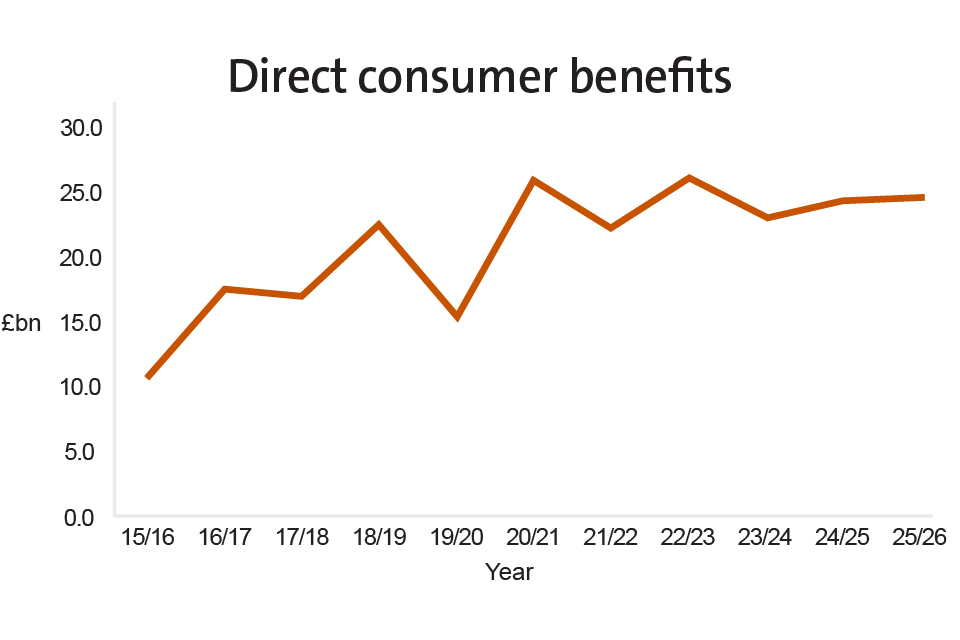
Graph shows the ratio of direct consumer benefits to costs, which has risen from around 11 to 1 in 2015 to 2016 to almost 25 to 1 in 2025 to 2026, with some fluctuations over time. The ratio is calculated as a three-year rolling average.
Fines imposed and ex-gratia payments
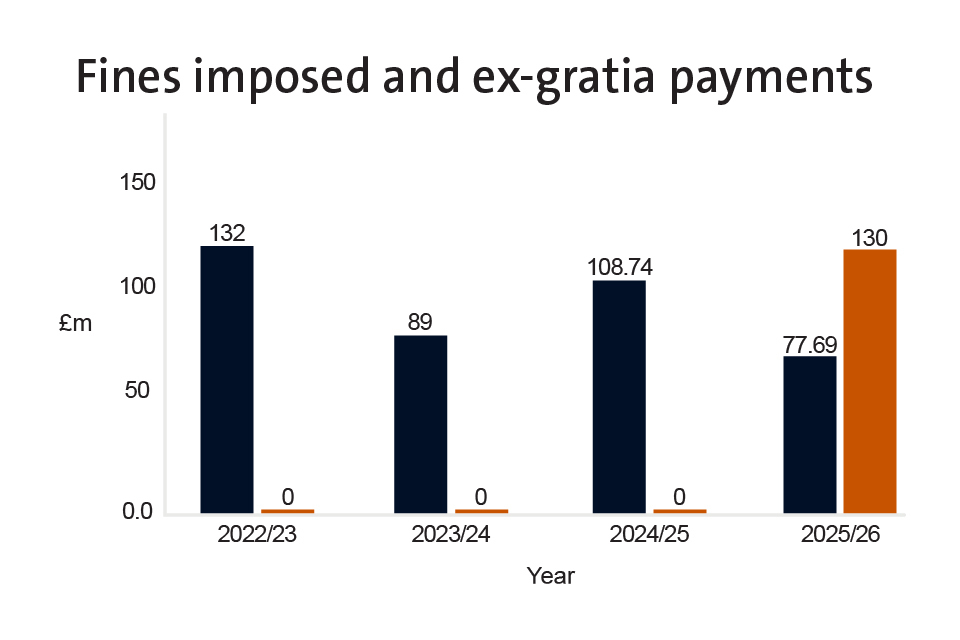
Chart shows fines imposed fluctuating between £77.69 million and £132 million between 2022 to 2023 and 2025 to 2026, while ex-gratia payments remained at zero until increasing to £130 million in 2025 to 2026.
Stakeholder engagement: raising awareness, listening and learning
- 4 meetings of Growth and Investment Council - new insights and constructive challenge from leaders of 11 major business and investor groups
- inaugural meeting of new Consumer Forum, to bring the voices of key consumer groups into our work
- participation in 169 diverse events – including AI adoption and how the CMA can best support growth
- consciously proactive and participative engagement throughout cases - more than 170 stakeholders met with in first 3 SMS investigations
- 10 events for businesses and investors on the CMA’s evolving approach to UK merger control
- 37 external speaking engagements to support implementation of new consumer regime, mainly targeted at businesses
Most significant casework: 2025 to 2026 Snapshot
Consumer protection
- 14 new regime investigations launched on drip pricing, fake reviews and online choice architecture. £4.2m fines and redress for 80,000 consumers through first of these
- swift, effective changes from Ticketmaster to make a real difference to loyal fans
- business guidance to support safe, trusted adoption of agentic AI
Advocacy
- competition thinking brought to the heart of policy development through work on Industrial Strategy, including scaleups, public procurement and anti-competitive regulation
Competition enforcement
- anti-competitive behaviour in housebuilding tackled: £100m affordable housing payment
- significant year for fines, including £99m upheld by courts for excessive NHS thyroid drug prices
Markets
- wide-ranging reforms to vets services to help millions of pet owners get a better deal
- clear recommendations to government to reform road and rail procurement in support of growth and investment
- agile, decisive response to Middle East crisis, supporting affordability for UK consumers and businesses
Merger control
- remedies secured to help keep down costs in areas like groceries and home improvements
- wider refresh of merger remedies approach, supporting clarity and certainty for businesses
Digital markets competition regime
- first 3 SMS designations in search and mobile ecosystems, enabling targeted interventions to unlock opportunities for growth, innovation and investment in UK tech
- new SMS investigation into Microsoft’s business software ecosystem, including cloud licensing
Driving growth
- agentic AI consumer protection guidance to support safe, trusted adoption
- advocacy to support pro-competitive policy making and industrial strategy: scaleups, public procurement, regulation
- significant progress on 4Ps to boost business confidence in UK regulatory landscape
- recommendations to government on civil engineering
- first 3 SMS designations under DMCR: enabling proportionate interventions in search and mobile ecosystems
Improving household prosperity
- tackling anti-competitive behaviour in housebuilding
- agile Middle East response: road fuel monitoring, heating oil
- consumer protection portfolio: first DMCCA investigations, Ticketmaster, fake reviews, online pricing, business guidance and outreach
- consumer-facing markets work: vets services, private dentistry
- taxpayer savings through competition enforcement: bid rigging and NHS drugs
About us
The CMA is an independent non-ministerial UK government department and is the UK’s primary competition and consumer protection authority. As set out in our Strategy (see summary below), our purpose is to promote competition and protect consumers with a clear end goal: to drive economic growth and improve household prosperity.
The CMA operates across the UK with offices in Belfast, Cardiff, Darlington, Edinburgh, London and Manchester. At the end of the 2025 to 2026 year, we employed around 1000 people.
The CMA is funded by HM Treasury (HMT), sponsored by the Department for Business and Trade (DBT), and is accountable to the UK Parliament. We lay our Annual Plan (AP) and ARA in Parliament, as well as in each of the devolved legislatures.
Our governance structure ensures fairness, independence, integrity, rigorous analysis, careful handling of sensitive information, effective use of public funds, and risk management – including the risks and challenges.
We are governed by a Board, which consists of the Chair, Chief Executive, Non-Executive Directors (2 of whom are also members of the CMA Competition Panel, and one of whom is Chair of the Office for the Internal Market), and Executive Directors. The Chief Executive, as the CMA’s Principal Accounting Officer, is responsible for the economy and efficiency of the CMA’s handling of public monies. Some functions of the CMA must be performed by members of the CMA Panel. CMA employees are civil servants.
Our 2026 to 2029 Strategy
Our purpose
We will promote competition and protect consumers with a clear end goal - to drive economic growth and improve household prosperity.
We will focus on five strategic objectives
1. Promoting effective competition
We will remain a strong advocate for, and independent enforcer of, effective competition across the UK economy - removing blockers to competition whilst also stepping up action to enable legitimate, pro-growth business collaboration.
2. Championing consumers
We will protect people from harm and help businesses do the right thing by their customers.
3. Helping government deploy tailored pro-competition interventions to support growth, innovation and investment-related policies
We will step up our role as an enabler of competition, providing expert advice and recommendations to government with a particular focus on public procurement and regulatory barriers.
4. Fostering a UK regulatory landscape that attracts investment and instils business confidence
We will continue to implement our 4Ps approach (pace, predictability, proportionality and process), ensuring the competition and consumer protection regimes contribute to the UK’s reputation as a great place to do business and invest.
5. Prioritising UK interests
Across all of our work, we will focus relentlessly on delivering tangible benefits for the UK’s economy, its citizens and businesses.
These will contribute to a set of mutually reinforcing outcomes:
- dynamic, competitive markets drive investment, innovation and growth
- strategically important markets and scaling businesses can flourish
- lower prices and fairer outcomes, particularly in essential markets, ease the burdens on household budgets
- consumers can engage confidently in markets, without fear of exploitation. • Fair-dealing businesses can compete on a level playing field
- our expert advice and recommendations to government shape pro-competitive policies that drive growth, support consumers, and secure value for money in public services
To deliver these objectives, we are making fundamental changes to how we work:
- embedding the 4Ps framework across all areas of the CMA
- evolving how we operate to maximise agility and productivity
- delivering a step-change in how we measure performance and impact
Performance analysis
Chief Executive’s Introduction
The UK continues to face acute economic pressures. Conflict in the Middle East, geopolitical instability and rapid technological change are compounding uncertainty for households and firms alike. Business confidence and trust in institutions remain fragile. At the same time, heightened concerns around security and sovereignty are driving a renewed focus on strengthening the resilience of the UK economy – particularly in sectors that are strategically important or have critical dependencies, such as technology and infrastructure.
In this context, competition and consumer protection are not abstract policy choices. How markets function, affordability and levels of consumer confidence all directly shape investment decisions, productivity, household resilience, and the economy’s capacity to adapt and grow in an uncertain world.
Over 2025 to 2026, the CMA leaned into this reality. Whilst we cannot control our external environment, our operating model, culture, setting a strategic direction and fitting our resources to the outcomes the country desperately needs is entirely within our gift. We believe in the power of competition, and we care about the UK’s long term prosperity and stability. So, we embraced the opportunity, delivering a year of impactful activity, while remaining agile in responding to opportunities to add value as they emerged.
We launched a bold new Strategy putting the outcomes the country needs – economic growth and household prosperity – at the heart of all our work. These outcomes, aligned with the government’s Strategic Steer, will guide our work over the next 3 years.
Our Strategy reflects the purposeful and pragmatic approach that has crystallised for the CMA over the last year. It means maximising speed to impact and deploying the full range of the CMA’s tools in the most proportionate manner possible; and helping to ensure the power of competition is deployed, alongside other policy levers, in service of national priorities.
This performance analysis shows how we delivered against our plan, including through:
- robust consumer enforcement, using our enhanced enforcement powers strategically - helping businesses comply with new rules, opening investigations into 14 businesses and securing direct refunds for consumers for the first time
- cross-market action in consumer-facing markets, notably vets services, road fuels, private dentistry and heating oil
- targeted and proportionate digital markets work to drive innovation and economic growth across search and mobile ecosystems
- a reimagining of our role not just enforcing but enabling competition – applying a combination of policy insight, microeconomics and markets expertise to advise government on where competition can help deliver national economic goals (including in relation to UK scaleups, public procurement and better regulation) including through our civil engineering market study
More than ever before, we have made conscious and agile choices about how best to deliver meaningful impact at pace, thinking creatively across our toolkit and making deliberate judgements about opportunity cost. In some cases, this meant pursuing the full legal process; in others, securing faster outcomes through guidance, warning letters, commitments or settlements.
We also sustained a step change in how we engage with stakeholders, both in and beyond casework. We strengthened relationships with business and investors through the Growth and Investment Council; and are now deepening multilateral engagement with consumer bodies through the new consumer forum. We also commissioned the CMA’s first regular feedback surveys, which are informing further changes to improve how we work and how we assess our performance.
Underpinning all of this, we continued to embed our 4Ps across the organisation. This transformation supports more pace, predictability, proportionality and direct engagement with stakeholders through our processes. It is a core contribution to a UK regulatory environment that builds business confidence and supports investment – and one which has helped inform positive change not only for the CMA, but across the broader regulatory landscape.
I am proud of how the CMA has responded to an exceptionally challenging year for households and businesses, and of the commitment and professionalism of our people. Stepping up to deliver real change within our organisation, and continued impact for the UK’s economy, citizens and businesses, has required the whole organisation to pull together as we evolve both culture and process. The direction of travel is highly positive as we carry this through into the new year, and I am confident in our ability to continue this trajectory as we look to the future.
Sarah Cardell, Chief Executive
Accountability and Independence
Parliamentary accountability
The CMA is accountable to Parliament for how we discharge our mandate. Alongside regular reporting to Parliament (including through this ARA), we deliver high levels of communications and outreach with Parliamentarians throughout the UK on diverse issues relating to our work. This year, we gave formal evidence to 6 UK and devolved Parliamentary Committees, and met with 6 Westminster All-Party Parliamentary Groups (and Parliamentary groups) to explain our work.
Independence
The CMA’s mandate to promote competition and protect consumers is enshrined in statute. Our operational independence is foundational to the integrity of the regime. At the same time, we operate in a policy-informed way, discharging our mandate in the UK’s best interests and recognising that real-world context, and government policy priorities, matter. This approach maximises the impact of competition while allowing us to bring competition thinking confidently and transparently into wider policy debates – even where it is not the pre-eminent policy goal, for example in areas such as industrial strategy and affordability.
Interaction with government
- the government’s Strategic Steer to the CMA provides important transparency over the policy priorities we can help advance, whilst explicitly acknowledging our independence. Our new Strategy and Annual Plan are aligned with this Steer, and we set out a summary of how we are implementing the Steer below. The relationship between the CMA and government is also underpinned by a Framework Agreement
- in common with other bodies, the CMA falls under the remit of the Regulation Action Plan. We have been front-footed in responding to expectations: working proactively to reduce burdens and improve certainty for businesses through our 4Ps programme; and improving transparency and accountability through our new performance metrics
- we make recommendations, provide advice, and engage routinely and proactively with UK and devolved governments. We act as a respected expert advisor across key policy areas, and help government bring competition thinking to bear in policy development.
How we are implementing the government’s Strategic Steer
1. Prioritise pro-growth and pro-investment interventions, wherever we have discretion
- strong pro-growth lens applied across our 2025 to 2026 portfolio and foundational to new Strategy
- action to improve functioning of civil engineering market and help government reframe road and rail procurement as a lever for growth and innovation
- 4Ps programme embedded so that competition and consumer protection regimes contribute to the UK’s reputation as a great place to do business and invest. Focus on increasing pace, predictability, proportionality and engagement (process) across the board
- targeted work under the 4Ps programme to refresh approach to merger remedies to help ensure the CMA can clear mergers that are capable of being cleared; and strategic review of markets remedies to ensure only those delivering real impact remain in place
2. Prioritise action where there is a clear and direct impact in the UK, and think carefully about when and how we engage in global issues
- prioritisation of UK interests embedded in new Strategy. Strong focus across all our work on delivering tangible benefits for the UK’s economy, and for UK citizens and businesses
- in merger control and digital markets, acting only where the CMA is best placed, including in relation to other agencies’ interventions across the globe
3. Work with other relevant regulators to ensure regulatory action is coherent, timely and that it supports dynamic markets, growth and investment in the UK
- collaborative approach to working with regulatory partners. In consumer protection, for example, operating alongside several other bodies across the UK with enforcement responsibilities, including trading standards and other members of the Consumer Protection Partnership (CPP)
- work to join up regulation in digital markets through the Digital Regulation Cooperation Forum (DRCF), including extensive programme on AI
- alignment with FCA on prioritisation statement intended to improve business confidence to collaborate lawfully
4. Use the new digital markets competition regime independently, flexibly, proportionately and collaboratively to unlock opportunities for growth
- 3 SMS designations made in core digital markets (search, mobile ecosystems) this year, with a targeted, flexible and ongoing approach to achieving improvements through a range of tools
- investigation into Microsoft’s business software ecosystem now launched; meaningful improvements to Microsoft and Amazon cloud services secured 5. Use our range of tools to help grow the economy through promoting consumer trust and confidence, while deterring poor corporate practices
- strategic approach to consumer protection, involving both enforcement and guidance to support business compliance. 14 investigations launched this year in priority areas and 20 guidance documents published or updated
- wide-ranging programme of consumer-facing markets work. Extensive reforms resulting from veterinary services market investigation; work in private dentistry and heating oil launched
5. Use our range of tools to help grow the economy through promoting consumer trust and confidence, while deterring poor corporate practices
- dtrategic approach to consumer protection, involving both enforcement and guidance to support business compliance. 14 investigations launched this year in priority areas and 20 guidance documents published or updated
- wide-ranging programme of consumer-facing markets work. Extensive reforms resulting from veterinary services market investigation; work in private dentistry and heating oil launched
6. Tackling anti-competitive conduct which harms businesses and consumers as swiftly as possible, in line with the new duty of expedition
- competition enforcement in multiple sectors, with range of tools deployed to achieve meaningful impact as quickly as possible. More than £77m fines imposed in the car industry, helping to robustly deter anti competitive behaviour. £100m payment for affordable housing programmes secured from housebuilders through commitments
7. Prioritise areas where competition can play an important role in driving efficiency and an enhanced user experience in the provision of key public services
- extensive work to tackle bid-rigging in public procurement through improved detection and move towards systematic screening
- enforcement against suspected anti-competitive behaviour in pharmaceuticals sector, with £23m payment to NHS secured
8. Continue to provide government with evidence and advice on key policy issues, including on the development and implementation of Industrial Strategy
- combination of policy, microeconomics and markets expertise is helping government enable competition in service of national policy goals. Scaleups, public procurement, and anti-competitive regulation all areas of focus
- microeconomics Unit (MU) Growth Programme progressed, deepening evidence base on critical drivers and blockers of growth
- considerable advice and reporting work carried out through specialist subsidy advice and internal market functions, including 36 independent reports on subsidies and annual report on developments in UK internal market
9. Continue to develop a contemporary evidence base to demonstrate our impact on the UK economy
- expanded CMA Impact Assessment (IA) published alongside this ARA, and stakeholder insights gathered from first of new, regular surveys
The Digital Markets, Competition and Consumers Act (DMCCA) 2024 introduced 2 landmark new regimes that the CMA has made full use of this year.
In consumer protection, the CMA now has an enhanced toolkit that includes being able to decide whether consumer protection laws have been infringed, order redress to affected consumers, and sanction businesses that fail to comply without going through the courts. Our approach to consumer protection is highly strategic, combining enforcement in priority areas with helping businesses comply with new rules (through guidance and pro-active engagement).
The digital markets competition regime (DMCR) enables the CMA to promote competition in fast-moving digital markets, while protecting UK consumers and businesses from unfair or harmful practices by the very largest technology firms (which the regime applies to). If certain conditions are met, these firms can be designated with strategic market status (SMS) in relation to a particular digital activity. The CMA can seek to achieve improvements in firm conduct and create opportunities for innovation and growth across the tech sector, using a range of means.
Consumer protection
Overview
The CMA’s ambition for consumer protection is to promote trust and confidence, so people can participate actively in the economy and businesses can compete on a level playing field. Our activities support improved household prosperity and economic growth, while deterring poor corporate practices.
Our 2025 to 2026 AP priorities were to focus on the most harmful and clear cut breaches of the law, prioritising areas of essential spend to support households under pressure. We particularly emphasised proactive engagement with businesses, developing accessible guidance to support awareness and compliance.
Case Study 1: Making a difference for fans through our Ticketmaster investigation
Live events provide millions in the UK with unforgettable experiences. Almost £7bn is spent each year on live music alone. Fans deserve to see clear, accurate information, upfront.
Ticketmaster’s practices came under the spotlight following the Oasis Live 2025 tour. The CMA had several concerns, which we probed through an investigation using powers under our previous consumer toolkit. In September 2025, the CMA secured formal commitments from Ticketmaster to give fans more information about prices and clear descriptions of exactly what they are getting for their money. Backed up by regular reporting to the CMA, this has meant swift, effective changes that are making a real difference to loyal fans.
Case Study 2: Resolving our first new regime investigations – drip pricing in driving schools
The first price customers see should be the price they pay. With household budgets under pressure, people must be able to shop confidently online. This is why we prioritised enforcement against unlawful online pricing practices, using our strengthened DMCCA toolkit. These include hidden or dripped fees that can lead consumers to spend up to £3.5bn more online each year than they intended.
In April 2026, 5 months from launch, the CMA concluded our first investigations under the new DMCCA regime. We found that drivers booking lessons online with AA Driving School and BSM Driving School (both owned by the AA) were not shown total upfront prices, as required by law. Instead, a mandatory £3 booking fee was added later in the process. On top of a £4.2m fine, the CMA leveraged new direct redress powers for the first time, ordering the AA to refund more than 80,000 learner drivers around £9 each on average.
Other significant work delivered in 2025 to 2026
2025 to 2026 marked the first 12 months of the new DMCCA regime.
This year we:
- opened investigations into 14 businesses and settled with 2
- issued 159 advisory and warning letters, with rapid impact - 90% of businesses changed their behaviour on fake reviews, for example, following advisory letters
- published or updated 20 guidance documents
- delivered 37 external speaking engagements, reaching around 2,000 attendees through events, seminars and briefings
Our public enforcement action targeted 3 areas:
-
Drip pricing with investigations relating to secondary ticketing and gym memberships, in addition to concluding work on driving school fees
-
Fake reviews opening investigations into 5 companies to establish whether consumer laws on misleading reviews have been broken, building on undertakings secured from Amazon in June 2025 to curb fake reviews, including enhanced detection systems and sanctions for businesses
-
Online choice architecture investigating default optional charges and false ‘time limited’ offers in the homeware sector
Beyond this, we continue to launch standalone cases addressing the conduct of specific businesses, where we have intelligence of potential infringement – for example, our investigation into Adobe is examining whether its early cancellation fees are unfair and misleading.
Embedding the 4Ps in consumer protection
Pace
Conducting our consumer protection investigations as efficiently and expeditiously as possible, as in the case of driving schools; streamlining cases to focus on key areas of concern; and keeping businesses under investigation updated on expected timelines, the status and progress of the case.
Predictability
Helping businesses understand how to comply with consumer law, including publishing clear guidance in formats that help businesses in all sectors of the economy and of all sizes understand their obligations; and supporting this with an ambitious engagement programme.
Proportionality
Focusing early action on more egregious conduct in areas where businesses should already be clear about the law, while engaging constructively and providing information where they are not sure how to comply. Our information gathering approach during investigations has been highly targeted. We are also resolving cases by consensus where we can do so without undermining deterrence (driving school fees, for example).
Process
New rules may create some uncertainty, particularly for SMEs, and so we are engaging widely and proactively with businesses and issuing clear, accessible guidance on a range of topics.
Spotlight: Supporting business compliance through guidance and outreach
Businesses complying with the law leads to good outcomes for consumers. The CMA has embraced our role in supporting this.
Guidance
We published or updated 20 guidance documents, including key materials on how we will use the new regime, alongside major cross-cutting guidance - such as unfair commercial practices. We also produced more targeted products, for example on price transparency, supported by a simple 3-step checklist promoted through the ‘Clear Pricing Campaign’ featuring Alexander Armstrong. This reflects a broader focus on clearer, more practical and more accessible guidance for businesses. That approach is making a real difference. For example, after we refreshed our resource page on social media reviews and endorsements, views increased by 660%.
Outreach
Our direct engagement programme with businesses has been ambitious, with 37 external speaking events this year, collectively reaching 2000 attendees. For example, we attended the Federation of Small Businesses (FSB) Coventry Business Bootcamp (helping us to reach SMEs) and started an events programme with regional law firms to share compliance advice.
Markets
Overview
Through our markets function, we identify and act on opportunities for markets to deliver better outcomes for the UK. These include more choice, lower prices and fairer outcomes for consumers. Alongside this, greater productivity, innovation and unlocking barriers to entry or scaling for challengers and small businesses. Our ambition is to realise these opportunities in a way that maximises overall benefits, while minimising potential costs and uncertainty for businesses, investors and other stakeholders.
Our 2025 to 2026 Annual Plan priorities were to drive forward our programme of work in consumer-facing markets, whilst applying a sharper priority to markets work that could have a multiplier effect on growth.
Case Study 3: Major reforms to veterinary services
Over half of UK households own pets, spending almost £400 a year on average on veterinary services. In March 2026, we concluded the most extensive review of veterinary services in a generation, having heard directly from an unprecedented 56,000 people over the course of our market investigation. The depth of concern about how the market was working was clear, including around persistent above-inflation price rises. We have set out wide-ranging reforms, and these legally binding measures will start coming into place by late 2026. They include prescription fee caps; providing comprehensive price lists, written estimates and itemised bills; and the creation of a price comparison website.
These measures will boost competition and drive down prices. However, we have been clear that competition alone is not enough to protect consumers. With modern legislation long overdue, the CMA backs the government’s proposed reforms to the Veterinary Surgeons Act. These reforms would, for the first time, make veterinary businesses, as well as individuals, accountable to an independent regulator.
Other significant work delivered in 2025 to 2026
Following 11 months of in-depth analysis and engagement, the CMA published the findings of our civil engineering market study in May 2026, recommending concrete actions to drive down costs and drive up innovation and productivity in a market that is central to driving economic growth through infrastructure investment. We are impressing on government the opportunity for systemic change, with our recommendations reflecting the need for strong central coordination, and a reframing of road and rail procurement as a lever for growth and innovation.
The CMA’s consumer-facing markets work supports affordability and fairer outcomes for households, which is particularly important at a time when geopolitical instability continues to intensify cost of living pressures. Alongside our work on veterinary services, we launched a market study into private dentistry, reflecting the growing number of people turning to private provision out of necessity. Our markets work has also been central to the CMA’s response to the crisis in the Middle East.
Spotlight: How the CMA is responding to the crisis in the Middle East
The crisis in the Middle East has had widespread effects in driving up wholesale prices for key commodities, and putting upward pressure on prices across a range of goods and services relied on by UK consumers.
Whilst we know that the majority of retailers behave responsibly and fairly, the CMA moved quickly to warn against exploitation, including through price increases that do not reflect genuine cost pressures. We took immediate action in areas most directly impacted by the conflict, launching a rapid market study in relation to heating oil and, in road fuel, stepping up our statutory monitoring function and putting firms on notice to supply accurate pricing information via the Fuel Finder scheme or risk fines. We continue to monitor sectors likely to be affected by price rises and disruption.
As set out in our Annual Plan for 2026 to 2027, we are highly conscious of the possibility of sustained conflict and instability in the Middle East and will prioritise medium and longer term affordability impacts in our work.
Embedding the 4Ps in Markets
Pace
Carefully selecting the appropriate markets tool at the outset, adopting the lightest-touch, fastest tool to effectively address the issues leading us to look at a market. In new markets projects, considering how best to engage expertise to support our understanding of the way the sector operates and commercial realities. For example, in civil engineering, appointing a sector panel.
Predictability
Publishing revised guidance on our overall approach to the regime. Within cases, publishing project roadmaps and introducing opportunities to update parties on progress and developing thinking.
Proportionality
Launching a strategic review of 33 CMA market remedies to ensure that only those remedies delivering real impact remain in place. In relation to information gathering, rolling out a more targeted approach in our private dentistry market study.
Process
Underpinning our casework with more active business and stakeholder engagement (teach-ins, monthly meetings, progress reports) to better understand likely impacts at key decision points.
Advocacy
Overview
The CMA has a statutory role providing expert advice and recommendations to governments and public authorities across the UK. This is increasingly underpinned by a powerful combination of policy, microeconomics and markets expertise. We deploy this function in a way that challenges ourselves, and government, to enable competition in service of national policy goals. Most notably, these include affordability for households and businesses, and the urgent need for economic growth, security and resilience in an uncertain world.
Our 2025 to 2026 AP priorities were to act as a respected expert advisor across key policy areas related to growth and household prosperity; and help government bring competition thinking to bear in broader policy development.
Case Study 4: Supporting growth through competition thinking
Competition is a powerful lever that can amplify delivery of national economic goals. As the government implements its Modern Industrial Strategy, a more activist role for the state creates new opportunities to shape markets in support of broad objectives - not least increased levels of growth and prosperity. Competition may not always be the primary goal in that context. However, competitive market dynamics and thoughtful pro competition interventions can help deliver better outcomes, more effectively, for the whole of the UK.
Scaleups
Scaled businesses generate high-value jobs, attract global investment, and strengthen the UK’s global position in critical sectors, so it is vital they remain here. Through an internationally recognised discussion paper, supported by extensive stakeholder engagement, the CMA has built a picture of how pro-competitive interventions can help scaling firms. We continue to generate insights to deepen government’s analytical understanding so that interventions can be better targeted.
Public procurement
UK public procurement, worth nearly £400bn annually, is the state’s single largest tool to shape markets. The CMA believes reforming public procurement (including broadening frameworks beyond traditional value-for money trade-offs) could represent a major opportunity drive growth, innovation and strategic resilience. We recently made recommendations to government through our civil engineering market study. These are designed to increase the effectiveness of procurement processes as part of a broader package to improve how road and rail projects are scoped, planned, procured and regulated.
We are also engaging with government in relation to defence procurement, national procurement strategies for cloud services, and to tackle bid-rigging through improved detection and more systematic screening, including through department-by-department pilots.
Regulation
The CMA has a mandate to assist government, and the wider regulatory community, improve pro competitive design and delivery of regulation to help reduce burdens. This year, we made recommendations through our civil engineering market study to align overlapping, duplicative accreditations and streamline standards that impose unnecessary costs and deter SMEs and challengers. We are also collaborating with the Medicines and Healthcare Products Regulatory Agency on pro-competitive regulation and procurement in the life sciences sector.
Other significant work delivered in 2025 to 2026
The CMA’s wider advocacy outputs this year included:
-
formal responses to 9 UK and devolved government consultations, including on public procurement, where we laid out practical approaches to help government deliver wider economic objectives through market shaping
- private responses to 30 requests for advice from UK and devolved governments, helping to bring considerations around competition and consumer protection to the heart of policy development
- advice to UK government on implementation of the recommendations made through our vets market investigation, which we are pleased to see being taken forward. Annex 2 to this performance analysis sets out the progress of recommendations made to government in recent years - overall, there has been notable progress this year, particularly by the UK government, in relation to the CMA’s longer-standing recommendations on road fuel, children’s social care and housebuilding - however, progress on infant formula (where recommendations were made in 2024 to 2025) has been more limited
Through research and analysis, we enriched the evidence base available to policy makers by:
-
diving deep into smart data and price transparency schemes, which could deliver much-needed benefits for consumers by improving their ability to search and compare prices, whilst strengthening price competition
-
progressing our MU growth programme focused on critical drivers and blockers of growth. We published new analysis on past industrial policies to help inform finalisation of government’s Modern Industrial Strategy, and a review of the relationship between competition and investment over the firm life cycle (feeding into our work on scaleups above) - we also explored the relationship between technology and productivity, including the role of competition in supporting technology diffusion across the economy - our most recent publication offers new empirical insights into UK supply chains, aligning with government calls for stronger evidence on economic resilience
Office for the Internal Market (OIM) and Subsidy Advice Unit (SAU)
Overview
The SAU and OIM reinforce the CMA’s advisory capabilities. The OIM provides economic advice and analysis supporting intra-UK trade – valued at more than 5% of UK GDP. The SAU delivers clear, actionable advice to public authorities to enable well-targeted interventions in a range of areas that impact on the lives of citizens and enable growth, including energy and net zero, transport, housing, life sciences, and regional economic development. Both functions report on the operation of the relevant policy frameworks. Our 2025 to 2026 AP priorities were for the SAU and OIM to carry out their statutory functions, including as the SAU worked towards its first periodic report on the operation and impact of the subsidy control regime.
Significant work delivered in 2025 to 2026
The SAU continued to play a central role in the operation of the UK subsidy control regime, publishing 36 independent advisory reports assessing public authorities’ compliance with the Subsidy Control Act 2022. (All for larger value subsidies and schemes of particular interest.) Reports spanned a range of sectors and public authorities across all 4 nations of the UK. They were also highly impactful, with more than 80% of referring public authorities this year telling us that they changed their subsidy or scheme as a result of engagement with the SAU. Alongside a large volume of referral casework, the SAU progressed its statutory monitoring role and has now published its first monitoring report on the effectiveness of the subsidy control regime.
In its latest annual report, the OIM found that the UK internal market remains broadly stable, but that ongoing and emerging regulatory differences across the 4 nations mean continued coordination between governments is essential to prevent new barriers to intra-UK trade. The OIM conducted sector-specific work this year in relation to farming and animal health, making recommendations to UK and devolved governments to mitigate business costs arising from proposed differences in national rules relating to bovine electronic identification (BEI). This monitoring and reporting work was supported by the OIM’s efforts to gather high quality data, with an updated OIM data strategy published in June 2025.
Embedding the 4Ps in OIM and SAU
Pace
Leaner, more agile SAU casework models, with smaller teams and front loaded analysis; more timely OIM advice delivered to governments through work on BEI.
Predictability
SAU facilitation and encouragement of pre referral discussions with public authorities, supporting better understanding of its expectations. Continued, active OIM engagement with businesses affected by regulatory divergence, as well as increased involvement in intergovernmental working groups through the Common Frameworks programme.
Proportionality
Updated SAU terms of reference to make governance procedures more agile; through its BEI work, a new OIM model for delivering proportionate, timely advice to governments aimed at avoiding unnecessary regulatory divergence.
Process
An expanded SAU outreach programme, meeting with more than 600 representatives of public authorities. OIM meetings with more than 100 businesses and trade groups.
Competition Enforcement
Overview
Our competition enforcement work deters anti-competitive conduct that stands in the way of fair outcomes for consumers and taxpayers, and impedes market dynamism and innovation. We have a range of tools at our disposal and we are unapologetic about taking the most effective route to achieve meaningful impact as quickly as possible. This may mean pursuing the full legal process, including imposing fines. In other cases, it may be more appropriate to use guidance, warning letters, commitments or settlements to bring investigations to an end by consensual agreement (without compromising deterrence).
Our 2025 to 2026 AP priorities were to resolutely deter anti-competitive practices, whilst providing guidance to help businesses lawfully collaborate to drive greater productivity.
Case study 5: Delivering savings for the NHS through competition enforcement
The CMA has a strong track record in tackling anti-competitive behaviour that harms UK taxpayers. Our action in relation to NHS drugs shows how a combination of interventions can help deliver significant impact.
First, by defending our decisions in court. After extended litigation, in May 2025, the Court of Appeal unanimously upheld the CMA’s finding that Advanz broke the law by overcharging the NHS for essential thyroid drug liothyronine. Our original investigation found that NHS annual spending jumped from over £2.3m to more than £30m in 7 years. The judgment sends a strong deterrent signal to companies that abuse their market power at the expense of taxpayers and the wider economy.
Second, by consensual end to an investigation where the circumstances were appropriate. In May 2025, the CMA accepted commitments from Vifor Pharma, addressing concerns that doctors had been given potentially misleading information about the safety of a rival treatment for iron deficiency anaemia. Alongside commitments to correct those communications and introduce future compliance measures, consulted on within 12 months of opening the investigation, Vifor made a voluntary payment of £23 million to the NHS.
Case Study 6: Housebuilding Investigation
In July 2025, the CMA secured a package of commitments from 7 of the UK’s largest housebuilders that delivered rapid, tangible benefits for the sector. The housebuilders agreed a combined £100 million payment – the largest ever secured by the CMA through commitments. This has been split between affordable housing programmes across all 4 nations, helping to fund hundreds of new homes for low-income households, first-time buyers and vulnerable people. Housebuilders also committed to robust measures to prevent anticompetitive behaviour and promote industry-wide compliance.
These outcomes followed a CMA investigation into concerns that the housebuilders had shared competitively sensitive information about sales which could weaken competition and affect the price and availability of new homes. By resolving the case through commitments, the CMA stopped potentially harmful behaviour quickly, strengthened compliance across the sector, and delivered rapid public benefits to support access to housing.
Other significant work delivered in 2025 to 2026
We progressed investigations in a range of sectors that touch the lives of citizens and businesses across the UK, including schools construction, waste management, and hotel online booking. In relation to travel – in April 2025, car manufacturers and industry bodies reached a settlement with the CMA after admitting breaches of competition law relating to vehicle recycling and related advertising claims. This resulted in fines totalling more than £77m. Then, in August 2025, we made a final decision to accept commitments preserving competition for UK-US passenger routes. The CMA’s overall deterrent effect this year was amplified through 50 warning and advisory letters concerning potentially unlawful behaviour in a range of sectors.
The CMA also enables competition by supporting legitimate business collaboration. We maintained an ‘open door policy’ for businesses to come forward with concrete evidence that competition law concerns could be chilling beneficial collaborations. We were highly proactive – publishing an accessible guide on how to collaborate without breaking competition law, as well as specific guidance on higher education, competing for talent, and environmental sustainability. Public statements on enforcement prioritisation can also support business confidence around collaboration – for example, our statement on commercial Variable Recurring Payments for open banking, where (aligned with the FCA) we signalled that we do not currently intend to prioritise enforcement.
Embedding the 4Ps in Competition Enforcement
Pace
Striving to deliver impact in the timeliest manner possible, with a statutory duty of expedition under the DMCCA now applying to all our competition enforcement investigations. Within cases, leveraging technology investment to speed up evidence review, alongside e-confidentiality tools.
Predictability
Working to facilitate legitimate business collaboration, which can support investment, innovation and growth.
Proportionality
Achieving the right suite of interventions across the regime, using the full range of tools to bring about good outcomes.
Process
With new guidance in place this year, implementing more streamlined procedures to make it easier for firms involved in a cartel to apply for leniency; and encouraging complaints from businesses affected by potential anti-competitive behaviour.
Digital markets competition regime
Overview
As new technology permeates every aspect of our lives, effective competition in digital markets is key. The CMA is committed to deploying a pro-competition lens to unlock opportunities for increased consumer choice, as well as investment, innovation and growth across the UK’s digital economy. Our approach involves leveraging the unique design of the UK regime – flexible, participative and forward-looking – to support an environment where all companies, large and small, can flourish.
Our 2025 to 2026 AP priorities for the DMCR were to carry out our first SMS investigations under the new regime, with a view to ensuring that benefits for UK consumers and businesses across the economy are delivered in a proportionate way, and as quickly as possible.
Case Study 7: Improving the way Google delivers search services in the UK
Google handles more than 90% of general search queries in the UK, with millions of people relying on it as a gateway to the internet, and over 200,000 UK firms spending more than £10 billion annually on Google search advertising.
In October 2025, the CMA designated Google as having SMS in general search services, comprising its general search and search advertising activities. Designation does not necessarily mean that the CMA will impose requirements. In relation to Search, however, our view is that tailored ‘conduct requirement’s (CRs) are necessary and proportionate to support innovation and growth, while ensuring that consumers and businesses are treated fairly. Our CRs focus on a fairer deal for content publishers, including a world first whereby publishers will be able to opt out of their content being used to power AI features in Google search, as well as clearer, more predictable and more transparent ranking systems that could give businesses greater scope to expand and invest.
All CRs will be supported by robust monitoring. The CMA will gather and report against metrics in future years to evidence the effectiveness and impact of our interventions.
Case Study 8: Better outcomes in mobile platforms
Almost every adult in the UK uses a mobile device. Almost all of these devices have a ‘mobile platform’ provided by either Apple (based around iOS) or Google (based around Android). Mobile platforms are integral to the UK’s app economy, which generates an estimated 1.5% of UK GDP and supports around 400,000 jobs.
In October 2025, the CMA designated Apple and Google as having SMS in regard to their respective mobile platforms. A unique strength of the UK regime is the ability to achieve improvements in a targeted, flexible manner, using a range of tools and prioritising speed to impact for the UK. In this case, we secured commitments from both firms, all now in effect, to give UK developers greater certainty, functionality, and transparency – supporting their confidence to bring new and innovative propositions to market. Whilst commitments will not be appropriate in all circumstances, here they have delivered swift, uncontested market improvements, and are underpinned by robust transparency and oversight measures.
Further to plans we laid out at the start of 2026, the CMA is now consulting on measures to improve app distribution on both iOS and Android, and published an update on how we might open up competition in relation to Near Field Communication access (which underpins a smartphone’s ability to make contactless transactions) and digital wallets.
Embedding the 4Ps in digital markets competition regime
Pace
In our first 3 SMS investigations, prioritising and standing down lines of inquiry in aid of a streamlined approach.
Predictability
Incorporating roadmaps into SMS investigations, to increase predictability around our priorities for potential interventions throughout the year.
Proportionality
At every stage (including when structuring investigation launches and consultations), ensuring stakeholders have sufficient time to engage. Also maintaining our focus on whether the CMA is best placed to act, considering any interplay with the actions of other regulators and government bodies, domestically and internationally.
Process
Maintaining a highly participative approach through extensive consultation with stakeholders in SMS investigations (more than 170 stakeholders met with in total).
Spotlight: SMS investigation into Microsoft’s business software ecosystem
In May 2026, we launched our fourth SMS investigation into Microsoft’s business software ecosystem, recognising its central role in the UK economy. The investigation comes as AI is rapidly integrated into core business tools used across the private and public sectors. The CMA’s investigation will examine whether Microsoft has SMS in business software and consider whether it can use that position to limit customer choice. It will assess whether bundling of products, limits in interoperability or default settings can prevent customers switching and weaken the competitive constraints Microsoft faces from rivals. This includes looking at how AI competitors are able to integrate with Microsoft’s business software, giving customers access to AI software across suppliers to best suit their needs.
An SMS designation would allow the CMA to act on a major concern from our cloud market investigation, which concluded in July 2025 – namely, Microsoft’s use of software licensing reducing competition in cloud. It would also provide a route to ensuring a level playing field among providers at a critical moment, as AI-driven innovation reshapes competition in productivity software.
Spotlight: How the CMA enables safe, AI-driven innovation to support growth
AI can be a powerful driver of UK growth and productivity – but only if businesses have the clarity to deploy it, and the public has confidence that it is used safely and fairly. Over the past year, we have drawn on our competition, consumer protection and market analysis expertise to support trusted, pro-innovation adoption of AI.
Alongside offering practical support to government for delivery of the AI Opportunities Action Plan, we published:
- new guidance for businesses on the application of consumer protection law to agentic AI, giving them the confidence to innovate in a way which protects consumers
- new, overarching analysis on how agentic AI is being used today, what the future could hold and how this will affect consumers
- a widely-read blog on AI and collusion, including practical tips for businesses using pricing algorithms
We continue to use AI internally to strengthen delivery of our functions:
- in-house data science capability supports casework, markets analysis and horizon scanning
- new agentic tools help us identify consumer harms at scale
- advanced analytics are enhancing detection of bid-rigging risks in public procurement
Through our partnership with other regulators in the DRCF, we:
- participated in the launch of a Thematic Innovation Hub for innovators, offering tailored engagement and joined-up regulatory advice on agentic AI
- contributed to a forward-looking exploration of how UK regulatory frameworks can help realise the opportunities of responsible and safe agentic AI
- helped to generate insights into AI adoption across the UK
Merger control
Overview
Merger control safeguards consumer interests and ensures UK markets remain dynamic and competitive, spurring innovation and growth. Most mergers do not raise competition concerns, but those that do can negatively impact on consumers (for example, through higher prices); and businesses (for example, by reducing incentives for investment). The CMA is clear that every deal capable of being cleared unconditionally, or with effective remedies, should be.
Our 2025 to 2026 AP priorities focused on operating the regime in a way that continues to protect UK consumers whilst also building business and investor confidence. In line with our mergers charter, we aim to reach the right decisions as quickly as possible, while minimising the burden on businesses.
Significant work delivered in 2025 to 2026
The CMA applied our merger control powers in a targeted, proportionate way, focusing our attention on the small number of deals which raised concerns for UK consumers and businesses. Of more than 40,000 deals announced globally, we:
- considered 902 merger cases
- concluded 32 phase 1 reviews
- concluded 4 phase 2 reviews
In terms of outcomes for reviews that concluded this year:
- 24 were cleared unconditionally (at either phase 1 or phase 2)
- 5 were cleared with remedies (at either phase 1 or phase 2)
- no merger was abandoned during the course of an investigation
- 2 mergers were subject to a prohibition decision
Many of the mergers we investigated arose in markets that matter directly to UK households – from care homes, to delivery services and home improvements.
Several related to groceries, where we:
- protected competition in supermarket supply chains, securing phase 1 remedies to Greencore’s acquisition of Bakkavor to help keep prices as low as possible for own-label chilled sauces
- investigated the potential effects on cost and quality of frozen baked goods supplied to supermarkets, referring Vandemoortele’s acquisition of Délifrance to phase 2
- helped keep the cost of supermarket warehousing low, as well as the prices paid by shoppers, through phase 2 remedies on GXO’s acquisition of Wincanton
Our merger investigations also helped to keep prices competitive in markets relied on by UK businesses, while protecting incentives for innovation and investment. We:
- helped ensure a competitive supply chain for firms looking to purchase aircraft components, securing phase 1 remedies on Safran’s acquisition of Collins
- progressed both phase 1 and phase 2 investigations into Getty’s proposed purchase of Shutterstock, which has since been provisionally cleared with remedies
- delivered benefits in sectors related to offshore oil and gas, securing phase 1 remedies for Schlumberger’s acquisition of ChampionX - following a phase 2 investigation, an independent panel decided that Aramark must unwind its purchase of Entier, restoring competition for offshore catering services
Embedding the 4Ps in Merger Control
Pace
Implementing a step change through new targets for prenotification and straightforward phase 1 cases - now a cornerstone of our new organisational performance metrics.
Predictability
Finalising new guidance on jurisdiction and procedure to increase business confidence to self-assess whether transactions will be within CMA jurisdiction. Introducing regular update calls during investigations to give merging businesses and advisors feedback on progress.
Proportionality
Where a merger is being investigated by another competition authority, considering whether we can ‘wait and see’ for those proceedings to resolve any UK concerns, before opening our own investigation. Within investigations, streamlining issues and sending targeted information requests, which merging businesses have welcomed.
Process
Guided by our mergers charter within cases, continually reflecting on what is working well and what could be done differently – both by the CMA and by parties and their advisors. Driving forward targeted outreach programmes for businesses and investors, hosting 10 events and participating in 17 further external speaking engagements.
Spotlight: Updating our approach to merger remedies
Provided they are put on the table at the right time, merger remedies play an important role in enabling the CMA to clear mergers that are capable of being cleared. Refreshing our remedies guidance has been a core part of the 4Ps in merger control, giving parties greater clarity and certainty about our approach - while keeping the focus firmly on effective outcomes.
Finalised in December 2025, the new guidance in relation to behavioural remedies sets out the factors we consider, and how risks can be managed. While structural remedies will usually be the most effective, we recognise that behavioural remedies can be the right answer in some cases – even at phase 1. To help ensure that pro-growth deals which do not harm consumers can proceed where possible, we also added clarity on substantive areas, such as how we assess ‘Relevant Customer Benefits’. These can help secure the best possible outcomes for customers, including lower prices or better quality.
Spotlight: Government reforms to the competition regime
In May 2026, government announced its intention to introduce a Competition Reform Bill in the King’s Speech, with a particular focus on strengthening the effectiveness, accountability and transparency of the mergers and markets regimes. The CMA welcomes the government’s proposals, which we consider complement the CMA’s operational transformation and further embed the 4Ps programme.
Important refinements we understand will be taken forward by government include:
- enhancing accountability and consistency in decision-making by giving the CMA board a greater role in merger and markets cases
- making market reviews faster and more focused, delivering significant benefits to consumers and businesses more quickly
- providing greater certainty on merger jurisdiction and enabling a more flexible, proportionate review of market remedies
The CMA stands ready to assist government as it develops legislation. This includes any further changes government might bring forward regarding the opt-out private damages regime, and regulatory appeals (where we have carried out significant work in relation to water and energy this year in line with our existing statutory duties and as efficiently as possible).
Evolving how we work: performance metrics
Guided by our new Strategy, and consistent with the government’s expectations, the CMA is delivering a step-change in organisational performance. We want to be transparent about how we are doing, open to feedback, and proactive in identifying opportunities to improve further. As indicated in our 2024 to 2025 ARA, we have overhauled our approach to measuring and reporting on our performance. This includes, for the first time, a data-driven performance assessment, complementing more detailed, qualitative information laid out in this ARA. We expect to evolve this assessment in future years and welcome feedback on our approach.
There are 3 important aspects of our performance that data can help to draw out:
1. The impact of our work
This is ultimately the most important marker of our success – it reflects our contribution to the UK, including the clear end goals in our strategy: economic growth and household prosperity.
2. Our speed and efficiency
These enablers allow us to maximise our impact through rapid and effective intervention.
3. Stakeholder experience and engagement
This helps us understand where our work can add value; how we can continue to improve; and whether we are contributing to a UK regulatory environment which inspires confidence.
For each of these areas, we lay out a range of relevant performance metrics in Annex 1 to the performance analysis.
These metrics include:
Outcome metrics
Which relate tangibly to the impact of our work, such as the direct financial benefits we monetise through our Impact Assessment (IA), and relevant stakeholder experiences.
Input metrics
The activities that contribute to our impact, particularly where it remains difficult to capture that impact fully. Examples include our deterrent effect, where metrics such as fines and warning and advisory letters help to build a sense of our impact As this is the first year of this approach, the data for 2025 to 2026 represents a baseline for the future. We expect to evolve this data-driven assessment in future years, alongside making further step changes to the methodology underpinning our IA, which has been published alongside this ARA.
Evolving how we work: organisational transformation
In a volatile and uncertain environment, which is placing sustained pressure on the UK economy and the cost of living, the need for the CMA’s work has never been greater.
We are driving forward an organisational transformation programme that is focused on ensuring we are equipped to meet that need – now and in the future – with the agility required to respond as markets and risks evolve.
Much of what sits behind this transformation is already underway, as laid out in our 2026 to 2029 Strategy. From meaningful improvements through the 4Ps programme, to better use of management information and the roll out of AI. We are now putting in place the critical capability enablers to help us deliver on our new Strategy – particularly to increase our speed to impact, and to prioritise timely, well-scoped interventions.
This work is based around 3 pillars:
1. Digital transformation
Making our core digital environment more secure, modern, integrated and scalable. We are upgrading systems at the heart of our casework, continuing to roll out digital case management and updating our evidence review platform. Building on the successful rollout of everyday AI tools across the CMA, we are accelerating the responsible use of AI where it can genuinely add value. This includes more specialised applications to support live casework, evidence analysis and drafting. Underpinning this work, we are building the skills, confidence and culture that support successful digital transformation across our workforce.
2. People
Ensuring each member of staff is equipped to play their full part in delivering on our Strategy. We are focusing on building leadership capability, career pathways, and our reward offer.
3. Productivity
Deploying our people, resources and tools in the most efficient way, to deliver maximum impact as quickly as possible. This includes recent improvements to prioritisation processes, and to the way we analyse impact across our portfolio. It also means streamlining delivery of CMA projects and building mechanisms to facilitate agile deployment of people and resources to priority areas.
Risks, challenges and opportunities
Delivery of the CMA’s new Strategy and organisational transformation will be affected by the way we navigate several significant risks and challenges.
-
Ongoing conflict in the Middle East, where continued instability could further intensify price volatility in essential markets and increase the risk of unlawful conduct. The CMA has responded swiftly to near term pressures, but implications for our future portfolio of work are unclear. Nevertheless, we are committed to prioritising medium and longer term affordability impacts and will respond robustly to evidence of harmful practices across the economy.
-
In a world of mobile capital and talent, the UK must work hard to attract the investment needed to power growth. By continuing to embed the 4Ps across our core functions, we will double down on our contribution to a UK regulatory landscape that acts as a magnet for investment. However, real, lasting transformation does not happen overnight – particularly where the requisite change is as much about culture as process. We remain determined to evolve and embed the 4Ps, listening and learning from stakeholder feedback as we go.
-
Our evolving approach to achieving impact requires ongoing, conscious consideration. In many cases, we will prioritise the most effective route to deliver meaningful impact as quickly as possible. This means drawing on the full range of tools available to us - not only formal investigations and litigation, but also early engagement and guidance to support compliance; warning or advisory letters; commitments, settlements or other forms of resolution. Where harm is serious and the law is clear, we will not hesitate to pursue formal enforcement where this is required to achieve effective outcomes. Just as over reliance on formal routes can slow delivery, increased use of informal tools must not come at the expense of effective deterrence. We will keep this balance under active review.
-
Rapid developments in AI (including agentic systems) present opportunities to unlock innovation and productivity, but also risk giving rise to new or amplified consumer harms and competition concerns. The CMA will continue to focus on supporting safe, trusted adoption in competitive markets, and will assist government in delivering the AI Opportunities Action Plan.
-
We are highly conscious of the need to maximise the value we deliver with the finite resources available to us. In common with other bodies, constrained public finances, and a complex, evolving portfolio, could affect delivery and create difficult trade-offs. Our organisational transformation programme is designed to mitigate these risks.
Annex to the performance analysis (1): performance metrics
The impact of our work
We have broken this down into direct and indirect impact; the extent to which stakeholders think we are contributing to our defined outcomes; and how our project portfolio maps to those outcomes. In 2025 to 2026 we substantially exceeded the government target of delivering £10 in direct consumer benefits for every £1 spent on our operations. Our work has less direct (but nonetheless important) effects – such as the CMA’s overall deterrent effect, driven by inputs such as fines and warning and advisory letters.
Stakeholder views help us understand the extent to which stakeholders believe we are contributing to the strategic outcomes we seek to support in our 2026 to 2029 Strategy, and mapping of our portfolio is another relevant indicator. Our overall delivery gives a sense of the breadth of our impact.
Impact
Direct impact
| Direct impact | Impact data | Explanatory notes |
|---|---|---|
| Average ratio of direct consumer benefits delivered by the CMA to operating spend over the last 3 years | 24.7:1 | Outcome metric. In 2025 to 2026 we substantially exceeded the government target of £10 direct consumer benefits for every £1 spent on our operations. More information can be found in the CMA’s Impact Assessment for 2025 to 2026, published alongside this ARA. |
| Annual average direct consumer benefits delivered by the CMA over the last 3 years | £3.3billion | Outcome metric, Total direct impact, More information can be found in the CMA’s Impact Assessment for 2025 to 2026, published alongside this ARA. |
Indirect impact
| Indirect impact | Impact data | Explanatory notes |
|---|---|---|
| Warning and advisory letters issued (competition and consumer protection law) | 209 | Our work has less direct (but nonetheless important) effects – such as the CMA’s overall deterrent effect, driven by inputs such as fines and warning and advisory letters. Fines metric is inclusive of penalties imposed by the CMA through competition and consumer enforcement this year. It does not include income from fines imposed in previous years. As set out in the trust statement, our total fining income this year was £170.5m |
| Fines imposed | £78.2 million | Our work has less direct (but nonetheless important) effects – such as the CMA’s overall deterrent effect, driven by inputs such as fines and warning and advisory letters Fines metric is inclusive of penalties imposed by the CMA through competition and consumer enforcement this year. It does not include income from fines imposed in previous years. As set out in the trust statement, our total fining income this year was £170.5m |
Percentage of stakeholders that consider that the CMA is making a positive contribution to our 6 strategic outcomes:
| Indirect impact | Impact data | Explanatory notes / outcome metric |
|---|---|---|
| Dynamic, competitive markets drive investment, innovation and growth | 47% | Stakeholder views help us understand the extent to which stakeholders believe we are contributing to our Strategy outcomes. More information can be found in the full report of the CMA Stakeholder experience survey, published alongside this ARA. |
| Strategically important markets and scaling businesses can flourish | 50% | Stakeholder views help us understand the extent to which stakeholders believe we are contributing to our Strategy outcomes. More information can be found in the full report of the CMA Stakeholder experience survey, published alongside this ARA. |
| Lower prices and fairer outcomes, particularly in essential markets, ease the burdens on household budgets | 52 % | Stakeholder views help us understand the extent to which stakeholders believe we are contributing to our Strategy outcomes. More information can be found in the full report of the CMA Stakeholder experience survey, published alongside this ARA. |
| Consumers can engage confidently in markets, without fear of exploitation | 60% | Stakeholder views help us understand the extent to which stakeholders believe we are contributing to our Strategy outcomes. More information can be found in the full report of the CMA Stakeholder experience survey, published alongside this ARA. |
| Fair-dealing businesses can compete on a level playing field | 60% | Stakeholder views help us understand the extent to which stakeholders believe we are contributing to our Strategy outcomes. More information can be found in the full report of the CMA Stakeholder experience survey, published alongside this ARA. |
| Our expert advice and recommendations to government shape pro-competitive policies that drive growth, support consumers, and secure value for money in public services | 53% | Stakeholder views help us understand the extent to which stakeholders believe we are contributing to our Strategy outcomes. More information can be found in the full report of the CMA Stakeholder experience survey, published alongside this ARA. |
Mergers
| Delivery by function | Impact data | Explanatory notes / outcome metric |
|---|---|---|
| Merger cases considered by the Merger Intelligence Committee | 902 | - |
| Phase 1 merger investigations concluded | 32 | - |
| Phase 2 merger investigations concluded | 4 | - |
DMCR
| Delivery by function | Impact data | Explanatory notes / outcome metric |
|---|---|---|
| Strategic Market Status (SMS) investigations undertaken | 3 | Whilst no CRs were imposed during the 2025 to 2026 financial year, the CMA consulted on 4 proposed CRs relating to Google’s general search services. A package of commitments relating to Apple’s and Google’s mobile ecosystems came into force at the start of the 2026 to 2027 financial year. |
| Conduct Requirements (CRs) implemented | Not applicable this year (see explanatory notes) | Whilst no CRs were imposed during the 2025 to 2026 financial year, the CMA consulted on 4 proposed CRs relating to Google’s general search services. A package of commitments relating to Apple’s and Google’s mobile ecosystems came into force at the start of the 2026 to 2027 financial year. |
| Commitments agreed | Not applicable this year (see explanatory notes) | Whilst no CRs were imposed during the 2025 to 2026 financial year, the CMA consulted on 4 proposed CRs relating to Google’s general search services. A package of commitments relating to Apple’s and Google’s mobile ecosystems came into force at the start of the 2026 to 2027 financial year. |
| Pro-Competition Interventions (PCIs) implemented | Not applicable this year | Whilst no CRs were imposed during the 2025 to 2026 financial year, the CMA consulted on 4 proposed CRs relating to Google’s general search services. A package of commitments relating to Apple’s and Google’s mobile ecosystems came into force at the start of the 2026 to 2027 financial year. |
Markets
| Delivery by function | Impact data | Explanatory notes / outcome metric |
|---|---|---|
| Markets projects (reviews, studies, investigations) open at year start (1 April 2025) | 2 | veterinary services and cloud services market investigations were open at the start of the year and completed during 2025 to 2026. At year end, 3 market studies were open: civil engineering, private dentistry, and heating oil. |
| Markets projects (reviews, studies, investigations) completed | 2 | veterinary services and cloud services market investigations were open at the start of the year and completed during 2025 to 2026. At year end, 3 market studies were open: civil engineering, private dentistry, and heating oil. |
| Markets projects (reviews, studies, investigations) open at year end (31 March 2026) | 3 | veterinary services and cloud services market investigations were open at the start of the year and completed during 2025 to 2026. At year end, 3 market studies were open: civil engineering, private dentistry, and heating oil. |
Competition enforcement
| Delivery by function | Impact data | Explanatory notes / outcome metric |
|---|---|---|
| Investigations open at year start (1 April 2025) | 7 | Competition enforcement investigations completed this year resulted in 1 infringement decision and 3 commitments decisions |
| Investigations open at year end (31 March 2026) | 5 | Competition enforcement investigations completed this year resulted in 1 infringement decision and 3 commitments decisions |
| Investigations completed | 4 | Competition enforcement investigations completed this year resulted in 1 infringement decision and 3 commitments decisions |
Consumer protection
| Delivery by function | Impact data | Explanatory notes / outcome metric |
|---|---|---|
| Investigations open at year start (1 April 2025) | 2 | Consumer protection investigations completed this year both involved the acceptance of undertakings from parties under investigation |
| Investigations open at year end (31 March 2026 | 14 | Consumer protection investigations completed this year both involved the acceptance of undertakings from parties under investigation |
| Investigations completed | 2 | Consumer protection investigations completed this year both involved the acceptance of undertakings from parties under investigation |
SAU
| Delivery by function | Impact data | Explanatory notes / outcome metric |
|---|---|---|
| Subsidy reviews completed | 36 | - |
Projects mapped to strategic outcomes
| Our projects mapped to strategic outcomes | Impact data | Explanatory notes |
|---|---|---|
| Dynamic, competitive markets drive investment, innovation and growth | 6 projects (12%) were considered to be most aligned to this outcome, 41 projects (84%) were considered to have a substantial alignment to this outcome (potentially alongside other outcomes). | This mapping concerns the 49 most significant and resource-intensive projects that the CMA undertook over the course of 2025 to 2026. These include some of our advocacy and research projects, but exclude our phase 1 merger investigations and subsidy reviews. |
| Strategically important markets and scaling businesses can flourish | 6 projects (12%) were considered to be most aligned to this outcome, 20 projects (41%) were considered to have a substantial alignment to this outcome (potentially alongside other outcomes). | This mapping concerns the 49 most significant and resource-intensive projects that the CMA undertook over the course of 2025 to 2026. These include some of our advocacy and research projects, but exclude our phase 1 merger investigations and subsidy reviews. |
| Lower prices and fairer outcomes, particularly in essential markets, ease the burdens on household budgets | 9 projects (18%) were considered to be most aligned to this outcome, 31 projects (63%) were considered to have a substantial alignment to this outcome (potentially alongside other outcomes). | This mapping concerns the 49 most significant and resource-intensive projects that the CMA undertook over the course of 2025 to 2026. These include some of our advocacy and research projects, but exclude our phase 1 merger investigations and subsidy reviews. |
| Consumers can engage confidently in markets, without fear of exploitation | 17 projects (35%) were considered to be most aligned to this outcome, 31 projects (63%) were considered to have a substantial alignment to this outcome (potentially alongside other outcomes). | This mapping concerns the 49 most significant and resource-intensive projects that the CMA undertook over the course of 2025 to 2026. These include some of our advocacy and research projects, but exclude our phase 1 merger investigations and subsidy reviews. |
| Fair-dealing businesses can compete on a level playing field | 6 projects (12%) were considered to be most aligned to this outcome, 40 projects (83%) were considered to have a substantial alignment to this outcome (potentially alongside other outcomes). | This mapping concerns the 49 most significant and resource-intensive projects that the CMA undertook over the course of 2025 to 2026. These include some of our advocacy and research projects, but exclude our phase 1 merger investigations and subsidy reviews. |
| Our expert advice and recommendations to government shape pro-competitive policies that drive growth, support consumers, and secure value for money in public services | 5 projects (10%) were considered to be most aligned to this outcome, 13 projects (27%) were considered to have a substantial alignment to this outcome (potentially alongside other outcomes). | This mapping concerns the 49 most significant and resource-intensive projects that the CMA undertook over the course of 2025 to 2026. These include some of our advocacy and research projects, but exclude our phase 1 merger investigations and subsidy reviews. |
Our speed and efficiency
| Mergers | Impact data | Explanatory notes |
|---|---|---|
| Percentage of phase 1 merger investigations completed within 40 working day statutory deadline (inc. where extended) | 100% | - |
| Percentage of phase 2 merger investigations completed within 24 week statutory deadline (inc. where extended) | 100% | - |
| DMCR | Impact data | Explanatory notes |
|---|---|---|
| Percentage of SMS investigations completed within 9-month statutory deadline (inc. where extended) | 100% | - |
| Percentage of PCI investigations completed within 9-month statutory deadline | Not applicable this year | - |
| Markets | Impact data | Explanatory notes |
|---|---|---|
| Percentage of market studies completed within 12 month statutory deadline (inc. where extended) | Not applicable this year | - |
| Percentage of market investigations completed within 18 month statutory deadline (including where extended) | 100% | - |
| Subsidy Advice Unit | Impact data | Explanatory notes |
|---|---|---|
| Percentage of subsidy reviews completed within 30 working day statutory deadline | 100% | - |
| Competition enforcement | Impact data | Explanatory notes |
|---|---|---|
| Average duration, over the last 3 years, of competition enforcement investigations | 37 months | - |
| Consumer protection | Impact data | Explanatory notes |
|---|---|---|
| Average duration, over the last 3 years, of competition enforcement investigations | To be reported on in future years as the new regime embeds | - |
Delivery to 4Ps-related targets (merger control and markets
| Mergers | Impact data | Explanatory notes |
|---|---|---|
| Percentage of merger prenotifications completed within 40 working day target (exc. cases where parties agreed an alternative timescale with the CMA | 100% | - |
| Percentage of straightforward phase 1 merger investigations completed within 25 working day target | 100% | - |
| Markets | Impact data | Explanatory notes |
|---|---|---|
| Percentage of markets projects (reviews, studies and investigations) that met targets set out in roadmaps | Not applicable this year | Outcome metric An average of stakeholders who, in response to our stakeholder survey, said that they: 1. ‘Strongly agreed’ or ‘tended to agree’ that the CMA sought to resolve the case in a way that addressed the CMA’s concerns at the earliest stage 2. ‘Strongly agreed’ or ‘tended to agree’ that the CMA looked for opportunities to streamline the case processes where possible 3. Thought that the CMA ‘always’ or ‘often’ responded promptly to requests. More information can be found in the full report of the CMA Stakeholder experience survey, published alongside this ARA |
| Average percentage of stakeholders who responded positively when asked about their experience of pace in the CMA’s casework | 63% | Outcome metric An average of stakeholders who, in response to our stakeholder survey, said that they: 1. ‘Strongly agreed’ or ‘tended to agree’ that the CMA sought to resolve the case in a way that addressed the CMA’s concerns at the earliest stage 2. ‘Strongly agreed’ or ‘tended to agree’ that the CMA looked for opportunities to streamline the case processes where possible 3. Thought that the CMA ‘always’ or ‘often’ responded promptly to requests. More information can be found in the full report of the CMA Stakeholder experience survey, published alongside this ARA |
Broader stakeholder experience and engagement
This year, we rolled out the first wave of new, regular stakeholder surveys, capturing feedback about interactions with the CMA – both within and outside casework. These provide useful insights on our performance and culture, as well as informing our work to improve the outcomes we can deliver. Embedding the ‘process’ element of the 4Ps programme is transforming this engagement within casework. At the same time, we continue to engage directly outside our casework at higher levels than ever before.
| Stakeholder experience | Impact data | Explanatory notes |
|---|---|---|
| Percentage of stakeholders that had a positive experience of interacting with the CMA in our casework | 84% | Outcome metric. More information can be found in the full report of the CMA Stakeholder experience survey, published alongside this ARA. |
| Percentage of stakeholders that had a positive experience of interacting with the CMA outside of casework | 80% | Outcome metric. More information can be found in the full report of the CMA Stakeholder experience survey, published alongside this ARA. |
| Stakeholder engagement | Impact data | Explanatory notes |
|---|---|---|
| Engagement with the business and investment community outside of case work | This included: 1. 4 meetings of the CMA’s Growth and Investment Council 2. 56 Chair, CEO and Executive Director bilaterals 3. 21 events reaching more than 300 business attendees | Outcome metric |
| Engagement with consumer bodies outside of case work | This included: 1. 1 meeting of our new Consumer Forum, launched in February 2026 to keep consumer perspectives at the heart of our work 2. 14 Chair, CEO and Executive Director bilaterals | Outcome metric |
| Engagement with Parliamentarians | The CMA is accountable to Parliament, and we are active in our engagement with Parliamentarians both at Westminster and in the devolved nations. This year we: 1. Gave formal evidence to Parliamentary Committees on 6 occasions 2. Met with 6 All-Party Parliamentary Groups (and equivalents in the devolved legislatures) | Outcome metric |
| Number of external events that the CMA contributed expert speakers to | 169 | Outcome metric |
Annex to performance analysis (2): recommendations to government
The CMA makes recommendations to UK and devolved governments where changes to law or policy could help to improve the functioning of UK markets. These recommendations are typically made following extensive information-gathering and analysis carried out under our markets tool, and are intended to enable competition to be harnessed in service of important economic goals.
The UK government has committed to respond to recommendations made under the CMA’s markets tools within 90 days, and to accept them unless there are compelling policy reasons not to do so. While recognising that approaches may differ in other nations, we call upon all governments to take action on CMA recommendations wherever they are able to do so.
To help assess the impact of our recommendations in leading to change, the following table provides a RAG-rated indication, for each recipient, of:
-
how fully their response plans to act on our findings and take forward our package of recommendations
-
the progress currently being made by the recipient towards implementing the recommendations it plans to take forward
Overall, there has been notable progress in 2025 to 2026, particularly by the UK government, in relation to the CMA’s recommendations on road fuel, children’s social care and housebuilding. Progress against infant formula has been limited. We understand that UK and devolved governments expect to take forward measures during 2026 to 2027 that would implement a number of the CMA’s recommendations to help parents make effective choices and save money on this essential product.
The CMA will continue to engage closely with UK and devolved governments on all our recommendations to support uptake and implementation.
Veterinary services (2025 to 2026)
Recommendation to update and replace the statutory regime for the regulation of veterinary services, to include business regulation, professional regulation, monitoring and enforcement, and complaints and redress schemes; consideration for protection of nurses’ titles and changes to the regulation of veterinary medicines.
| Recipient | Headline status | Response | Implementation | Updates this year (2025 to 2026) |
|---|---|---|---|---|
| UK Government (1) | Recommendation made, government making strong progress in advance of response | N/A | Green | Recommendation issued by the CMA. UK government consulted on reforms to the Veterinary Surgeons Act 1966 |
Infant Formula (2024 to 2025)
Recommendations on limiting the influence of branding in healthcare settings; tightening rules about displaying nutritional sufficiency; strengthening labelling and advertising rules; tightening enforcement of labelling rules.
44 recommendations (11 to each of UK, Welsh and Scottish Government and Northern Ireland Executive).
| Recipient | Headline status | Response | Implementation | Updates this year (2025 to 2026) |
|---|---|---|---|---|
| UK Government (11) Welsh Government (11) Scottish Government (11) Northern Ireland Executive (11) | Joint response to the recommendations, working towards implementation | Amber | Amber | Joint response from UK and devolved governments, accepting 6 of our 11 recommendations in principle. We understand that UK and devolved governments have made progress towards implementing some of these recommendations and that they expect to bring forward measures during 2026 to 2027 |
Housebuilding (2023 to 2024)
Recommendations and options to improve private management of public amenities (sometimes known as “fleecehold”) to address lack of consumer choice; recommendations to guarantee quality of new homes and service quality of housebuilders by improving transparency and accountability; and options for planning reform to reduce barriers to building.
33 recommendations and 33 options (11 recommendations and 11 options to each of UK Government, Welsh Government and Scottish Government).
| Recipient | Headline status | Response | Implementation | Updates this year (2025 to 2026) |
|---|---|---|---|---|
| UK Government (11 + 11 options) | Progressing towards implementing most recommendations and options | Green | Green | UK Government passed Planning and Infrastructure Act, taking forward CMA recommendations |
| Welsh Government (11 + 11 options) | Implementing or generally supportive of recommendations and options | Green | Amber | UK Government consulted on reforms to statutory consultees, build out rates, and private management of public estates, among others |
| Scottish Government (11 + 11 options) | Plan to bring forward some planning reforms in line with our options, but wider approach to CMA’s recommendations and options have not yet been confirmed | Red | Amber | Scottish Government consulted on measures to improve build out rates |
Road Fuel (2022 to 2023)
Recommendations to UK government to create, on a statutory basis, an open data fuel finder scheme and a fuel monitor function within an appropriate public body.
2 recommendations to UK Government.
| Recipient | Headline status | Response | Implementation | Updates this year (2025 to 2026) |
|---|---|---|---|---|
| UK Government (2) | Recommendations have been implemented | Green | Green | Government has implemented the CMA recommendations. Fuel finder scheme was launched in early 2026. The CMA has a formal statutory role monitoring the fuel market. The CMA also began its enforcement of Fuel Finder reporting requirements from May 2026 |
Children’s Social Care (2021 to 2022)
Recommendations to improve service commissioning enhancing value for money in procurement; recommendations to create more market capacity to ease supply constraints in the market; and recommendations to increase resilience in the market to ensure that any market exit does not cause detriment to children in care.
23 recommendations (8 to each of UK and Welsh Government and 7 to Scottish Government).
| Recipient | Headline status | Response | Implementation | Updates this year (2025 to 2026) |
|---|---|---|---|---|
| UK Government (8) | Progressing towards implementing most recommendations | Green | Green | Children’s Wellbeing and Schools Act passed, providing legislation for the full implementation of CMA recommendations in England |
| Welsh Government (8) | Not taking forward recommendations but actively pursuing alternative measures to address the issues identified | Amber | N/A | UK Government published the regional care cooperatives policy statement, setting out how RCCs can be most effective based on the evaluation of pathfinder regions |
| Scottish Government (7) | Scottish Government have brought forward enabling legislation, but focus on market reforms has been limited so far | Red | Amber | The Scottish Government passed the Children (Care, Care Experience and Services Planning) (Scotland) Bill, which could enable future reforms |
Annex to performance analysis (3): monitoring and evaluating the DMCR
The DMCR includes a reporting requirement via a bespoke monitoring and evaluation plan agreed with government. This Annex brings together relevant metrics from that Plan, with further information on total annual gross expenditure in Note 2 to the financial statements and levy in the trust statement.
Overall activity metrics – drawn from the CMA’s organisational performance metrics (see Annex 1 above)
| Strategic Market Status (SMS) investigations undertaken | 3 |
| Conduct Requirements (CRs) implemented | Not applicable this year (4 CRs in respect of Search consulted on in 2025 to 2026) |
| Commitments agree | Not applicable this year (4 Commitments in respect of Mobile Ecosystems came into force on 1 April 2026) |
| Pro-Competition Interventions (PCIs) implemented | Not applicable this year |
Speed and efficiency metrics – drawn from the CMA’s organisational performance metrics (see Annex 1 above)
| Percentage of SMS investigations completed within 9-month statutory deadline (inc. where extended) | 100% |
| Percentage of PCI investigations completed within 9-month statutory deadline | Not applicable this year |
Stakeholder engagement
| Metric | Search | Mobile ecosystems |
|---|---|---|
| Consultation responses | 121 in total, comprising: 42 proposed decision/roadmap consultation responses, 79 CR consultation responses | 141 in total, comprising: 57 proposed decision/roadmap consultation responses, 53 commitments consultation responses, 31 steering call for evidence responses |
| Requests for Information (RFI) received | 30 in total | 171 in total |
| Stakeholders met with | 99 in total, comprising: 33 industry, 20 publishers, 4 advertisers, 20 trade associations/industry bodies, 8 government bodies/regulators, 14 other | 79 in total, comprising: 55 industry, 11 trade association/industry bodies, 7 government bodies/regulators, 6 other |
Impact: Broader developments in UK digital markets
The CMA’s digital markets work takes place in a highly dynamic context. Digital markets globally, and in the UK, have continued to expand over the past year. Key developments over the past year include:
-
the UK tech ecosystem surpassing USD 1 trillion in value, maintaining its position as Europe’s largest, [footnote 1] supported by strong intellectual capital, sectoral strengths, and active government policy
-
significant investment in AI infrastructure and digital transformation, with £68bn of AI-related investment pledged since January 2025 [footnote 2]
-
widespread adoption of AI across businesses, with more than half of UK businesses using AI, [footnote 3] including by integrating it into products, services and workflows. UK businesses are spending on average an estimated £16m on AI in 2025 [footnote 4]
-
availability of funding for UK scaleups and potential market leaders, notably Nscale and Wayve, with Nscale (the UK-based AI infrastructure provider) having recently announced a USD 2bn funding round [footnote 5]
-
further public sector support for innovation and strategic AI assets, including the government’s announcement of a £500m Sovereign AI Fund [footnote 6]
While these developments support growth and innovation, effective competition in digital markets remains central to supporting positive outcomes for the UK. In particular, the combination of scale, control over key inputs, and the ability to shape routes to market may allow firms with significant market power to influence how emerging technologies develop and are accessed. This has implications for innovative UK firms that may face barriers in accessing customers, critical inputs, and monetisation opportunities.
Against this backdrop, and in line with the government’s Strategic Steer to promote growth and innovation under the DMCCA, the CMA has focused on ensuring that digital markets remain open, contestable, and that they create opportunities for investment and innovation by businesses of all sizes.
This has included a focus on several key, cross-cutting issues:
-
restricted access to inputs: Ensuring that UK firms can access the inputs necessary to compete effectively, including data, technology, and platform functionality. In digital markets, such inputs are often controlled by a limited number of firms. For example, in April 2026, the CMA secured commitments from Apple to improve transparency and predictability around access to functionality, which is important for UK developers seeking to build and scale innovative products on these devices
-
barriers to switching and user lock-in: Reducing frictions that make it harder for businesses and consumers to switch between providers, supporting a level playing-field and allowing innovative UK firms to win new business. For example, the CMA’s ongoing investigation into Microsoft’s business software ecosystem is considering whether bundling of products, limits in interoperability or default settings can prevent customers switching and weaken the competitive constraints Microsoft faces from rivals
-
constraints on monetisation and routes to market: Supporting firms’ ability to monetise innovation and reach customers, including in the context of AI-enabled services. For example, the CMA has introduced conduct requirements in relation to Google’s search services aimed at providing UK publishers with greater transparency and control over how their content is used in AI-generated outputs
Performance Summary and financial review
Performance Summary: Where we spent our money in 2025 to 2026
Our expenditure this year was directed towards delivery of the priorities laid out in our 2025 to 2026 Annual Plan. These included a highly strategic approach to consumer protection, combining both enforcement and guidance, high impact activity in core digital markets, and an advocacy and research programme that aimed to bring competition thinking to the heart of policy making. Our operational performance against these outcomes is set out in the performance analysis above. We operationalised new powers under the DMCCA, and also completed a streamlining of our workforce through a Voluntary Exit Scheme. In carrying out all of this work, we operated within Parliamentary spending controls and returned an underspend to the Exchequer, which reflects our active commitment to driving efficiencies across the organisation
£136.1 million
total resource expenditure 2024 to 2025: £137.5 million
£199 million
collected for HM Treasury via trust statement 2024 to 2025: £134.4 million
£12.3 million
Parliament voted £148.4m Resource DEL
Our resource expenditure
Our total resource DEL expenditure of £136.1 million (2024 to 2025: £137.5 million) comprised:
- our people 77% £105 million
- operations 14% £19.6 million
- non-cash 9% £11.5 million
Our people remain the foundation of our delivery. Staff costs of £105.0 million represented 77% of total resource spend. This reflects the specialist workforce required to deliver our statutory functions. The reduction in staff costs reflects the completion of the Voluntary Exit Scheme, as we rightsized the organisation and drove greater efficiency in ways of working. Further detail is provided in the Directors’ Financial Review. Non-staff operational costs were £19.6 million, reflecting increased regulatory appeals activity and full-year estate costs partially offset by savings in travel, recruitment and other discretionary areas. Non cash costs were £11.5 million and are largely depreciation charges. These are accounting charges that do not represent cash spent in the year.
Our resource budget: planned and actual
| - | Resource DEL | - |
|---|---|---|
| Budget | £148.4 million (Parliamentary authority) | 100% of authority |
| Outturn | £136.1 million | 92% of authority |
| Saving | £12.3 million returned as public underspend | 8% underspend |
We delivered a £12.3 million underspend against our resource budget, which captures a number of efficiency drives across staffing and non-staffing expenditure (such as travel and subsistence) in line with our SR25 Efficiency Delivery Plan. While the CMA continued to deliver our statutory functions in support of our Annual Plan priorities, some of our planned activity and investment was deferred into 2026 to 2027, particularly capital programmes and transformation activity. Detailed explanations of budget variances are set out in the Directors’ financial review.
How we deployed our resources
Our resources were primarily directed towards statutory delivery, including competition enforcement and consumer protection, merger control, markets work, and carrying out our role in the digital markets competition regime. The most significant change in the year was a reduction in legal costs from the previous financial year, following completion of major litigation in 2024 to 2025, a reduction in corporate services costs, alongside increases in consumer protection enforcement and markets activity and continued investment in digital markets and wider digital and technology capability. A full breakdown of expenditure by operating segment, together with a comparison against the prior year, is provided in Note 2 to the financial statements.
Capital expenditure
Capital investment was £5.6 million against a budget of £8.9 million. The underspend is primarily driven by issues outside of CMA’s control relating to the timing of contractual arrangements for lease extensions and regears accounted for under IFRS16. These costs, along with modest timing delays relating to capital projects will be deferred into 2026 to 2027 rather than cancelled. Investment focused on digital capability and property estate optimisation, including the Cabot Square rightsizing programme. The outturn is net of Capital DEL income of £0.1 million, recognised following the disposal of assets with a remaining net book value.
Provisions and annually managed expenditure
The CMA holds provisions for legal cases, lease-related obligations and dilapidation charges. Movements in these provisions are recorded as Annually Managed Expenditure (AME). Provisions for legal cases and lease-related obligations are treated as Resource AME and Capital AME is usually used to recognise non-cash accounting treatment relating to capitalised dilapidation costs as required by IFRS16 Leases. Total AME was approximately -£7.5 million (2024 to 2025: -£15.5 million). A negative total reflects that provisions utilised or released exceeded new provisions recognised. This was driven primarily by completion of the Voluntary Exit Scheme and reassessment of property liabilities.
Fines, penalties and levy income
The CMA collects fines and fees on behalf of HM Treasury. These are reported through the trust statement and do not form part of the CMA’s operating budget.
In 2025 to 2026 total trust statement income was £199.0 million (2024 to 2025: £134.4 million), reflecting increased enforcement activity and settlement of major cases. The CMA surrendered £309.6 million (2024 to 2025: £23.01 million) to the Consolidated Fund during the year, which included both current-year income and prior-year collections. The scale of these amounts demonstrates the broader economic and fiscal value generated by CMA enforcement activity.
Income retained by the CMA
The CMA retained income of £6.1 million (2024 to 2025: £2.8 million) driven primarily by the £5.6 million recovered for the costs of the Ofwat Price Redetermination 2024, one of the most complex regulatory references the CMA has handled. The increase from the prior year reflects the scale of the Ofwat case; regulatory appeals income is inherently variable from year to year.
5-year expenditure trends
| £ million | 2021 to 2022 | 2022 to 2023 | 2023 to 2024 | 2024 to 2025 | 2025 to 2026 |
|---|---|---|---|---|---|
| Resource DEL (total) | 97.9 | 115.3 | 123.0 | 137.5 | 136.1 |
| of which: staff costs | 73.9 | 80.2 | 94.7 | 106.8 | 105.0 |
| of which: other cash | 18.8 | 24.5 | 17.2 | 19.6 | 19.6 |
| of which: non-cash | 5.2 | 10.6 | 11.1 | 11.1 | 11.5 |
| Capital DEL | 2.7 | 6.5 | 6.3 | 6.5 | 5.6 |
| Total DEL | 100.6 | 121.9 | 129.3 | 144.0 | 141.7 |
| Resource AME | 7.9 | (9.0) | 18.1 | (15.7) | (8.3) |
| Capital AME | - | (0.2) | (0.3) | 0.3 | 0.8 |
| Total Managed Expenditure | 108.5 | 112.7 | 147.1 | 128.6 | 134.2 |
| Trust Statement gross income | 75.7 | 48.1 | 13.8 | 134.4 | 199.0 |
Key metrics
| Key metrics | 2021 to 2022 | 2022 to 2023 | 2023 to 2024 | 2024 to 2025 | 2025 to 2026 |
|---|---|---|---|---|---|
| Staff employed at 31 March | 875 | 928 | ~1,080 | ~1,130 | ~1,001 |
| Consumer benefit ratio (£ per £1 spent, 3-yr avg) | £22.50 | £26 | £23 | £24 | TBA |
Over the 5 years from 2021 to 2026, the CMA grew significantly to meet expanded statutory responsibilities – resource budget growing from £97.9 million in 2021 to 2022 to £137.5 million in 2024 to 2025 – as new functions including the Digital Markets Unit, Office for the Internal Market and Subsidy Advice Unit were established. The CMA’s workforce grew from 875 to around 1,130 people over the same period. In 2025 to 2026, total resource expenditure fell to £136.1 million as the Voluntary Exit Scheme was completed, with the full benefit of a smaller, rightsized workforce flowing through to 2026 to 2027. This is one of the ways in which the CMA has embraced the efficiency agenda.
Trust statement income – fines, penalties, merger fees and levy income collected for HM Treasury – grew from £75.7million in 2021 to 2022 to a record £199.0 million in 2025 to 2026, driven by major enforcement decisions in pharmaceutical pricing, construction and technology markets, alongside the first Strategic Market Status levy under the DMCCA. In 2025 to 2026 alone, the CMA surrendered £309.6 million to the Consolidated Fund – more than the organisation’s total operating cost over the last 2 financial years.
Digital markets strategic market status (SMS) levy
The CMA is using the new digital markets competition regime flexibly, proportionately and collaboratively to unlock opportunities for growth across the UK technology sector and to deliver tangible benefits for the UK economy, as well as for UK consumers.
In January 2025 the CMA launched our first strategic market status (SMS) designation investigations into Google’s position in search and search advertising services, and Apple’s and Google’s position in their respective ‘mobile ecosystems’ which include the operating systems, app stores and browsers that operate on mobile devices.
Under section 110 of the DMCCA, the CMA has powers to charge a levy to firms designated with SMS as stated in the SMS Levy Rules, which were published in September 2025. The government believes the funding for the regime should be fair, transparent and provide value for money for UK taxpayers, and as such we launched a consultation on the levy rules to gather stakeholder views, which were taken into consideration when publishing the final rules.
As set out in the rules, the 2025 to 2026 financial year is the inaugural Chargeable Year for the levy. However, designated firms are only liable for levy charges for the period they were designated. Google (search and mobile) and Apple (mobile) were assigned SMS designation in October 2025 and for the year 2025 to 2026 the CMA can recoup costs of operating a digital markets competition regime from October 2025 to March 2026. Levy charges of £6.8 million will be charged to the designated firms. These charges are collected in our Trust Accounts and remitted in full to HM Treasury.
Sustainability Report
Overview
Commitment
The CMA is committed to supporting the UK government’s statutory target of net zero greenhouse gas emissions by 2050 and to delivering the Greening Government Commitments (GGCs). The GGCs set out the actions UK government departments are required to take to reduce environmental impacts, including reducing greenhouse gas emissions and water consumption, minimising waste, ensuring sustainable procurement, and reducing the environmental impacts associated with Information and Communication Technology (ICT) and digital services. The current GGC framework covers the period from April 2025 to March 2030, with performance measured against a 2025 to 2026 baseline.
Sustainability Disclosures and Contributions to Global Goals
This Sustainability Report has been prepared in line with the Task Force on Climate related Financial Disclosures (TCFD) Phase 1, 2 and 3 recommendations. During 2025 to 2026, the CMA updated its approach to climate change adaptation to reflect the requirements of TCFD Phase 3 and to support a proportionate assessment of climate-related risks and impacts arising from the CMA’s operations.
The CMA’s sustainability activities support delivery of the UN Sustainable Development Goals (SDGs), as implemented by the UK government through existing planning and performance frameworks. In particular, performance against the Greening Government Commitments contributes to SDG 7 (Affordable and Clean Energy), SDG 12 (Responsible Consumption and Production), and SDG 13 (Climate Action), through action on energy efficiency, greenhouse gas emissions, sustainable procurement, waste reduction, and climate change adaptation.
Further detail on sustainability data, including reporting boundaries, assumptions, methodologies and limitations, is set out in Annex A (Notes on Sustainability Data), with detailed performance tables provided in Annex B (Sustainability Data).
The CMA’s Estate
The CMA operates offices in London, Belfast, Cardiff, Darlington, Edinburgh, and Manchester. All offices are commercially leased, except for Cardiff and Edinburgh, where the CMA occupies space within government-hub buildings hosted by other government departments. In 2025 to 2026, the CMA commenced a programme to reduce its overall property footprint, which is expected to support a reduction in future emissions.
Audit readiness and basis of preparation
This Sustainability Report has been prepared for inclusion in the CMA’s ARA and is intended to support external audit review. It has been prepared on a consistent basis with HM Treasury’s Sustainability Reporting Guidance (SRG) and Greening Government Commitments (GGC) reporting requirements. Climate-related financial disclosures are provided in a separate section aligned to the Task Force on Climate related Financial Disclosures (TCFD) pillars, using a materiality-led and proportionate approach.
Reporting boundary (organisational and operational)
Sustainability performance data in this report covers the CMA’s leased office accommodation in London, Belfast, Darlington, and Manchester. For premises located within government-hub buildings (Cardiff and Edinburgh), operational sustainability data relating to building operations is reported by the host organisations and is excluded from this report. The sustainability reporting boundary therefore differs from the CMA’s financial reporting boundary.
Data completeness, cut-off, and estimation
Where full-year actual consumption data was not available at the time of drafting (for example, due to timing of landlord reporting), the CMA has used a consistent estimation approach to produce a complete annual dataset. Estimated figures are based on available in-year consumption information and a documented methodology set out in Annex A. The CMA will update the ARA disclosures where materially different actuals are received before publication.
Controls, review, and evidence
Sustainability data is primarily sourced from landlord/managed service reports, supplier invoices, and internal travel systems. Data is subject to management review, including checks for completeness, year-on year comparability, and consistency between consumption and emissions calculations (using UK government GHG Conversion Factors published by Defra). Key assumptions, restatements, and exclusions are documented in Annex A to support audit review.
Carbon offsetting and external assurance
The CMA did not purchase or use carbon offsets in 2025 to 2026. No external assurance has been obtained over the sustainability metrics presented in this report beyond statutory audit procedures applied to the ARA.
Greening Government Commitments
Defra, the Department responsible for climate adaptation policy, has confirmed that that the Greening Government Commitment requirements for 2025 to 2030 have not yet been formalised or issued. We continue to follow a methodology for managing and reporting on sustainability that aligns closely with what we anticipate the new requirements will entail. This approach will put us in a strong position to either already comply or achieve compliance with the future targets within the expected timescales.
There are no GGC reporting requirements for 2025 to 2026. This particular year serves as the baseline for the forthcoming 2025 to 2030 targets once formalised.
Task force on climate-related financial disclosures (TCFD)
This section provides the CMA’s climate-related financial disclosures on a TCFD aligned basis. The CMA is compliant with HM Treasury’s TCFD implementation Phases 1, 2 and 3, and these disclosures have been prepared in line with HM Treasury’s Sustainability Reporting Guidance (SRG) and the UK public sector TCFD application guidance, using a materiality-led and proportionate approach.
Compliance Statement
The CMA’s disclosure covers the 4 TCFD pillars (governance, strategy, risk management, and metrics and targets). Applying a materiality-led, proportionate assessment over the relevant horizons, the CMA concluded that climate-related risks and opportunities are not material to its operations or to its current and future financial position and performance for the reporting period.
The CMA has therefore not undertaken quantitative climate scenario analysis or set organisation-specific climate targets and reports relevant operational metrics through the Greening Government Commitments (GGC).
Governance and risk management
Responsibility for climate-related risks and opportunities sits within the CMA’s established governance and corporate risk management arrangements. Oversight is provided by the Chief Operating Officer (as Chief Sustainability Officer) and the Executive Board through existing Board and committee structures.
Climate-related risks are assessed through the CMA’s corporate risk management framework. The main climate-related risks for the CMA as below were assessed as not material and did not meet the CMA’s threshold for designation as a principal risk:
- heatwaves
- heavy rainfall
- storms and high winds
- accountability report
- unreliable energy supply and increased energy costs
Consistent with the CMA’s materiality assessment, climate considerations are not embedded across all programme and project gateway reviews. This position will be kept under review as risk exposure and data availability evolve.
Strategy
The CMA undertook a qualitative materiality assessment of climate-related risks and opportunities and concluded they are not material over the relevant time horizons, based on the factors below:
- all operations are conducted from leased office premises in locations with no identified flood or acute physical climate risk
- the CMA does not own or operate physical infrastructure or assets exposed to transition or physical climate risks
- the CMA does not operate in climate-sensitive sectors such as energy, transport, agriculture, or the built environment
- established hybrid and remote working arrangements provide resilience to localised weather events, supporting business continuity
Accordingly, climate change did not influence the CMA’s strategic decisions or financial planning for the reporting period.
Metrics and targets
The CMA monitors and reports operational greenhouse gas emissions in line with Greening Government Commitments (GGC) requirements. Detailed emissions data and supporting calculations are provided in Annex A (Notes on Sustainability Data) and Annex B - Sustainability Data.
Summary of CMA compliance against TCFD areas
| TCFD area | Disclosure status (2025 to 2026) | Basis / explanation |
|---|---|---|
| Governance | Disclosed | Board and executive oversight of climate-related risks and opportunities is embedded within the CMA’s existing governance arrangements. |
| Strategy | Disclosed (materiality-led) | The CMA performed a qualitative materiality assessment, and concluded climate-related risks and opportunities are not material for the reporting period. |
| Risk Management | Disclosed | Processes for identifying, assessing, and managing climate-related risks are described within the CMA’s existing risk management framework. |
| Metrics and Targets | Disclosed (operational metrics) | Operational emissions metrics are reported for GGC purposes. No organisation-specific climate targets have been set beyond cross-government requirements. |
| Scenario analysis | Not undertaken (explain) | Given the CMA’s assessed non-material exposure and limited physical asset base, quantitative scenario analysis was not considered proportionate for 2025 to 2026. This position will be reviewed annually. |
Annex A - notes on sustainability data
General notes
Sustainability data has been collated from a range of sources and is primarily obtained from landlords and managing agents. The accuracy and completeness of the data reported is therefore dependent on the information made available by these third parties and the collation of the data by the CMA’s service provider.
Water consumption data has been provided by landlords and compiled for the purposes of this report on an aggregated basis. Information on indirect water use or water sources is not available to the CMA due to our occupation of multi-occupied buildings.
Due to reliance on landlord-provided information, accurate and complete financial data specifically attributable to water usage is not available and has therefore been excluded from this reporting period.
Utilities and most building services are provided by landlords and recovered through service charges. Where detailed breakdowns are unavailable, financial, and other available information has been used to help calculate sustainability data using the limited information typically provided to tenants in multi-occupied buildings.
The CMA does not derive income from waste streams and therefore has no income to offset against waste management costs and also does not hold or use carbon offsets.
For premises located within government-hub buildings, sustainability data relating to building operations is reported by the host organisations and is not included in this report. While expenditure associated with these buildings is included within the CMA’s financial reporting boundary, the sustainability reporting boundary excludes hub-building operational data. Accordingly, the sustainability reporting boundary differs from the financial reporting boundary.
Where office accommodation is occupied under licence arrangements, it has not been possible to isolate utility costs. Therefore, this financial information has been excluded.
Subject to a materiality assessment, the CMA has considered whether any other finite natural resource consumption beyond water is material to users of the ARA and has not identified any such areas for the reporting period.
The CMA has determined through materiality assessment that no further sustainability-related KPIs are necessary and confirms that sustainability performance is reported through the Greening Government Commitments (GGCs) only.
The CMA has considered whether there are any material value‑chain arrangements outside its accounting boundary that would result in emissions being shifted off balance sheet without actual reductions and has not identified any such arrangements for the reporting period.
No material expenditure has been incurred on emissions‑reduction projects or low‑emissions solutions.
There were no reportable environmental incidents, as defined under relevant environmental legislation, during the reporting period.
UK government GHG Conversion Factors as published by Defra, have been used in the calculation of greenhouse gas emissions reported in this document, other than where external public cloud providers provide emissions. In these instances, the CMA is reliant on their calculations.
The report has been populated with actual data for energy (electricity and gas), water, and waste where available. Where full-year actual data was not available at the time of drafting, estimates have been applied to support a complete annual dataset.
The methodology for collection and assurance of sustainability performance data is currently under review, with internal audit ongoing. The performance data included in this report represents the most accurate information available at the time of preparation but may be subject to future change.
Restatement of sustainability performance data
A subsequent review of sustainability data identified under-reporting of utilities consumption in earlier reporting periods[footnote 7], arising from incomplete information provided by third parties. On the basis of the information available at the time, the CMA reported compliance with the affected target (Area A – Mitigating Climate Change 2020 to 2025). Updated data has since confirmed that the target was not met, and the revised position is set out in the table below.
| Target A (by March 2025) | Reported Performance | Corrected Performance | Status |
|---|---|---|---|
| Overall Emissions (Scope 1, 2, 3) | 51% Reduction | 21% Increase | Not achieved |
| Direct Emissions (Scope 1) | 68% Reduction | 227% Increase | Not achieved |
Contextual Information
The previous GGC targets were measured against an absolute emissions baseline set in 2017 to 2018, which does not adjust for changes in organisational scale over time.
Since the baseline year, the CMA has expanded significantly, with the area of in-scope facilities increasing by 126%. When emissions are considered relative to this growth, overall emissions would represent an estimated 46% reduction, compared with a target of 48%.
While this adjusted position remains marginally non-compliant, it provides additional context on underlying performance and the impact of organisational growth since the baseline was established.
Annex B – Sustainability data
The CMA’s emissions for the 2024 to 2025 and 2025 to 2026 year are set out in the table below:
GHG emissions
| Non-Financial Indicators | Total FY 2024 to 2025 | Total FY 2025 to 2026 | Percentage Change (%) |
|---|---|---|---|
| Overall GHG emissions (tCO2e) | 1033.62 | 1054.87 | 2.06% |
| Direct GHG emissions (tCO2e) | 482.16 | 511.59 | 6.10% |
Water
| Non-Financial Indicators | Total FY 2024 to 2025 | Total FY 2025 to 2026 | Percentage Change (%) |
|---|---|---|---|
| Water usage (m³) | 6,128 | 10,987 | 79.29% |
Utilities
| Non-Financial Indicators | Total FY 2024 to 2025 | Total FY 2025 to 2026 | Percentage Change (%) |
|---|---|---|---|
| Electricity (000 kWh) | 2,106 | 2,483 | 17.90% |
| Electrical Emissions (tCO₂e) | 436.12 | 439.58 | 0.79% |
| Gas (000 kWh) | 2,636 | 2,796 | 6.07% |
| Gas Emissions (tCO₂e) | 482.16 | 511.59 | 6.10% |
| Transmission & Distribution Losses - Scope 3 Category 3 (tCO₂e) | 38.54 | 46.01 | 19.38% |
ICT Emissions
| Non-Financial Indicators | Total FY 2024 to 2025 | Total FY 2025 to 2026 | Percentage Change (%) |
|---|---|---|---|
| ICT Emissions (tCO₂e) | N/A | 232.29 | N/A |
Domestic flights
| Non-Financial Indicators | Total FY 2024 to 2025 | Total FY 2025 to 2026 | Percentage Change (%) |
|---|---|---|---|
| Distance (000 km) | 254.80 | 208.73 | -18.08% |
| Emissions (tCO₂e) | 41.02 | 28.28 | -31.06% |
| Number of Flights | 686 | 371 | -45.92% |
Other travel
| Non-Financial Indicators | Total FY 2024 to 2025 | Total FY 2025 to 2026 | Percentage Change (%) |
|---|---|---|---|
| Distance (000 km) | 61.22 | 48.83 | -20.24% |
| Emissions (tCO₂e) | 8.76 | 7.44 | -15.07% |
| Number of Trips | 1,642 | 1,175 | -28.44% |
Rail travel
| Non-Financial Indicators | Total FY 2024 to 2025 | Total FY 2025 to 2026 | Percentage Change (%) |
|---|---|---|---|
| Distance (000 km) | 761.91 | 619.17 | -18.73% |
| Emissions (tCO₂e) | 27.02 | 21.95 | -18.76% |
| Number of Trips | 2,428 | 2,018 | -16.89% |
Minimising waste
| Non-Financial Indicators | Total FY 2024 to 2025 | Total FY 2025 to 2026 | Percentage Change (%) |
|---|---|---|---|
| Waste going to landfill (%) | 0 | 0 | 0% |
| Proportion of waste recycled (%) | 30% | 55% | 83.33% |
| Overall Waste (tonnes) | 31.24 | 23.73 | -24.04% |
| Food Waste (tonnes) 4.68 | 3.59 | - 23.29% | |
| ICT Waste (tonnes) | 1.30 | 0.87 | -33.08% |
| Hazardous waste | 0 | 0 | 0% |
Table notes
-
The 2024 to 2025 figures are included for comparison, updated relative to the 2024 to 2025 report where additional information has been subsequently received. As the new draft GGCs no longer require reporting on international flights or international rail travel, these elements have been excluded from the 2024 to 2025 and 2025 to 2026 figures shown in the table; this is also reflected in the total emissions.
-
Since the last reporting period, material changes between the 2024 to 2025 and 2025 to 2026 sustainability data are as follows:
- the increase in water consumption – this is related to the reported increased consumption at the CMA’s Head Office in the Cabot - this information has been provided by the CMA’s landlord and is based on an apportionment across all tenants - this is currently under review
- domestic flights reduction - the number of domestic flights has decreased significantly mainly due to the tightening of the CMA’s travel policies
- overall travel reduction – there has been an overall reduction in travel year on year as the CMA has reduced in size and has tightened its travel policies
- waste reduction and increases in recycling - a key sustainability priority for the CMA within this reporting period was to reduce waste and increase recycling this has been achieved through undertaking roadshows, improving signage, and collaborating with landlords and suppliers
- Where this report refers to the Greenhouse Gas (GHG) Protocol scopes and categories, the CMA uses the following definitions:
Scope 1
Direct emissions from sources (for example, fuel combustion in boilers).
Scope 2
Indirect emissions from the generation of purchased energy consumed by the organisation (for example, purchased electricity).
Scope 3
Indirect value-chain greenhouse gas (GHG) emissions that arise as a consequence of the CMA’s activities but are not from sources owned or directly controlled by the organisation. For the current reporting period, the CMA’s Scope 3 disclosure covers business travel as well as transmission and distribution losses only.
-
Other travel includes journeys by London Underground, tram and light rail services, bus and coach travel, hire cars, and the use of CMA staff members’ personal vehicles for business travel.
-
ICT waste weight is reported as a total annual figure provided by the supplier and cannot be disaggregated into individual resource categories. While quantity and value data are available at a more detailed level, the weight figure reflects the aggregate total only
The CMA’s expenditure for utilities and business travel for 2024 to 2025 and 2025 to 2026 is set out in the table below:
| Financial Indicators | Total FY 2024 to 2025 | Total FY 2025 to 2026 | Percentage Change (%) |
|---|---|---|---|
| Expenditure on energy | £788,982.47 | £744,383.31 | -5.65% |
| Expenditure on travel | £376,120.08 | £346,588.99 | -7.85% |
Table notes
- Expenditure on Energy includes Electricity and Gas as invoiced by the CMA’s landlords.
- Expenditure on Travel includes all travel by Air, Rail, Car hire, mileage claims, including international travel and Eurostar, as it is not feasible to separate this information.
The CMA’s statistics for ICT Waste are set out in the table - ICT Waste for 2025 to 2026, Commitment 4.9:
| Category | Destination | Number of units | Value returned (£) |
|---|---|---|---|
| End User Devices (monitors) | Reuse | 170 | £7,949 |
| End User Devices (monitors) | Recycling | 731 | N/A |
| Peripherals | Reuse | 100 | N/A |
| Peripherals | Recycling | 134 | N/A |
| Network Devices | Reuse | 0 | N/A |
| Network Devices | Recycling | 47 | N/A |
| Phones (Excluding Smartphone) | Reuse | 0 | N/A |
| Phones (Excluding Smartphone) | Recycling | 7 | N/A |
| Imaging Equipment & Audio-Visual Equipment | Reuse | 79 | £45,935 |
| Imaging Equipment & Audio-Visual Equipment | Recycling | 61 | N/A |
| Other (Desktop printers, MFD Printers and shredder) | Reuse | 0 | N/A |
| Other (Desktop printers, MFD Printers and shredder) | Recycling | 19 | N/A |
Signed for and on behalf of the CMA by Sarah Cardell, Chief Executive and Principal Accounting Officer, 3 July 2026
Accountability report
Corporate governance report
Directors report
Statutory powers
The CMA is an independent non-ministerial UK government department and is the UK’s principal competition and consumer protection authority. We are overseen by a Board, including our Chair, Doug Gurr and Chief Executive, Sarah Cardell, and a Senior Executive Team with a strong mix of competition, consumer and corporate expertise.
Our new Strategy, published in November 2025, sets out our purpose: to promote competition and protect consumers with a clear end goal - to drive economic growth and improve household prosperity.
Our main functions are:
Consumer protection
Where we now have enhanced powers under the DMCCA. Our ambition here is to promote trust and confidence, so people can participate actively in the economy and businesses can compete on a level playing field. Our activities support improved household prosperity and economic growth, while deterring poor corporate practices.
Markets
Where we work to identify and act on opportunities for markets to deliver better outcomes for the UK. These include more choice, lower prices and fairer outcomes for consumers. Alongside this, greater productivity, innovation and unlocking barriers to entry or scaling for challengers and small businesses.
Advocacy
Where we have a statutory role providing expert advice and recommendations to governments and public authorities across the UK. We deploy this function in a way that challenges ourselves, and government, to enable competition in service of national policy goals.
Competition enforcement
Which acts to deter anti-competitive conduct that stands in the way of fair outcomes for consumers and taxpayers, and impedes market dynamism and innovation.
Digital markets competition regime
Established under the DMCCA, and through which we deploy a pro-competition lens to unlock opportunities for increased consumer choice, as well as investment, innovation and growth across the UK’s digital economy.
Merger control
Where we take a targeted and proportionate approach to safeguard consumer interests and ensure UK markets remain dynamic and competitive, spurring innovation and growth.
Office for the Internal Market
Which provides economic advice and analysis supporting intra-UK trade, and broader monitoring and reporting.
Subsidy Advice Unit
Which delivers clear, actionable advice to public authorities to enable well-targeted subsidies in a range of areas that impact on the lives of citizens and enable growth, and broader monitoring and reporting.
Regulatory appeals
Where we carry out a defined role in relation to price controls, terms of licences or other regulatory arrangements under sector specific legislation.
Auditors
Our Resource Accounts and the Trust Statement Accounts have been audited by the National Audit Office (NAO) and certified by the Comptroller and Auditor General, who was appointed under statute and is responsible to Parliament. The notional cost of the audit is disclosed in Note 4 of the CMA’s financial statements and relates solely to statutory audit work. The auditors did not undertake any non-audit work during the 2025 to 2026 year.
The CMA Directors, including the Chief Executive, have taken all the steps necessary to make themselves aware of any relevant audit information and to establish that the CMA’s auditors are also aware of that information. In so far as we are aware, there is no relevant audit information of which the Comptroller and Auditor General, with support of the NAO, is unaware.
Accounting Officer
As Principal Accounting Officer, CMA Chief Executive Sarah Cardell is responsible, with advice from the CMA Board, for ensuring that the CMA operates effectively and to a high standard of probity in relation to governance, decision-making and financial management. The CMA’s Principal Accounting Officer performs the roles and responsibilities of the Accounting Officer, including responsibility for the propriety and regularity of the public finances for which the Accounting Officer is answerable, including accounting for how resources are distributed in the CMA, as set out in chapter 3 of Managing Public Money published by the HM Treasury.
The Chief Operating Officer Daniel Lambauer is the Additional Accounting Officer with a specific responsibility for corporate and support services.
Directors’ report: financial review
| Financial performance at a glance | 2025 to 2026 (Outturn £000) | 2025 to 2026 (Budget £000) | 2024 to 2025 (Outturn £000) |
|---|---|---|---|
| Resource DEL | 136,062 | 148,411 | 137,523 |
| Ringfenced depreciation | (11,527) | (12,029) | (11,076) |
| Cash Resource DEL (ex-depreciation) | 124,535 | 136,382 | 126,447 |
| Capital DEL | 5,640 | 8,920 | 6,501 |
| Total DEL | 141,702 | 157,331 | 144,024 |
| Resource AME | (8,360) | 22,000 | (15,739) |
| Capital AME | 822 | 2,000 | 274 |
| Total AME | (7,538) | 24,000 | (15,465) |
| Total Managed Expenditure | 134,164 | 181,331 | 128,559 |
| Retained operating income | 6,144 | 8,000 | 2,753 |
| Trust Statement income (gross) | 199,015 | n/a | 134,408 |
| Surrendered to Consolidated Fund | 309,637 | n/a | 23,014 |
| Total equity at 31 March | 20,808 | n/a | 12,396 |
Basis of reporting
The Statement of Parliamentary Supply (SoPS) is the primary mechanism through which Parliament controls public spending. Performance against these limits is therefore a central measure of financial discipline.
Resource DEL
The CMA delivered total Resource DEL outturn of £136.1 million against a budget of £148.4 million, generating a £12.3 million underspend. The CMA remained within our Resource DEL limit, delivering an underspend while maintaining delivery of statutory priorities. The underspend reflects careful financial management, absorbing the costs of significant workforce change and timing of expenditure. It also illustrates the CMA’s commitment to driving efficiencies within operational spend areas.
2025 to 2026 saw the conclusion of CMA’s Voluntary Exit Scheme which brought a reduction in headcount during the year, and associate savings in staff related expenditure. The rightsizing of our workforce was a key step for us towards realising efficiencies within the organisation.
A more detailed analysis of expenditure lines can be found in Note 4 to the financial statements.
Staff costs
Staff costs of £105.0 million were £1.8 million (1.7%) below the prior year (2024 to 2025: £106.8 million) reflecting the impact of the Voluntary Exit Scheme and wider workforce changes. Savings were partially offset by pay awards and increased employer costs. Further detail is in the Staff Costs (audited) note to the Remuneration Report.
Non-staff expenditure
Non-staff costs increased due to regulatory appeals activity and estate costs, partially offset by savings in travel and recruitment. Further detail is in Note 4 to the financial statements.
Income
The CMA retained £6.1 million of income against £8.0 million authorised. The shortfall reflects timing of cost recovery. Details of income by category are in Note 5 to the financial statements.
Capital DEL
Capital spend was £5.6 million against a budget of £8.9 million, with the £3.3 million underspend driven primarily by issues outside of CMA’s control. This includes lease renewals for offices planned for 2025 to 2026 (accounted for under IFRS16) that did not conclude due to third party contractual timelines. Some property fit out work at the Cabot was delayed to align with sub tenant schedules. All deferred programmes are committed and funded in 2026 to 2027. The CMA also recognised capital income of £0.1 million, included in the outturn, for the disposal of assets carrying a net book value at the time of disposal.
Annually Managed Expenditure Resource
AME was -£8.4 million, reflecting provision movements including the completion of the Voluntary Exit Scheme and some new litigation provisions for ongoing proceedings. Resource AME is inherently variable and predominantly driven by legal outcomes rather than operational activity. Capital AME was £0.8 million following a reassessment of property provisions by an independent external contractor. This includes assessments across all the CMA’s property estates and reflects revised capitalised dilapidation assets and derecognitions of previous assets. Full details of dilapidation provisions across our estate are detailed in Note 14 to the financial statements.
Trust statement overview
The CMA administers a trust statement accounting for income collected as agent for HM Treasury. We are accountable to Parliament for its proper collection and stewardship.
| Trust Statement | 2025 to 2026 £000 | 2024 to 2025 £000 | Movement £000 |
|---|---|---|---|
| CA98 fines and penalties | 170,532 | 126,700 | +43,832 |
| EA02 fines and penalties | 25 1,525 | (1,500) | |
| Interest on outstanding penalties | 18,488 | 2,503 | +15,985 |
| Merger fees | 3,160 | 3,680 | (520) |
| SMS levy (first year) | 6,810 | - | +6,859 |
| Total income | 199,015 | 134,408 | +64,607 |
| Less: net expenditure | (1,796) | (10,688) | +8,892 |
| Net income | 197,219 | 123,720 | +73,49 |
The increase in interest income from £2.5 million to £18.5 million is significant. It reflects the large volume of CA98 penalties accrued as receivables at 31 March 2025 and the settlement timelines on major cases. Interest accrues to HM Treasury and the scale of this line indicates cases where collection extended beyond typical timescales.
The SMS levy of £6.8 million is the first operational income from the new digital markets regime in its inaugural chargeable year of 2025 to 2026. These charges represent the costs to operate the regime for the months in which firms were designated with SMS in this chargeable year (October 2025 – March 2026).
During 2025 to 2026, the CMA surrendered £309.6 million to HM Treasury’s Consolidated Fund (2024 to 2025: £23.0 million). Full detail is in the trust statement.
Financial position and balance sheet
Taxpayer equity
| Equity | 31 Mar 2026 | 31 Mar 2025 | 31 Mar 2024 |
|---|---|---|---|
| General Fund | 19,624 | 12,396 | (6,572) |
| Revaluation Reserve - first recognition | - | - | |
| Total Taxpayer equity | 20,808 | 12,396 | (6,572) |
Total equity increased to £20.8 million, reflecting improved financial position, resolution of legacy provisions and the first recognition of a Revaluation Reserve of £1.2 million, arising from the revised FReM requirements for property, plant and equipment valuation applied from 1 April 2025. Full detail is in Note 6.
Going concern
The CMA continues to operate on a going concern basis. The 2026 to 2027 Main Supply Estimate has been approved by Parliament and the Accounting Officer has confirmed there are no material uncertainties affecting this assessment.
Looking ahead to 2026 to 2027
The CMA will operate within its SR25 settlement in 2026 to 2027. Our financial plans reflect the following factors:
- our resource budget is set on a flat cash basis meaning a real-term reduction which will necessitate a continued commitment to efficiency within CMA’s operations
- capital expenditure of approximately £1.6 million deferred from 2025 to 2026 including office lease renewals in Manchester and Darlington, and the Cabot rightsizing - will be incurred in 2026 to 2027 and is provided for in our forward capital plan
- From 2026 to 2027, non-cash depreciation and impairment charges will transfer from Resource DEL to Resource AME under changes to HM Treasury’s budgeting framework. This is a presentational change with no impact on total managed expenditure
- retained income will depend on the volume and resolution of regulatory appeals and litigation cost recovery cases, which are inherently variable
- trust statement income will continue to depend on enforcement outcomes, penalty collection timelines and the pace of SMS designations under the Digital Markets Competition and Consumers Act
Core tables
The core tables are a new requirement from 2025 to 2026 following updated HM Treasury guidance. They summarise the Competition and Markets Authority’s (CMA’s) historic net resource and capital expenditure (Outturn) for the years 2021 to 2022 and 2025 to 2026 and future net resource and capital expenditure (Plan) for the years 2026 to 2027 and 2028 to 2029. The core tables can be found in the Annex.
Statement of Accounting Officers Responsibilities
Under the Government Resources and Accounts Act 2000, HM Treasury has directed the CMA to prepare, for each financial year, Resource Accounts detailing the resources acquired, held or disposed of during the year and the use of resources by the department during the year. The Resource Accounts are prepared on an accruals basis and must give a true and fair view of the state of affairs on the departments income and expenditure, Statement of Financial Position and cash flows for the financial year.
In preparing the Resource Accounts, the Principal Accounting Officer is required to comply with the requirements of the Government Financial Reporting Manual (FReM) and in particular to:
- observe the Accounts Direction issued by HM Treasury, including the relevant accounting and disclosure requirements, and apply suitable accounting policies on a consistent basis
- make judgements and estimates on a reasonable basis
- state whether applicable accounting standards as set out in the FReM have been followed, and disclose and explain any material departures in the Resource Accounts
- prepare the Resource Accounts on a going concern basis
- confirm that the Annual Report and Accounts as a whole is fair, balanced and understandable and take personal responsibility for the Annual Report and Accounts and the judgements required for determining that it is fair, balanced and understandable
HM Treasury has appointed the Chief Executive as Principal Accounting Officer of the department. In addition, an Additional Accounting Officer is appointed to be accountable for those parts of the department’s accounts relating to specified requests for resources and the associated assets, liabilities and cash flows. This appointment does not detract from the Chief Executive’s overall responsibility as Accounting Officer for the department’s accounts.
The allocation of Accounting Officer responsibilities in the department is as follows:
- Accounting Officer: Sarah Cardell, Chief Executive
- Additional Accounting Officer: Daniel Lambauer - Chief Operating Officer for sections A and B of the Estimate
The responsibilities of an Accounting Officer, including responsibility for the propriety and regularity of the public finances for which the Accounting Officer is answerable, for keeping proper records and for safeguarding the CMA’s assets, are set out in Managing Public Money published by HM Treasury.
As the Accounting Officer, I have taken all the steps that I ought to have taken to make myself aware of any relevant audit information and to establish that the NAO are aware of that information. So far as I am aware, there is no relevant audit information of which the auditors are unaware.
Signed for and on behalf of the CMA by Sarah Cardell, Chief Executive and Principal Accounting Officer, 3 July 2026
Governance statement
In accordance with HM Treasury Guidance, our governance statement sets out the governance, risk management and internal control arrangements for the CMA.
CMA Board
The CMA Board is the CMA’s main decision-making body. It establishes the CMA’s overall strategic direction and ensures that the CMA’s statutory duties and functions are fulfilled.
The Board consists of the Chair, Non-Executive Directors (two of whom are also members of the CMA Competition Panel, and one of whom is Chair of the Office for the Internal Market), Chief Executive and Executive Directors.
The Board establishes the overall strategic direction of the CMA within the policy framework laid down under the Enterprise and Regulatory Reform Act 2013 (the Act) and having regard to the Government’s Strategic Steer to the CMA. The Board ensures that the CMA fulfils its statutory duties and functions, maintains our independence as a non-ministerial government department and observes the principles of good corporate governance. The Board has regard to any opinions and reports of the CMA Principal Accounting Officer and Additional Accounting Officer and ensures that the CMA makes appropriate use of public funds.
The Board is responsible for a number of different matters. These include being the decision-maker on reserved matters, as set out in the Act and the CMA Rules of Procedure published on the CMA website, and which set out the Board’s powers and functions, and also include the Board Authorisations and the Conflicts of Interest Policy.
The Board is satisfied that it receives relevant, timely and high-quality information from across the CMA, including on casework, performance and resource use, to support effective decision-making and oversight. This information is subject to appropriate internal controls and assurance, including though the Chief Operating Officer, Executive Committee and the Audit and Risk Assurance Committee.
In line with the CMA Conflicts of Interest policy, a register of interests of Board members, Board advisers and their close family members is maintained and published on the CMA website. Any identified conflicts, and potential conflicts, of interest of Board members are managed in line with the Conflicts of Interest policy and any recusals that may subsequently be required are noted in the published minutes.
The Rules of Procedure were updated on 4 occasions in 2025 to 2026, including amendments to the terms of reference of Board committees to reflect changes to their membership and the Nominations Committee being dissolved by the Board in October 2025.
CMA board committees
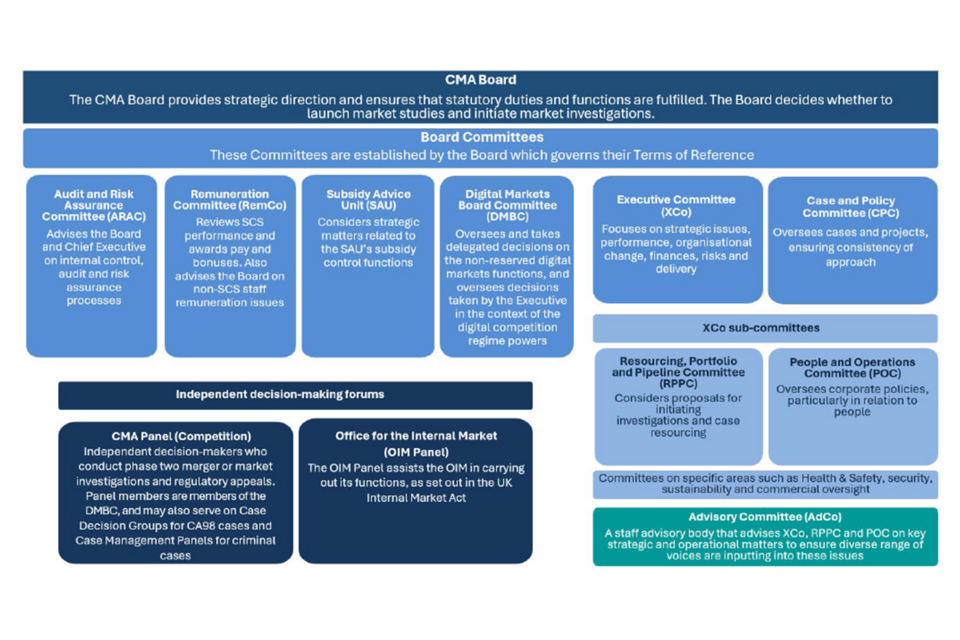
Committee arrangements in this graphic are correct as of 31 March 2026; the role of each committee is explained further below.
The CMA has a number of Board committees, including the Audit, Risk and Assurance Committee, Remuneration Committee, the Digital Markets Board Committee to oversee work and take certain decisions within the digital markets competition regime, and the Subsidy Advice Unit Committee (a statutory committee which covers this function).
The CMA also has 2 Board Committees which manage and oversee the performance and delivery of the CMA’s functions and objectives (the Executive Committee and the Case and Policy Committee), which are further supported by XCo’s sub-committees (the Resourcing, Portfolio and Pipeline Committee and People and Operations Committee).
The Advisory Committee works with XCo’s sub-committees to provide diversity of thought to inform, support and constructively challenge senior decision-making at the CMA.
Board members
The list below outlines the membership of the Board from 1 April 2025 to 31 March 2026, including recent changes in membership.
Doug Gurr
(Chair)
Doug Gurr was appointed interim Chair of the CMA Board in January 2025 and permanent Chair in March 2026. Doug is a member of the Remuneration Committee and is Chair of the Digital Markets Board Committee.
Justin Basini
(Non-Executive Director)
Justin Basini was appointed as Non-Executive Director of the CMA Board in February 2024. He was appointed the Senior Independent Director and Chair of the Audit and Risk Assurance Committee in July 2025.
Martin Coleman
(Competition Panel Chair, Non-Executive Director)
Martin Coleman was appointed as Non-Executive Director of the CMA Board in October 2017 and as Competition Panel Chair in September 2018. Martin is Chair of the Remuneration Committee and a member of the Digital Markets Board Committee.
Frank Dangeard
(Non-Executive Director)
Frank Dangeard stepped down as Non-Executive Director of the CMA Board and as a member of the Digital Markets Board Committee in April 2025.
The Board was saddened by Frank’s sudden death in August 2025, shortly after he resigned from the Board. Frank served as a Non-Executive Director of the Competition and Markets Authority during a significant period of change for the organisation. His wise counsel and extensive experience were highly valued by the Board and made an important contribution to the CMA’s work, particularly as it progressed its transformation and the establishment of the UK’s new digital markets regime. The Board records its gratitude for Frank’s service and extends its thoughts and condolences to his family.
Cynthia Dubin
(Non-Executive Director)
Cynthia Dubin stepped down as Non-Executive Director of the CMA Board and Chair of the CMA Audit and Risk Assurance Committee and the Nominations Committee in July 2025 after nine years of service, at the end of her final term.
Dame Patricia Hodgson
(Non-Executive Director)
Dame Patricia Hodgson was appointed Non-Executive Director of the CMA Board of in February 2024 and is a member of the Digital Markets Board Committee. Murdoch MacLennan (Chair of the Office for the Internal Market and Non-Executive Director) Murdoch MacLennan was appointed as Chair of the Office for the Internal Market and Non-Executive Director of the CMA Board in April 2022. Murdoch is a member of the Subsidy Advice Unit Committee.
Cyrus Mehta
(Non-Executive Director and Competition Panel inquiry chair)
Cyrus Mehta was appointed as CMA Panel Member in April 2020 and as a Non Executive Director of the CMA Board in February 2024. Cyrus is a member of the Remuneration Committee, the Audit and Risk Assurance Committee, the Digital Markets Board Committee and the Subsidy Advice Unit Committee.
Dharmash Mistry
(Non-Executive Director)
Dharmash Mistry stepped down as a Non-Executive Director of the CMA in August 2025 to pursue other commitments. He was a member of the Digital Markets Board Committee.
Sarah Cardell
(Chief Executive)
Sarah Cardell was appointed as Chief Executive of the CMA in December 2022. Sarah is the CMA’s Principal Accounting Officer, leads the Senior Executive Team, and chairs a number of committees, including the Executive Committee, and Case and Policy Committee. Sarah is also a member of the Digital Markets Board Committee.
Joel Bamford
(Executive Director for Mergers, Subsidy Advice Unit and Office for Internal Market)
Joel Bamford was appointed Executive Director for Mergers and Executive Director of the Board in February 2024. Joel is a member of the Senior Executive Team, the Digital Markets Board Committee, the Executive Committee, the Case Policy Case, and is Chair of the Subsidy Advice Unit Committee.
Juliette Enser
(Executive Director for Competition Enforcement and Markets)
Juliette was appointed Executive Director for Competition Enforcement in February 2025 and Markets in December 2025 and Executive Director of the Board in March 2025. Juliette is a member of the Senior Executive Team, the Executive Committee, the Case and Policy Committee, the Digital Markets Board Committee and the Subsidy Advice Unit Committee.
Will Hayter
(Executive Director for Digital Markets)
Will Hayter was appointed Executive Director for Digital Markets and Executive Director of the Board in February 2024. Will is a member of the Senior Executive Team, the Executive Committee, the Case and Policy Committee, and the Digital Markets Board Committee.
Dr Daniel Lambauer
(Chief Operating Officer)
Daniel Lambauer was appointed as Chief Operating Officer in July 2024 and Executive Director of the Board in October 2024. Daniel is a member of the Senior Executive Team, the Executive Committee and chairs the People and Operations Committee. Daniel is the CMA’s Additional Accounting Officer.
Board advisers
Chris Prevett
(General Counsel)
Chris Prevett was appointed as adviser to the CMA Board in July 2022, and as General Counsel in January 2024. Chris is a member of the Senior Executive Team, the Executive Committee, the Case and Policy Committee, the Subsidy Advice Unit Committee and the Digital Markets Board Committee.
Dr Mike Walker
(Chief Economic Adviser)
Mike Walker stepped down as Chief Economic Adviser and adviser to the Board in December 2025. Mike was a member of the Senior Executive Team, Executive Committee, the Case and Policy Committee, and the Subsidy Advice Unit Committee.
Dr Jenny Haydock
(Interim Chief Economic Adviser)
Jenny Haydock was appointed as Deputy Chief Economic Adviser in October 2021. Jenny is a member of the Senior Executive Team, Executive Committee, the Case and Policy Committee, and the Subsidy Advice Unit Committee and the Digital Markets Board Committee.
Dr Karen Croxson
(Chief Data, Technology and Insight Officer)
Karen was appointed as Chief Data, Technology and Insight Officer in September 2023 and as adviser to the Board in February 2024. Karen is a member of the Senior Executive Team, the Executive Committee, the Case and Policy Committee and the Digital Markets Board Committee.
Jessica Lennard
(Chief Strategy and External Affairs Officer)
Jessica Lennard was appointed as Chief Strategy & External Affairs Officer and adviser to the Board in August 2023. Jessica is also a member of the Senior Executive Team, the Executive Committee and the Case and Policy Committee.
George Lusty
(Interim Executive Director for Consumer Protection and Markets)
George stepped down as interim Executive Director for Consumer Protection and Markets and adviser to the Board in May 2025. George was a member of the Senior Executive Team, the Executive Committee and the Case and Policy Committee.
Board meeting attendance 2025 to 2026
The CMA Board met 11 times in 2025 to 2026. Board meetings were held in each month except in the months of August and September, with an extraordinary meeting held in November 2025 to deal with topical issues in a more timely and flexible manner. The minutes from CMA Board meetings are published on the CMA website.
| Board member | Role | Number of meetings attended |
|---|---|---|
| Doug Gurr | CMA Chair | 11/11 |
| Justin Basini | Non-Executive Director | 11/11 |
| Martin Coleman | Competition Panel Chair and Non Executive Director | 9/11 |
| Frank Dangeard | Non-Executive Director | 0/0 |
| Cynthia Dubin | Non-Executive Director | 3/4 |
| Dame Patricia Hodgson | Non-Executive Director | 11/11 |
| Murdoch MacLennan | Chair of the Office for the Internal Market and Non-Executive Director | 9/11 |
| Cyrus Mehta | Competition Panel Inquiry Chair and Non-Executive Director | 11/11 |
| Dharmash Mistry | Non-Executive Director | 2/4 |
| Sarah Cardell | Chief Executive | 11/11 |
| Juliette Enser | Executive Director | 11/11 |
| Will Hayter | Executive Director, Digital Markets | 11/11 |
| Daniel Lambauer | Chief Operating Officer | 11/11 |
Board evaluation
We review the effectiveness of the Board annually; every third year this review is carried out by an independent reviewer. In 2025, we undertook an internal Board Effectiveness Review (BER), adopting a deliberately light touch approach in recognition of the appointment of an Interim Chair at the start of the year and the expected significant changes in Non-Executive Director (NED) composition in early 2026.
As part of our internal review, we held a series of focused discussions during Spring 2025 with executive members, senior staff, and non-executive Board members, supplemented by further reflections gathered as part of the year end process in autumn 2025. No urgent or significant issues with the operation of the Board were raised. Given the context of the review, and the upcoming changes in composition, the review focused on establishing themes that could usefully be explored once the newly constituted Board was in place. The review identified areas where the Board continues to operate effectively, alongside opportunities to strengthen clarity of role, enhance ways of working, and support the incoming cohort of NEDs.
In summary, the review highlighted the need for the full Board - following induction of new NEDs expected in late spring 2026 - to take time together to reflect on the overall role, purpose, and preferred ways of working. This will be taken forward through a dedicated Board Workshop in 2026. The review also identified opportunities to improve Board papers, meeting cadence, and the wider use of NED expertise.
Some actions have already been implemented, including improvements to paper quality, and strengthened feedback to DBT on the skills and composition required for future Board appointments. Other recommendations – such as reviewing committee membership following the appointment of new NEDs and clarifying the role of the Board in light of the DBT policy consultation – will be progressed during 2026.
Given the permanent appointment of the CMA Chair and 4 new NEDs during the first half of 2026, we anticipate using this transition period to reflect and recalibrate aspects of Board purpose, structure, and working arrangements. A tightly scoped external review is planned for 2026 to 2027 once the new Board has been established.
Board committees
The Board and its committees support the decision-making functions at the CMA.
Audit and Risk Assurance Committee
The Audit and Risk Assurance Committee (ARAC) was chaired by Cynthia Dubin until July 2025. Justin Basini was then appointed Chair. The other members are Kirstin Baker, Frances McLeman, both Panel Members, who served throughout the year, and Cyrus Mehta who joined in July 2025.
ARAC’s remit covers all aspects of corporate governance, risk management and internal control within the CMA. The committee advises the Principal Accounting Officer and the CMA Board on the appropriateness of the financial statements, whether they are fair, balanced and understandable, and the adequacy of audit arrangements (internal and external). ARAC also considers a range of assurances provided in respect of risk, procedures and internal controls including those relating to business continuity and information technology with a view to enabling the Board to assure itself of the effectiveness of the CMA’s risk management system, and procedures and internal controls including business continuity and information technology. ARAC focusses on risk throughout each meeting, often considering in more detail issues that may raise specific risks for the CMA.
ARAC meets quarterly but also holds extraordinary meetings in addition to their regular meetings to deal with topical issues in a more timely and flexible manner. ARAC met 4 times in 2025 to 2026.
ARAC meeting attendance 2025 to 2026
| ARAC member | Role | Number of meetings attended |
|---|---|---|
| Justin Basini | Non-Executive Director | 4/4 |
| Kirstin Baker | Competition Panel Inquiry Chair | 4/4 |
| Cynthia Dubin | Non-Executive Director | 1/1 |
| Frances McLeman | Competition Panel member | 3/4 |
| Cyrus Mehta | Competition Panel Inquiry Chair and a Non-Executive Director | 3/3 |
The Principal Accounting Officer and/or the Additional Accounting Officer (respectively the Chief Executive and/or the Chief Operating Officer), the CMA Chair, the Director of Finance and the General Counsel also attend ARAC. The National Audit Office (NAO) and Government Internal Audit Agency (GIAA) are represented at these meetings.
Digital Markets Board Committee
The Digital Markets Board Committee (DMBC) is chaired by Doug Gurr. Other members are: Sarah Cardell, Martin Coleman, Margot Daly, Dame Patricia Hodgson, Cyrus Mehta, Robin Foster, Colleen Keck, Joel Bamford, Juliette Enser, and Will Hayter.
DMBC oversees and takes certain delegated decisions under the Digital Markets, Competition and Consumers Act 2024, including deciding whether to designate firms with strategic market status (SMS) and, potentially imposing conduct requirements and pro-competition interventions. DMBC meets at least quarterly and met 5 times in 2025 to 2026.
DMBC meeting attendance 2025 to 2026
| DMBC member | Role | Number of meetings attended |
|---|---|---|
| Doug Gurr | CMA Chair | 5/5 |
| Sarah Cardell | Chief Executive | 5/5 |
| Joel Bamford | Executive Director, Mergers, Subsidy Advice Unit and Office for Internal Market | 4/5 |
| Martin Coleman | Competition Panel Chair and Non Executive Director | 5/5 |
| Margot Daly | Competition Panel Inquiry Chair | 5/5 |
| Juliette Enser | Executive Director, Competition Enforcement and Markets | 4/5 |
| Dame Patricia Hodgson | Non-Executive Director | 5/5 |
| Will Hayter | Executive Director Digital Markets | 5/5 |
| Cyrus Mehta | Competition Panel Inquiry Chair and Non Executive Director | 5/5 |
| Dharmash Mistry | Non-Executive Director | 1/1 |
| Robin Foster | Competition Panel member | 5/5 |
| Colleen Keck | Competition Panel Member | 4/5 |
The Chief Economic Adviser or Deputy Chief Economic Adviser and General Counsel attend meetings in an advisory capacity. The Chief Data Technology and Insight Officer also attend.
In 2025 to 2026, the DMBC had 2 sub-committees, a Search sub-committee and a Mobile sub-committee which are decision-making bodies delegated by the DMBC to carry out non-reserved digital markets functions, including key decisions in Strategic Market Status (SMS) investigations. They consider and decide on matters such as SMS designation, conduct requirements, and related interventions within their respective sectors. Both sub-committees remain accountable to the DMBC, reporting on their activities and operating within defined Terms of Reference.
The Nominations Committee
The Nominations Committee (NomCo) was chaired by Cynthia Dubin. Other members included Doug Gurr and Sarah Cardell. The Chief Operating Officer, Chief People Officer, and the Director of Executive Office, Security and Property Transformation were also able to attend NomCo meetings. NomCo did not meet in 2025 to 2026 and was dissolved by the CMA Board in October 2025.
The Remuneration Committee
The Remuneration Committee (RemCo) is chaired by Martin Coleman. Other members are: Doug Gurr, Murdoch MacLennan and Cyrus Mehta.
RemCo provides a strategic steer on reward relating to all CMA employees and makes decisions or recommendations on all aspects of remuneration for senior civil servants in the CMA, in accordance with parameters set by the Cabinet Office and/or HM Treasury. The Remuneration Committee meets at least once a year and met 4 times in 2025 to 2026.
RemCo meeting attendance 2025 to 2026
| RemCo member | Role | Number of meetings attended |
|---|---|---|
| Martin Coleman | Competition Panel Chair and Non Executive Director | 4/4 |
| Doug Gurr | CMA Chair | 3/4 |
| Murdoch MacLennan | Chair of the Office for the Internal Market and Non-Executive Director | 4/4 |
| Cyrus Mehta | Competition Panel Inquiry Chair and Non-Executive Director | 4/4 |
The CMA Chief Executive, Chief Operating Officer, Chief People Officer and HR Director responsible for Pay and Reward may also attend RemCo.
Subsidy Advice Unit Committee
The Subsidy Advice Unit Committee (SAU) is chaired by Joel Bamford. Members are: Kirstin Baker, Murdoch MacLennan, Cyrus Mehta, Chris Prevett, Jenny Haydock, Juliette Enser, Anthony Wright and Adam Land.
The SAU Committee considers strategic matters such as they relate to the SAU’s subsidy control functions. These include the SAU’s overall strategy (including stakeholder management) and objectives; delivery and performance; the Monitoring Report; planning for the pipeline of future referrals (for example resource planning); regime and reputational issues; and policy and procedures. The SAU Committee meets roughly once every 2 months and met 6 times in 2025 to 2026.
SAU meeting attendance 2025 to 2026
| SAU member | Role | Number of meetings attended |
|---|---|---|
| Joel Bamford | Executive Director, Mergers, Office for the Internal Market and Subsidy Advice Unit | 6/6 |
| Kirstin Baker | Competition Panel Inquiry Chair | 5/6 |
| Juliette Enser | Executive Director for Competition Enforcement and Markets | 4/6 |
| Adam Land | Senior Director, Subsidy Advice Unit and Office for the Internal Market | 6/6 |
| Murdoch MacLennan | Chair of the Office for the Internal Market and Non-Executive Director | 6/6 |
| Cyrus Mehta | Competition Panel Inquiry Chair and Non Executive Director | 5/6 |
| Chris Prevett | General Counsel | 5/6 |
| Mike Walker | Chief Economic Advisor | 3/3 |
| Jenny Haydock | Interim Chief Economic Advisor | 3/3 |
| Anthony Wright | Senior Director, Communications | 6/6 |
Executive Committee
The Executive Committee (XCo) is chaired by Sarah Cardell, and members are part of the Senior Executive Team.
XCo is the overall decision-making body for performance and delivery. XCo oversees and makes decisions relating to strategy, delivery and performance, portfolio and pipeline, finance and risk, staffing, organisational transformation, regime issues and reputation. XCo also oversees and advises on the delivery of an internal audit programme, and makes decisions on matters relating to the Board, including preparing for and reviewing Board meetings. It further considers and approves recommendations from its sub-committees – the People and Operations Committee (POC) and the Resourcing, Portfolio and Pipeline Committee (RPPC). XCo meets weekly.
Case and Policy Committee
The Case and Policy Committee (CPC) is chaired by Sarah Cardell. The membership includes the majority of the Senior Executive Team, Senior Directors and two Competition Panel Inquiry Chairs.
CPC guides the development of CMA policy across all delivery tools, and provides oversight of cases and projects, ensuring consistency of approach and offers advice on high level legal, economic or policy issues as they arise. CPC usually meets fortnightly.
XCo sub-committees
People and Operations Committee
The People and Operations Committee (POC) is chaired by Daniel Lambauer. Members include Senior Directors from across the CMA and directors from the Corporate Services Directorate. POC reviews proposed policies, processes and structures that set standards of conduct, drive compliance, and ensure staff and assets’ safety. POC usually meets monthly.
Resourcing, Portfolio and Pipeline Committee
The Resourcing, Portfolio and Pipeline Committee (RPPC) is chaired by Sarah Cardell, and members include Executive Directors and Senior Directors from across the CMA. RPPC provides strategic direction in relation to the CMA’s use of resources in the ongoing and prospective pipeline of work. RPPC usually meets monthly.
The Advisory Committee
The Advisory Committee (AdCo) was launched in September 2021 as part of our wider work on Equality, Diversity and Inclusion (EDI) and the CMA’s Race Action Plan. AdCo works to improve diversity of thought at senior levels of the CMA, providing insights and advice to inform, support and constructively challenge senior decision-making. AdCo acts in an advisory capacity and has no decision-making powers. Committees consider AdCo’s advice and recommendations as part of their decision making. It also provides advice to committees including XCo, RPPC and POC and advice to teams and other groups where requested.
AdCo’s members are drawn from different areas and professions across the CMA, and from backgrounds and groups that are under-represented at senior levels. The CMA is currently reviewing how AdCo operates to ensure it continues to effectively deliver against our EDI objectives and wider organisational commitments.
CMA Competition Panel
As set out in the Act, decisions on phase 2 merger inquiries, market investigations and regulatory appeals are made by independent groups drawn from the CMA Competition Panel. Each group has at least three members and is led by an Inquiry Chair. Competition Panel members may also be appointed to antitrust (Competition Act 1998) case decision groups.
The groups make their decisions independently of the CMA Board. The requirement for the group to act independently does not prevent the CMA Board from giving appropriate information in its possession to a Group and vice versa. The Board is kept informed about resourcing, efficiency, the application of CMA policy and the staff processes that support the work of the Competition Panel. Legislation requires that at least one Competition Panel member sits on the CMA Board.
Currently there are two - the Panel Chair, Martin Coleman, and Cyrus Mehta, an Inquiry Chair and Non Executive Director of the CMA Board.
More information about each of the Competition Panel members is available on our website, and their interests are disclosed as part of the appointment process. A conflicts check is conducted, on a case-by-case basis, when Competition Panel members are assigned to inquiries and, if necessary, a publication of the disclosure of interest is made on the relevant case page.
Competition Panel Inquiry Chairs
Martin Coleman
(Panel Chair and Non-Executive Director)
Kirstin Baker CBE
(Inquiry Chair)
Kirstin was appointed a Panel Inquiry Chair and Panel Member Non-Executive Director of the CMA in September 2018, stepping down from the Board in March 2024. She is also a member of the Audit and Risk Committee.
Margot Daly
(Inquiry Chair)
Margot was appointed an Inquiry Chair of the CMA in September 2021, having been a Competition Panel member since May 2020.
Richard Feasey
(Inquiry Chair)
Richard was appointed an Inquiry Chair in April 2021, having been a Competition Panel member since October 2017. He is a member of the CMA’s specialist utility panel.
Stuart McIntosh
(Inquiry Chair)
Stuart was appointed an Inquiry Chair in April 2018, having been a Competition Panel member since October 2017. He stepped down from the CMA Panel in May 2025.
Kip Meek
(Inquiry Chair)
Kip was appointed an Inquiry Chair and a Competition Panel member in November 2018. He stepped down from the CMA Panel in January 2026.
Cyrus Mehta
(Inquiry Chair and Non-Executive Director)
Cyrus was appointed an Inquiry Chair in October 2025, having been a Competition Panel member since April 2020. He is also a member of the CMA’s specialist news and media, and payment systems panels.
Competition Panel members
- Jo Armstrong
- Humphrey Battcock
- Robin Cohen
- Maria Da Cunha
- Anne Fletcher
- Robin Foster
- Roland Green
- Ashleye Gunn
- Susan Hankey
- Ulrike Hotopp [footnote 8]
- Paul Hughes
- Colleen Keck
- Juliet Lazarus
- Sheila McClelland [footnote 9]
- Frances McLeman
- Cyrus Mehta
- Paul Muysert
- Jeremy Newman [footnote 13]
- Sir Kenneth Parker
- Keith Richards
- Stephen Rose
- Karthik Subramanya
- John Thanassoulis [footnote 10]
- Mark Thatcher
- David Thomas [footnote 11]
- Claire Whyley [footnote 12]
- Crispin Wright
OIM Panel
The Office for the Internal Market Panel assists the Office for the Internal Market (OIM) in carrying out its functions, as set out in the UK Internal Market Act.
The OIM is part of the CMA. The Chair of the Panel for the Office for the Internal Market, Murdoch MacLennan, also sits on the CMA Board.
The OIM Panel provides general support and advice to the OIM in their functions under the United Kingdom Internal Market Act 2020, and in relation to their overall portfolio (through a “Standing Task Group” consisting of all OIM Panel members) and, in some cases, on specific pieces of work (through “Project-specific Task Groups” which may be formed of smaller numbers of OIM Panel members). In addition, the CMA may authorise the OIM Panel to carry out functions under Part 4 of the United Kingdom Internal Market Act 2020 on behalf of the CMA. In such cases the OIM Panel will act independently of the CMA Board.
More information about each of the OIM Panel members is available on our website, and members’ interests are disclosed as part of the appointment process. A conflicts check is conducted ahead of each meeting of the OIM Panel and, if necessary, a publication of the disclosure of interest will be made on the relevant OIM Panel member’s webpage. The Panel typically meets every 2 months.
OIM Panel members
- Murdoch MacLennan
- Angharad Butler
- Michael Neilson
- Professor Suzanne Rab
- Professor Andrew Stephan
- Stephen Gifford
- Shane Lynch
- Tim Render
Risk management
Strong risk management helps the CMA make better decisions. The CMA’s risk management approach supports our ability to deliver our Strategy and Annual Plan priorities.
In 2025 to 2026, we continued to build on our existing risk management framework to ensure that it remains aligned with good practice in The Orange Book and ISO31000, as this is an integral part of the governance of the CMA. The risk management framework ensures the appropriate assessment and treatment of risks, as well as consistency of risk identification, management and reporting. The framework also helps the CMA respond to uncertainties that may affect our ability to deliver our strategic priorities. Within the CMA, risks are discussed in an open and transparent way which allows us to identify and treat risks quickly and creates a culture of ownership of risk issues at all levels of the organisation.
The risk management framework requires an assessment of the current profile of any given risk and that the residual risk is clearly set out. The residual risk is an assessment of the risk after all anticipated actions have been implemented to take current risk exposure down. This requirement means that active consideration is given to mitigating actions and what their effect will be once they are applied. The residual risk levels are assessed against the Board’s Risk Appetite. During 2025 to 2026, XCo and the Board reviewed the format of the risk appetite statement and adopted a new format. The new format is aligned with the guidance in The Orange Book.
The CMA’s corporate risk register gives a structured assessment of impact, likelihood and velocity, and the Risk and Compliance Lead works with the Directorates to manage local risk registers, which feed into the central corporate risk register on a monthly basis. The corporate risk register is split into 2 tiers of corporate and strategic risks. The risk register is subject to regular review by XCo, ARAC and the Board.
The risk function is led by the Director of Finance, Risk and Business reporting (responsibility moved from the the Legal Director for Governance, Compliance and Risk in January 2026), and the Risk Compliance Lead, with oversight from the Chief Operating Officer and General Counsel. All Tier 1 and Tier 2 risks have an Executive risk owner, who is responsible for updating their risks monthly to align with XCo meetings. This update is facilitated by the Risk and Compliance Lead, who updates the corporate register for XCo to review every month. XCo also reviews the operation of the risk framework and provides oversight of changes made to the framework.
ARAC carries out a review of the risk register and effectiveness of the risk framework and provides feedback at each of its meetings. This includes obtaining assurance that risks are being appropriately managed and that mitigating actions are effective and operating as intended.
The Board reviews Tier 1 risks monthly, considering, in particular, escalated risks. It monitors the overall risk portfolio including the mitigating actions and provides challenge where appropriate. Risk management forms a key part of the update provided by the Chief Executive at every Board meeting, when the most important risks facing the organisation are raised with the Board.
We are planning to introduce incremental changes to risk reporting in 2026 to 2027 with greater alignment with other business reporting. The changes will support us in delivering further improvements to the effectiveness of reporting to XCo, ARAC and the Board, to support their management and oversight roles during this year.
The risk approach is promoted to staff across the organisation, including through the CMA intranet pages and via ad hoc training, information, and guidance. Our focused work on risk has resulted in improved risk reporting and management throughout the CMA. We have set out more information on risks in the Performance Report.
Implementation of Government Functional Standards
Government Financial Standards (GFS) create a coherent, effective, and standardised approach to undertake business within government and to provide a stable basis for capability building and continuous improvement.
GFS refer to a published suite of management standards developed by the Cabinet Office, which have been mandated for use across central government since September 2021, including functions such as project delivery, commercial and finance.
Our assurance framework provides clear roles and accountabilities for those engaged in frontline delivery and related corporate oversight, and the use of each relevant GFS has been embedded into the organisation. Functional standards are now reported to XCo to ensure oversight from SET.
The Government Internal Audit Agency’s Functional Standards audit review report was agreed in late March 2025. A plan of action was agreed to make further improvements to ensure effective and proportionate compliance, reporting and governance arrangements for the GFS. We are making good progress in implementing the management recommendations from the audit.
Compliance
A strong compliance culture is fundamental in ensuring the CMA is run as efficiently and effectively as possible, and a robust compliance framework is embedded within the CMA’s management and reporting processes.
Corporate Governance Code
The CMA has complied with the principles and provisions of the Corporate Governance in Central Government Departments Code of Good Practice, to the extent appropriate and in line with its statutory duties.
Conflicts of interest
The CMA’s Conflicts of Interest policy sets out the process for declaring outside interests and managing any potential conflicts that may arise for Board, Panel and staff members as a result of outside interests. In line with this policy, all Board, Panel and staff members declare outside interests which could give rise to conflict risks to either their managers and/or the Compliance Officer for the purposes of assessing whether conflict risk arises as a result of outside interests and, if so, how it should be managed. This policy is both robust and adheres to the relevant requirements of the Civil Service Management Code.
In April 2026, an assurance exercise was undertaken to ensure that any paid outside employment held by Senior Civil Servants at the CMA does not present a conflict of interest. This exercise, the results of which have been scrutinised by the CMA’s Audit and Risk Assurance Committee, found that no CMA Senior Civil Servants held remunerated positions or wider interests that might conflict with their obligations under the CMA’s Conflicts of Interest policy or the Civil Service Management Code. In accordance with the Cabinet Office’s guidance on the Declaration and management of outside interests in the Civil Service, we have published online the details of 4 CMA Senior Civil Servants’ remunerated outside employment, which has been agreed in accordance with the CMA’s Conflicts of interest policy.
Business Appointments
The CMA’s Conflicts of Interest policy makes it clear that, when staff leave the organisation, they must comply with the requirements of the Business Appointment Rules (BARs) before they accept a new appointment outside the Civil Service. The CMA also has a dedicated BARs policy that sets out in more detail the process in place for handling applications made at different grades under the BARs. We have taken steps to ensure that both policies are well publicised within the organisation, through internal communications, presentations to teams and the annual attestation process set out in the Conflicts of Interest policy.
The CMA’s HR department follows a clearly defined process to ensure that BARs applications are completed by staff before they leave the Civil Service and all applications from senior staff are considered by the Compliance Officer. Data on BARs applications is presented quarterly to the CMA’s Audit and Risk Assurance Committee.
The CMA follows the broader civil service guidance, but recognises the nature of our work can give rise to different potential conflicts, and so has adopted this enhanced approach:
- all Grade 7 Competition Specialists, Grade 6 Competition Specialists and SCS who are going to a new employer must complete a BARs form. The risks can only be assessed based on the role and employer they are joining so if they are not joining an employer immediately on leaving, they will need to (in line with the BARs rules) notify the CMA at the point they are accepting a new role
- that anyone joining a firm with Strategic Market Status (SMS) (or a firm that is likely to be designated as such) are highly likely to need to complete a BARs form (these employees should seek advice from their line manager, the Compliance Officer and/or HR Business Partner if they believe that they should not)
Data on BARs applications is presented quarterly to the CMA’s Audit and Risk Assurance Committee.
BARs Applications 2025 to 2026
In 2025 to 2026, the CMA applied the BARs to staff leaving the Civil Service, and we have been transparent in the decisions given in individual applications from senior staff, in compliance with the BARs transparency reporting requirements, details of which can be found on our website.
In addition to the BARs applications received in 2025 to 2026, and outlined below, there were 35 Conflict Check applications for transfers to Other Government Departments. There were no applications that were found to be unsuitable for the applicant to take up, and there were no breaches of the Rules.
| Grade | Total number | Number where conditions were set |
|---|---|---|
| SCS2 | 5 | 5 |
| SCS1 | 9 | 8 |
| Grade 6 | 20 | 6 |
| Grade 7 | 38 | 10 |
| SEO | 5 | 0 |
| HEO | 6 | 0 |
SCS Pay Band 3 departures are considered by the CMA’s Compliance Officer who then sends the application and any comments to the Civil Service Commission (CSC) for advice on whether the individual can take up an appointment and, if so, whether any conditions should apply to the work that they can undertake. The Prime Minister makes the ultimate decision whether to accept the advice of CSC.
Where an appointment is approved, that outcome will be published on CSC’s website. Acceptance of a new position is conditional on CSC approval of the application and no announcements by either the individual, the CMA or the individual’s future employer are allowed before approval has been given.
Complaints and enquiries
Internal whistleblowing
The CMA’s internal whistleblowing policy, known as ‘Speaking Out’, outlines the process to follow if a member of staff is aware of a perceived wrongdoing within the CMA, including something they believe goes against the core values in the Civil Service Code (including integrity, honesty, objectivity and impartiality). The policy is available to all staff on the intranet and is highlighted to new staff during their induction programme. A programme of communications runs through the year, including blogs and involvement in the cross-Civil Service Speak Up week.
A network of staff trained as Speaking Out Advisers are available to staff who want to raise a concern but are not sure how to do so. The policy is part of the CMA’s internal control framework and is reviewed each year. The CMA received no whistleblowing complaints during 2025 to 2026.
External whistleblowing
The CMA has a prescribed role under the Public Interest Disclosure Act 1998 for matters relating to the sale of goods or the supply of services, which adversely affect the interests of consumers; or about competition affecting markets in the UK. Under this legislation members of the public can make a ‘protected disclosure’ to the CMA, if it is in the public interest and relates to potential wrongdoing by their employer or ex-employer.
The CMA Whistleblower Hotline has been in operation since July 2021 and enables members of the public to make disclosures to us by phone, email or webform. During this reporting period, the operational processes and procedures for the hotline were audited by the GIAA. The audit confirmed that the controls and systems in place for the CMA whistleblower process are appropriate and are operating efficiently. The GIAA report identified some areas for improvement, and the CMA agreed an action plan to address these issues. The Specialist Intelligence Unit are on schedule to complete all actions by the agreed deadlines.
In 2025 to 2026, we received 41 qualifying disclosures, of which 11 resulted in further investigation and 30 were recorded for intelligence. We publish our statistics annually and also submit a report to DBT.
Corporate complaints
Accountability report Accounts The CMA takes complaints raised against us very seriously. Our complaints procedure allows for speedy informal resolution of complaints, for instance by a phone call, if that is satisfactory to the complainant, or through an escalation to an independent senior staff member if appropriate. The CMA is committed to thorough investigation of any complaints raising serious issues about its conduct.
In 2025 to 2026, the CMA received 1 enquiry which raised issues about its conduct, and which was treated as a corporate complaint. The complaint was not upheld, and no further contact was made from the complainant.
No complaints were made about the CMA to the Parliamentary and Health Service Ombudsman during 2025 to 2026 (2024 to 2025: none).
General correspondence
In 2025 to 2026 the CMA handled 7,636 items of written correspondence from the public, including reports from consumers and businesses on potential anti competitive behaviour or market issues. Many of these enquiries are discussed at weekly pipeline meetings to inform future work. This represents a 33% increase compared to enquiries received in 2024 to 2025. The CMA operates an internal target of responding to correspondence within 10 working days. 77% of correspondence was responded to within this target, with 100% responded to within 20 working days. As stated in the ARA for 2024 to 2025, we responded to 100% of correspondence received within 10 working days.
MPs letters
In 2025 to 2026 we received 188 items of MP correspondence (an 88% increase compared to 2024 to 2025). Of these, 62% were responded to within our internal target of 15 working days and 80% within 20 working day target. The average processing time was 15 working days. As stated in the ARA for 2024 to 2025, the CMA received 100 MP correspondence, 59% were responded to within our target of 15 working days and 80% within 20 working days. With an average processing time of 14 working days.
In response to increased demand, we are streamlining key stages and strengthening support and oversight, including through digital solutions
Freedom of Information Act requests
Under the Freedom of Information Act 2000 (FOIA) a person who makes a request is entitled to be informed if the CMA holds information in scope of their request, and if so, to have that information communicated to them. These rights are subject to exclusions, (including a cost limit of £600 and an exclusion for vexatious requests) and exemptions as set out under the legislation. Under FOIA, the CMA must respond to requests promptly or within 20 working days. This can be extended in matters where further time is needed to conduct a public interest balancing test to apply an exemption. In 2025 to 2026, we responded to 97% of FOIA requests within the statutory 20 working day period (2024 to 2025: 95%).
We received 252 FOI requests between 1 April 2025 and 31 March 2026 (2024 to 2025: 167 requests). Detail on how we responded is set out as follows:
Freedom of information requests
- requests granted in full: 65
- requests where the CMA did not hold the information requested: 20
- requests exempt because they exceeded the cost limit: 22
- requests exempt because the request was vexatious: 0
- requests where the CMA provided some of the information in scope but applied an exemption to other parts: 64
- requests where the CMA applied an exemption to all parts of a request: 106
Once the CMA has issued a response, the requester has the right to ask us to internally review our decision. When handling an internal review, we consider our decision afresh.
In 2025 to 2026, we received 34 requests for internal reviews. In 28 of these our original decision was upheld, in 3 reviews it was partially upheld, and in these reviews some of the requested information was released to requesters in the other two. Currently 3 of these reviews are outstanding.
Following an internal review, a requester can ask the Information Commissioner’s Office (ICO) to consider the CMA’s handling of a request. In 2025 to 2026, 9 requesters asked the ICO to do this. In 3 of these cases the ICO upheld the CMA’s decision, and no further action was required. In the other 6 cases, we are waiting to hear back from the ICO on whether we need to provide a detailed response or whether they will close the case without additional input from the CMA.
Requests received under Data Protection legislation
Under data protection legislation (UK GDPR and the Data Protection Act 2018) a person has the right to access information about how the CMA has processed their data and to receive a copy of such data. A person can also ask the CMA not to process their personal data in a certain way, or at all, or to erase their data, or to rectify their personal data. Requests must be responded to within one month of receipt. In 2025 to 2026, the CMA received 20 requests under Data Protection legislation (2024 to 2025: 5): 18 subject access requests (2024 to 2025: 3), one deletion request (2024 to 2025: 1) and one further request which was a combined subject access and data deletion request (2024 to 2025: 1). Of these requests, 18 were answered within the statutory one-month period (2024 to 2025: 5).
Personal Data Related Incidents
Accountability report Accounts A personal data breach is a breach of security leading to the accidental or unlawful destruction, loss, alteration, unauthorised disclosure of, or access to, personal data. The CMA must inform the Information Commissioner’s Office (ICO) of the most serious breaches we identify. In the period between 1 April 2025 and 31 March 2026 the CMA did not report any data breaches to the ICO (2024 to 2025: 2).
Internal audit
The Head of Internal Audit at the Government Internal Audit Agency provides an annual report and opinion on the systems of governance, risk management and control operating in the CMA, based on the work undertaken during the year, knowledge of the business environment, and the application of the Risk Control Framework.
In 2025 to 2026, the Head of Internal Audit provided an overall Moderate opinion on the framework of governance, risk management and control within the CMA for the period 1 April 2025 to 31 March 2026.
This Moderate opinion reflects an improvement from the Limited opinion reported in 2024 to 2025. The improvement is primarily driven by the CMA having addressed the material weakness previously identified in the in-year financial and budgetary forecasting models.
Assurance work undertaken during the year confirms that the CMA’s core governance, risk management and control frameworks are operating effectively overall, although further improvements are required which are detailed below.
Internal audit activity during the year comprised of 8 reviews, all of which resulted in moderate assurance opinions. A total of 38 recommendations were raised, with no new or high priority recommendations outstanding. Management has demonstrated good progress in implementing agreed actions.
Governance and management frameworks are assessed as strong, with clear accountability, effective oversight and established risk management practices embedded across the organisation. Audit work identified a need to formalise some of the identified governance structures, including governance documentation, ethical frameworks and system-based controls. This will address any assurance gaps and strengthen accountability. Establishment of a change management Project Management Office (PMO), consolidation of governance documents, and systemisation of processes will enhance CMA’s transparency and risk management. Roles and accountabilities across the organisation are generally well documented, understood and supported at a functional, operational level and senior management level. Further work is required to formalise portfolio-level governance, strengthen change management documentation, and introduce more comprehensive role-based training to support delivery of organisational change.
The CMA demonstrates strong capability in project-level strategy, planning and reporting, supported by established governance frameworks, risk management processes and effective monitoring tools. Enhancements are required to provide greater granularity and integration of reporting, strengthen links to outcomes and benefits realisation, and develop more consistent key performance indicators to support ongoing monitoring.
Compliance with standards, policies and procedures is generally strong, with adherence to public sector requirements, statutory obligations and functional standards. Audit findings highlight the need to address fragmented policies (particularly in AI and payroll), improve documentation and version control, reduce reliance on manual processes, and strengthen disaster recovery planning and operational resilience.
Management has engaged positively with the internal audit function throughout the year and has demonstrated a continued commitment to implementing recommendations and strengthening governance, risk management and control arrangements.
Reporting on better regulation
Better regulation aims to minimise the burdens on businesses and consumers
Part 4 of the Regulatory Enforcement and Sanctions Act 2008 requires the CMA to report on our compliance with our duty under the Act to avoid imposing or maintaining unnecessary burdens on businesses in performing regulatory functions. Where our work results in regulatory functions, we do so under competition or mergers law, which are expressly excluded from better regulation reporting controls. We have no power to make rules or otherwise impose burdens affecting businesses generally. Our interventions take place in relation to specific businesses or markets, and we intervene only in the light of clear evidence of market failure and/or breaches of law that threaten the proper working of markets.
Remuneration and staff report
Remuneration report
The CMA is committed to providing a remuneration and benefits package that:
- is underpinned and compliant with the principles of equality and employment legislation
- is transparent, fair and consistent, whilst recognising the need to adhere to relevant Civil Service controls
- helps to attract and retain talented and diverse employees from both the Civil Service and external labour market
- recognises and values the contributions of employees
- is affordable and sustainable
The remuneration of all employees is set out in their contracts and is subject to annual review in line with the guidance agreed by the Cabinet Office.
The Remuneration and staff report sets out the CMA’s remuneration policy for Senior Civil Servants (SCS), reports on how that policy has been implemented and sets out the amounts awarded to senior management and, where relevant, the link between performance and remuneration. In addition, the report provides details on remuneration and staff that Parliament and other users see as key to accountability.
Remuneration policy
The remuneration of SCS is set by the Cabinet Office following independent advice from the Senior Salaries Review Body (SSRB) on an annual basis.
In reaching its recommendations, the SSRB considers:
- the need to recruit, retain and motivate suitably able and qualified people to exercise their different responsibilities
- regional and local variations in labour markets and their effects on the recruitment and retention of staff
- government policies for improving public services, including the requirement on departments to meet the output targets for the delivery of departmental services
- the funds available to departments as set out in the government’s departmental expenditure limits
- the government’s inflation target
The SSRB advice is carefully considered by government with the annual SCS pay practitioner’s guidance issued by the Cabinet Office, setting out the pay parameters available to government departments in terms of how to treat the salary and bonuses of SCS and apply the annual pay award.
Salary and bonuses
Salary covers both pensionable and non-pensionable amounts and includes but may not necessarily be confined to:
- gross salaries
- overtime
- recruitment and retention allowances
- private office allowances
- other allowances, to the extent that they are subject to UK taxation
- any ex-gratia payments
This report is based on accrued payments made by the CMA.
Also included in salary are non-consolidated payments (non-pensionable amounts) resulting from the application of the annual pay award; these payments are made in lieu of adding them to base salary in order to avoid the individual’s pay exceeding the pay band maximum for their grade or a salary agreed with HM Treasury through a pay exception case. Where such payments have been made, these are referenced in the footnotes.
Bonuses are also made as non-consolidated payments, but recorded separately to salary, in the year in which they become payable to the individual. The bonuses reported in 2025 to 2026 relate to performance in 2024 to 2025 and the comparative bonuses reported for 2024 to 2025 relate to performance in 2023 to 2024. Bonuses are made as part of the SCS performance management process and are based on performance levels attained.
In 2025 to 2026, the CMA was required to pay an end-of-year non-consolidated performance related payment (NCPRP, such as bonus) to those rated Exceeding as part of their performance management processes. In addition, departments were strongly advised to consider how to recognise those rated as High Performing with some level of end-of-year NCPRP award. Consequently, in July 2025, the Remuneration Committee approved non-consolidated performance payments to employees in receipt of an SCS performance rating of ‘Exceeding’ and ‘High Performing’ for performance year 2024 to 2025.
Senior management - single total figure of remuneration (audited)
| Salary | Allowances | Bonuses | Pensions (Table footnote 8) | Payments upon leaving (Table footnote 9) | Total | |||||||
|---|---|---|---|---|---|---|---|---|---|---|---|---|
| £000 | £000 | £000 | £000 | £000 | £000 | £000 | £000 | £000 | £000 | £000 | £000 | |
| Senior Management | 2025 to 2026 | 2024 to 2025 | 2025 to 2026 | 2024 to 2025 | ||||||||
| 2025 to 2026 (Table footnote 10) | 2024 to 2025 | 2025 to 2026 | 2024 to 2025 | 2025 to 2026 | ||||||||
| 2024 to 2025 | 2025 to 2026 | 2024 to 2025 | ||||||||||
| Chris Prevett (Table footnote 11) | 185-190 | 185-190 | - | - | 15-20 | 10-15 | 69 | 69 | - | - | 270-275 | 265-270 |
| Christina Duncan (Table footnote 12) | 0-5 | 135-140 | - | - | 10-15 | 2 | 53 | - | - | 15-20 | 190-195 | |
| Daniel Lambauer (Table footnote 13) | 150-155 | 75-80 | - | - | 5-10 | - | 60 | 30 | - | - | 220-225 | 105-110 |
| Emma Cochrane (Table footnote 14) | 55-60 | - | - | - | - | - | 23 | - | - | - | 80-85 | - |
| George Lusty (Table footnote 15) | 20-25 | 160-165 | - | - | - | 10-15 | 9 | 63 | - | - | 30-35 | 240-245 |
| Jenny Haydock (Table footnote 16) | 35-40 | - | - | - | 15-20 | - | 14 | - | - | - | 65-70 | - |
| Jessica Lennard | 160-165 | 155-160 | - | - | 10-15 | - | 62 | 61 | - | - | 235-240 | 215-220 |
| Joel Bamford (Table footnote 17) | 185-190 | 185-190 | - | - | 15-20 | - | 43 | 185 | - | - | 245-250 | 370-375 |
| Juliette Enser (Table footnote 18) | 170-175 | 160-165 | - | - | - | 15-20 | 63 | 68 | - | - | 235-240 | 245-250 |
| Karen Croxson (Table footnote 19) | 170-175 | 165-170 | - | - | - | 5-10 | 62 | 62 | - | - | 230-235 | 235-240 |
| Mike Walker (Table footnote 20) | 140-145 | 190-195 | - | - | - | - | 52 | 70 | - | - | 190-195 | 260-265 |
| Ruth Banks (Table footnote 21) | 100-105 | - | - | - | - | - | 42 | - | - | - | 140-145 | - |
| Sarah Cardell (Table footnote 22) | 220-225 | 215-220 | - | - | 15-20 | 15-20 | 31 | 32 | - | - | 265-270 | 265-270 |
| Will Hayter (Table footnote 23) | 170-175 | 165-170 | - | - | 10-15 | 15-20 | 62 | 62 | - | - | 245-250 | 245-250 |
- Table footnote 8: The value of pension benefits accrued during the year is calculated as (the real increase in pension multiplied by 20) less (the contributions made by the individual) The real increase excludes increases due to inflation or any increase or decrease due to a transfer of pension rights. The final salary pension of a person in employment is calculated by reference to their pay and length of service. The pension will increase from one year to the next by virtue of any pay rise during the year. The pension figures provided may differ from individual pension statements due to timing and calculation methods
- Table footnote 9: Payment upon leaving includes untaken annual leave entitled up to last date of employment, payment in lieu of notice and any exit package payments
- Table footnote 10: The figures provided in the 2025 to 2026 bonus column relate to the 2024 to 2025 performance year. Figures provided in the 2024 to 2025 bonus column relate to the 2023 to 2024 performance year
- Table footnote 11: Chris Prevett’s base salary for 2025 to 2026 was £175k to £180k. 2025 to 2026 salary column includes a non-consolidated amount of £5k to £10k
- Table footnote 12: Christina Duncan left the CMA on 13 April 2025. Full year annual base salary in 2025 to 2026 was £145k to £150k. The 2024 to 2025 pension figure has been amended from the 2024 to 2025 annual report. The amended figure from MyCSP was received after publication deadline so has been re-stated in the 2025 to 2026 annual report. Total for 2024 to 2025 has also been updated to reflect the amended pension figure
- Table footnote 13: Daniel Lambauer’s 2024 to 2025 pension figure has been amended from the 2024 to 2025 annual report. The amended figure from MyCSP was received after publication deadline so has been restated in the 2025 to 2026 annual report. The total column for 2024 to 2025 has also been updated to reflect the amended pension figure.
- Table footnote 14: Emma Cochrane joined the Executive Committee on 11 November 2025 in her interim role of Acting Executive Director, Consumer Protection. She was appointed to role on a permanent basis effective 23 March 2026. The 2025 to 2026 salary detailed is for period 11 November 2025 to 31 March 2026 to align with the date Emma joined the Executive Committee. Full year annual base salary in 2025 to 2026 was £150k to £155k.
- Table footnote 15: George Lusty left the CMA on 23 May 2025. Full year annual base salary in 2025 to 2026 was £160k to £165k. The 2024 to 2025 pension figure has been amended from the 2024 to 2025 annual report. The amended figure from MyCSP was received after publication deadline so has been re-stated in the 2025 to 2026 annual report. The total column for 2024 to 2025 has also been updated to reflect the amended pension figure
- Table footnote 16: Jenny Haydock joined the Executive Committee on 30 December 2025 as Interim Chief Economic Advisor. She was appointed permanently to Chief Economic Advisor on 17 April 2026. The 2025 to 2026 salary detailed is for period 30 December 2025 to 31 March 2026 to align with the date Jenny joined the Executive Committee. Full year annual base salary in 2025 to 2026 was £145k to £150k.
- Table footnote 16: Joel Bamford’s base salary for 2025 to 2026 was £180k to £185k. 2025 to 2026 salary column includes a non-consolidated amount of £5k to £10k. The 2024 to 2025 pension figure has been amended from the 2024 to 2025 annual report. The amended figure from MyCSP was received after publication deadline so has been re-stated in the 2025 to 2026 annual report. The total column for 2024 to 2025 has also been updated to reflect the amended pension figure.
- Table footnote 18:Juliette Enser’s base salary for 2025 to 2026 was £160k to £165k. 2025 to 2026 salary column includes a non-consolidated amount of £10k to £15k. The 2024 to 2025 pension figure has been amended from the 2024 to 2025 annual report. The amended figure from MyCSP was received after publication deadline so has been re-stated in the 2025 to 2026 annual report. The total column for 2024 to 2025 has also been updated to reflect the amended pension figure.
- Table footnote 19: Karen Croxson’s base salary for 2025 to 2026 was £160k to £165k. 2025 to 2026 salary column includes a non-consolidated amount of £10k to £15k.
- Table footnote 20: Mike Walker left the CMA on 29 December 2025.Full year annual base salary in 2025 to 2026 was £180k to £185k. 2025 to 2026 salary column includes a non-consolidated amount of £5k to £10k.
- Table footnote 21: Ruth Banks joined the CMA on 1 June 2025. Full year annual base salary in 2025 to 2026 was £130k to £135k.
- Table footnote 22: Sarah Cardell’s base salary for 2025 to 2026 was £205k to £210k. 2025 to 2026 salary column includes a non-consolidated amount of £10k to £15k.
- Table footnote 23: Will Hayter’s base salary for 2025 to 2026 was £160k to £165k. 2025 to 2026 salary column includes a non-consolidated amount of £10k to £15k
Civil Service Pensions
Cash Equivalent Transfer Values
A Cash Equivalent Transfer Value (CETV) is the actuarially assessed capitalised value of the pension scheme benefits accrued by a member at a particular point in time. The benefits valued are the member’s accrued benefits and any contingent spouse’s pension payable from the scheme. A CETV is a payment made by a pension scheme or arrangement to secure pension benefits in another pension scheme or arrangement when the member leaves a scheme and chooses to transfer the benefits accrued in their former scheme. The pension figures shown relate to the benefits that the individual has accrued as a consequence of their total membership of the pension scheme, not just their service in a senior capacity to which disclosure applies. The figures include the value of any pension benefit in another scheme or arrangement which the member has transferred to the Civil Service pension arrangements. They also include any additional pension benefit accrued to the member as a result of their buying additional pension benefits at their own cost. CETVs are worked out in accordance with The Occupational Pension Schemes (Transfer Values) (Amendment) Regulations 2008 and do not take account of any actual or potential reduction to benefits resulting from Lifetime Allowance Tax which may be due when pension benefits are taken.
Real Increase in CETV
This reflects the increase in CETV that is funded by the employer. It does not include the increase in accrued pension due to inflation, contributions paid by the employee (including the value of any benefits transferred from another pension scheme or arrangement) and uses common market valuation factors for the start and end of the period.
Senior management – pension benefits (audited) [footnote 14]
| Senior Management | Accrued pension at pension age as at 31 March (£000) | 2026 real increase in pension and related lump sum at pension age (£000) | CETV at 31 March 2026 (£000) | CETV at 31 March 2025 (£000) | Real increase (decrease) in CETV (£000) | Employer contribution to partnership pension account (£000) | |
|---|---|---|---|---|---|---|---|
| Chris Prevett | 40-45 | 2.5-5 | 537 | 470 | 38 | - | |
| Christina Duncan [footnote 15] | 35-40 | 0-.5 | 597 | 575 | 1 | - | |
| Daniel Lambauer | 45-50 | 2.5-5 | 665 | 601 | 32 | - | |
| Emma Cochrane | 0-5 | 0-2.5 | 53 | 37 | 11 | - | |
| George Lusty[footnote 16] | 50-55 | 0-2.5 | 726 | 710 | 5 | - | |
| Jenny Haydock | 30-35 | 0-2.5 | 419 | 408 | 7 | - | |
| Jessica Lennard | 10-15 | 2.5-5 | 125 | 77 | 33 | - | |
| Joel Bamford[footnote 17] | 40-45 | 2.5-5 | 722 | 660 | 14 | - | |
| Juliette Enser | 45-50 | 2.5-5 | 788 | 705 | 45 | - | |
| Karen Croxson | 5-10 | 2.5-5 | 138 | 82 | 41 | - | |
| Mike Walker | 60-65 | 2.5-5 | 977 | 932 | 38 | - | |
| Ruth Banks | 30-35 | 2.5-5 | 390 | 345 | 20 | - | |
| Sarah Cardell | - | - | - | - | - | 31 | |
| Will Hayter | 50-55 | 2.5-5 | 669 | 601 | 35 | - |
Accrued pension benefits included in this table for any individual affected by the Public Service Pensions Remedy have been calculated based on their inclusion in the legacy scheme for the period between 1 April 2015 and 31 March 2022, following the McCloud judgment. The Public Service Pensions Remedy applies to individuals that were members, or eligible to be members, of a public service pension scheme on 31 March 2012 and were members of a public service pension scheme between 1 April 2015 and 31 March 2022. The basis for the calculation reflects the legal position that impacted members have been rolled back into the relevant legacy scheme for the remedy period and that this will apply unless the member actively exercises their entitlement on retirement to decide instead to receive benefits calculated under the terms of the Alpha scheme for the period from 1 April 2015 to 31 March 2022.
Service contracts
The Constitutional Reform and Governance Act 2010 requires Civil Service appointments to be made on merit on the basis of fair and open competition. The Recruitment Principles published by the Civil Service Commission specify the circumstances when appointments may be made otherwise. Unless otherwise stated, the officials covered by this report hold appointments which are open-ended. Early termination, other than for misconduct, would result in the individual receiving compensation as set out in the Civil Service Compensation Scheme. In 2025 to 2026 73 payments were made as part of the voluntary exit scheme (2024 to 2025: Nil).
Fair pay disclosures (audited)
Scope
The scope of the Fair Pay Disclosure includes all staff on the CMA payroll on 31 March 2026 that fall into the following categories: Permanent, Fixed Term, Short Term Appointment, Loan In, Loan Out, Secondee In, Secondee Out. It also includes Agency and Seconded In staff who are not on the CMA payroll but were working for the CMA on 31 March 2026.
Percentage change in pay
For the highest paid director, there has been an increase of 2.3% when comparing the 2025 to 2026 mid-point of the band for total salary and allowances (£220k to £225k) to the 2024 to 2025 figure (£215k to £220k). This increase is a result of a larger non-consolidated payment being made as part of the 2025 to 2026 pay award. There has been no change to the 2025 to 2026 mid-point of the band for performance pay and bonuses (£15k to £20k) compared to 2024 to 2025. When considering total salary, allowances and bonuses, there has been an increase of 2.2% overall when comparing the mid-point of the band for 2025 to 2026 (£235k to £240k) to the mid-point of the band for 2024 to 2025 (£230k to £235k).
Excluding the highest paid director, the average salary and allowances for all staff has risen by 4.7% from 2024 to 2025. Concurrently, there has been an increase of 18.2% in average bonuses over the same period. Whilst the same percentage of the pay bill is used year on year to determine the bonus pot, the actual value of the individual SCS bonus awards and the AO to Grade 6 organisational award value were higher in 2025 to 2026 compared to 2024 to 2025, which combined with a smaller number of people on 31 March 2026 compared to 31 March 2025, led to this increase.
Pay ratios
The pay ratios show the relationship between the total pay and benefits of the highest paid director and the total pay and benefits of the remainder of the CMA workforce. Total pay and benefits include salary, allowances, bonuses, non-consolidated payments, and benefits in kind. It does not include severance payments, employer pension contributions and the Cash Equivalent Transfer Values (CETV) of pensions. During financial year 2025 to 2026, the banded full-time equivalent remuneration for the highest-paid director at the CMA ranged from £235k to £240k, compared to £230k to £235k in 2024 to 2025. In 2025 to 2026, no staff member received remuneration in excess of the highest-paid director, which was also true in 2024 to 2025 (2024 to 2025: nil). Base salaries for staff, excluding the highest-paid director, ranged from £28.9k to £203.2k (2024 to 2025: £26.7k to £199.5k). The table below shows the ratios between the highest paid director and their remuneration and the pay and benefits of the employee at the 25th percentile, the median and the 75th percentile.
Pay ratio tables (audited)
Pay Ratios 2025 to 2026
| - | Total pay and benefits (£) | Salary (£) | Pay ratio |
|---|---|---|---|
| 25th Percentile | 48,217 | 44,099 | 4.93:1 |
| Median | 67,191 | 65,259 | 3.53:1 |
| 75th Percentile | 89,037 | 86,462 | 2.67:1 |
Pay Ratios 2024 to 2025
| - | Total pay and benefits (£) | Salary (£) | Pay ratio |
|---|---|---|---|
| 25th Percentile | 42,196 | 41,214 | 5.51:1 |
| Median | 64,609 | 63,627 | 3.60:1 |
| 75th Percentile | 85,819 | 84,837 | 2.71:1 |
Non-Executive Board members remuneration (audited)
All the Non-Executive Director Board members (NEDs) were engaged on a 30-day per year basis except for Doug Gurr who is engaged to commit a minimum of 2 days per week. The Chairman and the NEDs are not members of the Principal Civil Service Pension Scheme, and they have no other pension entitlements with the CMA (2025 to 2026: nil).
| 2025 to 2026 | Salary £000 | Benefits in kind (nearest £100) |
|---|---|---|
| Cynthia Dubin [footnote 18] | 5-10 | - |
| Cyrus Mehta [footnote 19] | 25-30 | - |
| Dame Patricia Hodgson | 25-30 | - |
| Dharmash Mistry[footnote 20] | 10-15 | - |
| Doug Gurr | 105-110 | - |
| Frank Dangeard[footnote 21] | 0-5 | - |
| Justin Basini | 25-30 | - |
| Martin Coleman[footnote 22] | 25-30 | - |
| Murdoch MacLennan | 25-30 | - |
| 2025 to 2026 | Salary £000 | Benefits in kind (nearest £100) |
|---|---|---|
| Cynthia Dubin | 25-30 | - |
| Cyrus Mehta | 25-30 | - |
| Dame Patricia Hodgson | 25-30 | - |
| Dharmash Mistry | 25-30 | - |
| Doug Gurr | 20-25 | - |
| Frank Dangeard | 25-30 | - |
| Justin Basini | 25-30 | - |
| Marcus Bokkerink | 85-90 | - |
| Martin Coleman | 25-30 | - |
| Murdoch MacLennan | 25-30 | - |
Staff report
People context
The CMA is highly conscious of the need to maximise the value we deliver with the finite resources available to us. Our new Strategy, which is helping us increase our speed to impact and to prioritise timely, well-scoped interventions, plays an important role here. So too does achieving a reshaped and ‘right-sized’ workforce – which has been a core focus during 2025 to 2026 as we have moved out of a period of organisational growth.
These changes to the size and shape of the CMA have taken place alongside a period of wider organisational adjustment (for example, embedding our 4Ps programme across our functions), which has understandably had an impact on colleague engagement and wellbeing. We are using feedback from our people to inform our response, with a continued focus on leadership capability, effective line management and providing the right support for colleagues to perform at their best.
Organisational structure
Workforce profile and resourcing
During 2025 to 2026, the CMA reduced the size of our workforce as part of the planned reshaping activity. Total staff (full-time equivalent) at 31 March 2026 was 1,001, compared with 1,130 at 31 March 2025. The reduction was driven primarily by changes in permanent staffing through a Voluntary Exit Scheme.
A revised approach to workforce planning (WFP) underpinned this transition, with recruitment and resourcing decisions governed through clear processes to ensure alignment with organisational priorities, affordability and value for money. Internal resourcing options were prioritised wherever possible, supporting capability development and organisational continuity. We are taking a more deliberate approach to accessing external expertise, bringing in specialist capability where it adds clear value to delivery and capability building. External recruitment is being used to strengthen our depth in priority areas, and in line with Civil Service Recruitment Principles. We are making targeted use of temporary resourcing, including inward loans, to access niche skills, accelerate delivery and test emerging requirements.
While these external inputs are being used more intentionally to complement our core workforce, they remain tightly managed and a relatively small proportion of overall capacity. The majority of roles continue to be filled on a substantive basis, ensuring organisational stability, while giving us the flexibility to respond to changing demands and build critical skills at pace.
At the end of the year (2025 to 2026), organisational capacity remained concentrated at Grades 6, 7, SEO and HEO, which together formed the core workforce underpinning delivery across analytical, legal, economic, delivery and corporate functions. Overall, our workforce proportions remain largely stable, despite being smaller.
Staff numbers (audited)
The number of staff (FTE) at 31 March 2026 and the average number of staff (FTE) during the year is outlined in the table below.
Number of staff – FTE
| - | FTE at year-end 2025 to 2026 | Average FTE 2025 to 2026 | FTE at year-end 2024 to 2025 | Average FTE 2024 to 2025 |
|---|---|---|---|---|
| Permanent Staff | 918.7 | 965.2 | 1025.9 | 994.2 |
| Others | 82.1 | 85.1 | 104.2 | 131.3 |
| TOTAL Staff | 1000.7 | 1050.3 | 1130.2 | 1125.5 |
The 2025 to 2026 year-end figure is 129.5 FTE lower than the year-end figure for 2024 to 2025.
Staff composition[footnote 23]
The composition, by grade, of staff engaged on a contract of employment at 31 March 2026
| Grade | Male FTE 2025 to 2026 | Female FTE 2025 to 2026 | Male FTE 2024 to 2025 | Female FTE 2024 to 2025 |
|---|---|---|---|---|
| SCS3 (Director) | 0 | 1 | 0 | 1 |
| SCS2 (Director) | 16.7 | 16.5 | 16.7 | 16.4 |
| SCS1 | 40.9 | 49.7 | 51.5 | 52.1 |
| Grade 6 | 117.6 | 112.3 | 134 | 123.2 |
| Grade 7 | 138.6 | 150.3 | 154.8 | 154.7 |
| SEO | 49.6 | 47.7 | 63.4 | 47.6 |
| HEO | 89.5 | 92.3 | 99 | 107.4 |
| EO | 32.7 | 38.4 | 34 | 43.5 |
| AO | 2 | 5 | 14 | 17 |
| TOTAL | 487.5 | 513.2 | 567.3 | 562.9 |
| TOTAL Staff | - | 1000.7 | - | 1130.2 |
Staff loans 2025 to 2026
| - | Outward less than 6 months | Outward more than 6 months | Inward less than 6 months | Inward more than 6 months |
|---|---|---|---|---|
| SCS3 | 0 | 0 | 0 | 0 |
| SCS2 | 0 | 0 | 0 | 0 |
| SCS1 | 1 | 2 | 0 | 1 |
| Grade 6 | 1 | 2 | 1 | 2 |
| Grade 7 | 1 | 1 | 12 | 17 |
| SEO | 1 | 2 | 0 | 2 |
| HEO | 1 | 1 | 2 | 4 |
| EO | 4 | 0 | 0 | 0 |
| AO | 0 | 0 | 0 | 0 |
| TOTAL | 9 | 8 | 15 | 26 |
Turnover
The CMA’s annual staff turnover rate for permanent staff in 2025 to 2026 was 16.8%. Excluding those who left through the voluntary exit scheme, the CMA’s annual staff turnover rate for permanent staff in 2025 to 2026 was 9.6%, an increase of 1.3% (2024 to 2025: 8.3%).
Organisational capability
Learning and careers
The CMA’s Academy offers a broad range of learning and development opportunities with the aim of strengthening organisational capability to support the delivery of the CMA’s priorities, while ensuring value for money and compliance with central government procurement guidance and spend controls.
During 2025 to 2026 we focused on building skills essential to CMA delivery, including economics, legal capability, digital and data, leadership, and professional standards. The CMA Academy worked closely with Heads of Profession to align provision with business demand, prioritising capability needs, streamlining the offer, and reducing duplication while maintaining quality. This included:
-
building critical capability aligned to CMA priorities included support for professional qualifications, memberships and accreditation, expanded use of apprenticeships to build internal pipelines, and practical development through mentoring and coaching
-
1,168 attendees engaged with core learning programmes
-
83 colleagues supported through funded professional body memberships
- 26 graduates participating in our frontline delivery focused 3-year graduate rotation scheme
- apprentices in post on 31 March 2026
-
-
supporting career development through clearer pathways and progression routes, including convening the Heads of Profession quarterly forum, delivering content as part of our digital skills programme, our leadership and management programme, running our career coaching programme ‘Advance’, and our talent development programme ‘Aspire’ to support individuals take the next step in their career
-
improving the accessibility, and learning evaluation across the organisation, and working with Heads of Profession to baseline profession maturity and gain insights into driving change and capability
Performance development
We have focused on embedding our refreshed Performance and Development approach, which launched in April 2025. The updated performance management framework for AO to Grade 6 colleagues includes a new technology tool to support the process across the performance review cycle. We also introduced the CMA Success Framework, which sets out clear expectations for skills, expertise and behaviours at each role and grade across the organisation.
This has strengthened the consistency and quality of performance conversations and provided managers with better tools to support development and reinforcing the CMA’s commitment to transparent and equitable performance management. Over the year colleagues and managers have been supported to set clear objectives, provide regular feedback and apply evidence-based performance assessments aligned to the CMA Success Framework. Embedding this approach is central to creating clear alignment between expectations of individual performance, and alignment to the delivery of organisational priorities, and to ensuring that we are equipped to deliver in a more resource-constrained environment.
Creating a great workplace
We are committed to being an inclusive employer where all colleagues are supported to perform at their best, to both contribute to organisational success and help make the CMA a great place to work. We recognise that a workforce with diverse perspectives, skills, backgrounds and experiences strengthens decision-making and delivery. The CMA is committed to providing fair opportunities for colleagues to develop and progress their careers.
Our values
Our values provide a shared understanding of expected behaviours and underpin how we deliver outcomes for people, businesses and the UK economy. We are ambitious and evidence-based, and we strive for excellence. We treat colleagues and stakeholders with respect and work collaboratively and inclusively. Our values are underpinned by the Civil Service values of honesty, integrity, objectivity and impartiality.
Colleague engagement
The CMA participates annually in the Civil Service People Survey. Results from the 2025 survey, published in December 2025, showed a strong response rate of 64% (above the Civil Service average of 59%). The overall engagement score of 57%, decreased compared with 2024, (64%) and was below the Civil Service average of 65%.
The strengths showed that 89% were interested in their work, over 90% felt they have the skills needed to do their job effectively, and overall 63% of colleagues remained proud to work at the CMA.
As we continue the work of embedding the 4Ps framework, and our wider organisational transformation, we will continue to strengthen how we operate. The results in confidence to challenge senior leaders (47% positive) and managing change (40% positive) tell us we have more to do to bring our people with us on the change journey. This was disappointing but was not a surprise given the scale and pace of change over the last 12 months.
The results will shape priorities in our People Strategy and organisational transformation programme, and we will continue to use the People Survey to measure the impact of the change on our people over the period ahead. At a local level, teams are expected to consider results in their area, understand the drivers, and implement targeted local action plans, which will be delivered alongside the wider organisational change.
Equality, diversity and inclusion (EDI)
We recognise that a diverse workforce strengthens decision-making and ensures our work reflects the public and consumers we serve. In autumn 2024, we began developing the next phase of our EDI strategy, building on progress achieved between 2020 and 2024. This work was informed by quantitative and qualitative evidence and a review of our equality objectives.
We reaffirmed our core objectives for 2025 to 2026: to build a workforce that reflects and understands the public we serve, to ensure all colleagues are valued and able to contribute fully, and to enable colleagues to thrive and perform at their best.
Our delivery during 2025 to 2026 focused on meeting statutory and legislative requirements, recognising the aims of the Public Sector Equality Duty (PSED), building on progress achieved over the previous 4 years by embedding initiatives and sustaining momentum, and aligning EDI activity with the CMA’s long-term strategy and wider transformation programme.
We made progress in strengthening the inclusivity of recruitment, delivering priority actions from the 2024 diagnostic review. This included clearer and more inclusive job advertisements, improved candidate information, and enhanced interview materials and training for hiring managers. In February 2026, we renewed our Disability Confident accreditation at Level 2 and established a central workplace adjustments hub to support consistent and effective provision of reasonable adjustments, including tailored support for neurodiverse colleagues. We also strengthened staff network governance by introducing a clearer senior sponsorship model and engaging networks on the Civil Service staff network policy.
Our workforce profile shows modest progress. Female representation increased to 52%, with improvements across most grades. Ethnic minority representation rose to 25%, but remains significantly lower at senior levels, with around 8% representation in SCS (Senior Civil Servants). Disability representation increased slightly to 8% overall, with 6% at SCS level. LGBT+ representation remained stable at 9%.
Pay gaps
The 2024 to 2025 Pay gap reports (published at the end of March 2026) showed year-on-year improvements across both gender and ethnicity pay measures.
The gender pay gap (mean and median) reduced to its lowest levels since reporting began, reflecting increased female representation at SCS level and more balanced representation across all grades.
Ethnicity pay gaps reflected a new common reporting methodology implemented across all Civil Service departments, showing much greater granularity in the measures. Across most measures, there were improvements but overall, the ethnicity pay gaps remain too high, with under-representation of ethnic minority colleagues at SCS level continuing to be a key contributing factor.
Bullying, harassment and discrimination
A safe working environment, where bullying, harassment and discrimination are not tolerated, is essential to supporting colleague wellbeing. There was no change from the previous reporting year, with 8% of colleagues reporting that they had experienced bullying, harassment or discrimination. This is in line with the Civil Service benchmark of 8%.
Health and wellbeing
Occupational health
The CMA’s occupational health provider, Medigold, delivers services including pre-employment medical screening, management referrals, workplace assessments and specialist advice.
The Employee Assistance Programme, delivered by Health Assured under the Medigold contract, provides confidential support through a helpline and online resources covering mental health, bereavement, family, work-related, legal and health matters.
Strengthening our support
During 2025 to 2026, we strengthened wellbeing support by refreshing our approach to workplace adjustments, improving candidate communications on reasonable adjustments, introducing a single flexitime policy, and reinforcing the role of regular one-to-one meetings in monitoring workload and wellbeing. We also introduced a wellbeing conversation guide for managers and refreshed intranet guidance to bring together key policies, tools and support routes.
Support for colleagues with disabilities, conditions or illnesses
In the 2025 People Survey, 68% of colleagues agreed that their manager supports them to obtain the adjustments they need, down one percentage point on the previous year and below the Civil Service benchmark of 74%. There was, however, a positive increase in the proportion of colleagues reporting that they have a Workplace Adjustments Passport, rising from 0% to 15% during the reporting period. This supports more consistent and effective provision of workplace adjustments which sit alongside retraining where this may be required.
Employee absence
The average working days lost in 2025 to 2026 due to absence per FTE employee was 5.7 days (2024 to 2025: 5.3 days). This is 2.5 days lower than the most recently published Civil Service figure of 8.2 AWDL in the year ending 31 March 2025.
Resource costs
Our largest expenditure is on our people, with salaries subject to Cabinet Office guidance and controls and a competitive principal pension scheme that is now administered by Capita (effective 1 December 2025).
Staff costs (audited)
| Staff costs | Permanent staff (£000) | Other (£000) | Total (£000) | Previous Year (2024 to 2025) total (£000) |
|---|---|---|---|---|
| Wages and salaries | 72,771 | 1,891 | 74,662 | 77,102 |
| Social security costs | 10,416 | - | 10,416 | 9,138 |
| Pension costs | 19,624 | - | 19,624 | 20,228 |
| Sub total | 102,811 | 1,891 | 104,702 | 106,468 |
| Other staff costs | 367 | - | 367 | 326 |
| Recoveries of income in respect of outward secondments | (108) | - | (108) | (14) |
| TOTAL | 103,070 | 1,891 | 104,961 | 106,780 |
The total wages and salaries for 2025 to 2026 have decreased compared to 2024 to 2025. This reflects our expected position with a reduced headcount following the voluntary exit scheme.
While the voluntary exit payments are not reflected in the table above the associated social security costs for these payments are shown hence an increase from 2024 to 2025 in this category.
Off-payroll engagements
The overall cost for agency workers and contractors during the year that ended 31 March 2026 was £2,973,447.94, which reflects the more targeted use of temporary resourcing, particularly accessing niche skills, which may command higher costs in the short term but does not create ongoing costs pressures.
Off-payroll worker engagements, earning £245 per day or greater, as of 31 March 2026.
Number of existing engagements as of 31 March 2026
| Of which, no. that existed for | 37 |
| Less than 1 year | 23 |
| Between 1 and 2 years | 12 |
| Between 2 and 3 years | 1 |
| Between 3 and 4 years | 1 |
| 4 or more years | - |
All off-payroll workers engaged at any point during the year ended 31 March 2026, earning £245 per day or greater.
Number of temporary off-payroll workers engaged during the year ended 31 March 2026
| Of which | 56 |
| Not subject to off-payroll legislation | 45 |
| Subject to off-payroll legislation and determined as in-scope of IR35 | - |
| Subject to off-payroll legislation and determined as out-of-scope of IR35 | 11 |
| No. of engagements reassessed for compliance or assurance purposes during the year | - |
| No. of engagements that saw a change to IR35 status following review | - |
Any off-payroll engagements of board members, and/or, senior officials with significant financial responsibility, between 1 April 2025 and 31 March 2026.
Number of on and off-payroll board members engaged during the year ended 31 March 2026
| Type of engagement | Number |
|---|---|
| No. of off-payroll engagements of board members, and/or, senior officials with significant financial responsibility, during the financial year | 0 |
| TOTAL no. of individuals on payroll and off-payroll that have been deemed “board members, and/or, senior officials with significant financial responsibility”, during the financial year. This figure should include both on payroll and off-payroll engagements | 3 |
Off-payroll workers are typically engaged either through commercial contracts to deliver expert services or as temporary agency workers to fill hard to recruit roles, provide temporary cover for key roles or to deliver urgent and time critical projects.
Exit packages (audited)
Exit packages are paid, where applicable, in accordance with the terms of the Civil Service Compensation Scheme. Exit costs are accounted for in full when a commitment has been made by the CMA and are paid in the year of departure.
At 31 March 2025, the CMA had recognised a provision of £5.39 million (before discounting) to facilitate voluntary exits for eligible employees. The provision was established on the basis that individuals who were offered and accepted a voluntary exit would leave the organisation by 31 March 2026. The provision met the recognition criteria set out in IAS 37: Provisions, Contingent Liabilities and Contingent Assets.
By 31 March 2026, 73 staff had exited the organisation under the scheme and received exit payments totalling £4.23 million; noting that this excludes payments for 3 exits (that took place on 31 March 2026), which were processed in April 2026.
Exit packages in 2025 to 2026 were as follows:
| Exit package cost band | Number of compulsory redundancies | Number of other departures agreed | Total number of exit packages by cost band |
|---|---|---|---|
| <£10k | 0 | 1 | 1 |
| £10k to £25k | 0 | 10 | 10 |
| £25k to £50k | 0 | 18 | 18 |
| £50k to £100k | 0 | 44 | 44 |
| £100k to £150k | 0 | 0 | 0 |
| £150k to £200k | 0 | 0 | 0 |
| TOTAL | 0 | 73 | 73 |
Redundancy and other departure costs have been paid in accordance with the provisions of the Civil Service Compensation Scheme (CSCS), a statutory scheme made under the Superannuation Act 1972. The table above shows the total cost of exit packages agreed and accounted for in 2025 to 2026.
Trade union
The Trade Union (Facility Time Publication Requirements) Regulations 2017 came into force on 1 April 2017. These regulations place a legislative requirement on relevant public sector employers to collate and publish, on an annual basis, a range of data on the amount and cost of facility time within their organisation. We seek to work collectively with our recognised Trade Unions, FDA and PCS, on a range of issues that impact our staff, formally negotiating on AO to Grade 6 pay and consulting on a range of policies, including but not limited to the single flexitime policy introduced in 2025.
Trade union facility time
Facility time is the provision of paid or unpaid time off from an employee’s normal duties to undertake trade union activities as an accredited union representative.
Relevant union officials
During 2025 to 2026, 28 staff (21.46 FTE) were recognised as relevant union officials (2024 to 2025: 22.26 FTE). Of these:
-
11 union officials spent 0% of their working hours on facility time during the year(2024 to 2025: 8)
-
17 union officials spent up to 50% of their working hours on facility time (2024to 2025: 20)
Paid facility time
The proportion of paid facility time spent on trade union activities, expressed as a percentage of total paid facility time hours, was 14.39% in 2025 to 2026 (2024 to 2025: 9.93%).
The percentage of the total pay bill spent on facility time for relevant union officials was 0.074% during 2025 to 2026 (2024 to 2025: 0.071%).
Parliamentary accountability and audit report
Statement of outturn against parliamentary supply (SOPS)
In addition to the primary statements prepared under IFRS, the Government Financial Reporting Manual (FReM) requires the CMA to prepare a Statement of Outturn against Parliamentary Supply (SOPS) and supporting notes.
The SOPS and related notes are subject to audit, as detailed in the Certificate and Report of the Comptroller and Auditor General to the House of Commons.
The SOPS is a key accountability statement that shows, in detail, how the CMA has spent against our Supply Estimate. Supply is the monetary provision (for resource and capital purposes) and cash (drawn primarily from the Consolidated fund), that Parliament gives statutory authority for entities to utilise. The Estimate details supply and is voted on by Parliament at the start of the financial year.
Should the CMA exceed the limits set by their Supply Estimate, called control limits, its accounts will receive a qualified opinion.
The format of the SOPS mirrors the supply estimates, to enable comparability between what Parliament approves and the final outturn.
The SOPS contains a summary table, detailing performance against the control limits that Parliament has voted on, cash spent (budgets are compiled on an accruals basis and so outturn won’t exactly tie to cash spent) and administration.
The supporting notes detail the following: Outturn by Estimate line, providing a more detailed breakdown (note 1); a reconciliation of outturn to net operating expenditure in the SoCNE, to tie the SOPS to the financial statements (note 2); a reconciliation of outturn to net cash requirement (note 3); and an analysis of income payable to the Consolidated Fund (note 4).
The SOPS and Estimates are compiled against the budgeting framework, which is similar to, but different to, IFRS. Further information on the Public Spending Framework and the reasons why budgeting rules are different to IFRS can also be found in chapter 1 of the consolidated budgeting guidance available on gov.uk.
The SOPS provides a detailed view of financial performance, in a form that is voted on and recognised by Parliament. The Director’s report: financial review, in the Corporate Governance Report, provides a summarised discussion of outturn against estimate and functions as an introduction to the SOPS disclosures.
Summary tables – mirrors part 1 of the estimates
Figures in the areas outlined in thick line cover the voted control limits voted by Parliament. Refer to the supply estimates: guidance manual for detail on the control limits voted by Parliament.
| Outturn 2024 to 2025 | Estimate 2024 to 2025 | Outturn vs estimate, saving/ (excess) 2024 to 2025 | Outturn 2023 to 2024 | |||||||
|---|---|---|---|---|---|---|---|---|---|---|
| Type of spend | SOPS Note | Voted | Non-voted | Total | Voted | Non-voted | Total | Voted | Total | Total |
| £000 | £000 | £000 | £000 | £000 | £000 | £000 | £000 | £000 | ||
| Departmental Expenditure Limit | ||||||||||
| Resource | 1.1 | 136,062 | - | 136,062 | 148,411 | - | 148,411 | 12,349 | 12,349 | 137,523 |
| Capital | 1.2 | 5,640 | - | 5,640 | 8,920 | - | 8,920 | 3,280 | 3,280 | 6,501 |
| Total | 141,702 | - | 141,702 | 157,331 | - | 157,331 | 15,629 | 15,629 | 144,024 | |
| Annually Managed Expenditure | ||||||||||
| Resource | 1.1 | (8,360) | - | (8,360) | 22,000 | - | 22,000 | 30,360 | 30,360 | (15,739) |
| Capital | 1.2 | 822 | - | 822 | 2,000 | - | 2,000 | 1,178 | 1,178 | 274 |
| Total | (7,538) | - | (7,538) | 24,000 | - | 24,000 | 31,538 | 31,538 | (15,465) | |
| Total Budget | ||||||||||
| Resource | 1.1 | 127,702 | - | 127,702 | 170,411 | - | 170,411 | 42,709 | 42,709 | 121,784 |
| Capital | 1.2 | 6,462 | - | 6,462 | 10,920 | - | 10,920 | 4,458 | 4,458 | 6,775 |
| Total Budget Expenditure | 134,164 | - | 134,164 | 181,331 | - | 181,331 | 47,167 | 47,167 | 128,559 | |
| Non-Budget Expenditure | ||||||||||
| Total Budget and Non-Budget | 134,164 | - | 134,164 | 181,331 | - | 181,331 | 47,167 | 47,167 | 128,559 |
Net cash requirement 2025 to 2026
| Item | SOPS note | Outturn (£000) | Estimate (£000) | 2025 to 2026 Outturn vs Estimate savings/(excess) (£000) | 2024 to 2025 Outturn (£000) |
|---|---|---|---|---|---|
| Net Cash Requirement | 3 | 135,482 | 149,599 | 14,117 | 141,148 |
Administration costs 2025 to 2026
| Type of spend | SOPS note | Outturn (£000) | Estimate (£000) | 2025 to 2026 Outturn vs Estimate savings/(excess) (£000) | 2024 to 2025 Outturn (£000) |
|---|---|---|---|---|---|
| Administration costs | 1.1 | 26,255 | 36,091 | 9,836 | 26,373 |
Although not a separate voted limit, any breach of the administration budget will also result in an excess vote.
Notes to the Statement of Outturn against Parliamentary Supply 2025-26
SOPS 1 Outturn detail, by Estimate Line
SOPS 1.1 Analysis of resource outturn by Estimate Line
| 2024 to 2025 | 2023 to 2024 | ||||||||||
| Type of spend (Resource) | Resource outturn | Estimate | Outturn vs Estimate, saving/ (excess) | Prior Year Outturn Total | |||||||
| Administration | Programme | Outturn | Net total | ||||||||
| Gross | Income | Net | Gross | Income | Net | Total | |||||
| £000 | £000 | £000 | £000 | £000 | £000 | £000 | £000 | £000 | £000 | ||
| Spending in Departmental Expenditure Limit (DEL) | |||||||||||
| Voted: A Competition Promotion | 26,548 | (293) | 26,255 | 115,658 | (5,851) | 109,807 | 136,062 | 148,411 | 12,349 | 137, 523 | |
| Total voted DEL | 26,548 | (293) | 26,255 | 115,658 | (5,851) | 109,807 | 136,062 | 148,411 | 12,349 | 137, 523 | |
| Spending Annually Managed Expenditure (AME) | |||||||||||
| Voted: B Competition Promotion | - | - | - | (8,360) | - | (8,360) | (8,360) | 22,000 | 30,360 | (15,739) | |
| Total voted AME | - | - | - | (8,360) | - | (8,360) | (8,360) | 22,000 | 30,360 | (15,739) | |
| Total resource | 26,548 | (293) | 26,255 | 107,298 | (5,851) | 101,447 | 127,702 | 170,411 | 42,709 | 121,784 |
SOPS 1.2 Analysis of capital outturn by estimate line
| 2025 to 2026 | 2024 to 2025 | ||||||
|---|---|---|---|---|---|---|---|
| Outturn | Estimate | Outturn | |||||
| Type of spend: (Capital) | Gross | Income | Net Total | Total[footnote 25] | Net total compared to Estimate | Net total compared to Estimate, adjusted for virements [^41] | Net |
| £000 | £000 | £000 | £000 | £000 | £000 | £000 | |
| Spending in Departmental Expenditure Limit (DEL) | |||||||
| Voted: A | 5,770 | (130) | 5,640 | 8,920 | 3,280 | 6,501 | |
| Total spending in DEL | 5,770 | (130) | 5,640 | 8,920 | 3,280 | 6,501 | |
| Spending in Annually Managed Expenditure (AME) | |||||||
| Voted: B | 822 | - | 822 | 2,000 | 1,178 | 274 | |
| Total spending in AME | 822 | - | 822 | 2,000 | 1,178 | 274 | |
| Total Capital | 6,592 | (130) | 6,462 | 10,920 | 4,458 | 6,775 |
SOPS 2 Reconciliation of outturn to net operating expenditure
| Item | Reference | 2025 to 2026 Outturn (£000) | 2025 to 2025 Outturn (£000) |
|---|---|---|---|
| Total Resource outturn | SOPS 1.1 | 127,702 | 121,784 |
| Add: Research included within capital budget outturn | - | 65 | 524 |
| Total | - | 65 | 524 |
| Add: Discounting of capitalised dilapidation provisions for IFRS16 | - | 647 | (16) |
| Total | - | 647 | (16) |
| Net Operating Expenditure in Consolidated Statement of Comprehensive Net Expenditure | SoCNE | 128,414 | 122,292 |
This reconciliation bridges the resource outturn to net operating expenditure, linking the SOPS to the financial statements. Research spend, within scope of the European system of regional and national accounts 2010 (ESA 10), scores in the capital budget (in the DEL element) and the capitalisation of dilapidation provisions, for leases within scope of IFRS 16, also scores in the capital budget (in the AME element). However, both are accounted for as expenditure in the SOCNE. Expenditure on research and development (R&D) classified as ESA10 in 2025 to 2026 decreased by £0.46 million compared to 2024 to 2025, reflecting reclassification of £0.70 million to Resource DEL where recognition criteria were not met, and the non-delivery of certain planned R&D activity.
SOPS 3 Reconciliation of net resource outturn to net cash requirement
| Item | Note 2025 to 2026 | Outturn total 2025 to 2026 (£000) | Estimate 2025 to 2026 (£000) | Outturn vs estimate savings/(excess) 2025 to 2026 (£000) | Outturn total 2024 to 2025 (£000) |
|---|---|---|---|---|---|
| Total Resource outturn | SOPS 1.1 | 127,702 | 170,411 | 42,709 | 121,784 |
| Total Capital outturn | SOPS 1.2 | 6,462 | 10,920 | 4,458 | 6,775 |
| Adjustments to remove non-cash items: | |||||
| Depreciation | 4 | (11,527) | (12,029) | (502) | (11,076) |
| New provisions and adjustments to previous provisions | 4 | 3,194 | (26,300) | (29,494) | 15,756 |
| Other non-cash items | 4,5 | (46) | 46 | (605) | |
| Adjustments to reflect movements in working balances: | |||||
| Increases/(decreases) in receivables | 10 | 1,572 | - | (1,572) | 3,017 |
| Increases/(decreases) in payables | 12 | 376 | 6,597 | 6,221 | 3,545 |
| (Increases)/decreases in lease liabilities | 13 | 3,713 | - | (3,713) | 3,489 |
| Increases/(decreases) in lease receivables | 11 | (35) | - | 35 | (36) |
| Increases/(decreases) to be surrendered to the Consolidated Fund | - | (532) | - | 532 | (1,591) |
| Use of provisions | 14 | 4,603 | - | (4,603) | 90 |
| Total | - | 9,697 | 6,597 | (3,100) | 8,514 |
| Net cash requirements | - | 135,482 | 149,599 | 14,117 | 141,148 |
This reconciliation bridges the resource and capital outturn to the net cash requirement.
The table below reconciles the net cash requirement of £135.48 million in SOPS 3 to the Statement of Cashflow (SoCF).
| - | Note | 2025 to 2026 (£000) | 2024 to 2025 (£000) |
|---|---|---|---|
| Net cash outflow from operating activities | - | 125,486 | 131,446 |
| Net cash outflow from investing activities | - | 4,435 | 4,215 |
| Payment of lease liabilities | - | 5,599 | 5,525 |
| Receipt of lease liabilities | - | (38) | (38) |
| Net cash requirement | SoCF | 135,482 | 141,148 |
| Net cash requirement | SOPS 3 | 135,482 | 141,148 |
SOPS 4 Income payable to the consolidated fund
SOPS 4.1 Analysis of income payable to the consolidated fund
During 2025 to 2026 there was £0.29 million of income payable to the consolidated fund (2024 to 2025: nil). This relates to unspent Economic Data Innovation Funding, which will be returned to the Consolidated Fund in 2026 to 2027.
SOPS 4.2 Consolidated Fund income
Full details of income collected as agent for the Consolidated Fund is reported in the CMA’s 2025 to 2026 trust statement of these financial statements.
Parliamentary accountability disclosures
Losses and special payments (audited)
In 2025 to 2026, the CMA’s total losses were £0.48 million (2024 to 2025: nil).
There was one reportable loss of £0.45 million (2024 to 2025: nil) relating to a Competition Act 1998 debt assessed as irrecoverable. Following approval from HM Treasury, the debt was written off and recognised in the CMA’s trust statement. The debt related to Elite Sports Group Limited, which entered administration in 2022 and subsequently moved into liquidation in 2023. The liquidators advised that insufficient funds are expected to be available to pay a dividend to unsecured creditors, including the CMA.
There were no reportable special payments in 2025 to 2026 (2024 to 2025: nil).
Contingent liabilities not required to be disclosed under IAS 37 (audited)
In addition to contingent liabilities disclosed in the financial statements in Note 17, the CMA is also required to disclose liabilities for which the likelihood of a transfer of economic benefit in settlement is too remote to meet the definition of a contingent liability or a contingent liability otherwise outside the scope of IAS 37 (Provisions, Contingent Liabilities and Contingent Assets), such as financial guarantees.
There were no remote contingent liabilities in 2025 to 2026 (2024 to 2025: nil).
Reconciliation of contingent liabilities included in the supply estimate to the accounts The FReM 6.7.1 (g) requires departments to include a reconciliation of contingent liabilities reported in the Supply Estimate and those reported in the accounts
Quantifiable Contingent Liabilities (CL)
| Description of CL Supply | Estimate £000 | Amount disclosed in ARA £000 | Variance (Estimate – Amount disclosed in ARA) £000 |
|---|---|---|---|
| The CMA is currently engaged in litigation activity which is not disclosed on the grounds that it may be prejudicial to legal privilege and the outcome of the litigation. | Up to 26,120 | Up to 25,159 | 961 |
The £0.96 million variance is attributed to updated adverse cost estimates in ongoing cases and the emergence of new cases which have introduced potential financial obligations that may arise depending on the outcomes of the legal proceedings.
Further information can be found in Note 17.
Regularity of expenditure (audited)
The CMA’s expenditure was applied for the purposes intended by Parliament.
Special severance payments (audited)
In 2025 to 2026 there were no special severance payments (2024 to 2025: nil).
Gifts (audited)
In 2025 to 2026 there were no reportable gifts (2024 to 2025: nil).
Fees and charges (audited)
In 2025 to 2026 there were no reportable fees and charges (2024 to 2025: nil).
Signed for and on behalf of the CMA by Sarah Cardell, Chief Executive and Principal Accounting Officer, 3 July 2026
The certificate and report of the Comptroller and Auditor General to the House of Commons
Opinion on financial statements
I certify that I have audited the financial statements of the Competition and Markets Authority for the year ended 31 March 2026 under the Government Resources and Accounts Act 2000. The financial statements comprise the department’s:
- statement of Financial Position as at 31 March 2026
- statement of Comprehensive Net Expenditure, Statement of Cash Flows
- statement of Changes in Taxpayers’ Equity for the year then ended
- the related notes including the significant accounting policies
The financial reporting framework that has been applied in the preparation of the financial statements is applicable law and UK adopted international accounting standards.
In my opinion, the financial statements:
- give a true and fair view of the state of the Department’s affairs as at 31 March 2026 and its net operating expenditure for the year then ended
- have been properly prepared in accordance with the Government Resources and Accounts Act 2000 and HM Treasury directions issued thereunder
Opinion on regularity
In my opinion, in all material respects:
- the Statement of Outturn against Parliamentary Supply properly presents the outturn againstvoted Parliamentary control totals for the year ended 31 March 2026 and shows that thosetotals have not been exceeded
- the income and expenditure recorded in the financial statements have been applied to thepurposes intended by Parliament and the financial transactions recorded in the financialstatements conform to the authorities which govern them
Basis for opinions
I conducted my audit in accordance with International Standards on Auditing (UK) (ISAs UK), applicable law and Practice Note 10 Audit of Financial Statements and Regularity of Public Sector Bodies in the United Kingdom (2024). My responsibilities under those standards are further described in the Auditor’s responsibilities for the audit of the financial statements section of my certificate.
Those standards require me and my staff to comply with the Financial Reporting Council’s Revised Ethical Standard 2024. I am independent of the Competition and Markets Authority in accordance with the ethical requirements that are relevant to my audit of the financial statements in the UK. My staff and I have fulfilled our other ethical responsibilities in accordance with these requirements.
I believe that the audit evidence I have obtained is sufficient and appropriate to provide a basis for my opinion.
Conclusions relating to going concern
In auditing the financial statements, I have concluded that the Competition and Markets Authority’s use of the going concern basis of accounting in the preparation of the financial statements is appropriate.
Based on the work I have performed, I have not identified any material uncertainties relating to events or conditions that, individually or collectively, may cast significant doubt on the Competition and Markets Authority’s ability to continue as a going concern for a period of at least twelve months from when the financial statements are authorised for issue.
My responsibilities and the responsibilities of the Accounting Officer with respect to going concern are described in the relevant sections of this certificate.
The going concern basis of accounting for the Competition and Markets Authority is adopted in consideration of the requirements set out in HM Treasury’s Government Financial Reporting Manual, which requires entities to adopt the going concern basis of accounting in the preparation of the financial statements where it is anticipated that the services which they provide will continue into the future.
Other information
The other information comprises information included in the Annual Report, but does not include the financial statements and my auditor’s certificate and report thereon. The Accounting Officer is responsible for the other information.
My opinion on the financial statements does not cover the other information and, except to the extent otherwise explicitly stated in my certificate, I do not express any form of assurance conclusion thereon.
My responsibility is to read the other information and, in doing so, consider whether the other information is materially inconsistent with the financial statements or my knowledge obtained in the audit, or otherwise appears to be materially misstated.
If I identify such material inconsistencies or apparent material misstatements, I am required to determine whether this gives rise to a material misstatement in the financial statements themselves. If, based on the work I have performed, I conclude that there is a material misstatement of this other information, I am required to report that fact.
I have nothing to report in this regard.
Opinion on other matters
In my opinion the part of the Remuneration and staff report to be audited has been properly prepared in accordance with HM Treasury directions issued under the Government Resources and Accounts Act 2000.
In my opinion, based on the work undertaken in the course of the audit:
- the parts of the Parliamentary Accountability Report subject to audit have been properly prepared in accordance with HM Treasury directions issued under the Government Resources and Accounts Act 2000
- the information given in the Performance and Accountability Reports for the financial year forwhich the financial statements are prepared is consistent with the financial statements and is in accordance with the applicable legal requirements
Matters on which I report by exception
In the light of the knowledge and understanding of the Competition and Markets Authority and its environment obtained in the course of the audit, I have not identified material misstatements in the Performance and Accountability Report.
I have nothing to report in respect of the following matters which I report to you if, in my opinion:
- adequate accounting records have not been kept by the Competition and Markets Authority orreturns adequate for my audit have not been received from branches not visited by my staff
- I have not received all of the information and explanations I require for my audit; or
- the financial statements and the parts of the Remuneration and staff report andParliamentary Accountability Report subject to audit are not in agreement with the accountingrecords and returns
- certain disclosures of remuneration specified by HM Treasury’s Government Financial Reporting Manual have not been made or parts of the Remuneration and staff report to be audited is not in agreement with the accounting records and returns
- the governance statement does not reflect compliance with HM Treasury’s guidance
Responsibilities of the Accounting Officer for the financial statements
As explained more fully in the Statement of Accounting Officer’s Responsibilities, the Accounting Officer is responsible for:
- maintaining proper accounting records
- providing the C&AG with access to all information of which management is aware that is relevant to the preparation of the financial statements such as records, documentation and other matters
- providing the C&AG with additional information and explanations needed for his audit
- providing the C&AG with unrestricted access to persons within the Competition and Markets Authority from whom the auditor determines it necessary to obtain audit evidence
- ensuring such internal controls are in place as deemed necessary to enable the preparation of financial statements to be free from material misstatement, whether due to fraud or error
- preparing financial statements which give a true and fair view, in accordance with HM Treasury directions issued under the Government Resources and Accounts Act 2000
- preparing the annual report, which includes the Remuneration and staff report, in accordance with HM Treasury directions issued under the Government Resources and Accounts Act 2000
- assessing the Competition and Markets Authority’s ability to continue as a going concern, disclosing, as applicable, matters related to going concern and using the going concern basis of accounting unless the Accounting Officer anticipates that the services provided by the Competition and Markets Authority will not continue to be provided in the future [OR] either intends to liquidate the entity or to cease operations, or has no realistic alternative but to do so.
Auditor’s responsibilities for the audit of the financial statements
My responsibility is to audit, certify and report on the financial statements in accordance with the Government Resources and Accounts Act 2000.
My objectives are to obtain reasonable assurance about whether the financial statements as a whole are free from material misstatement, whether due to fraud or error, and to issue a certificate that includes my opinion. Reasonable assurance is a high level of assurance but is not a guarantee that an audit conducted in accordance with ISAs (UK) will always detect a material misstatement when it exists. Misstatements can arise from fraud or error and are considered material if, individually or in the aggregate, they could reasonably be expected to influence the economic decisions of users taken on the basis of these financial statements.
Extent to which the audit was considered capable of detecting non-compliance with laws and regulations, including fraud
I design procedures in line with my responsibilities, outlined above, to detect material misstatements in respect of non-compliance with laws and regulations, including fraud. The extent to which my procedures are capable of detecting non-compliance with laws and regulations, including fraud is detailed below.
Identifying and assessing potential risks related to non-compliance with laws and regulations, including fraud
In identifying and assessing risks of material misstatement in respect of non-compliance with laws and regulations, including fraud, I:
- considered the nature of the sector, control environment and operational performance including the design of the Competition and Markets Authority’s accounting policies
- inquired of management, Competition and Markets Authority’s head of internal audit and those charged with governance, including obtaining and reviewing supporting documentation relating to the Competition and Markets Authority’s policies and procedures on:
- identifying, evaluating and complying with laws and regulations
- detecting and responding to the risks of fraud
- the internal controls established to mitigate risks related to fraud or non-compliance with laws and regulations including the Competition and Market Authority’s controls relating to their compliance with the Government Resources and Accounts Act 2000 and Managing Public Money
- inquired of management, Competition and Markets Authority’s head of internal audit and those charged with governance whether:
- they were aware of any instances of non-compliance with laws and regulations
- they had knowledge of any actual, suspected, or alleged fraud
- discussed with the engagement team, including internal experts for property regarding how and where fraud might occur in the financial statements and any potential indicators of fraud
As a result of these procedures, I considered the opportunities and incentives that may exist within the Competition and Markets Authority for fraud and identified the greatest potential for fraud in the following areas: revenue recognition, posting of unusual journals, complex transactions and bias in management estimates. In common with all audits under ISAs (UK), I am required to perform specific procedures to respond to the risk of management override.
I obtained an understanding of the Competition and Markets Authority’s framework of authority and other legal and regulatory frameworks in which the Competition and Markets Authority operate. I focused on those laws and regulations that had a direct effect on material amounts and disclosures in the financial statements or that had a fundamental effect on the operations of the Competition and Markets Authority. The key laws and regulations I considered in this context included Government Resources and Accounts Act 2000, Managing Public Money, Supply and Appropriation (Main Estimates) Act 2025, employment law, tax legislation, The enterprise and Regulatory reform act 2013, the subsidy control Act 2022 and the Digital Markets, Competition and Consumers Act 2024.
Audit response to identified risk
To respond to the identified risks resulting from the above procedures:
- I reviewed the financial statement disclosures and testing to supporting documentation to assess compliance with provisions of relevant laws and regulations described above ashaving direct effect on the financial statements
- I enquired of management, the Audit and Risk Assurance Committee and in-house legalcounsel concerning actual and potential litigation and claims
- I reviewed minutes of meetings of those charged with governance and the Board; and internal audit reports
- I am addressing the risk of fraud through management override of controls by testing the appropriateness of journal entries and other adjustments; assessing whether the judgements on estimates are indicative of a potential bias; and evaluating the business rationale of any significant transactions that are unusual or outside the normal course of business
I communicated relevant identified laws and regulations and potential risks of fraud to all engagement team members, including internal experts for property and remained alert to any indications of fraud or non-compliance with laws and regulations throughout the audit.
A further description of my responsibilities for the audit of the financial statements is located on the Financial Reporting Council’s website at: www.frc.org.uk/auditorsresponsibilities. This description forms part of my certificate.
Other auditor’s responsibilities
I am required to obtain appropriate evidence sufficient to give reasonable assurance that the Statement of Outturn against Parliamentary Supply properly presents the outturn against voted Parliamentary control totals and that those totals have not been exceeded. The voted Parliamentary control totals are Departmental Expenditure Limits (Resource and Capital), Annually Managed Expenditure (Resource and Capital), Non Budget (Resource) and Net Cash Requirement.
I am required to obtain sufficient appropriate audit evidence to give reasonable assurance that the expenditure and income recorded in the financial statements have been applied to the purposes intended by Parliament and the financial transactions recorded in the financial statements conform to the authorities which govern them.
I communicate with those charged with governance regarding, among other matters, the planned scope and timing of the audit and significant audit findings, including any significant deficiencies in internal control I identify during my audit.
Report
I have no observations to make on these financial statements.
Gareth Davies
6 July 2026
Comptroller and Auditor General
National Audit Office
157-197 Buckingham Palace Road
Victoria
London
SW1W 9SP
Accounts
Financial statements
Statement of Comprehensive Net Expenditure (SoCNE) for the year ended 31 March 2026
| - | Note | 2025 to 2026 (£000) | 2025 to 2025 (£000) |
|---|---|---|---|
| Operating income | 5 | (6,144) | (2,753) |
| Total operating income | - | (6,144) | (2,753) |
| Staff costs | 3 | 104,961 | 106,780 |
| Purchase of goods and services | 4 | 29,597 | 18,265 |
| Total operating expenditure | 134,558 | 125,045 | |
| Net operating expenditure | 128,414 | 122,292 | |
| Other comprehensive net expenditure | |||
| Items which will not be reclassified to net operating expenditure: | - | - | - |
| Net (gain)/loss on revaluation of property, plant and equipment | 6 | (1,184) | - |
| Actuarial (gain)/loss on pension scheme liabilities | 14 | (8) | 26 |
| Comprehensive net expenditure for the year | - | 127,222 | 122,318 |
Additional notes form part of these financial statements.
Statement of Financial Position (SoFP) as at 31 March 2026
| - | Note | 2025 to 2026 (£000) | 2024 to 2025 (£000) |
|---|---|---|---|
| Non-current assets | |||
| Property, plant and equipment | 6 | 25,310 | 26,736 |
| Right-of-use assets | 7 | 35,661 | 39,446 |
| Intangible assets | 8 | 5,045 | 4,169 |
| Trade and other receivables | 10 | 2 | - |
| Lease receivables | 11 | 186 | 221 |
| Total non-current assets | - | 66,204 | 70,572 |
| Current assets | |||
| Trade & other receivables | 10 | 10,109 | 8,539 |
| Lease receivables | 11 | 35 | 35 |
| Cash & cash equivalents | 9 | 716 | 1,248 |
| Total current assets | - | 10,860 | 9,822 |
| Total assets | - | 77,064 | 80,394 |
| Current liabilities | |||
| Trade and other payables | 12 | (13,839) | (14,215) |
| Lease liabilities | 13 | (5,282) | (5,016) |
| Provisions | 14 | (2,561) | (5,776) |
| Total current liabilities | - | (21,682) | (25,007) |
| Total assets less current liabilities | - | 55,382 | 55,387 |
| Non-current liabilities | |||
| Lease liabilities | 13 | (30,315) | (34,294) |
| Provisions | 14 | (4,259) | (8,697) |
| Total non-current liabilities | - | (34,574) | (42,991) |
| Total assets less total liabilities | - | 20,808 | 12,396 |
| Taxpayers’ equity and other reserves: | |||
| General Fund | - | 19,624 | 12,396 |
| Revaluation Reserve | - | 1,184 | - |
| Total equity | - | 20,808 | 12,396 |
Additional notes form part of these financial statements.
Signed for and on behalf of the CMA by Sarah Cardell, Chief Executive and Principal Accounting Officer, 3 July 2026
Statement of Cash Flows (SoCF) for the year ended 31 March 2026
| - | Note | 2025 to 2026 (£000) | 2024 to 2025 (£000) |
|---|---|---|---|
| Cash flows from operating activities | |||
| Net operating expenditure | SoCNE | (128,414) | (122,292) |
| Adjustments for non-cash transactions | 4,5 | 8,480 | (4,545) |
| Adjustments for non-cash interest of lease liabilities | 4 | 467 | 452 |
| (Increase)/Decrease in trade and other receivables | 10 | (1,572) | (3,017) |
| Increase/(Decrease) in trade and other payables | 12 | (376) | (3,545) |
| Movements in payables relating to items not passing through the SoCNE | - | 532 | 1,591 |
| Use of provisions | 14 | (4,603) | (90) |
| Net cash inflow/(outflow) from operating activities | - | (125,486) | (131,446) |
| Cash flows from investing activities | |||
| Purchase of property, plant equipment | 6 | (2,704) | (2,092) |
| Purchase of intangible assets | 8 | (1,841) | (2,139) |
| Proceeds from disposal of non-financial assets | - | 110 | 16 |
| Net cash inflow/(outflow) from investing activities | - | (4,435) | (4,215) |
| Cash flows from financing activities | |||
| From the Consolidated Fund (supply) - current year | - | 134,950 | 139,557 |
| Payment of lease liabilities | 13 | (5,599) | (5,525) |
| Receipts from lease receivables | 11 | 38 | 38 |
| Net financing | - | 129,389 | 134,070 |
| Net increase/(decrease) in cash and cash equivalents in the year, before adjustment for payments to the Consolidated Fund | - | (532) | (1,591) |
| Payments of amounts due to the Consolidated Fund | - | - | - |
| Net increase/(decrease) in cash and cash equivalents in the year after adjustment for receipts and payments to the Consolidated Fund | - | (532) | (1,591) |
| Cash and cash equivalents at the beginning of the year | 9 | 1,248 | 2,839 |
| Cash and cash equivalents at the end of the year | 9 | 716 | 1,248 |
Additional notes form part of these financial statements.
Statement of Changes in Taxpayers’ Equity for the year ended 31 March 2026
| - | Note | General Fund (£000) | Revaluation Reserve (£000) | Taxpayers Equity (£000) |
|---|---|---|---|---|
| Balance at 31 March 2024 | - | (6,572) | - | (6,572) |
| Net Parliamentary Funding | ||||
| Drawn down supply | - | 139,557 | - | 139,557 |
| Comprehensive net expenditure for the year | SoCNE | (122,292) | - | (122,292) |
| Deemed supply | - | 2,839 | - | 2,839 |
| Unspent supply repayable to the Consolidated Fund | 9 | (1,248) | - | (1,248) |
| Auditors Remuneration | 4 | 138 | - | 138 |
| Actuarial (loss)/gain on pension liability | 14 | (26) | - | (26) |
| Balance at 31 March 2025 | - | 12,396 | - | 12,396 |
| Net Parliamentary Funding | ||||
| Drawn down supply | - | 134,950 | - | 134,950 |
| Comprehensive net expenditure for the year | SoCNE | (128,414) | - | (128,414) |
| Deemed supply | - | 1,248 | - | 1,248 |
| Unspent supply repayable to the Consolidated Fund | 9 | (716) | - | (716) |
| Auditors Remuneration | 4 | 152 | - | 152 |
| Actuarial (loss)/gain on pension liability | 14 | 8 | - | 8 |
| Revaluation gain | - | - | 1,184 | 1,184 |
| Balance at 31 March 2026 | - | 19,624 | 1,184 | 20,808 |
Additional notes form part of these financial statements.
Revaluation gain
The CMA recognised a revaluation reserve of £1.18 million for the first time in these accounts. This reflects the implementation of revised Financial Reporting Manual (FreM) requirements, effective from 1 April 2025, mandating the revaluation of tangible assets within scope. Further information on the methodology and application of this revaluation exercise is set out in Note 1.7 and in Note 6.
Notes to the financial statements
Statement of accounting policies
These financial statements have been prepared in accordance with the 2025 to 2026 Government Financial Reporting Manual (FreM), issued by HM Treasury, and the Government and Resource Accounts Act 2000. The accounting policies contained in the FReM apply International Financial Reporting Standards (IFRS) as adapted and/or interpreted for the public sector context. Where the FReM permits a choice of accounting policy, the CMA selects the accounting policy which is judged to be most appropriate for the purpose of giving a true and fair view.
In addition to the primary statements prepared under IFRS, the FReM also requires the CMA to prepare a Statement of Outturn against Parliamentary Supply and supporting notes analysing the net resource outturn and capital outturn against control totals voted by Parliament through the Estimate. These are included within the Parliamentary Accountability section of this document.
In common with other government departments, the financing of the CMA’s future service provision and liabilities are to be met by future grants of Supply from the Consolidated Fund and the application of future income, approved annually by Parliament. Parliament has authorised spending for 2026 to 2027 in the central government Main Supply Estimate and there is no reason to believe that future approvals will not be made. It has been considered appropriate to adopt a going concern basis for the preparation of these financial statements.
Accounting convention
These accounts have been prepared on an accruals basis under the historical cost convention, except for property, plant and equipment, which are carried at current value in existing use in accordance with HM Treasury’s FReM, and financial instruments, which are measured at amortised cost. The accounting policies have been applied in accordance with applicable accounting standards and the Accounts Direction issued by HM Treasury.
Provisions and Contingent Liabilities
The CMA recognises provisions in accordance with IAS 37 Provisions, Contingent Liabilities and Contingent Assets. Recognition and valuation of provisions rely on the application of professional judgement, historical experience, and other factors expected to influence future events. Provisions are calculated using the best available information, but the actual outcomes of items provided for may differ from expectations.
Where the time-value of money is material, the provision is discounted to its present value using HM Treasury’s standard discount rate (currently a nominal rate of 5.60% for post-employment benefit liabilities and a nominal rate of 3.64% for short term general provisions). Each year, the financing charges in the SoCNE include the adjustments to amortise one year’s discount and restate liabilities to current price levels.
Contingent liabilities are not recognised as liabilities in the SoFP but are disclosed in the notes to the accounts.
The CMA also discloses (if applicable) within its accountability report, for Parliamentary reporting and accountability purposes, certain statutory and nonstatutory contingent liabilities outside the scope of IAS 37 which have been reported to Parliament in accordance with the requirements of managing public money.
Standards issued but not yet effective
IFRS 18 Presentation and Disclosure in financial statements was issued in April 2024 and replaces IAS 1 Presentation of financial statements. IFRS 18 introduces changes to how organisations present performance in the statement of profit or loss, including new required subtotals, disclosure of management-defined performance measures, and updated principles for grouping and separating items. IFRS 18 is not yet effective in the public sector and an implementation date has not been set.
IFRS 19 Subsidiaries without Public Accountability: Disclosures allows eligible subsidiaries to apply IFRS Accounting Standards with reduced disclosure requirements and is effective for annual reporting periods beginning on or after the 1 January 2027 in the private sector. The impact of IFRS 19 on the public sector is still being assessed, and a decision has not yet been taken on an implementation date.
There are no other IFRS standards or IFRIC interpretations not yet effective that are expected to have a material impact on the CMA.
Income
IFRS 15 Revenue from Contracts with Customers applies to income received by the CMA. Income recognised consists principally of:
- regulatory Appeals
- appeal costs reimbursed (relating to recovered legal costs)
Regulatory appeals
The core principle of IFRS 15 is that an entity will recognise revenue to depict the transfer of promised goods or services to customers in an amount that reflects the consideration to which the entity expects to be entitled in exchange for those goods or services.
This core principle is delivered in a 5-step model framework: [IFRS 15:IN7].
The 5-step model has been clarified to reflect the nuances between different types of references made to the CMA and the regulators involved.
Step 1 - Identify the contract with a customer - this condition is satisfied when a third party challenges a regulatory decision by a sector regulator and the issue is referred to the CMA, or if a third party appeals directly to the CMA (depending on the sector and relevant statute). This fits the definition of a contract under the FReM adaption of IFRS 15.
Step 2 – Identify the performance obligations in the contract - which are for the CMA to act as an expert tribunal and to decide on the underlying case. The recovery of costs becomes enforceable at either: per financial year (for Ofwat redeterminations); or at a point in time (for all other appeals/references) in accordance with contractual obligations committed to by parties in step 1.
Step 3 - Determine the transaction price - which is the cost incurred by the CMA acting as an expert tribunal, as quantified either: per financial year (by the price of the CMA’s performance per financial year, determined and agreed by Ofwat); or at a point in time (for all other appeals/references) by the cumulative price of the CMA’s performance, determined and consulted upon by all parties, as quantified in the final costs order.
Step 4 - Allocate the transaction price to the performance obligations in the contract after steps 2 and 3 have been actioned.
Step 5 – Revenue is recognised - when the CMA considers that it is probable that it will collect the recovery of costs that it is entitled to either: per financial year (for interim invoices for water redeterminations) in line with the CMA’s progress towards completely satisfying its performance obligations; or at a point in time - when the timeframe to appeal the CMA’s decision has elapsed or the appeal process has been concluded.
Appeal costs reimbursed
Income from appeal costs reimbursed is recovered from parties who have unsuccessfully appealed a legal decision made by the CMA. The CMA accounts for income that relates to the recovery of the internal element of these costs and any external costs (disbursements) that were not previously offset from Competition Act 1998 (CA98) fine income on the CMA’s trust statement.
The income recognition point for legal cost reimbursements is when a Court or Tribunal judgment is handed down stating that the appeal has been dismissed, the CMA’s decision is being upheld, and it is agreed or ordered by the Court or Tribunal that the appellant should pay the CMA all or a proportion of the CMA’s costs in the appeal case.
Pensions
Pension benefits are provided through civil service pension arrangements as detailed in the Remuneration Report.
The CMA recognises the expected pension costs on a systematic and rational basis over the period during which it benefits from employees’ service by payment to the PCSPS of amounts calculated on an accruing basis. Liability for payment of future benefits is a charge on the PCSPS. In respect of the defined contribution schemes, the CMA recognises the contributions payable for the year. The CMA has a separate scheme for the previous Chairs and Directors General of the Office of Fair Trading, which is analogous to the PCSPS. A legacy pension provision has been recorded for the future costs of benefits under this scheme.
Leases
The CMA as a lessee
The CMA’s material leases relate to property rentals for office accommodation. In accordance with IFRS 16 Leases, the CMA applies a single lessee accounting model, recognising a right‑of‑use asset and corresponding lease liability for leases of controlled office space, unless the lease term is 12 months or less or the underlying asset qualifies as low value.
Lease arrangements are assessed at inception to determine whether they convey the right to control the use of an identified asset in accordance with IFRS 16. Arrangements relating to shared or non‑controlled space do not typically convey such control and are therefore treated as operating expenditure, with payments recognised on a straight‑line basis over the lease term.
Where arrangements include both controlled and shared space, the CMA assesses, with reference to IFRS 16 (including paragraphs B32–B33), whether these represent a single lease component or separate components, considering whether the underlying assets are distinct or form an integrated right‑of‑use. Where a single lease component is identified, it is recognised as a right‑of‑use asset and lease liability; otherwise, non‑lease elements are expensed on a straight‑line basis over the lease term.
In determining the lease term for recognised leases, the CMA assesses the likelihood of exercising break clauses and extension options where applicable. This judgement affects both the measurement of the lease liability and the valuation of the associated right‑of‑use asset.
The CMA defines low‑value assets as those with an individual value of £5,000 or less, consistent with its capitalisation threshold. Lease payments for short‑term leases (12 months or less) and leases of low‑value assets are expensed on a straight‑line basis over the lease term.
At initial recognition, lease liabilities and right‑of‑use assets are measured at the present value of future lease payments over the assessed lease term. The CMA applies HM Treasury’s prescribed discount rate as a proxy for its incremental borrowing rate (5.32% for leases recognised in 2025 to 2026).
In accordance with the FReM, the CMA considers the IFRS 16 measurement basis for right‑of‑use assets to represent a reasonable proxy for current value for the purposes of subsequent measurement. Further information on the HM Treasury revaluation of assets exercise is provided in Note 1.7.
After initial recognition, right of use assets are depreciated on a straight-line basis over the expected lease term. The lease liabilities are increased when interest is recognised and decreased when cash lease payments are made.
The CMA reassesses lease terms where there is a significant event or change in circumstances. Where such reassessment results in a change to the expected lease term, the lease liability is remeasured to reflect revised discounted lease payments, with a corresponding adjustment to the right‑of‑use asset. Where a lease term is shortened, depreciation of the right‑of‑use asset is adjusted prospectively to reflect the revised lease term.
The CMA does not have any peppercorn leases.
The CMA as a lessor
The CMA is the lessor in an arrangement that sub‑lets part of its office space at the Cabot to the Groceries Code Adjudicator (GCA). This arrangement is classified as a finance sub‑lease under IFRS 16, as the sub‑lease transfers substantially all the risks and rewards associated with the right‑of‑use asset to the GCA. Accordingly, the arrangement is within the scope of IFRS 16.
The CMA is also the lessor in an arrangement that sub‑lets part of its office space at One New Bailey to the Independent Football Regulator (IFR). This arrangement is classified as an operating lease to 31 March 2026 and falls outside the scope of IFRS 16 lessor accounting for finance leases, as the CMA retains the significant risks and rewards associated with the underlying right‑of‑use asset.
Property, plant, and equipment
From 1 April 2025, the CMA has applied HM Treasury’s revised approach to the valuation of non‑investment assets held for their operational capacity. Under this approach, property, plant, and equipment (PPE) is valued using methodologies that reflect the service potential of the asset rather than its market value, ensuring consistency with the FReM’s emphasis on the operational use of assets in the delivery of public services.
The CMA adopts a rolling programme of indexation, supported by a full professional valuation at least every five years, to ensure that the carrying values of material PPE do not differ materially from current value at the reporting date. Indexation is applied in the intervening years using appropriate, asset‑specific indices, with assumptions reviewed annually for continued appropriateness. This approach is considered sufficient to reflect changes in value while maintaining proportionality and value for money.
IT hardware is excluded from the CMA’s revaluation programme. These assets are short‑life and low value, with rapid obsolescence and limited residual service potential. IT hardware is therefore held at depreciated historic cost, which the CMA considers to be a reasonable proxy for current value.
Assets lives are within the following ranges:
| Leasehold improvement costs (including dilapidation assets) | Over the remainder of the lease term |
| Information technology | 2 to 6 years |
| Furniture, fittings, and fixtures | 5 to 10 years |
The CMA capitalises expenditure of £5,000 (inclusive of VAT) or more for both individual and grouped assets where the estimated useful life is over 12 months, and the CMA controls the asset. Where significant purchases of individual assets, which are separately beneath the capitalisation threshold, arise in connection with a single project, they are treated as a grouped asset.
The values of these assets are reviewed for impairment for events or changes in circumstances that indicate the carrying value may not be recoverable and are written down immediately to their recoverable amount.
There is uncertainty in relation to estimated useful lives of non-current assets; these are reviewed as at the reporting date and updated if expectations differ from previous estimates due to physical wear and tear, technical or commercial obsolescence, or legal or other limits on their use.
Intangible assets
Intangible assets comprise of the development of Information Technology (IT) platforms for use across the CMA, other software and software licences, that are capitalised at cost and held at amortised historic cost.
The revised FreM requirements in respect of the valuation of PPE do not extend to intangible assets, which continue to be accounted for in accordance with IAS 38 Intangible Assets, as adapted by the FreM.
Assets lives are within the following ranges:
| Software | 2 to 5 years |
| Software licences | 2 to 5 years (licence term) |
The CMA’s capitalisation criteria and impairment reviews for intangible assets is analogous to the policy for property, plant and equipment. Development costs that are directly attributable to the design and testing of software are capitalised when they meet the criteria specified in IAS 38 Intangible Assets (as adapted by the FReM).
Expenditure which does not meet the criteria is expensed as incurred.
Dilapidations
The CMA recognises a dilapidations asset in respect of leasehold properties within scope of IFRS 16 where it has an obligation to restore premises to their original condition at the end of the lease term. These assets are captured in the PPE disclosure note 6, for the Cabot, and right-of-use asset disclosure Note 7, for all other properties in scope.
The CMA obtains a full professional valuation of its dilapidation assets at least once every 5 years, undertaken by an appropriately qualified external valuer. In the intervening years, the asset is updated using appropriate indices to reflect changes in construction and reinstatement costs. Key assumptions, including cost estimates and timing of works, are reviewed annually to ensure that the carrying value does not differ materially from current value at the reporting date. This approach ensures that the dilapidation assets are measured on a basis consistent with the CMA’s wider application of the FReM revaluation framework for operational assets.
Assets under construction
Assets under construction represent costs incurred in developing both tangible and intangible assets. Upon completion and when these assets are available for use, the relevant value of these assets is reclassified to the appropriate asset class and depreciated (or amortised) according to the relevant accounting policy. Expenditure which does not meet the criteria for capitalisation is treated as an operating cost in the year in which it is incurred.
Depreciation and amortisation
The CMA depreciates right-of-use assets and dilapidation assets under IFRS 16 on a straight-line basis over the useful life of the asset. Property, plant, and equipment and intangible assets are depreciated and amortised (respectively) at rates calculated to write down their value, less any estimated residual value, on a straight-line basis over their estimated useful lives. Where a change in asset life is determined, the asset is depreciated or amortised over its remaining assessed life on a straight-line basis using accelerated depreciation.
Depreciation and amortisation are charged to the SoCNE from the month following that in which the asset is available for use.
Financial instruments
The CMA does not hold any complex financial instruments within scope of IFRS 9 Financial Instruments and those held are comprised of trade receivables and payables. Receivables are measured at amortised cost.
IFRS 9’s Expected Credit Loss (ECL) model for the assessment of impairment for financial assets does not materially impact these accounts. The CMA predominantly has trade receivables held for collecting cash in the normal course of business and therefore utilises the ‘simplified’ approach permitted by IFRS 9 which eliminates the need to calculate a 12-month ECL. If the credit risk of a trade receivable increases significantly and is not considered low, a full lifetime ECL is recognised.
Cash and cash equivalents
Cash in the SoFP represents the balance held with the Government Banking Service. The CMA does not hold cash equivalents as defined in paragraph 6 of IAS 7 Statement of Cash Flows.
Value Added Tax
Many activities of the CMA are outside the scope of VAT and, in general, output tax does not apply and input tax on purchases is not recoverable. Irrecoverable VAT is charged to the relevant resource expenditure category or included in the capitalised purchase costs of non-current assets. Where output tax is charged, or input tax is recoverable, the amounts are stated net of VAT.
Statement of operating costs by operating segment
Analysis by operating segment
The CMA recognised 10 reportable segments within our management accounts with the following breakdown of total gross expenditure:
| - | Total gross expenditure 2025 to 2026 (£000) | Total gross expenditure 2024 to 2025 (£000) |
|---|---|---|
| Corporate Services | 22,513 | 24,480 |
| Digital Markets Unit | 6,390 | 6,614 |
| Office for the Internal Market - Subsidy Advice Unit | 3,853 | 4,661 |
| Competition Enforcement | 12,104 | 12,520 |
| Legal Service | 21,747 | 31,436 |
| Consumer Protection and Markets | 14,086 | 11,614 |
| Mergers | 7,241 | 7,242 |
| Data, Technology and Insight | 19,898 | 18,257 |
| Office of Chief Economic Advisor | 15,696 | 16,066 |
| Strategy, Communications and Advisory | 8,922 | 7,903 |
| Total gross expenditure | 132,450 | 140,793 |
Expenditure by operating segment reflects the CMA’s internal management reporting structure. Year-on-year movements are influenced by the timing and complexity of casework, changes in staffing levels, and one-off projects.
Expenditure within Legal Service decreased compared with 2024 to 2025, reflecting payments made following the outcome of litigation hearings. Litigation costs vary year on year depending on the timing, scale, complexity and outcome of cases. 2024 to 2025 saw a higher value of case expenditure than 2025 to 2026. The CMA has approval to offset qualifying litigation costs using Competition Act 1998 penalty income collected in the trust statement.
Expenditure within Corporate Services decreased primarily due to lower staff costs following the Voluntary Exit Scheme and reduced use of contingent labour, alongside non-recurring estates-related professional service costs incurred in 2024 to 2025 associated with the operationalisation of new offices.
Expenditure within consumer protection and markets increased, reflecting higher staffing and specialist resource costs to support regulatory appeals activity, where costs may be recoverable in line with accounting policy.
Expenditure within Data, Technology and Insight increased, mainly due to higher staffing costs as the directorate expanded during the year, supporting delivery of projects within the CMA’s digital transformation programme.
Expenditure within Strategy, Communications and Advisory increased, primarily reflecting one-off activity in the year relating to the CMA hosting the ICN conference and increased costs for the Clear Pricing campaign.
Controls introduced in the year helped the CMA manage our travel and subsistence expenditure, delivering savings and reductions from 2024 to 2025 across all functions in the department.
Corporate Services’ total gross expenditure of £22.51 million is analysed as follows:
| - | Total gross expenditure 2025 to 2026 (£000) | Total gross expenditure 2024 to 2025 (£000) |
|---|---|---|
| Premises | 7,788 | 7,635 |
| Information Technology | 38 | 55 |
| Staff and other non-staff costs | 14,687 | 16,790 |
| Balance at 31 March | 22,513 | 24,480 |
Corporate Services expenditure decreased year on year, primarily reflecting lower staff costs following the Voluntary Exit Scheme. Payroll full time equivalent (FTE) numbers reduced from 115 to 94 by 31 March 2026 (around 18%), with corresponding reductions in recruitment and other staff-related non-pay costs. These reductions more than offset inflationary pressures on pay and non-pay costs.
In addition, 2024 to 2025 included one-off estates-related professional service costs associated with the operationalisation of new offices in Manchester, Belfast and Darlington, which did not recur in 2025 to 2026.
Corporate Services expenditure also includes non-case related operating costs of the CMA Board and the Competition Panel. These costs vary year on year depending on membership and levels of activity.
Reconciliation between operating segments and SoCNE
| - | 2025 to 2026 (£000) | 2024 to 2025 (£000) |
|---|---|---|
| Total gross expenditure reported for operating segments | 132,450 | 140,793 |
| Reconciling items: | ||
| Income | (6,144) | (2,753) |
| Litigation offset | (2,324) | (11,779) |
| Depreciation and non-cash items | 4,432 | (3,969) |
| Total net expenditure per the SoCNE | 128,414 | 122,292 |
The reporting on the utilisation of the VES provision differs between the management accounts and resource accounts. The budget treatment for the utilisation of the provision is covered by the Resource DEL cash payment made in the year whereas in the resource accounts the utilisation is matched against the cash payments. This explains the difference between the non-cash total in this table and Expenditure note (Note 4).
Staff costs
Total staff costs for the year ended 31 March 2026 were £104.96 million (2024 to 2025: £106.78 million), comprising: £74.66 million salaries and wages; £10.42 million social security; £19.62 million staff pension costs; and £0.37 million for other staff costs. This has been offset by recoveries from outward secondees, £0.11 million. Refer to staff costs note in the staff report.
Expenditure
| - | 2025 to 2026 (£000) | 2024 to 2025 (£000) |
|---|---|---|
| Rent (operating leases) | 133 | 314 |
| Rates | 1,954 | 1,839 |
| Utilities | 744 | 1,172 |
| Maintenance | (1) | 110 |
| Other premises costs | 266 | 271 |
| Service charge | 2,735 | 1,847 |
| Net premises costs | 5,831 | 5,553 |
| Research expenditure | 65 | 617 |
| Litigation costs | ||
| Professional services | 3,428 | 4,352 |
| Training | 1,635 | 1,582 |
| Publicity and campaigns | 186 | 39 |
| Travel and subsistence | 665 | 767 |
| Recruitment | 332 | 777 |
| Telecommunications | 151 | 169 |
| IT (including maintenance) | 5,819 | 5,590 |
| Printing, copying and mailing | 75 | 125 |
| Facilities management | 2,053 | 2,109 |
| Other expenditure | 317 | 555 |
| Total Goods and Services | 14,661 | 16,065 |
| Non-cash items | ||
| Depreciation of property, plant and equipment | 5,167 | 5,760 |
| Depreciation of right of use assets | 5,063 | 4,573 |
| Depreciation of intangible assets | 965 | 801 |
| Loss/(profit) on disposal of tangible and intangible assets | 330 | (58) |
| Apprenticeship Levy - training | 90 | 120 |
| Provisions - amounts provided for in year | 911 | 5,810 |
| Non-cash provisions utilisation | - | (8,813) |
| Auditors’ remuneration and expenses | 152 | 138 |
| Provisions - amounts not required, written back | (4,848) | (12,995) |
| Provisions - changes to discounting | 39 | (79) |
| Borrowing cost (unwinding of discount) | 704 | 321 |
| Interest costs of right-of-use assets | 467 | 452 |
| Total non-cash items | 9,040 | (3,970) |
| Total costs | 29,597 | 18,265 |
Net premises costs increased by £0.28 million compared with 2024 to 2025. This was mainly due to higher service charges (£0.89 million) partly offset by lower utilities (£0.43 million) and lower rent (£0.18 million), as rental payments for the previous short term accommodation in Manchester ceased following the move to One New Bailey. The maintenance line is slightly negative in 2025 to 2026 because it includes the reversal of a small prior year accrual and following an in-year change in our account code structure, maintenance spend is now captured against ‘Facilities Management’.
Litigation costs are shown net of an approved offset. The CMA has HM Treasury approval to offset 100% of qualifying litigation costs using Competition Act 1998 penalty income collected in the trust statement. In 2025 to 2026, sufficient penalty income was collected to fully offset net litigation costs of £2.04 million, so there is no net litigation charge shown in this note.
Research expenditure, mainly ESA10 research and development (R&D), decreased by £0.55 million compared with 2024 to 2025. This reflects lower activity in the year, including planned work that did not proceed, and reclassification of some planned ESA10 R&D spend to Resource DEL where the recognition criteria were not met. This is also reflected in SOPS 2 (Reconciliation of outturn to net operating expenditure).
Professional services expenditure decreased by £0.92 million compared with 2024 to 2025. This mainly reflects one-off projects in 2024 to 2025 that did not recur in 2025 to 2026, including work to develop a new employee performance framework and estates-related services linked to the operationalisation of new offices. Some costs were also reclassified between professional services and premises costs in 2025 to 2026.
Other expenditure decreased by £0.24 million, mainly due to increased recharges to other government departments for the use of CMA facilities, which are netted against expenditure.
IT (including maintenance) increased by £0.23 million, mainly due to higher storage and hosting costs, partially offset by lower Microsoft licence costs.
Lower headcount during the year contributed to reduced staff-related non-pay costs, particularly recruitment (down £0.45 million) and travel and subsistence (down £0.10 million).
Non-cash items include depreciation, which is the accounting charge for using assets over their useful lives rather than cash spent in the year. Non-cash items also include movements in provisions. In 2025 to 2026, the credit from provisions written back was £4.85 million (2024 to 2025: £13.00 million). The smaller credit compared with the prior year mainly reflects the absence of the large legal case reversals recognised in 2024 to 2025. In addition, the dilapidations provision reduced following reassessment by an independent valuer, and the Voluntary Exit Scheme provision was adjusted to reflect actual uptake and outturn. Further detail on provisions is provided in Note 14.
Auditors’ remuneration and expenses totalled £0.15 million (2024 to 2025: £0.14 million), comprising £0.13 million for the audit of these accounts and £0.02 million for the audit of the trust statement.
Income
| - | 2025 to 2026 (£000) | 2024 to 2025 (£000) |
|---|---|---|
| Recovery of accommodation costs | 138 | 71 |
| Appeals costs reimbursed | 92 | 1,571 |
| Regulatory appeals | 5,587 | 823 |
| Other income | 234 | 165 |
| Total income (cash items) | 6,051 | 2,630 |
| Non-cash items: | ||
| Apprenticeships Levy - notional grant | 90 | 120 |
| Interest received: Derecognised right-of-use asset | 3 | 3 |
| Total income | 6,144 | 2,753 |
Total income increased to £6.14 million (2024 to 2025: £2.75 million), primarily reflecting higher income from regulatory appeal cost recovery.
Recovery of accommodation costs increased to £0.14 million (2024 to 2025: £0.07 million) due to an arrangement to sub-let part of the CMA’s office space at One New Bailey to the Independent Football Regulator.
Appeal costs reimbursed were £0.09 million across four cases (2024 to 2025: £1.57 million across five cases), comprising £0.05 million of internal legal costs and £0.04 million of external legal costs that had not previously been offset against Competition Act 1998 penalty income. The decrease compared with the prior year reflects the lower number and value of reimbursed cases concluded in the year.
Regulatory appeals income increased to £5.59 million (2024 to 2025: £0.82 million) across three cases. This included £0.38 million relating to a financial resilience appeal and £5.21 million relating to an Ofwat price determination and a water code modification. Movements in this line can be significant year on year, reflecting the timing and scale of individual appeals and cost orders. Further detail on the CMA’s revenue recognition approach is set out in note 1.4.
The CMA receives a notional apprenticeship levy grant which is matched by training expenditure and has a net nil impact on the financial statements. The notional income recognised in year was £0.09 million (2024 to 2025: £0.12 million). By 31 March 2026, a cumulative total of 142 apprentices had started at the CMA (31 March 2025: 125), including 17 new starts in the year. Further detail on the associated expenditure is set out in note 4.
Property, plant, and equipment
| - | Leasehold improvements (£000) | Information technology (£000) | Furniture and fittings (£000) | Assets under Construction (£000) | 2025 to 2026 total (£000) |
|---|---|---|---|---|---|
| Cost or valuation | |||||
| As at 1 April 2025 | 32,464 | 13,274 | 4,841 | - | 50,579 |
| Additions | 3 | 843 | 15 | 1,843 | 2,704 |
| Disposals | - | (537) | (69) | - | (606) |
| Impairments | - | - | - | - | - |
| Reclassifications and transfers | 1,411 | - | - | (1,411) | - |
| Revaluations | 1,476 | - | 96 | - | 1,572 |
| At 31 March 2026 | 35,354 | 13,580 | 4,883 | 432 | 54,249 |
| Depreciation | |||||
| As at 1 April 2025 | 11,223 | 10,224 | 2,396 | - | 23,843 |
| Charged in year | 2,898 | 1,829 | 440 | - | 5,167 |
| Disposals | - | (464) | (12) | - | (476) |
| Impairments | - | - | - | - | - |
| Reclassifications and transfers | 8 | - | - | - | 8 |
| Revaluations | 340 | - | 57 | - | 397 |
| At 31 March 2026 | 14,469 | 11,589 | 2,881 | - | 28,939 |
| Carrying amount at 31 March 2025 | 21,241 | 3,050 | 2,445 | - | 26,736 |
| Carrying amount at 31 March 2026 | 20,885 | 1,991 | 2,002 | 432 | 25,310 |
Property, plant and equipment includes leasehold improvements, IT hardware, furniture and fittings, and assets under construction (projects in progress that are not yet available for use). The carrying value decreased to £25.31 million at 31 March 2026 (31 March 2025: £26.74 million). This primarily reflects depreciation exceeding additions in the year, partially offset by revaluation gains and investment in assets under construction.
In line with HM Treasury’s FReM, the CMA applies a rolling programme of valuation supported by annual indexation to ensure that asset values do not differ materially from current value. As part of this approach, the CMA revalued the relevant classes of property, plant and equipment at 31 March 2026. The indices applied are based on relevant Office for National Statistics Producer Price Index series and are reviewed annually to ensure they remain appropriate to the CMA’s asset base.
The application of indexation in 2025 to 2026 resulted in net revaluation gains of £0.48 million across leasehold improvements and furniture and fittings, with the gains recognised in the revaluation reserve. In addition, a £0.70 million revaluation increase was recognised in respect of the Cabot dilapidations asset, aligning the carrying value of the asset with the independently assessed valuation of the associated dilapidations liability. This is a non-cash adjustment and is excluded from property, plant and equipment additions reported in the Statement of Cash Flows.
Additions in the year totalled £2.70 million (2024 to 2025: £2.29 million). This included £1.84 million of assets under construction, primarily relating to the Cabot rightsizing project. This project includes reconfiguration of existing office space and supports a planned sub-letting arrangement, which is expected to reduce future accommodation costs.
The CMA invested £0.84 million in information technology assets, including networking equipment, servers and laptops, to support effective and flexible working across the organisation. Disposals totalled £0.61 million (2024 to 2025: £1.11 million). This included £0.11 million of IT assets and furniture and fittings sold to the Independent Football Regulator at carrying value, and £0.42 million of IT assets that had reached the end of their useful economic lives and were fully depreciated. Reclassifications from assets under construction during the year totalled £1.41 million (2024 to 2025: £4.55 million). These relate to fit‑out works at the Cabot which have been capitalised as leasehold improvements. The works were undertaken to reconfigure office space to facilitate the sub‑letting of the 9th floor and to optimise workspace capacity for CMA staff across the 7th and 8th floors. The reconfiguration is expected to generate ongoing savings in rental and associated property costs, contributing to improved operational efficiency.
Depreciation charged in the year was £5.17 million (2024 to 2025: £5.76 million). Depreciation is a non-cash accounting charge that spreads the cost of assets over the period they are used.
Property, Plant and Equipment (Prior Year: 2024 to 2025)
| - | Leasehold improvements £000 | Information technology £000 | Furniture and fittings £000 | Payment on Account & Assets under Construction £000 | 2024 to 2025 Total £000 |
|---|---|---|---|---|---|
| Cost or valuation | |||||
| As at 1 April 2024 | 28,867 | 13,114 | 4,316 | 3,088 | 49,385 |
| Additions | 410 | 401 | 18 | 1,463 | 2,292 |
| Disposals | (142) | (968) | - | - | (1,110) |
| Impairments | - | - | - | - | - |
| Reclassifications and transfers | 3,329 | 727 | 507 | (4,551) | 12 |
| Revaluations | - | - | - | - | - |
| At 31 March 2025 | 32,464 | 13,274 | 4,841 | - | 50,579 |
| Depreciation | |||||
| As at 1 April 2024 | 8,457 | 8,784 | 1,870 | - | 19,111 |
| Charged in year | 2,878 | 2,356 | 526 | - | 5,760 |
| Disposals | (112) | (916) | - | - | (1,028) |
| Impairments | - | - | - | - | - |
| Reclassifications and transfers | - | - | - | - | - |
| Revaluations | - | - | - | - | - |
| As at 31 March 2025 | 11,223 | 10,224 | 2,396 | - | 23,843 |
| Carrying amount at 31 March 2024 | 20,410 | 4,330 | 2,446 | 3,088 | 30,274 |
| Carrying amount at 31 March 2025 | 21,241 | 3,050 | 2,445 | - | 26,736 |
Right-of-use assets
| - | Buildings (£000) | 2025 to 2026 total (£000) | 2024 to 2025 total (£000) |
|---|---|---|---|
| Cost or valuation | |||
| At 1 April | 52,944 | 52,944 | 51,186 |
| Additions - new leases | 1,335 | 1,335 | 1,836 |
| Disposals | (73) | (73) | (78) |
| Remeasurement - existing leases | 8 | 8 | - |
| Reclassifications | - | - | - |
| At 31 March | 54,214 | 54,214 | 52,944 |
| Depreciation | |||
| At 1 April | 13,498 | 13,498 | 8,968 |
| Depreciation charged in year | 5,063 | 5,063 | 4,573 |
| Disposals | - | - | (43) |
| Reclassifications | (8) | (8) | - |
| At 31 March | 18,553 | 18,553 | 13,498 |
| Net Book Value at 31 March | 35,661 | 35,661 | 39,446 |
Right-of-use assets represent the CMA’s right to use leased buildings for the duration of the lease term. The carrying value of right-of-use assets decreased to £35.66 million at 31 March 2026 (31 March 2025: £39.45 million). This reflects significant disposals in the year, partially offset by remeasurements and additions.
Additions in the year totalled £1.34 million (2024 to 2025: £1.84 million). This includes £1.16 million relating to increases in rental costs following a review of lease arrangements for Queen Elizabeth House and Ty William Morgan, and £0.18 million relating to increases in capitalised dilapidations assets following independent external valuation assessments.
Disposals totalled £0.07 million (2024 to 2025: £0.08 million) and relates to reductions in capitalised dilapidations assets following updated valuations.
Depreciation charged in the year was £5.06 million (2024 to 2025: £4.57 million). Depreciation is a non-cash accounting charge that spreads the cost of the right to use leased buildings over the lease term.
Intangible assets
| - | Software and Software Licences (£000) | Assets Under Construction (£000) | 2025 to 2026 total (£000) |
|---|---|---|---|
| Cost or valuation | |||
| At 1 April 2025 | 6,029 | 1,915 | 7,944 |
| Additions | 98 | 1,743 | 1,841 |
| Disposals | (825) | - | (825) |
| Impairments | - | - | - |
| Reclassifications and transfers | 1,912 | (1,912) | - |
| Revaluations | - | - | - |
| At 31 March 2026 | 7,214 | 1,746 | 8,960 |
| Amortisation | |||
| At 1 April 2025 | 3,775 | - | 3,775 |
| Amortisation charged in year | 965 | - | 965 |
| Disposals | (825) | - | (825) |
| Reclassification | - | - | - |
| At 31 March 2026 | 3,915 | - | 3,915 |
| Carrying amount at 31 March 2025 | 2,254 | 1,915 | 4,169 |
| Carrying amount at 31 March 2026 | 3,299 | 1,746 | 5,045 |
Intangible assets comprise software, software licences and systems under development (assets under construction). The carrying value increased to £5.05 million at 31 March 2026 (31 March 2025: £4.17 million), reflecting continued investment in digital systems and the completion of projects during the year.
In 2025 to 2026, the CMA reclassified £1.91 million of spend from assets under construction to software, representing projects that became operational during the year. This primarily included:
- £1.07 million for the Consumer Digital Case Management System
- £0.42 million for the Litigation Case Management System
- £0.23 million for the Merger Data Management and Electronic Request for Information System
Additions in the year totalled £1.84 million (2024 to 2025: £2.23 million), largely relating to ongoing investment in systems under development.
Disposals totalled £0.83 million (2024 to 2025: £0.27 million). These assets had reached the end of their useful economic lives, were fully amortised, and were no longer in use.
Amortisation charged in the year was £0.97 million (2024 to 2025: £0.80 million). Amortisation is a non-cash accounting charge that spreads the cost of software over the period it is used.
Intangible assets (Prior Year: 2024 to 2025)
| - | Software and Software Licences (£000) | Assets Under Construction (£000) | 2025 to 2026 total (£000) |
|---|---|---|---|
| Cost or valuation | |||
| At 1 April 2024 | 5,193 | 802 | 5,995 |
| Additions | - | 2,234 | 2,234 |
| Disposals | (270) | - | (270) |
| Impairments | - | - | - |
| Reclassifications and transfers | 1,106 | (1,121) | (15) |
| Revaluations | - | - | - |
| At 31 March 2025 | 6,029 | 1,915 | 7,944 |
| Amortisation | |||
| At 1 April 2024 | 3,150 | - | 3,150 |
| Amortisation charged in year | 801 | - | 801 |
| Disposals | (176) | - | (176) |
| Reclassification | - | - | - |
| At 31 March 2025 | 3,775 | - | 3,775 |
| Carrying amount at 31 March 2024 | 2,043 | 802 | 2,845 |
| Carrying amount at 31 March 2025 | 2,254 | 1,915 | 4,169 |
Cash and cash equivalents
| - | 2025 to 2026 (£000) | 2024 to 2025 (£000) |
|---|---|---|
| Balance at 1 April | 1,248 | 2,839 |
| Net change in cash and cash equivalent balances | (532) | (1,591) |
| Balance at 31 March | 716 | 1,248 |
| The following balances at 31 March were held at: | ||
| Government Banking Service | 716 | 1,248 |
| Balance at 31 March | 716 | 1,248 |
Trade and other receivables
Amounts falling due within one year
| - | 2025 to 2026 (£000) | 2024 to 2025 (£000) |
|---|---|---|
| Amounts falling due within one year: | ||
| Trade receivables | 160 | 76 |
| Deposits and advances | 32 | 22 |
| Other receivables | 123 | 411 |
| Prepayments and accrued income | 9,650 | 7,797 |
| Input VAT | 144 | 233 |
| Total | 10,109 | 8,539 |
Amounts due within one year increased to £10.11 million at 31 March 2026 (31 March 2025: £8.54 million), primarily reflecting higher prepayments and accrued income.
Other receivables decreased to £0.12 million (2024 to 2025: £0.41 million). This reflects the settlement in March 2026 of amounts previously due from the CMA’s trust account in respect of qualifying litigation costs, which were offset using Competition Act 1998 penalty income.
Prepayments and accrued income increased to £9.65 million (2024 to 2025: £7.80 million). This primarily reflects £0.98 million of prepayments for software licences commencing in March 2026, and £0.87 million of accrued income relating to legal cost recoveries and regulatory appeal income expected to be received in 2026 to 2027. Prepayments represent amounts paid in advance for services to be received in future periods, while accrued income represents income earned but not yet received.
Trade receivables, deposits and advances, and VAT balances remained broadly stable year on year.
Amounts falling due after one year
| - | 2025 to 2026 (£000) | 2024 to 2025 (£000) |
|---|---|---|
| Amounts falling due after one year: | ||
| Deposits and advances | 2 | - |
| Total | 2 | - |
Lease receivables
Lease receivables represent amounts due to the CMA under sub-lease arrangements for office space. The lease receivables (both current and non-current) relate to part of the Cabot office that is sub-let to the Groceries Code Adjudicator.
A maturity analysis of lease receivables within the scope of IFRS 16, based on undiscounted contractual cash flows, is set out in the table below.
| 2025 to 2026 (£000) | 2024 to 2025 (£000) | |
|---|---|---|
| Maturity analysis - contractual cashflows: undiscounted | ||
| Less than one year | 38 | 38 |
| One to 5 years | 125 | 125 |
| More than 5 years | 74 | 104 |
| Total lease receivables: undiscounted | 237 | 267 |
Amounts recognised in the SoFP
| 2025 to 2026 (£000) | 2024 to 2025 (£000) | |
|---|---|---|
| Lease receivables: current receivables | 35 | 35 |
| Lease receivables: non-current receivables | 186 | 221 |
| Total Lease receivables: discounted | 221 | 256 |
The total carrying value of lease receivables decreased to £0.22 million at 31 March 2026 (31 March 2025: £0.26 million). This reflects the receipt of lease income in line with contractual arrangements over the remaining lease term.
Trade payables, financial and other liabilities
Amounts falling due within one year
| 2025 to 2026 (£000) | 2024 to 2025 (£000) | - |
|---|---|---|
| Amounts falling due within one year: | ||
| Output VAT | 220 | 25 |
| Other taxation and social security | 2,303 | 2,364 |
| Trade payables | 547 | 12 |
| Other payables | 2,202 | 3,170 |
| Accruals | 7,838 | 7,032 |
| Deferred income | 13 | 364 |
| Amounts issued from the Consolidated Fund for supply but not spent at year end | 716 | 1,248 |
| Total | 13,839 | 14,215 |
Amounts falling due within one year decreased to £13.84 million at 31 March 2026 (31 March 2025: £14.22 million), primarily reflecting lower other payables, partially offset by higher accruals and trade payables.
Trade payables increased to £0.55 million (2024 to 2025: £0.01 million). This primarily relates to amounts due to HM Treasury for unspent Economic Data Innovation Funding, which will be returned in 2026–27. This payable was previously recognised within deferred income.
Other payables decreased to £2.20 million (2024 to 2025: £3.17 million). This largely reflects the transfer of £0.91 million to the CMA’s trust account in respect of legal costs recovered from third parties. This ensures that income is returned to the trust bank account and avoids a double recovery of income when offset against litigation costs.
Accruals increased to £7.84 million (2024 to 2025: £7.03 million). This primarily reflects higher capital accruals for assets under construction, including legal, professional and refurbishment costs associated with the Cabot rightsizing project, as well as contractor costs for IT systems under development. Accruals represent costs incurred but not yet paid at the year end.
Deferred income decreased to £0.01 million (2024 to 2025: £0.36 million), mainly reflecting amounts recognised as income in the year or reclassified to payables where they are due to be returned.
Amounts issued from the Consolidated Fund for supply but not spent at 31 March were £0.72 million (2024 to 2025: £1.25 million). This represents funding drawn down but not yet used at the year end. In practice, this balance is not repayable to the Consolidated Fund; instead, it is deducted from the CMA’s net cash requirement for 2026 to 2027 and treated as ‘deemed supply’.
Other taxation and social security and VAT balances remained broadly consistent with the prior year.
Lease liabilities
A maturity analysis of lease liabilities within scope of IFRS 16, based on undiscounted gross cashflows, is reported in the table below. Liquidity risk is the possibility that the CMA may be unable to meet our obligations from lease liabilities to be settled with cash. As the CMA is allowed to draw down cash from the Consolidated Fund and, if necessary, make a Contingencies Fund advance[footnote 26] request to HM Treasury for additional cash, our liquidity risk is low.
| - | 2025 to 2026 (£000) | 2024 to 2025 (£000) |
|---|---|---|
| Buildings | ||
| Not later than one year | 5,672 | 5,597 |
| Later than one year and not later than 5 years | 17,188 | 16,090 |
| Later than 5 years | 14,450 | 19,546 |
| Present Value of obligations | 37,310 | 41,233 |
Amounts recognised in the SoFP
| - | 2025 to 2026 (£000) | 2024 to 2025 (£000) |
|---|---|---|
| Lease Liabilities: current | 5,282 | 5,016 |
| Lease Liabilities: non-current | 30,315 | 34,294 |
| Total lease liabilities: discounted | 35,597 | 39,310 |
Leases are discounted at a single nominal rate for leases, which for the full 2026 calendar year is 5.32% (2025: 4.81%), promulgated in HM Treasury Public Expenditure System papers.
Movement in lease liabilities
| - | 2025 to 2026 (£000) | 2024 to 2025 (£000) |
|---|---|---|
| Total discounted liabilities at 1 April | 39,310 | 42,799 |
| Discounted additions in year | - | 625 |
| Rent reviews and changes in lease terms | 1,419 | 982 |
| Interest in year | 467 | 452 |
| Disposals in year | - | (23) |
| Repayments in year | (5,599) | (5,525) |
| Total discounted liabilities at 31 March | 35,597 | 39,310 |
Provisions for liabilities and charges
| - | Legacy Pensions (£000) | Dilapidations (£000) | Legal (£000) | Staff Exit (£000) | 2025 to 2026 (£000) |
|---|---|---|---|---|---|
| Balance at 1 April | 877 | 6,479 | 1,801 | 5,316 | 14,473 |
| Provided in the year | 43 | 209 | 833 | - | 1,085 |
| Provisions not required written back | - | (3,779) | (219) | (872) | (4,870) |
| Provisions utilised in the year | (84) | - | - | (4,519) | (4,603) |
| Changes in discount rate | - | 19 | 20 | - | 39 |
| Borrowing costs (unwinding of discounts) | - | 627 | 2 | 75 | 704 |
| Actuarial loss / (gain) | (8) | - | - | - | (8) |
| Balance at 31 March | 828 | 3,555 | 2,437 | - | 6,820 |
| - | Legacy Pensions (£000) | Dilapidations (£000) | Legal (£000) | Staff Exit (£000) | 2024 to 2025 (£000) |
|---|---|---|---|---|---|
| Balance at 1 April | 891 | 6,218 | 22,894 | - | 30,003 |
| Provided in the year | 43 | 290 | 376 | 5,391 | 6,100 |
| Provisions not required written back | - | (26) | (12,969) | - | (12,995) |
| Provisions utilised in the year | (83) | (7) | (8,813) | - | (8,903) |
| Changes in discount rate | - | 2 | (6) | (75) | (79) |
| Borrowing costs (unwinding of discounts) | - | 2 | 319 | - | 321 |
| Actuarial loss | 26 | - | - | - | 26 |
| Balance at 31 March | 877 | 6,479 | 1,801 | 5,316 | 14,473 |
Provisions represent amounts set aside where the CMA has a present obligation and expects to incur future costs, but where the exact timing or amount is uncertain.
Total provisions decreased significantly to £6.82 million at 31 March 2026 (31 March 2025: £14.47 million). This primarily reflects a reduction in the dilapidations provision following a revised valuation, and the utilisation and release of the Voluntary Exit Scheme provision recognised in the prior year.
The legacy pensions provision is calculated by the Government Actuary’s Department using the assumptions set out in note 14.2. The dilapidations and legal provisions are discounted using HM Treasury rates where the timing of future cash flows is material.
The HM Treasury discount and inflation rates applied are set out below.
| HM Treasury rates | 2025 to 2026 | 2024 to 2025 |
| Consumer Price Index (CPI) Inflation | ||
| Year 1 | 2.50% | 2.60% |
| Year 2 | 2.00% | 1.80% |
| Into perpetuity | 2.00% | 2.00% |
| Nominal Discount Rate (NDR) | ||
| Short term (Years 1 to 5) | 3.64% | 4.03% |
| Medium term (Years 6 to 10) | 4.22% | 4.07% |
| Long term (Years 11 to 40) | 5.32% | 4.81% |
| Very long term (Years 41 to 100) | 5.07% | 4.55% |
Changes in discount rates during the year resulted in a £0.02 million increase in the dilapidations provision and a £0.02 million increase in the legal provision (2024 to 2025: nil impact).
Analysis of expected timing of discounted cash flows
| Legacy Pensions (£000) | Dilapidations (£000) | Legal (£000) | Staff Exit (£000) | 2025 to 2026 total (£000) | |
| Not later than one year | 84 | 40 | 2,437 | N/A | 2,561 |
| Later than one year and not later than 5 years | 336 | 677 | N/A | N/A | 1,013 |
| Later than 5 years | 408 | 2,838 | N/A | N/A | 3,246 |
| Balance at 31 March | 828 | 3,555 | 2,437 | N/A | 6,820 |
| Legacy Pensions (£000) | Dilapidations (£000) | Legal (£000) | Staff Exit (£000) | 2024 to 2025 total (£000) | |
| Not later than one year | 83 | 6 | 371 | 5,316 | 5,776 |
| Later than one year and not later than 5 years | 332 | 503 | 1,430 | N/A | 2,265 |
| Later than 5 years | 462 | 5,970 | N/A | N/A | 6,432 |
| Balance at 31 March | 877 | 6,479 | 1,801 | 5,316 | 14,473 |
Legacy pensions
This provision relates to pension liabilities for former Chairmen and Directors General of the Office of Fair Trading, one of the CMA’s predecessor bodies.
The provision is calculated based on an actuarial valuation performed by the Government Actuary’s Department as at 31 March 2026.
Key assumptions used in the valuation include:
- a discount rate of 5.60% per annum (2024 to 2025: 5.15%)
- pension increases of 2.55% per annum (2024 to 2025: 2.65%)
The provision decreased by £0.05 million in the year, primarily reflecting benefits paid, partially offset by interest costs and actuarial adjustments.
Other amounts disclosed to explain the change in provision are:
| 2025 to 2026 (£000) | 2024 to 2025 (£000) | |
| Interest cost | 43 | 43 |
| Actuarial loss / (gain) | (8) | 26 |
| Total | 35 | 69 |
| Benefits paid | (84) | (83) |
| Decrease in provision | (49) | (14) |
Dilapidations
The dilapidations provision represents the estimated future costs required to restore the CMA’s office properties to their original condition at the end of their lease terms.
In January 2026, the CMA undertook a comprehensive reassessment of this provision using an independent external valuation carried out by a newly appointed firm of surveyors. As a result, the provision decreased by £3.57 million (before discounting). This reflects updated assumptions, particularly for the Cabot property, where previous cost estimates were assessed as overstated.
The overall movement comprises:
-
a reduction of £3.64 million relating to the Cabot property
-
a reduction of £0.14 million relating to Queen Elizabeth House and the Vantage
-
an increase of £0.21 million relating to One New Bailey, Coniscliffe House, Thanet House, and Ty William Morgan
Where relevant, the associated dilapidations asset has been aligned to the updated valuation, with any increases recognised within the revaluation reserve.
Legal
Regulatory decisions made by the CMA may be subject to legal proceedings, which can give rise to liabilities for legal costs.
The CMA has recognised provisions where, as matters stand, it considers it is more likely than not that costs will be incurred. These relate to cases where there is a present obligation arising from ongoing or concluded legal proceedings.
Other legal proceedings remain subject to uncertainty in terms of outcome, timing and potential costs. These are disclosed as contingent liabilities in note 17 where they do not meet the criteria for recognition under IAS 37.
Provision for Voluntary Exit Scheme (VES) – Workforce Reduction
The Voluntary Exit Scheme provision recognised in 2024 to 2025 has been fully utilised or released in 2025 to 2026, resulting in a reduction of £5.32 million.
The provision reflected the CMA’s commitment to workforce reduction under the scheme. As staff exits were completed during the year, the provision was utilised to meet those costs, with any remaining balance no longer required written back.
Capital and other commitments
Capital commitments
At 31 March 2026, the CMA had capital commitments of £1.60 million (2024 to 2025: £0.29 million), primarily relating to the Cabot rightsizing project.
Commitments under operating leases
The CMA continues to occupy one property outside the scope of IFRS 16 (Thanet House, London). The future lease payments under this arrangement are set out in the table below.
| 2025 to 2026 total (£000) | 2024 to 2025 total (£000) | |
| Total future minimum lease payments under operating leases are given in the table below for each of the following periods: | ||
| Not later than one year | 44 | 44 |
| Later than one year and not later than 5 years | N/A | N/A |
| Later than 5 years | N/A | N/A |
| Total | 44 | 44 |
Related Party Transactions
The CMA undertakes transactions with other government departments and central government bodies. Its main transactions during the year were with the Government Property Agency, the Water Services Regulation Authority, the Independent Football Regulator, the Department for Business and Trade, and the Office of Communications.
Except for remuneration disclosed in the Remuneration Report, no Board member, key manager, or related party has undertaken any material transaction with the CMA during the year. Information on Board members’ interests is set out in the Directors’ Report.
The CMA sub-lets part of its office space at the Cabot to the Groceries Code Adjudicator, which is sponsored by the Department for Business and Trade, and at One New Bailey to the Independent Football Regulator, which is sponsored by the Department for Culture, Media and Sport. The CMA also occupies office space within Government Hubs leased from other government departments, including HM Revenue and Customs, supporting its presence across the UK.
Contingent liabilities
Contingent liabilities arise where the CMA may incur future costs, but the outcome is uncertain and does not currently meet the criteria for recognising a provision.
The CMA is involved in several ongoing litigation cases where there is a possibility that costs may be payable to third parties. The outcome of these cases is dependent on court rulings and remains uncertain at the reporting date.
The CMA’s estimated exposure to adverse costs in ongoing litigation cases is £25.16 million, on a discounted basis. Further information is provided in the Parliamentary accountability disclosures.
Events after the reporting period
In accordance with IAS 10 Events after the Reporting Period, events are considered up to the date on which the financial statements are authorised for issue, which is taken to be the date on which they are certified by the Comptroller and Auditor General. No events requiring disclosure or adjustment have been identified after the reporting period.
CMA trust statement
A separate trust statement is maintained for fees collected under the Enterprise Act 2002 (amended 2013), fines collected under the Competition Act 1998, SMS levy income and consumer fines collected under the Digital Markets, Competition and Consumers Act (DMCCA) 2024. These revenues are payable to the Consolidated Fund.
Statement of Accounting Officer’s responsibilities
HM Treasury has directed the CMA to prepare for each financial year a trust statement in the form and on the basis set out in the Accounts Direction. The accounts are prepared on an accruals basis and must give a true and fair view of the state of affairs of the CMA trust statement account and our revenue and expenditure and cash flows for the financial year.
HM Treasury has appointed the Chief Executive of the CMA as the Principal Accounting Officer with overall responsibility for preparing the trust statement and for transmitting it to the Comptroller and Auditor General.
In preparing the trust statement, the Accounting Officer is required to comply with the requirements of the FReM and, in particular, to:
-
observe the Accounts Direction issued by HM Treasury, including the relevant accounting and disclosure requirements, and apply suitable accounting policies on a consistent basis
-
make judgements and estimates on a reasonable basis
-
state whether applicable accounting standards as set out in the FReM have been followed, and disclose and explain any material departures in the accounts
-
prepare the trust statement on a going concern basis
I have taken all necessary steps to make myself aware of information relevant to the audit of this trust statement account, and to ensure that my auditors are informed. So far as I am aware there is no relevant information of which my auditors are unaware.
I confirm that this trust statement as a whole is fair, balanced, and understandable and I take personal responsibility for the trust statement and the judgements required for determining that it is fair, balanced, and understandable.
Signed for and on behalf of the CMA by Sarah Cardell, Chief Executive and Principal Accounting Officer, 3 July 2026
The certificate and report of the comptroller and auditor general to the House of Commons
Opinion on financial statements
I certify that I have audited the financial statements of the Competition and Markets Authority trust statement for the year ended 31 March 2026 under the Exchequer and Audit Departments Act 1921.
The financial statements comprise: the Competition and Markets Authority trust statement’s
-
statement of Financial Position as at 31 March 2026
-
statement of Revenue, Statement of Other Income and Expenditure, and Statement of CashFlows for the year then ended
-
the related notes including the significant accounting policies
The financial reporting framework that has been applied in the preparation of the financial statements is applicable law and UK adopted international accounting standards.
In my opinion, the financial statements:
-
give a true and fair view of the state of the Competition and Markets Authority TrustStatement’s affairs as at 31 March 2026 and its net revenue for the year then ended
-
have been properly prepared in accordance with the Exchequer and Audit Departments Act1921 and HM Treasury directions issued thereunder.
Opinion on regularity
In my opinion, in all material respects, the income and expenditure recorded in the financial statements have been applied to the purposes intended by Parliament and the financial transactions recorded in the financial statements conform to the authorities which govern them.
Basis for opinions
I conducted my audit in accordance with International Standards on Auditing (UK) (ISAs UK), applicable law and Practice Note 10 Audit of financial statements and Regularity of Public Sector Bodies in the United Kingdom (2024). My responsibilities under those standards are further described in the Auditor’s responsibilities for the audit of the financial statements section of my certificate.
Those standards require me and my staff to comply with the Financial Reporting Council’s Revised Ethical Standard 2024. I am independent of the Competition and Markets Authority trust statement in accordance with the ethical requirements that are relevant to my audit of the financial statements in the UK. My staff and I have fulfilled our other ethical responsibilities in accordance with these requirements.
I believe that the audit evidence I have obtained is sufficient and appropriate to provide a basis for my opinion.
Conclusions relating to going concern
In auditing the financial statements, I have concluded that the Competition and Markets Authority trust statement’s use of the going concern basis of accounting in the preparation of the financial statements is appropriate.
Based on the work I have performed, I have not identified any material uncertainties relating to events or conditions that, individually or collectively, may cast significant doubt on the Competition and Markets Authority trust statement’s ability to continue as a going concern for a period of at least twelve months from when the financial statements are authorised for issue.
My responsibilities and the responsibilities of the Accounting Officer with respect to going concern are described in the relevant sections of this certificate.
The going concern basis of accounting for the Competition and Markets Authority trust statement is adopted in consideration of the requirements set out in HM Treasury’s Government Financial Reporting Manual, which requires entities to adopt the going concern basis of accounting in the preparation of the financial statements where it is anticipated that the services which they provide will continue into the future.
Other information
The other information comprises information included in the Annual Report, but does not include the financial statements and my auditor’s certificate and report thereon. The Accounting Officer is responsible for the other information.
My opinion on the financial statements does not cover the other information and, except to the extent otherwise explicitly stated in my certificate, I do not express any form of assurance conclusion thereon.
My responsibility is to read the other information and, in doing so, consider whether the other information is materially inconsistent with the financial statements or my knowledge obtained in the audit, or otherwise appears to be materially misstated.
If I identify such material inconsistencies or apparent material misstatements, I am required to determine whether this gives rise to a material misstatement in the financial statements themselves. If, based on the work I have performed, I conclude that there is a material misstatement of this other information, I am required to report that fact.
I have nothing to report in this regard.
Opinion on other matters
In my opinion the part of the Remuneration and staff report to be audited has been properly prepared in accordance with HM Treasury directions issued under the Exchequer and Audit Departments Act 1921. In my opinion, based on the work undertaken in the course of the audit:
-
the parts of the Accountability Report subject to audit have been properly prepared in accordance with HM Treasury directions issued under the Exchequer and Audit Departments Act 1921
-
the information given in the Performance and Accountability Reports for the financial year for which the financial statements are prepared is consistent with the financial statements and is in accordance with the applicable legal requirements
Matters on which I report by exception
In the light of the knowledge and understanding of the Competition and Markets Authority trust statement and its environment obtained in the course of the audit, I have not identified material misstatements in the Performance and Accountability Report.
I have nothing to report in respect of the following matters which I report to you if, in my opinion:
-
adequate accounting records have not been kept by the Competition and Markets Authority trust statement or returns adequate for my audit have not been received from branches not visited by my staff
-
I have not received all of the information and explanations I require for my audit
-
the financial statements and the parts of the Accountability Report subject to audit are not in agreement with the accounting records and returns
-
certain disclosures of remuneration specified by HM Treasury’s Government Financial Reporting Manual have not been made or parts of the Remuneration and staff report to be audited is not in agreement with the accounting records and returns
-
the governance statement does not reflect compliance with HM Treasury’s guidance
Responsibilities of the Accounting Officer for the financial statements
As explained more fully in the Statement of Accounting Officer’s Responsibilities, the Accounting Officer is responsible for:
-
maintaining proper accounting records
-
providing the C&AG with access to all information of which management is aware that is relevant to the preparation of the financial statements such as records, documentation and other matters
-
providing the C&AG with additional information and explanations needed for his audit
-
providing the C&AG with unrestricted access to persons within the Competition and Markets Authority trust statement from whom the auditor determines it necessary to obtain audit evidence
-
ensuring such internal controls are in place as deemed necessary to enable the preparation of financial statements to be free from material misstatement, whether due to fraud or error
-
preparing financial statements which give a true and fair view and are in accordance with HM Treasury directions issued under the Government Resources and Accounts Act 2000Exchequer and Audit Departments Act 1921
-
preparing the annual report, which includes the Remuneration and staff report, in accordance with HM Treasury directions issued under the Exchequer and Audit Departments Act 1921
-
assessing the Competition and Markets Authority trust statement’s ability to continue as a going concern, disclosing, as applicable, matters related to going concern and using the going concern basis of accounting unless the Accounting Officer anticipates that the services provided by the Competition and Markets Authority trust statement will not continue to be provided in the future
Auditor’s responsibilities for the audit of the financial statements
My responsibility is to audit, certify and report on the financial statements in accordance with the Exchequer and Audit Departments Act 1921.
My objectives are to obtain reasonable assurance about whether the financial statements as a whole are free from material misstatement, whether due to fraud or error, and to issue a certificate/report that includes my opinion. Reasonable assurance is a high level of assurance but is not a guarantee that an audit conducted in accordance with ISAs (UK) will always detect a material misstatement when it exists. Misstatements can arise from fraud or error and are considered material if, individually or in the aggregate, they could reasonably be expected to influence the economic decisions of users taken on the basis of these financial statements.
Extent to which the audit was considered capable of detecting non-compliance with laws and regulations, including fraud
I design procedures in line with my responsibilities, outlined above, to detect material misstatements in respect of non-compliance with laws and regulations, including fraud. The extent to which my procedures are capable of detecting non-compliance with laws and regulations, including fraud is detailed below.
Identifying and assessing potential risks related to non-compliance with laws and regulations, including fraud
In identifying and assessing risks of material misstatement in respect of non-compliance with laws and regulations, including fraud, I:
-
considered the nature of the sector, control environment and operational performance including the design of the Competition and Markets Authority trust statement’s accounting policies, key performance indicators and performance incentives
-
inquired of management, the Competition and Markets Authority trust statement’s head of internal audit and those charged with governance, including obtaining and reviewing supporting documentation relating to the Competition and Markets Authority trust statement’s policies and procedures on:
-
identifying, evaluating and complying with laws and regulations;
-
detecting and responding to the risks of fraud
-
the internal controls established to mitigate risks related to fraud or non-compliance with laws and regulations including the Competition and Markets Authority trust Statement’s controls relating to the Competition and Markets Authority Trust statement’s compliance with the Exchequer and Audit Departments Act 1921 and Managing Public Money
-
-
inquired of management, the Competition and Markets Authority trust statement’s head of internal audit and those charged with governance whether:
-
they were aware of any instances of non-compliance with laws and regulations;
-
they had knowledge of any actual, suspected, or alleged fraud
-
discussed with the engagement team regarding how and where fraud might occur in the financial statements and any potential indicators of fraud
-
As a result of these procedures, I considered the opportunities and incentives that may exist within the Competition and Markets Authority trust statement for fraud and identified the greatest potential for fraud in the following areas: revenue recognition, posting of unusual journals, complex transactions and bias in management estimates. In common with all audits under ISAs (UK), I am required to perform specific procedures to respond to the risk of management override.
I obtained an understanding of the Competition and Markets Authority trust statement’s framework of authority and other legal and regulatory frameworks in which the Competition and Markets Authority trust statement operates. I focused on those laws and regulations that had a direct effect on material amounts and disclosures in the financial statements or that had a fundamental effect on the operations of the Competition and Markets Authority Trust Statement. The key laws and regulations I considered in this context included Exchequer and Audit Departments Act 1921, Managing Public Money, Supply and Appropriation (Main Estimates) Act 2025, The enterprise Act and Competition Act 1998 and the Digital Markets, Competition and Consumers Act 2024.
Audit response to identified risk
To respond to the identified risks resulting from the above procedures:
-
I reviewed the financial statement disclosures and testing to supporting documentation to assess compliance with provisions of relevant laws and regulations described above a shaving direct effect on the financial statements
-
I enquired of management, the Audit and Risk Assurance Committee and in-house legal counsel concerning actual and potential litigation and claims
-
I reviewed minutes of meetings of those charged with governance and the Board; and internal audit reports
-
I addressed the risk of fraud through management override of controls by testing the appropriateness of journal entries and other adjustments; assessing whether the judgements on estimates are indicative of a potential bias; and evaluating the business rationale of any significant transactions that are unusual or outside the normal course of business
I communicated relevant identified laws and regulations and potential risks of fraud to all engagement team members and remained alert to any indications of fraud or non-compliance with laws and regulations throughout the audit. A further description of my responsibilities for the audit of the financial statements is located on the Financial Reporting Council’s website, this description forms part of my certificate.
Other auditor’s responsibilities
I am required to obtain sufficient appropriate audit evidence to give reasonable assurance that the expenditure and income recorded in the financial statements have been applied to the purposes intended by Parliament and the financial transactions recorded in the financial statements conform to the authorities which govern them.
I communicate with those charged with governance regarding, among other matters, the planned scope and timing of the audit and significant audit findings, including any significant deficiencies in internal control I identify during my audit.
Report
I have no observations to make on these financial statements.
6 July 2026
Gareth Davies
Comptroller and Auditor General
National Audit Office
157-197 Buckingham Palace Road
Victoria
London
SW1W 9SP
Statement of Revenue, Other Income and Expenditure (SoROIE) for the year ended 31 March 2026
| Revenue | |||
| Note | 2025 to 2026 | 2024 to 2025 | |
| £000 | £000 | ||
| Fines and penalties | |||
| Penalties imposed under the Competition Act 1998 | 170,532 | 126,700 | |
| Penalties imposed under the Enterprise Act 2002 | 25 | 1,525 | |
| Interest earned on penalties imposed under the Competition Act 1998 | 18,488 | 2,503 | |
| Total fines and penalties | 189,045 | 130,728 | |
| Other income | |||
| Fees received under the Enterprise Act 2002 | 3,160 | 3,680 | |
| DMU SMS levy income | 3 | 6,810 | N/A |
| Total other income | 9,970 | 3,680 | |
| Total revenue and other income | 199,015 | 134,408 | |
| Expenditure | |||
| CA98 Penalty offset for litigation costs | 2 | (2,037) | (10,741) |
| Debts written off or otherwise impaired | 5.2 | 241 | 53 |
| Total expenditure | (1,796) | (10,688) | |
| Net revenue for the Consolidated Fund | 8 | 197,219 | 123,720 |
Additional notes form part of this trust statement.
Statement of Financial Position (SoFP) as at 31 March 2026
| Revenue | |||
| Note | 2025 to 2026 | 2024 to 2025 | |
| £000 | £000 | ||
| Receivables falling due after more than one year | 5.1 | 3,602 | 9,437 |
| Current assets | |||
| Receivables | 5.2 | 13,379 | 92,041 |
| Accrued fees and taxes receivable | N/A | N/A | |
| Cash and cash equivalents | 6 | N/A | 28,191 |
| Total current assets | 13,379 | 120,232 | |
| Current liabilities | |||
| Payables | 7 | (22) | (292) |
| Total current liabilities | (22) | (292) | |
| Net current assets | 13,357 | 119,940 | |
| Total assets less current liabilities | 16,959 | 129,377 | |
| Total net assets | 16,959 | 129,377 | |
| Represented by: | |||
| Balance on Consolidated Fund Account | 8 | 16,959 | 129,377 |
Additional notes form part of this trust statement.
Signed for and on behalf of the CMA by Sarah Cardell, Chief Executive and Principal Accounting Officer, 3 July 2026
Statement of Cash Flows for the year ended 31 March 2026
| Note | 2025 to 2026 (£000) | 2024 to 2025 (£000) | |
| Net cash flow from operating activities | A | 281,446 | 31,735 |
| Cash paid to the Consolidated Fund | 8 | (309,637) | (23,014) |
| Increase / (decrease) in cash in the year | (28,191) | 8,721 |
Notes to the Statement of Cash Flows
| A: Reconciliation of net cash flow to movement in net funds | Note | 2025 to 2026 (£000) | 2024 to 2025 (£000) |
| Net revenue for the Consolidated Fund | SoROIE | 197,219 | 123,720 |
| (Increase)/decrease in non-cash assets | 5.1, 5.2 | 84,497 | (92,213) |
| (Increase)/decrease in liabilities | 7 | (270) | 228 |
| Net cash flow from operating activities | 281,446 | 31,735 |
| B: Analysis of changes in net funds | Note | 2025 to 2026 (£000) | 2024 to 2025 (£000) |
| Increase/(decrease) in cash in the year | 6 | (28,191) | 8,721 |
| Net funds at 1 April (Net Cash at Bank) | 28,191 | 19,470 | |
| Net funds at 31 March (Closing Balance) | N/A | 28,191 |
Additional notes form part of this trust statement.
Notes to the trust statement
Statement of accounting policies
The CMA acts as an agent in collecting merger fees, penalties under CA98, DMU SMS levy income and consumer fines under the Digital Markets, Competition and Consumers Act 2024. These amounts are due to the Consolidated Fund and are not retained by the CMA.
This trust statement reports the collection of these revenues, where the CMA collects the income on behalf of the Consolidated Fund rather than for its own use. The requirement to remit such receipts is set out in the Exchequer and Audit Departments Act 1921, unless alternative treatment is approved by HM Treasury.
These financial statements have been prepared in accordance with the 2025 to 2026 FReM and the Accounts Direction issued by HM Treasury. The FReM applies International Financial Reporting Standards (IFRS) as adapted for the public sector.
The accounting policies adopted are considered appropriate for giving a true and fair view and have been applied consistently to all material items.
These financial statements have been prepared on a going concern basis.
Accounting convention
The trust statement has been prepared on an accruals basis, under the historical cost convention.
Significant judgements and estimates
Judgement is required in estimating income earned but not yet received (accrued income), particularly for penalties, enforcement activity and regulatory appeals. These estimates are based on the status of underlying cases and the CMA’s assessment of recoverability.
The CMA also applies the expected credit loss (ECL) model under IFRS 9 to assess the risk that amounts due will not be collected. This involves judgements about future economic conditions and their impact on recoverability. Based on these assessments, the CMA considers credit risk to be low and applies the simplified approach, recognising lifetime expected credit losses.
Further detail is provided in note 1.4.
Revenue recognition
Fees, penalties and levy income are recognised in accordance with IFRS 15 Revenue from Contracts with Customers, as adapted by the FReM.
-
merger fees are recognised once the CMA has completed its investigationand issued a decision, when it is considered probable that the fee will bereceived
-
fines and penalties are recognised when the CMA has an enforceable rightto payment. This is generally once the statutory appeal period of two calendarmonths has elapsed or where settlement has been reached and the risk ofappeal is considered remote
-
DMU SMS levy income is recognised when the CMA has an enforceable right to recover its costs. This arises when an entity is designated with SMS status and any applicable appeal period has expired. The amount recognised reflects recoverable qualifying costs incurred in carrying out digital markets functions.
Revenue is measured at the fair value of the amount receivable, net of any expected repayments.
Receivables
Receivables represent amounts due from entities in respect of fees, penalties and SMS levy income.
In accordance with IFRS 9, receivables are initially recognised at fair value and subsequently measured at amortised cost.
The CMA recognises expected credit losses (ECL) on receivables using the simplified approach, which considers lifetime expected losses from the point the receivable is recognised.
Loss allowances are estimated based on past collection experience, adjusted for current and forward-looking information on economic conditions.
Receivables are reviewed regularly for recoverability. Where recovery is uncertain and no progress has been made, balances may be fully impaired. This reduces the receivable balance and the amount payable to the Consolidated Fund. Movements in impairment allowances are recognised in the Statement of Revenue, Other Income and Expenditure.
Where penalties are payable in instalments and a counterparty defaults, recovery action is pursued. However, outstanding balances are typically fully impaired until recovery is confirmed, at which point any unused allowance is released.
Value Added Tax (VAT)
Merger fees, penalties under CA98, consumer fines and DMU SMS levy income are outside the scope of VAT.
CA98 penalty offset for litigation costs
The CMA has HM Treasury approval to offset its own litigation costs using income from penalties collected under CA98. The litigation cost offset was £2.04 million in 2025 to 2026 (2024 to 2025: £10.74 million). The decrease reflects a reduction in adverse cost liability during the period.
New income stream: DMU Strategic Market Status (SMS) levy income
In 2025 to 2026, the CMA introduced a new income stream under the Digital Markets, Competition and Consumers Act 2024. Section 110 of the Act provides the statutory basis for the DMU SMS levy, which enables the CMA to recover the costs of its digital markets functions.
The DMU SMS levy is calculated based on the CMA’s qualifying costs, which include:
-
staff costs, based on time spent by CMA personnel on digital markets work
-
non-staff costs, such as travel, subscriptions and professional services
-
overhead costs, representing an appropriate share of the CMA’s fixed costs, including accommodation
These costs are allocated across the year and are chargeable only for periods during which an entity holds SMS designation.
During 2025 to 2026, two entities were designated with SMS, with both designations occurring in October 2025. As a result, a single levy charge will be raised for the year, with a biannual billing cycle expected in future years.
Total DMU SMS levy income recognised in 2025 to 2026 was £6.81 million.
Revenue from the DMU SMS levy is recognised when the CMA has an enforceable right to recover its costs. This occurs once an entity has been designated with SMS status and any applicable appeal period has expired.
All DMU SMS levy income is payable to the Consolidated Fund and is not retained by the CMA.
Notes to the statements of cashflows
The net cash flow from operating activities increased to £281.45 million for the year ended 31 March 2026 (2024 to 2025: £31.74 million). This is primarily driven by higher net revenue for the Consolidated Fund and the collection of amounts recognised as accrued income in the prior year.
Net revenue for the Consolidated Fund increased to £197.22 million (2024 to 2025: £123.72 million), reflecting higher Competition Act 1998 (CA98) penalties, increased interest on penalties, and the introduction of DMU SMS levy income. These increases were partially offset by lower CA98 penalty offsets for litigation costs.
The movement in non-cash assets reflects the difference between income recognised and cash received. In 2025 to 2026, there was a decrease in non-cash assets of £84.50 million (2024 to 2025: increase of £92.21 million), primarily due to the collection of £85.30 million of CA98 penalties accrued income that had been recognised in 2024 to 2025.
In addition, a new receivable of £6.81 million was recognised in respect of DMU SMS levy income, representing amounts earned in 2025 to 2026 that will be collected in future periods.
Receivables
Non-current receivables
| Amounts falling due after more than one year | 2025 to 2026 (£000) | 2024 to 2025 (£000) |
| Competition Act 1998 penalties receivable | 3,602 | 9,437 |
| Total | 3,602 | 9,437 |
Current receivables
| Amounts falling due within one year | 2025 to 2026 (£000) | 2024 to 2026 (£000) |
| Competition Act 1998 penalties receivable | 5,566 | 5,693 |
| Competition Act 1998 penalties accrued income | 95 | 85,300 |
| Less impairment allowance | (114) | (757) |
| Net Competition Act 1998 penalties | 5,547 | 90,236 |
| Merger fees receivable | 800 | 610 |
| Merger fees accrued income | N/A | 280 |
| Less impairment allowance | (42) | (91) |
| Net Merger fees | 758 | 799 |
| DMU SMS Levy Accrued income | 6,810 | N/A |
| Less impairment allowance | N/A | N/A |
| Net DMU SMS Levy Accrued Income | 6,810 | N/A |
| Amount owed from CMA Main Account | 264 | 1,006 |
| Total | 13,379 | 92,041 |
Receivables
Non-current receivables
| Amounts falling due after more than one year | 2025-26 (£000) | 2024-25 (£000) |
|---|---|---|
| Competition Act 1998 penalties receivable | 3,602 | 9,437 |
| Total | 3,602 | 9,437 |
Total current receivables decreased significantly to £13.38 million at 31 March 2026 (2024 to 2025: £92.04 million). This primarily reflects the collection in 2025 to 2026 of £85.30 million of accrued penalty income recognised in the prior year.
CA98 penalties remain the main component of receivables. Net CA98 penalties were £5.55 million (2024 to 2025: £90.24 million), with the reduction reflecting lower levels of new penalties recognised in the year compared with 2024 to 2025.
Merger fees receivable were £0.76 million (2024 to 2025: £0.80 million), remaining broadly consistent year on year.
A new receivable of £6.81 million has been recognised in respect of DMU SMS levy income. This represents qualifying costs incurred in 2025 to 2026 that will be recovered in 2026 to 2027. Further information on this income stream is provided in the SoROIE and the accounting policies.
The amount owed from the CMA Main Account decreased to £0.26 million (2024 to 2025: £1.01 million), reflecting lower balances outstanding at the year end. The CMA assesses the recoverability of receivables in line with IFRS 9 and applies an expected credit loss (ECL) allowance where appropriate. The overall impairment provision decreased by £0.24 million compared with 2024 to 2025, reflecting the settlement of previously recognised receivables and the continuing low level of default risk. Where recoverability is uncertain, such as when an entity enters administration, balances are fully impaired until recovery is confirmed.
Cash and cash equivalents
| - | 2025-26 (£000) | 2024-25 (£000) |
|---|---|---|
| Balance held at Government Banking Service at 1 April | 28,191 | 19,470 |
| Net change in cash balances | (28,191) | 8,721 |
| Balance at 31 March | - | 28,191 |
Cash balances held with the Government Banking Service reduced to £nil at 31 March 2026 (31 March 2025: £28.19 million). This reflects the remittance of income collected during the year to HM Treasury’s Consolidated Fund.
In 2025 to 2026, the CMA surrendered £309.64 million to the Consolidated Fund and transferred £1.67 million to the CMA’s main account to offset qualifying litigation costs. As a result, no cash balance remained in the trust statement at the year end.
The movement in cash balances reflects the timing of cash receipts and payments, rather than the level of income recognised in the Statement of Revenue, Other Income and Expenditure (SoROIE).
£6.81 million of DMU SMS levy income recognised in the year will be collected in 2026 to 2027, reflecting the timing of billing under the new levy regime.
Payables
| - | 2025-26 (£000) | 2024-25 (£000) |
|---|---|---|
| Amounts falling due within one year | £000 | £000 |
| CA98 Penalties offset for litigation costs | 22 | 292 |
| Total | 22 | 292 |
Payables decreased to £0.02 million at 31 March 2026 (2024 to 2025: £0.29 million). These balances relate to amounts due in respect of CA98 penalty income used to offset qualifying litigation costs.
The reduction compared with the prior year reflects the lower level of outstanding balances at the year-end following settlement during 2025 to 2026.
Balance on the Consolidated Fund account
| - | 2025-26 (£000) | 2024-25 (£000) |
| Balance on Consolidated Fund account at 1 April | 129,377 | 28,671 |
|---|---|---|
| Net revenue for the Consolidated Fund | 197,219 | 123,720 |
| Less amount paid to the Consolidated Fund | (309,637) | (23,014) |
| Balance at 31 March | 16,959 | 129,377 |
The balance on the Consolidated Fund account represents amounts collected by the CMA that are due to be paid to HM Treasury.
The balance decreased to £16.96 million at 31 March 2026 (31 March 2025: £129.38 million). This primarily reflects the high level of cash remittances made to the Consolidated Fund during the year.
In 2025 to 2026, the CMA generated net revenue of £197.22 million for the Consolidated Fund and paid £309.64 million to HM Treasury. The payments made include amounts collected in both the current and prior years, resulting in a significant reduction in the closing balance.
Events after the reporting period
In accordance with IAS 10 Events after the Reporting Period, events are considered up to the date on which the trust statement is authorised for issue, which is taken to be the date on which it is certified by the Comptroller and Auditor General.
Non-adjusting events
On 15 April 2026, the CMA gave a final Infringement notice under consumer protection legislation in the Digital Markets, Competition and Consumers Act 2024 to Automobile Association Developments Limited. This imposed a financial penalty of £4.20 million, payable by 15 June 2026.
This event does not require adjustment to the trust statement, as the enforceable right to the income arose after the reporting date.
Annex: core tables
Core tables (not subject to audit)
The core tables are a new requirement from 2025 to 2026 following updated HM Treasury guidance. They summarise the Competition and Markets Authority’s (CMA’s) historic net resource and capital expenditure (Outturn) for the years 2021 to 2022 to 2025 to 2026 and future net resource and capital expenditure (Plan) for the years 2026 to 2027 to 2028 to 2029. The Plan data may be subject to change as it is based on future spend forecasts.
Historic data aligns with our published Annual Report and Accounts and future plans are in line with the CMA’s Spending Review 2025 settlement, adjusted for any public spending announcements made at other fiscal events. The data included within these core tables also align with HM Treasury’s Online System for Central Accounting and Reporting (OSCAR).
Table 1 sets out total resource and capital expenditure split between Departmental Expenditure Limit (DEL) and Annually Managed Expenditure (AME). Table 2 sets out the CMA’s financial performance in running the department, through our corporate and support functions, against the administration control total set by HM Treasury, predominantly at Spending Reviews.
Table 1 – Public Spending
| - | Outturn | Outturn | Outturn | Outturn | Outturn | (Plan) | (Plan) | (Plan) | (Plan) |
| - | 2021-22 | 2022-23 | 2023-24 | 2024-25 | 2025-26 | 2026-27 | 2026-28 | 2026-29 | 2026-30 |
| - | £000 | £000 | £000 | £000 | £000 | £000 | £000 | £000 | £000 |
| Resource (DEL) | 97,937 | 115,349 | 123,059 | 137,523 | 136,029 | 130,362 | 130,362 | 129,710 | TBC |
|---|---|---|---|---|---|---|---|---|---|
| Capital DEL | 2,675 | 6,528 | 6,330 | 6,501 | 5,200 | 8,500 | 5,800 | 6,552 | 5,890 |
| Resource (AME) | 7,875 | (8,979) | 18,157 | (15,739) | (8,144) | 35,624 | 15,477 | 15,077 | - |
| Capital (AME) | - | (173) | (345) | 274 | 935 | N/A | N/A | N/A | N/A |
| Total Net Expenditure | 108,487 | 112,725 | 147,201 | 128,559 | 134,020 | 174,486 | 151,639 | 151,339 | 5,890 |
AME budgets (Resource and Capital) are demand -led and revised annually at the Supply Estimate process. Plans for Resource AME represent depreciation charges which from 2026 to 2027 will be categorised as AME expenditure as per HM Treasury rules.
Table 2: Administration Budgets
| N/A | Outturn | Outturn | Outturn | Outturn | Outturn | (Plan) | (Plan) | (Plan) | (Plan) |
| N/A | 2021-22 | 2022-23 | 2023-24 | 2024-25 | 2025-26 | 2026-27 | 2026-28 | 2026-29 | 2026-30 |
| N/A | £000 | £000 | £000 | £000 | £000 | £000 | £000 | £000 | £000 |
| Administration Budget | 26,640 | 26,640 | 31,395 | 32,721 | 36,091 | 31,907 | 31,117 | 31,124 | TBC |
|---|---|---|---|---|---|---|---|---|---|
| Outturn | 19,070 | 19,777 | 24,349 | 26,373 | 25,987 | N/A | N/A | N/A | N/A |
| Variance | 7,570 | 6,863 | 7,046 | 6,348 | 10,104 | N/A | N/A | N/A | N/A |
-
Source: The Tech Nation Report 2025 and UK Sovereign AI Fund ↩
-
Source: DSIT - AI Opportunities Action Plan - 2026 Progress ↩
-
Source: AWS report ↩
-
Source: Oxford Economics Research Survey Commissioned by SAP ↩
-
Source: Nscale announcement 9 March 2026 ↩
-
Source: UK Sovereign AI Fund ↩
-
Reported performance against all other Greening Government Commitments, as well as disclosures made in line with the Task Force on Climate related Financial Disclosures (TCFD), remain unaffected. Due to under-reported utilities data in earlier periods that cannot be reliably corrected, the CMA has limited GHG emissions reporting to the two most recent years to enable trend analysis based on accurate and comparable information. ↩
-
Panel appointment term ended on 1 December 2025. ↩
-
Panel member appointment term ended on 5 October 2025. ↩
-
Panel member appointment term ended on 5 October 2025. ↩
-
Panel member appointment term ended on 5 October 2025. ↩
-
Panel member appointment ended on 10 March 2026. ↩
-
Panel member appointment term ended on 5 October 2025. ↩
-
The final salary pension of a person in employment is calculated by reference to their pay and length of service. The pension will increase from one year to the next by virtue of any pay rise during the year. The pension figures provided may differ from individual pension statements due to timing and calculation methods. ↩
-
The CETV at 31 March 2025 figure has been amended from the 2024 to 2025 annual report. The amended figure was provided by Capita in Resource Accounts statement received on 21 May 2026. ↩
-
The CETV at 31 March 2025 figure has been amended from the 2024 to 2025 annual report. The amended figure was provided by Capita in Resource Accounts statement received on 21 May 2026. ↩
-
The CETV at 31 March 2025 figure has been amended from the 2024 to 2025 annual report. The amended figure was provided by Capita in Resource Accounts statement received on 15 June 2026. ↩
-
Cynthia Dubin left the CMA on 18 July 2025. Her annual remuneration in the role of Non-Executive Director was £25k to £30k. ↩
-
Cyrus Mehta’s salary relates to his Non-Executive Director role only. He was appointed as an Inquiry Chair effective from 1 October 2025. His combined full-time equivalent annual remuneration for both roles is £165k to £170k. ↩
-
Dharmash Mistry left the CMA on 29 August 2025. His annual remuneration in the role of Non-Executive Director was £25k to £30k. ↩
-
Frank Dangeard (deceased) left the CMA on 2 April 2025. His annual remuneration in the role of Non-Executive Director was £25k to £30k. ↩
-
Martin Coleman’s salary relates to his Non-Executive Director role only. In 2025 to 2026 Martin was also employed as a CMA Panel Chair and in 2025 to 2026 earned a total remuneration of £135k to £140k for work on the CMA Board and Panel. ↩
-
The methodology for the staff composition table has been revised to align with that used for the staff numbers table. As a result, figures may not be directly comparable with those published in previous reports. ↩
-
There were no virements in 2025 to 2026. ↩
-
A Contingencies Fund advance is required to meet commitments until the Supplementary Estimate receives Royal Assent, at which point the CMA will be able to draw down the cash from the Consolidated Fund in the usual way, to repay the Contingencies Fund advance. ↩