Pensioners’ Incomes: background information and methodology
Published 26 March 2026

© Crown copyright 2026
This publication is licensed under the terms of the Open Government Licence v3.0 except where otherwise stated. To view this licence, visit nationalarchives.gov.uk/doc/open-government-licence/version/3 or write to the Information Policy Team, The National Archives, Kew, London TW9 4DU, or email: psi@nationalarchives.gov.uk.
Where we have identified any third party copyright information you will need to obtain permission from the copyright holders concerned.
This publication is available at https://www.gov.uk/government/statistics/pensioners-incomes-financial-years-ending-1995-to-2025/pensioners-incomes-background-information-and-methodology
1. Introduction
This background report accompanies the main Pensioners’ Incomes report for financial year ending (FYE) 2025.
The purpose of this report is to provide further contextual information to aid understanding of the statistics presented in the main report and data tables. It outlines points to note as well as strengths and limitations of the information presented in each section of the main report, alternative data sources, as well as changes this year.
A detailed description of the Pensioners’ Incomes (PI) methodology, data processing and quality assurance are presented within the relevant sections in this report. These descriptions are intended to help users in the use and interpretation of the FYE 2025 data.
From the March 2026 publication, administrative data has been integrated into the Family Resources Survey (FRS) to replace survey responses for the major DWP and HMRC benefits. This reduces the under-reporting of benefits that is currently seen in the FRS (and therefore PI). The update applies from FYE 2019 and is implemented in 2 stages: publication of administrative linked, improved datasets and estimates for FYE 2022 to FYE 2024 in March 2026, and for FYE 2019 to FYE 2021 in summer 2026.
By summer 2026, an administrative linked PI time series will be available from FYE 2019 to FYE 2025 inclusive. This integration of administrative data impacts the proportion of benefit units on State Pension, disability benefits, and income-related benefits, as well as the average weekly amount, and thereby gross and net income. This can be seen in all years from FYE 2022 (in March 2026) and from FYE 2019 (in summer 2026). There is a structural break in the PI series at these points, and we advise users not to make a direct comparison of changes in income across the break. On relevant charts and tables, we have shown this as a break in the series with a dotted line and with relevant notes.
This document, the statistics release and data tables, along with previous releases, can be found on the collections page.
A. Status of the Statistics
Accredited Official Statistics
These accredited official statistics were independently reviewed by the Office for Statistics Regulation (OSR) in November 2012. The continued accreditation of these statistics as National Statistics was confirmed in September 2022 following a compliance check by the OSR. They comply with the standards of trustworthiness, quality and value in the Code of Practice for Statistics and should be labelled ‘accredited official statistics’. Accredited official statistics are called National Statistics in the Statistics and Registration Service Act 2007.
You are welcome to email pensioners-incomes@dwp.gov.uk directly with any comments about how we meet these standards. Alternatively, you can contact OSR by emailing regulation@statistics.gov.uk or via the OSR website.
Since this assessment by the OSR in 2012, we have continued to comply with the Code of Practice for Statistics, and have made several improvements including:
-
adding value, in line with DWP Statistics reporting practices, publications have been made significantly shorter to enable a focus on commentary and analysis that aids interpretation to increase clarity and insight
-
the timeliness of the publication has been improved so that reports are released within 12 months of the completion of the Family Resources Survey (FRS), made possible by improvements to the suite of codes that are used to conduct analysis
-
by making our data available on Stat-Xplore and the UK Data Service, our statistics are more accessible to users and support new analysis not included in the publication
-
the quality of statistics has improved as variants of the CPI have replaced the use of Retail Prices Index (RPI) when adjusting for inflation, in line with guidance from the UK Statistics Authority and National Statistician
-
introduced an improved methodology for measuring and reporting uncertainty around key Pensioners’ Incomes (PI) estimates
-
amendments to our reporting of ethnic background to reflect fully that this is self-declared. Representation rates are now calculated from known declarations only and exclude ‘choose not to declare’ and ‘unknown’. Only a minimal number of interviews were affected by this change
-
added new tables in response to user needs
-
administrative data has been integrated into the FRS, further details are in the Methodology section
Users have been informed in advance of changes to the PI publication. Please see the DWP Statistical Work Programme and the PI Release Strategy for more details.
It is DWP’s responsibility to maintain compliance with the standards expected of Accredited Official Statistics. If DWP becomes concerned about whether these statistics are still meeting the appropriate standards, we will discuss any concerns with the OSR. Accredited Official Statistics status can be removed at any point when the highest standards are not maintained and reinstated when standards are restored.
Read further information about Accredited Official Statistics on the UK Statistics Authority website.
B. Background
Relevance
Pensioners’ Incomes (PI) contains estimates of the levels, sources, and distribution of pensioners’ incomes. It also examines the position of single pensioners and pensioner couples, including any dependent children, within the income distribution of the population as a whole. This is different from the Households Below Average Income (HBAI) publication. This is because PI only includes the income of pensioner units and excludes the income of other adults living in the same household.
This is a key source of information that is used to inform government thinking on relevant policies, as well as related programmes and projects. Users include policy and analytical teams within the DWP and the Department of Communities in Northern Ireland. Researchers and analysts outside government use the statistics and data to examine topics such as ageing, distributional impacts of fiscal policies and the income profiles of pensioner groups. Estimates in PI (as well as in HBAI) are based on data from the Family Resources Survey (FRS).
PI also contributes data to the Race Equality Unit who publish Ethnicity Facts and Figures about State Support. Ethnicity Facts and Figures provides information about the different experiences of people from a variety of ethnic backgrounds. It gathers data collected by government in one place, making it available to the public, specialists, and charities.
Read more about Pensioners’ Incomes online.
Accessibility
We have further reviewed our publication tables and supporting guidance to ensure accessibility to users. For compliance with The Public Sector Bodies (Websites and Mobile Applications) Accessibility Regulations 2018, some formatting in the ODS tables, such as merged cells, has been avoided. For more information, please see the accessibility statement specific to DWP’s statistical releases.
The PI publication and background information and methodology are released in HTML format. PI data tables are released as ODS tables.
PI data is available from FYE 1995 to FYE 2025 on the Stat-Xplore online tool, which allows users to create their own PI analysis. The PI information is available at family (pensioner unit) level. Note that from the FYE 2025 publication, given the methodological break in the series due to using administrative data, PI data via Stat-Xplore is split into 2 datasets: one that covers the period before the integration of administrative data and one that covers the period after. We advise users not to make a direct comparison of changes across the break.
Versions of the PI dataset are publicly available through the UK Data Service.
Clarity
PI statistics contain contact details for further information on the statistics, guidance on using the statistics, data sources, limitations, and other necessary relevant information to enable users of the data to interpret and apply the statistics correctly.
Within the data tables, a guidance page offers further help in interpreting the estimates. To aid interpretation a Glossary of key terms can be found at the end of this document. For more detail on the coherence and comparability of the PI themes see Section 1H.
Timeliness and Punctuality
In terms of timeliness, data relating to any given financial year are released at the end of the following financial year (March).
PI is based on FRS and HBAI data. FRS and HBAI FYE 2025 were released at the same time as PI FYE 2025.
In terms of punctuality, data has been released as announced in the release calendar, in March each year since 2017.
Confidentiality, security, and transparency
Data is held securely with access given only to analysts who have completed internal data access and security training and have a business need to access the data.
C. Context of the statistics
Pensioners are an increasingly large and diverse group in the population. There are several reforms affecting current and future pensioners, including:
-
private pension reforms including automatic enrolment.
This publication illustrates changes in pensioners’ incomes over time and puts the results in the context of both economic and policy changes.
Pensioner demographics
The Office for National Statistics (ONS) population estimates for the UK for mid- 2024 found that people aged 65 and over represented nearly one in 5 people.
According to the ONS the UK’s age structure is shifting towards older ages because of declining fertility rates and people living longer. The number of people of pensionable age relative to the size of those of expected working age is increasing.
Home ownership continues to be higher for pensioners compared to those of working age. Around three-quarters of pensioners live in homes that are owned outright (compared to a quarter of working-age adults), therefore face minimal housing costs, as explained in the HBAI report.
Considerations when interpreting average pensioner incomes
PI finds that there are differences in average incomes between age groups as well as changes over time. There are several reasons for this which should be noted when interpreting these results:
-
the ‘age’ effect: older pensioners are less likely to be in work and hence receive a smaller amount from earnings. Furthermore, they are less likely to have a partner who is in work. Any pension(s) they may be in receipt of are related to their earnings, years of scheme membership, and pension contributions (including National Insurance in the case of the State Pension) they made previously in their working lives.
-
the ‘cohort’ effect: the rapid rise in occupational pension coverage in the 1950s and 1960s will have been more beneficial to later cohorts. From the 1980s, coverage of high contribution defined benefit (DB) schemes started to decline with most private sector DB schemes now closed to new joiners. Only 4% of all schemes are open to new entrants. Coverage in private sector workplace pensions started to increase from 2012 following the introduction of Automatic Enrolment (AE). However, contributions to defined contribution (DC) schemes are currently much lower than previous defined benefit schemes.
-
the length of time since retirement: pensions generally increase by less generous uprating measures after retirement. In addition, most annuities purchased with occupational or personal pensions are level annuities, which do not increase over time. Income in real terms is therefore decreasing for these annuities once inflation is considered.
-
changing SPa over time: from 6 April 2010, the SPa has been increasing gradually for females, and since December 2018 has been increasing for both males and females. The FRS data contained in this report was collected throughout FYE 2025, during which the SPa for both males and females remained at 66 years. In this report, people are categorised as being above SPa based upon their reported birth date and the timetable for the legislated increases in Spa
-
annuities and lump sums: 88% of all individuals receiving a private pension payment do so through a DB or DC Annuity. However, individuals who have just started accessing their private pension are much more likely to be receiving this through full or partial Lump Sums’ or other DC product (53%)
-
removal of Cost of Living payments and wider support schemes: during FYE 2023 and FYE 2024 the government provided additional support to families with several cost of living and wider support schemes, depending on peoples’ circumstances. These payments are included as part of the income variables on the FRS dataset and are therefore also present in the PI data for FYE 2023 and FYE 2024. The scheme ended after the final payment in February 2024, and therefore payments are no longer included as part of the income variables on the FRS dataset or PI data, in FYE 2025. For more information, please see the section on Cost of Living Payments or refer to the FRS Background information and methodology
-
eligibility for Winter Fuel Payments (WFP) changed in FYE 2025. Pensioners in England and Wales were eligible to receive a payment if they were either in receipt of Pension Credit, Universal Credit, Income Support, or another means-tested benefit. Prior to this almost all pensioners were eligible for WFP if they lived in the UK and were not in a care home.
D. Policy Changes
For further explanation of any of the following terms, please refer to the Glossary at the end of this document.
State Pension
In October 2020, the State Pension age increased to 66 years for both males and females and has remained at 66 years for FYE 2025. Further increases to bring the State Pension age to 67 years are proposed to be phased in between 2026 and 2028. See the State Pension age timetable for further planned changes.
Pensioner TV licences
From 1 August 2020, anyone who was aged 75 years or over and received Pension Credit was entitled to a free TV licence.
Uprating
In April 2024:
-
inflation-linked benefits and tax credits rose by 6.7% in line with the Consumer Prices Index (CPI), as of September 2023
-
the Basic State Pension and New State Pension increased by 8.5% in line with earnings growth, following the restoration of the ‘triple lock’ which was temporarily suspended in FYE 2023. The ‘triple lock’ has ensured that the Basic and New State Pension increased by the highest of the increase in earnings, price inflation as measured by the CPI, or 2.5%. The Basic State Pension increased from £156.20 in FYE 2024 to £169.50 per week in FYE 2025, a cash increase of £13.30 per week. The New State Pension increased from £203.85 per week in FYE 2024 to £221.20 per week in FYE 2025, a cash increase of £17.35 per week
-
the Standard Minimum Guarantee (SMG) in Pension Credit increased by 8.5%. For those who were single, the Standard Minimum Guarantee in Pension Credit increased from £201.05 per week in FYE 2024 to £218.15 per week in FYE 2025, a cash increase of £17.10 per week. For couples, this increased from £306.85 per week in FYE 2024 to £332.95 per week in FYE 2025, a cash increase of £26.10
-
The department for Levelling Up, Housing and Communities (renamed as the Ministry of Housing, Communities and Local Government in July 2024) estimated that the average Band D Council Tax set by local authorities in England for FYE 2025 had increased by 5.1% from FYE 2024 levels
-
in Wales, the average Band D Council Tax for FYE 2025 represented an increase of 7.7% from FYE 2024 levels. In Scotland, the average band D Council Tax for FYE 2025 was frozen from FYE 2024 levels. In Northern Ireland, the rates (poundage) for FYE 2025 represented an increase of 4% from FYE 2024 levels
Housing Support for private renters
In April 2020, Local Housing Allowance rates were made more generous, as they increased to the 30th percentile of market rents. These rates remained the same for FYE 2025.
Cost of Living Payments
Eligible households on income-related benefits, including Universal Credit, Pension Credit and Tax Credits, received payments to help with the cost of living in FYE 2023 and FYE 2024. The scheme ended after the final payment in February 2024, and therefore payments are no longer included as part of the income variables on the FRS dataset or PI data, in FYE 2025. More information on Cost of Living Payments can be found here. For more information on the treatment of Cost of Living Payments in the Family Resources Survey (FRS), please see the FRS background information and methodology.
Household Support Fund
The Household Support Fund (HSF) has been running since the 6th October 2021, with the latest iteration, HSF6, running for a year from 1 October 2024 to 31 March 2025, with £500 million of funding allocated to Local Authorities in England, plus additional funding for the Devolved Administrations through the Barnett formula to be spent at their discretion. The aim of the HSF is to support vulnerable households across England most in need by helping them to meet their daily needs such as food, clothing, energy, and other essential living needs.
Warm Home Discount
Between October 2024 and March 2025, eligible households received a one-off discount on their energy bill under the Warm Home Discount scheme. The rebate was set at £150. It was automatically discounted from energy bills for houses in England and Wales where households were eligible if they were either in receipt of the Guarantee Credit element of Pension Credit or were on a low income and have high energy costs.
Alternatively, in Scotland, households were eligible if they were either in receipt of the Guarantee Credit element of Pension Credit or were on a low income and met their energy suppliers’ criteria for the scheme. The discount was not automatic; an application to the energy supplier was required.
The scheme was not available in Northern Ireland.
Winter Fuel Payments
Eligibility for Winter Fuel Payments changed in FYE 2025. Pensioners in England and Wales were eligible to receive a payment if they were either in receipt of Pension Credit, or another means-tested benefit. Eligible pensioners were born on or before 21 September 1959 and lived in England or Wales during the qualifying week starting 16 September 2024. Those who lived abroad in an eligible country were also eligible for Winter Fuel Payments, depending on their circumstances. A payment of £200 was given for households with anyone born between 22 September 1945 and 21 September 1959, and a payment of £300 for households with someone born before 22 September 1945.
In Scotland, a new benefit called Pension Age Winter Heating Payment replaced the Winter Fuel Payment, making payments for Winter 2024. It had the same eligibility rules as the Winter Fuel Payment for pensioners in England and Wales.
In Northern Ireland, the Emergency Fuel Payment Scheme by the Department for Communities (Northern Ireland) provided a one-off payment of £100 to all pensioner households who were no longer eligible for the Winter Fuel Payment.
E. Source of the statistics
The Family Resources Survey (FRS) is the main underlying data source for PI. It is one of the largest cross-sectional household surveys in the UK. The focus of the FRS is capturing information on household incomes, so it provides more detail on different income sources than other household surveys, making it the foremost source of income data. The FRS also captures contextual information on household and individual circumstances, such as employment, education level and disability. Overall, it is a comprehensive data source that allows for a range of different analyses.
The PI publication is also based on the Households Below Average Income (HBAI) dataset, which is derived from the FRS. HBAI makes an adjustment for households with very high incomes, as the FRS under-records information about these households. The HBAI quality and methodology information report provides further details on this and other topics.
The FRS is an annual survey based on financial years. Data is available for every year since FYE 1995.
Sample size: In FYE 2024, the target sample size was 20,000 and the actual achieved sample size was nearly 17,000. Similarly in FYE 2025 the achieved sample size was just over 16,000.
Coverage: Until FYE 2002, the FRS covered Great Britain. Since FYE 2003, Northern Ireland has been included, meaning the whole of the United Kingdom is included in PI. Therefore, caution should be taken when comparing results across these years.
F. Strengths of the statistics
-
the FRS captures more detail on different income sources compared to other household surveys; this allows PI to analyse and report on the different income sources for pensioners
-
the FRS provides information on components of income and housing costs which are unavailable in administrative data
-
integrating FRS survey data with administrative data improves the overall accuracy of the estimates made in the statistics by reducing under-reporting of benefit income
-
the relatively long time series available means that trends can be assessed going back to FYE 1995, allowing an analysis of the effects of policies and events on the incomes of pensioners over time
-
the range of demographic breakdowns allows comparisons between the incomes of groups of pensioners based on age, gender, ethnicity, and marital status
-
confidence intervals are calculated for a wide range of estimates using a bootstrapping approach (see ‘Measuring the size of sampling error’ below). These measures of uncertainty indicate whether differences between demographic groups and changes between years are likely to be real differences or caused by sampling error
-
PI provides information on the income of pensioner units in monetary terms, split by sources of income
-
PI also includes a range of metrics to support a wide range of different research questions, as found in the methodology section of this document
G. Limitations of the statistics
FRS data collection
For FYE 2025, the FRS achieved a sample of just over 16,000 households of this approximately 6,300 were pensioner units. This was similar to that achieved in FYE 2024 for pensioner units.
This publication concentrates on long-term changes in pensioners’ incomes, and interpretation of year-on-year changes should be treated with caution, as they are not usually statistically significant. Users should be mindful of the differences in data collection approaches across the period and the effect this has had on sample composition when interpreting changes in estimates over recent years. Additional caution is advised when interpreting changes in the data during and since the pandemic, and when comparing directly with pre-pandemic estimates.
More information can be found in the HBAI quality and methodology information report and the FRS background information and methodology.
This publication is based on survey data. Therefore, it is subject to potential limitations inherent in all surveys, including:
-
sampling error: This will vary to a greater or lesser extent depending on the level of disaggregation at which results are presented
-
non-response error: Systematic bias due to non-response by households selected for interview in the FRS. The response rate for the FRS in the FYE 2025 was 31%. To correct for differential non-response, estimates are weighted using population totals
-
survey coverage: The FRS covers private households in the UK. Therefore, individuals in nursing or retirement homes, for example, will not be included. This means that figures relating to the most elderly individuals may not be representative of the UK population, as some individuals in this age group will have moved into homes where they can receive more frequent help
-
survey design: The FRS uses a clustered sample design to produce robust regional estimates. Therefore, the FRS is not suitable for analysis below region level
-
sample size: Although the FRS has a relatively large sample size for a household survey, small sample sizes may require several years of data to be combined for some analysis
The FRS is known to under-report certain income streams, especially benefit receipt. Due to the expansion in use of administrative data on state benefits and tax credits in FYE 2025 (and applied to some back-series years), the level of under-reporting of benefits has reduced, but not eliminated, see the ‘Methodology’ section for more detail.
The FRS is the best source for looking at benefit and tax credit receipt by characteristics not captured on administrative sources, and for looking at total benefit receipt on a benefit unit or household basis. It is often inappropriate to look at benefit receipt on an individual basis because means-tested benefits are paid on behalf of the benefit unit. For further information on the under-reporting of benefit receipt, see the FRS background information and methodology and the new FRS quality assessment report.
H. Coherence and comparability
Coherence
PI uses a harmonised and consistent methodology. Any changes to the methodology are reported and announced here.
The PI release strategy highlights the potential release of new statistics within the publication and announces any other developments for future publications. Developments are also outlined in the Statistical Work Programme.
Comparability
PI uses uprating factors to adjust for inflation, by bringing values from previous years into current price terms for the most recent year of the publication. This means that the years are comparable over time. The series started in FYE 1995 and so allows for comparisons over time, as well as between different groups of the population. However, note that in the FYE 2025 publication there is a methodological break in the series due to the improved approach to using administrative data in place of survey responses for the major state benefits and tax credits. In the March 2026 publication, the break occurs at FYE 2022, and when this data improvement is applied to further back-series years in summer 2026, the break in series will be moved back to FYE 2019. We advise users not to make a direct comparison of changes across the break. On relevant charts and tables, we have shown this break in the series with a dotted line, with relevant notes.
I. Definitions and terminology
The Office for National Statistics (ONS) has published a guide for users of official statistics on earnings and income. This guide compares the main sources of data available and outlines which sources will best meet user needs. This can be found here: A guide to sources of data on income and earnings.
Other useful information on income and earnings:
More information can be found in the Glossary.
Pensioner units
PI provides analysis on pensioner benefit units (known as pensioner units), which include:
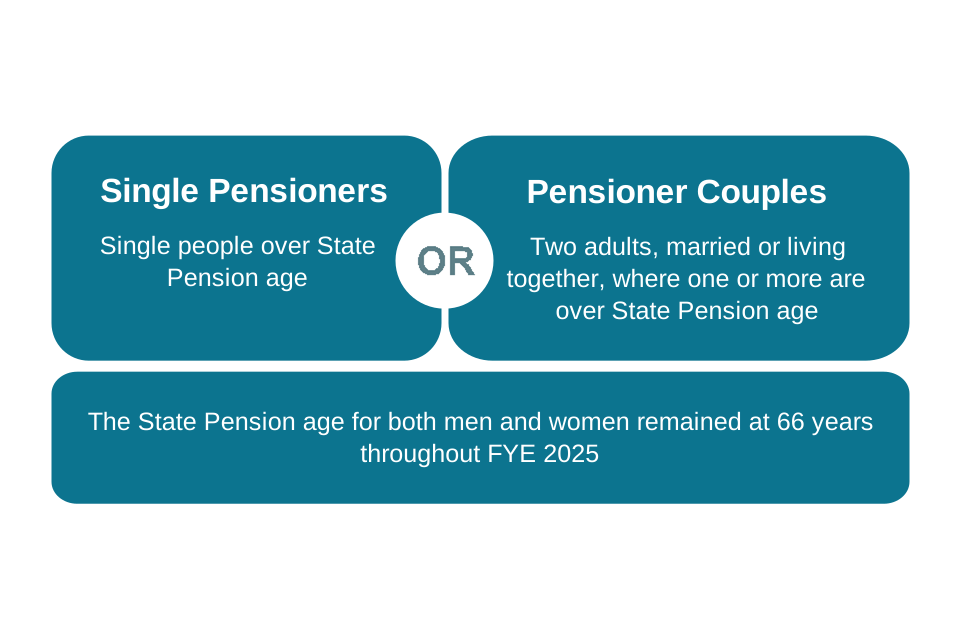
Figure shows the definition of single pensioners, pensioner couples and State Pension age, as defined in the Glossary.
Age of pensioner units
For analysis of pensioner units by age, pensioner couples are categorised by the age of the head. The head of the pensioner unit is the Household Reference Person (HRP, see below) if they belong to the pensioner unit. In households with multiple pensioner units, if the HRP is not part of the pensioner unit, the head of the pensioner unit is the first person from the pensioner unit named in the interview. In households where there is one person under SPa and one person over SPa, the younger person may be the HRP and therefore the head of a pensioner unit need not be over SPa.
The HRP is the householder with the highest income, regardless of gender.
-
in a single adult household, the HRP is the sole householder (i.e., the person in whose name the accommodation is owned or rented)
-
if there are 2 or more householders, the HRP is the householder with the highest personal income from all sources
-
if there are 2 or more householders who have the same income, the HRP is the eldest householder
Income
PI estimates do not reflect income from other adults and their dependent children in a household. For example, if a pensioner lives with their adult children, the younger adults’ incomes are not included in this analysis. While the benefit income of dependent children is included in the estimates, this was only relevant for just over half a per cent of pensioner units in FYE 2025.
Estimates are based on unequivalised income, except when comparing to the overall population distribution in section 7 of the main publication and in tables 4.6 and 4.7 of the table pack. Equivalisation makes an adjustment to income to reflect household size and composition to compare income across households as a measure of living standards and is used in the HBAI publication. In most cases in PI, income is shown for single pensioners and pensioner couples separately.
Income measures
Gross income: In PI, gross income is generally separated into 6 components:
1. Income from benefits, including tax credits. In some tables this is further divided into:
a. State Pension: Basic and Additional State Pensions, New State Pension, Bereavement Allowance (previously Widow’s Pension), and Widowed Parent’s Allowance.
b. Income-related benefits: Pension Credit, Housing Benefit, Council Tax Reduction, Social Fund Payments, and Universal Credit (for working-age partners of pensioners included within the PI dataset).
c. Disability benefits: Disability Living Allowance, Personal Independence Payments, Armed Forces Compensation Scheme, Attendance Allowance, Industrial Injuries Disablement Benefit, Adult Disability Payment (Scotland only, from FYE 2023) and any remaining Severe Disablement Allowance cases.
These 3 benefit types are not exhaustive: there are benefits, such as Winter Fuel Payments and Carers’ Allowance, which do not fit into any of these categories but are included in total benefit income.
2. Income from occupational pensions: employee pensions associated with an employer and workplace.
3. Income from personal pensions: personal pensions, annuities bought with lump sums from personal pensions, trade union and friendly society pensions.
Income from private pensions is the sum of income from occupational pensions and personal pensions.
4. Income from investments: including interest from Individual Savings Accounts (ISAs) and other savings accounts, unit trusts, bonds, stocks, and shares.
5. Income from earnings: including employee earnings and profit and loss from self-employment, as well as income from dividends. From FYE 2022, income received from director’s dividends is included in the estimates following an addition to the FRS. From FYE 2023 they are included where directors are classed as either employees, or self-employed and using business income as the basis of earnings (but not if self-employed and using profit & loss). This followed a methodological review.
6. Other income: benefits from friendly societies, income received for dependent children, maintenance payments and, from August 2020, free TV licences for those aged 75 and over who receive Pension Credit. In FYE 2023, this included several wider support Cost of Living Payments: the Council Tax Rebate, the Energy Bill Support Scheme, the Northern Ireland Energy Bills Support Scheme, the Warm Home Discount, and Welsh Fuel Support Payment. Of these, only the Warm Home Discount continued into FYE 2024 and future years.
More information about the different income sources can be found in the Glossary and for further information on the treatment of Cost of Living Payments and wider support schemes in FYE 2024, see the FRS background information and methodology.
Net income before housing costs (BHC) comprises total income from all sources for all members of the pensioner unit. Income is net of:
- income tax payments
- National Insurance contributions
- contributions to pension schemes
- local taxes (i.e., Council Tax or domestic rates)
- maintenance and child support payments
- student loan repayments, and
- parental contributions to students living away from home
Net income after housing costs (AHC) is derived by deducting a measure of housing costs from the above income measure and is also net of:
- rent (gross of housing benefits)
- water rates, community water charges and council water charges
- structural insurance premiums (for owner occupiers)
- mortgage interest payments (net of any tax relief), and
- ground rent and service charges
Income from Housing Benefit is included within gross income as an income-related benefit. Capital mortgage repayments are not deducted as a Housing Cost, as this is regarded as an asset being accrued and not a cost.
We use AHC figures throughout the PI publication unless otherwise stated, as this is a better reflection of pensioners’ disposable incomes.
J. Alternative data sources
There are other data sources that can provide information on areas of interest like those in the PI publication. These are listed below:
-
a guide to sources of data on income and earnings produced by the ONS. This guide is for users of official statistics on earnings and income. It compares the main sources of data available and outlines which sources will best meet user needs
-
HBAI presents the number and percentage of pensioners living in low-income households and material deprivation
-
the FRS publication includes pension participation for working-age individuals. This shows those who are saving for retirement and the type of pension they are saving in (occupational or personal)
-
Income Dynamics looks at changes in household income including a measure of persistent low income, based on Understanding Society data
-
the DWP Stat-Xplore Tool is a tool which provides users with access to administrative data, as well as data from FRS, HBAI and PI which allows users to conduct their own analysis. Users can download and analyse statistics on a range of different benefits, programmes, and other administrative information collected and stored by the department
-
the English Longitudinal Study of Ageing (ELSA) is a biennial longitudinal study of the health, social and economic circumstances of a sample of approximately 7,800 people aged over 50 in England. ELSA started in the early 2000s, with eleven waves of data currently published. It provides longitudinal data on pensions, savings, and labour market participation, as well as information on employment, retirement interactions, and transitions over the life courses of respondents as they grow older. ELSA also provides information on health trajectories, disability, and healthy life expectancy
-
the Wealth and Assets Survey (WAS) is a large-scale longitudinal survey with 8 rounds currently published. Round 8 (2020 to 2022) had a sample of around 15,100 households in GB. It is conducted by the ONS. The WAS dataset holds information about the economic status of households and individuals including their physical and financial assets, debts, and pension provision. WAS data is also used to understand how wealth is distributed and the factors which may affect financial planning, as well as respondents’ attitudes and behaviours towards saving. The Pension Wealth tables in WAS provide estimates of the types of private (non-state) pension wealth, split by a wide range of socio-demographic and economic breakdowns
-
the Occupational Pension Scheme Survey (OPSS) was an annual survey, conducted by ONS. It covered occupational pension schemes from the public and private sector and samples at the level of the scheme. The OPSS provided the UK’s longest consistent time series for estimates of pension scheme membership, with data from 1953 to 2018, and it provided estimates of the number of schemes, scheme members, and their level of contributions.
-
the Financial Survey of Pension Schemes (FSPS) is a quarterly survey that gathers information about income and expenditure, transactions, assets, and liabilities of pension schemes
-
the Annual Survey of Hours and Earnings (ASHE) is published by the ONS. It has been in place since 1997 and can be used to provide information on earnings for individuals close to or over SPa. It also collects significant information on employee pension membership and contributions. A summary dataset of pensioner results is published
-
the Labour Force Survey (LFS) is a continuous, large scale sample survey conducted by the ONS which provides information on the labour market, including employment, unemployment, and economic activity rates. This source can be used to provide information on individuals close to or over SPa in the labour market
-
the Benefit expenditure and caseload tables produced by DWP contain historic and forecast benefit expenditure and caseload data. These tables include long-term projections of pensioner benefit expenditure, as well as State Pension expenditure by country of residence
-
DWP benefit statistics provide a high-level summary of Accredited Official and Official statistics available through Stat-Xplore on a range of benefits, including the State Pension and Pension Credit. The main statistical release document is published on a six-monthly basis, with some data also released quarterly via Stat-Xplore and data tables
-
the personal incomes statistics as published by HMRC shows summary information about individuals who are UK taxpayers, their income, and the income tax to which they are liable. The data comes from the annual Survey of Personal Incomes, which samples administrative data held by HMRC on people who could be liable to UK income tax for the income tax year. This source includes information on income and tax for taxpayers of pension age
-
explaining income and earnings provides information on income and earnings statistics published by government departments, including DWP. It contains information on gender, occupations, and the number of people earning below the National Living Wage
-
changing trends and recent shortages in the labour market looks at workers that have entered or left the workforce and how this has changed in recent years
-
early insights from the Over 50s Lifestyle Study, Great Britain looks at attitudes and reasons behind those aged 50 to 70 years leaving the labour market at some point in 2021, in Great Britain between 8 to 13 February 2022
-
income estimates for small areas, England, and Wales are estimates of 4 measures of household income at local levels across England and Wales, based on the FRS
-
Below Average Resources are official statistics in development, and a response to the public consultation on developing new statistics based on the Social Metrics Commission approach to poverty measurement
-
Cost of Living Payment management information is an ad hoc release of management information on the number of Cost of Living Payments processed by the government, in both FYE 2023 and FYE 2024
-
Cost of Living Payments evaluation provides findings from an evaluation of the Cost of Living Payments support scheme, based on research carried out in January 2024 and August 2024
-
who has been affected by changing housing cost across England and Wales is a release published by the ONS which investigates how households in different areas of England and Wales have been affected by mortgage payment increases and rent cost increases
K. Quality Management
Quality Assurance (QA) during development
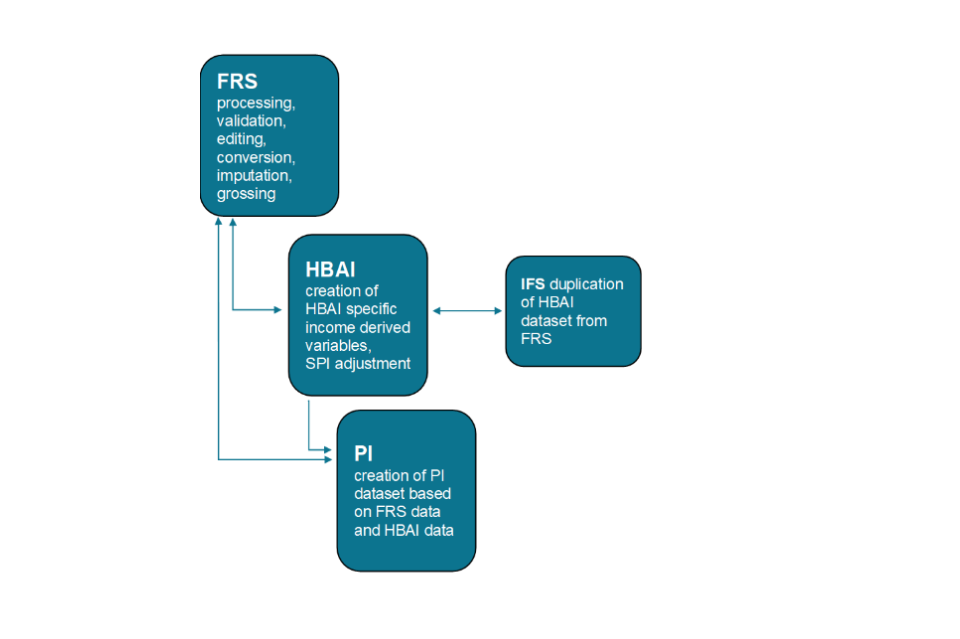
PI is based on the HBAI and FRS datasets. These datasets undergo substantial checking and verification both internally within DWP, and externally by the Institute for Fiscal Studies (IFS). When producing charts and tables for the publication, all content is independently quality assured by different members of the PI team to ensure methodology is robust. All commentary in the PI report is reviewed by the PI team and analysts from the relevant policy areas within DWP to ensure the information presented is accurate and meets user needs. The data QA process can be seen in the flowchart below, the flow chart shows the Quality Assurance process during development of these statistics. There is a feedback loop between the teams as follows: FRS and HBAI; FRS and PI; HBAI and PI; and HBAI and IFS.
-
there is quality assurance across the end-to-end process of the FRS. Questionnaire design, testing the questionnaire, and fieldwork processes such as interviewer briefing are all robust
-
the FRS requires a high threshold to accept interviews as being complete, before being included in the data process
-
there are several feedback loops between the FRS, HBAI, IFS, and PI, as shown via the arrows in the flowchart above
-
IFS provides additional quality assurance on the HBAI dataset
-
PI also receives input through working with DWP policy analysts who are subject matter experts
Routine Quality Assurance
-
every SAS program has its log checked to ensure no errors or warning messages are flagged when ran
-
where updates to SAS code are required before running, this is highlighted within the program with examples of how this should have been updated
-
checks that code has been updated correctly are part of the quality assurance of each section of the overall process
Independent assessors
Quality Assurance (QA) is conducted by:
-
members of the Surveys Branch team
-
a specifically defined QA group, consisting of people within the PI team, and analysts from within DWP
Suitable data sources
-
the FRS is a well-designed survey whose data is designated as Accredited Official Statistics by the OSR
-
FRS conducts stages of validation, editing, conversion, imputation, and grossing prior to publication
-
HBAI, which also uses the FRS dataset, is the UK’s primary source of poverty estimates and is also the main source of household incomes
-
the PI dataset draws on both the FRS and HBAI datasets to focus on pensioners
For more information on the quality assurance of the FRS dataset, see the FRS quality assessment report.
For more information on the integration of administrative data in to the FRS, see the Methodology section of this report. Also a technical report on FRS transformation, with illustrative results for DWP benefits, was published in March 2024 alongside the FYE 2023 FRS publication.
L. Feedback
We welcome feedback.
If you have any comments or questions, please contact:
Email: PENSIONERS-INCOMES@dwp.gov.uk
M. Acknowledgements
Lead Statistician: Kate Martin
Publication Lead: Aaron Brown
Publication Team: Tommi Kelha and John Bilverstone
2. Statistical Presentation
Overview of the dissemination process
Pensioners’ Incomes (PI) includes a main publication, data tables available in ODS format, release strategy and this background information and methodology. PI data is also made available on Stat-Xplore. Versions of the dataset are available from the UK Data Service.
Points to Note about Statistical Concepts and Definitions
| Use… | If… |
|---|---|
| Gross | Interested in how much income pensioners receive before any taxes are applied; Or interested in different sources of income. |
| Net | Interested in income available for pensioners to spend (excluding the income of other household members), either BHC or AHC. |
| Mean | Interested in all income available to pensioner units in a particular group; Do not consider the influence of the highest incomes to be a major problem; Or interested in breaking down income by source. |
| Median | Interested in the income of the ‘typical’ pensioner unit; Do not want the average distorted by a small number of high incomes; Or are looking at distributions of incomes. |
| Average (mean or median) for all | Interested in all income available to pensioner units; Or want to include those with no income from a particular source. |
| Average (mean or median) for those in receipt | Interested in the average ‘rate’ at which people receive income from a particular source; Or are interested in an individual source of income. |
| All pensioner units | Interested in broad trends in cash amounts for pensioners (both in couples and singles) as a whole. |
| Singles and couples separately | Comparing subgroups that contain different proportions of singles and couples; Or looking at distributions of income. |
| After housing costs | Interested in the income available for pensioners to spend after their housing costs have been met; Considering changes in this net income over time; Or for comparing pensioners’ incomes with working-age incomes. |
| Before housing costs | Interested in total net income. |
3. Methodology
A. Rounding and accuracy
In the tables and publication, the following conventions have been used:
| Convention Used | Description |
|---|---|
| [low] | Negligible (less than 50,000 or 0.5% or 50p) |
| [x] | Not available due to small sample size (fewer than 50 for averages, fewer than 100 for percentages) or as a result of less than 3 years of comparable data in 3-year average tables. |
Figures have been rounded to the nearest pound or one per cent. Population sizes have been rounded to the nearest 0.1 million. Individual figures have been rounded independently, so the sum of component items does not necessarily equal the totals shown.
B. Integrating administrative data into the FRS
As outlined in the DWP Statistical Work Programme (section 2.4), the department is committed to transforming its surveys through the integration of administrative data. This is in the wider context of the UK Statistics Authority’s strategy for data linking and OSR recommendations in their 2021 review of income-based poverty statistics, that DWP should explore the feasibility and potential of social survey and administrative data integration.
A technical report on FRS transformation, with illustrative results for DWP benefits, was published in March 2024 alongside the FYE 2023 FRS publication.
From the March 2026 FRS publication, administrative data has been integrated into the FRS to replace survey responses for the major DWP and HMRC benefits. This reduces the under-reporting of benefits that is currently seen in the FRS (and therefore PI) and improves data quality in both datasets.
This update will apply from FYE 2019 and implemented in 2 stages:
-
on 26 March 2026, alongside publication of the new FYE 2025 data, publish administrative linked, improved datasets and estimates for FYE 2022, FYE 2023 and FYE 2024; and
-
in summer 2026, publish administrative linked, improved datasets and estimates for FYE 2019 to FYE 2021
This means that by summer 2026, an administrative linked, improved, PI time series will be available from FYE 2019 to FYE 2025 inclusive.
This is a change to the current approach. In addition to improving the accuracy of the FRS dataset by using administrative records, to edit benefit amounts where the respondent has said that they receive (major) state benefits, the FRS also integrates administrative data for respondents who did not report receipt in the survey. Benefit records have been added to the FRS dataset where there is a linked state benefit record in administrative data. As such, this reduces the under-reporting of benefits that is in the FRS data and improves data quality.
This improvement means the proportion of benefit units on State Pension, disability benefits, and income-related benefits, and the average weekly amount, and thereby gross and net income has changed. This can be seen in all years from FYE 2022 (in March 2026) and from FYE 2019 (in summer 2026). This improvement also means there is a structural break in the PI series at these points, and we advise users not to make a direct comparison of changes across the break. On relevant charts and tables, we have shown this as a break in the series with a dotted line and with relevant notes.
Users should note that:
-
from the FYE 2025 publication, PI data via Stat-Xplore is split into 2 datasets to recognise the break in the series. The first dataset mainly covers the period before the integration of administrative data and the second dataset covers the period after. Note a single overlap year of data (FYE 2022 in March 2026 and FYE 2019 in summer 2026) are included in both datasets to allow for limited analysis across the break point following the guidance below. For this overlap year (FYE 2022 in March 2026 and FYE 2019 in summer 2026), where a standalone figure or a comparison with future years is required then the administrative-linked data should always be used
-
while the integration of administrative data has reduced FRS and HBAI under-reporting of benefits, some under and over-reporting will remain and the level will vary by individual benefit. See the FRS Methodology tables M.6a and M6b which are available via the FRS homepage for further information. Note the under-reporting of benefits has not been eliminated, although research continues for how to achieve this with further developments in the future. For more information on the improved approach, see the latest technical paper
The impact of this change on net income (AHC) can be seen in the figure below. The chart demonstrates the change in income. For the change in the proportion in receipt of different benefit income, this can be seen by comparing Table 2.1 in this current release with last year’s release, which does not integrate administrative data.
Average weekly income of pensioners (AHC) by family type in FYE 2025 prices (£)
In the 3 years from FYE 2022 to FYE 2025, pensioners had similar average incomes of £443 and £455 respectively. These figures are based on new linked data. The unlinked data is shown by a dotted line and shows income is lower over the 3 years from FYE 2022 to FYE 2025, than in the linked data.
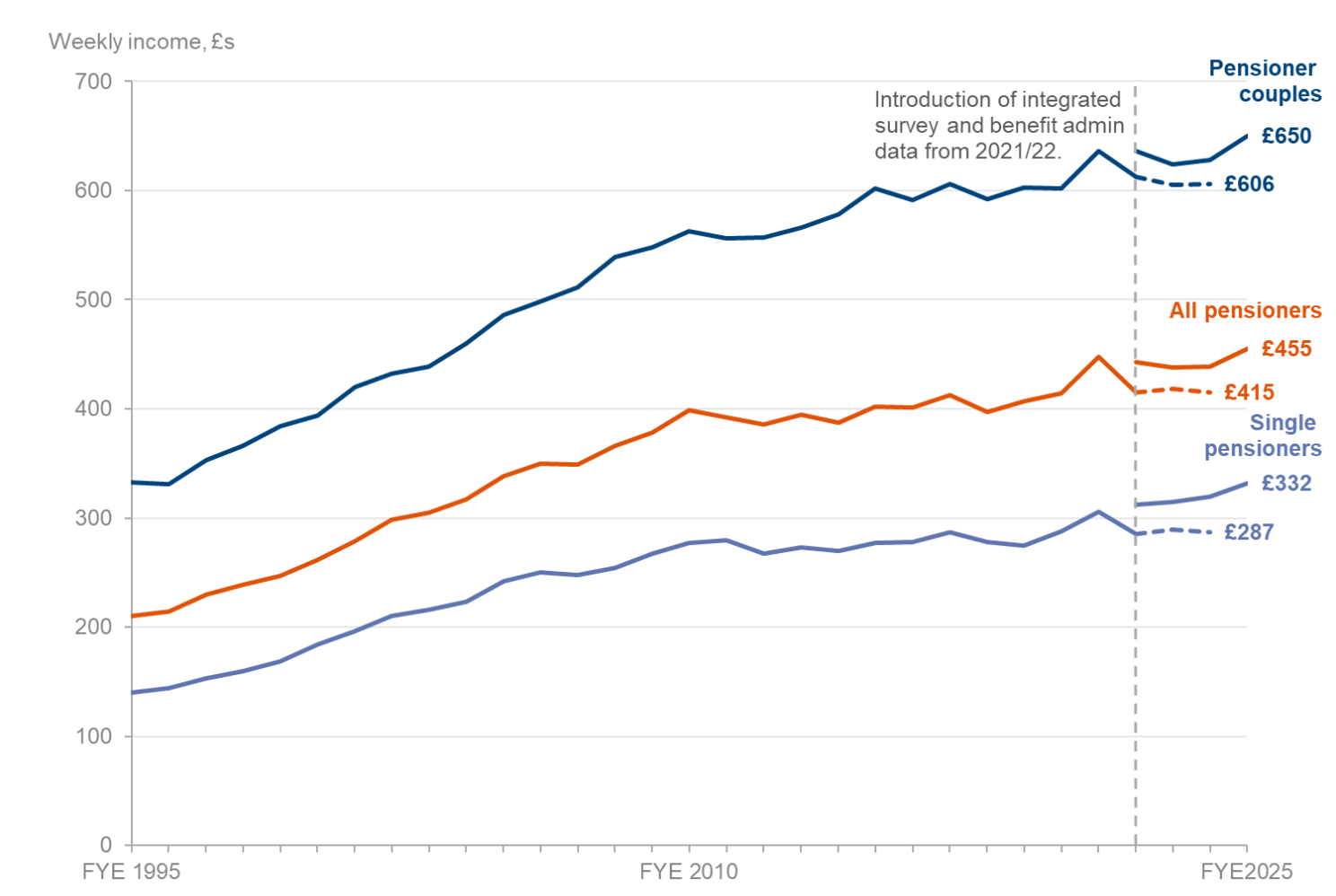
Dotted line represents estimates from survey data only, as previously reported
C. Measuring living standards
Incomes are often used as a measure of the ‘standard of living’ achieved by different groups. However, there are many other factors that can affect living standards, such as wealth, physical health, and expenditure. These factors are not considered in this report. Furthermore, estimates of incomes in PI only consider the income of the pensioner units.
Pensioners’ standards of living may also be affected by the income of other adult members of the household or their dependents. Also, no adjustment (equivalisation) is made for single pensioners compared to couples. Income estimates should therefore only be regarded as broadly indicative of pensioners’ overall living standards.
Material deprivation for pensioners, an additional indicator for measuring living standards, has been included in the HBAI publication since FYE 2010 and is derived from a suite of questions in the FRS. A final score is calculated from the set of questions and compared with a threshold score to determine whether a pensioner is in material deprivation.
Material deprivation estimates for FYE 2024 onwards are based on updated measures and therefore not directly comparable to previous estimates. We advise users not to make a direct comparison of changes in material deprivation estimates between FYE 2023 and FYE 2024.
This update to material deprivation measures follows the inclusion of updated questions in the FRS from April 2023 to March 2024 and analysis by the Department to review the previous measures. A technical report was published alongside the FYE 2024 HBAI release detailing the development of the updated measures.
For details of the old material deprivation indicator, see: Department for Work and Pensions Working Paper Number 54. For the latest results on the percentage of pensioners in low-income households and material deprivation, see the HBAI publication for FYE 2025.
Detailed information on the production of the FRS dataset can be found in this year’s FRS background information and methodology and the new FRS quality assessment report. This also includes information on the survey design, sampling, collection, and quality assurance processes.
D. Grossing
Grossing-up is the term usually given to the process of applying factors to sample data so that they yield estimates of the overall population. Estimates in the PI publication incorporate the 2011 Census based mid-year population estimates into the grossing regime from FYE 2013 onwards. A consistent back series has been produced from FYE 2003 to FYE 2012.
In addition to the use of 2011 Census data, several minor methodological changes have also been implemented in the FRS dataset. These methodological changes were made on the recommendation of the ONS Methodological Advisory Service during an Initial Review of the FRS weighting scheme. A report of the changes made to the grossing regime is available.
The full set of inputs based on the 2021 Census (2022 for Scotland), which are required for the grossing factors, were not available in time to apply to this release. For this reason, estimates for the FYE 2025 survey year have their basis in the 2011 Census, as rolled forward to FYE 2025 by ONS’ mid-year estimates. All FRS based outputs use these population estimates for FYE 2025. Full details of our plans to use 2021 Census outputs for the production of FRS grossing factors can be found in the FRS Release Strategy.
The mid-year estimates cover the usual resident population and were adjusted to reflect the population living in private households and covered by the FRS sample. This was achieved by deflating the usually resident population using data from the 2011 Census on the proportion of the usually resident (by local authority, age and sex) population, who live in private households.
A software package called CALMAR, provided by the French National Statistics Institute, is used to reconcile control variables at different levels and estimate their joint population. This software makes the final weighted sample distributions match the population distributions through a process known as calibration weighting. It should be noted that if a few cases are associated with very small or very large grossing factors, grossed estimates will have relatively wide confidence intervals.
E. Adjusting for inflation
PI uses uprating factors to adjust for inflation, by bringing values from previous years into current price terms for the most recent year of the publication. As advised in a Statistical Notice published in May 2016, from FYE 2015 PI made a methodological change to use variants of the Consumer Prices Index (CPI) when adjusting for inflation. Prior to the FYE 2015 PI publication, variants of the Retail Prices Index (RPI) were used to adjust for inflation. Read more information in the FYE 2015 PI publication’s background information and methodology.
F. Adjustment for individuals with very high incomes
An adjustment is made to sample cases at the top of the income distribution to correct for volatility in the highest incomes captured in the survey. This adjustment uses data from HM Revenue and Customs Survey of Personal Incomes (SPI) to control the numbers and income levels of the ‘very rich’ while retaining the FRS data on the characteristics of the households. For FYE 2025, pensioners in Great Britain are subject to the SPI adjustment if their gross income exceeded £108,000 per year (£87,700 in Northern Ireland). Working-age adults (including the working-age partners of pensioners) are subject to the SPI adjustment if their gross income exceeded £372,900 per year (£193,000 per year in Northern Ireland). For more details on the SPI adjustment see the HBAI quality and methodology information report.
G. Negative incomes
Negative incomes are not thought to be indicative of standards of living. Pensioner units with negative net income BHC have the gross income components of income, and their net income BHC, set to zero. Net income AHC is set to zero minus housing costs, and so for a small number of cases will be negative. See the PI methodological paper number 2 for more information on negative incomes.
H. Output standards for ethnic groups
The PI FYE 2025 publication continues to use the latest harmonised output standards for ethnic groups for the UK, however, ‘mixed’ and ‘other’ ethnic groups have been merged due to small sample sizes. The latest harmonised standards were published in August 2011 and cover the ethnic group question in England, Wales, Scotland, and Northern Ireland. They also cover harmonised data presentation for ethnic group outputs. The standards were updated in February 2013 detailing how Gypsy, Traveller, and Irish Traveller should be recorded in the outputs, due to differences across the UK.
Reporting of ethnic background was amended in FYE 2021 to reflect fully that this ethnicity is self-declared. Representation rates are now calculated from known declarations only and exclude ‘choose not to declare’ and ‘unknown.’ For the FRS and PI this has had a minimal effect on reporting.
For further details please see the Ethnicity harmonised standard.
I. Further information
A collection of methodological papers on PI are available which include papers on negative incomes, personal pension income, and definitions of pensioner units.
4. Reliability of estimates
The figures in this publication come from the FRS. Like all surveys, it gathers information from a sample rather than from the whole population. The size of the sample and the way in which the sample is selected is carefully designed to ensure that it is representative of the UK as whole, whilst bearing in mind practical considerations like time and cost constraints. Survey results are always estimates, not precise figures. This means that they are subject to a level of uncertainty which can affect how changes, especially over the short term, should be interpreted.
A. Estimating and reporting uncertainty
Two different random samples from one population, for example the UK, are unlikely to give the same survey results, which are likely to differ again from the results that would be obtained if the whole population was surveyed. This level of uncertainty around a survey estimate can be calculated and is commonly referred to as sampling error.
In addition to sampling error, the PI estimates can also be affected by other non-sampling errors. Some of these are:
-
reporting errors: Imperfect recall and respondents choosing to deliberately give incorrect answers are examples of reporting error. If these errors are systematic, they may lead to bias in the survey estimates. The integration of administrative data in the FYE 2025 publication and going forwards, reduces this reporting error of benefit income
-
under-reporting: The FRS information on benefits relies on the respondent being able to accurately report the amount of benefit they receive. This reliance leads to under-reporting in receipt for many benefits. The integration of administrative data in the FYE 2025 publication and going forwards, reduces this under-reporting of benefit income. It is also thought that household surveys underestimate income from both self-employment and investments so these figures should be treated with caution. The under-reporting of income from investments is particularly likely to affect the estimates for pensioners
-
misreporting: The type of income received is self-reported by survey respondents and can consequently be misreported. For example, some survey respondents may not be able to distinguish between the State Pension and Pension Credit because these benefits can be paid jointly. The integration of administrative data in the FYE 2025 publication and going forwards, reduces this misreporting of benefit income
-
systematic bias: This arises in the sample if certain groups are less likely to respond to a survey than others. This is corrected to some extent in the FRS by grossing to match subgroups of the population by age, sex, family status, tenure, Council Tax band, and broad geographic region. Nevertheless, it is difficult to account for all possible bias, so some results may still be affected
We can calculate the level of uncertainty around a survey estimate by exploring how that estimate would change if we were to draw many survey samples for the same time period, instead of just one. This process is called bootstrapping.
B. Measuring the size of sampling error
Bootstrapping allows us to define a range around the estimate (known as a “confidence interval”) and to state how likely it is that the real value that the survey is trying to measure lies within that range. Confidence intervals are used as a guide to the size of sampling error. These are typically set up so that we can be 95% sure that the true value lies within the range, in which case this range is referred to as a “95% confidence interval”. A wider confidence interval indicates a greater uncertainty around the estimate. Generally, a smaller sample size will lead to estimates that have a wider confidence interval. This is because a smaller sample is less likely than a larger sample to reflect the characteristics of the total population and therefore there will be more uncertainty around the estimate derived from the sample.
Statistical significance: Some changes in estimates between years will be the result of different samples being chosen, whilst other changes will reflect underlying changes in income across the population. Confidence intervals can be used to identify changes in the data that are statistically significant; that is, they are unlikely to have occurred by chance due to a particular sample being chosen. Confidence intervals can give a range around the difference in a result from one year to the next. If the range does not include zero it indicates this change is unlikely to be the result of chance.
Working with uncertain estimates: Some changes between years will be small in relation to sampling variation and other sources of error and may not be statistically significant. This is relevant for particular sub-groups, as these will have smaller sample sizes than the overall survey sample size. For these sub-groups it is important to look at long-term trends.
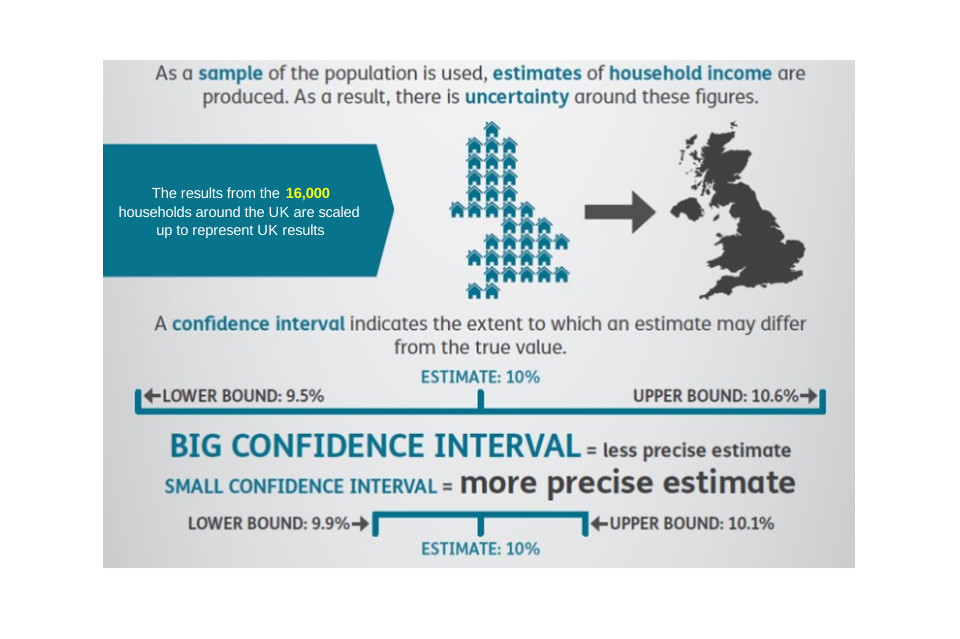
Graphic explains in text and images how the sample of 16,000 households of the population is scaled up to represent UK results, as a result there is uncertainty in the figures. Confidence intervals indicate the extent to which an estimate may differ from the true value with a bigger confidence interval being due to a less precise estimate.
5. Estimating and interpreting uncertainty in PI
A. Calculating uncertainty in PI
Since the FYE 2014 publication, confidence intervals have been calculated using a bootstrapping approach, using the statistical package SAS. This has allowed confidence intervals to be calculated for a wider range of estimates.
Bootstrapping considers the design of the sample. It replicates the sampling design of the survey and takes re-samples with replacement from the dataset, creating 500 new samples of the dataset. Each new sample is different and contains multiple copies of some survey observations and none of some others. Exploring the range of results in these samples allows us to generate confidence intervals around the result obtained in the original sample.
From the FYE 2016 publication and onwards, new bootstrapping methodology has provided an improved measure of uncertainty around key PI estimates by creating resamples of the HBAI dataset by simulating stratified, cluster sampling for GB and stratified sampling for NI. It also creates a unique set of grossing factors for each resample using the HBAI grossing process to gross the GB and NI resamples to the UK population. For a more technical guide to the approach used to generate confidence intervals in this report, please see the statistical notice or the HBAI quality and methodology information report.
B. Interpreting estimates of uncertainty in PI
Table M1.1 provides confidence intervals for key estimates of pensioners’ incomes in FYE 2025. For example, in FYE 2025, weekly gross income for all pensioner units is estimated to be £731. We can be 95% confident that the true value of gross income per week, if we were to take a census of the population, would lie between £703 and £756.
The table shows that, while there is a degree of uncertainty about the estimates, it does not affect the broad conclusions drawn, such as the relative importance of different types of income, or the fact that single males on average had higher incomes than single females.
When comparing 2 or more estimates, we must factor in the uncertainty surrounding each of the estimates. Table M1.2 shows the growth in sources of income between FYE 2022 and FYE 2025, and FYE 2024 and FYE 2025.
Statistically significant results (at the 95% confidence level) are marked with an asterisk (*). As can be seen, the confidence intervals around the estimates of various growth rates between FYE 2024 and FYE 2025 often include zero. This means that we cannot be confident that the growth rate is different from zero, and hence the change is not statistically significant.
Over short time periods, it is unlikely that an income measure will change dramatically, so the uncertainty is likely to be large compared with the change itself.
Users are advised to draw conclusions from long-term trends rather than year on year changes.
Even some longer-term changes need to be interpreted with care. For income sources where the amount received per week varies greatly between pensioner units, such as investment income, even long-term comparisons may not be statistically significant. For example, income from investments has increased by 52% for single pensioners from FYE 2022 to FYE 2025, but this increase is not statistically significant (see Table M1.2).
For more information about uncertainty around FRS derived estimates see the 2014 uncertainty in FRS based analysis report. There is also the 2017 statistical notice for the change implemented from FYE 2016 data onwards.
Table M1.1: Uncertainty surrounding estimates in PI FYE 2025 (95% confidence)
| All pensioner units | Estimate £pw | Interval width | Relative width | Interval range |
|---|---|---|---|---|
| Gross income | 731 | 54 | 7% | 703 to 756 |
| Benefit income | 342 | 14 | 4% | 337 to 351 |
| Occupational pension income | 200 | 27 | 14% | 185 to 212 |
| Personal pension income | 21 | 10 | 47% | 16 to 26 |
| Investment income | 65 | 12 | 18% | 59 to 71 |
| Earnings income | 98 | 38 | 39% | 76 to 115 |
| Other income | 4 | 2 | 57% | 3 to 5 |
| Net income BHC | - | - | - | - |
| Mean | 616 | 37 | 6% | 598 to 635 |
| Median | 505 | 34 | 7% | 490 to 524 |
| Net income AHC | - | - | - | - |
| Mean | 574 | 37 | 6% | 557 to 593 |
| Median | 455 | 34 | 7% | 439 to 473 |
| Pensioner couples | ||||
| Median net income BHC | 681 | 50 | 7% | 655 to 705 |
| Median net income AHC | 650 | 48 | 7% | 626 to 673 |
| Single pensioners | - | - | - | - |
| Median net income BHC | 378 | 29 | 8% | 363 to 392 |
| Median net income AHC | 332 | 33 | 10% | 315 to 348 |
| Single male pensioners | - | - | - | - |
| Median net income BHC | 396 | 47 | 12% | 373 to 420 |
| Median net income AHC | 350 | 54 | 15% | 325 to 379 |
| Single female pensioners | ||||
| Median net income BHC | 368 | 36 | 10% | 350 to 386 |
| Median net income AHC | 325 | 40 | 12% | 306 to 346 |
| Pensioner units where the head is under 75 | - | - | - | - |
| Median net income BHC | 551 | 53 | 10% | 526 to 579 |
| Median net income AHC | 502 | 65 | 13% | 471 to 536 |
| Pensioner units where the head is 75 or over | - | - | - | - |
| Median net income BHC | 467 | 39 | 8% | 448 to 487 |
| Median net income AHC | 417 | 36 | 9% | 397 to 433 |
1. The interval widths are calculated on unrounded numbers and therefore may not match the interval range.
Table M1.2: Growth in average incomes of pensioner units, FYE 2022 to FYE 2025, and FYE 2024 to FYE 2025
| All pensioner units | FYE 2022 | FYE 2024 | FYE 2025 | FYE 2022 to FYE 2025 (% growth) | FYE 2024 to FYE 2025 (% growth) | interval FYE 2022 to FYE 2025 (95% confidence) | interval FYE 2024 to FYE 2025 (95% confidence) |
|---|---|---|---|---|---|---|---|
| Gross income | 736 | 733 | 731 | -1% | 0% | -4% to 5% | -5% to 4% |
| Benefit income | 338 | 336 | 342 | 1% | 2% | -2% to 4% | -1% to 5% |
| Occupational pension income | 234 | 210 | 200 | -14%* | -5% | -22% to -6% | -15% to 3% |
| Personal pension income | 22 | 24 | 21 | -2% | -12% | -40% to 27% | -41% to 13% |
| Investment income | 49 | 66 | 65 | 33%* | -1% | 16% to 56% | -11% to 12% |
| Earnings income | 89 | 93 | 98 | 10% | 5% | -18% to 33% | -21% to 28% |
| Other income | 4 | 3 | 4 | 2% | 3% | -56% to 37% | -37% to 44% |
| Net income BHC | - | - | - | - | - | - | - |
| Mean | 622 | 611 | 616 | -1% | 1% | -4% to 4% | -3% to 7% |
| Median | 500 | 490 | 505 | 1% | 3% | -2% to 6% | -2% to 8% |
| Net income AHC | - | - | - | - | - | - | - |
| Mean | 569 | 565 | 574 | 1% | 2% | -3% to 6% | -5% to 4% |
| Median | 443 | 439 | 455 | 3% | 4% | -1% to 9% | -2% to 9% |
| Pensioner couples | - | - | - | - | - | - | - |
| Gross income | 983 | 992 | 972 | -1% | -2% | -8% to 7% | -10% to 5% |
| Benefit income | 388 | 386 | 393 | 1% | 2% | -2% to 5% | -2% to 5% |
| Occupational pension income | 337 | 306 | 286 | -15%* | -7% | -26% to -6% | -19% to 2% |
| Personal pension income | 34 | 36 | 32 | -5% | -11% | -60% to 24% | -51% to 19% |
| Investment income | 72 | 100 | 92 | 28% | -8% | -5% to 61% | -35% to 13% |
| Earnings income | 149 | 160 | 165 | 11% | 3% | -27% to 35% | -28% to 28% |
| Other income | 4 | 5 | 4 | 22% | -9% | -61% to 82% | -89% to 39% |
| Net income BHC | - | - | - | - | - | - | - |
| Mean | 820 | 813 | 806 | -2% | -1% | -8% to 4% | -7% to 5% |
| Median | 678 | 665 | 681 | 0% | 2% | -5% to 6% | -2% to 7% |
| Net income AHC | - | - | - | - | - | - | - |
| Mean | 770 | 770 | 773 | 0% | 0% | -6% to 7% | -6% to 6% |
| Median | 636 | 628 | 650 | 2% | 3% | -4% to 8% | -2% to 9% |
| Single pensioners | - | - | - | - | - | - | - |
| #Gross income | 492 | 493 | 510 | 4% | 3% | -4% to 12% | -6% to 13% |
| Benefit income | 289 | 290 | 296 | 2% | 2% | -3% to 7% | -2% to 7% |
| Occupational pension | 132 | 122 | 122 | -8% | 0% | -21% to 7% | -18% to 17% |
| Personal pension | 11 | 14 | 12 | 14% | -13% | -62% to 66% | -66% to 24% |
| Investment income | 27 | 34 | 40 | 52% | 17% | -18% to 107% | -76% to 65% |
| Earnings | 30 | 31 | 37 | 21% | 17% | -47% to 75% | -51% to 62% |
| Other income | 4 | 2 | 3 | -16% | 27% | -115% to 26% | -70% to 88% |
| Net income BHC | - | - | - | - | - | - | - |
| Mean | 427 | 423 | 441 | 3% | 4% | -3% to 10% | -3% to 12% |
| Median | 369 | 364 | 378 | 2% | 4% | -3% to 8% | -2% to 9% |
| Net income AHC | - | - | - | - | - | - | - |
| Mean | 370 | 373 | 392 | 6% | 5% | -1% to 14% | -3% to 14% |
| Median | 312 | 320 | 332 | 6% | 3% | -2% to 14% | -3% to 11% |
1. Results that are statistically significant are denoted with an asterisk (*).
2. Confidence intervals are calculated on unrounded numbers. Changes are indicated as statistically significant if the confidence interval before rounding does not include zero.
3. The percentage changes are calculated on unrounded numbers and therefore may not match those calculated for the rounded numbers shown in the table.
6. Households Below Average Income (HBAI) and Pensioners’ Incomes (PI)
Two of the tables in the PI table pack (Tables 4.6 and 4.7) provide information on the position of pensioners within the overall income distribution. These tables define pensioners as adults in families where at least one member is over SPa, consistent with the rest of the PI table pack. This is different to the definition used in HBAI which defines pensioners as those over SPa.
Results from HBAI should not be directly compared to those from PI. The main differences between HBAI and PI methods of analysis are:
Income components: The PI results include analysis of the components of pensioner unit income (benefit income, occupational pension income, etc.). HBAI, with its broader span of interests, does not present detailed analysis of this sort.
Household or pensioner unit: PI is generally concerned with cash incomes directly received by pensioners. It measures the income of pensioner units only (plus income for any dependent children within the pensioner unit), ignoring income received by any other members of the household. HBAI attempts to measure material living standards, so it includes all the income for the household in which the pensioner lives; the underlying HBAI assumption being that the total household income is shared amongst all household members.
Equivalisation: To allow comparison of living standards of different households, the HBAI ‘equivalises’ household income; that is, adjusts it to take account of household size and composition. One of the main functions of PI is to provide information on the income of pensioner units in monetary terms, split by sources of income. This can only be done using unequivalised income. Equivalisation is not necessary for most results, which are presented separately for pensioner couples and single pensioners. To avoid unnecessary complexity, the main PI results are presented in monetary terms, at constant FYE 2025 prices, rather than equivalised income at FYE 2025 prices. PI does however use equivalised income to analyse pensioners’ position in the overall population income distribution.
Equivalisation Scales: HBAI historically used the McClements equivalisation scale. Following user consultation, the FYE 2006 edition of HBAI and subsequent HBAI publications have used Modified OECD equivalisation scales. The same change has been made to the relevant data in PI since the FYE 2006 edition of PI. Information on the effect of the change can be found in Appendix B of the FYE 2006 edition of PI.
7. Glossary
This glossary gives a brief explanation for each of the key terms used in PI. Further details on these definitions, including full derivations of variables, are available on request from the DWP PI Team at pensioners-incomes@dwp.gov.uk with the subject Pensioners’ Income Methodology Query.
A glossary of income and earnings terms produced by the ONS is also available.
Adult
All individuals who are aged 16 and over are classified as an adult, unless the individual is defined as a dependent child (see Child). All adults in the household are interviewed as part of the FRS.
Age
Respondent’s age at last birthday (at the time of the interview).
Automatic enrolment
Automatic enrolment requires all employers to enrol their eligible workers into a workplace pension scheme if they are not already in one. The staged timetable began in October 2012 for larger firms and completed for all employers in 2019. To preserve individual responsibility for the decision to save, workers can opt out of the scheme. To be eligible for automatic enrolment, the jobholder must be at least 22 years old, under SPa, earn above the earnings trigger for automatic enrolment, and work or usually work in the UK. For further information, see automatic enrolment.
Benefit unit or family
A benefit unit may consist of a single adult, or a married or cohabiting couple, plus any dependent children. Same-sex partners have been included in the same benefit unit since January 2006. Where a total for a benefit unit is presented (such as total benefit unit income) this includes income from adults plus any income from dependent children. There are various types of benefit unit:
- pensioner couple: Benefit units where either adult in the couple is over SPa
- pensioner couple, married or in a civil partnership: Benefit units headed by a couple in which at least one partner is over SPa and the couple are either married or in a civil partnership
- pensioner couple, cohabiting: Benefit units headed by a couple in which at least one partner is over SPa and the couple are neither married nor in a civil partnership
- single male pensioner: Benefit units headed by a single male adult over SPa
- single female pensioner: Benefit units headed by a single female adult over SPa
It should be noted that ‘pensioner unit’ is used throughout the report as a description of groups of individuals regardless of whether they are in receipt of any state support.
Benefits
Financial support from the government. Most of these benefits are administered by DWP. The major exceptions are Housing Benefit and Council Tax Reduction, which are administered by local authorities. Child Benefit is administered by HMRC, who also administer Tax Credits. These are not treated as benefits, but both Tax Credits and benefits are included in the term State Support. Tax Credits will ultimately be replaced by Universal Credit.
Benefits are often divided into income-related benefits and non-income-related benefits. In assessing entitlement to the former, the claimant’s income and savings will be checked against the rules of the benefit. In contrast, eligibility for non-income-related benefits is instead dependent on the claimant’s circumstances (a recent bereavement, for example), rather than their income and savings. A list of the main state benefits divided into these 2 categories is below.
Disability-related benefits is the term used to describe all benefits paid on grounds of disability. These are: Disability Living Allowance, Personal Independence Payments, Armed Forces Compensation Scheme, Attendance Allowance, Industrial Injuries Disablement Benefit, and any remaining Severe Disablement Allowance cases. Before FYE 2009, Incapacity Benefit was also in this group. Numbers on Incapacity Benefit and Severe Disablement Allowance benefits have decreased over time, as both were replaced by Employment and Support Allowance from October 2008.
| Income-related benefits (UK) | Non-income-related benefits (UK) |
|---|---|
| Council Tax Reduction | Attendance Allowance |
| Employment and Support Allowance (income-related element) | Carer’s Allowance |
| Housing Benefit | Child Benefit |
| Income Support | Disability Living Allowance (both mobility and care components) |
| Pension Credit | Employment and Support Allowance (contributory element) |
| Universal Credit | Personal Independence Payment (Daily Living and Mobility components) |
| - | State Pension |
Child
A dependent child is defined as an individual aged under 16. A person is also defined as a child if they are 16 to 19 years old and they are all of the below:
- not married nor in a civil partnership nor living with a partner
- living with parents or a responsible adult
- in full-time non-advanced education or in unwaged government training
Confidence interval
A measure of sampling error. A confidence interval is a range around an estimate which states how likely it is that the real value that the survey is trying to measure lies within that range. A wider confidence interval indicates a greater uncertainty around the estimate. Generally, a smaller sample size will lead to estimates that have a wider confidence interval than estimates from larger sample sizes. This is because a smaller sample is less likely than a larger sample to reflect the characteristics of the total population and therefore there will be more uncertainty around the estimate derived from the sample. Note that a confidence interval ignores any systematic errors which may be present in the survey and analysis processes.
Council Tax
The tax is based on which, of a set of bands, a property’s value falls into. Its headline rate is based on 2 adults per household. Read more information on Council Tax.
Equivalisation
Income measures used in HBAI consider variations in the size and composition of the households in which people live. This process is called equivalisation. Equivalisation reflects the fact that a family of several people needs a higher income than a single individual for them to enjoy a comparable standard of living. Equivalence scales conventionally take a couple with no children as the reference point. The process then relatively increases the income of single person households (since their incomes are divided by a value less than one) and relatively reduces the incomes of households with 3 or more persons, which have an equivalence value of greater than one.
We do not use equivalisation in PI, except in section 7 of the main publication and when comparing to the overall distribution in Tables 4.6 and 4.7 of the table pack.
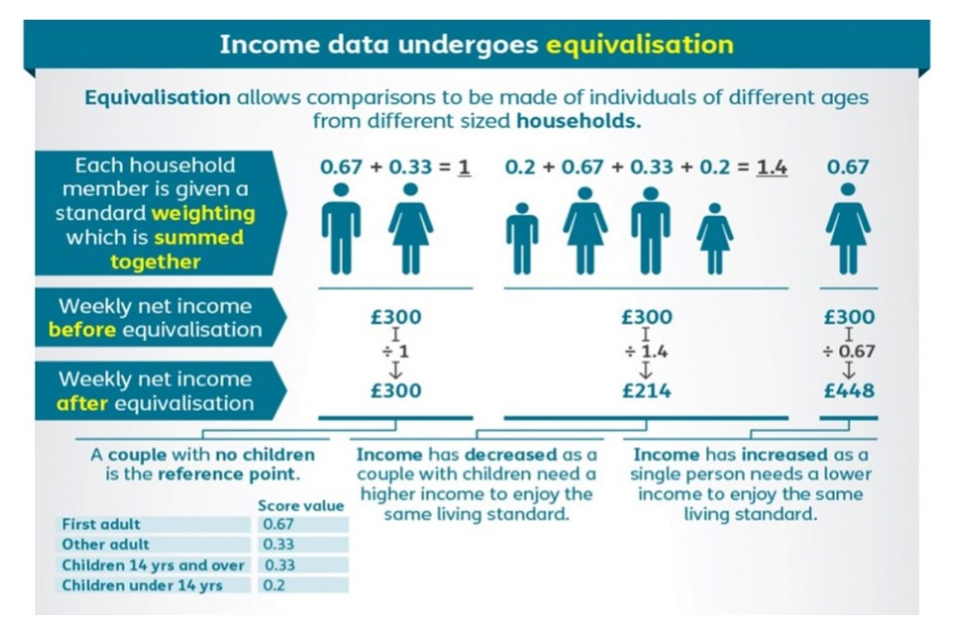
Graphic explains in text and images that equivalisation is applied to the income data. The graphic gives examples of weekly net income before and after equivalisation for 3 household types.
Ethnic group
The ethnic group to which respondents consider that they belong. The FRS questions are in line with Government Statistical Service (GSS) harmonisation guidance. The categories are:
- White
- Mixed or Multiple ethnic groups
- Asian or Asian British
- Black or African or Caribbean or Black British
- Other ethnic group
For Northern Ireland, ‘Irish Traveller’ is included in ‘Other ethnic group’. For England, Wales, and Scotland, ‘Gypsy or Irish Traveller’ is included in ‘White’.
‘Arab’ has been included in ‘Other ethnic group’ due to small sample sizes.
Ethnic background is self-declared; data is available for known declarations and excludes ‘choose not to declare’ and ‘unknown’.
Family Resources Survey (FRS)
The FRS is one of the largest cross-sectional household surveys in the country. From April 2011, the target achieved UK sample size for the FRS was reduced by 5,000 households from 25,000 to 20,000 households a year. It should be noted that due to COVID-19, there was a smaller achieved sample size in FYE 2021 and FYE 2022. In FYE 2025, the achieved sample size was around 16,000. Prior to FYE 2003 the survey covered GB; from FYE 2003 the survey was extended to cover the UK.
Gross income
Total income a pensioner receives from all sources before any outgoings, tax, or housing costs.
Head of pensioner unit
If the Household Reference Person (HRP) does not belong to the pensioner unit, then the Head of the pensioner unit is simply the first person from that pensioner unit, in the order they were named in the interview. If the HRP does belong to the pensioner unit, they are also the Head of that pensioner unit.
Household
One person living alone or a group of people (not necessarily related) living at the same address who share cooking facilities and share a living room or sitting room or dining area. A household consists of one or more benefit units.
Household Reference Person (HRP)
The highest income person in a household.
- in a single-adult household, the HRP is simply the sole householder (i.e., the person in whose name the accommodation is owned or rented)
- if there are 2 or more householders, the HRP is the householder with the highest personal income, taking all sources of income into account.
- if there are 2 or more householders who have the same income, the HRP is the elder
Before April 2001, the HRP was known as the Head of Household. Where we refer to ‘Head’ in tables relating to households, this is the HRP. The Head of the pensioner unit will not necessarily be the HRP (see Head of pensioner unit).
Housing costs
Housing costs are made up of rent (gross of housing benefit), water rates, community water charges and council water charges, mortgage interest payments (net of tax relief), structural insurance premiums (for owner occupiers), and ground rent and service charges.
Net incomes in PI are presented either on a BHC or AHC basis, the definitions of which are:
- before housing costs (BHC): Net income before the housing cost aspects listed above are taken away
- after housing costs (AHC): Net income after the housing cost aspects listed above are taken away
Capital mortgage repayments are not deducted as a Housing Cost as this is regarded as an asset being accrued and not a cost.
In a multi-benefit unit household, housing costs are attributed to the first pensioner unit (the pensioner unit with the HRP). This means that for a minority of pensioner units, housing costs will not be attributed to them.
Income distribution
The spread of incomes across the population.
Marital status
This is the person’s marital status:
-
married or civil partnership: currently married or in a civil partnership, and not separated from spouse (excludes temporary absences)
-
cohabiting: not married nor in a civil partnership but living as a couple
-
single: is not currently cohabiting and is not married nor in a civil partnership
Mixed-age pensioner couples
A couple where one member is above SPa, and the other is below. Used in comparison with couples where both members are over SPa.
Net income
Net income is gross income with direct taxes including Council Tax payments deducted. Net income may be presented on a BHC or AHC basis. See ‘Housing costs’ for more detail.
Occupational pension
An occupational pension scheme is an arrangement an employer makes to give their employees a pension when they retire. Employees may become a member of an employer’s pension scheme on a voluntary basis. Until 6 April 2016, Defined Benefit occupational pension schemes could be contracted into or out of the Additional State Pension. This was abolished with the introduction of the New State Pension. The contracting out of Defined Contribution occupational pension schemes was abolished in 2012.
Pensioner unit
Benefit units who are a pensioner couple, single male pensioner, or single female pensioner. Pensioner benefit units may also include any dependent children, but this is uncommon. In FYE 2025, just over half a per cent of pensioner units included dependent children.
Pension Credit
An income-related benefit made up of Guarantee Credit and Savings Credit. Guarantee Credit tops up the claimant’s income to a guaranteed level. Savings Credit is an extra amount for people who have made provision for their retirement above a certain threshold. Savings Credit was abolished for new claimants on 6 April 2016, so most people who reached SPa after 6 April 2016 are not eligible for Savings Credit. New claims for Savings Credit can still be made by pensioner units who have reached SPa prior to 6 April 2016.
Personal pension
A pension provided through a contract between an individual and the pension provider. The pension which is produced will be based upon the level of contributions, investment returns and annuity rates. A personal pension can be either employer provided or privately purchased. Different forms of personal pension include:
-
Group Personal Pension: Before automatic enrolment, some employers who did not offer an occupational pension scheme may have arranged for a pension provider to offer their employees a personal pension instead. The employer may have negotiated special terms with the provider that means the administration charges are lower than those for individual personal pensions. Although they are sometimes referred to as company pensions, they are not run by employers and should not be confused with occupational pensions, which have different tax, benefit, and contribution rules. Note that some companies may still offer Group Personal Pensions in addition to their occupational pensions.
-
Group Stakeholder Pension: As with Group Personal Pensions, an employer can make an arrangement with a pension provider and offer their employees a Group Stakeholder Pension (see Stakeholder Pension).
-
Stakeholder Pension: Enables those without earnings, such as non-earning partners, carers, pensioners, and students, to pay into a pension scheme. Almost anybody up to the age of 75 may take out a stakeholder pension and it is not necessary to make regular contributions.
Read more information on personal pensions.
Private pension
Private pensions include occupational pensions (also known as Employer-Sponsored pensions) and personal pensions (including Stakeholder pensions). People can have several different private pensions at once. In previous years only one of these pensions could be contracted out. The contracting out of Defined Benefit occupational schemes was abolished in April 2016 with the introduction of the New State Pension. The contracting out of Defined Contribution pension schemes was abolished in 2012.
Region
Regional classifications are based on the standard statistical geography of UK Regions, as defined by ONS: 9 in England, and a single region for each of Wales, Scotland, and Northern Ireland. Tables will also show statistics for the UK, GB, and England as a whole.
Read more information on geographical terms used in official statistics.
Disaggregation by geographical regions is presented as 3-year averages. This presentation has been used as single-year regional estimates are considered too volatile. Estimates for the UK, however, are shown as single-year estimates for the latest available year. Although the FRS sample is large enough to allow some analysis to be performed at a regional level, it should be noted that no adjustment has been made for regional differences in the cost of living, as the necessary data is not available.
Sampling error
The uncertainty in the estimates which arises from taking a random sample of the household population. The likely size of this error for a particular statistic can be identified and expressed as a confidence interval.
Sources of income
-
benefit income: including State Pension, income-related benefits, and disability benefits, as well as other types of benefits such as Winter Fuel Payments and Carer’s Allowance
-
occupational pension income: including employee pensions associated with an employer and workplace
-
personal pension income: including personal pensions, annuities bought with lump sums from personal pensions, trade union and friendly society pensions
-
investment income: including interest from Individual Savings Accounts (ISAs) and other savings accounts, unit trusts, bonds, stocks, and shares
- earnings income, including:
-
wages and salaries: for a respondent currently working as an employee, income from wages and salaries is equal to gross pay before any deductions, less any refunds of income tax, any motoring and mileage expenses, any refunds for items of household expenditure and any Statutory Sick Pay or Statutory Maternity Pay, plus bonuses received over the last 12 months (converted to a weekly amount) and any children’s earnings from part-time jobs
-
self-employed income: the total amount of income received from self-employment gross of tax and national insurance payments, based on profits (where the individual considers themselves as running a business) or on estimated earnings or drawings otherwise. Excludes any profits due to partners in the business. Any losses are recorded as such. From FYE 2022, income received from director’s dividends is included in the estimates following an addition to the FRS. From FYE 2023 they are only included where directors are classed as employees or self-employed and using business income as the basis of earnings (but not if self-employed and using profit & loss). This followed a methodological review. The income is treated as income from earnings
-
- other income: benefits from friendly societies, income received for dependent children, maintenance payments and from August 2020, free TV licences for those aged 75 and over who received Pension Credit. From In FYE 2023, this included several wider support Cost of Living Payments: the Council Tax Rebate, the Energy Bill Support Scheme, the Northern Ireland Energy Bills Support Scheme, the Warm Home Discount, and Welsh Fuel Support Payment. Of these, only the Warm Home Discount continued into FYE 2024 and future years
The below applies to FYE 2021 and FYE 2022 data only:
The calculation of self-employed income and therefore total individual income does not directly include grants received from Self-Employment Income Support Scheme (SEISS).
Wages are treated as earnings income rather than state support, irrespective of any support payments from the Coronavirus Job Retention Scheme (CJRS) that the respondent’s employer was receiving in respect of their employment.
State Pension
The State Pension is a payment made to qualifying individuals who have reached SPa. A new single-tier State Pension launched on 6 April 2016 for people who reached SPa on or after April 2016, to replace the previous system. This consolidated the basic State Pension and Additional State Pension into one single amount.
People who reached SPa before 6 April 2016 continue to receive the Basic State Pension and Additional State Pension if eligible. Read more information on the State Pension.
State Pension age (SPa)
SPa is the earliest age you can start receiving your State Pension. For FYE 2025 data, individuals are defined to be of SPa based on their date of birth and the date of interview. Since 6 April 2010, the SPa has been gradually increasing. The FRS data contained in this report were collected throughout the FYE 2025, during which the SPa for pensioners remained at 66 years. Proposed increases to the SPa are timetabled to be phased in between 2026 and 2028, bringing the SPa up to 67 years.
A breakdown of the increases can be seen in the State Pension age timetables and details of planned changes to SPa can be found online. Read further guidance on calculating State Pension eligibility age.
State support
An individual is in receipt of state support if they receive one or more benefits or are being paid Tax Credits.
Tax Credits
Working Tax Credits and Child Tax Credits are paid by HMRC. Tax Credits are being phased out, as they are being replaced by Universal Credit.
Read more information on tax credits.
Triple lock
The Basic State Pension and the New State Pension increases every year by whichever is the highest of the following:
-
earnings - the average percentage growth in wages (in GB)
-
prices - the percentage growth in prices in the UK as measured by the Consumer Prices Index (CPI)
-
2.5%
In FYE 2025, the increase was 8.5%, in line with earnings growth.
Working age
Adults (see “Adult” and “Child”) under SPa.
Note, our statistical practice is regulated by the Office for Statistics Regulation (OSR).