Digital and Technologies Sector Plan: Year One Update
Published 10 June 2026

© Crown copyright 2026
This publication is licensed under the terms of the Open Government Licence v3.0 except where otherwise stated. To view this licence, visit nationalarchives.gov.uk/doc/open-government-licence/version/3 or write to the Information Policy Team, The National Archives, Kew, London TW9 4DU, or email: psi@nationalarchives.gov.uk.
Where we have identified any third party copyright information you will need to obtain permission from the copyright holders concerned.
This publication is available at https://www.gov.uk/government/publications/digital-and-technologies-sector-plan-year-one-update/digital-and-technologies-sector-plan-year-one-update
Ministerial Foreword

Scientific and technological discovery are at the heart of this country’s national story. We are a country that prizes innovation and creativity, with a proud history of delivering the breakthroughs that built the modern world. But that world is changing fast and emerging technologies are reshaping the global economy and the way we live our lives.
Meeting today’s challenges demands an active, strategic state that partners with business to harness technological change and drives opportunity and growth. That is why we published the UK’s first ever long-term plan for our Digital and Technologies sector as part of the government’s Modern Industrial Strategy last year. In it, we set out a decade-long ambition to build the UK’s strategic, technological capabilities and make this country the best place in the world to start and scale an innovative technology business. This update sets out the progress we are making on delivering against this plan.
The events of the last year have only served to re-affirm the importance of this mission, as the pace of technological change continues to accelerate. In the 12 months since the Industrial Strategy was published, we have witnessed further, major technological breakthroughs - from the rise of agentic AI and the emergence of powerful new AI models, to major advances towards reliable quantum processing and remarkable progress in harnessing biology to engineer new solutions.
The UK must be both a home for invention and ideas and a globally competitive destination for investment, scale-up and exploitation of the technologies of the future if we want to build prosperity that is lasting and secure. We cannot wait for others to shape and own the technologies that will define our economy and society. In an increasingly uncertain world, we must redouble our work with international partners and allies to build on the UK’s strengths and shape these technologies around our values.
The sector plan is our blueprint for how we will make this happen. It is our plan to ensure that the UK remains at the forefront of this technological revolution to drive economic growth and productivity for everyone’s benefit. One year in, we have already made significant progress and are spearheading reforms to R&D funding through UKRI, driving business investment through the new Sovereign AI fund, and have announced 5 new Digital and Technologies Technical Excellence Colleges across the UK.
But this is just the beginning and we know there is more to do to deliver on our ambitions and support UK science and technology companies in an increasingly competitive global market. That also means evolving our approach in consultation with businesses, universities and other stakeholders and adapting to the rapidly changing global context. That is why we have gone further and faster in the past year with bold commitments to invest up to £1 billion to procure large-scale quantum computers by the early 2030s, become the fastest adopter of AI in the G7, and deliver major new reforms to tax and government procurement to support tech-based innovation, as set out in the Entrepreneurship Prospectus.
The Lord Vallance of Balham
Minister of State for Science, Innovation and Technology
1. Delivery highlights
Figure 1: Infographic of delivery highlights
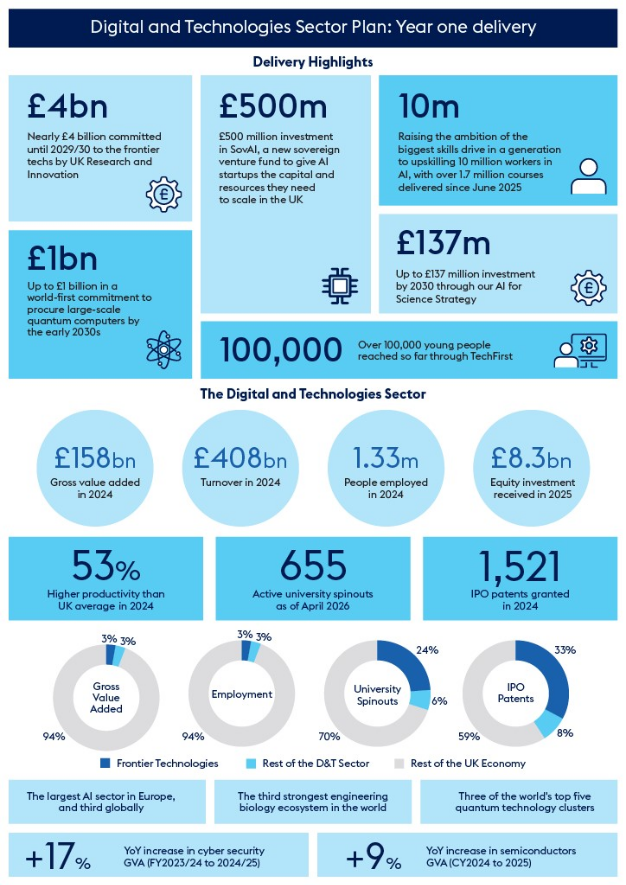
View the delivery highlights source data in an accessible format.
2. Introduction
One year ago, we published the first dedicated plan for the UK’s Digital and Technologies sector in our Modern Industrial Strategy. The plan set out an ambitious, 10-year vision to make the UK one of the top 3 places in the world to create, invest in, and scale up a fast-growing technology business, and to secure the UK’s first trillion-dollar technology company.
The sector plan backs 6 frontier technologies with the greatest potential to grow the economy and boost UK strategic advantage: advanced connectivity technologies, artificial intelligence (AI), cyber security, engineering biology, quantum technologies, and semiconductors. It sets out an active and strategic approach to deliver the interventions and support these technologies need to flourish, alongside reforms to the wider business environment.
In the past 12 months, we have delivered on the commitments set out in the sector plan but have also expanded our ambition. We have set out record public investment in R&D to back technologies at the earliest stage, including committing nearly £4 billion of funding to the frontier technologies through UK Research and Innovation until 2029/30. We have launched the largest skills drive in a generation on AI, expanding our ambition to reach 10 million workers. We have expanded the British Business Bank, introduced tax reforms to encourage frontier technology companies to start, scale and stay in the UK, and driven regulatory reform through the Regulatory Innovation Office. We are delivering world-class infrastructure, including through telecoms infrastructure that is fundamental to our digital economy. And, earlier this year, we announced up to £2 billion to establish the UK as a world-leader in quantum, including investing in skills and talent, research, and a world-first commitment to procure large scale quantum computers in the early 2030s.
At the same time, changing geopolitical realities have underlined the important role of Digital and Technologies in supporting national resilience and security. In response, we are redoubling our focus on growing the UK’s strategic capabilities. We have launched Sovereign AI, a £500 million new sovereign venture fund to scale companies in the UK with its first equity investment in the AI infrastructure company Callosum. We have published the AI Hardware Plan to back British companies developing the chips and semiconductor technologies behind AI. We have published the Cyber Growth Action Plan to boost the UK cyber security industry and are scaling the National Security Strategic Investment Fund, significantly increasing annual funding to invest in strategic science and technology companies.
We have delivered on our commitment to work in partnership with businesses, universities and other stakeholders: for example, working with DSIT’s Quantum Technologies Strategic Advisory Board on our ambitious quantum programme, and with the Semiconductor Advisory Panel on the new UK Semiconductors Centre headquartered in King’s Cross.
But we know there is much more to do and our ambitions do not stop here. This update sets out what we have achieved so far in unlocking economy-wide measures to boost technology growth and innovation, and the focused support we are delivering for each of the sector plan’s 6 frontier technologies. It also outlines our next steps and where we will go further as we move into year 2 of our decade-long commitment to the sector.
3. Unlocking economy-wide measures to boost Digital and Technologies sector growth
Realising our ambition for the sector means taking a whole-of-government approach to create the conditions for innovative digital and technology businesses to thrive. The sector plan set out how we will deploy government’s wider levers to reform the business environment, making greater use of our powers in areas such as regulation, government procurement, infrastructure and skills to bring technologies from the lab to the market. In the Government’s Entrepreneurship Prospectus (published in November 2025) we went beyond the commitments made in the sector plan, with further reforms to the British Business Bank and the tax systems to back our innovative digital and technology businesses.
Allocated nearly £4 billion of R&D investment to the frontier technologies through UKRI.
Reached over 100,000 young people so far through TechFirst.[footnote 1]
Announced energy support through the British Industrial Competitiveness and Supercharger Schemes.
Invested approximately £11.5 million into regulatory experimentation.[footnote 2]
Secured international partnerships with Germany, the Netherlands, and Japan.[footnote 3]
Published independent AI Adoption Plans for 5 Industrial Strategy Sectors, and committed over £200 million of investment for AI adoption
Boosting R&D investment
To back the development of frontier technologies from the earliest stage, we have undertaken the most significant reform of UKRI since its establishment, strengthening its focus on economic growth and government priorities. Alongside this, we have:
- Invested nearly £4 billion until 2029/30 in UKRI funding to back R&D in our frontier technologies, with over £1.5 billion for AI, over £1 billion for quantum, £643 million for engineering biology, and £718 million across advanced connectivity technologies, semiconductors, and cyber security.
- Begun to transform Innovate UK – the government’s innovation funding agency – to provide more targeted, bespoke support for high-potential businesses in Digital and Technologies and other Industrial Strategy sectors, linking innovators with public finance institutions including the National Wealth Fund and the British Business Bank.
Innovate UK support to Cambridge GaN Devices
Cambridge GaN Devices (CGD) is a University of Cambridge spin-out developing advanced semiconductors that improve energy efficiency and power density. Innovate UK have supported CGD across multiple streams of R&D funding and through the Compound Semiconductor Applications Catapult. Following Innovate UK’s support, CGD progressed through private venture rounds before receiving £5 million from the British Business Bank’s British Patient Capital as a part of its $32 million Series C round in 2025. This is an example of how closer partnership between Innovate UK and the public finance landscape is allowing high potential companies to progress through the investment pipeline.
Improved access to finance
The UK is the leading destination for venture capital in Europe, capturing a record 48% of European VC funding so far in 2026. We are making record public finance available to help innovative technology businesses scale in the UK and crowd-in private investment. We have established the National Wealth Fund (£27.8 billion total capitalisation), expanded the British Business Bank (£25.6 billion total capitalisation) and launched a new £4 billion Industrial Strategy Growth Capital Initiative. We are also driving reforms to consolidate the pension market, including through the recent Pension Schemes Act 2026. Alongside this, we have:
- Included Digital and Technologies and other Industrial Strategy sectors in the British Business Bank’s mandate and enabled it to make more direct investments in strategically important companies.
- Significantly scaled the National Security Strategic Investment Fund (NSSIF), building its capacity to deploy up to £330 million into strategic dual-use science and technology companies over the next 3 years.
- Earmarked Digital and Technologies subsectors as target sectors for the National Wealth Fund to channel investment to innovative tech businesses.
- Ensured the sector reaps the benefits of pension reforms. The British Business Bank’s British Growth Partnership, backed by 3 major pension funds, announced its first £200 million close in April, with an £8 million investment into the autonomous driving company Wayve, marking Aegon UK and Natwest Cushon’s first ever UK venture investments.
- Launched the second cohort of the Science and Technology Venture Capital Fellowship Scheme to build deep tech knowledge capability among investors.
- Announced a new UK AI hardware venture capital fund led by Silicon Valley investors Playground Global and backed by up to £150 million from the British Business Bank.
- Introduced tax reforms that help frontier technology companies including doubling investment limits for the Enterprise Investment Scheme and Venture Capital Trust scheme and expanding eligibility for the Enterprise Management Incentives by doubling employee and share option limits, quadrupling the gross assets test and increasing the maximum holding period to 15 years.
British Business Bank investment in Quantum Motion
In May this year, the British Business Bank invested £40 million in the UK-based spinout, Quantum Motion. This followed reforms that allow the Bank to make larger investments in strategically important companies and builds on the Bank’s partnership with the National Security Strategic Investment Fund who first backed Quantum Motion in 2020.
Increasing the skills of the workforce
We are undertaking major reforms of the skills system to ensure the workforce pipeline supports the sector. We have announced 5 new Digital and Technologies Technical Excellence Colleges across the UK and we are deploying the Growth and Skills Levy to back shorter, more flexible training for adults in priority areas including AI and digital. Alongside this, we have:
- Kickstarted ‘AI Skills Boost’, the biggest skills drive in a generation to deliver on the government’s expanded commitment to upskill 10 million workers through free access to foundational training in AI, with over 1.7 million courses completed since June 2025.
- Begun delivery of the £54 million Global Talent Fund by bringing a new cohort of leading international researchers to the UK, strengthening priority sectors and supporting growth.
- Launched a visa fee reimbursement scheme for scale-ups in Digital and Technologies and other Industrial Strategy sectors and a targeted fast-track referral scheme for Expansion Worker sponsor licences to accelerate high-potential firms entering the UK market.
- Launched the government’s TechFirst skills programme to help 2,000 disadvantaged people into jobs in frontier technologies this year, started new pathways for young people at risk of becoming not in education, employment or training (NEET) into AI apprenticeships, reached over 100,000 young people in schools across the UK, and awarded top-up stipends to 500 British and home doctoral students to strengthen sovereign talent.[footnote 4]
- Established the inaugural TechFirst Women’s Programme and announced Darren Hardman, UK Microsoft CEO, as the TechFirst Social Mobility champion.
- Announced the Early Careers Jobs Alliance to bring together government, employers, trade unions and young people to map how AI is changing entry-level work and support young people to get into the workforce, beginning with the Digital and Technologies Sector.
Global Talent Fund
Professor Dimitrios G. Angelakis, Professor in Electrical Engineering, University of Southampton, is a pioneer in using light-based quantum systems to emulate complex physical phenomena that are otherwise extremely difficult to study. He is the founder and chief scientific advisor of AngelQ Quantum Computing, a global quantum software company. He has been supported by the Global Talent Fund to come to the UK, which he was drawn to as one of the strongest and most internationally connected quantum ecosystems in the world.
Enhanced infrastructure
We are investing in the world-class infrastructure needed to underpin technology growth across the country. This includes telecoms, which provides fundamental connectivity underpinning the digital economy as a whole, enabling businesses and services to operate, driving productivity gains, and enabling the UK to harness emerging technologies such as AI. We have announced 5 AI Growth Zones to create localised AI infrastructure across the UK and stimulate investment. Alongside this, we have:
- Announced discounts to electricity bills for eligible Digital and Technologies manufacturers through the new British Industrial Competitiveness Scheme (BICS) and expanded Supercharger scheme.
- Completed the majority of 5G Innovation Regions projects, with over £46 million of funding awarded to 10 regions across the UK.
- Delivered 95% 4G coverage of the UK landmass through the Shared Rural Network.
- Amended legislation to allow data centres to be directed into the Nationally Significant Infrastructure Projects (NSIP) regime, where the Secretary of State decides on applications for development consent.
Supporting Telecommunications Infrastructure
The government is creating a competition-friendly environment in the telecoms market, recently placing growth at the centre of our Statement of Strategic Priorities to Ofcom (April 2026). This has accelerated the rollout of gigabit-capable broadband infrastructure where deployment is commercially viable, so we can focus government funds on the areas of the country where commercial deployment is unlikely.
Between July and December 2025, over 100,000 premises in hard-to-reach communities were upgraded to gigabit-capable broadband through government-funded programmes with 88% of UK premises now having access to gigabit-capable broadband, up from 46% in September 2021. In the mobile market, strong competition has driven mobile operators’ investment and deployment of mobile connectivity. The government’s ambition is for all populated areas to have standalone 5G by 2030 and mobile operators have publicly set out investment plans that align with this ambition.
Delivering pro-innovation regulation
To support our pioneering digital and technologies ecosystem and speed up access to market for cutting-edge technologies, the government’s Regulatory Innovation Office (RIO) is supporting regulators to accelerate innovation, assess safe AI and frontier technology innovation and address barriers to adoption, investing approximately £11.5 million into regulatory experimentation.[footnote 5] Through the Regulating for Growth Bill, the government will create powers to make rapid, temporary amendments to regulation to safely pilot and deploy AI to address regulatory uncertainty, sector by sector, through statutory sandboxes, including the statutory AI Growth Lab. Alongside this, we have:
- RIO has partnered with IBM, to co-host an AI Hackathon to develop AI solutions to common regulatory barriers with attendees from over 55 organisations.[footnote 6]
- Supported AI adoption by funding the Digital Regulation Cooperation Forum’s ‘digital library’ to help businesses navigate relevant regulation.
- Hosted the UK’s first Digital Standards Summit in Glasgow with up to 800 attendees from 50 countries, where the Minister announced the forthcoming publication of a Digital Standards Strategy.[footnote 7]
- Responded to the call for evidence on a Smart Data scheme in digital markets, with a consultation on designing a scheme planned for later this year.
- Launched the advisory AI Growth Labs, first focusing on legal services and LawTech. The Lab will bring together the Information Commissioners Office, the Council for Licensed Conveyancers and the Solicitors Regulation Authority to provide practical guidance on how existing rules apply to emerging AI applications.
The Regulatory Innovation Office
Established in 2024, the Regulatory Innovation Office (RIO) works closely with businesses and regulators to tackle regulatory barriers and support a more agile regulatory environment to give science and technology businesses the confidence and certainty to start and scale in the UK. The RIO is supporting regulators to assess, adopt and safely regulate frontier technologies such as AI, unlocking faster, smarter regulatory approvals in fast-growing, high-potential sectors. It has worked with the Department for Transport and Civil Aviation Authority to cut approval times for drones, including through the introduction and scaling of the UK-Light UAS Certificate (UK-LUC) to allow the safest and best drone operators to self-approve some operations and is working with the MoD to help more innovative businesses bring new capabilities into UK defence.
Developed targeted international partnerships
We are deepening our collaboration with global partners and striking new agreements to help scale UK technologies globally and anchor investment and market access. In the past year, we have agreed strategic science and innovation partnerships with Germany and the Netherlands. Alongside this, we have:
- Launched the UK-Japan Industrial Strategy Partnership and signed a Free Trade Agreement with the Republic of Korea with dedicated chapters on digital trade and telecommunications.
- Agreed the landmark Technology Prosperity Deal with the US in September 2025, providing a framework for UK-US science and technology collaboration. The Deal kickstarted a £31 billion investment into local communities and businesses in Britain.
- Committed further funding to the International Science Partnership Fund which supports research and innovation partnerships to advance frontier technologies, strengthen research and innovation capability, and help address shared global challenges.
Advanced Research and Innovation Agency (ARIA) Scaling Inference Lab
Developing novel AI hardware can be capital-intensive, forcing startups to rely heavily on hyperscalers. In February, as part of its Scaling Compute programme, ARIA announced a £50 million investment in a new ‘Scaling Inference Lab’ to address a key bottleneck for startups and researchers, giving them an open alternative to large, closed, dominant AI systems. This will help promising technologies reach the market faster and at lower cost. This lab is being expanded as part of the AI Hardware Plan.
Improved government procurement of innovation
Government spends almost £400 billion every year on procurement.[footnote 8] We are making government departments a better customer for cutting-edge technologies, with wide-reaching reforms to support innovative companies. We have:
- Made a world-first commitment of up to £1 billion to procure large scale quantum computers in the early 2030s. The first phase of ProQure, our programme to identify, grow, and deploy world-leading quantum computing capabilities, is now live.
- Announced a network of Innovation Champions through our Commercial Innovation Hub, a cross-government centre of excellence for pioneering new approaches to public procurement. The Hub has also supported individual procurements such as a demonstration-led competition on AI to augment planning decisions and a first-of-its-kind market-boosting procurement to back UK-based EdTech companies to design the next generation of safe and effective AI tools.
- Launched 11 procurement-focused research and innovation challenges under the R&D Missions Accelerator Programme, from identifying special educational needs and diagnosing dementia faster to helping households and businesses reduce peak energy demand.[footnote 9]
- Worked to deliver the commitment to spend 10% of the MOD’s equipment procurement budget on novel technologies which will be set out in the forthcoming Defence Investment Plan.
Driven the adoption of frontier technologies
To ensure that the benefits of frontier technologies are diffused across the economy, we have appointed expert AI Champions across Industrial Strategy sectors and published their independent sector plans. We have committed over £200 million for AI adoption, which will be used to deliver leading recommendations from the AI Champions’ plans and expand InnovateUK’s BridgeAI programme across the Industrial Strategy sectors. Alongside this, we have:
- Launched the AI Economics Institute, chaired by Nobel Prize winning economist Simon Johnson, to build the evidence base needed to understand and respond to the economic impacts of artificial intelligence adoption, including on jobs and growth.
- Launched a Quantum Growth Alliance of leading UK corporates to galvanise the adoption of quantum technologies within Industrial Strategy sectors.
- Published the Trusted Third-Party AI Assurance Roadmap, established the AI Assurance Innovation Fund, launched the Centre for AI Measurement at the National Physical Laboratory. We convened the AI Assurance Stakeholder Consortium, chaired by BCS (the Chartered Institute for IT) to lay the foundations for professionalising AI assurance and address market barriers to help deliver AI people can trust.
4. Supporting our frontier technologies
Advanced Connectivity Technologies
Significant commercial developments: Advanced Connectivity Technologies
- Archangel Lightworks closed an over-subscribed £10 million Series A round to accelerate commercialisation of its laser communication technology.
- Jet Connectivity, a Farnborough based sovereign RAN vendor, closed a £1.2 million pre–Series A round, led by Tricapital Angels, a Scottish angel investment network, with participation from FSE Group.
- Three JOINER terminals in Leeds, Bristol and Edinburgh have been awarded new Nvidia GPU platforms, substantially increasing the AI resource available for development of AI-native telecoms through the JOINER infrastructure. This deepens the Memorandum of Understanding signed between NVIDIA and UK government on ACT in June 2025.
Advanced Connectivity Technologies (ACT) and the networks they underpin enable the transmission of data in our increasingly digitised economy and society. The UK’s world-leading ACT capabilities span all the 4 nations and have a critical role to play in connecting industry, government and citizens. ACT companies employed approximately 109,400 people in the UK and generated £13.2 billion in GVA in 2025. UK ACT revenue is estimated to grow from £32.9 billion in 2025 to £62.8 billion by 2031.
In the sector plan, we committed to invest in ACT research and strengthen our world-class laboratory infrastructure, ensure spectrum availability supports ACT domestically and internationally, and deepen our collaboration with other ACT-leading countries. Over the past year, we have:
- Launched a new £270 million ACT R&D Programme to support research and help ACT businesses to grow and scale in the UK, helping to strengthen UK technology sovereignty. We have already launched funding competitions.
- Invested £110 million in the future of the UK Telecoms Lab through a four-year contract with the National Physical Laboratory.[footnote 10] We are continuing to improve the security and resilience of existing and emerging technologies in this critical sector.
- Announced the new UK-India Connectivity & Innovation Centre with an initial £24 million combined investment and agreed a jointly-funded £6 million ACT research programme with Japan.
- Published the Public Sector Spectrum Framework to ensure the UK has the spectrum capacity we need to support government priorities and industry, and a Statement of Strategic Priorities for Telecommunications, which signals the UK’s intent to treat spectrum as a strategic national resource.
JOINER – The UK’s Open Infrastructure for Networks Research
The Joint Open Infrastructure for Networks Research (JOINER), led by the University of Bristol, is the UK’s national federated research and experimentation platform for future communications networks. Since publication of the sector plan, JOINER has grown to over 15 nodes and connected its first international node in Dublin. In March 2026, it established a formal collaboration with Taiwan’s Industrial Technology Research Institute. JOINER enables large scale industry experimentation, such as BT’s work on deploying large language models in live telecoms environments.
Artificial Intelligence
Significant commercial developments: AI
- The development of the burgeoning AI cluster at London King’s Cross with: Google DeepMind, Anthropic, Meta, Perplexity, and Scale AI sitting alongside home-grown British companies like Wayve and Synthesia, valued at $8.6 billion and $4 billion respectively.
- New British AI superintelligence company Ineffable has just raised $1.1 billion in the largest seed round in European history.
AI is a transformative technology that is already changing the global economy, revolutionising healthcare and science, and improving how public services are delivered. The UK has the largest AI sector in Europe and the third largest globally. Since this government took office, AI companies have pledged investment of nearly £100 billion in the UK.[footnote 11]
The AI Opportunities Action Plan (January 2025) outlined how we will seize this transformation to benefit our economy and society. Our January 2026 update on the action plan set out our decisive move from ambition to delivery. The Digital and Technologies Sector Plan committed to build on this ambition by scaling the UK’s public sector AI Research Resource, creating a Sovereign AI venture fund, promoting AI adoption, accelerating AI-enabled scientific breakthroughs, and delivering a new framework for AI and copyright.
Over the past year, we have:
- Established 5 AI Growth Zones across the UK which will generate £28.2 billion in investment and create more than 15,000 jobs. We are targeting areas with greater energy capacity and pioneering low-carbon approaches to power them, including the UK’s first small modular reactor and a renewables-powered microgrid.
- Launched Sovereign AI, the new £500 million venture fund backing great British founders with the capital, compute and weight of the government to start and scale in the UK, and win globally. Sovereign AI has already made 3 equity investments and allocated over 3 million GPU hours of compute to startups.
- Announced £750 million for a new national AI supercomputer including up to £400 million to purchase next generation AI chips, of which £150 million is an advance commitment to buy novel chips from innovative startups and British firms at the cutting edge of chip design.
- Started delivery of our expansion of the AI Research Resource capacity, backed by over £1 billion in funding. We launched the Isambard-AI supercomputer in July 2025 and announced a £36 million investment in the new Zenith supercomputer, which will join Dawn, at the University of Cambridge delivering a six-fold increase in capacity. We will soon be launching the tender process for the next National Supercomputer in Edinburgh, set to be the UK’s most powerful. The UK Atomic Energy Authority also announced £45 million to build the world’s most powerful supercomputer dedicated to fusion energy, which is due to launch later this year.
- Published the AI for Science Strategy, backed by up to £137 million of investment, and set the UK’s first AI for science mission to harness AI to speed up discovery of drugs and treatments.
- Published a report and impact assessment on AI and copyright and set out where we will focus the next phase of this work.
AI forecasts of air pollution
In collaboration with NVIDIA, Professor David Topping, Director of Digital Worlds, University of Manchester has led a project to use the Isambard-AI supercomputer to retrain generative AI climate models to produce high-resolution air pollution forecasts across the UK. What previously took days can now be done in minutes, and this is already being adapted to integrate observational data. Ultimately, the team aim to make this technology available globally.
Cyber Security
Significant commercial developments: Cyber Security
- Inforcer, a London based software company enabling managed service providers to standardise Microsoft 365 security, raised £26 million in July 2025.
- Maze, whose AI platform identifies and automatically remediates exploitable vulnerabilities across cloud environments, launched with £18.4 million in investment.
- Sheffield-based Sitehop secured £7.5 million in October 2025 to help future-proof networks against quantum threats.
- Infrawatch, a cyber company supported through the government’s Cyber Runway programme, raised $3 million in pre-seed funding in one of the largest pre-seed raises by a UK cyber company.
Cyber security is fundamental to our economic stability and protects the technology we rely on every day. The UK has an internationally renowned cyber industry employing nearly 70,000 people and generating £9.1 billion in GVA in 2025. This is a rapidly evolving field where government is partnering directly with industry to ensure the UK’s cybersecurity architecture is agile in the face of evolving technology – for example, through the AI Safety Institute’s recent work to stress-test powerful new AI models like Anthropic’s Mythos.
In the sector plan, we committed to support UK cyber capabilities by publishing the Cyber Growth Action Plan, investing in the commercialisation of cyber research, supporting startups, growing domestic talent, and promoting the adoption of technologies that are cyber secure by design. Over the past year, we have:
- Published the UK Cyber Growth Action Plan to build broader support for the role of Cyber in protecting and growing our economy. We will shortly publish the government’s response in our National Cyber Strategy.
- Introduced the Cyber Security and Resilience (Network and Information Systems) Bill into Parliament to improve UK cyber defences.
- Launched the government Cyber Action Plan with £210 million in funding to rapidly improve the cyber resilience of government departments and public services.
- Invested £1.8 million in 21 projects across 9 English regions as part of Cyber Local, our programme to support local cyber skills and ecosystems.
- Delivered another successful cohort of CyberASAP to help academics commercialise their research and expanded Cyber Runway, government’s cyber accelerator for UK entrepreneurs and startups. CyberASAP alumni have secured £47 million in post‑programme funding over the past 9 years.
- Secured final planning consent for the National Cyber Security Centre in Cheltenham, with construction due to begin this summer.
- The Cyber-AI Hub in Belfast has delivered 5 minimum viable products and proof of concepts with industry through its collaborative R&D Technologies Hub.
- Brought CHERI, a hardware based cyber security technology developed in the UK, into commercial readiness and secured industry backing to deploy it in smart meters, drones, routers and other connected devices, protecting against the memory safety flaws behind around 70% of software vulnerabilities.
- Announced a £90 million fund to incentivise and support the adoption of cyber security standards such as Cyber Essentials and government’s codes of practice, and provide targeted support to priority sectors such as the NHS and small and medium enterprises to strengthen supply chain resilience.
Sitehop
Sitehop is a UK-based cyber security company headquartered in Sheffield, developing high-performance, crypto-agile security for data in motion. Its platform combines ultra-low-power, sub-microsecond hardware encryption with a centrally managed orchestration platform, allowing organisations to securely deploy and manage distributed networks through a single pane of glass. The technology is designed for telecoms, financial services and critical national infrastructure environments where performance, resilience and security are critical. The company was supported through the Government’s Cyber Runway programme, providing business development support, connections and mentoring. Following participation in Cyber Runway, Sitehop has secured £13.5 million in total investment to support product development and scaling.
Engineering Biology
Significant commercial developments: Engineering Biology
- Tropic raised $105 million in Series C investment to scale commercial rollout of gene-eEdited Tropical Crops.
- Bit.bio, a Cambridge-based Engineering Biology pioneer in next-generation human cell programming, successfully closed a $50 million Series C funding round.
- The Ellison Institute of Technology is building a new, world-leading Generative Biology Institute in Oxford, which will develop foundational technologies to unlock the power of biology and address challenges in engineering biology.
Engineering biology technologies are transforming industries as diverse as healthcare, fashion and textiles, and low-carbon fuels. The UK’s engineering biology ecosystem is the strongest globally outside the US and China.
In the sector plan, we committed to invest in engineering biology research and launch a novel programme to fund scale-up infrastructure, accelerate regulatory reform, and shape the global environment to ensure the UK remains a priority destination for investment. Over the past year, we have:
- Committed a total UKRI investment of £643 million toward Engineering Biology. This represents an increase of £263 million on our initial sector plan commitments to an R&D programme and a scale-up infrastructure programme.[footnote 12]
- Expanded and extended the Engineering Biology Mission awards with £20 million funding, announced over £12 million to deliver further doctoral training, and delivered our third Engineering Biology accelerator programme in collaboration with Science Creates.[footnote 13]
- Announced the Engineering Biology Value Chain Growth Fund, a targeted £45 million fund to support foundational capabilities and build UK sovereignty in engineering biology.
- Established the Engineering Biology Innovation Network to foster partnerships and opportunities for UK innovators and begun a UK-wide public dialogue on engineering biology with ScienceWise.
- Worked alongside the Regulatory Innovation Office with industry and regulators to adopt an agile approach to regulation. We have made reforms through the Engineering Biology Sandbox Fund including launching a project led by the Medicines and Healthcare products Regulatory Agency (MHRA) on engineered bacteriophage products, an innovative solution to antibiotic resistance, and funding the Food Standards Agency to launch a guidance portal and business support services on cell-cultivated and precision fermented products.
- Conducted trade missions to Japan and Korea and co-hosted a landmark responsible innovation multi-stakeholder event through the OECD.
- Commenced the secondary legislation to implement The Genetics Technology (Precision Breeding) Act 2023 for plants in England, a major milestone in regulatory reform for precision breeding, encouraging innovation and enabling products to be brought to market more easily.
Epoch Biodesign
Epoch Biodesign, a London-based biotech company founded in 2019, is scaling AI-engineered enzymatic recycling for plastic and textile waste, starting with nylon 6,6. Unlike traditional mechanical or chemical recycling, Epoch can process a wide range of blended, mixed waste and produce ultra-low emission, virgin-quality recycled polymers that are compatible with existing plastic and textile manufacturing. This is a cost-effective, commercially viable recycling technology for a material that has no other circularity solutions at scale. In Q1 2026, Epoch raised $12 million from Lululemon and others to scale to demonstration scale and beyond, bringing total funding to over $50 million.
Quantum Technologies
Significant commercial developments: Quantum Technologies
- Oxford Quantum Circuits raised £260 million of investment at Series C, the largest ever quantum Series C globally, which was backed by the British Business Bank’s largest ever direct investment of £100 million.
- Quantum Motion raised $160 million of investment at Series C, including £40 million from the British Business Bank.
- NuQuantum raised $60 million at Series A, the largest ever fundraise globally for a pure-play quantum networking company, backed by National Grid and NSSIF.
- Quantum computing company Rigetti announced its intention to invest up to $100 million in the UK to accelerate quantum computing development.
- IonQ announced the UK as their EMEA HQ, and will install their most advanced 256-qubit quantum computer at the new IonQ Quantum Innovation Centre in Cambridge.
Quantum has enormous potential to enhance our prosperity and security. The UK is home to 3 of the top 5 quantum technology clusters globally. By 2045, quantum could deliver 100,000 high-paid jobs across the country and add up to £212 billion to our economy.
The sector plan committed to sharpen the UK’s competitive edge by progressing the UK’s 5 National Quantum Missions, supporting the National Quantum Computing Centre, developing a quantum skills plan with the sector, and supporting businesses through access to infrastructure and improving the regulatory environment. Over the past year, we have:
-
Pledged over £1 billion to progress our National Quantum Missions to build the skills, infrastructure, and business environment for quantum companies to scale and transform sectors like healthcare, transport, and defence.
- Committed up to a further £1 billion to procure, large-scale quantum computers by the early 2030s, the first commitment of its kind by any government that will enhance public services, drive innovation, and change lives.
- Launched a Quantum Growth Alliance of leading UK corporates to galvanise the adoption of quantum technologies within Industrial Strategy sectors
- Announced a £51.2 million investment in a new National Cryogenics Facility in Daresbury to drive next-generation cryogenic R&D to support quantum computing scale up.
- Hosted the Quantum Development Group in London, bringing together 13 like-minded countries to strengthen international cooperation. We have announced funding for bilateral R&D collaboration with Canada, Germany, Japan and the Netherlands, as well as launching a UK-Singapore quantum satellite.
- Announced a new Quantum Commercialisation Skills Centre to support researchers to turn their discoveries into real-world impact, and started a new TechFirst partnership with quantum companies to offer 100 funded internships.
- Convened leading national measurement institutions from around the world to launch the NMI-Q initiative at National Physical Laboratory, laying the foundations for essential pre-standardisation work for quantum.
Aquark
Aquark is a UK company, spun out of Southampton University in 2021, that builds quantum sensing and timing solutions to keep critical systems and infrastructure running reliably. Aquark has been the recipient of several Innovate UK grants to develop novel quantum technologies that reduce the reliance of sectors such as telecoms, transport and defence on satellite signals that are vulnerable to disruption. In May 2026, the Ministry of Defence announced that it would fund the company through its new ‘defence unicorn’ fund to deliver cutting-edge quantum capability to the UK Armed Forces.
Semiconductors
Significant commercial developments: Semiconductors
- UK AI hardware companies developing next generation inference chips are attracting significant global investment, with companies Olix and Fractile each raising $220 million and scaling their UK presence, including a £100 million expansion commitment by Fractile. [footnote 14]
- Leeds based photonic computing company Optalysys raised £23 million to accelerate commercialisation of its technology.
Semiconductors are a fundamental technology at the heart of modern electronic devices, and crucial to the development of advanced technologies like AI and quantum. The UK is home to the world’s first compound semiconductor cluster in Wales. Dedicated companies directly employed approximately 16,350 people and generated £7.5 billion in GVA in 2025. As a country, we have globally recognised strengths in chip research and design, compound semiconductors and next generation technologies.
In the sector plan, we committed to establish a UK Semiconductor Centre, fund Innovation and Knowledge Centres to bring chip technologies to market, boost the UK’s chip design capabilities, and improve the UK semiconductor talent pipeline. Over the past year, we have:
- Launched the UK Semiconductor Centre (UKSC) with a new headquarters in London. The UKSC has launched a skills promotional campaign, and an ecosystem and infrastructure database. It is bringing together industry, academia and government, and providing cross-sector leadership on semiconductor innovation, alongside ecosystem building and business services.
- Launched the AI Hardware Plan, to back British companies developing the chips and semiconductor technologies behind AI and invest in the scientists, engineers and technicians needed to turn new ideas into products and good jobs in the UK.
- Announced a £120 million investment in AI Hardware Innovation, as part of the AI Hardware Plan, to take ideas from early research to building and testing prototypes.
- Delivered the first year of our UK-wide semiconductor skills programme, providing schools outreach across the UK and delivering 300 undergraduate bursaries. This has helped support an increase of around 14% in Electronic and Electrical Engineering enrolments between 2024 and 2025, the largest year on year rise in over 5 years.[footnote 15] Through the AI Hardware Plan, we have increased our investment in the semiconductor skills programme to £48 million.
- Established 2 new Innovation and Knowledge Centres in emerging semiconductor technologies: Neuroware, led by University College London, in neuromorphic computing hardware; and CHIMES, led by Sheffield University, in heterogeneous integration system design.
- Launched the Semiconductor Industry Future Skills Centre for Doctoral Training, led by Swansea University, and committed a further £12 million to a new Centre for Doctoral Training in Chip Design,
- Set up a pilot Chip Design Enablement Programme, delivered by the Science and Technologies Facilities Council, to support startups to access and use cutting edge chip design tools.
Optalysys
Headquartered in Leeds, Optalysys is reimagining the future of photonic computing by bringing processing into the data transfer path of AI and secure computing workflows, unlocking new levels of efficiency, scale and speed. The technology addresses the significant memory wall and power limitations facing today’s AI-driven computing challenges. In January 2026, Optalysys raised £23 million in a funding round led by Northern Gritstone, with participation from NSSIF. This investment will be used to accelerate the commercialisation of Optalysys’ proprietary photonic chip technology and support global expansion.
5. Growing the Digital and Technologies sector across the UK
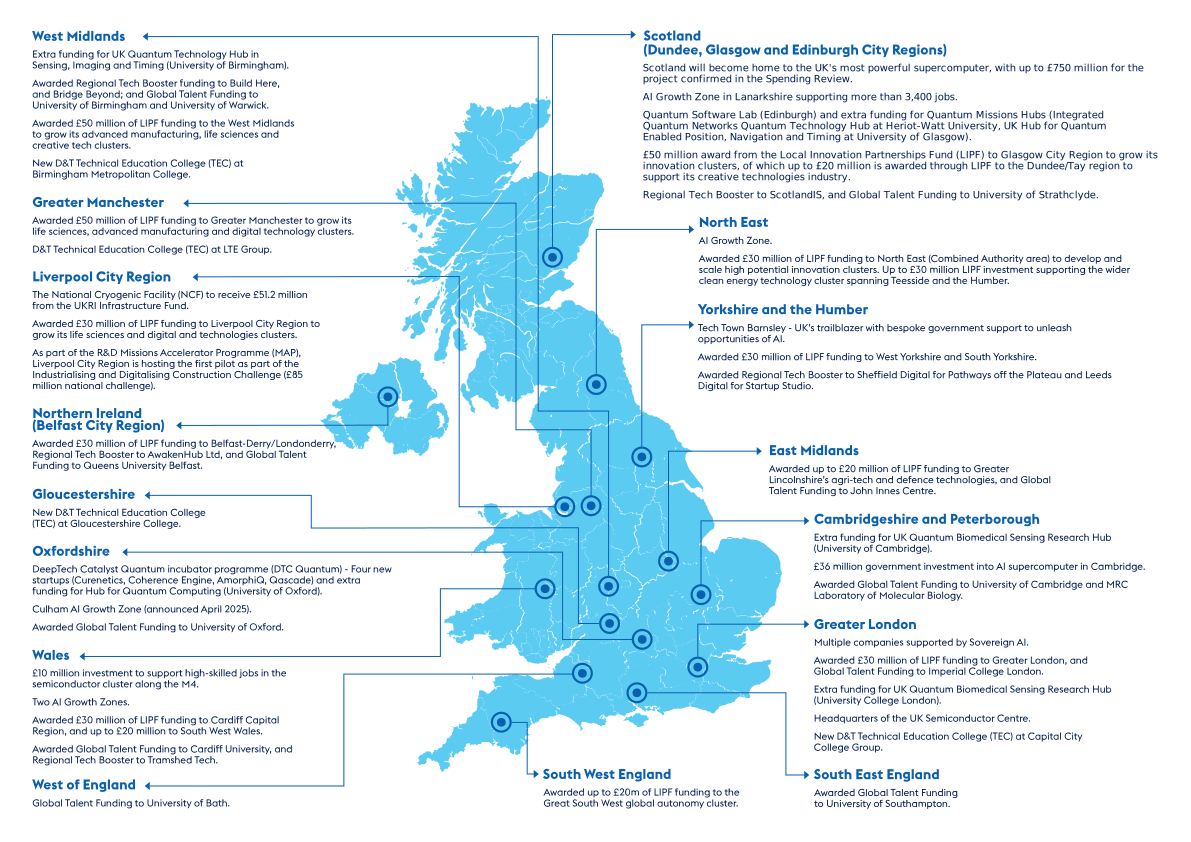
Cities and regions across the UK are essential to our national ambitions for the Digital and Technologies sector. Realising their full potential is a core objective of our modern Industrial Strategy and the Digital and Technologies sector plan.
We are investing in the Digital and Technologies sector throughout the UK. In recent years, UKRI investment has increased substantially, rising by 18% between the 2021-22 financial year and the 2023-24 financial year.[footnote 16] Over this period, investment outside the Greater South East increased more rapidly than within it. [footnote 17] In the 2023-24 financial year, half of funding was invested outside the Greater South East.[footnote 18] Over the next 4 years, UKRI will build on this record level of investment to go further in supporting all nations and regions of the UK.
Over the past year, we have invested in specific programmes including:
West Midlands
- Extra funding for UK Quantum Technology Hub in Sensing, Imaging and Timing (University of Birmingham).
- Awarded Regional Tech Booster funding to Build Here, and Bridge Beyond; and Global Talent Funding to University of Birmingham and University of Warwick.
- Awarded £50 million of LIPF funding to the West Midlands to grow its advanced manufacturing, life sciences and creative tech clusters.
- New D&T Technical Education College (TEC) at Birmingham Metropolitan College.
Greater Manchester
- Awarded £50 million of LIPF funding to Greater Manchester to grow its life sciences, advanced manufacturing and digital and technology clusters.
- D&T Technical Education College (TEC) at LTE Group.
Liverpool City Region
- The National Cryogenic Facility (NCF) to receive £51.2 million from the UKRI Infrastructure Fund.
- Awarded £30 million of LIPF funding to Liverpool City Region to grow its life sciences and digital technology clusters.
- As part of the R&D Missions Accelerator Programme (MAP), Liverpool City Region is hosting the first pilot as part of the Industrialising and Digitalising Construction Challenge (£85 million national challenge).
Northern Ireland (Belfast City Region)
- Awarded £30 million of LIPF funding to Belfast-Derry/Londonderry, Regional Tech Booster to AwakenHub Ltd, and Global Talent Funding to Queens University Belfast.
Gloucestershire
- New D&T Technical Excellence College (TEC) at Gloucestershire College.
Oxfordshire
- DeepTech Catalyst Quantum incubator programme (DTC Quantum) - Four new startups (Curenetics, Coherence Engine, AmorphiQ, Qascade) and Extra funding for Hub for Quantum Computing (University of Oxford).
- Culham AI Growth Zone (announced April 2025).
- Awarded Global Talent Funding to University of Oxford.
Wales
- £10 million investment to support high-skilled jobs in the semiconductor cluster along the M4.
- Two AI Growth Zones.
- Awarded £30 million of LIPF funding to Cardiff Capital Region, and up to £20 million to South West Wales.
- Awarded Global Talent Funding to Cardiff University, and Regional Tech Booster to Tramshed Tech.
West of England
- Global Talent Funding to University of Bath.
South West England
- Awarded up to £20 million of LIPF funding to the Great South West global autonomy cluster.
Scotland (Dundee, Glasgow and Edinburgh City Regions)
- Scotland will become home to the UK’s most powerful supercomputer, with up to £750 million for the project confirmed in the Spending Review.
- AI Growth Zone in Lanarkshire supporting more than 3,400 jobs.
- Software Lab (Edinburgh) and extra funding for Quantum Missions Hubs (Integrated Quantum Networks Quantum Technology Hub at Heriot-Watt University, UK Hub for Quantum Enabled Position, Navigation and Timing at University of Glasgow).
- £50 million award from the Local Innovation Partnerships Fund (LIPF) to Glasgow City Region to grow its innovation clusters, of which up to £20 million is awarded through LIPF to the Dundee/Tay region to support its creative technologies industry.
- Regional Tech Booster to ScotlandIS, and Global Talent Funding to University of Strathclyde.
North East
- AI Growth Zone.
- Awarded £30 million of LIPF funding to North East (Combined Authority area) to develop and scale hight potential innovation clusters. Up to £30 million LIPF investment supporting the wider clean energy technology cluster spanning Teesside and the Humber.
- Regional Tech Booster to Prepare to Land Founder Commons.
Yorkshire and the Humber
- Tech Town Barnsley – UK’s trailblazer with bespoke government support to unleash opportunities of AI.
- Awarded £30 million of LIPF funding to West Yorkshire and South Yorkshire.
- Awarded Regional Tech Booster to Sheffield Digital Limited Pathways off the Plateau and Leeds Digital Limited: Leeds Digital Startup Studio.
East Midlands
- Awarded up to £20 million of LIPF funding to Greater Lincolnshire’s agri-tech and defence technologies, and Global Talent Funding to John Innes Centre.
Cambridgeshire and Peterborough
- Extra funding for UK Quantum Biomedical Sensing Research Hub (University of Cambridge).
- £36 million government investment into AI supercomputer in Cambridge.
- Awarded Global Talent Funding to University of Cambridge and MRC Laboratory of Molecular Biology.
Greater London
- Multiple companies supported by Sovereign AI.
- Awarded £30 million of LIPF funding to Greater London, and Global Talent Funding to Imperial College London.
- Extra funding for UK Quantum Biomedical Sensing Research Hub (University College London).
- Headquarters of the UK Semiconductor Centre.
- New D&T Technical Education College (TEC) at Capital City College Group.
South East England
- Awarded Global Talent Funding to University of Southampton.
Figure 2: Map showing some specific investments in the sector across the UK (2025-2026)
Ox-Cam Corridor
Strong regional ecosystems are critical to scaling innovation and spreading opportunity. Over the past year, plans for the Oxford to Cambridge Growth Corridor have progressed significantly, including through the announcement of the AI Growth Zone in Culham, the award of up to £20 million from the UKRI Local Innovation Partnerships Fund to innovators in Bedfordshire, Buckinghamshire, Milton Keynes and Northamptonshire[footnote 19], and the establishment of the UK’s first Innovation Partnership between the University of Cambridge and the University of Manchester. This investment is underpinned by the government’s commitment to East West Rail, improving connectivity across the Corridor to unlock growth, alongside up to £800 million to support housing, land acquisition and enabling infrastructure. The government will continue to explore how it can further support the development of Digital and Technologies clusters across the Corridor.
Forward Look
2026
Cross-sector: Launch the tender for the new National Supercomputer at the University of Edinburgh.
Cross-sector: Publish Digital and Technologies Sector Jobs Plan.
Cross-sector: Projects from round 4 of the RIO’s Regulators’ Pioneer Fund and AI Capability Fund conclude.
ACT: Future Connectivity Hubs (formerly Future Telecoms Hubs) are renewed with an updated research and commercialisation focus.
AI: Enabling works begin at several AI Growth Zones in 2026, with demolition, remediation, and groundworks underway.
AI: Launch of Digital Replicas Consultation and announcement of AI Labelling Taskforce Chair.
Cyber/Semiconductors: Publish Version 1.0 of the Memory Safety Technical Specification subject to approval by the ETSI Technical Committee, to support secure memory practices and improve the resilience and trustworthiness of digital systems.
Cyber: Launch next cohort of the Cyber Runway accelerator.
Engineering Biology: Engineering Biology Doctoral Focal Awards and Industrial Doctoral Landscape Awards announced.
Engineering Biology: National Engineering Biology Programme is launched, investing £198 million to position the UK at the global frontier of engineering biology research, develop a highly-skilled EB talent pipeline, and bolster commercialisation.
Engineering Biology: Infrastructure investments are launched, with £184 million to tackle the key barriers stopping engineering biology firms from scaling in the UK.
Semiconductors: New cohort of 400 bursary students under the Semiconductor Skills Programmes and first cohort of PhDs in the new Centre for Doctoral Training in Future Semiconductor Skills.
Quantum: Additional funding calls for quantum sensing and PNT supply chains (competition live now until 8 July 2026).
Quantum: Additional funding calls on quantum networking, developing testbeds, accelerating component development and systems integration, and driving towards commercialisation.
Quantum: Competition launched to establish the Centre for Quantum Commercialisation Skills.
Quantum: Increase funding announced to support more apprentices to join the quantum workforce.
Quantum: Launch of quantum computing applications, and hybrid algorithms funding.
Quantum: Announcement of winners from the UK-Germany call on Collaborative Innovation for Quantum Technologies 2026.
Quantum: Global Expert Mission to Japan.
2027
Cross-sector: A second cohort of 500 PhD candidates supported through TechFirst.
ACT: Appropriate spectrum is secured to support ACT and space companies to grow by negotiating with international counterparts at the World Radio Conference (target).
ACT: Round 2 of ACT R&D Programme launches.
AI: Launch of statutory AI Growth Labs following passage of the Regulating for Growth Bill.
Cyber: An additional 30 academic teams recruited onto the CyberASAP programme, and 40 academics introduced to commercialisation via the CyberASAP Pathfinder programme (target).
Engineering Biology: Engineering Biology Value Chain Growth Fund begins, supporting high-growth-potential companies building capability in key value-chain areas.
Engineering Biology: Food Standards Agency regulatory sandbox on cell-cultivated protein completed.
Semiconductors: New cohort of 500 students receiving bursaries under the Semiconductor Skills Programme.
Semiconductors: End of Chip Design Enablement Pilot and decision on continuation.
2028
ACT: Round 3 of ACT R&D Programme launches.
AI: Several new AI Growth Zones will be operational, delivering new AI infrastructure capacity into the UK.
Cyber: National Cyber Security Centre opens, leveraging £1 billion in investment.
Engineering Biology: Engineered phage sandbox round 2 project completed.
Quantum: ProQure Phase 2 begins.
2029
Cross-sector: 1 million students reached across every secondary school in the UK, with 40% from disadvantage schools, and offered the chance to learn about technology and gain access to new skills training and career opportunities (target).
ACT: Final projects for ACT R&D Programme launch.
AI: Multiple AI Growth Zones will continue to ramp-up their size and energy capacity landing end user customers.
2030
Cross-sector: Milestone of 4,000 graduates supported by TechFirst (target).
ACT: Improved commercialisation of ACT companies, with over 25 new businesses set up and over 100 new products and services realised (target).
ACT: Improved growth and scale of ACT companies, with over 350 FTE employees in companies and over £100 million of private funding crowded in (target).
ACT: Increased domestic capability in ACT domains with over 60 patents filed (target).
AI: The UK has several strategically significant AI companies, operating at a critical points in the AI value chain and on credible paths to global leadership (target).
AI: 10 million people upskilled to use AI.
AI: 20-fold expansion of UK’s AI Research Resource capacity (target).
AI: The UK has fully operational AI Growth Zones, expanding and enhancing compute capacity and representing more than £28.2 billion in investment.
Cyber: Over 250 cyber companies supported, and 28 new academic spinouts created through the cyber accelerator programme and CyberASAP.
Engineering Biology: The UK is a world leader in responsible innovation, making a positive impact on global health, economic and security outcomes (target).
Quantum: ProQure phase 2 system delivery.
Quantum: NHS trusts to benefit from quantum sensing technology (Mission 3).
Quantum: Deployment of quantum navigation systems on aircraft (Mission 4).
Quantum: Deployment of mobile, networked quantum sensors in sectors such as defence, telecommunications and energy (Mission 5).
Metrics
We have established a robust framework to monitor and evaluate delivery of the sector plan and have identified 5 leading metrics to assess progress. We have drawn on multiple data sources that are available to update on initial progress, including new and experimental approaches to address evidence gaps; for example, the company-based definition introduced in the Digital and Technologies statistical release . Some metrics are subject to data lags.
1. By 2035, we will have maintained and built a strong ecosystem of digital and technology businesses across the UK
-
Number of businesses by size: 107,082 active digital and technology companies, with small companies (fewer than 50 employees) accounting for 95%.
-
Gross Value Added (GVA): £158 billion in 2024 (6% of the UK total). [footnote 20]
2. By 2035, we will have helped new, innovative and R&D-intensive technology businesses to scale rapidly
-
Equity investment: £8.3 billion raised across 1,284 deals in 2025; venture and growth stages accounted for 41% and 42% of investment, respectively. [footnote 21]
-
Deal size by growth stage: Average deal sizes increased 3x from seed to venture; 3x from venture to growth in 2025.
-
Value of turnover: £408 billion in 2024 (8% of the total for UK companies). [footnote 22]
3. By 2035, we will have supported a pro-innovation environment for digital and technology businesses
-
Patenting activity: 1,521 patents granted in 2024, 41% of IPO total.
-
University spinouts: 655 spinouts as of April 2026, representing 30% of the UK total.
4. By 2035, we will have built a highly skilled workforce for digital and technology businesses
-
Employment: 1.33 million people in 2024 (6% of the total for UK companies). [footnote 23]
-
Wages: Average wages of £56,000 in 2024 (50% higher than UK median earnings). [footnote 24]
-
Productivity: £119,000 GVA per employee in 2024 (53% higher than UK average).
5. By 2035, we will have attracted international investment in our Digital and Technologies sector and accessed associated opportunities in global markets
-
International equity investment: Mixed UK-foreign deals accounted for 58% of D&T equity investment with known investor origin in 2025, compared with 30% for foreign-only deals and 12% for domestic-only deals.
-
Deal size by investor origin: Mixed UK-foreign deals were around 10 times larger than domestic-only deals in 2025, while foreign-only deals were around 12 times larger than domestic-only deals.
Annex: accessible data for figures
Delivery highlights infographic - sources and accessible text
Delivery highlights
Text boxes
-
£4 billion - Nearly £4 billion committed until 2029/30 to the frontier techs by UK Research and Innovation. UK Research and Innovation (2025) Budget allocations for UK Research and Innovation.
-
£1 billion: Up to £1 billion in a world-first commitment to procure large-scale quantum computers by early 2030sDepartment for Science, Innovation and Technology (2026) UK’s “Quantum leap” to help beat disease, deliver high-paid jobs, and strengthen national security, as first country in the world to roll out Quantum computers at scale.
-
£500 million - £500 million investment in SovAI, a new sovereign venture fun to give AI startups the capital and resources they need to scale in the UK. Department for Science, Innovation and Technology (2026) AI firms pioneering drug discovery, cheaper supercomputing and more get first backing through UK’s Sovereign AI.
-
10 million - Raising the ambition of the biggest skills drive in a generation to upskilling 10 million workers in AI, with over 1.7 million courses delivered since June 2025. Department for Science, Innovation and Technology (2026) Interim government response to the AI Champions’ AI Adoption Plans.
-
£137 million - Up to £137 million investment by 2030 through our AI for Science Strategy Department for Science, Innovation and Technology (2025) AI for Science Strategy.
-
100,000 - Over 100,000 young people reached so far through TechFirst. The 100,000 figure is derived by aggregating the number of young people reached through different TechFirst programmes since June 2025:
(1) 64,437 attended in-person CyberFirst events delivered by regional partners (source: National Cyber Security Centre internal monitoring data, based on monthly attendance returns submitted by regional delivery partners covering young people aged 18 and under from June 2025);
(2) over 10,800 participated in the Girls Competition (source: IBM internal data, November 2025);
(3) 29,965 new learners registered on the Cyber Explorers platform (source: Cyber Explorers management information). To note, there may be overlap between participants across these programmes.
The Digital and Technologies Sector
Text boxes
- £158 billion - Gross value added in 2024
- £408 billion – Turnover in 2024
- 1.33 million – People employed in 2024
- £8.3 billion – Equity investment received in 2025
- 53% - Higher productivity than UK average in 2024
- 655 – Active university spinouts as of April 2026
- 1,521 – IPO patents granted in 2024
Department for Science, Innovation and Technology (2026) Digital and Technologies Sector Statistics: Volume 1. Based on latest available data and a new, dynamic company-level definition of the sector that substantially improves our measurements.
Graphs
- Gross Value Added: 3% Frontier Technologies; 3% Rest of the D&T Sector; 94% Rest of the UK Economy
- Employment: 3% Frontier Technologies; 3% Rest of D&T Sector; 94% Rest of the UK Economy
- University Spinouts: 24% Frontier Technologies; 6% Rest of the D&T Sector; 70% Rest of the UK Economy
- IPO Patents: 33% Frontier Technologies; 8% Rest of the D&T Sector; 59% Rest of the UK Economy
- Largest AI sector in Europe and third globally: Department for Science, Innovation and Technology (2025) AI Opportunities Action Plan.
Text boxes
-
Third strongest engineering biology ecosystem in the world: Department for Science, Innovation and Technology (2023) National vision for engineering biology.
-
Three of the world’s top 5 quantum clusters: ECIPE (2025) Quantum Clusters: Ranking the World’s Deep-Tech Epicentres.
-
+9% YoY increase in semiconductors GVA (CY2024 to 2025). +9% semiconductors GVA growth: Department for Science, Innovation and Technology (2026) Semiconductors Sector Study. Year-on-year growth compares GVA between the 2024 and 2025 calendar years.
-
+17% YoY increase in cyber security GVA (FY2023/24 to 2024/25). +17% cyber security GVA growth: Department for Science, Innovation and Technology (2026) Cyber security sectoral analysis 2026. Year-on-year growth compares GVA between the 2023-24 and 2024-25 financial years.
View the delivery highlights infographic.
-
100,000 TechFirst: The figure is derived by aggregating the number of young people reached through different TechFirst programmes since June 2025:
(1) 64,437 attended in-person CyberFirst events delivered by regional partners (source: National Cyber Security Centre internal monitoring data, based on monthly attendance returns submitted by regional delivery partners covering young people aged 18 and under from June 2025);
(2) over 10,800 participated in the Girls Competition (source: IBM internal data, November 2025);
(3) 29,965 new learners registered on the Cyber Explorers platform (source: Cyber Explorers management information for June-December 2025). To note, there may be overlap between participants across these programmes. ↩ -
£11.5 million: The £11.5 million figure is derived by aggregating £3.6 million from RIO’s AI Capability Fund (source: Regulatory Innovation Office: One Year On) and £7.8 million from RIO’s Regulators Pioneer Fund (source: Department for Science, Innovation and Technology (2025) Projects selected for the Regulators’ Pioneer Fund (2025)). To note, the £7.8 million reflects recent updates to RIO projects and is calculated by summing individual project grants listed on the linked page, excluding the London Fire Brigade and Argyll and Bute Council projects. ↩
-
International Partnerships: Department for Science, Innovation and Technology (2025) UK-Netherlands Innovation Partnership; Department for Science, Innovation and Technology (2025) UK and Germany deepen science and tech ties with £14 million to unlock quantum’s vast potential; Department for Science, Innovation and Technology (2026) UK and Japan strengthen science and technology ties. ↩
-
The 2,000 figure is derived by aggregating the number of jobs expected to be supported over the next financial year across different programmes:
(1) around 1,700 through the TechLocal “Connecting Local Talent to Local Jobs” competition (source: DSIT internal data);
(2) 40 through the new AI apprenticeship pilot in the North West;
(3) at least 300 through the TechFirst Women’s programme.
The 100,000 figure is derived by aggregating the number of young people reached through different TechFirst programmes since June 2025:
(1) 64,437 attended in-person CyberFirst events delivered by regional partners (source: National Cyber Security Centre internal monitoring data, based on monthly attendance returns submitted by regional delivery partners covering young people aged 18 and under from June 2025);
(2) over 10,800 participated in the Girls Competition (source: IBM internal data, November 2025);
(3) 29,965 new learners registered on the Cyber Explorers platform (source: Cyber Explorers management information). To note, there may be overlap between participants across these programmes.
The figure of 500 doctoral students is based on internal evidence from the Engineering and Physical Sciences Research Council (EPSRC). ↩ -
The £11.5 million figure is derived by aggregating £3.6 million from RIO’s AI Capability Fund (source: Regulatory Innovation Office: One Year On) and £7.8 million from RIO’s Regulators Pioneer Fund (source: Department for Science, Innovation and Technology (2025) Projects selected for the Regulators’ Pioneer Fund (2025)). To note, the £7.8 million reflects recent updates to RIO projects and is calculated by summing individual project grants listed on the linked page, excluding the London Fire Brigade and Argyll and Bute Council projects. ↩
-
Regulatory Innovation Office’s (RIO) internal event records. ↩
-
DSIT Internal Event Records. ↩
-
Department for Science, innovation, and Technology (2026) Modernising public procurement: backing British businesses and building a fairer economy; Data based on HMT Public Spending Statistics. ↩
-
UK Research and Innovation (2026) R&D Missions Accelerator Programme; Eleven challenge include:
5 Safer Street challenges (Safer Streets Mission);
1 challenge for Home Learning Environment (Opportunities mission);
1 challenge for Construction (Growth Mission);
1 challenge for Consumer Flex Energy (Clean Energy Mission);
1 challenge for Dementia Patient Flow (Health Mission);
1 challenge for SEND (Opportunities Mission);
1 challenge for Creative Content Exchange (Growth Mission). ↩ -
DSIT Internal evidence on completed investment in UK Telecoms Lab (UKTL). ↩
-
Internal DSIT count of publicly available press releases: £24.3 billion announced at the International Investment Summit (October 2024);
£4 billion announced alongside the AI Opportunities Action Plan (January 2025);
£1 billion announced by SEGRO and Pure Data Centres Group (March 2025);
£3.9 billion announced by Oracle as part of its UK AI investment plans (September 2025);
£30.4 billion announced through the US-UK Tech Prosperity Deal (September 2025);
£10 billion announced for the North East AI Growth Zone (September 2025);
£10 billion announced for the South Wales AI Growth Zone (November 2025);
£8.2 billion announced for the Lanarkshire AI Growth Zone (January 2026). ↩ -
The increase of £263 million is calculated by comparing the £643 million figure with the spending announcements included in the Sector Plan, comprising £196 million for the National Engineering Biology Programme and £184 million for the Engineering Biology Scale-Up Infrastructure Programme. ↩
-
£12 million is allocated to engineering biology-specific Doctoral Focal Awards. This is part of a wider package of £40 million of investment announced by UKRI: UK Research and Innovation (2025) UKRI doctoral training investment set to power UK growth;
UK Research and Innovation (2025) Science Creates launches third engineering biology accelerator. ↩ -
Fractile (2026) Fractile raises $220M to build the next generation of inference hardware;
UKTN (2026) UK chip startup Fractile announces £100m expansion plans;
Dealroom.co (2026) London’s Olix raises $220M at $1B+ valuation to build AI chips for brain-computer interfaces. ↩ -
Universities and Colleges Admissions Service - UCAS Undergraduate end of cycle data resources 2025; The 13.5% increase relates to the year-on-year percentage increase in the number of accepted applicants for the subject group Electrical and Electronic Engineering (CAH10-01-08) between 2024 and 2025, filtering UK-only projects. ↩
-
Geographical distribution of UKRI funding. UKRI investment outside the Greater South East increased by 27% between the 2021-22 financial year and the 2023-24 financial year, compared with a 10% increase within the Greater South East. ↩
-
Geographical distribution of UKRI funding. Total UKRI investment reached over £9.1 billion in the 2023-24 financial year. Of this, £4.6 billion went outside the Greater South East. ↩
-
UK Research and Innovation (2026). Seven new UK areas confirmed for £500m innovation fund support. ↩
-
UK GVA total sourced from 2024 data from GDP output approach – low-level aggregates - Office for National Statistics. Comparisons made with UK totals are indicative only. ↩
-
Company life cycle stages are defined using Beauhurst classifications. ↩
-
UK totals sourced from DBT’s Business Population Estimates 2024, based specifically on data relating to companies only. UK totals from 2024 have been selected for consistency when comparing totals from this release with UK totals. ↩
-
UK totals sourced from DBT’s Business Population Estimates 2024, based specifically on data relating to companies only. UK totals from 2024 have been selected for consistency when comparing totals from this release with UK totals. ↩
-
UK median employee earnings sourced from ONS Employee Earnings in the UK: 2024. Earnings are a broader concept than wages. Comparison with wages data is used to indicate a trend rather than provide a precise comparison. ↩