Adult skills fund: funding and performance management rules 2026 to 2027
Updated 14 September 2026
Applies to England

© Crown copyright 2026
This publication is licensed under the terms of the Open Government Licence v3.0 except where otherwise stated. To view this licence, visit nationalarchives.gov.uk/doc/open-government-licence/version/3 or write to the Information Policy Team, The National Archives, Kew, London TW9 4DU, or email: psi@nationalarchives.gov.uk.
Where we have identified any third party copyright information you will need to obtain permission from the copyright holders concerned.
This publication is available at https://www.gov.uk/government/publications/adult-skills-fund-funding-rules/adult-skills-fund-funding-and-performance-management-rules-2026-to-2027
Introduction to the adult skills fund
The purpose of the adult skills fund (ASF) is to support adult learners in non-devolved areas to gain skills. These skills will lead them to meaningful, sustained, and relevant employment, or enable them to progress to further learning which will deliver that outcome.
It places a strong priority on supporting young people who are aged 19+ and not in education, employment or training (NEET). This includes those at risk of becoming NEET, by equipping them with the skills they need to progress into further learning or sustainable employment.
Within ASF, further provision for tailored learning is available that supports wider outcomes such as to improve health and wellbeing, equip parents or carers to support their child’s learning, and develop stronger communities.
This document sets out the ASF funding rules for 2026 to 2027. We recommend that providers review the entire document.
We have published the ASF funding rates and formula guidance for 2026 to 2027. This contains the details of how providers will earn their funding.
What’s new in the ASF funding rules for 2026 to 2027
Responsibility for adult skills policy transferred from the Department for Education (DfE) to the Department for Work and Pensions (DWP) on 16 September 2025. The DfE continues to implement the ASF on behalf of the DWP. Throughout this document, references to the DfE have been updated to reflect this change and now refer to the DWP where appropriate.
This section sets out the main changes to the rules.
Changes made in June 2026
- We have updated the unemployed section to simplify the definition and provide greater clarity. The eligibility criteria for ASF includes having earnings below £26,800 including the unemployed and economically inactive.
- We have increased the earnings threshold from £25,750 to £26,800.
- We have expanded the free courses for jobs (FCFJ) offer to include level 2 qualifications in the engineering and manufacturing sectors.
- From August 2026, we are making it possible for providers to claim for the cost of a construction skills certification scheme (CSCS) to support learners to start work in the construction industry. We will fund a learners card application fee and the associated health and safety test.
- We have updated the what we will not fund section to clarify that, while apprenticeships remain the primary funding route, ASF may be used in certain circumstances. This applies where an employer does not agree for an apprentice aged 19 or over at the start of their apprenticeship to study English and maths. The apprentice can choose to exercise their statutory entitlement to study English and maths up to an approved Level 2. Where this happens, the apprentice may be funded through the ASF.
- We have updated the learning support section to make it clear that the cost of learning support assessments must not be claimed through ASF.
- We have updated the performance management rules for 2026 to 2027.
- In the limited length visa section we have removed the wording ‘High degree of confidence’ from the limited length visa’s section and replaced it with only where there is documented evidence indicating that the learner intends to, and is likely to be eligible to, renew their visa.
Purpose of the document
This document applies to all providers who receive funded ASF from the Secretary of State for Work and Pensions for funding year 2026 to 2027 (1 August 2026 to 31 July 2027).
The funding rules set out the conditions of funding in accordance with section 101 of the Apprenticeships Skills Children and Learning Act 2009 and section 16 of the Education Act 2002.
These rules do not apply to:
- the growth and skills offer
- advanced learner loans (ALL)
- skills bootcamps
- individuals resident in a devolved authority area, unless they meet the criteria for continuing learners in the who we fund section
This document forms part of the terms and conditions of funding and you must read them in conjunction with your funding agreement. You must operate within the terms and conditions of the funding agreement, these rules, rates and formula and the individualised learner record (ILR) specification. If you do not, you are in breach of your funding agreement with us.
Definitions and the glossary are included to assist in understanding the terminology and explain technical terms. We may make changes to these rules at any time.
Understanding the terminology
The term ‘we’ refers to the Secretary of State for DWP acting through DfE.
When we refer to ‘you’ or ‘providers’, this includes colleges, higher education institutions, training organisations, local authorities and employers who receive DWP funded ASF from us to deliver education and training to learners set out in the who we fund section.
We will use the generic term ‘you’ or ‘provider’ unless the requirements only apply to a specific provider type. We use the term ‘funding agreement’ to include:
- accountability agreement conditions of funding (grant)
- contract for services
- conditions of funding (grant) – employer
We use the terms ‘individual’ and ‘learner’ to cover those whose provision is funded by us.
When we refer to ‘DWP funded ASF’ this is funding you can claim from us for delivery of ASF provision to learners set out in the who we fund section.
Both the transfer of the functions to the specified combined authorities and the delegation of those functions in relation to the Mayor of London are referred to in this document as the devolution of adult education. Refer to annex B: devolution of adult education functions.
We use the term ‘provision’ or ‘learning’ or ‘learning aims’ to refer to DWP funded ASF, whether it is a regulated qualification, or other learning that is not regulated.
If we refer to ‘qualifications’, they will be from the Regulated Qualifications Framework (RQF) or an Access to Higher Education Diploma recognised and regulated by the Quality Assurance Agency (QAA).
If we refer to ‘learning aims’, we mean a single episode of learning which could be a regulated qualification, a component of a regulated qualification or non-regulated learning.
If we refer to ‘programmes’, we mean a coherent package of learning which may include regulated qualifications, components of regulated qualifications or non-regulated learning with clearly stated aims supporting agreed outcomes.
We may refer to this document as ‘funding rules’ or ‘the rules’.
Contact us
If you have any questions after reading our funding rules, or if there’s anything else you need help with, you can find more support in our customer help centre. You can also contact your DfE provider facing team.
Section 1 - General funding requirements
1.1: Principles of funding
These rules apply in relation to all learners starting new ASF learning aims on or after 1 August 2026 and continuing learners as referenced in the who we fund section.
Funding must be earned in the way set out in the specific funding agreement, and funding rules related to that funding. You will not be paid for over-delivery from the under-delivery on your other allocations that include:
- ASF
- FCFJ
- the growth and skills offer
- ALL bursary fund
- ALL loan facility
- skills bootcamp
- ASF funding received from devolved budgets to combined authorities
We will review and monitor whether ASF provision you provide represents good value for money. If we consider that funding is significantly more than the cost of providing education and training, we may reduce your funding after consulting with you.
Failure to comply with funding rules could lead to action or intervention. Our policies and guidance about the oversight of providers are set out in published information:
- college oversight: support intervention
- how DfE maintains oversight of independent training providers
The triggers for action and the type of action we may take is set out in these documents. This is in accordance with provisions in our Education and Skills agreements/accountability agreements, funding agreements and contracts available on DWP, DfE and ESFA funding agreements and contracts.
1.2: Who we fund
We will fund:
- individuals resident in areas of England outside of devolved authority areas undertaking ASF
- continuing learners who are resident in devolved authority areas, who have not completed their learning by 31 July 2026, but started their learning before the authorities’ devolution date with providers who have an Education and Skills funding agreement (grant)/accountability agreement only
Residency
You must check the eligibility of a learner, including where in England they are resident, at the start of each learning aim and only claim funding for ASF for eligible learners. Refer to the glossary definition of ‘learner residency’ and the devolution postcode checker data set.
Age
On the first day of learning a learner must be aged 19 or older on 31 August within funding year 2026 to 2027 to be DWP funded.
The age of the learner on 31 August in the funding year determines whether the learner is funded through the funding methodology (for individuals aged 19 and over), or the 16 to 19-year-olds funding methodology (for individuals aged 16 to 19 and those aged 19 to 24 with an education health and care plan).
All individuals aged 19 or over on 31 August who are continuing a programme they began aged 16 to 18 (‘19+ continuers’) will be funded through the 16 to 19-year-olds funding guidance.
Duration
Learners will be eligible for ASF for the whole of the learning aim or programme if they are eligible for funding at the start, even if the duration is for over one year. You must reassess the learner for any further learning they start.
Potential issues
If an individual starts a learning aim or programme and is not eligible for funding, we will not fund their learning while they remain ineligible.
You must not fund a learner who is unable to complete a learning aim or programme of study in the time they have available.
1.3: Residency eligibility
Individuals will be eligible for ASF funding if they meet the criteria in the who we fund section, the learning is taking place in England and they are ordinarily resident in the UK on the first day of learning.
Individuals who are not eligible for funding
You must not claim funding for individuals who do not meet the eligibility criteria set out in the residency eligibility section. Examples of individuals who do not meet the eligibility criteria include those:
- who are here without authority or lawful status
- who are resident in the UK on a student or graduate visa
- who are in the UK on holiday, with or without a visa
- who are in the UK on a sponsorship visa, including skilled worker visas and seasonal worker visas
- whose biometric residence permit or residence permit imposes a study prohibition or restriction on the individual
This list is not exhaustive.
Dependants of all individuals with sponsorship visa status, with the exception of seasonal workers, are eligible for ASF funding.
Learners with limited length visas
You must not fund learners who would not have enough time on their visa to complete their course and who do not intend to, or would not be eligible to, renew their visa. Where a course continues past a learner’s visa expiry date, you may at your discretion fund that learner only where there is documented evidence indicating that the learner intends to, and is likely to be eligible to, renew their visa.
Learners who have applied for an extension or variation of their immigration permission
Any person who has applied for an extension or variation of their current immigration permission in the UK is still treated as if they have that leave. This only applies if the application was made before their current permission expired. Their leave continues until the Home Office decides on their immigration application. Their leave will continue where they have appealed or sought an administrative review of their case within the time allowed to them for doing so.
Therefore, a person is considered to still have the immigration permission that they held when they made their application for an extension, administrative review or appeal, and their eligibility would be based on this status.
This is on the basis that the provider confirmed at enrolment that the learner intended to and will be eligible to renew their visa.
EEA and Switzerland frontier workers
An EEA or Switzerland frontier worker is someone who is employed or self-employed in the UK who resides in the EEA or Switzerland and returns to that residence in the EEA or Switzerland at least once a week.
Unlike other categories, a frontier worker or their eligible family member does not have to be resident in the UK on the first day of learning in order to have an eligible residency status.
Learners who live in Wales, Scotland or Northern Ireland
Learners who live in Wales, Scotland or Northern Ireland have their own funding arrangements. If you are planning to deliver a significant quantity of learning to learners who do not live in England, you must develop arrangements with the relevant devolved administration.
You must not actively recruit learners who live or work outside of England. Providers located close to the borders can deliver ASF to learners who are not resident in England but reside in their catchment area. Delivery must take place in England. We do not expect these numbers to be significant.
1.4: Asylum seekers
Asylum seekers are eligible to receive funding if they:
- have lived in the UK for 6 months or longer while their claim is being considered by the Home Office, and no decision on their claim has been made, or
- are receiving local authority support under section 23C or section 23CA of the Children Act 1989 or the Care Act 2014
An individual who has been refused asylum will be eligible if:
- they have appealed against a decision made by the UK government against granting refugee status and no decision has been made within 6 months of lodging the appeal, or
- they are granted support for themselves under section 4 of the Immigration and Asylum Act 1999, or
- are receiving local authority support for themselves under section 23C or section 23CA of the Children Act 1989
1.5: No recourse to public funds conditions
The learner’s immigration permission in the UK may have a ‘no recourse to public funds’ condition. Public funds does not include education or education funding. Therefore, this does not affect a learner’s eligibility, which must be decided under the normal eligibility conditions.
1.6: Learners in the armed forces
British armed forces personnel, Ministry of Defence personnel or civil and crown servants resident in England, who meet the criteria in the who we fund section, are eligible for DWP funded ASF where learning takes place in England.
Members of other nations’ armed forces stationed in England, and their family members, aged 19 and over, are eligible for DWP funded ASF, set out in the who we fund section, if the armed forces individual is ordinarily resident in England on the first day of learning. We will not fund family members that remain outside of England.
1.7: Fees and charging
You must not make compulsory charges relating to the direct costs of delivering a learning aim to learners we fully fund, including those with a legal entitlement to full funding for their learning. Direct costs include any essential activities or materials without which the learner could not complete and achieve their learning.
If a fully funded learner needs a disclosure and barring service (DBS) check to participate in learning, you cannot charge them for this. If the learning is associated with the learner’s employment, their employer is responsible for carrying out and paying for this check.
1.8: Qualifying days for funding
A learner must be in learning for a minimum number of days between their learning start date and learning planned end date before you can earn funding, including learning support. You can access this information in the funding rates and formula guidance.
1.9: Recognition of prior learning (RPL)
A learner could have prior learning or attainment that has been previously accredited by an awarding organisation or could be formally recognised and count towards achievement of a qualification. If this is the case, you must:
- reduce the funding amount claimed for the qualification aim by the percentage of learning the learner does not need
- follow the policies and procedures set by the awarding organisation regarding recognition of prior learning, including any restrictions concerning where RPL or prior attainment may not be applied
- ensure you have a robust internal RPL policy and appropriate resources to deliver RPL
We would not expect RPL or prior attainment to be used against the whole qualification, this is exemption rather than RPL.
You must not use prior learning to reduce funding for either:
- English and maths qualifications up to and including level 2
- essential digital skills qualifications (EDSQs) up to and including level 1
If a learner enrols on an advanced subsidiary (AS) level qualification followed by an A level, you must reduce the funding claimed for the A level to take account of the prior study of the AS level and record this in the ‘funding adjustment for prior learning’ field in the ILR. More information is available in our Individualised Learner Record technical documents, guidance and requirements.
1.10: Breaks in learning
You and the learner can agree to suspend learning while the learner takes a break from learning. This allows the learner to continue later with the same eligibility that applied when they first started their learning.
We will not fund a learner during a break in learning.
You must record the date a learner starts a break in learning and the date they restart their learning in the ILR. Further guidance on recording breaks can be found in the Individualised Learner Record technical documents, guidance and requirements.
You must have evidence that the learner agrees to return and continue with the same learning aim. Otherwise, you must report the learner as withdrawn. When the learner returns to learning, you must re-plan and extend the remaining delivery as required.
You must not use a break in learning for short-term absences, such as holidays or short-term illness.
1.11: What we will not fund
We will not fund:
- qualifications, units or learning aims that are not listed on find a learning aim or on the DfE list of qualifications approved for funding
- provision to learners in custody – the Ministry of Justice (MoJ) funds prison education in England - you can use your DWP funded ASF to fund individuals released on temporary licence
- end-point assessment outside of apprenticeship standards, which is subject to Ofqual external quality assurance and regulated as a qualification
- any part of any learner’s learning aim or programme that duplicates provision they have received from any other source
- training through DWP funded ASF, where a learner is undertaking an apprenticeship and where that training will:
- offer career-related training that conflicts with the apprenticeship aims
- be taking place during the apprentice’s working hours - where an apprentice has more than one job, working hours refers to the hours of the job the apprenticeship is linked to
- repeat the same regulated qualification where the learner has previously achieved it - the exceptions are that it is for any GCSE where the learner has not achieved grade 4 (C) or higher, or for English and maths where the learner has been assessed as having an existing skill level lower than grade 4 (even if they have previously achieved a GCSE or equivalent qualification in English or maths)
- a learner to sit or resit a learning aim assessment or examination where no extra learning takes place
- where a learner is undertaking an apprenticeship and where that training will replicate vocational and other learning aims covered by the apprenticeship standard, including English and maths or approved English or maths qualifications which are required for an apprentice to complete their apprenticeship where an apprentice does not already hold a suitable equivalent qualification. The apprenticeship funding route is the primary funding mechanism, the exception is where the employer does not fund English and/or maths. The apprentice may exercise their legal entitlement in this situation, and they can be funded through ASF. Refer to the apprenticeship funding rules for further guidance
1.12: Evidence
You must hold evidence to assure us that you are using DWP funded ASF appropriately. Most evidence will occur from your normal business process. You must make sure enrolments for DWP funded ASF support your decision to claim funding and support the individual’s case for consideration as ordinarily resident in England, or any exceptions set out in the residency eligibility section.
In line with General Data Protection Regulations (GDPR), you must record in the evidence pack what appropriate documentation you have seen, rather than take photocopies to prove eligibility.
Annex D contains the details on the evidence required.
Section 2 – DWP funded ASF
The 4 legal entitlements
DWP funded ASF includes support for 4 legal entitlements to full funding for eligible adult learners.
These entitlements are set out in the Apprenticeships, Skills and Children Learning Act 2009, and enable eligible learners to be fully funded for the following qualifications:
- English and maths up to and including level 2 for individuals aged 19 and over who have not previously achieved a GCSE grade A* to C or grade 4 or higher, or have been assessed as having an existing skill level lower than grade 4 (even if they have previously achieved a GCSE or equivalent qualification in English or maths)
- first full qualification at level 2 for individuals aged 19 to 23
- first full qualification at level 3 for individuals aged 19 to 23
- EDSQs or DFSQs, up to and including level 1, for individuals aged 19 and over, who have digital skills assessed at below level 1
The legal entitlements for level 2 and level 3 follow the definition of fullness in the full level 2 and full level 3 sections respectively. A learner can only be fully funded for one vocational qualification from the entitlement qualifications list when exercising their legal entitlement. Appropriate information, advice and guidance should be given to a learner and the learner should be made aware of their entitlement rights and progression routes on completing an entitlement qualification.
Policy entitlements
Learners who meet the residency eligibility criteria in section 1 and are below the earnings threshold criteria (including the unemployed) will also be fully funded for qualifications within policy entitlements that include:
- FCFJ
- level 2 local flexibility
- heavy goods vehicle (HGV)
- 19 to 24 work placements
- the sector-based work academy programme (SWAP)
- The King’s Trust
- English for speakers of other languages (ESOL)
An additional allocation for tailored learning is available to all grant funded providers, enabling the delivery of non-regulated provision. For more information refer to the tailored learning section.
Learning for level 2 and below (including the legal entitlements)
For learners aged 19 and over undertaking English, maths and digital, refer to the English, maths and digital for those aged 19 or older section.
2.1: Learning at Level 2 and below (excluding English, maths and digital)
We will fully fund learners who are aged 19 to 23 and have not previously achieved a full level 2 if they choose a qualification from the level 2 legal entitlement list. You must not charge them any course fees.
Any other learners aged 19 and over wishing to undertake a qualification at level 2 or below (either from the legal entitlement list or local flexibility offer) will be fully funded if they meet the definition of being below the earnings threshold criteria (including the unemployed). If they do not meet the definition of being below the earnings threshold criteria (including the unemployed) they will be co-funded.
For funding year 2026 to 2027, providers can find the qualifications we have approved in the DfE list of qualifications approved for funding.
2.2: Learning at level 3 legal entitlement and the free courses for jobs
Learners aged 19 to 23 who have not previously achieved a full level 3 qualification must be fully funded, regardless of the earnings threshold (including the unemployed), if they choose a qualification from the level 3 legal entitlement or FCFJ list. You must not charge them any course fees.
Learners aged 19 to 23 who undertake a qualification from the FCFJ list are funded through your FCFJ funding lines (ILR LDM code 378), and will include the relevant uplift.
For funding year 2026 to 2027, providers can find the qualifications we have approved in the national DfE list of qualifications approved for funding.
Learners who meet the residency eligibility, have exhausted their first level 3 legal entitlement and do not meet the definition of being below the earnings threshold (including unemployed) have the option of funding their learning through an advanced learner loan.
2.3: Free courses for jobs offer
FCFJ is a targeted offer to support adults who meet the definition of being below the earnings threshold (including unemployed). From August 2026 the offer was expanded to include a number of level 2 engineering and manufacturing related qualifications. A list of all FCFJ qualifications is available via the national DfE list of qualifications approved for funding.
The offer includes:
- qualifications which will support the development of new skills for adult learners and improve the prospects of eligible adults in the labour market. Eligible adults can now access fully-funded provision from the list of FCFJ qualifications available via the national DfE list of qualifications approved for funding
- an uplift is payable at 2 different rates and follows the earnings methodology set out in the funding rates and formula document - this uplift should be used to support delivery of the FCFJ offer
- eligible learners, irrespective of age or when they started their learning, are funded through your FCFJ funding line and will include the relevant uplift
Only qualifications included in this offer will attract an uplift. There may be additions to the list to ensure it meets the needs of the economy. We encourage you to check availability regularly.
We will fully fund learners who meet the residency eligibility as part of this offer where they:
- are aged 19 or above on 31 August within funding year 2026 to 2027, enrol on the FCFJ qualifications approved for funding and meet the eligibility of being below the earnings threshold (including unemployed)
- are aged 19 to 23 on 31 August within funding year 2026 to 2027, enrol on the FCFJ qualification approved for funding, have not achieved a full level 3 and earn above the earnings threshold criteria
You must not claim for DWP funded ASF funding where learners are already being funded through an ALL, or a skills bootcamp (where applicable), for qualifications that are in the FCFJ offer. The criteria for ALL can be found in the Advanced learner loans funding and performance management rules.
You must:
- use LDM code 378 and FFI code 1 to claim for funding for 19 to 23 year old learners, who have not achieved a full level 3 and earn above the earnings threshold
- use LDM code 378, FFI code 1, and LDM code 391 when recording learners who meet the earnings threshold criteria (including the unemployed), and have not achieved a full level 3
- record the employment status of learners accessing the offer in the ILR
To determine qualifications that are eligible for FCFJ funding you must use learning aims that are marked with FCFJ Adult Skills validity category.
The FCFJ learning aims continue to be marked with the category codes listed below:
- category code 45: Free Courses for Jobs rate 1
- category code 46: Free Courses for Jobs rate 2
- category code 49: Free Courses for Jobs – short qualification
2.4: English, maths and digital for those aged 19 or older
English and maths
We will fully fund eligible learners for the following qualifications:
- GCSE English and maths
- functional skills English and maths from entry to level 2
- stepping stone qualifications (including components, where applicable) in English and maths approved by DfE
To be eligible for the legal entitlement the individual must meet the residency eligibility in section 1, and:
- be aged 19 or over, and
- have not previously attained a GCSE in English or maths at grade 4 or above (or a qualification which is at a comparable or higher level) - or have been assessed as having an existing skill level lower than grade 4 (even if they have previously achieved a GCSE or equivalent qualification in English and maths), as part of their legal entitlement
If a learner wants to retake GCSE English and maths qualifications because they did not achieve a grade 4 (C), or higher, we will not fund the learner to only resit the exam.
You must not fund an apprentice for English and/or maths from DWP funded ASF.
An exception applies where an employer does not agree for an apprentice aged 19 or over at the start of their apprenticeship to study English and/or maths. In these circumstances, the apprentice may choose to exercise their statutory entitlement to study English and/or maths up to an approved Level 2.
Funding for this study may be accessed through the ASF. Refer to the Apprenticeship Funding Rules for further details.
You must not enrol individuals on qualifications which are not necessary for progressing towards a GCSE or functional skill level 2.
Digital Skills
We will fully fund eligible learners, including those who are employed, for the following qualifications:
- EDSQ up to and including level 1
- DFSQ up to and including level 1
To be eligible for the legal entitlement the individual must meet the residency eligibility in section 1, and be:
- aged 19 or over, and
- assessed as having digital skills levels below level 1
2.5: General funding principles for English, maths and digital entitlement
For those grant funded providers who have a tailored learning allocation, we will fully fund non-regulated English, maths and digital for learners. This includes those learners assessed at pre-entry level with significant learning difficulties or disabilities as part of a personalised learning programme, where assessment has identified the learner cannot undertake the entitlements above through your grant funded tailored learning allocation.
You must:
- carry out a thorough initial assessment to determine an individual’s current level using current assessment tools based on:
- the national literacy and numeracy standards and core curriculums or DfE published English and maths functional skills subject content
- the national standards for essential digital skills or DfE published functional skills subject content
- carry out an appropriate diagnostic assessment to inform and structure a learner’s evidence pack to use as a basis for a programme of study
- enrol the learner on a level above that at which they are assessed or of which they have prior attainment, and be able to provide evidence of this
- deliver ongoing assessment to support learning
- record the evidence of all assessment outcomes in the evidence pack
The assessments must place a learner’s current skills levels within the level descriptors used for the RQF.
2.6: Government contribution charts
Charts 1 and 2 show the level of government contribution for DWP funded ASF. You can find the text version below these charts.
The text in bold relates to either contents of this document or external links as shown below.
External links
Chart 1: 19 to 23-year-olds

19 to 23 contribution table 2026
Chart 2: 24+

24+ contribution table 2026
Government contribution charts – text version
Lists 1 and 2 are the text version of charts 1 and 2 and show the level of government contribution for DWP funded ASF.
Chart 1: 19 to 23-year-olds
- English and maths for learners aged 19 to 23 up to and including level 2 - must be delivered as part of the legal entitlement - fully funded.
- essential digital skills qualifications up to and including level 1 - must be delivered as part of the digital legal entitlement qualifications - fully funded.
- first full level 2 entitlement (excluding English and maths) - first full level 2 must be delivered as part of the legal entitlement qualifications - fully funded.
- learning aims up to and including level 2 (Local flexibility offer) - for learners who meet the earnings threshold criteria (including unemployed) -fully funded. Learners who do not meet the earnings threshold criteria (including unemployed) co-funded.
- first full level 3 legal entitlement – fully funded through ASF
- FCFJ offer for level 2 construction, engineering, manufacturing and FCFJ level 3 qualifications. For learners who meet the earnings threshold criteria (including unemployed) fully funded via FCFJ . For learners above the earnings threshold and have not achieved a full level 2 or level 3 - fully funded via FCFJ. For learners above the earnings threshold (including unemployed) and have achieved a full level 3 - advanced learner loans option.
- ESOL learning up to and including level 2. For learners who meet the earnings threshold (including unemployed) - fully funded. Learners who do not meet the earnings threshold (including unemployed) criteria - co-funded.
Chart 2: 24+
- English and maths up to and including level 2 - must be delivered as part of the legal entitlement, fully funded.
- essential digital skills up to and including level 1 - must be delivered as part of the legal entitlement qualifications - fully funded.
- level 2 and learning up to level 2 (local flexibility and access to L2 legal entitlement qualification as a policy addition) - for learners who meet the earnings threshold criteria (including unemployed), fully funded. For learners who do not meet the earnings threshold (including unemployed) criteria - co-funded.
- FCFJ offer - for those who meet the earnings threshold criteria (including unemployed), fully funded. For learners who do not meet the earnings threshold (including unemployed) - advanced learner loans
- ESOL learning up to and including level 2 - for learners who meet the earnings threshold (including unemployed) - fully funded - for learners who do not meet the earnings threshold (including unemployed) - co-funded.
2.7: Unemployed
The eligibility criteria for ASF funding includes having earnings below the threshold of £26,800. This includes individuals with no earnings, such as those who are unemployed or economically inactive.
In order to claim full funding for learners who are unemployed and not in receipt of benefits, you must indicate that they earn below the earnings threshold by using LDM code 391 and FFI code 1.
If the learner is unemployed and is claiming benefits you must complete the Benefit Status Indicator (BSI) to identify the learner is in receipt of Job Seekers Allowance (JSA) (BSI 1), UC (BSI 4) or Employment and Support Allowance (ESA) (all categories) (BSI 5).
2.8: Earnings threshold
You may fully fund learners who are unemployed, employed, or self-employed, up to and including level 2 and the level 3 offers, if they earn below £26,800 annual gross salary. The policy entitlement includes learners who are employed or self-employed.
You must have seen evidence of the learner’s gross annual wages in these circumstances. This could be a wage slip or a Universal Credit (UC) statement within 3 months of the learner’s learning start date, or a current employment contract which states gross monthly or annual wages. This list is not exhaustive, but you must evidence your decision to award full funding to an individual who would normally be eligible for co-funding.
To claim full funding for learners who earn below the earnings threshold, you must use LDM code 391 and FFI code 1.
2.9: Heavy goods vehicle driver training
HGV driver training flexibilities have been developed to support an increase in HGV driver training. Further information is available in the funding rates and formula document.
The 2026 to 2027 offer:
- includes level 2 qualifications which will prepare learners for HGV licence acquisition of all vehicles up to category C and E (articulated)
- includes any new additional qualifications that are approved for training in this sector throughout academic year 2026 to 2027
- allows all eligible learners, fully funded and co-funded, to be reimbursed for the cost of HGV licences and the medical
Learners must be eligible under the criteria for DWP funded ASF eligibility and enrolled on one of the targeted approved for funding level 2 qualifications listed in find a learning aim.
For learners, we will fund the first attempt only for:
- the HGV licence as part of a programme of training and
- the medical, at a cost of £61 per learner
- a licence to upgrade from category C to category C+E
You must:
- use learning aims that are marked with:
- category code 50: HGV Emergency Response, to identify an approved qualification
- category code 51: HGV Medical for the additional learning aim to represent the HGV medical
- category code 52: HGV Licence, for the additional learning aims to represent parts of the Driver Certificate of Professional Competence (CPC) tests required to attain the licence, when learners undertake these elements
- record an outcome of ‘Achieved’ in the ILR where you have a recorded learning aims for the HGV licence and medical aim, to generate reimbursement funding for these activities
- have criteria for how you will administer and distribute your funds
- retain evidence in the learner file confirming that you have verified the medical test and licence documentation, and evidence from your accounts of the payment made to the learner and learner’s receipt of the funds.
Construction Skills Certification Scheme (CSCS)
From August 2026, we are making it possible for providers to claim for the cost of a CSCS card to support learners to start work in the construction industry.
Learners must be eligible under the criteria for DWP funded ASF and be enrolled on a level 2 or 3 qualification within sector subject area (SSA) 05.2 Building and construction listed in find a learning aim.
For learners, we will fund the cost of their card application fee and the health and safety test.
Some qualifications have an associated alliance scheme and these can also be funded. CSCS cards will be recorded against category code 76. Refer to learning aim reference service (LARS) category codes for further details.
2.10: Work placement for 19 to 24-year-olds
We will fully fund learners for a work placement who meet the criteria in the who we fund) section where they:
- are aged 19 to 24 on 31 August within the funding year 2026 to 2027
- enrol on one or more learning aims from the ASF core offer, or a vocational qualification listed on find a learning aim, alongside a work placement learning aim
A learner’s work placement must take place with an employer and allow the learner to develop new workplace knowledge, skills and behaviours. In total, the work placement element must be at least 70 hours and a maximum of 240 hours, and it must not be virtual or be simulated learning in an artificial environment.
A learner can have separate work placements in different organisations. These must last at least 2 weeks with each employer, and at least 70 hours in total with each placement supporting progression linked to their learning plan.
For learners on JSA or UC, work placements can be between 70 to 240 hours.
A learner who is undertaking work experience as part of a SWAP funded through DWP must not be funded through the 19 to 24 work placement.
For eligible learners aged 19 to 24 the work placement will be funded through the DWP funded ASF funding methodology, with further information available in the funding rates and formula guidance.
You must use learning aims that are marked with Adult Skills Fund – Work Placement, refer to the funding rates and formula guidance for more information.
The employer must offer at the end of each work placement (which you must evidence) either:
- a formal interview for a job or apprenticeship vacancy, plus feedback
- an exit interview, written feedback and evidence of the learner’s time and activities during the work placement
If you are claiming Industry Placement funding for a learner, then you must not also claim adult skills funding.
2.11: Sector-based work academy programme
The Sector-based work academy programme (SWAP) is designed to help Job Centre Plus claimants build confidence to improve their job prospects and enhance their CV, whilst helping employers in sectors with current local vacancies to fill them. SWAP can last up to 6 weeks and has 3 main components:
- pre-employment training
- work experience placement
- a guaranteed job interview
The scheme runs in England and Scotland. Participants remain on benefits throughout their placement.
Only the pre-employment training element in England can be funded through ASF local flexibility and normally lasts 2 to 3 weeks. Jobcentre Plus fund the other components and will pay any travel and childcare costs whilst claimants are on the work experience placement.
Further education (FE) providers are part of the SWAP local design process and are informed when to expect referrals and how many.
You must keep a copy of the claimant’s SWAP referral notification issued by Jobcentre Plus in the evidence pack setting out start date and times for their ASF funded pre-employment training.
To claim full funding for claimants referred to SWAP pre-employment training you must use LDM code 375 and complete the Benefit Status Indicator) (BSI) to identify the claimant is in receipt of JSA (BSI 1), UC (BSI 4) or ESA (all categories) (BSI 5).
2.12: The King’s Trust Team Programme
The King’s Trust Team Programme is a 12-week course designed to improve confidence, motivation and skills for eligible 16 to 25-year-olds. Each team recruits a mix of 16 to 25-year-olds of different abilities and backgrounds, including employees sponsored by their employer. We fund the team programme and it is run and managed locally in partnership with the King’s Trust.
In order to deliver the team programme, you must get approval from The King’s Trust.
For eligible learners aged 19 to 25, we fund the team programme through the DWP Adult skills fund: funding rates and formula. Refer also to The King’s Trust section in Adult skills fund: funding rates and formula. For eligible learners aged 16 to 19, the team programme is funded through the DfE’s 16 to 19 funding methodology, with further information available in the funding rates and formula document.
2.13: English for speakers of other languages
ESOL qualifications are part of the ASF learning at level 2 and below offer, refer to this section for the eligibility criteria.
You may need to deliver additional learning to individual learners that incurs additional cost above the qualification rate. You can access information on how to do this in Adult skills fund: funding rates and formula.
2.14: Learners with learning difficulties and disabilities
We will fund learners with learning difficulties or disabilities as set out in the Apprenticeships, Skills, and Children and Learning Act 2009.
We have responsibility for securing the provision of reasonable facilities for education and training suitable to the requirements of persons who are 19 and over, set out in the who we fund section. This includes learners with an identified learning difficulty or disability who have previously had an education, health and care (EHC) plan and have reached the age of 25.
The 16 to 19 funding methodology will apply to learners aged 19 to 24, who have an EHC plan and require provision and support costs.
2.15: Learners with an education, health and care (EHC) plan
To access provision and support costs you must inform us before the start of funding year 2026 to 2027 where a learner:
- has reached the age of 25 and has not completed their programme of learning as set out in their EHC plan by the end of the previous funding year
- will reach the age of 25 in the funding year, where their EHC plan is not extended by their local authority to allow them to complete their programme of learning
The learner must:
- have an EHC plan that confirms their needs could only be met by the training organisation they are, or were, attending
- continue to make progress on the programme of learning as set out in their EHC plan
If a learner has an EHC plan, you must report this in the ‘Learner funding and monitoring’ fields in the ILR.
We will not fund learners whose EHC plan is extended by the local authority beyond their 25th birthday. Their local authority must continue to provide top-up funding and contract directly with you.
2.16: Tailored learning
Tailored learning is primarily non-qualification based provision that is tailored to the skills needs of the learners, employers and local communities. Tailored learning is non-formula funded which gives it the flexibility to support learners furthest from the workplace and to meet changing employer needs. The primary purpose of tailored learning is to support learners into employment and to progress to further learning, in line with the overall purpose of the ASF. It will, however, also support wider outcomes including improvements to health and wellbeing, and equipping parents and carers to support their child’s learning.
Tailored learning includes employer-facing provision that has been designed in collaboration with employers and others, that is not qualification based.
We would expect you to encourage and support all learners to progress on to new or more stretching provision to help them into more formal learning or employment. We would not expect to see multiple enrolments on similar level courses, or a repeat of similar learning aims where this does not benefit the learner’s development.
You have the freedom and flexibility within these parameters to determine how you use your tailored learning allocation, to meet the needs of your local community and employers. This can include outreach activities to engage learners and drive participation in adult learning.
If we fund your organisation through a contract for services, you will not have a tailored learning allocation or access to deliver non-regulated provision.
To deliver tailored learning, you must:
- follow DWP funded, ASF tailored learning funded methodology and submit ILR data under funding model 11 for the delivery and support
- complete the funding claim, how to submit a funding claim for 2025 to 2026
You must not use tailored learning funding for learning that is:
- eligible for funding through an ALL
- primarily or solely for leisure purposes
For more information refer to learner outcomes that are reported in the ILR specification. Tailored learning funding will be reconciled against the tailored learning allocation line at the end of the funding year. You must repay funding that has not been used for tailored learning or where its use cannot be evidenced. You must record the costs of tailored learning for audit purposes.
You must include the use of your tailored learning funding to cover learning and learner support costs up to the value of your tailored learning allocation. If you do, you must:
- claim for learning and learner costs through the final funding claim and follow the policy in line with the support funding section
- record these costs in the learner’s evidence pack and maintain evidence that support the costs for audit purposes
We will monitor tailored learning provision through the ILR and claim submissions and may require you to provide information on your delivery where it does not represent value for money.
You have the flexibility to use your tailored learning funding in line with the ASF formula funded methodology (funding model 38), to meet local demand. This flexibility works one way, you cannot use your ASF formula funded allocation to fund additional tailored learning and we will not fund above value in your funding agreement.
You can use this amount of tailored learning funding (stated in your funding agreement) to deliver regulated provision to meet local demand. If you do deliver regulated learning, you must enrol learners following DWP funded ASF eligibility requirements set out in the government contribution [chart 1][#chart1] and [chart 2][#chart2].
You can support learners aged under 19 if they meet both of the following, they are:
- a parent, carer or guardian attending provision delivered through family learning
- funded through tailored learning using funding model 11 in the funding model field (refer to ILR guidance for more information)
Tailored learning courses are delivered and reported on the ILR under the following purpose types, refer to the 2026 to 2027 ILR specification for further details on:
- engaging or building confidence
- preparation for further learning
- preparation for employment
- improving essential skills (English, ESOL, maths, digital)
- equipping parents and carers to support children’s learning
- health and well-being
- developing stronger communities
Learner outcomes of tailored learning courses are reported on the ILR. Refer to the 2026 to 2027 ILR specification for further details.
To record cost contributions for tailored learning you must use the correct learning delivery monitoring (LDM) codes. refer to the ILR specification for further details.
The eligibility principles we apply to tailored learning provision are as follows. It must not be:
- provision linked to UK visa requirements
- provision linked to occupational regulation unless there is an agreed concession in place
- learning, for example, ‘induction to college’, that should be part of a learner’s experience
- used primarily or solely for ‘leisure’ purposes
- a non-regulated version of a regulated qualification
- a regulated qualification that is not currently approved for funding
- above notional level 3
Where you are delivering tailored learning, you must ensure you have appropriate and robust quality assurance processes in place. For instance, you could follow ‘the recognising and recording progress and achievement (RARPA) cycle’. Further information on RARPA is available from the Learning and Work Institute.
You must have a fair and transparent fees policy in place and collect fee income from people who can afford to pay and where possible extend provision to learners who cannot.
You should consider charging employers where your tailored learning is employer facing. Your fees policy must be available on your website and, where appropriate, in the venues where you deliver tailored learning.
2.17: Funding for developing innovative provision
Funding for developing innovative provision enables you to earn up to 3% of your DWP ASF allocation on the development of innovative provision. The purpose of this flexibility is to encourage local innovation and to support eligible providers to be able to develop new provision, in partnership with local employers and others.
To be eligible to utilise up to 3% of your DWP funding ASF grant allocation for the development of new innovative provision you must have:
- delivered Education and Skills Funding Agency (ESFA) funded adult education budget (AEB) learning aims in 2024 to 2025, excluding FCFJ, and community learning
- a 2026 to 2027 ASF allocation (excluding FCFJ) over £500,000
- a 2026 to 2027 tailored learning value of less than 20% of your ASF
If you are eligible, the maximum amount of funding you can draw down for this purpose is set out in your allocation statement.
We expect that provision developed using this flexibility reflects the priorities outlined in your local skills improvement plan.
You have the flexibility to use all, or some, of the 3% of your ASF allocation and you must use this flexibility to fund the development costs of establishing new provision. This includes:
- research and developments costs – to support work with large employers or local small and medium-sized enterprise (SME) or micro businesses to scope and develop non-accredited provision bespoke to that employer
- project management costs – to support the costs of overseeing the project development and setting up of new non-accredited provision - it could also cover the staff costs of developing and preparing new qualifications for submission to DfE or awarding body approval processes
- training for the trainer – developing training for teaching staff to be able to deliver provision in new and emerging fields such as green skills and artificial intelligence
You must be able to demonstrate that the above activity has been delivered and ensure you clearly document and retain records as evidence of the complete breakdown of costs that have been incurred and paid.
This evidence may well form part of the documentation comprised of your normal financial systems and processes which demonstrate clearly the different costs specifically spent from this funding such as direct costs (invoices, expenses), personnel costs (payroll, time records) and any indirect costs (how these have been calculated).
Your spend may also have been subject to an audit from your own statutory or internal auditors, in which case assurance of spend may be accepted where this can be evidenced from audit reports and audit committee minutes. We will recover funding that is not duly spent, recorded and evidenced as above, or duly assured by your auditors and evidenced from relevant audit reports, or evidenced from formal audit committee minutes, as stated above.
You must complete the funding claim. Although the relevant guidance will not be published until later in the year, it will be in line with the current funding claims guidance, how to submit a funding claim for 2025 to 2026.
You must not use this flexibility to claim:
- funding for learners, including those where new provision is being piloted
- for any capital costs, building/estates refurbishments, maintenance and restoration
2.18: Support funding
The DWP fund ASF’s overarching aim is to support as many eligible adult learners as possible to access learning. Some learners will need additional support to start or stay in learning. Where you identify that a learner has a learning difficulty or disability, or a financial barrier, your ASF allocation enables you to claim learning support and learner support funding to meet the additional needs of learners.
Support for learners undertaking tailored learning is funded from within the tailored learning allocation.
2.19: Learning support
Learning support is available to meet the cost of putting in place a reasonable adjustment, as set out in the Equality Act 2010, for learners who have an identified learning difficulty or disability, to achieve their learning goal.
Learning support must not be used to deal with everyday difficulties that are not directly associated with a learner’s learning on their programme.
You must:
- carry out and document a thorough assessment to identify the learner’s learning difficulty or disability - the cost of this assessment cannot be claimed through ASF
- agree and record the assessment and outcome of your assessment in the evidence pack
- record details of the reasonable adjustments required and how support will be planned and delivered
- record and retain the appropriate evidence to demonstrate that the planned support has been delivered for each month you have claimed
- confirm the continuing necessity and appropriateness of these reasonable adjustments monthly - you must record this information and retain it in the evidence pack
- report in the ILR that a learner has a learning support need associated with an identified learning aim, by entering code LSF1 in the ‘Learning Delivery Funding and Monitoring’ field and entering the corresponding dates in the ‘Date applies from’ and ‘Date applies to’ fields - this does not apply to any non-formula tailored learning
- can only claim learning support funding for each month in which reasonable adjustments are provided to the learner and where evidence of costs can be provided - for months in which no reasonable adjustments are necessary, or no costs have been incurred, a claim for learning support funding must not be made
All learning support claims must be reported in the ILR. To claim any costs that exceed the fixed monthly rate, up to £19,000 you must also use the earnings adjustment statement (EAS). For any costs over £19,000 see exceptional learning support claims above £19,000.
You must keep evidence of these additional costs in the evidence pack. You must only record the excess amount on the EAS, not the whole learning support cost.
2.20: Exceptional learning support claims above £19,000
If a learner needs significant levels of support to start or continue learning and has support costs of more than £19,000 in a funding year, you can claim exceptional learning support (ELS) but only for the amount above £19,000.
The amount up to £19,000 should be claimed through the monthly rate and any excess funding through the EAS.
Learners aged 19 to 24 who require significant levels of support should have an EHC plan provided by their local authority and, therefore, would access funding from their local authority.
You must submit ELS claims at the beginning of the learner’s programme, or when you identify the learner requires support costs more than £19,000 in a funding year, by completing and sending the exceptional learning support – cost form.
To claim exceptional learning support for a learner aged 19 to 24 you must confirm why the individual does not have an EHC plan. This should be a letter or email from the learner’s local authority stating the reasons why the individual does not need an EHC plan.
When you claim exceptional learning support you must explain why you have claimed the amount you have, which would be linked to the learner’s assessment and planned learning support claim. You must only claim amounts for your costs of providing the support to the learner and not include any indirect costs or overheads.
2.21: Learner support
Learner support is available to provide financial support for learners with a specific financial hardship preventing them from taking part or continuing in learning. Before you award support to a learner, you must identify their needs within the following categories:
- hardship funding – general financial support for financially disadvantaged learners to support participation learning
- 20+ childcare funding – for learners aged 20 or older on the first day of learning who are at risk of not starting or continuing learning because of childcare costs
- Care to Learn top up for 19-year-olds
- residential Access funding – to support DWP funded ASF learners (set out in the who we fund section) where they need to live away from home to access provision
- ICT devices and connectivity – to support disadvantaged learners who cannot undertake online delivery without this provision
You must not claim more than 5% of your total learner support as administration expenditure. You must document your process for managing your administration costs over the current funding year and record, report and retain evidence on spending for each of the categories above. You must follow these rules and claim learner support using the appropriate method as set out below.
You must:
- have criteria for how you will administer and distribute your funds, these must reflect the principles of equality and diversity and be available to learners and to us on request
- assess and record the learner’s needs, demonstrating the need for support - you must record this information and retain in the evidence pack
- report the appropriate Learner Support Reason codes in the ‘Learner Funding and Monitoring’ fields in the ILR - this does not apply to non-formula tailored learning
- complete 3 funding claims throughout the year in line with funding claims guidance if you have a grant contract, else record delivery through the earning adjustment statement each month if on a contract for services
- consider the availability of other support for learners, for example from Jobcentre Plus
- make it clear to learners it is their responsibility to tell DWP about any learner support they are receiving from you, as learner support payments may affect their eligibility for state benefits
- use either ASF or loans bursary to support specific provision funded by either ASF or ALL where a learner is on 2 courses at the same time
You must not use learner support funds for any of the following:
- essential equipment or facilities if the learner is eligible for full funding, with the exception of the items covered in the first clause of the hardship section and the flexibilities in ICT devices and connectivity section
- a learner in custody or released on temporary licence
- a learner carrying out a higher education course or learning aims fully funded from other sources
- to pay attendance allowances or achievement and attendance bonuses
2.22: Hardship
You can use hardship funds for the following:
- course-related costs, including course trips, books and equipment (where costs are not included in the funding rate)
- support with domestic emergencies and emergency accommodation provided by others, or by providing items or services or cash direct to the learner, this can be in the form of a grant or repayable loan provided by you
- transport costs (but not make a block contribution to post-16 transport partnerships or routinely fund transport costs covered in the local authority’s legal duty for learners of sixth form age)
- examination fees
- accreditation fees, professional membership fees and any fees or charges due to external bodies
- your registration fees
In exceptional circumstances, you can use hardship funds to assist with course fees for learners who need financial support to start or stay in learning. If an asylum seeker is eligible for provision, you may provide learner support in the form of course-related books, equipment, cash payments or a travel pass.
2.23: Childcare
For 20+ learners you can only use childcare funding to pay for childcare with a childminder, provider or childminder agency, registered with Ofsted.
You must not use childcare funding to:
- fund informal childcare, provided by a relative
- set up childcare places or to make a financial contribution to the costs of a crèche
Learner support may be used to ‘top up’ childcare costs for 19 year old learners receiving care to learn funding if their costs exceed the weekly maximum rates for that scheme.
The top up may only be applied to childcare provision eligible under the Care to Learn scheme rules. You must hold evidence that the maximum amount is being paid under care to learn to confirm that a top up is required.
Any top up paid must be made in line with care to learn guidance and paid directly to the childcare provider.
You must claim for care to learn top-up through learner support 20+ childcare category.
To claim learner support to top-up care to learn you must follow the same process currently set out in the learner support section.
Residential access funding
You can use residential access funding to support DWP funded ASF learners who meet eligibility criteria in the who we fund section, where they need to live away from home, for example to access specialist provision which involves a residential element, or to support learners who cannot access provision locally. You must:
- set out the criteria and procedures for considering and agreeing applications for support from your residential access funds
- only pay for travel costs for learners who are awarded residential access funding in exceptional circumstances
- only claim residential access funding for the period the learner is resident, this could be in accommodation you own or manage or other accommodation which you have agreed to fund in line with your criteria
- ensure you evidence the costs that make up your claim represent value for money for the local area
- publish your rates where you have your own residential facilities
2.24: ICT devices and connectivity
You can support disadvantaged learners who are undertaking classroom or blended learning to continue to participate via online learning where the learner does not have:
- internet access at home
- a suitable device, for example a laptop or tablet, to compete the necessary online course work
You must secure value for money when purchasing IT devices and internet access including:
- deploying any unused devices before you purchase new ones
- exploring options to access low cost second hand or recycled devices
- avoiding entering long term contract arrangements
- holding a record of actual costs for any IT devices or internet access bought for this purpose and make this available to us, if asked
IT devices you purchase must only be loaned out to learners and returned at the end of their learning aim to allow them to be re-used by other learners. Learners must sign a declaration, confirming:
- they will return the device when their online learning aims are complete, or if they leave before completing their learning
- they will return the device in the same condition in which they received it
You must maintain an up-to-date record of the loan and return of devices to learners.
You must record the following evidence in the learner’s evidence pack:
- the outcome of the assessment undertaken to identify the learner’s individual needs
- the learner declaration referred to above
2.25: Job outcome payments
The earnings method principles changed for grant funded providers starting aims on or after 1 August 2024. In previous years 20% of funding was held back and only earned on achievement of the learning aim, this will continue for procured contracts. This 20% element will continue to be earned on completion for grant-funded providers for new starts from 1 August 2024. We therefore refer to ‘achievement /completion’ and ‘achieves/completes’ to reflect the difference. For more information refer to the funding rates and formula guidance.
For fully funded learners who are unemployed we will pay 50% of the completion or achievement payment if they start a job before completing or achieving the learning aim. If the learner then completes or achieves the learning aim, we will pay the remaining achievement payment.
The following conditions apply:
- the learner must provide you with evidence through a declaration, that they have a job for at least 16 hours or more a week for 4 consecutive weeks
- where the learner was claiming benefits relating to unemployment, they must also declare that they have stopped claiming these
Section 3 – payments and performance management
To ensure all providers are treated fairly, we operate a performance management process so everyone has the same opportunities to access any additional funding.
You must read the section below because this applies to everyone. In addition, the rules are split by the funding agreement you have with DfE. It is essential that you read the rules that apply to you. You may have more than one contract and will need to read all parts that relate to that funding agreement.
See annex G for a summary of arrangements in this section by funding agreement and allocation lines.
3.1: All funding agreements
This section sets out the principles by which we will manage your performance in funding year 2026 to 2027.
We use the term ‘funding agreement’ as a generic term for the separate contract arrangement.
For the purposes of this section, we use the term
-
‘contract value’ to mean your funding allocation or contract value as set out in the funding agreement
-
‘allocation line’ as the separate values or ‘of which’ within your funding agreement that we will use to manage your contract value
You must submit data using the ILR and EAS for each aim that is supported and maintain evidence that support the costs.
We will continue to apply different performance management processes according to the type of funding agreement we have with you. Within these processes, we will apply our principles of performance management consistently to all providers.
Manage your Education and Skills Funding is an online service that gives you access to information about contracting and payments. We use this service to share your contract documents, allocation statements, remittance reports (payments), subcontracting declarations and reconciliation statements.
All increases and funding above your contract value are subject to affordability.
We will use our approach to funding to make sure learning provision is of a high quality. We will use your track record to assess your ability to deliver education and training to the required standard. We may not increase your allocation through our performance management process and may reduce or remove your allocation if one or more of the following is true:
-
your Ofsted grade is inadequate, or for inspections from 10 November 2025 when the new Ofsted inspection framework started, we will evaluate each case according to its own circumstances particularly during the first 12 months of transition when deciding whether to increase or reduce your allocation
-
you are in formal intervention for minimum standards or inspection
-
you have been issued with a notice for financial management and control
-
you have been issued with a notice to improve, additional conditions of funding or additional contractual obligations in relation to minimum quality standards for 19+ education and training
-
you have significantly under delivered against your contract value in previous years
-
you are subject to an investigation for breach of contract or failed audit
As part of our funding assurance work, we will continue to monitor compliance with these funding rules. We will contact you where we find you have submitted data that does not meet our funding rules, or our ILR and EAS requirements. We will require you to correct inaccurate ILR and EAS data or to adjust your final funding claim. Details are set out in our funding rules monitoring guidance.
Your funding agreement will span 2 financial years:
-
August 2026 to March 2027: periods 1 to 8 of funding year 2026 to 2027
-
April 2027 to July 2027: periods 9 to 12 of funding year 2026 to 2027
You must not transfer funds between funding budgets. For details go to principles of funding.
You must not transfer funds between the following funding agreements:
-
Education and Skills Funding agreement (grant)/Accountability agreement
-
DWP funded ASF contract for services (procured from August 2023)
We may increase, decrease, or change the review points we operate, in line with delivery against the funding available or policy changes. We will distribute funds only through a formulaic calculation based on provider performance (not through a provider bidding/business case approach) and you must meet the criteria for growth.
3.2: Education and Skills Funding agreement (grant)/Accountability agreement
If you bid and were successful in the procurement, these are separate contracts and will be managed separately, refer to the appropriate section. This section excludes performance management arrangements for DWP funded ASF contract for services.
These rules apply in relation to providers who have an Education and Skills Funding contract (grant agreement)/Accountability agreement for eligible learners set out in the who we fund section.
Your 2026 to 2027 ASF allocation statement and your funding agreement will show allocation lines as separate values. We will manage these as individual allocation lines and you cannot transfer funds or request virements. Your Education and Skills Funding agreement has separate performance arrangements, and are made up of the following allocation lines:
-
DWP funded ASF
-
DWP funded FCFJ
We will make payments on the standard national profile as set out in table 1 annex F.
The funding agreement for Education and Skills Funding remains separate from procured contract for services with different payment and performance management arrangements. See appropriate section of these rules on the arrangements for contract for services (where applicable to you).
You must provide 3 funding claims setting out your actual delivery to date and, where appropriate, provide a forecast for the remainder of the funding year. We will review the actual spend you submit in your final funding claim against the ILR and EAS data you provide.
These are the funding claims you must provide:
-
mid-year forecast funding claim
-
year-end forecast funding claim
-
final funding claim
We will publish our funding claims guidance in autumn 2026 with details on how to submit your claims.
Using your mid-year funding claim (February) we will compare the amount of funding you have used with your contract value and reconcile your funding agreement. If your mid-year funding claim shows you expect to be significantly below your contract value, we may adjust your payments from April 2027 to reduce reconciliation following the final funding claim, although we will discuss this with you before reducing allocations.
You must ensure you meet the cost of continuing learners from within your Education and Skills Funding agreement (grant), as you have always done.
For information on continuing DWP funded learners and devolved authorities with responsibilities for adult skills funding refer to the adult education and skills funding guidance.
3.3: DWP funded ASF (grant)
Your funding agreement will state the amount of DWP funded ASF provision you can deliver between 1 August 2026 and 31 July 2027. It will also state the maximum value of tailored learning and developing innovative provision we will fund (where applicable).
It cannot be used for new learners resident in devolved areas or the FCFJ offer.
Tailored learning
You have the flexibility to use all, or some, of your tailored learning funding in line with the ASF formula funded methodology. This flexibility works one way, you cannot use your DWP funded ASF to fund additional tailored learning. The maximum value of your tailored learning will be outlined within your funding agreement and we will not fund above this value.
Where institutions use this flexibility, this will not affect your tailored learning allocation value for 2027 to 2028.
Funding for developing innovative provision
Where applicable, a proportion of your DWP funded ASF has moved to funding for innovative provision. If you are eligible, you will see a value on your funding agreement.
If eligible for this funding you have the flexibility to use all, or some, of this funding ASF formula funded methodology. This flexibility works one way, you cannot use your DWP funded ASF to fund additional innovative provision. The maximum value of your developing innovation funding will be outlined within your funding agreement and we will not fund above this value.
You must complete the funding claim. Although our relevant guidance will not be published until later in the year, it will be in line with our current funding claims guidance.
Reconciling your DWP funded ASF
Your DWP funded ASF is paid on a monthly profile and we will recover funds or make payments within the tolerances against actual delivery you submit through your final ILR, EAS and funding claims. You must supply accurate funding claims that can be fully evidenced.
At the end of funding year 2026 to 2027 we will apply a 3% reconciliation tolerance. Where your delivery of DWP funded ASF is at least 97% of your DWP funded ASF allocation line, we will not make an end-of-year adjustment and you will not have to pay back any unspent funds.
Our calculation of whether you have delivered 97% will only include delivery of tailored learning and innovative funding up to the value specified in your funding agreement (where applicable). Any under spends on tailored learning and innovative funding can be offset by overspends on your other funding lines.
If you do not deliver 97% or above, we will confirm the value of funding you must pay back in your reconciliation statement.
We may fund up to 10% of delivery above your contract value at the end of funding year 2026 to 2027, subject to affordability. This means we may fund delivery up to 110% of your DWP funded ASF allocation line, subject to affordability and to you meeting our track record checks. Any delivery you undertake above your contract value is at your own risk.
When calculating the 110%, we will include tailored learning delivery and innovative funding only up to the value specified in your funding agreement, but we will not include delivery over this amount. Any under spends on tailored learning and innovative funding can be offset by overspends on your other funding lines. We will not pay for:
-
tailored learning delivery over the value of your tailored learning allocation or
-
innovative funding over the value of your funding for innovative provision allocation
Reconciliation is based on the final data you provide in ILR, EAS and funding claims. The value we compare to may include audit and monitoring. More information is available in our funding claims guidance.
Reductions to your DWP funded ASF
DWP funded ASF allocation line is not in scope for reductions at the review point.
If you do not require your full DWP funded ASF contract value, you can voluntarily request to reduce (or remove) at the review point set out in annex E. We will not accept requests after this date.
Using your mid-year funding claim (February) we may compare the amount of funding you have used with your contract value and reconcile your funding agreement. We may adjust your payments from April 2027 to reduce reconciliation following the final funding claim, although we will discuss this with you before reducing allocations.
Increases to your DWP funded ASF
You must operate within your funding agreement and the payment thresholds as set out in the reconciling your DWP funded ASF section.
Future allocations will consider actual delivery against your funding agreement. Increases to your funding agreement will not automatically be consolidated into future years’ allocations.
We may fund delivery up to 110% at the end of funding year 2026 to 2027, subject to affordability, as set out in the reconciling your DWP funded ASF section.
Other increases
DWP funded ASF allocation line is not in scope for increases at the review point. If additional funding becomes available that would make a material difference to individual provider contracts, we will offer increases using a nationally consistent formulaic calculation based on performance and affordability (not through a provider bidding/business case approach).
3.4: DWP funded free courses for jobs offer (grant)
FCFJ is separate from your DWP funded ASF and we will manage it as a distinct allocation line. This section covers the payment and performance management arrangements for your FCFJ offer, irrespective of age or when they started their learning.
Reconciling your DWP funded free courses for jobs offer
Your DWP funded FCFJ offer is paid on a monthly profile and we will recover funds or make payments, within the tolerances, against actual delivery you submit through your final ILR, EAS and funding claims. You must supply accurate funding claims that can be fully evidenced.
At the end of funding year 2026 to 2027 we will apply a 3% reconciliation tolerance. Where your delivery of FCFJ offer is at least 97% of your allocation line, we will not make a year-end adjustment and you will not have to pay back any unspent funds.
If you do not deliver 97% or above, you must pay back all unspent funds. We will confirm the value of funding you must pay back in your reconciliation statement.
We may fund up to 10% of delivery above your allocation line contract value at the end of funding year 2026 to 2027. This means we may fund delivery up to 110% of your August 2026 to July 2027 contract value subject to affordability and you meeting our track record checks. Any delivery you undertake above your contract value is at your own risk.
Reconciliation is based on the data you provide in ILR, EAS and claims. The value we compare to may include audit and monitoring errors. More information is available in the funding claims guidance.
Reductions to your DWP funded free courses for jobs offer contract values
The FCFJ offer allocation line is not in scope for reductions at the review point.
If you do not require your full FCFJ offer contract value you should voluntarily request to reduce (or remove) at the review point set out in annex E. We will not accept requests after this date.
Increases to your DWP funded free courses for jobs offer contract value
You must operate within your funding agreement and the payment thresholds as set out in the reconciling your DWP funded FCFJ offer section.
We may fund delivery up to 110% at the end of funding year 2026 to 2027, subject to affordability, as set out in the reconciling your DWP funded FCFJ offer section.
If additional funding becomes available that would make a material difference to individual provider contracts, we will offer increases using a nationally consistent formulaic calculation based on performance and affordability (not through a provider bidding/business case approach).
At the December review point, set out in annex E , we will use the information you provide in your ILR and EAS data to measure your performance against a standard national profile, see annex F .
At the review point we may offer additional FCFJ funding to providers who meet the following criteria (subject to affordability):
-
you have delivered at least 90% of the standard national profile at the review point
-
you have a good track record
-
you are not in formal intervention with DfE and not under additional conditions of funding or additional contractual obligations
We may agree an exceptional case if you do not meet the criteria listed above, if accepted you will be subject to the formulaic calculation. Requests must be submitted using our performance management requests form 2026 to 2027 and by the deadline shown in annex E. We will not accept any requests received after the deadline or submitted to a different email address.
Additional growth funding may be available for providers at the review point with:
-
10 or more learner starts in Construction sector subject area qualifications
-
10 or more learner starts in Engineering and Manufacturing sector subject area qualifications
This will be based on starts from 1 August 2026 using the R04 data return.
We will calculate additional increases for providers who meet the criteria listed above using a nationally consistent formulaic calculation based on performance, maximum growth limits and affordability (not through a provider bidding/business case approach).
The maximum growth we will award at the review point is set out below:
| 2026 to 2027 contract value | Maximum growth |
|---|---|
| Up to £90,000 | £45,000 |
| More than £90,000 | 50% of your contract value |
Increases are subject to reserved funding being sufficient to cover in-year demand. If calculated growth exceeds the available budget, we may not be able to award the maximum value of growth available. The value of your increase is not guaranteed.
It is important that you make timely and accurate data returns at the review point, as this will help us to ensure your contract value is set at the correct level.
If we offer you growth and you do not intend to use or have the capacity to deliver the additional funding, you should decline the additional funding or reduce the amount. We will assume you can deliver the additional funding and issue a contract variation unless you let your provider facing team lead know otherwise.
If you deliver more than your contract value, then the increase we award may not cover the full cost of delivery to date.
We will apply increases based on the standard national profile to the remaining months of your contract, however we will prioritise existing over delivery in prior months to ensure that this is funded first.
Future allocations will consider actual delivery against your funding agreement. Increases to your funding agreement will not automatically be consolidated into future years allocations.
In academic year 2027 to 2028 we will ensure that we target additional funding for Construction and Engineering at those providers who have a track record in delivering in those sector subject areas.
Requesting a DWP funded free courses for jobs offer allocation for the first time or a contract value top-up to £45,000
At the review point, you can request an DWP funded FCFJ offer allocation for the first time, or an increase to your existing contract value, if:
-
you have a 2026 to 2027 ASF grant and have not been issued with a DWP funded FCFJ offer allocation because you have not delivered these courses historically, or
-
your DWP funded FCFJ offer contract value is below £45,000
Requests must be submitted using our ASF performance management requests form 2026 to 2027 by the deadline shown in annex E. We will not accept any requests received after the deadline or sent to a different email address.
The maximum allocation you can apply for is £45,000 (including existing contract value). This is not guaranteed, and the value we award may be lower. We will assess your request in line with the timetable set out in annex E.
We will use your track record to assess your ability to deliver education and training to the required standard.
If you do not utilise this allocation by the end of the academic year, we reserve the right to remove the first-time request or allocation top up from your funding agreement.
3.5: DWP funded ASF contract for services (procured from August 2023)
This section applies to you if you applied to and received a DWP funded ASF contract for services award as part of the 2023 AEB procurement. This section excludes performance management arrangements for Education and Skills Funding agreement (grant)/Accountability agreement.
These rules apply in relation to providers who have a DWP funded ASF contract for services for eligible learners set out in who we fund section.
Your funding agreement will show allocation lines as separate values. We will manage these as individual allocation lines and you cannot transfer funds or request virements. Your funding agreement has separate performance arrangements and are made up of the following allocation lines:
-
DWP funded ASF
-
Free Courses for Jobs
We will manage your contract in accordance with Public Contracts Regulations 2015.
The funding agreements for ASF Education and Skills Funding remain separate from procured contract for services with different payment and performance management arrangements. You cannot request or transfer funds between funding agreements. See the appropriate section of these rules for the arrangements (where applicable to you).
Your funding agreement states the expiry date of this contract and you must not recruit learners after this date. We may extend the contract period to give learners recruited prior to the relevant expiry date the necessary period to complete their learning programmes. This is subject to a longstop date as defined in your funding agreement. You must plan your delivery, including any subcontracted delivery accordingly. Funding beyond the extension will not be allocated. More details are available in part 2 of your funding agreement.
Your funding agreement will state the amount of DWP funded ASF provision you can deliver between 1 August 2026 and 31 July 2027.
It cannot be used for new learners resident in devolved areas or the FCFJ adult offer.
Paying your DWP funded ASF contract for services
We will pay you based on your actual delivery each month, including learner and learning support, up to your contract value for the financial year. We will calculate the value of your actual delivery using the latest validated ILR and EAS data you provide.
During the funding year, we will fund delivery up to 100% of each financial year within your funding agreement. This is subject to meeting our track record checks and we may recover funds over your contract value if you do not meet the required track record.
At the end of the funding year (at R14), subject to affordability, we may fund delivery up to 110% of your DWP funded ASF and DWP funded ASF learner support funding year contract value. This means we may fund delivery up to 10% above your August 2026 to July 2027 contract value. We will consider payments already made. This is subject to affordability and meeting our track record checks, we may recover funds over your contract value if you do not meet the required track record. The value we compare to may include audit and monitoring errors. Any delivery you undertake above your contract value is at your own risk.
Reductions to your DWP funded ASF contract for services
At the December review point, set out in annex E, we will use the information you provide in your ILR and EAS data to measure your performance against the standard national profile, see annex F.
We will reduce your contract value if your performance against the standard national profile is outside the tolerance (Key Performance Indicator (KPI) 1 of your contract) and you are not delivering in line with the other contracted KPIs. The tolerance level we will apply is set out in annex E.
The reduction in your contract value will reflect some or all the under-delivery to date outside of the tolerance. We may extrapolate the reduction forwards, which means we will reduce your contract value for the remainder of the year by the same percentage we reduce your year-to-date value. We will not change this approach unless there are exceptional circumstances.
We will apply the reduction unless:
-
you believe that your delivery pattern is significantly different to the standard national profile
-
you demonstrate you were impacted by data issues outside of your control
-
the amount you are below profile is less than £25,000
We may agree an exceptional case if you do not meet the criteria. Exceptional circumstances set out in the list above must be submitted using our ASF performance management requests form 2026 to 2027 and by the deadline shown in annex E. We will not accept any requests received after the deadline or submitted to a different email address.
If you do not require your full DWP funded ASF contract value, you can voluntarily request to reduce (or remove) at the review point set out in annex E. We will not accept requests after this date.
Increases to your DWP funded ASF contract for services
You must operate within your funding agreement and the payment thresholds as set out in the paying your DWP funded ASF contract for services section.
We may fund delivery up to 110% at the end of funding year 2026 to 2027, subject to affordability.
At the review point, set out in annex E, we will use the information you provide in your ILR and EAS data to measure your performance against a standard national profile, see annex F.
At the review point set out in annex E, we may offer additional ASF funding to providers who meet the following criteria (subject to affordability and meeting Public Contracts Regulations):
-
you have delivered at least 90% of the standard national profile at the review point
-
you have a good track record
-
you are not in formal intervention with DfE and not under additional conditions of funding or additional contractual obligations
-
delivered in line with contracted KPIs
We may agree an exceptional case if you do not meet the criteria listed above. Exceptional requests are to review whether you are in scope for an increase, if accepted you will be subject to the formulaic calculation and maximum growth limits. Requests must be submitted using our ASF performance management requests form 2026 to 2027 and by the deadline shown in annex E. We will not accept any requests received after the deadline or submitted to a different email address.
We will calculate additional increases for providers who meet the criteria set out above using a nationally consistent formulaic calculation based on performance, maximum growth limits and affordability (not through a provider bidding/business case approach).
The maximum growth we will award at the review point is set out below:
| 2026 to 2027 contract value | Maximum growth |
|---|---|
| Up to £90,000 | £45,000 |
| More than £90,000 | 50% of your contract value |
Increases are subject to affordability. In the event of calculated growth exceeding the available budget, we may not award the maximum value of growth available. The value of your increase is not guaranteed.
It is important that you make timely and accurate data returns at the review point, as this will help us to ensure your contract value is set at the correct level.
If we offer you growth and you do not have the capacity to deliver the additional funding, you can decline the additional funding or reduce the amount. We will assume you can deliver the additional funding and issue a contract variation unless you let your provider facing lead know otherwise.
If you deliver more than your contract value, then the increase we award may not cover the full cost of delivery to date.
We will apply increases based on the standard national profile to the remaining months of your contract, however we will prioritise existing over delivery in prior months to ensure that this is funded first.
3.6: DWP funded free courses for jobs offer contract for services (procured from August 2023)
FCFJ is separate from your DWP funded ASF and we will manage it as a distinct allocation line. This section covers the payment and performance management arrangements for your DWP funded FCFJ offer, irrespective of age or when they started their learning.
Your funding agreement will state the amount DWP funded FCFJ offer provision you can deliver between 1 August 2026 and 31 July 2027.
Paying your DWP funded free courses for jobs offer contract for services
We will pay you based on your actual delivery each month, including learner and learning support, up to your contract value for the financial year. We will calculate the value of your actual delivery using the latest validated ILR and EAS data you provide.
During the funding year, we will fund delivery up to 100% of each financial year within your funding agreement. This is subject to meeting our track record checks and we may recover funds over your contract value if you do not meet the required track record.
At the end of the funding year (at R14), subject to affordability, we may fund delivery up to 110% of your DWP funded FCFJ and DWP funded FCFJ learner support funding year contract value. This means we may fund delivery up to 110% of your August 2026 to July 2027 contract value. We will consider payments already made. This is subject to affordability and meeting our track record checks and we may recover funds over your contract value if you do not meet the required track record. Any delivery you undertake above your contract value is at your own risk.
Reductions to your DWP funded free courses for jobs offer contract for services
At the December review point, set out in annex E, we will use the information you provide in your ILR and EAS data to measure your performance against the standard national profile, see annex F.
We will reduce your contract value if your performance against the standard national profile is outside the tolerance (KPI 1 of your contract) and you are not delivering in line with the other contracted KPIs. The tolerance level we will apply is set out in annex E.
The reduction in your contract value will reflect some or all the under-delivery to date outside of the tolerance. We may extrapolate the reduction forwards, which means we will reduce your contract value for the remainder of the year by the same percentage we reduce your year-to-date value. We will not change this approach unless there are exceptional circumstances.
We will apply the reduction unless:
-
you believe that your delivery pattern is significantly different to the standard national profile
-
you demonstrate you were impacted by data issues outside of your control
-
the amount you are below profile is less than £25,000
Exceptional circumstances set out in the list above must be submitted using our ASF performance management requests form 2026 to 2027 and by the deadline shown in annex E. We will not accept any requests received after the deadline or submitted to a different email address.
If you do not require your full DWP funded FCFJ offer contract value, you can voluntarily request to reduce (or remove) at the review point set out in annex E. We will not accept requests after this date.
Increases to your DWP funded FCFJ offer contract for services
You must operate within your funding agreement and the payment thresholds as set out in the paying your DWP funded FCFJ section.
We may fund delivery up to 110% at the end of funding year 2026 to 2027, subject to affordability.
At the review point, set out in annex E, we will use the information you provide in your ILR and EAS data to measure your performance against a standard national profile, see annex F.
At the review point set out in annex E, we may offer additional FCFJ funding to providers who meet the following criteria (subject to affordability and meeting Public Contracts Regulations):
-
you have delivered at least 90% of the standard national profile at the review point
-
you have a good track record
-
you are not in formal intervention with DfE and not under additional conditions of funding or additional contractual obligations
-
delivered in line with contracted KPIs
We may agree an exceptional case if you do not meet the criteria listed above. Exceptional requests are to review whether you are in scope for an increase, if accepted you will be subject to the formulaic calculation and maximum growth limits. Requests must be submitted using our ASF performance management requests form 2026 to 2027 and by the deadline shown in annex E. We will not accept any requests received after the deadline or submitted to a different email address.
Additional growth funding may be available for providers at the review point with:
-
10 or more learner starts in Construction sector subject area qualifications
-
10 or more learner starts in Engineering and Manufacturing sector subject area qualifications
This will be based on starts from 1 August 2026 using the R04 data return.
We will calculate additional increases for providers who meet the criteria set out above using a nationally consistent formulaic calculation based on performance, maximum growth limits and affordability (not through a provider bidding/business case approach).
The maximum growth we will award at the review point is set out below:
| 2026 to 2027 contract value | Maximum growth |
|---|---|
| Up to £90,000 | £45,000 |
| More than £90,000 | 50% of your contract value |
Increases are subject to affordability. In the event of calculated growth exceeding the available budget, we may not award the maximum value of growth available. The value of your increase is not guaranteed.
It is important that you make timely and accurate data returns at the review point, as this will help us to ensure your contract value is set at the correct level.
If we offer you growth and you do not have the capacity to deliver the additional funding, you can decline the additional funding or reduce the amount. We will assume you can deliver the additional funding and issue a contract variation unless you let your provider facing team lead know otherwise.
If you deliver more than your contract value, then the increase we award may not cover the full cost of delivery to date.
We will apply increases based on the standard national profile to the remaining months of your contract, however we will prioritise existing over delivery in prior months to ensure that this is funded first.
Annex A: eligibility for funding
This annex sets out the countries falling within the below categories as referenced in the residency eligibility section.
British Overseas Territories
- Anguilla
- Bermuda
- British Antarctic Territory
- British Indian Ocean Territory
- British Virgin Islands
- Cayman Islands
- Falkland Islands
- Gibraltar
- Montserrat
- Pitcairn, Henderson Island, Ducie and Oeno Islands
- South Georgia and the South Sandwich Isles
- St Helena and its dependencies (Ascension and Tristan da Cunha)
- Turks and Caicos Islands
EEA
The EEA comprises of the following countries:
- All Member States of the European Union
You can access a list of member states on the EU website.
With respect to EEA nationality, note that any Cypriot national living on any part of the island qualifies for EU residency and is considered an EU national.
-
Iceland
-
Lichtenstein
-
Norway
The table below lists territories that are categorised as being within the EU and or territories that are categorised as being part of the listed countries such that they satisfy our residency requirements for the purposes of the ASF funding rules.
| Country | Territories |
|---|---|
| Denmark | The following is part of Denmark: Greenland and Faroe Islands |
| Finland | The following is part of Finland and the EU: Aland islands |
| France | The following is part of France and the EU: the French Overseas Department (DOMS) (Guadeloupe, Martinique, French Guiana (Guyana), Reunion and Saint-Pierre et Miquelon).The following is part of France: New Caledonia and its dependencies French Polynesia and Saint Barthélemy |
| Germany | The following is part of Germany and the EU: Tax-free port of Heligoland |
| Netherlands | The following is part of the Netherlands: Antilles (Bonaire, Curacao, Saba, St Eustatius and St Maarten) and Aruba |
| Portugal | The following is part of Portugal and the EU: Madeira and The Azores |
| Spain | The following is part of Spain and the EU: the Balearic Islands, the Canary Islands, Ceuta and Melilla |
Andorra, Macau, Monaco, San Marino and the Vatican are not part of the EU or the EEA.
Annex B: Devolution of adult education functions
Since 1 August 2019 devolved authorities with responsibilities for adult education for their residents and associated budgets have published their own funding rules for the providers they fund to deliver ASF funded provision to learners resident in their areas.
Nine combined authorities have responsibility for adult education functions in their areas. Details of all powers and funding that have been devolved to individual areas can be found through the local government association website.
A delegation of adult education functions was made in relation to the Mayor of London, under section 39A of the Greater London Authority Act 1999.
Annex C: Qualifications
Full level 2 qualification
Full level 2 is the level of attainment which, is demonstrated by:
- a GCSE in 5 subjects, each at grade 4 (C) or above
- a Technical Certificate at level 2 which meets the requirements for the 16 to 19 performance tables
Refer to DfE list of qualifications approved for funding and the prior attainment level tables in the ILR specification: 2026 to 2027. You can email qualifications.approval@education.gov.uk if you need advice on a previous qualification’s designation.
Full level 3 qualification
Full level 3 is the level of attainment which is demonstrated by a:
- General Certificate of Education at the advanced level in 2 subjects
- General Certificate of Education at the AS level in 4 subjects
- QAA Access to Higher Education (HE) Diploma at level 3
- Technical, or applied general qualification at level 3, which meets the requirements for the 16 to 19 performance tables
- Core maths at level 3
Refer to DfE list of qualifications approved for funding and the prior attainment level tables in the ILR specification: 2026 to 2027. You can email qualifications.approval@education.gov.uk if you need advice on a previous qualification’s designation.
For new linear AS and A levels, where a learner enrols on an AS qualification and continues with further study to take the A level qualification in the same subject, you must record both the AS and A level in the ILR. The AS learning aim will be funded separately to the A level learning aim.
Approved qualifications
Where you deliver regulated qualifications and their components, you must ensure they are approved for DfE funded ASF and available on find a learning aim.
Qualifications and public funding provides information on qualifications that are no longer approved for funding.
Where you deliver approved qualifications and their components you must ensure that learners are registered for the qualifications and component in line with the awarding policies and procedures. You must not ‘pre-register’ students a significant period in advance of the learner starting the qualification.
We will fund qualifications that are linked to occupational regulation/licence to practise. You can find more information about these qualifications at the qualifications website.
Before delivering a component, you must check with the awarding organisation they provide a learner registration facility, and the learner can achieve it alone or as part of accumulating achievement towards a qualification.
If the UK ENIC has confirmed the authenticity of a qualification gained overseas and confirmed it is comparable/compatible with a regulated qualification in England, currently part of the level 2 and level 3 legal entitlement, the individual will be deemed to have achieved their first full level 2 and level 3 qualification.
You must provide accurate unique learner number (ULN) information to awarding organisations and ensure all information you use to register learners for qualifications is correct. You can find more information in the Learner Records Service guidance.
Annex D: Evidence
Evidence Pack
The evidence pack must contain evidence to support the funding claimed and must be available to us if we need it.
Evidence in the evidence pack must assure us that the learner exists.
The learner must confirm information they provide is correct when it is collected.
If the time spent in learning is short, the level of evidence in the evidence pack would reflect this.
Where you hold information centrally, you only need to refer to the source.
If applicable, the evidence pack must confirm the following:
all information reported to us in the ILR, EAS, funding claims if applicable, and all supporting evidence to substantiate the data that you report and the costs you have incurred for funding claims.
-
your assessment and verified evidence of eligibility for funding and a counter signed record of the evidence the learner has provided to support their eligibility for funding
-
copies of all assessments and diagnostics undertaken to determine a learner’s requirements
-
evidence and information on prior learning that affects the learning or the funding of any of the learning aims or programme
-
for ‘personalised learning programmes’, for example, non-regulated learning aims, full details of all the aspects of the learning to be carried out, including supporting evidence of the number of planned hours reported in the ILR
-
a description of how you will deliver the learning and skills and how the learner will achieve
-
the supporting evidence about why you have claimed funding and the level of funding for a learner
-
details and evidence of any learner or employer contribution
-
support needs to be identified, including how you will meet these needs and the evidence of that
-
that learning is taking or has taken place and records are available
-
if applicable, a learner’s self-declaration as to what state benefit they claim
-
a learner’s self-declaration on their status relating to gaining a job
-
all records and evidence of achievement of qualifications, learning aims. This must be available within 3 months of you reporting it in the ILR
Where the learner is unemployed, this must include a record of what you have agreed with them, including the relevance of the learning to their employment prospects and the labour market needs.
If a subcontractor delivers any provision to the learner, the provider must clearly identify the subcontractor. This must match the information reported to us in the ILR.
Confirmation and signatures
The learner must confirm the information is correct when it is collected. You must have evidence of this, which can include electronic formats.
We accept electronic evidence, including electronic/digital signatures. Where evidence is electronic, you must have wider systems and processes in place to assure you that learners exist and are eligible for funding.
Both electronic and digital signatures are acceptable. We do not specify which should be used, only that a secure process to obtain and store signatures is followed:
-
an electronic signature is defined as any electronic symbol or process that is associated with any record or document, where there is an intention to sign the document by any party involved
-
an electronic signature can be anything from a check box to a signature
-
a digital signature is where a document with an electronic signature is secured by a process making it non-refutable
-
it is a digital fingerprint which captures the act of signing by applying security to a document - usually documents which have a digital signature embedded are extremely secure and cannot be accessed or amended easily
Where an electronic or digital signature is being held, from any party for any reason, you must ensure it is non-refutable. This includes the definitions of both wet and dry signatures. Systems and processes must be in place to assure to us the original signature has not been altered. Where any document needs to be renewed, and a new signature taken, it must be clear from when the new document takes effect, and both must be held.
You must keep effective and reliable evidence. You are responsible for making the evidence you hold easily available to us when we need it.
Starting, participating and achieving
You can only claim DfE funded ASF when directly related learning starts. This would not include enrolment, induction, prior assessment, diagnostic testing, or similar activities.
For your direct delivery, and any subcontracted delivery, you and where relevant, your subcontractors must have direct centre approval and where appropriate, direct qualification approval from the respective awarding organisation for the regulated qualifications you are offering.
Delivery of the qualification (including learner registration with the awarding organisation) for direct delivery and any subcontracted delivery must be in line with the qualification specification and guidance set out by the relevant awarding organisation.
You must have evidence that the learning took place, and the learner was not certificated for prior knowledge.
Where the learning is certificated, you must follow the relevant awarding organisation’s procedure for claiming the relevant certificates and ensure the learner receives them. You must evidence this has happened in the evidence pack.
Leaving learning
You must report the learning actual end date in the ILR for a learner who leaves learning as the last day that you can evidence they took part in a learning activity.
Individualised learner record
You must accurately complete all ILR fields as required in the 2025 to 2026 ILR specification even if they are not required for funding purposes.
The ILR must accurately reflect the learning and support (where applicable) you have identified, planned and delivered to eligible learners. You must not report inaccurate information that would result in an overstatement of the funding claimed.
Where your data does not support the funding claimed, we will take action to correct this, and we could recover funds you overstated.
Self-declarations by learners
All self-declarations must confirm the learner’s details and describe what the learner is confirming for requirements set out in this document.
If a learner self-declares prior attainment, you must check this in the personal learning record (PLR) and query any contradictory information with the learner. The PLR will not necessarily override the learner’s self-declaration.
Annex E: Performance management reviews
ASF, FCFJ review point tolerances and minimum thresholds. Exception and first-time request must be submitted using our ASF performance management requests form.
| Review point details | December review point (increases, reductions, and new requests) |
|---|---|
| Funding in scope for growth (increases calculated by DfE) | ASF - Contract for Services (procured from August 2023) FCFJ – Grant and Contract for Services (procured from August 2023) |
| Funding in scope for new requests or top ups | FCFJ – Grant |
| Funding in scope for reductions | ASF - Contract for Services (procured from August 2023) FCFJ - Contract for Services (procured from August 2023) |
| Tolerance for under-delivery | Where your delivery is 80% or below the cumulative profile to November |
| Tolerance for over-delivery | Where your delivery is 90% or above the cumulative profile to November |
| Lower threshold for contract value adjustments | £25,000 |
| Exception case and first-time request form published | 18 November 2026 |
| Exception case and first-time request form to be sent to DfE by | 2 December 2026 |
| Delivery information using the latest validated ILR data you provide | 4 December 2026 (R04 data return) |
| Providers told the outcome by | 22 January 2027 |
Annex F: Standard national profile
The following table represents the funding year periods where P1 is August and P12 is July. We will use this for performance management.
| P1 Aug | P2 Sep | P3 Oct | P4 Nov | P5 Dec | P6 Jan | P7 Feb | P8 Mar | P9 Apr | P10 May | P11 Jun | P12 Jul | |
|---|---|---|---|---|---|---|---|---|---|---|---|---|
| Monthly profile | 8.36% | 8.33% | 8.33% | 8.33% | 8.33% | 8.33% | 8.33% | 8.33% | 8.34% | 8.33% | 8.33% | 8.33% |
| Cumulative profile | 8.36% | 16.69% | 25.02% | 33.35% | 41.68% | 50.01% | 58.34% | 66.67% | 75.01% | 83.34% | 91.67% | 100.00% |
This includes DWP funded ASF and DWP funded FCFJ offer allocation lines for Grant and Contract for Services.
Annex G: Performance management overview
The following tables provide an overview of section 3: performance management by contract and allocation lines.
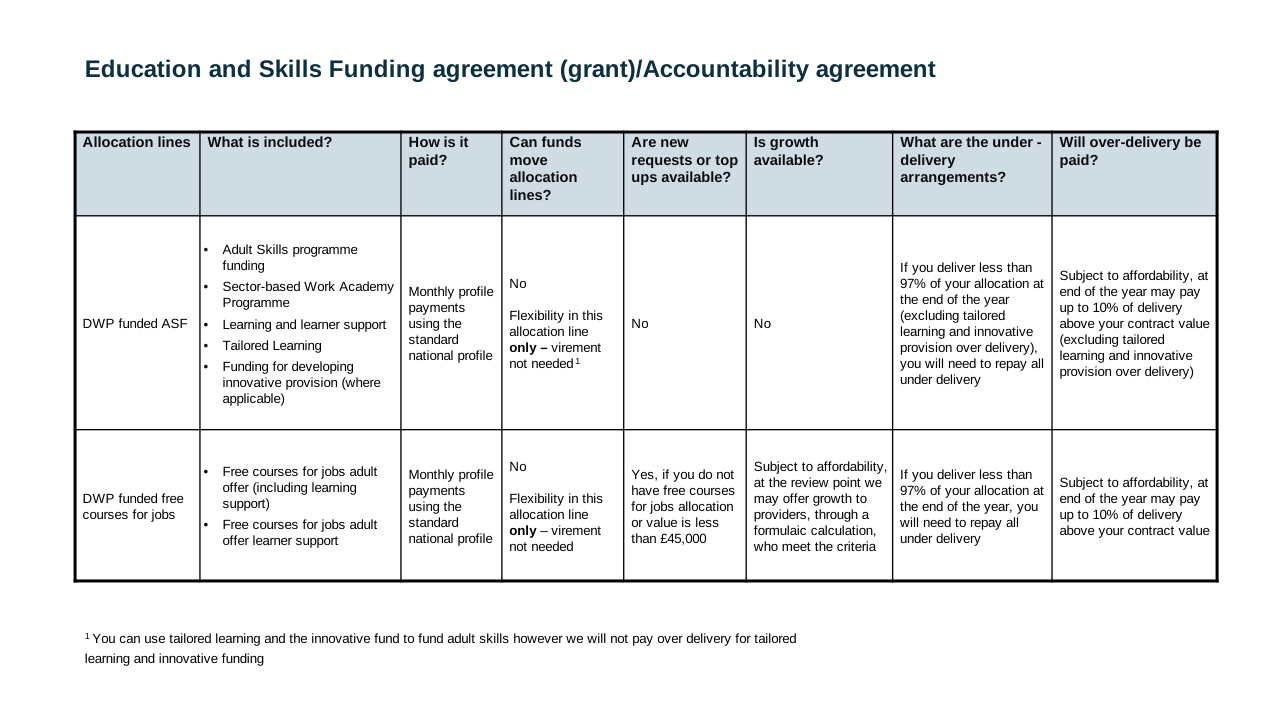
Education and skills funding agreement (grant), accountability statement
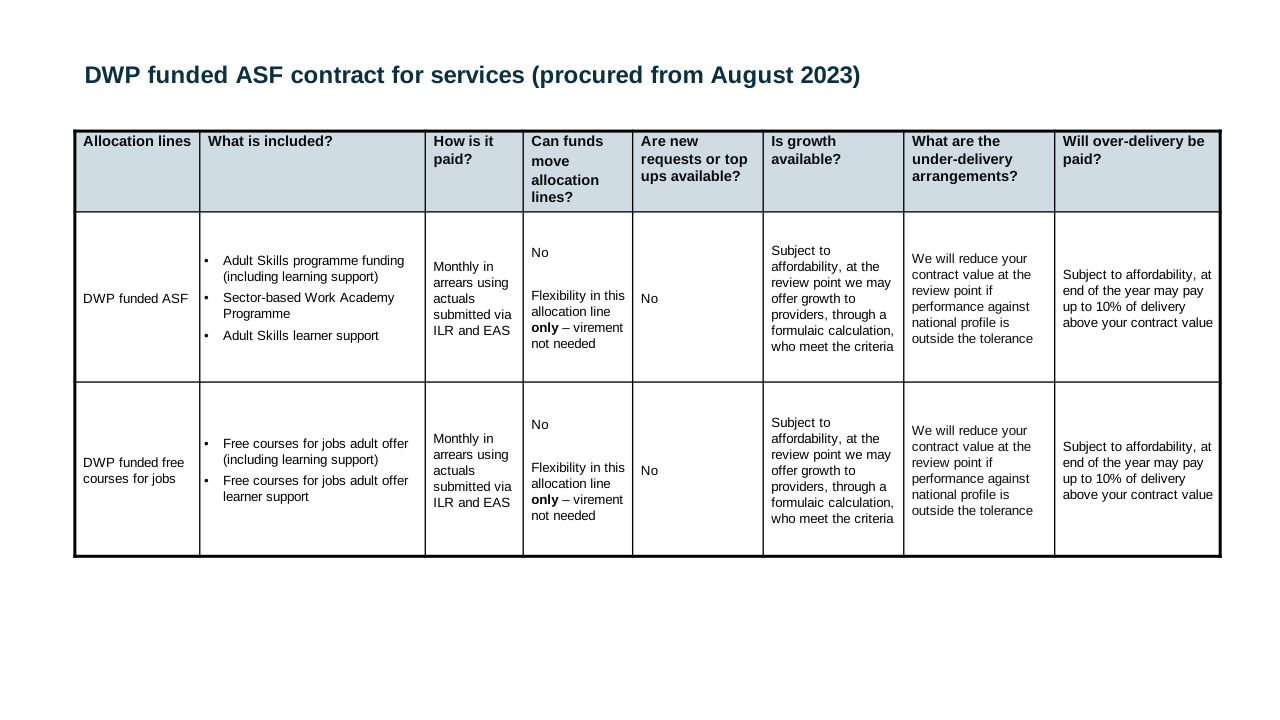
DWP funded ASF contract for services (procured from August 2023)
Glossary
20+ childcare
A category of learner support to assist learners aged over the age of 20 who are at risk of not starting learning or leaving learning due to issues in obtaining childcare.
Advanced learner loan
Advanced learner loans are available for individuals aged 19 or above to undertake approved qualifications at levels 3 to level 6, at an approved provider in England.
Advanced learner loans give individuals access to financial support for tuition costs similar to that available in higher education and is administered by Student Loans Company.
Annual gross salary
Gross salary is the total income before any deductions are removed from that amount. This total income is usually described as an annual salary, and it is the total amount an employee will receive for work completed before tax of national contributions are deducted.
ASF funding methodology
The funding methodology for individuals aged 19 and over, participating in ASF learning.
Benefit Status Indicator (BSI)
To identify if the claimant is in receipt of JSA (BSI 1), UC (BSI 4), or ESA (all categories) (BSI 5).
Break in learning
When a learner is not continuing with their learning but has told you beforehand that they intend to resume their learning in the future.
Completion
When a learner has completed their learning aim.
Care to Learn
A DfE scheme to assist young parents under the age of 20 with the childcare costs that may form a barrier to them continuing in education.
Components of regulated qualification
A subset of a qualification, which could be a unit.
Continuing learners
Learners who commenced learning in a previous funding year and remain in learning as of 1 August 2026.
Devolution of adult education functions
The devolution of adult education functions refers to the transfer of certain Secretary of State functions in the Apprenticeships, Skills, Children and Learning Act 2009.
Digital entitlement
The study of EDS qualifications for learners who have digital skills assessed at below level 1. Qualifications that are designated up to and including level 1 are:
- essential digital skills qualifications
- digital functional skills qualifications
Direct costs of learning
Any costs for items necessary for the learner to complete their qualification. This can include the costs of registration, examination or any other activities or materials.
Distance Learning
Learning delivered away from the learner’s main place of employment or place of learning but must be in England.
Earnings adjustment statement (EAS)
The form providers need to fill in to claim funding that cannot be claimed through the ILR.
Earnings
A measure of the money people receive in return for work done, before tax (gross). It includes salaries but not unearned income, benefits in kind or arrears of pay.
Earnings threshold
The earnings threshold is an eligibility criteria, that enables learners to be fully funded if they earn below than £26,800.
Education health and care (EHC) plan
An EHC plan is a legal document that sets out a child or young person’s special educational needs, the outcomes they are working towards, and the coordinated education, health, and care support required to meet those needs. The local authority has a legal duty to ‘secure’ the educational provision specified in the plan, meaning it must ensure that the support is put in place.
European Economic Area (EEA)
The EEA consists of the Member States of the European Union (EU) and 3 countries of the European Free Trade Association (EFTA) (Iceland, Liechtenstein and Norway, excluding Switzerland). The Agreement on the EEA entered into force on 1 January 1994. Refer to appendix A for more information.
European Union
A list of member states is available on the EU website.
Employment status (formerly employed)
The main types of employment status are:
- worker
- employee
- self-employed and contractor
- director
- office holder
More information on employment status is available.
English for speakers of other languages (ESOL)
Refers to the teaching and learning of English for people whose first language is not English, enabling them to develop the language skills needed for everyday life, education, and work.
DfE funded ASF
Funding you can claim from DfE for delivery of ASF eligible provision to individuals set out in the who we fund section.
Evidence pack
A collection of documents and information brought together to form a single point of reference relating to learning that is taking place. This must provide evidence to prove the learner exists, is eligible for funding, the planned learning to be provided, and that learning has been delivered.
Exceptional learning support
Learning support funding to meet the costs of putting in place a reasonable adjustment for a learner who requires more than £19,000 in a funding year.
Find a learning aim
Find a learning aim provides online services to find the latest information on available qualifications, non-regulated learning, apprenticeship standards, T Levels and units. Standards will show you information on funding, dates and common components. Qualifications and units show you funding streams for courses and the last date learners can start.
Free courses for jobs
A targeted adult offer includes level 2 qualifications in construction, engineering and manufacturing and level 3 qualifications. Available to support adults who meet the definition of being below the earnings threshold or unemployed outlined in the free courses for jobs section.
Full level 2
The following qualifications are designated full at level 2:
- General Certificate of Secondary Education in 5 subjects, each at grade C or above, or grade 4 or above
- a Technical Certificate at level 2 which meets or has previously met the requirements for 16 to 19 performance tables
Full level 3
The following qualifications are designated full at level 3:
- General Certificate of Education at the advanced level in 2 subjects
- General Certificate of Education at the AS level in 4 subjects
- QAA Access to Higher Education (HE) Diploma at level 3
- technical or applied general qualification at level 3 which meets or has previously met the requirements for 16 to 19 performance tables - core maths qualification at level 3
Full or co-funding Indicator (FFI)
Indicates whether a learning aim is fully funded or co-funded in adult skills or other adult funding.
Functional skills
Applied practical skills in English, maths and digital that provide the learner with the essential knowledge, skills and understanding to enable them to operate effectively and independently in life and work.
Funding agreement
Agreement between the Secretary of State for Education (acting through the Department for Education) and providers who receive funding for education and skills training.
Funding model (11 and 38)
Identifies the funding methodology we apply to submission of finalised ILR data. For ASF funding, Funding Model 11 (Tailored Learning) and 38 (Adult Skills) are used, noting model 11 is non-formula funded (as in, ILR data does not generate a funding rate and is paid on monthly profile) and model 38 is formula funded. More information is available in the 2026 to 2027 ILR Specification.
Funding year
The DWP’s adult funding system operates on a funding year basis, which starts on 1 August and finishes on 31 July.
General Data Protection Regulation
The GDPR is retained in domestic law as the UK GDPR, but the UK has the independence to keep the framework under review. The ‘UK GDPR’ sits alongside an amended version of the Data Protection Act (DPA) 2018.
Hardship
Within learner support, a category of support to assist vulnerable and disadvantaged learners to remove barriers to education and training.
Individualised learner record (ILR)
The primary data collection requested from learning providers for FE and work-based learning in England. The government uses this data to monitor policy implementation and the performance of the sector. It is also used by organisations that allocate funding for FE.
ILR specification
The ILR Specification is the technical documents, guidance and requirements to help providers collect, return and check ILR and other learner data.
Job outcome payments
Payments made for learners who are unemployed at the start of learning who cease learning to take up a job.
Learner residency
We use the term ‘resident’ or ‘residence’ in this document for different purposes.
Residence in the UK, EU and EEA has specific definitions in education law, and this is set out in the ‘residency eligibility’ section.
Following the devolution of adult education functions, there is a new emphasis on residence in England, in determining and evidencing eligibility for DWP funded ASF - see who we fund and annex D.
This means the permanent residency of an individual in England (as in, not a temporary address for duration of learning taking place), immediately prior to enrolment determines eligibility for DfE funded ASF.
Learner support
Funding to enable providers to support learners with a specific financial hardship that might prevent them from being able to start or complete their learning. May be used to ‘top up’ childcare costs for 19-year-old learners receiving Care to Learn funding if their costs exceed the weekly maximum rates for that scheme.
Learning aim
Statements that describe the overarching intentions of a course.
Learning aim reference number
The unique eight-character code used to identify a specific learning aim.
Learning delivery monitoring (LDM)
A code used as part of the ILR to indicate participation in programmes or initiatives.
Learning planned end date
The date entered onto the ILR when the learner is expected to complete their learning.
Learning support
Funding to enable providers to put in place a reasonable adjustment, set out in the Equality Act 2010, for learners with an identified learning difficulty or disability to achieve their learning goal.
Legal entitlements
DWP funded ASF includes support for 4 legal entitlements to full funding for resident eligible adult learners.
These entitlements are set out in the Apprenticeships, Skills and Children Learning Act 2009 and include:
- English and maths, up to and including level 2, for individuals aged 19 and over, where the learner has not achieved grade 4 (C) or higher, or where the learner has been assessed as having an existing skill level lower than grade 4 (even if they have previously achieved a GCSE or equivalent qualification in English and maths)
- first full qualification at level 3 for individuals aged 19 to 23 essential digital skills qualifications, up to and including level 1, for individuals aged 19 and over, who have digital skills assessed at below level 1
Leisure Learning
Defined as learning where the primary or sole intent of the learning is for leisure. This applies to curriculum intent and to the learner’s purpose for undertaking the learning.
Local flexibility
Regulated qualifications, and their components, that we fund, which is not part of the English and maths, or level 2 or level 3 legal entitlement offer. From 1 August 2025, Performing Arts Graded Exam qualifications were not funded through the local flexibility offer. All regulated qualifications that are available for funding through the flexible local offer is listed on find a learning aim.
Non-regulated learning
Learning which is not subject to awarding organisation external accreditation in the form of a regulated qualification. It may be designed, delivered and certificated by a provider or another organisation. This could include:
- independent living skills - engagement and confidence building - employability skills - labour market re-entry - essential skills (English, maths, digital) and ESOL
Ofqual
The Office of Qualifications and Examinations Regulation, which regulates qualifications, examinations and assessments in England.
Ordinarily resident
For funding purposes, a person who normally lives in the United Kingdom, are allowed to live there by law, and return there after temporary trips outside the country.
Performance management requests form (ASF)
This form must be used at the performance management reviews for exceptions to reductions or increases and first-time requests.
Personal learning record (PLR)
A database that allows individual learners access to their past and current achievement records. These can be shared with schools, colleges, FE training providers, universities or employers.
Policy entitlements
Alongside the legal entitlements DfE have policy entitlements allowing full funding for residency eligibility learners, over 19 years old, and meet the earnings threshold criteria or are unemployed, these include:
- level 2 and below local flexibility including ESOL - free courses for jobs - work placements - HGV - SWAP - King’s Trust
Recognising and recording progress and achievement (RARPA)
The Learning and Work Institute have published updated RARPA guidance. This comprises a clear framework designed to support learners through the learning process, identifying key outcomes. It provides a robust approach to quality assurance and improvement of non-regulated provision with a focus on self-assessment that supports standards acceptable to Ofsted. You can access further information from The Learning and Work Institute.
Recognition of prior learning (RPL)
An assessment method that considers whether a learner demonstrates that they can:
- meet the outcomes for a qualification or a component of a qualification through knowledge, understanding - skills they already have and so do not need to undertake a course of learning for that component or qualification
Regulated Qualifications Framework (RQF)
RQF provides a way of understanding and describing the relative level and size of qualifications. RQF, operated by Ofqual, is a single regulatory framework containing a range of general, technical and professional qualifications.
Residential support
Support provided under learner support to learners receiving specialist provision, which involves a residential element, or to support learners who cannot receive provision locally.
Sector-based work academy programme (SWAP)
SWAP is a DWP scheme that offers pre-employment training, work experience placements and a guaranteed job interview for recipients of JSA, UC (all work-related requirements group) or ESA.
Self-declaration
A process where the learner can confirm something through his or her own signature.
Skills bootcamp
A skills bootcamp is a bespoke employer-led level 3 to 5 programme, designed to meet skills needs within the economy. Following a procurement process, the skills bootcamp programme began in August 2022.
Start of learning
The date on which learning begins. We do not consider enrolment, induction, diagnostic assessment, or prior assessment to be part of learning.
State benefits
State benefits are contributions, both financial and non-financial, made by central and local government to individuals in certain circumstances to meet their day-to-day living needs.
Study programme
Study programmes are for learners aged 16 to 19 and cover all levels up to level 3. Funding is for each learner, rather than for each qualification and can only have one core aim at a time.
Tailored learning
Tailored learning is primarily non-qualification based provision that is tailored to the skills needs of the learners, employers and local communities.
Tailored learning is non-formula funded which gives it the flexibility to support learners furthest from the workplace and to meet changing employer needs.
The primary purpose of tailored learning is to support learners into employment and to progress to further learning. It also supports wider outcomes including improvements to health and wellbeing, and equipping parents and carers to support their child’s learning.
Tailored learning includes employer-facing provision that has been designed in collaboration with employers and others, that is not qualification based.
Unemployed
An individual who is looking for work and who has no earned income (earned income comprising the remuneration or profits derived from employment under a contract of service or in an office, including elective office, a trade, profession or vocation, or any other paid work).
Innovative tailored learning funding
Contract for services will not have a tailored learning allocation or access to deliver non-regulated provision.
Funding model 11 is DWP funded ASF tailored funding model that providers must use alongside the funding claim for 2026 to 2027.
Unique learner number
A 10-digit number used to match a learner’s achievement to their PLR.
Work placement
A placement with an employer in a workplace setting.
Young people’s funding methodology
The funding methodology for individuals aged 16 to 19 (and those aged 19 to 24 with an EHC plan). You can access 116 to 19 funding methodology.