Households Below Average Income: Background Information and Methodology report FYE 2025
Published 26 March 2026

© Crown copyright 2026
This publication is licensed under the terms of the Open Government Licence v3.0 except where otherwise stated. To view this licence, visit nationalarchives.gov.uk/doc/open-government-licence/version/3 or write to the Information Policy Team, The National Archives, Kew, London TW9 4DU, or email: psi@nationalarchives.gov.uk.
Where we have identified any third party copyright information you will need to obtain permission from the copyright holders concerned.
This publication is available at https://www.gov.uk/government/statistics/households-below-average-income-for-financial-years-ending-1995-to-2025/households-below-average-income-background-information-and-methodology-report-fye-2025
Published: 26 March 2026
Introduction
This Background Information and Methodology (BIM) report accompanies the main FYE 2025 Households Below Average Income (HBAI) report. The Households Below Average Income (HBAI) publication presents information on living standards in the United Kingdom and is the foremost source for data and information about household income, and inequality in the UK. It provides annual estimates on the number and percentage of people living in low-income households.
HBAI statistics incorporate widely used, international standard measures of low income and inequality. They provide a range of measures of low income, income inequality, and material deprivation to capture different aspects of changes to living standards. The current series started in Financial Year Ending (FYE) 1995 and so allows for comparisons over time, as well as between different groups of the population.
The statistics are based on the Family Resources Survey (FRS), whose focus is capturing information on incomes, and as such captures more detail on different income sources compared to other household surveys. The FRS collects a lot of contextual information on the household and individual circumstances, such as employment, education level and disability. This is therefore a very comprehensive data source allowing for a lot of different analysis.
This report provides contextual information to aid understanding of the statistics presented in the main publication and provides detailed information on key quality and methodological issues relating to HBAI data. Information on the FRS methodology is available within the FRS Background, Information and Methodology report. An additional report providing a detailed description of the FRS sampling methodology, fieldwork operations, data processing and data source quality management are presented in the FRS Quality Assessment Report.
The FYE 2025 HBAI publication features an improved approach to using administrative data in place of FRS survey responses both for FYE 2025 and some back-series years. Information on the major state benefits and tax credits is now based on administrative data rather than survey responses. Updates to the back-series will take place in two stages – in March 2026 (back to FYE 2022) and summer 2026 (back to FYE 2019). The improved approach is sometimes referred to as administrative-linked (or admin-linked) data; with data which has not had the change applied being referred to as unlinked data.
This improvement means key HBAI low-income measures, including the number/proportion of people identified as being in relative and absolute low income for all groups and in all years from FYE 2022 (in March 2026) and from FYE 2019 (in summer 2026) have changed. It also means there will be a break in the HBAI series at these points. We advise users that income data before and after the break are not directly comparable and if comparisons across the break point are required users should follow the advice set out in section 3.2. Dotted lines and notes have been added to all tables and charts which cover the break point to signal the change to administrative-linked data and other smaller updates to historical data. Some measures of poverty, such as material deprivation statistics, are unaffected by the improvement of using administrative-linked data.
Summary level information on the impact of this improvement on key HBAI low-income measures is included at Annex 5. For more information on the improved approach, see latest FRS technical report.
The other two main changes to the FYE 2025 HBAI publication are:
- the inclusion of the new deep material poverty measure, one of the two headline metrics alongside relative low income after housing costs which will be used to monitor progress against the Child Poverty Strategy; and
- the change the absolute low-income reference year. The latter is necessary because of the change to using administrative data. More information on all these changes, along with other smaller changes, can be found in section 2 of this report.
Acknowledgements
As in previous years, DWP would like to thank the Institute for Fiscal Studies (IFS) for the substantial assistance that they have provided in checking and verifying the income data and grossing factors underlying the main results in this edition.
We are also grateful to HM Revenue and Customs (HMRC) for the provision of aggregated data from the Survey of Personal Incomes.
Feedback
We are constantly aiming to improve this report and its associated commentary. We would welcome any feedback you might have and would also be particularly interested in knowing how you make use of these data to inform your work. Please contact us via email: team.hbai@dwp.gov.uk
1. Overview of the Statistic
1.1 Status of the Statistic
These Accredited Official Statistics were independently reviewed by the Office for Statistics Regulation in November 2012. They comply with the standards of trustworthiness, quality and value in the Code of Practice for Statistics and should be labelled ‘accredited official statistics’. Accredited Official Statistics are called National Statistics in the Statistics and Registration Service Act 2007.
It is DWP’s responsibility to maintain compliance with the standards expected of Accredited Official Statistics. If DWP becomes concerned about whether these statistics are still meeting the appropriate standards, we will discuss any concerns with the Office for Statistics Regulation. Accredited Official Statistics status can be removed at any point when the highest standards are not maintained, and reinstated when standards are restored.
The Office for Statistics Regulation (OSR) published a review of income-based poverty statistics on 19 May 2021. This included background information on why the review was commissioned as well as the findings and recommendations for statistics producers. Recommendations focussed on key areas including accessibility and guidance, understanding poverty, data gaps, data quality, and trustworthiness. Several of the recommendations were taken account of in the FYE 2021, FYE 2022 and FYE 2024 HBAI publications and maintained in the publications for subsequent years. This included including a section on the strengths and limitations of HBAI to the main statistical report and implementing a number of recommendations on material deprivation measures. From the FYE 2025 release onwards, the integration of administrative data into the FRS addresses further recommendations around making greater use of administrative data.
1.2 History of the Statistic
HBAI statistics are based on the FRS. The FRS is a continuous survey collecting information on the incomes and circumstances of individuals living in a representative sample of private households in the United Kingdom. The FRS has been running in Great Britain since October 1992 and was extended to cover Northern Ireland in the FYE 2003 survey year.
The HBAI publication has been running since FYE 1995 and has been updated annually since then. Over this period, the publication has evolved significantly. The publication has adapted to changes in information technology, publication standards (including internet standards) and user needs in the field of household income research. Several routes are now available for users to access these statistics, and these are described in later sections.
1.3 Guide to Published Tables
A wide range of ODS (OpenDocument Spreadsheets) tables are available alongside this release, breaking down the results presented in this report for different demographic characteristics. This includes breakdowns of the statistics by region, ethnic group, family type, and economic status. All tables can be downloaded via FYE 2025 Households Below Average Income (HBAI) (see Directory of Tables link on this webpage to locate tables to find the desired tables). Results are available for most series back to FYE 1995.
UK-level HBAI data is also available between FYE 1995 and FYE 2025 on the Stat-Xplore online tool. You can use Stat-Xplore to recreate measures in our static tables and create your own bespoke HBAI analysis. From the FYE 2025 publication, HBAI data via Stat-Xplore is split into two datasets to recognise the break in the series. Income data before and after the break are not directly comparable. The first dataset mainly covers the period before the integration of administrative data and the second dataset covers the period after. Note a single overlap year of data (FYE 2022 in March 2026 and FYE 2019 in summer 2026) are included in both datasets to allow for limited analysis across the break point following the guidance in section 3.2. For this overlap year (FYE 2022 in March 2026 and FYE 2019 in summer 2026), where a standalone figure or a comparison with future years is required then the administrative-linked data should always be used. See section 3.2 for more information.
The source data behind these statistics is available for download and further analysis via the UK Data Service and is expected to be available on the ONS Secure Research Service later in 2026.
Note that unpublished FYE 2021 data is excluded from both the tables and Stat-Xplore. The HBAI dataset underpinning the headline estimates for FYE 2021 remains available for expert users and researchers in the UK Data Service, and we recommend consulting the FYE 2021 technical report for more guidance on use and interpretation of sub-national estimates.
Estimates of the change in the percentage and number that are statistically significantly different from a previous year are shown with the notation [s]. Changes marked with an [s] are unlikely to have occurred because of chance. Changes that are not statistically significant are shown with the notation [ns].
The series started in FYE 1995 and so allows for comparisons over time, as well as between different groups of the population. However, note that in the FYE 2025 publication there is a methodological break in the series due to the improved approach to using administrative data in place of survey responses for the major state benefits and tax credits. In the March 2026 publication, the break occurs at FYE 2022, and when this data improvement is applied to further back-series years in summer 2026, the break will be moved back to FYE 2019. We advise users that income data before and after the break are not directly comparable and if comparisons across the break point are required users should follow the advice set out in section 3.2.
Dotted lines and notes have been added to all tables and charts which cover the break point to signal the change to administrative-linked data and other smaller updates to historical data. Some measures of poverty, such as material deprivation statistics, are unaffected by the improvement of using administrative-linked data.
For more information on the methodological break, please see Annex 5 of this report and the latest FRS technical report.
1.4 What do we mean by average?
In HBAI, the term ‘average’ is used to describe the median income. This divides the population of individuals, when ranked by income, into two equal-sized groups, and unlike the mean is not affected by extreme values.
1.5 HBAI Measures
There are a range of measures of low income, income inequality, and material deprivation to capture different aspects of changes to living standards:
- Relative low income measures the number and proportion of individuals who have household incomes below a certain proportion of the average in that year. It is used to look at how changes in income for the lowest income households compare to changes in incomes near the ‘average’. In the HBAI report we concentrate on those with household incomes below 60% of the average. Information on those with household incomes below 50% and 70% of the average is available in the detailed tables published on FYE 2025 Households Below Average Income (HBAI).
- Absolute low income measures number and proportion of individuals who have household incomes a certain proportion below the average in FYE 2025, adjusted for inflation. It is used to look at how changes in income for the lowest income households compare to changes in the cost of living. In the HBAI report we concentrate on those with household incomes below 60% of the average FYE 2025 income for years FYE 2022 onwards (and below 60% of the average FYE 2011 before FYE 2022). Note in summer 2026, when the methodological break in the series is extended back to FYE 2019, the FYE 2025 will be the reference point for absolute low income for years FYE 2019 onwards. Information on those with household incomes below 50% and 70% of the average is available in the detailed tables published on FYE 2025 Households Below Average Income (HBAI).
1.6 Rounding
Due to rounding, the estimates of change in percentages or numbers of individuals may not equal the difference between the total percentage or number of individuals for any pair of years.
The publication and tables follow the following conventions:
[low] – the estimate is less than 50,000 or the percentage is less than 0.5 per cent
[u] – the estimate is not available due to small sample sizes (fewer than 100)
[x] – the estimate is not available. In FYE 2021 this was due to sample quality concerns across different household sizes and compositions
Population estimates are rounded to the nearest 0.1 million.
Percentages are rounded to the nearest 1 per cent.
The approach we use for multi-year averaging is to calculate the statistics for each year and then average those values.
2. New for this Publication
2.1 Family Resources Survey (FRS) during FYE 2025
Survey fieldwork operations continued with face-to-face interviewing as the predominant way of completing the survey, as was the case for FYE 2024 FRS. Telephone interviewing was retained as an alternative based on household preference and interviewer availability.
Across the UK achieved sample overall, 89% of FRS households were interviewed face-to-face during FYE 2025 which was a slight increase compared to FYE 2024.
In FYE 2025, the FRS covered a sample of 16,299 households in the United Kingdom. This was a slightly smaller achieved sample than in FYE 2024 (16,758), with the target of 20,000 households remaining the same across these years. Surveys gather information from a sample rather than from the whole population.
We continue to advise users that changes in estimates over recent years should be interpreted being mindful of the differences in data collection approaches across the period and the effect this had on sample composition. In this year’s report we continue to make assessments of observed changes in the data compared with both FYE 2024 and preceding years.
For more information on FRS questionnaire or specific editing/imputation changes in FYE 2025, users should see section 1.3 and 1.5 of the FRS Background, Information and Methodology Report or contact the FRS team at team.frs@dwp.gov.uk. For FYE 2025, HBAI users should particularly note the following changes:
-
modelling of Council Tax, Council Tax Liability and Council Tax Rebate
-
removal of separate Class 2 National Insurance Contributions variables - these are now included with Class 3 National Insurance Contributions
-
additional categories for pension variable (PENHOW) as a result of changes to Collective Defined Contribution (CDC)
2.2 Integration of survey and administrative data
As outlined in the DWP Statistical Work Programme (section 2.4), the department is committed to transforming its surveys through the integration of administrative data. This is sometimes referred to as administrative-linked (or admin-linked) data; with data which has not had the change applied being referred to as unlinked data. This is in the wider context of the UK Statistics Authority’s strategy for data linking and OSR recommendations in their 2021 review of income-based poverty statistics, that DWP should explore the feasibility and potential of social survey and administrative data integration.
An initial technical report on FRS transformation, with illustrative results for DWP benefits, was published in March 2024 alongside the FYE 2023 FRS publication.
From the March 2026 FRS publication, administrative data has been integrated into the FRS to replace survey responses for the major DWP and HMRC benefits. This has reduced the under-reporting of benefits that was previously seen in the FRS (and therefore HBAI) and improved data quality in both datasets. A further technical report has also been published explaining the improvement.
Administrative data has also been used as part of the normal verification of FRS survey responses on rent for those on benefits, improving HBAI housing costs and tenure data; and has removed the need for HBAI to model estimates for Housing Benefit (HB) and Winter Fuel Payment (WFP).
This update will apply from FYE 2019 and implemented in two stages:
- on 26 March 2026, alongside publication of the new FYE 2025 data, we have published administrative-linked, improved datasets and estimates for FYE 2022, FYE 2023 and FYE 2024; and
- in summer 2026, we will publish administrative-linked, improved datasets and estimates for FYE 2019, FYE 2020 and FYE 2021
This will mean by summer 2026, an administrative-linked, improved, HBAI time series will be available from FYE 2019 to FYE 2025 inclusive.
This improvement means key HBAI low-income measures, including the number/proportion of people identified as being in relative and absolute low income for all groups and in all years from FYE 2022 (in March 2026) and from FYE 2019 (in summer 2026) have changed. It also means there will be a break in the HBAI series at these points. We advise users that income data before and after the break are not directly comparable and if comparisons across the break point are required users should follow the advice set out in section 3.2. Dotted lines and notes have been added to all tables and charts which cover the break point to signal the change to administrative-linked data and other smaller updates to historical data. Some measures of poverty, such as material deprivation statistics, are unaffected by the improvement of using administrative-linked data.
Users should note that:
- regional statistics published by Scotland, Wales and Northern Ireland have been classified as Official Statistics in Development. This signals that the changes introduce uncertainty that is acute for estimates below UK level which needs to be reflected in their Official Statistics reporting.
- from the FYE 2025 publication, HBAI data via Stat-Xplore is split into two datasets to recognise the break in the series. The first dataset mainly covers the period before the integration of administrative data and the second dataset covers the period after. Note a single overlap year of data (FYE 2022 in March 2026 and FYE 2019 in summer 2026) are included in both datasets to allow for limited analysis across the break point following the guidance in section 3.2 of this report. For this overlap year (FYE 2022 in March 2026 and FYE 2019 in summer 2026), where a standalone figure or a comparison with future years is required then the administrative-linked data should always be used. See section 3.2 for more information.
- while the integration of administrative data has reduced FRS/HBAI under-reporting of benefits, some under and over-reporting will remain and the level will vary by individual benefit. See the FRS Methodology tables M.6a and M6b for further information. Note the under-reporting of benefits has not been eliminated, although research continues for how to achieve this with further developments in the future.
A technical report has been published explaining this improvement in more detail. Annex 5 of this report also summarises the impact of this data improvement on key HBAI measures.
2.3 Update to the absolute low-income reference year
As outlined in the previous section, by summer 2026, benefits data in the FRS (and HBAI) will be replaced with administrative data, back to FYE 2019 (the earliest year for which we have sufficient linking to administrative records) for the major DWP and HMRC state benefits. Given the methodological break, it has been necessary to review the reference year for the absolute low-income measure in HBAI (FYE 2011).
From the March 2026 publication, the absolute reference year has changed to be FYE 2025 for the years where the integration of administrative data has been applied. It will remain at FYE 2011 for prior years. Not making this change would mean the calculation of the absolute low-income measure would not be analytically robust as the base year would be on a different methodological basis to the comparison year.
This change will impact the number of people identified as living in absolute low income, for the years where the absolute reference year has been updated (i.e. back to FYE 2022 in March 2026 and back to FYE 2019 by the summer 2026 update). It is a reclassification to a more up-to-date absolute low-income date, rather than a correction of an error in previous estimates.
These changes will improve the quality of our analysis of the income distribution and reporting on poverty. Changes to the absolute low-income reference year outlined above will also impact Separated Families statistics and Children in low-income families statistics.
Key points to note on the absolute low-income year change are:
- the FYE 2025 absolute and relative low-income estimates will be the same for FYE 2025, although the absolute and relative back-series will be different. Future years, when published, will also be different
- given the two-stage change to the back-series years outlined in the section above changes to the absolute reference year back to FYE 2019 will also happen in two stages as follows:
- in March 2026, the absolute reference year has changed to FYE 2025 for both FYE 2025 and the three back-series years being changed at that point (remaining at FYE 2011 for years prior to FYE 2022) and;
- in summer 2026, the absolute reference year will be updated to FYE 2025 for all years back to FYE 2019
- the annual HBAI publication fulfils the legal obligation to publish data on three of the four indicators for children living in low-income households in the Welfare Reform and Work Act 2016. Subsection 4(1)(c) and 4(2)(h) of the Act refers to the absolute reference year of FYE 2011. Starting from the March 2026 publication the references in subsection 4(1) and 4(2) of the Welfare Reform Act 2016 to the FYE 2011 should be read as references to the FYE 2025 for years where the HBAI data has been updated for administrative data linking (i.e. from FYE 2022 onwards in the March 2026 publication and from FYE 2019 onwards from summer 2026 update)
Annex 5 of this report summarises the impact of this change on absolute low-income measures.
2.4 Publication of the new Deep Material Poverty measure for children
As outlined in the Child Poverty Strategy, Our Children, Our Future: Tackling Child Poverty, the strategy will track progress against two headline metrics. The first is relative low income after housing costs (AHC), which is already included in the annual HBAI publication tables.
To complement this, a second measure has been developed to capture children experiencing a deeper level of poverty. Deep material poverty is based on material deprivation, specifically whether families can afford certain essential items. An ad-hoc statistical release Deep material poverty: Financial year ending 2024 - GOV.UK was published in December 2025 and this presented estimates for the number and percentage of children in deep material poverty for the first time. This new deep material poverty measure is defined as lacking at least 4 out of 13 essential material deprivation items.
From the FYE 2025 HBAI publication, six new data tables are included (1.4h, 4.9db, 4.10db, 4.11db, 4.12db and 4.10tr) which present estimates for the number and percentage of children in deep material poverty by various breakdowns. These new tables contain very similar information to the information presented in the December 2025 statistical release but are based on the latest data for FYE 2025 and include additional ethnic group and regional breakdowns. Ethnic group and regional breakdowns are presented as a two-year average of FYE 2024 and FYE 2025 data.
Uncertainty estimates (confidence intervals) around the number and percentage of children in deep material poverty and the year-on-year change are presented in table 8m.
Two new variables for the deep material poverty measure, MDCHDMP (Child/ren in deep material poverty flag) and MDCOUNTCHDMP (Total Child Deep Material Poverty count of items lacked), are now included in the HBAI dataset.
2.5 Changes to publication tables, charts or HBAI variables
Changes to publication tables 5.5tr, 5.6tr, 6.5tr and 6.6tr
Prompted by user feedback, we have made changes to ensure that four supplementary time series HBAI publication tables are unaffected by the changing State Pension Age over time. The tables impacted are: 5.5 tr, 5.6 tr, 6.5 tr and 6.6 tr, which can be found in the working-age (5.5tr and 5.6tr) and pensioner trends (6.5tr and 6.6tr) set of tables. These tables previously presented data on those aged 65+ (6.5 tr and 6.6 tr) and 64 and under (5.5tr and 5.6 tr) and from March 2026 have changed to present data on those aged 66+ (6.5 tr and 6.6 tr) and 65 and under (5.5 tr and 5.6 tr). When State Pension age changes again in future we will recut these time series tables again to match that change.
Changes to publication tables 1.6c and 6.7tr
Prompted by user feedback, the title and labelling of these tables have been changed to clarify the change in the eligible pensioner population included in the pensioner material deprivation measure over time. The material deprivation measure captures pensioners aged 65 and above only. Up until 2017/18, this meant that female pensioners aged 64 and under were not included in the measure. Since equalisation of State Pension Age, both men and women at or above State Pension Age have been captured in the measure.
Addition of two new After Housing Costs publication charts
Prompted by user feedback we have added two new After Housing Costs (AHC) publication charts and will routinely produce these going forward. The Before Housing Cost (BHC) versions of these charts are already routinely published. The new charts can be found in the publication-hbai_2024-25-charts file and are Chart 1.1 (AHC): Changes in real terms income AHC by percentile, FYE 2024 to FYE 2025 and Chart 1.2 (AHC) Weekly net equivalised household income AHC by percentile.
Inclusion of additional payments in HBAI variables DSCORANDBEN and BENBU_DISBEN
From FYE 2025, Scottish Adult and Child Disability Payments are included in the HBAI variables DSCORANDBEN (Disabled adults and/or children in the family (benefit unit) and receipt of any of these Disability Benefits by the family) and BENBU_DISBEN (Disability benefits received by the family). These payments have always been present in the HBAI data but we have now added them to these specific variables. This change impacts on any publication tables that show a Disability breakdown and has also been applied for FYE 2023 and FYE 2024 (see section 2.6).
Updates to Economic indicators in Table 1.2a
Historically we have not updated revisions to the back-series of economic indicators. However, in the FYE 2025 publication we have updated all economic indicators with the latest data and for future publications we will update the complete time series for these indicators routinely to match the most up to date figures at the time of publication.
Presentational changes to titles of publication tables
Prompted by the update to the absolute reference year we have reviewed titles and labels of publication tables to make them shorter and consistent with the relative and absolute low-income terminology used in the main publication report. Full definitions are available in notes to the tables or within this report. Dotted lines and notes have been added to all tables and charts which cover the break point to signal the change to administrative-linked data and other smaller updates to historical data.
Presentational changes to notes on publication tables
We have taken the opportunity from the FYE 2025 publication to both review all the notes across all the publication tables and make changes to ensure they are compliant with the latest accessibility guidance. The first change means that there is now one complete list of HBAI relevant publication table’s notes which appears in each workbook and numbers are consistent across tables – so, for example, note number one is the same note across all the tables where it applies. The second change means specific notes which are relevant for individual tables are then highlighted at the top of each table instead as super/sub scripts within the tables themselves.
2.6 Other updates to HBAI historical data in March 2026
As noted in section 2.2, the improvement of replacing survey data with administrative data for the major DWP and HMRC benefits will apply to back-series years as well as FYE 2025. As the back-series years are being updated for this change, we have taken the opportunity to update historical HBAI data to take account of other changes. This is in line with best practice for updating data when it is next released. These are:
- updates to constants and deflators: we have included the latest available data for constants and deflators from FYE 2022 for the March 2026 update and from FYE 2019 for the summer 2026 update.
- corrected data for Educational Attainment of Adult: we have included corrected data for the HBAI variable EDATTAIN (Educational Attainment of Adult) for FYE 2023 and FYE 2022, following corrected data being first re-introduced for this variable for FYE 2024 in the March 2025 publication. As additional degree-level grossing controls are present for FYE 2022, the inclusion of corrected data for this variable has had an impact on changing grossing factors for this year. Issues with this variable were also found to be present for earlier survey years but these will not be adjusted due to data deletion policy under the governance of UK GDPR.
- retrospective methodological change to Scottish Council Tax Charges and Water and Sewerage reduction scheme: This change is a correction which is already present in HBAI published data from FYE 2023 onwards and has been applied to FYE 2022 now for consistency and will be applied to FYE 2019 to FYE 2021 in the summer 2026 update.
- retrospective methodological change to when we include income received from directors’ dividends in HBAI income estimates: This change means that income received from directors’ dividends is now only included where directors are classed as employees for FYE 2022. This is now consistent with the treatment from FYE 2023 onwards. The income is treated as income from earnings.
- minimal changes to grossing factors for FYE 2022 to FYE 2024: This is due a small number of households changing category in the ‘region by tenure’ and ‘very rich household’ control groups.
-
inclusion of Scottish Adult and Child Disability Payments in the HBAI variables DSCORANDBEN and BENBU_DISBEN for FYE 2023 and FYE 2024: These payments have always been present in the HBAI data but we have now added them to these specific variables See section 2.5 as this change has also been applied to FYE 2025.
- removal of combined low income and pensioner material deprivation variables from the HBAI dataset available on the UK Data Service: These are not used in the publication tables and are not headline measures for users.
- inclusion of updated FRS data for several FRS variables as follows: total capital of the family, dividend income, account interest, healthy start vouchers, free school meals and free school fruit and veg and tax on bonuses. These are small changes, but more information is available from team.frs@dwp.gov.uk.
3. Background Information
3.1 Users and Uses
HBAI is a key source for data and information about household income and inequality and providing detail for different groups in the population. HBAI statistics and datasets are used for the analysis of low income by researchers, and the government and users include policy and analytical teams within the DWP, the Devolved Administrations, other government departments, local authorities, Parliament, academics, journalists, lobby groups and the voluntary sector. The HBAI statistics and datasets are also used for international comparisons.
The Department for Work and Pensions’ responsibilities include helping people move into work and supporting in-work progression, with the aim of increasing overall workforce participation; helping people plan and save for later life, while providing a safety net for those who need it; providing effective, efficient, and innovative services to claimants, including the most vulnerable in society, and improving the experience of DWP services while maximising value for money for the taxpayer. Progress towards some of these responsibilities will affect the HBAI results.
HBAI statistics will also be used to track progress towards Our Children, Our Future: Tackling Child Poverty, by providing two headline metrics: relative low income after housing costs and a new deep material poverty measure. HBAI will publish both metrics annually from FYE 2025.
The HBAI statistics also meet DWP’s statutory obligation to publish the first three of the four income-related measures included under section 4 of the Welfare Reform and Work Act 2016. The four measures cover the percentage of children in the United Kingdom:
a) who live in households whose equivalised net income for the relevant financial year is less than 60% of median equivalised net household income for that financial year
b) who live in households whose equivalised net income for the relevant financial year is less than 70% of median equivalised net household income for that financial year and who experience material deprivation
c) who live in households whose equivalised net income for the relevant financial year is less than 60% of median equivalised net household income for the financial year beginning 1 April 2024 (see note below), adjusted to take account of changes in the value of money since that financial year; and
d) who live in households whose equivalised net income has been less than 60% of median equivalised net household income in at least 3 of the last 4 survey periods
Definitions for relevant key terms in the Act are consistent with those given in the Glossary, Income Definition, Equivalisation, and Combined Low income and Child Material Deprivation sections of this report. Subsection 4(1)(c) and 4(2)(h) of the Act refers to the absolute reference year of FYE 2011. Starting from the March 2026 publication the references in subsection 4(1) and 4(2) of the Welfare Reform Act 2016 to the FYE 2011 should be read as references to the FYE 2025 for years where the HBAI data has been updated for administrative data linking (i.e. from FYE 2022 onwards in the March 2026 publication and from FYE 2019 onwards from the summer 2026 update).
Data for reporting against the fourth measure will be released via the Income Dynamics publication.
Further details of the uses of HBAI statistics are given in Annex 3.
3.2 Issues to Consider
The following issues should be considered when using HBAI data:
Comparisons across unlinked and administrative-linked data
From the March 2026 FRS publication, administrative data has been integrated into the FRS to replace survey responses for the major DWP and HMRC benefits. This has reduced the under-reporting of benefits that was previously seen in the FRS (and therefore HBAI) and improved data quality in both datasets.
This improvement has been applied from FYE 2022 onwards in the March 2026 publication and will be applied from FYE 2019 onwards in summer 2026. By summer 2026, an administrative-linked, HBAI time series will be available from FYE 2019 onwards and all data prior to this will be on an unlinked basis. On charts and tables, we have shown this break in the series, which is a change from unlinked data to linked data, with a dotted line, with relevant notes.
While administrative-linked data and unlinked data are not directly comparable, we recognise that there may be the need to make comparisons across the unlinked and linked data periods. If comparisons across the break point (FYE 2022 in March 2026 and FYE 2019 in summer 2026) are required users should follow the advice set out below.
Guidance and example for comparisons across unlinked and administrative-linked data
From the FYE 2025 publication, HBAI data via Stat-Xplore is split into two datasets to recognise the break in the series and to allow for comparisons across the break point following the guidance below.
The first dataset mainly covers the period before the integration of administrative data and the second dataset covers the period after. Note a single overlap year of data (FYE 2022 in March 2026 and FYE 2019 in summer 2026) are included in both datasets to allow for limited analysis across the break point following the guidance below. For this overlap year (FYE 2022 in March 2026 and FYE 2019 in summer 2026), where a standalone figure or a comparison with future years is required then the administrative-linked data should always be used.
When making comparisons across the unlinked and administrative-linked data periods, the process from the March 2026 publication to the summer 2026 update (linked data from FYE 2022) is:
A. Calculate the change on unlinked data between a chosen single unlinked year before FYE 2022 and FYE 2022.
B. Calculate the change on administrative-linked data between FYE 2022 and chosen single administrative-linked year after FYE 2022.
C. Add A and B.
Similarly, from summer 2026 the break/change point will move from FYE 2022 to FYE 2019, so when making comparisons across the unlinked and administrative-linked data periods, the process after the summer 2026 update is:
A. Calculate the change on unlinked data between a chosen single unlinked year before FYE 2019 and FYE 2019.
B. Calculate the change on linked data between FYE 2019 and chosen single linked year after FYE 2019.
C. Add A and B.
A worked example is provided below following this process for the March 2026 publication (i.e. administrative-linked data from FYE 2022).
Example: Calculate the change in the number of children in relative low income after housing costs (AHC) between FYE 2011 and FYE 2025.
A. Unlinked data: Calculate the change between FYE 2011 (3,597,742) and FYE 2022 (4,224,793).
4,224,793 – 3,597,742 = 627,051.
B. Linked Data: Calculate the change between FYE 2022 (3,950,355) and FYE 2025 (4,026,597).
4,026,597 - 3,950,355 = 76,242.
C. Add A and B. 627,051 + 76,242 = 703,293. Round as necessary at the end (e.g. round to 700 thousand) but do all calculations on unrounded data.
Impact of the coronavirus (COVID-19) pandemic on FYE 2021 and FYE 2022 statistics
Fieldwork operations for the Family Resources Survey (FRS) were changed in response to the coronavirus (COVID-19) pandemic and the introduction of national lockdown restrictions in March 2020. The established face-to-face interviewing approach employed on the FRS was suspended and replaced with telephone interviewing from April 2020 for the whole of the FYE 2021 and FYE 2022 survey years. This change impacted both the size and composition of the achieved samples for those years. The data published for FYE 2021 is limited to headline measures and not available in our supplementary tables or on our Stat-Xplore tool. It is, however, still deposited for download by users in the UK Data Service.
We recommend caution is exercised when interpreting any data published for these survey years, particularly when making comparisons with years prior to the coronavirus (COVID-19) pandemic.
This methodology report does not detail the effect the coronavirus (COVID-19) pandemic had on the sample data and estimates. For this information, users are advised to consult the technical reports which accompanied the FYE 2021 and FYE 2022 publications.
Lowest incomes
Comparisons of household income and expenditure suggest that those households reporting the lowest incomes may not have the lowest living standards. The bottom 10% of the income distribution should not, therefore, be interpreted as having the bottom 10% of living standards. Results for the bottom 10% are also particularly vulnerable to sampling errors and income measurement problems. The integration of administrative-linked data has improved the quality of data at the bottom of the income distribution in particular (see Annex 5), but results for the bottom 10% are still vulnerable to sampling errors and some under or over-reporting. For HBAI tables, this will have a relatively greater effect on results where incomes are compared against low thresholds of median income. We have also presented money value quintile medians in Table 2.3ts on three-year averages to reflect this uncertainty (any period including FYE 2021 is based on two data points).
Adjustment for inflation
As advised in a Statistical Notice published in May 2016, from FYE 2015 HBAI made a methodological change to use variants of Consumer Price Index (CPI) when adjusting for inflation. Prior to the FYE 2015 HBAI publication variants of Retail Price Index (RPI) were used to adjust for inflation. This change followed advice from the UK National Statistician that use of RPI should be discontinued in statistical publications. Full details on the impact on this methodological change, together with estimates for trends in income and absolute low income under both the old and new methodologies, are presented in Annex 4 of the FYE 2015 HBAI Quality and Methodology Report.
Benefit receipt
Relative to administrative records, the FRS is known to under-report benefit receipt overall (with a variation of under and over-reporting across individual benefits).
Several comparisons of FRS and administrative data are available. See Methodology tables M.6a and M.6b, for a summary of how FRS benefit caseloads and amounts compare with DWP administrative data. Due to the expansion in use of administrative data on state benefits and tax credits in FYE 2025 (and applied to some back-series years), the figures in these tables are materially different in the FYE 2025 publication, versus previous years as the level of under-reporting of benefits has reduced. Note the underreporting of benefits has not been eliminated, although research continues for how to achieve this with further developments in the future. For more information see the latest FRS technical report.
The FRS is the best source for looking at benefit and tax credit receipt by characteristics not captured on administrative sources, and for looking at total benefit receipt on a benefit unit or household basis. It is often inappropriate to look at benefit receipt on an individual basis because means-tested benefits are paid on behalf of the benefit unit. DWP published research (Working Paper 115) which explores the reasons for benefit under-reporting with the aim of improving the benefits questions included within the FRS.
Self-employed
All analyses in the HBAI publication include the self-employed. A proportion of this group are believed to report incomes that do not reflect their living standards and there are also recognised difficulties in obtaining timely and accurate income information from this group. This may lead to an understatement of total income for some groups for whom this is a major income component, although this is likely to be more important for those at the top of the income distribution. There is little difference in the overall picture of proportions in low-income households when analysis is performed either including or excluding the self-employed.
Savings and investments
The data relating to investments and savings should be treated with caution. Questions relating to investments are a sensitive section of the questionnaire and have a low response rate. A high proportion of respondents do not know the interest received on their investments. It is likely that there is some under-reporting of capital by respondents, in terms of both the actual values of the savings and the investment income. This may lead to an understatement of total income for some groups for whom this is a major income component, such as pensioners, although this is likely to be more important for those at the top of the income distribution.
Methodological change for FYE 2020 (FRS savings and investments variable used in HBAI)
The level of savings and investments, for some families (benefit units) and households was estimated using a slightly different methodology from FYE 2020 than in previous years. The new method more accurately estimates savings in current accounts and basic bank accounts. It should be noted that savings and investments breakdowns from FYE 2020 are not directly comparable with those for previous years.
Comparisons with National Accounts and updates to Economic indicators (Table 1.2a)
Table 1.2a shows comparisons between growth in recent economic indicators and real growth in HBAI mean BHC unequivalised income. For some years, income growth in the HBAI-based series appears lower than the National Accounts estimates. The implication of this is that absolute real income growth could be understated in the HBAI series. Comparisons over a longer period are believed to be more robust. Historically we have not updated revisions to the back-series of economic indicators. However, in the FYE 2025 publication we have updated all economic indicators with the latest data and for future publications we will update the complete time series for these indicators routinely to match the most up to date figures at the time of publication.
High incomes
Comparisons with His Majesty’s Revenue and Customs’ Survey of Personal Incomes (SPI), which is drawn from tax records, suggest that the FRS under-reports the number of individuals with very high incomes and understates the level of their incomes. There is also some volatility in the number of high-income households surveyed. Since any estimate of mean income is very sensitive to fluctuations in incomes at the top of the distribution, an adjustment to correct for this is made to ‘very rich’ households in FRS-based results using SPI data. See section 7.3 for more details on this adjustment and methodological changes to be aware of when looking across the time series. The median-based low-income statistics are not affected.
Gender analysis
The HBAI assumes that both partners in a couple benefit equally from the household’s income and will therefore appear at the same position in the income distribution. Research has suggested that, particularly in low-income households, the assumption regarding income sharing is not always valid as men sometimes benefit at the expense of women from shared household income. This means that it is possible that HBAI results broken down by gender could understate differences between the two groups.
Students
Information for students should be treated with some caution because they are often dependent on irregular flows of income. Only student loans are counted as income in HBAI (with both the maintenance and tuition parts of the loan included), any other loans taken out are not. The figures are also not necessarily representative of all students because HBAI only covers private households, and this excludes halls of residence.
Elderly
The effect of the exclusion of the elderly who live in residential homes is likely to be small overall except for results specific to those aged 80 and above.
Ethnicity analysis
Smaller ethnic minority groups exhibit year-on-year variation which limits comparisons over time. For this reason, analysis by ethnicity is usually presented as three-year averages.
Deep Material Poverty is an important new headline metric for the recently published Child Poverty Strategy and so as an exceptional case where sample sizes have allowed, we have presented ethnicity estimates based on a two-year average for FYE 2025. We will review this for FYE 2026 when a further year of data is available. Other low-income measures, like material deprivation, will remain as three-year averages in FYE 2025, to be consistent with our standard practice for region and ethnicity breakdowns in HBAI.
Please note that:
- following the decision to not publish breakdowns of the FYE 2021 estimates, all three-year averages calculated and published for any period including FYE 2021 are based on two data points only; and
- three-year averages which include mixed data points, both pre the integration of administrative-linked data and post, have not been published. These estimates are shown as [x]/estimate not available in relevant data tables. For the FYE 2025 March 2026 publication this applies to the average containing FYE 2019 (administrative data has not been integrated) and FYE 2022 (administrative data has been integrated). It will apply to different averages in the summer 2026 update when administrative data is integrated into FYE 2019, FYE 2020 and FYE 2021.
Disability analysis
No adjustment is made to disposable household income to take account of additional costs that may be incurred due to the illness or disability in question. This means that using income as a proxy for living standards for these groups, as shown here, may be somewhat upwardly biased. Analysis excluding Disability Living Allowance and Attendance Allowance from the calculation of income has been published as part of the suite of online HBAI ODS tables (see tables 7.1ts, 7.2ts and 7.3ts) (not available for FYE 2021).
Regional analysis
Disaggregation by geographical regions is usually presented as three-year averages. This presentation has been used as single-year regional estimates are considered too volatile. This issue was discussed in Appendix 5 of the FYE 2005 HBAI publication, where regional time series using three-year averages were presented. Although the FRS sample is large enough to allow some analysis to be performed at a regional level, it should be noted that no adjustment has been made for regional cost of living differences. It is therefore assumed that there is no difference in the cost of living between regions, although the AHC measure will partly consider differences in housing costs. Analysis at geographies below the regional level is not available from this data. Please see the Children in Low-Income Families publication for local level geographies.
Users should note that in FYE 2025, regional statistics published by Scotland, Wales and Northern Ireland have been classified as Official Statistics in Development. This signals that the changes introduce uncertainty that is acute for estimates below UK level which needs to be reflected in their Official Statistics reporting.
Deep Material Poverty is an important new headline metric for the recently published Child Poverty Strategy and so as an exceptional case where sample sizes have allowed, we have presented regional estimates based on a two-year average for FYE 2025. We will review this for FYE 2026 when a further year of data is available. Other low-income measures, like material deprivation, will remain as three-year averages in FYE 2025, to be consistent with our standard practice for region and ethnicity breakdowns in HBAI.
Please note that:
- following the decision to not publish breakdowns of the FYE 2021 estimates, all three-year averages calculated and published for any period including FYE 2021 are based on two data points only; and
- three-year averages which include mixed data points, both pre the integration of administrative data and post, have not been published. These estimates are shown as [x]/estimate not available in relevant data tables. For the FYE 2025 March 2026 publication this applies to the average containing FYE 2019 (administrative data has not been integrated) and FYE 2022 (administrative data has been integrated). It will apply to different averages in the summer 2026 update when administrative data is integrated into FYE 2019, FYE 2020 and FYE 2021.
Household food security and food bank usage
The individual level statistics presented in our tables relate to the household’s food bank usage or household food security. The circumstances of the household are applied to all individuals within that household. The questions do not ask, for example, about the food bank usage of the individual or food bank usage needs of children. It should also be noted that the statistics presented exclude shared households, such as a house shared by a group of professionals.
Changes to deflators
Since the HBAI FYE 2018 publication, the Office for National Statistics (ONS) have made some very minor revisions to the bespoke Consumer Price Index (CPI) series we use to make real-terms income comparisons within and between survey years. As the effect of these revisions on low-income measures is negligible no revisions were previously made to the deflators used in HBAI. See the following ONS update for more details. However, given the updates to the back-series in the FYE 2025 publication, deflators have now been updated from FYE 2022 for the March 2026 update and will be updated from FYE 2019 for the summer 2026 update.
Revision to FYE 1995 to FYE 2019 due to treatment of income from child maintenance
In HBAI FYE 2020 a minor methodological change was made to capture all income from child maintenance. This resulted in more income from child maintenance being included, in turn slightly increasing some household incomes and so tending to slightly reduce low-income rates for families with children. The full back-series back to FYE 1995 was revised so that comparisons over time are on a consistent basis across the full time series. This means that figures for FYE 1995 to FYE 2019 may be slightly different to the equivalent figures in publications issued prior to FYE 2019. Please refer to HBAI Quality and Methodology Information Report for FYE 2020 for more information.
Income from dividends
From FYE 2022, income received from directors’ dividends is included in the estimates following an addition to the Family Resources Survey. There is an adjustment to the treatment of dividends for a small group of respondents: in cases where respondents are (i) self-employed, and (ii) state they are directors, and (iii) where their calculated income rests on profits from annual accounts, as opposed to the other figures reported; then it is assumed that the profit figure is already inclusive of any dividend also reported. The income is treated as income from earnings. This adjustment has now been applied to FYE 2022, as well as from FYE 2023 onwards. More information on the treatment of specific income sources can be found in FRS Background Information and Methodology.
Revisions to FYE 2023 data in the FYE 2024 release
Time series and trends tables in the FYE 2024 HBAI release contain revised data for FYE 2023 following the correction to Cost of Living Support schemes in the underlying FRS FYE 2023 data. This means that figures in the FYE 2024 may be slightly different to the equivalent figures in the FYE 2023 publication.
3.3 Population
The analyses in the HBAI report are primarily based on the FRS. Households in Northern Ireland (NI) were surveyed for the first time in the FYE 2003 survey year. A detailed analysis of observed trends, together with results for NI and the UK for the first three years of NI data can be found in Appendix 3 of the FYE 2005 HBAI publication.
The FRS time series in this publication are presented with discontinuities in the years where there is a change from GB to UK. Prior to FYE 2015, for some tables, estimates for NI were imputed for the years FYE 1999 to FYE 2002. This allowed for changes since FYE 1999 to be measured at the UK level. For further details, see Appendix 4 of the FYE 2005 HBAI publication. This imputation is no longer carried out from the FYE 2015 publication.
The survey covers the private households in the UK. All the results therefore exclude people living in institutions, e.g. nursing homes, halls of residence, barracks or prisons, and homeless people living rough or in bed and breakfast accommodation. The sampling frame and sample design, and how these differ between Great Britain and Northern Ireland, are explained in detail in the FRS Quality Assessment Report.
A further adjustment is that households containing a married adult whose spouse is temporarily absent, whilst within the scope of the FRS, are excluded from HBAI. Similarly, prior to the FYE 1997 data, households containing a self-employed adult who had been full-time self-employed for less than two months were excluded. This exclusion is no longer made because of the improvements in the self-employment questions in the FRS.
3.4 Income Definition
The income measure used in HBAI is weekly net (disposable) equivalised household income. This comprises total income from all sources of all household members including dependants.
Income is adjusted for household size and composition by means of equivalence scales, which reflect the extent to which households of different size and composition require a different level of income to achieve the same standard of living. This adjusted income is referred to as equivalised income.
In detail, income includes:
- usual net earnings from employment
- profit or loss from self-employment (losses are treated as a negative income)
- income received from dividends (from FYE 2022)
- state support - all benefits and tax credits
- income from occupational and private pensions
- investment income
- maintenance payments
- income from educational grants and scholarships (including, for students, student loans and parental contributions); and
- the cash value of certain forms of income in kind (free school meals, free school breakfast, free school milk, free school fruit and vegetables, Healthy Start vouchers and free TV licences for those aged 75 and over who receive Pension Credit)
Income is net of the following items:
- income tax payments
- National Insurance contributions
- domestic rates / council tax
- contributions to occupational pension schemes (including all additional voluntary contributions (AVCs) to occupational pension schemes, and any contributions to stakeholder and personal pensions)
- all maintenance and child support payments, which are deducted from the income of the person making the payment
- parental contributions to students living away from home; and
- student loan repayments
Income After Housing Costs (AHC) is derived by deducting a measure of housing costs from the above income measure.
Housing costs
These include the following:
- rent (gross of housing benefit)
- water rates, community water charges and council water charges
- mortgage interest payments
- structural insurance premiums (for owner occupiers); and
- ground rent and service charges
For Northern Ireland households, water provision is funded from taxation and there are no direct water charges. Therefore, it is already considered in the Before Housing Costs measure.
In the FYE 1996 and subsequent datasets, a refinement was made to the calculation of mortgage interest payments to disregard additional loans which had been taken out for purposes other than house purchase.
Negative incomes
Negative incomes BHC are reset to zero, but negative AHC incomes calculated from the adjusted BHC incomes are possible. Where incomes have been adjusted to zero BHC, income AHC is derived from the adjusted BHC income.
State support
The government pays money to individuals to support them financially under various circumstances. Most of these benefits are administered by DWP. The exceptions are Housing Benefit and Council Tax Reduction, which are administered by local authorities. Tax Credits are not treated as benefits, but both Tax Credits and benefits are included in the term State Support. Further information on UK state support and specific benefits for devolved administrations is available under ‘Benefits’ in the Glossary section of the FRS Background Information and Methodology.
Treatment of coronavirus (COVID-19) pandemic related support schemes in the HBAI income estimates for FYE 2021 and FYE 2022
During FYE 2021 and FYE 2022 many households experienced variation in their earnings from employment and self-employment. Further information on the treatment of coronavirus (COVID-19) pandemic related support schemes in HBAI income estimates for FYE 2021 and FYE 2022 are available in both the Households below average income series: quality and methodology information report FYE 2023 and the FRS Background Information and Methodology report for the same year.
Treatment of Cost of Living support in the HBAI income estimates for FYE 2025
In previous years the UK Government implemented multiple schemes to support households with the increased cost of living. For FYE 2025 the only cost of living support schemes to be retained were the Warm Home Discount scheme and the Scottish Winter Heating payment.
Eligible low-income households may have received these payments depending on their circumstances on specific dates or during a particular period and where this is the case this continues to form part of calculated HBAI income variables and published tables.
Warm Home Discount scheme: Households in receipt of the Guarantee Credit element of Pension Credit or on a low income and have high energy costs received a one-off discount on their energy bill under this scheme. The rebate was £150 and was discounted automatically from bills.
The Scottish Winter Heating payment (£58.75 in December 2024) has been imputed on the FRS for those that are eligible, and these benefit payments are included in HBAI income.
Income from the Warm Home Discount and the Scottish Winter Heating Payment schemes are classified as miscellaneous income in HBAI.
Review of the imputation methodology for Scottish Child Payment
The FRS began collecting data on Scottish Child Payment (SCP) in FYE 2021, following introduction of the benefit in February 2021. The FRS caseload as collected via the survey had remained substantially below official caseloads published by Scottish Government (SG). To reduce under-reporting, receipt of SCP is now imputed (for eligible benefit units) for FYE 2022 to FYE 2024 This has been done in consultation with SG analysts, to provide more accurate estimates of state support income in the FRS dataset. Further details can be found in the publication for Scotland and in the FRS Background Information and Methodology report for FYE 2024. For FYE 2025, SCP has been included in the FRS published methodology table M.6. This compares the grossed estimates of benefit recipients in the data, with the total caseload on SCP from Social Security Scotland.
3.5 Household Food Security
In FYE 2020 measures of combined low income and household food security were added to the publication. To measure household food security, questions are asked of the person in the household who knows the most about buying and preparing food. In common with the rest of the FRS, the focus is on the period of 30 days leading up to interview. The questions are comparable to those used by other public bodies in the UK, and internationally. From the questions, a ten-point household score is generated, and the household is given a food security status:
-
high food security (score = 0): The household has no problem, or anxiety about, consistently accessing adequate food
-
marginal food security (score = 1 or 2): The household had problems at times, or anxiety about, accessing adequate food, but the quality, variety, and quantity of their food intake were not substantially reduced
-
low food security (score = 3 to 5): The household reduced the quality, variety, and desirability of their diets, but the quantity of food intake and normal eating patterns were not substantially disrupted
-
very low food security (score = 6 to 10): At times during the last 30 days, eating patterns of one or more household members were disrupted and food intake reduced because the household lacked money and other resources for food
Households with high or marginal food security are “food secure”. Food secure households are considered to have sufficient, varied food to facilitate an active and healthy lifestyle. Households with low or very low food security are “food insecure”. Food insecure households have a risk of, or lack of access to, sufficient, varied food.
3.6 Food Bank Usage
A new series of questions was added to the FRS for FYE 2022 on the topic of food bank usage. Food bank usage questions are asked of the person in the household who knows the most about food purchasing and preparation. This means that the questions do not directly ask about the food bank usage needs of children, and it cannot be determined which individual or individuals the food parcels are for. Food bank usage in the FRS refers only to visits to a food bank when emergency food supplies (food parcels) were obtained. This excludes visits to the food bank made only for other support (e.g. financial advice or mental health support).
The FRS asks food bank usage questions relating to two time periods: 12 months prior to interview, and in the 30 days prior to interview. This means that caution may be needed when making direct comparisons between the FRS results and other research on this subject.
For details on household food security measurement and food bank questions please see the FRS Background Information and Methodology report.
3.7 Ethnicity Categories
The ethnicity questions used in the FRS adopt the UK harmonised standards for use in major government social surveys; that is, they adopt the standard way of collecting information on the ways in which people describe their ethnic identity. The latest harmonised standards were published in August 2011 and cover the ethnic group question in England, Wales, Scotland and Northern Ireland. They also cover harmonised data presentation for ethnic group outputs. The standards were updated in February 2013 detailing how Gypsy, Traveller and Irish Traveller should be recorded in the outputs, due to differences across the UK.
The FRS adopted these latest harmonised standards for England, Wales and Northern Ireland for the FYE 2012 survey questionnaire, and the standards for Scotland were adopted for the FYE 2013 survey questionnaire. The FYE 2012 publication therefore adopted the latest harmonised output standards for ethnic groups for the UK. The most significant changes to previous publications are that the ‘Chinese’ category has moved from the ‘Chinese or other ethnic group’ section to the ‘Asian/Asian British’ section; and ‘Irish Traveller’ is included under ‘Other ethnic group’ for respondents in Northern Ireland and ‘Gypsy or Irish Traveller’ is included under the ‘White’ section for respondents in Great Britain, therefore UK figures have been allocated accordingly.
3.8 Disability Definition
The means of identifying people with a disability has changed over time. Data are not available for FYE 1995. Up until FYE 2002 all those who reported having a long-standing limiting illness were identified as having a disability. From FYE 2003, statistics are based on responses to questions about difficulties across several areas of life. Figures for FYE 2003 and FYE 2004 are based on those reporting substantial difficulties across eight areas of life and figures from FYE 2005 to FYE 2012 are based on those reporting substantial difficulties across nine areas of life. From FYE 2013 the FRS disability questions were revised to reflect new harmonised standards. Disabled people are identified as those who report any physical or mental health condition(s) or illness(es) that last or are expected to last 12 months or more, and which limit their ability to carry out day-to-day activities a little, or a lot.
For more information, please see the Coherence and comparability section of the FRS Background, Information and Methodology report.
4. Material Deprivation
4.1 Material Deprivation questions and measures
Material Deprivation is a direct measure of poverty derived from the lack of items deemed to be necessary for a minimum acceptable standard of living. Respondents to the FRS are asked a series of questions about access to goods and services and reasons why they do not have those goods and services if that is the case. HBAI uses answers to these questions and reasons given to produce material deprivation measures and report on these estimates alongside other low income and poverty measures.
Updated material deprivation questions were included in FRS from FYE 2024 and an updated methodology was informed by recommendations from the LSE Review, evidence from analysis of HBAI FYE 2024 and back-series data, as well as broader conceptual perspectives. A full technical report outlining the background to the material deprivation changes and the analysis and decisions underpinning the updated measures was published alongside the FYE 2024 HBAI statistics release.
Material deprivation estimates from FYE 2024 are based on updated measures and therefore are not directly comparable to previous estimates. We advise users not to make a direct comparison of changes in material deprivation estimates in the years before and after FYE 2023. FRS FYE 2025 contains only the updated material deprivation questions.
FYE 2025 HBAI includes the deep material poverty headline measure which is based on the updated material deprivation questions and specifically whether families can afford certain essential items. This new measure is one of two headline metrics that the Child Poverty Strategy, Our Children, Our Future: Tackling Child Poverty, will track progress against (the other being relative low income after housing costs).
Deep material poverty has been newly developed to capture children experiencing a deeper level of poverty.
An ad-hoc statistical release Deep material poverty: Financial year ending 2024 - GOV.UK was published in December 2025 and this presented estimates for the number and percentage of children in deep material poverty for the first time. This new deep material poverty measure is defined as lacking at least 4 out of 13 essential material deprivation items; the 13 essential items are listed in section 4.3.
The methodology for each of the child, working-age adult and pensioner material deprivation measures, along with the essential material deprivation items used in the deep material poverty measure is outlined in the individual sections that follow. Key underlying principles in calculating the material deprivation measures for each group are:
- a simple count approach is used for counting the number of items lacked – if the item is lacked, the item is given a value of 1. Values for all items are added together to provide a count of items lacked for children, for working-age adults and for pensioners. This simple count approach gives each item an equal weight and replaces a more complex prevalence-weighted score approach which underpinned the material deprivation estimates prior to FYE 2024.
- a simple absence definition is used for a small number of questions to define if an item is lacked: the item is defined as lacked if the response is ‘No’ to having the item and no further reasons are asked:
- enough clothes that they feel comfortable to wear (children question)
- enough bedrooms for children 10+ years (children question)
- money worries at the end of the month (working-age adult and pensioner questions)
- able to pay bills without cutting back on essentials (household question)
- able to put money aside for unexpected expenses (household question)
- home adequately warm in cold weather (household question)
- home damp-free (household question)
- heating/electrics/plumbing in good working order (household question)
- for remaining questions which are not simple absence definitions, a financial constrained lack definition is used - an item is defined as lacked if the response is ‘No’ to having the item and gives follow-up reasons for not having the item as ‘We/I do not have the money for this’ or ‘This is not a priority on my/our current income’. This was a change in FYE 2024 for the Pensioner Material Deprivation measure which previously used a wider constrained lack definition that also included some additional follow-up reasons such as ‘restrictions due to health or disability’, ‘too much trouble or too tiring’, ‘no one to do the activity with or to help’ or ‘other reasons’.
- A threshold has been set at which an individual is defined as in Material Deprivation, and this threshold is different for children, working-age adults and pensioner groups. Further details on each threshold are available in the 2024 technical report.
Note that material deprivation estimates are not published by region and ethnicity due to volatility in sample sizes and coverage. Historically, a three-year average has been applied (with a change to three-year averages based on 2 data points to exclude FYE 2021 in more recent years). As FYE 2025 is the second year of estimates based on the updated measures, estimates are not published in the HBAI FYE 2025 release but are expected to be re-instated in FYE 2026 when three data points will be available.
Deep material poverty is an important new headline metric for the recently published Child Poverty Strategy and so as an exceptional case where sample sizes have allowed, we have presented regional and ethnicity estimates based on a two-year average for the FYE 2025 release. We will review this for FYE 2026 when a further year of data is available.
Further information on material deprivation-based estimates published by country can be found in the publications for Wales, Scotland and Northern Ireland.
Further information on the changes to the material deprivation questions and measures from FYE 2024 can be found in the separate HBAI technical report that is published alongside the FYE 2024 release.
Further information on the development of the deep material poverty measure can be found in Deep material poverty: Financial year ending 2024 - GOV.UK
4.2 Impact of the coronavirus (COVID-19) pandemic on the material deprivation measures
Estimates for the coronavirus (COVID-19) pandemic period (FYE 2021 and FYE 2022) continue to be presented as individual data points. We advise users not to make a direct comparison of changes in material deprivation estimates over this period with those published prior to the pandemic and estimates published after FYE 2022. Further information on the impact of the coronavirus (COVID-19) pandemic can be found in the Households below average income series: quality and methodology information report FYE 2023.
4.3 Deep Material Poverty
As outlined in the Child Poverty Strategy, Our Children, Our Future: Tackling Child Poverty, the Strategy will track progress against two headline metrics. The first is relative low income after housing costs (AHC), which is already included in the annual HBAI publication tables.
To complement this, a second measure has been developed to capture children experiencing a deeper level of poverty. Deep material poverty is based on material deprivation, specifically whether families can afford certain essential items. An ad-hoc statistical release Deep material poverty: Financial year ending 2024 - GOV.UK was published in December 2025 and this presented estimates for the number and percentage of children in deep material poverty for the first time. This new deep material poverty measure is defined as lacking at least 4 out of 13 essential material deprivation items.
The table below indicate which items from each household and children question group are used to inform the 13 essential items for the deep material poverty statistic.
Table 1: Material deprivation questions used for deep material poverty
| Household-level questions | Used in deep material poverty statistic |
|---|---|
| Without cutting back on essentials, are you able to pay regular bills like rent, mortgage, electricity or Council tax (if GB) or Rates (if Northern Ireland)? | Yes |
| Are you able to put money aside to cover unexpected expenses? | Yes |
| Could you cover the cost of replacing or repairing appliances such as a washing machine, fridge or cooker if they broke? | Yes |
| Is your home kept in a good state of decoration and repair? | Yes |
| In cold weather, is your home kept adequately warm? | Yes |
| Is your home damp free? | Yes |
| Does everyone in your household have access to transport that is reliable, timely, safe and affordable? | Yes |
| Are the heating, electrics, plumbing and drains in good working order? | Yes |
| Do you have reliable access to the internet at home? | No |
| Does everyone in your household have use of a computer or tablet for work, education or accessing services? | No |
| Do you have home contents insurance? | No |
| Individual-level questions (child specific) | Used in deep material poverty statistic |
|---|---|
| Do [Name(s) of children in Benefit Unit who attend school] have a suitable place at home to do homework? | Yes |
| [Does your child/do your children] eat three meals a day? | Yes |
| [Does your child/do your children] eat fresh fruit and/or vegetables every day? | Yes |
| [Does your child/do your children] have enough clothes that they feel comfortable to wear? | Yes |
| [Does your child/do your children] have enough toys, games and outdoor equipment suitable for their age? | Yes |
| Do you (your partner and your dependent children) have a break away from home at least once a year? | No |
| [Does/Do Name(s) of children in Benefit Unit who attend school] go on school trips? (asked if children at school) | No |
| [Does your child/do your children] attend at least one regular organized activity a week outside school, such as sport or a youth group? | No |
| [Does your child/do your children] have friends round to play, have a snack or hang out once a month? | No |
| Are there enough bedrooms for every child of 10 or over of a different sex to have their own bedroom? (asked if 2 or more children in BU aged 10+ of a different sex) | No |
| [Does/Do [Name(s) of children in Benefit Unit under 6 and do not attend primary or private school] go to toddler group / nursery / playgroup at least once a week? | No |
From the FYE 2025 HBAI publication, six new data tables are included (1.4h, 4.9db, 4.10db, 4.11db, 4.12db and 4.10tr) which present estimates for the number and percentage of children in deep material poverty by various breakdowns. These new tables contain very similar information to the information presented in the December 2025 statistical release but are based on the latest data for FYE 2025 and include additional ethnic group and regional breakdowns. Ethnic group and regional breakdowns are presented as a two-year average of FYE 2024 and FYE 2025 data as an exception given the importance of this headline measure and this will be reviewed when a further year of data is available for the FYE 2026 publication.
Uncertainty estimates (confidence intervals) around the number and percentage of children in deep material poverty and year-on-year change are presented in table 8m.
Two new variables for the deep material poverty measure, MDCHDMP (Child/ren in deep material poverty flag) and MDCOUNTCHDMP (Total Child Deep Material Poverty count of items lacked), are now included in the HBAI dataset.
4.4 Combined low income and child material deprivation
A suite of questions designed to capture the material deprivation experienced by families with children has been included in the FRS since FYE 2005. Respondents are asked whether they have a number of different goods and services, including child, adult and household items. Together, these questions form the best discriminator between those families that are deprived and those that are not. If they do not have a good or service, they are asked reasons why (e.g. they do not want or cannot afford).
The original list of items was identified by independent academic analysis. See McKay, S. and Collard, S. (2004). Developing deprivation questions for the Family Resources Survey, Department for Work and Pensions Working Paper Number 13. The questions are kept under review and for the FYE 2011 Family Resources Survey, information on four additional material deprivation goods and services was collected and from FYE 2012 four questions from the original suite were removed.
Further information on the material deprivation questions asked between FYE 2011 and FYE 2023 can be found in Annex 1 of the FYE 2024 HBAI technical report (and referred to as the old material deprivation questions for children and working-age adults given the changes in FYE 2024) or in the HBAI release for FYE 2023. See Appendix 3 of the FYE 2011 HBAI publication for a discussion of the implications of changing the items.
From FYE 2024, child material deprivation measures are based on:
- 22 material deprivation questions, of which 11 are child items and 11 are household items. The household items are consistent across children, working-age adults and pensioners
- a threshold of lacking 4 or more items under a simple count approach to define a child being in material deprivation. Similarly, a child is defined as in combined low income and child material deprivation if they live in a family with an equivalised household income below 50/60/70% of relative/absolute median income and lack 4 or more items
In the main HBAI report and publication tables estimates are published for:
- Child Material Deprivation measure and
- Combined Low Income and Child Material Deprivation measure Before Housing Costs (BHC) and After Housing Costs (AHC)
The trends table 4.5tr available in the Data Tables on the FYE 2025 Households Below Average Income (HBAI) shows figures using the original suite of questions up to and including FYE 2011, the suite of questions from FYE 2011 to FYE 2023 and the suite of questions from FYE 2024. FYE 2011 data is presented for both suite of questions as figures from the old and updated suite of questions are not comparable. FYE 2024 data is presented on just the updated measures as only a small sample were asked the old suite of questions in the 2023 to 2024 FRS survey year. Further information can be found in Technical report: Update to measures using material deprivation for households below average income FYE 2024.
4.5 Combined low income and working-age adult material deprivation
From FYE 2022, the HBAI publication included statistics on combined low income and working-age adult material deprivation, with a back series of the data available to FYE 2011. From FYE 2022 the measures follow a similar methodology as for children, with the nine questions for adults detailed in Annex 1 of the FYE 2024 HBAI technical report forming the basis of the material deprivation measure for all working-age adults (and referred to as the old material deprivation questions for children and working age adults following he changes in FYE 2024). Working-age adults without children were also asked these questions.
From FYE 2024, working-age adults material deprivation measures, are based on:
- 21 questions, of which 10 are working-age adult items and 11 are household items. The household items are consistent across children, working-age adults and pensioners; and
- a threshold of lacking 5 or more items under a simple count approach to define a working-age adult being in material deprivation. Similarly, a working-age adult is defined as in combined low income and material deprivation if they have an equivalised household income below the 50/60/70% of relative/absolute median income and lack 5 or more items
In the main HBAI report and publication tables , estimates are published for:
- Working-age Adult Material Deprivation measure and
- Combined Low Income and Working-age Material Deprivation measures Before Housing Costs (BHC) and After Housing Costs (AHC).
4.6 Material deprivation for pensioners
A suite of questions designed to capture the material deprivation experienced by pensioner families has been included in the Family Resources Survey since May 2008. Up until FYE 2023 respondents were asked whether they have access to 15 goods and services. Note that the old measure for pensioner material deprivation was for adults aged 65 and over. This meant that before FYE 2019, female pensioners aged under 65 were not included. Since the equalisation of State Pension Age from FYE 2019, all pensioners were included in the measure.
The list of items was identified by independent academic analysis. See Legard, R., Gray, M. and Blake, M. (2008), Cognitive testing: older people and the FRS material deprivation questions, Department for Work and Pensions Working Paper Number 55 and McKay, S. (2008), Measuring material deprivation among older people: Methodological study to revise the Family Resources Survey questions, Department for Work and Pensions Working Paper Number 54. Together, these questions form the best discriminator between those pensioner families that are deprived and those that are not.
Annex 1 of the FYE 2024 HBAI technical report details the material deprivation questions used for pensioners up until FYE 2024 (and referred to as the old material deprivation questions for pensioners given the changes in FYE 2024). Pensioners were counted as materially deprived for an item if they responded ‘no’ to the initial question and gave reasons ‘I do not have the money for this’, ‘This is not a priority on their current income’, ‘My health/disability prevents me’, ‘It is too much trouble or too tiring’, ‘there is no one to do the activity with or to help’ or ‘other reasons’.
From FYE 2024 onwards, pensioner material deprivation measures are based on:
- 19 questions, of which 8 are pensioner items and 11 are household items. The household items are consistent across children, working-age adults and pensioners
- a threshold of lacking 4 or more items under a simple count approach to define a pensioner being in material deprivation
Unlike children and working-age adults, published measures only consist of pensioner material deprivation estimates. Combined low income and pensioner material deprivation estimates are not used in HBAI analysis.
5. Statistical Presentation
5.1 Overview of dissemination process
The HBAI statistical release includes a report, which is divided by topic, accompanied by numerous ODS detailed tables. These present a wide range of statistics from the HBAI dataset. The tables are referenced throughout the report. Additionally, users can create their own customised tabulations using the department’s Stat-Xplore online tool. HBAI on Stat-Xplore includes a wide range of variables, and data from the FYE 1995 to the latest published year.
Researchers and analysts outside of government can also access the HBAI datasets via:
- The UK Data Service, and on application access the Secure Access File version of the datasets and
- The ONS Secure Research Service, on application
5.2 Data Description
The HBAI dataset is an individual level dataset with unique identifiers for the household (SERNUM), the family (BENUNIT) and the individual (PERSON). It includes the latest year, FYE 2025, as well as the full back-series to FYE 1995. To allow users to analyse variables consistently over the time period, the dataset has been harmonised to provide:
- the same naming and definition of variables for each year (with values set to missing where information is unavailable or not applicable)
- all income and amount values presented in the latest, published CPI-based prices so that quicker, consistent comparisons can be made
For further information the HBAI Variables guide and HBAI User guide can be referred to, as well as Notes in the GOV.UK publication tables. Notes have been revised and updated for the FYE 2025 publication.
5.3 Statistical Concepts and Definitions
Interpreting Low-income Measures
Relative low income sets the threshold as a proportion of the average income and moves each year as average income moves. It is used to measure the number and proportion of individuals who have incomes a certain proportion below the average.
The percentage of individuals in relative low income will increase if:
-
the average income stays the same, or rises, and individuals with the lowest incomes see their income fall, or rise less, than average income; or
-
the average income falls and individuals with the lowest incomes see their income fall more than the average income
The percentage of individuals in relative low income will decrease if:
-
the average income stays the same, or rises, and individuals with the lowest incomes see their income rise more than average income; or
-
the average income falls and individuals with the lowest incomes see their income rise, or fall less, than average income, or see no change in their income
Absolute low income sets the low-income line with a given year, then adjusts it each year with inflation as measured by variants of the CPI. This measures the proportion of individuals who are below a certain standard of living in the UK (as measured by income).
-
The percentage of individuals in absolute low income will increase if individuals with the lowest incomes see their income fall or rise less than inflation.
-
The percentage of individuals in absolute low income will decrease if individuals with the lowest incomes see their incomes rise more than inflation.
Income inequality, measured by the Gini Coefficient, shows how incomes are distributed across all individuals, and provides an indicator of how high and low-income individuals compare to one another. It ranges from zero (when everybody has identical incomes) to 100% (when all income goes to only one person). The 90:10 ratio is the average (median) income of the top 20% (quintile 5) divided by the average income of the bottom 20% (quintile 1). The higher the number, the greater the gap between those with the highest incomes and those with the lowest incomes.
Figure 1 illustrates how the median household income is used to find the number of people in low-income households and also explains key low-income definitions used in HBAI
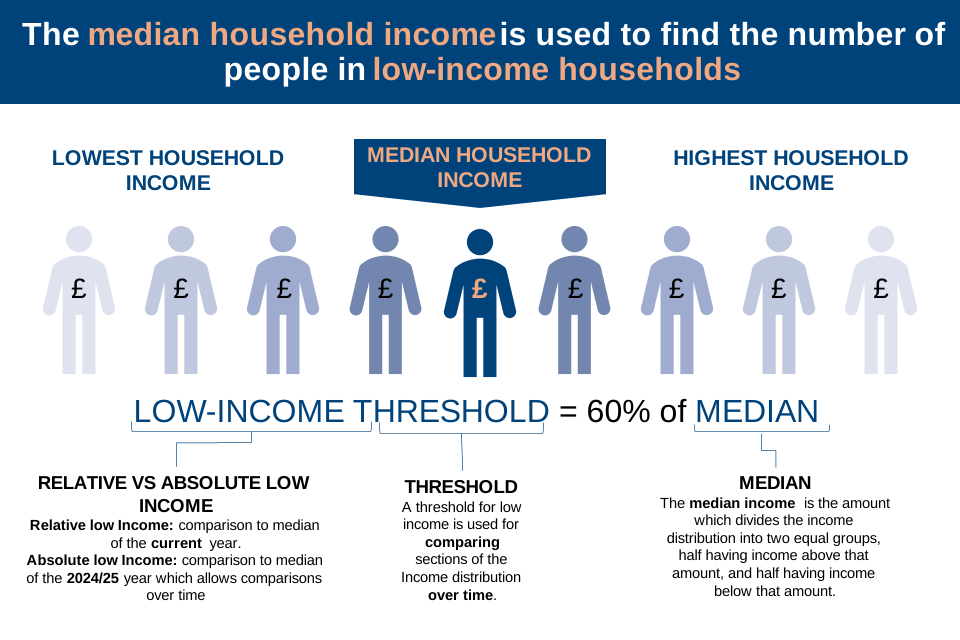
Relative vs Absolute low income: Relative low income is the comparison to the median of the current year; absolute low income is comparison to the median of a given year which allows comparisons over time.
Threshold: A threshold for low income is used for comparing sections of the income distribution over time.
Why not the mean average? Mean is the sum of all incomes divided by the number of people whose incomes were included. The median income is the amount which divides the income distribution into two equal groups, half having income above that amount and half having income below that amount. In unequal distributions, the mean is likely to be influenced by high values, so it does not reflect the experience of most individuals. The median is not affected by a few very high values.
Before Housing Costs (BHC) measures allow an assessment of the relative standard of living of those individuals who were benefitting from a better quality of housing by paying more for better accommodation, and income growth over time incorporates improvements in living standards where higher costs reflected improvements in the quality of housing.
After Housing Costs (AHC) measures allow an assessment of living standards of individuals whose housing costs are high relative to the quality of their accommodation. Income growth over time may also overstate improvements in living standards for low-income groups, as a rise in Housing Benefit to offset higher rents (for a given quality of accommodation) would be counted as an income rise.
Therefore, HBAI provides analyses of disposable income on both a BHC and AHC basis. This is principally to consider variations in housing costs that themselves do not correspond to comparable variations in the quality of housing.
6. Source Data
The statistics in the HBAI report come from the Family Resources Survey (FRS). In FYE 2025, the FRS covered an achieved sample of 16,299 households in the United Kingdom. This was a slightly smaller achieved sample than in FYE 2024 (16,758), with the issued sample being 59,044 (the same as in FYE 2024).
The focus of the FRS is on capturing information on incomes and, as such, is the foremost source of income data and provides more detail on different income sources than other household surveys. It also captures a lot of contextual information on the household and individual circumstances, such as employment, education level and disability. This is therefore a very comprehensive data source allowing for a lot of different analysis.
Surveys gather information from a sample rather than from the whole population. The sample is designed carefully to allow for this, and to be as accurate as possible given practical limitations such as time and cost constraints. Results from sample surveys are always estimates, not precise figures. This means that they are subject to a margin of error which can affect how changes in the numbers should be interpreted, especially in the short-term. The latest estimates should be considered alongside medium and long-term patterns.
In addition to sampling errors, consideration should also be given to non-sampling errors. Non-sampling errors arise from the introduction of some systematic errors in the sample as compared to the population it is supposed to represent. As well as response bias, such errors include inappropriate definition of the population, misleading questions, data input errors or data handling problems – in fact any factor that might lead to the survey results systematically misrepresenting the population. There is no simple control or measurement for such non-sampling errors, although the risk can be minimised through careful application of the appropriate survey techniques from the questionnaire and sample design stages through to analysis of results.
HBAI is based on data from a household survey and so subject to the nuances of using a survey, including:
- Sampling error. Results from surveys are estimates and not precise figures. Confidence intervals help to interpret the certainty of these estimates, by showing the range of values around the estimate that the true result is likely to be within. In general terms the smaller the sample size, the larger the uncertainty. Statistical significance is an attempt to indicate whether a reported change within the population of interest is due to chance. It is important to bear in mind that confidence intervals are only a guide for the size of sampling error.
- Non-response error. Prior to the coronavirus (COVID-19) pandemic, the FRS response rate each year was around 50 per cent. Following the change in mode because of the pandemic, in FYE 2021 the response rate fell to 23%. After this it improved slightly again but has not returned to pre-pandemic levels. FRS response rates, defined as a percentage of the issued sample who were eligible to take part in the years following 28% (FYE 2023), 32% (FYE 2024), and 31% (FYE 2025). For more information on response rates, see the FRS Background, Information and Methodology report and table M_2.
- Survey coverage. The FRS covers private households in the United Kingdom. Therefore, individuals in nursing or retirement homes, for example, will not be included. This means that figures relating to the most elderly individuals may not be representative of the United Kingdom population, as many of those at this age will have moved into homes where they can receive more frequent help.
- Survey design. The FRS uses a clustered sample designed to produce robust estimates at former government office region (GOR) level. The FRS is therefore not suitable for analysis below this level.
- Sample size. Although the FRS has a relatively large sample size for a household survey, small sample sizes for some more detailed analyses may require several years of data to be combined to generate reliable estimates. From April 2011, the target achieved GB sample size for the FRS was reduced by 5,000 households, resulting in an overall target sample size for the UK of around 20,000 households from FYE 2012 onwards. See later in this section for the actual achieved sample size. We previously published an assessment concluding that this still allows core outputs from the FRS to be produced, though with slightly wider confidence intervals or ranges.
- Measurement error. The FRS is known to under-report certain income streams, especially benefit receipt. Due to the expansion in use of administrative data on state benefits and tax credits in FYE 2025 (and applied to some back-series years), the level of under-reporting of benefits has reduced, but not eliminated. More detail can be found in Table M.6a and M.6b.
Response rates have continued to be challenging. An important challenge comes from recruitment and retention of interviewers, alongside increasing rates of respondent refusal and respondent apathy. At 16,299 households, the achieved sample in FYE 2025 is slightly smaller than that achieved in FYE 2024 (16,758). For FYE 2025, the issued sample was 59,044 (the same as in FYE 2024).
Further methodological details relating to the FRS are given in the FRS Background Information and Methodology report.
7. Grossing
The published HBAI analysis presents tabulations where the percentages refer to sample estimates grossed up to apply to the whole population. The system used to calculate grossing factors for HBAI mirrors that of FRS grossing with two differences.
Grossing up is the term usually given to the process of applying factors to sample data so that they yield estimates for the overall population. The simplest grossing system would be a single factor, e.g. the number of households in the population divided by the number in the achieved sample. However, surveys are normally grossed by a more complex set of grossing factors that attempt to correct for differential non-response at the same time as they scale up sample estimates.
The population estimates for different groups, chosen with the aims of DWP analysis in mind, are obtained from official data sources to provide control totals. The grossing factors are then calculated so that FRS/HBAI produces population estimates that are as close as possible to the control totals. As an example, a grossed FRS/HBAI count of the number of men aged 35 to 39 would be consistent with the ONS population estimate of the same group who live in private households.
In developing the grossing regime, careful consideration has been given to the combination of control totals, and the way age ranges, Council Tax bands and so on, are grouped together. The aim has been to strike a balance so that the grossing system will provide, where possible, accurate estimates in different dimensions without significantly increasing variances.
Some adjustments are made to the original control total sources, so that definitions match those in FRS/HBAI. For example, an adjustment is made to the demographic data to exclude people whose residence is not a private household. It is also the case that some control totals must be adjusted to correspond to the FRS/HBAI survey year which runs from April to March.
A software package called CALMAR, developed several years ago by the French National Statistics Institute, is used to reconcile control variables at different levels and estimate their joint population. This software makes the final weighted sample distributions match the population distributions through a process known as calibration weighting. It should be noted that if a few cases are associated with very small or very large grossing factors, grossed estimates will have relatively wide confidence intervals.
As noted above, the system used to calculate grossing factors for HBAI mirrors that of FRS grossing with two differences. The first difference with FRS grossing is that the sample of households is smaller for HBAI purposes because households with spouses living away from home are excluded (see Population section 3.3 above). The second difference is that separate control totals are introduced for ‘very rich’ households, so that the top end of the income distribution is more accurately reflected, which is particularly important for estimates of mean income or inequality as measured by the Gini coefficient.
As with the FRS, the grossing regime for HBAI currently uses population and household estimates based on the results of the 2011 Census. As the full set of inputs based on the 2021 Census (2022 for Scotland), which are required for grossing, were not available in time, the FYE 2025 publication is not based on the latest Census. Estimates for the FYE 2025 survey year instead have their basis in the 2011 Census, as rolled forward to the 2024 population by ONS’ mid-year estimates. All FRS based outputs will use these population estimates for FYE 2025. Full details of our plans to use 2021 Census outputs for the production of FRS grossing factors can be found in the FRS Release Strategy.
The mid-year estimates cover the usual resident population and were adjusted to reflect the population living in private households and covered by the FRS sample. This was achieved by deflating the usually resident population using data from the 2011 Census on the proportion of the usually resident (by local authority, age and sex) population, who live in private households.
Prior to FYE 2013, 2001 census-based estimates were used. In addition, a review of FRS grossing was carried out on behalf of DWP by the ONS Methodological Advisory Service. In implementing the review recommendations, several relatively minor methodological improvements were implemented from FYE 2013.
The main changes implemented were as follows:
- improvements to the categorisation of tenure control totals
- a full breakdown of the total number of households into each of the English regions (in addition to breakdowns for Scotland, Wales and Northern Ireland)
- a new adjustment to account for the different rates of sampling in England and Wales, Scotland, and Northern Ireland
A back-series of grossing factors calculated using the new methodology was created for each year back to FYE 2003 and are used in the HBAI publication tables from FYE 2013 onwards. Further details and analysis of the impact of these methodological changes are published in the grossing methodology review.
In developing the grossing regime, careful consideration has been given to the combination of control totals and the way age ranges, Council Tax bands and so on, have been grouped together. The aim has been to strike a balance so that the grossing system will provide, where possible, accurate estimates in different dimensions without significantly increasing variances.
Both Great Britain and Northern Ireland data use the same CALMAR software to reconcile control variables at different levels and estimate their joint population. There are some differences between the methods used to gross the Northern Ireland sample as compared with the Great Britain sample:
- local taxes in Northern Ireland are collected through the rates system, so Council Tax Band as a control variable is not applicable
- Northern Ireland housing data are based largely on small sample surveys. It is not desirable to introduce the variance of one survey into another by using it to compute control totals; therefore, tenure type has not been used as a control variable
Details of the grossing regime for Northern Ireland are shown in Table 3.
7.1 FYE 2025 Grossing Regime
As the full set of inputs based on the 2021 Census (2022 for Scotland), which are required for grossing, were not available in time, the FYE 2025 publication is not based on the latest Census. Estimates for FYE 2025 instead have their basis in the 2011 Census, as rolled forward to 2024 population by ONS’ mid-year estimates. All FRS based outputs use these population estimates for FYE 2025. These are bespoke estimates provided to DWP by ONS. Full details of our plans to use 2021 Census outputs for the production of FRS grossing factors can be found in the FRS Release Strategy.
As a result of administrative data replacing survey data for the back-series years from the FYE 2025 publication, there have been some changes to grossing factors for the back-series years impacted (FYE 2022 to FYE 2024 in March 2026 and FYE 2019 to FYE 2021 in summer 2026). See section 2.5 for further information.
The mid-year estimates cover the usual resident population and were adjusted to reflect the population living in private households and covered by the FRS sample. This was achieved by deflating the usual resident population using data from the 2011 Census on the proportion of people usually resident, by local authority, age and sex who live in private households.
Table 2: HBAI grossing regime for Great Britain, FYE 2025
| Control totals for Great Britain | Groupings | Original Source |
|---|---|---|
| Individuals (age, sex and region) | Male children: 0-9, 10-19 Male adults: 16-24, 25-29, 30-34, 35-39, 40-44, 45-49, 50-59, 60-64, 65-74, 75-79, 80+ Female children: 0-9, 10-19 Female adults: 16-24, 25-29, 30-34, 35-39, 40-44, 45-49, 50-59, 60-69, 70-74, 75-79, 80+ Each grouping is further broken down by region: North East, North West, Yorkshire and the Humber, East Midlands, West Midlands, East, London, South East, South West, Scotland and Wales |
Office for National Statistics (ONS) |
| Benefit Units with children | Region: England and Wales (combined), Scotland | DWP estimates using ONS population and HM Revenue and Customs Child Benefit data |
| Benefit Units with children | Lone Parents: Males, Females | DWP estimates derived from the Labour Force Survey |
| Households by tenure type | Tenure: Local Authority or Housing Association renters, private renters, owner occupiers | Ministry of Housing, Communities and Local Government (MHCLG), Welsh Government, Scottish Government |
| Households by Council Tax Band | Not Valued Separately (NVS) and Council Tax Band A, B, C-D, E-H and I in Wales only. | Valuation Office Agency, Scottish Government |
| Households by region | Region: North East, North West, Yorkshire and the Humber, East Midlands, West Midlands, East of England, London, South East, South West, Wales, Scotland. | Office for National Statistics (England) / Welsh Government (Wales) / Scottish Government (Scotland) |
| Households containing ‘Very Rich’ people | Pensioners, Non-pensioners | HMRC Survey of Personal Incomes (SPI) |
Table 2 lists the control variables used to generate grossing factors for private households in Great Britain.
Table 3: HBAI grossing regime for Northern Ireland, FYE 2025.
| Control variables for Northern Ireland | Groupings | Original Source |
|---|---|---|
| Individuals (age and sex) | Male children:0-19 Male adults: 16-24, 25-29, 30-34, 35-39, 40-44, 45-49, 50-59, 60-64, 65-74, 75-79, 80+ Female children:0-19 Female adults: 16-24, 25-29, 30-34, 35-39, 40-44, 45-49, 50-59, 60-69, 70-74, 75-79, 80+ |
Office for National Statistics (ONS) |
| Lone Parents | Lone parents in Northern Ireland | Department for Communities Northern Ireland (DfCNI) |
| Households | - | Northern Ireland Statistics and Research Agency (NISRA) |
| Households containing ‘Very Rich’ people | Pensioners, Non-pensioners | HMRC Survey of Personal Incomes (SPI) |
Table 3 lists the control variables used to generate grossing factors for private households in Northern Ireland.
7.2 Changes to the grossing regimes in FYE 2021 and FYE 2022
Due to the impact of the coronavirus (COVID-19) pandemic, there was a need to add in extra grossing controls during FYE 2021 and FYE 2022. Further information is available in the Households below average income series: quality and methodology information report FYE 2023.
Following the resumption of face-to-face interviewing in the FRS in FYE 2023 and FYE 2024, the methodology for these years reverted to the grossing system in place before the pandemic (detailed in tables 2 and 3).
7.3 Adjustment for individuals with very high incomes
An adjustment is made to sample cases at the top of the income distribution to correct for volatility in the highest incomes captured in the survey. This adjustment uses data kindly supplied by HM Revenue and Customs’ statisticians from HM Revenue and Customs’ Survey of Personal Incomes (SPI) to control the numbers and income levels of the ‘very rich’ while retaining the FRS data on the characteristics of their households. The methodology defines a household as ‘very rich’ if it contains a ‘very rich’ individual and it adjusts pensioners and non-pensioners separately. Thresholds have been set at the level above which, for each group, the FRS data is volatile due to small numbers of cases.
From the FYE 2010 publication, the SPI adjustment methodology was changed to be based on adjusting a fixed fraction of the population rather than on adjusting the incomes of all those individuals with incomes above a fixed cash terms level. This is intended to prevent an increasing fraction of the dataset being adjusted. The adjustment fraction was set at the same level as the fraction adjusted in FYE 2009. There was also a movement to basing all SPI adjustment decisions on gross rather than a mixture of gross and net incomes. These changes only have a very small effect on the results as presented.
From the FYE 2021 HBAI publication (which used SPI data from the 2018 to 2019 tax year), there was a methodological change to the underlying HMRC data which feeds into the HBAI SPI adjustment. This change related to the Self-Assessment grossing factors and mainly affected data for high-income individuals (those with income over £100,000 are required to submit a Self-Assessment tax return), which is the group that we use to make the SPI adjustment within HBAI. More details on this methodological change can be found in section 3.5 (Data validation) of the Quality report: Personal Income Statistics release.
We are unable to quantify the exact impact of this structural break on the HBAI statistics. However, users should bear this change in mind if they are comparing trends over time before and after HBAI FYE 2021, and if they are specifically focussing on HBAI statistics which are impacted by the SPI adjustment (for example, households and income sources in the top deciles, mean incomes and the GINI coefficient).
The numbers of ‘very rich’ pensioners and non-pensioners in survey estimates are matched to SPI estimates by the introduction of two extra control totals into the grossing regime. One is for the total number of pensioners above the pensioner threshold and the other for the number of non-pensioners above the non-pensioner threshold. The grossing factors for individual cases are only marginally changed because of this adjustment. In addition, each ‘very rich’ individual in the FRS is assigned an income level derived from the SPI, as the latter gives a more accurate indication of the level of high incomes than the FRS. Again, this adjustment is carried out separately for pensioners and non-pensioners.
The latest SPI data available when we carried out our analysis was for FYE 2023, which was projected forward to cover the FYE 2025. For FYE 2025, pensioners in Great Britain are subject to the SPI adjustment if their gross income exceeded £108,000 per year (£87,700 in Northern Ireland). Working-age adults (including the working-age partners of pensioners) are subject to the SPI adjustment if their gross income exceeded £372,900 per year (£193,400 per year in Northern Ireland).
8. Equivalisation
HBAI uses net disposable weekly household income, after adjusting for the household size and composition, as an assessment for material living standards - the level of consumption of goods and services that people could attain given the net income of the household in which they live. To allow comparisons of the living standards of different types of households, income is adjusted to consider variations in the size and composition of the households in a process known as equivalisation. HBAI assumes that all individuals in the household benefit equally from the combined income of the household. Thus, all members of any one household will appear at the same point in the income distribution.
The unit of analysis is the individual, so the populations and percentages in the tables are numbers and percentages of individuals – both adults and children.
Equivalence scales conventionally take an adult couple without children as the reference point, with an equivalence value of one. The process then increases relatively the income of single person households (since their incomes are divided by a value of less than one) and reduces relatively the incomes of households with three or more persons, which have an equivalence value of greater than one. The infographic below illustrates the process of equivalisation, Before Housing Costs.
Figure 2
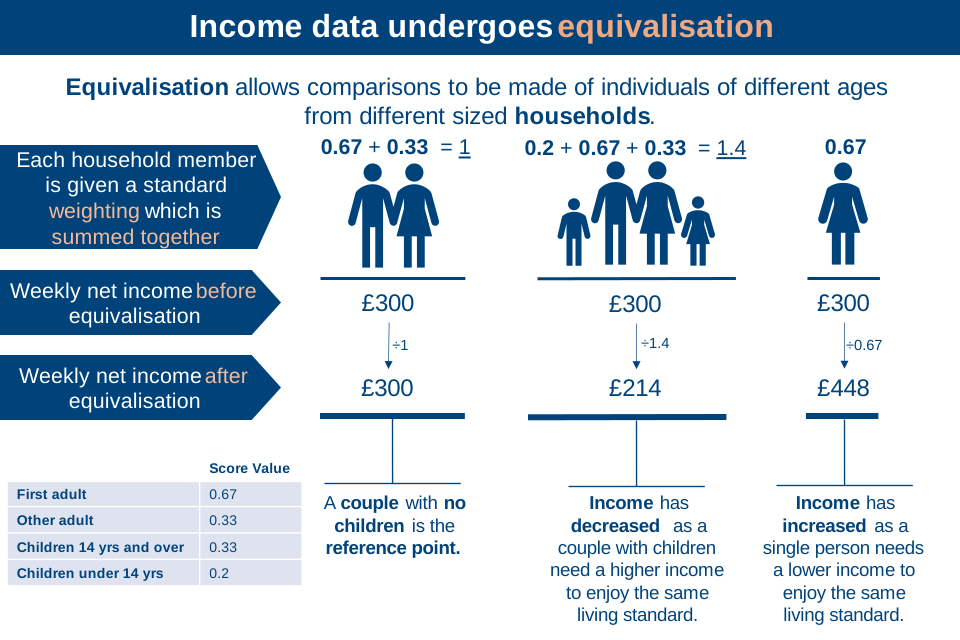
Figure 2 shows the process of how income undergoes the process of equivalisation for three different example household types – all of which have a weekly net income before equivalisation of £300, but after equivalisation have different weekly net incomes:
Example 1: Couple without children – have individual equivalisation weights of 0.67 (first adult) and 0.33 (second adult) which sum to 1. For this household their weekly net income before equivalisation is £300 and their weekly net income after equivalisation is £300 divided by 1, so also £300. A couple with no children is the reference point.
Example 2: Couple with 2 children under 14 years have equivalisation weights of 0.67 (first adult), 0.33 (second adult), 0.2 (first child under 14 years) and 0.2 (second child under 14 years) – these sum to 1.4. For this household their weekly net income before equivalisation is £300, and their net weekly income after equivalisation is £300 divided by 1.4, so £214. Compared to the reference point, income has decreased as a couple with children need a higher income to enjoy the same living standard.
Example 3: Single adult household has equivalisation weight of 0.67. For this household their weekly net income before equivalisation is £300 and their weekly net income after equivalisation is £300 divided by 0.67, so £448. Compared to the reference point, income has increased as a single person needs a lower income to enjoy the same living standard.
The main equivalence scales now used in HBAI are the modified OECD scales, which take the values shown in Table 4 The equivalent values used by the McClements equivalence scales are also shown for comparison alongside modified OECD values. The McClements scales were used by HBAI to adjust income up to the FYE 2005 HBAI publication.
In the modified OECD and McClements versions, two separate scales are used, one for income BHC and one for income AHC. The construction of household equivalence values from these scales is quite straightforward. For example, the BHC equivalence value for a household containing a couple with a fourteen-year-old and a ten-year-old child together with one other adult would be 1.86 from the sum of the scale values:
0.67 + 0.33 + 0.33 + 0.33 + 0.20 = 1.86
This is made up of 0.67 for the first adult, 0.33 for their spouse, the other adult and the fourteen-year-old child and 0.20 for the ten-year-old child. The total income for the household would then be divided by 1.86 to arrive at the measure of equivalised household income used in HBAI analysis.
Table 4 Comparison of modified OECD and McClements equivalence scales
| OECD rescaled to couple without children=1 | OECD ‘Companion’ Scale to equivalise AHC results | McClements BHC | McClements AHC | |
|---|---|---|---|---|
| First Adult | 0.67 | 0.58 | 0.61 | 0.55 |
| Spouse | 0.33 | 0.42 | 0.39 | 0.45 |
| Other Second Adult | 0.33 | 0.42 | 0.46 | 0.45 |
| Third Adult | 0.33 | 0.42 | 0.42 | 0.45 |
| Subsequent Adults | 0.33 | 0.42 | 0.36 | 0.40 |
| Children aged under 14yrs | 0.20 | 0.20 | 0.20 | 0.20 |
| Children aged 14 and over | 0.33 | 0.42 | 0.32 | 0.34 |
Users should note the following points about Table 4:
- Figures are presented here to two decimal places
- For the McClements scale, the weight for ‘Other second adult’ is used in place of the weight for ‘Spouse’ when two adults living in a household are sharing accommodation but are not living as a couple. ‘Third adult’ and ‘Subsequent adult’ weights are used for the remaining adults in the household as appropriate. In contrast to the McClements scales, apart from the first adult, the OECD scales do not differentiate for subsequent adults
- The McClements scale varies within the age bands for children; appropriate averages are shown in the table
9. Quality Management
HBAI statistics are produced under the Code of Practice for Statistics. Adhering to the Code gives users confidence that published government statistics have clear public value, are high quality, and can be trusted.
Trustworthiness relates to users having confidence in those who produce the statistics. Quality relates to using both appropriate data and methods to produce statistics that can be relied upon and meet user needs. Value means that statistics benefit users by informing decision making, action and debate.
The United Nations’ Canberra Group Handbook on Household Income Statistics states that income statistics are “inevitably some of the most complex statistics produced by national and international organisations”. This is reflected in the extensive production and validation procedures described in the FRS Quality Assessment Report.
The FRS Quality Assessment Report provides details on the following areas:
- sample design
- questionnaire design
- fieldwork management
- external assessors and the Expert Advisory Group
This was introduced in the FYE 2024 survey year and has been updated this year to reflect the use of administrative data in place of survey responses.
Additionally, as the FRS Quality Assessment Report outlines, for HBAI specifically, DWP contracts the Institute for Fiscal Studies (IFS) to undertake annual, independent validation of the HBAI dataset prior to each publication. IFS independently check and verify income data, grossing factors, summary publication statistics and confidence intervals. This parallel checking of the HBAI dataset by an independent third party recognises the complexity and high-profile nature of HBAI statistics and ensures they are of the highest quality.
10. Accuracy and Reliability
10.1 Sampling Error
Results in this report are subject to a margin of error which can affect how changes should be interpreted, especially between groups and in the short term.
Results from surveys are estimates and not precise figures. In general terms, the greater the sample size, the smaller the uncertainty of the estimates.
Two different random samples from one population, for example the UK, are unlikely to give the same survey results, which are likely to differ again from the results that would be obtained if the whole population was surveyed. The level of uncertainty around a survey estimate can be calculated and is commonly referred to as “sampling error”.
For further information on both sampling and non-sampling error in the FRS please refer to the FRS Quality Assessment Report.
10.2 Reporting Uncertainty
As discussed above, survey results are always estimates, not precise figures and so subject to a level of uncertainty.
We can calculate the level of uncertainty around a survey estimate by exploring how that estimate would change if we were to draw many survey samples for the same period instead of just one. This allows us to define a range around the estimate (known as a “confidence interval”) and to state how likely it is that the real value that the survey is trying to measure lies within that range. Confidence intervals are typically set up so that we can be 95% sure that the true value lies within the range – in which case this range is referred to as a “95% confidence interval”.
Annex 2 of this report provides further details on the Bootstrapping methodology used to estimate confidence intervals in HBAI, alongside estimates of the sampling error.
11. Coherence and Comparability
The GSS Harmonised Standards and Guidance are tools for improving the comparability and coherence of statistics.
Harmonised standards include definitions, survey questions, suggested presentations and information for data users. Both FRS and HBAI uses these harmonised standards to be aligned with others, which in turn increases the usefulness of the statistics produced.
The Harmonised Standards and Guidance have been developed by topic groups, after wide consultation across the GSS and beyond. Further information on the Harmonised Standards and Guidance is available via the GSS pages.
Coherence reflects the degree of similarity between related statistics and the fuller insight achieved by drawing them together. Comparability reflects the degree reflects the degree to which statistics can be compared over time, geographies and between different sources. The FRS Background, Information and Methodology report outlines the coherence and comparability of FRS data with other data sources. Users should use this alongside section 3.2 of this report when comparing HBAI and FRS data against other sources.
11.1 Data Revision
DWP complies with the Code of Practice for Statistics. A policy on revisions of DWP Official Statistics has been published in accordance with the Code of Practice for Statistics.
Planned
Changes planned for the next or subsequent release are announced and described in the Release Strategy. Users are able to contact with us regarding the likely impact of these changes. Please see the DWP Statistical Work Programme for more details.
Unplanned
Any unplanned changes are notified to users via our Collections page updates, when the date of the publication is announced on GOV.UK. For example, several updates were notified to users on 29 January 2026 for the FYE 2025 publication.
If any further changes occur within the four-week window prior to publication these are detailed within an update to the Collections Page on the day of publication and further detail provided in this Background, Information and Methodology report.
12. Comparison with EU low-income statistics
The UK’s cross-Europe-comparable low-income statistics have previously been derived from the ONS Survey of Living Conditions (SILC), a different survey source than the HBAI, meaning that there will be some differences due to the different data source. In addition to this, the figures will differ for several further reasons:
- Time period: The figures are presented on different timescales. The HBAI figures are presented for the financial year, while the EU comparable figures are presented for the calendar year.
- Population groups: The European low-income statistics are presented in different age groups than the HBAI figures:
- Children: the EU figures relate to those under 18 – HBAI figures are based on individuals aged under 16, in addition a person will also be defined as a child if they are 16 to 19 years old and they are not married nor in a Civil Partnership nor living with a partner; are living with parents; and are in full-time non-advanced education or in unwaged government training;
- Pensioners: EU figures relate to the 65+ population. The data in this report were collected throughout FYE 2024, during which the State Pension age for both men and women was 66 years.
- Preferred measures: The European low-income estimates are usually presented on a Before Housing Costs basis, while this is consistent with the most commonly used measure for working-age adults and children, we choose to look at pensioners’ incomes after deducting housing costs as this better reflects pensioner living standards compared to others and over time.
- Income derivation: The definition of income in the European figures differs from the official UK figures:
- Pension contributions are not deducted from income in the European comparable methodology.
- The European definition of income includes the value of non-cash employee income from company cars as employee income, which will raise the average income of people in work.
- High income adjustment: For the HBAI figures an adjustment is made to sample cases at the top of the income distribution to correct for volatility in the highest incomes captured in the survey. This adjustment is not applied to the European figures.
- In-year deflation: The HBAI estimates make an in-year adjustment to individuals’ incomes to ensure that respondents income collected across the financial year are comparable. This adjustment is not applied to the European figures.
- Sample cases: The HBAI figures exclude cases containing a married adult whose spouse is temporarily absent whereas these are included in the European figures, however this has a minimal effect on the figures.
- Income tax and national insurance: The European income tax and national insurance figures are calculated using a model of taxation, whilst the HBAI estimates are mostly calculated on the amount of tax and national insurance reported as being paid.
After the UK’s exit from the EU in 2020, some EU-SILC outputs were still delivered by ONS to Eurostat during the transition period in 2020, but all planned deliveries from 2021 onwards ceased. Data for the UK up to and including the 2018 calendar year remain available on Eurostat’s EU-SILC database.
13. Glossary
This glossary provides a brief explanation for each of the important terms used in the HBAI. Further details on these definitions, including full derivations of variables, are available on request from the HBAI team at team.hbai@dwp.gov.uk
Adult
All those individuals who are aged 16 and over, unless defined as a dependent child (see Child); all adults in the household are interviewed as part of the Family Resources Survey (FRS).
Benefit units or Family
A single adult or a married or cohabiting couple and any dependent children, since January 2006 same-sex partners (civil partners and cohabitees) have been included in the same benefit unit. A dependent child is aged 16 or under, or is 16 to 19 years old, unmarried and in full-time non-advanced education. This is consistent with the DWP term “benefit unit”, which is a standard grouping used for assessing benefit entitlement. Where a total value for a benefit unit is presented, such as total benefit unit income, this includes both income from adults and income from children.
Bills in arrears
The number of bills in arrears is presented at a benefit unit level. Bills considered are electricity, gas, other fuel, Council Tax, insurance, telephone, television/video rental, hire purchase, water rates, rent, mortgage payments and other loans. From FYE 2013 onwards, the analysis of income by whether people are behind with household bills has been extended to include rent, mortgage payments and other loans, so the figures are not comparable with those presented in previous reports.
Child
A dependent child is defined as an individual aged under 16. A person will also be defined as a child if they are 16 to 19-years old and they are:
- not married nor in a civil partnership nor living with a partner; and
- living with parents/a responsible adult; and
- in full-time non-advanced education or in unwaged government training
Combined low income and child material deprivation
Before FYE 2024, using a prevalence-weighted score approach a child was in combined low income and child material deprivation if they live in a family that has an equivalised household income below the 50/60/70% of relative/absolute median income and a prevalence-weighted score of 25 or more.
From FYE 2024, an updated suite of questions and methodology was introduced and using a simple count approach a child is in combined low income and material deprivation if they live in a family with an equivalised household income below 50/60/70% of relative/absolute median income and lack 4 or more items.
Combined low income and working-age adult material deprivation
Before FYE 2024, using a prevalence-weighted score approach a working-age adult was in combined low income and working-age adult material deprivation if they had an equivalised household income below the 50/60/70% of relative/absolute median income and a prevalence weighted score of 25 or more.
From FYE 2024, an updated suite of questions and methodology was introduced and using a simple count approach a working-age adult is in combined low income and material deprivation if they have an equivalised household income below 50/60/70% of relative/absolute median income and lack 5 or more items.
Confidence interval
A measure of sampling error. A confidence interval is a range around an estimate which states how likely it is that the real value that the survey is trying to measure lies within that range. A wider confidence interval indicates a greater uncertainty around the estimate. Generally, a smaller sample size will lead to estimates that have a wider confidence interval than estimates from larger sample sizes. This is because a smaller sample is less likely than a larger sample to reflect the characteristics of the total population and therefore there will be more uncertainty around the estimate derived from the sample. Note that a confidence interval ignores any systematic errors which may be present in the survey and analysis processes.
Contemporary median income
The average income for the period covered by the survey. Household incomes are adjusted from the date of interview to an average of survey-year prices. From the FYE 2025 publication contemporary income terminology in the publication tables has been replaced by relative income to be consistent with the terminology used in the main release.
Deciles and Quintiles
These are income values which divide the whole population, when ranked by household income, into equal-sized groups. This helps to compare different groups of the population.
Decile and quintile are often used as a standard shorthand term for decile/quintile group.
Deciles groups are ten equal-sized groups - the lowest decile describes individuals with incomes in the bottom 10% of the income distribution.
Quintiles groups are five equal-sized groups - the lowest quintile describes individuals with incomes in the bottom 20% of the income distribution.
Deep Material Poverty
Deep material poverty is based on material deprivation, specifically whether families can afford certain essential items. This new deep material poverty measure is defined as lacking at least 4 out of 13 essential material deprivation items. See section 4.3 for the list of essential items.
Disability
From FYE 2013 onwards, the definition of disability used is consistent with the core definition of disability under the Equality Act 2010. A person is considered to have a disability if they “have a physical or mental impairment that has a ‘substantial’ and ‘long-term’ negative effect on their ability to do normal daily activities”. Whereby ‘substantial’ is meant by more than minor or trivial, and long-term is meant by 12 months or more. However, some individuals classified as disabled and having rights under the Equality Act 2010 are not captured by this definition:
- people with a long-standing illness or disability who would experience substantial difficulties without medication or treatment
- people who have been diagnosed with cancer, HIV infection or multiple sclerosis and who are not currently experiencing difficulties with their day-to-day activities
- people with progressive conditions, where the effect of the impairment does not yet impede their lives
People who were disabled in the past and are no longer limited in their daily lives are still covered by the Act.
Economic status groups for children
Estimates for dependent children use an amended economic status classification closely related to the definitions used above. Children are grouped according to family type and the economic status of their parent(s) as defined in the previous section. As with the main economic status groups, individuals are allocated to the first category that applies in the following order:
- lone parent - in full-time work (includes full-time self-employed)
- lone parent - in part-time work
- lone parent - not working (unemployed or inactive)
- couple with children - one or more full-time self-employed
- couple with children - both in full-time work
- couple with children - one in full-time work, one in part-time work
- couple with children - one in full-time work, one not working
- couple with children - neither in full-time work, one or more in part-time work; and
- couple with children - both workless (unemployed or inactive)
Economic status of household
For the analysis of working and workless households, households are classified according to whether they contain a working-age adult or pensioner who works, but the status of non-working pensioners is not considered, except in the case of those households where children live only with pensioners, in which case the status of all adults is included.
Individuals are assigned to one of three categories:
-
All adults in work - A household where all working-age adults are in employment or are self-employed, or if there are no working-age adults in the household, at least one working pensioner.
-
At least one, but not all adults in work - A household where at least one working-age adult is in employment or is self-employed, or where a pensioner is in work if none of the working-age adults in the household are in work.
-
Workless household - A household where no adult members are in employment or are self-employed. Within households, pensioners are excluded from the classifications if they are not working and are included if they are working. So, for example, a household with a pensioner in work, but a working-age person not in work, would be in the ‘At least one adult in work, but not all’ category. A household with all working-age adults in work and a pensioner not in work would be categorised as ‘All adults in work’.
Economic status of household
For the analysis of working and workless households, households are classified according to whether they contain a working-age adult or pensioner who works, but the status of non-working pensioners is not considered, except in the case of those households where children live only with pensioners, in which case the status of all adults is included.
Individuals are assigned to one of three categories:
-
All adults in work - A household where all working-age adults are in employment or are self-employed, or if there are no working-age adults in the household, at least one working pensioner.
-
At least one, but not all adults in work - A household where at least one working-age adult is in employment or is self-employed, or where a pensioner is in work if none of the working-age adults in the household are in work.
-
Workless household - A household where no adult members are in employment or are self-employed. Within households, pensioners are excluded from the classifications if they are not working and are included if they are working. So, for example, a household with a pensioner in work, but a working-age person not in work, would be in the ‘At least one adult in work, but not all’ category. A household with all working-age adults in work and a pensioner not in work would be categorised as ‘All adults in work’.
Economic status of the family
The economic status of the family classification is in line with the International Labour Organisation economic status classification. This means that no economic status data is available for FYE 1995 and FYE 1996 as the relevant information was not collected in the Family Resources Survey for these years. This also means the economic status of the family and economic status of the household classifications are aligned.
The ‘Workless, other inactive’ group consists of families in which all adults are economically inactive (i.e. where no adult is in work or unemployed). This includes working-age adults in receipt of sickness and disability benefits, who may have living standards lower than those implied by the results presented because of additional costs associated with their disability (for which no adjustment has been made here).
Families are allocated to the first applicable category:
-
One or more full-time self-employed - Benefit units where at least one adult usually works as self-employed in their main job where the respondent regards themselves as working full-time. Those respondents not working in the last seven days but doing unpaid work in their own business are considered as full-time self-employed.
-
Single or couple, all in full-time work - Benefit units where all adults regard themselves as working full-time. Those respondents not working in the last seven days doing unpaid work in a business that a relative owns are considered as in full-time work, as are those in training.
-
Couple, one in full-time work, one in part-time work - Benefit units headed by a couple where one partner considers themselves to be working full-time, and the other partner considers themselves to be working part-time. Those respondents not working in the last seven days but doing an odd job are considered as working part-time.
-
Couple, one in full-time work, one not working - Benefit units headed by a couple, where one partner considers themselves to be working full-time, and the other partner does not work.
- No-one in full-time work, one or more in part-time work - Benefit units where at least one adult works but considers themselves to be working part-time.
-
Workless, one or more aged 60 or over - Benefit units where at least one adult is aged 60 or over and no adult is working.
-
Workless, one or more unemployed - Benefit units where at least one adult is unemployed.
- Workless, other inactive - Benefit units not classified above (this group includes the long-term sick, disabled people and non-working single parents).
Educational attainment
This looks at the highest level of educational attainment for each working-age adult. Information for students should be treated with some caution because they are often dependent on irregular flows of income. Only student loans are counted as income in HBAI, any other loans taken out are not. The figures are also not necessarily representative of all students because HBAI only covers private households, and this excludes halls of residence.
Comparisons between the numbers with no qualifications in the FRS, LFS and the Census indicate that the FRS figures have historically overstated the numbers of working-age adults with no qualifications. As a result of the FRS mode change in FYE 2021 and FYE 2022, the raw FRS sample contained a much higher proportion of working-age adults than in the years prior to the COVID-19 pandemic, and much lower numbers with no qualifications. We therefore introduced additional grossing controls in FYE 2021 and FYE 2022 to weight the sample by level of educational attainment. This boosted numbers with education levels below degree level in younger age groups. We did this using historical proportions from the FRS and calibrated growth over the two years to growth in levels recorded in the Annual Population Survey (APS), derived from the LFS. This maintained the previous relationship between the two sources while ensuring that grossed FRS proportions were more in line with expectations. Following the reintroduction of FRS face-to-face interviewing for FYE 2023, this additional weighting was no longer required, and the grossing returned to the FYE 2020 position.
In HBAI FYE 2023, an issue with the FRS variable that informs the EDATTAIN HBAI variable (Educational Level of Adult) was identified and data in that release was withdrawn. From March 2026, this has now been corrected on FYE 2022 datasets onwards.
Equivalisation
Income measures used in HBAI take account of variations in the size and composition of the households in which people live. This process is called equivalisation.
Equivalisation reflects the fact that a family of several people need a higher income than a single individual to achieve a comparable standard of living.
Equivalence scales conventionally take a couple with no children as the reference point. Consider a single person, a couple with no children, and a couple with two children aged twelve and ten, all having unadjusted weekly household incomes of £300 (BHC). The process of equivalisation, as conducted in HBAI, gives an equivalised income of £448 to the single person, £300 to the couple with no children, but only £214 to the couple with children. See section 8 of this report for detail on equivalisation.
Ethnicity
Ethnicity in HBAI reflect the harmonised standards included from the FYE 2012 publication onwards. The harmonised standards for Scotland were adopted in the FYE 2013 FRS questionnaire; however, there has been no change to the HBAI outputs as the harmonised output standards were previously adopted.
Individuals have been classified according to the ethnic group of the household reference person (see Household reference person) which means that information about households of multiple ethnicities is lost.
Smaller ethnic minority groups exhibit year-on-year variation which limits comparisons over time. For this reason, analysis by ethnicity is usually presented as three-year averages.
Deep Material Poverty is an important new headline metric for the recently published Child Poverty Strategy and so as an exceptional case where sample sizes have allowed, we have presented ethnicity estimates based on a two-year average for FYE 2025. We will review this for FYE 2026 when a further year of data is available. Other low-income measures, like material deprivation, will remain as three-year averages in FYE 2025, to be consistent with our standard practice for region and ethnicity breakdowns in HBAI
Please note that:
- following the decision to not publish breakdowns of the FYE 2021 estimates, all three-year averages calculated and published for any period including FYE 2021 are based on two data points only; and
- three-year averages which include mixed data points, both pre the integration of administrative data and post, have not been published. These estimates are shown as [x]/estimate not available in relevant data tables. For the FYE 2025 March 2026 publication this applies to the average containing FYE 2019 (administrative data has not been integrated) and FYE 2022 (administrative data has been integrated). It will apply to different averages in the summer 2026 update when administrative data is integrated into FYE 2019, FYE 2020 and FYE 2021
Families/family unit
The terms ‘families’ and ‘family units’ are used interchangeably with benefit units. See Benefit unit definition.
Family type
For some analyses, individuals are classified into family type or economic status groups. Individuals are classified according to the status of the benefit unit in which they live. All individuals in a benefit unit (adults and children) will therefore be given the same classification. The classifications are defined below:
- pensioner couple - a couple where one or more of the adults are State Pension age or over. However, in the HBAI tables relating specifically to pensioners results for individuals who are in pensioner couples do not count anyone who is not a pensioner
- single male pensioner - single male adult of State Pension age or over
- single female pensioner - single female adult of State Pension age or over
- couple with children - a non-pensioner couple with dependent children
- single with children - a non-pensioner single adult with dependent children
- couple without children - a non-pensioner couple with no dependent children
- single male without children - a non-pensioner single adult male with no dependent children
- single female without children - a non-pensioner single adult female with no dependent children
Full-time work
The respondent regards themselves as working full-time, either as an employee or self-employed.
Gender
In any analysis of gender, it must be remembered that HBAI attempts to measure the living standards of an individual as determined by household income. This assumes that both partners in a couple benefit equally from the household’s income and will therefore appear at the same position in the income distribution. Any difference in figures can only be driven by gender differences for single adults, which will themselves be diluted by the figures for couples. The lower level gender disaggregation in the family type classification is therefore likely to be more informative.
Research has suggested that, particularly in low-income households, the above assumption regarding income sharing is not always valid as men sometimes benefit at the expense of women from shared household income. This means that it is possible that HBAI results broken down by gender could understate differences between the two groups. See, for instance, Goode, J., Callender, C. and Lister, R. (1998) Purse or Wallet? Gender Inequalities and the Distribution of Income in Families on Benefits. JRF/Policy Studies Institute.
Gini coefficient
A widely used, international standard summary measure of inequality. It can take values from zero to 100, where a value of zero would indicate total equality, with each household having an equal share of income, while higher values indicate greater inequality.
Head of benefit unit
The head of the first benefit unit will be the same as the household reference person. For second and subsequent benefit units, the head will be the first adult to be interviewed.
High Income
Results for the top 10% are particularly susceptible to sampling errors and income measurement problems.
Household
One person living alone or a group of people (not necessarily related) living at the same address who share cooking facilities and share a living room or sitting room or dining area. A household will consist of one or more benefit units. Where a total value for a household is presented, such as total household income, this includes both income from adults and income from children.
Household food bank usage
Household food bank usage in the FRS refers only to visits to a food bank when emergency food supplies (food parcels) were obtained. This excludes visits to the food bank made only for other support (e.g. financial advice or mental health support).
The FRS asks food bank usage questions relating to two time periods:
- usage within the 12 months prior to interview
- usage within the 30 days prior to interview
Only households that report using a food bank in the last 12 month are asked about 30-day usage.
Household food security
“Food security” as a concept is defined as “access by all people at all times to enough food for an active, healthy life”. Questions relate to the household’s experience in the 30 days immediately before the interview.
The questions are put to the person in each household who is best placed to answer about food shopping and preparation. These respondents are asked the first three questions, on whether they are concerned about:
- food running out before they had enough money to buy more
- the food they had bought not lasting, and not having money to buy more
- not being able to afford balanced meals
The possible answers are ‘often, ‘sometimes’ or ‘never’ true. If respondents say that all three statements are never true, they will not be asked further questions on food security. If respondents answer that any of these statements are sometimes or often true, they will be asked further questions on the extent of their food security. Taking the responses together, a household ‘score’ for food security is then derived. This is a measure of whether households have sufficient food to facilitate active and healthy lifestyles.
This measure has four classifications:
- High food security (score = 0): The household has no problem, or anxiety about, consistently accessing adequate food.
- Marginal food security (score = 1 or 2): The household had problems at times, or anxiety about, accessing adequate food, but the quality, variety, and quantity of their food intake were not substantially reduced.
- Low food security (score = 3 to 5): The household reduced the quality, variety, and desirability of their diets, but the quantity of food intake and normal eating patterns were not substantially disrupted.
- Very low food security (score = 6 to 10): At times during the last 30 days, eating patterns of one or more household members were disrupted and food intake reduced because the household lacked money and other resources for food.
High and marginal food security households are considered to be “food secure”. Food secure households are considered to have sufficient, varied food to facilitate an active and healthy lifestyle. Conversely, low and very low food security households are considered to be “food insecure”. Food insecure households are where there is risk of, or lack of access to, sufficient, varied food.
The broad structure and sequence of the questions is the same as those used internationally. They are used within the UK (Food Standards Agency) and are also used by other countries, including the United States Department of Agriculture, enabling broad international comparability of the results.
Household reference person (used from FYE 2002 onwards)
The household reference person (HRP) is usually the highest income householder. Note:
- In a single-adult household, the HRP is simply the sole householder (i.e. the person in whose name the accommodation is owned or rented).
- If there are two or more householders, the HRP is the householder with the highest personal income, taking all sources of income into account.
- If there are two or more householders who have the same income, the HRP is the elder.
The Head of benefit unit will not necessarily be the HRP.
Housing costs
Housing costs are made up of rent (gross of housing benefit); water rates, community water charges and council water charges; mortgage interest payments (net of tax relief); structural insurance premiums (for owner occupiers); and ground rent and service charges.
Income
The income measure used in HBAI is weekly net (disposable) equivalised household income. This comprises total income from all sources of all household members including dependants. For BHC, housing costs are not deducted from income, while for AHC they are.
Households receive income from a variety of sources. The main ones are earnings, self-employment, state support (i.e. benefits and tax credits), interest on investments and occupational pensions.
In detail, income includes:
- usual net earnings from employment
- profit or loss from self-employment (losses are treated as a negative income)
- income received from dividends (from FYE 2022)
- state support - all benefits and tax credits
- income from occupational and private pensions
- investment income
- maintenance payments
- income from educational grants and scholarships (including, for students, student loans and parental contributions); and
- the cash value of certain forms of income in kind (free school meals, free school breakfast, free school milk, free school fruit and vegetables, Healthy Start vouchers and free TV licence for people 75 and over who receive Pension Credit)
Income is net of the following items:
- income tax payments
- National Insurance contributions
- domestic rates / council tax
- contributions to occupational pension schemes (including all additional voluntary contributions (AVCs) to occupational pension schemes, and any contributions to stakeholder and personal pensions)
- all maintenance and child support payments, which are deducted from the income of the person making the payment
- parental contributions to students living away from home; and
- student loan repayments
Income distribution
The spread of incomes across the population.
Income growth in real terms
For some years, income growth in the HBAI-based series appears slightly lower than the National Accounts estimates. The implication of this is that absolute real income growth could be understated in the HBAI series. Comparisons over a longer time period are believed to be more robust.
Income inequality
The extent of disparity between high income and low-income households, commonly measured using either the Gini coefficient or 90:10 ratio. The Gini coefficient is a widely used, international standard summary measure of inequality. It can take values from zero to 100, where a value of zero would indicate total equality, with each household having an equal share of income, while higher values indicate greater inequality. The 90:10 ratio is the average (median) income of the top 20% (quintile 5), divided by the average income of the bottom 20% (quintile 1). The higher the number, the greater the gap between those with the highest incomes and those with the lowest incomes.
Low income
‘Low income’ is defined using thresholds derived from percentages of median income for the whole population. Households reporting the lowest incomes may not have the lowest living standards. Therefore, the bottom 10% of the income distribution should not be interpreted as having the lowest living standards. Results for the bottom 10% are also particularly vulnerable to sampling errors and income measurement problems.
- Individuals are said to be in relative low income if they live in a household with an equivalised income below a percentage of contemporary median income BHC or AHC. Relative low-income statistics fall if income growth at the lower end of the income distribution is greater than overall income growth.
- Individuals are said to be in absolute low income if they live in a household with an equivalised income below a threshold of median income (for example 60% of median income) in a specific year adjusted for inflation BHC or AHC. The FYE 2025 median is used in this report from FYE 2022 onwards (and in the summer 2026 update will be used from FYE 2019 onwards), in order to measure absolute low income as referenced in the Welfare Reform and Work Act 2016, and to keep the absolute measure more in line with current living standards. The FYE 2011 median is used for years prior to FYE 2022 in the March 2026 publication and for years prior to FYE 2019 in the summer 2026 update. Absolute low-income statistics fall if low-income households are seeing their incomes rise faster than inflation.
Material deprivation for children
A suite of questions designed to capture the material deprivation experienced by families with children has been included in the FRS since FYE 2005. The suite of questions for children was updated in FYE 2011 and FYE 2024. From FYE 2024 there were also methodological changes to material deprivation measures.
Respondents are asked whether they have 22 goods and services -11 child items and 11 household items. If they do not have them, for most items, follow-up questions ask the reason why and those reasons are then used to determine if an item is counted as lacked for the purposes of defining if a child is in material deprivation. For the majority of questions, an item is counted as lacked if it is lacked for a financial reason - do not have the money for this or is not a priority on their current income - and for a remaining small number of questions an item is counted if it is lacked if the response is ‘No’ to having the item.
A simple count approach is then used to add up the total number of items lacked and if that total is 4 or more then that child has met the threshold to be defined as in material deprivation.
These questions are used as an additional way of measuring living standards for children.
Material deprivation for pensioners
A suite of questions designed to capture the material deprivation experienced by pensioners has been included in the Family Resources Survey since May 2008. The suite of questions for pensioners was updated in FYE 2024 and there were also methodological changes made to material deprivation measures from this year.
These questions are used as an additional way of measuring living standards for pensioners. Respondents are asked whether they have access to 19 goods, services and experiences – 8 pensioner items and 11 household items. For the majority of questions, an item is counted as lacked if it is lacked for a financial reason - do not have the money for this or is not a priority on their current income - and for a remaining small number of questions an item is counted if the response is ‘No’ to having the item.
A simple count approach is then used to add up the total number of items lacked.
Before FYE 2024, using a prevalence-weighted score approach a pensioner was in material deprivation if they had a final material deprivation score of 20 or more.
From FYE 2024, an updated suite of questions and methodology was introduced and using a simple count approach a pensioner is in material deprivation if they lack 4 or more items.
Material deprivation for working-age adults
Measures of combined low income and working-age adult material deprivation are available since FYE 2011 and were first published in HBAI in FYE 2022. The suite of questions for working-age adults were updated in FYE 2024 and there were also methodological changes to material deprivation measures from this year.
Working-age adults are asked whether they have access to 21 goods and services - 10 working-age adult items and 11 household items. If they do not have them, for most items, follow-up questions ask for the reason why and those reasons are then used to determine if an item is counted as lacked for the purposes of defining if a working-age adult is in material deprivation. For most questions, an item is counted as lacked if it is lacked for a financial reason - do not have the money for this or is not a priority on their current income - and for a remaining small number of questions an item is counted if it is lacked for any reason.
A simple count approach is then used to add up the total number of items lacked and if that total is 5 or more then that working-age adult has met the threshold to be defined as in material deprivation.
Mean
Mean equivalised household income of individuals is found by adding up equivalised household incomes for each individual in a population and dividing the result by the number of people.
Median
Median household income divides the population, when ranked by equivalised household income, into two equal-sized groups. Relative median income refers to the median income in the survey year being considered.
Part-time work
The respondent regards themselves as working part-time, either as an employee or self-employed.
Pensioner
Pensioners are defined as all those adults at or above State Pension age (SPa).
For women born on or before 5th April 1950, SPa is 60. Since 6 April 2010, the State Pension age for women increased until it matched men’s SPa of 65 in November 2018. The State Pension age for men and women then increased together, reaching 66 by October 2020.
State pension age timetables are available.
Pensioner classifications
In HBAI tables relating to ‘all individuals’, the classification pensioner couple includes individuals in a family unit where one member is above State Pension age, and one is below. This differs from results in HBAI tables relating specifically to ‘pensioners’, where only individuals above State Pension age are included. Thus, if a pensioner above State Pension age has a working-age partner, they will both be included under results for pensioner couple in ‘all individuals’ tables, but in ‘pensioner’ tables the working-age partner will be excluded as they will appear in the ‘working-age population’ tables.
Prevalence weighting
Prevalence weighting is a technique of scoring deprivation before FYE 2024, in which more weight in the deprivation measure is given to families lacking those items that most families already have. This means a greater importance, when an item is lacked, is assigned to those items that are more commonly owned in the population. From FYE 2024 a simple count method is used for scoring deprivation. More information on prevalence weighting can be found in HBAI releases pre-FYE 2024.
Region and country
Regional classifications are based on the standard statistical geography of the former Government Office Regions: nine in England, and a single country for each of Scotland, Wales and Northern Ireland. These regions are built up of complete counties or unitary authorities. Tables also include statistics for England as a whole, and detailed breakdown tables split London into Inner and Outer London to aid comparison with other Family Resources Survey-based publications. For more information see ONS’s webpage on UK Geographies.
Disaggregation by geographical regions is usually presented as three-year averages. This presentation has been used as single-year regional estimates are considered too volatile. Estimates for the UK are shown as single-year estimates for the latest available year.
Although the FRS sample is large enough to allow some analysis to be performed at a regional level, it should be noted that no adjustment has been made for regional cost of living differences, as the necessary data are not available. In the analysis here it is therefore assumed that there is no difference in the cost of living between regions, although the AHC measure will partly take into take account of differences in housing costs.
Analysis at geographies below the regional level is not available from this data. Please see the Children in Low-Income Families publication for local level geographies. The CiLIF Background, Information and Methodology document includes a table for users advising on scenarios on when you might use which sets of statistics. Users should consider the most appropriate series for regional level low-income households for children only and recognise the use of 3 year averages for HBAI regional estimates which differ from the regional estimates for CiLIF which are derived from 1 year UK HBAI estimates. CiLIF is the recommended source for single year regional figures.
Deep Material Poverty is an important new headline metric for the recently published Child Poverty Strategy and so as an exceptional case where sample sizes have allowed, we have presented regional estimates based on a two-year average for FYE 2025. We will review this for FYE 2026 when a further year of data is available. Other low-income measures, like material deprivation, will remain as three-year averages in FYE 2025, to be consistent with our standard practice for region and ethnicity breakdowns in HBAI.
Please note that:
- following the decision to not publish breakdowns of the FYE 2021 estimates, all three-year averages calculated and published for any period including FYE 2021 are based on two data points only; and
- three-year averages which include mixed data points, both pre the integration of administrative data and post, have not been published. These estimates are shown as [x]/estimate not available in relevant data tables. For the FYE 2025 March 2026 publication this applies to the average containing FYE 2019 (administrative data has not been integrated) and FYE 2022 (administrative data has been integrated). It will apply to different averages in the summer 2026 update when administrative data is integrated into FYE 2019, FYE 2020 and FYE 2021
Users should note that in FYE 2025, regional statistics published by Scotland, Wales and Northern Ireland have been classified as Official Statistics in Development. This signals that the changes introduce uncertainty that is acute for estimates below UK level which needs to be reflected in their Official Statistics reporting.
Sampling error
The uncertainty in the estimates which arises from taking a random sample of the household population. The likely size of this error for a particular statistic can be identified and expressed as a confidence interval.
Savings and investments
The total value of all liquid assets, including fixed term investments. Figures are taken from responses to questions on the value of assets or estimated from the interest on the savings when these questions are not asked. Note that banded savings do not include assets held by children in the benefit unit/household. The derivation of total savings used in the tables means that “no savings” specifically relates to cases where the respondent said that they had no accounts/investments, refused to answer, didn’t know, or some accounts/investments were recorded but none of them yielded any interest/dividends.
The data relating to investments and savings should be treated with caution. Questions relating to investments are a sensitive section of the questionnaire and have a low response rate. A high proportion of respondents do not know the interest received on their investments. It is likely that there is some under-reporting of capital by respondents, in terms of both the actual values of the savings and the investment income.
The level of savings and investments, for some families (benefit units) and households was estimated using a slightly different methodology from FYE 2020 than in previous years. The new method more accurately estimates savings in current accounts and basic bank accounts. It should be noted that savings and investments breakdowns from FYE 2020 are not directly comparable with those for previous years.
Simple Count approach
A simple count approach is used for scoring deprivation from FYE 2024. This approach gives each item that is lacked an equal weight.
Skewness
Skewness measures the degree to which a statistical distribution is asymmetrical or lopsided. A perfectly symmetrical distribution is not skewed. A distribution with a long tail to the right, such as the UK income distribution, is positively skewed.
Sources of income
Households receive income from a variety of sources. The main ones are earnings, state support (i.e. benefits and tax credits), interest on investments and occupational pensions.
It should be noted that comparisons with National Accounts data would suggest that surveys such as the FRS understate investment income. It is also the case that the FRS underestimates receipt of most types of State Support; although the expansion in use of administrative data on state benefits and tax credits in FYE 2025 (and applied to some back-series years) means that the level of under-reporting has reduced.
State support
The government pays money to individuals to support them financially under various circumstances. Most of these benefits are administered by DWP. The exceptions are Housing Benefit and Council Tax Reduction, which are administered by local authorities. Tax Credits are not treated as benefits, but both Tax Credits and benefits are included in the term State Support. Further information on UK state support and specific benefits for devolved administrations is available under ‘Benefits’ in the Glossary section of the FYE 2025 FRS Background Information and Methodology.
Threshold
An equivalised income value used for comparing sections of an income distribution over time or for comparing proportions of groups over time, for example: fractions of FYE 2025 median income or fractions of the median for the survey year. A relative threshold is relative to the median for each year’s survey. A fixed threshold uses the median from a given year which is then uprated for inflation as appropriate. For example, the absolute threshold ‘60% of the FYE 2025 median income’ in FYE 2025 is the same as the relative threshold, but the corresponding value for future survey years will be uprated by inflation from the FYE 2025 level over the intervening period.
Working-age Adults
Working-age adults are defined as all adults below State Pension age.
Annex 1: Benefit and tax reform in FYE 2025
This Annex summarises some of the major benefit and tax reforms which came into effect in FYE 2025. It is not intended to represent an exhaustive list.
Council Tax and Rates
The Ministry for Housing, Communities and Local Government (formerly known as the Department for Levelling Up, Housing and Communities prior to July 2024) estimated that the average Band D Council Tax set by local authorities in England for FYE 2025 had increased by 5.1% from FYE 2024 levels.
In Wales, the average Band D Council Tax for FYE 2025 represented an increase of 7.7% from FYE 2024 levels.
In Scotland, the average Band D Council Tax for FYE 2025 was frozen from FYE 2024 levels.
In Northern Ireland, the rates (poundage) for FYE 2025 represented an increase of 4% from FYE 2024 levels.
Cost of Living Payments
In FYE 2025 there were no cost-of-living payments to households through receipt of income-related benefits (including Universal Credit, Pension Credit and Tax Credits). The last payments of £299 had been paid in February 2024.
There were no cost-of-living payments to households through receipt of disability-related benefits (including Adult Disability Payment, Disability Living Allowance and Personal Independence Payment) for 2024 to 2025. The last payment of £150 was made in July 2023.
There were no cost-of-living payments to households for anyone born before 26 September 1956 in FYE 2025. The last payment of £300 was made in December 2023.
Income Tax
How much Income Tax a person pays in each tax year depends on how much of their income is above their Personal Allowance and how much of their income falls within each tax band.
The annual personal allowance (£12,570) and its related income limit (£100,000) remained the same as in the previous, 2023 to 2024 tax year.
The rates for Basic, Higher and Additional income tax were also held at their FYE 2024 levels in England, Wales and Northern Ireland. The band for the Basic, Higher and Additional rates also remained the same as in FYE 2024.
Table A.1a Tax rate and income bands (England, Wales and Northern Ireland), FYE 2024 and FYE 2025
| Tax rate | Income band for FYE 2024 | Income band for FYE 2025 |
|---|---|---|
| Basic rate 20% (People with the standard Personal Allowance started paying this rate on income over £12,570.) | £12,571 to £50,270 | £12,571 to £50,270 |
| Higher rate 40% (People with the standard Personal Allowance started paying this rate on income over £50,270.) | £50,271 to £125,140 | £50,271 to £125,140 |
| Additional rate 45% (People who earn over this figure do not have a Personal Allowance.) | Over £125,140 | Over £125,140 |
In Scotland, the Advanced Rate was introduced from 6 April 2024 for the 2024 to 2025 tax year, applying to income between £75,001 and £125,140 at a rate of 45%. The Top Rate for incomes in excess of £125,140 increased from 47% in FYE 2024 to 48% in 2024 to 2025.
Table A.1b Tax rate and income bands (Scotland), FYE 2024 and FYE 2025
| Tax rate | Income band for FYE 2024 | Income band for FYE 2025 |
|---|---|---|
| Starter rate 19% (People with the standard Personal Allowance started paying this rate on income over £12,570.) | £12,571 to £14,732 | £12,571 to £14,876 |
| Scottish Basic rate 20% | £14,733 to £25,688 | £14,877 to £26,561 |
| Intermediate rate 21% | £25,688 to £43,662 | £26,562 to £43,622 |
| Higher rate 42% (In 2023/24, those earning more than £100,000 saw their Personal Allowance reduced by £1 for every £2 earned over £100,000) | £43,663 to £125,140 | £43,663 to £75,000 |
| Advanced rate 45% (Those earning more than £100,000 saw their Personal Allowance reduced by £1 for every £2 earned over £100,000) | - | £75,001 to £125,140 |
| Top rate 48% | Above £125,140 | Above £125,140 |
The dividend allowance was reduced from £1,000 in FYE 2024, to £500 in FYE 2025. This measure reduced the tax-free allowance for dividend income, meaning that individuals would be taxed on dividend incomes over £500. In FYE 2025, the rates of tax paid on dividends remained the same as in FYE 2024.
National Insurance Contributions (NICs)
For employees, the 10% rate for Class 1 NICs (based on earnings from PAYE income only and made up of a combination of employee salary deductions and employer payments) decreased from 12% to 10% in January 2024 and then decreased by 2 percentage points from 6 April 2024 to 8%.
The rate for Class 2 NICs increased from £3.15 per week to £3.45 per week from 6 April 2023. The Small Profits Threshold amount remained at £6,725 per year. From April 2024, self‑employed people with profits above £12,750 are no longer required to pay Class 2 NICs. Those with profits below £6,725 however may still voluntarily pay Class 2 NICs. There was also a reduction announced for the rates of Class 4 NICs payable.
For the self-employed, the applicable rates for Class 4 NICs (payable on profits, above set thresholds) decreased: from 9% to 6% for the ‘Rate above Upper Profits Limit’. The Rate above Upper Profits Limit remained at 2% for the year FYE 2025. The Lower Profits Limit (the floor for these contributions, below which NICs were not payable) remained at £12,570 per year in FYE 2025.
National Living Wage
On 1 April 2024, the National Living Wage age threshold was lowered from those aged 23 and over, to those aged 21 and over. The National Living Wage increased from £10.42 to £11.44 per hour.
In accordance with the change to the age threshold for the National Living Wage, only employees aged under 21 years receive the National Minimum Wage. On 1 April 2024, the National Minimum Wage increased:
- from £7.49 to £8.60 per hour for those aged 18 to 20 years inclusive
- from £5.28 to £6.40 per hour for those aged below 18 years (but over compulsory school leaving age)
Additionally, the National Minimum Wage rose from £5.28 to £6.40 per hour for apprentices, both those aged below 19 years and those aged 19 years and above who were in the first year of their apprenticeship.
Uprating
In April 2024:
- inflation-linked benefits and tax credits rose by 6.7% in line with the Consumer Prices Index (CPI), as of September 2023
- the Basic State Pension and New State Pension increased by 8.5%. This was in line with the earnings growth measure, in line with the ‘triple lock’ policy. The ‘triple lock’ ensured that the Basic and New State Pension increased by the highest of the increase in earnings, price inflation as measured by the CPI, or 2.5%. The Basic State Pension increased from £156.20 per week in FYE 2024 to £169.50 per week in FYE 2025, a cash increase of £13.30 per week. The New State Pension increased from £203.85 per week in FYE 2024 to £221.20 per week in FYE 2025, a cash increase of £17.35 per week
- the Standard Minimum Guarantee in Pension Credit increased by 8.5%. For those who were single, this increased from £201.05 per week in FYE 2024 to £218.15 per week in FYE 2025, a cash increase of £17.10 per week. For couples, this increased from £306.85 per week in FYE 2024 to £332.95 per week in FYE 2025, a cash increase of £26.10 per week
- both the lower and higher Universal Credit Work Allowances rose broadly in line with CPI inflation. The lower rate increased by 6.7% to £156.11 per week in FYE 2025, and the higher rate increased by 6.7% to £487.58 per week in FYE 2025
Household Support Fund
The Household Support Fund (HSF) has been running since 6 October 2021, with the sixth iteration, HSF6, running for a year from 1 October 2024 to 31 March 2025 with £421 million of funding, including funding from the Barnett formula to the devolved administrations. The aim of the HSF is to support vulnerable households across England most in need by helping them to meet their daily needs such as food, clothing, energy, and other essential living needs.
Warm Home Discount
Between April 2024 and March 2025, eligible households received a one-off discount on their energy bills under the Warm Home Discount scheme. The rebate was set at £150. It was automatically discounted from energy bills for households in England and Wales who were eligible if they were either in receipt of the Guarantee Credit element of Pension Credit or were on a low income and had high energy costs.
In Scotland, households were eligible if they were either in receipt of the Guarantee Credit element of Pension Credit or were on a low income and met their energy supplier’s criteria for the scheme. The discount was not automatic; an application to the energy supplier was required.
The scheme was not available in Northern Ireland.
Winter Fuel Payments
Pensioners in England and Wales were eligible if they were either in receipt of Pension Credit, Universal Credit, Income Support, or another means-tested benefit. Eligible Pensioners were born on or before 22 September 1959 and lived in England or Wales during the qualifying week starting 16 September 2024. Those who lived abroad in an eligible country were also eligible for Winter Fuel Payments, depending on their circumstances. A payment of £200 was given for households with anyone between State Pension age and 79 years old, and a payment of £300 for households with someone aged 80 or over.
In Scotland, the scheme was no longer available. A new benefit called Pension Age Winter Heating Payment replaced the Winter Fuel Payment, making payments for Winter 2024. It had the same eligibility rules as Winter Fuel Payment for Pensioners in England and Wales.
In Northern Ireland, the Emergency Fuel Payment Scheme by the Department for Communities (Northern Ireland) provided a one-off payment of £100 to all pensioner households who were no longer eligible for the Winter Fuel Payment. The amount was based on the minimum spend limit required by home heating oil distributors and available funding for the estimated 170,000 pensioner households impacted by policy changes to Winter Fuel Payments.
Free Childcare Provision
Eligible working parents of 2-year-olds have been able to access 15 hours a week of early education and childcare since April 2024 over 38 weeks a year. In September 2024 this was extended to eligible working parents of children from 9 months to two years.
There is also a 15-hour entitlement for families with 2-year-olds receiving additional forms of support. Families (including single parents) are eligible if they claim Universal Credit and have a household earned income of £15,400 net or less, or a relevant legacy benefit.
People eligible for Universal Credit could claim up to 85% of their childcare costs, provided that both parents are working up to a maximum amount.
Child Benefit
Child benefit is a non-means-tested benefit eligible to those bringing up a child under 16 or under 20, if they stay in approved education or training, and is paid every 4 weeks.
Child benefit weekly rates for the only or eldest child increased from £24.00 in FYE 2024 to £25.60 in FYE 2025. Rates for the subsequent child increased from £15.90 in FYE 2024 to £16.95 in FYE 2025.
High Income Child Benefit Charge (HICBC) is a tax charge for recipients of Child Benefit payments on higher incomes. HICBC increased from £50,000 in FYE 2024 to £60,000 in FYE 2025. The upper threshold for partial Child Benefit was increased from £60,000 in FYE 2024 to £80,000 in FYE 2025 so the income range over which the benefit is gradually withdrawn was extended. The rate at which HICBC is applied within the partial Child Benefit range was halved, from 1% of the total Child Benefit received for every £100 over the HICBC threshold in FYE 2024 to 1% for every £200 in FYE 2025.
Annex 2: Communicating uncertainty
A2.1 Introduction
The figures in this publication come from the Family Resources Survey. This is a survey of just over 16,000 households across the UK for FYE 2025. Like all surveys, it gathers information from a sample rather than from the whole population. The size of the sample and the way in which the sample is selected are both carefully designed to ensure that it is representative of the UK as whole, whilst bearing in mind practical considerations such as time and cost constraints. Survey results are always estimates, not precise figures. This means that they are subject to a level of uncertainty which can affect how changes, especially over the short term, should be interpreted.
A2.2 Estimating and reporting uncertainty
Two different random samples from one population, for example the UK, are unlikely to give the same survey results and are likely to differ again from the results that would be obtained if the whole population was surveyed. The level of uncertainty around a survey estimate can be calculated and is commonly referred to as sampling error. In addition to sampling error the HBAI estimates can also be affected by non-sampling error such as non-response and a tendency to under-report benefit receipt. From FYE 2025 that under-reporting has reduced but not been eliminated.
We can calculate the level of uncertainty around a survey estimate by exploring how that estimate would change if we were to draw many survey samples for the same period instead of just one. This allows us to define a range around the estimate (known as a “confidence interval”) and to state how likely it is that the real value that the survey is trying to measure lies within that range. Confidence intervals are typically set up so that we can be 95% sure that the true value lies within the range – in which case this range is referred to as a “95% confidence interval”.
A2.3 Measuring the size of sampling error
Accuracy of the statistics: Confidence intervals are used as a guide to the size of sampling error. A confidence interval is a range around an estimate which states how likely it is that the real value the survey is trying to measure lies within that range. A wider confidence interval indicates a greater uncertainty around the estimate. Generally, a smaller sample size will lead to estimates that have a wider confidence interval than estimates from larger sample sizes. This is because a smaller sample is less likely than a larger sample to reflect the characteristics of the total population and therefore there will be more uncertainty around the estimate derived from the sample.
Statistical significance: Some changes in estimates from one year to the next will be the result of different samples being chosen, whilst other changes will reflect underlying changes in income across the population. Confidence intervals can be used to identify changes in the data that are statistically significant; that is, they are unlikely to have occurred by chance due to a particular sample being chosen.
Confidence intervals can give a range around the difference in a result from one year to the next. If the range does not include zero it indicates this change is unlikely to be the result of chance. The examples below give more detail on how confidence intervals can be interpreted.
In the summary tables presented in this report, estimates of the percentage in low income that are statistically significant from the previous year are shown with the notation [s], with further information in the Uncertainty and Commentary Tables pages. Estimates of the number in low income that are statistically significant from the previous year are also shown with the notation [s]. Conversely, estimates that are not statistically significant are shown with the notation [ns]. The HBAI estimates that are presented are the best estimate of the real value that the survey is trying to measure.
Non-sampling error: In addition to sampling error, non-sampling error is another area of uncertainty and is present in all surveys as well as in censuses. Non-sampling error encompasses all error other than sampling error. Types of non-sampling error include coverage error, non-response error, measurement error and processing error. These errors are minimised in this survey by rigorous procedures; however, it is not possible to eliminate it completely and it cannot be quantified. It is important to bear in mind that confidence intervals are only a guide for the size of sampling error and cannot tell us anything about non-sampling error.
Working with uncertain estimates: Some changes between years will be small in relation to sampling variation and other sources of error and may not be statistically significant. This is relevant for particular sub-groups, as these will have smaller sample sizes than the overall survey sample size. For these sub-groups it is important to look at long-term trends.
A2.4 Calculating uncertainty in the HBAI report
As the FRS is a sample from the UK population, any statistics derived from it are only estimates of the true numbers for the overall population. Prior to the FYE 2013 publication, confidence intervals for HBAI estimates were calculated using an estimating function approach. Since then, DWP has used bootstrapping techniques to measure how different a HBAI estimate might have looked if different FRS samples had been drawn.
The bootstrapping methodology used for the FYE 2013, FYE 2014 and FYE 2015 publications applied the original HBAI grossing factors to simple random resamples of the HBAI dataset to calculate confidence intervals for HBAI estimates.
The Institute for Fiscal Studies (IFS) were commissioned to develop the DWP methodology further to account as fully as possible for the specific features of the FRS sampling design for Great Britain (GB) and Northern Ireland (NI) and HBAI grossing process.
The methodology, introduced from the FYE 2016 publication onwards, produces:
- GB resamples simulating the FRS stratified, cluster sampling of GB households
- NI resamples simulating the FRS stratified sampling of NI households
- a unique set of grossing factors for each GB and NI resample, replicating the original HBAI grossing process, to produce lower and upper confidence intervals
accounting for:
- cluster sampling – this widens confidence intervals for most estimates, reflecting that this feature makes survey estimates less precise
- post-sample grossing to population totals – this narrows confidence intervals for estimates sensitive to incomes towards the very top of the income distribution, as specific control totals are set for high income individuals
Further details on methodological work undertaken by IFS, together with illustrative details of the impact of different aspects of the new methodology on key HBAI estimates for FYE 2014, are available in the published IFS report.
The following diagrams present:
- Figure A2a: Summary of the New Bootstrapping Methodology
- Figure A2b: GB FRS Sampling and Bootstrapping Resampling Process
- Figure A2c: NI FRS Sampling and Bootstrapping Resampling Process
- Figure A2d: HBAI Grossing and Bootstrapping Grossing Process
Further development work has been carried out on the derivation of the confidence intervals for HBAI estimates in the FYE 2017 publication, meaning results published in reports before this date may have changed slightly. The resample grossing factor datasets from FYE 1995 to the latest published year have been deposited at the UK Data Service, along with user guidance on creating confidence intervals.
Figure A.2a: Summary of the Bootstrapping Methodology
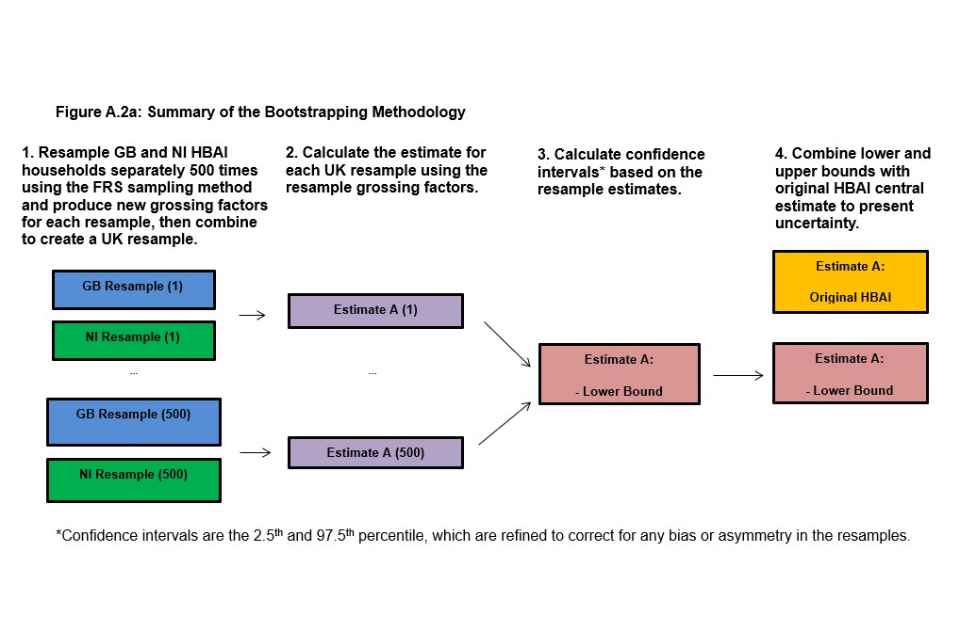
Figure A.2a illustrates the bootstrapping methodology. The bootstrapping methodology consists of four stages shown in diagram form in Figure A.2a and those stages are as follows:
(1) Resample GB and NI HBAI households separately 500 times using the FRS sampling method and produce new grossing factors for each resample, then combine to create a UK resample. You end up with GB and NI resamples from 1 to 500.
(2) Calculate the estimate for each UK resample using the resample grossing factors. So, you end up with 500 estimates, e.g. estimate A (1) to estimate A (500).
(3) Calculate confidence intervals based on the resample estimates. Confidence intervals are the 2.5th and 97.5th percentile, which are refined to correct for any bias or asymmetry in the resamples.
(4) Combine lower and upper bounds with original HBAI central estimate to present uncertainty.
Figure A.2b: Great Britain FRS Sampling and Bootstrapping Resampling Process
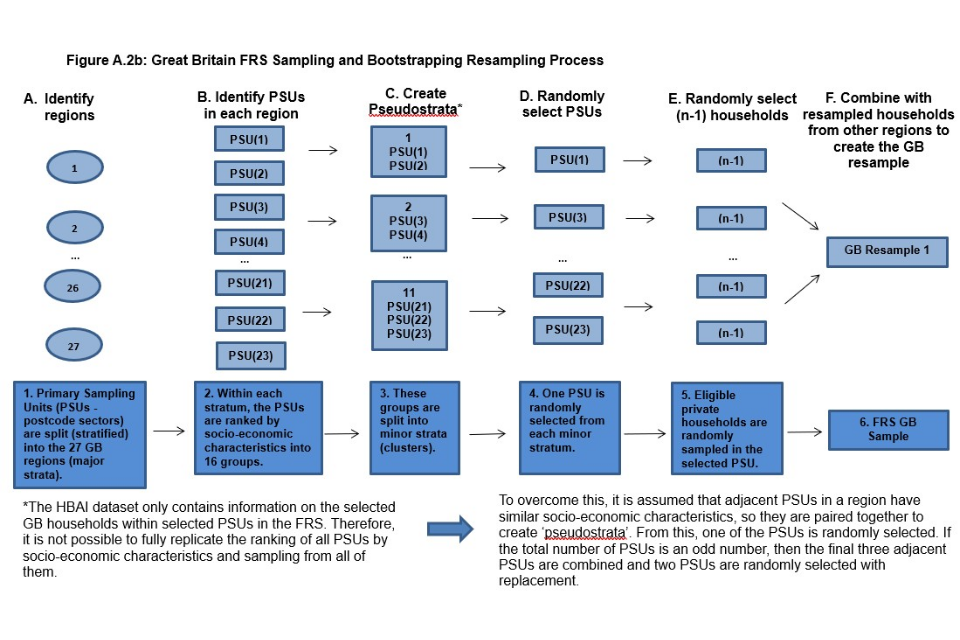
Figure A.2b illustrates the Great Britain FRS Sampling and Bootstrapping Resampling process in diagram form. The bootstrapping resampling is shown as six stages labelled A to F, and the GB FRS sampling process is shown as six stages 1-6. Those stages are as follows:
Bootstrapping Resampling Process:
(A) Identify regions 1 to 27.
(B) Identify PSUs in each region (PSU (1) up to PSU (23)).
(C) Create Pseudostrata: 1 (PSU(1), PSU(2)), 2 (PSU(3), PSU(4)) up to 11 (PSU(21), PSU(22), PSU(23)). These groups are split into minor strata (clusters). The HBAI dataset only contains information on the selected GB households within selected PSUs in the FRS. Therefore, it is not possible to fully replicate the ranking of all PSUs by socio-economic characteristics and sampling from all of them. To overcome this, it is assumed that adjacent PSUs in a region have similar socio-economic characteristics, so they are paired together to create ‘pseudostrata’.
(D) Randomly select PSUs. One of the PSUs is randomly selected from each minor stratum (e.g. from the first group PSU (1) might be selected and from the second group PSU (3) might be selected). If the total number of PSUs is an odd number, then the final three adjacent PSUs are combined and two PSUs are randomly selected with replacement (e.g. in group 11, PSU(22) and PSU(23) might be selected).
(E) Randomly select (n-1) households in each PSU.
(F) Combine with resampled households from other regions to create the GB resample.
GB FRS Sampling Process:
(1) FRS Primary Sampling Units (PSUs - postcode sectors) are split (stratified) into the 27 GB regions (major strata).
(2) Within each stratum, the PSUs are ranked by socio-economic characteristics into 16 groups.
(3) These groups are split into minor strata (clusters).
(4) One PSU is randomly selected from each minor stratum.
(5) Eligible private households are randomly sampled in the selected PSU.
(6) The FRS GB sample is created.
Figure A.2c: Northern Ireland FRS Sampling and Bootstrapping Resampling Process
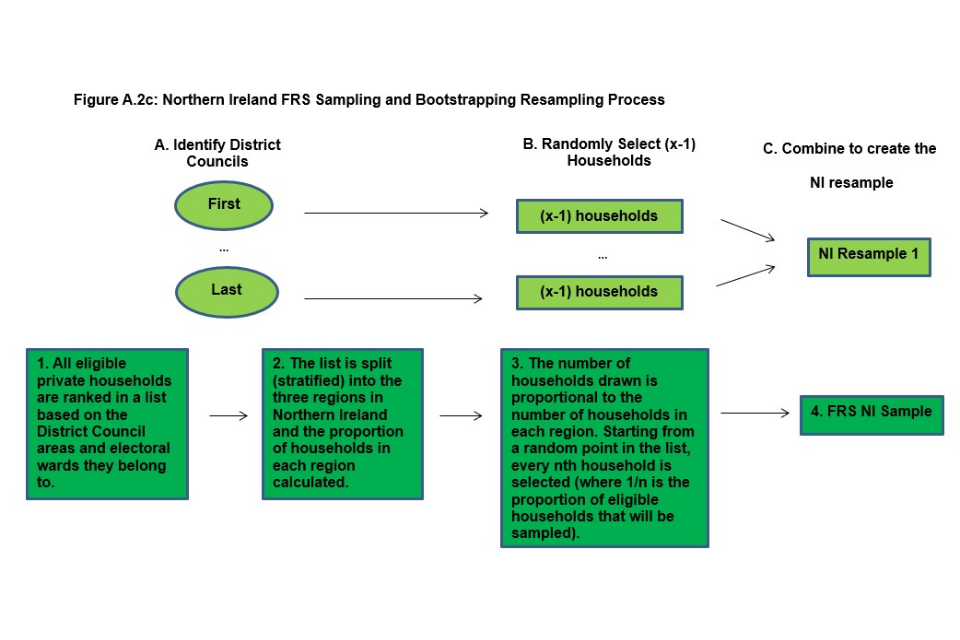
Due to the small NI FRS sample size, the systematic sampling is replaced with simple random sampling with replacement. However, the initial stratification into the districts is replicated.
Figure A.2c illustrates the Northern Ireland FRS Sampling and Bootstrapping Resampling Process in diagram form. The bootstrapping resampling is shown as three stages labelled A to C and the GB FRS sampling process is shown as three stages 1-3. Those stages are as follows:
Bootstrapping Resampling Process:
(A) Identify District Councils.
(B) Randomly Select (x-1) Households.
(C) Combine to create NI resample.
NI FRS Sampling Process:
(1) All eligible private households are ranked in a list based on the District Council areas and electoral wards they belong to.
(2) The list above is then split (stratified) into the three regions in Northern Ireland and the proportion of households in each region calculated.
(3) The number of households drawn is proportional to the number of households in each region. Starting from a random point in the list, every nth household is selected (where 1/n is the proportion of eligible households that will be sampled).
(4) The FRS NI sample is created.
Figure A.2d: HBAI Grossing and Bootstrapping Grossing Process
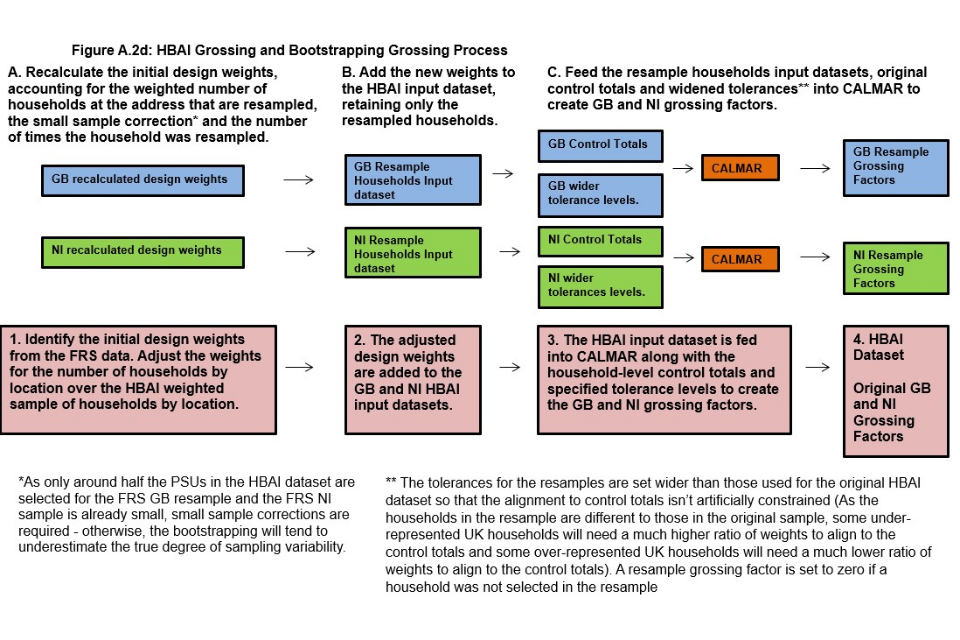
Figure A.2d illustrates the HBAI Grossing and Bootstrapping Grossing Process in diagram form. The bootstrapping grossing process is shown as three stages labelled A to C and the HBAI grossing process is shown as three stages labelled 1 to 3. Those stages are as follows:
Bootstrapping Grossing Process:
(A) Recalculate the initial design weights, accounting for the weighted number of households at the address that are resampled, the small sample correction and the number of times the household was resampled. As only around half the PSUs in the HBAI dataset are selected for the FRS GB resample and the FRS NI sample is already small, small sample corrections are required – otherwise, the bootstrapping will tend to underestimate the true degree of sampling variability.
(B) Add the new weights to the HBAI input dataset, retaining only the resampled households.
(C) Feed the resample households input datasets, original control totals and widened tolerances into CALMAR to create GB and NI grossing factors. The tolerances for the resamples are set wider than those used for the original HBAI dataset so that the alignment to control totals isn’t artificially constrained (As the households in the resample are different to those in the original sample, some under-represented UK households will need a much higher ratio of weights to align to the control totals and some over-represented UK households will need a much lower ratio of weights to align to the control totals). A resample grossing factor is set to zero if a household was not selected in the resample.
HBAI Grossing Process:
(1) Identify the initial design weights from the FRS data. Adjust the weights for the number of households by location over the HBAI weighted sample of households by location.
(2) The adjusted design weights are added to the GB and NI HBAI input datasets.
(3) The HBAI input dataset is fed into CALMAR along with the household-level control totals and specified tolerance levels to create the GB and NI grossing factors.
(4) Original GB and NI Grossing Factors.
A2.5 95% confidence intervals
Confidence intervals are typically set up so that we can be 95% sure that the true value lies within a certain range – in which case this range is referred to as a “95% confidence interval”.
Example 1 (from FYE 2025 publication tables): Interpreting confidence intervals
16% of individuals are estimated to be living in relative low income BHC. This figure has a stated confidence interval of 14 to 18% (Table 8b). This means that we can be 95% sure that between 14 and 18% of individuals are in relative low income. Our best estimate is 16% of individuals.
As well as calculating confidence intervals around the results obtained from one year of the survey, confidence intervals can also be calculated for the changes in results across survey years.
Example 2 (from FYE 2025 publication tables): Statistical significance
The estimated change in the percentage of individuals living in absolute low income BHC from FYE 2024 to FYE 2025 is a decrease of 1 percentage points (Table 8b). The confidence interval around this figure is -3 to 2 percentage points. This means that we can be 95% sure that the actual change in the percentage of people living in absolute low income is between a decrease of -3 percentage points and an increase of 2 percentage points, with the best estimate being a decrease of 1 percentage points. As the confidence interval includes zero this change is not statistically significant, which indicates that there is at least a 5% probability that the change in the percentage of individuals in absolute low income is the result of chance.
If the confidence interval did not include zero, we would conclude that the change is statistically significant i.e. the change is unlikely to be the result of chance.
Annex 3: Uses and users of HBAI statistics
HBAI is a key source for data and information about household income. Users include policy and analytical teams within the DWP, the Devolved Administrations and other government departments, local authorities, parliament, academics, journalists, and the voluntary sector.
HBAI statistics will also be used to track progress towards Our Children, Our Future: Tackling Child Poverty, by providing two headline metrics: relative low income after housing costs and a new deep material poverty measure. HBAI will publish both metrics annually from FYE 2025.
Researchers and analysts outside government use the statistics and data to examine topics such as income inequality, the distributional impacts of fiscal policies and understanding the income profile of vulnerable groups. Examples of published reports using HBAI data include:
- “Living standards, poverty and inequality in the UK: 2023”: Ray-Chaudhuri, Waters, Wernham, Xu, Institute for Fiscal Studies, 2023
- “UK Poverty 2024”: Cebula, Earwaker, Elliott, Johnson-Hunter, Matejic, Milne,Taylor, Thompson and Wenham, Joseph Rowntree Foundation, 2024
- “The Living Standards Outlook 2023”: Brewer, Fry, Try, Resolution Foundation, 2023
- “Falling Behind, Getting Ahead: The Changing Structure of Inequality in the UK, 2007-2013”: Hills, Cunliffe, Obolenskaya and Karagiannaki, Centre for Analysis of Social Exclusion, 2015
Within government the statistics and data are used:
- to inform policy development and monitoring, and for international comparisons
- for three of the four income-related measures in the Welfare Reform and Work Act 2016 where the HBAI report presents data for the income-related measures related to relative low income, combined low income and child material deprivation, and absolute low income. Note where FYE 2011 is referenced this should be read as FYE 2025 for years where administrative-linked data has been applied
- to provide further equality information in compliance with the specific duties under the Equality Act 2010, as well as to the Ethnicity Facts and Figures (formerly the Race Disparity Audit). The data is also referenced as a key source in the Equalities Data Audit, published by the Office for National Statistics; and
- as one of the financial indicator domain measures in the National Wellbeing Dashboard, published by the Office for National Statistics (ONS) to measure quality of life in the UK
The Scottish Government uses the HBAI data:
- to support users to understand inequalities of concern in Scotland in relation to income
- to help to inform policy action, and to measure and evaluate the impact of changes or interventions
- to report against three of the four income-related measures in the Child Poverty (Scotland) Act 2017 (relative low income, combined low income and child material deprivation, and absolute low income);
- supporting the independent Poverty and Inequality Commission
- as evidence for the Scottish Government’s National Performance Framework, specifically for the National Performance indicators on relative low income, income inequality and combined low income and child material deprivation; and
- to inform the Scottish Government’s policies about Equality and rights
The Welsh Government uses the HBAI data:
- to support users to understand issues relating to poverty in Wales, and to help inform policy in this area
-
to measure progress on the National Indicators for Wales; and
- to monitor progress of the Welsh Government’s Child Poverty Strategy (2024).
The Department for Communities in Northern Ireland uses HBAI data to produce the Northern Ireland Poverty and Income Inequality Report – the primary source for data and information about poverty and income inequality in Northern Ireland.
Users should note that in FYE 2025, regional statistics published by Scotland, Wales and Northern Ireland have been classified as Official Statistics in Development. This signals that the changes introduce uncertainty that is acute for estimates below UK level which needs to be reflected in their Official Statistics reporting.
Annex 4: Other relevant statistics
The HBAI report and statistics are released alongside several other statistics focused on income and low-income statistics across government.
In February 2015 the United Kingdom Statistics Authority (UKSA) published a report on the outcome of a monitoring review into the Coherence and Accessibility of Official Statistics on Income and Earnings. A progress report was published in January 2016, with a further update in December 2018.
This review considered the way in which official statistics about income and earnings across government are presented and includes summary details of the official statistics within the Review’s scope; discussion of the conceptual issues faced by users and advice needed when attempting to analyse official statistics; and makes recommendations around potential solutions to concerns identified and for the longer-term development of income and earnings statistics.
The Office for Statistics Regulation (OSR) published a further review of income-based poverty statistics on 19 May 2021. This included background information on why the review was commissioned as well as the findings and recommendations for statistics producers. Recommendations focussed on key areas including accessibility and guidance, understanding poverty, data gaps, data quality, and trustworthiness.
Several of the recommendations were taken account of in the FYE 2021 and FYE 2022 HBAI publications. For example, reporting of material deprivation measures was extended to include working age adults, and a section on the strengths and limitations of the HBAI was added to the main statistical report.
From the FYE 2024 HBAI release onwards DWP has specifically addressed further data gap recommendations on material deprivation statistics.
Firstly, DWP, in partnership with researchers at the London School of Economics and Political Science (LSE), conducted a review of the Material Deprivation measures and the associated FRS questions. The LSE Review was published in March 2024. Updated questions were added from the FYE 2024 FRS and an updated methodology to measure Material Deprivation has been developed by DWP. From FYE 2024 onwards, HBAI estimates use the updated measures. The decisions underpinning the methodology for the updated Material Deprivation measures were informed by recommendations from the LSE Review, evidence from analysis of HBAI FYE 2024 and back-series data, as well as broader conceptual perspectives. A technical report was published alongside the FYE 2024 HBAI release detailing the development of the updated measures.
Secondly, we addressed recommendations around improving the comparisons of material deprivation across groups and increasing the consistency of reporting material deprivation measures. From the FYE 2024 the HBAI report and publication tables have been extended to report on child material deprivation and working-age material deprivation, in addition to the combined low income and material deprivation measures. This allows material deprivation to be easily compared across groups. In addition, all combined measures are now published on a before and after housing costs basis for all thresholds which further increases the consistency of the way material deprivation is reported.
Finally, from the FYE 2025 release onwards, the integration of administrative data into the FRS addresses further recommendations around making greater use of administrative data.
Below Average Resources: a new poverty measure
DWP are developing a new additional poverty measure named ‘Below Average Resources’ (BAR) based on the approach proposed by the Social Metrics Commission (SMC) and using FRS data.
DWP sought user feedback on developing the new measure through an analytical consultation running from 18 January to 11 April 2024. The consultation response was published in January 2025, alongside the latest Official Statistics in Development publication in the BAR series. The publication included data for the financial year ending 2023 but did not include any substantial changes to the methodology for the measure compared to the initial publication.
We will review the impact of the changes to the Family Resources Survey and Households Below Average Income statistics before producing further updates to the Below Average Resources Official Statistics in Development. This means we will not be publishing a standalone update to BAR to include data for the Financial Year Ending 2024. We will first wait to review the impact of the full revised HBAI back series post the summer 2026 update.
The statistics highlighted below represent several statistical releases which might be considered alongside results from HBAI to give a more complete picture. This is not intended to be an exhaustive list and should be considered alongside details from the reviews highlighted, as well as ONS guidance on sources of data on earnings and income, with additional details at on important questions also available.
Poverty and income inequality in Scotland
In-depth analysis of HBAI data for Scotland.
Poverty statistics for Wales
In-depth analysis of relative income poverty in Wales can be found on the relative income poverty page of the Welsh Government website, which has links to material deprivation and persistent poverty analysis.
Households Below Average Income Report for Northern Ireland
In-depth analysis of HBAI data for Northern Ireland.
EU comparisons
After the UK’s exit from the EU in 2020, some EU-SILC outputs were still delivered by ONS to Eurostat during the transition period in 2020, but all planned deliveries from 2021 onwards ceased. Data for the UK up to and including the 2018 calendar year remain available on Eurostat’s EU-SILC database.
Details of the differences between the EU and HBAI methodology are given in section 12 of this report.
OECD international comparisons
The OECD income distribution database provides international comparisons on trends and levels in Gini coefficients before and after taxes and transfers, average household disposable incomes, relative poverty rates and poverty gaps, before and after taxes and transfers.
ONS Household Income statistics
The UK has two main, official data sources of household income statistics: the Family Resources Survey (FRS) run by the Department for Work and Pensions (DWP) and the Household Finances Survey (HFS) run by the Office for National Statistics (ONS).
The FRS estimates underpin DWP’s Households Below Average Income (HBAI) series, which is the UK’s primary source of poverty estimates. With a larger sample size, it is also the main source on household incomes. HFS data are used to produce ONS’s Average household income, UK - Office for National Statistics series (which include Household Disposable Income Inequality (HDII)) and Effects of Taxes and Benefits (ETB), and are the main source for considering the overall financial well-being of households.
The two sources of data are complimentary but there are some important methodological differences between them which means that their income estimates can be different. For example, the FRS focuses on respondents’ weekly incomes at the time of interview, whereas HFS focuses more on annual income. The treatment of pension contributions also differs, with ONS’ estimate of Gross Household Income being calculated before pension contributions. Further details are available in the income and earnings statistics guide.
Pensioners’ Incomes
The Pensioners’ Income (PI) publication gives more a more detailed analysis of pensioners’ incomes.
Family Resources Survey
The Family Resources Survey (FRS) publication gives some further results of FRS data analysis.
Income Dynamics
Income Dynamics (ID) is a publication based on longitudinal data, containing analysis of income movements and the persistence of low income for various population groups.
It supersedes Low-Income Dynamics, which was last published in September 2010.
Personal Incomes statistics
The Personal Incomes Statistics publication gives summary information about UK taxpayers, their income and the Income Tax to which they are liable.
Wealth in Great Britain
Household total wealth in Great Britain - Office for National Statistics is based on the Wealth and Asset Survey (WAS), a large-scale longitudinal survey with eight rounds currently published. Round 8 (2020 to 2022) had a sample of around 15,000 private households or 32,300 individuals in Great Britain. It is conducted by the Office for National Statistics (ONS). The WAS dataset holds information about the economic status of households and individuals including their physical and financial assets, debts, and pension provision. WAS data are also used to understand how wealth is distributed and the factors which may affect financial planning, as well as a respondents’ attitudes and behaviours towards saving. The Pension Wealth tables in WAS provides estimates of the types of private (non-state) pension wealth, split by a wide range of socio-demographic and economic breakdowns
Measuring National Well-being
The UK headline measures of National Well-being was published in February 2026. These headline measures have been introduced to provide timely insight into how we are doing as individuals, communities and, as a nation. They are also designed to complement the UK Measures of National Well-being comprehensive measure set, which is presented in the UKMNW dashboard.
Estimates of income and low-income levels for small areas
HBAI data cannot be broken down below the level of region, due to sample size and coverage issues. However, there are some data sources that present information at smaller geographies:
Children in Low-Income Families Local Area Statistics
Children in Low Income Families (CiLIF) provides estimates of the number and proportion of children living in low-income families, across the United Kingdom by local area. Following the successful completion of discovery work and a public consultation: Children in low income families - After Housing Costs Consultation Note - GOV.UK, from the FYE 2025 publication CiLIF statistics will be available on both a Before and After Housing Cost basis. The FYE 2025 publication will also include updates to the Before Housing Cost time-series at UK., regional and local area level. Data prior to FYE 2022 will not be published and there is no scheduled additional release later in the year.
There have been some methodological changes to the CiLIF release from the FYE 2024 onwards which includes a change to how those statistics are calibrated to HBAI. Further information is available in Children in low income families: local area statistics: background information and methodology - GOV.UK.
The CiLIF Background, Information and Methodology document includes a table for users advising on scenarios on when you might use which sets of statistics. Users should consider the most appropriate series for regional level low-income households for children only and recognise the use of 3 year averages for HBAI regional estimates which differ from the regional estimates for CiLIF which are derived from 1 year UK HBAI estimates. CiLIF is the recommended source for single year regional figures.
Small area model-based income estimates for England and Wales
ONS produce model-based estimates of income at Middle Layer Super Output Area (MSOA) level for FYE 2023
Admin-based income statistics, England and Wales
ONS also produce experimental estimates of gross and net income based on data from the Pay As You Earn and benefits systems.
English Indices of Deprivation
The English Indices of Deprivation, produced by the Ministry of Housing, Communities and Local Government is a measure of relative levels of deprivation in small areas of England called Lower Layer Super Output Areas.
Welsh Index of Multiple Deprivation
The Welsh Index of Multiple Deprivation (WIMD) is the official measure of deprivation in small areas in Wales. It is a relative measure of concentrations of deprivation at the small area level.
Scottish Index of Multiple Deprivation
The Scottish Index of Multiple Deprivation (SIMD) is the Scottish Government’s official tool for identifying those places in Scotland suffering from deprivation.
Northern Ireland Multiple Deprivation Measure
The Northern Ireland Multiple Deprivation Measure (NIMDM) is the official measure of spatial deprivation in Northern Ireland.
Annex 5: Impacts: Integration of survey and administrative data
A5.1 Summary
As outlined earlier in this report, the FYE 2025 HBAI publication features an improved approach to using administrative data in place of FRS survey responses both for FYE 2025 and some back-series years. Information on the major state benefits and tax credits is now based on administrative data rather than survey responses. Revisions to the back-series will take place in two stages – in March 2026 (back to FYE 2022) and summer 2026 (back to FYE 2019). The improved approach is sometimes referred to as administrative-linked (or admin-linked) data; with data which has not had the change applied being referred to as unlinked data. Linked and unlinked terminology has been used throughout this annex.
This improvement means key HBAI low-income measures, including the number/proportion of people identified as being in relative and absolute low income for all groups and in all years from FYE 2022 (in March 2026) and from FYE 2019 (in summer 2026) have changed. This improvement also means there will be a break in the HBAI series at these points. We advise users that income data before and after the break are not directly comparable and if comparisons across the break point are required users should follow the advice set out in section 3.2.
Users should note that:
- from the FYE 2025 publication, HBAI data via Stat-Xplore is split into two datasets to recognise the break in the series. The first dataset mainly covers the period before the integration of administrative data and the second dataset covers the period after. Note a single overlap year of data (FYE 2022 in March 2026 and FYE 2019 in summer 2026) are included in both datasets to allow for limited analysis across the break point following the guidance in section 3.2. For this overlap year (FYE 2022 in March 2026 and FYE 2019 in summer 2026), where a standalone figure or a comparison with future years is required then the administrative-linked data should always be used. See section 3.2 for more information
- while the integration of administrative data has reduced FRS/HBAI under-reporting of benefits, some under and over-reporting will remain and the level will vary by individual benefit. See the FRS Methodology tables M.6a and M6b for further information. Note the underreporting of benefits has not been eliminated, although research continues on how to achieve this with further developments in the future. For more information please see the latest FRS technical report
Note that other published HBAI statistics and breakdowns have changed because of administrative data linking but this annex focusses on impacts for key HBAI low-income measures only. Some measures of poverty, such as material deprivation statistics, are unaffected by the improvement of using administrative data.
This annex provides charts and tables to illustrate the impact of administrative data linking on:
-
medians and the income distribution
-
relative low-income measures
-
absolute low-income measures
For absolute low-income measures, the change to the absolute low-income reference year (from FYE 2011 to FYE 2025) is inter-linked with the change to administrative data linking. Therefore, this section also includes charts to illustrate that both changes contribute to the overall changes in absolute low-income measures.
Note that the use of administrative data and the change to the absolute year are the main reasons that data for back-series years have been updated from the FYE 2025 publication. There are a small number of other changes which have been made to the back-series at the same time as these improvements (see section 2.6) but the impacts of these other changes on low-income measures are much smaller and so have not been separated out in the charts or tables that follow in this annex. For further information on the impact of integrating administrative data on FRS source data please see the latest technical report.
All data that follow in this annex are in FYE 2025 prices, except for Figures A.5b which illustrates the change in the income distribution for a single year FYE 2024 – this is in FYE 2024 prices. HBAI estimates published prior to March 2026 (referred to as unlinked data in chart legends) have been adjusted to FYE 2025 prices and are shown as a solid line prior to FYE 2022 and dotted line from FYE 2022. Only administrative-linked FRS and HBAI statistics are available for FYE 2025 and this is why the dotted line finishes at FYE 2024.
Estimates are shown on a before housing costs (BHC) and after housing costs (AHC) measure in most cases.
In summary, impacts of linking survey and administrative data on key HBAI estimates are:
- higher median weekly household income, with between a 2% and 3% increase each updated year and with larger increases at the lower end of the income distribution
- lower numbers in relative low income for all groups
- higher numbers in absolute low income for all groups (due to the combined change of administrative data linking and the change in reference year from FYE 2011 to FYE 2025)
- overall, trends remain similar on administrative-linked estimates compared to unlinked estimates. Levels have changed and there is some variation in the magnitude of those level changes for each updated year
A5.2 Impact on medians and income distribution
Higher median household income due to administrative data linking
Figure A.5a: Median Weekly Household Income, FYE 2003 to FYE 2025
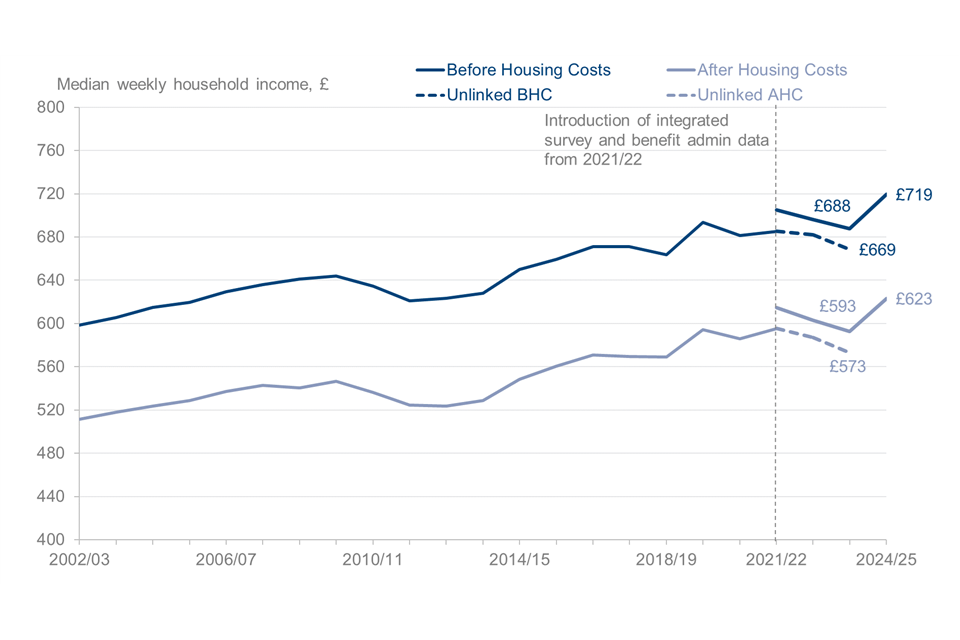
Figure A.5a shows that for each year between FYE 2022 and FYE 2024, the linking of administrative data to survey data resulted in higher median household net equivalised disposable incomes. The impact of administrative linking on median weekly household income was similar each year and resulted in higher medians by between 2% and 3% each year.
Administrative data linking adds more additional income to those nearer the lower end of the income distribution.
Figure A5.b Percentage change between unlinked FYE 2024 household income and administrative-linked FYE 2024 household income by income percentile BHC, FYE 2024 prices
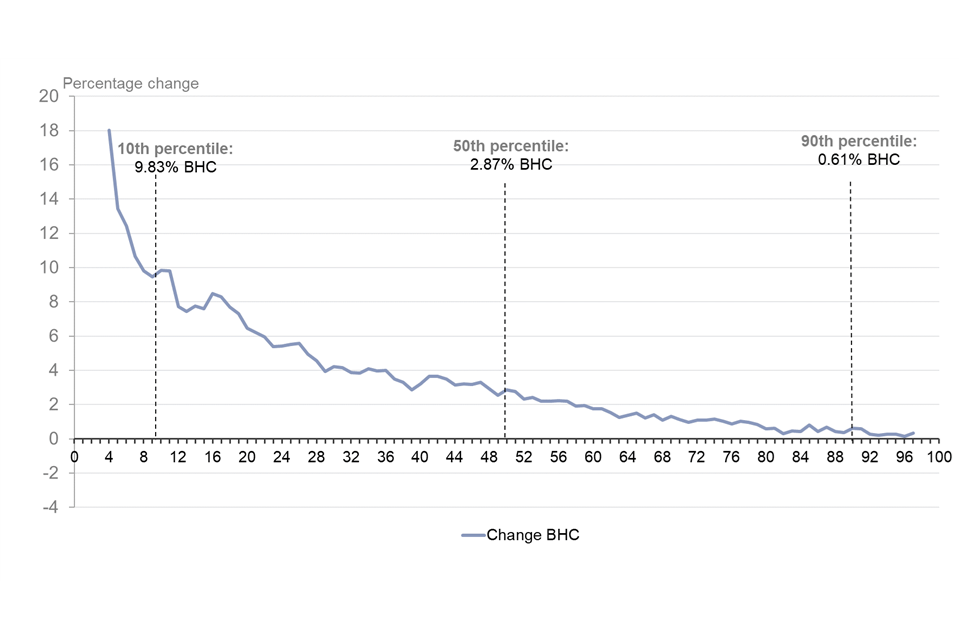
Figure A.5b shows the difference in household income (BHC) between unlinked FYE 2024 estimates and administrative-linked FYE 2024 estimates.
It shows that the magnitude of the change in income is much larger for those at the lower end of the distribution. This is in line with expectations given that the FRS historically under-reports benefit incomes compared to administrative data and that those at the lower end of the distribution are more likely to be in receipt of benefits.
A5.3 Impact on relative low-income measures
Relative low-income measures for all individuals are lower due to administrative data linking
Figure A.5c: Percentage of all individuals in relative low income, FYE 2003 to FYE 2025
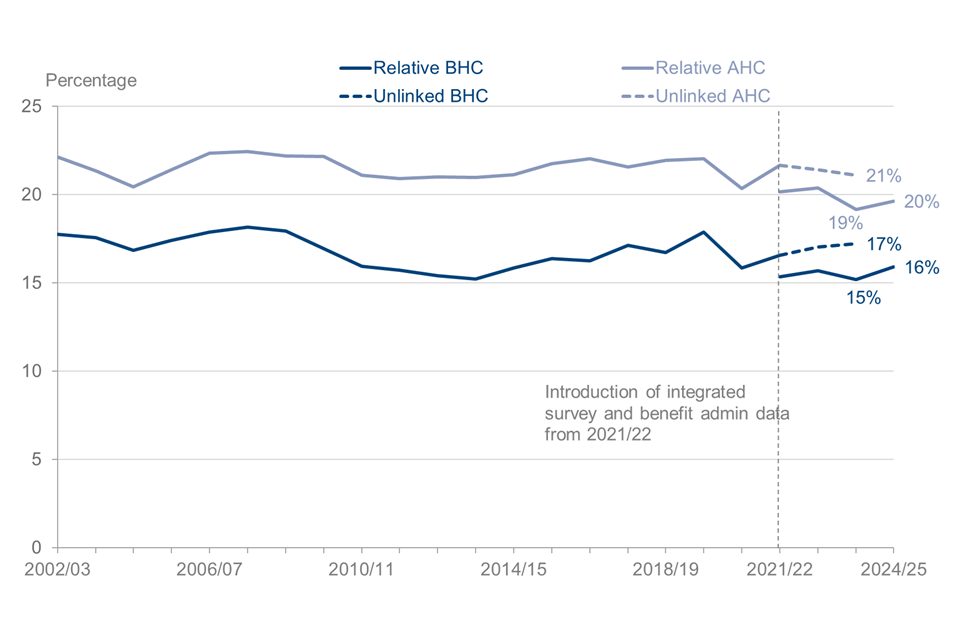
Figure A.5c shows that for each year between FYE 2022 and FYE 2024, the linking of administrative data resulted in lower numbers in relative low income. There were some differences in the magnitude of the change across the three back-series years – with a change of between one and two percentage points each year for both BHC and AHC measures.
Relative low-income measures for children are lower due to administrative data linking
Figure A.5d: Percentage of children in relative low income, FYE 2003 to FYE 2025
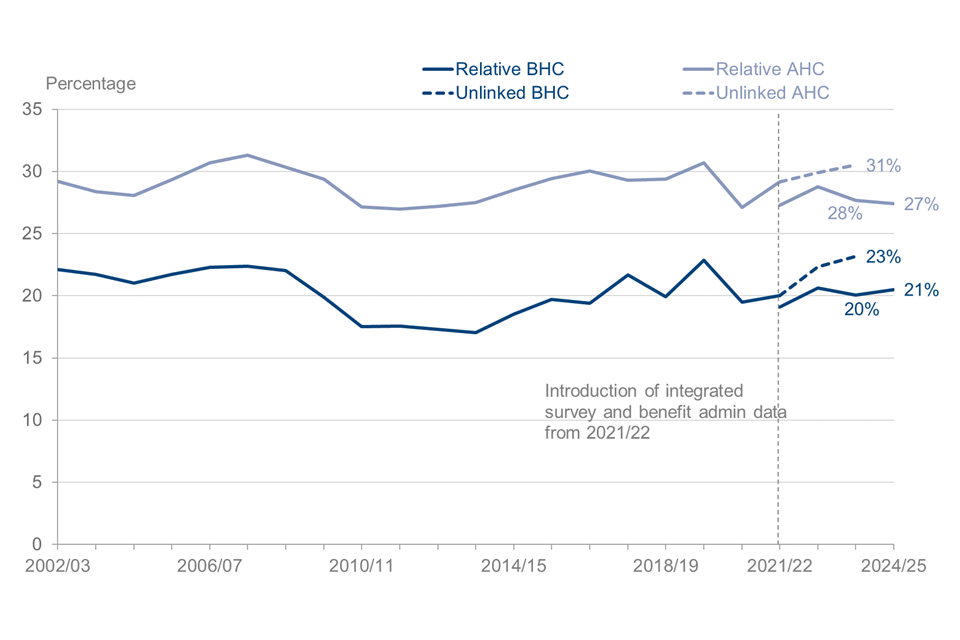
Figure A.5d shows that for each year between FYE 2022 and FYE 2024, the linking of administrative data resulted in lower numbers of children in relative low income. There were some differences in the magnitude of the change across the three back-series years– with a change of between one and three percentage points each year for both BHC and AHC measures.
Relative low-income measures for working-age adults are lower due to administrative data linking
Figure A.5e: Percentage of working-age adults in relative low income, FYE 2003 to FYE 2025
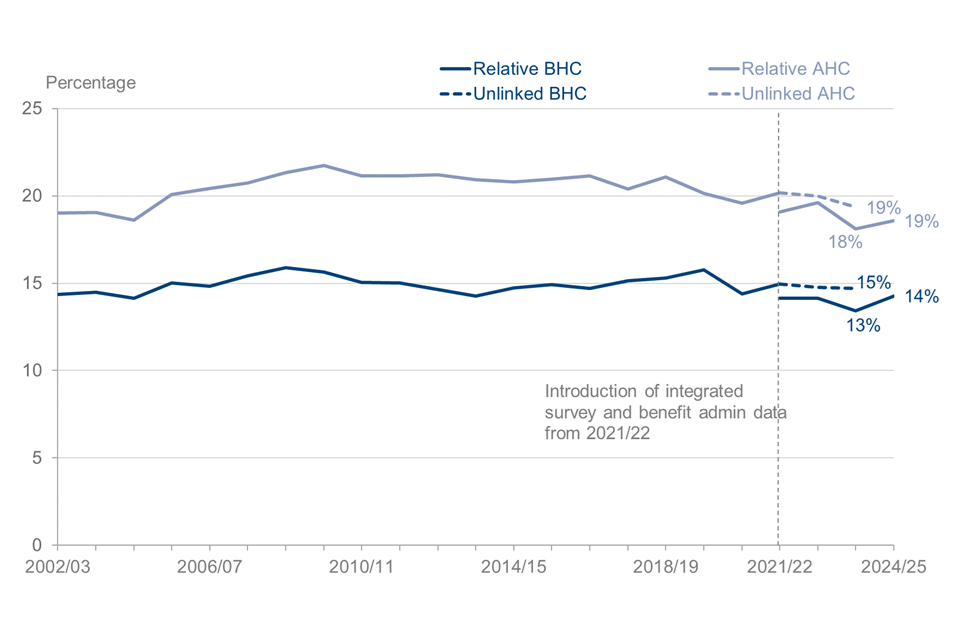
Figure A.5e shows that for each year between FYE 2022 and FYE 2024, the linking of administrative data resulted in lower numbers of working-age adults in relative low income. There were some differences in the magnitude of the change across the three back-series years – with a change varying around one percentage point each year on both BHC and AHC measures.
Relative low-income measures for pensioners are lower due to administrative data linking
Figure A.5f: Percentage of pensioners in relative low income, FYE 2003 to FYE 2025
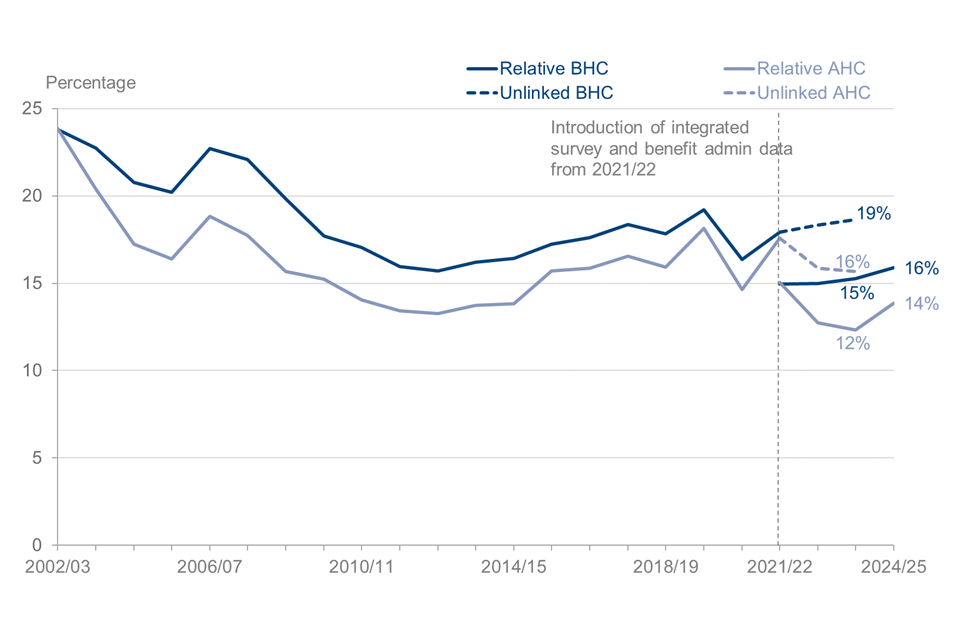
Figure A.5f shows that for each year between FYE 2022 and FYE 2024, the linking of administrative data resulted in lower numbers of pensioners in relative low income. The change each year was similar at approximately three percentage points each year for both BHC and AHC measures.
A5.4 Impact on absolute low-income measures
Absolute low-income measures for all individuals are higher due to administrative data linking and the update to the absolute low-income reference year
Figure A.5g: Percentage of all individuals in absolute low income, FYE 2003 to FYE 2025
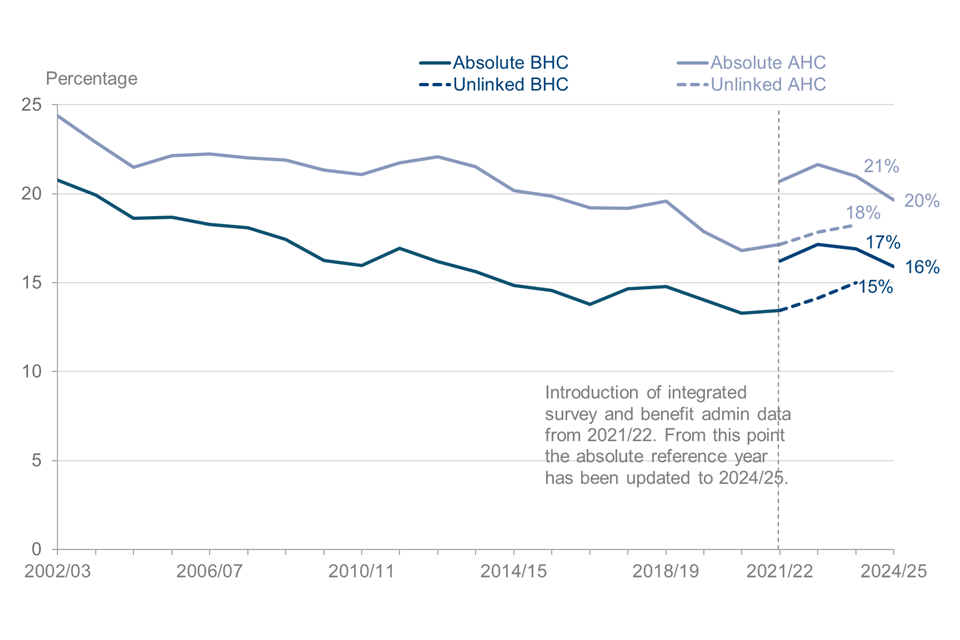
Figure A.5g shows that for each year between FYE 2022 and FYE 2024, the linking of administrative data coupled with the update to the absolute low-income reference year resulted in higher numbers in absolute low income. There were some differences in the magnitude of the change across the three back-series years – with a change of between two and four percentage points each year for both BHC and AHC measures.
It is not possible to completely separate the two effects contributing to the overall change illustrated in Figure A.5g. Due to the absence of an unlinked FYE 2025 median, isolating the impact of updating the absolute low-income reference year is not entirely possible. The change includes both shifting from an unlinked FYE 2011 median to an administrative-linked FYE 2025 median, thereby altering both the basis of the median and advancing the reference year by fourteen years.
However, noting this caveat, Figure A.5h and Figure A.5i split out the two impacts as far as possible. They illustrate the impact on absolute low-income measures of:
-
(1) incorporating administrative data linking with the absolute low-income reference year FYE 2011 (i.e. just administrative data-linking, reference year based on unlinked data but remaining the same reference point) and then
-
(2) updating to the absolute low-income reference year FYE 2025 (which is based on the administrative-linked FYE 2025 medians - i.e. reference year change along with some administrative-linking impact within the change to a median based on administrative-linked data).
These two related changes both contribute to the final level of the overall change in absolute low-income measures.
Update to absolute low-income reference year is important when considering the overall change to absolute low-income
Figure A.5h: Percentage of all individuals in absolute low income, FYE 2022 to FYE 2024 (BHC)
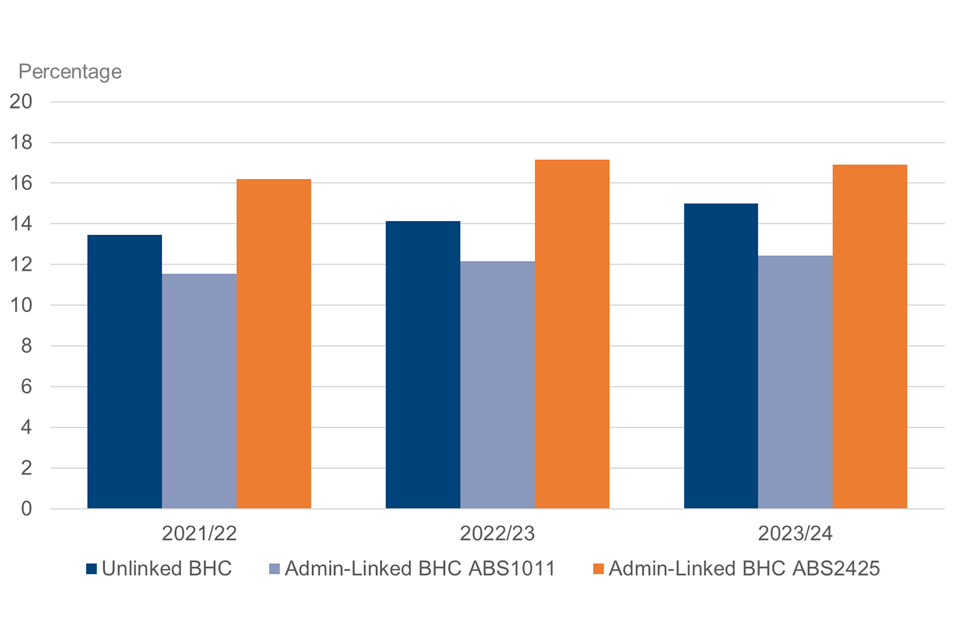
Figure A.5i: Percentage of all individuals in absolute low income, FYE 2022 to FYE 2024 (AHC)
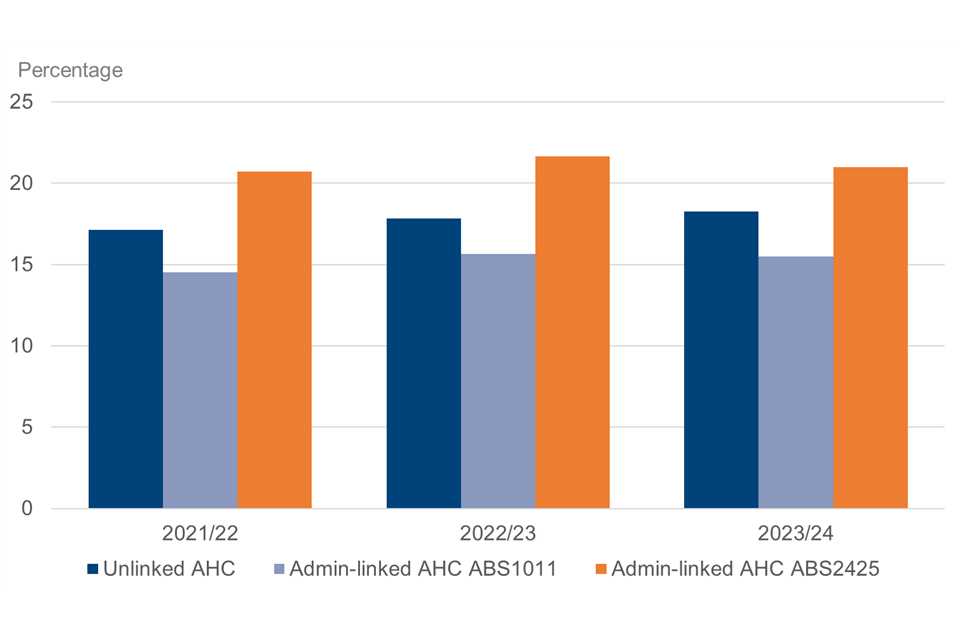
Figures A.5h and A.5i show that for each year between FYE 2022 and FYE 2024, the update to the absolute low-income reference year from FYE 2011 to FYE 2025 is the main reason for the increase in the overall numbers. However, as noted above it is not completely possible to separate the two impacts. Noting that caveat, the charts above show that the two impacts making up the overall change also work in opposite directions.
Given the methodological change of administrative data linking, it is necessary to update the absolute low-income reference year and so the overall impact should be to consider these changes together.
Absolute low-income measures for all groups are higher due to use of administrative data linking and update to the absolute low-income reference year
The tables below show the absolute low-income AHC measures for each group unlinked data (FYE 2011 reference year) compared to administrative-linked data (FYE 2025 reference year). Tables are not provided for BHC equivalents, but similar findings apply, with absolute low-income measures for all groups on a BHC basis being higher due to administrative data linking and update to the absolute low-income reference year.
Table A.5a: Percentage of children in absolute low income AHC: unlinked data (FYE 2011 reference year) compared administrative-linked data (FYE 2025 reference year)
| FYE | A: Percentage of children in absolute low income AHC: Unlinked data (FYE 2011 reference year) | B: Percentage of children in absolute low income AHC: Admin-linked data (FYE 2025 reference year) | Percentage point change (B-A) |
|---|---|---|---|
| 2022 | 19 | 28 | 9 |
| 2023 | 22 | 31 | 8 |
| 2024 | 23 | 30 | 8 |
Table A.5b: Percentage of working-age adults in absolute low income AHC: unlinked data (FYE 2011 reference year) compared administrative-linked data (FYE 2025 reference year)
| FYE | A: Percentage of working-age adults in absolute low income AHC: Unlinked data (FYE 2011 reference year) | B: Percentage of working-age adults in absolute low income AHC: Admin-linked data (FYE 2025 reference year) | Percentage point change (B-A) |
|---|---|---|---|
| 2022 | 15 | 20 | 5 |
| 2023 | 16 | 21 | 5 |
| 2024 | 15 | 20 | 5 |
Table A.5c: Percentage of pensioners in absolute low income AHC: unlinked data (FYE 2011 reference year) compared administrative-linked data (FYE 2025 reference year)
| FYE | A: Percentage of pensioners in absolute low income AHC: Unlinked data (FYE 2011 reference year) | B: Percentage of pensioners in absolute low income AHC: Admin-linked data (FYE 2025 reference year) | Percentage point change (B-A) |
|---|---|---|---|
| 2022 | 9 | 16 | 7 |
| 2023 | 8 | 14 | 6 |
| 2024 | 9 | 15 | 6 |
Tables A.5a, A.5b and A.5c show that for children, working-age adults and pensioners numbers in absolute low income are higher after the integration of administrative data and the update to the absolute low-income year. The magnitude of the change is broadly consistent across the three years within each group, but varies across the three different groups, being higher for children compared to working-age adults and pensioners.
For further information on the integration of administrative data on the FRS and impacts please see the separate technical report.