Landlord's guide to right to rent checks: 1 October 2026 (accessible)
Updated 1 October 2026

© Crown copyright 2026
This publication is licensed under the terms of the Open Government Licence v3.0 except where otherwise stated. To view this licence, visit nationalarchives.gov.uk/doc/open-government-licence/version/3 or write to the Information Policy Team, The National Archives, Kew, London TW9 4DU, or email: psi@nationalarchives.gov.uk.
Where we have identified any third party copyright information you will need to obtain permission from the copyright holders concerned.
This publication is available at https://www.gov.uk/government/publications/landlords-guide-to-right-to-rent-checks/landlords-guide-to-right-to-rent-checks-1-october-2026-accessible
1 October 2026
Produced by the Home Office
1. Introduction
The Right to Rent Scheme (the Scheme) requires landlords and their agents in England to check that all adult occupiers have the right to rent before a residential tenancy begins. You must carry out a right to rent check on every adult who will occupy the property as their only or main home, regardless of their nationality.
If you carry out the checks correctly and keep the required records, you will establish a statutory excuse against liability for payment of a civil penalty if an occupier is later found not to have the right to rent. This guidance explains:
- who requires a check
- when checks must be carried out
- the different types of right to rent check available
- when follow-up checks are required
- how to keep records and maintain a statutory excuse.
For the full legal requirements, refer to the Code of Practice for Landlords and their Agents.
The Scheme was introduced by the Immigration Act 2014. Landlords and their agents may be liable for a civil penalty if they rent accommodation to a person who is disqualified from renting because of their immigration status. Additional measures were introduced by the Immigration Act 2016, including criminal sanctions for those who knowingly rent to a disqualified person.
References in this guidance
‘3C leave’ (Section 3C of the Immigration Act 1971) extends existing immigration permission, and any associated conditions, to a person who makes an ‘in-time’ application to extend their stay in the UK. ‘In-time’ means the application was made before the existing permission expired. The person will continue to hold 3C leave while they are awaiting a decision on that application and while any appeal or administrative review they are entitled to is pending.
‘Adult’ means an individual who has attained the age of 18.
‘Agent’ means a person (which includes a company under Schedule 1 of the Interpretation Act 1978), acting in the course of a business, who acts on behalf of the landlord.
‘Authoritatively digitally issued’ is where the document is issued electronically by the official trusted source, that has the authority to provide it.
‘Breach’ or ‘breaches’ refers to where section 22 of the Immigration Act 2014 has been contravened by renting to an adult who is a disqualified person.
‘Cancelled document’ means a document that is no longer valid and therefore cannot be used to prove a right to rent. It may have been replaced by another document. A cancelled passport may have its corner clipped.
‘Certificate of Application’ (CoA) is a digital, or non-digital document which individuals can rely on to demonstrate their eligibility to work, rent, and access benefits and services. This document is issued when a valid application is made to the EU Settlement Scheme (EUSS).
‘Civil penalty’ or ‘penalty’ means a financial penalty imposed by the Home Office on a landlord or their agent who has allowed an occupier to occupy private rented residential accommodation, but the occupier does not have the right to rent.
‘Current document’ means a document that has not expired.
‘Disqualified person’ ‘Disqualified person’ means a person who does not have a right to rent because they have no lawful immigration status, or they have limited leave to enter or remain in the UK with a condition that prevents them from occupying the premises.
‘Document’ means an original document which may include a digital document, where specified.
‘EEA citizen’ means a citizen of EEA countries or Switzerland, EEA countries can be found on GOV.UK.
‘EU Settlement Scheme (EUSS)’. The EUSS provides a basis for European Economic Area (EEA) and Swiss citizens resident in the UK by 31 December 2020, and their eligible family members, to apply for the UK immigration status which they require to remain here.
‘eVisa’ is a digital record of a person’s immigration permission in the UK, and any conditions which apply, which they can access by logging into their UK Visas and Immigration (UKVI) account. People can share their eVisa through their UKVI account, including by generating a share code for right to rent checks.
‘Facial recognition technology’ is a digital system that identifies or verifies individuals by analysing the unique features of their face.
‘Home Office Landlord Checking Service (LCS)’ is an enquiry and advice service operated by the Home Office that landlords are required to contact in certain circumstances to check whether a person has a right to rent.
‘Home Office online right to rent check checking service’ is an online service that allows landlords to check whether a person is allowed to rent in England. This system is accessible for landlords on the ‘Check a tenant’s right to rent in England: use their share code’ page on GOV.UK. No other online portal relating to immigration status may be used instead for right to rent checking purposes.
‘Homeowner’ is the person who owns the property used for renting or sub-letting.
‘Immigration document’ is a document of a prescribed description which grants to the holder a right to enter or remain in the United Kingdom for such period as the document may authorise.
‘Joining Family Member (JFMs)’ is a person of any nationality (including EEA) who was not themselves resident in the UK by 31 December 2020 but is joining an EEA national or relevant sponsor in the UK who either holds EUSS status or, in limited circumstances, would be eligible for EUSS status if they applied.
‘Landlord’ means an individual who lets accommodation for use by one or more adults as their only or main home. This includes people who take in lodgers and occupiers who are sub-letting. References to ‘landlord’ also include agents who have accepted responsibility for complying with the Scheme on behalf of landlords, except for when agents are specifically and separately referred to.
‘Leave to Enter’ or ‘Leave to Remain’ see ‘Permission to Enter’ and ‘Permission to Stay’.
‘Lodger’ means someone who takes a room within accommodation that they share with their landlord (this could be the owner or an occupier of the property).
‘Market rent’ means the amount of rent that can be expected for the use of a property, in comparison with similar properties in the same area.
‘Negative Right to Rent Notice’ (NRRN) is a negative confirmation that a person does not have the right to rent from the Landlord Checking Service (LCS). If a landlord receives an NRRN but continues to enter into a tenancy agreement with this person, the landlord will not have a statutory excuse and may be liable for a civil penalty.
‘Non-EEA citizens’ are citizens of countries outside the EEA (Countries in the EU and EEA - GOV.UK).
‘Occupier’ means a person who is, or who will be, authorised to occupy the property under the residential tenancy agreement, whether or not they are named on that agreement.
‘Passive authentication’ verification is the process of reading and verifying a chip and data as authentic using digital technology that can communicate with the document’s data chip.
‘Permission to rent’ means permission allowed for a time-limited period by the Secretary of State for a person to occupy premises under a tenancy agreement, who is disqualified from renting by virtue of their immigration status.
‘Permission to Enter’ also known as ‘Leave to Enter’. Immigration documents and guidance may refer to either term, both are acceptable. This means that a person has permission from the Home Office to enter the UK.
‘Permission to Stay’ also known as ‘Leave to Remain’. Immigration documents and guidance may refer to either term, both are appropriate. This means that a person has permission from the Home Office to stay in the UK.
‘Positive Right to Rent Notice’ (PRRN) means a positive confirmation of a person’s right to rent from the Landlord Checking Service (LCS). This will provide the landlord with a statutory excuse for twelve months from the date specified in the Notice.
‘Pre-settled status’ (PSS) is limited leave to enter or remain issued under the EU Settlement Scheme. It is initially given for five years and will be extended unless the person no longer meets the requirements for it.
‘Reasonably apparent’ in relation to a false document, means that a landlord conducting a right to rent check, who is not trained in the identification of such documents, could reasonably be expected to identify that the document is false when undertaking a careful but brief inspection, without the use of specialist or technological aids. This includes circumstances where it is reasonably apparent that the photograph or image of a person on a document, or on an online right to rent check, does not correspond to the occupier to whom the right to rent check relates.
‘Relevant national’ is a British citizen or an Irish citizen, or a person with settled status or pre-settled status granted under the EUSS.
‘Rent’ means an occupier’s regular payment to a landlord for the use of property or land.
‘Right to rent’ means allowed to occupy privately rented residential accommodation by virtue of qualifying immigration status.
‘Right to rent digital verification service provider (RtR DVSP)’ is a service provider that enables people to digitally prove who they are, information about themselves or their eligibility to do something. RtR DVSPs are registered and can be used by landlords and their letting agents to conduct digital right to rent checks on holders of relevant DVSP documents and facial recognition checks according to the Right to Rent Office of Digital Identity and Attributes (OfDIA) Trust Framework and supplementary code.
‘Settlement’ also known as ‘Indefinite Leave to Remain’ means how a person settles in the UK. This gives a person the right to live, work and study in the UK for as long as they like and apply for benefits if they are eligible. This is sometimes referred to as ‘settled status’.
‘Statutory excuse’ refers to a landlord’s defence against liability for payment of a civil penalty, which can be obtained where they carry out prescribed right to rent checks before the occupier commences tenancy.
‘Subtenant’ means a person who leases property from an occupier.
‘Share code’ is a unique code generated by a person using the Home Office online service, which allows a landlord or agent to access information about that person’s right to rent. The code is valid for 90 days and must be used together with the person’s date of birth.
‘The Supplementary code’ is a set of rules for a digital verification service to follow in addition to the ‘UK digital identity and attributes trust framework’ (‘the trust framework’) in order obtain certification and entry onto the DVS register in respect of the right to rent check service(s) it offers.
Supplementary codes are published by the Office for Digital Identities and Attributes (‘OfDIA’).
‘Tenant’ means a person or persons to whom the residential tenancy agreement is granted.
‘UK digital verification services trust framework’ (‘the trust framework’) is a set of rules for providers of digital verification services to follow.
‘Valid application’ means individuals who comply with the validation requirement of an application process, including the enrolment of biometrics, if required, and the provision of evidence of nationality and identity.
‘Validity period’ In the context of this code of practice means the period for which an immigration document issued to the limited right occupier by or on behalf of the Secretary of State is valid.
We’ or ‘us’ in this code mean the Home Office. References to ‘you’ and ‘your’ mean the Landlord.
About this guidance for landlords
This guidance applies to right to rent checks conducted on or after 1 October 2026. Previous versions are available through the UK Government Web Archive.The Scheme applies only to residential tenancy agreements first entered into:
- on or after 1 December 2014 in Birmingham, Wolverhampton, Dudley, Sandwell and Walsall,
- on or after 1 February 2016 in the rest of England.
Summary of Changes
This guidance was last updated on 1 October 2026 and the most significant changes relate to:
- Updates to the requirements for where a digital verification service provider (DVSP) is used, including mandating the use of registered providers when conducting digital right to rent checks.
- Clarification and expansion of the role of DVSPs, including the types of checks and technology that can be used for a digital right to rent check.
- Updates to the lists of acceptable documents, including provision for digital versions of documents that can be verified by a landlord.
- Removal of content relating to Service Providers from Switzerland (SPS) following closure of the route on 31 December 2025.
- Updates to reflect changes to immigration documentation, including the move away from visa vignettes from 1 July 2026 and increased use of eVisas to evidence immigration status.
- Consolidation and clarification of the section relating to EEA citizens and their family members, including how they can evidence their right to rent and signposting to the online service, Certificates of Application and the Landlord Checking Service where relevant.
- Removal of the annex relating to Ukrainian nationals as right to rent checks now apply consistently across nationalities; a reference to the Foundational Access Verification (FAV) process has been retained within the main guidance.
- Restructuring and reformatting throughout the guidance to improve usability, navigation and consistency with related Home Office guidance.
- How Landlords and letting agents can receive notifications about updates to the Right to Rent Scheme by signing up to receive communications from the Home Office.
2. Who may be liable for a civil penalty?
Liability
Responsibility under the Scheme normally rests with the landlord. This is the person who authorises a person to occupy accommodation under a residential tenancy agreement that provides for the payment of rent. In some circumstances, responsibility for complying with the Scheme can be transferred to another person. These arrangements are explained below.
Transfer of Liability
Appointing an agent
A landlord may appoint an agent to carry out right to rent checks on their behalf. Where an agent accepts responsibility for conducting the checks, this should be recorded in a written agreement.
The agreement should make clear whether the agent is responsible for:
- initial right to rent checks; and
- any required follow-up checks for occupiers with a time-limited right to rent.
Where responsibility has been transferred in writing, liability for any civil penalty rests with the agent. Liability cannot be transferred beyond the appointed agent.
Tenants who sub-let and lodgers
If a tenant sub-lets all or part of their accommodation, or takes in a lodger for rent, they become responsible for carrying out right to rent checks on those occupiers. Responsibility can be transferred to their landlord (‘superior landlord’) where the superior landlord agrees in writing to accept responsibility for conducting the checks. Where the superior landlord accepts responsibility, they must:
- identify all occupiers;
- carry out the required right to rent checks;
- complete any required follow-up checks; and
- make any required reports to the Home Office.
If the superior landlord does not agree in writing to accept this responsibility, the person sub-letting the accommodation or taking in the lodger remains responsible for complying with the Scheme and may be liable for a civil penalty where the requirements are not met.
Sitting tenants and changes in landlord
Where a landlord acquires a property with sitting occupiers, they should confirm with the previous landlord that right to rent checks were carried out and retain evidence of this, such as copies of the documents (physical or digital) that were checked. Landlords must also note whether and when any follow up checks are required to maintain a statutory excuse against a civil penalty.
If the tenancy was entered into before the Scheme came into force, the new landlord does not need to confirm that a right to rent check has been carried out. However, they should obtain and keep evidence of the tenancy start date.
Where a disqualified person with no right to rent is found to be in occupation and the landlord has changed since the tenancy was granted, liability for a civil penalty depends on the circumstances. If the occupier had no right to rent at the time the tenancy was granted, the original landlord will remain liable, even if the property has since been sold. If an occupier had a right to rent when the tenancy was granted but later lost that right, and the required follow up checks were not carried out, the landlord at the time the breach is identified will be liable. This applies where the occupier’s permission to stay in the UK has expired and the landlord’s statutory excuse has also lapsed.
Who can occupy residential accommodation?
Under the Scheme, people will generally fall into one of two categories depending on their immigration status:
- those with an unlimited right to rent; and
- those with a time-limited right to rent.
This section explains who falls within each category. It also provides information about those who have been granted Permission to Rent by the Home Office and children.
Those with an unlimited right to rent
The following groups of people currently have an unlimited right to rent:
- British citizens.
- Irish citizens.
- people who have the right of abode in the UK.
- people who have been granted settlement (including settled status under the EU Settlement Scheme).
- people who have no time limit on their permission to stay in the UK.
You may carry out a right to rent check on these individuals at any time before the tenancy begins. You must retain a clear copy of the evidence checked, together with a record of the date the check was carried out, for the duration of the tenancy and for at least one year after it ends. No follow-up checks are required during the tenancy period, where an unlimited right to rent has been established.
Those with a time-limited right to rent
People who do not have an unlimited right to rent may have a time-limited right to rent if they have immigration permission which allows them to stay in the UK for a limited period. Examples include:
- People with valid Permission to Enter or Stay for a time limited period,
- People with an outstanding application with the Home Office.
These individuals will normally be able to provide evidence of their right to rent either through:
- a Home Office online right to rent check;
- an acceptable document;
Where a person holds an eVisa, the Home Office online right to rent service will confirm whether they have a right to rent and whether a follow-up check is required. If a follow-up check is required, the online service will provide the date by which it must be completed. To establish a statutory excuse, a right to rent check for a person with a time-limited right to rent must be carried out no earlier than 28 calendar days before the date the tenancy agreement is entered into. Evidence of the check, together with the date on which it was carried out, must be retained for the duration of the tenancy and for at least one year after it ends.
A follow-up check must be completed before the statutory excuse expires if the person remains in occupation.
Prospective occupiers outside the UK
In some circumstances, a prospective occupier may arrange accommodation before arriving in the UK. Where this occurs, you may agree a tenancy in principle before the person travels to the UK. The right to rent check should still be carried out before the person takes up occupation of the property. You may also wish to meet the prospective occupier by video call before agreeing the tenancy in principle.
Residential tenancy agreements
There is no requirement to create a written tenancy agreement listing all those who occupy the property, but you may find it advisable to do so. Where a written tenancy agreement exists, the date that the tenancy is entered into is usually the date that the agreement is signed, and not the date that the person takes possession of the property. For occupiers with a time-limited right to rent, a right to rent check must be completed no earlier than 28 days before the tenancy agreement is entered into. If a written tenancy agreement is signed after the occupier takes possession of the property, the agreement will be considered to have been entered into when the occupier moved in, and a right to rent check should be completed before this date.
If the tenancy agreement is oral or implied, the checks should still be made on all adults living at the property. Where you choose not to create a written tenancy agreement, the onus is on you to retain proof as to when the agreement was entered into. For occupiers with a time-limited right to rent, a right to rent check should be completed no earlier than 28 days before the agreement is entered into.
If there is evidence that you were aware of a person living in the property and did not conduct a right to rent check, you may be liable for a penalty. This will be the case regardless of whether the agreement is written, oral or implied. It is advisable to keep a record of:
- the full name and date of birth of all adults who will live in the property.
- the names and dates of birth of all children under 18 who will be living with them in the property.
- whether each adult has a right to rent in England.
A right to rent check should be carried out on all adult occupiers before a residential tenancy agreement is entered into, regardless of whether they are named in the tenancy agreement. A right to rent check should also be carried out on all adult occupiers, where a new residential tenancy agreement is being entered into. Circumstances in which a new residential tenancy agreement will be entered into include circumstances in which an agreement is:
- Varied – where a landlord agrees to the variation of a tenancy which grants the right of occupation to one or more new adult(s).
- Assigned – where a landlord agrees to the assignment of an existing and ongoing tenancy from one or more occupiers which grants a new adult(s) the right of occupation.
- Surrendered – where a landlord agrees to the surrender of an existing tenancy and grants a further agreement starting from the time the surrendered tenancy ends, to one or more of the original occupiers and one or more new occupiers as a new ‘joint tenancy’.
This means where a tenancy is varied, assigned or surrendered, and one or more new adults will occupy the property, you must carry out right to rent checks on all adult occupiers, not just the new occupiers. However, a residential tenancy agreement is not to be treated as being entered into for these purposes where:
- It arises by virtue of an order from a court, by or under any statutory provision, or by operation of law, or
- It arises between the same parties at the end of a term granted by a residential tenancy as a result of a contractual right exercised by the occupier. This includes instances where one or more occupiers has left the property and no new occupiers intend to occupy the property after the fact, and at least one of the original occupiers remains in the property.
In these circumstances, you are not required to carry out further right to rent checks on the remaining occupiers unless a follow-up check is required for a person with a time-limited right to rent.
In-time applications (3C leave)
Where a person makes an in-time application (before their current leave expires) to extend or vary their permission to stay in the UK, section 3C of the Immigration Act 1971 may extend their existing permission, and associated rights, until the application and any appeal or administrative review has been determined.
If an occupier tells you they have an outstanding in‑time application and they hold an eVisa, ask them for a right to rent share code and complete the check using the Home Office online service. If the occupier cannot provide a share code, or the online service cannot confirm their right to rent because the application or status requires Home Office verification, you should use the Landlord Checking Service (LCS). A Positive Right to Rent Notice (PRRN) from the LCS provides a statutory excuse for 12 months from the date specified in the notice.
If the occupier can access their eVisa but believes the information shown is wrong, they should use the Report an error with your eVisa service. If they cannot access their eVisa or need support with their UKVI account, they can contact UKVI.
Eligibility period
If presented with a document from List B of the list of acceptable documents, you will establish a statutory excuse for a limited time period, ‘the eligibility period’. The eligibility period will be the longest of the following:
- one year, beginning with the date on which the check was carried out.
- until the period of the person’s immigration permission in the UK expires.
- until the expiry of the validity of the Home Office issued immigration document which evidences their right to be in the UK.
A further check can take place at any time, such as when an occupier tells you that they have extended their immigration permission. To maintain a statutory excuse against a penalty, you will need to conduct a follow up check before the end of the eligibility period.
Those with no right to rent
A person does not have the right to rent if they require immigration permission to be in the UK but do not have this or an outstanding application with the Home Office. A landlord will normally be liable for a civil penalty if they authorise a person to occupy residential accommodation as their only or main home where that person does not have the right to rent.
Those who have been allowed permission to rent
The Secretary of State may allow someone Permission to Rent, even though their immigration status means they would otherwise not have the right to rent. A landlord will not be liable for a civil penalty if they let accommodation to an adult who has been given Permission to Rent by the Home Office.
The landlord must contact the Landlord Checking Service (LCS) for confirmation that the prospective occupier has been allowed Permission to Rent.
Permission to Rent requests can be received via email, letter or telephone call, from the person, their representatives or charities that support them. If a person wants to apply for Permission to Rent, they can download a form via GOV.UK and submit the completed form by email to CSCPUEnquiries@homeoffice.gov.uk, asking for Permission to Rent to be considered.
Children
The Scheme does not apply to children, and a landlord is not required to conduct a check on occupants under the age of 18. A landlord can consider a person to be a child where they are reasonably satisfied that they are not 18 years of age or over. Landlords may allow those who will turn 18 years of age during a residential tenancy agreement to continue to occupy property. A landlord is not required to conduct a right to rent check at the point the child turns 18 years of age. However, where follow up checks are required for the existing occupiers, the now adult should be included in those checks when they are due.
Discrimination
Landlords must not discriminate when carrying out right to rent checks. The best way to avoid discrimination is to apply the same checking process to all prospective adult occupiers, regardless of their nationality, ethnicity, appearance, accent or perceived immigration status. To help avoid unlawful discrimination, landlords should:
- ensure that no person is discouraged from renting a property because of a protected characteristic.
- provide individuals with a reasonable opportunity to demonstrate their right to rent using any of the prescribed methods.
Landlords should not:
- only check the status of people they believe to be migrants.
- make assumptions about a person’s right to rent or immigration status based on their appearance, nationality, ethnic or national origins, accent or length of residence in the UK.
- treat individuals with a time-limited right to rent less favourably.
- treat individuals differently depending on whether they provide evidence through an online check, a manual document check or confirmation from the Landlord Checking Service.
You cannot require a person to prove their right to rent using a particular method. Individuals should be given a reasonable opportunity to demonstrate their right to rent using any prescribed method available to them.
The code of practice for landlords: avoiding unlawful discrimination when conducting right to rent checks in the private rented residential sector provides further guidance on avoiding unlawful discrimination. Landlords should read this guidance alongside this document and the code of practice on right to rent: right to rent scheme for landlords and their agents when cowhen conducting right to rent checks. If you breach this guidance, it may be used as evidence in legal proceedings.
A landlord who discriminates contrary to the Equality Act 2010 may be subject to legal action. Individuals who believe they have experienced unlawful discrimination may seek redress through the courts or tribunal system. Compensation for unlawful discrimination is not subject to an upper limit. For advice and support on discrimination matters, contact the Equality Advisory Support Service (EASS).
Letting Arrangements that fall within the Scheme
Under the Scheme you must not authorise any adult to occupy a property under a residential tenancy agreement which provides for the payment of rent unless they have a right to rent or have been allowed permission to rent. The Scheme applies only to residential tenancy agreements first entered into on or after:
- 1 December 2014 in Birmingham, Wolverhampton, Dudley, Sandwell and Walsall.
- 1 February 2016 in the rest of England.
You are not required to conduct right to rent checks in relation to residential tenancy agreements entered into before these dates. You are also not required to conduct new right to rent checks where a tenancy agreement is renewed between the same parties and there has been no break in the occupier’s right to occupy the property.
Property for use as an only or main home
A property will be considered a person’s only or main home (with exclusions as detailed in “Excluded agreements” section below) if:
- it is the only property they live in, or
- where they live between multiple properties, their personal, legal or family ties to that property are such that it is where they live their settled day to day life.
When an occupier lives away from the home for extended periods due to employment, the address to which they return when they are not working is usually taken as being their only or main home. The occupier must physically live in the home for at least some of the time, but they do not need to spend the majority of their time there. When considering whether a property is a person’s only or main home, relevant factors may include whether they:
- will keep most of their belongings there.
- will be registered with a doctor/dentist from that address.
- will register for voting purposes there.
- receive post there or
- their partner or children live there.
The occupier’s reason for using the property will need to be considered on a case-by-case basis. If in doubt, it is advisable to assume that prospective occupiers intend to occupy the property as their only or main home. See initial right to rent checks for further information about the steps you should take to establish who will use the property as their only or main home.
Holiday accommodation
When letting holiday accommodation, you should consider how a person will be using the property to decide whether right to rent checks are necessary. If the letting is for a short, time-limited period, and the occupiers intend to use the premises for leisure related purposes and will not remain in the property after this period, then you may conclude that the property is to be used as holiday accommodation. In this scenario there is no need to conduct right to rent checks.
As a guide, the Home Office would consider that bookings of three months or more may indicate that a person is using the accommodation for a purpose other than leisure purposes and could be intending to use the accommodation as their only or main home. If the booking is open ended, or the initial booking was time-limited but is subsequently extended on one or more occasions such that the occupier appears to be using the premises as their only or main home, you should consider carrying out right to rent checks.
House guests
House guests, such as friends or family members, will not normally be treated as occupiers or occupiers under the Scheme because they will not usually be living in the accommodation as their only or main home.
Excluded agreements
Some properties and types of living arrangements are excluded from the requirement to make right to rent checks. These are listed below.
| Excluded category | When it is exempt | Key points / evidence to keep |
|---|---|---|
| Accommodation arranged by local authorities | Exempt where arranged by a local authority acting in response to a statutory duty owed to a person, or a relevant power with the intention of providing accommodation to a person who is homeless or threatened with homelessness. | • Includes placement into private rented property by the local authority. • Landlords should ask for written confirmation from the local authority and keep this on file. |
| Social housing | Exempt where a residential tenancy agreement grants a right of occupation in social housing by virtue of a relevant legislative provision as to housing. | • The local authority will already have been required to consider immigration status before allocating the property. • Can include an existing social housing occupier seeking to exchange their home for an alternative tenancy. |
| Care homes, hospitals, hospices and continuing healthcare provision | Accommodation provided in care homes, hospitals and hospices is exempt from the Scheme. | • Accommodation arranged by relevant NHS bodies as part of a statutory continuing healthcare package is also exempt. |
| Hostels and refuges | Exempt where the residential tenancy grants a right of occupation in a qualifying hostel or refuge. | • Applies where managed by social landlords, voluntary organisations or charities, or where not operated commercially and operating costs are met wholly or partly by a government department, agency or local authority. |
| Mobile homes | An agreement allowing a person to station a mobile home on a protected site and use it as their only or main home is exempt. | • If the mobile homeowner lets the mobile home to another adult, that residential tenancy agreement will be subject to the Scheme. |
| Tied accommodation | Exempt where a residential tenancy agreement grants occupation in accommodation provided by an employer to a renter, or by a body providing training in connection with that training. | • If the employee is expected to pay rent for accommodation under a residential tenancy agreement, the Scheme will apply. |
| Student accommodation | Halls of residence are exempt, whether the landlord is an educational institution or private accommodation provider. Accommodation provided directly by a higher or further education institution is also exempt. | • Residential tenancy agreements are excluded where a student has been nominated to occupy accommodation by a higher or further education institution or a charitable body. • Landlords should retain a copy of the nomination document relied upon. • The Scheme applies to all other student accommodation in the private rented sector. |
| Long leases | Leases granting a right of occupation for a term of seven years or more are exempt. | • An agreement will not grant a term of seven years or more if it can be terminated by a party before the end of seven years from the start of the term. • A lease containing a break clause includes an option to terminate and does not benefit from the exemption. • A lease with a forfeiture or right of re-entry for the landlord is not considered to include an option to terminate and is excluded from the Scheme. |
3. How to establish a statutory excuse for right to rent checks
You should conduct a right to rent check before you rent and permit occupancy to a prospective occupier to ensure they have lawful immigration status in the UK and are therefore allowed to rent. This includes everyone aged 18 and over, including British citizens, who will use the property as their only or main home, even if they are not named on the tenancy agreement and regardless of whether the tenancy agreement is written, oral or implied.
The completion of the right to rent check in line with the prescribed requirements set out in the code of practice provides a statutory excuse against payment of a civil penalty.
The type of check you conduct will depend upon the type of permission the occupier has to be in the UK, not the type of right to rent they have, as their right to rent status comes from their immigration status.
To establish a statutory excuse in the event an occupier is found to be renting, despite not having the right to rent, landlords must do one of the following checks before entering into a tenancy agreement with a prospective occupier:
1. A manual right to rent check
2. A Home Office online right to rent check
3. A right to rent check using a RtR DVSP
The type of check the landlord conducts will depend upon the person’s nationality, what kind of permission they have to be in the UK and, where appropriate, the person’s preference.
With the exception of prescribed checks carried out by a RtR DVSP, the landlord is responsible for carrying out all elements of the check. This responsibility may be delegated to an employee or other person acting on behalf of the landlord. However, the landlord will remain liable for a civil penalty where an occupier is found to be renting illegally, and the check has not been carried out as prescribed.
Right to rent checks carried out for purposes other than establishing a right to rent, including identity verification or referencing processes, do not establish a statutory excuse under the Scheme unless they are carried out in accordance with this guidance.
The Home Office began issuing eVisas in 2018, with a wider rollout in 2024 as part of the transition to a fully digital immigration system. People who hold only an eVisa must evidence their right to rent using the Home Office online service.
In some circumstances an occupier may be unable to demonstrate their right to rent through one of the prescribed methods above. Landlords can use the Landlord Checking Service (LCS) online form where a person has an outstanding application, administrative review or appeal and the Home Office online service cannot confirm their right to rent, or where their immigration status requires verification by the Home Office, such as where the person has immigration permission issued in a Crown Dependency (the Bailiwick of Jersey, the Bailiwick of Guernsey, and the Isle of Man).
In order to establish a statutory excuse against liability for a civil penalty, right to rent checks must be undertaken within specific time limits:
- A check on a person with an unlimited right to rent may be undertaken at any time before the residential agreement is entered into.
- A check on a person with a time-limited right to rent must be undertaken and recorded no earlier than 28 calendar days before the date the tenancy agreement is entered into.
If a person’s right to rent is time-limited, landlords must conduct a follow-up check before the statutory excuse expires. However, there will be some limited circumstances where it is not possible to undertake checks before the tenancy agreement is entered into. See prospective occupiers outside the UK. A statutory excuse against a penalty can be established and maintained if you can show that you have correctly:
- conducted initial right to rent checks before authorising occupation;
- conducted follow-up checks where required; and
- made a report to the Home Office where required.
Conducting a manual document-based right to rent check, including follow-up checks
The documents that are considered acceptable for establishing a statutory excuse when conducting a manual document-based right to rent check, including a follow-up check, are set out in Lists A and B of Annex A of this guidance, this can include the authoritatively digitally issued version (if any). Examples of the documents are provided to assist you with conducting right to rent checks, by offering you a visual guide. These can be found in the Right to Rent Checks: A user guide for tenants and landlords.
List A contains documents for a person with an unlimited right to rent, including British and Irish citizens. To establish a continuous statutory excuse, check either one document from List A Group 1 or two documents from List A Group 2. List B contains documents for a person with a time-limited right to rent. If the prescribed checks are completed, this establishes a time-limited statutory excuse, and a follow-up check will be required.
Complete all three steps before entering into a tenancy agreement, in order to establish a statutory excuse.
Three-step check process
Step 1: Obtain
Obtain original documents from List A or List B of Annex A.
Step 2: Check
Check the evidence is genuine, belongs to the occupier and demonstrates a right to rent.
Step 3: Copy and retain
Copy the evidence, record the date and retain it all securely.
Step 1: Obtain
- Obtain original documents from List A or List B of the acceptable document lists in Annex A of this guidance. This can include the authoritatively digitally issued version (if any).
- The documents provided must be original documents belonging to the prospective occupier and must demonstrate their right to rent in England.
Step 2: Check
- Check the documents in the presence of the prospective occupier, either in person or by video call.
- Check that the documents are genuine, have not been tampered with and belong to the prospective or existing occupier presenting them.
- Check that photographs and dates of birth are consistent across documents and with the person’s appearance in order to detect impersonation. This element of the check can be done in person, by video call or digitally using facial recognition technology by a RtR DVSP.
- Check that any differences in names across documents can be explained by supporting evidence, for example an original marriage certificate, divorce decree absolute or deed poll. Copies of any supporting documents should also be retained.
- Check that any immigration Permission to Enter or Stay in the UK has not expired.
- Check that the person has the right to rent in England, and any conditions or restrictions identified during the check are understood and complied with.
Step 3: Copy and retain
- Make a clear copy of each document in a format which cannot be manually altered and retain the copy securely, electronically or in hardcopy.
- Retain a secure record of the date on which the check was made. This date may be written on the document copy as: “the date on which this right to rent check was made: [insert date]”.
- Retain the copies securely for at least one year after the tenancy agreement comes to an end. The copies must then be securely destroyed.
- Where a person is unable to present any of the acceptable documents listed in Annex A, you may request verification of their right to rent from the Landlord Checking Service (LCS).
- You must copy and retain copies of:
Passports – any page with:
- the document expiry date
- the holder’s nationality
- date of birth
- signature
- biometric details
- photograph
- any page containing evidence of the holder’s permission to enter or stay in the UK (for example, a visa or entry clearance endorsement).
All other documents – the documents in full and copy both sides.
You should take all reasonable steps to check the validity of the documents presented to you, whether they are physical or in a digital format. You must take reasonable steps to ensure that any document or evidence presented is genuine, has been issued by, or on behalf of, the organisation or authority it purports to come from, and belongs to the person presenting it. This means that a person who is not trained in identifying false documents, examining the document carefully but briefly and without the use of technological aids, could reasonably be expected to recognise that the document is not genuine.
Where documents are provided in a digital format, landlords are encouraged to use a Digital Verification Service Provider (DVSP) to verify the document, as this provides a secure and reliable method of establishing identity.
Checking the validity of documents
| You must | You must not |
|---|---|
| Check the documents in the presence of the holder, either in person or by live video call. | Rely only on viewing the document during a live video call. |
| Be in physical possession of the original documents before conducting the check. For example, a person may choose to send their original documents by post to enable you to conduct the check via live video call. | Rely on a faxed, scanned or copied version of the document. |
| Be satisfied that the documents are genuine and belong to the person presenting them. | Accept a document if it is reasonably apparent that it is false. |
| Check that the person presenting the documents matches the photograph and biographical details in the document. | Accept a document if it is reasonably apparent that the person presenting it is not the person referred to in the document. |
| Check that any immigration permission has not expired. | Accept documents you know are false or do not rightfully belong to the holder. |
| Retain a clear copy of the documents and keep a record of the date the check was undertaken. | Discard or fail to retain evidence of the check. |
False documents and statutory excuse
If you are given a false document, you will only be liable for a civil penalty if it is reasonably apparent that it is false. You will not obtain a statutory excuse where:
- it is reasonably apparent that the person presenting the document is not the person referred to in that document, even if the document itself is genuine.
- you know that the person does not have a right to rent; or
- you know that the documents are false or do not rightfully belong to the holder.
For information on recognising fraudulent identity documents and reporting false documents or genuine documents that do not belong to the person presenting them, please refer to the Support section of this guidance.
If you are presented with a false document, or a genuine document belonging to another person, you should report this to the Home Office using the GOV.UK service to report immigration or border crime.
Conducting a right to rent check using the Home Office online service
Where a person holds only an eVisa, landlords must use the Home Office online right to rent checking service to establish a statutory excuse by accessing the person’s right to rent information using a share code, ‘Check a tenant’s right to rent in England: use their share code’. This service provides real-time information directly from Home Office systems.
Where it is not possible to conduct a Home Office online right to rent check, landlords may only carry out a right to rent check using another prescribed method where the person is able to demonstrate their right to rent using that method.
Where the online service cannot be accessed due to a technical issue, for example where a person is temporarily unable to generate a share code, landlords may be able to use the Landlord Checking Service (LCS) to obtain verification of the person’s right to rent, where applicable. If the person can access their eVisa but believes the information shown is wrong, they should use the Report an error with your eVisa service; LCS should not be used to correct eVisa information.
Landlords may use technology to support them with the required steps to carry out an online check. However, it remains the landlord who is responsible for conducting the check in the prescribed manner to establish a statutory excuse. The Home Office does not currently provide support to or endorse the use of technology for the purposes of carrying out online right to rent checks.
Should a landlord be found to be letting accommodation to an occupier without their identity and eligibility being verified as prescribed in this guidance and the associated Code of Practice, the landlord will not have a statutory excuse in the event the person is found to be renting without the right to rent and may therefore be liable for payment of a civil penalty.
Complete all 3 steps before occupation begins to establish a statutory excuse.
Three-step online check process
Step 1: Use online service
Enter the right to rent share code and date of birth.
Step 2: Check
Confirm the online result relates to the occupier.
Step 3: Retain evidence
Save the profile page and keep it securely.
How does an occupier generate a share code?
Individuals using the service must select one of the three reasons for sharing their immigration status. For prospective or existing occupiers, they must:
Occupier action:
-
Select choose prove your right to rent in England: Get a share code
-
Generate a 9-character right to rent share code.
-
Provide the share code and date of birth to the landlord.
Landlord action:
-
Use only share codes generated for right to rent purposes.
-
Right to rent share codes begin with “R”. Codes beginning with “W” or “S” are for other services.
-
Ask for a new right to rent share code if the code has expired or was generated for another service.
Step 1: Use the Home Office online service
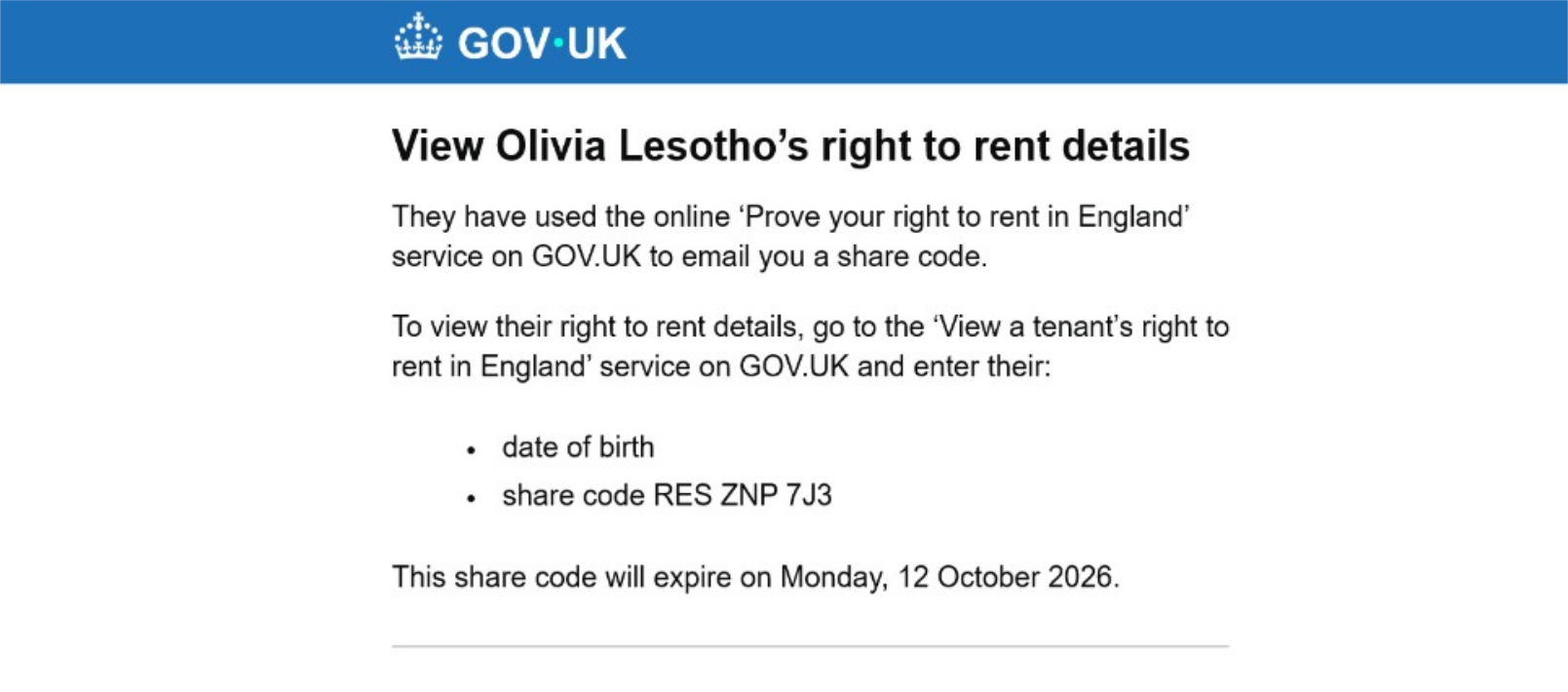
Enter the occupier’s right to rent share code and date of birth into the Home Office online right to rent checking service. The occupier may provide the share code directly to the landlord or choose to send it through the Home Office online service. Where the occupier sends the share code using the online service, the landlord will receive an email from righttorentservice@notifications.service.gov.uk. It is not sufficient to rely on information displayed to the occupier through the migrant-facing service or on printed copies of the service output. Landlords must access and view the Home Office online right to rent service directly.
Step 2: Check
To check the occupier’s right to rent details, you must access the Home Office online right to rent checking service ‘check a tenant’s right to rent in England: use their share cocde’ and enter the right to rent share code and the occupier’s date of birth.
When conducting a Home Office online right to rent check, including follow-up checks, landlords must:
| Requirement | What the landlord must do |
|---|---|
| Verify the occupier’s identity | Ensure that the photograph on the online right to rent check is of the occupier who is the subject of the check. This means the information provided by the check relates to the occupier, and they are not an imposter. This element of the check can be done in person, by video call or digitally using facial recognition technology by a RtR DVSP. |
| Use facial recognition only through a registered RtR DVSP | When facial recognition technology is used to complete this element of the check digitally, this must be carried out by a registered RtR DVSP. The RtR DVSP will provide a comparison verifying the facial image from the online right to rent check and the match to the occupier. |
| Consider poor-quality or incorrect images | If the image of the occupier on their digital profile is showing incorrectly or is of poor quality, advise the occupier to update the image on their account. Further information and support are available through UKVI. |
| Authorise occupation only where the check confirms a right to rent | Only authorise or continue to authorise occupation when conducting a follow-up check, if the online check confirms that the occupier has a right to rent in England. |
| Check whether a follow-up check is required | Where the online service confirms that the occupier has a time-limited right to rent, ensure that any follow-up check is conducted by the date specified. |
| Do not authorise occupation where the photograph does not match | Do not authorise occupation based on the check if it is reasonably apparent from the photograph that the occupier is not the person to whom the right to rent check relates. The landlord may be liable for a civil penalty if the occupier does not have the right to rent. |
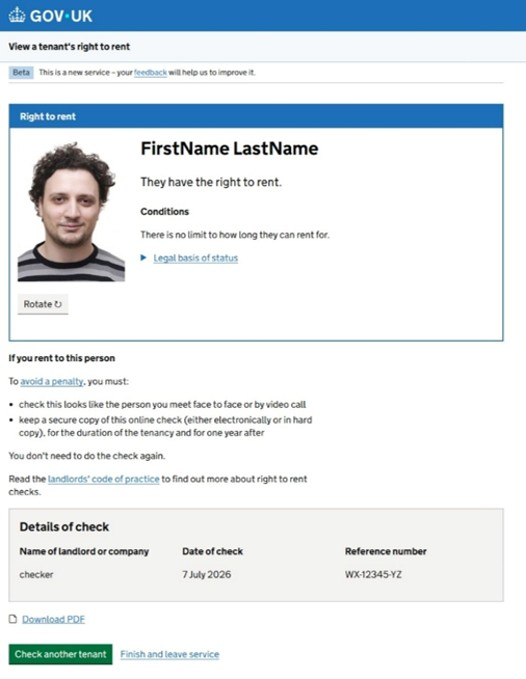
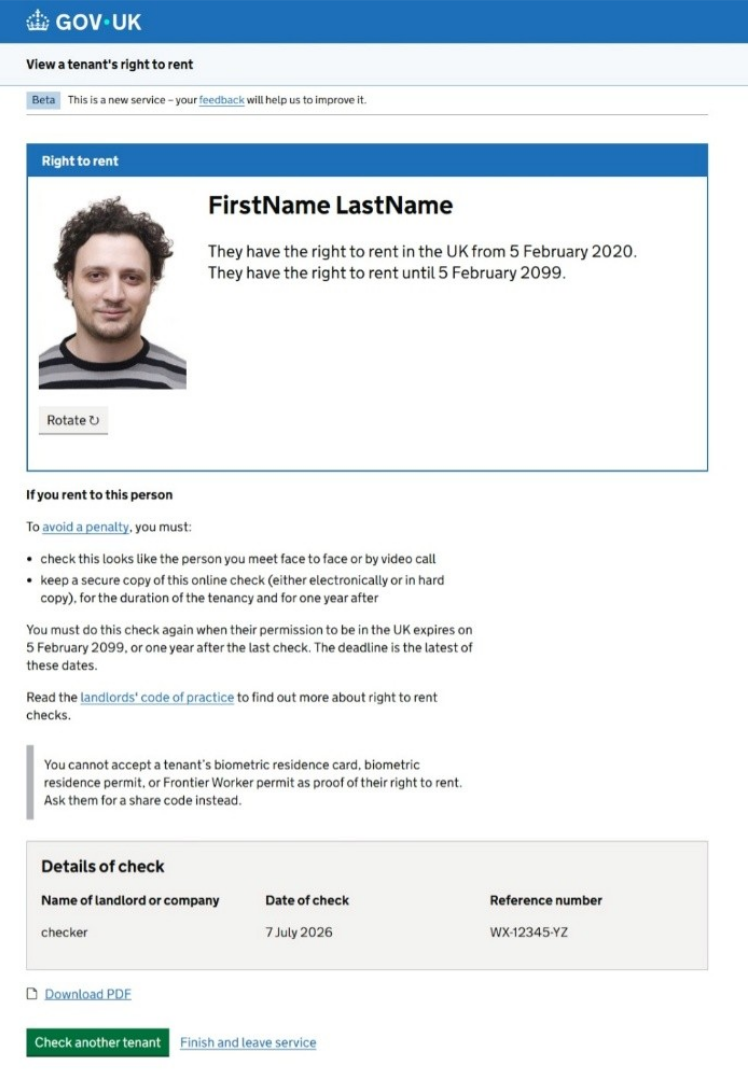
The Home Office online service will confirm whether the occupier has a continuous right to rent, in which case no follow-up check is required, or a time-limited right to rent, in which case the service will advise when a follow-up check must be carried out. Please see examples below:
Continuous right to rent output:
Time-limited right to rent output:
Step 3: Retain evidence of the online check
- Securely store (electronically or in hardcopy) a PDF or HTML copy of the profile page confirming the occupier’s right to rent. This will include the photograph and date on which the check was conducted.
- The copy should be retained for the duration of the tenancy agreement and for at least one year after the tenancy agreement comes to an end. The file or hard copy must then be securely destroyed.
- Landlords should also be able to produce this evidence quickly in the event that they are requested to demonstrate that they have carried out a right to rent check and established a statutory excuse.
- Landlords must repeat this process in respect of any follow-up check.
Conducting a right to rent check using a RtR DVSP
Landlords are able to use digital verification services to complete the digital identity verification element of right to rent checks. Digital identity verification, in this context, is the process of obtaining evidence of the prospective occupier’s identity, checking that it is valid and belongs to the person who is claiming it, where this verification takes place through digital means.
Whilst it is not mandatory to conduct right to rent checks digitally in this way, if a landlord chooses to do so, it is mandatory that the DVSP is registered on the Office for Digital Identities and Attributes (OfDIA) register, and that they are able to provide right to rent checks.[footnote 1]
A RtR DVSP is registered by OfDIA to confirm that the checks that they conduct follow the prescribed requirements for the Scheme. The RtR DVSP will provide written confirmation within the output from the check, that they are able to complete right to rent checks in accordance with the requirements. There may be different supplementary codes to which they are assessed. Transitional provisions of these codes will mean that the previous version of the code effectively still applies to the RtR DVSP and certificates issued under the old code remain valid.
Where a landlord uses a RtR DVSP, the landlord (and not the RtR DVSP) remains responsible for ensuring that the check is carried out in accordance with the prescribed requirements. Where those requirements have not been met, the landlord will not establish a statutory excuse and may be liable for a civil penalty if an occupier is found to be renting without the required permission. Landlords must therefore ensure that any checks carried out using a RtR DVSP comply with Home Office requirements.
If you procure an RtR DVSP’s service through another organisation which isn’t itself certified (for example, a referencing or screening agency), that organisation must clearly state that it is working with a certified and registered RtR DVSP and identify the service carrying out the check. This ensures that the landlord knows which certified and registered DVSP is being used. The certification, registration or trust-marked status of a RtR DVSP, or any other DVSP, must not be misrepresented.
What checks are RtR DVSPs permitted to do?
A RtR DVSP is able to carry out digital right to rent checks on holders of valid British or Irish passports (or Irish passport cards) (up to 6 months past the expiry date), verify acceptable documents from List A and List B of Annex A where they are available from the issuing authority in a digital format, and provide facial recognition technology to enable a landlord to confirm that a occupier is the same person the right to rent check was conducted on and is not an imposter. Services available by RtR DVSPs will vary across registered providers. A landlord’s chosen RtR DVSP will be able to advise which services and technology they can provide to support secure identity verification.
When an expired British or Irish passport (or Irish passport card) is presented to the RtR DVSP, they will be required to use passive authentication technology to access and verify the validity of the chip contained within the document. The RtR DVSP may choose not to offer services to verify these expired documents, and they will not be able to complete this check if the chip has been damaged or corrupted.
Landlords must not treat less favourably those who do not hold a valid passport, including one that expired within the previous six months[footnote 2] [footnote 3], or do not wish to prove their identity using a RtR DVSP. Where a person does not wish for the right to rent check to be carried out digitally, landlords should provide another way for them to prove their right to rent by carrying out a manual document-based right to rent check instead.
A landlord will have a continuous statutory excuse if both they and the RtR DVSP carry out the right to rent check as prescribed by the Home Office. The landlord must obtain evidence of the check from the RtR DVSP per Step 2: Obtain, below.
How to conduct a right to rent check using a RtR DVSP, including follow-up checks
You need to complete the following steps before a tenancy agreement is entered into in order to establish a statutory excuse.
Step 1: Locate
The landlord should choose a RtR DVSP permitted to conduct right to rent checks from the Office for Digital Identities and Attributes (OfDIA) register.
Step 2: Obtain
The landlord should receive a document from the RtR DVSP detailing the output of the check.
Step 3: Check
The landlord must satisfy themselves that the photograph and biographic details, for example date of birth, provided by the RtR DVSP are of the person who is the subject of the check, meaning the information provided by the check relates to the person and they are not an imposter. This can be done in person, by video call or using facial recognition technology provided by a registered RtR DVSP. Where facial recognition technology is used, the RtR DVSP will provide a comparison verifying the facial image from the document and the match to the person. Landlords must retain a secure copy of this comparison alongside a copy of the document checked.
Step 4: Retain
For each check, the landlord must obtain the following information to establish a statutory excuse and for audit and investigation purposes. They must retain a clear copy of the output of the check for the duration of the tenancy agreement and for at least one year after the tenancy agreement comes to an end. It should then be securely destroyed.
Information to be provided to the landlord by the RtR DVSP:
| Data field | Note |
|---|---|
| Given name(s) | |
| Middle name(s) | Only required if the user has a middle name(s). |
| Surname(s) | |
| Date of birth | |
| Image of the relevant RtR DVSP document | This must be an image of the full biometric page of the passport or, for an Irish passport card, an image of the front of the document in full. The holder’s name, date of birth, nationality, photo, and expiry date must be clearly visible. Where the document is in digital form from the authentic source; it must be the document in its entirety or that as displayed by that authentic source. |
| Photograph / image | An image of the prospective user. Landlords must verify that the image matches the passport or passport card, and the user. |
| Date of the identity check | |
| Evidence checked by | The name of the RtR DVSP, as it appears on their certificate. |
| Confirmation of RtR DVSP registration | The response must be “Yes” (or a clear equivalent, such as ‘Y’ or ‘true’) or ‘no’ (or equivalent, such as ‘N’ or ‘false’). |
| Confirmation RtR DVSP is conducting checks per the supplementary code for digital right to rent checks | The response must be “Yes” (or a clear equivalent, such as ‘Y’ or ‘true’) or ‘no’ (or equivalent, such as ‘N’ or ‘false’). |
| Link to DVS register entry | Link to the digital verification services register. They may also provide their trust mark details. |
| Identity verified | The response must be “Yes” (or a clear equivalent, such as ‘Y’ or ‘true’) or ‘no’ (or equivalent, such as ‘N’ or ‘false’). |
Landlords are encouraged to provide appropriate training and guidance to their staff, for example, on what information they must obtain from the RtR DVSP to confirm verification of identity, what the information can be used for, and the additional steps they must take to establish a statutory excuse.
Facial recognition checks through a RtR DVSP
Landlords may use digital facial recognition technology provided by a RtR DVSP to help confirm an occupier’s identity as part of right to rent checks by comparing the image on their document with an image taken by the RtR DVSP. This may make it quicker and easier to complete identity checks, particularly where occupiers are onboarded remotely.
Landlords are not mandated to use this technology. Landlords may carry out checks to confirm the individual’s identity in person.
If a landlord chooses to use facial recognition technology, they must use a RtR DVSP, as they are able to provide secure and reliable systems to complete the check. If the occupier is unable to complete the digital facial recognition check, the landlord should provide alternative ways for them to prove their identity as part of the right to rent check to avoid discrimination.
The RtR DVSP will provide the landlord with the following information which should be combined with the relevant record of the right to rent check. The landlord must retain a clear copy of this information for the duration of the tenancy agreement and for at least one year after the tenancy agreement comes to an end. It should then be securely destroyed.
Information to be provided to the landlord by the RtR DVSP
| Data field | Note |
|---|---|
| Image of document containing the facial image | This must be either a relevant RtR DVSP document, the image of the share code output, or a document containing a facial image from the acceptable documents lists A or B of Annex A. |
| Occupier’s facial image | The facial image of the occupier taken by the RtR DVSP. |
| Confirmation of RtR DVSP registration | The response must be “Yes” (or a clear equivalent, such as ‘Y’ or ‘true’) or ‘no’ (or equivalent, such as ‘N’ or ‘false’). |
| Confirmation RtR DVSP is conducting checks per the supplementary code for digital right to rent checks | The response must be “Yes” (or a clear equivalent, such as ‘Y’ or ‘true’) or ‘no’ (or equivalent, such as ‘N’ or ‘false’). |
| Date of check | |
| Evidence checked by | Name of the RtR DVSP as it appears on their certificate. |
| Link to DVS register entry | Link to the digital verification services register. They may also provide their trust mark details. |
| Confirmation of facial images | The response must be “Yes” (or a clear equivalent, such as ‘Y’ or ‘true’) or ‘no’ (or equivalent, such as ‘N’ or ‘false’). This must be confirmation that the facial image within the document and that of the occupier match. |
When to contact the Home Office Landlord Checking Service to verify right to rent
In certain circumstances, you may need to contact the Home Office Landlord Checking Service (LCS), using an online form to verify a person’s right to rent and establish a statutory excuse. These include:
1. The occupier has an outstanding application, administrative review or appeal with the Home Office which was made before their previous immigration permission expired.
2. The occupier has been issued with a Certificate of Application which states that a right to rent check must be obtained from the Landlord Checking Service.
3. The occupier is an asylum seeker or has an appeal pending against determination in respect of their asylum claim.
4. The occupier has been granted Permission to Rent by the Home Office.
5. The occupier is unable to use the Home Office online service because they cannot access their eVisa, or it contains an error which requires correction.
6. The occupier is from a Crown Dependency and has confirmed they have exercised control of their immigration status using a UKVI account, but their status cannot be verified using the Home Office online service.
7. You have been instructed elsewhere in this guidance to obtain confirmation of a person’s right to rent from the Landlord Checking Service.
You should delay entering into a tenancy agreement until you have received a response from the LCS. The LCS will respond to your request with a clear ‘yes’ or ‘no’ response within two working days. This will only be sent to you by the LCS and will contain a unique reference number. The information provided by the LCS will clearly set out whether a follow up check will be required, and if so, when.
If positive confirmation is received, by way of a Positive Right to Rent Notice (PRRN) (a ‘yes’ response) from the LCS, the statutory excuse will last for 12 months from the date specified. You will then need to make a further check before the expiry date.
If a ‘no’ response is received from the LCS, you will receive a Negative Right to Rent Notice (NRRN). This will inform you that the person does not have the right to rent, and if you rent to this person, you will not have a statutory excuse and may be liable for a civil penalty or be committing a criminal offence.
If in a follow up check, the LCS informs you that your occupier no longer has a right to rent, by way of a ‘no’ response, you must make a report to the Home Office in order to maintain a statutory excuse. If you do not do this, your statutory excuse will expire.
If the LCS has not considered the request within two working days, an automatic response will be sent to the landlord informing them that they can let their property to the prospective occupier. The statutory excuse will last for 12 months, at which time you will need to carry out a further check to maintain your statutory excuse. Any response from the Home Office LCS must be retained in order to maintain a statutory excuse against liability for a civil penalty.
Please note that the LCS is for the use of landlords and agents only.
4. Specific categories of occupiers and immigration status
Biometric Residence Permits
Biometric Residence Permits (BRPs) provided evidence of the holder’s immigration status in the UK. However, they ceased to be issued by the Home Office on 31 October 2024 as part of the move towards an immigration system which is more digital and streamlined. Physical immigration documents have now been replaced by eVisas. A manual check of an original, expired BRP is not acceptable proof of right to rent in England. In these circumstances, landlords will only establish a statutory excuse if they conduct an online right to rent check in accordance with this guidance.
Short validity vignettes
From 1 July 2026, visa vignettes are no longer issued as evidence of immigration permission.
Where an occupier needs to enter into a tenancy agreement before creating a UKVI account and accessing their eVisa, they may be able to evidence their right to rent using a short validity vignette contained in their passport, where one has been issued and remains valid. In these circumstances, landlords must carry out a manual right to rent check using the vignette.
Nationals of an EEA country, Australia, Canada, Japan, New Zealand, Singapore, South Korea or the USA who are visitors to the UK
Nationals of an EEA country, Australia, Canada, Japan, New Zealand, Singapore, South Korea, and the USA, who enter the UK as a visitor may use eGates, where available (including some juxtaposed ports) provided they hold a biometric passport. Those who do not hold a biometric passport will be processed by a Border Force Officer at the manned passport control point. In both cases, visitors will not normally receive a passport stamp. Those who are processed by an officer will be informed verbally of their permission to enter/remain and any associated conditions.
Individuals entering the UK under other immigration routes may be able to evidence their status using a UKVI account and eVisa. Visitors to the UK, including for short term study or business reasons are granted automatic Permission to Enter through the e-gates or granted leave to enter by a Border Force Officer for a maximum period of up to six months. As they will not usually receive a document to evidence their lawful status, these nationals may demonstrate a right to rent using their passport together with evidence of entry to the UK.
In some cases, a passport may be endorsed with a stamp showing the date of entry. Where a stamp is present, a landlord may carry out a right to rent check using the passport and endorsement alone.
Acceptable evidence of entry to the UK
Acceptable evidence may include, but is not restricted to, the following, provided it shows arrival in the UK within the last six months:
| Acceptable evidence of arrival | Requirement |
|---|---|
| Boarding pass or electronic boarding pass | Original or copy for air, rail or sea travel to the UK, establishing arrival in the UK in the last six months. |
| Airline, rail or boat ticket or e-ticket | Original or copy establishing arrival in the UK in the last six months. |
| Booking confirmation | Original or copy for air, rail or sea travel to the UK, establishing arrival in the UK in the last six months. |
| Other documentary evidence | Any other documentary evidence which establishes the date of arrival in the UK in the last six months. |
Under the Immigration Rules, upon arrival, non-visa nationals can be granted Permission to Enter the UK for up to six months from the date of their arrival. However, a different legislative framework governs the Scheme, purposely designed to minimise the frequency of checks a landlord needs to undertake. Where a right to rent check is conducted on the basis of the person’s evidence of arrival to the UK (as listed above), landlords will obtain a statutory excuse for 12 months. A follow‑up check must be carried out before the end of the 12‑month eligibility period if the person is still occupying the accommodation. However, there is nothing to prevent a landlord from conducting a follow-up check when an occupier’s right to rent expires, where a valid statutory excuse continues to remain in place.
How to conduct a right to rent check on visitors from these countries
Complete all three steps before occupation begins to establish a statutory excuse.
Step 1: Obtain
Passport and evidence of arrival.
Step 2: Check
Check documents and arrival date.
Step 3: Copy and retain
Copy evidence and record date.
Step 1: Obtain
You must:
* Establish that the person is a national of one of the countries listed above. * Obtain their passport. * Obtain evidence of their arrival in the UK within the last six months.
Step 2: Check
You must:
* Check the documents in the presence of the holder. This can be done in person or by live video link. * In either case, be in physical possession of the original documents. * Be satisfied that the documents are genuine and belong to the person presenting them. * Be satisfied that the photographs and biographic details are consistent. * Be satisfied that the evidence demonstrates arrival in the UK within the last six months.
Step 3: Copy and retain
* Make a clear copy of each document in a format which cannot be manually altered and retain it securely, either electronically or in hardcopy. * Keep a record of the date on which the check was carried out. This may be recorded as: “The date on which this right to rent check was made: [insert date]”. * Retain the evidence for the duration of the tenancy agreement and for at least one year after the tenancy agreement comes to an end. The records must then be securely destroyed.
Where a right to rent check has been conducted correctly, you will establish a statutory excuse for 12 months. A follow-up check must be carried out before the end of the 12-month eligibility period if the occupier continues to occupy the accommodation.
Visitors - Electronic Travel Authorisation (ETA)
An Electronic Travel Authorisation (ETA) permits a person to travel to the UK and, where entry is granted, remain for up to six months for tourism, visiting family and friends, business or short-term study. Further information on ETAs can be found on gov.uk at:
https://www.gov.uk/guidance/apply-for-an-electronic-travel-authorisation-eta
An ETA does not guarantee entry to the UK. Individuals must still seek permission to enter either through an ePassport gate (where eligible) or from a Border Force Officer. Where a person enters the UK through an ePassport gate, they may not receive a passport endorsement. Landlords should refer to “How to conduct a right to rent check on visitors from these countries” for information on establishing a right to rent in these circumstances. Where a person is required to see a Border Force Officer, they may be granted permission to enter for up to six months and receive an endorsement in their passport. In these circumstances, they may demonstrate a right to rent by presenting:
- a valid passport; and
- the passport endorsement confirming their permission to enter or stay in the UK.
Students
If you are letting accommodation to students in the private rented sector, you are required to conduct right to rent checks in the prescribed manner on all prospective occupiers, including British citizens, before the tenancy begins. The below sections set out a number of different scenarios you may come across when renting to students.
First time students from overseas
Students granted permission to enter the UK may be issued with an eVisa only. Where a student has access to an eVisa, you must carry out a right to rent check using the Home Office online service. Students can create a UKVI account before arriving in the UK and may have already done so as part of their visa application.
Details of how to do this are available at www.gov.uk/eVisa. They can use their UKVI account and eVisa to generate a share code to demonstrate their right to rent.
Where a student enters into a tenancy agreement before creating a UKVI account and accessing their eVisa, they may be able to evidence their right to rent using a short validity vignette in their passport, where one has been issued and remains valid. The vignette must be valid at the time of the check. This will provide a time-limited statutory excuse for 12 months.
It may be good practice to encourage a further right to rent check once the student has created their UKVI account, as this will provide a statutory excuse based on their digital immigration status for the duration of their immigration permission. The student must use the Home Office online service.
If there are any issues with account creation or access to a person’s digital status, they should contact UKVI. Where a person identifies errors with their eVisa, such as incorrect biographical details or validity dates, they can use the Report an error with your eVisa service.
Right to Rent checks when the student is overseas
In some cases, it may not be possible to check a student’s right to rent before a tenancy agreement is entered into, for example where the student lives overseas or is a returning student who is outside the UK before the start of a new academic year. In these circumstances, a tenancy may be agreed in principle before the student arrives in the UK. The right to rent check can then be carried out before occupation begins. The check may be undertaken on the day that the student moves into the accommodation.
Where a student has status under the EU Settlement Scheme or permission under the points-based immigration system, they must evidence their right to rent using the Home Office online service. The online check may be carried out by live video call while the student is overseas. For those with a time-limited right to rent, the right to rent check must be carried out no earlier than 28 calendar days before entering into the tenancy agreement.
Multiple occupancy student tenancies
Where accommodation is being let to multiple students, you must establish how many adults will occupy the property and carry out a right to rent check on each adult occupier. In some circumstances, occupiers may move into the property at different times. Where this occurs, you must carry out the right to rent check for each occupier before they take up occupation of the property.
Changes to Student Tenancy Agreements
Where a tenancy agreement has been agreed before students move into a property, and there are subsequent changes to the agreement which grant a right of occupation to one or more new adult occupiers, this is considered to be a varied tenancy.
For the purposes of the Scheme, a varied tenancy is treated as a new agreement. This means that right to rent checks must be carried out on all adult occupiers, including existing occupiers, regardless of nationality.
Visitors who are studying in the UK
Individuals accepted onto some short-term courses of study, of up to six months, may enter the UK as visitors. Where a visitor holds an eVisa, you should carry out a right to rent check using the Home Office online service. Where a visitor does not hold an eVisa, you should follow the relevant right to rent checking requirements for the immigration documentation presented.
For nationals of an EEA country, Australia, Canada, Japan, New Zealand, Singapore, South Korea and the USA who are visitors to the UK, please refer to the section “How to conduct a right to rent check on visitors from these countries”. You do not need to request information about the person’s course of study.
Members of visiting armed forces
Certain members of visiting armed forces deployed in the UK are not subject to immigration control. Some individuals may have an endorsement in their passport or travel document confirming that they are exempt from immigration control. In such cases, right to rent checks apply as normal and the document may be used to satisfy the check.
In some circumstances, a person may hold a digital record confirming their exemption from immigration control. Where this applies, they should use the relevant Home Office service to evidence their status. Other military personnel may travel to the UK using documentation which is not widely recognised and which, for security reasons, cannot be copied. In these circumstances, they may be unable to satisfy a right to rent check using the standard acceptable documents listed in Annex A.
If such a person wishes to occupy accommodation in the private rented sector as their only or main home, they may provide a letter from List A, Group 2, item 5, 6 or 7. You must retain the letter, or a copy of it, as evidence that the right to rent check has been carried out in the prescribed manner. For further information on exemptions from immigration control, see the GOV.UK guidance on Entering the UK: exemptions from immigration control.
Right to rent checks for EEA citizens
Following the UK’s exit from the EU, the Immigration and Social Security Coordination (EU Withdrawal) Act 2020 ended free movement law in the UK on 31 December 2020 at 23:00 (11pm) GMT. There followed a grace period of six-months during which relevant aspects of free movement law were saved to allow eligible EEA citizens and their family members resident in the UK by 31 December 2020 to apply to the EUSS. This period ended on 30 June 2021.
There is no requirement for a retrospective check to be undertaken on EEA citizens who entered into tenancy before 1 July 2021. Landlords and their agents will maintain a continuous statutory excuse if the initial checks were undertaken in line with legislation and published guidance that applied at the time the check was made.
Where retrospective checks are conducted, landlords and letting agents must do so in a non-discriminatory manner and in accordance with the Code of practice for landlords: avoiding unlawful discrimination when conducting right to rent checks in the private rented residential sector.
Irish citizens
Irish citizens have unrestricted access to rent in the UK. Eligible Irish citizens may choose to apply to the EU Settlement Scheme, and they can also apply for a frontier worker permit, which is a digital permit enabling them to prove their right to rent on GOV.UK.
EEA citizens granted status under the EU Settlement Scheme (EUSS)
Most EEA citizens prove their right to rent digitally. For holders of EUSS pre-settled or settled status, a check is required only before tenancy begins; no repeat checks are required. Where the initial check was conducted as prescribed and the landlord is not knowingly renting to an occupier without the right to rent, they will not be liable for payment of a civil penalty if the person is later found to be renting illegally.
Frontier Workers
Frontier workers are EEA citizens who live outside the UK but have a right to enter and rent in the UK under the relevant citizens’ rights agreements. Where a frontier worker holds a digital frontier worker permit, they should prove their right to rent in the prescribed manner. Where a frontier worker cannot provide a share code, or presents non-digital evidence, landlords must request a right to rent check from the Home Office Landlord Checking Service (LCS). in order to establish a statutory excuse. Further guidance can be found here: Frontier Worker Permit Scheme guidance.
Pending applications submitted to the EUSS
EEA citizens, and their family members, who have made a valid application to the EUSS have temporary protection of rights under the Withdrawal Agreement, the EEA EFTA Separation Agreement or the Swiss Citizens’ Rights Agreement, which gives them a right to rent until their application is finally determined. This includes pending the outcome of any administrative review or appeal against a decision to refuse status. They should have digital evidence and prove their right to rent in the prescribed manner to their landlord. Landlords and their agents should not treat those with an outstanding, valid application less favourably.
Certificate of Application (CoA)
A CoA is digital evidence that a person has made a valid application to the EUSS. This will enable them to prove their right to rent in the prescribed manner to their landlord until their application (and any appeal or administrative review) is finally determined. In these circumstances, there is no requirement for the landlord or letting agent to contact the Home Office Landlord Checking Service (LCS).
EUSS status granted and pending applications in a Crown Dependency
The Crown Dependencies (the Bailiwick of Jersey, the Bailiwick of Guernsey, and the Isle of Man) each operate their own equivalents of the EUSS for those eligible to apply. The UK and the Crown Dependencies recognise status granted under each other’s scheme. Where a person has been granted settled status, pre-settled status, or has a pending application under a Crown Dependency equivalent of the EUSS, they may be issued with a letter or email notification confirming their status or application.
In these circumstances, where a Crown Dependency letter or email is shared, landlords must also request a right to rent check from the Home Office Landlord Checking Service (LCS) retaining both documents below in order to establish a statutory excuse.
- A copy of the Crown dependency letter or email; and
- The response received from the LCS.
EEA citizens with Indefinite Leave to Enter or Remain
EEA citizens with Indefinite Leave to Enter or Remain (ILE/R) are not required to make an application to the EUSS but can do so if they wish. If they have digital evidence, they can prove their right to rent in the prescribed manner to their landlord in the same way as other individuals. In some circumstances, if the occupier does not have a digital status the landlord must carry out a manual right to rent check in accordance with guidance using documentation from the acceptable documents list (Annex A). Where a prescribed check is completed correctly and evidence is retained, the landlord or letting agent will establish a statutory excuse.
Where an EEA citizen believes they hold ILE/R but cannot provide documentary evidence, landlords and letting agents should encourage them to follow the following routes, as appropriate:
- apply to the Windrush Scheme to get proof of their ILE/R status.
- consider whether they are eligible to apply to the EU Settlement Scheme, where there are reasonable grounds for the delay in making their application.
- apply for ‘No time limit’ document, where applicable.
If they are from Malta or Cyprus, they may also be able to apply for British citizenship through the Windrush Scheme. Applications for either scheme are free of charge.
Family members of EEA citizens with EUSS status
Where they were resident in the UK before 11pm GMT on 31 December 2020, non-EEA family members of EEA citizens are required to make an application to the EUSS to continue living in the UK after 30 June 2021 but can apply after if they have reasonable grounds for their delay. Eligible family members (EEA and non-EEA) of EEA citizens with EUSS status (or persons of Northern Ireland, Irish citizens, those exempt from immigration control) can apply for an EUSS family permit from outside the UK, or directly to the EUSS, as a joining family member. EUSS family permits are valid for six months.
Family members of those EEA citizens can prove their right to rent digitally in the prescribed manner to their landlord.
Family members who wish to stay in the UK beyond the validity of their EUSS family permit should generally apply to the EUSS within 3 months of arriving in the UK, or before the expiry of their permit, whichever is later. During that period, they can rent in the UK. Where a joining family member makes a valid application to the EUSS, they will receive a CoA issued by the Home Office. They will be able to use their CoA to prove their right to rent in the prescribed manner to their landlord. Please see the section above which gives more details regarding CoAs. For more information, please see EU Settlement Scheme Family Permit guidance on GOV.UK.
5. When to conduct a follow-up check
A follow-up check is required where the initial right to rent check was established using:
| Initial evidence used | When does the statutory excuse expire? |
|---|---|
| List B document (Annex A) | At the end of eligibility period of the document specified, or as prescribed by the period of the statutory excuse. |
| Time-limited Home Office online check | At the expiry date specified by the online service, or as prescribed by the period of the statutory excuse. |
| Check on an eligible visitor (EEA, Australia, Canada, Japan, New Zealand, Singapore, South Korea or USA national) | 12 months after the date of the check. |
| Positive Right to Rent Notice (PRRN) issued by the Landlord Checking Service | 12 months after the date specified in the notice. |
This time-limited statutory excuse lasts either for:
- 12 months from the date of the right to rent check, or
- until expiry of the person’s permission to be in the UK, or
- until expiry of the validity of their immigration document(s) which evidences their right to be in the UK, whichever is later.
In order to maintain a statutory excuse, follow-up checks should be conducted before the time limited excuse expires and follow the same requirements as prescribed for the original check. You should ask the occupier for proof of their continued right to rent. The occupier can choose to evidence this either by providing the landlord with documents from List A or B as set out in the code of practice or by using the Home Office online checking service, if applicable. If the occupier is unable to produce their documents, you should contact the Landlord’s Checking Service.
If the occupier cannot produce evidence of their continued right to rent, you must make a report to the Home Office in order to maintain your statutory excuse, which will provide a defence against a civil penalty.
How to maintain a statutory excuse
Before the statutory excuse expires:
1. Ask the occupier to demonstrate their continued right to rent using:
- acceptable documents from List A or List B; or
- a share code for an online right to rent check, where applicable.
2. If the occupier is unable to provide evidence, contact the Landlord Checking Service.
3. If the occupier cannot demonstrate a continued right to rent, you must make a report to the Home Office to maintain your statutory excuse.
Important: Follow-up checks must be completed before the statutory excuse expires. Landlords should not assume that a follow-up check is required when an occupier’s immigration permission expires if a longer statutory excuse applies. However, there is nothing to prevent a landlord from conducting a follow-up check when an occupier’s right to rent expires, where a valid statutory excuse remains in place.
Making a report to the Home Office
When must I make a report?
You must make a report to the Home Office if:
- a follow-up check indicates that an occupier no longer has the right to rent; or
- an existing occupier is not cooperating with the right to rent checking process.
You must make the report as soon as reasonably practicable after becoming aware that the occupier no longer has the right to rent, or has become non-compliant, and before your existing time-limited statutory excuse expires.
What happens when I make a report?
- A report made in the prescribed manner will generate a unique reference number.
- You must retain this reference number as evidence of your continued statutory excuse.
- Copies of documents should not be submitted with the report.
However, all documents and evidence obtained during the right to rent checking process must be retained in accordance with this guidance.
Important
Making a report can only maintain a statutory excuse where a valid right to rent check was carried out correctly before occupation began. If you failed to carry out the initial right to rent check in the prescribed manner, you cannot establish a statutory excuse by making a report to the Home Office at a later date.
Retention requirements
All evidence relied upon to establish or maintain a statutory excuse must be retained securely for the duration of the tenancy agreement and for at least one year after the tenancy agreement comes to an end. The records must then be securely destroyed.
6. What happens if you rent to a disqualified person?
Breach
The Scheme is deemed to be breached if a landlord is letting to a person who is disqualified from letting private residential accommodation by virtue of their immigration status. Where a potential breach of the Scheme is identified, the evidence will be considered by the Home Office Civil Penalty Compliance Team (CPCT) which is responsible for considering potential breaches of the Scheme and determining liability for civil penalties.
Evidence of potential breaches may arise from a range of sources, including operational enforcement visits, information sharing across government, or other information indicating that a landlord may be renting to a disqualified person. Where a potential breach is identified through an enforcement visit the landlord may be served with a notice, which will inform them that they are being referred to CPCT for consideration of their liability for a civil penalty.
Information Request
The landlord will be sent an Information Request, providing an opportunity to supply further information or evidence of a statutory excuse. This information will be considered when determining liability for a civil penalty.
Decision
If the landlord is found liable for a civil penalty they will be issued with a Civil Penalty Notice. This Notice will include details of why the Home Office considers the landlord to be liable, the amount of the penalty, ways to pay, and information on how a landlord may object to the penalty and subsequently appeal. The Notice will be accompanied by a Statement of Case setting out the evidence and the reasons for the Home Office decision.
If a landlord is found not liable for a civil penalty, they will be issued with a No Action Notice which makes clear that no further action will be taken under the Scheme on this occasion and the case will be closed. This Notice will not be taken into account for the purposes of calculating penalty amounts in the event of any future breach of the Scheme.
Paying the penalty
The landlord must pay the civil penalty by the date specified in the Civil Penalty Notice or object to the Notice.
The Scheme operates a Fast Payment Option (FPO). The FPO reduces the amount of the civil penalty due by 30 per cent, if this payment is made within 21 days of the Civil Penalty Notice being given. The FPO is only available for landlords or their agents in receipt of their first penalty and cannot be paid in instalments.
A landlord may request to pay their civil penalty by instalments over an agreed period. In such cases, landlords or letting agents should provide full reasoning for their inability to pay the full penalty amount in one payment.
Objecting to the penalty
If the landlord receives a Civil Penalty Notice from the Home Office, they can object in writing within 28 calendar days of the due date specified in the Notice. Details of the reason for objecting must be supplied along with evidence supporting one or more of the acceptable grounds for objection as set out on the Objection Form.
A landlord may object on one or more of the following grounds:
- They are not liable to pay the penalty (this could mean they are not the landlord of the illegal renter(s) identified);
- They have a statutory excuse (this means they carried out a right to rent check as required); and/ or
- The level of penalty is too high (this means the Home Office have calculated the amount of penalty incorrectly).
The Home Office will send an Objection Outcome Notice if the penalty is to be cancelled, reduced or maintained. If the landlord objects to the penalty before the deadline specified in the Civil Penalty Notice, they will continue to be eligible for the Fast Payment Option.
If the landlord is still required to pay a penalty following objection, they will have 21 days to pay via the FPO (if applicable) and 28 days to pay in full, from the date specified in the Objection Outcome Notice. If the penalty is increased, a new Civil Penalty Notice will be sent. Each of these notices will include a Statement of Case. The Home Office will inform the landlord of the outcome of the objection within 28 days of receipt of the objection or by the date of any extension to the outcome as agreed with the landlord.
Appealing against the penalty
When a landlord’s objection against a civil penalty has been considered by the Home Office and it determines that they remain liable for a civil penalty, the landlord may then appeal to the County Court if they are not satisfied with the decision. The landlord must appeal to the Courts within 28 calendar days of either the date specified in the new Civil Penalty Notice, or the date specified on the Objection Outcome Notice. The deadline for appeal will be specified on the new notice.
A landlord should be aware that where an appeal is brought, the court may uphold the penalty, cancel it, or reduce the amount payable. If the landlord’s appeal does not succeed, the court may also order that they pay the reasonable costs or expenses of the Home Office in defending the appeal.
Where a landlord has lodged an objection and has not received a response within 28 days of the date on which the Home Office is deemed to have received the objection, the landlord may proceed to lodge an appeal.
Enforcement
If the landlord does not pay the civil penalty in full or by instalments, or object or appeal, by the specified due dates, the penalty will be registered with the civil court, after which enforcement action may be commenced immediately.
If a landlord is subject to immigration control and they are liable for a civil penalty, this will be recorded on Home Office systems and may be taken into account when considering any future immigration applications made to the Home Office.
Determining liability and calculating the penalty amount
When considering a landlord’s liability for a civil penalty, the Home Office will follow the framework set out below.
Stage 1: Does the landlord have a statutory excuse?
Where a landlord has been found to be renting accommodation to a person who is disqualified from renting by virtue of their immigration status, the Home Office will first determine whether the landlord has established a statutory excuse against payment of a civil penalty.
A landlord will have a statutory excuse where they have correctly carried out the prescribed right to rent checks before entering into the tenancy agreement, and where required, have correctly conducted any follow up checks and made any necessary reports to the Home Office.
Where an occupier has a time‑limited right to rent and a landlord has therefore established a time‑limited statutory excuse, the landlord must have conducted a follow up right to rent check in order to retain that statutory excuse.
It is the landlord’s responsibility to demonstrate that they have complied with the requirements to establish and, where necessary, retain a statutory excuse. A landlord will not have a statutory excuse if, for example:
- They cannot provide evidence that the prescribed right to rent checks were carried out before entering into a tenancy agreement.
- It was reasonably apparent that the person presenting the document was not the rightful holder (including where an imposter was identified).
- It was reasonably apparent that a document relied upon was false.
- They relied on a DVSP check where it was reasonably apparent that the result was incorrect or that the prescribed checking requirements had not been met.
- They relied on an online check which was not carried out using the official GOV.UK right to rent checking service.
- The right to rent check showed that the person did not have a right to rent in England; or
- The landlord’s time‑limited statutory excuse had expired.
If the landlord has a statutory excuse, they will not be liable for payment of a civil penalty. If the landlord has not established a statutory excuse, the Home Office will proceed to Stage 2.
Stage 2: Determining the level of breach
Is this a first or repeat breach?
The Home Office will consider whether the landlord has previously been in breach of the Scheme within the preceding three years.
- Where a landlord has previously been issued with a Civil Penalty Notice under the Scheme and has exhausted all objection and appeal rights, the breach will be treated as a repeat breach.
- Where the landlord has not previously been in breach within the last three years, the breach will be treated as a first breach.
The outcome of this stage determines the applicable penalty level.
Stage 3: Determining the civil penalty amount
The civil penalty amount is determined by reference to:
- whether the breach is a first or repeat breach, and
- whether the disqualified person is a lodger or an occupier.
| Type of occupier | First breach | Repeat breach within 3 years |
|---|---|---|
| Lodger | £5,000 | £10,000 |
| Occupier | £10,000 | £20,000 |
Faster Payment Option (FPO)
The Faster Payment Option (FPO) only applies to landlords who are liable for a first breach penalty within 3 years of either £5,000 or £10,000. It only applies where the landlord pays the civil penalty within 21 calendar days of the Civil Penalty Notice or Objection Outcome Notice being issued. It does not apply where the landlord is given permission by the Home Office’s Shared Service Centre to pay the civil penalty in instalments. Where the landlord qualifies for the FPO, the final penalty amount will be reduced from £5,000 to £3,500 per occupier (in the case of a lodger) or from £10,000 to £7,000 per occupier (in the case of an occupier). The 30% reduction will be off the final amount the landlord is liable for.
When to end a tenancy due to immigration status
After completing the prescribed follow-up requirements for each limited right occupier at the end of the eligibility period, it becomes apparent that an occupier no longer has a right to rent, you should notify the Secretary of State as soon as reasonably practicable. This means that you must make a report to the Home Office without delay on it first becoming apparent that the contravention has occurred. Making the report maintains your statutory excuse, so you are not required to end the tenancy, and you should retain copies of the relevant documents for future enquiries rather than submit them with the report.
Ending a tenancy: your options
The following options may be available to you to end a tenancy with a disqualified person:
- if multiple people live in the property and some are disqualified and others are not, you can agree with the disqualified person(s) that they will leave the property - if they are an occupier, you can consider reassigning the tenancy to one or more remaining non-disqualified occupiers.
- arrange the surrender of the tenancy by mutual agreement.
- rely on a Notice of Letting to a Disqualified Person to begin the process to recover vacant possession – the steps you should take depends on whether this names all occupiers or some of the occupiers.
- take other steps to recover vacant possession, depending on the kind of tenancy.
Request a Notice of Letting to a Disqualified Person (NLDP)
If you know or have reasonable cause to believe that you are renting to someone who is disqualified from renting, you may request an NLDP. If all occupiers are named on a Notice (or multiple Notices), the Notice may be relied upon to bring the tenancy to an end without a court order in certain circumstances.
Before issuing an NLDP, the Home Office will give the occupier an opportunity to demonstrate that they have a right to rent or are eligible for permission to rent. Where appropriate, an NLDP will be issued to the landlord.
An NLDP confirms that the Home Office considers the occupier to be disqualified from renting and may be relied upon when taking steps to recover possession. The Home Office will notify both the landlord and the occupier(s) named in the NLDP. Once you have acted on and NLDP, you must let the Home Office know when a disqualified person has left your property.
Option available to landlords
Where an NLDP names all occupiers of the property, landlords may:
- agree surrender of the tenancy.
- serve the Prescribe Notice and rely on the NLDP where permitted by law.
- take other lawful steps to recover possession.
Where an NLDP names only some occupiers, landlords may:
- agree that the disqualified occupier leaves voluntarily.
- reassign the tenancy to remaining occupiers where appropriate.
- agree surrender of the tenancy.
- Alternatively, you can take other steps to recover vacant possession. The action you take will depend on the type of tenancy you have. If you are considering ending a tenancy on immigration grounds, you may wish to seek independent legal advice. The action available will depend on the type of tenancy and individual circumstances.
7. Support for occupiers and landlords
UKVI Resolution Centre
This assists individuals who need help accessing or using their digital immigration status, including creating a UKVI account, recovering access to an account and updating personal details. The helpline is 0300 790 6268. They can also provide support where a person experiences issues accessing their digital status. Where a person identifies an eVisa error, such as incorrect biographical details or validity dates, they should use the Report an error with your eVisa service. If they cannot access their eVisa or need support with their UKVI account, they can contact https://www.gov.uk/contact-ukvi-inside-outside-uk.
Landlord Checking Service (LCS)
Landlords and letting agents can request a right to rent check from the LCS using the online form where this guidance requires verification by the Home Office. The LCS will provide a clear ‘yes’ or ‘no’ response within two working days, together with a unique reference number. The response will also confirm whether a follow-up check is required and, if so, when it must be carried out. The LCS is available only to landlords and letting agents and should not be used where a statutory excuse can be established through a prescribed document check or online right to rent check.
Notification of updates to the Right to Rent Scheme
Landlords and letting agents can sign up to receive updates about the Right to Rent Scheme on GOV.UK.
Windrush Help team
They can provide support and guidance to individuals who may be eligible under the Windrush Scheme, including vulnerable people and those who require additional assistance. If an occupier has been affected, they can contact the Windrush Help Team on 0800 678 1925.
Training
Training sessions on right to rent delivered by Immigration Enforcement are available for a small fee.
Guidance
Guidance on examining identity documents is available on GOV.UK. You may also wish to refer to:
If you are presented with a false document, or a genuine document belonging to another person, you should report this to the Home Office using the GOV.UK service to report immigration or border crime.
Annex A: List of acceptable documents for a manual right to rent check
Where a right to rent check has been conducted using the Home Office online service, the information is provided in real-time, directly from Home Office systems, and there is no requirement to see any or a combination of any of the documents listed below.
Examples of the documents, how to check them and how to copy them can be found in the Right to Rent Checks: A user guide for occupiers and landlords.
List A – acceptable documents to establish a continuous statutory excuse
If a prospective occupier can produce either one document from group 1 or two documents from group 2, then they will not require a follow-up check.
List A Group 1 – if a prospective occupier can produce one document from this group, then a continuous statutory excuse will be established, this can include the authoritatively digitally issued version (if any)
1. A passport [footnote 4] (current or expired) showing that the holder is a British citizen, or a citizen of the UK and Colonies having the ‘right of abode’ in the UK.
2. A passport or passport card (in either case, whether current or expired) showing that the holder is an Irish citizen.
3. A document issued by the Bailiwick of Jersey, the Bailiwick of Guernsey or the Isle of Man, which has been verified as valid by the Home Office Landlord Checking Service, showing that the holder has been granted unlimited leave to enter or remain under Appendix EU(J) to the Jersey Immigration Rules, Appendix EU to the Immigration (Bailiwick of Guernsey) Rules 2008 or Appendix EU to the Isle of Man Immigration Rules.
4. A passport or other travel document (in either case, whether current or expired) endorsed to show that the holder is exempt from immigration control, or is allowed to stay indefinitely in the UK, or has the right of abode in the UK, or has no time limit on their stay in the UK [footnote 5].
5. An immigration status document (current or expired) containing a photograph issued by the Home Office to the holder with an endorsement indicating that the person named in it is allowed to stay in the UK indefinitely or has no time limit on their stay in the UK. Further information on immigration status documents can be found at: Home Office issued documents (accessible) - GOV.UK (www.gov.uk).
6. A certificate of registration or naturalisation as a British citizen.
List A Group 2 – if a prospective occupier can produce any two documents from this group, then a continuous statutory excuse will be established, this can include the authoritatively digitally issued version (if any)
1. A birth certificate, long or short, issued in the UK [footnote 6].
2. An adoption certificate issued in the UK.
3. A birth certificate issued in the Channel Islands, the Isle of Man or Ireland.
4. An adoption certificate issued in the Channel Islands, the Isle of Man or Ireland.
5. A letter which:
a) is issued by a government department or local authority no longer than three months before the date on which it is presented.
b) is signed by a named official stating their name and professional address.
c) confirms the holder’s name.
d) confirm that the holder has accessed services from that department or authority or is otherwise known to that department or authority.
6. A letter which:
a) is issued no longer than three months before the date on which it is presented.
b) is signed by a British passport holder who is or has been a professional person or who is otherwise of good standing in their community confirms the holder’s name.
c) states how long the signatory has known the holder, such period being of at least three months’ duration, and in what capacity.
d) states the signatory’s name, address, profession, place of work and passport number.
7. A letter issued by a person who employs the holder no longer than three months before the date on which it is presented, which indicates the holder’s name and confirms their status as an employee and employee reference number or National Insurance number and states the employer’s name and business address.
8. A letter issued by a police force in the UK no longer than three months before the date on which it is presented, confirming that the holder has been the victim of a crime in which a document listed in List A (Group 1) belonging to the holder has been stolen and stating the crime reference number.
9. An identity card or document issued by one of His Majesty’s forces or the Secretary of State confirming that the holder is or has been a serving member in any of His Majesty’s forces.
10. A letter issued by His Majesty’s Prison Service, the Scottish Prison Service or the Northern Ireland Prison Service confirming that the holder has been released from the custody of that service no longer than six months before the date on which that letter is presented and confirming their name and date of birth.
11. A letter issued no longer than three months before the date on which it is presented by an officer of the National Offender Management Service in England and Wales, an officer of a local authority in Scotland who is a responsible officer for the purposes of the Criminal Procedure (Scotland) Act 1995 or an officer of the Probation Board for Northern Ireland confirming the holder’s name and date of birth and confirming that the holder is the subject of an order requiring supervision by that officer.
12. A current licence to drive a motor vehicle granted under Part 3 of the Road Traffic Act 1988 (to include the photocard license in respect of licenses issued on or after 1st July 1998) or Part 2 of the Road Traffic (Northern Ireland) Order 1981 (to include the photocard license).
13. A certificate issued no longer than three months before the date on which it is presented, by the Disclosure and Barring Service under Part V of the Police Act 1997, the Scottish Ministers under Part 2 of the Protection of Vulnerable Groups (Scotland) Act 2007 or the Secretary of State under Part V of the Police Act 1997 in relation to the holder.
14. A document, or a screen shot of an electronic document, issued no longer than three months before the date on which it is presented, by His Majesty’s Revenue and Customs, the Department of Work and Pensions, the Northern Ireland Department for Social Development or a local authority confirming that the holder is in receipt of a benefit listed in section 115(1) or (2) of the Immigration and Asylum Act 1999.
15. A letter which:
a) is issued no longer than three months before the date on which it is presented.
b) is issued by a public authority, voluntary organisation or charity in the course of a scheme operated to assist individuals to secure accommodation in the private rented sector in order to prevent or resolve homelessness.
c) confirms the holder’s name.
d) states the address of a prospective tenancy which the authority, organisation or charity is assisting the holder to obtain.
16. A letter which:
a) is issued by a further or higher education institution in the UK
b) confirms that the holder has been accepted on a current course of studies at that institution.
c) states the name of the institution and the name and duration of the course.
List B - acceptable documents to establish a time-limited statutory excuse, this can include the authoritatively digitally issued version (if any)
If a prospective occupier can produce one document from this group, then a time limited statutory excuse will be established. A follow-up check will be required within the timescales outlined in Eligibility Periods.
1. A current passport or travel document endorsed to show that the holder is allowed to stay in the UK for a ‘time-limited period’.
2. A current immigration status document issued by the Home Office to the holder, with a valid endorsement indicating that the holder has been granted limited leave to enter or remain in the UK.
3. A document issued by the Bailiwick of Jersey, or the Bailiwick of Guernsey or the Isle of Man, which has been verified as valid by the Landlord Checking Service, showing that the holder has been granted limited leave to enter or remain under Appendix EU(J) to the Jersey Immigration Rules, Appendix EU to the Immigration (Bailiwick of Guernsey) Rules 2008 or Appendix EU to the Isle of Man Immigration Rules.
4. A document issued by the Bailiwick of Jersey, the Bailiwick of Guernsey, or Isle of Man, showing that the holder has made an application for limited leave to enter or remain under Appendix EU(J) to the Jersey Immigration Rules or Appendix EU to the Immigration (Bailiwick of Guernsey) Rules 2008 or Appendix EU to the Isle of Man Immigration Rules (as the case may be), together with a Positive Right to Rent Notice issued by the Home Office Landlord Checking Service.
5. A document issued by the Home Office, confirming an application for leave to enter or remain, under Appendix EU to the immigration rules (known as the EU Settlement Scheme), made on or before 30 June 2021 together with a Positive Right to Rent Notice issued by the Home Office Landlord Checking Service.
6. A Certificate of Application (non-digital) issued by the Home Office showing that the holder has made an application for leave to enter or remain, under Appendix EU to the immigration rules (known as the EU Settlement Scheme), on or after 1 July 2021, together with a Positive Right to Rent Notice issued by the Home Office Landlord Checking Service.
7. A passport of a national of an EEA country, Australia, Canada, Japan, New Zealand, Singapore, South Korea or the USA who is a visitor to the UK together with evidence of travel to the UK that provides documentary evidence of the date of arrival in the UK in the preceding six months.
Annex B: Acceptable professional persons
- Accountant
- Airline Pilot
- Articled Clerk (Limited Company)
- Assurance Agent
- Bank/Building Society Official
- Barrister
- Chairman/Director of a Limited Company
- Chiropodist
- Civil Servant (Permanent)
- Commissioner for Oaths
- Councillor (Local or County)
- Dentist
- Director/Manager/Personnel Officer (VAT Registered Company)
- Engineer (Professional Qualifications)
- Financial Services Intermediary
- Fire Service Official
- Funeral Director
- Insurance Agent
- Journalist
- Justice of the Peace
- Legal Secretary
- Licensee of a Public House
- Local Government Officer
- Manager/Personnel Officer of a Limited Company
- Member of a Professional Body
- Member of Parliament
- Merchant Navy Officer
- Minister of a Recognised Religion
- Nurse (RGN or RMN)
- Officer of the Armed Services
- Optician
- Paralegal
- Person with Honours (e.g. OBE/MBE)
- General Practitioner
- Pharmacist
- Police Officer
- Post Office Official
- President/Secretary of a Recognised Organisation
- Professional Photographer
- Salvation Army Officer
- Social Worker
- Solicitor
- Surveyor
- Teacher/Lecturer
- Trade Union Officer
- Travel Agent (Qualified)
- Valuer or Auctioneer
- Warrant Officer or Chief Petty Officer
-
Where the document is an expired document, it must be verified through passive authentication. ↩
-
A clipped passport is a cancelled document (identified by the corners of certain pages in the passport being cut/removed) and therefore is not acceptable proof of right to rent. ↩
-
A clipped passport is a cancelled document (identified by the corners of certain pages in the passport being cut/removed) and therefore is not acceptable proof of right to work. ↩
-
Definition includes those with a document which shows that the holder is entitled to readmission to the UK (RUK endorsement)’ and ILR endorsements from a Crown Dependency. ↩
-
Definition includes a birth certificate issued by a UK diplomatic mission (British Embassy or British High Commission) and consular birth certificates. ↩