Every child achieving and thriving (HTML version)
Updated 27 April 2026
Applies to England

© Crown copyright 2026
This publication is licensed under the terms of the Open Government Licence v3.0 except where otherwise stated. To view this licence, visit nationalarchives.gov.uk/doc/open-government-licence/version/3 or write to the Information Policy Team, The National Archives, Kew, London TW9 4DU, or email: psi@nationalarchives.gov.uk.
Where we have identified any third party copyright information you will need to obtain permission from the copyright holders concerned.
This publication is available at https://www.gov.uk/government/publications/every-child-achieving-and-thriving/every-child-achieving-and-thriving-html-version
Corrections
- ‘We are further integrating our schools into child safeguarding with education as a strategic partner in multi-agency safeguarding arrangements and by including education in new multi-agency child protection teams.’ previously read ‘We are further integrating our schools into child safeguarding with education as the fourth safeguarding partner in new multiagency teams.’
- ‘We have also published analysis outlining how more than a decade of data from schools in England shows children with SEND in mainstream schools achieve half a grade higher, in English and maths GCSEs, than comparable children in special schools.’ previously read ‘We have also published analysis outlining how more than a decade of data from schools in England shows children with SEND in mainstream schools achieve half a grade higher, across each of English and maths GCSEs, than comparable children in special schools.’
Foreword
Childhood is changing and our education system must change with it. Children are growing up in a world that is evolving faster, with increased connectivity but also uncertainty, increased communication but growing mistrust. Our children’s horizons are wider, their ambitions greater and their determination to make the world a better place even stronger.
At the same time, pressures are arriving earlier, worries can feel bigger and children are struggling to articulate the instability many families face. The last government’s vision for education started and stopped at the school gates, from which the consequences have been clear: rising school absence, families left to fight for support for their children, disengagement rising, and families and communities not believing educational success is for them. Today, too many children and families have withdrawn, no longer believing that education is their route to a better life.
This government will build on the opportunities and respond to the challenges our children face. I am proud of the speed at which this government has moved to fix the foundations of our children’s lives and services. We’re rebuilding the services around schools that support families, with the foundation of Best Start, new youth clubs and free breakfast clubs. We are tackling child poverty with unprecedented ambition, expanding eligibility to free school meals (FSM) and bringing an end to the heinous injustice of the 2-child limit.
In school, we have recruited and retained thousands more teachers across our secondary and special schools. We have driven down persistent absence and invested in school environments that are built to support children with special educational needs and disabilities (SEND).
Now we look forwards: to take our education system into the 2030s and beyond.
This white paper is our plan to build a system that matches the ambition we have for our children, a system that works for the children neglected for too long, that stretches every child further, and sets them up to achieve and thrive.
Across the past 30 years, successive reforms have improved standards in our schools. Generations of children have benefitted from literacy and numeracy hour, from the phonics the last Labour government brought in, and from the professionalisation and spread of evidence-based teaching. We must build on that legacy and realise the opportunities of childhood today, recognising that our best schools are those where children achieve academically and thrive as people: 2 reinforcing halves of the same coin.
First, our approach to education must shift from narrow to broad. Past governments’ narrow focus on what happens only within the school gates will be replaced with a broad vision for childhood, from the day children are born to their transition to adulthood. Our ambition for high-quality education therefore starts in the early years, where the foundations of future success are laid.
Schools’ curricula must be rich and broad, building every child’s knowledge and their skills so our young people step into a world of change confident in their ability to shape it. Enrichment will be not just for those who can afford to pay, but a common entitlement for all. We will support schools’ roles as educators and anchors in our communities, because we know that education doesn’t begin and end with the school bell.
Next, we must take children let down under the last government from sidelined to included.
Children with SEND must be able to attend their local mainstream school and have their needs met by highly trained teachers, leaders and support staff, driving the highest standards for all.
We will not tolerate the blind eye that has been turned to the underperformance of white working-class children, and we will back aspirational school leaders to work in low-income communities, supported by strengthened school trusts rooted in their communities, learning from and developing each other. And children progressing well but capable of even more will be stretched and challenged to soar.
As we deliver these changes, our test will be the third shift: children and families who have withdrawn become engaged, believing in education once again. Children attending school every day and participating actively once there. Parents backing schools and taking an active role in supporting their children’s learning at home, believing again that their children’s success in school is their work and achievement too.
The young people let down most by the system we inherited have the most to gain from the uncompromising expectations I will bring. This white paper sets out a vision for education for the next decade, for a generation of children who will live into the next century.
The children in our classrooms today are the inventors, artists, creators, engineers, scientists, partners and parents of tomorrow. They will shape our country’s future – not just our economy, but our society. As they emerge from our schools, we need not just young people fit for the world of work, but engaged, responsible citizens ready to shape our country as we head towards the 22nd century. The road to national renewal runs through our schools.
That, of course, is a shared responsibility. It needs parents, schools and government, local authorities, healthcare, businesses, charities and communities to work together as one. Together, the pages of this white paper demand the collective creation of our common future. And now it’s up to all of us to answer the call.
The Rt Hon Bridget Phillipson MP
Secretary of State for Education
Executive summary
Our vision for childhood and for schools
The education and experiences that we provide to the children of today will shape the society of tomorrow. Our children are the citizens of our common future – the start of every success – and in them we see the curiosity, resilience and enterprise to succeed. As new waves of technological change transform our society and economy as never before, it is more important than ever that our nurseries, schools, trusts and colleges prepare the next generation to shape our world together.
It all begins with family.[footnote 1] Children can achieve and thrive throughout their lives, with the core memories of a happy and fulfilling childhood, and the support of a strong, stable, loving home. This is the experience we want for every child and why this ambitious white paper sits alongside our wider plan to rebuild our public services. This will support children and families at each stage and in every sphere of their lives, so that schools are not alone in working for the brighter future our young people deserve.
Our children have the strongest foundations when love and support at home is built on with stretching, enriching and inclusive school experiences. Great schools deliver this for every child. Teachers build children’s knowledge and skills, encouraging debate and discussion, which broadens young people’s horizons and challenges their ideas. They see children’s strengths and where they need extra support, recognising high standards and inclusion as 2 sides of the same coin. Staff put in place evidence-based strategies that enable children to attend, achieve and thrive at their local school. They deliver support and stretch for every child – from those currently struggling, to those doing well but capable of even more.
Schools are incredible agents for change: a universal public service that can reach every child and every family. Every school must be set up to match the ambition our children have to face into the world of change, uncertainty and opportunity that lies beyond the school gates.
Government must set the conditions that enable every family and every school to support children’s success: a partnership between all those with the responsibility to set our children up so they can achieve their ambitions and aspirations.
This white paper is not simply a vision of the change we want to bring to our schools, but a call to parents, schools, local services, and everyone working with children and young people to join us in building a future where every child can achieve and thrive.
The challenge we face
The past 3 decades have seen real progress in education, led by dedicated school leaders, teachers and support staff. We have built a new evidence base on what works to improve teaching and learning, from innovative changes such as the implementation of the Rose Review’s findings on phonics to establishing the evidence base on adaptive teaching to improve classroom practice. But the celebration of such successes must not lead us to the complacent belief that all is well.
As childhood has changed and children face both new pressures and new opportunities, education policy has struggled to keep up. Children in reception will go out into a world that is completely reshaped by artificial intelligence (AI) and technology. Young people have wider horizons than ever before, with more agency to find and access information. Yet they have found school does not always meet their horizons. We need to make sure they have strong foundations of knowledge and that they are active participants in their learning – debating, questioning, challenging and pursuing their own inquiry – set up for a lifetime of learning, not passive recipients of information.
In this world of change, children and young people need to feel a sense of belonging. Yet we have not prioritised this for our young people. Out of 27 European countries, the UK is last in how happy 15-year-olds are with their life.[footnote 2] We want to give children their childhood back. International studies such as the Programme for International Student Assessment (PISA) show us that high standards of attainment and belonging can go together: countries such as the Netherlands, Switzerland, South Korea and Japan perform strongly in both.[footnote 3],[footnote 4]
We must be every bit as demanding for our children. Yet despite the best efforts of dedicated staff, our school system is not serving all children well. Around one in five children are missing a day of school every fortnight.[footnote 5] The number of children saying they belong at school has declined.[footnote 6] Teacher and leader turnover is highest in schools with the highest proportion of disadvantaged pupils, where children could most benefit from stability.[footnote 7],[footnote 8] Disadvantaged children – especially white working-class children – and children with special educational needs and disabilities (SEND) are not succeeding as they should, with too many children not stretched to achieve all they can. Prior to the pandemic, in 2019, the primary school attainment gap widened for the first time since at least 2007, with researchers pointing to the failure to improve attainment for children living in the most persistent disadvantage.[footnote 9] Children’s outcomes are still – too often and too much – determined by background or circumstances, and this has led to a failure to close attainment gaps.
Figure 1: Pupil attainment by special educational needs (SEN) and disadvantaged status
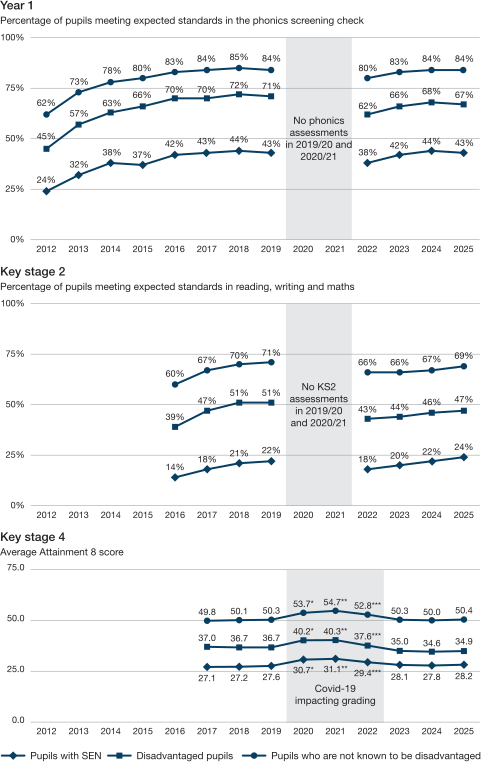
* Centre assessed grades ** Teacher assessed grades *** GCSE exams returned in 2022 and grades were awarded at a midpoint between 2021 and pre-pandemic grading
Source: DfE phonics screening check attainment data, KS2 attainment data, KS4 attainment data
Figure 2: Young people’s perceptions of the school environment, 2014 to 2022
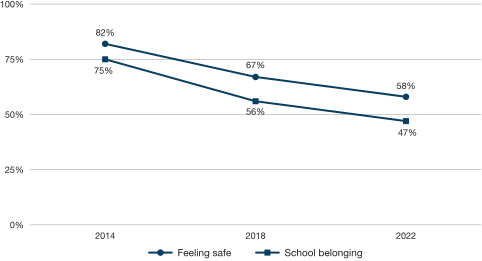
Source: Health Behaviour in School-aged Children (HBSC) England, 2023
Simply continuing the approach we have taken in the past will leave us with an education system that fails too many. That failure is seen in children who move from struggling at school to not attending or attaining, and go on to become part of the nearly one million young people not in education, employment or training (NEET).[footnote 10]
High-quality teaching must be at the heart of our school system. We must double down on evidence-based pedagogy on what works for all children and their learning. And we need to go further, building the evidence on what works for children’s engagement. It is a challenge to us to engage families in the power of education, and to support strong home-learning environments alongside schools which excite a love of learning and empower every child.
Too many children with SEND have been told they cannot thrive in mainstream schools, and that learning alongside their friends and neighbours is not for them. The principle that disabled people should be able to fully participate in our society if we remove the barriers they face risks slipping away from our education system. More children are being educated in specialist settings now than at any time in the last half century,[footnote 11] alongside more moving into unregistered alternative provision or home education attributed to unmet SEND needs.[footnote 12],[footnote 13],[footnote 14] For children, the level of support they receive is too often determined by how hard their families fight, or how much their families can spend.[footnote 15] It is clear that we must reset how we are equipping mainstream schools and the services that should wrap around them to enable all children to achieve and thrive in education, alongside securing high-quality specialist provision for children with complex needs who need a tailored educational experience.
We know that if we build an education system that enables the success of our most disadvantaged children, we will enable the success of all. The shifts set out in this white paper are built on strong foundations, learning from innovative leaders and teachers who have improved standards. This white paper shows that standards and inclusion together, working hand-in-hand, are how we can transform opportunities and outcomes to enable every child to achieve and thrive.
Our aspiration for every child
Transformative change for our country requires bold ambition for our children. Children born under this government will not see their life chances dictated by their background.
When this generation finishes secondary school, it is our ambition that:
- all children will be stretched to achieve higher standards. On average, across the system as a whole, children will leave school achieving a grade 5 or higher across their GCSEs. Every child will share in this improvement – from targeted support to help those furthest behind secure a pass to ensuring that children who are progressing but capable of more are stretched to achieve the very top grades
- the disadvantage gap will be halved. Children from low-income backgrounds will achieve around a full grade higher in each of their GCSEs than is the case today. This equates to over 1.3 million grade improvements across the cohort, and over 30,000 more disadvantaged children passing English and maths at grade 4 or above each year
The Office of Qualifications and Examinations Regulation (Ofqual) is responsible for maintaining standards and public confidence. It will continue to use a range of evidence to ensure that grades keep their value over time. Where evidence, including from the National Reference Tests, indicates that there is an increase in children’s attainment, that evidence will be appropriately reflected in the grading of qualifications. Any increase in grades must reflect genuine increases in attainment. Refer to the technical annex for more information on these targets.
Already, more than 300 mainstream, comprehensive schools across the country are meeting the key stage 4 attainment levels aligned with our national aspiration for every child. In these schools, children achieve a grade 5 or above on average across their GCSEs, with disadvantaged children achieving at the level needed to halve the national disadvantage gap even as overall standards rise. These are schools serving a broad range of communities, including schools with above‑average levels of disadvantage and higher proportions of children with an education, health and care plan (EHCP) or receiving special educational needs (SEN) support. These schools demonstrate what is achievable across the system. Our ambition is not to set uniform or unrealistic expectations, but to ensure that every child can leave school with the knowledge, skills and qualifications they need to progress, thrive and participate fully in society.
This aspiration will deliver the opportunities that prepare young people for adult life and equip them for further study and employment. It will reinforce 2 of our targets in the National Youth Strategy and Post-16 education and skills white paper:
- halving the gap in participation in enriching activities between disadvantaged young people and their peers by 2035
- two-thirds of young people participating in higher-level learning by the age of 25
Change is underway. By the end of this Parliament, we will already see the impact:
- early years: a record proportion of children starting school ready to learn – 75% of 5-year-olds reaching a good level of development in the early years foundation stage[footnote 16]
- key stage 1: 90% of children meeting the expected standard in the year 1 phonics screening check[footnote 17]
- key stage 2: outcomes will reach their highest level since current assessments began. This means around 25,000 more children leaving primary school with strong foundations for secondary, including over 10,000 disadvantaged children
- key stage 4: stronger progress for disadvantaged children and those starting secondary school below expected standards – a group that includes over three-quarters of children identified with SEND at the end of key stage 2[footnote 18]
- pupil belonging: more children – including those disadvantaged or with SEND – will feel a strong sense of belonging in school. Progress will be monitored through robust, ongoing national and international surveys. By 2029, we expect every school to monitor children’s sense of belonging and engagement, up from around 60% of schools today[footnote 19]
Across the system, this will be supported by key delivery commitments:
- teachers: 6,500 more expert teachers in secondary schools, special schools and further education (FE) colleges, targeted where need is greatest
- attendance: the attendance rate will rise by 1.3 percentage points compared to the 2023 to 2024 academic year, to over 94% – equivalent to children attending 20 million more days of school each year from the 2028 to 2029 academic year. This would be the fastest improvement in a decade[footnote 20] and our first step towards restoring attendance to pre-pandemic levels and beyond
- inclusive mainstream alongside high-quality specialist provision: schools equipped and funded to support children with SEND to achieve and thrive in inclusive mainstream settings, working together with high-quality specialist provision
- curriculum and enrichment: every child will benefit from a refreshed and broad national curriculum that secures knowledge and delivers key skills, alongside a wide range of enriching opportunities within and beyond the curriculum, delivered through a new enrichment entitlement
How we will deliver change
We are already making significant progress to improve children’s lives, at all ages, inside and outside school – across education, social care, health and youth services. We want to work alongside the profession to build on what is working, and bring searching expectations for where we can go further, spreading innovation and supporting schools to learn from one another.
Part 1: Setting every child up to succeed
Chapter 1: Our children’s futures Across government, we are rebuilding public services for our children, to support healthy, happy childhoods and enable every child to achieve and thrive. Our plans will wrap services around children and schools. Our schools are a truly universal public service that can touch the lives of every child and family. Services must be designed to work together, recognising and strengthening the anchor role that schools play in communities and working hand-in-hand with school staff to get support to children and families. Isolated services do not transform outcomes; we will design new collective accountability for our children within a community.
Chapter 2: Narrow to broad We are learners from birth and our ambitions for education must begin in the early years. By rebuilding family services, boosting quality in early years settings and building new relationships between early years providers and schools, more children will have a strong start. At school, all children should have a rich and broad experience. That means a curriculum that builds knowledge and skills; securing the highest standards in reading, writing, speaking and numeracy as the critical foundations, helping children to expand their knowledge, think critically, problem-solve and access the rest of their school curriculum. That means enrichment opportunities for all children, and strong transitions from early years, between schools and into further education, study and work. We will take a narrow experience for too many children and make it rich and broad by:
- delivering a curriculum that is knowledge-rich and broad, inclusive and innovative, taking forward the recommendations of our independent Curriculum and Assessment Review and building on them to ensure all children are supported and stretched
- improving the transitions through each phase of education, strengthening partnerships between nurseries and schools, and developing excellence in key stage 3
- providing an enrichment entitlement for every child, to ensure broad opportunities both within and beyond the curriculum
- encouraging breadth through our accountability system, with improved Progress 8, recognising the full range of young people’s achievements across subjects
- ensuring that children’s horizons are stretched and their opportunities broadened at every stage, by building on the strength of careers programmes and raising aspirations
Chapter 3: Sidelined to included Young people are ambitious for themselves and their futures. It is too often adults who expect less of young people because of their background, additional needs or the communities in which they are born. High standards and inclusion are 2 sides of the same coin, with our best schools combining challenge and care every day. This is particularly important for those whose needs are often sidelined by the wider system, including white working-class children, children with SEND, children with experience of the children’s social care system, and those progressing but capable of more.
We will move forward from a national debate about a system that marginalises children with SEND to an inclusive education system that delivers high standards for all. We will invest in equipping schools to become inclusive, with new digital plans that record additional needs, better training for teachers and quicker access to health professionals such as speech and language therapists. At the same time, we will retain EHCPs for children with the most complex needs, underpinned by new evidence-based Specialist Provision Packages that set out the kind of support children and young people will receive. This will end the postcode lottery, ensuring children get evidence-based support early and starting to restore families’ confidence in the system. Our consultation SEND reform: putting children and young people first is published alongside this white paper.
We will ensure that children who have been sidelined for too long by the system are included by:
- targeting deprivation funding and improving progress measures to boost outcomes for the most disadvantaged children, by increasing the impact of the pupil premium and national funding formula, and consulting on a new measure to better reflect progress of children starting secondary school behind their peers
- launching 2 place-focused missions – Mission North East and Mission Coastal – to transform outcomes for children and young people locally and provide a blueprint for national change. We will test a new model of bringing together schools with similar needs, and local community leaders to innovate together and tackle entrenched challenges in these areas
- delivering inclusive mainstream education, backed by an Inclusive Mainstream Fund of £1.6 billion over 3 years to ensure needs are identified early and met consistently, alongside a statutory duty on nurseries, schools and colleges to record and monitor SEN and provision in an Individual Support Plan (ISP)
- expanding access to multi-agency support in mainstream, creating a new £1.8 billion Experts at Hand service of speech and language therapists, educational psychologists and wider professionals to get support to children early, alongside new partnerships between special schools, alternative provision and mainstream settings to meet a wide range of needs confidently
- introducing new Specialist Provision Packages to set out nationally defined, evidence-based support for children with the most complex needs, forming the basis for future EHCPs, and ensuring families receive clearer, more consistent entitlements
- investing £3.7 billion from now until 2030 to make buildings accessible, create new special school places, and tens of thousands of new places in inclusion bases in mainstream settings. This investment will also deliver high-standard special and alternative provision places for children with complex needs
Chapter 4: Withdrawn to engaging Our best schools know that children achieve most when they feel safe and connected to their school environment. They show that high expectations for academic excellence and deep pupil engagement go hand-in-hand. They build relationships with parents and communities, working with health and local government services, to deliver calm, safe classrooms, with consistently high standards for behaviour and attendance, which minimise lost learning. We will move from children and communities withdrawing from school to engaging by:
- establishing a new pupil engagement framework, developed with input from children, parents and schools
- establishing minimum expectations for home-to-school partnerships, with clear communication expectations, tools for parents to support learning at home, and an improved complaints process
- supporting schools and wider services so that children attend 20 million more days per year by the 2028 to 2029 academic year versus the 2023 to 2024 academic year – the fastest rate of improvement in a decade
- equipping schools with the tools and guidance they need to improve behaviour, utilising our new attendance and behaviour hubs to spread best practice, and strengthening requirements for parents to engage with their child’s school
- introducing school profiles to give parents a rounded picture of their child’s education, presenting the latest useful information about schools together in one place
Part 2: Stronger foundations to deliver change
To achieve these shifts and deliver our vision for children, we will build stronger foundations. Across the more than 22,000 state schools in England, excellent practice that meets and delivers against these 3 shifts exists, as does the desire to innovate and learn how we can do better.
However, parents and schools too often report that such excellence is the result of an individual teacher or staff member going above and beyond in spite of the system, not because of it. Excellent individual practice can transform the outcomes of individual children. But it takes an excellent system – working with these teachers, leaders and support staff and empowering them – to transform the outcomes of communities and generations of children.
We are clear that a high-performing education system builds on and spreads good practice, invites innovation and embeds learning at every level. To drive forward these changes, we will align incentives with these ambitions. This means schools will be rewarded for supporting the progress of students who face the highest barriers to learning, and we will act swiftly where schools are struggling. We will back asks with investment – directly funding schools for inclusion, and supporting schools with training, productivity and digital innovation – and will put resources where need is highest.
We will equip staff across education with the knowledge and skills needed to deliver excellence. We will require collaboration between schools and wider public services to work together for children’s outcomes while ensuring the freedom for this to be driven locally. We will create space for genuine innovation in a self-improving system with the ability to test, learn and grow.
Chapter 5: Support and investment in high-quality staff We will work in partnership with school staff, building on work already underway, such as the new School Support Staff Negotiating Body that recognises the invaluable role of support staff, by:
- delivering 6,500 more expert teachers across our schools and colleges, with a clear delivery plan to achieve that
- funding schools to improve maternity pay for school teachers and leaders, doubling the period of full pay to 8 weeks, and seeking similar improvements for support staff and college staff
- giving teachers the training they need through a new and improved Teacher Training Entitlement, to ensure that every teacher and leader can access high-quality professional development, alongside more than £200 million over 3 years for our SEND continuing professional development (CPD) programme
- supporting excellence in leadership, including through a new mentoring and coaching offer for headteachers, and piloting a new place-based Headteacher Retention Incentive
- working in partnership with the profession, including through the Improving Education Together agreement with unions and employers, so that policy works in practice
Chapter 6: Collaboration between schools and with other partners The school system must be rooted in partnership and collaboration, so it can achieve higher standards, strengthen professional practice and deliver better outcomes for children. We will support schools to be anchors in their communities, collaborating with each other and across public services, by:
- putting collaboration at the heart of the system by moving to all schools being part of school trusts, including new trusts established by local authorities or area partnerships, which are rooted in their community and equipped to innovate for all children
- ensuring proportionate, independent inspection of trust quality and targeted intervention where it is needed
- setting out clear roles and responsibilities for local government in relation to all local schools and other partners, such as health, to deliver for children across the community
Chapter 7: Enabling innovation and ambition We will drive innovation and ambition through system-led improvement by:
- rolling out our new regional improvement for standards and excellence (RISE) universal and continuing targeted support programmes, so that all schools are encouraged to share and learn from best practice and, where needed, receive the appropriate support to drive high standards for all children
- realising the opportunities from data, AI and technology with safe tools that boost teaching and learning, underpinned by an extensive evidence programme and linked closely to curriculum delivery
- building a stronger, more nuanced accountability system that provides parents with a clear picture of schools and gives schools and trusts the insight they need to improve
We will also work with the sector to implement our reforms in a sequenced, phased and manageable way. The ask of the sector here is rightly ambitious for children. We will work with the sector to support effective delivery through:
- significant investment in the core schools budget and children and family services, including to support mainstream inclusion
- supporting schools with change, including working with the sector to assess what minimum lead-in time is reasonable for schools to prepare for different kinds of changes, creating a single, easy-to-use home for all school guidance and ensuring that all guidance is shorter, clearer and easier to use
-
carefully sequencing and phasing major reforms, with implementation in 3 phases that overlap:
- aligning to best practice from the 2025 to 2026 academic year
- preparing for SEND and curriculum reforms from the 2026 to 2027 academic year
- full implementation from the 2028 to 2029 academic year
We have a generational opportunity to deliver a school system that provides high standards and inclusion for every child, regardless of their background or need. Realising this vision will require all of us to work together in partnership to improve outcomes for all children.
Through this white paper, we set out the steps we will take to harness and spread existing best practice, as well as empowering everyone across the system to innovate together to improve outcomes. This is our open invitation: we want government, schools, families, and everyone with a stake in our children’s future working in genuine partnership, both at national level and in every community around the country. Together, with collaboration and determination, we can enable every child to achieve and thrive.
Part 1: Setting every child up to succeed
Chapter 1: Our children’s futures
Vision
Our vision is for all children to enjoy a childhood rich in opportunity – to learn, play and develop as individuals and to become empowered, confident citizens ready to shape our society’s future.
Delivering that ambition centres on schools as an anchor in children’s lives, yet stretches far beyond the school gates. It is an ambition that begins with family and the strong, stable and loving environments that help set our children up for life. It is an ambition that builds on working in partnership with our health service, ensuring that children and families can access services, from maternity and health visiting onward, that enable our children to thrive. It is an ambition that reaches into youth clubs, sports teams and community groups that shape how children learn to work together in teams and to communicate and respect one another.
Schools are the universal public service in children’s lives, but our school staff cannot deliver for children alone. To enable children to achieve in school, government must rebuild public services across our communities – education, local government, health and safeguarding partners – to actively support the healthy, happy childhoods that every parent wants for their child. We must equip these services to be adaptable and responsive to the changing patterns of children’s lives providing stability, love and support.
Above all, this is a national mission to celebrate and protect childhood, so that children can seize opportunities to achieve and thrive, grow with confidence and shape their own futures as well as the future of our society.
Case for change
Childhood is changing. Children and young people show great resourcefulness, curiosity and creativity as they navigate a world that is faster, louder and more complex than the one many adults experienced. They see opportunities and have broad ambitions for their futures in this changing world. Yet at the same time, the patterns and routines that shape young people’s lives are transforming more rapidly than the services designed to support them. Families are the anchors of children’s lives, the circle of love and support that guides young people through the ups and downs of life. But some families are struggling. Parents are searching for support, but too often services have been stripped away.
This is having a profound impact on our children. One in 4 children are arriving at school not fully toilet trained.[footnote 21] Higher screen use for young children has been linked to poorer language development.[footnote 22] Parents know they have responsibilities, but too often do not know where to look for support. Council spending on early intervention services, including children’s centres and family support, fell by 42% between 2010/11 and 2023/24, with the most deprived areas hit hardest.[footnote 23] One in 4 families with children under 5say that they have been unable to access local children’s centres or family hubs, rising to one in 3 among those on low incomes.[footnote 24]
As children grow up, there are fewer places in our communities for them to go and to spend time with friends. Between 2010 and 2023, more than 1,000 youth centres closed.[footnote 25] Young people associate a lack of opportunities in their communities and spaces to socialise with increasing online interactions.[footnote 26] More than a third of secondary-school pupils say they do not participate in any enrichment activities in school, and a similar proportion say they do not participate in any activities outside school.[footnote 27]
In a typical classroom of 30 children, there are around 10 growing up in poverty.[footnote 28] This permeates all aspects of children’s lives and education. Children on low incomes struggle to participate in all aspects of school life and report that they miss school because they do not have the right kit or are not able to pay to take part in activities.[footnote 29] Just one in 4 children in families with the lowest incomes get 5 good GCSEs including English and maths. For children in the families with the highest incomes, the figure is nearly 3 in 4.[footnote 30]
Challenges overlap and are often exacerbated for children in need, children looked after by local authorities, children on a child protection plan, and children facing multiple disadvantages compared with their peers, affecting not only their educational outcomes but also their physical and mental health, and their experience of childhood.[footnote 31],[footnote 32],[footnote 33] Young carers providing essential care and support to their loved ones often step up at the expense of their own childhood development and wellbeing.[footnote 34] We need to ensure there is early, consistent and co-ordinated support for them to thrive.
Amid this uncertainty, schools are a place of stability. They are a universal public service with an open door to every child and every family. Schools are an anchor, but they cannot be the only service accessible to families. Across communities, we need a network of services wrapping around schools, families and our children, so that every parent knows help is on hand, and all children can be supported to grow into the confident, capable citizens that will shape our country’s future.
This is a collective responsibility that requires collective accountability. Childhoods built on love and stability are those that enable learning and educational success.[footnote 35] This chapter outlines action taken across government to rebuild services, so they can provide joined up and timely support for children and families.
Wrapping services around children and families
Across the past year and a half, our first priority has been to fix the foundations of our public services across family support and education systems. Our ambition to rebuild services for children and families comes in 2 parts: first, to make services available and accessible to families and, second, to join up those services so that information can be shared between them to give children and young people consistent support that fits around their needs.
This requires coherent planning of services across a community and an understanding of the patterns of children and families lives in order to design around them. As a government, we are in the foothills of this challenge, but we are beginning to rebuild both the service infrastructure, and the systems of funding, commissioning and accountability that will enable this.
This will require schools, trusts, local authorities and health services to work together in ways that have become unfamiliar over the past decade. It will also look different in different parts of the country, reflecting not only the lives of families but also patterns of devolution and the maturity of strategic as well as local authorities.
Rebuilding local services
The building blocks of success are laid in the early years of a child’s life, as they begin to communicate, build relationships, play and learn. In these early years, parents need access to health, family support and education services working hand-in-hand. Our strategy, Giving every child the best start in life, sets out the building blocks of a new approach to supporting children and families from their first days of life. Best Start Family Hubs and the Healthy Babies programme, jointly funded by the Departments of Education and Health, will revitalise and build on the very best of Sure Start children’s centres. Hubs will provide a single point of access to healthcare services such as breastfeeding support or childhood vaccinations, alongside offering advice for parents on how to support learning at home, and stay-and-play services so children can start to interact with one another and parents can build local community networks.
We will go further by ensuring every Best Start family hub has a dedicated SEND practitioner, backed by over £200 million in investment over 3 years.
Trained SEND practitioners will help parents understand their child’s development, identify emerging needs sooner and support vital join-up between early years settings, health visitors and SEND teams. We know this works: evaluations of previous Sure Start family services found “overwhelmingly positive” impacts on outcomes such as educational attainment at school and reduced hospitalisations, and that children with access to Sure Start children’s centres were more likely to have their needs recognised at age 5 and less likely to require SEND support between ages 7 and 16.[footnote 36] Best Start Family Hubs will work with neighbourhood health services, set out in the NHS 10-Year Health Plan, to deliver this shift to prevention, making community healthcare more available and accessible.
This integration will flow through to nurseries and childminders providing early education and care services.
We will provide additional funding from our new Inclusive Early Years Fund to early years providers to identify and respond where children have emerging additional needs.
This will ensure that childcare is more available and accessible for children with SEND, preventing the current scenario where, too often, settings say they are not equipped to meet children’s needs. This will support early intervention and opportunities for children to learn to socialise and develop. We will also work with local authorities to strengthen their sufficiency-planning for children with SEND, giving parents greater confidence that their children can access the early education and childcare they are entitled to. More detail is set out in SEND reform: putting children and young people first.
Local authorities have a critical role to play in working with their local early years and childcare providers to shape a market that meets local sufficiency requirements and delivers high-quality education and care.
Through our Childcare and Early Education Review, we will look at how to improve access to early education and care, making the system simpler for families and delivering a coherent local offer.
This comes alongside our expansion of school-based nurseries, making high-quality childcare available and accessible, and the expansion to 30 hours of government-funded childcare, saving working families an estimated £7,500 a year.
Best Start Family Hubs will also be critical for integrating early family help services. We are expanding the Families First Partnership programme, which prioritises early intervention where families are experiencing challenges, breaking the cycle of late intervention to help keep families together wherever possible and safe to do so. We are transforming children’s social care with more than £2 billion of new investment since November 2024.
This does not stop when children reach school. Schools sit at the heart of children’s lives and school staff are often the first to see changes in children’s behaviour or wellbeing. Families First Partnerships will support school attendance – a key early indicator of need[footnote 37] – recognising that, when children’s home lives are in turmoil, attendance at school can drop and severe absence becomes all too common. Children’s mental health is also a significant barrier to school attendance.[footnote 38] By co-ordinating services across schools and the NHS, we’re expanding mental health support teams from 60% of schools today, to every school and college by the end of this Parliament.
We are further integrating our schools into child safeguarding with education as a strategic partner in multi-agency safeguarding arrangements and by including education in new multi-agency child protection teams. These teams will bring together the knowledge each service holds about a family to keep children safe and enable them to thrive.
We have been tackling children’s vulnerability to violence by partnering schools within a local authority area together with local education, safeguarding and police professionals as part of the SAFE (Support, Attend, Fulfil, Exceed) Taskforces programme being piloted in 10 serious violence hotspots. The lessons learnt will inform cross-government commitments on partnerships and school-based support in communities most affected by violence, including knife crime.
When children arrive at school, they must be ready to learn. Our Child Poverty Strategy will lift over half a million children out of poverty in the final year of this Parliament[footnote 39] by boosting family incomes, driving down essential costs and strengthening local services. We are removing the 2-child limit and supporting parents to work though tackling barriers to childcare access under Universal Credit and introducing free breakfast clubs in every primary school. Providing a supportive start to the school day for all primary-school children, no matter their circumstances, helps improve behaviour, attendance and attainment.[footnote 40]
Case study: Delivering free breakfast clubs for all children
At Devonshire Road Primary School, the free breakfast club is delivered by a variety of existing school staff including administrators, support staff, teaching assistants and a learning mentor. The special educational needs co-ordinator (SENCO) is also available on site to support when required. The school supports children with SEND by providing high-quality staff training and making appropriate adaptations for individual children where needed. The school has also ensured that the hall where the free club is delivered includes quiet spaces and regulation zones to support children.
A variety of activities are available to children during the free breakfast club including an activity zone for games, a creative zone for colouring and sticker art, a physical activity zone for table football as well as food activities available 3 times a week. The school reports a noticeable improvement on punctuality for the children attending the club, along with a positive impact on children’s readiness to start the day and attitude to learning.
Further school case studies on free breakfast clubs are available.
Beyond the school gates, we need spaces for children and young people to spend time with friends. Local authorities are receiving crucial investment for children’s play areas alongside funding flowing through Youth Matters, the first national youth strategy in more than 20 years, to create spaces for children and young people growing up in their communities. In addition, over £400 million will be spent on new and upgraded grassroots community sport facilities across the UK, which promote health and wellbeing. This funding will have a particular focus on providing access to sport for under-represented groups, such as women and girls, young people with SEND and those living in disadvantaged areas. New pathfinders – announced in the Education estates strategy – will pilot how surplus spaces in the education estate can be used flexibly to meet wider community needs, including youth facilities.
Local accountability for every child
Nurseries, schools and colleges are at the heart of children’s lives but need each of these other services, from social care, mental health and youth services to be working in tandem to deliver the best outcomes for all children across a community. That requires clear strategic planning and a stronger role for local authorities working with schools, healthcare and voluntary services.
It is only through collaboration between all the local services that touch on a child’s life that we can expect to deliver the improvements we want to see. However, for too long, partnership has been seen as optional rather than essential. While there are excellent models of joint working, driven by strong local leadership, there are no clear and well-defined expectations for how local authorities, schools and other services should work together, or the role each part of the system plays. Nor is there a consistent set of outcomes focused on the child as a whole, that could galvanise and unite local partners in delivery.
As we rebuild our public services, we must move from services operating in isolation, each with their own performance indicators and funding priorities, to services for children and families working together across a local system, jointly responsible for outcomes.
We will create a new model of local partnership and shared accountability for children’s outcomes across local communities.
Our aim is to enable the conditions that allow a sense of collective endeavour and responsibility: binding local government, schools and trusts, integrated care boards, the police and other local stakeholders around the aim of delivering shared outcomes for children and young people.
Chapter 2: Narrow to broad
Vision
Building on these firm foundations in our communities, our schools provide children with a rich and broad education that supports educational success, ignites curiosity and lays the foundations for a rich and fulfilling life and career. We want every school to join the best schools in being places that raise aspirations and standards for every child and young person – without exception. This means every school nurturing children’s talents and growing a love of learning that will carry them through school and set them up to seize the opportunities of the future. We want to prepare children to be skilled employees, but also citizens, artists, scientists, teachers, campaigners and parents.
To prepare children for the 2030s and beyond, each school’s curriculum must be rich in knowledge, broad in scope, inclusive and innovative. This begins with strong foundations through a broad early years curriculum. Excellence in maths and science will provide the problem-solvers of tomorrow. A love of reading and the deep knowledge that it unlocks will help children navigate an uncertain world, where fiction is too often dressed up as fact. A mastery of listening, speaking and writing will help them express their thoughts, present their ideas and find their voice. Our schools will teach young people to think critically and to draw on their store of knowledge to question the information now readily at their fingertips.
Enrichment, which has for too long been the privilege of a few, must now become part of a common entitlement. A strong enrichment offer and revitalised arts curriculum will spark children’s creativity. Access to sports, culture and nature will expand their horizons. Civic engagement will stretch their abilities beyond the classroom. Those who have been trapped in a cycle of poor outcomes and disengagement – often white working-class children, children with SEND, the children who are progressing but capable of more – have the most to gain from an ambitious, future-focused curriculum.
Case for change
All children need strong foundations in English and maths – both for their own sakes and because they are essential for accessing the rest of their school curriculum. Reading expands young people’s imagination and exposes them to new ideas and challenging perspectives; oral language interventions lead to significant improvements in student outcomes.[footnote 41] Children with a strong foundation in maths are more likely to achieve across the curriculum.[footnote 42],[footnote 43] Raising standards in oracy, reading, writing and maths is fundamental to supporting our cross-government mission on growth.
While many children are attaining well in these subjects, far too many children leave primary school without reaching expected standards in these fundamental areas. At least a quarter of children did not meet the expected standard in reading in each of the last ten years,[footnote 44] and at least a fifth did not achieve the expected standard in maths over the same period.[footnote 45] Children with SEND,[footnote 46] disadvantaged children[footnote 47] and children from white working-class backgrounds[footnote 48] are all less likely to meet these critical standards at the end of primary.
At secondary, the Curriculum and Assessment Review found that English Baccalaureate (EBacc) measures were unnecessarily constraining subject choice for some students and, consequently, were affecting students’ engagement and achievement. It is essential that all children retain a strong academic core, but we believe the current structure has hampered progress in subjects that strengthen our economy and society, including the arts subjects. We need to ensure breadth is recognised in our accountability system with an improved Progress 8 model.
There is also wide variation in access to enrichment opportunities that expand horizons, raise aspirations, and engage children: both in and outside school. Studies have shown that extracurricular enrichment participation is associated with higher educational achievement.[footnote 49],[footnote 50],[footnote 51] But more than a third of secondary school pupils say they do not participate in any enrichment activities in school, and a similar proportion say they do not participate in any activities outside school,[footnote 52] with lower participation for children whose parents did not attend university,[footnote 53] children in need,[footnote 54] and those eligible for FSM.[footnote 55],[footnote 56] In addition, children with SEND are less likely to be involved in extracurricular sports and physical activities.[footnote 57],[footnote 58]
Starting the school journey right
Children’s early years are the critical foundation to lifelong learning. For far too long, the early years have been regarded as lower in status – treated as an optional add-on rather than an integral part of the education system. We will tackle this narrow conception of children’s learning and educational experience. As set out in Giving every child the best start in life and in the previous chapter, we will rebuild early family services so parents are supported with children’s early development, especially communication, through our new Best Start Family Hubs.
Our changes will ensure that more children are arriving into reception and transitioning into key stage 1 with strong foundations. A child starting school is an exciting but unknown step for families, especially for families of children with additional needs. We want to strengthen the relationship between early years settings and schools to support transitions.
We will fund partnerships between early years settings and schools, using this model to test and implement different approaches to transitions, including for children with SEND.
These partnerships will allow staff in schools and early years settings to spend time learning from each other and sharing knowledge, expertise and best practice – so that staff can confidently meet the needs of all children. This will include developing shared resources and systems to help with early identification of needs and support, as well as shared pedagogy and curriculum, to ensure consistency of learning approaches. They will also help parents and children build relationships with schools, so children feel at home in the classroom when they transition to school.
We will publish and share best practice for schools, from schools that effectively support children into reception.
This will showcase effective practice from primary schools across the country, including how schools use home visits. This will complement a wide range of other initiatives to boost quality in the reception year, including the creation of new Reception Networks, new training for reception classroom teachers, and continued funding for the Nuffield Early Language Intervention (NELI) programme in reception.
Our ambition is for every child in reception to feel supported, confident, and ready to start school. We will measure our progress through a record 75% of children reaching a good level of development at the end of reception by 2028. We have already delivered training on reception-year quality and created a new ‘Compare your Good Level of Development (GLD) data’ report, which is available to schools, trusts and local authorities. We also want schools to achieve more for children from the start of primary. We have set an ambition for 90% of children to meet the expected standard in the phonics screening check by the end of year 1.
Our RISE universal offer of support will help support these ambitions – driving collaboration and sharing of best practice between schools – as part of a self-improving system (see Chapter 7: Enabling innovation and ambition).
We will be launching new RISE Reception Networks to spread best practice and encourage strong partnership working between schools.
Case study: Strengthening transitions into reception for children with SEND
Over the past few years, leaders at Front Lawn Primary Academy have focused on building trust with families and joint working with early years settings to support transitions into reception. The SENCO and early years foundation stage (EYFS) lead visit all feeder early years settings to observe children and collect detailed information on communication, sensory needs, toileting, sleep routines and regulation strategies. Feeder nurseries receive book bags and school jumpers for role-play areas, helping children with communication or sensory challenges become familiar with routines and school identity.
Transition events are informal, enabling families to meet the SENCO, school nurse, pastoral team and teaching staff on a one-to-one basis. Events such as teddy bears’ picnics provide low-pressure opportunities for children to explore the environment. Reception staff conduct structured home visits to understand each child’s context, build trust with families, and agree on early SEND support plans where applicable.
This approach ensures early support before a child’s entry into reception, helping the school identify children’s needs promptly. By addressing emerging issues early, children’s development is supported, and potential concerns can be effectively managed without the need for escalation. Families report feeling informed and supported.
A rich and broad, inclusive and innovative curriculum
All children should experience a curriculum that is knowledge-rich, broad, inclusive and innovative. The national curriculum should raise the floor for all without adding any limit to ambition or achievement. That is why, in July 2024, the Secretary of State commissioned Professor Becky Francis CBE to undertake a holistic and expert-led review of the curriculum, assessment and qualification system.
The Review reflected the evidence that a curriculum that is rich in knowledge and skills[footnote 59] can promote equality by giving everyone access to the same cultural references and give all children what they need to engage with the changing world around them. It reflects the cognitive science which shows that higher-order thinking skills cannot be built without the powerful knowledge that is their raw material.
Government responded to the report in November 2025 and confirmed how we intend to take forward the reforms to create a world-leading curriculum that raises standards and aspirations for all children. We also committed to develop evidence-led resources to support curriculum adaptation for all children and young people, including those with SEND.
To be set up for the changing world, children need access to a world-class curriculum and world-class teaching, and to be active participants in their learning. This includes making effective use of evidence on metacognition to help them take responsibility and secure agency over their learning. Metacognition enables learners to transfer knowledge across subjects and develop the capacity to become independent, self-improving lifelong learners.
Our response to the Curriculum and Assessment Review also included our measures to support children to adapt to this fast-changing world, where information is so readily available to them. We want every child to leave school able to critically engage with and challenge the information they encounter throughout their work and life.
Arming young people with secure and well-founded knowledge is central to media literacy, and making citizenship compulsory in primary schools will introduce key content to children earlier, such as law and rights. Cognitive skills to critically analyse, challenge claims, and assess sources and methods are an important part of subjects such as history, English and science, and we will strengthen these skills. In English, we will ensure children study a wide range of texts, including transient texts, so they can understand how arguments are constructed through different types of media and the various ways in which language can be used to persuade.
This is against the backdrop of wider changes in how advanced technologies are being used across the sector, as part of the wider toolkit that all teachers can use to support teaching and learning. It is vital that children are supported to become digitally literate and to be confident users of technology. This should be done safely and in ways that support, rather than replace their own cognitive effort. See Chapter 7: Enabling innovation and ambition for more information.
The Curriculum and Assessment Review
We have responded to the Curriculum and Assessment Review, committing to take forward its recommendations, including:
- refreshing the programmes of study in line with the Review’s recommendations for first teaching from 2028. We will also update GCSEs for first teaching from 2029 onwards. In doing so, we will follow the curriculum principles of knowledge-rich, coherence, subject mastery, specificity and depth, ensuring programmes of study and subject content are grounded in relevant and important knowledge and disciplinary skills
- creating a fully digital and easily navigable version of the national curriculum
- developing evidence-led resources to support teachers in adapting the curriculum for all children and young people, including those with SEND
- preparing children and young people for life and careers in a changing world through embedding oracy, financial, digital and media literacy in the curriculum and improving climate and sustainability education
- improving the assessment of writing at key stage 2 with greater focus on fluent writing and introducing a new statutory national assessment of reading fluency and comprehension in year 8
- consulting on Progress 8 options to ensure that pupils can access a strong academic core and a breadth of subjects at key stage 4
Excellence in literacy and numeracy
Phonics and reading
The ability to read well is the key that unlocks every subject, allowing children to access the whole school curriculum. It broadens children’s imaginations, exposes them to new ideas and challenging perspectives, and fosters creativity. That is why we have made 2026 our National Year of Reading.
We are already raising standards in reading by embedding the changes set out in our response to the Curriculum and Assessment Review. And we are going further, doubling the reach of our Reading Ambition for All CPD programme and training more teachers to support children’s reading fluency. We have announced a new statutory reading test for year 8.
In addition to these commitments, our new ‘Unlocking Reading’ CPD for secondary schools launched in January 2026. This will equip schools with assessment tools and evidence-based strategies to support children through both mainstream teaching and targeted interventions. At least 75% of secondary-school literacy leads will have access to this new reading training by the end of the 2025 to 2026 academic year. This will ensure all children can develop a lifelong love of reading.
RISE teams also play an important role in mobilising and spreading best practice both regionally and locally. They are already working in partnership with English hubs, supporting schools to engage in hub support and designing support plans for these schools.
We will go further by deepening the partnership between English hubs and RISE as a core part of our universal RISE offer to schools. This will increase the visibility of RISE English Hubs and use existing hub programmes to provide high-quality support for schools that need it most.
Case study: A strong culture of reading
Learning to read and reading to learn is the golden thread at Beech Grove Primary School, where they seek to create lifelong readers using a whole-school approach that focuses on fluency, confidence and reading for pleasure.
At the foundation stage and in key stage 1, children learn phonics in ability groups and progress is monitored so that children move between groups as skills develop. The school provides targeted interventions to support children who are struggling and uses tailored tutoring sessions to practice specific sounds and key skills. At key stage 2, children have different opportunities to develop their reading skills through whole-class reading, small-group reading and daily story time. The school uses a broad range of stories to motivate and inspire children to practice their reading skills.
Beech Grove has created a staff leadership role to promote reading for pleasure, supporting teachers to attend and lead teacher research groups. Staff across the school have a comprehensive knowledge of children’s authors, using this to engage children with books pitched to their ability and interests.
At Beech Grove, where nearly three quarters of children have been eligible for FSM in the past 6 years, 81% of children meet the expected standard in reading, writing and maths, above the national average of 62%. Disadvantaged children also perform well, with 76% meeting the expected standard compared to 47% nationally.
Speaking, listening and writing
We want speaking to be recognised as a core foundation of education, alongside reading, writing and numeracy. Strong speaking skills are essential for building children’s communication, helping them develop fluency and the confidence to negotiate, debate and discuss ideas. These abilities are critical not only for their future careers, but also for their mental health and their capacity to build meaningful connections with others.
Building on the EYFS statutory framework on communication and language, we committed to specifying more on speaking and listening throughout the national curriculum key stages. We also committed to create a new oracy framework to support primary teachers to help their children become confident, fluent speakers by the end of key stage 2. Through the development of the oracy framework, we will provide teachers with evidence-based guidance on how to formatively assess and support children’s oracy.
Good writing is essential, not just for allowing children to express themselves, but for scaffolding and supporting complex thought. We will continue to support schools in implementing our recently published writing framework. It marks the beginning of our longer-term plan to help teachers to support all children to become confident and fluent writers who can share their ideas and find their voice in the classroom and beyond. We have also set out our expectations for all schools to assess pupil progress in writing in year 8 and will signpost them to a range of high-quality products to help them do so. At secondary level, we will publish a combined secondary oracy, reading and writing framework to support teachers to connect and use all 3 in their teaching, and to embed literacy and oracy across the curriculum.
Case study: Embedding oracy within the classroom
Woodhall Primary School in Suffolk has established a whole-school approach to teaching oracy within school. Oracy is fundamental to all teaching and learning at the school. This approach provides children with opportunity to develop their communication skills.
Oracy is woven into the curriculum at Woodhall. The school uses different techniques, including sentence stems, talk tactics, collaborative problem solving and debates. Oracy is treated as a key skill on the same level as literacy and numeracy.
The school provides children with different opportunities to develop their oracy skills. This includes children becoming oracy ambassadors, taking part in listening walks to evaluate each other’s oracy skills and Talk Tuesday, where sessions are structured to enable children to explore oracy in practice. The school also supports its staff through high-quality training and resources that can be utilised within the classroom.
Children at the school perform above the national average for reading, writing and maths, with 78% of children meeting the expected standard, including 67% of disadvantaged children.
Maths
We will embed changes recommended through the Curriculum and Assessment Review, including resequencing the curriculum to deepen understanding for all children and promoting maths assessment in year 8. In addition, our RISE teams are working in partnership with maths hubs by designing plans for schools which make the best use of hub support.
We will go further by deepening the partnership between maths hubs and RISE as a core part of our universal RISE offer. This will increase the visibility of RISE maths hubs and use existing hub teacher development programmes to provide high-quality support for schools that need it most. We will strengthen and extend RISE maths hubs programmes in reception, boosting early numeracy.
Building on its aims to increase participation and improve teaching of level 3 maths, we have reformed the Advanced Maths Support Programme through the introduction of new programmes to stretch, inspire and support more children to achieve in maths. This includes our new Higher Level Maths Achievement Programme. A new pilot programme is also supporting teachers and children to understand the value and role of maths and statistics in machine-learning and AI.
Case study: Excellence in teaching maths
Plashet, City of London Academy, a girls’ school in East Ham, serves a highly diverse community, with nearly half eligible for FSM in the past 6 years. Supported by London North East Maths Hub, its maths department has built a shared approach that strengthens understanding, confidence and enjoyment of maths across the school. Its improvement plan centres on teaching for mastery, with weekly meetings focused on representations, questioning, and sequencing, allowing teachers to reflect and refine practice to ensure a coherent journey from year 7 to GCSE.
As almost three-quarters of students learn English as an additional language, the school has a strong focus on oracy and the use of precise mathematical language, so children can learn through discussion. The school reports that children now think more deeply and can explain their reasoning, and more girls are choosing STEM subjects post-16. The school’s Attainment 8 score of 56.4 is higher than the national average of 46.0, and its maths Attainment 8 score of 10.5 is above the national average of 9.1. The maths department recently won the PTI Bernice McCabe Award for 2025 to 2026 for excellence in leadership and teaching.
16 to 19 English and maths
It is crucial for learners to achieve the best possible levels of attainment in English and maths to enable them to broaden their horizons. The biggest barrier to learners progressing to level 3 is their prior attainment at key stage 4, particularly in English and maths.[footnote 60] This means that young people who do not achieve at least a grade 4 in these crucial qualifications are more likely to be limited to a narrow future path, which disproportionately includes young people with SEND[footnote 61] and disadvantaged children.[footnote 62] As set out in the Post-16 Education and Skills White Paper, we are introducing new level 1 ‘preparation for GCSE’ qualifications in English and maths for 16- to 19 year-old students who have a grade 2 or lower in those subjects. These new qualifications will help students gain the essential knowledge and skills in English and maths that will prepare them to successfully resit their GCSEs the following year.
From September 2025, 16-to-19 funded students are offered 100 hours each of English or maths teaching, or both, to be delivered at any point in the academic year. Students without a grade 4 or above in English or maths will bring in extra funding per subject, plus additional funding linked to low prior attainment.
We also plan to revise the 16-to-18 English and maths Progress Measure and the Qualification Achievement Rates, so that providers are recognised for the progress their students make towards a level 2 qualification. This will also help ensure that students are only resitting their English and maths exams when they are ready to make progress.
Key stage 3: improving transition and engagement
Key stage 3 is an important phase to which we want schools to give priority in its own right, not just as preparation for GCSEs. As well as being the transition to secondary school, children are consistently taught by subject specialists for each subject. This allows children to deepen their learning and have broader access to new opportunities for enrichment, enabling them to discover their interests, grow their talents and, above all, to enjoy learning.
However, currently too many children find this transition difficult, especially alongside adolescence, and are not benefiting from the breadth of the key stage 3 experience, narrowing their opportunities. Engagement decreases at this phase,[footnote 63] absence rates increase,[footnote 64] and disadvantaged children often further fall behind.[footnote 65] Survey data also shows that white working-class children are more likely to find the transition to secondary school more difficult than their peers.[footnote 66]
As set out in the government response to the Curriculum and Assessment Review, we will improve coherence and sequencing of the curriculum to avoid the risks of primary content being repeated in key stage 3. We want this phase to be about equipping children to access the breadth of the curriculum and consolidate the fundamental skills gained at primary schools. We will also include subject-specific disciplinary skills so that children are challenged to understand more complex concepts. This will improve transition between key stage 2 and key stage 3, progress during key stage 3, and ensure children are engaged and grow in capability and confidence. We are already delivering this by reforming the curriculum and introducing a new digital format, so teachers can see the links between key stages.
We will work in partnership with the sector through a new RISE Key Stage 3 Alliance.
Every secondary school needs to give sufficient priority to organising and strengthening key stage 3. This includes ensuring that children in key stage 3 benefit from the full 3 years of the key stage. The Alliance will build on excellent sector-led models to support innovation and spread best practice across the country. This will support schools to access and develop excellence in key stage 3, spotlighting and collaborating on key issues including the critical transition from primary, teaching and curriculum, attendance, and strengthening data at key stage 3.
Ofsted’s new framework supports these ambitions for key stage 3. Inspectors gather evidence of achievement, including how children at key stage 1 and 2 develop their knowledge and skills as they progress into key stage 3, and secondary-age children develop detailed knowledge and skills across the key stage 3 curriculum.
An enriching school day for all
We want extracurricular enrichment opportunities that have previously only been available to some to be available to all children. Studies have shown that extracurricular enrichment participation is associated with higher educational achievement[footnote 67],[footnote 68],[footnote 69] and positive outcomes in adulthood.[footnote 70] It can also support the development of skills such as teamwork and communication,[footnote 71] identified as essential employment skills.[footnote 72] This is particularly important as young people in England typically have worse socio-emotional skills at age 15 than the Organisation for Economic Co-operation and Development (OECD) average, and inequalities in these skills are also greater in England than in the other countries that measured these skills.[footnote 73]
Many schools already offer high-quality enrichment opportunities, but the offer can vary significantly between schools.[footnote 74] There are also disparities in participation rates, with lower participation for secondary-school children eligible for FSM[footnote 75],[footnote 76] and children in need.[footnote 77] Children with SEND are less likely to be involved in extracurricular sports and physical activities.[footnote 78],[footnote 79]
These differences in access and participation demonstrate why opportunities must be embedded within the school curriculum, as well as extra-curricular activities. We will strengthen the arts, music and physical education (PE), as set out in our response to the Curriculum and Assessment Review. In addition to a high-quality enriching curriculum, every child should be entitled to a strong and well-rounded wider enrichment offer.
We will publish the Enrichment Framework this academic year.
The framework will support schools and colleges to take a strategic approach to planning, delivering and monitoring their enrichment offers. It will set out benchmarks on what a good enrichment offer looks like and include case studies, self-assessment tools and signposting to further resources.
As set out in Ofsted’s new inspection framework, children’s access to opportunities that broaden their experiences and enable them to develop their talents and interests, is considered under personal development. Ofsted’s update of its inspection toolkits will take effect from September 2026 and will take account of the new enrichment benchmarks, in a similar way to the Gatsby Benchmarks currently included in relation to careers education. In addition, the work we are doing on school profiles will ensure that before the end of the Parliament, all parents will be getting consistent information on schools’ enrichment offers (Chapter 4: Withdrawn to engaging).
The framework will support schools to meet the expectations we set out in the government response to the Curriculum and Assessment Review for a new core enrichment offer that every school and college, in every community, should aim to provide for all children beyond the statutory curriculum. At a minimum, every school should deliver an enrichment offer that provides access to civic engagement; arts and culture; nature, outdoor and adventure; sport and physical activities; and developing wider life skills.
Figure 3: Enrichment
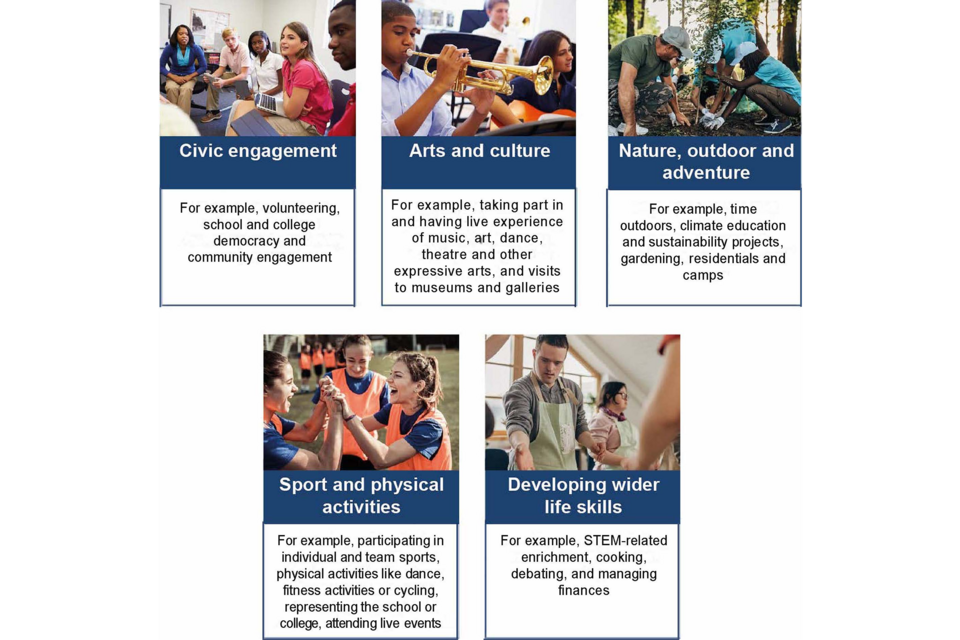
We will build on the wide range of support to help schools offer enrichment opportunities. As set out in the National Youth Strategy, we will work with DCMS on the investment of £22.5 million over 3 years to enable up to 400 schools in the most deprived areas of England to meet the enrichment benchmarks, including delivering the core enrichment offer set out above. The UK’s association to the EU’s Erasmus+ Programme in 2027 will also provide international enrichment opportunities. Schools will be able to bid for funding for children to take part in school trips to another country, or virtual school partnerships. School staff can also benefit from opportunities through the programme.
The government is also targeting £132.5 million of funding through the ‘Every Child Can’ programme to support the provision of services, facilities and opportunities to meet the needs of young people, particularly those from disadvantaged and under-represented backgrounds. Government will work with the National Lottery Community Fund and young people and youth organisations to decide how this fund is spent. We are continuing to invest in our national network of music hubs, as well as preparing to deliver enhanced PE and School Sport Partnerships. These new partnerships will support us in our ambition to raise the healthiest generation of children ever by expanding opportunities for children to access high-quality PE, sport and physical activity. In June 2025, we announced the government’s flagship TechYouth programme, which is providing £24 million to deliver high-quality extracurricular technology education to one million secondary-school children across the UK.
A broad range of partners are working alongside schools and colleges to help deliver a high-quality enrichment offer. Philanthropy and civil society have a unique interest and ability to innovate, mobilise quickly and reach communities in ways government alone cannot. For example, the Better Futures Fund is the world’s largest social outcomes fund – backed by £500 million of government funding over the next ten years, with plans to raise up to £500 million from local government, social investors and philanthropists. This fund will support up to 200,000 children and their families.
We welcome the commitment from organisations such as the Duke of Edinburgh’s Award, National Youth Theatre, Clore Duffield Foundation, Into Film, Raspberry Pi Foundation, Young Enterprise, Youth Sport Trust and Natural History Museum to bring their expertise, passion and programmes to enable schools and colleges to deliver a strong and well-rounded enrichment offer to all children. We invite further organisations to join this effort and help broaden the support.
Case study: Enrichment for all
Co-op Academy Glebe’s approach to enrichment is rooted in the belief that every child should have access to memorable, horizon-broadening experiences without barriers. With 58% of children eligible for FSM, leaders intentionally review and remove hidden costs or obstacles so that all students can participate fully, both during and beyond the school day. Enrichment is woven directly into a carefully mapped curriculum, ensuring that children engage in rich and varied experiences that complement their academic learning. Participation is closely tracked, and students play a central role in shaping future opportunities through feedback and leadership roles.
The school aims to be an active, integral part of the community and to help children understand the world beyond school to raise aspirations. They work closely with local businesses and charities to support their careers curriculum. Children have also participated in local and trust-wide music productions, written and performed their own song in conjunction with Port Vale Foundation Trust to raise the profile of their community projects and engaged in the police cadet programme.
Learning is brought to life through residential trips, local visits, hands-on workshops, and opportunities that help students build awareness of the community around them. The school’s 101 Things to Do Before You Leave Glebe initiative sets out an ambitious roadmap of experiences for every child, with achievements celebrated in a personal Passport of Achievements. This commitment extends beyond term time through a holiday camp programme that ensures continuity of experiences and support. By prioritising enrichment as a core part of education – not an add-on – Glebe develops confident, resilient, and brave learners. The self-esteem they build outside the classroom directly influences their approach to challenges within it, contributing to a culture where children are equipped to tackle problems, embrace new opportunities, and thrive both academically and personally.
Outcomes are consistently strong, with 82% of children meeting the expected standard in reading, writing and maths in 2025, compared to 62% nationally, and 32% of children achieving a higher standard compared to 8% nationally.
Recognising breadth in our accountability system
High and rising standards for all children must be underpinned by a strong accountability system. But teachers and parents have told us that, for too long, accountability became too narrow. The system has not consistently supported a broad curriculum, and in some cases disincentivised inclusive practice. We tell schools what we value by what we measure and focus on – and the system has not always reflected the full range of what children need to achieve and thrive.
Progress 8 is central to this. It has been effective in driving improvement and maintaining a strong academic core and we must retain it. However, we believe its current design has hampered progress in subjects which strengthen our economy and society, including the arts. In our response to the Curriculum and Assessment Review, we committed to consult on an improved version of Progress 8 that supports a strong academic core with true breadth for every child. Our response to the Curriculum and Assessment Review, and the consultation we are publishing alongside this white paper, explain how the improved Progress 8 model can help transform a narrow experience for too many children into one that is rich and broad. Our proposal will retain the current Progress 8 rules on English and maths and require 2 dedicated slots for science, recognising its importance. The proposal requires greater academic breadth and gives parity for creative subjects by requiring young people to study at least 2 of languages, creative subjects and humanities, as well as giving space for wider choices.
Figure 4: Progress 8
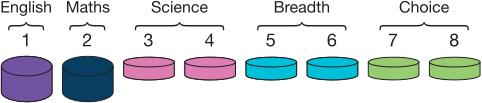
We want school leaders and wider stakeholders to have greater insight into the performance of their school and children and will provide them with a range of analytics so that they can prioritise data driven interventions with the greatest impact on children’s outcomes (see Chapter 7: Enabling innovation and ambition).
Careers advice to broaden opportunities
Our refreshed national curriculum will better prepare children for life, future study and eventually work. It will do this by including subject-specific disciplinary skills such as problem-solving in maths, embedding oracy across the curriculum, and identifying opportunities for children to practice social and emotional attributes such as teamwork in PE. Beyond this, we will explore opportunities to work with employers to create opportunities for bringing the curriculum to life. This will help children understand the relevance of their learning to their future career and find a passion for a future that inspires them to stretch themselves.
Every child and young person should also have access to high-quality careers advice and work experience throughout their education, to ensure that they leave education ready for work and ready for life. Good careers guidance can broaden opportunities in work and life. This is particularly important for children and young people who have not always had consistent access to good careers advice, including those with SEND and those from disadvantaged backgrounds.[footnote 80] Transitions and pathways to careers and further training are core themes of the Independent Inquiry into White Working-Class Educational Outcomes. Teachers can help with connecting children and young people with the opportunities of the future, with links to employers that can help broaden horizons.
In our Post-16 Education and Skills White Paper, we set out our vision for high-quality careers advice and work experience. We have published new careers statutory guidance, adopting the updated Gatsby Benchmarks for Good Career Guidance. Our ambition is for every young person to have 2 weeks’ worth of work experience during their secondary education. This is to ensure that work experience builds across secondary education, supporting the transition from education and training into employment, broadening horizons and breaking down barriers to opportunity.
We will continue to facilitate collaboration through career hubs between Strategic Authorities, local authorities, schools, colleges and employers. This collaboration will improve careers provision and secure better outcomes for young people. We are supporting businesses in every region to engage with schools, so that children can benefit from employer-led insights and experiences. This includes the development of enterprise and entrepreneurial skills. The Department for Business and Trade’s plan for small- and medium-sized businesses committed to embed enterprise and entrepreneurship into all stages of education, so that people can acquire these skills at any stage of their life or career.
Our collective vision will align careers and work experience programmes with the local labour market context, targeting skills gaps, supporting growth in priority sectors and driving national renewal, with no place or person left behind.
Broader horizons and clear pathways to post-16
The transition into post-16 education is crucial to support children as they become young adults, broadening their horizons with clear pathways into good jobs and the essential skills to thrive throughout life. In the Post-16 Education and Skills White Paper, we set out measures to improve the critical transition between school and further education. Our cross-government actions are addressing the drivers of disengagement for young people, especially for those at risk of becoming not in education, employment or training (NEET), so that everyone is engaged, included and has the chance to succeed. This includes a step change in efforts to raise attendance: for example, new data tools allowing schools to identify at-risk children early, before absence escalates.
Every child should have a planned destination before leaving school. Schools will routinely provide targeted support for those at risk of becoming NEET, helping them choose their next step and successfully transition into post-16 education and training. We are making this a reality by improving data-sharing between schools, local authorities and post-16 providers, and automatically allocating young people a place at a local college or FE provider when they do not have a post-16 study plan. We also welcome the work being done by The Rt Hon Alan Milburn into young people and work, which will make recommendations aimed at increasing opportunities for young people who are NEET.
We will make the post-16 system easier to navigate by introducing ‘V Levels’ as a new vocational option alongside A levels and T Levels at level 3. We will also strengthen post-16 level 2 options through 2 new pathways: an Occupational Pathway to prepare students for work, and a Further Study Pathway to help students progress to higher levels of study. These pathways will replace the current complex landscape.
Case study: Effective transitions from school to post-16 for learners with SEND
To support students with SEND transitioning between school and post-16 education, Derby College designed an 8-step package that supports students from an initial assessment to enrolment. This forms part of their standard admissions process.
In one example, a student applied to Derby College and the SEND and learning support team invited the student for an initial assessment to develop a personalised 10-month transition package, designed to allow regular engagement with the student and offer an insight into college life. The student attended site tours and met with student support services to provide an initial view of the college before developing a support plan with the learning support team and attending 2 curriculum taster days. The student successfully enrolled and progressed from a level 2 to a level 3 course in the following academic year.
Chapter 3: Sidelined to included
Vision
Schools must be places where every child is included, where they are supported and challenged to achieve and thrive – regardless of their needs or background. This means every child having the opportunity to be stretched and challenged, within the curriculum – with adaptive teaching from expert practitioners – and beyond it. This is key to improving the life chances of our most disadvantaged children and breaking the link between background and future success. Yet brilliant schools have too often felt they are working against the system to include the achievement and experience of children that the system has sidelined – including white working-class children, children in entrenched disadvantage, children progressing but capable of more, children who receive support from children’s social care and children with SEND.
Our best schools know that high standards and inclusion work together as 2 sides of the same coin. We welcome definitions of inclusion that can help guide actions that meet all children’s needs, including: ‘Inclusion is all staff supporting the learning, wellbeing and safety needs of all children, so that they belong, achieve and thrive’.[footnote 81] Within this, it is crucial we go further to deliver inclusion for children with SEND. In doing so, we will be guided by the UN Convention on the Rights of Persons with Disabilities.
Every child with SEND deserves the same high standards and expectations. They deserve schools that build on their strengths, and are better equipped to provide earlier, evidence-based support. This is a more inclusive mainstream school system, where all schools consider the evolving needs of children and proactively work to remove barriers to attainment and engagement for every child and to the benefit of all. Every child should have the right to go to their local school, within their local community. For children for whom specialist or alternative provision is the best option, we will ensure high standards and expectations underpinned by new Specialist Provision Packages.
Case for change
When children are not included in the system – their voices ignored and needs unmet – it leads to disengagement, isolation, and lasting educational inequality. For too long, too many children have been sidelined in our education system: children with SEND, children from disadvantaged backgrounds – including white working-class children – and the children who are progressing but capable of more. These children are not succeeding as they should, with too many children not stretched to achieve all they can. We must ensure their school experience is an ambitious one in which every child is connected to the world beyond their existing horizons and perspectives, and never limited by others’ assumptions. Despite the hard work of teachers, leaders and support staff, too many children leave full-time education without the knowledge, skills and attributes that will set them up for adult life.
Children’s outcomes are still too often determined by background or circumstances, and this has led to a failure to close the attainment gaps. We see attainment gaps between children emerge before school and widen as they progress through their education.[footnote 82],[footnote 83] Outcomes for disadvantaged children have long been below their peers,[footnote 84],[footnote 85] and disadvantaged children who were high-achieving at the end of primary are often outstripped by their lower-achieving but more advantaged classmates by the end of secondary school.[footnote 86] Within disadvantaged pupil groups, we also see wide variation by ethnicity. The single largest group is white working-class children,[footnote 87] who also have among the lowest outcomes.[footnote 88]
Other groups of FSM-eligible children also have particularly low outcomes, especially white Irish, white and black Caribbean, and black Caribbean children.[footnote 89] And disadvantages overlap and compound: outcomes for children both with SEND and eligible for free school meals are far below their peers who face neither of these challenges.[footnote 90] Research suggests that half of children who do not secure a pass in their English and maths GCSEs were judged to be behind at age 5.[footnote 91] Through our strategy Giving every child the best start in life, we will drive up access to high-quality early education and care and essential family support services to ensure more children build the crucial foundations of learning and a record proportion start school ready to learn. Building on these stronger foundations, this white paper sets out measures that will support all disadvantaged children to achieve and thrive, including those most persistently disadvantaged, and specifically addresses the barriers that we know affect white working-class children.
Compounding these issues, we do not have a truly inclusive mainstream system, which means children with SEND have too often been sidelined. The system is not enabling children and young people to get the outcomes and opportunities they deserve.[footnote 92],[footnote 93] Too often, support for children with additional needs is late, rigid and locked behind bureaucratic statutory processes, rather than easily available, provided early and flexibly to meet children’s needs as they evolve over time. Professionals such as educational psychologists are forced to spend too much time on paperwork, rather than being able to support children directly.[footnote 94],[footnote 95] Inconsistency, a lack of agreement and poorly evidenced provision in how needs should be identified and met contributes to widespread variations across schools.[footnote 96],[footnote 97] The increasing reliance on EHCPs as the mechanism to access support has – over the past decade – shifted the system away from making support available for early intervention and a strong universal offer.[footnote 98] As a result of the system’s failure to deliver mainstream inclusion, a greater proportion of the school population is educated in special schools than at any point in the past half-century.[footnote 99] Our education system has to be able to adapt to support all children, ensuring that SEND support is dynamic, well-evidenced and timely, with strong partnerships between mainstream and special schools. Our plans for this are set out in SEND reform: putting children and young people first.
White working-class children: defining and understanding the challenge
White working-class children are consistently sidelined under our current system. They have among the lowest attainment at GCSE[footnote 100] and, since the pandemic, their average attainment has got worse, while for many other groups of children it has improved.[footnote 101] These gaps open early in their education, with white FSM-eligible boys less likely to be “school ready” than their peers,[footnote 102] and widen as children progress through school.[footnote 103] White working-class children are also more likely to find the transition to secondary school more difficult than their peers[footnote 104] and have higher levels of identified SEND.[footnote 105] White working-class children’s attendance is also lower; they have among the highest overall absence rates, missing 12% of sessions on average – more than 4weeks a year.[footnote 106]
An Independent Inquiry into White Working-Class Educational Outcomes has been commissioned by Star Academies to investigate the barriers faced by this particular cohort and understand the underlying reasons behind these trends. The Inquiry’s latest research reaffirms that white working-class children remain one of the largest and lowest-performing groups in the education system.
The Inquiry also tells us that white working-class children are much less likely to say they enjoy school.[footnote 107] This is supported by similar evidence that finds that this cohort are more likely to have a negative experience of school overall: they are less likely to value education, be interested in lessons, put effort into their schoolwork or believe that they can influence their school outcomes.[footnote 108]
To address these challenges, this white paper sets out our plans to:
- rebuild early family support to help more disadvantaged children arrive at reception school-ready, introduce free breakfast clubs and revitalise youth services (Chapter 1: Our children’s futures)
- design a new model for targeting disadvantage funding to help schools deliver targeted interventions to narrow the attainment gap (Chapter 3: Sidelined to included)
- launch and fund 2 place-focused missions – Mission North East and Mission Coastal – to transform outcomes for young people locally and provide a blueprint for change nationally (Chapter 3: Sidelined to included)
- recognise schools that are successful in supporting children with the lowest prior attainment to make good progress during secondary school by consulting on a new progress measure to sit alongside Progress 8 (Chapter 3: Sidelined to includedChapter 3: Sidelined to included)
- develop insights into the relationships between white working-class children and families with schools, in order to strengthen parental engagement and ensure every child reaps the benefits of positive school-family relationships (Chapter 4: Withdrawn to engaging)
Stretch for all children: achieving without limits
Every child should have the opportunity to be stretched and challenged, within and beyond the curriculum and whatever their starting point. This includes both supporting those furthest behind and ensuring that children who are progressing but capable of more are stretched to achieve the very top grades.
Adaptive teaching is key to this – teachers adjusting their methods to get the best out of every child in the classroom. We are supporting teachers to do this through our initial teacher training and early career framework, which now includes more content on adaptive teaching, as well as our SEND CPD programme to give school staff the expertise to support children with a broad range of needs (see Chapter 5: Support and investment in high-quality staff).
As set out in our government response to the Curriculum Assessment Review, we will support teachers to identify and challenge children who have more to give in the classroom or who are not yet achieving what they possibly could. This does not just mean focusing on typically high-attaining children but making sure that all children are stretched and challenged. The curriculum should challenge higher attaining children by allowing them to deepen their learning, explore concepts in more detail, apply content to different contexts and make connections between subjects. We know that many schools are already teaming up to motivate and engage children. We will seek out, optimise and learn from local and regional partnerships across trusts, local authorities and the wider education community to support children working at greater depth.
Technology can also support teachers to stretch and challenge children. Oak National Academy will continue to work with teachers to develop a range of AI tools and curriculum materials that support them to stretch and challenge all children. See Chapter 7: Enabling innovation and ambition for more detail.
All children should also have opportunities for academic enrichment that extends and challenges their boundaries and fuels their love of a subject, including competitions, events and olympiads among groups of local schools and at national and international level. We are committed to helping schools to identify effective programmes and get the best out of them.
School Profiles (see Chapter 4: Withdrawn to engaging) will provide transparent information about the achievement of higher-attaining children in a school – for example, at key stage 4 introducing additional information focused on numbers of children achieving level 7 or above. We must ensure that our accountability system encourages the same high standards and expectations for children starting from a lower baseline.
We will consult on a new progress measure to better capture the progress and achievements of children who start secondary school significantly behind their peers.
Progress and attainment measures set an expectation that most children should enter at least 8 GCSEs or equivalent qualifications. For most children, this is the right approach, but at present around 15% of children do not fill all 8 slots within Attainment 8 and Progress 8, and this rises to 33% for those in the lowest prior attainment group.[footnote 109] This lets children down: both through some children being entered for qualifications they will not succeed in and through not enough attention being given to whether the children entered for fewer than 8 qualifications are making the progress that they should. Therefore, we are consulting on a new progress measure to recognise schools that are successful in achieving progress for all children, in addition to Progress 8, focused on the progress made by children with the lowest prior attainment.
Case study: Stretching and challenging children
Heanor Gate Spencer Academy stretches all of its children, including high attainers, to access a broad range of opportunities, build confidence and succeed.
Within the classroom, all children are given stretching and age-appropriate reading choices so that they can extend their vocabulary. The school uses AI-based educational tools to ensure that consolidation activities outside school are bespoke and provide high-quality challenge at all levels of learning. It also ensures that disadvantaged children are stretched and have tailored support by monitoring their progress and intervening when needed. School leaders closely monitor the engagement and attendance of children eligible for pupil premium, working proactively with families to identify and remove barriers.
To stretch high attainers, the school has a wide range of extra-curricular activities. High attainers in year 11 are introduced to a Spencer Academies Trust ‘Spires’ programme, which they then engage with at post-16. This offers support towards top-tier higher-education pathways through visits and mentoring. High-attaining year 11 students also attend a National Poetry Live event, deepening their understanding of the GCSE anthology poems. The year 10 debate club competes at regional level, ensuring focus on oracy and persuasive language. Year 9 and 10 students engage in both university and employment-based programmes that inspire females through science, technology, engineering and maths (STEM).
Outcomes are strong, especially for disadvantaged children, with a disadvantaged Attainment 8 score of 42.7, which is significantly above the national average of 34.9.
Supporting disadvantaged children through focussed funding
We are determined to do more to improve the life chances of our most disadvantaged children and break the link between background and future success. This white paper sets out a range of ambitious steps – family support to help more disadvantaged children arrive in reception school-ready; strengthening teacher recruitment and retention so every child has high-quality, adaptive teaching; and broadening the curriculum and offering high-quality enrichment opportunities. Beyond that, we must ensure that funding is targeted where it is needed most to enable the system to deliver.
The pupil premium grant and schools national funding formula deprivation funding allocations provide over £8 billion of funding to schools, playing a critical role in narrowing the disadvantage attainment gap and supporting the government’s Opportunity Mission. We have already increased pupil premium funding to over £3 billion for 2025 to 2026, which is an increase of almost 5% from 2024 to 2025; and 10.6% of the national funding formula – over £5 billion – was allocated through the national funding formula’s deprivation factors in the 2025 to 2026 academic year.
Both pupil premium and national funding formula deprivation funding primarily use FSM eligibility to identify disadvantaged children.[footnote 110] This does not enable disadvantage funding to schools to reflect different lengths and depths of disadvantage that children may be experiencing. Attainment is worse on average for children who have been disadvantaged for a greater proportion of their time in school, and the gap between the attainment of children with the most long-term disadvantage and their non-disadvantaged peers has remained stubbornly high, even in the years when the overall attainment gap between disadvantaged and non-disadvantaged children was narrowing.[footnote 111] Our current method of allocating funding fails to address these key problems.
Figure 5: The attainment gap for persistently disadvantaged pupils and all disadvantaged pupils, relative to non-disadvantaged pupils
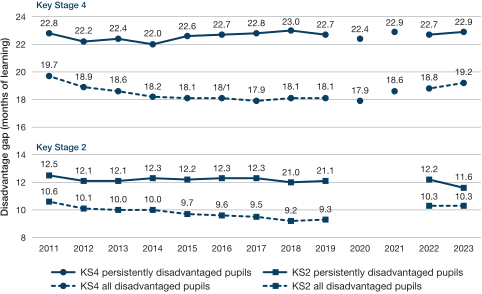
The stubbornness of these gaps, the lack of progress to date and the direct impact on children and young people’s life chances mean that radical action is required. Therefore, we will boost the impact of the pupil premium and national funding formula, by driving funding to where children’s needs are greatest and supporting schools to implement more effective evidence-based approaches.
We will develop and test a new model for targeting disadvantage funding to help schools narrow the attainment gap.
While these proposals continue to be developed, the new model has the potential to significantly rebalance how deprivation funding is distributed to schools, and, in turn, the level of support that schools with the poorest children receive.
While developing the new model, we are considering how funding rates could vary according to the level of disadvantage, so that children with more entrenched disadvantage attract more funding. Using income data rather than the binary metric of eligibility for FSM would enable schools to receive funding – for example, using a stepped model, reflective of the level of disadvantage in their cohort. The model could take into account how low family income is, and for how long this has been the case. It would also remove the need for families to choose to take up the offer of a free meal in order to be eligible for deprivation funding,[footnote 112] and reduce the administrative burden on schools. We are also considering whether to target funding based on the place a child lives, as well as their individual family economic circumstances.
We will consult on our proposals in summer 2026, inviting views from the sector and local communities on how we better allocate funding and address the impact of entrenched disadvantage on the education outcomes of children. We will consider any unintended consequences and how proposals will work to raise standards across the sector.
Driving effective use of pupil premium funding
We will maximise the effectiveness of pupil premium funding by strengthening effective use in all schools, and by targeting bespoke support to schools with poor outcomes for disadvantaged children. This two-pronged approach will raise the bar for all schools at the same time as concentrating support to improve disadvantaged children’s educational attainment where it is most needed.
We will drive better use of disadvantage funding through building a better evidence base and expert reviews.
We will draw on the wealth of evidence of ‘what works’ evaluated by the Education Endowment Foundation (EEF). Resources such as its Teaching and Learning Toolkit, alongside the Research Schools Network, are widely used and valued by schools.[footnote 113] However, there is more to be done to ensure all schools engage with evidence when deciding how to spend their pupil premium, to make sure that we are optimising every pound of funding to support disadvantaged children.
We will make the pupil premium strategy statement a more effective tool to support all schools in planning their use of pupil premium. Innovative digital and data opportunities offer the possibility to make strategy statements a more effective tool for schools to plan their use of pupil premium. This will also facilitate sharing of good practice and provide better information for governors, trustees, Ofsted and RISE.
We will introduce government funded pupil premium strategy reviews for schools that need additional support. Sector experts will deliver these reviews, providing tailored advice to help schools plan, implement and evaluate improvements to their pupil premium strategy. By focusing on the effective use of funding, these targeted reviews will equip school leaders to improve outcomes for disadvantaged children. We will develop the review model with the sector and draw on best practice from expert and peer review approaches across the public sector.
Case study: Developing an effective pupil premium strategy
Oakdene Primary Academy in Stockton-on-Tees supports a diverse community where almost half of children have been eligible for free school meals in the past 6 years. Over 80% of their pupil premium funding is spent on high-quality teaching interventions, such as providing CPD to teachers and support staff, with further spending on targeted reading, speech and language and writing interventions.[footnote 114] Daily classroom observations by school leaders allow them to identify opportunities for improvement in teaching practice. These lesson visits encourage ongoing conversations about assessment outcomes, enabling all staff to have a firm understanding about what each child needs to boost their success.
The school uses termly data points and regular conversations between staff and leaders as part of a trust wide cycle of improvement. They also conduct reviews to identify the most effective strategies to overcome barriers to learning, such as ensuring that disadvantaged children receive a high proportion of teaching from the most qualified and effective teachers, drawing on our guidance and EEF evidence.[footnote 115],[footnote 116] This extends beyond disadvantaged children: for example, Oakdene supports children with SEND by assessing and identifying indicators of SEND at the earliest opportunity and working closely with outside agencies to adapt provision for these children.
Outcomes are significantly above the local and national averages, with 91% of all children and 91% of disadvantaged children meeting the expected standard in reading, writing and maths in 2025. Oakdene also performs strongly for attendance with an overall attendance rate of over 97% at the start of the 2025 to 2026 academic year, ranking the school first among 21 similar schools.
Targeted missions to tackle entrenched disadvantage
We know that some of the biggest challenges are concentrated in particular places and communities. That is especially true for white working-class children and young people growing up in areas where disadvantage is entrenched and outcomes remain stubbornly low. We are determined to tackle these challenges head on, with a place-based approach that recognises – as with the London Challenge in the early 2000s – that local context is critical to sustained improvement.
That is why, alongside our national Call to Action (covered in Chapter 7: Enabling innovation and ambition), we will launch and fund 2 place-focused missions – Mission North East and Mission Coastal.
Our ambition is that these programmes will transform outcomes for young people locally and provide a blueprint for change nationally.
Mission North East will focus explicitly on radically improving outcomes for white working-class children and young people, in communities where attainment gaps are too often accepted as inevitable. It will bring together clusters of schools facing similar challenges, diagnose shared barriers to progress and develop a clear strategy for sustained improvement, backed by strong leadership and practical support.
Mission Coastal will focus on improving outcomes in disadvantaged coastal communities, where opportunity can be limited by geography, fragile local infrastructure, and the compounding effects of disadvantage. It will work with schools, school trusts and local partners to tackle the barriers that hold children back, and to strengthen the conditions that help young people thrive.
Both missions will be rooted in collaboration. We will establish partnership boards – drawing on expertise from teachers, local leaders, and the wider public so that the whole community takes shared responsibility for change. Where barriers to improvement are persistent – such as low parental engagement – we will take a test, learn and grow approach, building evidence of what works and scaling successful practice.
Consistent and fair admissions
All children should have access to high performing schools where they can achieve and thrive. However, more could be done to reduce barriers in the system, particularly for children from disadvantaged backgrounds, and children with SEND.
We will consult on changes to the School Admissions Code to promote fairness for all families, particularly the most disadvantaged and children with additional needs.
We propose requiring schools to give parents more information about decisions on in-year admission. We will also propose improvements to how fair access protocols are managed by local authorities, to strengthen the safety net for children struggling to secure a school place in-year. Finally, we are making the operation of banding arrangements clearer by requiring schools to set out more details about how their arrangements work in practice and tightening the rules that ensure banding produces representative intakes. We will consult on all changes to the school admissions code, including these changes, later in the year.
Access to high performing local schools should not be dependent on factors such as families’ household income or local house prices. The school admissions code already provides tools to ensure schools can achieve representative intakes, particularly for applicants from a disadvantaged background, by, for example, enabling schools to prioritise children eligible for the pupil premium. Organisations such as the Sutton Trust also provide support for schools that are keen to achieve more inclusive intakes. We will develop new resources to support and encourage schools to adopt more inclusive admission arrangements, working with key partners and drawing on best practice from the sector.
Supporting children with SEND
We are publishing our consultation: SEND Reform: Putting Children and Young People First alongside this white paper. Every child should have the same high standards, including children with SEND, but our current system is not set up to include them.[footnote 117] With one in 3 children being identified with SEN at some point in their schooling,[footnote 118] we must equip our schools to identify when children need additional support to achieve and thrive.
Our landmark SEND reforms have been designed through a process of co-creation with families, educators, healthcare professionals and local government, and with the views of children and young people themselves. In December 2025, we launched the biggest National Conversation on SEND which reached over 8,000 people, and we will continue in that spirit as we move into formal consultation on the changes proposed. Through those conversations, we have listened to concerns and responded through proposals set out in this white paper and in our consultation on SEND reform: putting children and young people first.
Reflecting what we have heard during the National Conversation, we have revised our 5 reform principles, which underpin the changes being proposed.
Our reform principles
-
Early. Children and families should receive the support they need as soon as possible, with a quick response to changing needs. This will start to break the cycle of needs going unmet and getting worse. Instead, we will intervene swiftly and proactively, focusing on providing support earlier in children’s lives when this can have the greatest impact.
-
Local. Children and young people with SEND should be able to learn at an education setting close to their home, alongside their peers, rather than travelling long distances from their family and community. Specialist settings should continue to play a vital role supporting those with the most complex needs.
-
Fair. Every education setting should be resourced and able to meet common and predictable needs, including as they change over time, without parents having to fight to get support for their children. Where specialist provision is needed for children and young people, we will ensure it is there, whether that be a mainstream, specialist or Alternative Provision setting, with clear legal requirements and safeguards for children and parents.
-
Effective. Reforms should be grounded in evidence, ensuring all education settings know where to go to find effective practice that has excellent long-term outcomes for children and young people.
-
Shared. Education, health and care services should work in partnership with one another, Best Start Family Hubs, local government, families, teachers, educators, experts, the voluntary sector and representative bodies to deliver better experiences and outcomes for all our children and young people. The voices of children should be at the heart of decision making.
We are committed to creating a more inclusive mainstream school system where more children can be educated in a local mainstream school, as part of their local community, with flexible, timely, and accessible support. That means considering the evolving needs of children and proactively working to remove barriers to engagement and attainment for every child. It means strengthening partnerships between local mainstream and specialist provision so children who need further help are supported, and staff are equipped to meet need.
This shift in approach is central to improving outcomes, especially for children with SEND, but also for their peers. International evidence shows that children learning alongside their peers has proven academic and social benefits for all children.[footnote 119] We have also published analysis outlining how more than a decade of data from schools in England shows children with SEND in mainstream schools achieve half a grade higher, in English and maths GCSEs, than comparable children in special schools.[footnote 120] For children with the most complex needs, special schools provide the right environment for children and young people to make meaningful progress and build independence. Those schools should also be closely connected to the wider system and their communities. This will require deliberate planning, engagement with families and partnerships with other local services to deliver.
One education system
Children’s needs, and how they present, change over time as they develop but the current system is rigid. It takes too long to get support[footnote 121] and too often relies on statutory assessments. We want one education system for all children and young people, including those with SEND. This means integrating the SEND system within the mainstream system, so that support can be provided earlier. To achieve this, we need more flexibility – with support that can be scaled, adapting to the needs of children as they grow and move through different education phases.
At the heart of this vision is a universal offer of high-quality teaching and support for all from early years to age 25. Inclusion is at the core, ensuring high-quality adaptive teaching methods, early support, and opportunities for growth for every child. Over the next three years, we will invest £1.6 billion to make the mainstream system more inclusive.
The universal offer will include:
- ambitious leadership and governance that embeds inclusion in planning
- evidence-based support prioritising early intervention
- high-quality teaching with a curriculum designed for all learners
- accessible and enriching provision beyond the classroom
- a safe and respectful culture fostering belonging and attendance
- strong partnerships with families and wider services
- inclusive environments with continuous improvements to accessibility
In practice, this means commonly occurring needs that every school should be familiar with can be consistently met in mainstream education through adaptive teaching, calm environments, and enrichment opportunities. We are not asking teachers to teach differently or to work harder. We are giving them the resources they need and reforming the system so that they do not have to fight against it. The steps we are taking to support this transition are set out to follow and in SEND reform: putting children and young people first.
For children and young people who need additional help to access education, support will be organised across 2 additional layers of support: Targeted (including Targeted Plus) and Specialist.
Targeted (including Targeted Plus) will provide structured, evidence-based interventions within mainstream schools, drawing on the Experts at Hand service to involve education, health and care professionals where needed.
The Specialist layer will provide a higher level of provision for children with complex needs, through new Specialist Provision Packages, which will form the basis of EHCPs.
For every child receiving Targeted or Specialist support, regardless of their educational setting, schools will be required to develop an Individual Support Plan. This plan will describe the child’s day-to-day educational provision and the support required, and will be created collaboratively with parents.
Specialist support will use nationally defined Specialist Provision Packages for children with the most complex needs. These will be developed and reviewed by an independent expert panel. These packages will guide provision and eligibility for EHCPs across mainstream and specialist settings. EHCPs will continue to set out the statutory entitlement to support for children and young people, with Individual Support Plans describing the day-to-day provision delivered in schools. Together, this integrated system aims to deliver an effective education experience for all children and young people.
Figure 6: Layers of support
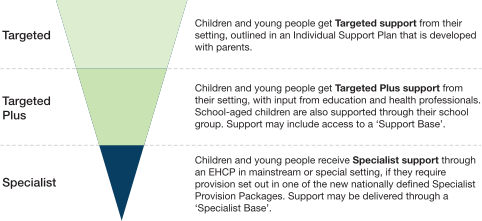
Ensuring SEND support is evidence-based
At present, there is significant inconsistency in how needs are supported across education settings and local authorities,[footnote 122],[footnote 123] and teachers tell us that further training and guidance would help them support children with SEND.[footnote 124] It is therefore vital that all staff feel confident in addressing a range of commonly occurring needs, and are supported to identify barriers and strategies to support children to overcome them.
By 2028, we will invest up to £15 million to build the evidence base for, and then provide, National Inclusion Standards – a digital library of high-quality identification tools and provision covering all layers of support for children with SEND.
We will appoint an independent expert panel who will oversee the development of the National Inclusion Standards and improving the quality of SEND evidence. They will also oversee the development of the new Specialist Provision Packages to underpin the specialist system.
The Standards will be informed by evidence, working closely with experts, as well as children and their families. They will set out what all children and families should be able to expect from their school. They will also empower leaders with clear, evidence-based guidance and approaches to make their school more inclusive, and to design targeted support for specific areas of development. By 2028, the National Inclusion Standards should guide how schools are meeting the needs of children.
In addition, we will update the SEND Code of Practice to clarify the responsibilities of education settings and local partners, as well as make the guidance easier to use and navigate. In this update, we will place a stronger emphasis on an evidence-based, ‘support first’ approach as part of a whole-setting commitment to inclusion. Additional professional development and guidance (outlined below) will help educators understand common barriers to learning and apply universal strategies-based in their practice, enabling them to recognise and respond to a wider range of needs with greater confidence. The National Inclusion Standards will provide a clear framework for how the updated Code should be delivered in practice.
We will also update the Code of Practice to refresh the current 4 broad areas of need, which are often unclear and inconsistently applied, replacing them with new areas of development that reflect key aspects of child development. This will support early, needs-led provision and help educators identify and address barriers to learning in ways that are more closely aligned with classroom practice. Further detail on the Standards and changes to areas of need is set out in SEND reform: putting children and young people first.
There will also be a new remit for the Children’s Commissioner to provide oversight and scrutiny of SEND reform implementation. This will include monitoring the progress and effectiveness of SEND reforms for all children, with a particular focus on children in care, children in need, children not in school, including those who have been excluded, intersectionality and those facing multiple disadvantages. The Children’s Commissioner will report publicly at regular intervals on the progress of reforms, including identifying, gaps, risks, and unintended consequences as well as areas of strength or good practice that we should build on.
High-quality teaching for all
The universal offer for all children begins with great teaching. High-quality teaching is the most important lever schools have for improving pupil attainment.[footnote 125] But teaching staff are not yet universally confident in supporting children and young people with SEND: less than three quarters of mainstream school leaders agreed or strongly agreed that their school could effectively support children with SEND or learning difficulties and disabilities[footnote 126] despite many teachers being keen to expand their knowledge.[footnote 127] To address this, we have launched a new landmark training package for school staff on supporting children with SEND, with an investment of over £200 million over 3 years.
From September 2026, all staff nationwide will be able to benefit from new training across early years, schools, and post-16, supported by government-backed training materials. The updated SEND Code of Practice will set out a requirement for all schools to ensure that their staff receive training on SEND and inclusion. Expert adaptive teaching is key to meeting the needs of all children,[footnote 128],[footnote 129] and should be woven into everything that schools do. This is not about asking teaching staff to do more, or to focus their attention on a few children and young people – but about making sure that support is there for every child. We will support teachers to constantly adjust their methods to bring out the best in every child in the classroom – it is second nature to many experienced teachers and support staff. National training will help both newer and more experienced teachers to develop their skills in building inclusive learning environments and spotting needs early so that children receive timely support.
This new training offer builds on improvements to existing teacher training programmes, including the initial teacher training and early career framework introduced in September 2025 to ensure both new and existing staff are trained to adapt their teaching for all children, and particularly to meet the needs of children with SEND. We have already strengthened requirements for training providers to ensure early career teachers receive clear guidance on SEND, and will review this again in 2027 to ensure they continue to reflect the latest evidence. A review of national professional qualifications is also underway to embed best practice, alongside a planned review of the early career teacher entitlement in 2027. For early years, we will consult with the early years sector on teacher training routes and course content; this will inform training in inclusive practice for early years teachers. We plan to expand access to this training route, more than doubling the number of early years initial teacher training places by 2028.
Together, these measures will ensure all new and existing teachers and leaders are trained to support a wide range of needs and reinforce that inclusive practice is a shared responsibility across all staff. Within this strengthened system, schools will be supported to use the expertise of special educational needs co-ordinators (SENCOs) more effectively. Through our reforms, we anticipate the role becoming more strategic and less administrative. Digital processes, clearer expectations for all and improved access to specialist support will reduce routine administration, enabling the SENCO to focus on strategic leadership and supporting the development of high-quality practice across the school. More detail on the future role of SENCOs is included in SEND reform: putting children and young people first.
Stronger communication about children’s needs
Clear and consistent communication is essential to reforming the SEND system. Families, education settings and professionals need a shared understanding of children’s needs, what support looks like, when it will be delivered, and how it will work across all phases of education. Currently, information about children’s needs is often fragmented across multiple systems, making it harder to keep records accurate and up to date. This can lead to delays in support and gaps during key transitions, such as moving from early years to school or school to college. Parents often report having to retell their story and explain their children’s needs multiple times to different professionals or settings. A responsive, accessible, digital way of recording needs and provision will ensure help is provided quickly and effectively, reducing the risk of challenges escalating and improving continuity of support.
We will require all schools and other educational settings to create digital Individual Support Plans for any child or young person with identified SEND.
The plans will capture barriers to learning, day-to-day provision, any reasonable adjustments and intended outcomes. They will be developed with input from and to communicate with parents, strengthening collaboration between home and school. Our ambition is for plans to be interactive, digital, accessible and integrated with wider services over time, so that identifying and communicating any support required is simpler and more effective. This approach will ensure support remains responsive throughout a child’s education, facilitating smooth transitions and reassuring families that their child’s needs will be recognised and met. We will set a requirement for Individual Support Plans to be reviewed annually at a minimum, which will involve discussions with parents. The use and quality of Individual Support Plans will be assessed through Ofsted’s inspections and assessment of SEND provision at a setting level.
Case study: Inclusive practice in schools
Tanfield School is a secondary school in County Durham which provides a range of support for children with SEND, particularly around transitions. For children with SEND, the school works closely with their primary school to understand their needs and put in place support for when they begin, such as specialist group interventions for literacy and numeracy. This support can start as early as Year 4, with their school SENCO offering support such as information evenings, transition days, summer school, online hub access and additional visits from years 4 to 6. Tanfield also has Year Managers that are dedicated to offering pastoral support to children and families to make the transition as smooth as possible, such as support on uniform, homework or wellbeing. This support extends throughout their time in school: inclusive high-quality teaching is regarded as foundational for student success, particularly for children with SEND. To ensure learning is accessible to all, adaptations are made according to children’s individual needs, such as changes to teaching strategies, adjustments to the curriculum, or the use of recommended classroom aids. Tanfield has a high proportion of disadvantaged students, but through their welcoming and engaging ethos, their students exceed academically. Absence is lower than the national and local authority averages, and outcomes are well above national and local averages, with an Attainment 8 score of 57.5 compared to 46.0 nationally and 44.1 for their local authority. Tanfield School is also partnered with a school through the RISE programme to support continued improvement.
Access to specialist support for SEND – Experts at Hand
Teachers and education leaders consistently tell us that better access to expert advice and support – including from health professionals such as speech and language therapists – is one of the most effective ways to meet the needs of children and young people with SEND.[footnote 130],[footnote 131] This support will primarily apply to children for whom specialist input is essential to help them thrive in mainstream education or the specialist system. We will create more opportunities for health professionals to work directly with school staff and groups of children as needed. This will help upskill staff in mainstream schools, provide timely support for commonly occurring needs, and ensure schools have quick and flexible access to expert advice.
We will invest £1.8 billion over the next three years in support services to improve access to health professionals such as speech and language therapists and educational psychologists for children and young people in early years settings, schools and colleges.
This funding will enable local authorities and Integrated Care Boards to establish an Experts at Hand Offer. This offer will be delivered both through partnerships with education and health services, and through outreach from specialist settings. £1 billion will fund expert professionals to work directly with mainstream schools, improving early support without requiring an assessment or referral, while £800 million will build the capacity of mainstream schools through expanding outreach from specialist and alternative provision settings. It will take time to embed these changes, but we anticipate that by the end of academic year 2028 to 2029, this funding would mean a typical school could benefit from annual support which is equivalent to 40 days per average primary school, and 160 days per average secondary school.[footnote 132]
We will invest over £40 million over three years to grow the educational psychology and speech and language therapy workforce, addressing long-standing shortages and reducing waiting times.
This includes training over 200 additional educational psychologists per year from 2026 and 2027, with further investment to train more over the following three years. This is alongside expanding speech and language therapy apprenticeships and introducing local speech and language therapist advanced practitioners and support workers in every Integrated Care Board area. We will bring more expert advice and services from education and health professionals (such as education psychologists or speech and language therapists) into mainstream education settings.
This builds on the emerging evidence from Early Language Support for Every Child (ELSEC) and Partnerships for Inclusion of Neurodiversity in Schools (PINs), which show the benefits of embedding health and other specialist professionals in mainstream schools to de-escalate needs.
As part of this, we will reform the role of Alternative Provision so that expertise in supporting children with SEND – particularly those whose needs present as disruptive or unsafe behaviour – can be used more effectively across the school system.
This will include outreach into mainstream schools for preventative support, time-limited placements to assess and address needs before reintegration, and longer-term placements where necessary, with a focus on progression to appropriate post-16 provision and employment.
We want to strengthen existing local strategic SEND partnerships and strategic planning across the country. These partnerships – bringing together stakeholders from the local SEND system including parent representatives – should give all schools influence over shared services and support to children with SEND. This will help with planning for specialist resources such as speech and language therapists, occupational therapists, educational psychologists and therapy assistants.
Direct responsibility over SEND funding
Education leaders, governors, and trustees will be expected, and supported, to create the conditions needed for all children and young people to achieve and thrive. This includes accessing a high-quality curriculum, including enrichment opportunities, and developing the skills needed to live fulfilling adult lives. For many schools and trusts, this will mean refining and strengthening what they already do; for others, it will require a more significant shift – placing inclusion at the centre of their approach and fully embracing their responsibilities alongside their local community. This will focus on understanding needs, adaptive teaching, a well-sequenced curriculum, calm environments, high standards of attendance and behaviour, and access to a broad range of academic and enrichment opportunities so that all children are supported to achieve and thrive. On top of the support provided through guidance, sharing of best practice, RISE networks, and their local school groups, we will support them through funding.
From academic year 2026 to 2027 onwards, we will provide £1.6 billion for a new Inclusive Mainstream Fund over three years, with over £500 million per year over the next three years to mainstream schools and other educational settings.
This new fund will give schools and other education settings direct responsibility over funding to empower them to deliver for children and young people with SEND. This will enable them to plan proactively and flexibly for commonly occurring needs and encourage earlier and more effective support. They will be able to use this funding, combined with funding for inclusion already in their budgets, to develop targeted, evidence-based support offers such as transition programmes or group interventions – without requiring formal assessments or diagnoses. For example, programmes like NELI (Nuffield Early Language Intervention) and ELSEC (Early Language Support for Every Child) could be funded to strengthen language development and early communication skills. This funding will also help strengthen the universal offer and targeted layers of support.
Schools will be required to publish an Inclusion Strategy outlining how resources are deployed to benefit children with SEND, which will be subject to oversight and challenge. Changes to the funding system will ensure schools have the resources and flexibility to maximise impact for children, while reducing reliance on costly statutory processes.
Schools and other education settings will be held accountable for how they use all their inclusion funding, including both the new Inclusive Mainstream Fund resource and the funding they already receive to provide support for children with SEND through their notional SEN budgets (and future funding through the National Funding Formula linked to SEND-related factors). Over time, there will be further rebalancing of funding from the High Needs budget, and this will also be part of these accountability arrangements. Further details on our plans are set out in SEND reform: putting children and young people first.
Collaboration between schools to deliver SEND support
Schools will need to work collaboratively to drive up the quality and scale of inclusive provision, through setting consistent standards and sharing resources to best support their children.
We propose that every school should be part of a local grouping to work together on SEND.
While some forms of SEND need are relatively common and would be expected in every school, other needs are less common and can require more specialist support. In the long term, we propose requiring all schools to pool a minimum level of funding to support needs fairly across their group. This pooled funding will be used collectively to meet the needs of children with SEND including through sharing expertise, resourcing, staffing, support bases and commissioning of shared resources, such as specialist teachers.
As set out in Chapter 6: Collaboration between schools and with other partners, we are moving over time to all schools joining or forming high-quality school trusts with coherence and scale. However, as many schools are not yet in a trust with sufficient scale or local presence, in the immediate term many SEND groups may consist of local groups of schools working together. This could include maintained schools working with schools in trusts that are geographically dispersed, for example.
We will look to local authorities and their partners to shape the formation of groupings in their areas, and have an oversight role for the local authority groups. Over the next three years we will expect all schools to join SEND group structures and agree operating principles, including peer support and challenge. We also expect them to work as a group with their local authority and Integrated Care Boards to scope the offer of support across their local area and develop a strategic plan for SEND. Through the consultation, we will explore options for how groups of schools and local SEND and alternative provision partnerships might work together, including how we can ensure they align clearly with the wider local plan for the SEND system.
Case study: Inclusive and holistic support
At Winyates Primary School in Peterborough, their holistic ethos and high ambitions for all children result in strong outcomes. All children are set up to thrive with high-quality teaching and targeted support when needed. The school follows a graduated approach to supporting SEND, following a cycle of assess, plan, do and review, to monitor pupil progress and remove any barriers to learning. Quality‑first teaching is the foundation for all pupils, and teachers know their learners well, enabling early identification of needs and timely support such as group interventions or curriculum adaptations. With inclusion and adaptive teaching strategies embedded into everyday teaching, children with SEND are able to learn amongst their peers and are involved in all aspects of school life. Outcomes are above average, with 76% of pupils meeting the expected standard of reading, writing and maths in summer 2025, above the national average of 62% in the same period.
Specialist Provision
As outlined above, we propose moving to a model of support based on a continuum of provision where children with the most complex needs have comprehensive packages of support, known as Specialist Provision Packages, supported by an EHCP. At present, there is inconsistency in how needs are identified and met. The current EHCP model makes it hard for schools to promptly adapt as needs emerge and change over time, which leaves too many children and young people with provision that is not necessarily suitable.[footnote 133],[footnote 134],[footnote 135]
Therefore, working with experts, we propose introducing new Specialist Provision Packages, which will form the basis for an EHCP.
These will be nationally defined, evidence-based packages of support for children and young people with the most complex needs, setting out the specific interventions, resources, and standards required to support them. EHCPs will guarantee statutory entitlements to the educational provision from the Specialist Provision Package that children and young people need, and their expected outcomes, alongside care provision and statutory entitlements to health provision. The detailed day-to-day educational provision will be set out in Individual Support Plans (as outlined above). These changes will ensure that high-quality, evidence-based offers of support are provided consistently across the country for those with the most complex needs, whilst allowing for schools and other education settings to adapt day to day provision as needs change over time. For children under 5 who have been identified as having complex needs, we will work with the Department of Health and Social Care and NHS England to introduce a fast-track route to support.
The proportion of school children with an EHCP is currently 5.3%, and has risen sharply. We expect that EHCP numbers will increase but at a slower rate through to 2029 to 2030 as we begin to invest in the new system and equip mainstream nurseries, schools and colleges to meet needs earlier. As reforms become embedded, we expect the number of children and young people needing a Specialist Provision Package, and hence an EHCP to access support, will return to around today’s level by 2035, with many more children having their needs met through an ISP in mainstream.[footnote 136]
We know it will be vital to manage the transition to a new system of support carefully. That is why our investments begin now, ahead of any forthcoming legislation, to enable early years settings, schools and colleges to prepare and build capacity for reform. It is also crucial that we manage the transition to the new system carefully for those already receiving statutory support.
From now until new legislation begins, the current SEND system – including all existing duties, rights and funding routes – will remain in place, and we will ensure these duties continue to be met. Once legislation is introduced, more children will get the help they need directly from support available in their school or setting, including through Experts at Hand, without requiring an EHCP. Any child who already has an EHCP (or has been assessed as needing one) at the point legislation commences will keep their plan and its provision until they finish their current phase of education or choose to move to the new system. Children with an EHCP in the early years will retain it until they complete the primary phase, when it will be reviewed.
After legislation takes effect, children with an existing EHCP will have a needs assessment as they approach the end of each phase of education. The local authority will determine whether they require a Specialist Provision Package and therefore a continued EHCP; if so, a new EHCP will be created based on the relevant Package, supported by an Individual Support Plan setting out day-to-day educational provision. If they do not require a Package, they will move to an Individual Support Plan in a mainstream school and receive support through the Universal and Targeted layers. The first cohort to transition will be pupils at the end of primary, secondary and post-16 in academic year 2029 to 2030, with assessments from September 2029 and moves to the new system from September 2030; those moving to Individual Support Plans will keep their existing EHCP until the end of that academic year. All children transitioning from an EHCP to an Individual Support Plan will retain the right to request a mainstream placement, and no child will move from a special school or college unless they choose to do so.
Specialist settings – including in early years, special schools, alternative provision, and specialist post-16 institutions – will play a dual role: delivering high-quality education for those with the most complex needs, and acting as catalysts for improvement across the system through outreach, short-term placements, and joint professional development. We will also change the law on independent special schools to ensure that children get suitable high-quality placements and that local authorities pay a reasonable price for them.
Schools designed to be inclusive
We are already creating 10,000 more school and college places for children and young people with SEND by investing £740 million in 2025-26. This funding will support a more inclusive mainstream school system by increasing the number of specialist and support bases and adapting the school estate so that more children with SEND can learn in a local mainstream setting in their community. This includes creating breakout rooms or sensory spaces where children can regulate, improving ventilation to create a more comfortable sensory environment, or adding ramps and accessible changing facilities. This expansion is reflected in the Education Estate Strategy published earlier this year, supporting an estate that is suitable to meet the need of children and young people with SEND, increase local capacity, and allow significantly more children to benefit from this provision.
We will create a further 50,000 new specialist places, including in inclusion bases, backed by £3 billion investment over the next four years and our commitment to deliver free schools or alternative funding in place of schools. These will give children with additional needs the opportunity to learn in mainstream schools, alongside their peers. Funding can be used to adapt buildings and buy equipment to make the estate more inclusive and accessible.
Inclusion bases will offer specialist support in mainstream schools and colleges so that more children get the opportunity to be educated in a local mainstream setting. For some children, this support will enable them to gradually transition to full participation in mainstream classes. For others, ongoing support from the base will help them access mainstream learning, education and their wider community in a way that works for them.
Through these bases, we aim to make inclusive support more widely available. Bases will be backed by clear guidance, which will form the benchmark for Ofsted inspections, and national best practice networks to ensure that settings high-quality inclusion bases and specialist provision in mainstream schools and colleges are recognised and celebrated, while also being held to account for delivering high-quality provision. Over time, we expect every secondary school will have an inclusion base, with an equivalent number of places in local primary schools. For many settings, where high-quality support is already being provided, it will be a continuation of best practice we see across the country. For some, this will be using the provision they have in a different way; and where there is a need to create new places, including by repurposing and improving existing space, this can be supported by our capital investment. Further detail can be found in SEND reform: putting children and young people first.
In addition to these steps to enable schools to be more inclusive, through their new education inspection framework, Ofsted is – for the first time – grading inclusion, to hold all settings to account for their inclusive practice. This evaluates how leaders set high expectations for all children and young people, including those with SEND, and put the right support in place to meet their needs. Ofsted Inspectors have received significant additional training focused on their renewed approach to inclusion, as part of both an Underpinning Skills Programme and face-to-face inspector training. We will also work with Ofsted to develop early insights on how mainstream schools are successfully driving inclusion, including through the use of inclusion bases in schools.
Chapter 4: Withdrawn to engaging
Vision
Our very best schools know that children achieve most when they feel safe and connected to their school environment. They show that high expectations for academic excellence and deep pupil engagement go hand in hand. They build relationships with parents and communities, working with health and local government services, to deliver calm, safe classrooms, meet children’s needs and enable them to achieve and thrive. Every school and every classroom should be a safe, calm and supportive place, where every child feels they belong. This in turn will improve young people’s engagement with learning, motivate them to stretch themselves and succeed in life.
This vision requires strong partnerships between families and schools, with parents included and engaged in their child’s learning, attendance and behaviour at school – including when their child moves within the school system. We want to see impactful and consistent parent-school engagement across the country, building on and spreading the impactful and innovative ways that many schools have developed to engage families to improve their children’s outcomes. To help parents to engage, we will give them a more complete picture of their child’s school.
These partnerships are critical to improving attendance and standards of behaviour at school. Attendance is key to achieving high standards, narrowing the disadvantage gap and supporting children with SEND. Expectations and standards of behaviour must be similarly high and consistent across all schools, with schools using support and sanctions together to provide all children with the benefit of a calm and inclusive environment.
Case for change
Children need to thrive, with a deep sense of engagement, belonging and inclusion, in order to achieve and excel at school. But too many children are withdrawn – their engagement with school life is low and they do not feel like they belong at school. This is particularly stark for children facing other barriers to learning: those with SEND and disadvantaged children (see Pupil belonging: the scale of the challenge).
Parent-school relationships have been increasingly strained since the Covid-19 pandemic. More than half of school leaders report strained parent relationships as a source of stress or unhappiness – 14 percentage points higher than in 2018, showing an upward trend that has accelerated since the pandemic.[footnote 137] Too many parents say they do not get enough information on how to support their child’s learning at home,[footnote 138] and information on school performance and enrichment offers can be difficult for parents to find. When children move within the school system, there is a lack of visibility that puts vulnerable children, including those with SEND, at risk of missing education or receiving provision that does not meet their needs.
Children need to attend school and learn in calm, safe classrooms in order to achieve and thrive. Yet, despite recent improvements, pupil absence and misbehaviour are too high. Around one in five children still miss a day or more of school every fortnight,[footnote 139] and teachers report seven out of every 30 minutes of teaching time is lost to misbehaviour.[footnote 140] We must address these issues to ensure that all children, particularly those sidelined in the system, are engaging with their education.
Pupil belonging: The scale of the challenge
Between 2014 and 2022, the proportion of children at secondary school reporting that they liked school “a lot” halved, and England saw a drop of over 20 percentage points in pupils’ sense of belonging.[footnote 141] This decline in school belonging is also seen internationally but is particularly stark for the UK and England, which both ranked poorly on this measure compared to other OECD countries in 2022.[footnote 142] There are particular challenges for children transitioning into secondary, with more than one in four children beginning to disengage from school during Year 7. This problem is also worse for many of the children we most need schools to be reaching – children on free school meals are less likely to enjoy school, less likely to trust other children at school, and report worse relationships with teachers than their peers.[footnote 143] In addition, children with SEND, children in need and those eligible for free school meals all report lower school belonging.[footnote 144]
This is not a side issue – compelling evidence shows that positive pupil engagement, including things like having a sense of belonging at school, are key to tackling some of the most important barriers to opportunity. Evidence shows that pupil engagement and belonging have clear positive relationships with attainment[footnote 145],[footnote 146] and school attendance.[footnote 147] School belonging also influences children’s long-term outcomes, with evidence showing those with good belonging at school are less likely to be NEET[footnote 148] and more likely to have good mental health[footnote 149] as they get older.
Building children’s sense of belonging and engagement
Every school should be a safe, calm, and caring place where every child feels they belong and are seen. When children feel connected and valued alongside excellent teaching, they are more likely to attend and engage more fully with learning, and stretch themselves – leading to improved attainment[footnote 150],[footnote 151] and long-term life chances.[footnote 152],[footnote 153]
To help build a sense of belonging, understanding children’s experiences is essential to identify how we can best support them. For the first time, we have brought together survey data on pupil experiences in school in the publication Pupil experiences in school: academic year 2024 to 2025. This will be published annually to provide a national picture of pupils’ engagement and belonging that will inform government policy and provide benchmarks for schools monitoring similar trends.
Case study: National engagement insights for school improvement
Schools are taking new approaches to measure pupil, employee and family engagement. One example is The Engagement Platform (TEP). TEP works with schools, local authorities and trusts nationwide to generate data insights on their performance, to target their practice and improve outcomes.
TEP data, now drawing from 300,000 children, indicates that low engagement is often linked to low attainment outcomes and poor attendance. Secondary school pupils with lower engagement scores are around three times more likely to be persistently absent than pupils with high engagement scores.[footnote 154]
Equipping schools with data on pupil engagement enables them to target interventions and improve practice. Schools focusing on activities such as improving transition support, actively listening to pupil and employee groups, and using inclusive routines, have been able to achieve engagement scores that are better than the national average.
We know that many schools are already building a sense of belonging within their schools. Around 60% of schools (76% of secondary schools) report that they are already measuring factors related to pupil engagement and belonging.[footnote 155] By 2029, we expect every school to monitor pupils’ sense of belonging and engagement so that more children – including those who are disadvantaged or have SEND – will feel a sense of belonging in school. This will support leaders, teachers and other education staff to better understand how their school’s ethos, culture, and practices impact the experiences and engagement of their pupils.
To support this expectation we will publish a new Pupil Engagement Framework later this year to enable all schools to measure the key factors that determine their children’s engagement in education and make improvements.
The Framework will be informed by insights from children, parents and carers, school leaders, partners and experts, and will highlight a range of good practice examples. It will provide schools and measurement providers with a standard set of well-evidenced questions for pupils that are actionable. This will include advice on how to measure factors such as children’s sense of school belonging and safety, inclusion, relationships with teachers and peers, their motivation and how much they value school. We expect schools to make effective use of this data, highlighting evidence-based practice that can be embedded into their improvement plans, which not only improve engagement, but also support outcomes including attendance and attainment.
As part of these efforts, we want to ensure that all children can learn in an environment where they feel safe and supported.
The government’s Race Equality Unit will work with us to undertake further research on the issue of racist abuse in schools. This will include direct engagement with pupils and teachers and help develop a more detailed understanding of what works to ensure our schools are spaces where all children feel like they belong, enabling greater attendance, attainment and engagement.
Following high-profile incidents and growing concern about antisemitism in schools and colleges, we also recently announced an independent review to help ensure all schools and colleges have the right systems and processes in place to identify and respond to antisemitism and related issues. This will commence from this Spring.
From a broken social contract to families as partners
Children achieve and thrive when families and schools work in partnership. The Education Endowment Foundation found that on average, parental engagement initiatives have a positive impact of 4 months additional progress on average over the course of a year for children in early years and primary.[footnote 156] Wider evidence shows the benefits of parental engagement throughout children’s time at school.[footnote 157],[footnote 158],[footnote 159]
Many parents want to be more involved in their child’s education, and many have a favourable view of the education their child receives. However, a third of parents of primary children, and half of parents of secondary children say they do not get enough information on how to support their child’s learning outside the classroom.[footnote 160] We know some schools have reported that reaching and engaging all parents in their schools can be challenging. These barriers to engagement with schools are greater for families facing intersecting challenges such as poverty, issues with housing, or juggling multiple jobs.[footnote 161] In some cases, disengagement is rooted in multi-generational distrust or negative experiences with education,[footnote 162] and this can lead to distant, or even adversarial relationships between families and schools.
Schools and families have been left to navigate this largely on their own for far too long. While many schools have developed impactful and innovative ways to do this, we must improve the consistency and impact of the engagement between schools and families.
We will work closely with schools, trusts, local authorities, communities, families and family-facing organisations to establish minimum expectations that supports the creation of meaningful home-to-school partnerships.
These principles will make clear what families can expect from schools, and what schools will expect of families in return. We will provide schools with the tools to support engagement and embed best practice by sharing case studies of successful school and trust level parental engagement strategies, with guidance on commonly used and effective approaches, such as home-school partnership agreements. We will also increase awareness and build on the learning of existing programmes, such as ParentKind’s Parent Friendly Schools Accreditation, where schools can develop new or improved whole-school strategies, and promote innovation to scale promising solutions through our Call to Action.
We want to build on the findings from the Independent Inquiry into White Working-Class Educational Outcomes to have better insight of issues specific to white working-class children, families and their relationships with schools, and will also continue to consider barriers specific to other communities, such as language or financial barriers. These findings will feed in to how we co-design the minimum expectations on parental engagement, to ensure white working-class children can also reap the benefits of positive school-family relationships.
We expect the minimum expectations to cover the following topics:
- effective and timely school communication, including the data and information that schools routinely share (such as attendance, behaviour, curriculum, academic progress, and upcoming events or activities) making use of available technology to share up-to-date information where possible, while also setting out how families should engage effectively and respectfully with schools
- establishing high expectations of families, highlighting how they are important partners in their children’s learning, including how they value daily attendance, uphold behaviour standards, actively engage in their child’s progress, and engage effectively and respectfully with schools
- supporting effective transitions between early years, schools and key stages, and into post-16 provision, including in how families can support effective transitions
- empowering families to support learning at home by signposting practical guidance, support, and resources
- creating a strong school culture with regular opportunities for families to be part of school life. Parent-led groups, such as parent-teacher associations, can play an important role in school life, supporting parents and the wider school community
We will support schools to continue to build on existing good practice with more targeted approaches to identify and implement appropriate support to build trusting relationships and support parents to overcome barriers. Our reforms to provision for children with SEND will help schools identify evidence-based approaches for inclusive teaching practices and cultures that will support children’s achievement, attendance and belonging at school.
Through our engagement with families and local authorities, we will work to understand the existing support in the system to equip parents for active engagement in their child’s education, including through the provision of parenting programmes. In extreme cases where families consistently fail to engage in cooperating with the school, we will ensure schools understand the powers that exist to mandate engagement where it is lacking.
The minimum expectations will also outline the crucial role that families play in children’s learning and wider development, and the expectations of parents and carers in supporting their child to flourish at school. We will include the voice of parents in all our thinking as work develops. In addition to home-to-school partnerships, we will equip families with the tools they need to support their children to develop and learn at home as well as at school. We will work with local authorities and health to better support families, learning from the approaches used in programmes such as Best Start Family Hubs, to provide evidence-based guidance for families with advice on how to support learning at home and overcome barriers like access to technology or study space.
We will review the current offer for online family support and work with parents and carers to create a one-stop shop of age-appropriate support and advice.
This will help parents with information on how to support learning at home, on transition through the school system, and issues we know families care about like managing behaviour, sleep, keeping children safe online, and screen time. For example, with the Department for Health and Social Care, we will publish new guidance on screen use for under-5s by April 2026 and also support families with guidance for parents of children aged 5 to 16. This sits as part of the government’s consultation on children’s use of social media to protect children’s wellbeing.
While we expect that improved partnerships between families and schools will help prevent concerns from escalating, the complaints system must work better for all involved. The new system must be clear, effective, command the confidence of families, and remove unnecessary workload and stress for school leaders and staff so that complaints are resolved effectively, efficiently and with mutual respect. We have worked with the Improving Education Together (IET) group to develop and agree changes to improve the school complaints system subject to user testing with families and the sector.
We will create a new digital, accessible solution for handling complaints that will aim to simplify the process, improve coordination between multiple bodies, improve complaints data collection, and stop complaints being escalated through multiple avenues in parallel.
We will set out new mutual expectations for complaints handling with clear and consistent timeframes for resolving complaints to help schools with managing expectations, while ensuring that families feel reassured about what to expect.
This will be supported by advice and case studies to help schools identify and handle vexatious complaints. We will update our guidance to make clear to parents and the sector which national organisation is best placed to consider specific complaints, to reduce complaints going to multiple organisations at once. We have worked with the charity ParentKind and the IET to support the development of a ‘Parent’s Guide to School Complaints’, which is a step-by-step guide to help parents better understand the complaints process, with a focus on trying to resolve issues at the earliest point and before they become a complaint.
We will work with the sector and parents to strengthen the independence of complaints panels. We will consult on introducing the requirement for maintained schools to include an independent member on complaint panels.
This will give families confidence that their complaint has been assessed fairly and objectively.
In rare cases, we know that parental actions towards school staff have escalated beyond what is acceptable. Abuse of staff will never be acceptable, whether in person or online. We will work with the sector to support them to collect more thorough and consistent reporting of incidents and consider the case for national monitoring in such a way which minimises the reporting burden. We will provide new guidance to schools, trusts and local authorities so that staff are better supported where cases of bullying and harassment take place, as set out in Chapter 5: Support and investment in high-quality staff.
Giving parents a more complete picture of school
Data about school performance, information on enrichment and the opportunities schools provide to young people is scattered in different places and can be difficult for parents to find. We want to bring all of this together in one clear, accessible place, giving parents a stronger, more complete picture of each school.
We will develop new School Profiles to give parents a rounded picture, by bringing useful and up-to-date information about schools together in one place.
The new School Profiles service will include information from Ofsted’s most recent report card for the school, along with the latest data on attainment, progress and attendance. We will also explore including wider information to give a more rounded picture of each school. As well as enhancing transparency, along with Ofsted’s broader and more granular reports, it will hold schools to account for their performance across a range of areas that drive children’s outcomes. We are piloting the service this school year, ready to launch it in the next school year.
The Post-16 Education and Skills White Paper sets out our commitment to consider changes to published performance data to help young people, their families, and employers make more informed decisions. We will therefore conduct further research this year to explore similar profiles for 16-to-19 providers.
High standards in attendance
For many children, poor attendance can be both a symptom and a cause of disengagement in education. Attendance is key to achieving better outcomes, narrowing the disadvantage attainment gap and supporting children with SEND.[footnote 163],[footnote 164] But we are facing significant challenges in attendance, with around 1.5 million children missing a day or more every fortnight at the start of this Parliament.[footnote 165] Thanks to the efforts of school staff and parents, we are beginning to see progress, with record improvements in AY 2024 to 2025 including 140,000 fewer children persistently absent.[footnote 166] But there is more to do. This is why our ambition is to improve school attendance back to pre-pandemic levels and beyond, to ensure all children are engaged and learning.
As a first step towards that ambition, we are setting a target to improve the attendance rate by 1.3 percentage points compared to 2023 to 2024, to over 94% – equivalent to children attending 20 million more days of school each year from the 2028 to 2029 academic year.[footnote 167]
That would recover learning time equivalent to 100,000 pupils attending school full time and represent the fastest rate of improvement in over a decade[footnote 168] – delivered through RISE attendance and behaviour hubs, world-leading data tools, parental engagement and support from local authorities and wider services including healthcare and family support.
Over the past eighteen months, we have delivered a gear change in the system. New statutory guidance in August 2024 set out an approach based on early, ‘support first’ intervention – not late, reactive punishment. We have shared best practice with the sector, driven by RISE, including through twelve regional conferences aimed at secondary schools, 2 published toolkits for schools and local authorities and expert adviser support to help local authorities strengthen attendance services.
We have delivered major upgrades to school and local authority level data including an AI powered report that allows schools to benchmark their attendance levels against 20 schools in similar circumstances, and which gives them targeted recommendations for improvement. From this academic year, Ofsted can access more timely and granular attendance data, supporting higher quality inspection.
We are directly supporting schools to progress towards this ambition by providing each school, through their AI reports, a personalised minimum annual improvement target for overall attendance set on the basis of the performance of similar schools. This will be used to help identify where attendance is not improving including against comparable schools and will be used to identify schools in need of further support. Reports also identify top comparable performers to help schools learn from each other.
Our approach is driving results, with children attending school for 5 million more days in AY 2024 to 2025:[footnote 169] the biggest improvement in over a decade. Attendance also improved for children eligible for free school meals,[footnote 170] with the North East and South West starting to catch up with the rest of the country.[footnote 171] We want to go further to help schools directly.
Removing barriers to attendance
We are clear that attendance is not optional: parents and carers play a critical role in setting expectations and supporting children to attend, even where there are barriers or a child is not keen to go. It is the responsibility of schools to help children feel engaged and supported – ensuring that school is a place children want to attend and to work with children, parents, local authorities and wider services to help tackle any barriers. Our reform of the SEND system will ensure that schools are equipped to meet all children’s needs and support improved attendance.
To drive stronger engagement and ensure it translates into better outcomes, we are rolling out RISE attendance and behaviour hubs. Schools who join the hubs will have access to a structured attendance and behaviour focussed training programme, as well as opportunities to discuss and share effective practice at termly open days. 90 hub schools will bring together regional networks with capacity to support more than 3,000 schools per year. Schools with the biggest challenges will receive intensive support to develop and implement an attendance and behaviour improvement plan focussed on effective systems, data and leadership. Over 500 schools with acute challenges will receive intensive support from a lead school per year, working with them.
Case study: Sharing best practice to improve attendance
Ninestiles, an Academy, attended the Breaking Down Barriers to Opportunity: Transforming Attendance conference in March, where attendees were encouraged to take a support first approach to absence, working in partnership with families. One key step is a distributional approach to analysing absence data. This means looking at all levels of absence, not just the lowest, to spot children that drop through absence bands quickly, and identify trends so that help can be provided earlier.
The best practice event offered Ninestiles the opportunity to take stock of their own practice around attendance and apply learning in their own setting. Using the new approach to data, they can target interventions to drive up attendance across the whole school community. The school works intensively and early with feeder primary schools to support children through the transition to secondary school. They build relationships with children and families over the summer and offer practical support with transport and uniform to remove barriers to attendance.
The school has reported that for the first half term for 2025, when comparing to similar schools, their attendance position moved from 17th to 4th. The current year 7 attendance is the highest for any year 7 cohort since the pandemic.
The barriers to children’s attendance and engagement in education can be complex and require a joint effort across a wide range of services, working in partnership. We are collaborating with our partners in health, housing, criminal justice, youth services and local authorities to tackle the root causes and deep drivers of children falling through the cracks, as set out in Chapter 1: Our children’s futures.
Local authorities, as well as schools, play a critical role in supporting attendance. We have been working across the country to strengthen school attendance support teams and implement an approach based on ‘support first’, with most local authority teams now meeting regularly with schools to agree individual plans for the most complex cases. We will deploy our specialist attendance advisers to support and challenge local authorities with high need, and those deploying innovative approaches. This will help build the evidence base on what works, developing new strategies in tackling severe absence and sharing this knowledge nationally. Additionally, severely absent children without a social worker will routinely be assessed for Family Help through the Families First Partnership programme. This means children and families who need it will be able to access additional support, tailored to their needs.
We have also expanded our attendance mentoring programme with £15 million investment to provide 10,000 more persistently absent children with one-to-one support from a trained mentor to support them back into school. This expansion covers an additional ten areas with some of the worst attendance rates in the country. The programme is being independently evaluated, in conjunction with the Youth Endowment Fund, to help us test, learn and grow the evidence base for interventions that are effective at improving pupil attendance and engagement in education. We will ensure that attendance is prioritised when children are considered for support through youth programmes like the Prevention Partnerships and Young Futures Hubs.
Reducing the impact of ill-health and medical appointments on attendance
As well as illness, in the 2023 to 2024 academic year, around 4 million school days were lost to medical appointments.[footnote 172] Through the 10 Year Health Plan, we are enhancing access to same day digital or telephone consultations which will help reduce the need for parents to take children out of school for medical appointments, and capitalise on the benefits of Neighbourhood Health Services for children.
To improve attendance and as part of our ambition to make mainstream schools more inclusive, we are working to enable schools to better accommodate children with health conditions so they can be in school and are exploring how we can collect data on health-related attendance to better understand where there may be opportunities for further action. We will also work with the NHS to update the existing guidance for parents to clarify expectations around medical appointments, helping to reduce lost learning time.
We will explore how we can better utilise spaces within schools to allow children to access health services without missing out on education, while also minimising disruption for working parents.
We are also encouraging other local services to reiterate the importance of attendance when they have regular contact with children. This includes GPs, nurses and social workers facilitating conversations with children and their families to support regular school attendance.
We will work with NHSE and DHSC to incorporate evidence-based conversations about school attendance into the Making Every Contact Count approach, making the most of every chance to support children to attend school regularly.
Supporting attendance for children affected by homelessness
Over half of school age children who are homeless have missed days of school because of living in temporary accommodation. The government’s national plan to end homelessness seeks to end the unlawful use of B&Bs and prevent more households from becoming homeless in the first place.
We will reduce the impact on attendance of children residing in temporary accommodation by providing clearer guidance, alongside the Ministry of Housing, Communities and Local Government, to ensure that continued school attendance is a priority when securing accommodation.[footnote 173]
Thanks to our world leading attendance data tools, schools, trusts and local authorities can already track disadvantaged children’s attendance in near real time. Building on this existing data we will improve transparency on the number of school days lost for children in temporary accommodation so that targeted support can be provided more effectively. We will introduce a new duty on councils to notify schools, health visitors and GPs that a child is in temporary accommodation. This will help improve partnership working and ensure services are aware of the household’s status, so they are able to provide appropriate support.
Calm and inclusive learning environments
Calm, caring and predictable environments are inclusive environments for all children, including children with SEND.[footnote 174] But these conditions can only be achieved where expectations and standards of behaviour are consistent and high. For too many children this is still not their experience. We must go further to ensure all children, including those with SEND, reap the benefits of a calm and inclusive environment.
The overall rise in behaviours leading to suspensions and permanent exclusions[footnote 175] means more children losing learning, more disruption to parents, and more teachers dealing with issues that get in the way of teaching. The worrying trend of school staff reporting abuse continues[footnote 176] – this is unacceptable as no one should experience physical abuse in their workplace.
Addressing this will take concerted effort from schools and parents – working together with clear roles and expectations. Many teachers, support staff and leaders already go above and beyond to set high standards of behaviour for all children. We know that when teaching staff have the tools, training and guidance to confidently create classrooms which are places of ambition and aspiration coupled with warmth and belonging, all can achieve and thrive. When parents reinforce these principles at home, it creates consistency that strengthens children’s sense of belonging and supports their success.
We will spread best practice, emphasising inclusion, through refreshed behaviour resources including Behaviour in Schools guidance, statutory Suspension and Permanent Exclusion guidance and a bespoke evidence-based toolkit for teachers on behaviour and bullying.
We will deliver this alongside the new network of Attendance and Behaviour Hubs, and this will strengthen early intervention and reinforce clear expectations around preventing all forms of bullying. All schools will receive support to develop safe, inclusive cultures with expectations for both attendance and behaviour. The Hub leads will also deliver a schedule of termly, regional events including best practice sharing events and open days.
The expectation of high standards of behaviour should be the same for all children. Inclusive schools consider how behaviour policies can best be designed and implemented to maintain these high standards, but also identify and address the root causes of individual behaviours, including where these might be associated with a child’s special educational needs and disabilities. This means understanding a child’s needs early and putting the right support in place.
We will work with partner organisations and the education sector to develop more practical guidance on reasonable adjustments, with worked examples and simple, actionable tools to embed inclusive practice confidently and consistently.
Many alternative provision and special schools have significant expertise in this area. We will enable alternative provision and special schools to partner with local mainstream schools through targeted outreach work to understand and address underlying behaviour issues at both the individual and cohort level. Where children’s needs are more complex, they can also offer time-limited placements in their specialist environments to better understand and address those needs.
Case study: Managing behaviour inclusively in a specialist setting
Olive Academy Thurrock, an alternative provision school, underwent a cultural shift in their approach to behaviour, in response to increasing numbers of students with EHCPs or identified with complex needs, eligible for pupil premium, or with English as an additional language. Their new approach focused on understanding the causes of students’ behaviour, alongside consistent expectations. This has created a more supportive environment for growth, rather than a solely reactive one, whilst maintaining a high standard of expected behaviour for all pupils, with an understanding that certain behaviours are unacceptable.
Children are supported to reflect on their experiences, and the school emphasises the need to repair harm, foster positive relationships and teach social and emotional skills. Careful needs analysis at induction has led to the development of targeted strategies and interventions. Collaboration with wider staff teams and families has enabled an integrated approach to meeting children’s needs. This was supported with high-level staff training and practice.
Though these changes are new, they are already seeing results across the trust, with the number of incidents leading to suspensions dropping from 34 to 13 and cutting days lost to suspension from 70 to 22 during the first half-term of this academic year, compared to last year. Mock examinations completed in the second half-term demonstrated that improved behaviour and engagement had delivered a positive impact on attainment. The school report that 70% of students achieve English and maths GCSEs, double the 35% who achieved this benchmark nationally in alternate provision in 2025. The school continues to monitor and refine behaviour management strategies to maintain low suspension rates and is working to assess the impact on student outcomes, especially those with additional needs.
We have introduced stronger guidance for schools to become mobile phone-free environments. Our network of attendance and behaviour hubs will support schools to implement and enforce mobile phone policies, so that children can focus on learning and engaging with their friends and peers.
Overall, our updated guidance and resources will encourage schools to give equal consideration to developing rewards and recognition systems alongside sanctions. Well-designed rules, routines, and rewards contribute to a positive and productive learning environment, which in turn benefits children’s sense of self and ultimately their attendance, behaviour and learning.[footnote 177]
Partnering with families to drive improvements in behaviour
Teachers and school leaders play a vital role in achieving the best outcomes for children – but they cannot do it alone. Families are central to success, making them critical partners in reinforcing expectations and supporting a positive school culture – with the vast majority of parents agreeing that they share responsibility for their child’s behaviour at school.[footnote 178] Families and schools must feel they share the responsibility for all aspects of a child’s education and school experience.
We will reinforce the expectation that families are actively engaged in their child’s education. We will explore how schools can use meaningful, documented agreements with families, which will set out clear expectations for both parents and pupils, and what they can expect in return from the school. This will help to build a culture of shared responsibility and accountability across multiple areas of school life, including behaviour.
We will introduce Reintegration Support Partnerships, which will involve a formal meeting following a suspension leading to an agreed plan and responsibilities.
This will ensure parents are playing their part in their child’s reflection and reintegration following a suspension. Schools that already do this well use these meetings to bring together schools, families, and relevant parties to co-develop strategies focused on collective responsibility for early intervention and behaviour improvement. We will consult on a proposed model and provide supporting good practice resources and case studies as part of the refreshed statutory suspension and permanent exclusion guidance. This is different and in addition to the local authority led planning for reintegration as part of SEND transition planning, set out in SEND reform: putting children and young people first.
Case study: Effective parental engagement to improve pupil behaviour
Dixons Cottingley Academy aims to deliver high standards of behaviour through setting strong expectations not just for students, but for parents too, and view families as essential partners in creating a culture of high expectations and sustained success.
The school has embodied the trust’s strategic approach to parental engagement by securing genuine buy-in from parents. The school has shifted efforts from bureaucratic tasks such as traditional report writing, to place greater emphasis on high-frequency, meaningful dialogue. Their Family Handbook ensures parents are equipped with knowledge on the curriculum, expectations around homework, uniform, attendance and the school’s approach to regular communication. By sharing this information at the outset and updating it throughout the child’s time in school, the school can gain buy-in from parents and a belief that their approach will benefit pupils in the long term, both in and out of school.
The school also ensures that regular contact with parents covers positive messaging, rather than only reaching out when things go wrong. This is supported by a Home-Academy agreement, which summarises and sets out the key expectations for all staff, parents and pupils. This demonstrates a shared purpose and allows all parties to hold each other to account where required. Both progress and attainment have continued to rise year-on-year, and the school reports more parents choosing to send their children to their school.
Supporting excluded pupils
We want children to be in school and in lessons whenever possible. Suspensions are serious sanctions. They provide a clear signal of what is unacceptable behaviour and should be used as an opportunity to recognise, reflect on and address those issues. We trust leaders to use suspensions and permanent exclusions where they judge them necessary to support all children’s engagement in school. High expectations of behaviour and early intervention to understand root causes should enable children to engage and participate at school, reducing disruptive behaviour.
Exclusions have consequences and should only be used appropriately and in line with the government guidance. It would be unlawful for example, to exclude a pupil simply because they have SEND that the school feels it is unable to meet. Violence has no place in our schools. We trust headteachers to use sanctions appropriately, in line with guidance and their professional judgement recognising the circumstances of individual pupils when deciding on exclusions. In December 2025, we published updated guidance on restrictive interventions, including reasonable force and seclusion. It sets clear expectations to help keep children and staff safe.
Many schools use forms of internal suspension as part of their behaviour policies, where children are removed from the classroom for a period of time. Suspensions, as set out in law, require a child to be temporarily removed from the school. While this might be appropriate in many cases, we also know that for some children being sent home could mean that they are left unsupervised and disengaged.[footnote 179]
We will equip schools with the flexibility, following consultation and updated guidance, to suspend children while requiring them to complete their sanction on site in a supervised environment.
To minimise disruption to learning and avoid time-consuming catch up, we will consult and introduce a duty that schoolwork is set for excluded children to mitigate and recover lost learning while managing teacher capacity.
We have committed to introduce a new framework to give schools clear guidance on when internal suspensions are appropriate and how to structure them effectively. Children will complete the work they would otherwise have missed, ensuring their education can continue and easing the burden on teacher time, which would otherwise be spent covering lost learning. Children will remain in a supervised school environment and receive support to understand the causes of their misbehaviour. For example, they may be supported to reflect on their actions, take responsibility, and develop emotional regulation skills. To help schools review their sanctions systems, we will provide schools with timely data on suspensions and permanent exclusions.
This will allow them to review their outcomes against similar schools. We will work with schools to help them understand their data and where required, offer targeted support and intervention, which includes signposting and sharing best practice to ensure schools are using exclusions effectively.
It is crucial to identify points of disruption in a child’s journey through school, particularly looking at absence together with suspension and permanent exclusion. For example, evidence shows there may be differences between ethnic groups in their experience of suspensions and permanent exclusions, in particular pupils from the Gypsy/Roma, Traveller of Irish Heritage, White and Black Caribbean, and Black Caribbean ethnic groups.[footnote 180]
The Race Equality Unit will work with key stakeholder groups to interrogate the evidence on what drives disparities in school exclusions between different ethnic groups.
This will help to inform more robust policy to improve children’s experience of the education system and their subsequent outcomes, better preparing them for the transition into the labour market.
Case study: A proactive approach to prevent permanent exclusion
Perryfields is a primary alternative-provision school in South Worcestershire that takes a proactive approach in preventing permanent exclusion from mainstream schools, rather than only focusing on reactive provision for pupils following exclusion. They focus on finding each child’s ‘forever school’ and reintegrating pupils into the mainstream wherever possible. Their most recent Ofsted inspection report highlights that Perryfields is ‘an intervention not a destination’.
The school also provides preventative outreach support to over 300 pupils each year across mainstream schools, which includes training sessions and support for staff. Their ‘Perryfields Intervention Programme (PIP)’ is a 6-week part-time placement, where pupils spend the morning in the programme and return to their mainstream school in the afternoon. Full time provision is made for permanently excluded pupils, until they can return to mainstream or allocated a special school place. Each year, an average of 85% of pupils who ever set foot in Perryfields successfully return to and maintain their mainstream placement.
Supporting children as they move between schools
Children move between schools for many reasons, such as getting more support from other schools or to move into and out of alternative provision. But the rules for these moves – particularly short-term placements – are not always clear or applied consistently. In some cases, children are not successfully supported to return to mainstream schools.
To address this, we will explore how we can make processes clearer and more consistent for all schools, including how pupils access inclusion bases within mainstream schools. We will strengthen expectations and processes for reintegrating pupils from alternative provision back into mainstream and set clear expectations for governing bodies and trust boards to keep track of pupil numbers.
When children move between schools, parents expect clear rules and strong oversight to make sure their child’s education continues smoothly and that they stay included in learning. But this is not always happening.[footnote 181] Pupil movements between different types of education settings are not monitored well, and the law is unclear in some areas, especially when children move into or out of alternative provision.[footnote 182]
Because of this lack of visibility, vulnerable children, including those with SEND, can miss out on education or end up with support that does not meet their needs. This lack of visibility puts vulnerable children, including those with SEND, at risk of missing education or receiving provision that does not meet their needs. Making these moves work well is a responsibility shared across the whole system as we move towards a more inclusive mainstream system. We will work with schools to make sure transitions are managed in the best interests of each child.
We will strengthen scrutiny of all pupil movement including unacceptable off-rolling practice by developing a new, internal dashboard that identifies school level trends in how children move through the education system.
Using the dashboard, we will take a curious approach to identify patterns in pupil movement that could suggest off-rolling or other concerning practices, including off-site direction and managed moves, and will follow up on a targeted basis with responsible bodies to understand and challenge where there are possible concerns. We will pay particular attention to schools where SEND, FSM or demographic trends appear significantly out of sync with their local context.
Off-rolling is unacceptable in any form, and we have strong enforcement arrangements where this is confirmed to be happening. We will work to share better more timely data on pupil movement with Ofsted to strengthen its ability to identify poor practice. Where inspectors find evidence of bad practice, it will be reflected in the school’s report card and the leadership and governance evaluation will likely be graded ‘urgent improvement’ – which in turn would normally lead to intervention.
Using insight from Ofsted and our regional offices, alongside the data dashboard, we will conduct an annual review that tracks how children move through the education system. This internal review will look at how offsite direction is used, how managed moves are carried out, and why children are leaving their school, including evidence on whether off-rolling is taking place.
Part 2: Stronger foundations to deliver change
To achieve the three shifts outlined in Part 1 of this white paper – rebuilding our public services around schools and setting every child up to succeed in and beyond school – we must reform our education system to provide stronger foundations for excellence. These foundations – of great teachers and leaders, of schools working collaboratively to be anchor institutions in their communities, and of an innovative, self-improving system – will help us to deliver transformational change and high standards for every child.
Chapter 5: Support and investment in high-quality staff
Vision
No education system can be better than the quality of its staff and, in England, we have some of the best and most dedicated staff working throughout education. We want to pay tribute to their incredible work and their tireless endeavours to support children and young people. Our goal is to move to a new model of supporting and enabling excellence within the system through innovation and working in genuine partnership with leaders, teachers and support staff. That includes investing in their professional development, respecting their expertise and autonomy as professionals. We are also addressing the reasons why many leave the profession, including tackling workload pressures created by high rates of child poverty and a lack of services for children and families around schools.
Every child should have expert teachers, leaders and support staff who deliver an enriching education and who set and embody the culture in which all children achieve and thrive. This chapter outlines how we will support, empower and invest in expert leaders, teachers and support staff in every school.
Case for change
Great teaching is the most important lever schools have for improving children’s attainment, especially for those whose needs have been sidelined for too long – disadvantaged children,[footnote 183] those with SEND,[footnote 184] and every child who could be pushed further to succeed. Too many teachers report that they lack the confidence to meet the needs of pupils with SEND,[footnote 185] and teaching children with SEND is the area most commonly mentioned by teachers for further training or development.[footnote 186]
Not all children are benefitting from experienced teachers: only around two-thirds of teachers are still in service 5 years after qualifying,[footnote 187] and many schools struggle to recruit and retain enough teachers. These recruitment and retention challenges are pronounced in certain subjects, including STEM.[footnote 188],[footnote 189] Children are missing out on the deep expertise of subject experts, with too many hours taught by non-specialist teachers.[footnote 190] The gaps in access to high-quality teaching do not fall equally. Schools with higher proportions of disadvantaged children have a greater proportion of unqualified teachers, teachers with 5 years or less experience and higher teacher turnover rates.[footnote 191] We must and will do more to address these issues – and ensure all children have access to high-quality teaching.
To improve the school experience for all children, we need the very best school leaders where they are needed most. Leaders want to spend their time focusing on children but are too often hampered from doing so. In 2025, around half of senior leaders said they spent too much time on administration within their school and around three in ten teachers and leaders said they were considering leaving the state-funded school sector in the next 12 months; most cited stress and/or poor wellbeing and high workload as important factors.[footnote 192] Schools with the highest proportion of children from disadvantaged backgrounds have the highest leaving rates of headteachers.[footnote 193] These schools are the ones that would most benefit from experienced, effective, leadership.
An expert teacher in every classroom
As a first step to securing the expert teaching that every child needs, we are recruiting 6,500 more teachers. As we set out in our new 6,500 teachers delivery plan, published alongside this white paper, we will work with the sector to drive recruitment and retention across three key themes.
Key themes of our 6,500 teachers delivery plan:
- attract: optimising routes into teaching
- retain: improving teaching experience and boosting retention
- develop: expanding career-long development opportunities
We will target shortage subjects, areas that face recruitment challenges, and retention issues. We are recruiting these teachers where the need is greatest – across our secondary and special schools and FE colleges, where pupil numbers will continue to grow and remain high this Parliament. We have seen good initial progress with over 2,300 more teachers across secondary and special schools in academic year 2024 to 2025,[footnote 194] and 1,150 more new postgraduate trainees in STEM subjects in 2025 to 2026 compared to the previous year.[footnote 195] This means that the STEM ITT target has been met for the first time since its introduction.[footnote 196]
We are already retaining more of our teachers: the leaver rate has fallen to 9%, the lowest since reporting began in 2010, other than during the COVID-19 pandemic.[footnote 197] In a challenging fiscal context, we have already acted quickly to improve the pay of teachers, accepting the School Teachers’ Review Body (STRB) recommendations for an almost 10% pay award over the past 2 years and investing £233 million in teacher recruitment for 2025 to 2026. To help promote supportive wellbeing cultures, over 4,200 schools and colleges have already signed up to the Education Staff Wellbeing Charter. We are also providing tools and resources to reduce workload and improve wellbeing, developed by school leaders for school leaders, through the ‘Improve Workload and Wellbeing for School Staff’ service.
In order to recruit and retain the expert workforce our children need, we will continue our work to reform statutory pay and conditions for teachers and leaders, and will remove the ceiling on pay, giving leaders more flexibility to innovate in what they offer their teachers.
We will also go further to address the pressures that staff face.
We are investing in a new teacher retention programme from Autumn 2026.
This new initiative will build on our flexible working programme, to share best practice across the sector and provide peer support, coaching and resources. This will help schools learn from each other on managing workloads and expanding flexible working, whilst protecting teaching time so that experienced teachers stay and thrive.
Assaults on school staff are rare but rising,[footnote 198] and totally unacceptable.
We will work with the sector to make clear that abuse against teachers will not be tolerated, and to improve reporting of incidents.
We will work with the sector to support them to ensure more thorough and consistent reporting of incidents so that we can assess the scale of the issue and consider the case for national monitoring or other further action. We will provide new guidance to schools, trusts and local authorities so that staff are better supported where cases of bullying and harassment do take place.
We will help teachers harness AI, including Oak’s lesson assistant, Aila, in ways that amplify their impact, streamline their workload, and preserve their irreplaceable role in shaping learning, as covered in further detail in Chapter 7: Enabling innovation and ambition.
Case study: EEF – Designing a modern school workforce
The Education Endowment Foundation has been evaluating the impact of flexible working, with a 2023 review finding that while more research is needed in this area, flexible working could have the potential to support recruitment, retention and workforce stability.[footnote 199] Challenges to implementing flexible working include potential additional costs and timetabling constraints, but successful flexible working that protects teaching time can be enabled by schools taking a whole-school, proactive approach through effective communication, clear and accessible policies and access to training, tools and guidance.
One example of flexible working is a 9-day fortnight for teachers by Dixons Academies Trust. Before it was introduced, Dixons took steps to systematically reduce teacher workload, especially around planning, marking and meetings. The EEF is evaluating the 9-day fortnight and found that delivering the change involved introducing or retaining a fortnightly timetable, increasing specialist teaching at primary level, and flexing some class sizes at secondary.[footnote 200] Most teachers reported improved teacher wellbeing, morale, and work-life balance, with no negative impact on children, including those with SEND – the next step in the project will test this robustly. Early signs of stronger recruitment and retention were also noted by some school leaders. The 9-day fortnight was a deliberate challenge to the status quo, aimed at giving teachers more control over their time, rather than reducing hours, without impacting teaching hours for children.
We lose too many female leaders, teachers and support staff from the profession. Women aged 30 to 39 are the largest group of leavers from the teacher workforce.[footnote 201] Maternity pay for staff in education has not kept up with other professions. Therefore, we are taking a first step to address the comparatively low level of maternity pay relative to other parts of the public sector:
We will fund schools to improve maternity pay, doubling the period of full pay from the current offer of 4 weeks to 8 weeks for school teachers and leaders from the 2027 to 2028 academic year.
Alongside this, we will provide funding for school support staff and will remit the new School Support Staff Negotiating Body (SSSNB) to negotiate an equivalent improvement to maternity pay for support staff in its first year of operation. We will also provide commensurate funding so that colleges can enhance the maternity offer for their staff.
Furthermore, we will improve the offer for mothers by improving flexibilities on their return to work after maternity leave. For example, we are taking action to promote and expand flexible working opportunities in schools – our funded flexible working programme offers practical support, including on how flexible working can be navigated alongside career progression. We have worked with school leaders to develop new resources on Improve Workload and Wellbeing for School Staff for supporting women’s health and wellbeing.
More broadly, we are working to make teaching more inclusive, so schools and colleges can attract and retain great teachers from all backgrounds as part of our efforts to recruit 6,500 more teachers. We are trialling fully anonymised profiles for some initial teacher training candidates; working to improve how we collect data on ethnicity and disability in schools so that we can better monitor and address disparities; developing new resources to support leaders to build inclusive environments and reviewing NPQ training to help more teachers from underrepresented groups step into senior roles. The Race Equality Unit will also undertake research to explore effective mechanisms to improve recruitment, retention and progression of the ethnic minority teaching workforce.
A valued and recognised support staff workforce
Support staff play a variety of roles in our schools, including in specialist roles such as managing behaviour and attendance, providing pastoral, teaching and learning support and critical roles in managing school estates. Teaching assistants are valued by school leaders for their positive impact on pupil behaviour, engagement and academic progress.[footnote 202] Recognising the vital role support staff play in the operation of schools and young people’s education, and to help recruit and retain the support staff we need, we will launch the new School Support Staff Negotiating Body (SSSNB). This body will enable bespoke negotiation on pay, including improvements to maternity pay referenced above, and terms and conditions to ensure that staff are recognised and rewarded for the work they do, as well as advise on suitable training and career progression routes for the varied roles support staff undertake. Support staff will benefit from our new training package on inclusion and we will continue to fund and promote research into how schools deploy their support staff in evidence-based ways to deliver the best outcomes for children.
We will expand the training and development opportunities available to school business professionals, including the introduction of a Regional In-Person Training Offer. We will also continue with our Level 7 School Financial and Operational Leadership qualification bursary programme and introduce a new bursary for the Level 4 Diploma in School Business Management. These initiatives will help equip chief financial officers and school business managers with the knowledge, skills and tools they need to support their headteacher to drive best value.
Case study: Using teaching assistants flexibly to support children
Our Lady Queen of Heaven Catholic Primary School worked with a School Improvement Advisor (SIA), who supported them to apply the Education Endowment Foundation (EEF) guidance and research on the deployment of teaching assistants (TAs).[footnote 203] As a result, TAs are now deployed across the year group, instead of always working with the same children. In the morning, they focus on supporting teaching in the classroom, and in the afternoon, they deliver a range of interventions, such as speech and language or literacy interventions. TAs receive appropriate training, including from an educational psychologist, the SENCO, and speech and language therapists, allowing them to upskill and gain confidence.
The school has high levels of achievement: 85% of children meet the expected standard in reading, writing and maths, compared to the local authority average of 60%.
Transforming career-long development opportunities
High-quality teaching is at the foundation of achieving the best outcomes for all children. It relies on the professional expertise of our leaders, teachers, and support staff who are not only specialists in their field, but also in delivering an enriching education for all their children, particularly those whose needs have been sidelined for too long. It is only by working in genuine partnership that we will achieve our collective ambition for children.
We must build on the significant progress in recent years in putting evidenced pedagogical approaches and high-quality continuous professional development (CPD) at the heart of education. We will invest in the profession and ensure that training reflects the current challenges that our schools face. School staff want to feel empowered and confident to meet the needs of all children, but too many are not yet getting this support.[footnote 204],[footnote 205]
We will improve professional development for staff at all points in their career and invest in training to ensure that teachers can identify and meet a broader range of needs, including the needs of children with SEND.
This includes our plans to equip the workforce with the skills, knowledge and confidence to meet a wider range of needs through evidence-based training in high-quality inclusive and adaptive teaching, which is set out in Chapter 3: Sidelined to included. Our plans also include delivering our commitment to ensuring that new teachers have or are working towards achieving qualified teacher status, which will help ensure an expert teacher for every child.
We are also bringing forward our offer of a new Teacher Training Entitlement (TTE), to ensure that every teacher and leader can access high-quality professional development opportunities to keep learning and developing. The TTE will evolve over time to ensure teachers continue to be supported to adopt evidence-based approaches, including in areas such as the use of technology and AI to support learning. This includes strengthening the existing national offer of professional development, extending the offer to reach new audiences such as experienced teachers and leaders, work to ensure development opportunities are clear and accessible, and support for schools to develop strong development cultures. The Post-16 Education and Skills White Paper sets out that we will also establish a professional development pathway for teachers in further education.
The Teacher Training Entitlement (TTE)
In schools, the TTE focuses on 4 strategic priorities for professional development:
-
Strengthening the existing national offer of professional development. An improved Early Career Teacher Entitlement (ECTE) was implemented this year, and will be reviewed again in 2027. national professional qualifications (NPQs) will be reformed to better reflect the training needs of today, including supporting children with SEND and people leadership skills.
- Extend the national offer so there is training at every stage by introducing new professional development programmes for experienced teachers and leaders. We will develop new models of CPD programmes that complement the ECTE and NPQs. This will start with:
- from September 2026, a new training package of over £200 million over 3 years will be available to all staff working across early years, schools and post-16 settings to support staff in building inclusive environments
- new training for reception classroom teachers to help ensure every child gets the best possible foundation in their first year of school
-
Ensuring development opportunities are clear and accessible to all teachers and leaders. Our first steps will involve working through the universal RISE programme (including teaching school hubs) to ensure all schools know how to access high-quality professional development within their communities, as well as bringing schools together to share knowledge and innovation.
- Supporting strong development cultures in schools and trusts, including by supporting and better promoting research on what makes effective CPD and how it can be implemented, and ensuring NPQs reflect this.
Case study: Investing in teacher development to improve outcomes for children
Greater Manchester Education Trust (GMET) consists of 5 schools in Greater Manchester, with a high level of disadvantage: 53% of children at the end of key stage 4 are eligible for the pupil premium compared to the average of 28.2%. GMET has embedded national CPD programmes for early career teachers and NPQs for teachers across the trust. Engagement with NPQs has more than doubled in the last 2 years. For example, leaders are encouraged to engage in NPQs as participants and facilitators. They complement the Early Career Teacher Entitlement, available to all early career teachers, with Trust specific induction materials leading to 100% satisfaction with the programme. Teachers also continue to build subject expertise through their career through learning communities overseen by subject leads with staff feedback showing they value opportunities to learn from colleagues and are implementing tangible improvements to their practice.
They collaborate with others beyond the school through grassroots networks such as the Trust-Wide CPD Leaders’ Forum, a free professional learning community that brings together CPD leaders from over 250 trusts. Since embedding this approach, the Trust achieves outcomes above national average scores for progress and attainment across their schools, and they report that their holistic approach to CPD has improved staff retention and engagement.
Excellence in leadership
Headteachers and leaders are central to everything that happens in schools. They set the culture and ethos in which school staff work together to ensure that all children can achieve and thrive. The trust and respect with which headteachers are held reflects the depth of experience, knowledge and commitment required to lead a school effectively. The professional expertise to deliver an excellent education for every child already exists within our school system. By working in genuine partnership, sharing this best practice and fostering collaboration among leaders, we strengthen not only individual schools but the collective capacity of the school system to deliver the highest standards for every child.
Our approach to spreading best practice and sharing learning is insufficient, and barriers and bureaucracy get in the way of leaders who are trying to do the right thing. We will set clear expectations and empower leaders with training and support to deliver for all children, particularly the most disadvantaged. We will invest in leaders and give them the agency to innovate and instil positive cultures that prioritise teacher development, building trust and improving working conditions so that more high-quality teachers and leaders want to stay in the profession. We recognise school headships as a high-performance leadership role.
We will deliver a targeted package of interventions for Excellence in Leadership that update standards, strengthen professional development and support wellbeing.
Supporting excellence in leadership
Our targeted package of interventions will include:
- investing an additional £500,000 each year in a reformed and improved early headship coaching offer, reaching approximately a further 500 headteachers, particularly in disadvantaged areas
- establishing a new offer for heads to access support from mentors and each other in support networks, including a new framework of evidence on mentoring for school leaders, and supporting local mentoring connections
- investing £1m additional funding each year for wellbeing support, providing up to 2,500 leaders annually with a safe and confidential space to develop new strategies to manage their resilience and capacity to thrive in their role
- ensuring the Headteachers’ Standards reflect key expectations for high-quality leadership, working with transformative employers, school leaders and experts across different sectors to capture and share examples of outstanding leadership, to support all headteachers to deliver best practice
- piloting a new place-based Headteacher Retention Incentive, to attract and support new headteachers to stay in the areas that need them most. In recognition of the acute challenges in certain parts of the country, we will invest £1 million each year starting next year to support newly appointed headteachers with an annual retention payment of up to £15,000 (before tax)
We know that leaders will need to make careful planning decisions as they work within tight budgets to deliver reform and improvement and will need to plan how to deploy their workforce, curriculum and resources to help every child achieve and thrive. The variation in approaches taken by schools suggests there are opportunities for best practice and exploration. Themes include innovating with new models of teaching, refining leadership team structures, refining support staff deployment to maximise impact on learning and development, and maximising the use of technology and AI in support of the workforce.[footnote 206] Many schools are already taking action to maximise their resources for high-quality teaching.[footnote 207]
We are working with leaders to tackle systemic issues and help them to go further, as part of the new Maximising Value for Pupils programme. That includes publishing a toolkit of research and resources like case studies to help leaders learn from their peers and continuing to update the financial benchmarking and insights (FBIT) tool to help leaders look deeply at their data, including similar school comparisons.
We will also support teachers, leaders and support staff to maximise the use of technology and AI, both to tackle staff workload and to enable them to deliver the best for the children in their classrooms every day, as set out in Chapter 7: Enabling innovation and ambition.
We are making it easier to find deals on commercial needs through services like Get Help Buying for Schools, our Teaching Vacancies Service and the Energy for Schools Service. We are also cracking down on unacceptable practices within the teacher supply market, to help reduce school spend on agency supply teachers. Schools will be expected to use the government’s new agency supply deal – delivered through the new Crown Commercial Service framework launching in 2026 – unless they are able to achieve better value for money elsewhere.
Leaders need safe, well maintained school buildings that provide high-quality learning environments for all children. Historical under-investment, and a lack of strategic planning, has undermined this.
We will, for the first time, provide long-term maintenance budgets for schools and colleges, as recommended by the National Audit Office (NAO).
To improve the condition of schools and colleges across England, we have given a long-term commitment for capital investment through to 2034 to 2035. We will invest almost £3 billion per year by 2034 to 2035 in capital maintenance and renewal, rising from £2.4 billion in 2025 to 2026. On top of this, through the school rebuilding programme, we will invest almost £20 billion from 2025 to 2026 to 2034 to 2035 to deliver rebuilding projects at over 500 schools across England within the existing programme, as well as expand rebuilding, with 250 additional schools to be selected within 2 years. This is in addition to the £3.7 billion we’re investing between 2025 to 2026 and 2029 to 2030 to create new specialist places, including adapting mainstream schools to create more inclusive environments.
Finally, we know that the volume and complexity of guidance issued to schools has grown significantly over time, requiring them to navigate substantial and often fragmented information. The final chapter of this white paper, Implementation: Delivering our ambition for every child, sets out how we will work with school leaders and representative groups to streamline and improve the usability of all guidance for schools.
Chapter 6: Collaboration between schools and with other partners
Vision
Enabling every child to achieve and thrive cannot be achieved by individual schools acting alone. Collaboration between schools and across local communities, supported by rebuilt public services around schools, is key to improving outcomes for children and families.
Our best school trusts illustrate the transformational potential of schools working together for children. By sharing resources and best practice, and through strong governance, they have shown that they are more resilient, can meet children’s needs and deliver the highest quality education in partnership. We will put collaboration at the heart of the system by moving to all schools joining or forming high-quality school trusts, including enabling new local authority established trusts. This is an opportunity for schools to come together in new partnerships to take on challenges and bring further innovation to the system.
Recognising the pivotal role of local authorities in safeguarding, supporting and promoting the welfare of all children in their area, we will strengthen and clarify how local authorities and school trusts should work together, building on best practice from existing place-based partnerships.
Case for change
Collaboration is not an end goal in itself. It is a means of achieving higher standards, stronger professional practice, and better outcomes for children. Better collaboration between schools lies at the heart of providing all children with the best our system has to offer. Our diverse system has resulted in collaborative groups of schools in both the academy and maintained sectors, including groups established with the purpose of driving school improvement. However, our current system is fragmented which leaves some schools missing out on opportunities for improvement and sharing best practice.
Standalone schools can chart their own path but can also face serious challenges: of the 55 academy trusts in cumulative deficit as of August 2023, 40 were single-school trusts.[footnote 208] Our challenge to our best standalone schools is to partner with others through a school trust, so that they can spread their excellence more widely.
Chapter 1: Our children’s futures includes several examples of the need to strengthen local partnership in a system where duties and responsibilities are dispersed between different services. For too long, roles and responsibilities have been unclear, and partnership seen as optional rather than essential. Greater clarity and responsibility within partnerships can unlock better outcomes for children.
Collaboration in high-quality school trusts
Our best school trusts use their scale, governance and high-quality leadership to innovate and drive excellence in standards and inclusion. They can, for instance, bring to life a high-quality curriculum for every child by sharing expertise and resources, and deploy teachers where they are most needed, including to benefit more disadvantaged children,[footnote 209] an approach made easier by operating at scale. Over time, the performance of secondary schools that have joined trusts has tended to improve.[footnote 210] Resources can be better shared and joint initiatives better implemented, minimising duplication and optimising expenditure. High-quality trusts, rooted in their community, are also well-positioned to collaborate with other schools, local government and health partners, to tackle challenges that extend beyond the school gate to deliver for all children in their area, including those with SEND. We welcome innovative trusts taking steps to meet the aspirations set out in this white paper, from embedding inclusion to tackling the attainment gap.
Over the last year, we have taken steps to ensure that all parents can have confidence in the core of their child’s learning with a national curriculum applying equally in both academies and maintained schools. We have started to spread the flexibility that academies have, for example to operate flexible working arrangements, to maintained schools so there is no ceiling on innovation.
We will now go further to enable all schools to access the benefits of collaboration in a structured way and ensure that all children can learn in schools which combine active collaboration with strong community ties. We want to harness the benefits of school trusts, backed by shared governance and accountability, with a leadership structure responsible for all children and their outcomes, to deliver more powerful collaboration.
We will put collaboration at the heart of the system by moving to all schools joining or forming high-quality school trusts.
We will create the ability for school trusts to be established by local authorities and local area partnerships so that schools are supported to deliver for all children.
We will work with the sector, prioritising quality over pace, to deliver a system truly built for all children. We know each area has a different school landscape and all local partners (local authorities, religious bodies, schools and trusts) need to work together to build the school landscape that is right for their area. There will be different ways of achieving this – for example, trusts with a national footprint could achieve coherence through local hubs or clusters. Trusts should be large enough to optimise benefits in terms of driving pupil progress,[footnote 211] estates planning and financial resilience,[footnote 212] although a degree of flexibility on size is needed to reflect the different characteristics of local school landscapes.
We will update our commissioning guidance to reflect our priorities of quality and geographical coherence. We will also set out further detail on how we will work with local partners to build a vibrant landscape of coherent high-quality, innovative trusts across each area. As part of this process, we will welcome dialogue with school trusts about whether the interests of children in isolated trust schools might be better served within a more geographically coherent school trust.
School trusts created by local authorities will deepen collaborative partnerships that have developed in the maintained sector by bringing them into the shared governance and accountability structure of a trust. We know that there is excellent school improvement work already being delivered in many parts of the country, including through school companies and other forms of partnership, and want to see these grow and flourish through the school trust system.
We will implement safeguards to manage potential conflicts of interest, both within trusts and local authorities, including restrictions on the local authority’s involvement in the day-to-day running of a trust. These school trusts will be subject to the same regulatory framework as all other trusts. We will set out arrangements for applications alongside updated commissioning guidance.
High-quality trusts must be rooted in their communities to play their part as civic institutions. We will expect all school trusts to look outwards with purpose, to share expertise, and support others to improve. This includes embedding collaboration into the standards we require of trusts, with a pillar focused on community collaboration in the new Trust Standards (covered further below). We will encourage school trusts to report on how they have supported stronger outcomes in their community role through annual public benefit reporting. Once established, we will hold school trusts to account for this role through trust inspection.
The most effective trusts combine a commitment to supporting and improving their schools with a responsibility to the wider education system, acting as civic institutions that partner with schools, local authorities, faith groups, and wider public services; and supporting other trusts to drive improvement. By collaborating across boundaries and sharing excellence, they ensure that all children benefit. We will hold every trust to the high standard that many already exemplify.
We will consult on requiring school trusts to have local governance structures that together include all their schools, hold annual parental forums, and ensure boards hear directly from parents and school communities.
The consultation will draw on the strongest sector practice in engaging parents and communities, to ensure that trust boards benefit from clear, consistent insight into the needs and priorities of the families they serve.
We will work with the sector to update co-operative academy school trust model articles of association, so this model can effectively support purposeful, large-scale collaboration.
Trust Standards to strengthen accountability
It is right that our accountability arrangements for school trusts reflect the large and growing role that they have in the school system. We know that there are excellent school trusts and want all school trusts to be as strong as they can be. We will drive up quality by setting clear and demanding standards, holding to account, recognising and celebrating where quality is high, and intervening when necessary. We will refine our approach through a continuing programme of engagement with stakeholders.
We will set demanding expectations for all school trusts, through new Trust Standards.
We will create new Trust Standards by overhauling the school trust quality descriptions to reflect the vision set out in this white paper. We will build on the current pillars to emphasise the importance of standards, inclusion, value for money and contributing willingly to community collaboration.[footnote 213] The Trust Standards will draw on the most transformational sector practice: sharing excellence, spreading innovation, and lifting outcomes across communities.
We have already announced our plans to introduce trust inspections, via the Children’s Wellbeing and Schools Bill. Trust inspection will make the system fairer and more transparent, and in doing so help to drive quality throughout the system. It will support trusts to improve themselves by identifying areas of strength and weakness. It will shine a light on trusts that lead with purpose, take a wider system role, and extend the original academies’ spirit of collaboration and innovation. The focus of inspection will be on assessing quality, rather than checking for compliance and it will consider the efficacy of a trust’s activity, rather than prescribing particular approaches.
We will work closely with the sector, and with Ofsted, on the details of how the new inspection arrangements will operate. Our programme of engagement with the sector will include a period of formal consultation, and Ofsted will also be testing and piloting inspection approaches, and consulting on its draft framework. Ofsted will build its expertise in this area, including by recruiting from the sector and there will be extensive stakeholder engagement before and through implementation. Our ambition is that when trust inspection is established, and more schools join trusts, we will be able to reduce the burden of school-level inspection.
To ensure high standards for all, we will intervene where standards are not met in an inspection.
We have also announced our plans for legislation, via the Children’s Wellbeing and Schools Bill, to enable the transfer of one or more of an underperforming trust’s schools. This will accelerate improvement across the system, with transformational results for children, by ensuring that schools can be moved from low-performing trusts into suitable and high-performing trusts. We will also explore using existing provisions to require an underperforming trust to strengthen its governance or engage with external support.
We want every trust to make the most of its collective strength. Pooling resources effectively can unlock innovation and maximise value for pupils. We will improve arrangements for transparency where resources are being pooled and illustrate where this is being done effectively. By shining a light on great practice and improving transparency for parents and communities, we can support more trusts to operate with the confidence and clarity that characterises the strongest sector practice.
We are also clear that the pay of trust chief executives must be justifiable, transparent, evidence-based and reflect individual responsibility. Trustees should adhere to these principles in setting pay, supported by our guidance and advice. However, in some cases, their decisions have led to the agreement of high salaries, compared to peers. We will tighten the academy trust handbook by requiring executive pay increases to be proportionate and justified, to prevent excessive increases for individuals carrying out broadly similar roles.
Local authorities’ role alongside trusts
In Chapter 1: Our children’s futures we set out how important local partnership between schools, trusts, local authorities and health services are in creating an environment that help set our children up for life. As part of this, local authorities – through their statutory duties, democratic mandate and geographic scale – are well placed to play a proactive leadership role, in driving place-based convening and collaboration. Many already embrace this, recognising their crucial role in seeing the whole child and coordinating the right support around them.
This role is critical to local authorities’ ability to fulfil key education duties, from ensuring sufficient school places and supporting SEND provision, to managing admissions, home-to-school transport and to support better outcomes in attendance and behaviour.
The Children’s Wellbeing and Schools Bill introduces new, important responsibilities and statutory duties to promote the safety and welfare of children: the requirement for local authorities to maintain a register of children not in school, new requirements around kinship care and family group decision-making, improved information sharing, support for children in or leaving care, and extending the role of virtual school heads to cover children in need and all children in kinship care.
All of these will require close, collaborative relationships with schools and trusts. Along with the rest of government, we are committed to working in partnership with local areas and supporting them in delivery.
Case study: Working across an area in Plymouth
Children’s outcomes in Plymouth have been transformed over the past few years. In 2019, Plymouth secondary outcomes were the lowest in the South West, with average A8 at 43.7 compared to 46.8 across the South West region and 46.7 nationally.
The Plymouth Challenge united city partners under an independent chair and secondary headteachers, bringing together MAT CEOs, council representatives, Plymouth education networks, and support from the Department and civic leaders. Regular meetings and a shared, place‑based strategy enabled the Plymouth Challenge to create clear structures for collective improvement and more coherent regional working. Local leaders also noted that introducing a small number of strong trusts streamlined the system compared with the previous 17 secondary schools across 13 trusts.
Following the Challenge, the city has seen steady gains in outcomes relative to the national average, with Attainment 8 now close to the local and national averages, at 45.7 compared to 46.2 across the South West and 46.0 nationally, and outcomes for disadvantaged children improving from over 5 points behind the national average in the 2018 to 2019 academic year, to within 0.6 points in the 2024 to 2025 academic year.
Our approach will allow for a two-way dialogue and support the sharing of best practice. As the proportion of schools in trusts grows, and it becomes more important for local authorities to lead in convening, commissioning and working with the system to improve educational outcomes, we will engage proactively with Directors of Children’s Services to support the delivery of strategic outcomes, and challenge where this is falling short. We will use real time performance data to ensure a tight focus on service delivery, and where there is failing, we will use all levers available to drive up performance.
Case study: Collaborating with schools across a local authority area
The local authority area of Wakefield comprises a mix of urban centres and rural areas, and 66% of the 140 schools are academies. Collaboration, openness and promoting inclusion are key elements of the local authority’s role in the local school system. It has focused on maximising space and resources across the area to provide high-quality learning environments for those with additional needs and reduce the reliance on the specialist sector, and on promoting strong practice across the sector within academies and maintained schools. They have also identified opportunities to build resources through collaboration – for example, through involvement with the schools rebuilding programme.
The local authority has a well-established relationship with the 18 trusts in the local area, which enables it to collaborate with them on removing barriers for improvement across the area. Leaders come together on an Executive Leadership Board, co-chaired by a trust leader and the Director of Children’s Services, as a forum for collaboration, problem solving and horizon scanning. The local authority has a dedicated website for education services, with a range of resources for both maintained schools and academies.
Chapter 7: Enabling innovation and ambition
Vision
Innovation must be a defining feature of a school system that delivers for every child. We must draw on the expertise and creativity of those already working across our school system, harness the opportunities of technology and create the conditions for innovation to spread.
Across the country, schools and trusts already hold the expertise, creativity and determination needed to meet the ambitions of this white paper, as has been demonstrated by the case studies throughout. For almost every challenge our system faces, there is excellent practice somewhere, or the ingenuity to develop it. Government will play its part by creating the conditions for innovation to flourish: supporting leaders to identify promising ideas, test them in different communities, and scale up what works so that every child benefits, and recognise this excellence in our accountability system.
Case for change
We must create a self-improving system where effective innovation is encouraged; evidence leads outstanding practice; and where collaboration is a core responsibility of every school leader.
A stronger, system‑wide culture of innovation is essential to drive improvement at scale. The best leaders in our system have the confidence, support and clarity to identify promising ideas, test them in different communities and grow the approaches that work. To make a reality of improvement at scale we need to create these conditions more consistently. We particularly need to ensure that areas of the system facing the toughest challenges have access to the tools, evidence and partnerships to drive disciplined, place‑based innovation. Without this, great practice remains isolated rather than shared, amplified and focused where it can have the greatest impact for children.
To develop a stronger and more resilient system, we need to ensure that the best new ideas are available to all schools quickly and easily. There is currently no central, accessible way for school leaders to understand and learn from the best evidence-led practice across the sector. Too often, the expertise of the best teachers and leaders remains in their own schools, rather than being multiplied through collaboration. By supporting schools to more effectively benchmark their performance and make smart investments in evidence-based support, we will strengthen resilience and ensure that improvement is not a one-off effort but a sustained, evolving commitment.
Nowhere is the need for effective innovation more necessary, nor the opportunity greater, than in the use of technology. We are living through huge advancements in the use of data and technology, particularly AI, to transform educational outcomes. These tools have the potential to give teachers new insights and save them time, allowing them to focus on the human interaction that is so essential to teaching. However, many teachers feel unequipped to use these tools effectively – either in the classroom or to help manage their workload.[footnote 214] As the education technology (edtech) sector continues to develop rapidly, we must ensure that evidence of impact on outcomes for children drives decisions on which tools schools use. We must learn from the schools who are already innovating to maximise the benefits that technology can bring while carefully managing the risks.
Finally, high and rising standards for all children must be underpinned by a strong, fair and nuanced accountability system that supports excellence, innovation, transparency and continuous improvement. Trusts and schools need clarity about expectations, incentives that reward the right behaviours, and information that supports improvement. Parents need a rounded picture of their child’s school.
A self-improving system
Those working in our schools and trusts have the expertise needed to deliver the ambitions in this white paper. In answer to almost any question or challenge our education system faces, there is existing excellent practice somewhere, or the willingness to innovate to find it. A teacher who has found the answer, a school leader trying something new, or an attendance support officer building new relationships. It falls to government to set the priorities and standards we expect for our children and to create the conditions which enable those ambitions to be fulfilled. But it is our teachers, leaders, teaching assistants, attendance advisers, liaison officers and all those working with children and families that are the experts in delivering high standards.
Many teachers and school leaders are experienced in tackling school challenges head-on and driving forward excellence for their children. However, this expertise often stays in just those schools, rather than being multiplied through collaboration. This results in some of our best schools flourishing, while others have been allowed to struggle, and ultimately children bear the consequences.
We will make a self-improving school system a reality: one where every good school leader sees collaboration and sharing their practice as being at the core of what they do.
This is reinforced in Ofsted’s new inspection framework, which places an emphasis on the best schools sharing their expertise as part of the ‘exceptional’ grade.
We have already made an initial £20 million investment in the RISE programme to help schools to navigate a pathway to improvement, no matter how well they are currently performing. Universal RISE, the service for all schools, will harness the capacity of our best schools and trusts, incentivising and supporting them to drive improvement across the system. We want good schools to become great ones, and we expect great schools to be engines of change across the whole system.
Alongside this, we want to cultivate a vibrant marketplace of innovative, commercial offers by encouraging schools to select offers that can help them the most.
We will build a new one-stop-shop digital platform for schools and signpost them to quality assured support to empower smart investment in data-driven, evidence-led self-improvement.
The new digital platform will provide schools with data that diagnoses their performance strengths and needs, allowing them to benchmark their performance against similar schools. This will help schools identify strengths and targeted areas for improvement, make more informed decisions, allocate resources more effectively, and track progress over time with greater confidence. By bringing together clear insights in one place, the platform will help schools prioritise interventions with the greatest impact on children’s outcomes.
In addition, we will help schools navigate towards high‑quality, trusted support from a range of sources such as strong performing schools and trusts, effective commercial programmes, and RISE Hubs, empowering schools to make smart investments to improve outcomes.
We will work with the EEF so that more school leaders and teachers access its high-quality research on what works to improve academic progress and attainment, while supporting networks and organising conferences to share best practice. We will continue to work with the EEF so that more schools benefit from their expertise and vital role in championing and implementing evidence-based practice.
Our support will focus on the schools that will benefit most with a particular focus on disadvantage. Through regional hubs, we will fund a suite of enhanced RISE programmes on priorities such as attainment, inclusion, reception year and attendance. We will fund and deliver this support in a way that encourages the emergence of new ideas that have impact to benefit children, supporting innovative practice, to raise standards for all children.
Where standards are too low, we must be prepared to take action quickly and decisively in the best interests of our children. For some schools, immediate intervention is imperative and we will not hesitate to change the governance of schools where that is necessary. But in cases where schools have the capacity to improve despite ingrained challenges, mandatory targeted RISE intervention will provide the tailored, intensive support necessary to turn things around. RISE advisers, working with the school’s responsible body and with the partnership of a high performing local trust or school, will be backed with the resources to address the underlying causes of poor performance. And we are not waiting to take action: between the start of this academic year and January 2026, RISE teams have doubled their engagement from 200 to 400 ‘stuck’ and ‘causing concern’ schools, reaching almost 215,000 children.[footnote 215] From September 2026, we will begin working with schools requiring significant improvement.
We will also consult on how to expand eligibility to include schools with the very lowest levels of pupil achievement from January 2027, so that these schools can get the rapid support they need to improve outcomes for children.
Harnessing and spreading innovation in the sector
Teachers and leaders are passionately committed to the success of their pupils. Government’s role is to support them: to encourage the best, challenge and empower the good schools to be great and to intervene where standards are low so that every child receives an excellent education. At a time when resources are necessarily constrained, it is even more important to share best practice, to innovate and to share the ways schools have found to deliver an excellent, rounded education. Trusts and school partnerships have the reach and capacity to help drive transformation and learning not just for themselves but as system leaders.
A high performing education system builds from best practice on the ground, invites innovation and embeds learning at every level. Our universal RISE teams will be focused on building partnerships to turbo charge best practice. We have stretching ambitions for our children and young people, and we will give schools the data and support they need to meet these asks.
Our best schools and trusts are already shaping what’s possible. This is our Call to Action for the sector: we are asking our best leaders to come forward with their ideas to innovate across a range of new areas vital in supporting all children to achieve and thrive.
We will build on brilliant leaders’ expertise, amplify their impact, and give them the platform from which to lead.
We are not defining what this support should look like at this stage, as we want the sector to shape it and will adapt our offer in response to what schools tell us they need. Effective innovation is disciplined and builds on the best ideas that have come before. That is why our Call to Action is underpinned by a test, learn and grow approach establishing what works in communities, rigorously testing effectiveness and championing the best work across the country.
While being led by the sector, we particularly want the Call to Action to focus on big system challenges that reflect the core themes of this white paper and where we have heard from the sector that unlocking progress will make a transformational difference.
Within the theme of ‘narrow to broad’, for example, we need to find ways to tackle the stubborn barriers that prevent children with SEND or from disadvantaged backgrounds from accessing opportunities for enrichment. And working through the new RISE Key Stage 3 Alliance, we want to identify ways to improve the transition from primary to secondary and support progress at key stage 3 so that children make the best start possible to the next phase of their education.
Innovation through technology, AI and data
AI is changing the face of education and society. Technology can – and should – support children and young people’s education and wellbeing rather than distract from it. We must harness the power of technology and equip teachers with innovative tools to prepare children for an AI-driven future. Technology is rapidly evolving and has the power to enrich education, driving outcomes for all children, especially the most disadvantaged. It also has the power to support teachers with tools that give them new insights and save them time, allowing them to focus on the human interaction that is so essential to teaching. Globally, we are leading the way in ensuring generative AI developments for education are founded on strong teaching practice, strengthening rather than substituting the expertise of teachers. Evidence suggests that cutting-edge technology rooted in sound educational practice has the potential to improve children’s attainment and provide intelligent feedback,[footnote 216] as well as reduce teacher workload.[footnote 217]
Case study: Oak National Academy
Oak National Academy’s free and optional AI lesson planning assistant, Aila, is designed to save teachers significant time on planning and resourcing high-quality, national curriculum-aligned lessons. Nearly two-thirds of surveyed teachers who had used Aila said it reduced their workload or helped them reclaim time for other priorities, with an average of 3 hours saved.[footnote 218] Teachers retain control throughout the planning process, steering the tool to co-create lesson resources that reflect pupil needs and school contexts.[footnote 219] Aila draws on Oak’s quality-assured content, crafted and tested by teachers and subject experts, and meets the highest standards of AI safety.
Ensuring every child can thrive in the digital world
Every classroom needs to keep up with the pace of technological change so children can make sense of the world around them. Technology can broaden children’s experiences by opening up access to rich content, diverse perspectives, and learning opportunities that extend beyond the classroom. Above all, technology offers children a way to connect with a broader body of knowledge and expertise, helping them explore ideas, deepen understanding, and engage more confidently. As part of everyday school life, digital tools can support collaboration, creativity, and independence in ways that complement strong teaching. For children with SEND, well-chosen assistive technologies can reduce barriers and enable more individual needs to be met through learning.
Government, industry and schools all have a responsibility to make sure that technology is used in ways that strengthen outcomes for children, increase support for disadvantaged children and help widen access to high-quality learning. The government’s consultation on children’s use of social media along with guidance for parents and schools will support age-appropriate choices that protect children’s wellbeing.
The right tools for teaching and learning – safe, evidence-based and innovative edtech and AI products
We are ambitious about the role AI and technology can play in education and uncompromising in our pursuit of safe and highly effective tools and models. They need to be built on robust evidence, aligned with the curriculum, and shaped by the realities of school life. Emerging evidence has shown that simply using general-purpose AI in education often has negative outcomes, because it simply gives answers rather than helping children learn and building their cognition; by contrast, there are some promising signs for well-designed tools that are specifically built for educational purposes, and are rooted in good pedagogy.[footnote 220]
We will expect all AI tools used by schools to meet high standards of safety and quality.
We are working with the school sector to set out clear principles for the safe and evidence-based use of AI in education. We will work with AI and sector experts to establish safety standards and efficacy assessments for edtech and AI tools used in education, including by updating our AI product safety standards to account for emerging risks around mental health and social, emotional and cognitive development, and to help make sure that AI products used in education do not cause harm.
Following the Curriculum and Assessment Review, we are working with Oak to digitise the refreshed national curriculum to create a dynamic, connected framework that will help to show links across and within subjects. Oak will advise on the digital framework through which we steer and organise curriculum content. We will harness the opportunities that edtech present so that they can build on the curriculum and draw from high-quality content. Tools must be evidenced, with rapid, powerful, data-driven feedback loops to show what works for improving children’s outcomes. A digitised curriculum is critical to making sure that everyone in the fast-growing edtech market can link their new ideas and products effectively and deeply to the refreshed national curriculum, in a well-sequenced way that will help children make real progress.
In 2026, we will build on the content store (which holds trusted content from Oak, EEF and others) so that AI tools are underpinned by rigorous, sequenced content that supports real progress for children.
We will work with industry to drive adoption of our standards and digital National Curriculum to improve the safety and quality of tools. This includes working with frontier labs – organisations such as Google DeepMind and OpenAI, which are already working with government on initiatives designed to develop sovereign solutions to the UK’s hardest problems, including in education. This will give us a unique foundation of safety and quality from which we can innovate, building on the appetite for innovation from within the school system.
The evidence is clear that high-quality teachers are the most important lever that schools have to improve pupil outcomes.[footnote 221] It also shows that high-quality one to one tutoring can also be hugely impactful, accelerating a pupil’s learning by around five months.[footnote 222] But access to tutoring is deeply unequal, with children from wealthier families far more likely to benefit.
We will support the development and trialling of AI tutoring tools for secondary-school children, working alongside teachers, AI labs and leading tech companies.
The aim is to bring these tools to a similar level of quality to offer, at scale, the kind of personalised one to one support often only available to a privileged few. Teacher-led co-creation of AI tutoring tools with industry will begin from the 2026 summer term. The tools would then be available to schools by the end of 2027 and could support thousands of children every year to access one-to-one tutoring.
We will work with teachers, AI labs and leading tech companies to robustly test AI tutoring tools, so that they are safe and work for children, including the most disadvantaged, and school staff. This includes ensuring they work in tandem with the national curriculum to build on children’s learning in class. The tools will complement high-quality face-to-face teaching – not replace it – offering targeted support to students who need it most while also pushing the most able children to go further.
We will build sovereign education benchmarks to assess the safety and pedagogy of AI in education, working together with a taskforce of educational experts.
This will firmly guide technology companies to develop products that support better educational outcomes for children, and will be delivered in partnership with the Department for Science, Innovation and Technology, and the Prime Minister’s AI incubator team.
We will also build an evidence base around the efficacy of these tools alongside continuing to stimulate innovations designed specifically around the needs of teachers and administrators.
We will invest an additional £23 million to expand the EdTech Impact Testbed pilot into a 4-year programme and develop our wider research strategy to understand the effects of AI on learning and wellbeing.
Case study: Innovative AI feedback and formative assessment tools
Following DfE’s initial £1 million funding in 2024, Innovate UK (part of UKRI) has now committed an additional £1 million to developing promising AI feedback and formative assessment tools.
Funded projects include:
- ‘Stylus’: an AI assessment and improvement service which supports teachers to assess children’s handwritten work, providing personalised reports, feedback and analysis at individual, class and school group level. ‘Stylus’ has reported that it has saved each teacher a total of 219 hours per year
- ‘Rubrical’: an AI geography formative assessment tool, which supports teachers to provide feedback and generate detailed class-level analytics on geography schoolwork. Teachers report a 52% reduction in marking time in the developer’s tests
- ‘LoopAI Mathematics’: a tool designed to help teachers with marking and feedback in secondary schools by using generative AI to analyse children’s mathematical reasoning step by step. It builds on a previous ‘LoopAI Computing’ prototype, for which the developer’s pilots estimated savings of 3 to 5 hours per week per teacher and an 89% teacher-AI agreement on feedback quality
This technology has the potential to help a wide range of children, and by investing in assistive technology, such as communication aids, screen readers and AI-powered eye-gaze software, we can make an even more powerful difference specifically for children with SEND. In September 2025, we invested over £1.6 million to pilot assistive technology lending libraries, which will enable up to 3,800 mainstream schools across 30 local authorities to borrow tech to ‘try before you buy’, building their confidence in what works so that more children with SEND can learn independently alongside their peers.
Access to high-quality data
Schools have more data at their fingertips than ever before. Harnessing this can provide fast, accurate insights to improve children’s outcomes and help schools deploy their resources wisely. We want data to flow seamlessly, not be locked within individual systems, so insights can be put directly into the hands of teachers, leaders and parents. As the foundation to delivering this:
We will develop a new ‘data spine’ that will create a secure, privacy-respecting and streamlined way to connect and share information across different systems in education.
This will include data such as pupil records, attendance, progress and assessments. It will ensure a steady stream of connected information that empowers school staff, provides more immediate insight about the effectiveness of interventions (including AI and tech) and simplifies experiences for parents and carers. Along with updated safety standards and our planned sovereign education benchmarks, this will help support schools as they make decisions about what edtech tools to invest in.
We will also ensure that new tools such as the recently launched Education Record app, and our plans for recording the needs of children and young people with SEND speak to one another and are informed by user research.
Giving the schools workforce the confidence and expertise to use digital and AI safely
At the core of teaching is human connection, but as technology and AI continue to advance, it is crucial that we support school leaders, teachers and support staff to extract the most from the benefits they have to offer.
We will set out a clear and progressive skills pathway for digital and data skills for the education workforce to increase their confidence and expertise in using digital and AI safely and effectively.
We will integrate these skills into existing professional qualifications and, working with organisations that offer support which aligns with the pathway, give school leaders more certainty that they are investing in high-quality training.
Ensuring all schools have safe and reliable connectivity and infrastructure
We are improving school connectivity: investing a further £325 million in upgrading wireless networks through Connect the Classroom and enabling every school to get access to high-speed internet. We are also helping schools make decisions on technology with clear digital standards and services such as Plan Technology for Your School. We have set the ambition for all schools to meet 6 core standards by 2030, so that all schools will have safe and efficient technology that meets the needs of their children.
Case study: Practical applications of technology and AI in primary education
LEO Academy Trust has embraced AI to enhance learning and streamline teaching. In classrooms, while teachers remain mindful of screen time, children use high-quality technology tools to support creative writing, receiving instant feedback and suggestions to improve their work. Teachers employ AI to automate lesson planning and adapt tasks based on individual child needs, saving time and improving inclusivity. The trust’s use of technology is supporting children with SEND, with children able to access assistive technology when needed.
AI also assists in formative assessment by analysing children’s responses and generating tailored next steps, which shows the potential benefits AI (if used correctly) can have on enriching children’s learning experience and reducing teacher workload. Pedagogy is at the heart of how the trust uses technology. The trust makes careful choices about when technology is used and when it is not.
Use of technology at the trust has improved staff satisfaction and the trust is consistently 15% to 20% above national benchmarks. This is attributed to the reduction in administrative tasks such as lesson scaffolding and resource adaptation.
Working in partnership on AI
To deliver this ambitious vision, we are working in collaboration across government and with schools, the FE sector, the education technology market including frontier AI labs and big tech, experts, parents and young people to develop a vision and plan to harness AI in education, focusing not just on upskilling but the best models for education in an AI-enabled future. Our recently launched AI Safety and Pedagogy Taskforce will work with teachers and AI experts to develop safety and pedagogy benchmarks for this work. They will be supported by a sector stakeholder group that will help steer the wider programme, addressing challenges and risks, building the right safety and assurance frameworks as we scale up AI and data capability in the education sector. And we will work closely with sector representatives through our Improving Education Together partnership, to make sure that our interventions make a genuine difference in schools throughout the country.
Setting clear expectations and improving accountability
To build a thriving innovation culture, we need an accountability structure that both accelerates what works and enables us to ‘fail fast’ when new ideas do not. The right accountability approach should empower innovation, not constrain it, by making improvement visible and actionable across the system. We must have high expectations for every child, not only some. An essential part of this is recognising that excellence and inclusion go together hand-in-hand.
Guided by the principles we agreed with the sector in our response to the School Accountability Reform consultation, we are committed to implementing an accountability system which improves outcomes for all children, provides transparent and reliable information that informs parental choice and supports schools to improve.[footnote 223]
Ofsted is implementing its renewed inspection framework that gives parents and staff a much clearer, broader picture of school performance.[footnote 224] The renewed framework and new report cards strengthen accountability, with a stronger focus on achievement, attendance, inclusion and how the needs of disadvantaged and vulnerable young people are being met.
This renewed inspection framework, along with the new School Profiles (see Chapter 4: Withdrawn to engaging) will provide parents with a clear and rounded picture of each school. By providing transparent information about all groups of children, including how the most able are doing, we will ensure that schools are incentivised to deliver for every child.
For the first time, Ofsted has emphasised holding schools to account for their inclusive practice and support offer for children with additional needs. Ofsted inspectors evaluate how schools set high expectations for all children and young people (including those with SEND), and put the right support in place to meet their needs.
Our accountability reforms will ensure greater breadth in the curriculum. As set out in Chapter 2: Narrow to broad and our response to the Curriculum and Assessment Review, we will improve Progress 8.
We will also consult on how to better recognise schools that are successful in achieving progress for all children through the development of a new progress measure, in addition to Progress 8, focused on the progress made by children who start secondary school significantly behind their peers (see Chapter 3: Sidelined to included).
As school trusts take on a greater role in delivering for children, we will strengthen the accountability system. Trust‑level inspection will give parents and communities a transparent view of the quality of leadership, the support it provides, and the outcomes it secures. This sits within a broader shift towards an accountability system that is more intelligent, proportionate and focused on improvement.
Implementation: Delivering our ambition for every child
We have set out how together we will build a school system that enables all children to achieve and thrive, regardless of their background or need. This is an ambitious vision that will take sustained and determined action over time. We will work with schools and wider partners to enable timely and effective implementation.
We have set out a series of asks of schools and other partners – some are new requirements and reforms; others are updates to existing policies. Some are mandatory and others are optional. Schools that are not yet following best practice, or need improvement, may face greater challenges over the next few years. Schools that already provide an excellent, inclusive education, will still need to implement some changes, like the new curriculum, but will also focus on sharing expertise with other schools in their local area and beyond.
We are also providing schools with an offer of support. This includes significant financial investment, better, evidence-backed guidance and tools, and help for schools not yet following best practice to learn from others.
Providing schools with funding
We are investing in schools to deliver these changes. This includes extensive investment in the core schools’ budget, which we have already increased by £3.7 billion in 2025 to 2026 compared to 2024 to 2025. We are adding to this through the additional funding announced in this white paper. We are investing an extra £1.7 billion into schools in 2026 to 2027, meaning the core schools’ budget will total £67.0 billion compared to £65.3 billion in 2025 to 2026. This will then continue to increase across the Spending Review period – seeing an above-real-terms per pupil increase in funding.
This includes significant investment over 3 years to support mainstream inclusion. From 2026 to 2027 we will provide £1.6 billion for the Inclusive Mainstream Fund for schools, colleges and early years settings to deliver an improved inclusion offer, £1.8 billion for Experts at Hand, and a SEND training programme of over £200 million. This is in addition to £3.7 billion of capital investment from 2025 to 2026. Further details can be found in SEND reform: putting children and young people first.
We are also ensuring our substantial funding to schools is distributed as effectively as possible, which is why we are boosting the impact of pupil premium and national funding formula deprivation funding, driving this to where children’s needs are greatest. We will move to a direct national funding formula for schools – which will mean that every mainstream school’s funding is determined by the same, national, formula. This will ensure that schools are funded on a fair basis wherever they are in the country, and will support wider reforms to create a more inclusive mainstream education system (as set out in SEND reform: putting children and young people first). Currently, individual schools’ actual funding allocations are determined by over 150 local authority funding formulae. Local authorities have moved their funding formula closer to the national funding formula in recent years, and the majority of local formulae now mirror the national funding formula, and so the move to a direct national funding formula is the final step in this direction of travel, delivering a nationally consistent approach.
Funding for schools sits alongside significant investment to support children and young people before they enter school and beyond the school gates, as set out in Chapter 1: Our children’s future. These changes restore support for children, lessening the burden on schools having to step in where wider services have not had the necessary investment and ensuring all children arrive at school ready to learn.
Supporting schools with change
Schools are not alone in delivering these reforms. As set out above, all schools will be able to access support to align with best practice through the RISE service. Schools with greater changes to make will be able to harness the expertise of those who are already implementing best practice. We also expect that putting collaboration at the heart of the school system will further support this, by moving to all schools being part of a high-quality school trust.
While some changes bring new asks on schools, many will free up capacity in schools, once established. We are offering better, evidence-backed guidance and tools across a wide range of areas to help schools work more effectively to reduce issues and save staff time. For example, an improved complaints process should reduce duplication and new Behaviour in Schools guidance will, once in place, enable schools to minimise disruption.
This support extends to helping schools get the best value out of their existing funding and resources for children. We have launched a new programme, Maximising Value for Pupils, to provide schools with a suite of tools, services and guidance to facilitate local decision-making. We are also taking action ourselves to address the systemic issues that drive costs and prevent schools from maximising value and directing funds to where they will directly benefit children.
We know that the volume and complexity of guidance issued to schools has grown significantly over time, requiring them to navigate substantial and often fragmented information. This creates an unnecessary administrative burden for leaders and their staff, making it harder to identify what is essential, current, and actionable. Working with school leaders and representation groups, we will create a single, easy-to-use home for all school guidance, and ensure that all guidance is shorter, clearer, and easier to use.
This will bring together both statutory and non-statutory material in one place and include AI-enabled search and support tools, making it simpler and faster for school leaders and teachers to find the information they need. We will also ensure that every change to guidance is explained in plain language so that schools can quickly understand what has been updated and why. We will simplify the most-used guidance documents and consolidate or archive the least-used guidance.
Carefully sequencing and phasing major reforms
We are committed to engaging with schools and partners on how we implement these and future reforms. Whilst we make no apologies for having high expectations of schools where change is critical to delivering for children, we also want to ensure that change is made sensibly. Where possible, we will test and pilot ahead of changes being made – as we have done, for example, with breakfast clubs. We also want to ensure that schools have sufficient time to prepare, although the amount of time will be dependent on the level of change in question.
We will work with the sector to assess what an appropriate minimum lead-in time would be for schools to prepare for different kinds of changes.
Where we continue to consult, we will ensure that this takes into account schools’ capacity to undertake further reforms. For our SEND reforms in particular, collaborating with the sector is essential to ensure that these changes meet the needs of schools, their learners and their staff. SEND reform: putting children and young people first sets out the details we plan to consult on further with a wide range of stakeholders, following engagement already undertaken.
We have also considered how we can ensure that these reforms are implemented in a structured and practical way for schools, while ensuring we are relentlessly delivering for children. This includes carefully sequencing reforms throughout the coming academic years. We have also considered which parts of the school workforce, and which types of schools will be most affected by different changes.
Implementation will come in three phases that overlap: aligning to best practice from the 2025 to 2026 academic year, preparing for the major SEND and curriculum reforms from AY 2026 to 2027, and full implementation of reforms from the 2028 to 2029 academic year. The timeline below gives a broad indication for when schools and other partners might expect to implement key reforms. While milestones will remain subject to change, for example depending on the passage of legislation through parliament, or based on ongoing feedback from the sector, we aim to give schools confidence in their ability to deliver these reforms, and parents and families confidence in the positive impacts their children will see over time.
Figure 7: Timeline
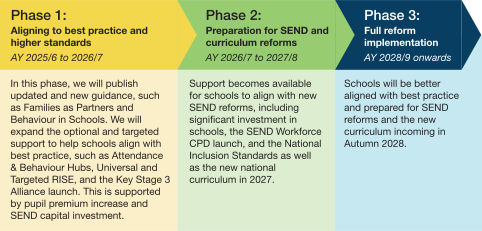
Conclusion: Working in partnership to deliver this vision
We have a generational opportunity to empower our children and young people to look out at a changing world, not scared about what the future brings but confident in their ability to shape it. We want all young people to leave education having benefitted from a well-rounded education, sure of their strengths and passions, with the curiosity to embrace life-long learning and the resilience to adapt to change.
Parents, teachers and young people should never have to choose between academic excellence and inclusion, knowledge and skills, belonging and stretch.
We know leaders, teachers and school staff share our aspirations for every child to achieve and thrive. Schools and trusts across the country are already demonstrating what can be achieved when working in partnership. Through this white paper, we set out the steps we will take to harness and spread existing best practice, as well as empowering each part of the system to innovate together to improve outcomes.
Delivering this vision will require all of us to work together to get behind our young people’s aspirations – by taking a narrow experience and making it broad, taking children from sidelined to included, and supporting children and families from withdrawn to engaged.
This is our invitation to all those in the sector to work in partnership – both at national level, and in every community across the country. Together, with collaboration and determination, we can enable every child to achieve and thrive.
Technical annex: Our aspiration for every child
This annex sets out how progress towards the targets will be measured.
Ambition 1: Higher standards for all
Progress will be tracked using the national average Attainment 8 score. The target is to reach an average Attainment 8 score of 50, up from 45.9 in the 2023 to 2024 academic year and 46.0 in the 2024 to 2025 academic year.[footnote 225] An Attainment 8 score of 50 is equivalent to an individual child achieving grade 5 in each GCSE slot (or other approved qualification) included in the measure. This is a national ambition, not a school-level target; expectations for individual children and schools will not all be the same.
The methodology and qualifications in scope for Attainment 8 and Progress 8 are under consultation following the publication of the government’s response to the Curriculum and Assessment Review. We will establish a reference group of leading educational research organisations to monitor progress and keep targets consistent as the system evolves.
Ambition 2: Halving the key stage 4 disadvantage gap
The gap will be measured by the difference in national average Attainment 8 scores between disadvantaged and non-disadvantaged children. At present, disadvantage is defined as children eligible for FSM in the past 6 years or looked after by a local authority (including previously looked after children). The gap was 15.4 points in the 2023 to 2024 academic year and 15.5 points in the 2024 to 2025 academic year.[footnote 226] The target is to reduce this by half, to 7.7 points.
Meeting both ambitions – raising the national average Attainment 8 to 50 and halving the gap – requires disadvantaged children’s Attainment 8 scores to rise by around 10 points in total, roughly one grade higher in each GCSE slot (with English and maths double-weighted). If the pupil population remains similar to that in 2024, this equates to around 1.3 million additional grade improvements. Based on current relationships between Attainment 8 and English and maths attainment, this also implies over 30,000 more disadvantaged children achieving grade 4+ in GCSE English and maths each year.
The definition of disadvantage is under review, with a view to adopting a household income-based measure in future. The specific target levels will be reassessed following any change to the definition, but the ambition will remain commensurate with halving the gap.
This white paper also sets new targets to improve outcomes:
- attendance: our ambition is to reduce the overall absence rate by 1.3 percentage points – from 7.15% in the 2023 to 2024 academic year to 5.85% in the 2028 to 2029 academic year. This improvement is equivalent to children attending 20 million more days of school each year from the 2028 to 2029 academic year, representing the fastest improvement in a decade. Progress will be monitored through the school census and daily attendance data. The 20 million days figure is calculated as: pupil enrolments in the 2023 to 2024 academic year × 190 school days × a 1.3‑point reduction in absence by the 2028 to 2029 academic year
- key stage 2: our ambition is for the share of children achieving the expected standard in reading, writing and maths to rise above the 2019 peak (64.9% overall; 51.3% disadvantaged) by the end of this Parliament. Assuming the cohort size remains stable and the disadvantaged rate stays in line with recent years, over 25,000 more children – including 10,000 disadvantaged children – would meet the expected standard than if attainment remained at 2024 levels (60.7% overall; 45.5% disadvantaged)
-
Where we refer to families and parents, we are referring to the adults at home with responsibility for supporting and enabling a child’s education, including carers. ↩
-
Pupil attendance in schools, Week 2 2026 – Explore education statistics – GOV.UK ↩
-
Health Behaviour in School-aged Children (HBSC) England, 2023 ↩
-
Evidence to the STRB: 2026 pay award for teachers and leaders – GOV.UK (data annex) See Table D7 ↩
-
DfE analysis of Schools Workforce Census, 2024 – see Schools, school workforce and pupils statistical analysis 2026 ↩
-
Education in England: Annual Report 2020 – Education Policy Institute ↩
-
Young people not in education, employment or training (NEET), UK – Office for National Statistics ↩
-
Data is drawn from the following sources: 1980-1999: Statistics of Education: Schools in England 2000 (pdf); 2000-2002: Schools, Pupils and their Characteristics Statistical First Release (provisional), January 2010 (pdf); 2003-2019: Schools, Pupils and their Characteristics 2019 Accompanying Tables [xlsx] (See Table 1a); 2020-2025: ‘Pupils in all schools, by type of SEN provision – 2020 to 2025’ from ‘Special educational needs in England’, Permanent data table – Explore education statistics – GOV.UK ↩
-
Understanding the use of unregistered alternative provision – May 2024 (pdf) ↩
-
Beyond the classroom: the experiences of children with SEND who are not in school – GOV.UK ↩
-
Number of education, health (EHC) plans as at January each year’ from ‘Education, health and care plans’, Permanent data table – Explore education statistics – GOV.UK ↩
-
Curriculum and Assessment Review Final Report: government response – GOV.UK ↩
-
‘Attainment by pupil characteristics’ from ‘Key stage 2 attainment’, Permanent data table – Explore education statistics – GOV.UK ↩
-
DfE analysis of School and College Voice data, December 2025 – see Schools, school workforce and pupils statistical analysis 2026 ↩
-
‘Absence by geographic level’ from ‘Pupil absence in schools in England’, Permanent data table – Explore education statistics – GOV.UK ↩
-
Kindred Squared (2026) School Readiness Survey 2025 (pdf) ↩
-
Children of the 2020s: home learning environment and screen time at age 2: research brief – GOV.UK ↩
-
PBE - A long road to recovery: Local authority spending on early intervention children’s services 2010-11 to 2023-24 - PBE ↩
-
Child Poverty Action Group (2025) Priced out of school: how lack of money prevents young people from attending school (pdf) ↩
-
Outcomes for children in need, including children looked after by local authorities in England, Reporting year 2024 – Explore education statistics – GOV.UK ↩
-
MHW0043 – Evidence on Mental health and well-being of looked after children ↩
-
Multiple disadvantage and KS4 attainment: evidence from LSYPE2 – GOV.UK ↩
-
The short- and medium-term effects of Sure Start on children’s outcomes - Institute for Fiscal Studies ↩
-
Magic Breakfast Evaluation report and executive summary (pdf) ↩
-
Coordinating mathematical success: the mathematics subject report – GOV.UK ↩
-
In reading, between 66% (2016) and 75% (2025) of pupils met the expected standard in each year between 2016 and 2025, excluding years in which there was no data due to the pandemic. Key stage 2 attainment, Academic year 2024/25 Revised – Explore education statistics – GOV.UK. This covers the period since testing of the new curriculum began in 2016. ↩
-
In maths, between 70% (2016) and 79% (2019) of pupils met the expected standard in each year between 2016 and 2025, excluding years in which there was no data due to the pandemic. In 2025 the figure was 74%. Key stage 2 attainment, Academic year 2024/25 Revised – Explore education statistics – GOV.UK. This covers the period since testing of the new curriculum began in 2016. ↩
-
42% of pupils with SEN met the expected standard in reading and 40% in maths: Key stage 2 attainment, Academic year 2024/25 Revised – Explore education statistics – GOV.UK ↩
-
63% of disadvantaged pupils met the expected standard in reading and 61% in maths: Key stage 2 attainment, Academic year 2024/25 Revised – Explore education statistics – GOV.UK ↩
-
60% of White British FSM eligible pupils met the expected standard in reading and 56% in maths: ‘Attainment by pupil characteristics’ from ‘Key stage 2 attainment’, Permanent data table – Explore education statistics – GOV.UK ↩
-
Out of school activities during primary school and KS2 attainment (pdf) ↩
-
Do extra-curricular activities in schools improve educational outcomes? A critical review and meta-analysis of the literature. Int Rev Educ 56, 591–612 ↩
-
Laurus Trust – Student outcomes and Progress – Education Policy Institute, 2024 ↩
-
Parent, pupil and learner voice: omnibus surveys for 2024 to 2025, data tables, December 2024 and June 2025 ↩
-
Parent, pupil and learner voice: omnibus surveys for 2024 to 2025, data tables, December 2024 and June 2025 ↩
-
Parent, pupil and learner voice: omnibus surveys for 2024 to 2025, data tables, December 2024 ↩
-
Access to extra-curricular provision and the association with outcomes – Education Policy Institute ↩
-
Parent, pupil and learner voice: omnibus surveys for 2024 to 2025, data tables, December 2024 and June 2025 ↩
-
Access to extra-curricular provision and the association with outcomes – Education Policy Institute ↩
-
‘All state-funded pupil characteristics and geography data’ from ‘Key stage 4 performance’, Permanent data table – Explore education statistics – GOV.UK ↩
-
‘All state-funded pupil characteristics and geography data’ from ‘Key stage 4 performance’, Permanent data table – Explore education statistics – GOV.UK ↩
-
Mind the Engagement Gap: A National Study of Pupil Engagement in England’s Schools ↩
-
‘Absence by pupil characteristics’ from ‘Pupil absence in schools in England’, Permanent data table – Explore education statistics – GOV.UK ↩
-
Disadvantage in early secondary school, Nuffield Foundation ↩
-
Public First Polling for the White Working Class Commission – Public First – see Table 58, pupil tables ↩
-
Out of school activities during primary school and KS2 attainment (pdf) ↩
-
Do extra-curricular activities in schools improve educational outcomes? A critical review and meta-analysis of the literature. Int Rev Educ 56, 591–612 ↩
-
Laurus Trust – Student outcomes and Progress – Education Policy Institute, 2024 ↩
-
Access to extra-curricular provision and the association with outcomes – Education Policy Institute, 2024 ↩
-
An unequal playing field: extra-curricular activities, soft skills and social mobility – GOV.UK ↩
-
Investigating cross-country differences in young people’s skill development and identifying factors associated with high-performance – NFER ↩
-
Curriculum and Assessment Review Final Report: government response – GOV.UK ↩
-
Parent, pupil and learner voice: omnibus surveys for 2024 to 2025, data tables, December 2024 wave ↩
-
Access to extra-curricular provision and the association with outcomes – Education Policy Institute ↩
-
Parent, pupil and learner voice: omnibus surveys for 2024 to 2025, data tables, December 2024 and June 2025 waves ↩
-
Parent, pupil and learner voice: omnibus surveys for 2024 to 2025, data tables, December 2024 and June 2025 waves ↩
-
Access to extra-curricular provision and the association with outcomes – Education Policy Institute ↩
-
Young people’s experiences of careers information, advice and guidance ↩
-
IPPR and The Difference (2025) Who is losing learning? Finding solutions to the school engagement crisis (pdf) ↩
-
The opportunity gap facing boys from low-income families at age 5 and beyond - Institute for Government ↩
-
Key stage 2 attainment, Academic year 2024/25 Revised – Explore education statistics – GOV.UK ↩
-
Key stage 4 performance, Academic year 2024/25 – Explore education statistics – GOV.UK ↩
-
When and why do initially high-achieving poor children fall behind?: Oxford Review of Education: Vol 43 , No 1 ↩
-
‘FSM eligibility by ethnicity or national curriculum year group’ from ‘Schools, pupils and their characteristics’, Permanent data table – Explore education statistics – GOV.UK ↩
-
‘All state-funded pupil characteristics and geography data’ from ‘Key stage 4 performance’, Permanent data table – Explore education statistics – GOV.UK ↩
-
‘All state-funded pupil characteristics and geography data’ from ‘Key stage 4 performance’, Permanent data table – Explore education statistics – GOV.UK ↩
-
‘All state-funded pupil characteristics and geography data’ from ‘Key stage 4 performance’, Permanent data table – Explore education statistics – GOV.UK ↩
-
The forgotten fifth: Examining the early education trajectories of teenagers who fall below the expected standards in GCSE English language and maths examinations at age 16 – CLS working paper number 2022/6 Lee Elliot Major and Sam Parsons (pdf) ↩
-
‘All state-funded pupil characteristics and geography data’ from ‘Key stage 4 performance’, Permanent data table – Explore education statistics – GOV.UK ↩
-
‘16-18 study leavers national level destinations’ from ‘16-18 destination measures’, Permanent data table – Explore education statistics – GOV.UK ↩
-
Educational psychology services: workforce insights and school perspectives on impact ↩
-
DfE (2026), Time spent on process for new Education, Health and Care plans by local authority professionals ↩
-
Identifying pupils with special educational needs and disabilities – Education Policy Institute ↩
-
High needs funding has increased in real terms five times faster than mainstream school funding between 2019-20 and 2025-26. Calculated based on published school funding numbers for the high needs block and schools. ↩
-
Data is drawn from the following sources: 1980-1999: Statistics of Education: Schools in England 2000 (pdf); 2000-2002: Schools, Pupils and their Characteristics Statistical First Release (provisional), January 2010 (pdf);2003-2019: Schools, Pupils and their Characteristics 2019 Accompanying Tables (xlsx) (See Table 1a); 2020-2025: ‘Pupils in all schools, by type of SEN provision – 2020 to 2025’ from ‘Special educational needs in England’, Permanent data table – Explore education statistics – GOV.UK ↩
-
‘All state-funded pupil characteristics and geography data’ from ‘Key stage 4 performance’, Permanent data table – Explore education statistics – GOV.UK ↩
-
Measured using Attainment 8: ‘All state-funded pupil characteristics and geography data’ from ‘Key stage 4 performance’, Permanent data table – Explore education statistics – GOV.UK ↩
-
The opportunity gap facing boys from low-income families at age 5 and beyond - Institute for Government ↩
-
63% of White British FSM eligible pupils met the expected phonics standard in Year 1 in 2025, compared to 67% of all FSM eligible pupils and 80% of all pupils nationally – see ‘Phonics screening check attainment by pupil characteristics’ from ‘Phonics screening check attainment’, Permanent data table – Explore education statistics – GOV.UK. At KS2, 43% of White British FSM eligible pupils met the expected standard in reading, writing and maths in 2025, compared to 48% of all FSM eligible pupils and 62% of all pupils nationally – see ‘Attainment by pupil characteristics’ from ‘Key stage 2 attainment’, Permanent data table – Explore education statistics – GOV.UK ↩
-
Public First Polling for the White Working Class Commission – Public First – see Table 58, pupil tables ↩
-
White British FSM eligible pupils have among the highest rates of identified SEN (36%) of all minor ethnic groups, significantly above the national average (19%). This is particularly true for white working-class boys, of whom 44% are identified as having SEN, compared to 24% of all boys. See Special educational needs in England, Academic year 2024/25 – Explore education statistics – GOV.UK ↩
-
‘Absence by pupil ethnicity and FSM eligibility – autumn and spring terms combined’ from ‘Pupil absence in schools in England’, Permanent data table – Explore education statistics – GOV.UK ↩
-
Unique new white working class education survey results published – Public First ↩
-
How engaged are low-income White children during secondary school? Jerrim, J., UCL Social Research Institute and ImpactEd Group, 2025 ↩
-
See Key Stage 4 Academic Performance Measures and Targeted RISE extension: Government Consultation (technical annex). A slot is considered filled when a grade is achieved for the qualification entered. A slot is considered empty if there is no qualification to fill the slot or if the qualification is ungraded. The percentage of pupils filling all 8 slots within Attainment 8/Progress 8 is 15% for all pupils, 33% for low prior attaining pupils, 11% for mid prior attaining pupils and 4% for high prior attaining pupils. ↩
-
Pupil premium also includes looked after and previously looked after children, and national funding formula deprivation funding allocations also use Indices of Deprivation Affecting Children Index (IDACI). ↩
-
Tackling the persistent disadvantage gap-A new approach to deprivation funding – Education Policy Institute ↩
-
In the vast majority of cases, though claims may need to continue for children missing from income data. ↩
-
Pupil Premium Statement Research: Academic Year 2024/25 – Research report - Education Endowment Foundation (EEF) ↩
-
While this white paper focuses on the impact for children in schools, our accompanying consultation document sets out the full detail of the reforms we plan to make to the SEND system, built on this co-creation process, including the full breadth of reforms across ages 0-25. ↩
-
DfE analysis of National Pupil Database – based on the cohort in Y11 in 2024/25 – see Schools, school workforce and pupils statistical analysis 2026 ↩
-
European Agency for Special Needs and Inclusive Education, Evidence: A Review of the Literature (2018) ↩
-
DfE (2026), Educational outcomes for pupils with SEND: comparing outcomes at mainstream and special school settings across policy reforms ↩
-
Education Select Committee (2025), Solving the SEND Crisis ↩
-
Identifying pupils with special educational needs and disabilities – Education Policy Institute ↩
-
The Children’s Plan: The Children’s Commissioner’s School Census (pdf) ↩
-
Estimated days of support per setting are calculated by taking mainstream setting population figures and average salary costs of experts including speech and language therapists, education psychologists and specialist support staff. ↩
-
Independent analysis of the consultation responses to the SEND review: right support, right place, right time (pdf) ↩
-
Ofsted (2025), Area SEND framework: findings from the first 2 years of inspections ↩
-
Office of the Children’s Commissioner (2022), An inconsistent approach to SEND, findings from analysis of Education Health and Care Plans (EHCP) from 2 local authorities in England ↩
-
See annex accompanying the SEND reform: putting children and young people first document for background on projections ↩
-
Teacher Tapp Insights, ‘Home-school relationships’, July 2024: Teacher Tapp Insights: Home-school relationships – Teacher Tapp ↩
-
Pupil attendance in schools, Week 2 2026 – Explore education statistics – GOV.UK ↩
-
National behaviour survey report: 2023 to 2024 academic year – GOV.UK ↩
-
Health Behaviour in School-aged Children (HBSC) England, 2023 ↩
-
Pupil experiences in school: academic year 2024 to 2025 – GOV.UK ↩
-
Korpershoek, H et al., 2020, The relationships between school belonging and students’ motivational, social-emotional, behavioural, and academic outcomes in secondary education: a meta-analytic review ↩
-
Parker, P., Allen, K.-A., Parker, R., Guo, J., Marsh, H. W., Basarkod, G., & Dicke, T. (2022). School belonging predicts whether an emerging adult will be not in education, employment, or training (NEET) after school. Journal of Educational Psychology, 114(8), 1881–1894 ↩
-
Adolescent School Belonging and Mental Health Outcomes in Young Adulthood: Findings from a Multi-wave Prospective Cohort Study - School Mental Health ↩
-
Korpershoek, H et al., 2020, The relationships between school belonging and students’ motivational, social-emotional, behavioural, and academic outcomes in secondary education: a meta-analytic review ↩
-
Driven to Succeed? Teenagers’ Drive, Ambition and Performance on High-Stakes Examinations - IZA – Institute of Labor Economics ↩
-
Adolescent School Belonging and Mental Health Outcomes in Young Adulthood: Findings from a Multi-wave Prospective Cohort Study - School Mental Health ↩
-
The long-term benefits of adolescent school engagement for adult educational and employment outcomes – PubMed ↩
-
Acting on the Engagement Gap: Insights from the Research Cohort ↩
-
DfE analysis of School and College Voice data, December 2025 – see Schools, school workforce and pupils statistical analysis 2026 ↩
-
John Hattie, 2009, Visible Learning: A Synthesis of Over 800 Meta-Analyses Relating to Achievement ↩
-
Department for Children, Schools and Families, 2007, Engaging Parents in Raising Achievement: Do Parents Know They Matter? (pdf) ↩
-
Parentkind Report: Learning at home throughout the pandemic (pdf), 2022 ↩
-
‘Absence by geographic level’ from ‘Pupil absence in schools in England’, Permanent data table – Explore education statistics – GOV.UK ↩
-
Pupil attendance in schools, Week 29 2025 – Explore education statistics – GOV.UK ↩
-
Equivalent to reducing overall absence to 5.85% in academic year 2028/29 compared to 7.15% in 2023/24 ↩
-
‘Absence by geographic level’ from ‘Pupil absence in schools in England’, Permanent data table – Explore education statistics – GOV.UK ↩
-
Pupil attendance in schools, Week 29 2025 – Explore education statistics – GOV.UK ↩
-
‘Absence by pupil characteristics – autumn and spring terms combined’ from ‘Pupil absence in schools in England’, Permanent data table – Explore education statistics – GOV.UK ↩
-
‘Absence rates by geographic level – autumn and spring terms combined’ from ‘Pupil absence in schools in England’, Permanent data table – Explore education statistics – GOV.UK ↩
-
‘Absence by geographic level’ from ‘Pupil absence in schools in England’, Permanent data table – Explore education statistics – GOV.UK Note that one session is half a day, so 8 million sessions equates to 4 million days ↩
-
Research by Shelter suggests that over half (52%) of homeless children of school age have missed days of school as a result of living in temporary accommodation. Of these, more than one in three (37%) have missed more than a month of school. See Still Living in Limbo: Why the use of temporary accommodation must end – Shelter England ↩
-
Suspensions and permanent exclusions in England, Academic year 2023/24 – Explore education statistics – GOV.UK ↩
-
‘Suspensions and permanent exclusions – by multiple reasons (2020/21 onwards)’ from ‘Suspensions and permanent exclusions in England’, Permanent data table – Explore education statistics – GOV.UK ↩
-
Public First (2025), What Parents Value in Education (pdf) ↩
-
Tackling Child Exploitation (2021) Excluded or missing from education and child exploitation: literature review and stakeholder views on safeguarding practice (pdf) ↩
-
‘Suspensions and permanent exclusions – by characteristic’ from ‘Suspensions and permanent exclusions in England’, Permanent data table – Explore education statistics – GOV.UK ↩
-
Alternative provision in local areas in England: a thematic review – GOV.UK ↩
-
School workforce in England, Reporting year 2024 – Explore education statistics – GOV.UK ↩
-
Initial Teacher Training Census, Academic year 2025/26 – Explore education statistics – GOV.UK ↩
-
Evidence to the STRB: 2026 pay award for teachers and leaders – GOV.UK ↩
-
School workforce in England, Reporting year 2024 – Explore education statistics – GOV.UK ↩
-
Evidence to the STRB: 2026 pay award for teachers and leaders – GOV.UK (data annex) See Table D7 ↩
-
DfE analysis of Schools Workforce Census, 2024 – see Schools, school workforce and pupils statistical analysis 2026 ↩
-
‘Size of the school workforce’ from ‘School workforce in England’, Permanent data table – Explore education statistics – GOV.UK ↩
-
‘Table 1.1 – ITT new entrants and trainee characteristics by subject’ from ‘Initial Teacher Training Census’, Permanent data table – Explore education statistics – GOV.UK ↩
-
There were 6,742 new PGITT entrants for STEM subjects, an increase of 21% compared to 2024/25 (5,593). This represents 107% of the PGITT STEM target (6,320), the first time the overall STEM target has been met since it was introduced into reporting in 2019/20. See Initial Teacher Training Census, Academic year 2025/26 – Explore education statistics – GOV.UK ↩
-
School workforce in England, Reporting year 2024 – Explore education statistics – GOV.UK ↩
-
Stakeholders report an increase in attacks/abuse against school staff. Physical assaults on adults leading to suspensions rose by 61% between 2021/22 and 2023/24, from 38,986 to 62,897. Permanent exclusions due to such assaults rose by 84%, from 1,011 to 1,860, in the same period. ‘Suspensions and permanent exclusions – by multiple reasons (2020/21 onwards)’ from ‘Suspensions and permanent exclusions in England’, Permanent data table – Explore education statistics – GOV.UK ↩
-
Evaluating a nine-day working fortnight as a strategy to improve teacher retention - EEF ↩
-
‘Qualified leavers from teaching’ from ‘School workforce in England’, Permanent data table – Explore education statistics – GOV.UK ↩
-
Use of teaching assistants in schools – research report (pdf) ↩
-
Evidence to the STRB: 2026 pay award for teachers and leaders – GOV.UK ↩
-
The tendency is that larger MATs are less likely to have a deficit and hold larger cumulative revenue surpluses. Academies consolidated annual report and accounts: 2022 to 2023 – GOV.UK ↩
-
Teacher Retention and Turnover Research – Research Update 2: Teacher Dynamics in Multi-Academy Trusts – NFER ↩
-
See Schools, school workforce and pupils statistical analysis 2026. Trends in the percentage of pupils achieving grades A* to C / 9 to 4 in English and maths since 2012 show pupils in both converter and sponsored academies perform better in relation to the national average the more years they have been in the trust. ↩
-
In general, pupils in both sponsored and converter academies make more progress in larger trusts – see ‘National multi-academy trusts data by trust characteristics’ from ‘Key stage 4 performance’, Permanent data table – Explore education statistics – GOV.UK ↩
-
See Schools, school workforce and pupils statistical analysis 2026. School financial benchmarking data shows that maintained schools and Single Academy Trusts are more likely to be in deficit than multi-school trusts. ↩
-
These Commissioning High-Quality Trusts principles included: High-Quality and Inclusive Education; School Improvement; Workforce; Finance and Operations; and Governance and Leadership. ↩
-
RISE programme: lists of advisers and targeted schools – GOV.UK ↩
-
ChatGPT in lesson preparation – Teacher Choices trial - EEF ↩
-
School Accountability Reform consultation School accountability reform – GOV.UK ↩
-
DfE consultation response: School accountability reform – school profiles, improvement and intervention: government consultation response; Ofsted response Improving the way Ofsted inspects education: report on the responses to the consultation – GOV.UK ↩
-
Key stage 4 performance, Academic year 2024/25 – Explore education statistics – GOV.UK ↩
-
‘All state-funded pupil characteristics and geography data’ from ‘Key stage 4 performance’, Permanent data table – Explore education statistics – GOV.UK ↩