Our Children, Our Future: Tackling Child Poverty
Updated 13 March 2026

© Crown copyright 2026
This publication is licensed under the terms of the Open Government Licence v3.0 except where otherwise stated. To view this licence, visit nationalarchives.gov.uk/doc/open-government-licence/version/3 or write to the Information Policy Team, The National Archives, Kew, London TW9 4DU, or email: psi@nationalarchives.gov.uk.
Where we have identified any third party copyright information you will need to obtain permission from the copyright holders concerned.
This publication is available at https://www.gov.uk/government/publications/our-children-our-future-tackling-child-poverty/our-children-our-future-tackling-child-poverty
Our Children, Our Future
Tackling Child Poverty
Presented to Parliament by Pat McFadden, Secretary of State for Work and Pensions and Bridget Phillipson, Secretary of State for Education by Command of His Majesty
December 2025
Foreword from the Prime Minister
The recent story of child poverty in Britain is simple. The last Labour Government reduced it by around 600,000 children. Yet since 2010 it has risen by 900,000 and now around 4.5 million children are in poverty. That is a staggering indictment of the previous Government’s policies. The statistics alone are shocking enough but think about the individual human cost. Think about the skipped meals. The cold bedrooms. The school uniform that’s too small or worn through. Should any of this really be happening in a country like ours?
The answer, in both first principles and evidence, is a resounding no. And so this child poverty strategy sets out a different path for Britain. There are four arguments in its favour.
First, the basic moral argument. I believe that it is a fundamental British value that our children should go as far as their talent takes them. We say it to our own children. “Work hard and you can achieve anything”. But poverty is a huge barrier to potential. After all, if you are arriving in your classroom hungry or tired from sleeping in a cold bed, then you are simply not in the best position to learn. We should not stand for that.
Second, there is the economic argument. As this strategy sets out at length, tackling child poverty is a sound investment in the country’s future. Evidence clearly shows that children who grow up in poorer households earn less at age 30 than their peers. They are also more likely to spend their first years as an adult out of work, training or education. By investing in their potential now, we can both improve their life chances and strengthen our economy for the long-term.
Third, there is the public services argument. This was put clearly to me when visiting a hospital, recently. The staff told me in no uncertain terms that an extremely high number of children they treat come through their doors because of conditions related to poverty. Again, this is a shocking example of the Britain built by the previous Government. But it also shows that tackling child poverty can help alleviate pressure on our public services.
Finally, there is the cost of living. Because, as well as the rise, in recent decades the nature of poverty in Britain has also changed. Even now, when we think about poverty in our minds eye, we are likely to imagine people who are out of work completely. But the reality is that almost three quarters of children in poverty now come from working families. Families where parents are doing the right thing, working harder and harder, yet find their pay packets don’t cover their essential costs. Driving down child poverty must therefore be viewed as an essential part of the Government’s wider ambitions to tackle the cost of living for working people.
For all those reasons and more, I am proud to publish this strategy. It has been drawn up in partnership with people directly affected by the issues it touches. And it is a symbol of the promise we made to the British people. That Britain deserves change. And that this Government is dedicated to unlocking the potential of us all.
– Keir Starmer, Prime Minister of the United Kingdom
Foreword from the Co-Chairs of the Child Poverty Taskforce
Imagine a future where poverty is not a barrier to opportunity. Where every child has the same chances in life. Where background has no bearing on future success. Where every child starts the day ready to learn, having had a good breakfast and slept in a warm bed. Where families don’t have to worry constantly about how they will pay the bills or put food on the table. Where every parent who can work has the right support to move into and progress in work. Where the welfare state lifts families up rather than trapping them down.
That is the future we are building. This strategy sets out our plan to get there – to improve children’s lives and life chances and address the root causes of child poverty over the next decade. It will give parents the tools, and children the chances, to shape better futures and reduce the harmful scarring effects that living in poverty has on children’s prospects. That means putting more money into the pockets of the poorest families, reducing the burden of essential costs, and strengthening local support.
Since July 2024, we’ve taken some important steps. That includes increases to the National Living Wage, the first ever above inflation rise to the basic rate of Universal Credit, and a new £1 billion package for a Crisis and Resilience Fund. By scrapping the two child limit, we will lift 450,000 children out of poverty. That number will rise thanks to other measures we are taking such as free school meals for all children in families on Universal Credit, help with energy bills, and the expansion of free childcare so that more parents can take up work.
There are those who would say that we cannot afford to act on poverty. This Labour government believes that it is the cost of inaction that our country, society, economy, and future generations cannot afford. When children grow up without the things they need to be happy, healthy and to achieve, they are less likely to do well at school, college, or university. They are less likely to get a job when they leave education. And they are less likely to have good mental or physical health. The cost in poorer health, worse educational attainment, lower skills and lower earnings is high. That is terrible in human terms, expensive in financial terms, and damaging in economic terms.
Tackling child poverty is an investment in the future of those children and in the country. To grow our economy, we need to make sure our children – the nation’s future workforce – can themselves grow, prosper, succeed, and flourish. The experience since 2010, where child poverty rose by 900,000, has shown that the cost of poverty down the line is one our society, our country, cannot afford.
Instead, this government is investing up front to avoid crisis costs that are the costs of failure. We are reforming children’s social care to intervene earlier and help families stay together wherever that works best for children. We are bringing in Best Start Family Hubs, revitalising Sure Start for the next generation. We are rolling out free breakfast clubs and hundreds more nurseries in school premises to give more children the best start in life. We are investing in hundreds of thousands of new homes. We are doubling down on reducing NHS waiting lists and helping people stay healthy in work to avoid getting sick. We are investing in the jobs of the future, and in the joined-up health, employment and skills support for people to start and succeed in them, particularly young people.
This is what we mean when we say we want an Opportunity Welfare State that not only protects in tough times but provides a platform from which people can rise and change their life stories and their communities for the better.
We are proud that this strategy has been developed in partnership with civil society and community organisations who have tirelessly worked to keep children healthy, fed and happy in the face of extreme adversity, as previous governments shied away from their responsibilities. We are grateful to, and humbled by, the children and families who have discussed their experiences with the Child Poverty Taskforce throughout this process.
The twin goals of opportunity and security have run through every Labour government, and they run through this strategy – which will help to build a Britain where children get the best start in life, with every opportunity to succeed and thrive.
– Pat McFadden, Secretary of State for Work and Pensions
– Bridget Phillipson, Secretary of State for Education
Foreword from parents involved in Changing Realities
As parents of children who experience poverty, being part of the development of this strategy has given us a welcome opportunity to represent the many others who face similar struggles day in, day out. We know our stories are all too similar.
We are part of Changing Realities, a collaboration pushing for positive change, made up of more than 200 parents and carers living on a low income working with academic researchers. Throughout, we have brought our voices, experiences, and ideas to the table, often sharing difficult truths about what life is really like. Child poverty exists, multiplies and thrives in an undercurrent of forgottenness. It desperately needs to be brought to the surface and to the forefront of people’s minds. Being part of this process has shown that our insights are valuable and necessary. We have experienced genuine listening and collaboration, and it has been encouraging to feel that our lived experiences can and should influence policy solutions.
Right now, every day feels like a balancing act between keeping the house warm, putting food on the table, and covering the basic costs of living. We are making decisions which no one should have to make. But like all parents, the things we want are simple: for our children to grow up in a home that’s warm, where they can focus on learning and playing rather than worrying about the essentials we can’t afford.
But we must not get complacent and stop there. All of us owe it to the children who are relying on decision makers to put them first – to stand up rather than sit back – and ensure we are doing everything we can to propel our children into a future filled with hope and not despair.
Our involvement in this strategy has strengthened our belief that lasting solutions come when policies are shaped with people, not just for them. We are proud to have contributed and we remain hopeful that through sharing our experiences, we will help create a better future for all children.
What might seem like small changes can have a huge impact for families like ours. With sky-high rents, rising food and energy bills as well as the expense of childcare, full time wages aren’t always enough, and support from government is vital. This strategy begins the work of lifting the weight of poverty off the shoulders of millions of families. With some of the changes, families like ours may start to breathe again. Not just survive but live with dignity. We’d all like to feel secure knowing that if something breaks, or a bill goes up, we won’t be pushed into crisis. More than anything, we want our children to have opportunities without us constantly having to say “no, not this time”.
We only get one childhood, but the effects of it – good or bad – last a lifetime. Let’s make sure all of our children have the best childhood possible. As parents and campaigners, we will do all we can to help make that happen, and we call on the government to do the same.
– Kim, mum to four children, from Wales
– Ella, mum to two children, from England
– Jonny, dad to two children, from England
– Tayyaba, mum to one child, from England
Executive Summary
Shortly after the election, the Prime Minister set up the Child Poverty Taskforce to bring together government and experts to explore how Government could use all its available levers to drive down child poverty. As he said at the time, for too long children have been left behind and no decisive action has been taken to address child poverty.
This strategy is the first step on our road to ending child poverty and delivers on the commitment to reduce child poverty this parliament. The strategy will lift 550,000 children out of relative low income in the final year of the parliament, and will see the largest reduction in child poverty by any Government in a single parliament. Around 7.1 million children will see their household incomes increase in the final year of the parliament due to the strategy, including 1.4 million children in deep material poverty.[footnote 1]
The case for change
The UK has higher child poverty rates than most comparable European Union and Organisation for Economic Co-operation and Development (OECD) countries.[footnote 2] Nearly a third (31%) of children are in relative low income in the UK.(Note a)[footnote 3]
The cost of inaction in this area is significant. A child growing up in poverty is more likely to experience mental and physical health issues[footnote 4], do worse at school,[footnote 5] work less, go on to earn less than their peers[footnote 6] and experience homelessness[footnote 7]. This is bad for childhoods and bad for all our futures: we want to act to give every child the chance of a positive childhood, and to make sure they are supported to grow up into adults who can thrive and make a positive contribution. It is vital to the economic prosperity of the country.
Reducing child poverty is a moral imperative: reducing the impact of poverty now on health, happiness and life expectancy of children is a key issue of social justice and opportunity, giving every child a chance to succeed. It is also vital to the future economic prosperity of the United Kingdom.
The impact of child poverty on educational attainment emerges early. By age five, children eligible for free school meals are already five months behind, by age 16 that gap has widened to over 19 months.[footnote 8] In families with the lowest incomes just one in four children gets five good GCSEs including English and Maths. For children in the families with the highest incomes, the figure is nearly three in four.[footnote 9] As adults, those who grew up in poverty are more likely to be unemployed or in low-skilled and lower-paid jobs.[footnote 10],[footnote 11] Of children attending state-funded schools, those who received free school meals earn around 25% less at age 30 than those who did not receive free school meals. Much, but not all, of this gap can be explained by their success in education.[footnote 12] The OECD estimate that in the UK, at current rates of social mobility, it could take five generations for a child from the poorest 10% of families to reach the national average income.[footnote 13]
Child poverty is associated with poorer health outcomes. Children living in the most deprived areas are twice as likely to be obese[footnote 14] and twice as likely to have tooth decay as those living in the least deprived areas.[footnote 15] These inequalities persist over the lifetime. The gap in healthy life expectancy at birth for women in England has increased to 19.6 years (between 2017 to 2019 and 2020 to2022), when comparing between small areas in the most and least deprived areas of the country.[footnote 16]
Tackling child poverty will alleviate hardship and improve the lives of children and their families now, while laying the foundations of national renewal as part of the systems wide approach we are taking to: breaking the link between family background and success, improving healthy life expectancy, and driving sustained economic growth.
This strategy is about creating the conditions for all families to forge their own path, make decisions about their own future, and enjoy the choices and chances that real control brings. Parents are crucial partners in delivering this change. This work will change the course we are on, fixing the system now and delivering a reduction in child poverty over this parliament.
Historical trends in child poverty
Child poverty rates (Note b) in the UK were comparatively low during the 1960s and 1970s. During the 1980s they rose and by 1997, children were more likely to be in poverty than people of working age or pensioners.[footnote 17]
However, by 2010 to 2011 the number of children in poverty had reduced by 600,000 compared to 1997 to 1998.[footnote 18]
Since 2010, a series of structural changes, cuts to public services and social security and a lack of economic growth increased rates of child poverty again. In 2023 to 2024, there were 4.5 million children in relative low income after housing costs, 900,000 more than in 2010 to 2011,[footnote 19] and two million children in deep material poverty.[footnote 20]
The child poverty challenge we face today is distinct from that of two decades ago. While in 2000, half of children in poverty lived in workless families, today almost three quarters[footnote 21] of children in poverty are in a working family.
Without decisive action, external projections suggest child poverty will increase even further during this parliament to approach record rates.[footnote 22]
Action we are taking
While this strategy sets out our plan to tackle the root causes of child poverty, families growing up in poverty now require our immediate support. If we fail to act, thousands more children will fall into hardship, and the cost will be felt for decades: lower skills, lower earnings, and poorer health, and billions lost in wasted potential.
To drive down child poverty rates within this parliament, we will take immediate action to remove the two child limit, lifting 450,000 children out of relative poverty within this parliament. Around two million children will live in households that will see an increase in income as a result of removing the two child limit including 600,000 children in deep material poverty.[footnote 23]
Removing the limit is the most cost-effective way to drive down child poverty rates – and it is the right thing to do. In modern Britain, the number of brothers and sisters a child has should not determine whether or not they will go hungry tonight.
The majority of families who will gain from the removal of the limit are in work.
This investment represents a downpayment on Britain’s future. Inaction will cost the UK far more than investing now, as every pound we spend lifting children out of poverty saves multiples in better health, educational attainment, and employment outcomes – and provides a stronger foundation for our future economy.
Given that the drivers and impacts of child poverty are multi-faceted, government has used all available levers to both tackle the root causes and alleviate the symptoms of child poverty. Over the last 15 months, government has prioritised action to boost family incomes, drive down the cost of essentials and strengthen local support.
Boosting family incomes
To ensure that families’ incomes are boosted so that children have the best possible start in life, alongside removing the two child limit government has:
-
increased the National Living Wage by 6.7% to £12.21 from April 2025 for the lowest earners, with a further increase to £12.71 per hour from April 2026
-
strengthened rights at work through the Employment Rights Bill, to tackle insecurity and create more secure jobs across the UK
-
introduced the first sustained above inflation increase to the basic rate of Universal Credit, estimated to be worth annually in cash terms £725 for a single parent aged 25 or over or £1,135 for a couple with children by 2029 to 2030
-
implemented the Fair Repayment Rate in Universal Credit from April 2025, this change reduced the overall deductions cap from 25% to 15% of a customer’s standard allowance. This will enable approximately over a million of the poorest households retain more of their award, on average £420 a year or £35 per month
-
proposed reforms to the Child Maintenance Service in Great Britain which will help lift 20,000 children out of relative low income (Note c),[footnote 24]
-
launched the biggest shake up of jobcentres in a decade to ensure more people receive personalised support to get into and on at work, alongside improving employees’ rights
-
expanded government funded childcare to working families in England, for children from the age of nine months backed by thousands of new school-based nursery places
-
begun rolling out free breakfast clubs in England, to support parents to boost their working hours
Driving down the cost of essentials
To ensure families can put food on the table and provide safe, warm homes for their children, government has:
-
announced that we will invest £39 billion in a new 10-year Social and Affordable Homes Programme in England, the biggest investment in recent memory
-
expanded free school meals in England to all children in households in receipt of Universal Credit, lifting 100,000 children out of relative low income by the end of this parliament.[footnote 25] We are including school-based nurseries, school sixth forms and Further Education settings, ensuring that we are supporting children all the way through their compulsory education.
-
committed £600 million investment into the Holiday Activity and Food Programme in England over the next three years, to deliver enriching activities and healthy food for the poorest children throughout the holidays
-
introduced a limit of three branded school uniform items to cut costs for parents
-
extended the Warm Homes Discount to an additional 2.7 million households in Great Britain
Strengthening local support
To ensure families can access personalised, local services and support, government has:
-
announced the Pride in Place Programme, which will deliver up to £5 billion funding to 244 of the most in-need places in Great Britain, giving communities the option to invest in measures to address child poverty
-
overhauled English local government funding through the first multi-year funding settlement in decades and the Fair Funding Review 2.0, and empowered local government and strategic authorities with the tools they need to prioritise child poverty through the new Outcomes for local government and the English Devolution and Community Empowerment Bill
-
announced plans to roll out Best Start Family Hubs in every local authority in England, backed with over £500 million in funding. This will support 500,000 more children
-
increased the Early Years Pupil Premium in England by an unprecedented 45% from £388 per child per year to £570, boosting early learning and development
-
announced a £1 billion package (including Barnett) for a new Crisis and Resilience Fund in England, giving councils funding to protect households from falling into crisis
-
invested £500 million in the Better Futures Fund in England, breaking down barriers to opportunity for up to 200,000 vulnerable children, young people and their families
-
started delivering the school-based nursery programme to create tens of thousands of places in school-based nurseries, helping more families access funded childcare and giving children the best start in life in England
-
made available over £2.4 billion for the Families First Partnership programme in England over the multiyear Local Government Finance Settlement to reform children’s social care, and deliver early intervention and support to up to 400,000 families
Taken together, action outlined in this strategy will lift 550,000 children out of relative low income after housing costs by the end of this parliament. It is estimated that 7.2 million children will live in households that see an increase in income as a result of the modelled measures including 1.5 million children in deep material poverty.[footnote 26]
Table 1: Impact of measures in the Child Poverty Strategy on projected numbers and proportions of children in relative low income after housing costs (UK)
| Change in relative low income AHC compared to baseline | Change in relative low income AHC compared to baseline | Change in relative low income AHC compared to baseline | Change in relative low income AHC compared to baseline | Change in relative low income AHC compared to baseline | |
|---|---|---|---|---|---|
| FYE2027 | FYE2028 | FYE2029 | FYE2030 | FYE2031 | |
| Overall | -400,000 | -450,000 | -550,000 | -550,000 | -550,000 |
| -2.60% | -3.10% | -3.90% | -4.00% | -3.80% | |
| Removal of two child limit | -300,000 | -350,000 | -450,000 | -450,000 | -450,000 |
| -2.20% | -2.60% | -3.20% | -3.20% | -3.10% | |
| Extension of FSM eligibility | -50,000 | -100,000 | -100,000 | -100,000 | -50,000 |
| -0.40% | -0.60% | -0.80% | -0.60% | -0.50% | |
| Remaining measures: Breakfastclubs, Healthy Start, Warm Home Discount and abolition of Direct Pay in child maintenance | <-25,000 | -50,000 | -50,000 | -50,000 | -50,000 |
| -0.10% | -0.30% | -0.30% | -0.30% | -0.30% |
| Note: The individual poverty impacts do not necessarily sum to the total impact of the strategy due to rounding and the interactions between measures which mean that some people are affected by more than one measure. |
Headline poverty metrics
This strategy will deliver change across two complementary headline metrics.
Overall child poverty, using the leading metric of relative low income (after housing costs). Relative low income is a widely used and internationally recognised income metric of poverty, and reflects changing living standards over time. This metric is based on how much income each household has after deducting taxes paid and their housing costs, adjusting for the number and ages of people in the household (to account for different levels of need across households). Anyone living in a household with less than 60% of the income of a household in the middle (median) of the income distribution is defined as being in relative low income after housing costs.
A newly developed metric of deep material poverty, based on existing material deprivation questions, which reflects our commitment to addressing deeper child poverty. Families are asked whether they can afford 13 items identified by the public as the most essential, covering basic needs such as food, heating and housing. If a family is lacking four or more of those items for financial reasons, they are judged to be in deep material poverty. The items and threshold will not change over the course of the ten year strategy so the definition of this metric is fixed. Whether a family can afford items is affected by more than just income, such as the cost of items, their overall financial situation, whether they face extra costs due to disability, for example, and the support they receive locally.
Reducing child poverty in partnership
The Child Poverty Taskforce has comprised Ministers and officials from across government, with advice from external experts. Over the last 15 months it has worked in a way that has:
-
put children and families at the heart of policy work engaging with the organisations Parents and Carers,[footnote 27] the Children’s Commissioners’ Offices,[footnote 28] and Changing Realities[footnote 29]
-
driven action across government departments and other public sector organisations to maximise impact, holding departments to account for their contributions
-
worked with devolved governments, strategic authorities, health systems, faith groups, business and civil society to understand the experiences of different communities
-
engaged experts throughout the evidence building and strategy development process, with independent expert advice and scrutiny provided throughout by the Child Poverty Analytical Expert Reference Group[footnote 30]
-
worked with leading organisations, charities and campaigners with child poverty expertise across the UK, such as Save the Children, IPPR, Citizens Advice, Child Poverty Action Group and the National Children’s Bureau
More information about how we have engaged externally is included at Chapter 6.
The publication of this strategy is just the start, and we will work hard to deliver this strategy effectively, building on the work already in train, to break the link between a child’s background and their future success.
The government is committed to reviewing progress against and understanding the impact of measures outlined in this strategy and to consider more longer-term action by building on the evidence from the strategy’s implementation. We will continue the collaborative approach adopted in developing this strategy, ensuring we engage directly with those who are living with the impacts of child poverty day in, day out, and monitoring the implementation of this strategy in close partnership with key stakeholders.
We have outlined a robust approach to monitoring and evaluation so that we can understand how well this is working, continue to make the case for intervention and tailor our responses to the challenge of child poverty across the UK.
This strategy will deliver change in the lives of children across all four nations. While many levers are the responsibility of devolved governments, UK Government holds key reserved levers and this strategy commits to making progress on these and complementing ongoing work from the Scottish and Welsh Governments and the Northern Ireland Executive.
In this strategy, ‘children’ are referred to as children and young people aged 0 to 18.(Note d) By ‘parents’ we mean parents and carers of children and young people. Other key definitions are set out in the Glossary.
Chapter 1: The scale of the challenge and the case for change
The Child Poverty Taskforce has undertaken a wide-ranging exercise to ensure this strategy is grounded in the latest and most robust evidence base. This chapter provides an overview of the scale of the challenge, what is causing poverty, and the negative impacts of poverty for children, their families, and for wider society. It sets out the case for the immediate as well as the broader action we are taking to address the structural drivers of poverty.
The scale of the challenge
Latest UK statistics (for 2023 to 2024) show 4.5 million children (31%) are in relative low income after housing costs (AHC), an increase of 900,000 since 2010 to 2011.[footnote 31] This means that in a typical classroom of 30 children there are ten children in relative low income. External projections suggest that without intervention, child poverty is set to increase further during this parliament.[footnote 32]
The relative low income metric is based on how much income each household has after deducting taxes paid and their housing costs, adjusting for the number and ages of people in the household (to account for different levels of need across households). Anyone living in a household with less than 60% of the income of a household in the middle (median) of the income distribution is defined as being in relative low income after housing costs.
For the first time, government has developed a deep material poverty metric,[footnote 33] which considers the ability of the child’s family to access essential goods and services. On this metric, two million children (14%) are in deep material poverty in 2023 to 2024.[footnote 34] This means that these children’s families cannot afford things like keeping their home adequately warm, fresh fruit and/or vegetables every day, and age-appropriate toys.
Whether a family can afford items is affected by much more than just income, such as the cost of items, their overall financial situation and the support they receive locally. This measure is able to reflect this broader set of issues which this strategy has committed to tackle and improve.
“There’s only one thing that that I actually want but I don’t think my mum can…get that. So, I’ve been holding it in…for 3 years…My little brother’s always asking for [toys], but I just say let’s just hide it until our mum gets money”
(Girl, 11, Children’s Commissioner’s Office England Research)[footnote 35]
The UK has higher child poverty rates than most comparable European Union and Organisation for Economic Co-operation and Development (OECD) countries.[footnote 36] This is in part due to structural differences in other countries, including greater family support, which enables higher rates of parental employment, and less inequality in take-home pay. This means child poverty rates in those countries are already lower than in the UK before redistribution through tax and social security.
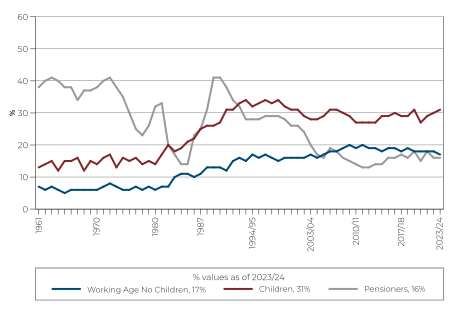
Child relative low income rates in the UK were comparatively low during the 1960s and 1970s. During the 1980s child poverty rates rose to reach more than one in three children by the mid 1990s.
By 1997, children were at significantly higher risk of relative low income than people of working age or pensioners. By 2010 to 2011, the number of children in relative low income after housing costs had reduced by 600,000 compared to 1997 to 98.
Since 2010, that progress has been reversed.
Figure 1 – Relative low income (AHC) rate by age group 1960 to 2023 to 2024 in Great Britain[footnote 37]
Trends and drivers of Child Poverty
Since 2010, a series of structural changes and cuts to social security particularly for families with children, a lack of economic growth, an increase in insecure work, and the cost-of-living crisis have worsened child poverty.
Over the last 15 years, the challenge of tackling child poverty has changed. Almost three quarters of children growing up in poverty have at least one parent in work, but are still in poverty often due to low earnings and low hours, and insecure work. Nearly three quarters of children in relative low income are in working families, up from nearly three fifths in 2010 to 2011.[footnote 38] Parental employment rates are high and have increased since 2010 to 2011, particularly among single parents and mothers in a couple.[footnote 39] Over the same period, average earnings for low-income families with children have increased by £51 per week in real terms.[footnote 40] However, a lack of secure and flexible jobs means that being in work is not enough to lift families out of poverty. Challenges accessing childcare provision, the availability of suitable jobs, caring responsibilities, being disabled and/or having health conditions, caring for disabled children and skills levels can all present barriers to increasing hours and earnings.
Support for children in the social security system has been eroded over time, while child poverty is increasingly concentrated in larger families. By 2023 to 2024, the mean value of social security for children in the bottom income quintile had decreased by £64 per week, from £220 per week in 2010 to 2011, to £156 per week in 2023 to 2024.[footnote 41] This is in part due to the introduction of two child limit, which limits the entitlement for child element in Universal Credit to two children for most families. While children in larger families (with three or more children) have always had a higher poverty risk, they make up a growing proportion of all children in poverty. Today, around half of children in poverty are in a larger family, up from one third in 2010 to 2011.[footnote 42]
Housing costs have risen, pushing families further into poverty, and more children are growing up in an insecure private rented sector. Low-income families are suffering from a lack of access to affordable and high-quality housing. Since the early 2000s, house prices have increased substantially more than earnings.[footnote 43] There has also been a lack of investment in new social homes[footnote 44] and waiting lists have inevitably risen, especially for larger homes.[footnote 45] The unregulated private rented sector was left to pick up the strain, where housing costs are particularly high, and housing quality is often poor. Almost four in ten children in poverty are living in privately rented accommodation, up from three in ten in 2010 to 2011.[footnote 46] This has also led to a rise in homelessness. As of June 2025, over 172,000 children were living in temporary accommodation in England alone.[footnote 47] This is more than twice as many as in 2010.
The increased cost of living has hit low-income families with children particularly hard. After the Covid pandemic, inflation rapidly increased to over 10% by July 2022.[footnote 48] This led to a cost-of-living crisis that presented particular challenges for families in poverty, the cost of essentials rose even faster than general inflation. Household costs for low-income families with children were 32% higher in September 2025 than in April 2020,[footnote 49] while the Standard Allowance in Universal Credit was 6% higher.[footnote 50] By October 2025, food costs were 37% higher, and energy prices 62% higher than in April 2020,[footnote 51] Low-income households with children spend a greater proportion of their expenditure on essential costs like housing and food than households in general, and many will have struggled to cut back on these costs.[footnote 52] Additionally, the poverty premium means that families in poverty already pay more for many of the same essential products and services. For example, food access for low-income families is shaped by limited access to affordable supermarkets, higher prices in local convenience stores, and lack of bulk-buying options due to cash flow constraints.[footnote 53] In 2022, the poverty premium was estimated to be over £200 per year, and almost all (98%) low-income households incur one or more poverty premiums.[footnote 54]
Public services have been eroded as a result of austerity. Public services can offset costs, mitigate experiences of poverty, build resilience and support families through crises. However, local authorities responsible for many services for vulnerable children and their families have seen their funding drastically reduced since 2010, disproportionately impacting more deprived areas.[footnote 55] Schools are on the frontline, providing emergency support for families in the absence of other services. One third of primary schools now run food banks; a quarter provide essentials and 38% say staff provide for pupils and families out of their own pocket.[footnote 56] This diverts scarce resources away from education, affecting all children.
Place matters
Place is fundamental to child poverty, shaping the environment in which children grow up and the opportunities parents have to provide for their children: through the jobs available locally, local childcare options, transport connections, shops, and community support. It also shapes the quality and availability of local support services that families in poverty rely on the most. Many of the key factors influencing child poverty are rooted in place. This can be which nation, region, or local authority, but also which ward and street.
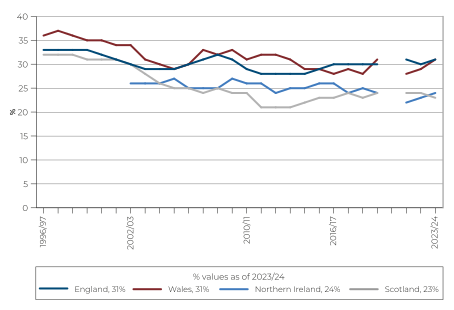
Child poverty varies across the UK, both in numbers and in the impact of different drivers. Child poverty is higher in England and Wales than in Scotland and Northern Ireland.
Figure 2 – Rate of children in relative low income AHC by UK nation (3-year average)[footnote 57]
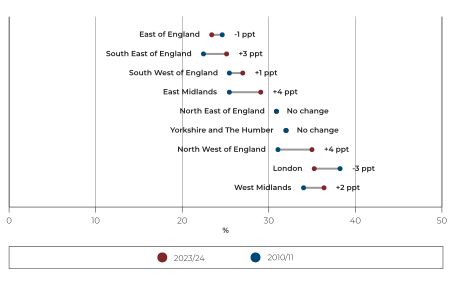
There is significant variation in child poverty rates among English regions. Regions with large metropolitan areas and large populations tend to have higher poverty rates such as the West Midlands, London and the North West. Most regions have experienced an increase in child poverty rates since 2010 to 2011.
Figure 3 – Rate of children in relative low income AHC by English region (3 year average)[footnote 58]
These factors combine to disproportionately impact certain families.
Children from single parent families, ethnic minority families and families with disability also have particularly high poverty risks.[footnote 59] In day-to-day reality for some families, many of these factors combine to exacerbate the challenges they face.
Families with similar incomes can have access to very different levels of resources (for example assets and savings), familial support and face different costs. While the relative low income metric does not capture this difference, the deep material poverty metric does, as it reflects families’ ability to afford essentials. Generally, the same types of families have increased poverty risks across the two metrics, although deep material poverty is especially pronounced for children in single parent families and children in families with disability.[footnote 60]
What living in poverty means for children and their families
Parents and carers talked about struggling to make ends meet, the kind of choices they must make to make money stretch, the mental burden and their reluctance to talk about their struggles due to feeling judged.
“Basically, it’s swimming very hard to keep our heads above the water. For me as a single parent this causes me stress and worry that we don’t have another income to rely on. The constant struggle to cope is not good for my mental and physical health. So, it’s not a good situation I’m afraid.”
(Sadie Q, Parent/ carer, Changing Realities)[footnote 61]
“I feel like a hustler trying to navigate things and dodge things and working out what will be paid and how. You don’t realise how much is going on in your head just to survive, just to keep on an even keel, just to make sure you’ve got enough money for food and the electricity isn’t cut off.”
(Parent/carer, Child Poverty Strategy Parents and Carers Research)[footnote 62]
For many children and young people, growing up in poverty means growing up too soon and dealing with adult-like worries and anxieties. They experience shame and stigma and are excluded from social activities with friends. It also affects their aspirations, with a focus on needing to provide for their families instead of thinking about the future.[footnote 63]
“… trying to feed us all…that’s also a struggle…. some nights my mum’s like, ’I genuinely cannot do anything with for you guys – I’ve got nothing for you older ones. I can only do pasta and sauce for the little ones’ and [I’m] like, ‘That’s fine, mum. I will go and try and get myself a tenner from someone’.”
(Girl, 17, Children’s Commissioner’s Office England Research)[footnote 64]
“I think that people that come from little money, they have a different social experience. They won’t invite people to their house because they might be embarrassed of the way it looks, how big it is … I think they definitely have a different social experience than people that may come from money, who can have friends around for tea …”
(Girl, 16, Children’s Commissioner’s Office England Research)[footnote 65]
The lasting impacts of poverty and the case for change
Children who experience poverty often have adverse outcomes that continue to influence their life into adulthood. Poverty affects children before they are born, with those born to parents living in disadvantage being more likely to have a low birth weight and less likely to survive their first year of life.[footnote 66] As they grow up, they continue to have worse physical and mental health, worse educational attainment, worse employment outcomes with higher risk of unemployment and lower earnings in work, and, ultimately, worse life outcomes including lower life expectancy.
The first few years of life are critical for cognitive, emotional and social development. The mental health of parents and carers, impacted by the material and social support they themselves have, plays an important role in enabling them to meet the needs of their children.[footnote 67]
Poverty can increase the risk of poor health outcomes, and vice versa. Living with low income and financial insecurity links to health in multiple ways, including material, psychosocial and behaviour, and can impact a broad range of physical and mental health outcomes across the life-course, contributing to health inequalities.[footnote 68] Research suggests that any exposure to poverty during childhood is associated with worse physical and mental health in adolescence[footnote 69] and children from low-income families are four times more likely to experience mental health problems than children from higher-income families.[footnote 70]
There is a direct link between educational attainment and a child’s household income.[footnote 71] For children in families with the lowest incomes, just one in four get five good GCSEs including English and Maths and for children in the families with the highest incomes, the figure is nearly three in four.[footnote 72] These gaps emerge early – by age five, children eligible for free school meals are already five months behind, by age 16 that gap has widened to over 19 months.[footnote 73]
Chapter 2: Reducing child poverty in partnership
“If young people feel like they’re in a community and they have a sense of belonging, then obviously that’s also linked to mental health and that’s really important”
(Girl, 16, Children’s Commissioner’s Office England Research)[footnote 74]
Developing this strategy has been a joint effort and delivering on it over the next decade will require the same commitment and collaboration across sectors and governments. We want to put the children who experience poverty and their parents and carers at the heart of this partnership, recognising that to develop solutions that work we need to collaborate with those who know what changes are needed.
We recognise the unique challenges faced by families in each nation and region and have worked closely with devolved governments, regional mayors and local government to understand their contexts and learn from their approaches. Since the last UK-wide strategy, significant powers and funding have been devolved, and both nations and regions have used these to take positive action to tackle child poverty. We need to find ways from learning from some of the differences that exist in policy and practice, and to develop ways to work together across different levels of government.
Reducing child poverty across the UK
Respecting devolution settlements and complementing work that is already underway in nations and regions is central to this strategy. Each nation has its own distinct devolution settlement which sets out powers to tackle child poverty. These powers vary across nations, with some levers being devolved to the governments of Scotland, Wales and Northern Ireland, while others remain reserved to the UK government.
Devolved governments receive funding through the Barnett formula.[footnote 75] How they decide to spend this funding depends on their own priorities.
-
The Scottish Government’s second Tackling Child Poverty Delivery Plan, Scotland’s ‘Best Start, Bright Futures (2022–2026)[footnote 76] outlined action to increase income from employment, reduce household costs, and maximise income from social security and benefits in kind, while also improving the wider wellbeing of families and the outcomes of children and young people
-
The Welsh Government’s Child Poverty Strategy,[footnote 77] published in January 2024, sets a long-term framework for tackling child poverty and outlines five key objectives: reducing costs and maximising family incomes, creating pathways out of poverty, supporting wellbeing, ensuring dignity in services, and strengthening collaboration across government.
-
The Northern Ireland Executive committed to bringing forward an Anti-Poverty Strategy[footnote 78] under its most recent Programme for Government “Our Plan : Doing What Matters Most”. The strategy will benefit everyone struggling with the cost of living. Led by the Department for Communities, this strategy will deal with poverty and will also focus on issues such as educational attainment gaps and health inequalities. The strategy will also ensure society and the economy provide opportunities for the future, such as high-skilled and meaningful jobs.
Reducing child poverty across regions and local areas
Leadership from all levels of government is vital for acting on child poverty, and the devolved governments in Scotland, Wales and Northern Ireland work closely with regional and local leaders in those nations.
-
Glasgow’s refreshed Community Plan places eradicating family poverty at the very heart of the city’s shared agenda. This sends a strong statement that as a collective, Glasgow’s leaders are committed to changing how they work to tackle child poverty. Over 200 organisations, from public sector to housing and third sector, have committed to shaping the ‘No Wrong Door’, approach across Glasgow, ensuring that joined-up services are provided at the right time and place for those who need assistance.
-
Blaenau Gwent’s Food Partnership is committed to ensuring all residents have access to healthy, affordable food. As part of a network of 22 Local Food Partnerships across Wales, it brings together local authorities, health boards, and third-sector organisations in a collaborative effort to tackle food insecurity. By addressing the root causes of food insecurity, expanding access to nutritious food, and equipping residents with the knowledge and tools to make informed choices, Blaenau Gwent is building a healthier, more equitable food system for all.
-
North Belfast and The Moor in Derry/Londonderry are currently included in piloting the ‘Collaboration Test and Learn’ initiative, which spans several jurisdictions across Northern Ireland. This cross-departmental approach aims to deliver better outcomes for communities through collaboration between Government departments, local Councils, community groups, and other partners. A cross-systems group has identified area based priority themes linked to Community Planning, including poverty, early years, early interventions, and educational needs (not exhaustive). By working together, we aim to better identify community needs and allocate resources collaboratively to achieve improved outcomes.
In England, regional and local leaders are taking proactive steps and demonstrating cross-system leadership to reduce child poverty and alleviate its impacts.
-
The North East of England’s Mayor, Kim McGuiness, has made tackling child poverty a top priority. This has included setting up a first-of-its-kind cross-sector child poverty reduction unit which has led the co-development of a five year action plan for the region. The Mayor and Cabinet have committed £30 million of new funding in addition to existing Combined Authority activity to deliver against the regional action plan, which sets out the actions they are taking to make the North East a place where every baby, child and young person is supported to thrive and have the opportunity to succeed, regardless of their background, or where they live.
-
Greater London’s Mayor, Sir Sadiq Khan, has introduced universal free school meals for all primary children, saving families £500 per child each year; and has convened partners from boroughs and the voluntary and community sector to deliver a programme of income maximisation that has put over £90 million to date into the pockets of Londoners living on low incomes, the majority of which are recurring annual income gains. The London Growth Plan sets out London’s ambition to raise the real household weekly incomes of the lowest earning 20% of Londoners by 20% by over ten years.
-
Greater Manchester’s Mayor, Andy Burnham, has made the ‘Live Well’ ambition and achievement of national ‘Prevention Demonstrator’ status a priority for the city-region. This shows how place-based leadership in a mayoral combined authority area can rewire public services to tackle child poverty and reduce inequalities. Greater Manchester Combined Authority brings together the ten local authorities, health partners, and civil society to drive this vision. Through Live Well, the region is integrating health, employment, housing support and early help to create an everyday support offer in every neighbourhood. This collaborative approach, championed by the mayor, is creating the conditions for families to thrive.
-
Salford’s Poverty Truth Commission collaborated with the City Council to better meet the needs of some of the city’s most vulnerable and financially distressed residents, including: helping over 25,000 people on low incomes through changing the way in which the council recovers debt, providing early help for those in financial difficulty and exempting young care leavers from paying council tax.
Reducing child poverty by working in partnership
Turning the tide on child poverty requires action beyond government. There is a role for national, regional and local leaders to use their convening powers to increase collaboration and boost the capacity of delivery partners. A broad and dedicated range of partners are already working to prioritise children and families in poverty. The most crucial are the children and parents who are already sharing their experiences and expertise with both one another and people in positions to help co-design support and services. There are a number of organisations who facilitate children and parents to come together in this way – including those who have supported this strategy which has included Changing Realities, the Children’s Commissioners and Save the Children – who support this direct learning from families facing the day to day realities of poverty.
Civil society is also critical in tackling child poverty by providing vital services, prevention activity and wraparound support to children and families experiencing poverty. Their efforts are not only crucial in bridging the gap between wider services but also in ensuring under-represented or hard-to-reach communities can access the services they need. This includes:
-
The Felix Project’s food distribution efforts in London, which rescues good, surplus food from the food industry that would otherwise go to waste.
-
Christians Against Poverty has around 3000 local CAP workers and supports approximately 10,000 people per year across the UK, providing money and debt advice and practical help and resource to individuals and families.
-
Sophie’s legacy funded 15 hospitals £5,000 each in March 2024 to test ways of providing meals for parents who would otherwise go without food when visiting their children in hospital as they are unable to meet the approximately £12 to £15 per day cost of feeding themselves, particularly during a long stay. Parents reported that financial pressure was significantly reduced. The goal is to roll the scheme out nationally. They plan to use the learning to help support other hospitals to implement a similar initiative.
Many of these efforts are funded by the UK’s proud track record of philanthropy, with the British public donating almost £2 billion to charities supporting children and young people, and an additional £496 million to organisations focused on poverty or relief in 2024.
Health and education systems and public services play an essential role in mitigating the impacts of child poverty and improving outcomes for children both nationally and locally. These are the systems and services that provide vital support, engaging daily with children and their families in family services, schools, nurseries, libraries, youth services and across a wide range of health provision.
This includes:
-
the Champs Public Health Collaborative, which is led by the nine Directors of Public Health and NHS Director of Population Health, who have been working together with partners on coordinated action to tackle child poverty in the Cheshire and Merseyside subregion. This includes the recent publication of an independent situational analysis and a comprehensive strategic framework for action
-
Children North East’s Poverty Proofing, which is a nationally recognised tool, developed in 2014 by Children North East, supporting organisations to remove barriers for children living in poverty, working across education, healthcare, and cultural settings. It provides evidence-based options rooted in poverty-awareness training, consultation (pupils, parents, staff), and co-produced action plans to overcome systemic cost and stigma barriers. It is helping boost attendance and attainment; improve take up of services and reduce missed appointments. They are also working with ‘Libraries Connected’ to identify barriers preventing low-income families from accessing the full range of services that libraries provide.
The private sector is a key partner in addressing child poverty. It provides the goods and services that families rely on and secure and stable employment for parents. We also know that many businesses are actively putting back into communities and helping to improve lives through a commitment to corporate social responsibility. Powerful examples include:
-
the Nationwide Fairer Futures programme which through its partnership with Action for Children aims to provide 100,000 children, young people and parents living in poverty or experiencing financial hardship with practical and emotional support;
-
the government recently announced exclusive offers from household names such as Weetabix, Magic Breakfast, Morrisons and Sainsbury’s for our free breakfast clubs early adopter schools. These partnerships will maximise the impact of our free breakfast clubs, making it work better for all schools and ensuring every child has access to a variety of nutritious food whilst freeing up time for schools by making it easier for them to deliver their free breakfast club.
Academia and think tanks have a critical role in carrying out research to understand the complex nature of child poverty, and in producing evidence of effectiveness for policy and services to tackle the root causes and impact. We have benefited from a huge range of expertise and existing evidence on these issues from across the UK and internationally, reflected by the independent expert advice and scrutiny provided by the Child Poverty Analytical Expert Reference Group.
The UK is also a pioneer in social impact investing, which involves collaboration between funders, the VCSE sector and communities to create the most impactful and sustainable interventions. It is a key tool for unlocking sustainability and growth in the VCSE sector, providing more opportunities for the people and communities that these organisations support. In many instances, this allows additional direct support to children and families, in deprived areas of the UK, which otherwise would not have been possible.
This includes the Life Chances Fund, funded by the Department for Culture Media and Sport, which has supported over 50,000 individuals to achieve better life outcomes in areas such as health, employment, and housing through supporting 29 projects in England. We are working to embed social outcome approaches, including through the Better Futures Fund discussed in chapter 5.
Government will continue to create the right conditions and make the critical changes required to support partners, empowering them to work together locally, regionally and nationally, alongside government to go further in our shared ambition to reduce child poverty.
Chapter 3: Boosting family income
“At some point in the future I would like to have a career instead of just having whatever wee job fits in around the children. I just don’t know how I could do that just now.”
(Parent/carer, Children and Young People’s Commissioner Scotland)[footnote 79]
Summary
We know that parents are doing what they can to give their children the best start with a safe, warm home, food on the table and the chance to take part in activities with their friends.
We want every parent who can work to feel the benefits of good, secure work that enables them to get on in life and support their families. Children also benefit in wider ways from living in a working household. Growing up in a working family is associated with better educational attainment and a reduced risk of poverty and worklessness for children themselves once they become adults.[footnote 80],[footnote 81]
Parents recognise the benefits that work brings and so parental employment rates are already high. Nearly three quarters of children growing up in poverty today are in a working family.[footnote 82] This is why we are delivering a widespread transformation of employment services through our plan to Get Britain Working, removing barriers to work through sustained investment in the government funded childcare where we are expecting to spend over £9 billion next year, and delivering the largest transformation of employment rights through our plan to Make Work Pay.
There are parents who may not be able to work, for example due to severe disability, or who fall on difficult times outside of their control. It is not right that we have a system where children are penalised through no fault of their own. This is why we want to make sure that the social security system is there to support all families whenever they need it and whatever their size, while taking action to make sure that work pays.
Longer term, our ambition is that social security provides the safety net where it is needed; most parents’ opportunity to work and progress is not limited by their circumstances; and that families can access affordable, high-quality childcare. We will keep track through the published Get Britain Working metrics on the employment rate gap between single parents and parents in a couple, and the percentage of coupled families where at least one parent is out of work.
The challenge facing children and families
For too many families, work is no longer a certain route out of poverty.
The social security system continues to play a key role in supporting families. Around 40% of income for the poorest children comes from social security.[footnote 83] The structural changes and cuts made to welfare in recent years have limited the support available for children, breaking the link between need and entitlement and making it harder for families to make ends meet.
Larger families now represent a rising share of those living in poverty, making up about half of all children in poverty compared to one third in 2010 to 2011 – an increase of 900,000[footnote 84] and half of children in deep material poverty.[footnote 85]
The two child limit in Universal Credit was introduced in 2017and limits support to two children for most households. The two child limit impacts 1.6 million children in around 450,000 families.[footnote 86] Almost six in ten of these households are in work and they are doing the right thing for their children but reductions in social security and increases in the cost of living have left many of them below the poverty line. Hard working parents with more than two children need to know the social security system will be there to support them if they fall on hard times. Many of these families had their children long before they made a Universal Credit claim.
Despite facing additional barriers, parents’ average employment rate of 84% in the UK is significantly above the 71% employment rate of adults without dependent children.[footnote 87]
Balancing work with parenting can be challenging, with women often bearing most domestic duties.[footnote 88] 80% of mothers in couples and 65% (down from 71% in 2019) of single parents (who are mostly women) work.[footnote 89]
Children in families where no parent works face the highest rates of poverty based on relative low income (62%). If one parent works full time and the other does not, 41% of children are in poverty; this drops to 16% if one parent works full time and the other part time, and to 8% if both work full time. For single parents, 43% of children are in poverty if the parent works part time, falling to 19% if they work full time.[footnote 90]
Parents face significant barriers to increasing work such as unreliable transport and lack of access to affordable, quality childcare. Survey data collected in 2024,[footnote 91] before the beginning of the latest expansion to 30 hours government funded childcare, shows that barriers remain for some families. Among families with children aged 0 to four years, almost four in ten parents said that there were not enough childcare places available locally and rated local childcare affordability as fairly or very poor. Of non-working mothers in these families, over half (54%) said that if they could arrange good quality childcare that was convenient, reliable and affordable, they would prefer to work. The high cost of childcare can significantly reduce the benefit of returning to work. In addition, availability of local childcare provision is a challenge, with 39% of parents surveyed in 2024 with children aged 0 to four saying it is ‘not enough’.[footnote 92]
Despite strong financial incentives to work within Universal Credit, for some parents the financial gain may not be enough to incentivise them to work or work more hours.
We also know some single parents are not receiving the support they are entitled to from the non-resident parents. Amongst separated families with no child maintenance arrangement, 51% of children are in poverty, compared to 37% of those with an arrangement.[footnote 93]
Going further to boost family incomes
Through this strategy we will build on this Government’s work to date and further tackle these challenges by:
- Ensuring the social security system is there for those who need it and that it supports families to increase income through work
- Delivering a step-change in employment and skills support
- Ensuring work pays and enabling parents to balance work and childcare responsibilities through high-quality, flexible jobs.
- Improving access to high quality childcare including the government funded 30 hours so that parents are able to work
- Supporting single parents to ensure children do not lose out when families separate
Ensuring the social security system is there for those who need it and that it supports families to increase their income through work
We recognise that addressing child poverty and tackling its deep-rooted causes will take time, but families dealing with the impact of poverty need support now. It is therefore necessary that we take action to reverse the trend of increasing child poverty in the short-term. If we fail to act, thousands more children will fall into hardship.
To drive down child poverty rates within this parliament, we will take immediate action to remove the two child limit.
Most of the rise in poverty has been for children in large families and 300,000 children are in poverty directly because of the two child limit. Without action, it will pull 150,000 more children into poverty by 2030, meaning more children will face hardship today, while the scarring effects of growing up in poverty stretch far into their futures.[footnote 94]
This is why the Government will bring forward legislation to remove the two child limit as quicky as possible.
This action will lift 450,000 children out of relative low income within this parliament. Around 2 million children will live in households that will see an increase in income as a result of removing the two child limit including 600,000 children in households in deep material poverty.[footnote 95] Combined with the wider action set out in this strategy, this represents an investment in our next generation of young people, ensuring every child has the best start in life.
The majority of families (59%) who will be affected by the removal of the limit are in work. This change will directly alleviate hardship, and support more families to afford the essentials, offering some much-needed breathing space.
This investment represents a downpayment on Britain’s future. Inaction will cost the UK far more than investing now, as every pound we spend lifting children out of poverty is an investment in better health, educational attainment, and employment outcomes – and provides a stronger foundation for our future economy.
In making this change, the Government will abolish the exemptions regime associated with the two child limit, including for instances of non-consensual conception. Once these reforms have been passed into statute, no mother will again be asked to prove that their child was conceived through rape or coercion in order to access vital support.
Case Study: Tasha’s story, the impact of the two child limit
Tasha, living in the South West with her partner and four children, works as a self-employed cleaner and exam invigilator, while her partner is a groundsman. In 2018, Tasha’s husband died suddenly, leaving her alone with three children. After a few years, she met her current partner, and together they decided to have a child – their daughter Mabel.
Despite both parents working, their finances have become increasingly strained due to rising living costs since COVID-19. The family faced an additional challenge when they were denied Universal Credit support for their youngest child, Mabel, because she was born after the introduction of the two child limit, leaving them struggling to cover essentials and forcing their older children to miss out on important experiences.
Tasha feels their hardship is not due to a lack of effort but because the benefits system does not reflect their real-life circumstances. She believes that removing the two child limit would allow her family to provide better opportunities for their children, such as attending school trips, affording new clothes, and participating in after-school activities, helping to make their childhoods more fulfilling and joyful.
Beyond reinstating support for all children through the removal of the two child limit, the government has already taken action to support all families.
As part of the government’s Plan for Change to put more money into people’s pockets and boost living standards, the new Fair Repayment Rate was implemented in April 2025. This change has reduced the overall Universal Credit deductions cap from 25% to 15% of a customer’s standard allowance, supporting 1.2m households including (700,000 families with children) on average £420 a year and £35 per month. This will support family budgets and day to day costs, whilst continuing to address certain debts.
We also recently consulted on changes to improve council tax collection and enforcement processes. This will ensure households are better able to manage their bills and are treated fairly when facing enforcement action. As part of this we will consider how these changes can specifically support vulnerable families. This could include issuing non-statutory guidance setting out the government’s expectations of councils and best practice when supporting vulnerable families in debt. Central government is also committed to improving the treatment of households in debt and will launch a comprehensive vulnerability training module that all civil servants working in debt management will be expected to complete. Wider support for those in problem debt, including increased funding for debt advice services, was set out in the Financial Inclusion Strategy. This seeks to ensure that everyone can access the financial products they need to support their financial resilience and participation in the economy, with a focus on access to banking, access to credit, and financial capability.
Moreover, the Universal Credit Act delivered the first sustained above inflation rise in the basic rate of Universal Credit since it was introduced. This means a little under four million households will benefit overall from government’s decision to increase the Universal Credit standard allowance – estimated to be worth £725 annually by 2029 to 2030 in cash terms based on Spring Statement 2025 economic assumptions for single parents aged 25 or over (£250 annually above inflation).[footnote 96]
This change along with reversing the changes to Work Capability Assessments introduced by the previous government will help lift 50,000 children out of relative low income this parliament.[footnote 97] This impact is included within the baseline against which the overall impact of the strategy is projected.
Beyond providing direct support, the social security system aims to ensure work always pays. However, the interaction between individual circumstances and other systems can inadvertently impose restrictions and cliff edges. It can also be difficult for people to understand whether they would be better off if they moved into work or increased their hours.
As part of the Universal Credit review we have considered the impact of passported benefits on incentives to work in Universal Credit. There are over 30 passported benefits, and many of these benefits have different rules or income thresholds. Families’ concern over losing one or more of these can cause them to avoid working more. We have already acted on one of the most significant of these, extending free school meals to households in receipt of Universal Credit with children in school, school-based nurseries and further education settings, a change which means parents are no longer incentivised to work less than 12 hours at the National Living Wage.
We are also making it easier for parents and young people living in temporary or supported housing to increase their earnings, without fearing that they will lose benefit support. Currently, this vulnerable group are subject to less favourable benefit tapering than counterparts living in other accommodation. Following the announcement at Autumn Budget 2025, we will be changing this by bringing in earned income disregards to Housing Benefit for this group, so they will not lose out financially by entering employment or increasing the hours they work.
We will also consider how locally designed council tax reduction schemes put in place by councils interact with the wider benefits system, and incentivise work. Alongside this we will issue statutory guidance to encourage councils to take careful account of the circumstances and needs of vulnerable families when designing their council tax support schemes.
Which parts of the UK are affected by these policies?
UK Government policies aimed at ensuring the social security system is there for those who need it and that it supports families to increase income through work are applicable in England, Wales and Scotland. The social security system in Northern Ireland operates on the basis of a principle of parity with the UK Government’s social security system.
UK Government policies on council tax and changes to Free School Meals eligibility are applicable in England only.
Delivering a step-change in employment and skills support
The right employment support can help parents overcome complex barriers to work, increase their hours and earnings, and progress in work. The government is driving forward labour market interventions that will deliver a step-change in support and help parents to enter and progress in work. Backed by £240 million in the Autumn 2024 Budget, the Get Britain Working White Paper set out the government’s ambitious plans to transform employment support. The June 2025 Spending Review also confirmed we are increasing funding for employment support to almost £3.8 billion per year by 2028 to 2029 to enable people to get into work and get on in work.
For those that are not yet in work, we are testing how local areas can innovate to better engage and support economically inactive people, including parents, to move towards work, through our £160 million funding over two years for nine place-based Inactivity Trailblazers in England and Wales. We are working with the Greater London Authority who, through one of their Trailblazers, are seeking to reduce childcare cost barriers for parents looking to return to work, training, or self-employment by offering childcare support grants. We are also working with the North East Combined Authority on their Trailblazer where they are scaling up a childcare grant programme to increase childcare support to help remove practical employment barriers parents face.
“[My Dad] doesn’t like [his job], but he does it for my family because we don’t have much money, he only does it so we can buy our weekly shopping.”
(Boy, 8, Children’s Commissioner’s Office England Research)[footnote 98]
All areas of England have been asked to develop local Get Britain Working plans identifying their local labour market challenges and setting out how they will work collaboratively at the local level to address these. This may include actions that can be taken to support women who care for their families into work or to progress into work where this has been identified locally as a priority.
Non-working parents often have barriers that make it difficult to get into work including being disabled and/or having health conditions. It is not always easy for parents to find out about the specialist support they could access and their potential to benefit from this is sometimes masked by their parenting responsibilities. We will make sure that parents can access and are supported towards appropriate programmes, including the Pathways to Work offer of personalised and tailored employment support for sick and disabled people through an additional £1 billion of funding a year by 2029 to 2030. This will require a full understanding of the individual and the specific barriers they may face, avoiding jumping to conclusions on them as parents and recognising their additional responsibilities.
For many parents the support offered in Jobcentre Plus and the future Jobs and Careers Service is right for them. We will ensure that the service provides advice and support that is tailored to their needs as a parent – treating them with dignity and respect at all times. We will also move away from a ‘box-ticking’ approach to facilitating more impactful conversations about work preparation. We will work to remove any stigma that can be associated with going to a Jobcentre, ensuring it is somewhere that people go to receive support, rather than to feel penalised or judged for receiving social security support.
Having the right skills is essential, and too many parents are held back by lacking the skills to get into work and to get on in work. Ensuring parents can access the right training and support is key to ensuring they can secure good work, progress in their careers, and help ensure children feel there are no limits to their ambitions. That is why the government, in partnership with mayors and other local leaders is delivering support to parents to develop their skills for work, including through Skills Bootcamps, free and flexible training co-designed with employers for adults in England to address skills shortages in high-growth sectors, apprenticeships and the £1.4 billion Adult Skills Fund. Our post 16 Education and Skills white paper sets out our plans to build on these to give people the skills and knowledge they need to succeed in work.
This is just the first step. The recent movement of responsibility for adult skills from the Department for Education to the Department for Work and Pensions will bring skills development closer to job opportunities, placing skills at the centre of efforts to help more people into work and improve career prospects. We will build learning from all of our labour market interventions into the design of the new Jobs and Careers Service to ensure that parents’ needs are a core part of the future transformed service.
Which parts of the UK are affected by these policies?
UK Government policies aimed at delivering a step-change in employment support are applicable in England, Wales and Scotland.
UK Government policies aimed at delivering a step-change in skills support are applicable in England.
Ensuring work pays and enabling parents to balance work and childcare responsibilities through high-quality, flexible jobs.
To be able to be productive at work and meet their children’s needs, parents need jobs that allow them flexibility and progression. Employers have a key role and will benefit from harnessing the skills of parents within the workforce. The UK has a long-standing record of ensuring that workers’ rights are protected, so that people are treated fairly at work, have job security, and can balance work with family responsibilities.
“As a single mum with 2 teens and 2 jobs – I have a full time office job and do part time care work at weekends, I often work in excess of 50hrs per week. I’m frustrated that I still struggle to meet basic needs.”
(Rosa K, Parent/carer, Changing Realities)[footnote 99]
Whilst social security must play its role, work itself must also pay. That is why the minimum wage was introduced in 1999 to provide protection to low-income workers and incentives to work. We increased the National Living Wage for everyone aged 21 and over by 6.7% to £12.21 per hour from April 2025 and this will increase to £12.71 per hour from April 2026, to provide a fair wage for the lowest-paid workers.
The Make Work Pay plan will improve employment rights for millions of people across Great Britain. Parents, particularly parents on low incomes or in irregular insecure work, will benefit from the planned changes that will improve flexibility and protections at work. Subject to consultation and legislation, modernised laws through the Employment Rights Bill[footnote 100] will include:
-
ending exploitative zero hours contracts by legislating so that workers get reasonable notice of their shift patterns and a right to guaranteed hours, enabling parents to plan ahead to organise childcare, and payment for shifts cancelled or curtailed at short notice, with corresponding rights for agency workers
-
improving access to flexible working. A new ‘reasonableness test’ will ensure that feasible flexible working requests are accepted. Government will consult on these reforms in early 2026 and they will take effect in 2027
-
new rights and protections that provide improved job security. A day one entitlement to Paternity Leave and Unpaid Parental leave, as well as enhanced protection against dismissal for pregnant women and new mothers, will give parents peace of mind
-
improving enforcement of employment rights, through a new Fair Work Agency bringing together the enforcement of employment rights, with powers to investigate a wider range of cases of labour abuse, issue penalties, and bring cases to the employment tribunal on the behalf of workers
“We struggle but we have enough to get by… but we don’t have a lot spare which is frustrating because we both work hard and don’t have enough to show for it.”
(Parent/carer, Child Poverty Strategy Parents and Carers Research)[footnote 101]
The arrival of a child is a transformative time in a family’s life. The current system needs improvement because it does not support working families as well as it could. That is why we launched the Parental Leave and Pay Review on 1 July 2025, covering all current and upcoming parental leave and pay entitlements. The review aims to explore how the system can better support working families and reflect the realities of modern work and childcare.
Employers have a key role to play in supporting parents to thrive at work. Many parents who are not working or working full-time are disabled or have health conditions. Sir Charlie Mayfield’s landmark Keep Britain Working Review,[footnote 102] published on 5 November, set out the damaging impact on individuals, employers and the state from economic inactivity. In response, the government will partner with employers to reshape how health issues and disabilities are managed in the workplace with the launch of employer-led vanguards. These will focus on prevention, early support, and better returns to work, helping more people stay in employment and boosting disability inclusion across the UK. This will particularly benefit parents who struggle to enter, remain and progress in work due to disability or health barriers, and bring wider benefits to all parents from an approach that focuses on providing flexibility and support based on people’s needs.
Parents with caring responsibilities for a disabled child or a child with a long-term health condition can find it especially hard to combine these with paid work, as do parents with caring responsibilities for other family members or friends. Government will work with carers and employers to review the Carer’s Leave Act 2023 which gave employees a right to time off to care for someone who is disabled, has a long-term health condition, or injury.
Which parts of the UK are affected by these policies?
UK Government policies aimed at ensuring work pays and enabling parents to balance work and childcare responsibilities through high-quality, flexible jobs are applicable in England, Wales and Scotland.
The National Living Wage is also applicable in Northern Ireland.
Improving access to high quality childcare including the government funded 30 hours so that parents are able to work
Childcare needs to be affordable, available, trusted and sufficiently flexible for parents’ needs. The government provides extensive support, but we know these offers are not always easy to understand, access or combine. These barriers are particularly acute for low-income families and children – the very families who stand to benefit the most. We want a system that helps parents to work and to help children thrive. The Best Start in Life Strategy sets out how we will expand and strengthen family services and improve the accessibility, affordability and quality of early years education and school-aged childcare in England.
From September 2025, 30 hours of Government-funded childcare is now available to eligible working parents of children from nine months old, helping thousands more children to start school ready to learn, and giving parents greater freedom over jobs and working hours. Recent Department for Education survey data[footnote 103] show that a previous expansion in Government funded childcare – to 15 hours for eligible working parents of nine month to two year old children, in September 2024 – may have had a particularly positive impact on lower-income families. Almost one in five parents with household incomes between £20,000 to £39,999 reported an increase in working hours since they started claiming childcare entitlements, the highest of any income group. Eligible families can save up to £7,500 a year per child. For the first time in years survey evidence shows childcare costs have decreased for under threes in England. Between 2024 and 2025, the price of a part time place in a nursery for children aged two and under in England more than halved – largely because of government funded childcare hours for working parents.[footnote 104]
Backed by over £400 million, the school-based nurseries programme is already delivering on our commitment to create tens of thousands of places in school-based nurseries, helping more families access funded childcare and giving children the best start in life. Data from schools in the programme shows that the first round of funding is already on track to create up to 6,000 places from this academic year onwards. School-based nurseries are more likely to operate in areas of disadvantage and have a higher proportion of children with special educational needs and disabilities than private providers. The majority of new nurseries opening as part of the first phase are in the North or Midlands, including around one in ten in the North East, increasing access to childcare in cold spots and supporting the communities that need it most.
We are also investing £600 million to extend the Holiday Activities and Food programme for three years. As well as directly tackling hunger, this programme will continue to provide holiday childcare provision across the country to support working parents with holiday childcare. This is in addition to over 50,000 additional full childcare places created through the National Wraparound Childcare programme, which aims to ensure that all parents of primary-school-aged children who need it can access term-time childcare in their local area from 8am to 6pm.
We are also creating free breakfast clubs in every primary school to provide parents with more affordable childcare choices and to support families with the cost of living, regardless of where they live in the country. Schools that offer free breakfast clubs report improvements in behaviour, attendance, and academic attainment. The DfE early adopter scheme launched in April 2025 with 750 schools nationally. This test and learn phase is demonstrating that this approach works, with schools already reporting benefits including improved punctuality and attendance, as well as a calmer environment during the school day ensuring children are ready to learn.
Free breakfast clubs in every primary school will provide parents with more affordable childcare choices and support families with the cost of living, regardless of where they live in the country. They will save parents up to £450 and 95 hours back a year. We are investing £80 million over the next year to rollout to 2,000 additional schools. We’re offering places to up to 500,000 more children, with the most disadvantaged schools in the country being prioritised, for this first phase of the national rollout.
Across the UK, low-income families in receipt of Universal Credit can access significant support to help with childcare costs. Under the current system, eligible parents can claim back up to 85% of their childcare costs, up to a maximum of £1,031.88 per month for one child and £1,768.94 for two or more children. This support is designed to make it easier for parents to enter or remain in work by reducing the financial barrier that childcare often presents. We recognise that childcare costs apply to each individual child and it is not right that we have a system that does not reflect this.
That is why we will provide Universal Credit childcare support to help with the childcare costs for all children instead of limiting this to two children, supporting parents who have larger families into work because we recognise the increased barriers they face. This means the maximum amount that can be reimbursed for childcare costs will increase by £736.06 for each additional child.
We know that the upfront childcare costs process is difficult for parents to navigate so we will streamline the process and ensure it is clear for parents who meet the eligibility criteria that they are entitled to upfront support, so they can be confident they will receive help. We will also extend eligibility to parents returning from parental leave to ease the difficult transition back to work.
These measures, alongside the ongoing expansion of funded early education entitlements for working parents, aim to ensure that low-income families are better able to access high-quality childcare and improve their work prospects.
However, we recognise there is still more we can do, the Department for Education will also lead a review of childcare provision. The purpose of this review is to simplify the system for providers and families, making it easier to access childcare and increasing the overall impact of the government’s offer.
Which parts of the UK are affected by these policies?
UK Government policies aimed improving access to high quality childcare so that parents are able to work are applicable in England.
UK Government policies on Universal Credit childcare offer are applicable in England, Wales and Scotland. The social security system in Northern Ireland operates on the basis of a principle of parity with the UK.
Supporting single parents to ensure children do not lose out when families separate
We know that any family can experience life events that lead to the breakdown of parental relationships and that children should not miss out as a result. We want to ensure that their parents receive the support they are entitled to. Single parents carry the burden of having to understand complex systems of entitlements sometimes following experiences of loss and abuse that add an extra layer of vulnerability and instability to a family separation and putting children at risk of living in poverty.
The Child Maintenance Service (CMS) is a vital income source for many families. The Government’s ambition is an efficient, trusted service that addresses non-compliance and drives high take-up ultimately increasing money flowing to parents who need it most.
“I’m too scared to contact the child maintenance service as my sons dad has been underpaying for years, but he’ll punish my son if I say anything. I can’t afford the mental load of this, never mind the financial.”
(Evelyn D, Parent/ carer, Changing Realities)[footnote 105]
We will legislate to overhaul the CMS, which will in future operate a single service based on the current Collect and Pay model where it manages all payments, with an improved ability to identify and act on non-compliance.
As part of these reforms, we will halve the fees for those using the CMS, while maintaining a 20% fee for non-resident parents who refuse to pay up on time and in full.
Parents currently in the Direct Pay system will have a choice:
-
keeping their CMS case which will be moved to the new, improved service, giving them the peace of mind that maintenance will be paid and any problems followed up, in return for a smal fee
-
improved support to make and maintain a family-based arrangement
We plan to progress with these proposals and believe that they will address the fundamental issues with Direct Pay. This change will prevent parents getting stuck in ineffective arrangements with no, reduced or erratic payments going to children. We know from research with Direct Pay customers that only six in ten receiving parents in Direct Pay report getting all the child maintenance they are owed, and only four in ten say they always receive it on time. Removing Direct Pay[footnote 106] will mean we can tackle this hidden non-compliance and get money flowing to children on these cases.
To have the best impact on child poverty, we need to ensure that more children are in effective arrangements, which we envisage these changes helping with. We estimate this change could result in around 20,000 fewer children in poverty on the relative low income after housing costs metric.(Note e),[footnote 107] To further support children receiving maintenance payments, a commitment was made, temporarily with a view to make permanently, to position child maintenance deductions higher up the Universal Credit deductions priority order from April 2025 becoming the first third-party deduction to be deducted from a Universal Credit award. The repositioning gives greater protection, ensuring that child maintenance is paid in cases where the overall deductions cap of 15% is reached.
The removal of Direct Pay will also represent a significant improvement to victims and survivors of domestic abuse using the CMS, by reducing contact with the other parent and reducing the paying parent’s ability to financially control the receiving parent by paying too little or too late, as is currently the case on Direct Pay.
We are also reviewing the Child Maintenance calculation to consider how it better encourages compliance and sustainable arrangements to ensure children are getting the right level of support. In addition, we are improving communications to increase awareness of child maintenance and remove common misconceptions.
Which parts of the UK are affected by these policies?
UK government policies aimed at supporting single parents to ensure children do not lose out when families separate are applicable in England, Wales and Scotland.
In Northern Ireland, social security and Child Maintenance provision is administered in line with the longstanding principle of parity of provision with the rest of the UK.
Chapter 4: Driving down the costs of essentials
“I think as soon as the allowance comes, the rent gets first and then those bills get next. So, whatever is left that I’m like, OK and that that’s that, this is my budget to look till the end of the month.”
(Parent/carer, Child Poverty Strategy Parents and Carers Research)[footnote 108]
Summary
We want all families to be able to afford the essentials that are necessary to give children what they need to learn and grow.
This means living in a warm and safe home, being fed healthy nourishing meals and being able to fully participate at school and in associated extra-curricular activities.
Alongside boosting families’ incomes, we will save families money by tackling the housing and homelessness crisis; supporting families with the cost of energy and water; increasing access to healthy affordable food; and reducing barriers to education and employment, such as poor local transport.
As we deliver this strategy, we want the proportion of the income that families in poverty spend on essentials to fall.
The challenges facing children and families
Balancing budgets for families in poverty has always been difficult, but the pressures of recent years have exacerbated this.
“Sometimes we struggle to pay the bills. Right now it’s OK… before mum would cry every time she was going to pay the bills.”
(Boy, 16, Children’s Commissioner’s Office England Research)[footnote 109]
Families in poverty spend a much higher proportion of their income on essentials, meaning that when prices rise, they have less scope for cutting back on non-essential items. Rising costs that disproportionally impact families in poverty include:
-
housing costs, with children in private rented accommodation having the highest average (median) housing costs of £141 per week, with all other tenure types being below £100 per week in median housing costs, (where the costs have been made comparable by adjusting for different family sizes and structure), leaving less money for other essentials.[footnote 110] Energy and water bills have risen quickly and are forcing many families to cut back on heating: energy bills have risen 62% since April 2020.[footnote 111]
-
accessing affordable healthy food, which is difficult for many, with 18% of children living in food insecure households with many parents unable to give their children the healthy food they need, with the cost of food increasing 37% since April 2020;[footnote 112] and
-
accessing education and services come with costs for parents. The cost of the school day has risen in recent years, with the average cost in England for primary school children now over £1,000 a year; for secondary school this is nearly £2,300 a year in 2024.[footnote 113]
A chronic undersupply of homes and rising demand has led to growing waiting lists for social housing, and contributed to sharp rises in housing costs, pushing families into poverty. Too many families are living in high-cost, insecure and poor-quality homes. At the sharpest end of the housing crisis, over 172,000 children are living in temporary accommodation in England alone. This is more than twice as many in 2010.[footnote 114]
Families face rising utility bills, and low-income households with children spend a greater proportion of their budget on housing, water, and energy.[footnote 115] Growing up in cold, damp homes is associated with worse health and educational outcomes for children and young people.[footnote 116] Support with the cost of water bills for families in poverty exists, but this support is not consistent across the country and uptake is low.[footnote 117]
Many families in poverty across the UK do not have access to healthy affordable food and are living in food insecurity. Almost one in five children are now in food insecure households,[footnote 118] meaning they do not have access to the necessary healthy food to thrive. As a result, many parents have had to rely on emergency food parcels to feed their children,[footnote 119] leaving them without the necessary nutrition to thrive.
The benefits of breastfeeding for child and maternal health are well established.[footnote 120] For families who cannot breastfeed or choose not to, it is vital that they can access infant formula that is safe, nutritionally complete and affordable. The cost of infant formula has risen by 25% between 2021 and 2023.[footnote 121] The Competition and Markets Authority completed a market study of infant formula due to concern over a lack of competition on price, concluding that the current regulatory framework, susceptibility of parents to brand reputation, and behaviour of manufacturers and retailers led to consumers paying high prices.[footnote 122]
We know that a good education and access to services are crucial for improving children’s life chances. However, too many children are unable to fully access and participate in education because of the cost of the school day. Too often, parents face high costs for school uniform and equipment, but also for things like school trips, after-school activities, and pressures to get outfits for non-uniform and special event days.
Families in poverty rely on public transport more than others but are too often let down by transport that does not deliver for them.[footnote 123] Transport provision and costs can be a barrier to accessing a whole host of services, and often bus routes are not designed with families in poverty as the focus.
Access to education and wider services often relies on digital access. Over a quarter of UK households had difficulty affording communications services in May 2025.[footnote 124]
Going further to drive down the cost of essentials
Through this strategy we will build on this Government’s work to date and further tackle these challenges by:
-
Building more homes, and ensuring these are affordable, safe and decent
-
Preventing homelessness and the use of emergency accommodation
-
Improving household experience and quality of temporary accommodation
-
Ensuring value for money for local councils
-
Saving families money on the cost of energy and water
-
Providing better-targeted support with utility bills through enhanced data sharing
-
Making it easier to access healthy, affordable food
-
Tackling the costs of the school day
-
Creating a better, more integrated and affordable transport system
-
Improving digital access to save families money and improve access to services
Building more homes, and ensuring these are affordable, safe and decent
Good homes are integral to living standards and life chances. High housing costs strain family finances, poor conditions harm health[footnote 125] and dignity and insecure housing undermines educational achievement[footnote 126] and community support. In England the Government has set out a vision for a housing system that works for everyone, so that housing is affordable, safe, secure, and suits our needs.
The government has committed to the biggest boost to social and affordable housing in a generation. We will work in partnership with the sector to rebuild their financial capacity to borrow and invest in new delivery alongside existing homes. The new ten-year, £39 billion Social and Affordable Homes Programme will kickstart social and affordable housebuilding at scale across the country. Grant funded homes will be delivered alongside those secured from developer contributions in S106 agreements. We will work with partners to update statutory guidance on social housing allocations to ensure that allocations reflect local needs and effectively support vulnerable households, including those with children in poverty.
More children are growing up in the private rented sector[footnote 127] and our flagship reforms will ensure it is fit for purpose for families who need security. Through the Renters’ Right Act we will be abolishing Section 21 ‘no-fault’ evictions from 1 May 2026. This will give tenants greater security and empower them to challenge poor conditions or unfair rent increases without fear of losing their home.
All children and their families deserve safe, decent homes. That is why we have implemented Awaab’s Law in social housing and committed to applying it to the private rented sector, putting in place clear protections for tenants and making sure landlords address damp and mould hazards within specific timelines. We will modernise the Decent Homes Standard (DHS) putting tenant safety at its core, and for the first time standards will apply to both private and social rented homes. We will provide guidance so local authorities are encouraged to prioritise enforcement where there is evidence of children living in privately rented homes that fail to meet these standards.
“Maybe if I had a bit more money, I’d be thinking for the future[…]”
(Boy, 15, Children’s Commissioner’s Office England Research)[footnote 128]
The social security system will continue to support low-income households to afford their rent. In the social rented sector, support will be in line with the rents set in the social rent settlement. In the private sector, we will continue to review the levels of support. From April 2026 additional support with housing costs from local authorities will be available, through the Crisis and Resilience Fund in England and Discretionary Housing Payments in Wales.
Which parts of the UK are affected by these policies?
UK Government policies aimed at building more homes, and ensuring these are affordable, safe and decent are applicable in England. UK Government policies aimed at social and private rented sector support are applicable in Great Britain and operate on the basis of a principle of parity in Northern Ireland.
Preventing homelessness and the use of emergency accommodation
Children residing in temporary accommodation, particularly for long periods of time, should be recognised as experiencing one of the deepest forms of poverty. We will end the unlawful use of Bed and Breakfasts for families, improve the quality of temporary accommodation and take action to reduce the cost for councils. We will shortly publish a cross-government Homelessness Strategy which will set out in more detail our plan to get back on track to ending homelessness in England.
A stay in temporary accommodation – originally intended only as an emergency measure – can have significant knock-on effects for children[footnote 129], including family disruption, missed schooling and damage to physical and mental health. Due to overwhelming homelessness pressures local authorities are having to rely on unsuitable, high-cost options like B&B accommodation to house families. Currently, 3,340 families with children are living in B&Bs, and 2,070 families with children have been living in B&Bs for more than six weeks[footnote 130]. This is unacceptable and often means the family is confined to a single room, where children not only sleep but do their homework and live day to day. In some cases, it means sharing cooking facilities with other households or having no cooking facilities at all.[footnote 131],[footnote 132]
We are preventing homelessness before it occurs by tackling its root causes. We are strengthening the rights of private renters, giving them more security in their homes. Councils in England have also received £644.17 million this year to help prevent homelessness and keep families out of temporary accommodation. This is the largest ever investment in homelessness prevention services and is part of over £1 billion being invested in homelessness and rough sleeping this year (2025 to 2026). This record level of funding will be maintained for the next three years, in addition to a further £100 million being provided for homelessness prevention, so giving councils more certainty to plan and deliver vital prevention services. The Families First Partnership Programme will also play an important role in prevention efforts. By shifting children’s social care towards earlier intervention, it will provide holistic support to keep families safely together and help identify risks – including homelessness – at the earliest point.
While it is promising to see some progress in our efforts to reduce the number of families in Bed and Breakfast accommodation, with numbers falling by over 40% since June last year, we are committed to ending their use other than for very short-term use in emergencies. To help achieve this, the government is supporting 20 Local Authorities across England with some of the highest use of Bed and Breakfast accommodation for homeless families through the Emergency Accommodation Reduction Pilots, which have been backed by £8 million over two years. We plan to continue this programme over the next three years.
The Local Authority Housing Fund helps councils to deliver housing to use as better quality temporary accommodation and to support resettlement, reducing the number of families living in expensive and unsuitable options like hotels and Bed and Breakfasts. The £950 million fourth and largest round of the fund will deliver up to 5,000 homes by 2030.
Which parts of the UK are affected by these policies?
UK Government policies aimed at preventing homelessness and the use of emergency accommodation are applicable in England.
Improving household experience and quality of temporary accommodation
In addition to ending the unlawful use of Bed and Breakfast for families, we will take action to improve the quality and the suitability of temporary accommodation placements, including action to prevent poor out of area placement practice. People living in temporary accommodation should expect strong protections against poor housing conditions and we are committed to improving standards across all types of housing, including temporary accommodation.
The government has announced £10.9 million funding for 2025 to 2026 to 61 local authorities with the highest numbers of children in temporary accommodation, to increase access to support and services for families and make tangible impacts on their quality of life. The funding is intended to deliver positive benefits for children’s education and health outcomes.
We have also put in place specific interventions to mitigate the harm living in temporary accommodation can inflict on children’s health, development and educational outcomes.
The government will introduce a temporary accommodation notification system, where local housing authorities would notify educational institutions, health visitors and GPs when a child is placed in temporary accommodation. This would enable health and education providers to respond appropriately to support children experiencing homelessness and mitigate the harmful impacts of living in temporary accommodation. This would also support schools and colleges to consider, where possible and applicable, providing pastoral support or practical assistance; for example, breakfast clubs, after school activities and support with homework.
Our long-term ambition is to reduce the number of days lost at school for children living in temporary accommodation.
Thanks to our world leading attendance data tools, schools, trusts and local authorities can already track disadvantaged children’s attendance in near real time. This enables them to spot trends early, benchmark school outcomes to close gaps and drive down school absence rates, including for children eligible for free school meals.
Building on this existing data we will identify the number of school days lost for children in temporary accommodation so that targeted support can be provided more effectively. We will support LAs, trusts and schools to record temporary accommodation status consistently.
We have also put in place a strong framework to prevent pupils being removed from a school’s roll unlawfully. Staff supporting vulnerable children, such as school pastoral support teams, should work closely with families to provide the right support when a child is living in temporary accommodation.
We have also launched a Better Futures Fund, which will support up to 200,000 struggling children, young people and their families through innovative impact funding projects, seeking to break down barriers to opportunity and deliver on the government’s Plan for Change, to give children the best start in life. Through the Better Futures Fund we will look to improve outcomes for youth and family homelessness. Further information about the Fund can be found in chapter 5.
Between 2019 and 2024, 74 children – of whom 58 were under the age of one – died in circumstances where temporary accommodation has been recorded as potentially having contributed to their death.[footnote 133] This is unacceptable. It is imperative that we prevent deaths caused by unsuitable or poor-quality accommodation or gaps in health care provision.
We will strengthen protections against poor housing conditions in temporary accommodation, and ensure that families in temporary accommodation are proactively contacted by health services. We will introduce a clinical code for children in temporary accommodation to improve data on accidents and admissions to better identify and prevent incidents.
Newborn babies should never be discharged into B&B or other unsuitable shared accommodation. The government commits to ending the practice of discharging newborn babies into B&B or other unsuitable shared accommodation. We will work with local authorities, supported by robust NHS pathways, to make sure safe and appropriate alternatives are available and used.
Which parts of the UK are affected by these policies?
UK Government policies aimed at improving household experience and quality of temporary accommodation are applicable in England.
Ensuring value for money for local councils
We recognise that councils need a stable revenue stream to support innovative finance models that allows them to lease good-quality properties or to unlock investment in new supply. However, government is currently spending more on homelessness support than ever before and the quality and standard of housing does not reflect this spending. This includes significant spend through Legacy Housing Benefit, with systems and funding approaches that have not been updated in years. There is an opportunity to improve the value for money that is being spent and improve the outcomes for vulnerable citizens. The government is therefore committed to considering the best way to sustainably fund good-quality temporary accommodation and drive down the use of poor-quality accommodation. This includes exploring the most appropriate support through the benefits system for both temporary accommodation and supported housing. We will be engaging with local authorities and sector partners to identify the most appropriate ways to balance certainty for councils, value for money, and support for vulnerable people.
“When I had to go to a hotel in [another part of PLACE], I used to come by two buses, [school] said they would give money for the bus tickets”
(Boy, 12, Children’s Commissioner’s Office for England Research)[footnote 134]
Which parts of the UK are affected by these policies?
UK Government policies aimed at ensuring value for money for local councils are largely applicable in England. Legacy housing benefits apply to England, Scotland and Wales. Legacy housing benefits in Northern Ireland operate on the basis of a principle of parity.
Saving families money on the cost of energy and water
When combined, housing, energy and water costs represent the biggest essential expenditures for low-income households with children.[footnote 135]
Fuel poverty is the issue of low-income households being unable to keep warm at a reasonable cost. Each nation has different metrics, targets and strategies in place to tackle this issue. In England, the Low-Income Low Energy Efficiency (LILEE) metric finds a household to be fuel poor if it has a residual income below the poverty line (after accounting for housing costs and required fuel costs) and lives in a home that has an energy efficiency rating below Band C.
Earlier this year, we reviewed the Fuel Poverty Strategy for England and found that more needs to be done to reach the fuel poverty target by 2030. We will be publishing a new Fuel Poverty Strategy to inform our next steps to tackle fuel poverty in England.
Energy bills are too high and this Government is relentlessly focused on bringing them down. With gas prices still significantly higher than historic levels, our exposure to international fossil fuel markets is still the main driver of high energy bills.
The Government’s Autumn 2025 Budget acts to take an average £150 of costs off people’s energy bills from April 2026. As a result of this action, families across Britain can expect to make a significant saving on their bills.
The Warm Homes Plan will help to transform our ageing building stock into comfortable, low-carbon homes that are fit for the future. We will upgrade homes across the country by accelerating the installation of insulation and efficient new technologies like heat pumps, solar PV and home batteries.
The Government is making the biggest ever capital investment in home retrofit with an additional £1.5 billion of new funding announced in the budget to tackle fuel poverty through the Warm Homes Plan - on top of the £13.2 billion allocated in the Spending Review. The Government remains committed to delivering this plan, including working with local authorities and social housing providers to install energy saving measures across the country, through Warm Homes: Social Housing Fund and Local Grant, and supporting all households to make the transition to clean heat via the Boiler Upgrade Scheme.
The Warm Home Discount supports low-income families with their energy bills through a £150 energy bill rebate. In England and Wales rebates are paid directly to low-income households where someone on a means tested benefit (or their partner / DWP nominee) is named on the energy bill. In Scotland, rebates can only be paid directly to those on Pension Credit Guarantee Credit, and those on other benefits should apply directly to their energy supplier who may use different eligibility criteria.
The scheme has been expanded this winter to increase the number of eligible households across Great Britain to around six million in total, including almost doubling the number of households with children that receive the discount to an estimated 1.9 million. The expansion will also ensure that around 45% of households in fuel poverty will receive the discount, compared to only 30% before expansion.
We recognise that many fuel poor households may still be missing out on crucial support, therefore we will explore improvements to it. This includes through a recent consultation which considered the best way to provide future Warm Home Discount support during the next scheme period. Options might include providing additional support to households in fuel poverty (rated EPC band D or below), and/or a digital applications route that would enable support to be offered to low-income households who are currently excluded from the scheme.
Alongside the government, the Office of Gas and Electricity Markets (Ofgem) is the energy regulator for Great Britain and protects the interests of energy consumers and also plays a key role. Ofgem’s consumer protections apply in England, Scotland, and Wales and it has put additional protections in place for vulnerable customers to ensure that they do not pay more. This includes implementing tougher rules on involuntary prepayment meter installations and ensuring those on prepayment meters do not pay more for their energy than those on direct debit. Ofgem has published its Consumer Vulnerability Strategy, which sets out the outcomes the regulator wants to achieve for consumers in vulnerable situations.
Government provides a statutory support scheme in water to those who have medical needs which require a higher water usage or families with more than two children. The scheme caps water bills to the average amount to help with additional costs those households face. We will go further by enhancing support for eligible low-income households. The Government has completed a consultation on reforms to the WaterSure scheme and is due to publish its response in due course.
Which parts of the UK are affected by these policies?
UK government policies aimed at saving family’s money on the cost of energy and water apply differently in different parts of the UK:
-
the Fuel Poverty Strategy is applicable in England.
-
the Warm Home Discount, as well as domestic private rented energy efficiency standards, are applicable in England and Wales.
-
OfGem’s consumer protections are applicable in England, Scotland and Wales. A Warm Homes Discount Scheme also operates in Scotland.
-
the WaterSure scheme is mandatory for all companies in England to offer and is applicable in England however the scheme has also been voluntarily implemented by Welsh companies. The proposed changes included in the consultation are applicable in England only.
Providing better targeted support with utility bills through enhanced data sharing
Government will continue to seek better and more innovative ways of matching and sharing data to be able to target vulnerable consumers, including those on a low income. We have brought together legal and data protection experts across the government to look at how data that the government holds can be used to identify people who need household utility support in England. The National Data Library in the Department for Science, Innovation and Technology will support the Department for Energy Security and Net Zero and other departments to use data to deliver meaningful improvements, with the aim to better identify those who may need support. This work will focus on household data to support bill relief schemes operating in Great Britain.
Similarly, the Department for Environment, Food and Rural Affairs will be working with departments including the Department for Science, Innovation and Technology, HM Revenue and Customs and the Department for Work and Pensions to better target support with water bills. The government will make it easier for customers to receive support for their water bills through new powers in the Water (Special Measures) Act. We will cut red tape to help water companies more easily enrol customers eligible for support.
This means that for those who need it, we will make it as easy as possible for families experiencing poverty to get support with their utility bills.
Which parts of the UK are affected by these policies?
UK government policies aimed at providing better targeted support with utility bills through enhanced data sharing are applicable in England and across the UK, depending on areas of future work.
Making it easier to access healthy, affordable food
The government recognises that the level of household food insecurity in the UK is unacceptable. We have already announced action to expand free school meals, support parents with the cost of healthy food outside of school, and transform our food system to ensure it delivers access to affordable, healthy food. To strengthen links between farms and charities, and help solve the problem of food farm waste, we are providing a new £15 million fund to help charities get spare produce to those in need. We are acting and supporting families from pregnancy, to birth, into education and more widely across the food sector. In doing so, we pay tribute to the work that retailers and others in the food industry are doing to support children in poverty.
Case Study: Supermarkets
Food retailers across the UK are taking action to support families with access to food. Working with charity partners including FareShare and the Trussell Trust, supermarkets have successfully redistributed surplus food throughout their supply chains.
Retailers including Tesco, Asda, Sainsbury’s, Iceland, Morrisons, Lidl, Waitrose, and Co-op are taking action over and above this to improve access to affordable healthy food. Just some examples of this work include:
-
Through their Lidl Foodies programme, Lidl is providing free resources to support primary schools in delivering lessons on healthy eating, with a focus on fruit and veg. In the last academic year, more than 2300 primary schools across GB took part in the initiative, reaching around 244,000 pupils.
-
Sainsbury’s have committed to making healthy foods affordable and accessible to all families by price-matching on staple healthy products in all their stores, funding more than 100,000 Holiday, Activities and Food programme (HAF) places over the Summer, and pledging their support for the 750 schools involved in the Test and Learn stage of the government’s Breakfast Clubs programme
-
The Iceland Food Club is supporting families to access interest-free, responsible credit to spread the cost the food shop without building debt, giving families the ability to better plan their finances.
-
Tesco’s Stronger Starts Fruit and Veg Scheme has provided 10.8m portions of fruit and veg portions to over 140,000 children across more than 400 schools in the UK, transforming children’s nutrition. This is expanding to over 500 schools for the coming academic year.
-
Over the Easter holidays this year, Morrisons, offered families a free breakfast, comprising of a bowl of cereal and piece of fruit to support parents in the school holidays.
-
Through the independent foundation they fund, Asda has supported the community provision of meals and last year launched a new Foodbank Fundamentals Fund to focus on alleviating food poverty. In 2024, it supported 271 organisations across the UK, and in 2025 it supported over 550 organisations, with over £400,000 worth of grant funding in total.
-
Working with its own-brand pasta supplier, Daybreak, Waitrose will divert approximately 130 tonnes of surplus pasta per year – the equivalent of 350,000 meals – to FareShare, the UK’s national network of charitable food redistributors and partner of the Coronation Food Project. This will provide a steady supply of pasta – a high priority and versatile staple – to catering settings and people facing food insecurity.
-
Co-op support community food provision across the UK through their work with Hubbub and Your Local Pantry, which provides families with access to healthy affordable food in their local communities. Co-op is also working with Barnardo’s to support positive futures of young people across the UK. Partnership services have been established in local communities across the UK in areas which need them most and largely focused on food and wellbeing opportunities.
These initiatives represent just a small portion of the work underway. Government will work hand in hand with retailers to maximise the impact of its Food strategy and increase access to healthy affordable food for children and families.
The government has committed to ending mass dependence on emergency food parcels. Food insecurity and food bank use have been increasing over the last few years. In 2023 to 2024, 7.5 million (11%) individuals lived in food insecure households including almost one in five of children. The percentage of children in households using a food bank is now 8%.[footnote 136]
This government recognises the significant benefits of breastfeeding for both mothers and babies, and remains fully committed to supporting families to breastfeed should they choose to. We are investing £18.5 million this year in infant feeding services and breastfeeding support in areas with high levels of deprivation through the Family Hubs and Start for Life programme and have extended the National Breastfeeding helpline to provide round-the-clock support for families across the UK.
However, we recognise some families cannot, or choose not, to breastfeed. For families that use infant formula, it is an essential item. The Competition and Markets Authority (CMA) completed a market study of infant formula due to concern over a lack of competition on price, concluding that the current regulatory framework, susceptibility of parents to brand reputation, and behaviour of manufacturers and retailers lead to consumers paying higher prices.
The government has considered the CMA’s recommendations and has announced, alongside this Child Poverty Strategy and in collaboration with government departments across the 4 UK nations, agreement to a range of measures to address these issues. This includes messaging that all infant formula sold on the UK market is safe and meets the nutritional needs of babies, regardless of the price or brand. This should help give parents confidence to select less-expensive formula products, confident in the nutritional value of their choice.
We are also delivering on an election campaign commitment to review the infant formula regulations to enable the use of loyalty points and vouchers as payment for infant formula. That review found that the current legislative framework does not prohibit the use of supermarket or multi-retailer gift cards, or other cash equivalents, for this purpose. We will shortly update existing guidance to support and standardise practice across retailers. This will help remove unnecessary barriers, for those who rely on infant formula.
The government is supporting families with the cost of food more broadly. In the 10 Year Health Plan, government announced that we will uplift the value of the weekly payments delivered by the Healthy Start Scheme by 10%. This vital scheme provides financial support to pregnant women and parents of babies and young children under four to purchase healthy food, including infant formula. Through these actions we are taking on the infant formula market, families who cannot or choose not to breastfeed could save up to £500 over a baby’s first year of life.[footnote 137]
Starting in April 2026, pregnant women and children aged over one and under four will each receive £4.65 per week (up from £4.25), and children under one will receive £9.30 per week (up from £8.50). We acknowledge also the work that retailers have done to promote this scheme to improve take-up, and where additional top-up funding has been provided, alongside many other initiatives by them to tackle poverty.
We are creating free breakfast clubs in every primary school to provide parents with more affordable childcare choices and support families with the cost of living, regardless of where they live in the country. Free breakfast clubs will ensure children are well prepared with a supportive start to the day, helping to drive improvements to behaviour, attendance and attainment.
The government announced earlier this year that we are extending free school meals to all children in households in receipt of Universal Credit in England from September 2026. This unprecedented expansion will lift 100,000 children out of relative low income by the end of the parliament, equivalent to increasing families’ incomes by £500 per child per year.[footnote 138] We are also including school-based nurseries, school sixth forms and Further Education settings, ensuring that we are supporting children all the way through their compulsory education. This will mean over half a million more children from the most disadvantaged backgrounds will get a free, nutritious lunch every school day.[footnote 139] This will contribute to higher attainment, improved behaviour, and better outcomes for those children and contribute to a better education and chance to succeed in work and life.[footnote 140]
We will continue to provide universal infant free school meals to all children in Reception, Year 1 and Year 2, reaching another 1.3 million infants.
The meals provided in schools should be nutritious, well balanced and high quality. To give parents confidence that their children will be eating fresh, healthy meals we are updating the School Food Standards to raise the quality of school meals and transform school food culture by making healthy eating the norm.
Food insecurity for children eligible for free school meals can be exacerbated during school holidays, and holiday clubs can help to provide a safety net to mitigate against holiday hunger for this group. The government is therefore investing in the Holiday Activities and Food Programme, with £200 million in 2025 to 2026, plus a further £600 million to extend the programme for another three years, in England. The programme provides healthy meals, enriching activities and free childcare places to children from low-income families during the summer, Easter and Christmas school holidays. It offers free places to school aged children who are in receipt of benefits-related free school meals. This supports parents with the cost of food during the holidays, meaning children do not go hungry outside of term time.
The government is committed to ensuring that the food system delivers for all, ensuring that families in poverty can access the healthy food they need. The government has published the Good Food Cycle, which set out the high-level vision for the food strategy and the outcomes that will make this vision a reality. These outcomes included Access for all to safe, affordable, healthy, convenient and appealing food options. Tackling food insecurity will be a key part of what the strategy seeks to achieve, which in practice means that more children will have the healthy and nutritious meals they need to grow and thrive.
Which parts of the UK are affected by these policies?
UK government policies aimed at making it easier to access healthy, affordable food are applicable in England.
The Healthy Start Scheme is available in England, Wales, and Northern Ireland. The equivalent scheme for Scotland is Best Start Foods.
Tackling the costs of the school day
We recognise that the costs of education can be too high, and we are taking action to address this, so that families do not experience hardship as a result of the costs associated with attending school.
“I don’t get pocket money but if I did I would save it for things I need like school supplies.”
(Girl, 14, Children’s Commissioner’s Office England Research)[footnote 141]
For children living in poverty, costs of uniform, transport and food can be a barrier to regular school attendance. As highlighted by research from CPAG, around a quarter of children from low income families have cited not being able to afford meals as a reason for missing school suggesting that the expansion in free school meals could also support regular school attendance.[footnote 142] Research indicates that pupils in poverty may also feel excluded from full participation in some school activities, including PE, music, swimming and art and design due to cost.[footnote 143]
“I don’t have money to pay the [sport club] registration every time. My mum said I can’t pay for it every time. There’s not enough income for my mum and my sister…I believe that if I do [sport], there could be an opportunity to get a contract and make my family happy, but I don’t have access to a gym or training.”
(Boy, 16, Children’s Commissioner’s Office England Research)[footnote 144]
We know many families struggle to afford expensive branded uniforms, which can act as a disincentive for some parents to apply for certain schools, or be a barrier to pupils participating in school activities or clubs. Parents are relying on others for support with costs, with over one in five grandparents contributing to the cost of uniforms.[footnote 145] Through the Children’s Wellbeing and Schools Bill, we will limit the number of branded items of school uniform and PE kit that schools in England can require. This will give parents more choice over where they shop, so they can control the cost of uniforms. We estimate that requiring fewer branded items from designated suppliers could save some parents £50 per child during the back-to-school shop from September 2026.
DfE published updated statutory guidance in October which contains draft statutory guidance that relates to the proposed branded items limit. Schools are strongly encouraged to take the draft statutory guidance into account now when planning uniforms for September 2026. The guidance also sets out the importance of ensuring access to second hand uniforms as a route to reducing the cost of uniform shopping – including branded items. While it is for schools to decide how to implement this, they should ensure that the information about how to access second hand uniform is clear for parents of both current and prospective pupils and is published on the school’s website.
DfE also makes it clear that local authorities and trusts may choose to provide school clothing grants to help with the cost of uniform in cases of financial hardship. Individual schools may run their own schemes to provide assistance, particularly to support new intakes of pupils or in the event of substantial changes to the existing uniform and there are many examples of schools doing this effectively. The updated guidance also makes it clear that in cases where it is suspected that financial hardship has resulted in a pupil not complying with the published uniform policy, schools should take a considerate approach to resolve the situation and that this should not result in any loss of learning for the pupil.
Schools should also be conscious of costs associated with wider engagement with school, for example fundraising or social events out of school hours and may want to consider removing financial barriers to full participation.
At the frontline, school leaders and their staff can directly utilise tools that promote Poverty Proofing, developed in 2014 by Children North East. This approach encourages school communities to think carefully about the things they ask of families. Asking for children to bring in items or costumes, or making small financial demands across the year, can place additional pressures on families and can stigmatise those who cannot afford to participate.
Which parts of the UK are affected by these policies?
UK government policies aimed at tackling the costs of the school day are applicable in England.
Creating a better, more integrated and affordable transport system
Access to both reliable and affordable transport is key to accessing education, as well as more widely supporting families and young people in poverty. The government is enabling places to invest in their local transport priorities, including cycleways, accessibility and congestion improvement measures, investing £15.6 billion by 2031 to 2032 in nine major city regions through the Transport for City Regions settlements, and £2.3 billion over the spending review period in smaller cities, towns and rural areas through the Local Transport Grant.
Recognising the importance of bus services to families in poverty, the government is improving bus services and supporting them with the cost. It has committed to maintaining the £3 bus fare cap through to March 2027. This limits the maximum single fare to £3 on eligible routes across participating bus companies in England, potentially saving passengers up to 80% of the cost on some routes.
We are also reforming the bus sector to improve the passenger experience and increase bus usage across England through the Bus Services Act 2025. This will give new powers to local leaders to choose the best model for buses in their local area. Alongside this we are providing over £1 billion this financial year and further funding through the spending review to maintain and improve bus services. Changes which make it easier for authorities to franchise their bus services, which are also part of the Act, give authorities greater control over key aspects of bus services, such as routes, timetables and fares. This could be used to ensure services are better targeted at local needs and more affordable for people on low incomes.
To maintain momentum across the government’s wider transport costs agenda, we will develop a transport poverty tool. This will aim to capture where poor transport connectivity and affordability limits people’s access to employment and essential services. We will explore how best to integrate this within decision-making across government, to support more people, particularly low-income groups, in getting to work, education and training and healthcare.
Which parts of the UK are affected by these policies?
UK government policies aimed at creating a better, more integrated and affordable transport system are applicable in England.
Improving digital access to save families money and improve access to services
The government is committed to tackling digital exclusion. In February 2025, this government published the Digital Inclusion Action Plan[footnote 146] which sets out the first five actions the government is taking on digital inclusion. This included the launch of the Digital Inclusion Innovation Fund this year, which is designed to support the local delivery of digital inclusion interventions across the UK. We have worked with the devolved governments to ensure that proportionate allocations of funding have been agreed to support digital inclusion initiatives in Scotland, Wales and Northern Ireland.
Which parts of the UK are affected by these policies?
Whilst the government’s Digital Inclusion Action Plan aims to support activity across all four nations of the UK, we recognise the action already taken by the devolved governments in supporting digital inclusion initiatives in their respective nations.
Chapter 5: Strengthening local support for families
“Sometimes it feels like we’ve been left behind just because of our postcode. There are fewer local services, long waiting lists, and limited childcare options. Good jobs often mean long commutes, which aren’t practical when you’re also a carer. It’s not just the lack of things—it’s how isolating it can feel. Like we’re not seen, not included in the same chances others get. If support and opportunities were spread more fairly, families like mine wouldn’t have to fight so hard just to keep up.”
(Ollie U, Parent/carer, Changing Realities)[footnote 147]
Summary
As a nation, we must ensure that we have the local and community services that enable families and carers to give their children the best start in life, including those families facing poverty.
This government’s programme of renewal and reform lays the groundwork for better funded, joined-up public services that reduce the rate and impact of child poverty, improve daily life, prevent crises and boost opportunities. Through the English Devolution and Community Empowerment Bill, the government is empowering strategic authorities, to take more targeted and locally responsive action. In England, Mayors and strategic authorities are taking proactive steps and demonstrating cross-system leadership to reduce child poverty and alleviate its impacts.
We have announced the expansion of Best Start Family Hubs, providing families with the support they need. We have announced the Pride in Place Programme, which will deliver up to £5 billion funding and support to 244 of the most in-need places in Great Britain. Investment can include measures to address child poverty, like establishing new community grocers or providing debt advice.
We are also resetting the relationship with local and community groups, providing focus and resources for the benefit of all our children, including through our world-leading Better Futures Fund.
Over the next ten years, we want to see families and children in vibrant communities, getting the support they need, when they need it. Renewal of our public services and the relationship with voluntary and charitable organisations are core to this, and to tackling child poverty.
The challenges facing children and families
This strategy relies on vibrant local services and communities. However, since 2010, public services and relationships across and between public and civil society have been lacking national ambition and proper funding. This has left us with key challenges:
-
local government funding has reduced over this period, and the outdated way in which local authorities are funded has left some places behind
-
NHS, family, youth and local health services struggle to work together to support families and deal with the impacts of poverty
-
partnership working with voluntary, community and social enterprise organisations have suffered, while expectations on them have grown, due to increased poverty
Local authorities have seen a reduction in their autonomy, due to increasing central government control. Accountability has become more fragmented and multiple reporting mechanisms, across various initiatives, has stifled action including in tackling child poverty.
A long period of austerity since 2010, has resulted in a decrease in preventative services, hitting the poorest hardest. Since 2010, local authorities have faced significant funding reductions and core funding fell by 9% in real terms by 2024 to 2025.[footnote 148] Where children live plays an important part in their chance of being in poverty and how they experience it, with the rates of poverty varying across UK nations, regions and between local authority areas. The 20 English local authorities with highest child poverty rates, before housing costs, all have child poverty rates above 30%, while the 20 with the lowest all have child poverty rates below 10%.[footnote 149] The funding model we inherited, has entrenched inequality, leaving some councils on a financial cliff edge and communities in deprived areas facing crumbling services, cuts and rising bills.
Historical under-funding and unmet higher needs in certain areas, mean parents experiencing poverty frequently struggle to access services they need.
Between 2010 and 2022, around one-third of children’s centres closed or were cut back, and funding for family services fell by 73%.[footnote 150] In England, local authority funding for youth provision has decreased significantly since 2011, falling from £1.1 billion in 2011 to £0.4 billion in 2021.[footnote 151] About 34% of all local authorities in England reduced real-terms expenditure per state-funded secondary school pupil by over 75% between 2011 and 2021. 29.6% of children do less than an average of 30 minutes physical activity a day, and only 47.8% are meeting their recommended 60 minutes a day. Activity levels vary across the country, with areas of higher deprivation associated with lower levels of physical activity.[footnote 152]
While the NHS is free at the point of access, some children and families experience barriers due to the hidden costs of travel to appointments, childcare for other children and loss of income for those who do not have access to paid time off to attend appointments.[footnote 153],[footnote 154] Long distance travel to health services exacerbates these issues. Children affected by poor mental health are more than twice as likely to live in a household that has fallen behind with the rent, bills or mortgage.[footnote 155] Too often these children struggle to access the mental health support that they need.
Pressures across services impact how local services can then effectively work together, risking vulnerable children falling between the cracks. External research suggests the rise in child poverty in England between 2015 and 2020 was linked to an estimated 10,000 additional children entering care.[footnote 156] Children in care are more likely to experience worse educational, employment,[footnote 157] housing,[footnote 158] mental and physical health outcomes than other children,[footnote 159],[footnote 160],[footnote 161],[footnote 162] and often with poorer outcomes in later life.
Civil society plays a core role in our society, yet it has suffered from increased pressures, government relationships characterised by short-term contracts, reduced grants and a policy environment that has not promoted trust, recognition and value.
Going further to improve local support for families
Through this strategy we will build on this government’s work to date and further tackle these challenges by:
-
Empowering local areas to act on child poverty
-
Strengthening the NHS, focussing on health inequalities and integrating more effectively at the local level
-
Preventing poor health in childhood
-
Investing in family services to break the cycle of poverty
-
Improving outcomes through place-based working
-
Investing in young futures
-
Supporting children and families with ‘no recourse to public funds’
-
Investing in community projects and establishing a better relationship with civil society
Empowering local areas to act on child poverty
Local government plays a critical role in tackling child poverty by delivering essential services for vulnerable children. This includes ensuring they have a safe roof over their heads and can get to school, giving families access to advice and support through Best Start Family Hubs, and providing safe places such as youth services. and public libraries.
We are putting tackling child poverty at the heart of local government outcomes. In England, the new Outcomes Framework[footnote 163] for local government makes clear the 15 priority outcomes on which we want to work with councils to deliver over the current spending review period. Together with the simplification of grant funding, local leaders will have the flexibility to support better joint working between local partners, central and local government across place.
The Framework includes four priority outcomes, with supporting metrics, that align with central government’s opportunity mission to break down barriers and give children the best start in life. This includes a contextual outcome, to reduce and alleviate child poverty to improve children’s lives and life chances. The Framework also includes wider priority outcomes that will help tackle child poverty such as preventing and reducing homelessness and rough sleeping; access to a decent, safe and affordable home; local growth; and promoting health and wellbeing in children. The framework’s digital tool, live from Spring 2026, will track progress against all outcomes. This will help local authorities prioritise the services which improve outcomes for children.
We are empowering regional leaders to better tackle poverty through the English Devolution and Community Empowerment Bill. Strategic authorities will be able to take more targeted and locally responsive action. With devolved powers and responsibilities over adult skills, employment support, transport, and housing, strategic authorities have the tools to drive inclusive local economic growth and employment opportunities, to help tackle the root causes of poverty. The most advanced strategic authorities will also have access to integrated settlements, providing mayors with the flexibility to pool and align budgets across their devolved responsibilities, enabling them to take a strategic leadership role on child poverty.
Moreover, we are boosting funding with a fairer allocation by need and committing to crisis funding over the long term.
The spending review 2025 provides over £5 billion of new grant funding for local services over the next three years. This includes £3.4 billion of new grant funding which will be delivered through the first multi-year Local Government Finance Settlement in over a decade. This will provide greater long-term certainty for local authorities and enable local government to focus on priorities, including tackling child poverty.
Through the Fair Funding Review 2.0, we set out proposals to ensure that funding is directed to the places and communities that need it the most, including those with higher levels of child poverty. Millions of people live in places that are underfunded relative to their need, because the way the government funds councils has not been updated since 2013. The proposals set out in the recent Local Government Finance Policy Statement mean that by 2028 to 2029, the 10% most deprived authorities, which on average have higher levels of child poverty, will see a significant increase in their Core Spending Power per head compared to the least deprived.
We will also simplify and consolidate funding to local authorities, which will support shifting to a prevention-focussed approach and wider service reform. The creation of a new Children, Families and Youth Grant within the Local Government Finance Settlement will consolidate the Social Care Prevention Grant and the Families First Partnership programme funding within the Children and Families Grant, alongside further investment in children’s social care reform.
Crisis support is a vital lifeline to support families in an emergency when they need extra help. The new Crisis and Resilience Fund, worth £842 million per year, will reform crisis support in England by enabling local authorities to provide immediate support to those on low incomes who encounter a financial shock. The fund will also provide housing support to help with rent or moving costs. Barnett consequentials will be provided to the devolved governments, taking the total cost of the scheme to £1 billion per year.
As well as providing crisis support, the Crisis and Resilience Fund will also invest in local financial resilience to enable communities to better deal with crises in the long-term, reducing dependence and repeat need. Local authorities, in partnership with the voluntary and community sector, will be empowered to provide preventative support that is specifically tailored to their communities, and meet key outcomes such as maximising people’s incomes and reducing the need for emergency food parcels.
The Government is committed to ensuring that everyone, no matter their background, can thrive. To support this, we will also commence the socio-economic duty on public bodies (section 1 of the Equality Act 2010). This will require public authorities to actively consider socio-economic disadvantage and how their strategic decisions might help to reduce inequalities.
We will learn from the Scottish and Welsh Governments’ experience of commencing the duty and from local authorities who have voluntarily adopted it. Such organisations report that it has enhanced their efforts to address socio-economic disadvantage. We are now taking forward work to make sure that commencement of the duty in England is as effective as possible, putting equality at the heart of decision-making to break down barriers to opportunity and ensure no child is left behind.
Together, these reforms will enable councils to act as more effective local partners in tackling child poverty.
Which parts of the UK are affected by these policies?
UK government policies aimed at empowering local areas to act on child poverty are applicable in England.
Strengthening the NHS, focusing on health inequalities and integrating more effectively at the local level
The NHS fosters a healthier, more productive society and a resilient economy, underpinning national stability and prosperity. Tackling child poverty is at the heart of the government’s Health Mission and its ambition to raise the healthiest generation of children ever.
Addressing healthcare inequity is at the heart of the 10 Year Health Plan, which will ensure that the NHS is there for parents, babies, children and families who need it, whenever they need it. The 10 Year Health Plan set out our vision to support the NHS to move to a Neighbourhood Health Service that provides more joined-up, preventative and personalised care to different population cohorts in the community. We are intending to publish a National Framework for Neighbourhood Health Plans in the coming months. This will set out how areas should design neighbourhood health services around local needs and different population cohorts, including children and young people.
This could include the implementation of Neighbourhood Multidisciplinary Teams for children which can signpost to relevant services to support children living in poverty. Through these changes, government is laying the foundations for all NHS bodies to ensure equitable access to services for low-income families and those who experience poverty, breaking the cycle of deprivation and poor health. To ensure equitable access to services there is existing support through the NHS Healthcare Travel Cost Scheme which provides financial assistance for travel-related costs to patients in receipt of the NHS Low Income Scheme or a qualifying benefit and their dependents.
The Devolution White Paper also further sets a long-term ambition to align public service geographies with Strategic Authorities, enabling more coherent planning and delivery across services which are vital to supporting families in poverty, including the Jobs and Careers Service and health services. The 10 Year Health Plan for England reiterates this commitment, with a clear intention to align Integrated Care Board boundaries with strategic authorities, wherever feasible. We will make strategic authority mayors (or their delegated representative) board members of their Integrated Care Boards to best align the opportunities for strategic planning between the NHS and the strategic authority as a key body for growth. A new statutory duty to improve health and reduce health inequalities will strengthen the role of Strategic Authorities in shaping long-term outcomes for children. Through their leadership in Integrated Care Systems and their ability to champion effective practice across place, mayors are positioned to drive systemic change and inspire collective action on child poverty.
Which parts of the UK are affected by these policies?
UK government policies aimed at strengthening the NHS, focussing on health inequalities and integrating more effectively at the local level are applicable in England.
Preventing poor health in childhood
We are determined to better allocate funding to general practice in a way that reflects the additional complexity of delivering care in communities with high levels of ill health. In June we announced the GP funding formula review to ensure that resources are targeted where they are most needed. The review began in October and is expected to conclude in six months, following which ministerial decisions regarding implementation will be made from 2027. As announced in the 10-Year Health Plan, we are gradually ending the practice of providing deficit support funding and moving organisations to what is their fair share of NHS funding – worth £2.2 billion in 2025 to 2026. This will release funding that can be redirected more quickly to areas with the greatest health need across the country.
Also in the 10 Year Health Plan for England, we will expand community water fluoridation in the north-east of England from 2028 so that it reaches 1.6 million more people by April 2030. We will assess further roll-out in areas where oral health outcomes are worst.
We are taking action to ensure no child experiences variation in health outcomes because of poverty. Health visiting services are key to this. They are often the only professionals to see children in their home environment, providing vital advice and support and helping to ensure that health, development and safeguarding needs are identified early. We are committed to strengthening health visiting services to ensure that all families have access to high quality support.
The Department of Health and Social Care is also investing in targeted interventions for children, including:
-
introducing pathfinder systems in 2025 to 2026 to test options for administering vaccinations to pre-school children from underserved groups as part of health visits
-
continuing to help families get the support they need through the Family Nurse Partnership intervention for first-time parents with additional vulnerabilities, many of whom live in poverty
-
reducing the harms of smoking to unborn babies and their families through our National Smoke-free Pregnancy Incentives Scheme
-
investing £11 million in the roll out of a supervised toothbrushing programme aimed at three to five year olds, targeting the most deprived areas of England in 2025 to 2026
We will accelerate the rollout of Mental Health Support Teams in schools and colleges to reach full national coverage by 2029, with a million more children set to benefit from expansion this year.
We recognise the value of working collaboratively with the private, public and voluntary sector to improve the health and life chances of children in poverty. For example, Virgin Media O2 has partnered with the charity, ‘Supporting Children with Diabetes’ and provided 1,000 refurbished smartphones to families on low incomes whose children have Type 1 diabetes, which is helping them to manage the condition. Virgin Media O2 has also committed to donate a further 500 devices to the charity over the next year.
As part of this strategy, the Department of Health and Social Care, therefore, commits to engage with the market and wider stakeholders outside of government to better understand and explore potential opportunities for collaboration to address the health impacts of child poverty, as part of raising the healthiest generation ever.
Which parts of the UK are affected by these policies?
UK government policies aimed at preventing poor health in childhood are applicable in England.
Investing in family services to break the cycle of poverty
The 1,001 days from conception to age two, are critical as a baby’s early relationships and experiences shape their rapid development.[footnote 164] Trusted local services like libraries can support access to antenatal classes, health visiting teams, parenting classes, development and mental health support. Access to affordable, high-quality early education and childcare are vital to support child development.
No parent should face the challenges of new parenthood alone. To make sure parents get the support they need, when they need it, we will provide transformative funding to every local authority in England through Best Start Family Hubs. Hubs will provide both universal and targeted support, with open-access activities and referral routes for families with complex needs. We will prioritise delivery in areas of disadvantage, where families face the greatest barriers to support. Through hubs, families will be connected to a wide range of support, including housing, employment, debt and welfare advice. We will prioritise funding the continuation of existing Healthy Babies (formerly Start for Life) services that support babies to have the healthiest start in life, including perinatal mental health, parent-infant relationships and infant feeding.
In addition, the Best Start in Life campaign and digital service brings together trusted advice, support and information to help guide parents to nurture their child from pregnancy and the 1,001 days through their child’s journey into childcare, early years education and starting school. Through the Best Start in Life website, emails and social media channels, Best Start Family Hubs and health service touchpoints, we will improve awareness and access to financial support available to low-income families, including Healthy Start, NHS Low Income Scheme, Healthcare Travel Costs and Sure Start Maternity Grants.
Setting up children for the best start in life is the crucial first stage for breaking the link between a child’s background and future success. We will invest over £500 million in Best Start Family Hubs over the spending review period. This investment is core to our commitment to tackle attainment gaps and to raise the healthiest generation of children ever.
Case Study: Brent Family Wellbeing Centres
In 2020, Brent Council implemented a remodel of the previous Children’s Centre offer into eight integrated family hubs (Family Wellbeing Centres). The Family Wellbeing Centres (FWCs) are at the heart of Brent’s Early Help community-based offer and are a priority in the Borough Plan (2023 to 2027). They provide an integrated ‘whole family’ (for children aged 0 to 18 years old, and up to 25 for those with SEND) service, bringing together core health visiting, school nursing, under 5s services, parenting and family support services into a single offer. This arrangement also helps the co-ordination and delivery of services for more vulnerable children, closely co-ordinated with children’s social care. The centres are open full-time, with several offering early evening youth activities and on Saturdays.
Each FWC is shaped by a Local Steering Group of stakeholders and there is integrated working across Brent’s Early Help network to efficiently and effectively respond to the needs of local families using a holistic approach.
A triage service acts as the initial access point for children and families who require light touch interventions or short-term pieces of work for families who meet the criteria for universal support. Common presenting issues for triage include re-location and lack of resources, debt, cost of living, housing, new arrivals, and parents of children who have undiagnosed additional needs and need help to access service.
During the year 2024 to 2025, 18,079 families were supported.
We will also focus on tackling the long-term cycle of poverty by taking measures to improve the educational outcomes of the most disadvantaged children in their early years. This is vital to break the link between a child’s background and future success. We have already increased the Early Years Pupil Premium by an unprecedented 45% from £388 per child per year to £570.
Preventing children from harm and from entering the care system, where appropriate, is vital to their long-term economic[footnote 165] and health outcomes,[footnote 166] to reduce their risk of ending up in poverty in the future. We are strengthening our approach to prevention and are undertaking significant reforms of children’s social care in England, to rebalance the system toward earlier intervention, ensuring support can be wrapped around children and families at the point of need, preventing escalation to crisis point.
We have provided over £2.4 billion of funding over the spending review period to rollout Family Help, multi-agency children protection and Family Group Decision Making through the national Families First Partnership programme. These crucial services help families facing challenges with substance misuse, domestic abuse and mental health, and can help to break the cycle of poverty.
Which parts of the UK are affected by these policies?
UK government policies aimed at investing in family services to break the cycle of poverty are applicable in England.
Improving outcomes through place-based working
Addressing multiple disadvantage is part of breaking the cycle to prevent adverse childhood experiences for young people at the most acute level of need. Multiple disadvantage refers to combinations of homelessness, addiction, mental ill health, domestic abuse and contact with the criminal justice system. People in this situation experience significantly poorer outcomes, including, in some cases, lower life expectancy.[footnote 167] Many adults experiencing multiple disadvantage have children, and they are also highly likely to be in entrenched unemployment and face significant financial difficulties.
Addressing multiple disadvantage requires reform to how local services work together to better support those in crisis, prevent escalation and improve outcomes for individuals and their families. Changing Futures, a five-year cross-government programme, has worked in 15 local areas to test approaches and resulted in improved outcomes including reduced homelessness and rough sleeping; reduced attendance at accident and emergency; reduced experience of domestic abuse, and better collaboration across services. We will build on the lessons learned from the programme.
The £100 million, Test, Learn and Grow programme in the Cabinet Office aims to close the gap between policy and delivery, and speed up improvement and innovation. The programme is working closely with ten local authorities in England to test new ways of improving public services, including those focused on disadvantaged children, families and young people to learn what works, and grow impact nationally. The programme is working with DfE, Northumberland and Manchester on improving integrated family support to drive a Good Level of Development, particularly among children from disadvantaged backgrounds. In Liverpool and Plymouth, multidisciplinary teams are helping set up and improve Neighbourhood Health services, focussing on improving children’s health outcomes and reducing health inequalities. Solutions will be developed with those using and managing public services on the frontline. This will put people and communities at the heart of public service innovation, while insights and successful strategies will be supported to grow nationally.
Which parts of the UK are affected by these policies?
UK government policies aimed at investing in improving outcomes through place-based working are applicable in England. Test Learn and Grow is applicable in the UK.
Investing in young futures
The National Youth Strategy will set out a new direction for young people in England and an action plan to deliver it. The strategy focusses on 10 to 21 years old, and up to age 25 for those with special educational needs and disabilities. The strategy will cover how the government will give young people the skills, connections and opportunities for better life chances and how we will ensure all young people are empowered, valued and actively involved in shaping the communities and society they are part of. This will include a major programme of capital investment to develop new and improved existing youth facilities across the country, as well as further funding to support local youth service provision.
The government’s manifesto committed to a Young Futures programme in England, made up of Young Futures Prevention Partnerships and Young Futures Hubs. Young Futures Hubs will bring together services to improve access to wellbeing advice interventions at a local level to support children and young people. This will promote positive outcomes and enable them to thrive. Each Young Futures Hub will meet three outcomes of increasing opportunities, improving mental health and wellbeing, and reducing crime. Eight early adopter Young Futures Hubs will launch this financial year, informing the long-term plan for 50 Hubs to be operational over the next four years. Young Futures Prevention Partnerships will identify young people vulnerable to being drawn into crime and will ensure they have access to local support, including via Young Futures Hubs.
As part of this renewed investment in the young, we are removing the significant barriers to sports participation that those living in poverty and in low-income families face. Government is committing £400 million over the next four years to support community grassroots sport facilities across the UK. This year, the Multi-Sport Grassroots Facilities Programme is investing £98 million across the UK, which will support areas in need, with 50% of funding in 2025 to 2026 going to the 30% most deprived areas, ensuring that funding reaches the communities who need it most.
Which parts of the UK are affected by these policies?
UK government policies aimed at investing in youth services are applicable in England.
The Multi-Sport Grassroots Facilities Programme will also run through the Football Foundation in England, Cymru Football Foundation in Wales, the Irish Football Association in Northern Ireland, and the Scottish Football Association.
Supporting children and families with ‘no recourse to public funds’
We are committed to ensuring that vulnerable migrant children receive the support that they require, regardless of their immigration status.
The Home Office regularly engages with departments across government regarding the forms of support available which could directly benefit migrant children, and, where possible, extends eligibility criteria to include children whose families are subject to the ‘no recourse to public funds’ condition (NRPF). This includes schemes and benefits such as:
-
free school meals
-
15 hours of free childcare for disadvantaged two year olds
-
15 hours free childcare for three to four year olds
The Home Office will continue to ensure that migrant children with NRPF are specifically considered by the departments responsible for administering schemes/forms of benefits when making decisions on eligibility for new schemes or reviewing the eligibility for existing benefits and schemes.
We know that local authorities provide crucial support services for vulnerable children and families, and this includes families with the NRPF condition. To ensure consistency in the provision of support services to vulnerable migrants (including vulnerable migrant children), and to provide clarity around the statutory duties to support those most in need, the Home Office will issue new guidance to local authorities. Specifically, the guidance will provide clarity on key safeguards, such as the interpretation of Section 17 of the Children Act, which will aid local authorities in their understanding of their statutory duties and interaction with NRPF and allow applications for support to be progressed in a timely manner.
Furthermore, the government is continuing to develop our understanding on NRPF and its impacts. The Home Office is working with the Department for Work and Pensions to develop questions on NRPF for inclusion in the Family Resources survey 2026 to 2027, a household survey undertaken annually to explore living standards in the UK. This will provide greater insight into how families with the NRPF conditions are living in the UK and will help to inform future policy-making.
Which parts of the UK are affected by these policies?
UK government policies aimed at supporting children and families with ‘no recourse to public funds’ are applicable to England.
The Households Below Average Income Dataset covers England, Wales, Scotland and Northern Ireland.
Investing in community projects and establishing a better relationship with civil society
We are committed to helping build a vibrant, equal society across all regions of the UK and investing in our communities. To do so, we will look for opportunities to strengthen our partnerships with a broad range of organisations.
The government is establishing the world’s largest social outcomes fund.[footnote 168] The Better Futures Fund will be backed by £500 million of government funding over ten years to support vulnerable children, young people and their families. The Fund has the potential to achieve up to £1 billion in total funding to enable collaboration between government, local communities, charities and social enterprises, social impact investors and philanthropists. The fund is for England with Barnett consequential funding for Scotland, Wales and Northern Ireland.
The funding will primarily be for commissioning Social Outcomes Partnerships, with government payments tied to the achievement of measurable improvements in people’s lives, such as increased family stability and school attainment, tackling homelessness, and reducing youth reoffending. Projects under the fund will be a core part of the objectives of this strategy, including to reduce the impacts of child poverty and to break the cycle of poverty across generations.
We are strengthening our partnership with the voluntary, community and social enterprise sector (VCSE) with our Civil Society Covenant. The government recognises that the VCSE sector is the bedrock of our communities and is fundamentally shifting the relationship between government and wider civil society. The sector has a strong track record of supporting children and families in poverty, showing what is possible. It is vital that we set the foundations for this work to continue, through deepening the partnership between government and the sector.
To help realise the aims of the Covenant at the local level, the government will be launching a ‘Local Covenant Partnerships’ programme to help support partnership working and delivery between civil society organisations, local authorities and public service providers in selected areas that need it the most.
As part of our Impact Economy work, government has three key priorities for philanthropy: to connect philanthropic investment with the places that need it most, to unlock extra philanthropic investment, and to partner with civil society, communities, donors and businesses to celebrate a culture of giving. As part of this, we are exploring how government can create an environment to encourage philanthropists to support local communities across the country and ensure that the benefits of philanthropic funding are felt evenly.
In September we announced the Pride in Place Programme which will deliver up to £5 billion funding to 244 of the most in-need places in Great Britain. In each location, the investment will be spent by a Neighbourhood Board on the priorities of local residents giving communities the option to invest in measures that support for families with the cost of living. An indicative list of interventions, help to guide and shape the development of local investment plans, will include measures to address child poverty, like establishing new community shops with access to discounted food and school uniform, providing debt advice, community kitchens or supporting households with essential items to help address furniture poverty.
Case Study: Social Impact
Over the course of developing this strategy, we have seen the important work delivered through Social Impact. Organisations bring energy and approaches to tackling the impact of poverty that is innovative and targeted. Just a few examples are:
BBC Children in Need have developed Communities for Children, a UK-wide programme announced on 25 September 2025. This is a strategic collaboration programme with four other funders - the National Lottery Community Fund, Pears Foundation, City Bridge Foundation and the Hunter Foundation - which aims to invest in ten communities across the UK. This is a place based, systemic change programme, which will empower communities to develop their own local solutions to child poverty. By working systemically to address the impact of child poverty on the lives of children and young people in their local contexts, the projects across the UK, seek to break cycles of disadvantage and create the conditions in which children and young people can thrive
Rethink Food piloted the National School Pantry Network (NSPN) across primary schools in areas of high deprivation. The NSPN provides schools with the infrastructure, training, and funds to establish pantries as trusted, stigma-free hubs. Each school receives £3,900 (for a full academic year) to purchase nutritious food, onboarding support, impact monitoring tools, and access to a digital learning network.
Camden Council and Nesta have developed the Family Hubs Pregnancy Grant (FHPG) through the Council’s missions, the Raise Camden taskforce, and Nesta’s A Fairer Start mission to test new ways of supporting families earlier. The pilot grant provides a £500 unconditional cash transfer to low-income parents in the third trimester of pregnancy. Families are identified through linked NHS and benefits data, removing the need to apply. Half also receive follow-up from a Family Navigator who offer parents a personalised introduction to Family Hub services including financial advice and early-years support.
Which parts of the UK are affected by these policies?
UK government policies aimed at investing in community projects and establishing a better relationship with civil society are mainly applicable in England.
Chapter 6: Hope for the future
This Government is acting to turn the tide on child poverty, but this change requires consensus, partnership and shared action. Government cannot achieve this goal alone. We have put the voices of children and families experiencing poverty at the heart of our work and heard how a wide range of systems and services, across Government, local areas, the third sector and private sector can come together to support children and families.
Our collaborative approach has been central to delivering this strategy. In particular, we have undertaken meaningful and structured engagement with children and their families, actively listening to their voices and building our strategy around their insights and experiences.
Since the inception of the taskforce, we have engaged with children and parents, civil society, faith organisations, trade unions, business, frontline organisations, local and strategic authorities, parliamentarians, academics, and children and families. This has seen 230 engagements with more than 180 organisations, which have in part been delivered through our close partnerships with Changing Realities, Save the Children, Child Poverty Action Group, Citizen’s Advice, IPPR and National Children’s Bureau.
This has not just taken place in London, with ministerial roundtables in Scotland, Northern Ireland and Wales which were attended by ministers of the respective nations, and ministers and officials having visited all the regions of England to meet with key child poverty representatives and visit frontline delivery projects.
We have also been ably supported by the Child Poverty Analytical Expert Reference Group, which has brought together external expertise on child poverty to provide advice and scrutiny on the analysis underpinning the development of the strategy.
Publishing the strategy is only the beginning. Tackling the causes of poverty will take time, and results cannot be achieved overnight. Alongside the strategy, we have set out our initial plans for monitoring and evaluation to ensure the strategy is on track to reduce child poverty, so that we continue to learn what works and make the best case for continued support. The monitoring and evaluation framework builds on the successful and collaborative approach taken to strategy development, and makes a commitment to transparency, accountability and continued learning.[footnote 169] A crucial part of this is our continued emphasis on hearing directly from children and families to inform the ongoing delivery and evaluation of the strategy.
Further details on the monitoring and evaluation approach will follow in a baseline report in Summer 2026. This will reflect the latest statistics and evidence and provide further details on plans for a full programme of reporting and analysis. We will report on an annual basis each Summer thereafter to monitor and evaluate progress over time and against the baseline position.
This programme of work will be underpinned and delivered by a continuing Child Poverty Team based within the Department for Work and Pensions with regular cross-government ministerial oversight of the implementation of this strategy. Tackling child poverty remains a key part of the Opportunity Mission.
This strategy is just the first step on our journey to drive down child poverty over the next decade and beyond. To do this we are keen to continue our work in partnership with local, regional, national, private, and third sector partners to build on and galvanise action as while the national government has a fundamental role to play in tackling child poverty, it cannot do it by itself. We are grateful to the huge number of organisations and individuals who took the time to share their expertise, submitted evidence, or spent time arranging events to engage with the Child Poverty Taskforce.
This includes over 360 young adults and parents/carers who have provided us with invaluable views and generously given up their time to share their lived experience as part of stakeholder events, roundtable discussions and workshops during the development of this strategy.
“I appreciate being able to share this, because these realities often get missed when people talk about opportunity — it doesn’t look the same for everyone. It’s encouraging to know these voices are being heard.”
(Rudy T, Changing Realities)[footnote 170]
Glossary
Children is defined as children and young people aged 0 to 18 years although statistics largely use the Households Below Average Income (HBAI) definition which is an individual under 16, or 16 to 19 years old and they are not married nor in a civil partnership nor living with a partner; and living with parents/a responsible adult; and in full-time non-advanced education or in unwaged government training.
Family has been used interchangeably in this document. It can be defined as all the people living in one housing unit but can also take into consideration other caregivers.
Household can be used interchangeably but for the purpose of this document is defined as all the people who occupy a housing unit.
Parents are primary care givers of children.
Parliament is a national legislative body where elected and appointed representatives debate and create laws, check the government, and approve taxes. Parliament’s key functions include scrutinizing the government, making or changing laws, and debating important issues. The phrase ‘during this parliament’ or ‘end of this parliament’ refers to the period of time between one general election and the next.
Social Security is monetary assistance from the government to individuals and households to ensure access to health care and to guarantee income security.
Relative low-income (the child is in a household with income below 60% of median equivalised household income), widely used nationally and internationally as the leading measure of poverty, and here we use the UK version on an after housing costs (AHC) basis.
Deep material poverty – a newly developed measure for the Strategy based on material deprivation – developed to better reflect the experience of children in deeper poverty, measured as lacking four or more of 13 essential items.
Acknowledgments
Thank you to all of the individuals, particularly the children, parents and carers who shared their experiences, and stakeholder organisations who contributed evidence and ideas for this strategy.
We would like to extend a particular thanks to Kim, Ella, Jonny and Tayyaba and the other parents and carers involved in Changing Realities; to Citizens Advice, National Children’s Bureau, Save the Children, IPPR and Child Poverty Action Group; and to the members of our Analytical Expert Reference Group.
We have also received contributions from many others, including:
38 Degrees; 4in10 London’s Child Poverty Network; A Better Start Southend; Aberlour Children’s Charity; Action for Children; Action for Children NI; Alder Hey Children’s Charity; Alexandra Rose Charity; All Party Parliamentary Group for Poverty and Migration; AllChild; ALLFIE; Anti-Bullying Alliance; Asda; Association of Directors of Children’s Services; Association of Directors of Public Health; ATD 4th World UK; Atlas Women’s Centre; Barking and Dagenham Council; Barnardo’s; Barnardo’s Cymru; BBC Children in Need; Belina Grow CIC; BEMIS ; Bevan Foundation ; Black Equity Organisation; Board of Deputies of British Jews; Bremner & Co.; Bridgend County Council; Bytes; Camden Council; Catholic Bishops’ Conference of England and Wales; Central England Law Centre; Centre for Excellence for Children’s Care and Protection; Centre for Food Policy, City St George’s, University of London; Centre for Regional Economic and Social Research (CRESR), Sheffield Hallam University; Centre for Social Justice; Centre for Young Lives; Challenging Behaviours Foundation; Changing Realities; Chartered Institute of Housing; Chefs in Schools; Cheshire and Merseyside CHAMPs network; Child Poverty Action Group; Child Poverty Action Group Scotland; Children and Young People Transformation Programme; Children and Young People’s Commissioner Scotland; Children First; Children in Wales; Children North East; Children’s Commissioner for England; Children’s Commissioner for Wales; Children’s Prosperity Plan; Children’s Rights Alliance England; Chinuch UK; Christians Against Poverty; Church of England; ChurchWorks; Citizens Advice; Citizen’s Advice Cymru; Citizens Advice New Forest; Citizen’s Advice Scotland; Citizens UK; City of Lincoln Council and North Kesteven District Council; Close the Gap; Coalition for Racial Equality and Rights; Committee on Fuel Poverty; Community Regeneration at the Church of England; Confederation for British Industry; Connect Public Affairs; Consumer Council for Water; Contact; Co-op; CoParent Coalition; COSLA; Coventry City Council Public Health; Coventry Council; Crisis; Cumberland Council; Derbyshire County Council; Donate to Educate; E.ON UK; Ealing Multibank; End Child Poverty Coalition; End Child Poverty Coalition Scotland; End Child Poverty England; Enforcement Conduct Board; Engender; EPI; Ethos Foundation and NESTA; Fair By Design; Fair Education Alliance; Fair Education Alliance Youth Steering Group; Fair4AllFinance; Faith in Families; Families Outside; Family Action; Family Fund; Feeding Britain; Felix Project; Fife Gingerbread; First Steps Nutrition Trust; Flic ; Food Foundation; Gingerbread; Glasgow City Council; Glasgow Disability Alliance; Good Things Foundation; Great Ashton Academy; Greater London Authority; Greater Manchester Combined Authority; Health Determinants Research Collaborations; Health Foundation; Healthy Me Healthy Communities; Helen Rowe; Home Start UK; Home-Start UK; Iceland; Immigration team of Rights of Women; Impact on Urban Health; In Kind Direct; Includem; Inclusion Scotland; IncomeMax; Independent Food Aid Network; Inspiring Scotland; Institute for Fiscal Studies; Institute for Policy Research, University of Bath; Institute for Public Policy Research; Institute of Health Visiting; Intergenerational Foundation; Interlink Foundation; John Lyon’s Charity; Joseph Rowntree Foundation; Joseph Rowntree Foundation Scotland; Kelloggs; Kids Matter; Kings Fund; Kings Trust; Kinship; KPMG Foundation; La Leche League Collective; Lancashire County Council; Law Centre Northern Ireland; Learning Disability Network London; Leeds City Council; Let’s End Poverty; Lidl; Lipscombe University; Liverpool City Region Combined Authority; Local Action on Child Poverty; Local Government Association; Local Government Association’s Children and Young People Board; London Borough of Barking and Dagenham; London Borough of Hackney; Manchester City Council; Marie Curie; Maternity Action; Mayor’s Fund for London; MCR Pathways; Members and former members of the House of Commons and House of Lords; Mencap; Merton Council; Methodist Church; Migration Policy Scotland; Money and Pensions Service; Money Wellness; Morrisons; National Children’s Bureau; National Education Union; National Governance Association; National Housing Federation; National Leaving Care Benchmarking Forum; National Network of Parent Carer Forums; National Residential Landlords Association; National School Pantry Network; Nest Insight; Nesta; NHS Confederation; NIAPN; NICVA; NIHRC; North East Child Poverty Commission; Northern Ireland Anti-Poverty Network; Northern Ireland Commissioner for Children and Young People; NRPF Network; NSPCC; Office for Health Improvement and Disparities; Ofgem; One Parent Families Scotland; Our Time; Oxfam; Oxfordshire County Council; Paddington Development Trust; Parent-Infant Foundation; Parenting Focus; Parentkind; Pelican Park Community Trust; Place Matters; Policy in Practice; Poverty Alliance; Poverty and Inequality Commission for Scotland; Praxis; Project 17; ProMo-Cymru; Hull City Council; Public Health Scotland; Public Health Wales; RCPHC; Resolution Foundation; Resolve Poverty; Rethink Food; Rights of Women; Robert Gordon University; Robertson Trust; Royal Borough of Greenwich; Royal College of Paediatrics and Child Health; Royal College of Speech and Language Therapists; Rural Community Network; Sainsbury’s; Salvation Army; Save the Children; Save the Children Scotland; School Food Matters; Scottish Council for Voluntary Organisations; Scottish Federation of Housing Associations; Scottish Pantry Network; Scottish Trade Union Congress; Scottish Women’s Budget Group; Scotwest Credit Union; Sefton Council; Share Foundation; Shelter; Shelter Cymru; Sight Support Hey (Sight Support kids); Single Parents Rights; Social Work Scotland; Southwark Council; St Michaels St Vincent de Paul; StepChange Debt Charity; Surrey County Council; Sustain; Teach First; Tesco; TGP Cymru; The Bread and Butter Thing; The Children’s Foundation; The Children’s Society; The Cottage Family Centre; The Council for Disabled Children; The Disabled Children’s Partnership; The National Society for the Prevention of Cruelty to Children; The North-East Mayoral Combined Authority; The Open University; The Promise; The Royal College of Nursing; The Women’s Budget Group; Thrive at Five; Thrive Together Birmingham; Tops Day Nurseries; Trade Union Congress; Triple P; Trussell Trust; Trussell Trust Scotland; Turning Point Scotland; UK Health Security Agency; UK Mayors network; UKRN; UNICEF Scotland; UNICEF UK; UNISON; University of Birmingham; University of Northampton; University of Oxford; University of Ulster; University of York; Urban Heath; USDAW; Utilita; Waitrose; Wales Centre Public Policy; Wales Council for Voluntary Action; Water UK; Welsh Local Government Association; West Midlands Combined Authority; Westminster City Council; Whizz Kidz; Who Cares? Scotland; Women’s Aid; Women’s Support Network; Women’s Consortium; Wonder Foundation; Working Families; YMCA; Youth Sport Trust; Z2K.
Analytical Expert Reference Group
Jonathan Bradshaw, University of York; Mike Brewer, Resolution Foundation; Emma Congreve, Fraser of Allander Institute, University of Strathclyde; Sara Davies, University of Bristol; Ciara Fitzpatrick, Ulster University and the Transitional Justice Institute; David Gordon, University of Bristol; Bristol Poverty Institute; Townsend Centre for International Poverty Research; Rod Hick, Cardiff University; Donald Hirsch, Loughborough University; Tim Leunig, Public First/London School of Economics; Peter Matejic, Joseph Rowntree Foundation; Jane Millar, University of Bath; Child Poverty Action Group; Carey Oppenheim, Nuffield Foundation; London School of Economics; Child Poverty Commission; Ruth Patrick, University of Glasgow; Kitty Stewart, London School of Economics, Centre for Analysis of Social Exclusion; Tom Waters, Institute for Fiscal Studies.
Notes
| Note a: Based on relative low income after housing costs (AHC). |
| Note b: Measured based on relative low income after housing costs (AHC), unless stated otherwise. |
| Note c: Note that these were calculated using a different approach to the cumulative poverty impacts of the strategy. |
| Note d: Though the Households Below Average Income (HBAI) statistics use a separate definition – see Glossary for further detail |
| Note e: Note that these were calculated using a different approach to the cumulative poverty impacts of the strategy. |
-
Department for Work and Pensions (2025) Child Poverty Strategy: Impact on low income poverty levels and children gaining in the UK: December 2025 - GOV.UK ↩
-
Unicef (2025). The State of the World’s Children 2025: Ending child poverty ↩
-
Department for Work and Pensions (2025). Households Below Average Income (HBAI) statistics for 2023 to 2024. Available at: Households below average income: for financial years ending 1995 to 2024 - GOV.UK ↩
-
Lai, Wickham, Law, Whitehead, Barr and Taylor-Robinson (2019). Poverty dynamics and health in late childhood in the UK: evidence from the Millennium Cohort Study. Available at: Poverty dynamics and health in late childhood in the UK: evidence from the Millennium Cohort Study, Archives of Disease in Childhood ↩
-
Joseph Rowntree Foundation (2008). The costs of child poverty for individuals and society. Available at: 2301 – child-poverty-costs.pdf ↩
-
Office for National Statistics (2022). Why free school meal recipients earn less than their peers. Available at: Why free school meal recipients earn less than their peers - Office for National Statistics ↩
-
Bramley and Fitzpatrick (2017). Full article: Homelessness in the UK: who is most at risk? ↩
-
Education Policy Institute (2024). Annual Report. Available at: Annual Report 2024: Disadvantage - Education Policy Institute ↩
-
Institute for Fiscal Studies (2022). The UK education system preserves inequality – new report. Available at: The UK education system preserves inequality – new report, Institute for Fiscal Studies ↩
-
Griggs and Walker (2008). The costs of child poverty for individuals and society: A literature review. Available at: 2301 – child-poverty-costs.pdf0 ↩
-
Barnardos (2022). At what cost? The impact of the cost-of-living crisis on children and young people. Available at: At what cost_impact of cost of living final report.pdf ↩
-
Office for National Statistics (2022). Why free school meal recipients earn less than their peers. Available at: Why free school meal recipients earn less than their peers - Office for National Statistics ↩
-
OECD (2020). A Broken Social Elevator? How to Promote Social Mobility –OECD ↩
-
NHS England (2024). National Child Measurement Programme, England, 2024 to 2025 School Year. Available at: National Child Measurement Programme, England, 2023 to 2024 School Year - NHS England Digital ↩
-
Office for Health Improvement & Disparities (2025). National Dental Epidemiology Programme (NDEP) for England: oral health survey of 5 year old children 2024. Available at: National Dental Epidemiology Programme (NDEP) for England: oral health survey of 5 year old schoolchildren 2024 - GOV.UK ↩
-
Office for National Statistics (2025). Healthy life expectancy by national area deprivation, England and Wales: between 2013 to 2015 and 2020 to 2022. Available at: Healthy life expectancy by national area deprivation, England and Wales - Office for National Statistics ↩
-
Institute for Fiscal Studies (2025) Living standards, poverty and inequality in the UK: 2024 – Institute for Fiscal Studies ↩
-
Department for Work and Pensions (2025). Households Below Average Income (HBAI) statistics for 2023 to 2024. Available at: Households below average income: for financial years ending 1995 to 2024 - GOV.UK ↩
-
Department for Work and Pensions (2025). Households Below Average Income (HBAI) statistics for 2023 to 2024. Available at: Households below average income: for financial years ending 1995 to 2024 - GOV.UK ↩
-
Department for Work and Pensions (2025) Deep material poverty: Financial year ending 2024 - GOV.UK ↩
-
Department for Work and Pensions (2025). Households Below Average Income (HBAI) statistics for 2023 to 2024. Available at: Households below average income: for financial years ending 1995 to 2024 - GOV.UK ↩
-
Resolution Foundation (2025). No half measures: Settling child poverty on a downward course and the Autumn Budget. Available at: No half measures • Resolution Foundation ↩
-
Department for Work and Pensions (2025) Child Poverty Strategy: Impact on low income poverty levels and children gaining in the UK: December 2025 - GOV.UK ↩
-
Department for Work and Pensions (2025). Introduction of single maintenance collection and transfer service in the Child Maintenance Service – impact on child poverty levels. Available at: Introduction of single maintenance collection and transfer service in the Child Maintenance Service – impact on child poverty levels - GOV.UK ↩
-
Department for Work and Pensions (2025). Free School Meals expansion to all children on Universal Credit – Impact on individual and child poverty levels and number of children in households receiving Universal Credit. Available at: Free School Meals expansion to all children on Universal Credit – Impact on individual and child poverty levels and number of children in households receiving Universal Credit - GOV.UK ↩
-
Department for Work and Pensions (2025). Child Poverty Strategy: Impact on low income poverty levels and children gaining in the UK: December 2025 - GOV.UK ↩
-
Department for Work and Pensions (2025). Child Poverty Strategy Parents and Carers Research (DWP research report no. 1097). Available at: Child Poverty Strategy parents and carers research - GOV.UK ↩
-
Children’s Commissioners Office for England (2025). Research with children to inform the Government’s Child Poverty Strategy. Available at: Research with children to inform the Government’s Child Poverty Strategy, Children’s Commissioner for England ↩
-
Changing Realities (2025). Available at: changingrealities.org ↩
-
Cabinet Office (2024). Child Poverty Analytical Expert Reference Group - Terms of Reference. Available at: Child Poverty Analytical Expert Reference Group - Terms of Reference (HTML) - GOV.UK ↩
-
Department for Work and Pensions (2025). Households Below Average Income (HBAI) statistics for 2023 to 2024. Available at: Households below average income: for financial years ending 1995 to 2024 - GOV.UK ↩
-
Resolution Foundation (2025). No half measures: Settling child poverty on a downward course and the Autumn Budget. Available at: No half measures • Resolution Foundation ↩
-
Department for Work and Pensions (2025). Deep Material Poverty: FYE 2024. Available at: https://www.gov.uk/government/statistics/deep-material-poverty-financial-year-ending-2024 ↩
-
Department for Work and Pensions (2025) Deep material poverty: Financial year ending 2024 - GOV.UK ↩
-
Children’s Commissioners Office for England (2025). Research with children to inform the Government’s Child Poverty Strategy. Available at: Research with children to inform the Government’s Child Poverty Strategy, Children’s Commissioner for England ↩
-
Unicef (2025). The State of the World’s Children 2025: Ending child poverty. Available at: The State of the World’s Children 2025: Ending child poverty ↩
-
Figure 1: Department for Work and Pensions (2025). Households Below Average Income (HBAI) statistics for 2023 to 2024. Available at: Households below average income: for financial years ending 1995 to 2024 - GOV.UK; Institute for Fiscal Studies (2025). Living standards, poverty and inequality in the UK. Available at: Living standards, poverty and inequality in the UK, Institute for Fiscal Studies. Notes: Data is for calendar years until 1994 to 1995, when it changes to financial years. Data includes Great Britain pre 2002 to 2003 and UK afterwards ↩
-
Department for Work and Pensions (2025). Households Below Average Income (HBAI) statistics for 2023 to 2024. Available at: Households below average income: for financial years ending 1995 to 2024 - GOV.UK ↩
-
Office for National Statistics (2025). Employment rates of people by parental status: Table P. Available at: Employment rates of people by parental status: Table P - Office for National Statistics ↩
-
Department for Work and Pensions (2025). Households Below Average Income (HBAI) statistics for 2023 to 2024. Available at: Households below average income: for financial years ending 1995 to 2024 - GOV.UK ↩
-
Department for Work and Pensions (2025). Households Below Average Income (HBAI) statistics for 2023 to 2024. Available at: Households below average income: for financial years ending 1995 to 2024 - GOV.UK ↩
-
Department for Work and Pensions (2025). Households Below Average Income (HBAI) statistics for 2023 to 2024. Available at: Households below average income: for financial years ending 1995 to 2024 - GOV.UK ↩
-
Office for National Statistics (2025). House price to workplace-based earnings ratio. Available at: House price to workplace-based earnings ratio - Office for National Statistics ↩
-
Ministry of Housing, Communities and Local Government (2025). Social housing lettings in England, tenancies: April 2024 to March 2025. Available at: Social housing lettings in England, tenancies: April 2024 to March 2025 - GOV.UK ↩
-
Ministry of Housing, Communities and Local Government (2025). Local authority housing data. Available at: Local authority housing data - GOV.UK ↩
-
Department for Work and Pensions (2025). Households Below Average Income (HBAI) statistics for 2023 to 2024. Available at: Households below average income: for financial years ending 1995 to 2024 - GOV.UK ↩
-
Ministry of Housing, Communities and Local Government (2025). Statutory homelessness England level time series “live tables”, Table TA1 - Number of households in temporary accommodation at the end of quarter by type of TA provided England, 1998 Q1 to 2025 Q2. Available at: Tables on homelessness - GOV.UK ↩
-
Office for National Statistics (2025). CPI ANNUAL RATE 00: ALL ITEMS 2015=100. Available at: CPI ANNUAL RATE 00: ALL ITEMS 2015=100 - Office for National Statistics ↩
-
Office for National Statistics (2025). Household Cost Indices for UK household groups by children status and income group: February 2007 to September 2025. Available at: Household Cost Indices for UK household groups by children status and income group: February 2007 to September 2025 - Office for National Statistics ↩
-
Department for Work and Pensions (2025). Abstract of DWP benefit rate statistics 2024. Available at: Abstract of DWP benefit rate statistics 2024 - GOV.UK; Department for Work and Pensions (2025). Benefit and pension rates 2025 to 2026. Available at: Benefit and pension rates 2025 to 2026 - GOV.UK. ↩
-
Office for National Statistics (2025). Dataset(s): Consumer price inflation tables. Available at: Consumer price inflation tables - Office for National Statistics; ↩
-
Office for National Statistics (2025). Household Cost Indices for UK household groups by children status and income group: February 2007 to September 2025. Available at: Household Cost Indices for UK household groups by children status and income group: February 2007 to September 2025 - Office for National Statistics ↩
-
Davies and Evans (2023). The Poverty Premium in 2022: Progress and problems. Available at: The poverty premium in 2022 - Progress and problems ↩
-
Davies and Evans (2023). The Poverty Premium in 2022: Progress and problems. Available at: The poverty premium in 2022 - Progress and problems ↩
-
Institute for Fiscal Studies (2024). How have English councils’ funding and spending changed? 2010 to 2024. Available at: How have English councils’ funding and spending changed? 2010 to 2024, Institute for Fiscal Studies ↩
-
Joseph Rowntree Foundation (2024). The impact of hardship on primary schools and primary and community Healthcare. Available – PDF ↩
-
Figure 2: Department for Work and Pensions (2025). Households Below Average Income (HBAI) statistics for 2023 to 2024. Available at: Households below average income: for financial years ending 1995 to 2024 - GOV.UK ↩
-
Figure 3: Department for Work and Pensions (2025). Households Below Average Income (HBAI) statistics for 2023 to 2024. Available at: Households below average income: for financial years ending 1995 to 2024 - GOV.UK ↩
-
Department for Work and Pensions (2025). Households Below Average Income (HBAI) statistics for 2023 to 2024. Available at: Households below average income: for financial years ending 1995 to 2024 - GOV.UK ↩
-
Department for Work and Pensions (2025) Deep material poverty: Financial year ending 2024 - GOV.UK ↩
-
Changing Realities (2025). Available at: changingrealities.org ↩
-
Department for Work and Pensions (2025) Child Poverty Strategy: parents and carers research - GOV.UK ↩
-
Children’s Commissioners Office for England (2025). Research with children to inform the Government’s Child Poverty Strategy. Available at: Research with children to inform the Government’s Child Poverty Strategy, Children’s Commissioner for England ↩
-
Children’s Commissioners Office for England (2025). Research with children to inform the Government’s Child Poverty Strategy. Available at: Research with children to inform the Government’s Child Poverty Strategy, Children’s Commissioner for England ↩
-
Children’s Commissioners Office for England (2025). Research with children to inform the Government’s Child Poverty Strategy. Available at: Research with children to inform the Government’s Child Poverty Strategy, Children’s Commissioner for England ↩
-
Child Poverty Action Group (2025). Effects of poverty. Available at: Effects of poverty, CPAG ↩
-
HM Government (2021). The Best Start for Life A Vision for the 1,001 Critical Days The Early Years Healthy Development Review Report. Available at: The Best Start for Life - The Early Years Healthy Development Review Report ↩
-
Faculty of Public Health (undated). Why Poverty Matters to Health. Available at: Why Poverty Matters to Health - Faculty of Public Health ↩
-
Lai, Wickham, Law, Whitehead, Barr and Taylor-Robinson (2019). Poverty dynamics and health in late childhood in the UK: evidence from the Millennium Cohort Study. Available at: Poverty dynamics and health in late childhood in the UK: evidence from the Millennium Cohort Study, Archives of Disease in Childhood ↩
-
Centre for Mental Health (2015). Children of the new century. Available at: Children of the new century - Centre for Mental Health ↩
-
Department for Education (2017). Analysing family circumstances and education: Increasing our understanding of ordinary working families. Available at: Analysing family circumstances technical consultation document.pdf ↩
-
Institute for Fiscal Studies (2022). The UK education system preserves inequality – new report. Available at: The UK education system preserves inequality – new report, Institute for Fiscal Studies ↩
-
Education Policy Institute (2025). Annual Report 2025. Available at: Annual Report 2025 - Education Policy Institute ↩
-
Children’s Commissioners Office for England (2025). Research with children to inform the Government’s Child Poverty Strategy. Available at: Research with children to inform the Government’s Child Poverty Strategy, Children’s Commissioner for England ↩
-
HM Treasury (2025). Statement of Funding Policy: Funding the Sottish Government, Welsh Government and Northern Ireland Executive. Available at: Statement_of_Funding_Policy.pdf ↩
-
Scottish Government (2022). Best Start, Bright Futures. Available at: Best Start, Bright Futures, GOV.SCOT ↩
-
Welsh Government (2024). Child Poverty Strategy for Wales 2024. Available at: Child Poverty Strategy for Wales 2024, GOV.WALES ↩
-
Northern Ireland Executive (2025).Northern Ireland Executive’s Anti Poverty Strategy. Available at: Consultation on NI Executive Anti-Poverty Strategy, NI GOV ↩
-
Children and Young People’s Commissioner Scotland (2025). Children Experiencing Poverty in Scotland A Review of Sources Reflecting Children’s Voices and Experiences. Available at: Scottish-version-Child-Poverty-Children-and-Young-Peoples-Voices.pdf ↩
-
Department for Work and Pensions (2017). Improving Lives: Helping Workless Families. Available at: Improving lives: helping workless families ↩
-
Macmillan, Gregg, Jerrim, and Shure (2018). Children in jobless households across Europe: evidence on the association with medium-and long-term outcomes. Journal of Poverty and Social Justice, 26(3), 335 to 358. Available at: Children in jobless households across Europe: evidence on the association with medium- and long-term outcomes in: Journal of Poverty and Social Justice Volume 26 Issue 3 (2018) ↩
-
Department for Work and Pensions (2025). Households Below Average Income (HBAI) statistics for 2023 to 2024. Available at: Households below average income: for financial years ending 1995 to 2024 - GOV.UK ↩
-
Department for Work and Pensions (2025). Households Below Average Income (HBAI) statistics for 2023 to 2024. Available at: Households below average income: for financial years ending 1995 to 2024 - GOV.UK ↩
-
Department for Work and Pensions (2025). Households Below Average Income (HBAI) statistics for 2023 to 2024. Available at: Households below average income: for financial years ending 1995 to 2024 - GOV.UK ↩
-
Department for Work and Pensions (2025) Deep material poverty: Financial year ending 2024 - GOV.UK ↩
-
Department for Work and Pensions (2025). Universal Credit claimants statistics on the two child limit policy, April 2025. Available at: Universal Credit claimants statistics on the two child limit policy, April 2025 - GOV.UK ↩
-
Office for National Statistics (2025). Employment rates of people by parental status: Table P. Available at: Employment rates of people by parental status: Table P - Office for National Statistics ↩
-
National Centre for Social Research (2023). British Social Attitudes 40: Gender roles. Available at: BSA 40: Gender roles ↩
-
Office for National Statistics (2025). Employment rates of people by parental status: Table P. Available at: Employment rates of people by parental status: Table P - Office for National Statistics ↩
-
Department for Work and Pensions (2025). Households Below Average Income (HBAI) statistics for 2023 to 2024. Available at: Households below average income: for financial years ending 1995 to 2024 - GOV.UK ↩
-
Department for Education (2025). Childcare and early years survey of parents. Available at: Childcare and early years survey of parents, Reporting year 2024 - GOV.UK ↩
-
Department for Education (2025). Childcare and early years survey of parents. Available at: Childcare and early years survey of parents, Reporting year 2024 - GOV.UK ↩
-
Department for Work and Pensions (2025). Separated families statistics: April 2014 to March 2024. Available at: Separated families statistics: April 2014 to March 2024 - GOV.UK ↩
-
Department for Work and Pensions (2025). Removing the two-child limit on Universal Credit: Impact on low income poverty levels in the United Kingdom. Available at: Removing the two-child limit on Universal Credit: Impact on low income poverty levels in the United Kingdom - GOV.UK ↩
-
ibid, reference 1. ↩
-
Department for Work and Pensions (2025) The Universal Credit Bill: Universal Credit Rebalancing – pdf ↩
-
Department for Work and Pensions (2025). Spring statement social security changes – updated impact on poverty levels in Great Britain, July 2025. Available at: Spring statement social security changes – updated impact on poverty levels in Great Britain, July 2025 - GOV.UK ↩
-
Children’s Commissioners Office for England (2025). Research with children to inform the Government’s Child Poverty Strategy. Available at: Research with children to inform the Government’s Child Poverty Strategy, Children’s Commissioner for England ↩
-
Changing Realities (2025). Available at: changingrealities.org ↩
-
Department for Business and Trade (2024). Employment Rights Bill: factsheets. Available at: Employment Rights Bill: factsheets - GOV.UK ↩
-
Department for Work and Pensions (2025) Child Poverty Strategy: parents and carers research - GOV.UK ↩
-
Department for Work and Pensions and Department for Business and Trade (2025). Keep Britain Working: Final Report. Available at: Keep Britain Working: Final report - GOV.UK ↩
-
Department for Work and Pensions (2025). Expansion to early childcare entitlements: Childcare Experiences Survey. Available at: Expansion to early childcare entitlements: Childcare Experiences Survey, Spring term 2025 to 2026 Second Wave - Explore education statistics - GOV.UK ↩
-
Coram (2025). Coram Childcare Survey 2025. Available at: Childcare Survey 2025 ↩
-
Changing Realities (2025). Available at: changingrealities.org ↩
-
Department for Work and Pensions (2025). Child Maintenance Service: Direct Pay Research. Available at: Child Maintenance Service: Direct Pay Research - GOV.UK ↩
-
Department for Work and Pensions (2025). Introduction of single maintenance collection and transfer service in the Child Maintenance Service – impact on child poverty levels. Available at: Introduction of single maintenance collection and transfer service in the Child Maintenance Service – impact on child poverty levels - GOV.UK. ↩
-
Department for Work and Pensions (2025) Child Poverty Strategy: parents and carers research - GOV.UK ↩
-
Children’s Commissioners Office for England (2025). Research with children to inform the Government’s Child Poverty Strategy. Available at: Research with children to inform the Government’s Child Poverty Strategy, Children’s Commissioner for England ↩
-
Department for Work and Pensions (2025). Households Below Average Income (HBAI) statistics for 2023 to 2024. Available at: Households below average income: for financial years ending 1995 to 2024 - GOV.UK ↩
-
Office for National Statistics (2025). Dataset(s): Consumer price inflation tables. Available at: Consumer price inflation tables - Office for National Statistics ↩
-
Office for National Statistics (2025). Dataset(s): Consumer price inflation tables. Available at: Consumer price inflation tables - Office for National Statistics ↩
-
Child Poverty Action Group (2025). The minimum cost of education in the UK. Available at: The minimum cost of education in the UK, CPAG ↩
-
Ministry of Housing, Communities and Local Government (2025). Statutory homelessness England level time series “live tables”, Table TA1 - Number of households in temporary accommodation at the end of quarter by type of TA provided England, 1998 Q1 to 2025 Q2. Available at: Tables on homelessness - GOV.UK ↩
-
Office for National Statistics (2025). Household Costs Indices (HCI) for UK household groups. Available at: Household Costs Indices (HCI) for UK household groups - Office for National Statistics; ↩
-
Institute of Health Equity (2022). Fuel Poverty, Cold Homes and Health Inequalities in the UK. Available at: Fuel Poverty, Cold Homes and Health Inequalities in the UK - IHE ↩
-
Citizens Advice (2024). Postcode lottery of social tariffs means people are in the dark about almost £2bn worth of extra bills support. Available at: Postcode lottery of social tariffs means people are in the dark about almost £2bn worth of extra bills support - Citizens Advice ↩
-
Department for Work and Pensions (2025). Households Below Average Income (HBAI) statistics for 2023 to 2024. Available at: Households below average income: for financial years ending 1995 to 2024 - GOV.UK ↩
-
Department for Work and Pensions (2025). Households Below Average Income (HBAI) statistics for 2023 to 2024. Available at: Households below average income: for financial years ending 1995 to 2024 - GOV.UK ↩
-
American Academy of Pediatrics (2025).Breastfeeding and Health Outcomes for Infants and Children: A Systematic Review. Available at: Breastfeeding and Health Outcomes for Infants and Children: A Systematic Review, Pediatrics, American Academy of Pediatrics and Feeding in the first year of life: SACN report - GOV.UK ↩
-
Competition and Markets Authority (2023). Price inflation and competition in food and grocery manufacturing and supply. Available at: Price inflation and competition in food and grocery manufacturing and supply ↩
-
Competition and Markets Authority (2023). Price inflation and competition in food and grocery manufacturing and supply. Available at: Price inflation and competition in food and grocery manufacturing and supply ↩
-
Department for Transport (2023). National Travel Survey: 2023. Available at: National Travel Survey: 2023 - GOV.UK ↩
-
Ofcom (2025). Communications Affordability Tracker. Available at: Communications Affordability Tracker - Ofcom ↩
-
Royal College of Pediatrics and Child Health (2025). Paediatricians warn toxic air and poor housing threaten the lives of over a million children in England. Available at: Paediatricians warn toxic air and poor housing threaten the lives of over a million children in England, RCPCH ↩
-
Children’s Commissioners Office for England (2025). No child should be homeless: how housing instability affects a child’s GCSE grades. Available at: No child should be homeless: how housing instability affects a child’s GCSE grades, Children’s Commissioner for England ↩
-
Department for Work and Pensions (2025). Households Below Average Income (HBAI) statistics for 2023 to 2024. Available at: Households below average income: for financial years ending 1995 to 2024 - GOV.UK ↩
-
Children’s Commissioners Office for England (2025). Research with children to inform the Government’s Child Poverty Strategy. Available at: Research with children to inform the Government’s Child Poverty Strategy, Children’s Commissioner for England ↩
-
Children’s Commissioners Office for England (2025). Research with children to inform the Government’s Child Poverty Strategy. Available at: Research with children to inform the Government’s Child Poverty Strategy, Children’s Commissioner for England ↩
-
Ministry of Housing, Communities and Local Government (2025). Tables on homelessness. Available at: Tables on homelessness - GOV.UK ↩
-
Children’s Commissioners Office for England (2025). Research with children to inform the Government’s Child Poverty Strategy. Available at: Research with children to inform the Government’s Child Poverty Strategy, Children’s Commissioner for England ↩
-
Department for Work and Pensions (2025) Child Poverty Strategy: parents and carers research - GOV.UK ↩
-
Households in Temporary Accommodation All Party Parliamentary Group (2025). Child Mortality in Temporary Accommodation. Available at: Child Mortality in TA 2025 APPG Report ↩
-
Children’s Commissioners Office for England (2025). Research with children to inform the Government’s Child Poverty Strategy. Available at: Research with children to inform the Government’s Child Poverty Strategy, Children’s Commissioner for England ↩
-
Office for National Statistics (2025). Family spending in the UK: April 2023 to March 2024. Available at: Family spending in the UK - Office for National Statistics ↩
-
Department for Work and Pensions (2025). Households Below Average Income (HBAI) statistics for 2023 to 2024. Available at: Households below average income: for financial years ending 1995 to 2024 - GOV.UK ↩
-
Competition and Markets Authority (2023). Price inflation and competition in food and grocery manufacturing and supply. Available at: Price inflation and competition in food and grocery manufacturing and supply ↩
-
Department for Work and Pensions (2025). Free School Meals expansion – Impact on poverty levels. Available at: Free School Meals expansion - Impact on poverty levels - GOV.UK ↩
-
Institute for Fiscal Studies (2023). ‘The policy menu for school lunches: options and trade-offs in expanding free school meals in England.’ Available at: The policy menu for school lunches: options and trade-offs in expanding free school meals in England, Institute for Fiscal Studies ↩
-
Belot & James (2011). Healthy School Meals and Educational Outcomes. Available at: Healthy_School_Meals_and_Educational_Outcomes.pdf ↩
-
Children’s Commissioners Office for England (2025). Research with children to inform the Government’s Child Poverty Strategy. Available at: Research with children to inform the Government’s Child Poverty Strategy, Children’s Commissioner for England ↩
-
Child Poverty Action Group (2025). Priced out of school: how lack of money prevents young people from attending school. Available at: Priced out of school: how lack of money prevents young people from attending school, CPAG ↩
-
Child Poverty Action Group (2022). The cost of a school day in England: Pupils’ Perspectives. Available at: PowerPoint Presentation ↩
-
Children’s Commissioners Office for England (2025). Research with children to inform the Government’s Child Poverty Strategy. Available at: Research with children to inform the Government’s Child Poverty Strategy, Children’s Commissioner for England ↩
-
ParentKind (2025).National Parent Survey 2025 – Parentkind ↩
-
Department for Science, Innovation and Technology and others (2025). Digital Inclusion Action Plan: First Steps. Available at: Digital Inclusion Action Plan: First Steps - GOV.UK ↩
-
Changing Realities (2025). Available at: changingrealities.org ↩
-
Institute for Fiscal Studies (2024).How have English councils’ funding and spending changed? 2010 to 2024. Available at: How have English councils’ funding and spending changed? 2010 to 2024, Institute for Fiscal Studies ↩
-
Department for Work and Pensions (2025) . Children in low income families: local area statistics 2014 to 2024. Available at: Children in low income families: local area statistics 2014 to 2024 - GOV.UK ↩
-
Institute for Fiscal Studies (2025). The short- and medium-term effects of Sure Start on children’s outcomes. Available at: The short- and medium- term effects of Sure Start on children’s outcomes ↩
-
Department for Digital, Culture, Media and Sport (2024). Youth provision and life outcomes research. Available at: Youth provision and life outcomes ↩
-
Sport England (2024) Active Lives Children and Young People Survey Academic Year 2023 to 2024. Available at: Active Lives, Sport England ↩
-
The King’s Fund (2024). Illustrating the relationship between poverty and NHS services. Available at: The Relationship Between Poverty And NHS Services, The King’s Fund ↩
-
Bidmead et al (2023). Poverty Proofing health care: a qualitative study of barriers to accessing health care for low income families with children in Northern England’ Available at: Poverty Proofing health care: a qualitative study of barriers to accessing health care for low income families with children in Northern England, medRxiv ↩
-
The Health Foundation (2024). What is happening to young people’s mental health? Available at: What is happening to young people’s mental health? - The Health Foundation ↩
-
The Lancet Public Health (2022)..Child poverty and children entering care in England, 2015–20: a longitudinal ecological study at the local area level. Available at: Child poverty and children entering care in England, 2015–20: a longitudinal ecological study at the local area level - The Lancet Public Health ↩
-
Harrison, Dixon, Sanders-Elis, Ward and Asker (2023). Care leavers’ transition into the labour market in England. Available at: Microsoft Word - Final LEO report - January 2023 ↩
-
House of Commons Library (2024). Support for care leavers. Available at: CBP-8429.pdf ↩
-
Murray, Lacey, Maughan and Sacker (2020). Non-parental care in childhood and health up to 30 years later: ONS Longitudinal Study 1971–2011. Available at: Non-parental care in childhood and health up to 30 years later: ONS Longitudinal Study 1971–2011, European Journal of Public Health, Oxford Academic ↩
-
Public Health England, National Institute for Health and Care Excellence (2021). Looked-after children and young people. Available at: Looked-after children and young people ↩
-
Viner and Taylor (2005). Adult Health and Social Outcomes of Children Who Have Been in Public Care: Population-Based Study. Available at: Adult Health and Social Outcomes of Children Who Have Been in Public Care: Population-Based Study, Pediatrics, American Academy of Pediatrics ↩
-
University College London (2024). Children of care leavers risk inheriting parent’s emotional scars. Available at: Children of care leavers risk inheriting parents’ emotional scars, UCL News - UCL – University College London ↩
-
Ministry of Housing, Communities and Local Government (2025). Local Government outcomes Framework: Call for Feedback. Available at: Local Government Outcomes Framework – Priority outcomes and draft metrics ↩
-
HM Government (2021). The best start for life: a vision for the 1,001 critical days. Available at: The best start for life: a vision for the 1,001 critical days - GOV.UK ↩
-
Harrison, Dixon, Sanders-Elis, Ward and Asker (2023). Care leavers’ transition into the labour market in England. Available at: Microsoft Word - Final LEO report - January 2023 ↩
-
Murray, Lacey, Maughan and Sacker (2020). Non-parental care in childhood and health up to 30 years later: ONS Longitudinal Study 1971–2011. Available at: Non-parental care in childhood and health up to 30 years later: ONS Longitudinal Study 1971–2011, European Journal of Public Health, Oxford Academic ↩
-
CFE Research & The University of Sheffield (2022). The Fulfilling Lives programme: supporting people experiencing multiple. Available at: Summary-of-programme-achievements-evaluation-findings-learning-and-resources-2022.pdf ↩
-
Department for Culture, Media and Sport (2025). Guidance: Social Outcomes partnerships and the Life Changes Fund. Available at: Social Outcomes Partnerships and the Life Chances Fund - GOV.UK ↩
-
Cabinet Office (2025) Child Poverty Strategy: Monitoring and Evaluation Framework - GOV.UK ↩
-
Changing Realities (2025). Available at: changingrealities.org ↩