Guidance for licensing authorities to prevent illegal working in the taxi and private hire sector in the UK: 1 October 2026 (accessible)
Updated 2 October 2026

© Crown copyright 2026
This publication is licensed under the terms of the Open Government Licence v3.0 except where otherwise stated. To view this licence, visit nationalarchives.gov.uk/doc/open-government-licence/version/3 or write to the Information Policy Team, The National Archives, Kew, London TW9 4DU, or email: psi@nationalarchives.gov.uk.
Where we have identified any third party copyright information you will need to obtain permission from the copyright holders concerned.
This publication is available at https://www.gov.uk/government/publications/licensing-authority-guide-to-right-to-work-checks/guidance-for-licensing-authorities-to-prevent-illegal-working-in-the-taxi-and-private-hire-sector-in-the-uk-1-october-2026-accessible
1 October 2026
1. Introduction
All licensing authorities in the UK are under a legal duty not to issue, extend or renew a taxi, private hire vehicle (PHV) or operator licence to an individual who is disqualified from holding that licence due to their immigration status. This helps prevent individuals without lawful immigration status and the right to work from obtaining a licence and working illegally.
Licensing authorities discharge this duty by carrying out a prescribed right to a licence check before issuing, renewing or extending a licence.
Legislation
The Immigration Act 2016 (“the 2016 Act”) amended existing licensing regimes in the taxi and private hire sector to prevent individuals who are disqualified by reason of their immigration status from holding a taxi or a private hire driver or operator licence. Since 1 December 2016, licensing authorities have been prohibited from issuing such licences to individuals who are disqualified from holding them.
- London Hackney Carriages Act 1843.
- London Cab Order 1934.
- Private Hire Vehicles (London) Act 1998.
- Metropolitan Public Carriage Act 1869.
- Local Government (Miscellaneous Provisions) Act 1976.
- Plymouth City Council Act 1975.
- Road Traffic Offenders (Northern Ireland) Order 1996; and
- Taxi Act (Northern Ireland) 2008.
The London Cab Order 1934 was further amended by regulations which came into force on 1 December 2016 to make equivalent provision for London taxis. The Civic Government (Scotland) Act 1982 (Licensing of Booking Offices) Order 2009 was amended on 22 January 2018 to make equivalent provision for booking offices in Scotland.
Who is disqualified from holding a licence?
An individual is disqualified from holding a taxi or private hire driver or operator licence by reason of their immigration status if:
- they require permission to enter or stay in the UK and have not been granted it; or
- their permission to enter or stay in the UK:
- is invalid.
- has ceased to have effect (whether by reason of curtailment, revocation, cancellation, passage of time or otherwise).
- is subject to a condition preventing the individual from doing work of the kind for which a licence is required (for example, an immigration restriction that does not permit them to work or undertake work as a taxi or private hire driver or as an operator).
References
‘3C leave’ (Section 3C of the Immigration Act 1971) extends existing immigration permission, and any associated conditions, to a person who makes an ‘in-time’ application to extend their stay in the UK. ‘In-time’ means the application was made before the existing permission expired. The individual will continue to hold 3C leave while they are awaiting a decision on that application and while any appeal or administrative review they are entitled to is pending.
‘Applicant’ means an individual who is applying for, renewing or extending a taxi, private hire vehicle or operator licence.
‘Certificate of Application (CoA)’ is a digital, or ’non-digital’ document which individuals can rely on to demonstrate their eligibility to work, rent, and access to benefits and services. This document is issued when a valid application is made to the EU Settlement Scheme.
‘Current document’ means a document that has not expired.
‘Document’ means an original document which may include a digital document, where specified.
‘EEA citizen’ means citizens of EEA countries or Switzerland. The EEA countries can be found on GOV.UK and are: Austria, Belgium, Bulgaria, Croatia, Republic of Cyprus, Czech Republic, Denmark, Estonia, Finland, France, Germany, Greece, Hungary, Iceland, Ireland, Italy, Latvia, Liechtenstein, Lithuania, Luxembourg, Malta, Netherlands, Norway, Poland, Portugal, Romania, Slovakia, Slovenia, Spain and Sweden.
‘EU Settlement Scheme (EUSS)’. The EUSS provides a basis for European Economic Area (EEA) and Swiss citizens resident in the UK by 31 December 2020, and their eligible family members, to apply for the UK immigration status which they require to remain here.
‘eVisa’ is an online record provided by the Home Office of an individual’s immigration status and the conditions of their permission to enter or stay in the UK.
‘Facial recognition technology’ is a digital system that identifies or verifies individuals by analysing the unique features of their face.
‘Home Office online right to work checking service’ means the online service that enables a licensing authority to check whether an individual is allowed to work in the UK and, if so, the nature of any restrictions on that individual’s right to do so. Licensing authorities access the service through ‘Check a job applicant’s right to work’ page on GOV.UK. No other online portal relating to immigration status may be used for the purpose of a right to a licence check.
‘Immigration permission’, also known as ‘leave’, should be read as ‘Permission to Enter/Leave to Enter, or Permission to Stay/Leave to Remain’.
‘Joining Family Member’ is an individual of any nationality (including EEA) who was not themselves resident in the UK by 31 December 2020 but is joining an EEA national or relevant sponsor in the UK who either holds EUSS status or, in limited circumstances, would be eligible for EUSS status if they applied.
‘Leave to Enter’ or ‘Leave to Remain’ see ‘Permission to Enter’ and ‘Permission to Stay’.
‘Online right to work check’ means the response generated by the Home Office online right to work checking service in relation to an individual.
‘Passive authentication’ verification is the process of reading and verifying a chip and data as authentic using digital technology that can communicate with the document’s data chip.
‘Permission to Enter’ also known as ‘Leave to Enter’. Immigration documents and guidance may refer to either term, both are appropriate. This means that a person has permission from the Home Office to enter the UK.
‘Permission to Stay’ also known as ‘Leave to Remain’. Immigration documents and guidance may refer to either term, both are acceptable. This means that a person has permission from the Home Office to be in the UK.
‘Pre-settled status (PSS)’ means limited leave to enter or remain issued under the EU Settlement Scheme. Pre-settled status is initially given for five years and will be extended unless the individual no longer meets the requirements for it.
‘Reasonably apparent’, in relation to a false document, means that a licensing authority conducting a right to a licence check, who is not trained in the identification of such documents, could reasonably be expected to identify that the document is false when undertaking a careful but brief inspection, without the use of specialist or technological aids.
This includes circumstances where it is reasonably apparent that the photograph or image of an individual on a document, or on an online check, does not correspond to the individual to whom the check relates.
‘Right to a licence checks’ refer to prescribed manual document-based checks, prescribed use of the Home Office online checking service or a prescribed check using a Right to Work digital verification service provider (RtW DVSP).
‘Right to Work digital verification service provider (RtW DVSP)’ is a service provider that enables individuals to digitally prove who they are, information about themselves or their eligibility to do something. RtW DVSPs are registered and can be used by licensing authorities to conduct digital right to a licence checks on holders of relevant DVSP documents and facial recognition checks according to the Right to Work Office of Digital Identity and Attributes Trust Framework and Supplementary Code.
‘Settlement’ also known as ‘Indefinite Leave to Remain’ means how an individual settles in the UK. This gives an individual the right to live, work and study in the UK for as long as they like and apply for benefits if they are eligible. This is sometimes referred to as ‘settled status’.
‘Supplementary code’ means the supplementary code for digital right to work checks. The supplementary code is a set of rules for RtW DVSPs to follow in addition to the UK digital trust framework to obtain certification and entry onto the DVSP register in respect of the right to work check service(s) it offers. Supplementary codes are published by the Office for Digital Identities and Attributes (OfDIA).
‘Status Verification, Enquiries and Checking Service (SVEC)’ refers to the Home Office service that licensing authorities are required to contact in certain circumstances to verify an individual’s right to a licence.
SVEC provides checks for licensing authorities and other government departments under the relevant legislative provisions. It is distinct from the Employer Checking Service, which provides right to work verification for employers. Licensing authorities should not use the Employer Checking Service (ECS), or accept a verification notice from the ECS as evidence of a right to a licence check.
‘UK digital verification services trust Framework’ (DVS Trust Framework) is a set of rules for providers of RtW DVSPs to follow.
‘Valid application’ means individuals who comply with the validation requirement of an application process, including the enrolment of biometrics, if required, and the provision of evidence of nationality and identity.
Previous versions of this guidance
The previous version of this guidance was published on 6 August 2025. Older versions of the guidance can be found in the UK Government Web Archive.
About this version
This version of the guidance updates that of 6 August 2025 and applies to right to a licence checks carried out from 1 October 2026.
It explains:
- the legal duty not to issue, extend or renew a licence for an applicant who is disqualified from holding one because of their immigration status.
- how to comply with that duty by carrying out prescribed right to a licence checks.
- who must be checked, when checks must be undertaken, and how checks must be conducted correctly; and
- the immigration-related provisions affecting the grant, duration, suspension and revocation of licences.
The right to a licence provisions apply where the applicant for the licence is an individual. They do not apply where the applicant is a separate legal entity, such as a limited company or limited liability partnership. They do not replace any other licensing requirement, including the assessment of whether an applicant is a fit and proper person to hold a licence or any requirement relating to vehicle testing.
A licensing authority must carry out a right to a licence check when an individual applies for a new licence or applies to renew or extend an existing licence. The licensing authority must be satisfied that the applicant is not disqualified from holding the licence before the licence is issued, renewed or extended.
The Right to Work Scheme changes which are in effect from 1 October 2026 create a separate legal duty to prevent illegal working and right to work checking responsibilities for some businesses operating in the taxi and private hire vehicle sector. Those responsibilities are distinct from a licensing authority’s duty to carry out a right to a licence check under the licensing provisions.
The provisions ensure that driver and operator licences are not issued, renewed or extended to individuals who are unlawfully present in the UK, are prohibited from working, or are subject to an immigration condition which prevents them from holding the licence. Licensing authorities must meet this requirement by carrying out right to a licence checks in the manner as prescribed in this guidance.
Who is this guidance relevant for?
This guidance is for licensing authorities in England, Wales, Scotland and Northern Ireland responsible for issuing, renewing, extending, suspending or revoking taxi and private hire licences, including applications relating to taxi drivers, taxi operators, private hire drivers and private hire operators.
Summary of changes in this version of the guidance
The most significant updates include:
- updates to the requirements for where a RtW DVSP is used, including to mandate the use of right to work registered providers when using a DVSP to conduct digital right to a licence checks.
- consolidation of the EEA Citizens section.
- clearer use of “right to a licence” terminology throughout.
- a dedicated section explaining when licensing authorities should contact SVEC.
- updated guidance on eVisas, BRPs and share codes.
- clarification on evidence retention, identity verification and impersonation and imposters.
- updated information on outstanding applications, appeals, administrative reviews and 3C leave.
- inclusion of a support section bringing together information about document fraud, reporting concerns, Home Office support for licensing authorities and for licence applicants.
When should licensing authorities conduct checks?
Licensing authorities should incorporate a right to a licence check into their existing application process. The check may be carried out at any stage of the application process, but it must be completed before a decision is made to issue, renew or extend the licence. For example, the check may be conducted when the applicant submits their application or at a subsequent appointment.
Where necessary, licensing authorities should amend their application forms to include a declaration that the applicant must have the required immigration status and permission to undertake the work associated with the licence. The declaration should explain that the licence may lapse if the licence holder becomes disqualified from holding it by reason of their immigration status.
The application form or accompanying guidance should explain the documents or information that the applicant must provide to enable the licensing authority to conduct a right to a licence check.
The declaration itself can be a succinct statement, such as:
‘Your immigration status and right to undertake the work associated with this licence will be checked as part of your licence application. This may include the licensing authority checking your immigration status with the Home Office and sharing relevant information with the Home Office.
You must demonstrate your right to hold the licence using a method permitted by the licensing authority. This may include providing a right to work share code generated through the Home Office online service, providing the original documents required for a manual document-based check or through the provision of a Right to Work digital verification service provider (RtW DVSP).
Where an online or DVSP check is carried out, the licensing authority will retain a copy of the page/s confirming the result of the check. Where a manual check is carried out, the licensing authority will copy the relevant original documents and return them to you. Your application will not be treated as complete until the required information or documents have been provided and any applicable fee has been paid.
Where your immigration permission is time limited, the licence must not be issued for a period extending beyond that permission. A further right to a licence check will be required if you subsequently apply to renew or extend the licence. If you become disqualified from holding the licence by reason of your immigration status, the licence may lapse and you may be required to return it to the licensing authority. Failure to return the licence when required may be a criminal offence.
If an applicant does not demonstrate a right to hold the licence in accordance with the licensing authority’s published application process and this guidance, the licensing authority should consider whether it is appropriate to give the applicant a further reasonable opportunity to provide the necessary documents or information before rejecting the application.
How to avoid discrimination
It is unlawful to discriminate against applicants on grounds of protected characteristics, including race, when carrying out right to a licence checks. Those experiencing unlawful discrimination may bring a complaint before the courts.
Licensing authorities must carry out right to a licence check in a fair, consistent and non-discriminatory manner.
Licensing authorities should:
- apply their right to a licence checking process consistently to all applicants.
- provide each applicant with a reasonable opportunity to demonstrate their right to hold the licence using an available prescribed method.
- make licensing decisions on the basis of the applicable licensing requirements and the evidence provided; and
- ensure applicants are not discouraged or excluded because of a known or perceived protected characteristic.
Licensing authorities should not:
- make assumptions about an applicant’s right to hold a licence or their immigration status based on their race, nationality, ethnic or national origins, accent, surname or length of residence in the UK.
- carry out checks only on applicants whom they consider more likely to be migrants; or
- treat an applicant less favorably because they are unable or do not wish to use a particular checking method where another prescribed method is available.
A licensing authority that does not apply its checking requirements fairly and consistently may be acting unlawfully under the Equality Act 2010 or, in Northern Ireland, the Race Relations (Northern Ireland) Order 1997, as amended.
If expert advice and support on discrimination is needed, please call the Equality Advisory Support Service (EASS) on 0808 800 0082. In Northern Ireland the advisory service is provided by the Equality Commission for Northern Ireland. The telephone helpline number is 028 90 500600.
2. Right to a licence check
Types of right to a licence check
Licensing authorities must ask all applicants to demonstrate their right to hold the licence. Licensing authorities cannot mandate the method by which an applicant does this and should provide each with a reasonable opportunity to demonstrate their right to hold the licence.
Licensing authorities must do one of the following checks before the applicant is issued with a licence, or a licence is extended or renewed:
The type of check the licensing authority conducts will depend on the applicant’s nationality, their immigration status and, where appropriate, their preference.
A licensing authority may also be able to use services provided by a registered RtW DVSP to support specified elements of the checking process. The formal term “RtW DVSP” is retained because this is the registration and service terminology used for these providers.
In some circumstances an applicant may be unable to demonstrate their right to a licence as detailed above. Licensing authorities can use the Status Verification, Enquiries and Checking (SVEC) Service where an applicant has an outstanding application, administrative review or appeal and their digital profile is not yet enabled to evidence this, or if their immigration status requires verification by the Home Office, for example in the case of the Crown Dependencies.
Licensing authorities can contact SVEC via ICESSVECWorkflow@homeoffice.gov.uk to obtain a status verification request form. Further information is available in the section When to contact the Status Verification, Enquiries and Checking Service (SVEC).
1. Conducting a manual document-based right to a licence check
Licensing authorities may conduct right to a licence check using an applicant’s original documents.
1. Obtain
Licensing authorities must obtain original documents from either List A or B of the acceptable documents for demonstrating a right to work within Annex A of the Employer’s guide to right to work checks. Where official evidence of an applicant’s name and permanent National Insurance number issued by or on behalf of a government agency is presented, a digital version of this document may be accepted, provided it is used in combination with the appropriate document from the acceptable document lists.
2. Check
When in physical possession of the original documents, licensing authorities must:
- check the validity of the documents to ensure they are genuine, have not been tampered with and that the applicant presenting them is the rightful holder.
This includes where a licensing authority is presented with official evidence of an applicant’s name and National Insurance number (NINo) in a digital format as part of the right to a licence check. This may be accepted in the form of a screenshot of the document on the applicant’s personal device, an email receipt or other electronic submission.
In these circumstances, licensing authorities should ensure they are confident that the information belongs to the applicant and have familiarised themselves with the format of the digital version of the document. For example, by checking that it appears genuine and originates from a reliable source such as an official government digital service or account. Licensing authorities must not request the applicant’s password to obtain the information from their personal device.
Further information is available in the ‘checking the validity of documents’ section in the Employer’s guide to right to work checks.
-
check photographs and dates of birth are consistent across documents and with the applicant’s appearance to detect impersonation and imposters. Where facial recognition technology is used to complete this element of the check digitally, this must be carried out by a registered RtW DVSP. For more information, refer to the ‘Impersonation and imposters’ section of the above linked guidance.
-
ensure expiry dates for permission to be in the UK have not passed.
-
check any work restrictions to determine the applicant is permitted to do the work of the kind for which the application for a licence relates to.
-
check the reasons for any differences in names across documents can be explained through supplementary evidence, for example a marriage certificate, divorce decree absolute or deed poll. Licensing authorities may choose to retain copies of these documents in order to evidence that they have satisfied themselves of the checking requirements.
Licensing authorities should make a report to the Home Office if an applicant provides a false document, or a genuine document that does not belong to them. Further information is available in the ‘Support’ section of this guidance.
3. Copy
Licensing authorities must:
- make a clear copy of each document checked. Where facial recognition technology has been used, this must include a copy of the document checked and any comparison provided by the RtW DVSP, in a format which cannot be manually altered. This can be electronically, in HTML or as a PDF, or in hard copy.
For passports the copy should include any page with the document expiry date, the holder’s nationality, date of birth, signature, immigration permission and expiry date, biometric details, photograph and any page containing information indicating the holder has an entitlement to enter or remain in the UK (visa or entry stamp) and undertake the work in question (the front cover does not have to be copied).
4. Record and retain
Licensing authorities must:
-
retain a secure record of the date on which the check was conducted by either making a dated declaration on the copy or by holding a separate record. When dating copy documents, the date should be written as follows: ‘The date on which this right to a licence check was made: [insert date]’ or a manual or digital record may be made at the time the check is conducted and documents are copied which includes this information. Simply writing a date on the copy document will not be sufficient as it does not, in itself, confirm that this is the actual date when the check was undertaken.
- ensure all copies of documents are stored and processed in accordance with the Data Protection Act 2018 and UK GDPR. The copy should be retained only for as long as necessary and must then be securely destroyed.
- where facial recognition technology is used, licensing authorities must retain a secure copy of this comparison alongside a copy of the document.
Checking the validity of documents
When checking the validity of documents, licensing authorities should ensure that they do this in the presence of the holder. This can be a physical presence in person or via a live video link. In both cases the licensing authority must be in physical possession of the original documents. For example, an applicant may choose to send their documents to the licensing authority by post to enable them to conduct the check with them via live video link. Licensing authorities may not rely on the inspection of the document via a live video link or by checking a screenshot or scanned copy of the document unless it is official evidence of an applicant’s name and NINo in a digital format.
Whilst a licensing authority may use a third party to provide support in terms of the technical aspects of the check, information gathering or specialised equipment, the responsibility for performing the check will remain with the licensing authority.
If a licensing authority is presented with a false document, it should assess whether the document is reasonably apparent to be false and take appropriate action in accordance with this guidance.
A licensing authority should not rely on the check if:
- it is reasonably apparent that the applicant presenting the document is not the individual referred to in that document, even if the document itself is genuine.
- they know that the applicant is not permitted to undertake work of the kind for which the application for a licence relates.
- they know that the documents are false or do not rightfully belong to the holder.
For information on recognising fraudulent identity documents, available training and reporting false documents or genuine documents that do not belong to the applicant presenting them, please refer to the ‘Support’ section in this guidance.
Impersonation and imposters
For all right to a licence checks, licensing authorities must be satisfied that the applicant whose right to a licence is being checked is the same individual who will be issued with the licence, or have their licence renewed or extended. The check therefore requires licensing authorities to take reasonable and proportionate steps, at the time the check is conducted, to verify the applicant’s identity and to ensure that the applicant who is the subject of the check is the individual to whom it relates.
The purpose of this requirement is to prevent impersonation and imposters. In practice, licensing authorities may wish to maintain proportionate measures and controls that are appropriate to their application process to manage the risk of impersonation, imposters, or other fraudulent activity. Such measures could range from retaining a photograph of the applicant who was the subject of the check for comparison at a later stage to the use of facial recognition technology via a RtW DVSP.
Where a licensing authority has doubts about an applicant’s identity or right to a licence documentation, they should raise those concerns with the applicant in a sensitive and proportionate manner. This may include seeking further information to address any anomalies identified during the checking process. Licensing authorities are also able to seek independent legal advice.
2. Conducting a Home Office online right to a licence check
Where an applicant has an eVisa, licensing authorities must use the Home Office online right to work checking service to verify an applicant’s immigration status and eligibility to hold a licence using a share code. This service provides real-time information directly from Home Office systems.
Where it is not possible to conduct a Home Office online right to a licence check, licensing authorities may only carry out a right to a licence check using another prescribed method where the applicant is able to demonstrate their right to a licence using that method.
Where the online service cannot be accessed due to a technical issue, for example where this results in the production of an incorrect share code or online right to a licence check result, or where an applicant is temporarily unable to generate a share code, licensing authorities are able to use SVEC to obtain verification of the applicant’s right to a licence, where applicable.
Licensing authorities may use technology to support them with the required steps to carry out an online check. However, it remains the licensing authority who is responsible for conducting the check in the prescribed manner. The Home Office does not currently provide support to or endorse the use of technology for the purposes of carrying out online checks.
Licensing authorities must ensure that right to a licence check is carried out in accordance with the prescribed requirements set out in this guidance before issuing, renewing or extending a licence.
How does an applicant generate a share code?
Applicants using the Home Office online service must select to prove their right to a licence from the three reasons for sharing their immigration status via ‘Prove your right to work to an employer: get a share code’. The applicant can then generate a 9-character long share code which will begin with the letter ‘W’, that can be passed on to the licensing authority which, when entered alongside the applicant’s date of birth, enables the licensing authority to access the required information.
Licensing authorities will not be able to accept or use share codes which begin with the letter ‘R’ or ‘S’ as these are designed for other services.
Share codes are valid for 90 calendar days from the point of issue. They can be used as many times as needed within that time but can only be used for the purpose they were originally selected for. If a share code has expired, or the applicant has used a code generated by another service, the licensing authority must ask them to resend a new share code.
How to conduct a Home Office online right to a licence check
Step 1: Use the Home Office online service
The applicant may provide the share code to the licensing authority directly, or they may choose to send it to them via the online service in which case the licensing authority will receive an email from right.to.work.service@notifications.service.gov.uk.
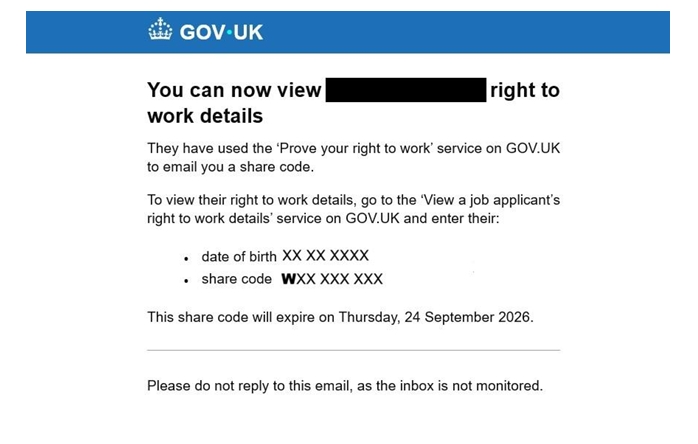
Example message licensing authorities will receive.
To check the applicant’s right to a licence details, the licensing authority will need to:
- access the service Check a job applicant’s right to work: use their share code - GOV.UK (www.gov.uk).
- enter the ‘share code’ provided.
-
enter the applicant’s date of birth.
- ensure that the correct licensing authority name is recorded in full when conducting the check using the online service.
Accurate recording helps support the integrity of the check and assists the licensing authority in evidencing that the prescribed check was carried out correctly.
When conducting online right to a licence checks, it is not sufficient to simply view the details provided to the applicant on the migrant-facing service or via printed copies of the service output for example.
Step 2: Check
When conducting a Home Office online right to a licence check, licensing authorities must:
- ensure that the photograph on the online right to a licence check is of the applicant who is the subject of the check (i.e. the information provided by the check relates to the applicant and they are not an imposter). This element of the check can be done in person, by video call or digitally using facial recognition technology. Where facial recognition technology is used to complete this element of the check digitally, this must be carried out by a registered RtW DVSP who will provide a comparison verifying the facial image from the service output and the match to the applicant.
If the name provided by the applicant does not match the name recorded on their eVisa profile (as shown in the online check output) or the image of the applicant on their digital profile is showing incorrectly or is of poor quality, licensing authorities should advise the applicant to update their Home Office account or update the image on their account.
-
only issue, renew or extend a licence where the online check confirms the applicant has the right to undertake the work associated with the licence and is not subject to a condition preventing them from doing so.
-
not issue, renew or extend a licence on the basis of the check if it is reasonably apparent from the photograph that the applicant is not the individual to whom the right to a licence check relates.
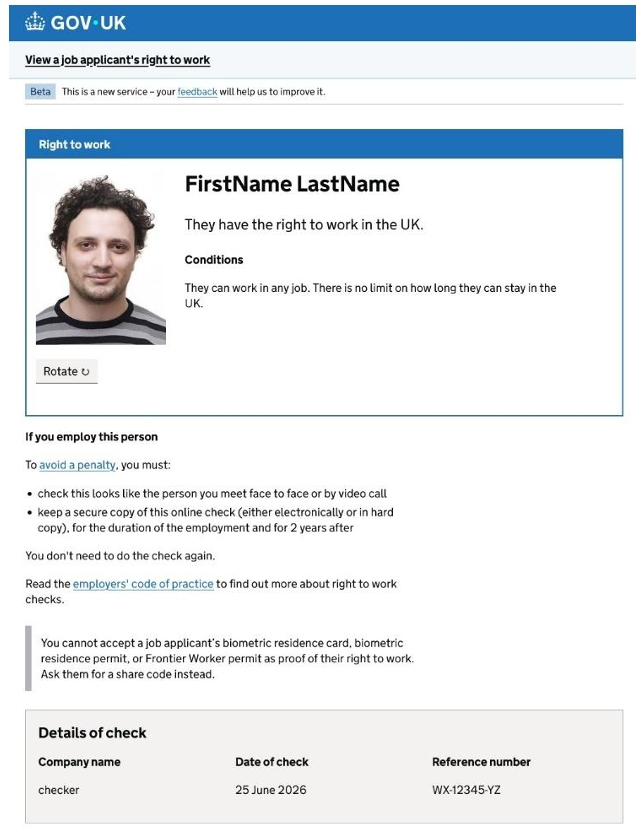
Example output showing an applicant with a continuous right to work in the UK.
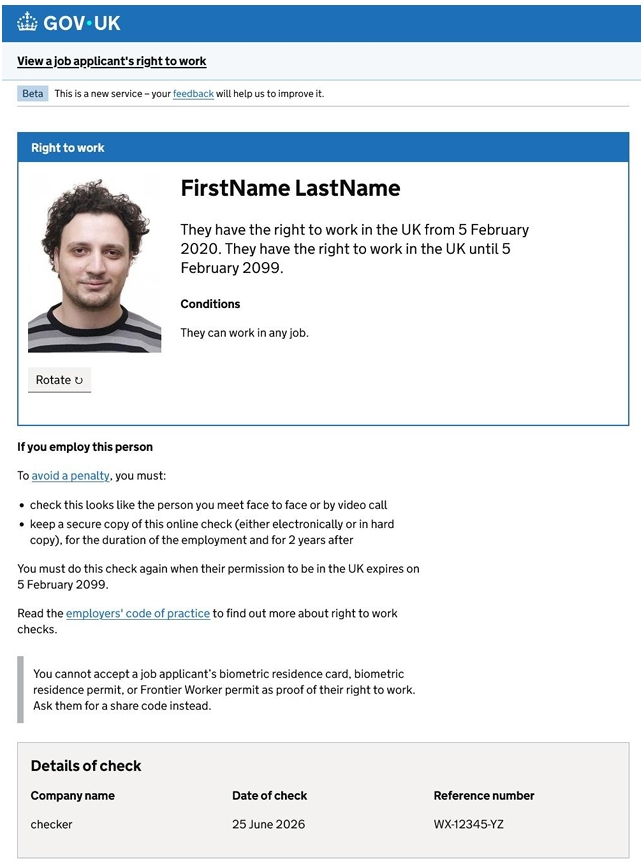
Example output showing an applicant with a time-limited right to work in the UK with no restrictions.
Step 3: Retain evidence of the online check
Securely store, electronically or in hard copy, a PDF or HTML copy of the ‘profile’ page confirming the applicant’s right to a licence. This will include the photograph and the date on which the check was conducted. The copy should be retained securely and only for as long as necessary for the licensing authority’s statutory functions, and in accordance with its data retention policies and obligations under data protection legislation. The electronic or hard copy must then be securely destroyed.
Where facial recognition technology is used, licensing authorities must retain a secure copy of the comparison provided to verify the facial image from the ‘profile’ page and the match to the applicant, alongside a copy of the service output.
3. Conducting a right to a licence check using a RtW DVSP
Licensing authorities are able to use digital verification services to complete the digital identity verification element of right to a licence checks. Digital identity verification, in this context, is the process of obtaining evidence of the applicant’s identity, checking that it is valid and belongs to the individual who is claiming it, where this verification takes place through digital means.
Whilst it is not mandatory to conduct right to a licence checks digitally in this way, if a licensing authority chooses to do so, it is mandatory that the DVSP is registered on the Office for Digital Identities Attributes (OfDIA) register, and that they are able to provide right to work checks[footnote 1].
A RtW DVSP is registered by OfDIA to confirm that the checks that they conduct follow prescribed requirements. The RtW DVSP will provide written confirmation within the output from the check, that they are able to complete right to a licence checks in accordance with the requirements. There may be different supplementary codes to which they are assessed. Transitional provisions of these codes will mean that the previous version of the code effectively still applies to the RtW DVSP and certificates issued under the old code remain valid.
Where a licensing authority uses a RtW DVSP, the licensing authority (and not the RtW DVSP) remains responsible for ensuring that the check is carried out in accordance with the prescribed requirements. Where those requirements have not been met, the licensing authority may not have carried out the right to a licence check in accordance with the prescribed requirements set out in this guidance.
If a licensing authority procures a RtW DVSP’s service through another organisation which is not itself certified (for example, a referencing or screening agency), that organisation must clearly state that it is working with a certified and registered RtW DVSP and identify the service carrying out the check. This ensures that the licensing authority knows which certified and registered DVSP is being used. The certification, registration or trust-marked status of a RtW DVSP, or any other DVSP, must not be misrepresented.
What checks are RtW DVSPs permitted to do?
A RtW DVSP is able to carry out digital right to work checks on holders of valid British or Irish passports (or Irish passport cards) (up to 6 months past the expiry date[footnote 2])[footnote 3], verify acceptable documents from Lists A and B of Annex A within an Employer’s guide to right to work checks when and where they are available from the issuing authority in a digital format, and provide facial recognition technology to enable a licensing authority to confirm that an applicant is the same individual the right to a licence check was conducted on and is not an imposter. Services available by RtW DVSPs will vary across the registered providers. The licensing authority’s chosen RtW DVSP will be able to advise which services and technology they can provide to support secure identity verification.
When an expired British or Irish passport (or Irish passport card) is presented to the RtW DVSP, they will use passive authentication technology to access and verify the validity of the chip contained within the document. The RtW DVSP may choose not to offer services to verify these expired documents, and they will not be able to complete this check if the chip has been damaged or corrupted.
Licensing authorities must not treat those who do not hold a valid passport (or passport card) (up to 6 months past the expiry date)2,3, or do not wish to prove their identity using a RtW DVSP, less favourably. Where an individual does not wish for the check to be carried out digitally, licensing authorities should provide another way for them to prove their right to a licence by carrying out a manual document-based right to a licence check instead.
How to conduct a right to a licence check using a RtW DVSP
The licensing authority needs to complete the following steps before issuing, renewing or extending a licence.
Step 1: Locate
The licensing authority should choose a RtW DVSP permitted to conduct checks from the Office for Digital Identities Attributes (OfDIA) register.
Step 2: Obtain
The licensing authority should receive a document from the RtW DVSP detailing the output of the check.
Step 3: Check
The licensing authority must satisfy itself that the photograph and biographic details (for example date of birth) provided by the RtW DVSP are of the applicant who is the subject of the check (i.e. the information provided by the check relates to the applicant and they are not an imposter). This can be done in person, by video call or using facial recognition technology provided by the RtW DVSP.
Where facial recognition technology is used to complete this element of the check digitally, this must be carried out by a registered RtW DVSP. The RtW DVSP will provide a comparison verifying the facial image from the document and the match to the applicant. Licensing authorities must retain a secure copy of this comparison alongside a copy of the document checked.
Step 4: Retain
For each check, the licensing authority must obtain the following information for audit and investigation purposes and retain a clear copy of the output of the check in accordance with data protection principles. It should then be securely destroyed.
Information to be provided to the licensing authority by the RtW DVSP:
| Data Field | Note |
|---|---|
| Given name(s) | |
| Middle name(s) | Only required if the user has a middle name(s). |
| Surname(s) | |
| Date of birth | |
| Image of the relevant RtW DVSP document | This must be an image of the full biometric page of the passport or, for an Irish passport card, an image of the front of the document in full. The holder’s name, date of birth, nationality, photo and expiry date must be clearly visible. |
| Photograph / image | An image of the prospective user. Licensing authorities must verify that the image matches the passport or passport card, and the user. |
| Date of identity check | |
| Evidence checked by | The name of the RtW DVSP, as it appears on their certificate. |
| Confirmation of RtW DVSP registration | The response must be “Yes” (or a clear equivalent, such as ‘Y’ or ‘true’) or ‘no’ (or equivalent, such as ‘N’ or ‘false’). |
| Confirmation RtW DVSP is conducting checks per the supplementary code for digital right to work checks | The response must be “Yes” (or a clear equivalent, such as ‘Y’ or ‘true’) or ‘no’ (or equivalent, such as ‘N’ or ‘false’). |
| Link to DVS register entry | Link to the digital verification services register. They may also provide their trust mark details. |
| Identity verified | The response must be “Yes” (or a clear equivalent, such as ‘Y’ or ‘true’) or ‘no’ (or equivalent, such as ‘N’ or ‘false’). |
Licensing authorities are encouraged to provide appropriate training and guidance to staff, for example, on what information they must obtain from the RtW DVSP to confirm verification of identity, what the information can be used for, and the additional steps they must take to establish eligibility to hold a licence.
Facial recognition checks through a RtW DVSP
Licensing authorities may use digital facial recognition technology to help confirm an applicant’s identity as part of right to a licence checks by comparing the image on their document with an image taken by the RtW DVSP. This may make it quicker and easier to complete identity checks, particularly where applicants are checked remotely.
Licensing authorities are not mandated to use this technology. They may carry out checks to confirm the applicant’s identity in person.
If a licensing authority chooses to use facial recognition technology, it must use a RtW DVSP as they are able to provide secure and reliable systems to complete the check. If the applicant is unable to complete the digital facial recognition check, the licensing authority should provide alternative ways for them to prove their identity as part of the right to a licence check to avoid discrimination.
The RtW DVSP will provide the licensing authority with the following information which should be combined with the relevant record of the right to a licence check. The licensing authority must retain a clear copy of this in accordance with data protection principles. It should then be securely destroyed.
Information to be provided to the licensing authority by the RtW DVSP
| Data Field | Note |
|---|---|
| Image of document containing the facial image | This must be either a relevant RtW DVSP document, the image of the share code output, or a document containing a facial image from the acceptable documents for demonstrating the right to work within Annex A of the Employer’s guide to right to work checks.. |
| Applicant’s facial image | The facial image of the applicant taken by the RtW DVSP. |
| Confirmation of RtW DVSP registration | The response must be “Yes” (or a clear equivalent, such as ‘Y’ or ‘true’) or ‘no’ (or equivalent, such as ‘N’ or ‘false’). |
| Confirmation RtW DVSP is conducting checks per the Supplementary Code for digital right to work (licence) checks | The response must be “Yes” (or a clear equivalent, such as ‘Y’ or ‘true’) or ‘no’ (or equivalent, such as ‘N’ or ‘false’). |
| Date of check | |
| Evidence checked by | Name of the RtW DVSP as it appears on the register. |
| Link to DVS register entry | Link to the digital verification services register. They may also provide their trust mark details. |
| Confirmation of facial images | The response must be ‘Y’ if the identity was verified and ‘N’ if it was not verified. This must be confirmation that the facial image within the document and that of the applicant match. |
When to contact the Status Verification, Enquiries and Checking Service (SVEC)
In most cases, a licensing authority should be able to make an assessment on whether or not an applicant is disqualified from holding a licence by carrying out a right to a licence check per the types of right to a licence checks prescribed in this guidance.
In certain circumstances, a licensing authority will need to contact SVEC to verify an applicant’s immigration status and right to hold a licence. These are when:
1. it is presented with a document (non-digital Certificate of Application or an acknowledgement letter or email) confirming receipt of an application to EUSS on or before 30 June 2021.
2. it is presented with a non-digital Certificate of Application confirming receipt of an application to the EUSS on or after 1 July 2021.
3. it is satisfied that it has not been provided with any acceptable documents by a non-British or non-Irish citizen and are unable to carry out a check using the online service, for example due to a technical issue with the applicant’s eVisa or digital immigration status.
4. it is satisfied that it has not been provided with any acceptable documents and the applicant is unable to generate a share code because they have an outstanding application with the Home Office which was made before their previous permission to stay expired and, as a result, the applicant is unable to provide evidence of their right to a licence.
5. it is satisfied that it has not been provided with any acceptable documents because the applicant falls within a cohort for whom verification of their right to a licence must be obtained from SVEC, such as an applicant who has immigration permission issued in a Crown Dependency.
6. it considers itself to have not been provided with any acceptable documents, but the applicant presents other information indicating they are a long-term resident of the UK who arrived in the UK before 1988.
In the above circumstances, a licensing authority must request verification from SVEC. SVEC will provide confirmation of the applicant’s immigration status and whether they have the right to work. Where the SVEC response confirms the applicant is entitled to undertake the work associated with the licence, the licensing authority may issue a licence for a maximum period of six months from the date specified in the SVEC response. This is a different process to the online checking service described in Conducting a Home Office online right to licence check.
Upon any subsequent application to renew the licence, licensing authorities must carry out a further check before issuing the licence. They are prohibited by statute from issuing a licence if a person is disqualified by their immigration status.
Biometric Residence Permits (BRPs)
BRPs provided evidence of the holder’s immigration status in the UK. They ceased to be issued by the Home Office on 31 October 2024 as part of the move towards an immigration system which is more digital and streamlined. As part of this development, physical documents evidencing immigration status have been replaced by eVisas.
A manual check of an original or expired BRP is not acceptable evidence of an applicant’s right to hold a licence. In these circumstances, the licensing authority must conduct a Home Office online check using a right to work share code.
Outstanding applications, appeals and administrative reviews
Where an applicant has an outstanding application to the Home Office, or an appeal or administrative review against a Home Office decision, the licensing authority should establish when the application, appeal or administrative review was made.
Where the applicant can generate a share code, the licensing authority should carry out a Home Office online right to work check.
Where the applicant is unable to generate a share code and cannot provide another acceptable form of evidence, the licensing authority should contact SVEC to verify the applicant’s immigration status and whether they are permitted to undertake the work associated with the licence.
A document or reference number showing that an application, appeal or administrative review has been made does not, by itself, demonstrate a right to hold the licence.
In-time applications (3C leave)
Where an applicant makes an application to extend or vary their immigration permission before their existing permission expires, section 3C of the Immigration Act 1971 may extend their existing permission while the application is pending. It may also continue while an appeal or administrative review to which the applicant is entitled remains pending.
Where section 3C applies, the conditions attached to the applicant’s previous immigration permission, including any permission or restriction relating to work, continue during that period.
Where the applicant has an eVisa and can generate a share code, the licensing authority should carry out a Home Office online check.
Where the applicant cannot generate a share code and cannot provide another acceptable form of evidence, the licensing authority should contact SVEC.
Where an online check or SVEC response confirms a continuing right arising from an outstanding in-time application, any licence issued on that basis must be limited to a maximum period of six months. A further prescribed check must be carried out before any subsequent licence is issued, renewed or extended.
Windrush generation individuals
Safeguards are in place to ensure that individuals who have lived lawfully in the UK since before 1988 are not prevented from demonstrating their status.
Some individuals of the Windrush generation, including those who arrived in the UK before 1973 and other non-UK citizens who arrived between 1973 and 1988, may not be able to provide documents from the acceptable document lists.
In these circumstances, the licensing authority should contact SVEC. SVEC will refer the case to the Windrush Help Team, where appropriate, so that the team can contact the individual, confirm their circumstances and assist them in resolving their status.
The Windrush Help Team can provide support and guidance about the Windrush Scheme and assist vulnerable individuals or those who require additional support. Applicants can access information through GOV.UK or contact the team by telephone on 0800 678 1925.
4. Duration of licences
Where a right to a licence check confirms that an applicant has a continuous right to work in the UK and no immigration restriction prevents them from undertaking the work associated with the licence, the licensing authority may issue the licence for the statutory maximum period, subject to the other applicable licensing requirements.
Where the licensing authority has securely retained evidence of a prescribed check confirming a continuous right, it is not required to repeat that immigration check when the applicant subsequently applies to renew or extend the licence, unless the licensing authority has information indicating that the applicant’s status or entitlement may have changed.
Where a check confirms that the applicant has time-limited immigration permission, the licence must not be issued for a period extending beyond the expiry of that permission or the statutory maximum period for the licence, whichever is earlier.
Where a licence is issued following positive verification by SVEC in relation to an outstanding application, appeal or administrative review, it must be limited to a maximum period of six months. The six-month period should be calculated from the date specified in the SVEC response.
A further prescribed right to a licence check must be carried out before any subsequent licence is issued, renewed or extended.
When will a licence lapse?
A licence will lapse if the licence holder becomes disqualified from holding it by reason of their immigration status. This may occur, for example, where their permission to enter or stay in the UK expires or is curtailed, revoked or cancelled.
Licensing authorities are not required to carry out ongoing immigration checks solely to establish whether a licence holder’s time-limited permission has ended. However, where a licensing authority receives information indicating that the licence holder may have become disqualified, it should consider the suspension, revocation or lapse provisions set out in this guidance.
5. Eligibility to hold a licence
A licensing authority must establish not only that an applicant is lawfully present in the UK and has permission to work, but also that no condition of their immigration permission prevents them from undertaking work as a taxi or private hire vehicle driver or operator.
This section provides information about immigration categories in which particular work restrictions may arise. Further assistance may be available from the licensing authority’s Local Partnership Manager or through the contact routes in the Support section.
Skilled workers
An individual granted immigration permission as a skilled worker is permitted to work for a specified sponsor in a specified role.
A skilled worker may undertake supplementary employment only where the relevant Immigration Rules permit it. Supplementary employment must not exceed 20 hours per week in total, must take place outside the contracted hours of the sponsored employment and must meet the applicable occupation requirements.
Work as a taxi or private hire vehicle driver or operator will not normally meet the conditions of skilled worker supplementary employment. A licensing authority must therefore carefully check the applicant’s immigration conditions and must not issue the licence where those conditions prohibit the work associated with it.
Different restrictions may apply to a dependant of a skilled worker. Their status and conditions should be checked using the prescribed method applicable to their circumstances.
Further information is available in An Employer’s guide to right to work checks (Annex B) and the Skilled Worker guidance.
Students
Not all international students are entitled to work while they are in the UK, but some are allowed to take limited employment if the conditions of their permission to study permit this.
A student who has been granted permission to be in the UK will have an eVisa. Licensing authorities can do a check by using the online service to determine whether the student is permitted to work and therefore hold a licence and what restrictions apply.
Students are not permitted to be self-employed unless they have made an in-time application for the Innovator Founder route, supported by an endorsement from an Innovator Founder endorsing body, and that application remains outstanding.
Further information is available in An Employer’s guide to right to work checks (Annex B) and for information about student work entitlements, please see Student route caseworker guidance and section 6 of the Student sponsorship duties guidance.
Application Registration Card (ARC), asylum seekers and refugees
Asylum seekers do not usually have permission to work and when they do, this is generally only in a shortage occupation or job on the Immigration Salary List depending upon the date they were granted permission to work. These roles will not involve the PHV and taxi sector and therefore they must not be granted a licence.
An Application Registration Card (ARC) is provided to a person who has claimed asylum in the UK, pending consideration of their case. An ARC may exceptionally state that the holder has a right to work, but generally this will only be in a shortage occupation or a job on the Immigration Salary List. Licensing authorities must not grant a PHV or taxi operator or driver licence on the basis of the ARC which states that the holder may only work in a shortage occupation or a job on the Immigration Salary List. However, licensing authorities should check whether the asylum seeker has alternative evidence of a right to hold a licence. A person who has been recognised by the UK as a refugee has no restrictions on their right to work in the UK. They may be granted a licence whilst they hold this permission.
Right to a licence check for EEA citizens
Following the UK’s exit from the EU, the Immigration and Social Security Coordination (EU Withdrawal) Act 2020 ended free movement law in the UK on 31 December 2020 at 23:00 (11pm) GMT. There followed a grace period of six-months during which relevant aspects of free movement law were saved to allow eligible EEA citizens and their family members resident in the UK by 31 December 2020 to apply to the EUSS. This period ended on 30 June 2021.
In line with the original requirements to demonstrate immigration status to prove a right to a licence, there is no requirement for retrospective checks to be undertaken. This means that you do not need to check the immigration status of those EEA citizens who already hold a licence which was issued between 1 December 2016 and 30 June 2021. An immigration status check should be repeated when the applicant is required to renew their licence.
Irish citizens
Irish citizens have unrestricted access to work in the UK. Eligible Irish citizens may choose to apply to the EU Settlement Scheme (see below for information on how to check the right to work of an EU Settlement Scheme status holder) and they can also apply for a frontier worker permit. This is a digital permit enabling them to prove their right to work using the Home Office online right to work service.
EEA citizens granted status under the EU Settlement Scheme (EUSS)
Most EEA citizens establish their right to a licence through the Home Office online service.
The Home Office no longer requires licensing authorities to carry out repeat checks on holders of pre-settled status. Provided it retains a copy of the online check, the licensing authority is not required to repeat the check in relation to an applicant who holds either pre- settled or settled status granted under the EUSS when the applicant applies to renew or extend their licence.
Pending applications submitted to the EUSS
EEA citizens, and their family members, who have made a valid application to the EUSS have temporary protection of rights under the Withdrawal Agreement, the EEA EFTA Separation Agreement or the Swiss Citizens’ Rights Agreement, which gives them a right to work until their application is finally determined. This includes pending the outcome of any administrative review or appeal against a decision to refuse status. Licensing authorities should not treat those with an outstanding, valid application less favourably.
Certificate of Application (CoA)
A CoA is evidence that an applicant has made a valid application to the EU Settlement Scheme.
Where an applicant has a digital CoA, they should use it to generate a share code. The licensing authority must use the share code and the applicant’s date of birth to conduct a Home Office online right to a licence check. In these circumstances, there is no need to contact SVEC.
Where an applicant presents a non-digital CoA, the licensing authority must contact SVEC to verify the applicant’s immigration status and right to hold a licence. The licensing authority must retain a copy of the non-digital CoA and the response received from SVEC.
EU Settlement Scheme status granted and pending applications in a Crown Dependency
The Crown Dependencies (the Bailiwick of Jersey, the Bailiwick of Guernsey, and the Isle of Man) each operate their own equivalents of the EUSS for those eligible to apply.
The UK and the Crown Dependencies recognise status granted under each other’s schemes. Where an applicant is granted settled status, pre-settled status, or has a pending EUSS application by a Crown Dependency they will be issued with a letter or email notification confirming their status or application under each other’s schemes.
In certain circumstances, a licensing authority will need to contact SVEC to verify an applicant’s immigration status and right to hold a licence,
Licensing authorities must retain:
- a copy of the Crown Dependency letter or email; and
- the response received from SVEC.
Where these steps are followed, the licensing authority will have complied with the prescribed verification requirements described in this guidance.
EEA citizens with Indefinite Leave to Enter or Remain
EEA citizens with Indefinite Leave to Enter or Remain (ILE/R) are not required to make an application to the EUSS but can do so if they wish and are required to prove their right to a licence in the same way as other applicants who do not hold digital status.
In these circumstances, licensing authorities must carry out a manual right to a licence check in accordance with guidance using documents from the acceptable documents for demonstrating a right to work within Employer’s guide to right to work checks.
Where an EEA citizen believes they hold ILE/R but cannot provide documentary evidence, licensing authorities should encourage them to follow the following routes, as appropriate:
-
Apply to the Windrush Scheme to get proof of their ILE/R status.
-
Consider whether they are eligible to apply to the EU Settlement Scheme, where there are reasonable grounds for the delay in making their application.
-
Apply for ‘No time limit’ document, where applicable.
If they are from Malta or Cyprus, they may also be able to apply for British citizenship through the Windrush Scheme Applications to either scheme is free of charge.
Family members of EEA citizens with EUSS status
Where they were resident in the UK before 11pm GMT on 31 December 2020, non-EEA family members of EEA citizens are required to make an application to the EUSS to continue living in the UK after 30 June 2021 but can apply after if they have reasonable grounds for their delay in doing so.
Eligible family members (EEA and non-EEA) of EEA citizens with EUSS status (or persons of Northern Ireland, Irish citizens, those exempt from immigration control) can apply for an EUSS family permit from outside the UK, or directly to the EUSS, as a joining family member. EUSS family permits are valid for six months.
Family members of those EEA citizens should provide a share code and their date of birth which will enable licensing authorities to check their Home Office immigration status via the online service, ‘Check a job applicant’s right to work: use their share code - GOV.UK (www.gov.uk)’ available on GOV.UK. For more information, please see EU Settlement Scheme Family Permit guidance on GOV.UK.
Family members who wish to stay in the UK beyond the validity of their EUSS family permit should generally apply to the EUSS within 3 months of arriving in the UK, or before the expiry of their permit, whichever is later. During that period, they can work in the UK.
Where a joining family member makes a valid application to the EUSS, they will receive a CoA issued by the Home Office. They will be able to use their CoA for the purpose of a right to a licence check.
6. Support
Support for licensing authorities carrying out right to a licence checks
In the first instance, it is recommended licensing authorities refer to the following:
-
The online interactive tool: ‘Check if someone can work in the UK’
-
An employer’s ‘Right to Work Checklist’
-
The ‘Code of practice on preventing illegal working: Right to Work Scheme for employers’
-
The ‘Code of practice for employers: Avoiding unlawful discrimination while preventing illegal working’
-
For right to a licence verification requests only, licensing authorities can contact SVEC via ICESSVECWorkflow@homeoffice.gov.uk to obtain a status verification request form. This service should not be used for general right to work or right to a licence enquiries.
-
‘Guidance on examining identity documents’ to aid recognition of fraudulent identity documents.
-
Compare identity and travel documents against archived images: ‘PRADO Public Register of Authentic travel and Identity Documents Online’ and ‘EdisonTD’.
Licensing authorities may obtain further assistance through their Local Partnership Manager or by emailing ISCLPMSupportTeam@homeoffice.gov.uk.
Where a forged or counterfeit document, or a genuine document being used by an imposter, is suspected, the licensing authority should follow its established referral arrangements and may report suspected immigration crime to the Home Office through GOV.UK.
Home Office training
The Home Office provides training on right to work requirements and document fraud awareness. For current training information, licensing authorities should contact the Immigration Sanctions and Compliance External Training Team at iscexternaltrainingteam@homeoffice.gov.uk.
Reporting illegal working
If illegal working is suspected, for example because it is believed an applicant does not have the right to a licence, has lost their permission to work, or has presented a false document or a genuine document that does not belong to them, licensing authorities should report the individual to the Home Office. Licensing authorities requiring support or advice should contact the Local Partnership Manager Support Team at ISCLPMSupportTeam@homeoffice.gov.uk.
Support for applicants
If an applicant requires further advice or support with regard to their immigration status, they can access information on ‘View and prove your immigration status: get a share code’ on GOV.UK. This also provides further information on how to prove immigration status, how to update personal details, and support available to them.
If the applicant needs help accessing or using their Home Office online immigration status services, including technical difficulties, they can contact the UKVI Resolution Centre: Telephone: 0300 790 6268.
Applicants can also report an error with their eVisa to the Home Office directly for example where their eVisa details are incorrect such as showing the wrong date of birth or immigration status, or they cannot view their eVisa because of a technical error.
7. Revocation of licences
The Home Office may provide a licensing authority with information, or the licensing authority may obtain information from another source, indicating that a licence holder may have become disqualified from holding the licence by reason of their immigration status.
This may include information that the licence holder’s permission to enter or stay in the UK has been curtailed, revoked or cancelled; that the licence holder is subject to a deportation order; that they have been convicted of an immigration offence; or that they have received an immigration penalty which has not been cancelled following an objection or appeal.
The licensing authority should consider that information in accordance with the applicable suspension, revocation and lapse provisions. It may also be relevant to the assessment of whether the licence holder remains fit and proper to hold the licence.
Return of the licence
A licence holder must return the licence, badge and any other evidence of identification issued by the licensing authority where the licence has expired, lapsed, been suspended or been revoked on immigration grounds.
The requirement is underpinned by criminal offences in the relevant taxi and private hire vehicle licensing legislation.
Where the licence holder fails, without reasonable excuse, to return the relevant items within seven working days, they may commit an offence. The maximum penalty is a level 3 fine on the standard scale.
8. Providing information to the Home Office
The immigration provisions relating to taxi and private hire vehicle licences do not impose a specific requirement on licensing authorities to report every application refused, or every licence suspended or revoked, on immigration grounds.
Licensing authorities are nevertheless requested to provide this information to the Home Office so that appropriate immigration enforcement action can be considered.
Section 55 of the Immigration Act 2016 expanded the information-sharing gateway in section 20 of the Immigration and Asylum Act 1999 and provides public authorities with statutory authority to supply information or documents to the Home Office for immigration purposes.
Relevant information should be sent to ISCLPMSupportTeam@homeoffice.gov.uk in the first instance.
Section 20A of the Immigration and Asylum Act 1999, as amended by section 55 of the Immigration Act 2016, also requires local authorities to provide nationality documents in their possession to Home Office immigration officials where specifically requested. This may include copies retained as part of a licence application where the documents belong to a person who is liable to removal from the UK.