Men's Health Strategy: guidance for local implementation
Published 19 November 2026
Applies to England

© Crown copyright 2026
This publication is licensed under the terms of the Open Government Licence v3.0 except where otherwise stated. To view this licence, visit nationalarchives.gov.uk/doc/open-government-licence/version/3 or write to the Information Policy Team, The National Archives, Kew, London TW9 4DU, or email: psi@nationalarchives.gov.uk.
Where we have identified any third party copyright information you will need to obtain permission from the copyright holders concerned.
This publication is available at https://www.gov.uk/government/publications/mens-health-strategy-guidance-for-local-implementation/mens-health-strategy-guidance-for-local-implementation
Foreword
England’s Men’s Health Strategy creates an opportunity to make men’s health part of everyday decisions about how services are designed and delivered, and how improvements in local conditions support healthier lives.
We now have an opportunity to turn that ambition into action locally. Local government, the NHS and community partners all bring different strengths, knowledge and relationships. We all have a part to play in bringing those together to make a difference.
Every area will have a different starting point, but there is already much to build on through work on prevention, neighbourhood health and reducing inequalities. We want local partners to build on what is already working, understand whose needs are not yet being met and identify where they can make the greatest difference. For some, that will mean getting started. For others, it will mean going further.
Understanding which men experience the poorest health outcomes should be at the heart of local priorities. Men do not experience poor health or barriers to support equally, and tackling these inequalities is fundamental to improving men’s health. Data can show where needs are concentrated, but it cannot tell us everything. We need to listen to men, including those who do not use services or who have disengaged, and understand what gets in their way. That means designing solutions with men and communities, not simply for them.
There is no single model that will work for every man or every community. A trusted community setting can help someone take the first step, but what happens next matters just as much. Appointment times, continuity, the response a man receives and whether services can address his needs all influence whether he comes back. Community organisations are powerful partners, bringing the trust, relationships and local knowledge needed to reach men and shape approaches that work.
Local action must also keep sight of the wider conditions shaping men’s health. Workplaces can be important places to reach men, but working conditions and expectations can themselves affect health. Local partners can influence these conditions as employers and commissioners, and through decisions about housing, access to work, transport and place. Improving men’s health is about creating the conditions that make healthier lives possible.
Gender interacts with poverty, ethnicity, disability and other circumstances, and these factors need to be considered together. And just as these issues do not exist in isolation, neither should our approach to men’s and women’s health. Taking action on men’s health complements, rather than competes with, work to improve women’s health and reduce inequalities. Progress on men’s health can strengthen relationships, families and communities and support better health and wellbeing for everyone.
Local systems do not need to do everything at once. Our ask is simple: use this guidance to start the conversation, agree a manageable number of priorities, identify a senior owner and be clear about what happens next. Share what works, be honest about what does not, and learn from other areas. By acting locally and learning together, we can make men’s health part of everyday decision-making and turn the ambitions of the Men’s Health Strategy into real change for men, their families and their communities.
Paul Galdas - Chair, Men’s Health Academic Network
Greg Fell - President, Association of Directors of Public Health
Councillor Eamonn O’Brien - Chair, Local Government Association
Executive summary
Across England, too many men are dying too young and facing illness that could often be prevented, with the greatest burden falling on the most disadvantaged communities.
These outcomes are not inevitable or the result of individual choices alone. They are shaped by:
- the environments in which men live, learn and work
- the opportunities available to them
- how effectively services respond to their needs
The challenges are significant, but so too is the opportunity. When men are able to live longer, healthier lives, the benefits ripple across every part of society, including:
- stronger families
- better connected communities
- employers benefitting from a healthier workforce
- reduced demand on health and care services
England’s first Men’s Health Strategy sets out a clear national ambition to address these challenges and improve outcomes for men and boys across the country. Realising that ambition now depends on action across the systems and services that shape their lives.
Action starts with a clear vision and strong leadership. We are calling on leaders across health, local government and the wider system to:
- champion the issue
- provide senior ownership and accountability
- create the motivation and conditions for action across their organisations and communities
This is not about creating a new programme of work. It is about recognising that by improving men’s health, we can accelerate progress on the ambitions local systems are already pursuing, from prevention and reducing inequalities to neighbourhood health, economic growth and stronger communities.
By embedding men’s health within existing priorities and empowering teams to act, local system leaders can be the driving force for improving outcomes for men and boys across the country, delivering benefits that are felt across families, communities and public services.
This guidance has been developed in collaboration with experts and local system partners to support this ambition. It sets out practical ways for local systems to turn the strategy into action and make men’s health a core part of how we tackle inequalities and build healthier communities for everyone.
The guidance outlines the foundations for local action, including governance, accountability, data and insight, and provides a practical checklist to help organisations get started. It then explores each of the strategy’s 6 levers for action, outlining why they matter and providing practical examples and case studies that can be adapted to local contexts.
Introduction
In November 2025, the government published England’s first Men’s Health Strategy, setting out a long-term vision to improve the health and wellbeing of all men and boys.
The strategy made a clear case for action. Men continue to experience poorer outcomes across a range of health issues and are more likely to die prematurely from preventable causes. In 2025, 35% of all deaths among men in England were before the age of 75. On average, men living in the most deprived areas of England are expected to die more than 10 years earlier than those living in the least deprived areas and spend significantly fewer years in good health. Rates of cancer, circulatory and respiratory conditions drive much of this difference in life expectancy. Men also account for around three-quarters of deaths by suicide and are more likely to experience a range of risk factors that can harm health and wellbeing, including smoking, harmful gambling, alcohol consumption and substance misuse. Men can also face barriers to seeking help and engaging with services, meaning opportunities to prevent ill health can be missed.
These outcomes reflect:
- the places where men live, learn and work
- the relationships and communities around them
- wider social, economic, environmental and cultural factors
Addressing these poor health outcomes requires a concerted effort across the whole system.
Since publication of the Men’s Health Strategy, there has been strong interest from local and regional partners in how they can support its delivery. Local authorities, integrated care boards (ICBs), NHS organisations, voluntary and community organisations, employers and many other partners have a critical role to play in designing services, shaping environments and supporting communities in ways that improve men’s health.
Much of this work is already underway. Across England, local systems are developing innovative approaches that support the ambitions of the strategy. Following engagement with a range of health system partners, academics and broader stakeholders, this guidance has been developed to support and share good practice.
Local action is most effective when it is shaped by the men it aims to support. Partners are encouraged to engage directly with men, particularly those experiencing the poorest outcomes, to understand their experiences, needs and priorities, and to help ensure services and interventions are relevant, accessible and effective.
Purpose of this guidance
This non-statutory guidance brings together practical suggestions and case studies to support systems to implement the ambitions of the Men’s Health Strategy. It is for local partners to decide how to use the guidance, based on their own needs and priorities. The suggestions illustrate how men’s health can be considered through existing responsibilities, services and activity. This guidance is aimed at:
- health and wellbeing boards (HWBs)
- ICBs
- local authorities, including directors of public health
- primary care networks
- NHS providers
It also supports collaboration with voluntary, community and social enterprise (VCSE) organisations that are critical partners for improving population health. The guidance may also be useful for wider local system partners, including:
- employers
- local businesses
- education providers
- other public services
Further guidance and resources developed by the men’s health sector that can support local implementation can be found on our men’s health resource hub (login required).
Implementation will look different across England, reflecting local needs, inequalities and priorities. In the 10 Year Health Plan, the government set an overall goal to halve the gap in healthy life expectancy (HLE) between the richest and poorest regions, while increasing it for everyone. Taking action that reflects the needs of local populations is essential to realising the ambitions within the national strategy. Local partners can tailor their approach to the needs of their communities, with particular consideration given to men experiencing the poorest health outcomes and greatest inequalities.
The map below illustrates the scale and geographical variation of the challenge. It shows how men’s HLE at birth varies across England. The map uses Middle-layer Super Output Areas (MSOAs), showing inequalities both between and within regions and local areas. The estimates range from 47.7 years in Stockton-on-Tees in the North East to 78.3 years in Westminster in London - a difference of 30.6 years.
Figure 1: HLE at birth for males in England (2019 to 2023)
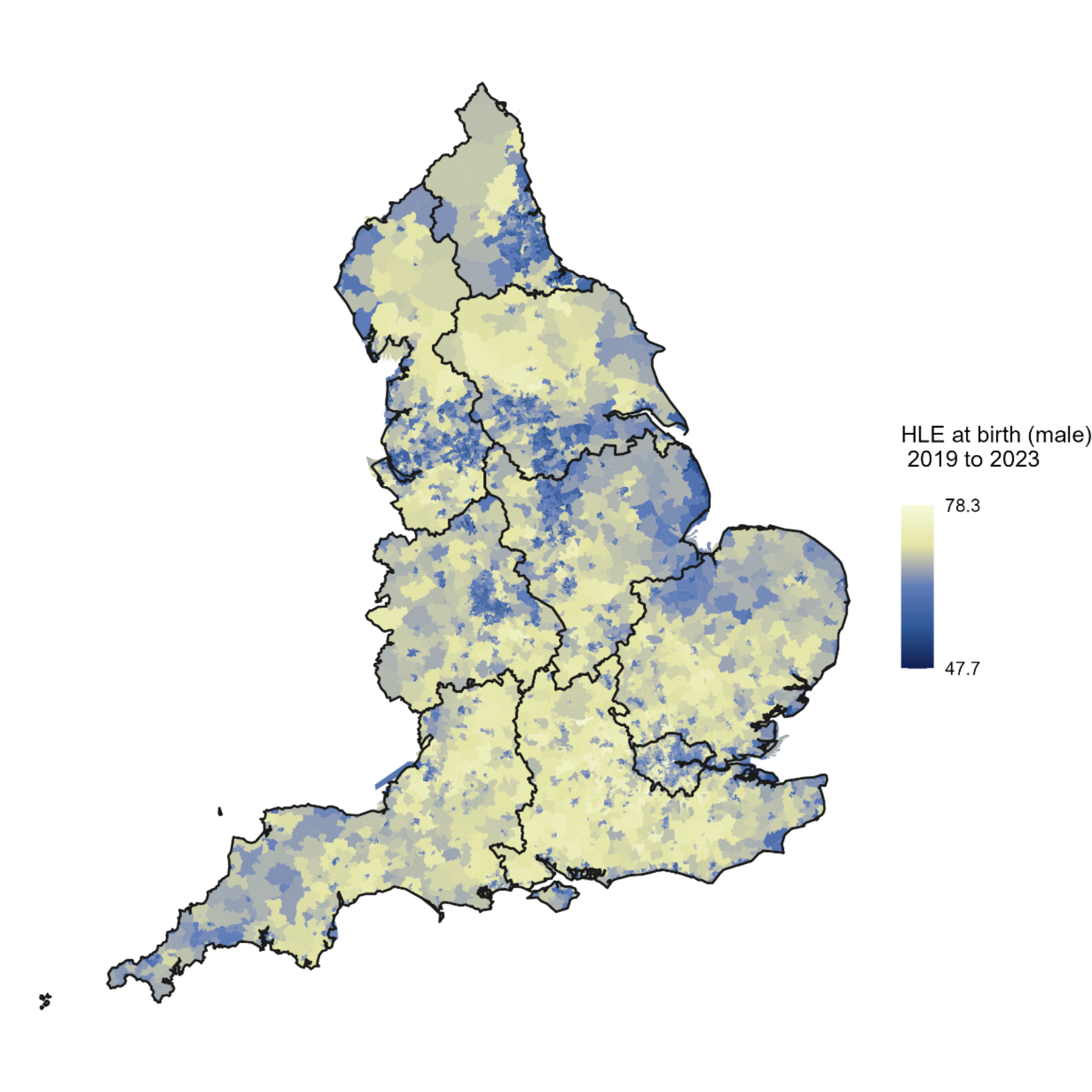
Figure 1 shows variation in HLE at birth for males in England, displayed at neighbourhood level. The highest (78.3 years) is found in Westminster in London and the lowest (47.7 years) is found in Stockton-on-Tees in the North East. The blue-to-yellow shading represents lower-to-higher healthy life expectancy in years, while the boundaries show the 9 English regions. HLE estimates relate to 2019 to 2023 and use Census 2021 self-reported health data. They should be interpreted with care and used to compare areas within this dataset rather than with other HLE datasets.
Local systems can begin by establishing strong foundations and selecting a manageable number of priorities before building their approach over time. This guidance includes a checklist to support systems taking their first steps.
How the Men’s Health Strategy relates to the health of other groups
Efforts to improve men’s health are not at odds with work to improve women’s health or the health of any other group. Both the Men’s Health Strategy and the renewed Women’s Health Strategy recognise that gender can influence health outcomes, experiences and behaviours, and that understanding these differences can help services better meet people’s needs. In practice, this means considering sex and gender as part of a broader approach to reduce inequalities and improve outcomes for all.
About the case studies
Case studies in this guidance are included to illustrate how the principles and ambitions of the Men’s Health Strategy can be put into practice and to give an indication of the range of activities taking place across England. They are intended solely as illustrative examples, and no endorsement, accreditation or recommendation by government of a particular organisation, service or approach is intended. Inclusion does not indicate that an organisation or activity has been formally evaluated by government or selected through a commercial procurement, market engagement exercise or any other fair and open competitive process.
Data included in the case studies has been self-reported by named organisations and has not been verified by the Department of Health and Social Care (DHSC).
How to get started
Local systems do not need to do everything at once. Organisations can begin with a small number of priorities and build from there. To get started, local systems can:
- name a senior owner for men’s health and embed this role within existing governance
- use sex-disaggregated data alongside deprivation, ethnicity, age and other relevant characteristics to make clear the priority health outcomes of men in the area
- identify where inequalities are greatest and explore why this might be
- map existing targeted or tailored provision relevant to men’s health and identify where there are gaps and opportunities
- to understand barriers, opportunities and to co-design solutions, engage directly with:
- men least well served by existing provision
- experts
- stakeholders
- community groups that are run by, for or with men
- once the foundations are in place, select one or 2 priority areas for initial action based on need
- set a measure of success, monitor progress and learn from what works
This checklist is intended to help local partners get started, not to limit ambition. Once these foundations are in place, organisations can consider broadening their approach, embedding consideration of men’s health across services, policies and wider system planning. The sections below outline how system partners can build on these foundations and put the strategy’s 6 levers for action into practice.
Case study: building the foundations for implementation in North Yorkshire
North Yorkshire Council has taken a structured approach to implementing the Men’s Health Strategy, focusing first on developing the foundations needed to support long-term action. Initial activity has included:
- the development of a local men’s health logic model
- analysis of local data and production of a men’s health infographic
- identification of major health challenges across the life course
- mapping existing public health activity
- collaboration with women’s health colleagues
- establishment of a working group on gender-specific approaches to cardiovascular disease prevention and management
An important part of the approach has been using data and evidence to understand how behavioural, cultural, structural and socioeconomic factors contribute to men’s health inequalities and poorer outcomes, and how national priorities align with local needs. The work has also been developed alongside a broader gender-equity approach, recognising the opportunities for men’s and women’s health initiatives to complement one another.
By bringing together local intelligence, developing a shared strategic framework and reviewing existing activity across the system, North Yorkshire Council is creating a foundation for identifying priorities, targeting action and embedding consideration of men’s health within wider prevention and health inequalities programmes. Future work includes:
- completing the mapping exercise
- identifying gaps and opportunities
- developing a gender-specific cardiovascular disease workstream as an initial test case for implementation
Using data and insight
Understanding which men experience the poorest outcomes and where inequalities are the greatest is an important starting point for local action. This could include identifying where services are failing to reach or retain those with the greatest need.
Regularly considering sex differences within local data, alongside disability, ethnicity, sexual orientation, age and deprivation, can help areas identify where there is the greatest unmet need and target action more effectively.
Platforms such as Fingertips and Spotlight bring together hundreds of indicators on population health, health inequalities, risk factors, behaviours, service uptake and outcomes, allowing users to compare local areas with regional and national benchmarks, where available. The LG Inform men’s health report (published 2026) provides a valuable source of local intelligence, enabling local authorities to explore and compare progress against a range of indicators and identify opportunities to target support where needed. Local data sources such as healthcare or locally commissioned service data may also provide more timely information that can be used for local needs assessments.
Local partners can consider where gaps in data limit understanding of men’s health outcomes, experiences or service use, and whether existing data collection and reporting arrangements could be used or adapted to support more effective planning, commissioning and service delivery. For example, where appropriate and proportionate, considering sex-disaggregated reporting on outcomes within contracts can provide understanding of what is working.
Partners can also work with community organisations run for men to help organisations build the evidence base for their contribution to health and wellbeing outcomes.
Further examples of how local systems can use data and insight are included throughout this guidance.
Governance and accountability
Local system leaders have a crucial role in driving progress on men’s health. By providing clear governance, senior ownership and accountability, they can help embed men’s health within existing priorities. This section provides examples of how men’s health can be built into governance, planning and performance arrangements.
ICBs and NHS providers
NHS organisations have statutory duties to reduce health inequalities, including duties relating to gender and sex. Health inequalities are defined as avoidable differences in health outcomes between groups or populations - such as differences in how long we live, or the age at which we get preventable diseases or health conditions.
In line with the Core20PLUS5 approach, NHS organisations are encouraged to draw on data and intelligence from a range of sources to build a robust understanding of men’s health and wellbeing needs across the life course, including how these vary between population groups and places. This can build on existing integrated needs assessments, joint strategic needs assessments (JSNAs) and neighbourhood health plans.
At a minimum, performance, quality and outcomes data can be disaggregated by sex, age, ethnicity and deprivation, and embedded in routine reporting to identify inequalities in access, experience and outcomes, including across relevant indicators within the NHS Oversight Framework.
Quantitative data could be combined with qualitative and community insight data to understand the barriers that may prevent men from accessing or engaging with care, including digital exclusion, transport barriers and the accessibility and flexibility of services.
These insights can help to establish a clear starting point and inform strategic commissioning decisions and measurable improvement plans, with progress tracked against relevant outcome goals to determine whether healthcare inequalities are reducing.
Combined strategic authorities
Combined strategic authorities can use their strengthened health duties to address the structural drivers of men’s health inequalities, while ensuring alignment with related agendas, such as jobs and skills growth and healthy workplaces. Operating across a wider geography can help authorities bring together data and insight on groups of men whose needs may be harder to understand or respond to within a single local authority. Their role can include:
- convening partners
- aligning action on employment, skills, transport and housing with local health priorities
- supporting delivery through existing local services
Local authorities
As the local authority’s statutory source of public health expertise, directors of public health can play an important role in informing local priorities and supporting evidence-based action. Directors of public health can use reports including the JSNA, specific in depth needs assessments, and their annual directors of public health reports to raise awareness of men’s health issues, highlight local inequalities and stimulate action across the wider system. Local authorities are encouraged to ensure that recommendations from these reports are implemented and monitored through the HWB.
Elected members can play an important role in scrutinising local system progress from neighbourhoods to across the authority and its partners. The Local Government Association’s Must know: supporting men’s health guidance supports councillors to encourage officers and partners to understand local needs.
The health scrutiny committee also provides a more formal opportunity to investigate how well system partners are addressing men’s health inequalities and review performance.
Health and wellbeing boards (HWBs)
The convening role of HWBs can also be a useful vehicle for accountability on men’s health. HWBs can look at how men’s health is considered in the JSNA and in the subsequent strategies developed by partners, including neighbourhood delivery plans. Part of this could also consider the involvement and engagement of local men as well as analysis of sex and gender differences when designing commissioning and delivery models of services.
HWBs may also consider whether a local men’s health or gender equality plan could be needed to accelerate and co-ordinate action.
Improving access to healthcare services
Men can face a range of structural, systemic and cultural barriers which affect how they engage with, access and experience the health and care system. These barriers can be particularly acute for men facing deprivation and other forms of disadvantage. Men may have fewer contacts with health services across the life course, meaning opportunities for prevention and early intervention can be missed. Services are more likely to engage and retain men when their design and delivery take account of men’s needs, preferences and the contexts in which they live and work. This means going beyond initial reach to ensure meaningful and sustained engagement over time.
Practical examples include:
- monitoring service uptake, retention and outcomes by sex and other intersecting characteristics to ensure services are engaging men and improving outcomes equitably
- undertaking direct engagement with target cohorts of men, particularly those facing the poorest outcomes, in the design of services and service specifications
- considering how to embed men’s health needs within locally owned neighbourhood health plans, as set out in the ‘Neighbourhood health’ section below
- delivering services through non-traditional settings that men know and trust, such as community groups involving or aimed at men, local charities, sports clubs, faith or cultural organisations and accessible community settings in high streets and town centres, with clear, supported routes into clinical care where appropriate
- identifying settings and services where health risks cluster among particular groups of men, and using these as opportunities to offer broader support and prevention interventions, such as strengthening links between community support and primary care
- taking a ‘no wrong door’ approach by connecting men in contact with services such as substance use, sexual health, homelessness or justice services to a wider range of health, wellbeing and prevention support
- ensuring male victims of domestic abuse and sexual violence can access safe, appropriate support through primary care
- identifying stages across the life course where men engage with health services and using these as opportunities for prevention, early intervention and connection to wider support. For example, reaching men through:
- childhood vaccination programmes
- maternity, neonatal and early years services
- adult social care services
- workplace occupational health
- considering appointment times, types of contact, language and follow up within service design to ensure it fits with men’s personal needs, for example, their working patterns or caregiving roles
- taking a Making Every Contact Count approach to ensure that when men engage with health and care professionals, they experience conversations that build confidence, trust and motivation to make positive changes - particularly for younger men and those who may not routinely access support
- ensuring care is personalised, such as offering personal health budgets proactively and equitably to address the needs of men who are underserved by traditional healthcare provision or have complex needs
Neighbourhood health
The shift to neighbourhood health will re-focus the system on improving people’s access to health and social care, experience and outcomes, ensuring services are organised to meet their needs closer to the places they live. The aim of neighbourhood health is improving health outcomes and reducing health inequalities through proactive, preventative and personalised care, delivered closer to home and shaped around the needs of local populations. This involves bringing together integrated neighbourhood teams of professionals and partners to improve health and wellbeing through support that reflects people’s needs and the ways they access care - including the different needs of men and women. Men have higher overall prevalence of GP recorded cardiovascular disease (CVD) and of diagnosed diabetes - conditions listed as high priority cohorts in the Neighbourhood health framework. Improving outcomes, including in these areas, is likely to require neighbourhood health models that:
- engage and retain men
- organise care around their needs
- address the wider determinants of health, including employment, housing and social connection, that influence men’s health outcomes
As set out in the Neighbourhood health framework, local areas have flexibility to design their neighbourhood health plans to ensure they meet the current and future needs of their population. Local areas are encouraged to consider how they can embed men’s health needs within locally owned neighbourhood health plans. This could include bringing together services commonly used by men, such as mental health or cardiovascular support, alongside wider provision such as employment or housing advice. VCSE organisations, including those with strong track records of engaging men, can be involved as strategic partners in the design and delivery of neighbourhood health services.
As neighbourhoods develop system pathways of care, they are encouraged to actively integrate community support for men into commissioned pathways and maximise the use of existing community assets through social prescribing.
Neighbourhood mental health centres
Neighbourhood mental health centres provide an important opportunity to improve access to mental health support for men, particularly those who may be less likely to engage with traditional mental health services.
As part of the wider shift towards neighbourhood health, 24/7 neighbourhood mental health centres are being rolled out across England to provide open access, community-based support closer to where people live. The centres bring together mental health, crisis, primary care, voluntary sector and wider community support into a single offer, making it easier for people to get help earlier and reducing the need to navigate multiple services.
Neighbourhood mental health centres are designed to restore continuity of care, ensuring people build relationships with a single team rather than being passed between services and repeating their story to different professionals. This is particularly important for people who may previously have disengaged from services or experienced barriers to accessing support.
Local areas are encouraged to consider how neighbourhood mental health centres can support groups of people who have traditionally been underrepresented in mental health services or are less likely to seek help. By combining clinical support with practical help, peer support and strong links to housing, employment and community networks, these centres can help create more accessible, trusted and effective routes into mental health care while supporting wider suicide prevention and mental health objectives.
The creation of specialist neighbourhood mental health teams also provides an opportunity to ensure that men with severe and complex mental health issues can access support and treatment earlier and more easily. Through these teams, alongside mental health specialists within integrated neighbourhood teams, and self-referral to NHS Talking Therapies, access for men with all types of mental health challenges should be improved. As part of this shift, it will be important to continue to close the treatment gaps for evidence-based mental health interventions, including National Institute for Health and Care Excellence (NICE) recommended psychological therapies.
Suicide amongst men reflects a complex interaction of multiple social, economic and behavioural influences which may include financial hardship, debt or work-related difficulties, alcohol and substance abuse, harmful gambling and physical and mental health issues. DHSC’s suicide prevention pathfinders programme has committed up to £3.6 million to test approaches that aim to strengthen joined-up pathways across the range of services that middle-aged men may be in contact with. While this work is taken forward, local areas are encouraged to consider how they can further integrate provision and strengthen pathways between neighbourhood-based services to improve the identification of men at risk of suicide.
Additionally, all mental health provision, including that provided by neighbourhood teams, should seek to improve men’s safety from suicide through adopting the staying safe from suicide guidance issued by NHS England in 2025.
Supporting individual behaviours
Some unhealthy behaviours, such as smoking, harmful gambling, harmful alcohol consumption and substance misuse are more common among men. The reasons for this are complex and are shaped by a number of factors, including societal norms and wider determinants of health such as education, employment and income. These behaviours are also closely linked to deprivation. System partners have a critical role to play in supporting prevention, early diagnosis, quality treatment and ensuring strong join-up of services.
Addressing men’s unhealthy behaviours must also include preventing behaviours that cause harm to others. This includes violence against women and girls (VAWG), which is predominantly perpetrated by men.
Practical examples include:
- ensuring that the health needs assessments (HNAs), required through the Gambling Harms Prevention local authority grant funding, consider gender-related needs, barriers and impacts to drive action in local areas
- using the Gambling Harms Prevention grant funding to reduce exposure to harmful gambling environments and create safer communities, with a focus on preventing harms among men, where appropriate. This could include action from local authorities through:
- licensing policies
- restrictions on gambling advertising and promotion
- public awareness campaigns
- delivering targeted smoking cessation support for men at greatest risk, working with NHS and local partners to reach those in high-prevalence settings and embedding support within services such as lung cancer screening and community outreach
- ensuring national campaigns - such as Stoptober - are amplified locally according to local evidence of sex disparities, and that the monitoring of impact and outcomes is understood by sex
- delivering weight management services in line with the relevant components set out in NICE guidance, including tailoring services, for example through men-only sessions or using local insight to help develop communications for specific groups
- ensuring that public health messaging around health information is strengths-based, is tailored to target groups and avoids deficit framing that places responsibility solely on individual men
- ensuring there is integrated high-quality service provision and treatment for men with co-occurring mental health and substance use needs, as set out in the co-occurring mental health and substance use delivery framework
Case study: tackling gambling harms among young men in Liverpool
Commissioned by Liverpool City Council, ‘If Only I Knew’ is a month-long public health campaign developed by Chapter One to address gambling harms among men aged 18 to 35. The campaign aims to increase understanding of modern-day gambling, reduce stigma, and encourage men to seek support earlier.
The campaign focused on how gambling products are designed to encourage continued play, the realities of the gambling industry business model and the benefits of life without gambling, using relatable stories and local imagery. These stories explore the impact that gambling can have on mental health and relationships, while emphasising that it is never too late to make a positive change.
By increasing awareness of gambling-related harms and encouraging earlier help-seeking, the campaign aims to support men to better understand the risks associated with gambling and access support when needed. The approach aligns with the Men’s Health Strategy’s focus on addressing gambling harms among young men and promoting early intervention.
Developing healthy living and working conditions
Where people live, work and learn has a significant influence on their health outcomes. Local systems can improve men’s health by creating environments that support healthy behaviours, reduce health risks and make it easier for men to access support. This includes using workplaces, educational settings and community spaces as opportunities to connect men with health services and prevention activity.
Practical examples include:
- working with both large and small local employers to support positive health behaviours. This could include working with traditionally male-dominated sectors as well as larger employers with substantial male workforces to:
- promote employees’ access to occupational health services
- promote flexible working arrangements that support attendance at health appointments and reflect men’s parenting and caring responsibilities
- use the workplace or working environment as a setting to deliver outreach services to male employees
- promote employee codes of practice and toolkits such as the British Standard on suicide prevention, Construction Leadership Council mental health joint code of practice (PDF, 18.2 MB) and BITC/Public Health England toolkits
- promote use of existing digital behaviour change tools and apps such as the NHS Healthy Choices Quiz, NHS Active 10 app, NHS Quit Smoking app and Mind Plan
- local authorities and NHS organisations leading by example through workplace policies and cultures that support health, wellbeing and prevention
- supporting parents, carers, educators and other trusted adults to help boys and young men navigate online environments safely, including by promoting resources such as:
- the Kids Online Safety Hub which contains content on misogyny and supporting conversations about harmful online narratives
- Educate Against Hate to safeguard students against radicalisation
- the updated relationships, sex and health education (RSHE) guidance covering online harms, misinformation, social media, artificial intelligence and deepfakes
- tackling structural contributors to poor health outcomes and inequalities that contribute to men’s health outcomes, for example, influencing planning and environmental design to tackle the impact of a lack of access to green space and quality housing, as well as the impacts of air pollution
Case study: workplace health checks for routine and manual workers in Essex
Essex County Council’s SISU mobile digital health checks programme brings preventative healthcare directly into workplace settings, improving access for routine and manual workers who may face barriers to engaging with traditional health services.
The programme has:
- delivered over 6,500 health checks across 94 Essex employers
- encouraged eligible users to contact their GP for a full NHS Health Check
- prompted 2,000 referrals to local services for smoking cessation, weight management, blood pressure and mental health support
Digital health check stations allow employees to complete a health check in just 4 to 6 minutes, with 24-hour access available to accommodate shift work and non-standard working patterns. 23.2% of checks were completed outside GP hours, demonstrating improved access to preventative services for people who may face work-related barriers.
Employee data reported that following checks:
- 95% of users made healthier lifestyle changes
- 91.4% acted on flagged issues
- 94% accessed follow-on support
Although not aimed at men specifically, the programme seeks to address issues that can disproportionately affect men including access to health services, health behaviours and health literacy. The programme’s 55% male engagement suggests that opportunistic health checks delivered outside primary care settings are an effective way of reaching men.
By embedding preventative health support within workplaces and making it easier to access around working lives, the programme demonstrates how employers can play a role in supporting healthier living and improving access to early prevention.
Fostering strong social, family and community networks
Social, community and family networks are a critical determinant of health outcomes. Local partners can play an important role in creating opportunities for men and boys to build and maintain meaningful connections. Fatherhood is an important life stage that can significantly affect men’s health and wellbeing, with the transition to parenthood presenting both challenges and opportunities to engage men in improving their health.
Practical examples include:
- identifying, connecting with and amplifying local community organisations that support men’s health, including by promoting their services through local networks and strengthening referral routes into them
- creating a range of opportunities for men to connect through sport or other activity-based provision, including practical opportunities such as cooking, building or nature-based activity, or creative opportunities such as singing, dance, painting or theatre
- raising awareness of the support offered through social prescribing and considering how to link men with local services that can support their individual practical, social or emotional needs
- considering the Department for Media, Culture and Sport’s social connection framework to identify and support boys and young men at risk of loneliness and isolation in the design and delivery of services
- ensuring fathers are involved in the design and delivery of services through Best Start Family Hubs and Healthy Babies, as set out in the local authority guidance and sharing best practice examples through the Healthy Babies father-inclusive practice professionals network
- encouraging family support services to offer parenting programmes and activities for fathers and contacting fathers in their own right instead of defaulting to them as secondary parents
- considering the support needs of the partners of women who access perinatal mental health services, with suitable pathways and referral processes available for father and co-parent specific support
- embedding father-inclusive practice across the system of family support services through workforce training and clear strategic commitments
Case study: integrating support for fathers and families in Norfolk
Locally collected data in Norfolk identified low awareness and uptake of perinatal mental health services among fathers. There was also limited collaboration between the Parent-Infant Relationship Service (PAIRS) and the Perinatal Mental Health Service (PMH), and referrals to PAIRS had declined following the COVID-19 pandemic.
In response, Norfolk County Council worked to integrate pathways for both services through their family hubs service, enabling families to access the right support regardless of where they first made contact. This included co-locating provision within family hubs, increasing workforce capacity and training staff to identify families’ needs and refer them to appropriate support. Father-inclusive practice training was delivered to 95 people across the local workforce.
Norfolk also invested £135,000 to fund community and voluntary sector organisations to provide place-based social activities for fathers as part of the PAIRS and PMH pathway. Local fathers participated in a multi-agency panel that assessed bids and decided which organisations received funding.
Norfolk reported that referrals to PMH services increased by 33% in 2023 to 2024 compared with the previous year. Referrals for fathers and co-parents increased by 60%, compared with 28% for mothers. The 95 participants in the father-inclusive practice training rated their level of knowledge and confidence before and after attending. On average, their ratings increased by 54% and 37% respectively.
Addressing societal norms
The Men’s Health Strategy recognises that norms are not driven by individual men but by the rules, relationships and incentives within different settings - such as schools, workplaces and healthcare environments - which shape what is acceptable, expected or difficult for men. These norms, roles and expectations often influence whether men find it harder to acknowledge their concerns, speak about their issues or seek help. These expectations also shape how services recognise and respond to men’s needs and whether men who seek help feel listened to and receive appropriate support. Norms can and do change, and local systems can play a critical role in shifting harmful societal norms towards healthier alternatives.
Practical examples include:
- avoiding masculine stereotypes that assume what men might prefer or need from support and instead directly engaging with target groups to ask them their views
- building on the motivations, assets and strengths that matter to men, using service design and communications to support positive behaviours and help-seeking, rather than reinforce harmful norms, particularly around mental health
- using images and language that reflect the diversity of men’s experiences and backgrounds, and considering how sex and gender intersect with age, ethnicity, disability, faith and sexual orientation
- reviewing local policies, services and professional practices to identify and address factors that may unintentionally reinforce harmful norms, for example, expectations to work through illness or distress, or processes that make it harder for men to disclose concerns
Tackling the greatest health challenges and conditions
This section provides examples of targeted action which can be taken to tackle the major contributors to premature mortality and inequalities among men. These include actions on conditions such as cardiovascular disease, cancer and respiratory disease as well as challenges such as suicide - which remains one of the leading causes of death for men under the age of 50. National data from the Office for National Statistics highlights that the highest rates of suicide among men in England are in the North East, South West, Yorkshire and the Humber and the North West. Local data and insight can help identify which groups of men have the greatest unmet need and inform where activity is focused.
Practical examples include:
- reviewing access and retention within mental health support, including mental health neighbourhood centres, with a concentration on sex and gender and intersectionality, to ensure pathways meet the needs of those at highest risk of suicide, self-harm and poor mental health
- promoting staying safe from suicide guidance by ensuring that all mental health practitioners across all providers undertake training and deliver care in line with the guidance
- ensuring men at risk of suicide can access urgent, tailored support, with signposting and referral available through different services with specific consideration of the needs of higher risk groups such as gay and bisexual men, disabled men and some specific ethnic groups
- using a variety of trusted, non-clinical routes to raise awareness of and provide mental health and wellbeing support
- ensuring mental health services use language and approaches that resonate with target groups of men, avoid stereotypes about help-seeking, and provide a timely and credible response when men do seek support. For example, considering how men describe distress, the quality of first contact, continuity and follow-up, and whether service models fit with the practical realities of men’s lives
- continuously monitoring the outcomes of initiatives that are operating in local areas for evidence of greater health literacy, subsequent access to health services where needed and recovery. For example, the Men’s Health Community Fund will include an evaluation of the programme to strengthen the evidence base on community-based approaches to improving men’s health and wellbeing, with findings published to support future policy and practice
- using population health management tools and local insight to proactively identify men who may be at risk of developing health conditions, such as undiagnosed respiratory disease, or poor mental health and suicide, recognising that men may be less likely to engage with traditional healthcare services
- ensuring implementation of the cardiovascular disease modern service framework (MSF) and other MSFs align with the principles for equitable implementation
- delivering NHS Health Checks in non-clinical, trusted settings that men use, such as workplaces, to encourage uptake, particularly among groups of men most at risk, as part of a broader approach to reducing inequalities
- promoting awareness of signs and symptoms of major conditions among men, such as cancer, cardiovascular disease and respiratory disease, ensuring messaging is tailored to target audiences
- promoting awareness and uptake among men of screening programmes such as for lung and bowel cancer
- developing and implementing local HIV action plans that align with national objectives and reflect local population needs, considering the 5 populations disproportionately affected by HIV, as set out in the government’s HIV Action Plan. This includes the following groups of men, among others:
- ethnic minority gay, bisexual and other men who have sex with men (GBMSM)
- White GBMSM
- Black African heterosexual men
- considering the needs of male service users within fertility services and providing services that are responsive to their needs. NICE guidance outlines how male fertility problems can be investigated
Case study: harnessing the power of football to support suicide prevention
The North London NHS Foundation Trust has worked in partnership with Arsenal in the community for 15 years, running a mental health football programme. This relationship led to further collaboration on the Premier League funded Together Against Suicide project, and the provision of a specialist mental health nurse working with the club. This is the second season of the Together Against Suicide initiative.
A nurse is on-site before, during and after all Premier League home matches, operating a confidential drop-in service. Each person accessing the service is provided with a specialist clinical assessment, intervention and signposting to community services for follow up.
Having a specialist nurse as part of the project has ensured clinical decisions have been made with confidence, using robust risk assessments and other NHS resources to inform the work. The NHS and Arsenal partnership aims to destigmatise those seeking access to mental health care and reach people in non-clinical settings.
Conclusion
This guidance is intended to help system partners turn the ambitions of the Men’s Health Strategy into local action. Once the foundations for action are in place, local partners can build on them in ways that reflect local needs, priorities and opportunities, embedding consideration of men’s health more systematically across services, policies and wider system planning. Over time, systems can build on what works and share their learning with others.
Further guidance and resources developed by the men’s health sector that can support local implementation can be found on our men’s health resource hub.
We will keep this guidance under review as practice develops. To provide feedback on this guidance or to share suggestions of good practice, contact us at menshealth@dhsc.gov.uk.
Acknowledgements
This guidance has been developed through extensive engagement with partners across health, local government, academia, the voluntary and community sector, and professional bodies.
We would like to express our sincere thanks to Professor Paul Galdas, the Association of Directors of Public Health (ADPH) and the Local Government Association (LGA) for their close collaboration in developing this guidance. We are also grateful to the Men’s Health Stakeholder Group and the Men’s Health Academic Network who shared evidence, expertise and practical examples throughout its development. Their insights have helped to shape a guidance document that reflects the realities of local delivery and highlights opportunities to improve the health and wellbeing of men and boys across England.
We are also grateful to the many local authorities and organisations that contributed case studies and examples of local practice. Their willingness to share learning, innovation and experience has been invaluable in demonstrating how the ambitions of the Men’s Health Strategy can be translated into practical action in communities across England.