DBT Accounting Officer System Statement 2026 (web version)
Published 13 May 2026

© Crown copyright 2026
This publication is licensed under the terms of the Open Government Licence v3.0 except where otherwise stated. To view this licence, visit nationalarchives.gov.uk/doc/open-government-licence/version/3 or write to the Information Policy Team, The National Archives, Kew, London TW9 4DU, or email: psi@nationalarchives.gov.uk.
Where we have identified any third party copyright information you will need to obtain permission from the copyright holders concerned.
This publication is available at https://www.gov.uk/government/publications/dbt-accounting-officer-system-statement-2026/dbt-accounting-officer-system-statement-2026-web-version
Introduction
1.1. Principal Accounting Officers in government departments are accountable to Parliament for the proper stewardship of the resources allocated to their departments. Details of the requirement to ensure regularity, propriety, value for money and feasibility are set out in the HM Treasury guide Managing Public Money. The Accounting Officer System Statements guidance, published in April 2017, sets out how central government departments should construct an Accounting Officer System Statement, including details of the accountability relationships and processes within their department. This should include relationships with public bodies and third-party delivery partners. The Department for Business and Trade (referred to hereafter as DBT or the department) works with 19 public bodies.[footnote 1]
1.2. In February 2023, the roles and responsibilities of central government departments were adjusted as part of a machinery of government change. As part of these changes, the government created a department for economic growth, DBT. DBT brings together the relevant parts of the former Department for Business, Energy and Industrial Strategy (BEIS) and the former Department for International Trade (DIT).
1.3. The purpose of this Accounting Officer System Statement is to provide Parliament with a single statement setting out all accountability relationships and processes within DBT and across the system for which we are responsible.
1.4. A review of the department’s governance structures and performance takes place annually and is published in the governance statement within the department’s annual report and accounts. The governance statement covers the accountabilities for all public money and other public resources which fall within the department’s responsibilities. It outlines standard processes which apply within the department and any significant bespoke arrangements which apply.
1.5. The accounting officer system statement complements the governance statement. The system statement charts the accountability relationships in place now and for the future and will be reviewed annually alongside the preparation of each year’s accounts and re-published if there are any material changes.
Principal Accounting Officer’s statement
2.1. I am the Principal Accounting Officer for DBT. This system statement sets out the accountability relationships and processes within the department and makes it clear who is accountable at all levels of the system.
2.2. As Principal Accounting Officer, I am personally responsible for safeguarding the public funds for which I have been given charge under the supply estimate and ensuring that resources authorised by Parliament, and sums paid from the Consolidated Fund to the department, are used for the purposes intended by Parliament. Where I have appointed additional Accounting Officers, their responsibilities are also set out in this system statement.
2.3. This system statement covers the department, its public and wider network bodies. It describes accountability arrangements for all expenditure of public money through my department’s supply estimate, all public money raised as income and the management of shareholdings, financial investments, and other publicly owned assets for which I am responsible. This statement describes the system which I apply to fulfil my responsibilities as an Accounting Officer in accordance with the HM Treasury guidance set out in Managing Public Money and ensures that spending is carried out with regularity and propriety and achieves value for money.
2.4. The statement describes the accountability system which is in place at the date of this statement, and which will continue to apply until a revised statement is published.
Gareth Davies
Department for Business and Trade Permanent Secretary and Principal Accounting Officer
17 March 2026
Departmental structure
3.1. DBT is a department for economic growth. It supports businesses to create the jobs, opportunities and prosperity that changes lives for communities up and down the country. DBT’s purpose is achieved through its strategic outcomes.
3.2. The Secretary of State for Business and Trade, and other departmental ministers, have a duty to Parliament to account, and be held accountable, for the policies, decisions and actions of the department, its public bodies and wider network bodies. They look to the department’s Principal Accounting Officer, to delegate within the department to deliver their agenda and to support them in making policy decisions and handling public funds.
Organisational structure
3.3. The department is organised into 8 groups, each led by a Director General. These groups are as follows:
- Business Group
- Economic Security and Trade Relations
- Trade Policy, Implementation and Negotiations
- Competition Markets and Regulatory Reform
- Corporate Services
- Domestic and International Markets and Exports
- Strategy and Growth
- Office for Investment
3.4. These are aligned with the department’s strategic outcomes, underpinned by 4 strategic enablers which represent the work of our corporate functions.
DBT’s public bodies
The 19 organisations by type.
Non-ministerial department
Executive agency
Executive (non-departmental public body)
- Advisory, Conciliation and Arbitration Service
- British Hallmarking Council
- Competition Service
- Financial Reporting Council
- Small Business Commissioner
- Trade Remedies Authority
Advisory (non-departmental public body)
Tribunal (non-departmental public body)
Public corporation
Other (statutory office holders)
- Certification Officer
- Groceries Code Adjudicator
- Office of the Regulator of Community Interest Companies
- Pubs Code Adjudicator
Other (public bodies not yet administratively classified)
3.5. DBT has one non-ministerial department, the Competitions and Markets Authority (CMA). This organisation is outside DBT’s accounting boundary. Its Chief Executive Officer (CEO) is appointed by Secretary of State for Business and Trade, with direct accountability to Parliament.
3.6. DBT has 2 executive agencies, Companies House and Insolvency Service. These are clearly designated units of a central government department, administratively distinct, but remaining legally part of it. The agencies perform executive functions, rather than providing policy advice.
3.7. The consolidated departmental group includes 10 non-departmental public bodies (NDPBs). The department sponsors NDPBs and they operate at arm’s length from ministers. These bodies are within our accounting boundary.
3.8. The department has 4 statutory office holders who are categorised as central government but not administratively classified. The 4 office holders are set out in the ‘DBT’s public bodies’ section. These are positions established under legislation. They have a specific remit to conduct activities or deliver services within the public sector.
3.9. One DBT body, British Business Bank (BBB), is classified to central government but does not have a formal administrative classification like a NDPB.
3.10. DBT has one public corporation, Post Office Ltd, which works to achieve DBT objectives but is not consolidated into group accounts.
3.11. Further information on these bodies is set out in section 6. A list of public bodies and wider network bodies is shown in Annex A.
Responsibilities within the department
Operating model
4.1. DBT is allocated taxpayers’ money through the estimates process. DBT Directors General, Directors and Accounting Officers of DBT’s public bodies (and onwards as appropriate) have the delegated authority to commit resources within predefined limits. They also have the responsibility for proper stewardship of these resources and compliance with the requirements of HM Treasury’s publication Managing Public Money
4.2. DBT work to ensure accountability is formalised through letters of delegated authority. Individuals with delegated authority are ultimately accountable to the Principal Accounting Officer for ensuring that they deliver the departmental priorities within these delegations.
4.3. DBT accountability is demonstrated through clear, evidence-based business planning, supported by strong governance, performance management and risk processes. This is reinforced through assurance provided through internal and external audit.
4.4. The Principal Accounting Officer secures comprehensive assurance from various accountability arrangements. The Departmental Board, Executive Committee and the DBT Audit and Risk Assurance Committee are served by the ‘3 lines of defence’ model and receive independent assurance from the Government Internal Audit Agency (GIAA) and National Audit Office (NAO).
4.5. Delivery plans for DBT’s vision and objectives are established through business planning processes which set out the actions, success measures and resource allocations against the departmental strategic objectives. It is supported by plans for each of the directorates and public bodies and, in turn, by more detailed delivery plans for the department’s portfolio of significant programmes and projects. Directors, chief executive officers (CEOs), and programme/project senior responsible owners (SROs) report on their delivery through the performance monitoring framework, and report on maintaining forecasted financial positions within budget limits. Where relevant, they are responsible for ensuring that their activities have been through an internal assurance process and/or the Government Major Projects Portfolio (GMPP) gateway processes.
4.6. Outcome Delivery Plans (ODPs) set out the department’s objectives and plans to achieve them. This establishes an internal accountability framework, based on policy milestones and indicators, and enables on-going monitoring of policy delivery. Management information on the progress against the ODPs is collated quarterly and discussed alongside significant risks or issues. This is examined through the DBT Executive Committee, the Performance and Risk Committee, and the Departmental Board.
4.7. Each public body has an ongoing relationship with the department based on a sponsorship model set up to help the department engage with its public bodies in a consistent and coordinated way. This is underpinned by regular financial and delivery reporting through the DBT performance monitoring framework. The relationship with individual public bodies is owned by named policy and governance sponsors within DBT to lead on discussions of both relevant policy development and governance of the public body. Interaction with the wider department, either at a day-to-day administrative level with finance teams or strategically with senior management and ministers, is driven according to need and the level of risk to which the public body and the department is exposed.
4.8. DBT and its public bodies are subject to Cabinet Office spend controls as required. Cabinet Office policies, guidance and controls do not apply to public corporations.
The governance framework
4.9. The Principal Accounting Officer undertakes personal responsibility for maintaining a sound system of internal control that supports the delivery of the department’s policies, aims and objectives, whilst safeguarding public funds and departmental assets. The governance framework for the department has been designed to maintain the existing internal control environment whilst developing further appropriate controls as the department’s risk profile evolves.
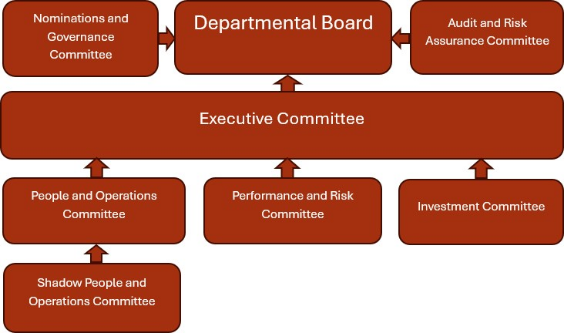
Table 1: the department’s governance framework remit
| Board/Committee | Role and responsibilities |
|---|---|
| Departmental Board | The Departmental Board is the principal governance body of the DBT and is chaired by the Secretary of State. The Permanent Secretary is a member. Its remit is to support the Secretary of State in the strategic and operational leadership of the department. |
| Executive Committee | Chaired by the Permanent Secretary. The Executive Committee oversees operational strategy and ensures the effective management of cross-cutting issues. It develops and implements the department’s vision, objectives and narrative. |
| Performance and Risk Committee | Co-chaired by the Director General, Chief Operating Officer and the Director General, Domestic and International Markets and Exports. The Performance and Risk Committee monitors DBT’s performance and performs deep dives into departmental risks. It ensures the department has robust planning, performance and risk frameworks in place. |
| Audit and Risk Assurance Committee | Chaired by a non-executive board member. The Audit and Risk Assurance Committee provide independent advice to support the Departmental Board and Accounting Officer in their responsibilities for issues of risk, control and governance. The committee acts in an advisory capacity, providing independent advice to the board on: • organisational risks and governance • the adequacy and appropriateness of the work plan of departmental bodies, including internal and external audit • the integrity of DBT’s financial reporting and its consistency with financial reporting standards |
| People and Operations Committee | Co-chaired by the Director General, Economic Security and Trade Relations and the Directors General, Competition, Markets and Regulatory Reform. The People Committee oversees all aspects of the workplace environment, including DBT’s strategic, policy, and operational approach to Human Resources, change management, diversity and inclusion and the employment lifecycle. |
| Investment Committee | Co–chaired by the Director General, Industrial Strategy and the Director General, Trade Policy, Implementation and Negotiations. The Investment Committee leads on investment decisions related to high value or high-risk projects and programmes in DBT’s portfolio. Any investment decision which has whole life costs or net cashable benefits of over £20 million requires approval by the Investment Committee. This approval is required even when the funding is already secured – the committee is responsible for ensuring that proposals represent a good investment of public money. |
| Nominations and Governance Committee | Chaired by the lead non-executive board member. The Nominations and Governance Committee ensures effective corporate arrangements are in place for overseeing senior appointments and pay arrangements. |
4.10. Further details of the department’s governance structure can be found in the governance statement in the DBT annual report and accounts.
Figure 1: departmental governance structure
The financial control framework
4.11. The department is allocated funding through the estimates process. The Principal Accounting Officer is accountable for ensuring that expenditure is in accordance with the requirements of regularity, propriety, value for money and feasibility as set out in HM Treasury’s publication Managing Public Money.
4.12. On an annual basis, the Appropriations Act (Main Estimates) provides the annual breakdown of the department’s overall funding settlement. There is an opportunity to redistribute funds between control totals once a year through the Supplementary Estimate process, if agreed by HM Treasury.
4.13. Allocation of resources to departmental priorities is decided by ministers, supported by advice from the Departmental Board and the Executive Committee. Within the department, the Principal Accounting Officer delegates to Directors General and the Chief Financial Officer (CFO) the authority to commit these resources in line with plans to achieve departmental objectives. Accountability is formalised through letters of delegation, onwards to directors and deputy directors as appropriate.
4.14. Separate budget delegations are made to public bodies as appropriate. Accountability is formalised through a letter of delegation, allocating budgets subject to certain controls, and outlining expectations and areas of responsibility.
4.15. More information on the expenditure of the department and its consolidated bodies is provided in the DBT annual report and accounts.
Monitoring expenditure
4.16. Forecasts are analysed and reported to the Executive Committee. They provide the opportunity for scrutiny and challenge of financial forecasts, informing an agreed DBT forecast position, with recommendations for intervention as necessary to protect the department’s budgetary control totals. These reviews are an important part of the system that enables DBT to make effective strategic funding decisions.
4.17. Departmental forecasts are also reported to HM Treasury through its Online System for Central Accounting and Reporting (OSCAR). This information feeds into the fiscal reporting to Parliament by HM Treasury.
Local funding arrangements
4.18. DBT oversees a legacy scheme for COVID-19 Business Support Grants in England, which were distributed to businesses by the relevant local authority. If a local authority’s post-payment checks reveal that a grant was wrongly issued, it must attempt to recover the funds. The department is notified of an irregular payment only after the local authority completes the minimum recovery action. Should recovery succeed, the full amount must be returned to DBT. If recovery fails, the local authority refers the debt to the department to decide on further action, such as pursuing legal proceedings or, if recovery is deemed impossible, writing off the debt. The accountability framework is established through a grant letter outlining specific conditions for each local authority.
Grants to private and voluntary sector bodies
4.19. DBT provides a wide range of business and other grant support schemes. These include support to small and medium-sized enterprises, research and development and sector specific support.
4.20. DBT has a Grant Delivery Directorate (GDD) to oversee and professionalise DBT grant provision. GDD has undertaken a significant change programme to raise grant delivery standards in the department and to ensure all DBT schemes comply with Cabinet Office mandated grant standards.
4.21. Legacy schemes are those that are closed to new applications, but with all awards made under the various schemes being monitored to ensure they deliver agreed outcomes, with recovery of funding where necessary. Live schemes are open for grant applications. Examples of legacy schemes include the COVID-19 local authority grant schemes.
4.22. A Cabinet Office review has shown that DBT grant capabilities meet all mandated standards.
Major contracts and outsourced services
4.23. DBT’s contracts are tendered and awarded in compliance with the Procurement Act 2023. This legislation requires authorities to observe the principles of equal treatment, non-discrimination, transparency, and proportionality and DBT contracts are tendered and awarded in line with the set of standard processes set out in these regulations. For all arrangements with third party suppliers, DBT ensures that the appropriate contract is put in place so that funds are controlled effectively, and services are delivered on time and in line with departmental requirements.
4.24. As part of the department’s governance framework, the Commercial Approvals and Assurance Group (CAAG) provides assurance on commercial aspects of programme and project delivery including compliance with commercial standards. It provides assurance and approvals for all procurements and contract changes where the value of proposed spend is over £5 million (thresholds are subject to change) or proposals of any value which are considered potentially novel, contentious or repercussive. A core part of the DBT Commercial Team’s function is compliance. The Commercial Team is responsible for a range of reporting, including the number of Gold Contract Managers trained through the Contract Management Capability Programme (CMCP), quarterly reporting to Cabinet Office on contract key performance indicators (KPIs), contracts added to Contracts Finder above the reporting threshold and submission of the quarterly procurement pipeline to the Cabinet Office.
4.25. The department’s approval framework for expenditure requires specific, value-dependent approvals of business cases, procurements, and contract awards, providing assurance that major contracts are subject to appropriate scrutiny before award. Where expenditure exceeds the department’s delegated limits, or is novel, contentious or repercussive, HM Treasury approval is also required. The Cabinet Office spend controls regime also applies where appropriate.
4.26. DBT does not have any large, outsourced services contracts that deliver services to the public – contracts are for goods and services to support staff or to support policy teams deliver their outcomes. This includes some relatively small outward facing contracts.
Investments, joint ventures and other assets
4.27. The Secretary of State for Business and Trade is the sole shareholder of the BBB. BBB is a public limited company, incorporated under the Companies Act 2006. It was established in 2014 to support the provision of finance to small and medium-sized businesses in the UK.
4.28. The Postal Services Act 2011 provided for a “Post Office company” to continue to be owned by the Crown or a mutual ownership structure after the privatisation of Royal Mail. Under the Act (Part 1, Section 4), the Crown may only dispose of its interest in a “Post Office company” through the issue or transfer of shares or share rights in a Post Office company to a relevant mutual by order of the Secretary of State.
4.29. DBT is a joint owner of UK Shared Business Services Ltd (UKSBS)[footnote 2], sharing the common objective of delivering shared services to a number of departments and public bodies, including ensuring people, suppliers and grants are paid accurately and on time.
The risk management framework
4.30. Since its creation, the department has focused on establishing the key building blocks of risk management to support compliance with the Orange Book principles.
An essential part of governance and leadership
4.31. Risk management is the responsibility of the Executive Committee, supported by its sub-committees, Audit and Risk Assurance Committee (ARAC) and an established central Risk Management Team.
4.32. Operational risk registers are maintained at directorate, and programme and project level, with key risks escalated into director general, sub-committee or principal level registers, as necessary. The most significant risks to the department are monitored through the department’s Principal Register at the Performance and Risk Committee and 3 times a year by the Executive Committee. A departmental risk register is monitored throughout the year. This is refreshed through an annual risk session with the Executive Committee to ensure that it continues to reflect both the operating landscape and the priorities set out in the Outcome Delivery Plan. Specific risks are monitored to ensure the necessary oversight at either Executive Committee or one of the Executive Committee’s sub-committees, either as part of a wider agenda item or a specific risk deep dive review.
4.33. The Risk Appetite Statement sets out the department’s overall attitude to risk to help staff and managers decide whether a particular risk is acceptable to the department, or whether further action is needed to manage it. As part of an agreed risk reporting cycle, risk is a standing agenda item in committees, and as part of director general Senior Leadership Team meetings.
4.34. The Risk Management Team is responsible for implementation of the risk management framework agreed by the Performance and Risk Committee. The team along, with other functional leads, provide scrutiny and advice on risk registers for relevant committees, working closely with risk owners to support and strengthen reporting. It conducts (as a minimum) an annual departmental risk workshop with Executive Committee to identify and articulate key risks and to thereafter monitor delivery against mitigation plans.
An integral part of all organisational activities
4.35. Risk management is integral and embedded into DBT activities including:
- outcome delivery planning
- policy delivery
- project and programme approvals and implementation
- security and information management
- public body deliver
- financial management
- cyber security
- counter fraud activities
Collaborative and informed
4.36. The Risk Management Team works collaboratively across the department, including engaging with colleagues in sponsor teams, governance, performance delivery, project delivery, finance and assurance to ensure risk knowledge is consistently shared and adopted across the department. The department works with other departmental heads of risk and government heads of function to inform mitigation and reporting to the Civil Service Board in relation to common cross-departmental risks.
Structured to include identification, treatment, monitoring, and reporting
4.37. Risks are identified and recorded by all directorates, using a central risk register tool. A comprehensive suite of policy and guidance documents have been developed to be accessible on the department’s intranet to ensure those responsible for recording risks are assessing them in a consistent manner. The Risk Management Team has dedicated Risk Champions for each director general area and directorate. They have responsibility for working to ensure risks are accurately recorded, escalated for discussion and with decisions on mitigations at relevant governance bodies as necessary.
The Audit and Assurance Framework
4.38. Audit and assurance arrangements support the Principal Accounting Officer as well as the departmental board’s delivery and accountability requirements, providing evidence-based assurance on the management of risks that may threaten the successful achievement of DBT’s objectives.
4.39. DBT operates an assurance framework with a 3 lines of defence model. The first line of defence is provided by operational management, those responsible for delivering specific objectives or operation. It provides assurance that performance is monitored, risks identified and addressed, and that objectives are being achieved. The second line of defence is represented by corporate functions who oversee internal governance. This assurance is separate from those responsible for delivery but not independent of the department’s management chain. The third line of defence focuses on the role of internal audit, which provides assurance over governance and risk management achieved by the first and second lines of defence and other third parties, such as the Major Projects Authority.
4.40. An annual corporate governance statement is included within the annual report and accounts. The governance statement sets out how the department was governed by management during the year. It provides an outline of:
- our governance structure
- a summary of the board and committee activities
- a risk assessment
4.41. As part of the governance arrangements, DBT and most of its public bodies have established assurance bodies (for example, Audit and Risk Assurance and Nominations and Governance Committees) which advise their management boards on a range of issues including succession planning, governance, audit and risk assurance and control functions. For those organisations with a more significant budget share and associated risks, an internal audit function exists to provide independent assurance over the work of the organisation, with a representative of internal audit regularly attending meetings of the assurance board. This independent assurance provides a valuable link into the Principal Accounting Officer assurance needs.
4.42. The DBT internal audit function is provided by the GIAA, a cross-government service supporting DBT and several of its public bodies, which undertakes a programme of risk-based internal audits and advisory work to provide assurance to the Principal Accounting Officer, ARAC and the departmental board. GIAA’s position within government enables it to provide insights and assurances that cut across traditional departmental boundaries and support the cross-cutting nature of the department’s work.
4.43. Further scrutiny and independent oversight are provided by committees of Parliament. The DBT Select Committee examines the administration, expenditure and policy of the department and its associated public bodies. The Public Accounts Committee scrutinises value for money (the economy, efficiency, and effectiveness of public spending) and generally holds DBT and its public bodies to account for delivery.
Project management
4.44. All projects across DBT and its public bodies are required to obtain formal sign-off at pertinent points of their lifecycle, from initial mandate through to closure, using HM Treasury’s Green Book guidance. Guiding this is the principle that the processes involved are proportionate to the value and risk profile of the project.
Projects below the delegation limits can be authorised by the director general or the public body and would be monitored at the group or public body level on either a monthly or quarterly basis, as appropriate.
Projects that are above business unit delegation limits are required to obtain approval through the DBT Investment Committee and would be included on the departmental portfolio, which is monitored every 2 months at departmental level. Projects on the departmental portfolio, and potentially those at group level, also undergo independent assurance in line with the department’s Integrated Assurance and Approvals Strategy, with DBT Portfolio Office organising independently run gateway reviews or health checks at key lifecycle stages and decision points.
Projects exceeding the department’s delegation limits need HM Treasury approval and must be disclosed. These limits are set by HM Treasury through delegated authority letters. Projects may also be subject to review by the Infrastructure and Projects Authority (IPA) and may enter the GMPP for ongoing IPA monitoring and assurance.
Relationships with other government departments
Competition and Markets Authority (CMA)
5.1. DBT ministers have lead policy responsibility for the work of the CMA. The CMA is classified as a non-ministerial department that falls outside the DBT accounting boundary.
5.2. The CMA has been established under statute to operate independently of DBT. Its CEO is appointed by the Secretary of State for Business and Trade and is designated as the Principal Accounting Officer for CMA by HM Treasury, with personal accountability to Parliament.
5.3. Although independent from DBT, members of the CMA board are appointed by the Secretary of State through open competition in compliance with the Governance Code on Public Appointments and in accordance with the legislation under which it was created. Further details can be found in the CMA’s annual report to Parliament.
UK Export Finance (UKEF)
5.4. UKEF’s mission is to advance prosperity by ensuring no viable UK export fails for lack of finance or insurance, doing that sustainably and at no net cost to the taxpayer. It is strategically aligned with DBT but is a separate ministerial government department. It publishes its own annual report and accounts and has its own independent board and subcommittees, reflecting the specialist nature of its work. Both departments report to the Secretary of State for Business and Trade.
5.5. The Principal Accounting Officer for UKEF is the CEO. The Secretary of State writes to the UKEF CEO on an annual basis to outline their priorities for UKEF for the coming year. UKEF CEO sits on DBT’s Executive Committee.
UK Government Investments (UKGI)
5.6. UKGI is a company wholly owned by HM Treasury. It is the government’s centre of excellence in corporate finance and corporate governance. It provides independent advice to a range of departments, relating to:
- governance: act as shareholder for, and lead establishment of, UK government public bodies
- asset realisations: acquire, manage and execute the sale of all significant UK government corporate assets
- corporate finance: advise on all major UK government corporate finance matters, including financial interventions into corporate structures and corporate finance negotiations
- contingent liabilities: analyse and advise on the UK government’s contingent liabilities
5.7. UKGI currently fulfils the department’s shareholder role for British Business Bank plc and Post Office Ltd and works closely with DBT on high-profile one-off projects as required.
Relationships with public bodies
6.1. DBT has 19 public bodies that vary considerably in size, type, and degree of independence from the department, and operate in a complex and often changing environment. These organisations are essential to the successful delivery of DBT’s objectives. They are set out in the ‘DBT’s public bodies’ section.
6.2. The Principal Accounting Officer for DBT public bodies is held accountable to Parliament for the proper stewardship of the resources allocated to them. Where relevant, the Principal Accounting Officer delegates responsibility as per Managing Public Money to the CEO (or equivalent) of the organisation in question or retain accountability directly. The exception to this is the CMA, which is a non-ministerial department and as such the CMA’s Chief Executive is the Principal Accounting Officer for the CMA and is accountable to Parliament for the CMA’s use of public money.
6.3. All newly appointed Accounting Officers for the department’s public bodies receive a letter from the Principal Accounting Officer confirming their appointment and setting out their accountabilities and responsibilities.
6.4. Each public body is overseen by a sponsor team in the department which agrees and documents the organisation’s remit in a framework document that is publicly available. The sponsor also monitors and challenges performance and works with the public body or wider network body to support its high-level aims. All public bodies are established with governance arrangements that are appropriate to both their mission and legal form, and with processes for engagement with the department that allow them to function and deliver with the appropriate balance of autonomy and accountability.
6.5. DBT is committed to the principles of the Cabinet Office’s Sponsorship Code of Good Practice, and tests adherence to the code through 2 assurance exercises per year that report to DBT’s Performance and Risk Committee.
6.6. DBT’s public bodies and wider network bodies are classified according to the Cabinet Office’s administrative classification groups. They also share many characteristics, such as similar funding and monitoring arrangements, and operate in a manner appropriate to their statutory or administrative form. The following categories provide, as far as possible, an account of the broad arrangements in place.
Executive agencies
6.7. Executive agencies have an Accounting Officer responsible to Parliament.
DBT has 2 of these agencies:
- Companies House: incorporates and dissolves limited companies. It also registers company information and makes it available to the public
- Insolvency Service: helps to deliver economic confidence by supporting those in financial distress, tackling financial wrongdoing and maximising returns to creditors
6.8. DBT receive assurance on their delivery through a sponsor team in the department, which monitors financial and performance data. Although autonomous of DBT, with the chair or CEO having accountability for the operation and budget of the organisation, these public bodies are supported through secretariat functions within DBT. Each is supported by a sponsor team in the department which acts as the main contact point between the public body and the department.
Non-departmental public bodies
6.9. NDPBs receive grant-in-aid from the department and may charge for their services. They vary significantly in size and scope and so their sponsorship and engagement with DBT and/or UKGI also varies greatly, with DBT Directors General on their boards in some cases but minimal policy input in others. There are currently 10 NDPBs.
6.10. Each NDPB has an independent board to oversee its delivery and provide assurance of financial probity and an Accounting Officer (normally the CEO) who is formally responsible to Parliament for the funds allocated to them. This provides the primary tier of accountability for the organisation’s use of public funds. In addition, respective sponsor teams in the department monitor financial and performance data, engaging as necessary in matters relevant to the DBT Principal Accounting Officer.
Expert committees
6.11. These are not public bodies and are usually non-statutory groups, providing independent expert advice on key issues from within the department. Like many of the NDPBs that possess an advisory function, expert committees comprise of external (non-Civil Service) specialists that form committees to advise ministers on policy areas. They are funded from within a departmental budget, administered and resourced by civil servants from within the department, and are not subject to the same levels of review or scrutiny that public bodies require.
6.12. Currently, DBT has a single expert committee known as the Industrial Development Advisory Board (IDAB). Its role is to advise ministers on requests for financial assistance under the Industrial Development Act 1982.
Office of the Department (Independent Secretariat)
6.13. These are distinct entities, but which form part of government departments. They can be set up for a specific project or initiative, or be long-standing, with dedicated teams within departments. They do not have executive agency status (and do not have the governance structures or the operational autonomy of an executive agency). They are staffed by civil servants and work within the rules and processes of their relevant home department.
6.14. DBT has 3 offices functioning as independent secretariats (see Annex A). These offices are responsible for advising pay bodies, developing an annual labour market strategy, and maintaining product safety and standards.
Other (subsidiaries)
6.15. These are companies incorporated under the Companies Act by the department for specific purposes, such as special purpose vehicles, holding companies for managing or holding investments on behalf of the government. DBT gain assurance over the investments they hold through the directors of the companies appointed as Accounting Officers (where necessary) and the management of the investments through departmental budgets and budget holders with support from UKGI (in respect of certain investments). These companies are designated within DBT’s wider network of bodies and operate mainly as subsidiaries of BBB and Post Office Ltd.
Central Government but not administratively classified
6.16. Some bodies are classified to central government by the Office of National Statistics but are not administratively classified to either non-ministerial departments, executive agencies or NDPBs. Under DBT, these would be the 4 office holders and BIS (Postal Services Act 2011) Company Limited.
Other public bodies not yet administratively classified
6.17. These are public bodies of DBT that have been classified as central government but have yet to be administratively classified by Cabinet Office. The BBB is the sole public body that falls under this category.
Public corporations
6.18. Any public entity that is at least 50% funded through commercial activities may be classified in the Office for National Statistics National Accounts system as a public corporation. These have substantial day-to-day operating independence and should be seen as an institutional unit separate from its parent department. Post Office Ltd is the sole public corporation classified under DBT in this category.
Statutory office holder
6.19. A statutory office is a position established under legislation, with a specific remit to conduct activities or deliver services within the public sector. The statutory office is a position held by one person, the statutory office holder, though the office may be provided powers to request additional resources if required (these would usually be provided by the department or by Parliament) or to employ staff. They can be set up by a ministerial department or on Parliament’s behalf.
6.20. DBT has 4 statutory office holders (see Annex A), appointed by the Secretary of State, who regulate their respective legislation from which they were established.
Annex A: list of DBT public and wider network bodies
| Name | Designation | Notes | Categorisation |
|---|---|---|---|
| Competition and Markets Authority | Public body | No notes | Non-Ministerial Department |
| Companies House (CH) | Public body | No notes | Executive Agency |
| The Insolvency Service | Public body | No notes | Executive Agency |
| Advisory, Conciliation and Arbitration Service (ACAS) | Public body | No notes | Non-Departmental Public Body |
| Certification Office for Trade Union and Employers’ Associations | Wider network body | Linked to ACAS | Not applicable |
| British Hallmarking Council | Public body | No notes | Non-Departmental Public Body |
| Central Arbitration Committee | Public body | Linked to ACAS | Non-Departmental Public Body |
| Competition Appeals Tribunal | Public body | No notes | Non-Departmental Public Body |
| Competition Service | Public body | No notes | Non-Departmental Public Body |
| Financial Reporting Council (FRC) | Public body | No notes | Non-Departmental Public Body |
| UK Accounting Standards Endorsement Board Limited | Wider network body | Subsidiary of FRC | Not applicable |
| Low Pay Commission | Public body | No notes | Non-Departmental Public Body |
| Regulatory Policy Committee | Public body | No notes | Non-Departmental Public Body |
| Small Business Commissioner | Public body | No notes | Non-Departmental Public Body |
| Trade Remedies Authority | Public body | No notes | Non-Departmental Public Body |
| Groceries Code Adjudicator | Public body | Office Holder | Central Government |
| Pubs Code Adjudicator | Public body | Office Holder | Central Government |
| Certification Officer | Public body | Office Holder | Central Government |
| The Office of the Regulator of Community Interest Companies | Public body | Office Holder, linked to CH | Central Government |
| British Business Bank PLC (BBB) | Public body | No notes | Other |
| BBB Patient Capital Holdings Limited | Wider network body | Subsidiary of BBB | Not applicable |
| British Business Aspire Holdco Ltd | Wider network body | Subsidiary of BBB | Not applicable |
| British Business Finance Ltd | Wider network body | Subsidiary of BBB | Not applicable |
| British Business Financial Services Ltd | Wider network body | Subsidiary of BBB | Not applicable |
| British Business Investments Ltd | Wider network body | Subsidiary of BBB | Not applicable |
| British Patient Capital Limited | Wider network body | Subsidiary of BBB | Not applicable |
| Capital for Enterprise Limited | Wider network body | Subsidiary of BBB | Not applicable |
| The Start-Up Loans Company | Wider network body | Subsidiary of BBB | Not applicable |
| Nations and Regions Investments Limited | Wider network body | Subsidiary of BBB | Not applicable |
| Cornwall and Isles of Scilly Investments Limited | Wider network body | Subsidiary of BBB | Not applicable |
| East Midlands Early Growth Fund Limited | Wider network body | Subsidiary of BBB | Not applicable |
| Fleetbank Funding Limited | Wider network body | Subsidiary of BBB | Not applicable |
| Midlands Engine Investments Limited | Wider network body | Subsidiary of BBB | Not applicable |
| Northern Powerhouse Investments Limited | Wider network body | Subsidiary of BBB | Not applicable |
| Post Office Ltd | Public body | No notes | Public Corporation |
| Postal Services Holding Company Limited | Wider network body | Subsidiary of POL | Not applicable |
| Post Office Management Services Ltd | Wider network body | Subsidiary of POL | Not applicable |
| Payzone Bill Payments Ltd | Wider network body | Subsidiary of POL | Not applicable |
| First Rate Exchange Services Ltd (FRES) | Wider network body | Subsidiary of POL | Not applicable |
| BIS (Postal Services Act 2011) Company Limited | Wider network body | No notes | Central Government |
| Industrial Development Advisory Board | Expert Committee | No notes | Not applicable |
| Office for the Pay Review Bodies | Independent Secretariat | No notes | Not applicable |
| Office of the Director of Labour Market Enforcement | Independent Secretariat | No notes | Not applicable |
| Office for Product Safety and Standards | Independent Secretariat | No notes | Not applicable |
-
Public bodies are those whose policies are overseen by DBT ministers and with whom we have a direct and close sponsorship relationship. Other bodies within the DBT network are referred to as the DBT wider network bodies, which include subsidiaries. A list of public bodies and wider network bodies are shown in Annex A. ↩
-
DBT is a joint owner of UKSBS along with the Department for Science, Innovation and Technology (DSIT), the Department for Energy Security and Net Zero (DESNZ) and UK Research and Innovation (UKRI). ↩