2005 to 2024 UK local and regional greenhouse gas emissions: statistical release (web accessible)
Updated 30 June 2026

© Crown copyright 2026
This publication is licensed under the terms of the Open Government Licence v3.0 except where otherwise stated. To view this licence, visit nationalarchives.gov.uk/doc/open-government-licence/version/3 or write to the Information Policy Team, The National Archives, Kew, London TW9 4DU, or email: psi@nationalarchives.gov.uk.
Where we have identified any third party copyright information you will need to obtain permission from the copyright holders concerned.
This publication is available at https://www.gov.uk/government/statistics/uk-local-authority-and-regional-greenhouse-gas-emissions-statistics-2005-to-2024/2005-to-2024-uk-local-and-regional-greenhouse-gas-emissions-statistical-release-web-accessible
This publication presents the latest estimates of greenhouse gas emissions for local authority and Protected Landscape areas in the UK for 2005 to 2024. Emissions are reported against the areas where they occurred except for energy supply emissions that are distributed to sectors and locations based on where the “end-use” of the energy occurred, and emissions from waste that have been distributed based on the waste arising in each area.
The main findings from the statistics are:
- Between 2023 and 2024, greenhouse gas emissions decreased in 71% (255) of the 361 local authority areas in the UK. This is consistent with the decrease seen in overall UK emissions in 2024. Most of the fall is the result of reduced emissions from electricity supply, reflective of higher net electricity imports, greater renewable generation and the closure of the UK’s last coal-fired power station in September 2024.
- In 2024, 32% of emissions assigned to local authority areas were attributed to the transport sector, 22% to the domestic sector, 14% to the industry sector, 14% to the agriculture sector, and 8% to the commercial sector. The remaining 10% of emissions were from the waste sector, the public sector, and the land use, land use change and forestry sector.
- The scale and sources of emissions vary between local authority areas, mainly due to economic and geographical differences. In 2024 the transport sector had the highest share of emissions in 59% of local authority areas, followed by the domestic sector (19%), agriculture (13%), industry (7%), the commercial sector (2%) and the waste sector (0.3%).
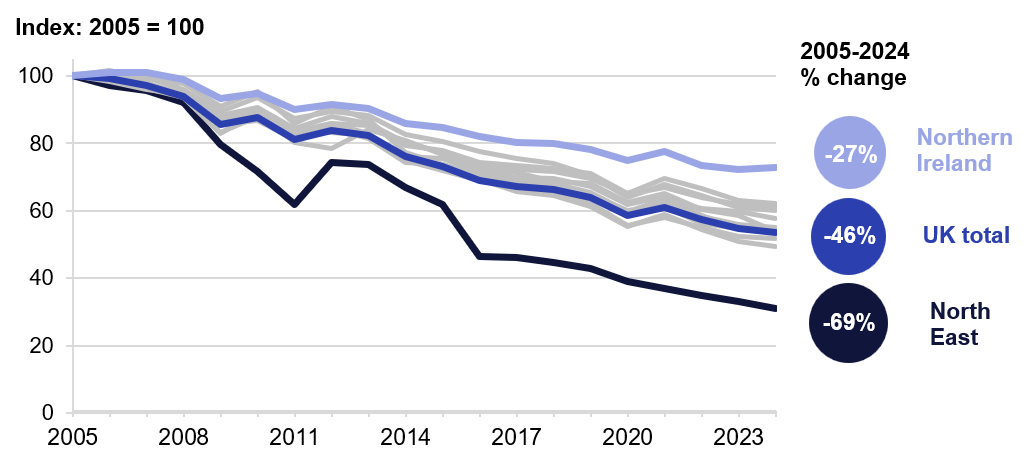
- Between 2005 and 2024, emissions fell by 27% in Northern Ireland, 42% in Scotland, 46% in Wales, and 46% in England. The North East of England was the region with the largest proportional fall in emissions over this period, at 69%, in part due to industrial closures.
Figure 1: Greenhouse gas emissions by country and English region, including UK total, 2005 to 2024, with country/region with the largest and smallest changes since 2005 highlighted
User survey on local emissions data and reporting needs
Last year the Department for Energy Security and Net Zero (DESNZ) carried out a user engagement exercise to better understand users’ needs for local level emissions data and considered whether they could be modified to ensure that they are:
- fit for purpose for current and future reporting of local level emissions.
- aligned with international best practice outlined in the GHG Protocol for Cities and Global Covenant of Mayors Common Reporting Framework.
We thank all organisations and individuals who engaged in the exercise. The survey results showed wide use of these statistics in their current format with the current sector breakdowns, but that for some users it would also be beneficial to have estimates on a ‘scope 1, 2 and 3’ basis as used in the GHG Protocol for Cities.
Based on the responses, we have identified improvement priorities and are in the process of developing scope-based estimates that could potentially be included in future releases, subject to available resources and an assessment of their quality and usability. In this release we have published 2024 emissions estimates and a revised time series for 2005 to 2023 using the same coverage, sector breakdowns, and table formats as used in the previous release.
Once the development work is complete we will provide a further update on our future plans and will give advance notice to users of any planned changes to the methods and coverage that will impact the statistics. We would welcome further thoughts from users on this and any other aspects of the statistics.
Introduction
This Accredited Official Statistics publication provides the latest estimates of territorial emissions for local authority and Protected Landscape areas in the UK for 2005 to 2024. A consistent time series has been produced by re-calculating the 2005 to 2023 estimates from the previous publication to reflect the methodological changes used in calculating the 2024 estimates. This is important as it allows changes to be monitored over time.
These statistics cover emissions of carbon dioxide (CO2), methane (CH4) and nitrous oxide (N2O) within UK borders. Emissions of fluorinated gases are not available at a local authority level so are excluded from these statistics. In the latest UK-level territorial emission statistics they accounted for 2% of total emissions in 2024. In accordance with international reporting, emissions from each gas are weighted by its global warming potential (GWP), so that total greenhouse gas emissions can be reported on a consistent basis. The GWP for each gas is defined as its warming influence in relation to that of carbon dioxide over a 100-year period. Emissions are then presented in carbon dioxide equivalent (CO2e) units. The GWPs used are shown in table 6.4 in our Final UK greenhouse gas emissions statistics, 1990 to 2024.
Emissions have been assigned to all 361 local authority areas in the UK. There are 296 local authorities in England, 32 in Scotland, 22 in Wales and 11 in Northern Ireland, based on administrative boundaries on 31 December 2025. For England this also enables estimates to be shown for the 9 English regions. Estimates are also shown for the Protected Landscapes, covering 15 National Parks within Great Britain, the 38 National Landscapes in England and Wales, and the 8 Areas of Outstanding Natural Beauty (AONBs) in Northern Ireland.
In the statistics, most emissions are allocated to sectors and locations based on the point where the emission occurred, other than for emissions related to energy supply and waste. Energy supply emissions, e.g. from power stations and refineries, are allocated on an “end-user” basis where emissions are distributed to sectors and locations based on where the “end-use” of the energy occurred. Emissions from waste have been spatially distributed using an approach analogous to the fuel end-user basis, distributing UK total emissions from waste proportionally to the waste arising in each local area, rather than to the location of waste management facilities. For example, emissions from landfills are distributed based on estimates of biogenic waste arising in each area.
Except for the energy industry, emissions from the production of goods are assigned to where the production takes place. Therefore, emissions from the production of goods which are exported will be included, and emissions from the production of goods which are imported are excluded.
Emissions estimates for local authority areas and Protected Landscapes are categorised into the following broad source categories:
- Industry (including electricity and fuel supply related emissions)
- Commercial (including electricity and fuel supply related emissions)
- Public (including electricity and fuel supply related emissions)
- Domestic (including electricity and fuel supply related emissions)
- Transport
- Land use, land use change and forestry (LULUCF) (including removals of carbon dioxide from the atmosphere, so that net emissions from this sector can sometimes be negative)
- Agriculture (including electricity and fuel supply related emissions)
- Waste (distributed based on the waste arising in each local area)
The level of sectoral detail available is constrained by the data available for local electricity and gas use. To estimate a more detailed breakdown would involve further general assumptions about energy use for different sectors, since local data is not available. However, further details - mostly in terms of fuel types - are shown in the accompanying technical report to provide additional insight into how the estimates are constructed.
The UK compiles an annual inventory of its greenhouse gas emissions to monitor progress against its domestic and international targets. Disaggregated versions of the UK inventory are also produced for England, Scotland, Wales and Northern Ireland, along with maps estimating the geographical distribution of the sources of emissions. This publication combines data from the UK inventory with data from other sources, including local energy consumption statistics, to produce a nationally consistent set of emissions estimates for local authority and Protected Landscape areas.
The statistics are largely consistent with the UK inventory and with the Devolved Government inventories, but there are some methodological and scope differences which are explained later in this publication. For UK or Devolved Government level emissions figures, the UK or Devolved Government inventories should be used rather than this publication.
Use of the estimates
The purpose of these estimates is to assist those wishing to understand the sources and assess changes in greenhouse gas emissions from local areas. Local authorities are not mandated to have greenhouse gas emissions reductions targets, but some local authorities do have such targets. These statistics allow local authorities to track emissions trends in their areas over time, and measure progress against any targets they have. While local authorities are the main users of the statistics, other users include non-profit organisations, the Devolved Governments, government departments, and academia.
It is important to be aware that circumstances vary greatly between authorities, and that local authorities have relatively little influence over some types of emissions. Therefore, these statistics should be interpreted with caution. However, when used with care, they can provide help in setting priorities. In particular, the dataset is sufficiently robust to set a baseline against which action on climate change can be monitored at a local level.
It should be noted that the results for regional level, which are also available from the dataset, are much more robust. Most of the difficulties in allocating data to local areas have little impact at the regional level. Problems of interpretation, such as economic activity or transport taking place across boundaries, still exist but are less acute at the regional level.
There are some important limitations that users of these estimates should be aware of. These include:
- unallocated electricity and landfill emissions, where electricity sales and waste sent to landfill within the sub-national dataset cannot be successfully allocated to specific local areas due to lack of information
- a significant proportion of landfill methane emissions in England in 2005-2009 could not be allocated to local areas so the landfill emissions estimates shown will be underestimates for some areas in the early part of the time series
- road transport emission estimates rely on national road traffic estimates, and distribution of traffic on minor roads has had to be imputed at local level from regional level data
- the local distribution of emissions from smaller emission sources are largely estimated from proxy information such as population or employment data
- some of the key sources used for mapping emissions do not cover the whole of the UK, and therefore alternative methods have had to be used for areas in Northern Ireland
Further details on data quality and the methods used are available in the supplementary reports published alongside this statistical release.
2024 emissions
Table 1.1 in the data tables accompanying this publication shows greenhouse gas emissions by sector for each local authority, country and region in the UK from 2005 to 2024, with totals for each gas shown in tables 1.2 to 1.4.
2024 emissions by country and English region
Between 2023 and 2024, greenhouse gas emissions allocated to local authorities in the UK fell by 2%. Most of this decrease is the result of reduced emissions from electricity supply, largely due to higher net electricity imports, greater renewable generation, and the closure of the UK’s last coal-fired power station in September 2024. There was also a notable fall in emissions from industry, largely due to blast furnace closures in the iron and steel industry and lower coal use across the sector. Domestic and public sector emissions increased due to higher gas use, likely driven by an easing of energy cost pressures.
Figure 2 shows a comparison of greenhouse gas emissions in 2023 and 2024 for each English region and for the other three countries of the UK. Between 2023 and 2024, all countries and regions saw a decrease in emissions except for Northern Ireland which saw a 0.5% increase, largely due to increases in emissions from the domestic and agriculture sectors. Wales saw the largest decrease, falling by 8%, primarily driven by a reduction in emissions in the industry sector.
Figure 2: Greenhouse gas emissions by country and English region, 2023 and 2024.
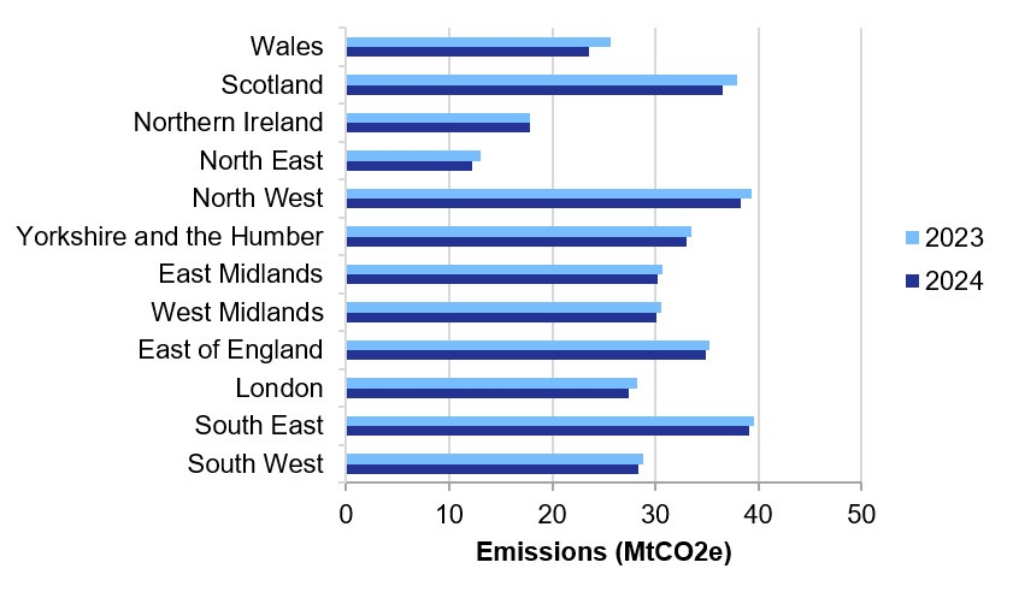
Figure 3 shows emissions by sector for each English region and for the other three countries of the UK. Results for individual local authority and Protected Landscape areas can be found in the data tables published alongside this statistics release. There is a large amount of variation in the sources of emissions between local areas. For example, a significant proportion of industry sector emissions are concentrated in a few areas, so the contribution of industry and commercial sector emissions for specific local areas may be different from regional averages.
Figure 3: Greenhouse gas emissions by sector for each country and English region, 2024.
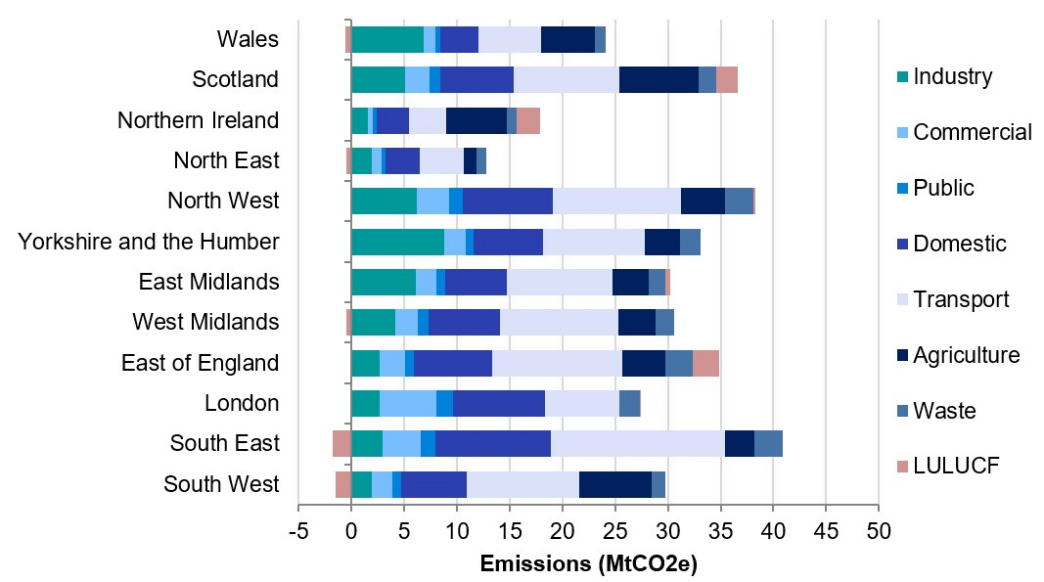
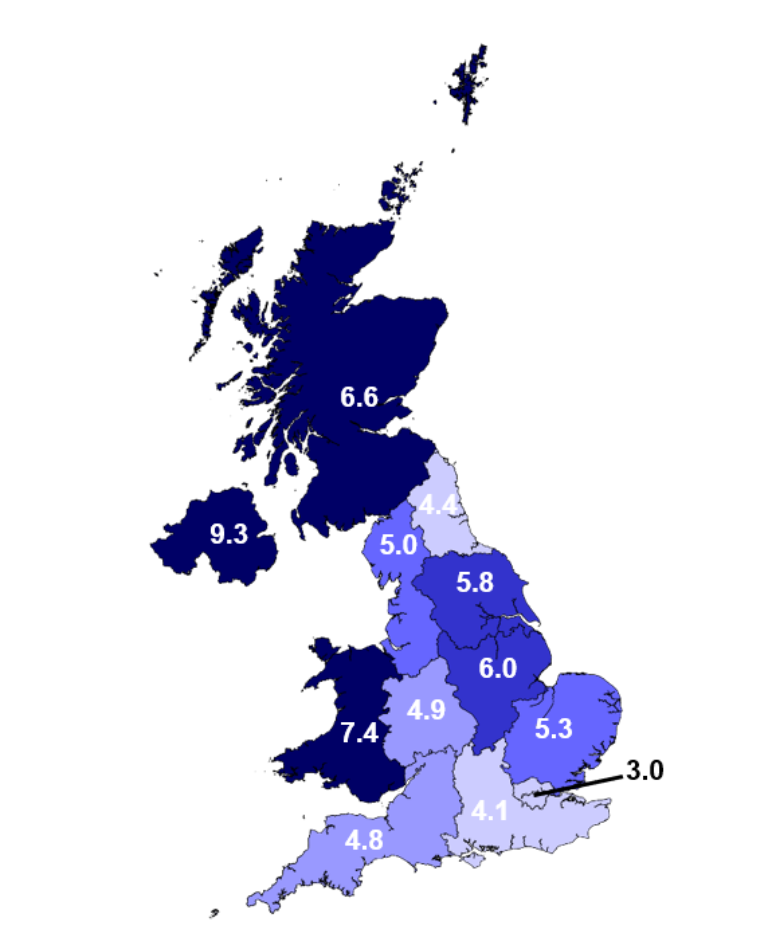
Figure 4 shows annual emissions per capita (per person) to make some allowance for the different sizes of countries and regions, and Figure 5 shows a breakdown of these totals by sector. Looking at emissions per capita allows comparisons between areas of different population size, although it should be noted that emissions are driven by many factors other than resident population.
Between 2023 and 2024, there was a 3% decrease in overall emissions per capita in the UK. Northern Ireland, Wales, and Scotland have the highest annual emissions per capita.
- Northern Ireland has the highest emissions per capita from the agriculture (3.0 tCO2e per person), land use, land use change and forestry (1.1 tCO2e per person), domestic (1.6 tCO2e per person), and waste (0.5 tCO2e per person) sectors
- Wales has higher emissions per capita than all countries and regions other than Northern Ireland due to it having the highest emissions per capita from the industry sector (2.1 tCO2e per person), reflecting its higher level of industrial installations - it also has high emissions per capita from the agriculture sector (1.6 tCO2e per person)
- Scotland has higher per capita emissions than the UK average in almost every sector, in particular from the agriculture sector (1.4 tCO2e per person), land use, land use change and forestry sector (0.4 tCO2e per person) and public sector (0.2 tCO2e)
- London has the lowest emissions per capita of any region at 3.0 tCO2e per person due its urban transport system, high population density and lower level of large industrial installations and agricultural land
Figure 4: Annual per capita greenhouse gas emissions in 2024 by country and English region (Tonnes of carbon dioxide equivalent (tCO2e) per person).
Contains Ordnance Survey Data © Crown Copyright and database right 2026
Figure 5: Per capita greenhouse gas emissions by sector for each country and English region, 2024.
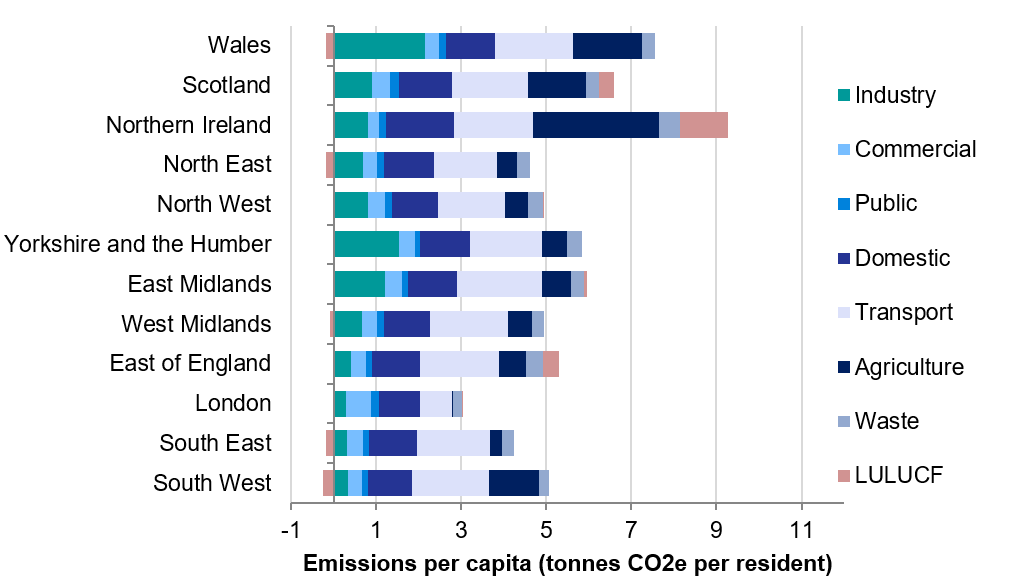
Figure 6 shows the split of total UK emissions by country and region. Emissions shares are highest in the South East and North West of England, each contributing around 11%. Meanwhile, emissions shares are lowest in the North East of England and Northern Ireland at 3% and 5% of total emissions respectively.
Figure 6: Proportion of greenhouse gas emissions in each country and English region, 2024.
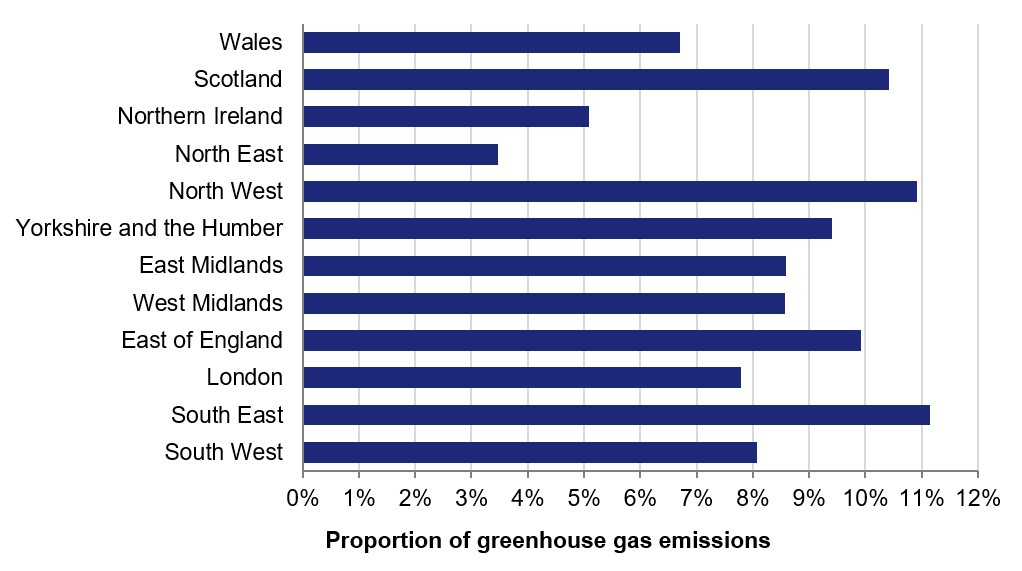
Note: Unallocated emissions are not shown in this figure.
2024 emissions by local authority
Figure 7 illustrates the share of greenhouse gas emissions for each sector across local authority areas, excluding LULUCF emissions since they can produce negative net emissions totals. The proportion of emissions attributable to each sector differs considerably across local authorities. In 2024, there were 16 (4%) local authority areas where the transport sector accounted for over 50% of emissions, 8 (2%) where the industry sector did and 8 (2%) where the agriculture sector did. The transport and domestic sectors both accounted for at least 20% of emissions in most areas, whilst the public, waste and commercial sectors rarely made up more than 20%.
Figure 7: Number of local authority areas by proportion of greenhouse gas emissions in each sector (excluding LULUCF), 2024.
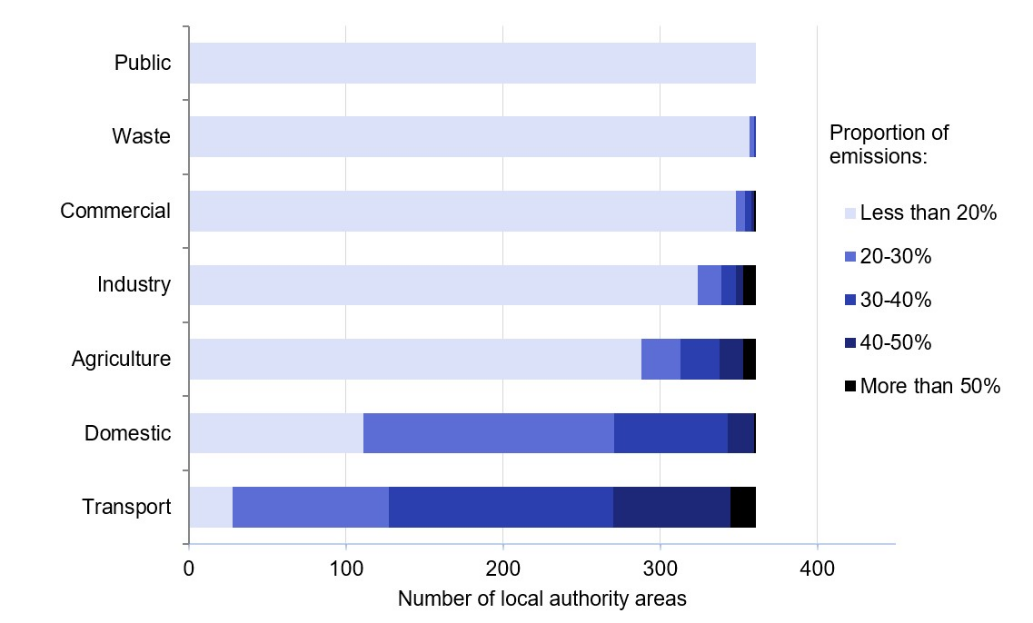
Figure 8 shows how annual emissions per capita varied between local authority areas in the UK in 2024. In general, emissions per capita are highest in industrial zones or rural areas with few residents. However, the local authority area with the highest emissions per capita in 2024 was the City of London, at 36 tonnes of CO2e (tCO2e) per person. This is due to its high level of commercial activity compared to the size of its resident population. The local authority with the second highest emissions per capita was Na h-Eileanan Siar, at 33 tCO2e. This is mainly due to high emissions from peatlands and a relatively low resident population for its area. Meanwhile, built-up areas with dense populations tend to have the lowest per capita emissions. In 2024, the London boroughs Harrow, Waltham Forest and Redbridge had the lowest per capita emissions at 2 tCO2e per person.
Alternatively, Figure 9 shows emissions per kilometre squared (km2) for each local area in the UK in 2024. Emissions per km2 are highest in urban and industrial areas, whilst they are lowest in rural areas. In 2024, City of London had the highest emissions per km2, at 173 ktCO2e, followed by Westminster at 75 ktCO2e per km2. Meanwhile, Argyll and Bute had the lowest emissions per km2 at 0.04 ktCO2e.
Figure 8: Net greenhouse gas emissions per capita by local authority area in 2024 (tCO2e per capita).
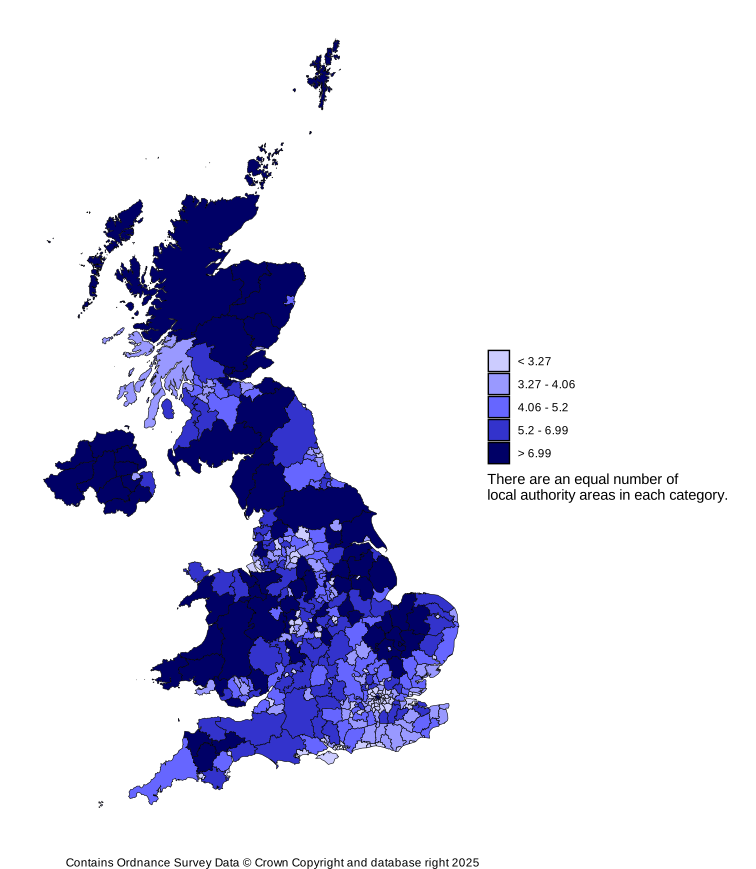
Figure 9: Net greenhouse gas emissions per km2 by local authority area in 2024 (ktCO2e per km2).
Domestic sector
The domestic sector accounted for 22% of greenhouse gas emissions in the UK in 2024. Between 2023 and 2024, domestic sector emissions increased by 1% across the UK. At the local level, they increased in 238 (66%) of the 361 local authority areas in the UK. The easing of energy cost pressures is likely to have been a factor in increased gas use for heating buildings. In 2024, 68% of domestic emissions arose from gas use, 20% from electricity use and 12% from other fuel consumption.
Between 2005 and 2024, domestic sector emissions decreased in all local authority areas. The local authority areas with the largest proportional decreases in domestic sector emissions over this period are the Isles of Scilly (65% fall), Shetland Islands (64% fall), and Gwynedd (60% fall). The Isles of Scilly, Shetland Islands, and many households in Gwynedd are not connected to the gas network, meaning electricity accounts for a larger proportion of energy use in these areas. Since electricity supply emissions have declined faster than those from gas use, the relative domestic sector emissions reductions in these areas are greater.
The domestic sector sees the least variation in emissions per capita between local authority areas of any sector. DESNZ publishes sub-national metered domestic gas and electricity consumption data which have been used to estimate local authority area emissions from domestic energy consumption. Domestic emissions here represent emissions from energy consumption in and around the home, but not activities by private individuals elsewhere, such as personal travel. Table 1 shows the range of emissions per capita in the domestic sector across local authority areas in 2023 and 2024. There are slightly more local authority areas in the lower categories than in 2023, reflecting the overall fall in domestic sector emissions per capita.
Table 1: Breakdown of UK local authority areas by per capita greenhouse gas emissions from the domestic sector, 2023-2024.
Number of local authorities, percentages
| Tonnes of CO2e per capita | No. of local authority areas 2023 | % of local authority areas 2023 | No. of local authority areas 2024 | % of local authority areas 2024 |
|---|---|---|---|---|
| <1.0 | 59 | 16% | 63 | 17% |
| 1.0 to 1.5 | 289 | 80% | 283 | 78% |
| 1.5 to 2.0 | 13 | 4% | 15 | 4% |
| Total | 361 | 100% | 361 | 100% |
In 2024, the domestic sector was the greatest contributor to emissions in 19% (69 of 361) of local authority areas. This sector can be influenced by the fuel types used, the type and condition of the housing (including its insulation), the average temperature (urban areas can be much warmer and therefore easier to heat than rural areas), average household size, type of household and the income and preferences of the occupiers.
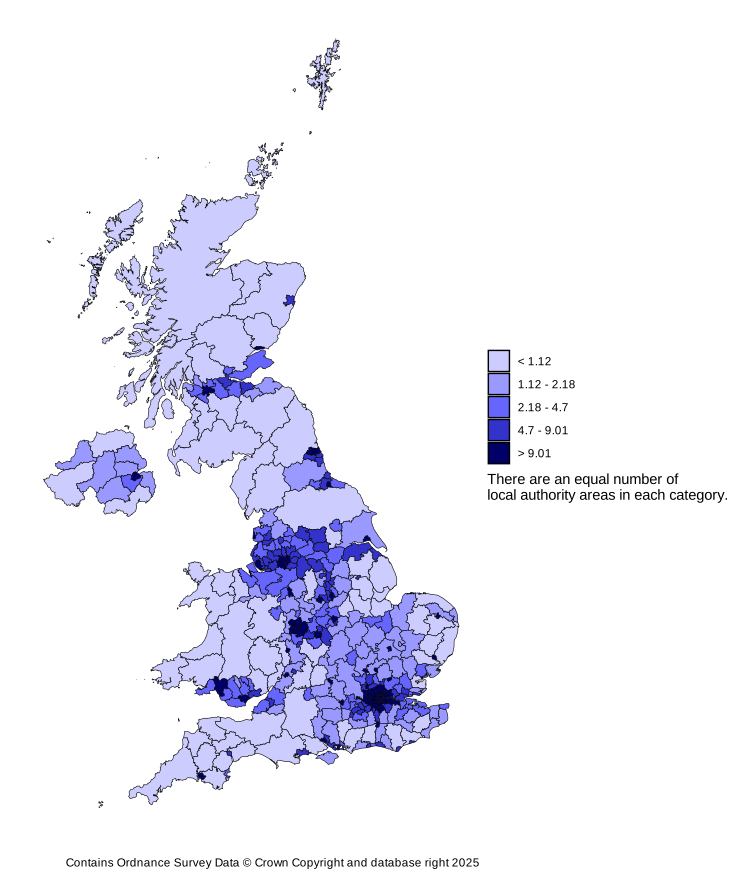
Figure 10 shows domestic sector emissions per capita in local authority areas in the UK in 2024. Emissions per capita were higher in Scotland, Northern Ireland, and Wales than in England. Higher emissions per capita in Northern Ireland are largely due to the limited availability of natural gas in the area; this results in greater use of more carbon intensive fuels such as coal, burning oil and gas oil. Use of these fuel types is captured in the domestic ‘other’ category in the data tables that accompany this statistical release.
Figure 10: Domestic sector greenhouse gas emissions per capita by local authority area in 2024 (tCO2e per capita).
Transport sector
The transport sector includes emissions from freight and passenger transport, both for private and business purposes. In 2024, it was the highest emitting sector and was responsible for 32% of all greenhouse gas emissions in the UK. Road vehicles are the largest source of emissions within the UK transport sector. Estimates are based on the distribution of traffic, therefore some of the emissions within each area represent through traffic, or part of trips into or out of the area, whether by residents or non-residents. In some areas this can be particularly significant, and this should be considered when looking at the statistics. The technical report shows how the road traffic estimates break down between major and minor roads, to help with consideration of this point. As the estimates are on an end-user basis, the transport emissions include a share of emissions from oil refineries.
In 2024, greenhouse gas emissions from the transport sector across the UK remained at a similar level to 2023. At the local level, transport emissions decreased in 54% of local authority areas (195 of 361) and increased in 46% (165 of 361). The transport sector was the largest emitting sector in 59% (213 of 361) of local authority areas in 2024.
Between 2005 and 2024, 98% (352 of 361) of local authority areas have seen a reduction in transport emissions, with the City of London having the greatest decrease (62%) and South Cambridgeshire having the greatest increase (11%). Meanwhile, 95% of local authority areas (344 of 361) had lower transport emissions in 2024 than in 2019, the last year before the COVID-19 pandemic. Prior to the large fall in 2020 that resulted from COVID-19 pandemic restrictions, national transport emissions had decreased slightly since 2005, even though there had been an increase in both the number of passenger vehicles and the vehicle kilometres travelled. This was due to changes in fuel consumption, with lower petrol consumption by passenger cars outweighing an increase in diesel consumption, and improvements in fuel efficiency of both petrol and diesel cars.
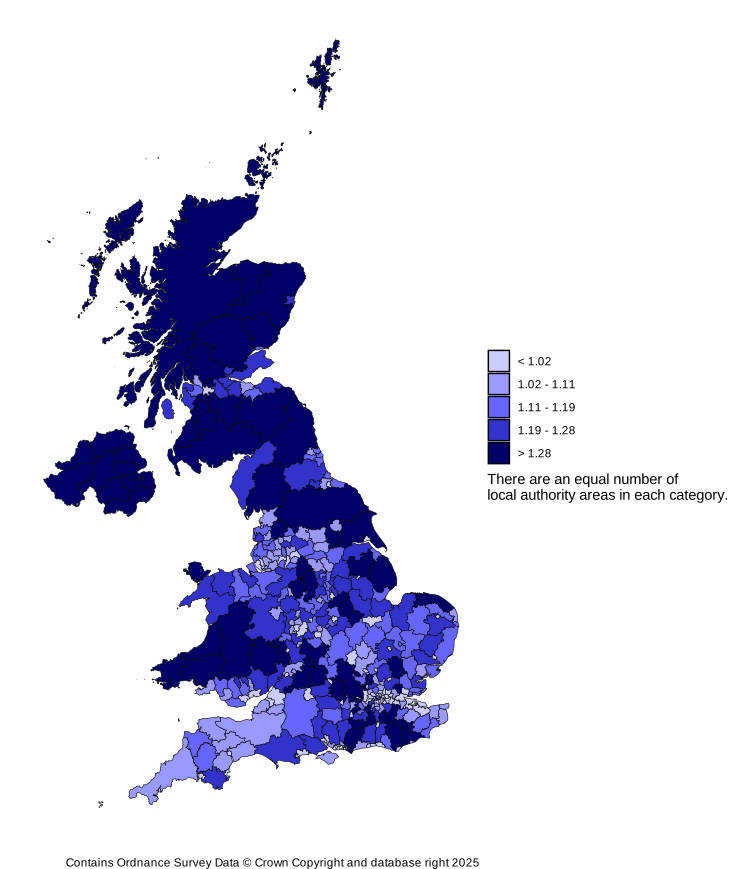
Figure 11 shows transport sector emissions per capita in local authority areas in the UK in 2024. There are a variety of factors that will affect the level of transport emissions in different areas such as the composition of the vehicle fleet and the level of road traffic for different vehicle types. Areas with higher emissions are more likely to be those with motorways and major roads carrying a lot of through traffic, while the areas with the lowest levels of emissions per capita are typically built-up highly populated areas with a high use of public transport.
Note that due to data availability, emissions related to the use of electricity in road vehicles are not included in the transport sector, but are instead included in the electricity totals in other sectors.
Figure 11: Transport sector greenhouse gas emissions per capita by local authority area in 2024 (tCO2e per capita).
Industry sector
The industry sector accounted for 14% of emissions in the UK in 2024. Between 2023 and 2024, industry sector emissions fell by 9% across the UK, largely due to blast furnace closures in the iron and steel industry and lower coal use across the sector. At the local level, industry sector emissions decreased in 67% of local authority areas (243 of 361). The industry sector was the largest emitting sector in 7% (25 of 361) local authority areas in 2024. Looking at longer term trends, all but one local authority areas have seen a reduction in emissions from industry since 2005.
Emissions from fuel use in large industrial installations have been mapped using the National Atmospheric Emissions Inventory (NAEI) database of point sources, which combines data from the UK Emissions Trading Scheme and EU Emissions Trading System with data reported by operators that are held in regulators’ pollution inventories. In the data tables accompanying this publication, these data are included in the large industrial installations category to ensure that no sensitive fuel consumption data for specific sites is disclosed. This means that the industrial gas category in particular does not include all industrial gas consumption, as some is included in the large industrial installations category.
Emissions per capita in the industrial sector are higher in Wales than in the other countries of the UK. Emissions from this sector are heavily dependent on whether there are large industrial sites situated in an area, and some of the lowest industrial emissions per capita are in local authorities in London which have a higher population density and a greater proportion of residential areas meaning that industrial sites are less likely to be located there.
Commercial sector
Commercial sector emissions predominantly arise from the use of electricity and gas by businesses. It accounted for 8% of greenhouse gas emissions in the UK in 2024. Between 2023 and 2024, commercial sector emissions fell by 8% across the UK, mainly due to lower emissions from electricity use. At the local level, commercial sector emissions decreased in 84% of local authority areas (303 of 361). The commercial sector was the largest emitting sector in 2% of local authority areas (6 of 361) in 2024.
Looking at longer term trends, all but one of the 361 local authority areas have seen a reduction in emissions from the commercial sector since 2005. This long-term fall is mainly driven by the reduced emissions from electricity use, largely due to decreased coal use for electricity generation and increased use of renewables. The one authority that saw an increase is Slough, where commercial sector emissions increased by 39% between 2005 and 2024. This increase may be due to the large number of data centres that have been built there.
Public sector
The public sector accounted for 3% of greenhouse gas emissions in the UK in 2024. Between 2023 and 2024, public sector emissions increased by 1% across the UK, largely due to an increase in emissions from the use of gas and other fuels. At the local level, between 2023 and 2024 public sector emissions increased in 51% of local authority areas (184 of 361) and decreased in 49% (177 of 361). The public sector was not the largest emitting sector in any local authority areas in 2024.
Looking at longer term trends, 99% of local authority areas (357 of 361) have seen a reduction in emissions from the public sector since 2005. This long-term fall is largely driven by the reduced emissions from electricity use, due to decreased coal use for electricity generation and increased use of renewables.
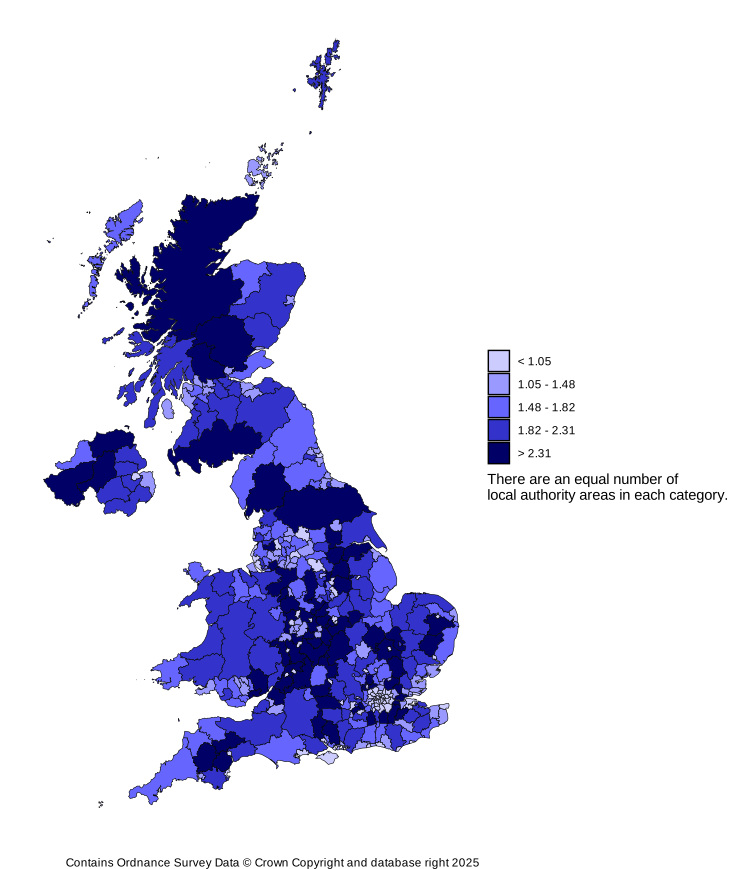
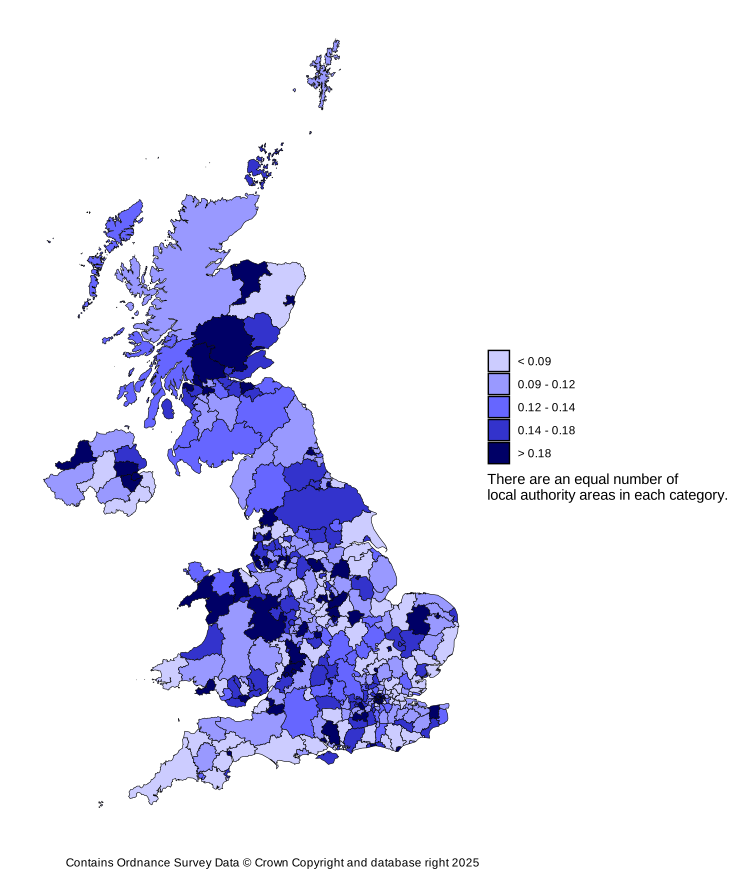
Figures 12, 13 and 14 show emissions per capita across local authority areas in the UK in 2023 for the industry, commercial and public sectors respectively.
Figure 12: Industry sector greenhouse gas emissions per capita by local authority area in 2024 (tCO2e per capita).
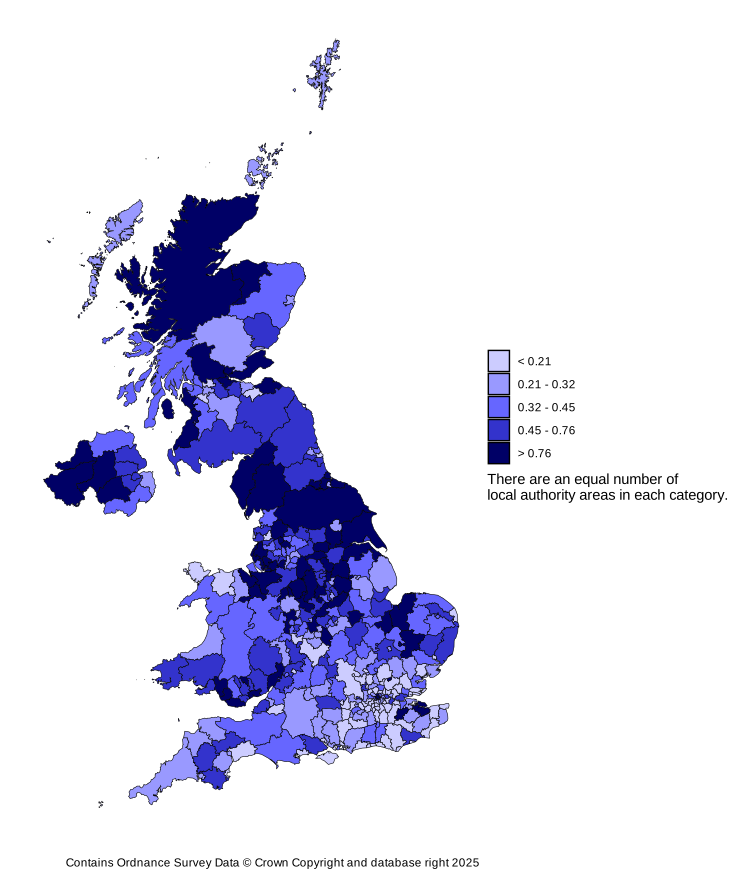
Figure 13: Commercial sector greenhouse gas emissions per capita by local authority area in 2024 (tCO2e per capita).
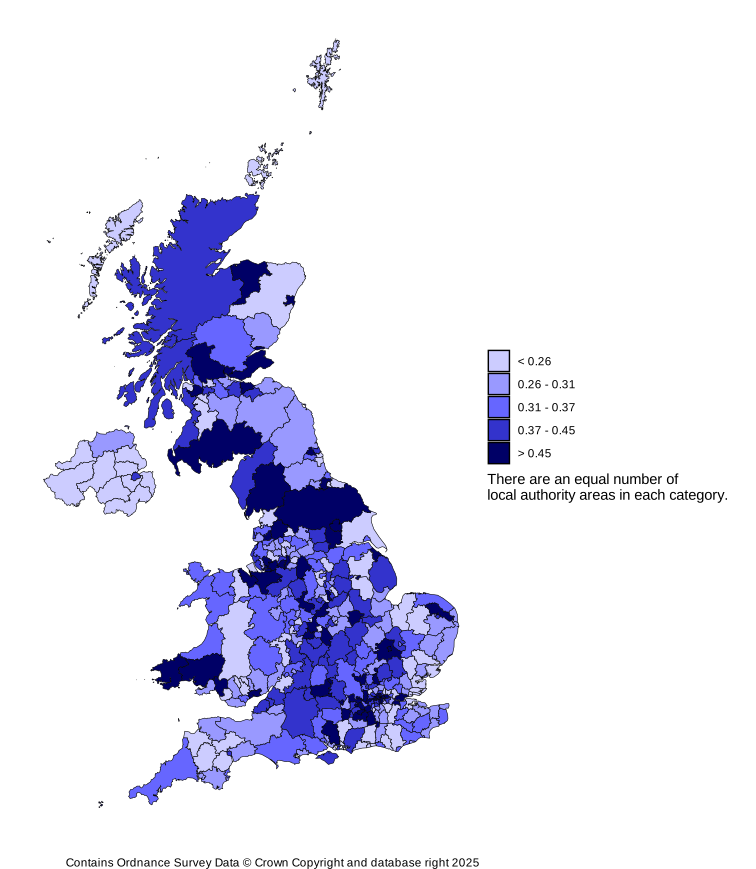
Figure 14: Public sector greenhouse gas emissions per capita by local authority area in 2024 (tCO2e per capita).
Agriculture sector
The agriculture sector accounted for 14% of greenhouse gas emissions in the UK in 2024. Emissions of methane (56%) and nitrous oxide (25%) dominate this sector. The most significant sources are emissions of methane from livestock, particularly cattle, and nitrous oxide emissions related to the use of fertilisers. Between 2023 and 2024, agriculture sector emissions fell by 1% across the UK, largely due to a reduction in emissions from livestock and agricultural soils, and despite increased emissions from agricultural machinery. At the local level, greenhouse gas emissions from agriculture decreased in 63% of local authority areas (228 of 361) between 2023 and 2024. The agriculture sector was the largest emitting sector in 13% (47 of 361) of local authority areas in 2024. Looking at longer term trends, 92% (332 of 361) local authority areas have seen a reduction in emissions from agriculture since 2005.
Waste sector
The waste sector accounted for 6% of greenhouse gas emissions in the UK in 2024, with methane accounting for 77% of all waste sector emissions. Most waste sector emissions are from landfill sites. Between 2023 and 2024, waste sector emissions fell by 4% across the UK, largely due to a fall in emissions from landfill sites.
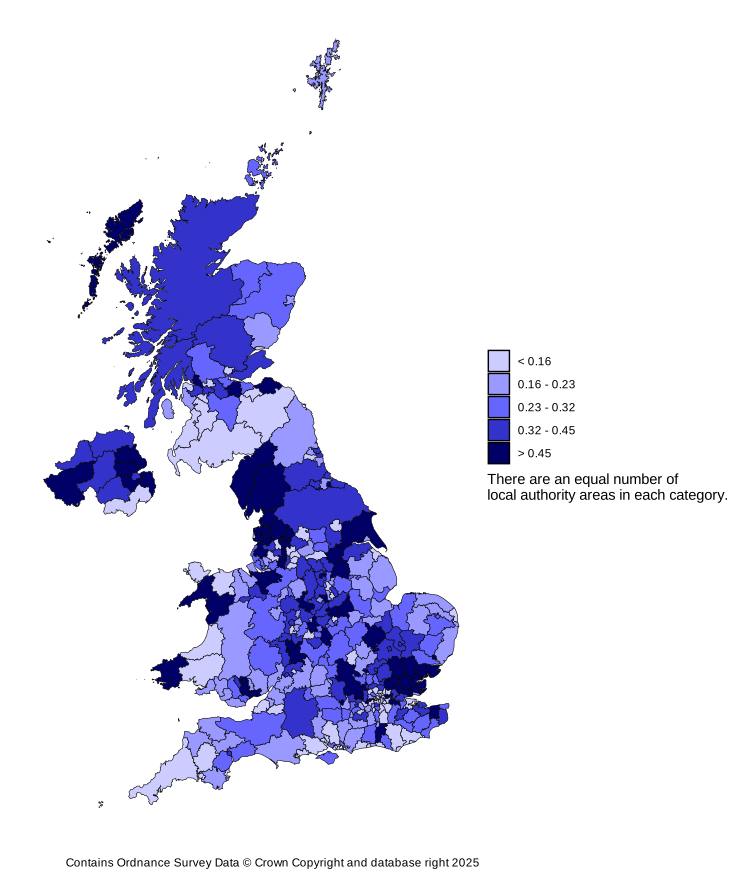
At the local level, emissions from waste are allocated to areas based on where waste originates, rather than where the emissions occur. This is to enable understanding of the emissions resulting from waste produced in a local authority area, in a similar way to how emissions from energy supply are shown on an end-user basis in these statistics. Between 2023 and 2024, greenhouse gas emissions from the waste sector decreased in 52% of local authority areas (186 of 361) and increased in 48% (175 of 361). The waste sector was the largest emitting sector in one local authority area in 2024.
Note that there have been two notable revisions to the waste estimates this year due to methodology changes compared to the figures published a year ago. At a national level there has been a large increase in the wastewater emissions estimates (included in the Waste ‘Other’ sub-sector) in all years throughout the time series, while landfill emissions have been revised down. Though the revisions in individual local authorities vary and do not necessarily follow the national trend. See the section on methodological improvements since last year and revisions to the data for 2005 to 2023 for more information about these revisions.
Also note that a significant proportion of landfill methane emissions in England in 2005-2009 could not be allocated to local authorities so the landfill emissions estimates shown will be underestimates for some local authorities in the early part of the time series.
Figures 15 and 16 show emissions per capita across local authority areas in the UK in 2024 for the agriculture and waste sectors respectively.
Figure 15: Agriculture sector greenhouse gas emissions per capita by local authority area in 2024 (tCO2e per capita).
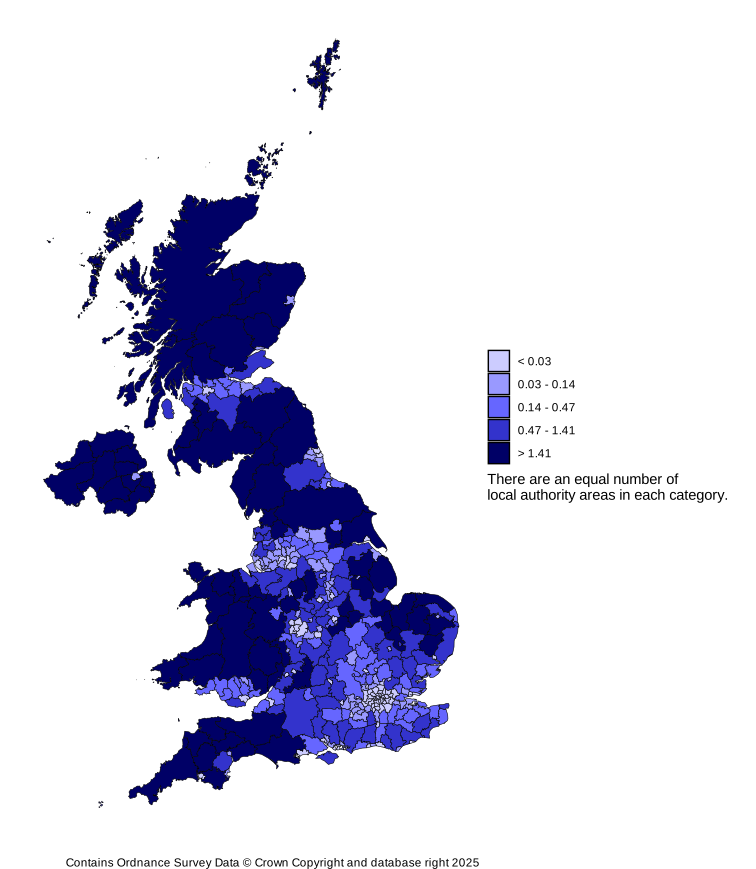
Figure 16: Waste sector greenhouse gas emissions per capita by local authority area in 2024 (tCO2e per capita).
Land use, land use change and forestry (LULUCF) sector
The LULUCF sector consists of emissions and removals from forests, cropland, grassland, peatland, and settlements. Across the UK as a whole the sector is estimated to have been a net source of greenhouse gas emissions in most years since the start of the data series. In general, peatland is the largest source of LULUCF emissions, while forestry is the dominant sink. Settlements and cropland mineral soils changes are estimated to have been net sources of emissions throughout the data series, while grassland mineral soils changes are estimated to have been a net sink.
While the LULUCF sector was a net source of emissions across the UK as a whole in 2024, it was a net sink in 53% of local authority areas (190 out of 361). Between 2023 and 2024, LULUCF sector emissions fell by 0.1 million tonnes of CO2e (MtCO2e) across the UK, largely due to lower emissions from wildfires. Despite this overall fall, 75% of local authority areas (270 of 361) saw an increase in LULUCF sector net emissions. Looking at longer term trends, 90% (326 of 361) of local authority areas have seen a reduction in net emissions from the LULUCF sector since 2005. The largest factor in this long-term fall has been a reduction in emissions from peatlands associated with ongoing management practices such as re-wetting.
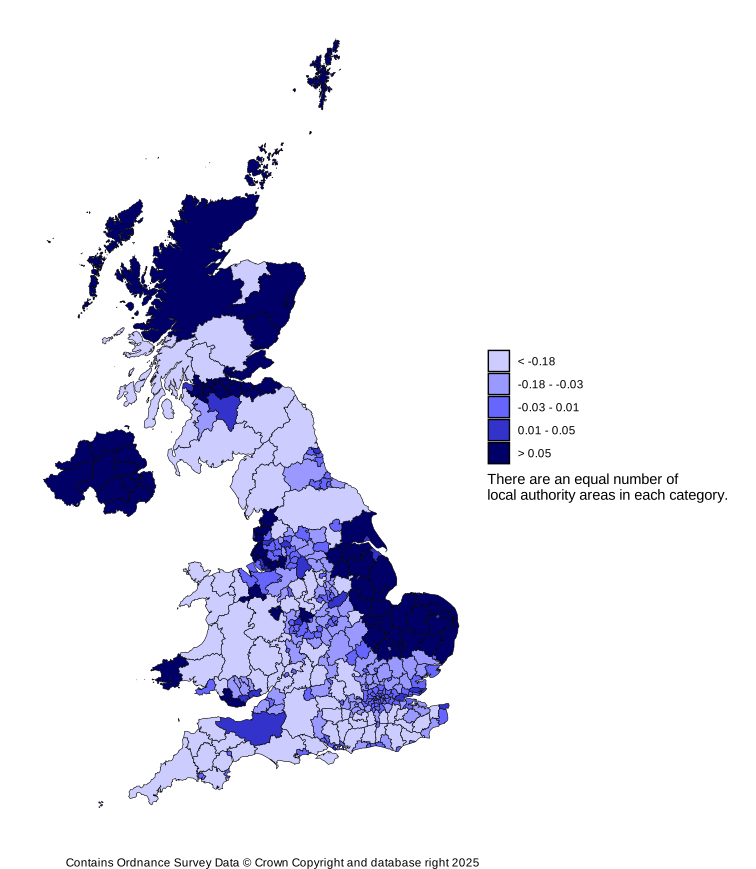
Figure 17 shows LULUCF sector emissions per capita in local authority areas in the UK in 2023. There are clear regional trends in per capita emissions. In particular, in large parts of Wales, the North East, and the South East and South West it is a large net sink of emissions. In other parts of the UK, such as in Northern Ireland, Scotland, and parts of the East of England, LULUCF is a large net source of greenhouse gas emissions. Northern Ireland has the highest LULUCF emissions per capita, due to the clearing of land for the maintenance and creation of settlements and croplands.
Figure 17: Net LULUCF sector greenhouse gas emissions per capita by local authority area in 2024 (tCO2e per capita).
Local authority areas with large changes in emissions since 2023
Between 2023 and 2024, greenhouse gas emissions decreased in 71% of local authority areas (255 of 361). For most local authorities this was largely due to a reduction in emissions from electricity use. Emissions from electricity generation decreased largely due to higher net electricity imports, greater renewable generation, and the closure of the UK’s last coal-fired power station in September 2024.
Some local authority areas will have had specific local factors affecting them such as changes in industrial emissions following closures or expansions of large industrial sites in those areas. The 106 local authority areas that saw a rise in emissions in 2024 did so because of a range of factors across different sectors. The easing of energy cost pressures are likely to have been a factor in increased gas use, particularly for heating buildings. There are also local authorities where the LULUCF sector provides a large emissions sink, giving them a small net emissions total that can be subject to large percentage changes when other sources of emissions change.
Table 2 shows some examples of local authority areas that had particularly big increases or decreases in emissions and the sub-sector that made the largest contribution to this change in each case. The largest falls between 2023 and 2024 were seen in Stockton-on-Tees (38%), Neath Port Talbot (33%), and City of London (22%). The largest contributor to the fall in Stockton-on-Tees was the closure of an ammonia plant and to the fall in Neath Port Talbot was the closure of the last blast furnaces in the area, whereas the largest contributors to the fall in City of London were reductions in landfill and commercial electricity emissions.
Meanwhile, Argyll and Bute (29%), East Riding of Yorkshire (22%), and Vale of Glamorgan (10%) saw the largest increases in emissions from 2023 to 2024. The largest contributor to the increase in Argyll and Bute was a reduction in the net emissions sink provided by forestry. Meanwhile, the largest contributors to the increases in East Riding of Yorkshire and Vale of Glamorgan were emissions from particular industrial sites increasing following reduced levels the year before.
Table 2: Local authority areas that had the largest changes in greenhouse gas emissions between 2023 and 2024.
| Local authority area | Percentage change | Sub-sector most responsible for changes in that area |
|---|---|---|
| Stockton-on-Tees | -38% | Large Industrial Installations |
| Neath Port Talbot | -33% | Large Industrial Installations |
| City of London | -22% | Landfill |
| Vale of Glamorgan | 10% | Large Industrial Installations |
| East Riding of Yorkshire | 22% | Large Industrial Installations |
| Argyll and Bute | 29% | Net Emissions: Forestry |
Greenhouse gas emissions trends since 2005
When the local authority area emissions are aggregated, estimated total greenhouse gas emissions decreased by around 46% between 2005 and 2024 (the earliest year for which data are available at local authority level) – falling from 656 million tonnes of CO2e (MtCO2e) to 351 MtCO2e. Whilst emissions have decreased over time there have been periods of fluctuation, with emissions increasing between 2009 and 2010 (largely due to exceptionally cold weather in 2010 and relatively low emissions in 2009 as a consequence of economic factors), between 2011 and 2012 (largely due to variations in temperature) and between 2020 and 2021 (largely due to the easing of COVID-19 restrictions and variations in temperature). For information on the drivers of trends at national level, see the latest UK territorial greenhouse gas emissions statistics.
Regional trends since 2005
Figures 18 and 19 show how total greenhouse gas emissions and annual greenhouse gas emissions per capita in 2005 and 2024 compare for each region and country in the UK. Emissions have decreased in all countries and regions since 2005. The largest percentage decrease in emissions (69%) and the largest decrease in per capita terms of 11.1 tCO2e per person were seen in the North East. The smallest decrease in percentage terms (27%) was seen in Northern Ireland and in per capita terms (4.4 tCO2e per person) was seen in London.
Figure 18: Greenhouse emissions by country and English region, 2005 and 2024.
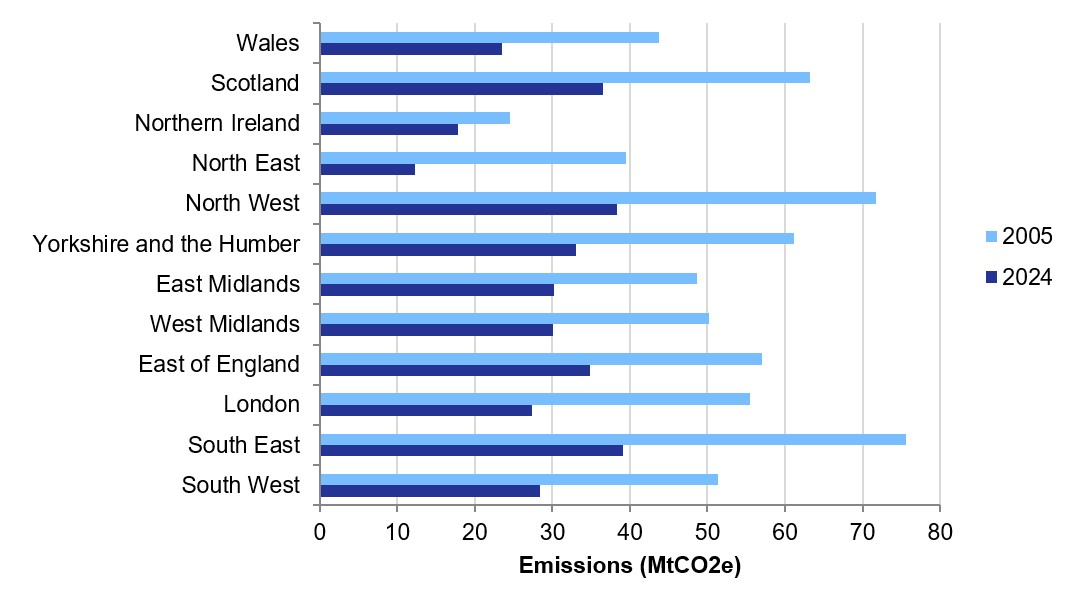
Figure 19: Greenhouse emissions per capita by country and English region, 2005 and 2024.
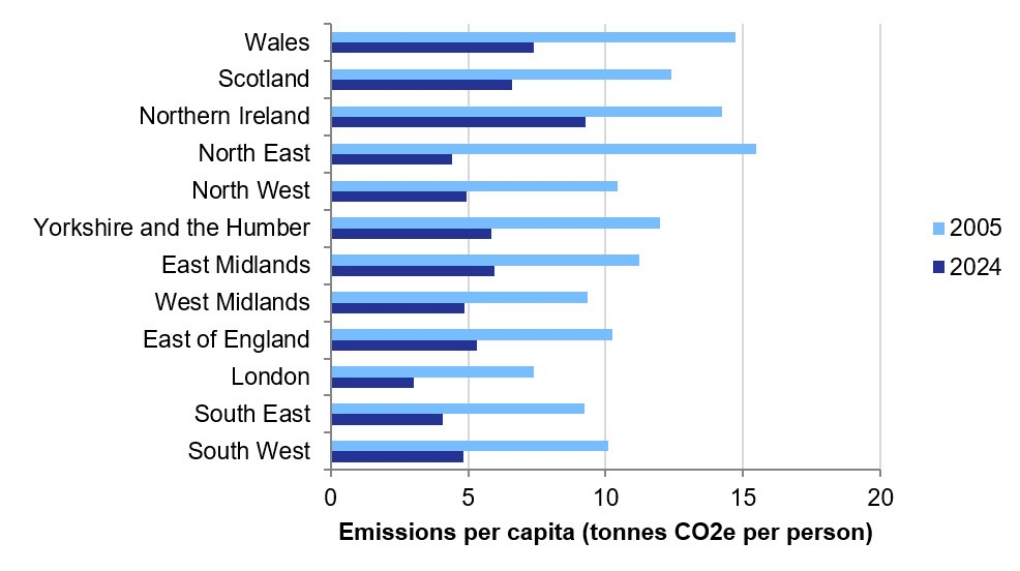
Table 3 shows how total greenhouse gas emissions and greenhouse gas emissions per km2 in 2005 and 2024 compare for each region and country in the UK. The highest emissions per km2 are generally in urban areas and areas with large industrial sites. At the regional level, the largest emissions per km2 were in London at 17.2 ktCO2e per km2 in 2024.
Table 3: Total greenhouse gas emissions and greenhouse gas emissions per km2 by region and country, 2005 and 2024.
| Region/country | 2005: Total emissions (MtCO2e) | 2005: Per km2 (ktCO2e) | 2024: Total emissions (MtCO2e) | 2024: Per km2 (ktCO2e) | Difference between 2005 and 2024 per km2 (ktCO2e) |
|---|---|---|---|---|---|
| UK | 656 | 2.6 | 351 | 1.4 | -1.2 |
| Wales | 44 | 2.1 | 24 | 1.1 | -1.0 |
| Scotland | 63 | 0.8 | 37 | 0.5 | -0.3 |
| Northern Ireland | 25 | 1.7 | 18 | 1.2 | -0.5 |
| England | 511 | 3.8 | 274 | 2.1 | -1.8 |
| North East | 39 | 4.5 | 12 | 1.4 | -3.1 |
| North West | 72 | 4.8 | 38 | 2.6 | -2.2 |
| Yorkshire and the Humber | 61 | 3.9 | 33 | 2.1 | -1.8 |
| East Midlands | 49 | 3.1 | 30 | 1.9 | -1.2 |
| West Midlands | 50 | 3.9 | 30 | 2.3 | -1.5 |
| East of England | 57 | 2.9 | 35 | 1.8 | -1.1 |
| London | 56 | 34.8 | 27 | 17.2 | -17.6 |
| South East | 76 | 3.9 | 39 | 2.0 | -1.9 |
| South West | 51 | 2.1 | 28 | 1.2 | -0.9 |
Local authority trends since 2005
As shown in Table 4, there is more variation in changes in total emissions since 2005 at the local authority level than at the regional level. Emissions for many local authority areas are heavily influenced by activities at industrial sites, and changes at a single site can have a big impact on emissions trends.
Between 2005 and 2024, all 361 local authority areas saw a decrease in total greenhouse gas emissions. This reflects the decrease in overall emissions in the UK during this period, driven mainly by reductions in emissions from power stations and industrial combustion. The reduction from power stations is driven by change in the fuel mix used for electricity generation with a large reduction in the amount of coal, which is a carbon intensive fuel, and increasing use of renewables. The reduction in industrial combustion is largely driven by the closure or reduced activity of industrial plants, a notable portion of which occurred during 2009, likely due to economic factors.
Table 4: Breakdown of size of decrease in greenhouse gas emissions between 2005 and 2024.
| Change in emissions since 2005 | Number of local authority areas |
|---|---|
| Decrease of more than 55% | 41 |
| Decrease of 50% - 55% | 53 |
| Decrease of 45% - 50% | 82 |
| Decrease of 40% - 45% | 72 |
| Decrease of 35% - 40% | 52 |
| Decrease of 30% - 35% | 26 |
| Decrease of 0 - 30% | 35 |
From 2005 to 2024, the largest percentage decrease in emissions from:
- all sectors combined was in Redcar and Cleveland (down 94%), due to the closure of several large industrial installations over this period
- the industry sector was in Redcar and Cleveland (down 98%), due to the closure of several large industrial installations over this period
- the commercial sector was North Ayrshire (down 83%), due to reductions in emissions from electricity use and from gas consumption
- the public sector was Newport (down 85%) due to reductions in emissions from electricity use
- the domestic sector was in the Isles of Scilly (down 65%), due to reductions in emissions from electricity consumption
- the transport sector was in the City of London (down 62%), due to a decrease in emissions from road transport
- the agriculture sector was in Islington (down 82%), due to a decrease in emissions from agricultural electricity and gas use (note that in absolute terms this equates to a small decrease in emissions, or around 1 ktCO2e)
From 2005 to 2024, the largest percentage increase in emissions from:
- the industry sector was in City of London (up 5%), due to an increase in emissions from ‘other’ (non-gas) fuels over this period
- the commercial sector was in Slough (up 39%), due to an increase in emissions from electricity use
- the public sector was in Tewkesbury (up 41%), due to an increase in emissions from gas consumption
- the transport sector was in South Cambridgeshire (up 11%), due to an increase in emissions from road transport
- the agriculture sector was in Hartlepool (up 58%), due to an increase in emissions from gas consumption
No local authority areas showed an increase in total or domestic sector emissions. The largest changes in the waste sector and the LULUCF are not shown. For the waste sector, a significant proportion of landfill emissions in 2005 could not be allocated to local authority areas. Meanwhile, the LULUCF sector is a net sink of emissions in some local authority areas.
Table 5 shows the local authority areas that have experienced the largest percentage decreases in greenhouse gas emissions since 2005, and the sub-sector that made the largest contribution in each case. All of the local authority areas with the largest decreases in emissions since 2005 were driven by closures in large industrial installations.
In some local authority areas, LULUCF sinks significantly impact emissions trends. A large sink can lead to much lower total net emissions than the non-LULUCF emissions total, meaning that changes in emissions from other sectors lead to a larger percentage change in total emissions. This is true for New Forest and Northumberland, where notable sinks have led to larger overall emission reductions.
Table 5: Local authority areas that had the largest decreases in greenhouse gas emissions between 2005 and 2024.
| Local authority area | Percentage decrease | Sub-sector most responsible for decrease |
|---|---|---|
| Redcar and Cleveland | 94% | Large industrial installations |
| Stockton-on-Tees | 80% | Large industrial installations |
| Gravesham | 78% | Large industrial installations |
| New Forest | 75% | Large industrial installations |
| Northumberland | 71% | Large industrial installations |
Carbon dioxide emissions within the scope of influence of local authorities
Alongside the full dataset, a “subset dataset” which represents carbon dioxide emissions within the scope of influence of local authorities is also published. This can be found in table 2.1 in the data tables accompanying this publication. This subset dataset was originally used to report progress against National Indicator 186 under the Department for Communities and Local Government’s Local Area Agreements, and while the National Indicator Set was discontinued in 2011, publication of the subset dataset has continued to allow local authorities to use it to monitor their progress in reducing emissions in their local area.
Unlike the full dataset, the subset dataset excludes emissions that local authorities do not have direct influence over. The emissions that are removed from the full dataset are:
- Motorways – all emissions from the “Transport (motorways)” sub-sector have been removed.
- EU Emissions Trading System (EU ETS) and UK Emissions Trading Scheme (UK ETS) sites – these emissions have been removed from the “Large industrial installations” sub-sector, with the exception of energy suppliers (for example, power stations), whose emissions are indirectly included via the end-user estimates for electricity use. Note that not all the emissions from the “Large industrial installations” sector are produced by EU and UK ETS installations, hence the fact that there are emissions remaining in this sector in the subset.
- Diesel railways – all emissions from the “Diesel Railways” sector have been excluded.
- Land use, land use change, and forestry – all emissions belonging to the “LULUCF Net Emissions” sector have been excluded.
The effect of excluding these emissions is greater in local authority areas where these sources contribute a larger share of total emissions. Table 6 shows the local authority areas with the largest decreases in emissions within the scope of influence of the local authority between 2005 and 2024. No authorities saw an increase over this period. None of the local authority areas that had the largest decreases in overall greenhouse gases in Table 5 in the previous section feature in Table 6. This is because the decreases in those local authority areas were mostly driven by the large industrial installations sub-sector, large aspects of which are considered to be outside the scope of influence of local authorities, or occurred in areas with large LULUCF sinks, which are considered to be entirely outside the scope of influence of local authorities.
Table 6: Local authority areas that had the largest increases or decreases in CO2 emissions within the scope of influence of the local authority between 2005 and 2024.
| Local authority area | Percentage change | Sub-sector most responsible for change |
|---|---|---|
| City of London | -70% | Commercial Electricity |
| Exeter | -63% | Public Sector Gas |
| Neath Port Talbot | -61% | Industry Electricity |
| Southwark | -60% | Commercial Electricity |
| North East Lincolnshire | -60% | Industry Gas |
Between 2023 and 2024, 70% of local authority areas (252 out of 361) saw a decrease in emissions within the scope of influence of local authorities. Table 7 shows the local authority areas with the biggest percentage changes to emissions within their scope of influence between 2023 and 2024. Most of the local authority areas shown in Table 7 do not appear in Table 2, as the drivers of some of the largest emissions changes (such as the opening or closing of large industrial installations) may be outside the scope of influence of local authorities.
Table 7: Local authority areas that had the largest increases or decreases in CO2 emissions within the scope of influence of the local authority, 2023-2024.
| Local authority area | Percentage change | Sub-sector most responsible for change |
|---|---|---|
| Clackmannanshire | -22% | Commercial Gas |
| Fife | -17% | Industry ‘Other’ |
| Cheshire West and Chester | -14% | Industry ‘Other’ |
| West Suffolk | 5% | Industry Gas |
| City of London | 6% | Industry ‘Other’ |
| Broadland | 7% | Commercial Gas |
Emissions within Protected Landscapes
Protected Landscapes consist of the UK National Parks, National Landscapes and Areas of Outstanding Natural Beauty (AONBs). These estimates have been produced following the same methodologies as the local authority area estimates as far as possible, and where there are differences these are given in the technical report that accompanies this publication.
There are 15 National Parks in the UK, of which 10 are in England, 3 in Wales and 2 in Scotland. There are 38 National Landscapes in England and Wales (which were known as AONBs until 2023) and 8 AONBs in Northern Ireland.
Protected Landscapes are more rural than many other areas of the country so have different characteristics when compared to most local areas. Relative to their size, they have lower levels of greenhouse gas emissions than more built-up areas. In 2024, average emissions per km2 were 0.2 ktCO2e across the National Parks and 0.5 ktCO2e across the National Landscapes & AONBs. In comparison, the average emissions per km2 across all local authority areas in the UK in 2024 was 1.4 ktCO2e.
However, Protected Landscapes have higher emissions relative to the size of their populations, averaging 11.9 tCO2e per capita in 2024 in National Parks and 9.8 tCO2e per capita in National Landscapes and AONBs. Meanwhile, the UK average was 5.1 tCO2e per capita in 2024. The LULUCF sector is also more prominent in the emissions in Protected Landscapes, both as a source and as an emission sink in different areas.
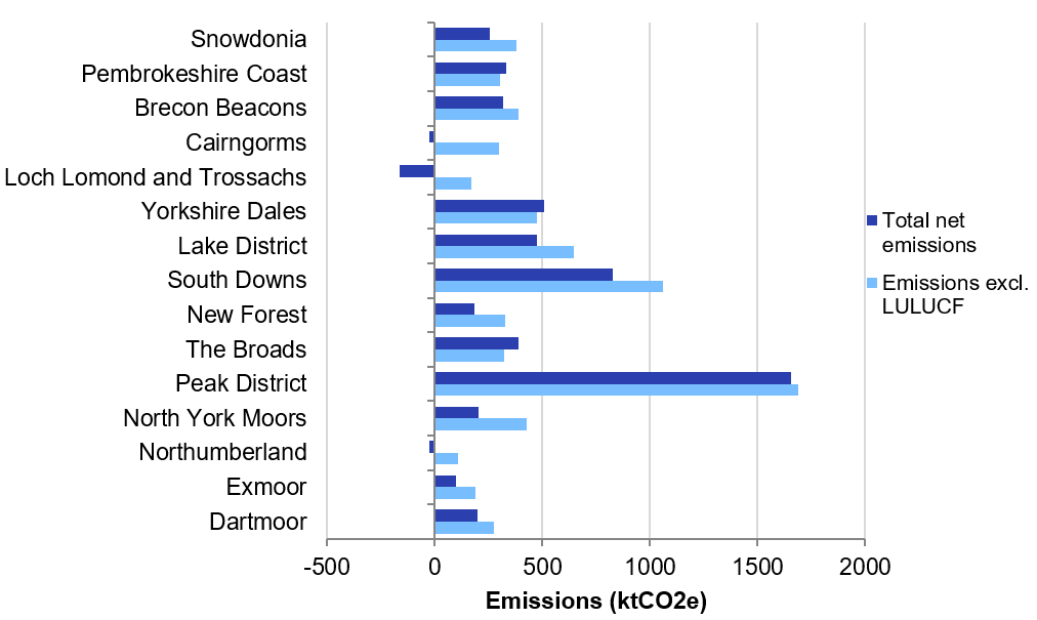
Figure 20 shows the net greenhouse gas emission totals in 2024 in the 15 National Parks, both including and excluding LULUCF. The Peak District has the largest total emissions, 63% of which were from the industry sector. LULUCF acts as a net emissions sink in 12 of the 15 National Parks, and in Loch Lomond and Trossachs, the Cairngorms and Northumberland results in the total net emissions being negative.
Figure 20: Net greenhouse gas emissions in National Parks including and excluding LULUCF, 2024.
Reconciliation with the UK inventory
Local area estimates are designed to be as consistent as possible with the national inventory for the UK. However, some differences are unavoidable. Several emission sources included in the UK inventory are not included in the local area estimates. Excluded sources are principally linked to aviation and shipping, exported fuels and fluorinated gases.
A small proportion of the gas and electricity consumption allocated to the domestic sector in these estimates is attributed to commercial buildings in the UK inventory. This is because it is not possible to distinguish between domestic customers and smaller businesses in the meter point consumption data used in these local estimates.
Table 8 (see the PDF version of this document) shows a summary of the reconciliation between the UK inventory and the local authority area estimates. The different elements of this reconciliation should be interpreted as follows:
- “Excluded” are the sectors that have been deliberately excluded from the local area allocation, as it would not have been appropriate to include them, or in the case of fluorinated gases because data are not available to be able to estimate emissions at a local area level.
- “Unallocated methodological differences” are differences which have become apparent due to the different methodological approaches used in deriving the UK Inventory and local area estimates. These include gas and electricity consumption which cannot be allocated to local authorities due to confidentiality concerns at high emitting sites or incomplete address information for individual meters, some landfill emissions for which data are not available showing which local authorities the waste originated in, and harvested wood products.
- “Methodological differences” are the methodological differences that have caused discrepancies between the national inventories and the local authority and Protected Landscape estimates. These are explained after the UK reconciliation table.
Main differences between the local authority and Devolved Governments datasets
This section of the report describes where there are unavoidable differences between the methodologies used in the estimation of emissions for these local authority greenhouse gas emissions statistics, and for the Devolved Government emissions datasets that show emission estimates for the four countries of the UK.
The following section sets out where and why these differences occur.
Gas and electricity consumption data
The definitions used for domestic and non-domestic consumers differ between the two datasets. In the local authority greenhouse gas dataset, the split is as defined by the DESNZ sub-national energy consumption dataset which are not fully consistent with the national energy data presented in the Digest of UK Energy Statistics (DUKES). The Devolved Government greenhouse gas inventories, however, are based on electricity consumption statistics for each country which are available in the electricity generation and supply section of the DESNZ Energy Trends publication, and are fully consistent with DUKES data for major power producers. These two underlying datasets are not fully consistent and therefore result in differences between the local authority dataset and the Devolved Government inventories for gas and electricity use, as described below.
Unallocated gas and electricity consumption data
In the sub-national energy datasets, some gas data cannot be allocated to local authority areas, due to reasons of confidentiality. In part, these gaps in the emissions estimates are filled through the point source database (mentioned below). However, in doing so, this introduces some uncertainty. In the Devolved Government inventories though, there is no unallocated consumption; point source data is supplemented by employment and other surrogate data to allocate all the national fuel use between the four countries.
In the local authority dataset, some electricity consumption data cannot be allocated to local authorities. This is due to both commercial confidentiality concerns for high-consuming sites, and where address information is incomplete. In these instances, these data are therefore assigned to the ‘unallocated’ category. The Devolved Government inventories, on the other hand, report emissions against a wider geographical coverage, effectively negating the data disclosure concerns, and hence there is no need to exclude specific emissions from them.
Unallocated LULUCF data
Harvested wood products can be allocated to particular countries but not to particular local authorities. Within the local authority greenhouse gas dataset, these emissions/removals are therefore assigned to the ‘unallocated’ category. These are the differences which can be seen in each of the reconciliation tables (4.1 to 4.5). All other LULUCF estimates are fully consistent across UK, Devolved Government and local authority data.
Use of additional gas data for Northern Ireland
Both datasets include consideration of gas consumption data supplied by Northern Ireland energy suppliers, which shows a large growth in gas use within Northern Ireland from 2006 onwards. The Devolved Government inventory approach includes estimates for the fuel-switching from oil and solid fuels that this growth in gas use has displaced. In the local authority greenhouse gas data these estimates of fuel switching have not been possible, given the greater level of detail required by the data, and the UK emissions distribution grids have been used solely.
Distribution of ‘other fuels’ across countries
There are some areas where emissions allocation methods differ between the two datasets due to the availability of data.
In the iron and steel sector, the methodology used for the local authority greenhouse gas emissions assumes that all emissions from the iron and steel sector from industrial processes, process gases and solid fuels occur at large point sources. Emissions from the consumption of oil in the iron and steel sector are mapped using a combination of point sources and area sources (as described in the technical report). In the Devolved Government inventories, fuel use data supplied by the Iron and Steel Statistics Bureau (ISSB) is used, since it is available on a country basis.
For domestic solid fuel combustion, the Devolved Government inventory estimates use the energy modelling work based on the 2021 census and the 2023 Defra Solid Fuel Survey, which also underpins the local authority estimates. This results in more consistent reporting between local authority greenhouse gas emissions and the Devolved Government inventory emissions. However, some differences remain for solid and liquid fuels due to different compilation methods and fuel aggregations; the local authority greenhouse gas dataset takes a more bottom-up approach to disaggregating smokeless solid fuels according to the location of smokeless zones, for example.
Point sources
There are also some differences between the estimates of emissions at large point sources and those in the national totals. An explanation for these differences is provided in the technical report.
Methodological improvements since last year and revisions to the data for 2005 to 2023
In the production of the 2024 estimates, new data were introduced, together with some improvements to the underlying methodology. To ensure that the data for 2005 to 2023 are consistent with the data now available for 2024, the estimates for these years have been revised to incorporate both the new data and the improvements in the underlying methodology. For some local authority areas, these revisions have resulted in noticeable changes to the emissions estimates in the earlier years for some sectors.
This year, all of the methodology changes originated in the UK greenhouse gas emissions estimates, so more detail about them is available in the Revisions to the UK Greenhouse Gas Inventory section of the final 2024 UK greenhouse gas emissions statistics. The emissions sources in the local and regional greenhouse gas emissions statistics that are most affected by these revisions are wastewater (included in the Waste ‘Other’ sub-sector), landfill, shipping (included in the Transport ‘Other’ subsector for those parts that are allocated to local areas), agriculture and LULUCF.
Accompanying tables and technical information
The full set of data tables and methodology documents that accompany this statistics release can be found at: UK local authority and regional greenhouse gas emissions statistics, 2005 to 2024.
Several supplementary reports are also available for local authority area emissions. These are for users to refer to if they want more information on the methodology for producing the estimates:
- 2005-2024 UK local and regional greenhouse gas emissions technical report - report detailing the methodology used to produce the local and regional emissions estimates
- Employment based energy consumption mapping in the UK - report detailing the methodology used to map emissions from smaller industrial and commercial sources
- Mapping greenhouse gas emissions and removals for the land use, land use change and forestry (LULUCF) sector - report detailing the methodology used to produce local and regional LULUCF emissions estimates
The following user guidance is available for sub-national emissions: Sub-national emissions statistics: Frequently asked questions.
Further information on UK greenhouse gas emissions statistics can be found at: UK greenhouse gas emissions statistics.
This statistical release and the related data tables are part of the National Atmospheric Emissions Inventory (NAEI) produced for the DESNZ and the Devolved Governments by Ricardo. For further information on the UK Greenhouse Gas Inventory, see the NAEI website.
Given the number of local authorities and Protected Landscapes, this statistical release does not provide a detailed explanation of all revisions to the historical data series or the year-on-year changes for each area. However, explanations of the reasons for any changes are available on request; any such requests should be sent to the following email address: GreenhouseGas.Statistics@energysecurity.gov.uk.
Further information
Future updates to these statistics
The next UK local and regional greenhouse gas emissions estimates, covering the period 2005 - 2025, will be published in June 2027.
In February 2027, DESNZ will publish final 1990-2025 UK territorial greenhouse gas emissions estimates by source sector. A summary of any planned methodology changes will be published in advance of that in January 2027.
In March 2027, DESNZ will publish a breakdown of 1990 - 2025 UK territorial greenhouse gas emissions with energy supply emissions on an end-user basis to supplement the source sector breakdown and provisional estimates of UK territorial greenhouse gas emissions for 2026 will be published.
In June 2027, DESNZ will publish estimates of 1990 - 2025 UK territorial greenhouse gas emissions by Standard Industrial Classification to supplement the source sector breakdown.
Related statistics
NAEI interactive local authority level emissions maps
Users can zoom in to any UK local authority, see the emissions for the area and identify the significant point sources, such as iron and steel plants. The data can be filtered by sector, and to see how emissions have changed across the time series: LAGHG Interactive Map
Devolved Government Greenhouse Gas Inventories
Greenhouse gas emissions inventories are available for England, Scotland, Wales and Northern Ireland on the NAEI website.
Final UK greenhouse gas emissions statistics
The Final UK greenhouse gas emissions statistics provides the latest estimates of UK greenhouse gas emissions by source sector (published in February each year) and with energy supply emissions on an end user basis (published in March).
Provisional UK greenhouse gas emissions statistics
Published in March each year, the Provisional UK greenhouse gas emissions statistics provides initial estimates of the previous year’s greenhouse gas emissions.
Sub-national energy consumption statistics
Several publications are produced by DESNZ estimating energy consumption by local authority, which are used in the production of the UK local authority greenhouse gas emissions estimates:
- Electricity consumption statistics for Great Britain and for Northern Ireland
- Gas consumption statistics for Great Britain and for Northern Ireland
- Road transport fuel consumption statistics for the United Kingdom
- Residual fuel (non-electricity, non-gas, non-road transport fuels) consumption for the United Kingdom
- Total final energy consumption statistics for the United Kingdom.
Other local area statistics
A large range of statistics about local areas in the UK can be found on the Office for National Statistics website.
Revisions policy
The DESNZ statistical revisions policy sets out the revisions policy for these statistics, which has been developed in accordance with the UK Statistics Authority Code of Practice for Statistics.
User engagement
Users are encouraged to provide comments and feedback on how these statistics are used and how well they meet user needs. Comments on any issues relating to this statistical release are welcomed and should be sent to: GreenhouseGas.Statistics@energysecurity.gov.uk
The DESNZ statistical public involvement and engagement strategy sets out the department’s approach to engaging with users of official statistics as outlined by the Code of Practice for Statistics.
Accredited Official Statistics designation
Accredited official statistics are called National Statistics in the Statistics and Registration Service Act 2007.
These accredited official statistics were independently reviewed by the Office for Statistics Regulation (OSR) in June 2014 and had their accreditation reviewed in September 2018. They comply with the standards of trustworthiness, quality and value in the Code of Practice for Statistics and should be labelled ‘accredited official statistics’.
Our statistical practice is regulated by the OSR.
OSR sets the standards of trustworthiness, quality and value in the Code of Practice for Statistics that all producers of official statistics should adhere to.
DESNZ has published several Official Statistics standards and policies that it follows.
You are welcome to contact us by emailing GreenhouseGas.Statistics@energysecurity.gov.uk with any comments about how we meet these standards.
Alternatively, you can contact OSR by emailing regulation@statistics.gov.uk or via the OSR website.
Pre-release access to statistics
Some ministers and officials receive access to these statistics up to 24 hours before release. Details of the arrangements for doing this and a list of the ministers and officials that receive pre-release access to these statistics can be found in the DESNZ Statistics release policy with the Pre-Release Access to Official Statistics Order 2008.
Contact
- Email: GreenhouseGas.Statistics@energysecurity.gov.uk
- Media enquiries: 020 7215 1000