Fire and rescue incident statistics, year ending June 2025
Published 23 October 2025
Applies to England

© Crown copyright 2025
This publication is licensed under the terms of the Open Government Licence v3.0 except where otherwise stated. To view this licence, visit nationalarchives.gov.uk/doc/open-government-licence/version/3 or write to the Information Policy Team, The National Archives, Kew, London TW9 4DU, or email: psi@nationalarchives.gov.uk.
Where we have identified any third party copyright information you will need to obtain permission from the copyright holders concerned.
This publication is available at https://www.gov.uk/government/statistics/fire-and-rescue-incident-statistics-year-ending-june-2025/fire-and-rescue-incident-statistics-year-ending-june-2025
Frequency of release: Quarterly
Forthcoming releases: Ministry of Housing, Communities and Local Government statistics release calendar
MHCLG responsible statistician: Paul Gaught-Allen
Public enquiries: firestatistics@communities.gov.uk
Media enquiries: newsdesk@communities.gov.uk
The statistics in this release inform the government, FRSs, and local authorities. The data is used to inform policy of the most relevant headline statistics, enhancing decision making by providing an overview of the most recent incident statistics and the latest trends.
This quarterly release contains statistics about incidents attended by fire and rescue services (FRSs) in England for the year ending June 2025 covering the last 10 years. The statistics are sourced from the online Incident Recording System (IRS) and include statistics on all incidents, fire-related fatalities, non-fatal casualties from fires and response times to fires.
Key results
FRSs attended 628,764 incidents in the year ending June 2025, an increase of 5.7% compared with the previous year (594,836). Of these incidents, there were 165,697 fires, which was an increase of 28% compared with the previous year (129,638).
Figure KR.1: Total incidents attended by incident type, England; the year ending June 2015 to the year ending June 2025
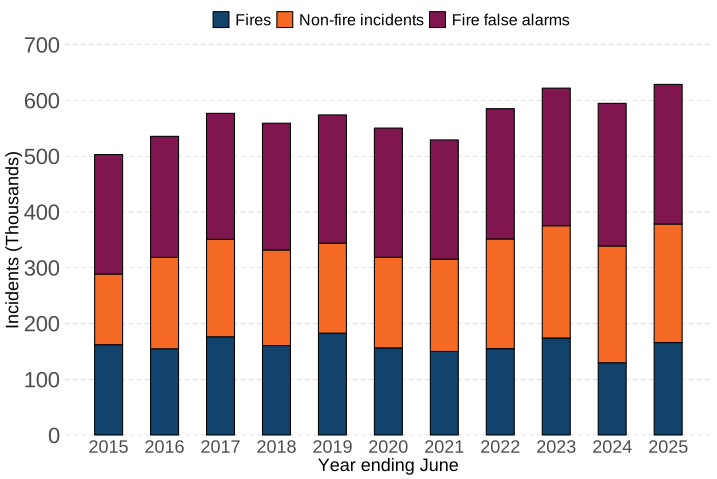
A chart showing the number of fires, non-fire incidents and fire false alarms over the past 11 years. The columns fluctuate but show an upward trend in the total number of incidents.
Source: FIRE0102
In the year ending June 2025, there were 279 fire-related fatalities in 255 fatal fires, compared with 231 fire-related fatalities in 218 fatal fires in the previous year.
Figure KR.2: Total fire-related fatalities, England; the year ending June 2015 to the year ending June 2025
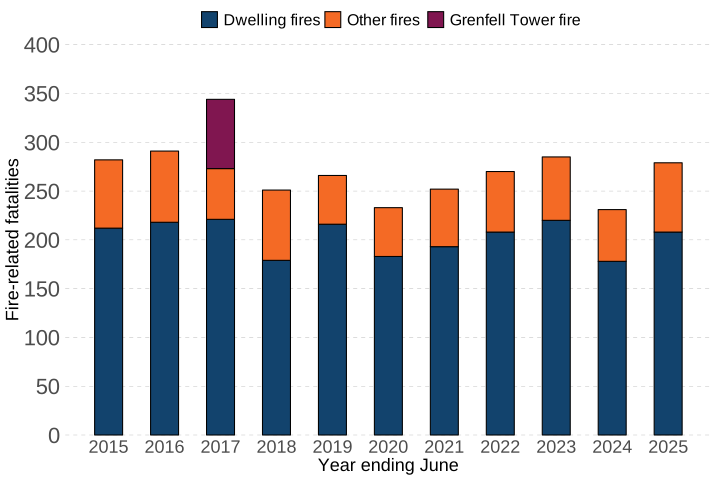
A chart showing the number of fire-related fatalities in the past 11 years. The year containing the Grenfell Tower fire is particularly high.
Source: FIRE0502
1. Incident summary
Incidents that FRSs attend are categorised into fires, non-fire incidents and fire false alarms.
Key results
In the year ending June 2025:
- 628,764 incidents were attended by FRSs, an increase of 5.7% compared with the previous year (594,836), an increase of 14% compared with 5 years ago (550,444) and an increase of 25% compared with 10 years ago (502,843); Source: FIRE0102, figure KR.1
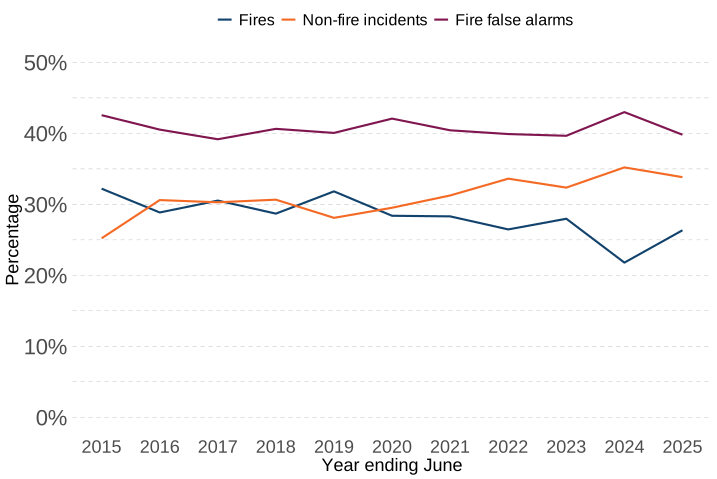
- of all incidents attended by FRSs, fires accounted for 26%, fire false alarms 40% and non-fire incidents 34%, compared with fires accounting for 32%, fire false alarms 43% and non-fire incidents 25% 10 years ago; Source: FIRE0102, figure 1.1
Total incidents
Over the past decade, as shown in figure KR.1, the number of incidents attended by FRSs in England has been on a gradual, if fluctuating, upward trend. In the year ending June 2015, there were around 503,000 incidents attended. The total number of incidents had reached around 629,000 by the year ending June 2025. When the latest year is compared to the previous year, there was an increase of 5.7% in all incidents.
As figure 1.1 shows, the share of incidents between incident types has changed over the past decade. Over recent years, there has been an increasing share of non-fire incidents and a decreasing share of fire incidents.
Figure 1.1: Total share of incidents attended by incident type, England; the year ending June 2015 to the year ending June 2025
Source: FIRE0102
Notes:
- Non-fire incidents include non-fire false alarms
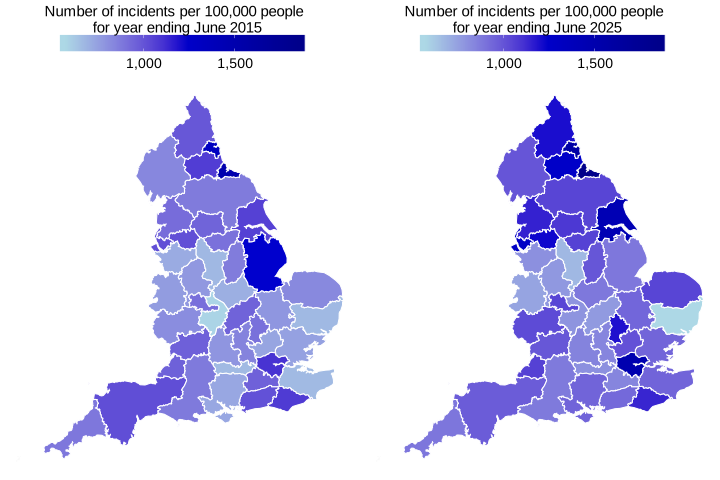
Figure 1.2 shows the changing rate of incidents per 100,000 people by FRS over the past decade. The rates, although clearly changing, are similar in both maps.
Figure 1.2: Rate of total incidents per 100,000 people by FRS for year ending June 2015 and 2025
Notes:
- Colour scale does not start at 0, but at lowest value for incidents per 100,000 people, and is the same for both figures
- Suffolk FRS could not submit all incidents before this date, due to technical reasons. Therefore, these statistics do not contain data for all incidents attended from September 2024 to June 2025 from Suffolk. The data will be revised in due course, as incidents are updated to the IRS.
2. Fires attended
Fire incidents attended are broadly categorised as primary, secondary or chimney fires, depending on the location, severity and risk levels of the fire, and on the scale of response needed from FRSs to contain them.
Primary fires Those that meet at least 1 of the following criteria: (i) occurred in a (non-derelict) building, vehicle or outdoor structure (ii) involved a fatality, casualty or rescue (iii) were attended by 5 or more pumping appliances.
Secondary fires Generally small outdoor fires, not involving people or property.
Chimney fires In (non-industrial) buildings where the flame was contained within the chimney structure.
Key results
In the year ending June 2025:
- FRSs attended 165,697 fires, which increased by 28% compared with the previous year (129,638) and increased by 2.3% compared with 10 years ago (161,963); Source: FIRE0102
- there were 65,116 primary fires, an increase of 7.0% compared with the previous year (60,874), but a decrease of 9.7% compared with 10 years ago (72,140); Source: FIRE0102
- there were 6,157 outdoor primary fires, an increase of 52% compared with the previous year (4,050), and an increase of 20% compared with 10 years ago (5,115); Source: FIRE0102
- there were 98,687 secondary fires, an increase of 48% compared with the previous year (66,682) and an increase of 17% compared with 10 years ago (84,626); Source: FIRE0102
- FRSs attended 688 fires in purpose-built high-rise (10 or more storeys) flats or maisonettes, a decrease of 2.4% compared with the previous year (705); Source: FIRE0205
Total fires
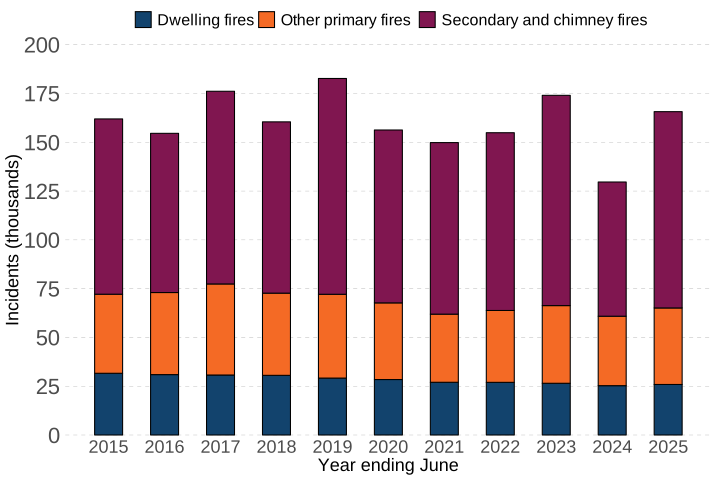
Over the past decade, as shown in figure 2.1, the number of fires attended by FRSs in England has fluctuated between around 129,000 and 184,000. The number of fires is affected by the weather. The summers of 2018 and 2022 were hot and dry, which caused high numbers of fires in those years, particularly outdoor primary and secondary fires.
The number of secondary fires in the latest quarter (40,075 in April to June 2025) is the highest figure for any quarter since July to September 2022. This high figure was the main reason for the increase in total fires for the year ending June 2025 compared to the year ending June 2024 which was a record low. The total number of fires increased by 36,059 while the number of secondary fires increased by 32,005.
Figure 2.1: Total fires attended by type of fire, England; year ending June 2015 to year ending June 2025
Source: FIRE0102
As shown in figure 2.1, there was a large increase in outdoor fires in year ending September 2022, which was due to the hot, dry summer. This increase was discussed in Fire and Rescue Incident Statistics: England, year ending June 2023 Total outdoor fires for summer 2022 and the Outdoor fires section of the Detailed analysis of fires attended by fire and rescue services, England, April 2022 to March 2023 release.
Primary fires
The number of primary fires (those considered to be the most serious or with a threat to life or property) has decreased over the past decade.
Primary fires accounted for 39% of total fires in the year ending June 2025. This compares with 47% in the previous year, 43% 5 years ago and 45% 10 years ago. The proportion of total fires accounted for by primary fires has fluctuated year-on-year over the past decade.
There were 39,896 building fires (dwelling and other building fires) attended by FRSs in the year ending June 2025, an increase of 4.4% compared with the previous year (38,222), a decrease of 5.7% compared with 5 years ago (42,286) and a decrease of 16% compared with 10 years ago (47,629).
Building fires accounted for 6.3% of all incidents, 24% of all fires and 61% of all primary fires in the year ending June 2025. Over the last 10 years this share has been steadily decreasing, from 9.5% of all incidents, 29% of all fires and 66% of all primary fires in the year ending June 2015.
3. Fire false alarms
Fire false alarms are where an FRS attends a location believing there to be a fire incident but, on arrival, discovers that no such incident exists or existed. These are broadly categorised by motive into ‘due to apparatus’, ‘good intent’ and ‘malicious’.
Due to apparatus
These calls are where a fire alarm or fire-fighting equipment operate (including accidental initiation by persons) in error.
Good intent
These calls are made in good faith in the belief that the FRS really would be attending a fire.
Malicious
These false alarms are made with the intention of getting the FRS to attend a non-existent incident.
Key results
In the year ending June 2025:
- FRSs attended 250,341 fire false alarms
- fire false alarms decreased by 2.1% compared with the previous year (255,771), increased by 8.1% compared with 5 years ago (231,641) and increased by 17% compared with 10 years ago (214,046); Source: FIRE0102
Fire false alarms by type
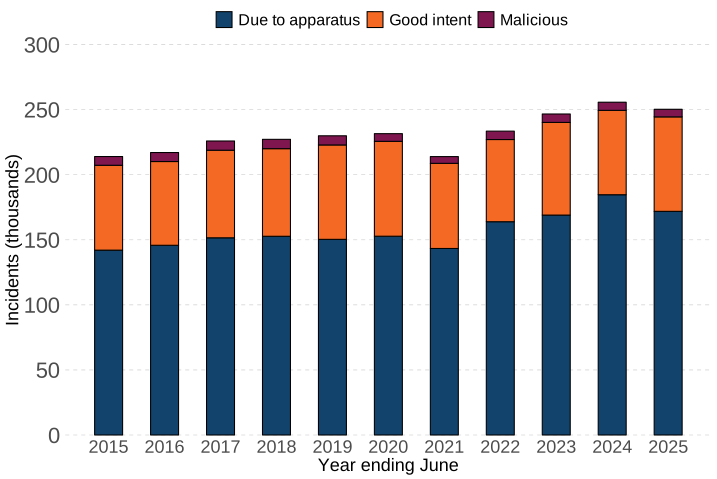
The number of fire false alarms attended by FRSs in England was on a general downward trajectory to a low of around 214,000 in the year ending June 2015.
Since then, with the exception of a period of decreases around the COVID-19 pandemic, there was a gradual increase in fire false alarms to around 250,000 in the year ending June 2025, one of the highest since the year ending June 2011. However, there was a decrease in fire false alarms on the previous year
Figure 3.1: Total fire false alarms by type of false alarm, England; year ending June 2015 to year ending June 2025
Source: FIRE0102
Figure 3.1 shows the type of fire false alarm incidents by year. In the year ending June 2025, there were:
- 171,935 fire false alarms due to apparatus, a decrease of 6.9% from the previous year (184,686), an increase of 13% from 5 years previously (152,791) and an increase of 21% from 10 years previously (142,116); Source: FIRE0104
- 72,604 fire false alarms due to good intent, an increase of 12% from the previous year (64,855), virtually unchanged from 5 years previously (72,945) and an increase of 11% from 10 years previously (65,218); Source: FIRE0104
- 5,802 malicious fire false alarms, a decrease of 6.9% compared with the previous year (6,230), a decrease of 1.7% from 5 years previously (5,905) and a decrease of 14% from 10 years previously (6,712); Source: FIRE0104
4. Non-fire incidents attended
FRSs attend many types of incidents that are not fires or fire false alarms. These are known as non-fire incidents or special service incidents. Examples include flooding incidents, responding to road traffic collisions (RTCs), animal assistance and collaborating incidents such as effecting entry or exit and assisting other agencies (a complete list can be found in fire data table FIRE0902).
Key results
In the year ending June 2025:
- FRSs attended 212,726 non-fire incidents, the largest rolling year figure since consistent data became available due to the introduction of the online IRS in 2009
- non-fire incidents increased by 1.6% compared with the previous year (209,427), increased by 31% compared with 5 years ago (162,510) and increased by 68% compared with 10 years ago (126,834); Source: FIRE0901
Types of non-fire incidents
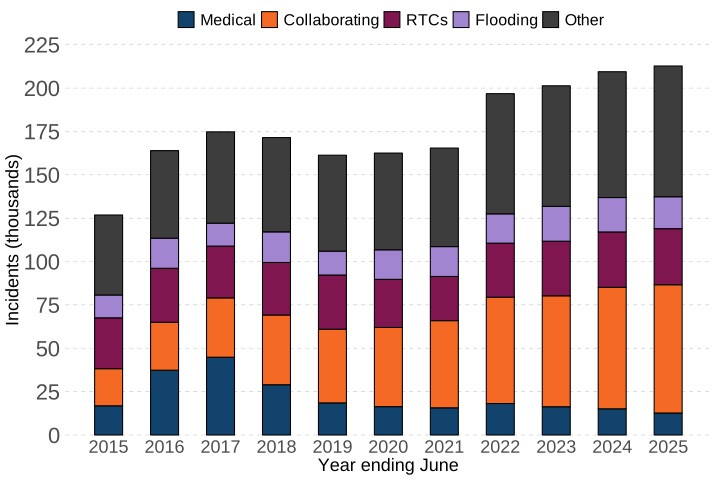
Figure 4.1 shows the number of non-fire incidents over the past decade had 2 clear increases - the first in the year ending June 2016 and the second in the year ending June 2022. It also shows the temporary increase in medical incidents in the second half of the 2010s, the increase in collaboration incidents that started at roughly the same time but has continued into the 2020s, and an increase in other non-fire incidents in the 2020s.
The figure for the year ending June 2021, and in particular the number of RTCs, was affected by the COVID-19 pandemic.
Figure 4.1: Total non-fire incidents attended by FRSs, England; year ending June 2015 to year ending June 2025
Source: FIRE0901
Notes
- The ‘other’ category contains 15 different non-fire incident types. This contains non-fire false alarms, no action incidents and remaining non-fire incidents. Source: FIRE0901
- The ‘flooding’ category contains the two smaller categories ‘flooding’ and ‘rescue or evacuation from water incidents’.
Table 4.1 shows that collaborating incidents and RTCs increased in the year ending June 2025 compared with the previous year, whereas medical incidents and flooding and rescue from water incidents decreased.
Table 4.1: The main categories of non-fire incidents attended by FRSs in England; year ending June 2024 and year ending June 2025
| Non-fire incident type | Year ending June 2025 | Year ending June 2024 | % change |
|---|---|---|---|
| Total non-fire incidents | 212,726 | 209,427 | 1.6% |
| Collaborating incidents | 73,962 | 70,035 | 5.6% |
| Road traffic collisions (RTCs) | 32,322 | 31,918 | 1.3% |
| Flooding and rescue or evacuation from water | 18,410 | 19,853 | -7.3% |
| Medical incidents | 12,672 | 15,099 | -16% |
| Other non-fire incidents | 75,360 | 72,522 | 3.9% |
Source: FIRE0901, FIRE0902
Collaborating incidents
In the year ending June 2025:
- FRSs attended 73,962 collaborating incidents[footnote 1], this is the highest rolling year figure since the implementation of the online IRS in 2010; Source: FIRE0901
- collaborating incidents accounted for 35% of non-fire incidents, an increase from 33% the previous year, 28% from 5 years ago and 17% from 10 years ago
The number of collaborating incidents has more than trebled from around 21,400 in the year ending June 2015 to around 74,000 in the year ending June 2025. These increases coincided with the introduction of the duty to collaborate legislation.
For the year ending June 2025, the 3 sub-categories of collaborating incidents have changed on the previous year as follows:
- effecting entry or exit increased by 4.9% to 39,859
- assisting other agencies increased by 6.6% to 30,816
- assisting at suicide attempts increased by 5.4% to 3,287
Medical incidents
In the year ending June 2025:
- FRSs attended 12,672 medical incidents[footnote 2], a decrease of 16% compared with the previous year (15,099) and a decrease of 22% compared with 5 years ago (16,333); Source: FIRE0901
- medical incidents accounted for 6.0% of non-fire incidents, a decrease from 7.2% the previous year and from 10% 5 years ago
Medical incidents peaked in the year ending June 2017 (44,847), during the EMR trials, and subsequently decreased. Since the year ending June 2019, the number of medical incidents attended has fluctuated between around 12,000 and 19,000 for a rolling year.
Road traffic collisions (RTCs)
In the year ending June 2025:
- FRSs attended 32,322 RTCs, an increase of 1.3% compared to the previous year (31,918) and an increase of 17% compared with 5 years ago (27,732); Source: FIRE0901
- RTCs accounted for 15% of non-fire incidents, compared with 15% in the previous year and 17% 5 years ago
RTCs generally increased from around 29,000 in the year ending June 2015 to around 31,200 in the year ending June 2019, before falling during the COVID-19 period to around 25,500 in the year ending June 2021. Subsequently the numbers have returned to a level similar to that seen prior to COVID-19.
Flooding and rescue or evacuation from water incidents
In the year ending June 2025:
- FRSs attended 16,477 flooding incidents, a decrease of 5.7% compared to the previous year (17,481) and an increase of 9.5% compared to 5 years ago (15,054); Source: FIRE0901
- FRSs attended 1,933 rescue or evacuation from water incidents, a decrease of 19% compared with the previous year (2,372) and a decrease of 2.9% compared with 5 years ago (1,991); Source: FIRE0901
Flooding and rescue or evacuation from water incidents generally increased over the last 10 years. FRSs attended 18,410 flooding and rescue or evacuation from water incidents in the year ending June 2025, a decrease of 7.3% compared with the previous year (19,853), an increase of 8.0% compared with 5 years ago (17,045) and an increase of 40% compared with 10 years ago (13,141). The share of this group of incidents has decreased from 10% 10 years ago to 8.7% in year ending June 2025.
Other incidents
In the year ending June 2025:
- FRSs attended 75,360 ‘other’ non-fire incidents, an increase of 3.9% on the previous year (72,522) and an increase of 35% 5 years ago (55,731)
- ‘other’ non-fire incidents accounted for 35% of non-fire incidents, virtually unchanged from 35% the previous year and up from 34% 5 years ago
Over the past 10 years, the number of ‘other’ non-fire incidents has increased from roughly 46,000 to approximately 75,400, an increase of 63%. This category covers many sub-types, of which most have had increases. However, the largest increase was for ‘no action’, which covers incidents where a non-fire emergency call was made but action was not required by the FRS when they arrived on scene. Given there are more non-fire incidents generally, and particularly more assisting other agency incidents, it follows that the number of ‘no action’ incidents increase as a result.
5. Fire-related fatalities and casualties
Fire-related fatalities Those that would not have otherwise occurred had there not been a fire. For the statistical releases, a fire-related fatality includes those that were recorded as ‘don’t know’.
Non-fatal casualties Those resulting from a fire, whether the injury was caused by the fire or not.
Fatal fires Those resulting in at least 1 fatality that would not have otherwise occurred had there not been a fire.
As the IRS is a continually updated database, the statistics published in this release may not match those held locally by FRSs, and revisions may occur in the future (see the revisions section for further detail). This may be particularly relevant for fire-related fatalities, where a coroner’s report could lead to revisions in the data sometime after the incident. It should also be noted that the numbers of fire-related fatalities are prone to year-on-year fluctuations, due to relatively small numbers.
Key results
In the year ending June 2025:
- there were 279 fire-related fatalities compared with 231 in the previous year (an increase of 21%); Source: FIRE0502
- there were 208 fire-related fatalities in dwelling fires, compared with 178 in the previous year (an increase of 17%); Source: FIRE0502
- there were 0 fatal fires resulting in 0 fire-related fatalities in purpose-built high-rise flats (10 or more storeys) or maisonettes, compared to 3 fatal fires with 3 fire-related fatalities in the previous year
- there were 6,650 non-fatal casualties[footnote 3], an increase of 6.1% compared with the 6,268 in the previous year; Source: FIRE0502
- there were 2,915 non-fatal casualties requiring hospital treatment, an increase of 7.9% compared with the 2,702 in the previous year; Source: FIRE0502
Fire-related fatalities
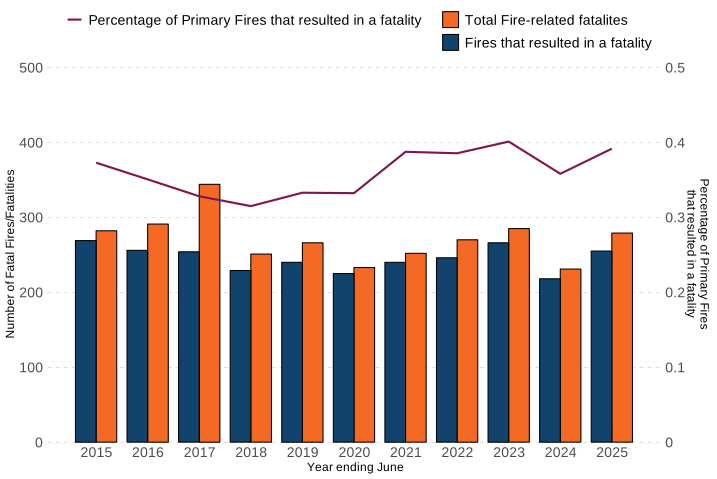
Over the past decade, as shown in figure KR.2 and figure 5.1, the number of fire-related fatalities have fluctuated year-on-year. There were notable increases in the year ending June 2016 (291)[footnote 4] and the year ending June 2017 (344) - the latter of which included 71 fatalities as a result of the Grenfell Tower fire[footnote 5].
Some quarters have shown high numbers of fire-related fatalities over the past few years, resulting in increases in the rolling year figures since the turn of the decade. It should be noted that the number of fire-related fatalities, whether annual or quarterly, are prone to fluctuations due to relatively small numbers.
The number of fire-related fatalities, 65, in the most recent quarter (April to June 2025) compares to 78, 69 and 67 in the previous 3 quarters of the year ending June 2025.
Fire-related fatalities in dwelling fires were the largest category, accounting for 75% of fire-related fatalities in the year ending June 2025. During this year, there were 208 fire-related fatalities in dwelling fires, an increase of 17% compared with 178 in the previous year.
As shown in figure 5.1, the percentage of primary fires that resulted in a fatality has ranged between 0.3% and just over 0.4% over the past 10 years. With the exception of the year ending June 2017, the ratio of fire-related fatalities and fires that resulted in at least 1 fatality has been relatively stable over the same period. There were 279 fire-related fatalities in the year ending June 2025, from 255 fires that resulted in at least 1 fatality (0.39% of primary fires).
Figure 5.1: Total fire-related fatalities, primary fires that resulted in a fatality and the percentage of primary fires that resulted in a fatality England; year ending June 2015 to year ending June 2025
Source: FIRE0502
Notes:
- Fire-related fatalities are those that would not have otherwise occurred had there not been a fire. Those where the role of fire was ‘not known’ are included in ‘fire-related’.
Fatalities in high-rise flats and maisonettes
In the year ending June 2025, FRSs attended 688 fires in purpose-built high-rise (10 or more storeys) flats or maisonettes, a decrease of 2.4% compared with the previous year (705), a decrease of 14% compared with 5 years ago (797) and a decrease of 14% compared with 10 years ago (802).
Over the 5-year period ending in June 2025, FRSs attended 3,621 fires in purpose-built high-rise (10 or more storeys) flats or maisonettes, which resulted in 11 fatal fires and 13 fire-related fatalities. This compared to 3,924 fires, resulting in 19 fatal fires and 89 fire-related fatalities in the 5-year period ending in June 2020 (note that this 5-year span included the Grenfell Tower Fire).
Non-fatal casualties
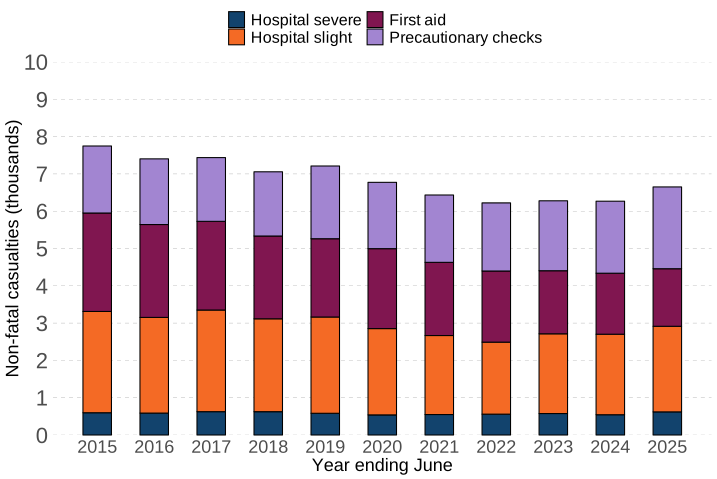
The number of non-fatal casualties in fires in England has been on a downward trend in the past decade, with the ‘hospital slight’ and ‘first aid’ categories showing the biggest decline.
In the year ending June 2025, there were 6,650 non-fatal casualties, an increase of 6.1% compared with the previous year (6,268). The 4 sub-categories were as follows:
- 620 hospital severe casualties, an increase of 14% compared with the previous year
- 2,295 hospital slight casualties, an increase of 6.3% compared with the previous year
- 1,543 first aid casualties, a decrease of 5.7% compared with the previous year
- 2,192 precautionary check casualties, an increase of 14% compared with the previous year
Figure 5.2: Total non-fatal casualties in fires by injury severity, England; year ending June 2015 to year ending June 2025
Source: FIRE0502
Notes:
- These figures are for all non-fatal casualties in fires, whether the fire caused the casualty or not.
6. Response times to fire incidents
Table FIRE1001 is published alongside this release and shows greater detail than this commentary, for example, breakdowns by time components. Full commentary and further tables for the year ending March 2025 can be found in detailed analysis of fire incidents and response times.
Key results
In the year ending June 2025:
- the average total response time to primary fires[footnote 6] in England was 9 minutes and 14 seconds, an increase of 12 seconds on the previous year; Source: FIRE1001
- the average total response time to secondary fires[footnote 7] in England went from 9 minutes and 14 seconds to 9 minutes and 38 seconds, an increase of 24 seconds; Source: FIRE1001
Response times to fire incidents
Total response time Defined as the minutes and seconds elapsed from the time of call to the arrival of the first vehicle at the incident.
The following incidents are not included in response time totals:
a. Road vehicle fires, where the road vehicle was abandoned.
b. Where the location of the fire was a derelict property.
c. Where an FRS learned of the fire when it was known to have already been extinguished (known as ‘late calls’).
d. Where the total response time for an incident was over an hour or less than 1 minute (to avoid erroneous data or exceptional incidents from skewing the averages).
e. Where the sequence of events (time of call - mobilisation - vehicle mobile - arrival at scene) in an incident is not recorded in a logical sequence, either through recording error (for example a vehicle appears to have arrived before it left) or absence of data (null values).
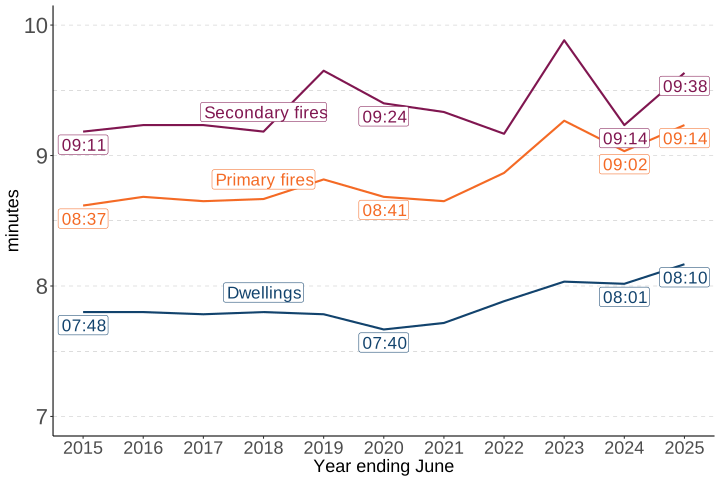
As shown in figure 6.1, response times to fires have increased gradually over the past decade. There was a decrease in the average response time to primary fires in the year ending June 2021, probably due to the impact of less traffic during the COVID-19 pandemic. Within this gradual upward trend, there were spikes in the year ending June 2019 and June 2022, probably due to the greater number of incidents in those years.
Figure 6.1: Average total response times (minutes) by type of fire, England; year ending June 2015 to year ending June 2025
Source: FIRE1001
Notes:
- Y-axis is from 7 to 10 minutes.
All primary fires
The average response time to primary fires was 9 minutes and 14 seconds, in the year ending June 2025. This was:
- an increase of 12 seconds compared with the previous year (9 minutes and 2 seconds)
- an increase of 33 seconds compared with 5 years ago (8 minutes and 41 seconds)
- an increase of 37 seconds compared with 10 years ago (8 minutes and 37 seconds)
Dwelling fires
The average response time to dwelling fires was 8 minutes and 10 seconds, in the year ending June 2025. This was:
- an increase of 9 seconds compared with the previous year (8 minutes and 1 second)
- an increase of 30 seconds compared with 5 years ago (7 minutes and 40 seconds)
- an increase of 22 seconds compared with 10 years ago (7 minutes and 48 seconds)
Primary outdoor fires
The average response time to other outdoor fires was 11 minutes and 35 seconds, in the year ending June 2025. This was:
- an increase of 27 seconds compared with the previous year (11 minutes and 8 seconds)
- an increase of 22 seconds compared with 5 years ago (11 minutes and 13 seconds)
- an increase of 50 seconds compared with 10 years ago (10 minutes and 45 seconds)
It should be noted that other outdoor fires are numerically the smallest of the main primary fire types, accounting for 9.5% of primary fires in the year ending June 2025. The small number of primary outdoor fires means that the response times are prone to fluctuation, which can impact year-on-year comparisons. These incidents increased by 52% from the previous year.
Secondary fires
The average response time to secondary fires was 9 minutes and 38 seconds, in the year ending June 2025. This was:
- an increase of 24 seconds compared with the previous year (9 minutes and 14 seconds)
- an increase of 14 seconds compared with 5 years ago (9 minutes and 24 seconds)
- an increase of 27 seconds compared with 10 years ago (9 minutes and 11 seconds)
The increase in the average response time to secondary fires might reflect the increase in the number of these incidents attended compared with the previous year.
7. Summary of changes over time
Table 7.1: Number of incidents, comparing the year ending June 2025 with 1, 5 and 10 years previously
| Incident Type | Year ending June 2025 | Year ending June 2024 | 1-year change | Year ending June 2020 | 5-year change | Year ending June 2015 | 10-year change |
|---|---|---|---|---|---|---|---|
| All incidents | 628,764 | 594,836 | 5.7% | 550,444 | 14% | 502,843 | 25% |
| Fires | 165,697 | 129,638 | 28% | 156,293 | 6.0% | 161,963 | 2.3% |
| Primary fires | 65,116 | 60,874 | 7.0% | 67,716 | -3.8% | 72,140 | -9.7% |
| Dwelling fires | 25,913 | 25,274 | 2.5% | 28,425 | -8.8% | 31,634 | -18% |
| Accidental dwelling fires | 23,468 | 22,746 | 3.2% | 25,435 | -7.7% | 28,553 | -18% |
| Other building fires | 13,983 | 12,948 | 8.0% | 13,861 | 0.9% | 15,995 | -13% |
| Road vehicle fires | 19,063 | 18,602 | 2.5% | 19,501 | -2.2% | 19,396 | -1.7% |
| Outdoor primary fires | 6,157 | 4,050 | 52% | 5,929 | 3.8% | 5,115 | 20% |
| Secondary fires | 98,687 | 66,682 | 48% | 85,558 | 15% | 84,626 | 17% |
| Fire false alarms | 250,341 | 255,771 | -2.1% | 231,641 | 8.1% | 214,046 | 17% |
| Non-fire incidents | 212,726 | 209,427 | 1.6% | 162,510 | 31% | 126,834 | 68% |
Table 7.2: Number of fire-related fatalities and non-fatal casualties, comparing the year ending June 2025 with 1, 5 and 10 years previously
| Fatal fires, fatalities and non-fatal casualties | Year ending June 2025 | Year ending June 2024 | 1-year change | Year ending June 2020 | 5-year change | Year ending June 2015 | 10-year change |
|---|---|---|---|---|---|---|---|
| Fatal fires | 255 | 218 | 17% | 225 | 13% | 269 | -5.2% |
| Fire-related fatalities | 279 | 231 | 21% | 233 | 20% | 282 | -1.1% |
| Fire-related fatalities in dwellings | 208 | 178 | 17% | 183 | 14% | 212 | -1.9% |
| Non-fatal casualties | 6,650 | 6,268 | 6.1% | 6,774 | -1.8% | 7,748 | -14% |
| Non-fatal casualties requiring hospital treatment | 2,915 | 2,702 | 7.9% | 2,853 | 2.2% | 3,311 | -12% |
| Non-fatal casualties in dwellings | 4,763 | 4,645 | 2.5% | 5,092 | -6.5% | 5,975 | -20% |
Table 7.3: Average response times, comparing the year ending June 2025 with 1, 5 and 10 years previously
| Type of Fire | Year ending June 2025 | Year ending June 2024 | 1-year change | Year ending June 2020 | 5-year change | Year ending June 2015 | 10-year change |
|---|---|---|---|---|---|---|---|
| Primary fires | 9m 14s | 9m 02s | +12s | 8m 41s | +33s | 8m 37s | +37s |
| Dwellings | 8m 10s | 8m 01s | +9s | 7m 40s | +30s | 7m 48s | +22s |
| Other buildings | 9m 05s | 9m 03s | +2s | 8m 35s | +30s | 8m 28s | +37s |
| Other outdoors | 11m 35s | 11m 08s | +27s | 11m 13s | +22s | 10m 45s | +50s |
| Road vehicles | 10m 14s | 10m 07s | +7s | 9m 38s | +36s | 9m 42s | +32s |
| Secondary fires | 9m 38s | 9m 14s | +24s | 9m 24s | +14s | 9m 11s | +27s |
Source: Fire statistics data tables
8. Further information
This release contains statistics about incidents attended by fire and rescue services (FRSs) in England. The statistics are sourced from the MHCLG’s online Incident Recording System (IRS). This system allows FRSs to complete an incident form for every incident attended, be it a fire, a false alarm or a non-fire incident (also known as a special service incident).
Fire and rescue incident statistics and other MHCLG statistical releases are available via the Ministry of Housing, Communities and Local Government statistics release calendar pages on the GOV.UK website.
Data tables linked to this release and all other fire statistics releases can be found on MHCLG’s Fire statistics data tables page.
Guidance for using these statistics and other fire statistics outputs, including a Quality Report, is available on the fire statistics guidance page.
The information published in this release is kept under review, taking into account the needs of users and burdens on suppliers and producers, in line with the Code of Practice for Statistics. The Office for Statistics Regulation carried out a compliance check in 2021 of the fire and rescue incident statistics against the Code of Practice, this was conducted when fire policy was under Ministerial responsibility of the Home Office. The results can be found in a letter to the Head of Profession published on the OSR website.
All fire-related Ministerial responsibilities moved from the Home Office to the Ministry of Housing, Communities and Local Government (MHCLG) on 1 April 2025. This change followed a recommendation from the Phase 2 report of the Grenfell Tower Inquiry, to bring all fire safety functions under one department. Therefore, as part of this move, all statistical publications and analysis on fire functions were also subject to the Machinery of Government (MoG) change.
If you have any comments, suggestions or enquiries, please contact the team via email using firestatistics@communities.gov.uk.
Revisions
The IRS is a continually updated database, with FRSs adding incidents daily. The figures in this release refer to records of incidents that occurred up to and including the end of June 2025. This includes incident records that were submitted to the IRS by 15 August 2025, when a snapshot of the database was taken for the purpose of analysis. As a snapshot of the data set was taken on 15 August 2025, the statistics published may not match those held locally by FRSs and revisions may occur in the future. This is particularly the case for statistics with relatively small numbers, such as fire-related fatalities. For instance, this can occur because coroner’s reports may mean the initial view taken by the FRS will need to be revised; this can take many months, even years, to do so.
Suffolk FRS could not submit all incidents before this date, due to technical reasons. Therefore, these statistics do not contain data for all incidents attended from September 2024 to March 2025 from Suffolk. The data will be revised in due course, as incidents are updated to the IRS.
COVID-19 and the impact on the IRS
The figures presented in this release relate to incidents attended by FRSs during year ending June 2025. There were no restrictions in response to COVID-19 in the latest year or the 3 comparator years.
In response to the COVID-19 pandemic, restrictions in England, Scotland and Wales started from 12 March 2020. In England, 3 lockdowns were imposed which applied strict limits on daily life. A first lockdown was applied on 23 March 2020 and was eased from 15 June 2020, a second lockdown began on 5 November 2020 and ended on 2 December 2020 and the third began on 4 January 2021 and ended on 12 April 2021.
Extra analyses on fire and rescue incidents during this period can be found in the year ending March 2021 edition of this release, detailed analysis of fires attended by fire and rescue services, England, April 2020 to March 2021, detailed analysis of non-fire incidents: England, April 2020 to March 2021 and detailed analysis of response times to fires: England, April 2020 to March 2021.
Other related publications
Fire Statistics publish 4 other statistical releases covering fire and rescue services.
These include:
- Detailed analysis of fires and response times attended by fire and rescue services in England: focuses on fires attended by fire and rescue services across England, fire-related fatalities and non-fatal casualties in those fires; including analyses of the causes of fires, smoke alarm ownership and operation, average response times to fires attended by fire and rescue services
- Detailed analysis of non-fire incidents attended by fire and rescue services, England: focuses on non-fire incidents attended by fire and rescue services across England, including analysis on overall trends, fatalities and non-fatal casualties in non-fire incidents, and further detailed analysis of different categories of non-fire incidents
- Fire workforce and pension statistics: Information on total workforce, the diversity of the workforce, staff leaving and joining, firefighter injuries, attacks on firefighters, firefighters’ pensions
- Fire prevention and protection statistics, England: focuses on trends in smoke alarm ownership, fire prevention and protection activities by fire and rescue services
The detailed analysis of response times to fires attended by fire and rescue services, England publication has been combined with detailed analysis of fires and a link to the latest publication can be found above. For older versions of this publication check: - Detailed analysis of response times to fire incidents by fire and rescue services, England.
The Ministry of Housing, Communities and Local Government (MHCLG) also publish statistical releases on fire.
These include:
- the English Housing Survey: fire and fire safety report focuses on the extent to which the existence of fire and fire safety features vary by household and dwelling type and this report focuses on whether people felt safe from fire in their homes by household and dwelling type
Fire statistics are published by the other UK nations:
Scottish fire statistics and Welsh fire statistics are published based on the IRS. Fire statistics for Northern Ireland are published by the Northern Ireland Fire and Rescue Service using data from a system similar to the IRS, which means that it is not directly comparable to English, Welsh and Scottish data.
Accredited official statistics status
Following the National Statistics designation review by the Office for Statistics Regulation the term “Accredited Official Statistics” was introduced to describe National Statistics in September 2023. This release was, formerly badged as “National Statistics” and should now be considered “Accredited Official Statistics”. National Statistics is the legal term set out in the Statistics and Registration Service Act 2007 for “Accredited Official Statistics” that have been judged by the Office for Statistics Regulation (OSR)[footnote 8], to comply with the Code of Practice for Statistics (“the Code”). This means these statistics meet the standards of trustworthiness, quality and value as set out in “the Code”. Further information about accredited official statistics can be found on the OSR’s website.
Percentages greater than or equal to 10% have been rounded to the nearest whole number. The term ‘virtually unchanged’ is used in relation to percentage changes of less than 0.5%.
A rolling year in this release is any period of 4 quarters in a row, so either 1 January to 31 December, 1 April to 31 March, 1 July to 30 June or 1 October to 30 September.
-
Collaborating incidents include ‘Assisting other agencies’, ‘Effecting entry or exit’ and ‘Suicide or suicide attempts’. ↩
-
Medical incidents include ‘First responder’ and ‘Co-responder’ incidents. ↩
-
For more detailed technical definitions of fire-related and non-fatal casualties, see the Fire statistics definitions document. A further breakdown of the different types of non-fatal casualties is available in the published fire data tables. ↩
-
For more information on the number of fire related fatalities in the year ending March 2016, see the Fire statistics monitor: April 2015 to March 2016. ↩
-
For more information on the Grenfell Tower fire and how the associated fire-related fatalities figures are recorded, see the Fire statistics definitions document. ↩
-
Primary fires are those that meet at least 1 of the following criteria - occurred in a (non-derelict) building, vehicle or outdoor structure or involved a fatality, casualty or rescue or were attended by 5 or more pumping appliances. ↩
-
Secondary fires are generally small outdoor fires, not involving people or property. ↩
-
OSR are the regulatory arm of the UK Statistics Authority ↩