Department for Transport annual report and accounts 2025 to 2026 (HTML version)
Published 15 July 2026

© Crown copyright 2026
This publication is licensed under the terms of the Open Government Licence v3.0 except where otherwise stated. To view this licence, visit nationalarchives.gov.uk/doc/open-government-licence/version/3 or write to the Information Policy Team, The National Archives, Kew, London TW9 4DU, or email: psi@nationalarchives.gov.uk.
Where we have identified any third party copyright information you will need to obtain permission from the copyright holders concerned.
This publication is available at https://www.gov.uk/government/publications/dft-annual-report-and-accounts-2025-to-2026/department-for-transport-annual-report-and-accounts-2025-to-2026-html-version
For the period 1 April 2025 to 31 March 2026:
- accounts presented to the House of Commons pursuant to section 6(4) of the Government Resources and Accounts Act 2000
- annual report presented to the House of Commons by Command of His Majesty
- ordered by the House of Commons to be printed on 15 July 2026
Foreword by the Secretary of State for Transport
Good transport has always been an engine for economic growth and social cohesion. And it is as true now as it’s ever been. We are seeing external shocks combined with global conflict and instability becoming a drag on living standards and opportunity. This government is clear: we will protect the British people, strengthen our economy and increase national resilience in the face of crises both at home and abroad.
The immediate priority is to reduce the cost of living. That starts with reliable bus and train services so people can get to work. It means quicker road journeys and fewer potholes so we can access public services and avoid costly car repairs. And it means ramping up greener flights and maritime, helping to secure our trading future while maintaining the connectivity that people and businesses rely on. At the heart of this effort is the Department for Transport and the thousands who work across the country to make journeys better every day. Over the past year, DfT has continued to deliver on our 3 strategic outcomes: enhancing growth and place, improving journeys for people and delivering green and healthy transport. This annual report charts our progress.
The backbone for any ambitious vision for transport is investment. In January 2026, I was proud to confirm Northern Powerhouse Rail, setting a government funding envelope of up to £45 billion. This represents a major long-term commitment to our railways and to improving connectivity across the North, supporting economic growth and strengthening links between cities, towns and communities. We have also introduced the Bus Services Bill, giving Mayoral Strategic Authorities and local leaders greater powers to shape and improve bus services. This builds on our wider commitment to devolution and place-based transport, ensuring transport networks increasingly reflect the unique needs of every community.
DfT continues to improve journeys for people by making transport more integrated, reliable, accessible and affordable. This year, we’re a step closer to the biggest reform to our railways in a generation. Over half of operating companies are now in public hands as we push to simplify the network to ensure rail serves passengers, not profit. The Railways Bill, which continues its journey in Parliament, will establish Great British Railways – a directing mind that will join up track and train and deliver better services that passengers can rely on. Finally, in a period of global energy instability, national security is now inextricably linked to energy security. That’s why we have taken important steps to deliver green and healthy transport. In March 2026, we secured Royal Assent for the Sustainable Aviation Fuel Bill, supporting cleaner, domestically produced fuels which will cut emissions from air travel. We have accelerated the transition to zero emission vehicles, expanding the rollout of charging infrastructure and helping to drive the shift towards cleaner road transport.
It’s also important we never forget the tragic events that have taken place on our network. The recent rail collision in Bedford shocked the country. Our thoughts remain with all those affected and I am determined we learn the lessons from this horrific incident. Safety on our transport network is non-negotiable and one of my proudest moments was publishing the first road safety strategy in a decade. Whether on rail, road or in the skies, I will always fight for safer travel for everyone.
I would like to thank colleagues across the DfT and our public bodies and all our partners across local and national government, industry and beyond. Their professionalism, expertise and commitment are the driving energy behind everything we do. I am very grateful for the support they’ve given me and my ministerial team.
The Rt Hon Heidi Alexander
Secretary of State for Transport
Foreword by the Permanent Secretary
DfT has a clear purpose: to make transport better – better for the people and businesses who rely on it every day, better for the places it connects and better for the future of our country. In my first year as Permanent Secretary, I have been incredibly proud of what colleagues across DfT have achieved. In a complex and fast-moving environment, we have continued to deliver with professionalism, commitment and a clear focus on improving outcomes for the public. This year has demonstrated the very best of the values that underpin our work.
DfT has continued to take bold steps to shape the future of transport, including through the publication of our new road safety strategy in January. For the first time in over a decade, DfT has set clear national targets to reduce those killed and seriously injured on our roads, underpinned by a renewed, evidence-led framework for improving safety for all road users. We are also taking a bold and responsible approach to adopting Artificial Intelligence to meet rising expectations, improve public services and deliver efficiencies. This includes using AI in high volume work such as consultations and correspondence and digital twins to support resilience and network management.
Transport only works through partnership and this year has highlighted the importance of collaborative working at every level. That has been particularly evident in the transfer of colleagues to DfT Operator Ltd, as another step towards the creation of Great British Railways, which has brought together colleagues from across DfT through one of the largest staff transfers undertaken in recent years. The successful transition reflected extensive collaboration between DfT, its arm’s-length bodies, trade unions and staff, ensuring continuity of services while laying the foundations for a more integrated railway.
Collaboration is also evident through our work supporting English devolution, where we have continued to deepen its work with mayors, local leaders and partners across government to help places shape transport systems that reflect the needs of their communities. This has required close collaboration across government, with local authorities, transport bodies and delivery partners. That partnership approach has strengthened decision-making, enabled more integrated strategic planning and helped ensure that transport continues to support local growth, opportunity and connectivity across the country.
Finally collaboration has also underpinned our response to the James Stewart review, as we implement the recommendations to strengthen governance, accountability and collective delivery across major infrastructure programmes. These improvements have informed the HS2 reset, providing an opportunity to take a transparent and realistic view of the programme, reset delivery against achievable costs and timescales and strengthen the governance and assurance needed to restore confidence in its delivery.
This year has also demonstrated the value of remaining curious; being willing to think differently, challenge ourselves and look ahead to the future. That curiosity has helped us to question long-standing assumptions about how transport services are planned, delivered and experienced by passengers. It is reflected in the launch of Better Connected: a strategy for Integrated Transport in England, which sets out a blueprint for simpler fares, integrated ticketing and nationwide standards for accessibility.
By harnessing the power of new technology and open data, while placing greater responsibility and flexibility at the local level, the strategy demonstrates how fresh thinking can help create a more joined-up transport system. That spirit of curiosity and continuous improvement will remain essential as we continue to modernise and improve transport for the future.
I would like to thank colleagues across DfT and our public bodies and all our partners for their continued dedication and professionalism over the past year. Together, through being bold in our ambition, collaborative in our approach and curious in how we learn and improve, we continue to deliver on our shared purpose: to make transport better.
Jo Shanmugalingam CB
Permanent Secretary
Performance report
Report purpose
This performance report outlines DfT’s key successes and challenges in relation to its 3 strategic outcomes.
DfT did not publish an outcome delivery plan (ODP) for 2025 to 2026; however, this report aligns to the strategic outcomes DfT published in April 2026, which have remained consistent in their sentiment.
Organisational structure
DfT consists of the central department (DfTc), its executive agencies and arm’s length bodies (ALBs). These are classified according to the level of ministerial control required for them to best perform their functions. These organisations have their own governance structures and publish annual reports, with their accounts consolidated into the group’s annual report and accounts.
Executive agencies act as a branch of DfT and typically carry out services or functions with a focus on delivering specific outputs, with policy set by ministers. Non-departmental public bodies (NDPBs), more generally referred to as ALBs, are separate legal entities from DfTc. DfT sets their strategic framework, appoints the chair of their boards, approves all non-executive board member appointments and appoints an accounting officer. Agencies and NDPBs are consolidated into the departmental group within these annual report and accounts.
The wider departmental family includes other public bodies classified outside of the departmental boundary helping to achieve its objectives, which have more autonomy over their own policies and are not consolidated into the group’s financial statements. Further details can be found in the accountability report.
Governance structure
DfT’s governance arrangements reflect best practice and the importance of giving Parliament confidence that DfT uses resources cost-effectively when delivering its strategic outcomes. The full governance statement can be found in the accountability report.
Parliament
Checks and challenges the work of DfT through questioning ministers and senior civil servants.
Through the Houses and committees, debates work carried out by DfT and checks and approves DfT spending.
Secretary of State for Transport and ministers
The Secretary of State for Transport is appointed by the Prime Minister and has overall responsibility for DfT and its public bodies.
Makes policy decisions based on advice from officials.
Presents and accounts for policy publicly and in Parliament.
Permanent Secretary, the Principal Accounting Officer
Responsible for the effectiveness and efficiency of DfT leadership, management and staffing.
Works to support and implement ministerial policies and objectives.
The Permanent Secretary acts as principal accounting officer, is responsible for the propriety and regularity of the DfT Group’s expenditure.
Department for Transport Board
Consists of the Secretary of State for Transport, ministers, non-executive board members, Permanent Secretary and directors general.
Advisory body that supports and challenges both DfT ministers and the principal accounting officer.
Provides strategic focus by advising on the operational implications and effectiveness of policy proposals.
Department for Transport Executive team
Consists of the Permanent Secretary, directors general, Director of Group Human Resources and Director of Group Finance.
Supports and reports to the Permanent Secretary in the management of DfT business in-line with ministerial priorities.
Group Audit and Risk Assurance Committee
Oversees the DfT’s assurance programme, reviews the internal audit strategy and the performance of both the Government Internal Audit Agency and external auditors.
It oversees that effective systems are in place for internal control, financial reporting, governance, assurance and risk management.
Nominations Committee
Has an advisory role focussing primarily on ensuring DfT has the capability to deliver and plan the current and future needs for talented people in both DfT and its ALBs.
It provides scrutiny of both DfT Executive appointments, as well as DfT and ALBs Non-Executive appointments by ensuring appropriate succession planning is in place to meet the needs of the DfT and ministers.
Internal and external audit
Internal Audit reviews processes and procedures to help improve DfT’s risk management, control and governance and internal audit provides independent assurance to the Permanent Secretary and DfT Board.
External audit undertakes a statutory audit of DfT’s consolidated annual report and accounts.
DfT’s public bodies landscape ‘our solar system’
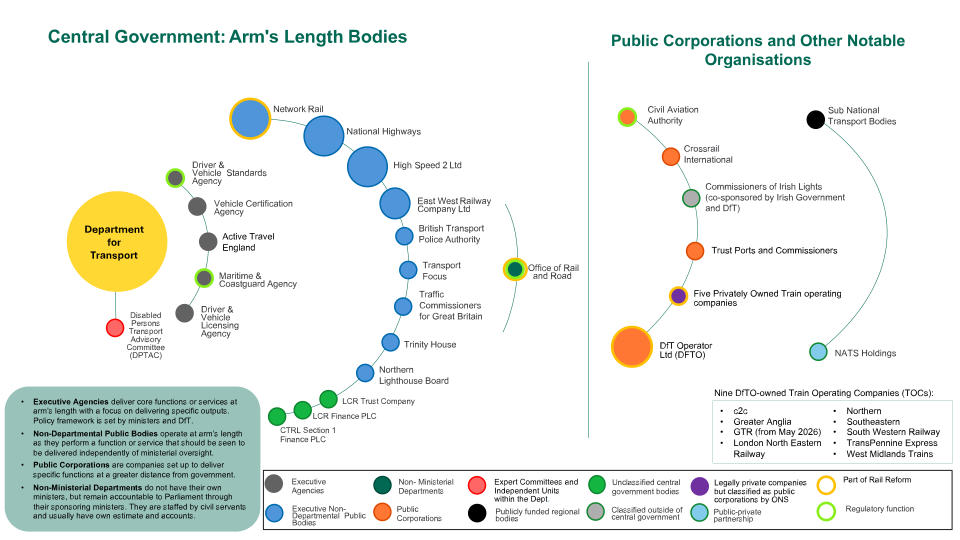
Figure: DfT public bodies landscape, our 'Solar System'
Financial overview from the Director General for the Corporate Delivery Group
Introduction
The 2025 to 2026 financial year was the first year of departmental spending plans covered by Spending Review 2025 (SR25). DfT spending plans for 2025 to 2026 were agreed alongside the 2024 Autumn Budget as phase 1 of SR25. Phase 2 of SR25 was published in June 2025 which set out departmental funding settlements until 2028 to 2029 for day-to-day resource funding and until 2029 to 2030 for capital investment.
The Autumn Budget 2025 (AB25) built on this, increasing our investment in the Electric Vehicle Grant and Electric Vehicle Charging Infrastructure for 2025 to 2026 to create a greener, safer and healthier transport system. AB25 also secured additional public funding for preliminary work on the Lower Thames Crossing, ahead of the planned implementation of a regulatory asset base private finance model for construction and operation of the new crossing.
DfT resource spending is forecast to reduce over the Spending Review period, primarily through a reduction in DfT’s financial support to train operating companies (TOCs), through increased ridership, farebox revenues and efficiencies. Ongoing spending efficiencies are also planned across DfT’s activities. In parallel, DfT made further policy interventions in 2025 to 2026 to manage day-to-day cost-of-living for public transport users. In June 2025, the £3 bus fare cap was extended to March 2027; and in November 2025, the government announced that regulated rail fares for the year beginning March 2026 will be frozen.
Capital spending will continue to increase over the Spending Review period. This provides major investment in our road and railway transport networks, in addition to supporting mayoral combined authorities and local authorities with enhancing and renewing regional and local transport infrastructure.
This report provides a high-level overview of our financial performance in 2025 to 2026. Figure 1 summarises total spend against the final control totals voted by Parliament at the supplementary estimate and figure 1.1 shows a breakdown of total spend by transport mode.
Table (figure 1): outturn and control totals authorised by Parliament. The budgeting framework for central government is further explained in figure 4.
| 2025 to 2026 | ||||
|---|---|---|---|---|
| Budget | Outturn | Variance | ||
| Control Total | £ million | £ million | £ million | % |
| Resource DEL | 19,999 | 18,731 | 1,268 | 7% |
| Of which: Administration | 382 | 369 | 13 | 4% |
| Capital DEL | 21,639 | 21,359 | 281 | 1% |
| Resource AME | 3,701 | 1,939 | 1,762 | 91% |
| Capital AME | 149 | (151) | 300 | (199%) |
| Net Cash Requirement | 34,671 | 30,247 | 4,424 | 15% |
This table shows the total departmental expenditure limit (DEL) and annually managed expenditure (AME) spending (net of income) by estimate line, with estimate lines grouped by transport mode. Total DEL and AME spending includes both resource and capital cash spending in addition to non-cash costs such as depreciation. Net cash requirement (NCR) represents the total level of supply funding drawn down from HM Treasury (HMT) during the year to support DfT’s spending, demonstrating DfT’s total call on taxpayer funds. As required by Parliament, DfT remained within all of the budget limits set by Parliament. Significant variances between budget and outturn are explained in the statement of outturn against parliamentary supply.
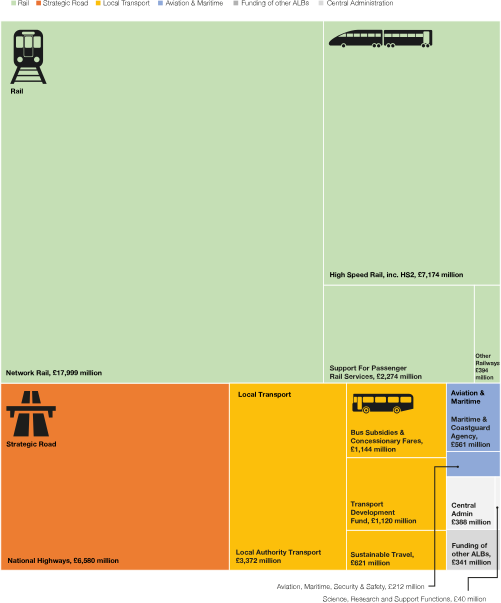
Figure 1.1: colours in this figure represent the breakdown of spending by mode
Income and funding
Alongside the supply funding received from HMT described in figure 1, DfT Group received £7.2 billion in income from other sources. These are summarised in figure 2 and more detail can be found in note 4 to the financial statements.
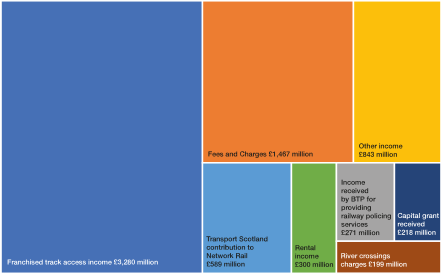
Figure 2: main sources of income received in year
Figure 2.1 shows the net movement in Income by revenue source in the year ended 31 March 2026. Revenues from DfT’s income streams were broadly comparable with the prior year.
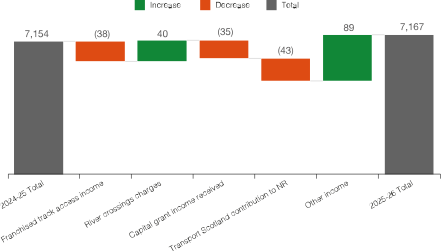
Figure 2.1: movement in revenue streams, £ millions
Source: financial statements note 4, cash items.
Expenditure
As reported in the statement of comprehensive net expenditure in the financial statements, DfT Group incurred £33 billion of expenditure in 2025 to 2026 compared to £32 billion in the previous year. Figure 3 shows the headline movements in expenditure during the year.
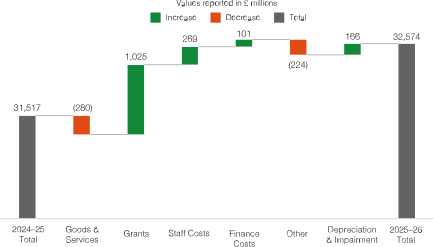
Figure 3: movements in expenditure in 2025-26
Goods and services costs decreased in 2025 to 2026 primarily driven by a reduction in funding required from DfT to support passenger rail services.
Grant expenditure includes amounts issued to local authorities and mayoral combined authorities for investment in local transport and local roads improvement, in addition to other grant schemes such as support for the local bus sector. Overall grants increased by £1,025 million. The biggest driver was an increase in grants to Transport for London (TfL) by £402 million due to the higher funding settlement agreed to deliver transport priorities. In addition, there were increases to capital funding for local highway maintenance and to Mayoral Combined Authorities through the Transport for City Regions (TCR) funding that provides multi-year, consolidated funding settlements to enhance the local transport networks of some of England’s largest city regions, including investment in public and sustainable transport infrastructure.
Staff costs increased due to pay awards during the year and the increase in the employer National Insurance contribution rate.
Finance costs primarily comprise interest charges on legacy debt owed by the group to bondholders. The debt supported investment in infrastructure projects relating to the railway assets now held by Network Rail Ltd and High Speed 1 Ltd. Finance costs on these bonds increased in 2025 to 2026, which are linked to the retail price inflation index.
The decrease in other costs relates to defined benefit pension scheme costs. These have decreased in the year driven by an increase in interest income on the pension assets in excess of interest costs on the scheme liabilities.
Depreciation and Impairment are non-cash costs relating to DfT’s fixed assets. Depreciation costs reflect the consumption of assets in the course of their operational use. Impairments are one-off costs reflecting a permanent drop in an asset’s value: in DfT’s circumstances, material impairments primarily arise when an infrastructure scheme is cancelled.
Depreciation increased in 2025 to 2026 driven by the increase in the valuation of the railway and road networks. Further detail on the accounting approach to estimating the balance sheet valuation and the associated depreciation charge for the road and railway networks is provided in note 1 to the financial statements.
Impairment costs decreased in 2025 to 2026. Impairment costs in the prior year included £428 million arising from the cancellation of a number of road schemes through the 2024 spending audit and Autumn Budget. In 2025 to 2026, DfT incurred £253 million impairments arising from the cancellation of 2 road schemes following phase 2 of SR25.
Total managed expenditure
Total managed expenditure (TME) represents the total funds spent by DfT against a series of different budget types, which are depicted in figure 4. A comparison of TME in 2025 to 2026 to recent years is shown in figure 5. NCR is a separate parliamentary control total which limits the cash funding departments can draw from the Exchequer to finance their TME spending for the year.
Our budget framework
HMT sets the budgetary framework for government spending
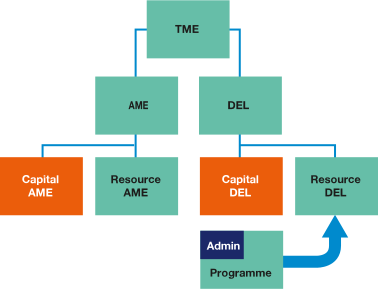
Figure 4: our budgetary framework
The total amount DfT spends is referred to as TME; which is split into: annually managed expenditure (AME) and departmental expenditure limit (DEL).
AME expenditure is typically volatile or demand-led. AME budgets are agreed with HMT on an annual basis. DEL expenditure reflects the cost of delivering front-line and back-office activities. Long-term DEL budgets are set through spending reviews which usually occur every 3 to 5 years.
Budgets are also classified into resource and capital.
Resource DEL is further split into: programme budgets for frontline services and admin budgets such as back office functions.
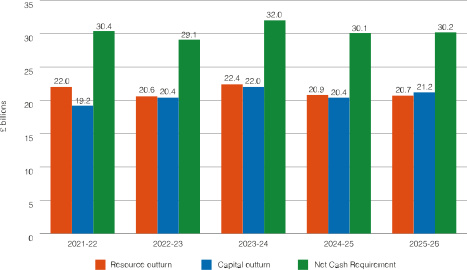
Figure 5: TME and NCR by year
Our resource DEL covers the expenditure associated with the day-to-day running of the group, including the operating costs our ALBs incur to support delivery of our major projects and to operate and maintain the elements of the transport network they are responsible for.
Our capital DEL covers the major capital programmes described above and other investment to enhance the transport system. Network Rail received material levels of capital income: these relate to contributions from other bodies towards capital projects.
TME includes our non-cash budget requirements, such as: depreciation in resource DEL; deferred tax and interest accretion charges in resource AME; and capital provisions in capital AME.
Figure 5 includes our NCR for the year, which represents DfT’s total call on taxpayer funds from the Exchequer to finance its spending activities for the year.
Figure 5.1 shows how our biggest areas of capital spend – HS2, Network Rail and National Highways – have evolved in recent years. Spending plans for 2026 to 2027 reflect amounts agreed in main estimate 2026 to 2027. HS2’s capital spending varies by year in line with the construction profile of the project.
Capital spending by Network Rail and National Highways is more stable between years, in line with the long-term investment programmes agreed through the Office of Rail and Road (ORR) Control Period and the Road Investment Strategy mechanisms respectively. Network Rail’s Control Period 7 funding settlement is for the period 1 April 2024 to 31 March 2029, providing security of long-term investment in the UK rail network.
The second Road Investment Strategy (RIS2) concluded on 31 March 2025. The 2025 to 2026 financial year was an interim year between road investment strategy periods, supported by a one-year settlement that enabled continued delivery while preparing for Road Investment Strategy 3 (RIS3). RIS3, published in March 2026, provides a 5-year funding settlement for 2026 to 2031 and sets the framework for future investment, with an increased focus on asset renewals, network resilience and long-term performance.
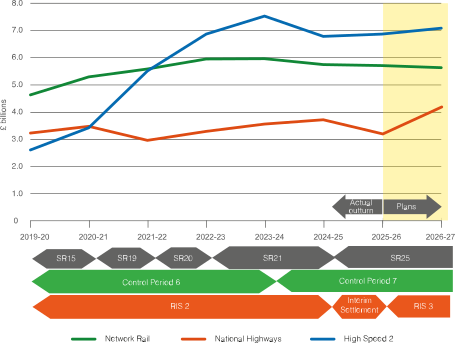
Figure 5.1: key areas of capital spend
Assets and liabilities
Table: assets
| 2025 to 2026 | 2024 to 2025 (Restated) | Increase / (Decrease) | |
|---|---|---|---|
| £ million | £ million | £ million | |
| Assets | |||
| Property, plant and equipment, including leases and assets held for sale | 729,623 | 691,552 | 38,071 |
| Receivables | 2,252 | 2,246 | 6 |
| Loans | 2,059 | 2,331 | (272) |
| Investments in equities and associates | 1,391 | 1,181 | 210 |
| Cash | 1,302 | 1,385 | (83) |
| Inventories | 1,364 | 1,234 | 130 |
| Derivatives | 7 | 22 | (15) |
| Investment properties | 199 | 195 | 4 |
| Pension asset | 1,680 | 1,238 | 442 |
| Intangible assets | 609 | 630 | (21) |
| Total assets | 739,856 | 702,014 | 37,842 |
Table: liabilities
| 2025 to 2026 | 2024 to 2025 (Restated) | Increase / (Decrease) | |
|---|---|---|---|
| £ million | £ million | £ million | |
| Liabilities | |||
| Borrowings | 35,076 | 34,311 | 765 |
| Payables | 7,733 | 8,052 | (319) |
| Pensions | 559 | 614 | (55) |
| Deferred tax | 8,291 | 7,630 | 661 |
| Provisions | 1,451 | 1,531 | (80) |
| Derivatives | 29 | 67 | (38) |
| Total liabilities | 53,139 | 52,205 | 934 |
| Net assets | 686,717 | 649,809 | 36,908 |
Assets
DfT had £740 billion of assets at 31 March 2026, an overall increase of £38 billion on the prior year. Notable changes are set out below.
As at 31 March 2026, £504 billion of assets related to the Railway Network in Great Britain and £175 billion related to the Strategic Road Network (SRN) in England, which are the responsibility of Network Rail and National Highways respectively. In addition, the group held assets under construction relating to HS2 of £44 billion. The increase in assets was driven largely by £16 billion additions and £32 billion of revaluation increases, offset by £10 billion of depreciation charges.
Additions to the rail network comprised £2.2 billion of enhancements and £3.6 billion of renewals. Major schemes included: Transpennine Route upgrade (TRU); East West Rail (EWR) and improvements to the East Coast Mainline. In Scotland, investment activity included completion of the electrification of the railway from East Kilbride to Glasgow and major infrastructure refurbishment of the Far North Line from Inverness to Wick. Additions to assets under construction (AUC) include £7 billion relating to HS2 construction works undertaken during the year.
Additions to the SRN comprised: £2.3 billion of capital enhancements including improvements to the surroundings of the network, supporting sustainability, protecting quality of life and the environment and delivering safety and congestion relief schemes; and £0.9 billion of asset renewals. Significant additions included the A63 at Castle Street in Hull and the M3 Junction 9 at Winchester.
The road and railway networks are valued using a depreciated replacement cost valuation methodology as required under HMT financial reporting rules. The revaluation gains represent increases in the estimated cost of constructing a modern equivalent infrastructure asset. DfT’s approach to valuing these assets is set out in notes 1 and 5 to the financial statements.
Investments in equities and associates of £1 billion comprise DfT’s shareholdings in entities which are not consolidated into the Financial Statements, primarily Platform4 Rail Regeneration Ltd (formerly LCR Ltd), DfT Operator Ltd (DFTO), Network Rail Insurance Ltd and NATS Holdings Ltd. With the progression of the railway public ownership programme in 2025 to 2026, the DFTO Group has expanded during the year leading to an increase in the valuation of DfT’s equity investment in the company. Note 26 in the financial statements provides further details.
Loans decreased by £0.3 billion, primarily driven by £0.2 billion repayment of loans for the Crossrail project made available to the Greater London Authority (GLA) and TfL.
Retirement benefit assets of £1.7 billion represent defined benefit pension schemes which are reporting a surplus of scheme assets over actuarial liabilities at 31 March 2026. Further details are provided in note 24.
Liabilities
DfT held £53 billion of liabilities at 31 March 2026 (2024 to 2025: £52 billion). These comprise:
-
Network Rail has £30 billion (2024 to 2025: £29 billion) of debt payable to bondholders, reflecting third party borrowing entered into before the company joined DfT Group. In addition, £4 billion of debt (2024 to 2025: £4 billion) is payable to institutional investors holding bonds issued by DfT’s finance companies, LCR Finance plc and CTRL Section 1 Finance plc. This stock of debt matures by 2052. The increase in the value of the borrowings during the year is caused by capital accretion on the index-linked bonds, which is accounted for as finance costs
-
£8 billion of trade and other payables (2024 to 2025: £8 billion)
-
Network Rail has a total deferred tax liability of £8 billion (2024 to 2025: £8 billion)
-
defined benefit pension liabilities of £0.6 billion. The pension schemes accounted for within this liability are described in note 24 to the accounts: this liability excludes pensions for civil servants in the PCSPS, for which accounting rules require that liabilities are recognised in year as the employer contributions fall due
-
£1.5 billion of provisions, of which £0.5 billion is for land and property purchases along the HS2 route
-
£1 billion of lease liabilities in respect of right-of-use assets (2024 to 2025: £1 billion)
Further details can be found in notes 13, 18 to 22 and 24 to the financial statements.
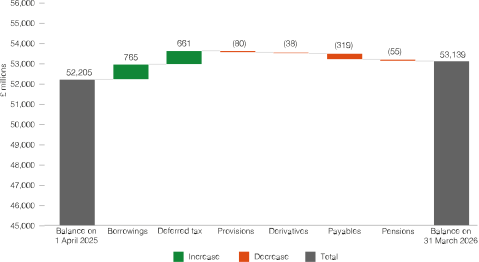
Figure 6: increase / (decrease) in liabilities during the year £ millions
Train operating companies (TOCs)
The Secretary of State contracts with 14 TOCs to deliver rail services for which she has statutory responsibility under the Railways Act. The Passenger Railway Services (Public Ownership) Act 2024 provides the legislative framework to bring these TOCs into public ownership. The transfer to public ownership is now in progress on a rolling programme as the existing contracts with commercial operators come to an end. DfT expects this will conclude by the end of 2027.
Government’s shareholding in publicly owned TOCs is held by DFTO, which is fully owned by the Secretary of State and therefore accounted for as a subsidiary of DfT, but is not consolidated into the DfT Group accounts (see note 1.3 for the full consolidation boundary). The following contracts transferred to DFTO during 2025 to 2026: South Western Railways in May 2025, c2c in July 2025, Greater Anglia in October 2025 and West Midlands Trains in February 2026. The Thameslink, Southern and Great Northern contract was transferred to DFTO in May 2026.
In parallel with the public ownership programme, DfT is establishing Great British Railways through the Railways Bill to merge responsibility for track and train operations into a single public body, aiming to improve service delivery and drive efficiencies.
Accounting and disclosure of train operating companies
DFTO and the TOCs are currently classified by ONS as public corporations. Under HMT’s financial reporting rules, they are therefore excluded from the annual statutory instrument which prescribes DfT’s accounting and budgeting boundary. A breakdown of DfT’s financial support in 2025 to 2026 to each TOC is provided in note 27, alongside a summary of each TOC’s own most recently published statutory financial results.
For TOCs not yet owned by DFTO, in some cases the most recent published financial results are those for the year-ending 2025. In addition, some TOCs not owned by DFTO apply the FRS 102 accounting framework rather than IFRS. For these reasons, the totals shown in note 27 should be considered as illustrative.
TOCs’ contracts with DfT to operate rail services are fixed term. The TOCs’ own financial statements include 2 significant accounting judgements which are material to their balance sheets, arising from the relatively short-term duration of TOCs’ operating contracts with DfT.
Firstly, TOCs do not recognise defined benefit pension surpluses and deficits under IAS 19 for their sections of the Railways Pension Scheme (RPS), reflecting that their operating contract terms are significantly shorter than the pension schemes’ duration.
Secondly, TOCs measure rolling stock lease liabilities and right-of-use assets over the shorter of the term of the lease and the term of their operating contract with DfT. Using management information, DfT estimates that gross right-of-use assets and lease liabilities are c. £10 billion, including c. £5 billion relating to DFTO’s publicly owned TOCs. DfT has also provided certain guarantees and indemnities to rolling stock lessors, disclosed as a remote contingent liability (see the parliamentary and accountability report), with further detail on leases and pensions outlined in note 27.
Future outlook
HMT’s SR25 secured a clear commitment to protect vital public transport services, maintain and renew our infrastructure and invest in the long-term future of our transport system. This plan will deliver improvements to roads, rail and local transport – and build for the future, supporting growth, housing and sustainability in every region.
Excluding HS2, which is presented separately in SR25 given the scale of the programme, capital DEL spending will continue to increase at an average real terms growth rate of 3.9% per year between 2025 to 2026 and 2029 to 2030. Resource DEL spending will be more constrained and decrease over the remaining period of this Parliament; this is in line with the wider government fiscal position and aligns with DfT’s intent to reduce the net subsidy on rail passenger services.
Looking beyond this SR period, this year DfT also set out plans for longer term investment through the government’s plans to unlock the potential of the Northern growth corridor. As part of this, Northern Powerhouse Rail (NPR) will build on the existing TRU, through a programme of new railways and railway upgrades to deliver a frequent and reliable turn-up-and-go railway service to cities across north of England, including Manchester, Bradford, Leeds, Sheffield and York.
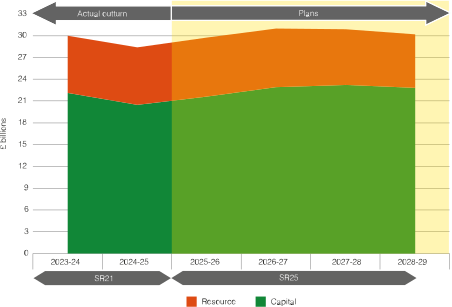
Figure 7: total net expenditure (exc. depreciation) split between capital and resource net expenditure
Barbara Bennett
Interim Director General, Corporate Delivery Group[footnote 1]
Performance overview
DfT has responsibility for ensuring that the transport system meets the needs of people today and in the future and ensures that it is safe and secure for all those who use it. DfT does this through its focus on its strategic outcomes, which are set out in detail in this report.
DfT also works to build resilience for issues which may affect the system, such as extreme weather events and pandemics. As part of delivering its strategic outcomes, DfT has a significant investment portfolio. For 2025 to 2026 DfT had a capital budget of £21.6 billion, a full policy agenda and a wide range of direct operational delivery activities, which are mainly delivered through its public bodies and additionally in the private sector.
DfT’s strategic framework
In 2024 to 2025, DfT refreshed its strategic framework in line with HMT’s planning and performance framework, establishing a set of strategic outcomes that articulate DfT’s long-term delivery ambitions. These outcomes provide the framework through which DfT plans, monitors and reports delivery, while aligning departmental activity with the government’s agenda and future spending review priorities.
These outcomes are interconnected and DfT recognises the natural cross-cutting nature of these outcomes. They are also supported by a suite of performance metrics to measure progress in delivering these outcomes, with the top-level metrics set out in the performance analysis section.
DfT makes transport better. That matters both for the role that transport plays in people’s lives, as well as transport’s critical role in this government’s work to deliver Britain’s renewal.
Communities thrive when transport is designed with the needs of people and places put first and foremost. Easy and affordable access to jobs, education and social activities makes us better connected. This is also the cornerstone of a growing and thriving economy. Progress is elaborated on in greater detail in the enhancing growth and place section.
Meanwhile, every encounter people have with transport services should be smooth, straightforward and predictable. People should be able to travel easily and reliably on an integrated transport system, with joined up local and national networks. So, whether catching a bus, applying for a driving licence or taking a train, DfT is making public services better. Progress is elaborated on in greater detail in the Improving Journeys for People section.
DfT is spearheading greener and healthier transport initiatives, such as the transition to electric vehicles and cleaning up aviation and maritime transport. All this will lead to a greener and healthier future for our communities, which can be a source of pride. Progress is elaborated in greater detail in the delivering green and healthy transport section.
DfT’s strategic outcomes are underpinned by crucial activity across its portfolio, in particular:
- enhancing security by strengthening transport resilience and building a more secure network together with operators and local and international partners
- sponsoring DfT public bodies to deliver across DfT: from carrying out driving tests, to coordinating safety at sea and growing active travel infrastructure
- embedding data, technology and innovation to drive productivity and efficiency, underpinned by research and development that accelerates innovation and scales new solutions across the transport system
- continuing to capture, share and apply project learning to strengthen future delivery, implementing the recommendations from the Stewart review – major transport projects governance and assurance review: the HS2 experience
DfT’s risk management
Risk management is an integral part of DfT’s work to deliver ministerial priorities. This includes how DfT manages its programmes and public money, develops policies and how it works with its ALBs and public bodies.
The climate and sustainability report and the accountability report contain details on DfT’s internal controls and risk management approach, they also set out the principal risks faced by DfTc during 2025 to 2026, DfT’s ‘Task Force on Climate-Related Financial Disclosures’ and ‘HMTs Orange Book Principles – comply or explain’ statements.
Performance overview: DfT’s ‘performance on a page’
Enhancing growth and place
Transforming transport infrastructure
- confirmed up to £45 billion funding envelope for Northern Powerhouse Rail, transforming connectivity between the key economic centres of the North
- published the third Road Investment Strategy (RIS3), our 5-year strategy for investment in and management of the strategic road network
Enhancing place through partnerships
- consolidated over 20 funding streams into a single flexible settlement, progressing English devolution, giving mayors greater control over transport prioritisation and investment
- received Royal Assent for The Bus Services Act, giving local leaders control over routes and fares, making it easier to put passengers first
Improving journeys for people
Integrated and affordable journeys
- published the Motor Insurance Taskforce’s report, tackling the high cost of motor insurance
- published the Better Connected strategy, underpinning the shift to more integrated transport
- froze rail fares and capped bus fares, benefiting over a billion journeys
Dependable journeys
- transferred 4 more train operating companies back into public ownership, as their contracts expired, paving the way for Great British Railways
- introduced the Railways Bill to Parliament, confirming intent to integrate infrastructure and a large number of passenger services under a single public body, Great British Railways
Accessible and inclusive journeys
- published Our roadmap to an accessible railway, setting out plans to improve the day-to-day travel experience of disabled passengers and others who require assistance
Safe journeys
- published the road safety strategy, setting a renewed national framework to reduce casualties and improve safety on our roads
Delivering green and healthy transport
Green transport
- published ‘Our Roadmap to an accessible railway’, setting out plans to improve the day-to-day travel experience of disabled passengers and others who require assistance
- rolled out over 119,000 more public chargers, rapidly unlocking access for drivers without off-street parking and accelerating the transition to zero-emission vehicles
Healthy transport
- committed almost £300 million to Active Travel England walking, wheeling and cycling schemes and the next strategic framework set through the launch of the Cycling and Walking Investment Strategy 3 consultation
Performance analysis
Strategic outcome: enhancing growth and place
Enhancing economic growth by transforming the transport system. We will do this by maintaining and renewing our existing roads and railways and developing new infrastructure, tailored to the needs and opportunities of different places and delivered through local partnerships.
Enhancing growth
Transforming transport infrastructure
In June 2025, DfT accepted the recommendations of an independent review led by James Stewart for improving the governance and assurance of major transport infrastructure projects, drawing on the experience of High Speed 2 (HS2). DfT has collaborated closely with the National Infrastructure and Service Transformation Authority (NISTA) and HMT, with the aim of achieving successful delivery of HS2 in the future as it undergoes a critical programme reset.
Additionally, DfT has worked with the NISTA and other government departments to ensure these lessons inform delivery across all major government projects. Following on from the review, DfT launched an internal implementation programme.
This programme focuses on systematically applying the learning to the DfT’s most complex projects such as Lower Thames Crossing and Heathrow Expansion, validated through independent assurance; resetting the DfT’s long-standing project delivery improvement programme to ensure learning is applied to all its current and future projects; and ensuring the findings are disseminated as widely as possible.
DfT’s connectivity metric sets out connectivity of places in England and Wales, measuring how easy it is for people to get to where they want to go. The metric is calculated for small local areas rather than just large regions and is a 0 to 100 index, with a score of 100 representing the most connected areas.
The regional comparison illustrates how connectivity in London is above the other English regions and Wales, due to factors such as more frequent public transport and a higher density of destinations. DfT’s decision to prioritise enhancing place-based transport decisions should be illustrated through this metric. The approach set out in Better Connected: a strategy for integrated transport in England is focused on improving connectivity across the transport system and strengthening the way it is measured and understood.
Alongside this, DfT’s English devolution agenda is enabling more decisions on transport planning and delivery to be taken at the local and mayoral level, supporting tailored approaches that reflect local needs and opportunities.
This is a newly developed metric. Therefore, all scores are subject to change and revision as improvements to the methodology are made and better versions of the underlying datasets (such as locations of services, employment data, timetables and transportation networks) become available. The connectivity metric will be reported annually.
The current figures shown in the table below were published in September 2025, showing connectivity levels in 2024. Publication of data for 2025 is planned for September 2026. Over time, the aim is to see all scores rising, particularly connectivity outside of London, reflecting increased productivity and enhancing growth. DfT also tracks connectivity specifically to employment (as a sub-connectivity metric) – the ease by which people can reach places of work using the transport network. This metric helps to understand how transport improvements are expanding skills to match productivity.
All metrics are designed to be informative in the relative sense – with scores becoming more insightful once DfT begins to track its progress over time to illustrate how effective its delivery plans have been in driving connectivity.
Table: DfT’s connectivity metric (overall sustainable travel)
| Area: | East Mids | East of England | London | North East | North West | South East | South West | West Mids | Yorkshire | England | Wales |
|---|---|---|---|---|---|---|---|---|---|---|---|
| 2024 | 59.15 | 57.76 | 83.94 | 64.00 | 66.89 | 60.45 | 55.65 | 63.71 | 62.73 | 64.78 | 52.70 |
Table: DfT’s connectivity metric (public transport to employment)
| Area: | East Mids | East of England |
London | North East | North West | South East | South West | West Mids | Yorkshire | England | Wales |
|---|---|---|---|---|---|---|---|---|---|---|---|
| 2024 | 52.72 | 53.13 | 89.05 | 55.51 | 61.80 | 55.51 | 47.77 | 58.48 | 56.6 | 60.78 | 45.23 |
Rail connectivity and major infrastructure
DfT is delivering the government’s ambition to improve the rail system and support the North’s role in the nation’s renewal. Major rail connectivity programmes, including the TransPennine Route Upgrade (TRU) and Northern Powerhouse Rail (NPR) will strengthen links between northern cities, improve capacity and reliability and support economic growth across the North’s core city regions.
TRU’s £11 billion programme is modernising the route between Manchester and York via Huddersfield and Leeds, enabling faster and more frequent passenger services, additional freight capacity, improved asset reliability and a better customer experience.
During the reporting year, the York to Church Fenton electrified section opened in August 2025, meaning 25% of the 70-mile route is now electrified. In September 2025, the Huddersfield Station blockade was completed, delivering major track, signalling and platform works to prepare the station for longer trains and improved reliability.
In October 2025, the £46 million Hillhouse Train Maintenance Centre opened in Huddersfield to support rolling stock across the corridor. Multiple blockades in 2026 have enabled the substantial rebuild of Mirfield, Dewsbury and Batley stations. Significant infrastructure upgrades including electrification have been progressed. Substantial enabling works for 4 future tracking upgrades have also taken place.
DfT is also progressing NPR to deliver faster, more frequent and more reliable services between major northern towns and cities, including Liverpool, Manchester, Leeds, Sheffield, Bradford and York.
In January 2026, the Secretary of State confirmed plans for delivery of NPR, with a government funding envelope of up to £45 billion and a 3-phase delivery approach as part of the northern growth strategy. £1.1 billion has been allocated in this Parliament for further design and development work, including resuming the adapted High-Speed Rail (Crewe–Manchester) Bill to secure powers for the section into Manchester via Manchester Airport.
DfT is working with mayors and local leaders across the North to develop the next stage of plans and is taking forward recommendations from the March 2026 National Audit Office (NAO) value for money review alongside lessons from the James Stewart review.
The government has also set out its long-term ambition to build a new line between Birmingham and Manchester as part of the northern growth strategy. This is not a reinstatement of HS2 Phase 2. DfT will undertake feasibility work with local partners to determine the scope and specification of what will be delivered.
East West Rail (EWR) will improve connectivity between Oxford, Milton Keynes, Bedford and Cambridge, supporting economic growth, housing and access to jobs, education and services.
In November 2025, the Secretary of State confirmed the next phase of the programme and committed £2.5 billion at the SR25 to progress the scheme beyond the Oxford–Bletchley section and into delivery of the central and eastern sections. EWR also published its ‘You Said, We Did’ report, setting out more than 80 design changes in response to consultation feedback, including proposals for 4 new consolidated stations on the Marston Vale Line.
A final consultation on the design proposals opened on 14 April 2026, alongside an accelerated delivery plan for parts of the route. Major infrastructure for the first stage between Oxford and Milton Keynes via Bicester has now been delivered and is operational for freight and charter services, completing the physical rail connection between Oxford and Bletchley for the first time in decades.
While passenger services have not yet opened to the originally expected timetable, phase 1 (formerly connection stage 1) of the delivery programme relates to services between Oxford and Bletchley / Milton Keynes and is the first phase of the wider EWR programme. Major construction was completed in June 2025 and freight services are now running on this section. DfT continues to work closely with Chiltern Railways and other partners to confirm a start date for the first EWR passenger services between Oxford and Milton Keynes.
Delivery also continues on HS2, which will provide additional capacity between London and Birmingham and support faster, more reliable services onwards to Manchester, Liverpool and Scotland. Following years of cost increases and delays, the government has taken action to bring the programme under control.
On 19 May 2026, the Secretary of State set out updated cost estimates and delivery timeframes, with the project now expected to cost between £87.7 billion and £102.7 billion in 2025 prices, this represents a stark increase on the previous cost range of £35 to 45 billion in 2019 prices, of which two-thirds of this expected cost increase were a combination of necessary works that were missed from the scope of the original project plan, under-estimation and inefficient delivery.
As of end of March 2026, 44.2 billion (nominal prices) had been spent on the HS2 programme. The first trains are expected to run between Old Oak Common and Birmingham Curzon Street between May 2036 and October 2039. The government has also confirmed that HS2 will operate at 320 km/h (200 mph), which could save up to £2.5 billion and reduce delivery time by at least one year.
Despite the reset, progress continues, with 6 major construction milestones delivered ahead of schedule during the year and all major deep-bore tunnelling between Old Oak Common and Birmingham completed in October 2025. HS2 is expected to support around £20 billion of economic growth over the next decade around station sites in the West Midlands and West London, alongside around 63,000 new homes and 49,000 new jobs.[footnote 2]
In June 2026, the NAO published a report on the HS2 reset, concluding that HS2 Ltd and DfT were making progress and taking a considered approach, but noting that significant work remained before the reset could be completed in 2027. DfT accepted all of the report’s recommendations and will take them forward as the reset progresses.
A critical element of realising HS2’s benefits is the redevelopment of the Euston Campus. In June 2025, the 10 Year infrastructure strategy confirmed that a Euston Delivery Company would be established to oversee development of the whole campus and that a public-private partnership model would be explored for delivery of the new HS2 station.
Early market engagement began in October 2025, followed by the first stage of preliminary market engagement on a public-private partnership model in February 2026. In March 2026, partners confirmed support for a single spatial plan and on 1 April 2026 the Euston Delivery Company formally assumed the leadership role for the campus as the single directing mind for the programme. Initially, the company will sit as a business unit within DfT as capability is built. DfT expect the company to be stood up as a public body in the autumn.
Road connectivity and major infrastructure
DfT’s road surface conditions metric measures the percentage of road in England where maintenance should have been considered. This is currently measured through Surface Condition Assessment for the National Network of Roads (SCANNER) surveys. SCANNER measures a series of parameters which are combined to give a road condition indicator score. These scores are grouped into 3 categories; red – should have been considered for maintenance, amber – may require maintenance soon and green – no further investigation or work is needed.
Local authorities have been required to provide DfT annually with the percentage of red road – should have been considered for maintenance and this is the current key metric for road condition. Over recent years the percentage has fluctuated for B and C roads but has overall remained relatively stable. The percentage of A road that should have been considered for maintenance had been stable but increased in 2024 to 2025.
DfT’s investment in highways maintenance is helping to fix and prevent millions of potholes across the country, with a £500 million uplift confirmed for 2025 to 2026 and a record £7.3 billion committed for local highways maintenance through to 2029 to 2030 to improve road conditions and network resilience. With 25% of the highways maintenance funding uplifts now conditional on local highway authorities publishing reports on the condition of their roads, how much they are spending to maintain them and whether they do so using best practice. This new framework directly links funding to demonstrable delivery.
In January 2026, DfT published red, amber or green road maintenance ratings for each highway authority, measuring how well they are maintaining their local roads. The ratings will be updated annually, providing an incentive to councils to improve, for example by investing more in preventative maintenance to ensure potholes do not form in the first place. Alongside this, DfT announced in January 2026 a dedicated support programme for red-rated authorities and extended its Live Labs 2 highways innovation programme to ensure authorities are supported in maintaining their roads in line with best practice.
In March 2026, DfT published Road Investment Strategy 3 (RIS3): 2026 to 2031, which sets out how the government will invest over £27 billion to make sure the SRN serves everyone. This includes £24.99 billion to operate, maintain, renew and enhance the network.
By March 2026, £1.6 billion of capital support had been deployed through the Highways Maintenance Block Fund (funding to local authorities to repair, maintain and improve local roads and highway infrastructure) and for the first time after a near-decade long decline, the percentage of roads receiving maintenance treatment has increased in 2025.
In July 2025, a review of the major road network (MRN) and large local majors (LLM) programme was announced to make sure the schemes in the programme were still needed, deliverable and affordable. The review considered 41 schemes and in spring 2026 DfT announced that 16 of these could continue in the programme, with construction expected to start by March 2029.
All schemes under review went through a rigorous and detailed assessment process which identified those schemes which would provide the widest range of benefits and best overall value for money for taxpayers. Decisions on the remaining schemes will be taken in due course.
In addition, during 2025 to 2026, the start of construction was announced for a number of schemes were announced to start construction including the A382 Drumbridges to Newton Abbot, Middlewich Eastern Bypass and North Hykeham Relief Road.
A reliable road network underpins economic growth by enabling the efficient movement of people and goods, supporting business productivity and access to markets. DfT has made targeted interventions such as the Kent resilience strategy, which strengthens freight and border resilience on the UK’s busiest international trade corridors that serve Dover and the Channel Tunnel.
Throughout 2025 to 2026, Operation Brock, which enables timely deployment and removal of resilience measures to minimise disruption to residents, businesses and freight operators was deployed on the M20 during peak cross-Channel travel periods. This maintained freight flows to the Port of Dover and Eurotunnel and prevented congestion from affecting Kent’s local road network.
It supported national supply chains during high-risk periods, while the Kent and Medway Resilience Forum, working with DfT and National Highways, maintained 24/7 border traffic monitoring and data-led decision-making to enable the timely deployment and removal of resilience measures, minimising disruption to residents, businesses and freight operators.
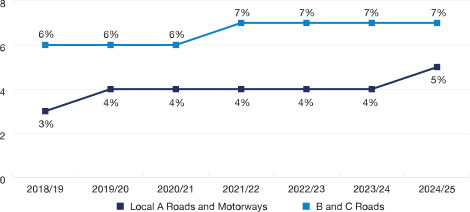
Figure: road surface conditions
DfT’s average delay on the SRN metric, shows that average delays on the SRN have increased year on year since 2020.
Prior to March 2020, the average delay on the SRN had remained relatively stable. Between late 2022 and 2024, average delay had been gradually increasing to above pre-pandemic levels. This correlates with the increase in economic activity.
Since the completion of the SMART motorway emergency area retrofit by National Highways in early 2025 there has been a decrease in average delay, which will appear in the 2025 to 2026 statistics.
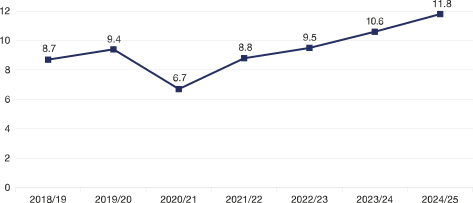
Figure: average delay on the strategic road network
This project is the most significant road building scheme in a generation; it will provide a significant boost to the UK economy and ease traffic pressures on the Dartford Crossing. At both the SR25 and the AB25, the government confirmed funding to complete the publicly funded works for the scheme which will enable the private sector to take forward construction and long-term operation.
Following approval of the development consent order (DCO) in March 2025, enabling and early construction works have begun. National Highways and its delivery partners have launched procurements for the tunnel boring machines and started ground investigations, utility surveys, ecological mitigation and site preparation across Kent and Essex, marking the project’s transition from planning into delivery. Work has been progressing over the year to implement the government’s preferred financing option using a regulated asset base (RAB) model.
Aviation and maritime connectivity and major infrastructure
Heathrow, as the UK’s busiest and only primary global hub airport, has the potential to further support economic growth, jobs, tourism and trade. In October 2025, DfT launched a review of the Airports National Policy Statement (ANPS) to ensure that any future decisions on Heathrow expansion properly reflect updated climate, environmental, noise and airquality obligations.
DfT committed to and has now published a revised draft ANPS for consultation, providing an uptodate policy framework for considering expansion. In November 2025, the government also confirmed that Heathrow Airport Limited’s third runway scheme would be taken forward as the scheme to inform the ANPS review, providing clarity for the next stages of work, prior to the consultation.
Ports are responsible for 85% of the goods that arrive in the UK by weight and in 2025 were designated a foundational sector in the UK’s modern industrial strategy, already delivering an average of £1 billion of private investment each year.
In 2025 to 2026 DfT took forward plans to remove barriers to ports’ growth and investment through consulting on an amended National Policy Statement that sets out the need for port development and the conditions that have to be satisfied for it to proceed. Many ports need a harbour revision order in order to develop. DfT has published a framework to enable applications to be prioritised where appropriate, including to support local economic activity.
Enhancing place through partnerships
DfT is improving places across the country by working with devolved administrations, local leaders and delivery bodies, giving local areas greater control over transport investment to support growth and reflect local priorities. Through its devolution agenda, DfT has transferred more powers, funding and accountability to strategic authorities, enabling locally led decisions on transport, housing and economic development.
Integrated settlements and devolution
In April 2025, integrated settlements were introduced for Greater Manchester and the West Midlands, bringing together over 20 funding streams into a single flexible settlement.
The government also confirmed that this approach will expand from 2026 to 2027 to additional authorities, including the North East, Liverpool City Region, West Yorkshire, South Yorkshire and the GLA. Alongside this, DfT has simplified local transport funding for all local transport authorities (LTAs), supporting greater local flexibility and strengthening place-based decision-making.[footnote 3]
Investing in city region transport
DfT is supporting local transport within city regions through £5.7 billion of City Region Sustainable Transport Settlements (2022 to 2027) and £15.6 billion of Transport for City Region Settlements (2027 to 2032). This funding supports major intracity transport improvements that drive growth, connectivity and regeneration.
A key example is West Yorkshire Mass Transit. West Yorkshire Combined Authority (WYCA) is developing a modern, high-capacity network to connect key centres, support regeneration and improve access to jobs and services. In January 2026, the government committed funding for West Yorkshire Mass Transit beyond 2032, underlining long-term support and aligning the scheme with the northern growth strategy and Northern Powerhouse Rail.
Given the programme’s scale and complexity, DfT has put in place bespoke sponsorship arrangements, alongside a Mass Transit Task Force to share best practice, tackle delivery barriers and support promoters of schemes, such as WYCA.
Supporting local transport across England
Outside city regions, DfT continues to support transport improvements in smaller cities, towns, villages and rural areas. In 2025 to 2026, DfT provided:
- £170 million through the Integrated Transport Block
- £28 million of revenue funding to local transport authorities outside major city regions
- over £220 million of Local Transport Grant funding for areas in the Midlands and North
- continued support for transport projects funded through the Levelling Up Fund, helping communities improve local connectivity, regenerate town centres and unlock economic growth
Following the SR25, DfT confirmed a further £2.3 billion of Local Transport Grant funding over the spending review period, to be included in consolidated local transport settlements from 2026 to 2027, helping places plan and deliver local transport priorities.
Empowering local areas through bus reform
DfT has continued to support local bus services through more than £1 billion of funding in 2025 to 2026, alongside longer-term funding commitments.
The Bus Services Act 2025 received Royal Assent in October 2025, delivering the most significant reform of England’s bus framework in a generation. The act enables place-based decision-making by giving local transport authorities greater control over routes, fares and service standards, allowing services to be shaped around local needs and priorities.
Authorities can now access new powers to pursue bus franchising, strengthen enhanced partnerships or establish local authority bus companies. DfT has published guidance to support implementation and will continue introducing regulations and guidance over the coming year, including measures to improve accessibility, safety and the transition to zero-emission buses.
Integrating transport, housing and regeneration
Alongside transport investment, DfT is helping to unlock housing growth and regeneration opportunities by integrating transport planning with wider development objectives. This includes the launch of Platform4, a new rail property development company, which will help unlock surplus railway land and support the delivery of up to 40,000 new homes over the next decade.
Strategic outcome: improving journeys for people
Improving the transport system to prioritise people’s needs, ensuring that journeys are seamlessly integrated and affordable, dependable, accessible, inclusive and safe. This will enable everyone to travel with confidence and convenience, while accessing work, essential services and opportunities.
Integrated and affordable journeys
Transport affects every aspect of daily life, connecting people to jobs, services and communities. DfT’s focus is improving end-to-end journeys by making them more integrated, affordable, dependable, accessible, inclusive and safe. These outcomes are being delivered through the commitments in Better Connected: a strategy for integrated transport and underpin this shift to more integrated journeys by providing a coherent, cross-modal framework that brings together rail, bus, road and active travel planning around the needs of people and places. Updated local transport plan guidance was published alongside Better Connected to support LTAs in developing integrated transport plans that deliver local transport needs in line with the government’s priorities.
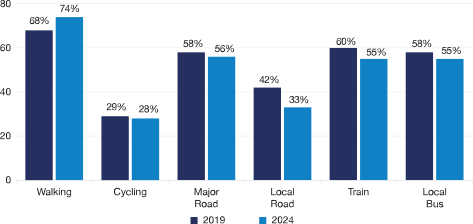
Figure: satisfaction with provision by mode
Progress towards improving transport for people is tracked in part through user satisfaction data from the National Travel Survey, which measures how well the transport system is meeting people’s needs. Satisfaction levels increased for walking, whilst satisfaction with cycling provision, major roads, local roads, trains and local buses showed a downward trend all to varying degrees.
In response, DfT is investing in the maintenance of local roads, supporting improvements to local bus services and delivering the commitments set out in Better Connected: a strategy for integrated transport in England to create more seamless and reliable journeys. Through these interventions, DfT is seeking to improve connectivity, strengthen transport resilience and deliver better outcomes for passengers, users and communities.
DfT made significant progress in 2025 to 2026 towards delivering more integrated journeys by laying the foundations for Great British Railways (GBR) and beginning the transition to a publicly led railway. By unifying track and train under one organisation, GBR will act as the directing mind for the sector, ending duplication and other inefficiencies to create a more agile and responsive railway. Over time, this is intended to make the railway simpler for passengers, with clear responsibility for service delivery and a better experience when journeys do not go as planned.
DfT published and concluded consultation on proposals for the Railways Bill and subsequently introduced the bill to Parliament. During 2025 to 2026, the bill progressed through key stages in the House of Commons.
The bill confirms the government’s intent to end fragmentation by legally integrating infrastructure and a large number of passenger services under a single public body. It sets out the final design for GBR as the guiding mind for track and train, with a clear focus on delivering reliable, safe and more affordable journeys, strengthening accountability, improving value for money for taxpayers and supporting the growth of rail freight.
Alongside legislative progress, DfT accelerated the programme to return passenger services to public ownership as contracts expired. Bringing passenger services into public ownership enables integration at a management level across track and train, supporting more passenger-focused planning and decision-making. South-Western Railway entered public ownership in May 2025, followed by c2c in July 2025, Greater Anglia in October 2025 and West Midlands Trains in February 2026, with further transfers scheduled through 2026 and 2027.
In parallel, DfT worked with the rail sector to modernise its workforce, supporting closer alignment between operators and infrastructure and strengthening the foundations for a more stable, skilled and passenger-focused railway as GBR is established. In 2025 to 2026, this included legislating for rail integration, lowering the minimum age to become a train driver from 20 to 18 and transferring more operators into public ownership.
DfT delivered the government’s manifesto commitment to tackle the high cost of motor insurance. Since its formation in October 2024, the cross-government Motor Insurance Taskforce has worked with government departments, independent regulators, the Competition and Markets Authority and the Financial Conduct Authority, to understand this market and agree a set of actions that aim to stabilise and reduce the premiums paid by drivers. The taskforce’s final report was published in December 2025.
The government will now continue its work to deliver against the actions set out in the report including addressing the broader factors that contribute to the cost of claims, such as vehicle theft and the cost of repairs. Although the cost of motor insurance remains high, the average premium dropped across 2025 and the latest industry data shows that premiums are stable. The average cost of cover in the first quarter of 2026 is £560, £20 lower than in the first quarter of 2025, a decrease of 3.6%[footnote 4].
DfT published ‘the government’s vision for buses and approach to delivery’ in April 2026. This outlined DfT’s vision for a bus service that is attractive to, accessible to and well used by everyone in the community; and where the needs and priorities of bus passengers are front and centre in the delivery of bus services.
DfT extended the £3 national bus fare cap in June 2025 as part of the SR25, with funding of £131.7 million, confirming that the cap would continue until March 2027. The cap also simplifies the system by providing a clear, consistent maximum price for single journeys, making fares easier for people to understand and compare across operators. This extension ensures millions of passengers continue to benefit from low-cost bus travel and confirmed new multi-year funding to support sustainable local bus networks alongside the reforms in the Bus Services Act 2025.
Those reforms are empowering local leaders to design bus services that better meet the needs of their local communities.
On rail, DfT has frozen rail regulated fares for a year from March 2026 for the first time in 30 years. This is expected to save existing passengers £600 million in 2026 to 2027 and benefit over a billion journeys. Alongside this, DfT has made progress reforming fares, ticketing and retail services. Contactless pay-as-you-go (PAYG) travel expanded to a total of 103 stations across the South-East. New GPS PAYG trials, using passengers’ mobile phones were launched on Northern and East-Midlands Railways.
Demand led simplified fare trials also continued on publicly-owned LNER. All of these initiatives have helped to reduce fare confusion and improve price transparency across multiple operators. DfT has also worked on fares and retail design, aligning policy, commercial and operational functions across DfT, Network Rail and public sector train operations. This work supports integrated fares and timetabling, simplified ticket types and consistent retail standards across the network.
Dependable journeys
DfT aims to deliver a transport network that gives people choice. Alongside structural reform through GBR (set out above), DfT has set outcomes for Network Rail in Control Period 7 (CP7), focused on asset condition, resilience and day-to-day performance, based on stable long-term funding and strategic direction to support a more reliable railway for passengers and freight users. The government remains committed to the CP7 funding settlement.
Further work included the East Coast Main Line where DfT supported Network Rail’s introduction of the largest timetable transformation in over a decade in December 2025, delivering faster journeys, additional capacity and more resilient service patterns.
A core metric for DfT and one most often felt by people on our rail network, is the percentage of planned trains which either did not run their full planned journey or did not call at all of their planned station stops (see the rail performance, GB cancellations metric).
DfT has further expanded upon this metric to include the percentage of trains arriving at recorded station stops within 3 minutes (see the rail performance, GB punctuality metric).
Cancellations (see the following chart) trended downwards over the last financial year ending March 2026 compared to the previous year. The total proportion of rail services lost due to cancellations and strikes since the start of financial year ending 2026 has more than halved compared with financial year ending 2023, which is likely a factor to the downward trend.
Punctuality (see the following chart) times peaked during the pandemic but have returned to pre-pandemic levels in the past 3 years.
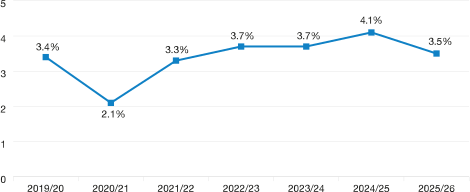
Figure: rail performance (GB cancellations)
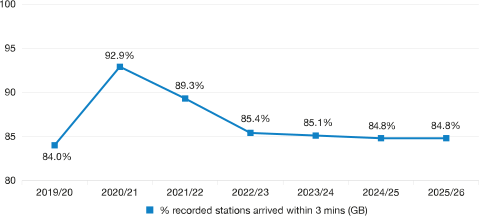
Figure: rail performance (GB punctuality)
Under public ownership and GBR, integrated leadership units combining track and train will allow for a whole system approach to improving performance across the rail network for passengers and customers.
By utilising resources more efficiently than under the current fragmented system, it will allow GBR to take advantage of greater resources in its approach to decisions, fixing problems, procurement, prioritisation, as well as delivering upgrades and enhancements. It will provide a platform to unlock and accelerate projects and generate greater long-term certainty and confidence too for the private sector supply chain partners.
In February 2026, Network Rail completed a major programme of testing and operational readiness activities for the European Train Control System (ETCS) on the East Coast Main Line between Welwyn Garden City and Hitchin. While this section of route represents a relatively small part of the wider programme, it provides an important testbed for the future deployment of digital signalling across a larger part of the network.
The year also saw continued progress in the transition to digital railway operations, building on the removal of conventional lineside signals on the Northern City Line in May 2025, which now operates fully under ETCS.
Delivery has not been without challenges, including the complexity of fitting in-cab signalling equipment to existing rolling stock and delays associated with the Retrofit Freight programme. These challenges have provided valuable lessons for future deployment and reinforced the importance of close collaboration across infrastructure managers and operators.
Together, this work is helping to build the capability, experience and operational readiness needed to support wider digital signalling deployment in the years ahead.
Accessible and inclusive journeys
DfT is committed to advancing fairness, accessibility and inclusion across the transport system.
As a ministerial department, DfT meets the requirements of the Public Sector Equality Duty (PSED) under section 149 of the Equality Act 2010.
Transport plays a vital enabling role in people’s lives. Ensuring that everyone can travel safely, affordably and with confidence is fundamental to a fair society.
DfT’s strategic plan reflects this responsibility by embedding equality considerations into all stages of policy development, investment decisions and delivery.
DfT works with industry, local authorities and passenger groups to understand the experiences and needs of those most affected by transport barriers, including women and girls, disabled people, older people, neurodivergent and those facing geographic or socioeconomic disadvantage.
The findings from this research directly shapes the commitments DfT makes to improve safety, accessibility and affordability across all modes of travel.
DfT’s strategic outcome to ‘improve journeys for people’ ensures that equality is not a standalone activity, but a core part of DfT’s investment, this is also in line with the PSED.
DfTs measures the percentage of all trips made by public transport directly from the National Travel Survey. The data (see the percentage of all trips made by public transport metric) indicates that the percentage of trips made by public transport dropped during the pandemic and remains below pre-pandemic levels, however it has increased year-on-year. Comparisons with pre-pandemic performance should be treated with caution, as travel patterns have changed significantly since 2020, with lower levels of regular commuting and a greater proportion of leisure travel affecting how the network is used.
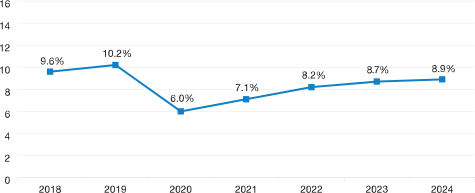
Figure: percentage of all trips made by public transport
DfT is working with disabled people, operators and regulators, to develop an accessible travel charter, setting clear expectations for barrier-free travel, consistent with the plans set out in Better Connected: a strategy for integrated transport, with an emphasis on people-focused, integrated networks.
DfT has also asked the Law Commission to undertake a review of transport accessibility legislation. This began in February 2026 and will review the current landscape and make recommendations for a simpler, clarified and more effective framework of rights to support disabled people and accessibility on transport, as part of DfT’s continued commitment to delivering the actions in the government’s response to the Transport Select Committee’s ‘Access denied’ report.
In November 2025, DfT published ‘Our roadmap to an accessible railway’, this sets out what DfT and the industry are doing between now and the stand-up of GBR to improve the day-to-day travel experience of disabled passengers and others who require assistance.
The roadmap is based around 7 priority themes and areas for improvement – including the accessibility of stations and trains, the reliability of services and key accessibility facilities in the rail industry and the way accessibility is understood and prioritised. It includes 31 actions to deliver improvements to infrastructure, information, staff training and the extension of welcome points at stations.
On aviation, DfT convened and published the Aviation Accessibility Task and Finish Group’s report in July 2025, securing a sector wide plan to improve aviation accessibility through better staff training, clearer passenger information, improved handling of mobility aids and stronger complaint pathways.
The Civil Aviation Authority (CAA) continued their oversight through its airport accessibility framework, improving transparency and accountability across the sector and supporting continued improvements in accessibility services for disabled passengers.
DfT’s satisfaction of disabled and older users on bus journeys metric[footnote 5] measures satisfaction with bus journeys among disabled people and those aged 60 or older, showing a rise in overall satisfaction across all ages and across disabled and non-disabled passengers between 2023 to 2024 and 2024 to 2025.
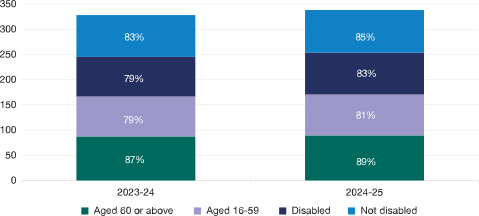
Figure: satisfaction of disabled and older users on bus journeys
For bus services, the Bus Services Act 2025 introduces statutory levers to embed and strengthen considerations of accessibility and personal safety at local authority level. These include requirements for local authorities to publish bus network accessibility plans, to consult disabled people when introducing or varying franchising schemes or introducing enhanced partnerships, where the authority and operators jointly agree improvements.
This is backed by a legal framework, and to ensure drivers and passenger-facing staff of local bus operators complete both disability awareness and assistance training. The act also requires authorities to have regard to new statutory guidance on the safety and accessibility of bus stops and provides enhanced powers to protect socially necessary routes.
Rail infrastructure improvements are being delivered through the long-running ‘Access for All’ programme, which supports step-free access and improved accessibility at stations across Great Britain. The programme funds the creation of obstacle-free routes from station entrances to platforms, typically through lifts or ramps alongside associated station improvements.
Since its launch, over 270 stations have completed accessibility upgrades, including 35 since April 2024, with further schemes continuing to be delivered. The programme remains active, with investment prioritised through a pipeline of feasibility and design work. Following recent feasibility studies across 50 additional stations, 8 stations were approved to proceed to delivery and a further 23 progressed to detailed design in January 2026, ensuring continued expansion of step-free access across the network.
DfT is playing a central role in tackling violence against women and girls (VAWG) by shaping safer transport environments and working with operators, local authorities and policing partners to prevent harm.
In 2025 to 2026, DfT set out 9 commitments under the cross-government strategy ‘Freedom from violence and abuse’ and convened a ‘Safer Streets, Safer Transport’ summit in Manchester with Greater Manchester Combined Authority, bringing together local leaders and operators to share practice and strengthen action on antisocial behaviour and safety on the network.
Evidence published in February 2026 from the Personal Safety on Transport survey (c.4,900 respondents) highlighted that while most people report feeling broadly safe using public transport, perceptions vary significantly by gender and age, with young women reporting the lowest levels of confidence.
The research also found high levels of antisocial behaviour impacting perceptions of safety, alongside under-reporting of incidents. DfT is now working with partners to translate these findings into targeted interventions across the transport system.
On the railway, DfT has commissioned Network Rail to develop the Visual Connectivity Platform, which will link station CCTV systems directly to the British Transport Police, improving the speed and effectiveness of incident response and investigations.
Alongside safety reforms, DfT has continued to prioritise operational recovery and digital transformation across its delivery agencies. The Driver and Vehicle Standards Agency (DVSA) increased driving test capacity to 1.99 million tests in 2025 to 2026, up 159,000 on the previous year, supported by additional examiner recruitment and efficiency measures.
The Driver and Vehicle Licensing Agency (DVLA) has progressed its Evolve programme, integrating digital identity services, expanding online driver services and introducing secure digital licence functionality through GOV.UK Wallet preparations.
DVLA also implemented the new Drivers Medical Service Platform in March 2026 and continued the migration of existing services to cloud-based infrastructure. These reforms are intended to improve resilience, reduce backlogs and deliver a simpler, more efficient customer experience over time.
Safer journeys
In January 2026, DfT published the first road safety strategy in over a decade. The strategy sets an ambitious target to reduce the number of people killed or seriously injured on British roads by 65% and 70% for children under 16, by 2035. This target will focus the efforts of road safety partners across Britain, with measures to protect vulnerable road users, update vehicle safety technologies and review motoring offences.
The current rate of people killed or seriously injured (KSI) is illustrated in the chart below, which shows the KSI rate has decreased year on year for the last 2 recorded years. DfT continued to drive forward implementation of the Automated Vehicles Act 2024, launching 2 calls for evidence to shape safety principles and the future regulatory framework, consulting on both the protection of marketing terminology and the new automated passenger services (APS) permitting scheme.
DfT published a suite of non-statutory guidance to support the APS scheme and the government response to the APS consultation. The associated statutory instrument came into force in May 2026.
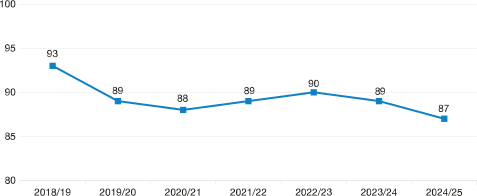
Figure: rate of people killed or seriously injured per billion miles travelled across all reported road casualities
DfT took action in response to Baroness Casey’s national audit on group-based child sexual exploitation and abuse, which included a recommendation for the taxi and private hire vehicle sector to promote passenger safety. The government response committed to addressing the issues raised and ensuring the public is protected wherever they travel.
To help address the issues Baroness Casey identified, DfT obtained powers through the English Devolution and Community Empowerment Act 2026 to enable government to set robust safety standards nationally and give licensing authorities enhanced enforcement powers for vehicles operating in their areas.
In November 2025, DfT, supported by National Highways, launched its first THINK! drug driving campaign in a decade, coordinated with police enforcement over the festive period and targeted at high-risk cohorts and locations using collision and force data.
Through the use of a bold creative approach, the campaign was one of THINK!’s most impactful campaigns in recent years, with 72% of the target audience of young male drivers recognising the campaign. There was a +7 percentage point increase in those who understood drug driving can lead to a criminal record and 40% of those who saw the campaign said they changed their own behaviour when it came to driving and drug use.
In maritime, DfT continued the transition to the second-generation aerial search and rescue contract (SAR2G). Alongside this progress, additional aircrafts have been added with new fixed wing bases opening in Newquay in April 2025 and Prestwick in June 2025, a nationally deployable mobile ground station with supporting unmanned aerial vehicles (UAVs) in December 2025. Finally, new seasonal helicopter bases were opened in Carlisle and Oban for the busiest months of the year.
In the rail sector, DfT also acted to maintain the UK’s world-leading rail safety record, while driving more proportionate and cost-effective approaches to safety management. In November 2025, DfT published its new vision for the railway, which included updated rail safety priorities, challenging established standards and ways of working where evidence showed the same or better safety outcomes could be delivered more efficiently.
Strategic outcome: delivering green and healthy transport
Delivering greener transport to cut emissions, improve air quality and boost public health, supporting walking, wheeling and cycling and strengthening climate resilience.
Healthier transport
DfT has also continued to encourage more journeys to be taken by alternative healthier modes of transport. By continuing to expand its active travel agenda, DfT aims to make walking, wheeling and cycling a safe, easy and accessible choices for everyone.
DfT committed almost £300 million in 2025 to Active Travel England walking, wheeling and cycling schemes, with final long-term active travel allocations published in December 2025 and the next strategic framework set through the launch of the Cycling and Walking Investment Strategy 3 (CWIS3) consultation in November 2025. The strategy was published in June 2026.
The CWIS3 sets out a target for 55% of all short stages in towns and cities to be walked, or cycled by 2035. This is underpinned by statutory objectives to enable more physical activity through active travel, to make active travel the easy and integrated choice and to improve safety.
DfT’s active travel metric measuring the average number of walking, wheeling and cycling travel ‘stages’ (i.e. segments of a journey) taken per person, per year (see the chart below), illustrates DfT’s focus on delivering healthy transport options for people, with walking and wheeling as a travel stage increasing year on year since 2021 to 2022.
Walking and wheeling stages have increased over the last 3 years, whilst cycling as remained static, which is in line with overall trends in personal travel returning towards pre-pandemic levels. Since 2020, walking and wheeling has represented a slightly higher share of personal travel than pre-pandemic and DfT will continue to monitor and assess the effectiveness of its policies when considering the longer-term trend.[footnote 6]
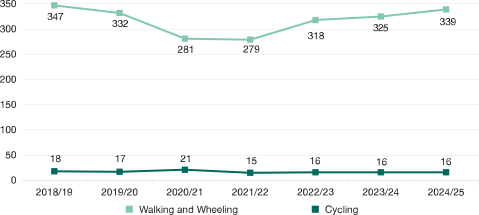
Figure: active travel: walking, wheeling and cycling stages
Green roads and streets
(See also the climate and sustainability report: sustainable development goal (SDG) 3: good health and wellbeing, SDG 8, decent work and economic growth, SDG 11: sustainable cities and communities and SDG 13: climate action).
The transport sector faces a major challenge as it remains a leading source of greenhouse gas emissions and air pollutant emissions, while climate change places growing pressure on network resilience.
One of the areas where this is felt most directly is on Britain’s roads and streets, where road transport accounted for 90% of total UK domestic transport greenhouse gas emissions and 68% and 82% of total UK domestic transport emissions of nitrogen oxides (NOx) and primary fine particulate matter (PM2.5) emissions respectively in 2024.
The government remains committed to transitioning to vehicles that are zero emission at the exhaust, supporting cleaner air, DfT’s net zero and carbon budget targets and UK growth. In 2025, zero emission vehicles (ZEVs) accounted for 22.9% of UK new car sales, up from 19.1% in 2024, with the ZEV market growing 23.9% year on year.
DfT’s metric on the percentage of the overall UK vehicle fleet that is zero emission (see the following chart) captures licensed road-using vehicles at the end of June each year, including buses, coaches, cars, goods vehicles, motorcycles and other vehicles.
DfT worked with manufacturers to support the ZEV transition. The ZEV Mandate continued to drive supply, with both car and van markets over-complying in the 2024 scheme year through ZEV sales and flexibilities.
Final 2024 compliance information was published in March 2026 and DfT enhanced flexibilities to support consumers and the automotive sector Backing British business: Prime Minister unveils plan to support carmakers – GOV.UK.
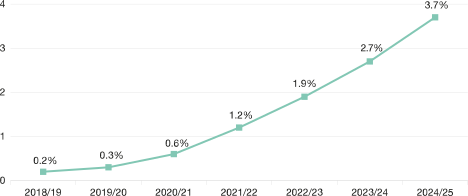
Figure: percentage of overall fleet that is ZEV
DfT supported drivers through the Electric Car Grant, which increased to £2 billion at AB25 and had benefited nearly 100,000 consumers by year-end. To strengthen demand, DfT launched an EV communications campaign in January 2026 to promote EV ownership and address misconceptions about range and running costs.
DfT also progressed the ZEV transition for commercial businesses. The Depot Charging Grant Scheme was piloted in 2025 to 2026 and Plug-in Truck Grant rates were temporarily increased in January to March 2026. In March 2026, DfT announced a £1 billion multi-year package of Zero Emission Truck, Van and Depot Charging grants, alongside a January to March 2026 consultation on a future zero emission HGV regulatory framework. DfT is analysing responses and will publish its response in due course.
Public charging infrastructure continues to expand, with more than 119,000 public EV chargers installed as of 1 April 2026, an increase of 13,309, or an average of 36 per day, since 1 April 2025.
Through the Local EV Infrastructure (LEVI) Fund, DfT is supporting local authorities and industry to improve charger availability for drivers without off-street parking. LEVI funding, alongside private investment, will support at least 100,000 local chargers. As of 31 March 2026, all requested LEVI capital funding had been paid, with £337 million paid to 81 projects.
LEVI delivery is supported by the LEVI Capability Fund and EV Infrastructure Support Service, which help local authorities plan, procure and deliver local chargers and will remain available until March 2029.
In July 2025, the electric vehicle pavement channel grant was launched to help residents without off-street parking charge at home using cheaper domestic tariffs. DfT also provided funding for NHS England to install charge points across 200 NHS sites, helping electrify the UK’s second-largest fleet and continues to offer home and workplace grants, simplified in April 2026.
There are now over 6,400 open-access rapid and ultra-rapid chargers within one mile of the SRN, more than quadrupling between July 2022 and October 2025. DfT has worked with industry, connection providers, motorway service area operators, charge point operators and National Highways to target support where needed most on the SRN, including:
- improving provision at motorway service areas with high connection costs
- modernising EV charging signage
- launching a £10 million fund for innovative technologies, including battery storage, to support charge point rollout
- accelerating deployment in areas with low or no provision
DfT continued to decarbonise the English bus fleet. In March 2026, DfT announced £73.2 million in additional zero-emission bus (ZEB) funding to support 484 ZEBs across 10 projects in England, including £38 million announced in April 2025 for an additional 319 ZEBs through the Zero Emission Bus Regional Area programme.
The Bus Services Act 2025 will require operators to transition away from non-zero emission buses on local routes in England, with implementation from 2030 onwards to allow a smooth transition.
Although increasing the fleet of ZEVs will reduce air pollution, emission of brake, tyre and road wear will continue to persist. In 2025, DfT published its multi-year research on the measurement of emissions from brake and tyre wear. DfT is using the findings to lead development of internationally harmonised brake and tyre wear emissions regulations through the United Nations Economic Commission for Europe, targeting adoption by November 2026.
DfT also supports low carbon fuels through the Renewable Transport Fuel Obligation (RTFO), which requires fuel suppliers to supply an increasing proportion of low carbon fuels to support greener transport. In 2025, DfT undertook a statutory review of the RTFO and committed to consult on key aspects in due course. https://www.gov.uk/government/calls-for-evidence/rtfo-statutory-review-and-future-of-the-scheme.
Green rail
(See also the climate and sustainability report: SDG 3: good health and wellbeing and SDG 13: climate action).
Rail is a comparatively green transport mode, accounting for 1% of UK transport CO2e emissions in 2024 and 2% of NOx and primary PM2.5 emissions in 2023. Increasing passenger and freight shift to rail can further reduce GHG emissions and environmental impacts.
Rail electrification is expanding, supported by improved battery technology to increase electrified journeys. DfT has funded major programmes, including £345 million for the TRU.
DfT will maintain air quality monitoring at up to 72 stations until March 2030, with operators implementing air quality improvement plans, including reduced idling and improved ventilation.
The Railways Bill (November 2025) supports rail freight growth through a statutory duty to promote freight, a legal requirement to set growth targets and embed decarbonisation in system-level decisions.
In February 2026, DfT backed Network Rail’s long-term control of Barking Eurohub, unlocking c.£15 million of private investment to enable cross-channel rail freight and shift freight from roads.
Green maritime
(See also the climate and sustainability report: SDG 3: good health and wellbeing and SDG 13: climate action).
Domestic and international shipping accounted for 6% of UK transport CO2e emissions in 2024 and 33% of transport NOx emissions in 2023. DfT is advancing greener maritime outcomes through a clear decarbonisation pathway, support for clean shipping innovation and management of legacy environmental risks.
The maritime decarbonisation strategy (March 2025) sets targets to reduce domestic maritime emissions by 30% by 2030 and 80% by 2040, reaching net zero by 2050 (against a 2008 baseline). Delivery will be driven by key measures including emissions pricing and fuel regulation.
Progress this year includes expansion of the UK Emissions Trading Scheme (ETS) to domestic maritime from July 2026. In January, the UK ETS Authority finalised the scheme’s technical design, published its consultation response and laid legislation across all 4 legislatures.
DfT’s ALBs are also contributing. In December 2025, the Northern Lighthouse Board took delivery of a £51.8 million replacement for its Pole Star vessel, funded through the General Lighthouse Fund. The diesel-hybrid vessel improves environmental performance and operational efficiency, supporting statutory safety and environmental responsibilities.
In September 2025, DfT announced a further £448 million for the UK SHORE programme (2026 to 2030), building on £240 million invested since 2022. This has supported over 200 projects and leveraged more than £110 million in private investment, with further funding competitions planned.
Greener aviation
(See also the climate and sustainability report: SDG 3: good health and wellbeing, SDG 8: decent work and economic growth and SDG 13: climate action).
Domestic and international aviation accounted for 25% of UK transport CO2e emissions in 2024 and, in 2023, 32% of NOx and 9% of primary PM2.5 emissions. DfT continues to support the transition to greener aviation while enabling sustainable sector growth.
DfT progressed the government’s commitment to increase sustainable aviation fuels (SAF). The SAF mandate came into force in January 2025, requiring an initial 2% blend. The mandated targets require 11% of jet fuel to SAF by 2030 and 28% by 2040. Early delivery has been confirmed in August 2025’s statistics and supported by compliance guidance published in January 2026. The Sustainable Aviation Fuel Act 2026 received Royal Assent in March 2026, providing long-term revenue certainty for SAF production.
Internationally, DfT has continued to influence global aviation decarbonisation through its role at the International Civil Aviation Organization (ICAO). At the 42nd Assembly in 2025, the UK supported reaffirmation of commitments to net zero international aviation emissions by 2050, alongside Carbon Offsetting and Reduction Scheme for International Aviation (CORSIA) and a global ambition to reduce emissions through SAF uptake. UK support for capacity building and access to finance for decarbonisation projects has been key to enabling developing countries to contribute to these goals.
Domestically, DfT and the CAA have accelerated airspace modernisation through the airspace modernisation programme. Progress includes publication of the airspace modernisation strategy deployment plan (August 2025), establishment of the UK Airspace Design Service and operational improvements such as Pairwise at Heathrow to reduce fuel burn. These measures support more efficient, quieter and lower-emission operations while preparing for future technologies.
The Jet Zero Taskforce continues to address barriers to aviation decarbonisation, bringing together government and industry. In 2026, it published independent reports on SAF, greenhouse gas removals, contrail mitigation and hydrogen. DfT has also committed up to £43 million through the Jet Zero R&D Programme to support zero-emission aircraft and innovation, including a UK contrail avoidance trial.
Meeting environmental objectives
(See also the climate and sustainability report: SDG 3: good health and wellbeing, SDG 8: decent work and economic growth, SDG 11: sustainable cities and communities, SDG 13: climate action and SDG 15: life on land and ‘sustainable procurement’).
In December 2025, DfT published the climate adaptation strategy for transport (CAST) which supports the transport system to adapt to the impacts of climate change. Throughout the year, DfT provided practical tools and guidance to help transport operators including climate risk assessment guidance, transport hazard summaries and an online tool housing best practice adaptation solutions.
CAST acts as the flagship policy under the third National Adaptation Programme (NAP3). The strategy supports the transport system as it prepares for the impacts of climate change by setting out long-term strategic direction, including actions to implement climate resilience standards and to develop stronger adaptation objectives for transport. It also mainstreams adaptation into planning and processes, whilst strengthening the evidence base through funding research and guidance. This was supported by targeted work with operators over the year to improve incident readiness and contingency planning, alongside continued investment to protect critical national transport assets and services.
With transport as the UK’s largest emitter of greenhouse gas (GHG) emissions, decarbonising the sector is key to achieving its contribution to the UK’s legally binding carbon budget and net zero targets. In October 2025 the government published the carbon budget and growth delivery plan, which sets out plans for reducing emissions from all sectors, including transport, in line with legislated carbon budgets 4 to 6.
One of DfT’s core metrics to measure progress against this outcome is GHG emissions from all domestic transport and international aviation and shipping bunkers, measured in million tonnes of CO2 equivalent (see the chart below). This metric has seen an 8% decrease between 2019 and 2024, due to several factors such as improvements in new car fuel efficiency and lower traffic growth.
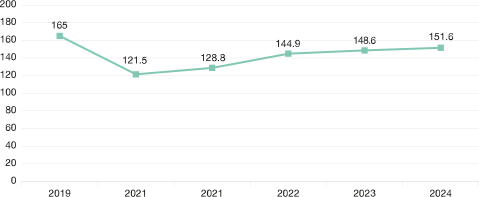
Figure: GHG emissions (MtCO2e)
DfT’s metric on air quality measures the percentage change in annual PM2.5 emissions from transport compared to a baseline level of emissions in 2005 (see the chart below). This metric has decreased meaningfully from the baseline, largely due to increased vehicle emissions standards that have dramatically reduced exhaust emissions of PM2.5.
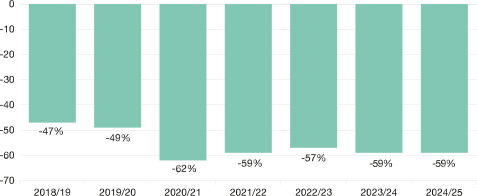
Figure: percentage change in annual PM2.5 emissions from transport (from a 2005 baseline)
The government’s statutory Environmental Improvement Plan published in December 2025 sets the long-term framework for improving air quality and reducing transport emissions. While GHG emissions from transport have fluctuated in recent years, long-term progress in reducing pollutants such as PM2.5 demonstrates the impact of sustained vehicle emissions standards and regulatory measures. The EIP provides the strategic direction for further action across road transport, supporting continued improvements in air quality and progress towards net zero.
DfT’s work adopts a cross-modal approach to biodiversity conservation, consistent with its duties under the Environment Act 2021, shared across all public authorities and reflecting a proactive commitment to integrating ecological sustainability into transport infrastructure, including through the application of biodiversity net gain requirements in relevant schemes.
DfT continues to maintain a strong focus on safety and environmental protection at the SS Richard Montgomery wreck. DfT published its latest annual survey report in October 2025, based on a detailed condition survey undertaken in July 2025. This evidence base continues to inform proportionate and evidence led risk management approach, ensuring that risks to coastal communities, navigation and the marine environment are actively managed.
DfT has strengthened its understanding of the potential impacts of a detonation through updated blast modelling and technical analysis, supporting more transparent engagement with stakeholders and Parliament, including recent debate on mast reduction and the balance with heritage considerations. A coordinated risk mitigation approach has been put in place, including a restriction of flying over the wreck site to complement existing maritime controls, developed in close collaboration with government and regulators. Alongside this, DfT has progressed delivery of the mast removal project through procurement and mobilisation of a specialist salvage contractor and commissioned further work on post-removal risk reduction and long-term site management, while maintaining close engagement with the United States government to ensure alignment.
Enabling our success
DfT’s transformation
The need for departmental transformation was highlighted in the Chief Secretary to the Prime Minister’s Move fast and fix things speech in January 2026 and reinforced in the Cabinet Secretary’s first message to the civil service in February 2026, which encouraged departments to sharpen our focus on delivery, leadership, innovative ways of working and remove barriers that stop people doing their best work. DfT has made a deliberate decision to transform how it operates by strengthening clarity of purpose, leadership, capability and culture to improve pace, focus and delivery. This approach reflects DfT’s own assessment of what is required to be fit for the future and aligns with wider Civil Service ambitions to modernise, innovate and remove barriers to delivery.
A refreshed DfTc People Strategy (for 2026 to 2030) will, for 2026 to 2027 provide a single framework to strengthen leadership, capability and culture, supporting delivery and longer-term resilience. This is supported by ongoing modernisation of technology and people systems, including the move towards more integrated, shared services that improve efficiency, consistency and access to workforce insight. Workforce changes linked to Great British Railways, including staff transfers, estate consolidation and increasing the number of colleagues based in Birmingham and Leeds, will reshape DfT ahead of 2027 and align with the government’s ambition for a more productive, agile and locally connected state.
Reshaping workforce and workplace
2025 to 2026 was a year of significant organisational transformation. DfT reshaped its workforce to align capability with ministerial priorities while operating within tighter financial constraints. Key achievements included:
- delivering an 8% workforce reduction through a voluntary exit scheme
- preparing rail services teams for transfer to the DfT Operator Company ahead of the establishment of Great British Railways
- supporting redeployment and internal mobility through a redeployment-first recruitment approach, helping to mitigate redundancies
- continuing progress against Places for Growth, increasing the proportion of roles, including senior leadership roles, based outside London
Alongside workforce restructuring, DfT strengthened leadership capability through refreshed leadership standards, a new leadership and line management curriculum, enhanced management tools and the introduction of 360-degree feedback for Senior Civil Servants.
Learning leadership and talent
DfT continued to invest in leadership, skills and future talent despite a challenging operating environment. During the year, staff participated in the Civil Service’s ‘One Big Thing’ programme on the responsible use of AI, while work began to strengthen compliance with mandatory learning through improved governance and reporting.
Career development remained a priority through departmental and Civil Service talent programmes, succession planning for grades 6 and 7 staff and an expanded apprenticeship offer covering 25 programmes. DfT also hosted 20 summer interns and welcomed participants through the Movement to Work scheme, helping to build future talent pipelines in priority professions.
Employee experience
DfT strengthened its commitment to inclusion and wellbeing during 2025 to 2026. Major milestones included:
- publication of a new 3-year equality, diversity and inclusion strategy
- a reduction in the mean gender pay gap from 4.3% to 3.4%
- expansion of mental health support, including additional Mental Health First Aiders and Mental Health Skills for Managers training
- introduction of key workforce policies, including neonatal care leave and pay
The Learning and Development theme score in the Civil Service People Survey decreased by 5 percentage points to 53%, with 41% of colleagues reporting that they see opportunities to develop their career. These perceptions are likely influenced by workforce restructuring and recruitment controls during the year. Strong leadership and management capability remains central to DfT’s transformation, with 2025 to 2026 focused on laying foundations through refreshed leadership standards, an updated leadership and line management curriculum, new line management tools and a 360-degree feedback requirement for SCS. These changes guided by the new People Strategy, position DfT to deepen leadership capability in 2026 to 2027, supported by continued embedding of Civil Service line management standards, alongside executive coaching, professional development and cross government SCS line management accreditation. These activities laid firm foundations for consistent, effective leadership and line management, recognising their critical role in enabling delivery, supporting staff through change and strengthening accountability during sustained transformation.
A secure and resilient transport system
A secure and resilient transport system underpins economic confidence, public trust and national resilience by enabling the safe and reliable movement of people and goods. In 2025 to 2026, DfT focused on strengthening transport resilience and security in partnership with operators, local authorities and the wider sector to better prepare for disruption and improve recovery when incidents occur.
DfT worked with the Cabinet Office and other stakeholders to develop and plan against Reasonable Worst-Case Scenarios under the UK National Security Risk Assessment, including participation in Exercise PEGASUS, the UK’s largest-ever tier 1 pandemic preparedness exercise (Sep to Oct 2025), testing national response capability. Learning from exercises and real incidents remains central to improving preparedness, response and recovery. As lead government department for the Huntingdon Station Incident (Nov 2025), DfT was commended for its adaptive cross-government coordination and situational awareness. It also assessed sector capabilities to identify resilience strengths and gaps, which will be addressed through implementation of the UK government resilience action plan.
International security pressures also shaped resilience planning in 2025 to 26, with ongoing conflicts in Ukraine and the Middle East highlighting vulnerabilities in global transport networks to geopolitical shocks. DfT’s support for Ukraine, aligned with the UK–Ukraine 100-year partnership (Jan 2025), includes transport planning support, expertise to help modernise and safely reopen airspace and negotiation of a new air services agreement, while also drawing lessons to strengthen UK resilience.
DfT has also supported the government’s response to the Middle East conflict through the Prime Minister’s Middle East Response Committee, monitoring impacts on transport networks and mitigating risks, including those affecting critical routes such as the Strait of Hormuz, while aligning with efforts to restore stability, diplomatic resolution and freedom of navigation.
Science, innovation, data and AI
2025 to 2026 saw significant progress in embedding innovation, data and artificial intelligence into transport policy and operations. Key achievements included:
- deploying AI pilots that delivered measurable savings and improvements in fraud detection, consultation analysis and correspondence handling
- publishing the transport data action plan, setting a long-term vision for transport data across government and industry
- launching new rounds of the Transport Research and Innovation Grant (TRIG) programme to support emerging transport technologies
- delivering improvements to nationally significant data services, including the Bus Open Data Service, National Public Transport Access Nodes, digital traffic regulation orders and the foundations of the National Parking Platform
DfT also continued to strengthen the evidence base for transport decisions through appraisal reform, transport modelling improvements and major evaluations, including analysis demonstrating the benefits delivered by the Elizabeth line.
Climate and sustainability report
As one of government’s largest landholders and as the department responsible for a transport system that underpins economic growth, connectivity and daily life, DfT plays a significant role in addressing climate change and supporting sustainable development.
During 2025 to 2026, DfT has continued to embed sustainability across its policy, delivery and corporate activity. This includes progressing decarbonisation across transport modes, strengthening climate adaptation and resilience and improving environmental performance across its estate and operations. These actions support delivery of the UK’s legally binding carbon budgets, the net zero target and wider environmental commitments.
UN sustainability development goals (SDGs)
The 2030 Agenda for Sustainable Development is a historic global agreement to eradicate extreme poverty, fight inequality and injustice and leave no one behind. Agreed at United Nations in 2015, the 17 sustainable development (SDG) goals succeed the Millennium Development Goals (MDGs). The SDGs are universal, with all signatories expected to contribute to them internationally and deliver them domestically.
The UK was at the forefront of negotiating the SDGs and will be at the forefront of delivering them. The UK lobbied hard to make sure the SDGs support the continuation of work undertaken through the MDGs.
DfT is directly working towards contributing to the achievement of the following 7 goals:
- SDG 3: good health and wellbeing
- SDG 4: quality education
- SDG 8: decent work and economic growth
- SDG 9: industry, innovation and infrastructure
- SDG 11: sustainable cities and communities
- SDG 13: climate action
- SDG 15: life on land
SDG 3: good health and wellbeing
More information can be found in delivering green and healthy transport.
Poor air quality remains a significant public health risk, with disproportionate impacts on low-income communities. The government’s 10-Year Health Plan (July 2025) reaffirmed DfT’s role in improving health outcomes through greener transport, including decarbonisation, deployment of clean technologies across all modes and investment in active travel. The Environmental Improvement Plan (December 2025) sets out a programme of transport air pollution reduction measures to support delivery of national targets, with progress reported annually by Defra.
DfT also supports improved health outcomes by enabling more active travel. Investment in infrastructure, road safety and transport integration makes it easier for people to incorporate walking, wheeling and cycling into everyday journeys. Alongside this, DfT is working with local authorities, regulators and other government departments to reduce the health and wellbeing impacts of transport noise.
DfT remains committed to reducing the impact of transport on water quality. Building on RIS2 (2020 to 2025) and the interim settlement (2025 to 2026), RIS3 (2026 to 2031) sets clearer expectations, with detailed mitigation measures to be confirmed in National Highways’ delivery plan. DfT expects continued delivery of the 2030 water quality plan, including new or upgraded treatment systems at priority locations.
Research on microplastic pollution from road run-off, undertaken by National Highways and the Environment Agency, concluded in 2024 to 2025. Targeted monitoring is now underway across the strategic road network, alongside development of a longer-term monitoring approach.
While UK roads remain among the safest globally, reducing casualties remains a priority. In 2024, 1,633 people were killed on Great Britain’s roads (a 1% increase on 2023), with 128,375 casualties overall (3% lower than 2023 and among the lowest levels since 1979). DfT continues to deliver a range of road safety interventions, supported by the road safety strategy and core metrics tracking those killed or seriously injured.
Since March 2024 DfT has invested £10 million to improve the safety of a further 2 of the country’s most high-risk roads, taking the total invested to £195.4 million and a total of 100 roads improved.
SDG 4: quality education
Accessible and affordable transport is essential for enabling access to education and training, particularly for low-income and socially excluded groups. DfT is supporting this through targeted investment and partnerships.
DfT is addressing skills shortages across transport sectors. In rail, collaboration with the National Skills Academy for Rail (NSAR) responds to persistent workforce gaps of 2,000 to 3,000 roles annually in key areas such as signalling, systems engineering and electrification. NSAR supports apprenticeships and promotes rail careers through initiatives such as Routes into Rail.
Major programmes are also contributing to workforce development. In 2025 to 2026, HS2 Ltd supported around 31,000 jobs and has delivered over 2,100 apprenticeships since 2017, exceeding its target. Since 2022, the Generation Logistics campaign has promoted careers in the sector through outreach, educational resources and an online jobs platform.
DfT is also working to improve diversity and future skills across transport. Initiatives such as the Diversity in Maritime programme and the Maritime Roadshow for Girls promote STEM careers, while the Maritime Skills Commission leads sector-wide skills development. In parallel, DfT and the Maritime and Coastguard Agency are modernising seafarer training, including delivery of programmes on green skills, future workforce needs and labour market assessment.
SDG 8: decent work and economic growth
DfT plays a key role in supporting sustainable, inclusive economic growth and productive employment by improving connectivity and decarbonising the transport network.
DfT is progressing a range of initiatives to support this transition. The Zero Emission HGV and Infrastructure Demonstrator is deploying battery electric and hydrogen HGVs alongside supporting infrastructure, while significant capital investment in zero emission cars, vans, HGVs, buses and coaches will continue to 2030. The Advanced Fuels Fund is supporting first-of-a-kind sustainable aviation fuel plants to reach commercial scale. Research also highlights the potential for maritime decarbonisation to deliver domestic economic benefits and access to global clean technology markets.
Since 2023, all projects undergoing DfT business case assurance have been required to produce a carbon management plan, ensuring that investment decisions are informed by whole life carbon impacts and that opportunities to reduce emissions are systematically identified.
Over the past year, DfT has supported projects in developing these plans, with a focus on identifying and addressing ‘carbon hotspots’ – the materials and processes contributing most to emissions. This approach targets decarbonisation efforts where they will have greatest impact and encourages investment in low carbon technologies and materials. For example, HS2 Ltd and National Highways have supported initiatives to scale up UK-produced calcined clay as a lower-carbon alternative to cement, helping to stimulate innovation, support skilled jobs and grow domestic low carbon industries.
In 2025 to 2026, DfT also launched research into barriers to resource efficiency in transport infrastructure delivery, examining how improved efficiency can reduce both carbon and cost. Embedding resource-efficient practices can reduce waste, strengthen supply chains and enhance productivity, supporting economic growth.
Early investment in climate adaptation provides further benefits, including improved network reliability, lower maintenance costs, reduced safety risks and fewer compensation claims. Evidence from the third climate change risk assessment indicates strong returns on adaptation investment across sectors.
SDG 9: industry, innovation and infrastructure
DfT supports resilient infrastructure, sustainable industrialisation and innovation through the Transport Research and Innovation Grant (TRIG) programme. TRIG provides competitive funding for early-stage research and prototyping across all transport modes, with a strong focus on small and medium-sized enterprises.
Grants of up to £45,000 are awarded through open competition, supporting both policy-driven challenges and open innovation calls. In 2025, TRIG funded 40 projects, including innovations in sustainable materials, clean fuels, infrastructure efficiency and rail operations.
Between 2019 and 2025, DfT awarded £12.6 million to 328 projects. These projects secured £94 million in follow-on funding from Innovate UK and attracted £97.8 million in private investment, demonstrating strong leverage and impact.
SDG 11: sustainable cities and communities
DfT is contributing to sustainable cities and communities through biodiversity delivery and improved local transport. DfT is implementing the Environment Act, including the biodiversity duty and biodiversity net gain requirements for transport developments.
Improving buses remains central to DfT’s growth outcome, with action to increase usage through more reliable, integrated and environmentally sustainable services. The Bus Services Act 2025 empowers local leaders to tailor services to local needs, with implementation continuing through 2026 to 2027.
Local areas can choose between franchising and strengthened enhanced partnerships, supported by a franchising pilot across 5 areas. Minimum standards in enhanced partnership areas, including simpler ticketing, aim to improve passenger experience and increase patronage. The act also introduces protections for socially necessary services.
Local transport authorities are monitored through an outcomes framework, enabling DfT to track performance, support delivery and drive greener, more sustainable transport outcomes.
SDG 13: climate action
More information can be found in delivering green and healthy transport.
Statistics published in February 2026 by the Department for Energy Security and Net Zero show transport remained the UK’s largest greenhouse gas emitting sector in 2024, accounting for 30% of territorial emissions and 37% including international aviation and shipping. DfT’s decarbonisation policies, supported by the October 2025 carbon budget and growth delivery plan, are driving continued transformation across all modes.
Even if warming is limited to 1.5°C, climate change impacts are already locked in. 2025 broke historical climate records and the UK recorded its warmest and sunniest year, with 4 of the last 5 years among the warmest since 1884.
Climate change will bring wetter winters, hotter summers and more extreme weather, disrupting travel and damaging infrastructure, as seen during storms Chandra and Goretti.
DfT is strengthening adaptation policy through the climate adaptation strategy for transport (CAST), published in 2025 under third National Adaptation Programme. CAST sets long-term direction, embeds adaptation in planning and strengthens the evidence base, including commitments in the UK infrastructure: a 10 year strategy to implement climate resilience standards by 2030 and develop stronger sector objectives.
DfT has also delivered practical tools to support risk management, including climate change risk assessment guidance, transport hazard summaries and an online interactive tool for identifying adaptation solutions. Further guidance is being developed on interdependent risks and nature-based solutions.
To support decision-making, DfT introduced climate adaptation e-learning in 2026 and embedded climate considerations across departmental processes. Adaptation has also been incorporated into transport analysis guidance, alongside research to develop resilience metrics and address evidence gaps.
DfT is developing a climate resilience programme and delivering a data improvement plan under CAST. Adaptation is being embedded across the sector, including in 2025 to 2026 business plans for 14 contracted TOCs and within RIS3 (2026 to 2031) for England’s 4,500-mile strategic road network.
Collaboration is also increasing, including a joint DfT–Civil Aviation Authority adaptation working group, a maritime sector monitoring survey and a new maritime resilience working group to support cross-industry best practice.
SDG 15: life on land
DfT’s cross-modal approach to biodiversity conservation, guided by its legal duties under the Environment Act 2021, reflects a proactive commitment to integrating ecological sustainability into transport infrastructure.
In February 2025, Active Travel England integrated biodiversity metrics into its assessment tools, ensuring that the potential impacts of active travel schemes on biodiversity are more consistently considered during project appraisal and development. This supports the delivery of nature-positive outcomes by embedding biodiversity considerations within infrastructure decision-making.
Practical interventions, including habitat-enhancing work where dead trees are modified to simulate natural decay and support woodland species, demonstrate how these approaches can help improve habitat provision and ecosystem resilience. Further details are set out in the performance report.
Sustainable procurement
DfT recognises the impact of procurement on sustainability outcomes and is committed to ensuring its supply chain supports sustainable development.
DfT sets minimum environmental standards for suppliers through its corporate environment policy, aligned with government’s buying standards. A revised policy will be published alongside the updated standards.
DfT holds the CIPS kite mark, demonstrating its commitment to ethical sourcing. Commercial staff are required to complete annual ethical sourcing training, including sustainable procurement.
Commercial lifecycle assurance provides risk-based oversight of procurement activity, ensuring effective, compliant delivery and consideration of sustainability targets. This includes engagement with sustainability experts and assessment of value for money from both financial and environmental perspectives.
DfT uses contractual mechanisms to drive sustainability, including carbon reduction clauses covering net zero commitments and incentivisation. Suppliers bidding for contracts above £5 million per annum must provide carbon reduction plans and procurements above public thresholds must include at least a 10% weighting for social value.
An internal commercial sustainability strategy supports consistent application across DfT and its public bodies, focusing on capability building, strengthened assurance and promoting tools to improve sustainability outcomes.
Taskforce for Climate Related Financial Disclosures and Sustainable Development
DfT is delivering major programmes to support the transition to a sustainable transport system, while improving environmental management across its estate and operations.
DfT is committed to the Government Greening Commitments (GGCs), which provide the cross-government sustainability framework. The 2021 to 2025 targets have now concluded, with 2025 to 2026 serving as the baseline year for the new 2025 to 2030 framework.
As new targets have not yet been confirmed, performance will be reported as year-on-year change only, without assessment against targets or baseline progress.
DfT reports quarterly to Defra, which produces an annual cross-government report. Reported data covers DfT and its public bodies, with further detail provided in individual annual reports and accounts.
DfT has completed climate risk assessments and mitigation plans across all office sites. Group bodies are at varying stages of completion, with full coverage expected over the next year to provide a comprehensive view of climate risk across the estate and operations.
DfT has reported on climate-related financial disclosures consistent with HMT Taskforce for Climate Related Financial Disclosures and Sustainable Development-aligned (TCFD-aligned) disclosure application guidance, which interprets and adapts the framework for the UK public sector. DfT considers climate to be a principal risk and has therefore complied with the TCFD recommendation and recommended disclosures around:
- governance – recommended disclosures (all recommended disclosures)
- risk management – recommended disclosures (all recommended disclosures)
- metrics and targets – recommended disclosures (all recommended disclosures)
DfT has partially complied with the TCFD recommended disclosures around:
- strategy – recommended disclosures (all recommended disclosures)
This is not in line with the central government’s TCFD-aligned disclosure implementation timetable for phase 3 which requires disclosures on the strategy used to assess and manage relevant climate-related risks and opportunities. Disclosure and explanations can be found below.
Some of the metrics and targets, used by DfT to measure its environmental impacts are derived from Defra and DESNZ and are primarily driven by the GGC. These targets are absolute ones and do not incorporate changes to the operations of DfT, such as intensifying periods of construction.
Governance recommended disclosures (A to B)
The DfT Board receives regular updates on the management of DfT’s principal risks, including those relating to climate change. See further information on the management of the principal risks.
Group Audit and Risk Assurance Committee (GARAC), a sub-committee of the DfT Board, provides independent oversight of DfT’s assurance framework. It reviews the internal audit strategy, the performance of the GIAA and external auditors and the effectiveness of DfT’s systems of internal control, governance, assurance, financial reporting and risk management.
ExCo provides executive oversight of climate-related risks and opportunities. It considers the potential impacts of climate change, oversees the management of climate-related risks and ensures these are taken into account in departmental decision-making.
All papers submitted to DfT’s Executive Committee (ExCo) and the DfT Board must be cleared by a Senior Civil Servant. Paper authors are required to consider climate-related issues, including compliance with the environmental principles policy statement (EPPS) and explain, where relevant, how climate-related risks have been considered in the development of policies, programmes and projects.
Management and operational leads are responsible for identifying climate-related risks within their areas, developing risk assessments and adaptation plans and implementing appropriate mitigations. Completed risk assessments and adaptation plans are shared across DfT through established governance and management arrangements.
DfT’s environmental and property principal risks affect both corporate operations and transport policy. While DfT’s public bodies manage their operational risks, they remain accountable to DfT through established governance arrangements, including ExCo and the Permanent Secretary.
Climate-related opportunities are identified alongside risks through DfT’s risk assessment processes and are considered when developing adaptation plans.
Strategy recommended disclosure (A to C)
DfT has identified 2 principal risks that relate to climate. See the ‘Environmental’ and ‘Property’ principal risks for further details. These principal risks link directly to the delivery of DfT’s long term strategic outcomes ‘green and healthy transport’ and ‘improving journeys for people’. These risks are considered significant, when compared to other risks that DfT manages. In the next national adaptation programme (due in 2028), the government aims to set stronger adaptation objectives. That is why we are taking the advice of the Climate Change Committee by planning for a minimum of 2°C of rise in global temperatures above pre-industrial levels by 2050.
Further details on DfT’s operational, financial and climate scenario planning can be found later on in this report.
Methodologies used for calculating risk and impacts differ across the DfT Group. Due to the operational nature of DfT’s ALBs, individual methodologies are used to reflect different primary risks. For example, The General Lighthouse Authority boards, focus on methodologies which assess the impact of extreme weather and sea level rise. These factors are only minimally considered within DfTc’s approach, given the majority of the estate is inland. Please see the section on recommended disclosures for risk management (C) for details of the methodology used by DfTc.
- methodological convergence is growing: most DfT Group bodies now anchor on ISO 14090/14091 concepts and a likelihood × consequence risk matrix, informed by UKCP18 (and in some cases early UKCP23) projections
- differences remain in: asset granularity (network-wide vs hotspot), how exposure/vulnerability are quantified, how far adaptation pathways are embedded and the maturity of interdependency analysis
Core differences in methodology between select bodies are below.
National Highways focusses on vulnerability (exposure × sensitivity) to derive likelihood, echoing ISO 14091 structure. Network Rail and HS2 Ltd focus more on corporate risk frameworks with narrative likelihood/consequence plus asset criticality – quantification varies by asset class and data availability.
Granularity: National Rail combines network-wide screening with ‘hotspot’ asset analysis (cuttings, embankments, drainage). National Highways applies a consistent method at scheme and route levels. HS2 Ltd is project-phase-centric, requiring designers/contractors to test climate loads against standards at component level.
Adaptation pathways maturity: HS2 Ltd has explicitly developed adaptation pathway guidance (when to trigger upgrades as conditions evolve). National Rail and National Highways consider staged interventions within their risk analysis rather than explicit pathways.
Interdependencies treatment: All risk analysis methods acknowledge dependencies. DfT’s 2025 guidance now requires upstream and downstream interdependencies to be in scope with the aim of pushing convergence across ALBs and local operators.
Uncertainty and confidence: DfT guidance explicitly asks for assumptions, uncertainty and confidence to be recorded. Some of the risk assessments will likely be updated as part of the fifth round of adaptation reporting which is expected to be launched by Defra in 2026.
Risk management recommended disclosure (A to C)
Climate is considered through principal risks, group and public body risk reporting, climate adaptation evidence and policy and programme decision-making. For example, risks may include physical impacts such as flooding, extreme heat, storms and sea-level rise, as well as transition risks linked to decarbonisation, air quality, biodiversity and legal carbon targets.
DfT manages climate-related risks through established risk treatment approaches, including mitigating, transferring, accepting or controlling risks according to their likelihood, impact, risk appetite and value for money. DfT’s climate adaptation strategy for transport supports this by setting long-term direction for a more climate-resilient transport system and providing tools such as climate risk assessment guidance, transport hazard summaries and adaptation solutions. For example, climate risk assessments can inform actions to improve drainage, protect critical infrastructure, manage heat risks and maintain business continuity across DfT’s estate and the wider transport network.
These processes are integrated into DfT’s overall approach to risk management, governance and delivery. Climate-related risks are recorded, monitored and escalated through established reporting routes, with public bodies managing risks relevant to their operational responsibilities and escalating significant issues where needed. Climate-related considerations may also inform strategic planning, policy development and programme delivery where relevant to departmental objectives. This includes greener and healthier transport, resilient infrastructure and reliable journeys for people and businesses.
In December 2025, DfT published the climate adaptation strategy which sets a vision for a well-adapted transport network that is resilient to the changing climate. The strategy supports the transport system to prepare for the impacts of climate change by setting a long-term strategic direction, mainstreaming adaptation into planning and processes and strengthening the evidence base by funding research and developing a data improvement plan.
The strategy builds on the commitments set out within the third National Adaptation Programme to adapt to the impacts of climate change. Alongside the strategy, DfT has developed practical tools to support the transport sector to manage climate risks, including climate change risk assessment guidance for the transport sector, Transport hazard summaries and an online interactive tool to help identify best practice adaptation solutions.
DfT is federated and the public bodies manage their climate-related risks in different ways depending on their operational requirements, however, their climate risks feed into the DfT climate principal risk. DfTc, which primarily manages an office-based estate, manages climate risk alongside its group property risk portfolio and these risks and adaptation strategies are focused more on maintaining business continuity.
DfT integrates its processes for identifying, assessing and managing climate-related risks into its overall risk management framework, as detailed in the sources. This integration ensures a consistent and comprehensive approach to addressing all uncertainties that could impact the achievement of DfT’s objectives.
DfT’s approach recognises that climate risk can exacerbate existing strategic risks and therefore is not considered in isolation but integrated into DfT’s strategy. DfT applies the same 4 main approaches for managing climate-related risks as it does for other risks: tolerate, treat, transfer or terminate. By embedding climate-related risk management within its broader framework, DfT aims for good governance and the achievement of its strategic priorities in building a resilient and sustainable transport system.
Metrics and targets recommended disclosure (A to C)
DfT risk assessment methodology is based on tested methods developed by other government departments and seeks to address the following points:
- existing vulnerabilities to weather-related hazards
- whether existing vulnerabilities are likely to change over time
- additional vulnerability likely to arise in the future
- the likely direct and indirect impacts on DfT output
- actions and measures to build resilience into the function of the building/site
- any opportunities created by changes in climate
Each area of risk is assessed for existing, medium and long-term risk and integrates the representative concentration pathways (RCP) scenarios. Hazards are categorised into the following broad areas:
- drought
- flood
- high temperatures
- low temperatures
- sea level rise
- other risks
The risk impact is then categorised as being focused on the following areas:
- business resilience
- infrastructure
- natural environment and people
Each asset is comprehensively assessed and a risk score is given. An asset is component of the estate which is either owned or leased by DfTc or DfT ALBs. For DfTc this includes the 5 office locations, Great Minster House (London), The Colmore Building (Birmingham), The Ellipse (Swansea), Priory Place (Hastings) and Wellington Place (Leeds).
Each site is assessed for all criteria within the risk assessment methodology. This risk score is then mitigated based on specific adaptations in place in buildings, such as the presence of pumps in basements or more general adaptations, such as the ability of all staff to work from home if buildings are temporarily uninhabitable. These risks are managed in the same way as other building-related risks, such as the assessment and repairs of buildings containing RAAC concrete.
It should be noted that there are limitations to all climate risk assessment methodologies. These include uncertainty in climate modelling, limitations around data availability and a lack of standardisation.
DfT’s strategic outcome ‘deliver green and healthier transport’ provides further details on how it tracks and where appropriate sets targets for a range of metrics that support it monitor levels of climate change.
Core risks identified
Climate risk assessments have been completed for areas across the transport system that are commonly reported or have a high rated risk factor. Further work will need to be undertaken to assess these against their short/medium/long term impacts.
Table: an example of the initial analysis completed, which is currently being further developed to include weighted density maps (an initial example of a density map can be seen below)
This was developed by combining risks, implications and adaptation measures identified by DfT ALBs.
| Climate risk | Potential financial implications | Adaptation measures |
|---|---|---|
| Flooding (coastal and inland) | Repair / replacement costs for damaged infrastructure. Increased insurance premiums. Service disruption. |
Elevate or relocate critical infrastructure. Enhance drainage systems. Implement flood barriers and resilient design standards. |
| Extreme heatwaves | Rail track buckling and road surface damage Increased cooling costs. Increased cooling requirement in buildings. Risk to health for the workforce, particularly outdoor workers. |
Upgrade rail tracks to heat-resistant materials. Use heat-resilient asphalt. Install cooling systems in vehicles and buildings, including temporary ones. |
| Storms and high winds | Damage to bridges, ports, airports, railways and roads. Emergency repairs. Damage to office sites and temporary structures. |
Reinforce structures (for example, wind-resistant bridges). Early warning systems. Vegetation management near roads and transport lines. Use established design protocols and climate risk assessments to ensure buildings are fit for purpose. |
| Sea-level rise | Long-term coastal defence investments. Potential relocation of assets. |
Build or strengthen sea defences around ports and coastal roads. Strategic retreat from highly vulnerable sites. |
| Heavy rainfall and landslides | Disruptions causing delays and maintenance costs. Drainage upgrades needed. |
Improve drainage and culvert capacity. Slope stabilisation works. Install real-time monitoring systems. |
| Cold weather variability | Increased snow clearance and maintenance costs. Infrastructure damage. |
Invest in all-weather-resilient materials. Improve weather forecasting and response planning. |
| Wildfires | Transport disruption and potential infrastructure loss. | Create firebreaks near critical infrastructure. Use fire-resistant building materials. Emergency response planning. |
| Supply chain disruptions | Cost inflation and project delays. | Diversify supply chains. Develop domestic supply capabilities. Maintain strategic material reserves. |
| Changes in public transport demand | Revenue losses. Need for new investments in resilient modes. |
Flexibly redesign transport services. Promote active and resilient travel modes (cycling, walking etc). |
| Transition risks | Stranded assets. Upfront low-carbon investment costs. |
Proactively shift to electrified and low-emission transport. Plan phased retirement of carbon-intensive assets. |
DfT will continue to develop its TCFD disclosure to show the impacts of these assessments over the short, medium and long term.
Table: density map indicating the assessed impact level of the identified climate risks
These assessments have been made based on the level of damage incurred and the cost required to repair any damage or return the asset to functionality. These costs and the impact are based on historic experience and reported costs. It is likely that these reported impacts and costs will change over time and they will be regularly reassessed and updated.
| Category | Low impact | Medium impact | High impact |
|---|---|---|---|
| Low cost | Cold weather variability | Wildfires | Changes in public transport demand |
| Medium cost | Supply chain disruptions | Heavy rainfall and landslides | Storms and high winds |
| High cost | – | Extreme heatwaves | Flooding/sea-level rise/transition risks |
DfT disclosures for scope 1 and scope 2 GHG emissions and the related risks.
These targets are used by DfT to manage climate-related risks and opportunities and performance against targets.
DfTc report into the GGC targets, on behalf of DfT Group and have incorporated these into the departmental sustainability strategy.
The carbon emissions below are calculated from utilities usage associated with business assets and the estate. They do not include project based operational activity, however once a new asset is completed and handed over to an ALB for ownership the carbon emissions associated with that asset are reported. They are calculated using the DESNZ carbon conversion factors associated with the activity for the reporting year.
Previously a baseline year of 2017 to 2018 was used. Within the new GGC framework, a baseline year of 2025-2026 is being used and therefore information has been reported alongside the prior year’s performance rather than against a baseline year. In subsequent years, the baseline year’s performance and the previous year’s performance will be supplied.
Data from all DfT Group ALBs, which are in scope for the GGC, is included in this section. Where data or an approach is associated with an individual ALB or DfTc it is disclosed.
Further detail on DfT Group’s sustainability performance can be found within the GGC annual reports.
The DfT Group scope 1 emissions have increased by 3.6% between financial year 2025 to 2026 and the previous financial year. This is primarily due to the increased operational activity of DfT ALBs resulting in increase solid fuel usage.
Scope 2 emissions have decreased by 19.75% between financial year 2025 to 2026 and the previous financial year. This is due to the increased amount of renewables on the estate and efforts to replace inefficient lighting and electrical equipment.
Table: 2025 to 2026 emissions (tonnes) by scope
| Emission type | KWh | Tonnes CO2e year (2025 to 2026) | Tonnes CO2e year (2024 to 2025) |
|---|---|---|---|
| Scope 1 (gas and solid fuels) | 60986703.76 | 33,680 | 32,513 |
| Scope 2 (electricity) | 428316627.4 | 106,857 | 133,152 |
| Total | 489303331.2 | 140,537 | 165.665 |
DfT Group has also committed to targets to reduce DfT’s waste production, paper and water use and domestic flights (see tables on the breakdown of waste production and water use, performance against waste targets and business flight data).
An increase in overall waste has been recorded by DfT in financial year 2025-2026 compared to the previous year, this is due, primarily to the increased activity within ALBs such as East West Rail and HS2 Ltd.
Recycling rates across DfT Group have dropped slightly with increased amounts of waste being sent to energy from waste facilities. Efforts are being made across the ALBs to increase awareness of recycling good practice and progress will be tracked to ensure DfT is able to increase its recycling rates.
DfT do not hold information on indirect water use.
Table: breakdown of waste production and water use in 2025 to 2026
| Resource | Total waste (tonnes) | Recycled | Landfill | Combustion with energy recovery | Water use (m3) |
|---|---|---|---|---|---|
| 2025 to 2026 waste | 44,761 | 58% | 3% | 39% | 156,335.1 |
Table: breakdown of performance against waste targets in 2025 to 2026
| Resource | Total waste tonnes | % sent to landfill | Waste recycled | Total water (M3) |
|---|---|---|---|---|
| Previous year baseline (2024 to 2025) |
32,527 | 0.64% | 65.67% | 308,979 |
| % comparison to previous year | +37.6% | Previous year percentage – 3% | Previous year percentage – 58% | -49% |
Due to the inclusion of the spend figures for Network Rail in this year’s report, the DfT Group spend on natural gas is significantly higher than 2024 to 2025. DfT use total facilities management contracts across a large proportion of the estate. The cost of waste disposal is included in these contracts and so cannot be split out and reported separately. The figure below is the costs associated with waste disposal for ALBs who are not part of total facilities management contracts. DfTc employed external consultants in 2022 to assess the cost, to the department of reaching net zero. This figure was developed be reviewing the current assets and energy usage and using real-world figures to calculate the cost of refurbishing and decarbonising these assets. This figure of £92.1 million will be required for DfTc’s estate to meet net zero and so is included in the potential additional costs each year.
Table: financial disclosures
| Energy/resource and potential emissions reduction cost | Actual spend | Potential additional cost |
|---|---|---|
| 2025 to 2026 natural gas | £167,578,530 | – |
| 2025 to 2026 electricity | £980,272,173 | – |
| 2025 to 2026 water | £30,247,695 | – |
| 2025 to 2026 waste | £45,335,941 – note it is not possible to define all waste spend as it forms part of facilities management contracts | – |
| Predicted cost for DfTc to complete all works required for net zero | £92.1 million |
DfT has increased its use of domestic flights in 2025 to 2026 compared to the previous financial year by 35.8%. However, a 65% reduction in international flights has been observed.
Table: breakdown of business flight data in 2025 to 2026
| Flight type and class | Passenger km | Tonnes CO2e | CO2e factor (Defra provided) |
|---|---|---|---|
| Domestic, to/from UK | 1,682,838 | 385,841.1 | 0.22928 |
| International | 621,797 | 95,023.02 | 0.03212 |
| Total | 2,304,635 | 480,864.1 | – |
Single use plastics
DfT Group do not intentionally procure single use plastics. DfT currently cannot provide an exact figure for disposed single use plastics as they are collected alongside other recyclable materials. DfT are working with suppliers and catering companies, used across the estate to minimise the use of single use plastics. DfT does not currently have re-use schemes in place, however this is currently being explored.
Nature recovery
DfT is currently completing baseline mapping of the estate which will then allow more detailed habitat mapping which in turn will support the development of the DfT’s natural capital assessment and completion of the Taskforce for Nature Related Financial Disclosures (TNFD).
Sustainable ICT
DfT and its ALBs complete annual sustainable technology advice and reporting returns, submitted to Defra, where DfT detail ICT purchases and disposals. A range of disposal routes are used including DfT ICT being re-purposed by other departments and being recycled. DfT works with suppliers to minimise ICT waste being sent to landfill.
Jo Shanmugalingam CB 13 July 2026
Permanent Secretary and Principal Accounting Officer
Department for Transport
Great Minster House
33 Horseferry Road
London
SW1P 4DR
The accountability report
Lead Non-Executive Board Member foreword (2025 to 2026)
DfT contributes to the government’s ambition for national renewal through its work on enhancing growth and place, improving journeys for people and delivering green and healthy transport. As DfT’s non-executive board members (NEBM), we play an important role in supporting DfT’s efforts to meet government’s objectives. Drawing on our expertise and experience, we provide an independent perspective on a variety of areas including project delivery, risk management, policy and governance.
Non-executives are involved in a broad range of activity across the department. For instance, Tony Poulter led the NED governance of the department’s Spending Review proposals. He also worked on rail reform, the transfer of train operators to public ownership and on the proposals for private financing of Lower Thames Crossing, Heathrow Expansion and the scheme for sustainable aviation fuel.
Sarah Storey has been particularly involved in the department’s efforts to improve the transport system for people who use it. She has supported the department with recruitment to the Disabled Persons Transport Advisory Committee and has provided input into the development of the national road safety strategy and the integrated national transport strategy. We have an active role in the department’s key governance structures.
Richard Keys chairs the Group Audit and Risk Assurance Committee (GARAC), which oversees the delivery of this annual report and accounts and actively engages on risk management and mitigation of key risks. Additionally, Richard has also conducted focused deep dives on rail reform, cyber security and supply chain management. I chair the Nominations Committee, which provides scrutiny and challenge of the department’s processes for developing talent across its public bodies.
Whether it is in the Executive and Non-Executive Meeting, where we provide advice on key strategic issues and challenges facing the department, or in the Investment Committee, where we scrutinise and test programmes proceeding through the investment approval process, we continue to support the department in the fulfilment of its objectives. The entire NEBM team attends the DfT Board, where we provide scrutiny and challenge on DfT’s strategy, performance and capability. A comprehensive and independent review of the Board’s effectiveness has been completed and I look forward to working with the department to implement any recommendations from its findings.
Our activity also extends beyond the central department and includes involvement in DfT’s public bodies as well as cross-government fora and workstreams. My role, as HS2 Special Director and the work on the reset of HS2, is an example of the support non-executives provide to the wider DfT family. Tracy Westall is a member of the Digital Non-Executive Forum (representing DfT) and has contributed to the Cabinet Office’s arm’s length bodies review on the motoring agencies. Tracy has also led on an independent investigation into National Highways regarding a technical fault with their variable speed cameras.
A review of DfT’s governance structure has been conducted and new governance arrangements are now in place that will be assessed on an ongoing basis as part of standard continuous improvement activity. We will continue to fulfil our key function of providing challenge and support within the refreshed structure. These workstreams demonstrate the wide breadth of activities NEBMs undertake on behalf of the department and we continue to stand ready to support the department in making transport better.
Ian King
Lead NEBM
Summary
The corporate governance report explains the composition and organisation of DfT’s governance structures and shows how they support DfT in achieving its objectives.
Statement of Principal Accounting Officer’s responsibilities
Under the Government Resources and Accounts Act 2000 (the GRAA), HMT has directed me, Jo Shanmugalingam CB, to prepare for each financial year, consolidated resource accounts detailing the resources acquired, used or disposed of, during the year by my department, including its public bodies and other public bodies designated by order made under the GRAA by Statutory Instrument 2025 no. 268 (together known as the ‘departmental group’, consisting of the department and designated bodies listed in note 25 to the accounts).
The accounts are prepared on an accruals basis and must give a true and fair view of the state of affairs of the Department for Transport and the departmental group and of the net resource outturn, application of resources, statement of financial position, changes in taxpayers’ equity and cash flows for the financial year, prepared on the basis set out below.
In preparing the accounts, I am required to comply with the requirements of the government financial reporting manual (FreM) and to prepare the accounts on this basis and in particular to:
- observe the accounts direction issued by HMT, including the relevant accounting and disclosure requirements and apply suitable accounting policies on a consistent basis
- ensure that DfT has in place appropriate and reliable systems and procedures to carry out the consolidation process
- make judgements and estimates on a reasonable basis, including those judgements involved in consolidating the accounting information provided by non-departmental and other delivery bodies
- state whether applicable accounting standards as set out in the government financial reporting manual have been followed and disclose and explain any material departures in the accounts
- prepare and present the accounts on a going concern basis
- confirm that the annual report and accounts as a whole is fair, balanced and understandable and take personal responsibility for the annual report and accounts and the judgements for determining that it is fair, balanced and understandable
HMT has appointed me as Principal Accounting Officer for DfT.
DfT has appointed the chief executive of each sponsored delivery body as the Accounting Officer for their delivery body.
As the DfT’s Principal Accounting Officer, I am responsible for ensuring that appropriate systems and controls are in place to ensure that any grants that DfT makes to its sponsored bodies are applied for the purposes intended and that such expenditure and the other income and expenditure of the sponsored bodies are properly accounted for, for the purposes of consolidation within the resource accounts.
Under their terms of appointment, the Accounting Officers of the sponsored bodies are accountable for the use, including the regularity and propriety, of the grants received and the other income and expenditure of the sponsored bodies.
The general responsibilities of an Accounting Officer, which includes responsibility for the propriety and regularity of the public finances for which the Accounting Officer is answerable; for keeping proper records; and for safeguarding the assets of the DfTc or non-departmental and other delivery bodies for which the Principal Accounting Officer is responsible, are set out in full in section 3.3.3 of ‘Managing Public Money’ published by HMT.
As the Principal Accounting Officer, I have taken all necessary steps to make myself aware of any relevant audit information and to establish that the National Audit Office has been made aware of all relevant information connected with its audit. Insofar as I know, there is no audit information of which the National Audit Office is not aware.
I confirm that the annual report and accounts as a whole are fair, balanced and understandable. I take personal responsibility for the annual report and accounts and the judgements required for determining that they are fair, balanced and understandable.
Directors’ report
The Secretary of State for Transport, appointed by the Prime Minister, has overall responsibility for DfT and its public bodies. For the majority of 2025 to 2026, DfT had one Permanent Secretary who is responsible for the effectiveness and efficiency of work to support ministerial policies and objectives. The Permanent Secretary is also responsible for DfT’s leadership, management and staffing.
In July 2025, Jo Shanmugalingam CB was appointed as the new Permanent Secretary for Department for Transport, having been the Interim Permanent Secretary following Bernadette Kelly’s retirement from the Civil Service. Our Permanent Secretary is the Principal Accounting Officer, responsible for the propriety and regularity of the DfT Group expenditure.
Further information about the Principal Accounting Officer’s responsibilities is set out in this report. DfT’s funding sits in several categories and HMT holds DfT accountable to agreed funding limits for each category. Detail of outturn against these funding limits is shown in the statement of outturn against parliamentary supply.
Governance statement
The governance statement describes how the DfT Board and its supporting governance structures work. It provides an assessment of how DfT is managed, including the effectiveness of the systems of internal control, risk management and accountability. The Secretary of State for Transport was supported in this by ministers, the Permanent Secretary, non-executive board members and directors general.
This structure is set out in Our governance. The composition of the Board is set out in the next section.
DfT Board members as of 31 March 2026
- Rt Hon Heidi Alexander MP, Secretary of State for Transport, 29 November 2024
- Lord Hendy of Richmond Hill, Minister of State for Rail, 8 July 2024
- Lilian Greenwood MP, Parliamentary Under-Secretary of State for Transport, 9 July 2024[footnote 7]
- Simon Lightwood MP, Parliamentary Under-Secretary of State for Transport, 9 July 2024
- Mike Kane MP, Parliamentary Under-Secretary of State for Transport, 9 July 2024 , left on 7 September 2025
- Keir Mather MP, Parliamentary Under-Secretary of State for Transport, 7 September 2025
- Ian King CBE, Lead non-executive director and non-executive board member with responsibility for the Union, 1 November 2017
- Tony Poulter, Non-executive board member, 19 September 2016
- Richard Keys, Non-executive board member, 1 December 2017
- Tracy Westall OBE, Non-executive board member, 1 November 2017
- Dame Sarah Storey, Non-executive board member, 1 April 2021
- Dame Bernadette Kelly DCB, Permanent Secretary, 18 April 2017, left on 13 June 2025
- Jo Shanmugalingam CB, Second Permanent Secretary, 30 May 2023, was promoted on 30 June 2025
- Jo Shanmugalingam CB, Permanent Secretary, 1 July 2025
- Nick Joyce, Director General Corporate Delivery Group, 18 December 2017
- Alan Over, Director General Major Rail Projects Group, 1 April 2024, left on 30 January 2026
- Dr Rannia Leontaridi, Director General Aviation, Maritime and Security Group, 21 June 2022 , left on 31 October 2025
- Alex Hynes, Director General Rail Services Group, 1 April 2024 , left on 21 December 2025
- Emma Ward, Director General Road Transport Group, 17 March 2020, left on 24 October 2025
- Conrad Bailey, Director General Public Transport and Local Group, 3 March 2021
- Richard Goodman, Director General Rail Reform and Strategy, 11 March 2025
- Ross Gribbin, Director General Transport Strategy Group, 10 December 2025
- Antonia Williams, Director General Road Transport Group, 8 January 2026
- Dean Creamer, Director General Major Rail Projects Group, 12 January 2026
- Ashley Ibbett, Director General Aviation, Maritime and Security Group, 16 March 2026
- David Silk, Interim Director General Aviation, Maritime and Security Group, 04 November 2025, to , 15 March 2026
Groups, as of 31 March 2026
DfTc was organised into 8 groups, each led by a director general.
The text below outlines the groups as they stood for the reporting year 2025 to 2026. The main responsibilities for these 8 groups are set out below.
| Group | Leads on |
|---|---|
| Decarbonisation, Technology and Strategy Group |
Strategy, Private Office and environment strategy Low carbon fuels UK, international and trade Science, innovation and technology Communications Analysis and data |
| Public Transport and Local Group |
Buses, taxis and private car hire vehicles Accessibility and inclusion English devolution Transport planning and housing Regions and cities partnership and delivery Land transport national security Better Connected: a strategy for integrated transport |
| Rail Reform and Strategy Group |
Rail reform Great British Railways set up and design Rail change portfolio Rail performance and sponsorship Passenger policy and fares, ticketing and retail |
| Major Rail Projects Group |
Euston/Euston Delivery Company HS2 Northern Powerhouse Rail Future strategic rail infrastructure and network planning |
| Corporate Delivery Group |
Project delivery and performance Shareholdings, appointments and inquiries response Corporate finance and property Group Finance Group Commercial Group Human Resources / change and organisational design Digital information and security |
| Aviation, Maritime and Security Group |
Aviation Heathrow expansion programme Maritime Transport security, resilience and response Accident investigation branches (air, marine and rail) |
| Road Transport Group |
Freight and borders EU entry and exit system (EES) contingency planning Roads and projects infrastructure delivery Lower Thames Crossing project sponsorship Roads strategy Office for Zero Emissions Future transport systems Sponsorship of driver agencies |
| Rail Services Group |
Rail Infrastructure Central Rail Infrastructure North and West Public ownership programme Group management Rail Services North Rail Services South |
Government Legal Department (GLD) provides legal advice to DfT and is not part of the DfT Group structure.
Corporate governance, management and internal control
DfT is governed by the:
- Secretary of State for Transport who has overall responsibility
- the Permanent Secretary’s responsibilities, both to the Secretary of State for Transport and directly to Parliament, as the Principal Accounting Officer for DfT expenditure and management
The system of control includes the DfT Board sub-committees, ExCo and its sub-committees and our public bodies. These are governed by the control framework, which is supported by internal and external assurance processes. The governance structure was reviewed and updated in 2025, with the new structure in place by November 2025.
The Investment, Portfolio and Delivery Committee, previously a sub-committee of DfT Board, was split into the Investment and Delivery Committees, reporting to ExCo. ExCo’s previous sub-committees, Risk Committee and Group People Committee, were stood down and their functions distributed among ExCo and its new sub-committees. The chart below illustrates Board and the sub-committee structure in DfT, which was implemented in November 2025.
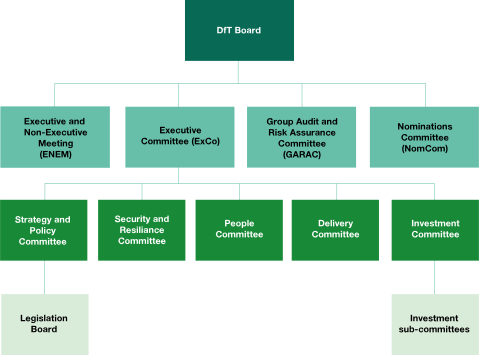
Figure: corporate governance structure as of 31 March 2026
DfT Board and its responsibilities
The Secretary of State for Transport chairs the DfT Board. The Board has oversight of 5 main areas, as outlined in the tables below.
The DfT Board is the most senior of the department’s oversight committees. It provides advice, support and challenge to the effective running of DfT. It oversees DfT’s performance and risk management and progress against delivery of its objectives and priorities. It draws together ministerial and civil service leaders with experts from outside government.
The corporate governance in central government departments: code of good practice requires the DfT Board to meet at least quarterly. In the 2025 to 2026 period, the Board met twice. Two scheduled meetings were cancelled in the period due to scheduling conflicts. DfT Board’s remit and role were supported and covered by its sub-committees and ExCo sub-committees throughout the period.
For example, strategy is regularly discussed and scrutinised at the Strategy and Policy Committee, ExCo tabled regular items on assessing resources, capability and risk, with the management information report scrutinised monthly. Delivery Committee oversees and supports the effective delivery and performance of the DfT’s portfolio. A summary of the discussions at DfT Board during 2025 to 2026 is provided in the tables below.
| Responsibilities of the Board | Topics discussed | |
|---|---|---|
| Strategy | Setting the strategic outcomes and ensuring activities contribute towards them and advising on major policies, projects and programmes. |
The Board discussed DfT's key activities and priorities for 2026. The priorities discussed included: The strategic initiatives to deliver tangible benefits to the public and business (e.g. approach to setting fares, implementing the Bus Services Act, the introduction to the Railways Bill and work for the creation of GBR, Heathrow Expansion and the publication of the Integrated National Transport Strategy) Driving policy that supports economic growth (airport expansion, mass transit schemes, publication of the freight plan and the Planning and Infrastructure Bill aligning housing and transport) Delivering a productive and agile state (reforming DfT's ALBs, consolidating local transport funding) The Board also considered how oil price inflation and supply concerns, ensuing from the Middle East conflict, may affect UK transport and DfT in this period. |
| Resources | Ensuring sound financial management and considering the appropriate allocation of DfT resources. |
A management information report is shared with the Board for each meeting. This is also shared with ExCo every month and the Executive and Non-Executive meeting when it meets. The pack provides an overview of performance, DfT's financial position and risks, along with milestones and delivery of DfT's portfolio, resourcing and workforce allocation and updates on secondary legislation. Certain aspects of resourcing and workforce considerations were delegated to ExCo (and its sub-committee, People Committee). |
| Capability | Ensuring DfT has the capability to deliver and ensuring DfT plans to meet current and future needs. |
The management information report provides an overview of DfT resources and capabilities. Many of the strategic papers also cover relevant capacity and capability issues. |
| Risk | Reviewing the risk appetite, reviewing key DfT risks and, ensuring controls are in place to manage risks. |
Certain aspects of risk were delegated to ExCo (and its sub-Committees). A risk overview is provided to the Board via the management information report. |
| Performance | Scrutinising the performance of DfT, setting standards and values. | DfT operates within a strategic model set out in the government's Plan for Change. DfT's strategic framework is structured around 3 interconnected strategic outcomes – enhancing growth and place, improving journeys for people and delivering green and healthy transport. DfT measures performance through this model. |
Compliance with HM Treasury’s corporate governance code
DfT has assessed its compliance with the corporate governance code for central government departments and has remained compliant with the spirit and principles of the code.
Board effectiveness evaluation
DfT is required under HMT corporate governance code to carry out a Board effectiveness evaluation annually, with independent input at least once every 3 years. An independent evaluation was conducted in January to March 2026.
The 2025 to 2026 independently led board effectiveness review identified a strong DfT Board, benefiting from a high-calibre and committed group of non-executive board members and well supported by effective sub-committees. The review highlighted the following areas of focus for the departmental board, which will help continue DfT’s commitment to continuous improvement of its corporate arrangements:
- strengthening the board’s oversight of DfT’s strategic role with increased future-facing debates and routine discussion of systemic risks
- carrying out a review of the ALB’s governance
- exploring artificial intelligence opportunities
- designing a strong induction for new non-executive board members and leveraging the diversity of their experience collectively in DfT Board meetings
Overview of the board’s subcommittee decisions
Executive Committee (decision making)
The committee met 33 times during 2025 to 2026. Discussions around key areas included:
| Key area | Discussions |
|---|---|
| Enhancing growth and place |
HS2 update Maritime as a key enabler Heathrow Express Delivering the Plan for Change through local government |
| Improving journeys for people |
Rail reform Better Connected: a strategy for integrated transport Road safety strategy DVSA wait times Future of rail enhancements Embedding accessibility within policy development and delivery |
| Delivering green and healthy transport |
Government fleet commitment Carbon budgets Transport resilience strategy Response capability development plan |
| International | Entry/exit system |
| An excellent department |
Productive and agile state Primary legislation bids Legal update Arm's length bodies review Management information ExCo Sub-committee reports Pay remit and reform Workforce implementation plan Management assurance Mental health action plan and analysis Transfer of functions and associated staff from DFTc to DFTO Government legal departments budgets 2026 to 2027 Pre-Budget update UK-wide approach to government People strategy People survey International remote working policy Expressions of interest policy Business planning Inquiries update COVID 19 Counter Fraud Taskforce report Plan for London Equality, diversity and inclusion in DfT Corporate finance update DfT transformation |
| Science, innovation, technology and data |
Data action plan Innovative procurement Chief Scientific Adviser update Appraisal and modelling evaluation strategy |
Executive and Non-Executive Committee (Advisory)
The committee met 6 times during 2025 to 2026. Discussions around key areas included:
- Spending Review 2025
- DfT corporate transformation (standing item at each committee meeting)
- management information
- outcome delivery plan/strategic planning
- rail reform
- DfT governance review
- enhancing growth and place
Nominations Committee (Advisory)
The committee met twice between April 2025 and March 2026 and discussions around key areas included:
- public appointments updates and recruitment activity
- DfT Board Effectiveness Review 2024 to 2025 – results and follow up actions
- public appointments Diversity and Inclusion Group – updates
- Board effectiveness review plan for 2025 to 2026
Group Audit and Risk Assurance Committee (Advisory)
Between April 2025 and March 2026, GARAC met 9 times (5 formal sessions and 4 deep dive sessions). In addition, GARAC held 3 dedicated sessions to review and provide assurance to the Permanent Secretary regarding approval of the annual report and accounts. In these meetings, the committee covered:
- state of the department update (standing item)
- Government Internal Audit Agency update (standing item)
- National Audit Office update (standing item)
- strategic workforce planning
- improving DfT control environment and counter fraud activity
- raising a concern (whistleblowing)
- train operating company landscape
- senior civil servants’ annual declaration
- national rail contract wash-up
- arm’s length bodies
- rail reform
- business appointment rules and declarations of interest
- legal and financial liabilities for trees obstructing the road network
- cyber security and artificial intelligence
- management assurance
- supply chain management risk
- sustainable aviation fuel and Renewable Transport Fuel Obligation
- depreciation replacement cost accounting and its associated costs of preparation
- annual report and accounts update
- key strategic risks, their mitigations and management
Investment Portfolio and Delivery Committee (decision making)
The committee met 16 times between April 2025 and October 2025, after which the committee was reformed and its remit disseminated to new sub-committees under ExCo. Meeting on a regular basis has enabled the assurance and controls to be maintained on decisions for investments and other financial interventions. This also ensured that business cases were considered in a timely manner and that the review of procurement activity across several different areas was maintained regularly throughout the year. The committee oversaw DfT’s project portfolio and scrutinised projects during the business case preparation and delivery phases as well as considered lessons learnt.
Investment Portfolio and Delivery Committee (IPDC) also met quarterly as part of ‘portfolio mode’, to review the future pipeline of investments and evaluation of implemented projects, as well as monitoring the progress and performance of the projects during implementation and ongoing evaluation of their impact. The committee continued to develop its portfolio management approach with increasing focus on the balance and deliverability of the portfolio.
Projects considered and programmes considered by IPDC during 2025 until its reconstitution on 13 October 2025 included:
| Key area | Discussions |
|---|---|
| Rail projects |
South Western Railway rolling stock Plan for strategic rail infrastructure update East West Rail client side professional services contracts Northern Powerhouse Rail – Bradford new station Rolling stock and infrastructure interim strategy Midland MainLine electrification programme closure Coventry VLR stage gates/change control request Public ownership programme East West Rail (EWR) – programme reset, procurement approvals and commercial strategy updates TransPennine Route upgrade (TRU) – 6-monthly programme update Plan for strategic rail infrastructure – stage one conclusions |
| High Speed 2 |
HS2 Cost and schedule ranges Euston delivery arrangements OBC |
| Road |
A417 air balloon annual update A66 Funding request A66 Northern Trans-Pennine project A358 Taunton to Southfields project closure Lower Thames Crossing outline business case National emergency areas retrofit Maintenance and response outline business case National Highways capital investment portfolio report |
| Other investment decisions |
OZEV restart car plug in car grant 2025/26 Theory Test transformation strategic outline business case Project Edison electric vehicle car grant Business case clearance for UK SHORE 2.0 Transforming Cities Fund programme closure NO2 (nitrogen dioxide) programme Transactions at Conter Service strategic outline case Local Electric Vehicle Infrastructure (LEVI) update UK SHORE 2.0 programme business case paper DVLA counter service contract strategic outline case DVLA Merchant Acquirer strategic outline case Approach to workforce solutions outline business case/full business case NO2 Programme closure discussion. Public ownership update on actions. |
Overview of the Board’s subcommittee attendance up to 31 March 2026
| Board member | DfT Board | Executive and Non-Executive Meeting | Executive Committee | Group Audit and Risk Assurance Committee | Investment Portfolio and Delivery Committee11 | Nominations Committee (NomCom) |
|---|---|---|---|---|---|---|
| Rt Hon Heidi Alexander | 1/2 | N/A | N/A | N/A | N/A | N/A |
| Lord Hendy of Richmond Hill | 2/2 | N/A | N/A | N/A | N/A | N/A |
| Lilian Greenwood MP | 2/2 | N/A | N/A | N/A | N/A | N/A |
| Simon Lightwood MP | 0/2 | N/A | N/A | N/A | N/A | N/A |
| Mike Kane MP | N/A | N/A | N/A | N/A | N/A | N/A |
| Keir Mather MP | 0/2 | N/A | N/A | N/A | N/A | N/A |
| Ian King | 2/2 | 6/6 | N/A | N/A | 12/15 | 2/2 |
| Tony Poulter | 2/2 | 4/6 | N/A | N/A | 10/15 | N/A |
| Richard Keys | 2/2 | 6/6 | N/A | 9/9 | N/A | N/A |
| Tracy Westall | 2/2 | 6/6 | N/A | 7/9 | N/A | 2/2 |
| Dame Sarah Storey | 2/2 | 6/6 | N/A | N/A | N/A | N/A |
| Dame Bernadette Kelly DCB | N/A | 1/2 | 6/8 | 1/2 | N/A | 0/1 |
| Jo Shanmugalingam CB | 2/2 | 5/6 | 27/33 | 3/9 | 0/15 | 2/2 |
| Alex Hynes | 1/1 | 2/5 | 14/23 | N/A | 11/15 | N/A |
| Nick Joyce | 2/2 | 6/6 | 26/33 | 8/9 | 11/15 | 2/2 |
| Emma Ward | N/A | 2/4 | 14/17 | N/A | 3/15 | N/A |
| Conrad Bailey | 1/2 | 3/6 | 26/33 | N/A | 11/15 | N/A |
| Rannia Leontaridi | N/A | 3/4 | 10/15 | N/A | 0/15 | N/A |
| Alan Over | 1/1 | 2/5 | 18/25 | N/A | 10/15 | N/A |
| Richard Goodman | 2/2 | 3/5 | 25/33 | N/A | 0/15 | N/A |
| Antonia Williams | 1/1 | 1/1 | 9/10 | N/A | N/A | N/A |
| Ross Gribbin | 1/1 | 1/2 | 9/11 | N/A | N/A | N/A |
| Dean Creamer | 0/1 | 1/1 | 9/10 | N/A | N/A | N/A |
| Ashley Ibbett | 1/1 | N/A | 3/3 | N/A | N/A | N/A |
| David Silk | 1/1 | 1/2 | 10/12 | N/A | N/A | N/A |
Note: The core members of IPDC within the list included Nick Joyce (who also chaired IPDC investment mode), Alan Over, Emma Ward, Alex Hynes and Richard Goodman. All DGs were invited to attend IPDC when it met in ‘portfolio’ mode. Non-core members of IPDC could also attend IPDC when there were items of interest. This accounts for lower attendance numbers for ‘non-core’ IPDC members.
Governance of public bodies
Public body reviews
DfT is committed to ensuring that all its public bodies are strategically aligned to ministerial priorities and continue to deliver high-quality public services and value for money to the taxpayer. Public body reviews support this aim by assessing the efficiency and effectiveness of individual bodies, alongside the robustness of governance and accountability arrangements to ministers and Parliament. In 2025 to 2026, DfT also used these reviews to assess organisations against the objectives and principles of the Cabinet Office’s arm’s length body review, launched in April 2025.
In 2025 to 2026, DfT completed a programme of reviews across its public bodies, strengthening oversight and providing a clearer evidence base for ongoing improvement. This included a strategic review of the Accident Investigation Branches (AIBs), a comprehensive review of the DVSA, a strategic review of the motoring agencies and a strategic review of Active Travel England (ATE). DfT has also commenced a strategic review of the Maritime and Coastguard Agency, continuing this programme of continuous improvement across the public body landscape.
Diversity in public appointments
The DfT strategy for diversity in public appointments aims to attract and appoint more diverse talent by building on the inclusive process, providing high-quality candidate support, whilst strengthening its use of data and feedback to inform improvement. Progress is ongoing in these areas and we continue to collaborate with DfT’s Public Appointments Diversity Engagement Group. This group was formed in 2024 and is made up of chairs, non-executive directors and executives from across DfT’s public bodies. It is dedicated to refining and advancing DfT’s approach to enhancing diversity in public appointments.
From data captured in March 2025, 23.8% of board members in DfT’s public bodies were female, 12.4% were from ethnic minority backgrounds, 13% declared a disability, 30% resided outside of London and the Southeast. 2026 diversity data is based only on appointees registered on the Cabinet Office Applicant Tracking System (ATS) who have submitted diversity information therefore at this time it does not cover the full DfT public appointee cohort. The average response rate stands at 45.2%. As of March 2026, of DfT public appointees who submitted diversity data:
- 46% are female
- 11% have declared a disability
- 9% are from an ethnic minority background
- 63% reside outside of London and the southeast
- 24% attended an independent fee-paying school
As part of its diversity strategy, DfT has continued to strengthen its outreach and support to prospective candidates through a range of initiatives. This includes working with diversity organisations to promote roles; partnering the Boardroom Apprentice Programme with DfT boards; delivering information events and webinars for potential candidates; providing application and interview top tips; widening our candidate talent pool; building a diverse list of independent panel members; and enabling candidates to submit their supporting statement in different formats to present themselves most ably. DfT remains committed to continuing to evaluate and adapt its approach to drive progress towards a more diverse and representative public appointments landscape.
Ministerial direction
There were no ministerial directions during 2025 to 2026.
Declarations of interest
For the 2025 to 2026 SCS annual confirmation of declaration exercise, all DfTc SCS were required to use the online tool (declaration of outside interest application) to record their return with the option to update any existing declaration or make a new declaration for review, assessment and approval by the appropriate senior manager. The SCS in the executive agencies continue to manage their annual confirmation of declaration exercise offline. This exercise includes confirming a nil return. Details of all the SCS with outside employment, work or appointments (paid or otherwise remunerated) are centrally collated, scrutinised and signed off by DfT Permanent Secretary and published. DfTc’s NEBMs declarations are noted below:
| Name | Name of company or organisation | Position held in DfT | Type of interest (for example, pay, fees, shareholding) | Other relevant information |
|---|---|---|---|---|
| Ian King | Ashtead Group Plc | Lead DfT NEBM | Shareholding | |
| Ian King | Breedon group | Lead DfT NEBM | Shareholding | |
| Ian King | Morgan Sindall group | Lead DfT NEBM | Shareholding | |
| Ian King | Brewin Dolphin investment funds. Managed by third party | Lead DfT NEBM | Shareholding | |
| Ian King | AIM investment funds. Managed by third party | Lead DfT NEBM | Shareholding | |
| Ian King | Cherished investments. Covers BAE systems, Schroders and Senior | Lead DfT NEBM | ||
| Ian King | HS2 Ltd | Lead DfT NEBM | Special Director | |
| Ian King | HS2 Ltd | Lead DfT NEBM | Non-Executive Director | |
| Ian King | Senior Plc | Lead DfT NEBM | Chair | |
| Ian King | Schroders Plc | Lead DfT NEBM | Senior Independent Director | |
| Ian King | Gleacher Shacklock LLP | Lead DfT NEBM | Senior Adviser | |
| Richard Keys | Merrill Lynch International | DfT NEBM and GARAC Chair | Non-Executive Director | Retired 31 May 2026 |
| Richard Keys | AWE plc | DfT NEBM and GARAC Chair | Non-Executive Director | |
| Richard Keys | Worshipful Company of Glaziers and Painters of Glass | DfT NEBM and GARAC Chair | Liveryman | |
| Richard Keys | Institute of Chartered Accountants in England and Wales | DfT NEBM and GARAC Chair | Fellow | |
| Richard Keys | Pension, ISA and other investments in a wide range of funds managed by third parties. Decisions on investments largely made by third party | DfT NEBM and GARAC Chair | Shareholding | |
| Richard Keys | Worshipful Company of Scientific Instrument Workers | DfT NEBM and GARAC Chair | Liveryman | |
| Tracy Westall | Westmill Solutions | DfT NEBM | Shareholding | |
| Tracy Westall | Westmill Solutions Limited – | DfT NEBM | Director | |
| Tracy Westall | WM5G Limited | DfT NEBM | Chair | |
| Tracy Westall | Zaizi Limited | DfT NEBM | Non-Executive Director | |
| Tracy Westall | Agena Limited | DfT NEBM | Non-Executive Director | |
| Tracy Westall | Curium Solutions Trustee Limited | DfT NEBM | Trustee | |
| Tony Poulter | Investments in a wide range of funds managed by third parties. | DfT NEBM | Financial | |
| Tony Poulter | GBRTT Ltd | DfT NEBM | Non-Executive Director | |
| Tony Poulter | London and Continental Railways (LCR) Property Limited | DfT NEBM | Special Director | |
| Tony Poulter | Cubico Sustainable Investments Ltd | DfT NEBM | Non-Executive Director | |
| Tony Poulter | Civil Service Commission | DfT NEBM | Civil Service Commissioner | |
| Tony Poulter | State Honours Committee | DfT NEBM | Member | |
| Tony Poulter | Oxford University Finance Committee | DfT NEBM | External member | |
| Dame Sarah Storey | Greater Manchester Combined Authority | DfT NEBM | Active Travel Commissioner | |
| Dame Sarah Storey | Manchester Metropolitan University | DfT NEBM | Visiting Professor | |
| Dame Sarah Storey | Lancashire Cricket Club | DfT NEBM | President | |
| Dame Sarah Storeyr | British Cycling | DfT NEBM | Member |
Special advisers
In line with the current declaration of interests policy for special advisers, all special advisers have declared any relevant interests or confirmed they do not consider they have any relevant interests. The Permanent Secretary has considered these returns and there are no relevant interests to be published.
Business appointment rules (BAR)
The BAR process is in place to uphold and protect the core values of the Civil Service Code if a former civil servant takes up an external appointment or employment (which includes civil servants at all grades and special advisers). The rules apply for up to 2 years after an employee has left our employment. The purpose of the rules is to address any reasonable concerns that a new employer might gain an improper advantage by appointing a former official and the risk of a former official improperly exploiting privileged access to contacts in government.
During the 2025 to 2026 reporting year, DfT received 18 Business Appointment Rules applications from employees leaving the Senior Civil Service (SCS) including Special Advisors to join external organisations. There were zero applications received at SCS2, SCS1 or below SCS which were deemed unsuitable for the applicant to take up the new role with the new employer without conditions being in place. Decisions on business appointment rules applications for SCS3 are managed by the Civil Service Commission.
Number of BARs applications assessed by DfT in 2025 to 2026
| Grade | Applications |
|---|---|
| SCS2 | 6 applications received |
| SCS1 | 12 applications received |
| Special Advisers | 1 application received |
| Below SCS | 18 applications received |
Number of BARs applications approved by DfT with conditions set in 2025 to 2026
| Grade | Applications |
|---|---|
| SCS2 | 4 applications |
| SCS1 | 11 applications |
| Special Advisers | 1 application |
| Below SCS | 17 applications |
There have been zero reported breaches of the business appointment rules during 2025 to 2026.
In compliance with BARs, DfT is transparent in the advice given to individual applications for senior staff, including special advisers. Advice regarding specific business appointments for members of the Senior Civil Service has been published. GARAC also receive a bi-annual paper on business appointment rules, to monitor DfT’s application of the rules.
DfT’s approach to risk
DfT’s risk management policy promotes a no surprises, no blame culture, where well managed risk taking is encouraged and managers are asked to lead by example. Risk management behaviours should be embedded into all DfT activities. DfT’s leadership understands that considered and well-managed risk taking is necessary to deliver organisational objectives.
As a result, DfT’s top risks are reported monthly to ExCo, with additional reporting provided to ENEM and the DfT Board. GARAC provides independent oversight, reviewing and challenging DfT’s approach to risk management and its principal risks. Until its closure, the Executive Risk Committee conducted regular deep dives into DfT’s principal risks and the risk profiles of individual DG groups. Responsibility for this oversight has since been embedded across ExCo’s new sub-committee structure, ensuring risk management remains integral to departmental governance and decision-making.
During the year, DfT reviewed and further developed the principal risks to consider the wider impact to the transport system and delivery against the government’s priorities. The purpose of the principal risks has been and continues to be to update, clarify and clearly identify DfT’s top risks. These risks were managed and mitigated throughout the year and will continue to be updated.
DfT has 17 risk themes which align with the Orange Book risk categories and DfT’s principal risks.
There is no principal risk specifically on legal risks, however DfT is mindful that its projects and programmes can attract legal challenge. Legal risks are assessed, monitored and mitigated project by project and programme by programme. DfT takes appropriate measures to meet legal or regulatory requirements or to protect our assets and regularly takes advice on these matters from GLD.
DfT is fully engaged on cross-government improvement work to strengthen risk management.
DfT recognises that many risks are carried by its public bodies and works with them to ensure that risks are widely understood and opportunities are taken to collectively manage them. The risk escalation protocol continues to give direction to the public bodies on what they need to escalate to DfT and when.
The reporting year has again brought many challenges and as a result, DfT has continued to deliver its risk action plan to further address and strengthen risk management.
His Majesty’s Treasury Orange Book principles – comply or explain
DfT’s risk management practices fully comply with 4 of the 5 requirements of the Orange Book’s principles. This position is supported in part by a risk maturity assessment conducted during the year, which helped shape the DfT’s overall assessment of compliance and incorporated survey input from senior leaders, delivery and risk professionals.
Although the 4 principles A, B, D and E are fully compliant, DfT has identified actions that will ensure continuous improvement and further mature its risk management culture, processes and effectiveness. Principle C is partially complied with and DfT continues to plan improvements to strengthen collaboration and information-sharing across the DfT system. Details of how the DfT will achieve this can be found below.
Principle A: risk management shall be an essential part of governance and leadership and fundamental to how DfT is directed, managed and controlled at all levels
DfT fully complies with ‘principle A’.
Risk management is embedded within DfT’s governance and leadership arrangements and is fundamental to how DfT is directed, managed and controlled. Senior leaders routinely consider principal risks and emerging risks through established group-level governance, with clear escalation routes to the ExCo and the DfT Board. This process provides structured oversight and makes sure that risk considerations inform strategic discussion and departmental direction.
DfT’s risk appetite statements and overarching risk management policy remain in place and have been approved through multiple governance levels, reinforcing leadership accountability and expectations around informed risk-taking. Periodic reviews of risk policy and guidance continue to be undertaken, informed by feedback from risk forums and assurance activity.
Evidence gathered during the year from risk maturity assessment indicates that there is broad confidence in DfT’s risk leadership and governance arrangements, providing assurance that the intent of principle A is being met in substance. As in any large and diverse organisation, experiences of risk management vary across contexts and DfT continues to strengthen consistency and leadership capability over time.
Taken together, DfT concludes that the governance structures, leadership engagement and accountability arrangements required by principle A are firmly in place and operating as intended.
Principle B: risk management shall be an integral part of all organisational activities to support decision making in achieving objectives
DfT fully complies with ‘principle B’.
Risk management is an integral part of DfT’s organisational activities and supports decision-making in the pursuit of objectives. Risks are routinely considered when setting strategy and priorities and are incorporated into key decision-making processes. These arrangements are supported by established reporting cycles and the use of DfT’s central risk management system.
Key processes like the monthly reporting cycle, the categorisation features within DfT’s central risk management system and the use of both the National Risk Register and the National Security Risk Assessment demonstrate DfT’s structured approach to horizon scanning and its alignment with civil contingencies frameworks. Training activity, policy development workshops and structured discussions of risk interdependencies at deep dives reinforce expectations that risk considerations form part of both day-to-day operational choices and in shaping medium-term strategy.
Evidence gathered during the year provides assurance that risk management is embedded within organisational activity in line with the intent of principle B. While the impact of risk considerations will naturally vary depending on the nature of decisions and delivery contexts, there is no evidence of systemic exclusion of risk from decision-making.
DfT continues to refine and strengthen how risk information is used to support prioritisation and delivery as part of ongoing maturity development. Nevertheless, the presence of established processes, governance and organisational practice demonstrates that risk management is integrated into how decisions are taken across DfT.
Principle C: risk management shall be collaborative and informed by the best available information and expertise
DfT partially complies with ‘principle C’.
As reported previously, DfT recognises that while collaborative risk management arrangements are in place, they are not yet implemented consistently across the full DfT system. This assessment remains appropriate.
DfT engages with public bodies, delivery partners and external stakeholders through established governance and oversight arrangements, enabling senior leaders to draw on a broad range of risk information and professional expertise when considering strategic and operational risks. These arrangements support collaboration at group and portfolio levels and provide mechanisms for sharing insight on emerging risks and interdependencies. Since the previous reporting period, DfT has continued to take forward improvement actions aimed at strengthening collaboration and information-sharing, including streamlining governance processes, improving the consistency and timeliness of risk data and enhancing arrangements for sharing cross-cutting risk information across organisational boundaries. These actions are intended to support a more joined-up view of risk across DfT and its public bodies.
In addition, the GIAA conducted a review into how DfT manages risks associated with its ALBs and provided a number of recommendations. Several of these have already been implemented, with the remaining actions to be taken forward in due course.Feedback gathered during the year indicates that while collaborative practices are developing and are effective in some areas, their application remains uneven across DfT and with external partners. Joined up risk views are strongest at senior and strategic levels, with further work required to embed consistent approaches across all delivery contexts. DfT therefore continues to conclude that it partially complies with principle C. Strengthening collaboration, shared ownership of cross-cutting risks and the consistent use of external insight remains a priority as DfT continues to develop its risk management maturity.
Principle D: risk management processes shall be structured to include:
- the selection, design and implementation of risk treatment options that support achievement of intended outcomes and manage risks to an acceptable level
- risk identification and assessment to determine and prioritise how the risks should be managed
- the design and operation of integrated, insightful and informative risk monitoring
- timely, accurate and useful risk reporting to enhance the quality of decision-making and to support management and oversight bodies in meeting their responsibilities
DfT fully complies with ‘principle D’.
DfT has established a structured and systematic risk management framework that aligns with the requirements of principle D. This framework supports consistent identification, assessment and prioritisation of risks, the design and implementation of mitigating actions, and clear escalation and reporting arrangements across the DfT.
Principal risks are subject to regular and formal review, including annual deep dives, supported by a defined risk framework and supporting guidance. Business continuity and resilience arrangements are in place and are tested to ensure preparedness for high-impact risks. An evolving toolkit, including structured risk analysis techniques, standardised workshop approaches and enhanced Power BI reporting within the DfT’s risk management system, supports consistent treatment, monitoring and reporting of risks.
Risk reporting operates on a tiered and proportionate basis, aligned to the level and nature of risk. ExCo and group boards undertake regular reviews of key risks, while portfolio-level assessments are conducted through established quarterly governance processes. These arrangements ensure that relevant risk information is available to senior leaders and oversight bodies at appropriate points to support informed decision-making.
Feedback gathered during the year indicates that while perceptions of the impact and use of risk processes vary across the organisation, there is broad recognition that the underlying risk management framework, reporting structures and escalation arrangements are in place and operating. This evidence is consistent with the intent of Principle D, which focuses on the existence and operation of structured processes rather than uniform experience of their application.
Throughout the year, DfT has continued to refine its risk management processes through training, guidance and targeted deep-dive activity, reinforcing expectations around the quality of risk assessment, the articulation of mitigations and the monitoring of delivery. While the effectiveness of risk processes ultimately depends on their consistent application and use, the underlying structures, tools and governance arrangements required by principle D are firmly in place.
Principle E: risk management shall be continually improved through learning and experience
DfT fully complies with ‘principle E’.
DfT has established a structured and systematic approach to the continual improvement of risk management, supported by learning from experience, maturity assessment and capability development. This approach reflects the intent of Principle E and remains central to DfT’s risk management framework.
Continuous improvement is underpinned by regular risk maturity assessments, lessons-learnt activity and a comprehensive training programme, which continues to build risk capability across DfT. Structured review points – including self-assessment activity and ongoing GIAA assurance – provide regular feedback on the effectiveness of risk management arrangements and inform prioritised improvement actions.
Feedback gathered continues to demonstrate that DfT has a core group of skilled risk practitioners and leaders who are able to drive, support and embed improvements in risk management practice across the organisation. Dedicated risk forums and targeted training, including refined training on risk appetite, tolerance and structured risk analysis techniques, further reinforce a culture of learning and professional development.
DfT’s 2-pronged maturity approach, combining the Orange Book risk control framework with HMT’s risk management assessment framework, enables DfT to identify strengths and areas for improvement in a systematic way. Findings from these assessments are captured within an ongoing risk action plan, providing a clear mechanism for tracking progress and ensuring that learning is translated into tangible improvements over time.
DfT recognises that embedding learning consistently across a large and diverse organisation is an ongoing endeavour. Nevertheless, the presence of established review mechanisms, assurance activity, capability development and active improvement planning demonstrates that DfT’s risk management arrangements are routinely reviewed, refreshed and strengthened in line with principle E.
Principal risks
In April 2026, the ExCo reviewed the DfT principal risks for 2026 to 2027. Following the review, it was agreed that they remained broadly unchanged from 2025 to 2026.
These risks are assigned owners at director level to manage and/or monitor the mitigating actions on behalf of ExCo. A summary of the mitigating actions is presented in the table below.
In addition to the principal risks noted below, DfT has also managed risks on ‘Security, resilience and international crises’ and ‘cyber threats’ and the impact on the transport systems, but due to the security sensitivity, these details are not disclosed.
Table: principal risks
| Principal risk | Mitigating actions | Direction of risk trend at year end |
|---|---|---|
| Affordability: drivers and assumptions for costs and revenues deviate from plan without being addressed, leading to a mismatch between the department's delivery commitments and priorities and the funding available to deliver these |
SR25 set departmental budgets for 2024 to 2025 to 2028 to 2029 RDEL and to 2029 to 2030 CDEL and these have been translated into the DfT strategic plan. DfT maintains robust processes to monitor its financial position and address affordability risks. This includes oversight by ExCo, ongoing in-year monitoring through monthly internal reforecasting against budget, alongside structured quarterly review points with directors general and HMT to assess the latest affordability position, including risks and opportunities. Budget holders are set clear forecasting targets and are held accountable for performance through their objectives. Reflecting the discipline established in previous years, Finance clearance processes remain in place, with the Finance Centre of Excellence and internal governance structures ensuring that affordability is rigorously tested in spending proposals, submissions and board papers. There is continued focus on medium-term affordability risks (including pressures such as inflation), supported by ongoing analysis and monitoring. DfT will continue to use the annual business planning process to ensure alignment between delivery plans and funding. Whilst also aligning with the projects and programmes principal risk relating to the implementation of the James Stewart review. |
Risk reduced |
| Projects / programmes: that major projects and programmes in the DfT portfolio are not delivered to schedule, cost and/or quality, undermining the achievement of government priorities |
As part of the DfT governance review, new central governance forums – including the Investment Committee and Delivery Committee – have been established, becoming operational by November 2025. A second phase of implementation is being taken forward to ensure that information flows, decision-making and follow-up actions from these committees are effective, embedded and support delivery across the DfT. This includes ensuring that governance outputs are clearly aligned to DfT's strategic objectives and targeted outcomes. DfT continues to deliver a rolling programme of improvement through the project delivery change programme to support all projects to deliver better outcomes consistent with the government project delivery functional standard and best practice. Following ExCo's endorsement of the forward plan in September 2024, priorities have included implementation of the new DfT project initiation approach duringl 2025, strengthening technical capability within project teams and setting principles for effective sponsorship of projects and programmes. As part of this programme, DfT is undertaking independently assured self-assessments across 7 of its largest and most complex major projects – EWR, NPR, Heathrow Expansion, A66, Lower Thames Crossing, West Yorkshire Mass Transit (WYMT) and Euston – to ensure that learning from the James Stewart review is embedded. |
No change |
| Environmental: the department does not act to sufficiently reduce greenhouse gas and air pollutant emissions from vehicles (all modes) in line with agreed targets and as required by law |
DfT has continued to progress a comprehensive programme of work to decarbonise transport infrastructure and reduce user emissions across all modes. In April 2025, DfT delivered a carbon baseline for its infrastructure portfolio, enabling improved estimation of whole life emissions and strengthening the evidence base for future policy and investment decisions. This was followed by a call for evidence on transport infrastructure decarbonisation in May 2025 and ongoing cross government engagement to support research, development and policy design. DfT has strengthened its approach to climate resilience through the publication of the climate adaptation strategy for transport and supporting guidance, including a climate change risk assessment framework for the transport sector. These outputs improve understanding of climate risks across the network and support more systematic integration of resilience into policy and investment decisions. DfT's strategic outcome 'deliver green and healthier transport' provides further detail on how performance of these actions are monitored. Cars and vans: The ZEV mandate sets annual targets for the proportion of new car and van sales that must be zero emission. Grant support remains available for EV chargepoints and infrastructure at eligible homes and workplaces. HGVs: DfT contributed to the development of the Carbon budget and growth delivery plan, published in October 2025, setting out the government's approach to meeting carbon budgets 4 to 6. Updated emissions projections indicate a remaining gap to carbon budget 6, driven in part by lower-than-expected savings from HGV decarbonisation. |
Risk reduced |
| Environmental: the department does not act to sufficiently reduce greenhouse gas and air pollutant emissions from vehicles (all modes) in line with agreed targets and as required by law |
Aviation: The SAF Mandate sets a legal obligation on fuel suppliers in the UK to supply an increasing proportion of SAF over time. This will be supported by a revenue certainty mechanism to drive investment in SAF production in the UK. The SAF mandate came into force in January 2025, with work ongoing to introduce a revenue certainty mechanism to support domestic production. Maritime: Following the publication of the maritime decarbonisation strategy, DfT has been focused on implementing its commitments, including the development of supporting policy measures. This sits alongside broader decarbonisation activity across transport, including ongoing work on a plan for greener freight. Rail: Deliver a carbon baseline to estimate whole life carbon emissions from DfT's infrastructure portfolio including rail infrastructure such as EWR and HS2. Regular cross government engagement on research and development and policy development to support infrastructure decarbonisation. Buses: DfT has taken powers through the Bus Services Act 2025 to enable the end of the use of new non-zero emission buses on registered bus services in England, on a date not before 2030. |
|
| Environmental: the department does not act to sufficiently reduce greenhouse gas and air pollutant emissions from vehicles (all modes) in line with agreed targets and as required by law |
Reduce air pollutant emissions from vehicles: DfT continues to play a key role in delivering improvements in air quality and biodiversity, working closely with Defra, DHSC and local authorities. DfT has contributed to the statutory Environmental Improvement Plan, published in December 2025, which sets out measures to support legally binding air quality targets. DfT has also progressed its contribution to the government's health mission, including the development of transport-specific policies to reduce air pollution and improve public health outcomes, supported by evidence such as the transport hazard summary: air quality and pollution. To strengthen the evidence base, DfT published a rapid assessment of non-exhaust emissions (including road wear and dust resuspension report). Continued engagement with local authorities through the NO2 programme has supported delivery of compliance measures, with ongoing monitoring, evaluation and funding management to ensure effective use of resources. |
|
| People capability and capacity: the department or its public bodies do not have the capacity and/or capability to; deliver its priorities and objectives across all modes and sectors; or minimise industrial action |
DfT has taken a coordinated approach to SCS workforce strategy, resourcing and standards. Capability has been strengthened through delivery of DfT's talent programmes, a core learning offer aligned to priority skills and implementation of the skills and capability plan. Digital and AI capability building has been supported and new tools provided to enable the increasing profile of management standards. The maturity of workforce planning has further increased across the group with a focus on standardisation ahead of Unity delivery. Structural change was delivered with the transfer of staff from DfT to the DFTO. Building on this, leadership management and flexibility will be progressed through the transformation programme, a department-wide programme to improve organisational effectiveness, efficiency and agility. This includes streamlining structures, the introduction of a management development programme and improving workforce flexibility. |
No change |
| Strategy: the department does not adequately anticipate or plan for future technological developments in the transport system, resulting in ineffective decision making and an incoherent transport landscape |
DfT is strengthening its approach to understanding and managing technological uncertainty across policy and decision-making. Work is underway to develop a transport digital communication strategy, supported by scenario analysis to test how future technologies could impact the transport system. Consideration of uncertainty is also being embedded earlier in the policy cycle, including through updates to project initiation documents and improvements to how uncertainty is communicated to senior decision-makers. Further work is planned to test and refine these approaches and ensure that DfT has secured a strong Spending Review settlement to support the maintenance and renewal of transport assets. This includes increased funding for local highways maintenance and the introduction of a new DfT continues to prioritise long-term funding certainty to enable more effective asset renewal and maintenance planning. It is also updating guidance for local highway authorities, including the Code of practice on well-managed highway infrastructure, to support improved asset management and resilience. In addition, DfT is strengthening its understanding of infrastructure condition and investment need. This includes gathering evidence from local highway authorities on structures most in need of repair and developing a rating system to assess authority performance, including on climate adaptation. These measures will support better targeting of investment and help incentivise improved performance across the network, while informing future Spending Review bids. |
No change |
| Strategy: the performance of the transport system declines and DfT is unable to influence or improve it. As a result, the system does not deliver for people or businesses |
DfT is strengthening performance, delivery and accountability across the transport system through improved monitoring, clearer outcomes and closer working with local and devolved partners. Performance and risk reporting has been refreshed to align with the strategic plan, with agreed metrics, within the strategic outcomes, stretching targets where possible and regular central reporting. Public perceptions of transport are monitored through established sources, including the National Travel Survey and Transport Focus. DfT is also reforming how local and regional transport is funded and governed, including developing an approach to consolidate funding streams, reduce burdens on local authorities and provide greater flexibility, while maintaining accountability through outcomes frameworks covering safety, reliability, accessibility and mode share. In parallel, DfT is supporting devolution through close working with mayoral authorities and local leaders, including structured strategic conversations to improve alignment, collaboration and delivery, as set out in the Better Connected: a strategy for integrated transport. Across modes, DfT is strengthening oversight and reform. This includes reforming bus services to give local authorities greater powers and introducing a new bus outcomes framework; improving rail performance through continued engagement with operators and regulators, alongside legislation to establish Great British Railways and a clearer accountability framework; and establishing a new passenger standards authority to strengthen the passenger voice. DfT is also clarifying roles and responsibilities through Better Connected: a strategy for integrated transport and strengthening its sponsorship capability, while continuing to work closely with aviation and maritime sectors and their regulators to oversee safety and operational performance. DfT's strategic outcomes provide further detail on how performance of these actions are monitored. |
No change |
| Property: failure to maintain the condition of the transport infrastructure system to a sufficient level, including to adapting to climate change, results in infrastructure degradation and the increased risk of experiencing asset failures |
DfT has secured a Spending Review settlement which increases focus on supporting maintenance and renewal of transport assets. This includes increased funding for local highways maintenance and the introduction of a new £1 billion Structures Fund to repair ageing infrastructure, alongside record levels of maintenance funding for the strategic road network through the Road Investment Strategy interim settlement. DfT continues to prioritise long-term funding certainty to enable more effective asset renewal and maintenance planning. It is also updating guidance for local highway authorities, including the code of practice on well-managed highway infrastructure, to support improved asset management and resilience. In addition, DfT is strengthening its understanding of infrastructure condition and investment need. This includes gathering evidence from local highway authorities on structures most in need of repair and developing a rating system to assess authority performance, including on climate adaptation. These measures will support better targeting of investment and help incentivise improved performance across the network, while informing future Spending Review bids. In December 2025, DfT published the climate adaptation strategy for Transport which sets out the actions that DfT and the transport sector are taking, or planning to take, to ensure the transport system is prepared for the impacts of our changing climate. |
No change |
The direction of the risk trend indicates whether the probability of the aggregate likelihood and impact of the risk materialising increased, decreased, or remained the same over the period of this report. The colour of the text reflects a black, red, amber or green rating based on the level of the risks exposure using a measurement of 1-5 for both the likelihood and impact of the risk materialising.
The direction of travel of the principal risk exposure scores represents the change throughout the reporting period up to the financial year end, however exposure scores are dynamic and continue to be monitored and may have changed after this period.
Functional standards
DfT staff adhere to the mandated government functional standards in a way that aligns with DfT’s business needs and priorities. GovS 001 (government functions) establishes expectations for the consistent management of all functions and functional standards across government departments.
The subsequent standards, from GovS 002 onwards, define expectations for specific functional areas such as project delivery and commercial operations. These standards provide a stable foundation for assurance, risk management, capability development and ensuring value for money for the taxpayers. This work complements DfT’s management assurance process, which provides the ExCo and GARAC assurance on compliance with process and controls.
Financial governance and management control
DfT’s business planning process distributes the budget voted by Parliament across all areas of DfT. Financial plans are established through agreement between DfT and HMT as part of the Spending Review process.
At the start of each financial year, Parliament grants statutory authority for DfT’s budget through the main estimate. Simultaneously, the Principal Accounting Officer formally delegates budgets to directors general and public bodies. Through ExCo, DfT reviews actual and forecast spending each month to ensure expenditure aligns with approved budgets, taking necessary actions to maintain control. This monitoring helps prevent breaches of Parliament-approved spending limits while advising ministers and the Board on optimal use of available resources to achieve DfT’s strategic outcomes.
Budget adjustments during the year are agreed upon with HMT, alongside strategic decisions made by ministers. Any in-year budget changes requiring statutory approval are submitted to Parliament through the supplementary estimate. Final budget delegations are then issued to directors general and public bodies. At year-end, actual spending is compared with the final budgets approved by Parliament in the statement of outturn against Parliamentary supply.
Financial control and counter fraud
DfT continued to deploy the Control Network Group (CNG), comprising senior subject matter experts from key functional areas, to oversee and strengthen controls, counter fraud activity efforts and ensure compliance with HMT, the Cabinet Office and internal controls. Assurance is provided through the management assurance activity on the control framework and CNG provides strategic oversight on key risks and any retrospective approvals.
DfT upholds a zero-tolerance policy on fraud, bribery and corruption. Reported incidents are investigated, with disciplinary and/or legal action taken as needed, following DfT and Public Sector Fraud Authority (PSFA) guidelines. DfT advanced and continued to take it forward its 2023 to 2025 counter fraud, bribery and corruption strategy, focusing on prevention, risk reduction and awareness, including participation in the International Fraud Awareness Week.
Detection efforts included the use of Spotlight, a due diligence tool for identifying risk areas and detecting fraud and error.
Quarterly meetings with senior counter fraud managers, DfT representatives and the GIAA enabled updates, best practice sharing and insights from PSFA. This collaboration improved fraud awareness and strengthened compliance with government counter-fraud functional standards.
All DfT staff are required to undertake annual online fraud awareness training.
Under PSFA’s across-government internal fraud policy, employees dismissed for fraud, bribery or corruption are added to the Cabinet Office internal fraud database and barred from civil service re-employment for 5 years. In 2025 to 2026, no cases fell within this scope.
Fraud cases within DfT’s public bodies are recorded in their respective governance statements.
Raising a concern and whistleblowing
DfT remains committed to building a culture where people feel safe to speak up about perceived wrongdoing and inappropriate behaviour and to report any concern in the knowledge that these will be heard and concerns taken seriously.
The People Survey also provides DfT with information and insight on how employees feel about DfT at a point in time. This data provides an opportunity to improve, develop and strengthen existing processes and practice going forward. Overall, for DfT, there has been a reduction in positive responses to People Survey questions about how safe employees feel to challenge and their awareness of the Civil Service Code compared to 2024.
Several high-profile change initiatives across the DfT Group over the last 12 months, including increased workplace attendance expectations, recruitment controls and a voluntary exit scheme in DfT may be contributing factors in the overall reduction in staff engagement and the decrease in how comfortable staff feel in raising concerns and challenging the way that things are done.
Our processes for raising concerns about wrongdoing are of a satisfactory standard and an annual update on our processes and the concerns raised each year is provided to the GARAC. DfT continue to focus on building awareness with staff of the importance of raising concerns and the avenues they can use to do this.
Over the past 12 months DfT has also worked with the Cabinet Office and other departments to implement the recommendations of the NAO report and Public Accounts Committee recommendations and to consider where, as a department, DfT can take further improvement action. This has included the launch of a new Whistleblowing Hotline. The hotline provides DfT employees with an alternative route to raise a concern outside of the management chain with DfT’s employee assistance provider and is available 24/7, 365 days of the year.
Whistleblowing reported to DFT as a prescribed person
The Secretary of State is a ‘prescribed person’ under The Public Interest Disclosure (Prescribed Persons) Order 2014[footnote 8], which provides the statutory framework for protecting workers from harm if they blow the whistle on their employer. Workers may tell the relevant prescribed person about suspected wrongdoing that they believe may have occurred, including crimes and regulatory breaches. Passing on information like this is known as making a ‘disclosure’. DfT can receive whistle-blowing disclosures in letters, emails and through our helpline. Sometimes the information is provided anonymously.
The Secretary of State is prescribed under the order in relation to the following transport functions and services: i) compliance with the requirements of merchant shipping law, including maritime safety; ii) motoring services with respect to driver and vehicle standards and the testing and certification of vehicles, their systems and components; iii) road, rail and maritime transport security and iv) transport sanctions: the Secretary of State’s functions in relation to aircraft and shipping sanctions in sanctions regulations made under section 1 of the Sanctions and Anti-Money Laundering Act 2018.
There were 56 disclosures in the reporting period, which we reasonably believe fall within the Secretary of State’s prescribed matters, the majority of which were classed as danger to health and safety or the environment.
Management assurance
DfT carried out management assurance activities to assess the implementation and effectiveness of processes, procedures, controls and compliance across DfTc and our public bodies within its accounting boundary. DfT also continuously works to improve the effectiveness of its management assurance tools.
DfT’s approach to assurance involved a 3-stage review process:
- First line of defence: directors and CEOs from public bodies provided assurance over key control areas within their responsibility.
- Second line of defence: policy leads and/or subject matter experts conducted an end of year independent assessment of these areas.
- Third line of defence: the GIAA provided audit opinions for relevant audits and an overall independent audit opinion.
Directors and CEOs were required to create action plans for areas rated below ‘substantial’. Findings from these assurance activities were reviewed by CNG and presented to ExCo and GARAC.
- the first line of defence review for 2025 to 2026 has been completed, with an initial second line of defence assessment placing the overall result in the ‘moderate’[footnote 9] range
- the full second line of defence opinion will be finalised by late summer 2026. Additionally, the 2024 to 2025 second line of defence review confirmed a ‘moderate’ overall rating
- for 2025 to 2026, the GIAA’s third line audit opinion for DfTc is also rated ‘moderate’ based on the GIAA audit plan
Analytical assurance
Analytical quality assurance (AQA) involves the consideration and communication of the strengths, weaknesses and limitations of analysis. This allows decision-makers to better understand the quality of the evidence base they use. DfT’s analytical assurance framework, Strength in Numbers, aims to strengthen the standard of analytical quality assurance in DfT. DfT is currently reviewing and rewriting this framework in line with the new Aqua Book – the central guidance on producing quality analysis.
As part of the AQA framework, DfT maintains and publishes a register of business-critical models, each of which has an appointed senior model owner responsible for ensuring appropriate governance and quality assurance of the model and its outputs throughout its lifecycle. Business critical models are used to drive essential decisions and have robust governance regimes in place to assure against errors which could cause serious financial, legal and/or reputational damage to DfT.
Analytical assurance statements highlight the strengths, limitations and uncertainties in the analysis, ensuring decision-makers are fully informed. Where recommendations or decisions within business cases or board papers rely on analysis and this goes to tier 1 or tier 2 investment boards, an analytical assurance statement is required. This also applies to non-regulatory impact assessments where analysis informs the decision.
For ministerial or permanent secretary submissions, an analytical assurance statement is required where the recommendation or decision relies on analysis and exposes DfT to significant legal, financial or reputational risk. In these cases, the analysis must be reviewed by an independent assurer to make sure all relevant information has been communicated and that the extent to which the analysis is considered reasonable and robust is clear.
DfT is working with the executive agencies to ensure alignment of standards across the group. Where responsibility for decision-making is delegated to public bodies, responsibility for AQA is also delegated.
Independent assurance
DfT’s internal audit service is provided by the GIAA, an executive agency of HMT. GIAA operates to the Global Internal Audit Standards in the UK Public Sector, confirmed through its last external quality assessment undertaken by the Institute of Internal Auditors during 2025 to 2026.
The Group Head of Internal Audit (Group HIA) provides DfT’s Accounting Officer with an independent opinion on the adequacy and effectiveness of DfT’s systems of internal control and makes recommendations for improvement. The work of GIAA is based on its analysis of DfT’s risks and its audit programme, which is approved by GARAC. Regular reports are provided by GIAA to DfT’s management, GARAC and to ExCo.
The Group HIA has provided the Permanent Secretary with an annual report on internal audit activity in DfT and its ALBs over the course of 2025 to 2026. This report summarises each of the individual Head of Internal Audit annual opinions for DfT and its ALBs, movement from 2024 to 2025 and provides the Group HIA’s independent opinion for 2025 to 2026 on the level (substantial, moderate, limited, unsatisfactory) of assurance that can be placed on the adequacy and effectiveness of DfT and ALBs’ governance, risk management and internal control arrangements.
The report highlighted that, although DfT remained within the moderate band, its direction of travel and overall position were less favourable compared to 2024 to 2025. For its ALBs, Internal audit observed that the control environment, which has largely been assessed as moderate in recent years, has been maintained. Consequently, the group internal audit opinion for 2025 to 2026 has been determined as ‘moderate.’[footnote 9]
Due to its relative materiality in the group, it is highlighted that ‘limited’ assurance can be placed on the adequacy and effectiveness of the control environment at HS2 Ltd. This follows a limited opinion in 2024 to 2025. Whilst improvement has been made in several areas since the last opinion and the trajectory is positive overall in 2025 to 2026, weaknesses in the control environment still present significant risks to the organisation. More time is needed to fully address known weaknesses and implement and embed robust controls and arrangements.
Looking ahead to 2026 to 2027, DfT faces several significant challenges, including the progression of Great British Railways, wider geopolitical conflicts and economic pressures. It remains important that during this period of change and uncertainty sufficient management focus and capability is directed to ensuring the oversight and application of robust core controls and risk management activities.
Auditors
This section sets out the costs of auditing the DfT Group accounts along with the costs of auditing the organisations which form part of the DfT Group as defined in accounting policy note 1.3. Audit fees are not included in this section for other entities who are outside DfT’s consolidation boundary. The Comptroller and Auditor General (C&AG) carries out the audit of the consolidated accounts of the DfT Group, as well as the audits of the following executive agencies:
- Maritime and Coastguard Agency
- Driver and Vehicle Licensing Agency
- Driver and Vehicle Standards Agency
- Vehicle Certification Agency
- Active Travel England
These audits are conducted under the Government Resources and Accounts Act 2000 (GRAA), at an annual notional cost of £1,275,000 (2024 to 2025: £1,254,000).
The audits of the following entities are completed by the Comptroller and Auditor General, but incur a cash or real charge of £1,775,300 (2024 to 2025: £1,773,450):
- Network Rail Ltd (and its substantial subsidiary bodies, Network Rail Infrastructure Ltd and Network Rail Infrastructure Finance plc)
- National Highways
- British Transport Police Authority
- HS2 Ltd
- Transport Focus
- CTRL Section 1 Finance PLC
- LCR Finance PLC
- East West Rail Ltd
In addition to these entities, the C&AG audits the accounts of the General Lighthouse Fund (GLF), which consolidates the General Lighthouse Authorities (GLAs). While the GLAs are consolidated into the DfT Group, the GLF is not consolidated. As such, the audit fee for the GLF is not included in this total. The audit fee for the GLF for 2025 to 2026 is £144,200 (2024 to 2025: £140,000)
PwC and Mazars audit the following smaller Network Rail subsidiary bodies, providing audit assurance to the C&AG as the group auditor. These audits incur a real cost charge of £699,039 (2024 to 2025: £283,680).
Deloitte audits the Air Travel Trust Fund, providing audit assurance to the C&AG as the group auditor. This audit incurs a real cost charge of £190,800 (2024 to 2025: £163,500).
BDO LLP audits Air Safety Support International Ltd providing audit assurance to the C&AG as the group auditor. This audit incurred a real cost charge of £13,197 (2024 to 2025: £12,738).
Train Fleet (2019) Ltd is a subsidiary of DFTO and is exempt from audit under Section 479A of the Companies Act 2006 (audit exemption for subsidiary undertakings).
The National Audit Office (NAO) in its work to scrutinise public spending for Parliament also performs other work under statute, including value for money and assurance work.
Accounting Officer system statement
DfT published an updated Accounting Officer system statement in December 2025.
Correspondence
DfT aims to respond to correspondence from members of the public in 20 working days. During 2025 to 2026, 4921 cases were received (a 40% decrease from 2024 to 2025) and 90% of replies were sent on time. DfT’s target response time for correspondence from members of Parliament, peers and key stakeholders is 15 working days. DfT received 7891 cases in 2025 to 2026 (a 17% increase on cases received in 2024 to 2025) and 64% of replies were sent by the target deadline.
Information rights, including personal data related incidents
DfT and its executive agencies regularly publish performance statistics alongside other government departments for requests made under either the Freedom of Information Act 2000 (FOI) or the Environmental Information Regulations 2004 (EIR). DfT publishes a list of FOI and EIR disclosure responses where some or all the requested information has been disclosed.
DfT also answered over 21,000 valid requests from individuals exercising their rights under data protection legislation. These consisted mainly of subject access requests, 98% of which were answered within the statutory deadline.
DfT holds personal data on millions of drivers in Great Britain, vehicle keepers across the UK plus those taking driving tests, driving instructors and seafarers. Every year DfT processes millions of transactions and billions of digital interactions, so DfT takes the protection of personal data very seriously. During 2025 to 2026, DfT notified 5 breaches to the Information Commissioner’s Office (ICO). Every personal data breach is investigated fully to identify the root cause and ensure action is taken to reduce the likelihood of recurrence. The ICO has taken no further action in response to any of the breaches reported.
Complaints handling: Parliamentary and Health Service Ombudsman
DfTc is committed to responding to complaints within 20 working days. Its public bodies have their own complaints procedures and timelines.
The number of complaints handled by DfTc, its executive agencies and other public bodies (where data is available) is published in the DfT Independent Complaints Assessors’ annual reports.
Complaints to the Parliamentary and Health Service Ombudsman
The Parliamentary and Health Service Ombudsman (PHSO) investigates complaints about the DfT and its delivery bodies when referred by a Member of Parliament on behalf of a complainant. Generally, the PHSO will expect the ICAs to have reviewed the matter before they consider investigating.
Where the PHSO believes there is evidence that there has been maladministration, unfair treatment, or poor service, it will investigate the issues, review the remedy provided and may recommend further actions to resolve the matter.
Table: number of complaints investigated, upheld and not upheld by PHSO
| Organisation | Complaints accepted for detailed investigation | Investigations upheld or partly upheld^ | Investigations not upheld or discontinued | ||||||
|---|---|---|---|---|---|---|---|---|---|
| 2025 to 2026 | 2024 to 2025 | 2023 to 2024 | 2025 to 2026 | 2024 to 2025 | 2023 to 2024 | 2025 to 2026 | 2024 to 2025 | 2023 to 2024 | |
| DfT(department) | 0 | 0 | 0 | 0 | 0 | 0 | 0 | 0 | 0 |
| DfT ICAs | 0 | 0 | 0 | 0 | 0 | 0 | 0 | 0 | 0 |
| CAA | 0 | 1 | 1 | 0 | 0 | 0 | 0 | 1 | 0 |
| DVLA | 2 | 3 | 3 | 1 | 0 | 2 | 3 | 1 | 1 |
| DVSA | 0 | 0 | 0 | 0 | 0 | 0 | 0 | 0 | 0 |
| HS2 Ltd | 0 | 0 | 0 | 0 | 0 | 0 | 0 | 0 | 0 |
| National Highways | 0 | 1 | 1 | 1 | 1 | 0 | 0 | 0 | 0 |
| MCA | 0 | 0 | 0 | 0 | 0 | 0 | 0 | 0 | 0 |
| VCA | 0 | 0 | 0 | 0 | 0 | 0 | 0 | 0 | 0 |
| Total | 2 | 5 | 5 | 2 | 1 | 2 | 3 | 2 | 1 |
^Completed investigations often occur from cases accepted for detailed investigation in previous year’s
Investigations into complaints by PHSO into DfT or its public bodies
When PHSO concludes an investigation, it may do so in the year(s) following when it was accepted. In addition, there can be several recommendations made to DfT or its public bodies to resolve a complaint and the time between the conclusion of an investigation; issue of a report with recommendations and when those recommendations are complied with or not can fall into a subsequent year. The table below includes the number of recommendations made by PHSO following an investigation of a complaint and whether those have been complied with over the last 3 years.
Table: recommendations made by PHSO and compliance
| DfT centre or DfT public body | No. of cases with recommendations | No. of recommendations | Closed: complied with |
Open: In compliance |
||||||||
|---|---|---|---|---|---|---|---|---|---|---|---|---|
| 2024 to 2025 | 2023 to 2024 | 2022 to 2023 | 2024 to 2025 | 2023 to 2024 | 2022 to 2023 | 2024 to 2025 | 2023 to 2024 | 2022 to 2023 | 2024 to 2025 | 2023 to 2024 | 2022 to 2023 | |
| DfTc | 0 | 0 | 0 | 0 | 0 | 0 | 0 | 0 | 3 | 0 | 0 | 1 |
| CAA | 0 | 0 | 0 | 0 | 0 | 0 | 0 | 0 | 1 | 0 | 0 | 0 |
| DVLA | 1 | 0 | 2 | 1 | 0 | 3 | 1 | 0 | 1 | 0 | 0 | 1 |
| HS2 Ltd | 0 | 0 | 0 | 0 | 0 | 0 | 0 | 0 | 0 | 0 | 0 | 0 |
| National Highways | 1 | 1 | 0 | 2 | 2 | 0 | 1 | 2 | 0 | 1 | 0 | 0 |
Better regulation
DfT has continued to ensure that regulation in the transport sector is effective, proportionate and does not impose unwarranted burdens on business.
DfT has engaged closely with the Department for Business and Trade (DBT) on the Regulation Action Plan published in March 2025 and on the subsequent update in October 2025. This includes coordinating the key regulator pledges of the ORR and CAA.
Over the coming year, DfT will continue to work with DBT to ensure DfT’s policy development is fully supportive of the action plan, including supporting the ambition to reduce the administrative burden of regulation on businesses by 25% by the end of this Parliament.
Between 1 April 2025 and 31 March 2026, DfT has submitted options and impact assessments for key regulatory reforms to the Regulatory Policy Committee as required under the Better Regulation framework. DfT has maintained its 100% green ‘fit-for-purpose’ rating record with regards to RPC scrutiny.
These green ratings include the impact assessment for the Railways Bill. This bill, currently undergoing parliamentary scrutiny, demonstrates DfT’s commitment to create a simplified and unified rail sector, through a range of measures such as establishing GBR as a new body responsible for planning and operating passenger services and managing infrastructure.
DfT also received green ratings for several key options assessments, highlighting DfT’s commitment to producing robust analysis in support of its legislation.
For regulatory provisions with impacts below £10 million, DfT has continued to produce proportionate de minimis assessments in accordance with the Better Regulation framework. This includes the assessment on lowering the minimum age of train drivers in Great Britain.
DfT is also committed to ensuring a high quality of monitoring and evaluation of its regulations. Over the last year, DfT has published 50 post-implementation reviews.
Health and safety
Each business unit within the DfT Group is legally accountable for the health, safety and welfare of its employees. DfTc and its executive agencies are autonomous in developing and implementing health and safety policy and arrangements and managing risk and compliance according to their risk profile and the requirements of their senior leadership teams.
DfT’s Health and Safety Group Forum brings together the occupational health and safety leads from across DfT to share best practices and to collaborate on common issues. They voluntarily participate in benchmarking of reactive indicators such as reports of work-related injuries, ill health and near misses.
The table below shows the number of incidents reportable to the Health and Safety Executive (HSE) during 2021 to 2022 – 2025 to 2026, under the Reporting of Injuries, Diseases and Dangerous Occurrences Regulations (RIDDOR).
There were a total of 9 RIDDOR reports made in this reporting period.
The reduction in RIDDOR incidents was most significant in the DVSA, where operational delivery has been supported by strengthened leadership visibility, enhanced health and safety training, a greater focus on lone working and personal safety and the introduction of conflict resolution measures to better protect frontline staff from workplace risks.
Table showing RIDDOR reportable incidents by business unit between 2021 to 2022 and 2025 to 2026
| Organisation | 2021 to 2022 | 2022 to 2023 | 2023 to 2024 | 2024 to 2025 | 2025 to 2026 |
|---|---|---|---|---|---|
| DfTc | 0 | 0 | 1 | 1 | 0 |
| ATE | N/A | N/A | 0 | 0 | 0 |
| DVLA | 1 | 3 | 16 | 4 | 4 |
| DVSA | 20 | 13 | 19 | 15 | 4 |
| MCA | 5 | 6 | 8 | 4 | 1 |
| VCA | 0 | 0 | 0 | 2 | 0 |
| DfT total | 26 | 22 | 44 | 26 | 9 |
Conclusion
As Principal Accounting Officer, I have responsibility for the effectiveness of the system of internal control. Management assurance is confirmed by executive managers within DfT, who are responsible for upholding a robust internal control framework and by our agencies and ALBs, who are responsible for their internal controls and delegated spending.
I am supported by the work of the internal audit and by the comments made by the NAO in their management letter and other reports. Based on these assurances, I am content that DfT upheld a satisfactory level of internal control and corporate governance throughout the reporting period.
Footnote 10: Lilian Greenwood MP left DfT on 7 September 2025 and rejoined on 16 September 2025.
Footnote 11: the core members of IPDC within the list included Nick Joyce (who also chaired IPDC investment mode), Alan Over, Emma Ward, Alex Hynes and Richard Goodman. All DGs were invited to attend IPDC when it met in ‘portfolio’ mode. Non-Core members of IPDC could also attend IPDC when there were items of interest. This accounts for lower attendance numbers for ‘non-core’ IPDC members.
People and remuneration report 2025 to 2026
Remuneration and staff report
The remuneration and staff report summarises DfT’s policy on remuneration of ministers, executive board members, non-executive board members and staff. It also provides details of actual costs and contractual arrangements. The remuneration and staff report has been prepared in accordance with the requirements of the government financial reporting manual as issued by HMT.
Remuneration policy: senior Civil Service
SCS pay and conditions are not delegated to individual departments. The SCS is a corporate resource, employed with a common framework of terms and conditions across government departments.
The remuneration of SCS is set by the Prime Minister following independent advice from the Senior Salaries Review Body (SSRB). The SSRB also advises the Prime Minister from time to time on:
- The pay and pensions of MPs and their allowances
- peers’ allowances
- the pay, pensions and allowances of ministers and others whose pay is determined by the Ministerial and Other Salaries Act 1975 (as amended)
In reaching its recommendations, the SSRB has regard to the following considerations:
- the need to recruit, retain and motivate suitably able and qualified people to exercise their different responsibilities
- regional and local variations in labour markets and their effects on the recruitment and retention of staff
- government policies for improving the public services, including the requirement on departments to meet the output targets for the delivery of departmental services
- the funds available to departments as set out in the government’s departmental expenditure limits
- the government’s inflation target
The government’s response to the recommendations of the SSRB is communicated to departments by the Cabinet Office through annual SCS pay guidance, which set out the parameters for base pay and non-consolidated pay for the relevant financial year.
DfT’s Pay and Performance Committee takes decisions on the remuneration of our SCS, in line with this central guidance.
Remuneration (including salary) and pension entitlements (audited information)
The following sections on ministerial remuneration and pension disclosures are audited information.
Salary
Salary’ includes gross salary; overtime; reserved rights to London weighting or London allowances; recruitment and retention allowances; ministers and permanent secretaries offices allowances and any other allowance to the extent that it is subject to UK taxation. This report is based on accrued payments made by DfT and thus recorded in these accounts.
In respect of ministers in the House of Commons, departments bear only the cost of the additional ministerial remuneration; the salary for their services as an MP is £93,904 (from 1 April 2025) and various allowances to which they are entitled are borne centrally.
However, the arrangement for ministers in the House of Lords is different in that they do not receive a salary but rather an additional remuneration, which cannot be quantified separately from their ministerial salaries. This total remuneration, as well as the allowances to which they are entitled, is paid by DfT and is therefore shown in full in the figures below.
Benefits in kind
The monetary value of benefits in kind covers any benefits provided by DfT and treated by HM Revenue and Customs (HMRC) as a taxable emolument. There were no benefits in kind reported in 2025 to 2026.
Compensation for loss of office
Ministers
Mike Kane, MP left government on 7 September 2025. He received a compensation payment of £5,593.
Table: ministers’ remuneration (audited information)
| Ministers | 2025 to 2026 Salary (£) | 2025 to 2026 Full year equivalent salary (£) | 2025 to 2026 Pension benefits (to nearest £1000) | 2025 to 2026 Total benefits (to nearest £1000) | 2025 to 2026 Severance payments (to nearest £1000) | 2024 to 2025 Salary (£) | 2024 to 2025 Full year equivalent salary (£) | 2024 to 2025 Pension benefits (to nearest £1000) | 2024 to 2025 Total benefits (to nearest £1000) | 2024 to 2025 Severance payments (to nearest £1000) |
|---|---|---|---|---|---|---|---|---|---|---|
| Rt Hon Heidi Alexander MP Secretary of State from 29 November 2024 |
67,505 | 67,505 | 17,000 | 84,505 | 22,900 | 67,505 | 6,000 | 29,000 | ||
| Simon Lightwood MP Parliamentary under Secretary of State from 9 July 2024 |
23,375 | 22,375 | 6,000 | 28,375 | 16,300 | 22,375 | 4,000 | 20,000 | ||
| Lilian Greenwood MP Parliamentary under Secretary of State from 9 July 2025 |
10,903 | 22,375 | 2,000 | 12,903 | 16,300 | 22,375 | 4,000 | 18,000 | ||
| Mike Kane MP Parliamentary under Secretary of State from 9 July 2025 to 7 September 2024 |
9,758 | 22,375 | 2,000 | 11,578 | 6,000 | 16,300 | 22,375 | 4,000 | 20,000 | |
| Keir Mather MP Parliamentary Under-Secretary of State from 7 September 2024 |
11,472 | 22,375 | 3,000 | 14,472 |
Note: Lilian Greenwood moved to HMT on 7 September 2025 and then assumed Parliamentary Under Secretary of State duties in the department from 16 September 2025.
Executive members of the DfT Board
Salary
‘Salary’ includes gross salary; reserved rights to London weighting or London allowances; recruitment and retention allowances; minsters and permanent secretaries offices allowances and any other allowance to the extent that it is subject to UK taxation. This report is based on accrued payments made by DfT and thus recorded in these accounts.
Bonuses are based on performance levels attained and relate to the relevant performance year. Under SCS pay guidance, DfT are permitted to pay in-year awards related to recognise in-year performance as well as end-year bonuses to those determined ‘exceeding’ and ‘high performing’ through the SCS appraisal process which are paid in arrears in the next financial year. The bonuses reported in 2024 to 2025 relate to in–year performance during the 2024 to 2025 performance year and end-year performance for the 2023 to 2024 performance year.
Benefits in kind
The monetary value of benefits in kind covers any benefits provided by DfT and treated by HMRC as a taxable emolument. There were no benefits in kind reported in 2025 to 2026 or 2024 to 2025 for executive board members.
Compensation payments (audited information)
Dame Bernadette Kelly, DCB left DfTc on 13 June 2025. She received a compensation payment of £48,723. This was for the waiting period set by ACOBA (Advisory Committee on Business Appointments).
Table: officials’ remuneration (audited information)
| Officials | 2025 to 2026 Salary (£000) | 2025 to 2026 Full Year Equivalent Salary (£000) | 2025 to 2026 Bonus Payments (£000) | 2025 to 2026 Pension Benefits (£000) | 2025 to 2026 Total Benefits (£000) | 2024 to 2025 Salary (£000) | 2024 to 2025 Full Year Equivalent Salary (£000) | 2024 to 2025 Bonus Payments (£000) | 2024 to 2025 Pension Benefits (£000) | 2024 to 2025 Total Benefits (£000) |
|---|---|---|---|---|---|---|---|---|---|---|
| Bernadette Kelly (Permanent Secretary) to 13 June 2025 | 35-40 | 190-195 | 35-40 | 190-195 | 190-195 | 10-15 | 205-210 | |||
| Jo Shanmugalingam CB (Permanent Secretary) to 13 June 2025 | 170-175 | 175-180 | 106 | 275-280 | 145-150 | 160-165 | 95 | 240-245 | ||
| Nick Joyce (Director General) | 170-175 | 170-175 | 10-15 | 45 | 225-230 | 165-170 | 165-170 | 5-10 | 97 | 265-270 |
| Emma Ward (Director General) to 26 October 2025 | 90-95 | 150-155 | 5-10 | 33 | 125-130 | 145-150 | 145-150 | 5-10 | 78 | 230-235 |
| Conrad Bailey (Director General) | 145-150 | 145-150 | 0-5 | 36 | 180-185 | 140-145 | 140-145 | 0-5 | 110 | 250-255 |
| Marianthi Leontaridi (Director General) to 31 October 2025 |
80-85 | 145-150 | 30 | 110-115 | 140-145 | 140-145 | 0-5 | 85 | 225-230 | |
| Alan Over (Director General) to 31 January 2026 | 120-125 | 145-150 | 48 | 170-175 | 140-145 | 140-145 | 0-5 | 67 | 205-210 | |
| Richard Goodman (Director General) | 145-150 | 145-150 | 5-10 | 58 | 205-210 | 5-10 | 140-145 | 33 | 40-45 | |
| Alex Hynes (Director General) to 23 December 2025 | ||||||||||
| Dean Creamer (Director General) from 12 January 2026 | 30-35 | 145-150 | 11 | 40-45 | ||||||
| Ross Gibbin (Director General) from 10 December 2025 | 45-50 | 155-160 | 55 | 95-100 | ||||||
| Ashley Ibbett (Director General) from 16 March 2026 | 5-10 | 155-160 | 4 | 5-10 | ||||||
| Antonia WIlliams (Director General) from 1 January 2026 | 30-35 | 130-135 | 8 | 35-40 | ||||||
| David Silk (interim Director General) from 3 November 2025 | 50-55 | 130-135 | 0-5 | 40 | 90-95 |
Note 1: Jo Shanmugalingam CB was Second Permanent Secretary until 1 July 2025.
Note 2: Alex Hynes was on secondment to DfT from Scotland’s Railway and was not a member of the PCSPS during the accounting period.
Note 3: Bernadette Kelly was a member of the Partnership Pension Scheme.
Non-executive board members (audited information)
Each of the NEBMs, Ian King, Richard Keys, Anthony Poulter, Tracy Westall and Dame Sarah Storey is entitled to claim annual fees, currently £15,000 per annum and reasonable expenses (including travel and subsistence in line with DfT’s policy on such expenses).
Ian King, as the lead NEBM, receives an additional £5,000 in recognition of this role. Similarly, Richard Keys, as Chair of DfT’s Group Audit and Risk Assurance Committee (GARAC), receives an additional £5,000 per annum in recognition of this role. The membership of the GARAC also includes Kathryn Cearns, Mark Bayley and Charmion Pears, who receive a fee for attending and preparing for meetings.
NEBMs are appointed on fixed terms. Their fees for 2025 to 2026 are set out in the table below.
Non-executive board members’ fees, 2025 to 2026
| Non-executive board member fees | 2025 to 2026 (£000) | 2024 to 2025 (£000) |
|---|---|---|
| Ian King | 20-25 | 20-25 |
| Richard Keys | 20-25 | 20-25 |
| Tracy Westall | 15-20 | 15-20 |
| Anthony Poulter | 15-20 | 15-20 |
| Dame Sarah Storey | 15-20 | 15-20 |
| Group Audit and Risk Assurance Committee Member Fees | 2025 to 2026 (£000) | 2024 to 2025 (£000) |
|---|---|---|
| Kathryn Cearns | 0-5 | 0-5 |
| Mark Bayley | 5-10 | 0-5 |
| Charmion Pears | 0-5 |
Ministerial pensions (audited information)
Pension benefits for ministers are provided by the Parliamentary Contributory Pension Fund (PCPF). The scheme is made under statute and the rules are set out in the Ministerial Pension Scheme 2015, available at mypcpfpension.co.uk.
Those ministers who are Members of Parliament may also accrue an MP’s pension under the PCPF (details of which are not included in this report).
Benefits for ministers are payable from State Pension age under the 2015 scheme. Pensions are re-valued annually in line with Pensions Increase legislation both before and after retirement. The contribution rate from May 2015 is 11.1% and the accrual rate is 1.775% of pensionable earnings.
The figure shown for pension value includes the total pension payable to the member under both the pre- and post-2015 ministerial pension schemes.
Ministerial pensions (audited information).
| Ministers | Accrued pension at age 65 as at 31/3/2026 (£000) |
Real increase in pension at age 65 (£000) |
CETV at 31/03/2026 (£000) |
CETV at 31/03/2025 (£000) |
Real increase in CETV funded by taxpayer (£000) |
|---|---|---|---|---|---|
| Rt Hon Heidi Alexander MP Secretary of State from 29 November 2024 |
0-5 | 0-2.5 | 29 | 10 | 11 |
| Simon Lightwood MP Parliamentary under Secretary of State from 9 July 2024 |
0-5 | 0-2.5 | 10 | 4 | 3 |
| Lilian Greenwood MP Parliamentary under Secretary of State from 9 July 2024 |
0-5 | 0-2.5 | 30 | 26 | 2 |
| Mike Kane MP Parliamentary under Secretary of State from 9 July 2024 to 7 September 2025 |
0-5 | 0-2.5 | 8 | 5 | 2 |
| Kier Mather MP, Parliamentary under Secretary of State from 7 September 2025 | 0-5 | 0-2.5 | 7 | 4 | 1 |
‘Pensions benefit’ – The value of pension benefits accrued during the year is calculated as (the real increase in pension multiplied by 20) less (the contributions made by the individual). The real increase excludes increases due to inflation or any increase or decrease due to a transfer of pension rights.
The cash equivalent transfer value (CETV)
This is the actuarially assessed capitalised value of the pension scheme benefits accrued by a member at a particular point in time. The benefits valued are the member’s accrued benefits and any contingent spouse’s pension payable from the scheme.
A CETV is a payment made by a pension scheme or arrangement to secure pension benefits in another pension scheme or arrangement when the member leaves a scheme and chooses to transfer the pension benefits, they have accrued in their former scheme. The pension figures shown relate to the benefits that the individual has accrued as a consequence of their total ministerial service, not just their current appointment as a minister.
CETVs are calculated in accordance with The Occupational Pension Schemes (Transfer Values) (Amendment) Regulations 2008 and do not take account of any actual or potential reduction to benefits resulting from Lifetime Allowance Tax which may be due when pension benefits are taken.
The real increase in the value of the CETV
This is the element of the increase in accrued pension funded by the Exchequer. It excludes increases due to inflation and contributions paid by the minister. It is worked out using common market valuation factors for the start and end of the period.
Pensions benefits (Officials)
Table: officials pensions (audited information)
| Officials | Accrued pension at Pension age as at 31/3/2026 and related lump sum (£000) | Real increase in pension and related lump sum at pension age (£000) | CETV at 31/3/2026 (£000) | CETV at 31/3/2025 (£000) | Real increase in CETV (£000) | Employer contribution for those with a partnership pension account (nearest £100) |
|---|---|---|---|---|---|---|
| Bernadette Kelly (Permanent Secretary) |
1,000 | |||||
| Jo Shanmugalingam CB (Permanent Secretary) | 50 to 55 plus a lump sum of 110 to 115 | 5 to 7.5 plus a lump sum of 5 to 7.5 | 966 | 836 | 74 | |
| Nick Joyce (Director General) |
60 to 65 | 2.5 to 5 | 1290 | 1187 | 26 | |
| Emma Ward (Director General) |
60 to 65 plus a lump sum of 80 to 85 |
0 to 2.5 plus a lump sum of 0 |
1129 | 1061 | 22 | |
| Conrad Bailey (Director General) |
75 to 80 | 0 to 2.5 | 1464 | 1365 | 16 | |
| Marianthi Leontaridi (Director General) | 60 to 65 | 0 to 2.5 | 1218 | 1169 | 20 | |
| Alan Over (Director General) | 45 to 50 | 2.5 to 5 | 744 | 683 | 33 | |
| Richard Goodman (Director General) from 10 March 2025 | 30 to 35 | 2.5 to 5 | 408 | 356 | 30 | |
| Alex Hynes (Director General) from 15 April 2024 | ||||||
| Dean Creamer (Director General) from 12 January 2026 | 60 to 65 | 0 to 2.5 | 1,093 | 1,077 | 7 | |
| Ross Gribbin (Director General) from 10 December 2025 | 45 to 50 | 2.5 to 5 | 793 | 741 | 42 | |
| Ashley Ibbett (Director General) from 16 March 2026 | 60 to 65 plus a lump sum of 140 to 145 | 0 to 2.5 plus a lump sum of 0 to 2.5 | 1,332 | 1,327 | 3 | |
| Antonia Williams (Director General) from 1 January 2026 | 40 to 45 | 0 to 2.5 | 665 | 654 | 3 | |
| David Silk (Interim Director General) from 3 November 2025 to 31 March 2026 | 35-40 plus a lump sum of 80-85 | 0-2.5 plus a lump sum of 0 | 720 | 656 | 22 |
Note 1: Bernadette Kelly is a member of the Partnership Pension Scheme and therefore no disclosure required.
Note 2: Alex Hynes is on secondment to DfT from Network Rail and was not a member of the PCSPS during the accounting period.
Civil Service pensions
Pension benefits are provided through the Civil Service pension arrangements. Before 1 April 2015, the only scheme was the Principal Civil Service Pension Scheme (PCSPS), which is divided into a few different sections – classic, premium and classic plus provide benefits on a final salary basis, whilst nuvos provides benefits on a career average basis.
From 1 April 2015 a new pension scheme for civil servants was introduced – the Civil Servants and Others Pension Scheme or alpha, which provides benefits on a career average basis. All newly appointed civil servants and the majority of those already in service, joined the new scheme.
The PCSPS and alpha are unfunded statutory schemes. Employees and employers make contributions (employee contributions range between 4.6% and 8.05%, depending on salary). The balance of the cost of benefits in payment is met by monies voted by Parliament each year. Pensions in payment are increased annually in line with the Pensions Increase legislation. Instead of the defined benefit arrangements, employees may opt for a defined contribution pension with an employer contribution, the partnership pension account.
In alpha, pension builds up at a rate of 2.32% of pensionable earnings each year and the total amount accrued is adjusted annually in line with a rate set by HMT. Members may opt to give up (commute) pension for a lump sum up to the limits set by the Finance Act 2004. All members who switched to alpha from the PCSPS had their PCSPS benefits ‘banked’, with those with earlier benefits in one of the final salary sections of the PCSPS having those benefits based on their final salary when they leave alpha.
The accrued pensions shown in this report are the pension the member is entitled to receive when they reach normal pension age, or immediately on ceasing to be an active member of the scheme if they are already at or over normal pension age. Normal pension age is 60 for members of classic, premium and classic plus, 65 for members of nuvos and the higher of 65 or State Pension age for members of alpha.
The pension figures in this report show pension earned in PCSPS or alpha – as appropriate. Where a member has benefits in both the PCSPS and alpha, the figures show the combined value of their benefits in the 2 schemes but note that the constituent parts of that pension may be payable from different ages.
When the government introduced new public service pension schemes in 2015, there were transitional arrangements which treated existing scheme members differently based on their age. Older members of the PCSPS remained in that scheme, rather than moving to alpha. In 2018, the Court of Appeal found that the transitional arrangements in the public service pension schemes unlawfully discriminated against younger members (the ‘McCloud judgment’).
As a result, steps are being taken to remedy those 2015 reforms, making the pension scheme provisions fair to all members. The public service pensions remedy is made up of 2 parts. The first part closed the PCSPS on 31 March 2022, with all active members becoming members of alpha from 1 April 2022. The second part removes the age discrimination for the remedy period, between 1 April 2015 and 31 March 2022, by moving the membership of eligible members during this period back into the PCSPS on 1 October 2023.
The accrued pension benefits, Cash Equivalent Transfer Value (CETV) and single total figure of remuneration reported for any individual affected by the Public Service Pensions Remedy have been calculated based on their inclusion in the PCSPS for the period between 1 April 2015 and 31 March 2022, following the McCloud judgment. The Public Service Pensions Remedy applies to individuals that were members, or eligible to be members, of a public service pension scheme on 31 March 2012 and were members of a public service pension scheme between 1 April 2015 and 31 March 2022.
The basis for the calculation reflects the legal position that impacted members have been rolled back into the PCSPS for the remedy period and that this will apply unless the member actively exercises their entitlement on retirement to decide instead to receive benefits calculated under the terms of the alpha scheme for the period from 1 April 2015 to 31 March 2022.
The partnership pension account is an occupational defined contribution pension arrangement which is part of the Legal and General Mastertrust. The employer makes a basic contribution of between 8% and 14.75% (depending on the age of the member).
The employee does not have to contribute but, where they do make contributions, the employer will match these up to a limit of 3% of pensionable salary (in addition to the employer’s basic contribution). Employers also contribute a further 0.5% of pensionable salary to cover the cost of centrally provided risk benefit cover (death in service and ill health retirement).
In 2025 to 2026, the administration of the Civil Service Pension Scheme was transferred to a new provider. There have been significant service failures since, including pensions not being paid on time.
The Cabinet Office co-ordinated a standardised cross-government response, in which those organisations with membership of the scheme were requested to offer transitional support loans to certain cohorts of recently retired and partially retired ex-employees experiencing adverse financial consequences referred to as hardship arising from a delay in receipt of pension payments. As at 31 March 2026, DFT and its agencies had issued 40 loans, with a total value of £216.3k.
Further details about the Civil Service pension arrangements can be found at the website www.civilservicepensionscheme.org.uk
Cash equivalent transfer values
A CETV is the actuarially assessed capitalised value of the pension scheme benefits accrued by a member at a particular point in time. The benefits valued are the member’s accrued benefits and any contingent spouse’s pension payable from the scheme.
A CETV is a payment made by a pension scheme or arrangement to secure pension benefits in another pension scheme or arrangement when the member leaves a scheme and chooses to transfer the benefits accrued in their former scheme. The pension figures shown relate to the benefits that the individual has accrued as a consequence of their total membership of the pension scheme, not just their service in a senior capacity to which disclosure applies.
The figures include the value of any pension benefit in another scheme or arrangement which the member has transferred to the Civil Service pension arrangements. They also include any additional pension benefit accrued to the member as a result of their buying additional pension benefits at their own cost.
CETVs are worked out in accordance with The Occupational Pension Schemes (Transfer Values) (Amendment) Regulations 2008 and do not take account of any actual or potential reduction to benefits resulting from Lifetime Allowance Tax which may be due when pension benefits are taken.
Real increase in CETV
This reflects the increase in CETV that is funded by the employer. It does not include the increase in accrued pension due to inflation, contributions paid by the employee (including the value of any benefits transferred from another pension scheme or arrangement) and uses common market valuation factors for the start and end of the period.
Our staff numbers (audited information)
This data refers to DfT Group (DfTc, agencies and other delivery bodies).
Details on the average number of whole-time equivalent persons employed during the year, the staff costs and gender composition are set out in the tables below.
Table: staff numbers (departmental group including delivery bodies) average number of staff, permanently employed staff, others, ministers and special advisers
| Average number of staff | Permanently employed staff | Other staff | Ministers | Special advisers | Total 2025 to 2026 |
Total 2024 to 2025 |
|---|---|---|---|---|---|---|
| DfTc | 3,397 | 20 | 5 | 5 | 3,427 | 3,798 |
| Agencies | 11,800 | 114 | 11,194 | 11,746 | ||
| Other Delivery Bodies | 5,977 | 1,194 | 57,171 | 56,235 | ||
| Total Average Number of Persons Employed | 71,174 | 1,328 | 5 | 5 | 72,512 | 71,779 |
Note 1: The special adviser numbers are taken on a snapshot date as of 31 March 2026.
Table: staff costs, £ millions (audited information)
Numbers are rounded to nearest million.
| 2025 to 2026 | 2024 to 2025 | |||
|---|---|---|---|---|
| Permanently employed staff | Other staff | Total | Total | |
| Wages and salaries | 4,151 | 38 | 4,189 | 3,989 |
| Social security costs | 553 | 553 | 437 | |
| Other pension costs | 414 | 414 | 400 | |
| Sub Total | 5,118 | 38 | 5,156 | 4,826 |
| Less recoveries in respect of outward secondments | (1) | (1) | (1) | |
| Less capitalised staff costs | (1227) | (13) | (1,240) | (1,179) |
| Total Net Costs | 3,890 | 25 | 3,915 | 3,646 |
| Core department and agencies | 910 | 17 | 927 | 884 |
| Departmental group | 3,890 | 25 | 3,915 | 3,646 |
‘Other staff’ includes ministers and special advisers, who were paid £138,000 and £0,000 respectively (2024 to 2025: £217, 0000 and £0,000)
Special advisers are temporary civil servants. In order to improve efficiency, the administration of staff costs for all special advisers across government is managed by the Cabinet Office, with corresponding budget cover transfers. Therefore, all special adviser costs are reported in the Cabinet Office annual report and accounts. Special advisers remain employed by the respective department of their appointing minister.
Table: number of persons of each sex who were employees of DfTc and its executive agencies as at 31 March 2026
| Men at 31 March 2026 |
Women at 31 March 2026 |
Men at 31 March 2025 |
Women at 31 March 2025 |
|
|---|---|---|---|---|
| Number of persons of each sex who were DfTc Permanent Secretary and Directors General | 6 | 2 | 5 | 4 |
| Number of persons of each sex who were senior managers of DfTc of the Senior Civil Service (excluding above) | 117 | 120 | 119 | 132 |
| Number of persons of each sex who were employees of DfTc | 1,772 | 1,697 | 2,019 | 1,766 |
| Number of persons of each sex who were employees of DfT agencies | 7,341 | 5,936 | 6,914 | 5,813 |
Staff movement
This data refers to the DfTc only.
Job vacancies across the Civil Service and the wider external market remained suppressed over the last year and as a result DfTc’s annual staff turnover (staff leaving DfTc), remained flat at around 12%. Around a third of staff leaving DfTc over the last year moved to other government departments to progress their careers within the Civil Service.
Within DfTc, around 1 in 5 staff made lateral moves or were appointed to vacancies at a higher grade (following open competition) in the last year, which speaks positively to the scale of careers and opportunities available to staff.
DfTc runs an exit survey completed by a high proportion of staff leavers which provides insights into what staff have valued about working at DfTc and their reasons for leaving. These insights are regularly reviewed and form part of an evolving retention plan.
Table: number of staff loaned into DfTc
| Staff Loaned into DfTc | Total loaned in | Loaned in short term (6 months or less) |
Loaned in long term (more than 6 months) |
|---|---|---|---|
| EO: | 0 | 0 | 0 |
| HEO: | 16 | 1 | 15 |
| SEO: | 2 | 0 | 2 |
| G7: | 7 | 0 | 7 |
| G6: | 4 | 0 | 4 |
| SCS: | 2 | 0 | 2 |
| Total: | 31 | 1 | 30 |
The cost of staff on loan to DfTc in 2025 to 2026 is £818,000 (2024 to 2025 £1.188m). There were 19 staff loaned to the department on a paid basis (excluding Fast Streamers) and a further 12 staff whose salary costs were not paid by us, as these were covered by their home department.
Loans have been used largely as a short-term solution for resourcing priority areas. There are longer-term loans in place to fill key roles and support the career development of these individuals, this can be seen in an increase in the average duration of loans.
Resourcing
This data refers to DfT Group (DfTc and executive agencies).
DfTc and its executive agencies have control systems requiring recruitment to be approved by the most appropriate authority up to and including Directors General. Between 1 April 2025 and 31 March 2026 inclusive, 2,196 successful applicants were recruited to DfT Group There was no Civil Service Commissioners Audit so the ‘fair’ rating received in 2024 to 2025 still stands.
Service contracts
The Constitutional Reform and Governance Act 2010 requires Civil Service appointments to be made on merit based on fair and open competition. The Recruitment Principles published by the Civil Service Commission specify the circumstances when appointments may be made. Unless otherwise stated below, the officials covered by this report hold appointments which are open-ended. Early termination, other than for misconduct, would result in the individual receiving compensation as set out in the Civil Service Compensation Scheme.
Performance management: senior Civil Service
This data refers to DfT Group (DfTc, agencies and other delivery bodies).
DfT follow the Cabinet Office performance management framework. Performance outcomes are assessed against Cabinet Office determined core objectives and minimum standards and calibrated against SCS peers in-year to determine placement in allocation to a performance group, to which non-consolidated variable pay is linked. There are 4 performance groups:
- Exceeding
- High performing
- Achieving
- Partially met
To be allocated to the exceeding performance group, an individual must have met the minimum standards and performed above and beyond their agreed stretching objectives, as well as evidenced exemplary behaviours throughout the performance year.
Number of senior Civil Service staff by band
This data refers to DfTc and executive agencies.
The number of SCS employed by DfT, including its executive agencies (DVLA, MCA, DVSA, VCA and ATE), as at 31 March 2026, is disaggregated in the following table.
Table: number of SCS within DfTc and its agencies by salary range
| 31 March 2026 Salary Range1 |
Distribution of senior civil service salaries within DfT Staff numbers2 |
|---|---|
| £81,000 to £84,999 | 28 |
| £85,000 to £89,999 | 92 |
| £90,000 to £94,999 | 34 |
| £95,000 to £99,999 | 10 |
| £100,000 to £104,999 | 11 |
| £105,000 to £109,999 | 9 |
| £110,000 to £114,999 | 24 |
| £115,000 to £119,999 | 12 |
| £120,000 to £124,999 | 2 |
| £125,000 to £129,999 | 3 |
| £130,000 to £134,999 | 4 |
| £135,000 to £139,999 | 2 |
| £140,000 to £144,999 | 2 |
| £145,000 to £149,999 | 5 |
| £150,000 to £154,999 | 1 |
| £155,000 to £159,999 | 2 |
| £160,000 to £164,999 | 1 |
| £165,000 to £169,999 | 0 |
| £170,000 to £174,999 | 1 |
| £175,000 to £179,999 | 1 |
| £180,000 to £184,999 | 0 |
| £185,000 to £189,999 | 0 |
| £190,000 to £194,999 | 0 |
| £260,000 to £264,999 | 1 |
| Total SCS Numbers | 245 |
(1) The minimum annual salary for SCS is £81,000.
(2) Staff numbers are actual, not full-time equivalents, so a part-time member of staff counts as 1.
(2) The senior civil servant reported within the highest salary band does not hold a Director-level position within the department.
Pay and Performance Committee (DfTc)
Table: pay and performance committee members
| Bernadette Kelly (left on 13 June 2025) | Permanent Secretary, Department for Transport |
|---|---|
| Jo Shanmugalingam CB | Permanent Secretary, Department for Transport |
| Alan Over (left on 2 February 2026) | Director General, Major Rail Projects Group |
| Nick Joyce | Director General, Corporate Delivery Group |
| Emma Ward (left on 31 October 2025) | Director General, Road, Transport Group |
| Conrad Bailey | Director General, Public Transport and Local Group |
| Marianthi Leontaridi (left on 3 November 2025) | Director General Aviation, Maritime and Security Group |
| Alex Hynes (left on 23 December 2025) | Director General, Rail Strategy Group (Membership from 1 April 2024) |
| Richard Goodman | Director General, Rail Reform Strategy Group (Membership from 10 March 2025) |
| James Norton | Director, Group Human Resources |
| David Silk (from 3 November 2025 to 31 March 2026) | Interim Director General, Aviation, Maritime and Security Group |
| Ross Gribbin (from 10 December 2025) | Director General, Decarbonisation, Technology and Strategy Group |
| Antonia Williams (from 1 January 2026) | Director General, Road Transport Group |
| Dean Creamer (from 12 January 2026) | Director General, Major Rail Projects Group |
| Ashley Ibbett (from 16 March 2026) | Director General, Aviation, Maritime and Security Group |
The remit of Pay and Performance Committee includes making pay, performance, talent and development decisions for Directors (SCS2) and Deputy Directors (SCS1). The permanent secretaries, in consultation with the Group HR Director, decide on pay and talent for directors general (SCS3).
Fair pay disclosures (audited information)
This data refers to DfTc and executive agencies.
Reporting bodies are required to disclose the relationship between the remuneration of the highest-paid director in their organisation and the lower quartile, median and upper quartile remuneration of the organisation’s workforce.
Table: percentage change in salary and bonuses for the highest paid Director and the staff average for 2025 to 2026
| Salary and allowances | Bonus payments | |
|---|---|---|
| Staff average | 2.9% | 2.3% |
| Highest paid director | -11.5% | 3.3% |
Table: ratio between the highest paid directors’ total remuneration and the lower quartile, median and upper quartile for staff pay
| 2025 to 2026 | 2024 to 2025 | |
|---|---|---|
| Band of highest paid director’s total remuneration (£000) | 185 to 190 | 205 to 210 |
| Median remuneration (£) | 32,822 | 31,976 |
| Ratio | 5.7 | 6.5 |
| 25th percentile remuneration (£) | 27,932 | 26,392 |
| Ratio | 6.7 | 7.9 |
| 75th percentile remuneration (£) | 46,341 | 45,619 |
| Ratio | 4.0 | 4.5 |
Table: lower quartile, median and upper quartile for staff pay for salaries and total pay and benefits
| Lower quartile | Median | Upper quartile | ||||
|---|---|---|---|---|---|---|
| 2025 to 2026 | 2024 to 2025 | 2025 to 2026 | 2024 to 2025 | 2025 to 2026 | 2024 to 2025 | |
| Salary | 26,607 | 25,159 | 31,597 | 31,249 | 45,143 | 44,062 |
| Total Pay and Benefits | 27,932 | 26,392 | 32,822 | 31,976 | 46,341 | 45,619 |
The above statistics for 2025 to 2026 were calculated using individual-level data from DfT’s Annual Civil Service Employment Survey (ACSES) returns. All staff in post (on full or reduced pay) on 31 March 2026 are included from DfTc, ATE, DVLA, DVSA, MCA and VCA. Their salaries are full-time equivalent on an annualised basis.
Total remuneration includes this salary, non-consolidated performance-related pay for the financial year and allowances. It does not include severance payments, employer pension contributions, or the cash equivalent transfer value of pensions.
The ratios are calculated by taking the mid-point of the banded remuneration of the highest paid executive board member and calculating the ratio between this and the lower quartile, median and upper quartile remuneration of DfT’s staff.
Pay ratio differences can vary by quartile and by year. These are calculated against pay award increases that are paid annually to all eligible staff and non-consolidated performance-related payments which vary, both in terms of the value the award and the number of staff awarded.
The banded remuneration of the highest paid executive board member in DfT in the financial year 2025 to 2026 was £185,000 to £190,000. This compares with £205,000 to £210,000 for 2024 to 2025.
This was:
- 6.7 times the lower quartile remuneration of the workforce (£27,932)
- 5.7 times the median remuneration of the workforce (£32,822)
- 4.0 times the upper quartile remuneration of the workforce (£46,341)
These figures are similar to those from 2024 to 2025, but slightly lower, reflecting that the highest paid executive board member received less this financial year.
In 2025 to 2026, as in 2024 to 2025, one employee received higher remuneration than the highest paid executive board member. Remuneration ranged from £24,349 to £268,450, compared with a range of £23,310 to £273,000 for the previous financial year.
Pension arrangements
This data refers to DfT Group (DfTc, agencies and other delivery bodies).
Employees of entities included in these accounts benefit from a range of pension scheme arrangements. Some are members of employee-specific defined benefit schemes, set out in note 24 to the financial statements. Others may be members of the Principal Civil Service Pension Scheme (PCSPS), or of defined contribution arrangements. The key schemes and associated costs for DfT Group are disclosed below.
The PCSPS is an unfunded multi-employer defined benefit scheme, but DfT is unable to identify its share of the underlying liabilities. A full actuarial valuation was carried out in 2020. Details can be found in the resource accounts of the Cabinet Office: civil superannuation annual report and accounts.
For 2025 to 2026, employers’ contributions of £168.96 million were payable to the PCSPS (2024 to 2025: £160.96 million) at the rate of 28.97% of pensionable pay, based on salary bands. The scheme’s actuary reviews employer contributions every 4 years following a full scheme valuation. The contribution rates are set to meet the cost of the benefits accruing during 2025 to 2026 to be paid when the member retires and not the benefits paid during this period to existing pensioners.
Employees can opt to open a partnership pension account (a stakeholder pension with an employer contribution). For 2025 to 2026, employers’ contributions of £1.21 million (2024 to 2025: £1.31million) were paid to Legal and General. Employer contributions are age-related and range from 8% to 17.75% of pensionable pay. Employers also match employee contributions up to 3% of pensionable pay.
In addition, employer contributions of £41,280.52 0.5% (2024 to 2025: £ 43,978 0.5%) of pensionable pay, were payable to the PCSPS to cover the cost of the future provision of lump sum benefits on death in service and ill health retirement of these employees. DfTc and its executive agencies neither owed or had prepaid any contributions to partnership pension providers as at 31 March 2025 and 2026.
There were 15 early retirements as a result of ill-health (2024 to 2025: 18).
Network Rail
Network Rail has 2 defined benefit pension schemes. The RPS and CARE schemes are both shared cost in nature, so the cost of benefits being earned and the cost of funding any shortfall in the schemes are normally split in the proportion 60:40 between the group and the members. In practice, the contributions are adjusted at each triennial valuation to reflect the funding position of the schemes at that time. For 2025 to 2026, the current service cost was £145 million (2024 to 2025: £187 million).
On 1 April 2004, a defined contribution pension scheme was introduced, the Network Rail Defined Contribution Pension Scheme (NRDCPS). This is an auto-enrolment scheme for all new employees of Network Rail, except those who have the legal right to join the Railway Pension Scheme (RPS), in compliance with regulations made under the Pensions Act 2008.
Any employee who wishes to transfer from the Network Rail Section of the RPS to the NRDCPS is entitled to do so. For 2025 to 2026 employers’ contributions of £27 million were payable into this scheme (2024 to 2025: £24 million).
National Highways
As an employer we offer employees access to the National Highways Personal Pension Plan, The Principal Civil Service Pension Scheme and the Mercer Defined Benefit Master Trust. These are described in more detail below including the eligibility criteria applied.
Employees who joined the company with effect from 1 April 2015 are eligible to participate in the National Highways Personal Pension Plan. The pension scheme is a defined contribution group personal pension plan provided by Legal and General Ltd and came into effect on 1 April 2015. In March 2026 the plan had 5305 active members and the default contributions are 5% (employee) and 10% (employer). In addition, life insurance cover is provided for members of the plan at an average cost of 0.4% of gross salary.
As this is a defined contribution scheme, our company incurs no liability for future pension costs of members of the pension plan. For the year to 31 March 2026, employers’ contributions of £37.6 million (2024 to 2025 £35.6 million) were payable to the plan.
The Principal Civil Service Pension Scheme
Employees who joined under a compulsory transfer from the Highways Agency on 30 September 2015 remain eligible to participate in the Principal Civil Service Pension Scheme. There are 1632 employees participating in the Alpha scheme as of March 2026.
Pension liabilities do not rest with the company and this is an unfunded public sector pension scheme, operated under the cost control mechanism, as outlined in section 12 of the Public Service Pension Act 2013. The next scheme valuation is scheduled for March 2024, with contribution adjustments expected in 2027.
For the year to 31 March 2026, employers’ contributions of £22.3 million (2024 to 2025 £22.7 million) were payable to the Principal Civil Service Pension Scheme at a flat rate of 28.97%.
Our people can choose to switch to a Partnership Pension Account. This is a defined contribution scheme operated by Legal and General, the scheme manager (Cabinet Office) appointed single provider. Employer contributions are age-related and range from [8% to 14.75%]. The company also matches employee contributions up to [3%] of pensionable pay.
Contributions due to the Partnership Pension Account as at 31 March 2026 were £0.18 million (2024 to 2025: £0.18 million*). In addition, employer contributions of [£0.002] million (2024 to 2025 £0.005 million), [0.5%] of pensionable pay, were payable to the Principal Civil Service Pension Scheme to cover the cost of the future provision of lump sum benefits on death in service or ill health retirement of these employees.
*Prior year this was reported as £0.16 million but the revised figure is £0.18 million.
The National Highways Pension Plan
Employees who joined the company with effect from 1 April 2015 are eligible to participate in the National Highways Personal Pension Plan. The pension scheme is a defined contribution group personal pension plan provided by Legal and General Ltd and came into effect on 1 April 2015. In March 2026, the plan had 5305 active members and the default contributions are 5% (employee) and 10% (employer). In addition, life insurance cover is provided for members of the plan at an average cost of 0.4% of gross salary.
As this is a defined contribution scheme, our company incurs no liability for future pension costs of members of the pension plan. For the year to 31 March 2026, employers’ contributions of £37.6 million (2024 to 2025 £35.6 million) were payable to the plan.
The Mercer Defined benefit Master Trust
The Mercer DB Scheme is managed by Mercers as the provider and is governed by a board of professional corporate trustees. We are required to meet each section’s liabilities and full actuarial valuations are completed by the scheme’s appointed trustees on a triennial basis.
The National Highways Company Limited Section
This section was established on 1 July 2016 to protect the defined benefit pension rights of individuals joining the company via a ‘transfer of undertakings regulations’. The current active membership is low at 9 members as of March 2026 and instances of new joiners are limited.
The contribution rates are based on the last actuarial valuation of the scheme as at 5 April 2022, The employer is required to pay contributions at the annual rate of 36.4%, less the member contributions, which are dependent on contractual employee contribution rates agreed at the time of transfer. Employer contributions of £0.1 million were paid to this section in the year to 31 March 2026 (2024 to 2025, £0.1 million).
The 5 April 2025 valuation has been received and is being finalised with the Trustees. The preliminary results show that the Scheme is in surplus on the technical provisions basis, with a funding level of 195%.
The National Highways (Severn Bridges) section
This section was established when the existing Severn River Crossing Pension Fund was wound up and transferred on the 31 December 2019, when we assumed responsibility for the Severn River Crossing from Severn River Crossing Plc. The current active membership of the scheme is limited at 7 members as of March 2026; this section is made up of predominately deferred or pensioner members. The contribution rates are based on the last actuarial valuation of the scheme as at 5 April 2023.
Employer contributions are 22.7% of pensionable earnings. Employer contributions of £0.04 million were paid to this section in the period to 31 March 2026 (2024 to 2025 £0.06 million). The last valuation also identified a funding shortfall. To address this, recovery funding was agreed upon with the trustees. The funding agreement outlines annual payments of £1,175,000 for a duration of 3 years starting from April 2024. Additionally, contributions covering management fees are also payable each September. A provision of £2.53 million has been accounted for to address this shortfall.
British Transport Police
British Transport Police has 2 defined benefit pension schemes; the British Transport Police Force Superannuation Fund (‘police officer scheme’) and the British Transport Police shared cost section of the Railways Pension Scheme (‘staff scheme’). Both schemes’ registered pension schemes are intended to be fully funded, providing benefits on a ‘defined benefit’ basis. For 2025 to 2026, the current service cost for both schemes was £28.96 million (2024 to 2025: £41.4 million).
Off-payroll engagements
This data refers to Department for Transport Group (DfTc, agencies and other delivery bodies).
As part of the review of tax arrangements of public sector appointees published by the Chief Secretary to HMT on 23 May 2012, departments and their public bodies were asked to report on their off-payroll engagements.
Data on these appointments is set out in the following tables.
Table: off-payroll engagements as at 31 March 2026, earning £245 per day or greater
| DfTc | BTPa | DVSA | DVLA | NH | HS2 Ltd | MCA | NR | VCA | ATE | EWRco | Total | |
|---|---|---|---|---|---|---|---|---|---|---|---|---|
| No. of existing engagements as at 31 March 2026* | 11 | 4 | 59 | 105 | 11 | 344 | 17 | 570 | 8 | 1 | 6 | 1,136 |
| Of which: | ||||||||||||
| No. that have existed for less than one year at time of reporting | 8 | 2 | 58 | 51 | 4 | 221 | 10 | 170 | 4 | 1 | 1 | 530 |
| No. that have existed for between 1 and 2 years at time of reporting | 1 | 1 | 1 | 31 | 4 | 67 | 6 | 116 | 2 | 0 | 4 | 233 |
| No. that have existed for between 2 and 3 years at time of reporting | 1 | 0 | 0 | 18 | 3 | 21 | 1 | 84 | 0 | 0 | 1 | 129 |
| No. that have existed for between 3 and 4 years at time of reporting | 1 | 0 | 0 | 5 | 0 | 17 | 0 | 70 | 2 | 0 | 0 | 95 |
| No. that have existed for 4 or more years at time of reporting | 0 | 1 | 0 | 0 | 0 | 18 | 0 | 130 | 0 | 0 | 0 | 149 |
Organisations with a nil return are not included in the above table.
DfTc, its executive agencies and public bodies have clearly defined governance and challenge processes in place to ensure they are compliant with the off-payroll (IR35) working rules. The Departmental Approvals Committee provides independent challenge and seeks assurance from DfTc and the executive agencies that: every effort is being made to reduce its reliance on off-payroll resource; that a process is in place to transfer skills from off-payroll resource to permanent staff and that alternative resourcing options have been considered. Similar governance arrangements exist within the ALBs.
DfT undertakes a risk-based sampling exercise where a selection of engagements, which include those previously assessed as being out-of-scope, are reassessed for consistency to ensure that the status of the role has not changed, which would thus deem them to be in-scope of IR35 legislation. The following table shows the number of engagements that were reassessed for consistency purposes during the 2025 to 2026 financial year.
DfT confirms that all the engagements reported in the previous and following tables where applicable have been considered using HMRC’s IR35 assessment tool, apart from those in HS2 Ltd, where the default is that all roles are assessed as being in scope of the off payroll working rules. The assessment tool is then only used when a role is identified to be out of scope, to assess its compliance against the legislation.
Table: all off-payroll engaged at any point between 1 April 2025 and 31 March 2026, earning £245 per day or greater
| DfTc | BTPa | DVSA | DVLA | NH | HS2 Ltd | MCA | NR | VCA | ATE | EWRco | Total | |
|---|---|---|---|---|---|---|---|---|---|---|---|---|
| No. of engagements between 1 April 2025 and 31 March 2026 |
25 | 5 | 153 | 146 | 18 | 490 | 35 | 873 | 15 | 4 | 13 | 1,777 |
| Of which: | ||||||||||||
| No. not subject to off-payroll legislation | 17 | 2 | 153 | 146 | 18 | 0 | 35 | 839 | 14 | 4 | 13 | 1,241 |
| No. assessed in scope of IR35 | 7 | 3 | 0 | 0 | 0 | 473 | 0 | 32 | 0 | 0 | 0 | 515 |
| No. assessed as out of scope of IR35 |
1 | 0 | 0 | 0 | 0 | 17 | 0 | 2 | 1 | 0 | 0 | 21 |
| No. of engagements reassessed for consistency / compliance purposes during the year* | 0 | 0 | 0 | 0 | 0 | 0 | 0 | 0 | 0 | 0 | 0 | 0 |
| No. of engagements whose IR35 status changed following reassessment | 0 | 0 | 0 | 0 | 0 | 0 | 0 | 0 | 0 | 0 | 0 | 0 |
Organisations with a nil return are not included in the above table.
These figures represent the number of engagements which were reassessed during the period to ensure compliance with IR35 legislation.
Core department (DfTc): engagements deemed in-scope of the legislation are recruited through the public-sector resourcing framework and placed on the payroll of the department’s chosen commercial framework supplier to ensure tax deductions are taken at source. Most off-payroll engagements were via umbrella companies and as a result, not subject to the IR35 legislation.
**British Transport Police Authority (BTPa): ** a robust governance process is in place to challenge and control the use of off-payroll engagements and ensure compliance. No engagements were deemed to be out of scope, as a result no sample tests were undertaken to reassess consistency and compliance.
Driver and Vehicle Standards Agency (DVSA): During 2025 to 2026, DVSA closely managed contingent labour usage, approving only essential requests for specialist skills where there was a temporary business need before seeking DfT DAC clearance. In line with HMT IR35 guidance, assurance checks continued for workers engaged through managed service arrangements, with suppliers confirming appropriate payroll arrangements or the completion of IR35 assessments.
Total contingent labour engagements reduced significantly to 153 (2024 to 2025: 337), comprising 26 directly hired workers and 127 resources supplied through managed service arrangements to support delivery under statement of work contracts.
Driver and Vehicle Licensing Agency (DVLA): All engagements are subject to compliance assessment prior to recruitment. During the year, the agency obtained assurance from suppliers that individuals engaged were on the payroll of entities within the supply chain, such that PAYE and National Insurance obligations were being met. On this basis, no engagements were considered subject to the off-payroll working legislation.
National Highways (NH): A robust governance process is in place to challenge and control the use of off-payroll engagements and ensure compliance. All existing off payroll engagements, outlined above, have at some point been subject to a risk-based assessment. This covered whether assurance was required around whether the individual is paying the right amount of tax; where necessary, further evidence was sought.
High Speed 2 Ltd (HS2 Ltd): a central recruitment authorisation panel ensures governance and challenge for the recruitment of off-payroll workers with representation from Finance and Human Resources. A process is in place to provide independent assessment of engagements deemed out-of-scope of the IR35 legislation to ensure compliance. In the period, 17 engagements were reassessed for consistency and compliance and 2 resulted in a change to their initial status.
During the period 2025 to 2026, there has been an increase in the number of off-payroll engagements to 490, up from 393 the previous year, due to the need to bring in temporary external expertise to support the reset of the programme.
Maritime and Coastguards Agency (MCA): A process is in place to challenge the business on the use of off-payroll engagements. Hiring managers must critically consider alternative resourcing options, including looking at in-house capability before off-payroll engagements are approved.
All requests for, and extensions of, contingent labour and off-payroll engagements require sign-off from the MCA Departmental Approvals Committee. It is the expectation of the MCA that all contingent labour is procured and placed on a payroll, be that of a recruitment agency or a specialist payroll company.
The reason for the increase in overall figures is due to a backlog of Freedom of Information and subject access requests. Temporary resources were brought in to resolve and complete the backlog. In addition, there was a rescope of the Estates team and estates project managers were brought in while permanent recruitment campaigns were run.
Network Rail (NR): Robust processes and procedures have been established to evaluate off-payroll engagements in accordance with IR35 legislation. Sample reviews of determinations are carried out throughout the year to ensure ongoing adherence to the off-payroll policy.
During this year NR continue to work to deliver the CP7 strategy with a focus on delivering a simpler, better, greener railway and improving performance, while developing the strategy for GBR. NR continues to monitor budgets closely and actively to ensure resources are managed efficiently and effectively to align with the CP7 strategy and the implementation of GBR.
Vehicle Certification Agency (VCA): A process is in place to assess compliance with the IR35 legislation. Majority of engagements were not subject to IR35 legislation.
After a review of the IR35 process contractors hired via recruitment agencies were included in the figures which caused the increase to overall figures.
Active Travel England (ATE): A process is in place to assess compliance with the IR35 legislation. All engagements are reviewed internally by corporate services to ensure consistency and compliance. ATE has engaged contingent labour to fill short-term specialist skill gaps around project management and digital and data, which have supported the delivery of key projects.
East West Rail Company Limited (EWRco): A process is in place to manage compliance and recruitment of off-payroll engagements. None of the engagements that were recognized as being ‘off payroll’ workers from the outset were subject to IR35 legislation.
Table: off-payroll engagements of board members and/or senior officials with significant financial responsibility, between 1 April 2025 and 31 March 2026
| DfTc | BTPa | DVSA | DVLA | NH | HS2 Ltd | MCA | NLB | NR | TF | THLS | VCA | ATE | EWRco | Total | |
|---|---|---|---|---|---|---|---|---|---|---|---|---|---|---|---|
| No. of off-payroll engagements of board members and/or senior officials with significant financial responsibility, during the financial year | 1 | 0 | 0 | 0 | 0 | 3 | 0 | 0 | 0 | 0 | 0 | 0 | 0 | 0 | 4 |
| Total no. of individuals that have been deemed 'board members and/or senior officials with significant financial responsibility', during the financial year. This figure includes both on-payroll and off-payroll engagements | 35 | 11 | 6 | 12 | 11 | 41 | 8 | 3 | 19 | 1 | 5 | 5 | 1 | 16 | 174 |
Details of the exceptional circumstances that led to the above off-payroll engagements with significant financial responsibility (SFR) and the duration of the engagement are as follows:
There were 3 HS2 off-payroll workers with SFR in 2025 to 2026. An interim Chief Financial Officer has been appointed to cover the CFO role, which was vacated in early April. HS2 received CST approval on 5 January for a permanent replacement and the formal recruitment is underway.
An interim Chief Programme Officer was appointed on 1 April 2025, with line management accountability for systems delivery and programme controls as HS2 moves into stage 4a of the reset, this interim role has been granted SFR by the HS2 AO from 19 January 2026 for an initial period of 6 months.
The third role holding SFR during 2025 to 2026 was the interim General Counsel who was appointed in mid-December on a temporary basis to replace the outgoing General Counsel. A permanent member of staff for role is now in place.
Consultancy and temporary staff costs
This data refers to DfT Group (DfTc, agencies and other delivery bodies).
During 2025 to 2026, DfTc, executive agencies and delivery bodies employed a number of consultancy and temporary staff.
Consultancy is the provision of objective advice relating to strategy, structure, management or operations of an organisation in pursuit of its purposes and objectives. Such advice is provided outside the ‘business-as-usual’ environment when inhouse skills are not available and will be time-limited. Consultancy may include the identification of options with recommendations, or assistance with (but not the delivery of) the implementation of solutions.
Consultancy costs are incurred primarily on specialist transport-related activities across the group, notably in Network Rail, High Speed 2 and DfTc.
Temporary staff costs are incurred when staff are brought in to supplement the existing workforce, this could be due to a surge in demand, to address a short-term resourcing need or in a temporary capacity for specialist skills.
Temporary staff costs are incurred primarily in major infrastructure programme across the group, notably in Network Rail and High Speed 2 and continue to be the most significant driver of these costs.
Table: consultancy and temporary staff costs
| Consultancy | Temporary staff | Total | |
|---|---|---|---|
| Network Rail | 57,861,079 | 87,623,038 | 145,484,117 |
| High Speed 2 | 77,807,682 | 11,052,887 | 88,860,569 |
| DfTc | 42,081,686 | 1,848,355 | 43,930,041 |
| National Highways | 6,489,375 | 2,221,040 | 8,710,415 |
| East West Rail | 4,250,318 | 3,263,299 | 7,513,617 |
| MCA | 915,257 | 3,570,409 | 4,485,666 |
| DVSA | 1,209,041 | 2,886,771 | 4,095,812 |
| VCA | 0 | 1,486,158 | 1,486,158 |
| DVLA | 162,501 | 1,103,195 | 1,265,696 |
| BTP | 306,684 | 792,419 | 1,099,103 |
| Northern Lighthouse Board | 0 | 541,080 | 541,080 |
| Transport Focus | 0 | 447,588 | 447,588 |
| ATE | 98,512 | 297,782 | 396,294 |
| Trinity House | 0 | 356,778 | 356,778 |
| Commission for Irish Lights | 0 | 97,359 | 97,359 |
| Air Safety Support International | 3,398 | 0 | 3,398 |
| Air Travel Trust Fund | 0 | 0 | 0 |
| LCR Finance Company | 0 | 0 | 0 |
| CTRL Finance Company | 0 | 0 | 0 |
| Trainfleet | 0 | 0 | 0 |
| DfT total | 191,185,533 | 117,588,158 | 308,773,691 |
Exit packages (audited information)
Table: DfTc and agencies (audited information)
| Exit package cost band | 2025 to 2026 compulsory redundancies | 2024 to 2025 compulsory redundancies | 2025 to 2026 other departures agreed | 2024 to 2025 other departures agreed | 2025 to 2026 total exits |
2024 to 2025 total exits |
|---|---|---|---|---|---|---|
| <£10,000 | 2 | 1 | 42 | 70 | 44 | 71 |
| £10,000–£25,000 | 2 | 1 | 50 | 14 | 52 | 15 |
| £25,000–£50,000 | 75 | 11 | 75 | 11 | ||
| £50,000–£100,000 | 187 | 8 | 187 | 8 | ||
| £100,000–£150,000 | 4 | 4 | ||||
| £150,000–200,000 | ||||||
| >£200,000 | ||||||
| Total number of exit packages | 4 | 2 | 358 | 103 | 362 | 105 |
| Total cost (£) | 40,414.06 | 21,571.28 | 19,404,093.68 | 1,442,987.44 | 19,444,507.74 | 1,464,588.72 |
Table: whole department group (audited information)
| Exit package cost band | 2025 to 2026 compulsory redundancies | 2024 to 2025 compulsory redundancies | 2025 to 2026 other departures agreed | 2024 to 2025 other departures agreed | 2025 to 2026 total exits |
2024 to 2025 total exits |
|---|---|---|---|---|---|---|
| <£10,000 | 138 | 69 | 88 | 201 | 226 | 270 |
| £10,000–£25,000 | 89 | 84 | 65 | 83 | 154 | 167 |
| £25,000–£50,000 | 197 | 206 | 97 | 144 | 294 | 350 |
| £50,000–£100,000 | 83 | 34 | 241 | 288 | 324 | 322 |
| £100,000–£150,000 | 17 | 2 | 15 | 56 | 32 | 58 |
| £150,000–200,000 | 8 | 3 | 15 | 11 | 15 | |
| >£200,000 | 2 | 1 | 1 | 2 | 2 | |
| Total number of exit packages | 534 | 396 | 509 | 788 | 1,043 | 1,184 |
| Total cost (£) | 18,262,628.27 | 11,730,733.50 | 26,240,798.18 | 37.515,810.40 | 44,503,426.45 | 49,246,583.90 |
Redundancy and other departure costs have been paid in accordance with the provisions of the Civil Service Compensation Scheme, a statutory scheme made under the Superannuation Act 1972 (with the exception of Network Rail, which is not governed by Cabinet Office controls and runs separate exit schemes).
Exit costs are accounted for in full in the year of departure. Where DfT has agreed early retirements, the additional costs are met by DfT and not by the Civil Service pension scheme. Ill-health retirement costs are met by the pension scheme and are not included in the table.
In line with the Constitutional Reform and Governance Act 2010 and the model contract for special advisers, a special adviser’s appointment automatically ends when their appointing minister leaves office. Special advisers are not entitled to a notice period but receive contractual termination benefits to compensate for this.
Termination benefits are based on length of service and capped at 6 months’ salary. If a special adviser returns to work for HM government following the receipt of a severance payment, the payment is required to be repaid, less a deduction in lieu of wages for the period until their return. Termination costs for special advisers are reported in the Cabinet Office annual report and accounts.
Sickness absence
Overall average working days lost (AWDL) per staff year in DfTc and its executive agencies was 9.5 days in the year ending 2026. This is up from 9.1 during the same period last year. Of these average working days lost (AWDL) 6.1 days per staff year were lost to long term sickness, this is an increase on the same period last year, where this value was 5.7.
Mental ill health remains the largest long term absence type. This is reflected at DfTc and its executive agencies with 3.4 days per staff year lost, a slight increase from the same period last year, where this value was 2.9.
All absence is reviewed to ensure that support is offered and occupational health reports, action plans and interventions are progressed as appropriate. DfT is focused on improving wellbeing and supporting mental health. The organisation recently extended a contract with a new employee assistance programme (EAP) provider, PAM assist: DfT has 53 trained Mental Health First Aiders (MHFA) across DfTc.
The workplace adjustments (WPA) team has a fluid process in place to ensure WPA referrals are documented and trackable from day 1. The WPA team consistently promote the use of the workplace adjustment passport, to allow all WPA recommendations for DSE and neurodiverse adjustments to be recorded and for individuals to have regular reviews with line managers to discuss any ongoing WPA needs. The WPA team is also working closely with our occupational health provider to ensure a high standard of service for users.
-
In April 2026, Nick Joyce joined National Highways on secondment from DfT as interim CEO. In May 2026, Barbara Bennett joined DfT as Interim Director General for the Corporate Delivery Group. ↩
-
See From trains to cranes: HS2 and the West London development boom and From trains to cranes: HS2 and the West Midlands’ development boom. ↩
-
Place based decision-making empowers local leaders to shape policies, services and investment around the unique needs, priorities and opportunities of their communities. ↩
-
According to the latest information from the Association of British Insurers, who analyse approximately 28 million policies sold every year. ↩
-
In the Your Bus Journey survey, ‘disabled’ refers to respondents reporting a long-term physical or mental health condition, based on Transport Focus’s survey methodology. ↩
-
Wheeling refers to journeys made using wheeled mobility aids such as wheelchairs and mobility scooters ↩
-
Lilian Greenwood MP left DfT on 7 September 2025 and rejoined on 16 September 2025. ↩
-
As amended by The Public Interest Disclosure (Prescribed Persons) (Amendment) Order 2018 and The Public Interest Disclosure (Prescribed Persons) (Amendment) Order 2025. ↩
-
A moderate rating refers to the overall rating across all questions ranging between 60 to 90%. ↩ ↩2