Automated passenger service permits: local authority and transport body roles
Published 31 March 2026
Applies to England, Scotland and Wales

© Crown copyright 2026
This publication is licensed under the terms of the Open Government Licence v3.0 except where otherwise stated. To view this licence, visit nationalarchives.gov.uk/doc/open-government-licence/version/3 or write to the Information Policy Team, The National Archives, Kew, London TW9 4DU, or email: psi@nationalarchives.gov.uk.
Where we have identified any third party copyright information you will need to obtain permission from the copyright holders concerned.
This publication is available at https://www.gov.uk/government/publications/automated-passenger-service-permits-local-authority-and-transport-body-roles/automated-passenger-service-permits-local-authority-and-transport-body-roles
Introduction
This non-statutory guidance is provided to help local authorities and transport bodies understand the automated passenger services (APS) permitting scheme, established by Part 5 of the Automated Vehicles Act 2024 (the act) and the Automated Vehicles (Permits for Automated Passenger Services) Regulations 2026 (the APS statutory instrument).
The act sets out 3 roles for local authorities and/or transport bodies in APS permitting.
-
If an automated passenger service resembles a taxi or private hire vehicle (PHV), each taxi and PHV licensing authority in whose area the service may be provided must give consent (section 85). A service ‘resembles’ a taxi or PHV if, had it been driven by a human, it would require a taxi or PHV licence.
-
If the APS resembles a bus service and is provided in an area covered by (and is not exempt from) a franchising scheme or framework, the relevant franchising body must give consent (section 86). A service ‘resembles’ a bus if, had it been driven by a human, it would be a local service within the meaning of the Transport Act 1985.
-
All traffic authorities that are likely to be substantially affected by a permit must be consulted (section 87(1)).
This guidance refers to local authorities and / or transport bodies, as appropriate, that fall within (1) and (2) as ‘consenting authorities’ and those that fall within (3) as traffic authorities.
This guidance applies to:
- bus-like services in England, Scotland and Wales
- taxi and PHV-like services in England only
The guidance explains:
- the legislative basis for the APS permitting scheme
- the management and operation of the scheme
- the process for consenting authorities to give consent
- the process by which the Secretary of State will consult traffic authorities
The intention is to provide high-level understanding and awareness of the APS permitting scheme. The guidance is not a technical manual, and it does not prescribe how authorities should approach decision making. Nor does it provide legal advice.
Other non-statutory guidance documents have been developed for organisations who may wish to deploy an automated passenger service and for emergency services. Local authorities and transport bodies may also wish to consider these documents.
This guidance is organised around what we anticipate may be a typical journey for an APS permit application, which is likely to involve the following.
Early engagement
We wish to encourage early conversations between applicants and consenting authorities so that both parties can understand how a service might align with local transport and other policies. We also encourage applicants to engage with traffic authorities and other appropriate stakeholders to further this understanding of local transport and policies.
The formal process
The act states that after receiving a request from the appropriate national authority, undertaken by DVSA on behalf of the Secretary of State, a consenting authority has six weeks to give or refuse consent. This act gives consenting authorities considerable discretion on how to do this, both in procedural and substantive terms.
Consultation with traffic authorities
DVSA, on behalf of the Secretary of State, will consult substantially affected traffic authorities for their view, alongside emergency services.
Consulting affected police forces
When exercising the Secretary of State’s duties under section 87(1) of the Automated Vehicles Act 2024, DVSA, acting on the Secretary of State’s behalf, will support consultation with affected police forces being carried out in a consistent and structured way. This supports a national assessment of policing implications before any APS permit is granted.
Service deployment
Following granting of an APS permit, DVSA will undertake monitoring and enforcement of the scheme.
Legislative scheme outline
The APS permitting scheme provides a targeted and dedicated route for regulating passenger transport services using automated vehicles. It is designed to provide a flexible and adaptive regulatory approach to enable novel passenger transport service models to emerge where appropriate, while maintaining safety.
As outlined in section 82(2) of the act, a permit can be granted for a service ‘that consists of the carrying of passengers’. That provision also specifies that, for a permit to be granted, the passenger carrying vehicle must be either:
- designed or adapted to travel autonomously
- being used for a trial with the aim of developing vehicles that are so designed or adapted
This means that some passenger services will use self-driving vehicles, while others will use safety drivers in trials that aim to develop self-driving vehicles. Both purposes fall within the scope of this guidance.
Trialling of automated vehicle technology in the United Kingdom
APS permitting builds on previous trials of automated vehicles. The ‘Code of Practice: automated vehicle trialling’ (CoP) was first published in 2019. The CoP explains that it is possible to trial any level of automated vehicle technology on any road in the UK if carried out in line with UK law. This includes, but is not limited to, having:
- a driver or operator, in or out of the vehicle, who is ready, able and willing to resume control of the vehicle
- a roadworthy vehicle
- appropriate insurance in place
Alongside outlining legal requirements, the CoP also sets out broader recommendations to support organisations wishing to deploy a trial and other stakeholders, such as local authorities and / or transport bodies as appropriate, to understand more about trialling in the UK.
Numerous trials have taken place in the UK under existing legislation, both on a purely commercial basis and supported with government funding. A key aspect of these trials is that the driver or operator retains responsibility for the vehicle as anyone else driving a vehicle would do, so the vehicles are not ‘self-driving’. Furthermore, up until now, trials would only be permitted to offer passenger transport services if they held the appropriate licence (such as a taxi, PHV or PSV licence).
Automated and Electric Vehicles Act 2018
The Automated and Electric Vehicles Act 2018 (AEVA) established a new form of civil liability for automated vehicles (AVs), whereby the insurer is liable for any accident caused by an AV ‘when driving itself on a road or other public place’ (section 2(1)).
AEVA also defines when a vehicle is ‘driving itself’. It requires the Secretary of State to maintain a list all vehicles which are ‘capable, in at least some circumstances or situations, of safely driving themselves’.
The government intends that, in the second half of 2027, following full implementation of the act, these provisions will be replaced by the full authorisation scheme set out in the 2024 Act. For the pilot period, the listing scheme through AEVA provides the method to evaluate self-driving vehicles and, where the capability and safety has been demonstrated, to allow them to be deployed.
Automated Vehicles Act 2024
This act received royal assent in May 2024. It establishes a comprehensive legal framework with safety at its core. Full implementation of the act is intended for the second half of 2027. It introduces several different organisations to take responsibility for self-driving vehicles.
Authorised self-driving entities (ASDEs) (section 6)
These are likely to be the automated driving system (ADS) developers or manufacturers of the AVs. They are responsible for ensuring the vehicle meets – and continues to meet – self-driving standards.
No user-in-charge operators (NUICOs) (sections 12 and 13)
Some AVs will still require a responsible person in the driving seat, called a ‘user-in-charge’. However, other vehicles will be allowed to undertake journeys without a responsible person in the driving seat – which are referred to as ‘no user-in-charge journeys’. The act requires that a no user-in-charge journey is overseen by a no user-in-charge operator or ‘NUICO’. The act states that the NUICO ‘should have general responsibility for the detection of, and response to, problems arising during’ such a journey.
Following full implementation of the act, where a vehicle travels autonomously without anyone in the driving seat, it will need to have both an ADSE (to take responsibility for the ADS) and a NUICO (to take responsibility for day-to-day operation, including maintenance and response to in service problems). These may or may not be the same organisation.
How will APS permit-holders fit into this scheme?
Part 5 of the act (entitled ‘Permits for automated passenger services’) allows APS permits to be granted to a person to provide a passenger service (section 82(1)).
When the full act is implemented, APS permit holders will sit alongside ADSEs and NUICOs. The permit holder will be responsible for delivering the permitted service and for complying with the terms of the permit. In the long term, permit terms are likely to focus on passenger-related aspects of the service - such as safeguarding, accessibility and punctuality – rather than on maintaining the safety of the vehicle. The APS permit holder may be a different organisation from the ASDE or NUICO, or may combine several roles.
Government announced accelerating delivery of the APS permitting scheme on 10 June 2025 to enable early small-scale deployments of self-driving passenger transport services before the full implementation of the act in the second half of 2027. The aim is to assess the benefits and challenges of such services before full implementation.
For the pilot period, the APS permit holder and any other partner(s), for example where the permit holder is separate to the organisation seeking listing, will have more extensive duties, including, but not necessarily limited to, updating software, maintaining vehicles and responding to problems.
Note that those using APS services will be passengers. They will not carry any responsibilities for how the vehicle behaves.
The statutory scheme for APS permits
Some aspects of the APS permitting scheme are set out in the 2024 Act while others are in the APS statutory instrument (SI) wider considerations) between 21 July 2025 and 28 September 2025, with the intention that that permitting scheme is introduced in spring 2026.
Aspects enacted by the act
Power for the appropriate national authority to grant a permit.
What an automated passenger service is.
Power attach conditions to a permit.
Establishing a separate legislative scheme to taxi, PHV and bus licensing.
The requirement for consent.
Consultation requirements.
The need for regard to whether, and to what extent, granting a permit will lead to an improvement in the understanding of how APS should best be designed for, and provided to, older and disabled people.
Requirement for a permit holder to report on its service and the steps it takes to meet the needs of older and disabled people and safeguard passengers.
The ability to take powers to set further detail through secondary legislation.
Enacted by the APS SI
Maximum permit length.
Procedure for varying, suspending and withdrawing a permit, and the circumstances in which this can be done.
The period during which a permit holder can apply to renew a permit.
The mechanism for a permit holder to request an internal review of a decision by the appropriate national authority.
Information collection, sharing and protection.
The following sections provide some further guidance around the extent and basis of the legislation.
Central bodies responsible for APS permitting
Role of the Vehicle Certification Agency
The APS permitting scheme will not assess a vehicle’s capability to drive itself. That task will be carried out by the Vehicle Certification Agency (VCA). The VCA, as an executive agency of the Department for Transport, is the UK’s type approval body for new vehicles and has over 40 years’ experience.
Further information on the requirements for a vehicle to be listed can be seen in the guidance for those interested in applying to deploy a self-driving automated passenger service.
Where a vehicle is assessed as being able to safely and legally drive itself in some or all situations, it will be ‘listed’ under AEVA in the pilot period and may be ‘authorised’ following full implementation of the act.
Initially, it is unlikely that vehicles will be able to drive themselves in all situations. Instead, the listing/authorisation will be limited to an ‘operational design domain’. This could be geographic (as in a list of streets or a town) or may be limited by other factors, such as weather (for example, ‘not in snow’).
Role of the appropriate national authority
A key difference between the APS permitting scheme and existing taxi and PHV licensing is that APS permitting is managed at a national level, with the permit granted by the ‘appropriate national authority’.
The Secretary of State for Transport is the appropriate national authority for taxi- and PHV-like services in England and for bus-like services in Great Britain.
For taxi and PHV-like services in Scotland and Wales, the matter is devolved to the Scottish Ministers and Welsh Ministers, respectively, and is outside the scope of this guidance.
Role of the Driver and Vehicle Standards Agency
The Driver and Vehicle Standards Agency (DVSA) will undertake certain functions on behalf of the Secretary of State. These include:
- receiving and assessing an APS permit application
- requesting the appropriate consent from consenting authorities
- consulting with substantially affected traffic authorities and emergency services
- subject to consent being provided, deciding whether or not to grant a permit
As vehicles are deployed on roads, DVSA will also undertake monitoring and enforcement activity, including (where necessary) varying, suspending or withdrawing permits. DVSA currently plays a similar role by monitoring and enforcing standards for heavy goods vehicles and public service vehicles (PSVs). This experience provides DVSA with the skills and capabilities to monitor self-driving vehicles and take action where appropriate.
APS permits and taxi, PHV and PSV licensing
Do operators need an APS permit to run passenger services?
The APS permitting scheme provides a targeted and dedicated route for regulating passenger transport services using automated vehicles. The APS permitting scheme exists alongside the licensing routes for taxi, PHV and PSV, which remain available for an applicant to explore using instead of the APS permitting scheme.
However, those licensing schemes may be difficult and cumbersome to utilise. The APS permitting scheme is not a bypass for pre-existing legislation for taxi, PHV and PSV, and these routes must be used where appropriate - where a vehicle is not self-driving or working towards becoming so.
When the act has been fully implemented, it is expected that a NUICO will be prevented from operating passenger transport services without an APS permit. This will effectively make the APS scheme compulsory for all self-driving automated passenger services.
Operating under a targeted legislative regime
Under section 83 of the act, where a permit holder is providing an automated passenger service in an area and in vehicles allowed by the permit, existing taxi, PHV or PSV legislation does not apply.
Our expectation is that a PHV-like model is likely to be dominant for APS services and be pre-booked through an app. However, despite operating and functioning like a PHV service, they are not to be treated as such.
The involvement of consenting authorities
What is a local consent?
Where a proposed service would resemble a taxi or PHV, a permit cannot be granted without the consent of the taxi/PHV licensing authority.
Similarly, permits for bus-like services in areas covered by a franchising scheme or framework would need consent from the franchising body.
Consent is required from each authority or body in whose area the service would operate. For example, if a PHV-like service is proposed to deploy in two licensing authorities’ areas to deliver a cross-border service, the grant of a permit for this service would require consent from both authorities.
Key aspects of consent are that:
- the consenting authority has a 6-week period to respond beginning with the day on which the request is made (sections 85(5) and 86(6) of the act)
- if the consenting authority fails to respond, or refuses consent without giving written reasons, consent is to be taken as being given (sections 85(4) and 86(5) of the act)
Local consent procedure
The guidance for permit applicants encourages applicants to approach consenting authorities as soon as possible to discuss their proposed deployment. Government wishes to see a 2-step approach to support effective discussions.
-
Early engagement to evaluate the proposed service and the potential effect on the local area.
-
The consent decision, in which the consenting authority responds to DVSA’s request within 6 weeks.
Figure 1 - Potential process where consent is given
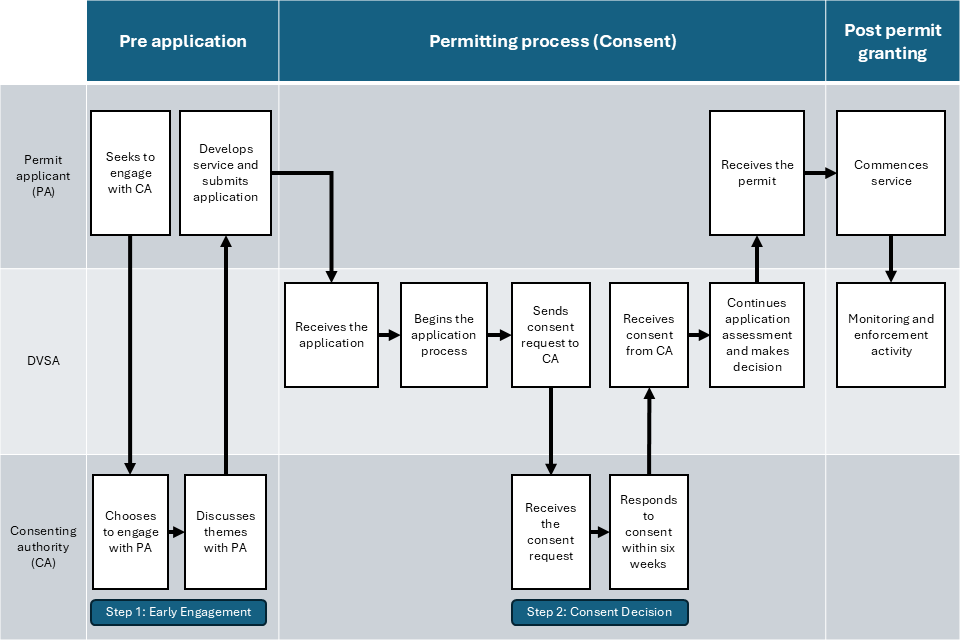
Indicative local consent process - text description of process shown in figure 1
Pre‑application steps - initial engagement
-
Service provider engages with LA.
-
LA understands the plan and agrees to move forward.
-
LA outlines consent requirements with the service provider.
-
Service provider completes application form and sends to DVSA.
Permitting
-
DVSA receives the application and commences the application assessment.
-
DVSA send consent request to LA - if DVSA content application can proceed.
-
LA reviews application and sends written response to DVSA.
-
If consent granted, DVSA decides whether to grant permit and informs service provider.
Post permitting
-
Service provider begins operations.
-
DVSA monitors and enforces rules.
Authorities involved in this process may wish to look at the applicant guidance to understand what this process looks like from the applicant’s point of view.
Early engagement
Applicant bodies are encouraged to engage as early as possible with appropriate consenting authorities. While there is no legislative basis to guide this engagement, it will encourage applicants to consider local issues, such as those identified through local transport plans and other relevant policies. Any engagement also provides the opportunity for the consenting authority to provide comment about the proposed service. The engagement also provides an opportunity, if desired, for the authority to set out what considerations may inform their decision on consent.
Any early engagement is outside the formal bounds of the consent process, so does not have any time limit. Pre-consent engagement could happen up until DVSA sends the consenting authority a formal request for consent, allowing the applicant to amend details of its service as feedback is received.
Early engagement is likely to help both the applicant and consenting authority. Consenting authorities will have more time to consider the detail of the proposed service while applicants will have the chance to shape the service to meet the consenting authority’s concerns. To aid this consideration, consenting authorities may wish to engage with other local stakeholders to understand their views on the proposed service. Although authorities are not under any obligation to do this, they may wish to talk to traffic authorities (including colleagues where in the same authority), emergency responders and other local stakeholder groups.
Themes that may want to be considered for discussion with engagement
The act does not set specific criteria on which consent must be considered. Some issues that a consenting authority may want to consider include:
Alignment with existing policies and strategies
Where a proposed service supports local priorities or runs counter to them. This could include, for example, local transport plans, environmental strategies, and any existing taxi and PHV policy.
Engagement undertaken by the applicant
The extent of engagement that the applicant has taken to shape the service and secure the views of important stakeholders.
Operational details
For example, aspects such as the proposed geographical scope of the proposed deployment area, specified routes, and description of the drop-off/pick-up locations. Authorities may also wish to look at what vehicles will do between journeys, including ‘empty cruising’, parking and use of charge points.
Vehicle details
This could include areas such as the proposed number, make and model of the vehicle, and its fuel type.
Service details
The proposed service provision such as service days and hours of operation, service model, alignment with existing transport network, and support for local accessibility.
This list is not exhaustive, and consenting authorities may wish to consider the views of other stakeholders, for example traffic authorities and emergency services. Emergency services will be particularly interested in how vehicles will interact with first responders. While traffic authorities and emergency services will be consulted where the appropriate national authority considers that they are likely to be substantially affected, consenting authorities may wish to be aware of their considerations even in cases where these bodies are not substantially affected.
However, there are some issues which a consenting authority does not need to consider. In particular, the consenting authority has no requirement to assess the vehicle’s ability to safely and legally drive itself or modifications made to a vehicle. This is the responsibility of the VCA and DVSA.
When DVSA receives an application, it may also hold preliminary, informal discussions with the consenting authority before making the formal consent request. Again, this will be voluntary: the consenting authority may choose to engage or not.
If the consenting authority sees providing their consent as being conditional on changes to the application, the authority is advised to communicate this to the applicant at this stage.
The consent decision
Following the consent request being made, the consenting authority has 6 weeks to consent to the proposed service or not (section 85(5)). This takes the form of a binary ‘yes/no’ response, with reasons needing to be provided where consent is not given.
If, within the 6-week period, the authority fails to give or refuse consent, or refuses consent but fails to give written reasons for doing so, consent will be deemed granted (section 85(4)).
Negotiations to change the nature of the service will need to take place before the formal consent request is made. Otherwise, the decision is taken on the application as submitted in the consent request, with consent either refused or deemed to be granted.
If consent is refused, DVSA cannot grant a permit and the application will be terminated. The legislation does not set out any specific right of appeal against a consenting authority’s refusal to give consent. However, an applicant may look to dispute a refusal; this could include, though is not limited to, through the authority’s own internal procedures.
If consent is granted, DVSA will continue to review any outstanding aspects of the application to consider whether it is appropriate to grant a permit or not. It is important to note that this will not involve changes made to the service as consented to.
Cross-border services
Where a proposed service would operate in different consenting authority areas, consent is required from each of those bodies. We do not expect deployments in the pilot period to be cross-boundary. However, in the longer term, consideration is being given to how applicants and consenting authorities can be supported in bringing cross-boundary services forward.
Varying, suspending or withdrawing a permit
After a permit is granted, the applicant may ask for the permit to be varied. One example would be where the applicant asked to add more vehicles to the service. If so, consenting authorities will be asked again to consent to this variation. The procedure is set out in regulation 6 of the APS SI. It is similar to the procedure for original consent, and the same considerations apply.
Another possibility is that the Secretary of State decides to vary, suspend, or withdraw a permit without the permit holder’s consent. This might, for example, involve restricting the service, possibly in the wake of a series of traffic infractions or a crash. Here the procedure is set out in regulation 7(1) of the APS SI. Before making a final decision, DVSA will issue a notice to the consenting authority and consider any representations made. However, the regulation 7 procedure does not require the consenting authority’s consent.
Consulting with traffic authorities
Section 87(1) requires the Secretary of State to consult any traffic authorities that they consider are likely to be substantially affected if the permit is granted. This is an important and distinct step, that applies even if the traffic authority is also a consenting authority.
Again, applicants are being encouraged to engage with traffic authorities at an early opportunity, and it is for traffic authorities to decide how much they wish to engage in the process.
Following receipt of an application, DVSA will formally consult with affected traffic authorities. The consultation provides the opportunity for the traffic authority to provide views on how the service interacts with the local, major, or strategic road networks. Discussions may range from broad issues of policy to issues of detail about pick-up and drop-off points, and how the service will respond to break downs and disruption. The views from consultation responses will be considered by DVSA in deciding whether to grant a permit and attach conditions.
The appropriate national authority is also required to consult with any emergency services that they consider are likely to be substantially affected if the permit is granted. Separate guidance has been developed to support emergency services, which may be of interest to authorities.
Bus services in non-franchised areas do not require consent from a franchising body. However, the intention is that these services should demonstrate awareness of and alignment with local principles, such as through Bus Service Improvement Plans.
Monitoring and enforcement
Once a permit has been issued, responsibility for monitoring and enforcement falls on DVSA. DVSA will undertake regular monitoring of permitted services, to ensure the permit holder’s compliance with the permit conditions and vehicle safety. It will also monitor complaints from users and other stakeholders.
During the pilot phase, if a permitted vehicle commits a traffic offence, the police and local authority will carry out enforcement in the normal way. This may include issuing a penalty charge notice to the registered keeper. A portal will be made available to keep DVSA informed of any PCNs issued and for wider feedback on deployments, while other means, such as email, will also remain available.
When fully implemented, the Act will introduce a new system of civil penalties where authorised vehicles commit traffic infractions. Guidance will be updated to reflect on experiences from pilots to ensure it remains relevant.
A framework is currently being developed to report on any pilot deployments. More information will be published on this as it is finalised.
Reporting and learning
Additional operator reporting is set out within the guidance for applicants, which outlines the Department for Transport’s intention to ensure that government can learn from pilot deployments, public understanding of deployments is improved and that the public is able to scrutinise the regulatory approach to automated vehicle deployments.
Key themes within this could include aspects such as safety, use as a service, accessibility, congestion impacts and economic effects.