Supporting potential carers to make informed decisions about work and care: Findings from the Carers’ Employment Digital Discovery and the Care Choices Project
Published 29 January 2026

© Crown copyright 2026
This publication is licensed under the terms of the Open Government Licence v3.0 except where otherwise stated. To view this licence, visit nationalarchives.gov.uk/doc/open-government-licence/version/3 or write to the Information Policy Team, The National Archives, Kew, London TW9 4DU, or email: psi@nationalarchives.gov.uk.
Where we have identified any third party copyright information you will need to obtain permission from the copyright holders concerned.
This publication is available at https://www.gov.uk/government/publications/carers-employment-digital-discovery-and-care-choices-reports/supporting-potential-carers-to-make-informed-decisions-about-work-and-care-findings-from-the-carers-employment-digital-discovery-and-the-care-choice
January 2026
Crown copyright 2026.
You may re-use this information (not including logos) free of charge in any format or medium, under the terms of the Open Government Licence. View the Open Government Licence or write to:
Information Policy Team
The National Archives
Kew
London
TW9 4DU
or email psi@nationalarchives.gov.uk
First published January 2026
Views expressed in this report are not necessarily those of His Majesty’s Government.
The project was led by the Department for Work and Pensions’ (DWP) Human-Centred Design Science team and co-funded by DWP, the Department of Health and Social Care (DHSC) and the – Office for Equality and Opportunity (OEO).
Executive summary
Background and introduction
Many of us will provide unpaid care for a sick, disabled or elderly relative or friend during our lifetime. In 2023 to 2024, 8% of people in the UK or 5.4 million people provided some form of unpaid care.[footnote 1] The caring population is highly dynamic. Between 2010 and 2020, an average of 4.3 million people took on new unpaid caring roles each year while 4 million stopped unpaid caring each year.[footnote 2] As the population ages, these figures are set to increase.[footnote 3]
Caring can be a rewarding experience, but it can also have negative consequences for people’s physical and mental health, wellbeing, relationships, and employment. In 2021 1.3 million working age unpaid carers in England and Wales were not in paid employment (being either economically inactive or unemployed).[footnote 4] Even when people don’t leave work altogether, many reduce their hours or turn down opportunities for promotion to accommodate caring roles. When this happens families, public services, employers and the economy are all impacted.
Carers often want to remain in employment if they can. However, many report feeling they have no option but to take on caring activities that, over time and without adequate support, become incompatible with paid work.[footnote 5] They also say the information and support available to help them understand their options and make informed decisions about work and care is inadequate.[footnote 6]
The Carer’s Employment Digital Discovery Project explored the system of information and support for working people facing decisions about work and care (‘potential carers’), focussing on online information. Through close collaboration with a range of organisations and carers themselves, we developed a detailed understanding of how choices are made. We used this to identify improvements needed to better support informed decision-making about work and care. The project was led by the Department for Work and Pensions’ (DWP) Human-Centred Design Science[footnote 7] team and co-funded by DWP, the Department of Health and Social Care (DHSC) and the Office for Equality and Opportunity (OEO). This paper sets out the project’s findings.
The findings in this report are largely based on research and consultation which took place between 2018 and 2019, prior to the COVID-19 pandemic. Whilst the key insights have since been re-tested and replicated, suggesting the wider findings remain relevant, they should be interpreted in light of the current context in which people are making decisions about work and care.
Understanding informed decisions about work and care
People’s decisions around caring and work are often constrained by factors beyond their control, such as which services are accessible in their local area and the needs, views, and help of their family and community networks. Information cannot change these constraints, but it can help people to identify which options exist and can better equip individuals to navigate those options to make the choice that is right for them.
This project explored the hypothesis that working people (or ‘potential carers’) make early decisions about care and work without a good understanding of their options or the longer-term consequences of their choices and that this, in turn, limits their ability to remain in work even when they want to. Combining existing evidence, primary research with working carers conducted by Ipsos, and consultations with a range of stakeholders,[footnote 8] we developed a definition of informed decision-making for choices about work and care (Section 3). An informed decision is not defined by whether or not a person remains in paid work, but instead by how much they know about and have considered their options when making decisions about care and work.
Critical steps for making informed decisions include understanding your options around care and work alongside their short and longer-term implications; considering your personal needs and wishes alongside those of the person needing care and giving both due weight; and having honest, clear conversations with the care-recipient, family and your employer.
The ‘default decision journey’
The model described above represents an ideal informed decision-making experience. However, our research found the current ‘default journey’ (Section 3) that many potential carers experience looks very different:
- Early choices around care are made hastily in response to urgent needs, without considering their long term implications or how care needs might change. The needs of the person requiring care are prioritised to such an extent that people don’t think about their own needs or the impact of caring on their own future.
- People taking on these activities often don’t think of themselves as carers, meaning that support aimed at carers can be invisible to them. Many don’t feel that they are making an active choice to be a carer, but are instead simply responding as a daughter, son, partner or friend.
- Those unfamiliar with caring don’t know where to start looking for information about their situation and can feel overwhelmed by the task of trying to identify relevant information from a complex range of sources. When they do find information, it can carry assumptions that they will or have already become ‘primary carers’ or give the impression that it is inevitable they will have to stop work to care.
- The unpredictable nature of caring, in particular dealing with unexpected, last minute demands, emergency medical appointments, and failures with paid care services, can substantially impact whether people feel able to combine work and care. Employers try to help, but their patience can grow thin over time, as can their confidence in a carer’s reliability and capacity to add value in the workplace.
The default caring journey therefore starts with managing but can rapidly turn into a period of stress, culminating in crisis. At the point of crisis, services for both the carer and cared-for are often discovered but the chance to maintain employment may have passed. Based on their research Ipsos summarised the default journey in 6 stages (Figure 1):
Figure 1: The default journey[footnote 9]

Barriers to informed decision-making
A range of barriers make accessing and using information challenging for potential carers (Section 4). Drawing on the default journey, 3 key areas can be identified:
- Decisions tend to be short-term, reactive and made under stress. Thinking about the possibility of friends and family becoming ill or needing help is emotionally and mentally difficult. Discussing it with others – especially the person who will need care – can be even harder. As a result, many people shy away from planning ahead, stuck instead in a state of reactive decision-making or ‘firefighting’. Dealing with issues only as and when they become urgent increases the time pressure and stress levels around those decisions, limiting people’s ability to seek information about their options, factor in their own needs and longer term considerations, and discuss those decisions with others.
- Carers are required to actively seek out information. In order to access information, advice and guidance about care and work, many people currently have to proactively search for it. Making time for this whilst working and trying to support friends or family is challenging. Not realising you have options to explore and choices to make, not knowing where to start searching and not recognising that you are (or could be) a ‘carer’, means that it is often not prioritised.
- Much available information has not been designed to support holistic decisions. In order to build an accurate understanding of their options, people are often required to navigate through a range of different local and national websites and offline resources, piecing together the information they find to build a coherent picture of their situation and the choices they face. This can be complicated, time consuming and confusing. Information from different sources can appear contradictory, or carry assumptions that restrict people’s perception of the range of options they have available to them.
Implications for solution development
The findings suggest that decisions about work and care could be improved if potential carers accessed information tailored to their specific needs earlier on in their decision-making journey (Section 5). Improved information tailored to their specific needs could help them better navigate the complex choices they face, agree more sustainable care arrangements, and ultimately increase their chances of remaining in work.
Digital connectedness and collaboration between the many organisations supporting potential carers offers an opportunity to improve their experiences of finding and using information. Generative and other forms of Artificial Intelligence also offer exciting new opportunities for tailoring information content and delivery.
The 2 main areas for solution development are:
- improving information content
- increasing proactive signposting to information
Improving information content
Increasing the quality and consistency of information about work and care would make it easier for potential carers to effectively navigate and use. Messaging and language would benefit from being more consistent, neutral and balanced; content from being presented in more digestible bite-sized chunks; and signposting would be improved if potential carers’ user journeys across a broader number of information sources was considered.
New resources and tools should aim to fill gaps in current provision. These include content designed to specifically aid decision-making about work and care, and to assist people in weighing up different options and considering the longer-term consequences. Also, advice around having effective conversations about care with the cared-for person, family and employers. This new content could also be adapted for offline settings which potential carers already use and trust, including face-to-face and telephone-based services.
Increasing information usage by proactively ‘serving’ it to potential carers
Greater proactive signposting from both the offline and online settings that potential carers are already in contact with early on in their journey would accelerate their access to information. Many potential carers come into regular contact with health and social care-related services as a direct result of the support they provide family and friends with care needs. Common touchpoints include GP surgeries, pharmacies, health and social care providers, hospitals and condition-specific charities. Employers and community groups are another existing touchpoint for working carers, as are trusted online sources such as GOV.UK, the NHS website and MoneyHelper. Co-producing new ways of identifying potential carers and serving them with the information they need in both offline and online settings could help to reduce the numbers reaching a crisis point in combining work and care.
Progress towards solutions: the Care Choices Project
In 2022 we initiated a design phase of the project, reconvening our community of expert stakeholders and carers. This phase was entitled the Care Choices Project. Partnering with Policy Lab and University of the Arts London, we ran a series of workshops to collaboratively explore ideas to address barriers to decision-making documented in this report, testing these ideas with carers. This design sprint represented a first step in an iterative process of designing and testing solutions. On the back of this work, in 2023 DWP funded a team of digital experts, design scientists and policy professionals to continue collaborating with the Care Choices community of experts. The team conducted further research with potential carers to re-test earlier findings. This indicated that the barriers to informed decision-making set out in this report still exist. The team then developed content for carers, currently hosted on the Job Help campaign page, as well as a prototype care and support guide for potential carers which applies the principles for good information set out in this report (Appendix C).
Authors
The following members of the Department for Work and Pensions (DWP) Human-Centred Design Science team authored this report:
Dr Carla Groom
Cate Fisher
William Gliński
Lucien Bush
Hannah Langton
Acknowledgements
The authors would like to thank the many organisations and individuals who contributed to the Carers’ Employment Digital Discovery Project and subsequent Care Choices project, whether by assisting us with primary research, sharing expertise in meetings and workshops, or commenting on earlier versions of the findings in this report. Contributing organisations are named in Appendix A. Among these are the Department for Health and Social Care and the Office for Equality and Opportunity, which co-funded the early phases of the project with the Department for Work and Pensions. These departments were instrumental in jointly co-ordinating the project as part of a cross-governmental steering group alongside the Department for Business and Trade.
Particular thanks go to the many carers who generously shared their experiences in interviews and focus groups and who helped us to test and refine our understanding of the problem and potential solutions. We are extremely grateful to all of them for their contributions to this work.
Glossary of terms
| Term | Definition |
|---|---|
| Carer | Someone who looks after a relative, partner or friend who requires help and support due to illness, disability, or frailty. The care they provide is unpaid. |
| Carer’s Allowance | A benefit payment for those who spend 35 hours or more a week caring for someone who is in receipt of certain disability benefits, and who earn £196 or less per week after tax, National Insurance and expenses. Learn more about Carer’s Allowance. |
| Carer centres | Usually independent, not-for-profit organisations providing a range of support services to carers in the local area. These services usually include – but are not limited to – providing information and advice. |
| Caring activities | activities involved in supporting someone with illness, disability or frailty. Examples range widely and include but are not limited to helping with grocery shopping, laundry, dressing, cleaning, managing finances or professional care arrangements, also providing emotional support and company.[footnote 10] |
| External support | Support provided both to carers themselves, for example carer peer support groups, information services and Carer’s Assessments, and/or the care recipient, such as help around the home, paid carers and health services. |
| Informed decisions/‘informed decision model’ | Decisions (in this context) about paid work and care that are informed by an understanding of the range of options available to someone, and the longer-term implications of those options for their working life, health, relationships and finances. Those options include legal rights and entitlements such as access to a Carer’s Assessment or flexible working, as well as other forms of services and support available to them given their financial circumstances, geographic location and the nature of the care needs that need to be met. The ‘informed decision model’ (Section 3.1) was developed on the basis of the evidence gathered by this project. It sets out the cognitive steps and behaviours which people need to do or take to make an informed decision about work and care. |
| Potential carer | A person facing decisions about what (if any) role to take in meeting the care needs of another adult; whether and how to share caring activities with others (including those within their social circle as well as formal services); and whether and how to combine work and care. Many potential carers will not have begun to perform care activities at the point that they face these decisions. Some may not go on to become carers at all in so far as they won’t take on care activities themselves. Others may do so for a period of time before deciding that the care needs should be met a different way. |
| Paid care/carer | Care provided by professional carers, in care homes, day centres or people’s homes. These professional carers might be paid (directly or indirectly) by the local authority, or by the person with care needs and/or their family or friends. |
| Whole systems approach | An approach that takes into account a broad and multifaceted system of factors surrounding an issue and seeks to understand how changes in one part of the system might impact on another part of the system. In this project, taking a whole systems approach means considering the complex system of public, private and charity-sector services that play a role in supporting potential carers, as well as the cultural practices and social norms around caring that affect people’s expectations, preferences and decisions around care and work. |
1. Introduction
In this section we outline the caring and employment challenge facing the UK, including the importance of informed decision-making about work and care. We explore difficulties information providers face in supporting people to make informed decisions and make the case for a whole system approach in addressing the challenge. Lastly, we summarise the project aims, scope and method and outline the contents of the following sections.
1.1. The caring and employment challenge
When illness, disability and old age hits families and communities it brings with it the question of how associated care needs are going to be met. Those care needs might range from weekly help with shopping and gardening, to daily help with eating and bathing, to intensive, round-the-clock care and support. They also include examples of ‘caring at a distance’, which don’t require (although might still involve) physical proximity, for example, managing a person’s paid care services or overseeing their finances. Caring can be considered a spectrum and the term ‘carer’ encompasses people doing a range of different types and amounts of caring activity.
In 2023 to 2024, 5.4 million people in the UK were providing some form of unpaid care and support for others, including 3.3 million women and 2.1 million men.[footnote 11] This is not a static population, however. People move in and out of caring roles – sometimes multiple times – as those around them develop care needs, recover, pass away, or as carers make decisions to reduce their caring activities for other reasons. Between 2010 and 2020, an average of 4.3 million people took on new unpaid caring roles each year while 4 million stopped unpaid caring each year.[footnote 12] Many of us will provide unpaid care for an ageing, sick or disabled relative or friend during our lifetime. Two-thirds (65%) of UK adults had provided informal care at some point between 1991 and 2018.[footnote 13] This proportion rises to 7 in 10 (70%) for women. As the population ages, the number of people caring for someone is set to increase further.[footnote 14]
1.1.1. Carer benefits and challenges
Caring for a friend or relative, be it an elderly parent, sick partner or disabled child, can be a rewarding experience. It can bring additional meaning to life, a sense of pride and reciprocity for childhood care.[footnote 15] In fact, sandwich carers – those caring for both older relatives and dependent children – who care for less than 5 hours per week report slightly higher levels of satisfaction with their life and health than the general UK population.[footnote 16]
At a societal level carers perform a vital function within the wider health and social care system. Along with paid carers and health professionals, unpaid carers support people with care needs to lead full and dignified lives, support their health and wellbeing, and play an active role in their communities.
However, caring often comes with significant pressures. The cumulative stress that many carers experience can, over time, have profound and enduring consequences for their mental and physical health. Caregiving is associated with higher rates of depression and psychological distress as well as increased risk of heart disease and stroke.[footnote 17] In particular, sandwich carers (62% of whom are women) are more likely than the general population to experience mental ill-health. Research by the Office for National Statistics found that more than one in 4 reported symptoms and the prevalence of mental health problems increased with the amount of care given.[footnote 18] For some carers, these negative outcomes do not disappear when their caring activities come to an end.
1.1.2. Caring, work and gender
Carers’ working lives are often deprioritised in the face of their caring activities. In 2023 to 2024, just over half of all adult informal carers in the UK were in employment compared with 6 in 10 of the general adult population (51% versus 60%).[footnote 19]
People are at greatest risk of dropping out of work to care between the ages of 50 and 64, just as they are reaching the peak of their professional skills and experience.[footnote 20] Risk factors include being a ‘sandwich carer’, lack of access to and inflexibility in formal care, and changing circumstances.[footnote 21] Even if people don’t give up work altogether they often reduce their hours, which can substantially limit wage progression,[footnote 22] or turn down opportunities for promotion in order to accommodate their caring activities. There is also a gendered dimension: female carers in the UK are more likely to work part-time than male carers or the general female population (21% compared with 9% of male carers and 18% of females generally).[footnote 23]
Amongst those who do leave work, many don’t return to employment after their period of caregiving ends.[footnote 24] This can have a substantial impact on both their immediate and longer-term financial wellbeing.
Carers are also at high risk of loneliness as a result of the limitations on the time and energy available to them to socialise and enjoy fulfilling leisure time.[footnote 25] Work can provide a vital source of social contact and identity. Without it, carers can feel even more isolated.
1.1.3. Impact on employers, the economy and the public purse
Employers, government and the economy also lose out when experienced people exit the workforce.[footnote 26] Employers have to fund the recruitment and training of new staff and experience productivity losses while they wait for new recruits to take up posts and receive training. This can be a particular problem when carers leave the workforce suddenly as a result of reaching a crisis point. Estimates of the combined cost to society from lost tax revenue and increased welfare and healthcare costs, as well as the direct costs to carers, which include lost earnings and reduced pension saving, range between £6 billion[footnote 27] and £37 billion[footnote 28] per year.
Despite these costs, modelling suggests that unpaid caring provides net economic value to society as a vital social infrastructure: an unpaid army of millions supporting the UK’s health and social care system.[footnote 29] This raises questions about how to reduce negative consequences of caring at the individual and societal level, whilst recognising the indispensable value of unpaid care to our current social care system.
1.1.4. Reducing negative impacts of caring through work
When people are supported to combine care and work, some negative impacts of caring can be reduced.[footnote 30] Carers often want to remain in employment if they can.[footnote 31]
However, many report feeling that they have no option but to take on caring activities that, over time, become incompatible with paid work.[footnote 32] They also say that the information and support available to help them understand their options and make informed decisions about work and care is inadequate.[footnote 33] The Work and Pensions Select Committee (2018)[footnote 34] and House of Lords Select Committee on Adult Social Care (2022)[footnote 35] have said that Government should do more to support this group by providing better information and signposting.
Against this background, this project sought to understand how best to address the challenge of information provision and empower working people to make informed decisions about paid work and care.
1.2. Whole system approach
Despite the vital work of a range of organisations, many potential carers are still struggling to access the information they need at the point they need it. A key challenge lies in the sheer complexity of the system, including the service provider landscape, surrounding working carers. Within government, a number of departments have responsibility for different elements of the national package of rights, entitlements and support for carers and those with care needs. Key amongst them are Department for Work and Pensions (DWP), Department of Health and Social Care (DHSC), Department for Business and Trade (DBT) and Office for Equality and Opportunity (OEO).
Outside of central government, the range of organisations and professionals with a role in providing services and information to this group spans all sectors. They include (but are not limited to):
- local authorities
- the NHS
- health and social care workers
- private residential and domiciliary care providers
- financial and legal advice providers
- the not-for-profit sector, including carer, condition-specific and consumer organisations
- employers
In the face of this combined complexity, carers are frequently overwhelmed by the task of trying to navigate the system and understand the options available to them given their specific circumstances and geographic variations in provision. Navigating local provision can be even more challenging when the carer lives in a different area to those they care for. Providers face significant barriers to producing information that not only aligns with their specific objectives but also supports carers to understand that information within the context of the wider system. In order to address this problem providers must come together to produce a holistic, system-wide solution. Collaboration is the most effective way to make significant and sustained inroads into this problem.
1.3. Carers’ Employment Digital Discovery Project: Background and aims
The Carers’ Employment Digital Discovery Project has looked across the system of information and support for working people facing decisions about work and care from the citizen’s perspective with a view to identifying opportunities for improvement. While we focussed on understanding online information, we also explored the value of printed information and verbal advice from potential carers’ perspectives. The project was led by DWP’s Human-Centred Design Science team and co-funded by DWP, DHSC and OEO, with input from DBT and HM Treasury (HMT).
This project explored the hypothesis that many working people are making early decisions about providing care for a friend or relative without a good understanding of their options or the longer-term consequences of their choices. As a result, they can end up feeling they have no option but to leave their job to care – despite wanting to remain in work – when the challenge of combining both activities becomes too great.
More specifically, we sought to:
- understand the experiences of working people considering their role in meeting a friend or relative’s care needs from the point that they find out about those care needs
- identify their information needs and the extent to which those needs are currently being met by the available information, with a particular focus on online information about combining work and care
- explore what (if any) changes to the current online information provision might help working people make more informed decisions about work and care
The overarching goal of this work was to generate evidence-based recommendations about how to improve online information for working people facing care decisions in order to maximise their likelihood of making informed decisions.
1.4. Project scope
Carers are a diverse group and, as outlined above, the system of information and support surrounding them is broad and complex. In order to make the project manageable whilst also ensuring it provides us with a good understanding of the broader issues, we narrowed our focus to the following groups and aspects of the system:
-
People aged 18 and above, with a particular focus on those aged around 45 to State Pension Age (SPa) who are in work and facing decisions about work and care. We are focused on the role information can play in preventing people from falling out of employment, reducing their hours, or taking a demotion. People in this broad age bracket are at most risk of leaving work in order to care.[footnote 36] The information needs of carers who are seeking to return to employment after a period out of work – as well as those of young carers under the age of 18 – are very different.
-
Those who are making initial decisions about their role in meeting someone else’s care: including whether or not to provide care themselves and how to combine work and care. From this point in the paper onwards we refer to this group as ‘potential carers’ rather than carers. For more information see Section 2.2.
-
People who are facing decisions about their role in meeting the care needs of another adult (for example, a parent, partner or adult child) rather than those who are caring for a disabled child aged under 18. The system of services and support for children and young people with care needs is very different to the adult health and social care system. The challenges carers face to accessing information about that system are likely to be different too.
-
Digital information, advice and guidance - primarily information available online, through websites, apps and email. Digital information is one aspect of a wider system of offline and online sources which people navigate over the course of their caring journey. It is, however, an increasingly important one. Digital information offers benefits to both users and providers. It allows users to access information from their own home, in their own time and at their own pace, easily storing it to return to later. This is particularly important for people who struggle to get out, for example, as a result of their caring activities.[footnote 37] Information providers benefit in terms of the efficiency and reach of their services. Digital platforms also offer new opportunities for tailoring information to the needs of specific users. This is particularly valuable when serving as diverse a group as potential carers.
-
From the perspective of an information user, the separation of offline and online information is an artificial one. Offline sources influence the ways in which people navigate and use online sources and vice versa, with both types of sources providing a vital signposting function to the other and collectively adding to potential carers’ understanding of their situation via complementary content. We have therefore explored people’s journeys through the information landscape as a whole whilst retaining a focus on ways in which the online provision (and signposting to it from offline sources) can be improved in order to better meet working people’s needs.
-
Working people in England, recognising the fact that many of the relevant policy areas are devolved and as a result the services and support available for carers may differ significantly in the devolved nations. Many of the project findings are likely to be transferrable to working people facing care decisions in Wales, Northern Ireland and Scotland. However further research and engagement would be required with carers and carer organisations in those nations to establish the impact of any contextual differences.
1.5. DWP Human-Centred Design Science approach
DWP’s Human-Centred Design Science team works collaboratively with a range of stakeholders to ensure government policies and services are informed by an accurate understanding of people’s behaviour.[footnote 38] We seek to identify the reasons why people currently do or don’t do things that could be beneficial for them, such as saving for retirement or planning for their future working life. We do this by conducting research and consulting with subject experts, including ‘experts by experience’,[footnote 39] to ground our thinking in the reality of people’s daily lives. Once we have established a thorough understanding of the problem, including the current barriers people face to taking these beneficial actions, we collaborate with colleagues to co-design and implement solutions to address it.
Whilst we adapt our approach to the needs of different projects, and it evolves over time as we learn and develop our methods, we often tackle problems in 4 main stages.
1.5.1. 4-stage approach
1. Clarifying the ‘intent’, or ultimate goal, of a policy or service. For example, this may be helping people to move into a job, helping them to gain promotion, or preventing them from becoming unemployed. This stage often involves bringing a range of stakeholders together to build a shared understanding of the intent of different parts of the system and resolve any conflicting goals.
2. Defining the behaviours, cognitive processes and/or practices required to achieve that intent. In other words, clarifying who needs to do what, and at which point(s) in order to achieve a given aim. Given the nature of this particular project and its emphasis on decision-making, we have focused on cognitive aspects of the decision-making process as well as observable behaviours such as talking to others about options. Cognitive aspects include understanding your options and considering your needs and values (see Section 3 for further details).
3. Systematically identifying the barriers to those behaviours, cognitive processes and practices. In other words, the reasons why people aren’t currently carrying them out. We often group these barriers into those concerned with:
- capability – skills and knowledge, or a lack of it;
- opportunity – aspects of the physical and social environment that make a behaviour more difficult; and
- motivation – include attitudes, habits and values[footnote 40]
4. Co-designing solutions to overcome these barriers. We do this in collaboration with the range of relevant organisations and individuals who are involved in or affected by the policy or service in question. Depending on the nature of the problem solutions can include new communications campaigns, changes in the way existing services are provided, and where needed the creation of new policies and services.
These stages are not straightforwardly linear and there are often ‘feedback loops’ between them. For example, defining the behaviours required to achieve the intent of a policy (stage 2) can also help us to clarify what the intent of that policy should be (stage 1).
Throughout the course of the Carers’ Employment Digital Discovery Project, we have collaborated with a range of experts, including working carers, to help clarify the policy intent, define behaviours and identify barriers (stages 1 to 3). Based on this knowledge we have started to identify the key areas in which new solutions are needed in order to help address the barriers (stage 4).
1.6. Project method
1.6.1. A multi-stranded approach
The project involved 7 strands designed to help us develop a holistic understanding of the problem and potential solutions:
1. Consultation with a range of expert stakeholders via meetings and workshops throughout the course of the project.
2. Exploration of the current information available online for carers, involving a review of websites brought up using hypothesised search terms.
3. Qualitative research (depth interviews) with working people facing decisions about work and care. This study explored participants’ current and recent experiences of making decisions and accessing information.
4. Qualitative research (focus groups) with carers receiving support from their local carer centre who were working at the point that they became a carer. This study retrospectively explored participants’ experiences of making decisions about work and care, as well as what they wished they had known about caring and work earlier in their journey.
5. Triangulating research findings through reference to existing literature.
6. Behavioural analysis and model development: Synthesising findings from the above strands and applying those findings to our understanding of the problem and possible solutions. Extensively and continually testing and refining our understanding with working carers and stakeholder organisations to produce the final set of findings.
7. Prototyping solutions iteratively with a range of carers and carer organisations.
1.6.2. Primary research
The desk review and the 2 strands of qualitative research (strands 2 to 4) with carers and potential carers were conducted for us by the independent research agency Ipsos. Carers Trust also made the second strand of qualitative research possible by supporting us to speak to carers via their network of local carer centres. Selected findings from the research are referenced and summarised throughout this paper in support of the project conclusions.
1.6.3. Stakeholder community
Government doesn’t hold all the knowledge, ideas or levers in relation to working carers, but we are able to bring together wide-ranging groups of stakeholders to encourage and enable collaboration on key social problems. This ability has proved vital here given the need to adopt a holistic, system-wide approach (Section 1.2). We iteratively tested our research questions and emerging conclusions with a deliberately large and varied group of stakeholders from across the public, private and third sectors. This ensured a variety of perspectives and a rich body of knowledge were brought to bear on our findings. The stakeholder community included policy and analytical leads from DWP, DHSC, OEO and DBT, as well as local authorities, condition-specific charities, employers, carer support organisations and academics. Additionally, we consulted with carers themselves through both our independent research and via staff networks of working carers within government departments. A full list of the organisations and academics who generously contributed their time, knowledge and expertise to this project can be found in Appendix A. The carers who participated were guaranteed anonymity in line with research ethics standards.
Through this work we have been able to build a consensus on the nature of the problem facing a group of people who had not previously been clearly identified, along with a desire to work together to address these issues. Moving forward we hope to continue working closely with this community to co-produce whole system solutions to the collective challenges we are facing.
1.6.4. Interpreting findings in this paper
Findings in this paper are based on research and consultation which took place between 2018 and 2019, prior to the COVID-19 pandemic. While findings remain valid and relevant, interpretation should consider the context in which people are now making decisions about work and care.
1.7. Paper contents and structure
This paper presents the findings and conclusions from the Carers’ Employment Digital Discovery Project. The contents are structured as follows:
- Section 2 defines the ‘potential carers’ group that is the focus of this project and briefly explores our understanding of care as a social practice before considering what choice means in the context of work and care.
- Section 3 presents a model of informed decision-making about work and care, developed on the basis of evidence gathered throughout this project. It then outlines the ‘default journey’ that potential carers currently experience when approaching decisions about work and care, and illustrates this with stories of 2 fictional potential carers.
- Section 4 summarises the main barriers that currently reduce working people’s abilities to make an informed decision and therefore achieve the best outcomes for themselves and the people they care for.
- Section 5 discusses the main categories of solution which could help to address the barriers outlined in section 4.
- Section 6 sets out the steps Government has taken in response to these findings.
2. Care, work and decision-making
This section outlines the intent of Government policy and services in relation to work and care. We define the ‘potential carers’ group who are the focus of this project and outline our understanding of care as a social practice before considering what choice means in the context of work and care.
2.1. Supporting informed decision-making
We recognise that decisions around caring for relatives and friends are very often deeply personal. They are influenced by people’s values, priorities and the nature of their social connections. For some, leaving work to care for a loved one will be the right decision and one made after carefully weighing up their various options and understanding the short and longer-term implications of leaving work on their finances, health and wellbeing. For others, giving up work would cause not only financial hardship but a sense of social isolation and loss of identity that could be damaging for both them and the person they are caring for.
Supporting informed decisions does not mean seeking to influence potential carers to remain in work if it is not right for them. Instead we want to support greater numbers of potential carers to make informed decisions about work and care and to achieve the best outcomes possible over the longer term given their personal circumstances. We aim to support them to make these decisions in a considered way – not as a result of reaching a crisis point when they may feel they have no option other than to leave work.[footnote 41] It is this process of informed decision-making about work and care that we have sought to define and explore in this project, including:
- what informed decisions about care and work involve
- what barriers potential carers face to making informed decisions
- what sorts of solutions are required to help address these barriers
2.2. Defining ‘potential carers’
This work focuses on ‘potential carers’. Potential carers are an overlapping but distinct group that we have identified through our research and consultation. Section 2.2.1 provides a definition of this group.
2.2.1. ‘Potential carers’ – a definition
Potential carers are people facing decisions about:
- what (if any) role to take in meeting someone’s care needs;
- whether and how to share caring activities with others – including other friends and relatives as well as paid care services, including self-funded and government funded options; and
- whether and how to combine work and care.
Many potential carers will not have begun to perform care activities at the point of starting to make these decisions. Some may not go on to become carers at all, in so far as they won’t take on care activities themselves. Equally, some potential carers will realise they have decisions to make about work and care and will be actively thinking and talking to friends, family and employers about them. Others will not, but may nonetheless potentially have a role to play in meeting a person’s care needs. All such groups can be considered ‘potential carers’.
Defining potential carers in the way outlined in this section involves acknowledging how widespread (and, with an ageing society, rapidly expanding) membership of this group is. As stated, it not only includes people who recognise they have decisions to make about a relative or friend’s care needs and are actively thinking about options. It also contains those who are delegating or deferring such decisions, or assuming that others will provide or organise the care required without the need for discussion or agreement. Under State Pension age, more women than men provide unpaid care. However, equal proportions of women and men are likely to fall into the potential carer category. A daughter living close to her increasingly frail mother who has been thinking about what additional support she needs is a potential carer, but equally so is her brother who lives further away and has been assuming his sister will care for their mother. Also included are the mother’s friends and neighbours who are thinking of offering help with shopping or odd jobs around the house. All of these individuals could form part of a distributed network of care provision alongside any support from paid carers, cleaners and gardeners.
There is no such thing as a ‘primary potential carer’ in the way that there might be a ‘primary carer’.[footnote 42] There are only a range of potential carers in different circumstances all facing decisions about what course of action best balances their needs with those of the cared-for and other potential carers. Focusing on potential carers rather than carers therefore encourages us to consider how we can better support all people – men, women, friends and relatives – to make active, shared and well-informed decisions about how the care needs of those close to them should be met, and to challenge unhelpful assumptions about who ‘should’ be doing the caring.
In defining potential carers this way we hope to shift readers’ focus from the more discrete carers group to a much broader social group who have a different set of information and support needs. Keeping this distinction between the 2 groups in mind will be critical to designing and delivering information that meets potential carers’ specific needs and provides effective support to help them make informed decisions.
Throughout the paper we refer to ‘potential carers’ for brevity. However, given the focus of this project on helping people to make informed decisions about paid work and care before reaching a crisis point, we are referring to the sub-set of potential carers who are still in paid work at the point that they face decisions about work and care. Potential carers who are no longer in work but would like to return to the labour market face a substantially different set of decisions and barriers around work and care and therefore need to be considered separately.
2.3. Caring as a social practice
Before we explore the concept of informed decisions about work and care it is important to acknowledge the inherently social dimension of these decisions, and of the practice of caring itself. People make decisions and provide care within the context of families, workplaces, communities and broader societies. These families and communities have social norms around caring that make some options (for example keeping the provision of care within the family) seem more acceptable than others. Social systems can provide – or fail to provide – services and support in a way that makes certain options more possible than others, for example, a decision to combine care and work will be more possible if paid carers are available to provide support while an unpaid carer is working. These social systems also fundamentally shape our ideas of what it is to ‘care’ and be a ‘carer’, as well as what it means to be a good partner, son, daughter, parent, or friend.
Caring can also be understood as a social activity which is triggered by the development of care needs.[footnote 43] As the nature, scale and distribution of care needs across society changes and wider social developments such as female employment and increases in retirement age impact on the ways in which those needs can be met, so the practice of caring will need to change in response to this. Section 2.3.1 sets out the social changes and demographic changes that will impact on the way care is provided in the future.
We have sought to take into account the role and impact of wider social influences as far as possible when exploring potential carers’ decisions about work and care. It is vital that we avoid solely focusing on the role of the individual potential carer – including their attitudes, motivations and beliefs – in the decision-making journey. Instead we aim to develop a holistic understanding of the environmental and structural factors that empower, or disempower, potential carers in order to identify how best to support this group to achieve the right outcomes for them.
2.3.1. Social and demographic changes impacting on the need for and provision of care
The Government Office for Science’s 2016 report ‘Future of an Ageing Population’ set out the social changes taking place in the UK that are re-shaping the way we think about and respond to later life, including later life care.[footnote 44] Whilst older people’s care needs have been typically met within families, the report notes that traditional expectations of later life care – that it will take place almost exclusively within the family unit and be undertaken primarily by women - are becoming increasing ill-adapted to our new social reality. This new social reality includes:
- people living longer but spending more years of life in ill health
- those born with serious health conditions and disabilities living into adulthood in greater numbers than ever before
- people working much further into later life due both to economic necessity and changing social norms
- increasing proportions of women in work, again due to both economic necessity and changed expectations
- lower marriage and birth rates – fertility rates in the UK are below replacement rate
- the diversification of family types, with increasing proportions of blended and single parent families
The UK is not the only country facing adult social care challenges as a result of significant demographic change. A number of other European countries, North America and Japan are in a similar position.[footnote 45]
2.4. Choice and constraints on choice for potential carers
The notions of choice, control and autonomy have long been recognised as important in the lives of disabled people and those with care needs, in terms of the services they access and the ways they engage with their communities. Choice and control is increasingly being recognised as important for carers too.[footnote 46] Choice for potential carers includes choice about:
- what, if any, role to play in meeting a friend or relative’s care needs. In other words, what kind of care activities to take on and how frequently to do them
- whether those care activities will be shared with others, including other friends and relatives, and outsourced or professional services. The latter includes local authority provided social care self-funded care services, cleaners, services provided by the voluntary sector etc
- what, if any, changes to make to their working situation in order to accommodate the caring activities they are taking on. This could include working more flexibly, reducing their hours, changing jobs or even leaving work entirely.
Evidence suggests that having choice about whether, and how, to provide unpaid care brings wellbeing benefits for both the carer and the person with care needs.[footnote 47] As we have acknowledged in Section 1, providing care can be intensely demanding as well as rewarding. It often requires specific skills and knowledge as well as time, energy, patience, understanding, and emotional and physical resilience. Carers can be required to do things that are challenging in a variety of ways and could have significant consequences if they go wrong, such as moving someone if they are unable to move themselves, administering medication or ensuring the person they care for complies with their care plan. Ideally, caring activities should only be taken on by people choosing to do so willingly, and who feel they have sufficient resources and support to be able to carry out those activities in a way that doesn’t impact upon them detrimentally.
Academics have noted 2 important preconditions of choice in this context.[footnote 48] The first is having access to up-to-date, accurate information about your options in order to make an informed choice between them. It is this aspect of choice that this project is seeking to improve. The second, and even more fundamental, precondition is having 2 or more viable options to choose between. In this case, 2 or more options that will effectively meet the needs of the recipient and are sustainable in financial and wellbeing terms over the longer term. For example, your elderly father needs care and you are exploring the options of taking him to a day centre during weekdays and looking after him yourself during evenings and weekends, moving him into full-time residential accommodation, or meeting all his needs yourself. If the former 2 options aren’t available because there are no appropriate day centres near you, your father is not eligible for state-funded residential care and you cannot afford to pay for it yourselves,[footnote 49] and there are no other ways of meeting his needs, then you cannot be said to have a meaningful choice about whether or not to become his carer. You may, however, have a choice about some aspects of how you provide that care, in terms of whether and how you adapt your current work commitments to accommodate your caring activities.
2.4.1. Constraints on choice
People’s choices – or decisions – around caring and working are therefore constrained by a range of structural factors linked to the wider system of services and support around them, as well as by their family, friendship and community networks. These potential constraints include:
- the needs and wishes of the person needing care
- whether or not there is a wider network of family and friends with whom a potential carer can share caring activities
- access to local authority-funded social care, and to what extent this meets the needs of the recipient
- access to suitable, good quality self-funded care services in their locality, and whether the person with care needs and/or the potential carer have the means to self-fund such external support
- access to technology that can support people to combine care and work, such as home alert systems
- the nature of the potential carer’s work, how supportive their employer is of the carers in their workforce, and whether or not they are willing and able to accommodate flexible working patterns
- the potential carer’s wider skills and the employment opportunities in their area which will affect their ability to find a new job or change careers to support flexible working;
- social norms and resulting pressures around caring, particularly those related to being female[footnote 50] and coming from cultures with a strong emphasis on providing care within families and communities
In the short-term, improving information provision to help people make more informed decisions will not alter the options available to people, but it can help them make the best decisions given their available options. This may mean choosing between options where they exist, more fully understanding where they are absent, and being better equipped to navigate through those constraints. In the longer-term, however, greater awareness of and demand for different types of support services amongst potential carers could help to drive changes in other areas, for example self-funded provision, resulting in greater choice and better outcomes.
The next section sets out what we mean by informed decisions about work and care, based on the research and consultation we have conducted, as well as other evidence about the way in which potential carers currently make decisions.
3. Decisions about work and care: the informed decision model and current decision-making
This section presents a model of informed decision-making about work and care, developed on the basis of evidence gathered throughout this project. We then outline the way in which our research suggests most potential carers currently approach decisions about work and care. Lastly, we set out 2 fictional ‘carer stories’, illustrating the differences we believe information (or a lack of it) can make to employment, wellbeing and financial outcomes.
3.1. Defining informed decision-making
‘Good’ outcomes in relation to work and care will differ from person to person, depending on their unique situation and what brings value to their lives. As we have seen in Section 2.4, options and decisions are also constrained by a wide range of factors. For some potential carers, a ‘good’ outcome will involve remaining in employment and combining their work with some caring activity. For others it will involve scaling back their work in order to accommodate a caring role or leaving work completely. For others still, it may be stopping caring when needs escalate. An informed decision is not defined by its outcome, but rather the way information is brought to bear in the process of deciding. We do not suggest that any particular course of action is better than any other at a personal level.
How, then, can we define informed decisions and better support potential carers to make them? We have worked with our stakeholder community and carers themselves to define what informed decisions around work and care look like. Based on extensive research and consultation, we developed the following ‘informed decision model’ for decisions about work and care and have user-tested it with carers.[footnote 51]
The model highlights steps carers ought to be supported to achieve if they are to have the best chances of making informed decisions. The model can apply to a variety of decisions about how someone’s care needs are met, when it affects their work, health and finances. For example:
- ‘Shall I start providing care, or is it better that others provide it?’
- ‘Should care arrangements be shared between family members or friends? How?’
- ‘Should any of my family or the care-recipient move in together to reduce the time and costs of travelling to care?’
- ‘Shall I hire a cleaner to free up time if I provide care?’
- ‘Shall I change the number of hours I work if I start providing care?’
- ‘Shall I reach out to other people or organisations to help me think about my situation and deal with new stresses?’
The model and its key stages are set out in Figure 3.1. At the end of the model, we indicate our hypothesis that more informed decisions will enable people to stay in work if they so wish.
Figure 3.1: The informed decision model for decisions about work and care

The model displays a number of steps – either thought processes or behaviours – that potential carers need to take for their decisions to be well-informed:
- recognising that they may have options to choose between, and therefore decisions to make, in relation to caring and working; rather than being reactive and taking action without seeking information about their options
- understanding the current level and nature of their relative or friend’s care needs and whether and how those care needs might develop over time, including the ‘best’ and ‘worst’ case scenarios;
- accessing information about their options and having a good understanding of the implications of those different options for their longer-term ability to remain in work
- considering their own needs and values, as well as those of the person needing care, and giving both due weight. These include needs and values relating to health, work, finances, relationships and wellbeing
- having honest discussions with the person needing care, wider friend and family networks and their employer in order to agree the best way forward.
Access to accurate, up-to-date and relevant information about options is therefore necessary but not sufficient for informed decision-making.
3.1.1. Complex decisions
The model is laid out linearly and looks relatively straightforward. This is a simplification to help policy makers and information providers think about complex decisions. In practice, the lived experience of decision-making is complex and iterative. Potential carers may revisit steps multiple times as they seek to understand their options and explore them with others. Discussions with the person with care needs, other family members and friends, employers and the local authority should help to clarify what options are available for potential carers but might also mean they need to return to earlier stages to seek further information.
Like many decisions people make regarding family and friends, they involve both ‘head and heart’. Complex notions of perceived ‘duty’ and reciprocity – for example, in relation to the parents who raised and cared for them – and ideas about what it means to be a ‘good’ child or partner, along with feelings of love and concern, can carry more weight than financial considerations. Deeply held values around what constitutes a meaningful life and the relative contributions that paid work, voluntary work and family and friends make to that life will play a strong role too. For most potential carers, decisions are unlikely to be straightforward. They are likely to feel ‘torn’, at least at points in their journey, particularly if their own needs and values do not appear to be aligned with those of the person needing care or with those of other family members and friends also considering these issues.
The decision-making model applies to a range of different care and work-related decisions taken at different stages of a potential carer’s journey. It applies not only to initial decisions about whether or not to start caring activities, but as circumstances change and prognoses become clearer, people may need to find out how to accommodate new needs alongside their working life. Potential carers may therefore need to revisit certain steps within the model when:
- the needs of the recipient change
- their own priorities and needs change, for example, if they develop a health condition themselves or feel their wellbeing is suffering
- their work situation changes, for example, if their workload increases, or if they are considering moving jobs or going for a promotion
- other aspects of their own situation change, for example their financial resources or commitments, or their household situation
- the support, rights and entitlements available to them change, for example, if a new service starts to be offered or an existing one is no longer available, if employment rights change or they move to a new employer who has different policies around carers
The decision-making process is complex and individual; everyone’s journey will be different. Despite this, we believe most potential carers will need to go through most, if not all, of the stages at some point if they are going to make well-informed decisions about work and care.
3.1.2. Information needs
Underpinning this decision journey is a more detailed set of related ‘information needs’ – see Appendix B.[footnote 52] These needs include:
- being actively given/served/provided information and signposted to further information early by trusted organisations and professionals
- accessing information on a wide range of topics, from finances and assistive technologies for the person with care needs to workplace rights and entitlements
- finally (if necessary) being supported to understand the information they have accessed and apply it to their specific set of circumstances
Given that each potential carer’s circumstances are unique, different information needs will be more prominent at different points in each journey. We expect, however, that most potential carers will have many – if not all – of these information needs at some point.
3.2. How potential carers currently make decisions
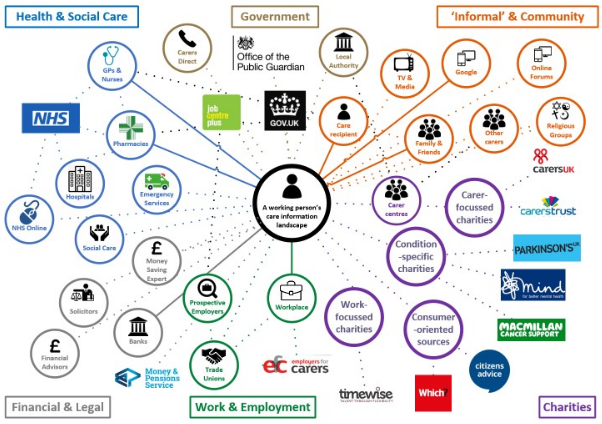
In order to make informed decisions for themselves and their families, potential carers need to make sense of a highly complex and often unfamiliar system of services and support. Figure 3.2 illustrates a range of possible information touchpoints that working potential carers may come into contact with soon after learning that a family member or friend has or will develop care needs.[footnote 53] Information sources are grouped into 6 colour-coded categories. Working clockwise from the top around the landscape map these are:
- government – central and local government, other public bodies, and organisations contracted to provide services for them
- ‘Informal’ and community – friends and family, the media and offline as well as online peer support networks and forums
- charities – carer-specific, condition-specific and consumer/legal rights organisations
- work/employment – workplaces (including line-managers, HR and work colleagues), prospective employers and trade unions
- financial and legal – both providers of regulated and unregulated advice along with banks and building societies
- health and social care – primarily frontline NHS service providers such as doctors and nurses, as well as pharmacists and the NHS website, alongside paid social care providers
The solid lines in the figure illustrate the connections our evidence suggests potential carers are more likely to have soon after learning that a family member has or will develop care needs (for example their workplace, the care recipient, GPs and nurses). Dotted lines illustrate connections which are less certain or ones which may never be established, depending on a potential carer’s situation and needs, where they are signposted to, or simply chance in finding them. The organisations depicted in the diagram are not exhaustive. We understand that there are many other valuable sources of information. In particular, the charities depicted are merely a few examples from a wide range of organisations that potential carers may turn to for information and support.
Figure 3.2: A working person’s care information landscape
3.2.1. The ‘default journey’
Figure 3.2 demonstrates the initial challenge that potential carers face in simply knowing where to start looking for information. This in itself can be a daunting and overwhelming task. Yet to make decisions about work and care, potential carers have to both find up-to-date and reliable information that meets their needs and use it to understand the options available to them, including both the short and longer-term implications of each. This comes with the added challenge of significant variation in the kind of support available to potential carers and those in need of care depending on their geographic location, the kind of work they are in, their financial circumstances and the extent and nature of the care needs.
A picture of a ‘default journey’[footnote 54] has emerged from our research and consultation that looks very different to the informed decision model outlined above. In this default journey:
- Early decisions are taken hastily, without considering how care needs might change.
- The needs of the sick relative or friend are prioritised to such an extent that those taking on caring activities do so without considering their own needs or possible alternatives.
- People taking on these activities often don’t think of themselves as carers. Support aimed at carers is therefore often invisible to them, especially if they don’t qualify for financial assistance.
- If potential carers do locate information about caring, that information can carry assumptions that they will become carers or are already primary carers. It therefore doesn’t always set out the full range of possible options available to people.
- The emphasis in some online information on the difficulty of ‘juggling’ work and care may give the impression that it is inevitable carers will have to stop work at some point.
- The unpredictable nature of caring, particularly last minute, emergency medical appointments and failures with paid care services, can have a substantial impact on the extent to which people feel able to combine work and care.
- Employers try to help but their patience can grow thin over time, as does people’s confidence in their reliability and capacity to add value in the workplace.
- The journey therefore starts with managing but can rapidly turn into a period of stress, culminating in crisis (see Figure 3.3). At the point of crisis more services are often discovered but the chance to maintain employment may have already passed.
Figure 3.3 Key stages in the current journey of potential carers[footnote 55]

3.3. Examples of decision-making and the role of information
The 2 following stories are fictionalised examples of the ‘default’ journeys taken by potential carers described above. We present these to illustrate our understanding of the importance of decisions made from the earliest stages and the role that information (or the lack of it) can play in these decisions and their outcomes.
These stories inevitably simplify the complexities of carers’ real life experiences in order to illustrate these points. They are not representative of all carers’ experiences. However, they are composites of real first and second-hand accounts of carers’ experiences. Following each story, we outline how we believe changes to information could impact health, finance and employment outcomes for the characters depicted.
3.3.1. Lorna’s story
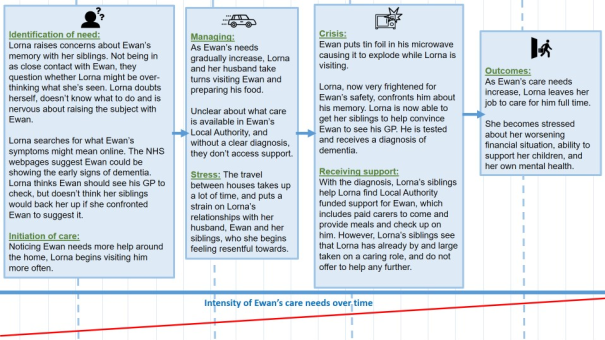
Lorna, 50, is married with 2 teenage children. Her family have very little in savings. Lorna’s father, Ewan—72 and recently widowed —lives 45 minutes away in a different local authority area. Lorna has 2 siblings that live slightly further away. Lorna visits Ewan more often than her siblings and notices he has become increasingly forgetful and disoriented over the past few months. Lorna’s story is shown in Figure 3.4.
Figure 3.4
How information affects Lorna’s story
Lorna’s story shows how opportunities for arranging care sustainably can be missed in response to gradually increasing care needs. Lorna begins meeting Ewan’s initial care needs that she notices early on, because she is the potential carer in closest contact with Ewan. Because of this, 2 things happen. First, because the care needs are manageable initially and increase gradually, Lorna takes more and more on without seeking information or additional support, with negative consequences to her wellbeing building imperceptibly until a crisis point is reached. And second, by committing herself to those initial needs, she is seen by her siblings to have assumed a role of ‘the primary carer’ – even though they could help Lorna with Ewan’s care.
We believe that in cases like Lorna’s, additional support for having constructive and proactive conversations with family about health needs could improve outcomes. Lorna found information about dementia online early on. However, she lacked confidence in confronting Ewan about his memory and persuading him to see his GP. This project identified a gap in information provision around how to have effective family conversations about health needs. We suggest that, if Lorna had found information supporting her, she may have been encouraged and equipped with effective techniques to speak to Ewan about his emerging needs early on:
- Ewan could have been persuaded to see his GP and received a diagnosis sooner, providing clarity for the family about their situation, enabling them to plan and seek further information about how to best meet Ewan’s care needs.
- The family may have been able to agree a fairer distribution of care arrangements between them, sparing Lorna from being seen to adopt a ‘primary carer’ role.
- With Lorna’s siblings engaged with the issue, the family may have identified and accessed the funded care that was available in Ewan’s local authority sooner, further relieving pressure from them to provide all of the care needed themselves.
With the additional support from the local authority and her siblings in place sooner, Lorna may have felt able to remain in employment. Further, a more collaborative and sustainable arrangement for meeting Ewan’s care needs could have made a difference to:
- Ewan, who could have received a higher quality of care for longer with Lorna and her family remaining financially and mentally stable.
- Lorna’s husband, who finds their marriage is better without supporting Lorna in straining to take on the majority share of Ewan’s care.
- Lorna’s employer, who wouldn’t have had to hire and train a new member of staff.
- Public services, which would have benefitted from Lorna continuing to work and pay tax.
3.3.2. Jake’s story
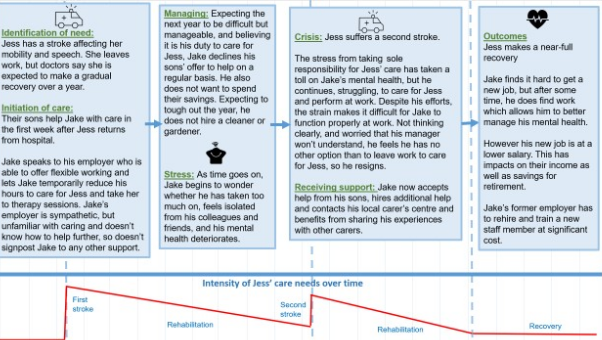
Jake, 59, has been married to Jess, 58, for 34 years. Both work in offices for large employers. They have some savings that they had been hoping to give to their sons for deposits on their first homes. One evening Jess has a stroke. Jake’s story is shown in Figure 3.5.
Figure 3.5
How information affects Jake’s story
Jake’s story shows how inaccurate expectations of what care involves can lead to unsustainable care arrangements. It also shows the opportunities that employers have for informing and supporting potential carers. Jake understands that it may take Jess a year to recover. However, he underestimates the full extent of the stresses of caring and doesn’t anticipate how care needs can be unpredictable. Because of these expectations and strong sense of responsibility, Jake declines help from his sons and refuses to spend savings on hiring a gardener and cleaner early on. We suggest that Jake’s employer, while sympathetic and able to offer flexible working, was in a good position to have signposted Jake to further information that could have improved his outcomes. If Jake’s manager had access to guidance and information on how to support staff facing decisions about work and care:
- Jake may have accessed support groups for carers of stroke victims, read more about others experiences and recognised the potential scale of what lay ahead. With a better appreciation of the nature of caring, he may have accepted help from his sons or decided to spend some of their savings to hire a gardener and cleaner to better manage care while working.
- Jake could have been signposted to his local carer centre sooner, which may have provided an outlet for sharing his experiences with others who understood his situation, leading him to feel less isolated.
- Jake may have felt that his employer was more supportive or understanding of his situation. This, as well as being better able to maintain his mental health, may have encouraged Jake to negotiate his working hours to care for Jess until she recovered and return to work full time at his existing job, rather than feeling the need to leave employment and take on a lower paying job.
Being enabled to make more sustainable care arrangements could have made a difference not only to Jake’s outcomes, but also:
- To Jess, in Jake being less stressed and a happier husband, while saving more for their retirement together.
- To Jake’s employer, who wouldn’t have had to rehire and train a new member of staff
- To the health services and taxpayer, who didn’t have to fund mental health support for Jake over the long term.
- To public services, which benefit from Jake’s higher tax payments.
4. Barriers to making informed decisions about work and care
The informed decision model discussed in the previous section outlined the necessary cognitive steps and behaviours for making informed decisions about work and care. In this section we discuss the most prominent barriers to informed decision-making on those issues.
The more accurate and detailed our understanding is of the barriers to potential carers making informed decisions about work and care, the more effectively we will be able to design solutions to help them overcome those barriers. To help us map out the range of barriers facing potential carers we combined an individual-level approach to understanding behaviour[footnote 56] with one that acknowledges broader social and cultural influences on it. These social and cultural influences include societal norms around care which shape practices around how it gets provided and by whom.[footnote 57]
Using this approach, we have identified and then categorised the main barriers that prevent potential carers from performing one or more of the steps in the informed decision model into 5 groups, based on the source of the barrier. By pinpointing the source of each barrier, we can better understand both how to address them through improvements to information provision, and the extent to which it will be possible to address them through information alone. The 5 groups of barriers are:
1. Individual capability, mind-set and emotion: these barriers are internal to the individual potential carer. They are associated with people’s individual capabilities, thinking styles, personality, motivations and values, and therefore vary from person to person.
2. Individual situation and social connections: these barriers are external to the individual potential carer. They are affected by their circumstances, the resources available to them and the environments they are in contact with when they are facing decisions about work and care. They include the nature of the care needs and their speed of onset, as well as things like the potential carers’ social, family, financial or employment situations.
3. Care information: these barriers arise from the information sources available for potential carers to access, including the language used, the way choices are framed and the way further information is (or is not) signposted.
4. Cultural: these barriers arise from the social and cultural norms shaping people’s expectations and values around care and work.
5. Structural: these barriers arise from the way in which the health and social care system, as well as other services, are structured and delivered. For example, the scale, complexity and geographic variation the social care system.
Each of the barriers outlined in this section can affect decision-making in multiple ways and often interact with other barriers. While the barriers we present here are those which we identified as most prominent through our research, we do not claim them to be exhaustive. Neither are we claiming that all potential carers will experience all the barriers. The barriers were identified from a range of different sources, including existing evidence, the new primary research with carers conducted as part of this project and workshops with expert stakeholders. Where the barriers came from existing publications or our primary research this has been clearly referenced. The evidence is stronger for some barriers than others, and all barriers will warrant validation and further exploration at the solution development stage to ensure we understand them sufficiently to address them effectively.
Before we explore the barriers in more depth, Figure 4.1[footnote 58] summarises the main barriers in each of the 5 groups. This diagram draws heavily on the Individual, Social Material (ISM) model.[footnote 59]
Figure 4.1: Overview of the barriers to making informed decisions about work and care

4.1. Barriers related to potential carers’ capability, mindset and emotion
Responding to someone’s care needs can be an emotionally, physically and mentally challenging task. It often requires people to think about the physical and mental deterioration — sometimes even death — of someone close to them. It also forces them to make complex trade-offs between different factors such as finances and relationships. Between individual cases, the scale and nature of care needs will vary, as will the ways in which potential carers process the situation mentally and emotionally. The way an individual reacts, as well as whether or not they have pre-existing knowledge and skills about the health and social care system and about the caring experience, can affect their approach to decisions and their understanding of their options.
4.1.1. Focus on the care recipient’s urgent needs can prevent people from considering their own, or from seeing their situation as one with choices available.
When illness, disability or frailty strikes, the attention and priorities of those close to them quickly narrow in on how to support their immediate needs.[footnote 60] Family members and friends often willingly make sacrifices to help. They can feel it is their duty to do what they can and that they have no choice but to begin providing care. It is not easy to step back from the immediate and urgent activities to consider longer-term options, and personal needs, as well as the needs of other relatives or friends. But this can be vital in determining what care arrangements will be most sustainable and best for everyone over the longer-term. If people over-commit, or don’t factor their own needs into decisions of whether to provide care, they can put their own wellbeing at risk. Risks to carers’ own mental, emotional and physical health which are associated with informal care,[footnote 61] could in turn undermine their ability to continue caring at a consistent quality. Further, people unfamiliar with what caring entails may not recognise their situation as one that presents decisions which can be supported by information. They may not be aware of the implications of taking on care activities for their own health, employment and financial wellbeing, let alone be concerned for themselves when faced with the suffering of someone close to them.[footnote 62] This can lead to potential carers not considering their own needs when making decisions.
4.1.2. Being proactive is challenging, and some do not seek support until crisis hits.
Some potential carers understandably report being reluctant to find out their friend or relative’s full prognosis or likely trajectory of their care needs.[footnote 63] When a person feels unequipped or overwhelmed by challenging situations, or the prospect of discussing prognoses with the care-recipient or family is daunting, it can be difficult to take a proactive approach to confronting questions of how to act. The Ipsos research identified a ‘default journey’ (see Section 3.2 describing the decision-making behaviours of participants across their study. The ‘default journey’ was characterised by a reactive approach to decision-making in which limited information and support was sought until they reached a crisis-point.
4.1.3. Prolonged stress causes burnout, adversely affecting decision-making.
Caring is often punctuated by challenging events and changes to care needs, confronting potential carers with stressful life decisions. Responding to these events can be physically and mentally demanding. Approaching them proactively, by seeking information and finding opportunities to respond in a way that best suits those affected, can save substantial time and energy. The impact of caring - particularly when longer-term or high intensity - on carers’ physical and mental health can have a negative impact on the quality of care they are able to provide (described in some of the literature as ‘carer burnout’).[footnote 64] Without time for respite and maintaining their own mental and physical health, carers’ ability to meet their own and the cared-for’s needs can deteriorate.[footnote 65]
4.1.4. Decisions are complex, emotive and can involve choosing between deeply-held values.
Even if individuals search and identify options extensively, they can face challenges in reflecting on them in light of their personal values and determining the best course of action for themselves. The long term implications of any decision will inevitably contain uncertainty in how events will play out. Further, different options about how care is provided will often involve trade-offs between personal values. For example, choosing to care for a parent can be an expression of love and gratitude for the care they gave you as a child but it may mean risking the progress you could otherwise have made in your career, or your confidence, energy, and self-esteem in the workplace. Determining what is most valuable to an individual overall in these choices can be riddled with uncertainty and conflicting motivations.[footnote 66] Feelings of guilt when considering personal needs and values alongside the needs of the cared-for is a commonly reported experience among carers.[footnote 67] This is an example of ‘hot cognition’ – situations in which emotions influence reasoning – and can be a barrier to forming a clear view of what care arrangements might be most sustainable for all parties in the long-term.[footnote 68]
Support and advice on how to apply relevant information to their situation may provide potential carers with ideas of how to act on information and how to weigh up different issues and options. It could also boost their self-efficacy or help to ease the anxiety that can come with making these complex decisions. Information that acknowledges the challenges of caring and encourages people to factor their personal needs into decisions may help alleviate feelings of guilt. Further, encouragement to be proactive from the earliest stage and think about the longer term, as well as supporting potential carers to responding to changing needs over time could better enable them to make more informed decisions throughout their journeys.
4.1.5 Some lack digital skills to access information
Lack of digital capability is a further barrier. In 2019, 12.1 million people in the UK (23% of the UK population) lacked basic digital skills, such as the ability to open web browsers and find internet pages.[footnote 69] These skills are critical for accessing the wealth of relevant information online.[footnote 70]
4.2. Barriers related to potential carers’ situations and social connections
A number of barriers to making informed decisions arise from the broader circumstances potential carers find themselves in, when first learning about the care-recipient’s needs and throughout the course of their decision-making journey. Difficult situations can exacerbate other barriers, such as those outlined in the previous section.
4.2.1. Time pressure can limit ability and motivation to explore options.
A person’s situation can determine the amount of (real and perceived) time they have to find information and make decisions. For example, many potential carers have existing commitments (such as paid work or child-care) at the point they learn about a relative’s care needs. They will have less time to step back and consider the prospect of care as one with choices and long term implications that could be supported by information. A sense of time-pressure can make individuals feel the need to act hastily, seeing their situation as calling for an urgent response rather than seeking information. When a diagnosis is terminal, spending what remaining time you have with the care-recipient can become first priority, side-lining other considerations. Thinking long term can also be particularly challenging if care needs emerge suddenly, or if a condition’s prognosis is uncertain.
I’ve just been putting out each fire as it lights up. I haven’t had time to think that far into the future about help.
– Female, Nottingham interview, Ipsos interview
4.2.2. Roles established early on can stick even when care needs change.
While the barriers to decision-making about sudden-onset illnesses may be more immediately apparent – often urging rapid responses while emotional or surprised – slowly progressing illnesses can also present barriers to making sustainable and collaborative decisions about care. The Ipsos research suggested that when the onset of care needs is sudden, relatives and friends may be more likely to mobilise support collaboratively in response to a clear emergency and then remain involved over the long-term, sharing care activities between them. In cases of more gradually increasing needs, participants more often reported that they felt the division of care among family was imbalanced. This suggests that care needs which appear less demanding at first may be more likely to be taken on by the person who happens to be geographically closest or most able to help with the most pressing needs apparent at the time. However, needs can slowly increase, ratcheting-up demands on time and energy without prompting individuals to seek help from others until it is too late, when they become unmanageable or affect their own health and other commitments. This risks individuals adopting roles early on which become difficult to adapt later. Roles such as that of a ‘primary carer’ can fix perceptions of whose ‘responsibility’ the care is and prevent more sustainable, shared arrangements being sought.
I feel frustrated. Because she lives close to me, I’m the default carer, 7 days a week. There wasn’t a proper discussion about sharing the load.
– Male, Nottingham interview, Ipsos research
4.2.3. Help available from family, friends, employers and communities can vary greatly.
Discussing care arrangements with family and friends can be vital to agreeing a sustainable approach to providing care and for receiving much-needed emotional support along the way. However, some have fewer relatives and friends to call on for help. Others may find conversations about care challenging, particularly if there are pre-existing family tensions or strongly held views of how care needs should be met.[footnote 71] Some may be unsure of how to raise issues with family in constructive ways. Long-held family roles can give rise to expectations, urging people to behave in certain ways without exploring alternatives.
This can prevent people from agreeing ways of sharing care that works for everyone over the long run. Some options may be more difficult to explore if the care-recipient holds strong views about what forms of care are acceptable who should provide care. For example, care-recipients can be reluctant to receive personal or physical care from people they are not familiar with, or external care providers.[footnote 72] Further, beliefs about the quality of external care and other support available can sometimes be based on peer experiences, community views or out-dated information.[footnote 73] Providing potential carers with guidance on ways to have constructive conversations about work and care could help to improve the arrangements agreed in those conversations with those around them.
The workplace also plays an influential role in what information potential carers access early on and in what support or work arrangements seem possible, thereby framing decisions and what information is sought to support them. Formal policies such as flexible working and emergency leave for dependents can better enable potential carers to manage work and care or take time to seek information and make critical decisions.[footnote 74] In some instances it will be possible to fit care around existing, fixed work-hours. Many conditions, however, result in unpredictable and changing care needs that cannot conform to regular schedules. Rigid job structures limiting the ability to adapt where, when and how staff work can make fitting work schedules with care especially challenging. A supportive line manager, colleagues, carer networks and HR policies can act as important touchpoints signposting to helpful information. Workplace awareness, cultures and attitudes towards care can play significant roles in enabling ‘psychological safety’[footnote 75] and confidence in discussing care with employers, and identifying and exploring what accommodations the employer may be able to make. In contrast, fear of repercussions from taking time away from work or being viewed as less reliable due to personal commitments can be a barrier to these constructive conversations between managers and staff. Workplaces vary greatly in how flexibly people are able to work and in how effectively employers support potential carers. In 2015, only a quarter of UK employers (26%) had a formal, written policy in place about supporting carers in their organisation, with a further 8% having an informal verbal policy.[footnote 76]
4.2.4. Financial situations affect options and approaches to decision making.
While research suggests that potential carers with more money may be more willing to take time off work or consider paying for support to manage work and care, this can also be a barrier to seeking information about state-funded support.[footnote 77] If these options remain unexplored it can leave people in financial situations worse than they otherwise would have been, for example, if they end up using their savings before exploring what support they are entitled to.
4.3. Barriers within care information sources
Some barriers exist within the information sources that potential carers access. Some websites we reviewed contained phrases that might lead readers to think that certain options for meeting care needs are more likely or acceptable than others. When information has been designed primarily for established carers, without considering the distinct needs and options available to potential carers, this can narrow the range of options a potential carer believes they have available to them.
Specific prescriptions about how to meet care needs may be valuable to some. However, the diversity of needs and circumstances amongst the carer population risks universal guidance being misleading, or reinforcing potential carers’ feelings of doubt and guilt about considering options in light of their own specific needs and personal situation. Other information sources contain more implicitly embedded assumptions that frame options in leading ways, making some seem less acceptable or possible than others. Messaging can carry implications that can prevent potential carers exploring alternative arrangements. Some shortfalls in information design may be due to challenges in catering to both the specific needs of individuals at the outset of caring journeys as well as more established carers or other intended audiences. In addition to overlapping needs with established carers, potential carers have their own unique needs and knowledge gaps at the outset of the caring journey that need consideration in information design. Improvements in tailoring information to specific needs may remove some of the barriers and motivational pressures outlined in previous sections. Greater awareness among information providers of these needs and knowledge-gaps could broaden the applicability of sources and support potential carers in making more informed decisions.
4.3.1. When there is an imbalance between emphasis on the needs of the care-recipient and carer, it can reinforce feelings of guilt and the de-prioritisation of potential carers’ own needs
Some carers report that the first information they looked for was about the care-recipient’s condition, to understand it better.[footnote 78] Sources focussing solely on the needs of the care-recipient that do not mention the needs of family and friends may unwittingly reinforce perceptions that their own or other potential carers’ needs are unimportant, at a time when they are already focussing heavily on the needs of the cared-for. They may also reinforce feelings of guilt arising from potential carers considering their own needs. Without greater balance in messaging about the needs of all those affected by health conditions, potential carers may be less likely to seek support for themselves or explore more manageable ways to care while maintaining their own wellbeing.
I can remember so many of the conversations [with the GP] were about my mother’s condition. Looking back, there wasn’t nearly enough focus on who was going to be providing the care for her.
– Female, Nottingham interview, Ipsos research
4.3.2 Some information makes assumptions about the reader’s situation and options that frame their choices in a limiting way
Some information written for carers assumes that the reader has already made a decision to take on caring activities themselves and does not present options still open to people at early stages of their journey (for example, self-funded care or discussing options with family and friends). Alternatively, some information assumes a ‘primary carer’ model of care, where one person takes on the majority of care activities. Other information sources use language that might lead people to conclude that care and work are incompatible over the longer term. For example, phrases like “juggling care and work” can imply a fundamentally precarious nature to attempting their combination. Understanding the guilt that potential carers can feel when considering themselves leads us to believe that using strong, value-laden terms such as “responsibilities” and “duties” in information may reinforce messages of inevitability or a sense of personal imperative to decide to care in a certain way, which might limit exploring alternative options in deciding how needs can best be met. Further, an emphasis in some online sources on the Carer’s Allowance benefit with its earning limit of £196 per week (after tax, National Insurance and expenses) may imply that carers are generally unable to work full-time.
4.3.3. The task of exploring a complex and fragmented information network while working can make identifying and reasoning about options overwhelming
When beginning to look for information, challenges exist in finding sources of help and support relevant to the potential carer’s particular situation. As evident in Figure 3.2 (the care information landscape map), it can be difficult to know where to start looking for information. Discovering relevant sources among the vast, fragmented range of information available online while working — and therefore under time-pressure —can be a matter of sheer luck if people are not signposted effectively. This can be particularly challenging where people do not have previous exposure to, or experience of, care. Interpreting what content is relevant to their particular situation and which sources to trust and believe can be tiring and overwhelming. The Ipsos research found that participants had a strong desire to have information served to them directly at the very outset of a caring journey to help answer broad initial questions, preferably from a trusted offline source, rather than having to navigate and sift online information and make judgements about which sources are most trustworthy.
4.3.4. The terms ‘care’ and ‘caring’ do not resonate with many potential carers, rendering information and support invisible to them
Much information and support is targeted at ‘carers’. Many people providing care however, do not identify as a carer, and the term does not resonate with how they conceive of their situation. Potential carers report that they see themselves as ‘looking after a family member/friend’ rather than ‘caring’ or being a ‘carer’. Initially, potential carers often do not know that the role they are considering is recognised by many parts of society and the state and has a system of support available. Evidence suggests that addressing information to ‘carers’ may unintentionally alienate those who do not identify as such. In some reported cases, the support can remain invisible to carers for years if they do not come to recognise that it applies to them.
Female, London Focus Group, Ipsos research.
I didn’t see myself as a carer, so it’s almost impossible to look for things to help you with your situation.
The term ‘care’ can be confusing and unclear. ‘Care’ can be assumed to apply to professional or paid carers or include only certain activities such as physical care, rather than others such as shopping, managing finances from a distance, or providing company and emotional support.[footnote 79] This ambiguity obscures the fact that information providers already consider many people supporting each other in a wide variety of ways to be carers. There are psychological and practical risks in taking on the role of a carer. For example if it signals to other potential carers that it means the ‘carer’ willingly accepts sole or predominant responsibility for providing care, when in fact wider distribution could be better. These problems raise the question of how information might be framed and targeted so that it can be accessed sooner by people who have just learned about their family member’s needs for support, to better inform critical early decisions with an understanding of what to expect.
4.3.5. Some existing information is inconsistent, hard to navigate and out of date
Providing accurate, comprehensive information about the complex and ever-changing system of support can be challenging for information providers. While many websites are kept up-to-date with changing details about services and policies, others require more monitoring to maintain. Some participants in the Ipsos research found local authority websites to be inconsistent, hard to navigate, or to contain out of date information, adding to confusion about what support was available.
4.4. Cultural barriers
Further barriers that influence people’s decision-making emerge from the culture around them. For instance, social norms around taking on care activities are stronger for women and can be more prescriptive within some communities than others. People’s perceptions of what the expected or appropriate behaviour in certain situations is can be based on their impressions of society or in their beliefs of what those around them value or expect.[footnote 80] This can translate to fear of criticism or stigma if potential carers choose not to perform a certain role. It can also mean that they simply do not consider not taking on a role or see it as a viable option. In particular, women are more likely to become carers and leave employment to do so. Deep-seated, historical and cultural expectations about where ‘responsibility’ lies within society or families to provide care may be continuing to influence decisions about how care activities are allocated. Such norms may be beyond the reach of smaller-scale changes to policies and information, although it is important to recognise that norms are often transmitted and reinforced through information. Conscious attempts to change those norms can start with the information provided by trusted bodies.
4.5. Wider structural barriers
The complexity of the health and social care system can make it overwhelming to navigate. In addition, information providers face significant challenges in producing information that not only aligns with their specific goals but also supports carers to understand that information within the context of the wider system. Some of this complexity is a result of the vast number of different organisations inside and external to government that provide different aspects of information and services to those in caring situations.[footnote 81] The aim of information providers should be to collectively deliver a holistic, intuitive and navigable information-gathering journey for potential carers encountering this system. Doing so will require enhanced coordination between organisations but will be the best way of ensuring potential carers access the information they need when they need it.
Further, provision of support changes over time, meaning information providers need to devote resource to keep information accurate and up to date. Geographic variation in provision adds difficulty to carers identifying options in their local area, which can be particularly confusing if the care recipient and their family live in different local authority areas offering different services. For example, carer support may only be available in the local authority that the cared-for person lives. Further geographic factors include variability in broadband coverage, limiting people’s access to the internet and therefore online information about their options.
4.6. Using an understanding of barriers to inform solutions
The barriers discussed in this section prevent potential carers from performing one or more of the cognitive steps and behaviours we outlined in the informed decision-model in Figure 3.1, limiting their ability to make the best decisions for them and the care-recipient. Given the complex and interrelated nature of these barriers it will not be possible to remove or mitigate them all through information. Many of the individual level barriers are natural human responses to intense situations and as such are outside of the control of individuals, employers, information providers and government. The cultural and structural barriers will require more significant intervention than changes to information alone can deliver.
Nevertheless, designing information with a more detailed, accurate understanding of the cognitive, motivational, situational and structural challenges faced by potential carers should help to remove or at least minimise their impact. In doing so, it should better help individuals to make more informed decisions about work and care, leading to the best outcomes for themselves and those around them. The next section outlines the broad solutions for improving information for potential carers suggested by this project.
5. Solution areas and principles
This section outlines ways in which information content and signposting could be improved to better meet potential carers’ needs and mitigate some prominent barriers to informed decision-making. It then sets out 3 overarching principles that will be important in the solution development process.
5.1. Linking barriers and solutions
Earlier in the report we described the steps involved in informed decision-making about care and work (Section 3). We also outlined the wide-ranging barriers that make it difficult for potential carers to achieve those steps (Section 4), and that contribute to a sub-optimal ‘default journey’. These barriers to informed decision-making arise from a combination of:
- potential carers’ circumstances, including the level of complexity involved;
- the nature of current information provision about caring and work; and
- the wider social and cultural systems that limit both the perceived and actual options available to potential carers.
Improvements to information alone cannot remove the barriers stemming from potential carers’ circumstances, or the wider systems and social structures surrounding them. However, effective information provision can go some way to mitigating their impact, for example by helping carers more effectively navigate those complex systems. It may also have the potential to catalyse wider systemic and cultural change around how caring and care choices are understood and responded to.
This project highlights 2 main areas in which improvements could be made to information to ensure it is an enabler rather than an additional barrier. The first is content, and the second is signposting from both offline settings, and non-care specific websites. These 2 areas are explored in turn in this section.
5.2. A note on Artificial Intelligence
The findings in this report were largely developed between 2019 and 2023 when both generative and other forms of Artificial Intelligence (AI) were significantly less advanced than they are today. Although we have not done so here, there will likely be considerable value in fully exploring the potential for AI to support identification, signposting, and content generation solutions for potential carers in future work.
5.3. Improving content
Project findings suggest that a user-centred approach to improving content should involve the following:
1. Improving the design of existing content, including the consistency and neutrality of message, and phasing of information.
2. Filling information gaps.
3. Improving the journey across different websites.
These ideas are explored in more detail below.
5.3.1. Improving the design of existing content, including the consistency and neutrality of messaging, and phasing of information
Websites which provide information on caring and working currently vary widely in a number of aspects: the language they use around care, the messaging they contain, and the way their content is presented. Value-laden terms such as ‘responsibilities’, ‘duties’ and even words such as ‘carer’ – which potential carers often don’t relate to – can pose a barrier to this group accessing balanced and neutral information about their options. Many organisations seek to avoid using the term ‘carer’ in communications designed to reach people who don’t identify as such for this very reason.[footnote 82] Additionally, phrases like ‘juggling work and care’ can emphasise tension between the 2 and might imply that combining them is simply not sustainable over the long term. Whilst these phrases may reflect the lived experience of many carers combining work and care, they are not necessarily conducive to helping potential carers understand the benefits of remaining in work and making informed decisions.
Whilst a number of information providers have put considerable effort into testing and refining their online resources to make them as user-friendly and balanced as possible, others lack the resources to do so. Many providers do not distinguish between carers and potential carers and have not developed their content with the specific needs of the latter group in mind.
In terms of messaging, attention should be given to the tone used, the weight that is given to different options in the way information is set out and providing an even-handed approach to how options or choices of other services/websites are presented.
In terms of content design, getting the order and sequencing of information right is important for maximising impact and understanding. It is often useful to tier or ‘drip-feed’ information by starting with key, high-level messages followed by the option for users to explore particular topics in gradually greater levels of detail. Ideally this more detailed information is tailored to users’ specific circumstances. Generative AI with chat functionality offers huge potential for supporting carers to access tailored information on topics of interest at a self-determined pace, provided associated risks such as hallucinations and out-of-date information being shared can be properly mitigated.
Content design also entails considering a range of alternative media and formats to help users engage with content, for example visual aids, videos and case studies.
To support the system of information providers to collectively improve provision, it may be useful to co-create a set of design principles to guide content creation targeted at potential carers. This could include points such as:
- Develop information with time-poor users in mind, making it as easy to process, clear, concise and easy to navigate as possible.
- Use a warm and sympathetic tone.
- Avoid value-laden language that assumes what someone ought to do (for example ‘responsibility’).
- Design content to enable users to tailor the information they see to their specific needs and appetite for detail. This could include, for example, storing preferences or previous decisions to enable information to be presented in a more personalised way over time. This could also enable the chunking-up of information into bite-sized pieces, tiering information and building in navigation tools such as questionnaires and decision-trees.
- Allow information to be easily stored and returned to for further reference and consideration.
5.3.2. Filling information gaps
New digital tools and content designed specifically to support decision-making about work and care could be developed to fill current gaps. Many potential carers struggle with weighing up different options, understanding the longer-term consequences and trade-offs of each and factoring in their own needs as well as those of the cared-for person. Our ‘informed decision model’ suggests these steps are likely to be important if potential carers are to reach a decision that is right for them. New content and tools are needed to explicitly address this unmet need. These should support potential carers by demonstrating effective approaches to decision-making and providing guidance about the factors they need to consider, how to deliberate on these and how to take actions. The aim is to empower potential carers to take proactive decisions by improving their capability and confidence in doing so. Case studies of potential carers who have already been through the decision-making process could be useful in support of this.
5.3.3. Areas of focus for new tools and content
The new tools and content could integrate information about:
- The full range of options and alternatives available to potential carers in terms of care and work, including professional care, wider support services, sharing care with a network of friends and family, and workplace rights and entitlements.
- How to factor personal needs (be they related to physical, mental or other aspects of health, or indeed social or work orientated) and wellbeing into decision-making.
- Practical tips and advice on how to have conversations with care recipients and family members, employers, and/or medical staff about options and values in emotionally charged settings where people may tend to prioritise the needs of the recipient – this could for example include scripts, checklists to follow and prompts on the questions people should ask.
- The longer-term implications of different options for people’s ability to remain in work, their financial situation and their wellbeing.
- Different approaches to decision-making that have worked for people in a variety of different circumstances – this could take, for example, the form of a range of relatable case studies.
These new tools or content could be ‘white labelled’ and made freely available for use by a range of organisations on their websites under their own branding. They could also be adapted for use in offline settings, such as helplines and carers centres. This would help to minimise duplication of resources whilst maximising the numbers of potential carers able to access this new information.
5.3.4. Improving the information journey across different websites
Potential carers often reported feeling overwhelmed by the amount of information available online, and not knowing where to start or how to navigate through it to find what they need.[footnote 83] Consideration should be given to how we can best support carers to navigate through different sources of online information as part of a streamlined journey that enables them to build a full picture of the options available. In particular, more effective signposting between national information sources and information about local provision would be valuable. Ideally, potential carers should be able to access high-quality, consistent and comprehensive information about their situation regardless of the specific route into online information they take.
5.4. Increasing proactive and timely signposting to carer-specific information
This includes improving early identification and signposting from:
1. Offline settings, for example workplaces and primary healthcare services such as GP surgeries and pharmacies.
2. Online settings such social media, forums and search engines.
The goal is to ensure potential carers are ‘served’ information at or just before the point of need. These 2 types of setting are explored in turn below.
5.4.1. Offline settings
Many potential carers are not accessing the information they need until they have already reached a point of crisis. Our research suggests part of the reason is that many don’t recognise they have decisions to make or would benefit from information to help them understand and weigh up their options.[footnote 84] In other words, because they don’t realise they have unmet needs until much later. Even when they do recognise that information would be valuable, potential carers often report not knowing how to start searching for it or which websites to trust. They also say they would prefer to be ‘served’ the information rather than having to actively search for it due to the limits on their time and energy. Our research also suggests that potential carers often prefer trusted offline sources for accessing initial general information, for example, about the care recipient’s condition, or for initial emotional support, before being signposted to more detailed (often online) sources of information and support thereafter.
There is a clear opportunity for the offline sources and settings that potential carers are already in contact with early in their journey to become more effective at proactively identifying and directing them to further sources of support before they reach crisis point. Potential carers will be in contact with some of these sources and settings – for example GP surgeries, health and social care providers, pharmacies, hospitals and condition-specific charities – as a direct result of the support they are providing for the person with care needs. We explore some of these sources and settings in more detail below. Regardless of the setting, it will be important that the language and terminology used in this signposting activity aligns with the guidance developed around online content. This will help to ensure that potential carers recognise the relevance of this information for them.
Workplaces
Workplaces are a key setting in which we should look to further strengthen early identification of potential carers and signposting. They are the touchpoint that working potential carers are most commonly in contact with. Our research[footnote 85] shows that there is a good deal of variation in how employers inform potential carers of their rights and support them through the difficult early stages of establishing support for a family member or friend. More work is needed to ensure they know how to effectively identify, engage with and signpost potential carers at an early point.
Communicating the benefits of retaining carers, who are often some of the most skilled and experienced employees, could be helpful in any future work with employers. Such activity should also build on and further strengthen existing initiatives, such as Carers UK’s Employers for Carers scheme which helps employers to better support the carers within their workforce.
Healthcare settings
Healthcare settings, including GP surgeries, health and social care providers, pharmacies, hospitals and condition-specific charities, are also vital and currently underutilised in the identification and signposting of potential carers. These frontline professionals are likely to have early and often frequent contact with potential carers, for example when they accompany care-recipients to appointments or collect prescriptions on their behalf. Our research suggests that some carers are currently identified through this route, but this is often by chance and later on in their journeys, sometimes only after they have been attending medical appointments with the care recipient for a number of years.[footnote 86]
Carers can be helpfully viewed as distinct second order users of health and social care services, rather than just people in a support role. The journeys of the potential carers and person needing care are intertwined and both stand to benefit from their combined information needs being addressed. Indeed, there could be efficiencies in the use of services (both in healthcare and information provision settings) if both groups’ needs were addressed concurrently where opportunities exist. Some organisations do this already – addressing care recipients and carers simultaneously in their online literature and materials.
Local charities, support groups and religious organisations
Lastly, our research suggests other favoured offline touchpoints, including local charities and support groups, could better coordinate signposting. Establishing even stronger local links between these and community and religious groups is a potential means of strengthening the carer-friendly attributes of existing communities and making information on local initiatives more readily accessible by residents. This is likely to be a good way to reach those potential carers who would prefer to engage with neighbourhood networks than more formal organisations or structures. It could also help to build local repositories of knowledge about ongoing local carer initiatives.
5.4.2. Supporting early identification and signposting in online settings
A mentioned above, our research suggested potential carers see government websites, such as GOV.UK, the NHS and the MoneyHelper websites, as trusted information sources. Those in our studies said they would more readily trust links from these websites to other organisations, for example, those providing specialist advice or information about local support services for carers. This helps to increase the perceived legitimacy of sites potential carers might not be familiar with but which nonetheless could be helpful. In doing so it could assist potential carers in identifying good sources of information at a time when they are struggling to discern the reliability of different websites.
Maximising use of digital data and artificial intelligence
AI may be able to help identify and signpost potential carers to information more effectively and earlier in their journey. For example, using search engine data to identify the kind of search behaviours potential carers exhibit from the earliest stages of their journey could lead to the development of smarter and more predictive signposting. Opportunities to maximise the signposting of potential carers to local services based on their geographic location (derived from their IP address or mobile phone signal) could also be explored.
General websites and forums
It will also be important to look at ways to increase the promotion of carer-specific content from more general websites and forums that we know potential carers use for advice and support in the early stages of their journey. These include websites such as Mumsnet and Money Saving Expert, as well as social media like Facebook. This would again help to ensure that they are identified and access the information they need at the point at which they first need it.
5.5. Principles for solution development
Throughout work to create improvements in these solution areas, our findings suggest it would be valuable to adhere to 3 main principles:
- Develop solutions to meet the specific needs of potential carers.
- Co-design and thoroughly user test solutions.
- Build on what already exists.
5.5.1. Develop solutions to meet the specific needs of potential carers
The needs of potential carers, while overlapping with those of carers more broadly, are unique. Information must be designed and tailored to the specific needs and decisions of this group, the contexts they are in and the barriers they are facing. Some potential carers may not have started to perform caring activities at the point that they are seeking information. Others may not go on to do so directly. New solutions must reflect the diversity of potential carers’ situations and the full range of options available to them in order to effectively support informed decision-making. It will also be vital that information is designed from the perspective of its end users rather than its providers, their particular remits and any duties they need to fulfil.[footnote 87] This will help carers make sense of the complicated system they are navigating and their full range of options within it.
5.5.2. Co-design and thoroughly user test solutions
Making improvements across these areas needs to be a collective endeavour, involving the organisations and individuals depicted in the care information landscape, amongst others (Figure 3.2). Working carers told us that:
- the information they tried to access was fragmented across numerous, sometimes unconnected websites
- they often only found helpful information by chance; and
- there can be confusing inconsistency in messaging across different sources.
If new approaches are going to be more effective than existing ones, partnership working across organisations, taking a whole systems view, will be vital. A collaborative approach provides the greatest chance of generating high quality solutions that deliver a more holistic, joined-up and consistent journey through online information, regardless of potential carers’ entry point.
5.5.3. Build on what already exists
New solutions must add value to the various tools and initiatives that already exist or are in development in this space, not duplicate them. A step change in the provision of information for potential carers is required, but it must be one that is based on the foundations laid by existing effective resources. Innovative work has already incrementally advanced the support available to potential carers. The Social Care and Support Guide on the NHS website offers wide ranging information to inform a number of decisions in a single site and signposts on to a number of other touchpoints. The Carers UK’s Upfront online tool helps people navigate through complex and large amount of information. NHS England have collaborated with the Care Quality Commission to develop standards for carer-friendly GP practices. These include quality markers around the identification and signposting of carers and an aim to support better practice in this area. These many excellent projects must form the building blocks of further work to improve information provision, whether that involves further iterating existing tools and content, or expanding their reach to new groups and locations.
6. Progress against the systemic problem: The Care Choices Project
This section outlines the first actions DWP took in response to this report’s findings, including developing 3 new information products to help potential carers and support further co-design of improvements to the wider information system. Collectively these developments have become known as the Care Choices project.
6.1. Response to COVID-19
The COVID-19 pandemic mounted additional pressures on established carers as well as creating a cohort of new carers. The urgent demands of the pandemic on our partner organisations who contributed to developing findings in this report postponed the open, system-wide co-design of solutions we identified as needed to improve outcomes. However, we were able to put some findings to immediate use:
- Working closely with DHSC, we applied our research about how carers interact with information to the rapid provision of emergency COVID-19 guidance for carers, young carers and the extremely vulnerable.
- Close working relationships with DHSC, the NHS, Carers UK and Carers Trust and others strengthened through this project also enabled us to rapidly develop a leaflet for provision to those being discharged from hospital, their families and loved ones.
6.2. Progress towards solutions: prototyping
In early 2022, partnering with the UK Government’s Policy Lab and University of the Arts London (UAL), we brought some of our community of experts and carers back together to develop solution ideas. In this move from research (‘discovery’) to design phases we re-named the initiative ‘the Care Choices Project’, emphasising our intended outcome of empowered choices. Through a series of co-design workshops, we explored and developed:
- How information products can reach and convey options to potential carers most effectively at the earliest effective point.
- How potential cares might best be supported to make sense of their situation, options and considerations involved in care choices.
- What conversation support might aid sensitive and collaborative discussions between potential carers, employers, healthcare professionals, family and those with care needs.
- How potential carers might be supported in navigating a range of online information.
- How different information touchpoints might proactively serve information to potential carers at an early stage.
- What kinds of language and terms are and are not effective in communicating with potential carers.
- How carers might be supported to give their own needs due weight in decision-making.
- How organisations might collaborate through a ‘community of practice’ to make progress towards system-wide improvements.
View Policy Lab’s Prototyping Report of this co-design work. The Report is available in 2 formats:
- a PDF version in the format produced by Policy Lab, preserving visual content used to explore ways of communicating to carers
- an HTML version that features less visual material, and is screen-reader accessible
6.3. Progress towards solutions: initial product development
In December 2022 DWP funded a multidisciplinary team of digital practitioners, analysts, behavioural and design scientists and policy professionals to refine these ideas, bringing them into sharper relief and exploration with potential carers. Given the size and complexity of the problem, our aim was to identify ways to begin addressing it, rather than assume that the barriers identified by this report can be impacted by a single product.
The new team first spoke with potential carers, re-testing findings and hypotheses in this report, understanding the lived experience of early carers and exploring the system of information and support that potential carers are required to navigate.
We recognised that solutions would require:
- improvements across existing information products across the system
- ways to better identify and signpost potential carers to and through the broad information system
For pragmatic reasons we started by co-designing and testing 2 initial information products with experts and carers, and identified ways that existing pages on GOV.UK could be better signposted to. These 2 products were:
2. A more experimental, ‘host agnostic’ information prototype to address information needs that could not be met on GOV.UK (available in Appendix C). The intent of the prototype guide is to serve as an illustration of ways information can be tailored to the earliest stages of a caring journey and the choices involved. It could be further developed and adapted for use by organisations working with or supporting potential carers in order to fill content gaps or stimulate further system-wide improvements.
6.3.1. Content on the Job Help campaign site
The Job Help website provides information to improve readers’ chances of finding, staying and progressing in work. We co-created new pages for this site providing tailored advice for those thinking about combining care and work. The new pages cover employer support, conversation support, local groups and mental wellbeing resources. Some of the project’s findings are reflected in the information design. For example:
- Particular attention was given to the first words that users would read: ‘Working and supporting someone’s health or care’, reflecting that many potential carers do not identify as ‘carers’ but often think about early care activities as ‘supporting’ or simply helping someone who matters to them. This aims to help readers new to caring more readily recognise the relevance of the content, whether they identify as a ‘carer’ or not.
- To further address this ‘identification problem’ and the variation in public conceptions of what constitutes care, the landing page aims to clarify ‘care’ by listing a range of example caring activities. This should enable users to more readily recognise what the term ‘care’ encompasses and determine whether it applies to their situation. The content doesn’t refer to ‘caring responsibilities’ or ‘duties’. While people may conceive of their own situations in these terms, there is no legal responsibility on individual citizens to care for another adult, including a spouse or parent. Empowering people to make considered decisions about whether or not to take on caring activities, as well as about the amount and nature of any activities they take on, is important. Use of the terms ‘responsibilities’ and ‘duties’ in this context can therefore not only be misleading, but it can also add pressure on those who might be feeling obliged to take on caring activities despite feeling it’s not the best option for themselves and/or the care recipient.
- The content signposts readers to further resources provided by Carers UK, Carers Trust, Citizens Advice and a range of other organisations. These may help readers consider further steps in the informed decision model, including thinking about how to speak to employers, and encourage proactive considerations of steps to take to establish sustainable caring arrangements.
6.3.2. New prototype care and support guide
You can view a PDF version of the prototype guide in the format used for user-testing with carers in Carers’ Employment Digital Discovery and Care Choices reports. Appendix C of this report contains accessible content adapted from the prototype ‘care and support guide’. The design of the prototype guide was grounded in the informed decision model (Section 3), potential carer information needs (Appendix B) and broader information design principles set out in this report. It was co-designed and user tested with a small group of working carers and experts. The guide is not a government-endorsed product and is not intended for use with potential carers in its current form. Rather, its purpose is to:
- illustrate of the kind of information our findings suggest is needed by potential carers in order to help them make early, informed choices, and
- in doing so, support and inspire information providers to adapt and develop the information they provide in order to better meet the needs of this group
The prototype content focusses on guiding potential carers through the very earliest decisions and considerations related to caring and working. This includes making sense of their new situation and putting initial care arrangements in place. Information in the guide is organised into 5 sections:
1. My loved one needs support. Where do I start?
2. Supporting a loved one: how might it affect me?
3. How can I talk to others about supporting a loved one?
4. How can I plan care and prepare for change?
5. Contacts and resources.
The prototype guide is not solely focussed on explicitly employment-related topics. This is because our evidence suggested that effectively supporting early choices about what caring activities to take on, and whether or how to share, care can also prevent work and care becoming incompatible later on. Our evidence also suggested that potential carers’ very earliest concerns do not tend to be explicitly employment-related. As such, the design team decided that this prototype guide should incorporate topics that may not be explicitly work-related, but which may nonetheless later influence potential carers’ ability to stay in work.
The prototype guide contains exercises and visuals throughout, the purpose of which are to help break up the text and make the information as practical, useful and engaging as possible. Some aspects of the version in Appendix C of this document have been adapted from the original user-tested to make the content accessible. For example, the versions are formatted differently, with the original containing care planning tables with merged cells, and tick-boxes to help users track progress through the various activities, which would not be accessible to some users. The user-tested version has been preserved as an example of what had been user-tested prior to publication.
6.4. Next steps
As the evidence throughout this report highlights, enabling more informed decision-making about work and care cannot be achieved through isolated information products or individual organisations alone. Carers need to navigate numerous sources and touchpoints depending on their situation and varied needs. A collective and co-ordinated effort to improving information across organisations and sectors is therefore vital.
Central government has an important role to play in supporting this systemic change. It would not be appropriate or effective for it to become the gatekeeper or provider of all relevant information, but it can facilitate and catalyse improvements to the information landscape through sharing insight and learning, prototyping new information products and creating forums for effective stakeholder collaboration.
We are incredibly grateful for all the time, energy and expertise that the working carers and range of organisational partners we have collaborated with thus far have contributed to this work. By publishing this report we hope to make our learning about how best to support potential carer decision-making more widely available, and inspire others to review and iterate their information offer with the goal of empowering potential carers to make informed decisions that are right for them.
Appendix A – List of stakeholders
We explored the issues involved, iteratively tested our research questions and emerging conclusions with a deliberately large and varied group of internal and external stakeholders and carers to ensure a variety of perspectives and rich body of knowledge were brought to bear on this work.
A list of the stakeholder organisations who have generously contributed their time, knowledge and expertise to this project at different points in the process can be found below. We are extremely grateful to all the individuals involved and their respective organisations for their contributions to this work.
- Accenture
- Advisory, Conciliation and Arbitration Service (ACAS)
- Age UK
- Alice Spann, Sustainable Care Programme, University of Sheffield
- Alison Black, Typography and Graphic Communication, University of Reading
- Alzheimer’s Society
- Association of Directors of Adult Social Services (ADASS)
- Bristol and South Gloucestershire Carers Support Centre
- Business in the Community
- Carers First
- Carers Lewisham
- Carers Trust
- Carers UK
- Caring Together
- Centre for Care
- Centrica
- Citizens Advice
- Civil Service Carers Network
- Compassion in Dying
- Department for Business and Trade (DBT)
- Department for Health and Social Care (DHSC)
- Department for Work and Pensions (DWP)
- DWP Carers Network
- Essex County Council
- Government Digital Service (GDS)
- Harrow Carers
- Hospice UK
- Ipsos
- Jo Moriarty, Social Care Workforce Research Unit, King’s College London
- Kate Hamblin, Sustainable Care Programme, University of Sheffield
- Liverpool City Council
- Lyndsay Lindley, Social Policy Research Unit, University of York
- Macmillan Cancer Support
- Marie Curie
- Mary Larkin, Senior Lecturer in Health and Social Care, Open University
- Maxine Watkins, School of Social Policy, University of Birmingham
- Mind
- Mobilise
- Money and Pensions Service (MaPS)
- MS Society
- National Development Team for Inclusion
- Nationwide Building Society
- Nest Insight
- NHS England
- NHS Digital
- Nicola Brimblecombe, Care Policy and Evaluation Centre, London School of Economics
- Northamptonshire Carers Centre
- Office for Equality and Opportunity (OEO)
- Parkinson’s UK
- Policy Lab Redbridge Carers Support Service
- Sefton Carers Centre, Liverpool
- Siobhan O’Dwyer, University of Birmingham
- Surrey County Council
- Susan Yeandle, Professor of Sociology and Director of CIRCLE (Centre for International Research on Care, Labour & Equalities), University of Sheffield
- The Charity for Civil Servants – For You By You
- Timewise Foundation
- Tower Hamlets Carers Centre
- Tower Hamlets Council
- Which?
Appendix B – Potential carer’ information needs
These detailed information needs draw on the research findings and were developed in consultation with expert stakeholders. Needs are grouped according to the stage of the informed decision model (Section 3.1) to which they relate. The informed decision model stages,from figure 3.1, are articulated below.
Stage of informed decision model: I have learned that a friend or relative has or will develop care needs, or that their care needs are changing
Overarching need
As someone facing (immediate and/or future) decisions about whether and how to help meet a family member’s care needs:
- I need to understand what options are available to me and the person with care needs, and the longer term consequences of those options – particularly on my ability to remain in work
- so that I can make informed decisions and put in place sustainable arrangements that will help me stay in work if I want to
Stage of informed decision model: I recognise I have decisions to make that will affect the person with care needs, me and my work over the longer term, and that I need information about my options and their consequences
Identification and signposting
I need people/sources I already come into contact with and trust to help me to:
- recognise my situation and realise I have decisions to make early on in my journey, before I reach a crisis point in combining care and work
- encourage me to make time to think ahead and consider the longer term as well as more immediate issues, including how care needs may change over time and what happens when caring activities end
- encourage me to think about and prioritise my own needs and values (including health and wellbeing needs, financial needs, emotional and social needs) as well as those of the person needing care, and other family members and dependants
- encourage me to think about relevant assets and strengths as well as any constraints (for example financial, support system, skills and knowledge or physical and mental health)
- tell me where to go to find high quality information about national and local services and support for people in my situation, including peer support
- I need signposting that uses language and terms I recognise and relate to so that that I understand it is relevant to me
Stage of informed decision model: I can easily access clear, accurate, up-to-date information on my range of options (including my rights and entitlements) based on an understanding of my friend/relative’s care needs now and how they might change
Accessing digital information
Journey/location
- I need to be able to find all the information I want easily and quickly without having to conduct separate searches on multiple websites
- I need the information to be available to me on or through online sites I already visit and trust, via clear signposting/click-throughs
- I need to be able to locate information I’ve previously found easily and quickly so that I can revisit it at a time that works for me
Content - amount and specificity of information; format, tone, messaging etc.
- I need to be able to access information in a form that doesn’t overwhelm me, and that can be tailored to my current level of appetite for it
- I need information that uses language and terms that I recognise and relate to so that I understand it is relevant to me
- I need information that is relevant to my situation and point in my journey
- I need information that makes me feel reassured and supported, acknowledges the difficult emotions I might be experiencing and helps me realise I am not alone
- I need information that encourages me to consider my own needs as well as those of others, and reduces any feelings of guilt I might experience around doing this
- I need information that is neutral, balanced and presents a full range of possible short and long-term outcomes (including not doing any direct caring) so that I feel empowered to reach the decision that is right for me and don’t feel directed down a particular path by it
- I need information that is accurate, up-to-date and reflects my current options (bearing in mind the system of support and services changes frequently at both the national and local level)
Content - information topics
Cross-cutting information needs
I need accurate, up-to-date information about:
- my family member’s care needs now, and what caring activities will need to be performed in order to meet those needs
- if/how those care needs and activities might change in the medium and longer term, including best and worst case scenarios which take into account diagnosis, prognosis, treatment, side effects and any additional conditions
- what options are available to me to meet those care needs (given my family and financial situation and geographic location). These options might include:
- providing care within family/friendship networks
- LA funded care – home-based, residential, respite care and/or day centres
- self-funded paid care (see main types above)
- non care-specific external support (for example cleaners, gardeners)
- assistive technologies (for example home alarm systems)
- what the longer term implications of those different options are in terms of:
- my finances, including the likely impact on my income, savings, pension pots, property ownership, eligibility for benefits
- my time and energy
- my working life and future career and/or business
- my health and wellbeing (including physical and mental health) and that of the person needing care
- my relationship with the person needing care
- my relationships with other family members (for example dependent children, other people I might care for, my partner)
- my living arrangements (for example whether moving house or home adaptations will be required)
- any new skills and capabilities I might need to develop to meet someone’s care needs (for example administering medications or moving someone safely)
- how I make decisions about/access that support, and what to do if I am unhappy with the situation
- what financial support is available for the person with care needs and for any unpaid carers helping to care for them (including benefits, grants, critical illness or accident insurance claims)
- what legal rights and entitlements unpaid carers have (for example local authority services such as Carer’s Assessments)
- what psychosocial support, advocacy and training services are available for unpaid carers, nationally and in my locality
- how to share care activities with other friends and relatives, including how to communicate easily and efficiently about any changes in care needs, medications and circumstances
- how I might reduce or stop any caring activities if I no longer feel able or want to perform them
- how to identify any assumptions that I, the cared-for person or others are making about the available options, and how and test or check them
- how to anticipate and recognise crisis situations, and what to do when something unexpected happens or I feel I can’t cope
- I need to know that the system of services and support changes frequently and that I should therefore check the information about my options on a regular basis
Content - employment-specific information needs
I need accurate, up-to-date information about:
- the legal rights and entitlements of carers in the workplace (for example right to request flexible working, time off for dependants, contractual rights) and how they apply to my situation and needs
- the options offered to me by my current employer that would help me to combine work and any caring activities I take on (for example absence and leave policies, flexible working for example home working and/or changing working patterns, career breaks)
- the psychosocial and health-focused support available to me in/through my workplace (for example employee assistance schemes, employee carer networks)
- the opportunities for, and benefits and disadvantages of, changing my role, working hours or responsibilities with my current employer in order to better combine work and any caring activities
- the opportunities for, and benefits and disadvantages of, changing job field/sector or employer in order to enable me to better combine work and any caring activities, and how to identify employers who are most likely to be accommodating and supportive of caring activities.
Stage of informed decision model: I know what my options and their longer term implications are, I know it’s important to give my own needs due weight alongside the needs of others when assessing my options, I have considered my options in light of my own needs, values, entitlements, capabilities and assets, I have discussed options with the cared-for person and my family, and I have discussed options with my current employer
Using information to make informed decisions
- I need information and practical advice about how to consider and prioritise my own needs and values, so that I make the time to do this and can give them due weight in my discussions with others,
- I need information and practical advice about how to negotiate with others and to advocate for myself and the person with care needs, including:
- with the person requiring care about the different options available to meet their care needs, and the extent to which my own needs are met by these options
- with other family members about their possible role(s) in meeting the care needs, the other options available, and the extent to which my own needs are met by these options
- with my employer about my situation, the options and support available to me at work and my employment rights or (if self-employed) with my colleagues/staff about any changes to my working pattern, availability and the nature of my role moving forwards
- with providers of statutory and other services (for example Local Authorities, NHS, carer centres) about the services available, what my needs and those of the recipient are, what services would best meet those needs and how to access them.
Stage of informed decision model: I have made an informed choice about work and care and can do so again if my situation changes, and, if I want to, I am better able to stay in work and to experience its financial and wellbeing benefits
Appendix C – Content adapted from the prototype guide
The content of the prototype guide presented in this appendix has been adapted to be accessible to screen-readers, and as such differs visually from the version that was user-tested with carers. You can view the version that was tested and co-designed with working carers, at Carers’ Employment Digital Discovery and Care Choices reports. The prototype was developed to illustrate findings from the Care Choices project about ways potential carers’ choices can be informed from the earliest stage. It is not a live product and does not constitute government advice.
Prototype guide title: Supporting loved ones with health or care needs: your practical guide
Who is this guide for?
We’ve designed this guide for adults in England who have recently learned that an adult close to them needs care or support due to their health. This may be due to an accident, old age, illness, disability or other physical or mental health problem.
You might also find this guide useful if you have been supporting a loved one whose support needs are changing, or if you want to think about changing the support provided for any other reason.
We hope this guide can help you understand your options and connect you with resources and support that others in your situation have found useful.
We understand that this is likely a busy and emotional time with lots of new information and choices to make. That’s completely normal. Please use this guide in an order that makes sense to you, and come back to it when you want. You can read it by yourself, or you might find it useful to talk about topics with friends or relatives. This guide is for adults thinking about caring for other adults. If you are a:
- young carer (under 24) you can get support from the Carers Trust
- parent of a child under 18 with care needs, NHS Choices has further information
What is ‘care’ and ‘support’?
There is a range of different ways someone might need care due to their health. The support they need could take a lot or little time to give, and might vary day-to-day. Caring can be done in person, over the phone or online. Many people might contribute to someone’s care, or it might be given by just one person. Some examples include:
- emotional support like help with anxiety or keeping someone company
- practical tasks like cooking, housework or shopping
- physical support like lifting, helping someone get upstairs, or with physiotherapy
- personal care like washing, dressing or help with toileting
- managing finances, including budgeting, payments or applying for benefits
- collecting prescriptions or giving medications
- managing appointments or services for example with hospitals or paid carers
- supporting the person to make sense of things, or make decisions
- advocating for your loved one’s rights and access to services.
Care often blends into family routine and relationships. You might not think of this help as ‘care’ or those providing it as ‘carers’. You might view the support as part of being a partner, parent, son, daughter or friend. That’s normal and you don’t need to think of yourself as a carer for this guide to help you! But it can be useful to know that the term ‘carer’ is used by organisations that want to help you, and using it yourself might help you access support you are entitled to. The next pages outline guide contents.
Supporting loved ones with health or care needs
This guide includes 5 sections, each containing useful information, exercises and tools.
1: My loved one needs support. Where do I start?
- Understanding what your loved one needs
- Understanding your options and support
- Contacting Local Authorities
- Carer and Care needs Assessments
- Understanding your entitlements
2: Supporting my loved one: how might it affect me?
- Maintaining your wellbeing
- Support options
- Get support from your employer
- Financial guidance and support
- Connecting with others
3: How can I talk to others about supporting my loved ones?
Tips for conversations with:
- My loved one who needs support
- My family and friends
- My GP or healthcare professional
- My boss or co-workers
4: How can I plan care and prepare for change?
- Making and reviewing a care plan
- Preparing for change
- Lasting power of attorney
- Checking if care arrangements are sustainable
- What can I do if things change?
5: List of contacts and resources
- General information
- Support for carers
- Mental health support
- Financial and legal support and information
- Work and employment support
- Independent living equipment and advice
- Advance illness and end of life care
1. My loved one needs support. Where do I start?
Having a family member or friend who needs support due to their health is very common. You might feel uncertain or overwhelmed thinking about your loved one’s health and how things might change. You’re not alone. A useful first step can be to get a clear sense of what support your loved one needs, what you need and who can help.
Understand what support your loved one needs [Tick box]
You might start by clarifying what support your loved one needs, and who might help provide it. If you can, write or share a care list with someone else. This way someone else knows what help your loved one needs in case someone providing care is no longer able to for any reason.
The below example care list is one way to start listing support needed for your loved one that could be shared with others involved in caring. A further template that also gives space to list how others might support you personally is provided later in this section. These are suggestions of different ways to stay organised if you choose to care, and you can choose the way that makes sense for you or your family, as caring arrangements can vary.
When thinking about the care needed, remember the ‘small things’. For example, keeping someone company or checking in with them makes a huge difference and takes time and energy. Below is an example of what an initial care list might look like.
Table 1 - Example care list: Support for Dad
| Support needed | Who might provide this support? |
|---|---|
| Remind and sometimes help Dad to microwave his meals. | Dad’s neighbour, Jack, might be able to nip over at lunch times. |
| Help Dad upstairs to the toilet, help him to sit down/stand up. | My daughter, Ann, works around the corner – could she go to see Dad before and after her shift? |
| Take Dad to his hospital appointment, and keep him calm if he gets anxious. | Dad’s younger brother, who lives down the road, might be available. |
| Do online food and toiletries shopping for Dad, and pick up his medicine from the pharmacy. | I can do this once a week on a Sunday evening. |
| Keep Dad company in the evening for an hour. | Ann and I can alternate weekdays |
Care needs and personal situations can change, so it can help to review your list or care plans from time to time. Reviewing your list can help you think whether different arrangements could work better. Further information on care planning is also available in section 4 of this guide. Carers First also offer further free advice on care planning.
Understand your options and reach out for support [Tick box]
Many people who care say that finding and getting support early on can prevent getting overwhelmed or burning out. Understanding what support is available can help you adapt care arrangements to suit you better, or manage if things change.
Getting advice from a GP, the NHS, condition-related websites, your local authority, charities, or from other carers (for example via a local carers centre) can be useful ways to learn about providing care and extra help. You can find a local GP on the NHS.UK website.
You can find local care support organisations and services using Carers Trust’s postcode tool. Others who care, or who have cared before, are often happy to share experiences and advice. Organisations like Carers UK and Mobilise offer online meetups and forums to enable carers to connect with each other. Further contacts and resources are listed in section 5 of this guide.
Find your and your loved one’s local authority [Tick box]
If you choose to provide care, to see what could make life easier for you and your loved one, you can request support from your local authority.
A first step is finding which local authority is responsible for ‘social care’ in the area of the person providing care and the area of the person with care needs. GOV.UK’s postcode tool can help you find your local authority website. If only one local authority is listed after you enter your postcode, it will be responsible for social care. If more than one local authority is listed, check which one mentions ‘social care’.
If you live in a different local authority area to the person who needs care, enter both your postcode and your loved one’s postcode to find both relevant authorities.
The next step is to request a Carer’s Assessment and/or a care needs assessment from the local authority. These assessments are explained below. You won’t be charged for either assessment, but the things they recommend might not be free and funding may not be provided.
Get a free Carer’s Assessment to identify support for you and/or others who are providing care [Tick box]
A carer’s assessment is used to recommend things to make your life easier when looking after someone. Don’t worry, this isn’t an assessment of how you look after your loved one, but of what help might be available to you. The assessment might recommend things like:
- someone to help with caring so you can take a break
- a gym membership or exercise classes to relieve stress
- help with taxi fares if you don’t drive
- help with gardening and housework
- training on how to lift safely
- putting you in touch with local support groups so you have people to talk to
- advice about benefits for carers
Get a free Care Needs Assessment for the person who needs care [Tick box]
A care needs assessment is focussed on what support or equipment could be provided to help your loved one live more independently and safely. It might recommend things like:
- equipment like a walking frame or personal alarm
- changes to your home such as a walk-in shower
- practical help from a paid carer
- day care for your child if either you or they are disabled
- access to day centres and lunch clubs
Exercise 1: Note your support options and network [Tick box]
Now you’ve thought about what your loved one needs help with, and learned about carer’s assessments and care needs assessments, you might find it useful to think about who else can help you and your loved one.
You could use the template at (table 2) to start listing your ‘support network’ of people or organisations that might be able to help. It can help to note contact details and save them in one place so you can find them easily later. Create your own map or list if you prefer. Your support network could include family members, friends, neighbours, people at work, your GP, volunteers, social workers, your local authority, local organisations, or anyone else you can think of who might help. A list of caring organisations, resources and links are provided in section 5 of this guide and might help you think about who you might want to include in your support network.
It could be useful to do this exercise or share your support list with other people who can help you think about, plan or give the care. For example, you might ask friends or family, a GP, a social worker or carer’s centre to think about your support map or list. Speaking to them might also help you identify sources of support you might not have thought of.
Table 2 – Template support options: my care support contacts
| Who can offer support? | Name and contact details | How might they help my loved one? | How might they help me? |
|---|---|---|---|
| Family and friends | – | – | For example Pick my daughter up from school and take her to gymnastics on a Tuesday so I can help Dad |
| Organisations (for example Healthcare professionals, condition-related or carers-focussed charities) | – | – | – |
| Work | – | – | – |
Understand what protections and support you could be entitled to [Tick box]
We might feel a responsibility to provide care, or that we have to care in a certain way. This might be out of love, expectation or even pressure we put on ourselves. Caring can be rewarding and demanding, while we also have demands on us from other parts of our lives. It can be helpful to learn about what legal protections carers can be entitled to.
You can get advice about entitlements to from your local Citizens Advice Bureau, or on the Citizens Advice website. Mobilise also provide advice about carers’ entitlements under the law, such as protections at work, as well as practical advice about how to assert your legal entitlements. If you care for someone, some things you might be entitled to could include:
- requesting flexible working. This could involve changing the number of hours you work, the times or days you work or the location you work from.
- taking time off work to care for dependents
- protection against discrimination under the Equality Act 2010
Section Summary
There’s lots of information out there. Keeping track and making sense of it can be hard. Here’s a summary of what you’ve learned from this section, and things you might want to do next:
- Reaching out to others in similar situations early on can help you get valuable advice and support, helping make things more manageable down the line. Getting support early can prevent you from getting overwhelmed or burning out.
- Sharing care and reaching out to any friends, family, organisations or local services can help make caring easier for everyone. If you can, avoid doing all the care yourself, even if the tasks seem small or manageable.
- It can help to learn about legal entitlements and protections carers are entitled to.
Summary of things you could do
- Search for local carer support services using Carers Trust’s postcode tool.
- Connect with others who care for someone or have done so before, for example, through organisations like Carers UK and Mobilise.
- Find out more about carer’s assessments and care needs assessments and consider getting support from your local authority.
- Reach out to people who could support in different ways.
Reflections
Please feel free to use this space to write down any thoughts or ideas you have after reading this section. For example, information you’ve found useful or things you want to do or learn more about:
[Prototype content - lines for reflection to be inserted here]
2: Supporting a loved one: how might it affect me?
When a loved one needs help it can be easy to make them your focus. We might feel we have to put our own needs to one side for someone else. We may stop doing things we enjoy and keep us healthy. Sometimes putting others first is vital, but over time it can lead to burn out, being unable to provide the same level of care, or leaving work.
Regularly considering your own needs and wellbeing can help you stay healthy and notice if you need more support. You’ll find exercises and links to help you below. It can help to make a habit of checking your own wellbeing, even if things feel manageable right now.
Exercise 2: Check in with yourself [Tick box]
Recognising your own feelings, looking after your own health, and learning how others have managed when loved ones are in need can help protect your wellbeing. You might start by simply taking a few minutes to ‘check in’ with yourself.
[Prototype: Space to insert lived experience quote and illustration]
Below, you will find a visual to help you check in with how you’ve been feeling. Some feelings and emotions may seem familiar, others might not. You might have no idea how you’ve been feeling lately – and that’s okay too.
Take a look through our examples, and have a go at circling any you’ve been feeling lately. Add any that are missing. You can do this activity on your own, or you might find it helpful to talk about how you’ve been feeling with others.
Right now I’m feeling…. Isolated, optimistic, peaceful, tired, connected, overwhelmed, angry, content, calm, anxious, sad, stressed, worried, confused?
You might be experiencing a range of things including anger, stress, worry or confusion. These feelings might be new to you, or you might have felt them for a while. You don’t have to deal with them alone. It can help to reach out to friends, family or support groups, or go to the NHS Every Mind Matters pages for advice and support.
Recognising when we need a break or support is important. Some things you could do to help you feel better right now include:
- taking 10 minutes to enjoy a drink or snack
- going for a walk
- calling a friend
- listening to your favourite music
You could also consider adjusting how much you have on your plate, and making bigger changes to deal with caring, work or other demands. Regular self-care and checking in is important for ourselves and those who depend on us. Caring can be both rewarding and demanding. To keep doing it in a healthy way over time, it’s important to remember to eat well, sleep, get regular exercise, stay in touch with friends, and do things you enjoy.
If you’ve noticed changes in the way you are thinking or feeling over the past few weeks or months that concern you and cause you distress, you could consider seeing your GP or accessing NHS mental health support services.
[Prototype content - lines for reflection to be inserted here]
Maintain your wellbeing: support options
Many people who have cared for someone say that connecting with local support services and networks is key to staying healthy while caring. Carers Trust’s postcode tool can help you find services near you, including carers centres and hubs that provide advice, information, peer support and carers’ breaks. Many charities offer advice on maintaining wellbeing while caring, such as Carers UK, Carers Trust and Mind.
Get local support [Tick box]
People who provide care and those who need care can request an assessment for support from their local authority. Find out what support might be recommended with a carer’s assessment and care needs assessment (see section 1 for more information).
Take a break [Tick box]
As or when you need to, you might be able to take a break from supporting your loved one while someone else helps out. You might hear this being called ‘respite care’, and it allows you time to take care of yourself. The support available is based on what you and your loved one need. Find out more about carers’ breaks on the NHS website.
Share care [Tick box]
If you can, share care with family, friends and neighbours, or get support from organisations. Sharing care to ease the pressure on yourself isn’t selfish: it can be in everyone’s interests. It can help the person who needs care to get the support they need, and help those around them to stay healthy too. Those providing care can find it easier to make time to look after themselves, and to combine caring and work if they want to. Talk to family and friends to see if they can help. You can find tips for having these conversations in section 3 of this companion.
Get support from your employer [Tick box]
If you’re employed, it’s useful to find out about support your employer might offer. Ask your employer what they offer or check your employment contract and policies. For example:
You are entitled to ask for flexible working. Flexible working means a way of working that suits your needs, for example having flexible start and finish times, working part-time or working from home more. You can find out more information from Carers UK.
You’re also allowed to take time off work for an emergency involving your dependents, for example, if someone depending on you has a fall, or other care support is cancelled last minute.
Some employers have support groups for employees who look after someone or may agree for you to take a career break.
Some employers may be part of the carer’s passport scheme or may be willing to use one. A carer’s passport is a document to help carers be recognised and supported by those around them in a range of settings, including work.
You can get free, impartial advice about support you can expect from your employer from carers charities, ACAS, Citizens Advice or the GOV.UK Job Help pages. You can also find tips for having conversations at work about care in section 3 of this guide.
More resources and organisations you can speak to about support at work can be found in section 5 of this guide.
Explore financial guidance and support [Tick box]
Caring can come with financial impacts, from extra travel costs, needing to make home adaptations or by affecting your paid work. It can be useful to explore financial support and guidance. Some useful resources to be aware of include:
Money Helper which gives free guidance about managing money and care.
GOV.UK: Benefits and financial support if caring for someone (including Carer’s Allowance and Universal Credit)
GOV.UK: Cost of living support
Midlife MOT: Check the status of your work, health and money
The Carers UK Upfront tool can also help you understand what benefits and support you may be entitled to.
Connect with others who have provided care [Tick box]
Other people who care for someone, or have done so before, are often happy to give practical advice to people in situations they’ve been through. Caring organisations like Carers UK and Mobilise offer online meetups and other forums for carers to connect and share experiences. NHS.UK lists a number of telephone helplines for people providing care or support for a loved one. A further list of resources is available in section 5.
Exercise 3: Take note of the things you enjoy and try to protect them [Tick box]
You can use the space below to write down things that you enjoy. This can be anything that supports your wellbeing, or helps you stay healthy and active. Don’t forget the things that make you happy or bring you meaning and purpose like your family and relationships, hobbies and leisure, or your career. You could also think about whether anything else this guide mentions might help you to continue doing the things you enjoy.
Example 1: I really enjoy going to my knitting group on Tuesday evenings, but Mum needs her medicines at this time. Could a neighbour pop in to help her on that night each week?
Example 2: It’s important that I’m at my son’s football matches on a Sunday and around afterwards to spend time with him. Could my sister be on call on a Sunday if our brother with care needs has a fall or otherwise needs urgent help?
[Prototype content - lines for reflection to be inserted here]
Section summary
- You may feel like you have to take all the care on yourself. Seeking help from others and making time for the things that support your wellbeing can put you in the best position to be there for your loved one.
- Finding local services and connecting with others in similar situations can help you unlock valuable support.
Summary of things you could do
- Search for local carer support services using Carers Trust’s postcode tool.
- Connect with others who care for someone or have done so in the past, for example, through organisations like Carers UK and Mobilise.
- Talk to your employer, friends, or family members to see if they can help.
- Find out more about carers’ breaks on the NHS website.
Reflections
Please feel free to use this space to write down any thoughts you have after reading this section. For example, information you’ve found useful or things you want to learn more about:
[Prototype content - lines for reflection to be inserted here]
3: Talking to others about supporting a loved one
Talking to others about care can help everyone involved get the support they need. Talking about care can be tough sometimes and you might feel nervous. Don’t worry, that’s completely normal.
Prototype: Space to insert lived experience quote and illustration.
Look at our care conversation guides for tips [Tick box]
We’ve developed the conversation guides below to help you get the most out of important conversations with the person with care needs, family, friends, healthcare professionals and your manager or colleagues at work. These might help you think about who to talk to, and what you might talk about. Some tips might also apply to other important conversations about care, for example with social workers, trade union representatives or other organisations involved in your loved ones’ care.
Tips listed below are just suggestions, and you can think about what makes sense for your relationships and situation. For example, you might have regular conversations with family members and the person with care needs, while conversations with healthcare professionals might be rarer so you might want to cover more topics in one conversation. These tips cover 4 types of conversation that you might have, but might be useful to consider with others too.
You may be surprised to learn what options others can make available through these conversations. If you want more support, or to connect with others in similar situations, reach out to local carers centres or services through Carers Trust’s postcode tool. You might also search for condition-focussed support via charities like Age UK.
Tips for a conversation with my loved one who needs support
- Consider whether you need a private conversation between you both, or whether involving other trusted family or friends might be helpful.
- Try to find somewhere quiet where you’re comfortable and won’t be interrupted. Think about where and how you can all feel safe to share what’s on your mind.
- Start by sharing what you hope to get out of the conversation. Share any concerns you have and how you’re feeling.
- Remind your loved one that you want them to have the best possible care, while also looking after your own wellbeing.
- Try not to rush. Allow time to for each of you to share your views. You may be surprised to learn that they share your feelings or have already thought about what support options would work best!
- Pause and listen to how they’re feeling. Validate their feelings and give reassurance. Remember, some of the things you, or they, want to say might be hard to hear and you might each be feeling emotions of guilt, sadness, anger or frustration. Take your time, and take a breath or sip of water if you need. Reinforce that you just want to work together to explore the best care arrangements for everyone involved.
- If you’re feeling stressed or overwhelmed, try using “I” statements and specific examples to help them understand how you feel. For example, “I find it hard to look after myself and spend enough time with my children while also coming over every evening. It’s affecting my wellbeing. I want to make sure you’re well looked after, so we’re going to have to explore different options.”
- Share ideas for different support options that might benefit both of you. Some of them, like getting a care needs assessment, are mentioned in this guide – feel free to discuss any of these. Encourage your loved one to express their honest feelings about the options, but remember that finding the best solution for everyone might involve making some compromises.
- Finally, don’t forget you can get professional advice if you need it. If you or your loved one are overwhelmed or you’re struggling with finding suitable care arrangements, speak to your GP, a carers charity or local authority. They can provide further support and guidance, resources, and advice for your situation.
Tips for a conversation with family or friends
- Try to find somewhere quiet, where everyone is comfortable and won’t be interrupted.
- Start by sharing what you hope to get out of the conversation. Share any concerns you have and how you’re feeling.
- Remind them that you want your loved one to have the best possible care while looking after your own wellbeing too.
- Pause and listen when they want to share their own thoughts and feelings. Remember that people can have very different personal circumstances and points of view. Try to be considerate and constructive whilst also making sure your views and feelings are heard too.
- Discuss what care is needed, talking through a care list or plan if useful. Talk through the tasks that need doing, how often they’re needed and how long they take, and how you might share them between you.
- Talk about how extra support could help, even if things feel manageable now. Share any concerns, for example about your life and wellbeing.
- Discuss different options for caring. Consider discussing ideas from this guide. Someone might surprise you by sharing ideas which you hadn’t thought of. Even if your friends or family members don’t live close by there are still things they might be able to do from a distance (for example take care of an online shop or help manage finances). Be sure to share availability, experience and skills to make a plan – feel free to use templates or exercises in this guide to help.
- If you’re overwhelmed, or family members are unable to offer support, consider speaking to your GP, local authority, or carer charities. They can provide resources and guidance tailored to your family’s situation.
- Finally, revisit and adjust your plan with friends and family regularly. Remember that every care situation is unique, there is no one right way to approach it, and circumstances can change quickly. By working together and communicating frequently you can help the arrangements work for everyone involved.
Tips for a conversation with a GP or other healthcare professional
- Schedule an appointment with your GP or other healthcare professional.
- Prepare a list of the caring needed, any problems you’re experiencing, and if or how it’s affecting your physical or mental wellbeing. You could also write down a list of questions to ask the GP. For example, about how your loved one’s care needs might change and whether there is anything to help manage change. GPs might have limited time or availability, so it can help to prepare in advance to make the best use of time and cover everything you want to.
- Try to be open, honest and direct. Share specific examples, and don’t be afraid to make your doctor aware of how you’re feeling both physically and mentally. This information will help them understand your situation and suggest the right support.
- Ask for advice and support in managing your own health and wellbeing. If it’s not directly offered, ask about specific self-care strategies and techniques that can help with stress, or even information about local support groups.
- Discuss alternative care options or adjustments to your current care plan. You might ask for further advice on how to involve family members, friends, or paid carers.
- Remember, you know yourself and loved one best. If you feel something isn’t right, trust your instincts and raise concerns.
- Finally, don’t be afraid to ask for referrals even if this hasn’t been offered. Arrange a follow-up appointment if it’s needed. Remember that GPs and other professionals are there to help both you and the person who needs care.
Tips for a conversation with my boss, co-workers, or other people at work
- If you can, arrange a chat with someone you trust at work. This can, but doesn’t have to be, your boss. It could be a trusted colleague, HR representative, wellbeing champion, or a member of a workplace carer’s network (if your organisation has one). Choose a time and private place where both of you are comfortable, not rushed, and free from distractions and interruptions.
- Prepare by writing down what care is needed, and how it may impact your work now or in future, for example needing time off at short notice. You don’t need to talk about your loved one’s condition, but you can if it helps.
- You could prepare a list of questions to ask, for example about company policies, entitlements and protections while caring, employee support networks, whether your employer is part of the carer’s passport scheme or open to using one, or information you could be signposted to for support. You may be surprised at what’s on offer.
- Express that you want to find arrangements that suit you and your employer and mean your loved one gets the care they need. If you’re having this discussion with a manager, consider suggesting solutions, or asking about what flexibilities they might offer. You might read more about benefits of flexible working on Carers UK for ideas.
- Be open and honest about how you’re feeling. If you’re feeling stressed or overwhelmed, try using “I” statements and be as specific as you can. For example, “I was late to a meeting yesterday as I had to answer an urgent phone call from my Mum’s doctor. I’m worried that colleagues will think I’m not committed or competent, especially if it happens again.”
- Discuss the impact of caring on your work. Express any worries you have and pause to listen to any comments or thoughts from the other person.
- Consider talking about emergency plans should you need to leave work urgently to look after your loved one, for example if they have a fall or other arrangements are cancelled last minute. Find out more about time off for family and dependents on GOV.UK.
- Finally, try to arrange follow-up chats, or consider arranging a chat with a manager if you did not initially. Keep in contact regularly and be open and honest if anything changes. Remember, you can get free, impartial advice about support you can expect from your employer from carers charities, ACAS, Citizens Advice or the GOV.UK Job Help pages.
Section Summary
- Speaking to others about your situation can be daunting, but it can be really helpful for planning and managing care.
- You can get support from local carer centres and charities. Other carers, contactable through for example carers centres or online forums (for example Carers UK) who have had similar conversations, are often happy to support and share experiences and advice.
- Try to be open and honest when having conversations to ensure the people you speak to have an accurate view of your situation and can give the right support.
Summary of things you could do
- Search for local care support services using Carers Trust’s postcode tool.
- Think about if any conversations could help support you or the person who needs care.
- Use the conversation guides to help get the most out of your conversations. Note down what you want to get out of the conversation. Afterwards, write down any next steps or agreements.
Reflections
You might find it useful to write down any thoughts or ideas you have after reading this section, for example, information you’ve found useful or things you want to learn more about:
[Insert lines for reflection here – prototype content]
4: How can I plan care and prepare for change?
Make or review a care plan [Tick box]
Making and reviewing a care plan can help you manage your time and help your loved one get the care they need. Sharing the plan with others also makes it easier for your loved one to continue getting the care they need in an emergency or if someone providing care becomes unavailable.
Using information in this guide as a prompt, you could begin writing down a care plan with your loved one and anyone else involved. Remember that situations change over time, and you can return to this section whenever you need to.
Lived experience quote and illustration.
Below you will find some examples of how you might lay out a care plan. The aim of a plan like this is to make things clear for everyone who is helping out, and so that your loved one can continue to receive care in an emergency or if things change. Carers First and The Charity for Civil Servants also offer detailed templates for emergency care planning.
In case the care plan might be used by someone other than yourself, it can be helpful to note particular details about what your loved-one prefers, enjoys or makes them more comfortable, as well as any irregular appointments that aren’t part of their normal routine. Examples could include their preferred name, how they like their tea or coffee, any social gatherings they attend, or things like hospital appointments which happen every few weeks. There’s no detail too small. If it’s important to them or to you, write it down.
Once you have a plan in place, keep it somewhere accessible and try to update it regularly. If your loved one currently has no support or you’re the only one looking after them and you would like help, please speak to your GP or local authority. They can help you and your loved one get support.
Example care plans for Malik
In these examples, Samira and Zayn help look after their dad – Malik.
Table 3 – Details and contacts
| Details | Contacts |
|---|---|
| Name and DOB of person with care needs: | Malik Smith 1/1/1953 |
| Preferred name: | “Mal” |
| Emergency contact #1 (in order of preference) | Mal’s daughter Samira: xxxxx |
| Emergency contact #2 | Mal’s son Zayn: Xxxxx |
| Emergency contact #3 | Mal’s neighbour Jim: xxxxx |
Table 4 – Needs, wants and preferences
| Details | Needs, wants and preferences |
|---|---|
| Medical history: | Mal has recently been diagnosed with dementia, which means he struggles to remember more recent things. Mal has asthma, which he has a blue inhaler for. He also has urinary incontinence. Mal is allergic to bee stings. |
| Further relevant information: | Mal uses glasses, otherwise he struggles to see close-up. Listening to Frank Sinatra really calms Mal down if he gets agitated. |
| Communication needs: | As a result of Mal’s dementia, he often needs to be reminded of things multiple times. Please be patient with him and speak calmly and kindly when repeating things otherwise he can get agitated and upset. |
| Mobility: | Mal can get around with a walking frame, but needs help standing up and sitting down. |
| Anything else: | Mal’s favourite foods are rich tea biscuits and rice pudding. A chat with a cup of coffee (with milk and 2 sugars) really helps him calm down. |
Table 5 – Daily support care plan
| Time of day | Daily support care plan |
|---|---|
| Morning: | Mal usually wakes up around 07:30. He needs help to stand up out of bed and can then walk to his en suite using his walking frame. He can wash himself and undertake personal care if wash supplies are provided and then just needs support to put on fresh clothes (found in wardrobe) and conveen (under sink) before breakfast. Please also give him his teeth, which are kept beside his bed. —- For breakfast, Mal likes 3 Weetabix, or 2 slices of toast and a cup of coffee (milk and 2 sugars). He needs support to make breakfast but can eat and drink independently. —- After breakfast, Mal likes to go to his living room and watch television. He can walk there with his frame, but will need support to stand and sit down. Please make sure Mal’s table is within reach, with the remote, a fresh drink and his mobile phone. |
| Afternoon: | Mal likes to have lunch between 12:00 and 13:00. He will choose from the ready meals in his freezer. He will need support to microwave them but can eat them independently. —- While his meal is cooking, Mal needs to be supported to the toilet, where he needs help to sit and stand. Empty conveen as needed. —- He likes to eat lunch at his dining room table, and will have another coffee. When he is finished, please rinse the pots and put them away. —- Mal then likes to return to his sofa, where he may have an afternoon nap or watch more TV. Please make sure his table is within reach with the remote, his glasses a fresh drink and his mobile phone. |
| Evening: | Mal likes to eat tea between 17:00 and 18:00. He will choose from the ready meals, or from ingredients he has available. —- Please help him to the toilet again and empty conveen as needed. —- He can eat independently and likes to sit in the kitchen to chat as it is prepared, and will help where he can (like chopping food for example). —- With his evening meal, Mal likes a cup of Horlicks or glass of water. After eating he will decide whether he would like to get in bed to watch TV, sit in his reading chair or return to the living room. He will need support to stand and sit. Please make sure he has a drink, mobile phone and glasses within reach. |
| Night: | Mal usually goes to bed around 21:00, but some nights may go earlier after his tea. —- Mal can manage these things independently, but will need reminding to: —- take his teeth out and place them in the green pot next to his bed —- remove his convene —- He will then need a little support to get changed into his pyjamas (top drawer) and incontinence pants (under sink). Please make sure his mobile phone, a fresh glass of water and his TV remote are within reach. |
Table 6 – Weekly support care plan
| Day | Weekly support care plan |
|---|---|
| Monday | Samira helps in the morning. —- Zayn pops over for the afternoon, and usually either takes Mal shopping, or provides some company. Evening and night: Layla (paid carer – company and number) |
| Tuesday | Samira helps in the morning, and takes Mal to Carers centre for midday. Mal stays there until 16:00. —- Zayn collects Mal from the Carers centre and helps with evening and night routine. |
| Wednesday | Morning and afternoon: Layla (paid carer - company and number) —- Evening and night: Samira |
| Thursday | Morning: Samira. —- Afternoon: Zayn. —- Evening and night: Layla (paid carer – company and number) |
| Friday | Morning and afternoon: Zayn. —- Evening and night: Samira. —- Please note: Mal has the Physio at the outpatients’ clinic every 2 weeks at 11am. Zayn takes him to this. |
| Saturday | Samira stays for the whole day (and night) and takes Mal out shopping. |
| Sunday | Zayn stays for the whole day and night. |
Example - Other support
Who’s available to take Malik to hospital appointments:
Samira: Monday, Tuesday and Thursday mornings
Zayn: Monday, Tuesday and Thursday afternoons, Friday all day
Layla: Wednesday
Power of attorney: Samira and Zayn
Manage money and direct debits: Samira
Other useful contacts: Jim (Dad’s neighbour at no. 19), GP, physio, local carers centre, social care team at the council
Exercise 4: Make a care plan of your own [Tick box]
You can use the template below to fill in your loved one’s weekly plan of support. Try to think about your options from previous activities in this guide, and don’t be afraid to ask others for help.
Make sure to draft or share your plan with someone else, particularly with other people involved in providing care so everybody understands what care is needed. If it’s just you who is providing care at the moment, sharing the plan with someone else is still important so that others can help if you become unavailable for any reason.
Table 7 – Blank care plan
| Contact | Care plan |
|---|---|
| Name and DOB of person with care needs: | – |
| Preferred name: | – |
| Emergency contact #1 (in order of preference) | – |
| Emergency contact #2 | – |
| Emergency contact #3 | – |
Table 8 - Needs, wants and preferences
| Details | Needs, wants and preferences |
|---|---|
| Medical history: | – |
| Further relevant information: | – |
| Communication needs: | – |
| Mobility: | – |
| Anything else: | – |
Table 9 – Blank daily support care plan
| Time of day | Care plan |
|---|---|
| Morning: | – |
| Afternoon: | – |
| Evening: | – |
| Night: | – |
Table 10 – Blank weekly support care plan
| Day | Care plan |
|---|---|
| Monday | – |
| Tuesday | – |
| Wednesday | – |
| Thursday | – |
| Friday | – |
| Saturday | – |
| Sunday | – |
Other support to consider
Who’s available to take [name] to hospital appointments:
Power of attorney [if relevant]:
Manage money and direct debits:
Other useful contacts:
[Insert lines for reflection here – prototype content]
Prepare for change [Tick box]
Change can’t always be predicted. Your loved one’s care needs might increase or develop in different ways. Changes in your support network might mean some might no longer be able to help with caring, or become more able to help than before. Thinking about support and flexibilities in advance can help you manage better if and when changes or emergencies do occur.
Learning about your loved one’s condition can help you prepare for possible future changes. Depending on their diagnosis/diagnoses, charities like Age UK, McMillan Cancer Support, Mind or Parkinson’s UK could help you understand how your loved one’s needs might develop or change over time. They can also offer opportunities for learning from others in similar situations. Mobilise lists a broader range of condition-related charities on their website.
You could use our ‘sustainable care checker’ below to think about if and how to make care arrangements more manageable and adaptable. Remember, any decisions you make now are not set in stone. Your options might change in the future, and that’s okay!
Consider if you need a lasting power of attorney [Tick box]
You may want to talk to the person with care needs about setting up a lasting power of attorney for themselves (you may even wish to set up one for yourself). A lasting power of attorney is a legal document that allows someone to make decisions for you, or act on your behalf, if you’re no longer able or no longer want to make your own decisions. In England, there are 2 types of lasting power of attorney:
One covers decisions about finances and property. It can start working while the person still has capacity to make their own decisions.
The other deals with decisions about health and welfare. This only comes into force when the person loses capacity to make their own decisions.
You need to plan ahead for this as the person making the LPA must have the mental capacity to consent to getting an LPA. If the person who needs care doesn’t have the capacity to make a lasting power of attorney, it is still possible to get the legal agreements needed to make decisions for them by applying to the Court of Protection. Find out more:
- GOV.UK: Power of Attorney
- Carers Trust: Managing someone’s affairs
- Carers UK: Managing someone’s affairs
Exercise 5: Check if your care arrangements are sustainable [Tick box]
Everyone’s situation is unique. There’s no one right way to provide care. The below exercise includes questions and actions you might find helpful to consider.
Table 11 – sustainable care checker
| Things to think about | Tips and things you could do: |
|---|---|
| If you or someone else involved in helping wants to take a break (for example, to go on holiday), is there someone else who can help out for a short period of time? | 1. Try asking friends and family if they would be able to help. 2. Speak to your GP or local authority about respite care. 3. Find local carers support services through Carers Trust’s postcode tool. |
| Have you spoken to healthcare professionals about how your loved one’s needs may change in the future? | 1. Speak to your loved one’s healthcare professionals and condition-related charities to see if they can give you any information about how your loved one’s needs may change in the future and what you can expect. 2. If your loved one’s condition is getting worse over time, it can be difficult to think about the future. It’s important to remember you don’t have to do this alone, though, so make sure to reach out to your GP for support. You can also speak to others in a similar situation through support groups run by charities like Carers UK, Carers Trust or Mobilise. 3. If you have information about how things might change, start thinking about how your care arrangements could adapt to meet your loved one’s needs. |
| Do you regularly review your care arrangements with those involved, to check no one is overwhelmed or that the plan still works for all involved? | 1. Set a date in the diary (perhaps the first week of every month or every few months) to review your arrangements and check in about how everyone is feeling. |
| Have you connected with a local carers centre to find what support they might offer, for example with care planning? | 1. Search for local carer support services using Carers Trust’s postcode tool. 2. Ask your GP or healthcare professional if they can recommend local support services. 3. Contact your local authority to understand what support they provide. |
| Do you, or anyone who might be involved in caring for your loved one, have enough time for yourselves? For example, for any activities that you would normally do to relax or to maintain your physical or mental wellbeing? | 1. Read about what could help you make more time for yourself and the things that are important to you in section 2 of this guide. |
| Do you know what burnout is and how to spot early signs? | 1. Burnout is a state of emotional and physical exhaustion, often caused by long-term stress or being overwhelmed and not having the time needed to care for yourself or do things you enjoy. Early signs can include feeling drained of energy, irritable, or physical symptoms like headaches. 2. If you or someone you know shows early signs of burnout, speak to your GP to get support. |
| Can you speak to someone if you feel overwhelmed? | 1. If possible, try having a designated person in your life who you can trust and ask for help if needed. 2. If you don’t feel comfortable talking to family or friends, try to speak to your GP. |
Remember, this checker exercise aims to help you find opportunities to make caring arrangements more sustainable. There’s support available to help you plan care. Please speak to your GP, local authority, local carer centre, or carer charities for support. You can find contact details for these organisations in section 5.
Exercise 6: What can I do when things change? [Tick box]
When things change, some people can feel rushed to adjust or respond as quickly as possible. It’s tempting to take on everything yourself to meet an urgent need. Try to find time when you can to make sure you’re also considering your own needs and life alongside the person who needs care. Ask for support and try to find time to think about options to make arrangements manageable over time.
This activity is a handy checklist to help you respond to change. Feel free to return to it as a reminder of key bits of advice from this booklet when things change or you want to consider adapting care arrangements.
Table 12 – Things that can help with change
| Things that might help | Questions to think about: |
|---|---|
| Understand the change | 1. What is the change – a change in your love one’s care needs? A change in the support available to them or you? A broader life event like a house or job move that will impact on your caring? 2. Is it a temporary or permanent change? 3. Is it definitely happening or still just a potential change at this stage? |
| Talk to others about it | 1. Family 2. Friends 3. GPs 4. Paid carers 5. Charities like Carers UK, Mobilise or Age UK etc |
| Revisit exercises and suggestions in this guide | 1. Section 1 helps you think through what’s happening and what support is available 2. Section 2 helps you check in on your feelings, and how you might be impacted 3. Section 3 helps you talk to those around you 4. Section 4 helps you make care arrangements sustainable 5. Section 5 lists further resources and organisations and websites that might help you |
| Learn from mistakes and mishaps | 1. If possible, can we reduce the chances of any negative or unhelpful events happening again? For example: 2. Your loved one has a fall and might need extra equipment to get around safely. 3. Someone who helps becomes overwhelmed and pulls out of providing support, so you have to cover the gap in care this creates for a while. 4. Think about what you, or those around you could do to prevent the same happening again. |
| Test new arrangements first | 1. You might be able to test some changes out before they become permanent. For example: 2. If you’re offered a new job promotion you could ask your boss for a trial period first, 3. You want to try paid carers, but your loved-one who needs care isn’t sure about how they feel about it, so you start with a few trial sessions. |
| Remember to protect yourself | 1. You may feel a sense of duty or morally obliged to look after your loved one, but you are entitled to choose whether or not to provide care, as well as how. |
Remember, you’re not obliged to give up parts of your life to care for someone. There are options available to try to adjust care arrangements. For example, sharing care, paid carers, or support from local authority. It can also risk being unsustainable to put your life on hold and prevent changes you want while looking after your loved one. Caring for someone doesn’t have to come at the cost of our wellbeing. Looking after ourselves is important if we want to care effectively long-term.
Protect your wellbeing [Tick box]
It’s important to remember you are always entitled to make or adapt choices that work for you and your loved one. If providing support becomes too much, or if it’s something you can’t manage, it’s perfectly okay, and sometimes for the best, to take a step back and ask for help. Your wellbeing matters too, and it’s in both your and any dependent’s interests for you to protect your own health and life. It’s important to consider whether over-committing in the short term could put you at risk of burnout or being less able to provide care later on – it’s not selfish to say no to things and protect your health!
Your entitlement to choose whether to care or not applies no matter what arrangements you might have already agreed to. There is other support available, like paid carers and community services. Your kindness and compassion show no matter what, and it isn’t measured by the number of hours you give. Just remember that it’s okay to seek help, or make choices to put your own wellbeing first – you can do this at any time.
Summary
- Be prepared for change and think about adapting care arrangements to help you manage changes.
- Finding time to plan or adapt care arrangements can be difficult. But having sustainable care arrangements in place can reduce the risk of crisis situations.
- Change in life is often inevitable. Planning ahead and having support to rely on is important.
- You can reach out to your GP, local carers centre, local authority, or carer charities for support.
- Remember that considering your own needs and life alongside those of others isn’t selfish, and it can often be in everyone’s best interests.
Summary of things you could do
- If you don’t have one already, try writing down the care arrangements that are in place for your loved one. You can use our example plan to help you.
- Use our ‘sustainable care checker’ exercise to see if there’s any opportunities to make your current plan more sustainable.
- Revisit the exercises and templates in this guide to help you understand the change and how it might impact you.
- Search for local carer support services using Carers Trust’s postcode tool.
- Consider connecting with others who care for someone or have done so in the past, for example, through organisations like Carers UK and Mobilise.
Reflections
Please feel free to use this space to write down any thoughts you have after reading this section. For example, information you’ve found useful or things you want to learn more about.
[Prototype content - lines for reflection to be inserted here]
5: Contacts and resources
General information and support:
Age UK provides information and advice for people in later life through their advice line, local centres and website.
Age UK Contact: 0800 678 1602
Age UK Website: www.ageuk.org.uk
In Wales: Age Cymru Contact: 0300 303 44 98
Age Cymru Website: www.agecymru.org.uk
In Northern Ireland: Age NI Contact: 0808 808 7575
Ace NI Website: www.ageni.org
In Scotland: Age Scotland Contact: 0800 124 4222
Age Scotland Website: www.agescotland.org.uk
Condition-related charity websites like Age UK, Mind, Parkinson’s UK and many more are listed on Mobilise’s website
FirstStop a fair service that provides guidance and information to older people, their families and carers about accommodation and care choices for older age.
Telephone: 0800 377 7070.
Website: www.firststopcareadvice.org.uk
Homecare Association the Homecare Association is the umbrella organisation for groups that offer social care, including nursing services, to people who live at home.
Telephone: 020 8661 8188.
Website: www.homecareassociation.org.uk
Independent Age offers advice and help on living and financial arrangements, travel and accessibility for older people, their relatives and caregivers.
Telephone: 0800 319 6789.
Website: www.independentage.org
NHS provides information on NHS services and condition specific advice in their Health A-Z.
Website: www.nhs.uk
Social care and support guide: www.nhs.uk/conditions/social-care-and-support-guide
Carer’s assessment: www.nhs.uk/conditions/social-care-and-support-guide/support-and-benefits-for-carers/carer-assessments
Care needs assessment: www.nhs.uk/conditions/social-care-and-support-guide/help-from-social-services-and-charities/getting-a-needs-assessment/ Find your local GP: www.nhs.uk/service-search/find-a-gp
Carers’ breaks and respite care: www.nhs.uk/conditions/social-care-and-support-guide/support-and-benefits-for-carers/carer-breaks-and-respite-care/
Scope offers advice and information one living with disability. Also supports an independent, UK-wide network of local Disability Information and Advice Line services run by and for disabled people.
Telephone: 0808 800 3333
Website: www.scope.org.uk
The Silver Line An anonymous, free phone service that offers support, companionship and guidance to elderly people.
Telephone: 0800 470 8090
Website: www.thesilverline.org.uk
Support for those who help, or care for, loved ones:
Carers Trust works with local carer organisations to provide access to the right support, advice and resources. Contact: Call 0300 772 9600 in England or 0300 772 9702 in Wales or email info@carers.org
Website: www.carers.org Postcode tool: www.carers.org/help-and-info/carer-services-near-you
Carers UK provides information and advice on caring, offers a telephone listening service and helps carers connect with each other through local support groups.
Contact: Call 0808 808 7777 or email advice@carersuk.org
Website: www.carersuk.org
District Provision Tool provides national and county-specific links to carer support.
Website: www.gov.uk/guidance/district-provision-tool/carers
Mobilise provides support and advice to unpaid carers through their online service and offers virtual meetups. Website: www.mobiliseonline.co.uk
Emotional and mental health support:
British Association for Counselling and Psychotherapy (BACP) helps people learn about counselling and find appropriate services in the UK. You can also search for a certified counsellor on their ‘How to find a therapist’ page.
Telephone: 0145 588 3300 (Mon to Fri, 10am to 4pm)
Website: www.bacp.co.uk
Mind offers guidance, help and assistance to anyone who has a mental health issue.
Telephone: 0300 123 3393
Website: www.mind.org.uk
Relate provides relationship counselling and support across the UK
Telephone: 0300 100 1234
Website: www.relate.org.uk
Samaritans offers private and unbiased emotional help, anytime of the day or night, all year round, for people who feel troubled or hopeless
Telephone: 116 123
Website: www.samaritans.org
UK Council for Psychotherapy (UKCP) maintains the national list of psychotherapists and psychotherapeutic counsellors, showing practitioners who meet high standards and training requirements
Telephone: 020 7014 9955
Website: www.psychotherapy.org.uk
Financial support and legal information:
Carer’s Allowance Unit handles state benefits in England, Scotland and Wales. You can find information online or through its helplines and apply for benefits.
Telephone: 0800 731 0297
Website: www.gov.uk/carers-allowance
Citizens Advice offers free advice and information on various issues, such as debt, benefits, consumer rights, housing, immigration and legal matters.
Telephone: 0800 144 8848
Website: www.citizensadvice.org.uk
Disability Rights UK provides information on benefits and disability rights in the UK. Has several helplines for specific support, including getting back to work, direct payments, human rights issues, and advice for disabled students.
Telephone: 0330 995 0400 (not an advice line)
Website: www.disabilityrightsuk.org
Equality Advisory Support Service (EASS) supports fairness and educates people on their legal entitlements in England, Scotland and Wales.
Telephone: 0808 800 0082
Website: www.equalityadvisoryservice.com
GOV.UK UK Government website provides information on government services such as benefits, jobs and pensions. Website: www.gov.uk
Carer’s Allowance: www.gov.uk/carers-allowance
Find support through your local authority: www.gov.uk/find-local-council
Turn2Us a charity that assists people who are struggling financially to get welfare benefits, charitable grants and other financial support.
Telephone: 0808 802 2000
Website: www.turn2us.org.uk
Work and employment support:
ACAS gives employees and employers free, impartial advice on workplace rights, rules and best practice.
Website: www.acas.org.uk/
Access to Work offers guidance and assistance to people who have chronic health problems and their employers. This helps cover the cost of practical support, so you can perform your work.
Telephone: 0800 121 7479
Website: www.gov.uk/access-to-work
Job Help offers information for people working and supporting someone with care needs.
Website: jobhelp.campaign.gov.uk/ways-of-working-that-fit-around-you/working-and-caring-location-menu/
WorkSmart source of information on work rights, wellbeing at work and money issues. It belongs to the Trades Union Congress (TUC).
Website: www.worksmart.org.uk
Independent living equipment and advice:
British Red Cross provides various health and social care services in the UK, such as home care, a service to borrow medical equipment, and a transport service.
Telephone: 0344 871 11 11
Website: www.redcross.org.uk
Disabled Living Foundation (DLF) offers unbiased guidance on all kinds of disability equipment and mobility products.
Telephone: 0300 999 0004
Website: www.dlf.org.uk
Living Made Easy offers unbiased, free guidance on various kinds of mobility products and disability equipment.
Telephone: 0300 999 0004
Website: www.livingmadeeasy.org.uk
Advanced illness and end of life care:
Compassion in Dying helps people to plan ahead and write Advance Decisions (‘Living Wills’) and discuss their wishes and preferences when facing a life-changing illness.
Telephone: 0800 999 2434
Website: www.compassionindying.org.uk
Dying Matters encourages and supports people to communicate more freely about dying, death and grief.
Website: www.dyingmatters.org
Hospice UK offers guidance on coping with serious illness. Also offers free pamphlets and a list of hospice services in the UK.
Telephone: 020 7520 8200
Website: Hospice UK
Marie Curie - Marie Curie nurses offer end-of-life care at no cost in the UK. They look after people in their own homes or in Marie Curie hospices, around the clock, every day of the year.
Telephone: 0800 090 2309
Website: www.mariecurie.org.uk
-
DWP (2024). Family Resources Survey 2023 to 2024. ↩
-
Petrillo, M., Bennett, M., & Pryce, G. (2022). Cycles of caring: transitions in and out of unpaid care. ↩
-
Brimblecombe, N., Fernandez, J-L., Knapp, M., Rehill, A., & Wittenberg, R. (2018). Review of the international evidence on support for unpaid carers. Journal of Long-Term Care, September, 25-40. ↩
-
Office for National Statistics (2023). Unpaid care by age, sex and deprivation, England and Wales: Census 2021 ↩
-
DWP (2024). DWP Research Report No. 92: Qualitative research with working people exploring decisions about work and care. ↩
-
Work and Pensions Select Committee (2018). Employment support for carers (PDF file. Size 362 KB). ↩
-
Formerly named DWP’s Behavioural Science team. ↩
-
Stakeholders included UK Government departments, local authorities, charities, private sector employers and academics. A full list of stakeholders can be found in Appendix A. ↩
-
DWP (2024). DWP Research Report No. 92: Qualitative research with working people exploring decisions about work and care. ↩
-
The provision of emotional support or company would not, on its own, be sufficient to meet the conditions for Carer’s Allowance. ↩
-
DWP (2024). Family Resources Survey 2023 to 2024. ↩
-
Petrillo, M., Bennett, M., & Pryce, G. (2022). Cycles of caring: transitions in and out of unpaid care (PDF file. Size 5.37 MB). ↩
-
Carers UK (2019). Will I Care? The likelihood of being a carer in adult life - Carers UK. ↩
-
Government Office for Science (2016). Future of an ageing population - GOV.UK. ↩
-
Pendergrass, A., Mittelman, M., Graessel, E., Özbe, D. & Karg, N. (2019). Predictors of the personal benefits and positive aspects of informal caregiving. Aging & Mental Health 23:11, pages 1533-1538; and Mackenzie, A. & Greenwood, N. (2012). Positive experiences of caregiving in stroke: a systematic review. Disability and Rehabilitation, 34:17, 1413-1422. ↩
-
Office for National Statistics (2019). More than one in 4 sandwich carers report symptoms of mental ill health. ↩
-
Ji, J., Zoller, B., Sundquist, K. & Sundquist, J. (2012). Increased risks of coronary heart disease and stroke among spousal caregivers of cancer patients. Circulation 125(14): 1742-1747. ↩
-
Office for National Statistics (2019). More than one in 4 sandwich carers report symptoms of mental ill health. ↩
-
DWP (2024). Family Resources Survey 2023/24. Care data tables ↩
-
DWP (2019). DWP Research report: Informal carers and employment: summary report of a systematic review. ↩
-
DWP (2019). DWP Research report: Informal carers and employment: summary report of a systematic review. ↩
-
Switching to part-time work on average leads to negligible progression in hourly wages. See Costa Dias, M., Joyce, R., & Parodi, F. (2018). Institute for Fiscal Studies report: Wage progression and the gender wage gap: the causal impact of hours of work (PDF file. Size 488 KB). ↩
-
DWP (2024). Family Resources Survey 2023 to 2024. Care data tables ↩
-
DWP (2019). DWP Research report: Informal carers and employment: summary report of a systematic review. ↩
-
Carers Week (2019). Getting Carers Connected - Carers UK. ↩
-
Carers UK & HM Government (2013). Supporting Working Carers: The Benefits to Families, Business and the Economy. ↩
-
Cartagena-Farias, J., & Brimblecombe, N. (2023). The Economic Cost of Unpaid Care to the Public Finances: Inequalities in Welfare Benefits, Forgone Earnings-related Tax Revenue, and Health Service Utilisation. Social Policy and Society, First View, 1-15. ↩
-
NEF Consulting for NHS England (2019). Technical note accompanying the model: ‘Socioeconomic Costs and Benefits of Unpaid Carers’ (PDF file. Size 858 KB). ↩
-
NEF Consulting for NHS England (2019). Technical note accompanying the model: ‘Socioeconomic Costs and Benefits of Unpaid Carers’ (PDF file. Size 858 KB). ↩
-
Carmichael, F., & Ercolani, M. G. (2016). Unpaid caregiving and paid work over life-courses: Different pathways, diverging outcomes. Social Science & Medicine, Elsevier, vol. 156(C), 1-11. ↩
-
Carmichael, F., & Ercolani, M. G. (2016). Unpaid caregiving and paid work over life-courses: Different pathways, diverging outcomes. Social Science & Medicine, Elsevier, vol. 156(C), 1-11. ↩
-
DWP (2024). DWP Research Report No. 92: Qualitative research with working people exploring decisions about work and care. ↩
-
Work and Pensions Select Committee (2018). Employment support for carers (PDF file. Size 362 KB). ↩
-
Work and Pensions Select Committee (2018). Employment support for carers (PDF file. Size 362 KB). ↩
-
House of Lords Adult Social Care Committee (2022). HL Paper 99: A “gloriously ordinary life”: spotlight on adult social care (PDF file. Size 1.81 MB). ↩
-
DWP (2019). DWP Research report: Informal carers and employment: summary report of a systematic review. ↩
-
The barriers that some people experience to using digital resources, including a lack of skills or internet access, are acknowledged in Section 4. ↩
-
The team was formerly named DWP’s Behavioural Science team. ↩
-
By ‘experts by experience’ we mean people who have lived experience of a particular situation, life event or service, although they may not have professional expertise in that area. For example, people who have experience of being carers or having care needs, or those who have been supported by employment services. ↩
-
This categorisation of barriers is based on the ‘COM-B’ model. For more information see: Michie, S., van Stralen, M. M. & West, R. (2011). The behaviour change wheel: A new method for characterising and designing behaviour change interventions. Implementation Science, 6, 42. ↩
-
For more information about carers reaching crisis point see: Carers UK (2019) Carers at Breaking Point: Making the case for carers’ breaks in England (PDF file. Size 1.01 MB). ↩
-
The term ‘primary carer’ is often used to describe the person providing the majority of the care for a person. ↩
-
Broese van Groenou, M. I., & De Boer, A. (2016). Providing informal care in a changing society. European Journal of Ageing, 13:271–279. ↩
-
Government Office for Science (2016). Future of an Ageing Population. (PDF file. Size 4.54 MB). ↩
-
United Nations (2017). World Population Ageing 2017 – Highlights (PDF file. Size 10.69 MB). ↩
-
Arksey, H. & Glendinning, C. (2006). Choice in the context of informal care-giving. Health and Social Care in the Community, 15(2): 165–175. ↩
-
Al-Janabi, H., Carmichael, F., & Oyebode, J. R. (2017). Informal care: choice or constraint? Scandinavian Journal of Caring Sciences, 12;32(1):157–167. ↩
-
Arksey, H. & Glendinning, C. (2006). Choice in the context of informal care-giving. Health and Social Care in the Community, 15(2): 165–175. ↩
-
In this example, your father’s support needs and eligibility for state-funded care should be assessed by your local authority regardless of his likely eligibility for it, as legislated for in the Care Act 2014. ↩
-
For example, a mother who has made the choice to work part-time in order to look after dependent children being viewed as the ‘default carer’ within the family because she has already made a financial and career decision to combine work with care. ↩
-
Existing frameworks defining informed choice about care we consulted can be found in Broese van Groenou, M. I., & De Boer, A. (2016). Providing informal care in a changing society. European Journal of Ageing, 13:271–279.; and Arksey, H. & Glendinning, C. (2006). Choice in the context of informal care-giving. Health and Social Care in the Community, 15(2): 165–175. ↩
-
Information needs were identified in detailed consultation with expert stakeholders, a literature review and on the basis of the primary Ipsos research with carers: DWP (2024). DWP Research Report No. 92: Qualitative research with working people exploring decisions about work and care. ↩
-
Touchpoints were identified through consultation with expert stakeholders and on the basis of qualitative research conducted by Ipsos: DWP (2024). DWP Research Report No. 92: Qualitative research with working people exploring decisions about work and care. ↩
-
DWP (2024). DWP Research Report No. 92: Qualitative research with working people exploring decisions about work and care. ↩
-
DWP (2024). DWP Research Report No. 92: Qualitative research with working people exploring decisions about work and care. ↩
-
We used the ‘COM-B’ model to examine an individual potential carer’s perspective. Taken from: Michie, S., van Stralen, M. M. & West, R. (2011). The behaviour change wheel: A new method for characterising and designing behaviour change interventions. Implementation Science, 6, 42. ↩
-
We used the ‘Individual, Social, Material (ISM)’ model to help us think about barriers from a broader social and cultural perspective. It takes into account of the individual (for exaple emotions and values), social (for example norms and roles and identities) and material (for example time and institutions) contexts that influence behaviour. This model was developed by the Scottish Government. Scottish Government (2013). Influencing behaviours – moving beyond the individual: ISM user guide. ↩
-
Image of human head in profile created by Adam Zubin as part of the Noun Project. ↩
-
Scottish Government (2013). Influencing behaviours – moving beyond the individual: ISM user guide. ↩
-
DWP (2024). DWP Research Report No. 92: Qualitative research with working people exploring decisions about work and care. ↩
-
Ji, J., Zoller, B., Sundquist, K. & Sundquist, J. (2012). Increased risks of coronary heart disease and stroke among spousal caregivers of cancer patients. Circulation 125(14): 1742-1747; and Office for National Statistics (2019). More than one in 4 sandwich carers report symptoms of mental ill health. ↩
-
DWP (2024). DWP Research Report No. 92: Qualitative research with working people exploring decisions about work and care. ↩
-
DWP (2024). DWP Research Report No. 92: Qualitative research with working people exploring decisions about work and care. ↩
-
Gerain, P., & Zech, E. (2019). Informal Caregiver Burnout? Development of a Theoretical Framework to Understand the Impact of Caregiving. Frontiers of Psychology, 10: 1748 ↩
-
Alves, L.C.S., Monteiro, D.Q., Bento, S.R., Hayashi, V.D., Pelegrini, L.N.C., & Vale, F.A.C. (2019). Burnout syndrome in informal caregivers of older adults with dementia: A systematic review. Dementia & Neuropsychologia, 13(4): 415–421. ↩
-
Al-Janabi, H., Carmichael, F., & Oyebode, J. R. (2017). Informal care: choice or constraint? Scandinavian Journal of Caring Sciences, 12;32(1):157–167. ↩
-
Arksey, H. & Glendinning, C. (2006). Choice in the context of informal care-giving. Health and Social Care in the Community, 15 (2):165–175. ↩
-
Abelson, R.P. (1963). Computer simulation of “hot cognition”. in Tomkins, S.S. & Messick, S. (Eds.), Computer simulation of personality: Frontier of psychological theory (pp. 277-302). New York: Wiley. ↩
-
Lloyds Bank UK (2024). UK Consumer Digital Index report). ↩
-
Lloyds Bank UK (2024). UK Consumer Digital Index report. ↩
-
Lashewicz, B., & Keating, N. (2009). Tensions among siblings in parent care. European Journal of Ageing, 6(2):127–135. ↩
-
Arksey, H. & Glendinning, C. (2008). Combining Work and Care: Carers’ Decision-making in the Context of Competing Policy Pressures. Social Policy and Administration, 42(1):1-18. ↩
-
Ipsos MORI for the Competition and Markets Authority (2017). Care Homes: Consumer Research (PDF file. Size 1.65 MB). ↩
-
Brimblecombe, N., Fernandez, J-L., Knapp, M., Rehill, A., & Wittenberg, R. (2018). Review of the international evidence on support for unpaid carers. Journal of Long-Term Care, September, 25-40. ↩
-
In this case, by psychological safety we mean people facing caring decisions feeling confident that they can share their experiences, emotions, and needs around caring in the workplace without fear of judgement, stigma or disadvantage. ↩
-
CIPD and Westfield Health (2016). Creating an enabling future for carers in the workplace (PDF file. Size 339 KB). ↩
-
DWP (2024). DWP Research Report No. 92: Qualitative research with working people exploring decisions about work and care. ↩
-
DWP (2024). DWP Research Report No. 92: Qualitative research with working people exploring decisions about work and care. ↩
-
Carers UK (2016). Missing out: The identification challenge (PDF file. Size 2.19 MB). ↩
-
Arksey, H. & Glendinning, C. (2006). Choice in the context of informal care-giving. Health and Social Care in the Community, 15 (2):165–175. ↩
-
For a non-exhaustive list, see Section 1.2. ↩
-
For example, some campaigns (such as one run by Tower Hamlets Council and Carers Centre to promote local carers support) attempt to engage carers and potential carers without requiring them to identify as a carer. They use phrases such as “Is there someone who depends on you?” or “Do you have a partner, relative or friend that needs your help and support?”. ↩
-
DWP (2024). DWP Research Report No. 92: Qualitative research with working people exploring decisions about work and care. ↩
-
DWP (2024). DWP Research Report No. 92: Qualitative research with working people exploring decisions about work and care. ↩
-
DWP (2024). DWP Research Report No. 92: Qualitative research with working people exploring decisions about work and care. ↩
-
DWP (2024). DWP Research Report No. 92: Qualitative research with working people exploring decisions about work and care. ↩
-
This is in accordance with the user-centred design approach championed in government by the UK Government Digital Service. ↩