Impact assessment: further extension of the Ukraine Permission Extension Scheme (accessible version)
Published 6 March 2026

© Crown copyright 2026
This publication is licensed under the terms of the Open Government Licence v3.0 except where otherwise stated. To view this licence, visit nationalarchives.gov.uk/doc/open-government-licence/version/3 or write to the Information Policy Team, The National Archives, Kew, London TW9 4DU, or email: psi@nationalarchives.gov.uk.
Where we have identified any third party copyright information you will need to obtain permission from the copyright holders concerned.
This publication is available at https://www.gov.uk/government/publications/statement-of-changes-to-the-immigration-rules-hc-1619-5-march-2026/impact-assessment-further-extension-of-the-ukraine-permission-extension-scheme-accessible-version
Title: Further Extension of the Ukraine Permission Extension Scheme
Type of measure: Immigration Rules Change
Department or agency: Home Office
IA number: HO IA 1023
Type of Impact Assessment: Final
RPC reference number: N/A
Contact for enquiries: UkraineResponseStrategicPolicyTeamMBG@homeoffice.gov.uk
Date: 19/02/2026
1. Summary of proposal
1. On 4 February 2025 the Ukraine Permission Extension scheme (UPE)[footnote 1] opened to applications for Ukrainian nationals with Ukraine scheme permission to remain living in the UK temporarily. With the conflict still ongoing, the scheme will be extended by a further 24 months[footnote 2], in preparation for when the first UPE permissions begin to expire in August 2026.
2. The application window for applications will also be increased from 28-days to 90-days before an individual’s current permission expires. This is in line with concerns raised around the Ukrainian cohort being able to prove their right to stay in the UK to employers, landlords and other third parties, to continue benefiting from these services.
3. Given that this extension is a continuation of the Ukraine Permission Extension scheme, this Impact Assessment largely draws on the previous Impact Assessment[footnote 3], updating it where necessary.
2. Strategic case for proposed regulation
4. The UPE extension aims to fulfil the UK government’s commitments to the Ukrainian government to provide temporary sanctuary in the UK for Ukrainian nationals until it is safe to return.
5. The problem under consideration is the future of the schemes with ongoing war in Ukraine - the initial 18 months temporary permissions granted under UPE will begin to expire in August 2026.
6. Without government intervention, it would mean that at the point of permission expiring, the right to live and work in the UK would end for these permission holders. To continue to legally reside in the UK, Ukrainian nationals would have to apply for permission to stay under another immigration route (for example, work, study or family) and meet its eligibility criteria.
7. For example, on some work visas, Ukrainian nationals would have to meet salary thresholds and work in specific occupations which may limit the options available to them to continue to lawfully reside in the UK. Otherwise, some may apply for asylum or humanitarian protection, some may leave the UK or there is a risk some may remain in the UK illegally.
8. Not providing an avenue for individuals to extend further would increase the risk of not meeting the aims to provide temporary sanctuary to eligible Ukrainian nationals and their family members, and government intervention is required as no non-legislative intervention could turn Ukrainians who do not meet the criteria for other UK visa routes to the asylum and humanitarian protection systems to do so, putting a huge burden on those systems.
9. Relative to the business-as-usual scenario, policy intervention aims to avoid the harms of:
-
not meeting UK government commitments to Ukraine (especially in light of the 100-Year partnership agreement signed with Ukraine in January 2025)
-
risks of increased pressure on the asylum/humanitarian protection system
-
risks of increased irregular activity[footnote 4] in the UK.
10. Through engagement with stakeholders and the Ukrainian community, issues around uncertainty about the future of the schemes and having sufficient time to prove to third parties, such as landlords and employers, have consistently been raised. The extension of the UPE scheme will provide reassurance and certainty to Ukrainians that they can continue to stay in the UK for a further 24-months, with the same rights and entitlements they have benefitted from since the introduction of the Ukraine schemes. Increasing the application window from 28 days to 90 days allows the Home Office to address feedback from Ukrainian communities seeking earlier confirmation of their status to secure jobs and tenancies. Calls for an extended application window have come through helpline escalations, local authority engagement, Ukraine support Groups and media coverage, reflecting concerns about uncertainty and operational pressures. A 90-day window will also support better planning and resource allocation.
3. SMART objectives for intervention
11. The objectives are to:
-
Fulfil UK government commitments to Ukraine in providing temporary sanctuary for eligible Ukrainian nationals and their immediate family members, with the means to do so in place prior to their current temporary sanctuary product ending (for example, prior to August 2026);
-
Avoid additional burden on the asylum and humanitarian protection system via applications from Ukrainians at the expiry of their initial UPE permission (primarily during 2026 or 2027);
-
Ensure temporary sanctuary offered does not significantly exceed wider international offers in relation to the length of permission extension – such as the EU – and so does not create incentives for secondary migration.
12. The policy objectives are not misaligned with wider government objectives (such as growth, clean energy, NHS, education, setting up Border Security Command)[footnote 5] but neither are they expected to make large contributions to achieving wider objectives – as later sections will outline, the group in scope to be impacted are a relatively small cohort in the context of the wider UK population and so the impacts on wider objectives are expected to be small, and the reason for intervention is primarily humanitarian.
13. The measurable outcomes for each of these objectives are:
14. Objective 1) Extending the route which provides temporary sanctuary to eligible Ukrainian nationals and their family members prior to the expiry of the first UPE permissions at the beginning of August 2026. Applications and grants occurring under this route will serve as the measure of success of this outcome.
15. Objective 2) Monitoring of Ukrainians applying for asylum or humanitarian protection following permission held under a previous Ukraine scheme – and measuring changes in volumes relative to current business-as-usual volumes – would help provide an indication of meeting the second objective.
16. Published data provides information on asylum applications by nationality (see Table 1 below) but doesn’t indicate whether a previous Ukraine visa was held, and applications can be affected by factors wider than an extension of the UPE route. As a result, no hard numerical threshold would be imposed to assess meeting or not meeting the objective. If asylum or humanitarian protection applications from Ukrainians reach volumes in the high hundreds in 2026 or 2027 it may at least suggest reviewing whether the UPE extension is functioning as intended.
Table 1 – Asylum applications by Ukrainian nationals, Year End September 2019 to 2025
| Year | Volume of Applications |
|---|---|
| Year ending September 2019 | 160 (relating to 196 people) |
| Year ending September 2020 | 103 (relating to 157 people) |
| Year ending September 2021 | 71 (relating to 129 people) |
| Year ending September 2022 | 574 (relating to 871 people) |
| Year ending September 2023 | 138 (relating to 212 people) |
| Year ending September 2024 | 329 (relating to 488 people) |
| Year ending September 2025 | 1,064 (relating to 1,857 people) |
Source: Home Office Immigration System Statistics Data Tables, Table Asy_D01[footnote 6]
17. Objective 3) Length of permission offered via the UPE in relation to the EU offer will be the measurable outcome for the third objective. The EU Temporary Protection Directive is currently offering protection up to March 2027 but has proposed a council recommendation on a coordinated transition out of temporary protection[footnote 7].
4. Description of proposed intervention options and explanation of the logical change process whereby this achieves SMART objectives
18. The preferred option is to amend the current immigration rules for the UPE scheme, which will:
-
enable Ukrainian nationals and their eligible family members living in the UK to continue their lives in the UK for, in most cases, up to a further 24 months (amounting to a maximum of 6.5 years of sanctuary overall), with the same entitlements to work, study and access to public funds as provided for under the existing Ukraine schemes.
-
be open to individuals who currently hold, or held, permission under UPE (18-months) and children born to a Ukrainian parent(s) in the UK.
-
grant up to 24 months further permission. Where, for example, a child is being aligned with a parent’s period of permission their permission grant may be less than 24 months.
-
further permission, providing Ukrainians with more certainty to keep and obtain housing, employment and education.
-
be fee free, as all existing Ukraine schemes currently are.
-
exempt applicants from the requirement to pay the Immigration Health Surcharge (IHS).
-
retain the temporary nature of the permission granted to remain by ensuring it cannot be relied upon to gain permanent settlement, in line with the express wishes of the Ukrainian government that they will need their citizens to return, when it is safe to do so.
-
will be open to some non-Ukrainian nationals who were granted sanctuary under the Ukraine schemes based on their family relationship with a Ukrainian national.
19. The intervention will meet the objective of providing a route for continued temporary sanctuary for eligible Ukrainian nationals once placed into Immigration Rules, and resources to collect, assess, process and issue decisions and status for applications under the route are in place. As long as Immigration Rules are laid in a timely manner that allows the extension route to be established in April 2026, it would meet the time dimension of that objective.
20. The intervention will meet the second objective, based on the UPE providing a way for Ukrainians to continue their lawful residence in the UK with similar entitlements as current permissions. To help meet the objective of avoiding burden on the asylum system, communication around UPE will be undertaken from Spring 2026 to coincide with changes to the immigration rules.
21. This communication will include engagement with the Ukrainian community and stakeholders, including the voluntary charity sector, to raise awareness of the launch of the scheme and its requirements. This will enable further awareness and should mean people know about and are able to use UPE rather than apply for asylum.
22. As with the previous objective, as long as Immigration Rules are laid in a timely manner that allows the route to be established in April 2026, it would meet the time dimension of that objective.
23. Additionally, the third objective will be achieved through keeping the permission offered under the Ukraine scheme temporary and ensuring that only those with previous UPE permission can apply for the 24-month extension.
5. Summary of long-list and alternatives
24. Options considered varied elements within the design of the preferred option. For example:
Visa length – 6-, 24- and 30-month length options were considered.
A preferred option of 24 months was decided based on:
- As a 24-month extension provides the right balance between cost restraints, certainty for Ukrainians in the UK and the wishes of the Ukraine government.
- This is also more in line with the third objective, an intention to not provide a length of leave that does not significantly exceed the EU (who are offering leave up to March 2027) and so potentially create incentives for secondary migration.
- The previous Ukraine Permission Extension scheme was 18 months long. Through the Home Office’s engagement with the Ukrainian Government, via the Embassy, whilst developing the policy and approach to the UPE scheme, they expressed concerns that 18 months permission does not offer sufficient certainty for Ukrainians. Particularly when it comes to securing stable employment, education or entering into rental agreements. Home Office Ministers were also lobbied by members of the public and voluntary organisations to highlight the same concerns. A 24-month extension can provide greater certainty for Ukrainians and address the concerns above that had been raised following the initial grants of UPE.
Fees – Fee free or charge a fee were considered
A preferred option of fee free was agreed on the basis of:
- Consistency with previous Ukraine schemes which were also fee free, on humanitarian grounds that fees should not preclude people who have fled a war zone. This better aligns with the first objective of providing continued temporary sanctuary for those that need it.
- It is noted this means assessing and processing Further UPE applications will incur a cost to the public sector, but as the appraisal highlights use of further UPE is estimated to offer savings relative to people claiming asylum or humanitarian protection. UPE remaining fee free – in line with claiming asylum or humanitarian protection – may help encourage applications for UPE and avoid costs associated with claiming asylum or humanitarian protection.
Direct business costs and SaMBA considerations
25. Regardless of the options considered, the only direct impact to businesses identified are familiarisation costs to Immigration Lawyers and Advisors.
26. These were estimated in the Ukraine Permission Extension scheme launch 2024 Impact Assessment[footnote 8] using an approach which is consistent with wider Home Office appraisal. Since any non “business-as-usual” option is a further extension of the previously launched UPE scheme, the level of re‑familiarisation required by Immigration Lawyers and Advisors is expected to be minimal and comparable to that needed last time.The familiarisation costs calculated for the initial launch of the scheme have been applied to estimate the costs in this case.
27. Based on the number of words in a draft policy explainer document – direct costs to business from any non “business-as-usual” option are estimated at around £0.1 million to £0.4 million as a transitional year 1 cost in 2025/26 prices.
28. Given the three-year appraisal period the estimated Equivalent Annual Net Direct Costs to Business (EANDCB) are estimated at around £0.1 million or less.
29. The small level of direct business impacts, and the requirement for Immigration Lawyers and Advisors to know the current version of the Immigration Rules mean no exemptions for small, micro or medium businesses would be appropriate. In addition, as lawyers and some advisors work in fee receiving businesses, it is debateable these costs are direct (fee receiving businesses have the opportunity to turn down business if the fee is not seen to offer profit after bearing all costs of supplying a service). This would apply to small, micro or medium businesses also.
30. These costs are considered transitional only, applying only to current Immigration Lawyers and Advisors, as new Immigration Lawyers and Advisors would be expected to familiarise with Immigration Rules as part of their induction to the roles and so this route does not present an additional cost to new lawyers / advisors in the future.
31. ONS data for 2025[footnote 9] suggests within the sub sector of ‘legal activities’ the distribution of businesses by size are broadly similar to the UK overall – see Table 2 below. This may suggest any impacts on law firms may not be disproportionate if similar impacts were to fall to businesses across the UK overall. No specific sub-sector covering Immigration Advice has been identified, and it is not known if immigration law has a similar firm size distribution to legal activities overall.
Table 2 – Distribution by Business Activity and Number of Employees in 2025
| 0-9 employees | 10 - 49 Employees | 50 – 249 Employees | 250+ Employees | |
|---|---|---|---|---|
| Legal Activities | 87 per cent | 10 per cent | 2 per cent | Less than 1 per cent |
| UK | 89 per cent | 9 per cent | 2 per cent | Less than 1 per cent |
Source: ONS ‘UK Business: Activity, Size and Location’, 2025[footnote 10]
Indirect business impacts and Small and Micro Business (SaMBA) considerations
32. Indirect business impacts would primarily be theoretical avoided costs as a result of implementing the preferred option and so impacts are compared to the business-as-usual scenario where further UPE does not exist. Choices in the design of the preferred option do not materially affect these impacts compared to avoiding the business-as-usual scenario[footnote 11]. These indirect impacts, and discussion of SaMBA consequences identified are:
-
Avoided charges from Visa Sponsorship – where in the business-as-usual scenario Ukraine scheme visa holders are assumed to use routes involving sponsorship (primarily some work and study routes) firms avoid the charge costs associated with sponsorship.
- These charges are Certificate of Sponsorship (£525 per sponsored work applicant[footnote 12]), Confirmation of Acceptance (£55 per sponsored study applicant[footnote 13]) and Immigration Skills Charge (£1,320 per year per sponsored work applicant if a large / medium firm, £480 per year per sponsored work applicant if a small / micro firm)[footnote 14].
- Based on illustrative assumptions of a visa length of 3 years and a 50:50 split between applicants at small / micro and medium / large sponsors – illustrative assumptions based on previous analysis of sponsored work visas[footnote 15] – the charge levels can be multiplied by relevant volumes (see ‘Annex A – Methodological Approach’) to estimate these avoided costs.
- A range of avoided costs of around £100 million - £140 million (2025/26 price base year, present value across the appraisal period, rounded to nearest £10 million) across the three-year appraisal period are estimated with a central value estimated at £120 million (2025/26 price base year, present value across the appraisal period, rounded to nearest £10 million).
- The SaMBA impacts would depend on the distribution by business size of Ukraine scheme visa holders in work, or at whom those visa holders attend study. No data has been identified to understand this but as this is an avoided cost no consideration has been given to exempting SaMBA businesses.
-
Avoided Administration Costs from Visa Sponsorship – where in the business-as-usual scenario Ukraine scheme visa holders are assumed to use routes involving sponsorship (primarily some work and study routes) firms avoid the administrative costs.
- A previous Impact Assessment[footnote 16] estimated unit costs of these actions in work routes using two previous studies in 2019 which looked at users of the predecessor visa system to the current Points-Based Immigration system. No updated data to reflect current experiences has been sourced. As such this impact will not be quantified. The policy would be expected to result in a small reduction in indirect cost to sponsors of visa main applicants for each application.
- The SaMBA impacts would depend on the distribution by business size of Ukraine scheme visa holders in work, or at whom those visa holders attend study. No data has been identified to understand this but as this is an avoided cost no consideration has been given to exempting SaMBA businesses.
-
Avoided replacement labour impacts where in the business-as-usual scenario, working migrants leave the UK – this would result in a benefit to businesses from avoiding replacing staff who otherwise leave the UK in the absence of UPE.
- The ONS survey of Ukraine visa holders in April 2024[footnote 17] suggests around 69 per cent of adults holding Ukraine scheme visas surveyed were in employment.
- In addition, the same ONS survey highlights only around 14 per cent intend to leave the UK in the absence of UPE (see Table A3 of ‘Annex A – Methodological Approach’ for more details on this estimate).
- This suggests in a labour market with an estimated 30.2 million employees in the UK in December 2025[footnote 18], any avoided impacts are likely to be small as the volumes in scope to be impacted are small. Previous Impact Assessments[footnote 19] have noted the data issues in quantifying this type of impact.
- As outlined above SaMBA impacts would depend on the distribution by business size of Ukraine scheme visa holders in work, no data has been identified to understand this but as this is an avoided cost, no consideration to exempting SaMBA businesses from this has been given.
- Familiarisation costs for wider organisations – Some voluntary sector organisations may also familiarise with Immigration Rules as part of ongoing support for Ukrainian diaspora in the UK. These organisations may be providing support in terms of the visa application process (for example, digital access, language support) and so may choose to familiarise with new Immigration Rules but are not mandated to familiarise. As such any familiarisation impacts would be indirect. Based on experience under current Ukraine scheme visas, this may affect a small number of organisations and is assumed to be a small-scale unquantified impact
6. Description of shortlisted policy options carried forward
33. As highlighted in the long list – variation in options considered do not affect the estimated business impacts, and the trade-offs between options have already been identified and laid out. No further analytical work to refine options was undertaken, and a policy judgement was taken to arrive at a preferred option.
34. The section above on the long list highlights a preferred option including a 24-month visa length and no fee applying (best aligning with the option for providing temporary sanctuary for those who need it).
35. This short-listed preferred option will be compared against the ‘business-as-usual’ scenario in analysis below.
36. Discussion of overall business impacts and micro, small, or medium business impacts as included in the long list section above will still hold for this section.
7. Regulatory scorecard for preferred option
Part A: Overall and stakeholder impacts
(1) Overall impacts on total welfare
Note: Below are examples only
Description of overall expected impact
Note more detailed discussion of quantified impacts and the methods, data and assumptions underpinning them is included in ‘Annex A – Methodological Approach’.
Figures presented in Section 7 use 2025/26 as the price base year, rounded to the nearest £0.1 million (transitional familiarisation costs) or £10 million (other impacts) and are discounted across the appraisal period (noting transitional familiarisation costs occur in year 1 only and so discounting has no impact).
Costs and benefits stem from the change in outcomes for Ukrainian migrants with and without the UEP. Differences in numbers/ proportions working in the UK, claiming asylum and leaving the country drive financial outcomes in the with and without policy scenarios.
Overall, central and high scenarios are estimated to result in overall net benefits to society with a NPSV of £40 million in the central scenario over the appraisal period, and the low scenario a net cost – the range of outcomes is driven by variation in assumptions across scenarios, in particular:
- i) Assumed share of those claiming asylum or humanitarian protection assumed to receive accommodation and / or support payments.
- ii) Assumed visa products applied for varies between scenarios.
- iii) The assumed proportion of individuals who, under the ‘business‑as‑usual’ scenario, would have moved onto a Worker visa but do not meet the skills requirements and are therefore displaced - either leaving the UK or claiming asylum.
As such, overall impacts are driven by impacts falling to the public sector, and not businesses or households.
Impacts arise from assumed changes in migrant behaviour following the policy changes and are therefore very uncertain.
Directional rating
Positive
Based on all impacts (incl. non-monetised)
Monetised impacts
The central net present social value (NPSV) is estimated at £40 million across the appraisal period, with a range of -£380 million to £1,010 million.
Across the appraisal period, quantified impacts relative to the business-as-usual scenario will include:
Business impact:
Transitional familiarisation costs (small direct cost to business) – estimated at around £0.2 million in the central scenario (range of £0.1 million to £0.4 million).
Public sector impacts - Fiscal:
Going from ‘business-as-usual’ to ‘policy option’ scenarios see additional people remain in the UK/remain eligible to work consistently in the UK; and additional people maintain recourse to public funds.
These are influenced by a relatively low assumed earnings profile for those in work (see paragraph 71 of ‘Annex A – Methodological Approach’) and that large volumes are estimated to see a change in eligibility for receipt of public funds between ‘business-as-usual’ and ‘policy option’ scenarios. Both these factors lead to increases in estimated fiscal pressure (a cost) that outweigh increases in estimated fiscal revenue (a benefit).
In all scenarios, increases in fiscal pressure (estimated at around £770 million in the central scenario, with a range of £290 million to £1,330 million in low to high) outweigh estimated increases in fiscal revenue (estimated at around £370 million in the central scenario, with a range of £110 million to £980 million in low to high scenarios).
A number of factors affect the range of estimated net fiscal impacts (that is an increase in fiscal revenue minus increase in fiscal pressure), main factors being:
- Variation in assumed use of further UPE from low to high scenarios (which means higher proportions of people in high scenarios see a change in outcomes such as recourse to public funds). This leads to increases in assumed fiscal pressure from low to high scenarios.
- Variation in assumed fiscal components within scenarios may have an impact but increase both revenue and pressure moving from low to high scenarios which will counterbalance changes in impacts to a degree.
- Variation in assumed departure rates affect volumes in scope within each scenario, with volumes increasing from low to high scenarios amplifying all impacts.
Public sector impacts - Fee/charge revenue and processing costs:
Going from ‘business-as-usual’ to ‘policy option’ scenarios see changes in use of visa products – and so changes in the resultant fee/charge revenue and processing costs as these are not uniform across all visas.
In all scenarios the cost from reductions in fee revenue outweighs any net benefit in reduced processing costs. Impacts are estimated as:
- Reduction in revenue (cost): around £290 million in central scenario (£300 million to £230 million in low to high scenarios).
- Reductions in processing costs (benefit): around £30 million in central scenario (£30 million to £40 million in low and high scenarios).
Fee and charge revenue / cost impacts are influenced by:
- Further UPE being a fee free product and other visa products (family, study, work) charging a fee.
- Assumed work visas as an employee – as from low to high increased shares of those on worker visas are assumed to use Health and Care visas rather than Skilled Worker visas, with lower fee levels and not subject to the IHS this narrows ranges of impacts (and means highest net fee / charge impacts are seen in the central scenario).
- To note, estimated net reductions in processing costs in all scenarios account for reductions in processing costs from lower use of work, family or study visas when going from ‘business-as-usual’ to ‘policy option’ scenarios, net of increased use of further UPE which also incurs a processing cost. As volumes and shares assumed to apply for further UPE increase from low to high scenarios, so do further UPE processing costs.
- To a lesser degree the changes in departure rates and work visa eligibility rates and use of further UPE also influence fee / charge revenue and processing costs.
Public sector impacts - Asylum/Humanitarian Protection accommodation support and processing costs:
Going from ‘business-as-usual’ to ‘policy option’ scenarios see avoided asylum or humanitarian protection costs. Asylum or humanitarian protection support costs are one of the largest factors influencing overall impacts and the decrease in asylum costs since the last Impact Assessment in November 2024 for UPE is what is causing the large disparity in costs.
Moving from low to central to high scenarios see assumptions increase in:
- Volumes both the ‘policy option’ and ‘business-as-usual’ scenarios
- Assumed shares of those applying for asylum or humanitarian protection assumed to receive support in ‘business-as-usual’ scenario
Variation in these assumptions combine to lead to the wide range of assumed benefits from avoiding these costs - estimated at around £700 million in the central scenario, with a range of £80 million to £1,570 million in low and high scenarios.
Overall net present social value impact of varying assumptions in each scenario
In the low scenario, the assumption that 0 per cent of those claiming asylum or humanitarian protection receive support and accommodation limit the benefits seen and mean net fiscal and fee / charge costs lead to an overall negative net present social value in the low scenario.
As that assumption increases to 50 per cent in central and 100 per cent in high scenarios, the estimated avoided support and accommodation costs alongside the fiscal revenue as a result of keeping workers who would’ve otherwise been displaced to leave the UK or claim asylum are of a scale to lead to positive overall net present social value in the central and high scenarios.
Table A12 in ‘Annex A – Methodological Approach’ provides the estimated quantified costs and benefits in low, central, and high scenarios.
Directional rating
Positive
Based on likely £NPSV
Non-monetised impacts
Unquantified impacts discussed will include:
- Household impact: Social / Community impacts (neutral impact)
- Business impact: Avoided replacement costs for employers in the labour market (small potential benefit/neutral impact)
- Household impact: Labour market displacement, wage, productivity impacts (neutral impact)
- Business impact: Avoided administrative time from employers / universities interacting with visa sponsorship (small benefit)
- Business impact: Small familiarisation cost to third sector parties choosing to help people with applications
Non-monetised impact is expected to be positive and significant in this impact assessment as the strategic objectives of providing support for Ukrainians is seen as a ministerial priority and a UK government objective.
This is outlined in the Strategic case (paragraph 6) and is a strong driver for why intervention is the preferred option compared to the BAU position.
Directional rating
Positive
Any significant or adverse distributional impacts?
Large, estimated impacts affect the public sector – either through changes in net fiscal receipts/expenditure or avoided asylum support costs.
The small levels of estimated impacts on businesses and households limit the potential for significant or adverse distributional impacts for those groups, and so this is given a neutral rating.
Directional rating
Neutral
(2) Expected impacts on businesses
Description of overall business impact
Direct impacts on businesses could fall as a cost to Immigration Lawyers and Advisors in terms of familiarisation costs with new legislation. Since the further extension of the UPE is an extension of the previous legislation on the introduction of UPE, the associated familiarisation costs are considered to be negligible and well below the +/-£10 million equivalent annual net direct cost to business (EANDCB) threshold as set out in Section 5 above (EANDCB estimated at around £0.1 million or less).
No other direct impacts identified.
Section 5 also discussed indirect impacts on business:
- assumed benefit from avoiding theoretical transfers to the public sector relating to sponsorship fees/charges when using the immigration system to sponsor workers (estimated at around £100 million to £140 million, with a central value of around £120 million.
- the assumed benefit to business from avoiding theoretical administration costs from using the sponsorship system (unquantified).
- the assumed benefit from avoiding theoretical labour replacement costs in the absence of further UPE (unquantified but assumed to be small as set out in Section 5)
- the assumed familiarisation cost to third sector parties choosing to help people with applications (unquantified but assumed to be small, due to small number of parties affected as set out in Section 5).
Directional rating
Positive
Monetised impacts
The Business Net Present Value (BNPV) is estimated at around £100 million to £140 million, with a central value of around £120 million.
BNPV is estimated as the quantified benefit from avoided theoretical transfers minus the small assumed direct familiarisation cost.
As noted above, EANDCB is estimated at around £0.1m or less.
No identified pass through to households.
Directional rating
Positive
Based on likely business £NPV
Non-monetised impacts
Identified non-monetised business impacts are likely to be positive as discussed in the ‘description of overall business impact’ box.
Directional rating
Positive
Any significant or adverse distributional impacts?
No.
Given the estimated small scale of business costs, and the largest quantified factor in the BNPV being a benefit to business, the scope for significant adverse impacts is small.
Aside from the small direct familiarisation costs assumed to be borne by immigration lawyers and immigration advisors, and the small indirect familiarisation costs being borne by the third sector, both of which have been flagged as highly unlikely due to scheme being extended, no specific distributional impacts have been identified by region / sector.
Directional rating
Neutral
(3) Expected impacts on households
Description of overall household impact
Households are not expected to be materially affected by the policy choice.
Directional rating
Neutral
Monetised impacts
No monetised household impacts have been identified.
Directional rating
Neutral
Based on likely household £NPV
Non-monetised impacts
Where ‘policy option’ scenarios see a retention of people/workers relative to ‘business-as-usual’ scenarios, households may be impacted.
Social and Community Impacts
The Migration Advisory Committee (MAC)[footnote 20] reviewed evidence on social and community impacts and suggested “there is no evidence that migration has affected crime. There is no evidence that migration has reduced subjective well-being though some suggestion that this varies with attitudes to migration. Overall, there is no evidence that people are less satisfied with their neighbourhoods than in the past.” but also that “the impacts of migration on communities is hard to measure due to their subjective nature which means there is a risk they are ignored “.
Recent Ipsos polling (November 2025) found that 67 per cent of British people surveyed believe immigration levels are too high, with 43 per cent reporting they are ‘much too high’ [footnote 21]. Respondents were also more likely to perceive that immigrants have a negative rather than a positive impact on their local community. Skilled Workers were viewed more positively than other migrant groups in relation to their impact on local communities, though the specific nature of these impacts was not defined. This distinction is supported by research from the Migration Observatory which found that the British public tends to differentiate between migrant types, with high skilled migrants receiving greater support, although there were some differences in views across the cohort of low skilled migrants, with more positive views towards care workers for older people for example [footnote 22].
This research reflects migration overall, and outcomes may differ when discussing humanitarian migration.
As such neutral impacts in terms of social and community cohesion are expected as a result of enabling Ukrainian scheme visa holders to extend stays in the UK visa system via the furthering of UPE.
Labour Market Displacement and Wage Impacts
The MAC [footnote 23] reviewed evidence on the impact of migrant workers on displacement, wages and training of resident labour. Their review findings stated:
- Displacement: On average “the majority of studies find no or little impact of immigration on the employment and unemployment outcomes of the UK-born workforce” whilst distributionally “there is evidence of differential impacts across different UK-born groups, with more negative effects for those with lower levels of education and more positive effects for those with higher levels of education. As our robustness checks show, these findings are subject to a significant degree of uncertainty”
- Wages: “Immigration is not a major determinant of the wage growth experienced by existing residents. There is some suggestion that the impact on lower skilled groups may be more negative than for higher-skilled groups, but again these estimates are imprecise and subject to uncertainty”.
- Training: “There is no evidence that migration has reduced the training of UK-born workers”.
Given these findings, any impacts are thought to be negligible.
Productivity
Research has suggested inflows of skilled labour may have positive impacts on productivity and innovation, with the MAC[footnote 24] summarising these impacts as “high-skilled immigrants make a positive contribution to the levels of innovation in the receiving country” and “there is a lot of uncertainty about the impact of immigration on productivity, although most studies conclude there is a positive impact”.
The MAC review of evidence also highlights quantification of productivity impacts is an area requiring further research as current methods have not resulted in reliable quantification.
As such these impacts are not quantified but assumed impacts may neutral given a) not all migrants affected would be in work, b) not all migrants affected in work may be assumed to be in skilled work and c) in a labour market with an estimated 30.2 million employees in the UK in December 2025[footnote 25] the relative scale of any impact may be negligible.
Directional rating
Neutral
Any significant or adverse distributional impacts?
As no meaningful overall household impacts are identified, no distributional impacts are identified.
Directional rating
Neutral
Part B: Impacts on wider government priorities
| Category | Description of impact | Directional rating |
|---|---|---|
| Business environment: Does the measure impact on the ease of doing business in the UK? | The policy affects a small group and intends to enable them to continue to live in the UK and undertake activity in the UK as now – wider macroeconomic impacts are expected to be minimal. | Neutral |
| International Considerations: Does the measure support international trade and investment? | The policy affects a small group and intends to enable them to continue to live in the UK and undertake activity in the UK as now – wider macroeconomic impacts are expected to be minimal. | Neutral |
| Natural capital and Decarbonisation: Does the measure support commitments to improve the environment and decarbonise? | The policy affects a small group and intends to enable them to continue to live in the UK and undertake activity in the UK as now – wider macroeconomic impacts are expected to be minimal. | Neutral |
8. Monitoring and evaluation of preferred option
37. The further extension of UPE, like the initial introduction and previous and existing Ukraine schemes, will be kept under review to ensure its policies are working as intended.
38. Internally, it will be possible to track uptake of the scheme by analysing data on the volumes of applications which are granted. Monitoring the volumes of rejections and refusals and the reasons for those outcomes will enable us to understand whether the scheme is fit for purpose or whether there are any unintended consequences arising. Should anything untoward be revealed by internal data, changes to the scheme will be considered. A change to the situation in Ukraine could also necessitate a change to the scheme.
39. Since May 2022, the ONS has published seven surveys[footnote 26] on the Ukraine schemes which gathered information on arrivals and integration into the UK. The latest survey, published on 3 June 2024, collected information as to current Ukraine Scheme visa holders’ future intentions to apply to UPE and indicated a high awareness of the scheme (85%). Future surveys will enable the Home Office to gain an understanding of the impacts the further extension of UPE is having based on a sample of Ukrainian nationals and whether it is successfully meeting their needs. Should it be necessary to supplement the ONS’s findings, an in-house survey could be conducted.
40. The Home Office publishes migration statistics quarterly, including for the Ukraine Schemes, which will also serve to demonstrate the success of the further extension of UPE.
9. Minimising administrative and compliance costs for preferred option
41. Administrative and compliance costs are expected to be lower in the preferred option than in the business-as-usual scenario for reasons as set out throughout this document (such as avoided costs in terms of time costs and charges associated with visa sponsorship, avoiding replacement recruitment costs).
42. Other than the small, estimated familiarisation costs being placed on Immigration Advisors and Lawyers, no additional compliance burdens are identified for UK businesses or citizens.
43. The decision to make the route fee free reduces compliance costs in costs of applying for further UPE – although as noted in Section 10 those applying for further UPE are not considered part of the resident population.
10. Main assumptions / sensitivities and economic / analytical risks
44. This appraisal looks to compare outcomes in the ‘policy option’ (that is, where UPE is further extended) to the ‘business-as-usual’ (that is, where UPE is not extended), and within both ‘policy option’ and ‘business-as-usual’ assumptions may vary to account for uncertainty and create low, central and high scenarios.
45. Between ‘business-as-usual’ and ‘policy option’ scenarios changes in assumed behaviour in visa product or status applied for, or presence in the UK can influence characteristics such as economic activity in the UK and earnings. These changes lead to estimated economic impacts differing between those scenarios.
46. As changes between ‘business-as-usual’ and ‘policy option’ scenarios are implemented via Immigration Rules changes, familiarisation with Immigration Rules changes can also impose costs.
47. As such, the quantified impacts in this appraisal relate to:
-
Changes in fiscal revenue and pressure for those seeing changes in economic activity/ earnings / presence in the UK.
-
Changes in visa and associated charge revenue for immigration status applications.
-
Changes in processing (and where relevant support costs) for immigration status applications,
-
Familiarisation costs associated with changes in Immigration Rules.
48. General assumptions used in this appraisal include:
-
Any quantified impact uses 2025/26 as the price base year.
-
An appraisal period of three years is used, with policy implementation assumed in early 2026/27 until the end of 2028/29. A three-year appraisal period is used given uncertainty in the Ukraine war and how long temporary sanctuary will be needed to be provided and is similar to a three-year appraisal period used in previous Ukraine scheme appraisal[footnote 27].
-
The three-year appraisal period means initial permission on the further extension of UPE will expire for some people within the appraisal period – for this appraisal an illustrative assumption is made that further extensions will be allowed in those cases. This is purely an illustrative assumption made for this appraisal and subject to future decisions on further extensions, and uncertainty in the trajectory of the conflict. As such administrative costs consider the impacts of two applications in some cases.
-
In line with the approach taken by the Home Office in migration analysis, as recommended by the Migration Advisory Committee[footnote 28], impacts are considered for impacts on the resident population only – defined as UK citizens in this instance.
-
A discount rate of 3.5 per cent is applied to quantified impacts.
-
Unless otherwise stated, all volumes are presented rounded to the nearest 5,000.
-
This appraisal makes a simplifying assumption – due to a lack of data at a granular level to make more well-evidence detailed assumptions – that all intending to apply for any visa product or asylum / humanitarian protection other than the worker visa are able to meet eligibility requirements to do so. This may affect estimated impacts where:
-
If someone changes economic activity (for example changing occupation / earnings to qualify for a work visa) to meet visa requirements, the resulting fiscal impacts (for example additional revenue) are not captured in this modelling.
-
If someone is unable to meet eligibility requirements and so may have to change activity in terms of presence in the UK / visa product applied for / seeking asylum or humanitarian protection; resulting fiscal and fee & charge / processing & support costs impacts are not captured in this appraisal.
-
-
Between the completion of the latest ONS survey on the intentions of Ukrainians in the UK under humanitarian schemes in the absence of UPE, and the development of this appraisal, changes have been made to implement some of the reforms to work visas set out in the white paper, “Restoring control over the immigration system”, published on 12 May 2025[footnote 29]. These include an increase in the skills threshold for occupations eligible for Skilled Worker and Health and Care visas from Regulated Qualifications Framework (RQF) level 3 (approximately A-level) to RQF level 6 (graduate level)[footnote 30]. To reflect the fact that a proportion of respondents who, when completing the survey in 2024, expected to be eligible for a work visa are now unlikely to remain so following these significant policy changes, the ‘business-as-usual’ scenario assumes a different outcome for these volumes compared with other visa routes. Specifically, it is assumed that some individuals will be unable to meet the eligibility requirements to transition onto the Skilled Worker or Health and Care visa routes and will instead be displaced, either leaving the UK or claiming asylum. This assumption is set out in more detail in paragraphs 27 and 28 within ‘Annex A – Methodological Approach’.
49. More detailed discussions of assumptions are included within ‘Annex A – Methodological Approach’.
Analytical risks
50. This appraisal follows the same methodology used in the previous Impact Assessment for the launch of the UPE scheme[footnote 31]. As a result, the analytical risks identified in the earlier assessment also apply here.
Conflict Analysis
51. The previous Impact Assessment highlighted that conflict-analysis is subject to unavoidable and significant uncertainty.
52. This is still the case meaning that estimates should be treated as indicative, particularly because they rely on the core assumption that conditions in Ukraine and international humanitarian protection schemes remain broadly “as is” over the appraisal period, with no major escalation or de-escalation.
53. To reflect this uncertainty, impacts are presented as ranges driven mainly by alternative departure-rate assumptions, which determine how many people are expected to still be in the UK when the current Ukraine Scheme visas and original UPE expire.
Human Behaviour – Presence in the UK
54. As the previous Impact Assessment acknowledged, there is an inherent uncertainty in impacts resulting from human behavioural choice.
55. One such area is in assumed presence in the UK at the point of current Ukraine Scheme visas expiring. To help account for this uncertainty, a range of departure rate assumptions are used.
56. Risk arises from the fact that either some who have been assumed to depart the UK could return or maintain links with the UK to be able to qualify for UPE and subsequently further UPE, or that departures lie outside of the range provided.
57. Given the range of departure rates used with a wide range of potential impacts from high to low, testing wider risks in this specific assumption may in part be covered within the existing impact range were outcomes to be narrower than the range tested for other assumptions.
Human Behaviour – Applications
58. Another uncertain area in human behaviour is around actions taken in respect to applying for further UPE, applying for other visas, leaving the UK or claiming asylum. These can affect fiscal fee / charge, and asylum and humanitarian protection related impacts.
59. As in the previous IA, assumptions in this area are based on the ONS surveys, so the attached risk to survey data can be applied here.
60. No further well evidenced data exists to refine this uncertainty. Findings are presented in a wide range due to a variation of assumptions in different scenarios, risks in this specific assumption may in part be covered.
Receipt of support and accommodation when claiming asylum / humanitarian protection.
61. This risk is fully tested within this appraisal as it was in the last Impact Assessment– with low scenarios assuming 0 per cent of those making asylum/humanitarian protection claims receive support or accommodation, central scenarios 50 per cent and high scenarios 100 per cent. No further extensions in testing this impact are feasible.
Declaration
Department: Home Office
Contact details for enquiries: Migration and Citizenship Policy, Home Office
Minister responsible: Minister Tapp
I have read the Impact Assessment and I am satisfied that, given the available evidence, it represents a reasonable view of the likely costs, benefits and impact of the leading options.
Signed: Date:
Summary: Analysis and evidence
For Final / Enactment Stage Impact Assessment, please finalise these sections including the full evidence base. For a Consultation Stage Impact Assessment, these sections can be in less detail with evidence gaps highlighted.
Price base year: 2025/26
PV base year: 2026/27
Costs (£m)
This table may be reformatted provided the side-by-side comparison of options is retained
| 1. Business as usual (baseline) | 2. Do-minimum Option | |
|---|---|---|
| Low | NA – no change in relation to baseline | £590 million |
| High | NA – no change in relation to baseline | £1,570 million |
| Best | NA – no change in relation to baseline | £1,060 million |
(Distinguish between setup and ongoing costs, as well as private/public costs)
Only setup cost is small familiarisation cost (see Section 5) to business. All other costs are ongoing and fall to the public sector.
Benefits (£m)
| 1. Business as usual (baseline) | 2. Do-minimum Option | |
|---|---|---|
| Low | NA – no change in relation to baseline | £210 million |
| High | NA – no change in relation to baseline | £2,580 million |
| Best | NA – no change in relation to baseline | £1,100 million |
(Distinguish between setup and ongoing benefits, as well as private/public benefits
All benefits are ongoing and fall to the public sector and business.
Net present social value (£m)
| 1. Business as usual (baseline) | 2. Do-minimum Option | |
|---|---|---|
| Low | NA – no change in relation to baseline | -£380 million |
| High | NA – no change in relation to baseline | £1,010 million |
| Best | NA – no change in relation to baseline | £40 million |
This table may be reformatted provided the side-by-side comparison of options is retained
| 1. Business as usual (baseline) | 2. Do-minimum Option | |
|---|---|---|
| Public sector financial costs (with brief description, including ranges) | NA – no change in relation to baseline | Public sector impacts are the main factors in NPSV estimates: Costs - Reduction in visa fee / IHS charge revenue (arises as UPE not subject to these fees/charges and other visa products are): £300 million (low), £290 million (central), £230 million (high). Note low is highest due to assumptions on visa products applied for varying between scenarios. - Increase in fiscal pressure (arises from UPE allowing recourse to public funds, whereas other visa products / immigration statuses do not, and as people assumed to leave the UK in ‘business-as-usual’ are assumed to remain in the UK in ‘policy option’): £290 million (low), £770 million (central), £1,340 million (high) Benefits - Reduction in visa product / charges processing costs (arises as processing costs differ between visa products): £30 million (low), £30 million (central), £40 million (high). - Increase in fiscal revenue (arises from workers remaining in the UK in ‘policy option’ compared to leaving the UK in ‘business-as-usual’; and change in eligibility to work for those in work in ‘policy option’ but unable to work for the duration of assumed asylum or humanitarian protection claims in ‘business-as-usual’): £110 million (low), £370 million (central), £980 million (high) - Reduction in support, accommodation and processing costs for those claiming asylum or humanitarian protection (arises from assumed reduced claims for asylum or humanitarian protection when UPE exists): £80 million (low), £700 million (central), £1,560 million (high) |
| Significant un-quantified benefits and costs (description, with scale where possible) | NA – no change in relation to baseline | As noted in Section 7, unquantified impacts are not estimated to be significant. |
| Key risks (and risk costs, and optimism bias, where relevant) | NA – no change in relation to baseline | Risks around uncertainty in the conflict, presence in the UK, meeting eligibility requirements for visas, and receipt of support if claiming asylum or humanitarian protection are discussed in Section 10. Variation in assumptions around those risks are tested in low, central and high scenarios - driving the range seen in overall NPSV estimates. |
| Results of sensitivity analysis | NA – no change in relation to baseline | NA – assumed range for testing assumptions within low – high range assumed to represent a range of uncertainty. |
Evidence base
Annex A – Methodological Approach
1. This Annex sets out the data, assumptions, and methodologies used in appraisal, which inform quantified impacts in this Impact Assessment. No further discussion of unquantified elements is included, please refer to the main body of this Impact Assessment for those impacts.
2. The methodological approach largely follows the methodology used in the previous IA for the introduction of the 18-month UPE. The key changes in the methodology for this appraisal are:
-
A new methodology has been used to estimate the average cost of an asylum claim featuring two key changes: (1) faster asylum processing times, based on more recent data, and (2) support costs calculated using a weighted average of all accommodation types rather than relying solely on the more expensive hotel accommodation costs as in the previous IA.
-
Where the previous IA makes a simplifying assumption that all intending to apply for any visa product or asylum / humanitarian protection are able to meet eligibility requirements to do so, this appraisal continues to hold that assumption for all visa products other than the worker visas. This assumption has been varied for the work visa to reflect the recent significant policy changes affecting this specific visa route. In this case, a proportion of the volumes who would have previously applied to the work visa route in the ‘business-as-usual’ option are assumed to be ineligible to account for the increase in skills threshold explained in paragraphs 27-28. The ineligible volumes are displaced to leave the UK or assumed to claim asylum.
-
For estimated volumes not yet on the 18-month UPE, the intention rates must be applied twice - first to reflect behaviour between the expiry of their initial Ukraine Scheme visa and the first 18‑month UPE visa (see paragraph 31 and 32), and then again between the first 18‑month UPE visa and the further 24‑month UPE visa.
Analytical Framework, Risks and General Assumptions
3. See Section 10 of the main body of this Impact Assessment.
Volumes in Scope to Apply for Further UPE (2026/27 – 2028/29)
4. The first step in appraisal was identifying volumes in scope to apply for further UPE during the appraisal period. Three main factors feed into these estimates.
Historical arrivals on Homes for Ukraine (HfU), Ukraine Family Scheme (UFS), grants of extensions under the Ukraine Extension Scheme (UES) and projected future arrivals on HfU
5. Historical arrivals under the Homes for Ukraine (HfU) scheme, the Ukraine Family Scheme (UFS), and grants of extensions under the Ukraine Extension Scheme (UES), as well as projected future arrivals under HfU, have been used to estimate individuals who have not yet completed their initial Ukraine scheme period but are expected to do so and subsequently become eligible to apply for further UPE within the appraisal period.
6. Historical arrivals from published Home Office Immigration System Statistics[footnote 32] estimates approximately 230,000 arrivals on UFS and HfU visas between the routes opening and the end of September 2025.
7. In addition, as the HfU route remains open to new entrants, internal Home Office projections estimate around an additional 8,000 potential arrivals on that route from September 2025 to March 2026 – all of whom would see the initial 18 month visa length on HfU and the initial 18 month visa length of the UPE launch expire and so potentially be eligible to apply for further UPE within the three-year appraisal period.
8. Finally, published Immigration System Statistics[footnote 33] suggest UES grants – which provided status for people to remain in the UK when for example, switching from temporary work visas into UES – totalled around 25,000 from the route opening to the end of June 2024. As the UES closed for most new applicants from 16 May 2024, it is assumed any additional new grants on UES after June 2024 will be negligible.
9. Summing these provides a total of around 260,000 people who - if they retain links to the UK and apply from within the UK - may be eligible to apply for a further UPE visa within the appraisal period.
Estimated presence in the UK at the point of becoming eligible to apply for further UPE
10. Not all of the 260,000 cohort will maintain links to the UK, with some already having departed and some future arrivals expected to depart prior to becoming eligible to apply for UPE. To address this, estimates of permanent departures are used to determine who is likely to remain in the UK when their current Ukraine Scheme leave expires. This provides a proxy for the number of people who may be eligible to apply for UPE, and therefore for subsequent UPE grants and follows the same approach used in the previous IA appraising the introduction of the initial 18-month UPE.
11. Home Office management information can help identify departures of those on Homes for Ukraine or Ukraine Family Scheme visas. This is used to estimate the number of arrivals in each month up to the end of April 2023, who within the first six months of arriving to the UK may have subsequently departed for at least 32 continuous weeks. As a share of all arrivals in a month, these estimated ‘permanent departure rates within six months of arrival’ were estimated to rise from March 2022 arrivals to April 2023 arrivals. As such, for estimating ‘permanent departure rates within six months of arrival’ for arrivals on HFU/UFS visas for arrivals from May 2023 onwards, the April 2023 profile is used.
12. After the initial six-month period, an illustrative assumption is made that in each subsequent six-month period up to the end of the visa grant period an additional 1 per cent to 5 per cent (with a central assumption of 3 per cent) of the arrival cohort are assumed to make ‘permanent departures’.
13. These assumptions are applied to all arrivals, including projected future arrivals on the HFU visa, leading to an estimated permanent departure rate that during the length of a HFU or UFS visa:
-
around 30 per cent of HFU visa arrivals may make a ‘permanent departure’ lasting at least 32 continuous weeks in a central case, with a range of around 25 per cent to 45 per cent.
-
similarly, around 40 per cent of UFS visa arrivals may make a ‘permanent departure’ lasting at least 32 continuous weeks in a central case, with a range of around 30 per cent to 50 per cent.
-
No specific data on departures for UES cases has been sourced and as such an average of the ‘permanent departure’ rates for HFU and UFS are used to represent UES cases.
14. The departure rates outlined above are consistent with those used in the previous UPE impact assessment. A comparison between volume estimates in the previous IA and the actual number of individuals granted UPE in 2025 suggests that the earlier departure rates overestimated how many eligible individuals left the UK between their initial visa and obtaining UPE. This is likely because applicants tended to process their UPE as early as possible to avoid perceived risks of processing delays. Demand for further UPE is expected to be spread more evenly as a result of the new 90-day application window so for the purposes of this appraisal, it is assumed that the original departure rates remain an appropriate proxy over the full appraisal period, and that no additional departures occur between the initial UPE and any subsequent UPE.
15. A number of factors should be considered when interpreting this data:
-
Analysis is based on the early cohort of arrivals on Ukraine Scheme visas. Whilst these represent the bulk of visa holders on these routes, behaviour may or may not differ for later arrivals.
-
A 32 consecutive week period of exit from the UK is used to estimate a ‘permanent’ departure, this is an illustrative cut-off point representing substantially more than a six-month period outside of the UK. This analysis is used to proxy eligibility under the Further Extension to the UPE visa, where eligibility for applicants not resident in the UK relates to links to the UK (for example, caring responsibilities in the UK, owning / renting property in the UK, employment in the UK). Those classed as ‘permanent’ departures are assumed to represent those without such links to the UK but there may be uncertainty in how accurate a proxy this is.
-
More widely, uncertainty in conditions in the Russian invasion of Ukraine may affect assumed departures – for example an escalation in the invasion may be assumed to correlate with a potential reduction in ‘permanent’ departures.
16. Noting these are highly uncertain assumptions – central estimated departure rates when applied to the estimated 260,000 arrivals cohort leads to an estimate of around 170,000 people assumed to have arrived in the UK on a current Ukraine scheme visa, see that visa expire within the appraisal period, and not have permanently departed the UK by the point that visa expires. Low and High cases see a range of around 140,000 – 190,000 people do similar.
17. Following the estimation of volumes reaching the end of their initial Ukraine visa, uptake rates for the initial 18‑month UPE visa are applied. These uptake proportions are aligned with the assumptions used in the previous Impact Assessment[footnote 34] which were informed by ONS surveys capturing Ukrainian Scheme visa holders stated intentions (explained further in paragraphs 23-32) regarding their longer‑term plans. In the low scenario, 70 per cent of individuals are assumed to apply for UPE; in the central scenario, 90 per cent; and in the high scenario, full take‑up at 100 per cent. It is these proportions who are then considered to be in scope of applying for further UPE.
18. The approach used to estimate volumes in scope of applying for further UPE outlined in paragraphs 5-17 only apply to Q3 2027 of the appraisal period onwards since early 2026/27 – Q2 2027 is informed by internal Home Office management information data (paragraphs 19 – 22).
Historical data on grants of extensions under the launch of UPE.
19. The Ukraine Permission Extension (UPE) scheme officially launched and opened for applications on 4th February 2025.
20. The volumes in scope for further UPE applications in the first year of the appraisal period are derived from internal Home Office data on the number of individuals granted UPE in 2025, rather than from the historical arrival and departure rates outlined in paragraphs 5–17. As the original UPE offer period was 18 months, individuals granted UPE during that window would be expected to apply for further UPE between Q3 2026 and Q2 2027.
21. Since these figures are based on the actual number of UPE grants, they do not vary across the low, central, and high scenarios in response to different departure rates. This is because they already reflect departures occurring between the initial Ukrainian humanitarian visa and the 18‑month initial UPE visa and any further departures are estimated to be negligible.
22. Combining these three factors provides the estimated volumes eligible for further UPE under each scenario, as shown in Table A1 below.
Table A1 – Estimated volumes eligible to apply for the further UPE 24- month visa
| Scenario | Low | Central | High |
|---|---|---|---|
| Volumes eligible for further UPE | 165,000 | 185,000 | 195,000 |
Source: Home Office analysis as described in paragraphs 5-22. Estimates are rounded to the nearest 5,000.
Outcomes within ‘Business-as-usual’ and ‘Policy Option’ Scenarios by application type or other action
23. The next stage in appraisal looks to estimate what actions people who are present in the UK at the point of their current UPE visa expiring wish to take in both ‘business-as-usual’ and ‘policy option’ scenarios. In both ‘business-as-usual’ and ‘policy option’ scenarios these intentions are based on an ONS survey of Ukraine Scheme visa holders.[footnote 35]
24. The methodology outlined below follows the same approach used in the previous Impact Assessment [footnote 36] for the introduction of the initial 18-month UPE visa. It also accounts for potential changes in eligibility for work visa routes arising from the increase in the skills threshold for occupations eligible under the Skilled Worker and Health and Care visas, from Regulated Qualifications Framework (RQF) level 3 (approximately A‑level) to RQF level 6 (graduate level). These changes were not known to respondents at the time they completed the ONS survey in 2024 and are therefore explicitly factored into the analysis (see paragraph 27 and 28).
25. This survey is a sample survey of arrivals up to June 2023 on a current Ukraine scheme visa who responded to a previous version of this survey. Data was collected between 15th to 22nd April 2024 and so reflects views from that specific time period only. The survey included a sample of over 19,500 adults who were invited to participate, with a response rate of 39 per cent, resulting in 7,594 total responses. The survey asks about the intentions of Ukrainians within the UK after their leave expires and is used in the analysis to determine what the people assumed to be present in the UK when their current Ukraine scheme visa expires during the appraisal period do at that point (noting that means around 8,000 responses are assumed to be representative of this cohort).
26. Within the ONS survey, responses to the following questions are used to inform assumptions on intentions:
- a. Thinking about a future in which you feel it is safe to return to Ukraine, in which country would you intend to live most of the time?’ – respondents who state they intend to remain in the UK most of the time in a future where they felt it safe to return to Ukraine (68 per cent, rounded to 70 per cent) are used to inform the share of those in the low ‘policy option’ scenario assumed to apply for UPE.
- b. ‘Do you plan on applying for the Ukraine Permission Extension (UPE) scheme?’ – respondents saying ‘yes’ (88 per cent, rounded to 90 per cent) are used to inform the share of those in the central ‘policy option’ scenario assumed to apply for UPE. Note in the high ‘policy option’ scenario an illustrative assumption is made that 100 per cent are assumed to apply for UPE.
- c. ‘Which of the following best describes why you are not interested in applying for the Ukraine Permission Extension (UPE) Scheme?’ – respondents stating an intention to apply for a visa (67 per cent) are used in low and central ‘policy option’ scenarios to estimate who of those not assumed to apply for UPE stay in the UK and apply for a visa (67 per cent) or leave the UK (33 per cent).
- d. ‘Before the Ukraine Permission Extension (UPE) scheme was announced, what did you intend to do when your visa expires?’ / ‘What did you intend to do when your visa expires?’- note these questions are similar but asked to groups who were / were not aware of UPE when surveyed respectively. These responses are set out in Table A2 below, and include a weighted value based on accounting for the share of respondents who were / were not aware of UPE when surveyed. These responses - after redistributing those who responded ‘other’ or ‘don’t know’ to the main categories - are used to inform a) intentions in all ‘business-as-usual’ scenarios, and b) the relative shares within those stating an intention to apply for work, study an family visas are used to apportion the shares in low and central ‘policy option’ scenarios who state they are not applying for UPE but are applying for a visa into a visa category to apply for.
Table A2 – Estimated intentions in the absence of UPE, raw data (split by awareness of UPE at point of survey) and initial weighted total
| Intention | Per cent – Aware of UPE at point of Survey | Per cent – Not aware of UPE at point of Survey | Per cent – weighted total |
|---|---|---|---|
| Apply for a family visa | 10% | 21% | 11% |
| Apply for a work visa | 33% | 22% | 32% |
| Apply for a student visa | 3% | 3% | 3% |
| Apply for asylum / humanitarian protection | 14% | 8% | 13% |
| Move back to Ukraine | 6% | 8% | 6% |
| Move to a different country | 4% | 4% | 4% |
| Other | 2% | 3% | 2% |
| Don’t know | 28% | 33% | 29% |
| Total Sample Responses | 6,160 | 900 | 7,060 |
Source: ONS ‘Visa holders living in the UK under the Ukraine Humanitarian Schemes, follow-up survey’, responses to ‘Before the Ukraine Permission Extension (UPE) scheme was announced, what did you intend to do when your visa expires?’ / ‘What did you intend to do when your visa expires?’; and final column is Home Office analysis creating weighted total distribution.
27. To reflect potential changes in eligibility for work visa routes resulting from recent visa reforms, such as the increase in the skills threshold for occupations eligible under the Skilled Worker and Health and Care visas, different work visa eligibility rates are assumed across the low, central, and high scenarios. These assumptions are informed by internal Home Office management information (MI) on Ukrainian nationals who switched into the worker immigration category between 2022 and 2025 and the proportion of them whose qualification level (RQF) would no longer meet the revised skills threshold or the updated Temporary Shortage List (TSL).
28. Based on this data, the ‘business-as-usual’ central scenario assumes that 15 per cent of individuals who would otherwise have transitioned onto a worker visa are ineligible to apply and instead displaced into alternative outcomes: either leaving the UK or applying for asylum or humanitarian protection. The distribution between these outcomes reflects the proportional weighted estimated intentions for each route, with 57 per cent applying for asylum or humanitarian protection and 43 per cent leaving the UK. Under the low scenario, it is assumed that all individuals who apply for a worker visa in the ‘business-as-usual scenario’ are eligible. Under the high scenario, an additional 25 per cent of individuals relative to the central scenario are assumed to be ineligible, resulting in a total displacement rate of 19 per cent.
29. After distributing those responding, ‘don’t know’ or ‘other’ and applying the estimated worker visa eligibility rates outlined in paragraph 28, outcomes in ‘business-as-usual’ are assumed as in Table A3 below.
Table A3 – Estimated intentions in the absence of UPE, weighted total for ‘Business-as-usual’ scenarios
| Intention | Per Cent - Low | Per Cent - Central | Per Cent High |
|---|---|---|---|
| Apply for a family visa | 16% | 16% | 16% |
| Apply for a work visa | 46% | 39% | 37% |
| Apply for a student visa | 4% | 4% | 4% |
| Apply for asylum / humanitarian protection | 19% | 23% | 24% |
| Leaves the UK | 14% | 17% | 18% |
Source: Home Office analysis based on ONS ‘Visa holders living in the UK under the Ukraine Humanitarian Schemes, follow-up survey’, responses to ‘Before the Ukraine Permission Extension (UPE) scheme was announced, what did you intend to do when your visa expires?’ / ‘What did you intend to do when your visa expires?’.
30. Accounting for shares assumed to apply for UPE, leave the UK, and apportioning those stating an intention to not apply for UPE but to apply for a visa into a specific visa group (one of work, study or family), outcomes in ‘policy option’ scenarios are assumed as in Table A4 below.
Table A4 – Estimated intentions in ‘Policy Option’ scenarios
| Intention | Per Cent - Low | Per Cent - Central | Per Cent - High |
|---|---|---|---|
| Applies for UPE | 70% | 90% | 100% |
| Apply for a family visa | 5% | 2% | 0% |
| Apply for a work visa | 14% | 5% | 0% |
| Apply for a student visa | 1% | Less than 1% | 0% |
| Leaves the UK | 10% | 3% | 0% |
Source: Home Office analysis based on ONS ‘Visa holders living in the UK under the Ukraine Humanitarian Schemes, follow-up survey’, responses to ‘Before the Ukraine Permission Extension (UPE) scheme was announced, what did you intend to do when your visa expires?’ / ‘What did you intend to do when your visa expires?’.
31. These estimated intentions were derived in the previous Impact Assessment for the introductions of the UPE[footnote 37]. As the proposed further extension is a continuation of the existing UPE, intentions are expected to remain broadly consistent. No newer ONS survey data is available from which to update these intention estimates.
32. For the cohort whose eligibility to apply for further UPE within the appraisal period is modelled rather than based on observed data, the intention rates must be applied twice - first to reflect behaviour between the expiry of their initial Ukraine Scheme visa and the first 18‑month UPE visa (see paragraph 17), and then again between the first 18‑month UPE visa and the further 24‑month UPE visa. Under the low (70%), central (90%) and high (100%) scenarios, different proportions are assumed to go on to apply for UPE. The estimated volumes are therefore multiplied by these respective proportions to determine how many individuals are actually in scope for the further UPE visa.
Volumes Summary – Arrivals, Presence in the UK at point of current Ukraine Scheme visa expiry, and Estimated Outcomes in terms of application or presence in the UK
33. The combination of analysis as described in the ‘Volumes in scope to apply for UPE (2026/27 – 2028/29)’ and ‘Outcomes within ‘Business-as-usual’ and ‘Policy Option’ Scenarios by application type or other action’ sections are illustrated in Figure 1 below. Figure 1 shows estimated volumes of arrivals who are estimated to see UPE visas end during the appraisal period, how that arrivals volume is impacted by assumed permanent departures in low, central and high cases, intentions towards the original 24-month further UPE visa and what shares and resultant volumes are estimated by application type / leaving the UK in low, central and high ‘business-as-usual’ and ‘policy option‘ scenarios.
34. The modelling is subject to a high level of uncertainty meaning actual outcomes may be outside the range presented. For example, high uncertainty derives from modelling future behaviour around arrivals, departures and intentions to use Further UPE visas, and accounting for maintained potential links to the UK even if not residing in the UK; uncertainty in the ONS sample survey data from April 2024 holding for the wider population in the long term; and wider uncertainty in conditions and the ongoing war in Ukraine.
Figure 1 – Flow Diagram to illustrate outcomes for total volumes and shares of Ukraine Scheme visa arrivals across appraisal period in low, central and high scenarios
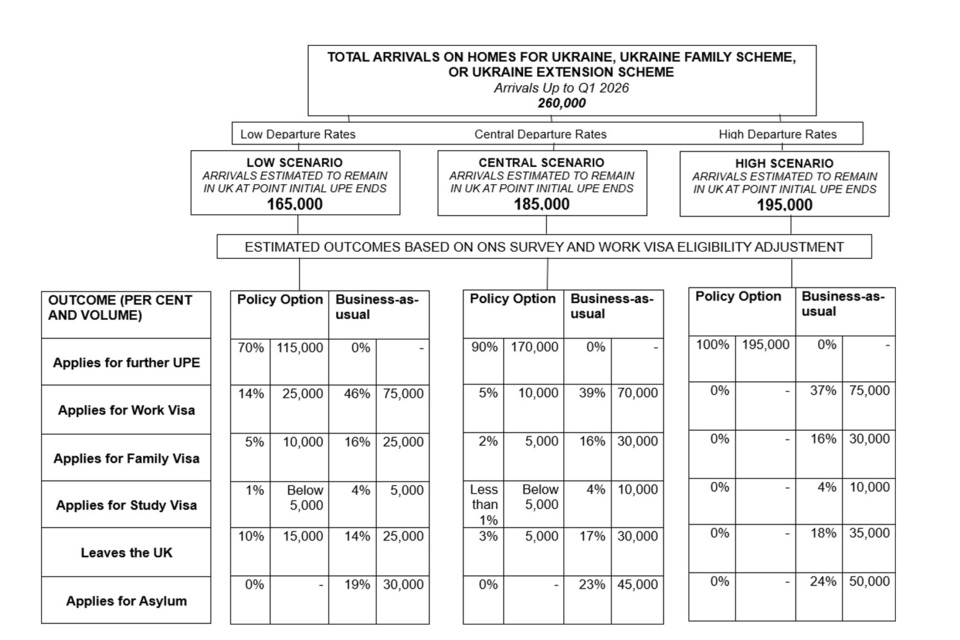
Flow chart showing estimated outcomes for 260,000 people who arrived in the UK under the Homes for Ukraine, Ukraine Family Scheme or Ukraine Extension Scheme by Q1 2026. Three scenarios are modelled based on low, central and high departure rates, estimating that 165,000, 185,000 or 195,000 people remain in the UK when the Ukraine Permission Extension scheme ends. Under the policy option, most people are expected to apply for a further extension of stay, rising from 70% in the low scenario to 100% in the high scenario. Under business as usual, significant proportions are expected to apply for work visas, family visas, asylum or leave the UK.
Fees, Charges, Processing and Support Cost Impacts
35. This section sets out assumptions that affect fee and charge revenue, processing costs and support costs, and estimates these impacts. These include:
- Visa Fee revenue and processing costs (public sector impact)
- Immigration Health Surcharge (IHS) revenue and processing costs (public sector impacts)
- Asylum application processing costs (public sector impacts)
- Support costs for asylum applications where in receipt of asylum support (public sector impacts)
- Immigration Skills Charge (ISC) revenue (transfer between business to public sector) and processing costs (public sector impacts)
- Certificate of Sponsorship (CoS) revenue (transfer between business to public sector) and processing costs (public sector impacts)
- Confirmation of Acceptance (CaS) revenue (transfer between business to public sector) and processing costs (public sector impacts)
36. Unless otherwise stated, these impacts are estimated as the relevant volume multiplied by the relevant fee / charge / processing cost level.
37. The ONS survey of Ukraine visa holders do not specify which visa products people may apply for if intending to apply for visas. As such assumptions on specific products assumed to be used are set out below. Fee levels for visa products can vary depending on if applying from in or out of the UK. As those switching from current Ukraine scheme visas are assumed to be in the UK, fee levels are assumed to reflect in country visa products.
38. It is noted some adults stating intentions to apply for family visas may include some who may use dependant visas of work or study main applicants, but no well-evidenced data to enable an account for this has been sourced.
39. Volumes in the appraisal who are estimated to be adults or children affect estimated IHS impacts and volumes who may face ISC / CoS / CaS as part of visa applications. Published Immigration System statistics[footnote 38] are used to estimate shares of adults and children in this appraisal. Those published statistics suggest around 26 per cent of those on current Ukraine visas who have arrived in the UK by September 2025 were aged under 18, informing the assumption in this appraisal.[footnote 39] So, for example if 100,000 people were assumed to apply for UPE in a scenario, around 74,000 would be assumed to be adults, and 26,000 children. Then if of the adults, half were assumed to apply for a specific visa product, half the children would be assumed to be their dependants on that visa product.
Further UPE
40. Further UPE will be a fee free product like the initial UPE visa was, as such no fee revenue is estimated from use of UPE in ‘policy option’ scenarios.
41. Further UPE processing costs occur in the ‘policy option’. For the purpose of this appraisal, the illustrative processing cost for UPE in the previous Impact Assessment [footnote 40] has been estimated to remain the same for the further UPE. Actual unit processing costs may differ from this estimate, which has been developed to provide a sense of scale of potential impacts for this appraisal only. This estimate is based on assumptions on the number of caseworkers required to process applications, the volume of applicants needing to re-enrol biometrics, and the cost of the technical development of the scheme. This provides a potential estimate for UPE processing costs of around £45. Given that even if doubled, the resulting scale of impact would not materially impact the directions of estimated net present social value in low, central or high scenarios, no range around this assumption is used in modelling.
42. Further UPE will have a visa duration of 24 months, meaning that, should the need for sanctuary from the conflict in Ukraine persist, a further extension of Ukraine scheme permission may become due within the 3-year appraisal period. This appraisal assumes that should they be required, further UPE extensions will be permitted – this is purely an illustrative assumption made for this appraisal and subject to future decisions on further extensions, and uncertainty in the trajectory of the conflict. A further assumption is made that all those making an initial further UPE application would make extension applications, implicitly assuming all those who make permanent departures do so prior to applying for UPE. This may mean estimated impacts from extension applications may lean towards providing overestimates of impacts. Estimated volumes of initial and extension applications are set out in Table A5 below.
Table A5 – Estimated UPE applications in ‘Policy Option’ scenarios
| Low | Central | High | |||||
|---|---|---|---|---|---|---|---|
| Further UPE Applications | Extension of further UPE Applications | Further UPE Applications | Extension of further UPE Applications | Further UPE Applications | Extension of further UPE Applications | ||
| 2026/27 | 85,000 | 0 | 105,000 | 0 | 120,000 | 0 | |
| 2027/28 | 25,000 | 0 | 45,000 | 0 | 55,000 | 0 | |
| 2028/29 | 10,000 | 85,000 | 15,000 | 105,000 | 25,000 | 120,000 | |
| Total | 115,000 | 85,000 | 170,000 | 105,000 | 195,000 | 120,000 |
Source: Home Office analysis as described in ‘Volumes in scope to apply for UPE (2026/27 – 2028/29)’ and ‘Outcomes within ‘Business-as-usual’ and ‘Policy Option’ Scenarios by application type or other action’ sections.
43. As such further UPE processing costs are estimated in the ‘policy option’ as the volumes of applications in Table A5, multiplied by the estimated £45 processing cost.
Work Visas
44. Visa routes: This appraisal varies assumptions for work visa products applied for in low, central and high scenarios on the basis of a) if assumed to be working as an employee or self-employed, and b) given work visa products vary by fee and charge levels associated with them assuming a variation in products used between scenarios to help illustrate uncertainty in these impacts. It is assumed all adults applying for work visas will come from people already in work. The previously referenced ONS survey of current Ukraine scheme visa holders in April 2024 suggested 84 per cent of adults in work were employees when surveyed, and 16 per cent self-employed. As such, assumed visa routes used are:
- a. Low Scenario: 100 per cent of employees use Skilled Worker visa, as the one of two ‘popular’ work visas[footnote 41] (Skilled Worker or Health and Care visas) with higher fee and charge levels, and those working as self-employed are assumed to start a new business under the Innovator Founder visa.
- b. Central Scenario: 50 per cent of employees use Skilled Worker visa, and 50 per cent use Health and Care visa the two ‘popular’ work visas, and those working as self-employed are assumed to start a new business under the Innovator Founder visa.
- c. High Scenario: 100 per cent of employees use Health and Care visa, as the one of two ‘popular’ work visas with lower fee and charge levels, and those working as self-employed are assumed to start a new business under the Innovator Founder visa.
45. Visa lengths: Innovator founder visas are set at three years, and previous analysis[footnote 42] of Skilled Worker / Health and Care visas has estimated median visa lengths of around three years, which are assumed here. Three-year visas mean only a single application on any of these products are assumed during the appraisal period.
46. Fee, Charge and Processing Costs: These are drawn from published sources as set out in Table A6 below. Note these are subject to changes.
Table A6 – Estimated work visa and associated charge levels, processing costs, and sources
| Fee / Charge | Fee / Charge Level | Processing Cost | Source |
|---|---|---|---|
| Skilled Worker visa Up to 3-year product | £885 | £228 | Visa Fees Transparency Data [footnote 43] |
| Health and Care visa Up to 3-year product | £304 | £228 | See footnote 43 |
| Innovator Founder | £1,590 | £396 | See footnote 43 |
| CoS Applies to main applicants (adults) only Does not apply to Innovator Founder | £525 | £230 | See footnote 43 |
| IHS – Adult Does not apply to Health and Care applicants | £1,035 per year | 0.9 per cent of charge (approximately £9 per year) | Charge Level: IHS webpage [footnote 44] Processing Cost: See footnote 42 |
| IHS - Child Does not apply to Health and Care applicants | £776 per year | 0.9 per cent of charge (approximately £7 per year) | Charge Level: See footnote 44 Processing Cost: See footnote 42 |
| ISC Applies to main applicants only (in this appraisal all adults using relevant visa routes are main applicants) Does not apply to Innovator Founder | £1,320 a year for large / medium businesses for each work visa holder sponsored £480 a year for small / micro businesses for each work visa holder sponsored Illustrative assumption made that 50% of business are large / medium and 50% small / micro – leads to average of £900 per applicant per year | 1.79 per cent of charge (approximately £16 per applicant per year based on average charge of £900 a year) | Charge level: UK visa sponsorship for employers webpage [footnote 45] Processing Cost: See footnote 42 |
47. Total estimated volumes using work visas in each scenario are set out in Figure 1 above, and as only a single application is assumed for each person during the appraisal period no extension applications need to be accounted for. Table A7 below sets out further disaggregation of the relevant volumes from Figure 1 by visa route, if adult /child, and which volumes apply to which fees / charges and processing costs.
Table A7 – Total volumes applying for work visas across appraisal period in low, central and high
‘business-as-usual’ and ‘policy option’ scenarios by via product / charge faced
| Low | Central | High | |||||
|---|---|---|---|---|---|---|---|
| Used for | Busine ss-as-Usual | Policy Option | Busine ss-as-Usual | Policy Option | Busine ss-as-Usual | Policy Option | |
| Skilled Worker - Adult | Visa fee and processing cost, CoS fee and processing cost, ISC fee and processing cost, IHS (adult charge level) and processing cost | 45,000 | 15,000 | 20,000 | Fewer than 5,000 | 0 | 0 |
| Skilled Worker - Child | Visa fee and processing cost, IHS (child charge level) and processing cost | 15,000 | 5,000 | 10,000 | Fewer than 5,000 | 0 | 0 |
| Health and Care - Adult | Visa fee and processing cost, CoS fee and processing cost, ISC fee and processing cost | 0 | 0 | 20,000 | Fewer than 5,000 | 45,000 | 0 |
| Health and Care - Child | - Visa fee and processing cost | 0 | 0 | 10,000 | Fewer than 5,000 | 15,000 | 0 |
| Innovator Founder - Adult | Visa fee and processing cost, IHS (adult charge level) and processing cost | 10,000 | Fewer than 5,000 | 10,000 | Fewer than 5,000 | 10,000 | 0 |
| Innovator Founder - Child | Visa fee and processing cost, IHS (child charge level) and processing cost | Fewer than 5,000 | Fewer than 5,000 | Fewer than 5,000 | Fewer than 5,000 | Fewer than 5,000 | 0 |
| Total | 75,000 | 25,000 | 70,000 | 10,000 | 75,000 | 0 |
Source: Home Office analysis. Disaggregates data from Figure 1 for those in ‘Applies for Work visa’ categories.
48. Volumes in Table A7 are multiplied by the relevant fee and charge levels from Table A6 to estimate revenue impacts and multiplied by the relevant unit processing cost levels from Table A6 to estimate processing cost impacts. For IHS and ISC estimates – as these vary with lengths of visas - fee, charge levels and processing costs are multiplied by assumed visa lengths in these calculations.
49. Differences in impacts between ‘Business-as-Usual’ and ‘Policy Option’ scenarios for visa and IHS fee / charge levels and processing costs, and for ISC and CoS processing costs feed into the Net Present Social Value (NPSV) estimates. The difference in impacts for ISC charges and CoS fee revenue represents a change in transfers from businesses to the public sector, as discussed in the section on indirect impacts to businesses in the main body of the Impact Assessment.
Family visas
50. Family visas are assumed as a single product which leads to assumptions of:
-
Visa Length: 2.5 years. This means similar to UPE, there will be some extension applications assumed for Family visas.
-
Visa fee level and processing cost: Based on visa fees transparency data a fee level of £1,321 and processing cost of £426 per application is assumed.
-
IHS charge level and processing costs: Similar assumptions as set out in Table A7, adult charge level of £1,035 per applicant per year, child charge level of £776 per applicant per year. Processing costs estimated at 0.9 per cent of charge levels.
51. Table A8 below illustrates the assumed volumes of applicants on Family visas. Initial applicants reflect disaggregation of data in Figure 1 above into adults and children, and extension applicants reflect those initial applicants for Family visas whose leave to remain on a current Ukraine Scheme visa is assumed to expire before the end of July 2026 and so may see a 2.5-year Family visa also expire during the appraisal period.
Table A8 – Total adult and child volumes applying for family visas across appraisal period in low, central and high ‘business-as-usual’ and ‘policy option’ scenarios by initial or extension applicants
| Low | Central | High | |||||
|---|---|---|---|---|---|---|---|
| Used for | Business-as-Usual | Policy Option | Business-as-Usual | Policy Option | Business-as-Usual | Policy Option | |
| Family Visa - Adult | Visa fee and processing cost, IHS (adult charge level) and processing cost | 20,000 - Initial Applicants | 5,000 - Initial Applicants | 25,000 - Initial Applicants | Fewer than 5,000 - Initial Applicants | 25,000 - Initial Applicants | 0 |
| Family Visa - Adult | Visa fee and processing cost, IHS (adult charge level) and processing cost | Fewer than 5,000 - Extension Applicants | Fewer than 5,000 - Extension Applicants | Fewer than 5,000 - Extension Applicants | Fewer than 5,000 - Extension Applicants | Fewer than 5,000 - Extension Applicants | 0 |
| Family Visa - Child | Visa fee and processing cost, IHS (child charge level) and processing cost | 5,000 - Initial Applicants | Fewer than 5,000 - Initial Applicants | 10,000 - Initial Applicants | Fewer than 5,000 - Initial Applicants | 10,000 - Initial Applicants | 0 |
| Family Visa - Child | Visa fee and processing cost, IHS (child charge level) and processing cost | Fewer than 5,000 - Extension Applicants | Fewer than 5,000 - Extension Applicants | Fewer than 5,000 - Extension Applicants | Fewer than 5,000 - Extension Applicants | Fewer than 5,000 - Extension Applicants | 0 |
Source: Home Office analysis. Initial Applicants: Disaggregates data from Figure 1 for those in ‘Applies for Family visa’ categories based on information as set out in paragraph 39. Extension Applicants: Based on initial applicants who see that initial application expire within the appraisal period.
52. Fee and IHS revenue and processing costs are estimated by multiplying the volumes in Table A8 by the fee/charge levels and unit processing costs as set out in paragraph 50, multiplying IHS charge levels and unit processing costs by the assumed 2.5 years visa length.
Study Visas
53. Those applying for study visas are assumed to apply for the Student visa[footnote 46], at a level consistent with eligibility to sponsor dependants, for courses that provide a three-year visa length. These are illustrative assumptions.
54. Assumed fee and charge levels and unit processing costs are:
- Student visa: £524 fee and £266 processing cost[footnote 47]
- Confirmation of Acceptance (applies to main applicants only): £55 fee and £30[footnote 48] processing cost Immigration Health Surcharge: Both adults and children see a charge level of £776 per year per applicant, and processing costs of 0.9 per cent of charge levels.[footnote 49] These are multiplied by assumed visa length in calculations of total IHS revenue and processing costs.
55. As such, the volumes applying for a Student visa are purely a disaggregation of the volumes of ‘Applies for Study visa’ from Figure 1 above, disaggregated by age to account for Confirmation of Acceptance fees (transfer between the private and public sectors) and Confirmation of Acceptance processing costs (public sector impact), which apply only to main applicants (adults). These volumes (set out in Table A9 below) are multiplied by fee/charge levels and processing costs as set out in paragraph 54.
Table A9 - Total adult and child volumes applying for student visas across appraisal period in low, central and high ‘business-as-usual’ and ‘policy option’ scenarios
| Low | Central | High | |||||
|---|---|---|---|---|---|---|---|
| Used for | Business-as-usual | Policy option | Business-as-usual | Policy option | Business-as-usual | Policy option | |
| Student Visa - Adult | Visa fee and processing cost, CaS fee and processing cost, IHS (discounted charge level) and processing cost | 5,000 | Fewer than 5,000 | 5,000 | Fewer than 5,000 | 5,000 | 0 |
| Student Visa - Child | Visa fee and processing cost, IHS (child charge level) and processing cost | Fewer than 5,000 | Fewer than 5,000 | Fewer than 5,000 | Fewer than 5,000 | Fewer than 5,000 | 0 |
Source: Home Office analysis. Disaggregates data from Figure 1 for those in ‘Applies for Study visa’ categories based on information as set out in paragraph 39.
Applies for Asylum / Humanitarian Protection
56. No fee applies when claiming asylum / humanitarian protection, and neither do other charges such as the IHS. As such, only processing, asylum support and accommodation and appeal costs apply when considering asylum / humanitarian protection claims.
57. Estimates of the asylum-related costs of this cohort are based upon historical internal Home Office Management Information data & general assumptions.
58. Support costs, which make up around ~85 per cent of the total asylum claim cost in the central scenario, reflect the average cost of accommodation of a claim from the point of claiming through to the end of their move-on. The remaining components are initial decision (ID) processing, interpreter, appeal processing, and legal aid costs.
59. This cost of support component is reliant on several key assumptions, including the average time to Initial Decision average time in the appeal system and the average cost of accommodation per person per night. This cost is a weighted average of all accommodation types (Hotel, Initial Accommodation, Dispersal Accommodation, and cash only) by the proportion of people in each type.
60. As receipt of asylum support and accommodation is an assumption that has a large impact on the estimated net present social value, in the absence of well evidenced data on potential receipt of support by Ukrainians should they claim asylum in the absence of further UPE, the support rate is varied across different scenarios varying from 0% (low), 50% (central) to 100% (high). These ranges represent at the low extreme, a fully unsupported claim whereby no support costs are incurred. And at the high, a fully supported claim.
61. To reflect the uncertainty in the estimates, scenarios are also varied according to the expected grant rate at ID. These grant rates at ID are based on a Ukraine specific estimate (high), general cost of asylum claim assumptions (central), & applying symmetry from these two scenarios (low), all based on Home Office internal MI data.
62. Processing costs apply to all asylum/humanitarian protection applications and so the processing costs are identical between all ranges.
63. Combining the information in paragraphs 58 to 62 leads to estimates of the average cost of an asylum claim to future Ukrainians in scenarios of:
- Low: £3,000
- Central: £20,600
- High: £42,100
64. The methodology for estimating the cost of an asylum claim in this appraisal differs to the approach taken in the previous Impact Assessment[footnote 50]. In this appraisal, the estimated cost per claim is lower due to two key changes: (1) faster asylum processing times, based on more recent data, and (2) support costs calculated using a weighted average of all accommodation types rather than relying solely on the more expensive hotel accommodation costs as in the previous IA. These revisions significantly affect the net present social value when compared with the previous IA, as the estimated benefits from reduced asylum and humanitarian protection processing and support costs are now lower (£700 million in the central scenario, compared with £860 million previously).
65. Estimated volumes of those in ‘business-as-usual’ scenarios in Figure 1 in ‘Applies for Asylum’ categories are disaggregated by whether assumed to receive support and accommodation or not, are provided in Table A10 below.
Table A10 - Total assumed asylum/humanitarian protection volumes across appraisal period in low, central and high ‘business-as-usual’ and ‘policy option’ scenarios by whether assumed to receive support or not
| Low | Central | High | ||||
|---|---|---|---|---|---|---|
| Used for | Business-as-Usual | Policy Option | Business-as-Usual | Policy Option | Business-as-Usual | Policy Option |
| Average cost of an asylum claim | 30,000 | 0 | 45,000 | 0 | 50,000 | 0 |
Source: Home Office analysis. Disaggregates data from Figure 1 for those in ‘Applies for Asylum’ categories.
Limitation in all fee and charge revenue, processing costs, and asylum support and accommodation costs analysis
66. There are limitations in this analysis, as set out in the ‘General Assumptions’ above, which do not account for the possibility of failing to meet eligibility requirements. If eligibility requirements are not met, individuals may need to change their intended actions regarding their applied status or presence in the UK. In ‘business-as-usual’ scenarios, this could affect estimated fee and charge revenue, as well as processing and support costs.
Fiscal Impacts
67. Fiscal impacts are estimated using similar methods and assumptions as previous appraisals – for example see the previous UPE appraisal[footnote 51] or previous Impact Assessments such as for changes to Autumn 2025 Immigration Rules[footnote 52] . Fiscal modelling is based on estimated changes in ‘stocks’ of migrants by economic activity (such as earnings, employment and presence in the UK) and age, which together influence estimates of fiscal revenue and fiscal pressure. Low, central and high scenarios within both ‘business-as-usual’ and ‘policy option’ vary the components of fiscal pressure and fiscal revenue included as set out in paragraphs 69 and 70 below.
68. ‘Stocks’ reflect the total assumed populations within appraisal assumed to be resident in the UK – each year of appraisal sees new ‘flows’ adding to the stock and departures in that year reducing the stock. As the assumption in the ‘policy option’ scenario is that no permanent departures occur after further UPE applications, the stocks at the end of the appraisal period reflect those shown in Figure 1 above, with stock levels increasing each year as new flows are added.
69. Fiscal pressures include estimated spending on health, education, personal social services, wider public services, and core congestible public goods in all scenarios. Non-core congestible public goods are added in the central scenario and pure public goods are added in the high scenario. As Ukrainian nationals on the schemes have recourse to public funds, welfare estimates are included and based on internal data provided by DWP. This is estimated at approximately £2,000 per claimant (to the nearest thousand)[footnote 53]. Changes in the stocks of adults and children resident in the UK, or with access to welfare affect fiscal pressure estimates.
70. Fiscal revenue includes estimated income tax, national insurance, indirect tax, council tax and corporation tax in all scenarios. Business rates are added in the central scenario, and gross operating surplus and other taxes are added in the high scenario, and models how changes in stocks can affect those tax receipts – affected by changes in volumes in work and earnings.
71. Assumed employment rates and earnings of Ukraine Scheme visa holders are taken from the ONS survey of Ukraine scheme visa holders, which suggests 69 per cent of adults are in employment, and provides a monthly earnings distribution for net earnings. This monthly distribution is converted to gross earnings[footnote 54], and annualised to provide estimated annual earnings. After accounting for redistribution of the small shares who responded, ‘Don’t know’ or ‘prefer not to say’, the estimated gross earnings distribution is as outlined in Table A11 below.
Table A11 – Estimated gross annual earnings of those estimate to be in work in this appraisal
| Up to around £9,500 | Between around £9,500 and around £12,000 | Between around £12,000 and around £15,000 | Between around £15,000 and around £18,500 | Around £18,500 or higher | |
|---|---|---|---|---|---|
| Share of estimated Ukraine scheme visa holders in work | 18% | 7% | 10% | 13% | 52% |
Source: Home Office analysis based on ONS ‘Visa holders living in the UK under the Ukraine Humanitarian Schemes, follow-up survey’, responses to ‘What was your take-home pay last month?’.
72. Based on the visa product applied for in ‘business-as-usual’ and ‘policy option’ scenarios, simplifying assumptions are made on the economic activity and earnings within those groups (noting discussion below focusses on adults):
-
Groups who apply for visas or leave the UK in ‘policy option’ scenarios are also assumed to be part of those who do so in ‘business-as-usual’ scenarios (where the absence of the further extension of UPE sees volumes doing so grow larger) – as such there is no estimated change in fiscal impact for these groups.
-
As such the group who apply for work visas as employees in ‘business-as-usual’ scenarios are in ‘policy option’ scenarios assumed to either also apply for work visas as employees or apply for further UPE as employees. In both ‘business-as-usual’ and ‘policy option’ scenarios they are assumed to be in work as employees and assumed to come from the highest earnings bands (as salary thresholds apply for work visas as employees). In turn, this group experiences no change between ‘business-as-usual’ and ‘policy option’ scenarios in terms of presence in the UK, employment, or earnings. No changes in fiscal revenue impacts are estimated for this group, and fiscal pressure only changes in terms of access to welfare, where a transition from applying for further UPE to applying for a visa leads to a status with no recourse to public funds.[footnote 55]
-
Those who apply for work visas as self-employed in ‘business-as-usual’ scenarios are similarly assumed to be self-employed in both ‘business-as-usual’ and ‘policy option’ scenarios, and in ‘policy option’ scenarios either apply for work visas as self-employed or apply for further UPE. They are assumed to come from across the earnings distribution (after accounting for those applying for work visas as employees drawing from highest earners). As such, this group sees no change between ‘business-as-usual’ and ‘policy option’ scenarios in terms of presence in the UK, employment or earnings and therefore no change in fiscal revenue impacts are estimated for this group. Fiscal pressure only changes in terms of access to welfare, where a transition from applying for further UPE to applying for a visa leads to a status with no recourse to public funds.
-
The group who applies for study visas are assumed to be out-of-work, with the simplifying assumption they are assumed to concentrate on full-time study in both ‘business-as-usual’ and ‘policy option’ scenarios. In the ‘policy option’ scenarios they either apply for study visas or apply for further UPE. As such, this group sees no change between ‘business-as-usual’ and ‘policy option’ scenarios in terms of presence in the UK, employment or earnings and so no change in fiscal revenue effects are estimated for this group, and fiscal pressure only changes in terms of access to welfare where a transition from applying for further UPE to applying for a visa leads to a status with no recourse to public funds.
-
The remainder of groups in ‘business-as-usual’ scenarios (apply for family visas, leaves the UK, applies for asylum / humanitarian protection) can draw from either in or out-of-work groups. Where assumed to be in work, they are considered to come from across the earnings distribution (after accounting for those applying for work visas as employees drawing from highest earners), resulting in estimated weighted annual average earnings of around £11,000 for those in work in these groups. In ‘business-as-usual’ scenarios, where Ukrainians are applying for family visas or leaving the UK, in ‘policy option’ scenarios they are assumed to behave similarly (in also applying for family visas / leaving the UK respectively) or apply for further UPE. Those claiming asylum / humanitarian protection in ‘business-as-usual’ scenarios are assumed to apply for further UPE in ‘policy option’ scenarios.
-
As such for those applying for further UPE in ‘policy option’ scenarios are the only groups assumed to see fiscal impacts arise through:
-
Applies for Study/Work/Family visa – Fiscal Pressure: All applying for further UPE in ‘policy option’ scenarios and applying for a visa in ‘business-as-usual’ scenarios will be subject to no-recourse-to-public funds in ‘business-as-usual’ scenarios and so are assumed to see an increase in fiscal pressure (at the assumed annual welfare receipt of around £2,000) when going from ‘business-as-usual’ to ‘policy option’ scenarios. Given the volumes assumed to see this impact this has a large factor in net fiscal impacts.
-
Applies for Asylum/Humanitarian Protection – Fiscal Revenue: Those in work when applying for further UPE in ‘policy option’ scenarios and applying for asylum/humanitarian protection in ‘business-as-usual’ scenarios are assumed to not be eligible to work whilst claiming asylum/humanitarian protection[footnote 56] and so are assumed to see an increase in fiscal revenue for the assumed duration of asylum/humanitarian protection claims (at the assumed annual earnings of around £11,000) when going from ‘business-as-usual’ to ‘policy option’ scenarios.
-
-
Applies for Asylum/Humanitarian Protection – Fiscal Pressure: All applying for further UPE in ‘policy option’ scenarios and applying for asylum/humanitarian protection in ‘business-as-usual’ scenarios will be subject to no-recourse-to-public funds whilst claiming asylum/humanitarian protection[footnote 57] and so are assumed to see an increase in fiscal pressure for the assumed duration of asylum claims (at the assumed annual welfare receipt of around £2,000) when going from ‘business-as-usual’ to ‘policy option’ scenarios.
-
Leaves the UK – Fiscal Revenue and Pressure: All those in the UK (including children) applying for further UPE in ‘policy option’ scenarios and leaving the UK in ‘business-as-usual’ scenarios will see an increase in fiscal pressure when going from ‘business-as-usual’ to ‘policy option’ scenarios from additional people being in the UK and using services, but also increased revenue from those who are in work.
Familiarisation Costs
73. Methods, data and calculations for this quantified impact are discussed in Section 5 of the main body of the Impact Assessment and not repeated here.
Impacts - Summary
74. Based on data, assumptions and methods as set out in this annex, the summary of impacts that are included within net present social value estimates are outlined in Table A12 below.
Table A12 - Summary of total costs and benefits, and estimated net present social value across the appraisal period, ‘policy option’ low, central and high scenarios compared against ‘business-as-usual’ low, central and high scenarios (2025/26 price base year, millions, present value across the appraisal period)
Costs
| Impact | Who impact falls to | Direct or indirect | Transitional/ongoing | Low | Central | High |
|---|---|---|---|---|---|---|
| Familiarisation Costs for Immigration Advisors and Lawyers | Private Sector | Direct | Transitional | £0.1 | £0.2 | £0.4 |
| Reduction in Visa Fee Revenue | Public Sector | Direct | Ongoing | £80 | £90 | £90 |
| Reduction in IHS Revenue | Public Sector | Direct | Ongoing | £220 | £200 | £140 |
| Increase in Fiscal Pressure | Public Sector | Indirect | Ongoing | £290 | £770 | £1,340 |
| Total Costs | Total | Total | Total | £590 | £1,060 | £1,570 |
Benefits
| Impact | Who impact falls to | Direct or indirect | Transitional/ongoing | Low | Central | High |
|---|---|---|---|---|---|---|
| Reduction in Visa, CoS, CaS, ISC and IHS Processing Costs | Public Sector | Direct | Ongoing | £30 | £30 | £40 |
| Reduction in Asylum/Humanitarian Protection Processing and Support Costs | Public Sector | Direct | Ongoing | £80 | £700 | £1,560 |
| Increase in Fiscal Revenue | Public Sector | Indirect | Ongoing | £110 | £370 | £980 |
| Total Benefits | Total | Total | Total | £210 | £1,100 | £2,580 |
| Net Present Social Value | Total | Total | Total | -£380 | £40 | £1,010 |
Source: Home Office analysis as described in the Rounded to nearest £0.1m where under £1m, and to nearest £10m in other cases.
75. The main drivers in estimated impacts are changes in estimated asylum/humanitarian protection support costs providing a benefit, and net fiscal impacts – where large populations see small, assumed changes in receipt of welfare and relatively low assumed earnings for those seeing increase in work activity in the ‘policy option’ scenarios relative to ‘business-as-usual’ influence estimated fiscal impacts.
Business Impacts
76. The only net direct impact to business are the outlined transitional familiarisation costs – estimated at £0.1 million - £0.4 million across the appraisal period, with a central estimate of £0.2 million. As the appraisal period is 3 years, the Estimated Annual Net Direct Cost to Business (EANDCB) are those values divided by three years, leading to a maximum value of around £0.1 million.
77. Business net present value (BNPV) includes the familiarisation cost outlined above, plus indirect benefits in terms of reduced transfers from business to the public sector from reductions in ISC, CoS and CaS payments. These benefits are estimated at a total of £100 million - £140 million (2025/26 price base year, present value across the appraisal period, rounded to nearest £10 million) across the appraisal period, with a central estimate around £120 million (2025/26 price base year, present value across the appraisal period, rounded to nearest £10 million). Given the small nature of familiarisation costs, BNPV estimates are similarly £100 million - £140 million (2025/26 price base year, present value across the appraisal period, rounded to nearest £10 million) across the appraisal period, with a central estimate around £120 million (2025/26 price base year, present value across the appraisal period, rounded to nearest £10 million).
Public Sector Impacts
78. Public sector impacts reflect those outlined as falling to the public sector in Table A12 above plus the additional costs from loss of revenue in transfers from business to the public sector as outlined in paragraph 77 above. These sum when comparing ‘policy option’ to ‘business-as-usual’ scenarios to provide estimated net public sector present value (across the appraisal period, discounted, rounded to nearest £10 million) of a low of -£480 million a central of -£90 million, and a high of £870 million.
Household Impacts
79. No quantified household impacts have been estimated.
Annex B - Statutory Equalities Duties Summary
| Mandatory specific impact test - Statutory Equalities Duties | Complete |
|---|---|
| Statutory Equalities Duties It is not currently considered that the further extension of the Ukraine Permission Extension scheme constitutes direct discrimination further than is already authorised by the immigration rules or separate Ministerial Authorisations. Indirect discrimination is considered in full in the EIA and is considered to be a proportionate means of achieving the policy aims. The SRO has agreed these summary findings. | Yes |
-
See https://www.gov.uk/guidance/applying-to-the-ukraine-permission-extension-scheme. ↩
-
See https://hansard.parliament.uk/commons/2025-09-01/debates/1CB78605-9A14-4CEE-B5CE-BA8836354FA7/BordersAndAsylum. ↩
-
Home Office (2024) HO IA 1007 ‘Ukraine Permission Extension Scheme – Route Launch – Impact Assessment November 2024’ https://assets.publishing.service.gov.uk/media/674863456f60e77679723984/Ukraine+Permission+Extension+_UPE_+IA.pdf ↩
-
In the absence of a regular status via UPE, some who do not either qualify for another permission or apply for / obtain Humanitarian Protection may seek to remain in the UK without a right to reside in the UK. ↩
-
See https://assets.publishing.service.gov.uk/media/691c3a6e5a253e2c40d70650/asylum-claims-datasets-sep-2025.xlsx. ↩
-
See https://www.europarl.europa.eu/RegData/etudes/ATAG/2025/775833/EPRS_ATA(2025)775833_EN.pdf. ↩
-
Home Office (2024) HO IA 1007 ‘Ukraine Permission Extension Scheme – Route Launch – Impact Assessment November 2024’ https://assets.publishing.service.gov.uk/media/674863456f60e77679723984/Ukraine+Permission+Extension+_UPE_+IA.pdf. ↩
-
See UK business: activity, size and location - Office for National Statistics (ons.gov.uk) - https://www.ons.gov.uk/businessindustryandtrade/business/activitysizeandlocation/datasets/ukbusinessactivitysizeandlocation. ↩
-
See footnote 9. ↩
-
For example, given the three-year appraisal period. ↩
-
See https://www.gov.uk/uk-visa-sponsorship-employers/certificates-of-sponsorship. ↩
-
See https://www.gov.uk/government/publications/visa-fees-transparency-data. ↩
-
See https://www.gov.uk/uk-visa-sponsorship-employers/immigration-skills-charge. ↩
-
See Home Office (2024) HO0490 ‘2024 Spring Immigration Rules Impact Assessment’ - https://www.gov.uk/government/publications/changes-to-immigration-rules-impact-assessments. That IA highlights median visa lengths on Skilled Worker and Health and Care visas of around 3 years, and that on the Skilled Worker visa around 48 per cent of applicants in the year ending September 2023 were sponsored by large firms along, but only 14 per cent of care and senior care worker were. As such a simplified, illustrative 50:50 split between applicants at small / micro and medium / large firms is assumed. ↩
-
See Home Office (2020) HO0376 ‘Impact Assessment for changes to the Immigration Rules for Skilled Workers’ - https://www.gov.uk/government/publications/supporting-documents-for-skilled-worker-immigration-rules.. ↩
-
See Visa holders living in the UK under the Ukraine Humanitarian Schemes, follow-up survey - Office for National Statistics (ons.gov.uk): https://www.ons.gov.uk/peoplepopulationandcommunity/populationandmigration/internationalmigration/bulletins/visaholdersenteringtheukundertheukrainehumanitarianschemes/15aprilto22april2024#labour-market. ↩
-
See https://www.ons.gov.uk/employmentandlabourmarket/peopleinwork/employmentandemployeetypes/bulletins/uklabourmarket/january2026. ↩
-
See https://assets.publishing.service.gov.uk/government/uploads/system/uploads/attachment_data/file/1146120/Home_Office\Impact_Assessment_HO0443_-_Immigration_Rules_April_2023_-_Salary_changes.pdf or https://assets.publishing.service.gov.uk/government/uploads/system/uploads/attachment_data/file/936121/Revised_Impact_Assessment_for_the_Skilled_Worker_Route_signed.pdf for example. ↩
-
All quotes in this paragraph are taken from Migration Advisory Committee (MAC) report: EEA migration - GOV.UK - https://www.gov.uk/government/publications/migration-advisory-committee-mac-report-eea-migration. ↩
-
Two thirds of Britons say the total number of people entering the UK is too high Ipsos: https://www.ipsos.com/en-uk/two-thirds-67-uk-adults-16-75-think-number-people-coming-uk-high-too-high-bit-too-high. ↩
-
UK Public Opinion toward Immigration: Overall Attitudes and Level of Concern - Migration Observatory - The Migration Observatory: https://migrationobservatory.ox.ac.uk/resources/briefings/uk-public-opinion-toward-immigration-overall-attitudes-and-level-of-concern/. ↩
-
All quotes in this paragraph are taken from the Migration Advisory committee (MAC) report EEA migration- Gov.UK https://www.gov.uk/government/publications/migration-advisory-committee-mac-report-eea-migration. ↩
-
Migration Advisory Committee (MAC) report: EEA migration - GOV.UK – https://www.gov.uk/government/publications/migration-advisory-committee-mac-report-eea-migration. ↩
-
See - https://www.ons.gov.uk/employmentandlabourmarket/peopleinwork/employmentandemployeetypes/bulletins/uklabourmarket/october2024. ↩
-
See https://www.ons.gov.uk/peoplepopulationandcommunity/populationandmigration/internationalmigration/bulletins/visaholdersenteringtheukundertheukrainehumanitarianschemes/previousreleases. ↩
-
Home Office (2024) HO IA 1007 ‘Ukraine Permission Extension Scheme – Route Launch – Impact Assessment November 2024’ - https://assets.publishing.service.gov.uk/media/674863456f60e77679723984/Ukraine+Permission+Extension+_UPE_+IA.pdf. ↩
-
See https://www.gov.uk/government/publications/analysis-of-the-impacts-of-migration. ↩
-
Restoring control over the immigration system: https://www.gov.uk/government/publications/restoring-control-over-the-immigration-system-white-paper/restoring-control-over-the-immigration-system-accessible. ↩
-
Home Office (2025) HO IA 1017 ‘Spring 2025 Immigration Rules Impact Assessment (Skilled Worker and Care Worker) – July 2025’ - https://www.gov.uk/government/publications/statement-of-changes-to-the-immigration-rules-hc-997-1-july-2025/spring-2025-immigration-rules-impact-assessment-skilled-worker-and-care-worker-july-2025-accessible-version. ↩
-
Home Office (2024) HO IA 1007 ‘Ukraine Permission Extension Scheme – Route Launch – Impact Assessment November 2024’ - https://assets.publishing.service.gov.uk/media/674863456f60e77679723984/Ukraine+Permission+Extension+_UPE_+IA.pdf. ↩
-
Ukraine Visa Schemes: Applications, Grants and Arrivals under Ukraine Family Scheme and Ukraine Sponsorship Scheme by Quarter, 2022 to 30 September 2025-https://assets.publishing.service.gov.uk/media/69147528493305b49ce6e685/ukraine-visa-schemes-summary-jun-2025-tables.ods. ↩
-
Grants and refusals of extensions of stay in the UK, 2010 Q1 to 2025 Q3-https://assets.publishing.service.gov.uk/media/691af2925a253e2c40d705a6/extensions-datasets-sep-2025.xlsx. ↩
-
Home Office (2024) HO IA 1007 ‘Ukraine Permission Extension Scheme – Route Launch – Impact Assessment November 2024’ - https://assets.publishing.service.gov.uk/media/674863456f60e77679723984/Ukraine+Permission+Extension+UPE+IA.pdf. ↩
-
See https://www.ons.gov.uk/peoplepopulationandcommunity/populationandmigration/internationalmigration/bulletins/visaholdersenteringtheukundertheukrainehumanitarianschemes/15aprilto22april2024. ↩
-
Home Office (2024) HO IA 1007 ‘Ukraine Permission Extension Scheme – Route Launch – Impact Assessment November 2024’ - https://assets.publishing.service.gov.uk/media/674863456f60e77679723984/Ukraine+Permission+Extension+UPE+IA.pdf. ↩
-
Home Office (2024) HO IA 1007 ‘Ukraine Permission Extension Scheme – Route Launch – Impact Assessment November 2024’ - https://assets.publishing.service.gov.uk/media/674863456f60e77679723984/Ukraine+Permission+Extension+_UPE_+IA.pdf. ↩
-
Demographic (age/sex) breakdown for those arriving on Ukraine Schemes as at 30 September 2025-https://assets.publishing.service.gov.uk/media/691b0ab3d140bbbaa59a28af/ukraine-visa-schemes-summary-sep-2025-tables.ods. ↩
-
Internal Home Office MI data on the age profiles of entrants to the Ukrainian humanitarian schemes supports this assumption, despite many children having been in the UK for several years. ↩
-
Home Office (2024) HO IA 1007 ‘Ukraine Permission Extension Scheme – Route Launch – Impact Assessment. November 2024’ - https://assets.publishing.service.gov.uk/media/674863456f60e77679723984/Ukraine+Permission+Extension+UPE+IA.pdf. ↩
-
See https://www.gov.uk/browse/visas-immigration/work-visas - setting out Health and Care visa and Skilled Worker visa as ‘popular work visas’. ↩
-
See Home Office (2024) HO0490 ‘2024 Spring Immigration Rules Impact Assessment’-https://assets.publishing.service.gov.uk/media/66f13f5b554440e6da17e24f/Annex+D+-+IA0490+-+Spring+Immigration+Rules+2024+IA+-+May+2024.pdf. ↩
-
https://www.gov.uk/government/publications/visa-fees-transparency-data. All references to ‘Visa Fees Transparency Data’ refer to this source, and the table of fees and unit costs as of November 2025 was used in this appraisal. ↩
-
See https://www.gov.uk/healthcare-immigration-application/how-much-pay . ↩
-
See https://www.gov.uk/uk-visa-sponsorship-employers/immigration-skills-charge. ↩
-
See footnote 43. ↩
-
See footnote 43. ↩
-
See footnote 44 for source for charge levels and footnote 42 for source for assumed processing cost. ↩
-
Home Office (2024) HO IA 1007 ‘Ukraine Permission Extension Scheme – Route Launch – Impact Assessment November 2024’ - https://assets.publishing.service.gov.uk/media/674863456f60e77679723984/Ukraine+Permission+Extension+_UPE_+IA.pdf. ↩
-
See footnote 50. ↩
-
Home Office (2025) HO IA 1018 ‘ Autumn 2025 Immigration Rules Impact Assessment (Graduate, Global Talent, High Potential Individual, English Language Requirements and Immigration Skills Charge) – October 2025[’https://assets.publishing.service.gov.uk/media/68ee3f4a82670806f9d5e044/Autumn_2025Immigration_Rules_Impact_Assessment_.pdf](https://assets.publishing.service.gov.uk/media/68ee3f4a82670806f9d5e044/Autumn_2025_Immigration_Rules_Impact_Assessment.pdf). ↩
-
This assumption is the same as used in previous Ukraine scheme appraisal: Home Office (2024) HO IA 1007 ‘Ukraine Permission Extension Scheme – Route Launch – Impact Assessment November 2024’ - https://assets.publishing.service.gov.uk/media/674863456f60e77679723984/Ukraine+Permission+Extension+_UPE_+IA.pdf. ↩
-
Home Office fiscal modelling is based on gross earnings, net figures are converted to gross based on inputting net figures into https://www.uktaxcalculators.co.uk/tax-calculators/personal-tax-calculators/reverse-tax-calculator/ to estimate gross earnings in 2024/25. ↩
-
See https://www.gov.uk/government/publications/public-funds/public-funds-accessible. ↩
-
See https://www.gov.uk/government/publications/handling-applications-for-permission-to-take-employment-instruction/permission-to-work-and-volunteering-for-asylum-seekers-accessible. ↩
-
See https://www.gov.uk/government/publications/public-funds/public-funds-accessible. ↩