Nutrient profiling model 2018: technical guidance
Published 27 January 2026

© Crown copyright 2026
This publication is licensed under the terms of the Open Government Licence v3.0 except where otherwise stated. To view this licence, visit nationalarchives.gov.uk/doc/open-government-licence/version/3 or write to the Information Policy Team, The National Archives, Kew, London TW9 4DU, or email: psi@nationalarchives.gov.uk.
Where we have identified any third party copyright information you will need to obtain permission from the copyright holders concerned.
This publication is available at https://www.gov.uk/government/publications/nutrient-profiling-model-2018/nutrient-profiling-model-2018-technical-guidance
Introduction
This guidance provides guidelines on how to use the updated UK nutrient profiling model (NPM) 2018.
The NPM 2018 works in the similar way as the Nutrient profiling model 2004 to 2005. It reflects changes to UK government dietary recommendations, in particular for free sugars and fibre, based on the advice of the Scientific Advisory Committee on Nutrition (SACN), which were accepted by UK health departments.
For further information on the differences between the NPM 2004 to 2005 and the NPM 2018, see the outcome of the UK nutrient profiling model 2018 review.
Nutrient profiling model 2018
The NPM 2018 applies equally to all foods and non-alcoholic drinks (generally as sold - however, NPM scores for reconstituted foods and drinks are calculated according to the manufacturer’s instructions). There are no category-specific criteria.
The model uses a scoring system, in which points are allocated on the basis of the level of each nutrient or food component in 100 grams (g) of a food or drink.
Points are awarded for:
- ‘A’ nutrients (energy, saturated fats, free sugars and salt)
- ‘C’ nutrients or food components (protein, fibre, and fruit, vegetables, nuts and seeds)
The score for ‘C’ nutrients or food components is then subtracted from the score for ‘A’ nutrients to give the final nutrient profiling score.
Foods scoring 4 or more points, and drinks scoring 1 or more points, are classified as ‘less healthy’.
Applying the NPM 2018
Nutrients and food components in the model
The NPM 2018 scores products based on their content of certain nutrients or food components, which are:
- energy (kilojoules (kJ))
- saturated fat (g)
- free sugars (g)
- salt (g)
- protein (g)
- fruit, vegetables nuts and seeds (% or g)
- fibre (g)
The nutrient scores are based on UK government dietary recommendations and dietary reference values for women aged 19 to 64 years, available in the Eatwell Guide.
Fibre is based on the Association of Official Analytical Chemists’ (AOAC) method for total dietary fibre analysis. AOAC fibre includes resistant starch and lignin to estimate total fibre, as well as non-starch polysaccharides (NSP).
The NPM 2004 to 2005 included nuts. The NPM 2018 also includes seeds because seeds and nuts are comparable in terms of nutritional composition.
Calculating ‘A’ points
Table 1 outlines the points for the ‘A’ nutrients per 100g of a food or drink.
A maximum of 10 points can be awarded for each of the ‘A’ nutrients (energy, saturated fats, free sugars and salt).
Total ‘A’ points are calculated by adding points for:
- energy
- saturated fats
- free sugars
- salt
The equation for calculating ‘A’ points is:
total ‘A’ points = (points for energy) + (points for saturated fats) + (points for free sugars) + (points for salt)
Points are assigned to a nutrient or food component based on its content per 100g (generally as sold), which can be:
- less than or equal to (≤) a value
- more than (>) a value
Table 1: points scored for each ‘A’ nutrient per 100g of the food or drink
| Points | Energy (kJ per 100g) | Saturated fats (g per 100g) | Free sugars (g per 100g) | Salt (g per 100g) |
|---|---|---|---|---|
| 0 | ≤ 315 | ≤ 0.9 | ≤ 0.9 | ≤ 0.2 |
| 1 | > 315 | > 0.9 | > 0.9 | > 0.2 |
| 2 | > 630 | > 1.9 | > 1.9 | > 0.5 |
| 3 | > 945 | > 2.8 | > 2.8 | > 0.7 |
| 4 | > 1,260 | > 3.7 | > 3.7 | > 0.9 |
| 5 | > 1,575 | > 4.7 | > 4.6 | > 1.1 |
| 6 | > 1,890 | > 5.6 | > 5.6 | > 1.4 |
| 7 | > 2,205 | > 6.6 | > 6.5 | > 1.6 |
| 8 | > 2,520 | > 7.5 | > 7.4 | > 1.8 |
| 9 | > 2,835 | > 8.4 | > 8.3 | > 2.0 |
| 10 | > 3,150 | > 9.4 | > 9.3 | > 2.3 |
Note: if a food or drink scores 11 or more ‘A’ points, then it cannot score points for protein unless it also scores 5 points for fruit, vegetables, nuts and seeds (see ‘Calculating ‘C’ points’ below).
Calculating ‘C’ points
A maximum of 5 points can be awarded each for protein and for fruit, vegetables, nuts and seeds.
A maximum of 10 points can be awarded for fibre.
Total ‘C’ points are calculated by adding points for:
- protein
- fruit, vegetables, nuts and seeds
- fibre (calculated using the AOAC method)
The equation for calculating ‘C’ points is:
Total ‘C’ points = (points for protein) + (points for fruit, vegetables, nuts and seeds) + (points for fibre)
Table 2: points scored for each ‘C’ nutrient or component, per 100g of the food or drink
| Points | Protein (g per 100g) | Fruit, vegetables, nuts and seeds (g per 100g) | Fibre (as measured by AOAC method) (g per 100g) |
|---|---|---|---|
| 0 | ≤ 1.7 | ≤ 40 | ≤ 0.6 |
| 1 | > 1.7 | > 40 | > 0.6 |
| 2 | > 3.4 | > 60 | > 1.2 |
| 3 | > 5.1 | Not applicable | > 1.8 |
| 4 | > 6.8 | Not applicable | > 2.4 |
| 5 | > 8.5 | > 80 | > 3.0 |
| 6 | Not applicable | Not applicable | > 3.6 |
| 7 | Not applicable | Not applicable | > 4.2 |
| 8 | Not applicable | Not applicable | > 4.8 |
| 9 | Not applicable | Not applicable | > 5.4 |
| 10 | Not applicable | Not applicable | > 6.0 |
Calculating the overall score
The nutrient profiling score for the NPM is calculated from the total ‘A’ points minus the total ‘C’ points.
A food is classified as ‘less healthy’ where it scores 4 points or more.
A drink is classified as ‘less healthy’ where it scores 1 point or more.
You can find guidance below on:
- how to calculate free sugars for food and drink products
- calculating the fruit, vegetables, nuts and seeds content
Less than 11 ‘A’ points
If a food or drink scores less than 11 ‘A’ points, then the overall score is calculated by subtracting the total ‘C’ points from the total ‘A’ points as follows.
Nutrient profiling score = total ‘A’ points (energy + saturated fats + free sugars + salt) –total ‘C’ points (protein + fruit, vegetable, nuts and seeds + fibre)
More than or equal to 11 ‘A’ points
If a food or drink scores 11 or more ‘A’ points and scores 5 points for fruit, vegetables, nuts and seeds, then the score for protein is included. So, the overall score is calculated by subtracting the total ‘C’ points from the total ‘A’ points as follows.
Nutrient profiling score = total ‘A’ points (energy + saturated fats + free sugars + salt) – total ‘C’ points (protein + fruit, vegetable, nuts and seeds + fibre)
If a food or drink scores 11 or more ‘A’ points but scores less than 5 points for fruit, vegetables, nuts and seeds, then the score for protein is not included. So, the overall score is calculated by subtracting the total ‘C’ points from the total ‘A’ points as follows.
Nutrient profiling score = total ‘A’ points (energy + saturated fats + free sugars + salt) – total ‘C’ points (fruit, vegetable, nuts and seeds + fibre)
Information on nutrients and food components to calculate the score
For foods and drinks, information on the amount of ‘A’ nutrients (energy, saturated fats, salt) and ‘C’ nutrients (protein and fibre) can be found on ‘back of pack’ nutrition labelling. This includes values per 100g or 100ml (see section on ‘Nutrition labelling and ingredients list’ below).
For the ‘A’ nutrient free sugars, see section ‘How to calculate free sugars for food and drink products’.
For the ‘C’ component fruit, vegetables, nuts and seeds, see section ‘Calculating the fruit, vegetable, nut and seed content’.
How to calculate free sugars for food and drink products
This section provides guidance on how to calculate the free sugars content of a product when calculating the NPM. This includes:
- a definition of free sugars
- terminology to help identify free sugars
- ‘decision tree’ diagrams to help decide if a free sugars calculation is needed for a product
- an approach to calculate free sugars for foods and drinks
Definition of free sugars
Free sugars are defined as:
- all added sugars in any form
- sugars in honey, syrups and nectars
- all sugars naturally present in fruit and vegetable juices, purées, powders and pastes, extruded fruit and vegetable products, and similar products in which the structure has been broken down
- all sugars in drinks (except for unsweetened dairy-based drinks)
- lactose and galactose added as ingredients (this also includes hydrolysed lactose and the sugars (lactose) in whey powder)
- all sugars in drinks except for lactose naturally present in cows’ milk and other dairy products - this includes the sugars naturally present in fruit and vegetable juices, concentrates, smoothies and dairy-alternatives
- all sugars in lactose free dairy products where the lactose has been partially removed through filtration and the remainder broken down to glucose and galactose using lactase
The definitions of free sugars do not include:
- sugars (lactose and galactose) naturally present in cows’ milk and other dairy products including dried milk powder
- all sugars naturally present in fresh, frozen, dried, stewed and canned fruit and vegetables (other than purées, powders, pastes, juices, smoothies and extruded products)
- all sugars naturally present in puréed and powdered starchy carbohydrates, including tubers (such as potatoes, sweet potatoes, yams, cassava and plantain)
- all sugars naturally present in cereal grains including rice, pasta and flour and all sugars naturally present in nuts and seeds (other than cereal-based or nut-based drinks)
- maltodextrins, oligofructose and sugar substitutes such as polyols (for example, sorbitol)
For more information, see:
- A definition of free sugars for the UK - published by the Public Health Nutrition journal (2018)
- SACN letter on hydrolysed lactose (PDF, 122.2KB) - at its meeting on 13 November 2025, SACN discussed issues relating to the classification of free sugars
Identifying free sugars
Terminology for ingredients which are examples of sources of free sugars is provided below. This is to help identify free sugars in different foods and drinks.
Fruit and vegetable products, such as:
- concentrate
- juice
- paste
- powder
- purée
Products with sugar in the name, such as:
- beet sugar
- brown sugar
- cane sugar
- caramelised sugar
- coconut palm sugar
- coconut sugar
- date sugar
- demerara sugar
- icing sugar
- invert sugar
- jam sugar
- molasses sugar
- organic sugar
- preserving sugar
- raw cane sugar
- raw sugar
Syrups, such as:
- agave syrup
- carob fruit syrup
- corn syrup
- date syrup
- glucose-fructose syrup
- glucose syrup
- golden syrup
- high-fructose corn syrup
- inverted sugar syrup
- liquid sugar
- maple syrup
- molasses
- rice malt
- syrup
- treacle
Nectars, such as:
- agave nectar
- coconut blossom nectar
- date nectar
- fruit nectar
Other sugars, such as:
- crystalline sucrose
- dextrose
- fructose
- glucose
- glucose-fructose
- iso-glucose
- maltose
- sucrose
Cows’ milk derivatives as added ingredients, such as:
- galactose
- hydrolysed lactose
- lactose
- sugars in whey powder
Other sources of free sugars, such as:
- honey
- malt extract
Decision trees
The free sugars ‘decision tree’ diagrams in figures 1 and 2 outline how to assess free sugars in foods and drinks. They were adapted from ‘Annex A: 2018 review of the UK nutrient profiling model’, one of the consultation documents in the UK nutrient profiling model 2018 review.
You can find the notes for the decision tree diagrams below the figures.
Drinks
If the product is a drink, use figure 1 to assess free sugars from total sugar (see note 1).
Figure 1: decision tree diagram for drinks to assess free sugars from total sugar for the NPM

Question 1: does the product contain dairy (see note 2)?
- Yes: go to question 2
- No: total sugar equals free sugars (see ‘Group A worked examples: drinks containing no dairy’)
Question 2: does it contain any added sugars (see note 3) or other sources of sugars (see note 4)?
- Yes: calculate the proportion of free sugars for each source per 100g, then combine each source of free sugars to calculate all free sugars per 100g (see ‘Group B worked examples: drinks containing dairy’)
- No: no free sugars
All worked examples are in ‘Nutrient profiling model 2018: worked examples and further advice on calculations’ on the Nutrient profiling model 2018 page.
Foods
If the product is a food, use figure 2 to assess free sugars from total sugar (see note 1).
Figure 2: decision tree diagram for food to assess free sugars from total sugar for the NPM
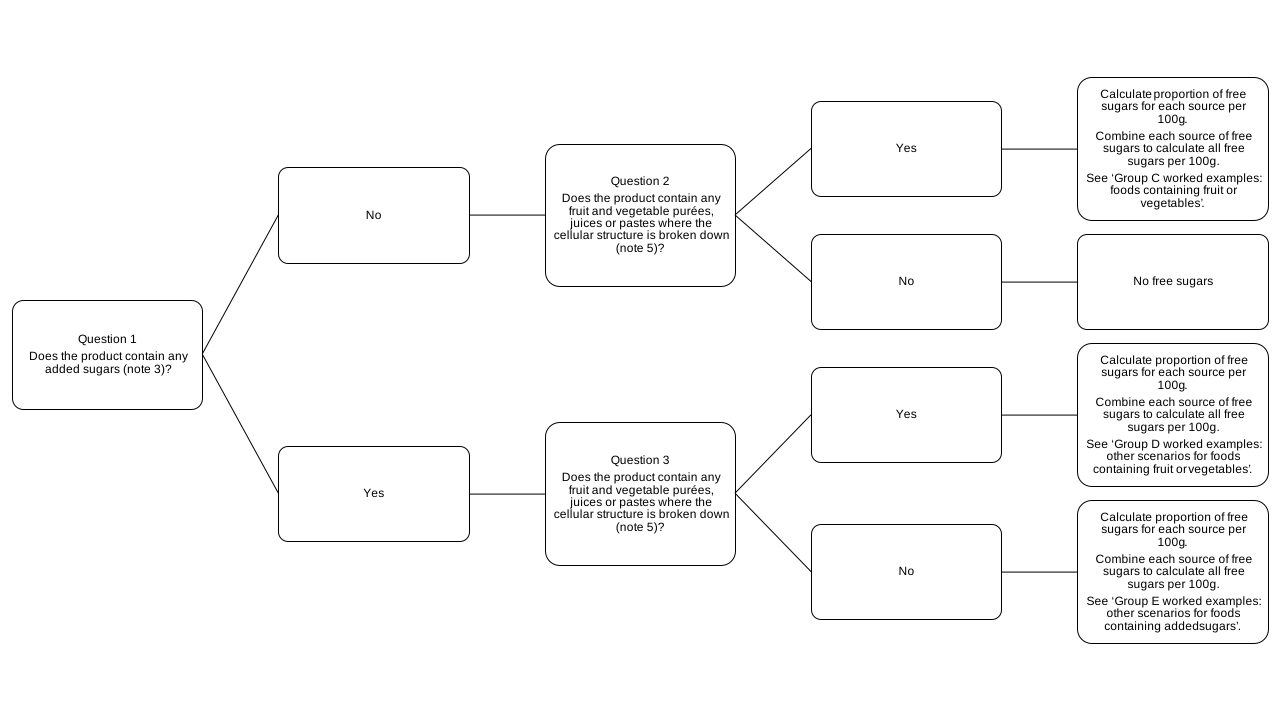
Question 1: does the product contain any added sugars (see note 3)?
- No: go to question 2
- Yes: go to question 3
Question 2: does it contain any fruit and vegetable purées, juices or pastes where the cellular structure is broken down (see note 5)?
- Yes: calculate the proportion of free sugars for each source per 100g. Combine each source of free sugars to calculate all free sugars per 100g. See ‘Group C worked examples: foods containing fruit or vegetables’
- No: no free sugars
Question 3: does it contain any fruit and vegetable purées, juices or pastes where the cellular structure is broken down (see note 5)?
- Yes: calculate the proportion of free sugars for each source per 100g. Combine each source of free sugars to calculate all free sugars per 100g. See ‘Group D worked examples: other scenarios for foods containing fruit or vegetables’
- No: calculate the proportion of free sugars for each source per 100g. Combine each source of free sugars to calculate all free sugars per 100g. See ‘Group E worked examples: other scenarios for foods containing added sugars’
All worked examples are in ‘Nutrient profiling model 2018: worked examples and further advice on calculations’ on the Nutrient profiling model 2018 page.
Notes for decision tree diagrams
Note 1: total sugars are defined by the mandatory nutrition labelling requirements as shown in the ‘Nutrition labelling and ingredients list’ section.
Note 2: dairy products include milk (liquid and dried) and milk-based products (for example, cream, yoghurt, cheese, butter and ice cream). Lactose, hydrolysed lactose, galactose and sugars in whey powder added as ingredients are included in the definition of free sugars, so are excluded from dairy products. All sugars in lactose free dairy products where the lactose has been partially removed through filtration and the remainder broken down to glucose and galactose using lactase are included in the definition of free sugars.
Note 3: added sugars in whatever form, including the sugars in:
- honey, syrups or nectars
- added glucose, fructose, sucrose, lactose, hydrolysed lactose, or galactose
- whey powder
Note 4: other sources of sugars include:
- sugars naturally present in fruit and vegetable purées, powders, pastes, juices, concentrates, smoothies and extruded fruit and vegetables
- sugars in dairy-alternatives
- sugars in milk-derivatives
Note 5: the sugars naturally present in fruit and vegetable purées, powders, pastes, juices, concentrates, smoothies and extruded fruit and vegetables. The sugars naturally present in fresh, frozen, dried, stewed and canned fruit and vegetables are excluded from the definition of free sugars.
Calculating free sugars
You should use the following approach to calculate free sugars for foods and for drinks. It will enable you to:
- identify and quantify ingredients that contribute to free sugars
- determine the total sugar content of those ingredients per 100g
- calculate the free sugars content of those ingredients per 100g
The overall free sugars for the product per 100g is calculated by combining the contribution of free sugars from each ingredient.
For example, for a yoghurt drink, you should first identify the ingredients that contribute to free sugars. In this example, the yoghurt drink contains 10% fruit juice. The total sugar content of fruit juice is 10.7g per 100g. To determine the free sugars content, calculate the amount of sugar from the fruit juice:
10 ÷ 100 × 10.7g total sugar per 100g = 1.07g free sugars contribution from this ingredient
The overall free sugars content for the yoghurt drink per 100g is calculated by combining the contribution of each ingredient that was identified as a source of free sugars. As fruit juice was the only source of free sugars, the free sugars content for the product is 1.07g per 100g yoghurt drink. So, this yoghurt drink would score 1 point for free sugars.
For drinks containing no dairy, the value for total sugars is the same as the value for free sugars.
For products requiring reconstitution before consumption, there are additional steps to consider.
For more information, see worked examples 3, 6 and 16 in the accompanying ‘Worked examples and further advice on calculations’, which also has further worked examples listed in table 1 that are grouped as:
- A - drinks containing no dairy
- B - drinks containing dairy
- C - foods containing fruit or vegetables
- D - other foods containing fruit or vegetables
- E - other foods containing added sugars
How to calculate the fruit, vegetables, nuts and seeds content
This section provides guidance on how to calculate the fruit, vegetables, nuts and seeds (FVNS) content of a product using the NPM.
For definitions of fruit, vegetables, nuts and seeds, see ‘Fruit, vegetables, nuts and seeds definitions’ on the ‘Nutrient profiling model 2018’ page.
The NPM 2004 to 2005 included nuts. The NPM 2018 also includes seeds because seeds and nuts are comparable in terms of nutritional composition.
What counts and what does not
The foods counted as part of the FVNS component for the purposes of the NPM are:
-
intact fruit and vegetables, including those that are:
- fresh
- cooked
- peeled
- sliced
- chopped
- grated
- chilled
- frozen
- canned
- dried
- puréed and juiced
- beans and pulses
- nuts and seeds which are whole, roasted, chopped, grated or ground
The foods that do not count as part of the FVNS component in the NPM are:
- starchy carbohydrates including tubers (potatoes, sweet potatoes, yams, cassava and plantain)
- fruit and vegetables (including those that are dried or freeze-dried) that have been further converted into concentrated fruit juice sugars such as fruit nectar, powders or leathers
- products containing dried fruit or vegetables that have been (for example) pressed, blended or shaped, and are far removed from the original fruit or vegetable product
You can calculate the amount of fruits and vegetables in a product before or after cooking. However, when calculating the amount in a composite food, all the ingredients should be in the same state (either raw or cooked). So, the scoring should not use a mixture of cooked and uncooked fruit and vegetables.
Dried fruit and vegetables
Smaller amounts of dried fruit and vegetables are equivalent to one standard portion of fresh fruit or vegetables. This principle should also apply to commercially prepared concentrated tomato puree.
When calculating a score for dried fruit and vegetables, the weight of dried fruit and vegetables should be multiplied by 2.
The total amount of FVNS in 100g of a product containing dried fruit and vegetables is calculated as set out below.
For the purpose of the equation, FVNS is fruit, vegetables, nuts and seeds that includes juices and purees other than tomato puree and dried fruit and vegetables includes tomato puree.
The amount of FVNS within a product is calculated as:
((weight of FVNS) + (2 × weight of dried fruit and vegetables)) ÷ ((weight of FVNS) + (2 × weight of dried fruit and vegetables) + (weight of other ingredients)) × 100
Fruit and vegetable juices
The NPM FVNS score includes 100% fruit and vegetable juices. These include:
- freshly squeezed juices
- juices made from concentrate
- fruit and vegetable smoothies
If available nutrition information is per 100ml, this should be converted to nutrition information per 100g using the appropriate specific gravity of the product (the ratio of the density (mass of a unit volume) of a food to the density (mass of the same unit volume) of water).
See the accompanying ‘Worked examples and further advice on calculations’ for further information.
The number of points scored for FVNS depends on the proportion of fruit and vegetable juice in the product. The threshold for scoring 1 point is set at more than 40g of FVNS per 100g.
A product needs to contain more than 40g per 100g of 100% fruit and or vegetable juices to score points in the NPM.
For example, a product that contains:
- 100g fruit juice per 100g (where juice is 100% fruit juice from concentrate) would score 5 points for FVNS
- 84g fruit juice per 100g (where juice is 100% fruit juice from concentrate) would score 5 points for FVNS as it has a content of greater than 80g per 100g fruit juice
- 56g fruit juice per 100g (where juice is 100% juice from concentrate) would score 1 point for FVNS
- 40g or less fruit juice per 100g (where juice is 100% fruit juice from concentrate) would not score any points for FVNS
Nutrition labelling and ingredients list
Most of the information required to calculate NPM scores can be based on readily available nutrition labelling and ingredients lists on prepacked foods and drinks. For more information on nutrition labelling requirements, see Technical guidance on nutrition labelling.
Nutrition labelling
Mandatory nutrition labelling applies to most prepacked food and drinks. This is underpinned by assimilated EU Regulation 1169/2011 of the European Parliament and of the Council on the provision of food information to consumers. Mandatory nutrition declaration on nutrition labelling includes the:
- energy value in both kilojoules (kJ) and kilocalories (kcal)
- amounts in grams (g) of fat, saturates (saturated fat), carbohydrate, sugars, protein and salt
Table 3: mandatory ‘back of pack’ nutrition labelling on prepacked products
| Nutrients per 100g/ml | Units of measurement |
|---|---|
| Energy | kJ/kcal |
| Fat | g |
| of which saturates | g |
| Carbohydrate | g |
| of which sugars | g |
| Protein | g |
| Salt | g |
Sugars
On mandatory ‘back of pack’ nutrition labelling, ‘sugars’ refers to total sugars.
The NPM uses free sugars rather than total sugars in line with current UK dietary recommendations as outlined in the introduction.
See the section ‘How to calculate free sugars for food and drink products’ for detailed information on the definition of free sugars and identifying them in products.
See figures 1 and 2 for how to assess free sugars in foods and drinks.
Fibre
Fibre values
Fibre (‘dietary fibre’) is not included in mandatory ‘back of pack’ nutrition labelling. Fibre is declared on a voluntary basis.
Dietary fibre should be chemically determined using the current AOAC method agreed by regulatory authorities.
The fibre value in UK dietary recommendations (and so also in the NPM) is based on the AOAC method.
Where the AOAC fibre value is unknown, you should consult manufacturers to find out the AOAC fibre value. This will ensure you can accurately calculate the AOAC fibre value and overall nutrient profiling score. If only the NSP fibre value is known, then you should convert this to the AOAC fibre value using an appropriate conversion factor.
Extracted fibre
Extracted fibre, such as dextrin, inulin, psyllium and polydextrose are sometimes added to products.
In its 2015 report Carbohydrates and Health, SACN stated that for extracted natural carbohydrate components or synthetic carbohydrate products to be defined as dietary fibre, beneficial physiological effects must be demonstrated by accepted scientific evidence. These benefits must be similar to those demonstrated for the naturally integrated dietary fibre component of foods.
Any extracted ingredients used to increase fibre content and count as ‘C’ points should align with fibre as determined by the AOAC method and the SACN definition above.
Ingredients list
If a food or drink has 2 or more ingredients (including any additives), these will be listed. Ingredients are listed in order of weight, with the main ingredient first (for more information, see Food labelling and packaging).
Where proportions of ingredients are unknown, you should consult manufacturers to find out exact proportions of ingredients to ensure you can calculate free sugars accurately.