
Final report
Published 26 February 2024

© Crown copyright 2024
This publication is licensed under the terms of the Open Government Licence v3.0 except where otherwise stated. To view this licence, visit nationalarchives.gov.uk/doc/open-government-licence/version/3 or write to the Information Policy Team, The National Archives, Kew, London TW9 4DU, or email: psi@nationalarchives.gov.uk.
Where we have identified any third party copyright information you will need to obtain permission from the copyright holders concerned.
This publication is available at https://www.gov.uk/government/publications/housebuilding-market-study-final-report/final-report
Background
The CMA launched its housebuilding market study on 28 February 2023, at which point it also issued a Statement of Scope for consultation. The document identified the purpose and proposed themes to be explored in the market study and outlined the CMA’s intended approach to evidence-gathering. Submissions were also invited on the topics raised.
Since then, we have gathered information from various sources, met with stakeholders, and released several interim publications, including:
-
an interim update report and decision on whether to consult on making a market investigation reference in August 2023
-
working papers covering the private management of public amenities on housing estates, land banks, and planning in November 2023
Rationale for the launch of our study
Housebuilding, in some form, has been at the forefront of government policy since the end of the Second World War and has been closely scrutinised in numerous research papers and reviews by academics and others.
The UK government set a target in its 2019 manifesto to deliver 300,000 homes (in England) per year by the mid-2020s and at least a million more homes by the end of the 2019 Parliament. These targets have so far not been met, with concerns about whether they are attainable and/or can adequately meet future needs and demands.
The Secretary of State for the Department of Levelling Up, Housing and Communities (DLUHC) wrote to the CMA in 2022 supporting a study into the housebuilding sector, highlighting the importance of ensuring that the housebuilding market is working in the best interests of consumers. The CMA received further calls from members of parliament and industry bodies to carry out a review of the market. Taking these views into account, and applying our prioritisation principles, the CMA Board decided that it was timely to launch a market study into housebuilding in England, Scotland, and Wales. Our Statement of Scope set out that the study would consider the supply of new homes to consumers in England, Scotland, and Wales. Given differences in the structure and functioning of the housebuilding sector in Northern Ireland, we considered that NI was unlikely to face the same market or supply-side issues as the rest of the UK; we therefore excluded NI from the scope of the market study.
The focus of our work
We have gathered and analysed a range of evidence to enable us to:
-
provide an overview of how the market is structured, the main models of housing delivery in GB, the relationships between key participants, and other aspects of the way the industry operates, at each key stage of the housebuilding process
-
discuss the outcomes that are delivered in relation to the supply and affordability of new homes, the profitability of the largest housebuilders, and the extent to which innovation in the market is occurring, in particular to improve its sustainability
-
explore the extent to which various drivers contribute to the outcomes that we observe in the housebuilding market. We seek to measure, where possible, whether and to what extent any of the competition issues that we identify may lead to consumer harm, by looking at drivers of prices and build-out speed, the nature and operation of the planning system, and drivers of quality and innovation in the sector
-
outline our proposals to address issues we have found during the market study and consider options to improve market outcomes within the current framework. We also identify concerns about the planning system of GB nations and detail possible options for reform
Methods of engagement
Since launching the market study, the CMA has collated information from and discussed issues with a range of stakeholders across the different parts of England, Scotland, and Wales to get an understanding of the challenges facing different regions.
Specifically, we have:
-
sent requests for information (RFIs) to the 11 largest housebuilders, to 52 land agents and promoters, to 55 SME housebuilders, and to 15 estate management companies, allowing us to gain access to information not available to others who have studied this market
-
engaged with a range of government bodies across England, Scotland, and Wales tasked with forming and delivering policy in this area
-
procured planning data from a specialist supplier
-
procured an independent research agency to carry out qualitative research with a sample of 100 owner-occupiers of new build homes, with a focus on understanding their expectations and experiences of the quality of their properties (50 interviews), or their experiences of estate management charges where these apply (50 interviews)
-
held 4 roundtable sessions involving diverse stakeholder representation from the industry on matters relating to quality and planning in each of England, Scotland, and Wales. Roundtable attendees involved: local authorities, housebuilders, and various representative bodies (including trade associations, consumer groups, and associations representing planning and housing officers and local authorities)
We have also received responses to our working papers, including 90 responses from organisations and over 170 individual responses, largely from owners of new build properties.
Scope of our study
The focus of our market study is the supply of new homes to consumers (‘housebuilding’) in England, Scotland, and Wales.
From engaging with various stakeholders in Northern Ireland and undertaking desk research, we identified that the housebuilding sector in Northern Ireland demonstrates notable disparities in market structure and functioning compared with England, Scotland, and Wales. In particular, these are that: the largest 11 GB housebuilders do not operate there, and Northern Ireland is served entirely by SME builders; the pace of housebuilding has been significantly higher than in the rest of the UK; affordable housing is largely funded directly rather than using developer contributions; and estate management with regard to new roads takes place on a different basis.
Due to these significant differences in dynamics and outcomes, a number of the concerns we sought to examine in the course of our study do not appear applicable here. As a result, we decided to exclude Northern Ireland from the geographic scope of the market in this study.
The statutory 12-month timetable for market studies imposed certain limitations on the scope of our investigation. We therefore sought to identify aspects of the housebuilding market where we could offer significant insights and have the greatest impact.
The area of housebuilding touches on important policy objectives that involve wider social and economic policy concerns, beyond the CMA’s core focus on whether the market is working well for consumers. Accordingly, we scoped our study so that we have not considered issues such as:
-
the validity of the actual targets set by governments across GB and whether GB is building enough homes to meet demand
-
the constraints on new homes supply resulting from broad policy choices that weigh various costs and benefits to society, such as the preservation of green belts
-
the fundamental aims of the GB planning regimes, including the way in which they seek to balance housing needs and other societal needs
Our approach to the final report
This document constitutes the final report of the CMA’s housebuilding market study, setting out our overall findings and conclusions, as well as our final decision on whether to make a market investigation reference in relation to this market.
In addition, we are publishing a supplementary supporting evidence document containing in-depth information. Appendices A – K cover technical areas.
Market overview
Summary
Housebuilding in GB, as in many other countries, involves developers identifying a desired location, acquiring land, and navigating a legislative and regulatory framework in order to construct homes and bring them to market.
The majority of new homes in GB are delivered through the ‘speculative model’ of housebuilding (over 60% in 2021/22), whereby housebuilders buy land in advance of the construction and sale of homes, for profit, and without knowing the final price they will sell that home for.
Around a third of homes are built on an affordable housing basis (c.30% in 2021/22), meaning they are sold or rented at a discount to the market price. The construction of these homes is typically either funded and procured by a public body, local government, or registered housing provider, or provided by housebuilders via planning obligations. As a proportion of total builds, England has relatively more speculative housing, and Scotland and Wales have relatively more affordable housing.
The largest 11 housebuilders provide a significant proportion of homes in GB (around 40% in 2021 to 2022), operating mainly, but not exclusively, through the speculative model. Large housebuilders develop a range of sites, whether greenfield, brownfield, rural or urban, with a wide geographic spread, although they tend to focus on larger developments.
Our analysis suggests there are currently thousands of SME housebuilders in England, Scotland, and Wales, who according to our data are building in excess of 50,000 houses in total each year. SMEs also cover a range of sites but tend to focus on smaller developments. The number of SME housebuilders is reported to have fallen significantly since the late 1980s.
Landowners, intermediaries who support transactions between landowners and housebuilders, providers of warranties for new homes (similar to insurance), and estate management companies are also participants in the market.
Housing policy is a devolved matter. In England, the Department of Levelling Up, Housing and Communities (DLUHC) is the lead policy department. The Department for Environment Food and Rural Affairs (DEFRA) and the Department for Transport (DfT) have responsibility for sewers and drainage and roads on new build estates, respectively.
The Scottish and Welsh governments have policy responsibility for the range of areas within housing policy in these nations.
Local government plays an important role, with Local Planning Authorities (LPAs) leading planning activities and decisions in local areas and bringing forward social housing, and local authorities (as well as other relevant authorities) having power to adopt infrastructure and amenities constructed by housebuilders.
A number of public bodies such as Homes England, the Planning Inspectorate, HM Land Registry, and statutory consultees to the planning process (such as Natural England, the Environment Agency, and others) also play a role.
In this chapter we describe the key features of the housebuilding market[footnote 1] in England, Scotland, and Wales in order to provide the background and building blocks for subsequent chapters focused on analysis and recommendations.
This chapter therefore discusses:
-
the process of bringing new homes to market
-
the main models of housing delivery in GB
-
the key market participants
-
the role of government and public bodies
How houses are brought to market
The activity of supplying new homes in GB, as in other countries, is not as simple as buying a plot of land, starting construction, and then putting them on the market.
Housebuilders instead operate through a series of legislative and regulatory frameworks which are in place with the aim of managing a range of social and policy objectives, which we describe later in our report as they become relevant.
In this section, we set out the main phases that housebuilders go through while developing a plot of land into new, saleable homes.
The development process
The development process broadly consists of a number of phases:[footnote 2]
-
pre-planning, typically involving: site identification and appraisal; securing target sites under contract (usually through an option agreement); initial site design and master planning; site promotion for allocation in local plan; and pre-application discussions with local planning authorities (LPAs) and other stakeholders
-
planning application to planning permission, typically involving: final preparation of planning applications; submission of the planning applications to the LPA for validation; statutory and non-statutory consultation for a minimum of 21 days; negotiation of planning conditions and planning obligations; recommended decision on planning applications by planning officers; final decision on planning application by planning committee; and (where this occurs) an appeal of a planning decision to the Planning Inspectorate (or in some cases a judicial review of the planning decision)
-
planning permission to start on site, typically involving: final acquisition of permissioned land from landowner/land promoter; discharge of planning conditions; pre-commencement orders/reserved matters; assembly of labour and construction materials; and ground works, site access, and installation of enabling infrastructure
-
construction, typically involving: build commencement; marketing and initial sales release; phasing development; build complete. Within this stage, consumers may have moved in which initiates the snagging and aftercare processes
-
post-construction, typically involving: sales completion; adoption of amenities, such as roads, sewers and drains, or transfer of land and management of amenities to a residents’ management company (RMC) or private management company.[footnote 3] Consumer aftercare is provided by the housebuilder and warranty providers for a period of time
How land is sold
Land is clearly an essential input required by housebuilders to deliver homes. Finding the right plots, where people want to live, where there is - or can be - appropriate infrastructure, and where they are likely to get planning approval is a key part of the housebuilding process.
Housebuilders may purchase or control residential land with:
-
no planning permission (known as long-term or strategic land). For this type of land, a housebuilder must first obtain planning permission to begin construction of a residential development
-
at least outline planning permission (known as short-term or permissioned land). For this type of land, the housebuilder will be able to begin construction of the residential development relatively quickly
Land can either be brownfield (previously developed) or greenfield (previously undeveloped).
Housebuilders use the Red Book, voluntary guidance published by the Royal Institution of Chartered Surveyors (RICS), to value the land which they plan to develop.[footnote 4] Land agents also provide land valuations to landowners, but this is provided as a guide for marketing purposes. Land can be valued either through direct comparison with other recent sales (where data on sufficiently similar transactions is available) or through residual valuation, where the land value (in other words, the ‘residual’) is the completed gross development value (how much the properties on the land would sell for) minus total development costs, government policy and obligation costs (for example, Section 106 contributions), and developer’s profit.
Land can be sold either through on-market (in other words, publicly advertised) or off-market (inother words, private transactions not publicly advertised) processes. The negotiation process between the seller and purchaser is typically one of the following:
-
bilateral negotiation: this is a one-to-one negotiation between the buyer and the seller
-
limited tender: a select list of potential purchasers are invited by the landowner (and/or their appointed agent) to bid for the land
-
open market: any bidder can bid for the land
The main models of housing delivery in GB
There are several models by which housing has been delivered across GB and other countries in recent decades. These models vary by how much involvement the eventual buyer, or a state or private developer, has in the construction process, and in terms of the kind of end-user envisaged for the dwelling.
The main models used to deliver housing in GB are:
-
speculative housebuilding – housebuilders buy land in advance of the construction and sale of homes. The price at which the homes are to be sold is uncertain at the time of the land purchase and will not be determined until the homes are sold to a final consumer, which can be late on in the development process. As with most market transactions, the builder is motivated primarily by the desire to earn a commercial return on the project
-
affordable housing/sub-market – this is housing that is typically sold or rented at a discount to market prices. Several different types of housing fall into this category, including social rented housing; affordable or intermediate rented homes; and discounted or subsidised sales of homes. The construction of these homes is, typically, either funded and procured by a public body (such as Homes England or an LPA) or a Registered Housing Provider, or provided by housebuilders via planning obligations that form part of the planning permissions obtained for developments
-
build to rent housing – purpose-built housing that is typically 100% rented out. These types of build to rent developments will usually offer longer tenancy agreements of 3 years or more and will typically be professionally managed rental stock in single ownership and management control
-
custom build/Self-commissioned housing – housing built by an individual, a group of individuals, or persons working with or for them, to be occupied by them. Such housing can be either market or affordable housing
Our analysis suggests that around 141,000 (around 60%) of the 239,000 new build homes completed in GB in 2021 to 2022 were built though the speculative model, although we note this is approximate given the different data sources used
Figure 2.1: Estimated number of homes built in GB using various models in 2021 to 2022

Alt text
A pie chart showing the number of homes built under various models of housebuilding in GB in 2021 to 2022.
The numbers are: speculative housing 141,600; affordable housing 71,600; custom build housing 15,900; and build to rent housing 12,300.
Sources: CMA analysis of
-
New data shows custom and self build numbers growing (nacsba.org.uk)
-
Live table 1000 Additional affordable homes provided by tenure, England
-
Additional affordable housing provision by provider and year (gov.wales)
Note: Figures may not sum due to rounding. Note: Figures for custom build housing are for 2019.
We see a higher proportion of speculative housebuilding in England than in Scotland or Wales, due to England having a lower proportion of affordable/social housing. In England, affordable housing accounted for around 29% of completions in 2021 to 2022, compared with 45% and 50% for Scotland and Wales respectively.
Key market participants
A range of market participants are involved in the supply and related activities regarding new build housing in GB. This includes housebuilders (who differ significantly by size and other characteristics such as geographic scope), landowners, intermediaries of various kinds, warranty providers, and estate management companies.
Large housebuilders
Large housebuilders, also known as volume housebuilders, are key players in the GB housing market.
For the purposes of this study, we define large housebuilders as those building more than 1,000 homes a year. Our analysis of NHBC data suggests that around 25 housebuilders built more than 1,000 homes in 2022, although this may be an underestimate.[footnote 5] For the purposes of our analysis, we have particularly gathered information from a subset of these: the 11 largest housebuilders in Great Britain, by 2020 to 2021 and 2021 to 2022 revenue. Each of these housebuilders built more than 2,000 homes in 2021-22.[footnote 6] These firms are: Barratt, Bellway, Berkeley, Bloor Homes, Cala, Crest Nicholson, Miller Homes, Persimmon, Redrow, Taylor Wimpey, and Vistry.[footnote 7]
These large housebuilders mainly build under the speculative model outlined above, but typically a significant minority of their output will be affordable homes. 8 of these firms are UK-listed and, since the Global Financial Crisis (GFC), have been largely equity-financed to allow them to better manage risk.
Large housebuilders develop a variety of sites, including greenfield and brownfield sites, and rural and urban sites. They tend to focus on larger developments, and generally have a relatively wide geographic spread, which allows them to diversify exposure to local risks.
According to our estimates, in 2021 to 2022 the single largest builder, Barratt, supplied around 8% of the GB market. The largest 11 firms together supplied around 40%.[footnote 8]
Figure 2.2: GB shares of housebuilding 2021 to 2022

Alt text
A pie chart showing shares of new-build housing in 2021 to 2022.
The shares are: Barratt 8%; Bellway 5%; Persimmon 6%; Taylor Wimpey 6%; other top 11 housebuilders 15%; and other builders 61%.
Sources: CMA analysis of:
-
various large housebuilders’ annual reports and accounts and government statistics; Housing supply: net additional dwellings - GOV.UK
-
Housing statistics quarterly update: new housebuilding and affordable housing supply (gov.scot)
SME housebuilders
SME housebuilders also play a significant role in housing delivery in GB. For the purposes of this market study, we define SME housebuilders as any housebuilder building 1,000 houses or fewer per year.[footnote 9]
Our analysis suggests there are currently thousands of SME housebuilders in England, Scotland, and Wales, who according to our data are building in excess of 50,000 houses in total each year.[footnote 10] The number of SME housebuilders is reported to have fallen significantly since the late 1980s.[footnote 11]
SMEs develop a variety of types of site, including greenfield and brownfield sites, and rural and urban sites. They also develop a range of sizes of site, including smaller sites which larger housebuilders may not develop.
SMEs build a variety of houses, with some utilising standardised house types, and others building more bespoke homes.
Unlike large housebuilders, SMEs typically use external debt financing, either on a project-by-project bases or through longer-term finance. This means SMEs cannot hold land banks in the same way as the large housebuilders can due to their access to equity or other external finance.
Landowners
Landowners are private individuals, public entities, commercial entities, charities, or institutional landowners who own land and may be willing to sell it for housing development. There is no single comprehensive set of data on who owns what proportion of land across Great Britain. However, some estimates suggest around 60% of land in England and Wales is owned by private individuals, with a range of institutions such as the Forestry Commission, Ministry of Defence, and the Crown Estate also holding significant amounts of land for different purposes.[footnote 12]
Intermediaries
There are intermediary actors in the market which support landowners when they seek to sell or develop their land. Most commonly these are solicitors, land agents, and land promoters. The interactions these actors have with landowners are usually dependent on what the owner wants to do with their land.
Land agents are individuals or firms who specialise in representing clients (buyers or sellers) in land transactions. They support the sale, purchase, or leasing of land.
Based on the land agents’ completed sales data,[footnote 13] we found the largest land agents were Savills (approximately [redacted]% of sites, equivalent to [redacted]% of plots in 2022),[footnote 14] with multiple agents holding a share of more than 5% of sites and plots and several more with shares below 5% in 2022.
Land promoters’ main activity is promoting land through the planning system on behalf of landowners, with the objective of securing planning permission for residential development. Land promoters have been active in the strategic land market for decades, but the GFC is reported to have stimulated the expansion of this model since 2008.[footnote 15]
Based on land promoter completed sales data,[footnote 16] we found Gladman was typically the largest promoter each year (approximately [redacted]% of sites, equivalent to [redacted]% of plots). Based on sites, the other promoters are smaller and do not have a consistently high share for each year, indicating that sales from promoters may be volatile. Based on plots, there is more variation in the relative size of land promoters, which may be due to the sale of larger sites with more plots in particular years.
Warranty providers
A new build warranty is an insurance product for a newly-built home. The warranty is taken out by the housebuilder, with the beneficiary of protection being the buyer and mortgage lender, if applicable. It typically covers defects that arise due to faults in design, workmanship, or materials that remain undiscovered at the time of completion of the new build.[footnote 17] There is a range of warranty providers: well-known ones are NHBC, Local Authority Building Control (LABC), and Premier Guarantee.
Currently, the period of coverage is usually 10 years and housebuilders are not required by law to provide a warranty; instead, the majority of mortgage lenders make provision of one a requirement for lending.[footnote 18] The Building Safety Act 2022 has provisions to make it mandatory for housebuilders to provide a warranty to the purchaser, with a minimum period of coverage of 15 years.[footnote 19] These provisions are not yet fully in force, although are expected to come into force in the near future.
Estate management companies
Estate management companies, which include some property factors in Scotland, provide services to households on housing estates for the ongoing management and maintenance of public amenities such as open spaces, roads, drainage and sewers, and sustainable drainage systems (SuDS), where those amenities have not been adopted by the relevant public authority.
They may specialise in the provision of estate management services in general or in the provision of estate management services for specific amenities such as public open spaces, and they may offer estate management services as part of a wider portfolio including, for example, block management for leasehold customers.
The role of government and public bodies
As noted above, housebuilding operates in an environment heavily influenced by governments and public bodies, and the legal and regulatory frameworks they set and operate. In this section we set out the key responsibilities and features in this regard.
Policy responsibility
Housing policy, including policy on planning, consumer protection with regards to housing, and other relevant policy areas such as specific environmental policies and energy efficiency policy, is devolved. Therefore, governments across GB are responsible for policies which impact the issues considered in this market study.
England
The UK government is responsible for housebuilding in England. The lead policy department is the Department for Levelling Up, Housing and Communities (DLUHC). DLUHC’s work includes investing in areas to drive growth and create jobs, delivering the homes the country needs, supporting community and faith groups, and overseeing local government, planning, and building safety.
DLUHC is responsible for housing, which includes a broad range of activities in homeownership, leasehold, the private rented sector, social housing, housing delivery, building safety and Net Zero. Planning is also a key responsibility: DLUHC is responsible for the production of the National Planning Policy Framework (NPPF), a document that sets out the UK government’s economic, environmental, and social planning policies for England. The NPPF covers a wide range of topics, including housing, business, economic development, transport, and the natural environment.
In relation to estate management, DLUHC has policy responsibility for leasehold and freehold matters, and is implementing reforms through the Leasehold and Freehold Reform Bill.
In relation to the adoption of amenities, the Department for Environment, Food and Rural Affairs (DEFRA) has policy responsibility for sewers and drains under the Water Industry Act 1991 and sustainable drainage systems (SuDS) under the Flood and Water Management Act 2010. In relation to roads, the Department for Transport (DfT) has policy responsibility under the Highways Act 1980.
Scotland
The Scottish Government has responsibility for housing policy in Scotland. It also has responsibility for the production of the National Planning Framework, a document that acts as the national spatial strategy for Scotland, as well as setting out Scotland’s spatial principles, regional priorities, national developments, and national planning policy.
Policy responsibility for estate management and roads is also devolved in Scotland. In relation to estate management, the Scottish Government sets out its policy for property factors in Scotland under the Property Factors (Scotland) Act 2011.
In relation to adoption, the Scottish Government sets out the policy for roads under the Roads (Scotland) Act 1984, and sewers and SuDS under the Sewerage (Scotland) Act 1968.
Wales
The Welsh Government has responsibility for housing policy in Wales. It also has responsibility for preparing Planning Policy Wales (PPW), the document that sets out the land use planning policies of the Welsh Government.
PPW is supplemented by a series of Technical Advice Notes, Welsh Government Circulars, and policy clarification letters, which together with PPW provide the national planning policy framework for Wales. The primary objective of PPW is to ensure that the planning system contributes towards the delivery of sustainable development and improves the social, economic, environmental, and cultural well-being of Wales, as required by the Planning (Wales) Act 2015 and the Well-being of Future Generations (Wales) Act 2015.
In relation to estate management, in November 2023, the Minister for Climate Change stated that she will be laying a Legislative Consent Memorandum in respect of the Leasehold and Freehold Reform Bill, given housing is within the legislative competence of the Senedd.[footnote 20]
In relation to adoption, the Water Industry Act 1991 covers the adoption of sewers and drains. Welsh Ministers have published standards related to the mandatory adoption of sewers and lateral drains under the Flood and Water Management Act 2010. The adoption of SuDS is governed by the Flood and Water Management Act 2010 (Schedule 3). Adoption of roads is covered by the Highways Act 1980.
Local government
Local planning authorities (LPAs)
The planning system is designed to be applied by local government and communities across all 3 GB nations. Local government administers much of the planning system, preparing local plans, determining planning applications, and carrying out enforcement against unauthorised development.
An LPA is the local government body that is empowered by law to exercise planning functions for a particular area.
Mayor of London and the Greater London Authority (GLA)
The Mayor of London and the GLA have joint responsibility for planning with the London boroughs. The GLA sets out a spatial development strategy for London in the form of the London Plan and related polices. It also sets London’s housing targets. Strategic planning applications are referred to the Mayor for comment and the Mayor also has power to ‘call in’ planning applications in certain circumstances.
Greater Manchester and the West Midlands Mayors
Similar to the London Mayor, the Mayor of Manchester and Greater Manchester Combined Authority have planning powers and are developing a planning spatial strategy for the region, barring Stockport Council. The Mayor of Manchester has no powers to ‘call in’ strategic applications.
Contrary to London and Manchester, the Mayor of the West Midlands and West Midlands Combined Authority work with constituent and non-constituent members on spatial planning and redevelopment of brownfield land, including use of compulsory purchasing powers to acquire land. However, formal planning powers rest primarily with individual local councils.
Both Greater Manchester and the West Midlands also have various transport and housing powers, among others.
Public bodies and statutory consultees
Public bodies play different roles across the housebuilding process. The main ones are Homes England, the Planning Inspectorate, and HM Land Registry.
Homes England
Homes England is an executive non-departmental public body, sponsored by DLUHC. It is the UK government’s housing and regeneration agency working across England only, except in London where much of the agency’s role is devolved to the London Mayor. Its role is to improve the supply and quality of housing in England.
Planning Inspectorate
The Planning Inspectorate is an executive agency sponsored by DLUHC. It deals with planning appeals, national infrastructure planning applications, examinations of local plans, and other planning-related and specialist casework in England.[footnote 21]
HM Land Registry
HM Land Registry is a non-ministerial department which registers the ownership of land and property in England and Wales.[footnote 22]
Statutory Consultees
Statutory consultees are organisations that are required by legislation to be consulted on plans and applications. They play an important check-and-balance role within planning systems, safeguarding the environment, respecting heritage, and ensuring health and safety considerations are properly considered in the production of Local Plans and in determining planning applications. Such organisations include Natural England, Nature Scot, Natural Resources Wales, the Environment Agency, Historic England, Cadw, Historic Environment Scotland and the Health and Safety Executive, among others.
Market outcomes
Summary
The housebuilding market is not delivering well for consumers. In particular, we see:
Supply of new homes across GB persistently falling well short of government targets and other assessments of need, as well as being highly cyclical. As this happens over many years, it compounds to create a growing housing shortfall, which puts increasing pressure on housing affordability. Looking back at the history of this market, it is notable that housebuilding has only reached the desired levels in periods where significant supply was provided via local authority building.
Below the GB level, significant variation in housing delivery relative to need. Scotland has, in general, come closer to its implied target levels than Wales and, in particular, England. There is also variation by region, with regions of England (London, South East and East) accounting for the majority of the areas where there has been significant under-delivery against assessed need, and some local authority areas in Scotland and Wales also delivering less than their assessed level of need.
The ability for firms to earn profits in excess of the cost of capital over an extended period. Our analysis has found that during the 2010s, average housebuilder profitability was well in excess of the cost of capital, although this was preceded by a period in which the reverse was true, and was partially driven by external factors such as ultra-low interest rates and the Help to Buy scheme. We therefore do not take this to indicate that intervention is required to directly tackle housebuilder profitability.
Problems faced by some purchasers of new homes in relation to the prevalence of defects, and the effectiveness with which they are rectified. Although buyers’ reported satisfaction at 8 weeks after completion is generally high, there is some evidence that customers’ perceptions of the quality of service they had received (or in some cases were still receiving) deteriorated as they lived in their homes for longer. In particular, where consumers experience a greater number of snags or faults it can be more difficult to resolve them, taking weeks or even months. It also appears that there is a small but significant minority experiencing the most serious defects, who are likely to experience significant consumer detriment.
Lower levels of innovation in the industry than we might expect in a dynamic, well-functioning market. Although many of the largest builders have invested in, acquired, or developed their own more innovative production capacity, the dissemination of these new methods continues to happen at a slow pace. Efforts at improving sustainability are primarily driven by expectations of future regulation, rather than industry momentum.
Consumer detriment arising from the private management of public amenities on housing estates. We conclude that, as a result of the proliferation of this model, and with some households unable to switch provider at all, households may face detriment in the form of the charges they pay, the quality of amenities available to them and the quality of management services they receive, the potential for disproportionate sanctions to be applied for outstanding charges, and the sometimes significant efforts required to achieve a satisfactory outcome in those regards. We consider that if the status quo is maintained, aggregate detriment is likely to worsen over time.
Introduction
In market studies, we explore the outcomes that are being delivered by a market, so that we can assess how well it is working for consumers, and areas where it may be falling short.
In this chapter, we discuss our findings in relation to the following outcomes:
- the supply of new build homes, and the affordability of homes more broadly
- the profitability of the largest housebuilders
- the quality of the new homes being delivered, and consumers’ experiences of seeking redress when things go wrong
- the extent to which the market is innovating, including to improve its sustainability
- the increasing use of private models for managing the public amenities on new estates, and the impact this is having on consumers
In the Statement of Scope for our housebuilding study we set out that we would also examine the extent to which the market delivers adequate choice of new build homes; we explore this in our discussion of how housebuilders decide build-out rates and prices at paragraph 4.105 onwards. We also said that we would seek to understand the role of SME housebuilders in driving quality and innovation; we report our findings in respect of that question in paragraph 4.185 onwards.
Supply and affordability
Fundamental to whether the housebuilding market is delivering good outcomes for consumers is whether it is producing an adequate quantity of new housing. The quantity of housing that is supplied to the market depends on a range of factors, including decisions made by housebuilders; government policy (such as housebuilding targets or government housebuilding programmes); broader macroeconomic conditions; the planning system and how well it functions; how effectively the markets for the supply of land and housing are working; and natural constraints such as the quantum of developable land in places where people want to live. While observations about how much new build housing is being delivered may not directly tell us how well the market, and competition within it, is working, nevertheless it is an important step in understanding whether we should be concerned about how the market is delivering for consumers.
In considering the adequacy of supply in the housing market it is important to distinguish between housing demand and housing need. While housing demand is determined by the number of people or organisations willing and financially able to buy a property, either as a home, second home or investment property, housing need is determined by the amount of housing required for all households to live in accommodation that meets a certain normative standard. As such, estimates of housing need inevitably reflect views about what acceptable standards look like, which are ultimately for wider society to determine through democratic processes.
One of the primary ways in which housing need is assessed is through setting government targets. The different nations of GB have different approaches to estimating housing need.
-
in England, there is a government commitment to deliver 300,000 new houses per year by the middle of the decade. Alongside this, LPAs must conduct a local housing need assessment through the Standard Method (SM). The current version of the SM introduced changes to help ensure that it ‘delivers a number nationally that is consistent with the commitment to plan for the delivery of 300,000 new homes a year’[footnote 23]
-
in Scotland, LPAs must set out their Local Housing Land Requirement for the area they cover. This is expected to exceed the 10-year Minimum All Tenure Housing Land Requirement (MATHLR). The sum of the MATHLR targets set out in Annex E of NPF4 equates to land for 20,000 homes per year[footnote 24]
-
in Wales, LPAs must explain how they will ensure that their housing requirement and associated land supply will be delivered in their local development plan. While there is no officially set target, work published by the Welsh Government in August 2020 provided a central estimate of annual all-tenure housing need of 7,400[footnote 25]
We do not intend to provide an assessment of the targets set by governments or test their validity. However, we note that assessing the level of housing need is very challenging, requiring a variety of assumptions around factors such as population growth and current levels of suppressed demand. As such any method is likely to have weaknesses. We set out in Section 2 of the supporting evidence document further detail of critiques which have been made of the different approaches to setting targets in the different nations.
Given the difficulty of assessing housing need and the issues with any given metric used for this purpose, we have therefore also considered other assessments of the level of housebuilding which is needed.[footnote 26] We do not endorse the specific figures produced by any of these papers. However, we note that most find that there is a shortfall in current levels of housing provision, and that the findings of those papers imply the target levels of housebuilding set by government may be a lower bound for what is needed.[footnote 27]
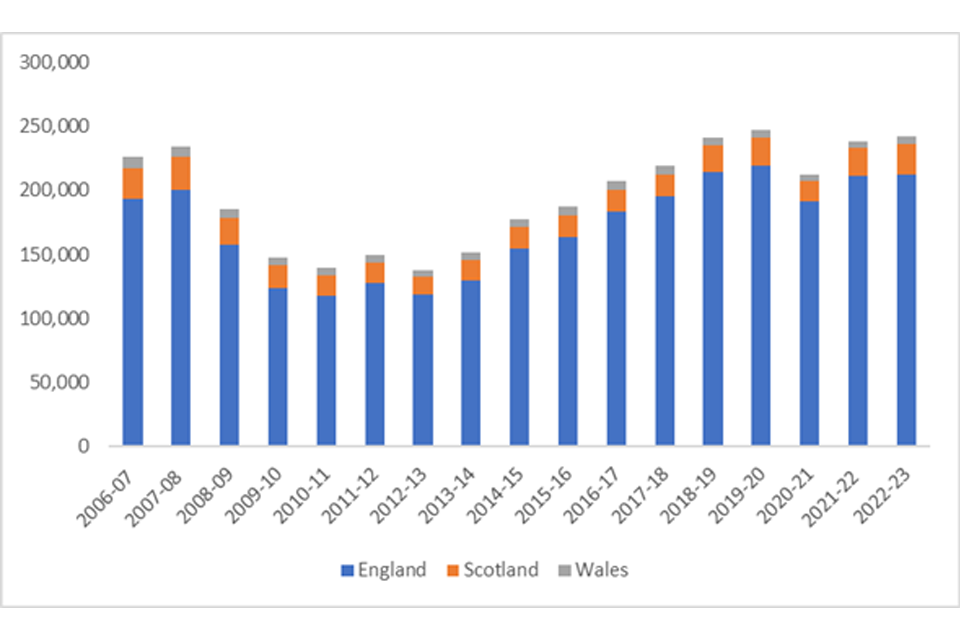
Figure 3.1: New homes built in England, Scotland, and Wales 2006 to 2007, to 2022 to 2023
Alt text
A bar chart showing the number of new homes built in England, Scotland, and Wales between 2006 to 2007, and 2022 to 2023.
The chart shows that housebuilding over this period has been significantly and persistently below 300,000 homes per year across GB.
In England, the volumes of housing delivered annually have increased significantly since the Great Financial Crash but have not exceeded 250,000 at any point during this period.
In Scotland, it has taken some time for the level of new-build completions to return to close to pre-2008 levels (which exceeded 25,000) and were still somewhat short of this at 21,000 in 2021 to 2022.
In Wales, the number of new-build homes completed remains well below its pre-2008 level of around 9,000 and in 2021 to 2022 was less than 6,000.
Sources:
As figure 3.1 above shows, housebuilding over this period has been significantly and persistently below 300,000 homes per year across GB.[footnote 28]
-
in England, the volumes of housing delivered have increased significantly since the GFC but have not exceeded 250,000 at any point during this period
-
in Scotland, it has taken some time for the level of new build completions to return to close to pre-2008 levels (which exceeded 25,000) and are still somewhat short of this at 21,000 in 2021 to 2022. While in some recent years levels of completions have been just above 20,000, over a 10-year period (2012 to 2013, to 2021 to 2022) completions were below this, averaging approximately 17,800
-
in Wales, the number of new build homes completed remains well below its pre-2008 level of around 9,000 and in 2021 to 2022 was less than 6,000. This is also below the level of need estimated by the Welsh Government as described in paragraph 3.6(c)
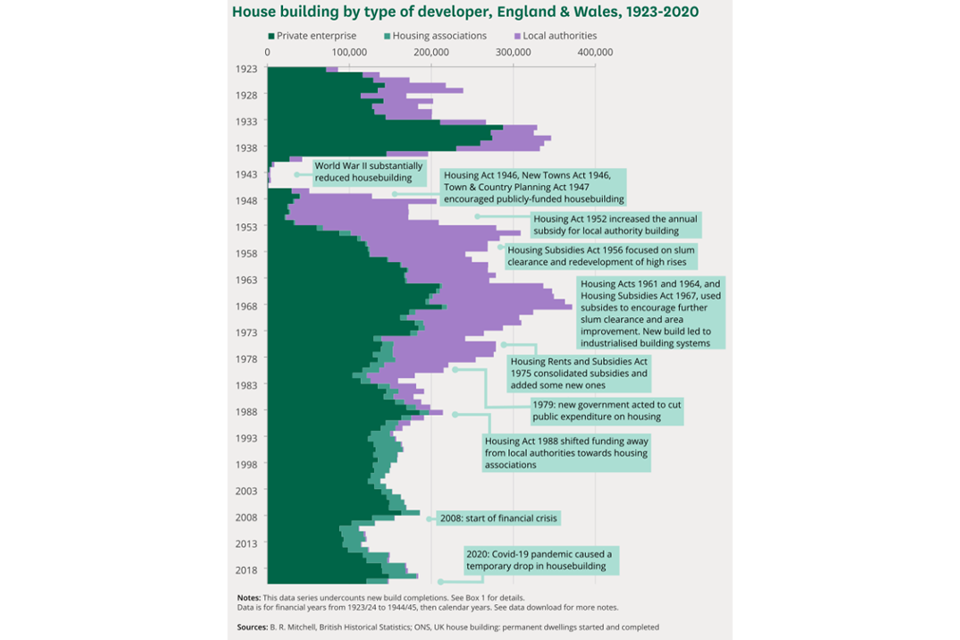
Recent levels of housebuilding are not unusual in the longer historical context. As can be seen from the chart below, the only years when housebuilding in England and Wales approached or exceeded 300,000 homes per year were during periods with significant levels of local authority housebuilding.
Since the Second World War, private developer output has fluctuated between roughly 150,000 and 200,000 per year, according to this data set. It is also highly cyclical in nature, with housing output strongly correlated with changes in macroeconomic outlook. There is some underestimation of new build supply in this dataset, which means we cannot be definitive;[footnote 29] nevertheless, looking over a longer time period shows that private housebuilding alone has rarely, if ever, in the past century delivered close to the amount of housing expected under the current targets.
Figure 3.2: Housebuilding by type of developer, England and Wales, 1923 to 2020
Alt text
A chart showing housebuilding in England and Wales by private enterprises, housing associations and local authorities.
Since the Second World War, private developer housing output has fluctuated between roughly 150,000 and 200,000. Housebuilding by local authorities has declined markedly and, although since the late 1970s the volume of housebuilding by housing associations has increased, this has not been sufficient to outweigh the large drop in volumes provided by local authorities. Private housebuilding is shown to be highly cyclical in nature, with housing output strongly correlated with changes in macroeconomic outlook. Looking over a longer time period shows that private housebuilding alone has rarely, if ever, in the past century delivered close to the amount of housing expected under the current targets according to this data set.
Source:
There are also important local dynamics at play in housing delivery. The same level of housing (and so housebuilding activity) is not required uniformly across the nations and regions of Great Britain.
-
in England, the majority of LPAs in England meet or exceed their local Housing Delivery Test (HDT) targets: 214 (or 70%) of LPAs achieved more than 95% of their housing need in 2020 to 3021[footnote 30] - significant underperformance of housing delivery against targets is limited to a relatively small number of LPAs, and these are relatively highly concentrated in certain areas of the country, particularly in the South East, East of England, and London regions
-
for Scotland, over the last 5 years, in 7 out of 33 LPAs (21%) housing completions were equivalent to 75% or less of their MATHLR assessment of local need, while in 18 (55%) housing completions were in excess of 100% of this - the LPAs scoring below 75% included the most densely populated conurbations in Scotland – Edinburgh and Glasgow[footnote 31]
-
for Wales, over the last 5 years, 13 out of 21 LPAs (62%) achieved housing completions equivalent to 50% or less of their local plan housing requirement whilst none achieved completions in excess of 100% - the high number of LPAs missing their local plan requirements means that they are spread across Wales but amongst the areas with the lowest ratios are the most densely populated areas Cardiff and Swansea[footnote 32]
We have also considered what we can infer from metrics of housing affordability. In addition to supply, affordability is determined by factors such as household size and composition, credit conditions, population growth, and levels of household income. If supply of housing fails to keep pace with changes in demand, we might expect house prices to increase faster than earnings, and so affordability may worsen. In addition, large differences in affordability between areas may indicate the market is not able to fully respond to price signals (for example, consumers being unable to move to areas with greater supply and so lower prices, or housebuilders not being able to expand supply in areas with greater shortages).
A number of measures define affordability to be house prices of around 4 times or 5 times annual incomes. In 2022, full-time employees in England could expect to spend around 8.4 years of income buying a home. This compares with average house price to income ratios of 6.4 in Wales, and 5.3 in Scotland.[footnote 33],[footnote 34] We also see significant regional variation in affordability. Analysis by Nationwide found that in 2021 almost all regions had some areas where affordability ratios were above the level which would be considered affordable, and in the East of England, South East, South West, and London, all LAs had an affordability ratio of 5 or higher.[footnote 35] Data from the ONS for England and Wales shows a similar pattern,[footnote 36] and shows that over the 25 years for which the series is available, affordability has worsened in every LA area. Equivalent data is not available for Scotland.
Considering affordability of rents, ONS uses an affordability threshold of 30% of income (in other words, rent less than 30% of income is considered affordable). Since 2014, the rental affordability ratio for both England and Wales has been below this threshold. However, ONS analysis also indicates that affordability is challenging for those on low incomes and in London, as discussed further in Section 2 of the supporting evidence document. Equivalent data is not available for Scotland.
Clearly, housebuilding is only one factor which will affect affordability, and some studies have indicated that other factors, such as interest rates, taxes, and levels of housing benefit, play an important role.[footnote 37] We therefore cannot attribute changes in affordability solely to the level of housebuilding. In addition, we note that there are limitations with the data used to calculate affordability ratios.[footnote 38] However, worsening affordability, particularly in those parts of the country where housebuilding has been more constrained, is indicative of a market which is not working well.
Conclusions on supply outcomes
Our analysis indicates that the housebuilding sector is not delivering the number of homes which governments and a number of other sources have assessed are needed. At the same time, the affordability of buying a home is increasingly challenging, particularly in highly populated areas. While rents remain more affordable for most of the population, they are more challenging for those on low incomes or in London. In addition, a significant number of people remain in acute need of adequate housing, as demonstrated by the numbers who are homeless, in temporary accommodation or awaiting social housing (as we discuss further in Section 2 of the supporting evidence document).
However, it is important to reiterate that this reflects performance against need rather than demand. Some people will not be able to afford the level of accommodation which normative judgements indicate they need (for example, those on low incomes living in overcrowded accommodation); others will be able to demand well above the level of need (such as those who can afford a second home). Private sector housebuilders are likely to be far more focused on building homes to meet demand rather than need, as demand will determine what and how much they can sell. Demand for housebuilding is strongly influenced by general economic conditions such as interest rates and incomes, and so fluctuates throughout the economic cycle. This is important context for understanding how the market functions, and particularly the incentives on housebuilders to build at different points in time.
Profitability
Introduction
The primary purpose of conducting profitability analysis is to understand whether the levels of profitability (and therefore prices) achieved by suppliers are consistent with the levels we might expect in a competitive market. If supernormal profits (in other words profits above the levels that we would expect in a competitive market) have been sustained over a sufficiently long period of time, this could indicate limitations in competition.
The extent to which the results of profitability analysis indicate limitations in the competitive process may depend on both the size of the gap between the level of profitability and the cost of capital, and the length of the period over which the gap persists. Further, the appropriate time period over which to examine the persistence of the gap between profitability and the cost of capital may vary according to the specific market.
For our methodology and approach in full, please see Profitability Appendix A and Cost of capital Appendix B.
Approach to profitability analysis
As with all of our markets work, we are interested in understanding how the market functions. The CMA’s guidelines for market investigations (CC3 (Revised)) indicate that outcomes such as the profitability of firms provide evidence about its functioning.[footnote 39] We consider that these guidelines are relevant to our profitability analysis in this market study.
The analysis of profitability as a means of understanding competitive conditions in a market is based on the premise that in a competitive market firms would generally earn no more than a ‘normal’ rate of profit. CC3 (Revised)[footnote 40] defines a ‘normal’ level of profit as:
… the minimum level of profits required to keep the factors of production in their current use in the long run, in other words, the rate of return on capital employed for a particular business activity would be equal to the opportunity cost of capital for that activity.
The opportunity cost of capital is the cost of capital which investors expect for providing capital to firms undertaking the activities under investigation. This can be thought of as a market-based return on investment, to compensate investors for providing money to firms in the market.
The rationale for benchmarking return on capital with the opportunity cost of capital is that, in a competitive market, if firms persistently earned in excess of the return required to compensate investors for the risks taken, we would expect these high returns to attract entry and/or expansion. Such entry/expansion would serve to compete away profits in excess of the cost of capital up until the point where firms cover their total costs, including a market-based cost of capital and no more. Where firms persistently earn in excess of a normal return, this therefore signals that there may be limitations in the competitive process.
Our methodology
Profitability
In scoping our profitability analysis, we have considered:
-
the relevant business activities to be: securing land for future development; obtaining planning permission (and putting in place various agreements with the appropriate authorities); and building and then selling homes
-
the relevant firms to be the 12 largest housebuilders operating in GB[footnote 41]
-
the relevant time period to be 20 years from January 2003 to December 2022. The housebuilding market is highly cyclical and impacted by external factors such as the wider economic climate, and so we wanted to understand how the level of profitability changed over a long period
In calculating profitability, we have adopted the following approach:
-
profitability measure: we have used return on capital employed (ROCE) as our measure of return on capital, as this measure can be computed annually and thus provides greater insights into trends over time and the drivers of profitability above the ‘normal’ level
-
potential adjustments to financial information to determine economic profitability:
-
we have excluded items which do not relate to the housebuilders’ operating profits and operating capital employed
-
we have retained the basis of valuation for land that housebuilders adopt in their accounts for our analysis.[footnote 42] We consider that the returns housebuilders have realised in each period through selling homes to new home buyers is the most relevant concept for assessing outturn performance and that valuation basis provides the right foundation for what we are seeking to assess
-
Cost of capital
We have compared the returns made by the 12 largest housebuilders against their opportunity cost of capital, as estimated using the capital asset pricing model (CAPM).[footnote 43] We have estimated the cost of capital of the 12 largest housebuilders over the 20-year period from January 2003 to December 2022 in line with our profitability analysis. We have calculated a range for the cost of capital for each year to reflect changes in macroeconomic conditions over the period.
Results and interpretation of our analysis
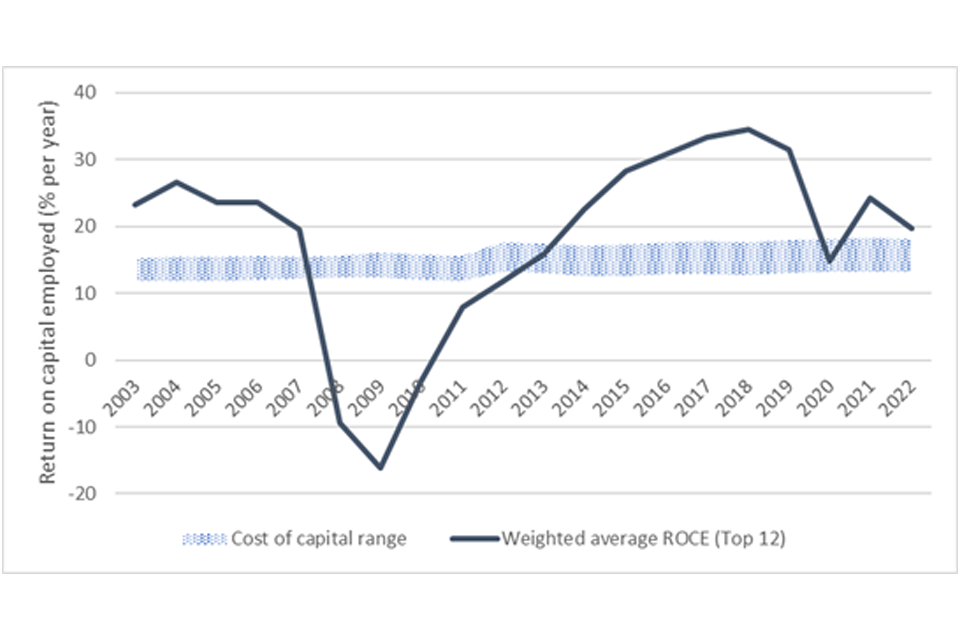
Figure 3.3 below illustrates the profitability of the 12 largest housebuilders over the 20-year period, as compared with our estimate of their cost of capital for the corresponding period.
Figure 3.3: Weighted average ROCE for the 12 largest housebuilders compared with our range for the cost of capital
Alt text
Figure 3.3 plots annual return on capital employed (ROCE) across the 12 largest housebuilders against our period of review from 2003 to 2022. It also plots our estimate of the range for the cost of capital across the same period.
Source: CMA analysis based on information drawn from large housebuilders annual reports and accounts.
We have found that the 12 largest housebuilders have generally earned returns in excess of the cost of capital over the 20-year period, although profitability has fluctuated across the period. Given the fluctuations in profitability across the period, we consider separately below their profitability leading up to the GFC, their profitability during and in the immediate aftermath of the GFC, and their profitability following the GFC and leading up to 2022.
Profitability leading up to the GFC (2003 to 2007)
During this period, on average, the 12 largest housebuilders earned returns in excess of the cost of capital, which reflects a generally favourable operating climate for them over the period. The demand for new homes was supported by low interest rates, good employment levels, and the continuing serious constraint on supply caused by delays within the planning system.
Profitability during and in the immediate aftermath of the GFC (2008 to 2012)
During this period, the 12 largest housebuilders earned returns in line with or below their cost of capital, including a period of losses in the immediate aftermath of the GFC from 2008 to 2010.
The GFC adversely impacted all housebuilders, as prospective purchasers of new homes found it difficult to obtain mortgages. This caused housebuilders, in contrast to their normal build-out practices whereby they seek to sell homes at prices prevailing in local second-hand markets, to significantly reduce the prices of the homes they were already constructing in order to sell them to generate funds. The prevailing economic conditions therefore resulted in the 12 largest housebuilders realising lower profit margins on the sale of new homes, resulting in reduced levels of profitability. The large housebuilders (with the exception of Berkeley) were also forced to write down the value of their land banks, causing many of them to incur losses over the period. This was because, in many cases, the price that they had paid in the past for the land would have then not enabled them to develop that land profitably due to the fall in house prices.[footnote 44]
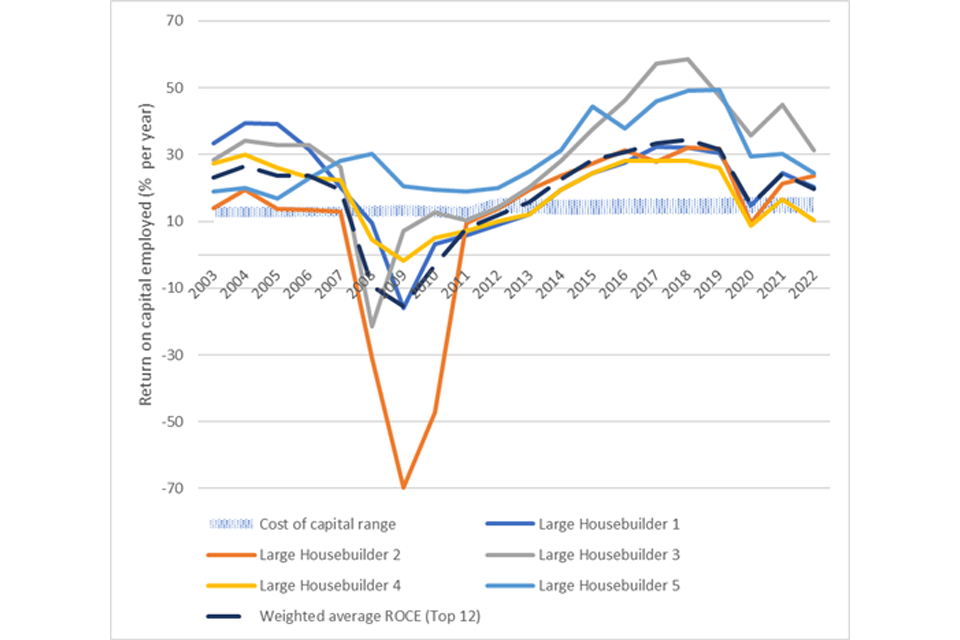
This all adversely impacted the profitability of individual large housebuilders to varying degrees, depending, in particular, on the volume of land they held at the time and the extent to which the GFC adversely affected the value of that land. See Figures 3.4 and 3.5 below.
The profitability of the 12 largest housebuilders gradually improved towards the end of the period, primarily driven by the fall in interest rates proving beneficial to those prospective purchasers who were able to obtain mortgages under the stricter lender conditions immediately following the GFC but also through government initiatives to relieve housebuilders of excess stock and increase mortgage take-up.
Profitability following the aftermath of the GFC and leading up to 2022 (2013 to 2022)
During this period, on average, the 12 largest housebuilders earned increasingly higher returns above the cost of capital up to 2018. After 2018 average returns plateaued and then fell to levels that nevertheless were above or at the cost of capital.
In the first half of this period, housebuilders benefitted from increasing consumer confidence, driven by improving access to mortgages, low interest rates, and the launch of the government’s Help to Buy scheme in 2013.[footnote 45]
The large housebuilders also benefited from the revision of the planning regime in 2012 which included a presumption in favour of sustainable development.[footnote 46],[footnote 47] This enabled the large housebuilders more readily to gain planning permission for developments where they had already purchased the land without planning permission, enabling them to construct homes and bring them to the market on these sites, thereby increasing their profitability.[footnote 48]
In 2020, housebuilders’ profitability was adversely impacted by the COVID-19 pandemic, which caused them to curtail operations, resulting in lower sales and increased costs.[footnote 49] This was somewhat mitigated by the government temporarily reducing stamp duty rates, which drove up demand, resulting in an increase in house prices and profitability.
Profitability levels, particularly in 2021 and 2022, were also adversely impacted by the significant provisions that housebuilders have made to cover the costs of the remedial work on legacy buildings found to be necessary in the wake of the 2017 Grenfell fire.[footnote 50]
More recently, profitability levels have been adversely impacted by an increase in construction costs,[footnote 51] the need to meet more stringent planning requirements (for example, in respect of environmental standards), and an increase in inflation and interest rates dampening demand.
Variation in levels of profitability across the largest housebuilders
Although we have found that the 12 largest housebuilders have generally earned returns in excess of the cost of capital over the 20-year period, there was variation in their individual performance during this period.
Figure 3.4 shows the profitability of the 5 largest housebuilders over the 20-year period, as compared with our estimate of the cost of capital for the corresponding period.
Figure 3.4: ROCE for the 5 largest housebuilders compared with our range for the cost of capital
Alt text:
Figure 3.4 plots:
a) return on capital employed (ROCE) for each of the 5 largest housebuilders in our dataset
b) weighted average return on capital employed across the 12 largest housebuilders
c) our estimate of the range for the cost of capital, against our period of review from 2003 to 2022, all expressed in percent for each year
Source: CMA analysis based on information drawn from large housebuilders annual reports and accounts.
Note 1: The 5 largest housebuilders have been determined on the basis of their revenues over the 20-year period inflated to December 2022 £s using CPIH
Note 2: The range for the cost of capital relates to all the large housebuilders in our sample, not just the 5 shown here
Figure 3.5 shows the profitability of the remaining 7 largest housebuilders over the 20-year period, as compared with our estimate of the cost of capital for the corresponding period
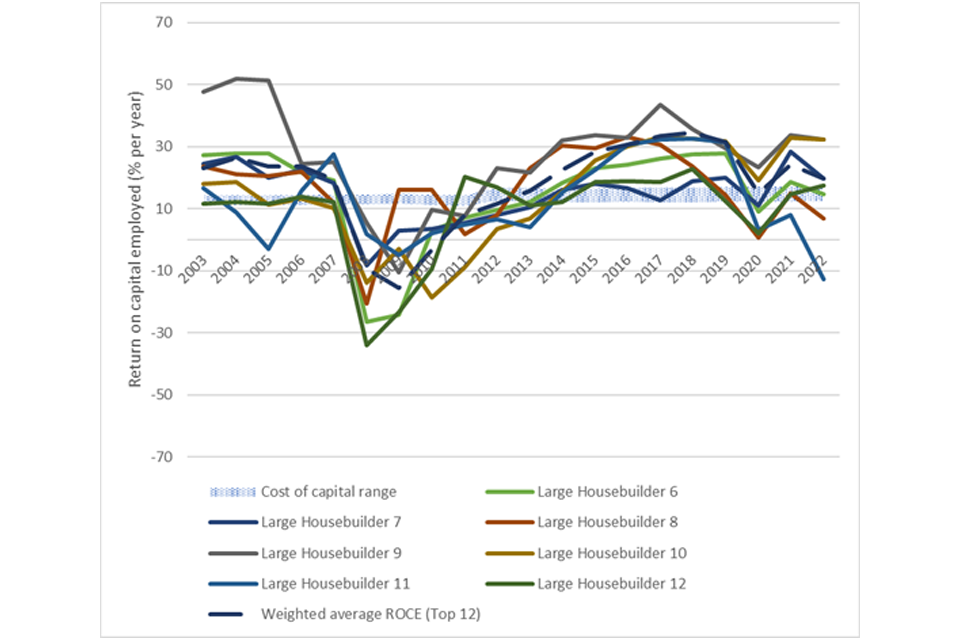
Figure 3.5: ROCE for the other 7 of the 12 largest housebuilders compared with our range for the cost of capital
Alt text
Figure 3.5 plots a) return on capital employed (ROCE) for each of the other 7 of the 12 largest housebuilders in our dataset b) weighted average return on capital employed across the 12 largest housebuilders and c) our estimate of the range for the cost of capital, against our period of review from 2003 to 2022, all expressed in percent for each year.
Source:
- CMA analysis based on information drawn from large housebuilders annual reports and accounts
Note 1: The other largest housebuilders have been determined on the basis of their revenues over the 20-year period inflated to December 2022 £s using CPIH.
Note 2: The range for the cost of capital relates to all the large housebuilders in our sample, not just the 7 shown here.
We have found that the 5 largest housebuilders have generally achieved higher levels of profitability than the others. For example, one large housebuilder, following the changes to the planning regime in 2012, was able to build out the strategic land bank it held at the time, thereby realising the greater returns associated with buying land without planning permission. This large housebuilder also benefitted significantly from the increase in demand driven by the Help to Buy scheme: in 2018, we estimate that this large housebuilder sold circa 60% of the homes it had delivered in that year to customers accessing the scheme.[footnote 52] Another large housebuilder benefitted from developing complex brownfield sites, typically to construct tall blocks of flats in areas of high demand at the higher end of the market.
In contrast, we have found that there is greater variability in the performance of the other large housebuilders. For example, 4 of the large housebuilders were forced to restructure their businesses, sometimes repeatedly, during the period of review, often in response to the operational and financial challenges caused by the GFC (see paragraph 3.33).
As previously explained in paragraph 3.34, there was also significant variability in the extent to which the GFC adversely impacted the profitability of individual large housebuilders.
Current position and outlook
In the current period, the housebuilders have reported that their profitability is falling due to subdued demand caused by the increase in interest rates resulting in a sharp rise in the cost of mortgages. In contrast to the GFC, however, house prices have so far held relatively steady, meaning the impact of current market conditions is manifesting itself, in the first instance, through reduced output rather than falling prices.[footnote 53]
Conclusions
We have found that the profitability of the 12 largest housebuilders has been generally high during those periods outside the GFC and its immediate aftermath. The period from 2013 to 2019 was particularly elevated due to supportive economic circumstances for housebuilders – in particular, low interest rates and quantitative easing – as well as measures taken by the government to help homebuyers fund deposits for the purchase of new homes through the Help to Buy scheme.[footnote 54]
While we have seen an extended period during the 2010s in which the profitability of the 12 largest housebuilders has been higher than we would expect in a well-functioning market, we do not take this to indicate that intervention is required to directly tackle this level of profitability, because:
-
the housing market is highly cyclical and impacted by external factors, such as the wider economic climate
-
profitability during the 2010s is likely to have been boosted by temporary factors that are no longer in evidence, in particular a prolonged period of ultra-low interest rates and the Help to Buy schemes’ support for first-time buyers
-
there was significant variation in the performance of individual large housebuilders in our sample
Given the points above, there is a risk that any measures seeking directly to reduce housebuilder profitability may create an additional downward pressure on the number of houses being built, exacerbating the supply problems that have characterised this market over a long period.
Instead, our analysis suggests that actions could be sought to improve the functioning of the market more generally, and the impact of competition within it, which would then serve to bear down on the price of new homes and the levels of profitability that large housebuilders are able to achieve.
Quality
The quality of goods and services is another indicator of how well a market is working. In a competitive market, when all other factors are equal, a product or service that offers higher consumer satisfaction would be expected to outsell a product with lower consumer satisfaction. However, this does not mean that there would not be differentiation between providers: a competitive market is likely to generate different price/quality combinations across providers in accordance with the preferences of different customers, who can observe, understand, and choose between the available combinations.
For the purposes of our market study, we have defined new build housing quality in terms of the reasonable expectations a consumer might have of their new build home. We consider that this includes the structural integrity of the property, and the ability to use it and its features as reasonably intended. We have not sought to interrogate whether requirements for building standards are adequate, as reforms are being implemented in response to building safety concerns by the UK, Scottish, and Welsh governments. Instead, we have focused on indicators of the quality of new homes overall, consumer satisfaction, the experience of buying a new home and ease of getting issues resolved.
As quality can encompass different parameters, there is no single measure for the quality of new build housing. However, there are several sources of evidence that can be used to infer quality of build or to explore and understand particular aspects of quality. In this study we have analysed data from the National New Homes Customer Satisfaction Survey (CSS) run by the Home Builders’ Federation (HBF) for the 4 survey years 2018 to 2019 to 2021 to 2022,[footnote 55],[footnote 56] and abridged, aggregated findings from quantitative research by the agency In-house Research on behalf of 80 housebuilders.[footnote 57]
We have also carried out our own qualitative consumer research consisting of 50 in-depth interviews with recent new build buyers about the quality of their new homes (CMA consumer research),[footnote 58] and we have reviewed complaints submitted to us by consumers in response to our Statement of Scope and Update Report.
The evidence suggests that the majority of customers are happy with the pre-sale process and the period shortly after completion. The 8-week CSS suggests that there is high overall satisfaction, with 89% of customers in 2021 to 2022 saying they would recommend their builder, and 83% saying that they were very or fairly satisfied with the pre-completion services.[footnote 59] Similarly, our consumer research found that most homeowners were satisfied with their purchase journey, although some felt that housebuilders’ sales teams had a tendency to misrepresent aspects of quality of the property and estate. The In-house Research survey found that in the period of purchasing the property and shortly after completion, customers were generally satisfied.[footnote 60]
However, our consumer research and our Q19 verbatim analysis both indicate that customers’ perceptions of the quality of service they had received (or in some cases were still receiving) deteriorated as they lived in their homes for longer.
Moreover, a specific issue on customisation came to light through our consumer research where a considerable number of buyers were left dissatisfied. Concerns centred around ‘hidden costs’, specifically, the lack of clarity around what features, fixtures and fittings were (not) included as standard, the perceived limited, overpriced, or low quality of customisation options, and the timing for payment of requested upgrades.
Across a range of evidence sources, we see a less positive picture once customers have lived in the home for a period of months, particularly in relation to their experience of snags. In the 9-month CSS, for example, 487 out of 1,200 respondents referred negatively to snagging issues in their Q19 verbatim answers. We see evidence of a statistically significant increase over time in the proportion of homeowners reporting higher numbers of snags, with 35% of respondents to the 9-month CSS in 2021 to 2022 reporting 16 or more different problems.[footnote 61]
While we have not been able to gather quantitative evidence on the severity of problems, our qualitative consumer research suggests that although many issues are relatively minor, there are certainly cases of more serious issues. Likewise, in our Q19 verbatim analysis we saw (for example) the following from respondents:
‘After moving in, my attic hatch fell completely out of the ceiling of its own, because the joiner had only used 3 screws to fix it instead of 16 plus.’
‘The stairs collapsed while walking up [them] with my son.’
‘From the day we moved in and I badly scolded my hands due to the faulty boiler, we knew things were not going to be straightforward.’
‘[Ongoing] leaks … which have led to serious damage to our home … we had to rip out our bathroom floor as mould was growing under the flooring.’
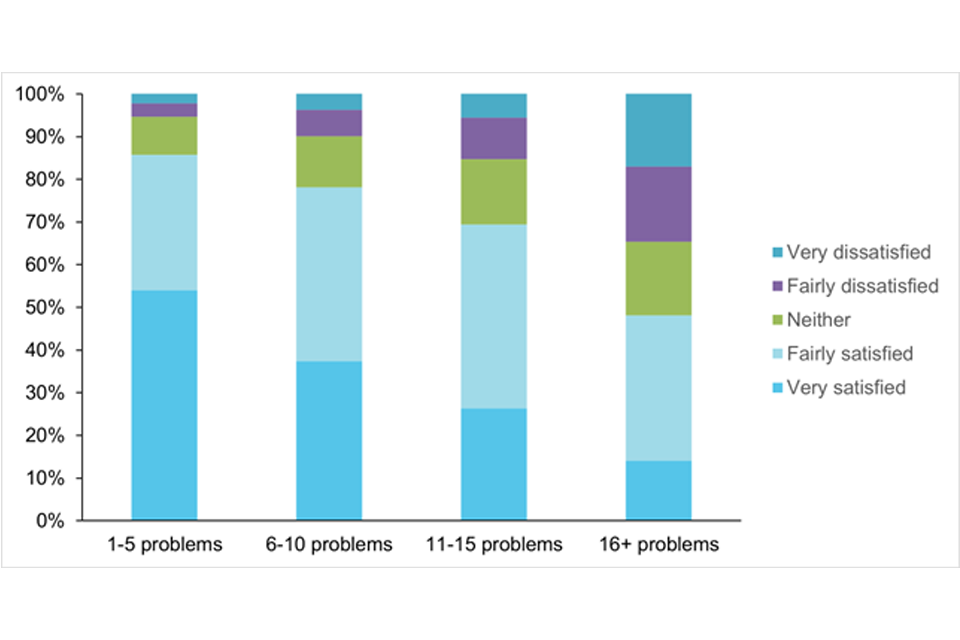
The 9-month CSS findings suggest that a significant proportion of customers who report issues to their builders do not have their problems resolved within a reasonable timescale and to their satisfaction, particularly those who experience the highest number of separate issues (see Figures 3.6 and 3.7).
Figure 3.6: Time taken to repair snags by the number of snags reported

Alt text
A bar chart showing how the time taken to repair snags varies with the number of snags reported at 9 months post-completion, based on the CMA’s analysis of the National New Homes Customer Satisfaction Survey (CSS) dataset for 2021 to 2022.
For customers reporting more than 16 problems, in 65% of cases these snags were still to be rectified.
For customers reporting between 11 and 15 problems in 44% of cases these snags were still to be rectified.
For customers reporting between 6 and 10 problems, in 31% of cases these snags were still to be rectified.
For customers reporting between 1 and 5 problems, in 18% of cases these snags were still to be rectified.
Source: CMA analysis of 2021 to 2022 9-month CSS Q8c: Has the repair work been …?
Base: All who reported problems with their home to their builder and answered Q8c (n=38,870); 1-5 problems: n=8,720, 6-10 problems: n=9,420, 11-15 problems: n=6,369, 16+ problems: n=14,361
Figure 3.7: Satisfaction with repair of snags by the number of snags reported
Alt text
A bar chart showing how customer satisfaction with repair of snags varies with the number of snags reported at 9 months post-completion, based on the CMA’s analysis of the National New Homes Customer Satisfaction Survey (CSS) dataset for 2021 to 2022.
For customers reporting more than 16 problems, around one in 3 were fairly or very dissatisfied.
For customers reporting between 11 and 15 problems, around one in 6 were fairly or very dissatisfied.
For customers reporting between 6 and 10 problems, around one in 10 were fairly or very dissatisfied.
For customers reporting between 1 and 5 problems, around one in 17 were fairly or very dissatisfied.
Source:
- CMA analysis of 2021 to 2022 9-month CSS Q8d: How satisfied or dissatisfied were you … with the standard of any repair work carried out by your builder?
Base: All who reported problems with their home to their builder and answered Q8d (n=31,503); 1-5 problems: n=8,191, 6-10 problems: n=8,497, 11-15 problems: n=5,410, 16+ problems: n=9,405
In addition to single indicators from the CSS and the In-house Research survey, we have developed a composite indicator using the CSS dataset to identify customers who express overall dissatisfaction with problems in their home, and with the way these problems are addressed.[footnote 62] Overall, 12% of customers met these criteria in 2021 to 3022, and this had hardly changed over the previous 4 years.
The experience of customers in this regard appears to vary substantially across housebuilders: among the top 11 in 2021 to 2022, the proportion of customers expressing dissatisfaction ranged from 1% to 24%. Outside of the top 11 housebuilders, other large companies appear to have a higher proportion of customers experiencing these types of problem (18% of their customers, compared with 11% overall for the top 11). The medium and small housebuilders sit between these on average, at 12% and 14% of customers respectively.
In summary, the data we have analysed shows that, overall, most consumers are happy with their new homes. As part of the purchase process, they expect snags (although not the volume of snags they actually encounter) and have sought for these to be fixed post-completion. However, where consumers experience a greater number of snags or faults, it can be more difficult to resolve them, taking weeks or even months. It also appears that there is a small but significant minority experiencing the most serious defects, who are likely to experience significant consumer detriment.
Innovation
Similar to quality, innovation is another indicator that can support the assessment of how well a market is working. In a well-functioning market, we would expect firms to be incentivised, through adequate competitive pressure, to invest in innovation to adopt efficient production methods or improve their products. Hence, a lack of innovation may suggest that firms are not subject to sufficient competitive pressure and therefore have reduced incentives to innovate, or that there are barriers to innovation present in the market.
Modern Methods of Construction (MMC)
Innovation is defined as the successful development and application of new knowledge.[footnote 63] Within housebuilding there has been a range of advancements that can be categorised as Modern Methods of Construction (MMC). Other forms of innovation could include advances in technology across the features and fixtures of the home, or innovations to make homes more energy efficient such as heat pumps or solar panels. For the purpose of this market study, we have focused on the uptake of MMC, specifically off-site manufacture and approaches to sustainability.
Modern methods of construction refer to innovations in the techniques used in both on-site and off-site processes and manufacture of housing. MMC is not in fact very ‘modern’: some of the first applications of off-site manufacturing could be seen in the 1940s after the Second World War, where a severe housing shortage meant homes needed to be built quickly.[footnote 64]
Unfortunately, the focus on quantity over quality meant that issues with the design and construction of these homes only came to light decades later. The failings gave rise to a government statutory scheme of assistance for people who had purchased a defective home.[footnote 65] As a result, these construction methods have experienced a lingering negative stigma amongst consumers, builders, investors, and insurers, which has limited their further development and uptake.[footnote 66] Conversely, in non-residential settings the commercial MMC market is mature; market observers believe this is due to producers’ ability to build a consistent pipeline across the public and private sectors.[footnote 67]
MMC has numerous definitions. We use the framework developed by the MMC cross-industry working group which splits different types of MMC into 7 categories based on the levels of pre-manufacture.[footnote 68]
In recent years, the housing sector has witnessed a notable uptick in the adoption of modern methods of construction.[footnote 69] This shift reflects a growing recognition of the need for more efficient, sustainable, and cost-effective approaches to meet the increasing demand for housing. These methods allow for greater precision, reduced construction timelines, and minimised on-site waste, addressing some of the longstanding challenges faced by the traditional construction industry.[footnote 70]
Data on the use and number of homes delivered using types of MMC is not readily available across England, Scotland, and Wales. Moreover, due to the difference in definitions and categorisation of MMC, estimates of the extent to which these methods are used vary:
-
analysis undertaken by Savills using CITB data estimated that between 6 and 10% of homes built in 2020 used MMC.[footnote 71] However, different housebuilders appear to utilise MMC methods to different extents. Research undertaken by NHBC in 2018 outlines that, of 36 developers that were actively involved in MMC or considering its use, 25 of them (69%) were delivering housing using ‘advanced MMC’[footnote 72]
-
use across the nations varies. England, Scotland, and Wales have all sought to encourage the use of MMC for affordable and social housing. Scotland’s use of category 2 MMC, specifically timber frame construction, accounted for 75% of the NHBC-registered new build homes in 2015. This was attributed to timber frame being the conventional approach in Scotland as the materials are more readily available. By contrast, in Wales timber frame accounted for just over 30% share and in England its share was below 10%[footnote 73]
-
the information we have gathered from the top 11 housebuilders suggests that the majority of them have either invested in, acquired, or developed their own category 1 and 2 MMC providers. Among them, pre-manufactured timber frame construction (category 2) was the most popular
Sustainability
We have defined a sustainable home as one built, operated, and maintained in ways that reduce the carbon footprint and the impact on climate change. National Planning Policy in England, Scotland, and Wales all include directives on achieving sustainable development, alongside environmental and building regulation. The way planning policy operates in the nations differs.[footnote 74]
Through our analysis of the top 11 housebuilders’ approaches to sustainable development, we have found that housebuilders are undertaking a range of activities. The following were the most common:
-
reviewing, creation and amendments of strategies: most housebuilders had developed their internal and external strategies in relation to sustainable development. Some housebuilders had instructed consultants to advise them, whilst others were focused on upskilling staff in-house
-
internal organisational changes: these were undertaken to provide governance structures and frameworks to aid meeting strategic priorities. Examples of these were appointment of senior executive team leads to improve accountability and setting up committees and steering groups to build priorities and needs into business plans
-
sunder the Science-Based Targets initiative, which explain their sustainability intentions to their stakeholders, investors, and to the public
-
undertaking trials: to provide test and learn approaches in seeking to construct sustainable homes that meet forthcoming regulations[footnote 75]
It is clear from the variation in approaches that some housebuilders are more ambitious in leading the industry, while others are content with following. We note that the main reason that housebuilders are focused on these issues is that they expect changes to the minimum regulations.[footnote 76]
Conclusions
The adoption and roll-out of MMC by housebuilders is increasing but remains variable and the level of innovation has been described as low and slow relative to other sectors.
Efforts are being made by housebuilders to improve sustainability. The main spur to innovating in this regard appears to be the expectation of future regulatory requirements, rather than any pressure from investors or the public.
Private management of public amenities on housing estates
The imposition of arrangements and charges related to the private management of public amenities such as roads, sewers and drains, SuDS, and public open spaces on new build housing estates is now a common aspect of the supply of new homes. Private companies increasingly provide and charge for such management services, whereas in the past the default position was that relevant authorities or bodies, in particular local authorities, would generally ‘adopt’ (in other words, take on responsibility for maintenance in perpetuity for) such amenities.
As a result of the emergence of the private management model, and the market power conferred on some management companies, households are facing financial and emotional detriment, and, if the status quo is maintained, this is likely to worsen over time.
Estate management charges and fees
The amount charged by estate management companies per household per year varies greatly, from just under £60 to just under £1,000 in 2022, with an average charge of £358. This is in addition to the council tax paid by those households. In aggregate, we estimate that in 2022 households paid at least £260 million in estate management charges. Projecting these costs over a 25-year period, without accounting for future price rises or increasing prevalence, affected households would pay the equivalent of more than £4.4 billion. Given the trends we have seen so far, without changes in the market this is likely to turn out to be a significant underestimate.
Estate management charges can increase significantly year on year – we have heard of fees almost doubling over a single year, and of fees trebling when a new management company was appointed. Households can face significant repair bills – in one case, a potential share of £100,000 for upgrades to a pumping station. As estates age and amenities degrade, households are likely to face larger repair and maintenance bills, which may be difficult to predict and thus budget for – a particular concern as we have seen that not all management companies hold sinking funds.
Households may also be subject to ‘event’, ‘consent’ or ‘permission’ fees for one-time events – data from one estate management company showed that in its last financial year it charged an additional c.40% in such fees on top of its annual charge. One large housebuilder told us that one of its customers had recently brought to its attention that their managing agent wanted to charge them £1,800 to sign a document.
A significant proportion of the overall estate management charge may be allocated to management/administration fees, rather than maintenance work carried out, and this was a key concern in submissions we received from homeowners. Our analysis of data from management companies and submissions from homeowners has shown that such fees can amount to around 60% of the total amount charged.
Transparency of charges and future implications of arrangements
While homebuyers may have been made aware of the existence of estate management arrangements and annual charges before buying their home, they may have been less informed about important details of those arrangements and their long-term implications. This could have a significant impact, for example in relation to their ability to budget for future repair bills or on their ability to sell their home at a later date.
High annual charges can potentially impact on the valuation of a property, and we have heard of sales being abandoned, with the associated costs incurred, because of delays on the part of estate management companies in providing information needed to progress the sale. The requirement for ‘sellers packs’ from management companies – at a cost of several hundred pounds, which may be duplicated if the seller is liable to more than one management company – was a particular concern raised by homeowners, with calls for time limits to be imposed for the provision of such information.
Quality of amenities and estate management services
Amenities that are not adopted by the relevant authority may not be constructed to an acceptable quality. Some respondents to our working paper on the private management of public amenities on housing estates said that amenities had not been constructed in accordance with approved plans and the relevant authorities had refused to adopt them because they were either incomplete or substandard.
Additionally, once constructed, amenities may not be maintained to a satisfactory standard on an ongoing basis by the management company. While our consumer research found that the initial quality of the communal green areas and other public amenities on estates was generally good, these standards were not always maintained over time, or evenly throughout estates, and in a sizeable minority of estates, maintenance was seen as either patchy or of a poor standard. We also received many examples from homeowners who were not satisfied with standards of maintenance services being provided. We have seen evidence that customers attempting to resolve issues with estate management companies may also face poor levels of customer service.
Our consumer research also highlighted that it may be unclear to households who is responsible for maintenance, with no party to hold to account, and issues therefore left unresolved when things go wrong.
Switching
It is often very difficult for residents to switch management companies, and in some cases it is simply not possible for homeowners to do this, as we demonstrate in the section below on Drivers of market outcomes in relation to the private management of public amenities. As a result, there may be limited, and in some cases no competitive pressure on estate management companies to deliver services at a reasonable cost or to an acceptable quality.
In particular, embedded management companies, (also known as land-owning management companies in Scotland), where a company owns the land and is named in the deeds as the provider of estate management services, may have significant market power through protection from any competitive constraints.
Disproportionate sanctions
Of particular concern are letters that homeowners and in some cases their lenders have received threatening repossession of their homes, by virtue of remedies available under Section 125 Law of Property Act 1925, for outstanding estate management charges, which may be as little as a few hundred pounds. While we have seen no evidence of such threats being followed through, the threat of such sanctions, which are highly disproportionate, could result in significant emotional detriment.
Conclusions
We conclude that, as a result of the proliferation of this model, and with some households unable to switch provider at all, households may face detriment in the form of the charges they pay, the quality of amenities available to them and the quality of management services they receive, the potential for disproportionate sanctions to be applied for outstanding charges, and the sometimes significant efforts required to achieve a satisfactory outcome in those regards. We consider that if the status quo is maintained, aggregate detriment is likely to worsen over time. We consider this in detail in Section 5 of the supporting evidence document - Private management of public amenities on housing estates.
Drivers of market outcomes
Summary
Our analysis clearly highlights the planning systems as very significant drivers of negative overall outcomes in the housing market. Across GB as a whole, and England in particular, the planning systems are not delivering sufficient planning permissions to deliver new housing up to government targets and other assessments of need. In the course of our study, we have seen evidence of 3 key concerns with the planning systems which we consider are limiting their ability to support the level of new housing that policymakers believe is needed:
-
lack of predictability
-
length, cost, and complexity of the planning process
-
insufficient clarity, consistency and strength of LPA targets, objectives and incentives to meet housing need
We have also seen evidence that problems in planning systems may be having a disproportionate impact on SME housebuilders. The time, expense, and uncertainty associated with negotiating the planning systems is exerting a downward pressure on the number of planning permissions sought and granted each year. This is contributing to a situation where not enough homes are being built where they are needed and pressures on affordability continue to grow.
We have also found that, given the way the market works, housebuilders’ incentives lead them collectively to build fewer homes than the socially optimal amount and to build them at a rate that is consistent with the local absorption rates – the rate at which homes can be sold without housebuilders needing to reduce their prices – rather than as quickly as possible. We have seen evidence suggesting some housebuilders may be sharing non-public information on sales prices, incentives, and rates of sale with each other. While we do not consider this behaviour to be one of the main factors in the persistent under-delivery of the market against government targets and assessed need (and, therefore, in contributing significantly to increasing affordability pressures at a market-wide level), we do consider that it may weaken competition in the market. In light of these concerns, we have decided to launch an investigation into this suspected conduct under the Competition Act 1998.
We have found that barriers to entry and expansion are likely to be restricting the role of SMEs in the market. Of these barriers, the most significant is negotiating the planning system, the burdens of which fall most heavily on smaller builders, followed by access to land. The barriers may adversely affect market outcomes in some respects: in particular, they may adversely impact the variety of new build houses, both in terms of the aesthetics of the houses produced and in producing more niche housing types, and constrain overall housing supply. We recognise that a very large increase in supply is required to meet housing need. However, our analysis suggests that barriers to entry and expansion constrain SME output and, by doing so, overall housing supply. Our analysis does not suggest that SME housebuilders provide better quality housing compared with larger builders, and so reducing the barriers for SMEs would be unlikely to lead to an increase in the quality of new houses.
There is a lack of competitive pressure to drive up new build quality. This is because quality is difficult to observe prior to purchase (and for some aspects, is unobservable until something goes wrong); prospective buyers prioritise other factors, and assume all housebuilders will build to a baseline level of quality; and indicators of how well previous customers have been served (notably through the HBF Star Rating Scheme) are of limited informational value.
The increasing prevalence of private management arrangements on new build housing estates is due to a combination of the discretionary nature of aspects of the legal framework underpinning adoption, the commercial incentives of housebuilders not to seek adoption and local authorities being unwilling to adopt amenities (largely for financial reasons). This situation is unlikely to improve without government intervention.
We have also examined other potential drivers of negative outcomes in the market, including the operation of the land market, and land banks held by large housebuilders. On these issues we have not found evidence that they are driving poor market outcomes in themselves either nationally or locally, though in some cases we observed behaviour that is a symptom of underlying problems in the market.
Introduction
In this chapter we set out our findings on the extent to which various drivers are contributing to the outcomes that we observe in the housebuilding market, covering:
-
the nature and operation of the planning systems
-
the operation of the land market
-
the size and composition of land banks held by large housebuilders
-
drivers of build-out speed and price, including the role of certain government interventions in the market
-
drivers of quality and innovation
-
arrangements for the private management of amenities on housing estates
We then bring this material together to consider the role that competition has in driving outcomes in this market.
The planning systems
In this section we provide an overview of the key features of the planning systems of the 3 nations included in our study, before explaining how these systems contribute to some of the outcomes we have set out in the preceding section.
Overview of the GB planning systems
Housing, environmental, and planning policy are devolved to the respective legislatures in Scotland and Wales. Each of the nations of GB has a ‘plan-led’ system which means that LPAs develop local development plans and make decisions about development based on planning policy.
Each system is discretionary, whereby the LPA is responsible for deciding whether a proposed development should be allowed to go ahead and then grants, or refuses, planning permission. Planning applications should be decided in line with local development plans unless there are material considerations that indicate otherwise.
In relation to planning policy, all 3 nations have a national policy framework: the National Planning Policy Framework (NPPF) in England, the Planning Policy Wales (PPW) in Wales, and the National Planning Framework 4 (NPF4) in Scotland. The relevant legislation requires LPAs to have regard to these national policies when taking planning decisions.
While these broad characteristics are common across all 3 nations, there is also a number of key differences. In particular,
-
regional planning: unlike in Scotland[footnote 77] and Wales[footnote 78], England no longer has a regional planning system[footnote 79] - however, it should be noted that few regional plans in these forms currently exist in Scotland and Wales
-
affordable housing: both the English and Scottish planning frameworks include a requirement for a percentage of new homes on developments to be affordable housing[footnote 80]
-
targets: as noted in paragraph 3.6, in England there is an all-tenure housing target of 300,000 homes - in Scotland, meanwhile, there are only local targets, although these do add up to an approximate overall figure[footnote 81] - in Wales, LPAs set local targets, albeit using evidence from a recently introduced standard tool[footnote 82]
-
incentives: unlike in the English system, in Scotland and Wales there is no statutory equivalent to the presumption in favour of sustainable development or requirement for a 5-year housing land supply of specific and deliverable sites[footnote 83]
Planning policy and frameworks are not static, with governments across all 3 nations making frequent updates to various elements of their systems in recent years. Most recently these include:
In England, the October 2023 Levelling up and Regeneration Act (LURA) introduced a number of measures including the introduction of national development management policies, commencement and completion notices, Street Votes and the Infrastructure Levy; a requirement to prepare design codes; a new process to amend planning permissions (section 73B), plus reforms to the plan making process. Additionally, an updated NPPF[footnote 84] was published in December 2023 which removed the requirement to demonstrate a 5-year housing land supply[footnote 85] (5YHLS) if a LPAs local plan is up-to-date; added a 4-year housing land supply (4YHLS) for emerging plans; reconfirmed that the ‘Standard Method’ is only a starting point for LPAs making plans; provided clarification for LPAs seeking to diverge from objectively assessed housing need; provided support for small sites for community led development and custom and self-build dwellings; and outlined that there was no requirement for Green Belt boundaries to be reviewed
In Scotland, the 2023 NPF4 is Scotland’s long-term plan looking to guide spatial development to 2045, as well as setting out national planning policies, designating national development and highlighting regional spatial priorities. Further developments following on from this will be set out in 2024. Importantly, NPF4 is the first time that the national planning framework has become part of the development plan for determining applications. It also adds an affordable homes target and sets out Scotland-wide action to combat the climate and nature emergencies, as well as promoting sustainability, health, and inclusion in the planning process
In Wales, the planning framework set out in Planning Policy Wales (PPW) was last updated in February 2024, it being the 12th version in this series. The primary objective of PPW remains to ensure that the planning system contributes to the delivery of sustainable development and improve the social, economic, environmental and cultural well-being of Wales, as required by the Planning (Wales) Act 2015 and the Well-being of Future Generations (Wales) Act 2015 and resultant duties. Additionally, the 2020 revocation of Technical Advice Note 1 (TAN1: Joint Housing Land Availability Studies) was important since it removed the requirement to demonstrate a 5-year housing land supply in Wales as well as removing the requirement of planning decision makers to afford ‘substantial weight’ to any lack of housing delivery. It replaced it with a new method of monitoring housing delivery based on trajectories set out in Local Development Plans. Finally, the most recent changes to Chapter 6 (Distinctive and Natural Places) of edition 12 of PPW showed changes to biodiversity, green infrastructure, protection of sites of special scientific interest, and trees and woodland policies
There is detailed information on the planning systems of the GB nations in Section 6 of the supporting evidence document.
Analysis of the GB planning systems
Planning systems, by their nature, aim to control the type of development that may take place, trading off the need to deliver appropriate levels and types of building against other desirable outcomes.
In line with our duties and the role of market studies in making markets work better for consumers, we have focussed our analysis largely on how the planning system facilitates meeting housing need. However, we acknowledge that this analysis is necessarily partial as a result and that policymakers taking decisions on the overall design of the planning system would need to consider a wider range of policy objectives.
Overall, we have found that the nature and operation of the planning systems in England, Scotland, and Wales is a highly significant driver of long-term under-delivery of new homes against targets and assessed need.
Number of planning permissions, applications, and new homes built
In order to deliver a given number of homes, the number of planning permissions granted must be sustained at a somewhat higher level, over an extended period, as a proportion of permissions will lapse or be re-applications relating to a previously permissioned project. Our analysis, however, suggests that this has not consistently been the case in recent years.
In England, the number of permissions granted, and the number of net additional dwellings added, fell sharply following the GFC before increasing steadily.
Figure 4.1: Housing net additional new homes built and net additional planning permissions in England

Alt text
A line chart showing the number of new additional homes built over the last 15 years in England, which has been below 300,000 per year as well as the number of units granted planning permissions which has exceeded 300,000 per year since the mid-2010s.
Sources:
-
DLUHC analysis of Glenigan data [DLUHC Open Data : Units granted planning permission on all sites
-
England opendatacommunities.org
-
DLIHC Live Table 118: annual net additional dwellings and components, England and the regions
However, the number of new permissions has at no point been significantly above 300,000, indicating that insufficient new permissions are being granted to support the provision of 300,000 new homes per year.
In Scotland, the number of homes given planning permission has increased significantly above the level of completions and assessed overall housing need since 2014 to 2015.
Figure 4.2: New build completions and units given planning permission in Scotland

Alt text:
A line chart showing the number of new build homes in Scotland which has remained below the pre-2008 level of 25,000 per year and in 2021 to 2002 was at 21,000. It also shows the number of units granted planning permission which has been higher than the number of new homes built since 2014-15, peaking at over 40,000 in 2019 to 2020 reducing to around 30,000 in 2021 to 2022
Sources: HPL_REPORT_2022_Q3_HG_DRAFT_3.pdf (hbf.co.uk); Housing statistics quarterly update: new housebuilding and affordable housing supply - gov.scot (www.gov.scot).
Since 2014 to 2015 the average number of homes given planning permission annually was 29,000, significantly in excess of the sum of LPA land supply targets although this varies substantially on a year-by-year basis. If this is sustained, it may feed through into an increased number of housing completions in the coming years.
In Wales, while the average number of homes given planning permission annually has been slightly in excess of both need estimates since 2014 to 2015, the excess is unlikely to be sufficient to support annual completions up to the estimates of need.[footnote 86]
Figure 4.3: New build completions and units given planning permission in Wales

Alt text
A chart showing the new-build completions in Wales between 2006 to 2022. It shows that the number of new dwellings has fallen from its pre-2008 level of around 9,000 to less than 6,000 in 2021 to 2022. The number of units granted planning permission has been higher than this going from around 8,000 in 2014 to 2015 to over 10,000 in 2021 to 2022.
Sources:
The number of homes that are granted planning permission annually is a function of the number of planning applications that are received, and the proportion of those that are granted planning permission. Other factors such as the size of the sites applying for planning permission and the time taken to make decisions will also play a role. Across the nations, there are somewhat different trends in the number of applications and/or decisions, although in all 3 the majority of applications have been approved:
In England, analysis of data on major residential applications[footnote 87] shows the number of planning decisions made on major applications increased from around 5,000 to 8,000 per year between 2012 to 2013 and 2017 to 2018 before falling afterwards. The proportion of decisions that were approvals remained relatively constant between 2010 to 2011, and 2022 to 2023, at between 80 per cent and 85 per cent.[footnote 88]
In Scotland, the average number of applications for major housing developments[footnote 89] between 2013 to 2014 and 2022 to 2023 was approximately 120, with the total number of major applications fluctuating around this over the same period. During the period for which we have data available, 2019 to 2020 to 2022 to 2023, the proportion of major applications approved varied between 78% and 87%, with no clear trend.[footnote 90]
In Wales, the number of major residential planning applications[footnote 91] and decisions made over the last 10 years has been falling, especially in recent years. Over the period between 2013 to 2014 and 2018 to 2019 the number of planning applications and decisions averaged 342 and 301 respectively. Over the period 2019 to 2020 to 2022 to 2023 the number of applications averaged 213 and the number of decisions 172. Over the last 10 years, major application approval rates varied between 81% and 89%, with no clear trend.[footnote 92]
Given these findings, we have considered whether there are particular features of the design or operation of the planning systems that are limiting the number of permissions they produce each year and so give us cause for concern.
Concern 1: Lack of predictability
In relation to lack of predictability we identified and considered 4 potential sources of unpredictability in the planning system.
The first of these is that governments frequently use the planning system as a means of implementing a range of new policies, most commonly environmental regulations. Examples include Nutrient neutrality requirements and Biodiversity Net Gain rules in England; NPF4 ensuring that climate change and nature are considered as high priorities in Scotland; and Phosphorus Concentration and biodiversity measures in Wales. Where the introduction of such policies affects which developments can go ahead or otherwise, this creates unpredictability for housebuilders.
Second, there is a continuous revision of the planning process itself, with significant changes in England and Scotland over the past few years. Across all 3 nations, continuous and frequent planning policy reform can create uncertainty within the planning system, which in turn materially affects how it operates. HBF research has indicated that uncertainty around the 2020 Planning White Paper slowed plan-making, and the Scottish Government told us that they were aware that a number of LPAs had held back on preparing new plans given there were significant changes made through the 2019 Planning Act to procedures for plan making.
Third, there is a lack of up-to-date local plans, in particular in England, where our analysis shows that less than 40% of LPAs had in place a plan that was less than the suggested maximum age of 5 years old, as of 31 December 2021. This is true to a lesser extent for Scotland, with 63% of plans being 5 years old or less. Wales fares well in terms of the number of plans in place, with only one plan of a potential total of 24 not in place at all, although they are on average somewhat older than in England or Scotland. Where plans are not up to date, there is more uncertainty for housebuilders on how likely applications are to be approved.
Fourth, political and public attitudes to development are frequently expressed through the planning process, with residential development becoming increasingly politically contested. The planning system is in large part designed to ensure that local preferences are incorporated into decision-making. However, this does not necessarily lead to consistent decision-making at a local level. Furthermore, we found evidence that opposition to development can make it harder for LPAs to draw-up local plans and for applications to receive approval. It can also increase the time for such approvals, and ultimately discourage applications and investment.
Our assessment is that these factors contribute to suppressing the number of permissions for new build homes that are produced by the planning systems in England, Scotland, and Wales. This is because when housebuilders choose to pursue residential development at a site, they incur a number of upfront sunk costs (such as the costs of identifying and investigating a site, securing an option on a site, site design, navigating the planning process) prior to planning permission being granted. When there is significant uncertainty about whether planning permission will be granted, housebuilders will be more reluctant to incur these costs and hence bring forward planning applications.
Concern 2: Length, costs, and complexity
In relation to length, costs, and complexity, we found that the planning process typically takes a long time to navigate, and the time required to make planning decisions is increasing.
In England, the share of applications reviewed within the statutory deadline of 13 weeks fell from 55% in 2009 to 12% in 2021 and the average time to make an outline planning permission decision between 2020 and 2022 was well over a year. In Scotland, the most recent annual figures (for 2022 to 2023) show that major planning application decisions made took on average more than 39 weeks to make.[footnote 93] In Wales, in 2018-19, the average time taken to make a planning decision for a major planning application was more than 240 days, up from 206 days in 2014 to 2015.[footnote 94]
The evidence that we have obtained indicates that there are several factors driving up the length of the planning process. The main reasons identified, alongside increasing public and political engagement discussed above, were:
-
the increasing amount of policy impacting the planning system (see paragraph 4.23)
-
LPA resourcing constraints, with expenditure on planning falling by c.40% across all 3 nations over the past decade or so (see our supporting evidence document Section 6 Planning for further details)
-
delays in receiving responses from statutory consultees
-
the negotiation of site-specific agreements to secure housebuilder contributions to funding of local infrastructure
The planning process has become increasingly costly and complex to negotiate. In addition, there are substantial and increasing policy-related costs involved in the development process. Recent analysis by Lichfields suggests that since 1990 the volume of evidence that is required to support a planning application has increased dramatically, as has the cost associated with making a planning application.[footnote 95] This was attributed largely to the increased policy requirements and evolution of technical and professional practices and also to increasingly risk-averse LPAs who have lost expertise and experience from their planning departments. Our own analysis shows the direct costs associated with making planning applications can be substantial, ranging from around £100,000 per application to around £900,000 per application depending on the size of a site. On top of these costs there will be substantial internal staff resources that are devoted to progressing a planning application.[footnote 96]
While these issues are present across the nations of GB, several responses to our planning working paper provided comments on Scotland and Wales, with the overall position that the length and cost have a proportionately greater impact as a result of specific issues relating to the planning frameworks in those nations:
-
in Scotland, these issues include lower land values making the impact of costs more prominent, an extended statutory pre-application process, and a focus on affordable housing
-
in Wales, these issues include lower land values, a focus on affordable housing, and increased groundwork costs caused by a different policy approach in certain areas such as sustainable urban drainage
Concern 3: LPAs faced mixed and inconsistent incentives
As noted above (para 4.7(c)), GB nations vary in how they set targets for housing delivery by LPAs, with England having the clearest national housing target.
We found that local land supply and housing targets are important in driving how much land LPAs need to allocate in plans, and therefore have a significant influence on how many planning applications are approved.
We also note the competing objectives that are faced by LPAs, for example, in the area of environmental goals through legislation mentioned in para 4.22 above.
We found the strongest sanctions for LPAs to prioritise housing delivery are in place in England, where a presumption in favour of sustainable development comes into play if targets are not met and means that housebuilders have greater rights to have applications approved. While there are limits to how much impact the presumption in favour of sustainable development has, for example not applying to greenbelt or other protected land, there is no equivalent incentive in place in Scotland or Wales.
Finally, we note the significant constraints placed on some LPAs by the nature of their undeveloped land, including the presence of greenbelt land or geographic constraints.
Impact of the planning system on SMEs
In relation to the impact of the planning system on SMEs, while we found that the concerns with the planning system set out above will have a negative effect on the ability of all housebuilders to take forward projects, we are concerned that these impacts are disproportionately felt by SME housebuilders. As we set out below, the number of SME housebuilders operating in the market, the number of small sites available to them, and their proportion of total homes built, has declined significantly in recent years. SME housebuilders have told us that the planning system is the biggest barrier they face to maintaining or increasing their levels of output.[footnote 97],[footnote 98] We discuss the impact of barriers to entry, including relating to planning, on market outcomes below (paragraph 4.176 onwards).
SME housebuilders face higher costs, in per-plot terms, than larger competitors when they take a site through planning, because of the size of the sites they develop. Our analysis shows that per-plot direct costs (mainly LA planning fees and consultancy costs) for sites of fewer than 50 plots are around £3,500 on average, compared with £1,500 for sites with 100-500 plots and under £1,000 for more than 500 plots. Given SME housebuilders will naturally tend to seek smaller sites, this indicates the disproportionate financial burden placed on them by the planning system.
There was a strong consensus in responses to our planning working paper and, more widely, some evidence[footnote 99] that the number of large sites being allocated is increasing at the expense of smaller sites more often developed by SMEs, for a number of reasons including LPA resource constraints, infrastructure concerns, political convenience, and national policy direction.
In addition, by having smaller portfolios of land, SME housebuilders are inherently less able to mitigate uncertainty in the planning system, and the length of time taken to decide applications can have an impact on their ability to raise finance to gain control of the site in the first place.
Conclusion
In the course of our study, we have seen evidence of 3 key concerns with the planning system which we consider are limiting its ability to support the level of new housing that policymakers believe is needed:
-
lack of predictability
-
length, cost, and complexity of the planning process
-
insufficient clarity, consistency and strength of LPA targets, objectives and incentives to meet housing need
We have also seen evidence that problems in the planning system may be having a disproportionate impact on SME housebuilders.
Overall, our view is that, due to the factors set out above, the nature and operation of the planning system is exerting a significant downward pressure on the overall number of planning permissions that is being produced across the nations of GB. The number of planning permissions granted over the last 10 years across GB, and particularly in England, has been insufficient to support housebuilding at the level required to meet government targets and widely accepted measures of need.
The land market
Land is an essential input required by housebuilders to deliver homes. A well-functioning and competitive market for land will contribute, therefore, to a well-functioning housebuilding market.
To examine how effectively the land market[footnote 100] functions, we have gathered information from a subset of the larger participants in the land market, including land agents, housebuilders, and land promoters. We have also engaged with SMEs, and drawn on publicly available data and reports. We have sought to understand whether:
-
there is enough land available in the right places to develop into homes
-
the market facilitates access to land for all participants
-
there is sufficient competition for sites, and how intermediaries facilitate this
-
any actors (particularly land promoters) have an incentive to prolong their part of the process, and delay the conversion of land into housing
-
the recent trend for integration of promoters and housebuilders is concerning from a competition perspective
Availability of potentially developable land
There must be sufficient availability of potentially developable land in desirable locations for housebuilders to meet housing needs. To investigate availability of land we identified the amount of land which is developed, protected against development, and located in a flood zone, and assumed the remainder of land is potentially developable. We appreciate there are several limitations to this analysis, but consider it provides a broad indication as to whether there are areas where land availability is likely to be significantly constrained.[footnote 101] We reviewed land use statistics to understand whether there is sufficient availability of potentially developable land in England and Wales. As land use statistics for total protected land are not readily available in the same format for Scotland, we have assessed the availability of potentially developable land by conducting a visual analysis of the different types of protected and built-up land.
Figure 4.4 below shows approximately 43.6% of land in England and 53.4% of land in Wales is assumed to be potentially developable. Except for London, developed land accounts for less than 10% of land in each region of England, so we would expect the remaining potentially developable land (more than 30% of land in each region of England and Wales) to be sufficient to meet future housing needs.[footnote 102] There is significant regional variation, however: most of the local authorities that have a quantum of potentially developable land that is lower than 30% are located in London, the North West of England, the South East of England, and Yorkshire and the Humber.
Figure 4.4: Proportion of land that is protected, developed or at risk of flooding, by region of England and by nation (England and Wales)
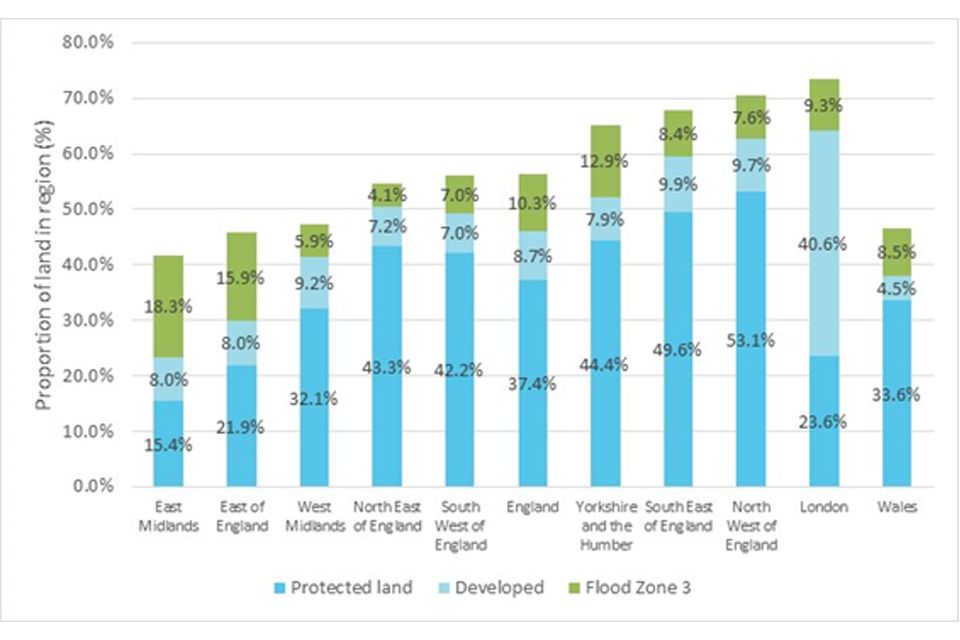
Alt text
A bar chart showing the proportion of land that is classified as protected, developed or at risk of flooding, by region of England and by nation (England and Wales).
The proportion of protected land, developed land and flood zone 3 land in each region was as follows: East Midlands 15.4%, 8.0% and 18.3%; East of England 21.9%, 8.0% and 15.9%; West Midlands 32.1%, 9.2% and 5.9%; North East 43.3%, 7.2% and 4.1%; South West 42.2%, 7.0% and 7.0%; England 37.4%, 8.7% and 10.3%; Yorkshire and the Humber 44.4%, 7.9% and 12.9%; South East 49.6%, 9.9% and 8.4%; North West 53.1%, 9.7% and 7.6%; London 23.6%, 40.6% and 9.3%; Wales 33.6%, 4.5% and 8.5%
Source:
-
CMA analysis of DLUHC Land use in England data (2022)
-
Welsh Government analysis of Ordinance Survey, ONS, and Natural Resources Wales
The visual analysis of Scotland (see Section 7 of the supporting evidence document) indicates that there is a substantial amount of land which in principle is potentially developable. However, we note that in major built-up areas (for example Edinburgh, Glasgow, Aberdeen) land designated as greenbelt may restrict further residential development to some extent.
Overall, we conclude that there is generally a substantial amount of potentially developable land across England, Scotland, and Wales at the regional level, with the exception of London. At the local level, there are several local authorities mostly located in London, the North West of England, the South East of England, Yorkshire and the Humber and some built-up areas in Scotland that have a shortage of potentially developable land. In these areas we expect a mixture of previously developed and undeveloped land can be used to meet housing needs in the short term (see discussion of availability of brownfield sites in Section 7 of the supporting evidence document). Longer-term, as the availability of brownfield sites reduces, we may see reduced land availability in built-up areas, although this would depend on several other factors such as changes in demand for housing and government policy.[footnote 103]
We note only a subset of this potentially developable land is available to purchase or control for residential development. In order for land to be brought to market for development, landowners need to be willing to sell or develop the land. As they can only sell the land once, landowners must determine whether their best strategy is to capitalise on what is (or is likely to be) offered for the land now or to hold onto the land and wait for better terms to be offered in future. This decision will be informed by expectations as to many different aspects of current and likely future market conditions.
Access to land
In theory, where purchasers do not have fair access to land, we expect less competition for land, which may lead to lower land prices and disincentivise landowners from selling their land. As land is an essential input, we expect lower land availability to translate into fewer houses being built. This could lead to worse outcomes for home buyers, for example, by reducing the overall supply of houses which could lead to higher prices, or by limiting consumer choice around location and type of house.
To assess whether land is accessible to all market participants, we analysed data obtained from land agents and promoters – the 2 most prevalent types of intermediaries in this market – on who they sell to. We found that agents and promoters both sell to a wide range of purchasers, although land promoters look to sell a high proportion of their sites to the largest housebuilders. Specifically:
-
land agents from whom we gathered information managed the sale of 388 sites (equivalent to approximately 65,000 plots) to housebuilders in 2022 - around 65% of these were sold to housebuilders other than the top 11 (non-top 11 housebuilders)[footnote 104] and the remaining c.35% were sold to the top 11 housebuilders - we note the non-top 11 housebuilders category included 235 unique housebuilders in 2022, some of which are SME housebuilders
-
land promoters from whom we gathered information sold approximately 70 sites (equivalent to 12,000 plots) to housebuilders in 2022 - around 55% of these were sold to the top 11 housebuilders and c.45% were sold to the non-top 11 housebuilders - we note the non-top 11 housebuilder category includes 24 unique housebuilders in 2022 and 36 in 2021, some of which are SME housebuilders - land promoters often sell their smaller sites (sites less than 50 plots) to non-top 11 housebuilders, although overall promoters sold relatively fewer smaller sites[footnote 105]
The existing body of evidence on the experience of SME housebuilders suggests that SMEs can face challenges finding or securing land, either through a lack of transparency in the market, or for other reasons. For example:
-
the IPPR argues that the transparency of the land market is an issue, with large housebuilders being better placed to establish relationships with landowners, which allows them to capture land before it reaches the open market[footnote 106]
-
the London Chamber of Commerce and Industry (LCCI) has argued that a lack of transparency about who owns land creates a barrier for smaller developers[footnote 107]
-
a study from RIBA notes that, given the costs and risk involved, many landowners prefer to work with ‘established national companies’ rather than SMEs[footnote 108]
Responses to our SME questionnaire[footnote 109] are consistent with the view that SME housebuilders can face challenges related to land. Most respondents (10 of 19) ranked acquiring land as one of their top 3 barriers, although the majority of respondents (12 of 19) did not rank finding land as one of their top 3 barriers.
Most SMEs who responded to our questionnaire used intermediaries to find land (for example, via marketing by land agents), and a substantial minority used intermediaries to secure land (in other words, were successful purchasing the land). Some SMEs indicated that land agents’ knowledge, expertise, and ability to reduce workload were helpful. However, a small number of SMEs commented that land agents made it hard for them to participate in the land market, for example, by favouring large housebuilders. Further, some respondents (2 of 19) raised concerns about land agents only offering sites to companies on a shortlist, meaning they could miss opportunities. However, there were mixed views on the significance of this issue. In addition, land promoters were thought to reduce the risks associated with acquiring land (as they obtain the planning permission before selling), but one SME said it has been known for promoters to obtain a planning permission that doesn’t maximise the site’s development value, in the event of which the SME may not find the site profitable to develop.
Overall, we have found that the land market, and the intermediaries active within it, facilitates access to land for different types of participants. Our analysis suggests that land agents and promoters provide access to land for the top 11 housebuilders and several other housebuilders (some of which are SME housebuilders). However, we note that SMEs face issues that can make the land market more challenging for them.
Competition for land
Strong, open competitive processes ensure the market is more accessible to all participants, including SMEs. In this section we review internal documents and bidding data to investigate whether there is sufficient competition for land, and how intermediaries facilitate this. Paragraph 2.11 provides an overview of the different types of sales process used in the land market.
We collected bidding data from the 3 largest land agents ([redacted]). Overall, they provided bidding information on 379 completed site sales (equivalent to approximately 70,000 plots) in 2022. We found:
-
competitive bidding processes were used for the sale of 82% of sites, with bilateral processes in the minority
-
limited tenders reduced the number of invited bidders, but this does not result in there being substantially fewer bids submitted compared with open market tenders - on average there were 5.7 bidders for limited tenders, and 6.2 bidders for open market tenders
-
sites sold via open tender, and 32.5% of sites sold via limited tender, were smaller than 50 plots - furthermore, the number of submitted bids did not change substantially with size of site: sites in most size categories had a median 3 to 4.5 submitted bids - the exception is sites with 101 to 200 plots, and those with more than 300 plots, which appear attractive to more housebuilders, attracting a median of 5 bids in 2022
-
top 11 housebuilders tend to compete with each other for sites, and other housebuilders also compete frequently with top 11 housebuilders
-
top 11 housebuilders exert a competitive constraint on each other (to some extent) based on their win rates - also, other housebuilders exert a competitive constraint (to some extent) on top 11 housebuilders based on their collective win-rate
Our information gathering from the top 11 housebuilders supports the conclusions we have reached from analysing the data. These housebuilders purchased a greater proportion ([30 to 40]%) of their sites via off-market bilateral negotiations in 2022 than the land agent data suggests, but a substantial proportion of their purchases still involved some form of competitive process. In addition, internal documents from 6 of the largest housebuilders indicate that the strategic land market is highly competitive.
Intermediaries’ incentives to prolong the process
If intermediaries had some control over the speed at which a particular land sale progressed, and – in a context of rising land prices – delays boosted their expected returns, we could see efforts by intermediaries to slow down the sale process. This would mean developable land being converted into homes more slowly, leading to worse market outcomes. We have therefore investigated the degree to which intermediaries have the ability or the incentive to engage in delaying behaviours.
We have focused on land promoters in considering this question, for 2 reasons: they receive a relatively high share of the land value in fees following the sale of the land; and the process of obtaining planning permission, which they lead, is relatively uncertain, lengthy, and complex, meaning greater scope to manipulate timelines.
We consider promoters’ ability to delay the sales process both at the stage of obtaining planning permission, and when selling land to developers after receiving planning permission.
Promoters and planning permission
We received data from promoters on the time they take to obtain planning permission, and compared this with the typical time required by housebuilders to go through the same process, based on internal documents and discussions with housebuilders. From the promoters’ data, the share of housing units that obtained outline planning permission:
-
in 5 years or fewer was 33.2% for permissions obtained in 2020, 61% in 2021, and 43.4% in 2022
-
in 9 years or fewer was 85.1% for permissions obtained in 2020, 91.6% in 2021, and 97.4% in 2022
This indicates that land promoters obtained planning permission for most housing units in fewer than 5 years and almost all in fewer than 9 years. This is broadly consistent with timelines indicated by 2 top 11 housebuilders. One top 11 housebuilder indicated their timeline to obtain outline planning permission for a 200-plot site is 5 years, although actual timelines vary site by site, and may be significantly longer. Also, one top 11 housebuilder’s advisors said promotion of the land can often take 5 to 10 years or even longer. This is also consistent with the option agreement contract length indicated by several housebuilders which is a minimum of 5 years.[footnote 110],[footnote 111]
We therefore conclude that promoters do not appear to lengthen the time taken to obtain planning permission, relative to other market participants.
Promoters and land sale
While land promoters are able to influence the sales process, they are also contractually obliged to begin the sale of the land as soon as practicably possible after receiving outline planning permission (in some contracts within 2 months). We note the land promotion contractual arrangements do not typically restrict the time between beginning of marketing and a completed sale. However, a land agent (if involved) would set out a timeframe for a completed sale.
We requested data from promoters on the time taken between obtaining planning permission and completing the sale (ie, to complete the sale and marketing of the land).[footnote 112] We find that, in 2022, 65% of units sold by promoters were sold within 12 months of obtaining planning permission. In 2021 that figure was 53%, and in 2020 it was 49%. This implies a significant proportion of sales take longer than 12 months, and while virtually all are sold within 6 years, it implies large variation in the time taken to sell a site.
Promoters gave us many reasons for some sites taking longer to sell, including low interest in the site, protracted price negotiations, a housebuilder withdrawing from the sale, and multi-phased sales. These reasons are for the most part supported by other evidence, or may also occur where a housebuilder has taken the site through planning.
Overall, we have found no evidence that promoters delay the sale process after obtaining planning permission, and have limited scope to do so due to the contracts they operate under.
Vertical integration of housebuilders and promoters
Promoters are both competitors to housebuilders for strategic land and suppliers of permissioned land. In the course of our evidence gathering, we have found that there is an increasing trend of housebuilders purchasing promoters, primarily with the aim of increasing their land supply.
To explore this trend and its impacts further, we have assessed whether it has reduced competition for strategic land, or limited access to permissioned land.
How much of the land promotion market has been acquired
Since 2019, several of the large housebuilders have either successfully acquired, or attempted to acquire, a promoter. Barratt, Bellway, and Miller Homes successfully acquired land promoters, [redacted] [redacted]
-
the largest acquisition within this timeframe was Barratt’s purchase of Gladman Developments, through which it gained promotion agreements for [redacted]
-
Berkeley Homes acquired the remaining 50% share of its joint venture, St William, gaining [redacted]
-
Miller Homes acquired Wallace Land Investment & Management, gaining promotion agreements for [redacted]
-
Bellway acquired Rosconn Strategic Land, gaining [redacted][footnote 113]
By undertaking analysis of the significance of these acquisitions relative to the number of signed promotion agreements overall,[footnote 114] we conclude that they account for a relatively small share of promoters, in terms of agreements signed, and that many other promoters remain active in the market. In addition, other housebuilders continue to provide a competitive constraint for strategic land.
Contract changes post-acquisition
We also wanted to understand whether housebuilders who had acquired promoters had sought to convert their promotion agreements into other types of contract more favourable to the housebuilder’s interests (for example, by adding pre-exemption clauses giving the housebuilder ‘first refusal’ on a site, or converting from a promotion agreement to an option agreement).
To do this, we looked at information provided by 2 top 11 housebuilders both pre- and post-acquisition on the contractual arrangements between their respective land promoters ([redacted]) and their customers.
Our analysis of the agreements active at the point of acquisition showed few or none had been converted into more advantageous agreements for the top 11 housebuilders by May 2023.
However, there is some tentative evidence that the types of contract signed by these promoters is changing post-acquisition, to give the housebuilder greater control over what happens to the land once planning is granted. [redacted]. We note that this phenomenon could become more concerning in future, if it were to have the effect of limiting broader market access to land.
Conclusion
Overall, our view is that none of the major potential concerns we have investigated in relation to the operation of the land market have been borne out, and that the way the land market is operating at this time is not itself a driver of negative outcomes in the housebuilding market.
Land banks
Land banks are portfolios of land that are held by certain types of public or private organisations, either for future development such as residential use, commercial or employment developments, or for maintenance purposes (such as protected woodland). While land banks may be held by different types of public and private organisations, for the purposes of our study we have considered only land banks held by housebuilders.
There are 2 main types of land banks held by housebuilders for residential housing:
-
short-term land, also referred to as current, immediate, controlled, or consented land - these are sites that have some form of planning permission and where construction may not be far from commencing
-
long-term land, also referred to as strategic land - this is land that housebuilders have acquired (or taken out an option on) for future development but which does not yet have planning permission - this land requires long-term investment to secure planning permission, at which point it would move into the firm’s short-term land bank, forming a pipeline of developable sites
Another point of difference between short- and long-term land is the way in which it is generally controlled by the housebuilder. Short-term land is more often owned by the housebuilder, while long-term land can be either owned by the housebuilder, or it can be the subject of an option agreement, where the housebuilder has ‘first refusal’ on the site on pre-agreed terms (usually set in relation to the prevailing market price).
One of the primary reasons for a housebuilder to hold land is to ensure it has a steady supply of land to feed into its business. Without the supply of developable land, no new houses can be built, and the housebuilder’s business cannot exist. Land banks ensure a forward pipeline of sites that have or are likely to have planning permission and are ready to go when needed. Many housebuilders flagged in their Statement of Scope responses how important land banks were for managing their development pipelines.
However, we have also heard concerns around the impact of housebuilders’ land banks on the way the market functions, focusing on 3 interrelated issues:
-
that land banks reduce the amount of land available for development by other builders
-
that control of large amounts of developable land allows housebuilders to slow the delivery of new homes in a particular area
-
that a lack of transparency in land ownership hinders small and medium-sized housebuilders from identifying and securing suitable land for development
To better understand the role and impact of land banks within housebuilding, we have: gathered data on more than 5,800 individual sites held in the land banks of the top 11 housebuilders; examined local-level data on planning applications; analysed national data on planning application outcomes and how land progresses through the planning system; examined internal documents gathered from the largest housebuilders; and undertaken extensive engagement with academic experts, devolved governments in Scotland and Wales, and market participants. The information we have gathered using our statutory powers means we have access to a greater depth of information as to the location of sites owned by the top 11 housebuilders and their internal decision-making on these sites than any of the previous pieces of research we have reviewed.
We found that the top 11 housebuilders in GB held a total of 1.17m plots in their land banks as of 2022. The geographical distribution of this land, as well as its division between long-term and short-term land banks, is shown in the figure below.
Figure 4.5: Number of plots in long-term and short-term land banks by English regions, Scotland and Wales
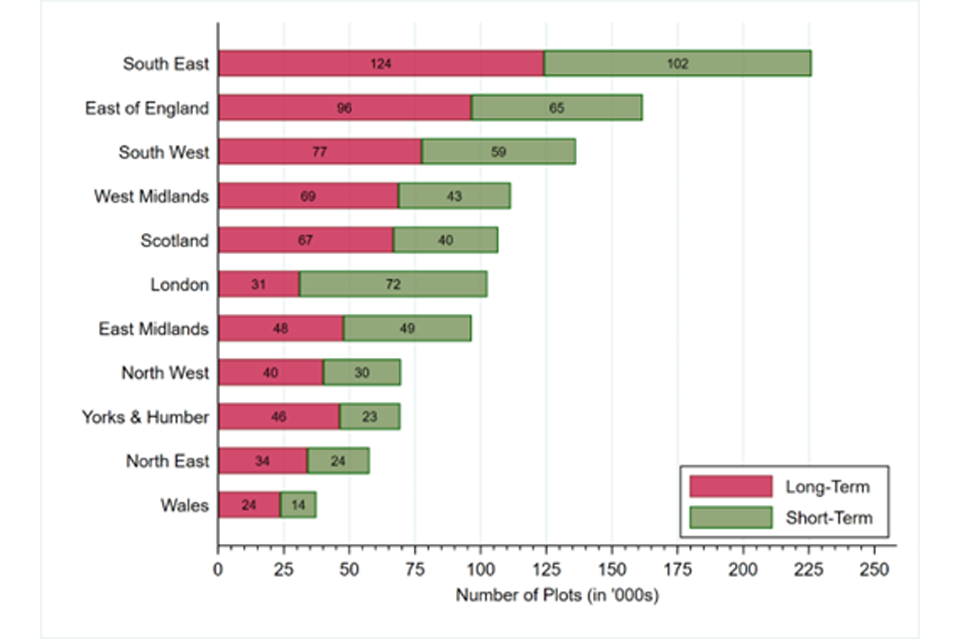
Alt text
A bar chart showing the number of plots in long-term and short-term land banks by English regions, Scotland, and Wales.
By nation, England has the most plots in long-term and short-term land banks (c.565,000 long-term and c.466,000 short-term plots) followed by Scotland (c.67,000 long-term and c.40,000 short-term plots) and then Wales (c.24,000 long-term and c.14,000 short-term plots).
Within England, land banks are larger in the south and midlands of England, and lower in the north of England.
Source:
- CMA analysis of the top 11 housebuilders’ land banks data.
Overall size of land banks
There are clear interlinkages between the amount of land a housebuilder holds, how many houses they intend to build, and over what period they intend to build them. Determining whether housebuilders hold ‘too much’ land is therefore complicated by the interaction with those builders’ plans for growth, their reading of current and likely future prospects for both the land and housing markets, and their approach to managing risk.
The main concern we have heard with regard to the total size of land banks is that it prevents other builders from getting access to land, allowing the incumbents to increase scarcity of land and so maintain prices.[footnote 115] This would be a concern if it prevented others from developing the land more quickly. We have therefore considered how long the land in land banks as of 2022 had been held: if the land had on average been acquired relatively recently, it would seem less likely that housebuilders were holding land back from development. We recognise that these estimates will understate the length of time that the land will ultimately be held by the housebuilder, since it has not yet been developed.
Length of time land is held in land banks
We find that, as of 2022, the top 11 housebuilders from which we requested data had held their long-term land for an average of 7 years. We know that some strategic land has a very low probability of being developed; to take account of this type of land, we removed sites that had been owned by the housebuilders for more than 11 years (around 15% of land across the housebuilders in our dataset) and recalculated the average duration for which land had been held. The remaining land had been held in long-term land banks for just over 4 years on average. For short-term land banks, land had been held by the housebuilders for an average of 2.5 to 4.5 years[footnote 116], as of 2022.
There are several reasons, in our view, why these average time frames do not appear to be unreasonably long for land to remain in land banks:
(a) not all land will make it through the development process: about 76% of long-term land is not allocated as part of a Local Plan[footnote 117], suggesting that there is significant uncertainty around whether it will achieve planning permission. In addition, as set out in paragraph 4.19, around 15 to 20% of major planning applications are rejected in England and 10 to 20% are rejected in Wales (and around 10% of all applications are rejected in Scotland). Land that is not granted planning permission, or that requires several attempts to get planning permission, will remain in land banks for longer
(b) there are substantial direct and indirect costs involved in making planning applications and gaining approval. In addition, across all 3 nations in GB, the length of time taken to make planning decisions is substantial and increasing, as discussed above. Planning delays can have a material impact on how housebuilders operate and imply that housebuilders will hold more land in their land banks, and that the land will remain in their land banks for longer
(c) once planning permission has been gained, the housebuilders cannot fully realise the return on their investment until all units are sold.[footnote 118] As we discuss in paragraph 4.119 and Section 9 of the supporting evidence document, construction can be delayed even once planning permission is granted, for example due to labour and materials constraints or if a site is challenging to build out due to its topography or layout. Further, as we discuss in paragraph 4.118 and Section 9 of the supporting evidence document, housebuilders have an incentive to build out in a manner which does not reduce their sale prices, which may mean building more slowly and so keeping land longer than they could otherwise. This would mean land being held up in short-term land banks is a symptom of this phenomenon, rather than being concerning in and of itself
Overall, we do not consider the aggregate size of land banks and the length of time the land is held in themselves present a concern. Rather, they are likely to reflect underlying issues in the operation of the market such as the operation of the planning system and incentives driving the speed of build out.
Land hold-ups and ‘ransom strips’
As part of our analysis of land ownership, we looked at the extent to which land development is being delayed by the owners of adjacent land (and therefore land held in land banks for longer). Such tactical measures are sometimes referred to as land hold-ups or ‘ransom strips’.
A ransom strip refers to a parcel of land needed to access an adjacent property from a public highway, to which the owner is denied access until payment is received.[footnote 119] In contrast, land hold-ups can relate to many different situations. From the large housebuilders’ RFI responses, they can include neighbouring landowners refusing to sell their land; disagreements among several landowners around how to develop land; or claims about the impact of current and future noise pollution from an existing development and right to light claims.
The evidence we have received indicates such situations occur quite infrequently, but when they do, they can have a significant impact on the time and cost involved in development. However, these do not occur across all developments or to the same extent. In addition, these are risks which housebuilders are well aware of and try to mitigate, for example, through due diligence prior to purchase. In addition, some hold-ups are likely to be borne of genuine disagreements over property rights and the effect on others’ land from developments. Overall, across all land held by housebuilders we do not consider hold-ups caused by such disagreements are likely to materially affect how long land takes to be developed.
Local concentration and land banks
We have also investigated whether land holdings are concentrated at the local level. Most researchers who have considered housing markets conclude that they are primarily local markets.[footnote 120] We also note that surveys of purchasers of new build housing consistently find that location is the feature of new build homes that is most important to consumers.[footnote 121]
Consistent with this, our consumer research found that location was the main factor in the decision of recent new build buyers to buy a property. Housebuilders’ internal documents also show that they consider housebuilding markets to be local.
We have therefore considered the extent to which concentration in the ownership of land at local level may be creating conditions in which one housebuilder, or a small group of housebuilders, would have sufficient ability to control the overall build-out rate in an area, and in so doing to maintain prices at a higher level than would otherwise be the case. For a detailed description of our methodology and findings, see Section 8 of the supporting evidence document and Appendices G and H on identifying concentrated areas and our review of evidence of initially identified concentrated areas.
We analysed data at the LPA/LA level across GB, to determine whether any LPA/LA areas had a high level of local concentration (ie., whether the developable land in the area was controlled by a small number of housebuilders). This initial process identified 26 areas for further consideration, and we consulted on our approach in our land banks working paper.[footnote 122]
In our subsequent phase of work, we found no concerns with 17 areas, finding that sufficient new build properties were being completed to meet local housing need and there was land available for future development.
For the remaining 9 local areas, we reviewed the information we received from the top 11 housebuilders and other stakeholders active in those areas to understand the local competition dynamics.
From our review of this information, concentration does not appear to be arising as a result of deliberate strategies to limit competition in those remaining areas. In some cases, concentration is lower than our initial screening indicated or appears to be a relatively short-term phenomenon; in others, it arises due to a limit on the amount of land suitable for development or number of permissions being granted in that area which acts as an external constraint on how many builders can be active. Our findings are summarised as follows:
For Wales
We examined the evidence we received for Pembrokeshire. Our view of the evidence is the local concentration concerns appear in part to be due to a lack of permissioned land available to build new homes, which has led to a limited number of housebuilders being present.
In Scotland
We examined the evidence for 3 local areas: East Renfrewshire, East Dunbartonshire, and West Dunbartonshire. The evidence suggests that there have previously been more developments undertaken but there is less information available on current development activity, such that concentration is lower than originally indicated. In all 3 areas, we have reviewed documents that outline strategic land opportunities for potential future developments.
In England
We examined the evidence for 5 local areas: Havant, Kingston Upon Thames, South Tyneside, Tower Hamlets, and Watford. The evidence suggests that, for each of these areas, a mix of different developers has been active recently. Many developments in these areas have been completed or are due to complete over the next few years. Additionally, in South Tyneside, the evidence suggests that new build developments have been limited because of a lack of developable land and due to the lack of planning applications being granted.
In summary, our in-depth analysis of concentration at the local level has not revealed any concerning areas, with the majority of local housing markets characterised by the presence of several housebuilders.
Conclusions
We do not see evidence that the size of land banks we observe held by different housebuilders individually or in aggregate either locally or nationally is itself a driver of negative consumer outcomes in the housebuilding market. Rather, our analysis suggests that observed levels of land banking activity represent a rational approach to maintaining a sufficient stream of developable land to meet housing need, given the time and uncertainty involved in negotiating the planning system.
A lower level of land banking would likely mean fewer rigidities in the market, since it would potentially mean more land available for purchase by housebuilders who could develop it more quickly. However, attempting to artificially reduce the size of land banks from their current level, without tackling the elements of the market that are driving housebuilders to hold them, would be likely to drive lower completion rates.
Given this conclusion, we do not propose any remedies directed at land banks.
How housebuilders decide build-out rates and prices
An important driver of outcomes in most markets is how firms make decisions around how much, and what type, of supply to bring to the market, and what price they are going to charge for that supply. In the housebuilding market this is a particularly complex process, with policies in relation to home ownership and regulation (particularly planning) playing a significant role.
How build-out rates interact with prices
Housebuilders face strong incentives to maximise the price at which they sell homes, rather than to aim for a higher volume of sales at lower prices.
The extent to which housebuilders can expand their supply in a local area is limited by the volume of homes for which they have planning permission and the rate at which they can feasibly build homes.[footnote 123] Housebuilders could increase the rate at which they sell these homes by offering them for sale at lower price. However, because the number of homes that housebuilders can build (and therefore sell) in an area in the short to medium term is inherently limited by the planning system, lowering their prices is more likely to bring sales of these homes forward in time, rather than increasing their overall sales over the medium term.[footnote 124] Therefore, reducing prices will reduce the overall revenue that housebuilders receive for these sales and this is unlikely to be offset by a reduction in costs (for example, lower financing costs as a result of selling homes more quickly). Consequently, reducing prices to increases sales will rarely be a profit-maximising strategy for housebuilders.
There is strong evidence from studies,[footnote 125] as well as housebuilders’ RFI responses and internal documents, that housebuilders generally respond to the incentive to maximise prices[footnote 126] by building homes within a local market at a rate that is slower than the pace at which they could otherwise build them. This evidence shows that instead of seeking to sell homes as quickly as possible, housebuilders tend to sell them at a rate that is consistent with the local absorption rates – the rate at which houses can be sold without housebuilders needing to reduce their prices.[footnote 127] Housebuilders told us that they also build homes at a slower pace to avoid having capital tied up in partly finished or finished, unsold homes.
Although housebuilders tend to avoid reducing the sales prices as far as possible, they do offer incentives to individual consumers at the margin (for example, part-exchange, subsidisation of mortgage, free upgrades on kitchens) to help drive sales. This is supported by evidence from housebuilder internal documents detailing their responses to the sudden rise in mortgage rates in Autumn 2022. These documents show that while housebuilders tended to experience a significant fall in the rate at which homes were sold, they did not respond by seeking to reduce the prices at which they sold the homes,[footnote 128] although in some cases they did step up the level of incentives they offered.
The land purchase process further contributes to housebuilders’ focus on sale prices above volumes. Most land is bought under the residual valuation model, meaning that when housebuilders bid for land, they offer a price that is affordable based on their estimate of the value of the homes they can build on it, taking into account the costs of developing a site, and their target rates of return.
As we explain above in paragraphs 4.57 to 4.59, the majority of land sales we have information on involve some form of competitive process, with many different types of bidders involved. Any successful bid for land is therefore likely to incorporate the most optimistic (but plausible[footnote 129]) assumptions about future market prices. Such competition is welcome, to the extent that it incentivises landowners to bring land forward. But it also means that a housebuilder’s bid for land will need to put forward development plans that maximise the site’s future sale value if it is to be the winning bid. With all housebuilders pursuing the same strategy, there is a strong market imperative to seek price maximisation, which implies moderating build-out speed.
At the same time, where the supply of development land is inherently limited by the planning system, competition for land potentially increases land prices to a level that is significantly above what landowners would be willing to accept for their land.[footnote 130] This suggests that if housing were delivered more quickly and at lower prices then, where this resulted in housebuilders being willing to pay less for land, it may not have a significant impact on the overall supply of land.
Factors which influence new build prices
As noted above, housebuilders generally have an incentive to maximise the price they achieve for their houses. However, the price of new build homes is constrained by both the price of other comparable new build homes in a local area, and by the price of comparable second-hand properties for sale at that time, or recently sold. Our review of housebuilder internal business cases for land purchases[footnote 131] shows that:
-
data on the price of comparable new build properties in a local area is a key input into the price at which housebuilders expect that they will be able to sell new build homes - when determining the comparability of nearby new build properties, housebuilders consider factors including the size, layout, specification, and location - in addition, we understand that housebuilders also consider relevant local demand-side factors when setting prices of their developments relative to comparator developments - this can include assessing how factors such as local amenities, transport connections, and the demographics of the local population for a site compares with those for other developments
-
housebuilders also usually consider prices of nearby second-hand houses when forecasting prices during land purchases, albeit new build homes can often be sold at a slight ‘new build premium’ to comparable second-hand homes
Other evidence also supports that second-hand housing imposes a constraint. Our consumer research suggests that whether a property was a new build is a secondary factor in a consumer’s decision to purchase a property. It concluded that, ‘The main decision factor for buying a property tended to be its location and the extent to which the property met the buyers’ expectations in terms of size and cost. The fact that it was a new build was in most cases a secondary factor.’ This suggests that consumers will often consider both new build and second-hand homes when buying a property.
At a national level there is a strong correlation between the rate at which prices of new build homes change, and the equivalent price evolution for second-hand homes (see Figure 4.6 below). This suggests that the price of new build housing is bounded above, at least to some extent, by the price of second-hand housing. Second-hand home sales account for the majority of transactions in the housing market: in England and Wales transactions for new build homes made up only 11% of total housing market transactions, on average, between 2013 to 2014 and 2022 to 2023.[footnote 132]
Therefore, we do not consider it likely that, in general, housebuilders will account for a sufficient fraction of housing sales in a given local area to allow them to increase prices above the current market level by restricting their output. However, as we explain above, our analysis suggests that housebuilders could supply homes to the market at a faster rate than they do and reduce their prices, although they typically choose not to do so.
Figure 4.6: Indices of new build and second-hand property prices in England and Wales (April 1995=100)

Alt text
A line chart showing how the price indices for new-build housing and existing property have changed between 1 April 1995 and 1 April 2023. The chart shows the 2 indices are closely correlated with the indices for both rising from 100 to above 500 meaning that changes in the prices of new-build and existing housing are closely correlated.
Source:
- CMA analysis of data from UK House Price Index: data downloads September 2023
Factors which influence speed of building
The rate at which housebuilders supply homes varies from area to area and from site to site and is influenced by a variety of factors, falling into one of 2 categories:
-
factors which influence the rate at which housebuilders are willing to supply homes
-
factors which influence the rate at which housebuilders could feasibly supply homes
As discussed above, housebuilders tend to build houses at a rate that is consistent with the local absorption rates. The rate at which housebuilders are willing to supply homes is affected by a variety of factors that affect absorption rates and the likelihood of them imposing a limiting constraint on the builder’s plans, including:
-
the level of local and aggregate demand: where local demand is greater relative to the supply of housing, housebuilders are more likely to believe they can sell at a faster rate without impacting the price they can charge. Several pieces of research support this, including work by Lichfields[footnote 133] and Ball et al.[footnote 134] Housebuilders’ internal business cases for land purchases also consider that local demand is a key determinant of local house prices, sales rates, and build-out rates. Demand for housing is, in turn, influenced by the national economic outlook, particularly expectations for interest rates and household incomes
-
the diversity of type (for example, differences in the branding, size, and design of the homes) and tenure (for example, for private sale, private rent, or affordable housing) of housing on a site and within the local area - evidence from housebuilder internal documents shows that increasing the different types of home provided can appeal to different groups of buyers, and therefore can be sold more quickly without reducing the market price than would be the case for the same number of more homogenous homes - tenures of housing such as affordable housing or build to rent housing are typically sold in bulk to a single customer well in advance of their completion - housebuilder internal documents suggest that these tenures of homes can be supplied at a faster rate than and/or in addition to homes for private sale without affecting the rate (or price) at which private homes can be sold into the market
The rate at which housebuilders could feasibly supply homes on a given site is affected by a range of external factors, including labour and materials constraints; adverse weather conditions; site characteristics; and the types of homes being constructed. In addition, delays can be caused by infrastructure issues on-site, or environmental negotiations.
The role of the private market in meeting housing need
Increasing housebuilders’ incentives to supply homes more quickly could potentially have some impact on the price of housing and the number of homes that are delivered. However, this is unlikely to be sufficient, in and of itself, to deliver enough homes to meet housing need as described in the section on supply and affordability because:
-
as we explain in the section on planning, insufficient planning permissions have been/are being granted to meet housing need. Unless more planning permissions are granted over the longer run, improvements to build-out rates are likely to change when homes are built, rather than to have a large impact on how many homes are built
-
a competitive private market will not, on its own initiative, produce sufficient housing to meet overall housing need - the cost of private sector housing, and the level and distribution of incomes and assets, means that significant numbers of households lack the resources to be able to afford adequate housing on the private market - in addition, the wider benefits of housing availability and conditions (such as health outcomes,[footnote 135] educational attainment,[footnote 136] and productivity[footnote 137]) are not captured by private actors in the market (housebuilders and landowners) as profit - this means that the private market will not, on its own initiative, produce sufficient housing to meet overall housing need, even if it is highly competitive[footnote 138]
However, increasing housebuilders’ incentives to supply homes more quickly could have implications for how housebuilders might respond to reforms aimed at increasing housing supply. Given that many areas have a shortage of supply (see the supporting evidence document, Section 2 Supply and affordability), the options for loosening the restrictions on housebuilding posed by planning we set out in the planning section, could be expected to boost the pace of housing delivery in those areas. However, we note that reforms to the planning system to boost the number of planning permissions granted may not have the desired effect on build-out rates, in areas where the local absorption rate is a significant constraint on how many homes are supplied. Areas where demand for housing is relatively limited compared to the potential supply (how many homes could be built) are most likely to be significantly constrained by the absorption rate. In areas where demand is high compared to potential supply then the absorption rate is much less likely to be a constraint on how many homes are supplied by housebuilders.
Housebuilders commercial decisions could be influenced by the sharing of non-public information
Housebuilder commercial decisions are based on a range of information. Much of this is publicly available, such as listed house prices (available through housebuilder or estate agent websites), achieved (headline) prices (through land registry with some lag), competitors’ plans for number and types of houses to be built (through planning applications), and to some extent competitor sales (through housebuilder websites).
However, evidence from housebuilders’ internal documents suggests that sharing with each other of some non-public information on sales prices, incentives, and rates of sale may be taking place. The sharing of commercially sensitive information has the potential to weaken competition between housebuilders by reducing strategic uncertainty in the market and influencing housebuilders’ commercial decisions, potentially including on output or prices. Housebuilders may find it mutually beneficial to share this information because it helps to provide greater certainty about rivals’ current market prices (including any incentives they provide) and sales rates and this potentially could influence the prices at which they bid for land and/or their own decisions about the current levels of pricing, sales rates, and build-out rates.
We are concerned that any sharing by housebuilders of non-public information of this kind may have the object or effect of preventing, restricting or distorting competition. While we do not consider this behaviour to be one of the main factors in the persistent under-delivery of the market against government targets and assessed need (and, therefore, in contributing significantly to increasing affordability pressures at a market-wide level), we do consider that it may weaken competition in the market. In light of these concerns, we have decided to launch an investigation into this suspected conduct under the Competition Act 1998.
Government interventions affecting price and supply
In addition to the competitive decisions of private housebuilders, the quantity and price of new build housing in the market can be influenced by government policy interventions.
One significant intervention has been the Help to Buy equity loan schemes set up in England, Scotland, and Wales.
-
in England Help to Buy was introduced on 1 April 2013 and closed from 31 May 2023. The scheme was adjusted several times during its operation, but provided an equity loan from government which reduced the size of the mortgage the buyer needed to take on, to support the purchase of a new build home. Later iterations restricted the scheme to first-time buyers and reduced the value of the homes eligible[footnote 139]
-
the Help to Buy Scotland Scheme opened in September 2013 and closed in February 2021.[footnote 140] As in England, the Scheme helped buyers purchase a new build property in Scotland through the provision of an equity loan.[footnote 141] Also as in England, over time the eligibility for the scheme was narrowed[footnote 142]
-
Help to Buy – Wales was introduced in January 2014 and is still in operation having been extended until at least March 2025.[footnote 143] The scheme provides a shared equity loan of up to 20% of the price of a new build property. Since 1 April 2023 all homes purchased under the scheme must have an EPC rating of at least B
There have been several evaluations of the English Help to Buy scheme.[footnote 144] These have generally found that the scheme led to some additional housebuilding, particularly in areas that were less supply-constrained. However, evaluations have also found that the scheme most likely provided support to some homebuyers who would have bought anyway, and in supply-constrained areas such as London, it inflated prices without having a significant effect on housing supply.
The government also provides affordable housing, which supplements provision by the private market. Affordable housing generally takes one of 3 forms (although the exact definition differs between the nations of GB):
-
social rent – homes offered for rent at a substantial discount to market prices (circa 50% or more)
-
affordable or intermediate rent – homes let at least 20% below local market rents (affordable rental properties) or let at rates set between market rents and social rents (intermediate rental properties)
-
discounted or shared ownership – there is a variety of schemes in place across GB that operate to sell homes to certain consumers (such as first-time buyers, key workers, or families below a certain income threshold) either at a discount to market prices or through a shared ownership scheme
The overall approach to affordable housing, as well as the volume and type of affordable housing provided, varies between the nations of GB
-
during the last parliamentary term (May 2016 to May 2021), the Scottish Government adopted a target of delivering 50,000 affordable homes and has since adopted a target of delivering 110,000 affordable homes by 2032
-
in July 2021, the Welsh Government committed to deliver 20,000 new low-carbon homes for rent within the social sector during the government term[footnote 145]
-
there is no formal government target for the provision of affordable housing in England. However, the government’s Affordable Homes Programme aims to deliver 180,000 new homes between 2021 and 2026[footnote 146]
In Scotland and Wales, the provision of additional affordable housing since 2007-08 has represented a greater share of housing provision than in England. In addition, in Scotland and Wales the proportion of affordable housing that is provided as socially rented housing is much greater than it is for England. Between 2007 to 2008 and 2022 to 2023:
-
in England, additional affordable housing supply was equivalent to 31% of new build completions. In terms of type of affordable homes produced, 31% of additional affordable housing supply was socially rented housing, with 36% being affordable or intermediate rent and 33% being discounted or shared ownership
-
in Scotland, additional affordable housing supply was equivalent to 41% of new build completions. In terms of type, 71% of additional affordable housing supply was socially rented housing, with 9% being affordable or intermediate rent and 20% being discounted or shared ownership
-
in Wales, additional affordable housing supply was equivalent to 41% of new build completions. In terms of type, 63% of additional affordable housing supply was socially rented housing, with 13% being affordable or intermediate rent and 8% being discounted or shared ownership (the tenure of 16% of affordable housing in Wales could not be identified[footnote 147])
In our discussions with representative bodies of affordable housing providers, they described a number of key barriers to the provision of affordable housing:
-
as most affordable housing developments are funded, at least in part, by grant funding, the availability of this funding is necessarily a key factor in the level of affordable housing that can be provided
-
like other forms of housing, affordable housing has to go through the process of applying for planning permission and is subject to some of the risks, uncertainties, and delays associated with that process described above
-
given that the values of private developments are generally higher than those for affordable developments, and hence private housebuilders can generally bid more for land, affordable housing providers have difficulty competing with private housebuilders to purchase land. Consequently, many affordable developments take place on land that would not be of interest to private developers. However, the availability of such land which is also suitable for affordable development can be limited
The provision of more affordable housing could potentially influence broader market outcomes such as prices, and the speed of housing delivery.
The impact of the provision of affordable housing on average house prices in an area is ambiguous. While the provision of affordable housing will lead to below-market housing costs for those who live in the homes, it could have an impact on wider house prices in the area if it displaces market-rate development. A recent study[footnote 148] of the impact of the provision of affordable housing on house prices found that it led to a reduction in house prices in the short term and had no appreciable impact in the longer term.
As noted in paragraph 4.118, evidence suggests that housing of differing tenures such as affordable housing can be built at a faster rate than housing for private sale because the rate at which it is sold is not constrained by, and does not itself constrain, the rate at which private housing can be sold without affecting prices.
Finally, the LURA and the revised NPPF contain a number of measures which may influence the speed of housing delivery. These include measures to better monitor and enforce build-out rates, as well as measures that may make it easier to develop on land purchased without the ‘hope value’ associated with potential future planning permission. These are explained further in Section 9 of the supporting evidence document although it is too soon to determine how these measures will be used in practice and what effect they may have.
Conclusion
Housebuilders’ incentives lead them to build more slowly than they could do, with the objective of maximising sale prices and keeping their stock of built and unsold homes to a minimum.
However, while they have some price-setting power, our view overall is that the second-hand market is a constraint on new build prices, and for the most part housebuilders’ share of local supply is unlikely to be sufficient for them to be able to boost the overall market price of housing by restricting their output.
While we consider that measures to speed up the pace at which new build housing is supplied to the market may be beneficial (and we set out options for some in the chapter on addressing the problems we have found), these would need to be accompanied by planning reform if they were to deliver increases in housing delivery of the size needed to bring GB housing completions significantly closer to 300,000 per year. We also note that the housebuilding market is unlikely to deliver sufficient housing to meet overall need in any event, given the need for sub-market options, and the externalities that mean housebuilders cannot capture all of the benefits of housing provision.
We are concerned about some of the sharing of non-public commercial information that appears to be happening between some housebuilders, which could be leading to worse outcomes in some local markets. In light of these concerns, we have decided to launch an investigation into this suspected conduct under the Competition Act 1998.
Notable government interventions that have an impact on the supply and price of homes include the Help to Buy schemes, which provided equity loans to purchasers of new build properties, and the provision of affordable housing. We judge that the latter can be provided without impacting on private market build-out rates, given that it is serving a different part of the market.
Drivers of quality and innovation
When a market is working well, we usually expect to see suppliers competing on both price and quality, with lower quality providers either being forced to offer a lower selling price or lose customers to their competitors. We would also expect firms to be incentivised, through competitive pressure, to invest in innovation to adopt efficient production methods.
In paragraphs 3.53 to 3.65 and Section 3 of the supporting evidence document, we showed that while most consumers are happy with their new homes, there are some who experience considerable challenges in getting snags or faults fixed and a minority that experience the most serious defects. On innovation, the uptake and use has been described as low and slow. In this section, we examine the drivers of those outcomes in turn.
Quality
There are drivers across the housebuilding process which impact quality. A key driver early in the process is building regulations. These are the regulations that need to be complied with for construction to take place.[footnote 149] As outlined in paragraph 3.54 we have not sought to examine building regulations because changes to building safety regulations in the nations are ongoing. Instead, we have focused on drivers at the latter end of the process, specifically, consumers’ experiences of buying homes.
To identify drivers of the ultimate quality of new homes, it is necessary to understand consumers’ attributes and the nature of their decision-making when purchasing a house. These consumer features have an impact on the power of consumers to collectively incentivise housebuilders to provide the best quality product. Buying a house is often the largest purchasing decision a person will make in their lifetime.[footnote 150] In addition, it is an infrequent experience for most, and the lack of suitable supply will tend to limit the buyer’s options, meaning the relationship between the housebuilder and consumer is unbalanced.[footnote 151]
Our consumer research found that consumers characterised the purchase as a big decision, involving compromise, emotion, and pressure. The primary selection criterion was location, as well as the extent to which the property met buyers’ expectations in terms of size and cost, and its availability. Generally, there was an assumption that housebuilders would meet certain standards and regulations (ie, quality as a ‘hygiene factor’). These findings are further supported by other research in the sector.[footnote 152] In addition, our consumer research found that the specific developer was rarely the main driver for or barrier against a purchase decision, with consumers appearing to tailor their choice of developer to who is building in their preferred location.
Further, consumers only have limited information available on quality when making purchase decisions. For example, they will often purchase a new home off-plan, before it is built or the estate is finished. These circumstances can result in weak competitive incentives and subsequent poor-quality provision.
Consumers’ ability to choose between housebuilders on the basis of reputation, even if they were inclined to do so, is hampered by a lack of systematic and consistent information about builder quality. The main information on quality that is publicly available at builder level comes from the HBF Star Rating Scheme. We have significant reservations as to the usefulness of this information as a tool to inform decision-making, as builders opt in to making the information available (if they even participate in the Scheme), and it is based on only one yes/no indicator from a broader survey, giving only a partial picture.[footnote 153] Moreover, most housebuilders are rated as 4* or 5* which limits any meaningful ability to distinguish between them.[footnote 154]
Our analysis of information gathered from the top 11 housebuilders found that many of these builders focus on their star rating in board papers where they discuss quality, as well as reporting on further breakdowns from the CSS in some instances. Some of the builders considered a wider set of metrics, such as monitoring Trustpilot and social media. That some of the housebuilders look at broader metrics than their performance in the HBF Star Rating Scheme indicates that the rating in and of itself is not a sufficiently informative measure of the quality they are achieving. However, such discussions tended to be more infrequent and/or less in-depth than other aspects of strategy, such as land acquisition.
Lastly, improving consumers’ experience of buying a new home has been a goal for industry since the 2000s,[footnote 155] and was one of the drivers for the OFT’s 2008 Housebuilding Market Study. Despite improvements in the redress system, the redress journey that consumers must navigate if something goes wrong with their new build purchase is still too complex.[footnote 156] We are concerned that the piecemeal nature of coverage, with many different parties having responsibility in different situations, means that consumers are not effectively protected in practice. A redress system which does not work diminishes the incentive for builders to get quality right the first time.
In summary, consumers have limited ability to observe the quality of a home prior to purchase and quality tends to be a lower priority than other factors such as location, given the limited available housing stock. This means housebuilders are not necessarily incentivised to compete on quality as we would expect in other markets. Thus, housebuilders’ appetite to improve and maintain quality may be driven more by regulation of the minimum standards required in housing and maintenance of more easily observed metrics such as their published star rating (where they choose to publish this).
Innovation
To understand the drivers for innovation, we have analysed the reported benefits and challenges associated with MMC and, as part of this, housebuilders’ reasons for or against investment. We have also reviewed the reasons why housebuilders have sought to become more sustainable in their developments.
MMC
MMC has long been hailed as the solution to numerous challenges faced by the housebuilding industry, including meeting net zero.[footnote 157] The benefits of using category 1 and 2 MMC in building have been subject to extensive research. These benefits centre around better speed and predictability of build, reduction in labour, cost, and environmental impact.[footnote 158]
In response to the housing shortage and inefficiency of traditional construction methods, in 2018 the UK government advocated for more use of methods such as off-site manufacturing in construction through its Industrial Strategy. More recently, governments in England, Scotland, and Wales have sought to encourage use of MMC in affordable housing through strategies and funding.[footnote 159]
The majority of the larger housebuilders have either invested in, acquired, or developed their own category 1 and 2 MMC providers.[footnote 160] The rationale for these investments consistently centred around sustainability, quality, safety, and cost. Conversely, where we have seen examples of housebuilders deciding against investing, the key reason has also included costs. This is because some types of MMC have a high startup cost, eventually leading to cost savings.[footnote 161]
There are, therefore, a number of drivers towards greater use of MMC. However, there are also several barriers:
-
as described in Section 3 (Outcomes), due to multiple public failures of housing built using MMC in the past, most notably post-war ‘prefabs’, these construction methods have experienced a lingering negative stigma amongst consumers, builders, investors, and insurers which limited its further development and uptake. Many different parties need to be bought into the use of MMC for it to be taken up, including planning authorities, warranty providers and lenders
-
as noted above, some forms of MMC involve high startup costs, which may be difficult to justify even where they eventually lead to cost savings over the long term. This may be particularly the case given the cyclicality of housebuilding – the high fixed costs of factories must be covered even where the demand for the produced resources falls or is uncertain, making such investments high risk
Sustainability
Housebuilders have also taken different approaches to making their homes more sustainable. We have defined a sustainable home as one built, operated, and maintained in ways that reduce the carbon footprint and impact on the climate. National Planning Policy in England, Scotland, and Wales all include directives on achieving sustainable development, alongside environmental and building regulation, though the operation of these differs.[footnote 162]
We found through our consumer research and our engagement with housebuilders that neither party was likely to consider energy efficiency in-depth. Homeowners assumed that standards would dictate that homes should be efficient to run. Housebuilders are undertaking a range of changes, with some who are more ambitious leading the industry and others content with following. However, the predominant reason these changes are implemented is in the expectation of changes to the minimum regulations.[footnote 163]
In summary, similar to quality, consumers are unable to observe the environmental impact of their home, in building and operation, when deciding to buy. Therefore, the key driver for innovation is pre-dominantly government intervention through regulation, stewardship, and funding.
Drivers of outcomes in relation to the private management of public amenities on housing estates
As noted in the Section 3 (Outcomes) above, and as discussed in detail in Section 5 of the supporting evidence document (private management of public amenities on housing estates), the imposition of arrangements and charges related to the management of public amenities such as roads, sewers and drainage, and public open spaces on new build housing estates is now a common aspect of the supply of new homes. Private companies increasingly provide and charge for such management services, whereas in the past the default position was that public authorities, in particular local authorities, would generally ‘adopt’ (in other words, take on responsibility in perpetuity for) such amenities.
We have identified that households subject to such arrangements may face detriment in the form of the charges they pay, the quality of amenities available to them and the quality of management services they receive, the potential for disproportionate sanctions to be applied for outstanding charges, and the sometimes significant efforts required to achieve a satisfactory outcome in those regards.
Fundamentally, we consider that the root cause of the aggregate detriment we observe is the decrease in levels of adoption of amenities by relevant authorities, resulting in a proliferation of private management arrangements in which estate management companies may possess significant market power.
Decreasing levels of adoption
We have identified a number of factors and barriers which in combination have led to public amenities on housing estates not being adopted by the relevant authority. They are:
-
the discretionary nature of much of the legal framework underpinning adoption, with housebuilders often under no obligation to seek adoption and authorities not necessarily under an obligation to grant it where it is sought. This is especially an issue in relation to:
-
roads, particularly in England and Wales
-
sewers, particularly in England
-
SuDS, in England, although concerns have also been raised with the mandatory framework in Wales, which England is moving towards, and in relation to processes in Scotland
-
public open spaces across all 3 nations
-
-
the processes involved in seeking and achieving adoption, including inconsistencies in approach across adopting authorities, tensions between different bodies involved in the adoption process, lack of nationally imposed guidance in certain areas, and the timescales and costs involved, including a lack of transparency around how costs for commuted sums and bonds are calculated by adopting authorities
-
linked to b) above, the funding and resourcing constraints of local authorities. We have heard that local authorities are increasingly not adopting amenities, driven by concerns around the future ongoing costs of maintaining those amenities, which have emerged in the context of reduced local authority budgets and resourcing pressures, with local authorities struggling to maintain existing roads
-
the commercial incentives of housebuilders to minimise costs, in particular those for commuted sums and bonds, and/or to keep costs down by not constructing amenities to adoptable standards
Competitive constraints on estate management companies
There are 2 main models for estate management: residents’ management companies (‘RMCs’) and embedded management companies, also known as land-owning management companies in Scotland.[footnote 164] As we discuss below, and in Section 5 of the supporting evidence document, our evidence indicates that it is challenging to switch management company where they act on behalf of RMCs, and virtually impossible with embedded management companies.
Local authorities may specify to the housebuilder what type of estate management arrangement should be put in place where amenities are not to be adopted by the local authority, for example, they may make the establishment of an RMC a condition of Section 106 agreements. In addition, a number of housebuilders told us they favour establishing RMCs. RMCs may appoint estate management companies to act as their agent. Data received from 14 of the 15 estate management companies we sent information requests to shows that in aggregate just over 40% of their arrangements are with RMCs, indicating that management companies acting as agents for RMCs (or equivalent) is the predominant model.
We asked estate management companies how they acquire contracts. They told us that they may be appointed by competitive tender, through direct approaches from housebuilders, or through opportunities identified by their business development managers. They also said that they may be appointed through direct approaches from RMCs wishing to change management company. They told us they compete on various parameters including location, size, and type of portfolio under management, reputation and prior experience, quality of customer service, pricing and fee structure, and technology and innovation.
Where a management company is acting as the appointed agent for an RMC, management agreements will often allow for termination of the contract, generally where 3 months’ notice is given. Our analysis of data on switching and lost contracts suggests that management contracts have been ended at the instigation of homeowners (RMCs) in some cases, and information from a 2020 Welsh Government report on estate charges suggests that costs had lowered in a few cases as a result of changing to a new management company.[footnote 165] However, the qualitative evidence we have reviewed highlights that there can be significant challenges with switching in practice, with one homeowner stating that ‘switching, even if it was possible, is likely to be the weakest of competitive constraints (particularly on large estates) because of the difficulties of organising a ‘mutiny’ with disinterested and disengaged neighbours’. Obtaining collective agreement from households was identified as a key barrier to switching by estate management companies, along with reaching agreement on termination costs – including termination fees and legal transfer fees where the management company owns the land – and a lack of guidance for households on how to switch.
In some circumstances management companies are contractually imposed on homeowners – referred to as embedded management companies or land-owning maintenance companies in Scotland. In these circumstances the freehold parts of the estate that require maintenance are transferred to a management company usually for a nominal fee and that company is named in the deeds as the provider of estate management services. Such arrangements confer significant market power on the company through protection from any competitive constraints. Our analysis of data received from 14 of the 15 estate management companies we sent information requests to shows that in aggregate just over 20% of the estates that they manage are subject to such arrangements, and one large housebuilder told us that embedded management arrangements are its preferred option.
In such circumstances, the provisions in the deeds may not allow for switching, even where the management company has failed to provide the contracted services, or there may be challenging conditions to be met to effect switching such as providing evidence that 2 thirds of the homeowners agree to the transfer of ownership. The commencement of transfers may also be subject to services being delivered by the incumbent company for a minimum time limit of 5 years or more from commencement of services. Data from the 14 estate management companies shows that switching rates / lost contracts associated with embedded management arrangements are negligible.
The lack of competitive constraints in these circumstances results in a significant power imbalance between estate management companies and homeowners.
Consumer protection and redress
Respondents to our consultations during the market study have highlighted limitations in the consumer protection and redress regimes in England, Scotland, and Wales. Some have highlighted the challenges in formally contesting issues where they have not been able to resolve them directly with estate management companies, and others have indicated that they have been deterred from doing so in the first place because of the processes involved, or because they felt any costs awarded would simply be recovered by the estate management company through annual charges.
Although a consumer protection regime exists in Scotland under the Property Factors (Scotland) Act 2011, and consumer protections and redress are being strengthened in England and Wales under the Leasehold and Freehold Reform Bill, we consider that these regimes do not go far enough to redress the power imbalance between estate management companies and homeowners and to protect consumers from potential future detriment, including in terms of transparency of information pre-sale and facilitating switching, on a ‘no-fault’ basis, to enable homeowners to seek more competitive estate management offerings.
Conclusions
Even with greater protections in place for households, there is still likely to be a significant imbalance of power and misalignment of incentives between companies managing amenities available for wider public use and the subset of households required to fund their maintenance (in addition to paying their council tax).
Also, even if households had greater control over the amenities on their estates, and with additional protections in place, the cost of maintaining amenities will remain hard to predict for them. In addition, such costs are likely to be higher than they would otherwise be if managed by local authorities, given potential for local authorities to achieve greater efficiencies through economies of scale and locally based maintenance teams, and local authorities’ focus on best value as opposed to the profit maximisation objectives of private firms.
Over time, the requirement to pay estate management charges will be likely to also depress the value of the home subject to those charges.
Overall, therefore, we see a model that has emerged in recent years to become extremely prevalent on new build estates and that creates significant detriment for households over an extended period. Absent intervention we would expect to see this model increase in prevalence and the aggregate detriment to grow accordingly.
Barriers to entry and expansion for SME housebuilders
Barriers to entry and expansion are factors that prevent, or make it difficult, for firms to enter or expand in a market. These factors give incumbents an advantage and can reduce competition in a market.
In order to explore the barriers to entry and expansion in the housebuilding market, we gathered information from SME housebuilders to get an understanding of the key challenges they face. We contacted 47 housebuilders and received written information from 19 SME housebuilders. We also had calls with an additional 3 housebuilders and heard directly from industry stakeholders including the Federation of Master Builders, the Home Builders Federation, and Homes for Scotland. In addition to gathering information directly from market participants, we have drawn on existing research and analysis of the challenges faced by SME housebuilders. For more information on the evidence underpinning this section, see Section 10 of the supporting evidence document.
This section is organised as follows:
-
first, we set out the challenges faced by SME housebuilders which our research has highlighted are important barriers to entry and expansion
-
second, we set out the effect of these barriers on market outcomes
Challenges faced by SME housebuilders
Our research has identified several barriers to entry and expansion, most prominently the effect on SME housebuilders of:
- the planning system
- the land market
- access to finance
- labour and materials constraints
Even if the market were functioning as well as possible, some of these factors would always create barriers to entry and expansion; for example, the planning system will, by design, restrict where development can take place. However, in our study we have focused on the extent to which these barriers are higher than is necessary for the market to function effectively, and whether lowering them would improve outcomes in the market.
We understand that the planning system is one of the main barriers faced by SME housebuilders. Existing evidence suggests the reasons for this include SME housebuilders being less able to mitigate planning risk across a wide portfolio of sites, and the complexity and cost of the planning system disproportionately impacting SME housebuilders.[footnote 166] In addition, several studies suggest that the planning system favours large sites due to lower costs and greater expediency.[footnote 167] Our own research is consistent with this evidence, with the planning system emerging as the greatest barrier amongst the SME housebuilders we heard from. The uncertainty of the planning system was raised as one of the main challenges, with the cost and complexity of the planning system also emerging as an issue. For a more detailed explanation of the impact of the planning system on SME housebuilders, please refer to 4.37
Issues related to the land market also emerged as one of the main barriers. Existing evidence suggests that land-related issues are key for SME housebuilders. In particular, the availability of land, as well as the affordability of land, have been cited as challenges.[footnote 168] A variety of reasons for this have been suggested, including a lack of suitable sites for SME housebuilders, land being bought up by larger developers, a lack of transparency in the land market, and the role of the planning system in favouring large sites. Our research supports the view that SME housebuilders face issues that can make the land market more challenging for them, although we also find many different players can get access to land. For a more detailed explanation of the impact of the land market on SME housebuilders, please refer to 4.51
Our analysis suggests that finance can create barriers for some SME housebuilders, although the evidence we have gathered indicates it is a less significant barrier than planning and land. Finance was not one of the main issues amongst the SME housebuilders we heard from, although a few housebuilders raised concerns about the conditions attached to finance, and the role of the planning system in increasing the cost of finance. We are also aware that existing evidence highlights several concerns relating to finance and note that challenges related to finance may increase if the economic outlook matches current forecasts.[footnote 169]
We understand that both labour and materials shortages can act as barriers for SME housebuilders. Existing evidence suggests that labour and materials constraints have been a long-term issue for SME housebuilders,[footnote 170] with some evidence suggesting that shortages have worsened due to Brexit and the COVID-19 pandemic.[footnote 171] The SME housebuilders we heard from supported this, although several suggested constraints are now easing. We note, however, that even in a well-functioning market, smaller players would likely be at a disadvantage in securing labour and materials due to large housebuilders having preferential access to suppliers upstream and greater buyer power because of their size.
What are the effects of barriers to entry and expansion on the market?
We have considered the potential impact of reducing the barriers to entry and expansion outlined above on outcomes in the market. We consider several outcomes, including the level of overall housing supply, the quality of new houses, and the variety of new houses.
Effect on overall supply
Our analysis suggests that a reduction in barriers to entry and expansion could lead to increase in overall housing supply. This is because additional output from SME housebuilders could come from sites that large housebuilders are less likely to develop, such as small or challenging sites.
We recognise that a very large increase in supply is required to meet housing need. For example, a 242% increase in the number of units being given permission on small sites (equating to 27,800 additional projects) would be required to meet the government’s target of 300,000 houses per year. Nevertheless, even though increasing the number and output of SME housebuilders may only be part of the solution to addressing housing need, an increase in the number of SME housebuilders may help to increase overall supply.
Quality
We have considered several sources to understand the effect of SME housebuilders on housing quality, most notably our consumer research and results from the National New Homes Consumer Satisfaction Survey (CSS) of new build homebuyers.
Some buyers in our consumer research showed a preference for moderately sized estates, which SME housebuilders are more likely to build. In addition, many of the customers of SME housebuilders in the consumer research sample found the “name” of the SME housebuilder – the specific business – to be relevant to their purchase decision insofar as they believed SME housebuilders would have a local reputation to protect, meaning they would be less able to ‘get away’ with sub-standard work. On the other hand, participants who bought their new build from a large developer often pointed to the size of the business as a source of reassurance. Overall, however, the specific developer was rarely the main driver for or barrier against a purchase decision, with factors such as location and property features being higher priorities.
This is consistent with our analysis of the National New Homes Consumer Satisfaction Survey (CSS). Where achieved sample sizes permit comparisons between individual developers, there is a very wide variation in customer satisfaction between developers within and across different sizes. However, if we categorise builders into large housebuilders and SME housebuilders, there is no evidence to suggest that those purchasing from SME housebuilders have a better experience, or are more satisfied, than those purchasing from large housebuilders.
We have not found clear evidence from our own consumer research or from the CSS to suggest that there are systematic differences in the quality of new build homes being produced by SMEs versus larger housebuilders. This suggests that SMEs do not tend to provide better quality houses than large housebuilders, although there may be some aspects of their offering that consumers prefer.
Variety
Our analysis suggests that SME housebuilders may have a role in increasing variety in the types of houses being built. Drawing on existing evidence, and our own research, we found that SME housebuilders are less likely than large housebuilders to use standardised house models.[footnote 172] In addition, we have found that an increase in the number of SME housebuilders may help to increase variety through producing more niche types of housing, such as custom build houses and multigenerational houses.[footnote 173]
Other outcomes
Other outcomes that may be adversely impacted by barriers to entry and expansion include the build-out rate of sites, and the employment and training opportunities in the industry.
Some studies argue that SME housebuilders build out at a faster rate than large housebuilders.[footnote 174] This is because SME housebuilders typically build on smaller sites so are less constrained by a location’s absorption rate. Several empirical studies support this argument, with all suggesting small sites deliver a greater proportion of their total units in a given period.[footnote 175] We note, however, that there will be a limit to the extent to which increasing the number of small sites would be able to increase the build-out rate of privately sold housing as, regardless of the size of each site in an area, there will still be the constraint imposed by the aggregate level of local demand (see 4.105).
Some existing evidence suggests that SME housebuilders play an important role in providing employment and training opportunities for people looking to get into the industry.[footnote 176] This suggests that an increase in the number of SME housebuilders may help to increase training opportunities, although the impact on outcomes in the market is unclear.
Conclusion
Our analysis suggests that several barriers to entry and expansion exist in the housebuilding market. We understand that the greatest barriers for SME housebuilders relate to the planning system and the land market. Other less significant barriers include access to finance, and labour and materials constraints.
We recognise that a very large increase in supply is required to meet housing need, and this means that increasing the number and output of SME housebuilders is only part of the solution. However, our analysis suggests that barriers to entry and expansion constrain SME output, and by doing so overall housing supply, as SMEs would be likely to develop sites which larger developers would not. Therefore, a reduction in the barriers to entry and expansion could lead to some improvement in the overall level of housing output.
In addition, our analysis suggests that barriers to entry and expansion may adversely impact the variety of new build houses, both in terms of the aesthetics of the houses produced and in producing more niche housing types. Other outcomes that may be adversely impacted by barriers to entry and expansion include the build-out rate of sites, and the employment and training opportunities in the industry, although the impact of barriers on these outcomes is less clear.
However, our analysis does not suggest that SME housebuilders provide better quality housing compared with larger builders, and so reducing the barriers for SMEs would be unlikely to lead to an increase in the quality of new houses.
Conclusions, and the role of competition in driving outcomes
Here we summarise our views as to the key drivers of the outcomes we have observed, and the role of competition within this.
A prior condition for building houses is having permission to build them. As we note in paragraph 4.43 that the planning systems are exerting a significant downward pressure on the overall number of planning permissions being produced across GB. Over the long-term, the number of permissions being given has been insufficient to support housebuilding at the level required to meet government targets and other measures of need.
We have considered the extent to which access to land presents a barrier to delivering new houses, either for specific parties or in general. This analysis is set out in the section on The land market. We have found there is generally land which is potentially available for development in most areas, although this is more constrained in certain parts of GB; however, how much of this land is actually available on the market at any time will depend on landowners’ assessment as to when and if it makes sense to try to sell. While SMEs may face some disadvantages in being able to secure land, we have found that many different types of market participants can get access to land, and a significant proportion of land is made available for purchase via a competitive process.
We have also considered whether the land held by housebuilders specifically may distort the market, by making it difficult for others to identify and secure land or allow them to dominate housing delivery in particular areas (see section on Land banks). While large housebuilders hold large amounts of land in absolute terms, they do not appear to hold onto this land without attempting to develop it for a disproportionate amount of time, given our understanding of the features of the planning system. We have also not found there to be widespread concentration in land holdings in particular LPA areas and therefore it does not appear that a small number of housebuilders will have an unassailable competitive position in particular areas for many years to come.
Overall, we do not consider that competition in the land market, or the land holdings of different housebuilders individually or in aggregate either locally or nationally, is significantly distorting competition between housebuilders in delivering houses.
However, this does not mean that competition is necessarily achieving good outcomes for consumers. As discussed in the sections on How housebuilders decide build-out rates and prices and Drivers of quality and innovation, there are limits to how far the competitive process can be expected to deliver good outcomes, given the constraints and incentives faced by housebuilders.
As we have already highlighted, the planning system represents a constraint on how many houses can be built (as that is its purpose). However, there is a further limit on how much housebuilders are incentivised to build beyond the restrictions of the planning system.
As discussed in paragraph 4.120(b), housing availability and conditions can influence socially important factors such as health outcomes, educational attainment, and productivity. As such, ensuring there is sufficient housing to meet the needs of the population is an important government priority. However, as we note in paragraph 3.18, housing need differs from housing demand. Private sector housebuilders are likely to be far more focused on building homes to meet demand rather than need, as demand will determine what and how much they can sell. Therefore, the number of homes that housebuilders are likely to build is likely to:
-
vary according to the business cycle, with housing output strongly correlated with changes in macroeconomic outlook. This contrasts with need, which is likely to be much more stable in the short term, although fluctuate in the long term with changes in factors such as population growth and household size and composition
-
under-deliver housing relative to the socially optimal level, as the wider benefits of adequate housing are not captured by housebuilders (or other market actors). There may also be a disconnect in the types of homes housebuilders are incentivised to build; housebuilders may have less incentive to provide housing aimed at consumers on low incomes, for example, even though improving the housing situation of these individuals may have the greatest impact on wider societal benefits
In terms of how quickly housing is built and for what price, instead of building houses as quickly as possible, a range of evidence shows housebuilders tend to build them at a rate that is consistent with the local absorption rates, ie, the rate at which houses can be sold without needing to reduce their prices.
The extent to which housebuilders can expand their supply in a local area is inherently limited by the extent to which they can get hold of further land with planning permission in the area. As a result, the effect of lowering their prices is more likely to bring sales forward in time, rather than increase their overall sales over the medium term; therefore, doing this will rarely be a profit-maximising strategy for housebuilders. Given that it is costly for housebuilders to have capital tied up in partly finished or finished, unsold homes, they are incentivised to control their build-out rate to a level that maintains selling prices.
Builders’ incentives to pursue the strategy of maximising sales prices are reinforced by the way they compete to purchase developable land. Most land is bought under the residual valuation model, meaning that when housebuilders bid for land, they offer a price that is affordable based on their estimate of the value of the homes they can build on it. Given the competition we observe for land, housebuilders must offer the highest possible price to secure it. With all housebuilders subject to the same market forces, this further incentivises housebuilders to build out at a rate that supports high prices, rather than (outside of a housing market downturn) reducing prices to increase the volume they can sell.
We have seen evidence suggesting that some housebuilders may be sharing non-public information on sales prices, incentives, and rates of sale. The sharing of commercially sensitive information has the potential to weaken competition between housebuilders by reducing strategic uncertainty in the market and influencing housebuilders’ commercial decisions, including on output or prices. Housebuilders may find it mutually beneficial to share this information because it helps to provide greater certainty about rivals’ current market prices (including any incentives they provide) and sales rates and this potentially could influence the prices at which they bid for land and/or their own decisions about the current levels of pricing, sales rates, and build-out rates. While we do not consider this behaviour to be one of the main factors in the persistent under-delivery of the market against government targets and assessed need (and, therefore, in contributing significantly to increasing affordability pressures at a market-wide level), we do consider that it may weaken competition in the market.
On quality, our consumer research, supported by other evidence, suggests a range of limitations in how far competition drives quality.
-
consumers are limited in the attention they give to quality over other factors, such as location, size, price, and availability
-
consumers only have limited information available on quality when making purchase decisions. In particular, the main information available on a systematic basis across builders is from the HBF Star Rating Scheme, which is based on one yes/no indicator from a wider survey and which housebuilders opt-in to sharing (if they even participate in the Scheme)
Once purchased, consumers should be able to get builders to resolve issues with their house for 2 years, after which they should be protected by their warranty. However, builders can be reluctant to resolve problems where this is costly, for example, when there are many issues, or the issues are more serious. It does not appear that redress routes are sufficiently clear and comprehensive to offer effective consumer protection.
In terms of innovation, our evidence indicates that take up of modern construction methods has been slow to take off, largely due to high upfront costs even where these are expected to reduce costs over time. The key drivers for innovation in energy efficiency have pre-dominantly been government intervention through regulation, stewardship, and funding rather than competition.
These are not issues which can be solved through simply trying to increase the number of housebuilders competing either in aggregate or at local level: as we have seen, concentration is already low relative to many other markets. While we have identified a number of barriers to entry and expansion, it is not obvious that reducing these would fix the issues we have identified in themselves: we do not observe systematic differences in the quality provided by housebuilders of different sizes, and while reducing barriers would likely expand output to some degree, it seems unlikely it would expand to the level required to meet targets alone. Small housebuilders are likely to respond to the same incentives in terms of maximising profits and so would not be able to - or necessarily seek to - increase output to socially optimal levels.
We have also observed a growing trend in private management of public amenities on housing estates. As discussed in the section on Private management of public amenities on housing estates, these often come with inadequate protections for consumers and create significant detriment for homeowners over an extended period. These raise a number of concerns from the perspective of consumers:
-
while homebuyers may have been made aware of the existence of estate management arrangements and charges before buying their home, they may be less informed about important details about those arrangements and their long-term implications, which could have a significant impact, for example, in relation to their ability to sell their home in the future
-
amenities that are not adopted by the relevant authority may not be constructed to an acceptable quality (which may be the reason they are not adopted in the first place) or may not be maintained to a satisfactory standard on an ongoing basis by the management company. Customers attempting to resolve issues with estate management companies may also face poor levels of customer service - it may also be unclear to households who is responsible for maintenance, with no party to hold to account, and issues therefore left unresolved
-
it is often very difficult for residents to switch management companies, and in some cases there appears to be no feasible way for them to do this - as a result, there is limited, and in some cases no, competitive pressure on estate management companies to deliver services at a reasonable cost or to an acceptable quality
-
in addition to regular estate management charges, a large proportion of which can be allocated to management/administration fees, we have heard evidence that some households can face significant repair and maintenance bills - further, as estates age, and amenities degrade, substantial investment may be required in the future, which homeowners may be unable to predict
Overall, while we observe various deficiencies in the outcomes we observe compared with a well-functioning market, in only relatively limited respects would increased competition in itself resolve these issues. As we discuss further in the next section, intervention is required to:
-
address the increasing prevalence of private estate management arrangements and the negative effects this can have
-
improve quality and redress routes for consumers
-
improve the planning systems to counteract the time, expense, and uncertainty associated with negotiating them and the effect this has on the number of planning permissions sought and granted each year
-
deliver the number of homes required to meet targets which go beyond the level private builders have an incentive to provide
Addressing the problems we have found
Introduction
In this section, we set out our proposals to address the problems we have found during the market study. For the reasons explained below, these proposals include both recommendations to the UK, Scottish, and Welsh governments[footnote 177] and other interventions for governments to consider.
We would like to see a housebuilding market that delivers:
-
more homes overall, and particularly in the areas of highest demand, in turn reducing pressure on affordability
-
consistently better outcomes on new build quality, with consumers having an effective route to redress
-
reduced detriment to consumers arising from the private management of amenities on new build estates
With these outcomes in mind and in considering how to effectively address the problems we have found, we are conscious of several factors in this market that shape the way in which we, as an independent competition and consumer agency, should seek to support achieving this vision
-
the outcomes of the housing market – the number and location of new homes built, and their affordability – are significantly impacted by factors outside the market itself, including interest rates, levels of household formation and population growth, and levels of household income
-
one of the main drivers of these outcomes, the planning systems, is specifically intended to enable local and national decision-makers to trade-off their delivery of new homes against other important policy objectives, many of which are fundamentally a matter for governments
-
the question of what would constitute acceptable outcomes in this market, set against the wider trade-offs required to get there, reflects wider political choices which are a matter for governments
Taking these factors into account, we intend to address the problems we have found as follows:
-
we are making recommendations to governments in those areas where we see opportunities to improve market outcomes within the current broad market framework and which do not involve significant trade-offs with other policy objectives which are outside the scope of the CMA’s study and which would involve wider political choices, specifically:
-
the private management of public amenities on housing estates - our recommendations to the UK, Scottish, and Welsh governments intend to prevent the proliferation of private management arrangements on new housing estates and provide greater protection to households living under private management arrangements - we also invite these governments to consider options to support the adoption of public amenities on estates currently under private management arrangements
-
the quality of new homes and the service provided by housebuilders, alongside the ability of consumers to access appropriate redress when this is not the satisfactory - our recommendations to the UK, Scottish and Welsh governments are aimed at ensuring all housebuilders are held to a consistent set of quality standards, which are met and maintained, and that consumers are able to determine the true price of their new home
-
-
in relation to the planning systems, given the wider policy trade-offs and complexities that are inherent in their design and operation, we do not consider it appropriate for the CMA to make specific recommendations to governments. However, given the vital role that the planning systems play in shaping market outcomes, we have set out our proposed options for consideration which could reform the planning systems in a way that makes them more predictable and less costly, lengthy, and complex for housebuilders. In deciding whether to take some or all of these options forward, it will be for governments to consider whether the trade-offs with wider policy objectives are worth making, in the context of their overall objectives for the housing market
We summarise our proposals below.
Summary of proposals – Recommendations to governments
Private management of public amenities on housing estates
Preventing the proliferation of private management arrangements on new housing estates
Recommendation 1.1: Common adoptable standards
- we recommend that the UK, Scottish, and Welsh governments each implement common adoptable standards for public amenities on new housing estates
Recommendation 1.2: Mandatory adoption
- we recommend that the UK, Scottish, and Welsh governments each implement mandatory adoption of public amenities on new housing estates (outside of minor, well-defined exceptions)
Providing greater protection to households living under private management arrangements
Recommendation 1.3: Enhanced consumer protection measures
- we recommend that the UK government, in consultation with the Scottish and Welsh Governments, introduce enhanced consumer protection measures, underpinned by a robust enforcement regime, for households living under private management arrangements
Recommendation 1.4: Prohibition of new embedded management arrangements
- we recommend that the UK, Scottish, and Welsh governments each prohibit the establishment of new embedded management arrangements
Recommendation 1.5: Guidance for residents’ management companies
- we recommend that the UK, Scottish, and Welsh governments each provide guidance to members and directors of residents’ management companies to support and enable them in effectively managing the amenities on their housing estates
Quality of new homes produced and service provided by housebuilders
A single mandatory consumer code and the New Homes Ombudsman Scheme
Recommendation 2.1: A single mandatory consumer code
- we recommend that the UK government, in consultation with the Scottish and Welsh Governments, develops and approves a single mandatory code for all housebuilders operating in GB
Recommendation 2.2: New Homes Ombudsman Scheme
- we recommend that the UK government, in consultation with the Scottish and Welsh Governments, activates the New Homes Ombudsman Scheme
Eliminating drip pricing and providing greater clarity to buyers regarding the true cost of their new home
Recommendation 2.3: Prohibition of drip pricing
- we recommend that the UK government, in consultation with the Scottish and Welsh Governments, establishes a specific banned practice on the drip pricing of all mandatory elements of a new home, as well as other charges that are presented as ‘optional’ but which it is reasonably foreseeable that most consumers would have to pay, even if others could avoid them
Recommendation 2.4: Disclosure of optional extras
- we recommend that the UK government, in consultation with the Scottish and Welsh Governments, requires that where housebuilders present consumers with genuinely optional extras as a part of the purchasing process, these optional extras and their prices are prominently and fully disclosed alongside the headline price
Developing an independent single consumer satisfaction survey and publishing key quality metrics
Recommendation 2.5: Single consumer satisfaction survey
- we recommend that the UK government, in consultation with the Scottish and Welsh Governments, requires an independent body to develop, maintain, and undertake a single consumer satisfaction survey on the quality of new homes and the service provided by all housebuilders
Recommendation 2.6: Publishing key quality metrics
- we recommend that the UK government, in consultation with the Scottish and Welsh Governments, requires housebuilders to participate in the survey, display their key quality metrics to consumers, and share this information with an independent body for public dissemination
Summary of proposals - Options for consideration
Private management of public amenities on housing estates
Adoption of public amenities on housing estates currently under private management
Option 1.1: The UK, Scottish, and Welsh governments should consider options to support the adoption of public amenities on estates currently under private management arrangements.
Reforming the planning systems
The UK, Scottish, and Welsh governments should each consider the following options for reforming their planning systems.
Reforming the planning systems
Option 2.1: More objective and effective use of targets to ensure housing need is met.
Option 2.2: Effective monitoring and enforcement of local plans to encourage housebuilders to bring forward successful planning applications and build new houses.
Option 2.3: Streamlining the planning systems to significantly increase the ability of housebuilders to begin work on new projects sooner and bring forward marginal projects which may have previously been non-viable due to the costs of taking them forward.
Improving the planning processes
Option 2.4: Clearly defining and rationalising statutory consultees to reduce the delay caused by the statutory consultation process.
Option 2.5: Effective monitoring and enforcement of deadlines for statutory consultees so as not to unnecessarily delay the planning process.
Measures to support reforms to the planning systems and processes
Option 2.6: Improving LPA capacity and resource by raising planning fees to a cost-reflective level and ringfencing those fees.
Option 2.7: Additional support for SME housebuilders through better guidance, standardised LPA policy and a simpler ‘outline’ stage of planning permission.
Measures to support a higher build-out rate
Option 2.8: LPAs could require greater diversity of housing tenure for larger sites to be granted planning permission.
Option 2.9: LPAs could be incentivised by governments to increase the number of homes that are delivered through smaller sites.
Option 2.10: LPAs could require housebuilders to increase the diversity of the types of homes they build on larger sites.
We consider that our recommendations in respect of the private management of public amenities on housing estates and the quality of new homes produced and service provided by housebuilders, as well as our options for reforming the planning systems, will improve the housebuilding market. If our proposals are taken forward by governments, we would expect to see the quality of homes increase; a reduction in the prevalence of private estate management arrangements and the resulting detriment for households subject to these arrangements; and more homes built, including in areas of high demand, placing a downward pressure on affordability concerns over the longer term.
However, even if policymakers make the changes we have proposed, the market may still not deliver the quantity of homes, supporting a level of affordability, that policymakers find acceptable. This is because:
-
market outcomes are heavily influenced by external factors, such as interest rates, mortgage availability, the rate of new household formation, demographic change, and the level of household incomes
-
market cyclicality and the speculative housebuilding model means that private housebuilders do not collectively have the necessary incentives to build houses at the rate required to meet policymakers’ objectives
In this situation, it is open to policymakers to deliver change through more fundamental interventions, often with fiscal and policy implications, that go beyond the way in which the housing market itself works but would have a significant impact on the quantity and affordability of new homes being built. Given the wide-ranging policy implications of such interventions, it would not be appropriate for the CMA to make recommendations in this area. Nonetheless, we have set out these areas of potential intervention, as without them, our analysis of this market, and the potential outputs it can deliver, would remain incomplete.
Across all of our recommendations and other proposed interventions, we consider it more appropriate for the UK, Scottish, and Welsh governments, rather than the CMA, to take these proposals forward, because these proposals will need to be considered in the context of other policy issues and the governments’ overall objectives for the housing market.
In the remainder of this section, we set out in more detail the analysis underpinning our proposals to address the problems we have found. We then identify the more fundamental interventions that may be necessary in this market. Finally, we set out our decision on whether to make a market investigation reference.
We recognise that identifying the best options to address the problems in the housing market is a complex matter, with a wide range of factors playing into housing market outcomes, and stand ready to engage with policymakers, housebuilders, and others to explain our proposals, encourage their implementation, and provide support for this process.
Improving market outcomes within the current framework
Private management of public amenities on housing estates
As set out in the discussion of private management of public amenities in Section 3 of this report, and in Section 5 of the supporting evidence document, we have found a number of concerns regarding the private management of public amenities on housing estates.
The current estate management system:
-
causes an imbalance of power and misalignment of incentives between private companies managing amenities and those households that are required to pay for those amenities on an ongoing basis
-
means households are unable to oversee estate management companies effectively and, if necessary, remove/switch estate management companies, or to readily challenge poor service or unreasonable charges
-
means households living in estates with private management arrangements suffer detriment by privately funding amenities which are open for wider public use
We consider that these concerns should be addressed by the UK, Scottish, and Welsh governments each taking measures to:
-
prevent the proliferation of private management arrangements for new housing estates
-
provide greater protection to households living under private management arrangements
Each government should also consider options to support the adoption of public amenities on housing estates currently under private management.
Preventing the proliferation of private management arrangements through adoption by public authorities
To prevent the proliferation of private management arrangements for new housing estates:
-
recommendation 1.1: we recommend that the UK, Scottish, and Welsh governments each implement common adoptable standards for public amenities on new housing estates
-
recommendation 1.2: we recommend that the UK, Scottish, and Welsh governments each implement mandatory adoption of public amenities on new housing estates (outside of minor, well-defined exceptions)
Recommendation 1.1: Common adoptable standards
Where they are not already in place, we recommend that mandatory common adoptable standards should be implemented at a national level by each of the UK, Scottish, and Welsh governments, and housebuilders should be required to build public amenities on housing estates to those standards. These standards should, as far as possible, eliminate variation between authorities and limit discretion. In turn, this should help to increase certainty for housebuilders, reduce timescales for adoption, and result in better outcomes for households.
We consider that mandatory common adoptable standards should be introduced for highways; sewers, pumping stations, and drains; and SuDS (where they are not already in place in each nation). These are amenities for which the requirements are technical in nature, and common codification would be feasible. For each of these, a range of standards already exists, which could form the basis for national standards.[footnote 178] We note that there is precedent for such mandatory common standards. For example, in Wales, mandatory standards were brought in under secondary legislation under the Flood and Water Management Act (see discussion of adoption in Section 5 of the supporting evidence document).
While highways, sewers, pumping stations, drains, and SuDS are well-suited to a technical approach outlined above, public open spaces are less homogenous, and less amenable to common standards set at a national level. There are 2 elements that make common adoptable standards less appropriate for public open spaces:
-
there is wide variation in geological, ecological, and environmental conditions across the different nations and even within local authority areas. Developing national standards that account for this may not be practicable or effective
-
common adoptable standards could limit developers’ ability to engage in ‘placemaking’ – the ability to create varied, attractive, and desirable public open spaces – by restricting developers to the terms set out in those standards, and disincentivising creative approaches to development that go beyond this baseline
For public open spaces, a more flexible approach may therefore be more appropriate. Local authorities could have discretion to either develop standards adapted to local needs, or apply a planning-led approach, whereby the appropriate public open space is determined as part of the planning approval process. This would essentially be a continuation of the current process, in which designs for landscapes, play equipment, and other amenities are submitted – often involving certification from third parties including the Royal Society for the Prevention of Accidents. In either case, requirements for developers could draw on existing codes.[footnote 179]
How this measure addresses our concerns
As noted in paragraph 4.162(b), one of the barriers to the adoption of public amenities by relevant authorities is the inconsistency in the approach taken by relevant authorities and a lack of mandatory national standards. We therefore consider that determining and enforcing common adoptable standards for the construction of public amenities could improve outcomes for households.
Common adoptable standards will not be sufficient to reverse the trend towards private management arrangements. However, they are likely to support the process of adoption, by reducing frictions and inefficiencies in adoption processes, and in turn are likely to reduce the costs passed on to households.
Rather than acting as a standalone measure, common adoptable standards are likely to be more effective as the foundation for a system of mandatory adoption. These standards provide a set of obligations on the part of housebuilders and form a critical counterpart to authorities’ obligations to adopt the amenities in question.
We note that an increase in the quality of amenities and the payment of commuted sums (which fund maintenance of amenities for an initial period, as described in Section 5 of the supporting evidence document) would increase costs for housebuilders and that these costs may be passed onto the purchasers of new homes through an increase in the sale price. It is our view that any such pass-through would be limited due to the constraint imposed on new housing prices by the prices of existing housing stock and may instead be passed back to landowners through lower land prices (particularly if the likely costs are well-understood as a result of greater clarity over the adoptable standard which must be met). Further, we consider that it would be more transparent if the costs of adoption, to the extent those costs are passed through to consumers, were reflected in the purchase price rather than through estate management charges. This is because the costs incurred by housebuilders in building amenities to a common, adoptable standard and paying commuted sums for their ongoing maintenance would be based on agreed requirements, whereas, under the current system, they are implicit, perpetual, and uncapped.
Areas for further consideration
Critical components for effectively implementing common adoptable standards include the clear allocation of responsibility for building, inspecting, and approving new amenities, and for completing and funding any necessary remedial work.
Housebuilders should be responsible for building amenities to the determined standards, which should be approved by public authorities through a standardised inspection process. This system should be supported by the mandatory use of bonds by housebuilders. This would be consistent with the requirements of the Roads (Scotland) Act 1984 and the Security for Private Road Works (Scotland) Regulations 1985, SI 1985/2080 (as amended).
Where public amenities are not built to the determined adoptable standard, remedial work could be completed in one of 2 ways:
-
the housebuilder completes the work necessary to meet the determined adoptable standard and directly bears the cost of this remedial work
-
if the housebuilder fails to bring the amenities up to the common adoptable standards, then the authority could call in the bond, and arrange for a third party to complete the work
Given the ability to call in bonds in the case of non-completion, we do not consider that further sanctions would be required to ensure that housebuilders build to common adoptable standards. Appropriately specifying bond requirements would provide the necessary financial incentives and prevent the cost of remedial work falling to local authorities.
The UK, Scottish, and Welsh governments should also consider introducing standardised approaches to bond calculations, inspections, and approvals. We have heard from housebuilders that differences in approaches drive inefficiencies, with some also reporting that bond requirements can be excessive. We also have concerns that high bond values can act as a barrier to SME housebuilders, who typically have lower financial capacity than larger competitors. Standardised approaches to bond calculations, inspections, and approvals could help SME housebuilders to compete, reduce inefficiencies in the process, and lead to lower levels of cost ultimately passed on to households.
Recommendation 1.2: Mandatory adoption of public amenities for all new housing estates
The determination of common adoptable standards for the construction of public amenities seeks to improve the existing system but does not directly address the underlying cause of the problems we see – the proliferation of private management arrangements. Mandatory adoption of public amenities would reverse the trend of falling adoption levels and prevent the growth in consumers suffering the associated detriment. We therefore consider that mandatory adoption is necessary to achieve a comprehensive solution to our concerns.
To enable this solution to be effectively implemented, we consider that:
-
housebuilders would need to build all public amenities to an adoptable standard (see our consideration of common adoptable standards above)
-
housebuilders would be required to offer all public amenities for adoption by the relevant authority
-
relevant authorities would be required to adopt all public amenities that are built to an adoptable standard
-
adoption by the relevant authority would have to take place upon completion of construction of the public amenity
-
there would need to be a clear route for relevant authorities and householders to enforce the above duties
We note that the mandatory adoption of public amenities on housing estates by local authorities would require legislative and policy change by the UK, Scottish, and Welsh governments. One element of this would be DEFRA implementing the provisions of s42 of the Flood and Water Management Act to implement mandatory adoption of sewers and drainage in England (which has already been implemented in Wales - see the discussion of the legal framework in Section 5 of the supporting evidence document).
How this measure addresses our concerns
Our concerns have arisen in the context of declining local authority adoption of amenities on housing estates leading to increasing levels of private management of amenities on housing estates.
Even with improved protections in place for households, we consider that there would still be a significant imbalance of power and misalignment of incentives between the companies managing those amenities available for wider public use, and the sub-set of households that are required to fund their maintenance.
Consumer protection measures cannot fully mitigate the detriment experienced by those residents living under private management arrangements. The cost of maintaining amenities will remain hard for them to predict and control and is likely to be higher than it would otherwise be if managed by local authorities, given the potential for local authorities to achieve greater efficiencies through economies of scale and locally based maintenance teams, and local authorities’ focus on best value as opposed to the profit maximisation objectives of private firms.
Over time, the requirement to pay estate management charges will be likely to also depress the value of the homes subject to those charges. If this trend continues - and we have not seen evidence to suggest that it will not - the detriment caused by the emergence of the private estate management model will continue to grow. Mandatory adoption would reverse this trend and thereby address our concerns in relation to new housing estates at source.
Excluding estate management companies, most respondents to our working paper on the private management of public amenities on housing estates, published on 3 November 2023,[footnote 180] supported mandatory adoption of new housing estates. Where reservations or opposition existed, this was primarily due to concerns that insufficient funding and resourcing would be provided by governments to enable it to operate effectively, referring, for example, to the challenges they face when currently seeking adoption, as described in paragraph 4.162. We recognise this concern and note that the UK, Scottish, and Welsh governments will need to consider how best to ensure that appropriate funding is provided to local authorities, as discussed further below.
In response to our working paper, estate management companies argued that there would be significant downsides to the mandatory adoption of public spaces. They argued that private stewardship of land led to better maintenance and outcomes for households. Given the extensive negative experiences of households detailed in Section 3, the CMA is not persuaded that private management of public spaces provides better outcomes for consumers.[footnote 181]
Areas for further consideration
We set out below the areas that would require further consideration by the UK, Scottish, and Welsh governments for the mandatory adoption of public amenities on new housing estates to be implemented effectively:
-
specification of the public amenities to be adopted by the local authority
-
funding of the maintenance of adopted public amenities
-
inspection
Specification of public amenities that must be adopted
We consider that the following amenities should be required to be adopted by the relevant public authority where this is not already the case in each nation:
-
roads that meet the eligibility criteria for public roads
-
the connection to the sewer and drain network for homes that are built in appropriate proximity to those networks
-
pumping stations and their rising mains
-
sustainable drainage systems (SuDS)
-
open spaces on housing estates provided that they are not exclusively for the use of households on the estate
Exceptions to mandatory adoption should be clearly defined, both to avoid placing undue burdens on authorities, and to prevent authorities using available leeway to avoid adoption where it is appropriate. We consider that exceptions to mandatory adoption should include:
-
roads that do not meet the eligibility criteria for public roads, for example, those serving only a very small number of homes;
-
sewers, drains and associated infrastructure that are too far from the network to be connected. There are some existing homes in Britian that are not connected to the sewer and drain network due to their distance from the network. Authorities should not be required to adopt such amenities.
-
open spaces that are not accessible to the general public. For example, there should be no obligation on authorities to adopt open spaces in private gated communities.
Recognising that there are circumstances where adoption of a road may not be appropriate (for example, private roads, or in circumstances where households collectively do not wish their road to be adopted), we consider that the UK, Scottish, and Welsh governments would need to set out clear criteria to enable local authorities to identify the circumstances under which they would not be required to adopt a road. Under these circumstances, our proposed enhanced measures to protect households living under private management arrangements would apply (see paragraphs 5.55 to 5.76).
For sewers, we note that mandatory adoption is already effectively in place in Scotland and Wales, but not in England, as described in the discussion of the legal framework in Section 5 of the supporting evidence document.
As noted in Section 5 of the supporting evidence document, the existing legal framework for the adoption of public open spaces appears to allow local authorities greater discretion than is the case for roads and drainage. It may therefore be appropriate for governments to adopt a phased approach to mandatory adoption, beginning with roads and drainage before considering the appropriate approach for the adoption of public open spaces.
Funding of maintenance of adopted public amenities
We have acknowledged throughout this market study that mandatory adoption will have financial and resourcing implications for local authorities. The CMA is not best-placed to judge the appropriate funding model and it follows that further consideration needs to be given to the funding of the long-term maintenance of public amenities. We offer the following observations based on the analysis we have conducted and the evidence we have seen.
A number of options are available to mitigate the taxpayer impact of this option. For example, local authorities could fund the ongoing maintenance of adopted public amenities by requiring the payment of commuted sums by housebuilders that cover the expense of maintenance for an initial period. We have explained above why we do not consider that these additional costs for housebuilders would necessarily be passed through in full to consumers (see paragraph 5.24).
We acknowledge that the payment of commuted sums only covers an initial period of maintenance, after which the expense must come from the local authority’s overall budget. Although this allows local authorities to plan for the expense in advance of funding it themselves, they would nevertheless reach a stage where the commuted sums are spent and must be replaced with general budget expenditure. To mitigate the financial impact and secure sufficient funding for an initial period of maintenance, such commuted sums could be:
-
hypothecated for maintenance expenditure and reflective of the typical cost of the ongoing maintenance of adopted public amenities. To ensure consistency in the calculation of commuted sums, local authorities could be provided with guidance on how to calculate the sums
-
set by the local authority and agreed with the housebuilder as part of the planning process
-
published alongside each local plan so that all key stakeholders are aware of the methodology and housebuilders are able to take this into account for further developments
The UK, Scottish, and Welsh governments should consider introducing standardised approaches to commuted sums. As described in paragraph 4.162(b) and Section 5 of the supporting evidence document, housebuilders reported that sizes of commuted sums varied significantly and that their average value had increased in recent years, disincentivising housebuilders from seeking adoption of amenities. Without standardisation, local authorities could use high commuted sum levels to disincentivise development and reduce their adoption responsibilities. Standardisation, with limited scope for variation, would mitigate this risk and reduce inefficiency for all stakeholders. Governments should consider the same for construction bonds for public amenities, where the same issues apply (see paragraph 5.29 above and Section 5 of the supporting evidence document).
Beyond the initial maintenance period covered by commuted sums, the planned Infrastructure Levy intended to be introduced as part of the Levelling Up and Regeneration Act (‘LURA’) could provide a foundation for ongoing maintenance of public amenities in England. This seeks to replace the current system of developer contributions with a mandatory, more streamlined, and locally determined levy. The Levy will be charged on the value of the property at completion per square metre and applied above a minimum threshold. Levy rates and minimum thresholds are proposed to be set and collected locally, and local authorities will be able to set different rates within their area. The UK government has set out some examples of what ‘infrastructure’ the Levy might cover. There is considerable overlap with the public amenities we consider for mandatory adoption, including SuDS, carriageways, and open space.[footnote 182] This Infrastructure Levy therefore appears well-suited to funding the long-term maintenance of public amenities - albeit we recognise that there will be trade-offs in how this money will be spent, including balancing against other local priorities such as the development of affordable housing.
One estate manager and one body representing households proposed council tax precepts on residents of new estates as a potential alternative option to fund maintenance costs. A number of individual respondents also told us that they would be content to pay an additional charge to the council in return for adoption. However, we do not consider this to be an appropriate source of funding for residents of new estates, as it would retain the detriment of a subset of residents ‘double paying’ for public amenities and services (as described at paragraph 3.80).
Water and wastewater network providers have their prices regulated (by Ofwat in England and Wales and by WICS in Scotland), taking into account required investment and expected revenues. This includes allowances for investment to support network growth and expected revenue from new network connections. Therefore, we consider that in England and Wales, mandatory connection should not fall outside of normal business and should not require funding through inclusion in commuted sums.
Inspection
We consider that an inspection regime would be necessary to ensure that public amenities are built to the required adoptable standard and adopted by the relevant authority in a timely manner (note we consider inspection fees in paragraph 5.29). Such inspections should be carried out by the relevant public authority (for example, the local authority for public open spaces and roads, and the sewer and drain network provider for sewers and drains). The UK, Scottish, and Welsh governments should consider introducing standardised stage inspections, approvals, timescales, and fee levels, as this would help reduce uncertainty and complexity in the system.
Protection measures for households living under private management arrangements
Even if common adoptable standards and mandatory adoption of public amenities are implemented, there will remain a significant population of households living under pre-existing private management arrangements. We consider that the detriment experienced by households living under the current arrangements could be mitigated by a series of enhanced protections and support that could be delivered in the short to medium term (In other words, within the next 2 to 3 years).
To provide greater protection to households living under private management arrangements:
-
recommendation 1.3: We recommend that the UK government, in consultation with the Scottish and Welsh Governments, introduces enhanced consumer protection measures, underpinned by a robust enforcement regime, for households living under private management arrangements
-
recommendation 1.4: we recommend that the UK, Scottish, and Welsh governments prohibit the establishment of new embedded management arrangements
-
recommendation 1.5: We recommend that the UK, Scottish, and Welsh governments provide guidance to members and directors of residents’ management companies to support and enable them to effectively manage the amenities on their housing estates
Recommendation 1.3: Enhanced consumer protection measures
To address the detriment to households living under pre-existing private management arrangements, we recommend that the UK government, in consultation with the Scottish and Welsh Governments introduces enhanced consumer protection measures, underpinned by a robust enforcement regime, for households living under private management arrangements.
We consider that an enhanced consumer protection regime should align to the following principles:
-
transparency: All arrangements and charges imposed on consumers should be transparent
-
cost-reflectiveness: Households must only be charged fees that reflect the actual costs of managing the estate
-
accountability: Services provided by the estate management company should meet an agreed service level
-
proportionality: Sanctions imposed on households by the estate management company for non-payment of charges should be reasonable and proportionate to the infraction
-
switching: Households must be able to switch providers if they are dissatisfied with the level of service provided or the charges imposed by the estate management company
-
redress: Households must have the right to readily challenge charges or sanctions, and not face significant barriers in doing so, and have the right to redress where appropriate
-
liability: The system must not place disproportionate legal obligations or liabilities on households
-
onward sale: The system must not cause households problems with the onward sale of their property
We note that as part 4 of the Leasehold and Freehold Reform Bill, the UK government has proposed some consumer protection measures for England and Wales (see the discussion of consumer protection and redress in Section 5 of the supporting evidence document),[footnote 183] including:
-
transparency measures, such as a requirement for estate managers to publish an annual report, the right for property owners to request and receive information from an estate manager, transparent requirements for administration charges, obligations for estate managers to provide information when demanding payment[footnote 184]
-
requirements for reasonableness in both levels of fees charged, and in level of service provided by estate managers[footnote 185]
-
the ability for freeholders to challenges costs, including access to the First-tier Tribunal (Property Chamber)[footnote 186]
Additional amendments have been tabled, including the abolition of enforcement measures under s125 of the Law and Property Act, establishing a right to manage for freeholders, enabling freeholders to apply for the appointment of substitute managers, and providing freeholders with access to redress via the First-tier Tribunal (Property Chamber).[footnote 187]
We consider that these measures would provide some additional protection to consumers and form a foundation on which a protection regime could build. However, our proposals, based on a series of core principles, would provide broader and more comprehensive protection to households subject to estate management charges (see paragraph 5.75).
In Scotland, The Property Factors (Scotland) Act 2011 also includes consumer protection elements with which estate managers must comply, including i) a mandatory register of property factors providing services to homeowners in Scotland; ii) a code of conduct that specifies the minimum standard of service property factors must provide; and iii) the Housing and Property Chamber (First-tier Tribunal for Scotland), to enable homeowners to report their factors. We consider that this represents a significantly more robust regime than is currently in place in England and Wales. However, we consider that it should be strengthened with reference to the principles set out in paragraph 5.56, in light of our findings as set out in Section 3, and Section 5 of the supporting evidence document. We discuss some specific areas in paragraph 5.76 below.
The enhanced measures to protect households living under private management arrangements that we set out in this section could, in principle, be implemented using the powers available to the CMA at the end of a market investigation, or by the UK, Scottish, and Welsh governments, as appropriate, introducing the necessary legislation. As set out in paragraphs 5.252 to 5.254, our view, based on the evidence we have seen, is that legislation is a more effective approach for achieving the specific consumer protection outcomes of this remedy. A single, mandatory, non-statutory consumer code could also provide a degree of consumer protection. However, we consider that a statutory regime would be more robust and also more appropriate, given the existing legal regime in Scotland under the Property Factors (Scotland) Act 2011, and the draft legislation in the Leasehold and Freehold Reform Bill in England and Wales.
Transparency
All housebuilders should be required to provide information in relation to the management of the new housing estate to customers prior to the purchase of a new home, including:
-
a full description of the estate management arrangements in place (and/or to be put in place), including the nature of any contract the homeowner will enter into with the relevant party and details of any covenants relating to estate management charges that the homeowner will be required to enter into
-
the charges payable in the first year of ownership, a statement that charges can increase annually and may not be subject to any cap (subject to cost reflectiveness, read chapter 5), and a clear description of the basis on which management and administration fees will be calculated
-
how the estate management process operates in practice. This should include the specific amenities covered by the contract, which party or parties owns them, which party or parties are responsible for their maintenance, and if the arrangements are subject to change (for example, as phases of a development are completed and handed over)
-
whether, and if so how, the estate management company can be changed
-
households’ rights to redress
Similar information should also be provided on a regular basis to households, on at least an annual basis. This should also include details of policies such as repair times, complaints management process, and rights to redress (see paragraph 5.72).
The Law Society proposed that the National Trading Standards Estate and Lettings Agents Team (NTSELAT) should include details of estate management arrangements in the ‘material information’ provided by estate agents. Some details have been included in the guidance published in November 2023, including that “if there are any fees payable in respect of [management of common areas], these should be included in the listing.” We consider that this guidance should be strengthened, to include further information detailed above.
Households should receive clear management charge schedules, setting out the nature and expected value of upcoming charges and issued at the beginning of any period for which costs are incurred. Both management charge schedules and invoices should be issued on at least an annual basis, and should include:[footnote 188]
-
fee structure, including a clear description of the basis on which charges are calculated
-
for each charge, the amount due (or, for upcoming charges where the amount is not known, the basis on which they will be calculated)
-
explicit quantifications of any increase or decrease in management fees, justified with reference to changes in costs incurred
Cost-reflectiveness and accountability
Fees and charges should be reflective of reasonable costs incurred for the delivery of services. This should be calculated with reference to the invoiced costs of providing the service. To achieve this, a clear framework should be introduced to guide estate management companies in how they should tender for work, monitor the quality of that work, and set the level of management charge they are allowed to include.
Households should only be required to pay charges that are included in the management charge schedule, as detailed in paragraph 5.65.[footnote 189]
Proportionality
Remedies available under Section 121 of the Law of Property Act 1925 should be abolished through legislation where these relate to the non-payment of estate management charges by domestic households. Among stakeholders who commented on this point in response to the working paper, there was universal support for the abolition of these remedies.
Switching
Based on the evidence we have reviewed from management companies and from households, we consider there to be a particularly high imbalance of power between management companies and households in the case of embedded management companies.[footnote 190] Such arrangements cause - or have the potential to cause - significant detriment to those living under such arrangements, given the market power bestowed on companies through such arrangements (see paragraph 3.90 and Section 5 of the supporting evidence document). In such situations, the ability of households to switch service provider is either limited or absent.
To enable them to exercise choice and drive competition, households should have the right to review and change estate management companies, for example, through a routine process of regular renewal or tender. This could be annual, or over a reasonable contracted period, for example, up to 3 years.
This could be triggered if, for example, a majority of residents vote in favour of this measure (albeit this may introduce challenges of its own, as set out in paragraph 4.166). While this would involve depriving the management company in question of their property right, we do not consider this to be an insurmountable impediment, considering that management companies have typically not incurred material cost to acquire the property in question. This would also bring freehold estates more in line with the rights of leaseholders on leasehold developments where leaseholders have the right to acquire the management functions of the property.[footnote 191] Note that we also recommend the prohibition of embedded management arrangements on new estates (see Recommendation 1.4 below).
Redress and liability
Households should be entitled to contest charges[footnote 192] and to obtain redress and this should be supported by access to an appropriate ombudsman with the necessary powers of investigation. The ombudsman’s remit should include checking that providers do not place disproportionate legal obligations or liabilities on households.
Onward sale
Estate management companies should be required to provide, without charge, and within a specified maximum time period, any information about the arrangement that a household reasonably requires to progress the sale of their home.[footnote 193]
How this recommendation addresses our concerns
We consider mandatory adoption to be the only way to address the root cause of our concerns. Consistent with this, in response to our working paper, individuals and representatives of households generally viewed consumer protection measures as a significantly inferior, second-best solution to mandatory adoption. However, legislative and policy changes to increase adoption may take considerable time to achieve to ensure that all the necessary changes are effectively implemented, and there may be exceptional cases of new developments where adoption is not feasible (see, for example, the inclusion criteria described at paragraph 5.40). In addition, notwithstanding options available to governments described below (from paragraph 5.84), there is likely to remain a significant population of households who continue to live under existing private management arrangements.
We consider that the principles we have set out under our proposed enhanced consumer protection regime are more comprehensive than those currently included in the Leasehold and Freehold Reform Bill, including the amendments proposed at committee stage. In particular, we consider that consumer protection measures should be strengthened in areas including, but not limited to:
-
increasing transparency requirements relating to information provided prior to sale
-
providing freeholders with broader rights to switch service provider on a no-fault basis to ensure they can readily seek more competitive offerings
We also consider that this represents a stronger set of requirements than is currently in place in Scotland under The Property Factors (Scotland) Act 2011. We believe that consumer protection should be strengthened, including, but not limited to, the following areas:
-
increasing the scope of transparency, to include consideration of legal and technical information in title deeds at sale
-
strengthening cost reflectiveness and accountability measures. The code of conduct includes requirements for provision of information on fee structure, refunds, and early and late payments, but no requirements to ensure fees reflect actual costs of delivering a service, for example, requirements to show value for money or a robust tendering process
-
introducing requirements for an ombudsman, in addition to existing requirements for internal complaints-handling processes
-
strengthening right to switch, making it easier for homeowners to switch property factors
-
introducing explicit requirements for onward sale, including provision of documentation without charge
Recommendation 1.4: Prohibition of new embedded management arrangements
We consider that the prohibition of new embedded management arrangements should be implemented by prohibiting developers from specifying an estate management company in the terms of deeds on new estates. In circumstances where residents retain an obligation to fund the maintenance of public amenities, this obligation must not be tied to a specific service provider, as in the case of embedded management companies.
How this recommendation addresses our concerns
As described in paragraph 5.69, there is a particularly high imbalance of power between management companies and households in the case of embedded management companies. There is very limited scope for meaningful negotiation after the initial appointment as the management company is specified in the deed, and provisions may not allow for switching. This causes, or has the potential to cause, significant detriment to households.
Prohibiting embedded management arrangements prevents this situation from arising in future and provides households with a greater degree of control over the management of public amenities, including the ability to switch provider.
Recommendation 1.5: Guidance to members and directors of residents’ management companies
We recommend that the UK, Scottish, and Welsh governments should each introduce guidance to members and directors of Residents’ Management Companies (RMCs) to support and enable them in effectively managing the amenities on their housing estates.
This should take the form of information, guidance, learning resources, and practical tools to support effective operation of RMCs, and should cover:
-
the legal rights and obligations for directors and members of RMCs
-
available consumer protection (including any measures introduced as part of enhanced protection measures recommended in paragraph 5.55)
-
dispute resolution
-
‘best practice’ management practices and processes
This would mirror the support provided to leaseholders by The Leasehold Advisory Service[footnote 194], which provides accessible information, advisory support, guidance, and templates. It also offers consultations to leaseholders seeking information and support and a series of courses, including ‘Being a Director’, ‘Financial Management’, and ‘Dispute Resolution’. We consider that similar resources could be developed and provided to freeholders living under private management arrangements.
How this recommendation addresses our concerns
As laid out in paragraph 4.166 and Section 5 of the supporting evidence document, there can be significant challenges faced by households living under RMCs. These include residents not having sufficient skills to manage service providers effectively; burdens on RMC directors; and coordination challenges inhibiting switching. While not eliminating these challenges, access to guidance and support would mitigate them by supporting households in such arrangements. These challenges could become more salient if, as we recommend, new embedded management models are prohibited, as RMCs will become more prevalent.
Options to support the adoption of public amenities on housing estates currently under private management
We recognise that the adoption of public amenities on existing housing estates would impose significant challenges to public authorities in respect of the capacity and funding available for adoption, potential remedial work, and ongoing maintenance. However, given the manifest detriment to households under such arrangements, we think that:
Option 1.1: the UK, Scottish, and Welsh governments should consider options to support the adoption of public amenities on estates currently under private management arrangements.
These options could include:
-
a right for households to request the adoption of the amenities
-
an obligation on public authorities to consider the adoption of such amenities, and/or to adopt amenities that meet a defined standard
There would need to be a clear route for relevant authorities and households to enforce the above duties, in addition to a power for an inspector to enforce those duties
We consider that the categories of amenity that should be considered for adoption should be the same as those included in the adoption of public amenities on new estates, as described in paragraph 5.40: highways; sewers, pumping stations, and drains; SuDS; and public open spaces.
How this option addresses our concerns
Even with strong protection measures in place, households living under existing private management models would continue to suffer detriment, paying management fees in addition to council tax and continuing to bear the financial and non-financial costs of managing public amenities. With mandatory adoption of new estates, households living under existing private management arrangements would risk forming a ‘second tier’, anomalous to ongoing practice, which could have a negative impact on house prices and saleability.
A route to adoption for existing estates would address the root cause of these concerns by facilitating a way out of private management arrangements. In response to the working paper, an overwhelming majority of individuals living under private management arrangements supported mandatory adoption of existing estates.
Precedents exist for the adoption of amenities under private ownership. For example, in 2011, in England and Wales, existing sewers and drains under private ownership were transferred to statutory water and sewage companies by Water and Sewage Companies. An impact assessment led by DEFRA showed a positive benefit from the adoption of sewers.[footnote 195] The main monetary costs of adoption (upfront capital expenditure to bring infrastructure up to standards, and annual maintenance costs) were estimated to be less than the monetary benefits (costs of private maintenance and time for maintenance). In addition, the risk assessment noted there were significant non-quantified benefits, including addressing the cross-subsidisation of infrastructure by a subset of the population, the typical lack of preventative maintenance, and potential knock-on effects from poor maintenance of private sewers on the public infrastructure. We consider that these issues likely remain the case for private sewers in England, and much of the economic logic is likely to apply to other public amenities.
Areas for further consideration
In line with most housebuilders and authorities who responded to the working paper, we recognise that adoption of existing estates would present significant challenges, including:
-
capacity and funding limitations of authorities to oversee adoption process and take on additional responsibilities
-
variation in the quality of amenities and the potential need for remedial work to meet adoptable standards, with associated burdens of inspection, funding, and disruption for residents
We set out below some of the key areas that would require further consideration by the UK, Scottish, and Welsh governments to effectively implement measures to encourage the adoption of public amenities on existing estates:
-
criteria for adoption, including any differences by type of amenity
-
funding of maintenance of adopted public amenities
-
funding of any remedial work on estates to be adopted by the local authority
-
phasing of adoption of different amenity types
Criteria for adoption
Criteria for public adoption could include both specification of consent criteria for adoption on the part of residents, and criteria under which authorities are required to adopt amenities.
Consent criteria could include requirements that residents of an estate must be able to demonstrate support for adoption. For example, it might require that a majority of households must vote in favour of adoption.
The UK, Scottish, and Welsh governments should consider a range of possible options for adoption criteria by public authorities. Example criteria could include:
-
obligation to consider adoption of any amenities put up for adoption by households; and/or
-
obligation to adopt amenities that meet certain standards - given the evolving nature of adoptable standards, current adoptable standards may not be appropriate, as existing amenities are unlikely to meet them - it may be appropriate to consider a lower standard, such as meeting standards in place at time of construction - standards should be common, providing limited discretion to local authorities to raise standards, as this would otherwise present opportunities for the authority in question to block adoption
Obligations could vary between types of amenity as the complexity of adoption and related funding challenges may vary. For example, the adoption of sewers may be less challenging than other amenities, given universal adoption in Scotland and Wales, precedent for historical adoption, and the resulting smaller volume of unadopted amenities. The UK government could therefore consider implementing stronger adoption obligations with respect to sewers in England than other amenities.
Funding of the maintenance of adopted public amenities
Unlike in the case of adoption of new estates, with existing estates there may be no housebuilder from whom commuted sums can be collected to fund maintenance. Funding would need to come from authority budgets.
In the case of sewers, pumping stations, and drains, funding could be provided through water and wastewater charges, which allow for water authorities to fund investment and growth of the network.
For roads and private open spaces, funding challenges are likely to be more significant. Given existing pressure on local authority budgets, we consider that additional funding is likely to be required to make the retrospective adoption of public amenities feasible. One option could be charging a council tax precept. As described in paragraph 5.50, some household respondents to the working paper indicated they would prefer to pay a council tax surcharge for services to paying a private management company. Similarly, in Wales, a post-implementation review of Schedule 3 of the Flood and Water Management Act 2010 proposed a service charge approach levied by local authorities as a mechanism of funding long-term maintenance of adoptable SuDS assets (see discussion of the operation of the adoption system in Section 5 of the supporting evidence document). While we do not consider such charges to be appropriate for new estates where there is greater scope for sourcing funding from housebuilders, they may offer a pragmatic approach for funding maintenance of amenities on existing privately managed estates, if adopted by local authorities. While this would not eliminate the detriment to residents living in these arrangements (as they would continue to pay higher charges than others), it may be preferable for households than the current situation and offer a way for authorities to cover their costs.
Remedial work for amenities not meeting adoptable standards
In many cases, existing estates may not meet standards required for adoption and remedial work may be required to facilitate adoption.
We do not consider it appropriate for housebuilders to fund such remedial work. It would not be appropriate to retrospectively apply additional, financially costly, requirements, when housebuilders met the requirements in place at time of construction.
Residents could independently fund and organise a third party to bring facilities up to an adoptable standard prior to adoption by a public authority. Alternatively, authorities could take responsibility for completing remedial works, funding them through a precept on residents, broader budgets, or incremental central government funding.
Quality of new homes produced and service provided by housebuilders
As set out in Section 3, we have found that most consumers are happy with their new homes, expect some snags, and have sought for these to be fixed following completion of the purchase of their new home. However, we have also found that:
-
the quality of customer service was perceived to deteriorate as buyers lived in their homes for longer
-
a considerable number of buyers in our consumer research were left dissatisfied with the customisation of their properties due to the lack of clarity around what features, fixtures and fittings were included or excluded as standard; the perceived limited, overpriced, or low quality of customisation options; and the timing for payment of requested upgrades
-
where consumers experience a greater number of snags or faults, it can be more difficult to resolve them. It also appears that there is a small but not insignificant minority experiencing serious defects
We consider that these concerns should be addressed by the UK, Scottish, and Welsh governments taking measures to:
-
ensure that all housebuilders are held to a consistent set of quality standards in addition to their legal obligations under the building regulations
-
enable consumers to determine the price of their new home and increase the likelihood of them purchasing a property which meets their needs and budget
-
maintain the quality of new homes and the service provided by housebuilders to consumers at an appropriate level
We encourage the UK, Scottish, and Welsh governments to publish a plan with clear, timebound milestones for implementing our recommendations within 6 months of publication of this report. This will enable industry and other relevant stakeholders to plan and prepare appropriately. Where our recommendations are delivered through other organisations, we would expect the UK, Scottish, and Welsh governments to work closely with them to ensure they have the capacity, capability, and funding to deliver in an effective and timely manner.
A single mandatory consumer code and the New Homes Ombudsman Scheme
To ensure that all housebuilders are held to a consistent set of quality standards:
-
recommendation 2.1: we recommend that the UK government, in consultation with the Scottish and Welsh governments, develops and approves a single mandatory consumer code for all housebuilders operating in GB
-
recommendation 2.2: we recommend that the UK government, in consultation with the Scottish and Welsh governments, activates the New Homes Ombudsman Scheme
How these recommendations address our concerns
As shown in Section 3 of the supporting evidence document, it is difficult for consumers to observe or infer the quality of a new home and the service provided by housebuilders. Factors such as location and availability tend to be higher priorities than quality in consumers’ decision-making when buying a new home,[footnote 196] and for a variety of reasons (financial, legal, time pressures and/or emotional), consumers may be unwilling or unable to stop or change their purchase once they have started the purchase process if they are not satisfied with their home or the service they receive from their housebuilder. Given this, housebuilders are not necessarily incentivised to compete on quality to the extent that we might see in other markets.
We consider that, given the features of the market and the problems we have identified, there is a limited extent to which competition can improve the quality of new homes and the service provided by housebuilders. This makes regulatory intervention necessary, and we consider that the introduction of a single mandatory consumer code will ensure that all housebuilders adhere to a specified quality standard before, during, and after the sale of a new home.
We note that several consumer codes currently exist, including the New Homes Quality Code (NHQC), the Consumer Code for New Homes, and the Consumer Code for Home Builders. The consumer code that a housebuilder is signed up to is determined by the warranty provider it has chosen.[footnote 197] This means that the obligations of a housebuilder in marketing, selling, and providing aftercare on a new build home, and therefore the protection afforded to consumers, can vary.
We also have concerns about the level of protection some codes provide to consumers, including whether the protection goes any further than existing legislation, how much a consumer is able to pursue a complaint, the inability to recover legal costs, how well compliance with the code is monitored, and the effectiveness of sanctions for non-compliance.[footnote 198] We have similarly heard concerns that the level of protection offered by a consumer code may, in some instances, reflect the coverage offered by the structural warranty provider. Further, dispute resolution services may only be provided when a particular requirement of a code has been breached.[footnote 199] This risks leaving consumers exposed to inappropriate or unfair treatment where the performance of the housebuilder is not covered by the code (or consumer protection legislation, such as the Consumer Rights Act 2015). However, we note that steps have been taken to strengthen consumer protection across, and consistency between, the main consumer codes.[footnote 200]
We consider that a single mandatory consumer code, which covers the quality of new homes and the service provided by housebuilders to consumers before, during, and after the purchase of their new home, will ensure that all housebuilders are held to account to a consistent set of quality standards. This will eliminate the risk that consumers are afforded differing levels of protection and are left to undertake their own assessment of the quality of a housebuilder. Further, we would expect to see a reduction in the number of complaints from consumers on the basis that housebuilders are held to a higher quality standard. Added to this, those housebuilders who currently use multiple warranty providers, and therefore adhere to multiple consumer codes for different new builds, may also find a single mandatory consumer code simpler.
Inevitably, there will be some quality issues with some new build homes that require a resolution. However, our analysis of the datasets from the 9-month National New Homes Consumer Satisfaction Survey (CSS) found that those consumers who experience a larger number of problems tend to have more issues getting them fixed, lower satisfaction with the quality of the fix, and express more dissatisfaction with the after-sales service and overall satisfaction. Given this, a single mandatory consumer code needs to require housebuilders to provide an efficient and timebound aftercare service, a process for raising problems, and a formal complaints procedure for 2 years post-completion.
In addition to this, by enacting the New Homes Ombudsman Scheme, the UK government, working with the Scottish and Welsh governments, would be able to ensure that all new build homeowners can access redress. The New Homes Ombudsman Scheme will enable consumers who cannot resolve an issue directly with the housebuilder in a timely manner through their aftercare and complaints procedure to have the claim investigated and determined by an independent ombudsman in the first 2 years after the purchase of their new home.[footnote 201]
The activation of the New Homes Ombudsman Scheme could also help simplify and provide greater consistency for consumers accessing redress, as it will largely negate the need for consumers to approach their warranty provider to resolve problems experienced with their housebuilder in the 2 years post-completion (although there may be some instances when warranty providers would need to step in, for example, if the housebuilder went into liquidation).[footnote 202] The option for consumers to access the New Homes Ombudsman Scheme should be clearly set out in a single consumer code.
As provided for in the Building Safety Act 2022, the New Homes Ombudsman Scheme should make recommendations to housebuilders to maintain and raise quality standards where unacceptable or widespread quality concerns are identified. Where improvements are deemed necessary, updates to the single consumer code should be considered. More broadly, the single consumer code will need sufficient flexibility to evolve to reflect relevant changes in the industry (such as innovative ways of working or building practices) and consumer needs.
How these recommendations could be implemented
The Building Safety Act 2022 provides that the Secretary of State must make arrangements for there to be a scheme, to be known as the New Homes Ombudsman Scheme, for England, Scotland, Wales, and Northern Ireland. It also provides that the Secretary of State may give approval to or issue a code of practice that covers the standards of conduct and quality of members of the New Homes Ombudsman Scheme. In doing so, it requires the Secretary of State to consult with the Scottish and Welsh governments, and the relevant Department in Northern Ireland.[footnote 203]
The UK government should therefore work with the Scottish and Welsh governments and relevant stakeholders, including housebuilders and their representative groups, consumer code providers, warranty providers, and consumer representative groups, to develop, establish, and maintain a single mandatory consumer code and the New Homes Ombudsman Scheme.
The code should be guided by a set of overarching principles including fairness, quality, timeliness, safety, and transparency. Further, it should deliver on the specific recommendations made by the OFT in its 2008 Market Study on housebuilding,[footnote 204] and the issues we have identified in this report, by:
-
clarifying what is covered by the code and who is responsible for remedying quality issues
-
improving consumer understanding of snagging and quality issues in respect of new homes
-
ensuring that:
-
new homes are liveable when complete, that ‘liveability’ is clearly defined, and the cost of customising any features that are necessary to make the property liveable are included in the headline price
-
where customisation is genuinely optional and does not determine whether a property is liveable or not, these costs are disclosed prominently and alongside the headline price
-
it is set out clearly both how and when customisation options should be paid for, and the circumstances under which any payment will be returned to the consumer if the sale does not proceed
-
consumers are made aware of the quality and range of customisation options available to them
-
-
clarifying the delineation of consumer rights for major and minor defects
-
requiring housebuilders to provide information to consumers in relation to the management of the new housing estate prior to the purchase of a new home as set out in paragraph 5.62 above
-
requiring housebuilders to participate in a consumer satisfaction survey and display quality metrics as set out in Recommendation 2.6.
The code will need to be appropriately tailored to the diverse needs of consumers, including those who are more vulnerable. It should also reflect the diversity of the housebuilding industry, with consideration given to the additional support that may be needed by SME housebuilders, and have the flexibility to facilitate innovation, including novel home types. It should also reflect the differing contexts in England, Scotland, and Wales. To deliver an effective single consumer code, we encourage the adoption of best practice and lessons learnt from the development and operation of existing codes.
We would also expect the UK government, working with the Scottish and Welsh governments, to outline a timeline for transitioning to a single mandatory consumer code. This will need to balance the need to increase consumer protection with the time that different sizes of housebuilders need to successfully transition to delivering a new code’s requirements. During this transition period, protection will need to be maintained for consumers in the 2-year post-completion period and covered by an existing consumer code. These codes and warranty providers may need to continue providing dispute resolution services unless a smooth transition can be made to the New Homes Ombudsman Scheme (using the legacy codes to make decisions).
In anticipation of the creation and use of the powers in the Building Safety Act 2022, the NHQB has collaborated with the Dispute Service to launch a voluntary New Homes Ombudsman Service which has been approved by the Ombudsman Association. The NHQB has also developed and launched a voluntary principles-based NHQC that all developers can sign up to. Importantly, the NHQB, while recognising the key role housebuilders play in informing its work, is independent of industry.[footnote 205]
The NHQB and its work could act as a base from which the UK government, in consultation with the Scottish and Welsh governments, could take forward our recommendations. We understand that around 200 developers are currently registered to operate under the NHQC and so there would be cost and efficiency advantages to evolving this code to respond to our recommendations.
In the longer term, we would expect the UK government to continue to progress the 2019 commitment to develop a new Housing Complaints Resolution Service for the entire housing market. Ultimately, we think that consumers should have access to a visible and simple route to redress when they have an unresolved issue – this could extend beyond the scope of our market study and include all types of homes.
Eliminating drip pricing and providing greater clarity to buyers regarding the true cost of their new home
To enable consumers to determine the price of their new home and increase the likelihood of them purchasing a property which meets their needs and budget:
-
recommendation 2.3: we recommend that the UK government, in consultation with the Scottish and Welsh governments, establishes a specific banned practice on the drip pricing of all mandatory elements of a new home, as well as other charges that are ‘optional’ but which it is reasonably foreseeable that most consumers would have to pay, even if others could avoid them
-
recommendation 2.4: we recommend that the UK government, in consultation with the Scottish and Welsh governments, requires that where housebuilders present consumers with genuinely optional extras as a part of the purchasing process, these optional extras and their prices are prominently and fully disclosed alongside the headline price
How these recommendations address our concerns
The development of a single mandatory consumer code (see Recommendation 2.1) will ensure that consumers have access to accurate information about the price of the home they intend to purchase, which will help ensure that they buy a home that meets their needs and budget. Recommendations 2.3 and 2.4 will build on the provisions in the Digital Markets, Competition and Consumers Bill to tackle drip pricing to provide greater protection to consumers and additional clarity and certainty in relation to the transparency requirements that housebuilders and other relevant stakeholders must adhere to under law.
Our recommendations may also help stimulate improved competition on price between housebuilders. This is because it will no longer be possible for housebuilders to attract customers by displaying deceptively low headline prices and instead, they will have to compete on the actual price of the home.
This is necessary given that our consumer research has identified concerns around customisation, including ‘drip pricing’ (see our analysis of ‘Customisation’ in Section 3 of the supporting evidence document). For example, this includes fixtures and fittings that homebuyers widely regarded as essential to their property’s ‘liveability’ but then discovered were not supplied as standard and were not included in the headline price, being presented instead as ‘upgrades’ at additional cost. Consumers often reported that the extent of ‘upgrades’ needed (and the extra sums involved) became apparent only after they had become emotionally invested in the purchase and/or had placed a deposit. Although we do not have sufficient evidence to assess the prevalence or scale of detriment associated with this, we know that customisation is a process that many purchasers of new builds go through.
How these recommendations could be implemented
Existing consumer law, such as The Consumer Protection from Unfair Trading Regulations 2008 and Consumer Rights Act 2015, may provide some protection to consumers with regards to the drip pricing practices we have found in relation to the customisation of new build homes. However, this will need to be determined on a case-by-case basis.
Given this, we propose that the UK government, in consultation with the Scottish and Welsh governments, provides more robust protections to consumers purchasing new homes through enhancements to existing consumer protection law by building on the provisions in the Digital Markets, Competition and Consumers Bill to tackle drip pricing. We also consider that these enhanced protections should be reflected in a single mandatory consumer code (see Recommendation 2.1).
Developing an independent single consumer satisfaction survey and publishing key quality metrics
To maintain the quality of new homes and the service provided by housebuilders to consumers at an appropriate level:
-
recommendation 2.5: we recommend that the UK government, in consultation with the Scottish and Welsh governments, requires an independent body to develop, maintain, and undertake a single consumer satisfaction survey on the quality of new homes and the service provided by all housebuilders
-
recommendation 2.6: we recommend that the UK government, in consultation with the Scottish and Welsh governments, requires housebuilders to participate in the survey, display their key quality metrics to consumers, and share this information with an independent body for public dissemination
How these recommendations address our concerns
We consider that the introduction of a single mandatory consumer code, a New Homes Ombudsman Scheme, and measures to tackle drip pricing (see Recommendations 2.1 to 2.4) will improve the quality of new homes and the service provided to consumers prior to, during and following the sale of a new home.
To complement these measures, the effective collection and dissemination of key information on the quality of new homes and the services provided by housebuilders will help consumers to better assess the quality of a new build home and the service offered by the housebuilder. Further, it will enable consumer representative groups to provide better information on quality to consumers and act on their behalf when necessary. The greater overall transparency of service quality outcomes will also incentivise housebuilders to improve and maintain the quality of their new homes and the service they provide to consumers, as not doing so may have adverse reputational consequences for them. This will benefit consumers, as it should reduce the number of snagging issues for which they need to seek resolution.
In addition, by increasing the focus on improving the quality of new homes and the service provided by housebuilders, consumer sentiment towards new build homes may improve. While the British Social Attitudes survey undertaken in 2018 found that 46% of people thought new build homes were well designed and 36% of people thought they were well built, a substantial proportion of people felt that new build homes were poorly designed (23%) and badly built (30%).[footnote 206]
How these recommendations could be implemented
We propose that the UK government builds on the National New Homes Consumer Satisfaction Survey (CSS) and public reporting via the HBF Star Rating Scheme. As we noted in our update report, this work was born out of recommendations from the Barker report and the OFT’s subsequent market study, which both identified low levels of consumer satisfaction with new build homes.[footnote 207]
As we have set out in our analysis of information available to consumers in Section 3 of the supporting evidence document, while the HBF Star Rating Scheme has value, it can also be improved. With this in mind, it is encouraging that HBF and NHQB, with the support of NHBC, are considering improvements to the data currently available to consumers.[footnote 208] This includes providing greater information from the 8-week and 9-month CSS surveys (over and above the HBF Star Rating), as well as assessing whether publication of the results could be required for all NHQB ‘activated’ builders and also made available on the NHQB website. They have also agreed to augment the HBF Star Rating Scheme with a composite set of questions from both the 8-week and 9-month CSS surveys.
We welcome these developments as they seek to ensure that consumers have access to reliable, comprehensive, accurate, and timely information on quality. There is scope to go further, however, and we encourage consideration of the following factors:
-
when and how data is collected. It is important that quality is reviewed at appropriate points in the consumer journey to avoid perverse incentives for housebuilders to focus on quality and customer service only until the point at which consumers submit their survey responses, or to offer incentives in return for favourable responses (something we found some evidence of in the 9-month CSS Q19 verbatim comments)[footnote 209]
-
exempting the smallest housebuilders from the process or setting a de-minimis threshold or allowing them to decide whether they wish to take part. This will be necessary where it is unlikely that sufficient responses would be received to deliver statistically robust results, where a small base size risks skewing the findings, or where reporting would reveal individual respondents[footnote 210]
-
opportunities to minimise the survey burden on SME housebuilders that are required to participate, balancing this against the need to provide consumers with comprehensive information on the quality of all the housebuilders they might be considering purchasing a property from
-
how and when information is reported to consumers, including using behavioural insights to ensure maximum impact. This could include considering the value of using time series data to show the direction of travel on quality for individual housebuilders; ensuring composite scores enable consumers to tell the difference between the quality levels different housebuilders offer; and the role that governments and consumer groups can play in improving the visibility of this information
-
how best to use the data and insights gathered from a single survey to support the housebuilding industry to continually improve on quality of service and new homes it brings to the market, for example, through updates to a single mandatory consumer code as well as training and guidance on the marketing, sales, and aftercare for new homes
We consider that the requirement on housebuilders to participate in the survey, display their key quality metrics to consumers, and share this information with an independent body for public dissemination could be achieved by including these requirements in the single mandatory consumer code (see Recommendation 2.1 where we explain that a single mandatory consumer code could be delivered using the powers in The Building Safety Act 2022).
The body that the UK government, working with the Scottish and Welsh governments, chooses to take forward delivery of a single mandatory consumer code and New Homes Ombudsman Scheme is likely to be well placed to deliver on this recommendation too given their reach and interaction with the industry and consumers.
Options for reforming the planning systems
As set out in Section 4, we have the following concerns about the planning systems in England, Scotland and Wales:
-
there is a lack of predictability for housebuilders when navigating the systems
-
the process is significantly costly, lengthy, and complex
-
there are mixed and inconsistent incentives for LPAs to meet housing need
We have also seen evidence that problems in these planning systems may be having a disproportionate impact on SME housebuilders.
Our view is that the nature and operation of GB planning systems is exerting a significant downward pressure on the overall number of planning permissions granted across all the nations in GB. The number of planning permissions that have been granted over the last 10 years across GB, and particularly in England, have been insufficient to support housebuilding at the level required to meet government targets and widely accepted measures of need.
Given the wider policy trade-offs that are inherent in the design and operation of the planning systems, we do not consider it appropriate for the CMA to make specific recommendations. However, given the vital role that the planning systems plays in shaping market outcomes, we have set out our options for reform in a way that would be supportive of better market outcomes. It will be for governments to consider whether the trade-offs with wider policy objectives are worth making, in the context of their overall objectives for the housing market.[footnote 211]
We consider these options within 3 categories:
-
options for reforming the planning systems, meaning the overarching rules and framework that underpin planning decision-making
-
options for reforming the planning processes, meaning the administration and operation of the framework in place
-
measures to support the effective implementation of our proposed reforms to planning systems and the planning processes
We have further found that the incentives faced by housebuilders and landowners result in it not being in their commercial interests to reduce their prices below prevailing local prices and sell more homes over a given period of time. There is therefore weak competitive pressure to supply homes at a rate that exceeds the current local absorption rate, limiting the number of homes that are built over a period of time and removing potential downward pressure on local prices. Therefore, we also set out measures to increase the build-out rate.
In our view, there is no single reform that would, on its own, address all of our concerns in relation to the planning systems. We therefore consider that the options we set out in this section should not be considered as individual reforms, but rather as potential components of a wider package by policymakers.
We consider that the options we are proposing would benefit all housebuilders, as well as people looking to buy a new home. However, given we have found that the problems with the planning systems may be having a disproportionate impact on SME housebuilders, it follows that our proposed options would particularly enable SME housebuilders to build more homes more quickly.
In determining our options for reforming the planning systems, we have taken into account the feedback we received in response to our planning working paper, which was published on 15 November 2023. A summary of the responses we received to our planning work paper is provided in Appendix K Options for reforming the planning systems - responses to the CMA planning working paper.
Options for reforming the planning systems
We consider that the UK, Scottish, and Welsh governments could reform their planning systems by reference to one or more of the following options:
-
option 2.1: More objective and effective use of targets
-
option 2.2: Effective monitoring and enforcement of local plans
-
option 2.3: Streamlining the planning systems
Option 2.1: More objective and effective use of targets to ensure housing need is met
Local and national targets for housing supply are crucial in enabling LPAs to establish accurate local plans and approve sufficient applications to meet local and national housing need.
We have heard a number of concerns that current targets do not reflect housing need. While it is for governments to determine the appropriate methodology(s) to adopt to ensure targets reflect need, we consider that the calculation of targets:
-
should be based on an easy-to-understand methodology
-
should use reliable and up-to-date information
-
should be assessed at regular intervals
Furthermore, to ensure total housing need is met, local targets should add up to national targets.
To increase certainty in the planning systems, there should be limited discretion for governments to adjust original calculations, and targets should be binding and enforceable on LPAs. We note that recent steps announced by the UK government to allow LPAs to justify not meeting housing targets in England runs contrary to the direction of travel we consider most appropriate in this area.[footnote 212]
How this option addresses our concerns
We consider that there a number of features that cause sub-optimal outcomes in the current target-setting process. These include the range of factors incorporated into the target; the nature of evidence used; the frequency of updates; the discretion to make adjustments; and the degree of local deviation from the national target that is permitted.
In England, the Standard Method (SM) is the baseline for LPA housing targets.[footnote 213] It has been subject to criticism, in particular due to its continued reliance on 2014 household projections rather than more recent projections, and the application of the urban uplift.[footnote 214] The NPPF allows an LPA to deviate from the SM in ‘exceptional circumstances’.[footnote 215] As a result, housing requirements set out in local plans are sometimes below the level that would be required by the SM. Our analysis suggests that the sum of local housing targets used in the Housing Delivery Test (HDT) in 2021 was approximately 225,000, significantly below the 300,000 national target.
In Scotland, there is no nationally set target, but the Minimum All Tenure Housing Land Requirement (MATHLR), based on the Scottish Government’s housing needs and demand assessment (HNDA) methodology, adds up to sufficient land supply for 20,000 homes per annum.[footnote 216] The HDNA has faced some criticism for setting targets below housing need and relying on secondary data, although others have argued that the targets are too high.
In Wales, LPAs are instructed to set out their housing requirement and housing land supply in their local plan. A key determinant of these requirements is the local housing market assessment (LHMA) tool, which takes account of a wide range of local factors and planning constraints. However, while the LHMA tool does guide the development plan target, the housing requirement in a development plan will sometimes reflect other local factors that are not taken account by the LHMA tool.
Reflecting upon the issues we have found with the current approach to setting targets, we consider that a more effective methodology, that would be more likely to result in a target that accurately reflects need, would have the following features:
-
ease of understanding – ensuring that the assessment of housing need is easily implementable and has results that are readily understood will allow for the target to be more readily accepted and its outputs to be more easily disseminated
-
using reliable evidence – using up-to-date and robust evidence will ensure that the target will more closely reflect current housing need. In addition, using evidence from credible and, where possible, publicly available sources will help ensure that the results are more easily understood and accepted
-
regular assessment – regular calculation of the housing target will help to ensure that the target is as accurate as possible. There is a balance to be struck here, however, as LPAs need a degree of stability in the national target so that they can effectively plan to deliver their local housing target for the medium and long term. Updating the target too frequently could lead to increased uncertainty at a local level, as well as the national and local target losing credibility. To achieve the right balance, the target could, for example, be updated whenever updated national household projections are available, but no more frequently than this
-
unadjusted outputs – housing policy is a matter for governments and incorporating aspects of policy targets, such as brownfield land use, may be an appropriate way of achieving policy aims. However, reducing the incorporation of other policy aims in the methodology through adjustments will result in the target being more reflective of underlying housing need. Therefore, such adjustments should be kept to a minimum with limited scope for discretion for the governments in making such adjustments
-
local alignment with national target – limiting the extent to which LPAs are able to deviate from the agreed methodology will result in local targets that are more closely aligned with the national target
How this option could be implemented
We consider that the governments in England, Scotland, and Wales are best placed to determine an appropriate methodology to set a national housing target.
In determining an appropriate methodology, the governments will need to consider:
-
how LAs could effectively align their local plan with the national target
-
whether and, if so, how the target should reflect the need to address existing levels of supply, as well as meeting future housing need
Option 2.2: Effective monitoring and enforcement of local plans
Local plans are fundamental to giving housebuilders a clear and coherent framework within which to bring forward successful sites, planning applications and build new houses. In England, and to a lesser extent in Scotland and Wales, many local plans are out of date, meaning housebuilders have limited certainty on where to focus their efforts.
We consider that governments can drive step-changes in the number of up-to-date local plans in place through effective monitoring and enforcement of plan production backed by incentives. Governments responsible for housebuilding policy in England, Scotland, and Wales should use a range of measures to incentivise LPAs to produce and maintain accurate local plans.
Positive financial incentives could include:
-
access to planning fees and grants being made dependent on having an up-to-date plan in place
-
the existing New Homes Bonus scheme in England being made dependent on an up-to-date plan being in place, and a similar scheme could be considered in Scotland and Wales
These positive incentives could be accompanied by penalties or sanctions where up to date plans are not in place. This could include:
-
reducing the ability of LPAs to reject applications until their housing target is met, for example, by strengthening (for England) or introducing (for Scotland and Wales) a presumption in favour of sustainable development
-
exercising existing powers to remove planning powers/responsibilities from LPAs with no plan or an out-of-date plan in place. We note that, in December 2023, the Secretary of State announced his intention to take action against a number of LPAs who did not have plans in place[footnote 217]
We acknowledge that an LPA’s funding and resourcing constraints can limit their ability to produce and maintain up to date local plans. However, we consider that the production and maintenance of up-to-date plans to be fundamental to meeting housing delivery targets, and therefore, we have considered how to free up LPA resources and increase the finances available to them (see Option 2.6 below).
How this option addresses our concerns
As explained in Section 4, we have found that:
-
many LPAs, particularly but not exclusively in England,[footnote 218] lack up-to-date local plans and there appears to be a correlation between the age of a plan and the levels of housing delivered in that locality - areas with older plans or no plans in place are associated with lower levels of planning applications and housing delivery
-
when preparing local plans, local authorities face conflicting incentives, such as the presumption of sustainable development in England not applying to land afforded protections by the NPPF (for example, green belt land), as well as planning constraints, such as existing dense urbanisation and green belt boundary areas. This is in part reflected in LPAs allocating a large number of housing sites in local plans that, due to such constraints, are not deliverable within the period the plan covers
-
problems with the planning systems disproportionately impact SME housebuilders. In particular, the uncertainty and complexity associated with the planning systems, coupled with the length of time take to obtain approval, can harm SME builders more than the larger housebuilders who are better equipped to deal with these issues
The effective monitoring and enforcement of local plans will increase certainty in the planning system, because local authorities will have greater incentives to meet local housing need and housebuilders will have clearer sight of local need, thus enabling them to align their activity to where there is greater need. This will contribute, in aggregate, to governments meeting national housebuilding targets.
We consider that this would be particularly beneficial for SME housebuilders, as they will be able to focus their activity on those local areas where there is greater potential for housebuilding. This would reduce the extent to which SME housebuilders need to engage in speculative planning applications, which typically favour larger housebuilders who are able to take on and mitigate the greater risk of planning refusal through the diversification of sites.
How this option could be implemented
LPAs should be incentivised to have an up-to-date local plan in place. Incentives could include:
-
ringfencing funds that LPAs can use only if they have an up-to-date local plan in place
-
making it more difficult for LPAs to reject planning applications if they do not have a local plan in place or if they do not have an up-to-date plan in place
-
central governments taking over the decision-making authority in a local area until a local plan is in place and as a last resort, imposing a local plan on the LPA. We note that this would go further than the government’s recently announced plans to drive an improvement in local plan production (see paragraph 5.153)
There may also be other funding levers that governments could consider, such as imposing a penalty on the LPA or withdrawing funding where an up-to-date local plan is not in place. Although this would ensure that the LPA’s financial incentives are aligned with meeting local need, the loss of funding could have financial implications for the LPA, which could cause it further difficulties in meeting local housing need.
We are aware that resourcing constraints are currently a significant factor constraining the production of local plans. Therefore, we consider that it would be more appropriate to reward LPAs who have an up-to-date local plan in place rather than financially penalising those that do not. We acknowledge that the provision of any financial incentives would need to be appropriately funded.
Option 2.3: Streamlining the planning systems
We consider that streamlining the planning systems in England, Scotland, and Wales has the potential to significantly increase the ability of housebuilders to begin work on new projects sooner and bring forward marginal projects which may have previously been non-viable due to the costs of taking them forward. We set out some of the ways that the planning systems could be streamlined in paragraph 5.175 below.
How this option addresses our concerns
We have found that:
-
uncertainty in the planning systems is a key factor impacting housebuilders. Given the costs associated with securing land and taking it through the planning systems, uncertainty about whether planning permission will be achieved will reduce the expected return to housebuilders of doing so, so some potential applications will no longer be viable
-
as the planning systems have evolved, the obtaining of planning permission has become increasingly subject to policy considerations at a local and/or national level (and/or regional in Scotland and Wales) - this means there is a wide variety in the outcomes of the planning systems in different areas reflecting, at least in part, local attitudes to development
-
the planning systems are increasingly lengthy and complex, and the consequent uncertainty and complexity disproportionately impacts SME housebuilders - a longer planning process requires housebuilders to hold on to a larger quantum of land for a longer period of time than they would otherwise and manage a longer period between paying the upfront cost associated with initiating a development and realising the returns from their investment - this, coupled with a higher cost of engaging in the planning process, is likely to deter planning applications, as well as slowing the delivery of homes where an application is made
We consider that streamlining the planning systems in England, Scotland, and Wales could remove the uncertainty and complexity experienced by housebuilders, particularly SME housebuilders. This has the potential to significantly increase the ability of housebuilders to begin work on new projects sooner and bring forward marginal projects which may have previously been non-viable due to the costs of taking them forward.
How this option could be implemented
The UK, Scottish, and Welsh governments could consider the following options for streamlining the planning systems:
-
increasing the emphasis on local plans as the key means by which communities and their elected local officials decide the amount, mix, design, location, and overall standards of new housing in their area, rather than by reviewing planning applications on a case-by-case basis
-
creating a fast-tracked route for in-principle approval for applications that are in line with an adopted local plan, so housebuilders have greater certainty to begin development
-
formally reviewing the varied LPA schemes of delegation with a view to harmonising the complex set of rules and removing the use of Planning Committees for those applications which are broadly in-line with the local plan and/or which below an agreed threshold
-
improving the appeals process, as informal hearing and written representations appeals can cause delays and have an adverse impact on the delivery of smaller housing schemes and on SME housebuilders[footnote 219]
These options apply equally to all 3 GB nations, with the exception of (a), which may be less of a priority for Scotland and Wales, as there is a higher proportion of LPAs with up-to-date plans in place in both nations.
We note that the Secretary of State’s written ministerial statement of 19 December 2023 noted that he intends to ‘consider what more we can to support planning officers and the committees they serve to focus on the right applications. This might be about providing more training, or using guidance to share best practice on the tools that can help to prioritise a committee’s time – including the schemes of delegation that authorities adopt to determine which applications get determined by officers and which warrant committee airing’.[footnote 220]
Options for reforming the planning processes
We consider that the UK, Scottish, and Welsh governments could improve their planning processes by reference to one or both of the following options:
-
option 2.4: Clearly defining and rationalising statutory consultees
-
option 2.5: Effective monitoring and enforcement of deadlines for statutory consultees
Option 2.4: Clearly defining and rationalising statutory consultees
We have found that if the statutory consultation process is not managed effectively, this can significantly delay the planning process. We consider that governments could reduce the delay caused by the statutory consultation process by clearly defining which organisations must be consulted before planning applications can proceed.
We therefore welcome the review of statutory consultees for England, led by Sam Richards, announced by the UK government in December 2023, and in particular, the intention to review the number of statutory consultees, the speed with which they provide their comments and the effectiveness of their comments. The Scottish and Welsh governments may wish to consider launching similar reviews.
How this option addresses our concerns
We have found that where statutory consultees do not respond within the 21-day consultation period, this can cause delays and uncertainty in the planning process. We consider that the restriction of mandatory consultation to a limited set of stakeholders would result in a more efficient planning process, as LPAs would be able to focus their resources on engaging with those mandatory consultees and only engage with other stakeholders on a discretionary basis.
Delays in the planning process have a disproportionate impact on SME housebuilders as they are required to hold on to a larger quantum of land for a longer period of time than they would otherwise and manage a longer period between paying the upfront cost associated with initiating a development and realising the returns from their investment. Reducing delays, by narrowing the scope of required engagement with consultees, would therefore benefit SME housebuilders in particular.
How this option could be implemented
The UK, Scottish, and Welsh governments could determine the statutory consultees, which would ensure consistency within each nation. However, LPAs may be better placed to determine the key stakeholders in their locality. Therefore, it may be more appropriate for governments at a national level to determine the criteria that LPAs must consider when determining the appropriate mandatory consultees in their local area. This approach would ensure that the LPA takes into account the views of key local stakeholders including local residents affected by developments where relevant.
Option 2.5: Effective monitoring and enforcement of deadlines for statutory consultees
We have found that statutory consultees often provide their feedback after the 21-day deadline to do so has lapsed.
We therefore support measures to encourage responses from statutory consultees to be received in a timely manner so as not to unnecessarily delay the planning process. We again welcome that Sam Richard’s review will consider this issue when looking at ‘whether the absence of a reply within an appropriate timeline should be treated as a green light rather than a red one’.[footnote 221] The Scottish and Welsh governments may wish to consider launching similar reviews.
How this option addresses our concerns
We consider that adherence to the 21-day statutory timeframe would improve the efficiency of the planning process, as LPAs would not need to take into account late responses or utilise their resources to engage with those statutory consultees who submit their representation after the statutory deadline. It would also reduce the incidence of late representations which lengthen the planning process. Consequently, housebuilders would have greater certainty over the timing of the planning process.
How this option could be implemented
There are various measures that LPAs could take to support the effective monitoring and enforcement of the statutory consultation window, including but not limited to:
-
giving clear and advance notice to statutory consultees of the change in approach
-
issuing regular reminders to statutory consultees during the 21-day period and a final notice close to the end of the 21-day period
-
issuing notices of deemed consent upon expiry of the deadline
The regular reminders would mitigate the risk that LPAs do not receive useful input from important stakeholders. Such reminders could also play a role in mitigating the risk that the input from statutory consultees is rushed, particularly where those consultees are themselves resource constrained. There are a number of ways that governments could support statutory consultees in adapting to this new approach, such as those suggested by respondents to the planning working paper (see Appendix K).
Measures to support the effective implementation of our planning systems and processes options
We consider that implementation of the options we have set out above could significantly improve the planning systems and the planning processes in England, Scotland, and Wales. We consider that 2 further 2 options are necessary to support the effective implementation of our planning systems and processes options.
-
option 2.6: Raising planning fees to a cost-reflective level and ringfencing those fees
-
option 2.7: Additional support for SME housebuilders
Option 2.6: Raising planning fees to a cost-reflective level and ringfencing those fees
We understand that resourcing challenges facing LPAs are a key underlying reason for many of the concerns we have found with regard to the planning systems, in particular the lack of up-to-date local plans in place and the length of the planning application process.
We therefore consider there could be material benefit from governments setting planning fees at a level which covers the costs incurred by LPAs in administering the planning system in their local area. Further, we consider that ringfencing these fees to support the planning process will help ensure that LPAs have sufficient resources to effectively administer the planning system in their local area, given the presence of other significant pressures on local authority budgets. There may also be merit in stepped fees so as not to place an undue financial burden on SME housebuilders.
In England, pursuing this option would build on the UK government’s November 2023 announcement of a 35% increase in fees for major applications and a 25% increase for minor ones.[footnote 222] We understand that in Scotland and Wales fees are lower, and so a larger increase in fees may be necessary to achieve cost-reflectivity.
How this option addresses our concerns
We have found that the time taken to process planning applications in England, Scotland, and Wales has increased significantly over time and that a substantial cause of this is the resourcing pressures experienced by LPAs.
We consider that the appropriate configuration and hypothecation of planning fees could ensure that LPAs have the necessary resources to review planning applications in an efficient manner and provide greater certainty and predictability regarding the timeframes for the planning process.
In addition, the ringfencing of LPA funds from the wider funding available to the local authority could ensure that the planning process is not adversely impacted by other financial and resourcing pressures facing the LPA, noting the risk that higher planning fees could be used to supplement other local authority budget areas if they are not ringfenced.
We noted in our planning working paper that the UK government is currently consulting on proposed changes to planning fees. The key measures include:
-
increasing planning fees by 35% for major applications and 25% for all other applications
-
introducing additional fees for bespoke or ‘fast track’ services
-
making an annual inflation-related adjustment to planning fees
-
creating a cross-sector working group with representatives from local government, the private sector, and professional bodies to build capacity and capability strategy across local planning authorities
-
ringfencing the additional fees income for local planning authorities
As of 6 December 2023, planning fees have increased by 35% for major applications and 25% for other applications. Local authorities are obliged to spend these fees on planning services, and the Secretary of State has made clear there should be no reduction in authorities’ spend on planning from their general fund.
Following the Chancellor’s boost to the Planning Skills Delivery Fund at the Autumn Statement to a total £29 million, 180 local authorities were awarded a share of £14.3 million from the first round of funding on 19 December 2023. It was announced that this will better enable them to clear their planning application backlogs and invest in the skills needed to deliver the changes set out in the LURA.
The UK government also announced on 19 December 2023 that it was establishing Planning Super Squad members – the new team of leading planners and specialists whose talents will be used to unblock major developments, with £13.5 million to fund their work.
We consider that are our proposal is different to the UK government’s recent announcements, because the UK government’s proposals:
-
will not increase planning fees to the level that covers LPAs’ costs
-
will only ringfence the additional fee income rather than all the fee income
-
will only apply in England
How this option could be implemented
Each LPA could set its planning fees to align with the costs incurred by its planning department, to enable the accurate recovery of costs incurred by the LPA. However, this approach may increase planning costs for housebuilders, which may be particularly challenging for SME housebuilders for whom planning fees can represent a larger proportion of their costs.
Alternatively, each LPA could set its planning fees to align with the costs incurred by its planning department, but those fees could be varied according to the size of the development. This approach would particularly benefit SME housebuilders who, as mentioned in Section 4, face proportionately higher per-plot planning fee costs than larger housebuilders. However, it should also be considered that fees set in this way may affect the viability of larger developments.
Since increased planning fees would be an increased cost for housebuilders, we note that there is potential for these increases to be passed through to consumers in the form of higher new build prices, reflecting the cost of building houses that meet local need. However, it is our current view that any such pass-through would be limited due to the constraint imposed on new housing prices by the prices of existing housing stock. The additional cost may instead be passed back to landowners through lower land prices (particularly if the likely costs are well-understood as a result of clear pricing schedules).
We note that LPAs across GB face resourcing constraints due to shortages of qualified planners as well as budgetary constraints. It therefore may be that, to maximise their impact, increased planning fees would need to be accompanied by an improved ability to recruit suitable members of staff.
Option 2.7: Additional support for SME housebuilders
We have found that SME housebuilders are significantly and disproportionately impacted by the issues we have found with the way the planning systems currently operate. As previously noted, the number of SME housebuilders is reported to have fallen significantly since the late 1980s.
Although the options we have set out above will benefit all housebuilders, and SME housebuilders in particular, we consider that more could be done by the UK, Scottish, and Welsh governments to support SME housebuilders.
How our option addresses our concerns
We have found that the problems with the planning process have a significant and disproportionate impact on SME housebuilders. The provision of greater support to SME housebuilders could help them effectively navigate the planning process, thus increasing the efficiency of the process and reducing the barriers to entry and expansion they face when compared with larger housebuilders.
How this option could be implemented
There are a number of ways in which SMEs housebuilders could be offered additional support, including:
-
additional guidance on how to navigate the planning systems
-
greater support from LPAs before, during and after the planning application process
-
standardising elements of policy across LPAs with the aim of reducing the length and cost of the planning process
-
simplifying the outline permission stage of planning applications
In addition, we consider that the options we set out below to increase the build-out rate would benefit SME housebuilders.
Measures to increase the build-out rate
As set out in our analysis of how build-out rates interact with prices in Section 4 above, we have found that housebuilders generally respond to the incentive to maximise prices by building homes at a rate that is slower than the pace at which they could build them, instead building at a rate that is consistent with the local absorption rates – the rate at which houses can be sold without needing to reduce prices.
In addition to the options set out for reforming the planning systems, the UK, Scottish, and Welsh governments may therefore wish to consider measures in the following areas to improve the speed of housing delivery:
-
option 2.8: Increasing the diversity of housing tenure
-
option 2.9: Increasing the number of homes that are delivered through smaller sites
-
option 2.10: Increasing the diversity of housing type
Increasing the diversity of housing tenure
LPAs could require increased diversity of tenure for larger sites to be granted planning permission. This could involve increasing the proportion of affordable, build to rent or custom build homes on sites. Increasing the diversity of housing tenures, which are aimed at different sub-segments of the market, could allow for more homes to be absorbed within the local market without housebuilders needing to reduce the prices of the housing they produce for the private market, thereby improving the speed of housing delivery.
LPAs could publish their policy on housing tenure requirements, meaning they are known by housebuilders and reflected in land transactions. These could be decided and operated in a similar way to LPA polices on affordable housing and developer contributions. We note that the Letwin review recommended a similar measure, although it has not been taken forward by the UK government.[footnote 223]
If the UK, Scottish, and Welsh governments were to pursue this option, we would propose that they take into account the following considerations:
-
requirements for housebuilders to deviate from the profit-maximising level of site diversity could impact viability and the number of sites developed
-
to build a greater amount of affordable housing would likely require additional public funding, as such housing is sold to registered providers who are, at least in part, funded by government grants
-
as with obtaining developer contributions, site diversity requirements must be consistent and not complex, as this would increase uncertainty and create delays in the planning process
Increasing the number of homes that are delivered through smaller sites
LPAs could be incentivised by the UK, Scottish, and Welsh governments to increase the number of homes that are delivered through smaller sites. LPAs typically allocate a significant proportion of local plan allocation to larger sites, as this limits administration, negotiation, and local consultation. Small sites may build out more quickly than large sites as the small number of homes brought to the market is less likely to depress local new build prices and therefore, such sites are less constrained by the local absorption rate. Further, increasing the number of homes that are delivered through smaller sites will also benefit SME housebuilders who typically deliver such sites.
We note that the UK government’s NPPF states that LPAs should identify land for at least 10% of their housing requirement on sites no larger than one hectare.[footnote 224] This could be strengthened to require explicit identification of the sites that will comprise this 10%, alongside regular enforcement of the policy. A similar policy could also be considered by the Scottish and Welsh Governments, in order to support SME housebuilders and increase housing delivery rates.
If the UK, Scottish, and Welsh governments were to pursue this option, they should recognise that a very substantial increase in the number of homes built on smaller sites would be required to make a significant difference to the overall number of homes built nationally, and that processing applications from a large number of small sites can be burdensome for LPAs. Further, there will be a limit to the extent to which increasing the number of small sites would be able to increase the build-out rate of privately sold housing as, regardless of the size of each site in an area, there will still be the constraint imposed by the aggregate level of local demand.
Increasing the diversity of housing type
LPAs could require housebuilders to increase the diversity of the types of homes they build on larger sites. Sites with greater diversity of types may build out more quickly as the varying types of homes entering the market are more likely to appeal to different sub-segments of the market and therefore such sites are less constrained by the local absorption rate.
If the UK, Scottish, and Welsh governments were to pursue this option, it would be important to recognise that any requirement for housebuilders to deviate from the profit-maximising level of home type could impact site viability and thereby the number of sites brought forward for development. Further, the home type diversity requirements must be consistent and not complex, as this would increase uncertainty and create delays in the planning process.
More fundamental interventions
We consider that the proposals we have set out above will improve outcomes in the housebuilding market. If our proposals are taken forward by governments, we would expect to see the quality of homes increase; a reduction in the prevalence of private estate management arrangements and the resulting detriment for households subject to these arrangements; and more homes built, including in areas of high demand, placing a downward pressure on affordability concerns over the longer term.
However, even if policymakers make the changes we have proposed, the market may still not deliver the quantity of homes, supporting a level of affordability, that policymakers find acceptable. This is because:
-
market outcomes are heavily influenced by external factors, such as interest rates and mortgage availability, the rate of new household formation, demographic change and the level of household incomes
-
market cyclicality and the speculative housebuilding model may mean that private housebuilders do not collectively have the necessary incentives to build houses to the rate required to meet policymakers’ objectives
In this situation, it is open to policymakers to deliver change through more fundamental interventions, often with fiscal and policy implications, that go beyond the way in which the market itself works but would have a significant impact on the quality and affordability of new homes being built. While it is not for the CMA to offer recommendations or specific policy proposals in this space, we think it important to set out these additional options for potential intervention, as without them our analysis of this market and the potential outputs it can deliver would remain incomplete.
Governments may wish to consider measures to increase the amount of non-speculative building and increase the rate at which new homes with planning permission are built, which go further than the options we have proposed to increase the build-out rate as part of our broader set of options to reform the planning systems. Further, if governments seek to stimulate demand through policy interventions, we set out the factors they may wish to consider in doing so. We consider these measures below.
Measures to increase the amount of non-speculative building
As we have noted in in our analysis of how build-out rates interact with prices and our assessment of the role of competition in driving outcomes in Section 4 above, under the speculative model, housebuilders that build homes for private sale have an incentive to match, but not exceed, the absorption rate. Since this absorption rate is difficult to predict and is cyclical (in line with demand), this way of building and selling houses is also highly cyclical. It also means, by design, housebuilding activity is calibrated to avoid impacting market prices.
One way of addressing these issues would be to encourage greater use of non-speculative housebuilding models. Under these models, the buyer is committed to the purchase at an earlier stage and therefore, the housebuilder would have little incentive to slow down the speed with which they deliver the homes; in fact, the opposite would be true. Increasing the proportion of housebuilding that happens on a non-speculative basis could also reduce the cyclicality of housebuilding activity to some degree, although we recognise that private sector purchasers of non-speculative housing would still be affected by changes in the business cycle to a greater extent than public sector-backed building. Further, non-speculative models of housebuilding reduce the risk that housebuilders would incur in taking on a new project – this reduced risk could result in them accepting a lower return on the investment, which could feed through to lower new build prices.
To reduce their dependence on the speculative model of housebuilding to reach housing targets, the UK, Scottish, and Welsh governments could consider measures to increase the use of alternative private and non-speculative models, such as self- and custom-build and build-to-rent.
To bring the delivery of housing closer to a level that meets need (see paragraph 4.207 above on housing need differing from demand), we consider that the UK, Scottish, and Welsh governments could look to increase significantly their delivery of publicly-funded housing by local authorities or housing associations. As noted in paragraph 5.225 above, such publicly-funded housing would also be less subject to cyclicality and the constraints imposed by absorption rates in local markets.
Measures to increase the build-out rate
We have found that housebuilders face commercial incentives that lead them to manage their build-out rate over a period of time such that they do not exceed the local absorption rate. This limits the number of homes that are built over a period of time, reducing potential downward pressure on local prices.
As part of our options to reform the planning systems, we have set out options to increase the speed of housing delivery by:
-
increasing the housing mix/tenure on sites
-
increasing the number of homes that are delivered through smaller sites
-
increasing the diversity of the types of housing built on sites
If policymakers are concerned that our proposed options to increase the build-out rate through reforming the planning systems will not drive a significant increase in housing, the UK, Scottish, and Welsh governments may wish to consider reforming the land market or building on the measures in the LURA to further support increasing build-out rates.
Land market reform
The UK, Scottish, and Welsh governments may wish to consider a more active role for the public sector in the purchase and assembly of land for development. This could be achieved by granting LPAs additional powers to purchase land and/or to generate revenue to support development or through Community Land Auctions.[footnote 225] We note that the Letwin review recommended the establishment of more local development corporations with strong compulsory purchase powers, as well as the ability to raise finance to fund local infrastructure to support development at a site.[footnote 226] Further, this approach has been adopted in some European countries, such as Germany.[footnote 227]
By purchasing land without planning permission, before either developing the land themselves or selling on to housebuilders, LPAs could help reduce the price of land and, in turn, the price of houses built on that land, particularly where they can purchase the land without the ‘hope value’ associated with the expectation of achieving planning permission in future. This would be in contrast to when housebuilders purchase land conditional on planning permission being achieved and there is a large uplift in the value of the land when the housebuilders subsequently obtain planning permission. This uplift is incorporated into the land price and then feeds into the price of houses built on that land.
We consider that this could have a meaningful impact on the build-out rate, although it would represent a substantive change to the rights of landowners and would place significant additional pressure on the capability and resources of LPAs to manage this process effectively.
Building on the LURA measures
The UK government has proposed several measures aimed at improving build-out through the LURA and changes to the NPPF (see our analysis of LURA and NPPF measures in Section 9 of the supporting evidence document for more details), including changes to the reporting and monitoring of build-out rates, greater scrutiny of the build-out rate as part of the planning application process and streamlining the existing powers available to LPAs to serve a completion notice (which has the effect that if the development is not completed within the period specified in the planning notice, the planning permission for unfinished development lapses).
We consider that the Scottish and Welsh governments could propose similar measures, and they, and the UK government, could expand these measures by embedding expectations of higher build-rates into the early stages of the planning process. For example, expectations of higher build-out rates could be reflected in national planning policy and in local plans, and LPAs could set the build-out rate they expect housebuilders to achieve as conditions to planning applications – this could allow for a degree of flexibility to account for local economic variables or force majeure events. The UK, Scottish, and Welsh governments could also consider providing LPAs with greater enforcement powers where housebuilders do not meet the target build-out rate, such as objections to the extension of the current project or to future planning applications; sanctions; the reallocation of the site to another housebuilder; and the use of Community Land Actions or Compulsory Purchase Orders.
We consider that this approach could improve build-out rates, although it will require further consideration to mitigate any unintended consequences. For example, the build-out rate is one of the key levers available to housebuilders to mitigate the risk of macroeconomic conditions having an adverse impact on demand and therefore, restricting their ability to flex the rate at which they build homes may increase their risk exposure, resulting in certain sites becoming unviable for them. Further, there may be challenges for LPAs in setting an appropriate build-out rate and if the target build-out rate is too high, this may make certain sites unviable.
Measures to stimulate demand
Our proposals to address the problems we have found in the housebuilding market focus on increasing the supply of new homes.
However, if the UK, Scottish, and Welsh governments wished to implement measures to increase demand, they should consider the following principles:
-
stimulating demand without addressing the shortage in supply may cause house prices to rise. Therefore, implementing measures that increase supply would be needed to mitigate the risk that the gains from demand-side interventions accrue primarily to housebuilders and other sellers rather than buyers
-
measures that seek to stimulate demand among certain groups of customers reduce the incentives on housebuilders to reduce their prices to attract those customers or to attract other customers. Any intervention should therefore be carefully designed to target those potential purchasers who would not otherwise be able to purchase a home
-
schemes that reduce the deposit requirement buyers face will also reduce the equity those buyers have in their home at the time of purchase. This leaves such buyers vulnerable to future mortgage and house price movements, with negative equity more likely
-
any demand-focused scheme will inevitably be temporary. This means it risks unintended consequences, including creating winners and losers among different groups of house purchasers over time. There is therefore an important temporal aspect to consider when designing such a scheme
We note the conclusion of the recent House of Lords report into meeting housing demand, which concludes that: ‘In the long term, funding for home ownership schemes do not provide good value for money, which would be better spent on increasing housing supply.’[footnote 228]
Decision on a market investigation reference
Background
On 28 February 2023, the CMA published a market study notice, in accordance with section 130A of the Act, that the CMA proposed to carry out its functions under section 5 of the Act in relation to the supply of new homes to consumers (‘housebuilding’) in England, Scotland, and Wales. Considering the extent to which a matter in relation to the supply of those services has or may have effects adverse to the interests of consumers, and to assess the extent to which steps can and should be taken to remedy, mitigate or prevent any such adverse effects.
The CMA provided details of the scope of the market study, highlighting issues on which it welcomed responses in writing, in an Invitation to Comment published alongside the market study notice.
The CMA has the power to make a market investigation reference when the findings of a market study give rise to reasonable grounds for suspecting that a feature or combination of features of a market or markets in the UK prevents, restricts, or distorts competition in connection with the supply or acquisition of any goods or services in the UK or part of the UK (the ‘reasonable suspicion’ test).[footnote 229] A decision whether to make a reference is made by the CMA’s Board, in consideration of the organisation’s full range of priorities and objectives and taking into account the CMA’s published guidance.[footnote 230]
On 25 August 2023, as part of our Update Report, we launched a consultation on a proposal to make a market investigation reference (‘consultation on an MIR’) based on concerns we had identified in the following 2 areas:
-
weaknesses in the adoption process for roads and public open spaces resulting in responsibility for their maintenance being passed on to private companies that may have significant market power (‘private management of public amenities’)
-
the large amount of developable land controlled by the largest housebuilders, which may be hindering the growth of smaller housebuilders (‘local concentration and land banks’)
At that time, our decision to consult was influenced by the judgement of the CAT in Apple v CMA (the ‘CAT Judgment’), which made it clear that where the CMA opens a market study and considers at the 6-month stage that it has identified some concerns that may justify a market investigation reference, the correct approach is to consult on whether to make a reference and include in the context of that consultation information about the circumstances that may lead the CMA to decide not to make a reference.[footnote 231]
The consultation closed on 18 September 2023. We subsequently published working papers for consultation on the private management of public amenities on housing estates (3 November 2023) and local concentration and land banks (15 November 2023).
Since then, the CMA appealed the CAT Judgment and in a unanimous judgment, the Court of Appeal found that the CMA lawfully exercised its powers under section 131 of the Act to make a market investigation reference, that the CAT had erred in its interpretation of the Enterprise Act 2002 and that such an interpretation, if uncorrected, would have “serious consequences” on the CMA’s ability to promote competition and protect consumers. The Court of Appeal ruled that the CMA’s standalone power contained in section 131 of the Enterprise Act 2002 carries with it sufficient and important public law safeguards, and “the principal purpose of the Act is to promote competition and protect consumers”.[footnote 232] The judgement clarifies that if the CMA opens a market study and considers at the 6-month stage that it is not necessary to make a reference, it can still rely on section 131 of the Enterprise Act 2002 to make a reference after all at the 12-month stage, subject to the usual restrictions of public law.
Decision
The CMA has decided not to make a reference under section 131 of the Act in relation to the 2 areas identified on housebuilding land banks and private management of public amenities, for the reasons set out in more detail below. For the avoidance of doubt, the CMA has no duty under section 131B of the Act to consult interested parties before making its decision, and the CMA is not inviting comments on its decision.
Local concentration and land banks
From the evidence we have reviewed over the course of this market study, our conclusion is that we do not propose a market investigation reference, or any remedies directed at land banking.
Overall, we do not consider the aggregate size of land banks, or the length of time over which land is held by housebuilders, in themselves present a concern. Rather they are likely to reflect underlying issues in the operation of the market such as the operation of the planning systems and incentives driving the speed of build out.
We have also examined the geographical distribution of the land held in land banks, to understand whether concentration in land control at a local level presents cause for concern. We find that multiple housebuilders are present in the majority of local authority areas. In those few instances where land is concentrated among a small number of housebuilders, there are good justifications for this, such as the local market being small or geographically constrained.
The existence of land banks as a feature of how the market operates was supported by the majority of organisations and market participants who responded to our consultation on planning and land banks, though there were some respondents who did strongly call for a market investigation. Similarly, our consultation on the MIR as part of the update report elicited the same nature of responses.
Private management of public amenities
Based on the evidence we have seen over the course of the market study, our conclusion is that a market investigation is not the most effective way to address our concerns about estate management arrangements and charges and improve competition, and thus outcomes, for consumers. Our conclusion is that government action is a more appropriate and comprehensive response to the detriment we have identified. We have arrived at this decision for the following reasons:
-
the use of private management of public amenities on housing estates is considerably influenced by the interaction between housebuilders, local authorities, estate management companies, households, and the legislative framework underpinning adoption and property law
-
the CMA itself is not best placed to enforce and monitor a discrete solution as the additional measures we have outlined would be most effective if underpinned by a broader regulatory framework
-
action is needed to reduce the prevalence of private estate management arrangements, which could only be implemented through action by government, rather than by the CMA
-
it is not clear that the advantages of government action would be counteracted by any timing benefits from using the CMA’s powers instead
Government’s ability to provide a comprehensive and appropriate solution instead of the CMA was supported by the majority of organisations and market participants who responded to the consultation on an MIR, although some individual homeowners and representatives of homeowners did strongly call for a market investigation reference. Of those who commented on this in response to the working paper, the majority of stakeholders supported the view that government legislative and policy changes were more appropriate.
The decision not to make a market investigation reference should not in any way be interpreted as the CMA finding no concerns in the sector, only that based on our current state of knowledge any potential concerns identified to date would not be best addressed through a market investigation at this time. Section 5 outlines our areas of concern and recommendations and options for reform.
Next steps
We recognise that identifying the best options to address the problems in the housing market is a complex matter, with a wide range of factors playing into housing market outcomes.
We stand ready to engage with policymakers, housebuilders, and others to explain our proposals, encourage their implementation, and provide support for this process.
-
Throughout the report, we use the term ‘housebuilding market’ loosely for ease of exposition, as true economic markets for housebuilding are local, and may well differ between different types of housing. For the avoidance of doubt, we have not attempted a comprehensive analysis of such markets, and instead focus on assessing broader trends, data and behaviour relating to the process of housebuilding. ↩
-
Based on Housebuilder RFI responses and publication: The Role of Land Pipelines in the UK Housebuilding Process (2017), ChamberlainWalker Economics, Barratt Developments PLC. Publication: Chamberlain, P., and Walker, C., (2019) An Investigation into Land Banking in Scotland, Scottish Land Commission, Commissioned Report. ↩
-
May occur as phases of a development are completed. ↩
-
RICS, Red Book Global Standards, 31st January 2022, page 116 to 126. ↩
-
Based on NHBC data on the warranties granted to houses built by different housebuilders in GB. The NHBC data may underestimate the number of housebuilders and how many houses they are building, as NHBC is only one of a number of warranty providers; it estimates it covers only 70-80% of new homes provided with warranties. NHBC: The UK’s Leading Provider of Warranty and Insurance for New-Built Homes. ↩
-
CMA analysis of various annual reports. ↩
-
Information for Vistry generally includes Countryside, which it purchased in 2022. The exception is in our analysis of profitability (set out at paragraphs 3.19 to 3.52) where we treat Vistry and Countryside separately. ↩
-
These figures are an approximation as different housebuilders have different financial year ends which do not always align with the dates used for compiling housing statistics. ↩
-
The CMA classifies small housebuilders as delivering less than or equal to 100 units per year and medium as delivering 101-1,000 units per year. ↩
-
CMA analysis of data from Build-Zone, ICW, MD Insurance, and NHBC. Excludes self-build houses and social housing. ↩
-
HBF (2017), Reversing the decline of small housebuilders. ↩
-
How the United Kingdom Uses Its Land for Wealth, Energy and Grouse Hunting (bloomberg.com) ↩
-
We have collected land sales data from 15 land agents. However, as we do not have complete visibility of all land agents active in the market, these shares are an overestimate. ↩
-
A ‘site’ is a parcel of land on which a development could be constructed; a ‘plot’ is a housing unit built (or expected to be built) on the land. ↩
-
Professor Pat McAllister, Response to CMA Statement of Scope of 28 February 2023, p6-7 & McAllister et. al. (2021), The role of land promoters and promotion in the housing land market, University of Reading, pp13-14 ↩
-
We do not have complete visibility of all promoters in the market. Where possible, we aimed to collect information on most promoters identified by the Land Promoters and Developers Federation (LPDF) in addition to competitors identified by promoters. As such, the shares are an overstatement as our dataset does not include a large number of additional promoters (especially local and regional promoters). ↩
-
Home Owners Alliance, New build Home Warranties ↩
-
A Professional Consultants Certification may be accepted if the individual has indemnity insurance. UK Finance Lenders Handbook Scotland – Para 6.7; UK Finance Lenders Handbook England and Wales – para 6.7 ↩
-
Welsh Government (2023), Written Statement: Leasehold and Freehold Reform Bill (28 November 2023) - GOV.WALES ↩
-
https://www.gov.uk/government/organisations/planning-inspectorate ↩
-
Proposed changes to the standard method for assessing local housing need: Government response to the local housing need proposals in “Changes to the current planning system” - GOV.UK (www.gov.uk). ↩
-
In particular, we have considered the findings of Bramley, G 2019, Housing supply requirements across Great Britain for low-income households and homeless people: Research for Crisis and the National Housing Federation; Main Technical Report. Heriot Watt University, Edinburgh. Available at Housing supply requirements across Great Britain for low income households, Heriot Wat; People in housing need, The scale and shape of housing need in England December 2021, National Housing Federation; Methodology and Counterfactuals, The housebuilding crisis: The UK’s 4 million missing homes, The Centre for Cities, February 2023; Tackling the UK housing crisis: is supply the answer? Ian Mulheirn, UK Collaborative Centre for Housing Research, August 2019. ↩
-
The exception to this is Tackling the UK housing crisis: is supply the answer? Ian Mulheirn, UK Collaborative Centre for Housing Research, August 2019. This paper argues that housing supply has outstripped household formation for decades. It suggests house price increases are a function of the main components of the cost of capital: mortgage interest rates, taxes, and expectations of future price growth. Overall, it argues the housebuilding target of 300,000 would only result in a 10% decrease in the affordability ratio over 20 years and will not solve problems of high house prices or low home ownership. ↩
-
We note that the targets described in paragraph 3.6 have not been in place through all of this period: for example, the MATHLR figures were introduced in NPF4 which was adopted in February 2023, while in England the commitment is to deliver 300,000 houses per year by the middle of the decade. However, it is informative to consider how delivery in the past has compared with these targets to understand the prospects for the housebuilding sector to deliver housing at these levels. This is particularly the case given that the past decade has been relatively buoyant for housebuilding, supported by low interest rates and specific policies to support housebuilding (as discussed in paragraphs 3.36 to 3.41). ↩
-
DLUHC publishes 2 separate time series on housing: a quarterly publication covering new-builds only, and an annual series covering overall net supply of housing. The annual net supply series is more comprehensive, including conversions, change of use, demolitions, and other stock changes in addition to new-builds. The quarterly series covers new-builds, but its figures are generally lower than the new-build figures given in the annual net supply series. Since 2012-13, the number of new builds in the quarterly series has been 10% to 27% lower than the number in the annual series. While the quarterly series is less accurate, it covers a longer historical period, and identifies supply from private developers, local authorities and housing associations separately. See Box 1 of Tackling the under-supply of housing in England: Research briefing, May 2023 for full details. ↩
-
CMA analysis of HDT data for 2021 (source: Housing Delivery Test: 2021 measurement - GOV.UK (www.gov.uk)). ↩
-
CMA analysis of data provided by the Scottish Government. ↩
-
CMA analysis of data provided by the Welsh Government. ↩
-
In the financial year 2021/2022, estimates of the median (average) household income and median house price for each country were as follows: in England, £275,000 for an average-price home and £33,000 for average income (a ratio of 8.4); in Wales, £185,000 for an average-price home and £29,000 for average income (a ratio of 6.4); and in Scotland, £170,000 for an average-price home and £32,200 for average income (a ratio of 5.3). ↩
-
Nationwide (2022) Local Affordability Report: Britain’s most and least affordable areas to live. ↩
-
Housing affordability in England and Wales - Office for National Statistics (ons.gov.uk), figure 5 ↩
-
Mulheim, I (2019) Tackling the UK housing crisis: is supply the answer? UK Collaborative Centre for Housing Research, August 2019 ↩
-
ONS notes the following limitations: the approach of comparing average purchase prices to income does not take account of upfront costs such as fees and surveys, or deposits, nor does it take into account any impacts on housing cost affordability resulting from changes to mortgage interest rates and payments; these statistics are an indicator of changes in housing purchase affordability on average, over time and for a whole country or region but we are unable to match individual household incomes and house prices; house prices are not adjusted to represent a typical mix of what is available in an average period; and incomes are estimated through sample surveys, with statistical uncertainty and additional uncertainty from the effects of the coronavirus (COVID-19) pandemic. See Housing Purchase Affordability, UK - Office for National Statistics (ons.gov.uk) section 10. ↩
-
CC3 (Revised), paragraph 10. ↩
-
CC3 (Revised), paragraph 116. ↩
-
These housebuilders were selected based on their revenue over 2021 and 2022. Note that one large housebuilder (Vistry) acquired another large housebuilder (Countryside) in October 2022. In this analysis, we treat Vistry and Countryside separately. ↩
-
Namely, the lower of cost or net realisable value. ↩
-
CC3 (Revised), Annex A, paragraph 16. ↩
-
Housebuilders in such circumstances are required to write down the value of land holdings affected to the amount that they would have paid for these holdings at that later point. This approach ensures that these assets are not overvalued in their accounts. Under financial reporting rules, assets must be stated at the lower of cost or net realisable value, the latter valuation basis only becoming relevant when the assets in question would not now be acquired at their original (now inflated) purchase price. ↩
-
The scheme helped buyers, especially first-time buyers, to buy a new home by providing eligible buyers with an equity loan of up to 20% of the value of the home and this caused an increase in house prices in areas of constrained demand, thereby increasing the profitability of the housebuilders operating in those areas. ↩
-
The presumption in favour of sustainable development for local plan-making means local planning authorities should promote sustainable development, including the provision of housing that meets an area’s need. In relation to decision-making, it means approving proposals that accord with an up-to-date plan without delay. Where a LPA’s housing policies are out-of-date; it cannot demonstrate a 4 or 5-year supply of deliverable housing sites (as appropriate); or it has failed to deliver 75% of its housing target over a 3-year period as required by the housing delivery test, LPAs should grant permission for schemes unless NPPF policies that protect areas or assets of importance provide a clear reason for refusing them or any adverse impacts of doing so would significantly and demonstrably outweigh the benefits, when assessed against them (NPPF paragraph 11). ↩
-
See Section 6 of the supporting evidence document, the planning system. ↩
-
Large housebuilders state that they earn higher margins on those developments the land for which has been sourced from their strategic land banks. ↩
-
Site costs would have continued to be incurred even if construction had been brought to a standstill. Furthermore, once construction and the selling of homes resumed, more costly procedures needed to be put into place. ↩
-
The largest 12 housebuilders had provided for a cost of circa £2.5 billion by 2022. ↩
-
Housebuilders report that their input costs (labour and materials) have been subject to significant cost price inflation, particularly after the easing of pandemic restrictions across the world and then the war in Ukraine resulted in supply chain shortages. ↩
-
[redacted] ↩
-
Bellway, for example, reported that the impact of build cost inflation, extended site durations because of slower reservation rates and the increased use of targeted sales incentives was leading to reductions in its underlying gross margins. Source: Bellway Announcement of its Preliminary Results for the year to July 2023,17 October 2023, page 12. ↩
-
See Section 9 of the supporting evidence document: Drivers of price and build out, Government interventions affecting price and supply, Help to Buy. ↩
-
In each survey year (October-September), questionnaires are sent to the owners of new-build homes at 8 weeks (the 8-week CSS) and 9 months (the 9-month CSS) after legal completion. ↩
-
In addition to analysing the full datasets across these years, we have also conducted a qualitative analysis of the free text answers to Question 19 of the 9-month CSS from a random (fixed interval) sample of 1,200 respondents in the 2021 to 2022 survey year. We refer to this as our Q19 verbatim analysis. ↩
-
In-house Research interviews are carried out over the telephone between 3 and 12 weeks after legal completion. ↩
-
CMA analysis of the CSS 8-week and 9-month datasets. Further detail of our analysis is set out in Section 3 of the supporting evidence document in relation to our analysis of pre-sale quality. ↩
-
CMA analysis of In-house Research dataset. ↩
-
We have to treat these increases with some caution as there has been growing awareness amongst consumers of the need to report problems to their builders so this increase may in part be due to increased reporting, rather than an increased number of problems. ↩
-
These were customers who, in their 9-month survey answers, said they would not recommend their builder OR said they were very dissatisfied with the overall build quality of their home AND in regard to the problems in their home, IF they had reported problems to their builder, were EITHER very dissatisfied with the standard of repair OR (if the problem had not been rectified) were very dissatisfied with the service provided by the builder after completion OR (if they had more than 10 problems) were very dissatisfied with the service provided by the builder after completion. We consider that customers who met these criteria can be considered to be expressing strong dissatisfaction with the service they received from their builder after the sales process was completed. ↩
-
OECD, Competition and Innovation: A theoretical perspective, page 7 ↩
-
NHBC (2016), Modern methods of construction: Views from the industry, p3; RICS (2021), Modern methods of construction: where are we now? ↩
-
House of Commons Library (2011), Housing: construction defects, p2 ↩
-
Cambridge Centre for Housing and Planning Research (2021), Deploying modular housing in the UK: exploring the benefits and risks for the housebuilding industry, p2 ↩
-
Homes England (2023), Built Environment Committee Corrected oral evidence: Modern methods of construction—what’s gone wrong?, p8; Modular and Portable Building Association (2023), Built Environment Committee Written Evidence: Modern methods of construction—what’s gone wrong?, p 1 to 2 ↩
-
Categories 1 to 5 refer to manufacturing of products in a factory or site that is separate to the final construction site of the home, including timber-frame manufacturing. Categories 6 and 7 refer to technologies and methods used on-site manufacturing process to improve construction efficiency. For a full breakdown of MMC categories and their descriptions, please see Section 4 of the supporting evidence document. ↩
-
NHBC (2018), Modern methods of construction: who’s doing what?, p1 ↩
-
Zhang, Wei, Lee, Ming Wai, Jaillon, Lara., & Poon, Chi-Sun. (2018) The hindrance to using prefabrication in Hong Kong’s building industry, Journal of Cleaner Production, 204, pp. 70-81 ↩
-
Savills (2020), Modern Methods of Construction; Savills (2020), A modern approach to construction ↩
-
NHBC (2018), Modern methods of construction: who’s doing what?, p5. We note that this research was not submitted in evidence to the case and, as a result, we have not assessed its evidential weight. Therefore, we have interpreted the findings entirely at face value, considering them in the round with a range of other evidence where they appear to be indicatively informative. ↩
-
NHBC (2016), Modern methods of construction: Views from the industry, p10 ↩
-
England: Paragraph 11 of the NPPF, Scotland: NPF4; Wales: Planning Policy Wales Edition 11 and Wellbeing of Future Generations Act ↩
-
More detail on the actions can be found in Section 4 of the supporting evidence document. ↩
-
In England, the Future Homes Standard is expected to come into force in 2025. In Scotland, the New-build Heat Standard will come into in April 2024. In Wales, changes to building regulations are scheduled for 2025 to make new homes close to near-zero carbon. ↩
-
See sections 4 to 6 of the Planning (Wales) Act 2015 as originally enacted. Provisions in the Local Government and Elections (Wales) Act 2021 repealed the relevant sections of the Planning Act on regional planning so that responsibility for preparing SDPs resides with Corporate Joint Committees (CJCs) and not Strategic Planning Panels (SPPs). See also: Local Government and Elections (Wales) Act 2021 and Planning (Wales) Act 2015 – implementation update - March 2021 ↩
-
England was formerly divided into 8 regions (Regional Development Agencies Act 1998). The regional level was abolished by the Localism Act 2011. ↩
-
While Wales does not have such a requirement, the Welsh Government has committed to build 20,000 new low-carbon social homes for rent between 2021 and 2026. Similarly, the Scottish Government has committed to deliver 110,000 affordable homes between 2022-32. There is no equivalent target in England. ↩
-
See: npf4-housing-land-figures-method-paper.pdf (transformingplanning.scot); Housing Need and Demand Assessment (HNDA): practitioner’s guide 2020 - gov.scot (www.gov.scot). ↩
-
See Welsh Government (2022), Undertaking local housing market assessments. ↩
-
The Scottish Government removed the presumption in favour of development of sustainable development as part of the development of NPF4. This follows a previous decision of the Scottish Government to retain a reworded version of the presumption as part of a consultation on the Scottish Planning Policy in December 2020. In Wales, until March 2020, LPAs were required to attach ‘considerable’ weight to the lack of a 5-year housing land supply as a material consideration in determining planning applications for housing. This requirement was removed in March 2020 following a review, due in large part to the land supply situation in many Welsh LPAs meaning that they attracted a significant number of speculative applications. ↩
-
DLUHC (December 2023), National Planning Policy Framework. ↩
-
A 5-year housing land supply is a supply of specific deliverable housing sites sufficient to provide either a minimum of 5 years’ worth of housing if a plan is out-of-date, or a minimum of 4 years’ worth of housing if the provisions in NPPF Paragraph 226 apply. ↩
-
Although there is no all-tenure housing target in Wales there are some estimates of overall housing need. In September 2015 the Welsh Government commissioned the Welsh Centre for Public Policy (WCPP) to estimate housing need. The resulting report’s central estimate was that between 2011 and 2031 the annual all-tenure housing need would be 8,700 (Future-Need-and-Demand-for-Housing-in-Wales-REVISED.pdf (wcpp.org.uk). More recent work published by the Welsh Government in August 2020 provides a central estimate for annual all-tenure housing need of 7,400 (Estimates of housing need: 2019-based - GOV.WALES). ↩
-
In England a planning application involving new dwellings is a major application if: the number of dwellings to be constructed is 10 or more; or if the number of dwellings is not provided in the application, the site area is 0.5 hectares or more. ↩
-
CMA analysis of DLUHC District planning application statistics (PS2): Live tables on planning application statistics - GOV.UK (www.gov.uk). ↩
-
In Scotland major housing developments are those with 50 or more dwellings or with a site area that is or exceeds 2 hectares where the predominant use is for housing. ↩
-
CMA analysis of data provided by the Scottish Government and sourced from: 2. Annual Trends – Local Developments (excludes legacy cases) – Planning performance statistics: annual report 2018 to 2019 – gov.scot (www.gov.scot) ↩
-
In Wales, major residential applications are defined as follows: housing developments of 10 residential units or more; and housing developments of greater than 0.5 hectares where the number of units is not known. ↩
-
CMA analysis of various Welsh government development management quarterly surveys, see: Development management quarterly surveys - GOV.WALES ↩
-
See section 3.2 of: Planning Applications Statistics 2022/2023: Annual and Quarterly (October 2022 to March 2023) (www.gov.scot). ↩
-
See: The effectiveness of local planning authorities in Wales - Audit Wales. ↩
-
Lichfields (2023), Small builders, big burdens. ↩
-
CMA analysis of data from the 5 largest housebuilders. ↩
-
We have received information from 19 SME housebuilders located across GB (out of a total of 47 we contacted) to get an understanding of the key challenges they face. 10 of these responded that delays in the planning process were a big issue for their businesses, whilst 9 respondents mentioned inconsistency and unpredictability in the planning system as an issue. Also see: Planning delays and rising costs crippling SME housebuilders (hbf.co.uk). ↩
-
This is also consistent with existing studies, as discussed in Section 10 Barriers to entry and expansion, of the supporting evidence document and Appendix I. ↩
-
Savills UK - Is the planning system delivering the volume and mix of sites to increase delivery in England? ↩
-
Throughout the report, we use the term ‘land market’ loosely for ease of exposition, as true economic markets for land are local, and may well differ between different types of land. For the avoidance of doubt, we have not attempted a comprehensive analysis of such land markets, and instead focus on assessing broader trends, data and behaviour relating to land supply and transactions. ↩
-
One limitation of this analysis is that a housebuilder may not consider some of the land to be potentially developable for other reasons, for example, technical constraints such as steep slopes. In addition, some portion of this land may be required to support the residential population, for example, agriculture or infrastructure. However, the aim of this analysis is to understand broadly how much land is potentially developable, appreciating it can only provide a starting point to understand how much land is available. ↩
-
Note, our estimate of assumed potentially developable land assumes that protected, developed, and flood zone 3 land is non-overlapping. Where there is some overlap, our estimate of potentially developable land will be understated. ↩
-
We note that more broadly, the willingness and ability to develop housing in different areas is likely to change over time, given changes in factors such as societal trends and government policy. Our analysis of data on the land banks held by the top 11 housebuilders shows they hold long-term land across many parts of GB, including less populous areas, indicating some potential for development in a broad set of areas. ↩
-
The ‘top 11 housebuilders’ for our purposes are: Barratt, Bellway, Berkeley, Bloor Homes, Cala, Crest Nicolson, Miller Homes, Persimmon, Redrow, Taylor Wimpey, and Vistry. For more information on how we chose this group of housebuilders, please see paragraph 2.18. The non-top 11 housebuilders are all housebuilders in the dataset excluding the top 11 housebuilders. ↩
-
CMA analysis of land promoter sites with less than 50 plots sold to housebuilders. ↩
-
IPPR (2011) We must fix it: Delivering reform of the building sector to meet the UK’s housing and economic challenges. ↩
-
London Chamber of Commerce and Industry (LCCI), Getting our house in order: The impact of housing undersupply on London businesses, May 2014, p19. See also Section 10 of the supporting evidence document, and Appendix I on barriers to entry and expansion for SMEs. ↩
-
Improving Housing Quality - Royal Institute of British Architects (yumpu.com) ↩
-
We requested information from 47 SMEs via a questionnaire and received written responses from 19. Given the small number of responses, we give this information limited evidential weight, and have considered it in the round alongside other sources. ↩
-
CMA analysis of housebuilder’s internal documents ↩
-
We have separately looked at data on how long it takes for land to get through the planning process for the purposes of analysing land banks. As described in Appendix F on estimating the development timeline, our estimate for the most comparable element of the process is, on average, 3 to 4.5 years. However, we note the stages in the development process measured by this data are not entirely aligned with that we are considering for promoters, and the form in which we have the data is not easily comparable. ↩
-
We received responses from 21 land promoters for each year between 2020 and 2022 (inclusive) on the time required between obtaining outline planning permission and completing the sale of land to a purchaser. ↩
-
[redacted] ↩
-
For detailed analysis of the size of acquired promoters, and their market share relative to all signed promotion agreements, see Section 7 of the supporting evidence document. ↩
-
With regard to the transparency of land ownership and the effect this has on SMEs, we consider the experience of SMEs in the land market more broadly, and measures to assist them in the LURA, in Section 7 of the supporting evidence document where we discuss how the market facilitates access to land for different participants. ↩
-
We report a range for the average duration in short-term land rather than a point estimate because housebuilders provided their response to the land banks data on different terms. See Appendix F on estimating development timelines for further details. ↩
-
CMA analysis of the top 11 housebuilders’ land banks data. ↩
-
We also note that not all land in short-term land banks will be ready to be built out; land with outline planning permission will be some way off from construction commencing. There will be a time lag between detailed planning permission being granted and/or reserved matters being discharged for construction to start, and which will then lead to completions. Each of these factors are necessary parts of the development pipeline and imply a need for land banks. ↩
-
Ashfords (2021) What is a ‘ransom strip’ and does size matter? ↩
-
Successive reports have found that housing markets are local such as the Baker Review of Housing Supply (2008) and the OFT Homebuilding in the UK (2008). See also Department for Communities and Local Government (2010) Geography of housing market areas - Final report. ↩
-
See, for example, Beyond location, location, location: priorities of new-home buyers - a report by NHBC Foundation and Savills (2018). ↩
-
In the longer-term, supply will depend on the extent to which they can get hold of further land with planning permission in the area. ↩
-
Once a housebuilder has built out and sold the homes it has planning permission for in an area it cannot simply sell more homes. To increase sales above this level a housebuilder must first obtain more planning permissions which, as we explain above, is a lengthy and risky process. ↩
-
See for example: Independent review of build out: final report; Why not build faster?: Explaining the speed at which British house-builders develop new homes for owner-occupation - Enlighten Publications (gla.ac.uk); Start to Finish (second edition): What factors affect the build-out rates of large scale housing sites? (lichfields.uk) ↩
-
That is, to charge the price which maximises profits, which in this instance will often involve charging the highest price possible. ↩
-
Albeit as we explain in more detail in paragraph 4.119, there are certain technical and supply side factors which will limit the rate at which homes could be built. ↩
-
Although over the course of the period since there has been a modest fall in house prices. ↩
-
If the housebuilder repeatedly overestimated the value they would realise from a development it would consistently make a loss. This encourages housebuilders not to use pricing assumptions that are substantially above the current market price of similar homes. ↩
-
See for example, Gathering the windfall - CPP (progressive-policy.net); Muellbauer (2023) Why we need a green land value tax and how to design it - ORA - Oxford University Research Archive. ↩
-
Housebuilders make assumptions about future prices when purchasing land. The assumptions made by housebuilders in their internal assessments of land values give a good insight into what factors they consider will impact the price at which they can sell homes. ↩
-
Lichfields (2020), Start to Finish ↩
-
Ball, Cheshire, Hilber and Yu (2023) ‘Why Delay? Understanding the construction lag AKA the build out rate’, presented at International AREUEA Conference, July 2023. ↩
-
Housing and health: a reading list - House of Commons Library (parliament.uk) ↩
-
Teachers_Research_Report.pdf (ctfassets.net); Do poor housing conditions affect educational attainment?: an analysis of the impact of poor housing conditions on educational achievement, a study based in Buenos Aires, Argentina (georgetown.edu) ↩
-
How does the housing market affect UK productivity? - Economics Observatory ↩
-
We note that, at the same time, many individuals see negative externalities from new housing, hence the frequent objection to new developments, although these are not typically factored into assessments of housing need. ↩
-
Regional maximum prices at the time scheme closed were: London: £600,000; South East: £437,600; East of England: £407,400; South West: £349,000; East Midlands: £261,900; West Midlands: £255,600; Yorkshire and the Humber: £228,100; North West: £224,400; North East: £186,100. ↩
-
See: Help to Buy (Scotland) Scheme, 2020/21 – monitoring information on characteristics of households ↩
-
Help to Buy: Equity Loan scheme – progress review - National Audit Office (NAO) report; Help to Buy: Equity loan scheme: progress review (parliament.uk); Meeting housing demand (parliament.uk) Help to Buy: Equity loan scheme: progress review (parliament.uk). ↩
-
See: Written Statement: Social Housing in Wales (15 June 2021) - GOV.WALES ↩
-
See: Jenrick unveils huge £12 billion boost for affordable homes - GOV.UK (www.gov.uk). ↩
-
The data for Wales only identifies the tenure of affordable housing where it is provided by a Registered Social Landlord. ↩
-
Economic Issues, Vol. 26, Part 1, 2021 - 21 - Does UK social housing affect housing prices and economic growth? An application of the ARDL model Faith Chorley1 and Chunping Liu: EI_March2021_chorley.pdf (economicissues.org.uk). ↩
-
House of Commons (2023). Research Briefing: Building regulations and safety, page 5 and 53; Building Act 1984; Building Regulations 2010; Building (Scotland) Act 2003; Building (Scotland) Regulations 2004. ↩
-
DLUHC (September 2019), How to buy a home. ↩
-
Ali, S. (2019), Building a Better Market: Making the housebuilding market work for consumers, p17 ↩
-
Zoopla also reports (Consumer insights for housebuilders 2022: A survey of buyers active in the new homes and resales markets) that location was the most frequently cited buying consideration for the homebuyers it surveyed, mentioned by 51% (n=2,615 who had bought a new home in the previous 18 months or intended to buy one in the next 18 months). Quantitative research conducted by Savanta with n=487 customers of one of the top 11 housebuilders found that 99% described the property’s location as very or slightly important. We note that this research was not submitted in evidence to the case and, as a result, we have not assessed its evidential weight. Moreover, the evidence relates to a specific sub-group of new-build customers and is unlikely to be generalisable to all new-build customers. Therefore, we have interpreted the findings entirely at face value, considering them in the round with a range of other evidence where they appear to be indicatively informative. ↩
-
The HBF Star Rating Scheme is open to all HBF members. It is a voluntary scheme so only those builders who opt to participate will be star rated, and those who do participate can choose whether to publish their rating. Star ratings are awarded based on the findings from one question asked in the National New Homes Consumer Satisfaction Survey (CSS): Would you recommend your builder to a friend? ↩
-
There was a single builder in 2021/22 who has a 3* rating in the public domain. ↩
-
HBF (2023), Response to the CMA’s Statement of Scope in relation to the Housebuilding market study, page 98 ↩
-
See figure 3.9 in Section 3 of the supporting evidence document. ↩
-
Payne, S (2023), The potential role of Modern Methods of Construction in addressing systemic supply issues, page 5 ↩
-
See Section 4 of the supporting evidence document at benefits. HCLG committee (2019), Modern methods of construction; Payne, S (2023), The potential role of Modern Methods of Construction in addressing systemic supply issues; Cambridge Centre for Housing and Planning Research (2021), Deploying modular housing in the UK: exploring the benefits and risks for the housebuilding industry; Barker, K (2004). Review of Housing Supply: Final Report – Recommendations; National Audit Office, (2005). Using modern methods of construction to build homes more quickly and efficiently. ↩
-
See Section 4 of the supporting evidence document at benefits, challenges and risks. ↩
-
See Table 4.1 at Section 4 of the supporting evidence document. ↩
-
See Section 4 of the supporting evidence document at risks and challenges. ↩
-
England: Paragraph 11 of the NPPF, Scotland: NPF4; Wales: Planning Policy Wales Edition 11 and Wellbeing of Future Generations Act ↩
-
See Section 4 of the supporting evidence document at approaches to sustainability ↩
-
There are other models that we are aware of, but these are less common. ↩
-
Welsh Government (2020), Estate charges on housing developments – summary of responses (gov.wales), page 18. ↩
-
See for example: APPG SME housebuilders (2020), Report on ways to improve the planning system in the UK; Small is beautiful: delivering more homes through small sites - LGiU; Planning delays and rising costs crippling SME housebuilders (hbf.co.uk) ↩
-
See for example: All Party Parliamentary Group for Small and Micro Business - FSB, The Federation of Small Businesses; Reversing the decline of small housebuilders: (hbf.co.uk); APPG SME housebuilders (2020), Report on ways to improve the planning system in the UK. ↩
-
See for example: Planning delays and rising costs crippling SME housebuilders (hbf.co.uk); FMB House Builders’ Survey 2022 - FMB, Federation of Master Builders; Small house builders and developers: Current challenges to growth (nhbc.co.uk) ↩
-
Economic and fiscal outlook – November 2023 - Office for Budget Responsibility (obr.uk) ↩
-
See for example: Planning delays and rising costs crippling SME housebuilders (hbf.co.uk); FMB House Builders’ Survey 2022 - FMB, Federation of Master Builders; Small house builders and developers: Current challenges to growth (nhbc.co.uk) ↩
-
Planning delays and rising costs crippling SME housebuilders (hbf.co.uk) ↩
-
HOOPER, A. & NICOL, C. 1999. The design and planning of residential development: standard house types in the speculative housebuilding industry. Environment and Planning B: Planning and Design, 26 (6), 793-805 in 190228-How-does-the-land-supply-system-affect-the-business-of-UK-speculative-housebuilding.pdf (housingevidence.ac.uk) ↩
-
Think small, build big: Lessons from SME housebuilding in Germany - IPPR ↩
-
HBF (2017) Reversing the decline of small housebuilders; University of Cambridge/Davis (2016), The future role of the SME sector in housing supply: as study of the housing market in England; FMB (2016), Small is beautiful – delivering more homes through small sites ↩
-
See for example: Greenhalgh et al. (2021), Does the diversity of new build housing type and tenure have a positive influence on residential absorption rates? An investigation of housing competition rates in Leeds City region; Lichfields 2020, Start to finish (second edition) What factors affect the build-out rates of large scale housing sites; Ball, Cheshire, Hilber, and Yu (2023) ‘Why Delay? Understanding the construction lag AKA the build out rate’, presented at International AREUEA Conference, July 2023. ↩
-
HBF (2022) State of play: challenges and opportunities facing SME home builders; HBF (2017) Reversing the decline of small housebuilders ↩
-
Such recommendations do not bind the person to whom they are addressed, although the UK government has committed to respond to any recommendation made to it within 90 days of publication of the CMA’s report. ↩
-
For example, Water UK’s Design and Construction Guidance for foul and surface water sewers offered for adoption under the Code for adoption agreements for water and sewerage companies operating wholly or mainly in England (the “Code”), the Design Manual for Roads and Bridges, and the CIRIA SuDS Manual. ↩
-
For example, BS4428 1989 – Code of Practice for General Landscape Operations; BS7370 1993 – Grounds Maintenance. Recommendations for Maintenance of Soft Landscape; BS 3969:1998 - Recommendations for Turf for general purposes; and Guidance for Outdoor Sport and Play. ↩
-
See our working paper on the private management of public amenities on housing estates. ↩
-
Subject to those circumstances identified in paragraphs 5.41 and 5.42 where adoption may not be appropriate. ↩
-
Paragraph 1.15, Technical consultation on the Infrastructure Levy. ↩
-
Leasehold and Freehold Reform Bill, Part 4 (as introduced). ↩
-
Clauses 45 to 47 (of the Bill as introduced). ↩
-
Clause 41 (of the Bill as introduced). ↩
-
Clause 44 (of the Bill as introduced). ↩
-
Such provisions are included in the Leasehold and Freehold Reform Bill (as introduced), Part 4, s51 ↩
-
Such provisions are included in the Leasehold and Freehold Reform Bill (as introduced), Part 4, s53 ↩
-
Also known in Scotland as land-owning maintenance companies. ↩
-
This right to manage for leaseholders is under the Commonhold and Leasehold Reform Act 2002. ↩
-
As included in Freehold and Leasehold Bill, Section 4 (as introduced), although it does not include explicit reference to an ombudsman. ↩
-
In our working paper on the private management of public amenities on housing estates, we also proposed that households could be provided with the right to progress sales without the approval of the management company. Taking into account responses to the working paper, we no longer consider this likely to be desirable, given the legal uncertainties it would create with regards to management responsibilities and costs. ↩
-
Transfer of private sewers and lateral drains to statutory water and sewerage companies - Impact Assessment. ↩
-
There is some indication from the CMA consumer research that other factors such as availability, location, price, and size may take precedence over quality. The quality of the property was mostly considered to be a ‘hygiene factor’, ie, because they had purchased a new build property, most of the homeowners interviewed simply assumed that quality would not be an issue. ↩
-
For example, as the Consumer Code for New Homes explains, its supporting Structural Warranty Providers have committed to support the Code and all eligible developments must be registered with the Code. ↩
-
See publications from the All Party Parliamentary Group for Excellence in the Built Environment: APPG For Excellence in the Built Environment (2018), Better Redress for Homebuyers, June 2018, and APPG For Excellence in the Built Environment (2016), More Homes Fewer Complaints, July 2016. ↩
-
For example, Independent Dispute Resolution is available under the Consumer Code for New Homes when a buyer believes the developer has failed to meet the Code’s requirements and it falls outside of the Structural Warranty Body’s dispute resolution scheme for defects or damage. ↩
-
For example, the Consumer Code for Homebuilders and Consumer Code for New Homes have announced that their Codes of Practice have been updated to deliver better consumer protection and greater consistency across the new-build homes market. ↩
-
As the UK government states in its consultation response, most problems with new build houses tend to occur in the first 2 years post-completion. A 10-year new-build warranty is an insurance policy that covers problems that may arise in a new-build property. The warranty is split into 2 parts. The first 2 years are the developer liability period, during which the developer is obliged to fix defects in the property caused by design problems, faulty materials, or poor workmanship during construction. The remaining 8 years of the policy are the structural insurance period, during which problems with certain structural elements of the property are covered by the warranty provider (coverage can vary). ↩
-
Warranty providers would continue to be regulated by the Financial Conduct Authority (and complaints examined by the Financial Ombudsman Service) given that warranties are an insurance product. ↩
-
As noted, these provisions extend to Northern Ireland, however the scope of this market study is Great Britain. ↩
-
We recognise that some of the OFT’s recommendations may be addressed by subsequent consumer law, such as the Consumer Protection from Unfair Trading Regulations 2008 and the Consumer Rights Act 2015. Separately, several of the OFT recommendations refer to consumers paying administrative charges. We encourage the UK government to consider whether it is appropriate for housebuilders to deduct administration charges. ↩
-
Further information about the NHQB and the NHOS can be found on the NHQB homepage and the NHOS homepage. ↩
-
See Ministry of Housing, Communities and Local Government (2019), Public attitudes to house building Findings from the 2018 British Social Attitudes Survey. ↩
-
Barker, K. (2004). Review of Housing Supply, p140 – Recommendation 32; Office for Fair Trading (2008). Homebuilding in the UK, p12; National New Homes Customer Satisfaction Survey (CSS): Background information. ↩
-
NHBC is a service provider for the National New Homes Customer Satisfaction Survey and will assist in making data available to the relevant organisations. ↩
-
See our supporting evidence document for our analysis of the 9-month CSS Q19 verbatim comments on the offering of incentives in return for favourable survey responses. ↩
-
Although the UK government may wish to consider whether collection may be useful for its own internal understanding of the industry. ↩
-
We note that in her budget statement in December 2023, the Deputy First Minister noted the Scottish Government’s intention to accelerate the planning system in Scotland - “Recognising the importance of planning to a growing economy, we will work with local authorities, business organisations and the development sector and will set out options to accelerate the planning system in a consultation paper that will be published in early 2024.” ↩
-
See the UK government’s December 2023 update on its long-term plan for housing. ↩
-
The standard method is a baseline formula used to identify the minimum number of homes expected to be planned for in a way which addresses projected household growth, affordability and, in some cases, an urban uplift. It identifies a minimum annual housing need figure. However, it does not produce a housing requirement figure since this is expected to be done by a LPA. ↩
-
The urban uplift applies a 35% increase to local targets for 20 cities with the aim of increasing development on brownfield land. ↩
-
NPPF, paragraph 61. These circumstances include limited land availability due to the presence of significant amounts of Footnote 7 land. The NPPF provides that there is strong reason for restricting the overall scale, type or distribution of development in areas or assets of particular importance. Footnote 7 defines these as: habitats sites and/or designated as Sites of Special Scientific Interest, land designated as Green Belt, Local Green Space, an Area of Outstanding Natural Beauty, a National Park (or within the Broads Authority) or defined as Heritage Coast, irreplaceable habitats, designated heritage assets (and other heritage assets of archaeological interest), and areas at risk of flooding or coastal change. ↩
-
The MATHLR is the minimum amount of land, by reference to the number of housing units, that is to be provided by each planning authority in Scotland for a 10-year period. The initial default estimate for each LPA’s MATHLR is based on the Scottish Government’s HNDA methodology, which requires the input of a variety of data regarding local demographic, affordability, and wider economic trends to produce an estimate of local housing need. ↩
-
On 19 December 2023, the UK government announced an update on its long-term plan for housing. This included the steps it intended to take to address local authorities not having up-to-date plans in place, such as requiring local authorities to provide robust evidence to justify why they do not have plans in place; directing 7 local authorities with the oldest local plans to set out a local plan development timetable within 12 weeks of the publication of the new NPPF; and requiring local authorities without up-to-date plans in place to update their land supplies on an annual basis (rather than on a 5-year basis, which is the norm). ↩
-
As of May 2021, fewer than 40% of LPAs in England had an up-to-date local plan. ↩
-
We note that the 2020 Rosewell Review looked at public inquiries and subsequently improved their process, efficiency, and speed. We therefore feel a similar review into Informal Hearings and Written Representations could improve the appeals process for these sorts of appeals. ↩
-
See the UK government’s December 2023 update on its long-term plan for housing. ↩
-
See the UK government’s December 2023 update on its long-term plan for housing. ↩
-
See The Town and Country Planning (Fees for Applications, Deemed Applications, Requests and Site Visits) (England) (Amendment) Regulations 2023. ↩
-
Paragraph 3.8 of the Letwin review recommends that all large housing sites above 1,500 units must strive to achieve sufficient housing diversity to support the timely build out of the site and high quality development. Housing diversity includes housing of differing type, size and style, design and tenure mix. It also includes housing sold or let to specific groups, such as older people’s housing and student accommodation, and plots sold for custom or self-build. ↩
-
Paragraph 70(a) of the NPPF states that to promote the development of a good mix of sites local planning authorities should identify, through the development plan and brownfield registers, land to accommodate at least 10% of their housing requirement on sites no larger than one hectare. ↩
-
The LURA provides for the trialling of Community Land Auctions by LPAs. The intention is to enable LPAs to secure land for development at a price that is not uplifted to reflect the value of the potential that the land will be granted planning permission. The LURA also provides for LPAs to apply for a direction from the Secretary of State to permit Compulsory Purchase Orders to be used for specific projects in the ‘public interest’, such as education, healthcare, or affordable housing, without compensating the landowner for the potential uplift in the value of the land associated with the land being granted planning permission. ↩
-
Paragraphs 4.9 to 4.16 of the Letwin review recommend the establishment of more local development corporations with strong compulsory purchase powers and the ability to raise finance to fund local infrastructure at a site. ↩
-
German model homes? A comparison of the UK and German housing markets, IPPR, 5 December 2016. Key findings include that ‘German local authorities commonly act to intervene in the land market, buying up and assembling sites, and delivering infrastructure before returning them to the market.’ ↩
-
House of Lords Built Environment Committee, 1st Report of Session 2021 to 2022, Meeting Housing Demand, p.50,10 January 2022. ↩
-
Section 131 of the Enterprise Act 2002 (“Power of the CMA to make references”). ↩
-
OFT511, paragraph 2.1, contains a list of relevant criteria which must be met for the CMA to propose making a reference. Even if these criteria are met, the CMA retains a discretion to decide whether it is appropriate to make a reference. ↩
-
2023 CAT 21, Apple Inc. & Others v. Competition and Markets Authority ↩
-
2023 EWCA Civ 1445, Competition and Markets Authority v. Apple Inc. & Others ↩