HPR volume 20 issue 10: news (29 October 2026)
Updated 29 October 2026

© Crown copyright 2026
This publication is licensed under the terms of the Open Government Licence v3.0 except where otherwise stated. To view this licence, visit nationalarchives.gov.uk/doc/open-government-licence/version/3 or write to the Information Policy Team, The National Archives, Kew, London TW9 4DU, or email: psi@nationalarchives.gov.uk.
Where we have identified any third party copyright information you will need to obtain permission from the copyright holders concerned.
This publication is available at https://www.gov.uk/government/publications/health-protection-report-volume-20-2026/hpr-volume-20-issue-10-news-29-october-2026
Salmonella Enteritidis detected in Ukrainian eggs associated with cluster of human cases (t5.8998) in England and Wales, October 2026
Since May 2026, the Gastrointestinal Infections, Food Safety and One Health (GIFSOH) division at UKHSA, together with public health and food safety agencies across the UK, and Animal & Plant Health Agency (APHA), have been investigating an outbreak of Salmonella Enteritidis (SE) (t5.9411 and related clusters) associated with imported eggs. Further information on this outbreak can be found in previously published UKHSA Health Protection Reports (1-3) and Statistical Releases (4).
As part of this outbreak investigation, microbiological testing of nearly 3,000 imported eggs has been undertaken by UKHSA. In October 2026, Salmonella Enteritidis was detected in 3 samples (of 6 pooled eggs each) from a single Ukrainian producer. Nine isolates of Salmonella Enteritidis (3 from each positive sample) were sent to the reference laboratory and on 8 October 2026, UKHSA confirmed via whole genome sequencing (WGS) that all 9 isolates were the same strain of SE, with UKHSA designated Single Nucleotide Polymorphism (SNP) address 1.1.857.2962.5661.8998.% (henceforth referred to as t5.8998). The t5.8998 strain of SE is not closely genetically related to the strains of SE linked to the ongoing Salmonella outbreak investigation (which is associated with t5.9411 and related clusters) but it is associated with cases of illness in people. Work is ongoing to establish whether the t5.8998 strain has epidemiological and food chain links to the ongoing salmonella outbreak.
As of 13 October 2026, this t5.8998 cluster is associated with 78 confirmed cases in people, where sample dates range between 17 December 2024 and 26 September 2026 (see figure). Of these 78 cases, 40 have been reported in 2026. The majority of cases have been identified in England (76 out of 78; 97%), with the remaining two cases reported from Wales. Among cases reported from England, the majority are from London (32 out of 76; 42%) and the East of England (24 out of 76; 32%). Cases range in age from 0 to 99 years, with a median age of 30. Across all age groups, 50% (n=39) are female. Evidence gathered to date does not suggest that this cluster is associated with international travel, as only 3 out of 78 cases (4%) reported travel.
Amongst cases in this cluster there had been one small local outbreak reported in June 2026, where 6 confirmed cases were linked to a restaurant in Yorkshire and Humber where non-UK eggs were used for certain dishes.
Number of Salmonella Enteritidis cases in the t5.8998 cluster over time based on specimen date
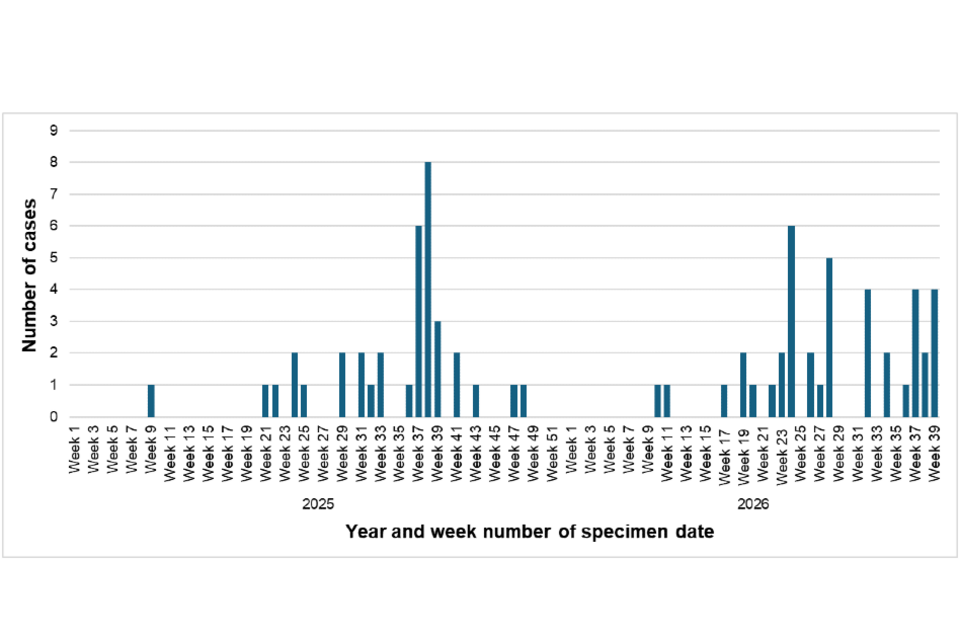
As a result of the detection of Salmonella Enteritidis t5.8998 in these Ukrainian eggs, and findings from food chain investigations in relation to the ongoing S.E t5.9411 incident, on 10 October 2026, the Food Standards Agency (FSA) issued a Food Alert for Action (FAFA) (5) to businesses, including caterers, manufacturers and wholesalers, as well as consumers, to advise businesses to withdraw and recall eggs from this particular Ukrainian egg producer with a specific producer code stamped on the egg shell.
UKHSA and FSA continue to work closely together to evaluate the impact of this action of the supply chain on cases of Salmonella Enteritidis.
References
1. UKHSA (December 2025). ‘Outbreak of Salmonella Enteritidis in the UK, November 2025’. Health Protection Report: volume 19, number 11 (news)
2. UKHSA (August 2026). ‘National outbreak of Salmonella Enteritidis (t5.9411) in the UK’. Health Protection Report: volume 20, number 8 (news)
3. UKHSA (2026). ‘Notified cases of Salmonella Enteritidis (t5.9411 and related clusters) in England: data to week 35’
4. UKHSA. ‘Salmonella statistical releases’
5. Food Standards Agency (2026). ‘Food Alert For Action: To food businesses and consumers who have purchased shell eggs originating from Yasensvit Ltd, Ukraine, stamped with the code 3UA1012066’
Update on the investigation of cyclosporiasis in travellers returning from Mexico
UKHSA, alongside Public Health Scotland and Public Health Wales, has been investigating an increase in Cyclospora cayetanensis in UK travellers, the majority of whom reported travel to Mexico. This report is an update to the previously published Health Protection Report and indicates that the number of newly reported cases has decreased in August and September, after a peak in June and July 2026.
Between 30 April and 29 September 2026, 135 cases of cyclosporiasis were reported in UK travellers returned from overseas (81 from England, 43 from Scotland and 11 from Wales). Of those with symptom onset or specimen date reported, 1 case (0.9%) had onset of illness in April, 3 (2.6%) in May, 49 (41.9%) in June, 47 (40.2%) in July, 10 (8.5%) in August and 7 (6%) in September. Age was known for all cases and sex for 126 (93.3%) cases; the median age of cases was 47 and 61.1% of cases were female.
Cases of cyclospora infection for 2026 per week (data as of 9 October 2026) by onset date, or specimen date when onset date was unavailable (n=116)
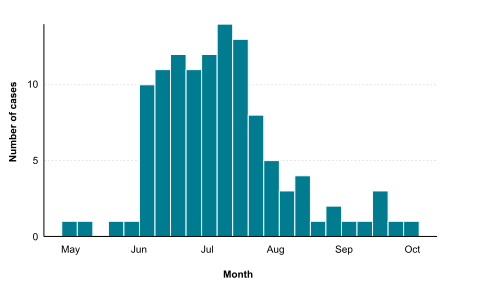
Of the 95 cases with travel information available, 88 (92.6%) had travelled to Mexico, with Riviera Maya remaining the primary region reported. Fewer than 5 cases reported travel to the USA or to both the USA and Mexico, despite outbreaks of cyclosporiasis being reported in the US in 2026 (1). Fewer than 5 cases reported travel to Spain and Canada as part of their travels, which also included visiting either Mexico or the USA.
UKHSA is continuing to liaise with ABTA and Mexican public health authorities to inform investigations of these infections. UKHSA continues to work with the National Travel Health Network and Centre (NaTHNaC) to ensure appropriate advice is in place for UK travellers. More information on cyclosporiasis, including how to protect yourself when travelling can be found on the UKHSA’s blog and NaTHNaC’s TravelHealthPro website.
Reference
1. US Centers for Disease Control and Prevention (2026). ‘Cyclospora outbreak with unknown source’
Hand, foot and mouth disease cases increase in young children
Hand, foot and mouth disease (HFMD) is a common childhood illness that is caused by enteroviruses. HFMD infections can spread quickly in nursery and other childcare settings. Cases usually present with fever, mouth ulcers and a rash, and although it is predominantly a self-limiting illness it can on rare occasions lead to serious neurological or cardiopulmonary complications. A recent epidemiological study in England highlighted the burden of HFMD (presenting to primary care) in children aged under 5 years (1).
UKHSA syndromic surveillance systems are used to monitor all-hazard health threats in real-time, utilising data from NHS sources including NHS 111, general practitioners (GP) and emergency departments (2). During September 2026, increases in general practitioner (GP) ‘in-hours’ consultations for HFMD were identified, particularly in children aged 1 to 4 years (see figure). The autumn/winter seasonal trends of HFMD GP consultations seen in previous years generally have two patterns of activity: a higher and more rapid increase in activity starting in September and peaking in October, as seen in 2024 and 2021; or a lower and more gradual increase as seen in other years, starting in September, but peaking in October or November (see figure). Currently, 2026 is following the trend for the higher activity years, fitting with a 2 to 3 yearly cycle.
Daily GP consultation rate per 100,000 (7-day moving average) for hand, foot and mouth disease in children age 1 to 4 years, 2020 to 2026, England
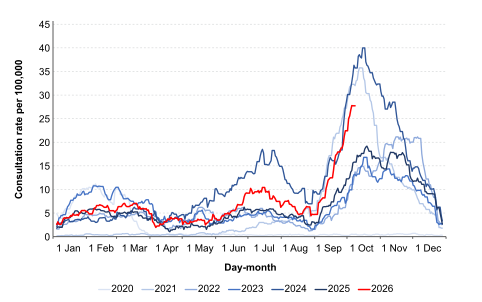
Information on HFMD for children and young people’s educational settings is available and is focused on preventative measures such as good hand and respiratory hygiene (3). Further epidemiological and microbiological investigations are planned to better understand the specific enteroviruses that are currently circulating and that may be associated with increased HFMD presentations this season, and how these compare to previous years. This work will also elucidate whether HFMD seasonality in England follows a 2 to 3 year cycle, which will help inform clinicians and NHS services to plan for increases in presenting cases and clinical management, treatment and advice.
References
1. Bednarska NG, Smith S, Bardsley M, and others (2025). ‘Trends in general practitioner consultations for hand foot and mouth disease in England between 2017 and 2022. Epidemiology and Infection: volume 153, e-page 22
2. UKHSA (2026). ‘Syndromic surveillance: systems and analyses’
3. UKSHA (2026). ‘Health protection in children and young people’s settings, including education’
Strengthening norovirus surveillance in England and preparing for the 2026/27 winter
Norovirus is the most common cause of infectious gastroenteritis worldwide and outbreaks of norovirus contribute significantly to winter pressures on the NHS and social care each winter. Following unusual norovirus activity in recent seasons (1,2), UKHSA has been working to strengthen norovirus surveillance ahead of this winter. This includes implementation of more sophisticated typing methods, improving surveillance outputs and undertaking research to gain insights into whether there is a difference in severity of illness between norovirus genotypes. This article provides an overview of this work and a forward look for the 2026/27 season.
Implementation of dual-typing and development of next generation sequencing for norovirus
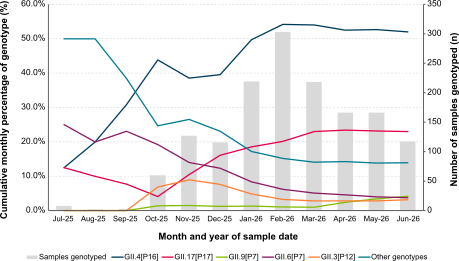
To monitor circulating noroviruses the national reference laboratory carries out genotyping on norovirus-positive samples referred from diagnostic laboratories, representing at least 10 percent of laboratory confirmed cases each season. Historically, UKHSA has employed a method which sequences a region of the capsid gene to identify the genotype. However this methodology did not include the polymerase gene and polymerase-types (P-type) were not assigned. During the 2025/26 season UKHSA introduced the same dual-typing methodology as the US Centers for Disease Control and Prevention (CDC), which sequences partial regions of both the capsid and polymerase genes for genogroup I (GI) or genogroup II (GII) noroviruses (3). From October 2025 onwards dual-typing was routinely implemented and this data is summarised in figure 1 and table 1.
Figure 1: Cumulative monthly percentage of genotypes identified using the dual-typing methodology and the number of samples tested in England during the 2025/26 season
Notes:
‘Other genotypes’ includes all genotypes identified which accounted for under 3% of the total samples in the 2025/26 season.
Between July and October of 2025, the dual-typing method was being validated, so not all samples received underwent dual typing; therefore, cumulative totals for the 2025/2026 season may differ from the data presented using the capsid-only genotyping method in the OS report.
Adoption of the dual-typing method and nomenclature (4) which includes the capsid and polymerase types enables more detailed monitoring of circulating noroviruses. Table 1 summarises norovirus genotypes detected in England using the dual-typing method during the 2025/2026 season and includes the previous nomenclature. It highlights that GII.4 data reported during the 2025/26 season was an aggregation of GII.4[P16], GII.4[P31] and GII.4[P4], with GII.4[P16] representing 52% of all samples typed, whereas the other two represented less than 1 per cent. This transition means that our norovirus surveillance is now more sensitive to detecting the emergence of recombinant noroviruses.
UKHSA is now working to further strengthen its genomic surveillance of norovirus by developing next generation sequencing (NGS) capabilities and will publish sequences for the 2026/27 season . Once implemented this will allow full sequencing of a subset of noroviruses to help us better understand and monitor viral evolution.
Changes to the Official Statistics national norovirus and rotavirus surveillance report and the norovirus data dashboard
During May 2026, UKHSA asked users of the Official Statistic ‘National norovirus and rotavirus surveillance report’ (5) to complete a survey. Based on that feedback, we have made some updates to the report. We have added a figure showing the national rate of norovirus laboratory reports per 100,000 population compared to the 5-season average. The national rate has also been added to the charts which show rates by age group and region, to facilitate interpretation. The molecular surveillance section of the report now presents the dual-typing genotyping data, and we have added an additional metric to the outbreaks section, reporting the percentage of suspected and confirmed norovirus outbreaks reported to the Hospital Norovirus Outbreak Reporting System (HNORS) which result in a ward or bay closure. The report is now produced one day later than in previous seasons, reducing the impact of laboratory reporting lag and thereby improving the completeness and timeliness of the data.
Following the return to weekly reporting on 8 October 2026, UKHSA will be providing weekly updates of national norovirus laboratory report data in the UKHSA dashboard (6) to coincide with the publication of the Official Statistics report each Thursday at 09.30 hours.
Comparing the severity of genotypes GII.4 and GII.17
During the spring of 2023, an unusual genotype, GII.17, rapidly emerged and went on to replace GII.4 as the dominant norovirus during the 2024/25 season (2,7). During the 2025/26 season, UKHSA undertook a study to investigate if there was any difference in the severity of illness and risk of fatality between the GII.4 and GII.17 genotypes (8). This study linked positive norovirus laboratory report and genotyping data with NHS hospital admissions and mortality data to estimate case-fatality risk for the two genotypes over the 3 seasons of 2022/23, 2023/24 and 2024/25. Seasonal peaks in hospital admissions correlated with peaks in norovirus laboratory report data and in 2024/25 there was an increase in the proportion of hospital admissions which coincided with the co-circulation of GII.4 and GII.17. The risk of all-cause mortality within 14 days of a positive norovirus test increased with age across all genotypes, but there was no significant difference in the average predicted case-fatality risk between GII.4 and GII.17 genotypes. From these findings we were able to conclude that the increased activity and severity observed with GII.17 was likely driven by lower population immunity, changes in transmissibility and improved testing, rather than a higher genotypic-specific severity of GII.17. These insights will be used to inform future winter preparedness and will be particularly valuable should another unusual genotype emerge and displace GII.4 as the dominant genotype in the future.
The 2025/26 season and recent activity
The 2025/26 season saw a rapid escalation in norovirus activity in England in January 2026 when norovirus laboratory reports almost doubled (+44.7%) from week 1 (n=344) to a season peak in week 3 (n=622), after which activity remained above expected levels for the rest of the season with the only exception of week 11 of 2026. Overall, the cumulative number of laboratory reports during the 2025/2026 season (n=13,430) was 39.7% higher than the 5-season average for the same period (n=9,615) which excludes the seasons which were impacted by the COVID-19 pandemic (2019/20. 2020/21, 2021/22). Consistent with previous seasons, the notable increase was driven by a rise in norovirus laboratory reports in the 65 years-and-over age group and coincided with an increase in suspected and confirmed norovirus outbreaks reported to HNORS. In total 88.6% of reported outbreaks were laboratory confirmed as norovirus, underlining the burden norovirus outbreaks continue to place on the NHS each winter (9).
While GII.4[P16] and GII.17[P17] continued co-circulate throughout the 2025/26 season Figure 1 indicates the increased activity from January 2026 onwards was mostly driven by GII.4[P.16], representing just over half of genotyped samples compared to GII.17[P17] which only accounted for about a quarter (Table 1).
So far during the 2026/27 season norovirus activity has remained within expected levels and GII.4[P16] is the most commonly detected genotype (10), although detections of GII.9[P7] have risen during the first 10 weeks of the season. There remains uncertainty whether these trends will continue for the rest of the winter. This is because norovirus transmission is influenced by many factors including, but not limited to, whether the person has been infected with norovirus recently, community contact patterns and the weather.
The latest data on norovirus is published weekly during the winter months as Official Statistics and UKHSA guidance on how to prevent onward transmission is available: Norovirus: What to do if you catch it and helping to stop the spread
References
1. UKHSA (2024). ‘Increasing levels of norovirus activity in England’. Health Protection Report: volume 18, number 10 (news)
2. UKHSA (2025). ‘Update-on-increasing-levels-of-norovirus-activity-in-england-february-2025’ Health Protection Report: volume 19, number 2 (news)
3. Chhabra P, Browne H, Huynh T, Diez-Valcarce M, Barclay L, Kosek MN, and others (2021). ‘Single-step RT-PCR assay for dual genotyping of GI and GII norovirus strains’. Journal of Clinical Virology: volume 134, number 104689
4. Chhabra P, de Graaf M, Parra GI, Chan MC, Green K, Martella V, and others (2020). ‘Updated classification of norovirus genogroups and genotypes’. Journal of General Virology: volume 100, number 10, pages 1,393 to 1,406
6. UKHSA. ‘Norovirus data dashboard’
7. Chhabra P and others (2024). ‘Increased circulation of GII.17 noroviruses, six European countries and the United States, 2023 to 2024’. EuroSurveillance: volume 29, number 39, pages 1 to 6
8. Tang ML, Douglas A, Celma C, Vivancos R, Godbole G, Ward T, and others (2026). ‘Case-fatality risk of norovirus, England, 2022-2025’. Emerging Infectious Diseases: volume 32, number 8, pages 1,336 to 1,340.
9. UKHSA (2026). ‘National norovirus and rotavirus report, week 27 report: data to week 26 (data up to 28 June 2026)
10. UKHSA. ‘National norovirus and rotavirus reports (week 43 report, data up to 25 October 2026)’
Table 1. Norovirus genotypes in England using the dual-typing method, 2025/2026 season
| Genogroup | Previous genotype nomenclature | Updated dual-type genotype nomenclature | Count | Percentage |
|---|---|---|---|---|
| G/group I | GI.1 | GI.1[P1] | 6 | <1.0% |
| G/group I | GI.1 | GI.1[P3] | <5 | <1.0% |
| G/group I | GI.2 | GI.2[P2] | <5 | <1.0% |
| G/group I | GI.3 | GI.3[P10] | <5 | <1.0% |
| G/group I | GI.3 | GI.3[P13] | 21 | 1.4% |
| G/group I | GI.3 | GI.3[P3] | 18 | 1.2% |
| G/group I | GI.4 | GI.4[P4] | 7 | <1.0% |
| G/group I | GI.5 | GI.5[P5] | 9 | <1.0% |
| G/group I | GI.6 | GI.6[P11] | <5 | <1.0% |
| G/group I | GI.7 | GI.7[P7] | 25 | 1.7% |
| G/group I | GI.8 | GI.8[P8] | <5 | <1.0% |
| G/group II | GII.1 | GII.1[P33] | 6 | <1.0% |
| G/group II | GII.1 | GII.1[P37] | <5 | <1.0% |
| G/group II | GII.2 | GII.2[P16] | 9 | <1.0% |
| G/group II | GII.2 | GII.2[P2] | 26 | 1.7% |
| G/group II | GII.3 | GII.3[P12] | 48 | 3.2% |
| G/group II | GII.3 | GII.3[P16] | 5 | <1.0% |
| G/group II | GII.3 | GII.3[P3] | <5 | <1.0% |
| G/group II | GII.4 | GII.4[P16] | 782 | 52.0% |
| G/group II | GII.4 | GII.4[P31] | <5 | <1.0% |
| G/group II | GII.4 | GII.4[P4] | 7 | <1.0% |
| G/group II | GII.5 | GII.5[P2] | <5 | <1.0% |
| G/group II | GII.6 | GII.6[P7] | 57 | 3.8% |
| G/group II | GII.7 | GII.7[P7] | 25 | 1.7% |
| G/group II | GII.8 | GII.8[P8] | <5 | <1.0% |
| G/group II | GII.9 | GII.9[P16] | <5 | <1.0% |
| G/group II | GII.9 | GII.9[P7] | 63 | 4.2% |
| G/group II | GII.12 | GII.12[P16] | <5 | <1.0% |
| G/group II | GII.13 | GII.13[P16] | 6 | <1.0% |
| G/group II | GII.15 | GII.15[P15] | 8 | <1.0% |
| G/group II | GII.16 | GII.16[P16] | <5 | <1.0% |
| G/group II | GII.17 | GII.17[P17] | 346 | 23.0% |
| G/group II | GII.20 | GII.20[P20] | <5 | <1.0% |
| G/group II | GII.20 | GII.20[P7] | <5 | <1.0% |
| G/group II | GII.21 | GII.21[P16] | <5 | <1.0% |
| G/group II | GII.21 | GII.21[P21] | <5 | <1.0% |
Infection reports in this issue: MMR
Laboratory confirmed cases of measles, mumps and rubella, England: April to June 2026
Vaccine coverage: provisional childhood coverage data; time-limited MenB young adults programme; maternal pertussis
Provisional childhood vaccine coverage: August data
MenB one-off young adults programme vaccine coverage report up to September 2026
Prenatal pertussis vaccination coverage in England from April to June 2026
Chemical and environmental hazards: LEICSS 2026
Lead Exposure in Children Surveillance System (LEICSS) annual report, 2026