MenB one-off young adults programme vaccine coverage report up to September 2026
Published 1 October 2026
Applies to England

© Crown copyright 2026
This publication is licensed under the terms of the Open Government Licence v3.0 except where otherwise stated. To view this licence, visit nationalarchives.gov.uk/doc/open-government-licence/version/3 or write to the Information Policy Team, The National Archives, Kew, London TW9 4DU, or email: psi@nationalarchives.gov.uk.
Where we have identified any third party copyright information you will need to obtain permission from the copyright holders concerned.
This publication is available at https://www.gov.uk/government/publications/menb-one-off-vaccination-programme-young-adults-2026-coverage-reports/menb-one-off-young-adults-programme-vaccine-coverage-report-up-to-september-2026
This interim report presents meningococcal group B (MenB) vaccine coverage in England for the MenB one-off programme targeting young adults, which began on 20 July 2026. This report measures dose 1 coverage in the 2025/26 Year 13 cohort only (those born between 1 September 2007 and 31 August 2008). Coverage estimates in this report include vaccinations given up to 20 September 2026. Coverage of dose 2 will be assessed in future reports.
Coverage is grouped by commissioning region, Integrated Care Board (ICB), Index of Multiple Deprivation decile (IMD), ethnicity and sex.
Reports in this series will be published monthly.
Main findings
The main findings are that:
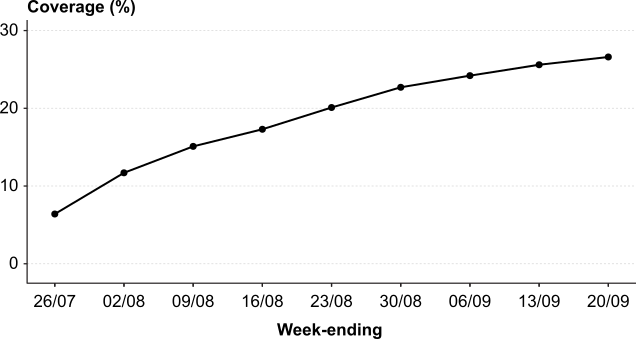
- coverage was 26.6% (212,549 vaccinated out of 799,840 eligible individuals) up to 20 September 2026
- coverage is gradually increasing as individuals have more time to be vaccinated
- coverage varies substantially by geography, sex, deprivation and ethnicity
Coverage in England
Cumulative coverage reached 26.6% (212,549 vaccinated out of 799,840 eligible individuals) by 20 September 2026, the ninth week of the programme (Figure 1).
Figure 1. MenB dose 1 coverage by week, up to 20 September 2026
Coverage by geography
The main findings for coverage by geography were that:
- coverage by commissioning region differed by 10.6 percentage points, from 21.0% in London to 31.6% in the South East (Table 1)
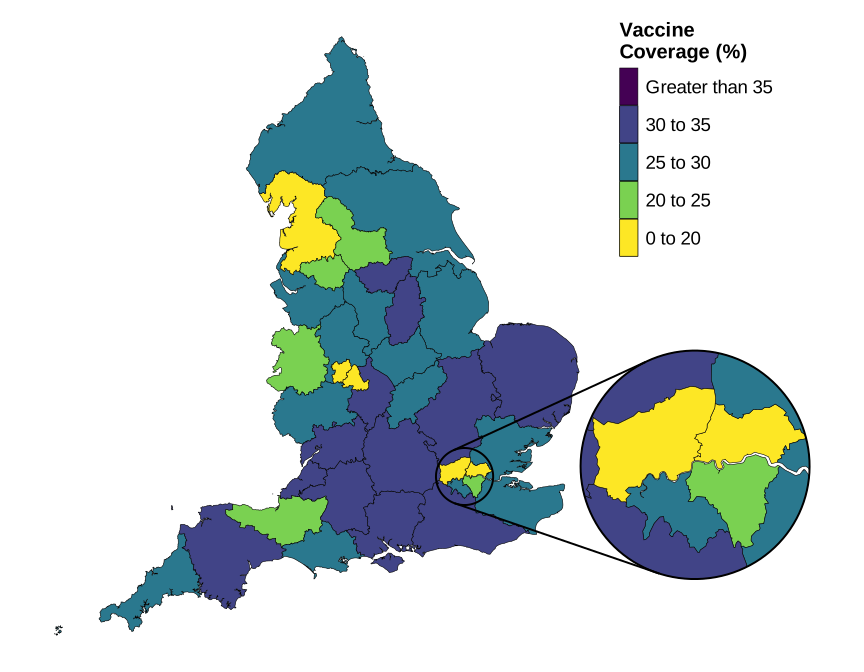
- coverage by ICB differed by 17.6 percentage points, from 16.2% in North East London ICB to 33.8% in Nottingham and Nottinghamshire ICB (Figure 2)
Table 1. MenB dose 1 coverage by commissioning region, up to 20 September 2026
| Commissioning region | MenB dose 1 coverage (%) |
|---|---|
| North East and Yorkshire | 26.6 |
| North West | 23.0 |
| Midlands | 25.7 |
| East of England | 29.7 |
| South East | 31.6 |
| London | 21.0 |
| South West | 30.7 |
Figure 2. MenB dose 1 coverage by ICB, up to 20 September 2026
Coverage by deprivation
Coverage by IMD 2025 decile differed by 33.2 percentage points, from 11.8% in the most deprived decile to 45.0% in the least deprived decile (Table 2).
Table 2. MenB dose 1 coverage by IMD 2025 decile, up to 20 September 2026
| IMD 2025 decile | MenB dose 1 coverage (%) |
|---|---|
| 1 (most deprived) | 11.8 |
| 2 | 15.7 |
| 3 | 19.8 |
| 4 | 22.8 |
| 5 | 26.8 |
| 6 | 28.5 |
| 7 | 31.3 |
| 8 | 33.2 |
| 9 | 38.8 |
| 10 (least deprived) | 45.0 |
Coverage by ethnicity
Coverage by ethnicity differed by 34.1 percentage points, from 8.8% in the Gypsy or Irish Traveller ethnic group to 42.9% in the Chinese ethnic group (Table 3).
Table 3. MenB dose 1 coverage by ethnic group, up to 20 September 2026
| Ethnic group | MenB dose 1 coverage (%) |
|---|---|
| Gypsy or Irish Traveller | 8.8 |
| Unknown | 12.0 |
| Asian or Asian British – Pakistani | 13.1 |
| Arab | 13.8 |
| Black or Black British – Caribbean | 16.0 |
| Asian or Asian British – Bangladeshi | 17.2 |
| Mixed – White and Black Caribbean | 18.4 |
| Other ethnic groups – Any other ethnic group | 19.5 |
| Black or Black British – Any other Black background | 20.6 |
| White – Other | 22.1 |
| Black or Black British – African | 24.6 |
| White – Irish | 26.4 |
| Mixed – White and Black African | 26.8 |
| Mixed – Any other mixed background | 27.2 |
| Asian or Asian British – Any other Asian background | 27.5 |
| White – British | 31.5 |
| Mixed – White and Asian | 34.8 |
| Asian or Asian British – Indian | 36.5 |
| Chinese | 42.9 |
Note. Ethnic group was recorded for 87.7% of eligible individuals
Coverage by sex
Coverage by sex differed by 9.6 percentage points, from 21.9% in men to 31.5% in women (Table 4).
Table 4. MenB dose 1 coverage by sex, up to 20 September 2026
| Sex | MenB dose 1 coverage (%) |
|---|---|
| Female | 31.5 |
| Male | 21.9 |
| Unknown | 6.9 |
Data sources and methodology
Data for this report was extracted on 28 September 2026 from the Immunisation Information System (IIS) and the number of vaccinations was calculated by aggregating individual level MenB vaccination records. The number of eligible individuals was estimated based on the IIS denominator which includes records for all individuals in the population, based on the Personal Demographic Service.
Indicator definitions
Coverage is defined as the proportion of the eligible population (denominator) that have been vaccinated with the MenB vaccine (numerator). This report measures cumulative coverage, so estimates include vaccinations given in previous weeks.
Dose 1 was defined as the earliest dose given between 20 July 2021 and 31 December 2026, excluding vaccinations administered after the extraction date. This includes vaccinations administered during the one-off programme and those given during the outbreak response in Kent.
Some individuals will have received the MenB vaccine prior to 20 July 2021, however since protection from the MenB vaccine lasts for around 5 years these individuals are still eligible for the one-off MenB programme.
Geography
Commissioning region and ICB were identified by linking each individual’s most recent residential postcode in IIS to the Office for National Statistics (ONS) Postcode directory.
IMD
Deprivation is estimated using the Index of Multiple Deprivation which measures deprivation based on income, employment, education, health, crime, barriers to housing and services, and living environment. In this report we use the 2025 IMD decile of an individual’s residential Lower Layer Super Output Area as a proxy for deprivation.
Ethnicity
Ethnicity is stratified based on the ONS Ethnic group classifications.
Sex
Sex is based on the latest recorded sex in the IIS denominator dataset. The ‘Unknown’ category represents individuals where their sex is unknown or other.
Cohorts
The 2025/26 Year 13 birth cohort was defined as individuals born between 1 September 2007 and 31 August 2008, resident in England and alive at the extraction date. The number of eligible individuals was deduplicated based on NHS number.
In this report we have presented coverage figures for the 2025/26 Year 13 cohort, which will include those starting university for the first time. The data currently available does not allow first-time university entrants to be identified which means that coverage estimates cannot be stratified by eligibility group.
Background information
In 2026, a national MenB one-off vaccination programme was introduced for young adults in response to an outbreak of meningococcal disease in Kent that began in March 2026. The programme targets young people who were in Year 13 in the 2025/26 academic year and those aged under 25 starting university or some further education colleges as residential students for the first time. These groups are at increased risk of meningococcal disease due to social mixing patterns and other risk factors. The programme began on 20 July 2026 and continues until 31 March 2027.
Eligibility
The MenB one-off young adults programme is available in England, Scotland, Wales, Northern Ireland and the Crown Dependencies (Jersey, Guernsey, and the Isle of Man).
The cohorts eligible for the one-off MenB programme in England are:
- individuals born between 1 September 2007 and 31 August 2008
- individuals aged under 25, born on or after 21 July 2001 and starting at university for the first time, or starting in further education for the first time and living at further education accommodation, in autumn 2026. This includes international students, students from the devolved administrations and crown dependencies, and those travelling abroad to study.
Timing of vaccination
The MenB vaccination programme consists of 2 doses administered at least 28 days apart. Eligible individuals were advised to receive their first dose as soon as possible, so that the majority of those eligible could receive their second doses, and therefore be fully protected before the start of the 2026/27 academic year.
For the one-off programme which commenced on 20 July 2026, dose 1 will be offered until 31 December 2026 and dose 2 will be offered until 31 March 2027.
In England, the vaccination programme will be delivered in community pharmacies.
Limitations
There are some limitations which should be taken into account when interpreting the coverage figures presented in this report. Firstly, data flows mean that vaccinations administered outside England, including those given in the devolved administrations, will not be recorded within the IIS MenB vaccination dataset. This means that some vaccinations may not be captured in the numerator. Also, the IIS may not take into consideration all people who have left the country, meaning it is likely to be overestimated. These caveats mean that coverage is likely to be higher than the estimates presented here although the degree of under-estimation is difficult to accurately ascertain.
Feedback and contact details
If you have any feedback or questions about the information presented in this report please contact the UKHSA vaccine coverage team at menb@ukhsa.gov.uk.