HPR volume 20 issue 7: news (30 July 2026)
Updated 24 September 2026

© Crown copyright 2026
This publication is licensed under the terms of the Open Government Licence v3.0 except where otherwise stated. To view this licence, visit nationalarchives.gov.uk/doc/open-government-licence/version/3 or write to the Information Policy Team, The National Archives, Kew, London TW9 4DU, or email: psi@nationalarchives.gov.uk.
Where we have identified any third party copyright information you will need to obtain permission from the copyright holders concerned.
This publication is available at https://www.gov.uk/government/publications/health-protection-report-volume-20-2026/hpr-volume-20-issue-7-news-30-july-2026
Investigation of cyclosporiasis in travellers returning from Mexico
The UK Health Security Agency (UKHSA), Public Health Scotland and Public Health Wales have all identified an increase of infections caused by Cyclospora species in travellers returning from Mexico.
Between 30 April and 15 July 2026, 67 cases of cyclosporiasis were reported in the UK (30 in England, 27 in Scotland and 10 in Wales). Age was known for all cases and sex for 59 (88%) cases. The median age of cases is 46, and 66% of cases with information available on sex are female. Of the 51 cases with travel information available, 48 reported travel to Mexico, with 1 reporting both travel to Mexico and the USA. One case reported travel to the USA and 1 to Kenya. Detailed travel information is available for 28 cases who travelled to Mexico, with cases primarily reporting travel to the Riviera Maya region and several reporting travel to Cancún. Cases reported staying in a range of different hotels and consuming a variety of different food and drink within their resort as part of an all-inclusive holiday package. Data collection is ongoing.
Cases of cyclospora infection for 2026 (data as of 15 July 2026) by onset date, or specimen date when onset date was unavailable (n 54, 13 cases missing date)
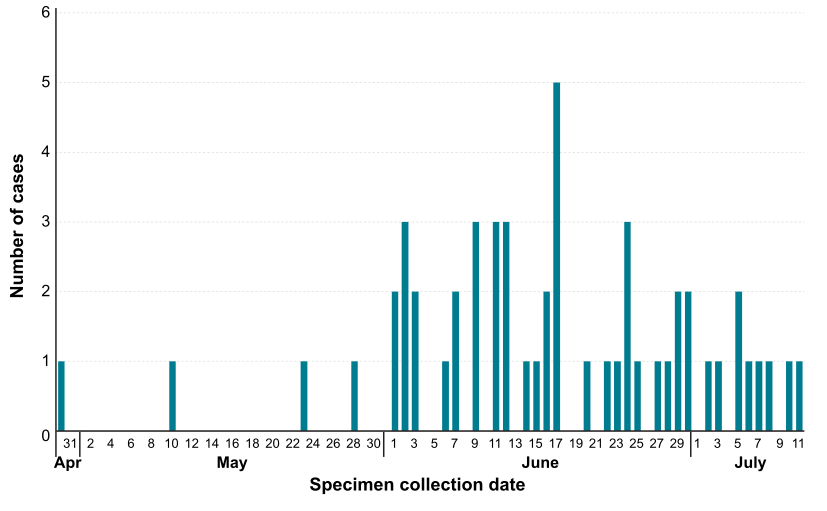
Seasonal outbreaks of cyclosporiasis in UK travellers returning from Mexico have been reported since 2015, except in 2020 and 2021 during the COVID-19 pandemic. Annual case numbers have varied with the highest annual total of 359 cases reported in 2016 and an annual average of 93 cases reported each year between 2022 and 2025. UKHSA is anticipating a continued rise in reported travel-associated cases linked to increased summer travel to Mexico and to the USA, where there has been a widespread outbreak reported (1).
Cyclospora cayetanensis is a protozoan parasite that does not naturally occur in the UK and can cause severe gastrointestinal illness in those who become infected. Cyclospora infection is transmitted through consumption of food or drink that is contaminated with infected human faeces. Therefore, travellers are advised to maintain good food and water hygiene at all times, even if staying in high-end all-inclusive resorts. If possible, travellers should choose freshly prepared food that is thoroughly cooked and served piping hot. Certain foods should be avoided such as fresh uncooked berries and herbs, unpeeled fruit and salad items.
Infection can cause frequent, watery diarrhoea, abdominal cramping, bloating, nausea, flatulence, low-grade fever, loss of appetite and weight. While cyclosporiasis is usually mild and self-limiting for most people, infections can be more serious or prolonged in immunocompromised individuals. Infection is diagnosed by testing stool samples. Although most cases resolve on their own, antibiotics can be given to treat severe or prolonged infections.
UKHSA is liaising with ABTA and Mexican public health authorities to inform investigations of these clusters. UKHSA continues to work with the National Travel Health Network and Centre (NaTHNaC) to ensure appropriate advice is in place for UK travellers. More advice is available on NaTHNaC’s TravelHealthPro website, including specific information on cyclospora and summer travel.
Reference
1. US Centers for Disease Control and Prevention (July 2026). ‘Cyclospora outbreak linked to iceberg lettuce in 9 states’
Transfusion-transmitted infections (UK): 2025 annual report in summary
This news report summarises the findings of the transfusion transmitted infections (TTI) chapter of the annual Serious Hazards of Transfusion (SHOT) report for 2025, published on the SHOT website. Publication of the report marks 30 years operation of both SHOT and the joint NHSBT (NHS Blood and Transplant) and UKHSA Epidemiology Unit.
Key messages from the TTI chapter of SHOT 2025 are that:
-
no confirmed TTIs were reported in 2025; 3 bacterial near miss incidents involving Staphylococcus aureus were identified
-
bacterial TTI remain rare owing to established safety measures, including bacterial screening of platelet components
-
healthcare professionals should continue to inspect blood components for visual abnormalities and remain alert to possible transfusion reactions
-
vigilant practice throughout the transfusion pathway contributes significantly to the prevention of TTIs
-
hospitals should promptly report suspected TTIs to the relevant UK Blood Service when no alternative cause is identified
-
consultant microbiologists, virologists, and other infectious disease specialists should be involved in the investigation of suspected TTIs
-
the UK Blood Services retain a sample from every blood donation for at least 3 years, enabling retrospective testing when TTIs are suspected
-
data from the annual SHOT report informs blood safety policy and support continuous improvements in transfusion safety
-
UK Blood Services continuously monitor donor infection rates to provide assurance of blood supply
Bacterial transfusion transmitted infections
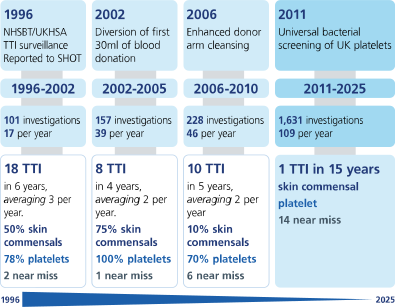
Since the Epidemiology Unit was established in 1995, a range of safety measures have been introduced to reduce the risk of bacterial TTIs. Over 3 decades of surveillance, the number of bacterial TTI investigations has increased, while the number of confirmed transmissions has fallen from an average of 6 cases per year (1996 to 2001) to just 1 case in the last 15 years (2011 to 2025). The most recent confirmed bacterial TTI was reported in 2015 (Figure 1).
Bacterial TTIs are now extremely rare because of the cumulative impact of several safety interventions, including diversion of the first 30 mL of donated blood (introduced in 2002), enhanced arm cleansing with Chloroprep (2006) and universal bacterial screening of all platelet components (2011). However, 14 bacterial near-miss incidents have been reported since 2011, suggesting a shift to prevention and early detection. Continued clinical vigilance, visual inspection of blood components and reporting of near-miss events remain essential.
Figure 1. Confirmed bacterial TTIs identified between 1996 and 2025, aligned to the safety interventions introduced over the same period
Non-bacterial transfusion transmitted infections
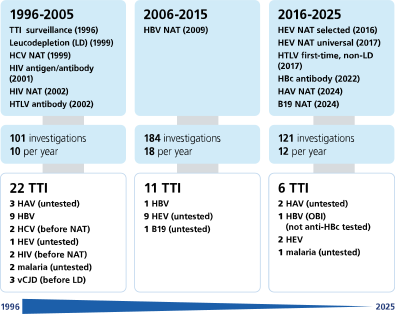
Risk-reduction strategies including donor selection, donation testing, component processing, cold storage, pathogen inactivation and manufacturing controls have also reduced the number of confirmed non-bacterial (viral, parasitic and prion) TTIs. The average number of confirmed non-bacterial TTIs decreased from 2 per year (1996 to 2005) to 0.6 per year (2016 to 2025) (Figure 2).
Figure 2. Confirmed non-bacterial TTIs identified between 1996 and 2025, aligned to the safety interventions introduced over the same period
Although these events remain extremely rare, ongoing surveillance is essential to inform and evaluate blood safety policies. Sensitive screening tests are now in place for viral infections that have previously been associated with confirmed TTIs. While the criteria for malaria testing have been refined over time, testing still relies on identifying donors with a relevant travel or exposure history. Identification of TTIs has led to policy reviews and changes to testing strategies, such as the introduction of hepatitis E virus (HEV) screening. Continued horizon scanning for emerging infections is crucial to ensuring vigilance and responding to any potential threats to blood safety.
In 2025, UK Blood Services investigated 100 suspected bacterial incidents and 10 suspected viral or parasitic incidents. No confirmed transmissions were identified. Most suspected bacterial cases were concluded to be post-transfusion reactions or conditions related to the patient’s underlying illness. This included all cases with positive patient blood cultures, where there was no evidence of the implicated organism in associated blood components or recipient investigations. Three bacterial near-miss incidents involving Staphylococcus aureus were reported. Of the non-bacterial investigations, 6 were concluded as not transmissions, 1 as a possible hepatitis B (HBV) and 1 undetermined HBV, with 2 investigations pending (1 HBV and 1 malaria).
Three pending investigations were reported in 2024. Since then, 1 hepatitis C virus (HCV) investigation has been concluded as no transmission, 1 B19 investigation remains pending, and a second B19 investigation has been concluded as a probable transmission. This case involved a kidney transplant recipient with multiple donor exposures, who was diagnosed with high grade parvovirus following their transplant. Archive testing of the donors identified 1 positive for B19. This was prior to testing of all whole blood and plasma donors for B19. Molecular typing was not conducted, but the transfusion was the most likely source of the transmission.
Viral transmissions are extremely rare in the UK, with only 33 confirmed transfusion-transmitted viral infections documented in the UK since 1996. Among these, hepatitis B (HBV) (n=11) and hepatitis E (HEV) (n=12) were the most reported proven viral TTI. Since 2022, hepatitis B core antibody (anti-HBc) screening has been undertaken to reduce the risk of HBV transmission from donors with occult HBV (OBI). For HEV, all except 2 transmissions were reported before the HEV RNA screening was introduced in April 2017 in the UK. The chance (or residual risk) of not detecting HBV, HCV, or HIV in whole blood donations in the UK remains very low, at around 1 per million donations tested (1).
Suspected TTIs should be reported promptly to the Blood Service for investigation, particularly when no other cause can be identified, to ensure that other components can be recalled preventing further transmissions. TTIs remain extremely rare in the UK due to risk reduction strategies including donor selection and rigorous testing of blood donations. All suspected TTIs investigated by the UK Blood Services are reported to the joint NHSBT and UKHSA Epidemiology Unit for monitoring and form part of the Serious Hazards of Transfusion (SHOT) haemovigilance scheme.
Lookback investigations
Lookback investigations are initiated when repeat donors are found to have newly identified markers of infection, either through donor seroconversion, post-donation information, or the introduction of a new test. In 2025, NHSBT initiated 2 lookback investigations involving repeat donors with newly identified markers.
One repeat apheresis donor’s most recent donation tested positive for HEV RNA positive. The archive from the donor’s most recent screen-negative donation was subsequently found to be positive. Two recipients were traced; 1 had died and the other tested negative, with no evidence of HEV infection.
The second donor had markers of occult hepatitis B infection (OBI) and had donated on 3 previous occasions. No archived samples were available for testing. Five recipients who had received these donations were followed up; 4 had died and 1 tested negative with no evidence of HBV infection. In Scotland, 10 syphilis and 1 HEV lookback investigations were conducted, and no transmissions were identified.
Further information about these cases is available in the TTI chapter of the annual SHOT report.
Reference
1. JPAC position statement (2025). ‘Estimated residual risk for HBV, HCV and HIV’
Neonatal sepsis assessment in England reviewed
In the wake of group B Streptococcus (GBS) awareness week, a new study examining early-onset neonatal sepsis (EOS) in England - of which GBS is a leading cause - has been published (1).
Following a 2021 UKHSA survey that identified variation in approaches to neonatal sepsis assessment across England (2), researchers at UKHSA, Imperial College London and the Evelina London Children’s Hospital undertook a national evaluation to investigate the impact of these differences in clinical practice (1).
The study examined outcomes in newborn babies following a transition from National Institute for Health and Care Excellence (NICE) guidance to the Kaiser Permanente Early-Onset Neonatal Sepsis risk calculator (KP-SRC) in 16 NHS hospital Trusts across England between 2015 and 2023 (3,4).
Both NICE guidance and the KP-SRC are approved approaches for assessing babies at risk of sepsis during the first days of life. Previous studies have shown that use of the KP-SRC can reduce antibiotic treatment in newborns, but there has been limited large-scale evidence from England on potential negative impacts, such as delayed diagnosis of EOS.
The evaluation included more than 222,000 babies born during the 18 months before and after implementation of the KP-SRC. Rates of EOS, hospital readmission with EOS, and mortality were compared before and after the transition.
Overall, the study found no evidence of an increase in adverse outcomes following implementation of KP-SRC, including no overall increase in delayed diagnosis of EOS among babies readmitted after discharge. There was also no increase in mortality attributable to EOS but the study was not powered for this outcome.
However, the findings identified variation between hospitals. While the overall national picture was reassuring, some Trusts experienced non-significant increases in EOS readmissions following implementation. This variation may reflect differences in how the calculator was used in local clinical pathways.
The findings suggest that, while there was no overall increase in adverse outcomes following implementation of the KP-SRC, ongoing local monitoring and evaluation remain essential following changes to neonatal sepsis assessment pathways, and when the KP-SRC is used, as per the NICE guidance recommendations (3).
As with any change in clinical practice, potential benefits from reducing unnecessary antibiotic treatment should be balanced against the risk of undertreatment, reinforcing the importance of continued surveillance and quality assurance at local level.
References
1. Barton HE, Moore HL, Guy RL, Oeser C, Nsonwu O, Collin SM, and others (2026). ‘Impact of Kaiser permanente early-onset sepsis risk calculator implementation in hospitals, England: pre–post intervention cohort analysis‘.Archives of Disease in Childhood - Fetal Neonatal Edition
2. Moore HL, Battersby C, Piyasena C, Demirjian A, Lamagni T (2023). ‘Assessing variation in neonatal sepsis screening across England’. Archives of Disease in Childhood - Fetal Neonatal Edition: volume 108 number 4 pages 430–1
3. National Institute for Health and Care Excellence (2021). ‘Neonatal infection: antibiotics for prevention and treatment (NICE Guideline 195)’
4. Kuzniewicz MW, Puopolo KM, Fischer A, Walsh EM, Li S, Newman TB, and others (2017). ‘A quantitative, risk-based approach to the management of neonatal early-onset sepsis’. JAMA Pediatrics: volume 171, number 4, page 365
Infection reports
Laboratory confirmed cases of measles, mumps and rubella, England: January to March 2026
Laboratory reports of Haemophilus influenzae by age group and type, England: annual 2025 (and 2024)