HPR volume 20 issue 8: news (18 and 27 August 2026)
Updated 24 September 2026

© Crown copyright 2026
This publication is licensed under the terms of the Open Government Licence v3.0 except where otherwise stated. To view this licence, visit nationalarchives.gov.uk/doc/open-government-licence/version/3 or write to the Information Policy Team, The National Archives, Kew, London TW9 4DU, or email: psi@nationalarchives.gov.uk.
Where we have identified any third party copyright information you will need to obtain permission from the copyright holders concerned.
This publication is available at https://www.gov.uk/government/publications/health-protection-report-volume-20-2026/hpr-volume-20-issue-8-news-18-august-2026
National outbreak of Salmonella Enteritidis (t5.9411) in the UK
On 26 May 2026, the Gastrointestinal Infections, Food Safety and One Health (GIFSOH) division at the UK Health Security Agency (UKHSA) identified an increase in the number of cases of Salmonella Enteritidis caused by a single strain using whole genome sequencing (WGS) data. UKHSA initiated an outbreak investigation, working with public health and food safety agencies in the UK and Devolved Administrations, and the Animal and Plant Health Agency (APHA) to identify additional cases, and consider potential sources of the outbreak to enable control measures to be implemented. Cases were interviewed with an outbreak questionnaire to gather information on severity of illness and risk factors for infection.
S. Enteritidis is the most common Salmonella serovar in England and the leading cause of salmonellosis in people (1). Like all non-typhoidal Salmonella, it is spread via consumption of contaminated food (including eggs, poultry, meat, unpasteurised dairy and fresh produce), contact with the environment, or person-to-person transmission. Symptoms of salmonella infection include diarrhoea, stomach cramps and sometimes vomiting and fever. Salmonella generally causes a self-limiting gastroenteritis, although immunocompromised individuals and those in vulnerable groups (young children and older adults) may experience more severe illness such as blood stream infections, infection of metastatic sites, sepsis and multiorgan failure.
As of 13 August 2026 (3), 207 confirmed cases between 11 August 2025 and 1 August 2026 had been detected within this outbreak, all within the same 5-single nucleotide polymorphism (SNP) single linkage cluster based on WGS, indicating a common source of contamination. The majority of cases (206 out of 207) in the cluster were reported in 2026.
Cases were resident in England (n=199), Scotland (n=6), Wales (n=1) and Northern Ireland (n=1). For cases resident in England, the regions with the highest number of cases to date were London (n=47) and Yorkshire and Humber (n=38).
Figure 1. Number of Salmonella Enteritidis outbreak cases reported in 2026, over time, based on sample date (n=203 [note1])
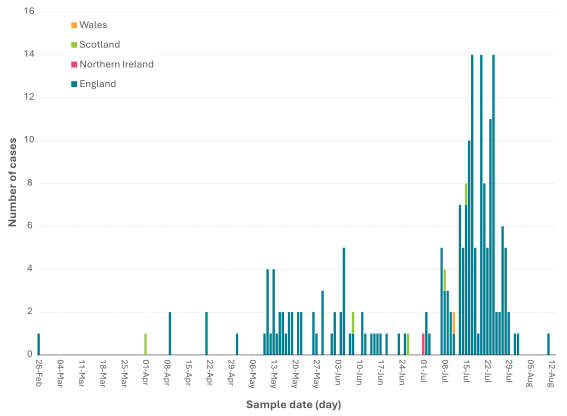
Note 1: sample date not known for remaining 3 cases reported in 2026.
Cases range in age from 0 years to 90 years with a median age of 30. Across all age groups, 51% (n=105) were female.
Evidence gathered as of 13 August suggested that the outbreak is not associated with international travel, as only 6 out of 207 cases (3%) had reported travel to countries outside of the UK.
Most people affected in the outbreak experienced self-limiting gastrointestinal illness; however, 38% of people with information available were admitted to hospital due to their salmonellosis symptoms and two people had a blood stream infection. There had been one death associated with the outbreak, as of 13 August.
The Outbreak Control Team utilised the ECDC EpiPulse platform to notify member countries of the outbreak, and to understand whether other countries had identified genetically related Salmonella Enteritidis cases.
Extensive epidemiological and food chain investigations are ongoing to identify the source and origin of the contamination responsible for illness. As of 13 August, 114 cases had been interviewed and had completed a regional questionnaire or an outbreak questionnaire. Of those cases with a completed questionnaire, 95 (83%) reported eating food prepared outside of the home in the week prior to symptom onset. Case interviews identified 5 food businesses where two or more independent cases reported attending in the week prior to symptom onset. These food businesses linked 24 cases in total. Eleven of these cases reported eating dishes made with eggs. The signal for egg consumption remains the strongest in this investigation to date.
Food chain investigations, as of 13 August, had identified that those premises had been supplied with eggs from multiple sources, including egg importers. Local investigations had also identified possible cross-contamination risk events within two of the settings. As of 13 August, there was no identified link to UK-produced eggs or poultry. The FSA is liaising with local authority environmental health teams who have provided advice on food safety management to food businesses where issues have been identified.
This outbreak of Salmonella Enteritidis is phylogenetically linked (within 25 SNPs) to a previous outbreak from 2025 which was also linked to imported eggs (2). UKHSA, alongside APHA, FSA and Devolved Administrations are working to collate the information gathered in these outbreaks to explore any potential risks posed from imported eggs and implement preventative measures if necessary.
References
1. UKHSA (2026). ‘Non-typhoidal Salmonella data 2015 to 2024’
2. UKHSA (2025). ‘Outbreak of Salmonella Enteritidis in the UK, November 2025’ Health Protection Report: volume 19, number 11
3. UKHSA (27 August 2026). ‘Notified cases of Salmonella Enteritidis (t5.9411 and related clusters) in England.
Giardiasis annual surveillance report 2025
A new UKHSA report on giardiasis in England, published on 26 August, refers to 6,069 laboratory-confirmed cases having been reported in 2025, an increase of 11.4% compared with 2024 and the highest annual total reported since 2016.
Giardiasis is a gastrointestinal infection, caused by the Giardia parasite, that can lead to diarrhoea, stomach cramps and bloating. In the UK, it is usually caught by swallowing contaminated water or food, through contact with an infected person or animal, or by accidentally ingested contaminated water while swimming.
The Agency is investigating the reasons for the upward trend in reports, likely to be the result of a mix of factors, including: new, more effective testing and changes in patterns of international and domestic travel since the pandemic.
Vector-borne disease in the UK and World Mosquito Day 2026
In May this year UKHSA, Defra and APHA published the One Health Vector-borne Disease Surveillance Report 2025 which sets out a systematic approach to the identification and assessment of risks to public health associated with vector-borne diseases in England, incorporating a VBD risk monitoring matrix to be updated annually (1, 2).
The inaugural report covered tick-borne and mosquito-borne diseases and other infections transmitted by other vectors (which may be insects, arachnids, animals or humans). Forty VBDs of significance for public health in England were identified: 16 mosqito-borne,10 tick-borne, 13 transmitted by other vector species and 1 with multiple modes of transmission. The report highlighted malaria, dengue, chikungunya, West Nile virus and Lyme disease as VBDs for which significant global changes to distribution and epidemiology had been noted, although for most VBDs, with some exceptions such as Lyme disease, very few, if any, autochthonous human cases had been recorded in England, as of 31 December 2025.
There had been no locally-acquired, mosquito-borne human infections reported in England, as of 31 December 2025, but the report highlighted the putative risk to humans of mosquito-borne viruses: this includes Usutu virus, which is now considered endemic in mosquitoes and birds in south-east England, and WNV, which was detected for the first time in samples of dead mosquitoes collected in 2023 (3).
Recent developments
Since the One Health VBD report 2025 was published, UKHSA has updated guidance on tick-borne encephalitis, of which, up to end-2025, very few cases with no international travel history had been reported to UKHSA. However, a small number of further cases have been reported in 2026 and it is now recommended that vaccination should be considered for occupational groups – such as forestry workers, deer cullers and field scientists – who are regularly exposed to ticks in regions where TBEV-infected ticks have been found (including the New Forest and the north Yorkshire Moors) (4); also, that local authorities should promote seasonal tick-bite prevention messages in those areas.
While mosquito-borne infections in the UK are still predominantly travel-related, the situation in mainland Europe is different.
At the launch of the One Health VBD report, professor Lea BerrangFord, deputy director of the UKHSA’s Centre for Climate and Health Security, noted that, “The overall risk to the public from vector-borne diseases in England remains low, but [ … the …] risk picture is changing due to factors including climate change, urbanisation and the globalisation of trade and travel. We are now seeing cases of mosquito-borne infections regularly reported across Europe, while we continue to detect incursions of invasive mosquitoes at points of entry in the UK, and it is therefore vital to maintain robust surveillance to protect the biosecurity”.
The Aedes albopictus (‘Asian tiger’) mosquito, which transmits dengue and chikungunya viruses, is now established in 16 continental European countries (5) and, during 2025, a record number of locally acquired chikungunya cases were reported on the continent (more than 800 cases in mainland France alone) following a record number of locally-acquired dengue cases in 2024. France also reported its largest outbreaks of West Nile virus to date in 2025, located predominantly in northern parts of the country, including urban Paris.
Six regions of mainland Europe reported locally-acquired WNV infections for the first time in 2026 and the European Centre for Disease Prevention and Control has published several related reports to support preparedness and control efforts (6). For non-specialists, a useful podcast discussing the mosquito-borne infection hazard for human health in continental Europe was made available on its website, featuring the Centre’s expert on emerging and vector-borne diseases (7).
References
1. ‘UKHSA and partners publish first One Health vector-borne disease surveillance report’ [news story]
2. UKHSA (2026). One Health vector-borne disease surveillance report 2025
3. UKHSA (2025). ‘First detection of West Nile virus in UK mosquitoes’ [news story]
4. UKHSA (August 2026). ‘Immunisation against infectious disease (the Green Book): Tick-borne encephalitis’
5. ECDC (2025) . ‘Aedes albopictus: current known distribution’
6. ECDC (August 2026). ‘World Mosquito Day 2026: Europe must upgrade control tools as disease risks rise’ [press release]
7. ECDC (August 2026). ‘What’s biting Europe’ [podcast]
Infection reports in this issue
Laboratory confirmed cases of invasive meningoccocal infection in England: April to June 2026
Vaccine coverage
Provisional childhood vaccine coverage: June 2026
Evidence reviews: meningococcal disease
Transmission parameters in outbreak contexts
Transmission and associated behaviours in outbreaks in closed social congregation settings
Impact of vaping on transmission
Public health and social measures to reduce or prevent transmission