Applicant's guide: Capital Grants 2026 (closed)
Updated 1 September 2026
Applies to England

© Crown copyright 2026
This publication is licensed under the terms of the Open Government Licence v3.0 except where otherwise stated. To view this licence, visit nationalarchives.gov.uk/doc/open-government-licence/version/3 or write to the Information Policy Team, The National Archives, Kew, London TW9 4DU, or email: psi@nationalarchives.gov.uk.
Where we have identified any third party copyright information you will need to obtain permission from the copyright holders concerned.
This publication is available at https://www.gov.uk/government/publications/capital-grants-2026/applicants-guide-capital-grants-2026
Capital Grants 2026 is closed for applications.
When you receive an agreement, read the agreement holder’s guide to understand how to manage your agreement.
1. About Capital Grants 2026
These grants are standalone Capital Grants which can be used on their own, or to support and complement:
- Sustainable Farming Incentive (SFI) agreements
- Countryside Stewardship (CS) Higher Tier (last agreements issued 1 January 2024)
- CS Mid Tier and Wildlife Offers (last agreements issued 1 January 2024)
- CS Higher Tier (CSHT) agreements starting from 2025
- Environmental Stewardship (ES) Higher Level Stewardship agreements
The Rural Payments Agency (RPA) will accept one eligible Capital Grants application submitted in a calendar year for each Single Business Identifier (SBI) that you manage. Any further applications submitted under the same SBI will be rejected.
You can also apply for other capital grants at any time of the year.
This round of the Capital Grants offer will close for applications when the available funding is allocated. Once the scheme opens, we’ll share updates on The Farming Blog, you can subscribe for updates when new posts are published. We will aim to give reasonable notice of the Capital Grants offer closure.
At the point of closure, we will not accept any further applications including those started but not yet submitted.
Funding is not guaranteed even if an application has been submitted and is eligible.
2. Check if you and your land are eligible
Capital Grants are open to land managers who are one of the following:
- an owner occupier
- a tenant
- a landlord
- a licensor if they have management control of the land and activities needed to meet the obligations of the grant for the full duration of the agreement
2.1 Land that is eligible
To be eligible for Capital Grants, land parcels must be entirely within England, and you must have management control of the relevant parcels as set out in section 2.3 ‘Management control of land’.
The following land parcels may also be eligible:
- those included in any existing agreement, see section 2.4 ‘Land receiving other funding’
- those subject to an English Woodland Grant Scheme (EWGS) agreement (read section 2.4.3 ‘English Woodland Grant Schemes’ for some exceptions)
- those included in agreements for PA1: Implementation plan, PA2: Feasibility study, PA3: Woodland management plan, PA4: Agroforestry plan, PA5 Moorland mapping, PA7: Species management plan, or a Woodland tree health grant (if all other eligibility criteria are met)
- those on a site of special scientific interest (SSSI) or scheduled monument, including their boundaries
- non-agricultural land parcels where the eligibility of the capital item allows its use on that area (for example farmyards)
2.2 Land that is not eligible
The following land is not eligible for Capital Grants:
- land parcels containing common land or shared grazing rights
- land that is included in certain other schemes or under obligation (read section 2.4 ‘Land receiving other funding’)
- developed land and hard standing (including permanent caravan sites and areas used for permanent storage)
2.3 Management control of land
You must have management control of the land in a Capital Grants agreement for 5 years from the start date of your agreement, or the countersignature of your landlord (see section 2.3.1 ‘Tenants’). Management control of the land for 5 years is to cover the agreement and durability periods.
This includes control over:
- all activities needed to meet the grant payment
- keeping all capital items funded through this scheme in the condition and to the specification set out in your agreement for the 5 years. This is known as the durability period
- using capital items only for the approved purpose during this period, for example you cannot use a roofing item to cover an area used to house livestock
If you do not meet these requirements, you must get the written consent of all other parties who have management control.
2.3.1 Tenants
If you occupy land under a tenancy, you must have:
- a tenancy agreement granting you management control for at least 3 years from the start of the Capital Grants agreement or the countersignature of your landlord (however, see the requirements for a rolling tenancy below)
- the agreement of your landlord before you apply
- a countersignature from your landlord if you do not have management control for 5 years (for the durability period) from the start of your agreement
- control of all the activities over the land to meet the scheme requirements for the chosen capital items
It is your responsibility to check when you apply for Capital Grants that you do not breach the terms of your tenancy agreement.
If your tenancy is renewed each year on a rolling basis, you must be certain your tenancy will extend to the length of your Capital Grants agreement, or you must have a countersignature from your landlord. You must check this with your landlord before you apply.
If the landlord takes over a Capital Grants agreement from you once your tenancy has ended, they must be eligible to do so. For example, they must not be an ineligible public body.
2.3.2 Landlords
If you are a landlord and can show that you have enough management control over the land and activities, you can apply for an agreement on land you have let to a tenant.
As the Agreement Holder, you must give your tenant a copy of the Capital Grants agreement. RPA may ask you to provide evidence to show that you have done this. It is your responsibility to make sure that your tenant does not breach the terms of the agreement.
2.3.3 Partnerships
If you are in a business partnership, you can apply for Capital Grants. The person signing the application must have the appropriate permission levels in the Rural Payments service.
2.3.4 Licensors
If you are a licensor, you can apply for a Capital Grants agreement. It is your responsibility to make sure that the licensee does not breach the terms of the agreement.
You must make sure that the licensee is aware of the requirements of the agreement, as relevant to the licence, and include these in the licence agreement.
2.3.5 Licensees
Licensees are usually not eligible for Capital Grants as a licence arrangement will not provide sufficient management control of the land to the licensee for the agreement period.
If in practice your licence agreement gives you wider land management responsibilities, this may mean you are a tenant and therefore may be eligible for Capital Grants. You must show that you have sufficient management control of the land and activities to be able to apply. See section 2.3.1 ‘Tenants’ for more information.
2.3.6 Land owned by public bodies
Land owned by some public bodies is eligible for Capital Grants provided the work does not form part of their obligations as a public body.
This includes land owned by:
- local authorities
- national park authorities
- public corporations
Parish councils and former college farms are not considered to be public bodies and so are eligible to apply for Capital Grants.
Land is not eligible if it is owned or managed by:
- Crown bodies (including all government departments, executive agencies and trading funds)
- non-departmental public bodies (NDPBs)
See a list of all government departments, agencies and public bodies on GOV.UK.
2.3.7 Tenants of land owned by public bodies
If you are a tenant of a public body, you will need to check if the land is eligible for Capital Grants with your landlord. If it is, you must get the public body to countersign your application if you do not have a tenancy agreement for 5 years to cover the agreement and durability periods.
If you do have a tenancy agreement for the full term of a Capital Grants agreement and durability period, you are eligible to apply as a tenant with management control of the land. See section 2.3.1 ‘Tenants’.
You cannot apply for Capital Grants for any work that is a requirement of your tenancy or any other legally binding obligation.
2.4 Land receiving other funding
You cannot use Capital Grants to pay for any environmental management for which you are already receiving:
- payment from Exchequer funds
- grant aid from any other public body
You cannot use a Capital Grants agreement to fund capital works that you:
- are required to carry out under other legally binding obligations
- are currently receiving funding from other sources
- have received funding for the same item on the same area in the last 5 years (except fencing where the exclusion period is 7 years)
You may be able to apply for a Capital Grants agreement in addition to an existing Environmental Land Management agreement, if you follow the rules set out in section 2.4.1 ‘Environmental Land Management schemes’ and, 2.4.2 ‘Other Capital Grants agreements’.
RPA will carry out checks to make sure that capital works are not funded twice from public money.
You must make sure that any work proposed for this grant does not breach the conditions of any other agreement.
2.4.1 Environmental Land Management schemes
Land parcels in a Higher Level Stewardship, SFI, Landscape Recovery or Wildlife Offer agreement may be eligible for a Capital Grants agreement providing:
- the same capital works are not being funded twice
- the actions required in your existing agreement and your new Capital Grants agreement are compatible
- there is sufficient space in the parcel
Land in a Countryside Stewardship agreement, including CS Mid Tier, Higher Tier, and CSHT agreements may be eligible if:
- the same capital works are not being funded twice
- the actions required in your existing agreement and your new Capital Grants agreement are compatible
- you have completed and been paid for all capital works in any land parcel included in your Capital Grants application
- there is sufficient space in the parcel
These conditions also apply to land in another capital grant agreement if that agreement is from one of these offers:
- Higher Tier Capital Grants
- Protection and Infrastructure grant
- Woodland Tree Health
- Capital grants plans
- PA3: Woodland management plan
2.4.2 Other Capital Grants agreements
You can include the same land parcels in a new Capital Grants agreement as an existing Capital Grants agreement if:
- the same capital works are not being funded twice
- the actions required in your existing agreement and your new Capital Grants application are compatible
- any capital works on the same land parcel are complete, and you have received your final payment
- you are not submitting more than one application in a calendar year for each SBI that you manage
You can apply for a Capital Grants agreement on land parcels that are not in your existing agreement if the new capital works do not conflict with that agreement.
2.4.3 English Woodland Grant Schemes
You can apply for a Capital Grants agreement on land parcels covered by an English Woodland Grant Scheme (EWGS) capital grant if both of the following apply:
- this does not result in you being paid twice for the same items or activities
- the Capital Grants do not conflict with any ongoing capital EWGS requirements
You cannot apply for Capital Grants on land parcels covered by a multi-annual EWGS agreement, England Woodland Creation Offer, EWGS Farm Woodland Payment, Farm Woodland Premium Scheme or Farm Woodland Scheme.
2.4.4 Inheritance Tax or Capital Gains Tax exemption
Land that’s conditionally exempt from Inheritance Tax (or the object of a maintenance fund) may not be eligible for capital items if they:
- are not compatible with the exemption
- duplicate an activity within the exemption
Read ‘Eligible funding on land conditionally exempt from Inheritance Tax’ for more information and to see which capital items are eligible or not.
3. Capital items you can apply for
There are 80 capital items available, you can find more information in section 5.2 ‘Choosing capital items’. The Capital grant finder gives a description and essential requirements for each capital item. This includes eligibility and evidence requirements.
3.1 Capital Grant groups and funding limits
Items in the offer are divided between 6 groups:
- air quality items, for example slurry scrapers
- assessments items, for example a wildfire checklist
- boundaries, trees and orchards items, for example repairing stone walls
- improvements items, for example educational access visits
- natural flood management items, for example leaky woody dams
- water quality items, for example biofilters
There is a funding limit for 4 of the item groups.
| Group | Funding limit |
|---|---|
| Air quality | £25,000 maximum |
| Boundaries, trees and orchards | £35,000 maximum |
| Natural flood management | £25,000 maximum |
| Water quality | £25,000 maximum |
There is no funding limit for items in the assessment or improvement groups.
Supplementary items
You can apply for supplementary items for some capital items. Read section 5.2 ‘Choosing capital items’ to see if there is a supplementary item available with the capital item that you can apply for.
3.2 What the grant cannot pay for
You cannot use a Capital Grant to pay for:
- any capital works done (or materials purchased) before your agreement starts
- planning application fees or other transactional fees
- agent fees or other advisory fees
- meeting legal requirements, including planning conditions, environmental regulations and tenancy agreements
- any works on land parcels containing common land or shared grazing rights
- any works undertaken as part of another grant or obligation (read section 2.3 ‘Management control of land’
- in-kind contributions (this means the value of donated work or services) or gifted materials where you have not incurred a cost for them
3.2.1 Other schemes or grants
Capital Grants cannot fund works that form part of:
- England’s Community Forests
- England Woodland Creation Offer
- Farming in Protected Landscapes
- Farming Investment Fund
- HS2 Woodland Fund
- Woodland Carbon Fund
- any other grant funded scheme
This is not an exhaustive list.
4. Evidence and supporting documents
You should prepare the evidence and supporting documentation required before applying.
You must send us all the evidence needed to support your application within 10 working days of submitting it.
You can check if capital items in your application need any additional evidence other than that below using the Capital grant finder.
The evidence you will need depends on your application but can include:
- a letter from an accountant confirming you have the financial resources to carry out the work under your agreement. See section 4.1 ‘Business viability’ for the details of when you need to do this and what you need to do
- Catchment Sensitive Farming support for any items in your application that need it. See section 4.2 ‘Catchment Sensitive Farming’ and Table 1 in Annex 2 for more information
- a map or maps showing where the capital works are to be carried out, see section 4.3 ‘Maps’
- a land ownership control form countersigned by your landlord if you are a tenant and you do not have a tenancy which lasts at least 5 years from when you apply, see section 2.3 ‘Management control of land’
In addition, some items may need further supporting evidence with your application. You can check each item using the Capital grant finder.
4.1 Business viability
RPA will check your business or SBI on the bankruptcy and insolvency register. This is to confirm that you have the administrative, financial and operational capacity to meet the capital expenditure required. If your application is not financially viable, we may not offer you an agreement.
4.1.1 Check you have sufficient funds
If you are offered an agreement, you’ll need to pay for capital items or works before you can claim back costs. Use the payment rate information in section 5.2 ‘Choosing capital items’ or the Capital grant finder to calculate the value of your application to make sure you have sufficient funds.
If the value of your capital application is estimated to be more than £50,000 in total, you must submit a statement from an accountant with your application’s supporting documents. This is to confirm that the business or SBI has the resources from trading profits, reserves or loans to carry out the work in the proposed agreement.
The accountant will need to provide a letter on headed paper which confirms:
- they are chartered or certified, or registered with a professional body such as ACCA (Association of Chartered Certified Accountants), ICAEW (Institute of Chartered Accountants in England and Wales), CIPFA (Chartered Institute of Public Finance and Accountancy) or CIMA (Chartered Institute of Management Accountants)
- they act as the accountant for the applicant or have been contracted to act on behalf of the applicant
- you as the applicant have sufficient finances to complete the capital works in your application and how these funds will be sourced (for example, savings or loan)
- their understanding of the total value of the capital works in the application
4.2 Catchment Sensitive Farming (CSF) support
Some capital items are only available with support from CSF following an advisory consultation to discuss your local environmental priorities. You’ll need support from CSF to apply for capital items listed in Table 1 of Annex 2.
CSF area teams are not currently able to prioritise any new requests for advisory visits but will be able to offer advisory visits later this year. Use the ‘CSF advice request form’ to ask for an advisory consultation. They will get in touch when they have capacity to help. In the meantime, you can register for one of their free events.
If you have received CSF support in the last 2 years for the relevant items, you can use this support when you apply.
RPA will remove from your application any relevant capital items which do not have CSF support.
Read Annex 2 to find out:
- which capital items require support
- which capital items help to improve water quality, air quality and natural flood management
- how to identify air or water priorities on your land
4.3 Maps
You must create and submit a map or maps to support your application. You can create your base map by printing your land parcel digital maps in the Rural Payments service.
You need to mark your maps to show the location of your capital items on your land parcels. It may help to complete the application and your maps alongside each other.
Read Annex 3 for more information on creating your supporting maps.
4.4 Check if you need consent to carry out capital works
You must check each capital item you are applying for on the Capital grant finder to see if any consents, permissions or permits are needed.
You will not be paid for any capital works without the necessary consents, permits and permissions being in place before you begin any work.
You are responsible for arranging all relevant consents, permits, permissions, exemptions, and written advice needed for your application.
In some cases, you will not be offered an agreement if these are not in place.
4.4.1 Sites of special scientific interest (SSSI)
You must get consent from Natural England if your application includes land on a SSSI.
4.4.2 Scheduled monuments
Your local Historic England officer can provide advice on any management or changes needed to maintain or bring the scheduled monument into favourable condition. You will also need Scheduled Monument Consent from Historic England for some of the chosen work (such as fencing and gateways).
In these situations, you must contact Historic England to see whether consent is needed, or for advice on how to go about works to avoid or reduce negative effects on the scheduled monument.
Historic England can advise if proposals affecting registered parks and gardens, or registered battlefields are likely to be accepted.
4.4.3 Planning consent
Your local planning authority can give you informal advice on whether a proposal needs planning consent. Read the guidance on planning permission for farms.
You must have any required permission or consent in place before you start any capital works. You will need to provide evidence when you make a claim. You do not need to provide this with your application.
4.4.4 Other consents
You may need to apply for other consents or licences if work affects:
- protected species (as defined by the Wildlife and Countryside Act 1981)
- a watercourse or highway
If you have protected species on your land, you must meet the requirements for their protection before carrying out any activities. For more information, read Managing wildlife on your land. If you have consent for work that affects protected species, you may need to plan around seasonal activity. You should have consent in place before you start any activity.
If the work affects priority habitats (other than SSSIs), you should consider the effect on these even if you do not need consent. To find out more about how to avoid harming protected area and species read Construction near protected areas and wildlife.
4.4.5 Work on trees and hedges
You may need permission for work on trees that are under a Tree Preservation Order (TPO). If this applies to you, contact your Local Authority or National Park Authority.
Find out when you may need a Forestry Commission tree felling licence.
You can fell up to 5 cubic metres (m3) and sell up to 2m3 of timber without a felling licence each calendar quarter. If you plan to fell or sell more, you must get a felling licence before your agreement offer can be issued.
You do not need to provide evidence of any TPO permission or a felling licence with your application. If required, you will need to have the consent before you carry out any work. You will need to submit this when you make a claim for this work.
4.4.6 Applying for items that do not require capital works
Some items do not require capital works. They are:
-
AC2: Countryside educational access visits accreditation – you can only apply for this item in the same application as VED1: Educational access visits.
-
WF1: Create a wildfire checklist – this will cover all your holding. In your application apply for one unit against one land parcel. You do not need to add the details of all the land parcels in the checklist.
-
VED1: Educational access visits – when you apply, the number of visits defaults to 75 (for a 3-year agreement). You do not need to carry out 75 visits during the agreement period. You need to include one land parcel in your application, but it does not need to be in an existing agreement to be eligible.
4.4.7 Waste permits
You may need an exemption or Environmental Permitting Regulations (EPR) waste permit from the Environment Agency to carry out certain activities. This applies to activities that produce, treat, dispose of, or use waste. This can include biobeds, biofilters, or sheep dips. You may need to contact your local Environment Agency office for advice.
4.4.8 Other considerations
When you carry out work under the agreement, you must not:
- break byelaws
- obstruct public rights of way
- block or restrict access to ‘open access’ land
- affect oil or gas pipelines
If required, you will need to have permission or consent in place before you carry out any work. You will need to submit this evidence when you make a claim for this work.
5. How to apply
You should apply online for Capital Grants in the Rural Payments service.
You need to register or be registered in the Rural Payments service. Use the guidance on registering and updating your details to help you.
5.1 Check your land is registered
All land parcels listed in your application must also be registered in the Rural Payments service and have a parcel reference number (in the format AA1234 5678). Check the Rural Payments service to find out if your land parcels are registered and up to date.
5.1.1 Release a land parcel in an existing agreement
Make sure you claim for any completed works under an existing CS Mid Tier, Higher Tier or Capital Grant agreement.
If you have finished claiming for a capital item, confirm it is a final claim in the Rural Payments service. This will release the associated land parcel so you can include it in your application.
5.1.2 Authorise an agent if required
You can authorise an agent to fill in and submit your application for you, and manage your agreement if you are offered one, including making claims for payment.
For an agent to act for you, you must give them the appropriate permission levels in the Rural Payments service. This applies even if you have previously authorised the agent using the paper agent authorisation form.
You are responsible for ensuring that permissions assigned in the Rural Payments service are made correctly and that all contact details are correct.
5.1.3 Apply online
To apply, sign into the Rural Payments service and select ‘View business’. From the ‘Business overview’ screen, select ‘Countryside Stewardship applications’.
Use the Countryside Stewardship application screens to apply online for Capital Grants.
The ‘Help’ link in the Rural Payments service tells you what to do on each screen.
If you cannot see the ‘Countryside Stewardship applications’ link, check that you have the correct permission level to create an application. If you still cannot see the link after your permission level updates in the Rural Payments service, ‘sign out’ then ‘sign in’ again to refresh your account.
You can create and submit only one Capital Grants application in a calendar year. If you want to make changes to an application you’ve already submitted, you must first delete or withdraw the previous application. If you don’t do this, RPA can only accept the first submitted application.
When adding land parcels to your application, if a land parcel is missing from the list, you may need to register land and update digital maps.
You must also create a map or maps to support your application. Read Annex 3 – Supporting maps.
If you are unable to apply online, call the RPA on 03000 200 301 (Monday to Friday, 8.30am to 5pm, except bank holidays).
5.2 Choosing capital items
This section summarises the capital items available. Use the Capital grant finder for more details and specific requirements for these items.
You can select multiple items from the 6 groups listed in the following tables. There is a funding limit on groups for:
- air quality items
- boundaries, trees and orchards items
- natural flood management items
- water quality items
If you exceed the funding thresholds for any group of items, you will not be able to submit your application. You should calculate the value of all items in a group and check they do not exceed the limit for that group before you apply.
5.2.1 Air quality items - funding limit £25,000
| Code | Items | Payment rate | Supplement |
|---|---|---|---|
| AQ1 | Automatic slurry scraper | £2,760 per passageway or channel | Not applicable |
| AQ2 | Low ammonia emission flooring for livestock buildings | £72 per metre2 | Not applicable |
| TE4 | Supply and plant tree | £1.72 per tree | Not applicable |
| TE5 | Supplement for use of individual tree-shelters | £2.43 per unit | Yes, with TE4 |
To add air quality items to your application - in the Rural Payments service:
- ‘Open’ your application
- select ‘Edit your application’
- select ‘Capital - Air Quality Options’
In the ‘Applied for’ column on the application screen in Rural Payments service, you will need to add the number of units or trees, or for low emission flooring add the area (in hectares) for the item in each land parcel. For example, to add an area of 150m2 of low emission flooring to a land parcel, first ‘Open’ AQ2 and enter the area as 0.015 hectares.
5.2.2 Assessments items - no funding limit
| Code | Items | Payment rate | Supplement |
|---|---|---|---|
| WF1 | Create a wildfire checklist | £327.12 per farm | Not applicable |
To add an assessment item to your application - in the Rural Payments service:
- ‘Open’ your application
- select ‘Edit your application’
- select ‘Capital – Assessments’
In the ‘Applied for’ column add ‘1’ in the ‘units’ box to apply against one parcel in your application. You do not need to add a unit number against every parcel in your application.
5.2 3 Boundaries, trees and orchards items - funding limit £35,000
| Code | Items | Payment rate | Supplement |
|---|---|---|---|
| BN1 | Stone-faced bank repair | £67.25 per metre | Not applicable |
| BN2 | Stone-faced bank restoration | £163.26 per metre | Not applicable |
| BN3 | Earth bank creation | £20.59 per metre | Not applicable |
| BN4 | Earth bank restoration | £10.54 per metre | Not applicable |
| BN5 | Hedgerow laying | £13.52 per metre | Not applicable |
| BN6 | Hedgerow coppicing | £5.33 per metre | Not applicable |
| BN7 | Hedgerow gapping-up | £17.22 per metre | Not applicable |
| BN8 | Hedgerow supplement - casting up | £4.39 per metre | Yes, only use with BN5 and BN6 |
| BN10 | Hedgerow supplement - top binding and staking | £5.82 per metre | Yes, only use with BN5 |
| BN11 | Planting new hedges | £22.97 per metre | Not applicable |
| BN12 | Stone wall restoration | £31.91 per metre | Not applicable |
| BN13 | Top wiring - stone wall | £5.54 per metre | Yes, only use with BN12 or BN16 |
| BN14 | Stone wall supplement - stone from quarry | £164.50 per metre | Yes, only use with BN12 or BN16 |
| BN16 | Repair stone walls | £16.17 per metre | Not applicable |
| FG12 | Wooden field gate | £489.90 per gate | Not applicable |
| FG13 | Stone gate post | £651.42 per post | Not applicable |
| FG14 | Badger gate | £61.81 per gate | Not applicable |
| TE1 | Planting standard hedgerow tree | £19.06 per tree | Not applicable |
| TE3 | Planting fruit trees | £28.07 per tree | Not applicable |
| TE7 | Tree guard (large post and rail) | £121.62 per guard | Not applicable |
| TE8 | Tree guard (small post and rail and wide weld mesh) | £74.74 per guard | Not applicable |
| TE10 | Coppicing bankside trees | £53.95 per tree | Not applicable |
| TE11 | Tree surgery | £73.36 per tree (limbs up to and including 20cm diameter), £146.72 per tree (limbs over 20cm diameter) | Not applicable |
| TE16 | Use tree surgery to ‘hinge’ a tree into a watercourse | £95.26 per tree | Not applicable |
| TE19 | Tree guard (narrow weld mesh) | £35.67 per guard | Not applicable |
| WB1 | Small wildlife box | £29.84 per box | Not applicable |
| WB2 | Medium wildlife box | £55.91 per box | Not applicable |
| WB3 | Large wildlife box | £137.93 per box | Not applicable |
To add boundaries, trees and orchards items to your application - in the Rural Payments service:
- ‘Open’ your application
- select ‘Edit your application’
- select ‘Capital – Boundaries, Trees and Orchards’
5.2.4 Improvements item - no funding limit
| Code | Items | Payment rate | Supplement |
|---|---|---|---|
| AC2 | Countryside educational access visits accreditation | £277.26 once per agreement | Yes, can only be used with VED1: Educational access visits |
| AC3 | Install and maintain signage | £55.65 per sign | Not applicable |
| VED1 | Educational access visits | £363 per visit (to a maximum of £9,075 per year) | Not applicable |
To add improvement items to your application - in the Rural Payments service:
- ‘Open’ your application
- select ‘Edit your application’
- select ‘Capital – Improvements’
To add VED1 Educational access visits to your application, in the ‘Applied for’ column add 75 in the unit box as it defaults to the maximum number of visits you can claim (you do not have to complete and claim 75 visits).
It will always default to 75, even if you apply for a different number of visits.
5.2.5 Natural flood management items - funding limit £25,000
| Code | Items | Payment rate | Supplement |
|---|---|---|---|
| RP31 | Equipment to disrupt tramlines in arable areas | £1,500 per machine | Not applicable |
| RP32 | Small leaky woody dams | £461.39 per dam | Not applicable |
| RP33 | Large leaky woody dams | £764.42 per dam | Not applicable |
| WN12 | Create or restore ponds up to 2 hectares | £1879.46 per pond | Not applicable |
To add natural flood management items to your application - in the Rural Payments service:
- ‘Open’ your application
- select ‘Edit your application’
- select ‘Capital – Natural Flood Management’
In the ‘Applied for’ column add the quantity for the number of units you want to apply for.
5.2.6 Water quality items - funding limit £25,000
| Code | Items | Payment rate | Supplement |
|---|---|---|---|
| FG1 | Fencing | £6.34 per metre | Not applicable |
| FG2 | Sheep netting | £7.47 per metre | Not applicable |
| FG3 | Permanent electric fencing | £5.66 per metre | Not applicable |
| FG4 | Rabbit fencing supplement | £5.65 per metre | Yes (only use with FG1, FG2, FG3) |
| FG15 | Water gates | £532.80 per gate | Not applicable |
| LV3 | Hard bases for livestock drinkers | £179.15 per base | Not applicable |
| LV4 | Hard bases for livestock feeders | £290.63 per base | Not applicable |
| LV5 | Pasture pumps and associated pipework | £295.90 per pump | Not applicable |
| LV6 | Ram pumps and associated pipework | £1,861 per pump | Not applicable |
| LV7 | Livestock troughs | £152.92 per trough | Not applicable |
| LV8 | Pipework associated with livestock troughs | £3.31 per metre | Not applicable |
| RP1 | Resurfacing of gateways | £136.95 per gateway | Not applicable |
| RP2 | Gateway relocation | £369.59 per gateway | Not applicable |
| RP3 | Watercourse crossings | £506.44 per crossing | Not applicable |
| RP4 | Livestock and machinery hardcore tracks | £44.63 per metre | Not applicable |
| RP5 | Cross drains | £750.26 per drain | Not applicable |
| RP6 | Installation of piped culverts in ditches | £376.23 per culvert | Not applicable |
| RP7 | Sediment ponds and traps | £11.88 per metre2 | Not applicable |
| RP9 | Earth banks and soil bunds | £195.61 per unit | Not applicable |
| RP10 | Silt filtration dams or seepage barriers | £198.14 per unit | Not applicable |
| RP11 | Swales | £7.52 per metre2 | Not applicable |
| RP12 | Check dams | £85.29 per dam | Not applicable |
| RP13 | Yard - underground drainage pipework | £2.02 per metre | Not applicable |
| RP14 | Yard inspection pit | £200 per unit | Not applicable |
| RP15 | Concrete yard renewal | £33.64 per metre2 | Not applicable |
| RP16 | Rainwater goods | £11.55 per metre | Not applicable |
| RP17 | Storage tanks underground | £441.98 per metre3 | Not applicable |
| RP18 | Above ground tanks | £73.34 per metre3 | Not applicable |
| RP19 | First flush rainwater diverters and downpipe filters | £174.59 per unit | Not applicable |
| RP20 | Relocation of sheep dips and pens | £3,544.71 per unit | Not applicable |
| RP21 | Relocation of sheep pens only | £1,772.35 per unit | Not applicable |
| RP22 | Sheep dip drainage aprons and sumps | £19.50 per metre2 | Not applicable |
| RP23 | Installation of livestock drinking troughs (in draining pens for freshly dipped sheep) | £152.92 per unit | Not applicable |
| RP24 | Lined biobed plus pesticide loading and washdown area | £119.77 per metre2 | Not applicable |
| RP25 | Lined biobed with existing washdown area | £66.24 per metre2 | Not applicable |
| RP26 | Biofilters | £2,026.14 per unit | Not applicable |
| RP27 | Sprayer or applicator load and washdown area | £35.86 per metre2 | Not applicable |
| RP28 | Roofing (sprayer washdown area, manure storage area, livestock gathering area, slurry stores, silage stores) | £72.50 per metre2 | Not applicable |
| RP29 | Self-supporting covers for slurry and anaerobic digestate stores | £29.50 per metre2 | Not applicable |
| RP30 | Floating covers for slurry and anaerobic digestate stores and lagoons | £2.75 per metre2 | Not applicable |
To add water quality items to your application - in the Rural Payments service:
- ‘Open’ your application
- select ‘Edit your application’
- select ‘Capital – Water Capital Options’
To add water quality items to your application, in the ‘Applied for’ column add the length, volume or area (in metres, cubic metres or hectares) or the number of units (for example, biofilters, sheep pens) for the item in each land parcel.
5.3 Submit your application
You can submit your application when you have followed all the steps of the application process in the Rural Payments service, and agreed to the declarations and undertakings.
5.4 Send us your evidence and supporting documents
You must send us maps and any supporting documents by email or post.
You must include:
- the application map
- a land ownership control form, if applicable
- if your application is for more than £50,000, a letter from an accountant confirming you have the funds available to carry out the works in your application
- a letter of support for items that need Catchment Sensitive Farming support
- any other supporting documents RPA ask for as detailed on the Capital grant finder
You have 10 working days after submitting your application to send RPA your supporting documents.
RPA will only accept supporting documents, such as photos or forms if they are either printed and sent by post or scanned and attached to an email. Emails should not be larger than 32MB. For security reasons, RPA cannot accept discs, USB pen drives or other external storage media. If you are sending supporting documents by post, we recommend you get ‘proof of posting’.
5.5 How RPA checks your application
RPA will check that your application:
- meets the eligibility requirements
- is complete
- includes an annotated map
- includes any other evidence needed to support your application
If your application is successful, RPA will send you an agreement offer.
If you want to accept the agreement offer, you must sign and return the declaration within 30 calendar days. If you do not accept your offer in time, it will be withdrawn.
You can withdraw an application at any point after submission, prior to an agreement offer being made. Once an agreement offer has been made, you cannot withdraw your application, but you can reject your agreement offer.
You can find more information about entering into an agreement in section 6.1 of the Agreement holder’s guide.
When you receive an agreement, read the Agreement holder’s guide to understand how to manage your agreement.
If your application is unsuccessful, RPA will tell you why. You have the right to follow the complaints and appeal process. Read section 7.10 of the Agreement holder’s guide.
Annex 1: Terms and Conditions
Read the Capital grants agreements: Terms and Conditions 2026 - these set out the scheme rules you must follow when you have an agreement.
Annex 2: Choose capital items to help improve water and air quality, and reduce flood risk
Choosing the right capital items can help reduce water pollution, ammonia emissions and flood risk on or from your farm.
Find out if you have water or air priorities on your land
-
Use the statement of priorities to find the water and air objectives for your local area.
-
Use the MAGIC map application to find water and air priority information for your land.
In the Map Layers, choose ‘Countryside Stewardship Targeting & Scoring Layers’, then ‘Water’, and then ‘Countryside Stewardship Water Quality Priority Areas (England)’.
You can make this layer transparent by using the slider under ‘Countryside Stewardship Targeting & Scoring Layers’.
Navigate to your land and use the ‘Identify’ tool in the top toolbar to check the information specific to your land parcels. -
Use the Agricultural Land Environmental Risk and Opportunity Tool (ALERT) to help analyse the landscape and reduce pollution from agriculture.
-
Choose capital items:
Table 1 lists the capital items that require CSF support. Read section 4.2 ‘Catchment Sensitive Farming’ to find out how to get support.
Table 2 lists the capital items to help you improve water and air quality and reduce flood risk.
Table 1: Items that require CSF support
For the items listed below, you must have CSF support in place before the offer opens. If you have received CSF support in the last 2 years for these items, you can use this support when you apply.
| Item code | Description |
|---|---|
| AQ1 | Automatic slurry scraper |
| AQ2 | Low ammonia emission flooring for livestock buildings |
| RP4 | Livestock and machinery hardcore tracks |
| RP13 | Yard – underground drainage pipework |
| RP14 | Yard inspection pit |
| RP15 | Concrete yard renewal |
| RP17 | Storage tanks underground |
| RP18 | Above ground tanks |
| RP19 | First flush rainwater diverters and downpipe filters |
| RP20 | Relocation of sheep dips and pens |
| RP21 | Relocation of sheep pens only |
| RP22 | Sheep dip drainage aprons and sumps |
| RP23 | Installation of livestock drinking troughs (in draining pens for freshly dipped sheep) |
| RP24 | Lined biobed plus pesticide loading and washdown area |
| RP25 | Lined biobed with existing washdown area |
| RP27 | Sprayer or applicator load and washdown area |
| RP28 | Roofing (sprayer washdown area, manure storage area, livestock gathering area, slurry stores, silage stores) |
| RP29 | Self-supporting covers for slurry and anaerobic digestate stores |
| RP30 | Floating covers for slurry and anaerobic digestate stores and lagoons |
| RP31 | Equipment to disrupt tramlines in arable areas |
| RP32 | Small leaky woody dams |
| RP33 | Large leaky woody dams |
| TE4 | Supply and plant tree (when creating tree shelter belts to capture ammonia) |
| TE5 | Supplement for use of individual tree-shelters (when used with TE4 only to create tree shelter belts) |
Table 2: Capital items that address pollutant pressures affecting water and air quality and for flood and coastal risk
| Code | Water quality, air quality and flood risk issues |
|---|---|
| AQ1: Automatic slurry scraper | Ammonia – air quality |
| AQ2: Low ammonia emission flooring for livestock buildings | Ammonia – air quality |
| BN7: Hedgerow gapping-up | Ammonia – air quality Natural flood management Pesticides – surface water Phosphate and sediment – surface water |
| BN11: Planting new hedges | Ammonia – air quality Natural flood management Pesticides – surface water Phosphate and sediment – surface water |
| FG1: Fencing | Ammonia – air quality Faecal indicator organisms – bathing water Natural flood management Nitrate – ground water Nitrate – surface water Pesticides – ground water Pesticides – surface water Phosphate and sediment – surface water |
| FG2: Sheep netting | Ammonia – air quality Faecal indicator organisms – bathing water Natural flood management Nitrate – ground water Nitrate – surface water Pesticides – ground water Pesticides – surface water Phosphate and sediment – surface water |
| FG3: Permanent electric fencing | Faecal indicator organisms – bathing water Nitrate – surface water Phosphate and sediment – surface water |
| FG4: Rabbit fencing supplement | Ammonia – air quality Faecal indicator organisms – bathing water Natural flood management Nitrate – ground water Nitrate – surface water Pesticides – ground water Pesticides – surface water Phosphate and sediment – surface water |
| FG12: Wooden field gate | Ammonia – air quality Faecal indicator organisms – bathing water Natural flood management Nitrate – ground water Nitrate – surface water Pesticides – ground water Pesticides – surface water Phosphate and sediment – surface water |
| FG15: Water gates | Ammonia – air quality Faecal indicator organisms – bathing water Natural flood management Nitrate – ground water Nitrate – surface water Pesticides – ground water Pesticides – surface water Phosphate and sediment – surface water |
| LV3: Hard bases for livestock drinkers | Faecal indicator organisms – bathing water Natural flood management Phosphate and sediment – surface water |
| LV4: Hard bases for livestock feeders | Faecal indicator organisms – bathing water Natural flood management Phosphate and sediment – surface water |
| LV5: Pasture pumps and associated pipework | Faecal indicator organisms – bathing water Natural flood management Phosphate and sediment – surface water |
| LV6: Ram pumps and associated pipework | Faecal indicator organisms – bathing water Natural flood management Phosphate and sediment – surface water |
| LV7: Livestock troughs | Faecal indicator organisms – bathing water Natural flood management Phosphate and sediment – surface water |
| LV8: Pipework associated with livestock troughs | Faecal indicator organisms – bathing water Natural flood management Phosphate and sediment – surface water |
| RP1: Resurfacing of gateways | Phosphate and sediment – surface water |
| RP2: Gateway relocation | Faecal indicator organisms – bathing water Natural flood management Phosphate and sediment – surface water |
| RP3: Watercourse crossings | Faecal indicator organisms – bathing water Phosphate and sediment – surface water |
| RP4: Livestock and machinery hardcore tracks | Faecal indicator organisms – bathing water Natural flood management Phosphate and sediment – surface water |
| RP5: Cross drains | Faecal indicator organisms – bathing water Natural flood management Phosphate and sediment – surface water |
| RP6: Installation of piped culverts in ditches | Faecal indicator organisms – bathing water Phosphate and sediment – surface water |
| RP7: Sediment ponds and traps | Faecal indicator organisms – bathing water Natural flood management Pesticides – surface water Phosphate and sediment – surface water |
| RP9: Earth banks and soil bunds | Faecal indicator organisms – bathing water Natural flood management Pesticides – surface water Phosphate and sediment – surface water |
| RP10: Silt filtration dams or seepage barriers | Faecal indicator organisms – bathing water Natural flood management Pesticides – surface water Phosphate and sediment – surface water |
| RP11: Swales | Faecal indicator organisms – bathing water Natural flood management Pesticides – surface water Phosphate and sediment – surface water |
| RP12: Check dams and woody debris structures | Faecal indicator organisms – bathing water Natural flood management Pesticides – surface water Phosphate and sediment – surface water |
| RP13: Yard – underground drainage pipework | Faecal indicator organisms – bathing water Nitrate – ground water Nitrate – surface water Pesticides – ground water Pesticides – surface water Phosphate and sediment – surface water |
| RP14: Yard inspection pit | Faecal indicator organisms – bathing water Nitrate – ground water Nitrate – surface water Pesticides – ground water Pesticides – surface water Phosphate and sediment – surface water |
| RP15: Concrete yard renewal | Ammonia – air quality Faecal indicator organisms – bathing water Nitrate – ground water Pesticides – ground water Pesticides – surface water Phosphate and sediment – surface water |
| RP16: Rainwater goods | Ammonia – air quality Faecal indicator organisms – bathing water Natural flood management Nitrate – ground water Nitrate – surface water Pesticides – ground water Pesticides – surface water Phosphate and sediment – surface water |
| RP17: Storage tanks underground | Faecal indicator organisms – bathing water Natural flood management Nitrate – ground water Nitrate – surface water Pesticides – surface water Phosphate and sediment – surface water |
| RP18: Above ground tanks | Faecal indicator organisms – bathing water Natural flood management Nitrate – ground water Nitrate – surface water Pesticides – ground water Pesticides – surface water Phosphate and sediment – surface water |
| RP19: First flush rainwater diverters and downpipe filters | Faecal indicator organisms – bathing water Natural flood management Nitrate – ground water Nitrate – surface water Pesticides – ground water Pesticides – surface water Phosphate and sediment – surface water |
| RP20: Relocation of sheep dips and pens | Pesticides – ground water Pesticides – surface water |
| RP21: Relocation of sheep pens only | Pesticides – ground water Pesticides – surface water |
| RP22: Sheep dip drainage aprons and sumps | Pesticides – ground water Pesticides – surface water |
| RP23: Installation of livestock drinking troughs (in draining pens for freshly dipped sheep) | Pesticides – ground water Pesticides – surface water |
| RP24: Lined biobed plus pesticide loading and washdown area | Pesticides – ground water Pesticides – surface water |
| RP25: Lined biobed with existing washdown area | Pesticides – ground water Pesticides – surface water |
| RP26: Bio filters | Pesticides – ground water Pesticides – surface water |
| RP27: Sprayer or applicator load and washdown area | Pesticides – ground water Pesticides – surface water |
| RP28: Roofing (sprayer washdown area, manure storage area, livestock gathering area, slurry stores, silage stores) | Faecal indicator organisms – bathing water Natural flood management Nitrate – ground water Nitrate – surface water Pesticides – ground water Pesticides – surface water Phosphate and sediment – surface water |
| RP29: Self-supporting covers for slurry and anaerobic digestate stores | Ammonia – air quality Faecal indicator organisms – bathing water Nitrate – ground water Nitrate – surface water Phosphate and sediment – surface water |
| RP30: Floating covers for slurry and anaerobic digestate stores and lagoons | Ammonia – air quality Faecal indicator organisms – bathing water Nitrate – ground water Nitrate – surface water Phosphate and sediment – surface water |
| RP31: Equipment to disrupt tramlines in arable areas | Natural flood management Nitrate – ground water Nitrate – surface water Phosphate and sediment – surface water |
| RP32: Small leaky woody dams | Natural flood management |
| RP33: Large leaky woody dams | Natural flood management |
| TE1: Planting standard hedgerow tree | Ammonia – air quality Faecal indicator organisms – bathing water Natural flood management Nitrate – ground water Nitrate – surface water Pesticides – ground water Pesticides – surface water Phosphate and sediment – surface water |
| TE4: Supply and plant a tree | Ammonia – air quality Faecal indicator organisms – bathing water Natural flood management Nitrate – ground water Nitrate – surface water Pesticides – ground water Pesticides – surface water Phosphate and sediment – surface water |
| TE5: Supplement for use of individual tree-shelters | Ammonia – air quality Faecal indicator organisms – bathing water Natural flood management Nitrate – ground water Nitrate – surface water Pesticides – ground water Pesticides – surface water Phosphate and sediment – surface water |
Annex 3: Supporting maps
You must create and submit a map or maps to support your application.
Create your maps
You can create your base map by printing your land parcel digital maps in the Rural Payments service. On the ‘Business overview’ screen select ‘View land’ then select the relevant land parcel. The option to print is below the map. Make sure your printed map is clear, readable and meets the standards set out below.
If you cannot print the map, you can call RPA on 03000 200 301 or you can use MAGIC maps on GOV.UK. If you choose MAGIC, use the ‘export map tool’ as this adds the required licence information. Wherever you get your base map from, make sure it has the copyright licence for this use.
Maps must meet the following requirements:
- A3 or A4 in size (either is acceptable)
- 1:2,500 or 1:10,000 scale, unless using the Rural Payments Land View screen in the Rural Payments service to produce a map as it will automatically scale the map to fit A4 which is acceptable
- it must show the whole land parcel on which the boundaries to be included are located and the boundaries of the land parcel must be clear
What to include in the maps
Mark your maps to show the location of your capital items on your land parcels. It may help to complete the application and your maps alongside each other.
If your application is successful and you are offered an agreement, your Capital Grants maps will become your ‘Agreement Maps’.
Maps must include the following:
- map number, include a unique map number and total number of maps for example, 1 of 3
- scale of the map
- SBI consisting of 9 digits; application year; and agreement title (as entered in the application), write these on the top right of the map
- name of business - this should be the name that is registered with us for the SBI, write this on the right-hand side of the map
- if there are no numbered Ordnance Survey (OS) grid lines, you must write a 6 figure OS grid reference for the centre of the map on the bottom left of the map (format AB 123 456)
- land parcel reference number, for example, SK 1234 5678, for the land parcels where the capital items will be located
- circle the land parcel reference number for all parcels that you include in your application
- add the capital item code to the land parcel in the location where the capital works will be located
- mark the boundaries you include in your application with a thick black line. You only need to include the land parcels adjacent to one side of each boundary, you do not need to include the land parcels on both sides of a boundary
- use black ink for all annotations on your map. If you make a mistake do not use correcting fluid, strike through the mistake instead
If you send a map that does not meet these requirements, we’ll return it to you to amend or ask you to send us a new one. You’ll need to complete this map to the minimum standard and return it to us.
Example map
The example map shows what you need to mark on your map.
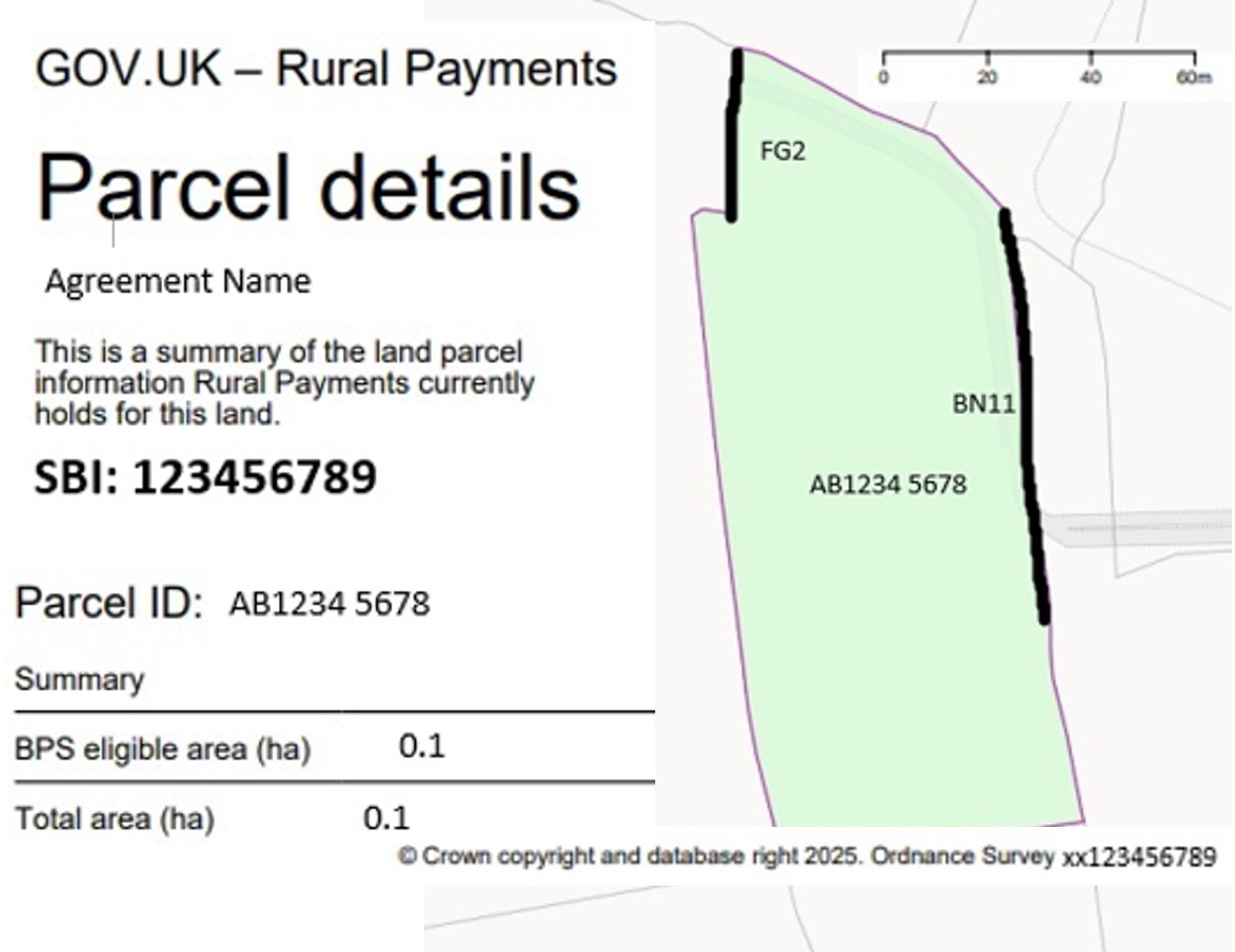
In this example map, the land parcel number is in the centre of the land parcel. A thick line is drawn along 2 sides of the land parcel to show a new or changed boundary. The agreement name, parcel ID, SBI, and total area are included on the left. The map scale is shown top right, and the OS grid reference is shown at the bottom of the map.
Supplementary information map
The following items require extra information, which must be provided on a supplementary map.
| Item code | Name of item | Evidence required at application stage |
|---|---|---|
| BN3 | Earth bank creation | Historic maps or other records to evidence that the proposed location of the bank creation is on an original footprint, or is a feature of a specific location or landscape – this can be marked on any map |
| BN5 | Hedgerow laying | A map showing the location of existing hedgerow trees in each length of hedge |
| BN6 | Hedgerow coppicing | A map showing the location of existing hedgerow trees in each length of hedge |
| BN11 | Planting new hedges | Historic maps or other records to show that the proposed location of the hedge planting is on an original footprint or extends existing hedges or contributes to the reduction of soil erosion and run-off – this can be marked on any map |
| BN12 | Stone wall restoration | A map showing the location of any wall-side trees, saplings and stone features |
| TE1 | Planting standard hedgerow tree | A record of where hedgerow trees are to be planted |
Annex 4: Contact details
Contact Rural Payments Agency (RPA)
If you have a question about Capital Grants, contact RPA by:
-
completing a query form in the Rural Payments service – sign in to your Rural Payments account and go to ‘Create or view a query’ (this is the quickest way to receive a response)
- email: ruralpayments@defra.gov.uk – include ‘Capital Grants’ and your SBI in the subject line
- post: Rural Payments Agency, PO Box 324, Worksop, S95 1DF
Contact Natural England
You can contact Natural England by:
- email: enquiries@naturalengland.org.uk
- telephone: 0300 060 3900
March to September: Monday to Friday, 10am to 4pm, except bank holidays
October to February: Monday to Friday, 10am to 3pm, except bank holidays - post: Natural England, County Hall, Spetchley Road, Worcester, WR5 2NP
- Catchment Sensitive Farming (CSF)
Contact other organisations
You may also need to contact: