Improving the energy performance of privately rented homes: impact assessment (HTML)
Updated 21 January 2026

© Crown copyright 2026
This publication is licensed under the terms of the Open Government Licence v3.0 except where otherwise stated. To view this licence, visit nationalarchives.gov.uk/doc/open-government-licence/version/3 or write to the Information Policy Team, The National Archives, Kew, London TW9 4DU, or email: psi@nationalarchives.gov.uk.
Where we have identified any third party copyright information you will need to obtain permission from the copyright holders concerned.
This publication is available at https://www.gov.uk/government/consultations/improving-the-energy-performance-of-privately-rented-homes-2025-update/outcome/improving-the-energy-performance-of-privately-rented-homes-impact-assessment-html
Title: Improving the energy performance of privately rented homes in England and Wales
Type of measure: Secondary legislation
Department or agency: Department for Energy Security and Net Zero
IA number: DESNZ034(F)-25-NZBI
RPC reference number: DESNZ-25058-IA
Contact for enquiries: PRSMEESConsultation@energysecurity.gov.uk
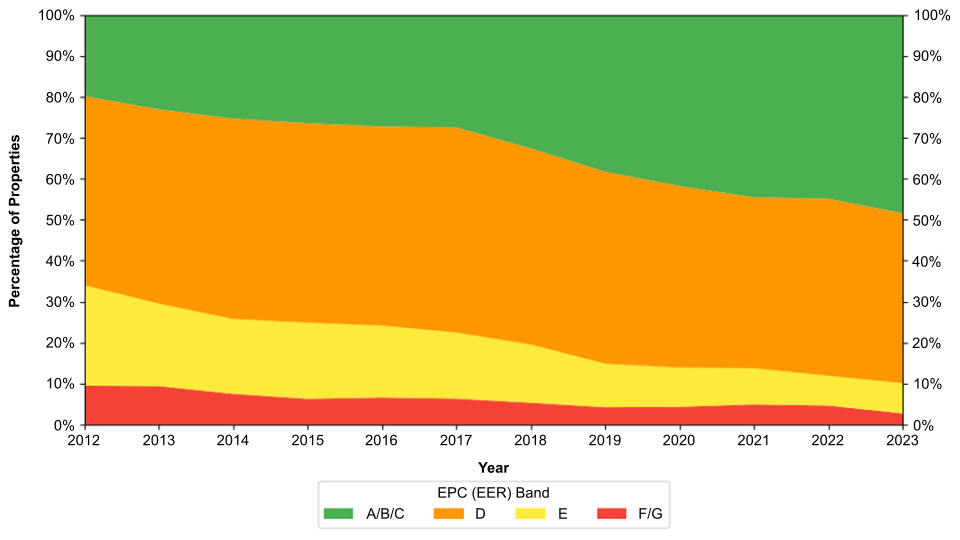
Date: 16 January 2026
1. Summary of proposal
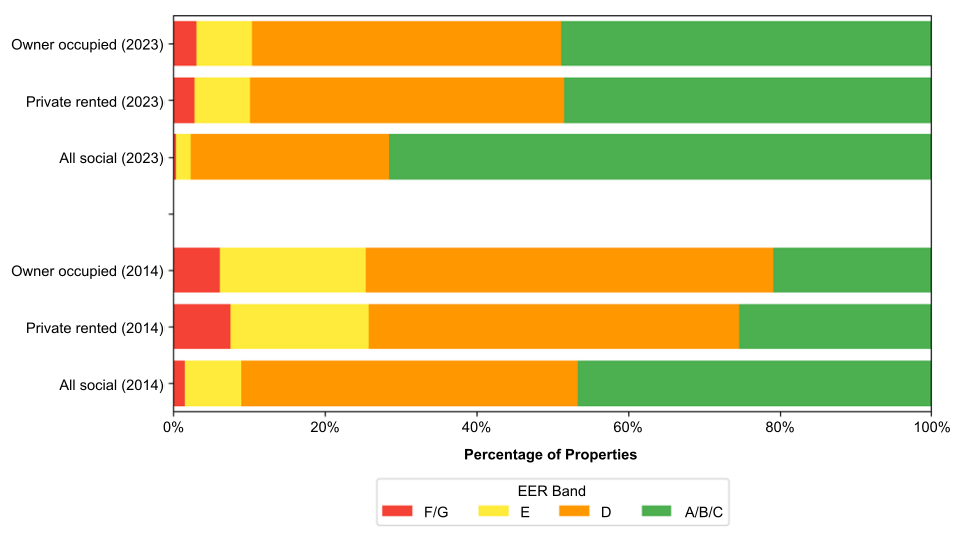
1.1. Context for proposals: the EPB regime
1. The Energy Performance of Buildings (England and Wales) Regulations 2012 – hereafter referred to as the ‘EPB Regulations’ – require that properties have a valid Energy Performance Certificate (EPC) before they are marketed, sold, or rented, ensuring that buyers or tenants are informed about the property’s energy performance.
2. Under the current EPB regime, the primary metric used to assess a property’s energy performance is the Energy Efficiency Rating (EER). This rating estimates how cost-effectively a home can be heated, lit, and powered under standardised occupancy assumptions. The EER is expressed on a numerical scale from 1 to 100, where a higher score indicates lower running costs and greater energy efficiency.
3. Based on their EER, properties are categorised into A-G bands, with Band A representing the most energy-efficient homes and Band G the least. This banding system provides a clear and accessible way for tenants, landlords, homeowners and homebuyers to understand and compare the energy performance of dwellings.
4. On the 4 December 2024, the government launched a consultation on proposals to reform the EPB regime. This included overhauling the way in which property energy performance is assessed and presented, with a move away from using the EER as the single headline metric. The government has now published its position that instead of using a standalone EER headline metric, EPCs will show multiple headline metrics for a more holistic view on property energy performance.[footnote 1] These headline metrics are:
- Fabric performance – reflecting the thermal efficiency of the building envelope.
- Smart readiness – reflecting the ability to integrate smart energy technologies.
- Heating system – reflecting the efficiency and environmental impact of the heating system.
- Energy cost – reflecting the financial implications of energy use.
5. The EER metric will no longer feature as a headline metric, but will be included on EPCs as a legacy metric given its importance for current energy efficiency policies.
6. It is anticipated that EPCs featuring the new headline metrics will be introduced in the second half of 2026. For clarity, these reformed EPCs are called ‘new-style EPCs’ in this impact assessment (IA). Existing EPCs with the standalone EER headline metric are called ‘old-style EPCs’.
1.2. Raising PRS MEES to the equivalent of EPC C
7. The Energy Efficiency (Private Rented Property) (England and Wales) Regulations 2015[footnote 2] – hereafter referred to as the ‘PRS Regulations’ – introduced minimum energy efficiency standards (MEES) in the private rented sector (PRS). The regulations require that where properties are let on a qualifying tenancy type[footnote 3] and legally require an EPC, the EER rating of the property must be Band E or better, unless a valid exemption applies. The standards took effect for new or renewed tenancies in April 2018 and for all tenancies in April 2020.
8. On the 7 February 2025, the government launched a consultation on proposals to raise PRS MEES to the equivalent of EPC C (hereafter ‘the equivalent of’ is omitted for readability). Raising MEES in the PRS would make it easier and more affordable for tenants to keep their homes warm, reduce fuel poverty, and cut carbon emissions. The consultation covered proposals in 5 key areas:
- the EPC metrics on which increased PRS MEES would be based
- the required maximum spend (cost cap) per property
- the timeline for compliance
- the transition arrangements from existing PRS MEES and EPCs
- exemptions and enforcement
The consultation also sought views on whether PRS MEES should apply to short-term lets, whether the government should take new actions to encourage or require smart meters in PRS properties and whether letting agents and online property platforms should be required to only advertise and let properties compliant with PRS MEES.
9. Having considered the views of stakeholders through the consultation, the government has set out its final policy position in its government response.[footnote 4] The final policy position is to:
- Base higher standards on new-style EPCs that feature new headline energy performance metrics
- Require PRS properties to meet a primary fabric standard and a secondary standard based on – at the landlord’s discretion – smart readiness or heating. To incentivise fabric improvements, improvements made towards the secondary standard will not count towards a landlord’s cost cap until either the primary fabric standard has been achieved or an exemption on meeting the fabric standard has been obtained
- Require PRS properties to meet the new standards by 1 October 2030. Properties let on a new or existing qualifying tenancy after this date will be required to meet the standards, unless a valid exemption is registered on the PRS MEES Exemptions Register[footnote 5]
-
Set a £10,000 cost cap that allows for properties to be exempt for 10 years from the new standards if more than £10,000 would need to be spent on upgrades. Before obtaining the exemption, landlords will need to make improvements up to the point where the next cheapest improvement would push total property spend above the cap. Once the exemption expires – 10 years after registration – landlords will need to either bring the property up to standard, subject to another £10,000 cost cap, or register a further exemption. The cost cap will not rise with inflation (it is set in nominal, not real terms)
- Allow landlords to count towards their first cost cap the costs of any improvements made since 1 October 2025. The first cost cap is the one associated with the first 10-year exemption registered for a property based on improvement costs that would exceed the cap. Subsequent exemption registrations, if applicable, cannot rely on improvements that have already been registered to have been made.
- Once new-style EPCs are available, require landlords to obtain a new-style EPC before taking action to comply with the higher standards and a post-improvement EPC to demonstrate subsequent compliance. Landlords will be able to count the costs of these EPCs when registering a cost cap-based exemption.
- Allow landlords to use previous old-style EPCs to demonstrate their properties comply with the existing EPC E standard. This is a transitional arrangement to avoid landlord compliance with the existing standard being affected by the move to a new assessment methodology (the Home Energy Model) for new-style EPCs.
- Treat properties that are rated EER C or better on an old-style EPC or new-style EPC obtained by 1 October 2029 as compliant with the new standards until the EPC expires or is replaced. This provision will mean that landlords of properties which already have an EER of Band C or better will have longer to meet the new standards, potentially to 2039 given the 10-year validity period of EPCs.
- Increase the maximum possible fine for non-compliance with the PRS Regulations to £30,000 per property, for each breach.
- Make available to landlords the following exemptions[footnote 6]:
- ‘High-Cost’ exemption: If the cost of making even the cheapest recommended improvement on the EPC would exceed the cost cap (inc. VAT).
- ‘All Relevant Improvements Made’ exemption: All the ‘relevant energy efficiency improvements’ that can be made have been made, and the property remains below EPC C.
- ‘Cost Cap’ exemption: When a landlord has spent up to or over the cost cap of £10,000, or the next cheapest improvement will take the total spent on improvements – that have not previously been used for an exemption – over the cost cap of £10,000.
- ‘Property Value Adjustment’ exemption (affordability exemption): Where the cost cap is £10,000 or 10% the value of the house, whichever is lower.
- ‘Solid Wall Insulation’ exemption: Where a landlord could choose not to install solid wall insulation (SWI) and record that decision through this exemption.
- ‘Negative Impacts’ exemption: This will combine 2 existing exemptions, the Devaluation exemption[footnote 7] and the Wall insulation exemption[footnote 8], and will also allow landlords to register evidence that a specific measure would negatively impact their property.
- ‘Third-Party Consent’ exemption: Consent from a relevant third-party, for example, tenant, superior landlord, planning authority, is not granted.
- ‘New landlord’ exemption: A temporary 6-month exemption for new landlords. This exemption will be simplified to clarify the criteria for determining when an individual assumes the role of landlord.
10. Concerning other policy matters that the government sought views on in the PRS MEES consultation, it was decided that:
- Short-term lets will not be brought into scope of PRS MEES at this time. However, the government will keep this position under review and will seek primary powers to enable short-term lets to be brought into scope of PRS MEES should our position change.
- No new, additional actions will be taken to encourage or require smart meters in PRS properties. As smart meters will be an essential element to meeting the smart readiness standard, it is expected that the PRS MEES policy will itself lead to a significant level of rollout of smart meters across the PRS.
- Additional regulations to require letting agents and online property platforms to only advertise and let properties compliant with PRS MEES will not be introduced at this time. The government’s current preference is to wait and observe how the creation of a PRS Database (as part of the Renters’ Rights Bill[footnote 9]) and improvements to the PRS MEES Exemptions Register could improve the ability of letting agents and online property platforms to check for compliance before potentially regulating. However, the government will seek primary powers so that it can introduce such regulations for letting agents and online property platforms in the future, if this is deemed necessary to support effective enforcement and compliance.
2. Strategic case for proposed regulation
11. The UK government is committed to improving the energy performance of domestic properties across all tenures as part of its broader strategy to meet its statutory fuel poverty targets and carbon budgets. The PRS accounts for 5.1 million properties in England and Wales (4.9m and 0.2m, respectively), representing 19% of the housing stock.[footnote 10] This section sets out how the PRS currently performs on energy efficiency, how landlords have responded to the existing PRS Regulations and why intervention is required to further improve energy efficiency in the sector.
2.1. Current energy performance of PRS properties
12. Figure 1 shows that at an overall level, the energy efficiency of the PRS has consistently improved over time. Between 2012 to 2023, the percentage of PRS properties rated EER Band F/G reduced from 9.5% to 2.7%, Band E properties reduced from 24.5% to 7.4%, Band D properties reduced from 46.2% to 41.5%, and Band C+ properties increased from 19.8% to 48.4%.
13. Several factors have contributed to increased energy efficiency in the PRS overall. New properties entering the sector are constructed to higher standards, while older, less energy-efficient buildings are more likely to be demolished and removed from the sector. The replacement cycle for boilers has resulted in many older models being swapped for more efficient condensing gas boilers, and Ecodesign (Lighting Product) regulations have facilitated the transition to more energy-efficient lighting. Government schemes such as the Energy Company Obligations have provided support for landlords to retrofit their properties and the PRS Regulations have required landlords to improve properties to at least EER Band E. Other influences include the introduction of EPCs, which have increased landlord awareness on how to improve properties, decreasing technology costs (for example, solar PV) and, possibly, landlords seeking to adapt to potential future regulatory requirements. Updates in scientific research have also led to changes in assumptions regarding property energy performance. For example, from 2018, the SAP 2012 methodology used to assess property EERs incorporated new U-values for various wall types (this corresponds with the observed increase in EER C+ properties between 2017 and 2018 in Figure 1).
Figure 1. EPC (EER) bands of PRS properties in England, 2012 to 2023
Source: English Housing Survey data on energy performance, heating and insulation[footnote 11].
Description of figure 1: Stacked area chart showing the number of EPC bands of PRS properties in England from 2012 to 2023. See paragraphs 12 and 13 for details.
14. Figure 2 shows how the PRS compares with the owner-occupier and social rented sectors on energy efficiency. The chart displays the most recent data from 2023 alongside tenure performance from 2014, providing context for the status of the PRS prior to the introduction of the PRS Regulations in 2015. Note that cross-tenure comparisons should be treated with caution as the 3 tenures are made up of dwellings that differ on various characteristics that affect energy efficiency, such as type (houses vs flats) and age of construction.
15. Notwithstanding this caveat, it is observed that whilst aggregate energy efficiency in the PRS was worse than in the social rented sector in 2023, it was broadly similar to the owner-occupier sector.
16. A comparison of 2014 and 2023 data shows that the proportion of owner-occupier properties rated EER C or above increased more than in the PRS sector over this period. However, the PRS witnessed a sharper decline in the proportion of its properties rated EER F or G. Between 2014 and 2023, there was a 64% decline in the proportion of the PRS stock rated EPC F or G, exceeding the 51% decline for the owner-occupier sector.
Figure 2. EPC (EER) bands by tenure, 2023 vs 2014
Source: English Housing Survey data on energy performance, heating and insulation.
Description of figure 2: Stacked bar chart comparing EPC bands by tenure between 2023 and 2014. See paragraphs 14 to 16 for details.
17. The existing PRS Regulations appear to have contributed to the reduction of EER F/G properties in the PRS. The final evaluation of the existing PRS Regulations indicates that, among a subset of properties with 2 EPCs on either side of the MEES compliance date, those PRS properties subject to the regulations were 3.53 times more likely to meet the minimum standard compared to those not subject to the regulations. Additionally, their EER scores increased by an average of 1.1 points more than properties not affected by the regulations.[footnote 12]
- 18. Figure 2 also shows that in 2023, 3 years after all qualifying tenancies were brought into scope of MEES EPC E, an estimated 2.7% of PRS properties in England (approximately 132,000) were still rated EPC F/G. These properties could fall into one of the following groups:
- (i) Properties not let on a qualifying assured, regulated or domestic agricultural tenancy – based on data from the 2023/24 English Housing Survey[footnote 13], we estimate that 16% of private renters in England are not on one of the qualifying tenancies under the PRS Regulations.
- (ii) Properties that are not legally required to have an EPC – only properties which are required to have an EPC under the EPB Regulations have needed to comply with MEES. Under the EPB Regulations, landlords of homes under multiple occupation (HMOs) have not required a building EPC when renting out individual rooms and landlords of heritage buildings[footnote 14] have not required an EPC. The Ministry of Housing, Communities and Local Government (MHCLG) has estimated that there are roughly 6,900 HMO and heritage buildings that would be rated F/G if they required an EPC.[footnote 15] The other group of landlords who have not required an EPC are those who have maintained the same tenants since 1 October 2008 (since EPCs have only been required for lettings to new tenants). In 2023, around 4.9% of private renting households had moved into their property before EPCs became a requirement.[footnote 16]
- (iii) Properties which have an exemption for MEES – several exemptions are available under the PRS Regulations, allowing landlords to continue letting out EPC F/G properties under certain circumstances. As of June 2025, a total of 20,200 properties had an exemption registered on the PRS MEES Exemptions Register.[footnote 17]
- (iv) Properties which are non-compliant with the PRS Regulations or EPB Regulations – some landlords may be renting out an EPC F/G property or could be renting out a property without an EPC at all. The final evaluation of the existing PRS Regulations estimated that 4.7% of PRS properties were non-compliant with the regulations as of August 2023.[footnote 18]
2.2. The response of landlords to the existing PRS Regulations
19. The final report of the evaluation of the existing PRS Regulations is published alongside the government response.[footnote 19] It follows on from the interim evaluations which were published in 2020 and 2021.
20. The final evaluation of the existing PRS Regulations found that overall landlord awareness of the regulations was generally high (90% in 2024). However, there were differences in awareness across different types of landlords. The types of landlords with lower levels of awareness were individual (rather than company) landlords, landlords with just one or a few properties, landlords who were not a member of a landlord body and landlords who did not use a letting or managing agent.
21. Indeed, landlord bodies and letting and managing agents were the main sources of awareness and understanding of the regulations amongst landlords. Agents and other market actors were also often instrumental in helping landlords interpret the implications of the regulations for the individual properties they owned. This points to the importance of these intermediary organisations in supporting landlords to understand and interpret regulatory requirements.
22. On compliance with the PRS Regulations, the evaluation found that the vast majority of landlords were compliant with the regulations. The most important factors motivating and facilitating compliance were: the potential negative consequences of non-compliance; a general compliance mindset; and pre-existing plans to upgrade properties.
23. Instances of non-compliance, or at least deferred or delayed compliance, were associated with a lack of awareness and understanding of the regulations, the cost and time implications of compliance, and possible disruption for tenants.
24. Regarding property upgrades, landlords generally focused on implementing necessary improvements to meet the EER E rating while keeping expenditures as low as possible. However, the characteristics of individual properties were also a determinant of improvements made, and some landlords invested in more extensive improvements either as part of a wider property upgrade and/or as ‘future-proofing’ against anticipated future increases in minimum standards.
25. Where landlords have registered exemptions on the PRS MEES Exemptions Register, these have predominantly been due to all relevant improvements having been made to the property (with the property remaining below EER E); third-party consent for improvements being denied; and the existing £3,500 cost cap on improvement costs.
26. On enforcement of the PRS Regulations, the evaluation found that most landlords (and agents) who participated in the evaluation research were not aware of enforcement activities being undertaken by local authorities, although there were some positive examples of local authorities reinforcing compliance.
27. Overall, the evaluation found that the existing PRS Regulations engendered landlords to upgrade their properties. The findings also show the drivers (potential negative consequences of non-compliance, pre-existing plans to upgrade properties; potential benefits for the environment or tenants) and trade-offs (improving energy efficiency while minimising costs) and barriers (cost, time and effort, tenant access or disruption) that landlords face. We can assume that these motivations and challenges would be the same with new regulations.
28. The final evaluation found that for a sample of PRS properties used in impact analysis (F or G-rated properties that applied for a second EPC), PRS properties in England and Wales were 3.53 times more likely to have an EPC rating of E or higher, with SAP scores being on average 1.1 points higher, than otherwise due to the regulations. For this sample, there were average annual savings of £67 from energy bill costs per household.
29. The final evaluation also found that the average PRS property in England and Wales would have got 0.1-0.3 ºC warmer (indoor winter temperature) by moving from an EPC rating of F or G to an E rating or better. The evaluation estimates that the health improvements resulting from warmer homes due to moving from an EPC of F or G to EPC E or better equate to 1,046 Quality Adjusted Life Years. The associated health sector expenditure impacts equate to a total estimate of savings of around £1 million after 5 years.
2.3. The need for further energy efficiency improvements in the PRS
30. Whilst the evidence presented in Section 2.1 shows that energy efficiency in the PRS has improved over time, in 2023, 55% of PRS properties in England were still rated below EER Band C – the government’s benchmark of good performance, which is also used in the existing definition of fuel poverty. Further energy efficiency improvements in the PRS are required to:
- Improve the decency of PRS properties: Energy efficiency is a core component of housing decency with poorly insulated, expensive to heat properties leaving the private renters that occupy them with high energy bills and/or cold and damp homes. In England, the PRS is the tenure with the greatest share of properties that have a damp problem (9%), followed by the social rented sector (7%) and then the owner-occupied sector (4%). Furthermore, whilst only 4% of PRS properties rated EER A-C have damp present, 14% of PRS properties rated EER D-G are affected with the issue.[footnote 20] This illustrates the association between damp and mould issues and property energy efficiency.
- Reduce energy bills: Energy efficiency improvements enable households to heat, light and/or power their homes more affordably. Our analysis projects that, under the final MEES EPC C policy design, tenant households in upgraded properties will save an average of £210 annually on energy bills by 2030 (based on projected 2030 energy prices, adjusted to 2025 pounds).
- Tackle fuel poverty: Fuel poverty remains a persistent issue across all tenures, but particularly in the PRS. Based on the existing low-income, low energy efficiency (LILEE) definition of fuel poverty, 24% of private renting households in England are classified as fuel poor. The fuel poverty rate is lower in the social rented sector (15%) where properties are typically more energy efficient.[footnote 21] And whilst the PRS and owner-occupier sectors perform similarly on overall energy efficiency, the fuel poverty rate is lowest in the owner-occupier sector (9%). This is because owner-occupier households typically have higher incomes and are more able to afford relatively high energy bills. As almost one-quarter of households in the sizeable PRS sector are fuel poor – due to a combination of low energy efficiency and low incomes – government intervention in the sector is key to supporting the government’s statutory fuel poverty target of upgrading as many fuel poor homes as reasonably practicable to a minimum EER Band C by 2030.
- Reduce carbon emissions: The residential sector is responsible for around 20% of the UK’s net greenhouse gas emissions,[footnote 22] mostly driven by the burning of fossil-fuels for heating. In England, 83% of PRS properties are heated primarily with fossil fuels with 79% heated primarily with gas.[footnote 23] The government recognises that to meet its objectives on reducing carbon emissions (including the Carbon Budgets, Nationally Determined Contributions and Net Zero by 2050), the housing stock needs to transition to low carbon heating, such as heat pumps and connections to low carbon heat networks. Under the final MEES EPC C policy, this transition is supported both through the use of the EPC heating metric as a secondary standard that landlords can choose to comply with, and also through the improvements made to property energy efficiency that can support future adoption of heat pumps (for example, insulation which can enable heat pumps to run more effectively and solar PV which can power heat pumps).
- Improve tenant health and wellbeing: Cold and damp homes – associated with poor energy efficiency – are linked to a range of health issues, including respiratory conditions, cardiovascular problems, and mental health challenges.[footnote 24] Children, the elderly, and those with pre-existing health conditions are particularly at risk. The tragic death of Awaab Ishak who died at the age of 2 in 2020 after prolonged exposure to damp and mould in his home highlights this. At the national level, cold homes cost the NHS an estimated £857m per year (2018 prices), with each Category 1 level damp and mould hazard costing £9.8m per year (2019 prices).[footnote 25],[footnote 26]
2.4. The rationale for government intervention
31. As seen from the prevalence of homes with lower energy efficiency ratings, market forces in the PRS have not been sufficient to ensure that all landlords upgrade their properties and provide decent housing. There is clear evidence of market failures in the sector, and to raise standards, government intervention is needed.
32. Underinvestment in energy efficiency occurs due to externalities. Externalities refer to costs or benefits that are not experienced by the individuals making the decision to invest, or not invest, in energy efficiency. They can include the effects of the individual’s decision on greenhouse gas emissions / global warming, the quality of air surrounding a property, national energy security and the demands placed on the National Health Service (NHS) due to non-decent homes. Critically, without consideration of these external effects, the case for investing in several energy efficiency and clean heat technologies is currently unlikely to be compelling for many landlords. This is due to certain measures having high upfront costs and consequently long payback periods. For instance, some types of insulation can take decades to yield a positive financial return
33. Another market failure that inhibits property upgrades in the PRS relates to misaligned incentives (another case of people not considering impacts that are external to them). Landlords are not the ones who suffer the negative health and wellbeing consequences of living in a cold property they let, and most – those who do not include energy bills as part of rent – will not enjoy the direct energy bill benefits flowing from energy efficiency upgrades. They will, however, be the bearer of the upfront costs of upgrading their properties.
34. To an extent, the possibility of earning more rental income on a property that is more energy efficient could act to align landlord incentives. However, quantitative evidence on the relationship between energy efficiency and rents is difficult to establish because of the complexity of the relationship. Econometric studies indicate that energy efficient properties tend to have higher rents compared to less efficient properties, although factors such as unobserved differences in property condition have made it challenging for researchers to reach definitive conclusions. One such study was published by the Department for Business, Energy and Industrial Strategy (BEIS) in 2020, which found that compared to EER D properties, the rents for EER C properties were 4.9% higher and the rents for EER F/G properties were 5.7% lower (both differences were statistically significant).[footnote 27] However, the authors noted “it is not possible to establish with certainty that these premiums and discounts are indeed caused by EPCs and not by unobserved factors correlated with EPCs such as the state of repair of a property.”
35. Note that even if the rental price premium for upgrading an EER D property to EER C was indeed 4.9%, this level of returns would still be modest compared to the upfront upgrade costs many landlords could face. To illustrate this, suppose an individual landlord who is a higher rate taxpayer[footnote 28] lets out an EER D property for £16,788 per year (the average rent in England in the 12 months to June 2025).[footnote 29] Upgrading the property to EER C, the landlord would earn £823 extra a year in rents if the price premium was 4.9%. However, since the assumed landlord is a higher rate taxpayer, 40% of this extra income would be taxed, leaving the landlord with £494 additional post-tax income per year. This yearly return compares to an average cost of improving a PRS property from EER D to EER C of around £6,000,[footnote 30] therefore meaning that it would take around 12 years for the landlord to recoup their investment cost. Given the projected payback period and the opportunity cost associated with alternative investments for the landlord’s £6,000, it is unlikely that the landlord in this scenario would proceed with the upgrades. This situation further emphasises the necessity of considering externalities when justifying investments in energy efficiency. Although some landlords will want to make improvements over time, relying solely on market forces would likely result in an upgrade rate that falls short of the optimal level for society.
36. With respect to the incentives of tenants to ask for and/or accept energy efficiency upgrades, it is also the case that these can be misaligned. Some, but not all, renters frequently change home[footnote 31], meaning that whilst they would bear the disturbance associated with their home being upgraded, they will not enjoy all the downstream benefits – albeit the introduction of rolling tenancies is intended to help create greater stability for renters. In their Voice of the Tenant Survey (Wave 5), the TDS Charitable Foundation found that as of March 2025, two-thirds of tenants had not requested energy efficiency improvements from their landlord or letting agent, with 25% of these citing it would be too much hassle.[footnote 32]
37. It is also the case that many tenants are reluctant to complain about poor quality housing for fear of eviction or ask for improvements for fear of rent rises.[footnote 33] Wider reforms to the PRS, including the abolition of ‘no-fault’ section 21 evictions and the introduction of a new Ombudsman, will help tenants to demand action from their landlords on issues such as disrepair and damp and mould. However, tenants’ bargaining power and their consequent ability to push for home improvements will likely remain insufficient to correct for the underinvestment in energy efficiency relative to societal benefit that we see in the private rented sector without further regulation.
38. Finally, additional obstacles to investing in energy efficiency may include insufficient awareness among landlords regarding property improvements, uncertainty about the suitability of certain measures for specific property types, limited access to reliable installers, and financial constraints.[footnote 34] Other government policies and initiatives are in place to help address these barriers. These include: the Find Ways to Save Energy in Your Home website[footnote 35]; the government’s heat pump suitability checker[footnote 36]; the Trustmark quality scheme providing a register of trusted installers; and grant schemes such as the Boiler Upgrade Scheme[footnote 37].
3. Objectives for intervention
39. The proposed update to the PRS Regulations is designed to deliver a step-change in energy performance across the PRS by 2030. The scale of ambition – with improvements to over a million properties – has framed comparison across policy options and to assess whether regulatory intervention is necessary.
40. The proposals aim to achieve the following SMART-aligned objectives by 2030. The evaluation criteria are based on the modelled outcomes for the preferred policy option. It is important to note that the EPC policy landscape, including technical definitions of new EPC metrics, is still evolving, and the targets presented here are indicative at this stage. These objectives and targets will be kept under review as final policy decisions on EPCs and new metrics are made, and as evidence emerges on how landlords might respond and comply with the regulations.
1. Deliver cost-effective energy efficiency improvements in the PRS
Outcome: Widespread energy efficiency upgrades at proportionate cost.
Evaluation criteria (indicative targets based on preferred option):
- Proportion of PRS stock achieving EPC C equivalent or above (target: two-thirds by 2030 – includes properties achieving EER C under old-style EPCs, or EPC C under new-style EPCs).
- 1.75 million properties receiving measures by 2030.
- Landlords protected from spending more than £10,000 per property.
- Cost-effectiveness threshold (target: upgrades yield positive net-societal benefits over the lifetime of measures).
2. Improve tenant welfare
Outcome: Lower energy bills and reduced cold-related health risks.
Evaluation criteria (indicative targets based on preferred option):
- Reduction in average energy bills in upgraded properties (target: £210/year by 2030).
- Reduction in fuel poverty prevalence (target: around 415,000 households lifted from fuel poverty by 2030).
- Increase in average indoor temperatures during winter months and reduced prevalence of damp and mould issues.
3. Boost clean energy generation and improve UK energy security
Outcome: Increased rooftop solar deployment to support decentralised clean energy generation.
Evaluation criteria (indicative targets based on preferred option):
- Number of properties with rooftop solar fitted (target: 938,000 by 2030).
- Installed rooftop solar capacity (target: 2.42 GW by 2030).
4. Reduce greenhouse gas emissions
Outcome: Lower CO₂ emissions from PRS energy use.
Evaluation criteria (indicative targets based on preferred option):
- Annual emissions reduction from PRS energy use (target: at least 0.2 MtCO₂e per annum by 2030).
- Contribution to meeting Carbon Budgets and Net Zero trajectory.
5. Stimulate growth in energy efficiency and clean heat sectors
Outcome: Economic activity and job creation in retrofit and clean heat industries.
Evaluation criteria (targets not set due to difficulty of attribution):
- New jobs created.
- Increase in domestic supply chain capacity and investment levels.
41. These policy objectives align with the government’s broader objectives on achieving fuel poverty targets in both England and Wales[footnote 38], delivering on the Clean Power 2030 Action Plan[footnote 39], and cutting carbon emissions (including meeting the Carbon Budgets, Nationally Determined Contributions and Net Zero by 2050).
42. It is recognised that there can be tensions between some of the policy objectives. For example, achieving substantial reductions in carbon emissions from the PRS would likely require widespread deployment of low-carbon heating technologies such as heat pumps at the expense of a working alternative system. In light of these trade-offs, the government has sought to strike an appropriate balance between decarbonisation, affordability, and tenant welfare in selecting its preferred policy approach. The chosen option aims to deliver meaningful progress across all objectives while prioritising tenant benefits in bill savings and comfort and not requiring any landlord to remove boilers.
4. Theory of change
43. Figure 3 illustrates the theory of change for the preferred PRS MEES EPC C policy described in Section 1.2. It outlines the step-by-step process by which inputs and activities associated with the regulations are expected to lead to measurable outputs, outcomes and impacts. Boxes with a dashed border indicate some of the unintended outputs and outcomes that could be realised and highlight that landlords’ behaviour in response to the regulations is a key area of uncertainty in achieving the intended impacts.
44. Monitoring and evaluation are needed to understand the robustness of assumptions underlying the theory of change and determine the regulations’ success. Section 18 describes the monitoring and evaluation strategy for the policy.
Figure 3. Theory of change for the PRS MEES EPC C policy
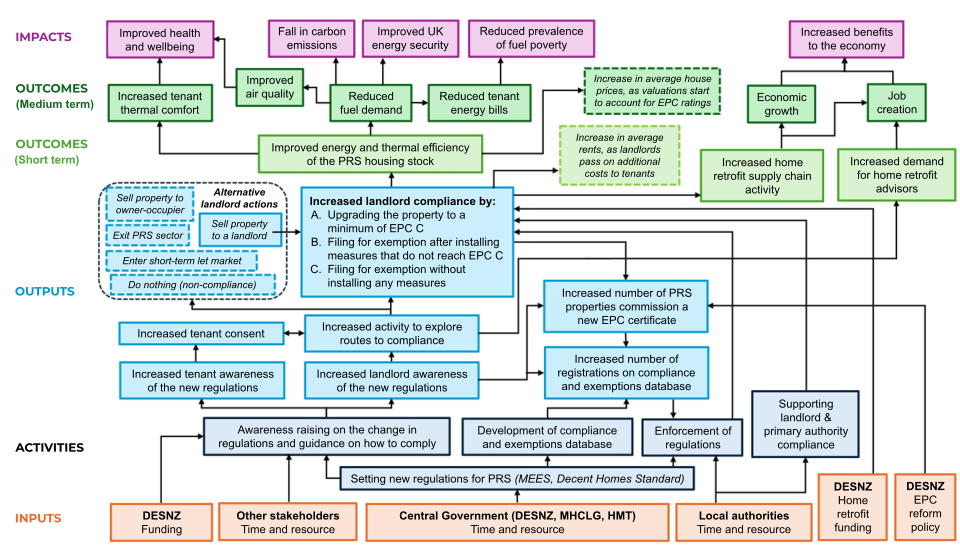
Description of figure 3: Diagram illustrating the theory of change for the PRS MEES EPC C policy. See Section 1.2 for details.
5. Non-regulatory options considered
45. The government assessed a range of non-regulatory approaches to improve energy efficiency in the PRS and achieve objectives on tenant welfare, fuel poverty, energy security, and carbon reduction. These options were evaluated against their ability to deliver the scale and pace of improvements required. While they can play a supporting role, none were considered sufficient as standalone measures due to persistent market failures and structural barriers in the PRS.
46. Improving landlord information through better guidance and advice could help engaged landlords make informed decisions. However, information alone does not address the key market failures of externalities and the ‘split incentive,’ where landlords bear the cost of upgrades while tenants benefit from lower bills. Without a compliance mechanism, uptake would remain voluntary and uneven, failing to deliver sector-wide improvements at the speed required.
47. Providing financial incentives such as grants, tax relief, or low-interest loans could encourage some landlords to invest in upgrades. However, participation would remain voluntary, leaving many properties unimproved. Large-scale subsidies would also impose significant costs on the Exchequer, funded by taxpayers, which could be seen as inequitable given landlords’ private ownership of assets. There is also a risk of deadweight, where subsidies reward landlords who would have upgraded anyway, reducing cost-effectiveness.
48. Voluntary or self-regulation was also considered. While industry-led schemes can work in sectors with few actors and strong reputational drivers, the PRS is highly fragmented, with many small landlords who may lack resources or incentives to comply. Enforcement through peer pressure or market forces is unrealistic in this context. Similarly, market-based signals such as green mortgages or tenant demand for efficient homes can influence landlord behaviour, but these mechanisms develop slowly and cannot guarantee universal coverage. Tenants often have limited bargaining power, especially in tight rental markets, and many landlords prioritise short-term returns over long-term efficiency gains.
49. These non-regulatory approaches do not adequately address the fundamental market failures in the PRS, including externalities and the split incentive between landlords and tenants. As a result, they would not deliver the scale of improvement needed to meet the government’s objectives. Regulation provides a clear, enforceable standard that creates certainty for landlords and the supply chain.
50. Although insufficient on their own, these measures remain important as complementary interventions. The government continues to work to improve awareness of energy efficiency benefits and provide targeted financial support for those, including landlords, seeking to upgrade their properties.
6. Long-list of regulatory options considered
51. There are many possible ways to design a regulatory policy to raise energy efficiency standards in the PRS. The government considered a wide range of options across several policy dimensions. A full assessment of these options, including detailed rationales and links to critical success factors, is provided in Annex A. This section summarises the key decisions and the reasons why some options were taken forward for detailed assessment in this IA, while others were discounted.
52. Decisions were guided by a set of critical success factors, which define the attributes of a successful policy:
- Strategic fit – alignment with policy objectives and wider government strategies
- Value for money – optimisation of social, economic, and environmental outcomes relative to costs and risks
- Landlord capacity and capability – practicality for landlords given their knowledge, financial resources, and property portfolios
- Achievability – feasibility for supply chains to deliver the required upgrades
53. The following paragraphs provide a high-level summary of the preferred options for each policy dimension. For full details of all options considered, including those discounted, see Annex A.
54. Policy scope (letting arrangements): The scope will remain as now, but include HMOs: assured shorthold, regulated, and domestic agricultural tenancies. Extending coverage to niche arrangements (for example, lodgers, Crown tenancies, employer‑provided housing) is discounted due to poor strategic fit, legal complexity, and limited additional benefits. Including short‑term lets is discounted due to evidence gaps on energy use and challenging enforceability.
55. EPC metrics: An approach prioritising fabric underpins compliance. Two options are taken forward: (i) a single fabric metric; and (ii) a prioritised dual metric with fabric as primary, and smart readiness or heating system as the secondary metric. Smart‑only, heating‑only or energy cost‑only approaches are discounted (weaker strategic fit, reduced focus on cutting heat loss), as are non‑prioritised dual and average‑score approaches (complexity, gaming risk).
56. Compliance date: All PRS properties must reach EPC C by 1 October 2030, with no new‑tenancy trigger. This provides clarity, supports supply chain ramp‑up, and aligns with 2030 fuel poverty goals. Earlier ‘new tenancy’ triggers are discounted due to complexity and gaming risks; post‑2030 compliance is discounted for poor strategic fit (misalignment with 2030 fuel poverty objectives).
57. Cost cap: Adopt a £10,000 cap with a 10‑year exemption where the cap prevents further upgrades, plus an affordability exemption for low‑value properties. A higher universal cap is discounted on affordability grounds; inflation indexation and shorter exemption cycles are discounted due to complexity and administrative burden.
58. EPC transition: Treat properties rated EER C on old‑ or new‑style EPCs obtained by October 2029 as compliant until the EPC expires. This helps encourage early action and smooths assessor/supply‑chain demand. Only recognising old EPCs until their expiration is discounted based on strategic fit (does not encourage early action) and landlord capacity to get EPCs updated in time. Immediate mandatory re‑rating is discounted for achievability reasons (would add to supply chain pressures to 2030).
59. Large portfolio landlords: Allowing Primary Authority Partnerships with local authorities is taken forward as it will improve value for money and streamline compliance.
60. Maximum fine: Increase the maximum fine to £30,000 per property per breach to create a credible deterrent and align with wider housing enforcement regimes. Lower levels are discounted as less credible deterrent which may necessitate increased local authority intervention to address non-compliance (worsening value for money).
7. Shortlisted regulatory options
61. This IA assesses the following policy options for raising MEES in the PRS to EPC C, which differ in terms of the metrics of energy performance used. The options are the same in all other respects.
Option 0: The PRS Regulations are left unchanged (‘Business As Usual’)
62. Under this option, the PRS Regulations are left unchanged. PRS properties must continue to meet EER Band E. This option serves as the counterfactual against which the impacts of other options are assessed.
Option 1: Fabric standard only
63. Under this option, PRS properties must achieve a ‘C’ level on fabric performance on new-style EPCs. This is proxied in the IA by properties achieving a heat loss parameter of 3 W/m2K (see Section 8.1).
Option 2: Primary fabric standard with secondary smart readiness standard
64. Under this option, PRS properties must achieve both a ‘C’ level on fabric performance and a ‘C’ level on smart-readiness. In this IA, a ‘C’ level on fabric performance is proxied by properties achieving a heat loss parameter of 3 W/m2K. A ‘C’ level on smart-readiness is proxied by properties having at least a 1 kWp solar PV system, where suitable (see Section 8.1). The fabric standard is primary, meaning that landlords cannot count spend on smart readiness measures towards their cost cap until either they have achieved the fabric standard or an exemption on meeting the fabric standard has been obtained.
Option 3: Primary fabric standard and a secondary standard based on – at the landlord’s discretion – smart readiness or heating
65. Under this option, PRS properties must achieve a ‘C’ level on fabric performance and – at the landlord’s discretion – either a ‘C’ level on smart readiness or a ‘C’ level for their heating system. In this IA, a ‘C’ level on fabric performance is proxied by properties achieving a heat loss parameter of 3 W/m2K. A ‘C’ level on smart-readiness is proxied by properties having at least a 1kWp solar PV system, where suitable, and a ‘C’ level for a heating system is proxied by properties having a heat pump, where suitable (see Section 8.1). The fabric standard is primary, meaning that landlords cannot count spend on secondary metric measures towards their cost cap until either they have achieved the fabric standard or an exemption on meeting the fabric standard has been obtained.
8. Approach to assessing policy options
8.1. Proxy definitions of new EPC metrics and PRS standards
66. The government’s consultation on reforming EPCs went live on 4 December 2024[footnote 40]. New EPC metrics will be produced using the Home Energy Model (HEM) and we plan to consult on the HEM methodology for EPCs in 2026. The intention is to transition to reformed EPCs, based on a form of HEM for existing dwellings and used by EPC assessors, in the second half of 2026.
67. The approach taken in this IA to assess policy outcomes has been to focus on the high-level implications of basing new PRS standards on different elements of property performance. Until the final position on how reformed EPC metrics should be constructed and properties assessed, there will remain some uncertainty about the specific targets for the PRS on the new metrics.
68. In this IA, modelling has been carried out with proxy definitions of the new EPC metrics and illustrative targets. These definitions and targets should not be taken as an indication of how the new EPC metrics or the higher standards for the PRS will ultimately be defined. Their use is to throw light on what can be achieved by basing PRS standards on the different elements of property performance (fabric performance, adoption of smart and energy generation technologies, heating performance) and to give a sense of the numbers of properties affected and the magnitudes of costs.
69. Table 1 describes the proxy metrics and targets used in the modelling. Note that the proxy metric for ‘fabric’ is continuous in nature, allowing for more calibrated targets to be used. However, the proxy metrics for ‘smart’ and ‘heating’ are binary with targets based on whether a property has solar PV or a heat pump, respectively. Consequently, the modelled outcomes for ‘smart’ and ‘heating’ are potentially more polarised than what may occur when PRS standards are based on the final HEM versions of these metrics.
70. Decisions on the proxy metrics and standards to use in this IA were influenced by what it is currently possible to model using the department’s National Buildings Model (NBM)[footnote 41]. At the time of analysis, the NBM did not feature some measures, such as, batteries, that may feature as part of the final HEM versions of the metrics. Following development of HEM and ahead of an updated Final IA for the policy (to go alongside the legislation), the department’s modelling will be updated to account for the key measures that feature in the final HEM metrics.
Table 1. Proxy definitions of new EPC metrics and PRS standards used in modelling
| Metric | Proxy definitions |
|---|---|
| Fabric |
Proxy metric: SAP dwelling ‘heat loss parameter’ (W/m2K)[footnote 42]. Proxy PRS standard: 3 W/m2K – with this standard, just under 50% of PRS properties would currently be below standard. Of those, around 95% are judged to be below Band C for energy costs on current EPCs. Note that we assume a 3 W/m2K target on the basis that this corresponds closely to what would be required for properties to meet EER Band C on existing EPCs. Modelling based on a less ambitious target of 4 W/m2K is provided as part of sensitivity analysis. This target was presented as the ‘heat pump ready’ fabric standard in our consultation Options Assessment.[footnote 43] |
| Smart |
Proxy metric: We proxy for smart properties according to whether or not they have a solar PV system. There are other possible components to a smart property, including smart meters and batteries, which are not accounted for. However, note smart meters are assumed to be in place / installed where properties get solar PV as this enables households to take full advantage of the system, including selling excess electricity to the grid.[footnote 44] Proxy standard: Property must have at least a 1kWp solar PV system. |
| Heating |
Proxy metric: We proxy for properties having good heating system performance according to whether or not they have a heat pump. Proxy standard: Property must have a heat pump. Note this is an ambitious standard. Lower ambition standards based on properties being heat-pump ready (for example, having suitable emitters and pipework) may be possible. Finally, some landlords may be able to achieve the equivalent of a heat pump by connecting to a heat network (not modelled). |
8.2. Simulation of PRS property upgrades in the NBM
71. The National Buildings Model (NBM) is a discrete event simulation model that was used to model landlord actions under the proposed PRS MEES and estimate the impact from the installation of measures in the PRS property stock. NBM estimates are made using a SAP-based energy calculation, adjusted by in-use factors (to account for the difference between modelled and observed energy savings). The domestic building population is represented using a sample of dwellings from the English Housing Survey (EHS). The EHS is an annual survey of over 12,000 households in England which, when taken together, represent all the different property types in the country.
72. The NBM model is based on 2016/17 EHS data as this was the latest full set of data available when the model was created. However, the NBM dwelling stock has been updated to account for energy efficiency and heating measures installed since 2016/17, using data from DESNZ’s Household Energy Efficiency Statistics[footnote 45] and modelling associated with existing policies, including the PRS EPC E Regulations.
73. For the PRS MEES EPC C policy, we model landlords upgrading their properties to the required energy efficiency standards in a cost-effective way. To achieve the fabric standard, landlords install fabric measures in descending order of what improves the heat loss parameter (HLP) of the property most per pound spent. However, for the smart readiness metric and heating metric, landlords simply install solar PV or a heat pump, respectively. We stop upgrading a property once the property has achieved the required standards, no further measures are suitable, or the cost cap has been reached. We assume that no landlords choose to go beyond what is required of them under the regulations, though some may in practice do so.
74. Where the cost cap is reached before the required standards are met, the model seeks to upgrade the property again after a 10-year exemption has passed (subject to a new £10,000 cost cap, in nominal prices).
75. For Policy Option 3, landlords have discretion to install either solar PV under the secondary smart metric or a heat pump under the secondary heating metric. Our modelling assumes that approximately 10% of landlords upgrading their properties via a secondary metric by 2030 will choose to install a heat pump, supported by the Boiler Upgrade Scheme (BUS). This assumption – equivalent to 109,000 heat pumps in the results – reflects the PRS receiving a representative share of BUS funding over the scheme period. Once the BUS scheme concludes, it is assumed that landlords will not install heat pumps within the £10,000 cost cap.
8.3. Time profile of upgrades under the PRS MEES policy
Compliance timing and grandparenting
76. The timing of when a PRS property must be upgraded to meet MEES depends on whether it qualifies for a longer compliance period under grandparenting provisions. Properties achieving EER C (on either an old-style or new-style EPC) by 1 October 2029 will only need to comply with MEES when their EPC expires. All other properties below EER C must be compliant by 1 October 2030.
Profile of upgrades for properties below EER C
77. For properties currently below EER C, we assume an exponential (quadrupling) trajectory of upgrades between 2027 and 2030, reflecting an expected slow start and a sharp increase as the compliance deadline approaches. In 2030, the number of upgrades is adjusted down by 10% to account for tenant non-consent. This 10% figure is informed by survey work from LRG, which found that 7% of private renters would reject energy upgrades due to disruption, and a further 2% would only accept upgrades if the landlord was otherwise required to sell.[footnote 46] Properties affected by non-consent are assumed to be upgraded at a rate of 20% per year (of the remaining stock) from 2031 onwards, based on evidence of tenant churn.
Profile of upgrades for properties at EER C or better
78. For properties already at EER C or above, we assume that under the policy scenario, landlords update their EPCs between 2027-2029 to ensure their properties comply with MEES for longer under the grandparenting provision. Assuming new-style EPCs are valid for 10 years, EER C or better properties are generally modelled to receive MEES upgrades from 2037. However, some early action ahead of required compliance is accounted for using the same exponential growth assumptions as for properties below EER C (meaning some upgrades occur up to 3 years before is required). Additionally, we assume that where landlords seek to upgrade properties when required, 10% of tenants refuse consent causing those properties to be upgraded in slower time when tenants move out (at a rate of 20% per year).
8.4. Treatment of exemptions
79. Table 2 sets out which exemptions have been factored into the policy modelling and which have not.
Table 2. Treatment of exemptions in the PRS MEES modelling
| Exemption | Treatment in modelling |
|---|---|
| High-Cost exemption | Modelled: If the cost of making even the cheapest improvement exceeds the cost cap, we do not upgrade a property. |
| All Relevant Improvements Made exemption | Modelled: If no relevant improvements can be made then no improvements are made in the modelling. |
| Cost Cap exemption | Modelled: Where landlords install measures and hit the cost cap before reaching MEES, the model stops upgrading the property. |
| Property Value Adjustment exemption (affordability exemption) | Not modelled: This exemption allows landlords of properties valued below £100,000 to work to a cost cap that is 10% of the property’s value. The NBM does not contain property prices to allow robust modelling of the exemption. |
| Solid Wall Insulation (SWI) exemption | Modelled: For simplicity, we assume all landlords who can take advantage of this exemption do so (there may in reality be a small number of landlords who still wish to install SWI). Thus, our modelling results do not include SWI. |
| Negative Impacts exemption | Not modelled: We do not account for specific cases where a measure is recommended on an EPC, but determined to negatively impact a property or its value through some other assessment. |
| Third-Party Consent exemption | Partially modelled: We do account for in-situ tenants not consenting to improvements at a rate of 10%. However, we do not account for refused consent from other third parties, including superior landlords (freeholders) and local authorities through planning permission processes. |
| New landlord exemption | Not modelled: We do not account for property transfers, but given new landlords exemptions only last for 6 months this will not significantly affect modelling results |
8.5. Counterfactual
80. The impacts of the proposed PRS Regulations were assessed against a ‘business as usual’ baseline – the counterfactual. There are 2 main aspects to the counterfactual that affect the net costs and benefits, improvements that occur as a result of natural replacement, and improvements delivered from other government policies. In practice, some measures may also be installed by landlords in the absence of further policy, though the number of such installations was assumed to be zero for simplicity – small numbers of improvements in the counterfactual are unlikely to affect results significantly.
81. With respect to natural replacement, for the counterfactual we assume that existing lights and boilers will be replaced with more energy efficient equivalents at the end of their lifetime, regardless of government intervention. Replacement of existing lighting with low energy lighting is taken from the modelling underpinning the Ecodesign requirement for lighting products.[footnote 47] Uptake of conventional heating measures assumes replacement with Ecodesign compliant condensing boilers as existing boilers reach the end of their lifetimes. In addition, the counterfactual assumes that when boilers are replaced, providers will install the appropriate heating controls as required by the Building Regulations.[footnote 48]
82. With respect to other government policies, the counterfactual assumes that the Boiler Upgrade Scheme (BUS) will be fully subscribed, primarily by owner-occupiers installing heat pumps. Consequently, where landlords install BUS-supported heat pumps under PRS MEES (Option 3), these installations – and their associated costs, benefits, and carbon savings – are not considered additional. Instead, PRS MEES heat pumps are assumed to displace heat pumps that would otherwise have been installed elsewhere. In contrast, all other PRS MEES upgrades are assumed to be fully additional to the impacts of other existing and future government policies. This is a simplifying assumption adopted for the practicalities of NBM modelling, and is not expected to materially affect the results, as other government policies predominantly cater to other tenures rather than private landlords.
8.4. Appraisal period and re-installation of measures
83. The cost-benefit analysis appraisal period starts in 2025 and ends in 2071. The year 2071 is the point at which all measures installed in 2030 (the main compliance year) will have reached the end of their estimated lifetimes.
84. However, some measures have shorter lifetimes. For instance, air source heat pumps have an estimated lifetime of 15 years and solar panels are assumed to require replacement after 25 years. The regulations will still apply, and it is assumed that landlords will replace measures on a like-for-like basis as they expire. This is an assumption that enables the counterfactual and policy impact to be assessed over time on a consistent basis, although there may be differences in replacement behaviour in practice. These reinstallation costs and benefits are attributed to these regulations and apportioned on a pro-rata basis up to the end of the appraisal period. Counterfactual measure installations, for example boilers, are also assumed to be reinstalled during the policy appraisal period but are not attributed to the PRS Regulations.
8.5. Categories of costs and benefits analysed
85. A range of costs and benefits arise from the PRS MEES EPC C policy. Table 3 summarises these impacts and indicates whether each is a social or private cost or benefit, as well as whether it has been quantified. Full descriptions of the costs and benefits are provided in Annex B along with the assumptions used in quantifying and monetising them, where applicable.
Table 3: Categories of costs and benefits analysed
Costs:
| Group that costs or benefits fall to | Type of cost/benefit | Social or private and whether quantified |
|---|---|---|
| Landlords (businesses) | – Capital cost of installing measures | Social costs, quantified and included in net-present social value (NPSV) |
| – Hidden costs of installing measures, such as the time required to research measures and oversee installation | Social costs, quantified and included in net-present social value (NPSV) | |
| – Familiarisation costs of understanding the regulations | Social costs, quantified and included in net-present social value (NPSV) | |
| – Cost of time spent applying for exemptions where needed | Social costs, quantified and included in net-present social value (NPSV) | |
| – Costs of getting pre- and post-improvement EPCs | Social costs, quantified and included in net-present social value (NPSV) | |
| Tenants | – Hidden costs of installing measures, such as the time required to clear rooms or learn new systems | Social costs, quantified and included in NPSV |
| – Search and moving costs should landlord decide to discontinue letting property | Social costs, unquantified | |
| – Potential rent increase as a result of property improvements | Private cost, unquantified | |
| Local authorities | – Costs of investigating properties, encouraging compliance and enforcing the regulations | Social costs, unquantified (full landlord compliance assumed) |
Benefits:
| Group that costs or benefits fall to | Type of cost/benefit | Social or private and whether quantified |
|---|---|---|
| Landlords (businesses) | – (Potential) increased property value as a result of making improvements, more than offsetting any short-term depreciation | Private benefit, unquantified |
| – Potential rent increase as a result of installing measures | Private benefit, unquantified | |
| Tenants | – Improved thermal comfort in homes (comfort taking) | Social benefits, quantified and included in NPSV |
| – Improved health outcomes as a result of warmer homes | Social benefits, quantified and included in NPSV | |
| – Lower energy costs | Private benefits, quantified but not included in NPSV | |
| Society | – Lower energy use | Social benefits, quantified and included in NPSV |
| – Improvements in air quality from lower fossil fuel use | Social benefits, quantified and included in NPSV | |
| – Reductions in greenhouse gas emissions | Social benefits, quantified and included in NPSV |
9. Modelled policy outcomes and impacts
9.1. Policy outcomes
86. Table 4 summarises the modelled outcomes for the shortlisted options. Note that:
- In the outcomes sections of the table, costs and bill savings are not discounted with a social time preference rate. The values reflect what the actual future £ costs/savings would be in 2025 prices
- The numbers of households taken out of fuel poverty are provided for England only, based on the low-income, low-energy efficiency (LILEE) definition of fuel poverty.[footnote 49]
Table 4. Modelled outcomes for short-listed options (£ values in 2025 prices)
| Summary outcomes | Option 1: Fabric only | Option 2: Fabric then Smart | Option 3: Fabric then Smart or Heat |
|---|---|---|---|
| Outcomes by 2030: | |||
| Properties upgraded | 1,314,905 | 1,752,819 | 1,753,974 |
| Undiscounted capital spend (£bn) | 4.14 | 9.32 | 9.87 |
| Avg. landlord cost per property (£) | 3,220 | 5,388 | 5,387 |
| Average annual bill savings (£) | 105 | 233 | 210 |
| Households out of fuel poverty1 | 130,873 | 436,965 | 415,020 |
| Outcomes by 2050: | |||
| Properties upgraded | 1,621,406 | 2,697,027 | 2,698,183 |
| Undiscounted capital spend (£bn) | 5.04 | 15.13 | 15.62 |
| Avg. landlord cost per property (£) | 3,178 | 5,686 | 5,662 |
| Non-traded carbon savings: | |||
| Carbon Budget 5 (MtCO2e) | 1.02 | 1.02 | 1.02 |
| Carbon Budget 6 (MtCO2e) | 1.64 | 1.64 | 1.64 |
| NPVs & BCRs (from 2025-2071): | |||
| Net-present value (NPV) (£bn) | 0.90 | 1.26 | 1.53 |
| Benefit-cost ratio (BCR) | 1.19 | 1.09 | 1.11 |
| Measures by 2030 (‘000s): | |||
| Cavity wall insulation | 333,080 | 333,080 | 333,080 |
| Loft insulation | 359,383 | 359,383 | 359,383 |
| Floor insulation | 675,140 | 675,140 | 675,140 |
| Double glazing | 392,574 | 392,574 | 392,574 |
| Room thermostat | - | - | 19,861 |
| Solar PV | - | 1,029,839 | 937,698 |
| Heat pump | - | - | 108,749 |
1 England only
87. The key insights from Table 4 are:
- Properties upgraded: Options 2 (Fabric then Smart) and 3 (Fabric then Smart or Heat) deliver the highest number of upgrades by 2030 (around 1.75 million properties each), significantly more than Option 1 (Fabric only) at 1.31 million. By 2050, this pattern persists, with Options 2 and 3 upgrading around 2.7 million properties compared to 1.6 million under Option 1.
-
Measures: All options deliver similar levels of core fabric measures (cavity wall, loft, floor insulation, and double glazing). However, Options 2 and 3 introduce large-scale deployment of solar PV (over 930,000 installations by 2030), while Option 3 also includes some heating system upgrades (around 109,000 heat pumps), offering a mixed pathway that combines smart/renewable technologies with selective heating improvements.
It should be noted that the modelled measure mix is subject to significant uncertainty. In particular, the modelling does not account for differences in tenant consent rates across measures. For example, while floor insulation is projected to be widely deployed, it is relatively disruptive for in-situ tenants, which could lead to higher refusal rates and lower actual uptake than modelled. - Costs: Capital costs vary substantially. Option 1 is the least expensive (£4.1bn by 2030), while Options 2 and 3 are the most costly (£9.3–9.9bn), reflecting the additional smart and renewable technologies. Average landlord costs follow the same pattern: £3,200 under Option 1 versus £5,400 under Options 2 and 3.
- Bill savings and fuel poverty impacts: Options 2 and 3 deliver the greatest household benefits, with average annual bill savings of £210–£233 and over 400,000 households lifted out of fuel poverty by 2030. Option 1 achieves modest savings (£105) and 131,000 households out of fuel poverty.
- Carbon savings: All options deliver the same non-traded carbon savings in Carbon Budgets 5 and 6 (1.02 MtCO₂e and 1.64 MtCO₂e), as these savings are driven by fabric improvements. While the heat pumps installed under Option 3 would contribute to non-traded carbon savings, these are not considered additional relative to the counterfactual. This is because, under the counterfactual, it is assumed that the same number of heat pumps – supported through the Boiler Upgrade Scheme (BUS) – would be installed in other properties, predominantly owner-occupied homes.
- Benefit–cost ratios (BCRs): Option 1 offers the highest BCR (1.19) and a positive NPV (£0.9bn), indicating strong value for money at low cost. Options 2 and 3 also have positive NPVs (£1.3–£1.5bn) but slightly lower BCRs (1.09–1.11) due to higher costs. Value for money is further discussed in Section 9.2.
88. The modelling highlights clear trade-offs between cost and benefits. Option 1 (Fabric only) provides the best value for money but delivers modest consumer benefits. Options 2 and 3 achieve far greater bill savings and fuel poverty reductions, though at higher cost, and maintain positive NPVs. Option 3 offers additional flexibility by allowing either smart/solar or heating upgrades, supporting strategic fit with decarbonisation goals.
89. Tables 5 and 6 show the modelled distributions of landlord costs out to 2030 and to 2050, respectively for Options 1-3. These costs include landlords’ capital expense on measures and the costs associated with additional EPCs. For heat pumps installed under Option 3 through BUS, only landlord contributions to heat pump costs are counted.
90. Considering upgrade costs by 2030, most properties under Option 1 (Fabric only) fall below £5,000, with the largest share in the £1,000–£2,000 band (around 441k properties). Options 2 (Fabric then Smart) and 3 (Fabric then Smart or Heat) show a broader spread, with many properties in the £4,000–£7,000 range and some approaching £10,000.
Table 5. Property upgrades up to 2030 by landlord spend (upgrades in thousands)
| Upgrade costs by 2030: | Option 1: Fabric only | Option 2: Fabric then Smart | Option 3: Fabric then Smart or Heat |
|---|---|---|---|
| £0 - £1,000 | 22 | 8 | 8 |
| £1,000 - £2,000 | 441 | 117 | 116 |
| £2,000 - £3,000 | 288 | 139 | 151 |
| £3,000 - £4,000 | 177 | 202 | 191 |
| £4,000 - £5,000 | 151 | 309 | 306 |
| £5,000 - £6,000 | 100 | 275 | 275 |
| £6,000 - £7,000 | 49 | 255 | 264 |
| £7,000 - £8,000 | 47 | 214 | 206 |
| £8,000 - £9,000 | 33 | 179 | 184 |
| £9,000 - £10,000 | 7 | 56 | 52 |
91. Considering upgrade costs by 2050, the cost distribution does not shift upwards for Option 1, which remains concentrated below £5,000. Options 2 and 3 see large clusters in the £4,000–£7,000 range and a long tail beyond £10,000, with some properties exceeding £15,000 over the period.
Table 6. Property upgrades up to 2050 by landlord spend (upgrades in thousands)
| Upgrade costs by 2050: | Option 1: Fabric only | Option 2: Fabric then Smart | Option 3: Fabric then Smart or Heat |
|---|---|---|---|
| £0 - £1,000 | 31 | 14 | 14 |
| £1,000 - £2,000 | 584 | 164 | 162 |
| £2,000 - £3,000 | 340 | 169 | 183 |
| £3,000 - £4,000 | 216 | 376 | 368 |
| £4,000 - £5,000 | 160 | 501 | 502 |
| £5,000 - £6,000 | 120 | 383 | 383 |
| £6,000 - £7,000 | 58 | 372 | 381 |
| £7,000 - £8,000 | 53 | 239 | 231 |
| £8,000 - £9,000 | 33 | 186 | 191 |
| £9,000 - £10,000 | 14 | 105 | 99 |
| £10,000 - £11,000 | 6 | 68 | 66 |
| £11,000 - £12,000 | 2 | 50 | 46 |
| £12,000 - £13,000 | - | 38 | 38 |
| £13,000 - £14,000 | 1 | 20 | 20 |
| £14,000 - £15,000 | 4 | 7 | 7 |
| Over £15,000 | - | 5 | 5 |
92. Option 1 remains the most affordable pathway, while Options 2 and 3 deliver greater ambition but introduce significant cost variability, including a minority of very high-cost cases.
9.2. Cost-benefit analysis results
93. Table 7 summarises the main quantifiable costs and benefits of the policy options. They have been monetised and discounted in line with HM Treasury’s Green Book and supplementary guidance on valuing energy use and greenhouse gas emissions.
Table 7. Discounted costs and benefits for shortlisted options (£m, 2025 prices)
| Social CBA results (2025 present-values, 2025–2071 appraisal period) | Option 1: Fabric only | Option 2: Fabric then Smart | Option 3: Fabric then Smart or Heat |
|---|---|---|---|
| Discounted costs: | |||
| Capex of installing measures | 3,677 | 10,817 | 10,121 |
| Capex of re-installing measures | 493 | 2,563 | 2,424 |
| Landlord hassle costs from measure installs/re-installs | 208 | 525 | 497 |
| Tenant hassle costs from measure installs/re-installs | 83 | 143 | 138 |
| Policy familiarisation costs for landlords | 40 | 40 | 40 |
| Costs of additional EPCs for landlords | 251 | 320 | 319 |
| Landlord time costs from registering exemptions | 31 | 38 | 38 |
| Total discounted costs: | 4,782 | 14,445 | 13,577 |
| Discounted benefits: | |||
| LRVC energy savings | 1,524 | 11,253 | 10,677 |
| Air quality benefits | 328 | 341 | 340 |
| Traded carbon savings | 13 | 298 | 278 |
| Non-traded carbon savings | 2,993 | 2,993 | 2,985 |
| Tenant comfort benefits | 486 | 486 | 485 |
| Mortality benefits | 182 | 182 | 182 |
| Morbidity benefits | 155 | 155 | 155 |
| Total discounted benefits: | 5,681 | 15,708 | 15,103 |
| Value for money metrics: | |||
| Net-present value (NPV) (£m) | 898 | 1,263 | 1,526 |
| Benefit-cost ratio (BCR) | 1.19 | 1.09 | 1.11 |
94. Key insights from Table 7 are:
- Cost drivers: The largest cost component across all options is the installation of measures, with Options 2 and 3 incurring significantly higher costs than Option 1 due to the inclusion of secondary measures. Re-installation costs and associated disruption for landlords and tenants are also more pronounced in Options 2 and 3 because of the broader scope of works beyond fabric improvements.
- Benefit drivers: Energy (LRVC) savings are the dominant source of benefits in Options 2 and 3, reflecting the impact of renewable generation in reducing grid-electricity demand. Both options also deliver reasonable carbon savings and modest health and comfort benefits. Option 1 provides similar types of benefits but on a smaller scale, as it focuses solely on fabric measures.
- Overall impacts and value for money: All 3 options deliver positive net benefits. Option 1 offers the highest benefit–cost ratio, showing strong value for money at low cost, but its overall impact is limited. Options 2 and 3 both achieve substantial benefits, with broadly similar performance on value for money. Option 3 edges ahead on net benefit and offers a flexible approach that can adapt to different property types and market conditions.
95. Justification of the preferred option: Option 3 (Fabric then Smart or Heat) is preferred because it combines high benefits with flexibility for landlords, allowing either smart/renewable technologies or heating upgrades where most appropriate. This adaptability supports decarbonisation and consumer outcomes while managing costs and delivery risks. It provides a balanced pathway that aligns with strategic objectives and offers the strongest overall case for implementation.
10. Wider impacts on the PRS market
96. Introducing higher energy performance standards in the PRS will raise the cost of supplying properties to the sector, where properties do not already meet the standard. Of the approximately 5.1 million PRS properties in England and Wales, modelling in this IA suggests that around one-third will be upgraded to meet the new standard by 2030. When properties that will be required to comply after the end of the grandparenting period are included, the proportion of upgraded properties rises to just over half of the sector.
97. Quantifying the extent to which this will impact the supply of dwellings is complicated, as supply is determined by a wide range of factors. These include rent levels, house prices, taxation policy, interest rates, returns on other investment options, wider reforms in the sector and the movements of tenants into homeownership and social rented housing. The cost of complying with these regulations is just one of many considerations landlords need to factor into their financial decision-making. There is a lack of evidence to enable us to robustly assess the impact of this reform relative to other changes in the sector and the economy because this intervention is not happening in isolation.
98. Additionally, landlords are not one homogenous group – business models vary and so do their motivations for being landlords. The level of costs will also differ depending on the characteristics of each property. This means landlord responses to the introduction of higher energy performance standards could differ, even from property to property.
99. Therefore, we cannot robustly quantify how landlords will respond to the changes, although we do have some initial and partial evidence which we present here. Based on this evidence, we think landlords will choose to do one or more of the following:
Absorb the costs:
100. Evidence shows that landlords may be willing to absorb the costs of improving energy performance standards if they know the costs could be offset by an increase in asset value. Various studies have found that energy-efficient properties have sold at a premium relative to less energy-efficient properties. For instance:
- Fuerst et al. (2013) found that compared to otherwise similar properties rated EPC G, more energy-efficient properties had a higher sale price per square metre and the price differential increased with EPC band. Properties rated EPC E/F sold for 6% more, EPC D properties for 8% more, EPC C properties for 10% more and EPC A/B properties for 14% more.[footnote 50] The study was based on data of property sales in England from 1995 to 2011.
- Fuerst and Adan (2020) found that properties rated EPC B/C sell for a 4.7-4.9% premium per square metre relative to EPC D properties. This was based on data of property sales in England from 1995 to 2013. The authors also found the price differential was increasing over time – controlling for general increases in price over time, the authors found that the average appreciation of EPC B/C properties between 2 sales was 5.9 percentage points higher than for EPC D properties.[footnote 51]
- Hill et al. (2023) found that about 84% of the costs of EPC-recommended energy efficiency improvements are capitalised in property prices for flats, with 59% of costs capitalised in semi-detached/terraced and detached properties.[footnote 52] The study was based on data of property sales in England and Wales from 2014 to 2022.
101. Note that due to limitations in data, the above studies were not able to conclusively infer a direct causal relationship between improving a property’s energy efficiency and its sale price. However, the external evidence suggests a strong association.
102. Some landlords may not see the benefit of a higher asset price until they sell their property. However, depending on their business models, some landlords may decide to borrow more against the value of the property hence realise the benefits of higher asset prices sooner.
103. Some landlords place a greater emphasis on asset value, whereas others may be using their rental income to fund retirement. In the English Private Landlord Survey 2024 it was found that the most common way landlords saw their own role was as making a long-term investment to contribute to their pension (56%), followed by an investment for rental income (48%), and an investment for capital growth (27%). Additionally, the 2 most prevalent reasons given for why respondents originally became a landlord were as a pension contribution (42%) and a preference for investing in property rather than other investments (42%), whilst 13% of landlords wanted to build equity for their children.[footnote 53] We expect cost absorption to be more likely for landlords that care more about asset value.
- However, this is dependent on landlords being able to absorb these additional costs. DESNZ-commissioned research examined how landlords might react to our proposed reform of the PRS Regulations, focusing on the effect of increased regulation on rental prices through a situational conjoint design (a research method that presents people with realistic scenarios and different option combinations to reveal which factors most influence their choices). In this study, participants in the test group were presented with various hypothetical scenarios assuming strengthening of PRS Regulations whereas the control group was instructed to assume that existing regulations remained unchanged. Interim findings[footnote 54] from the research suggest that a comparable proportion of landlords opting to upgrade their properties would finance improvements either through rent increases or personal savings. The chosen funding method is largely influenced by the cost of the works and the extent to which the enhancements are expected to increase property value. The market for loans encouraging home energy efficiency improvements is evolving. This is something the government is exploring encouraging further through the Warm Homes Plan.
Increase rents:
105. Alternatively, it is possible that some landlords may pass some of the costs through to tenants in the form of higher rents. However, the chance of this happening is dependent on a number of factors.
106. Whilst a tenant may still prefer one dwelling over another, the fact that they could move elsewhere means different PRS properties are still substitutes for each other. Therefore, PRS landlords are engaging in monopolistic competition[footnote 55] with each other and landlords cannot unilaterally set the rent of their property at whatever level they wish. This means the extent to which they can pass through the increased costs depends on the proportion of landlords facing additional costs, and will be limited by what the market can bear.
107. Wider market factors alongside this regulation may affect the rental prices of properties whether or not they are required to make upgrades under the MEES regulations. In the latest English Private Landlord Survey, the most common rationale given by landlords who increased rent for their most recent letting was they set rent in line with the market rate in their area (79%).[footnote 56]
108. The degree to which landlords can pass costs through into rents is dependent on whether tenants are able and willing to pay higher rent levels. An expected slowdown in real wage growth[footnote 57] and rents rising more quickly than incomes in recent years,[footnote 58] means there may be limited scope for tenants to pay higher rent levels and therefore for landlords to charge them.
109. This is likely to be most true for areas with the lowest levels of demand and for tenants with lower incomes. In 2022-23, just under three-quarters (72%) of private renters in the lowest 2 income quintiles spent 30% or more of their income on rent. This represents approximately 1.2 million private renting households across England with low incomes and high housing costs. Nearly all (94%) private renters living in London who were in the lowest 2 income quintiles spent more than 30% of their income on rent.[footnote 59]
110. Under the preferred policy option, tenants are anticipated to benefit from lower energy bills as a result of increased energy performance standards. This option is projected to yield an average saving of £210. To the extent that there is any impact on rent, this could be offset by lower bills, depending on whether landlords attempt to pass costs through and how they are constrained or enabled by wider market determinants.
111. Under the Renters’ Rights Act there are new regulations governing rent rises. Landlords will only be able to increase rents once a year via the section 13 process and tenants who receive a rent increase that they feel is not representative of the market value will be able to challenge the increase at the First-tier Tribunal. These additional regulations may result in fewer landlords choosing to raise rents to cover the costs of higher energy performance standards.
112. Given the number of uncertainties listed above as well as the inherent uncertainties surrounding the standards landlords will need to meet, we are unable to give a definitive, objective view on how much cost could be passed onto tenants, or the extent to which this would pass over time into measures of inflation. Past surveys of landlords have suggested landlords may exercise restraint in asking their tenants to bear their property improvement costs. For instance:
- In 2021, DESNZ (then part of BEIS) surveyed Welsh landlords asking them whether they would put their rents up if faced with different amounts of improvement cost due to a new MEES. Based on a £5,000 improvement cost, 47% said they would not raise rents, 37% said they would increase rents to recover some of the cost, and 16% said they would increase rents to cover most of the cost. The survey was conducted with landlords registered with Rent Smart Wales and collected 755 responses. However, survey data does not take into account some of the limitations described above, for example that individual landlords do not have total discretion over the level of rent they charge, given they are engaged in monopolistic competition and rents are set according to local market conditions and wages. Therefore, it is plausible that some landlords who say they would prefer to recover most of the cost through rents are unlikely to be able to do so in full.
- The evaluation of the current PRS Regulations found that the majority of landlords reported paying for at least some of the costs of the improvement works to meet EPC E through their savings (86%), with only 10% saying they would pay for at least some of the costs by putting up rents.[footnote 60]
113. Interim research indicates that that among the landlords who would aim to upgrade properties, around half would primarily use their own savings and half say they would primarily raise money through higher rents. Again this data is subject to the caveat set out in paragraph 112.
114. In the cases where landlords do pass on costs to rents, the impacts will depend on how much of the costs are passed through. This will be dependent in part on landlord-specific circumstances, such as their level of savings and access to loan finance, and on the level of competition and market-rates in the area in which the property is located. For instance, interest-only mortgages are often used in the buy-to-let market, which would reduce the annual costs landlords are exposed to through complying with these regulations, compared to taking out a short-term unsecured repayment loan. Our preliminary research also shows landlords would envisage lower rent increases where they expect to recover costs through property value increases.
115. It is not possible to outline a probable average level of costs passed through to tenants, nor how quickly landlords would look to recoup these costs if they did plan to pass some of them on to tenants. In our new research, half the landlords who would be willing to raise rents said they would increase them by less than 10% and a third thought they might opt for something higher (the rest were unsure). However, it is important to note that landlords who reported an intention to raise rents in response to the policy may end up increasing rents regardless, particularly if prevailing market conditions allow, or may find that they are unable to raise rents as high as they would have liked given prevailing market conditions militating against this. This makes it difficult to attribute any future rent movements solely to the introduction of higher energy efficiency standards. Furthermore, these provisional results were based on an earlier version of the policy, set out at consultation, with a £15,000 spending cap. The policy has been adapted to require a lower cap (£10,000) in light of feedback from landlords and the need to balance improving properties to deliver warmer homes and cheaper bills with landlord affordability. Various changes to the policy have been made to help landlords including a transitional period to 2029 where an EER C score can be used to demonstrate compliance; the ability to use a pre-reform EPC C score to demonstrate compliance; improvements and simplifications to the exemptions regime including a targeted affordability exemption and a commitment to explore a portfolio based approach for landlords with a larger number of properties. In addition to these changes government is committed to helping landlords meet the requirements through the development of refreshed guidance and improvements to the PRS MEES exemptions register and its ability to interact with other data sources (such as the landlord database and EPC register). Clearer guidance on eligible allowable tax expenses for energy improvements may also make the improvements more attractive and affordable for landlords.
116. Typically, potential rent increases would be expected to be lower/higher where landlords face below/above average improvements costs due to a higher MEES, all else equal. However, as stated above, PRS landlords are engaging in monopolistic competition with each other. Therefore, for the subset of landlords with amongst the highest improvement costs (for example, close to the maximum £10,000 cost cap), they are likely to be constrained in how much of their costs they can pass through relative to landlords with average (£5,400) or lower relative costs. On the other hand, landlords with the lowest improvement costs could potentially have more scope to pass on a higher proportion of their costs, although whether they choose to do so will depend on a range of factors including whether they consider passing low costs on is proportionate and conducive to retaining their tenants.
Sell their properties:
117. Lastly, some landlords could decide to exit the market. The likelihood of this is dependent on the current profitability of their rental property, the level of costs they face, the price landlords would receive from the sale of their property and their wider financial circumstances. These factors will vary across the country. At an aggregate level, the proportion of private rental properties in the housing stock has been stable for the last 10 years at around 19%.
118. Ferentinos et al. (2021) found that the prices of EPC F/G PRS properties affected by the current regulations (requiring PRS properties to be EPC E) decreased by about £5,000 to £9,000, relative to unaffected properties. If a similar situation were to arise in the context of higher MEES standards, landlords may decide it is more profitable to improve properties and remain as landlords. However, landlords who face the highest costs may decide, on balance, it is still less costly to sell their property than comply with the higher energy performance standard.
119. Our preliminary research found that around a quarter of landlords would contemplate leaving the market following changes to minimum energy efficiency standards if, after increasing rents, they get no offers from tenants within 6 months. However, a similar number said they would accept a lower offer or revert back to previous levels. Importantly however, we also found a similar proportion of landlords contemplating leaving the market in the control group. This indicates that the PRS Regulations are not the determining factor in determining landlord’s decision to remain in or exit the market, and indeed that a similar number of landlords would exit the market under a regulation and no-regulation scenario. These findings will be analysed further.
120. If some landlords do decide to sell and those properties are sold to other landlords, supply in the PRS will remain unchanged. This transfer might even be associated with increased efficiency or professionalisation of the sector, particularly if the reforms encourage rogue landlords to leave the sector who are replaced with responsible landlords. This may also reset any pre-existing exemptions which could mean the objectives of the policy may be met quicker.
121. If a proportion of these properties are sold to homeowners, PRS supply would decrease. This will have a neutral net impact on prices in the sector if this results in tenants leaving the PRS to become homeowners. Yet, properties in the owner-occupied sector do not need to meet the higher energy performance standards so there is less of a guarantee that the policy will meet its objectives.
122. A reduction in PRS supply could enable existing landlords to put up their rent levels. However, an increase in rents may incentivise more landlords to enter the market which could go some way to offset the initial decease in supply and increase competition, putting downward pressure on rents. However, as with rent pass through, this is dependent on a range of market factors.
11. Business impact
11.1 Equivalent Annual Net Direct Cost to Business & Business Impact Target
123. The proposed amendments to the PRS Regulations will result in increased costs to landlords, who are assumed to all be businesses – this is in keeping with previous regulations affecting the sector. Similar to the amendment of the PRS Regulations in 2018, these proposed amendments would be a Regulatory ‘In’ measure, as landlords will bear the costs of installing measures directly.
124. Direct costs determined to be in scope are:
- Capital costs of installations, including the costs of parts, labour and VAT.
- Hidden/hassle costs of installations, such as researching whether measures would be appropriate, contacting installers about undertaking the work, and ‘make good’ costs post-installation.
- Additional policy-related costs, including the time costs of policy familiarisation and registering exemptions, and the costs of getting new EPCs.
125. Although landlords may see increased rental yield and asset value, these are not classed as direct benefits that are in scope of the Equivalent Annualised Net Direct Cost to Business (EANDCB). There may also be some beneficial impacts on those in the retrofit and smart energy supply chain, as the market for home improvement expands.
126. Using the Department for Business and Trade’s Impact Assessment Calculator, the EANDCB of the final policy is set out in Table 8 below, alongside the business net-present value.
Table 8. Impact of final PRS EPC C policy on business (2025 prices, 2025 present value base year), 2025 – 2071 appraisal period
| Impact metric | Value (£m) |
|---|---|
| Business Net Present Value | -14,426 |
| Estimated annual net direct cost to business (EANDCB) | 604 |
11.2 Small and Micro Business Assessment
127. Table 9 sets out an estimate of the portfolio size for domestic landlords, drawing on data from the Private Landlord Survey 2010[footnote 61] and English Private Landlord Survey 2024[footnote 62]. This shows that, in 2010, the majority (78%) of domestic landlords owned a single property and 1% of landlords owned 25 or more properties. This dynamic has shifted, with less than half of landlords owning a single property in 2024.
Table 9. Estimated distribution of property portfolios for private landlords
Number of properties:
| Year | 1 | 2-4 | 5-9 | 10-24 | 25-100 | >100 |
|---|---|---|---|---|---|---|
| 2010 | 78% | 17% | 3% | 1% | 1% | 0% |
| 2024 | 45% | 38% | 11% | 5% | 1% | 0% |
Classification of PRS Landlords as small and micro businesses
128. As most landlords in the domestic PRS own fewer than 5 properties, it seems appropriate to make the conservative assumption that all landlords in the domestic sector should be classified as small or micro businesses for the Small and Micro Business Assessment, given that the definition of a small or micro business is less than 50 employees.
129. In 2023/24, around 2.86 million unincorporated landlords declared rental income via HMRC Self Assessment (of these, 2.83 million were individuals).[footnote 63] As this series excludes incorporated landlords and those below reporting thresholds, it is a conservative proxy for the number of private landlords.
Rationale for the non-exclusion of small and micro businesses from the Regulations
130. All domestic landlords are classified as small and micro businesses for the purpose of this assessment; therefore, their exclusion would remove most, if not all, of the intended benefits of the policy. Many of the costs incurred by landlords as a result of the regulations are likely to be on a per-property basis – meaning that landlords with small property portfolios (and therefore deemed to be small or micro businesses, as discussed above) will not be disproportionately burdened by the regulations.
12. Growth and wider economic impacts
131. Table 10 provides an assessment of policy impacts on components of growth that are key within the government’s growth mission.
Table 10. Expected impact of the PRS MEES policy on key components of growth
| Growth impact components | Expected magnitude of impact | Justification |
|---|---|---|
| Population effects | Limited | PRS MEES will not directly influence population growth or migration. While there are distributional benefits for lower-income groups, these do not translate into measurable population-level changes. |
| Employment impacts | Moderate |
PRS MEES is expected to create positive labour demand, supporting an estimated 180,000 jobs in energy efficiency and smart technology sectors by 2030. However, some of these roles may represent labour reallocation rather than net new employment, as workers shift from other sectors. Additional skilled trades—such as glaziers, solar panel installers, and heating engineers—will be required to deliver upgrades. This demand sits alongside other retrofit and construction activities relating to home building, the implementation of the Decent Homes Standard and Awaab’s Law. It is important to note that if landlords were to raise rents or withdraw properties from the PRS – see Section 10 for a discussion of the uncertainties and evidence on this – this could then reduce housing affordability and availability. This may constrain labour mobility, as workers could find it harder to relocate for job opportunities, thereby impacting employment levels. |
| Investment impacts | Moderate | Upgrading PRS properties to EPC C will require significant private investment from landlords, estimated at £9.87 billion by 2030. This is expected to stimulate supply chain growth in energy efficiency products and services. |
| Productivity impacts | Limited |
PRS MEES could deliver indirect productivity benefits by improving thermal comfort and reducing cold-related illnesses, which can lower absenteeism and enhance wellbeing. However, the causal link between improved housing conditions and measurable productivity gains is less direct, so overall impacts are expected to be limited. Should the policy impact negatively on labour mobility (see employment impacts), this could affect productivity. |
132. More broadly, the policy is expected to have the following wider economic / macroeconomic effects:
- Boosting supply chains: The increased demand for energy efficiency upgrades will stimulate growth in manufacturing and installation of insulation, windows, smart technologies, and heating systems. This can lead to economies of scale, innovation, and increased competitiveness of UK supply chains
- Regulatory certainty underpinning long-term investment: Clear and ambitious MEES targets provide helpful regulatory certainty for landlords and businesses operating in the energy efficiency sector. This enables businesses to plan, make investment and recruitment decisions, and – in the context of providers of energy efficiency technologies - develop new products and services with confidence
- Inflation impacts: Upgrades could exert some upward pressure on rents if landlords seek to recover costs. Because rental prices are included in the Consumer Prices Index (CPI), this could translate into a short-term inflationary effect. However, any such impact is expected to be modest. Over time, as CPI calculations reflect lower energy consumption in the private rented sector, these savings could offset initial pressures, potentially making the policy neutral or even slightly deflationary in the longer term.
- Resilience and energy security: By reducing overall energy demand and adding an estimated 2.42 GW of rooftop solar capacity by 2030, the policy will enhance national energy security and resilience to energy price shocks
13. Place based analysis
133. Table 11 shows that the proportion of PRS properties expected to be upgraded by 2030 varies significantly across regions. Some areas, such as Yorkshire and the Humber, are projected to see a much higher rate of upgrades compared to others like London. Most regions fall somewhere in between, with a mix of higher and lower upgrade rates reflecting differences in housing stock. Wales is assumed to follow the overall average due to a lack of specific data for Wales
134. It should be noted that the regional rates of upgrades by 2030 are particularly influenced by the shares of properties below EER C. Regions with greater shares of properties with properties already at EER C or above will see greater proportions of landlords benefitting from the policy grandparenting provision. In these regions, a greater share of upgrades will be delayed beyond 2030.
Table 11. Modelled PRS property upgrades across the English regions and Wales
| Region | PRS properties | Upgrades by 2030 | % upgraded by 2030 |
|---|---|---|---|
| North East | 213,306 | 72,789 | 34% |
| North West | 562,070 | 227,911 | 41% |
| Yorkshire and the Humber | 437,116 | 234,485 | 54% |
| East Midlands | 393,686 | 178,957 | 45% |
| West Midlands | 499,849 | 199,269 | 40% |
| East of England | 488,970 | 156,183 | 32% |
| London | 1,143,267 | 266,832 | 23% |
| South East | 671,251 | 169,802 | 25% |
| South West | 470,271 | 178,557 | 38% |
| Wales | 200,400 | 69,190 | 35% |
| England and Wales | 5,080,186 | 1,753,974 | 35% |
135. Regional differences are also evident in the scale of investment, typical landlord costs, and the impact on household energy bills (see Table 12). Areas with larger PRS stocks tend to see higher total investment, but average costs and savings per property are relatively consistent across regions. The number of households expected to move out of fuel poverty varies, with the largest improvements seen in regions with more PRS properties and greater investment. Again, figures for Wales reflect overall averages rather than specific outcomes for the nation.
136. Note that the average landlord spend figures in Table 12 do not account for landlords obtaining an affordability exemption which would lower their applicable cost cap. Overall, only a small share of landlords are expected to qualify for this exemption, but we would expect a greater share of landlords in regions such as the North East to qualify. Thus, the average cost in such regions may be slightly overstated.
Table 12. Other modelled outcomes (by 2030) across the English regions and Wales
| Region | Total capital investment (£bn) | Average landlord spend (£) | Average bill saving (£) | Households out of fuel poverty |
|---|---|---|---|---|
| North East | 0.42 | 5,532 | 200 | 23,197 |
| North West | 1.28 | 5,298 | 208 | 75,956 |
| Yorkshire and the Humber | 1.23 | 5,074 | 177 | 39,789 |
| East Midlands | 1.06 | 5,459 | 205 | 54,677 |
| West Midlands | 1.10 | 5,469 | 265 | 62,405 |
| East of England | 1.07 | 6,093 | 225 | 39,259 |
| London | 1.39 | 5,145 | 199 | 75,444 |
| South East | 0.95 | 5,472 | 207 | 27,460 |
| South West | 0.98 | 5,354 | 212 | 16,833 |
| Wales | 0.39 | 5,387 | 210 | N/A |
| England and Wales | 9.87 | 5,387 | 210 | 415,020 |
137. Table 13 shows that upgrade rates for PRS properties differ notably depending on the type of area. Rural locations and village centres are projected to see much higher proportions of upgrades compared to city centres and other urban areas. Suburban areas fall in between, with moderate upgrade rates. These differences reflect variations in property types (particularly the proportions of flats, which are not modelled to be treated with most insulation measures or solar PV) and existing energy efficiency levels.
Table 13. Modelled PRS upgrades in England by type of area
| Type of area | PRS properties | Upgrades by 2030 | % upgraded by 2030 |
|---|---|---|---|
| City centre | 429,157 | 88,259 | 21% |
| Other urban centre | 1,561,212 | 488,645 | 31% |
| Suburban residential | 2,424,810 | 826,642 | 34% |
| Rural residential | 229,498 | 124,913 | 54% |
| Village centre | 118,038 | 62,081 | 53% |
| Rural[footnote 64] | 117,071 | 94,244 | 81% |
| England | 4,879,786 | 1,684,785 | 35% |
138. The scale of investment and the impact on landlords and tenants also varies by area type (see Table 14). Rural and village locations tend to require higher average investment per property, but also deliver greater energy bill savings for tenants. Urban and city centre areas see lower average costs and savings, with the largest numbers of households moving out of fuel poverty found in suburban and urban settings, reflecting the larger PRS populations there.
Table 14. Other modelled outcomes (by 2030) in England by type of area
| Type of area | Total capital investment (£bn) | Average landlord spend (£) | Average bill saving | Households out of fuel poverty |
|---|---|---|---|---|
| City centre | 0.38 | 4,427 | 172 | 12,611 |
| Other urban centre | 2.66 | 5,153 | 187 | 121,415 |
| Suburban residential | 4.66 | 5,441 | 213 | 236,121 |
| Rural residential | 0.75 | 5,716 | 278 | 31,236 |
| Village centre | 0.44 | 6,048 | 168 | 8,081 |
| Rural[footnote 65] | 0.59 | 6,162 | 273 | 5,556 |
| England | 9.48 | 5,387 | 210 | 415,020 |
14. Equalities impacts
139. To estimate the impacts of the PRS EPC C policy on people with protected characteristics[footnote 66], it is necessary to understand which groups are over and underrepresented in the populations of PRS landlords and tenants. The department uses 2 primary data sources for data on tenants and landlords in the PRS; the English Housing Survey and the English Private Landlord Survey. We have undertaken a separate full equalities impact assessment in accordance with the Public Sector Equality Duty. This section provides an overview of findings.
140. With respect to landlords, due to data limitations, it has only been possible to evidence that landlords are, on average, older and less ethnically diverse than the general population and more likely to be male. Almost two-thirds (63%) of landlords are aged 55 or older. 88% of landlords identify as White and 55% of landlords identify as male.[footnote 67] This evidence suggests that White, older men who make up a greater share of landlords will bear the majority of the policy costs within the landlord cohort. However, the costs of improving properties could be offset by increased rental income and an appreciation of property values. Over the long term, such groups may find the policy has a net-beneficial impact on their welfare.
14\1. There is greater data availability on the make-up of tenants in the PRS. Evidence suggests that compared to the general population, private tenants are[footnote 68]:
- Typically younger: The age distribution of private renters is based on the age of the Household Reference Person (HRP). Private renters in 2022-23 remained the youngest tenure with a mean age of 41. The most common age group among private renters was 25 to 34 year olds (30%). The least common age group were those 75 years or older (4%) among private renters.
- More likely to be male: 55% of HRPs identify as male. The only age categories that differed between the sexes were among 25 to 34 year olds and 35 to 44 year olds. Those aged 25 to 34 were 4 percentage points more likely to be male than female (17% compared to 13%), and those aged 35 to 44 were also 4 percentage points more likely to be male than female (13% compared to 9%).
- Less likely to have a long-term illness or disability: 28% of households in the PRS have one or more household members with a long-term illness or disability (compared to 56% in the Social Rented Sector).
- More likely to come from an ethnic minority background: The Social Rented Sector had a higher proportion of white HRPs than the Private Rented Sector (80% or 3.2 million, compared to 74% or 3.4 million, respectively).
- More likely to hold a religious belief other than Christianity or hold no religious belief: In 2022-23, private renters had the highest proportion of HRPs of all tenures with no religion at 45% (2.1 million), compared to 37% of social renters (1.5 million) and 38% of owner occupiers (6 million). Social renting HRPs were 12 percentage points more likely to identify as Christian than private renting HRPs (52% and 40% respectively). After Christianity, the most reported religion was Islam, with 8% of both private and social renters identifying as Muslim.
- More likely to have one dependent child or more: The most common household type within the rented sectors in 2022-23 was one person living alone, making up 33% of private rented households (1.5 million) and 45% of social rented households (1.8 million). The second most common household type for private renters was couples with no children, followed by couples with dependent children (21% and 18%, respectively).
- More likely to identify as LGB+: The most common sexual identity across the rented sector was heterosexual, with 93% of private renters (3.7 million) and 94% of social renters (3.4 million) identifying as such. This equates to 476,000 LGB+ HRPs within the rented sectors. LGB+ HRPs were significantly less common among owner occupiers (3%).
142. Due to data limitations, it has not been possible to build up a picture of private tenants on the protected characteristic of gender reassignment, whilst only proxy data is available for the protected characteristics of pregnancy and maternity, and marriage or civil partnership.
143. On average, the protected groups overrepresented in the population of private tenants will disproportionately benefit from the policy. There will be variability across the PRS though, and some private tenants may be negatively affected by the policy; for example, where a landlord withdraws a property from the market, or the policy leads to rent increases.
15. Regulatory scorecard for preferred option
Part A: Overall and stakeholder impacts
(1) Overall impacts on total welfare
| Impact | Description of impact | Directional rating |
|---|---|---|
| Description of overall expected impact | The preferred option is expected to have a net-positive impact on societal welfare. The benefits associated with reduced energy needs, lower carbon emissions, better health and comfort for tenants are expected to outweigh property upgrade costs and other policy costs. | Positive |
| Monetised impacts | Total NPSV: £1,526 million (2025 prices; 2025 present value) | Positive |
| Non-monetised impacts | Non-monetised societal costs include: – Costs to local authorities of enforcing the regulations. – Costs to the courts in cases where landlords challenge any fines for non-compliance. – Tenant relocation/moving costs in instances where landlords sell properties. Non-monetised societal benefits include: – Improved energy security. |
Uncertain |
| Any significant or adverse distributional impacts? | To the extent that this policy involves investment by landlords in properties lived in by those across the income scale, we expect there to be some positive distributional impacts. Should the benefits to tenants (energy bill savings and comfort benefits) outweigh any potential rent increases, the policy will be progressive. Beyond this, the realised distributional impacts are uncertain as they depend on the extent to which landlords (a relatively richer cohort in society) pass on costs to tenants (a relatively poorer cohort). | Uncertain |
(2) Expected impacts on businesses
| Impact | Description of impact | Directional rating |
|---|---|---|
| Description of overall business impact | Letting private property is a business activity[footnote 69], which will be negatively impacted by such properties needing to meet higher energy performance standards. Landlords will incur costs upgrading their properties to the new MEES. Most of the cost will relate to the capital expense of installing measures. Over the last 10 years, the proportion of private rental properties in the stock has remained around 19%, suggesting resilience in the sector to stricter regulations and tax treatment of landlords. |
Negative |
| Monetised impacts | Business NPV: -£14,426 million Estimated Annual Net Direct Cost to Business (EANDCB): £604m This does not account for any pass through of landlord costs to tenants. |
Negative |
| Non-monetised impacts | Landlords are likely to benefit from appreciation in the values of their properties and increased rental income which has not been monetised in the analysis. | Positive |
| Any significant or adverse distributional impacts? | According to the English Private Landlord Survey 2024, 83% of landlords own between 1-4 properties. 45% own one property. Given this, it seems appropriate to make the conservative assumption that all landlords can be classified as small or micro businesses (SMBs). The proposed policy would therefore impact SMBs. However, since the costs to a landlord of complying with the regulations will scale proportionality to the number of sub-standard properties they own, there should not be a differential burden on smaller landlords compared to larger landlords. |
Neutral |
(3) Expected impacts on households
| Impact | Description of impact | Directional rating |
|---|---|---|
| Description of overall household impact | Tenant households are expected to benefit from lower energy bills and warmer properties. Due to living in warmer surroundings, tenant health will also be improved. The overall impact is uncertain due to the possibility of some cost pass through by landlords. | Uncertain |
| Monetised impacts | Household NPV: +£9,850 million Estimated Annual Net Direct Cost to Household (EANDCH): -£413m This does not account for any pass through of landlord costs to tenants in the form of higher rents. |
Positive Based on likely household £NPV |
| Non-monetised impacts | The monetised impacts show a positive effect of the policy. As potential increases in rents have not been captured in the monetised impacts to households, the non-monetised impact is negative. There is uncertainty over whether and to what extent they would materialise, however. Some tenants may also incur relocation/moving costs if their landlord sells their property. | Negative |
| Any significant or adverse distributional impacts? | In aggregate, private renters are a poorer cohort compared to owner-occupiers who make up the majority of households. As such, the proposed policy would benefit most those on relatively low-incomes. The overall impact is uncertain due to the possibility of some cost pass through by landlords. | Uncertain |
Part B: Impacts on wider government priorities
| Category | Description of impact | Directional rating |
|---|---|---|
|
Broader business environment: Does the measure impact on the ease of doing business in the UK? |
In Part A, the impacts of a higher MEES on landlord businesses were described. All else the same, the proposed policy is likely to reduce the attractiveness of letting properties in the PRS and increase the barrier to entry. Market concentration would be reduced if landlords leave the sector. With respect to the broader business environment (on which the directional rating here is based), the impact of the policy is uncertain. It is difficult to draw a linear relationship between this intervention and the future size of the PRS, noting that the size of the sector has remained resilient to previous regulatory changes. A smaller PRS could affect labour mobility if rental availability declines, with a possible impact on firms’ ability to innovate. Also, any increase in living costs for renters could influence wage expectations. Conversely, energy efficiency improvements may lower net living costs, support energy security, and reduce health-related economic inactivity. Innovation and market opportunities: The policy will stimulate demand for energy-efficient technologies such as solar PV, heat pumps, and smart energy management systems. This could accelerate innovation in building optimisation, where firms develop integrated solutions to maximise energy efficiency and minimise costs. Growth in this sector will create new business opportunities, support green jobs, and enhance the UK’s position in low-carbon technology markets. |
Uncertain |
|
International Considerations: Does the measure support international trade and investment? |
The proposed regulation is expected to have a neutral (neither positive or negative) impact on international trade and investment. | Neutral |
|
Natural capital and Decarbonisation: Does the measure support commitments to improve the environment and decarbonise? |
The proposed regulation will help the UK towards its Net Zero goal, delivering an estimated 1.02 MtCO2e of non-traded carbon savings for CB5 and 1.64 MtCO2e for CB6. | Supports |
16. Risks and uncertainties
16.1. Discussion of main risks and uncertainties
144. There are significant uncertainties with the analysis as presented, above. Much of this stems from the as yet to be determined HEM:EPC metrics and what landlords will need to do to comply with them.
145. There is less uncertainty with the fabric-based elements of the scenarios, since these are likely to be closer to the final EPC metric than the smart or heat options. Because the smart and heat metrics are based around single measure installations (solar PV and heat pumps, respectively), the results are more polarised than if the metric had more compliance points.
146. Also uncertain is how landlords will respond to the metrics options when presented to them. Assumptions have been made in the modelling for how they will choose various measure installations to comply with the regulations, but this could be very different to how they respond in practice. The impact of grandparenting and the cost cap are both very unclear at this stage, although the uncertainty reduces the longer the regulations are in place.
147. Another uncertainty relates to the time between this analysis and the implementation of the regulations. Changes in the market’s appetite for certain measures could lead to greater numbers of installations under business as usual, which could reduce the marginal impact of these regulations. For instance, insulation is often installed alongside other measures when renovation works are being done; solar PV is being taken-up by households without the need for any government support at present; and heat pumps are likely to form the basis of much of the housing sector’s decarbonisation path, installation of which could gain momentum by the late 2020s.
148. The work required to increase energy performance standards may overlap with the work needed to meet the Decent Homes Standard. However, we still expect there to be significant demands for construction workers. This could push up wages, particularly for certain trade types, which in turn could increase the cost of MEES for landlords.
149. In the long run, higher wages in the construction sector will incentivise more people to train in these professions which should cause wage growth in the construction sector to slow. However, there are expected to be short term cost implications, particularly given the number of properties affected by the reform and similar timing of other policies that will also make demands on the construction workforce. The impact will also likely vary by region, depending on the current energy performance of PRS properties and the local workforce.
16.2. Sensitivity analysis
150. This section shows how sensitive the outcomes and impacts of the PRS EPC C policy are to a range of factors. The factors considered are the definition of the ‘EPC C’ boundary on the fabric metric, the capital cost of measures, energy prices and carbon values.
16.2.1. Sensitivity of results to the definition of ‘C’ on the fabric metric
151. To model properties being upgraded on a new HEM:EPC fabric metric, this IA has used the SAP-based ‘heat loss parameter’ (HLP) as a proxy for the metric. Furthermore, a proxy ‘C’ boundary for dwellings on this metric has been assumed at 3 W/m2K on the basis that this corresponds closely to what would be required for properties to meet EER Band C on existing EPCs. Table 15 shows how modelled outcomes would differ under a less ambitious ‘C’ boundary of 4 W/m2K. This target was presented as the ‘heat pump ready’ fabric standard in our consultation Options Assessment.
Table 15. Policy outcomes under different definitions of ‘EPC C’ on fabric
| Summary outcomes | Lower fabric target: 4 W/m2k | Central fabric target: 3 W/m2k |
|---|---|---|
| Outcomes by 2030: | ||
| Properties upgraded | 1,584,763 | 1,753,974 |
| Undiscounted capital spend (£bn) | 8.78 | 9.87 |
| Avg. landlord cost per property (£) | 5,216 | 5,387 |
| Average annual bill savings (£) | 211 | 210 |
| Households out of fuel poverty1 | 397,961 | 415,020 |
| Outcomes by 2050: | ||
| Properties upgraded | 2,442,379 | 2,698,183 |
| Undiscounted capital spend (£bn) | 13.37 | 15.62 |
| Avg. landlord cost per property (£) | 5,293 | 5,662 |
| Non-traded carbon savings: | ||
| Carbon Budget 5 (MtCO2e) | 0.42 | 1.02 |
| Carbon Budget 6 (MtCO2e) | 0.68 | 1.64 |
| NPVs & BCRs (from 2025-2071): | ||
| Net-present value (NPV) (£bn) | 0.94 | 1.53 |
| Benefit-cost ratio (BCR) | 1.08 | 1.11 |
| Measures by 2030 (‘000s): | ||
| Cavity wall insulation | 123,530 | 333,080 |
| Loft insulation | 152,708 | 359,383 |
| Floor insulation | 306,481 | 675,140 |
| Double glazing | 227,132 | 392,574 |
| Room thermostat | 21,435 | 19,861 |
| Solar PV | 1,079,645 | 937,698 |
| Heat pump | 123,394 | 108,749 |
1 England only
152. Setting the fabric target at a less ambitious 4 W/m²K, rather than 3 W/m²K, results in fewer properties being upgraded, lower overall capital investment, and slightly reduced average costs for landlords. However, this less stringent target also delivers lower carbon savings, a smaller reduction in fuel poverty, and slightly weaker economic returns, with a lower net-present value and benefit-cost ratio. The 4 W/m²K target leads to less extensive deployment of fabric measures such as insulation and double glazing, while slightly increasing the uptake of solar PV and heat pumps by 2030.
16.2.2. Sensitivity of results to higher measure costs
153. The extent to which landlords make energy efficiency improvements will depend on the costs they face against the cost cap. While the analysis in this IA uses measure costs assumptions in the NBM, which is our best evidence available, measure costs are subject to change in the future (for example, due to supply chain impacts). For the PRS MEES policy, the key risk is that increased demand for measures against a tight supply chain could cause a spike in the cost of energy efficiency measures, which would reduce the number of measures each property can install within a set budget.
154. The Green Book guidance on optimism bias[footnote 70] suggests that real costs for construction projects in standard buildings may be as much as 24% higher than initially estimated, as a result of appraisers being overly optimistic. Table 16 shows how modelled outcomes for the EPC C policy change in a higher measure cost scenario where we assume costs are 25% higher.
Table 16. Policy outcomes under different measure cost assumptions
| Summary outcomes | Central measure cost assumptions | +25% measure cost assumptions |
|---|---|---|
| Outcomes by 2030: | ||
| Properties upgraded | 1,753,974 | 1,705,585 |
| Undiscounted capital spend (£bn) | 9.87 | 9.85 |
| Avg. landlord cost per property (£) | 5,387 | 5,589 |
| Average annual bill savings (£) | 210 | 176 |
| Households out of fuel poverty1 | 415,020 | 361,042 |
| Outcomes by 2050: | ||
| Properties upgraded | 2,698,183 | 2,591,495 |
| Undiscounted capital spend (£bn) | 15.62 | 16.46 |
| Avg. landlord cost per property (£) | 5,662 | 6,264 |
| Non-traded carbon savings: | ||
| Carbon Budget 5 (MtCO2e) | 1.02 | 0.97 |
| Carbon Budget 6 (MtCO2e) | 1.64 | 1.56 |
| NPVs & BCRs (from 2025-2071): | ||
| Net-present value (NPV) (£bn) | 1.53 | -0.91 |
| Benefit-cost ratio (BCR) | 1.11 | 0.94 |
| Measures by 2030 (‘000s): | ||
| Cavity wall insulation | 333,080 | 320,598 |
| Loft insulation | 359,383 | 359,383 |
| Floor insulation | 675,140 | 674,113 |
| Double glazing | 392,574 | 372,827 |
| Room thermostat | 19,861 | 10,086 |
| Solar PV | 937,698 | 740,601 |
| Heat pump | 108,749 | 85,691 |
1 England only
155. Under the higher measure cost scenario, the number of properties upgraded falls slightly, with around 50,000 fewer homes improved by 2030 compared to the central cost case. Although total capital spend to 2030 remains similar, it rises by around £0.8 bn by 2050 due to increased per-property costs. Average landlord costs per property are higher, rising by about £200 by 2030 and £600 by 2050. The higher costs – meaning less measures installed - also lead to lower average annual bill savings and a reduction in the number of households lifted out of fuel poverty. Non-traded carbon savings are modestly reduced, and the economic case weakens considerably, with net-present value dropping from £1.53 bn to -£0.91 bn and the benefit-cost ratio falling below breakeven (from 1.11 to 0.94). Fewer fabric and technology measures are delivered, especially solar PV and heat pumps. Overall, higher measure costs significantly constrain delivery, reduce benefits, and weaken the policy’s value for money.
16.2.3. Sensitivity of results to lower and higher energy prices
156. As shown in Section 9.2, the value of energy saved by PRS MEES is a major driver of the policy’s benefits. Throughout this IA the central price projections from the HMT Green Book supplementary guidance on valuing energy and greenhouse gas emissions have been used. Table 17 shows the sensitivity of the policy’s NPV and BCR to ‘low’ and ‘high’ price projections, as well as how estimated bill savings change under these alternative projections. Note that energy prices do not directly impact the costs of the policy.
Table 17. Bill savings and policy value for money under different energy prices
| Summary outcomes | Low energy price projections | Central energy price projections | High energy price projections |
|---|---|---|---|
| Outcomes by 2030: | |||
| Average annual bill savings (£) | 178 | 210 | 283 |
| NPVs & BCRs (from 2025-2071): | |||
| Net-present value (NPV) (£bn) | -0.15 | 1.53 | 3.89 |
| Benefit-cost ratio (BCR) | 0.99 | 1.11 | 1.29 |
157. The policy delivers greater household bill savings, higher net benefits, and stronger value for money as energy prices rise. If energy prices are low, the net-benefits are marginally negative. If prices are high, the policy’s value for money and impact are enhanced.
16.2.4. Sensitivity of results to lower and higher carbon values
158. In this IA the central carbon price projections from the Green Book supplementary guidance on valuing energy and greenhouse gas emissions are also used. Table 18 shows the sensitivity of the policy NPV and BCR to using the ‘low’ and ‘high’ carbon price projections. Assuming lower carbon values turns the policy NPV slightly negative, whilst higher carbon values improve the NPV.
Table 18. Policy value for money under different carbon values
| Summary outcomes | Low carbon values | Central carbon values | High carbon values |
|---|---|---|---|
| NPVs & BCRs (from 2025-2071): | |||
| Net-present value (NPV) (£bn) | -0.11 | 1.53 | 3.16 |
| Benefit-cost ratio (BCR) | 0.99 | 1.11 | 1.23 |
17. Minimising administrative and compliance costs
159. We are currently developing a service to replace the existing PRS MEES Exemptions Register, to improve functionality and usability. The existing register was developed in 2017. We have identified a number of potential improvements following an assessment of the service and engagement with users, to make the new register more user-friendly. We will also improve the website used to access the register and provide clearer guidance on how to use the register and comply with PRS MEES more generally. The benefits of this improved guidance and service are that it will reduce the time it takes for landlords to register a valid exemption and enable them to submit the correct evidence required, which in turn will support engagement with local authorities for the purposes of demonstrating compliance. We are also reviewing the functionality of the register for local authorities, seeking feedback on what features would improve their experience and aid in checking compliance before taking further enforcement action. This will improve the efficiency of local authorities’ engagement with landlords on PRS MEES.
160. Through redevelopment of the register, we are also aiming to better integrate the service with other relevant government services, with the possibility of utilising shared data to reduce input required from landlords and enable local authorities to check compliance more accurately and efficiently. This includes options for linking up with the Energy Performance of Buildings Register (the service that hosts EPCs) and the Private Rented Sector Database currently in development. Further to this we are reviewing options for commonality across government services including the use of One Login and Unique Property Reference Numbers. This would help reduce burdens on local authorities via single log in options across services, speeding up access, and having a system of easily identifying properties in different data sets.
18. Monitoring and evaluation
161. We plan to evaluate the proposed changes to the regulations looking at both how they are implemented (for example, landlord awareness, behaviour and compliance) and the impact they have (for example, impacts on carbon emissions, fuel poverty, health and wellbeing and wider economic benefits).
162. This will build upon the completed evaluation of the PRS MEES 2016 regulations, which required landlords of PRS properties with EPC ratings of F or G to upgrade their properties to EPC E or above, or register a valid exemption. The final evaluation report for the 2016 regulations has been published alongside this government response.[footnote 71] Details of the findings can also be found in Section 2.2 of this impact assessment.
163. Our proposed evaluation will pay special consideration to regulatory changes in comparison with the 2016 regulations. These include the use of multiple energy efficiency standards to determine compliance, the increase in the cost cap, and changes to the exemption and enforcement regimes.
164. We will use impact evaluation to understand if the regulations have improved the energy and thermal efficiency of the PRS housing stock, leading to reductions in carbon emissions, fuel poverty and improved health and wellbeing. Process evaluation will also be important to assess landlord and tenant awareness and behaviour, compliance with the regulations (including barriers and enablers to compliance), and the response of the energy efficiency and clean heat supply chain to increased demand.
165. Evaluation questions will be designed to test the regulations’ objectives (outlined in Section 3). A full list of evaluation aims, objectives and questions will be developed in the planning stage of the evaluation. Based on the assumptions and risks identified within our initial theory of change (shown in Section 4), key questions may include:
- the extent to which landlords and tenants are aware of and understand the change in regulations
- the extent to which landlords comply with the regulations, including factors impacting compliance, and the prevalence and effectiveness of enforcement activities
- how landlords behave in response to the regulations, including the prevalence and type of exemptions registered, the choice of measures and rationale for these, wider impacts on the private rented sector (such as impacts on average rents, supply of PRS housing), and how behaviour varies between types of landlords
- the overall impact of the regulations on the energy efficiency of private rented properties, including changes to energy consumption, tenant energy bills, carbon emissions and tenant welfare
- how the regulations impact the energy efficiency and clean heat supply chain, including capability and capacity to meet increased demand and impacts on jobs and growth
166. To answer these questions, we will use draw upon existing data sources, as well as new quantitative and qualitative research.
- Existing data sources: This may include analysis of the PRS MEES Exemptions Register, EPC data (from the EPC register as well as use of MHCLGs English Housing Survey) and National Energy Efficiency Data-framework. The evaluation may also draw upon the future PRS Database created as part of the Renters’ Right Act (as this database is not yet complete, this will depend on timelines and availability). These data sources will provide insight into compliance rates, landlord behaviour, and the overall impact of the regulations on the energy efficiency of the private rented market. Please note this is a provisional list as a future evaluation would include detailed scoping of the datasets available
- Landlord surveys and interviews: This may involve gathering quantitative and qualitative evidence across a range of landlord groups, to provide insight into landlords’ awareness and understanding of the regulations, factors impacting compliance, and how landlords behave in response to the regulations. We plan to start landlord surveys before the regulations are in force to gain early insight into landlords’ behaviour (both current actions and future intentions)
- Qualitative research with other market actors (for example, tenants, letting agents, local authorities, installers): Interviews or focus groups with tenants and letting agents would enable insight into their roles in informing landlords’ decision-making or enabling compliance. Similar research with local authorities would also help us to understand barriers and enablers to effective enforcement and approaches to supporting compliance. Qualitative research with energy efficiency and clean heat installers would support our understanding of the impact of the regulations on the supply chain, particularly in relation to capacity and capability to scale up activities to meet increased demand ahead of 2030
167. Monitoring will be important to understand how the regulations are working, both in the lead up to the new regulations and post-implementation. To do this, we will use a combination of the data sources described above to conduct top-down monitoring of trends through the national databases and bottom-up monitoring of landlord behaviour through bespoke landlord surveys.
168. The evaluation work will be scoped and developed further, including establishing evaluation questions and data sources. We would plan to commission the evaluation to an independent contractor. Budget and resources have been set aside for monitoring and evaluation.
169. In terms of timings for the evaluation and how the evidence will be used, we plan to start the process evaluation in 2026. Impact evaluation scoping work will also start in 2026 to look at baselines and methodologies. Between 2026 and 2030 the evaluation will focus on landlord surveys and depth interviews; research with tenants, LAs and installers; finalising the impact evaluation methodology. This evidence will be essential for policy customers to increase confidence in how the regulations will work by understanding landlord’s awareness, attitudes, and planned behaviours. In particular they will be able to monitor early signs of any unintended outputs and outcomes (as flagged in the theory of change above) that could be realised. Post 2030 when the regulations come into force the evaluation will be crucial to examine landlords’ behaviour in response to the regulations including upgrades and exemptions.
170. There will be an updated impact assessment for the legislation and further M&E details will be provided there. A post-implementation review of the policy will be carried out after 5 years. This will allow us to understand how landlords have responded to the new regulations, assess how the policy objectives have been met and what the impacts have been to date. It will draw on the monitoring and evaluation evidence.
Declaration
Department: Department for Energy Security and Net Zero
Contact details for enquiries: PRSMEESConsultation@energysecurity.gov.uk
Minister: Martin McCluskey MP, Minister for Energy Consumers
I have read the impact assessment and I am satisfied that, given the available evidence, it represents a reasonable view of the likely costs, benefits and impact of the lead option.
Date: 16 January 2026
Annex A. Longlist options decision matrices
171. This annex provides a summary of the options considered for each policy dimension, indicating whether each option has been progressed from the long list to the short list for further analysis, along with the rationale based on the critical success factors. For options advanced to the short list, the annex also outlines key risks and corresponding mitigation measures.
A. Policy Scope (Letting Arrangements)
Option A1 – Maintain current scope (Assured shorthold, regulated, domestic agricultural tenancies)
Decision: Taken forward
Rationale (linked to critical success factors):
- Strategic fit and legal coherence: Aligns with the existing EPB Regulations and the current MEES framework.
- Achievability: Good awareness of MEES amongst these landlords, reducing implementation risk.
- Landlord capacity/capability: Minimises confusion by maintaining continuity.
- Value for money: Avoids local authority costs associated with defining and policing boundary cases in niche tenure categories, allowing resources to focus on the largest source of benefits – mainstream PRS tenancies.
Key risks and mitigations:
- Risk: Potential for landlords to move into out-of-scope arrangements.
- Mitigation: Monitor tenancy mix and revisit scope if evidence of avoidance emerges. Reserve primary power to bring short-term lets into scope.
Option A2 – Extend to other rental arrangements (lodgers, educational institutions, Crown tenancies/licences, service occupancy, employer-provided accommodation, asylum seeker lets)
Decision: Discounted
Rationale (linked to critical success factors):
- Strategic fit: Several categories sit outside the EPC requirement; bringing them into scope would require upstream regulatory change to EPB and potentially primary legislation.
- Value for money: Enforcement costs are high relative to potential benefits due to small volumes and complex identification.
- Affordability and economic impacts: Tightening requirements for employer-provided and educational institution accommodation risks knock-on effects on labour mobility and student housing supply.
- Split incentive logic: Lodger arrangements do not exhibit the same landlord–tenant split incentive; the resident landlord directly experiences comfort and bill savings, so mandating here yields less additionality.
Option A3 – Extend to short-term (holiday) lets
Decision: Discounted
Rationale (linked to critical success factors):
- Value for money: Benefits are uncertain because energy use in short-term lets is variable and occupancy is intermittent; capital costs per unit of realised energy/health benefits are likely higher than permanently occupied homes.
- Achievability and enforceability: Identification is difficult (platform-based, episodic letting), risking high enforcement overheads and low compliance.
- Evidence gap: Robust data on energy consumption profiles, seasonal occupancy, and upgrade cost-effectiveness is limited; proceeding now risks mis-targeting.
B. EPC Metrics for PRS MEES
Option B1 – Single metric: Fabric-only
Decision: Taken forward for further analysis
Rationale (linked to critical success factors):
- Strategic fit: Strong alignment with health and fuel poverty objectives through demand reduction. Weaker alignment to carbon budgets.
- Value for money: Durable savings across all fuel types; supports clean heat deployment.
- Achievability: Mature supply chain and clear upgrade pathways.
- Landlord capacity: Simple and well-understood measures.
Key risks and mitigations:
- Risk: Hard-to-treat homes may face feasibility barriers.
- Mitigation: Use cost caps and exemptions.
Option B2 – Single metric: Smart readiness-only
Decision: Discounted
Rationale (linked to critical success factors):
- Strategic fit: Limited direct impact on warmth or energy demand. Weaker alignment to carbon budgets.
Option B3 – Single metric: Heating system-only
Decision: Discounted
Rationale (linked to critical success factors):
- Strategic fit: Risks poor outcomes without fabric improvements (higher bills, larger systems). Weaker demand reduction. However, good strategic fit for carbon budgets.
- Value for money: May increase bills in leaky homes.
- Landlord capacity: Higher disruption and cost.
Option B4 – Single metric: Energy cost-only
Decision: Discounted
Rationale (linked to critical success factors):
- Strategic fit: May discourage clean heat adoption due to current fuel price differentials. This is the current metric used in EPCs, however.
- Value for money: Volatile and potentially misleading metric.
Option B5 – Dual metric without prioritisation
Decision: Discounted
Rationale (linked to critical success factors):
- Strategic fit: Blurs sequencing logic; risks neglecting fabric.
- Value for money: Encourages better value for money according to properties’ characteristics.
- Achievability: Complex to implement and enforce. Supply chain uncertainty. Provides more choice of measure pathways.
- Landlord capacity: Confusing compliance pathways.
Option B6 – Dual metric: Fabric (primary) + Smart (secondary)
Decision: Taken forward
Rationale (linked to critical success factors):
- Strategic fit: Prioritises fabric while enabling smart measures. Weaker alignment to carbon budgets.
- Value for money: Combines durable savings with flexibility.
- Achievability: Supports phased upgrades.
- Landlord capacity: Clear sequencing and optionality.
Key risks and mitigations:
- Risk: Poor carbon savings.
- Mitigation: Ensuring measures complement clean heat systems, which deliver the most carbon savings.
Option B7 – Dual metric: Fabric (primary) + Heating (secondary)
Decision: Discounted
Rationale (linked to critical success factors):
- Strategic fit: Risks over-prioritising heating system upgrades in the short term, which may conflict with affordability and fuel poverty objectives. Stronger alignment to carbon budgets.
- Achievability: Large-scale deployment of low-carbon heating by 2030 would strain supply chains and installer capacity, increasing delivery risk.
- Landlord capacity: High upfront costs and complexity of heating system upgrades create barriers for landlords, particularly those with smaller portfolios or low-value properties.
Option B8 – Dual metric: Fabric (primary) + (Smart or Heating) at landlord’s discretion
Decision: Taken forward
Rationale (linked to critical success factors):
- Strategic fit: Maintains fabric-first while allowing tailored secondary measures (avoids one-size-fits-all). Potential for stronger alignment to carbon budgets.
- Value for money: Flexibility to match building archetype.
- Achievability: Supports diverse upgrade pathways.
- Landlord capacity: Enables choice and planning.
Option B9 – Dual metric: Smart (primary) + Heating (secondary) (no fabric)
Decision: Discounted
Rationale (linked to critical success factors):
- Strategic fit: Weakens demand reduction focus. Under-delivery on warmth goals. Stronger carbon budgets alignment.
- Value for money: Risks poor performance in leaky homes.
- Achievability: Less effective without fabric upgrades.
- Landlord capacity: Higher complexity and cost.
Option B10 – Average score across metrics
Decision: Discounted
Rationale (linked to critical success factors):
- Strategic fit: Masks poor performance on critical metrics.
- Value for money: Allows trade-offs that reduce tenant benefits.
- Achievability: Complex to assess and enforce. Provides more choice of upgrade pathways.
- Landlord capacity: Difficult to understand and comply.
C. Compliance Date for PRS Properties
Option C1 – New tenancies from 2028; all by 2030
Decision: Discounted
Rationale (linked to critical success factors):
- Strategic fit: Creates two-tier compliance system.
- Value for money: Higher enforcement and admin costs.
- Achievability: Harder to monitor and easier to game.
- Landlord capacity: Less time for landlords to make upgrades. Difficult to prepare for unexpected new tenancy.
Option C2 – New tenancies from 2029; all by 2030
Decision: Discounted
Rationale (linked to critical success factors):
- Strategic fit: Similar issues as C1 with limited benefit.
- Value for money: Adds complexity without improving outcomes.
- Achievability: Risks uneven upgrade timelines.
- Landlord capacity: Difficult to prepare for unexpected new tenancy.
Option C3 – All properties compliant by 2030 (no new tenancy trigger)
Decision: Taken forward
Rationale (linked to critical success factors):
- Strategic fit: Aligns with 2030 fuel poverty and health goals.
- Value for money: Simplifies enforcement and maximises benefits.
- Achievability: Allows supply chain ramp-up.
- Landlord capacity: Clear deadline supports planning.
Key risks and mitigations:
- Risk: Backloading upgrades to 2030.
- Mitigation: Grandparenting provision to encourage earlier action. Use communications and incentives to encourage early action.
Option C4 – Compliance beyond 2030
Decision: Discounted
Rationale (linked to critical success factors):
- Strategic fit: Misses key policy objectives.
- Value for money: Delays benefits and increases social costs.
- Achievability: Risks bunching with other net-zero demands.
- Landlord capacity: Prolongs uncertainty.
D. Caps on Landlord Spend
Option D1 – £10,000 cap with 5-year exemption
Decision: Discounted
Rationale (linked to critical success factors):
- Strategic fit: Short exemption cycles increase cost burden.
- Value for money: Repetitive processing costs.
- Landlord capacity: More financially demanding for landlords.
Option D2 – £10,000 cap with 10-year exemption
Decision: Taken forward
Rationale (linked to critical success factors):
- Strategic fit: Supports long-term planning and compliance.
- Value for money: Reduces administrative churn.
- Landlord capacity: Less financially demanding for landlords. Allows longer to save for subsequent upgrade works.
Option D3 – £15,000 cap with 10-year exemption
Decision: Discounted
Rationale (linked to critical success factors):
- Strategic fit: Risks affordability issues. Increased landlord-exit or rent pass-through.
- Value for money: Diminishing returns in some archetypes.
- Landlord capacity: Higher financial burden.
Option D4 – Index cap for inflation
Decision: Discounted
Rationale (linked to critical success factors):
- Strategic fit: Adds complexity with limited benefit.
- Value for money: Hard to plan around moving targets.
- Achievability: Increases dispute risk.
- Landlord capacity: Confusing for financial planning.
Option D5 – Adjust cap for low-value/low-rent properties (affordability exemption)
Decision: Taken forward
Rationale (linked to critical success factors):
- Strategic fit: Protects tenants and supply in weaker markets.
- Value for money: Targets support where needed.
- Achievability: Enables tailored exemptions.
- Landlord capacity: Reduces exit risk.
Key risks and mitigations:
- Risk: Overuse or misclassification.
- Mitigation: Clear eligibility criteria and audit process.
E. EPC Transition Arrangements
Option E1 – Treat old-style EER C as compliant until expiry
Decision: Discounted
Rationale (linked to critical success factors):
- Strategic fit: Reduced incentives for earlier upgrades under new-style EPCs.
- Value for money: Encourages short-term gaming.
- Achievability: Risks assessment bottlenecks in run up to new-EPCs.
Option E2 – Treat EER C on old- or new-style EPC obtained by 2029 as compliant until expiry
Decision: Taken forward
Rationale (linked to critical success factors):
- Strategic fit: Rewards early action and avoids penalising upgrades.
- Value for money: Smooths demand for assessments.
- Achievability: Supports supply chain capacity.
- Landlord capacity: Fair and clear rules.
Key risks & mitigations:
- Risk: Rush to obtain EPCs before 2029.
- Mitigation: Monitor assessor capacity.
Option E3 – Require new-style EPC immediately; no EER C route
Decision: Discounted
Rationale (linked to critical success factors):
- Strategic fit: Penalises early action.
- Value for money: Adds costs with limited benefit.
- Achievability: Creates unsustainable demand surge.
- Landlord capacity: Increases compliance burden. Limited incremental benefit for already C-rated homes; undermines goodwill.
F. Measures for Large Portfolio Landlords
Option F1 – No special measures
Decision: Discounted
Rationale (linked to critical success factors):
- Strategic fit: Misses opportunity to streamline compliance.
- Value for money: Higher admin costs.
- Achievability: Slower delivery.
- Landlord capacity: Less efficient for large portfolios.
Option F2 – Portfolio approach to compliance (offset overspend/underspend)
Decision: Taken forward
Rationale (linked to critical success factors):
- Strategic fit: Enables least-cost decarbonisation.
- Value for money: Optimises spend across properties.
- Achievability: Supports bulk upgrades.
- Landlord capacity: Improves planning and delivery.
Key risks and mitigations:
- Risk: Neglect of individual properties.
- Mitigation: Set minimum standards and reporting requirements.
Option F3 – Primary Authority Partnerships (PAPs)
Decision: Taken forward
Rationale (linked to critical success factors):
- Strategic fit: Streamlines enforcement and compliance.
- Value for money: Reduces duplication and improves consistency.
- Achievability: Supports multi-area landlords.
- Landlord capacity: Facilitates efficient engagement.
Key risks and mitigations:
- Risk: Variable quality of partnerships.
- Mitigation: Use template agreements and performance reviews.
G. Maximum Fine Level
Option G1 – Maintain £5,000
Decision: Discounted
Rationale (linked to critical success factors):
- Strategic fit: Weak deterrent effect.
- Value for money: Allows non-compliance to persist.
- Achievability: Undermines enforcement credibility.
- Landlord capacity: May be absorbed as cost of doing business.
Option G2 – Increase to £15,000
Decision: Discounted
Rationale (linked to critical success factors):
- Strategic fit: Improved deterrent but still insufficient.
- Value for money: May not change behaviour of larger landlords.
- Achievability: Limited impact on compliance rates.
- Landlord capacity: Moderate financial impact.
Option G3 – Increase to £30,000
Decision: Taken forward
Rationale (linked to critical success factors):
- Strategic fit: Strong deterrent aligned with housing enforcement norms.
- Value for money: Reduces enforcement costs by improving compliance.
- Achievability: Supports strategic objectives.
- Landlord capacity: Balanced by exemptions and guidance.
Key risks and mitigations:
- Risk: Hardship for constrained landlords.
- Mitigation: Maintain exemptions and proportional enforcement guidance.
Annex B. Modelling approach
172. This annex sets out the modelling approach used in this impact assessment, the detail of the costs and benefits analysed in the cost-benefit analysis, and any other key assumptions made.
Background to the National Buildings Model (NBM)
173. The National Buildings Model (NBM) was used to model landlord actions under the proposed PRS Regulations. The NBM is a discrete event simulation model that allows us to install various measures in different houses and estimate the impact. For example, all uninsulated lofts could be insulated and the associated costs and energy savings assessed. The model is based on the English Housing Survey (EHS), an annual survey of thousands of households in England which, when taken together, represent the different types of house in the country. Results are scaled to account for dwellings in Wales.
174. In the NBM, a Standard Assessment Procedure (SAP) calculator is used to calculate the energy demand of a dwelling before and after a measure is installed. However, SAP tends to overestimate real world energy savings from energy efficiency measures since, as a benchmarking tool, SAP assumes the same internal temperature and heating pattern in all dwellings. In reality, less efficient homes tend to be heated less, resulting in a lower real world energy demand and therefore energy savings. Residents living in poorly insulated homes are also likely to be underheating their home in order to save on fuel bills and subsequently increase their heating when measures are installed in order to improve their thermal comfort. This is known as comfort taking. The inputs commonly assumed in SAP also reflect theoretical/standardised measure performance whereas in reality measures may not perform as well.
175. In order to account for this, the energy calculations have been adjusted in 2 ways: adjusting the starting energy demand and adjusting for comfort taking. A statistical model of real-world heat demand is used to calculate the starting state of the dwelling, based on the National Energy Efficiency Data-Framework (NEED).[footnote 72] The SAP calculator is then used to calculate a percentage theoretical heat demand saving achieved by a measure installation, which is then applied to a statistical model of real-world heat demand, before a 15% savings reduction is applied to account for comfort taking.[footnote 73] The comfort taking reduction is only applied to measure installations that reduce heat demand.
176. The domestic stock in the NBM is based on the 2016/17 EHS. To account for energy performance installations that have occurred since then, adjustments have been made to align the stock to current day, by modelling installations that are known to have occurred from government schemes as well as private installations. While there is good data on installations from government schemes, it is more difficult to capture private installations. In addition, the most recent detailed data from the EHS is from 2020/21. Taking a proportional approach, the NBM stock has been adjusted by artificially installing measures to match the proportion of homes with those measures to the proportion seen in EHS 2020/21.
177. For the PRS MEES EPC C policy, we model landlords upgrading their properties to the required energy efficiency standards in a cost-effective way. To achieve the fabric standard, landlords install fabric measures in descending order of what improves the heat loss parameter (HLP) of the property most per pound spent. However, for the smart readiness metric and heating metric, landlords just install solar PV or a heat pump, respectively. We stop upgrading a property once the property has achieved the required standards, no further measures are suitable, or the cost cap has been reached.
178. Where the cost cap is reached before the required standards are met, the model seeks to upgrade the property again after a 10-year exemption has passed (subject to a new £10,000 cost cap, in nominal prices).
179. The impacts of the proposed PRS Regulations were assessed against a ‘business as usual’ baseline – the counterfactual. There were 2 main aspects to the counterfactual that affect the net costs and benefits (including the direct ones to business), improvements that occur as a result of natural replacement, and those delivered from current or planned government policies. In practice, some measures may also be installed by landlords in the absence of further policy, though the number of such installations was assumed to be zero.
180. In the counterfactual, the model assumes that existing lights and boilers will be replaced with more energy efficient equivalents at the end of their lifetime, regardless of government intervention. Replacement of existing lighting with low energy lighting is taken from the modelling underpinning Ecodesign requirement for lighting products.[footnote 74] Uptake of conventional heating measures assumes replacement with Ecodesign compliant condensing boilers as existing boilers reach the end of their lifetimes. In addition, the counterfactual assumes that when boilers are replaced, providers will install the appropriate heating controls as required by the Building Regulations.[footnote 75]
181. Once both a counterfactual and scenario model scenarios had been produced, the net impact of the policy was calculated by subtracting the counterfactual from the scenario. Finally, the results were scaled to our expected stock in scope.
182. The output from the model allowed the changes which occurred as a result of the policy to be examined by comparing the stock before and after the policy measure installations. Changes over the entire policy appraisal period, net of the counterfactual, were assessed to calculate the net present value of the policy.
Costs and benefits included in the cost-benefit analysis
183. A CBA model was used to aggregate the output from the NBM to calculate the Net Present Value (NPV) and Benefit Cost Ratio (BCR). The costs and benefits of the policy options have been appraised in line with the HMT Green Book and supplementary guidance. The key assumptions used in the CBA model are summarised in the table below.
Table 19. Key assumptions used in the CBA
| Key assumption | Description |
|---|---|
| Appraisal period start date | 2025. |
| Appraisal period end date | The appraisal period for PRS MEES ends in 2071. An appraisal period of 48 years has been used based on certain insulation measures installed in 2030 having a useful life of 42 years. |
| Reinstallations | The analysis assumes that measures that reach the end of their useful life before the end of the appraisal period will be replaced on a like-for-like basis. For instance, a heat pump being replaced after 20 years. The assumptions used to estimate reinstallation costs, including capital and hassle costs, are the same as those for a first-time installation. |
| Landlord behaviour | The modelling assumes that landlords will install measures based on the proxy definition of the HEM metrics. Measures are installed until the property has reached the metric target, there are no further measures suitable, or the cost cap has been reached. |
| Compliance rate | The model assumes full compliance from landlords; either installing measures to reach the target or registering a valid exemption. |
| Heating systems counterfactual | We assume in the counterfactual that households will replace their existing heating systems with the cheapest option, a like-for-like replacement. These costs are deducted from the installation costs of any low-carbon heating system installed. |
| Energy, and air-quality emissions costs | Costs have been valued using the 2023 Interdepartmental Analyst Group (IAG) national values. Air quality emissions are valued based on the distribution of the social housing stock between high density and low density urban and rural areas. The biomass assumptions are taken from the latest SAP report.[footnote 76] The CBA uses central IAG national values as the central scenario. |
| Carbon values | The analysis uses the most recently updated IAG carbon values.[footnote 77] The biomass assumptions are taken from the latest SAP report. The CBA uses central carbon values as the central scenario. |
| Hassle costs | The analysis assumes that there will be hassle costs of installing measures to both residents and landlords. The hassle costs assumptions are drawn from the Ecofys report tailored to the characteristics of the whole private rented sector.[footnote 78] These include the time taken by landlords to research potential installations, to liaise with the installer, prepare the property for installation, oversight of the installation, as well as clean-up or redecoration costs associated with the installation. Some hidden costs may also fall to the tenant, for example, clearing rooms where work is required or learning how to use new systems. A detailed breakdown of the different costs associated with installing different measures was used to allocate the split between landlord and tenant for different measures. These costs are estimated to be small in the majority of cases and may overestimate costs where installations occur in void periods. |
| Health benefits | The analysis assumes that certain energy efficiency measures will have associated health benefits. These benefits are monetised using the HIDEEM module of the NBM. |
| Discount factors | The analysis applies standard discount rate (3.5%) to costs and health discount rate (1.5%) to health benefits occurring in the first 30 years of PRS MEES, in line with Green Book recommendations.[footnote 79] |
| Price base year | The analysis is presented in 2025 price base year. The latest series of Gross Domestic Product (GDP) deflators have been used to convert all costs and benefits into 2025 prices, this accounts for general inflation in the domestic economy. |
| Cost of understanding the regulations | Landlords will face costs in understanding the Regulations. The cost to landlords is associated with the time they spend reading the guidance. There may be a cost to letting agents in understanding the Regulations, though these are likely to be small and have not been monetised. |
| Compliance costs | Landlords will also incur a time cost in demonstrating compliance or applying for an exemption from the regulations when this is required. |
| Enforcement costs | Local authorities will be required to administer and enforce the PRS Regulations, however, there is uncertainty in the costs required to do so, given the scale of the proposed amendments. |
| Comfort taking benefits | Energy performance improvement measures reduce the amount of fuel required to deliver a given level of energy service, meaning that some households will heat their homes to a higher temperature, for a longer period, or heat more rooms in their homes. This was valued at retail energy prices which acted as a proxy for the willingness of consumers to pay for the additional comfort. |
Key input assumptions
Capital costs
184. Table 20 presents the cost of the different measures (excluding heating), primarily derived from a published study[footnote 80], but also updated with cost data from more recent grant schemes. The cost data has been combined with an assessment of the average area treated for different property types to produce cost models that scale the cost of particular measures to the property. This allows for a much more granular representation of measure cost, which is useful when assessing policies with cost caps or payback period thresholds. Note that these cost models were fitted to the underlying data and therefore may appear different to cost models built up from the individual components of an installation.
Table 20. Non-heating central capital cost assumptions used in the modelling (2020 prices)
| Measure Description | Fixed cost (£) | Unit cost | Units for unit cost |
|---|---|---|---|
| Loft insulation | 175 | 6 | £ / m2 treated |
| Low cost cavity wall insulation | 295 | 3 | £ / m2 treated |
| High cost cavity wall insulation | 1845 | 30 | £ / m2 treated |
| Solid wall insulation (external) | 1,630-5,595 | 130 | £ / m2 treated |
| Double/secondary glazing | 1,230 | 160 | £ / m2 treated |
| Floor insulation | 0 | 40 | £ / m2 treated |
| Draught proofing | 45 | 1 | £ / m treated |
| Low energy lights | 0 | 4 | £ / bulb |
| Hot water cylinder insulation (tank) | 20 | 0 | - |
| Cylinder (hot water tank) thermostat | 205 | 0 | - |
| Appliance thermostat | 205 | 0 | - |
| Room thermostat | 240 | 0 | - |
| Zone controls | 0 | 110 | £ / bedroom |
185. Table 21 shows capital cost assumptions for gas, oil boiler and air source heat pump installations for a particular capacity. The capital cost used in the model varied according to capacity and was derived from an internal study completed at the start of 2018, which involved interviews with installers, manufacturers, and other industry association input on the costs of heat generation measures and controls.
Table 21. capital cost assumptions for gas, oil boiler and air source heat pump
| kW Capacity | Gas Boiler | Gas with First Time Central Heating | Oil Boiler Upgrade | Oil with First Time Central Heating | Air Source Heat Pump | Solar PV (assumed cost in 2023) |
|---|---|---|---|---|---|---|
| 4 | - | - | - | - | - | £5,400 |
| 8 | - | - | - | - | £11,800 | - |
| 24 | £2,700 | £6,200 | £4,300 | £8,200 | - | - |
Table 22. Central capital cost assumptions for heating measures and solar PV used in the PRS modelling (2020 prices)
| kW Capacity | Gas Boiler | Gas with First Time Central Heating | Oil Boiler Upgrade | Oil with First Time Central Heating | Air Source Heat Pump | Solar PV (assumed cost in 2023) |
|---|---|---|---|---|---|---|
| 4 | - | - | - | - | - | £5,400 |
| 8 | - | - | - | - | £11,800 | - |
| 24 | £2,700 | £6,200 | £4,300 | £8,200 | - | - |
Landlord costs of understanding the regulations and compliance
186. One hour of familiarisation time was assumed to be required for each landlord in order for them to understand the amended PRS Regulations, valued using ASHE median gross hourly pay data for ‘Estate Agents and Auctioneers’.
187. It was assumed that landlords would also need to spend an hour to prove compliance for each property they were able to improve to EPC C. It was also assumed they would need to obtain a new EPC accounting for the improvements made, at a cost of £70 and an additional hour of time. If a landlord was unable to improve a property to EPC C, it was assumed an hour of time was required to file the necessary exemption and that a new EPC would also be required.
Hidden costs of installations
188. The hidden costs of installing measures were drawn from the ECOFYS report[footnote 81] tailored to the characteristics of the whole PRS stock. This report details the additional time taken to install different measures. The value of landlord time follows the same assumption as the landlord compliance cost. Although it is likely that landlords would carry out work during void periods, a hidden cost to tenants as if they were living in the house was conservatively assumed. The value of tenant time also follows the same value of free time as landlords. The hidden costs are summarised in Table 23.
Lifetime of measures
189. The lifetime of measures used in the modelling are shown in Table 23.
In-use factors
190. In-use factors scale the SAP energy savings so that they better represent the observed savings of particular measures. In-use factors from Ofgem have been used where available[footnote 82]. The in-use factors for other technologies have been taken from other internal data sources on the real-world effectiveness of particular measures and discussions with BEIS scientists. These in-use factors are shown in Table 23.
Table 23: Hidden costs, in-use factors, and measure lifetimes assumed in the PRS modelling (2021 prices)
| Energy performance improvement measure | Estimated hidden cost landlords (£) | Estimated hidden cost tenants (£) | In use factor | Lifetime (years) |
|---|---|---|---|---|
| Loft insulation | 70 | 70 | 0.65 | 42 |
| Cavity Wall Insulation | 80 | 20 | 0.65 | 42 |
| Solid Wall Insulation (external) | 225 | 15 | 0.67 | 36 |
| Floor insulation | 80 | 60 | 0.85 | 42 |
| Draught-proofing | 60 | 0 | 0.85 | 10 |
| First Time Central Heating | 85 | 35 | - | 42 |
| Boilers | 25 | 0 | 0.75 | 12 |
| Air source heat pump | 175 | 35 | 0.95 | 20 |
| Heating Controls | 35 | 10 | 0.5 | 12 |
| Hot Water Cylinder Insulation | 5 | 0 | 0.85 | 10 |
| Hot Water Thermostat | 35 | 10 | 0.9 | 12 |
| Low energy lighting | 5 | 0 | 1 | 10 |
| Double glazing | 80 | 0 | 0.85 | 20 |
| Solar PV | 140 | 25 | 1 | 30 |
Solar PV
191. The PRS model includes Solar Photovoltaic (PV) panels in the selection of measures which can be applied to homes as part of the policy. With this type of measure, however, factors such as roof coverage, efficiency, and total energy produced and/or sold back to the National Grid have to be considered to accurately reflect the impact this measure’s inclusion may have on SAP ratings and greenhouse gas emission savings. Considerable research, testing and collaboration with BEIS engineers and scientists has been undertaken, and assumptions on efficiency and proportion of generation exported are consistent with those used in modelling for Feed-in Tariffs. This results in the following assumptions being included in the model;
- the proportion of roof area that can be covered by Solar PV per household is assumed to be 30%
- 50% of the energy produced by the panels is assumed to be used by the household with the other 50% being exported back to the grid
- the efficiency of any Solar PV installation is taken to be 17.5%
- the take-up of the measures is capped at 50% of the total stock under assessment - this accounts for households with unsuitable orientation, overshadowing, etc
First time central heating
192. The application of first-time central heating is applied as a function of property type and number of bedrooms. This applies costs to the installation of heating systems to account for the additional costs a landlord may incur through installing a central heating system – such as new radiators, piping work and labour costs.
Health benefits
193. Over recent years BEIS has been collaborating with a team of leading experts from University College London and London School of Hygiene and Tropical Medicine to develop a model to estimate the change in occupants’ health from the installation of energy performance improvement measures (resulting from changes in the indoor temperature and pollutant exposure). The model that was developed is the Health Impacts of Domestic Energy Efficiency Measures (HIDEEM) model.
194. HIDEEM uses the English Housing Survey as a basis for the analysis. The model is built from a number of inter-related modules covering a building’s permeability properties and individual health conditions. Pollutants included in the model that impact on health are particulate matter, tobacco smoke, radon gas and mould growth. The health conditions linked to these pollutants include heart and circulatory diseases, cancers and strokes, as well as respiratory illness and common mental disorders. HIDEEM uses the Quality Adjusted Life Year (QALY) method to monetise these health impacts. This involves placing a value on the change in a person’s health over time. More details on HIDEEM can be found in Section 6 of the analytical annex to Fuel Poverty: A Framework For Future Action[footnote 83].
-
MHCLG/DESNZ (2026) Reforms to the Energy Performance of Buildings regime: partial government response ↩
-
Available at: The Energy Efficiency (Private Rented Property) (England and Wales) Regulations 2015 ↩
-
The qualifying tenancies are assured, regulated and domestic agricultural tenancies. ↩
-
DESNZ (2026) ‘Improving the energy performance of privately rented homes: government response’ ↩
-
Where an exemption applies, this must be registered on the PRS MEES Exemptions Register and accompanied by suitable evidence to demonstrate the property is eligible for the exemption. The registration is made on a self-certification basis, with local authorities responsible for checking registered exemptions are valid. The validity length of the revised ‘Cost cap’ exemption, the Property value adjustment exemption and the Negative impacts exemption will be 10 years, all other exemptions are typically valid for 5 years. ↩
-
This applies where specific measures would reduce the market value of the property by more than 5%. ↩
-
This applied where wall insulation would have a potential negative impact on the fabric or structure of the property. ↩
-
A summary of the Renters’ Rights Bill is available at: ‘Guide to the Renters’ Rights Act’ ↩
-
Data for England taken from the English Housing Survey (2023 to 2024). Data for Wales taken from StatsWales dwelling stock estimates ↩
-
Available at: ‘English Housing Survey data on energy performance, heating and insulation’ ↩
-
DESNZ (2026) ‘Domestic private rental sector minimum energy efficiency standards: evaluation - final report’ ↩
-
MHCLG (2025) ‘English Housing Survey 2023 to 2024: rented sectors’ ↩
-
Meaning buildings officially protected as part of a designated environment or because of their architectural or historical merit. ↩
-
MHCLG/DESNZ (2024) ‘Reforms to the Energy Performance of Buildings regime: impact assessment’ ↩
-
Based on EHS 2023/24 data showing that in 2023, 4.9% of private renters had been in their residence for 16 years or more. ↩
-
DESNZ (2026) ‘Domestic private rental sector minimum energy efficiency standards: evaluation - final report’ ↩
-
DESNZ (2026) ‘Domestic private rental sector minimum energy efficiency standards: evaluation - final report’ ↩
-
MHCLG (2025) ‘English Housing Survey 2023 to 2024: drivers and impacts of housing quality’ ↩
-
DESNZ (2024) ‘Fuel poverty detailed tables 2024 (2023 data)’. Note that fuel poverty in England is measured using the Low Income Low Energy Efficiency (LILEE) indicator. Under this indicator, a household is considered to be fuel poor if: they are living in a property with a fuel poverty energy efficiency rating of band D or below and when they spend the required amount to heat their home, they are left with a residual income below the official poverty line. ↩
-
DESNZ (2024) ‘Provisional UK greenhouse gas emissions national statistics 2023’ ↩
-
MHCLG (2025) ‘English Housing Survey data on energy performance, heating and insulation’ ↩
-
For a review of the evidence on the impacts of cold homes on health see: Hayley Janssen and others (2022) ‘Cold homes and their association with health and well-being: a systematic literature review’ ↩
-
BRE (2021) ‘The cost of poor housing in England’ ↩
-
BRE (2023) ‘The cost of poor housing in England by tenure’ ↩
-
BEIS (2020) Do house prices and rents in the private rented sector reflect energy efficiency levels? – final project report ↩
-
In 2024, the median gross annual income for landlords in England (including income from rents) was £52,000. Therefore, many landlords will be higher rate taxpayers. Source: MHCLG (2024) ‘English Private Landlord Survey 2024: main report’ ↩
-
ONS (2025) ‘Private rent and house prices, UK: July 2025’ ↩
-
MHCLG (2025) ‘Annex tables for English Housing Survey 2023 to 2024 headline findings on housing quality and energy efficiency’ ↩
-
About half of private renters in England have been at their current residence for less than 3 years according to the English Housing Survey 2022-2023 rented sector statistics. ↩
-
TDS Charitable Foundation (2025) ‘Private renters need better advice on government’s energy efficiency plans’ ↩
-
Various sources:
Shelter (2023) ‘Private renters who complain about disrepair more than twice as likely to be slapped with an eviction notice’;
DLUHC (2023) ‘English Housing Survey 2021 to 2022: satisfaction and complaints’, EHS AT 2.15;
TDS Charitable Foundation (2025) ‘Private renters need better advice on government’s energy efficiency plans’ ↩
-
Aimee Ambrose (2015) ‘Improving energy efficiency in private rented housing: what makes landlords act?’ ↩
-
The existing fuel poverty target for England is to improve as many homes of fuel poor households to EPC Band C by 2030 as is reasonably practicable. In Wales, the Welsh Government has set 3 targets for 2035 under its fuel poverty plans, which are detailed here: Welsh Government (2021) ‘Tackling fuel poverty 2021 to 2035’ ↩
-
DESNZ (2024) ‘Clean Power 2030 Action Plan’ ↩
-
MHCLG (2024) ‘Reforms to the Energy Performance of Buildings Regime: consultation’ ↩
-
BEIS (2022) ‘BEIS business critical models: 2022’ ↩
-
Heat lost from the dwelling (W) per m2 floor area of the dwelling (m2) for each degree temperature difference between internal and external temperature (K). ↩
-
DESNZ (2025) ‘Improving the energy performance of privately rented homes: options assessment’ ↩
-
It has not been possible to fully account for additional smart meter installations in the modelling that occur where solar PV is installed. Our modelling implicitly assumes that households getting solar PV already have a smart meter, thereby allowing them to benefit from selling excess electricity generation to the grid. This income is added into the estimated average energy bill savings for households. Should households get a smart meter for the first time alongside their solar PV, they may benefit from even higher energy bill savings due to the ability to monitor their energy use. ↩
-
LRG (2025) ‘July 2025 Lettings Report’ (PDF) ↩
-
European Commission (2024) Ecodesign for Sustainable Products Regulation ↩
-
The LILEE definition is based on the EPC cost metric (only households in properties below band C on the FPEER-cost metric, that is based on SAP, can count as fuel poor). ↩
-
DECC (2013) ‘An investigation of the effect of EPC ratings on house prices’ – final project report ↩
-
BEIS (2020) ‘Do house prices and rents in the private rented sector reflect energy efficiency levels? – final project report ↩
-
Robert Hill, Norbert Pfeifer and Miriam Steurer (2023) ‘Energy efficiency improvements and property values: a hedonic analysis of market incentives in England and Wales’ ↩
-
MHCLG (2024) ‘English Private Landlord Survey 2024: main report’ – Annex table 1.15. Figures may not sum to 100% as respondents could select more than 1 answer. ↩
-
Interim findings are subject to change. ↩
-
‘Monopolistic competition’ is a market structure where many firms offer similar but not identical products or services. Each firm has some control over pricing because of product differentiation, but competition limits their ability to set prices arbitrarily. In this context, PRS landlords compete for tenants with properties that are substitutes but differ in features, location, or quality. ↩
-
MHCLG (2024) ‘English Private Landlord Survey 2024: main report’ ↩
-
OBR (2024) ‘Economic and Fiscal Outlook October 2024’ ↩
-
ONS (2024) ‘Private rent and house prices, UK: November 2024’; Average Household Income; CPI Time Series Data. Between 2022 and 2024 median disposable incomes rose by 8% while rents rose by 15%. ↩
-
MHCLG (2024) ‘English Housing Survey 2022 to 2023: rented sectors’ ↩
-
DESNZ (2026) ‘Domestic private rental sector minimum energy efficiency standards: evaluation - final report’ ↩
-
MHCLG (2011) Private landlords survey 2010’ ↩
-
MHCLG (2024) ‘English Private Landlord Survey 2024: main report’ ↩
-
HMRC (2025) ‘Property rental income statistics: 2025’ ↩
-
Note that this does not take account of the impacts the proposed updated set of exemptions could have for some rural properties, including the Negative Impacts Exemption. ↩
-
Note that this does not take account of the impacts the proposed updated set of exemptions could have for some rural properties, including the Negative Impacts Exemption. ↩
-
There are 9 protected characteristics under the Public Sector Equality Duty: age; disability; gender reassignment; pregnancy and maternity; race; religion or belief; sex; and sexual orientation. ↩
-
DLUHC (2022) ‘English Private Landlord Survey 2021: main report’ ↩
-
Data taken from: MHCLG (2024) ‘English Housing Survey 2022 to 2023: rented sectors’ ↩
-
Profits from UK land or property are treated, for tax purposes, as arising from a business. See: HMRC Property Income Manual - GOV.UK ↩
-
HM Treasury (2013) ‘Green Book supplementary guidance: optimism bias’ ↩
-
DESNZ (2026) ‘Domestic private rental sector minimum energy efficiency standards: evaluation - final report’ ↩
-
The National Energy Efficiency Data-Framework (NEED) matches gas and electricity consumption data, collected for DESNZ subnational energy consumption statistics, with information on energy efficiency measures installed in homes, from government schemes, such as the Energy Company Obligation (ECO) and the Green Homes Grant. It also includes data about property attributes and household characteristics, obtained from a range of sources. Available at: National Energy Efficiency Data-Framework (NEED) - GOV.UK ↩
-
Phil Webber, Andy Gouldson and Niall Kerr (2015) ‘The impacts of household retrofit and domestic energy efficiency schemes: A large scale, ex post evaluation’, Energy Policy ↩
-
European Commission (2024) Ecodesign for Sustainable Products Regulation ↩
-
DESNZ (2012) Green Book supplementary guidance: valuation of energy use and greenhouse gas emissions for appraisal ↩
-
ECOFYS (2009) ‘The hidden costs and benefits of domestic energy efficiency and carbon saving measures - Final report’ ↩
-
HM Treasury ‘Green Book Supplementary Guidance Discount Factors’ (Excel) ↩
-
BEIS (2017) ‘Domestic cost assumptions - what does it cost to retrofit homes?’ ↩
-
ECOFYS (2009) ‘The hidden costs and benefits of domestic energy efficiency and carbon saving measures - Final report’ ↩
-
Ofgem (2018) ‘ECO2t Measures Table’ ↩
-
DECC (2013) ‘Fuel Poverty: a framework for future action - Analytical Annex’ ↩