Rough sleeping snapshot in England: autumn 2025 - technical report
Published 26 February 2026
Applies to England

© Crown copyright 2026
This publication is licensed under the terms of the Open Government Licence v3.0 except where otherwise stated. To view this licence, visit nationalarchives.gov.uk/doc/open-government-licence/version/3 or write to the Information Policy Team, The National Archives, Kew, London TW9 4DU, or email: psi@nationalarchives.gov.uk.
Where we have identified any third party copyright information you will need to obtain permission from the copyright holders concerned.
This publication is available at https://www.gov.uk/government/statistics/rough-sleeping-snapshot-in-england-autumn-2025/rough-sleeping-snapshot-in-england-autumn-2025-technical-report
1. Introduction
This technical report outlines in detail how the rough sleeping snapshot statistics are collected, the quality assurance processes in place and the limitations of the statistics so users are fully informed when interpreting the statistics release.
The annual snapshot statistics remain our official and most robust measure of rough sleeping on a single night given they are independently quality assured and are published in line with the Code of Practice for Statistics.
Our statistical practice is regulated by the Office for Statistics Regulation (OSR). OSR sets the standards of trustworthiness, quality and value in the Code of Practice for Statistics that all producers of official statistics should adhere to.
These statistics are designated as Official Statistics. Official statistics are produced to high professional standards as set out in the Code of Practice for Statistics.
Ministry of Housing, Communities and Local Government (MHCLG) published a technical note explaining the differences between the current snapshot statistics, which was introduced in 2010, and the figures published prior to 2010.
All local authorities across England take an autumn snapshot of people sleeping rough using one of the following approaches:
- A count-based estimate which is a physical count of the number of people seen sleeping rough in a local authority on a ‘typical’ night[footnote 1] .
- An evidence-based estimate which is an evidence-based assessment by local agencies, leading to a single snapshot figure that represents the number of people thought to be sleeping rough in a local authority on a ‘typical’ night.
- An evidence-based estimate including a spotlight count, which includes an evidence-based assessment with local agencies as well as a street count, which might not be as extensive as the count-based estimate but has taken place after midnight on the ‘typical’ night.
2. Definition of rough sleeping
People sleeping rough are defined as[footnote 2]:
- People sleeping, about to bed down (sitting on/in or standing next to their bedding) or actually bedded down in the open air (such as on the streets, in tents, doorways, parks, bus shelters or encampments).
- People in buildings or other places not designed for habitation (such as stairwells, barns, sheds, car parks, cars, derelict boats, stations, or bashes which are makeshift shelters, often comprised of cardboard boxes).
Bedded down is taken to mean either lying down or sleeping. About to bed down includes those who are sitting in/on or near a sleeping bag or other bedding.
The definition does not include people in hostels or shelters, people in campsites or other sites used for recreational purposes or organised protests, those in squats or travellers.
3. Quality Assessment
In 2020, OSR completed a compliance check of the Rough sleeping snapshot statistics and the areas for improvement that the OSR identified have all been completed.
In 2015, the UK Statistics Authority (UKSA) published a regulatory standard for the quality assurance of administrative data. We have used this standard to assess the quality of the rough sleeping snapshot.
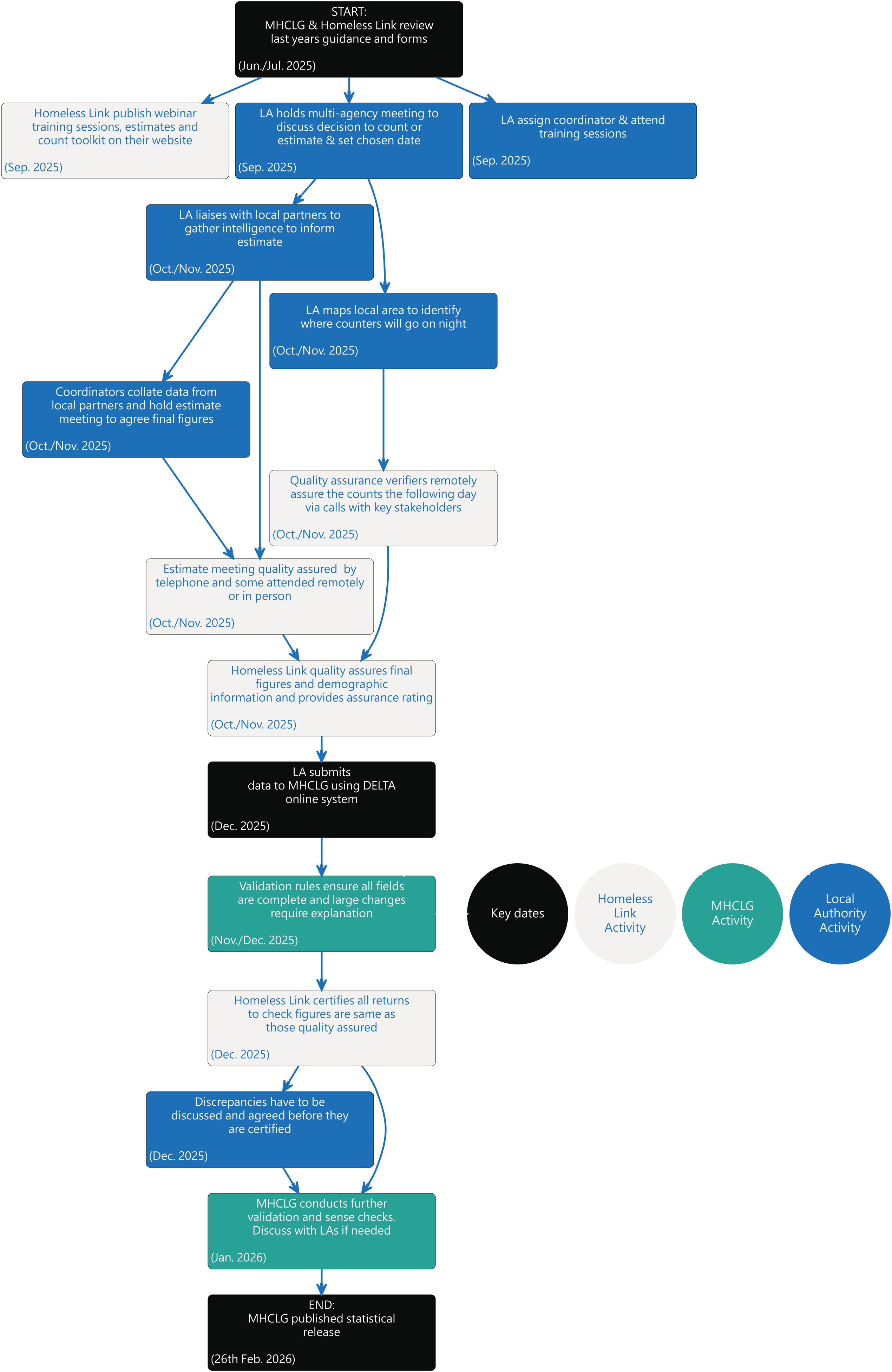
The standard is supported with an Administrative Data Quality Assurance Toolkit which provides useful guidance on the practices that can be adopted to assure users about the overall quality of the rough sleeping snapshot. See Figure 3.1 for a full outline of the statistical production process.
Overall, the rough sleeping snapshot has been assessed as A2: Medium Risk. This is because it is considered to have a medium public interest profile, as there is mainstream media interest with moderate economic and/or political sensitivity. The data is also regarded as medium risk in terms of data quality concerns, due to the large range of data suppliers, which includes all local authorities across England. Homeless Link were able to ‘Assure’ nearly all (93%) of rough sleeping snapshots this year.
Table 3.1: Assessment of the level of risk based on the Quality Assurance Toolkit
| Risk/Profile Matrix Statistical Series | Administrative Source | Data quality concern | Public interest | Matrix classification |
|---|---|---|---|---|
| Rough sleeping snapshot | Local authority rough sleeping counts and estimates | Medium | Medium | Medium Risk (A2) |
Figure 3.1: Rough Sleeping Quality Assurance Process Flowchart An outline of the statistical production process and quality assurance carried out to produce this year’s rough sleeping snapshot
4. Quality assurance during collection
Homeless Link have been funded by MHCLG since 2010 to provide guidance to local authorities who conduct the rough sleeping snapshot and to independently quality assure all local authorities’ snapshot estimates. Homeless Link’s role includes:
- Publishing a toolkit that supports local authorities to produce an accurate snapshot, whether by a count-based estimate or an evidence-based estimate.
- Providing support to local authorities in planning and carrying out the data collection.
- Assuring the quality of each rough sleeping snapshot.
- Provide training and support to quality assurance verifiers.
- Cross-checking the data submitted by local authorities to MHCLG with the numbers Homeless Link has quality assured for each local authority (i.e. the single night estimate of rough sleeping and demographic information).
The Homeless Link toolkit sets out the process that local authorities, and their local agencies, use to arrive at their snapshot estimate of people sleeping rough on a single night in autumn. This provides a full explanation of everything local authorities need to know to successfully carry out a rough sleeping snapshot estimate. See the full guidance. Key documents include:
- Choosing you approach
- Working with local partners
- Key dates and processes
- Quality assurance
- Forms and resources for local authorities.
- Common scenarios and possible solutions
- Videos explaining the process, including a 7 minute briefing
- Glossary of terms
- Submitting your data
Local authorities appoint a coordinator to oversee the process and liaise with Homeless Link’s Project Manager for support and to arrange quality assurance. The coordinator can be someone from the local authority but may also be an external person, such as a rough sleeping coordinator or an outreach team leader.
All coordinators are required to read the Homeless Link toolkit which sets out the process that local authorities, and their local agencies, should use to carry out their respective snapshots of rough sleeping. The toolkit includes guidance around: defining rough sleeping, choosing between the different approaches, collecting demographic data, how the quality assurance process works, step-by-step guidance, templates and forms and quick guides for easy reference.
This year, some changes have been made to the quality assurance process to improve the accuracy and robustness of the snapshot, in particular for count-based estimate and more clearly outline role of Homeless Link to local authorities, and escalation and support process.
This included largely replacing in-person assurance at count-based estimate with post-count quality assurance to be carried out remotely via three separate calls, with the LA Lead/Count Coordinator, Independent Partner, and a partner agency representative who participated in the count. In some cases, where there are concerns about specific LAs this assurance will remain in person.
Homeless Link also introduce standardised grading for the quality assurance of all snapshot estimates, to improve transparency, consistency and ensure better support for any local authorities who need additional support. Alongside, Homeless Link also more clearly explained their RAG rating system.
The RAG ratings are used by Homeless Link to assess each local authorities has been ability to fulfil the requirements of the snapshot estimate approach and whether additional support for future snapshot estimates should be offered. Any local authorities where there are concerns are automatically allocated a quality assurance verifier to attend the subsequent year’s snapshot estimate.
Quality assurance is the process through which the Quality Assurance Verifier allocated by Homeless Link ensures that the correct processes, as set out in the Rough Sleeping Snapshot Estimates Toolkit 2025 have been followed and the snapshot estimate figures are robust. The allocated verifier will classify each rough sleeping snapshot estimate as either:
- Assured – which means all elements of the chosen approach have been followed and there are no concerns about process or execution.
- Not Fully Assured – which means the chosen approach was partially followed e.g. no independent partner, count began before midnight, etc, or
- Not Assured – which means the chosen approach was not followed, e.g. known sites/hotspots were inaccessible or not visited, safety concerns, a different approach would have provided a more robust figure
Homeless Link uses its own staff, associates and volunteers to quality assure the rough sleeping snapshot estimates. These quality assurance verifiers receive Homeless Link training and must be independent of the local authority they are quality assuring. The reasons why this independent assurance role is important are that it:
- Provides independent oversight of the snapshot process.
- Ensures that there is a comparable process, year by year.
- Checks that each local authority is using the correct process.
- Enables action if local authorities are using the wrong process.
- Arrives at an accurate single figure and collates demographic data.
- Helps to answer questions and resolve issues.
- Asks questions and gathers information about rough sleeping causes and responses in different areas.
- Gains feedback to improve next year’s processes.
Quality assurance verifiers may attend some count-based estimates in person to check that people counting have followed the published guidance. They will join a counting team and will be back at the base before the other count teams arrive to speak to each counting team. Quality assurance verifiers are required to keep a tally of numbers and demographics and ask questions of each count team such as:
- Did they make any decisions not to count anywhere (e.g. due to safety concerns)?
- Were there any issues identifying people sleeping rough?
- Were there any incidents or activities that might have changed patterns of rough sleeping?
- Were the safety guidelines followed?
- Was the estimate what they were expecting?
Quality assurance verifiers may also attend evidence-based estimate meetings to observe the meeting and complete a quality assurance form. Their role is to be objective and ensure the process follows the published guidance; making sure evidence has been examined and discussed to provide a reliable estimate of the number of people sleeping rough on the night chosen for the estimate. Quality assurance verifiers at evidence-based estimate meetings should:
- Confirm the coordinator has contacted a range of local agencies, including relevant voluntary and community organisations, and invited them to be part of the estimate process.
- Confirm agencies have been given sufficient information to participate in the process and provide the information required.
- Confirm a ‘typical’ night has been chosen and that all agencies involved understand the principle of the ‘typical’ night, the definition of rough sleeping and that there is a data sharing protocol in place.
- Assess whether enough data and evidence has been gathered to resolve any conflicting information and that double counting has been avoided.
- Check if there are any issues or dynamics between local agencies that could influence the meeting.
- Observe the meeting and make notes in the quality assurance form.
- Listen to the evidence presented for each person thought to be sleeping rough.
- Provide guidance or make decisions about specific cases if the group are unsure or disagree.
- Make sure demographic data for each person sleeping rough is provided and any gaps in the data are explained and recorded as ‘Not known’.
- Ask questions to remind people of the rough sleeping definition and to ensure that decisions are led by evidence.
Quality assurance verifiers attending count-based estimates and evidence-based estimate meetings in person have to complete a quality assurance form which asks a series of questions about the process. For example, checking that the guidance had been followed, that relevant local agencies were involved, that a single ‘typical’ night was used, and that there was an understanding of the rough sleeping definition. These quality assurance forms have to be returned to the Homeless Link project manager who will review them and then let the local authority know they can submit their snapshot estimate and related demographic information via MHCLG’s DELTA online data collection system. The project manager will note any concerns or recommendations relating to the process which will be reported back to the local authority and also kept by Homeless Link to help inform their risk assessment of other local authorities.
There are a number of reasons why Homeless Link might not be able to quality assure an estimate. For example, if there were no independent local agencies involved or there was a lack of reliable evidence that people included were sleeping rough on that night or evidence was not included about known sleep sites or individuals sleeping rough.
The involvement of local agencies is an essential element of the rough sleeping snapshot. It ensures transparency about how the snapshot was carried out and enables Homeless Link to speak to independent local agencies as part of the quality assurance process.
Local authorities may not have involved independent local partners for a number of reasons, including last minute cancellations, self-isolation so they could not be involved and difficulty finding independent partners who were not commissioned by local authority in some way or another to support people sleeping rough as services have been expanded. In some other cases, local authorities involved independent, non-commissioned local partners in the planning of the process but not the actual count-based estimate or evidence-based estimate meeting, so these would be given a ‘Not Fully Assured’ rating.
Any snapshots not quality assured in person or in detail remotely, are quality assured remotely by telephone. In each case, the telephone quality assurance verifier will ask the coordinator a series of questions about how they conducted their snapshot to complete a quality assurance form. Once completed, they can confirm that the information be recorded on DELTA.
In 2025, Homeless Link quality assured 1 local authority’s count-based estimate in person (0.3% of the total), liaising with the count coordinator at Bournemouth, Christchurch and Poole to check that the guidance had been followed in the planning of the count.
Homeless Link conducted a detailed remote quality assurance of the remaining 50 local authorities (17% of the total) which used a count-based estimate. These were Leicester, South Ribble, East Staffordshire, Colchester, City of London, Hackney, Dover, Folkestone and Hythe, Bedford, Torbay, Liverpool, Sheffield, Westminster, Croydon, Islington, Newcastle, Middlesbrough, Sunderland, Redbridge, Norwich, Ipswich, Maidstone, Crawley, Bracknell Forest, Preston, Brighton & Hove, Stoke on Trent, Newcastle under Lyme, Nottingham, Hillingdon, Leeds, Peterborough, Oxford, Medway, Bristol, Lambeth, Harrow, Lewisham, Greenwich, Bexley, Southwark, Kensington and Chelsea, Hammersmith & Fulham, Manchester, Trafford, Bury, Southend on Sea, Barking and Dagenham, Cambridge and Ealing.
Homeless Link also conducted a detailed quality assurance of 48 local authorities which used an evidence-based estimate meeting (16% of the total) by being present at the online estimate meeting. These were Hounslow, Rutland, Worcester, Gedling, Hinkley and Bosworth, Hereford, Coventry, Walsall, Tower Hamlets, Waltham Forest, Newham, Gosport, Fareham, Test Valley, Kirklees, North Warwickshire, Shropshire, Luton, Barnet, South Tyneside, Sefton, Stroud, Tewkesbury, Cotswold, Forest of Dean, Cheltenham, Gloucester, Haringey, Camden, Fylde, Havant, Central Bedfordshire, Exeter, Reading, Horsham, Teignbridge, East Hampshire, Wyre, Eastbourne, Lewes, Rother, Wealden, Fenland, Woking, Bromley, Milton Keynes, Calderdale and Rochford.
Homeless Link chose these local authorities at random and via a risk assessment to ascertain whether these local authorities would need direct support with planning or quality assurance of their estimate was carried out. High risk authorities could be those with high numbers of people sleeping rough, issues with local agencies disputing estimates, concerns about the correct approach being used in previous years, or requests for additional support.
The remaining 197 (67%) local authority estimates were not selected for detailed quality assurance and underwent the process by telephone .
In 2025, Homeless Link quality assurance verifiers gave a ‘Not Assured’ rating to 3 local authorities, which means the chosen approach was not followed. These were Colchester, Harrow and South Gloucestershire.
Homeless Link also gave 17 local authorities a ‘Not Fully Assured’ rating, which means the chosen approach was partially followed. These were South Ribble, Fylde, Bournemouth, Christchurch and Poole, Bristol, Gosport, Central Bedfordshire, Reading, Horsham, Woking, Harborough, Breckland, Wandsworth, Babergh, Mid Suffolk, Mid Sussex, Bath and North East Somerset, and Pendle.
The remaining 276 (93%) local authorities were ‘Assured’ by Homeless Link, which means all elements of the chosen approach have been followed and there are no concerns about process or execution.
5. Quality assurance prior to publication
Since 2017, local authorities have been required to submit their annual single night snapshot data via MHCLG’s DELTA online data collection system.
The rough sleeping snapshot DELTA form asks local authorities to provide the following information:
- Type of approach used.
- Date of count (i.e. ‘typical’ night).
- Whether the approach used was same/different to last year.
- Whether there were any activities, incidents or circumstances that affected the snapshot.
- Which local agencies were involved.
- Total snapshot figures.
- Demographic details (i.e. age, gender, nationality).
The DELTA online data collection system includes in-built rules and validation checks to ensure the data provided is complete and accurate. For example, any large changes compared to the previous year would trigger an alert to the authority and require a text description to explain the reason for the change, in order to submit the information. Specifically, these include a rule to ensure:
- Figures have been quality assured by Homeless Link before they are submitted via DELTA.
- Demographic breakdowns sum to the total snapshot figure provided.
- All fields are completed before the form can be submitted.
- Date of snapshot was between 1 October 2025 and 30 November 2025.
- At least one local agency has been consulted as part of the process before information can be submitted via DELTA.
and a Validation check to trigger an explanation from the local authority if the:
- Overall snapshot figure is +/- 20 % or +/- 5 different compared to last year.
- Gender breakdown changes significantly compared to last year.
- Age breakdown changes significantly compared to last year.
- Nationality breakdown changes significantly compared to last year.
All returns submitted by local authorities on DELTA also undergo a final certification by Homeless Link to check that the final figures submitted were the same as those which had already been quality assured. If there were any discrepancies, these had to be discussed and agreed with Homeless Link before they were certified.
As well as the in-built validations via DELTA, MHCLG analysts also carry out a series of checks including comparing the latest snapshot figures with other relevant data sources to produce a quality report. These include:
- Outlier checks to see how each overall rough sleeping snapshot figure compares to previous years.
- Outlier checks to see how demographic figures compare to previous years.
- Comparing London snapshot estimates with CHAIN estimates for October to December.
- Comparing new rough sleeping management information with the rough sleeping snapshot.
6. Data quality and limitations
Accurately estimating the number of people sleeping rough within a local authority is inherently difficult given the hidden nature of rough sleeping. There are a range of factors that can impact on the number of people seen, or thought to be sleeping rough, on any given night. For example, the availability of night shelters, the weather, where people choose to sleep, and the date and time chosen for the snapshot estimate. Whilst local authorities are asked to provide possible reasons for any significant changes in the numbers of people who sleep rough, compared to previous years, the figures in this release are subject to some uncertainty and therefore should be treated as estimates of the number of people sleeping rough on a single night in autumn. In 2021 and 2022 there were COVID-19 related measures in place. These measures may have reduced people’s risk of rough sleeping.
The single night snapshot in England provides a way of estimating the number of people sleeping rough across local authorities and assessing change over time. There is currently no national mechanism for recording every person who sleeps rough in England across the year. However, the single night snapshot aims to get as accurate a representation of the number of people sleeping rough as possible, while acknowledging that there are some limitations. The snapshot approach used in England aligns with a standard approach used in many parts of the world including Canada, the United States and several other European countries including France, Ireland, Italy and Spain.
All approaches record only those people seen, or thought to be, sleeping rough on a single ‘typical’ night. They do not include everyone in a local authority with a history of sleeping rough, or everyone sleeping rough in local authorities across the October-November period.
Many people who sleep rough do so intermittently, moving from hostels or ‘sofa surfing’ to sleeping rough and back. Many people sleeping rough bed down in places out of sight to avoid the risk of being detected, which means accurately capturing the number of people sleeping rough across a local authority on a single night is inherently difficult. We recognise that sleeping patterns of females experiencing rough sleeping is more hidden, transient and intermittent and therefore may not be fully captured by the snapshot which requires people to be bedded down and takes place at night. For example, women who sleep rough may sit or sleep in places which are open all night, walk all night or engage in sex work during the night but not have anywhere to sleep during the day[footnote 3].
A range of different factors can influence the outcome of the snapshot estimates including:
- Local authority topography: It is more difficult to carry out a count of people sleeping rough in large rural and coastal areas than in urban areas. For example, the surface area to cover on a single night in a rural area is often much larger with a wider range of places people may sleep rough. For example, woods, barns or farmland, which can be difficult or unsafe to access. Whilst in urban areas it may be easier to carry out a street count, there may still be issues with including everyone sleeping rough. This is because people could be sleeping in sites which are difficult and unsafe to access, such as derelict buildings and building sites. Furthermore, people sleeping rough may move across local authority boundaries regularly which may explain some of the year-on-year differences observed.
- Weather: The weather of the chosen night for the count or estimate may have an impact on the number of people sleeping rough. Severe weather conditions will force many people who normally sleep rough to use a night shelter or hostel, to ‘sofa surf’, or sleep in locations which are hidden. These people would be excluded from the count or estimate which may alter the detected level of people sleeping rough. In some local authorities, we know that the weather was more severe compared to last year and in others it was milder, which may also have impacted on the overall number.
- Time and day of snapshot: The guidance provided by Homeless Link makes clear that the night chosen for the count or estimate should take care to avoid any unusual local factors which may distort the number, such as: club nights, football matches, festivals, charity sleep-outs, higher levels of police activity, or changes to service opening times. Local authorities are also advised to identify an appropriate day of the work week for the estimate, as opposed to a day of the weekend, where people may bed down later or are less visible. Local authorities are advised that start times should be tailored to meet local circumstances. The earliest permitted start is midnight. In cities and towns with a busy night time economy a start time of 2am, or even later, is more appropriate so that people sleeping rough who bed down after pubs and clubs close are still counted. Counts should be completed by 5am. However, in rural areas, where the majority of people are sleeping rough away from built-up and well-lit areas, they may be conducted in the hours after dawn. Local authorities should take care to follow the same time period used each year as closely as possible, unless there is a good reason not to, such as a later night time economy.
7. Comparability with other rough sleeping statistics
MHCLG also collects and publishes management information to better understand how far rough sleeping is prevented wherever possible, and where it does occur it is rare, brief, and non-recurring. This management information provides more timely information about people sleeping rough but uses a similar collection approach to annual rough sleeping statistics, albeit without the greater quality assurance of the annual statistics.
Local authorities are asked to provide a single‑night estimate each month using one of the three recognised snapshot methods used for the annual rough sleeping estimate. If they have not conducted a snapshot that month, they should use local intelligence and records to produce the best available figure.
In October and November, when the annual snapshot takes place, authorities are advised to submit their annual estimate as their monthly return. Some, however, choose to keep a consistent monthly snapshot instead. There is more local discretion for the monthly snapshot compared to annual snapshot around the approach used, the date for the single night snapshot, the coverage, the involvement of independent local partners and the level of thoroughness. The annual snapshot remains the official and most robust single‑night measure, as it is independently quality assured by Homeless Link.
In 2025, 53% of local authorities submitted the same figure for both their annual snapshot and their corresponding monthly single‑night estimate. The annual autumn rough sleeping single night estimate for 2025 was 4,793 people, compared to the October single night snapshot estimate of 4,050 people and the November single night snapshot of 4,304 people, 18% and 11% lower. Overall, the management information single night snapshot estimate which coincides with the official annual single night snapshot tends to be lower, as seen in previous years.
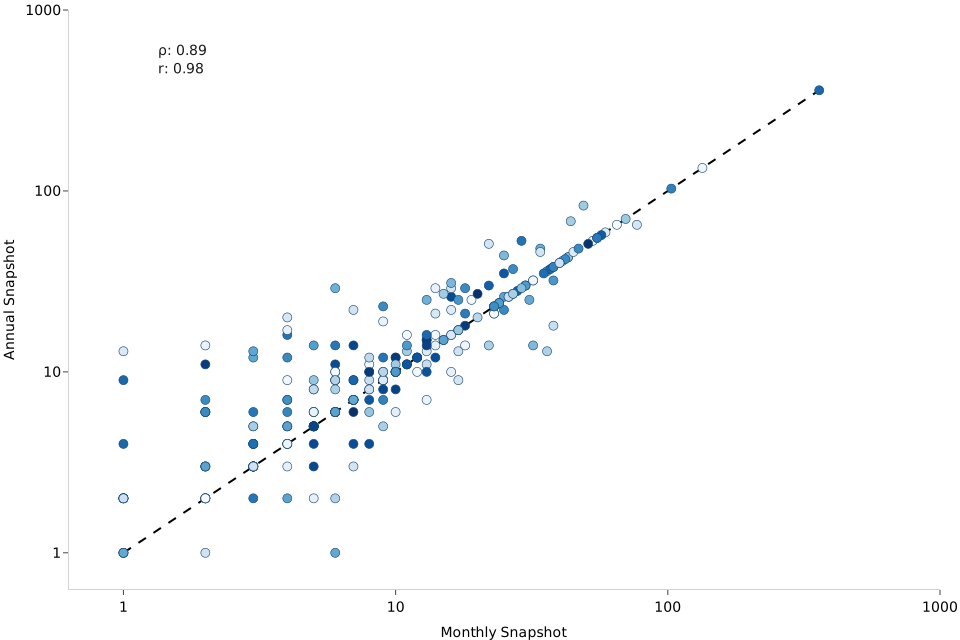
To assess the quality of the management information, we compared the monthly rough sleeping management information estimates with the 2025 rough sleeping snapshot data (See Figure 7.1). These two different sources were correlated which provides confidence that local authorities are consistent when estimating the number of people sleeping rough on a single night.
Figure 7.1: Scatterplot of rough sleeping snapshot (autumn 2025) estimates compared to monthly rough sleeping management information estimates (November 2025) The Spearman (ρ 0.89) and Pearson (r 0.98) correlation coefficients show that the data are positively correlated
Combined Homelessness and Information Network
The Combined Homelessness and Information Network (CHAIN) is a multi-agency database that records information about people seen rough sleeping by outreach teams in London. It is managed by Homeless Link and is used by organisations working with people sleeping rough in London. Information is recorded onto the CHAIN database by people who work directly with people sleeping rough in London (e.g. workers in outreach teams, day centres, hostels and resettlement teams). CHAIN, however, does not cover ‘hidden homeless’ groups, such as those who are squatting or staying in inaccessible locations to outreach workers.
The CHAIN data most similar to the single night snapshot provides a total count of all individuals seen sleeping rough by outreach teams in London on at least one night during the October to December 2025 quarter (CHAIN data is published quarterly and annually). Whereas the MHCLG single night snapshot for autumn 2025 shows the number of people seen or thought to be sleeping rough on a single night between 1 October and 30 November 2025.
Although the CHAIN data is not directly comparable to the single night snapshot, a relationship between the two sources of evidence is not unexpected as they are measuring the same group of people, albeit in different ways.
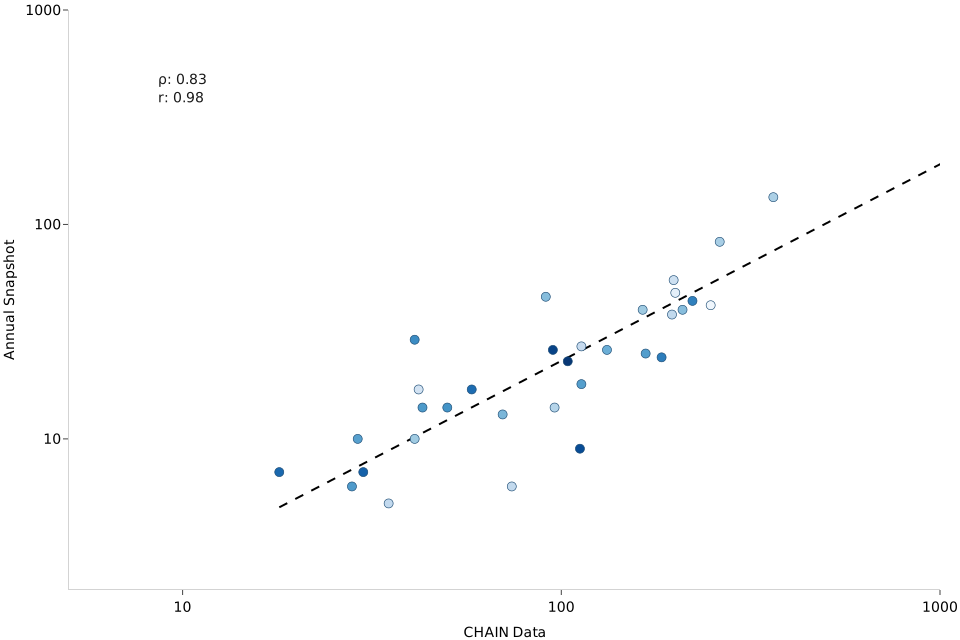
As part of our quality assurance checks, we looked at the correlation between the latest rough sleeping snapshot estimates for all local authorities in London and the latest CHAIN quarterly estimates of rough sleeping in London. A positive correlation was observed between the two sources of data (See Figure 7.2). This provides further confidence in the quality of the rough sleeping snapshot estimates as they are similar to another independent source.
Figure 7.2: Scatterplot of rough sleeping snapshot (Oct-Nov 2025) data compared to CHAIN (Oct-Dec 2025) data The Spearman (ρ 0.83) and the Pearson (r 0.98) correlation coefficients show that the data are positively correlated
8. Data collection process
All local authorities take a snapshot of the number of people sleeping rough in their local authority on a ‘typical’ night which is a single date chosen by the local authority between 1 October and 30 November. The date can change from one year to the next and will not be the same for all local authorities, although there is some coordination across neighbouring local authorities, to avoid double counting.
All snapshot approaches will not include everyone in the local authority with a history of rough sleeping between October and November but rather record people found on the night of the count or known to be sleeping rough on a single night, evidence of which is provided by local agencies.
The snapshot takes place in the autumn rather than summer or winter where numbers are either likely to be higher, due to warmer temperatures or lower, as more temporary night shelters are made available to ensure people do not sleep rough in very cold weather.
If there are severe weather conditions on the night of the estimate, the local authority may activate their Severe Weather Emergency Protocol (SWEP), if they have one. This provides support for individuals during extreme weather. If people sleeping rough do take up emergency accommodation as part of the SWEP, they are still included in the rough sleeping snapshot.
Local authorities appoint a coordinator to oversee the snapshot process and liaise with Homeless Link’s Project Manager to arrange quality assurance. Homeless Link uses its own staff, associates, and volunteers to quality assure the rough sleeping snapshots. These quality assurance verifiers receive Homeless Link training and must be independent of the local authority they are quality assuring.
The local authority starts by arranging a multi-agency meeting with local agencies to bring together the most accurate and up-to-date information on rough sleeping. This enables a decision to be made on the most appropriate approach to be used and the ideal date that the ‘typical’ night for the snapshot should be.
Local authorities are advised to involve local agencies that will have the most accurate information about who is sleeping rough and may include:
- Outreach teams, hostels, day centres and night shelters.
- Housing departments and Housing associations.
- Police, community safety teams and park rangers.
- Faith groups, soup runs, street pastors and advice agencies.
- Social Services, youth workers and probation services.
- Health and mental health services.
- Refuse collectors, town centre and local retail security/management and street wardens.
9. Deciding which approach to use
Local authorities, together with local agencies, decide which approach and date to use for their snapshot of people sleeping rough. They are advised to use the approach that will most accurately reflect the number of people sleeping rough in their local authority, thus providing the most accurate estimate. The decision about what approach to use is made in September, so that there is enough time to plan the next steps before the snapshot happens in October or November.
Homeless Link provide guidance to local authorities on the reasons to choose the relevant snapshot approach. These are as follows:
Reasons to choose a count-based estimate:
- People sleeping rough are in sleep sites that will be visible/accessible at night.
- There are changes in the number, population or location of people sleeping rough where sites are visible. These include areas near transport hubs where transient groups sleeping rough make the figures unpredictable from one night to the next, or areas that regularly see people new to the streets.
- There are difficulties forming an evidence-based estimate on the basis of the information available. For example, where there is a lack of local agency intelligence about where people are sleeping rough or where local agencies refuse to share data.
- There is significant disagreement about the numbers between agencies and where sites are visible/accessible.
Reasons to choose an evidence-based estimate meeting:
- Sleep sites are inaccessible (e.g. in woods or dispersed across rural areas).
- Sleep sites are unsafe to access or are hidden from sight.
- The local authority cannot arrange safe access to known rough sleeping sites (e.g. parks, tower blocks) during a street count.
- There is regular intelligence gathering in place by a number of agencies and they are happy to share their intelligence with the local authority.
- Numbers of people sleeping rough are consistently low, they are already in touch with services, and partner agencies agree this is the case (i.e. there are rarely people who are new or returning to the streets).
- The local authority can gather sufficient and reliable intelligence on people sleeping rough on the ‘typical’ night via partner agencies.
- Partner agencies agree to collect information for an agreed night and share this with the local authority for the purpose of the estimate.
Reasons to choose an evidence-based estimate meeting informed by a spotlight count:
- There is a mix of visible/accessible and hidden/inaccessible locations in the local authority.
- The individuals sleeping rough or overall numbers of people sleeping rough in visible/accessible sites change frequently.
- There are conflicting views from local agencies about which approach is right for the local authority.
- Additional intelligence comes to light on the night of a planned street count about hidden rough sleeping (i.e. the process is expanded from count-based estimate to evidence-based estimate meeting).
As part of the quality assurance process, Homeless Link asks why the specific approach has been chosen and provide feedback to local authorities where there are concerns that the proposed approach might not produce the most accurate snapshot. If there is any evidence that the chosen approach has missed out people known to the local authority or included people who are not within the rough sleeping definition, Homeless Link may not be able to quality assure the snapshot.
Local authorities can adjust aspects of the process from year to year to achieve greater accuracy. Some of the small changes a local authority might make include:
- Choosing the ‘typical’ night earlier (e.g. October) to reduce the risk of severe weather.
- Changing the night of the week in response to a busier night time economy.
- Starting a street count later (e.g. 2am instead of midnight) in response to a busier night time economy.
- Involving new local agencies and/or people with lived experience to improve evidence base/engagement.
- Taking into account a significant change in the local context, such as boundary changes.
If local authorities change their approach from an evidence-based estimate meeting to a count-based estimate or vice versa from one year to the next, Homeless Link question the decision-making process to confirm that there is a valid reason to change approach. Areas are advised that undertaking a count at other times of year is not in itself a sufficient reason to change between evidence-based and count-based estimates. Again, if the decision to change approach does not meet the criteria for choosing one approach over another as detailed above, Homeless Link may provide the snapshot with a ‘Not Assured’ rating
10. Count-based estimates
Local authorities are advised to start planning the count-based estimate of visible rough sleeping at least six weeks before the count itself. This gives enough time to carry out a range of key activities including:
- Gathering intelligence from local agencies.
- Preparing a data protection statement.
- Organising volunteers.
- Planning the night’s activities.
- Liaising with the police.
- Arranging a Homeless Link quality assurance verifier.
Local authorities are advised that the date of the count should only be shared on a ‘need to know’ basis in case this causes a change in the pattern of people sleeping rough, potentially resulting in a less accurate figure.
The presence of film crews or photographers on the count is not permitted by the guidance, as this would mean it is no longer a ‘typical’ night. For example, people may move sleep sites to avoid being filmed or photographed.
Start times should be tailored to meet local circumstances (typically between 12-2am and finish between 3-6am). The earliest permitted start time is midnight. In cities and towns with a busy night time economy a start time of 2am, or even later, is more appropriate to include people who bed down after pubs and clubs close. In rural local authorities, where the majority of people are sleeping rough away from built-up and well-lit areas, counts may be conducted in the hours after dawn.
There is no fixed duration for a count. It will depend on the geography of the local authority, the number of counters, the number of people sleeping rough and what occurs as the teams are talking to the people they meet (e.g. getting people to shelter/hubs or dealing with emergencies). In most cases, if appropriate intelligence has been gathered and enough volunteers recruited, counts take no more than three hours to conduct.
Local authorities without regular outreach teams may do a street needs audit with a smaller team in advance of the count. This helps to gather intelligence about sleep sites so that the count can be planned around known sleeping sites. This is because it is not feasible to check every street/alley/car park in most local authorities and thus, some targeting of teams is needed. However, local authorities are advised not to do ‘pre-counts’ on the same day as they could disrupt activity. For example, if people get prior knowledge a count is due to take place, they may move elsewhere to avoid being disturbed later in the evening.
Local authority coordinators are responsible for recruiting volunteer counters to help with the count-based estimate. Many local authorities use volunteers from their own workforce, as well as volunteer counters from the local statutory and voluntary sectors or faith and community groups. For example, police, park rangers, day centre staff, street pastors and advice workers. If there is a local outreach team available to the local authority, they should be fully involved in the count-based estimate.
Local authorities must involve volunteers who are independent of the council and its outreach team (e.g. non-commissioned) as this strengthens the credibility of the count. Homeless Link may not quality assure the process if no local agencies, or only those that are part of, or commissioned by, the local authority are involved.
Local authorities are advised to liaise with neighbouring local authorities and, if possible, organise a count on the same night over a county or wider sub-regional area. This reduces the risk of double counting people who move across local authority boundaries.
It is unlikely local authorities will have enough volunteer counters to cover every street or park in their local authority. If there are sleep sites that are occupied but inaccessible or unsafe, then local authorities should consider using the evidence-based estimate meeting process including a spotlight count to improve accuracy.
Local authorities are advised to plan ahead to gain access to non-public areas where people may be bedded down (e.g. hospital or college grounds, parks, building stairwells, car parks). This may include contacting police, park rangers or security firms to gain access to those areas.
Local authorities should be divided into segments for each counting team. Each counting team will need a map clearly showing the boundaries of their segment and any known areas for people sleeping rough within it. Exact boundaries, identifying individual streets or parts of streets, should be identified and drawn on a map. It is important to be precise about boundaries so that areas are not double counted or missed entirely.
The areas covered should be well known to the teams and individual counters. The most effective counters are those with knowledge of where people are likely to be sleeping rough in that local authority (e.g. workers from local outreach teams). Therefore, someone with knowledge of local rough sleeping should be included in each team, alongside volunteers from other agencies.
There should be at least one mobile counting team in a car to cover outlying areas and support other teams if they encounter delays (e.g. providing assistance to a person they find sleeping rough).
At least one person, usually the coordinator, stays at the base of operations to deal with queries and check in with counting teams during the night. The quality assurance verifier should be in the first team to return to the base so that they can speak to each team as they return and ask questions about the information being provided. This ensures that the guidance has been followed correctly.
Some count-based estimates may be quality assured in person by Homeless Link. The majority will be quality assured remotely by telephone, in which case they will speak with at least three participating counters, including someone independent/non-commissioned (e.g. from a local faith or community group).
Once the information has been quality assured , it is submitted to MHCLG where it is quality assured and compiled for publication. For more information about the quality assurance processes involved, see the sections on Quality assurance during collection and Quality assurance prior to publication.
What information is collected on the night of a count-based estimate?
Homeless Link provide templates and guidance for local authorities to use on the night of the count. This information is used both for the rough sleeping snapshot, as well as helping the local authority establish plans to reduce rough sleeping. The counters are asked to record the following information, where possible, to help plan local responses for supporting people sleeping rough. This includes:
- Location.
- Full name (if known).
- Demographics (i.e. age, gender, nationality).
- Support needs.
- Length of time sleeping rough.
- Reason why details not known.
- Whether had accommodation but not taking it up.
- Whether known to outreach.
- An action plan to end each rough sleeping for each person found.
11. Evidence-based estimate meeting and evidence-based estimate meeting including a spotlight count
Evidence-based estimate meetings
An evidence-based estimate meeting is an effective way to collate the evidence of rough sleeping on the chosen night and to discuss any potential duplicates or misinformation. Where a disagreement arises, or where there are conflicting approaches between agencies on the scale of the issue, a face-to-face meeting is a useful way to agree upon an accurate estimate on the number of people sleeping rough in a local authority.
Evidence-based estimate meetings rely on agencies being able to share accurate basic information about an individual’s situation on a particular night. Agencies should agree a data sharing protocol with the local authority before the evidence-base meeting takes place. It is important that there is a way to identify individuals, by name or a unique identifier (e.g. initials and date of birth), to minimise the risk of double counting and including people who have been housed and were not sleeping rough on the ‘typical’ night.
If some agencies decline to join the data sharing agreement they may still submit information as evidence, but more weight will be given to those agencies whose evidence is supported by complete data.
What information is collected to inform the evidence-based estimate meeting?
Homeless Link provide templates and guidance for local authorities to use as part of the evidence gathering task that is used to inform the evidence-based estimate meeting. This information is used both for the rough sleeping snapshot as well as a way of helping the local authority establish plans to reduce rough sleeping. The information local agencies are asked to gather includes:
- Location.
- Full name (if known).
- Demographics (i.e. age, gender, nationality).
- Evidence that the individual was rough sleeping on the agreed ‘typical’ night.
- Other agencies working with an individual.
Agencies should collect evidence for the night of the estimate and bring it to the estimate meeting. If a face-to-face estimate meeting isn’t practical, agencies are asked to submit their evidence in a password encrypted email file or verbally via a telephone conference. The coordinator should collate this evidence and resolve any issues with the relevant agencies.
If there is already a local forum or network, which brings together key agencies working with people sleeping rough, then this can also be used for the evidence-based estimate meeting (with expanded membership, if needed). As long as sufficient data sharing protocols are in place.
Each agency should present information on who they think slept rough on the night of the estimate. Evidence should be provided for each person. Examples of evidence that an individual slept rough include:
- Individual seen bedded down by local or partner agency.
- Individual known to the agency and it is clear that they do not have accommodation that they can occupy (people sleeping rough over a longer period/with a history of rough sleeping).
- A spotlight count carried out in particular locations on the chosen night.
- Individual self-reports sleeping rough over the period alongside evidence that they are sleeping rough (use of services, carrying/storing belongings, appearance - while bearing in mind many people sleeping rough are well-presented, other known factors).
- Information that demonstrates that someone known to be sleeping rough, intermittently, did sleep rough on the night in question (e.g. they weren’t seen in their hostel; were at the day centre early; were discharged from prison or hospital shortly before).
Spotlight counts are an additional evidence source to include alongside multi-agency intelligence (Spotlight counts should only be used alongside other data sources). This can be particularly effective for local authorities with people sleeping in a mix of urban and rural locations, or where there are fluctuating numbers of people sleeping rough. Spotlight counts must take place after midnight on the ‘typical’ night chosen. This is to avoid counting people who are part of wider street activity but have somewhere to stay and will not bed down for the night. Involving independent agencies will give the spotlight count more credibility but may cause resource issues if the same agencies are being asked to attend the estimate meeting.
The final decision on the estimated number of people sleeping rough is made by the local authority, taking into account all the evidence and eliminating duplicates or unsubstantiated data. The coordinator might need to collate further information following the estimate meeting in order to resolve any outstanding questions. Particularly where people are known to move between local authority boundaries and where there is a risk of duplication with neighbouring estimates.
Homeless Link aim to join at least 10% of the estimate meetings remotely as part of the quality assurance process based on a combination of: concern/risk, random allocation, geography and availability. During quality assurance, Homeless Link will check which agencies have been involved. Estimates using the evidence-based process must be able to show more than one data source. Where the process involves no local agencies, or only those that are part of or commissioned by the local authority, Homeless Link may not be able to quality assure the process.
After the estimate process ends, the quality assurance verifier completes the evidence-based estimate quality assurance form. This is then reviewed by Homeless Link’s Project Manager before being returned to the local authority lead.
Once the estimate has been quality assured by Homeless Link, local authorities submit this information to MHCLG. For more information about the quality assurance processes involved, see sections on quality assurance during collection and on quality assurance prior to publication.
12. Analysis of approach changes by local authorities
The number of people sleeping rough overtime was investigated in order to examine the possible effects of local authorities’ changing their approach on rough sleeping estimates. Specifically, we looked at those local authorities who have consistently used the same approach[footnote 4] compared with those who have changed approach[footnote 5] . Approach changes included changing from a count-based estimate to either an evidence-based estimate meeting or an evidence-based estimate meeting with spotlight count, and vice versa. Changes between the two evidence-based estimates were not considered as overall approach changes.
Local authorities using the same approach compared with those who have changed approach
There are several reasons why a local authority may change from an evidence-based estimate to a count-based estimate or vice versa from year to year. For example, a local authority may change from an evidence-based estimate to a count-based estimate if there are a lack of local agencies with intelligence about where people are sleeping rough or if agencies refuse to share their data making it difficult to form a reliable estimate. Conversely, a local authority may change from a count-based estimate to an evidence-based estimate if there are new sleeping sites that are inaccessible or unsafe which would not be included in a count-based estimate.
Local authorities can change approach from year to year but any decision to do so has to be guided by whether it will produce the most accurate and precise figure. Homeless Link ask for details on the decision-making behind any potential change as part of the quality assurance process to ensure they meet the guidance.
There were 123 local authorities (42% of the total) that consistently used the same approach for their snapshot since 2010, compared to 173 (58% of the total) local authorities that have changed approach at least once since 2010 (See Table 12.1). Local authorities that have changed approach at least once since 2010 have consistently recorded higher numbers of people sleeping rough compared to local authorities that have always used the same snapshot approach. However, this does not take into account the differences in the types of local authorities which have changed approach compared to local authorities that have used the same approach.
Table 12.1: Local authorities who have changed approach or used same approach since 2010
| Approach | Number of local authorities | % |
|---|---|---|
| Changed approach | 173 | 58 |
| Same approach | 123 | 42 |
| Total | 296 | 100 |
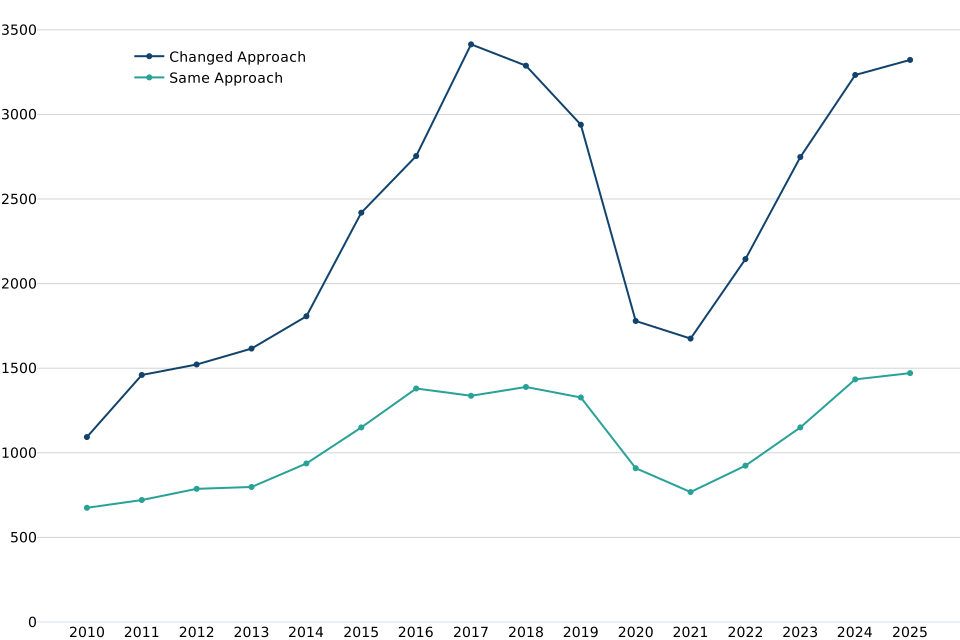
Between 2011 and 2016, the number of people sleeping rough in local authorities that changed approach, compared to local authorities that consistently used the same approach, increased at similar rates. However, between 2016 and 2017, local authorities that had changed approach at least once since 2010 saw an increase in the numbers of people sleeping rough (See Figure 12.1). However, this could be in response to local authorities having identified increased numbers of people sleeping rough and as a result changed approach to more accurately account for this increase. While it is difficult to say exactly what may have caused this divergence between 2016-2019, many of the local authorities that have changed approach are located in London which historically has high numbers of people sleeping rough compared to the rest of England. In 2020, there was a sharp decrease in overall levels of rough sleeping regardless of the approach taken by the local authority. The decrease in the number of people sleeping rough, according to the local authorities involved, was largely due to the ‘Everyone In’ scheme and other projects funded by the Department, including the RSI.
Figure 12.1: Number of people sleeping rough on a single night: comparing local authorities that have never changed approach relative to local authorities that have changed approach at least once since 2010
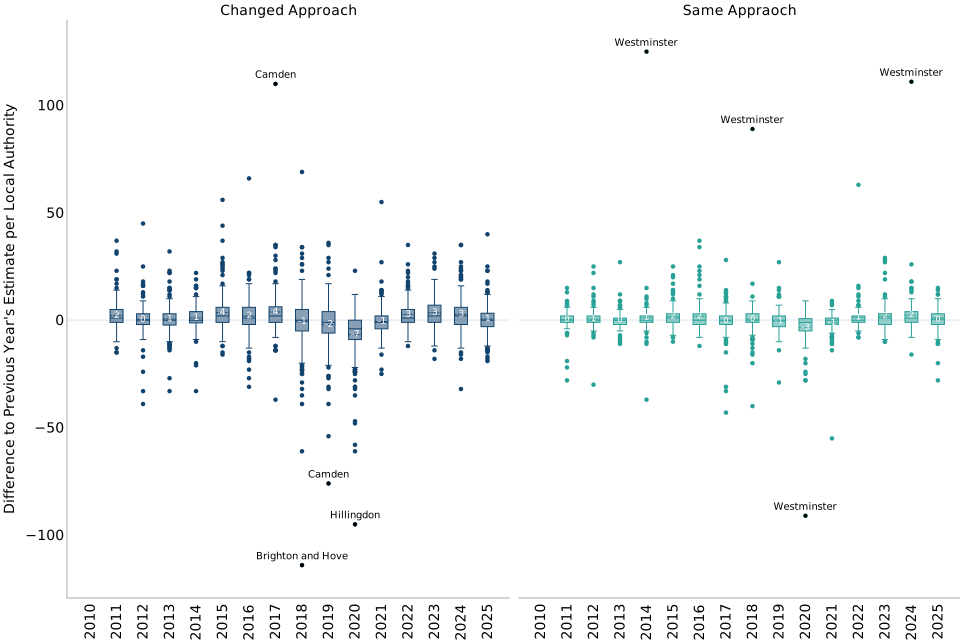
The average (median) year on year difference in the number of people sleeping rough per local authority that have never changed their snapshot approach since 2010, compared to local authorities that have changed their approach at least once since 2010, was investigated (See Figure 12.2). This data would suggest that the average change in the number of people sleeping rough per local authority is broadly similar over time, irrespective of approach changes.
Figure 12.2: Box plot[footnote 6] year on year difference of people sleeping rough: comparing local authorities that have used the same approach since 2010
13. Data tables and interactive dashboard
Seven accompanying tables are available alongside this release. These include the number of people sleeping rough, demographic information (i.e. age, gender, nationality), the snapshot approach used, and any consultations that took place with local agencies. An interactive dashboard enables users to explore trends in rough sleeping since 2010.
14. Related statistics
The rough sleeping statistics do not provide a definitive number of people or households affected by homelessness in England. The term ‘homelessness’ is much broader than people sleeping rough. It is difficult to provide an accurate estimate of all homelessness across England. Data used to compile any estimate is collated from different datasets, which sample different subsets of the population over different time frames. Any estimate of homelessness in England will collate datasets that are not discrete from one another, which means some individuals may have been included more than once in the estimated total.
MHCLG related statistics
Rough sleeping data framework management information
MHCLG also collects and publishes management information to better understand how far rough sleeping is prevented wherever possible, and where it does occur it is rare, brief, and non-recurring.
This management information provides more timely information about people sleeping rough but uses a similar collection approach to annual rough sleeping statistics, albeit without the greater quality assurance of the annual statistics.
Management information for London boroughs is pre-populated via the Combined Homelessness and Information Network (CHAIN).
Alongside this year’s snapshot statistics, we are also publishing the latest quarterly update of Rough Sleeping Data Framework management information, up to December 2025.
Support for people sleeping rough
MHCLG collected and published management information about the support for rough sleepers and those at risk of rough sleeping since May 2020 to October 2023, initially as part of the response to the COVID-19 pandemic.
This management information provided more timely information about people sleeping rough but uses a similar collection approach to annual rough sleeping statistics, albeit without the greater quality assurance of the annual statistics.
This quarterly publication provided a fuller picture of the dynamic and seasonal nature of rough sleeping, and illustrated the work done by local authorities to provide a pathway off the streets and into long term accommodation.
Following the roll out of the new data framework to all local authorities in England, in May 2023, this quarterly publication was replaced.
Rough sleeping questionnaire
The Rough Sleeping Questionnaire (RSQ) is one the largest surveys of people who sleep rough ever attempted in the UK. People who participated in the questionnaire provided details of their homelessness experience, support needs and vulnerabilities, and their use of public services. This survey was first run in 2019 to provide information on rough sleeping experiences, and repeated in 2025, to continue MHCLG’s mission to improve services for people who sleep rough, and those at risk of sleeping rough, with the help of the latest data.
To address gender disparities in rough sleeping experiences, in particular women who have been victims of domestic abuse and violence, an analysis of the rough sleeping 2025 questionnaire responses, with a particular focus on the trends affecting women was undertaken.
To improve MHCLG’s understanding in supporting people experiencing homelessness, particularly in relation to their mental health needs, an analysis of the rough sleeping 2025 questionnaire responses with a particular focus on mental ill health and conditions, was undertaken.
Homelessness research
MHCLG have published a collection of research and evaluation reports on Homelessness and rough sleeping commissioned or conducted by MHCLG, including reports based on research and analysis undertaken as part of the Better Outcomes through Linked Data (BOLD) programme. The reports demonstrate how a range of linked datasets can provide a richer understanding of situations faced by those who become homeless.
Statutory homelessness
MHCLG also collect and publish quarterly and annual statistics on the broad characteristics and circumstances of households owed a statutory homelessness duty. This includes households who are rough sleeping at the time of local authority approach. Any individual not owed a homelessness duty would not be part of the local authority case level data submission to MHCLG and therefore would not be included in the Statutory Homelessness statistics. People sleeping rough will only be recorded in these statistics if they have made an application that has been accepted by the local authority. There are 3 main groups that are not included in the statutory homelessness statistics that would be included in the management information. These include:
- People not eligible for statutory homelessness assistance because they are ‘persons from abroad’ specifically excluded by the legislation.
- People sleeping rough who did not engage with the assessment process required to take a homelessness application, or who were not owed a relief duty by the local authority.
- People who were provided accommodation via upper tier local authorities, such as Greater London Authority (GLA) who do not have statutory homelessness duties, and do not provide data via the Homelessness Case Level Information Collection (HCLIC) data system.
These statistics include information about the accommodation at the time of application, including if a household was sleeping rough, and include information about support needs, including rough sleeping history, offending history, care leavers, former asylum seekers and whether applicants had served in the HM forces.
Hidden homelessness
MHCLG produce other statistical releases that can help build up the wider homelessness picture. For example, the English Housing Survey publishes data on the number of people sofa surfing and concealed households in, which are additional adults in a household who wanted to rent or buy but could not afford to do so.
Social housing lettings for homeless people
In addition, the CORE social housing lettings collection publishes data on those moving from homelessness into local authority/ private registered providers accommodation.
Expenditure on homelessness
MHCLG publish statistics on local authority revenue expenditure and financing in England. The RO4 return within the Revenue Outturn suite relates to housing services and includes information on local authorities’ expenditure on homelessness activities.
A national plan to end homelessness: analytical annexe
MHCLG published an analytical annexe which sets out the evidence underpinning the National plan to end homelessness. It summarises what we know about the scale, trends, causes, and impacts of homelessness and rough sleeping in England. It also includes a review of evaluation evidence from across government interventions and outlines how MHCLG plans to continue to strengthen its evidence base to support implementation of the strategy.
Other related statistics
Combined Homelessness and Information Network (CHAIN)
The Combined Homelessness and Information Network (CHAIN) is a multi-agency database recording information about people seen rough sleeping by outreach teams in London. CHAIN is managed by Homeless Link, a London-based homeless charity and is used by organisations working with people sleeping rough in London. Information is recorded onto the CHAIN database by people who work directly with people sleeping rough in London (e.g. workers in outreach teams, day centres, hostels and resettlement teams). CHAIN does not cover ‘hidden homeless’ groups, such as those who are squatting or staying in inaccessible locations to outreach workers.
The CHAIN data, which is published quarterly and annually, is not directly comparable to the single night snapshot estimates presented in this release. The CHAIN data most similar to the single night snapshot provides a total count of all individuals seen sleeping rough by outreach teams in London on at least one night during the October to December 2025 quarter. Whereas the MHCLG single night snapshot for autumn 2025 shows the number of people seen or thought to be sleeping rough on a single night between 1 October and 30 November 2025. The CHAIN database also records more detailed demographic information about people sleeping rough.
Although the CHAIN database provides more information about the flows and characteristics of people sleeping rough in London, MHCLG’s Rough sleeping snapshot provides a way of estimating the number of people sleeping rough on a single night and measuring change over time. CHAIN data quality is influenced by the number of outreach workers active on any one night. A local authority which does not have a commissioned outreach team may appear to have fewer rough sleepers than an adjacent borough which does have an active outreach service.
Data from the CHAIN database is used to pre-populate MHCLGs Rough sleeping data framework management information, which is collected monthly and published on quarterly basis.
Hostels and support services
Homeless Link publishes an Annual Review of Single Homelessness support, which includes information about the number of hostels and shelters in England and available bed spaces, as well as the support and services available to single people who become homeless in England.
Devolved administration statistics
The devolved administrations publish their own statistics on homelessness which contain information on rough sleeping:
- The Scottish Government publishes figures on the number of households applying to the local authority for assistance under homelessness legislation who say they have slept rough the previous night or slept rough in the three months prior or have reported their housing situation as ‘long term roofless’.
- The Welsh Government publishes management information on the numbers of individuals placed into and living in temporary accommodation, individuals moved to long-term accommodation and rough sleepers across Wales.
- The governing legislation for homelessness in Northern Ireland is the Housing (Northern Ireland) Order 1988 (as amended). Unlike the other three UK nations, housing is allocated by the Northern Ireland Housing Executive (NIHE), which covers the whole of Northern Ireland, rather than by local authorities. In Northern Ireland, statistics on homelessness are obtained from the NIHE. They carry out annual snapshot counts in areas with an identified need, in partnership with other local agencies and homeless organisations.
Comparing between UK countries
The figures are not directly comparable between parts of the UK as they have a different methodology, coverage and are carried out at different time periods. ONS published a report and an interactive tool on the comparability and coherence of existing UK Government data sources on homelessness. ONS have also published a report on rough sleeping in the UK.
15. Revisions policy
This policy has been developed in accordance with the UK Statistics Authority Code of Practice for statistics and the Ministry of Housing, Communities & Local Government Revisions Policy. There are two types of revisions that the policy covers:
Non-scheduled revisions
Where a substantial error has occurred as a result of the compilation, imputation or dissemination process. The statistical release, live tables and other accompanying releases will be updated with a correction notice as soon as is practical.
If a local authority notifies MHCLG of an error in the information they have submitted after publication of the release, a decision on whether to revise will be made based upon the impact of any change and the effect it has on the interpretation of the data.
Scheduled revisions
There are no scheduled revisions for this release.
Pre-release access
The pre-release access list gives details about the officials who have 24 hours pre-release access to the Department’s rough sleeping statistics prior to publication.
16. User engagement and enquiries
User engagement
Users are encouraged to provide feedback on how these statistics are used and how well they meet user needs. Comments on any issues relating to this statistical release are welcomed and encouraged. Please contact roughsleepingstatistics@communities.gov.uk if you have any feedback or comments.
See the Ministry’s engagement strategy to meet the needs of statistics users.
Enquiries
Media
Telephone: 0303 444 1209
Email: newsdesk@communities.gov.uk
Statistical enquiries
Telephone: 0303 444 2623 or 2238
Email: roughsleepingstatistics@communities.gov.uk
Responsible Analysts: Jon White & Khizir Abid
Information on Official Statistics is available via the UK Statistics Authority website.
Information about statistics at MHCLG is available via the Department’s website.
-
A ‘typical’ night should avoid weekends and local events which may impact numbers (e.g. football matches, club nights, festivals, charity sleep-outs, higher levels of police activity or changes to service opening times). ↩
-
This definition has been in place since the snapshot methodology was introduced in 2010. ↩
-
Women’s Rough Sleeping Census 2024 report Women’s Rough Sleeping Census - Single Homeless Project ↩
-
Local authorities that have always used the same approach for estimating the number of people sleeping rough since 2010. ↩
-
Local authorities that have changed their approach for estimating the number of people sleeping rough at least once since 2010. ↩
-
A box plot was used to present the distribution of year on year differences in people sleeping rough in local authorities that have changed their snapshot approach (at least once) against local authorities that have used the same approach since 2010. ↩