Status of all-species: relative abundance
Updated 25 February 2026
Applies to England

© Crown copyright 2026
This publication is licensed under the terms of the Open Government Licence v3.0 except where otherwise stated. To view this licence, visit nationalarchives.gov.uk/doc/open-government-licence/version/3 or write to the Information Policy Team, The National Archives, Kew, London TW9 4DU, or email: psi@nationalarchives.gov.uk.
Where we have identified any third party copyright information you will need to obtain permission from the copyright holders concerned.
This publication is available at https://www.gov.uk/government/statistics/england-biodiversity-indicators/status-of-all-species-relative-abundance
Last updated: 2025
Latest data available: 2023
Introduction
This indicator shows changes in the relative abundance of all species in England for which suitable data are available. The all-species indicator mainly represents species found in terrestrial and freshwater environments. The all-species indicator was developed with the aim of producing an index to summarise trends in abundance for the broadest possible set of organisms that are representative of English biodiversity, although the species coverage is limited by data availability. Presented in this indicator are values of abundance relative to the starting year (set to a value of 100), rather than absolute abundance. Changes to this value reflect the average change in species abundance; if on average species experienced a doubling in abundance, the indicator would rise to 200, if they halved it would fall to a value of 50.
First published in Indicators of species abundance in England publication, the method for calculating this indicator is not yet finalised and two smoothing options are presented. When fully developed, the all-species abundance measure will be used to track the government’s progress towards meeting the statutory target of halting the decline in species abundance by 2030, and then reversing these declines by 2042. Currently this measure includes data for 1,176 species, plans for developing the indicator further are detailed in the Development Plan.
Data for this indicator can be found in the published datafile.
Type of indicator
State indicator
Type of official statistics
Official statistics in development – indicator under development: The England biodiversity indicators project team would welcome feedback on the novel methods used in the development of this indicator, please email us. For more information, please visit the UK Statistics Authority’s website on Types of official statistics – UK Statistics Authority.
Assessment of change
| Measure | Assessment | Time period | Result |
|---|---|---|---|
| All species | Long term | 1970 to 2023 | Deteriorating |
| All species | Medium term | 2013 to 2023 | Little or no overall change |
| All species | Short term | 2018 to 2023 | Little or no overall change |
Key results
The all-species indicator draws on data for 1,176 species for which we have suitable data. See the Technical annex for more information about the standards applied for data inclusion.
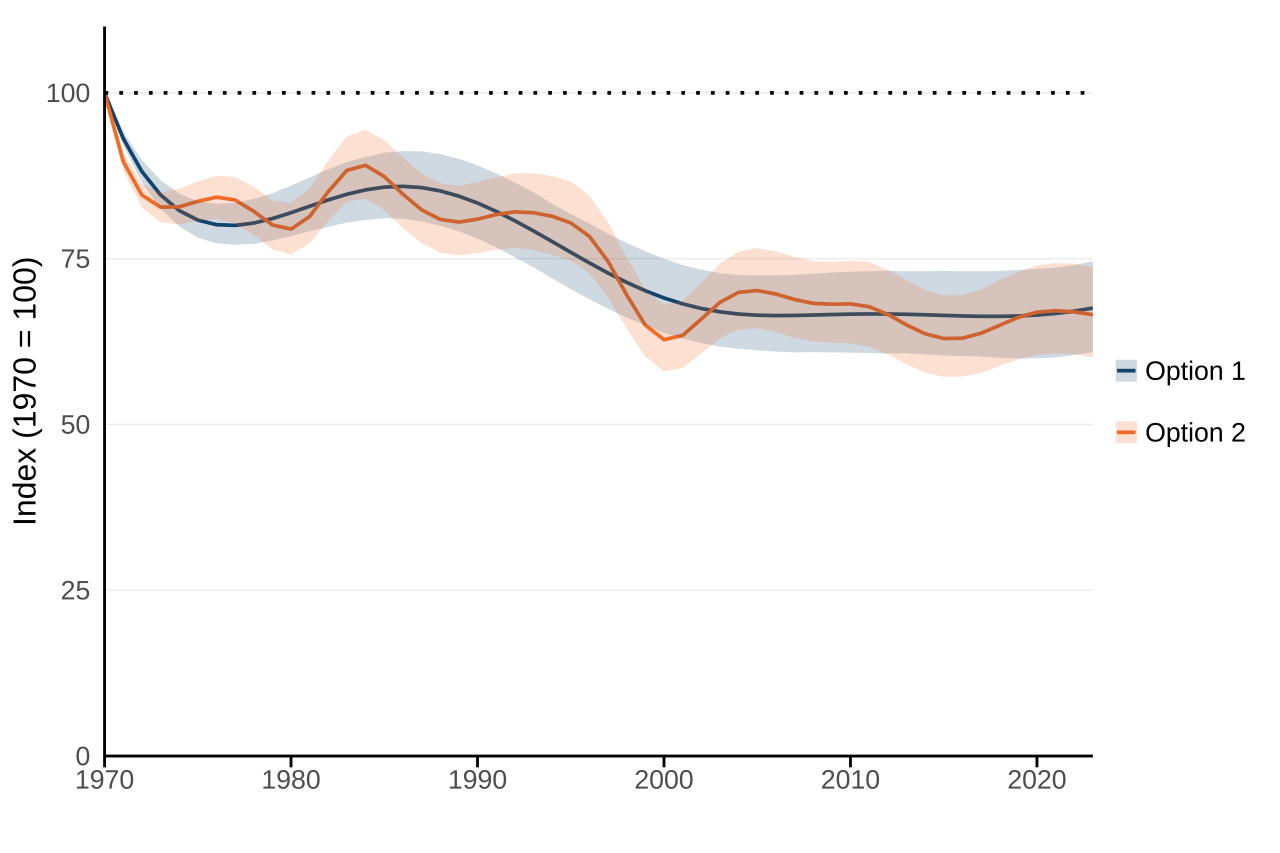
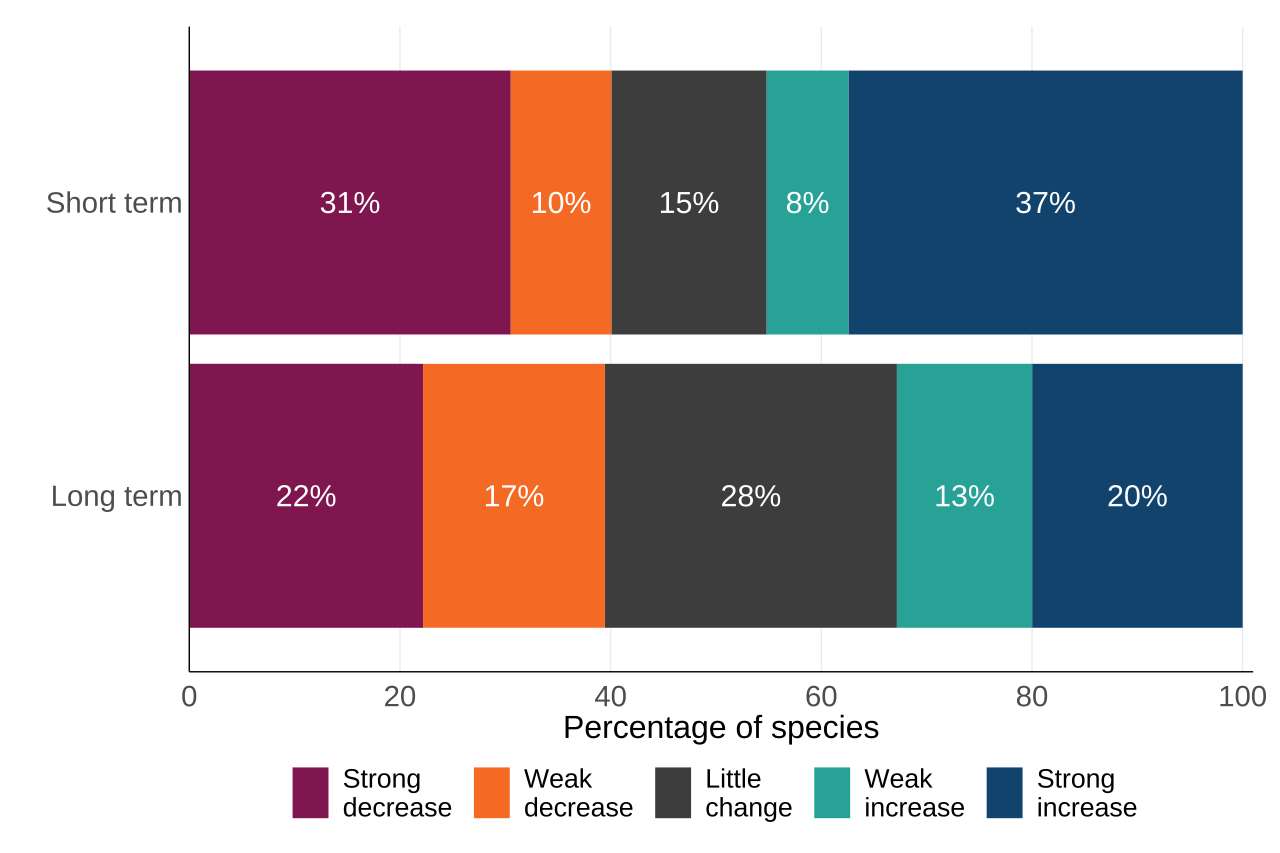
By 2023, the index of change of relative abundance of species in England had declined to 67% of its 1970 value. Over this long-term period 39% of species showed a strong or weak decline, while 33% showed a strong or weak increase.
More recently, between 2018 and 2023, the relative abundance index did not change significantly, changing from 66 in 2017 to 67 in 2023. Over this short-term period, 45% of species showed a strong or weak increase and 40% showed a strong or weak decline.
Figure 1: Change in the relative abundance of all species for which we have data in England, 1970 to 2023
Source: Bat Conservation Trust, Bees, Wasps and Ants Recording Society, Botanical Society of Britain and Ireland, British Trust for Ornithology, Bumblebee Conservation Trust, Butterfly Conservation, Defra, Environment Agency, Joint Nature Conservation Committee, People’s Trust for Endangered Species, Plantlife, Queen Mary University of London, Rare Breeding Birds Programme Secretariat, Rothamsted Research, Royal Society for the Protection of Birds, UK Centre for Ecology & Hydrology, University of Kent
Notes about Figure 1
- Figure 1 shows the two options for the smoothed trend (solid line) with their 95% credible intervals (shaded area). See discussion of smoothing in Caveats and limitations.
- Index values represent change from the baseline value in 1970, the credible interval widens as the index gets further from the 1970 value and confidence in the estimate of change relative to the baseline falls.
- The credible intervals capture the variation in trends across species, but not uncertainty in the underlying species abundance indices. Furthermore, they do not capture uncertainty associated with the spatial locations of sample points, nor about the degree to which the species represent wider biodiversity.
Figure 2: Long-term and short-term changes in species’ abundance trends in England, 1970 to 2023
Source: Bat Conservation Trust, Bees, Wasps and Ants Recording Society, Botanical Society of Britain and Ireland, British Trust for Ornithology, Bumblebee Conservation Trust, Butterfly Conservation, Defra, Environment Agency, Joint Nature Conservation Committee, People’s Trust for Endangered Species, Plantlife, Queen Mary University of London, Rare Breeding Birds Programme Secretariat, Rothamsted Research, Royal Society for the Protection of Birds, UK Centre for Ecology & Hydrology, University of Kent
Notes about Figure 2
- Figure 2 shows the percentage of species within the indicator that have increased (weakly or strongly), decreased (weakly or strongly) or shown little change in abundance based on set thresholds of change (see Methodology for more detail).
- Due to rounding, the data labels may not sum exactly to 100%.
Further detail
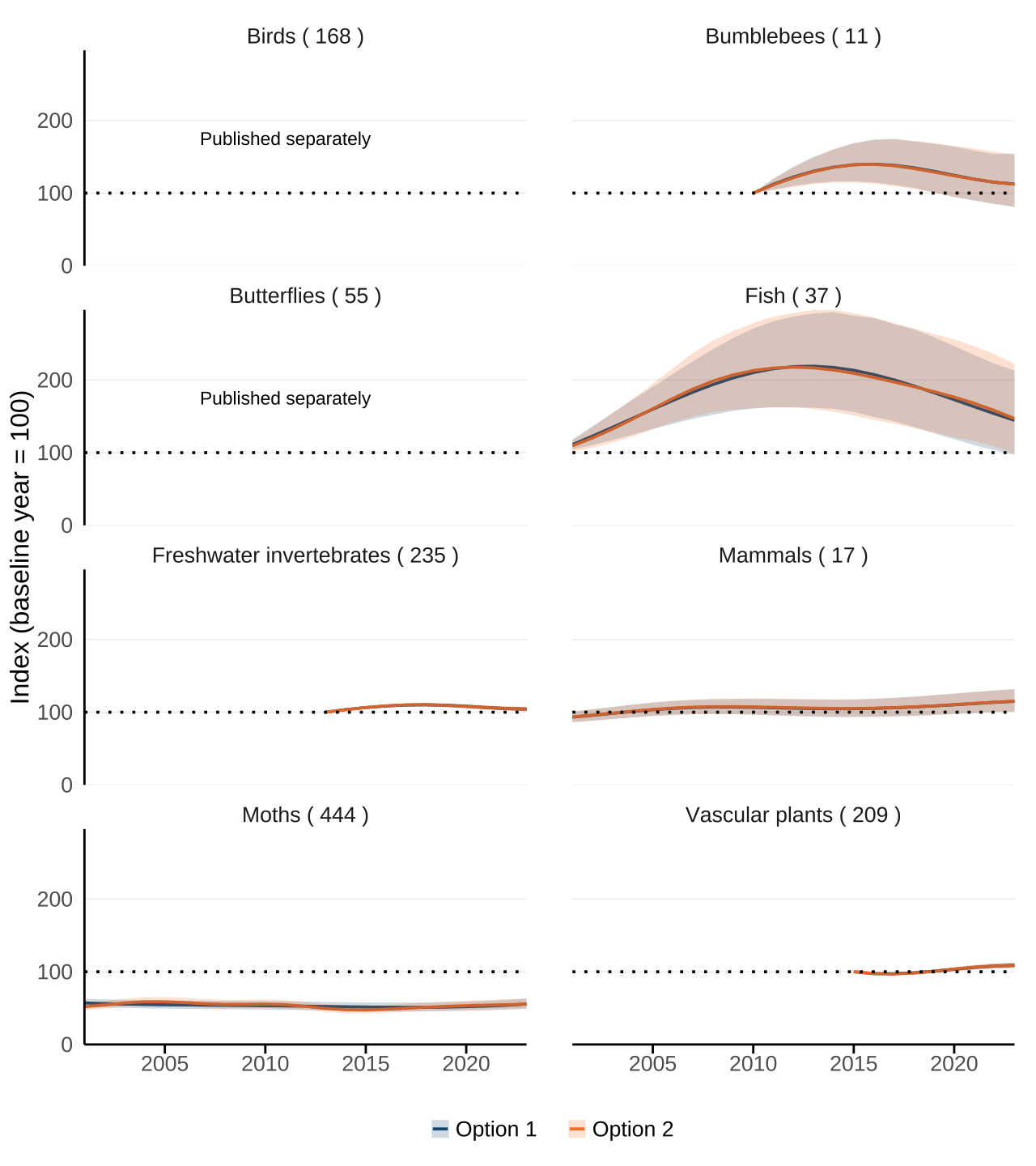
The headline indicator (Figure 1) masks variation between the taxonomic groups which make up the indicator. Figure 3 shows the index for each taxonomic group separately, generated using the same methods as the headline indicator. The relative abundance measure comprises 168 bird species, 17 mammals, 37 freshwater and estuarine fish, 55 butterflies, 444 moths, 11 bumblebees, 235 freshwater invertebrates and 209 vascular plants. The moths have undergone the biggest decline with an index value in the final year that was only around 55% of its value in 1970, although most of the decline occurred prior to 2000. Freshwater invertebrates, mammals and vascular plants have all increased compared to their baseline year. Bumblebees and fish have shown little change compared to their baseline years. We already publish species abundance indices for birds and butterflies in our Wild bird populations in England and Butterflies in England publications, so those taxonomic breakdowns are not included in this publication. Data collection for each taxonomic group spans different time periods and so the baseline year for each differs (see Table 1, Technical annex).
Figure 3: Change in relative species abundance by taxonomic group, 2000 to 2023
Source: Bat Conservation Trust, Bees, Wasps and Ants Recording Society, Botanical Society of Britain and Ireland, British Trust for Ornithology, Bumblebee Conservation Trust, Butterfly Conservation, Defra, Environment Agency, Joint Nature Conservation Committee, People’s Trust for Endangered Species, Plantlife, Queen Mary University of London, Rare Breeding Birds Programme Secretariat, Rothamsted Research, Royal Society for the Protection of Birds, UK Centre for Ecology & Hydrology, University of Kent
Notes about Figure 3
- Figure 3 shows the two options for the smoothed trend (solid line) with their 95% credible intervals (shaded area). See discussion of smoothing in Caveats and limitations.
- Indices for the years prior to the year 2000 are not shown as data for many individual groups are not available prior to that year.
- Index values represent change from the baseline value for each group. The credible interval widens as the index gets further from the baseline value and confidence in the estimate of change relative to the baseline falls.
- The credible intervals capture the variation in trends across species, but not uncertainty in the underlying species abundance indices. Furthermore, they do not capture uncertainty associated with the spatial locations of sample points, nor about the degree to which the species represent wider biodiversity.
- We already publish species abundance indices for birds and butterflies in our Wild bird populations in England and Butterflies in England publications, so those taxonomic breakdowns are not included in this publication.
Relevance
Monitoring the abundance of species is important for our understanding of the state of the wider environment, particularly as measures of species abundance are more sensitive to change than other aspects of species populations. It should be noted that for a more comprehensive indication of the state of the wider environment, indicators of species abundance should be reviewed alongside species distribution and extinction risk indicators.
International/domestic reporting
When fully developed, the all-species abundance measure will be used to track the government’s progress towards meeting the Environmental Improvement Plan statutory targets for biodiversity on land. The target seeks to halt the decline in species abundance by 2030, and by the end of 2042, reverse the decline so that species abundance is higher than in 2022 and at least 10% higher than in 2030.
This indicator also feeds into the Environmental Indicator Framework (previously known as the Outcome Indicator Framework), a set of indicators describing environmental change related to the ten goals within the Environmental Improvement Plan. As part of the Environmental Indicator Framework, this data contributes towards the evidence base used to prepare the annual progress report for the Environmental Improvement Plan. This indicator contributes to indicator D4: Relative abundance and/or distribution of species.
Web links for further information
- Bat Conservation Trust: The National Bat Monitoring Programme
- Botanical Society of Britain and Ireland: National Plant Monitoring Scheme
- British Trust for Ornithology: Indicators of wild bird populations
- Bumblebee Conservation Trust: BeeWalk Survey Scheme
- Butterfly Conservation: Butterflies and Moths
- Joint Nature Conservation Committee: Seabird Monitoring Programme
- People’s Trust for Endangered Species: National Dormouse Monitoring Programme
- People’s Trust for Endangered Species: National Water Vole Monitoring Programme
- Wildfowl and Wetlands Trust: National water bird estimates
- UK Biodiversity Partnership: UK Biodiversity Action Plans
- UK Butterfly Monitoring Scheme: Butterflies as indicators
- Kunming-Montreal Global Biodiversity Framework 2030 targets
- Environmental Improvement Plan
Acknowledgements
Thank you to the many people and organisations who have contributed by providing data, the independent expert review panel who provided useful insights into developing the method and to the many colleagues who have helped produce these indicators.
Technical annex
For a more in-depth discussion of the methodology and data used in this indicator, please see Indicators of species abundance in England. A brief summary of these is presented in the following.
Source data
Much of the data on species abundance is collected through well-established volunteer-based recording schemes, many of which are run through partnerships between government bodies, NGOs and research organisations, or through statutory monitoring schemes. The species have not been selected as a representative sample of species and they cover only a limited range of taxonomic groups. The measure is therefore not fully representative of species in the wider countryside (see Species included).
Three criteria were used to assess whether data was suitable for inclusion in the indicator: that the scheme uses a standardised approach with protocols and appropriate analytical methods, has spatially replicated survey design across England and a taxonomic resolution ideally to species level. More details on these criteria can be found in the full statistical release.
Robust English population time-series were sought for as many species as possible to produce the indicator for all-species in England. The measure is a composite indicator of 1,176 species from many broad taxonomic groups. The majority of the data in this indicator have previously been published and many of the datasets are currently used elsewhere within the England biodiversity indicators. Table 1 presents the taxonomic coverage and data sources contributing to the indicator. Further information on the analytical methods used by each scheme can be found here.
Table 1: Summary of information on the data collection schemes included in the indicators
| Name of scheme | Taxonomic coverage | Number of species in all-species indicator | Number of species in priority species indicator | Timespan included in indicators |
|---|---|---|---|---|
| Breeding Bird Survey (BBS) / Common Bird Census (CBC) | Birds | 97 | 27 | 1970-2023 |
| Rare Breeding Birds Panel (RBBP) | Birds | 33 | 8 | 1970-2022 |
| Seabird Monitoring Programme (SMP) | Birds | 12 | 1 | 1986-2023 |
| Statutory Conservation Agency and RSPB Annual Breeding Bird Scheme (SCARRABS) | Birds | 7 | 5 | 1971-2023 |
| Wetland Bird Survey (WeBS) | Birds | 19 | 3 | 1975-2022 |
| BeeWalks | Bumblebees | 11 | 1 | 2010-2023 |
| UK Butterfly Monitoring Scheme (UKBMS) | Butterflies | 55 | 21 | 1976-2023 |
| National Fish Population Database (NFPD) and Transitional/Coastal waters Data (TRaC) | Fish | 37 | 8 | 2000-2023 |
| Freshwater Invertebrates (BIOSYS) | Freshwater invertebrates | 235 | 0 | 2013-2023 |
| Breeding Birds Survey (BBS) Mammals | Mammals | 5 | 1 | 1995-2023 |
| National Bat Monitoring Programme (NBMP) | Mammals | 10 | 5 | 1998-2023 |
| National Dormouse Monitoring Programme (NDMP) | Mammals (single species) | 1 | 1 | 1998-2023 |
| National Water Vole Monitoring Programme (NWVMP) | Mammals (single species) | 1 | 1 | 2015-2023 |
| Priority Moths | Moths | 9 | 10 | 1995-2023 |
| Rothamsted Insect Survey Light Trap | Moths | 435 | 66 | 1970-2023 |
| National Plant Monitoring Scheme (NPMS) | Vascular plants | 209 | 1 | 2015-2023 |
Notes about Table 1
- The Breeding Bird Survey began in 1994 and incorporates the Waterways Breeding Bird Survey and the Heronries Census. Prior to this, data came from the Common Bird Census (CBC).
- Data is available in the freshwater invertebrates (BIOSYS) dataset from the mid-1990s to the present. Data prior to 2013 wasn’t considered to meet the criteria for taxonomic resolution to species level, so data from 2013 onwards is used in the indicator.
Species included
The species in the all-species indicator are intended to be as representative as possible of wider biodiversity in England, although the coverage is limited by the availability of data from existing monitoring schemes (Table 2). All native and naturalised species with suitable data were considered for inclusion in the indicator. Invasive non-native species were excluded. All species that were naturalised before 1500 were included, as well as those that colonised England from mainland Europe more recently (for example, the tree bumblebee Bombus hypnorum which arrived in England from Europe in 2001).
The vast majority of the 1,176 taxa in the all-species indicator are individual species. There are 20 species groups and 66 genera – the majority of these species groups and genera are from the freshwater macroinvertebrate dataset. This reflects the fact that many invertebrates are difficult to identify to species level, especially in their larval stage. The decision to include these higher taxa reflects the desire for the indicator to be broadly representative.
The species in the all-species indicator align with those listed in Schedule 2 of The Environmental Targets (Biodiversity) (England) Regulations 2023, which sets out 1,195 species that should be monitored as part of the species abundance targets. Throughout the rest of this publication we will refer to it as Schedule 2. The indicator does not yet include data for all 1,195 species, as data are not yet ready for inclusion for a small number of species (10 plants, 8 moths and 1 fish). This year we added water vole (Arvicola amphibius) to the all-species indicator. Water vole is already on Schedule 2 and data from the National Water Vole Monitoring Programme was found to meet the standards set for data inclusion (see Technical Annex).
Table 2: Taxonomic groups included in the all-species indicator and their representativeness of UK biodiversity
| Higher group | Group | Estimated number of species in the UK | Number of species in all-species indicator |
|---|---|---|---|
| Vertebrates | Amphibians | 7 | - |
| Vertebrates | Birds | 218 | 168 |
| Vertebrates | Fish | 82 | 37 |
| Vertebrates | Mammals | 49 | 17 |
| Vertebrates | Reptiles | 6 | - |
| Vertebrates | Total vertebrates | 362 | - |
| Invertebrates | Coleoptera (beetles) | 4,093 | 34 |
| Invertebrates | Butterflies | 59 | 55 |
| Invertebrates | Hymenoptera (bees, ants, wasps) | 7,154 | 11 |
| Invertebrates | Moths | 2,345 | 444 |
| Invertebrates | Diptera (flies) | 7,099 | 25 |
| Invertebrates | Other insects | 3,197 | 132 |
| Invertebrates | Non-insect invertebrates | 5,369 | 44 |
| Invertebrates | Total invertebrates | 29,316 | - |
| Plants | Vascular plants | 1,497 | 209 |
| Plants | Bryophytes | 1,056 | - |
| Plants | Chlorophyta | 2,342 | - |
| Plants | Total plants | 4,895 | - |
| Fungi | Non-lichenised fungi | 15,100 | - |
| Fungi | Lichens | 2,354 | - |
| Fungi | Total fungi | 17,454 | - |
| Total | - | - | 1176 |
Notes about Table 2
- An indicative list of species was only available for the whole of the UK (Burns et al., 2018), rather than for England specifically. The total number of multicellular eukaryotic freshwater and terrestrial species found in the UK is approximately 55,000, as reported in Burns et al., 2018.
Methodology
Pre-smoothing
Species abundance of many organisms tends to fluctuate from one year to the next. These fluctuations make it difficult to reveal the underlying trends. For this reason, some schemes include a statistical smoothing to remove short term stochastic variation. We therefore applied a smoothing term to each species time series, except those for which a smoothed trend was already available (bats and most of the birds). We applied a thin plate spline with 0.3 degrees of freedom for each data point (Fewster et al., 2000) and did this on the log scale. The resultant smoothed trends were then taken forward to the next stage of analysis.
Multispecies trends
To create the composite index, we used a method specifically developed for creating multispecies indicators from heterogeneous data (Freeman et al., 2020). The resulting index is an estimate of the geometric mean abundance. This is a relatively newly developed method and offers some advantages over older techniques: it is adaptable to different data types and can cope with the issues often presented by biological monitoring data, such as varying start dates of datasets and missing values.
A smoothing process is used to reduce the impact of between-year fluctuations - such as those caused by variation in weather - making underlying trends easier to detect. For this a penalised spline was used with the number of “knots” set to one of two values. Firstly, as has been done for previous iterations of the priority species indicator and as is standard elsewhere (Fewster et al., 2000), we used the total number of years of data divided by 3. Secondly, in order to reveal a more stable long-term trend in the data, we used the total number of years of data divided by 10. These two values were selected to demonstrate the range of plausible indicator values for the purpose of assessing meaningful change in species abundance over time.
The overall trend shows the balance across all the species included in the indicator. Individual species within each measure may be increasing or decreasing in abundance (Figure 2). Estimates will be revised when new data or improved methodologies are developed and will, if necessary, be applied retrospectively to earlier years. Further details about the methods used to create the all-species indicator can be found in the full statistical release.
Confidence and uncertainty
The credible intervals around the multispecies index represent confidence in the degree to which average abundance in any given year is different from the baseline year (1970). They do not provide clear guidance on the degree to which pairs of years (for example, 2000 versus 2022) differ.
The credible intervals capture uncertainty in the trends between individual species that contribute to the index. They do not capture uncertainty associated with the spatial locations of sample points, nor about the degree to which the species represent wider biodiversity.
The credible intervals partially capture uncertainty in the species abundance estimates, inasmuch as the method includes a term to estimate measurement error. However, our approach does not explicitly propagate information about relative uncertainty of different species or years.
Assessment of change
Formal assessment of change is made on the basis of credible intervals for the time period; if the indicator value for the first year falls outside of the credible intervals for the final year then the indicator is deemed to have changed over that time period. This was done for three time periods; long-term (from the beginning of the time series to 2023), medium-term (the most recent 10 years) and short-term (the most recent 5 years).
To illustrate the variation in trends among individual species, an assessment of change is made for each species. Species are categorised into one of five categories on the basis of defined thresholds (Table 3). The five trend thresholds are based on average annual rates of change over the assessment period and are derived from the rates of decline used to assign species to the red and amber lists of Birds of Conservation Concern (Eaton et al., 2015). Asymmetric percentage change thresholds are used to define these classes as they refer to proportional change, where a doubling of a species index (an increase of 100%) is counterbalanced by a halving (a decrease of 50%).
Table 3: Thresholds used to define individual species’ trends
| Category | Threshold | Long term change |
|---|---|---|
| Strong increase | An increase of more than 2.81% per annum | Equivalent to an increase of more than 100% over 25 years |
| Weak increase | An increase of between 1.16% and 2.81% per annum | Equivalent to an increase of between 33% and 100% over 25 years |
| Little change | Change is between +1.16 % and -1.14% per annum | Equivalent to a change of between +33% and -25% over 25 years |
| Weak decrease | A decrease of between 1.14% and 2.73% per annum | Equivalent to a decrease of between 25% to 50% over 25 years |
| Strong decrease | A decrease of more than 2.73% per annum | Equivalent to a decrease of more than 50% over 25 years |
Development plan
Developments planned for this indicator follow broadly the plans for the full statistical release. Over the short term, these plans include:
- We will continue to investigate the impact of different levels of smoothing in the indicator and make a decision on whether we will continue to produce multiple options for different uses, or produce a single indicator of species abundance, and priority species abundance, in England.
- We will make available the code for all stages of the modelling pipeline on GitHub.
Longer term development plans:
- We will review on an ongoing basis new species abundance data that may become available.
- We will continue to review the data that feeds into the indicator. This will include ongoing review of the status of monitoring schemes (including the schemes that provide data that is used in the current indicator, as well as those that may provide new abundance data in future).
- We will continue to improve the quality of the raw data and methodology, in line with our commitment to the Code of Practice for Statistics.
- We will work towards developing an indicator for the abundance of all-species at the UK scale.
- In this publication we have broken down the trend by taxonomic group only. In future, we will explore further options for breakdowns that may be useful for users of the statistic (for example, separate trends for generalist and specialist species or widespread and rare species).
- We will continue to refine how the methodology is implemented and explore the impacts of any differences from the original Freeman implementation. For example, this may include investigating the propagation of species-specific uncertainty in the model, measurement error or the decision to pre-smooth. We also aim explore the assumption that species with missing data behave in a similar way to those with data present in the model, and the impact this assumption has on the outputs.
- We will continue to review how we communicate the representativeness of the indicator. We will assess the spatial, taxonomic and temporal coverage of the data underlying the indicators and communicate these alongside the indicators. We would also like to explore the trade-off between increasing the representativeness of the indicator against our ability to detect meaningful biological change.
- We will review our methods for assessing change over short and medium time-scales in the indicators and, if appropriate, refine them further.
We are keen to hear from our users about these plans, as well as our published development plan, please email us.
References
- Burns, F., Eaton, M.A., Hayhow, D.B., Outhwaite, C.L., Al Fulaij, N., August, T.A., Boughey, K.L., Brereton, T., Brown, A., Bullock, D.J., Gent, T., Haysom, K.A., Isaac, N.J.B., Johns, D.G., Macadam, C.R., Mathews, F., Noble, D.G., Powney, G.D., Sims, D.W., Smart, S.M., Stroh, P., Walker, K.J., Webb, J.R., Webb, T.J., and Gregory, R.D. (2018). An assessment of the state of nature in the United Kingdom: A review of findings, methods and impact. Ecological Indicators, 94(1), 226 to 236. https://doi.org/10.1016/j.ecolind.2018.06.033
- Eaton, M. A., Burns, F., Isaac, N. J. B., Gregory, R. D., August, T. A., Barlow, K. E., … Williams, J. (2015). The priority species indicator: measuring the trends in threatened species in the UK. Biodiversity, 16(2–3), 108–119. https://doi.org/10.1080/14888386.2015.1068222
- Fewster, R M., S T. Buckland, G M. Siriwardena, S R. Baillie, and J D. Wilson (2000). Analysis of Population Trends for Farmland Birds Using Generalized Additive Models. Ecology 81, 1970–84.
- Freeman, S. N., Isaac, N. J. B., Besbeas, P., Dennis, E., B. and Morgan, B, J., T. (2020) A Generic Method for Estimating and Smoothing Multispecies Biodiversity Indicators Using Intermittent Data. Journal of Agricultural, Biological and Environmental Statistics, 26, 71 to 89. https://doi.org/10.1007/s13253-020-00410-6