Environmental Indicator Framework Theme D (Wildlife)
Updated 13 May 2026
Applies to England

© Crown copyright 2026
This publication is licensed under the terms of the Open Government Licence v3.0 except where otherwise stated. To view this licence, visit nationalarchives.gov.uk/doc/open-government-licence/version/3 or write to the Information Policy Team, The National Archives, Kew, London TW9 4DU, or email: psi@nationalarchives.gov.uk.
Where we have identified any third party copyright information you will need to obtain permission from the copyright holders concerned.
This publication is available at https://www.gov.uk/government/publications/environmental-indicator-framework-theme-d-wildlife/environmental-indicator-framework-theme-d-wildlife
D1: Quantity, quality and connectivity of habitats
Short Description
This indicator will measure the extent, condition and connectivity, of terrestrial and freshwater habitats in England. In the 25 Year Environment Plan, government committed to establishing a Nature Recovery Network: an increasingly connected network of places that are richer in wildlife and more resilient to climate change. The network will build on the recommendations from ‘Making space for nature’, led by Professor Sir John Lawton, and will provide wider environmental benefits, including carbon capture and opportunities for recreation.
Data are available to measure some aspects of this indicator such as extent and condition of some habitats, but further work is required to assess habitats beyond protected sites, and reliable methods for measuring ecological connectivity need to be further tested. Some indicators of aspects of ecosystem functions and processes are available to assess condition, but these are not comprehensive. New methods of Earth Observation together with development of measures of favourable conservation status and long-term site-based monitoring offer good opportunities to develop this indicator.
Readiness and Links to Data
An interim indicator for quantity is presented here that shows the percentage of land cover in England by broad habitat types. Interim figures for habitat quantity are available for reporting using the Living England Habitat Map. Work is underway to develop metrics to track the connectivity and quality of these habitats, with the aim to be included in a future publication.
The Living England project, led by Natural England, is a multi-year programme delivering a map of broad habitat types across England. The project uses satellite imagery, geo-environmental data and habitat data from extensive field surveys to train and validate a machine learning model. The model is taught to make connections between the known habitat type (established by the field surveys) and satellite imagery and geo-environmental for the same location. The model then uses this knowledge to predict habitat types elsewhere, where field survey data is not available.
Natural England published the latest version of the Living England habitat map in September 2024. This latest version uses an updated and improved methodology compared to the Phase IV map which was published previously. Ongoing work to progress this indicator includes statistical analysis of attributes to assess habitat quality and testing of different approaches to measure habitat connectivity.
During 2021 and 2022 a final list of habitat quality attributes was produced, together with identification of data sets which can be used to measure them. Work during 2023 focussed on determining benchmarks for defining poor, moderate and good status for each attribute in each habitat type. Work is also in development to bring in measurable elements of natural function for each habitat type, as well as determine how this indicator will utilise the England Ecosystem Survey when these data are available.
The development of the habitat connectivity element of the indicator is also ongoing. During 2021 and 2022, 3 potential connectivity metrics were trialled using the UK Centre for Ecology & Hydrology Land Cover map 2015. Two of these metrics were deemed to perform against several desirable properties best.
Work is underway to develop a metric to track action to create and restore wildlife-rich habitat outside of protected sites, to monitor progress towards the statutory target to restore or create at least 500,000 hectares of wildlife-rich habitat outside of protected sites by 2042. The aim is to include this metric in a future publication of the indicators.
Notes on Indicator
The Living England habitat map displays the modelled likely broad habitat classifications, trained on up-to-date field surveys and Earth observation data as well as ancillary data layers. The figures presented here are derived from Phase VI of the Living England project.
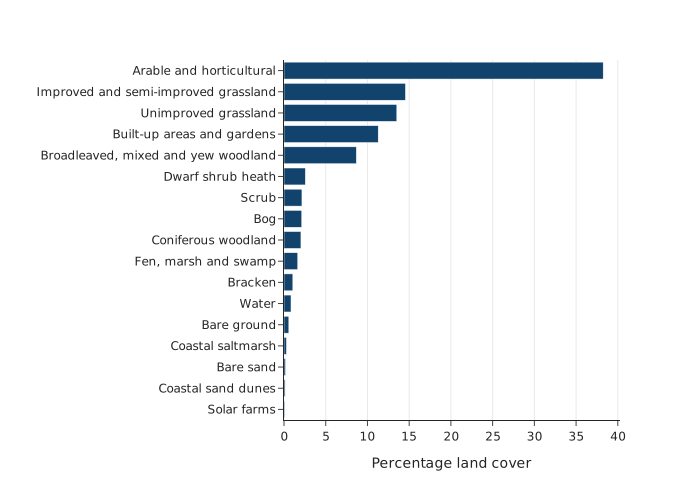
D1: Percentage land cover in England by broad habitat types, 2023
Source: Natural England
Download the data for this chart in .csv format
Trend Description
Artificial habitat types comprising ‘arable and horticultural land’ and ‘built-up areas and gardens’ and 'solar farms' account for approximately half of land cover in England (38%, 11% and 0.1% respectively). Semi-natural habitat types account for the remaining 50%, with ‘improved and semi-improved grassland’ and ‘unimproved grassland’ making up 15% and 14% respectively of total land cover in England, and ‘broadleaved, mixed and yew woodland’ making up a further 9%.
Assessment: D1
No assessment of change was undertaken for this indicator as a suitable time series is not yet available in the Environmental Indicator Framework.
Metadata
| Headline | Nature on land and water |
|---|---|
| Primary Goal | Restored nature |
| Relevant Goals | Restored nature, Climate change |
| Relevant Targets | Creating or restoring 500,000 hectares of wildlife-rich habitat outside the protected site network, focusing on priority habitats as part of a wider set of land management changes providing extensive benefits, Implementing a sustainable and effective second National Adaptation Programme |
| Natural Capital | Condition of assets - species and ecological communities |
| Related Commitments | Conservation of Habitats and Species Regulations 2017 (as amended), May provide evidence in support of Climate Change Risk Assessment and the Adaptation Sub Committee’s assessment of the National Adaptation Programme, under the Climate Change Act (2008) |
| Geographical Scope | England |
| Development Status | Interim |
| First Reported | 2023 |
| Last updated | May 2025 |
| Latest Data | 2023 |
Return to Environmental Indicator Framework Collection Page
D2: Extent and condition of protected sites – land, water and sea
Short Description
Protected sites are areas of land, inland water and the sea that have special legal protection to conserve important habitats and species in England. These include our Sites of Special Scientific Interest (SSSIs), Marine Conservation Zones (MCZs), National Nature Reserves (NNRs), Special Areas of Conservation (SACs), Special Protection Areas (SPAs), Ramsar sites and relevant Highly Protected Marine Areas (HPMAs). These area designations have been included as they focus on the protection of biodiversity and provide legal mechanisms for this protection. This indicator currently has 2 components: (a) extent of protected sites on land, freshwater and at sea and (b) condition of terrestrial SSSIs on land and water. Condition for terrestrial sites is assessed against relevant common standards agreed by the UK conservation agencies. Condition methodology for marine sites is currently under development.
Readiness and Links to Data
An interim indicator is presented here that shows the extent of protected areas (D2a) and condition of SSSIs in England (D2b). Data for this interim indicator are published annually as England Biodiversity Indicator – Extent and condition of protected areas. Work is underway to review reporting for terrestrial and freshwater sites. Further work is required to implement a methodology for assessing the condition of marine sites.
The latest release of England Biodiversity Indicator - Extent and condition of protected areas includes the breakdown for condition of SSSIs by area to 2024, and since 2024, the condition by designated feature. This new updated approach allows Natural England to record variation in a feature’s condition across an SSSI, and better informs management through unit-specific comments to aid with conservation.
Feature condition data represent either the baseline created from historic feature-on-unit data, given a confidence rating on a scale from “No”, “Low”, “Medium”, to “High” based on the age and consistency of the data, or the outcome of a more recent assessment undertaken post-2020 at the scale of the whole feature and given “Complete” confidence. Features with a condition confidence rating of “High” or “Complete” confidence are considered as having an “up-to-date” condition assessment. As of 31 March 2025, 32% of all SSSI features had an up-to-date condition assessment. The feature condition reporting here includes the condition of all SSSI features across all confidence category ratings.
The 2024 and 2025 results for D2b reflect a shift in monitoring methodology introduced by Natural England in 2023. Because SSSI condition is now assessed at the whole-feature level rather than by site units, the results are not directly comparable with those from previous years.
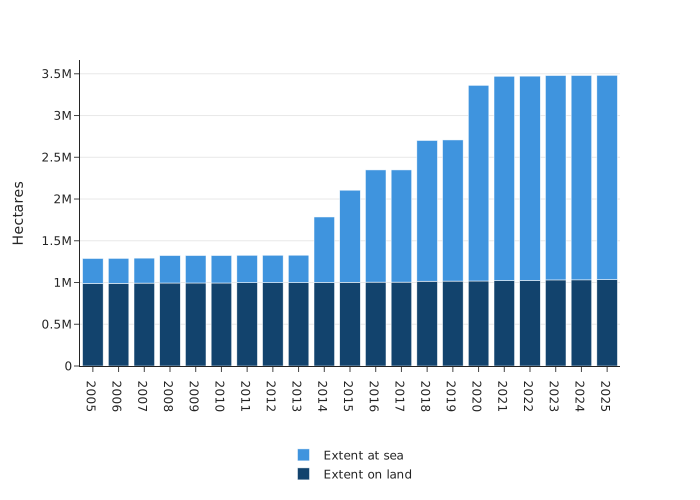
D2a: Extent of protected sites in England, 2005 to 2025
Source: Department for Environment, Food & Rural Affairs
Download the data for this chart in .csv format
Notes on Component
The extent of protected sites is the cumulative area assessed by 31 March of each year shown. Extent is based on the following designations: Sites of Special Scientific Interest (SSSI), Special Areas of Conservation (SAC), Special Protection Areas (SPA), Ramsar sites, Marine Conservation Zones (MCZ) and National Nature Reserves (NNR). Any one protected area can have more than one designation, but each site contributes only once to the indicator total. For sites that span English borders, only the area within England is included. The area of sites in the ‘at sea’ measure includes all sites within the specified designation between mean low water (MLW) or mean high water (MHW) and the 12 nautical mile limit; sites beyond 12 nautical miles, in UK waters, are excluded. These are covered by the UK Biodiversity Indicators.
Trend Description
The total extent of land, water and sea protected in England through national and international protected areas has increased from 1.3 million hectares in 2005 to 3.5 million hectares in 2025. The area of sites at sea has increased substantially, by more than 7 times since the time series began in 2005, although the majority of this increase took place between 2013 and 2020. The area of sites on land has remained relatively stable over time, increasing by 4.6% between 2005 and 2025.
Assessment: D2a
On land, there has been little or no change to the extent of protected sites in the most recent 5 years for which trends can be assessed (2020 to 2025), however an increase (or improvement) has been observed in both the medium and long term. The extent of protected areas at sea has seen an improvement across the short, medium and long term.
Change since 2018 has also been assessed. This shows that the extent of protected sites at sea increased by 45.2% since 2018, while the extent of protected sites on land showed little or no change (1.8% increase).
Further information on this assessment, along with details on the methodology, is provided in the Assessment guide page. Summaries by Environmental Improvement Plan goal and information on indicator links are presented in the Assessment results pages.
| Component | Subcomponent | Period | Date range | Percentage change | Smoothing function | Assessment of change |
|---|---|---|---|---|---|---|
| D2a | Extent at sea | Short term | 2020 to 2025 | 4.45 | Unsmoothed | Improvement |
| D2a | Extent at sea | Medium term | 2015 to 2025 | 121.84 | Unsmoothed | Improvement |
| D2a | Extent at sea | Long term | 2005 to 2025 | 718.83 | Unsmoothed | Improvement |
| D2a | Extent on land | Short term | 2020 to 2025 | 1.56 | Unsmoothed | Little or no change |
| D2a | Extent on land | Medium term | 2015 to 2025 | 3.15 | Unsmoothed | Improvement |
| D2a | Extent on land | Long term | 2005 to 2025 | 4.59 | Unsmoothed | Improvement |
Note that percentage change in Table D2a refers to the difference seen between the first and last years in the specified date range. Assessment results presented here differ from those presented in the source publication (the England Biodiversity Indicators) because we use unsmoothed data and assess sites in favourable condition, whereas the England Biodiversity Indicators use a 3-year average for the baseline (effectively smoothing the data) and assess sites in favourable and unfavourable recovering condition.
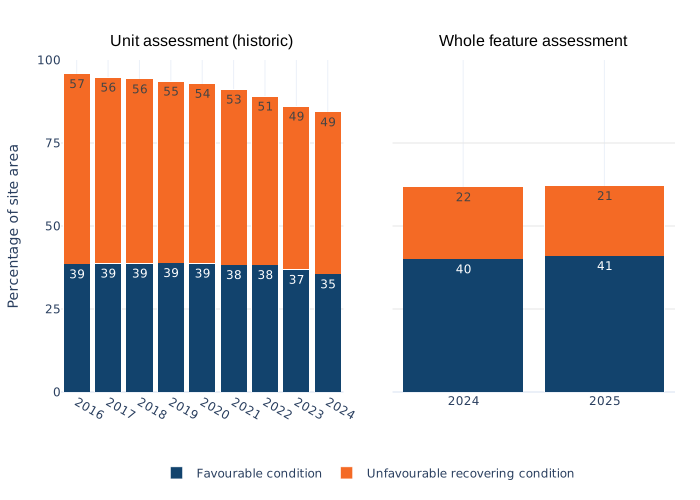
D2b: Condition of Sites of Special Scientific Interest in England, 2016 to 2025
Source: Department for Environment, Food & Rural Affairs
Download the data for this chart in .csv format
Notes on Component
Site condition is the cumulative area assessed by 31 March of each year shown. As new assessments are completed, they replace the previous ones, so Figure D2b is a snapshot of the condition of the site network at a given point in time. Natural England have recently developed a new approach to monitoring SSSIs. The previous approach was to subdivide SSSIs into units and make assessments of condition at the unit scale. From 2023 SSSIs are now assessed for condition of designated features across the whole of the SSSI. This new approach, known as Whole Feature Assessment (WFA), helps to better understand what is affecting features and how SSSIs function as part of their wider landscape.
Trend Description
From 2023, SSSIs have been assessed for condition of designated features across the whole of the SSSI, known as Whole Feature Assessment (WFA). This means WFA data from 2024 is not comparable to previous years. From 2024 to 2025, the proportion of SSSI features in favourable condition has slightly increased from 40.0% to 41.0%
Assessment: D2b
No assessment of change was undertaken for this indicator as a suitable time series is not yet available following a change in methodology.
Metadata
| Primary Goal | Restored nature |
|---|---|
| Relevant Goals | Restored nature |
| Relevant Targets | Increasing the proportion of protected and well-managed seas, and better managing existing protected sites |
| Natural Capital | Condition of assets - species and ecological communities |
| Related Commitments | The Conservation of Habitats and Species Regulations 2017 (as amended), The Convention on the Conservation of European Wildlife and Natural Habitats (the Bern Convention), Convention for the Protection of the Marine Environment of the North-East Atlantic (OSPAR), Marine and Coastal Access Act 2009 |
| Geographical Scope | England |
| Development Status | Interim |
| First Reported | 2019 |
| Latest Data | 2025 |
| Last Updated | Feb 2026 |
Return to Environmental Indicator Framework Collection Page
D3: Area of woodland in England
Short Description
This indicator shows change in the area of broadleaved and conifer woodland in England. Woodland, as defined for the National Forest Inventory (NFI), is land under stands of trees with a minimum area of 0.5 hectares, a width of at least 20 metres, and a canopy cover of at least 20% or having the potential to achieve this. To be considered a tree, a plant must have at least one woody stem and be expected to achieve a height of at least 5 metres. The definition of woodland relates to land use, rather than land cover, so integral open space and areas of felled trees that are awaiting restocking (replanting) are included as woodland. Woodland is a key natural capital asset that provides many natural capital benefits, such as the provision of timber and other wood products, carbon storage, improvement of the water environment, habitats for wildlife, and opportunities for exercise and recreation.
Readiness and Links to Data
Data on the area of woodland are published annually in Forest Research’s Forestry Statistics along with information on the data sources and methodology. Additional commentary on recent trends and new planting of woodland and trees in England is provided in the Forestry Commission’s Key Performance Indicators.
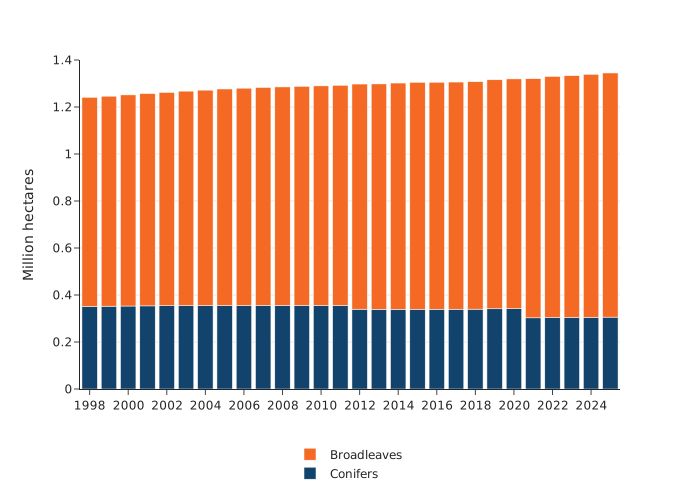
D3: Area of woodland in England, 1998 to 2025
Source: Forest Research
Download the data for this chart in .csv format
Notes on Component
Annual datapoints reflect the area of conifer and broadleaf woodland in England at 31 March each year.
Due to rounding, areas of conifer and broadleaf woodland shown here may not sum exactly to the total area of woodland in England shown in this indicator and in the source publication (Forest Research's Forestry Statistics).
Data for 2021 to 2023 were revised in the 2025 update of this indicator. The total area of woodland reported marginally increased for the 2022 and 2023 data points, mainly driven by a marginal increase in areas of broadleaf woodland.
There is a general assumption that woodlands that have been clearfelled will be restocked. These areas are classified as 'woodlands in transition' until there is evidence (through satellite imagery or aerial photography) that the areas have been replanted, have regenerated, or lost to another land use. As natural regeneration can take some time to establish, some areas can remain as woodlands in transition for more than 10 years and there can be considerable time lags between the felling of woodland to create open habitats and the designation of that area as non-woodland. It is likely this leads to some overestimation of the area of conifer woodland.
The area of woodland statistics are based on annual updates to both the NFI woodland map based on remote sensing and also administrative data on new planting of woodland. The split between conifer and broadleaf in the woodland map data is based on more accurate assessments of stocked areas from fieldwork data.
Trend Description
The total area of woodland in England has increased from 1.24 million hectares in 1998 to 1.34 million hectares in 2025, equating to an increase from 9.5% to 10.3% of total land area of England (total land area of England derived from the Office for National Statistics (ONS) Standard Area Measurements for Administrative Areas). This growth has been driven by an increase in area of broadleaf woodland since the start of the time series, despite the area of conifer woodland having gradually decreased over the same period. The two apparent step changes in the area of conifer woodland (2011-12 and 2020-21) reflect updates to stocked area by species estimates from the National Forest Inventory field surveys, that are then used to estimate the conifer/broadleaf for the total woodland area, rather than losses of conifer woodland in those specific years.
Assessment: D3
The observed increase in the area of woodland in England over the short term is assessed as ‘little or no change’. This is because it would take a large area of additional woodland cover to reach the 3% increase needed for the ‘improvement’ category to be assigned. There has, however, been an increase (improvement) over the medium and long term. This assessment does not consider whether any improvement is on a sufficient scale for meeting targets.
Change since 2018 has also been assessed. There has been ‘little or no change’ in woodland cover since 2018.
Further information on this assessment, along with details on the methodology, is provided in the Assessment guide page. Summaries by Environmental Improvement Plan goal and information on indicator links are presented in the Assessment results pages.
| Component | Subcomponent | Period | Date range | Percentage change | Smoothing function | Assessment of change |
|---|---|---|---|---|---|---|
| D3 | Total woodland | Short term | 2020 to 2025 | 1.91 | Unsmoothed | Little or no change |
| D3 | Total woodland | Medium term | 2015 to 2025 | 3.05 | Unsmoothed | Improvement |
| D3 | Total woodland | Long term | 1998 to 2025 | 8.34 | Unsmoothed | Improvement |
Note that percentage change in Table D3 refers to the difference seen from the first to last year in the specified date range.
Metadata
| Primary Goal | Restored nature, Access to nature |
|---|---|
| Relevant Goals | Restored nature, Access to nature, Resources |
| Relevant Targets | Creating or restoring 500,000 hectares of wildlife-rich habitat outside the protected site network, focusing on priority habitats as part of a wider set of land management changes providing extensive benefits, Increasing woodland cover in England in line with our aspiration of 12% cover by 2060: this would involve planting 180,000 hectares by end of 2042 [now superseded by the Environment Act target to increase tree canopy and woodland cover to at least 16.5% of land area in England by 2050]. |
| Natural Capital | Condition of assets - land, Condition of assets - species and ecological communities |
| Related Commitments | Equivalent data at UK level are reported to the United Nations Food and Agriculture Organisation for its regular Forest Resources Assessment, and to Forest Europe for publication in the State of Europe’s Forests |
| Geographical Scope | England |
| Development Status | Final |
| First Reported | 2019 |
| Latest Data | 2025 |
| Last Updated | Feb 2026 |
Return to Environmental Indicator Framework Collection Page
D4: Relative abundance and/or distribution of species
Short Description
This indicator will use regularly collected data to track changes in relative abundance and/or distribution of species which are characteristic of different broad habitats in England including birds, bats, butterflies, moths, other invertebrates, and plants. The indicator will ultimately have 2 components: (a) changes in the relative abundance of species listed on Schedule 2 of The Environmental Targets (Biodiversity) (England) Regulations 2023 for which suitable abundance data are available; and (b) changes in the distribution of widespread species for which suitable distribution data are available. The relative abundance of a species will increase when the population of the species grows, and it will decrease when the population of the species declines. The distribution index, also referred to as the occupancy index, measures the number of 1 kilometre grid squares across the country in which species are recorded each year. It will increase when a species becomes more widespread and decrease when a species becomes less widespread.
Readiness and Links to Data
An interim indicator is presented here which shows composite trends in the relative abundance of species in England.
Further detail about the all-species abundance indicator is available in the annual Indicators of species abundance in England statistics release. This includes taxonomic breakdowns, a technical background section that describes the data sources and methods in greater detail, and a spreadsheet that contains a list of species within the index, together with a more granular breakdown of the data. The data are published as an official statistic in development to gather feedback and facilitate user involvement in the development of the indicator.
An all-species distribution indicator is available as part of England Biodiversity Indicator – Status of priority species: distribution. Further work is ongoing to incorporate the distribution measure into the Environmental Indicator Framework.
Notes on Indicator
This indicator is an official statistic in development and has been published in order to facilitate user involvement in its development – information on how the data have been obtained and how the indicator has been prepared is available via the link(s) in the 'Readiness and links to data' section. We would welcome any feedback, particularly on the usefulness and value of this statistic, via environmentalindicators@defra.gov.uk.
The species list for this indicator was developed with the aim of producing an index to summarise trends in abundance for the broadest possible set of organisms, although the species coverage is limited by data availability. As a result, the indicator reflects changes in trends of the selected species across England which are included on Schedule 2. The indicator was designed to represent terrestrial and freshwater biodiversity and does not represent marine species (with the exception of seabirds and a small number of fish which live in coastal waters) as marine species are highly mobile and widely dispersed, requiring assessments to be done at a much larger scale (e.g. the North East Atlantic). There are existing abundance indicators for marine species in the UK Marine Strategy and in the OSPAR assessments.
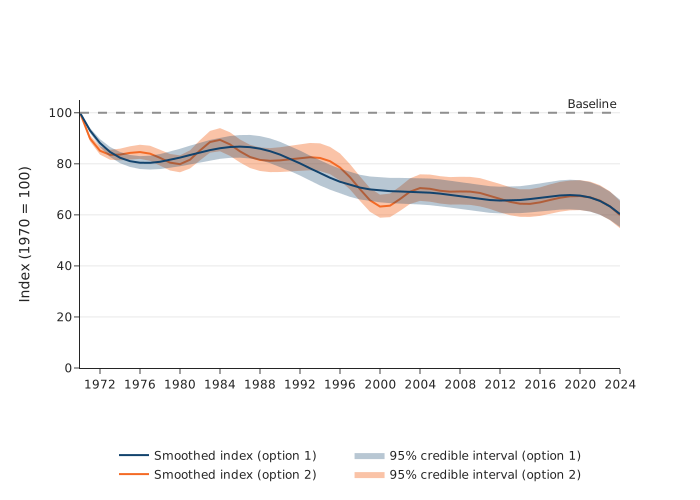
Two possible versions of the relative abundance measure are currently presented here, 'option 1' with a greater degree of smoothing applied (using a 10-year timescale) and 'option 2' with a lesser degree of smoothing (using a 3-year timescale). Smoothing is applied to the species abundance indicator to identify long-term trends in otherwise noisy data. A greater degree of smoothing may provide a clearer view of the underlying long-term trend, while a lesser degree of smoothing preserves the shorter-term patterns in the data. The results given in the commentary are based on the values of both trends and are intended to communicate the extent to which reliance of these trends are dependent on methodological decisions. Further details on this methodology are available in the Indicators of species abundance in England statistical release.
D4i: Relative abundance of species in England, 1970 to 2024
Source: Department for Environment, Food & Rural Affairs
Download the data for this chart in .csv format
Notes on Component
This composite ‘all-species’ measure of relative abundance is based on 1,185 species (444 moths, 235 freshwater invertebrates, 218 vascular plants, 168 birds, 55 butterflies, 37 fish, 17 mammals and 11 bumblebees).
The graph shows the smoothed trends for the relative abundance of these 1,185 species under 2 different smoothing scenarios; 'option 1' being smoothed on a 10-year timescale (effectively applying more smoothing) and 'option 2' being smoothed on a 3-year timescale (effectively applying less smoothing).
The shaded areas on the graph represent the 95% credible intervals (measures of uncertainty) for the 2 smoothed trends. The index values represent change from the baseline value in 1970; therefore, the credible intervals widen over time as confidence in the estimates of change relative to the baseline fall.
The credible intervals capture the variation in trends across species, but not uncertainty in the underlying species abundance indices for individual species. They do not capture uncertainty associated with the spatial locations of sample points, nor about the degree to which the species represent non-sampled species.
Trend Description
By 2024, the index of change in the relative abundance of species in England had declined to around 60% of its baseline value in 1970, with the majority of these changes taking place in the last 3 decades of the 20th century. More recently, between 2019 and 2024, the relative abundance index has declined by around 7%. It should be noted, that as this is an official statistic in development, this trend is not finalised and should not be used to draw conclusions around whether we are on track to meet the statutory species abundance targets.
Assessment: D4i
The composite ‘all-species’ relative abundance measure is also reported in Indicators of species abundance in England. This statistical release presents a short-, medium- and long-term assessment for the same time periods used in this Environmental Indicator Framework assessment. These assessment results were reused here as the method in the source publication is tailored to the specific composite abundance index and it factors-in information on confidence. The assessment found a deterioration in the abundance of species in England over all time periods.
Details on the assessment methodology used for this indicator can be found in the ‘assessment of change’ section of the Indicators of species abundance in England statistical release. Further information on the standard assessment used in the Environmental Indicator Framework, along with details on the methodology, is provided in the Assessment guide page. Summaries by Environmental Improvement Plan goal and information on indicator links are presented in the Assessment results pages.
| Component | Subcomponent | Period | Date range | Percentage change | Smoothing function | Assessment of change |
|---|---|---|---|---|---|---|
| D4i | Smoothed index (options 1 and 2) | Short term | 2019 to 2024 | -10.9 to -11.0 | Smoothed data | Deterioration |
| D4i | Smoothed index (options 1 and 2) | Medium term | 2014 to 2024 | -6.9 to -8.4 | Smoothed data | Deterioration |
| D4i | Smoothed index (options 1 and 2) | Long term | 1970 to 2024 | -39.7 to -40.1 | Smoothed data | Deterioration |
Note that smoothed data presented in Figure D4i were used for percentage change calculations. The smoothing method is specific to this indicator and differs from the default Loess smoothing approach adopted for most indicators for the Environmental Indicator Framework assessment. Percentage change refers to the difference seen between the first and last years in the specified date range.
D4ii: Long-term and short-term changes in the relative abundance of individual species in England, 1970 to 2024
Source: Department for Environment, Food & Rural Affairs
Download the data for this chart in .csv format
Notes on Component
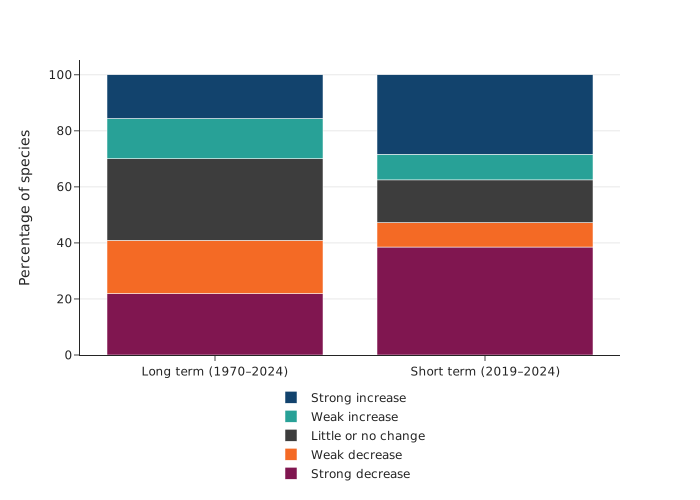
Composite indices mask individual species trends, therefore, this bar chart shows the percentage of the 1,185 species within the indicator that have increased, decreased or displayed little or no overall change in their relative abundance over 2 time periods, (i) long term (since the time series began in 1970) and (ii) short term (latest 5 years of the time series).
Trend Description
The long-term decline in the overall abundance of species in England shown in D4i masks the trends of the individual species within the index, 41% of which have shown a strong or weak decrease and 30% of which have shown a strong or weak increase in abundance since 1970. Over the short-term period (2019 to 2024) 38% of species showed a strong or weak increase and 47% showed a strong or weak decrease in abundance.
Assessment: D4ii
No assessment of change was undertaken for this indicator component as it is based on the same underlying data that are already assessed in D4i.
Metadata
| Primary Goal | Restored nature |
|---|---|
| Relevant Goals | Restored nature |
| Relevant Targets | Halt the decline in species abundance by 2030 and increase species abundance so that by 2042 it is greater than in 2022, and at least 10% greater than 2030 |
| Natural Capital | Condition of assets - species and ecological communities |
| Related Commitments | Sustainable Development Goal 15 (Life on Land) |
| Geographical Scope | England |
| Development Status | Interim |
| First Reported | 2019 |
| Latest Data | 2024 |
| Last Updated | May 2026 |
Return to Environmental Indicator Framework Collection Page
D5: Conservation status of our native species
Short Description
This indicator will track changes in the national extinction risk faced by terrestrial and freshwater species. It will do this by using the International Union for Conservation of Nature’s (IUCN) Red List categories and criteria (Version 3.1 Second edition, 2012). The Red-listing process, when applied to countries, classifies each species into one of several categories including Least Concern, Near Threatened, Vulnerable, Endangered, Critically Endangered, Regionally Extinct (country scale), Extinct in the Wild (global scale) and Extinct (global scale). Species classified as Vulnerable, Endangered and Critically Endangered are defined as ‘threatened’ with extinction. The indicator summarises the IUCN Red List category of a large number of species through a ‘Red List Index’, the value of which decreases as species become more threatened and increases as species become less threatened.
Readiness and Links to Data
The presentation of extinction risk for this indicator is split into 2 parts. Component D5i presents the aggregate value of the 'Red List Index for England' and the individual index values for 36 taxonomic groups. Component D5ii presents a summary by extinction risk category of the same data. It shows the percentage of 8,259 native species (taxa) in the Red List Index for England that are classified as falling into each of the main extinction risk categories, together with the percentage considered to be threatened. Therefore, D5ii represents a snapshot of the status of species in the baseline index in 2022.
Further details on the development of the Red List Index for England, along with supporting data and a species list are available in the Natural England research report 124, while information on the methodology of a Red List Index is available on the IUCN website. Additional detail on extinction risk categories is also available on the Regional Red List Assessments page of the IUCN website.
Available data on changes in abundance and distribution of native species are presented in indicators ‘D4 Relative abundance and/or distribution of widespread species’, ‘D6 Relative abundance and/or distribution of priority species’ and ‘D7 Species supporting ecosystem functions’.
Notes on Indicator
The IUCN red-listing process is a globally accepted methodology for assessing species extinction risk at global and regional (including national) scales.
A Red List Index is based on the numbers of species in each Red List category. How these numbers change over time reflects how species improve or deteriorate in status. The index is expressed as a value between zero and one, where ‘one’ equates to all species assessed as Least Concern (hence none are expected to go extinct in the near future), and ‘zero’ indicates that all species have gone extinct within the geographical area being considered. In this way, the index is used to measure the overall extinction risk of many species, and when recalculated at intervals, this provides a trend.
The Red List Index for England encompasses the status of 8,259 species native to England for which a Great Britain Red List Category was available in 2022 (excluding species classed as Data Deficient, Not Applicable, Not Evaluated and globally Extinct). Under IUCN guidance, micro-organisms are unsuitable for Red List assessment, hence the index focusses on macro-organisms which are defined here as of sufficient size to be seen by the human eye unaided. The index covers 23 major taxonomic groups, comprising almost exclusively terrestrial and freshwater taxa: 49% invertebrates; 29% vascular plants, mosses and liverworts; 18% fungi and lichens; and 4% vertebrates. Assuming a total of approximately 40,000 native macro-organisms (species) in terrestrial and freshwater groups in England, about 20% are covered by the index.
Great Britain scale assessments can underestimate or overestimate extinction risk at an England scale. A comparison of Great Britain and England Red List categories across 4 taxonomic groups showed that between 80% to 92% of statuses aligned and therefore the Red List Index presented here is considered an approximation of extinction risk in England. Importantly, losses from England of species still present in Scotland or Wales will not be detected by the index. In future updates of this indicator, geographical biases to gains and/or losses will be reviewed, and losses from England as a whole highlighted.
The indicator presented here excludes changes in the number of species in each Red List category that are driven by improvements in knowledge (e.g. increase in data) or changing taxonomy, rather than a real change in population or distribution. It therefore measures genuine improvements or deteriorations in the status of species.
Change in the Red List Index for England is expected to be subtle, partly because it is numerically dominated by species of Least Concern, and the index measures net changes in the movement of species between Red List categories. Furthermore, the index can exhibit time-lags, due to the implementation of biodiversity policies, resultant improvements in species populations, available data evidencing these and the frequency of Red List assessment. Therefore, the index will be most effective as a long-term indicator. It is anticipated that the indicator will operate over at least a 20-year period (2022 to 2042), with a 10-year update cycle of every Great Britain Red List in the index. The D5 indicator will be partially updated and reported on every 5 years.
D5i: Red List Index for England by broad taxonomic group, 2022 baseline
Source: Natural England
Download the data for this chart in .csv format
Notes on Figure
Results are based on Great Britain Red List assessments of species known to be native to England.
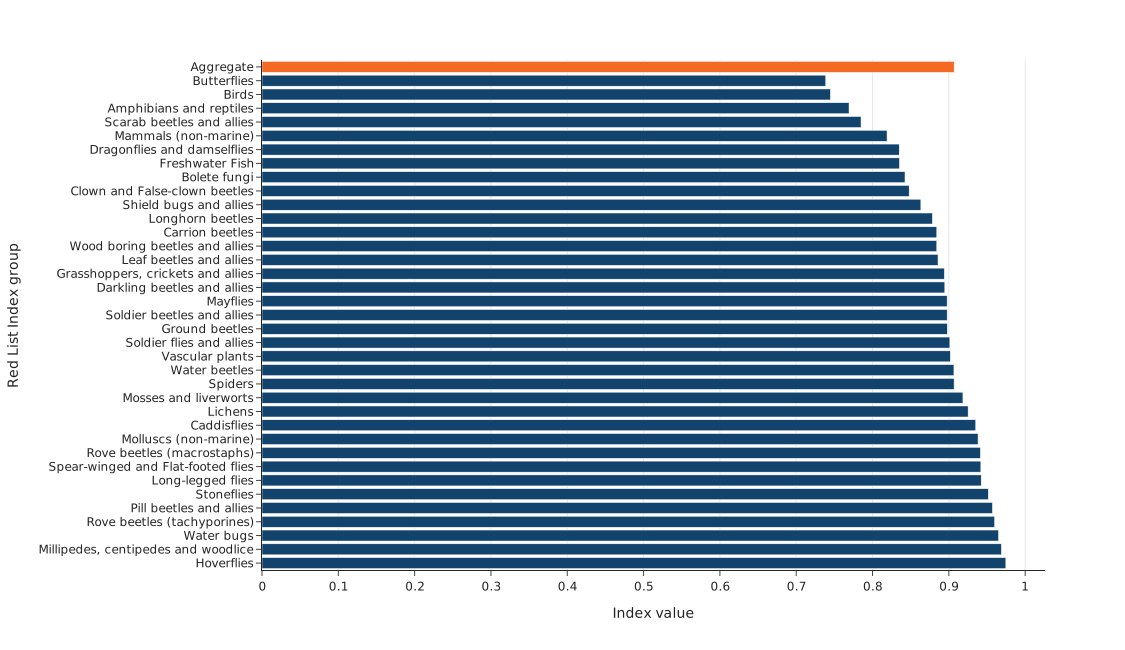
The Red List Index for England includes 8,259 taxa across 23 major taxonomic groups. The 'Aggregate' category summarises the results for all these taxa. Thereafter, taxonomic groups are shown in order of decreasing extinction risk from top to bottom.
Comparisons of Red List Index values between groups can be uncertain because of differences in underlying Red List data, including data quality, taxonomic rank, and extinction definitions.
Trend Description
The aggregate value of the Red List Index for England for the baseline year of 2022 was 0.9070, while the index values for individual groups ranged from 0.7387 to 0.9747, with a median of 0.8979. Butterflies; birds; and amphibians and reptiles had the lowest Red List Index values (highest extinction risk) of 0.7387, 0.7448 and 0.7692 respectively, while hoverflies; millipedes, centipedes and woodlice; and water bugs had the highest values (lowest extinction risk) of 0.9747, 0.9689 and 0.9651 respectively.
Assessment: D5i
No assessment of change was undertaken for this indicator as a suitable time series is not yet available in the Environmental Indicator Framework.
D5ii: Percentage of species in the 2022 baseline Red List Index for England by category of extinction risk
Source: Natural England
Download the data for this chart in .csv format
Notes on Figure
Results are based on Great Britain Red List assessments of species known to be native to England.
The Red List Index for England includes 8,259 taxa across 23 major taxonomic groups.
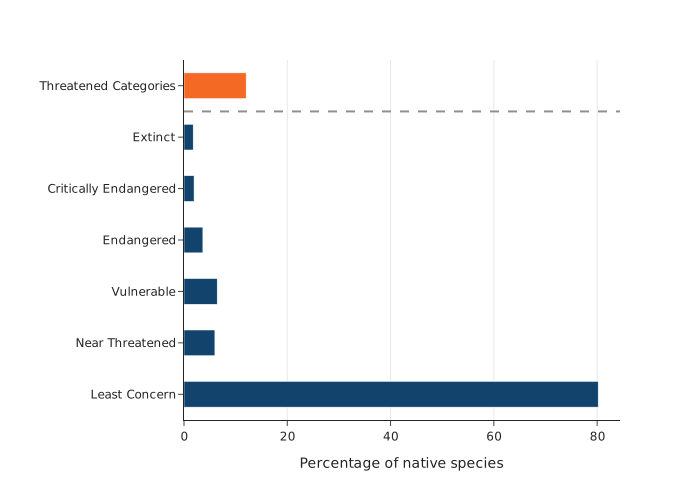
For the purposes of this indicator component, the ‘Extinct’ category includes taxa that are Extinct (in Great Britain), Extinct in the Wild, Regionally Extinct and Critically Endangered (Possibly Extinct). The combined ‘Threatened Categories’ total presented here is simply the total number of taxa in the Vulnerable, Endangered and Critically Endangered categories, calculated as a percentage of the total number of taxa in the Red List Index for England.
Trend Description
In the 2022 baseline year, of the 8,259 native species (taxa) in the Red List Index for England, 1.8% were either Extinct (in Great Britain), Regionally Extinct, Extinct in the Wild or Critically Endangered (Possibly Extinct), 12% were considered to be in one of the 3 threatened categories (1.9% Critically Endangered, 3.7% Endangered and 6.4% Vulnerable) and a further 6% were considered to be Near Threatened. The remaining 80% of the species in the index were categorised as 'Least Concern' in this baseline assessment. Note that Least Concern species can be in decline but not at a rate, or to a degree, sufficient to be considered at risk of extinction.
Assessment: D5ii
No assessment of change was undertaken for this indicator as a suitable time series is not yet available in the Environmental Indicator Framework.
Metadata
| Headline | Wildlife and wild places |
|---|---|
| Primary Goal | Restored nature |
| Relevant Goals | Restored nature |
| Relevant Targets | Taking action to recover threatened, iconic or economically important species of animals, plants and fungi, and where possible to prevent human induced extinction or loss of known threatened species in England and the Overseas Territories |
| Natural Capital | Condition of assets - species and ecological communities |
| Related Commitments | Relevant to Sustainable Development Goal 15 (Life on land), May provide evidence in support of Climate Change Risk Assessment under the Climate Change Act (2008) |
| Geographical Scope | England |
| Development Status | Final |
| First Reported | 2023 |
| Last updated | May 2025 |
| Latest Data | 2022 |
Return to Environmental Indicator Framework Collection Page
D6: Relative abundance and distribution of priority species in England
Short Description
Priority Species are those identified as the most threatened or declining species in the UK. They were identified to support UK conservation planning and are published and maintained by the Joint Nature Conservation Committee. Priority species are used as the reference source to produce statutory species lists of principal conservation importance. Such lists are published by the Secretary of State under Section 41 of the Natural Environment and Rural Communities Act 2006. There are 940 priority species recognised in England.
This indicator has two components: (a) changes in the relative abundance of those priority species for which suitable abundance data are available; and (b) changes in the distribution of those priority species for which suitable distribution data are available. The relative abundance of a species will increase when the population of the species grows, and it will decrease when the population of the species declines. The distribution index, also referred to as the occupancy index, measures the number of 1 kilometre grid squares across the country in which species are recorded each year. It will increase when a species becomes more widespread and decrease when a species becomes less widespread.
Readiness and Links to Data
An interim indicator is presented here showing trends for the relative abundance and distribution of priority species at an England-level. A newly developed relative abundance measure was incorporated into this indicator in 2024. Further details about this abundance measure, including taxonomic breakdowns, a technical background section that describes the data sources and methods in greater detail, and a spreadsheet that contains a list of species within the index together with a more granular breakdown of the data are available in the annual Indicators of species abundance in England statistics release. The data are published as an official statistic in development to gather feedback and facilitate user involvement in the development of the indicator.
Further details about the distribution measure are published annually as England Biodiversity Indicator – Status of priority species: distribution. This includes a technical background document that describes the data sources and methods in detail, a list of species within the index, and a spreadsheet that contains a more granular breakdown of the data.
Methods are being developed to refine the future reporting of this indicator and to expand the taxonomic coverage.
Notes on Indicator
The taxonomic coverage of this indicator is limited at present. The relative abundance measure includes priority birds, butterflies, moths, some mammals (one hare, one dormouse, one water vole and five bats), eight fish, two freshwater invertebrates, one bumblebee and one vascular plant. It does not currently include any fungi, amphibians, or reptiles. The distribution measure includes priority species of bryophytes, lichens, insects and other invertebrates but does not currently include amphibians, reptiles, birds, fish or mammals. Species will be added to this indicator if they are included on the priority species list and suitable data become available, or if they become recognised as priority species and suitable data is available that meets the criteria set out in the Technical annex of Indicators of species abundance in England.
Two possible versions of the relative abundance measure are currently presented here, 'option 1' with a greater degree of smoothing applied (using a 10-year timescale) and 'option 2' with a lesser degree of smoothing (using a 3-year timescale). Smoothing is applied to the species abundance indicator to identify long-term trends in otherwise noisy data. A greater degree of smoothing may provide a clearer view of the underlying long-term trend, while a lesser degree of smoothing preserves the shorter-term patterns in the data. The results given in the commentary are based on the values of both trends and are intended to communicate the extent to which reliance of these trends are dependent on methodological decisions. Further details on this methodology are available in the Indicators of species abundance in England statistical release.
While the data currently available on the distribution of priority species in England presented in indicator D6b mostly predate the 25 Year Environment Plan, they provide the most recently available assessment of this measure. They also enable a better understanding of a baseline from which to measure progress towards the goals of the Environmental Improvement Plan when the indicator is next updated.
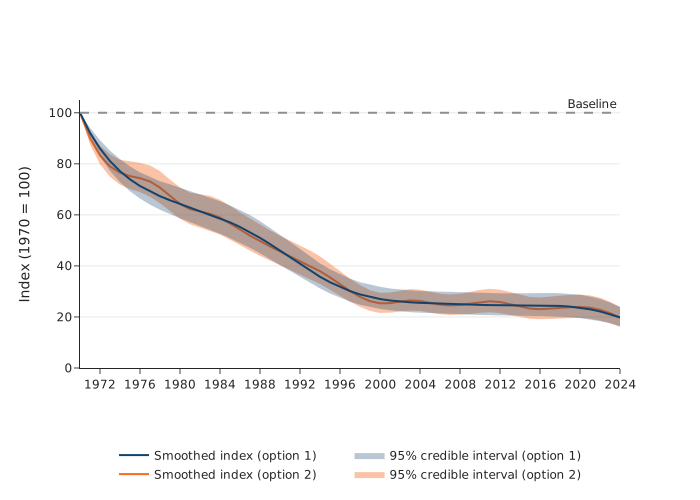
D6ai: Relative abundance of priority species in England, 1970 to 2024
Source: Department for Environment, Food & Rural Affairs
Download the data for this chart in .csv format
Notes on Component
This composite measure of relative abundance is based on 161 species (76 moths, 44 birds, 21 butterflies, eight mammals, one bumblebee, eight fish, two freshwater invertebrates and one vascular plant).
The graph shows the smoothed trends for the relative abundance of these 161 species under two different smoothing scenarios; 'option 1' being smoothed over a 10-year timescale (effectively applying more smoothing) and 'option 2' being smoothed over a 3-year timescale (effectively applying less smoothing).
The shaded areas on the graph represent the 95% credible intervals (measures of uncertainty) for the two smoothed trends. The index values represent change from the baseline value in 1970; therefore, the credible intervals widen over time as confidence in the estimates of change relative to the baseline fall.
The credible intervals capture the variation in trends across species, but not uncertainty in the underlying species abundance indices for individual species. They do not capture uncertainty associated with the spatial locations of sample points, nor about the degree to which the species represent non-sampled species.
Trend Description
By 2024, the index of change in the relative abundance of priority species in England had declined to around 20% of its baseline value in 1970, with the majority of these changes taking place in the last three decades of the 20th century. More recently, between 2019 and 2024, the relative abundance index declined by around 17%.
Assessment: D6ai
The composite relative abundance of priority species measure is also reported in Indicators of species abundance in England. This statistical release presents a short-, medium- and long-term assessment for the same time periods used in this Environmental Indicator Framework assessment. These assessment results were reused here as the method in the source publication is tailored to the specific composite abundance index and it factors-in information on confidence. The assessment found a decrease (deterioration) in the relative abundance of priority species in England over the short-, medium- and long-term periods.
Details on the assessment methodology used for this indicator can be found in the ‘assessment of change’ section of the Indicators of species abundance in England statistical release. Further information on the standard assessment used in the Environmental Indicator Framework, along with details on the methodology, is provided in the Assessment guide page. Summaries by Environmental Improvement Plan goal and information on indicator links are presented in the Assessment results pages.
| Component | Subcomponent | Period | Date range | Percentage change | Smoothing function | Assessment of change |
|---|---|---|---|---|---|---|
| D6ai | Smoothed index (options 1 and 2) | Short term | 2019 to 2024 | -17.3 to -17.5 | Smoothed data | Deterioration |
| D6ai | Smoothed index (options 1 and 2) | Medium term | 2014 to 2024 | -17.8 to -19.3 | Smoothed data | Deterioration |
| D6ai | Smoothed index (options 1 and 2) | Long term | 1970 to 2024 | -80.2 to -80.3 | Smoothed data | Deterioration |
Note that smoothed data presented in the indicator charts were used for percentage change calculations. The smoothing method is specific to this indicator and differs from the default Loess smoothing approach adopted for most indicators for the Environmental Indicator Framework assessment.
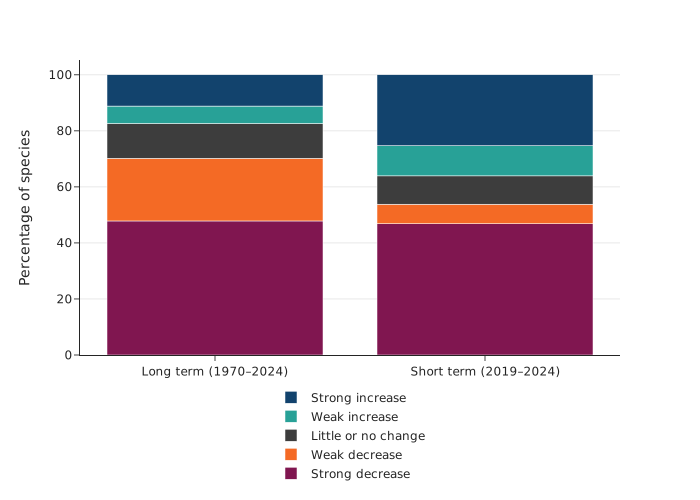
D6aii: Long-term and short-term changes in the relative abundance of individual priority species in England, 1970 to 2024
Source: Department for Environment, Food & Rural Affairs
Download the data for this chart in .csv format
Notes on Component
Composite indices mask individual species trends, therefore, this bar chart shows the percentage of the 161 priority species within the indicator that have increased, decreased or displayed little or no overall change in their relative abundance over two time periods, (i) long term (since the time series began in 1970) and (ii) short term (latest five years of the time series).
Trend Description
The long-term decline in the overall abundance of priority species in England shown in D6ai reflects the trends of the individual species within the index, 70% of which showed a strong or weak decrease and 17% of which showed a strong or weak increase in abundance since 1970. Over the short-term period (between 2019 and 2024), 54% showed a strong or weak decrease and 36% of species showed a strong or weak increase in abundance.
Assessment: D6aii
No assessment of change was undertaken for this indicator as it is based on the same underlying data that are already assessed in D6ai.
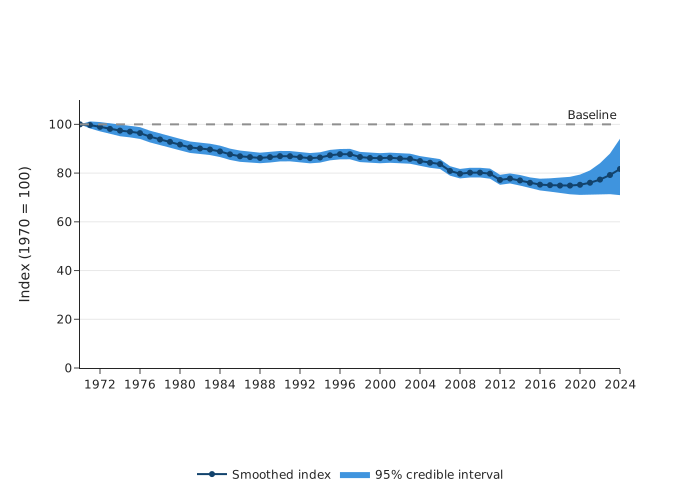
D6bi: Distribution of priority species in England, 1970 to 2024
Source: Department for Environment, Food & Rural Affairs
Download the data for this chart in .csv format
Notes on Component
This composite measure of distribution is based on 245 species.
The shaded area on the graph represents the 95% credible interval (measure of uncertainty) for the smoothed index.
Trend Description
By 2024, the index of distribution of priority species in England had declined to 82, a decrease of around 18% from its 1970 value. More recently, between 2019 and 2024, the distribution index increased by around 9% from 75 to 82.
Assessment: D6bi
The assessment methodology and results from the England Biodiversity Indicators have previously been reused here as they are more tailored to the specific dataset and factor-in information on confidence. However, the method for calculating this indicator within the underlying England Biodiversity Indicators has been updated and it is now classified as an Official Statistic in Development. As such, it has not been assessed in the latest release.
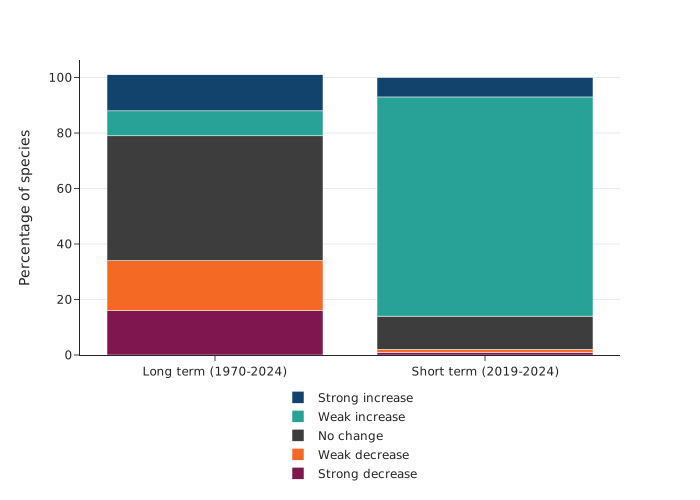
D6bii: Long-term and short-term changes in the distribution of individual priority species in England, 1970 to 2024
Source: Department for Environment, Food & Rural Affairs
Download the data for this chart in .csv format
Notes on Component
Composite indices mask individual species trends, therefore, this bar chart shows the percentage of the 245 priority species within the indicator that have increased, decreased or displayed little or no overall change in their distribution over two time periods, (i) long term (since the time series began in 1970) and (ii) short term (latest five years of the time series).
Trend Description
The long-term decline in the overall distribution of priority species in England shown in D6bi masks the trends of the individual species within the index, with 34% showing a decrease in distribution and 22% of species showing an increase in distribution since 1970. Over the short-term period (2011 to 2016), 2% of priority species showed a decrease in distribution and 86% of species showed an increase in distribution.
Assessment: D6bii
No assessment of change was undertaken for this indicator as it is based on the same underlying data that are already assessed in D6bi.
Metadata
| Primary Goal | Restored nature |
|---|---|
| Relevant Goals | Restored nature |
| Relevant Targets | Halt the decline in species abundance by 2030 and increase species abundance so that by 2042 it is greater than in 2022, and at least 10% greater than 2030 |
| Natural Capital | Condition of assets - species and ecological communities |
| Related Commitments | Sustainable Development Goal 15 Life on Land |
| Geographical Scope | England |
| Development Status | Interim |
| First Reported | 2019 |
| Latest Data | 2024 |
| Last Updated | May 2026 |
Return to Environmental Indicator Framework Collection Page
D7: Species supporting ecosystem functions
Short Description
All species have a functional role within ecosystems such as photosynthesis, respiration, decomposition, nutrient cycling, predator-prey and symbiotic relationships such as pollination. Plants, fungi, algae, invertebrates and soil micro-organisms are particularly important. The presence, abundance and diversity of species are key factors in determining the resilience of ecosystems to environmental changes, including climate change and disease, and the maintenance of ecosystem services. Further research is required to develop this indicator, building on the existing UK pollinator indicator and defining species groups and functions for inclusion.
Readiness and Links to Data
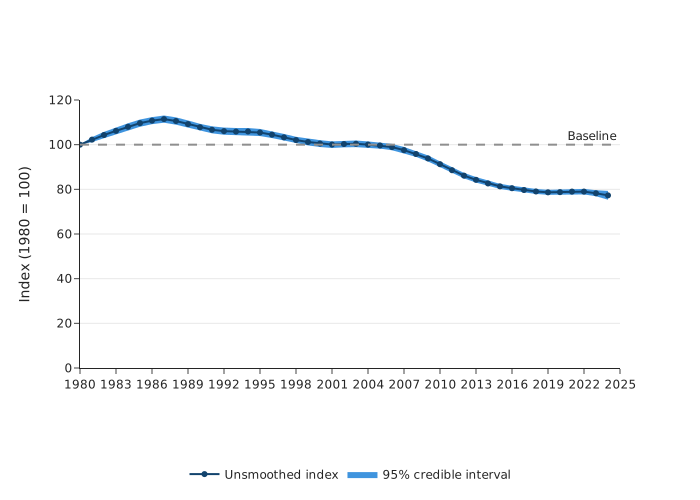
This indicator shows trends in the distribution of pollinators (bees and hoverflies) in the UK. These metrics were previously designated as official statistics and finalised, though recent challenges with the statistical modelling of the wild bees and hoverflies data means the underlying publication has now been designated an Official Statistic in Development to allow for further development and consultation with users. Furthermore, additional research and development is required to include a range of species groups important for supporting ecosystem functions in England. This distribution index, also referred to as an occupancy index, measures the number of 1 kilometre grid squares in which species are recorded each year. It will increase when a species becomes more widespread and decrease when a species becomes less widespread. These data are published annually as UK Biodiversity Indicator – Status of pollinating insects.
D7i: Change in the distribution of pollinators in the UK, 1980 to 2024
Source: Joint Nature Conservation Committee
Download the data for this chart in .csv format
Notes on Component
This composite measure of distribution includes 158 wild bee and 235 hoverfly species; the total number of species included in the index can vary between years and hence this indicator may not be directly comparable to those appearing in previous publications.
The shaded area on the graph represents the 95% credible interval (measure of uncertainty) for the unsmoothed index (note this was 90% in previous updates of this indicator).
Trend Description
There has been an overall decline in the UK pollinators index of 34 percentage points since its peak in 1987. In 2024, the index had decreased by almost 23 percentage points since the start of the time series in 1980. More recently, the trend has levelled off, though there has been a slight decrease seen since 2022.
Assessment: D7i
The indicator ‘Status of pollinating insects’ is also reported in the UK Biodiversity Indicators, and we have previously reused the assessment results from that publication in the Environmental Indicator Framework, as they are more tailored to the specific dataset and factor in information on confidence. Due to issues with the statistical modelling, no assessment results were provided in the 2025 ‘Status of pollinating insects’ publication, and so no assessment has been provided in the Environmental Indicator Framework at this time. Please see the UK Biodiversity Indicators for further information.
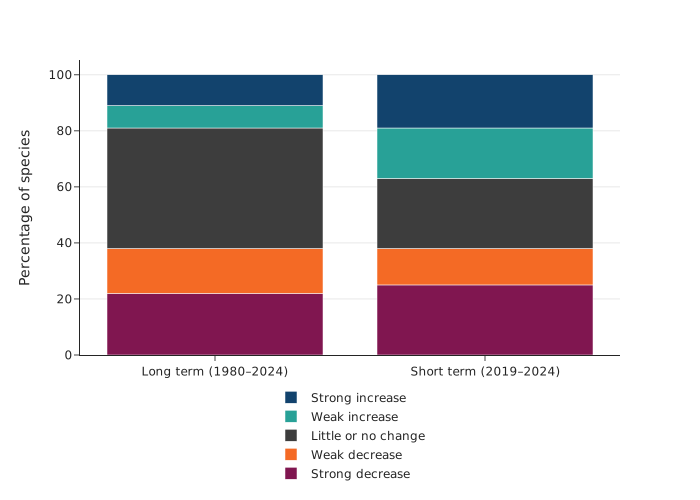
D7ii: Long-term and short-term changes in the distribution of individual pollinator species in the UK, 1980 to 2024
Source: Joint Nature Conservation Committee
Download the data for this chart in .csv format
Notes on Component
Composite indices mask individual species trends, therefore, the bar chart shows the percentage of the 393 pollinator species within the indicator that have increased, decreased or shown little or no change in occupancy. This is based on set thresholds of change over the long term (since the time series began in 1980) and short term (latest 5 years of the time series).
Trend Description
The long-term decline in the overall distribution of pollinators in the UK shown in D7i masks the trends of the individual species within the index, 38% of which have become less widespread, 43% of which have shown little or no change and 19% of which have become more widespread since the index began in 1980. Over the short term (between 2019 and 2024) results for the individual species trends are more balanced, with 38% of species becoming less widespread, 25% showing little or no change and 37% becoming more widespread in the latest 5 years for which data are currently available.
Assessment: D7ii
No assessment of change was undertaken for this indicator as it is based on the same underlying data that are already assessed in D7i.
Metadata
| Primary Goal | Restored nature |
|---|---|
| Relevant Goals | Restored nature |
| Relevant Targets | Taking action to recover threatened, iconic or economically important species of animals, plants and fungi, and where possible to prevent human induced extinction or loss of known threatened species in England and the Overseas Territories |
| Natural Capital | Condition of assets - species and ecological communities |
| Related Commitments | May provide evidence in support of Climate Change Risk Assessment under the Climate Change Act (2008) |
| Geographical Scope | England. The interim indicator is only available for the UK. |
| Development Status | Interim |
| First Reported | 2019 |
| Latest Data | 2024 |
| Last Updated | Feb 2026 |