Assessing and monitoring the Economic and Financial Standing of Suppliers guidance note (HTML)
Updated 30 September 2026

© Crown copyright 2026
This publication is licensed under the terms of the Open Government Licence v3.0 except where otherwise stated. To view this licence, visit nationalarchives.gov.uk/doc/open-government-licence/version/3 or write to the Information Policy Team, The National Archives, Kew, London TW9 4DU, or email: psi@nationalarchives.gov.uk.
Where we have identified any third party copyright information you will need to obtain permission from the copyright holders concerned.
This publication is available at https://www.gov.uk/government/publications/the-sourcing-and-consultancy-playbooks/assessing-and-monitoring-the-economic-and-financial-standing-of-suppliers-guidance-note-html--2
1. Context
1.1 Overview
1.1.1. Assessing and monitoring the economic and financial standing (EFS) of suppliers is about understanding the financial capacity of suppliers to perform a contract in order to safeguard the delivery of public services.
1.1.2. This guidance note provides advice on how to:
- assess the EFS of bidders prior to a contract award;
- monitor the ongoing EFS of suppliers during the life of a contract;
- mitigate the financial risks identified from the EFS evaluation of a bidder, either upfront or during the course of the contract.
1.1.3. Effective evaluation and monitoring of the EFS of suppliers should take place both pre- and post- an award of a contract, alongside a wider strategy to maintain a healthy market as detailed in HMG’s Sourcing Playbook.
1.1.4. The contents of this guidance note apply to all Central Government Departments, their Executive Agencies and Non Departmental Public Bodies. Such bodies are referred to as “in-scope organisations”. Other contracting authorities may, at their discretion, choose to incorporate this guidance in their procurements.
1.2 Timing and Scope
1.2.1. This guidance note is expected to apply to all new procurements with an expected contract value exceeding the relevant threshold set out in the Procurement Act 2023 (“the Act”). In applying the guidance however, in-scope organisations will need to consider whether the recommended approach is appropriate to their particular procurement and to adopt a ‘comply or explain’ approach.
1.2.2. This guidance note applies to services and works contracts. Model contractual provisions dealing with monitoring the ongoing EFS during the life of a contract are set out in the “Financial Distress” / “Financial Difficulties” Schedules in the Model Services Contract (MSC); and Mid-Tier Contract. However, the MSC and Mid-Tier Contract are not intended for use with works contracts; for works contracts, industry-specific contracts are recommended. Generally, the provisions for services and works contracts in this guidance note will be the same; where there will be differences, we have highlighted these in this guidance note.
1.3 Contact
1.3.1. Feedback on and enquiries about this guidance note should be directed to markets-sourcing-suppliers@gca.gov.uk
2. Assessing the Economic and Financial Standing of Bidders
2.1 Purpose
2.1.1. The purpose of assessing the EFS of bidders as part of a procurement is twofold:
- To assess the bidders’ financial capacity to perform the contract and;
- To assess whether appropriate risk mitigations can be put in place to address any identified risks with bidders’ financial capacity.
2.1.2. Failure to assess EFS effectively could result in the appointment of a financially challenged supplier which may subsequently:
- Adopt sub-optimal behaviours;
- Fail to deliver aspects of a contract to a satisfactory standard;
- Fail to deliver all elements of the contract if it subsequently experiences financial distress[footnote 1] or becomes insolvent.
2.1.3. A contracting authority may then:
- Incur additional time and cost in managing and re-procuring the contract or bringing the delivery of the service in-house;
- Potentially bear an increased contract price, particularly if urgent short-term or interim arrangements are required;
- Suffer from delays to the provision of important public works and/or risks to the quality and continuity of critical public services.
2.2 Principles
2.2.1. The Act allows contracting authorities to set conditions of participation that a supplier must satisfy in order to participate in a competitive tendering procedure. Any conditions must be a proportionate means of ensuring suppliers have this capacity or ability, having regard to the nature, cost and complexity of the contract. This includes conditions relating to a supplier’s financial capacity. Bidders EFS should be assessed as part of the conditions of participation, and tailored to the contract. Contracting authorities must also have regard to the importance of delivering value for money.
2.2.2. All bidders, whatever their size and constitution, shall be treated the same during the assessment of their EFS (unless a difference between them justifies different treatment). No small and medium sized enterprises (SMEs), public service mutuals or third sector organisations should be inadvertently disadvantaged by the EFS assessment approach and metrics applied (unless justified by relevant differences). This can be achieved by allowing all bidders to propose relevant mitigations where risks are identified that arise from an organisation’s size or structure.
2.2.3. Assessment of EFS should be transparent and objective. It should be based on performance against a set of metrics and ratios, using appropriate scales to indicate lower and higher financial risk for each bidder. Bidders should be able to see performance against these scales as they complete the financial assessment and, where relevant, be given the opportunity to explain why different risk classifications may be more appropriate.
2.2.4. In many cases the assessment can be based on a standardised set of metrics and ratios, although these should be reviewed to ensure they are proportionate to the contract. For example, for certain contracts, such as procurements of more critical, complex works and services, or for longer periods, additional or alternative metrics and ratios may be appropriate.
2.2.5. There are alternative standardised ratios that can be used for voluntary, community, and social enterprises (VCSEs); these are set out in ‘APPENDIX I – Standard Financial Ratios’. The Act (section 12) provides that “in carrying out a covered procurement, a contracting authority must treat suppliers the same unless a difference between the suppliers justifies different treatment. If a contracting authority considers that different treatment is justified in a particular case, the authority must take all reasonable steps to ensure it does not put a supplier at an unfair advantage or disadvantage.”, therefore the different accounting requirements for entities that fall under the provisions of the Companies Act 2006 (CA 2006) and those VCSE’s who are outside the scope of CA 2006 may warrant the use of alternate ratios. Where this approach is to be followed it should be identified in advance and set out in the tender notice (or associated tender documents).
2.2.6. The assessment of a bidder’s EFS should be conducted by staff with appropriate finance skills, calling on specialist expertise as necessary. This may include consulting the Markets, Sourcing and Suppliers team in the Government Commercial Agency for suppliers operating across government to understand any systemic risks.
2.2.7. Regulation 6 of the Procurement Regulations 2024 requires contracting authorities to obtain confirmation from suppliers that they have submitted up-to-date ‘core supplier information’ on the central digital platform, and that such core supplier information has been shared. This includes certain financial information (such as financial accounts). However, any other information relating to conditions of participation required by the contracting authority, which is not covered by the central digital platform, will need to be obtained from the supplier by other means (for example the Financial Viability and Risk Assessment (FVRA) tool).
2.2.8. Contracting authorities may wish to assess EFS after confirming other elements of the conditions of participation are met, in order to reduce the number of assessments required.
The assessment of a bidder’s EFS should be conducted by staff with appropriate finance skills, calling on specialist expertise as necessary.
This may include consulting the Markets, Sourcing & Suppliers team in Government Commercial Agency for suppliers operating across government to understand any systemic risks and wider sector performance. Queries can be directed to: markets-sourcing-suppliers@gca.gov.uk
2.3 Process map
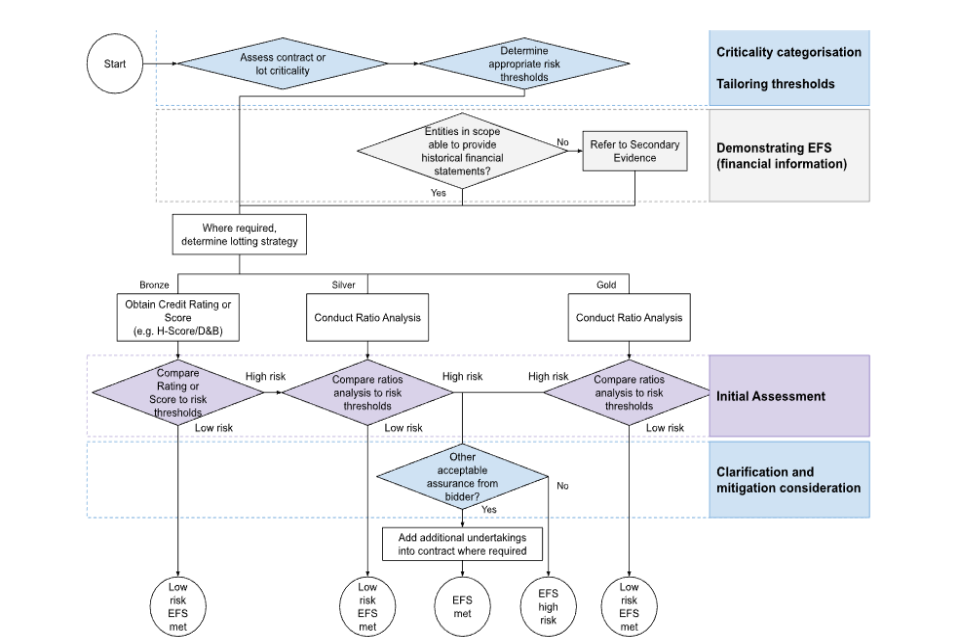
2.4 Contract categorisation and setting a risk assessment scale
Categorising contracts
2.4.1. In order to determine what constitutes a proportionate assessment of EFS, contracting authorities should, prior to commencing a procurement, determine the criticality of the potential contract or framework lot. The criticality should drive the level of EFS assessment and the scale used for each of the metrics as well as any associated contract management requirement or need for financial assessment subject matter expertise.
2.4.2. Government Commercial Agency has developed a Contract Tiering Tool to measure criticality. The Tool takes into account various criteria, including the potential impact of service failure, the speed and ease of switching suppliers and the contract value. Contracting authorities should use this tool for consistent categorisation of contracts or lots between ‘Gold’ (most critical), ‘Silver’ and ‘Bronze’ (least critical).
2.4.3. As detailed in the table below, the Gold, Silver and Bronze categorisation should inform both the detail of the assessment and the scales used for this analysis. This does not preclude the requirement to ensure the assessment uses conditions that are related, proportionate and appropriate. Contract classification will be made known to suppliers as part of the EFS assessment process.
| Description | Assessment | |
| Bronze (least critical) | Bronze contracts are typically smaller, simpler contracts for non-critical works and services. In these cases, it may be appropriate to carry out a more basic financial assessment. | In order to keep the assessment proportional to a lower criticality contract, contracting authorities may wish to use ‘off-the-shelf’ financial analyses and risk assessments from a credit score or ratings agency. Examples include Experian (credit score), Company Watch (risk score), Dun & Bradstreet (failure score) and Moody’s (credit rating). Higher risk could be defined as the scores or ratings that indicate an above average risk of default, for example: ≤35 for a Company Watch H score; ≤50 for a Dun & Bradstreet failure score. If an assessment indicates higher risk, a more detailed assessment, including ratio analysis, should be undertaken, with bidder clarification or mitigation as required. ‘Off-the-shelf’ scores should not, on their own, be used to conclude that a bidder is higher risk without further investigation. Contracting authorities may also wish to use the short-form ‘lite’ version of the Financial Viability and Risk Assessment (FVRA) tool. |
| Silver | Silver contracts are typically contracts for important but not critical works and services. In these cases, a more detailed financial assessment is appropriate and a risk assessment scale should be set accordingly. | The assessment should use the standard financial metrics and ratios set out in ‘APPENDIX I – Standard Financial Ratios’ and an appropriate scale for these metrics ; these can be tailored from ‘APPENDIX II – Interpreting standard financial metrics.’ |
| Gold (most critical) | Gold contracts are typically larger, longer contracts for complex or critical works and services. In these cases a very detailed financial assessment is appropriate; risk assessment scale should be set at the same level as for Silver contracts or higher. | The assessment should normally include as a minimum the standard financial metrics and ratios set out in ‘APPENDIX I – Standard Financial Ratios’ and appropriate and proportionate values at the same level or higher than those for Silver; these can be tailored from ‘APPENDIX II – Interpreting standard financial metrics.’ Contracting authorities should also consider whether to carry out additional analysis, for example the use of additional financial metrics, ratios and/or trend analysis. |
“Assessment of EFS shall be transparent, objective and non-discriminatory.”
Tailoring scales for risk assessment
2.4.4. In setting an appropriate scale of values for risk assessment, contracting authorities should always seek to reflect industry specific circumstances. APPENDIX II sets out some suggested ranges that contracting authorities should tailor to ensure they are related and proportionate to the contract or lot.
2.4.5. Any points on the scale at which a bidder would be required to provide additional mitigations should be specified in advance. Such values may be linked to the risk rating across multiple financial metrics or ratios. Values shall be transparent, objective and proportionate to the requirement under procurement.
Using credit ratings and credit scores
2.4.6. Credit ratings issued by major credit ratings agencies (such as Standard and Poor’s, Moody’s and Fitch Ratings) can also be used to provide an indication of a bidders EFS in support of other metrics.
2.4.7. Contracting authorities should generally not use the lack of a credit rating, a minimum credit rating or its accompaniment by a negative outlook on the bidder’s rating as a reason to eliminate a bidder alone; other financial ratios and/or metrics should also be considered.
2.4.8. Credit ratings are distinct from the credit scores issued by credit scoring agencies (such as Dun & Bradstreet, Experian and Company Watch). Credit scores are based on algorithms based on prior performance of companies with similar characteristics; their usefulness is limited by their dependence on backwards-looking published financial information which can be out of date. Credit scores should be used to corroborate other analysis or to assist identifying potential risk for investigation, but should not be relied upon as the sole measure of EFS for Gold and Silver procurements.
2.5 Application to frameworks
2.5.1. Where a contracting authority is procuring a framework, it should assess the EFS of bidders in a similar manner to the procurement of a standard contract, consider the cumulative value of awards that could be made and should also monitor the ongoing EFS of suppliers on the framework. GCA’s Public Sector Contract, which underpins many GCA frameworks, contains model contractual provisions dealing with monitoring the ongoing EFS during the life of a contract in the “Financial Difficulties” Joint Schedule.
2.5.2. To manage a potential high volume of EFS testing, a contracting authority procuring a framework could explore reducing the numbers of periods of accounts tested or the use of simplified ratios. Any measure should remain consistent with the principles outlined in this guidance and the legal frameworks in place at the time. The financial assessment level should be fully articulated in the framework documentation for the benefit of bidders and customers.
2.5.3. Where permitted in the framework, section 46 of the Act allows a contracting authority to also set ‘conditions of participation’ at the stage of awarding a call-off contract based on a competitive selection process under a framework. To do so a contracting authority must be satisfied that they are a proportionate means of ensuring that suppliers have the financial capacity to perform the contract (amongst other things). Therefore, contracting authorities establishing a framework, should ensure that the framework permits the application of conditions of participation in the competitive selection process for call-off contracts, to ensure an appropriate EFS assessment can be undertaken at call off where appropriate.
2.5.4. A condition of participation for the award of a call-off contract may include a stipulation that the conditions of participation for award of the framework must be met or may include some or all of the same conditions. It may also include additional conditions that did not apply to the award of the framework, for example, bespoke insurance requirements relevant to the particular call-off contract to be awarded.
2.5.5. A contracting authority entering into a call off contract under a framework should always have regard to the criticality of the call off contract. If the framework does not permit EFS assessment appropriate for the criticality of the call off contract, then an alternative framework or route to market should be used.
2.6 Demonstrating economic and financial standing
2.6.1. Contracting authorities are encouraged to exercise flexibility when specifying the financial information they require from bidders. Contracting authorities are prohibited from requiring, as a condition of participation, the provision of audited annual accounts from suppliers that are not otherwise required to have their accounts audited by Part 16 of the Companies Act 2006 or an overseas equivalent.
2.6.2. Where audited statements are not available, other financial information that contracting authorities may use to assess a bidder’s EFS includes but is not limited to:
- Parent or ultimate parent company audited accounts (if applicable);
- Guarantees and bonds;
- Bankers’ statements and references;
- Management accounts;
- Financial projections (including cash flow forecasts) and order book pipeline;
- Details and evidence of previous contracts, including contract values;
- Other evidence of capital availability;
- Annual Returns (in the case of charities with an annual income of more than £10,000 or where the charity is a charitable incorporated organisation (CIO)).
2.6.3. Contracting authorities should be aware that use of historical financial information is subject to various shortcomings such as timeliness and lack of forward view.
“Immediately prior to contract award for Gold and Silver potential contracts, a contracting authority should confirm whether there has been any change to a bidder’s EFS which would have resulted in its elimination if it had been known at the time of the original assessment”
2.6.4. The majority of companies are only legally required to file accounts nine months after their year-end, or ten months after year-end for an unincorporated charity submitting its accounts to the Charity Commission. Where the latest published financial statements have been drawn up to an accounting reference date more than 12 months previous to the submission of the EFS information, contracting authorities should consider requesting management accounts drawn up to a more recent date to evaluate the bidder’s EFS. Such accounts may need to cover a 12-month period to reduce the need for extrapolation. In addition, where the backward-looking information generates a medium or high-risk outcome in the financial tests, contracting authorities may, subject to legal advice, consider requesting forward-looking information as part of the permissible additional information if such information is appropriate in the particular case. However, the requirement for permissible additional information needs to be clear in the procurement documents (including for example the Procurement Specific Questionnaire) and offer a few options so that bidders can select the most appropriate evidence (e.g. forecasts for listed entities may be market sensitive).
2.6.5. Management accounts and financial projections should be supported, as a minimum, by written representations from the boards of bidders and ideally by independent assurance. The acceptability of different forms of information and assurance will depend on the criticality of the potential contract; where the procurement is for a ‘Gold’ contract the appraisal should be supported by the latest audited financial statements or, where an entity is not required to have their financial statements audited, other independent support of the bidder’s EFS.
2.6.6. Bidding entities may be registered in different countries, have similar names to subsidiaries or have recently changed their names. Where a bidding entity is registered overseas, provision of translated accounts and appropriate supporting documentation should be requested.
2.6.7. Any non-public information shared with a contracting authority during the procurement process should be treated as confidential and used solely for the purposes of assessing the financial standing of the bidder on that particular procurement.
2.6.8. For procurements involving sequential contracts, such as multi-phase projects or construction contracts utilising a Pre-Construction Services Agreement followed by a main implementation contract, contracting authorities may wish to provide for reassessing the EFS of the supplier before entering subsequent contract phases. This is particularly relevant where a significant period has elapsed since the initial contract award. In these cases, contracting authorities should ensure that the possibility of this additional EFS assessment is clearly articulated within the procurement documentation, alongside an explanation of the actions that will be taken if a satisfactory EFS cannot be demonstrated prior to the award of a subsequent contract phase. The EFS assessment should include the assessment of any significant sub-contractors to be deployed at implementation stage.
2.7 Clarifying risk classifications
2.7.1. Bidders should be able to see their risk classifications as they complete their financial assessments and offer a written explanation as to why different risk classifications may be more appropriate. Clarification questions from contracting authorities should:
- Clearly specify the source of the concern;
- Ask why this is the case;
- Probe how the bidder is seeking to address the issue raised;
- Invite additional evidence to be provided as required.
2.7.2. Bidder’s explanations may include:
- Non-underlying or one-off items;
- Improvements in a bidder’s EFS since the accounting reference date used in the assessment due to management actions, improved financial performance or raising of additional capital for example;
- Adoption of new accounting policies/standards;
- Alternative ratio calculations[footnote 2]; and
- One-off use of restricted reserves accumulated by a charity.
2.7.3. A contracting authority should consider the validity of such explanations (Appendix I provides an outline set of possible mitigations for each metric) and take them into consideration in its assessment of a bidder’s EFS. Where a significant period of time has passed since the bidder last published financial accounts, contracting authorities might consider asking bidders for latest management accounting data to confirm that these are consistent with narrative explanations provided.
2.7.4. A contracting authority can contact the Markets, Sourcing and Suppliers team in the Government Commercial Agency in relation to the EFS of government strategic suppliers[footnote 3] and Critical Service Contracts. The contracting authority may also share EFS assessments with another government body subject to taking appropriate care to protect any confidential information provided by bidders. As each contracting authority may have different risk appetites and different assessment requirements and methodologies tailored to individual procurements, the relevance of shared EFS assessments may be limited.
2.7.5. In multi-stage procedures, the bidder’s EFS is assessed at the selection stage of a procurement but should be monitored throughout the procurement process until award and establishment of EFS monitoring under the contract. Contracting authorities can include provision in the procurement documentation obliging bidders to disclose any change in circumstances promptly after occurring; some forms of model contract, including the Model Services Contract and Mid-Tier Contract require bidders to warrant no Financial Distress Events[footnote 4] have occurred or are subsisting at the time of entering into a contract.
2.7.6. In multi-stage procedures, immediately prior to contract award, a contracting authority should confirm whether there has been any change to a bidder’s EFS which would have resulted in a different risk assessment if it had been known at the time of the original assessment. If such a change has occurred, a contracting authority should consider whether adequate risk mitigations can be implemented. If the EFS of a winning bidder is considered to have deteriorated to such an extent as to pose an unacceptable risk, the contract should not be awarded to that bidder.
2.7.7. Where there has been a change in circumstances affecting a bidder, a contracting authority may seek to calculate pro forma ratios based on the event or change of circumstances. This should be considered in light of circumstances at the time and would normally only be appropriate where updated figures are available from the bidder or a reputable independent source, or can be estimated with reasonable certainty[footnote 5].
2.7.8. The contracting authority should explain how it has derived the pro forma ratios and give a bidder the right to explain in writing why application of a different risk classification would be more appropriate before using the pro forma ratios as a basis for its appraisal of EFS. Examples of changes in circumstances in which use of pro forma ratios might be appropriate include but are not limited to:
- The announcement of an acquisition or a change of control;
- The declaration or payment of large dividends or other distributions; and
- Publicly announced interim or final results or profits warnings.
2.7.9. Where bidders are not yet felt to have addressed raised concerns satisfactorily, contracting authorities should now consider whether they should be asked to commit to relevant mitigations as a condition of being taken forward. Where mitigations cannot be agreed or are not sufficient to allow the bidder to meet the conditions of participation, the contracting authority should consider whether the bidder should be excluded from the procurement. See Section 3 for more detail.
“A contracting authority may allow bidders to proceed despite being classified overall as medium or high risk subject to agreeing a set of risk mitigations”
A Financial Viability Risk Assessment Tool is available which can be completed by individual bidders.
The model automatically calculates a series of financial ratios and, subject to the insertion of the desired individual ratios and appropriate values for risk assessment, can generate a risk assessment by ratio for each bidder subject to override by the contracting authority as set out above. Input of information should be checked by the contracting authority back to the source material provided by the bidder. Where there is a compelling rationale, the contracting authority may tailor its Tool to be more suited to the assessment of EFS of potential bidders.
A short-form ‘lite’ version of the FVRA is also embedded within the tool which can be used for the least critical procurements. It requires fewer inputs, allowing the EFS assessment to be proportionate to the requirement.
2.8 Considerations relating to the types of entities in scope
| Groups and parent companies | Where a bidder is a member of a group, it may benefit from the greater financial resources available to the group. If a bidder is unable to demonstrate lower or medium risk EFS, a parent company guarantee may be sought as a potential mitigation. A written commitment from the parent to provide such a guarantee would normally be sufficient prior to contract award. In this case, the EFS assessment should include the bidding entity and the guarantor. If the guarantor is assessed as higher risk, the contracting authority should determine that the bidder is higher risk due to its reliance on a higher risk guarantor. |
| Key subcontractors[footnote 6] | The Government Commercial Agency Procurement Specific Questionnaire template requires bidders to set out whether they will be using subcontractors. Where a key subcontractor is identified, the EFS assessment should include the bidding entity and the key subcontractor. The contracting authority may apply the same tests and risk values as applied to the bidding entity or may tailor the values, for instance pro-rata, to represent the proportion of the works or services to be delivered by the key subcontractor. If the key subcontractor is assessed as higher risk, the contracting authority could require the bidder to replace the key subcontractor as a mitigation, provided a key subcontractor that can be assessed at lower risk can be found. If this is not possible, the contracting authority should determine that the bidder is higher risk due to its reliance on a higher risk subcontractor. |
| Joint Ventures (JV), Special Purpose Vehicles (SPVs) and Consortia | These bidders may not be able to demonstrate capacity through EFS assessment on a standalone basis and specific consortia members may be less well placed to achieve low risk EFS assessments. In order to mitigate this risk, the contracting authority should normally seek ‘joint and several’ guarantees from the major shareholders (i.e. not ‘proportionate’) or consortia members. A written commitment to provide such guarantees would normally be sufficient prior to contract award. In this case, the EFS assessment should include all the entities bidding or party to guarantees. |
Support
Where there are questions or issues, contracting authorities are encouraged to consult with colleagues in the Markets, Sourcing and Suppliers Team (markets-sourcing-suppliers@gca.gov.uk) in Government Commercial Agency.
3. Mitigating Financial Risk
3.1 Introduction
3.1.1. This section reviews ways to mitigate risks arising from a bidder’s EFS which have been identified at the procurement stage and are at the higher end of the risk scale. It also reviews ways to manage changes to a supplier’s EFS which may occur during the life of the contract. Authorities should ensure that any such additional commitments agreed to by the bidder in the procurement, for example more regular financial monitoring, appear in any contract awarded to the bidder, should the bidder be successful.
3.1.2. Some of these mitigations, for example bonds and other financial instruments, can be expensive and their cost and availability can be impacted by the wider economic conditions at the time of procurement. The requirement and choice of a mitigation should be proportionate to the identified risk and procurement. The selected mitigation should also be carefully assessed against the costs and expected protection for the contracting authority. Contracting authorities should ensure that the cost of any such security is included in the bidder’s price.
3.2 Guarantees and Bonds
3.2.1. Guarantees and bonds can be either performance or financial guarantees, or a hybrid of both. They only crystallise when a supplier has failed to perform works or services (performance guarantee) or to pay a sum due (payment guarantee). As such, they provide a remedy once a supplier has failed to deliver the works or service rather than directly supporting performance of the contract.
3.2.2. The financial markets can provide a variety of alternative financial instruments to protect customers. Since these can be expensive and their cost is likely to be reflected in bidders’ tenders, it is generally preferable to seek a parent company bond or guarantee first where this is available and credible. It should be noted however that bidders’ existing debt terms may prevent the creation of new guarantees in some cases.
3.3 Guarantees
3.3.1. Under a guarantee, another party (the guarantor) undertakes to fulfil the terms of the contract (a performance guarantee) and/or make payments due but not made by the supplier and/or provide financial compensation to the contracting authority (a financial guarantee) if the contract is not fulfilled or a sum of money not paid.
3.3.2. Where a potential supplier’s EFS appears higher risk and subject to any clarifications with the potential supplier in this regard, contracting authorities should ask it to procure a guarantee from a guarantor with greater EFS or alternative means of support. It is important that any guarantor has adequate assets and is an entity of substance as a guarantee is only as good as the EFS of the entity providing it (see also Section 2.8 ‘Entities In Scope’ above). An assessment of the guarantor’s EFS will need to be performed. Contracting authorities should ensure that any guarantee will survive a change of control of the guarantor or that a mechanism exists to ensure that appropriate alternative arrangements are in place if necessary.
3.3.3. A guarantee can be provided by a member of the supplier’s group or by a bank or insurance company. The latter would normally provide a financial guarantee where the guarantor agrees to indemnify the contracting authority against specific financial losses, liabilities and expenses incurred if the supplier defaults on its contractual obligations. These guarantees may be less advantageous, assuming the guarantor remains solvent, than a performance guarantee from the supplier’s parent company or another company in the group which obliges the guarantor to perform the contract if the supplier fails to do so. There is a draft guarantee template in the “Guarantee” Schedules of the Model Services Contract and Mid-Tier Contract.
3.4 Bonds
3.4.1. Bonds are typically provided by independent third parties, such as lenders and specialist surety providers / insurance companies, and provide financial compensation in the event of supplier failure. A range of different types of bonds are available.
3.4.2. A performance bond can provide some compensation if the supplier is proven to have defaulted on its obligations. It is usually provided at contract award for an agreed percentage of the total contract value until its expiry date. A performance bond will not by itself ensure that contracts are carried out efficiently and to time, but it will be an additional incentive on the supplier to perform well.
3.4.3. Conditional bonds can usually only be called on (invoked) following a serious breach by the supplier (including becoming insolvent, which would normally allow the contracting authority to terminate the contract). These bonds provide a third party incentive to the supplier not to default under a contract it has entered into. They also provide compensation to the contracting authority where there is a proven default. They may be required where there are identifiable risks of default by the supplier, subject to value for money considerations.
3.4.4. On-demand bonds include within their terms and conditions the trigger and mechanism for calling on them. These are expensive and therefore more onerous for the supplier; they should typically only be used for high risk and/or high value projects where the costs and/or consequences of default by the supplier are high. They can be called on at the sole discretion of the customer, i.e. there may be no need to establish that the contract has been breached; if the agreed conditions for calling are met, the payment shall be made.
3.4.5. Contracting authorities should seek professional advice on the use, best choice, and drafting of bonds, taking into account that the availability and cost of bonds can be affected by the wider economic climate. In particular, they should be used proportionately as they can be burdensome requirements for small/medium value contracts and their costs are likely to be reflected in tenders. They should only be used where appropriate to the procurement in question. Consideration should also be given to whether any requirements for bonds could effectively preclude smaller firms from bidding.
3.4.6. Performance bonds and sureties are often used in construction contracts where there is an active private market in the provision of such bonds and where performance can be more easily measured; they would not normally be used to support services contracts.
“Guarantees and bonds can be either performance or financial guarantees, or a hybrid of both.”
3.6 Other methods to mitigate financial risk
3.6.1. Risk mitigations should be proportionate to the risk identified and the inherent criticality of the contract. Please refer to the Resolution Planning guidance for more details on various protection mechanisms.
3.6.2. Step-in rights allow a contracting authority to take over some or all of a supplier’s contractual obligations for a temporary period to rectify a problem (usually a major performance failure), after which control is returned to the supplier. A trigger could be where a failure by the supplier causes the contracting authority to be in breach of a statutory duty where the contracting authority has no option but to assume control of the service in order to remedy the statutory breach. A permanent replacement supplier cannot be appointed under these measures; that would require a fresh competition in accordance with applicable procurement law. The Model Services Contract and Mid-Tier Contract contain standard step-in rights for service contracts and they are often contained in collateral warranties on construction projects or other complex procurements.
3.6.3. Insurance requirements can be amended on the basis of financial risk within the contract and the risk of the supplier. A base level of cover will be required of all bidders, but authorities may require certain additional policies if there are concerns regarding supplier liquidity. Authorities should act proportionately when setting insurance requirements, and are not permitted to require insurance be in place prior to contract award.
3.6.4. Escrow arrangements can be used, where appropriate, to protect critical software and technology assets. Escrow services are provided by neutral third-party escrow and verification specialists. Risk is mitigated by ensuring the contracting authority has access to source code and other proprietary information needed to maintain technology should the service provider go out of business or fail to provide support. The trusted third-party escrow specialist will securely hold the source code and release it under specific contractual conditions.
3.6.5. Whether an escrow arrangement is entered into and who bears the cost[footnote 7] is subject to agreement between the parties. Escrow arrangements should not be required for open source software since the source code would normally be provided with the software.
3.7 Contractual provisions to support EFS throughout the contract
3.7.1. To facilitate effective contract management and financial monitoring procedures, the terms and conditions of the contract should clearly specify any particular financial information required for ongoing financial assessment and monitoring post-contract award. This is especially relevant where such financial information is not publicly available but is necessary to mitigate heightened financial risk.
3.7.2. Specific contract terms and conditions may be needed when a pre-award assessment has identified a higher financial risk that requires additional ongoing financial monitoring, or where a contract-specific mitigation has been agreed to reduce the financial capacity risk to an acceptable level.
3.7.3. Contracting authorities should ensure that the commercial contract includes clauses for the provision of any additional financial information, financial guarantees, or other mitigations deemed relevant for the bidder to evidence sufficient financial capacity to perform the contract.
3.7.4. The frequency at which such additional financial information should be provided must be clearly specified in the contract terms. When drafting financial contract terms, contracting authorities should consider the following points:
Specificity:
Be as precise as possible about the exact financial information required, the reporting frequency, and the format of the reports.
Reasonableness:
Ensure that reporting requirements are reasonable and proportionate to the criticality of the contract. Avoid imposing overly burdensome requirements on lower-risk contracts or requirements that could increase costs unnecessarily.
Informed by EFS Assessment:
Any indicators, data sources, and assumptions used should be clearly documented and linked to the initial economic and financial standing (EFS) assessment. This provides transparency for all bidders and helps address any challenges they may present in providing additional information.
3.7.5. The financial distress provisions within the “Financial Distress” / “Financial Difficulties” Schedules of the Model Services Contract and Mid-Tier Contract also include monitoring of financial ratios, initially tested during the procurement qualification stage.
3.7.6. Authorities are advised to consider using a range of measures of financial stability beyond credit scores and/or ratings, both at the qualification stage of procurement and for ongoing contractual reporting requirements.
3.7.7. The “Financial Distress” and “Financial Difficulties” Schedules of the Model Services Contract and Mid-Tier Contract outline the supplier’s obligation to report changes in the financial status of relevant entities. This reporting aims to provide the authority with early warning signals so that appropriate actions can be taken in good time to prevent threats to the quality or continuation of the services.
3.7.8. These schedules give the authority the option to utilise credit ratings, credit scores and/or financial indicators for the purposes of the financial distress provisions. Authorities may use any combination of these indicators to suit their requirements and may delete or amend them as necessary. They should ensure that the drafting of any financial indicators aligns with the financial standing criteria and mitigations used during the assessment of financial capacity at the conditions of participation stage of the procurement.
Suppliers of Gold (critical) contracts should be required to provide resolution planning information to allow contracting authorities to better understand the potential impact of a supplier’s insolvency.
This should enable contracting authorities to work more closely with suppliers to develop mitigations to protect short-term service continuity together with plans for the accelerated transfer of responsibility for service provision to protect longer-term service continuity. Further details, including best practice for contingency planning, are set out within the Resolution Planning guidance.
4. Monitoring the Economic and Financial Standing of Suppliers following Contract Award
4.1 Background
4.1.1. The EFS of suppliers (previously bidders) can change throughout the term of a contract. Therefore, contracting authorities should regularly monitor the EFS of their suppliers.
4.2 Identifying and monitoring Key Suppliers
4.2.1. Contracting authorities should identify their key contracts and suppliers using the Contract Tiering Tool. “Key Suppliers” include all suppliers of critical (Gold) contracts or important (Silver) contracts. Contracting authorities should also consider whether any other suppliers should also be regarded as “Key Suppliers”.
4.2.2. The EFS of all suppliers of ‘Gold’ and ‘Silver’ contracts and any other Key Suppliers should be reviewed at least once per year.
4.2.3. Monitoring should include a review of performance against EFS metrics, Financial Distress Event triggers under the contract, KPI and contractual performance and commercial behaviours (including supply chain payments, requests to customers to be paid early, payment mechanism and recoverable cost challenges) and wider business performance. This should be undertaken using the latest financial results alongside additional public and/or reported information under the contract. More regular reviews are particularly recommended for suppliers flagged by contracting authorities as critical for their services or which are perceived to have other than a low risk of financial failure.
4.2.4. Where monitoring and follow-up with a supplier suggests a raised level of concern, more regular monitoring and supplier reporting may be appropriate. In such cases, contract managers should ensure their contingency plans are up-to-date and consider whether any further action (including invocation of relevant financial distress contract clauses) or enhanced monitoring is required.
4.2.5. Monitoring teams should also regularly review any financial conditions included within the Contract Terms and Conditions including Financial Distress Event clauses to ensure that the supplier is compliant with any contract specific financial conditions.
4.2.6. Whilst monitoring should be undertaken by staff with sufficient appropriate financial skills, contract managers are well placed to undertake regular monitoring of suppliers due to their understanding of the supplier’s business operations and the contract. Where there are concerns about a supplier’s financial health, it can be beneficial for specialist financial teams within the contracting authority to support the assessment. Several authorities ask their finance function to provide this support.
4.2.7. EFS should be a standing item on the agenda of supplier relationship meetings and, in the case of Gold contracts, should occur on receipt of the annual statement of compliance. Monitoring teams should establish ‘alert’ systems under which they are immediately informed, in respect of Key Suppliers, of:
- any change in a measure that forms part of the EFS assessment, for example changes in credit scores or ratings (where specified and available);
- any stock exchange announcements (where suppliers are quoted);
- press articles commenting on a supplier’s profitability or financial standing.
4.2.8. The Markets, Sourcing and Suppliers Team in the Government Commercial Agency currently monitors the overall financial health of strategic suppliers to government. Subject to observing any applicable confidentiality obligations, the Markets, Sourcing and Suppliers Team should regularly share information on the EFS of strategic suppliers with the relevant contracting authorities. For their part, contracting authorities should liaise closely with the Markets, Sourcing and Suppliers Team and make them aware of any relevant information they receive.
“More regular reviews (e.g. every 6 months or less) are particularly recommended for suppliers flagged by contracting authorities as critical for their services or other than low risk of failure.”
4.3 Coverage
4.3.1. Monitoring of Key Suppliers should cover not just the contractual Financial Distress Events but take a wider view of a supplier’s business and financial health and the level of risk. Although suppliers can collapse suddenly and unexpectedly, declines in financial health typically occur over a longer period as a result of changes in the market and/or business performance which then lead to a longer-term solvency problem. It is therefore helpful to be aware of the wider business context and performance metrics, the trends over time and non-financial indicators.
4.3.2. Financial monitoring should cover the supplier, key subcontractors, any guarantor or monitored supplier specified in the contract and, if this is not the ultimate holding company, the ultimate holding company. Exceptions to this would be where the supplier and/or any guarantor have been deliberately ring-fenced, operationally and financially, from the remainder of the group or where the ultimate holding company acts as a pure investor (as in the case of a private equity investor for example) and the supplier and parent company guarantor have no other financial dependence on the ultimate parent company. In this case, references to the ultimate parent company should be read as references to the highest parent company of the ring-fenced entity or the highest parent company in the group which does not act as a pure investor.
4.4 The importance of access to liquidity
4.4.1. In terms of immediate risk, lack of access to liquidity is the typical cause of financial failure. It is therefore important to understand a supplier’s, or a supplier group’s, funding strategy and the nature of any borrowing arrangements. Relevant items include:
| Committed | If uncommitted, access to credit may be withdrawn by the lender if they determine the supplier’s risk profile has deteriorated. A supplier relying on uncommitted facilities may be an indicator of risk. |
| Covenants | These are conditions, often financial ratios, that the borrower must meet. These are sometimes attached to the extent drawn down. A supplier close to breaching covenants could be an indicator of risk (this may also be described as limited “headroom”). |
| Headroom | How much space is there between the potential future peak cash needs and the borrowing already in place? Any lack of headroom should be identified and handled by management. |
| Extent Drawn Down | How much of the total credit line the supplier has received. A supplier drawing the maximum could be an indicator of risk. |
| Maturity profile | The dates at which debts fall due. Borrowers typically need to start looking at replacing funding lines 12-18 months prior to maturity. A supplier with a maturity profile that is not spread evenly or is coming up very soon could indicate a higher level of risk. |
| Repayment type | The capital and interest profile. For example, is it repaid regularly throughout the life of the loan or is it a “bullet loan” whereby there is no payment until the maturity date? On construction projects lenders may permit the ‘roll up’ of interest during the build phase, only commencing payments once the building is complete. |
Other items to consider:
- How much reliance is there on other group entities for liquidity?[footnote 8]
- What is the working capital profile of the supplier? Where the business has a negative working capital cycle it collects cash in advance of need. Where the opposite is true there will always be a cash working capital requirement.
- Has the supplier or its group provided security to its lenders?
- Are there any restrictions on how liquidity can be used, for example grants provided for specific activities? This is particularly relevant in the VCSE sector where “restricted” funds denote balances that can only be used for particular purposes.
- If a supplier has been identified for enhanced monitoring, what further detail can the aged debtors and “work in progress” report provide in the supplier’s ability to meet its short term liabilities? This is particularly relevant for construction companies with complex supply chains.
4.4.2. Not all of this information is readily available in the public domain; some suppliers may be reluctant to provide details of their borrowing facilities such as details concerning covenants and headroom. Contracting authorities should consider whether their reluctance to provide such information stems from genuine concerns over commercial confidentiality or potential issues in the supplier’s financial standing. Where increased financial risk is identified pre contract award, including contractual terms for the provision of additional financial information can support monitoring.
4.5 Access to forward-looking information
4.5.1. The limitation of using only published information for ongoing financial monitoring is that it is backward-looking and can often be a year or more out of date. Monitoring should therefore include access to forward-looking information where possible. In the case of publicly quoted suppliers, the share price performance relative to its peers or a relevant stock market index can provide a useful indication of investor sentiment towards the company. The short percentage of a supplier’s shares can also be useful as this indicates some investors are “betting against” the company.
4.5.2. In the case of private suppliers which are not members of a publicly quoted group, it may be appropriate to seek access to forward-looking information such as financial projections or a simplified business plan. Many suppliers will provide this information to their banks as a matter of course to support their credit lines so will have a standard pack available on request.
4.5.3. Suppliers which are publicly quoted (or part of publicly quoted groups) are generally very reluctant to provide access to forward-looking information as such information may be price sensitive. In extreme situations, for example, if a Financial Distress Event contractual clause is triggered, government may be willing to become an insider and to enter into appropriate non-disclosure agreements; contracting authorities should always take legal advice and/or consult Government Commercial Agency Markets, Sourcing and Suppliers Team first in such circumstances because of the obligations involved.
4.5.4. Where analyst research reports are available, these provide a view on investors’ expectations of a supplier’s future performance (the most useful reports are typically those issued by a supplier’s retained stockbroker). Note however that these can only ever represent a third-party view, that such reports are written without access to the supplier’s internal budget and forecasts, that they cannot be relied upon and that they are written for the benefit of investors, not customers.
Price sensitive information
Contracting authorities shall take legal advice or consult Government Commercial Agency Markets, Sourcing and Suppliers Team (markets-sourcing-suppliers@gca.gov.uk) prior to accepting price sensitive information and becoming insiders because of the obligations that this status can create.
4.6 Annual confirmation of compliance
4.6.1. The Financial Distress Schedule of the Model Services Contract states that suppliers should promptly notify a contracting authority following the occurrence of a Financial Distress Event or any fact, matter, or circumstance which could cause a Financial Distress Event. In addition, boards of suppliers of Critical Service Contracts (usually Gold contracts) should provide an annual confirmation in writing to the contracting authority that they are not aware that a) any Financial Distress Event or any matter which could cause a Financial Distress Event has occurred and/or is subsisting; or b) any matters have occurred or are subsisting that could reasonably be expected to cause a Financial Distress Event. Standard wording is included in Annex 4 of the Financial Distress Schedule of the Model Services Contract[footnote 9].
4.6.2. For works contracts and Public sector dependent suppliers[footnote 10] of Critical Service Contracts that are subject to more frequent monitoring, it is recommended that confirmation by boards should be six monthly.
4.7 Follow up
4.7.1. Whether or not a review indicates any concerns, it should be discussed promptly with the contract manager and any subject matter experts within the contracting authority. Any concerns should normally then be discussed with the supplier and reassurance sought; it is good practice to hold at least an annual meeting with Key Suppliers to discuss their financial health and strategy.
4.7.2. Where financial monitoring and follow-up suggest a raised or continuing level of concern, contract managers should ensure their contingency plans are up-to-date and consider whether any further action or enhanced monitoring is required. Any concerns and actions should be raised with a senior business owner at an early stage.
“Boards of suppliers of critical (Gold) contracts should provide an annual confirmation in writing to the contracting authority that no Financial Distress Event or any matter which could cause a Financial Distress Event has occurred and/or is subsisting.”
4.8 Financial Distress Events
4.8.1. The Model Services Contract and Mid-Tier Contract contain a set of standard Financial Distress Events or triggers. These should be included in all new critical and important contracts (‘Gold’ and ‘Silver’ contracts). Their purpose is to provide an early warning signal of a supplier’s possible future financial distress and give a contracting authority the time and opportunity to investigate and take further action if required. The “Financial Distress” / “Financial Difficulties” Schedules of these contracts state that Suppliers should promptly notify a contracting authority following the occurrence of a Financial Distress Event or any fact, matter, or circumstance which could cause a Financial Distress Event.
4.8.2. The Model Services Contract (in the Financial Distress Schedule) and Mid-Tier Contract (in the Definitions Schedule) contains a list of Financial Distress Events based on the principal financial indicators or metrics used to assess bidders’ EFS at the procurement stage. The more important of these metrics should normally be included in Gold and Silver contracts. Contracting authorities should also consider whether to include any additional Financial Distress Events to reflect the particular circumstances of the requirement under procurement.
4.8.3. Financial Distress Events should generally be applied to each of (a) the supplier, (b) any guarantor, (c) any key subcontractors and (d) ‘monitored suppliers’. Monitored suppliers would normally be limited to key members of the supplier’s group on which the supplier depends financially or to provide a substantial or critical part of the works or services.
4.8.4. If a Financial Distress Event is triggered, a contracting authority should promptly discuss the position with the supplier. Subject to the detailed mechanism set out in the contract, where the supplier satisfies the contracting authority that it is a false alert and/or that it has the necessary plans in place to manage the situation, it is appropriate for the contracting authority not to pursue its full rights, having agreed any enhanced monitoring or other conditions the contracting authority deems appropriate. In such circumstances the contracting authority should revisit its contingency and business continuity plans to ensure that these remain up-to-date.
4.8.5. If a contracting authority remains concerned that the supplier could be entering financial distress, it should actively pursue the situation. See Guidance on Corporate Financial Distress for further assistance.
Information sources and support
Subject to observing any confidentiality obligations, information and best practice should be shared between contracting authorities. The Markets, Sourcing and Suppliers Team in the Government Commercial Agency acts as a Centre of Excellence for Financial Monitoring; it is contactable on markets-sourcing-suppliers@gca.gov.uk.
5. APPENDIX I: Standard Financial Ratios
This Appendix provides guidance on the standard ratios and metrics that should normally be used as a minimum when assessing the economic and financial standing (EFS) of bidders and suppliers. Where the bidder and/or supplier is a VCSE, some alternative ratios have been suggested that consider the different financial priorities within the VCSE sector.
The list is not exhaustive and should be tailored to the particular requirement under procurement. Any ratios used should be transparent, objective, proportionate and non-discriminatory.
The methodology for assessing EFS should be clearly described and any minimum values for ratios and metrics clearly stated in the Procurement Specific Questionnaire or other procurement documentation.
Where bidders are asked to insert figures in a response or model, a copy of the underlying financial statements or other document supporting those figures should be sought so that they can be checked if required.
A check of all bidders’ inputs may be appropriate during the selection stage but should always be performed on the winning bidder. Where the procurement relates to a critical or important (Gold or Silver) contract, checks should be performed on all bidders at the selection stage to mitigate against delay to the procurement.
Bidder commentary / mitigating explanation
Where a bidder’s ratio score results in an indicative higher risk classification, there is an opportunity within the Financial Viability Risk Assessment tool for the bidder to provide explanations in the form of mitigating commentary. If an alternative tool is used the same opportunities should be provided to bidders. In addition to those detailed under each metric, other mitigations should also be considered such as those detailed in Section 3 of this guidance.
Terminology and locating figures
The terms used in the ratio calculations are intended to describe financial statement line items largely found on the face of the primary statements in published accounts; Statement of Financial Position, Statement of Comprehensive Income and Cash Flow Statement; or a Statement of Financial Activities (SoFA) for VCSE suppliers which sets out a charity’s financial performance in line with the charity Statement of Recommended Practice (SORP).
If an entity is not a UK private or public company, the closest matching line item should be used, even if the terminology is slightly different.
Groups
Where consolidated financial statements are prepared, consolidated figures should be used.
Currency conversion
The contracting authority should specify in procurement documentation the exchange rate for conversion to Sterling. This could be specified at current exchange rates (i.e. the rate prevailing at the date of issue of the Procurement Specific Questionnaire) or the rate at the relevant date for which the financial metric is being calculated. The Financial Viability Risk Assessment tool offers space to specify the rate and input non-Sterling figures on the input sheets.
Treatment of non-underlying / exceptional items
Ratios should generally be based on reported International Financial Reporting Standards (or appropriate accounting framework) figures from the financial statements.
Where this produces other than a lower risk outcome, contracting authorities should permit adjustment for non-underlying items or ‘exceptional’ items, subject to satisfying themselves of their nature as both material and out of the ordinary course of business, on the basis that this is likely to provide a better representation of underlying performance. It is recommended that the authorities allow such adjustment after they have engaged with the affected bidder for additional information around the non-underlying items and the overall financial performance.
A contracting authority may also adjust for non-underlying items which are material and out of the ordinary where this would move the categorisation to a higher risk banding. Where adopted, the contracting authority should:
- include explanation in the Procurement Specific Questionnaire or other procurement document,
- disclose the proposed adjustments to the bidder,
- allow the bidder adequate time to respond and
- appropriately consider any representations the bidder wishes to make.
Note that within the Financial Viability and Risk Assessment tool, exceptional and non-underlying items are not included in ratio calculations where the net total entered is positive (i.e. income). This means operating profit for the purpose of ratio calculation may be less than the operating profit reported as it is net of exceptionals where the total entered is negative.
Accounting periods of other than 12 months:
Where metrics are measured for a period rather than at a specific date (for example, operating profit), they should generally be based on figures for periods of 12 months to allow for potential seasonality and comparability. Contracting authorities should discuss the basis of the adjustments with their finance teams if any adjustments are required.
Post balance sheet events (‘PBSEs’):
Bidders may draw attention to post balance sheet events in explaining why application of a different risk assessment may be more appropriate than that generated by the ratios. Similarly, contracting authorities may adjust for post balance sheet events in preparing proforma ratios.
Modifications of Independent Auditor’s Opinions and Reports:
Where the independent auditor’s opinion on the entity’s financial statements is not unmodified / unqualified or contains additional disclosures[footnote 11], contracting authorities should review the qualification or emphasis of matter and decide how to proceed. Additional assurance may be required to confirm the entity’s EFS. Particular care should be taken with any auditor commentary in relation to the going concern assumption.
Metric 1 – Turnover Ratio
Assesses whether winning the contract could have a such a material impact on the organisation that it might struggle to deliver the contract
Turnover Ratio = Bidder Annual Revenue / Expected Annual Contract Value
Definition
Revenue should be shown on the face of the Income Statement. It should exclude the entity’s share of the revenue of joint ventures or associates.
Interpretation
The Turnover Ratio is used to understand how large the contract is compared to the annual revenue of a bidder for the contract. A larger number might suggest that the bidder can accommodate the contract more easily and be better able to deliver the contract.
Where the contract will exceed one year and where the contract value is expected to vary over time it is recommended that the highest anticipated annual contract value is utilised in the calculation above. Contracting authorities should use outputs from any estimating and should cost modelling activities to arrive at this figure.
Benchmark
Turnover thresholds should be set at a reasonable level so as to provide assurance of the capacity of the bidder to deliver the goods and services required, without imposing inappropriate and unfair barriers to smaller, particularly social sector, suppliers. Contracting authorities should normally not exclude bidders solely on the basis of the Turnover Ratio, unless the ratio indicates an exceptionally high level of risk and, following clarification and consideration of proportionate mitigations, the authority concludes the risk remains unacceptable.
For assessments relating to frameworks, where there is no single estimated contract value, authorities may use an adapted approach. For example, where a supplier seeks to bid for more than one lot, the maximum contract value across all of the relevant agreement lots could be used in place of an estimated contract value.
Potential mitigations
Where application of the test generates a ratio which would fall into the medium or high risk band, potential mitigations could include:
- Extension of the test to the bidder’s wider group where the bidder is part of a group and the bidder is supported by a parent company guarantee;
- Inclusion of new contracts won by the bidder since the publication of its financial results or the full impact of which is not reflected in the financial statements used for the assessment; and
- Assessment of historic turnover trends or forward-looking order books.
Metric 2 – Operating Margin
Measures what proportion of revenues remain after deducting operating expenses
Operating Margin = Operating Profit / Revenue
Definition
The elements used to calculate the Operating Margin should be shown on the face of the Income Statement in a standard set of financial statements. Figures for operating profit and revenue should exclude the entity’s share of the results of joint ventures or associates.
Where an entity has an operating loss (i.e. where the operating profit is negative), operating profit should generally be taken to be zero.
Since Operating Margin can vary, the test should normally be based on the higher of (a) the Operating Margin for the most recent accounting period and (b) the average Operating Margin for the last two accounting periods.
Interpretation
Operating Margin is a measure of an entity’s profitability or ability to generate a surplus. A higher ratio would normally suggest, other things being equal, that the entity’s business is more sustainable and able to withstand any change in business and financial circumstances. Conversely, a low or negative ratio may raise doubts over the sustainability of the business and hence the entity.
Contracting authorities who have completed Should Cost Models should use these as a benchmark to evaluate whether bidders’ may have submitted financially unsustainable bids.
Benchmark
See standard ratios by sector in ‘APPENDIX II – Interpreting standard financial metrics’.
Potential mitigations
The Operating Margin may not be representative of a bidder’s future profitability and hence sustainability. It may also not reflect a bidder’s mission. Where application of the test generates a ratio which would fall into the medium or high risk band, potential mitigations could include:
- Adjustment for any one-off costs or expenses that unduly affected the Operating Margin for the period(s) under consideration and are unlikely to be repeated to the same extent in future years;
- Adjustment for profitable new business won or loss-making business closed since the publication of its financial results or the full impact of which is not reflected in the financial statements used for the assessment; or
- Recognition that the Operating Margin may not be an appropriate indicator of sustainability where the bidder is a charity or other not-for-profit organisation with a mission to subsidise provision of services. In this instance, the bidder may well make a deficit in any one period. Where this is the case, it is important to understand the longer term trends, reserve position and what is driving the deficit. A VCSE-specific ratio which considers its reserve position (operating reserve ratio), is included at the end of this appendix.
Metric 3(A)* – Free Cash Flow to Net Debt Ratio
Shows what percentage of the supplier’s debt could be repaid in one year if all free cash flow was used to repay debt.
*(Metrics 3(A) and 3(B) are alternative measures. Metric 3(A) is more relevant to capital intensive sectors and Metric 3(B) to less capital intensive sectors.)
Free Cash Flow to Net Debt Ratio = Free Cash Flow / Net Debt
Definition
Free Cash Flow = Net cash flow from operating activities – Capital expenditure
Capital expenditure = Purchase of property, plant & equipment + Purchase of intangible assets
Net Debt = Bank overdrafts + Loans and borrowings, including balances owed to other group members + lease liabilities + Deferred consideration payable – Cash and cash equivalents, including short-term financial investments
The majority of the elements used to calculate the Free Cash Flow to Net Debt ratio should be shown on the face of the Statement of Cash Flows and the Balance Sheet in a standard set of financial statements.
- Net cash flow from operating activities: This should be stated after deduction of interest and tax paid.
- Capital expenditure: The elements of capital expenditure may be described slightly differently but will be found under ‘Cash flows from investing activities’ in the Statement of Cash Flows; they should be limited to the purchase of fixed assets (including intangible assets) for the business and exclude acquisitions of other companies or businesses. The figure should be shown gross without any deduction for any proceeds of sale of fixed assets.
- Net Debt: The elements of Net Debt may also be described slightly differently and should be found either on the face of the Balance Sheet or in the relevant note to the financial statements. All interest bearing liabilities (other than retirement benefit obligations) should be treated as borrowings as should, where disclosed, any liabilities (less any assets) in respect of any hedges designated as linked to borrowings (but not non-designated hedges). Borrowings should also include balances owed to other group members.
Deferred consideration payable should be included in Net Debt despite typically being non-interest bearing. Cash and cash equivalents should include short-term financial investments shown in current assets.
Where an entity has net cash (i.e. where application of the formula would produce a negative figure), the outcome of the test should be treated as ‘low risk’ Interpretation. An entity’s free cash flow represents the cash generated from its operations which is available for other purposes after ongoing capital expenditure. The Free Cash Flow to Net Debt Ratio effectively shows the proportion of its outstanding net debt (debt less cash), which it could pay off in a year if all its free cash flow went towards repaying debt and is a measure of the bidder’s leverage. A high ratio would normally indicate, other things being equal, that an entity is better able to pay back its debt and/or may be able to take on more debt if necessary. Conversely, a low ratio may raise doubts over an entity’s ability to service its existing debt. Where a bidder is scored as other than low risk, the authority may want to consider whether the bidder has any supply chain finance or invoice factoring facilities in place.
Benchmark
See standard ratios by sector in ‘APPENDIX II – Interpreting standard financial metrics’.
Of note, Free Cash Flow to Net Debt Ratio is less relevant and not commonly used by VCSEs. A more appropriate measure of a VCSE’s ability to cover debt would be Operating Cash Ratio which considers current liabilities only; this is detailed at the end of this Appendix.
Potential mitigations
A bidder’s free cash flow for one year in isolation may not be representative of its future ability to generate cash. It may also have other means to service its debt or its debt may not be due for repayment for a significant period. Where application of the test generates a ratio which would fall into the medium or high risk band, potential mitigations could include:
- Adjustment for any one-off costs that unduly affected the free cash flow for the year under consideration and are unlikely to be repeated to the same extent in future years;
- Adjustment for profitable new business won or loss-making business closed since the publication of its financial results or the full impact of which is not reflected in the financial statements used for the assessment;
- Adjustment for exceptionally high capital expenditure which unduly depressed the free cash flow for the year under consideration and is unlikely to be required at the same level in future years;
- A bidder’s ability or plans to repay debt from sources other than the generation of free cash flow from operations, for example through other available unused debt facilities, the sale of an asset or business currently generating limited cash flow or through the use of parent company resources where the bidder is a member of a wider group;
- Access to further liquidity, for example, level of undrawn facilities available; access to financial markets and/or new equity through equity markets. If the bidder plans to repay existing debt with new debt, clarification as to why this would be sustainable should be provided;
- Adjustment for elements of debt or deferred consideration which are only due for repayment in the long-term (for example beyond the maturity of the contract under procurement) or debt which is held with other companies in the same group which is not likely to be required to be repaid;
- Adjustment for changes in relevant financial reporting guidance impacting on financial results. Changes in UK and non-UK financial reporting standards could result in a change in the outcome of the assessment, even though there has been no actual commercial impact on the reporting entity;
- Adjustment for contingent deferred consideration to the extent that the liability is unlikely to crystallise in practice.
Metric 3(B)* – Net Debt to EBITDA Ratio
Shows how many years it would take to repay net debt if EBITDA remained constant and was used in full to repay financial debt
*(Metrics 3(A) and 3(B) are alternative measures. Metric 3(A) is more relevant to capital intensive sectors and Metric 3(B) to less capital intensive sectors. Please see text box below for a new alternative metric for the construction sector).
Net Debt to EBITDA ratio = Net Debt / EBITDA
Definition
Net Debt = Bank overdrafts + Loans and borrowings, including balances owed to other group members + lease liabilities + Deferred consideration payable – Cash and cash equivalents, including short-term financial investments
EBITDA = Operating profit + Depreciation charge + Amortisation charge
The majority of the elements used to calculate the Net Debt to EBITDA Ratio should be shown on the face of the Balance sheet, Income statement and Statement of Cash Flows in a standard set of financial statements but will otherwise be found in the notes to the financial statements.
Net Debt:
The elements of Net Debt may be described slightly differently and should be found either on the face of the Balance Sheet or in the relevant note to the financial statements. All interest bearing liabilities (other than retirement benefit obligations) should be included as borrowings as should, where disclosed, any liabilities (less any assets) in respect of any hedges designated as linked to borrowings (but not non- designated hedges). Borrowings should also include balances owed to other group members.
Deferred consideration payable should be included in Net Debt despite typically being non-interest bearing.
Cash and cash equivalents should include short-term financial investments shown in current assets.
Where an entity has net cash (i.e. where Net Debt is negative), the outcome of the test should be regarded as ‘Low Risk’.
EBITDA:
Operating profit should be shown on the face of the Income Statement and, for the purposes of this test, should include the entity’s share of the results of any joint ventures or associates.
The depreciation and amortisation charges for the period may be found on the face of the Statement of Cash Flows or in a Note to the Accounts.
Where EBITDA is negative, the outcome of the test should be regarded as ‘High risk’ unless Net Debt is also negative in which case the outcome of the test should be regarded as ‘Low Risk’.
Interpretation
An entity’s EBITDA is a proxy for the cash flow it generates from its ongoing operations. The Net Debt to EBITDA Ratio is often used by lenders as a measure of an entity’s ability to service its debt. A low ratio would normally indicate, other things being equal, that an entity is better able to pay back its debt and/or may be able to take on more debt if necessary.
Conversely, a high ratio may raise doubts over an entity’s ability to service its existing debt. Where a bidder is scored as other than low risk, the authority may want to consider whether the bidder has any supply chain finance or invoice factoring facilities in place.
Benchmark
See standard ratios by sector in ‘APPENDIX II – Interpreting standard financial metrics’.
Of note, Net Debt to EBITDA ratio is less relevant and not commonly used by VCSEs as EBITDA is not a metric commonly used by VCSEs. As noted previously, a more appropriate measure of a VCSE’s ability to cover debt would be Operating Cash Ratio which considers current liabilities only; this is detailed at the end of this Appendix.
Potential mitigations
A bidder’s EBITDA for one year in isolation may not be representative of its future ability to generate cash. It may also have other means to service its debt or its debt may not be due for repayment for a significant period. Where application of the test generates a ratio which would fall into the medium or high risk band, potential mitigations could include:
- Adjustment for any one-off costs that unduly affected EBITDA for the year under consideration and are unlikely to be repeated to the same extent in future years; or
- Adjustment for profitable new business won or loss-making business closed since the publication of its financial results or the full impact of which is not reflected in the financial statements used for the assessment;
- A bidder’s ability or plans to repay debt from sources other than the generation of cash flow from operations, for example through the sale of an asset or business currently generating limited cash flow or through the use of parent company resources where the bidder is a member of a wider group;
- Access to further liquidity, for example, level of undrawn facilities available; access to financial markets and/or new equity through equity markets. If the bidder plans to repay existing debt with new debt, clarification as to why this would be sustainable should be provided.
- Adjustment for changes in relevant financial reporting guidance impacting on financial results. Changes in UK and non-UK financial reporting standards could result in a change in the risk assessment produced by the FVRA, even though there has been no actual commercial impact on the reporting entity.
- Adjustment for elements of debt or deferred consideration which are only due for repayment in the long-term (for example beyond the maturity of the contract under procurement) or debt which is held with other companies in the same group which is not likely to be required to be repaid;
- Adjustment for contingent deferred consideration to the extent that the liability is unlikely to crystallise in practice.
- The use of the bidder’s average month-end Net Debt to EBITDA ratio, if the contracting authority believes this could be a better reflection of the entity’s financial indebtedness or they are found to be an average net cash position through the year.
- For construction businesses average month end Net Debt may provide a better representation of the financial indebtedness of construction businesses. It uses an average of the month-end Net Debt throughout the year rather than the level of Net Debt at the year-end or half-year which can be positively impacted by withholding payments prior to reporting dates. This may also be a helpful metric for monitoring purposes throughout the lifetime of a contract.
Definitions and calculations, average month end Net Debt:
Net Debt: Balances owed to other group undertakings + all interest bearing liabilities (other than retirement benefit obligations) + lease liabilities + deferred consideration payable – Cash and cash equivalents. Note that this does not include hedges linked to borrowings or supply chain finance.
The Average Month End Net Debt is the preceding 13 month-end positions divided by 13.
Metric 4 - Net Debt + Net Pension Deficit/Surplus to EBITDA Ratio
Incorporates an organisation’s net pension deficit/surplus into Metric 3
Net Debt + Net Pension Deficit/Surplus to EBITDA ratio = (Net Debt + Net Pension Deficit) / EBITDA
Definition
Net Debt = Bank overdrafts + Loans and borrowings, including balances owed to other group members + lease liabilities + Deferred consideration payable – Cash and cash equivalents, including short-term financial investments
Net Pension Deficit = Retirement Benefit Obligations – Retirement Benefit Assets EBITDA =
Operating profit + Depreciation charge + Amortisation charge
The majority of the elements used to calculate the Net Debt + Net Pension Deficit to EBITDA Ratio should be shown on the face of the Balance sheet, Income statement and Statement of Cash Flows in a standard set of financial statements but will otherwise be found in the notes to the financial statements.
Net Debt:
The elements of Net Debt may be described slightly differently and should be found either on the face of the Balance Sheet or in the relevant note to the financial statements. All interest bearing liabilities (other than retirement benefit obligations) should be included as borrowings as should, where disclosed, any liabilities (less any assets) in respect of any hedges designated as linked to borrowings (but not non- designated hedges). Borrowings should also include balances owed to other group members
- Deferred consideration payable should be included in Net Debt despite typically being non-interest bearing.
Cash and cash equivalents should include short-term financial investments shown in current assets
Net Pension Deficit:
Retirement Benefit Obligations and Retirement Benefit Assets may be shown on the face of the Balance Sheet or in the notes to the financial statements.
They may also be described as pension benefits / obligations, post-employment obligations or other similar terms.
Where calculation of Net Debt + Net Pension Deficit produces a negative figure, the outcome of the test should be regarded as ‘Low Risk’.
Various events can trigger a mandatory reassessment of the pension fund which could impact the pension deficit (e.g. a change of ownership of the supplier).
EBITDA:
Operating profit should be shown on the face of the Income Statement and, for the purposes of this test, should include the entity’s share of the results of any joint ventures or associates.
The depreciation and amortisation charges for the period may be found on the face of the Statement of Cash Flows or in a Note to the Accounts.
Where EBITDA is negative, the outcome of the test should be regarded as ‘High risk’ unless the Net Debt + Net Pension Deficit calculation also produces a negative figure in which case the outcome of the test should be regarded as ‘Low risk’.
Interpretation
Pension deficits have some similarities to debt in that they represent obligations repayable over time on which interest accrues. An entity’s EBITDA is a proxy for the cash flow it generates from its ongoing operations. The Net Debt + Net Pension Deficit to EBITDA Ratio measures the scale of an entity’s debt and any pension deficit relative to the entity’s size. A low ratio would normally indicate, other things being equal, that an entity is better able to pay back its debt and fund its pension fund deficit and/or may be able to take on more debt if necessary. Conversely, a high ratio may raise doubts over the sustainability of the entity.
Benchmark
See standard ratios by sector in ‘APPENDIX II – Interpreting standard financial metrics’.
Of note, Net Debt + Net Pension Deficit/Surplus to EBITDA Ratio is less relevant and not commonly used by VCSEs as EBITDA is not a metric commonly used by VCSEs. As noted previously, a more appropriate measure of a VCSE’s ability to cover debt would be Operating Cash Ratio which considers current liabilities only; this is detailed at the end of this Appendix.
Potential mitigations
A bidder’s pension deficit may not need to be paid off for many years and may be overstated against its actuarial value. A bidder’s EBITDA for one year in isolation may not be representative of its future ability to generate cash. It may also have other means to service its debt or pension deficit or its debt and pension deficit may not be due for repayment for a significant period. Where application of the test generates a ratio which would fall into the medium or high risk band, potential mitigations could include:
- Adjustment for any one-off costs that unduly affected EBITDA for the year under consideration and are unlikely to be repeated to the same extent in future years; or
- Adjustment for profitable new business won or loss-making business closed since the publication of its financial results or the full impact of which is not reflected in the financial statements used for the assessment;
- A bidder’s ability or plans to repay debt from sources other than the generation of cash flow from operations, for example through the sale of an asset or business currently generating limited cash flow or through the use of parent company resources where the bidder is a member of a wider group;
- Access to further liquidity, for example, level of undrawn facilities available; access to financial markets and/or new equity through equity markets.
- Adjustment for elements of debt, deferred consideration or pension deficit which are only due for repayment in the long-term (for example beyond the maturity of the contract under procurement) or debt which is held with other companies in the same group which is not likely to be required to be repaid;
- Adjustment for contingent deferred consideration to the extent that the liability is unlikely to crystallise in practice;
- Consider whether the deficit in the most recent triennial valuation (as adjusted for subsequent deficit recovery payments) is significantly lower than that shown for accounting purposes.
- Check the date for the next triennial valuation and whether an updated pension deficit repayment plan, including annual outlays, has been agreed after the publication of the latest accounts used for the EFS assessment.
Metric 5 - Interest Paid Cover/Times Interest Earned
A measure of how many times an organisation can cover its annual interest payments out of its available earnings
Interest Paid Cover = Earnings Before Interest and Tax / Interest Paid
Definition
Earnings Before Interest and Tax = Operating profit
Operating profit should be shown on the face of the Income Statement in a standard set of financial statements and, for the purposes of this test, should include the entity’s share of the results of any joint ventures or associates. Where the entity has an operating loss (i.e. a negative operating profit), operating profit should generally be taken to be zero.
Interest paid should be shown on the face of the Income Statement or Cash Flow Statement.
Interpretation
Interest Paid Cover measures how easily an entity can pay interest on its debt out of the profits it generates from its operations, and therefore provides a measure of the entity’s solvency. A higher number would normally indicate, other things being equal, that the entity is better able to service interest on its debt, and/or is more likely to be able to borrow additional money if required. Conversely, a low figure may raise doubts over an entity’s ability to service the interest on its existing debt.
Benchmark
See standard ratios by sector in ‘APPENDIX II – Interpreting standard financial metrics’.
Potential mitigations
A bidder’s EBIT for one year in isolation may not be representative of its future EBIT. A bidder may also have plans to repay its debt from other sources reducing the level of future interest or the interest may be rolled up and not due for payment until a future date. Where application of the test generates a ratio which would fall into the medium or high risk band, potential mitigations could include:
- Adjustment for any one-off costs that unduly affected EBIT for the year under consideration and are unlikely to be repeated to the same extent in future years; or
- Adjustment for profitable new business won or loss-making business closed since the publication of its financial results or the full impact of which is not reflected in the accounts used for the assessment; or
- A bidder’s plans to repay debt, for example through the sale of an asset or business currently generating limited profits or through the use of parent company resources where the bidder is a member of a wider group; or
- Access to further liquidity, for example, level of undrawn facilities available; access to financial markets and/or new equity through equity markets. If the bidder plans to repay existing debt with new debt, clarification as to why this would be sustainable should be provided.
Metric 6 - Acid Ratio / Quick Ratio
A liquidity ratio which measures an organisation’s ability to use cash and other assets that can be quickly translated into cash to meet short-term liabilities falling due.
Acid Ratio = (Current Assets – Inventories)/ Current Liabilities
Definition
All elements that are used to calculate the Acid Ratio are available on the face of the Balance Sheet in a standard set of financial statements.
Interpretation
The Acid Ratio (also commonly referred to as The Quick Ratio) provides a measure of an entity’s ability to meet its short term liabilities. A high ratio would normally suggest, other things being equal, that it can more easily meet its liabilities as they fall due. Conversely, a low ratio may raise doubts over its ability to meet its liabilities as they fall due.
Benchmark
See standard ratios by sector in ‘APPENDIX II – Interpreting standard financial metrics’.
Potential mitigations
The Acid Ratio ignores inventories and focuses just on an entity’s more liquid assets relative to its short-term liabilities. It ignores the availability of other sources of funding with which to pay short-term liabilities, the possibility that its inventory may be capable of swift realisation and an entity’s ability to take credit from its suppliers. Where application of the test generates a ratio which would fall into the medium or high risk band, potential mitigations could include:
- A bidder’s ability to raise cash through new borrowings, equity issuance, the sale of an asset or the use of parent company resources where the bidder is a member of a wider group;
- A bidder’s stock turn, i.e. the speed with which it can sell its inventory to raise cash;
- The nature of the bidder’s short-term liabilities which may include creditors and accruals not immediately due for settlement;
- The nature and level of the bidder’s deferred income in current liabilities.
Metric 7 - Net Asset Value
The value of all of an organisation’s assets minus all of its liabilities
Net Asset Value = Net Assets
Definition
Net Assets are shown (but sometimes not labelled) on the face of the Balance sheet of a standard set of financial statements. Net Assets are sometimes called net worth or Shareholders’ Funds. They represent the net assets available to the shareholders. Where an entity has a majority interest in another entity in which there are also minority or non- controlling interests (i.e. where it has a subsidiary partially owned by outside investors), Net Assets should be taken inclusive of minority or non-controlling interests (as if the entity owned 100% of the other entity).
Interpretation
The Net Asset Value provides a basic view of whether an entity’s assets exceed its liabilities and its overall solvency. Where an entity has a negative Net Tangible Asset Value this may suggest the business and hence the entity is less sustainable in the event of any deterioration in performance.
Benchmark
See standard ratios by sector in ‘APPENDIX II – Interpreting standard financial metrics’.
Potential mitigations
The value of an entity’s Net Assets provides a very basic assessment of its worth. Assets are stated at accounting values which may be substantially higher or lower than their market or realisable values, particularly in the case of non-current assets.
The test provides no indication of an entity’s ability to pay its creditors as they fall due, with no recognition of its ability to generate funds, of the funding available to an entity or of when liabilities are due for payment.
Where application of the test would suggest medium or high risk, potential mitigations could include:
- Considering the value of any intangible assets such as goodwill which have not been included in the balance sheet (although the value of purchased goodwill is included in balance sheets, the value of self-generated goodwill is not);
- Considering any other assets (for example property) which may have been included at an undervalue;
- Considering the ability of the entity to generate EBITDA sufficient to meet its liabilities as they fall due;
- Considering other sources of funding available to the entity.
Bidders should normally not be eliminated on the basis of the Net Asset Value test alone.
Metric 8 - Group Exposure Ratio
Measures the ability of the bidder to withstand the non-recovery of balances owed to it by other members of the group and/or the crystallisation of contingent liabilities linked to the wider group.
Group Exposure Ratio = Group Exposure / Gross Assets
Definition
Group Exposure = Balances owed by Group Undertakings + Contingent liabilities assumed in support of Group Undertakings
Gross Assets = Fixed Assets + Current Assets
Group Exposure:
Balances owed by (i.e. receivable from) group undertakings are shown within fixed assets or current assets either on the face of the Balance Sheet or in the relevant notes to the financial statements. In many cases there may be no such balances, in particular where an entity is not a member of a group or is itself the ultimate holding company of the group.
Contingent liabilities assumed in support of group undertakings are shown in the contingent liabilities note in a standard set of financial statements. They include the value of guarantees and security given in support of the borrowings of other group companies, often as part of group borrowing arrangements. Where the contingent liabilities are capped, the capped figure should be taken as their value. Where no cap or maximum is specified, the outcome of the test should automatically be regarded as ‘High risk’.
In many cases an entity may not have assumed any contingent liabilities in support of group undertakings, in particular where an entity is not a member of a group or is itself the ultimate holding company of the group.
Gross Assets:
Both fixed assets and current assets are shown on the face of the Balance Sheet
Interpretation
This test is relevant to subsidiaries and controlled entities which may have exposures (actual or contingent) to wider group entities whose results are not reflected in the entity’s own financial statements. The test is designed to establish whether an entity could withstand a significant adverse event elsewhere within the group of which it is a member; such an event could lead to the non-recovery of balances owed to it by other group members or to the crystallisation of a contingent liability linked to the wider group (e.g. a call under a guarantee).
Where Group Exposure represents a high or uncapped percentage of an entity’s Gross Assets, this suggests the entity is more exposed to the performance or position of other entities within its wider group. Typical exposures arise where an entity is a member of a borrowing group the members of which have provided cross guarantees and/or security to the lender.
Benchmark
See standard ratios by sector in ‘APPENDIX II – Interpreting standard financial metrics’.
Potential mitigations
The value of an entity’s Gross Assets may be a poor reflection of the size and value of the entity. Where application of the test would suggest medium or high risk, potential mitigations could include:
- A comparison of Group Exposure relative to the size of the bidder as measured by revenue or operating profit rather than Gross Assets;
- Inclusion within Gross Assets of the value of any intangible assets such as goodwill which have not been included in the balance sheet (although the value of purchased goodwill is included in balance sheets, the value of self-generated goodwill is not).
Where an entity has uncapped exposure to wider group entities, the solution is often to seek a parent company guarantee. Other potential mitigations might include:
- Analysis of the EFS of those other group entities to which the entity is exposed to determine whether or not the risk of an exposure crystallising is limited (for example, an entity may be a member of a borrowing group and act as guarantor of its parent company’s drawings under a debt facility but the facility itself is capped or is unlikely to be drawn down).
VCSE Metric 1 – Operating Reserve Ratio
Assesses how long the organisation can continue to operate without funding.
Operating Reserve Ratio = (Unrestricted Net Assets / Expenditure) x 12
Definition
Unrestricted Net Assets:
Unrestricted assets are assets (fixed and current) that the VCSE can use for any operating purpose or general expenditure; its use is not restricted to a particular charitable purpose - hence the term “unrestricted.” Liabilities are subtracted to derive the unrestricted net asset value. This value can be found on the Balance Sheet; it equates to the VCSE’s Total Unrestricted Funds which is detailed within the separate Funds / Reserves section.
Expenditure:
Total expenditure can be found on the Statement of Financial Activities (SoFA) directly below the income activities. It includes expenditure on raising funds, charitable activities and other.
Interpretation
The Operating Reserve Ratio is used to measure the number of months that expenditure could be covered by reserve funds which are not otherwise tied up for a specific purpose, should the VCSE / charity cease receiving donations or incur an unexpected expense or event.
A high ratio would normally suggest, other things being equal, that it can more easily maintain its current levels of expenditure.
Benchmark
A higher ratio indicates a stronger financial position and suggests the VCSE has sufficient operating reserves to provide a safety net for unforeseen circumstances such as loss of funding, unexpected expenses or a crisis.
Three months is considered reasonable for a VCSE. Anything above that is lower risk while anything below that, or a downward trend, could indicate a higher financial risk.
Potential mitigations
Where application of the test generates a ratio which would fall into the medium or higher risk band, potential mitigations could include:
- Extension of the test to the bidder’s wider group where the bidder is part of a group and is supported by a parent company guarantee;
- Assessment of the costs included in the annual expenses. For instance, to ascertain if significant one-off expenses - where information is available as to what they relate to - could be excluded, or whether any expenses could be supported through other sources e.g. National Portfolio funding;
- Consideration of financial controls, monitoring and reporting processes in place to ensure effective financial management of the organisation;
- Review of future cash flow forecasts and/or activity plans to ascertain future income, expenditure and any potential financial risk.
VCSE Metric 2 – Operating Reliance Ratio
Assesses how efficiently an organisation is using its funds to fulfil its mission.
Operating Reliance Ratio = Unrestricted Income / Expenditure
Definition
Unrestricted Income:
This refers to income/funds that are not restricted to a particular charitable purpose and can be spent as the charity sees fit, hence the term “unrestricted.” (The alternative is “restricted” income which can only be used for a specific charitable purpose). The split between unrestricted and restricted income can be found on the Statement of Financial Activities (SoFA).
Expenditure:
This is the annual expenditure on charitable activities and raising funds. The value can be found on the Statement on Financial Activities (SoFA) directly below the income activities.
Interpretation
The Operating Reliance Ratio is used to assess: (a) financial sustainability - an indication to donors and stakeholders that the organisation can sustain itself through core activities and that restricted contributions will be used for intended key missions rather than basic operational needs; (b) expense management - how effectively the organisation is at controlling expenses in line with income; (c) resource allocation - how reliant the organisation is on restricted versus unrestricted funds.
A high ratio would normally suggest, other things being equal, that it can more easily generate the required levels of income to meet its expenditure.
Benchmark
A VCSE should be aiming for a ratio of 1.0 or higher; this indicates that the organisation can sustain its operations through its unrestricted income (i.e. there is sufficient unrestricted income to cover its operating expenses); the higher the ratio (above 1.0), the more desirable, as it indicates greater financial independence. A ratio below 1.0 suggests that the organisation is struggling to meet its expenses with unrestricted income which could be an indication of poor expense management.
Potential mitigations
Where application of the test generates a ratio which would fall into the medium or higher risk band, potential mitigations could include:
- Extension of the test to the bidder’s wider group where the bidder is part of a group and is supported by a parent company guarantee;
- Assessment of the organisation’s funding options to ascertain whether there are any additional sources of income that have not previously been considered e.g. affordable lending, philanthropic income;
- Consideration of the financial controls, monitoring and reporting processes to review expense management efficacy, and notably whether restricted funds are being used for their designated purposes;
- Review of future cash flow forecasts and/or activity plans to ascertain future income, expenditure and any potential financial risk.
VCSE Metric 3 – Donations & Legacy Reliance Ratio
Assesses financial security, how well funded the organisation is and the stability / diversity of its income.
Donations & Legacy Reliance Ratio = Donations and Legacy Income / Total Income
Definition
Donations & Legacy Income:
A VCSE must classify its income by source or funding stream within its Statement of Financial Activities (SoFA). This splits income into one of five standard sources: donations and legacies, charitable activities, other trading activities, investments and other income. A further breakdown of income by specific activity will be included within the VCSE’s accompanying statement notes. Within the SoFA, donations and legacies relate to income received by the charity as a gift made on a voluntary basis; it may be restricted (given for a specific purpose) or unrestricted. Total Donations & Legacy Income should be used for the calculation.
Total Income:
This is the total of all income activities and funds, both restricted and unrestricted. The value can be found on the Statement of Financial Activities (SoFA).
Interpretation
The Donations & Legacy Income Reliance Ratio is used to assess an organisation’s financial security, whether it receives sufficient and stable funding and its reliance on different income sources.
It is important to understand a VCSE’s different funding sources including grants, and particularly the proportion of unearned versus earned income. As donations and legacies are voluntary, they are a riskier and more unreliable source of income versus other income sources which are usually steadier by nature.
Grants fit under one of two funding categories:
- Grants and Legacies: grants that provide core funding or are of a general nature;
- Charitable activities: grants specifically for the provision of goods or services as part of charitable activities or services to beneficiaries (including performance-related grants).
A low ratio would normally suggest, other things being equal, that the entity has a more diverse income stream, and would be better able to manage a reduction in donations of legacies.
Benchmark
While the ideal income mix depends on the organisation’s size, mission and age, income earned through charitable activities, contracted services, trading and investments can be viewed as a less risky and steadier source of income which demonstrates a cost disciplined business model. There is no set criteria for donations and legacies versus other sources of income, however a possible benchmark could be no more than 30 percent derived from donations and legacies which can be viewed as a riskier and more unreliable source.
Potential mitigations
Where application of the test suggests over reliance on donations and legacies, potential mitigations could include:
- Extension of the test to the bidder’s wider group where the bidder is part of a group and is supported by a parent company guarantee;
- Consider forecasts and future strategy for the organisation encompassing any new / additional income streams;
- Assessment of the organisation’s funding options to ascertain whether there are any additional sources of income that have not previously been considered e.g. affordable lending, philanthropic income;
- Assessment of the income sources to ascertain the number of streams within each one. For instance, where there is a significant reliance on donations and legacies, a large number of different donors may be less risky than a reliance on a single donor. Similarly, where there is a significant reliance on charitable activities, a large number of charitable activities may be less risky than one core activity.
VCSE Metric 4 – Operating Cash Ratio
Assesses if the VCSE has sufficient cash flow to manage its core business activities and deliver throughout the lifetime of the contract.
Operating Cash Ratio = Net Cash Flow from Operations / Current Liabilities
Definition
Net Cash Flow from Operations:
The net cash flow from operating activities can be found on the Statement of Cash Flow. It includes regular fundraising, grants and trading activities; it excludes cash inflow/outflow from investments and disposals which are listed separately in the Statement of Cash Flow.
Current Liabilities:
Listed as ‘creditors: amounts falling due within one year’ on the Balance Sheet. This includes amounts owed to third parties but not yet paid (such as accruals for grants payable, trade creditors, bank loans and overdrafts, taxation and social security).
Interpretation
The Operating Cash Ratio is used to measure the number of times a VCSE can pay off current liabilities with net cash flow from operations calculated on a rolling 12-month basis. It helps assess how readily the VCSE can cover its short term liabilities using cash from day to day operations; it is in indication of its liquidity and therefore how easily it can fulfil contract deliverables.
A high ratio would normally suggest, other things being equal, that it can more easily meet its liabilities as they fall due.
Benchmark
A VCSE should be aiming for a ratio of 1.0 or higher; this implies that the organisation is able to manage its core business activities and maintain liquidity; an indication that it will have sufficient cash flow to fulfil contract deliverables based on current funding. A ratio below 1.0 suggests that the organisation is not managing its cash flow for day-to-day operations and contract deliverables over time could be at risk.
Potential mitigations
Where application of the test generates a ratio which would fall into the medium or higher risk band, potential mitigations could include:
- Extension of the test to the bidder’s wider group where the bidder is part of a group and is supported by a parent company guarantee;
- Consider payment mechanisms (eg, payment schedules, milestone payments) and if they can be changed to enhance cashflow;
- Consider cash in hand (in the ‘cash and cash equivalents’ section of the balance sheet) as an additional source to pay off the liabilities;
- Review of future cash flow forecasts and/or activity plans to ascertain future income, expenditure and any potential financial risk.
6. APPENDIX II: Interpreting standard financial metrics
Interpreting standard financial metrics - Risk categories by sector and criticality of procurement. These values represent a scale of risk rather than a prescribed threshold. For example, the table below should be interpreted as followed for the presented metrics:
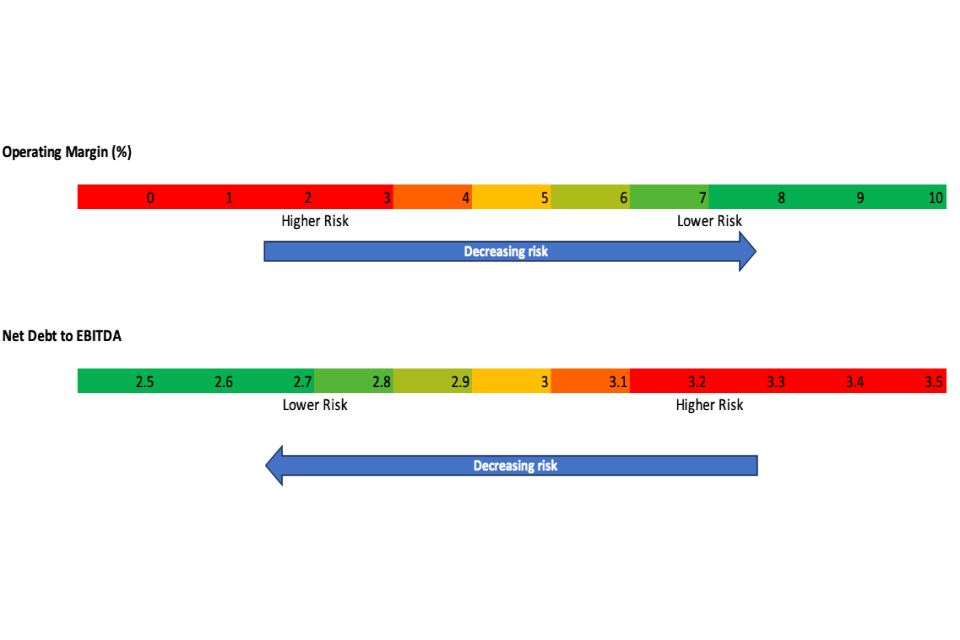
Mitigations should be considered when a bidder’s EFS begins to move into the higher risk of the spectrum but should be proportional to the requirement and criticality of the contract.
The following tables should be used to determine the level of risk associated with a bidder/supplier following the application of standard financial assessments.
| Sector | Metric | Lower risk | Decreasing risk | Medium risk | Increasing risk | Higher risk |
| All sectors (save where shown separately below) | Metric 1 - Turnover Ratio | >2.0x | >1.5x | 1.5x | <1.5x | <1.0x |
| All sectors (save where shown separately below) | Metric 2 - Operating Margin | >10.0% | >7.5% | 7.5% | <7.5% | <5.0% |
| All sectors (save where shown separately below) | Metric 3(A) - Free Cash Flow / Net Debt | >15.0% | >10.0% | 10.0% | <10.0% | <5.0% |
| All sectors (save where shown separately below) | Metric 3(B) - Net Debt / EBITDA | <2.5x | <3.0x | 3.0x | >3.0x | >3.5x |
| All sectors (save where shown separately below) | Metric 4 - Net Debt + Net Pension Deficit / EBITDA | <4.0x | <4.5x | 4.5x | >4.5x | >5.0x |
| All sectors (save where shown separately below) | Metric 5 - Interest Paid Cover | >4.50x | >3.75x | 3.75x | <3.75x | <3.00x |
| All sectors (save where shown separately below) | Metric 6 - Acid Ratio | >1.00x | >0.9x | 0.9x | <0.9x | <0.8x |
| All sectors (save where shown separately below) | Metric 7 - Net Assets | >0 | N/A | N/A | N/A | <0 |
| All sectors (save where shown separately below) | Metric 8 - Group Exposure Ratio | <25.0% | <37.5% | 37.5% | >37.5% | >50.0% |
| Construction, Engineering and Facilities Management | Metric 2 - Operating Margin | >4.0% | >3.0% | 3.0% | <3.0% | <2.0% |
| Construction, Engineering and Facilities Management | Metric 3(B) - Net Debt / EBITDA | <1.0x | <1.5x | 1.5x | >1.5x | >2.0x |
| Construction, Engineering and Facilities Management | Metric 4 - Net Debt + Net Pension Deficit / EBITDA | <2.5x | <3.0x | 3.0x | >3.0x | >3.5x |
| Information Technology and Telecoms | Metric 3(B) - Net Debt / EBITDA | <3.00x | <3.25x | 3.25x | >3.25x | >3.50x |
| Information Technology and Telecoms | Metric 4 - Net Debt + Net Pension Deficit / EBITDA | <4.50x | <4.75x | 4.75x | >4.75x | >5.00x |
| VCSE | VCSE Metric 1 - Operating Reserve Ratio | >4.0x | >3.0x | 3.0x | <3.0x | <2.0x |
| VCSE | VCSE Metric 2 - Operating Reliance Ratio | >1.00x | >0.75x | 0.75x | <0.75x | <0.50x |
| VCSE | VCSE Metric 3 - Donations & Legacy Reliance Ratio | <30.0% | <40.0% | 40.0% | >40.0% | >50.0% |
| VCSE | VCSE Metric 4 - Operating Cash Ratio | >1.0x | >0.75x | 0.75x | <0.75x | <0.50x |
7. APPENDIX III: Tools and information sources
Sourcing Playbook and Guidance Notes
Digital, Data and Technology Playbook
Contract Tiering Tool (KHub account required)
© Crown copyright 2025
This publication is licensed under the terms of the Open Government Licence v3.0 except where otherwise stated. To view this licence, visit nationalarchives.gov.uk/doc/open-government-licence/version/3
Where we have identified any third party copyright information you will need to obtain permission from the copyright holders concerned.
-
For example, average month-end net cash or average month-end net debt to EBITDA alongside net debt to EBITDA (as relevant to construction suppliers, see Appendix I) ↩
-
One of the suppliers to government listed as strategic suppliers ↩
-
Financial Distress Event: An indicator of possible financial distress defined in a contract which, if it arises, gives the contracting authority the right to require the supplier to put forward a remediation plan and could ultimately lead to the contracting authority terminating the contract. ↩
-
If an exact figure cannot be estimated but it can reasonably be ascertained to be above (or below) a particular amount and use of any figure above (or below) that amount would produce a similar outcome in the appraisal of EFS, the Authority may use that amount as the basis for the proforma. ↩
-
As defined in the Model Services Contract ↩
-
These arrangements normally attract charges/fees ↩
-
See Metric 8: Group Exposure Ratio for further detail on reliance upon other Group entities. ↩
-
There is provision for the annual confirmation to be provided to the contracting authority (and for strategic suppliers, also to Government Commercial Agency Markets, Sourcing and Suppliers Team) by an authorised financial representative in place of the board, under certain circumstances. ↩
-
As defined in the Sourcing Playbook. ↩
-
Additional disclosures in the Independent Auditor’s reports do not necessarily affect or change the auditor’s opinion, which remains unqualified. These include key audit matters, an emphasis of matter and certain disclosures relating to going concern. ↩