Supporting customers who may not be able to make their own decisions
Published 11 December 2025
Applies to England and Wales

© Crown copyright 2025
This publication is licensed under the terms of the Open Government Licence v3.0 except where otherwise stated. To view this licence, visit nationalarchives.gov.uk/doc/open-government-licence/version/3 or write to the Information Policy Team, The National Archives, Kew, London TW9 4DU, or email: psi@nationalarchives.gov.uk.
Where we have identified any third party copyright information you will need to obtain permission from the copyright holders concerned.
This publication is available at https://www.gov.uk/government/publications/supporting-customers-who-may-not-be-able-to-make-their-own-decisions/supporting-customers-who-may-not-be-able-to-make-their-own-decisions
Foreword
Millions of people across England and Wales benefit from Powers of Attorney – which are valuable legal tools that help some of the most vulnerable people stay in control of decisions about their welfare and finances if they lack mental capacity.
However, the people appointed to make those decisions often find the process of dealing with service providers confusing.
To support a smoother customer experience and enable effective use of powers of attorney, the Office of the Public Guardian and UK Regulators’ Network have worked together to refresh this guide, first published in 2019. It includes updated information about Lasting and Enduring Powers of Attorney, Deputyships and Guardianships.
This guide will help companies develop more straightforward processes for when attorneys, court-appointed deputies or guardians contact them. It will also help customers be better prepared when engaging with relevant organisations.
By providing clarity on policies, legal aspects, and other helpful information, we aim to ease the burden that attorneys, deputies and guardians face in their day-to-day responsibilities, making transactions as smooth and problem-free as possible.
We are proud to work together to improve how our shared customers access and use our services.
Ruth Duffin, Public Guardian and Chief Executive
Attricia Archer, Director of the UK Regulators Network
Introduction
This guide has been written by the Office of the Public Guardian (OPG) in partnership with the UK Regulators Network (UKRN), Ofcom, Ofwat, Ofgem and the Financial Conduct Authority.
It is intended to help policy makers in financial services and utility companies provide straightforward and consistent information for staff, which will make the process easier for customers.
This document also gives an overview of how the Mental Capacity Act 2005 should shape an approach to dealing with customers who have powers of attorney or a deputyship or guardianship court order.
It sits alongside information on the GOV.UK website and existing sector guidance, and is not intended to replace more detailed guidance where it’s available.
Office of the Public Guardian
The Office of the Public Guardian (OPG) helps people in England and Wales to stay in control of decisions about their health and finances.
It enables people to get help making decisions or have someone make decisions they cannot make for themselves. This could be because they do not have mental capacity or have gone missing.
The Public Guardian’s authority comes from the Mental Capacity Act 2005 (MCA). The MCA sets out how anyone who is unable to make some or all decisions must be treated.
For guardianships, this authority comes from the Guardianship (Missing Persons) Act 2017.
England and Wales
This guide only covers powers of attorney registered in England and Wales and court orders issued in England and Wales.
There are different laws and processes in Scotland and Northern Ireland.
Scotland and Northern Ireland
For information about powers of attorney in Scotland, please visit the Office of the Public Guardian (Scotland) website.
For information about powers of attorney in Northern Ireland, please visit the NIdirect website.
A brief look: powers of attorney and deputyship orders
Powers of attorney
A power of attorney is a legal document that lets someone (the ‘donor’) choose one or more trusted people (‘attorneys’) to make decisions on their behalf.
Powers of attorney and deputyships are governed by the Mental Capacity Act 2005 (see ‘Mental capacity: what you need to know’ for more about this).
Donors must be over 18 and have mental capacity when they sign a power of attorney. Donors do not need to live in England or Wales, but powers of attorney only cover assets based in England and Wales.
OPG registers 3 different types of power of attorney. They are:
-
lasting powers of attorney (LPAs) for property and financial affairs decisions
-
LPAs for health and welfare decisions
-
enduring powers of attorney (EPAs) – these are older documents covering property and financial decisions only, which were replaced by LPAs in 2007
Staff in regulated markets will deal with 2 types of powers of attorney – LPAs for property and financial affairs decisions, and EPAs.
LPAs for health and welfare decisions do not give attorneys power to make financial decisions. If you receive a health and welfare LPA, be aware it does not give an attorney power to manage someone’s finances or run their accounts.
Deputyship orders
When a person does not have the mental capacity to ask someone else to manage their affairs, an individual can apply to the Court of Protection (the court) to become a deputy for that person (referred to as ‘P’).
These applications are made when P has lost capacity to make an LPA.
If the court agrees that the applicant is the most suitable person to become P’s deputy, it issues a deputyship order. Once the order is issued, the deputy can make certain decisions on behalf of P.
OPG supervises and supports deputies appointed by the court. We do this to make sure they are acting in the best interests of the person they are appointed for.
A deputyship order can cover decisions about:
• property and finances
• personal welfare
One deputyship order can also cover decisions about both.
Mental capacity: what you need to know
The Mental Capacity Act 2005 (MCA) has 5 principles:
- Assume a person has mental capacity unless there’s evidence otherwise
- Do not treat people as incapable of making a decision unless all practicable steps have been taken to help them make the decision
- A person should not be treated as incapable of making a decision because their decision seems unwise to anyone else
- Always act in the best interests of someone who lacks mental capacity
- Before making a decision on someone’s behalf, always consider whether the outcome could be achieved in a less restrictive way
It’s useful to know these principles – especially if you think someone is not following them and you want to report a concern. However, you will not need to remember the principles to help customers or someone acting on a customer’s behalf.
You will not assess a customer’s capacity yourself, because you do not have enough contact with them or enough experience of mental capacity to make an accurate assessment. You simply need to:
-
check that any legal document you’re shown is genuine – we tell you how later in this guide
-
read a customer’s legal documents carefully to see who is allowed
-
to make decisions for them, when that person can act and whether there are limitations on how they can act
-
amend your company records to show who is supporting your customer in making decisions, or making decisions on their behalf
Mental capacity can be:
-
lost permanently
-
lost temporarily, then regained
-
fluctuating – a person may be able to make decisions at some times but not others
Mental capacity assessments always test whether someone can make specific – rather than general – decisions at the time they need to be made.
Reasons that someone might lack mental capacity include:
-
learning disability
-
brain injury
-
dementia
-
alcohol or drug misuse
-
side effects of medical treatment
Scenario: mental capacity
Roger has had a property and financial affairs LPA since 2014, which names his wife Angela and son Mark as joint and several attorneys.
Angela contacts the bank to say that her husband has Alzheimer’s and has lost mental capacity. She wants to take over the management of his bank accounts.
She sends a certified copy of Roger’s LPA to the bank. The document states that the attorneys can only manage Roger’s finances when he has lost mental capacity to make his own financial decisions.
The next day, Roger calls the bank and states confidently that he can still manage his own money and wants to keep his own bank card.
The bank is not sure what to do. A customer agent writes to Angela to ask if there’s any evidence that Roger no longer has mental capacity.
Angela sends the bank a recent letter from Roger’s doctor that states Roger lacked the mental capacity to make a decision about whether to go ahead with an operation.
However, the letter does not mention Roger’s mental capacity to make financial decisions.
Because the bank has trained its staff in the principles of the MCA, they know that people can have mental capacity to make some decisions but not others.
There’s no evidence that Roger lacks mental capacity to manage his finances, just because he lacks mental capacity to make a health decision. Therefore, Angela and Mark should presume he has capacity to make the decision.
The bank decides that Angela cannot take over management of Roger’s accounts at this time.
For more about mental capacity, see the MCA code of practice or read advice on GOV.UK about how to make decisions for someone else
Treating attorneys and deputies with care
Making decisions for someone else is a serious responsibility. Many attorneys agree to it without realising the level of commitment it takes.
Some attorneys and deputies find it stressful or difficult making decisions on someone else’s behalf. Bear in mind that they might be dealing with a loved one losing their mental capacity at the same time as taking over management of their accounts.
An attorney or deputy will probably have many companies and organisations to deal with at the start of making financial decisions. If you ask them for original documents, it might take the attorney or deputy a while to provide them.
Once you’ve checked that the LPA, EPA or deputyship order is genuine – we tell you how to do it in this guide – you’ll know that an attorney or deputy has authority to act on behalf of your customer.
You should then treat the attorney or deputy as you would treat the customer they’re acting for.
It will help attorneys and deputies if you write clear policies for accepting legal documents, so they know exactly what you expect.
How attorneys and deputies must act
Attorneys and deputies have the power to make certain decisions on behalf of the donor or P, but they must:
-
support the donor or P to make their own decisions, where possible
-
make any decisions in the donor’s or P’s best interests consider the donor’s or P’s wishes and feelings, where these are known
-
work within the limits of the court order, in a deputyship, instructions and preferences in an LPA or restrictions and conditions in an EPA
When dealing with attorneys and deputies, you might be concerned about how they’re carrying out their duties.
If you notice anything suspicious about something an attorney or deputy says or does, make a note of it and report it to OPG.
Report concerns about an attorney, deputy or guardian
Contact OPG if you have concerns about anyone acting on behalf of a donor or P.
Concerns can be anything you feel is not in a donor’s or P’s best interests, such as:
-
the misuse of money
-
decisions that benefit an attorney or deputy instead of a donor or P
-
an LPA, EPA or deputyship order you think might be fake
-
a donor signature that does not match your records
-
unusual spending from a donor’s or P’s account
-
bills repeatedly not being paid
-
hearing something which makes you think the donor or P is at risk of harm (see also Tell the police section)
If you are concerned about how an attorney or deputy is managing your customer’s account:
• email opg.safeguardingunit@publicguardian.gov.uk
• telephone 0300 456 0300
For helpline opening hours, please see the Report a concern page.
Information we need to deal with a concern
To deal with a concern quickly, we need to know:
-
the name and date of birth of the person you’re concerned about
-
the name of anyone you think might be abusing their decision-making power
-
the dates of any possible abuse – this could be when unusual transactions or missed payments started
-
details of any evidence – records of comments made, copies of bank statements, unpaid customer account logs or similar
-
your contact details – we’ll keep these confidential but need to know who you are so we can update you
Tell the police
If you think a crime has been committed against someone who cannot make their own decisions, dial 101 and report it to the police non-emergency number.
Economic abuse is a crime, and is defined in the Domestic Abuse Act 2021.
Always call 999 if someone is in immediate danger
How we deal with your concerns
Once you’ve provided the information we need, we’ll review the concern to see if we have:
-
enough evidence to start an investigation
-
the jurisdiction to look into the matter
We carefully consider every concern and respond to the person who reported it within 5 days. We’ll tell you at this stage if we have enough evidence to begin a full investigation.
OPG investigations
When OPG carries out a full investigation we aim to complete it within 70 days. ‘Report concerns about an attorney, deputy or guardian’ shows the kind of concerns we can investigate.
If an attorney or deputy will not co-operate with OPG during the investigation, or if we find evidence of financial or welfare abuse, we may make an application to the Court of Protection.
In some cases we’ll ask the court for an order which instructs an attorney or deputy to provide evidence of decisions they’ve made on behalf of the donor or P.
In other cases, we might ask the court to remove an attorney or deputy from an EPA, LPA or court order, so they can no longer act for the donor or P.
What we cannot investigate
We cannot investigate concerns:
-
that happened before an LPA or EPA was made, or before a court order was issued
-
that do not relate to a registered LPA or EPA – for example, health concerns where the donor only has a property and financial affairs LPA or an EPA
-
about the actions of people who are not attorneys or deputies
-
if the donor still has capacity to deal with the concerns themselves
Although we cannot investigate concerns that happened before an LPA or EPA was registered, we can investigate if there are concerns that one is being used that is not valid.
When we receive a concern which is outside our legal authority to investigate, we may pass it to another appropriate agency such as social services or the police.
Some common questions about LPAs and EPAs
When can a property and financial affairs LPA be used?
A property and financial affairs LPA can be used by an attorney as soon as it’s registered by OPG, unless:
-
the donor signed the LPA after 1 January 2016 using form LP1F and stated in section 5 (page 6) that they did not want the LPA to be used until they lost mental capacity
-
the donor stated in the instructions of any version of the LPA that the attorneys could only act once the donor lost capacity
You can see the registered LPA on the View an LPA service.
What are ‘ordinary’ and ‘general’ powers of attorney?
Both ordinary and general powers of attorney can be set to look after someone’s affairs for a limited time, for example, if they’re living abroad, going to prison or housebound. They can only be used when both the donor and attorney have mental capacity, so these documents are not an alternative to an LPA or EPA.
Ordinary powers of attorney can be used to look after specific affairs, so may not include finances. You should check the document carefully for this information.
General powers of attorney relate only to financial decisions. OPG does not deal with either ordinary or general powers of attorney.
If a donor has registered for a ‘nominated contact’ for billing, do they still need an LPA or EPA?
A nominated contact can be used as long as a donor has mental capacity.
If a donor has lost mental capacity and has a registered LPA or EPA in place, their attorneys are now legally entitled to manage their finances instead of a nominated contact.
If a donor has lost mental capacity without putting an LPA or EPA in place, the person named as their deputy is legally entitled to manage their finances instead of a nominated contact.
What about Department for Work and Pensions (DWP) appointees?
The Department of Work and Pensions (DWP) can appoint someone (an appointee) to act on behalf of a person receiving state benefits who cannot manage their benefits because they have lost mental capacity, or are severely disabled.
However, an appointee is only allowed to manage the other person’s benefit payments, not the rest of their finances.
What is the difference between an LPA or EPA, third-party mandates and third-party bill management?
A third-party mandate gives a third party access to manage a person’s accounts. Third-party bill management allows for a third party to pay utility bills. Both arrangements are supported by regulated markets but are not based on the same level of legal authority as an LPA or EPA and the range of powers is usually limited.
Unlike LPAs and EPAs, third-party mandates and utility bill management are only valid while an individual retains mental capacity.
OPG cannot deal with concerns about third-party mandates or third-party bill management.
Can attorneys be removed from LPAs and EPAs?
Yes, in some circumstances.
OPG cannot remove attorneys – we have to apply to the court to ask a judge to make a decision.
Attorneys are legally required to act in a way that supports the donor’s wishes and best interests. Failure to do this could mean that a case is referred to the Court of Protection for a decision on whether attorneys or deputies have acted in the donor’s or P’s best interests.
An LPA attorney can decide they want to stop acting as an attorney (this is called ‘disclaiming’). Unless the donor has said otherwise in their instructions, an attorney also has to stop acting if they get divorced from the donor or are in a civil partnership with the donor which is dissolved.
However, they can only be removed from their role:
-
by the donor, if the donor has mental capacity
-
by the court, if the donor lacks mental capacity to remove the attorney themselves
An EPA attorney can disclaim by filling in a EP5 form. The Court of Protection can also remove the attorney from the EPA if the situation requires.
A donor with an EPA cannot remove an attorney once the EPA is registered, because EPAs are only registered when the donor is losing, or has lost, mental capacity to make their own decisions.
Customers with lasting powers of attorney (LPAs)
Overview: lasting powers of attorney (LPAs)
LPAs were introduced in October 2007. Anyone over 18 who has mental capacity can make an LPA.
LPAs must be registered by the Office of the Public Guardian (OPG) before they can be used. You can find out how to apply to register an LPA on GOV.UK.
There are 2 types of LPA:
- health and welfare
- property and financial affairs
A donor can choose to make one type or both.
Staff in regulated markets will not deal with LPAs for health and welfare decisions. Check that the LPA a customer or attorney shows you is for property and financial affairs.
Property and financial affairs LPAs cover decisions about day-to-day finances including:
- paying household bills
- sorting out tax issues
- managing bank, building society and savings accounts
- dealing with pensions, benefits, shares, investments, insurance or property
- changing utility supplier
You can find examples of the LPA versions on GOV.UK. You may also be given access to an online summary of the LPA. You can find out more about this in ‘Check if an LPA is registered’.
An LPA ends in various ways, including when:
- a donor decides to revoke, or cancel, it
- a donor dies
- an attorney loses mental capacity, and there are no other attorneys or replacement attorneys who can act
- a donor and a sole or jointly-appointed attorney are married or in a civil partnership and get a divorce or dissolution, unless the donor has said otherwise in their instructions
- a donor or a sole attorney becomes bankrupt or they’re subject to a Debt Relief Order (DRO) – if they’re a property and financial affairs attorney
- a sole attorney is removed by the Court of Protection
- a sole attorney dies and no replacement attorneys have been appointed
- a sole attorney disclaims from the LPA
- a joint attorney is unable to act and no replacement attorneys have been appointed
- the court cancels the LPA
When OPG is notified that an LPA has ended, we update the paper LPA and the Use an LPA service to reflect this.
When you find out a customer has an LPA
You’ll usually find out that an LPA has been registered for one of your customers when the customer or attorney contacts you. The LPA must be registered before it can be used.
If a customer tells you they have a registered LPA:
- take them through security checks in the usual way
- make a note on their file of the names and personal details of the attorneys they have chosen
- check whether they still want to manage their accounts personally for now, they want their attorneys to manage their accounts, or they want their attorneys to help manage certain things
- ask to see the registered LPA (see ‘Check if an LPA is registered’)
If an attorney tells you that a customer has registered an LPA:
- ask them to provide some form of identification
- follow your usual policy for speaking to third parties
- explain that until you see the LPA you cannot discuss or amend the customer’s accounts
- ask to see the registered LPA so you can check it, and keep a copy for your files
- check the LPA to see if the customer wants it to be used now or only when they lose mental capacity
- contact the customer to tell them that the attorney has asked to take over management of their account.
Keep up to date
You may want to ask the donor and attorneys to let you know about any changes in their personal details or circumstances, or any changes to the LPA.
You can also ask to see the LPA again at a later date if you need to.
Trust corporations
Trust corporations are businesses or individual professionals that manage trusts and estates. They are often banks or law firms.
A trust corporation can be chosen as an attorney by a donor or appointed by the Court of Protection as a deputy.
Follow your usual policies for confirming details about an organisation and for speaking to third parties.
As the company, rather than a person, has been appointed as attorney, you may find that you deal with different employees from the trust corporation at different times.
Check if an LPA is registered
Once you know a customer has an LPA, you should ask to see evidence of it. This will allow you to confirm it is registered, review the details of the LPA and keep a copy for your records if you need to.
The ‘View a lasting power of attorney’ online service
You can use this service instead of asking to see the original paper LPA. The service is available at www.gov.uk/view-lasting-power-of-attorney
If the customer’s LPA was registered on or after 1 January 2016, you can use this service to get a one-page summary of the LPA. This includes:
- if it’s still valid and registered
- the donor’s name, address and date of birth
- the attorney’s name, address and date of birth
- how decisions are made by the attorneys
- the donor’s restrictions and conditions (sometimes known as instructions and preferences)
You can download a copy of the LPA summary as a PDF to keep for your records.
You can only use View an LPA to access LPAs registered in England and Wales. It doesn’t show LPAs registered in Scotland, Northern Ireland or abroad. It also doesn’t show enduring powers of attorney (EPAs).
How do customers share the LPA digitally?
To see the LPA, you need a ‘LPA access code’, supplied by the attorney or donor. An access code is 13 characters long and begins with the letter V.
Go to the View a LPA service, enter the donor’s surname and the 13-character code. If an LPA is found, you will see the full name of the donor and the LPA type. Check the donor’s full name matches your customer’s name. If it doesn’t, have the attorney check the code again.
Check the LPA type, and that it is appropriate for the decision that needs to be made. Is it a decision about the donor’s property and finance or about their health and welfare? If it isn’t the right type, have the attorney provide the code for the correct LPA type.
You must give the name of your company or organisation. This is recorded along with the date so that the donor and any other attorneys can see when and how the LPA is being used.
You can then view the LPA and download a summary for your records.
If a donor or attorney shows you a screenshot, download or printout of an LPA summary, this cannot be used as proof of an LPA. They must give you an LPA access code.
Why use View a lasting power of attorney?
You can see the details of the LPA without the attorney needing to provide the paper version, which they would have to bring in person or post to you. There are many benefits for you, the customer and the attorney to do it this way:
It saves time and resources
The online summary contains all the information needed to confirm the LPA can be used and to verify an attorney on it. This is more efficient, as:
- the essential information is summarised on one page online, but is found throughout several sections of the paper version
- if you need a copy of the LPA for your records, you can download the PDF. With the paper version, the necessary pages of the paper LPA must be scanned in
- a posted LPA could take days to arrive and be returned, and could leave your customer without someone to act for them in the meantime
- if a replacement attorney needs to start acting for the donor, the paper LPA must be returned to us to be amended and then sent back to the attorney. With the online summary, you can see the update much sooner
It offers extra security
All the information on View an LPA is accurate when you view it, whereas the paper LPA can only display the information it contained when it was registered. Up-to-date information is vital as:
- an LPA can only be used if its current status is ‘Registered’. Anyone using it unregistered is breaking the law
- the donor might have removed an attorney, and no longer wants them to make decisions. The paper LPA might not reflect this change
- a replacement attorney might have started acting for the donor, who could affect how any other attorneys make decisions
- the attorney might have changed their name or address, information used to verify their identity. If they have already notified us, View an LPA will show the new details. However, the paper LPA cannot be changed
Other ways to check an LPA
When asking to see an LPA, you can also accept:
- the original paper LPA
- a ‘certified’ copy or ‘office’ copy
There’s nothing in law that says you must see the original paper LPA.
What is a certified copy?
It’s a copy of an LPA which has been certified as a true copy of the original paper LPA. Certified copies have the same legal authority as original documents.
If the donor still has mental capacity, they can certify their own copy of their LPA.
Copies of property and financial affairs LPAs can also be certified by solicitors, someone qualified to carry out notarial activities (often called ‘a notary’) or stockbrokers.
A certified copy of an LPA needs the following statement on every page: ‘I certify this is a true and complete copy of the corresponding page of the original lasting power of attorney.’ This statement must be signed and dated on every page.
On the final page of the LPA it must state: ‘I certify this is a true and complete copy of the lasting power of attorney,’ and this statement must be signed and dated.
What is an office copy?
It’s a copy of the LPA held on file by OPG that can be requested if someone loses or destroys the original LPA. It has the same legal authority as the original LPA.
The copy we provide is a scanned image of the original, with a watermark on every page which reads ‘Office Copy’.
We put various marks and stamps onto an office copy, in exactly the same way as the original LPA would have been stamped and marked during registration.
Scenario: passwords
Mohammed is in hospital and has a registered LPA for property and financial affairs. His daughter Basma is his attorney and wants to receive Mohammed’s bills so she can pay them. The telecoms account has a password, but Basma does not know it and Mohammed cannot tell her because he is confused.
The telecoms provider checks the LPA Basma provides. It is an older style LPA, which does not state whether Basma can make decisions as soon as it is registered, or only when Mohammed loses mental capacity.
The telecoms provider knows that a property and financial affairs LPA can be used as soon as it’s registered, unless the donor states otherwise. There are no instructions in the LPA about when Basma can start making decisions. So she is allowed to act from the day the LPA is registered.
Even without the password, the LPA is proof that Basma can act for Mohammed. The telecoms provider adds her to Mohammed’s account so she can speak to them about the account and receive her father’s bills.
Marks used on registered paper LPAs
Since 2007, OPG has used several different marks to show that LPAs are registered.
A registered LPA, or an office copy, will always have at least one of the following:
- ‘VALIDATED-OPG’ perforated at the bottom of each page – perforation may be hard to see on a photocopy or scan but will be more obvious on an original form
- a registration stamp on the front page of the LPA

Validated OPG and Court of Protection entered
When checking a paper LPA make sure you see the whole document, not just the first few pages.
The front page of the LPA will always have either:
-
a stamp to confirm the date of registration
-
a hand-written date in the section ‘For OPG office use only’
The inside pages will tell you the donor’s instructions about who can make decisions for them and whether there are restrictions on the sort of decisions attorneys can make – see ‘Preferences and instructions’ for more about preferences and instructions.
The donor’s wishes – how LPA attorneys should act
One attorney
If the LPA names one attorney, that person has authority to make decisions for the donor without consulting anyone else. We say that one attorney is acting ‘solely’ when they are the only one named in the LPA.
The sole attorney should still work with the donor, where possible, to include them in decisions.
You’ll need to check that the donor wants the attorney to act right now, and not only when they’ve lost mental capacity (see Some common questions about LPAs and EPAs for information about an LPA being used before a donor loses mental capacity).
More than one attorney
If the donor wants more than one person to make decisions on their behalf, there are several ways attorneys can be appointed.
The MCA code of practice, which gives guidance on how people can understand the law, states: Joint attorneys must always act together. All attorneys must agree decisions and sign any relevant documents.
It’s important to find out from the donor or the attorneys how they plan to deal with the instruction to act jointly, and note this in your records.
Jointly – if attorneys are appointed jointly and one of them dies or wants to stop being an attorney, the LPA can no longer be used and will be cancelled, unless the donor says otherwise in their instructions or a replacement attorney has been appointed.
Jointly and severally – attorneys can choose to make decisions alone or together. Attorneys do not need to consult each other or agree on decisions. This is the way that most donors choose to appoint two or more attorneys.
Jointly for some decisions and severally for everything else – a donor who chooses this option wants attorneys to make certain decisions together.
The donor will write in the LPA which decisions must be made jointly. For all other decisions, attorneys do not need to consult each other or agree on decisions.
Unspecified – if a donor has chosen two or more attorneys but not completed the section of the LPA for how the attorneys should act, the default position in law is that the attorneys must act jointly.
Scenario: joint attorneys
Gary is an attorney named on his cousin Stephen’s LPA for property and financial affairs.
Gary applies for a remortgage on behalf of his cousin, saying that Stephen wants to build a home extension with an accessible bathroom.
Jaswinder deals with the call on behalf of the bank. She asks to see Stephen’s LPA to check that Gary has been named as an attorney to deal with property and financial affairs decisions.
Gary gives Jaswinder an LPA access code so she can see an online summary of the LPA on the View a lasting power of attorney service. When Jaswinder sees the LPA summary, she confirms that Gary is appointed to act on Stephen’s behalf. But she notices that Gary is appointed jointly with another family member.
Jaswinder realises she cannot take instructions solely from Gary – she needs to speak to the other attorney as both attorneys must agree to remortgage Stephen’s property.
Stephen has stated in his LPA that he wants his attorneys to act on his behalf as soon as the LPA is registered, and not just if he loses mental capacity.
However, as a remortgage is a big decision, and as Stephen may still have mental capacity, Jaswinder decides to contact Stephen to make sure the remortgage is what he wants.
When she’s contacted everyone involved, Jaswinder feels confident that she can now deal with the remortgage application.
Replacement attorneys
Donors can choose one or more replacement attorneys, in case their original attorneys are unable to act for any reason.
Choosing replacement attorneys is a safeguard against the LPA being cancelled if the original attorneys can no longer act.
Replacement attorneys have the same level of authority as the attorneys they replace.
How replacement attorneys start to act
A replacement attorney may start acting for the donor when:
-
an attorney decides to stop acting
-
an attorney dies
-
the marriage or civil partnership between the donor and an attorney ends in divorce or annulment
-
an attorney loses have mental capacity
-
an attorney becomes bankrupt (this only applies to property and financial affairs LPAs)
OPG then asks for the original LPA to be sent to us, so we can amend it and show which attorneys are now acting. If the LPA was registered on or after 1 January 2016, we’ll also update the online summary on the View a lasting power of attorney service.
If you’re contacted by a replacement attorney who says they can now act for the donor, they should be able to prove this by showing you the amended paper LPA or giving you an LPA access code so you can view the online LPA summary.
If a replacement attorney is acting for the donor, the original paper LPA will be stamped by OPG to show this. Next to the name of the attorney who is no longer acting, we stamp ‘the attorney can’t act’. Next to the name of the replacement attorney who is now acting for the donor, we stamp ‘this replacement attorney can now act’.

OPG attorney can't act and replacement attorney can now act
OPG then scans the amended form into our systems, so any office copies created in future show the correct attorneys.
Preferences and instructions
The donor can give their attorneys guidance on how they should make decisions. We call these ‘preferences and instructions’.
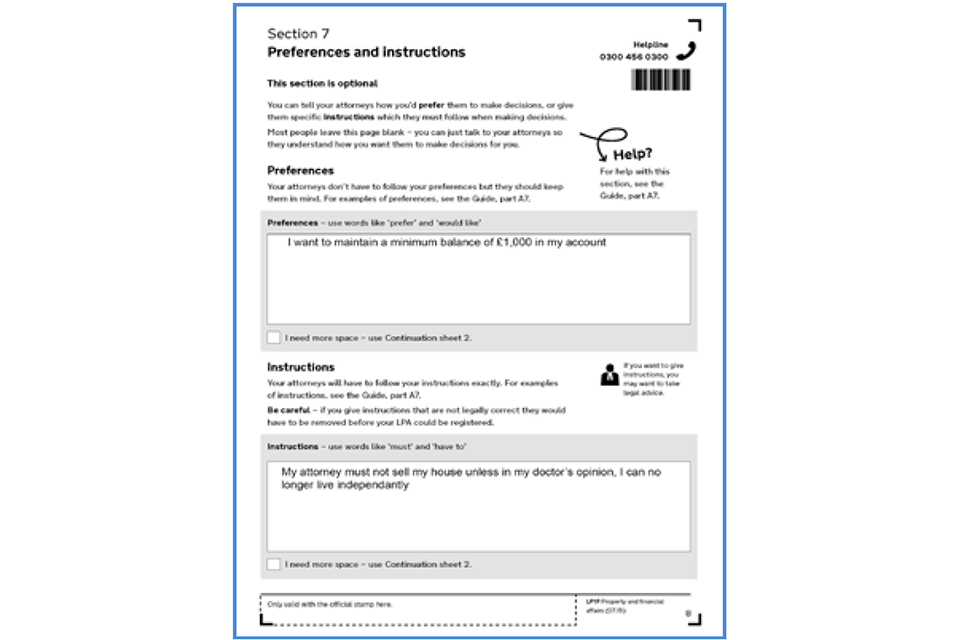
It’s important you read the donor’s preferences and instructions in case they cover decisions about bills, banking or energy use.
There’s an example of a preferences and instructions page from an LPA on the left. This version of the LPA form is the LP1F, which was released in 2015. But all 3 versions of the LPA form have sections like this, where a donor can record their wishes for how their attorneys act.
Instructions (called ‘restrictions’ or ‘conditions’ in earlier versions of the LPA form)
Anything written in the ‘instructions’ part of the form tells the attorneys what they must do when acting on the donor’s behalf.
Instructions are legally binding and attorneys can be challenged in the Court of Protection for not following them.
If you think an attorney is failing to follow instructions in an LPA, please report a concern to OPG.
Example: ‘I must bank with a non-profit company’
Preferences (called ‘guidance’ in earlier versions of the LPA form)
Preferences are what the donor would like their attorneys to think about when making decisions. Attorneys do not have to follow preferences but should consider them. Preferences are not legally binding.
Example: ‘I would prefer to use renewable energy in my home’
Do not worry about whether instructions in an LPA are valid – OPG will decide this during the process to register an LPA.
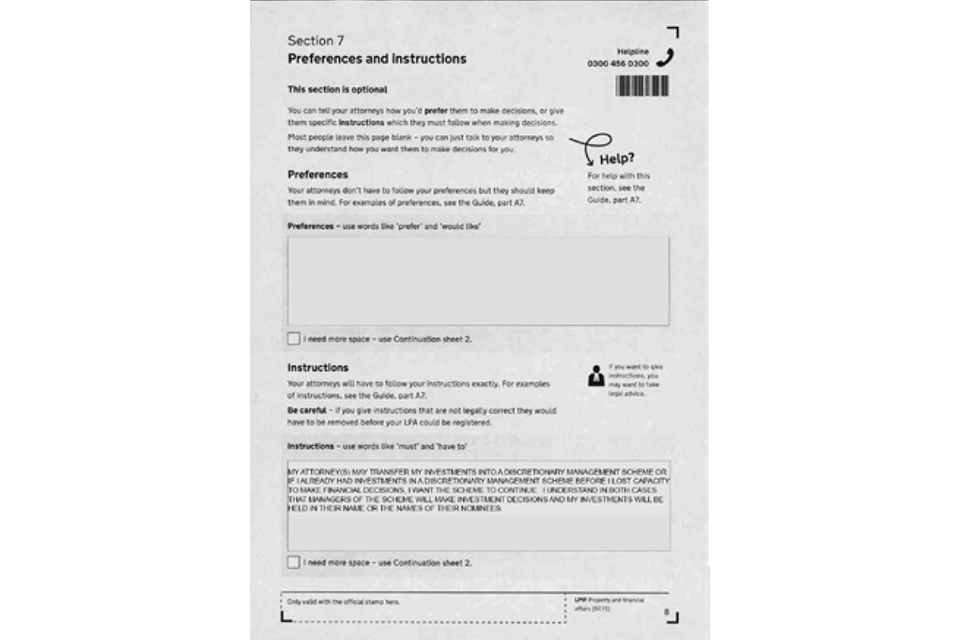
If a donor makes an instruction which is not valid, or which contradicts other instructions in the LPA, we’ll apply to the court to get it removed. We’ll then stamp the page:

Example: Frank Dobbs names his oldest children (Martha and John) as his attorneys. In his instructions he writes ‘I want my youngest son, Frank Jr, to make the decision over selling my house’
This instruction is invalid because Frank Jr is not an attorney. While the MCA code of practice says attorneys should consult family or friends, decisions must be made by the attorneys.
Scenario: LPA application
Noah’s brother, Ethan, has a head injury and can no longer manage his own affairs.
Ethan signed an LPA for property and financial affairs before his accident and Noah has now sent it to OPG to be registered. The registration process can take up to 10 weeks.
In the meantime, Ethan is paying for a telecoms service he cannot use and Noah has asked the telecoms provider to close the account.
The telecoms provider tells Noah that they may be willing to accept a letter from a hospital or GP in order to close Ethan’s account.
If Noah cannot get a letter, the account may be suspended until the LPA is registered, meaning that no further charges build up.
Once the telecoms provider sees a copy of the registered LPA and sees that Noah has been appointed as Ethan’s attorney for property and finances, they can close Ethan’s account.
Check the status of a registered LPA
If you’re not sure whether an LPA is registered or want to check who the attorneys are, you can:
-
ask the donor or attorney for an LPA access code so you can see a summary of the LPA on the View a lasting power of attorney online service. This is only for LPAs registered on or after 1 January 2016
-
contact OPG to ask us to search our LPA register. This is a free service and you’ll get an answer within 5 working days.
Both the online LPA summary and the register search can tell you:
-
the registration date of the LPA
-
the name of the donor
-
the date of birth of the donor
-
the names of attorneys
-
whether decisions relate to property and finances or health and welfare
-
whether there are any restrictions in the LPA – we do not release what these are, just whether they exist
-
how attorneys or deputies are appointed to act – solely, jointly, jointly for some decisions and severally for everything else, or jointly and severally
-
whether the LPA is registered or if it’s been cancelled
Our LPA register is updated whenever we’re told about a change to a donor’s or attorney’s details. When anyone requests a search of our registers, we provide the latest information we have.
To request a register search, fill in an OPG100 form – you can complete it electronically and email it to OPG.
Enduring powers of attorney (EPAs)
Overview: enduring powers of attorney (EPAs)
EPAs were made possible by the Enduring Power of Attorney Act 1985.
This Act allowed a donor to name one or more people to make financial decisions for them in case they lost mental capacity in the future.
EPAs were replaced by lasting powers of attorney (LPAs) on 1 October 2007.
An EPA does not need to be registered with OPG before attorneys can use it. The donor must sign the EPA in the presence of a witness.
To be legally used by the attorneys, the donor must have:
- signed it before 1 October 2007
- had mental capacity when they signed
- agreed that the attorneys can act for them
We do not know how many donors are holding onto EPAs they signed before 1 October 2007. OPG continues to receive around 6,000 valid EPAs for registration every year.
EPAs only cover property and financial decisions. An attorney cannot make health and welfare decisions under an EPA.
Attorneys using EPAs can make decisions about:
- paying the donor’s household bills
- sorting out the donor’s tax
- managing bank, building society and savings accounts
- dealing with pensions, benefits, shares, investments, insurance or property
- changing utility supplier
The donor must consent to the attorneys using the unregistered EPA. Once the donor loses mental capacity, their attorneys must register the EPA with OPG to continue using it.
A donor can have more than one EPA at the same time, and choose different attorneys to manage different aspects of their finances. An EPA ends when:
- the donor cancels, or revokes it, while the EPA is unregistered
- all attorneys want to stop acting – sometimes called ‘disclaiming’ an attorneyship
- the only attorney or the donor declares bankruptcy
- the donor dies
- the Court revokes the EPA
When you find out a customer has an EPA
An existing customer or someone switching to your service may present you with an EPA.
If a customer tells you they have an unregistered EPA you should:
- take them through security checks in the usual way
- make a note on their file of the names and personal details of their chosen attorneys
- check whether they still want to manage their accounts personally, or if they want their attorneys to do it
- ask to see the EPA so you can note down any restrictions the customer has written in it
If an attorney tells you that an EPA has been registered for a customer, you should:
- explain that you need to see the registered EPA before you can discuss the customer’s accounts with them
- amend the customer’s file to show they have appointed one or more attorneys to make decisions for them
- ask them to provide some form of identification – follow your usual policy for speaking to third parties
- assume that the customer has lost mental capacity to make their own financial decisions
- check the registered EPA when it arrives to see how your customer wants their attorneys to act
Scenario: account changes
Joyce has dementia and has temporarily moved into a care home while she recovers from an operation. Her daughter Grace is an attorney named on her mother’s registered EPA.
Grace calls her mother’s energy supplier to let them know that Joyce’s home will be empty for several months. Grace asks how she can begin to look after Joyce’s account.
The agent asks Grace to send in the EPA, telling her it is quicker to send a scanned copy by email and provides the email address. Emailing the form also means there’s less risk of the original EPA getting lost in the post.
The agent receives a scan of the EPA by email and confirms that Grace has the authority to act on Joyce’s behalf.
The agent stores this information on Joyce’s gas and electricity account making sure that Grace can discuss her mother’s account whenever she calls the energy supplier.
Check a registered EPA
Once you know a customer has a registered EPA, you should ask to see it.
There’s nothing in law that says you must see the original EPA. Your choice to accept original documents might depend on the level of risk involved in letting an attorney manage a customer’s account.
When asking for a document, you can accept any of these:
- a photocopy or scanned image – although it might be harder to check that a copy or scan is genuine
- the original document
- a ‘certified’ copy or ‘office’ copy
What is a certified copy?
It’s a copy of an EPA which has been certified as a true copy of the original. Certified copies have the same legal authority as original documents.
A donor can certify an unregistered EPA, as long as this was done when they still had mental capacity. Copies of EPAs can also be certified by solicitors, someone qualified to carry out notarial activities (often called ‘a notary’) or stockbrokers.
A certified copy of an EPA needs the following statement on every page: ‘I certify this is a true and complete copy of the corresponding page of the original enduring power of attorney.’
This statement must be signed and dated on every page.
On the final page of the EPA it must state: ‘I certify this is a true and complete copy of the enduring power of attorney,’ and this statement must be signed and dated.
What is an office copy?
It’s a copy of the EPA held on file by OPG that can be requested if someone loses or destroys the original EPA. It has the same legal authority as the original EPA.
The copy we provide is a scanned image of the original, with a watermark on every page which states ‘Office Copy’.
We then put various marks and stamps onto the office copy, in exactly the same way as the original EPA would have been stamped and marked during registration.
Keep up to date
You may want to ask the attorneys to let you know about any changes in their or the donor’s personal details or circumstances, or any changes to the EPA.
You can also ask to see the EPA again at a later date if you need to.
Other things to check on EPAs
Unregistered EPAs
There will be no official OPG stamps, seals or stickers on an unregistered EPA. Unregistered EPAs can be typed or handwritten.
If you receive an unregistered EPA, you should check it was:
- signed and dated before 1 October 2007
- made when the donor was at least 18
- signed by the donor and a witness who was not one of the attorneys for the EPA
- signed by all the attorneys
When the EPA was signed, the attorneys had to:
- be aged over 18
- have mental capacity
- not be bankrupt, and not have been declared bankrupt since – check the bankruptcy and insolvency register to be sure
You can then:
-
contact the donor to confirm whether they want the attorney to act for them
-
check whether the donor has included any restrictions or conditions in Part B of the form
Scenario: switching tariffs
Deven is the sole attorney under a registered EPA for his father Jerome.
Deven calls the energy supplier to discuss his father’s bill. The prices have recently increased and Jerome is on the supplier’s most expensive tariff.
Deven asks about switching his father’s account to a cheaper ‘green energy’ tariff to save money. However, it is not the cheapest tariff.
The agent asks to see Jerome’s EPA, to check that Deven has the authority to make decisions for him. After receiving the EPA form, the agent amends the customer file and notes that because the EPA has been registered, Jerome now lacks mental capacity to make financial decisions.
Jerome has included a preference in his EPA to support environmental issues where possible. Although Deven has a duty to get a good deal for his father, he also needs to act in a way he believes his father would have acted.
The energy tariff is not the best deal, but switching to it would support the wishes Jerome stated in his EPA form. The agent switches the tariff as agreed and adds Deven as the main point of contact for Jerome’s account.
Marks used on registered EPAs
A registered EPA will always have at least one of the following:
- ‘VALIDATED-OPG’ perforated at the bottom of each page – perforation may be hard to see on a photocopy or scan but will be more obvious on an original form
- a registration stamp on the front page of the EPA, from either the Court of Protection or OPG

EPA validation marks
You can find examples of registered EPAs on GOV.UK.

The donor’s wishes – how EPA attorneys should act
An attorney should work with the donor, where possible, to include them in decisions. This applies even after the EPA is registered.
Although, we can assume that a donor has lost capacity to make financial decisions, the attorney should continue working to include them in decisions.
One attorney
If the EPA only names one attorney, that person has authority to make decisions for the donor without consulting anyone else. We say that one attorney is acting ‘solely’ when they are the only one named in the EPA.
More than one attorney
If the donor wants more than one person to make decisions on their behalf there are two ways the attorneys can be appointed, jointly and severally or jointly:
-
Jointly and severally – attorneys can choose to make decisions alone or together. Attorneys do not need to consult each other or agree on decisions. If one attorney wants to stop acting, they can do so – the EPA will continue with the remaining attorneys.
-
Jointly – more than one attorney who must agree or they cannot make the decision. In some cases, jointly-appointed attorneys will need to ask the Court of Protection to decide a matter in the best interests of the donor.
Decisions an attorney or attorneys may make include:
- changes to the donor’s accounts
- decisions about finance such as closing bank accounts or transferring money
- switching tariffs to get a better deal
If attorneys are appointed jointly and one of them dies or wants to stop being an attorney, the EPA will be cancelled. We do this because it was never the donor’s wish for one person to make decisions for them. However, the donor may have specified in the EPA’s ‘restrictions and conditions’ that it can continue in these specific circumstances.
There are no replacement attorneys on an EPA.
Restrictions and conditions
The donor can give their attorneys guidance on how they should make decisions. On EPA forms this guidance is called ‘restrictions and conditions’.
It’s important you read the EPA to see if the donor has added restrictions or conditions that cover decisions about bills, banking or energy use.
Restrictions are legally binding and attorneys can be challenged by the Court of Protection for not following them.
Example: ‘I only want my attorneys to buy shares for me in companies that invest in renewable energy’
Do not worry about whether restrictions in a registered EPA are valid – OPG will decide this when we register the form.
If a donor makes a restriction which is not valid, or which contradicts other restrictions in the EPA, we’ll apply to the Court of Protection to get it removed. We’ll then stamp the page:
Example: Joan Hart wants her niece Alice to be her EPA attorney, but in her restrictions she writes ‘I would like my husband Max Hart to decide whether I go into a care home, if I can no longer feed or bathe myself’
This restriction is invalid because EPAs do not cover decisions about a donor’s health and welfare, but only about financial matters.
If you think an attorney is failing to follow restrictions in an EPA, please report a concern to OPG so we can look into it.
Check the status of a registered EPA
If you’re not sure whether an EPA is registered or want to check who the attorneys are, you can contact OPG to ask us to search our EPA register.
It’s a free service and you’ll get an answer within 5 working days.
We do not disclose all the information we hold, but can tell you:
- if there is a registered EPA
- the registration date of the EPA
- the name of the donor
- the date of birth of the donor
- the names of attorneys
- whether there are any restrictions in the EPA – we do not release what these are, just whether they exist
- how attorneys are appointed to act – solely, jointly or jointly and severally
- whether the EPA is registered or cancelled
Our EPA register is updated whenever we’re told about a change to a donor’s or attorney’s details. When anyone requests a search of our registers, we provide the latest information we have.
To request a register search, fill in an OPG100 form – you can complete it electronically and email it to OPG.
Deputyship orders
Overview: deputyship orders
Deputyship orders are legal documents giving one or more people (called ‘deputies’) authority to make decisions for someone (‘P’) who lacks mental capacity. The order will refer to the individual the deputy is acting for as ‘P’.
A judge at the Court of Protection will only issue a deputyship order when there is evidence P lacks mental capacity.
Deputies can act for P as soon as the sealed deputyship order is issued.
Deputyship orders can be interim or final and can relate to:
- property and affairs – this deals with finances and is the most common type of deputyship order
- personal welfare decisions
- both property and affairs and personal welfare
Staff in regulated markets will not deal with personal welfare deputyship orders. If you receive an order which covers personal welfare only, bear in mind that a deputy cannot use it to make financial decisions for P.
The deputyship order lists the kinds of decisions deputies can make for P.
Deputies must report to OPG every year to show how they’ve managed P’s property and finances, and what decisions they’ve made on P’s behalf.
Who can be a deputy?
Deputies are usually adult relatives or friends of someone who needs help making decisions.
Anyone over 18 can apply to the Court of Protection to become the deputy for a specific person, but applying does not mean they’ll automatically be chosen.
Potential deputies need to satisfy a judge that they are able to make financial decisions for someone else. This includes declaring any unspent convictions, insolvency or other financial matters that could affect a deputyship.
Some people are paid to act as deputies – they are usually accountants, solicitors or representatives of the local authority.
If no one else is available or appropriate, the Court can itself choose a specialist deputy to appoint, called a ‘panel deputy’.
When you find out a customer has a deputy
Scenario: waiting for court order
Bessie calls her sister Jayne’s water supplier and asks if she can receive copies of Jayne’s bills and any other correspondence from now on.
Bessie says that Jayne can no longer manage her own affairs. Bessie is in the process of applying to the Court of Protection for a deputyship order.
Bessie wants to receive Jayne’s water bills so that she can make payments on her behalf because she is concerned that bills may go unpaid. Bessie wants to know when payments are due and how much Jayne owes.
The agent dealing with the call realises that Bessie has no legal authority yet to make property and finance decisions on behalf of Jayne as there is no EPA, LPA or deputyship order in place. The agent puts Bessie through to a specialist team at the water company, so she can speak to someone trained to support vulnerable customers.
Once Bessie has the deputyship order, she sends it to the water supplier. They check it and add Bessie’s name to Jayne’s account.
An existing customer or someone switching to your service may present you with a deputyship order.
If a deputy gets in touch to inform you about a deputyship order, you can:
- ask them to provide some form of identification
- follow your usual policy for speaking to third parties
- ask to see the sealed deputyship order
- be assured that your customer lacks the mental capacity to deal with their own financial matters (or lacked it when the order was made), as a judge will have checked this before issuing the court order
- check that the court order appoints the deputy to deal with your customer’s financial decisions
- amend your records so you communicate with the deputy in future, instead of your customer
Keep up to date
You may want to ask the deputies to let you know about any changes in their or your customer’s personal details or circumstances. They should also let you know about any changes to the deputyship.
You can also ask to see the deputyship order again at a later date if you need to.
Checking that a deputyship order is valid
Once you know a customer has a deputy acting for them, you should ask to see the court order. This will allow you to check the document and keep a copy in your customer file, if you need to.
When asking for a document, you can accept either:
- a photocopy or scanned image – although it might be harder to check that a copy or scan is genuine
- the original document
Court orders use legal language and need reading carefully. A lot of the words or phrases might be unfamiliar, but court orders will state clearly what the judge’s ruling is.
A deputyship order will tell you:
- the name of the judge who appointed the deputy
- the date of the order – this is the date the judge heard the case
- the name of P
-
the names of the deputies. If they are a solicitor or panel deputy it may also state the name of the company they work for
- the length of time the deputy can act for. Not all orders have an end date, but some do
- what kind of decisions the deputies can make and if there are any restrictions
- where there is more than one deputy, which decisions they must make jointly and which they can make separately
Marks used on sealed deputyship orders
A court order is sealed if it has an embossed date stamp with the words ‘Court of Protection’ on it.

Judges’ decisions
The decision of the court is in the section that begins ‘IT IS ORDERED that:’
Here you will find information about any restrictions the judge has placed on the deputy, or any powers they have granted.
You should read the whole document to understand the court’s decision in full, as well as to check whether the deputyship order has an end date.
If it doesn’t mention a specific type of financial activity, e.g. selling property, you should assume the deputy does not have authority to do this.
Unlike LPAs and EPAs – which can be cancelled or revoked but are usually made for life – a deputyship order is sometimes put in place for a limited time. This could be because someone else is taking over in the future, or because a deputy only wants to act for a short period (also known as an interim deputy).
When a deputyship order ends
A deputy can apply to the Court of Protection to end their deputyship if:
- they no longer want to act
- P has regained mental capacity
A deputy also needs to tell OPG and the court if P dies. A deputy does not have authority to manage the estate of a deceased person, unless they are also an executor.
When OPG is informed of a change in P’s circumstances, either by the deputy or the court, we’ll update our deputyship order register.
The Court of Protection will issue a sealed revocation order when a deputyship ends. You should check this is valid in the same way as you check a deputyship order (see Checking that a deputyship order is valid). The deputy should show this to you to allow your records to be updated.
A revocation order is sealed if it has an embossed date stamp with the words ‘Court of Protection’ on it.
Check the status of a deputyship order
If you’re not sure whether a deputyship order is genuine or you want to check some details, you can ask OPG to search the deputyship order register.
It’s a free service and you’ll get an answer within 5 working days.
We do not disclose all the information we hold, but can tell you:
- if a deputyship order has been issued
- the date of issue
- the name of the person the deputyship order is for (P)
- P’s date of birth
- the names of deputies
- whether there are any restrictions on how deputies can act
- how deputies are appointed – solely, jointly or jointly and severally
- whether the deputyship order is active, expired or cancelled
- the expiry date of the deputyship order, where relevant
Our deputyship order register is updated whenever we’re told about a change to a donor’s or attorney’s details. When anyone requests a search of our registers, we provide the latest information we have.
To request a register search, fill in an OPG100 form – you can complete it electronically and email it to OPG.
Guardianships
Overview: guardianship court orders
Guardianship orders are legal documents appointing someone (called a ‘guardian’) to manage the property and financial affairs of someone who is missing (the ‘person’).
A person is ‘missing’ if they are not at home and involved in their usual activities. One of the following must also apply:
- the applicant does not know where they are
- they cannot contact the applicant to let them know their decisions
The High Court will usually only grant a guardianship order when the person has been missing for 90 days continuously, if the missing person or the applicant is a resident of England or Wales and if appointing a guardian is in that person’s best interests.
The order could cover all the missing person’s property and financial affairs, or it may be tailored to specific assets and specific powers.
These may include:
- selling, letting or mortgaging a property
- making investments
- executing deeds
- dealing with debts (either owed to or owed by the person)
- resigning trusteeships
- conducting legal proceedings on their behalf
- making gifts on their behalf
A guardian cannot execute a will for the person. They also cannot exercise a power vested in the person by trust in a property.
A guardianship order is valid for up to 4 years, and once appointed a guardian is supervised by OPG.
Who can be a guardian?
Guardians are usually adult relatives or friends of the person who is missing. They must be over 18 or a trust corporation (see Trust corporations). A guardian needs to be suited to making financial decisions for someone else. This means having declared any unspent convictions, insolvency or other financial matters that could affect the guardianship. They must be relied upon to make those decisions when required.
If no one else is available or appropriate, the Court can itself choose a specialist guardian to appoint, called a ‘panel guardian’.
Appointing more than one guardian
Two or more guardians may be appointed for one person. It could be a joint appointment where they have to make and agree all decisions or they could be given some separate responsibilities. In these cases, guardians may be appointed for differing amounts of time. Unlike LPAs, multiple guardians will never be appointed on a ‘joint and several’ basis.
You should always check the details of the order to confirm the court’s instruction. More information about the appointment of guardians can be found in Section 5 of the Code of Practice.
When you find out a customer has a guardian
Scenario: mortgage deal expiring
Anne is guardian for her daughter, Lisa, who has been missing for 15 months. Lisa’s fixed rate mortgage deal expires in two months’ time. Lisa had a couple of lodgers at the time she went missing and Anne has kept them on, with their rental payments covering the mortgage.
Anne has reason to believe Lisa may return and she considers it is in Lisa’s best interests to leave things as they are so that the property is safe and being paid for while Lisa isn’t there.
Anne decides to meet with the bank to discuss whether a new rate can be negotiated in the circumstances. The discussion will need to include whether future mortgage payments can be met with the rental income, the bank’s commercial policy and what they’ll agree to so that Anne can make an objective decision based on Lisa’s continued best interests.
A guardianship order might be about an existing customer or someone switching to your service.
You will usually find out that a guardianship order exists for one of your customers when the guardian calls, emails or writes to you.
If someone tells you they are a court-appointed guardian for a missing person you should:
- ask them to provide some form of identification
- follow your usual company policy for speaking to third parties
- explain you need to see the guardianship order before you can discuss the account(s) with them
- thoroughly check the order to see what the court has permitted the guardian to do. There could be certain restrictions that apply
- amend your records to show that the customer has a court-appointed guardian to act for them, that could be in place for up to 4 years
Bear in mind that unlike with LPAs, deputyships and EPAs, the customer has not lost mental capacity. The guardian is acting for them because they are missing or have been taken/imprisoned overseas and cannot be contacted.
Check the guardianship court order is valid
Once you know a customer has a guardian acting for them, you should ask to see the court order. This will allow you to check the document and keep a copy in your customer file, if you need to.
When asking for a document, you can accept either:
- a photocopy or scanned image although it might be harder to check that a copy or scan is genuine
- the original document or a certified copy
There’s nothing in law that says you must see the original court order. As with powers of attorney and deputyships you’ll need to assess the level of risk involved in accepting copies.
A guardianship court order will tell you:
- the name of the ‘claimant’ - the guardian. If they are a solicitor or panel guardian, it may include the name of the company they work for
- the name of the ‘defendant’ - the person who is missing
- the date the order began
- the length of time the guardian can act for. This is a maximum of 4 years
- what kind of decisions the guardian can make and if there are any restrictions
The court order must be read carefully. Orders use legal language which may be unfamiliar to the reader. Also the conditions of the order may change while it is in place. The guardian must make you aware when this happens.
The Code of Practice for the Guardianship (Missing Persons) Act 2017 provides guidance on the act and how it is applied.
Marks used on guardianship court orders
A guardianship order is made by the High Court, so is not stamped or marked by OPG. It will instead have a unique case reference number from the High Court. The order is made by a division of the High Court either the Family division or Chancery division.
An order can be verified by contacting either the court that issued it or OPG. Please quote the order reference number for a quicker response.

Check the status of a guardianship court order
If you’re not sure whether a guardianship order is genuine or you want to check some details, you can ask OPG to search the guardianship order register.
It’s a free service and you’ll get an answer within 5 working days.
We do not disclose all the information we hold, but can tell you:
- when a guardianship order became active
- the name of the person an order is about
- the date of birth of the person an order is about
- whether there are any restrictions in a court order (but not what they are)
- whether a court order is active, cancelled, revoked or expired
- a court order reference and OPG case reference number
- the expiry date of a guardianship court order
We can’t tell you the name of the guardian or guardians, or give you information about applications that are still in progress.
Our guardianship order register is updated whenever we’re told about a change to a missing person or guardian’s details. When anyone requests a search of our registers, we provide the latest information we have.
To request a register search, fill in a GS4 form and email it to OPG.
If a missing person returns
If a missing person returns, an application must be made to the court for the order to be revoked. Any organisation that the guardian has had dealings with should also be told about this change in circumstances.
If it is established that the returned person has lost mental capacity and they do not have an existing LPA or EPA, someone could apply to the Court of Protection for a deputyship order.
There is more information about what happens if a missing person returns in the Code of Practice.
Terms we use
Attorney: a person who has been appointed by someone to help them make decisions, or to make decisions on their behalf.
Certified copy: a copy of an LPA or EPA which someone has signed to say it’s a true copy of the original, and that they’ve seen the original. Can be used in place of an original document.
Court of Protection: responsible in England and Wales for appointing deputies to make decisions for those who have lost mental capacity.
Court order: the decision of the court set out in a document. Judges who appoint deputies do so in a deputyship order.
Deputy: a person appointed by the Court of Protection to make decisions on behalf of someone who lacks mental capacity.
Donor: the person who makes a lasting or enduring power of attorney Enduring power of attorney (EPA): until October 2007, someone with mental capacity could make an EPA to give authority to other people to make property and finance decisions on their behalf.
Guardian: the individual appointed by the High Court to handle the property and financial affairs of the person.
Guardianship order: the decision made by the High Court that appoints a guardian.
Mental capacity: having mental capacity means being able to make a particular decision at the time it needs to be made.
Mental Capacity Act 2005 (MCA): the MCA affects anyone who is unable to make some or all decisions for themselves. It outlines 5 principles which must be followed to protect the best interests of someone who lacks mental capacity.
Office copy: a scanned image of the original LPA or EPA held on file by OPG. Can be used in place of a lost or misplaced original document.
Office of the Public Guardian (OPG): an executive office of the Ministry of Justice. OPG registers LPAs, EPAs and deputyship orders. It supervises court appointed deputies and guardians.
P: the official description of the individual who is the subject of a court order (short for ‘person’).
Person: the official description of the individual who is the subject of a court order, sometimes shortened to ‘P’.
Useful Links
Legal information
Enduring Power of Attorney Act 1985
Guardianships Code of Practice
Lasting powers of attorney
Enduring powers of attorney
Stop acting as an EPA attorney
Deputyships
Approved ‘professional’ deputies
Guardianships
Approved ‘professional’ guardians
Guardianships Code of Practice
Search the registers
Bankruptcy and insolvency register