Skills England annual skills report 2026
Updated 6 October 2026

© Crown copyright 2026
This publication is licensed under the terms of the Open Government Licence v3.0 except where otherwise stated. To view this licence, visit nationalarchives.gov.uk/doc/open-government-licence/version/3 or write to the Information Policy Team, The National Archives, Kew, London TW9 4DU, or email: psi@nationalarchives.gov.uk.
Where we have identified any third party copyright information you will need to obtain permission from the copyright holders concerned.
This publication is available at https://www.gov.uk/government/publications/skills-england-annual-skills-report-and-sectoral-skills-needs-assessments-2026/skills-england-annual-skills-report-2026
1. Forewords
1.1 Secretary of State for Work and Pensions, The Rt Hon Pat McFadden MP
The right skills are a springboard to a better future and the lifeblood of the economy.
But too many people lack the skills they need to get on and that businesses demand. With the jobs market changing faster than at any time in living memory, we must train people in the new skills needed for this labour market.
In the face of change, we are not standing back and abandoning young people. At nearly one million, the number of young people not in education, employment or training is far too high. Acting on youth inactivity should be a cause that motivates us all. The human cost is a tragedy. The waste of potential appalling. And the financial cost to the country enormous.
That is why we are changing the job description of the state to make it more of a platform for opportunity in a fast-changing world. Not just a welfare state but a working state.
In 2025, we took an important step: bringing skills, apprenticeships, and adult further education into DWP to better link training with employment opportunities and vacancies. Within DWP, Skills England is playing an important role - bringing a clear picture about the nation’s current and future skills needs and helping improve access to training.
Through our Youth Guarantee and Growth and Skills Levy we’re bringing forward a better offer for young people. With more youth apprenticeships after a 40% decline in starts in 10 years. More opportunities to find a job or move into workplace training or learning.
This includes new foundation apprenticeships in retail and hospitality and new shorter courses known as apprenticeship units to address urgent skills needs in sectors like AI and engineering.
As we go further in 2026 and 2027, Skills England will continue to help shape the policies and programmes that support young people to develop essential skills, access high quality opportunities, and move confidently into work.
Through action across government, partnership with industry, and putting local leaders in the driving seat to tailor support in their areas, we want to ensure all young people are supported to earn and learn.
This report sets out progress made and the priorities ahead. I want to thank all those who have contributed to this shared endeavour - government, business, education and local leadership.
Together, we are building a skills system that gives young people hope and opportunity and delivers positive change for the whole country’s future.
1.2 Skills England Chair, Phil Smith CBE
Skills England’s vision is ‘Better Skills for Better Jobs’. Since the agency was established in June 2025, we have worked with dedicated partners across government, industry, education, and local leadership to work towards this vision.
I want to extend my sincere thanks to everyone who has contributed their expertise, insight, and commitment during this formative period. Your support has been instrumental in shaping an organisation with the clarity, ambition and evidence base needed to drive a stronger national skills system, with a focus on how it supports local delivery. We look forward to continued collaboration as we move into the next phase of delivery.
Over the past year, our shared efforts have started to build a more coherent and responsive skills landscape - one capable of supporting economic growth, improving productivity, and creating opportunity for people and employers in every region.
These achievements reflect the strength of our partnerships across government departments, as well as our work with Strategic Authorities, Employer Representative Bodies, employers and industry leaders. Also, my role on the Industrial Strategy Advisory Council enables Skills England to support skills in the industrial strategy priority sectors.
As we look to the year ahead, collaboration will remain at the heart of our approach. The challenges we face - rapid technological change, regional inequality, persistent skills shortages, and evolving workforce needs - demand collective action.
Together, we will continue to strengthen training routes, improve data transparency, and align provision to the government’s missions for growth, clean energy, safer communities, opportunity, and a future-ready NHS.
We know that artificial intelligence (AI) is transforming every sector, and developing the right skills is essential to ensure people and businesses can use it confidently and responsibly. Skills England is working with industry to set clear benchmarks and expand high-quality training, so our workforce is ready for the opportunities ahead.
A central priority for the coming year is supporting young people. Too many are struggling to find their first foothold in the labour market. We are committed to working with partners to improve youth employability, ensuring every young person can build a confident, sustainable route into work.
Skills England will continue to champion a skills system that works for everyone, and I look forward to the progress we will make together.
2. Executive Summary
Skills England is the government’s national agency for skills. Our vision is clear and ambitious: Better Skills for Better Jobs. We want to help employers to boost their workforce and get more people into skilled jobs faster so that our nation can prosper.
We use our insight on national and regional skills gaps to drive improvements, working with partners so that people and businesses can benefit from the training they need to get on.
To deliver this, we work across government to ensure that individuals undertaking apprenticeships or technical education have clear education and training pathways. This includes young people starting out on their careers and adults who need to upskill or reskill.
Critically, we will respond quickly to what employers tell us they need by collaborating with local, regional and national partners to find effective solutions. We also innovate to keep pace with the wide-ranging technological changes that we are seeing across the economy.
But Skills England cannot deliver this in isolation. Addressing the challenges in our skills system will require everyone to play their part: employers, trade unions, colleges, universities, schools, training providers, careers advisers.
In our first year of operation (spanning 2025 to 2026), our focus has been on generating clear, evidence-based insight. We use this to understand how we can create a more coherent and responsive system, strengthening links between employers, providers and government.
Based on extensive research, data and evidence, this report identifies 5 key challenges the skills system faces in 2026. It sets out how Skills England, with our partners, proposes to respond.
2.1 Challenge 1: addressing skills shortages
To deliver economic growth, we need a workforce with the right skills across all levels. Employers report more than a quarter of job vacancies are hard to fill due to skills shortages.
Skills England’s skills needs assessments (SNAs) build on the methodology used in our previous Skills England (2025) Assessment of priority skills to 2030 report.[footnote 1] They provide a comprehensive view of skills demand and supply in the industrial strategy sectors[footnote 2] and occupations most critical to economic growth. They highlight current and future priority jobs across the economy and identify the most common pathways into these jobs. They then map the training provision to meet demands.
The SNAs (brought together at the national level in Chapter 6 of this report) show that demand for key occupations in industrial strategy priority sectors is expected to increase by nearly a quarter over the next decade.
There will be particularly strong cross-sectoral growth in digital and engineering professions as they are identified as priorities across several sectors. Most of these occupations require qualifications at Level 4 and above (above A Levels or T Levels), including higher technical qualifications and degrees.
At the same time, our assessments indicate continued growth in construction, clean energy, and adult social care, where roles typically require level 2 and 3 training and qualifications. The scale of projected demand suggests the education pipeline alone will be insufficient to meet employers’ needs. Therefore, significant reskilling of the existing workforce will be essential.
We are working across government to ensure Skills England data underpins Jobs Plans (sector-led workforce plans that will set out how each priority sector will address workforce shortages). Jobs Plans will include shared commitments to grow the domestic workforce and galvanise greater private investment in building a sustainable workforce.
Looking to the future, we will build on our sectoral analysis to develop place-based assessments to support the development and delivery of Local Skills Improvement Plans (LSIPs) as well as other key local plans. We will also work closely with regional partners including Strategic Authorities and Employer Representative Boards (ERBs) to improve the quality of local data. This will support local partners to target provision and get more people into local jobs.
2.2 Challenge 2: how to maximise employer investment in skills
Business investment in training has been declining over the long term across most sectors and regions. Barriers to investment are complex and can reflect wider economic and labour market conditions. Employers are clear that to invest more and engage with the skills system, they want training that is relevant, up to date, and aligned with the needs of their workforce. Small and medium-sized enterprises (SMEs), in particular, report that the system is overly complex and time-consuming to navigate.
Chapter 2 of this report sets out how Skills England is addressing this challenge. First, we continue to work closely with employers to develop occupational standards, which underpin all apprenticeships and technical education. We are also producing shorter, more flexible courses such as apprenticeship units, that employers tell us they want. Employers will be able to access these through their Growth and Skills Levy (where applicable) to help workers to upskill quickly in priority areas. Second, we are adapting our training products more quickly, using improved data and artificial intelligence (AI)-enabled insight to track changing skills needs, and engaging employers in more agile ways. This will allow employers to get the skills they need at pace. Finally, we are developing a dedicated programme of work to support SMEs to invest in their own workforces’ skills and, as a result, sustain and grow their business.
2.3 Challenge 3: how to respond to the accelerated adoption of AI
Artificial intelligence is reshaping the skills required across many jobs, sectors and regions of the economy. The challenge facing the UK is not only to increase the number of AI specialists, but to ensure the entire workforce can adapt to rapid, uneven and uncertain technological change. Skills England’s analysis highlights substantial skills gaps and persistent barriers to upskilling.
Chapter 3 of this report sets out how Skills England will respond to this challenge, setting out 3 priority areas.
First, all workers need to develop the cross-cutting skills to enable them to access AI - including communication skills, critical thinking and analytical skills. We are defining these skills more clearly and will embed them consistently across our training offer to ensure all learners can develop them.
Second, we are building our understanding of the impact of AI and strengthening our ability to track employer demand. We will respond quickly as needs change, including the rapid development of new training where needed, for example, a new Level 4 AI and Automation practitioner apprenticeship in 2025.
Finally, we aim to build workforce resilience by enabling people to upskill and reskill throughout their careers. The skills system must provide flexible products and clear pathways to help the workforce adapt as AI continues to transform work.
2.4 Challenge 4: how to support young people’s employability skills
The number of young people who are not in employment or education is at a sustained high level. Youth unemployment rose to 16.1% in December 2025, the highest rate since 2015. The risk of being not in education, employment or training (NEET) is more than twice as high for young people from disadvantaged backgrounds and those with low qualifications.[footnote 3] The Young People and Work Interim Report[footnote 4] published in May 2026 sets out the case for urgent action to address this issue.
Building on the Youth Guarantee, Skills England convened partners earlier this year to better understand youth employability skills. We found that young people develop valuable skills through everyday experiences, but these are often overlooked by recruiters who prioritise formal qualifications and paid experience.
A lack of shared language makes it hard for young people to articulate these skills, while education does not always equip them with the transferable skills needed for work. High quality work experience is critical, yet young people - particularly those at risk of becoming NEET, often fall through gaps in a fragmented system.
This points to 2 key areas of work for Skills England. First, young people need clear pathways into jobs. We will review the occupational standards that underpin apprenticeships, technical and vocational education to ensure they better meet the needs of those at the start of their working life.
Second, we will develop a shared language for describing and recognising employability skills, including those that young people develop outside paid employment. This will support more meaningful work experience, help businesses recruit young people and enable young people to better articulate their skills when applying for jobs.
2.5 Challenge 5: how to build a more responsive and locally integrated skills system
Local economies play a vital role in supporting sustainable economic growth, reflecting the importance of place in shaping productivity outcomes. The differences across regions in terms of growth, productivity and investment means that labour market and skills needs can be specific to a place. A one-size fits-all national approach will not work. At the same time, we need to align national and regional policy.
Skills England’s response is to champion place-based working, as set out in Chapter 5. We will use our convening role to develop skilled pipelines for major investment and infrastructure projects. We will also support a more integrated approach to local planning and solutions through better data collection and sharing, building on the Local Skills Improvement Plans.
This will be underpinned by strengthened strategic relationships with key bodies and anchor institutions, including colleges, higher education institutions (HEIs), independent training provider (ITPs), trade unions, Strategic Authorities, Employer Representative Bodies, Jobcentre Plus and the future Jobs and Careers Service.
Through this ongoing collaboration, Skills England will coordinate efforts across England, fostering a unified approach to skills and labour market development.
2.6 Conclusion - looking forward
Our SNAs highlight that demand for priority jobs in key sectors, including clean energy, construction, and digital, will continue to grow. This reaffirms the critical role of colleges, universities, and apprenticeships in meeting employer demand in key sectors, alongside the provision of shorter, more flexible courses to allow for up-skilling and re-skilling.
The rapid adoption of new technologies is fundamentally changing the labour market, but the pace and nature of this change is uncertain. As automation and augmentation changes work, employers tell us that they value transferable skills, including communication, problem solving, digital literacy and adaptability.
These capabilities are especially important for young people starting out in the labour market. Employers consistently report they are looking for ‘work-ready’ recruits, people who can work well with others, engage confidently with customers, take the initiative, and demonstrate responsibility and accountability.
Taken together, this underlines the need for a skills system that not only delivers technical expertise for growth sectors but also embeds strong employability skills from the outset. Doing this will widen opportunity, support productivity, and ensure people of all ages can succeed in a fast-changing labour market.
3. Introduction
Skills England is the government’s national delivery agency for skills. Our vision is clear and ambitious: Better Skills for Better Jobs. Aligned with the government’s priorities on growth and opportunity in the Prime Minister’s 2024 Missions[footnote 5], our mission is to support the government’s objectives to reduce skills shortages in priority sectors, increase overall employment, and enable two-thirds of young people to progress into higher-level education or training.
Employers report that the nation’s economic potential depends on a skills system that keeps pace with business needs and provides clear, accessible pathways into high-quality work. Our priorities, therefore, are to:
- understand the nation’s future skills needs
- simplify access to skills provision
- mobilise partners to co-create solutions
Applying a place and sector lens to our work, the strategic outcomes we want to achieve by 2029 are as follows:
3.1 Strategic Outcome 1: Employers
- employers, including SMEs, are partners in investing in skills. Public-private partnerships are in place to address skills gaps
- industrial strategy sectors have strong skills plans for growth
- internationally mobile investors supported to access the skills they need to deliver
- up-to-date employer insight shapes our skills system and promotes innovation
- occupational standards, underpinning technical education, respond to economic trends, innovation and employer need
3.2 Strategic Outcome 2: People
- more people benefit from high quality technical education, leading to sustained work in key economic sectors
- a single authoritative view of skills needs in England is publicly available and informs government decisions on labour market policy and sectoral and regional priorities
- technical education and apprenticeships provide a direct route into and progression through employment for diverse groups, including NEETs
- sector skills plans develop our domestic pipeline, reducing reliance on migration in key sectors
- place-based workforce development is informed by local skills data mapped to local labour market information
3.3 The policy environment
The government has placed skills at the centre of its mission to drive economic growth, raise productivity and provide opportunity for all.
Post-16 Education and Skills White Paper
The Post-16 Education and Skills White Paper[footnote 6] makes clear that a strong skills system is essential to delivering careers, higher wages, and improved living standards. It also helps meet national growth priorities including housebuilding, defence, the clean energy transition and improved health and adult social care. The White Paper sets out how ensuring people become equipped with the right knowledge and skills is fundamental to building a resilient, future ready workforce.
Support to young people
Alongside this, the government has made reducing the number of young people not in education, employment or training (NEET) a major priority. The Young People and Work Interim Report[footnote 7] has considered the drivers behind rising youth inactivity, including mental health challenges, poverty, technological change and shifts in the benefits system. It notes the importance of skills in helping young people get into work, including those who may be at most risk of becoming NEET.
The government has announced that over the next 3 years, the total investment into the Youth Guarantee (as described in DWP’s 2026 related press release[footnote 8]) and the additional investment in the DfE’s (2026) Growth and Skills Levy[footnote 9] will be £2.5 billion, supporting almost one million young people and helping to deliver up to 500,000 opportunities to earn and learn.
A significant package of support is being rolled out. This includes:
- expanded tailored employment support and a structured path into a job
- apprenticeships
- work experience
- Sector-based Work Academy Programme (SWAP)
- learning or training for young Universal Credit (UC) claimants looking for work
- the creation of more than 360 Youth Hubs providing accessible local employment and skills services
The government will deliver around 300,000 new opportunities including work experience placements and training programmes, alongside fully funded apprenticeships for SMEs who take on young trainees. Pilot schemes will help better connect young people, including NEETs, with employers. As set out in the 2026 DWP Jobs Guarantee Guidance[footnote 10], the Jobs Guarantee will further provide 6-month paid work for long term unemployed 18 to 24 year-olds from spring 2026.
Industrial Strategy and Labour Market Evidence Group
The Industrial Strategy[footnote 11], published in 2025, sets out a 10-year plan to boost growth by increasing business investment, strengthening 8 high growth sectors, and creating the conditions for industry to flourish. By offering stability, clarity and targeted support, the Strategy gives employers greater confidence to invest, innovate and expand.
The skills system plays a critical role in underpinning this by ensuring that businesses can access the talent they need.
The Industrial Strategy Advisory Council (ISAC) is an independent, non-statutory, expert committee responsible for advising government on the development and delivery of the strategy and monitoring progress on its objectives.
Using a broad evidence base, the ISAC informs the Industrial Strategy’s design and development, guides its effective implementation and monitors progress on growth-driving sectors and policies.
ISAC and Skills England also feed into the work of the Labour Market Evidence Group with the Migration Advisory Committee, working across government to generate shared UK-wide evidence base on labour market issues.
Sector packages
The government is investing over £1 billion to deliver skills packages in priority sectors to test the effectiveness of a range of skills interventions. This includes:
- a £625 million Construction Skills Package to deliver up to 60,000 skilled construction workers
- £187 million for ‘TechFirst’ digital skills and AI Upskilling package
- £182 million to support engineering skills in England across 4 years
- £182 million for the defence talent pipeline
Jobs Plans
Building on the Industrial Strategy sector plans, work is underway across government on Jobs Plans. These are sector-led workforce plans that will set out how the 8 industrial strategy priority sectors and construction will tackle workforce shortages and the underlying causes - such as skills gaps, retention, pay, and job quality. They will draw on Skills England’s sectoral analysis - alongside other data and insight - and include shared commitments to grow the domestic workforce.
Technical Excellence Colleges
Technical Excellence Colleges (TECs) are being established across priority sectors. These colleges will function as system leaders, working with employers, trade unions, Strategic Authorities, local government and higher education institutions. Their role is to strengthen collaboration and ensure training provision is closely aligned with employer demand and local economic need.
Case study 1: Technical Excellence Colleges (TECs)
In August 2025, the government announced the selection of 10 Construction TECs (CTECs), 1 in each region of England and a tenth operating cross-regionally. Backed by £120 million in funding, CTECs are delivering high-quality construction skills, supporting the goal of building 1.5 million homes, and creating well-paid jobs nationwide. One of the core objectives of CTECs is to secure strong employer engagement - as critical to TEC success. In this first year of delivery, some excellent examples of this are already being demonstrated by our CTECs.
North Kent College have set up an employer engagement forum for providers to connect with small and large businesses in Kent & Medway, called Industry 4 Council. This is facilitating the delivery of key infrastructure projects for the South East region.
Wigan and Leigh College are opening their new KS4 facility in September, training Year 10/11 learners from 3 secondary schools in the North West in Level 1 construction courses. This ensures joined-up training for learners interested in construction, facilitating their entry into Level 2/3 courses once they have completed their Level 1 qualifications.
Dudley College have published a provision map on their website of the regional construction curriculum offered across 16 colleges in the West Midlands. This approach ensures transparency and collaboration and strengthens employer engagement by showcasing regional capacity and opportunities for placements and apprenticeships.
A further 19 TECs were announced in April 2026 in 4 high-growth sectors: defence, clean energy, digital and technologies, advanced manufacturing. These Wave 2 TECs will help to build a robust employer-aligned skills pipeline and raise the quality of provision for these high-growth sectors and priority occupations. Each TEC will act as a hub of excellence with advanced facilities, expert staff, cutting-edge courses, and strong employer partnerships.
Qualification reform for 16- to 19-year-olds
Reforms to 16-to-19 qualifications are central to improving progression into skilled employment. Following publication of the government’s response to the 16-to-19 pathways consultation in March 2026, Skills England is supporting implementation using labour market intelligence and priority skills assessments. This includes ensuring occupational standards provide a coherent foundation for new qualifications.
From 2027, the first V Levels in education, accounting and finance and digital will be introduced. They will offer young people greater choice, allowing them to combine academic and vocational learning or explore different sectors before specialising. The first Occupational Certificates also go live in 2027. These are in catering and hospitality and education and early years.
Get Britain Working White Paper
The Get Britain Working White Paper[footnote 12] brings together employment, skills and health policy to tackle structural labour market challenges. It focuses on reducing ill-health as a barrier to work, strengthening support for young people through the Youth Guarantee, and creating a more joined up system linking jobs, skills and health services. Measures include reforming Jobcentre Plus, expanding local partnerships, improving NHS waiting times and supporting employers to create healthier, more inclusive workplaces.
Devolution in England
In April 2026, the English Devolution Bill received Royal Assent.[footnote 13] The Act follows on from the government’s 2024 English Devolution White Paper[footnote 14], which set out government agenda for devolution.
The Act will introduce new measures to expand devolution and empower mayors and local people. Beyond making changes for communities and high streets, the Act introduces ‘Strategic Authorities’ into law, to make it quicker to devolve powers out from Whitehall. Strategic Authorities with elected Mayors will receive more devolved powers over transport, planning, housing, and economic regeneration.
Measures in the Act include mandating Mayoral Strategic Authorities to develop local growth plans, aligning regional economic strategies with national policy. Established Mayoral Strategic Authorities are also gaining stronger control over skills, supported by integrated funding settlements, giving them greater flexibility to target investment towards the needs of their regions.
Over two-thirds (67.5%) of the adult skills budget is now devolved. Strategic Authorities are the central commissioners of adult education in their areas and play an essential role in boosting skills in line with economic need. The Devolution Framework Explainers[footnote 15] provide more information about the statutory functions of Strategic Authorities.
4. Chapter 1: addressing skills shortages
4.1 The Challenge
As we set out in the first Skills England report (2024)[footnote 16], delivering the government’s ambition to drive economic growth and raise living standards across the country will require coordinated, cross-government action.
Since the publication of our first report, there have been clear signs of economic recovery. The UK economy grew by 1.3% in 2024[footnote 17], making it the fastest growing European G7 economy.[footnote 18] There are also early signs that the acute skills shortages seen after the COVID-19 pandemic have begun to ease. Job vacancies, which peaked in 2022, have returned to more typical levels. Consistent with this, the 2024 Employer Skills Survey[footnote 19] shows that fewer vacancies are constrained by skills shortages, falling from 36% in 2022 to 27% in 2024.
Nevertheless, skills shortages remain stubborn over the long term. They are still above that seen before the COVID-19 pandemic, with particular problems in construction, education and manufacturing. The recent December 2025 Skills England Occupations in Demand report[footnote 20], which combines a range of labour market indicators to provide a metric measuring the level of demand for occupations, shows high demand in the information and communication, property, and finance sectors.
Furthermore, Skills England’s assessment of skills needs, described in detail in Chapter 6 and summarised in Box 1, indicate that skills supply will need to continue to grow substantially to avoid skills shortages in the future. Our assessment shows that many of the jobs that are crucial for the delivery of the Industrial Strategy are already in high demand and are expected to grow by almost a quarter over the next 10 years to deliver government’s commitments across the economy - an additional 1.8 million extra jobs.
The diagrams ‘Figure 1: UK vacancy levels’ and ‘Figure 2: Proportion of workers in high demand occupations by industry in 2025’ have been removed because they could not be made accessible. If you need this information email accessibility@dwp.gov.uk and include the name of the publication. The diagrams made reference to footnotes 21 and 22[footnote 21][footnote 22].
Box 1. Skills England’s Skills Needs Assessments (SNAs)
Skills England has focused on the 8 Industrial Strategy priority sectors, plus the health and social care sector and the construction sector (IS8+2). Government departments sponsoring those sectors identified 150 occupations, making up 23% of total employment in 2025. Many of these occupations cover more than one of the IS8+2 sectors. Digital, engineering and construction occupations appear most commonly.
Many of these occupations are already experiencing high recruitment demand and are expected to continue growing strongly over the long term. Overall, employment across these roles is projected to increase by around 1.8 million by 2035, representing 24% growth from 2025. The greatest expansion is expected in the construction, digital and technologies, and creative industries sectors. In particular, care workers and specific digital occupations are projected to see the largest increases in employment.
Around two-thirds of the new entrants joining priority occupations are expected to need a Level 4 qualification (post A Level and T Level), while the remaining third are expected to need a Level 2 or 3 qualification.
The most common historical route for learners entering priority occupations was through higher education, accounting for over two thirds of these learners. In Higher Education, courses related to health and architecture have the highest proportions of employed recent education leavers in priority occupations. There are also some courses, such as business, that have a relatively low proportion of their leavers going onto priority occupations, but because of their numbers of total enrolments, they are still important sources of new entrants into priority occupations. In Further Education, accounting and finance has the highest proportions of employed recent education leavers in priority occupations, and health and social care courses produce large numbers of learners into priority occupations but at a lower proportion.
The sustained growth projected for the Industrial Strategy priority sectors represents a considerable shift in the economic structure of the UK and is likely to increase the proportion of the country’s workforce employed in the IS8+2 sectors. A shift of this scale will see movement of established workers into the IS8+2 sectors and occupations.
4.2 Skills England’s approach
The information set out in the skills needs assessments in Chapter 6 of this report provide the insight for policy makers across government and our stakeholders to determine priorities and areas of focus as set out below.
Working across government
Skills England uses these assessments, with other insights including sector feedback, to ensure apprenticeships, technical education and vocational qualifications are aligned with labour market demands and the needs of the economy, including at a local level. We are working with government departments to support them to use our analysis to help shape Jobs Plans for the Industrial Strategy sectors (and construction). Skills England’s SNAs will also inform and underpin the Post-16 Education and Skills White Paper[footnote 23] commitment to measure the number of individuals starting priority courses, delivering the skills needed in key growth sectors. The ambition is to increase the provision of these courses, and drive demand among individuals to support economic growth.
The challenge of Level 4 and 5
A key challenge from our SNAs is how to address the ‘missing middle’: people qualified at level 4 and 5 who can fill occupations in growth sectors. While the UK compares favourably internationally with the proportion of young people educated to degree level, too few are qualified to higher technical levels at 4 and 5 (using the OECD’s data explorer[footnote 24], the UK ranks sixth among G7 countries for the proportion of adults aged 25 to 64 whose highest qualification is at level 4 or 5). Doing more here will require improved access to higher education (including through the lifelong learning entitlement) as well as better progression from level 3. We also need to demonstrate the benefits of level 4 and 5 training pathways to both employers and young people, showing that they offer a strong route into employment, provide good value, and are more easily linked to and combined with work. See Case Study 3 for an example of how we have worked with partners to deliver new higher technical qualifications to meet a specific need.
Improving our data and insight
Looking ahead, Skills England will address gaps in the jobs and skills data. Current labour market data lacks sufficient detail at local and occupational levels, limiting our ability to track how skills demand is evolving, particularly in local areas. There are also notable gaps in evidence on training that takes place outside the formal education system. To address this, Skills England will expand the use of online job advertisement data, working with the Office for National Statistics (ONS), and has launched the UK Standard Skills Classification[footnote 25] (see Chapter 6 for more information) to strengthen understanding of skills demand. We will also work with partners, including local organisations and Strategic Authorities, to improve the quality of national and local data. In parallel, we will work with employers and others to explore how skills can be made more portable across sectors and regions (see Case Study 2).
Case study 2: skills passports - using insight to explore the portability of skills
As set out in the Industrial Strategy and the Post-16 Education and Skills White Paper, Skills England is working with industry and regional partners to explore the development of skills passports[footnote 26] and wallets. Skills passports could support sectors to fill skills gaps and shortages by improving portability of skills within and across sectors. There are already active skills passport schemes in sectors like construction and clean energy. More sector and place-led passports and wallets are being developed alongside separate government-led initiatives such as the DfE Digital Education Record, Digital Apprenticeship Certificates and DWP’s Jobs and Careers Service.
In early 2026, Skills England held a summit with over 60 stakeholders from industry, sectors, places and government on skills passports and digital skills wallets. We heard that the main drivers for development are improving portability of skills, better demonstrating skills and credentials, and improving recruitment. While sectors and places value the freedom to design their own passports and wallets, there is appetite for government to play a convening role and in developing shared ‘rules of the road’ to ensure digital passports can be interoperable. We are continuing to gather evidence about skills passports, and will publish a paper in 2026 setting out what we have found and identifying where government can add greatest value.
5. Chapter 2: maximising employer investment in skills
5.1 The Challenge
As the driving growth and widening opportunities Skills England report (2024)[footnote 27] highlighted, there has been a long-term retreat by UK businesses from investing in their workforce’s training and skills, with business investing half as much per employee in vocational training compared to the European average. The DfE 2024 release from the Employer Skills Survey[footnote 28] shows this declining trend has continued into 2024. Between 2019 and 2024, the total training expenditure of businesses in England has fallen from £49.4bn to £44.8bn in 2024 prices, a decline of 9%. The decline from 2011, the beginning of the survey, to 2024 is now 19% (£10.6bn) in 2024 prices. The fall in training investment per employee is even steeper and widespread, with UK businesses spending £250 (13%) less per employer than they did in 2019 and in nearly all industries except for the education and primary sector and utilities industry. There is also a considerable variation in the typical spend by industry with a range from £1,320 per employee in the hotels and restaurants industry to £2,550 in construction.
Figure 3: Training expenditure per employee at 2024 prices in England
| Industries | Investment (£s) 2011 | Investment (£s) 2019 | Investment (£s) 2024 | Change to 2024 (2011) | Change to 2024 (2019) |
|---|---|---|---|---|---|
| All industries | 2,440 | 1,940 | 1,690 | -31% | -13% |
| Arts and Other Services | 2,790 | 1,680 | 1,670 | -40% | -1% |
| Business Services | 2,840 | 2,790 | 2,290 | -19% | -18% |
| Construction | 2,610 | 2,720 | 2,550 | -2% | -6% |
| Education | 2,970 | 1,680 | 1,970 | -34% | 17% |
| Financial Services | 1,860 | 1,860 | 1,380 | -26% | -26% |
| Health and Social Work | 2,480 | 2,070 | 1,380 | -44% | -33% |
| Hotels and Restaurants | 2,790 | 1,560 | 1,320 | -53% | -15% |
| Information and Communications | Not applicable | 1,880 | 1,700 | Not applicable | -10% |
| Manufacturing | 2,160 | 1,500 | 1,100 | -49% | -27% |
| Primary Sector and Utilities | 1,880 | 1,650 | 1,980 | 5% | 20% |
| Public administration | 3,110 | 1,900 | Not applicable | Not applicable | Not applicable |
| Wholesale and Retail | 1,720 | 1,410 | 1,680 | -2% | 19% |
Note: The Employer Skills Survey is a UK business survey of over 20,000 employers about their skills needs and training, conducted every 2 years. The definition of industrial sector in the survey is aligned with the ONS Standard Industry Classification (2022) [footnote 29] rather than the Industrial Strategy sectors.
Source: Department for Education and Skills England (2025).
Low levels of privately funded training limit the UK’s ability to tackle skills shortages. Reversing this decline would support productivity and business performance. Public investment alone cannot close the skills gap. The £10.6bn fall in private spending since 2011 (from £55.4bn to £44.8bn as in the 2024 Employer Skills Survey[footnote 30]) is nearly as much as the government’s total skills budget of £14bn (Farquharson and others, 2026).[footnote 31] Employer-funded training also offers flexibility, allowing businesses to respond more nimbly and to tailor learning to their specific needs. Maximising both public and private funding is therefore essential.
Small to medium sized enterprises (SMEs) are critical partners in the skills system. Businesses with fewer than 250 employees comprise 99.9% of UK firms and employ 60% of the private sector workforce (Murray, 2025).[footnote 32] Despite the key role they play in the economy, SME employers report that they struggle with complex systems, limited capacity, and cost when trying to get the skills they need. They face particular challenges in navigating the administrative requirements of the skills system and committing to longer programmes.
5.2 Skills England’s approach
Through our engagement with employers, we have heard about some of the barriers they face when looking to invest. While some relate to wider economic and labour market conditions, many are about the skills system itself. These include system complexity, lack of coordination, outdated training, and not having clear information on what training will best meet their needs and give them a return on their investment.
Skills England is therefore focussing on 3 key areas to tackle this issue:
- collaborating with employers to develop training that meets their needs, including shorter flexible courses and more proportionate apprenticeship assessment
- responding more quickly to business and labour market demands
- helping SMEs engage more in the skills system
Developing technical training that meets employers’ needs
Close and ongoing collaboration with employers is central to improving the skills system. Skills England uses occupational standards as the foundation for technical education products, including apprenticeships, foundation apprenticeships, technical and vocational qualifications, and apprenticeship units. These standards define an occupation and set out the knowledge, skills and behaviours required for competence. In the coming year, we will continue to work closely with employers and other stakeholders to develop and update standards, ensuring that the training products derived from them meet business needs and will support economic growth (see Case Study 3 and Case Study 4 as examples).
Businesses also tell us that they want flexibility in how they can spend the growth and skills levy and report that short courses lasting days or weeks would sometimes meet their needs better than an apprenticeship which may take months or years. Skills England has developed the first apprenticeship units to respond to this need. 10 apprenticeship units were published in April 2026, developed with stakeholders and rooted in the occupational standards. These focus on the AI, digital, construction and engineering sectors and will help employers upskill their workforces quickly and flexibly.
To support the government’s ambition for a more balanced and proportionate apprenticeship assessment regime, Skills England is collaborating with partners to review assessment plans on a sector-by-sector basis. This work will remove duplication and ensure assessments are rigorous, proportionate, and grounded in sector expertise to maintain employer confidence. Our approach is deliberately flexible and will protect quality, maintain full occupational competence, including in safety-critical roles, and reflect specific sector needs.
Case study 3: MedTech qualification
Skills England has introduced new Higher Technical Qualifications (HTQs) in MedTech to address a projected 145,000-job shortfall by 2035. The qualifications will train technicians, software developers and regulatory specialists to work on cutting-edge AI-enabled health devices, wearable tech, imaging and diagnostic tools. The pioneering new qualifications will help plug skills gaps in the UK’s booming medical technology (MedTech) sector - easing NHS pressures by boosting productivity.
They were developed through an innovative partnership between Skills England, Pearson, the West Midlands Combined Authority, and employers. The region is a MedTech powerhouse boasting over 700 businesses.
Rollout of the new HTQs is supporting the government ambition for two-thirds of young people to be participating in higher-level learning (Level 4+) - academic, technical or apprenticeships - by age 25.
Responsiveness and agility to changing employer and economic need
Employers tell us that the skills system must respond more quickly to changes in the economy, including rapid technological advances, so that people have the skills they need to succeed at work. In response, Skills England is evolving how we develop and update occupational standards, and the apprenticeships and technical qualifications they underpin. We are moving towards a more responsive and agile approach that is firmly data driven and strengthens employer voice.
Case study 4: Embedding green skills in occupational standards
In the transition to net-zero, Skills England addresses green skills in its occupational standards through a structured system-wide approach that embeds climate change, sustainability and environmental competence into how occupations are defined and updated. This enables learners across apprenticeships and technical qualifications to build green competence within their chosen occupation.
The application of green requirements is integrated into knowledge and skills across all sectors, not just green jobs, with standards keeping pace with latest technologies.
Examples include construction standards which include low carbon technologies, electrical standards adapted to include changing technologies such as EV charging and solar systems, and business standards incorporating sustainable procurement.
This new approach has 2 core elements. First, we use workforce data, labour market intelligence and our skills needs assessments (set out in Chapter 6) to identify priority skills gaps and areas for intervention (both regionally and nationally). This allows us to identify where and when to convene employers to review or update occupational standards, ensuring that our work is evidence-led, timely and focused on where it will have most impact. We are using innovative approaches to speed up this process, including analysing job vacancies data and comparing employer need with existing occupational standards (see Case Study 5 for more information).
Second, building on this technology-enabled approach, we are reshaping our engagement model through a new Expert Network. This will bring together and expand our existing Trailblazers, Route Panels and wider stakeholder community. The network will operate through time limited, task-focused groups to develop and update occupational standards. We will also bring together experts from the network to consider broader strategic issues such as those specific to a sector or place, that arise from our skills needs assessments, hearing their insights and working with them to check and validate our work. This will allow Skills England to respond more quickly and proportionately to emerging needs from businesses and the economy more generally.
We have been beta-testing this approach over recent months and are already seeing positive outcomes. The occupational groups we have brought together to review apprenticeship assessment plans shows how a wider range of experts can quickly provide insight to support our work.
Case study 5: SkillsCompass
Skills England has adopted a data-driven approach to updating occupational standards and technical education products, developing a new tool, SkillsCompass. The tool analyses online job advert data to identify changes in the skills employers need, helping us to update our standards more quickly.
SkillsCompass provides timely, data-driven insight that links directly to occupational standards. It saves time by allowing us to quickly highlight statements that are candidates for including in standards, allowing expert input to focus on assessing and evaluating against wider evidence.
The tool has been developed in partnership between Skills England and InnovateUK. It is currently in an alpha version while we continue to test with several users.
In February 2026, we announced a new accelerated route for developing apprenticeship units or updating existing apprenticeships where there is a critical need to support major investment or infrastructure projects. This will be used where there is clear evidence that existing provision does not meet need, where new units or updates are essential to project delivery, where there is a good value for money case, and where employers have made credible commitments on future recruitment and wider sector demand. We will also apply this route where urgent regulatory or safety changes are required (see Case Study 8 for an example).
5.3 Providing focussed support for SMEs
Helping SMEs to engage in the skills system is critical and, based on discussions with small businesses and intermediary organisations, Skills England will prioritise 3 key areas of focus.
First, we will make it easier for SMEs (and intermediaries) to determine the skills they need and how to access them. We will convene SMEs to better understand the frictions in the system, pinpoint obstacles and help remove these to encourage take-up of apprenticeships, including young apprentices in hospitality and retail. We will cut through real and perceived administrative burdens so that businesses can access better information, more quickly, and in a way that makes sense to them.
Second, SMEs report the challenges of reaching the critical mass required to invest in training or shape provision. We have seen great positive examples of SMEs in different sectors and regions trying to address this by collaborating to maximise economies of scale. Strategic Authorities and other local partners including Growth hubs and Chambers of Commerce already work closely with SMEs, supporting them to access the skills they need. We will gather intelligence on different approaches and co-commissioning models, sharing best practice and trialling approaches before working with SMEs to consider how to scale across sectors and regions.
Finally, for employers with 10 to 50 employees in particular, limited promotion routes can make the link between investing in workforce skills, staff progression, and business performance less visible. This, coupled with concerns about trained employees moving on, can mean smaller business owners are less willing to invest in the skills of their staff. We will work with SMEs to demonstrate how investing in workforce skills can improve retention, productivity, and competitiveness. We will make the case for investment, working across government to share practical examples of what works, providing SME leaders with clear, credible evidence that gives them the insight and confidence to invest in workforce skills.
This work will contribute to the government’s strategy for SMEs, DBT’s (2025) plan for small and medium sized businesses’[footnote 33], helping to build a more coherent, employer-centred skills system that builds domestic talent pipelines.
6. Chapter 3: accelerating adoption of AI
6.1 The Challenge
Artificial Intelligence (AI) is having a profound impact on the UK economy and labour market, but the speed of adoption and exactly how it will affect employment is still uncertain. According to International Monetary Fund (IMF) AI analysis[footnote 34] and OECD’s 2025 report,[footnote 35] the UK’s relatively high exposure to AI (the extent to which AI is either automating or augmenting occupational tasks) means the country stands to benefit significantly. OECD (2025)[footnote 36] analysis suggests AI could lift UK productivity growth by 0.4 to 1.3 percentage points over the next decade, helping narrow the long-standing productivity gap with other developed nations.
AI is likely to automate or augment aspects of many occupations, changing task composition and processes. As cited in DSIT’s 2026 report[footnote 37], Cazzaniga and others (2024)[footnote 38] estimated that 70% of UK workers are in occupations containing tasks that AI could potentially perform or enhance. At the same time, AI is also likely to create new opportunities and occupations. Ensuring the right routes for upskilling and reskilling exist for affected workers will be key to supporting the transition of the workforce and realising the potential productivity gains from AI.
It is hard to distinguish the specific impact of AI on the current labour market from wider labour market trends. Recent reports have highlighted a concern about entry level and graduate recruitment. Kings College London research by Klein Teeselink (2025)[footnote 39] suggests employment reductions appear to be concentrated at a junior level, with AI exposed firms reducing total employment by 4.5% and junior positions by 5.8%. The same report noted that highly exposed firms were 16.3 percentage points less likely to post vacancies overall, which may disproportionately impact graduates who depend on open postings. This is supported by UK job market analysis in Adzuna’s (2026)[footnote 40] job market report, which found that the number of graduate online job adverts were 45% lower in 2025 compared to the previous year and that entry level job adverts were down by 25%.
However, other reports, such as the Economic Graph Research Institute’s 2026 report[footnote 41] point to more complex reasons for the changes in the graduate recruitment market. Burn-Murdoch and O’Connor (2026)[footnote 42] analysis found there is no clear evidence that AI is behind the slowdown in graduate job roles. There has been a slow decline in graduate vacancy numbers since 2022 and distinguishing the impact of AI from post-COVID labour market adjustments and a normal economic cycle is difficult. At this stage, it is too early to say whether and to what impact AI will have or is having on graduate jobs.
The impact of AI across different occupations and sectors is uncertain and highly uneven. Skills England has just updated its 2023 analysis[footnote 43] on the impact of AI on jobs using the latest data on job classifications and AI exposure. The results are shown in Figure 4 (further information on the updated methodology is in the technical annex). Some areas, such as computer coding, cybersecurity and research are already seeing rapid shifts in work practices and workflows. AI exposure is highest among workers in professional, analytical and higher paid occupations, where tasks align closely with what today’s AI systems can augment or perform - cognitive, clerical and data driven activities. Some of the Industrial Strategy sectors are among those most exposed to AI. In contrast, sectors centred on physical activity or human interaction, including construction and hospitality, remain less exposed.
Effective adoption also depends on organisational capability. ONS’s (2025) data release[footnote 44] shows firms with stronger management practices are far more likely to adopt AI and realise productivity gains. However, many organisations face common barriers including the cost and time of implementation, a lack of relevant skills and challenges in identifying viable use cases. ONS (2026)[footnote 45] note that these challenges are especially acute for SMEs, which cite limited time, unclear benefits and a lack of trusted training options, despite often having the agility to adopt new technologies more quickly.
Figure 4. AI Occupations Exposure (AIOE) index by industry
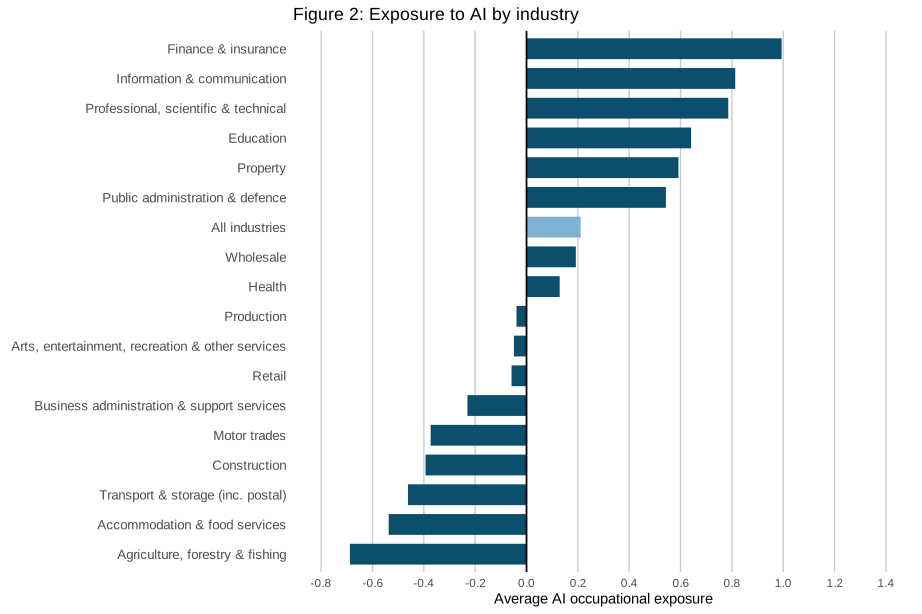
Note: Industries are defined by grouped standard industry classification sections, which are designed by ONS to classify businesses by the type of economic activity they engage in. Source: updated AI exposure index, Skills England analysis (see technical annex for methodology).
This unevenness complicates planning. For example, digital occupations are the largest growth area in our skills needs assessment (see Chapter 6). At the same time, as DSIT (2026)[footnote 46] outline these occupations are seeing some of the fastest transformation in work practices due to AI. It is not clear yet whether the strong growth in demand for digital work will be met by more people in digital roles or through the greater productivity of digital workers due to AI adoption. The nature of digital roles may also change. This creates challenges for forecasting and managing supply and demand for these roles.
AI activity also varies across the UK. London, the South-East and the East of England remain major hubs, hosting around three-quarters of AI company headquarters. But growth is no longer confined to these areas. The West Midlands, North-West, East Midlands, Wales, and Yorkshire and the Humber have all more than doubled their number of AI firms since 2022 according to DSIT (2025).[footnote 47]
Demand for AI related capabilities is shifting rapidly. PWC’s (2025)[footnote 48] AI jobs barometer shows that employer requirements in the UK for AI roles are evolving 66% faster than for other jobs, and workers with AI skills earn a 56% wage premium globally compared with peers in equivalent roles. AI Skills for the UK Workforce[footnote 49] research published in 2025 funded by the British Academy in collaboration with Skills England, shows most workers will require practical AI literacy - the ability to use, verify and safely integrate AI tools - while a smaller share will need specialist technical skills. Rather than looking to employees to carry out routine tasks, employers want those who have judgement, problem-solving, collaboration, digital fluency and responsible AI capabilities. As more processes become automated, employers may place great value on ‘human’ skills such as empathy, team work and resilience as set out in FSSC’s 2026 report.[footnote 50]
While evidence for the UK from PWC’s AI Jobs Barometer suggests AI is largely being used to support workers rather than replace them, our engagement with employers, trade unions and others highlights persistent inequities in access to relevant skills and training. Without sustained investment in digital and AI-related capabilities, existing disparities by sector, qualification level and region may widen, constraining the benefits of AI.
6.2 Skills England’s approach
Skills England is working with partners across government, including HM Treasury’s AI Economics Institute[footnote 51], to address the skills challenges arising from the rapid and uncertain adoption of AI. Given the pace of technological change, our approach is anchored in 3 principles that shape how we respond.
First, we prioritise the development of ‘no regret’ skills, capabilities that are valuable now and likely to remain essential as AI adoption grows. This includes skills set out in FutureDotNow and DSIT’s AI-embedded Essential Digital Skills Framework[footnote 52] and the essential employment skills identified in the NFER skills imperative 2035 research[footnote 53], which underpin effective participation in a changing labour market alongside more technical AI capabilities.
Second, we focus on actively monitoring AI skills demand and improving the flexibility of the skills system so it can respond quickly to emerging needs. This requires timely labour market insight, engaging employers early, working locally and adapting training products at pace as demand shifts across sectors and occupations.
Third, we aim to strengthen workforce resilience, ensuring people are supported to adapt to new technologies and retrain throughout their careers as job roles evolve. Enabling individuals to upskill and reskill over time is central to ensuring that AI adoption supports productivity growth while widening opportunity, rather than increasing inequality.
Guided by these principles we are prioritising the following areas of work.
Developing a shared understanding of and language for AI
Skills England will work with stakeholders to build a taxonomy for AI skills, aligning with work currently underway across government. Working closely with the new AI Economic Institute and external partners, we will build a shared, evidence-based understanding of the current and future impact of AI on skills needs across the UK.[footnote 54] This will improve our ability to anticipate demand, target interventions and ensure provision keeps pace with rapid technological change.
Building AI expertise, including in leadership and management
We will use this intelligence to determine where new training is needed to support the development of specific training, including for leaders and managers. This will build on our existing products, including the development this year of a new set of 3 apprenticeship units on AI leadership. These can be taken over 30 hours per apprenticeship unit and support organisational leaders to define AI priorities and manage AI enabled change.
In 2025, we also launched a new Level 4 AI and Automation practitioner apprenticeship, developed with employers, which equips apprentices to identify where AI and automation can save time, reduce costs and improve organisational performance. Reflecting the growing accessibility of AI through low-code and no-code technologies, the programme enables a wider range of employees to identify process improvements, integrate AI tools into workflows and support organisational transformation.
Upskilling the workforce in AI
As noted above, equipping everyone with the skills needed to harness the benefits of AI is essential. In January 2026, DSIT announced a major expansion of the national AI upskilling programme in the form of AI Skills Boost,[footnote 55] underpinned by Skills England’s new AI foundation skills for work benchmark[footnote 56] (see Case Study 6).
The programme enables every adult in the UK to access free training that builds practical AI capabilities and supports the ambition to upskill 10 million workers by 2030. Skills England will continue to build partnerships with expert organisations across industry and the public sector to extend reach of this work across sectors. We will also be embedding the relevant AI content from the framework into apprenticeships, V Levels and T Levels where appropriate.
Case study 6: Skills England AI foundation skills for work benchmark
The Skills England AI foundation skills for work benchmark sets out the skills needed to use simple AI tools confidently and responsibly at work. It was developed with industry experts, using information from Skills England’s ‘AI skills for the UK workforce’ report. There are 6 AI foundation skills for work, grouped under 3 domains:
- technical AI foundation skills: writing clear instructions for AI tools and using AI tools to support routine processes and tasks
- non-technical AI foundation skills: using simple software that automates work tasks and adjusting how an AI tool works, such as choosing the tone of writing or privacy settings, to get better results
- responsible and ethical AI foundation skills: understanding the risks and consequences associated with AI use and analysing information
7. Chapter 4: Supporting young people’s employability skills
7.1 The Challenge
The UK labour market is strong by international standards but there remain long-term challenges particularly affecting young people. Youth unemployment rose to 16.2% in the 3 months to March 2026, the highest rate since the beginning of 2015 and over 3 times the national average. Nearly 1 in 5 of unemployed 16 to 24-year-olds had been unemployed for longer than 12 months.[footnote 57] The number of 16 to 24-year-olds not in employment, education or training (NEETs) increased after COVID, reaching the highest level for a decade at the end of 2024, and has remained near to that level since. Currently there are 957,000 16- to 24-year-olds who are NEET, of which 411,000 are unemployed and 547,000 are inactive.[footnote 58]
The diagram ‘Figure 5: Numbers of 16 to 24-year-olds not in employment, education or training in the UK’ has been removed because it could not be made accessible. If you need this information email accessibility@dwp.gov.uk and include the name of the publication.
Some of the rise in youth NEET numbers is due to the relatively low employment demand which is expected to increase as the economy revives. But there are also signs of longer standing supply side issues. The increase in youth NEET numbers is in part driven by an increase in inactivity[footnote 59] where young people have disengaged from the market often due to poor health. This highlights the cyclical nature of inactivity which suggests that inactivity should also decline following sustained economic growth. Youth Futures Foundation’s 2023 report[footnote 60] includes the following factors:
- not having academic qualifications above GCSEs
- having a limiting disability or mental health condition
- having children at a young age
Skills are also a factor for youth employment. The Young People and Work Interim Report[footnote 61] found that young people’s experience of education and training is not keeping up with the needs of the labour market. Consistent with this, the Youth Voice Census 2025[footnote 62] found that young people identified limited work experience, anxiety and a lack of local job opportunities as the main obstacles to entering employment.
Tackling the high youth NEET levels is crucial not only to support the UK’s immediate economic capacity and individual’s incomes, but also to reduce the long-term scarring effects from a lack of work. For instance, a House of Commons research briefing[footnote 63] noted that time spent not in education or work “can have a detrimental effect on physical and mental health, and increase the likelihood of unemployment, low wages, or low quality of work later on in life.”
7.2 Skills England’s approach
In February 2026, Skills England convened a series of Youth Employability Summits to look at issues around skills and work readiness in young people from 3 different perspectives, covering:
- young people themselves and representative organisations
- place-based leaders from Strategic Authorities and education providers
- employers from across sectors including IBM, PwC, Severn Trent and Enterprise Rent-a-Car
The sessions were delivered in partnership with Youth Futures Foundation and the key messages from them included:
Talking to recruiters
Young people are developing valuable skills such as communication, resilience, teamwork, and problem solving through everyday experiences (including weekend work, caring for family members), yet these capabilities often go unrecognised in recruitment. Recruiters rely heavily on formal qualifications and paid experience, making it difficult for young people to demonstrate skills gained informally. With no shared language for describing employability skills, young people struggle to translate their experiences into terms employers use, and job descriptions frequently lack clarity on the skills required.
Education gap
Participants also highlighted a persistent gap between education and the workplace. Many practical and transferable skills are left for young people to learn independently, for example, financial literacy, teamwork, networking and interview preparation. Employers noted structural mismatches: education environments provide clear instructions and frequent feedback, whereas workplaces expect individuals to navigate ambiguity and receive more irregular guidance. The need for young people to develop critical judgement when using AI tools was also raised as increasingly important.
Value of work experience
Work experience was consistently identified as the most effective way for young people to build and demonstrate employability skills, but only when placements involve real responsibilities. Sessions also emphasised that the NEET population is highly diverse and requires flexible, integrated support. Young people often fall through gaps in a fragmented system - particularly at key transition points - reinforcing the need for earlier intervention, stronger coordination, and clearer pathways between school, training and employment.
Based on our insight, we will focus work in 2 areas to support young people into work: better training pathways and a shared language for employability skills.
Improved training pathways for young people
Skills England will consider how to streamline and simplify our training offer to better meet the needs of young career starters, alongside those who are already in the workplace. We will work across government, with regional authorities, youth employment specialists and with industry so that regional and national skills provision is coherent, evidence-driven and responsive. We will use our insight to expand our flexible and modular learning options, ensure qualifications and training meets labour market needs and develop clear pathways into employment for young people who are finding it difficult to enter the labour market.
This will include close collaboration with the Department for Education to align activity on youth employability with their work to build cross-cutting skills into the reformed school curriculum and the new enrichment framework up to the age of 18. We will also work together on the development of new technical and vocational qualifications for learners aged 16 to 18 years old. This will include reviewing and developing the occupational standards needed to support V Levels, T Levels and qualifications for young people at Level 2.
There has been a 40% decline in apprenticeship starts among young people over the past decade as stated in the House of Commons (2026).[footnote 64] Skills England is working closely with the Department of Work and Pensions to support more young people starting out on their careers to take up apprenticeships. This includes delivering foundation apprenticeships, new training programmes specifically tailored for young people aged 16 to 21 (or up to 24 for care leavers or those with Education, Health and Care Plans). The first wave of foundation apprenticeships launched in August 2025, with new foundation apprenticeships in hospitality and retail available from April 2026. These sectors traditionally employ large numbers of young people and offer strong entry points into sustained employment with clear progression routes across England, including in rural areas where they make strong contributions to rural economies. We are also launching a new level 2 Administrative Assistant apprenticeship aimed specifically at 16 to 24-year-olds (see Case Study 7).
Case Study 7: Level 2 Administration Assistant
Apprentices on this new 12-month Level 2 apprenticeship, developed in collaboration with household names including Coca-Cola Europacific Partners, Amazon, Hull City Council and the NHS, will be able to carry out routine administration tasks that support operations across a broad range of sectors. This brand-new standard ensures the apprentice will develop a highly transferable set of knowledge, skills and behaviours that can be applied across the public, private and third sector. This includes learning about AI and automation and how to apply this in their roles, alongside developing skills to communicate effectively, how to maintain professional relationships with stakeholders, as well as up to date principles of data and information handling and storage. This standard provides an excellent career starting point, enabling progression into a range of occupations, such as marketing, business administration, HR and sales.
7.3 Improving how employability skills are described and recognised
Skills England will work with employers to understand what they recognise as employability skills and will translate this into key activities that young people experience. Using Skills England’s UK Standard Skills Classification[footnote 65] as a starting point (see Chapter 6 for more information), we will develop a shared language that both employers and young people recognise, helping employers to better understand the capabilities young people develop outside formal employment. We will build on our ongoing work on skills passports[footnote 66] (see Case Study 6) to consider how these tools can help capture and communicate the skills young people develop - whether through work experience, volunteering or lived experience - so that they are visible and valued by employers.
Building on this, we want to understand what makes work experience genuinely effective in building and evidencing the skills young people need. We will work with employers to understand all types of work experience from work shadowing, industry placement to job guarantee - and will highlight best practice and how quality work experience supports talent pipelines.
Taking action on youth employability requires a collective response. Skills England is working with partners like Youth Employment UK to explore what more can be achieved nationally and locally, building on good practice across the country. We will continue to collaborate with key stakeholders on this agenda - including Strategic Authorities, colleges, schools, HE and training providers, the Department for Work and Pensions, the Department for Education, Jobs and Careers Service, and the Careers and Enterprise Company.
8. Chapter 5: Place - a more locally responsive and integrated skills system
8.1 The Challenge
Local and regional economies play a vital role in supporting sustainable and inclusive economic growth, reflecting the importance of place in shaping productivity outcomes. However, recent analysis from The Productivity Institute[footnote 67] points to substantial variation across regions with differences in skills, investment and infrastructure influencing local productivity levels. These disparities suggest that national growth is closely linked to the performance of local economies. Strengthening local capabilities, while aligning national and local policy, can therefore support more balanced and resilient economic growth across the UK.
In all areas of the country, we will work with local partners and employers to better understand skills needs, improve the skills offer and simplify access to skills to boost economic growth. We will co-create solutions with local partners, supporting both opportunity and growth and Skills England’s driving ethos of Better Skills for Better Jobs.
As key strategic partners, Strategic Authorities play a vital role in place-based solutions. Skills England will work alongside them to add value where needed, recognising that all areas are different, and some regions may require a more individual approach to addressing skills challenges set out below.
8.2 Skills England’s approach
Skills England is focusing on 3 priorities:
-
supporting major investors and large infrastructure projects to develop the skilled workforces they need
-
delivering a more coordinated approach to local skills planning.
-
strengthening relationships with regional partners, and stakeholders across the UK
Driving growth through regional investment and infrastructure
The National Infrastructure and Service Transformation Authority (NISTA)’s 2025 annual report[footnote 68] sets out how government has committed at least £725bn of funding to support infrastructure over the next decade, unlocking major projects across the country and creating substantial demand for skilled workers. To support this, Skills England has launched the Investment and Infrastructure Skills Service, providing a single front door for coordinated skills support for major projects in England. The service is designed to make it quicker and easier for investors and infrastructure projects to access the workforce they need, while ensuring local people benefit from high-quality job opportunities linked to long-term investment.
The service offers dedicated account management, which provides rapid engagement, a clear understanding of project-specific skills challenges, and coordinated solutions across the skills system. Skills England works closely with the Office for Investment to support globally mobile investors, and with the National Infrastructure and Service Transformation Authority to identify strategically and economically important projects at an early stage. This enables proactive workforce planning, rather than reactive responses to skills shortages.
In areas where similar services already exist, Skills England will seek to align efforts rather than duplicate them. We will work with local services and Strategic Authorities to identify specific gaps and available levers to further unlock job creation and local growth. Skills England also works closely with Technical Excellence Colleges, which act as local centres of excellence for skills in key growth sectors (see Case Study 1).
The Investment and Infrastructure Skills Service brings together the full range of Skills England’s expertise and networks. This includes providing advice on skills supply and provision, co-designing training solutions with employers, providers and Strategic Authorities, and mobilising partners - including colleges, training providers, local authorities, sector bodies and Jobcentre Plus - to deliver at scale. Where appropriate, the service will draw on the fast-track approach to accelerate updates to apprenticeships and develop new short courses, ensuring that skills provision aligns with the delivery timelines of major infrastructure and investment projects (see Case Study 8).
Case study 8: Agratas Battery Manufacturing
Agratas, part of the Tata Group, is building a major battery factory near Bridgwater, Somerset and is expected to create thousands of jobs and supply almost half of the UK automotive sector’s battery manufacturing capacity by the early 2030s.
Through the new Investment and Infrastructure Skills Service, Skills England has convened key local stakeholders - UCS College Group (UCS), Agratas and Somerset Council together with expertise from across government. This has enabled partners to gain a deep insight of the skills barriers that the project faces and then co-design local and national solutions.
Skills England fast-tracked a solution which was co-designed with industry - a level 2 Battery Manufacturing apprenticeship unit. This was developed in 3 months following a rapid consultation with Electrification Skills Network, North East and West Midlands battery clusters, Agratas, wider employers and academic experts. The new unit ranges between 30 and 140 hours and can be delivered over one to 16 weeks.
Bhavik Mistry, Head of Learning and Development for Agratas, said the course will prioritise practical skills and it “ensures learning is closely aligned to the realities of modern battery manufacturing, making sure it is high quality and closely matched to daily life in battery production”.
Andy Berry CBE, CEO UCS College Group said, “This represents a pivotal moment for the battery manufacturing sector in the UK. I am glad this unit has been prioritised. It reflects the culmination of a collaborative approach between industry and education, demonstrating the role colleges play in delivering skills for the UK.”
A coordinated approach to local skills planning and solutions
LSIPs bring together local employers, leaders, colleges, universities and independent training providers to identify and address post-16 technical key skills gaps from entry level through to postgraduate qualifications. LSIPs are both a plan and a process - and central to ensuring local skills systems keep pace with employer demand, boost productivity and help people progress into high-quality jobs.
Following the success of the first LSIPs published in 2023 that can be accessed via the Employer Representative Bodies (Skills England, 2025)[footnote 69], we announced in autumn 2025 the development of the second cycle of LSIPs. Thirty-nine plans covering every part of England will be published in Summer 2026. This process is supported by Skills England’s (2025) LSIP statutory guidance[footnote 70]. This was developed with a range of partners and has been designed to support the Post-16 Education and Skills White Paper. It sets expectations around a new LSIP joint working model between Employer Representative Bodies (ERBs) and Strategic Authorities, closer alignment between employment and skills services as Jobcentre Plus and the National Careers Service merge to form the Jobs and Careers Service, and increased collaboration with Higher Education. In this new joint working model, the designated ERB and Strategic Authority work on all stages of the LSIP, with the Strategic Authority providing a statement of sector skills priorities to inform the LSIP’s development from the start. This is important as the relevant Strategic Authority has a wide remit around driving economic growth and can bring together not only LSIPs but also wider plans and strategies in a place.
While each LSIP reflects the specific post-16 technical key skills needs of its local area, they also generate valuable national insight. Taken together with Local Growth Plans, Job Plans, Get Britain Working plans and Strategic Authorities’ insights, they provide a rich source of intelligence. We are exploring how the use of this data and intelligence can drive strong local interventions and shape a system that delivers stronger local economies. We will share best practice and will work with local partners to improve our evidence base and assessments of skills needs at a place-based level, building on our Local Skills Dashboard[footnote 71] (see Case Study 9). We will also use our insight to co-design joint interventions with Mayoral and Strategic Authorities, focussed on addressing specific barriers and challenges in the skills system which regional partners have identified.
Case Study 9: Local Skills Dashboard
The Employer Representative Bodies drafting the LSIPs and the local Strategic Authorities delivering local skills policy need good data on the area’s jobs and skills market.
Skills England has developed the Local Skills Dashboard to improve the coherence and useability of the data which is available. The dashboard is an online hub which brings together data from a range of official sources to provide a detailed view of local skills and employment. It allows users to explore, visualise and download data for specific local areas in a single place, rather than pulling information from multiple disconnected sources, including on:
- employment and labour market trends including future job projections
- jobs and vacancies
- the number of businesses and their size
- education and training provision
- qualifications and attainment
Local bodies, such as Local Authorities, are using the dashboard to monitor the local labour market and training provision, to inform local skills strategy. Government departments and agencies have used it to support engagement with local bodies and to inform locally targeted policy and delivery. Education and training suppliers, for example Further Education colleges, are using it to gather local labour market information that supports curriculum planning and careers advice.
Bringing responsibility for policy and delivery of adult skills into the Department for Work and Pensions provides an opportunity to move further towards more coherent local planning on skills and jobs. For example, the strong and growing collaboration between Skills England and the future Jobs and Careers Service (JCS) is helping to support people to access better jobs. Skills England is already working alongside Jobcentre Plus (JCP) when there are risks of significant job losses in an area, sharing data to support retraining and rapid re-employment, and upskilling JCP staff to make the best use of Skills England information. Joint delivery pilots - such as the construction employment programme in Barrow with the Construction Industry Training Board - demonstrate how combining Skills England’s intelligence with JCS delivery capability can create clear pipelines from training into jobs.
Convening partners - regionally and across the UK
To strengthen the role of place in shaping a more responsive and integrated skills system, Skills England has established a new advisory forum (a sub-group of our overall Board) to ensure local insight and lived experience more consistently inform national strategy and programme design. The group brings together representatives from Strategic, Mayoral and Local Authorities, Employer Representative Bodies and government departments to surface local intelligence, champion co-design with partners and promote innovative practice across diverse localities. Skills England also meets metro mayors regularly to understand the strategic skills issues facing different regions. This engagement with our local and regional government partners is supporting Skills England to advocate across central government and deliver shared ambitions for skills-powered growth.
Although skills policy is devolved to Scotland, Wales and Northern Ireland, Skills England is working with the devolved governments to share best practice and create an accessible skills system for employers across the UK. We know that for many employers, including those whose ‘travel to work’ area crosses borders, or who work and recruit UK-wide, coherence is an important issue. We will continue to collaborate with partners in the devolved government and skills agencies to collectively strengthen the delivery of the skills employers and individuals need.
Looking forward, we want to use our joint forum with partners in the devolved governments to explore where there are further opportunities to work together. Potential opportunities could include further development of the UK Standard Skills Classification to support UK-wide usage and working in specific sectors to harmonise our occupational standards across the UK (or indicating to employers where this is not possible). We are also exploring work to share best practice on engaging SMEs and to develop our understanding of the role skills passports can play in reducing cross-border systems friction.
9. Chapter 6: Skills England’s Skills Needs Assessments
9.1 Introduction
Skills England has published its skills needs assessments (SNAs) alongside this report. These assessments provide a detailed understanding of the skills needed in the 8 Industrial Strategy priority sectors[footnote 72], as well as the construction and health and social care sectors (IS8+2).
Each assessment describes the current and future demand for the priority occupations that underpin the sector and maps the training pathways into these occupations. All future employment estimates are uncertain and are included to indicate broad trends. They provide an indication of the scale of change in skills demand and the implications for skills requirements, rather than precise forecasts.
Government departments have identified 150 occupations as ‘priority’ - those that are critical for the delivery of the Industrial Strategy. These allow for a consistent, cross-sector view of skills needs, while recognising that there will still be other highly specialised and emerging roles that need consideration. The assessments build on the methodology of Assessment of priority skills to 2030[footnote 73] by providing more detailed assessments of skills demand and supply and extending job projections timelines to 2035. They bring together the best available quantitative and qualitative data to assess skills needs at national, sectoral, and place-based levels.
This shared understanding of skills needs is critical to facilitate discussions with stakeholders on the key skills and jobs needed in the economy and how skills provision can help meet these skills needs. The assessments will be iterated over time and published on an annual basis.
Summary of key findings
In 2025, priority occupations represented 22.9% of the UK workforce (the equivalent of 7.6 million employees). Digital roles are the occupations most commonly identified as crucial across the 10 sectors.
Currently, these priority occupations are typically seeing high recruitment demand and are expected to see demand grow rapidly in the future. According to Skills England’s Occupations in Demand 2025 report[footnote 74], three fifths of these priority occupations are showing elevated demand or higher, and over a quarter are in critical demand. Employment in these priority occupations is expected to increase by 1.8 million by 2035, a growth of around one quarter. The sectors seeing the largest increase in numbers are expected to be the construction, digital and technologies, and creative industries sectors. Across all the IS8+2 sectors, the occupations which are likely to see the greatest increase in numbers are: care workers and home carers, programmers and software development professionals (see Box 2 for uncertainties with this projection), and IT business analysts, architects and systems designers.
Most additional employment demand (62%) is expected to be met by workers with a qualification level of 4 or above, compared with 38% at education at levels 2 or 3.
Overall, the skills system is providing strong routes into these occupations. In the most recent year of data, around 230,000 learners were in priority occupations, almost half of those entering employment from the skills system (almost three quarters (74%) had a qualification at level 4 or above).
For example, specialised level 6 higher education (HE) courses in health and architecture have a high proportion of graduates entering priority occupations. Increasing the supply of new entrants from these courses will require higher enrolments. This differs from more generalist courses, such as those in level 6 business and management, where a much lower proportion of graduates go to priority occupations (although given the high numbers of students on these courses, they are important routes into these occupations).
There is a similar pattern within further education (FE). However, the proportion of those leaving FE and then entering priority occupations is lower. Learners studying level 2 and 3 accounting and finance, engineering, transportation operations and maintenance, and building and construction are the most likely to go into a priority occupation. Level 2 and 3 health and social care routes are delivering high volumes of learners, although the proportion of these going into priority occupations is not as high, at 27%.
There are also signs of growth in the courses that supply new entrants into priority occupations. Between 2021 and 22 to 2023 and 24 academic years, enrolments into these courses have grown by 18%, or 8% annually, a faster rate than the projected growth of priority occupations. Growth rates are slightly higher for key courses at level 2 or 3, than for level 4 and above courses.
Priority Occupations
Many priority occupations appear across multiple sectors, suggesting that employers may face increased competition for the same roles across the wider economy. Digital roles are the most common priority occupation and required by many of the Industrial Strategy sectors. Programmers and software development professionals were the single most common occupations (although we know these roles are highly likely to be affected by AI, see Box 2), followed by IT business analysts, architects and systems designers. Other common groups of occupations are engineers, particularly needed in advanced manufacturing, clean energy and defence sectors, and construction workers, particularly to support the construction and clean energy sectors. Figure 6 shows the 10 occupations most commonly identified as a priority across sectors.
Figure 6. Occupations prioritised most often across multiple sectors
| Occupation | Number of sectors |
|---|---|
| Software development professionals | 7 |
| IT business analysts, architects and systems designers | 6 |
| Engineering professionals | 5 |
| Civil engineers | 4 |
| Electronics engineers | 4 |
| Production and process engineers | 4 |
| Electrical engineers | 4 |
| Engineering technicians | 4 |
| IT managers | 4 |
| Financial managers and directors | 4 |
Several Industrial Strategy sectors show geographical clustering across specific areas. Advanced manufacturing is notably concentrated in Gloucestershire, Cumbria, and Warwickshire, while creative industries and digital and technologies [footnote 75][footnote 76] activity is most prevalent in areas such as Greater London, Thames Valley Berkshire, and Oxfordshire. Financial services and professional and business services similarly display regional specialisation, with Greater London, Hertfordshire, and Cheshire and Warrington emerging as key hubs for these sectors (ONS (2022))[footnote 77][footnote 78].
Current and Future Demand for Priority Occupations
Priority occupations are typically in high current demand and are expected to grow significantly over the next 10 years. As already noted in Chapter 1, three fifths (60%) of the priority occupations saw elevated recruitment demand or higher throughout 2025, according to the Occupation in Demand analysis, and over a quarter (27%) were in critical demand.
Priority occupations are also expected to grow substantially faster than the rest of the economy. Priority occupations are projected to grow by 24% to 2035 (1.8 million extra jobs) while non-priority occupations are expected to grow by 14%. There are no economy wide projections, but over the last 10 years UK overall employment has grown by 9%.[footnote 79]
The overall projection of 1.8 million extra jobs by 2035 includes an increase of 0.9m by 2030, which is consistent with the growth projected in Skills England (2025).[footnote 80]
Figure 7. Projected additional employment in IS8+2 priority sectors
| Occupations | Workers in 2025 | Workers in 2035 | Change in number of workers 2025 to 2035 | Percentage change 2025 to 2035 |
|---|---|---|---|---|
| Priority occupations | 7.6 million | 9.5 million | 1.8 million | 23.8% |
| Non-priority occupations | 9.6 million | 11.0 million | 1.4 million | 14.4% |
| All priority sector occupations | 17.3 million | 20.5 million | 3.2 million | 18.5% |
Note: Some sector definitions overlap so employment for each occupation has been capped to 100% of UK employment in that occupation in 2025.
Sector breakdowns
Skills England worked with sponsoring government departments to project the growth rate of the priority occupations that underpin the Industrial Strategy’s Jobs Plans. Table 4 shows the projected additional employment between 2025 and 2035 for each sector.[footnote 81] Projected employment growth varies widely across sectors due to differences in sector size and modelling approaches, and the estimates are intended to show their contribution to overall demand rather than to allow direct comparisons between sectors or with priority occupation figures. The sectors projected to need the most additional people in their workforces over the next 10 years are the construction, digital and technologies, and creative industries sectors.[footnote 82] [footnote 83]
The fastest growth of priority occupations as a proportion of the current employment are clean energy, defence, and life sciences. For the clean energy sector, the priority occupation workforce needs to increase by over 70% from its current level.
Across these sectors, the occupations projected to grow the most between 2025 and 2035 are care workers and home carers (199,000 additional workers), with this demand concentrated entirely within the adult social care sector. Other occupations showing high demand growth are programmers and software development professionals (192,000), IT business analysts, architects and systems designers (70,700), and IT managers (67,400).
Figure 8. Projected growth of sectors across priority and other occupations from 2025 to 2035
| Sector | Whole sector change in number of workers | Priority occupation change in number of workers | Priority occupation percentage change |
|---|---|---|---|
| Adult Social Care[footnote 84] | 371,000 | 281,000 | 27.5% |
| Advanced Manufacturing | 47,000 | 47,000 | 12.6% |
| Clean Energy | 161,000 | 63,000 | 70.6% |
| Construction | 758,000 | 493,000 | 26.2% |
| Creative Industries | 433,000 | 416,000 | 26.9% |
| Defence | 120,000 | 53,000 | 58.1% |
| Digital and Technologies | 731,000 | 239,000 | 27.3% |
| Financial Services | 158,000 | 130,000 | 22.5% |
| Life Sciences | 141,000 | 66,000 | 44.0% |
| Professional and Business Services | 330,000 | 116,000 | 8.8% |
Note: Direct comparison between sectors should be avoided due to different approaches used by sectors to produce these projections
Box 2. Uncertainty in job projections
Projecting labour market change is inherently uncertain, and this increases the further forward the projection extends. To understand more about the uncertainty in the skills assessment projections, Skills England asked government departments to provide alterative scenarios. These are covered in more detail in the individual sectoral skills needs assessments.
For example, different assumptions on workforce growth within the creative industries and advanced manufacturing sectors change the demand figures significantly.
In the creative industries a conservative main scenario is created by estimating that half of the Creative Sector Plan’s target to increase investment to 2035 is realised, that GVA per worker grows following OBR’s high productivity scenario, and that priority occupations become more prevalent within the creative industry workforce. This leads to a projection of 416,000 growth over the next 10 years. However, if the full investment figure is realised, GVA grows continuously, and the impact of AI on productivity follows OBS’ J-shaped scenario (Office for Budget Responsibility, 2025)[footnote 85], then a much higher workforce growth of 813,000 is projected.
In advanced manufacturing the main scenario assumes that priority occupations will grow following DfE’s labour market and skills projections technical opportunities scenario, where accelerated technological change creates new jobs to support economic growth. This leads to a projection of 47,000 growth over the next 10 years. However, if the more conservative baseline growth scenario is applied the sector is projected to grow by 24,000 over the same period.
There is further uncertainty that is not captured in all alternative scenarios which will also influence the level of demand seen in each sector. For example, the accelerated adoption of AI technology could lead to an increase in job productivity and then a reduction in the demand for new workers. This is a particular issue for digital occupations (including programmers and software development professionals). These occupations have seen some of the highest projected growth rates, while also affected by some of the greatest AI related changes (DSIT, 2026).[footnote 86]
While there is particular uncertainty around how the adoption of AI may impact occupations such as digital occupations, Skills England has not made any adjustment to the projections provided by sector experts. Currently, the evidential basis for making such changes is not strong. However, there is a heightened uncertainty inherent in the projections of AI-exposed occupations, including the overestimation of the projections for digital occupations. We will be conducting further work over the next year to understand the risks more fully.
Figure 9. Examples of growth scenarios for priority occupations in the Creative Industries and Advanced Manufacturing sectors
| Sector | Scenario | Growth 2025 to 2035 | Percentage growth |
|---|---|---|---|
| Creative Industries | Main | 416,000 | 26.9% |
| Creative Industries | Alternative | 813,000 | 50.7% |
| Advanced Manufacturing | Main | 47,000 | 12.6% |
| Advanced Manufacturing | Alternative | 24,000 | 6.4% |
Qualification level demand
Most of the job growth in the priority occupations will be filled by high-skilled individuals. Overall, around three-fifths (62%) of the extra jobs will be filled with people with higher-level qualifications (Level 4 and above[footnote 87]) with the remaining two-fifths (38%) of jobs typically filled with a lower level (Levels 2 or 3). The expected education level split for each sector varies substantially by sector. Most sectors are heavily weighted towards higher level skills, though Levels 2 and 3 skills are key for adult social care, clean energy, and construction (79%, 59%, and 59% respectively).
Figure 10. Additional employment in priority occupations between 2025 and 2035 by expected education level
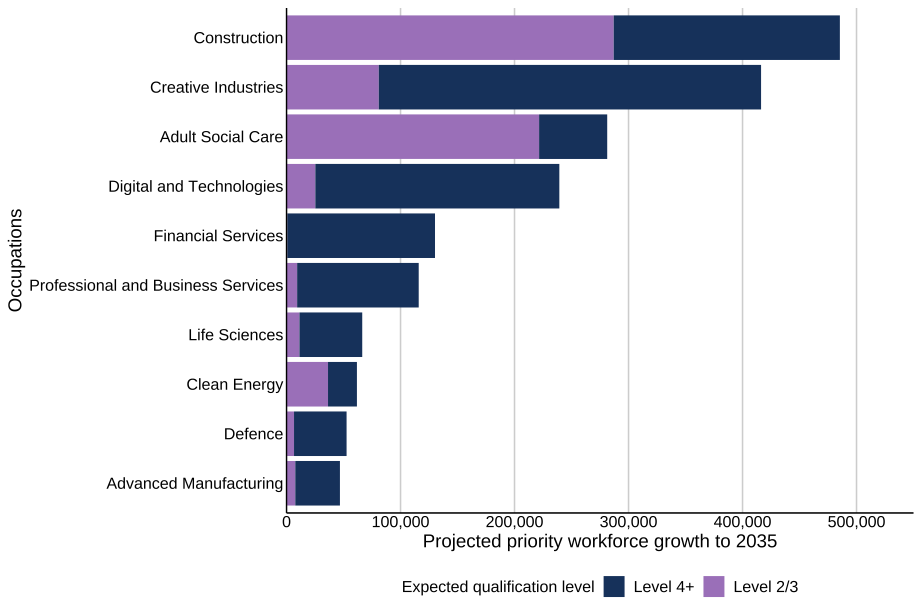
Skills for priority occupations
The UK’s first skills taxonomy, The UK Standard Skills Classification (SSC)[footnote 88], provides a mapping of relevant skill areas to occupations. Using an initial prototype of the SSC, experimental analysis was conducted to identify the skills areas which are relevant to priority occupations.[footnote 89]
Across all priority occupations, the top technical skill areas are:
- developing and deploying applications
- determining project requirements and plans
- managing organisational and operational records
The latter also appears in the top relevant skill areas for occupations across the UK.
The classification will also support Skills England’s efforts to address youth employability by helping employers to articulate the skills they need and young people to better describe their own skillsets.
Priority occupations also require higher proficiency compared to the UK average for most core skills (see box 3), with particularly higher than the UK average proficiency required in creating, digital literacy, numeracy, problem solving and decision making, learning and investigating, and planning and organising.
Box 3. Core Skills
Thirteen Core Skills are defined in the UK Standard Skills Classification (SSC)[footnote 90]. These are foundational, transferable abilities required across occupations, and they are listed explicitly in the SSC Skills Explorer. More details can be found in the technical annex.
- Planning and Organising - setting goals, prioritising tasks, structuring approaches.
- Adapting - adjusting strategies or behaviour to new or changing situations.
- Working With Others - collaborating effectively with teams or groups.
- Listening - understanding spoken communication, including non-verbal cues.
- Speaking - communicating clearly and confidently through speech.
- Leadership - motivating, guiding, and inspiring others.
- Learning and Investigating - searching for, gathering, and understanding new information.
- Creating - developing original ideas, innovations, or solutions.
- Problem Solving and Decision Making - identifying issues, analysing information, selecting solutions.
- Numeracy - applying mathematical techniques and interpreting numerical data.
- Digital Literacy - using digital tools and technologies including Artificial Intelligence tools effectively.
- Reading - interpreting written information accurately.
- Writing - communicating ideas clearly and persuasively in written form.
Education supply
There are multiple routes by which people enter employment in a given occupation. The data available to consider these is limited. This section focuses on the direct supply into occupations following government-funded education.
Historic supply
In 2022 to 2023, an estimated 230,000 recent education leavers were in priority occupations, almost half (48%) of all those entering employment from the skills system in England. Almost three quarters (74%) of these had a qualification at level 4 or above. The most common route for learners entering priority occupations was through higher education, accounting for over two thirds of all learners (68%). There are also large numbers entering through level 2 or 3 routes through apprenticeship or further education which account for over a quarter of learners (26%).
When referring to pathways in this section, apprenticeships include all qualification levels, further education can include those at level 2 to 4, and higher education can include level 6 and above qualifications.
The further education figures include achievements for qualifications at full level 2, full level 3 and level 4 and above. This excludes other level 3 achievements and skills bootcamps, which if included would reduce the share of learners at level 4 and above.
Figure 11: Learners entering priority occupations by pathways and levels in 2022/23
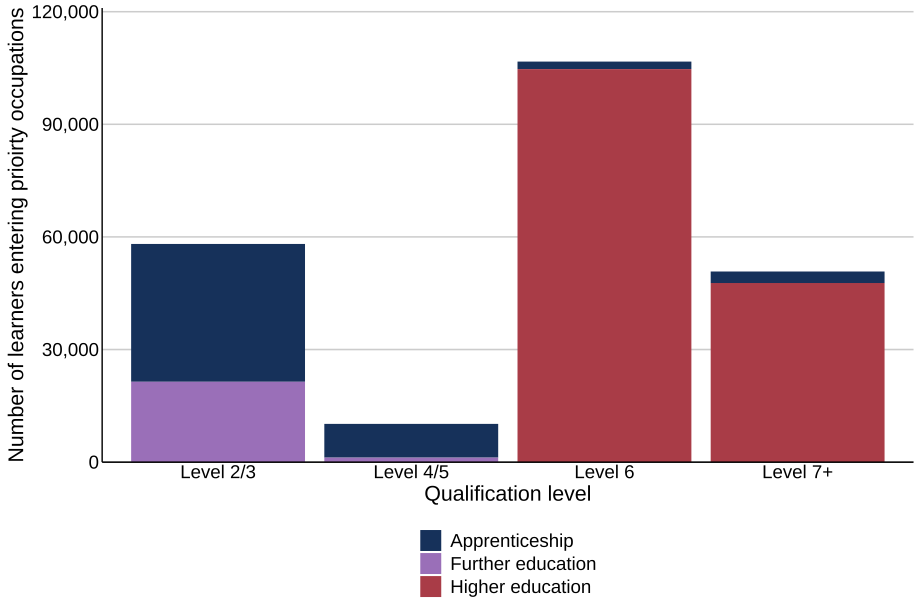
In higher education, over half (54%) of employed recent education leavers are in priority occupations. At level 6, health and architecture related courses show the strongest alignment with priority occupations, with very high proportions (above 78%) of learners progressing into priority occupations, concentrated in a relatively small set of priority roles. Courses in computing and engineering at level 6 also had above 74% of learners progressing into priority occupations. Courses in business and management at level 6 had the second greatest volume of learners entering priority occupations, after health, but have a lower proportion of leavers moving to priority occupations (56%) due to the very large amount of education leavers from these courses, and a much wider spread of occupations that they enter.
In further education, the overall alignment between the courses and priority occupations is lower, with less than one third (29%) of employed recent education leavers in priority occupations. At level 2 or 3, accounting and finance courses show the strongest alignment with priority occupations, with 58% of employed recent education working in priority occupations. Engineering (45%), transportation operations and maintenance (43%), and building and construction (38%) also show strong alignment. Health and social care has the second highest volume of learners in priority occupations behind building and construction but has a lower proportion of recent education leavers in priority occupations (27%).
For apprenticeships, almost half (48%) of employed recent education leavers are in priority occupations. Apprenticeships in engineering have the highest share of employed recent education leavers in priority occupations (81%). This is closely followed by building and construction, digital technology, and accounting and finance (all above 75%). These estimates include achievements on older apprenticeship frameworks, and do not capture all the newer apprenticeships standards that are more aligned to occupational standards.
The analysis of historic supply data indicates that courses can be major sources of skilled entrants even when alignment is not high. Such courses direct high numbers of education leavers into priority occupations alongside supplying other occupations. For example, business and management courses in higher education and health and social care in further education provide high numbers of entrants into priority occupations even when many of their students go to other occupations, due to their high overall number of education leavers. There are other more specific sector examples discussed in the sector SNAs. However, in these cases the most efficient way of boosting skills supply for priority occupations may not be increasing the enrolments into these courses but encouraging leavers, or adapting the courses, so that more of their leavers go into priority occupations.
Important training routes
A key aspect to our skills assessment is the judgement of whether the skills system is reacting to the changes in skills demand. Our analysis, as explained below, suggests that the courses which are closely linked to priority occupations have been expanding at a faster rate than the projected future growth. The analysis indicates that apprenticeships and higher education have been more able to expand supply more than further education.
Our assessment has identified a selection of important training routes that most directly relate to employment in priority occupations, based on historic supply, occupational maps and expert judgement. Figure 12 provides a summary these routes, and a full list is provided in the technical annex. These routes do not cover every relevant qualification, or some specialisms. Further sector-specific routes of interest are covered in the sectoral assessments.
For apprenticeships, we group by subject area as a proxy which allows more consistent tracking of achievement over time while new standards have been rolling out. Skills England occupational maps are the main way that should be used to identify apprenticeship standards that link to priority occupations.
Figure 12: Important routes related to priority occupations
| Provision | Selection criteria |
|---|---|
| Apprenticeships | 16 sector subject areas where at least 60% of achievements are in standards mapped to a priority occupation |
| Higher education (Level 4+) | 12 subject areas based on level 6 courses only where at least 60% of employed recent education leavers are in priority occupations |
| Further education (Level 4 or 5) | 12 subject areas matching those identified for level 6+ higher education |
| Further education (Level 2 or 3) | 4 subject areas where at least 40% of employed recent education leavers are in priority occupations |
| Skills Bootcamps | 9 bootcamp sectors selected based on judgement on alignment to priority sectors |
Note: Level 4 and above further and higher education subject areas are based on level 6 higher education outcomes to ensure alignment in subject areas across all levels.
Between 2021 and 2022 and 2023 and 2024 academic years, training (achievements) in routes related to priority occupations have gone up by 18% (approximately 66,000), or 8% annually, with almost one fifth of this growth (17%) related to computing level 7+ routes. This is a faster rate than the average 2.2% annual projected growth of all priority occupations between 2025 to 2035. In comparison routes not related to priority occupations have only grown by 10% (approximately 83,000). Routes related to priority occupations with a level of 4 or higher have growth at a slightly slower rate (17%) than those at level 2 or 3 (18%).
Figure 13 shows that all pathways have grown in terms of training in routes related to priority occupations except for further education which has seen a 7% decrease in training, the same as the decrease in further education learner numbers overall (7%).[footnote 91] Skills Bootcamps are seeing fast growth (332%). The underlying reason for this may be due to the fact they were recently introduced, so this growth rate may not continue.
Figure 13. Achievements in courses linked to priority occupations
| Pathway | 2021/22 achievements | 2022/23 achievements | 2023/24 achievements | Percentage growth (21/22 to 23/24) | Volume growth (21/22 to 23/24) |
|---|---|---|---|---|---|
| Apprenticeship | 78,000 | 90,000 | 99,000 | 27% | 21,000 |
| Further education | 48,000 | 44,000 | 45,000 | -7% | -3,000 |
| Higher education | 244,000 | 261,000 | 278,000 | 14% | 34,000 |
| Skills Bootcamp | 4,000 | 11,000 | 18,000 | 332% | 14,000 |
Note: Skills bootcamps are reported on a financial year while other pathways are reported on an academic year basis, which may impact comparisons on growth across years.
Construction and digital are 2 sets of occupations which are likely to see substantial growth over the next 10 years. Generally, the courses most directly linked to these occupations are growing quickly and this suggests that parts of the education and training pipeline are expanding. However, course growth by itself is not a guarantee that job-ready supply of learners with applied capability and work-based experience will meet demand for specific priority roles, particularly in frontier technology areas. Ensuring that leavers can progress into key roles is also crucial for instance through gaining required experience.
For construction in particular this related course growth is partly due to the rise in the number of Skills Bootcamps. The growth rate between 2021/22 and 2023/24 in construction courses[footnote 92] was 25% or 12% annually which is above the projected annual growth in demand of 2.4% for the construction sector priority occupations. Computing and digital courses have grown by 44% in the same years or 20% annually, much greater than the projected annual demand growth of 2.4% for the digital and technologies sector’s priority occupations.[footnote 93] This is summarised in Figure 14 and Figure 15 below.
Figure 14: Historic growth in achievements for important pathways related to construction occupations.[footnote 94]
| Pathway | 2021/22 achievements | 2023/24 achievements | Growth (21/22 to 23/24) |
|---|---|---|---|
| Apprenticeship | 8,000 | 13,000 | 64% |
| Further education | 25,000 | 26,000 | 7% |
| Higher education | 18,000 | 19,000 | 7% |
| Skills Bootcamps | 100 | 5,000 | 4600% |
Figure 15: Historic growth in achievements for important pathways related to digital occupations.[footnote 95]
| Pathway | 2021/22 achievements | 2023/24 achievements | Growth (21/22 to 23/24) |
|---|---|---|---|
| Apprenticeship | 8,000 | 13,000 | 58% |
| Higher education | 41,000 | 55,000 | 35% |
| Skills Bootcamps | 4,000 | 7,000 | 102% |
10. Conclusion - looking forward
This report has set out a clear ambition for a skills system that supports and promotes economic growth in all parts of the country. Skills must be an enabler of opportunity. They should allow people to get good, well supported jobs that raise living standards. They should support local economies, drive regional growth and play to the distinct strengths of local areas. Achieving this requires a balanced and responsive skills system, combining greater flexibility for learners and business, stronger employer engagement, and clearer alignment between national priorities and local needs.
The evidence in this report shows that continued participation in higher level education (Level 4+) remains essential particularly for health, STEM and digital. Further education and apprenticeships will remain critical pipelines into construction, manufacturing, social care and technical occupations, offering job relevant experience and often meeting employer demand very effectively. At the same time, more flexible and modular training will be increasingly important to support retraining, respond to AI adoption, and enable workers to move into priority sectors, supported by improved skills information and initiatives such as skills passports.
There are clear tensions to manage, particularly between a focus on higher skill, growth-oriented sectors and the need to support unemployed and economically inactive young people. Addressing these challenges will require integrated approaches that link skills provision to workforce planning plans, employer demand and place-based growth strategies, including through Local Skills Improvement Plans.
There are some skills that are common across most priority occupations and sectors and are fundamental to ensuring people can succeed in a rapidly changing labour market. As the report highlights, employers consistently emphasise the value of transferable capabilities such as communication, problem-solving, teamwork, digital literacy and the ability to adapt to new technologies. These skills underpin effective participation in work across all sectors, including those undergoing fast transformation due to AI and wider technological change. Human skills - like empathy, emotional intelligence, judgement - may become more important as processes are automated. Strengthening how young people access, develop and articulate these skills will be essential to widening opportunity, improving work readiness and supporting progression.
Skills England has a central role to play in this system. As the single authoritative voice on England’s current and future skills needs, we will drive a data led approach to workforce planning, identify priority skills gaps, support the design of occupational standards and qualifications, and provide the data and evidence to support policy making. By working across government and with regional partners, Skills England will ensure national priorities translate into meaningful opportunities for employers and individuals across the country.
11. Footnotes
-
Skills England (2025). Assessment of priority skills to 2030 – GOV.UK ↩
-
Department for Business and Trade (2025). Industrial strategy – GOV.UK ↩
-
House of Commons Library (2026). Research Briefing. NEET: Young People Not in Education, Employment or Training – commonslibrary.parliament.uk ↩
-
Department for Work and Pensions (2026). Young people and work: interim report – GOV.UK ↩
-
Prime Minister’s Office, 10 Downing Street (2024). Missions – GOV.UK ↩
-
Department for Education, Department for Work and Pensions and Department for Science, Innovation and Technology (2025). Post-16 education and skills white paper – GOV.UK ↩
-
Department for Work and Pensions (2026). Young people and work: interim report – GOV.UK ↩
-
Department for Work and Pensions (2026). Major employment drive to help unlock 200,000 new jobs and apprenticeships for next generation – GOV.UK ↩
-
Department for Education (2026). The Growth and Skills Levy – GOV.UK ↩
-
Department for Work and Pensions (2026). Jobs Guarantee – GOV.UK ↩
-
Department for Business and Trade (2025). Industrial strategy – GOV.UK ↩
-
Department for Work and Pensions (2024). Get Britain Working White Paper – GOV.UK ↩
-
Ministry of Housing, Communities and Local Government (2026). English Devolution Bill receives Royal Assent – GOV.UK ↩
-
Ministry of Housing, Communities and Local Government (2024). English Devolution White Paper: Power and partnership: Foundations for growth – GOV.UK ↩
-
Ministry of Housing, Communities and Local Government (2025). English Devolution and Community Empowerment Bill: Devolution Framework Explainers – GOV.UK ↩
-
Department for Education (2024). Skills England report: driving growth and widening opportunities – GOV.UK ↩
-
Office for National Statistics (ONS) (2026). GDP first quarterly estimate, UK: January to March 2026 – GOV.UK ↩
-
OECD GDP Growth, Q4 2025 - OECD Statistics News Release, February 2026. ↩
-
Department for Education (2025). Employer skills survey: 2024 – GOV.UK ↩
-
Skills England (2025). Occupations in demand: 2025 – GOV.UK ↩
-
Office for National Statistics (2022). UK Standard Industrial Classification of Economic Activities (UK SIC 2007) – GOV.UK ↩
-
Skills England (2025). Occupations in demand: (2025) – GOV.UK ↩
-
Department for Education, Department for Work and Pensions and Department for Science, Innovation and Technology (2025). Post-16 education and skills white paper – GOV.UK ↩
-
OECD (2020). Education and training expenditure by age group (NEAC share of expenditure) – OECD Data Explorer ↩
-
Skills England (n.d.). UK Standard Skills Classification Explorer – killsclassification.org ↩
-
In this context, skills passports are the concept of a portable record of skills and credentials, typically digital. ↩
-
Department for Education (2024). Skills England report: driving growth and widening opportunities – GOV.UK ↩
-
Department for Education (2025). Employer skills survey: 2024 – GOV.UK ↩
-
Office for National Statistics (2022). UK Standard Industrial Classification of Economic Activities (UK SIC 2007) – GOV.UK ↩
-
Department for Education and Skills England (2025). Employer Skills Survey: 2024 - investment in training – GOV.UK ↩
-
Farquharson, C., Ogden, K., Ornadel, N., Ridpath, N., Sibieta, L., Snape, D. and Tahir, I. (2026). Annual report on education spending in England: 2025-26 – ifs.org.uk ↩
-
Murray, A. (2025). Business statistics – parliament.uk ↩
-
Department for Business and Trade (2025). Backing your business: our plan for small and medium-sized businesses – GOV.UK ↩
-
Cazzaniga, M; Pizzinelli, C.; Rockall, E.J. and Mendes-Tavares, M. (2024a). Exposure to Artificial Intelligence and Occupational Mobility: A Cross-Country Analysis, IMF Working Paper No. 2024/116 – imf.org ↩
-
OECD (2025). The Adoption of Artificial Intelligence in Firms: New Evidence for Policymaking – oecd.org ↩
-
OECD (2025). Macroeconomic productivity gains from artificial intelligence in G7 economies – oecd.ai ↩
-
DSIT (2026). Assessment of AI capacities and the impact on the UK labour market – GOV.UK ↩
-
Cazzaniga, M., Jaumotte, F., Li, L., Melina, G., Panton, A.J., Pizzinelli, C., Rockall, E.J. and Tavares, M.M. (2024b). Gen-AI: Artificial Intelligence and the Future of Work. IMF Staff Discussion Notes No. 2024/001 – imf.org ↩
-
Klein Teeselink, B. (2025). Generative AI and labor market outcomes: Evidence from the United Kingdom – ssrn.com ↩
-
Adzuna (2026). UK Job Market Report – adzuna.co.uk ↩
-
LinkedIn Economic Graph Research Institute (2026). Labor Market Report: Building a Future of Work That Works – linkedin.com ↩
-
Burn-Murdoch, J. and O’Connor, S. (2026). The AI Shift: What millions of job ads reveal about AI displacement – ft.com ↩
-
Department for Education (2023). The impact of AI on UK jobs and training – GOV.UK ↩
-
Office for National Statistics (2025). Management practices and the adoption of technology and artificial intelligence in UK firms: 2023 – GOV.UK ↩
-
Office for National Statistics (2026). Business insights and impact on the UK economy – GOV.UK ↩
-
DSIT (2026). Assessment of AI capabilities and the impact on the UK labour market – GOV.UK ↩
-
DSIT (2025). Artificial Intelligence sector study 2024 – GOV.UK ↩
-
PwC (2025). The Fearless Future: 2025 Global AI Jobs Barometer – pwc.com ↩
-
Skills England (2025). AI skills for the UK workforce: Sectoral overview – GOV.UK ↩
-
Financial Services Skills Commission (2026). A workforce transformed: Technology, skills and the future of work in financial services – financialservicesskills.org ↩
-
HM Treasury (2026). Chancellor’s growth plan sets key principles for UK-EU alignment – GOV.UK ↩
-
FutureDotNow (2023). The Essential Digital Skills Framework – futuredotnow.uk ↩
-
National Foundation for Educational Research (NFER) (n.d.). The Skills Imperative 2035: Publications – nfer.ac.uk ↩
-
HM Treasury (2026). Mais Lecture 2026 – GOV.UK ↩
-
Department for Science, Innovation and Technology (DSIT) (2026). Free AI training for all, as government and industry programme expands to provide 10 million workers with key AI skills by 2030 – GOV.UK ↩
-
Skills England (2026). AI foundation skills for work: Benchmark – GOV.UK ↩
-
According to the ONS, there were 713,000 16- to 24-year-olds who were unemployed, of which 146,000 (20%) had been unemployed for over 12 months in the 3 months to January 2026. ↩
-
ONS (2026). Young people not in education, employment or training (NEET): Table 1 – GOV.UK ↩
-
Machin, S. and Wadsworth, J. (2023). The trouble with inactivity – lse.ac.uk ↩
-
Crowley, J., Addario, G., Khrikova, E. and Breedvelt, J. (2023). Risk factors for being NEET among young people – youthfuturesfoundation.org ↩
-
Department for Work and Pensions (2026). Young people and work: interim report – GOV.UK ↩
-
Youth Employment UK (2025). Youth Voice Census 2025 Results Report – youthemployment.org.uk ↩
-
Powell, A. (2026). NEET: Young people not in education, employment or training – parliament.uk ↩
-
UK Parliament (2026). Youth Employment. Hansard, House of Commons, 16 March – parliament.uk ↩
-
Skills England (2026). The UK Standard Skills Classification – GOV.UK ↩
-
In this context, skills passports are the concept of a portable record of skills and credentials, typically digital. ↩
-
Peck, J., Spencer, H., Thorpe, S. and Westwood, A. (2025). Place-based industrial policy: Six lessons for the UK – productivity.ac.uk ↩
-
National Infrastructure and Service Transformation Authority (NISTA) (2025). NISTA Annual Report 2024-25 – GOV.UK ↩
-
Skills England (2025). Local skills improvement plans and designated employer representative bodies – GOV.UK ↩
-
Skills England (2025). Guidance for developing a Local Skills Improvement Plan (LSIP) – GOV.UK ↩
-
Department for Education (2026). Local skills dashboard (version 1.6.12) – GOV.UK ↩
-
The Industrial Strategy sectors are: advanced manufacturing, clean energy, creative industries, defence, digital and technologies, financial services, life sciences and professional and business services. ↩
-
Skills England (2025). Assessment of priority skills to 2030 – GOV.UK ↩
-
Skills England (2025). Occupations in demand: 2025 – GOV.UK ↩
-
DSIT (2025). Innovation Clusters Map – GOV.UK ↩
-
Which provides further geographic cluster details for the Digital and Technologies and related sectors. ↩
-
Office for National Statistics (2022). Business Register and Employment Survey – GOV.UK ↩
-
Skills England used the Business Register and Employment Survey (BRES) – GOV.UK to identify employment concentrations of sectors in certain regions and Local Skills Improvement Plan (LSIP) areas. Due to available industry definitions, this analysis was only possible for the Advanced Manufacturing, Creative Industries, Digital and Technologies, Professional and Business Services, and Financial Services sectors. ↩
-
Total employment in the UK grew from 31.3 million to 34.2 million between 2015 and 2025 according to ONS figures. Number of People in Employment (aged 16 and over, seasonally adjusted): 000s – GOV.UK ↩
-
Skills England (2025). Assessment of priority skills to 2030 – GOV.UK ↩
-
Direct comparison between sectors should be avoided due to the differences in the approaches used by sectors in making projections. ↩
-
For comparison purposes, we have agreed with the Department for Energy Security and Net Zero to hold projected demand growth flat for the period from 2030 to 2035 due to high degrees of uncertainty. ↩
-
These figures exclude replacement demand (e.g. retirements), and it should be noted that economic growth could be met through improved productivity rather than increased workforce volumes, both of these are a key factor for the Advanced Manufacturing sector. ↩
-
Figures for the Health sector are not included as these will not be available until the NHS 10 Year Work plan is finalised. ↩
-
Office for Budget Responsibility (2025). Briefing paper No. 9: Forecasting productivity – obr.uk ↩
-
DSIT (2026). Assessment of AI capabilities and the impact on the UK labour market – GOV.UK ↩
-
A Level 4 qualification is broadly equivalent to an extra year’s education beyond A Levels such as a Higher National Certification. A three-year degree qualification is a Level 6, and a Master’s qualification is a Level 7. Level 2 is equivalent to a GCSE and Level 3 to an A-level. ↩
-
Skills England (2026). The UK Standard Skills Classification – GOV.UK ↩
-
To note that a revised version of the mapping between skills and occupations will be developed for the upcoming version 1 of the SSC. This revised version will be used for future iterations of this analysis. ↩
-
Skills England (2026). The UK Standard Skills Classification – GOV.UK ↩
-
Further education routes may still be important as an intermediate step in moving learners into routes which have large proportions that enter priority occupations. ↩
-
For example, building, construction, planning and architecture education routes. ↩
-
Excluding bootcamps growth in achievements are closer to demand growth, with 16% in construction related courses and 39% growth in computing and digital related courses. ↩
-
Includes building and construction for further education and apprenticeships and architecture, building and planning for higher education. ↩
-
Includes digital technology (practitioners) for apprenticeships, and computing for higher education. ↩