Assessment of AI capabilities and the impact on the UK labour market
Published 28 January 2026

© Crown copyright 2026
This publication is licensed under the terms of the Open Government Licence v3.0 except where otherwise stated. To view this licence, visit nationalarchives.gov.uk/doc/open-government-licence/version/3 or write to the Information Policy Team, The National Archives, Kew, London TW9 4DU, or email: psi@nationalarchives.gov.uk.
Where we have identified any third party copyright information you will need to obtain permission from the copyright holders concerned.
This publication is available at https://www.gov.uk/government/publications/assessment-of-ai-capabilities-and-the-impact-on-the-uk-labour-market/assessment-of-ai-capabilities-and-the-impact-on-the-uk-labour-market
This document presents an initial, high-level assessment of existing evidence on how AI capabilities are developing and their potential impacts on the UK labour market. The available evidence does not yet provide clear answers to many of the questions that matter most for policy. The AI and Future of Work Unit has been established in part to address this gap by developing more rigorous research through better data access, collaboration across Government departments, and input from technical and industry experts.
In reviewing this evidence, we have focused on AI systems with capabilities that are improving rapidly and that could, if current trends continue, match or exceed human-level performance across an increasing range of tasks.
Evidence judgements
1. AI capabilities are improving rapidly in specific domains such as coding, cybersecurity, and research, with uncertainty about whether similar improvements will extend to other domains.
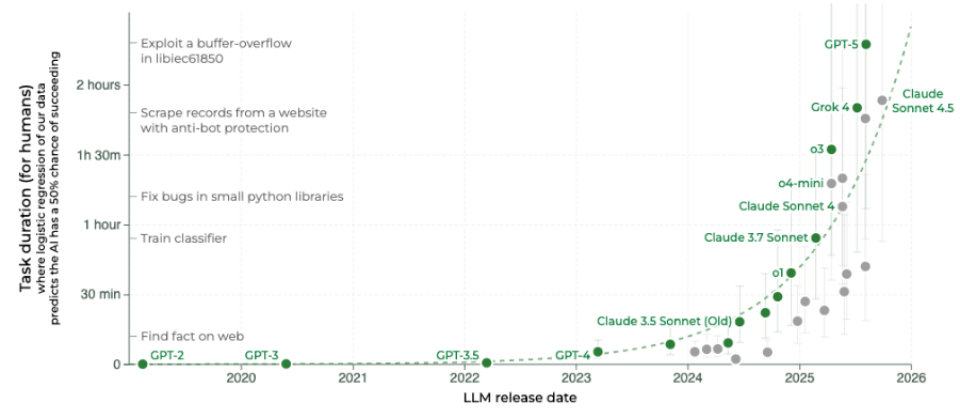
Rapid advances in the capabilities of autonomous AI agents have made the prospect of significant AI-driven productivity improvements more plausible. The length and complexity of tasks that these agents can perform autonomously has approximately doubled every seven months in domains such as coding, cybersecurity, and research (see Figure 1) [footnote 1]. Evidence also shows that, compared to chatbots, these agents are being used for automation more often than for assisting human work.[footnote 2]
Recent evaluations suggest frontier AI models can now produce expert-quality work on a significant share of real-world professional tasks. Research evaluating frontier models on over 1,300 tasks drawn from actual work products of experienced professionals found that the best-performing model produced deliverables rated as good as or better than human expert output in nearly half of cases.[footnote 3] These tasks required an average of seven hours for experts to complete. However, the evaluation covered precisely specified, self-contained digital tasks. Real work often involves greater ambiguity and iteration.
There is uncertainty over whether AI agents can be trained to reliably complete complex tasks across a broad range of domains. If this were to occur, it could have significant implications for the labour market, though the nature and scale of such impacts would depend on many factors including adoption rates, workforce adaptation, and policy responses.[footnote 4] The distinguishing features of current AI development (compared to previous technological waves) may be the potential speed of capability improvement and the breadth of cognitive tasks that could be affected. Even if AI capabilities do not advance substantially beyond current levels, wider deployment of existing systems could still affect labour markets.
Figure 1: The time-horizon of software engineering tasks different LLMs can complete 50% of the time
2. The UK’s service-sector economy is well-positioned to benefit from AI-driven productivity gains, but realising this potential will require investment and proactive management of transition risks
Around 70% of UK workers are in occupations containing tasks that AI could potentially perform or enhance, according to IMF estimates. [footnote 5] This is a higher share than the US and other advanced economies (around 60%), reflecting the UK’s service-sector-intensive economy (see Figure 2) [footnote 6]. The IMF measures exposure using an index that assesses the correspondence between AI applications and the human abilities required for each occupation, weighted by the importance and complexity of those abilities.[footnote 7] However, such exposure indices have not been extensively validated against real-world outcomes, and should be interpreted as indicative rather than precise measures of impact.
This high exposure creates both potential benefits and risks. Around half of exposed workers are in ‘high complementarity’ roles. This assessment by the IMF is based on the social and physical context of work, and includes factors where societies may be less willing to permit unsupervised AI use.[footnote 8] For these workers, AI may be more likely to boost efficiency and productivity. The other half are in ‘low complementarity’ roles where AI may be more likely to perform tasks currently delivered by human labour, creating transition challenges that will need to be managed. Further work is needed to understand the extent to which AI exposure metrics predict labour market outcomes, and other factors, such as policy, will play a role.
The scale of potential economic benefits from AI adoption is significant. OECD estimates suggest UK labour productivity growth from AI could reach 0.4–1.2 percentage points annually over the next decade, placing it second only to the US among G7 economies.[footnote 9] This reflects the UK’s high share of AI-exposed knowledge-intensive services (approximately 23% of GDP). Realising such gains could help narrow the UK’s longstanding productivity gap. UK labour productivity is around 20% below US levels.[footnote 10]
Figure 2: The UK workforce faces high AI exposure relative to the US and other advanced economies
| Advanced economies | High exposure, High complementarity | High exposure, Low complementarity | Low exposure | |
|---|---|---|---|---|
| UK | 35% | 32% | 33% | |
| USA | 30% | 30% | 41% | |
| Advanced economy average | 26% | 32% | 42% |
Note: AI exposure measures how much of a job’s tasks could, in theory, be carried out by AI, based on the correspondence between AI applications and the human abilities required for each occupation. AI complementarity assesses the social and physical context of work (including interpersonal responsibility, decision criticality, and consequences of errors) to judge how likely a job is to be replaced by AI. High complementarity jobs are less likely to be displaced but may benefit from productivity boosts, while those with low complementarity face a higher risk of AI replacing human tasks. These indices have limitations and should be interpreted as indicative rather than precise.
3. Evidence from occupation-level studies shows that AI can deliver substantial productivity gains for certain roles, but it is uncertain if and when these will scale up to firm-level or economy-wide improvements
Experimental studies have reported increased productivity amongst occupations such as software developers, writers, and consultants. A range of studies are summarised in Figure 3. These predate the deployment of more advanced reasoning and agent models, which could bring further productivity gains.[footnote 11]
Emerging evidence also suggests AI can improve the quality of work output, not just speed. A field experiment found that individuals using AI matched the solution quality of traditional two-person teams without AI, and that AI-enabled teams were significantly more likely to produce exceptional results.[footnote 12]
The emerging evidence from these studies is a useful indicator of potential but is not a guarantee of large-scale productivity gains. Experimental settings differ substantially from real-world workplaces, tasks are often more clearly specified, and environments more controlled. There is also likely to be a period of organisational adjustment in which firms experiment with AI tools, integrate them into workflows, and train staff, which may temporarily slow measured productivity.[footnote 13]
The scale of benefits will depend on adoption rates, which remain modest. While business AI adoption has more than doubled since late 2023, only around one in five firms use or plan to use AI. Within firms adopting AI, less than one-third of employees use it. Adoption also varies significantly by size and sector, large (250+ employee) and mid-sized (50-249 employee) businesses show higher AI adoption rates of 36% and 23% respectively, whereas adoption is significantly lower for micro (5-9 employee) businesses at 14%.[footnote 14]
From DSIT’s AI adoption survey, 56% of firms using AI reported productivity gains, most estimating improvements of up to 20%. However, these estimates of productivity are self-assessed rather than objectively measured, and there is currently limited robust statistical evidence that higher AI adoption at the firm level is linked to higher overall productivity.
Figure 3: Evidence AI use can boost productivity for specific occupations and tasks
| How AI can boost productivity | % |
|---|---|
| Writing tasks | 59% |
| Software development | 56% |
| IT support | 44% |
| Legal work | 34% |
| Consulting | 25% |
| Commercial and R&D IT support | 20% |
Note: Productivity impacts here refer to changes in the speed of work (time taken) when using AI tools. Results and time measurements vary by study and setting, so effects should be seen as context-specific rather than universal. Cross-study comparisons should be made with caution as methodologies differ.
4. Data suggests hiring is falling faster in occupations more exposed to AI, but establishing whether AI is causing these patterns remains challenging
Several analyses find that job postings have declined more sharply in occupations with higher AI exposure. Analysis of UK job postings found that a one standard deviation increase in AI exposure was associated with a 3.9% reduction in posting volume, with the effect becoming statistically significant approximately seven months after ChatGPT’s release and intensifying thereafter. Job postings went back to their original levels after around 20 months. The decline concentrated in high-salary occupations, with no significant change observed in low-salary roles.[footnote 15] A separate analysis from McKinsey found that between 2022 and 2025, UK job adverts fell by 38% for high-exposure occupations compared to 21% for low-exposure roles.[footnote 16]
Patterns in graduate and early-career employment are also consistent with differential impacts on AI-exposed roles. A US study using payroll data found that employment among early-career workers in highly AI-exposed occupations fell by 13%, while it remained stable or grew in less-exposed roles.[footnote 17] In 2024, UK digital sector employment dropped for the first time in a decade, with the number of 16–24-year-olds in computer programming down 44% in a single year.[footnote 18] Whilst computer programming is highly exposed to AI automation, it should be noted that this change cannot be directly attributed to AI and that job losses have occurred across the economy for various reasons unrelated to AI. For example, hospitality (a sector with relatively low AI exposure) accounted for 53% of UK job losses between October 2024 and August 2025.[footnote 19]
These patterns are suggestive, but do not yet establish that AI is the cause of the decline. The studies above are consistent with AI contributing to reduced hiring, but they do not on their own establish causality. Two main issues remain. First, exposure is not adoption. Most indices measure whether an occupation’s tasks are suitable to be assisted or replaced by AI, not whether firms have actually deployed AI in ways that reduces human labour. Second, AI exposure is correlated with other factors, such as sensitivity to interest rates, business cycles, or sector-specific shocks, that could also explain the observed patterns.
Other evidence finds no significant employment effects from AI adoption to date and highlights alternative explanations. Analysis from the Yale Budget Lab examining US labour market data over 33 months found that the occupational mix is not changing faster than during previous technological transitions, and that the share of workers in AI-exposed occupations has remained stable.[footnote 20] The authors argue that observed hiring declines in AI-exposed roles may be better explained by monetary policy tightening, which began in early 2022 (before generative AI tools were publicly available) and disproportionately affected the interest-rate-sensitive sectors (Information, Finance, Professional Services) that overlap with high AI exposure. Research using detailed Danish micro-level data found that AI adoption had no measurable effect on worker earnings or hours, with adopting workplaces showing no shifts in job creation or destruction. [footnote 21] This held even for intensive daily users and early adopters.
5. Significant evidence gaps remain; addressing them will require both in-depth research and real-time monitoring to inform timely policy responses
The evidence reviewed above reveals significant gaps in our understanding of AI’s labour market impacts. Better evidence in these areas would enable more concrete policy decisions:
- Robustly establishing causal links between AI adoption and employment or earnings changes, distinguishing AI-specific effects from correlated macroeconomic factors
- Predicting with greater confidence which specific occupations or demographic groups face the greatest displacement risk or opportunity
- Measuring the rate and nature of new job creation that may offset any displacement
- Assessing how quickly workers can transition to new or restructured roles
- Understanding how the composition of tasks within occupations is evolving as AI tools are adopted
Addressing these gaps will require improved data access, partnerships within UK government and with external researchers, and sustained engagement with the research community.
Alongside in-depth research to answer specific questions, we will need real-time data monitoring to track impacts as they develop and enable timely policy responses. The indicators below represent priority areas for ongoing assessment; specific metrics are under development and the examples given are illustrative:
a. Indicators of AI capability advancement (e.g., length and complexity of tasks agents can complete autonomously, benchmark performance across domains), drawing on work by the AI Security Institute and others
b. Proliferation of AI technologies across business and society (e.g., adoption rates for AI technologies amongst businesses of different sizes and sectors, individual usage patterns)
c. Reshaping of jobs and the workplace (e.g., AI occupational exposure scores, changes in job postings in exposed occupations, evolution of task content within roles)
d. Distributional impacts (e.g., geographical and demographic variation in adoption, AI exposure, and job creation; outcomes for early-career workers versus experienced workers)
e. Shifting macroeconomic picture (e.g., changes in employment rates, productivity metrics, wage trends, and the tax base)
f. New job creation and role emergence (e.g., tracking new roles and occupations, skills demand in job postings, emergence of AI-complementary occupations)
Subject to agreement across government on the approach to monitoring and publication, the AI and the Future of Work Unit intends to publish updates on these indicators and undertake deeper research into priority areas as we build our internal capability, establish external research collaborations, and better data becomes available.
-
METR, “How Does Time Horizon Vary Across Domains?”, July 2025 ↩
-
Anthropic, “The Impact of AI on Software Development”, April 2025 ↩
-
Patwardhan, T. et al., “GDPval: Evaluating AI Model Performance on Real-World Economically Valuable Tasks”, arXiv:2510.04374, October 2025 ↩
-
Gabriel, I. et al., “The Ethics of Advanced AI Assistants”, April 2024 ↩
-
IMF, Gen-AI: Artificial Intelligence and the Future of Work, January 2024 ↩
-
IMF, “Upskilling the UK Workforce: United Kingdom”, July 2024 ↩
-
Felten, E., Raj, M. and Seamans, R., “Occupational, Industry, and Geographic Exposure to Artificial Intelligence: A Novel Dataset and Its Potential Uses”, Strategic Management Journal, 2021 ↩
-
Pizzinelli, C. et al., “Labor Market Exposure to AI: Cross-Country Differences and Distributional Implications”, IMF Working Paper, 2023 ↩
-
Filippucci, F., Gal, P., Laengle, K. and Schief, M., “Macroeconomic Productivity Gains from Artificial Intelligence in G7 Economies”, OECD Artificial Intelligence Papers No. 41, June 2025 ↩
-
Indraccolo, L., “Bridging the Gap: Understanding the UK-US Productivity Decoupling”, IMF Selected Issues Paper SIP/2025/112, August 2025 ↩
-
Brynjolfsson, E. et al., “Generative AI at Work”, November 2024; Dell’Acqua, F. et al., “Navigating the Jagged Technological Frontier”, September 2023; Noy, S. and Zhang, W., “Experimental Evidence on the Productivity Effects of Generative AI”, July 2023; Cui, Z. et al., “The Productivity Effects of Generative AI: Evidence from a Field Experiment with GitHub Copilot”, March 2024 ↩
-
Dell’Acqua, F. et al., “The Cybernetic Teammate: A Field Experiment on Generative AI Reshaping Teamwork and Expertise”, Harvard Business School Working Paper 25-043, March 2025 ↩
-
Brynjolfsson, E. et al., “The Productivity J-Curve: How Intangibles Complement General Purpose Technologies”, January 2021 ↩
-
ONS, “Business Insights and Conditions Survey (BICS)”, July 2025 ↩
-
Klein Teeselink, B., “Generative AI and Labor Market Outcomes: Evidence from the United Kingdom”, King’s College London Working Paper, December 2025 ↩
-
McKinsey, “Not Yet Productive, Already Disruptive: AI’s Uneven Effects on UK Jobs and Talent”, July 2025 ↩
-
Brynjolfsson, E., Chandar, B. and Chen, R., “Canaries in the Coal Mine? Six Facts about the Recent Employment Effects of Artificial Intelligence”, August 2025 ↩
-
DSIT, “Economic Estimates: Employment in the Digital Sector”, January 2024 to December 2024; ↩
-
ONS and HMRC, “Earnings and employment from Pay As You Earn Real Time Information, UK”, October 2025 ↩
-
Gimbel, M., Kinder, M., Kendall, J. and Lee, M., “Evaluating the Impact of AI on the Labor Market: Current State of Affairs”, Yale Budget Lab, October 2025 ↩
-
Humlum, A. and Vestergaard, E., “Large Language Models, Small Labor Market Effects”, 2025 ↩