National Immunisation Programme Health Equity Audit 2025
Published 5 March 2026
Applies to England

© Crown copyright 2026
This publication is licensed under the terms of the Open Government Licence v3.0 except where otherwise stated. To view this licence, visit nationalarchives.gov.uk/doc/open-government-licence/version/3 or write to the Information Policy Team, The National Archives, Kew, London TW9 4DU, or email: psi@nationalarchives.gov.uk.
Where we have identified any third party copyright information you will need to obtain permission from the copyright holders concerned.
This publication is available at https://www.gov.uk/government/publications/national-immunisation-programme-health-equity-audit-2025/national-immunisation-programme-health-equity-audit-2025
Executive Summary
This updated Health Equity Audit for the National Immunisation Programme provides the clearest evidence yet that immunisation inequity in England is not only persistent but it is worsening in critical areas, with serious implications for public health protection and public confidence in the vaccination offer.
1. Inequalities in vaccination uptake remain entrenched—and in some cases have widened
The audit identifies a progressive widening of the gap between the most and least deprived groups in several immunisation programmes since 2016/17. This undermines the national objective of equitable vaccine coverage and signals systemic failure to close known gaps. Across nearly all major vaccination programmes, the audit reaffirms a stark and consistent pattern:
- Lower uptake is strongly correlated with socioeconomic deprivation, with clear gradients across the deprivation spectrum.
- Several ethnic minority groups continue to show significantly lower uptake, echoing patterns unchanged from the last audit in 2019.
- Regional inequalities persist, with coverage rates in London consistently lower than in other parts of the country.
These patterns mirror those reported in 2019 but have not meaningfully improved despite system-wide recognition and work by actors across the system to strengthen service access, improve public awareness of and confidence in vaccination, and to develop the infrastructure underpinning immunisation in England.
2. Barriers to uptake remain diverse and deeply contextual
The report provides evidence that barriers differ by community but commonly include:
- Limited service access
- Practical and logistical obstacles to taking up vaccination
- Cultural and linguistic barriers
- Mistrust or low confidence in vaccines
The breadth of these barriers underscores the need for tailored, locally co designed solutions alongside strengthened core national vaccination offers in General Practice and to school-age children, to ensure that everyone has the opportunity to be protected by full immunisation no matter who they are or where they live.
3. Critical data gaps persist, limiting the system’s ability to act
Despite improvements in the granularity of data available over recent years, for some communities, data quality and completeness are inadequate to support meaningful assessment of inequities or their drivers. Without improved data capture, linkage, and local intelligence, interventions designed to improve immunisation equity will continue to be poorly targeted and slow to evaluate.
Section 1. Introduction
1.1 The importance of immunisation equity
Immunisation saves lives. Over just the past 50 years, global immunisation efforts are estimated to have saved over 150 million lives, including over 100 million infants younger than one year of age (1). Immunisation continues to prevent between 3.5 million to 5 million deaths from over 30 life-threatening diseases and infections around the world every year (2).
However, high levels of coverage are required to realise the full benefits of immunisation. We know that large coverage gaps remain at every level, from global to local. In England, we now face a situation where none of the routine childhood immunisations meet the World Health Organization (WHO) target of 95% coverage.
We also know that coverage is not equally distributed. Where communities or population groups experience suboptimal coverage, they face an increased risk of infections and outbreaks of vaccine-preventable disease (VPD). These communities are often some of the most at-risk and underserved that are already experiencing significant health inequalities. Describing the extent and nature of this unequal coverage is an important step in maximising uptake overall and closing the gaps between communities and across different VPD programmes.
In this document, our focus is on equity in immunisation where equity is understood as “the absence of unfair and avoidable or remediable differences in health among population groups defined socially, economically, demographically or geographically” (3). Achieving equity requires the distribution of resources according to need, and not necessarily equally as is implied by a focus on equality (see Image 1).
Image 1. Equality and equity
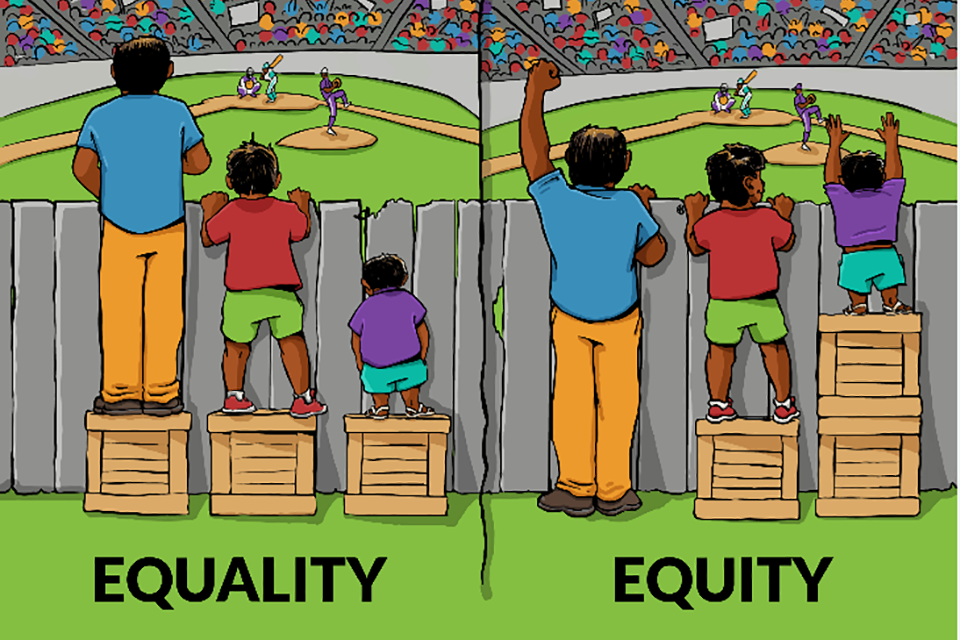
Drawing 1 (equality) shows a man and 2 boys watching baseball over a fence. All 3 stand on boxes but the shortest boy still cannot see. In drawing 2 (equity) the man stands on the ground and the shortest boy stands on 2 boxes. All 3 can now see.
(Source: Interaction Institute for Social Change | Artist: Angus Maguire)
Health inequalities in infectious diseases
The burden of infectious diseases is not distributed equally. Higher prevalence of infection and lower vaccination coverage among groups and communities that experience wider health inequalities is well documented (4). In 2025, UKHSA published the Health Inequalities in Health Protection report which provides a high-level summary of the current state of health inequalities in England caused by infectious diseases, including VPDs (5).
Epidemiological analysis of a measles outbreak in Birmingham in 2023/24 showed that 78% of the cases occurred in the city’s 20% most deprived areas and that the infection rate per 100,000 was 86.3 in the Black African ethnic group compared to 10.8 in White British group. Most cases (89%) were unvaccinated (6).
Ethnic minorities often experience worse health outcomes due to infectious disease. For example, in England, for the year 1 September 2023 to 31 August 2024, emergency admission rates for tuberculosis were 29 times higher for the ‘Asian other’ group, 27 times higher for the ‘Indian’ group and 15 times higher for the ‘Black African’ group, compared to the ‘White British’ group (5).
Early analysis of the 2022 mpox outbreak found that it disproportionately affected men who were gay, bisexual and other men who have sex with men (GBMSM), a trend that continued throughout the outbreak (7). Routine pre-exposure vaccination is now advised for GBMSM at highest risk of exposure to mpox (8).
In 2022, 50 cases of diphtheria, a now very rare infection in England due to the success of the routine immunisation programme, were detected among people seeking asylum. Cases were predominantly among young males aged 14 to 25 years old and clustered in the South East of England (9).
Socio-economic, ethnic, and geographical inequalities emerged early in the course of the COVID-19 pandemic, exacerbating existing health inequalities. For example, mortality rates from COVID-19 were higher for Black and Asian ethnic groups when compared to White ethnic groups, the opposite of the patterns seen for all-cause mortality rates in previous years (10).
1.2 Purpose, objectives and scope
Purpose
A health equity audit (HEA) is a process that examines how the determinants of health, access to relevant health services, and related outcomes are distributed across the population, to inform action. In 2019, Public Health England (UKHSA’s predecessor organisation) conducted a first HEA of the National Immunisation Programme (NIP) [Note 1] demonstrating that inequalities in immunisation exist within and between some population groups (11, 12). These inequalities varied in extent in different immunisation programmes, may be larger or smaller in different parts of the country, or when individuals belong to more than one group at a time. The audit also demonstrated that community, institutional, and policy factors, as well as the health beliefs and knowledge of individuals and families, may lead to inequalities in vaccination.
This document updates the findings of the previous audit (focusing on evidence published since the original audit was conducted) in order to provide a baseline against which progress of the UKHSA Immunisation Equity Strategy 2025 to 2030 can be measured (13).
Objectives
The objectives of this refreshed HEA were to:
- describe the scale and nature of the inequalities in vaccination uptake in England in order to identify population groups with the greatest immunisation needs
- describe the determinants of vaccination uptake as they relate to different population groups in England in order to provide insights for future immunisation system, programme or policy changes and innovation
- identify evidence gaps where immunisation inequalities have not yet been adequately estimated in order to highlight priority areas for future data collection and/or primary research
- satisfy, in part, the requirements placed upon UKHSA as a public authority under the Public Sector Equality Duty of the Equality Act 2010
Scope
This audit covered all Section 7A national immunisation programmes in England as at 1 January 2025 (see Appendix 1). Vaccinations not covered by section 7A were initially within scope, but it was recognised that the current data architecture may be insufficient to make a meaningful assessment.
All measures of vaccination uptake were considered, including overall vaccination coverage, timeliness of vaccination, and completion of vaccination schedules. Measures of vaccine confidence, often reported from a negative perspective as vaccine hesitancy within the peer-reviewed literature, were also within scope. The domains and characteristics across which inequities were explored in this audit are described in Section 2: Methods.
Measures of health outcomes (that is, VPD incidence, morbidity, mortality) and the effectiveness of interventions to improve vaccination uptake were out of scope for this audit. A separate review of the evidence from interventional studies will be conducted by UKHSA.
Audience
This document summarises the national-level picture on vaccination uptake across populations and geographies to inform implementation of the UKHSA Immunisation Equity Strategy 2025 to 2030 (13). Ahead of delegation of commissioning responsibilities to integrated care boards (ICBs) in England, it is likely to be of interest to those with responsibility for, and oversight of, immunisation activities in these organisations as context to local level analysis drawing on the template local action plan for immunisation equity (a revised version of which is in preparation), and UKHSA’s data and information sources document. However, findings will be of interest to a broad range of stakeholders across the immunisation system, from national through to local.
Section 2. Methods
2.1 General approach
UKHSA has adopted the NHS England CORE20PLUS framework as a lens through which to identify population groups who face the greatest risk of adverse health outcomes (14). The framework provides a structured way to routinely consider people and communities who are more likely to experience health inequalities. ‘CORE20’ refers to the most deprived 20% of the national population as identified by the national Index of Multiple Deprivation (IMD) (see Section 3: Socio-economic groups and deprivation for further detail) (15). ‘PLUS’ refers to population groups known to experience health inequalities. Typically, this will include some people with protected characteristics, people living in certain geographic areas, and inclusion health groups [Note 2]. It is acknowledged that different aspects of a person’s identity and life circumstances intersect to compound the disadvantage faced by people with multiple marginalised identities or adverse circumstances. Therefore, this audit adopted an intersectional approach and sought to assess the influence of intersectionality on immunisation equity where the data and evidence allowed.
An assessment of equity requires a qualitative assessment of fairness or justice, which cannot be derived from data alone. Therefore, quantitative measures of health inequalities, that is, the uneven distribution of health outcomes, are used throughout this audit as an imperfect proxy for health equity alongside peer-reviewed qualitative evidence.
Two principal activities were undertaken for this audit:
- a review of routinely collected vaccination coverage data for national immunisation programmes, with deep dives into a set of selected ‘indicator programmes’ (see Section 2.2: Indicator programmes)
- a narrative-style literature review of peer-reviewed quantitative and qualitative primary research across all vaccination programmes published between January 2019 and February 2025 (inclusive)
Further details of the methods used to compile this audit can be found at Appendix 2.
2.2 Indicator programmes
Given the scale and complexity of the NIP, 5 principal immunisation programmes were selected for in-depth analysis. Programmes were selected to represent immunisations delivered across the life course, targeted at a range of population groups including pregnant women and people with underlying medical conditions, and delivered in a range of settings such as general practice, schools and other alternative locations. The indicator programmes selected were:
- 6-in-1: the diphtheria, tetanus, poliomyelitis, pertussis, Haemophilus influenzae type b (Hib) and hepatitis B (6-in-1) immunisation programme delivered principally via general practice
- MMR: the measles, mumps and rubella (MMR) immunisation programme, delivered principally via general practice
- HPV: the routine, adolescent human papillomavirus (HPV) immunisation programme (plus the HPV immunisation programme for GBMSM). This programme is delivered via school-age immunisation services in England to young people in school years 8, 9 and 10
- Pertussis: the prenatal pertussis immunisation programme for pregnant women, which is delivered by general practice and/or maternity services to women in every pregnancy, typically between gestational weeks 20 and 32
- Influenza: the seasonal influenza immunisation programme delivered principally via general practice and community pharmacies (primarily focussing on the programmes for adults aged 65 years or more and for those aged 6 months to under 65 years with underlying medical conditions)
Further detail on these indicator programmes can be found at Appendix 3.
2.3 Presentation of findings
The findings of this audit are presented in 6 parts:
- socio-economic groups and deprivation (Section 3)
- protected characteristics in the Equality Duty (Section 4)
- geography (Section 5)
- inclusion health and at-risk groups (Section 6)
- people living with long-term conditions (Section 7)
- facilitators and barriers of vaccination uptake (Section 8)
Sections 3 to 6 are presented according to the 4 overlapping domains of the UKHSA Health Equity Assessment Tool, which aligns with the CORE20PLUS approach (16). Section 7 is added to acknowledge that people living with long-term conditions do not necessarily meet the definition of disability in the Equality Act (see Section 4.2). Image 2 summarises theses domains and represents the overlapping nature of these 5 dimensions and the intersectional nature of immunisation equity. Section 8 presents findings from the qualitative literature that examines the facilitators and barriers to vaccination uptake according to ‘The 5As’ taxonomy proposed by Thomson and others: Access, Affordability, Awareness, Acceptance, and Activation (17). Further detail on this taxonomy is included at the beginning of Section 8.
The findings of this audit should be interpreted within the context of the methods used to collect the underlying data in order to fully understand the scope and limitations of the results presented. Where appropriate, important background methodological information is included at the beginning of each section or sub-section. This is particularly pertinent in Section 3, which relies on area-level measures of deprivation, and Section 4.6, which uses various classifications and groupings of ethnicity.
Image 2. Overlapping dimensions of health inequalities

An illustration which shows the overlapping dimensions of health inequalities created using the Health Equity Assessment Tool
Section 3. Socio-economic groups and deprivation
3.1 Summary of findings
Vaccination coverage decreases as area-level deprivation increases
This was a consistent finding across the indicator programmes and other programmes explored in the peer-reviewed literature, including the COVID-19 vaccination programme. The use of large area (for example, upper tier local authority) and out-of-date measures of deprivation limits the robustness of individual measures of the size of the effect.
Inequalities between the least and most deprived areas have widened over time
This was observed in all indicator programmes where sufficient trend data was available and was supported by findings from the peer-reviewed literature.
Evidence from the COVID-19 vaccination programme demonstrates that inequalities in vaccine uptake appeared early and widened over the course of the pandemic
These findings from the peer-reviewed literature were consistent in national, regional, and population-specific analyses.
There is evidence of intersectionality in COVID-19 vaccination uptake
Namely, the effect of deprivation on uptake appears to be greater among younger age groups and among ethnic minorities.
The MMR catch-up campaign showed a progressive pattern of change in coverage
For all age cohorts, the greatest percentage change in coverage was observed in the most deprived deciles. While more deprived populations had lower baseline coverage, and therefore greater opportunity for larger increases, the campaign appears to have been effective at reaching those most in need and thus reduced inequalities.
Socio-economic status (SES) is a descriptive term for a person’s particular set of social and economic circumstances, including their educational and occupational background. There are many classifications systems for SES that vary in their complexity.
The most common classification used in health research is the Index of Multiple Deprivation (IMD): a measure of small-area (Lower Super Output Area [LSOA]) relative deprivation that combines 39 indicators across 7 domains: income, employment, education, skills and training, health deprivation and disability, crime, barriers to housing and services, and living environment (15). IMD is often stratified into quintiles or deciles to examine systematic differences between people living in areas considered the most deprived and least deprived, or trends along the deprivation gradient. The CORE20 in the CORE20PLUS framework refers to the most deprived 20% of the national population, that is, IMD quintile 1 or IMD deciles 1 and 2.
Where IMD is calculated using larger areas, such as at upper tier local authority (UTLA) level, or proxy measures, such as patient’s GP practice postcode instead of their home address, this can lead to an inaccurate representation of the true level of deprivation experienced by individuals and may mask hidden pockets of more/less deprivation. This practice is often used where more granular data is unavailable, as in this audit, to explore broad trends across the population. Such findings must be interpreted with caution. It is also important to consider that there is often a bi-directional relationship between SES and other personal factors, such as ethnicity and cultural background. This should be considered when interpreting observed associations between measures of SES and health data. Furthermore, IMD is a static measure, and the version used for much of the analysis described in this audit (IMD2019) is based on data from 2015/16; a more recent version, IMD2025, has since been published (although this has not – as of the publication of this audit – been incorporated into reporting of coverage data) (18). This limits the robustness of conclusions that can be drawn from the trends in data over time as comparisons are not like-for-like.
The findings in this section are presented in 2 parts:
- data from the indicator programmes
- evidence from the quantitative literature on national immunisation programmes
3.2 Data from indictor programmes
6-in-1 and MMR vaccinations
The Public Health Outcomes Framework (PHOF) provides summaries of the Cover of Vaccination Evaluated Rapidly (COVER) programme data for several indicators of childhood vaccination coverage in England by UTLA IMD decile (19). Table 1 and Figures 1 and 2 display the data for 3-dose coverage of the 6-in-1 vaccine at 12 months (indicator D03c) and one-dose coverage for the MMR vaccine at 24 months (indicator DO3j) from 2016/17 to 2023/24. Note that some of the data have been calculated using slightly different geographical borders for IMD: 2016/17 to 2020/21 data uses IMD2019 4/19 and 4/20 geography, while 2021/22 to 2024/5 uses IMD2019 4/21 geography.
The data indicates that:
- in general, coverage in 2024/25 is progressively lower in areas of greater deprivation for both indicators (see Table 1)
- from 2016/17 to 2024/25, coverage has decreased in all but the least deprived decile for both indicators (see Table 1)
- for the 6-in-1 vaccine, inequality has widened over time: the difference between the least and most deprived IMD deciles increasing from 0.1pp (in favour of the most deprived decile) to 6.6pp (in favour of the least deprived decile) (see Figure 1)
- For the MMR vaccine, inequality has also widened over time to an even greater extent: the difference between the least and most deprived IMD deciles increased from 1.0pp (in favour of the most deprived decile) to 7.6pp (in favour of the least deprived decile) (see Figure 2)
Table 1. Hexavalent combination (6-in-1) vaccine and measles, mumps and rubella (MMR) vaccine coverage by upper tier local authority IMD decile, 2016/17 and 2024/25
| 6-in-1 3-dose coverage at 12 months | MMR one-dose coverage at 24 months | |||||
|---|---|---|---|---|---|---|
| IMD 2019 decile | 2016/17 (%) | 2024/25 (%) | Trend (pp) | 2016/17 (%) | 2024/25 (%) | Trend (pp) |
| England | 93.4 | 91.3 | ▼2.1 | 93.4 | 88.9 | ▼2.2 |
| 10 (least) | 93.0 | 94.0 | ▲1.0 | 90.6 | 92.0 | ▲1.4 |
| 9 | 94.9 | 93.6 | ▼1.3 | 92.6 | 91.9 | ▼0.7 |
| 8 | 94.5 | 91.8 | ▼2.7 | 92.8 | 89.5 | ▼3.3 |
| 7 | 94.2 | 93.5 | ▼0.7 | 92.3 | 91.9 | ▼0.4 |
| 6 | 91.6 | 91.1 | ▼0.5 | 89.5 | 88.9 | ▼0.6 |
| 5 | 90.8 | 90.5 | ▼0.3 | 89.0 | 87.6 | ▼1.4 |
| 4 | 93.4 | 91.0 | ▼2.4 | 91.4 | 86.8 | ▼4.6 |
| 3 | 93.6 | 90.1 | ▼3.5 | 92.2 | 86.5 | ▼5.7 |
| 2 | 93.5 | 89.4 | ▼4.1 | 93.0 | 87.8 | ▼5.2 |
| 1 (most) | 93.1 | 87.4 | ▼5.7 | 91.6 | 84.3 | ▼7.3 |
Source: Public Health Outcomes Framework (indicators D03c and D03j)
Figure 1. 6-in-1 vaccine 3-dose coverage at age 12 months from 2016/17 to 2024/25, by upper tier local authority IMD decile

(Source: Public Health Outcomes Framework indicator D03c)
Figure 2. MMR vaccine one-dose coverage at age 24 months from 2016/17 to 2024/25, by Upper Tier Local Authority IMD decile
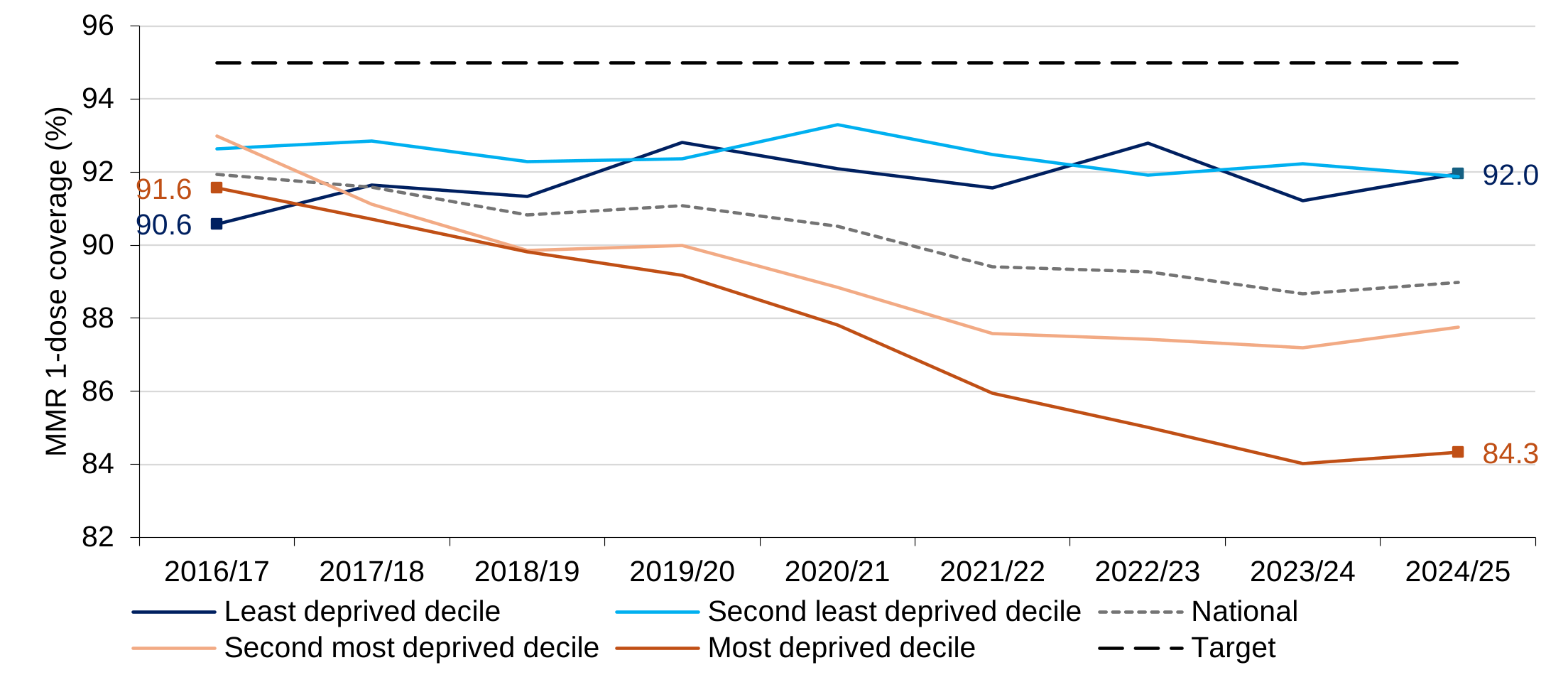
(Source: Public Health Outcomes Framework indicator D03j)
There is evidence from routine data that targeted activities can have appreciable impacts on narrowing immunisation inequalities by SES. For example, a national MMR catch-up campaign for children, young people and young adults was launched by NHS England in November 2023 in response to regional outbreaks and an overall national exceedance in measles cases. An evaluation of this catch-up activity, using Immunisation Information System (IIS) data measured prior to (31 August 2023) and at the end of (30 April 2024) the catch-up period, found that (20):
- more than 180,000 additional doses of MMR vaccine were delivered during the campaign, with over 13% of previously unvaccinated children under the age of 5 years receiving MMR1
- for all age cohorts for both MMR1 and MMR2, the greatest percentage change in coverage was observed in the most deprived deciles (decile 1), whilst the smallest percentage change was observed in the least deprived deciles (deciles 9 and 10) (see Figure 3).
Figure 3. Percentage point change in percent vaccinated with MMR dose 1 and 2 by cohort and IMD decile

(Source: Evaluation of vaccine uptake during the 2023 to 2024 MMR catch-up campaigns in England)
HPV vaccination
Analysis of UKHSA statistical publications of coverage data for the adolescent HPV vaccination programme also demonstrates variation in uptake by UTLA IMD quintile.21 For one-dose coverage in year 9 students, the analysis indicates that since 2020:
- coverage decreases as area-level deprivation increases for both female and male students
- inequality has widened over time, for example the difference between the least and most deprived IMD deciles has increased from 0.8pp to 13.9pp (see Figure 4).
Figure 4. HPV vaccine coverage for year 9 female students from academic year 2017/18 to academic year 2021/22 by Local Authority IMD quintile

(Source: UKHSA/Alvi and others (21))
Prenatal pertussis vaccination
Linkage of 2024/25 prenatal pertussis vaccination ImmForm data with the IMD deciles of each woman’s GP practice postcode, performed by UKHSA for this audit, reveals:
- a broadly linear association of increasing uptake with decreasing deprivation (see Figure 5)
- inequality in uptake between the most and least deprived IMD deciles of 18.9pp
Figure 5. Prenatal pertussis vaccination coverage by GP IMD decile, 2024/2025

(Source: ImmForm)
Seasonal influenza vaccination
Seasonal influenza vaccine uptake in GP patients is reported by UKHSA for each winter season (22). Uptake during the 2024/25 season is presented in Figure 6 for those aged 65 years or more and those in clinical risk groups, stratified by IMD using GP practice postcodes. The data indicates that:
- a broadly linear association of increasing uptake with decreasing deprivation (see Figure 6)
- the magnitude of the inequality in coverage between the least and most deprived IMD deciles was similar in both groups at 11.6pp for the 65+ and over and 11.7pp for clinical risk groups
- this inequality in uptake by IMD varies by NHS commissioning region: highest in London among the 65+ (21.8pp) and lowest in the South East for clinical risk groups (7.7pp)
- separate deprivation data from the PHOF (using UTLA IMD deciles) show that inequalities have widened in both groups since the last pre-pandemic season (2019/20) to the 2023/24 season, from 2.9pp to 8.8pp among the 65+ and from 2.6pp to 9.5pp among clinical risk groups
Figure 6. Influenza vaccine coverage for those aged 65 years and over and 6 months to under 65 years in clinical risk groups in 2024/25, by GP practice IMD decile

Source: Seasonal influenza vaccine uptake in GP patients: winter season 2024 to 2025)
Multiple programmes
The direction of effect that area-level deprivation exerts on vaccination coverage is consistent across all programmes for which data is available in the PHOF: coverage is lower in the most deprived decile compared to the least deprived decile (see Table 2). Inequalities range from 22.3pp in the HPV vaccination programme among female Year 10 students to 3.7pp for the pneumococcal polysaccharide vaccine among adults aged 65 years or more.
Table 2. Difference in uptake of national immunisation programmes between the least deprived and most deprived UTLA IMD deciles in 2024/25
| Programme | Age at measurement | National coverage (%) | Coverage in least deprived decile (%) | Coverage in most deprived decile (%) | Difference (pp) |
|---|---|---|---|---|---|
| 6-in-1 (3 doses) | 12 months | 91.3 | 94.0 | 87.4 | ▼6.6 |
| MenB | 12 months | 91.0 | 93.4 | 87.0 | ▼6.4 |
| Rotavirus | 12 months | 88.8 | 91.6 | 83.6 | ▼8.0 |
| PCV | 12 months | 93.1 | 94.6 | 90.2 | ▼4.2 |
| 6-in-1 (3 doses) | 2 years | 92.5 | 94.7 | 89.4 | ▼5.3 |
| MenB booster | 2 years | 87.3 | 91.2 | 82.2 | ▼9.0 |
| MMR1 | 2 years | 88.9 | 92.0 | 84.3 | ▼7.7 |
| PCV booster | 2 years | 88.0 | 91.4 | 83.2 | ▼8.2 |
| Hib/MenC | 2 years | 88.6 | 91.0 | 84.0 | ▼7.0 |
| Influenza [note 1] | 2 to 3 years | 56.3 | 53.0 | 30.4 | ▼22.6 |
| DTaP/IPV booster | 5 years | 81.3 | 85.7 | 76.7 | ▼6.0 |
| MMR1 | 5 years | 91.8 | 94.1 | 89.3 | ▼4.8 |
| MMR2 | 5 years | 83.7 | 87.9 | 79.0 | ▼8.9 |
| Influenza [note 1] | 4 to 11 years | 54.5 | 66.7 | 40.8 | ▼25.9 |
| HPV (female) [note 2] | 12 to 13 years | 71.3 | 81.1 | 60.8 | ▼20.3 |
| HPV (male) [note 2] | 12 to 13 years | 65.2 | 76.7 | 54.5 | ▼22.2 |
| HPV (female) [note 3] | 13 to 14 years | 62.9 | 73.6 | 51.3 | ▼22.3 |
| HPV (male) [note 3] | 13 to14 years | 56.1 | 66.1 | 44.0 | ▼22.1 |
| MenACWY [note 2] | 14 to 15 years | 73.4 | 81.8 | 61.1 | ▼20.7 |
| Influenza (at risk) | 6 months to 65 years | 49.1 | 45.0 | 33.6 | ▼11.4 |
| Influenza | 65 years and over | 79.9 | 78.3 | 68.0 | ▼10.3 |
| PPV | 65 years and over | 71.8 | 75.2 | 70.4 | ▼4.8 |
| Shingles [note 3] | 71 years | 48.3 | 50.9 | 40.8 | ▼10.1 |
Note 1: 2024 flu season coverage data.
Note 2: 2023/2024 coverage data.
Note 3: 2022/2023 coverage data.
Source: Public Health Outcomes Framework
3.3 Evidence from the quantitative literature
The association between vaccination coverage and measures of socioeconomic deprivation was widely reported within the quantitative literature.
Using the slope index of inequality (SII), an indicator of the association between health outcomes and socioeconomic deprivation, Flatt and others, quantified the widening in inequalities in uptake of several childhood vaccinations among approximately 2.4 million children under 5 years of age between 2019/20 and 2022/23 (23). This study found that:
- for all vaccinations studied (MMR1, MMR2, rotavirus, pneumococcal booster, and 6-in-1), the SII increased over the study period, with the greatest change and highest absolute inequality seen for MMR dose 2 at 5 years of age
- the estimated number of children susceptible to measles increased 15-fold in the least deprived IMD decile and 20-fold in the most deprived IMD decile
- the greatest inequalities were observed in London and Northern regions
An ecological study examined the population-wide variation in COVID-19 vaccination uptake and mortality rates 28 days after a positive COVID-19 test by IMD quintile across 307 lower tier local authorities in England between March 2020 to December 2022 (24). It found that:
- inequalities in uptake widened between the most and least deprived IMD quintiles with each dose, from 7.9pp for dose one (73.7% versus 81.6%) to 14.6pp for dose 3 (52.4% versus 67.0%)
- despite inequality in mortality decreasing following vaccination roll-out, had the vaccination rates in the most deprived areas equalled those in the least deprived, the inequality in mortality rates would have been 40.2 instead of 118.9 per 100,000 by the end of 2022
Several other retrospective studies reported similar findings, some demonstrating that the association between uptake and deprivation remained after adjusting for a range of factors including sex, ethnicity, maternal age, region, GP surgery, and whether children were born before or during the COVID-19 pandemic (25, 26, 27, 28, 29, 30). This suggests that deprivation exerts a negative effect on childhood immunisation coverage that is independent of these other factors. For example, analysis of ImmForm data showed a decreasing trend for 2-dose MenB coverage as deprivation quintile increased among children becoming 12 months of age; the most deprived quintile had 2-dose coverage 3.2pp lower than the least deprived quintile after adjustment for ethnicity and region (30).
Variation in uptake of the COVID-19 vaccine by deprivation was found to interact with numerous other equity factors, including ethnicity and age group, suggesting a degree of intersectionality. For example:
- differences in vaccination rates between the most and least deprived IMD quintiles was 18pp in the Black Caribbean ethnic group compared to 5pp in the White British group (31)
- an analysis of vaccination records from over 35 million adults showed that variation by deprivation was greater among younger age groups, the difference between least and most deprived areas being 23pp (83% versus 60% vaccinated) among 18 to 29 year olds but only 3pp (98% versus 95% vaccinated) in people aged 80 years or more (32)
Studies undertaken with specific population groups also found variation in COVID-19 vaccination uptake by deprivation. This included multiple studies undertaken with pregnant women, people living with a range disabilities or long-term life-limiting conditions, and in regional populations (33, 34, 35, 36, 37, 38, 39, 40, 41).
The association between greater deprivation and lower uptake of adolescent vaccination programmes was also apparent. For example:
- aggregated data from approximately 1,500 schools found that those in the least deprived quintile areas had significantly higher vaccination coverage for both HPV and MenACWY among year 9 students when compared to schools in the most deprived areas, after adjusting for various factors including ethnicity and deprivation (42)
- an ecological analysis demonstrated lower uptake of MenACWY vaccination among Year 10 pupils in 129 schools in Greater Manchester in schools with a higher proportion of children eligible for free school meals, a proxy measure of deprivation (43)
Greater relative deprivation was also associated with lower uptake among older adults. Two large retrospective analyses demonstrated that socioeconomic deprivation was significantly associated with lower uptake of the influenza, pneumococcal and shingles vaccines among adults aged 65 years or more (44, 45). Larger household size, a possible proxy measure of deprivation, was also associated with lower vaccine uptake of all 3 vaccines, especially in households of 10 or more members (45).
Several regional analyses demonstrated similar associations, including:
- in the South West in 2015/16, influenza vaccination uptake among 5 and 6 year olds reduced progressively with increasing deprivation, regardless of provider type (that ism, GP, pharmacy, or school-based programmes) (46)
- in Greater Manchester between 2015/16 and 2021/22, income deprivation was associated with lower influenza vaccine uptake among children and older adults and, while uptake increased across all age groups during the pandemic, it did so disproportionately in the least deprived areas, widening existing inequalities (47)
- in Liverpool general practices in 2022/23, influenza vaccination coverage was significantly associated with the GP surgery IMD (48)
Beyond area-based measures of deprivation, lower COVID-19 vaccination rates have also been observed according to individual elements of socio-economic status, such as a lower level of educational attainment, living in rented or other accommodation (versus owner-occupied), living alone or in a multigenerational household, and eligibility for free school meals (32, 49, 50). COVID-19 vaccine hesitancy, as for low uptake, has been consistently associated with lower income and a lower level of educational attainment in a large number of surveys and qualitative studies (51, 52, 53, 54, 55, 56, 57, 58, 59, 60, 61).
There was also a wealth of literature examining the variation in COVID-19 uptake by occupation. For example, analysis of nationwide population-level data of over 15 million working age (18 to 64 years) adults in England showed that (63):
- health professionals (84.7%) and teaching and other educational professionals (83.6%) had the highest rates, whereas people working in elementary trades and related occupations (57.6%) had the lowest
- differences were largely unchanged after adjustment for potential confounders such as age, sex, ethnicity and educational attainment
- those able to work from home had higher vaccination rates than people with occupations that involved contact with the public or at-risk people, suggesting that uptake was not in accordance with individual risk of infection
In a separate study, across all 3 doses, uptake was around 3% lower in high-risk occupations than in low-risk occupations, broadly corresponding with occupation-based classifications of socio-economic status in the UK (64). Other studies found more nuanced patterns (65, 66).
Several studies explored the rates of COVID-19 vaccination specifically among healthcare workers (HCWs) showing that, in general, higher paid health professions had higher vaccination uptake, including:
- analysis of over 23,000 participants of a prospective cohort (SIREN) study among staff working in publicly funded hospitals in the UK showed that, after accounting for potential confounders, significantly lower COVID-19 vaccination coverage was associated with job role (particularly low in porters, security and estates, and midwives), as well as age, ethnicity, and deprivation (67)
- a smaller single-centre cohort study of over 2,000 HCWs at a London hospital found that one-dose uptake was significantly higher in surgeons, medics and allied health professionals than in nurses, and porters and catering staff (68)
Findings from cross-sectional surveillance of nearly 20,000 HCWs in the East Midlands appeared to buck this trend, showing that allied health professionals, healthcare scientists, and administrative/executive staff were all around 1.5 times more likely to be vaccinated than doctors. However, after excluding locum and bank contracts, doctors were no less likely than other groups to be vaccinated (69).
Section 4. Protected characteristics in the Equity Duty
4.1 Summary of findings
A wealth of evidence suggests that belonging to an ethnic minority is associated with lower vaccination coverage
Where ethnicity data is available, there are consistent patterns in lower coverage among ethnic minorities, particularly Black ethnic groups, in a wide range of populations. However, some Asian ethnic groups have vaccination rates comparable to, or higher than, the White British population. The higher coverage among children of Pakistani ethnicity in Bradford, and among clinical risk groups in London’s Bangladeshi community, are notable examples which may provide insights into improving immunisation equity.
The MMR catch-up campaign showed a progressive pattern of change in coverage among ethnic minorities
The greatest percentage change in coverage was observed in ethnic groups with historically lower baseline coverage of MMR vaccination, particularly Black ethnic groups. The campaign appears to have been effective at reaching those ethnic groups most in need and thus reduced inequalities.
Vaccination uptake among pregnant women is suboptimal and intersects with other equity factors
Uptake of the both the seasonal influenza and COVID-19 vaccinations were disproportionately low among pregnant women compared to other eligible groups. Other factors such as increasing deprivation, extremes of childbearing age, and belonging to an ethnic minority (particularly Black ethnic groups) appear to negatively effect uptake among pregnant women.
Increasing age is associated with higher uptake of vaccinations aimed at older adults
Uptake of the seasonal influenza and COVID-19 vaccinations appears to increase with age among older adults, before falling among those of extreme older age. There was less evidence to suggest an effect of age among childhood programmes, although children born to young mothers or during the pandemic were more likely to have lower/slower uptake.
There is little evidence of variation in vaccination coverage between sexes
Sex appears to exert only a minimal (if any) effect on vaccination uptake at a national level, other than for the HPV immunisation programme, which may be explained by its later rollout among male adolescents and its primary intent of preventing cervical cancer in women. There is very little evidence available to assess immunisation equity among minority genders.
Uptake of targeted vaccinations among eligible GBMSM appears adequate overall but with some evidence of inequalities
National data suggests that a very low proportion of GBMSM had ever declined an HPV vaccination, although declining vaccination appears to be associated with belonging to an ethnic minority or having been born outside the UK, but not deprivation. Those who remain unvaccinated may choose to do so based on their personal risk factors, such their relationship status and number of sexual partners. There is very little evidence available to assess equity among people of other specific sexual orientations.
Vaccination uptake among children and young people with intellectual or learning disabilities appears to be lower than in the those without
This pattern appears to be consistent across a number of programmes within the peer-reviewed literature and is corroborated by data presented in Section 7. There is a lack of routinely collected data on the presence of other impairments meeting the definition of disability under the Equality Act.
At a national level, there is very limited evidence to suggest that immunisation equity is materially influenced by gender reassignment, marriage and civil partnership, and religion or belief
However, data on these protected characteristics are not routinely collected and the absence of evidence does not equal evidence of absence. At a local level, low vaccination uptake among some religious communities (for example, Haredi Jewish families in North London) has been previously well-documented but is not prominently reported in the national data or quantitative literature since 2019.
The findings in this section are presented in 9 parts in accordance with the 9 protected characteristics, combining data from the indicator programmes with findings from the literature review, including evidence related to COVID-19 vaccination uptake.
4.2 Age
Due to age being integral to the eligibility criteria for all national immunisation programmes, assessing variation in uptake by age within the data from the indicator programmes was of limited value. However, within the published literature, uptake of childhood vaccinations was found to vary with a range of age-related factors, for example:
- a study of nearly 800,000 linked mother-baby records from 2000 to 2020 found that children of younger mothers (aged 20 and under) were 12% and 6% less likely to have received MMR1 and MMR2 at ages 2 and 5 years respectively, compared to older mothers (aged 31 to 40 years) (25)
- among over 500,000 children born between 2006 and 2014, the later the age at which a vaccine was due within the schedule, the greater the risk of delay in receiving the vaccination (70)
- those born or due to receive vaccinations during the COVID-19 pandemic lockdown periods received less timely 6-in-1 and MMR vaccination (28, 71)
- among children attending an emergency department in Greater Manchester in October 2021, children eligible for preschool boosters had significant unmet vaccination needs with MMR2 uptake considerably lower than tetanus booster despite being scheduled together (72)
Uptake of the seasonal influenza vaccine was also found to vary with age between and within eligible groups (44, 48, 73, 74, 75). For example:
- coverage among older adults was significantly higher than in young children during the 2022-23 influenza season in Liverpool (48)
- overall annual uptake between 2011 and 2016 for those aged 65 years or more increased with ascending age up to the age of 85 years, then decreased (44)
Regarding the COVID-19 vaccination programme, several whole-population studies explored uptake across different age groups. As expected with the phased rollout of the programme according to age group, at a national level younger age groups had progressively lower coverage at various points in time throughout the pandemic (49, 76, 77) However, those aged over 100 years were found to be 60% more likely to be unvaccinated than those aged 70 to 74 years, after adjustment for a range of other factors (49).
Older age was associated with greater uptake of the COVID-19 vaccine in a range of specific population groups including pregnant women, adolescents, social media users, and in young adults when compared to their mothers (33, 50, 51, 78, 79). A number of surveys conducted prior to the rollout of the COVID-19 vaccine also demonstrated younger age to be associated with lower vaccine confidence (52, 53, 54, 55, 56, 57, 60, 62, 80, 81, 82).
4.3 Disability
Disability is defined under the Equality Act 2010 as having a physical or mental impairment that has a substantial (for example, it takes much longer than it usually would to complete a daily task like getting dressed) and long-term (12 months or more) negative effect on your ability to do normal activities (83). While it is acknowledged that the presence of impairments such as mobility limitations and sensory deficits are likely to influence vaccination uptake, such data is not routinely collected and therefore a thorough assessment of immunisation equity from a disability perspective is not feasible.
There is substantial overlap between disability and the presence of diagnosed long-term conditions. However, not all people living with long-term conditions experience substantial and long-term impairments due to their condition and therefore these terms are not synonymous. Therefore, people living with long-term conditions are considered separately in Section 8.
One population group for which there is evidence from the routine data and the peer-reviewed literature is people living with intellectual or learning disabilities. These studies typically show that the presence of such disabilities has a negative effect on uptake of a range of vaccinations.
For example, a cross-sectional study of over 18,000 children born in the UK between 2000 and 2002 found that vaccination coverage rates were lower for children with intellectual disabilities for all vaccinations at all ages when compared to children without intellectual disability, with one exception (MMR coverage at age 5 years) (84). The strength of this association was reduced after adjusting for family socioeconomic position and other factors including maternal age and belonging to an ethnic minority (84). However, the differences in coverage were minimal at age 5 years, with children with intellectual disabilities appearing to catch-up with their peers after a period of greater susceptibility due to under-vaccination in early childhood (84).
Other examples include:
- analysis of aggregated data from year 9 pupils attending approximately 1,500 schools in 2016/17 showed that special schools and pupil referral units had significantly lower vaccination coverage for HPV (26.4% and 41.1% lower, respectively) and MenACWY (18.0% and 39.6% lower respectively) when compared to state-funded secondary schools, after adjusting for various factors including ethnicity and deprivation (42)
- a cross-sectional study of state-funded secondary school pupils during the academic year 2021/22 showed that less than half (48.1%) of 200,000 pupils aged 12–15 years that have accessed special educational needs support were vaccinated against COVID-19, compared to 53.5% of the more than one million pupils that had not accessed such support (50)
- COVID-19 vaccination uptake also varied among CYP with life-limiting neuro-disabilities, being much higher in 16 to 17 year olds (72.5%) than in 5 to 11 year olds (17.0%), with the lowest rates of uptake among Black CYP (18.7%) compared to White CYP (38.3%) and in CYP living in the most deprived IMD quintile (26.0%) compared to the least (47.0%) (37)
People with learning disabilities are eligible for the seasonal influenza vaccination. Coverage rates in those with learning difficulties are discussed in Section 7 alongside other clinical indications for this vaccination.
More generally, a national study of over 6.5 million adults aged 70 years or more demonstrated a higher likelihood of being unvaccinated against COVID-19 in those who were ‘limited a little’ or ‘limited a lot’ by a disability when compared to those who were ‘not limited’, after adjusting for a range of sociodemographic and other factors (49). Other population-level analyses have demonstrated similar findings of lower vaccination rates in people recorded as living with a disability (32, 49). Data from a cross-sectional study of over 10,000 adults indicates that living with a disability was associated with higher vaccine confidence among White respondents but lower vaccine confidence in other ethnic groups (85).
In a whole population study of people aged 70 years or more, living in a care home (often associated with different forms of disability) was associated with a higher one-dose but lower 2-dose coverage (77). Possible explanations include the logistical and administrative difficulties in the follow-up of partially vaccinated individuals as they moved in and out of adult social care settings as well as the role of (COVID-19 or other) infection at the time of vaccine offer. Living in a care home was found to be protective against being unvaccinated in another study (49).
4.4 Gender reassignment
The review identified no evidence to suggest that gender reassignment materially influences immunisation equity, although it is acknowledged that data on this protected characteristic are not routinely collected. This highlights the need for disaggregated data for both sex assigned at birth and gender identity in order to monitor immunisation inequalities among gender diverse people.
4.5 Marriage and civil partnership
Marriage and civil partnership status was not prominently reported within the literature nor is it routinely presented in epidemiological reports.
One cross-sectional survey of 372 UK-based older adults aged 65 to 92 years found that those who reported being single, separated/divorced, or widowed had a greater likelihood of not receiving the COVID-19 vaccination compared to those who were married or co-habiting (86).
4.6 Pregnancy and maternity
It is difficult to assess pregnancy and maternity as a factor influencing immunisation equity because non-pregnant women are not routinely offered the same vaccinations, at the same stage in the life course, as pregnant women. In addition, there are programmes that are specifically targeted to pregnant women on the basis of clinical risk to the unborn infant rather than to the mother (for example, prenatal pertussis) that are not offered to non-pregnant women. This section therefore focuses on (i) evidence of differential uptake where pregnant women are one of a number of risk groups offered the vaccination in question, and (ii) between pregnant women from different populations for the same programme.
Pregnancy compared to other risk groups
One programme that may offer some insight, through comparison with other eligible groups, is the seasonal influenza vaccination programme. While the rationale for the seasonal influenza vaccination is broadly the same in all eligible groups (that is, to offer both personal protection to those at greatest risk and to protect wider society through the reduction of community transmission), the motivation for uptake, mechanism of delivery, and data capture will differ. Comparison between eligible groups should therefore be interpreted with caution. Also note that during the 2024/25 season, for the first time adult groups (excluding pregnant women) were eligible from 3 October, rather than 1 September as in previous seasons. Therefore, data for those aged 65 years and over, and those aged under 65 years in clinical risk groups, is not comparable with previous seasons.
Figure 7 summarises the uptake of the seasonal influenza vaccination during the previous 2 winter seasons in all eligible groups. It shows that:
- uptake among pregnant women was suboptimal in both 2023/24 (32.1%) and 2024/25 (35.0%)
- uptake among pregnant women was lower than in all other eligible groups in both seasons
- if pregnancy was considered an individual clinical risk group, it would have the lowest seasonal influenza coverage, lower than ‘any learning disability’ at 33.2% for 2024/25 (see Figure 22 in Section 7)
- in contrast to the majority of other eligible groups, uptake among pregnant women increased (by 2.9pp) from 2023/24 to 2024/25
Figure 7. Seasonal influenza vaccination coverage during the 2023/24 and 2024/25 seasons among eligible groups

Source: ImmForm / Seasonal influenza vaccine uptake in GP patients: winter season 2024 to 2025)
As seen in the data for the seasonal influenza vaccination programme, 4 studies provided evidence that uptake of the COVID-19 vaccination was disproportionately low among pregnant women compared to other eligible groups (33, 34, 35, 36). Within these studies, several factors were consistently identified as being associated with lower uptake, including younger age (various categories all under 30 years), identifying with a Black ethnic group, and living in more deprived areas (33, 34, 35, 36). One small study also identified that living in a household with no other vaccinated members, using less regulated information sources such as friends/family and social media, not receiving information about the vaccine at antenatal appointments, and low English language proficiency were associated with lower vaccination uptake (36). However, women with chronic conditions, such as asthma, chronic heart disease and diabetes, were more likely to receive at least one dose of the vaccine than those without, while women with pregestational diabetes were 10 times more likely to receive a vaccination (33, 34).
Pregnancy as a factor between population groups
Numerous studies identified lower rates of influenza and/or pertussis vaccination uptake among pregnant women identifying with a Black ethnic group and higher rates among those identifying with White or Asian ethnicity (87, 88, 89, 90, 91). Multiple other factors were variably associated with vaccination uptake including lower uptake among women at the extremes of childbearing age, those living in more deprived areas or with low incomes, and those with a greater number of children in the household, but higher uptake in those with an additional indication for vaccination (that is, an at-risk condition), those with a planned versus unplanned pregnancy, primiparous women, and those booking within the first trimester (87, 88, 89, 90, 91, 92).
Pregnancy was also found to be associated with lower COVID-19 vaccine confidence (57, 93). In one online survey of over 1,000 pregnant women, low income and younger age were also associated with lower vaccination acceptance, while pregnant women in any Black ethnic group were twice as likely to reject a vaccine for themselves and their babies compared to White ethnic groups (93).
4.7 Race
The Equality Act 2010 lists ‘race’ (including colour, nationality, and ethnic or national origins) as a protected characteristic whereas, within the scientific literature, ‘ethnicity’ is more commonly cited as an epidemiological variable. Whilst these terms have important differences in meaning, this audit will refer to ethnicity in exploring the variation in immunisation coverage for this protected characteristic. This audit accepts that ethnicity is a multi-faceted, self-identified and fluid concept; ethnicity refers to the group to which people belong, as a result of shared characteristics such as geographical and ancestral origins, cultural traditions, and languages (94). The ethnicity categories described below reflect those which are presented in the source material; it is acknowledged that the use of such categories does not reflect the full diversity of certain ethnic groups and may mask hidden variation in immunisation uptake.
Ethnicity data may not always be reliably recorded, or recorded at all, limiting the conclusions that can be drawn from analysing health data. It is also important to consider that associations between immunisation and ethnicity may be influenced by contributing and confounding variables, such as geography, religion, and socio-economic status. This should be considered when interpreting observed associations between ethnicity and immunisation uptake presented below. Nevertheless, the patterns and trends identified in this audit highlight important variations that warrant description in detail.
As described in Section 3, an evaluation of the MMR catch-up activity undertaken between November 2023 and April 2024 found variation in immunisation uptake according to a number of factors, including ethnicity (as recorded in IIS) (20). The data shows that:
- the largest gains were observed among ethnic groups with historically lower baseline coverage of MMR vaccination, including people from African, Arab, other Black, and White Gypsy and Irish Traveller ethnic groups (see Figure 8)
- excluding those with unknown ethnicity, the largest single increases in coverage were seen for MMR2 in the 3 years and 7 months to 5 years of age cohort in those with ethnicity recorded as any other Black background (5.04pp) and African (5.00pp)
- the smallest single increase was seen for MMR1 in the 12 to 25 years of age cohort in those with ethnicity recorded as White British (0.09pp), possibly reflecting the higher baseline coverage in this group
- when ethnicity was aggregated according to the Office for National Statistics (ONS) Census 2021 Ethnic group classification 6a, in all age cohorts and for both MMR1 and MMR2, the largest increases in coverage were seen in Black, Black British, Caribbean, or African ethnicities and the lowest increases in the White British ethnic group (95)
The annual report for prenatal pertussis vaccination coverage in 2024/25 also describes coverage by ethnicity (using ONS 2011 Census categories) (96). This data is limited in its completeness with 13.4% of patients missing an ethnicity code while previous comparisons with national data on live births in 2021 indicate that such data represents about 71% of the population of pregnant women. These findings should therefore be interpreted with caution.
Notwithstanding these limitations, the main findings presented in the report were that:
- there were marked ethnic inequalities with annual coverage differing by 34.0pp between the ethnic groups with the highest and lowest coverage
- coverage was highest in the White British (73.0%) and Chinese (72.9%) ethnic groups (see Figure 9)
- coverage was the lowest in Black or Black British Caribbean (39.0%) and Black or Black British (Any other background) women (46.4%)
Figure 8. Percentage point change in percent vaccinated with MMR dose 1 and 2 by cohort and ethnicity

(Source: Evaluation of vaccine uptake during the 2023 to 2024 MMR catch-up campaigns in England)
Figure 9. Pertussis vaccination coverage in pregnant women in 2024/25, by ONS 2011 census ethnicity categories

The annual report for seasonal influenza vaccination coverage in 2024/25 also describes coverage by ethnic group (using ONS 2001 census categories) with similar levels of data completeness to the prenatal pertussis report (85.4% of the 65 years and over group and 89.6% of the clinical risk group had a recorded 2001 ethnicity code). The data indicates that:
- the ‘Black – Caribbean’ ethnic group had the lowest uptake in both the over 65s (40.7%) and the clinical risk group (21.3%) while the ‘White British’ ethnic group had the highest uptake in both (79.1% and 43.8% respectively) (see Figure 10)
- the patterns of uptake in both the over 65s and the clinical risk group were broadly similar, with White ethnicity categories having higher uptake and Black ethnicity categories having lower uptake
- there was variation within the Asian ethnicity categories, with the ‘Asian or Asian British – Pakistani’ category having much lower uptake than the ‘Asian or Asian British – Indian’, ‘Asian or Asian British – Bangladeshi’, and ‘Other – Chinese’ categories in both eligibility groups
- there were regional differences in the ethnicity categories with the highest and lowest coverage (see Table 3)
Figure 10. Seasonal influenza vaccination coverage in people aged 65 and over and those aged 6 months to under 65 years in clinical risk groups, by ethnicity, 2024/25

(Source: Seasonal influenza vaccine uptake in GP patients in England: winter season 2024 to 2025)
Table 3. Ethnicity categories with the highest and lowest seasonal influenza vaccination coverage during the 2024/25 season in people aged 65 years and over and those aged 6 months to under 65 years in clinical risk group(s), by NHS commissioning region
| Region | 65 years and over | Clinical risk groups | ||
| Highest | Lowest | Highest | Lowest | |
| England | White - British | Black - Caribbean | White - British | Black - Caribbean |
| London | White - British | Black - Caribbean | Asian - Bangladeshi | Black - Caribbean |
| South West | White - British | Black - African | White - British | Black - Caribbean |
| South East | White - British | Black - African | White - British | Asian - Pakistani |
| Midlands | White - British | Black - African | White - British | Black - Caribbean |
| East of England | White - British | Black - African | Chinese | Asian - Pakistani |
| North West | White - British | Black - African | Chinese | Mixed - Caribbean |
| NE and Yorkshire | White - British | Asian - Pakistani | White - British | Asian - Pakistani |
(Source: Seasonal influenza vaccine uptake in GP patients in England: winter season 2024 to 2025)
Within the recent peer-reviewed literature, there was a considerable number of studies exploring the association between ethnicity and inequalities in vaccination coverage. A retrospective cohort study of over one million children at age one (reducing to approximately 650,00 at age 5) between 2006 and 2021 found considerable variation in routine childhood vaccination coverage by maternal ethnicity (97). Across the study period:
- children born to mothers of White British, Indian, Chinese, Any other Asian, and White and Asian ethnicities had coverage of 95% or above for the 6-in-1 (or equivalent), MenB and pneumococcal vaccines at age one year
- children born to mothers of Black Caribbean, Any other Black, African or Caribbean ethnic groups, White and Black Caribbean, and any other ethnic group were much less likely to have received the primary course of any of the vaccines
- these gaps were even wider for some ethnic minorities at age 2 and persisted to age 5 for the full course of MMR and 6-in-1 (or equivalent), for example children born to mothers of Caribbean ethnicity were 12% less likely to receive MMR1 than the White British group at age 2 in 2007/08, widening to 27% in 2020/21
- further analysis demonstrated that these inequalities could not be explained by wider sociodemographic and birth-related factors such as deprivation, rurality, region and maternal age at birth, indicating that ethnicity has an independent association with uptake
Similar findings were reported in other retrospective analyses of large datasets (25), (27). Ethnic inequalities were also observed in a number of area-level and regional studies, including:
- lower MenB booster coverage at 18 months of age in GP practices with a greater proportion of ethnic minorities (30)
- significantly lower HPV (but not MenACWY) coverage among Year 9 pupils in schools located in areas with the largest ethnic minority populations (42)
- in Greater Manchester, lower MenACWY vaccine uptake in schools with higher proportions of pupils with English as a second language (EASL), after accounting for school type, size, and effectiveness (Ofsted rating), and deprivation (43)
- in London, children of Black ethnicities were less likely to receive timely MMR vaccination and were more likely to have missed each of the 12-month vaccinations compared to White children (28)
However, analysis of data from nearly 7,000 participants in the bi-ethnic Born in Bradford cohort demonstrated lower uptake among White British children (98). Specifically, this study found that:
- childhood vaccination uptake was greater in Pakistani children at all ages and for each year examined compared to White British children, while those of foreign-born Pakistani mothers were more likely to be fully immunised than Pakistani children whose mothers were UK-born
- the association of a range of socioeconomic factors, including single parenthood and increasing number of children in the household, with partial immunisation was present in both groups but especially strong in White British children
Ethnic inequalities in vaccination coverage were also observed among adult populations. One study analysed records from more than 1,800 general practices and found that (45):
- Black African, Black Caribbean and Chinese ethnicities were all significantly associated with lower uptake of influenza, pneumococcal and shingles vaccines compared to White ethnicity
- uptake among other Asian ethnicities was complex (for example, Bangladeshi ethnicity was associated with higher uptake of influenza and pneumococcal vaccines but lower for the shingles vaccine)
- while deprivation was associated with lower uptake of all 3 vaccines overall, within each individual ethnic group increasing deprivation was associated with higher vaccine uptake
A further large retrospective study found that seasonal influenza vaccination uptake between 2011 and 2016 was highest among Asian adults aged 18 to 64 years old and White adults aged 65 and over, and lowest among Black patients in both age strata, with evidence that these trends remained after adjusting for other factors such as region and deprivation (44). A study of young sexually active London residents found lower rates of HPV vaccination among ethnic minorities, albeit in a very small sample size (99).
A large number of studies reported on ethnic inequalities in COVID-19 vaccination uptake. At a national level:
- ethnic inequalities emerged early in the course of the COVID-19 vaccination rollout and widened over time with Black, Mixed, and Pakistani ethnicity groups exhibiting lower uptake than White and Indian groups (32, 76)
- several age-restricted analyses found low uptake among all ethnic minorities, with Black African and Black Caribbean ethnicities being much more likely to remain unvaccinated than the White British group after adjustment for multiple sociodemographic factors such as age, sex, geography, deprivation, and health status (31, 49, 77)
- among adolescents aged 12 to 15 years in state-funded schools, uptake was highly variable according to ethnicity, with Chinese, Indian, and White British ethnic groups having the highest uptake whereas Gypsy/Roma, Black Caribbean, and Traveller Irish had the lowest (50)
- small area spatial modelling of rates of full vaccination against COVID-19 revealed that the geographical inequality of coverage in adults was strongly associated with ethnicity with Mixed and Black ethnic groups associated with lower coverage (versus White ethnicity) (100)
- a greater proportion of people over the age of 18 years speaking English as their main language had been vaccinated compared to those with EASL (32)
Similar variations were observed in more selective study samples, such as:
- in Greater Manchester, after standardising to the vaccine-eligible population structure, inequalities in uptake were as wide as 20 percentage points between Arab and various Black ethnic groups compared to White British (41)
- in London, uptake varied significantly by ethnicity, being highest among White British, Indian, White Irish and Bangladeshi groups, and lowest among Black Caribbean, any other Black background, and mixed White and Black Caribbean groups (101)
- among women of reproductive age (18 to 49 years), one-dose uptake varied significantly with ethnicity, being highest in White British or mixed British, Indian, and Bangladeshi women, and lowest in Black Caribbean, White and Black Caribbean, and Chinese women (78)
- in studies involving pregnant women, lower vaccination rates among women identifying with a Black ethnicity compared to Asian and White British ethnicities was a consistent finding (33, 34, 35, 36)
- among people living with disabilities or long-term life-limiting conditions such as kidney disease, immunocompromise, blood cancers, neuro-disabilities, and severe mental illness, all ethnic minorities were more likely to be unvaccinated (except the Indian population living with blood cancer) than their White ethnicity counterparts (37, 38, 39, 102, 103)
- in healthcare workers (HCWs), ethnic minorities were consistently observed to have lower vaccination uptake, particularly those identifying with Black ethnic groups (67, 68, 69, 104)
Many other studies examined variation in vaccine confidence, rather than vaccination uptake, and found similar variation by ethnicity. Numerous surveys and studies conducted before the COVID-19 vaccine rollout showed lower vaccine confidence among ethnic minorities in general (51, 52, 53, 56, 59, 60, 105, 106). More specifically, several studies identified vaccine confidence to be particularly low among Black ethnic groups and, to a lesser extent, Pakistani, Bangladeshi, Other European and Mixed groups (54, 55, 80, 107, 108). Indian ethnicity, however, was associated with a greater willingness to accept the vaccine in 2 studies (80, 81). A small qualitative study revealed differences in vaccine intention between some ethnic groups, most notably that all participants in the Jewish focus group intended to accept a vaccine whereas all participants in the Traveller focus group reported that they probably would not (109).
Finally, Bécares and others, empirically examined the theory that racism is the fundamental cause of ethnic inequalities in COVID-19 vaccine confidence using data from the UK Household Longitudinal Study COVID-19 Survey (110). They calculated that:
- institutional-level factors such socio-economic position, area-level deprivation, and overcrowding were dominant determinants, explaining 42% of the inequality in lower vaccine confidence among people identifying as Pakistani and Bangladeshi
- among Indian and Black groups, community-level factors such as ethnic density, community cohesion, political efficacy, and racism in the area were the most important factors, explaining 35% and 15% of the inequality respectively (barriers and facilitators to vaccination uptake are explored further in Section 7)
4.8 Religion or belief
Few studies explicitly reported on religion as a factor associated with vaccination uptake. Among the national immunisation programmes, one study found that year 9 pupils attending schools affiliated to the Muslim and Jewish faiths had significantly lower vaccination coverage for HPV (24.0% and 20.5% lower, respectively), but not for MenACWY, than schools of no religious character, after adjusting for various factors including school size and deprivation (42).
For the COVID-19 vaccination programme, one population-level study found that people identifying as Muslim or Buddhist were more than twice as likely to be unvaccinated compared to Christians, with only the Jewish group being marginally less likely to be unvaccinated, after adjusting for other factors (49). Elsewhere, in a survey of over 12,000 respondents, identifying as part of the Church of England was significantly associated with having received more COVID-19 vaccinations, whereas adherents to the Pentecostal Evangelical, Islamic, and Roman Catholic faiths had significantly fewer COVID-19 vaccinations compared to ‘no religion’, after adjusting for age, education, trust in government and general trust (111).
4.9 Sex
All routine and selective immunisation programmes in England are offered equally to males and females (excluding those offered during pregnancy). However, the HPV immunisation programme was initially only offered to female students in school year 8 (aged 12 to 13 years) and only later, in September 2019, was the programme extended to male students in year 8. Some, but not all, local authorities offer catch-up opportunities in school years 9 and 10. It is a school-based programme with alternative arrangements made for those who are not in mainstream schools and those in cohorts eligible for vaccination remain so until their 25th birthday (112). Initially a 3-dose course, the programme moved to a 2-dose course in April 2022 and to a one-dose course in September 2023 (113). The statistics presented here are therefore for one-dose coverage.
While the vaccine protects both men and women from some anogenital and head and neck cancers as well as genital warts, it is particularly effective at preventing cervical cancer in women, therefore personal and parental motivation to receive the vaccine may differ between sexes.
The most recent official statistics relate to the 2023/24 academic year (114). The data used to compile the annual report for HPV vaccination uptake is submitted by NHS Screening and Immunisation Teams at local authority level, although the data sources vary by local authority and there is some variation in the denominators used to calculate coverage statistics (114). The statistics show that:
- after 3 years of HPV vaccine eligibility, the coverage in school year 10 in the 2023/24 academic year was 76.7% for female students (cohort 19) and 71.2% for male students (cohort 3) (see Figures 11 and 12)
- HPV vaccine coverage for both male and female students has consistently decreased from pre-COVID-19 pandemic levels (although 2019/20 was the first year that males were eligible)
- uptake in year 8 has risen slightly in females (72.9% [+1.6pp]) and males (67.7% [+2.5pp]) from 2022/23 to 2023/24
- most vaccine doses are given in year 8 (that is, timely vaccination) with some catch-up required in years 9 and 10, particularly during the COVID-9 pandemic
Figure 11. HPV vaccine one-dose coverage for female students by cohort [note 4] and school year of vaccination between the 2014/15 and 2023/24 academic years

(Source: Human papillomavirus (HPV) vaccination coverage in adolescents in England: 2023 to 2024)
Note 4: cohort 19 is the latest cohort with at least 3 years of cumulative eligibility.
Figure 12. HPV vaccine one-dose coverage for male students by cohort [note 5] and school year of vaccination between the 2014/15 and 2023/24 academic years

(Source: Human papillomavirus (HPV) vaccination coverage in adolescents in England: 2023 to 2024)
Note 5: cohort 3 is the latest cohort with 3 years of cumulative eligibility.
Among the other indicator programmes, uptake of the seasonal influenza vaccination programme also displays some variation by sex (22):
- among those aged 65 years or more, there was little variation observed in 2024/25 between males (74.8%) and females (75.0%), an equivalent difference to that observed in 2023/24 of 0.2pp
- among those aged 16 years to under 65 years in clinical risk groups (excluding ‘healthy’ pregnant women), males (24.2%) had considerably lower coverage than females (32.5%) representing an increase in this inequality from 7.5pp in 2023/24 to 8.3pp
Within the peer reviewed literature, most studies did not identify any meaningful differences in vaccination uptake between males and females. For example, analysis of national MenB vaccine data showed that coverage was practically identical for males and females for children becoming 12 months of age between December 2016 and May 2018 (30). Similarly, uptake data from over a million children aged 0 to 18 years between 2008 and 2018 found little difference in timely uptake of childhood vaccinations, except for the HPV vaccine, reflecting the later eligibility of males for this vaccine (26).
Other studies found small but significant differences:
- females were found to be more likely to have received the seasonal influenza vaccine across multiple age groups and risk categories (44, 48)
- among 50,000 children in North East London, there was a higher likelihood of timely MMR vaccination in females, albeit by less than 2pp before than pandemic and less than 1pp during the pandemic (28)
- among 346 people attending outreach services, such as drug treatment centres and homeless hostels in London, being female was a strongly significant predictor of having an incomplete (less than 3 doses) hepatitis B vaccination status, after adjusting for other factors including age, ethnicity, and homelessness (115)
4.10 Sexual orientation
Information on sexual orientation is not routinely collected within the national immunisation data architecture and, therefore, there is limited opportunity to explore immunisation equity between peoples of different sexual orientation. Furthermore, calculation of accurate and valid coverage statistics by sexual orientation is hindered by the lack of appropriate denominators (that is, the size of the population identifying with a particular sexual orientation).
However, since June 2016, a programme of HPV vaccinations for GBMSM has was implemented deliberately to reduce inequality in HPV prevention by sexual orientation. As such, HPV vaccination uptake and completion among GBMSM been monitored using the GUMCAD STI surveillance system, which receives data on all consultations from the commissioned specialist and non-specialist sexual health services (SHS) in England. Therefore, this dataset can provide some insight into HPV immunisation inequalities within the GBMSM population.
For context, a targeted HPV vaccination strategy was implemented in April 2018, following an initial pilot beginning in June 2016, across England for GBMSM up to and including the age of 45 years attending specialist sexual health or HIV clinics. As for the adolescent programme, this programme has also implemented a one-dose course for some (113).
Analysis of GUMCAD data by the Blood Safety, Hepatitis, Sexually Transmitted Infections (STI) and HIV Division (BSHSH) of UKHSA found that among over 333,000 attendees between 1 June 2016 and 31 December 2022 (116):
- a very low proportion of GBMSM had ever declined an HPV vaccination (2.5%) and an even lower proportion do not later go on to receive a vaccination (1.7%)
- declining an offer of HPV vaccination was positively associated with belonging to Asian, Black, Mixed ethnicity or ethnicity ‘Not specified’ groups compared to those with White ethnicity
- declining an offer of HPV vaccination was also positively associated with being born outside of the UK, compared to those born in the UK, and with a negative HIV status, compared to those living with HIV
- there was no apparent association between declining HPV vaccination and IMD quintile
A more recent extract from GUMCAD, compiled by BSHSH for this audit, provides data for approximately 1.5 million attendees at SHS between June 2016 and December 2024. The data indicates that:
- nearly 150,000 GBMSM were vaccinated with a first dose of HPV vaccine in SHS, while fewer than 7,500 declined an offer to receive such vaccine
- a disproportionate number of GBMSM belonging to Asian or Asian British, Black or Black British, Mixed, and ‘Not specified’ ethnicities declined an offer of HPV vaccination compared to those accepting vaccination (see Figure 13)
- the proportions of GBMSM accepting and declining HPV vaccination were broadly similar among deprivation quintiles (see Figure 14)
Within the published literature, there were few studies exploring immunisation equity according to sexual orientation, all of which concerned vaccination uptake among GBMSM.
An online cross-sectional survey of over 2,000 GBMSM conducted in 2022 found that rates of actual or intended vaccination against mpox were very high among those recruited via a dating application (93.5%) or social media (96.3%), compared to the general population sample (74.2%), indicating that digital literacy may impact vaccination uptake or that those using dating applications have a higher perception of risk (117).
Figure 13. Proportions of GBMSM attending SHS receiving ≥1 dose of HPV vaccination or declining an offer of HPV vaccination between Jun 2016 and Dec 2024 by ethnicity

(Source: GUMCAD / BSHSH)
Figure 14. Proportions of GBMSM attending SHS receiving ≥1 dose of HPV vaccination or declining an offer of HPV vaccination between Jun 2016 and Dec 2024 by IMD quintile

(Source: GUMCAD / BSHSH)
A survey of over 1,000 GBMSM found that uptake of the mpox vaccination was relatively high (69%); however bisexual men (versus gay or homosexual men), participants with below degree-level education (versus degree-level or higher), and unemployed participants (versus employed) all had significantly lower uptake, after adjusting for multiple demographic and socioeconomic factors (118). Participants reporting their relationship status as single were more likely to be vaccinated, as were those reporting a recent sexually transmitted infection, use of HIV pre-exposure prophylaxis, a higher number of recent physical sex partners, and having received hepatitis A, B or HPV vaccination (118). Uptake of these other vaccinations among eligible GBMSM was similar to that of mpox: 68% for hepatitis A, 72% for hepatitis B, and 65% for HPV (119). A smaller study found that, among 115 GBMSM, homosexual participants were more likely to have initiated the HPV vaccination series compared to bisexual participants (120).
Analysis of the pilot phase of the HPV vaccination programme for GBMSM aged up to 45 years attending SHS, showed that recorded initiation of vaccination (receipt of first dose) for eligible GBMSM was 49.1% (121). Recorded initiation was higher in HIV clinics (65.4% versus 48.7% in SHS) but only marginally higher in HIV-positive GBMSM attending SHS (52.7% versus 47.9%) (121). Recorded initiation was slightly higher at ‘Rural village and dispersed’ clinics at 61.8% compared to 48.4% and 54.0% in clinics in ‘Urban major conurbation’ and ‘Urban city and town’ clinics areas respectively (121).
Finally, a cross-sectional survey over 1,000 GBMSM found that those identifying as a gender minority were approximately 4 times less likely to self-report COVID-19 vaccination uptake than cisgender (122). Increasing age, degree level education (or higher), being currently employed, and having been vaccinated against human papillomavirus (HPV) were all significantly associated with higher self-reported uptake in this sample (122).
Section 5. Geography
5.1 Summary of findings
There is stark regional variation in vaccination coverage across England
Coverage in all indicator programmes is lowest in the London region. The scale of regional inequalities is highest (25.6pp) between London and the South West for the prenatal pertussis programme. The regions with the highest coverage varied by programme: 6-in-1 and MMR coverage is highest in the North East, HPV coverage is highest in the South East, and prenatal pertussis and seasonal influenza coverage is highest in the South West.
Regional trends in vaccination coverage have had a mixed effect on inequalities
For example, the greatest reductions in coverage of 6-in-1, MMR and HPV since 2018/19 have generally occurred in the regions with the lowest coverage, thereby widening regional inequalities. However, regional inequalities in prenatal pertussis appear to have shrunk, although how much of this reduction might be explained by changes in the way vaccination are recorded remains uncertain.
The peer-reviewed literature suggests that geographical differences in coverage are not wholly explained by underlying factors.
Several studies showed that these regional variations in remained after using statistical techniques to control for the effect of possible explanatory factors, such as differences in ethnicity and deprivation. By doing so, these studies provide evidence that geography may exert an independent influence on immunisation equity via an as yet undescribed mechanism. Regional variation in coverage of the COVID-19 vaccination appears more closely tied to demography and socioeconomics.
There is limited recent evidence to suggest which, if any, of rural, urban, or coastal communities experience immunisation inequities
There were mixed findings on the effect of rural-urban classification and no recent evidence on the effect of living in a coastal community on immunisation equity. As expected, remote rural and coastal communities faced longer travel times to COVID-19 vaccination services, particularly those relying on public transport.
There is some evidence from the COVID-19 vaccination programme that geography interacts with other factors
For example, living in an urban area appears to be associated with lower vaccination coverage among Black ethnicities when compared to other ethnic groups. Geographical inequalities may have resulted from the age-based prioritisation of the vaccine rollout as it failed to account for the underlying variation in frailty of regional populations.
This section of the audit aims to describe the variation in immunisation coverage at various levels of geography, where data availability allows, including 9 UKHSA regions, 7 NHS England regions, 42 NHS integrated care boards (ICBs), 153 UTLAs, as well as rural, urban and coastal classifications.
Comparing immunisation rates across administrative geographical boundaries can help to provide a spatial assessment of the equity of the national immunisation programme. However, many factors beyond the performance of the regional and local health systems will affect immunisation equity, including the social, cultural, political and economic contexts, within each geographical area. Therefore, the variation identified in this section of the audit should be interpreted alongside all other findings, particularly the variation according to socio-economic status and deprivation in Section 3. Nevertheless, exploring the variation between different regions helps to enumerate existing geographical inequalities and supports the identification of populations and communities in greatest need, regardless of the underlying causes and contributing factors.
The findings in this section are presented in 2 parts:
- data from the indicator programmes
- evidence from the quantitative literature on national immunisation programmes
5.2 Data from indicator programmes
6-in-1 and MMR vaccinations
COVER provides annual data for both 6-in-1 and MMR vaccination coverage at various geographical levels (123). For the 6-in-1 vaccination, the data indicates that:
- in 2024/25, only one region exceeded the national target of 95% coverage at 12 months (North East, 95.4%) and 24 months (North East, 95.8%), and only 2 regions at 5 years of age (South West, 95.6% and North East, 95.0%) (see Table 4)
- London was the only region to display coverage below 90%, doing so at all ages measured
- from 2018/19 to 2024/25, coverage at 12 months decreased in all regions (by between -0.2pp to -2.4pp) except in the North East (no change), South West (+0.4pp) and South East (+0.7pp)
- at 12 months, 26 UTLAs exceeded 95% coverage (highest in Sunderland, 97.2%) while 43 had coverage less than 90%, 26 of which were in the London region (lowest in Hackney and City of London, 61.5%) (see Figure 15)
For MMR1 coverage at 24 months, the data indicates that:
- in 2024/25, while 5 of 9 regions exceeded 90% coverage, no region achieved the 95% national target for MMR1 at 24 months
- MMR1 coverage at 24 months was highest in the North East (93.9%) and lowest in London (80.8%), a difference of 13.1pp
- from 2018/19 to 2024/25, coverage decreased in all regions (by between 0.5pp and 3.5pp) except in the South East (+0.4pp)
- coverage exceeded the 95% target in only 11 UTLAs (highest in North Tyneside, 96.3%) while 74 had coverage less than 90%, including all London UTLAs (lowest in Hackney and City of London, 65.3%) (see Figure 16)
- MMR1 coverage at age 5 years was above 95% in only the North East (95.4%) and lowest in London (84.4%)
- MMR2 coverage at age 5 years was below the 95% target in all regions, highest in the North East (90.2%) and lowest in London (69.6%)
Table 4. Hexavalent combination (6-in-1) vaccine and measles, mumps and rubella (MMR) vaccine coverage by UKHSA region in 2018/19 and 2024/25
| 6-in-1 3-dose coverage at 12 months | MMR one-dose coverage at 24 months | |||||
|---|---|---|---|---|---|---|
| UKHSA region | 2018/19 (%) | 2024/25 (%) | Trend (pp) | 2018/19 (%) | 2024/25 (%) | Trend (pp) |
| England | 92.1 | 91.3 | ▼0.8 | 90.3 | 88.9 | ▼1.4 |
| North East | 95.4 | 95.4 | – 0.0 | 94.5 | 93.9 | ▼0.6 |
| South West | 94.0 | 94.4 | ▲0.4 | 93.0 | 92.5 | ▼0.5 |
| South East | 93.0 | 93.7 | ▲0.7 | 91.4 | 91.8 | ▲0.4 |
| East Midlands | 94.2 | 93.2 | ▼1.0 | 92.0 | 90.7 | ▼1.3 |
| East of England | 92.4 | 91.9 | ▼0.5 | 91.3 | 90.8 | ▼0.5 |
| Yorkshire and The Humber | 93.9 | 91.9 | ▼2.0 | 92.8 | 89.9 | ▼2.9 |
| West Midlands | 92.2 | 91.1 | ▼1.1 | 90.6 | 88.6 | ▼2.8 |
| North West | 92.6 | 90.2 | ▼2.4 | 92.4 | 88.9 | ▼3.5 |
| London | 87.4 | 86.3 | ▼1.1 | 83.0 | 80.8 | ▼2.2 |
(Source: Cover of vaccination evaluated rapidly (COVER) programme: annual data)
Figure 15. 6-in-1 vaccination 3-dose coverage at age 12 months in 2024/25, by upper tier local authority area

Figure 16. MMR vaccine one-dose coverage at age 24 months in 2023/24, by upper tier local authority area
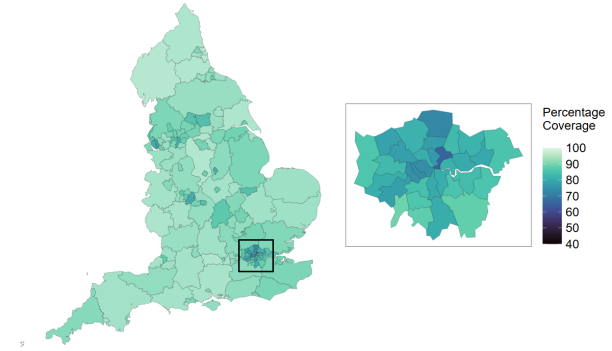
HPV vaccination
Similar geographical variation was observed for HPV vaccination coverage official statistics for the 2023/24 academic year (114). As described above, the data sources used to compile these statistics vary by local authority and direct comparisons should be made with caution (114). The data shows that:
- for year 10 students in 2023/24, coverage was highest in the South East (females 82.7%, males 77.3%) and lowest in London (females 64.9%, males 58.9%)
- the low coverage in London was a particular outlier for both year 10 female and male students at 11.8pp and 12.3pp below the national average respectively (see Table 5)
- coverage in male students was lower than female students in years 8 to 10 across all regions
- trends in coverage also vary by region, for example the decline in year 9 coverage among females has been greatest in the London, down 21.6 pp from 2018/19, yet increased in the North West, East of England, and South West in 2023/24 compared to 2022/23 (see Figure 17)
- within each region, coverage varied substantially by UTLA, for example coverage among year 9 female students displayed the greatest variation in London (25.5% to 93.8%) and the least variation in the South West (70.1% to 86.2%) (see Figure 18)
Table 5. HPV one-dose vaccination coverage in year 10 students in 2023/24 by sex and NHS region
| NHS region | Year 10 females | Difference from sex-specific national average (pp) | Year 10 males | Difference from sex-specific national average (pp) |
|---|---|---|---|---|
| England | 76.7 | - | 71.2 | - |
| South East | 82.7 | +6.0 | 77.3 | +6.1 |
| North West | 79.4 | +2.7 | 73.2 | +2.0 |
| East of England | 79.3 | +6.6 | 75.0 | +3.8 |
| North East and Yorkshire | 79.2 | +2.5 | 74.1 | +2.9 |
| South West | 77.9 | +1.3 | 72.8 | +1.6 |
| Midlands | 74.7 | -2.0 | 68.3 | -2.9 |
| London | 64.9 | -11.8 | 58.9 | -12.3 |
(Source: Human papillomavirus (HPV) vaccine coverage estimates in England: 2023 to 2024)
Figure 17. HPV vaccine coverage for year 9 female students between the 2015/16 and the 2023/24 academic years by NHS region

(Source: Human papillomavirus (HPV) vaccination coverage in adolescents in England: 2023 to 2024)
Figure 18. HPV vaccine coverage for year 9 female and male students for the 2023/24 academic year by upper tier local authority area

(Source: Human papillomavirus (HPV) vaccination coverage in adolescents in England: 2023 to 2024)
Prenatal pertussis vaccination
The prenatal pertussis vaccination coverage annual report also describes wide geographical variation at NHS commissioning region and ICB level (96). The key statistics at these levels are:
- annual coverage varied by 25.6pp between commissioning regions, from 48.2% in London to 73.8% in the South East
- annual coverage varied by 48.1pp between ICBs, from 34.3% in North Central London to 82.4% in Shropshire, Telford and Wrekin
- coverage in London has been much lower than in other regions over the last 5 years, although this gap has closed considerably since mid-2024 (see Figure 19)
Note that a new point of care app developed by NHS England to record vaccinations was introduced in September 2024 which may partially account for the increase in coverage reported since then (124).
Figure 19. Pertussis vaccination coverage in pregnant women by NHS commissioning region, April 2019 to March 2025

Seasonal influenza vaccination
Finally, the data on adult GP patients from the 2024/25 seasonal influenza vaccination programme also demonstrate similar variation by geographical region, including (22):
- among all eligible cohorts (older adults, those in clinical risk groups, and pregnant women), the London NHS commissioning region displayed the lowest uptake of all regions (see Figure 20)
- for those aged 65 years and over, 22 of the 25 UTLAs with the lowest uptake were in London (equal lowest in Westminster and Hammersmith and Fulham at 53.3%), while the 5 UTLAs with the highest uptake were all in the South West (highest in South Gloucestershire at 83.3%)
- similar regional patterns were observed for clinical risk groups (ranging from 24.1% in Hammersmith and Fulham to 51.6% in South Gloucestershire) and pregnant women (ranging from 18.6% in Enfield to 50.3% in Wiltshire)
Figure 20. Seasonal influenza vaccination uptake for those aged 65 years and over, aged 6 months to under 65 years in clinical risk groups, and pregnant women in 2024/25, by NHS commissioning region

(Source: Seasonal influenza vaccine uptake in GP patients: winter season 2024 to 2025)
Data on the variation in vaccination uptake according to rural, urban or coastal classification is not routinely reported by UKHSA. While a limited number of peer-reviewed publications explored variation by rural-urban classification (see below), there was an absence of any studies specifically exploring uptake in coastal communities. Therefore, UKHSA undertook a bespoke analysis of IIS MMR uptake data (as at 21 July 2025) using the 2024 ONS classification of coastal and non-coastal built-up areas (see Figure 21). The data suggests there is minimal variation in MMR1 uptake at either 24 months or 5 years of age (0.1pp and 0.3pp respectively) or in MMR2 uptake at 5 year of age (1.0pp), with coastal communities exhibiting the higher uptake in all measures. However, this is unadjusted data, and it is unclear whether controlling for underlying differences in demographic and socio-economic factors may reveal more substantial variation. (Note that less than 5% of records could not be linked; the aggregate coverage of unlinked records was within a 1.5pp margin of coastal and non-coastal areas for MMR1 measures and within a 3.0pp margin for MMR2)
Figure 21. MMR uptake according to 2024 ONS classification of coastal and non-coastal built-up areas as at 21 July 2025

(Source: IIS / ONS)
5.3 Evidence from the quantitative literature
Several studies reported on the regional variation in vaccination uptake across a range of programmes and population groups. Some of these studies add to the findings above by using statistical techniques to adjust for other factors that might explain some, if not all, of the regional variation, such as ethnicity and deprivation. The key findings from the literature include:
- using ImmForm data, and after adjustment for ethnicity and deprivation, 2-dose MenB coverage among children becoming 12 months of age between December 2016 and May 2018 varied by more than 5pp between regions (highest in Cumbria and the North East and lowest in London) (30)
- aggregated data from year 9 pupils from approximately 1,500 schools found that HPV and MenACWY vaccine coverage in 2016/17 was higher in schools in the North of England, and lower in those in London, compared to in the South of England, after adjusting for multiple factors including rural/urban classification, ethnicity and deprivation (42)
- variation in the timeliness of childhood vaccinations was also shown to vary by region with the North East showing very little deviation from the routine schedule compared to much wider deviation in London (70)
- the London region also showed a delayed first but accelerated second dose of MMR vaccine, possibly explained by the implementation of an accelerated schedule during the study period in response to several local outbreaks of measles in the late 2000s (70), (126)
- a retrospective cohort study of over one million children and young people found that adherence to the routine schedule was significantly less likely for almost all vaccines in London and generally highest in the Midland and East region, albeit with small absolute differences and without adjustment for other factors (26)
- in contrast other vaccines, uptake of the hepatitis B vaccine was higher in the London region compared to the North, South and Midlands and East of England regions in a survey of over 3,500 people who inject drugs in the UK, possibly reflecting the higher burden of hepatitis B in London and that a larger emphasis has been placed on reaching people who inject drugs (PWID) through targeted vaccination efforts (127)
Several studies of COVID-19 vaccination uptake highlighted intersections between geography and other factors. For example, a study of adults aged 40 years or more identified that living in an urban environment was associated with a much lower vaccination among people of Black ethnicities compared to all other ethnic groups (31).
An analysis from the first 79 days of the programme indicated that the age-based priority (over 50 years) element of the COVID-19 vaccination programme created area-based inequalities in the number of doses administered relative to the number of people who are frail or have other risk factors for COVID-19.128 Vaccination uptake relative to the frail population was very low in parts of the North of England, West Midlands and London, suggesting that distributing vaccines based on age does not equitably protect all populations from adverse outcomes associated with COVID-19 infection (128).
Similarly, a small area spatial analysis of rates of full vaccination against COVID-19 revealed that (100):
- geographical inequality of uptake in adults was strongly associated with the area’s underlying demographic and socio-economic characteristics, such as increasing age, higher average household income, higher car ownership, and greater accessibility to vaccination services
- however, more deprived areas were found to be associated with higher rates of vaccination, which might be explained by the higher rates of underlying clinical risk factors as indications for vaccination within these populations
- Mixed and Black ethnicities were associated with lower vaccination rates (versus White ethnicity); however, the spatial variation in uptake by ethnicity was more complex, for example Asian ethnicity was negatively associated with uptake in Yorkshire and Humber and parts of the Northwest, but positively associated with uptake in the East and Southeast of England
Few studies explicitly reported on differences in uptake according to urban-rural classification, while those that did found inconsistent results, namely:
- analysis of the seasonal influenza vaccination programme between 2011 and 2016 did not identify an association between rurality of GP practice (according to ONS classification) despite significant regional differences (44)
- however, analysis of records from around 1,500 schools found that those in rural areas had slightly but significantly lower coverage for both HPV and MenACWY vaccinations compared to urban schools, after adjusting for various factors including school size, ethnicity and deprivation (42)
- in contrast, analysis of the pilot phase of the HPV vaccination programme for GBMSM showed that recorded initiation (receipt of first dose) was higher in ‘rural village and dispersed’ clinics compared to those in ‘urban major conurbation’ and ‘urban city and town’ clinics (121
One study analysed the geographical accessibility of COVID-19 vaccination sites using travel times by private and public transport, with largely predictable results, including (129):
- areas with poorer accessibility tended to be those that are more remote and rural areas such as North Devon, the North Pennines, the North York Moors, rural Lincolnshire, Cambridgeshire and Norfolk, and areas along the south coast or the borders with Wales and Scotland
- overall, access for households with private transport was deemed excellent, with an average drive time of 10 minutes from any neighbourhood in England to the 5 most accessible vaccination sites
- public transport users were estimated to experience a median travel time that was 25 minutes longer than private transport users
- the median travel time to the most accessible 5 vaccination sites increased by 35 minutes once GP-led services were excluded, highlighting the importance of GP-led provision of vaccinations for people relying on public transport
- a clear rural-urban divide with a median journey time via public transport of 14 minutes in the largest urban centres and 40 minutes in the most rural areas
- no evidence for inequalities in accessibility by area-based deprivation measures
Yet despite this relative greater accessibility to vaccination sites in urban areas, several population level studies identified that living in an urban area was associated with lower vaccination rates (31, 49, 77).
Section 6. Inclusion health and at-risk groups
6.1 Summary of findings
There is limited national data available to assess immunisation equity among and between inclusion health and other at-risk groups
There are high catch-up vaccination needs among migrants, including people seeking asylum and refugees
This is particularly the case among adult and adolescent migrants who appear to be underserved when compared to migrants under the age of 10 years. The low uptake of catch-up vaccinations requires attention. In contrast, COVID-19 vaccination uptake among migrants was relatively high, perhaps reflecting the vaccination requirements for international travel during the pandemic and for work visas, given the significant proportion of this group working in health and social care professions.
There is limited new quantitative analysis of uptake among other inclusion health groups
While there is some evidence of variation in hepatitis B vaccination uptake among both sex workers and PWIDs, these findings are drawn from isolated studies undertaken with data that is no longer current. This is despite qualitative evidence among inclusion health groups highlighting extensive barriers to healthcare access likely leading to significant vaccination inequalities (see Section 8 and Appendix 4).
People belonging to inclusion health groups tend to have very poor health outcomes, often much worse than the general population and a lower average age of death (130). Poor access to health and care services and negative experiences can also be commonplace for inclusion health groups due to multiple barriers, often related to the way healthcare services are delivered (131). Inclusion health and at-risk groups are not consistently accounted for within the national immunisation data architecture, nor within wider healthcare databases. Therefore, there is limited scope to assess immunisation equity for these groups using routinely collected data.
Within the quantitative literature published since the last audit was completed, only a small number of studies specifically examined immunisation rates among inclusion health or at-risk groups.
Migrants including people seeking asylum and refugees
A retrospective study of the UK resettlement programme found that (132):
- vaccination coverage was suboptimal among the nearly 7,000 refugees departing for the UK between 1 January 2018 and 31 October 2019
- coverage varied by vaccine antigen: 80.9% having at least one recorded dose of a measles-containing vaccine, 84.4% a polio-containing vaccine, but less than 20% had at least one recorded dose of a diphtheria- or tetanus-containing vaccine.
- this compares to 94.5% MMR1 coverage by age 5 years and 94.5% 6-in-1 3-dose coverage by age 2 years in the England general population in 2018/19
- few refugees were fully aligned with the UK schedule for measles (34.0%), polio (11.1%), and diphtheria and tetanus (5.5%)
- adults and adolescents were significantly less likely than children under 10 years of age to be in line with the schedule for polio and measles
- vaccination rates varied by nationality and country of health assessment, with Sudanese and Eritrean refugees and those assessed in Egypt being significantly less likely to have received these vaccines compared other nationalities and assessment countries
Similarly, in the Million Migrant cohort of over 2 million non-European Union migrants and resettled refugees in the UK, of those aged 16 years or more, 465,470 (44.5%) were linked by NHS number to at least one COVID-19 vaccination record (133). Of these:
- 91.8% of migrants received a second dose of COVID-19 vaccination and 51.3% received a third
- refugees and migrants from ethnic minorities were more likely to have a delayed second or third dose, while refugees and older migrants were more likely to not have received a second or third dose, compared to the general population of England
- migrants with Black ethnicity were more than twice as likely to have a delayed second dose than migrants with White ethnicity, this trend reversing for third doses
- migrants on work visas were less likely to be overdue for subsequent doses than the general population, perhaps reflecting the significant proportion of this group working in health and social care professions, and thus initially prioritised for vaccination
Smaller studies found similarly high vaccination needs among recently arrived migrants, yet low uptake of catch-up vaccination offers despite efforts to identify and refer eligible individuals (134, 135).
Sex workers
Analysis of data from GUMCAD of over 13,000 female sex workers attending SHS between 2015 and 2019 showed that, despite all sex workers being eligible for hepatitis B vaccination, coverage was low at just 37% (136). Furthermore, this statistic is based on sex workers who have self-identified as such, whereas it is known that sex workers usually do not reveal their status, and those that do not reveal their status are likely to have even lower coverage. Therefore, the 37% coverage calculated in this study is likely an overestimate. The study also showed that:
- being of younger age was associated with an increased likelihood of being vaccinated against hepatitis B
- having been born in South America (versus UK-born) was associated with an increased likelihood of being vaccinated
- being of Asian ethnicity or having been born in Europe, North America or Australasia were factors associated with lower uptake
- vaccination rates also varied by region of residence, however, unreported differences in recording practices and/or the intensity of outreach programmes prevent robust conclusions being drawn from this finding
People who inject drugs
A survey of over 3,500 PWID across the UK found that self-reported coverage with the hepatitis B vaccination was suboptimal at 76% for at least one dose, while only 45% for the recommended 3 doses (127). This study also showed that:
- uptake of the hepatitis B vaccination varied with age, being highest among those aged 40 to 50 years, and was positively associated with ever being imprisoned, ever being homeless, engaging in transactional sex, being sexually active in the previous year, and having accessed a variety of health services in the past year including a GP or family doctor, SHS, or needle and syringe and drug treatment programmes
- most participants had been vaccinated in a drug treatment service, a prison, or at a needle and syringe programme setting, with smaller numbers receiving their vaccination at a GP practice, Accident and Emergency, or elsewhere
Section 7. People living with long-term conditions
Summary of findings
There is variation in uptake of the additional vaccinations aimed at people living with long-term conditions
Evidence from the seasonal influenza immunisation programme and the peer-reviewed literature shows that uptake varies according to the underlying medical condition and vaccine antigen. The degree to which this variation is explained by other factors (for example, deprivation and low uptake among those with chronic liver disease) remains uncertain.
There are complex patterns of uptake of the seasonal influenza vaccination in people with learning disabilities
Those with severe learning disabilities having the highest uptake of any clinical risk group, yet the lowest uptake was among people with any learning disability (including severe). The underlying causes of this variation warrants further investigation.
Living with a long-term condition appears to intersect with other equity factors
Including age, sex, ethnicity and deprivation. For example, coverage with 3 doses of the COVID-19 vaccine among people with chronic kidney disease was particularly low in younger adults from ethnic minorities living in the most deprived areas.
People, and children born to mothers, with mental ill health and/or substance misuse may be at risk of under-vaccination
While the evidence base is relatively small, the direction of effect (lower vaccination rates) is consistent in all studies exploring this factor.
A long-term condition is a health problem that requires ongoing management over a period of years or decades and is one that cannot currently be cured, at present, but can be controlled with the use of medication and/or other therapies (137). Such conditions include chronic respiratory, heart, kidney, liver and neurological conditions, diabetes, immunosuppression (due to disease or treatment), and asplenia or dysfunction of the spleen. People living with these conditions (also known as ‘clinical risk groups’) are eligible for additional vaccines such as the seasonal influenza and pneumococcal vaccines.
Data from the seasonal influenza vaccination programme therefore provides an insight into immunisation equity from this perspective. People with learning disabilities are also eligible for this programme and data for this group are also discussed here (in addition to evidence from the peer-reviewed literature discussed in Section 4.2). Within this data, patients in individual clinical risk groups are identified using clinical codes within the Systematized Nomenclature of Medicine Clinical Terminology (SNOMED CT) (138). There are often adjustments to classifications in clinical coding of these groups, as well as year-to-year variation in prevalence and data capture, and therefore caution should be taken in making historical comparisons.
Uptake of the seasonal influenza vaccine among people aged 6 months to under 65 years in clinical risk groups is presented in the 2024/25 annual report (22). The data indicates that:
- the proportion of the general population aged 6 months to 65 years in each of the risk groups has remained comparable to the previous season
- all individual risk groups had uptake below that of the previous season, except patients with chronic neurological disease in whom uptake increased by 1.9pp (from 42.7% to 44.6%)
- the highest uptake was in patients with a severe learning disability (a subset of patients with chronic neurological disease) at 56.2%, a decrease of 3.9pp from the previous season, followed by patients with diabetes (49.7%) and patients with chronic kidney disease (48.1%)
- the lowest uptake was among patients with any learning disability (including severe) at 33.2%, a decrease of 2.3% from the previous season, followed by patients with chronic liver disease (33.8%) and patients with a body mass index (BMI) greater than or equal to 40 (34.2%) (see Figure 22)
Figure 22. Seasonal influenza vaccine uptake during the 2024/25 season in people aged 6 months to under 65 years in clinical risk group(s), by underlying medical condition

Note: severe learning disability is a subcategory of chronic neurological disease.
(Source: Seasonal influenza vaccine uptake in GP patients: winter season 2024 to 2025)
Within the peer-reviewed literature, there were several studies examining variation in uptake of additional vaccines for individuals with long-term conditions, including:
- a study focussing on the 2018/19 influenza season found broadly similar patterns to those in presented above for 2024/25, adding that coverage had decreased over the previous 5 seasons across almost all risk groups but particularly in patients with immunosuppression (92)
- analysis of records for the seasonal influenza vaccination programme between 2011 and 2016 demonstrated that the odds of uptake increased significantly with each additional at-risk condition among both the 18 to 64 year olds and the over 65s while the odds of uptake was highest among younger patients with diabetes and older patients with chronic respiratory disease, whereas they were lowest in patients with obesity in all ages (44)
- an increasing number of health conditions was also associated with higher uptake of at least one dose of the influenza, pneumococcal and shingles vaccines in older adults between 1989 and 2020. (45) However, both dementia and severe mental illness were associated with marginally lower uptake of all 3 vaccines (45)
- similarly, a retrospective analysis of approximately 100,000 at-risk adults revealed that those with chronic heart disease, chronic kidney disease, chronic liver disease, chronic respiratory disease or diabetes were significantly less likely to have received the pneumococcal vaccination than immunosuppressed patients (139)
Vaccination uptake was also shown to vary within populations with similar conditions:
- uptake of both the inactivated influenza vaccine and the pneumococcal vaccine were found to be suboptimal among adults with an immune-mediated inflammatory disease (IMID), yet uptake of the latter was higher among older, female, and people at higher risk, as well as those on immunosuppressant drugs (140, 141)
- a single-centre study of patients with inflammatory arthritis found variation in uptake by vaccine antigen: pneumococcal (35%), influenza (63%), and COVID-19 (87%) (142). Predictors of pneumococcal vaccine uptake in this sample included age 65 years or more, receiving biologic therapy, and the presence of additional risk indictors (142)
- COVID-19 vaccination rates among adults with kidney disease were found to be very high, albeit with some variation. For example, coverage with 3 doses was particularly low in younger adults from ethnic minorities living in the most deprived areas compared to older adults of White ethnicity living in the least deprived areas (38)
Various further studies explored COVID-19 vaccination uptake among people living with long-term and life-limiting illnesses or other clinical risk factors. These included numerous studies conducted before vaccination rollout that demonstrated higher confidence in the vaccine among clinically at-risk individuals (54, 58, 60, 80, 81, 143). This translated to higher uptake in some at-risk groups when compared to the general population, including immunocompromised patients and those with a blood cancer diagnosis (39, 102). However, some individual population groups were found to have lower COVID-19 vaccination confidence and/or uptake including adults with low BMI (under 18.5kg/m2) and those with severe mental illness (52, 53, 103, 144).
Beyond those eligible for additional vaccinations due to their physical health, 2 large retrospective cohort studies reported that children of mothers with common mental disorders had lower odds of being vaccinated in comparison to those with no record of mental illness, even after adjusting for age, deprivation and region, with the strongest effects seen in children exposed to maternal alcohol or substance misuse (145, 146). Considering severe mental illness, a whole-population study demonstrated that COVID-19 vaccination coverage was high in those with physical comorbidities (95.7%) but substantially lower in those with severe mental illness (89.5%) or learning disabilities (91.4%) (76). Analyses from a longitudinal household study of approximately 10,000 adults in the UK indicated that those with poorer mental health were more likely to be vaccination hesitant (52, 53).
Section 8. Determinants of vaccination uptake
UKHSA commissions regular surveys to explore the attitudes of parents and young people towards vaccination (147, 148). These surveys have consistently shown that, among a majority of respondents, confidence in the routine immunisation programme is high, vaccines are viewed as safe and important, information about vaccines is mostly received from official sources, and most are satisfied with the way vaccinations are delivered overall. While these are important and reassuring findings, these results are drawn from a general population sample and the results are not stratified according to population characteristics. Furthermore, there is little exploration of the underlying causes of why some people have less confidence in vaccinations.
In order to better understand these underlying causes, and how they differ between population groups, this section of the audit presents findings from the qualitative literature examining both facilitators and barriers to vaccination uptake using the ‘5As taxonomy’. Thomson and others, described this practical taxonomy to organise the possible root causes, or ‘non-sociodemographic determinants’, of suboptimal vaccination coverage (17).
The 5As are:
- Access: the ability of individuals to be reached by, or to reach, recommended vaccines
- Affordability: the ability of individuals to afford vaccination, both in terms of financial and non-financial costs (for example, time)
- Awareness: the degree to which individuals have knowledge of the need for, and availability of, recommended vaccines and their objective benefits and risks
- Acceptance: the degree to which individuals accept, question or refuse vaccination
- Activation: the degree to which individuals are nudged towards vaccination uptake
The authors describe how this taxonomy is ‘deliberatively simple, intuitive and alliterative, with the express aim of facilitating a mutual understanding of a complex problem.’ It is for these reasons that this taxonomy was selected over other classification systems such as the Social Ecological Model, Health Belief Model, and the Theory of Planned Behaviour model, all of which require a deeper understanding of the underpinning theory and may, therefore, be less accessible to a non-specialist audience (149, 150, 151). Other alliterative models, such as the WHO ‘3Cs’ and the ‘5C scale’ proposed by Betch and others, were considered but the 5As taxonomy was deemed to have a more holistic view of the determinants of vaccination, rather than focussing only on vaccine hesitancy or the psychological antecedents of vaccination (152, 153).
All qualitative studies included in the literature review were analysed to identify themes (the 5As) and sub-themes (facilitators and barriers). The results are presented in summary format below. The population groups identified within the literature as being affected by each determinant are presented in italics. Table 6 provides an overview of the determinants by population group.
Note that the participants in each study were not necessarily from the population groups affected (for example, health service providers working with a given population group) For some population groups, a summary term is used (for example, ethnic minorities) to aid presentation of this complex literature. A more comprehensive narrative review, including greater disaggregation of the population groups and vaccination programmes affected, is provided at Appendix 4.
8.1 Access
Definition: ‘the ability of individuals to be reached by, or to reach, recommended vaccines’.
Facilitators
Availability, flexibility and ease of booking appointments including evening and weekend appointment slots or the option to attend a private pharmacy in the absence of GP appointments (people with long-term conditions, ethnic minorities, pregnant women) (154, 155, 156, 157, 158, 159, 160).
Well-trusted and/or alternative access points such as one’s own GP practice, secondary care check-up appointments, community centres, food banks, satellite clinics, and civil society organisations (children, pregnant women, migrants, people with long-term conditions, healthcare workers) (46, 109, 159, 161, 162, 163, 164).
Integrating vaccinations at routine appointments with other health services, for example antenatal care appointments (pregnant women) (158, 165, 166, 167).
Barriers
Limited availability and flexibility of appointment times and locations including appointment cancellations or booking errors, difficulties accessing face-to-face appointments due to the COVID-19 pandemic restrictions, and perceived challenges to providing appointments in non-primary care locations (children, pregnant women, young adults, people with long-term conditions, health care workers) (82, 91, 156, 159, 168, 169, 170).
Language inaccessibility from both a service user perspective (for example, lack of officially translated leaflets or access to an interpreter) and a provider perspective (for example, difficulty translating vaccination histories and the time-consuming nature of using interpreting services) (migrants, ethnic minorities, Gypsy, Roma and Travellers [GRT]) (159, 171, 172, 173, 174, 175, 176, 177, 178, 179).
Difficulties navigating the UK healthcare system including uncertainties around entitlement to care, limited digital literacy, and faulty systems to enable online and telephone booking systems (migrants, ethnic minorities, GRT, children) (159, 174, 176, 177, 180, 181).
Logistical barriers to attending appointments including whilst caring for babies or multiple children and juggling multiple appointments at various health services (children, GRT, people with long-term conditions) (154, 168, 180).
Exclusion from catch-up vaccination initiatives including the a lack of incentivisation for vaccination of recently-arrived adult migrants (migrants) (171).
Vaccine shortages due to limited supply or difficulties in anticipating demand (people with long-term conditions, children, GBMSM, migrants) (134, 154, 182, 183).
8.2 Affordability
Definition: ‘the ability of individuals to afford vaccination, both in terms of financial and non-financial costs (for example, time)’.
Facilitators
Offer of vaccinations at no cost to the individual via the NHS, in contrast to experiences of healthcare systems in other countries (ethnic minorities) (157).
Barriers
Perception of potential financial costs for those who are uncertain over their entitlement to care (migrants) (173).
Indirect financial costs due to the necessity to take time off work to attend appointments, especially for those in insecure or low-income professions (people with long-term conditions, children, pregnant women, GBMSM) (155, 158, 159, 165, 182, 183).
Competing demands and non-financial costs (that is, time) including wider family commitments (pregnant women, GRT) (165, 173).
8.3 Awareness
Definition: ‘the degree to which individuals have knowledge of the need for, and availability of, recommended vaccines and their objective benefits and risks’.
Facilitators
High perception of risk of both infection and severity of illness including due to personal, or witnessing others’, experience of VPDs (children, pregnant women, people with long-term conditions, social care workers) (55, 143, 154, 155, 165, 166, 182, 184, 185, 186, 187, 188).
Opportunities to discuss concerns with trusted healthcare professionals as well as involving healthcare workers in vaccine promotion and a healthcare professional’s confirmation of personal suitability for vaccination (children, pregnant women, migrants, people with long-term conditions) (154, 158, 159, 167, 169, 175, 178, 182, 189, 190, 191, 192).
Sufficient information tailored to specific needs and delivered through personal engagement rather than relying on written materials, supported by sufficient time and space to discuss concerns and counter misinformation and the provision of language and culturally appropriate communication channels (children, adolescents, pregnant women, ethnic minorities, migrants, GBMSM) (80, 90, 157, 159, 162, 172, 183, 185, 190, 193, 194, 195).
Culturally accessible information, particularly when coming from peer-to-peer communication and key organisations or voices from within one’s own community (GBMSM, migrants, ethnic minorities) (161, 162, 177, 178, 183, 196).
Barriers
Low perception of risk of both infection and severity of illness including due to a lack of tailored information for specific groups (for example, influenza vaccination for those with non-respiratory chronic diseases) and idiosyncratic beliefs (for example, influenza is inevitable or VPDs are ‘historic illnesses) (children, people with long-term conditions, GBMSM, ethnic minorities) (74, 156, 163, 168, 174, 182, 195, 197, 198, 199).
Low awareness of eligibility and knowledge of how to access additional or selective immunisation programmes (older adults, people with long-term conditions, GBMSM, social care workers) (86, 154, 155, 200, 120, 199, 201, 202).
A lack education and understanding of how vaccines work resulting in an inability to make informed choices and the development of specific negative perceptions (for example, the HPV vaccine promotes promiscuity) (GRT, people with long-term conditions, adolescents) (163, 173, 203).
Overwhelming, inconsistent or contradictory public messaging and media information leading to mistrust and low confidence in health authorities and the government (migrants, ethnic minorities, healthcare workers, pregnant women) (165, 178, 179, 192, 204).
Exposure to misinformation and the dilution of trustworthy sources amidst the volume of online information within messenger services and social media resulting in lower vaccine confidence, a misplaced reliance on ‘natural immunity’ and home remedies, scepticism over vaccine efficacy, and the belief in conspiracy theories (young adults, pregnant women, ethnic minorities, GRT, GBMSM, children, migrants, people with long-term conditions, healthcare workers) (54, 57, 74, 75, 86, 90, 154, 157, 158, 159, 161, 165, 170, 173, 174, 175, 176, 177, 178, 179, 181, 183, 186 187, 191, 197, 198, 204, 205, 206, 207, 208, 209, 210, 211, 212, 213).
8.4 Acceptance
Definition: ‘the degree to which individuals accept, question or refuse vaccination’.
Facilitators
Positive inter-personal and social influences including a desire to protect others, knowledge of others vaccinated status, knowing someone who has been personally affected by VPDs, viewing vaccination as a social or workplace norm, and the positive influence of faith or community leaders as a trusted sources of advice (pregnant women, children, adolescents, young adults, older adults, people with long-term conditions, ethnic minorities, healthcare workers) (82, 86, 109, 155, 157, 158, 163, 165, 166, 167, 168, 176, 178, 182, 184, 186, 187, 194, 203, 204, 205, 210, 214, 215, 216, 217, 218, 219, 220).
Trust in the NHS, wider public health system and healthcare professionals’ advice including recommendations to receive new vaccines such as the respiratory syncytial virus (RSV) vaccine (ethnic minorities, pregnant women, people with long-term conditions, older adults) (90, 93, 157, 163, 193, 213, 220, 221, 222).
Previous positive vaccination experiences either personally or in a close family member (people with long-term conditions, pregnant women, young adults) (154, 158, 54).
Stability of one’s underlying medical condition(s) alongside confidence in the safety of vaccines (people with long-term conditions) (154).
Barriers
Negative interpersonal and societal influences including discouragement from family and friends, the sharing of anecdotes relating to side effects and the false link between vaccination and autism, and reinforcement within social networks that vaccination is not necessary (people with long-term conditions, pregnant women, ethnic minorities, children) (154, 157, 172, 195, 223).
Distrust in government, health authorities and/or pharmaceutical companies as a result of past negative experiences with healthcare, a lack of continuity of care, the perception of undue financial and commercial influence, instances of recent or historical discrimination and cultural insensitivity, and fear around data sharing with immigration authorities (GRT, migrants, pregnant women, ethnic minorities, children, older adults) (54, 86, 93, 108, 159, 161, 169, 172, 173, 175, 177, 178, 180, 189, 196, 198, 212, 220, 224, 225, 226).
Concerns regarding vaccine safety, whether legitimate or baseless, including known side effects and unforeseen future adverse outcomes associated with the perceived speed of development of new vaccines (people with long-term conditions, adolescents, pregnant women, ethnic minorities, children, young adults, older adults, migrants, healthcare workers, social care workers) (55, 80, 81, 82, 86, 93, 143, 154, 156, 159, 161, 163, 165, 169, 172, 174, 175, 176, 178, 179, 181, 182, 184, 185, 186, 187, 188, 191, 192, 193, 197, 198, 203, 204, 205, 206, 207, 210, 213, 212, 218, 219, 222, 227).
Stigma, particularly with vaccinations against infections associated with sexual transmission, including a perception that HPV vaccine acceptance indirectly condones sexual promiscuity, and the reinforcement of homophobic tropes and perceived risk of disclosure of sexual orientation associated with the mpox vaccination programme (adolescents, migrants, GBMSM) (134, 183, 228).
Cultural mismatch between health behaviours and UK vaccination programme delivery (for example, responsive rather than proactive attitudes to healthcare), and unmet expectations of both the immunisation schedule (that is, no universal BCG programme) and vaccination practices (for example, professions other than doctors administering vaccines) (GRT) (173, 174, 180).
A perception of ‘over-vaccination’ or vaccine fatigue due to the number of different vaccinations delivered over a short period of time or the number of doses of an individual vaccine (migrants, children, ethnic minorities, young adults) (134, 159, 175, 176, 204, 210).
Fear of needles (adolescents, pregnant women, people with long-term conditions) (155, 165, 203).
Challenges with obtaining consent for school-based adolescent programmes such as the non-return of written parental consent forms, a lack of time to perform follow-up phone calls to parents, and a lack of school engagement with vaccination programmes (adolescents) (46, 203, 228).
8.5 Activation
Definition ‘the degree to which individuals are nudged towards vaccination uptake’
Although interventional studies were not included in this literature review, a number of activation factors were identified as influences on vaccination uptake.
Facilitators
Direct recommendation by a trusted authority figure including doctors or other respected authority figures (for example, government officials or community and faith leaders), one’s own GP or midwife, and those with a good knowledge of their immunosuppressed patients’ conditions (pregnant women, people with long-term conditions, migrants, children, older adults, GBMSM) (154, 155, 158, 175, 182, 189, 191, 199, 214).
Collaborative and localised approaches to community engagement and outreach programmes, undertaken by partnerships between health services and civil society organisations with close ties to communities, to facilitate activities such as joint visits to families, home vaccinations, and catch-up clinics (GRT, ethnic minorities, adolescents, rural and remote communities) (173, 180, 195, 203, 228, 229, 230).
Supportive organisational culture and leadership such as senior management placing a high importance on staff vaccination uptake, greater engagement by executive teams, more direct communication strategies (for example, staff briefings), and framing the programme as a commitment to staff wellbeing (healthcare workers) (164, 231).
Incentives that promote vaccination uptake such as setting high institutional uptake targets, offering financial and non-financial (for example, food and drinks vouchers) rewards, reimbursement schemes for primary care professionals (for example, QOF) and a compensation scheme for those who experience severe side effects (healthcare workers, children, migrants) (171, 231, 232).
A desire to ‘return to normal’, including to maintain regular activities, to avoid social and travel restrictions, and to be able to visit older relatives, as a specific facilitator of COVID-19 vaccination uptake in the context of the wider social restrictions implemented as part of the pandemic response. (young adults, ethnic minorities) (55, 82, 109, 210, 218, 233).
Barriers
Difficulties in assessing eligibility and identifying vaccination needs due to poorly documented or untranslated vaccination histories, an inability to verify vaccinations received overseas, a lack of granular data, insufficient information transfer between platforms, lack of registration with a GP, lack of staff awareness of vaccination catch-up guidelines, and discordant guidance from different institutions (for example, specialty-specific versus Joint Committee on Vaccinations and Immunisation [JCVI] guidelines) (migrants, ethnic minorities, GRT) (134, 157, 171, 172, 180, 229, 234, 235).
Missed opportunities to vaccinate eligible people attending services or settings capable of administering vaccinations, in part due to a lack of staff knowledge of service users’ risk behaviours and/or non-disclosure of such behaviours by service users for fear of stigmatisation and negative perceptions (GBMSM, PWID, people experiencing homelessness, people in contact with the justice system, older adults, migrants) (86, 119, 120, 127, 175, 236).
Reliance on traditional methods of engagement such as recall and reminder systems that use letters or SMS text invitations for population groups or individuals who face a combination of language barriers, transiency of location, and who may not be registered with a GP (GRT, migrants) (134, 173, 180).
Resource limitations such as a lack of staff capacity and time during individual appointments to discuss vaccination concerns, use an interpreter, encode missing vaccination histories, and to offer opportunistic vaccinations (migrants, pregnant women, people with long-term conditions, older adults, urban area residents, ethnic minorities, GRT) (134, 156, 171, 172, 180, 195, 214, 229, 235).
Coercive messaging and undue pressure, including the use of opt-out forms, ‘naming and shaming’, and suggestions of mandatory vaccination policies, leading to feelings of being undermined as autonomous individuals and fear of being targeted for holding a minority (that is, vaccine hesitant) opinion (healthcare workers, ethnic minorities, children) (163, 164, 198).
Conclusions
Identified inequalities
The association of increasing socioeconomic deprivation with lower vaccination coverage is widespread across a number of programmes. While the inherent inaccuracies of using area-level measures of deprivation limit the interpretation of the size of this observed effect, the consistency in its direction across all programmes and populations supports this as a robust conclusion. Moreover, the inequality between people living in the least and most deprived is widening, highlighting the ‘CORE20’ as a key population group for focussed interventions to improve immunisation equity.
Belonging to an ethnic minority group was also consistently shown to be associated with lower vaccination uptake across a number of programmes and populations, with the greatest inequality apparent for people identifying with Black ethnic groups. Specific local populations appear to buck this trend and may provide insight into improving immunisation equity, namely the Pakistani population of Bradford and the Bangladeshi community living in London.
Regional inequalities in vaccination rates continue and, in many cases, have grown wider. London continues to exhibit the lowest vaccination coverage statistics; the regions with the highest coverage varies by programme. Differences in underlying demographics, deprivation and geographical factors are likely to play a role in this inequality, but evidence from the peer-reviewed literature suggest that these factors do not wholly explain this variation.
There is evidence that other populations groups have low or suboptimal coverage of additional or catch-up vaccinations including pregnant women, adult migrants, and people with certain long-term conditions or learning disabilities.
Intersectionality
Evidence from the peer-reviewed literature has provided some insight into the intersectional nature of immunisation equity. Examples include:
- the association of deprivation with lower vaccination coverage appears to be greater in young adults and in ethnic minorities
- GBMSM from ethnic minorities show disproportionate rates of declining HPV vaccination
- pregnant women at the extremes of childbearing age, living in more deprived areas, and identifying with Black ethnic groups exhibit lower vaccination rates
- living in an urban area has a greater association with lower COVID-19 vaccination rates among people identifying as Black than with other ethnic groups
- COVID-19 vaccination coverage among people with chronic kidney disease was particularly low in younger adults from ethnic minorities living in the most deprived areas
Determinants of vaccination uptake
A large and wide range of facilitators and barriers influence the uptake of vaccinations, affecting different population groups to different degrees. These determinants point to possible interventions that are likely to be effective in improving uptake in these populations; a further follow-on review of the effectiveness of interventions among and between population groups will provide additional evidence to support the planning of vaccination initiatives.
Convenience of access to immunisation services, particularly in well-trusted access points, is a key determinant across most population groups. Migrants and ethnic minorities face barriers related to language inaccessibility, navigation of the UK primary healthcare system and the apparent exclusion from specific catch-up vaccination initiatives. Affordability barriers including indirect or non-financial costs, such as taking time off work to attend appointments, are more likely to be experienced by people working in insecure or low-income professions.
The perception of risk from vaccine-preventable diseases is a prominent factor among a number of population groups. Facilitators included opportunities to discuss concerns regarding vaccinations with a trusted professional and the provision of tailored information for specific eligible populations, such as pregnant women and people with long-term conditions. Low awareness, education and understanding of the need for vaccinations and how they work, and exposure to misinformation, are important barriers across populations.
Social and interpersonal influences operate both as facilitators and barriers to vaccination and occur in family, community, faith, patient, and online networks. Scepticism over vaccine efficacy and concern of side effects or adverse outcomes following vaccination are prominent barriers for many groups in the post-pandemic age. Distrust in government, health authorities and the motivations of pharmaceutical companies is a higher order factor in the vaccination decisions of migrants and people belonging to ethnic minorities.
In contrast, a direct recommendation by a trusted healthcare professional supports vaccination, as do localised and collaborative approaches to vaccination initiatives. Immunisation services face difficulties in identifying vaccination needs due to a range of data and resource limitations leading to missed vaccination opportunities in a range of settings.
Data and evidence gaps
There is insufficient data and/or evidence to assess immunisation equity among a number of population groups within the CORE20PLUS framework. The national immunisation data architecture does not capture the full range of protected characteristics nor is there a clear mechanism to identify people belonging to inclusion health groups and those living with a disability, at a national level. In-depth analysis of the influence of living in rural, urban, or coastal areas, controlling for underlying demographic and socioeconomic factors, is also lacking. The peer-reviewed literature published since 2019 only partially fills these gaps; relying on older publications or those from a non-UK setting is likely to be misleading.
This audit has found compelling evidence of inequity by deprivation and ethnicity. However, these assessments rely on imperfect aggregations using area-level measures and broad categorisation respectively, limiting the accuracy and precision of the observed associations. Disaggregation to individual-level records, although technically more complex and resource-intensive, may reveal hitherto hidden or more nuanced patterns of inequity.
Current data and evidence gaps limit the degree to which intersectionality in immunisation equity can be assessed. While this audit has identified a number of convincing and likely population groups associated with low vaccination coverage, the degree to which these factors overlap to produce multiple disadvantages cannot be fully explored.
Actions required to reverse inequalities
This section sets out proposed actions for action to improve knowledge, understanding, and assessment of immunisation equity. It also highlights some of the key areas for action to improve vaccination uptake overall and reduce inequities in uptake identified through this HEA – noting that the major focus of the report has been on describing variations in uptake by various equity factors, and that further work will be required to determine which of these proposed areas of action to prioritise and how best to translate evidence into action.
General principles
In addition to the specific action given below, findings from this audit also underscore general principles for action on immunisation equity. In particular:
- while local actors are best placed to assess needs in their communities, the consistency of the evidence in this HEA is such that those living in the 20% most deprived areas and those from certain ethnic minority groups are likely to be priority populations in almost all areas, notwithstanding the need to improve understanding of inequalities among other population and community groups in any given area
- given all that is known about the public health importance of immunisation, immunisation equity should be seen as central to system-wide initiatives to improve trust, counter misinformation, and eliminate discrimination and racism in health services
Actions
Much is being done across the immunisation system to bolster access opportunities, to improve public awareness of, and confidence in, vaccination, and to strengthen the infrastructure underpinning immunisation activities in England. In addition to these, to strengthen knowledge, understanding and assessment of immunisation equity over the period 2025 to 2030, parties to the Immunisation Equity Strategy should consider:
- developing and implementing a basket of outcome indicators based on the findings of this audit as a measurement of progress against the aims of the immunisation equity strategy throughout, and at the end of, its 5-year cycle
- expanding the use of individual level data where available to provide more robust analyses of vaccination coverage trends, by deprivation (at LSOA-level) and ethnicity in particular
- introducing an annual immunisation equity report drawing on data from coverage collections to collate the most up-to-date information on variations in uptake across and between programmes
- developing and implementing a set of agreed common standards for UKHSA annual reports and official statistics publications to ensure inclusion of the fullest possible range of equity factors and to support analytical (not just descriptive) epidemiology to better examine the influence of intersectionality
- exploring approaches to strengthening measurement of immunisation inequities over time, including identifying best practice approaches to:
- overall equity measurement (which may include aggregate measures of ‘gap’, concentration indices and other approaches), and
- measurement of specific equity factors (especially deprivation given acknowledged limitations of IMD identified in this report
- working with and through our partners to improve the quality and completeness of coding for characteristics identified through this audit as lacking a clear evidence picture, including physical impairments, learning difficulties, and an agreed set of priority inclusion health groups, including through new or existing service-academic partnerships
- undertaking a prioritisation exercise to agree key immunisation equity questions to address in order to improve understanding in areas identified through this audit as gaps, including but not limited to:
- analysis of rural, urban and coastal variation in vaccination uptake adjusting for regional, socioeconomic and demographic factors in order to further understand the influence of geography on regional inequalities, and
- evidence on variations in uptake for inclusion health groups including those in custodial settings and people experiencing homelessness
- incorporating the findings from the qualitative (‘5 As’) element of this audit in the design of future national attitudinal surveys and explore the use of minority-boosted sampling to ensure specific factors are monitored over time (for example, distrust among migrants and ethnic minorities, opportunities to discuss concerns for pregnant women and people with long-term conditions)
- integrating findings of this audit with wider evidence review work to better understand which interventions (at national, regional and/or local levels) are likely to be effective in improving uptake overall and to close the gap between communities and population groups.
Informing evidence translation into action
Assessment of intervention effectiveness was not an explicit focus for this HEA, and decisions on tailoring intervention approaches properly lie with local teams. However, evidence collated as part of this audit (particularly in the ‘5As’ section) highlights some common themes for consideration by those engaged in service design and delivery:
-
strengthening the core offer of vaccination to all population groups in line with the determinants of uptake identified through this audit, drawing on wider research and practice evidence sources as appropriate, including but not limited to:
- improving access through greater flexibility of appointment timing
- improving awareness through active dissemination of information regarding eligibility and entitlement to additional and catch-up vaccinations
- improving acceptance by ensuring access for all to simplified and transparent information on vaccine efficacy and safety
- improving activation by involving trusted voices in the direct recommendation of vaccination to individuals
-
assessing the feasibility of interventions that will reduce immunisation inequity through targeted actions aimed at addressing barriers for specific population groups. including but not limited to actions that:
- improve access through improved cultural and language accessibility of vaccination information and communication for migrants and ethnic minorities
- improve awareness and acceptance through greater provision of localised, co-produced outreach models of delivery for populations that are not best served by current or traditional methods of engagement
- improve activation through immunisation training for all healthcare professionals likely to work with communities with low vaccination coverage
Note 1: The NIP is a set of vaccinations offered to everyone as they reach certain ages. The schedule is designed to provide early protection to the population from 19 diseases across the life course. There are also a range of selective and additional immunisation programmes in which some individuals are eligible for additional vaccines or additional doses due to underlying medical conditions or circumstances that put them at an increased risk.
Note 2: Inclusion health is an approach to addressing extreme health inequalities in a range of people and communities who experience social exclusion. These groups typically experience very poor health including high risk of infection, stigma and discrimination, poor access to, and experience of, healthcare and other services. These groups include people experiencing homelessness, people with drug and alcohol dependence, people seeking asylum, refugees and undocumented migrants, sex workers, people in contact with the justice system and other socially excluded groups.
References
1. Shattock AJ, Johnson HC, Sim SY, and others. ‘Contribution of vaccination to improved survival and health: modelling 50 years of the Expanded Programme on Immunization’ The Lancet 2024: volume 403, issue 10,441, pages 2,307 to 2,316
2. World Health Organization. Vaccines and immunization (accessed 17 August 2025)
3. World Health Organization. Health equity (accessed 27 August 2025)
4. Ayorinde A, Ghosh I, Ali I, and others. ‘Health inequalities in infectious diseases: a systematic overview of reviews’ BMJ Open 2023: volume 13, issue 4, article e067429
5. UK Health Security Agency (UKHSA). Health inequalities in health protection report 2025 updated 27 May 2025 (accessed 18 August 2025)
6. Jary H, Pullen A, Howett D, and others. ‘Sociodemographic inequalities in the epidemiology and vaccine uptake within a large outbreak of measles in Birmingham, England, 2023 to 2024’ Eurosurveillance 2025: volume 30, issue 16, 2400652
7. Vivancos R, Anderson C, Blomquist P, and others. ‘Community transmission of monkeypox in the United Kingdom, April to May 2022’ Eurosurveillance 2022: volume 27 issue 22
8. Department of Health and Social Care. JCVI statement on mpox vaccination as a routine porgramme 2023 updated 10 November 2023 (accessed 27 August 2025)
9. UKHSA.Diphtheria: cases among asylum seekers in England, health protection report (data to 25 November 2022) updated 17 July 2025 (accessed 28 August 2025)
10. Public Health England. COVID-19: understanding the impact on BAME communities 2020 updated 16 June 2020 (accessed 27 August 2025)
11. UKHSA. National Immunisation Programme: health equity audit 2021 updated 2 February 2021 (accessed 28 August 2025)
12. UKHSA. Complete routine immunisation schedule 2025, updated 3 June 2025 (accessed 28 August 2025)
13. UKHSA Immunisation Equity Strategy: commitments for 2025 to 2030 updated 31 July 2025 (accessed 28 August 2025)
14. NHS England. Core20PLUS5 (adults) - an approach to reducing healthcare inequalities (accessed 29 August 2025)
15. Ministry of Housing Communities and Local Government. The English Indices of Deprivation 2019 (IoD2019) 2019
16. Office for Health Improvement and Disparities. Health Equity Assessment Tool (HEAT) 2024 updated 23 August 2024 (accessed 5 September 2025)
17. Thomson A, Robinson K, Vallée-Tourangeau G. ‘The 5As: A practical taxonomy for the determinants of vaccine uptake’ Vaccine 2016: volume 34, issue 8, pages 1,018 to 1,024
18. Ministry of Housing Communities and Local Government. ‘The English Indices of Deprivation 2025’
19. Department of Health and Social Care. Public Health Outcomes Framework 2025 updated 5 August 2025 (accessed 8 August 2025)
20. UKHSA. Evaluating the impact of national and regional measles catch-up activity on MMR vaccine coverage in England, 2023 to 2024 updated 29 August 2024 (accessed 8 August 2025)
21. Alvi MIuR, Viviani L, Hopkins S, and others. (in press) ‘Inequalities in Adolescent HPV, Td/IPV, and MenACWY Vaccination Coverage by Socioeconomic Status in England: An Ecological Study’, Eurosurveillance 2025
22. UKHSA. Seasonal influenza vaccine uptake in GP patients: winter season 2024 to 2025 updated 28 May 2025 (accessed 19 August 2025)
23. Flatt A, Vivancos R, French N, and others. ‘Inequalities in uptake of childhood vaccination in England, 2019-23: longitudinal study’ BMJ 2024: volume 387, article e079550
24. Bennett N, Bambra C, Sinclair D, and others. ‘Ecological study of the association between the English national vaccination programme and area deprivation inequalities in COVID-19 mortality’ BMJ Open 2025: volume 15, issue 1, article e085195
25. Skirrow H, Foley K, Bedford H, and others. ‘Impact of pregnancy vaccine uptake and socio-demographic determinants on subsequent childhood Measles, Mumps and Rubella vaccine uptake: A UK birth cohort study’ Vaccine 2024: volume 42, issue 2, pages 322 to 331
26. Bauwens J, de Lusignan S, Sherlock J, and others. ‘Adherence to the paediatric immunisation schedule in England’ Vaccine: X 2021: volume 9, page 100,125
27. Hoang U, de Lusignan S, Joy M, and others. ‘National rates and disparities in childhood vaccination and vaccine-preventable disease during the COVID-19 pandemic: English sentinel network retrospective database study’ Archives of Disease in Childhood 2022: volume 107, issue 8, pages 733 to 739
28. Firman N, Marszalek M, Gutierrez A, and others. ‘Impact of the COVID-19 pandemic on timeliness and equity of measles, mumps and rubella vaccinations in North East London: a longitudinal study using electronic health records’ BMJ Open 2022: volume 12, issue 12, article e066288
29. Buck E, Burt J, Karampatsas K, and others. ‘‘Unable to have a proper conversation over the phone about my concerns’: a multimethods evaluation of the impact of COVID-19 on routine childhood vaccination services in London, UK’ Public Health 2023: volume 225, pages 229 to 236
30. Tiley KS, White JM, Andrews N, and others. ‘Equity of the Meningitis B vaccination programme in England, 2016-2018’ Vaccine 2022: volume 40, issue 42, pages 6,125 to 6,132
31. Gaughan CH, Razieh C, Khunti K, and others. ‘COVID-19 vaccination uptake amongst ethnic minority communities in England: a linked study exploring the drivers of differential vaccination rates’ Journal of Public Health 2023: volume 45, issue 1, pages e65 to e74
32. Dolby T, Finning K, Baker A, and others. ‘Monitoring sociodemographic inequality in COVID-19 vaccination uptake in England: a national linked data study’ Journal of Epidemiology and Community Health 2022: volume 76, issue 7, pages 646 to 652
33. Ihenetu G, Aylin P, Novov V, and others. ‘Uptake of COVID-19 vaccines and association with hospitalisation due to COVID-19 in pregnancy: Retrospective cohort study’ Vaccine 2024: volume 42, issue 25, page 126,214
34. Blakeway H, Prasad S, Kalafat E, and others. ‘COVID-19 vaccination during pregnancy: coverage and safety’ American Journal of Obstetrics and Gynecology 2022: volume 226, issue 2, pages 236 e1 to 236 e14
35. Husain F, Powys VR, White E, and others. ‘COVID-19 vaccination uptake in 441 socially and ethnically diverse pregnant women’ PLOS ONE 2022: volume 17, issue 8, article e0271834
36. Davies D, McDougall A, Prophete A, and others. ‘COVID-19 vaccination: patient uptake and attitudes in a multi-ethnic North London maternity unit’ Postgraduate Medical Journal 2022: volume 98, issue 1,164, pages 750 to 755
37. Cruz J, Harwood R, Kenny S, and others. ‘COVID-19 vaccine effectiveness and uptake in a national cohort of English children and young people with life-limiting neurodisability’ Archives of Disease in Childhood 2025: volume 110, issue 2, pages 158 to 164
38. Parker EP, Tazare J, Hulme WJ, and others. ‘Factors associated with COVID-19 vaccine uptake in people with kidney disease: an OpenSAFELY cohort study’ BMJ Open 2023: volume 13, issue 1, article e066164
39. Hirst J, Mi E, Copland E, and others. ‘Uptake of COVID-19 vaccination in people with blood cancer: Population-level cohort study of 12 million patients in England’ European Journal of Cancer 2023: volume 183, pages 162 to 170
40. Glampson B, Brittain J, Kaura A, and others. ‘Assessing COVID-19 Vaccine Uptake and Effectiveness Through the North West London Vaccination Program: Retrospective Cohort Study’ JMIR Public Health Surveillance 2021: volume 7, issue 9, article e30010
41. Watkinson RE, Williams R, Gillibrand S, and others. ‘Ethnic inequalities in COVID-19 vaccine uptake and comparison to seasonal influenza vaccine uptake in Greater Manchester, UK: A cohort study’ PLOS Medicine 2022: volume 19, issue 3, article e1003932
42. Tiley K, White J, Andrews N, and others. ‘What school-level and area-level factors influenced HPV and MenACWY vaccine coverage in England in 2016/2017? An ecological study’ BMJ Open 2019: volume 9, issue 7, article e029087
43. Fletcher R, Wilkinson E, Cleary P, and others. ‘Did school characteristics affect the uptake of meningococcal quadrivalent vaccine in Greater Manchester, United Kingdom?’ Public Health 2019: volume 171, pages 24 to 30
44. Loiacono MM, Mahmud SM, Chit A, and others. ‘Patient and practice level factors associated with seasonal influenza vaccine uptake among at-risk adults in England, 2011 to 2016: An age-stratified retrospective cohort study’ Vaccine X 2020: volume 4, page 100054
45. Tan PS, Patone M, Clift AK, and others. ‘Factors influencing influenza, pneumococcal and shingles vaccine uptake and refusal in older adults: a population-based cross-sectional study in England’ BMJ Open 2023: volume 13, issue 3, article e058705
46. Christensen H, Reynolds R, Kwiatkowska R, and others. ‘Influence of commissioned provider type and deprivation score on uptake of the childhood flu immunization’ Journal of Public Health 2020: volume 42, issue 3, pages 618 to 624
47. Watkinson RE, Williams R, Gillibrand S, and others. ‘Evaluating socioeconomic inequalities in influenza vaccine uptake during the COVID-19 pandemic: A cohort study in Greater Manchester, England’ PLOS Medicine 2023: volume 20, issue 9, article e1004289
48. Powell A, Jones A, Van Hout MC, and others. ‘Influenza vaccine uptake in socially deprived areas: A multilevel retrospective population-based cross-sectional study using electronic health records in Liverpool, United Kingdom’ Vaccine 2025: volume 50, page 126,837
49. Nafilyan V, Dolby T, Razieh C, and others. ‘Sociodemographic inequality in COVID-19 vaccination coverage among elderly adults in England: a national linked data study’ BMJ Open 2021: volume 11, issue 7, article e053402
50. Aiano F, Ireland G, Powell A, and others. ‘Factors associated with COVID-19 vaccine uptake in adolescents: a national cross-sectional study, August 2021-January 2022, England’ BMJ Open 2023: volume 13, issue 9, article e071707
51. Condie J, Northstone K, Major-Smith D, and others. ‘Exploring associations between the Big Five personality traits and cognitive ability with COVID-19 vaccination hesitancy and uptake among mothers and offspring in a UK prospective cohort study’ Vaccine 2024: volume 42, issue 11, pages 2,817 to 2,826
52. Halstead IN, McKay RT, Lewis GJ. ‘COVID-19 and seasonal flu vaccination hesitancy: Links to personality and general intelligence in a large, UK cohort’ Vaccine 2022: volume 40, issue 32, pages 4,488 to 4,495
53. Batty GD, Deary IJ, Fawns-Ritchie C, and others. ‘Pre-pandemic cognitive function and COVID-19 vaccine hesitancy: cohort study’ Brain, Behavior, and Immunity 2021: volume 96, pages 100 to 105
54. Freeman D, Loe BS, Chadwick A, and others. ‘COVID-19 vaccine hesitancy in the UK: the Oxford coronavirus explanations, attitudes, and narratives survey (Oceans) II’ Psychological Medicine 2022: volume 52, issue 14, pages 3,127 to 3,141
55. Robertson E, Reeve KS, Niedzwiedz CL, and others. ‘Predictors of COVID-19 vaccine hesitancy in the UK household longitudinal study’ Brain, Behavior, and Immunity 2021: volume 94, pages 41 to 50
56. Allington D, McAndrew S, Moxham-Hall VL, and others. ‘Media usage predicts intention to be vaccinated against SARS-CoV-2 in the US and the UK’ Vaccine 2021: volume 39, issue 18, pages 2,595 to 2,603
57. Murphy J, Vallières F, Bentall RP, and others. ‘Psychological characteristics associated with COVID-19 vaccine hesitancy and resistance in Ireland and the United Kingdom’ Nature Communications 2021: volume 12, issue 1, page 29
58. Paul E, Fancourt D. ‘Predictors of uncertainty and unwillingness to receive the COVID-19 booster vaccine: An observational study of 22,139 fully vaccinated adults in the UK’ The Lancet Regional Health - Europe 2022: volume 14, page 100,317
59. Mendolia S, Walker I. ‘COVID-19 vaccination intentions and subsequent uptake: An analysis of the role of marginalisation in society using British longitudinal data’ Social Science and Medicine 2023: volume 321, page 115,779
60. Chaudhuri K, Chakrabarti A, Chandan JS, and others. ‘COVID-19 vaccine hesitancy in the UK: a longitudinal household cross-sectional study’ BMC Public Health 2022: volume 22, issue 1, page 104
61. Roberts CH, Brindle H, Rogers NT, and others. ‘Vaccine Confidence and Hesitancy at the Start of COVID-19 Vaccine Deployment in the UK: An Embedded Mixed-Methods Study’ Frontiers in Public Health 2021: volume 9
62. Fazel M, Puntis S, White SR, and others. ‘Willingness of children and adolescents to have a COVID-19 vaccination: Results of a large whole schools survey in England’ EClinicalMedicine 2021: volume 40, page 101,144
63. Nafilyan V, Dolby T, Finning K, and others. ‘Differences in COVID-19 vaccination coverage by occupation in England: a national linked data study’ Occupational and Environmental Medicine 2022: volume 79, issue 11, pages 758 to 766
64. Beale S, Burns R, Braithwaite I, and others. ‘Occupation, Worker Vulnerability, and COVID-19 Vaccination Uptake: Analysis of the Virus Watch prospective cohort study’ Vaccine 2022: volume 40, issue 52, pages 7,646 to 7,652
65. Rhodes S, Demou E, Wilkinson J, and others. ‘Potential contribution of vaccination uptake to occupational differences in risk of SARS-CoV-2: analysis of the ONS COVID-19 Infection Survey’ Occupational and Environmental Medicine 2023: volume 81, issue 1, pages 34 to 39
66. Butter S, McGlinchey E, Berry E, and others. ‘Psychological, social, and situational factors associated with COVID-19 vaccination intentions: A study of UK key workers and non-key workers’ British Journal of Health Psychology 2022: volume 27, issue 1, pages 13 to 29
67. Hall VJ, Foulkes S, Saei A, and others. ‘COVID-19 vaccine coverage in health-care workers in England and effectiveness of BNT162b2 mRNA vaccine against infection (SIREN): a prospective, multicentre, cohort study’ The Lancet 2021: volume 397, issue 10286, pages 1,725 to 1,735
68. Azamgarhi T, Hodgkinson M, Shah A, and others. ‘BNT162b2 vaccine uptake and effectiveness in UK healthcare workers – a single centre cohort study’ Nature Communications 2021: volume 12, issue 1, page 3,698
69. Martin CA, Marshall C, Patel P, and others. ‘SARS-CoV-2 vaccine uptake in a multi-ethnic UK healthcare workforce: A cross-sectional study’ PLOS Medicine 2021: volume 18, issue 11, article e1003823
70. Suffel AM, Walker JL, Williamson E, and others. ‘Timeliness of childhood vaccination in England: A population-based cohort study’ Vaccine 2023: volume 41, issue 39, pages 5,775 to 5,781
71. McQuaid F, Mulholland R, Sangpang Rai Y, and others. ‘Uptake of infant and preschool immunisations in Scotland and England during the COVID-19 pandemic: An observational study of routinely collected data’ PLOS Medicine 2022: volume 19, issue 2, article e1003916
72. Isba R, Brennan L, Egboko F, and others. ‘Unmet vaccination need among children under the age of five attending the paediatric emergency department: a cross-sectional study in a large UK district general hospital’ BMJ Open 2023: volume 13 issue 6
73. Sinnathamby MA, Warburton F, Andrews N, and others. ‘Uptake and impact of vaccinating primary school children against influenza: Experiences in the fourth season of the live attenuated influenza vaccination programme, England, 2016/2017’ Influenza and Other Respiratory Viruses 2022: volume 16, issue 1, pages 113 to 124
74. Bachtiger P, Adamson A, Chow JJ, and others. ‘The Impact of the COVID-19 Pandemic on the Uptake of Influenza Vaccine: UK-Wide Observational Study’ JMIR Public Health Surveill 2021: volume 7, issue 4, article e26734
75. Hamilton RA, Krockow EM, Vekria P. ‘Attitudes towards influenza and uptake of the flu vaccine: A survey of pharmacy staff working in English hospitals’ Vaccine 2021: volume 39, issue 19, pages 2,636 to 2,642
76. Curtis HJ, Inglesby P, Morton CE, and others. ‘Trends and clinical characteristics of COVID-19 vaccine recipients: a federated analysis of 57.9 million patients’ primary care records in situ using OpenSAFELY’ British Journal of General Practice 2022: volume 72, issue 714, pages e51 to e62
77. Tessier E, Rai Y, Clarke E, and others. ‘Characteristics associated with COVID-19 vaccine uptake among adults aged 50 years and above in England (8 December 2020-17 May 2021): a population-level observational study’ BMJ Open 2022: volume 12, issue 3, article e055278
78. Magee LA, Molteni E, Bowyer V, and others. ‘National surveillance data analysis of COVID-19 vaccine uptake in England by women of reproductive age’ Nature Communications 2023: volume 14, issue 1, page 956
79. Cheng T, Han B, Liu Y. ‘Exploring public sentiment and vaccination uptake of COVID-19 vaccines in England: a spatiotemporal and sociodemographic analysis of Twitter data’ Frontiers in Public Health 2023: volume 11, page 1,193,750
80. Cook EJ, Elliott E, Donald L, and others. ‘Knowledge, perceived risk, and attitudes towards COVID-19 protective measures amongst ethnic minorities in the UK: A cross-sectional study’ Frontiers in Public Health 2022: volume 10, page 1,060,694
81. Sethi S, Kumar A, Mandal A, and others. ‘The UPTAKE study: a cross-sectional survey examining the insights and beliefs of the UK population on COVID-19 vaccine uptake and hesitancy’ BMJ Open 2021: volume 11, issue 6, article e048856
82. Williams L, Allyson G, Lily B, and others. ‘Barriers and facilitators to the future uptake of regular COVID-19 booster vaccinations among young adults in the UK’ Human Vaccines and Immunotherapeutics 2022: volume 18, issue 6, page 2129238
83. GOV.UK. Definition of disability under the Equality Act 2010 (accessed 22 September 2025)
84. Emerson E, Robertson J, Baines S, and others. ‘Vaccine Coverage among Children with and without Intellectual Disabilities in the UK: Cross Sectional Study’ BMC Public Health 2019: volume 19, issue 1, page 748
85. Emerson E, Totsika V, Aitken Z, and others. ‘Vaccine hesitancy among working-age adults with/without disability in the UK’ Public Health 2021: volume 200, pages 106 to 108
86. Nicholls LAB, Gallant AJ, Cogan N, and others. ‘Older adults’ vaccine hesitancy: Psychosocial factors associated with influenza, pneumococcal, and shingles vaccine uptake’ Vaccine 2021: volume 39, issue 26, pages 3,520 to 3,527
87. Walker JL, Rentsch CT, McDonald HI, and others. ‘Social determinants of pertussis and influenza vaccine uptake in pregnancy: a national cohort study in England using electronic health records’ BMJ Open 2021: volume 11, issue 6, article e046545
88. Carlisle N, Seed PT, Gillman L. ‘Can common characteristics be identified as predictors for seasonal influenza vaccine uptake in pregnancy? A retrospective cohort study from a South London Hospital’ Midwifery 2019: volume 72, pages 67 to 73
89. Woodcock T, Novov V, Skirrow H, and others. ‘Characteristics associated with influenza vaccination uptake in pregnancy: a retrospective cohort study’ British Journal of General Practice 2023: volume 73, issue 727, pages e148 to e55
90. Skirrow H, Holder B, Meinel A, and others. ‘Evaluation of a midwife-led, hospital based vaccination service for pregnant women’ Human Vaccines and Immunotherapeutics 2021: volume 17, issue 1, pages 237 to 246
91. Skirrow H, Barnett S, Bell S, and others. ‘Women’s views and experiences of accessing pertussis vaccination in pregnancy and infant vaccinations during the COVID-19 pandemic: A multi-methods study in the UK’ Vaccine 2022: volume 40, issue 34, pages 4,942 to 4,954
92. Oakley S, Bouchet J, Costello P, and others. ‘Influenza vaccine uptake among at-risk adults (aged 16 to 64 years) in the UK: a retrospective database analysis’ BMC Public Health 2021: volume 21, issue 1, page 1,734
93. Skirrow H, Barnett S, Bell S, and others. ‘Women’s views on accepting COVID-19 vaccination during and after pregnancy, and for their babies: a multi-methods study in the UK’ BMC Pregnancy Childbirth 2022: volume 22, issue 1, page 33
94. Bhopal RS. ‘Migration, ethnicity, race, and health in multicultural societies’ OUP Oxford 2014
95. Office for National Statistics. Ethnic group classifications: Census 2021, updated 2023 (accessed 21 August 2025)
96. UKHSA. Prenatal pertussis vaccination coverage in England from January to March 2025, and annual coverage for 2024 to 2025 updated 26 June 2025 (accessed 12 August 2025)
97. Zhang CX, Bankhead C, Quigley MA, and others. ‘Ethnic inequities in routine childhood vaccinations in England 2006-2021: an observational cohort study using electronic health records’ EClinicalMedicine 2023: volume 65, page 102281
98. Santorelli G, West J, Mason D, and others. ‘Factors associated with the uptake of the UK routine childhood immunization schedule in a bi-ethnic population’ European Journal of Public Health 2020: volume 30, issue 4, pages 697 to 702
99. Kerry-Barnard S, Beddows S, Reid F, and others. ‘Human papillomavirus (HPV) vaccination and oropharyngeal HPV in ethnically diverse, sexually active adolescents: community-based cross-sectional study’ Sexually Transmitted Infections 2021: volume 97, issue 6, pages 458 to 460
100. Chen H, Cao Y, Feng L, and others. ‘Understanding the spatial heterogeneity of COVID-19 vaccination uptake in England’ BMC Public Health 2023: volume 23, issue 1, page 895
101. Halvorsrud K, Shand J, Weil LG, and others. ‘Tackling barriers to COVID-19 vaccine uptake in London: a mixed-methods evaluation’ Journal of Public Health 2023: volume 45, issue 2, pages 393 to 401
102. Chen DT, Copland E, Hirst JA, and others. ‘Uptake, effectiveness and safety of COVID-19 vaccines in individuals at clinical risk due to immunosuppressive drug therapy or transplantation procedures: a population-based cohort study in England’ BMC Medicine 2024: volume 22, issue 1, page 237
103. Gibbon S, McPhail E, Mills G, and others. ‘Uptake of COVID-19 vaccination in a medium secure psychiatric hospital population’ BJPsych Open 2021: volume 7, issue 4, article e108
104. Odejinmi F, Mallick R, Neophytou C, and others. ‘COVID-19 vaccine hesitancy: a midwifery survey into attitudes towards the COVID-19 vaccine’ BMC Public Health 2022: volume 22, issue 1, page 1,219
105. Byrne T, Patel P, Shrotri M, and others. ‘Trends, patterns and psychological influences on COVID-19 vaccination intention: Findings from a large prospective community cohort study in England and Wales (Virus Watch)’ Vaccine 2021: volume 39, issue 48, pages 7,108 to 7,116
106. Goffe L, Antonopoulou V, Meyer CJ, and others. ‘Factors associated with vaccine intention in adults living in England who either did not want or had not yet decided to be vaccinated against COVID-19’ Human Vaccines and Immunotherapeutics 2021: volume 17, issue 12, pages 5,242 to 5,254
107. Nguyen LH, Joshi AD, Drew DA, and others. ‘Self-reported COVID-19 vaccine hesitancy and uptake among participants from different racial and ethnic groups in the United States and United Kingdom’ Nature Communications 2022: volume 13, issue 1, page 636
108. Costa-Font J, Docrat F. ‘Discrimination backfires? Minority ethnic disparities in vaccine hesitancy’ Economics and Human Biology 2024: volume 55, page 101,441
109. Sides E, Jones LF, Kamal A, and others. ‘Attitudes towards coronavirus (COVID-19) vaccine and sources of information across diverse ethnic groups in the UK: a qualitative study from June to October 2020’ BMJ Open 2022: volume 12, issue 9, article e060992
110. Bécares L, Shaw RJ, Katikireddi SV, and others. ‘Racism as the fundamental cause of ethnic inequities in COVID-19 vaccine hesitancy: A theoretical framework and empirical exploration using the UK Household Longitudinal Study’ SSM - Population Health 2022: volume 19, page 101,150
111. Ejnar Hansen M, David Pickering S. ‘The role of religion and COVID-19 vaccine uptake in England’ Vaccine 2024: volume 42, issue 13, pages 3,215 to 3,219
112. UKHSA. Human papillomavirus (HPV): the green book, chapter 18a updated 20 June 2023 (accessed 8 August 2025)
113. UKHSA. HPV vaccination programme moves to single dose from September 2023 (accessed 10 August 2025)
114. UKHSA. Human papillomavirus (HPV) vaccination coverage in adolescents in England: 2023 to 2024 2025 updated 24 June 2025 (accessed 22 August 2025)
115. Taylor JEB, Surey J, MacLellan J, and others. ‘Hepatitis B vaccination uptake in hard-to-reach populations in London: a cross-sectional study’ BMC Infectious Diseases 2019: volume 19, issue 1, page 372
116. Slater L, Checchi M, Migchelsen S, and others. ‘Targeted HPV vaccination for gay, bisexual and other men who have sex with men attending specialist sexual health services in England 2016-2022: characteristics of those declining offer of vaccination’ Eurogin 2024
117. Smith LE, Potts HW, Brainard J, and others. ‘Did mpox knowledge, attitudes and beliefs affect intended behaviour in the general population and men who are gay, bisexual and who have sex with men? An online cross-sectional survey in the UK’ BMJ Open 2023: volume 13, issue 10, article e070882
118. Ogaz D, Enayat Q, Brown JRG, and others. ‘Mpox Diagnosis, Behavioral Risk Modification, and Vaccination Uptake among Gay, Bisexual, and Other Men Who Have Sex with Men, United Kingdom, 2022’ Emerging Infectious Diseases 2024: volume 30, issue 5, pages 916 to 925
119. Baldry G, Phillips D, Wilkie R, and others. ‘Factors associated with human papillomavirus, hepatitis A, hepatitis B and mpox vaccination uptake among gay, bisexual and other men who have sex with men in the UK– findings from the large community-based RiiSH-Mpox survey’ International Journal of STD and AIDS 2024: volume 35, issue 12, pages 963 to 981
120. Stearns S, Quaife SL, Forster A. ‘Examining Facilitators of HPV Vaccination Uptake in Men Who Have Sex with Men: A Cross-Sectional Survey Design’ International Journal of Environmental Research and Public Health 2020: volume 17 issue 21
121. Checchi M, Mesher D, McCall M, and others. ‘HPV vaccination of gay, bisexual and other men who have sex with men in sexual health and HIV clinics in England: vaccination uptake and attendances during the pilot phase’ Sexually Transmitted Infections 2019: volume 95, issue 8, pages 608 to 613
122. Ogaz D, Allen H, Reid D, and others. ‘COVID-19 infection and vaccination uptake in men and gender-diverse people who have sex with men in the UK: analyses of a large, online community cross-sectional survey (RiiSH-COVID) undertaken November-December 2021’ BMC Public Health 2023: volume 23, issue 1, page 829
123. UKHSA. Vaccination coverage statistics for children aged up to 5 years, England (COVER programme) report: April 2024 to March 2025 updated 28 August 2025 (accessed 5 September 2025)
124. NHS England. Record a vaccination service 2025 updated 7 August 2025 (accessed 12 August 2025)
125. Office for National Statistics. Coastal communities, characteristics of built-up areas, England and Wales: Census 2021 2024 updated 7 February 2024 (accessed 19 September 2025)
126. Lacy J, Tessier E, Andrews N, and others. ‘Impact of an accelerated measles-mumps-rubella (MMR) vaccine schedule on vaccine coverage: An ecological study among London children, 2012–2018’ Vaccine 2022: volume 40, issue 3, pages 444 to 449
127. Njoroge J, Hope VD, O’Halloran C, and others. ‘Are there missed opportunities for vaccinating against hepatitis B among people who inject drugs in the UK?’ Epidemiology and Infection 2019: volume 147, article e244
128. Sinclair DR, Maharani A, Stow D, and others. ‘Can vaccination roll-out be more equitable if population risk is taken into account? PLoS One 2021: volume 16, issue 11, article e0259990
129. Duffy C, Newing A, Górska J. ‘Evaluating the Geographical Accessibility and Equity of COVID-19 Vaccination Sites in England’ Vaccines 2021: volume 10 issue 1
130. Aldridge RW, Story A, Hwang SW, and others. ‘Morbidity and mortality in homeless individuals, prisoners, sex workers, and individuals with substance use disorders in high-income countries: a systematic review and meta-analysis’ The Lancet 2018: volume 391, issue 10117, pages 241 to 250
131. NHS England. Inclusion health groups (accessed 13 October 2025)
132. Deal A, Hayward SE, Crawshaw AF, and others. ‘Immunisation status of UK-bound refugees between January, 2018, and October, 2019: a retrospective, population-based cross-sectional study’ The Lancet Public Health 2022: volume 7, issue 7, pages e606 to e15
133. Burns R, Wyke S, Eyre MT, and others. ‘COVID-19 vaccination coverage for half a million non-EU migrants and refugees in England’ Nature Human Behaviour 2024: volume 8, issue 2, pages 288 to 299
134. Crawshaw AF, Goldsmith LP, Deal A, and others. ‘Driving delivery and uptake of catch-up vaccination among adolescent and adult migrants in UK general practice: a mixed methods pilot study’ BMC Medicine 2024: volume 22, issue 1, page 186
135. Carter J, Goldsmith LP, Knights F, and others. ‘Health Catch-UP!: a realist evaluation of an innovative multi-disease screening and vaccination tool in UK primary care for at-risk migrant patients’ BMC Medicine 2024: volume 22, issue 1, page 497
136. Hibbert M, Simmons R, Ratna N, and others. ‘Retrospective cohort study assessing coverage, uptake and associations with hepatitis B vaccination among females who engage in sex work attending sexual health services in England between 2015 and 2019’ Sexually Transmitted Infections 2023: volume 99, issue 7, pages 497 to 501
137. NHS Data Model and Dictionary. Long Term Physical Health Condition (accessed 24 September 2025)
138. NHS England. SNOMED CT 2025 updated 3 June 2025 (accessed 15 August 2025)
139. Matthews I, Lu X, Xia Q, and others. ‘Pneumococcal vaccine coverage among individuals aged 18 to 64 years old with underlying medical conditions in the UK: a retrospective database analysis’ BMC Public Health 2020: volume 20 issue 1
140. Nakafero G, Grainge MJ, Card T, and others. ‘Uptake and safety of pneumococcal vaccination in adults with immune-mediated inflammatory diseases: a UK wide observational study’ Rheumatology 2024: volume 64, issue 3, pages 962 to 968
141. Nakafero G, Grainge MJ, Card T, and others. ‘Uptake, safety and effectiveness of inactivated influenza vaccine in inflammatory bowel disease: a UK-wide study’ BMJ Open Gastroenterology 2024: volume 11, issue 1, article e001370
142. Nagra D, Bechman K, Russell MD, and others. ‘Pneumococcal vaccine uptake in patients with inflammatory arthritis: a single centre cohort study’ Rheumatology 2024
143. Williams L, Gallant AJ, Rasmussen S, and others. ‘Towards intervention development to increase the uptake of COVID-19 vaccination among those at high risk: Outlining evidence-based and theoretically informed future intervention content’ British Journal of Health Psychology 2020: volume 25, issue 4, pages 1,039 to 1,054
144. Piernas C, Patone M, Astbury NM, and others. ‘Associations of BMI with COVID-19 vaccine uptake, vaccine effectiveness, and risk of severe COVID-19 outcomes after vaccination in England: a population-based cohort study’ The Lancet Diabetes and Endocrinology 2022: volume 10, issue 8, pages 571 to 580
145. Osam CS, Pierce M, Hope H, and others. ‘The influence of maternal mental illness on vaccination uptake in children: a UK population-based cohort study’ European Journal of Epidemiology 2020: volume 35, issue 9, pages 879 to 889
146. Suffel AM, Carreira H, Walker J, and others. ‘The association of maternal mental health with vaccination coverage and timeliness in early childhood - A historical cohort study in England using electronic health records’ Vaccine 2025: volume 43 issue Pt 2 page 126529
147. UKHSA. Childhood vaccines: parental attitudes survey 2025 findings updated 20 August 2025 (accessed 11 September 2025)
148. UKHSA. Immunisation survey 2023: attitudes of young people and parents updated 17 November 2023 (accessed 11 September 2025)
149. McLeroy KR, Bibeau D, Steckler A, and others. ‘An Ecological Perspective on Health Promotion Programs’ Health Education Quarterly 1988: volume 15, issue 4, pages 351 to 377
150. Rosenstock IM. ‘The Health Belief Model and Preventive Health Behavior’ Health Education Monographs 1974: volume 2, issue 4, pages 354 to 386
151. Ajzen I. ‘The theory of planned behavior’ Organizational Behavior and Human Decision Processes 1991: volume 50, issue 2, pages 179 to 211
152. MacDonald NE. ‘Vaccine hesitancy: Definition, scope and determinants’ Vaccine 2015: volume 33, issue 34, pages 4,161 to 4,164
153. Betsch C, Schmid P, Heinemeier D, and others. ‘Beyond confidence: Development of a measure assessing the 5C psychological antecedents of vaccination’ PLOS ONE 2018: volume 13, issue 12, article e0208601
154. Fuller A, Hancox J, Vedhara K, and others. ‘Barriers and facilitators to vaccination uptake against COVID-19, influenza, and pneumococcal pneumonia in immunosuppressed adults with immune-mediated inflammatory diseases: A qualitative interview study during the COVID-19 pandemic’ PLOS ONE 2022: volume 17, issue 9, article e0267769
155. Gallant AJ, Flowers P, Deakin K, and others. ‘Barriers and enablers to influenza vaccination uptake in adults with chronic respiratory conditions: applying the behaviour change wheel to specify multi-levelled tailored intervention content’ Psychological Health 2023: volume 38, issue 2, pages 147 to 166
156. Kasstan B, Lazarus R, Ali I, and others. ‘Improving influenza vaccine uptake in clinical risk groups: patient, provider and commissioner perspectives on the acceptability and feasibility of expanding delivery pathways in England’ BMJ Public Health 2024: volume 2, issue 1, article e000929
157. Ali I, Bell S, Mounier-Jack S. ‘'’It was just the given thing to do’: exploring enablers for high childhood vaccination uptake in East London’s Bangladeshi community-a qualitative study’ BMJ Public Health 2025: volume 3, issue 1, article e001004
158. Ralph KMI, Dorey RB, Rowe R, and others. ‘Improving uptake of vaccines in pregnancy: A service evaluation of an antenatal vaccination clinic at a tertiary hospital in the UK’ Midwifery 2022: volume 105, page 103,222
159. Skirrow H, Lewis C, Haque H, and others. ‘“Why did nobody ask us?”: A mixed-methods co-produced study in the United Kingdom exploring why some children are unvaccinated or vaccinated late’ Vaccine 2024: volume 42, issue 22, page 126,172
160. Ismail S, Chantler T, Paterson P, and others. ‘Adapting SARS-CoV-2 vaccination delivery in England to population needs: a thematic analysis of providers and commissioner’s perceptions’ BMC Health Services Research 2023: volume 23, issue 1, page 417
161. Deal A, Hayward SE, Huda M, and others. ‘Strategies and action points to ensure equitable uptake of COVID-19 vaccinations: A national qualitative interview study to explore the views of undocumented migrants, asylum seekers, and refugees’ Journal of Migration and Health 2021: volume 4, page 100,050
162. Balaam MC, Haith-Cooper M. ‘The influence of HARP (The Health Access for Refugees’ Project) on vaccine hesitancy in people seeking asylum and refugees in Northern England’ Glob Health Action 2025: volume 18, issue 1, page 2,457,808
163. Williams L, Deakin K, Gallant A, and others. ‘A mixed methods study of seasonal influenza vaccine hesitancy in adults with chronic respiratory conditions’ Influenza and Other Respiratory Viruses 2021: volume 15, issue 5, pages 625 to 633
164. Mounier-Jack S, Bell S, Chantler T, and others. ‘Organisational factors affecting performance in delivering influenza vaccination to staff in NHS Acute Hospital Trusts in England: A qualitative study’ Vaccine 2020: volume 38, issue 15, pages 3,079 to 3,085
165. Parsons DJ, Grimley DC, Atherton PH, and others. ‘What factors influence the uptake of vaccinations amongst pregnant women following the Covid-19 pandemic: A qualitative study’ Midwifery 2024: volume 134, page 104,021
166. Kilada S, French N, Perkins E, and others. ‘Pregnant women’s attitudes and behaviours towards antenatal vaccination against Influenza and COVID-19 in the Liverpool City Region, United Kingdom: Cross-sectional survey’ Vaccine X 2023: volume 15, page 100,387
167. Razai MS, Hargreaves S, Oakeshott P. ‘Challenges and opportunities of vaccination during pregnancy: perspectives of 20 healthcare professionals’ Journal of Public Health Policy 2025: volume 22, page 22
168. Bell S, Clarke R, Paterson P, and others. ‘Parents’ and guardians’ views and experiences of accessing routine childhood vaccinations during the coronavirus (COVID-19) pandemic: A mixed methods study in England’ PLoS One 2020: volume 15, issue 12, article e0244049
169. Skirrow H, Lewis C, Haque H, and others. ‘The impact of the COVID-19 pandemic on UK parents’ attitudes towards routine childhood vaccines: A mixed-methods study’ PLoS ONE 2024: volume 19, issue 8, article e0306484
170. Gray G, Cooper J. ‘An evaluation of influenza vaccine uptake in UK medical students’ Occupational Medicine 2021: volume 71, issue 2, pages 105 to 108
171. Carter J, Mehrotra A, Knights F, and others. ‘“We don’t routinely check vaccination background in adults”: a national qualitative study of barriers and facilitators to vaccine delivery and uptake in adult migrants through UK primary care’ BMJ Open 2022: volume 12, issue 10, article e062894
172. Berendes S, Mounier-Jack S, Ojo-Aromokudu O, and others. ‘“Figuring stuff out myself” - a qualitative study on maternal vaccination in socially and ethnically diverse areas in England’ BMC Public Health 2023: volume 23, issue 1, page 1,408
173. Bell S, Saliba V, Ramsay M, and others. ‘What have we learnt from measles outbreaks in 3 English cities? A qualitative exploration of factors influencing vaccination uptake in Romanian and Roma Romanian communities’ BMC Public Health 2020: volume 20, issue 1, page 381
174. Bell S, Edelstein M, Zatoński M, and others. ‘“I don’t think anybody explained to me how it works’: qualitative study exploring vaccination and primary health service access and uptake amongst Polish and Romanian communities in England BMJ Open 2019: volume 9, issue 7, article e028228
175. Deal A, Crawshaw AF, Salloum M, and others. ‘Understanding the views of adult migrants around catch-up vaccination for missed routine immunisations to define strategies to improve coverage: A UK in-depth interview study’ Vaccine 2024: volume 42, issue 13, pages 3,206 to 3,214
176. Simkhada P, Tamang P, Timilsina L, and others. ‘Factors Influencing COVID-19 Vaccine Uptake among Nepali People in the UK: A Qualitative Study’ Vaccines 2022: volume 10 issue 5
177. Knights F, Carter J, Deal A, and others. ‘Impact of COVID-19 on migrants’ access to primary care and implications for vaccine roll-out: a national qualitative study’ British Journal of General Practice 2021: volume 71, issue 709, pages e583 to e95
178. Crawshaw AF, Kitoko LM, Nkembi SL, and others. ‘Co-designing a theory-informed, multicomponent intervention to increase vaccine uptake with Congolese migrants: A qualitative, community-based participatory research study (LISOLO MALAMU)’ Health Expect 2024: volume 27, issue 1, article e13884
179. Lockyer B, Islam S, Rahman A, and others. ‘Understanding COVID-19 misinformation and vaccine hesitancy in context: Findings from a qualitative study involving citizens in Bradford, UK’ Health Expectations 2021: volume 24, issue 4, pages 1,158 to 1,167
180. Mytton J, Bedford H, Condon L, and others. ‘Improving immunization uptake rates among Gypsies, Roma and Travellers: a qualitative study of the views of service providers’ Journal of Public Health 2020: volume 43, issue 4, pages e675 to e83
181. Lanyi K, Green R, Craig D, and others. ‘COVID-19 Vaccine Hesitancy: Analysing Twitter to Identify Barriers to Vaccination in a Low Uptake Region of the UK’ Frontiers in Digital Health 2022: volume 3
182. Price T, McColl E, Visram S. ‘Barriers and facilitators of childhood flu vaccination: the views of parents in North East England’ Zeitschrift fur Gesundheitswissenschaften 2022: volume 30, issue 11, pages 2,619 to 2,626
183. May T, Towler L, Smith LE, and others. ‘Mpox knowledge, behaviours and barriers to public health measures among gay, bisexual and other men who have sex with men in the UK: a qualitative study to inform public health guidance and messaging’ BMC Public Health 2023: volume 23, issue 1, page 2,265
184. Anderson E, Brigden A, Davies A, and others. ‘Maternal vaccines during the Covid-19 pandemic:A qualitative interview study with UK pregnant women’ Midwifery 2021: volume 100, page 103,062
185. Sherman SM, E. SL, Julius S, and others. ‘COVID-19 vaccination intention in the UK: results from the COVID-19 vaccination acceptability study (CoVAccS), a nationally representative cross-sectional survey’ Human Vaccines and Immunotherapeutics 2021: volume 17, issue 6, pages 1,612 to 1,621
186. Smith LE, Sherman SM, Sim J, and others. ‘Parents’ intention to vaccinate their child for COVID-19: A mixed-methods study (CoVAccS–wave 3)’ PLOS ONE 2022: volume 17, issue 12, article e0279285
187. Dennis A, Robin C, Jones LF, and others. ‘Exploring vaccine hesitancy in care home employees in North West England: a qualitative study’ BMJ Open 2022: volume 12, issue 5, article e055239
188. Bell S, Clarke R, Mounier-Jack S, and others. ‘Parents’ and guardians’ views on the acceptability of a future COVID-19 vaccine: A multi-methods study in England’ Vaccine 2020: volume 38, issue 49, pages 7,789 to 7,798
189. Wilson R, Paterson P, Larson HJ. ‘Strategies to improve maternal vaccination acceptance’ BMC Public Health 2019: volume 19, issue 1, page 342
190. Campbell H, Paterson P, Letley L, and others. ‘Vaccination, information and parental confidence in the digital age in England’ Vaccine: X 2023: volume 14, page 100,345
191. Magee L, Knights F, McKechnie DGJ, and others. ‘Facilitators and barriers to COVID-19 vaccination uptake among ethnic minorities: A qualitative study in primary care’ PLOS ONE 2022: volume 17, issue 7, article e0270504
192. Woolf K, McManus IC, Martin CA, and others. ‘Ethnic differences in SARS-CoV-2 vaccine hesitancy in United Kingdom healthcare workers: Results from the UK-REACH prospective nationwide cohort study’ The Lancet Regional Health - Europe Journal 2021: volume 9, page 100,180
193. Razai MS, Ussher M, Goldsmith L, and others. ‘Navigating vaccination in pregnancy: Qualitative study in 21 ethnically diverse pregnant women’ PLoS ONE [Electronic Resource] 2025: volume 20, issue 1, article e0310823
194. Sherman SM, Sim J, Cutts M, and others. ‘COVID-19 vaccination acceptability in the UK at the start of the vaccination programme: a nationally representative cross-sectional survey (CoVAccS – wave 2)’ Public Health 2022: volume 202, pages 1 to 9
195. Kasstan B, Mounier-Jack S, Zuriaga-Alvaro A, and others. ‘“We’re potentially worsening health inequalities”: Evaluating how delivery of the 2022 London polio booster campaign was tailored to Orthodox Jewish families to reduce transmission vulnerability”’. SSM Qualitative Research in Health 2023: volume 4, page 100365
196. Ogueji IA, Demoko Ceccaldi BM, Okoloba MM, and others. ‘Black People Narrate Inequalities in Healthcare Systems that Hinder COVID-19 Vaccination: Evidence from the USA and the UK’ Journal of African American Studies 2022: volume 26, issue 3, pages 297 to 313
197. Anderson A. ‘Regional and neighbourhood-based variation in three types of vaccine attitude in Britain’ Health and Place 2023: volume 83, page 103,098
198. Sythes L, Bedford H. ‘Motherhood and vaccine refusal in the United Kingdom: A new examination of gender, identity and the journey to contemporary non-vaccination’ Child Care Health Dev 2022: volume 48, issue 6, pages 979 to 989
199. Armstrong HL, Scholfield C, Symonds Y, and others. ‘Reasons for incomplete STI vaccination among men who have sex with men in an English sexual health service’ International Journal of STD and AIDS 2023: volume 34, issue 8, pages 532 to 540
200. Sherman SM, Sim J, Amlôt R, and others. ‘Intention to have the seasonal influenza vaccination during the COVID-19 pandemic among eligible adults in the UK: a cross-sectional survey’ BMJ Open 2021: volume 11, issue 7, article e049369
201. Edelstein M, Iyanger N, Hennessy N, and others. ‘Implementation and evaluation of the human papillomavirus (HPV) vaccination pilot for men who have sex with men (MSM), England, April 2016 to March 2017’ Eurosurveillance 2019: volume 24 issue 8
202. Bell S, Clarke RM, Ismail SA, and others. ‘COVID-19 vaccination beliefs, attitudes, and behaviours among health and social care workers in the UK: A mixed-methods study’ PLOS ONE 2022: volume 17, issue 1, article e0260949
203. Rockliffe L, McBride E, Heffernan C, and others. ‘Factors affecting delivery of the HPV vaccination: A focus group study with NHS school-aged vaccination teams in London’ The Journal of School Nursing 2020: volume 36, issue 2, pages 135 to 143
204. Chandok RS, Madar P, Majeed A. ‘A qualitative study of factors influencing COVID-19 vaccine hesitancy among South Asians in London’ JRSM Open 2022: volume 13, issue 10, page 20,542,704,221,123,430
205. Dickerson J, Lockyer B, Moss R, and others. ‘[COVID-19 vaccine hesitancy in an ethnically diverse community: descriptive findings from the Born in Bradford study version 2; peer review: 1 approved, 2 approved with reservations’ Wellcome Open Research 2021: volume 6 issue 23
206. Manby L, Dowrick A, Karia A, and others. ‘Healthcare workers’ perceptions and attitudes towards the UK’s COVID-19 vaccination programme: a rapid qualitative appraisal’ BMJ Open 2022: volume 12, issue 2, article e051775
207. Jennings W, Stoker G, Bunting H, and others. ‘Lack of Trust, Conspiracy Beliefs, and Social Media Use Predict COVID-19 Vaccine Hesitancy’ Vaccines 2021: volume 9, issue 6, page 593.
208. Allington D, McAndrew S, Moxham-Hall V, and others. ‘Coronavirus conspiracy suspicions, general vaccine attitudes, trust and coronavirus information source as predictors of vaccine hesitancy among UK residents during the COVID-19 pandemic’ Psychological Medicine 2023: volume 53, issue 1, pages 236 to 247
209. Juanchich M, Sirota M, Jolles D, and others. ‘Are COVID-19 conspiracies a threat to public health? Psychological characteristics and health protective behaviours of believers’ European Journal of Social Psychology 2021: volume 51, issue 6, pages 969 to 989
210. Denford S, Mowbray F, Towler L, and others. ‘Exploration of attitudes regarding uptake of COVID-19 vaccines among vaccine hesitant adults in the UK: a qualitative analysis’ BMC Infectious Diseases 2022: volume 22, issue 1, page 407
211. Paul E, Steptoe A, Fancourt D. ‘Attitudes towards vaccines and intention to vaccinate against COVID-19: Implications for public health communications’ The Lancet Regional Health – Europe 2021: volume 1
212. Gillibrand S, Kapadia D, Watkinson R, and others. ‘Marginalisation and distrust in the context of the COVID-19 vaccination programme: experiences of communities in a northern UK city region’ BMC Public Health 2024: volume 24, issue 1, page 853
213. Skafida V, Heins E. ‘Trust in COVID-19 information sources and vaccination status: Exploring social inequalities and differences within the four United Kingdom nations using a representative survey’ Journal of Health Services Research and Policy 2024: volume 29, issue 3, pages 153 to 162
214. Bricout H, Torcel-Pagnon L, Lecomte C, and others. ‘Determinants of shingles vaccine acceptance in the United Kingdom’ PLOS ONE 2019: volume 14, issue 8, article e0220230
215. Thompson O, Cristea M, Tamariz M. ‘COVID-19 vaccination attitudes and uptake: A sociocultural perspective focusing on parents and peers’ PLOS ONE 2024: volume 19, issue 7, article e0300771
216. Wakefield JRH, Khauser A. ‘Doing it for us: Community identification predicts willingness to receive a COVID-19 vaccination via perceived sense of duty to the community’ Journal of Community and Applied Social Psychology 2021: volume 31, issue 5, pages 603 to 614
217. Sohns F, Ghinoi S, Langosch M. ‘The effect of public tolerance towards corruptive behaviour on healthcare efficiency and equity : The case of the UK’s COVID-19 vaccination programme’ Social Science and Medicine 2024: volume 361, page 117,180
218. Husted M, Gibbons A, Cheung WY, and others. ‘COVID-19 vaccination hesitancy in adults in the United Kingdom: Barriers and facilitators to uptake’ Health Psychology 2023: volume 42, issue 8, pages 584 to 592
219. Smith LE, Sim J, Cutts M, and others. ‘Psychosocial factors affecting COVID-19 vaccine uptake in the UK: A prospective cohort study (CoVAccS – Wave 3)’ Vaccine: X 2023: volume 13, page 100,276
220. Stead M, Jessop C, Angus K, and others. ‘National survey of attitudes towards and intentions to vaccinate against COVID-19: implications for communications’ BMJ Open 2021: volume 11, issue 10, article e055085
221. Wilcox CR, Calvert A, Metz J, and others. ‘Attitudes of Pregnant Women and Healthcare Professionals Toward Clinical Trials and Routine Implementation of Antenatal Vaccination Against Respiratory Syncytial Virus: A Multicenter Questionnaire Study’ Pediatric Infectious Disease Journal 2019: volume 38, issue 9, pages 944 to 951
222. Wilcox CR, Calvert A, Metz J, and others. ‘Determinants of Influenza and Pertussis Vaccination Uptake in Pregnancy: A Multicenter Questionnaire Study of Pregnant Women and Healthcare Professionals’ The Pediatric Infectious Disease Journal 2019: volume 38, issue 6, pages 625 to 630
223. Marszalek M, Firman N, Wilk M, and others. ‘Household determinants of delayed MMR vaccination: longitudinal analysis using electronic health records in North East London, UK’ BMJ Open 2025: volume 15, issue 5, article e097559
224. Allington D, McAndrew S, Duffy B, and others. ‘Trust and experiences of National Health Service healthcare do not fully explain demographic disparities in coronavirus vaccination uptake in the UK: a cross-sectional study’ BMJ Open 2022: volume 12, issue 3, article e053827
225. Paul E, Fancourt D, Razai M. ‘[Racial discrimination, low trust in the health system and COVID-19 vaccine uptake: a longitudinal observational study of 633 UK adults from ethnic minority groups](https://pubmed.ncbi.nlm.nih.gov/35512716/’ Journal of the Royal Society of Medicine 2022: volume 115, issue 11, pages 439 to 447
226. Woodhead C, Juliana O, Rebecca R, and others. ‘Race, ethnicity and COVID-19 vaccination: a qualitative study of UK healthcare staff’ Ethnicity and Health 2022: volume 27, issue 7, pages 1,555 to 1,574
227. Gallant AJ, Nicholls LAB, Rasmussen S, and others. ‘Changes in attitudes to vaccination as a result of the COVID-19 pandemic: A longitudinal study of older adults in the UK’ PLOS ONE 2021: volume 16, issue 12, article e0261844
228. Chantler T, Letley L, Paterson P, and others. ‘Optimising informed consent in school-based adolescent vaccination programmes in England: A multiple methods analysis’ Vaccine 2019: volume 37, issue 36, pages 5,218 to 5,224
229. Bell S, Saliba V, Evans G, and others. ‘Responding to measles outbreaks in underserved Roma and Romanian populations in England: the critical role of community understanding and engagement’ Epidemiology and Infection 2020: volume 148, article e138
230. Nanyonjo A, Nelson D, Sayers E, and others. ‘Community efforts to promote vaccine uptake in a rural setting: a qualitative interview study’ Health Promotion International 2023: volume 38 issue 4
231. Stead M, Critchlow N, Patel R, and others. ‘Improving uptake of seasonal influenza vaccination by healthcare workers: Implementation differences between higher and lower uptake NHS trusts in England’ Infection, Disease and Health 2019: volume 24, issue 1, pages 3 to 12
232. Smith LE, Carter B. ‘Parental preferences for a mandatory vaccination scheme in England: A discrete choice experiment’ The Lancet Regional Health, Europe 2022: volume 16 (no pagination)
233. Kasstan B, Letley L, Mounier-Jack S, and others. ‘Tailoring immunisation programmes in a time of SARS-CoV-2: What can be learnt by comparing the findings of childhood and COVID-19 vaccine evaluation studies in an underserved population?’ Public Health in Practice 2022: volume 4, 100287
234. Ahmed S, Lauran M, Ugwoke A, and others. ‘The relationship between Zoster serology, vaccination uptake and infection rates: a single-centre cross-sectional study’ Rheumatology Advances in Practice 2024: volume 8 issue 4
235. Lecouturier J, Kelly MP, Sniehotta FF. ‘Reaching national Covid-19 vaccination targets whilst decreasing inequalities in vaccine uptake: Public health teams’ challenges in supporting disadvantaged populations’ Public Health in Practice 2024: volume 8, page 100,551
236. Mullen D, Edney J, Phillips D, and others. ‘Mpox vaccination uptake in a UK community sample of gay, bisexual and other men who have sex with men (GBMSM) the year following the 2022 clade IIb mpox outbreak’ Sexually Transmitted Infections 2025: volume 101, issue 3, pages 203 to 204
237. UKHSA. Hexavalent DTaP/IPV/Hib/HepB combination vaccine: information for healthcare practitioners 2025 updated 2 June 2025 (accessed 8 August 2025)
238. UKHSA. Childhood schedule changes from 1 July 2025: information for healthcare practitioners updated 4 June 2025 (accessed 8 August 2025)
239. UKHSA. Hepatitis B: the green book, chapter 18 updated 3 June 2025 (accessed 15 August 2025)
240. Amirthalingam G, Andrews N, Campbell H, and others. ‘Effectiveness of maternal pertussis vaccination in England: an observational study’ The Lancet 2014: volume 384, issue 9953, pages 1,521 to 1,528
241. UKHSA, NHS England, Department of Health and Social Care. National flu immunisation programme 2024 to 2025 letter updated 18 June 2024 (accessed 12 August 2025)
242. UKHSA. Influenza: the green book, chapter 19 updated 29 May 2025 (accessed 12 August 2025)
243. Department of Health and Social Care. JCVI statement on the routine annual influenza vaccination programme 2013 updated 23 July 2013 (accessed 12 August 2025)
244. Edelstein M, Müller M, Ladhani S, and others. ‘Keep calm and carry on vaccinating: Is anti-vaccination sentiment contributing to declining vaccine coverage in England?’ Vaccine 2020: volume 38, issue 33, pages 5,297 to 5,304
245. Kasstan B, Mounier-Jack S, Letley L, and others. ‘Localising vaccination services: Qualitative insights on public health and minority group collaborations to co-deliver coronavirus vaccines’ Vaccine 2022: volume 40, issue 14, pages 2,226 to 2,232