Why infection prevention and control matters in adult social care
Published 28 October 2026

© Crown copyright 2026
This publication is licensed under the terms of the Open Government Licence v3.0 except where otherwise stated. To view this licence, visit nationalarchives.gov.uk/doc/open-government-licence/version/3 or write to the Information Policy Team, The National Archives, Kew, London TW9 4DU, or email: psi@nationalarchives.gov.uk.
Where we have identified any third party copyright information you will need to obtain permission from the copyright holders concerned.
This publication is available at https://www.gov.uk/government/publications/infection-prevention-and-control-ipc-in-adult-social-care-asc/why-infection-prevention-and-control-matters-in-adult-social-care
This section explains how infections can spread in adult social care settings, identify situations and care environments where the risk of infection may be higher, and describes the practical steps staff can take to reduce the risk and keep people safe.
Key summary
- IPC keeps individuals, staff, and places safe from infection
- preventing infections means less need for antibiotics and helps stop antimicrobial resistance
- people accessing care and support are at higher risk of infection
- IPC should balance safety with dignity and independence
- keep up to date with IPC training so the correct IPC measures are embedded into routine care
- use the best controls first
- use antibiotics properly to prevent antimicrobial resistance
Call for action
- do good IPC every day (clean hands, clean areas, use PPE)
- prevent and reduce spread (vaccination, hygiene, safe care)
- spot infections early and report
- use antibiotics correctly and report issues
- use the best controls first; PPE last
- adapt to the situation and keep improving
Infection prevention and control (IPC) is essential in adult social care (ASC) settings to keep people safe and healthy. Many people in ASC settings have underlying health conditions or weakened immune systems, making them more vulnerable to severe illness from infections such as flu, norovirus, and COVID-19. Effective IPC reduces the risk of infections occurring and spreading between people, staff and the environment.
Every infection prevented also reduces the need for antimicrobial treatments for infections. Using antimicrobials too often or incorrectly can lead to antimicrobial resistance (AMR). This means that some medicines may no longer work effectively against certain infections, making infections harder to treat. Infections that are prevented do not require antibiotic or antimicrobial treatment, helping to reduce the risk of AMR.
IPC measures should be applied proportionately, taking account of people’s needs and different care settings.
What an infection is
An infection happens when bacteria, viruses, fungi or parasites (also known as pathogens) enter the body, multiply and cause harm, making a person unwell and causing symptoms like fever, nausea or vomiting.
There are many types of infections such as urinary tract infections (UTIs), respiratory infections, or gastrointestinal (GI) infections. Symptoms can vary depending on the type of infection, a person’s overall health, their vaccination status and whether they have any other medical conditions. Most people recover from infections without serious illness, but people with underlying health conditions or weakened immune systems may become more seriously unwell.
Some pathogens may be present on the skin, the lungs and the gut without causing any harm. This is called colonisation. A person can have no signs or symptoms of infection and will not feel unwell. For example, some people may carry bacteria on their skin or in their nose without it causing any problems. However, pathogens can move from one person to another, or from one part of a person to another part. This can cause an infection if they spread to other people or enter the body in a different way.
People accessing care and support may be more vulnerable to infection for several reasons. These can include close contact with care and support workers, regular interaction with other people, older age, existing health conditions, weakened immunity, or the use of medical devices such as catheters. The care setting and type of support provided can increase the risk of infection. For example, support with personal care, such as washing, dressing, or toileting, can create opportunities for infections to spread if appropriate IPC measures are not in place. Care and support workers may also be at risk of infection because they come in contact with many people and other staff as part of their work.
IPC describes actions taken to prevent infections and reduce their spread. A common way of showing how the transfer of pathogens can be stopped is a diagram known as the chain of infection.
The chain of infection
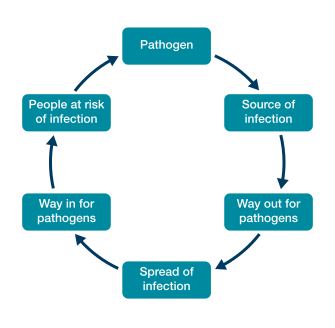
The chain of infection shows how infections spread. The chain has 6 interconnecting links. Breaking any one link can stop the spread of infection. The more links that break, the safer everyone is.
Figure 1: The chain of infection
Pathogen
Pathogens are germs that can cause infections, for example norovirus or influenza (flu virus). Pathogens can be present in the environment or on a person’s body. This can make breaking this part of the chain difficult. Other links in the chain of infection are much easier to break.
Source of infection
The source of infection is where pathogens live or grow. They can be on the skin, in the gut, in bodily fluids, in food, or in the environment. Knowing where pathogens come from helps ensure the right IPC measures are used. IPC measures, when carried out properly, are safe practices to stop pathogens from spreading and causing illness.
Way out for pathogens
The way out is how pathogens leave where they live and grow. For example, coughing or sneezing spreads the flu virus into the air, or eating or preparing contaminated food can spread Salmonella bacteria.
Spread of infection
The spread of infection is how pathogens move between people or objects. This could be through touching contaminated surfaces, the air, or body fluids. This is the easiest link to break.
Way in for pathogens
The way in is how pathogens enter the body. This could be through breathing them in, swallowing them, through wounds or broken and dry skin, touching eyes or mouth, or via devices like catheters, feeding tubes or needles. People accessing care often have multiple ways in, making them more vulnerable.
People at risk from infection
Everyone receiving care and support is at some risk of infection, but older individuals and those with health conditions or weaker immune systems are at greater risk because infections can cause more serious illness. They may also need more support, have more contact with healthcare services, or take antibiotics more often. This can increase their chance of coming into contact with harmful pathogens. Good IPC practices and a clean environment help reduce this risk.
IPC measures should always be applied in a way that is proportionate and person-centred, balancing infection prevention with people’s rights, independence, dignity and quality of life.
Breaking the chain of infection
Standard infection control precautions (SICPs) are used to break the chain of infection. They should be followed every time care is provided, whether an infection is known or not.
Using the hierarchy of controls to reduce the risk of infection
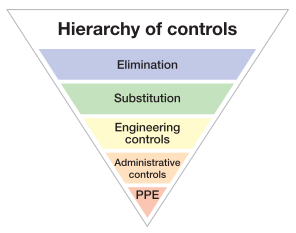
The hierarchy of controls helps decide which safety measures to take to reduce the risks from a particular hazard such as infection. Action needs to be taken at all levels of the hierarchy of controls.
Figure 2: Hierarchy of controls
Source: Health and Safety Executive (HSE)
The hierarchy of controls shows 5 levels of action to reduce or remove hazards, in this case, infections and the pathogens that cause them. The levels are ordered by how effective they are in keeping an environment safe. Elimination (the most effective control) is at the top; this would mean keeping a pathogen out of the setting completely. Personal Protective Equipment (PPE) is less effective but necessary where an infectious hazard (pathogen) cannot be completely eliminated. PPE includes items such as gloves, aprons, face masks, and eye protection. These are used to reduce the risk of infection spreading between people, care and support workers, and the environment.
Often, there will be a need to use more than one level of control in the hierarchy. Even if elimination, substitution, engineering, or administrative controls have been used, there may still be times when PPE is needed because those other measures are not enough to remove the risk (for example, if there’s a risk of contact with blood or body fluids). PPE when used correctly will protect the user.
Elimination
Elimination (remove or reduce the infection) can be achieved by:
- Vaccine uptake (for example, flu, measles, hepatitis A, respiratory syncytial virus (RSV). This is because vaccination reduces the number of people in the population who have the infection, so this lowers the risk of other people getting and spreading infections
- keeping a person who has an infection away from others
- cleaning all equipment used for more than one person before and after use
- carrying out hand hygiene before and after touching a person
- encouraging people accessing care and support to clean their hands regularly through the day
Substitution
Substitution (change what is done) can be achieved by:
- reducing communal activities during an outbreak
- increasing cleaning during an outbreak
- using outdoor spaces for visits and meetings where possible
- taking only the equipment needed for home visits
Engineering controls
Engineering controls (change the environment) can be achieved by:
- improving ventilation, for example, ensuring ventilation systems are maintained and turned on and/or opening windows safely
- carrying out care in clean, well-maintained areas
- reduce damaged surfaces (such as cracked floors or chipped worktops) that are hard to clean and where pathogens can live
Administrative controls
Administrative controls (change how you work) can be achieved by:
- limiting staff movement between areas where possible during an outbreak
- assigning a small number of staff to care for someone with an infection needing home care
- reporting infections quickly so they can be managed before spreading to others
- using a specific care plan for people with an infection to reduce spread
Personal protective equipment (PPE)
PPE is the last measure in the hierarchy of control. Use PPE when:
- other controls do not reduce the risk enough
- there is a risk of blood or bodily fluid exposure
- put PPE on and take it off in the correct order to protect care and support workers and people accessing care and support
The hierarchy of controls helps care and support workers understand why standard infection control precautions are so important and how to apply them effectively.
Risk environments
Different care settings carry different infection risks. This depends on the type of contact care and support workers have with people accessing care and support and how vulnerable they are. ASC settings vary and include small or large residential settings, services for older people, people living with dementia, people with learning disabilities or other disabilities, and care provided in people’s own homes. The type of care provided also varies depending on the needs of people accessing care and support. IPC measures should therefore be applied flexibly and proportionately, based on the risks in the setting and the needs of people accessing care and support.
Examples of common ASC settings are described below to help care and support workers think about risks in a practical way and decide which IPC measures are most important.
Remember standard infection control precautions are needed in all ASC settings.
Care homes for older adults (including residential and nursing care)
People in older adult care homes are usually vulnerable to infections because of age and frailty. They often need frequent, close-contact care, which makes it easier for infections to spread. Many people also live with dementia, which can make it hard for them to follow IPC measures. This means they need compassionate, person-centered approaches that balance safety with dignity.
Residential care settings for people with learning disabilities
These homes are usually small (often fewer than 10 people) and feel more like a household. People with learning disabilities may be more at risk of infection, especially if they have other health conditions. Many people are younger and more active in these settings, with some only needing limited daily living or behavioural support. As people are often active in the community, IPC measures need to consider independence and quality of life.
Care settings supporting people with mental health needs
Infection risks in these settings may be influenced by shared environments and social interaction. Some people may find it more difficult to follow IPC measures due to anxiety, distress, or cognitive factors. Care and support workers should apply IPC measures using person-centred approaches that are proportionate and least restrictive, while supporting people’s rights, independence, and wellbeing.
Domiciliary care (home care)
In domiciliary care, people are visited in their own homes. The risk of infection transmission varies depending on the household, including the number of occupants, visitors, general living conditions, lifestyle habits and presence of pets. Care and support workers may provide close personal care, visit multiple households, and work within variable domestic environments, all of which can influence infection risk. People accessing care and support may also be at higher risk due to age, underlying health conditions, or increased vulnerability. Risk assessment is therefore essential to identify and apply appropriate IPC measures in each home setting.
Safeguarding statement
In keeping with the Mental Capacity Act 2005, care and support workers must presume capacity unless assessed otherwise, provide tailored support to enable understanding, and document any capacity assessments clearly. Where a person lacks capacity, decisions or protective measures must be made in their best interests and be proportionate, necessary, and least restrictive, with involvement from relevant professionals and those close to the person wherever appropriate.
Always ensure any information sharing about a person who is infectious is done so in a compassionate but proportionate way.
Antimicrobial resistance and stewardship
What antimicrobial resistance is
Antimicrobial resistance (AMR) is when bacteria, viruses, fungi, or parasites no longer respond to medicines like antibiotics, antivirals, antiparasitic, or antifungal medication. If antibiotics stop working due to AMR, infections become harder to treat. AMR is a global threat and therefore an important reason for preventing infections. Fewer infections mean fewer antimicrobials are used, reducing the risk of AMR happening. Using antibiotics too often, or not using them as prescribed, for example if doses are missed, can contribute to AMR. Using antibiotics when they are not needed, for example if an infection is not caused by a bacteria, can also contribute to AMR.
Care and support workers have a role in promoting responsible antibiotic use and protecting people accessing care and support from resistant infections.
Understanding the risks
In ASC settings, people often have complex health needs and are vulnerable to infection and frequent need for antibiotic use, which increases the risk of AMR. Quick tests to diagnose infections are not always available so antimicrobials can sometimes be given as a precaution, when they are not needed. There is also less monitoring of antibiotic use than in healthcare settings. These factors can increase the risk of AMR. AMR in ASC settings can affect the wider community. Staff, visitors, and people accessing care and support move between places, so resistant pathogens can spread beyond ASC settings.
Antimicrobial stewardship
Antimicrobial stewardship (AMS) means using antibiotics and other antimicrobials responsibly. They should be used only when needed and in the correct way as prescribed.
Many people in ASC settings take multiple medicines which can affect how antimicrobials are prescribed, monitored and tolerated. This can increase the risk of side effects, drug interactions, and difficulties with adherence, making careful monitoring and clear communication especially important.
AMS matters because it:
- improves outcomes for people
- reduces inappropriate antimicrobial use
- lowers healthcare-associated infections
- cuts healthcare costs
- prevents the spread of resistant pathogens
- improves infection diagnosis and management
- reduces adverse reactions/ allergic reactions
- reduces illness and death
Effective AMS protects people now and preserves other antimicrobials for the future.
In practice, this means supporting people to take antibiotics as prescribed, ensuring treatment begins immediately, observing and recording their response to treatment, and escalating concerns if symptoms do not improve or if their condition changes. Decisions about prescribing or changing antibiotics remain the responsibility of the prescriber and wider healthcare team.
Practical actions for care and support workers
Promote infection prevention and control (IPC)
Always promote effective IPC, including hand hygiene, cleaning and PPE use.
Encourage vaccinations, especially seasonal vaccinations such as influenza. Vaccines are the most effective way to prevent many infectious diseases and give protection to people accessing care and support.
Ensure all IPC training is up to date.
Providers should have systems in place to manage the occupational health needs of staff in relation to IPC, including vaccination, screening, and the management of infectious risks, in line with national guidance, to support safe and effective care.
Support early detection of an infection
Seek advice from a GP or NHS 111 for emerging symptoms.
Keep a record of the person’s symptoms.
Engage with prescribers
Ensure a prescribed course of antimicrobials is started promptly, and that there is a mechanism for adding these to a care plan.
Document and record all prescriptions and administration, giving detail of what has been prescribed, what has been given, any missed doses, why it has been prescribed, the start date and review date.
Care and support workers should not make decisions about prescribing or clinical management but should escalate concerns and seek advice from appropriate healthcare professionals.
Educate
Care and support workers can access training on AMR to understand the importance of correct antimicrobial use. Their role is to support people to take antibiotics as prescribed, recognise and report any concerns, and signpost people or their families to healthcare professionals for clinical advice.
They may also reinforce key messages about correct antibiotic use where appropriate and signpost to recognised resources, such as the TARGET Toolkit, to support understanding of managing common infections and when to seek advice.
Monitoring antibiotic use
Keep secure, up-to-date records for each person receiving medicine. This is required under The Health and Social Care Act 2008 (Regulated Activities).
Care and support workers who administer medicines should record all doses given, including any missed doses, and report allergic reactions or other concerns to the appropriate healthcare professional in line with local procedures.
Information about antibiotic use should be recorded in line with local care plans or medication administration records and shared appropriately between care visits to support continuity of care.
Concerns should be communicated in line with local procedures, which may include reporting to managers, family members, GPs, community nurses or other healthcare professionals as appropriate.
Responsibility for monitoring antibiotic use will vary depending on the care setting and local arrangements. Care and support workers support prescribed treatment, maintain accurate records where this is part of their role, and escalate concerns, while clinical monitoring and decisions about prescribing remain the responsibility of the prescriber and wider healthcare team.
Water safety
Water safety is an important aspect of environmental IPC and may be supported by local organisational policies and procedures.
Water safety is essential for protecting people and includes:
- Legionella control
- scalding prevention
- general water hygiene
- correct sink use to prevent drain contamination
All residential and other communal ASC providers should have a water safety policy. This should include a water safety plan, which sets out how risks such as Legionella are identified, monitored and controlled. Providers are responsible for ensuring that water safety systems are in place and maintained, including identifying a designated person or persons who are trained to recognise risks, report issues, and follow water hygiene procedures.
Responsibilities for water safety differ between care settings. In domiciliary care, care and support workers are not responsible for compliance with water safety standards, monitoring or maintaining water systems or water temperatures. Instead, they should check that water used during care is safe (for example, not too hot to prevent scalding) and escalate any concerns in line with local procedures.
Legionella control
Legionella bacteria can grow in water systems and cause Legionnaires’ disease.
All communal ASC care settings must assess the risk of Legionella growth and maintain a water safety plan, including regular maintenance and flushing of infrequently used outlets (taps).
Hot water should be at safe temperatures:
- storage: above 60°C
- distribution: above 50°C
Use thermostatic mixing valves to reduce scalding risks while keeping temperatures high enough to control Legionella.
More information on how to manage the risk of legionella bacteria can be found in The control of legionella bacteria in water systems and HTM 04-01 safe water in healthcare premises
Prevention of scalding
Scalding (a burn caused by hot liquid or steam) is a risk for frail people, those with reduced mobility or cognitive impairments, staff, and visitors.
Thermostatic mixing valves can limit hot water at outlets (taps) which can prevent scalding (41°C for bathrooms/showers and 43°C for assisted bathing).
Staff should follow safe bathing procedures. Managers should ensure regular maintenance and testing of valves and systems is carried out.
Safe drinking water in communal ASC care settings
Drinking water must come from a safe source and should be monitored in line with local policies and procedures to ensure it remains safe. Any concerns about water quality should be reported and escalated promptly to local water provider. People accessing care and support should have easy access to drinking water at all times in all ASC settings.
Taps should be labelled, and water containers and dispensers should be kept clean and well maintained to avoid contamination. This applies to water supplies as well.
More information on safe drinking water can be found in The Workplace (Health, Safety and Welfare) Regulations 1992 and the Drinking Water Inspectorate Guide for private supply owners/users
Safe drinking water in domiciliary care
People accessing care and support in their own home should have access to clean and safe drinking water. Water containers and dispensers should be kept clean and well-maintained to avoid contamination. Care should be taken to keep water free from contamination during storage, handling, and use.
Hand wash sinks in communal ASC care settings
Hand wash sinks are only for handwashing.
Putting body fluids, food, drinks, or other waste into these sinks can contaminate the sink, increasing the risk of infection.
Keep sinks free from clutter or equipment to avoid splash contamination and allow for proper cleaning.
Clean sinks daily with detergent and disinfectant.
Hand wash sinks in domiciliary (homecare) settings
Use the most suitable sink available for handwashing; one that has the least clutter, is easiest to clean and nearest the person accessing care.
Do not place care equipment on or next to the sink.
Care and support workers are encouraged to bring liquid soap and paper towels to the visit so handwash equipment is always available when needed (domestic homes may not have this equipment available). After handwashing, use a clean paper towel to turn off taps where possible to reduce the risk of hand recontamination.
If the sink is dirty or may be contaminated, use alcohol-based hand rub until a suitable hand wash sink is available.
Water used for flowers or plants
Flowers and plants can support wellbeing and help maintain a homely environment. IPC measures should therefore be applied proportionately, recognising that in some settings, such as domiciliary care, care and support workers may have limited control over the environment and should focus on observation, good IPC practice, and escalation of concerns where needed.
Water used for flowers or vases should be disposed of safely (for example in a suitable utility area) and not in handwashing sinks, as stagnant water may contain harmful bacteria. Where appropriate, vases should be emptied, cleaned and refilled regularly to reduce the risk of microbial growth.
In domiciliary care, dispose of used water in the most appropriate place, for example a kitchen sink or a toilet.
Always clean hands after disposing of used water.
Pets, animal contact and avoiding pests
Pets in ASC settings, including domiciliary care
Pets can enhance quality of life, but it is important that hygiene precautions are in place to reduce infection risk.
Carry out a risk assessment for hygiene, including handwashing and cleaning to reduce infection risks between pets, people and care and support workers to a safe level.
In domiciliary care settings, care and support workers have limited control over the home environment; including pets. Care and support workers should carry out hand hygiene after any contact with pets and escalate any concerns regarding any pets in line with local procedures.
Keeping pets safely in communal ASC settings
A nominated person should always be responsible for the animal.
Only domesticated pets are advised in communal ASC settings.
Keep pets away from where food is stored, prepared, cooked, or served.
Keep pets groomed, vaccinated, treated for fleas, wormed, and checked for illness regularly.
Ensure sick animals are treated by a vet and not returned to the communal ASC setting until cleared.
Keep claws trimmed to reduce scratches. Clean any scratches promptly.
Clean pet fur and bedding regularly.
Hygiene practices
Follow these hygiene practices if any pet is present in the communal ASC setting:
- remove pets during wound care
- keep pets away from any open wounds
- clean hands after touching pets
- cover skin lesions, cuts or abrasions
- keep pet feeding areas clean
- use separate dishes to feed pets
- do not feed pets in food preparation areas
- store pet food separately from human food
Litter trays or boxes:
Keep litter trays or boxes away from food areas.
Wear gloves and a disposable apron to clean litter trays or boxes.
Clean litter daily to remove animal excrement.
Disinfect litter trays or boxes weekly to reduce the risk of Toxoplasma. Toxoplasma is a parasite commonly found in cat faeces, although infection may also occur through other animals and sources such as undercooked meat. It can lead to serious health issues, especially in pregnant people and those with weakened immune systems. Pregnant staff should avoid cleaning litter trays.
Seal litter that has been removed in a plastic bag and dispose of it in the general household waste.
Birds that are kept as pets:
Carry out a risk assessment before bringing birds into the care setting to check for health risks and suitability. Birds should be healthy and free from disease. They should be checked by a vet if they are not well.
Follow the hygiene practices, such as handwashing and cleaning, to prevent infections.
Keep birds in designated areas, away from food preparation, storage, and eating areas.
Any staff regularly handling the birds, should be trained on how to handle them safely, how to recognise signs of illness, and how to follow IPC practices. Manage birds safely and ensure any visitors follow these infection control rules listed above.
Wear gloves and a disposable apron when handling any bird droppings, and clean hands afterwards.
Pests
Pests are animals or insects that can pose a risk to human health, for example birds, rats, mice and cockroaches.
Pests can contaminate food and damage buildings. Pests can be prevented by using well-fitting doors, covering drains, using fly screens, or bird-netting.
If there is any evidence of pests (droppings, nests, chew marks, egg cases, webbing, damaged food, or live insects), always contact the Local Authority environmental health officer immediately.
Always discard affected food and items.
Preventing pests
To prevent pests coming into the ASC setting:
- clean up spillages as soon as practicably possible
- rotate stock regularly
- store food in rodent-proof containers with lids
- store food off the floor/ground
Training and education
Training is a vital component of effective IPC practice. It ensures that care and support workers keep their IPC knowledge and skills up to date, helping to protect people accessing care from avoidable infections. ASC settings should have a policy that sets out what should be included in IPC training and how competencies will be checked.
IPC training should be part of inductions, with annual refreshers and updates tailored to different roles. This will help to build an IPC culture that empowers staff to report issues and drive continuous improvements in IPC standards.
All ASC providers and settings should have access to IPC training that is aligned to CQC Inspection Standards, the Health and Social Care Act 2008: code of practice on the prevention and control of infections, Skills for Care Certificate standard 15: infection, prevention and control, and national evidence-based guidance (such as NICE and UKHSA).
The skills for health care certificate standards are a set of standards for health and social care workers to use in their daily working life, including standards for IPC which should inform the content of IPC training.
IPC training should cover:
- how infections spread and how to stop them (chain of infection)
- identifying standards of infection control precautions which must be followed to prevent infections
- demonstrating effective hand hygiene at the right times and using the right technique using appropriate products
- how care and support workers’ own health, hygiene, vaccination status and exposure to infection at work might pose a risk to the people accessing care support
- how to risk assess, work safely, and use PPE correctly, including putting on and taking off correctly
- how to spot and respond to suspected or confirmed infections including transmission-based precautions
- what an outbreak is and how to manage it
- how to handle waste (including sharps) and laundry safely
- demonstrating appropriate cleaning and or decontamination of care equipment and care environments
- how to prevent and manage exposure to infections (including sharps injuries) and handling blood or bodily fluids
- safe use of medicines, AMR and AMS
- extra training for those who support people with invasive devices, for example catheters, or wounds
- support and advice on IPC training and education is available from local, regional and national organisations - Integrated Care Systems (ICS) will have details of local IPC training arrangements.
IPC champions
ASC providers may choose to have designated IPC leads or champions within their service. An IPC champion is a member of ASC staff who helps promote good IPC practices in their ASC setting (including domiciliary care). They support colleagues, encourage good habits such as hand hygiene, share information and guidance, and help create a safe environment for people accessing care, visitors, and staff.