Standard infection control precautions in adult social care
Published 28 October 2026

© Crown copyright 2026
This publication is licensed under the terms of the Open Government Licence v3.0 except where otherwise stated. To view this licence, visit nationalarchives.gov.uk/doc/open-government-licence/version/3 or write to the Information Policy Team, The National Archives, Kew, London TW9 4DU, or email: psi@nationalarchives.gov.uk.
Where we have identified any third party copyright information you will need to obtain permission from the copyright holders concerned.
This publication is available at https://www.gov.uk/government/publications/infection-prevention-and-control-ipc-in-adult-social-care-asc/standard-infection-control-precautions-in-adult-social-care
This section explains the standard infection prevention and control precautions that should be used for routine care for every person accessing care and support to help prevent the spread of infection and keep people and staff safe.
Key summary
- standard infection control precautions (SICPs) are basic infection prevention and control (IPC) rules used for every person, every time
- they protect staff and people accessing care and support
- hand hygiene is important
- spot infections early to reduce spread
- use personal protective equipment (PPE) when needed, based on risk
- keep the environment clean, including, equipment and linen
Call for action
- always follow standard infection control precautions
- clean hands regularly
- report infections early
- use PPE when needed
- keep things clean
- handle waste and sharps safely
- act quickly on spills/exposure
- use good respiratory hygiene and ventilation
Standard infection control precautions (SICPs) are basic IPC measures that should be used by everyone providing care in ASC settings, for all people accessing care and support, at all times regardless of whether an infection is known or suspected.
The use of SICPs is advised whenever providing care or support to people. These precautions protect both care and support workers and people accessing care, whether they are known to have an infection or not.
Applying SICPs may look different depending on where care is provided. For example, there may be different considerations in a person’s own home than in a care home. Nevertheless, the overall aim remains the same, which is to prevent infections.
Using SICPs correctly helps protect people receiving care while also reducing unnecessary waste and use of resources, supporting both safe care and environmental sustainability.
Safeguarding statement
In keeping with the Mental Capacity Act 2005, care and support workers must presume capacity unless assessed otherwise, provide tailored support to enable understanding, and document any capacity assessments clearly. Where a person lacks capacity, decisions or protective measures must be made in their best interests and be proportionate, necessary, and least restrictive, with involvement from relevant professionals and those close to the person wherever appropriate.
Always ensure any information sharing about a person who is infectious is done so in a compassionate and proportionate way.
Checking for infection
Care and support workers play an important role in noticing when someone may have an infection. Early recognition means people get the right treatment quickly and reduces the chance of infections spreading to others.
When someone first comes into a care setting including those new to domiciliary care (homecare), they should be asked about previous infections. This may include chest infections, urinary tract infections, MRSA, hepatitis B, or Clostridioides difficile (C. diff). This information can help with care planning. Records should be kept confidential and only shared with people who need the information to provide care or carry out public health duties.
Risk factors for infection include:
- vaccination status
- wounds or breaks in the skin
- invasive devices such as urinary catheters
- conditions or medicines that weaken the immune system (for example diabetes, cancer treatment, or steroids)
Possible signs and symptoms of infection include:
- diarrhoea and/or vomiting
- an unexplained rash
- fever or high temperature
- cough, breathlessness, or other respiratory symptoms
Older people may not always show the usual signs and symptoms of infection, for example they may not get a high temperature, and they may not be able to describe how they are feeling. They may present with a change in cognitive status (new state of confusion), reduced appetite or increased falls. This needs to be considered when assessing their needs and deciding if a medical review is needed.
Checking for infection is important to help identify people who may be becoming unwell and who may need further assessment or treatment. Clinical observations can support this process.
Care and support workers should always seek advice, and/or support people to seek advice, from their GP or other NHS service if they present with symptoms of infections.
When caring for a person with a known or suspected infection, transmission-based precautions (TBPs) need to be used in addition to SICPs.
In domiciliary care, care and support workers are often the first to notice changes in a person’s health or behaviour. Recognising the early signs of infection and seeking advice when needed can help ensure they get the right care quickly.
Hand hygiene
Hand hygiene is the most effective way to prevent the spread of infection. Hand hygiene must be carried out at the right time, using the right product, and with the correct technique. Encourage and support people accessing care to clean their hands regularly too.
When to clean hands
Key moments for hand hygiene include:
- before touching a person
- after touching a person
- before a clean or aseptic task
- after body fluid exposure
Other moments to clean hands include:
- when arriving at or leaving the setting, including when people accessing care and support return from activities or appointments
- before and after handling medications or food
- before and after refreshment breaks
- before putting on PPE
- after removing PPE
- after using the toilet
- between care activities with the same person (for example: feeding, washing, dressing)
- between providing care and support for different people
- after cleaning equipment, handling waste, or handling used linen and clothing
Hand hygiene products that can be used
There are different products that can be used for hand hygiene, and they have specific requirements for their use.
Liquid soap and water
Always use liquid soap and water when hands are visibly dirty, soiled, or if there has been contact with blood, body fluids, or with a person who has symptoms of diarrhoea or vomiting.
Avoid bars of soap because bars of soap can collect pathogens that can then spread to others.
Do not top up liquid soap containers or dispensers, as this can increase the risk of contamination. Replace empty containers or cartridges in line with the manufacturer’s instructions.
Alcohol-based hand rubs
Alcohol-based hand rubs must contain at least 60% alcohol and must conform to British and EN (European Norm) standards. Alcohol-based hand rubs may contain different types of alcohol, such as ethanol or isopropyl alcohol. Individual products should be checked to ensure they meet these standards, as effectiveness may vary between active ingredients.
Alcohol-based hand rub is only effective if used on visibly clean hands. Alcohol-based hand rub is not effective against some pathogens that can cause diarrhoea and vomiting. This includes non-enveloped viruses like enterovirus, rhinovirus, norovirus and adenovirus, which have a hard outer protective layer that alcohol cannot always break down. It also includes bacteria that produce spores like Clostridioides difficile. For this reason, alcohol-based hand rub is not recommended for hand hygiene when caring for people with diarrhoea and vomiting or during outbreaks of diarrhoea and vomiting.
Always assess the suitability of alcohol-based hand rub products before use, because they are flammable and can be harmful if swallowed or misused. Care and support workers should inform their manager if they have concerns about using alcohol-based hand rub with any person or group of people.
Do not top up alcohol-based hand rub containers or dispensers, as this can increase the risk of contamination. Replace empty containers or cartridges in line with the manufacturer’s instructions.
Do not use products that are expired, damaged, or unsuitable. Report them and dispose of them safely following local procedures, COSHH guidance, and manufacturer instructions.
Non-alcohol alternative hand hygiene products
If alcohol-based hand rubs are not safe to use due to risk of misuse or allergies, then ASC providers can choose alternative products. Those involved in purchasing hand hygiene products are advised to:
- complete a documented risk assessment approved by local governance
- confirm the product is effective and suitable for its intended use. This will mean checking with the manufacturer and checking the product meets EN standards and British Standards
- identify any differences in use compared to alcohol-based hand rubs, such as amount needed, contact time (this is the time the product needs to remain on the hands to work effectively), or method of application.
- ensure all care and support workers and other ASC staff are aware of how to use the products safely and effectively. This will include providing staff with guidance, training, and supporting materials to use the product
Hand hygiene in different ASC settings
Hand hygiene can be harder in some ASC settings, especially when providing homecare. Care and support workers should have access to alcohol-based hand rub in easy reach in any setting.
Providers of ASC in homecare settings must make sure that care and support workers always have access to portable hand hygiene equipment, such as:
- alcohol-based hand rub in easily carried containers
- portable liquid soap
- paper towels or kitchen roll
This helps care and support workers maintain good hand hygiene when working in a person’s own home where facilities may vary.
Preparing for hand hygiene (bare below the elbows)
Long sleeves and items worn on the hands or forearms can make effective hand hygiene more difficult. Care and support workers should be bare below the elbows to support good hand hygiene. This means:
- do not wear hand or wrist jewellery when providing care (except plain rings which should be removed or moved up the finger when cleaning hands)
- keep nails short and clean and free from nail varnish, artificial nails and any other alternative nail products
Faith based considerations
Religious bangles can be worn but they need to be moved up the forearm during hand hygiene to ensure hands and wrists are properly cleaned.
If disposable oversleeves are worn for religious reasons, they must be removed and disposed of before carrying out hand hygiene. Apply new disposable oversleeves once hand hygiene has been completed. Oversleeves are single use items. Single use means use once for one person, then dispose of safely.
Many faith leaders, including the Muslim Council of Britain, support the use of alcohol-based hand rubs because protecting health and preventing infection is a priority.
Correct hand hygiene technique
The correct hand hygiene technique is the same whether liquid soap and water or alcohol-based hand rub is used. It is not necessary to use both, use one or the other depending on the circumstance.
Whatever type of hand hygiene product is used, it is important that all parts of the hand and wrist are cleaned. This involves the following steps, using enough product to cover all parts of the hands and wrists:
- rubbing hands palm to palm
- interlacing fingers
- rubbing the back of hands
- rubbing over and around both thumbs, and all fingertips
- paying attention to nails and wrists
The following poster how to handrub shows the technique when using an alcohol-based hand rub product. When using an alcohol-based rub, take at least 20 seconds for the hands to dry naturally. This allows the alcohol to kill the pathogens effectively.
When using soap and water, follow how to handwash, noting the following points:
- wet hands with lukewarm or warm running water before applying liquid soap, as this helps the soap to lather
- apply enough liquid soap to cover both hands (never use bar soap)
- do not use nail brushes as they can cause skin damage
- dry hands completely using a disposable paper towel
- do not use fabric towels as these can hold pathogens and re-contaminate washed hands during drying
Hand care
It is very important to keep hands well moisturised and in a healthy condition (no cracks, no dry areas and no sore areas) to protect skin from the drying effects of hand hygiene.
If hands are dry, cracked and sore then they become difficult to clean effectively.
Use the following advice to help keep hands healthy for both care and support workers and people accessing care and support.
- use emollient hand cream (moisturiser) regularly (before breaks, after work, before sleep)
- avoid communal tubs of hand cream
- report irritation to a healthcare professional and manager
- cover any broken skin on the hands with a waterproof dressing
Supporting people who are accessing care and support with hand hygiene
Hand hygiene is important for people accessing care and support.
Care and support workers should encourage, remind, or help people to clean their hands either with soap and water, alcohol-based hand rub (where appropriate) or dedicated hand wipes at the following times:
- before and after preparing or eating food
- after using the toilet, commode, urinal or bedpan
- if their hands are visibly dirty
- on entering and leaving a communal care home
- if contaminated after coughing, sneezing, or touching wounds
Respiratory and cough hygiene
Good respiratory hygiene helps reduce the spread of infections.
To reduce the spread of infection care and support workers and people accessing care and support should be encouraged to:
- cover their nose and mouth with a disposable tissue when sneezing, coughing, or wiping their nose
- keep tissues within easy reach and dispose of them immediately after use in a bin
- if tissues are not available, sneeze or cough into their elbow instead of their hands
- clean hands with soap and water or alcohol-based hand rub after coughing, sneezing, using tissues, or touching contaminated objects (for example sputum pots)
- keep hands away from eyes, nose, and mouth if respiratory symptoms are present
- increase ventilation where possible (for example opening windows) when respiratory infections are suspected or confirmed
Catch it. Bin it. Kill it. is a useful poster to place in ASC settings to remind care and support workers and people accessing care and support of good respiratory hygiene.
In domiciliary care, care and support workers should encourage good respiratory hygiene within the person’s home.
More information is available in the infection prevention and control in adult social care: acute respiratory infection guidance.
Ventilation
Good ventilation helps reduce the risk of respiratory infections by reducing the pathogen load. This is the amount of pathogens suspended or floating in the air. Open windows or vents if a respiratory infection is suspected or confirmed.
Opening windows to improve ventilation should be based on the person’s consent and take account of their preferences and the home environment.
High-level windows are better than low-level ones to avoid draughts. Opening several windows slightly is usually more comfortable than opening one window wide. Open windows on different sides of a room to increase airflow.
External doors can also be opened but check for safety and security risks first. Keep vulnerable people (those who may be at risk of harming themselves) safe while still maintaining good ventilation.
In hot weather, follow the Supporting vulnerable people before and during hot weather guidance. In cold weather, follow the Managing infections - don’t forget about the indoor air in your care home guidance and Supporting vulnerable people before and during cold weather.
Adjust windows, doors, and heating or cooling as needed to balance airflow and comfort.
Ventilation in communal ASC settings
Open windows where safe and appropriate to do so, as this increases natural ventilation and supports better air circulation throughout the environment. Do not remove window restrictors.
Keep internal doors open to improve airflow, but only if fire safety is not compromised.
Keep doors closed when caring for someone with an infection, based on risk assessment. This will help prevent spread to other people in the setting.
Use outdoor spaces to help reduce risks of infection and to support safer visiting in care homes.
Portable fans in ASC settings
Portable fans can be useful during periods of hot weather, including heatwaves or where their use is needed to support a person’s comfort and safety and should be used based on a risk assessment and judgement based on the following recommendations.
If a person has a cough or other respiratory symptoms, portable fans should be switched off where possible until the person is better, unless needed for comfort or safety. Do not use fans during an outbreak.
Switch fans off when providing clinical interventions, such as wound care, or medical device care (catheter, feeding).
Make sure fans are free from dust and debris and can be easily cleaned.
Ensure portable fans are documented on planned maintenance and cleaning schedules.
Clean fans following manufacturer’s instructions between use by different people if in a communal ASC setting.
Use fans only in rooms with open windows or mechanical extraction and aim the airflow toward the outside.
A person’s preference for where a fan is positioned should be taken into account, but ideally place at bed or chair level or higher. Avoid aiming directly at the person’s face, body, or open wounds.
Avoid creating a trip hazard.
Clean hands before and after handling the fan.
In home care settings, care providers may have limited control over portable fans owned by the person receiving care. If a fan appears visibly dirty or is likely to create a risk of spreading dust or contamination, staff should consider asking for it to be switched off while care is being provided.
Personal protective equipment (PPE)
Personal protective equipment (PPE) helps keep care and support workers safe while doing their job. PPE includes any clothing or equipment worn or held at work to protect someone from health or safety risks. PPE used for IPC purposes is designed to prevent pathogens gaining entry to a person’s body through the skin, eyes, nose and mouth.
Care providers must provide PPE free of charge if a risk assessment shows it is needed, after other safety measures have been considered in line with COSHH.
Care and support workers should assess if there is any likely exposure to blood or body fluids, broken skin or mucus membranes before carrying out any care and support activity.
PPE should be available at the point of care. In domiciliary care, this will often mean taking the PPE needed for the visit with you.
PPE should only be worn if a risk is identified. Overuse of PPE should be avoided. Overuse of PPE is wearing gloves, aprons, masks or other protective equipment when it is not needed based on the level of risk, for example wearing gloves for social contact or an apron for every interaction regardless of the task being carried out.
PPE can also be used to protect the wearer from other hazards including cleaning chemicals.
Types of PPE
Types of PPE include:
- single use disposable aprons or gowns
- single use disposable gloves (sterile and non-sterile)
- single use disposable Type IIR fluid-resistant surgical face masks (FRSM)
- eye protection (goggles or visors, disposable or reusable)
- respiratory protective equipment (RPE)
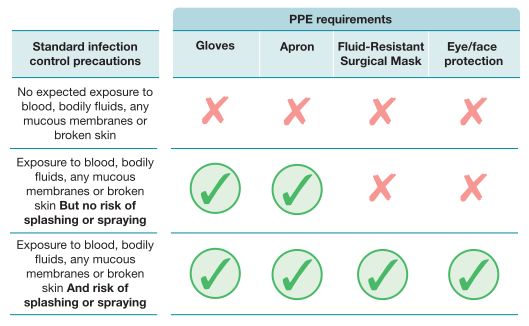
Table 1 provides a quick guide to inform care and support workers on when PPE is usually required when using SICPs.
Table 1: PPE requirements
Disposable single use sterile gloves
Use single use sterile gloves if you are going to touch equipment that needs to stay sterile, or touch body sites where the skin is not intact, or where invasive devices are present (wound bed, catheter that is being inserted into the body).
Disposable single use non-sterile gloves
Gloves are not a substitute for hand hygiene.
Gloves are single use and protect the user from getting and spreading infection.
Gloves should be made of vinyl or nitrile (nitrile is preferred as they have less risk of tearing and can tolerate longer use). Latex gloves are not recommended due to risk of latex allergies and sensitivities.
Gloves should fit the user well and should be put on immediately before the task for which they are needed. Be careful not to touch other things in the environment once gloves are on.
Double gloving is not recommended, as wearing two pairs of gloves does not reduce the risk of infection and may make it harder to clean hands properly or carry out tasks safely.
Never wash gloves or use alcohol-based hand rub on gloves - they should never be reused.
Glove use should be assessed based on risk, exposure and care activity.
Gloves should be worn for:
- contact with broken skin or mucous membranes
- exposure to blood, body fluids, secretions, or excretions (for example: wound care or personal care, where there is exposure to body fluids)
- applying topical creams or medications which might be absorbed into the skin (cytotoxic, cytostatic, or steroids)
- handling hazardous chemicals that may cause skin irritation (other types of gloves may be indicated when using hazardous chemicals as per COSHH assessment)
Avoid overuse and inappropriate use of gloves.
Gloves should not be used for
- social contact like holding a hand when assisting the person to mobilise
- administrative tasks
- handing out meals or drinks
- using mobile phones or other electronic devices
- handling of non-hazardous items
- administering intramuscular injections
Overusing gloves can increase the risk of infection due to hand hygiene moments being missed.
Remove and dispose of gloves between people and between care activities on the same person (for example after helping a person to use the toilet and before helping a person to brush their teeth, and before contact with other items such as door handles).
Perform hand hygiene immediately after removing gloves.
Disposable plastic aprons
Wear disposable aprons when there is a risk of clothing becoming contaminated with blood, body fluids, secretions, excretions, or broken skin (for example personal care or handling dirty linen and clothing or cleaning equipment).
Uniforms do not replace the use of disposable plastic aprons.
Disposable plastic aprons should be changed between providing care for different people and between care activities on the same person.
Long-sleeved gowns are only needed if there is risk of extensive splashing that a normal apron would not cover.
Dispose of aprons after each care activity.
Face masks (Type IIR fluid-resistant surgical masks)
Fluid-resistant surgical masks (FRSMs) protect the wearer by stopping splashes and droplets from reaching the nose and mouth and reducing exposure to pathogens that are transmitted through the air. FRSMs should be worn whenever there is a risk of exposure to respiratory pathogens or blood or body fluids splashing to the nose or the mouth.
Always ensure FRSMs are:
- well-fitting and cover the nose, mouth, and chin
- not touched while being worn
- never moved to under the nose or chin
- removed in a safe area and hand hygiene carried out before touching anything else
- fully removed by only handling by straps
- disposed of as per local waste policies after the care activity, and at any time if moist damaged, or visibly contaminated
Change the FRSM:
- at the end of a procedure or task
- if the mask feels moist
- if it has been contaminated with blood or body fluids
Manufacturers’ specific instructions should be followed.
People accessing care and support and the use of FRSMs
If a person accessing care develops respiratory symptoms, wearing an FRSM may help reduce the spread of infection when they are in contact with others. Only ask a person to wear an FRSM if they can do so safely and without distress, and if it does not affect their breathing. This may not be necessary if the person has limited contact with others. FRSMs are not recommended for people who cannot wear them safely or who have breathing difficulties.
In home care settings, people with respiratory symptoms may not need to wear an FRSM to prevent the spread of infection as they are not sharing communal facilities. Care and support workers can wear an FRSM to protect themselves if someone in a homecare setting has respiratory symptoms.
Transparent face masks
Transparent masks are important for people who rely on lip-reading, people with hearing loss, some people living with dementia, and people with learning disabilities or autism who rely heavily on facial expression and visual communication. Transparent masks can be obtained for use by care and support workers if people accessing care and support rely on lip-reading or visual communication. Where transparent masks are not available or suitable and FRSM are used, staff should use alternative communication aids for those who reply on lip-reading or visual communication.
For more information on using fluid-resistant surgical masks during acute respiratory infections, see infection prevention and control in adult social care acute respiratory infection.
Eye protection
Wear goggles or visors if there is a risk of blood or body fluids splashing into your eyes, as the eyes can be a way in for pathogens.
Prescription glasses do not provide adequate protection. If you wear glasses, visors may be more comfortable than goggles.
While wearing goggles or a visor, do not touch them with your hands once on, to avoid contamination.
Decontaminate reusable goggles and visors immediately before and after use as per manufacturer instructions and store in a clean and dry covered container.
Respiratory protective equipment (RPE)
Respiratory protective equipment protects against pathogens that transmit through the air (airborne pathogens). RPE is not the same as an FRSM.
RPE is not routinely needed in ASC settings unless recommended by an IPC advisor (see risk assessment advice below).
An example of RPE is a filtering face piece class 3, known as an FFP3 mask. People accessing care and support are not expected to wear respiratory protective equipment (FFP3 respirators or hoods). These are intended for use by health and care and support workers.
FFP3 masks or hoods should only be used following risk assessment and IPC advice. IPC advice will support providers access support and implementation of RPE if and when it is needed. The risk assessment will include training, supply, storage, safe disposal, record keeping and support where fit testing fails.
If RPE is deemed necessary based on local risk assessment, then care and support workers must:
- use respiratory protective equipment (FFP3 respirators) in line with the health and safety executive respiratory protective equipment guidance
- be fit tested before use
- be fit-checked before each use
The person undertaking the fit test will tell the care and support worker if it has failed or not. Powered respirator hoods (if available) can be used if FFP3 fit testing fails (the mask doesn’t fit you well enough). If powered respirator hoods are used, then correct decontamination and maintenance must be carried out as per manufacturer’s instructions.
Providers of ASC should carry out risk assessments before RPE is used with help from their local IPC advisor. This risk assessment must consider:
- aerosol-generating procedures if a person accessing care and support has a suspected or confirmed acute respiratory infection
- close contact with infectious people
- poorly ventilated environments
- whether RPE reduces transmission risk and all other control measures and mitigations have been considered
- if there is a newly detected infection with pandemic potential, following advice from national UKHSA teams, UKHSA local Health Protection Teams or other relevant public health professionals
- follow any additional guidance issued for novel infections
Providers should consider the availability of suitable RPE, staff training and fit testing requirements to ensure it can be used safely and effectively when needed.
Safe management of the care environment (cleaning and decontamination)
In communal ASC settings like care homes or day centres, the environment must always be visibly clean, well maintained, and in good repair. This is because cleaning helps remove harmful pathogens from the environment, while a well-maintained environment supports effective cleaning practices.
In someone’s own home, care and support workers have no control over cleaning standards or property maintenance. This means the environment may not meet the same standards as communal ASC settings such as a care home.
In home care settings, care and support workers are not always responsible for cleaning. However, if there’s a risk of contamination, a care and support worker may need to clean a surface before starting a care activity to protect any equipment from being contaminated during use, as well as protecting the person accessing care and support.
All care and support workers should have basic training in cleaning so they can clean correctly and effectively.
All care and support workers and those with designated cleaning roles should be trained in correct cleaning techniques, including how to prepare cleaning solutions, and follow correct contact times. Always use a formal training package, not just an on-the-job demonstration.
Why cleaning is important
Cleanliness is essential for keeping care safe. ASC settings that are registered with the Care Quality Commission (CQC) must meet legal requirements under Regulation 12: Safe care and treatment and Regulation 15: Premises and equipment . These provide clear expectations around IPC and cleanliness.
Anyone involved in cleaning should understand their role and responsibilities under the Health and safety at work Act 1974 and Control of Substances Hazardous to Health (COSHH).
For cleaning measures to be used when a person accessing care is suspected or known to have an infection.
For cleaning measures to be used after a person accessing care and support has had an infection and has recovered, or at the end of an outbreak.
Cleaning definitions
Cleaning
Cleaning removes dirt and contamination but does not kill all pathogens. Suitable for general and routine cleaning when no infection is suspected or known. If an infection is suspected or known, then additional steps are required following cleaning (disinfection).
Disinfection
Removes most pathogens but not all. This is needed if equipment has been in contact with blood or body fluids (for example commodes, toilets) and any contact with known or suspected pathogens. A disinfectant should always be used after cleaning has taken place.
Cleaning in communal ASC settings
Follow local policies on how to clean each area, what products to use, and how to use them safely.
Use documented cleaning schedules so it is clear how to clean each area and how often it needs to be cleaned. This should include communal areas, bedrooms and bathrooms as well as service areas such as laundry rooms, storage areas, and corridors.
Cleaning equipment includes any cleaning items such as cloths (reusable or disposable), mops, buckets. The following colour-coding should be used for cleaning equipment to reduce cross-contamination:
- Red: Bathrooms including ensuites, toilets, showers, basins, bathroom floors
- Blue: General areas like lounges, dining rooms, bedrooms, staff spaces
- Green: Kitchens or areas where food is prepared or served
- Yellow: Areas that have had contact with a person with an infection (for example: their bedroom)
If providers use a different colour coding scheme to what is shown here, then it should be clear for all staff what this is.
Sluices and dirty utility areas are used to safely manage body fluids, such as urine and faeces, and other contaminated waste. They should be kept clean, tidy and used only for this purpose.
Cleaning frequencies in communal ASC settings
Most communal and shared areas need to be cleaned every day.
It is recommended that bedrooms (including ensuites) are cleaned daily.
Clean frequently touched surfaces such as door handles, grab rails, call bells, light switches, bed rails, bedside tables, and mobile devices daily or more often if visibly dirty.
Clean toilets and bathrooms at least daily, or more often if they become soiled (visibly dirty).
Extra cleaning is needed if there is a known or suspected infection. Follow instructions from managers of ASC setting or local IPC advisors for additional cleaning advice.
Ways of cleaning in all ASC settings
Clean from top to bottom, this means start with high surfaces like shelves or counters and clean floors last. Always use a hazard sign when cleaning floors to prevent slips.
Always start with clean areas and move to the dirty areas last to prevent spreading pathogens.
Large flat surfaces should be cleaned with an ‘S’ shape motion, starting at the farthest point, slightly overlapping. Do not go back over the area to avoid recontamination.
Always dust with a damp cloth.
Change cloths when dirty.
Detergent wipes are suitable for cleaning surfaces, frequently touched areas, and reusable equipment. Use one wipe per surface.
If using a fresh solution of neutral detergent, use it in warm water and change it when it becomes dirty or when switching cleaning tasks.
Routine disinfection of the general environment is not usually needed, but it is advised to use 1,000 parts per million (ppm) chlorine or hypochlorite solutions on sanitary areas such as toilets, sinks, or when there is a known infection.
Products that combine a detergent and disinfectant in a single formulation may be more practical to use, as they allow cleaning and disinfection to be carried out in one step (where disinfection is required).
Place signs while cleaning to prevent slips and remove signs once floors are completely dry.
Household detergents or bleach can be used if cleaning is needed in homecare settings. Always clean with detergent first before using bleach and follow the product instructions.
For further advice see the Cleaning Specification for Care Homes guidance.
Making up cleaning solutions
When making up cleaning solutions follow these instructions:
- always prepare cleaning solutions exactly as instructed by the manufacturer
- wear appropriate PPE
- measure carefully to ensure the correct concentration is made, as making the solution too weak may not kill pathogens, and too strong can damage surfaces or be unsafe
- replace solutions regularly, especially if they become dirty or contaminated
Bleach alternatives
Disinfectants used as an alternative to bleach should be selected based on their intended use and comply with relevant British and European (EN) standards for bactericidal (the ability to kill bacteria), virucidal (the ability to kill viruses) and fungicidal (the ability to kill fungal pathogens) activity. Where sporicidal activity is required (the ability of the chemical to kill and destroy bacterial or fungal spores), products should also demonstrate effectiveness against bacterial spores. Information about compliance with these standards can be found on the product label, technical data sheet or manufacturer’s product information.
The British and European (EN) standards can be hard to understand. If you are unsure which disinfectant to use, check with your manager, supervisor, IPC lead, or the person responsible for buying cleaning products before choosing or using a disinfectant. One product should not automatically be substituted for another, even if they appear similar, because their ingredients, concentration, preparation, or effectiveness may differ, Individual products must be checked to ensure they have been tested to and pass the relevant standards.
Safe management of care equipment
Care equipment is anything used to provide care and support and is often used by more than one person accessing care and support. Care equipment can easily be contaminated with blood, body fluids, or pathogens. It is very important to clean care equipment to help stop the spread of infection.
Care equipment must always be cleaned before and after each use with clear documented evidence that it has been cleaned before it is used again.
Care equipment must be stored clean and dry and kept in good condition.
If equipment is moved between people’s homes, it must be cleaned immediately after use, before it is transported to the next person.
Always make sure care equipment is CE marked (this shows it meets safety standards in Great Britain) or UKCA marked (this shows it has been UK conformity assessed).
Figure 1: CE and UKCA markings

Types of care equipment
Single-use
Single use means use once for one person, then dispose of safely.
To identify these items, look for the symbol of a 2 in a circle with a diagonal line across, or the words ‘single use only’ on the packaging.
Figure 2: single use only symbol

Single person use
This means the equipment can only be reused for the same person accessing care and support. Labelling might state ‘single patient use’.
Clean and decontaminate between each use in line with manufacturer’s instructions.
Reusable communal equipment
Examples of reusable communal equipment include hoists and commodes.
Clean and decontaminate all reusable communal equipment before and after each use.
People using a hoist should have their own sling that is laundered regularly.
Cleaning responsibilities
Shared care equipment can be a source of infection, so it is very important that all items are cleaned and decontaminated immediately before and after being used for any person accessing care or support.
Care and support workers should receive training on how to clean care equipment correctly.
Care and support workers are usually responsible for cleaning the care equipment that they use. Responsibilities for cleaning may vary between ASC settings, so always check who is responsible for cleaning or decontaminating equipment.
Always follow manufacturer’s instructions for cleaning and decontamination of reusable equipment.
Detergent and disinfectant products should be available to clean care equipment properly.
Always clean equipment immediately after contact with blood or body fluids.
Clean equipment before and after servicing or repairs.
Some items (like mattresses) may also need cleaning at set times as part of a regular cleaning schedule.
Equipment must also have evidence that it is regularly maintained (CQC Reg15) to ensure it is working correctly.
Storage of care equipment
Store equipment so that it is clean, dry, and protected from contamination, including during transport between care settings.
Used and dirty equipment should be kept separate from clean equipment at all times.
Avoid using the storage room to have a comfort break for eating and drinking and use a dedicated space for this.
In homecare (domiciliary care)
Clean equipment that needs to be taken into the home before entering the property, before leaving, and again before putting it back into storage.
Ideally clean used equipment in the person’s home, before leaving the property.
If care and support workers need to store or transport items in a vehicle, place them in a clean, dry, lidded storage box to keep them safe and to prevent contamination. Storage boxes should be provided by the care provider.
Levels of decontamination in ASC settings
The process of reducing the number of pathogens on the equipment is called decontamination.
It is important that all items of equipment that are used for more than one person do not carry pathogens from one person to another. This is achieved by cleaning and/or disinfection.
The level of decontamination that is needed will depend on the type of contamination that may be present as well as what the item is being used for.
Risks are grouped into 3 categories:
Low risk
Equipment that only touches intact skin or is not in direct contact with the person.
Medium risk
Equipment that touches mucous membranes or broken skin.
High risk
Equipment that enters the body, touches sterile areas, or is exposed to blood or body fluids.
Table 2 shows what level of cleaning and/or decontamination is needed according to the expected level of risk.
Table 2. Summary of level of risk and type of decontamination needed
| Level of risk | Description | Method | Example |
|---|---|---|---|
| Low | Items that come into contact with skin that isn’t broken Or: Items that do not come into contact with people And: Items are not contaminated by blood or body fluids |
Cleaning. Disinfection only if an increased infection risk is suspected | Wash bowls, catheter stands, hoists, thermometers, wheelchairs |
| Medium | Items that come into contact with mucous membranes Or: Items that have been used with people who have serious infections that spread easily, or with people whose immune systems are weak Or: Low risk items contaminated with blood or body fluids. |
Cleaning and disinfection | Respiratory equipment, thermometer, commodes, urinals, bedpans, blood sugar machines |
| High | All reusable equipment that is used in close contact with a break in the skin or any mucous membranes, and devices that enter a sterile area of the body, which is a part of the body that should be completely free from pathogens. | Follow manufacturer’s instructions. This may include high level chemical disinfectant methods | Sterile, which means completely clean and free from pathogens (this would not be carried out in ASC settings), or single use items |
If a combined detergent and disinfect product is not being used, then equipment must be cleaned and rinsed before it is disinfected.
Safe management of blood or body fluid spillages
A blood or body fluid spillage is any accidental escape of blood or body fluids like urine, faeces, vomit or sputum (spit or saliva). Blood and body fluid spills may contain pathogens.
Always risk assess the need for PPE before cleaning up a spillage. The minimum PPE required is an apron and non-sterile gloves. For large or splashing spills, also wear a gown and face and eye protection.
Clean spillages immediately where possible, or as soon as it is safe to do so.
Care and support workers should only clean up blood or body fluid spillages if they have been trained to do so. Keep people accessing care and support away from the area until it is cleaned.
Always check manufacturer’s instructions to ensure that cleaning and disinfectant products are appropriate for the type of material affected by the spill.
Heavily contaminated items that cannot safely be cleaned may need to be thrown away. Always discuss options with the owner of the item first.
Soft furnishings
Soft furnishings like carpets, cushions or delicate items are often found in ASC settings. They are hard to clean and usually can’t be cleaned with chlorine disinfectants as these will discolour the soft furnishing.
Laundry or steam cleaning can be used if it’s safe after the initial clean. Always discuss options with the owner first.
Products for cleaning up blood or body fluids
Spill kits have everything needed to safely clean blood or body fluids, including PPE and cleaning equipment. Spill kits do not have to be used if there is access to items such as gloves, aprons, a chlorine-releasing agent or suitable alternative, paper towels or other disposable absorbent material, and waste bags.
Always keep chlorine-releasing agents in a locked cupboard when stored in a communal care setting.
In homecare settings, use the products the person normally uses or has available.
New disinfectants are now available that don’t use chlorine but are still effective on blood and bodily fluid spillages. In ASC settings, managers can choose the product that works best for the ASC setting as long as it meets these European Standards: EN17126, EN13727, EN14348, EN14476, EN13697, EN14885, EN13704, EN1650, EN1276 and EN13624. These numbers will be on the product information. These standards can be hard to understand, so always check with the person responsible for buying cleaning products before choosing or using a disinfectant.
If the item can tolerate a chlorine-based product, follow the spillage procedure for the type of spill which is detailed below.
Cleaning up body fluid spillages (urine, faeces, vomit, or sputum)
It is important that body fluid spills are cleaned as quickly as possible using the following steps.
Step 1: Apply PPE (minimum apron and non-sterile gloves). For large or splashing spills, also wear a gown, face and eye protection.
Step 2: Soak up the spillage with disposable paper towel.
Step 3: If the spill is on a surface that won’t be damaged by bleach, clean the area with 1,000 ppm available chlorine solution or use a combined detergent with chorine releasing solution to a concentration of 1,000 ppm. Never put chlorine directly on urine.
Always check manufacturer’s instructions for how to dilute and how long to leave the solution and whether the area needs to be ventilated.
Step 4: Wash the area using disposable paper towels and a solution of general-purpose detergent and warm water.
Step 5: Dry the area (use paper towels or let it air dry).
Step 6: Throw away used paper towels and disposable PPE into waste bag, or if in a private home, into the general waste bin.
Step 7: Clean hands after removing PPE.
Cleaning up blood spillages
It is important that blood is cleaned up as quickly as possible using the following steps.
Step 1: Assess the risk and choose the right PPE (minimum apron and non-sterile gloves). For large or splashing spills, also wear a gown, face and eye protection.
Step 2: Put chlorine granules (if available), directly on the spill so long as the surface will not be damaged by these.
If chlorine granules are not available, cover the spill with disposable paper towels or an alternative absorbent product to absorb and contain it. Then pour 10,000 ppm chlorine solution onto the towels so long as the surface will not be damaged by doing this.
Follow manufacturer’s instructions for dilution and contact time or leave for at least 3 minutes if no other contact time is provided by the manufacturer.
In homecare settings where chlorine may not be available, wash the area with general-purpose detergent solution.
Step 3: Dispose of all waste from the spillage as infectious waste.
Step 4: Wash the area with disposable paper towels and a solution of general-purpose detergent and warm water.
Step 5: Dry the area (use paper towels or let it air dry).
Step 6: Remove PPE.
Step 7: Clean hands after removing PPE.
Step 8: Throw away used paper towels and PPE as per local waste policy, or if in a homecare setting, place in the general waste bin.
Soft furnishings like carpets or delicate items are hard to clean and usually can’t be cleaned with chlorine disinfectants. In this case wash the area with general purpose solution and then steam clean.
If an item is heavily contaminated and can’t be safely cleaned, it may need to be discarded. Always discuss options with the owner of the item that has been contaminated.
More information is available here in the Management of blood and bodily fluid spills guidance.
Safe disposal of waste and sharps
Waste management is important to prevent injury or infection, save costs, and reduce environmental impact.
In some ASC settings, such as homecare, there are fewer controls over how waste is handled than in communal or residential settings.
If care and support workers make waste while caring for someone, then they need to know how to separate it and store it safely until it is collected.
Always follow legal requirements and safety guidance:
Environmental protection Act (1990)
Health and Social Care Act 2008
The Waste (England and Wales) Regulations 2011
The Health and Safety (Sharp Instruments in Healthcare) Regulations 2013
Although HTM 07-01: Safe and sustainable management of healthcare waste is designed for healthcare, many parts of it are useful and relevant for ASC settings.
Types of waste and correct colour coding for the waste
There are several types of waste, including:
- recycling
- household
- offensive or hygiene
- infectious
- sharps
- medicines
Information on waste categories can be checked with your local council or the Environment Agency.
Care and support workers should be trained to know which waste category to use for the waste that they are working with or producing.
Waste categories
Clinical or infectious waste (orange bag)
Clinical or infectious waste is waste that may contain pathogens and cause infection and/or waste from people with a suspected or confirmed infection.
Health care staff often visit ASC settings and create clinical or infectious waste, so it is important that care and support workers know when waste should be treated as clinical waste.
Offensive waste (Yellow tiger stripe bag)
Offensive waste is commonly produced in ASC settings and should only include:
- waste that is not infectious or hazardous but may contain body fluids, secretions, or excretions
- types of waste that might have the potential to have an unpleasant odour and appearance, for example incontinence pads
Always dispose of offensive waste at the point of care using the yellow tiger stripe bag.
Pharmaceutical (medicine) waste
Unused medication should be returned to a pharmacy for safe disposal. Medicines should not be put into general waste or wastewater. This helps prevent antimicrobial resistance and contamination of the environment.
General waste
General waste is any non-contaminated household items or food waste that cannot be recycled.
Recycling waste
Recycling waste is for any items like paper, plastic, tins, or used paper hand towels that can be recycled.
Sharps waste
Waste involving sharps such as needles or scissors should always be disposed of in the correct colour coded rigid sharps box designed for this purpose.
Sharp items should never be disposed of into waste bags as this can cause a sharps injury and risks spread of infections.
Sharps should always be disposed of at the point of use.
People accessing care and support at home who are using sharps, will need a prescription from their GP for a sharps box.
Waste table summary
The Table 3 below shows each type of waste, the correct bag or sharps bin colour, and how it should be treated or disposed of. This includes waste that is also healthcare related for information.
Correct waste segregation reduces environmental impact and disposal costs. Infectious waste streams should only be used when clinically required.
Table 3: Types of waste and disposal
| Type of waste | Colour or waste stream | Treatment or disposal |
|---|---|---|
| Clinical waste (infectious only) | UN approved orange bag, UN approved box or sharps container | For alternative treatment |
| Offensive (non-infectious) | Yellow bag with black stripe (tiger) bag | Energy from waste, landfill or other permitted processes |
| Healthcare waste contaminated with non-hazardous pharmaceuticals or chemicals) | UN approved yellow bag, UN approved box or sharps container | For incineration or other permitted process |
| Waste contaminated with cytotoxic or cytostatic medication | UN approved purple bag, UN approved box or sharps container | For incineration |
| Non-hazardous pharmaceuticals (no sharps) | Blue box or container | For incineration or other permitted process |
| Anatomical waste or full blood bag and blood preserves | UN approved red lidded container | For incineration only |
| General waste | Black or clear bags | Energy from waste, recovery or landfill |
| Recycling | Clear, green or other colour bag | Recycling |
| Food waste (non-domestic properties only) | Separate from domestic waste | Recycling or compost |
Mixing or using the wrong waste streams breaks hazardous waste regulations. Care providers should make sure their setting has appropriate waste contracts in place.
Disposing of waste safely
Dispose of waste immediately and as close as possible to where the waste was produced.
Never overfill waste bags. Do not fill them more than two-thirds full.
Clean hands after handling any waste.
Waste in communal ASC settings
Ensure waste bins are foot operated, lidded and lined with a disposable plastic waste bag.
Tie waste bags securely using a plastic tie or secure swan neck knot (twist the top and turn it over on itself and fasten with a cable tie).
Make waste traceable to for communal ASC settings by writing on bags (prior to use), attaching sticky labels or numbered tags with the setting postcode and date.
Store waste safely in a designated, lockable area while awaiting collection (this is usually outside the building). Keep waste storage areas secure from unauthorised people and animals.
ASC managers must arrange waste collection through a licenced waste contractor on an appropriate collection frequency to avoid build up.
Remove and recycle outer packaging where possible.
Waste in domiciliary settings (homecare), extra care settings
It is rare for care and support workers to regularly manage waste in a homecare setting.
If waste produced at the time of the care activity is less than 7kg then it can be placed in the person’s general waste bin. This includes non-hazardous items such as dressings, personal hygiene products, or incontinence pads from a healthy person.
If more than 7kg of waste is produced, check that there is a suitable place to store it in the home where it will not harm anyone living in the property and is not accessible to pets or pests. Report this to your manager in line with local procedures. The provider should ensure that the person accessing care and support is informed of any relevant risks and that arrangements are made for waste to be collected by the local authority or an appropriate contractor.
Any waste produced by healthcare treatment should be double bagged and put in the domestic bin with the householder’s permission.
Using sharps containers safely
Sharps bins should be manufactured to standard BS EN ISO 23907-1 (single use), BS EN ISO 23907 2 (reusable).
Assemble correctly and label with the ASC setting and date of assembly.
Using the temporary close mechanism and keep it closed when not in use.
Always store sharps bin away from the reach of vulnerable people and always store in a lockable room when not in use.
Lock the container when it reaches the manufacturer’s fill line (two-thirds full) and place in a safe, designated area that is locked ready for collection.
Sharps bins used in home care settings should be disposed of in line with local waste management procedures. If you are unsure of the arrangements in your area, speak to your manager or the organisation responsible for providing the sharps container.
More information on sharps safety can be found in the CQC handling sharps in adult social care and HSE Managing the risk of needlestick or sharps injuries guidance.
Preventing exposures (including sharps injuries)
Care and support workers may be exposed to:
- sharps injuries
- human bites
- failures in PPE
- blood or body fluids (vomit, saliva, urine, faeces, broken skin) splashing into the eyes, nose, or mouth
All ASC settings should have a risk-assessed plan or checks to reduce exposure to infections.
Preventing sharps injuries
Prevent sharps injuries by:
- never passing sharps hand-to-hand
- not bending, breaking, disassembling, or recapping needles
- disposing of sharps immediately into a sharps container at the point of use
- never giving a sharp to someone else to dispose of
- keeping sharps containers in a safe position to prevent spillage
- taking sharps containers to the point of use
- using the temporary close mechanism on the sharps container when not in use
- only putting sharps waste in the sharps container
- never overfilling the sharps container past the fill line
- using approved safety devices where appropriate
If an exposure happens
Seek medical attention immediately if there is a sharps injury, bite or an exposure to blood or body fluids. This may mean attending an emergency department, GP or occupational health service for advice.
Report the incident to a manager or delegated person without delay. They may investigate how this happened so actions can be taken to prevent it happening again.
Care and support workers should also be aware of the occupational vaccinations recommended for their role. The staff health section will provide more details on hepatitis B vaccination and other recommended vaccines.
Immediate first aid
For eyes, nose, mouth exposure: wash copiously with water.
For puncture wounds: encourage bleeding by gentle pressure, do not scrub or suck, rinse under running tepid water, and seek medical advice. A way to remember this is ‘bleed it, wash it, cover it and report it’.
More information on dealing with exposure incidents is available in the HSE how to deal with an exposure incident at work guidance.
Safe management of linen
Definitions
For the purpose of this guidance:
Linen refers to washable items, such as clothing, bedding, towels, and other reusable fabric items.
Laundry refers to the process of washing, drying, and handling these washable items.
All ASC settings with responsibility for laundry services for people accessing care and support should follow the HTM 01-04: Decontamination of linen for health and social care.
In ASC domiciliary (homecare) services, it is recognised linen and clothing management depends heavily on the person’s home environment and family support and that laundry may be done using the person’s own facilities or a private laundry service, so the Health Technical Memorandum (HTM) requirements do not apply. However, principles for linen and clothing handling, including separation of clean from dirty, washing temperatures and storage of clean linen and clothing should be encouraged.
Clean linen and clothing are essential for safe care. Linen and clothing should always be fit for use, clean, and free from damage or stains.
Incorrect handling, washing, or storage of linen and clothing can spread infection. Follow the principles below whether linen and clothing is laundered on site or by an external contractor.
Handle used or soiled laundry as little as possible. Bag used or soiled linen at the point of removal, and follow with hand hygiene. Where care and support workers do not manage laundry, they should provide advice on safe handling and raise any concerns where needed.
Settings should ensure that staff involved in managing laundry have access to appropriate training and support to carry out laundry tasks safely and effectively.
Linen and clothing workflow
Keep clean linen and clothing separate from used or soiled (visibly dirty) linen and clothing.
Use separate trolleys or baskets for clean, used, and dirty linen and clothing to avoid cross-contamination.
Always use a linen trolley or linen basket to transport linen and clothing.
Carry out laundry (washing and drying) in a dedicated laundry room if available. Small care homes often use domestic-style arrangements but should have documented local processes in place.
In domiciliary care there may not be an obvious workflow, with domestic arrangements in place. Domestic laundry arrangements refer to the person’s usual way of managing laundry within their own home. This may include using their own washing machine in a kitchen space, detergent, drying facilities and preferred routines. Care and support workers may or may not have laundry responsibilities. If they do, then general principles of safe management of linen can be followed.
Never place any linen or clothing (clean or dirty) on the floor.
Always make sure there is access to PPE if handling dirty, contaminated or infectious laundry.
Linen and clothing categories
Clean linen and clothing
Clean linen and clothing are washed, dried, and ready for use.
Store in a clean, designated area above floor level.
Perform hand hygiene before handling.
Used linen and clothing
Used linen and clothing has been used but is not contaminated with blood or body fluids.
Wear a single-use or washable apron when handling used linen and clothing
Handle safely and place in appropriate bags or baskets to transport and store before it is laundered. In domiciliary care this may not be an option, so ensure you hold the used linen away from your body and take straight to the washing machine.
Dirty or contaminated linen and clothing (soiled linen)
Dirty or contaminated linen and clothing is visibly soiled or contaminated with blood or body fluids.
Wear PPE (plastic apron and gloves) when handling dirty or contaminated linen and clothing.
Place in an impermeable bag immediately at point of use.
Do not shake or place on the floor.
Transport carefully using trolleys or covered baskets. In domiciliary care this may not be available, so ensure you hold the dirty or contaminated linen away from your body and taken straight to the washing machine.
Use pre-wash or sluice cycles on washing machines if heavily soiled. If there is no prewash cycle on a domestic washing machine, just wash at the highest temperature that the machine allows and fabric will tolerate. If the item is still soiled, wash it again.
Tumble dry at the highest safe temperature.
Infectious linen and clothing
Infectious linen or clothing has been used by a person known or suspected to have an infection. It should be handled as follows:
- seal in a water-soluble bag inside a waterproof plastic bag
- place the water-soluble bag directly into the washing machine as soon as possible, do not open inner bags
- dispose of the waterproof plastic bag as this cannot go into the washing machine
- disinfect using washing cycles: 65ºC for at least 10 minutes or 71ºC for at least 3 minutes
- alternative time-temperature combinations are acceptable
- for domestic machines, use the hottest temperature the item can withstand
- tumble dry at the highest temperature that the line can be dried at
- use laundry bleach or a disinfectant for delicate infectious items if needed (especially if unable to tolerate the recommended thermal disinfection cycles)
Laundering mops and cleaning cloths
In domiciliary settings it is unlikely that care and support workers will be responsible for laundering of mops and cloths.
In other ASC settings, always wash used non-disposable mop heads and cloths daily.
Keep used mops and cleaning cloths in plastic-lidded containers or plastic bags to prevent contamination during transport to the laundry area.
Do not place used mops or cleaning cloths on the floor or on surfaces.
Wash at the highest temperature the fabric can withstand.
Use a full wash cycle. If heavily soiled, do a pre-wash or sluice cycle first.
Add a disinfectant according to the manufacturer’s instructions.
Do not mix mops or cloths with other linen and clothing.
Tumble dry at the highest safe temperature.
Keep used mops or cloths separate from clean mops and cloths
Store clean mops and cloths in a clean, dry area above floor level.
Laundry room requirements
This section is not applicable to domiciliary care. A bespoke section for domiciliary laundry requirements follows this section.
The laundry facility should allow clean and used or dirty items to be kept separate at all times.
Hand wash basins should have lever taps (taps should have additional cleaning as part of the regular cleaning routine if not lever taps), with no plug or overflow.
Liquid soap and disposable paper towels should be available.
Pedal-operated offensive and domestic waste bins should be available.
Easy access to PPE such as gloves and aprons should be available.
Avoid using the storage room to have a comfort break for eating and drinking and use a dedicated space for this.
Domiciliary (homecare) laundry requirements
In homecare settings there should be access to:
- a sink
- liquid soap and paper towels
- waste bin
Never carry linen and clothing with hands to the washing machine. Always use a basket or plastic bag.
Used linen and clothing can be washed on shorter wash cycles due to time restrictions that care and support workers may have in domiciliary settings. This is not appropriate for linen and clothing that are visibly soiled or infectious, as they need the longer wash cycles to reach the hottest temperature the linen and clothing can withstand.
Where a tumble dryer is not available, a person’s usual arrangements for drying laundry may be followed.
Hand hygiene and PPE
Wash hands between handling clean and used, dirty or infectious linen and clothing.
Always wash hands after handling used, dirty or infectious linen and clothing and after removing PPE.
Gloves and aprons should be used if there is a risk of blood or bodily fluid contamination. These should be removed and changed between laundry tasks.
People may choose to wear aprons when carrying out laundry tasks to protect their clothing, particularly where there is a risk of contact with skin scales, scabies or other material from clothing and linen.
Good practice principles
Change linen and clothing frequently and when soiled (visibly dirty).
Never carry dirty, contaminated or infectious linen and clothing directly in hands, place it in a covered basket or trolley.
Keep clean linen and clothing above floor level, away from the laundry area.
Do not clean linen and clothing by hand washing.
Do not shake used or infectious linen and clothing.
Avoid overfilling laundry containers (fill to a maximum of two-thirds full).
Use separate containers for clean and used linen and clothing.
Do not re-handle bagged linen and clothing.
Avoid placing inappropriate items in laundry receptacles (for example: PPE, waste).
Do not place dirty linen and clothing on surfaces or floors.
Do not overfill washing machines.
Washing machines should be kept in good condition and cleaned and maintained according to the manufacturer’s instructions. Do any segregation before transporting linen and clothing to the laundry or washing machine to avoid extra handling.
If sending linen and clothing to an off-site laundry, inform them of its type and make sure written guidelines for its transport and handling are agreed to and followed.
For more information on national guidelines for handling linen and clothing, see:
- Linen processing within adult social care: information sheet. This has important advice during the summer months due to an increased risk of bacterial contamination of linen.
- Guidance for the safe management of linen in residential, nursing or other social healthcare environments
- HTM 01-04: Decontamination of linen for health and social care.