Health Bill: role and functions of the restructured DHSC - fact sheet
Published 19 May 2026
Applies to England

© Crown copyright 2026
This publication is licensed under the terms of the Open Government Licence v3.0 except where otherwise stated. To view this licence, visit nationalarchives.gov.uk/doc/open-government-licence/version/3 or write to the Information Policy Team, The National Archives, Kew, London TW9 4DU, or email: psi@nationalarchives.gov.uk.
Where we have identified any third party copyright information you will need to obtain permission from the copyright holders concerned.
This publication is available at https://www.gov.uk/government/publications/health-bill-role-and-functions-of-the-restructured-dhsc-fact-sheet/health-bill-role-and-functions-of-the-restructured-dhsc-fact-sheet
Introduction
This document explains the role and functions of the restructured Department of Health and Social Care (DHSC). It describes the new roles and responsibilities of the Secretary of State for Health and Social Care and explains how the restructured DHSC is intended to work as a leaner and more agile national centre that supports local delivery.
Background
The 10 Year Health Plan for England set out the government’s ambition to reform the NHS through 3 shifts: hospital to community, analogue to digital and sickness to prevention. This reform will only happen if the health service devolves decision‑making and enables local leaders to improve outcomes for their populations.
The Health Bill (‘the bill’) provides for the abolition of NHS England and moves its functions either to the Secretary of State (exercised through the restructured DHSC) or the wider system. Where functions are best held locally, they are being moved to integrated care boards (ICBs) and where national-level functions are still needed, they will move to the restructured DHSC. We will both empower local organisations to make the decisions that are right for their populations and reduce duplication at national level, while sharpening accountability.
Work is underway to design how the restructured DHSC will operate, including how national, regional and local roles will work together. The restructured DHSC will focus on enabling ICBs, providers and local partners to lead delivery while:
- setting clear national direction
- stewarding resources
- providing effective oversight
This approach is intended to clarify the role and responsibilities of the restructured DHSC, reduce bureaucracy to free up capacity to deliver the reforms set out in the 10 Year Health Plan, and streamline the system. This will put power and resources in the hands of frontline NHS organisations.
The diagrams below shows how the bill will streamline the system.
Figure 1: overview of the health and social care structures before the Health Bill 2026
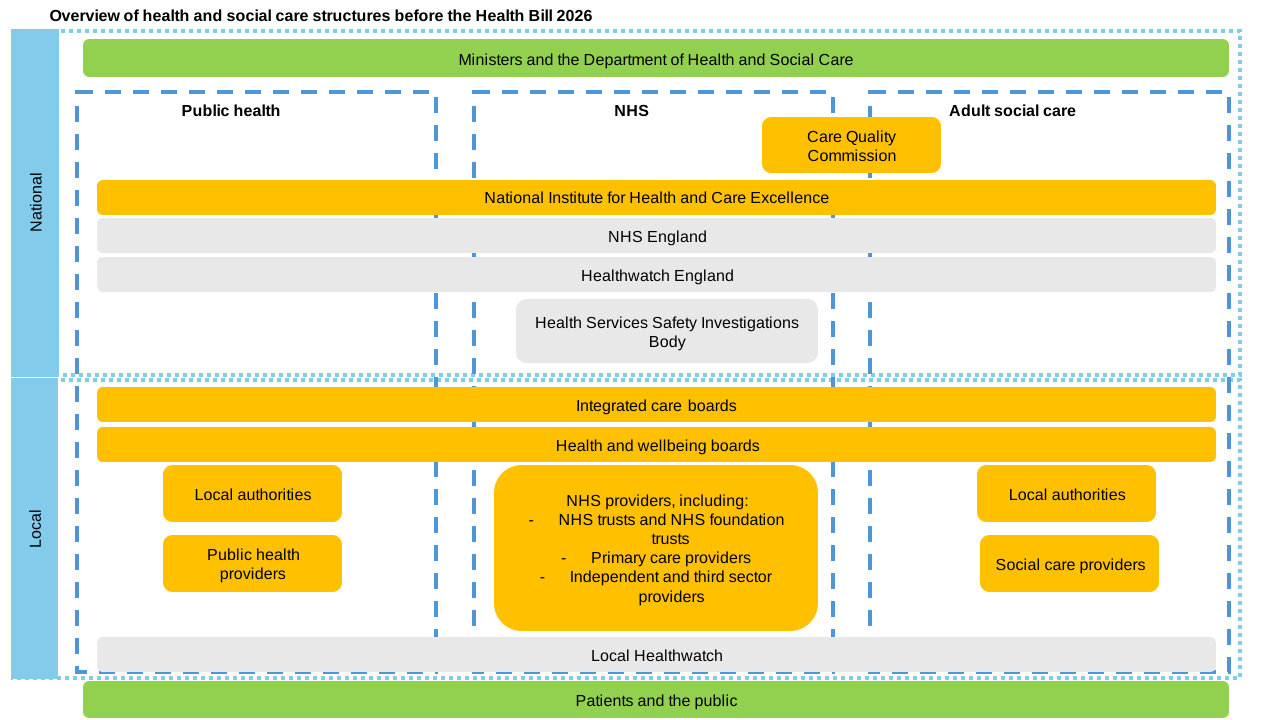
Figure 1 shows some of the bodies that exist within the national and local structures before the Health Bill 2026. It shows which different bodies support delivery for public health, the NHS and/or adult social care.
Nationally, ministers, DHSC, the National Institute for Health and Care Excellence (NICE), NHS England and Healthwatch England support public health, the NHS and adult social care. The Care Quality Commission (CQC) supports the NHS and adult social care, and the Health Services Safety Investigations Body (HSSIB) supports the NHS.
Locally, health and wellbeing boards, integrated care boards and local Healthwatch support public health, the NHS and adult social care.
Local authorities support public health and adult social care. Public health providers support public health, NHS providers support the NHS and social care providers support adult social care.
Figure 2: overview of the health and social care structures after the Health Bill 2026
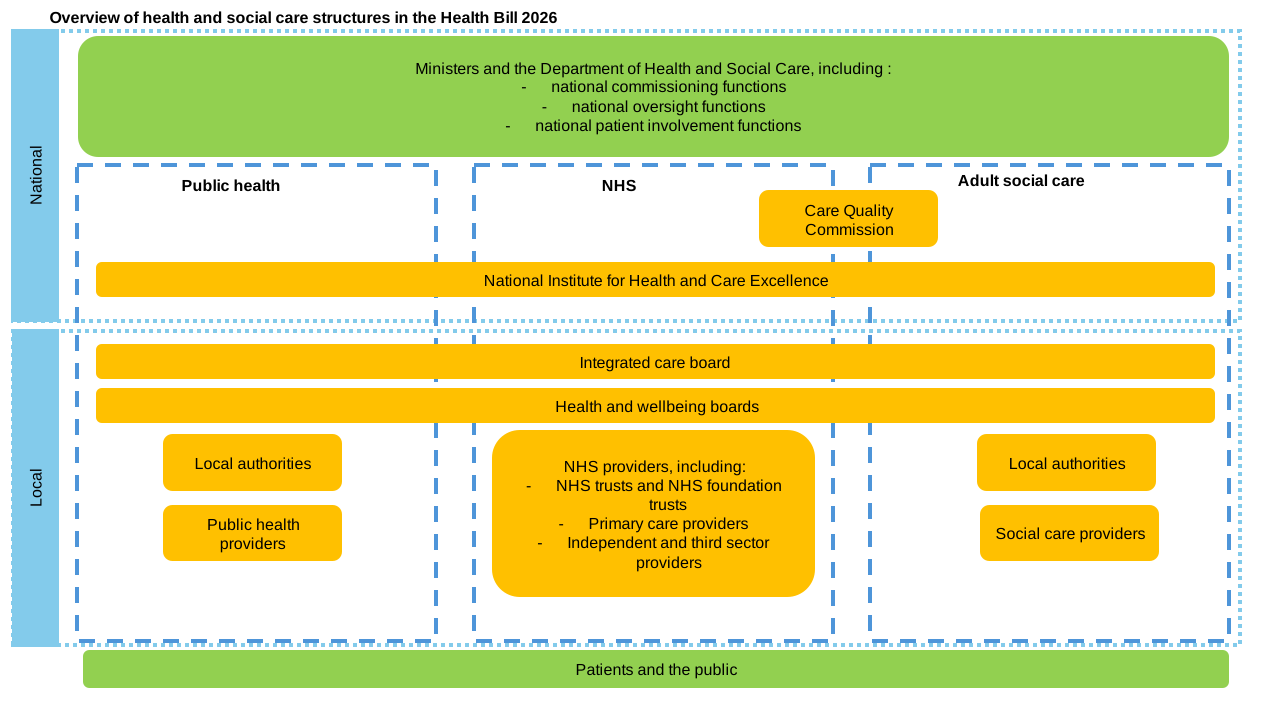
Figure 2 shows some of the bodies that exist within the national and local structures after the Health Bill 2026. This shows which different bodies support delivery for public health, the NHS and or adult social care.
Nationally, ministers, DHSC and NICE will continue to support public health, the NHS and adult social care. CQC will continue to support the NHS and adult social care. NHS England, Healthwatch England and HSSIB will be abolished.
Locally, health and wellbeing boards and integrated care boards will continue to support public health, the NHS and adult social care. Local authorities will continue to support public health and adult social care.
Public health providers will continue to support public health, NHS providers will continue to support the NHS and social care providers will continue to support adult social care. Local Healthwatch will be abolished.
Objectives of the bill
The bill will give the Secretary of State new powers for effective national management of several main functions in the health and care system which will be exercised through the restructured DHSC. These powers will support the Secretary of State to deliver their existing duties to promote a comprehensive health service, to have regard to the need to reduce inequalities and have regard to the NHS Constitution. The new powers in the bill will:
- transfer NHS England’s duties:
- to ensure the health service is prepared for an emergency at a national level to the Secretary of State, and maintaining the current position for ICBs, NHS trusts and NHS foundation trusts to lead the operational delivery in emergency response
- to have both an effective system of health education and training and the availability of a sufficient number of trained healthcare workers, to the Secretary of State
- to promote innovation in health services to the Secretary of State. This will broaden this duty as the Secretary of State will have wider functions than NHS England
- in relation to patient involvement and choice to the Secretary of State
- transfer NHS England’s functions to develop quality standards for medicines to the Secretary of State
- transfer NHS England’s powers to issue financial directions to ICBs to the Secretary of State. See the Health Bill: oversight of the health system - fact sheet for further information
- transfer NHS England’s data and digital functions to the Secretary of State. See the Health Bill: data and digital functions - fact sheet for further information
- introduce a new general power of direction with respect to ICB functions. See ‘Health Bill: oversight of the health system - fact sheet’ for further information
- transfer responsibility for NHS England’s ICB accountability functions to the Secretary of State including with respect to appointments, guidance and oversight
- transfer responsibility for NHS England’s provider accountability functions to the Secretary of State including with respect to the provider licence and foundation trust authorisation, appointments and a new power to convert foundation trusts to trusts, as a last resort
The bill will give the restructured DHSC, through the Secretary of State, powers to adapt to the changing needs of the health and care system. This includes the ability to delegate its healthcare functions to other bodies, such as ICBs and local authorities where this is the most effective way to support patients and communities. This flexibility is intended to allow responsibilities to be carried out at the level best placed to respond to local circumstances, capacity and capability. The bill will also give the Secretary of State the necessary statutory tools to have direct financial oversight of the system.
It is important for responsibilities to sit at the most appropriate level of the system, while maintaining clear national oversight, and the bill will enable the restructured DHSC to support better integration and reduce unnecessary centralisation. This approach is intended to simplify how the system operates, strengthen accountability and allow the health system to evolve over time.
Finally, the bill will reinforce the role of ICBs as strategic commissioners. See the Health Bill: ICBs as strategic commissioners - fact sheet for further information. However, for some services where, due to the low number of patients involved, the national spread of these patients and the cost of these services, the bill will enable the transfer of specific NHS England’s commissioning services to the Secretary of State (by regulations).
Improve efficiency, cut bureaucracy and support innovation
The current 2-centre approach to overseeing the NHS faces several challenges including complexity and duplication resulting in additional cost and administrative requirements. The transfer of powers to the restructured DHSC will cut bureaucracy and create a simpler landscape of health bodies, aligning with wider government commitments to streamline arm’s length bodies.
The restructured DHSC will act as a coordinating national body, supporting a joined-up response to emergencies, streamlining workforce planning, and providing central oversight of patient involvement and innovation. Through transferring these functions to the Secretary of State, the restructured DHSC will simplify and clarify operational oversight, policy and strategy, operating more effectively and thereby creating better health and life outcomes for the population. See ‘Health Bill: oversight of the health system - fact sheet’ for further information.
These provisions support greater efficiency by enabling the national centre to focus on a smaller number of core national responsibilities. By concentrating on setting priorities, allocating resources and overseeing delivery where national leadership adds most value, the restructured DHSC can avoid spreading effort across too many activities and reduce the burden of centrally-driven initiatives on the system. This supports the overall ambition to create a sustainable health system, moving away from reactive, short‑term management towards a stronger focus on prevention and long‑term value. This is intended to reduce the need for repeated intervention and crisis response, supporting people to live healthier lives and helping the system make more effective use of resources over time.
Having one national body will create clearer national responsibility and support more consistent use of data and digital capability to improve productivity and support innovation across the system. This is intended to strengthen national insight, reduce duplication in data collection and analysis, and support better‑informed decision‑making at all levels of the health and care system. This will create stronger conditions for innovation and productivity gains across the system, enabling greater focus on prevention and earlier intervention, helping our coordinated effort to address the wider determinants of health.
Example: simplifying national functions to reduce duplication and support delivery
Under the current arrangements, some national functions are split across multiple organisations, requiring regions, ICBs and providers to engage with more than one national body on closely related issues. This can result in repeated requests for information, parallel assurance processes and unclear lines of accountability.
For example, the Hewitt Review of integrated care systems highlighted:
notwithstanding the severe performance issues in December 2022, in one instance one integrated care system (ICS) received 97 ad-hoc requests from DHSC and NHS England, in addition to the 6 key monthly, 11 weekly and 3 daily data returns.
There are too many layers and processes between the centre and the system. This is illustrated by the priority setting for the NHS. The government’s mandate to NHS England sets out DHSC’s objectives for NHS England. NHS England then translates these objectives into detailed planning guidance that outlines specific, actionable priorities for the system to deliver. This type of elaborate process increases the cost of operating the current system.
Through the bill, functions currently held by NHS England will transfer to the restructured DHSC, and we are reshaping the department to support the alignment of those functions within a single national organisation. For example, bringing together national responsibilities for workforce planning, emergency preparedness and patient involvement will allow the restructured DHSC to set clearer national expectations, while reducing the number of separate processes regional and local partners need to navigate.
Over time, this approach is expected to reduce administrative overheads, make it easier for regional teams to work with a single national point of accountability, and enable the centre and regions to focus more consistently on supporting delivery rather than managing duplication.