Farming Roadmap 2050: Growing England’s Future (accessible version)
Published 24 June 2026
Applies to England

© Crown copyright 2026
This publication is licensed under the terms of the Open Government Licence v3.0 except where otherwise stated. To view this licence, visit nationalarchives.gov.uk/doc/open-government-licence/version/3 or write to the Information Policy Team, The National Archives, Kew, London TW9 4DU, or email: psi@nationalarchives.gov.uk.
Where we have identified any third party copyright information you will need to obtain permission from the copyright holders concerned.
This publication is available at https://www.gov.uk/government/publications/farming-roadmap-2050/farming-roadmap-2050-growing-englands-future-accessible-version
Ministerial foreword
Farmers feed our nation. They manage the land that shapes our countryside, sustain rural communities and underpin a £153 billion agri-food sector. Farming is woven into who we are as a country, into our national security, and it is a crucial part of communities across the country. Farmers are the ones who know their land best and our overarching ambition is to support them. As custodians of around 70% of England’s land, their role in shaping both our food system and our environment is fundamental.
We have visited farms across England and spoken with farmers, growers and industry leaders across the country. Those conversations revealed both the scale of the challenges farmers face and the determination and skill with which they meet them. Yet for too long, farmers have been asked to navigate profound change without a clear sense of where government is heading over the long term. Rising environmental expectations, fast-moving technological change, volatile global markets and the growing impacts of climate change together mean that this is a time of significant change for farming businesses. The message we heard consistently as we developed this roadmap was simple: farmers need clarity and confidence to plan, invest and build for the future.
This roadmap is our answer to that call for clarity over the long term. It sets out a clear long-term plan to 2050 for how we will work in partnership with farmers to ensure this essential industry, and the farming communities that support it, can thrive for generations to come. The roadmap also sets out the detailed practical steps we will take over the next 5 years, showing how this partnership will work in practice and how we will meet the immediate challenges ahead together.
Our ambition is straightforward: profitable farms that maintain domestic food production, fair rewards for the farmers who produce that food, good jobs in farming with clear career paths into farming, and a sector that helps restore nature and meet our climate goals while contributing to the growth of the British economy. These are not competing aims. They are, over the long term, inseparable. Healthy soils, clean water and functioning ecosystems are the foundations of food production.
The ongoing pressure on fertiliser and fuel prices because of the closure of the Strait of Hormuz underlines the need to shift to a more resilient farming system with reduced reliance on such inputs.
Government’s role is to ensure markets work fairly, crowd in private investment and provide the long-term certainty that farmers and investors need to plan with confidence. Delivering this requires an active, strategic and at times interventionist state, working in partnership with business to support food security, farming profitability and the public goods on which they depend. Where new approaches are untested or deliver wider public value, government will invest patient capital in skills, data, technology and infrastructure and share risk. As these practices become established and commercially viable, we will step back.
This roadmap is not a plan written in Whitehall and handed down. It is grounded in engagement with farmers, growers and land managers across the country, reflecting the most pressing challenges and opportunities ahead. It brings together our commitments on food security, environmental recovery, land use, climate resilience, and animal health and welfare into a single, coherent direction of travel. It is published alongside our detailed response to the Farming Profitability Review, authored by former National Farmers’ Union President Minette Batters, because profitability is central to everything we are trying to achieve.
Farmers have a long tradition of adapting to change over generations. Farming has survived war, disease, trade shocks and extreme weather. Farmers across England are not asking for protection from change; they are asking for tools, stability and honest partnership with government. This roadmap is that partnership. We are proud to share it so that, together with farmers, we can build a resilient and productive future for English farming.
The Right Honourable Emma Reynolds MP Secretary of State for Environment, Food and Rural Affairs and Stephen Morgan Minister of State for Food Security and Rural Affairs
Section 1
The context for change
Farmers produce 65% of our food, manage 70% of England’s land and support a £153 billion agri-food industry across food production, manufacturing, retail and catering. Farming is the foundation of the food system and is shaped by the physical and biological environment, climate pressures and global markets. It also underpins outcomes of national importance, from nature recovery and climate resilience to economic growth and food security.
English farming is undergoing the most significant transformation since the Second World War. Back then, the sector took on the challenge to maximise food production in response to national scarcity, increasing UK food self-sufficiency from around 30% pre-war to around 60% by 1970. Today’s transformation is focused on maintaining domestic food production in a very different and increasingly complex context. Significant and interrelated challenges are reshaping how land is used and managed, as well as how government, businesses and the sector work together. All while farmers live through the impacts of climate change, biodiversity loss and increasing market volatility. In response, government and the sector must adapt to become more resilient, competitive and environmentally sustainable.
An economic transition
Since leaving the European Union, area-based subsidy payments have been progressively reduced, with funding redirected into environmental, climate, productivity and innovation outcomes. Going forwards, most farm businesses will rely more heavily on returns from the market, payments for public goods related to nature and climate, and diversified income. Given farming’s role in supporting a £153 billion agri-food supply chain and over 400,000 jobs, stable markets and profitable farms are crucial.
A changing national security context
Food is one of the UK’s Critical National Infrastructure sectors. While the UK is food secure, the conditions under which food security is maintained are changing. Geopolitical instability, climate impacts, environmental degradation and supply chain disruptions are increasing exposure to price, input and output volatility. Over time, this could increase the risk of severe food price shocks and, in some extreme situations, lead to reduced availability of certain foods. This places greater strategic weight on domestic food production, our long-term capacity to produce food and the resilience of the farming sector, reinforcing the need for productivity growth and more efficient, multifunctional use of land across England. UK food security also depends on access to open, fair and reliable international agricultural markets. Stable trading relationships remain essential to manage risk, smooth supply and support both imports and exports alongside domestic production.
An environmental and climate transition
Farming is among the sectors most exposed to climate shocks, environmental degradation and growing resource pressures. Climate change, increased pollution and nature loss are already reshaping growing conditions, water availability, disease pressures and global food markets. At the same time, agriculture has a major impact on the environment, including being the largest contributor to water pollution. How land is managed is therefore central to meeting our commitment, made in the Land Use Framework, to maintain domestic food production to at least current levels while restoring biodiversity, improving water and air quality, and reducing greenhouse gas emissions (GHG).
This requires a shift towards lower input and more sustainable farming systems, which is already under way, with 69% of English farmland currently being managed under agri-environment schemes. Nature‑friendly farming systems can sustain or enhance production while strengthening resilience and reducing input dependency. Too often, the debate around farming and the environment is framed as a trade-off, with food production on one side and nature recovery on the other. But the most resilient farms are profitable precisely because they work with the environment, not against it.
These approaches are therefore not at odds with food security but are increasingly central to it. Lower input systems can maintain or increase productivity by improving soil health, increasing nutrient efficiency and reducing exposure to volatile input costs. These systems can additionally build resilience to drought, flooding, disease, and other extreme weather and can accelerate nature’s recovery. Some land will need to be used or managed differently to balance nature and climate outcomes with maintaining levels of domestic food production.
A technology transition
Farming is in the midst of major technological change, as digital tools, data and automation develop rapidly. Advances in artificial intelligence (AI), automation, robotics, precision technologies and advanced genetics are set to reshape how farms operate, decisions are made and risks are managed. Realising these benefits for English farming will depend on robust data standards, accessible digital services, and widespread access to skills and advice so that all farmers can participate.
Together these transitions are already prompting farmers to reshape their farm businesses. At the heart of this is a challenge: how to maintain food production and support profitable farming while moving towards a lower-impact, market-led and climate-resilient system. Addressing this challenge will require new approaches to land management, business models, and partnership across government, industry and the sector. Whilst pressures are unevenly felt, the message we have heard is consistent: farmers need clarity to plan for the future. This roadmap, developed with the sector, responds directly to that call, helping farmers plan with confidence and shape their businesses for the future.
What the evidence shows about the challenges ahead
Evidence shows that food security depends on productive and efficiently used land, enabling stable and profitable farm-level production alongside robust trading systems. Recent geopolitical shocks have highlighted how quickly disruption in global energy, fertiliser and commodity markets can translate into higher costs and greater uncertainty for farm businesses (Defra, Agricultural Price Indices). While trade remains an essential part of the food system, increased volatility reduces farmers’ ability to plan and absorb shocks, particularly where margins are tight. This reinforces the importance of resilience at farm and sector level.
In 2025, agriculture directly contributed around £15.9 billion to the UK economy (Defra, Total Income from Farming ) and supported more than 400,000 jobs in 2024 (Defra, Agriculture in the UK). Agricultural productivity in England has risen over the long term (Defra, Total Factor Productivity of UK Agriculture) but growth has lagged slightly behind leading EU countries (OECD, Agricultural Policy M&E) and has become more variable in recent years. Performance gaps within sectors remain large and some farms are much more productive than others in the same sector (Defra, Farm Business Survey). Evidence suggests that differences in management approaches contribute to this variation (Andersons Centre, Characteristics of Top Performing Beef and Sheep, Cereal and Oilseed, and Dairy Farms). However, many farms face tight financial and labour constraints that limit their ability to invest or upskill. This indicates potential for productivity gains through improved business management, where barriers to investment, skills and technology adoption can be addressed.
In 2024, agriculture contributed an estimated 12% of total UK GHG emissions, making it the sector with the third highest emissions after domestic transports (30%) and buildings and product uses (22%). Although emissions from agriculture have fallen 15% compared to 1990 levels, the sector now accounts for a larger share overall as other sectors have decarbonised more quickly. (DESNZ, Greenhouse Gas Emissions). Further reductions are required to meet government targets. Across biodiversity, soils and water quality, the overall trend indicates ongoing degradation, with key indicators such as farmland bird populations continuing to decline and agriculture remaining a major contributor to water pollution and soil degradation (Defra, Wild Bird Populations and New Vision for Water; Efra Committee, Soil Health).
A recent national nature security assessment identified ecosystem degradation as a significant risk to food production (Defra, Nature Security Assessment). Agri-environment schemes play a key role in environmental recovery. Participation is now widespread, with 6.1 million hectares in England under agri-environment agreements, covering 69% of utilised agricultural areas. This supports an increased uptake of practices associated with environmental recovery including improved soil health and reduced input use (Defra, Area under agri-environment schemes). For example, 69% of farmers now have a nutrient management plan (Defra, Nutrient Management). In addition, we have made substantial progress towards targets set out in the National Action Plan (NAP) to reduce potential environmental pressures from pesticides (Defra, NAP target explainer). Emerging nature markets may offer future opportunities for environmental recovery as well as income streams for farmers (OECD, Agricultural Policy Monitoring and Evaluation (M&E) Taskforce on Nature-related Financial Disclosures (TNFD), Recommendations of taskforce).
Consumer behaviour adds further pressure. Rising food prices have increased emphasis on affordability, particularly for lower income households. Consumer choices are mainly driven by price, with sustainability and ethical considerations influencing choices mainly where price impacts are minimal. (ONS, Family Spending; Food Standards Agency, concern around the cost of food; Defra, UK Food Security Report). Meat production is a significant contribution to greenhouse gases in the farming sector, but levels of meat consumption in high income countries, including the UK, are stabilising. However, global demand for animal products remains significant.(Defra, UK Food Security; OECD, Agricultural Outlook; European Commission, Agricultural Outlook; AHDB, Protein Trends).
Taken together, this evidence points to a sector facing interconnected challenges on resilience, productivity and environmental sustainability, all of which are critical to long-term food security and affordability.
A comprehensive summary of the evidence underpinning this roadmap has been published as a supplementary annex.
What the farming sector told us about these challenges
This roadmap reflects extensive engagement with the farming sector. Between January 2025 and May 2026, we held regional and national workshops, online focus groups and spoke to people at auction marts, conferences and agricultural shows across the country. Over the past 12 months many organisations have published their own analysis setting out their own vision for the future of farming. This roadmap draws on and builds on that collective effort.
A central concern heard was that food production could be sidelined, particularly if environmental objectives are considered a separate or competing priority. Stakeholders were clear that food production remains the core purpose of farming, whilst recognising that farmers can also derive value from their land by producing feed, fibre, fuel, energy and environmental outcomes. At the same time, many emphasised that long term productivity depends on environmental recovery and that climate and nature outcomes must be integrated into productive farming systems rather than treated as alternatives.
Across discussions, stakeholders highlighted the need for clear, long-term policy direction to provide confidence for investment and business planning. Concerns about fairness were raised repeatedly, particularly the risk that access to finance, schemes, innovation and advice could be uneven, leaving some businesses at a disadvantage.
There was widespread concern about low farmgate prices, supply chain power and exposure to imports produced to lower standards. Alongside this, stakeholders emphasised the importance of trusted data, proportionate assurance and credible markets, while expressing caution about costs, access and uneven impacts across the sector. Stakeholders also pointed to ongoing workforce pressures and the importance of skills, advice and new entrants in supporting a resilient farming sector. Further detail on what we heard from the sector is included in the supplementary evidence annex.
A roadmap for change
This roadmap provides a clear, long-term direction for the sector. It sets out the outcomes we are collectively working towards and the principles that will guide government policy and investment over time. It brings together the most important government strategies, commitments and reforms that affect farmers into a single, coherent document. The aim is to help farmers, investors and participants in agri-food supply chains see how different policies fit together, so they can plan with greater confidence.
The roadmap is not a detailed, year-by-year delivery plan or a fixed set of milestones until 2050. It does not prescribe a single pathway for farms or pre-determine how individual businesses should change. Instead, it allows flexibility for different farming systems, places and businesses to adapt and respond in ways that work for them as markets, technology and conditions evolve.
The roadmap sets out the government’s approach to supporting a profitable, productive, resilient and sustainable farming sector. It is grounded by a set of principles that shape how government, markets and the sector work together over time:
- markets will play a central role in shaping the future of the sector, enabled by an active and strategic state. Government will set direction, shape markets, crowd in investment and step in where markets alone will not deliver nationally important outcomes
- food production remains the primary purpose of farming. However, farms are uniquely positioned to also provide cleaner air and water and create space for nature to thrive. As set out in the Land Use Framework (LUF), domestic food production can be maintained whilst also achieving environmental ambitions. Therefore, public goods will be delivered alongside food and other agricultural production
- farming must work with the environment to protect, restore and regenerate the natural assets - soil, water, air and biodiversity - that underpin food production, profitability and resilience. Over time, these outcomes increasingly reinforce one another. Therefore, the long-term future of farming depends on a healthy environment
- improvements to productivity and profitability will be driven by innovation. New research, technology, data and skills all underpin long-term improvement in farm business performance and support more efficient and resilient production. This is essential to helping maintain food outputs and adapt to change
- clear and predictable policy direction enables farmers and investors to plan and invest for the long term, with risks and opportunities shared across the sector. Therefore, long-term certainty and clarity are essential to support confidence
- farm businesses must take a long term, adaptive approach, operating through expected volatility and preparing for climate, market and geopolitical shocks. Therefore, both personal and business resilience are fundamental to the future of farming. Resilience is strengthened through sustainable environmental foundations, improved productivity and profitability, and better planning, diversification and risk management
The role of government
Within the farming sector, government’s role is to support the provision of public goods, ensure food security alongside producers and the markets, and to create the conditions and standards for farmers to plan confidently and manage risk as the sector changes. This requires an active, strategic and at times interventionist state, working in partnership with business and markets, to set clear direction, ensure markets function effectively and fairly, and provide long-term certainty and incentives to support food security, farming profitability, investment, innovation and fair competition.
To achieve this, government will provide targeted support to de-risk new approaches through schemes such as Environmental Land Management (ELM) and to provide patient public investment in skills, data, technology and infrastructure. This will help shape markets and crowd in private investment where action is needed at scale.
Government will also play an active role in supporting responsibility, fairness and good growth in farming, while ensuring long-term food and environmental security. This will include maintaining a fair, clear, proportionate and effective regulatory framework, removing barriers to support trade, and aligning private markets with long-term national objectives.
As private markets mature and food supply chain standards shift to encourage more sustainable practices, government will step back and withdraw support where it is no longer needed. Instead, where appropriate, government will embed established approaches in regulation. However, where there is a case for enduring intervention, for example due to market failures or the creation of public goods not rewarded by markets, government will continue to provide support.
The role of supply chains and markets
Food businesses, processors, retailers, investors and other supply chain participants will play an important role in shaping the conditions in which farmers operate. Through purchasing decisions, contracts, standards, finance and investment, they can create stronger incentives for high-quality, sustainable production and deliver fairer returns for farmers.
Where innovation and business change offers commercial benefits, businesses across the supply chain should increasingly take on more of the upfront costs and risks associated with production.
Government will work in partnership across the supply chain to tackle barriers to profitability, promote fair and transparent markets and address power imbalances where they arise. Government will intervene where unfair practices or disproportionate value extraction undermine effective competition, harming farmers and communities. Government also has a role where market failures prevent nationally important outcomes from being realised or severe market or environmental shocks pose a risk to national security that cannot be addressed through existing market mechanisms.
The role of farmers
Farmers are central to delivering national objectives on food production and the environment through the day-to-day decisions they make on their farms. Those decisions determine what is produced, how efficiently resources are used and how land and natural assets are managed. Farmers will continue to produce food, and other agricultural outputs such as fuel, feed and fibre, as their core business, while adapting land use, production practices and business models over time in response to market signals, environmental limits and climate risks. In doing so, nature-friendly farming and food production increasingly go together, with environmental improvements underpinning long‑term productivity and resilience. Decisions farmers make will be shaped by access to advice, data and finance.
Government support will help farmers test and adopt new practices and deliver outcomes that markets alone do not reward, but this support will not replace long-term commercial viability. As new practices become standard, farmers will take on a greater share of the costs and risks resulting from their investment choices, reflecting their role as business owners making informed investment choices. Farmers will build the skills, confidence and business capability needed to follow regulations, to compete in markets and to invest in their business. Through these choices, farmers will drive productivity, environmental improvement and profitable growth, placing farm businesses on a more resilient and economically sustainable footing over time.
Bringing government priorities into a single farming roadmap
Since the EU referendum in 2016, much of government’s transition effort has focused on moving away from the EU’s Common Agricultural Policy (CAP), but this roadmap sets a deliberately forward-looking vision for the sector we will transition towards.
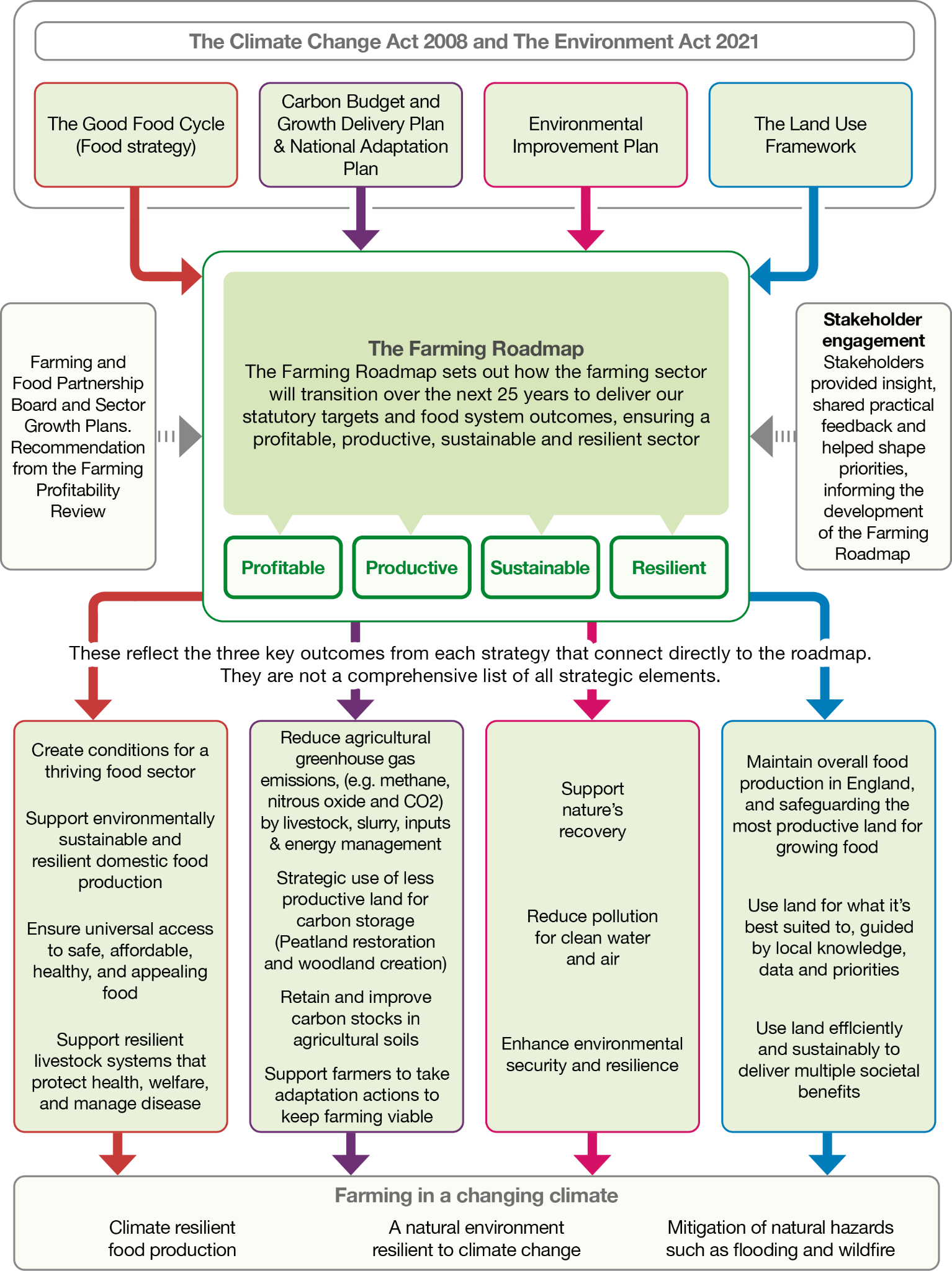
Figure A: How the Farming Roadmap helps to deliver statutory commitments on nature and climate alongside plans for food security, land use and farmed animal health and welfare.
The roadmap brings together the farming relevant parts of the government’s statutory commitments on climate and nature, as set out in the Climate Change Act 2008 and the Environment Act 2021, alongside plans for food security, land use and farmed animal health and welfare. A comprehensive plan to deliver these commitments is set out in existing government documents including:
- Environmental Improvement Plan (EIP) - how the natural environment will be protected and restored
- Carbon Budget and Growth Delivery Plan (CBGDP) and National Adaptation Programme - these plans set out how we will reduce emissions and build resilience to climate impacts, supporting a transition to a lower‑carbon economy while supporting investment and productivity
- Land Use Framework (LUF) - how England’s land can be best utilised to achieve multiple benefits
- The Good Food Cycle - which sets out the priority outcomes we want from the wider food system
These frameworks recognise that food production, environmental delivery and economic viability are interlinked and must be delivered together. We are also publishing a detailed response to the Farming Profitability Review, authored by Baroness Minette Batters, alongside this roadmap. Although the response sits as a separate document, the evidence, insight and recommendations from the Farming Profitability Review have directly shaped the priorities and direction set out here.
By bringing these strands together into a farmer-focused document, this roadmap sets out a clear direction for the sector and what changes are expected. It sets the foundation for a farming sector that is productive, profitable and environmentally sustainable, capable of meeting future challenges while continuing to feed the nation and care for the land.
A shared vision for farming in 2050
To set out a roadmap for the next 25 years, we need a sense of where we are heading. The 2050 vision sets out a clear picture of what farming needs to look like by the middle of this century. That future farming system should produce food (and other agricultural outputs) as its primary purpose, be profitable and competitive, use land and resources efficiently, and protect natural systems while remaining resilient to change. This vision describes the outcomes farming must deliver and the standards, capabilities and system characteristics that will be in place to enable the sector to thrive.
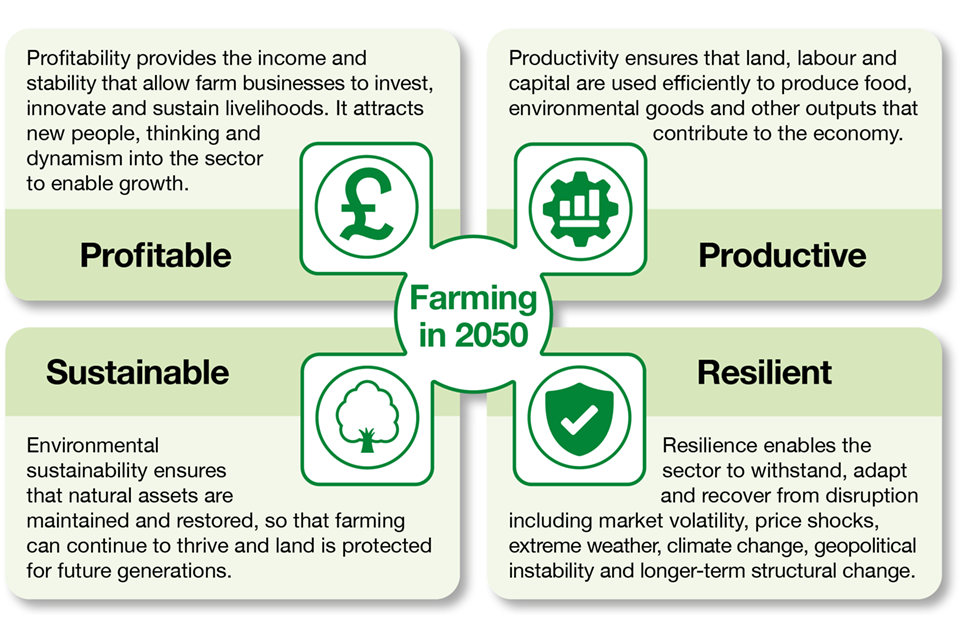
Figure B: How the Farming Roadmap brings together government’s top 4 priorities for farming
A profitable farming sector is one in which the value generated across all farms collectively exceeds overall costs, and where the sector generates sufficient profit to support reinvestment and long-term viability, even though individual farm profitability will vary. A profitable farm business earns more from its activities than it spends, once all costs are included. There will always be peaks and troughs in farming, but a profitable farming business generates a reliable average income over the medium to long term that supports reinvestment, family living costs and business development.
A productive farming sector makes efficient use of land, labour and capital to generate a mix of outputs. These include food, environmental goods and services and other forms of diversification that strengthen rural economies. Different farms will contribute to productivity in different ways depending on their land, system and business model. A productive farm business uses resources efficiently to increase the value it produces. For some farms this may mean producing the same or more outputs with fewer inputs through better technology or management. For others it may involve partially shifting to forms of production that suit their land and skills, including delivering environmental and climate outcomes or diversification activities.
An environmentally sustainable farming sector protects and improves the natural assets that future food production and society depend on. This includes restoring and maintaining soils, biodiversity, water and air quality while reducing greenhouse gas emissions and adapting to climate change. An environmentally sustainable farm business manages land, livestock and inputs in a way that protect and improve the environment. This includes reducing pollution and greenhouse gas emissions, enhancing soil and habitats, using resources carefully and adapting to climate change.
A resilient farming sector can absorb shocks, adapt to long-term pressures and continue to function effectively. This includes coping with unstable global contexts, volatile markets, climate impacts, biosecurity risks and changes in technology, labour and trade. A resilient sector is supported by diverse business models, strong skills and the ability to plan for uncertainty.
By 2050, the farming system will be firmly established on a consistently profitable, resilient and environmentally secure footing, underpinned by early reforms enabling steady, cumulative progress across the sector. England will have a dynamic, multifunctional landscape in which productive farming, nature recovery and climate resilience are delivered side-by-side, strengthening the long-term stability of the sector, enabling farms to thrive and to weather any global or local shocks that arise.
Food production will remain the primary purpose of farming and central to national identity and security. England will have maintained, and in some key sectors increased, overall food production by improving productivity and profitability in a sustainable and resource efficient way. This is increasingly delivered through nature-friendly farming approaches, where environmental improvement and food production reinforce one another. Most farm income will come from the market, supported by diverse and resilient business models, while public funding will focus on outcomes that markets alone do not reward.
Supply chains will be consistently fairer, well regulated, more transparent and better able to withstand shocks arising from market volatility, climate impacts, geopolitical instability and biosecurity risks. All farming sectors will see growth, supported by clearer trade policy and widespread adoption of innovation and technology, alongside protection of agricultural land with the greatest long-term potential for food production.
England will be a confident and competitive food exporter, known internationally for high quality, trusted and sustainably produced food, with clear export pathways and reduced barriers to trade, including improved access to EU markets through the sanitary and phytosanitary (SPS) agreement.
Farmers will have confidence in clear, predictable and outcome-focused regulation, resulting from early simplification and consolidation by 2030 to remove friction, raise standards and create long-term certainty, enabling productivity, innovation and private investment over time.
Environmental recovery will be visible across whole landscapes. Land across England will be used for the outcomes it is best suited to deliver, guided by ongoing engagement with land managers on the LUF to balance food production, nature recovery and climate mitigation as well as demands from other sectors such as energy.
Resources will be used more efficiently and kept in use for longer, with waste reduced across farming systems. Early action to halt biodiversity loss will help stabilise natural systems. Environmental harms will be reduced through better on‑farm practices, supported by clear guidance, advice and proportionate regulation, raising standards where needed to improve water and air quality and reduce emissions. Sustainable and productive farming will sit alongside ambitious, targeted, landscape-scale change where appropriate, including through initiatives such as Landscape Recovery (LR), creating a rich mosaic of diverse habitats and more resilient landscapes.
On farms, this will be driven by the wider adoption of regenerative, organic or other agroecological practices where appropriate, resulting in healthier soils, cleaner water and more resilient fields and pastures. Soils will hold more organic matter, absorb and retain water and support stronger crop and grass growth. Fields will be more resilient to drought, flooding and disease and better able to sustain productive farming under changing conditions. Nutrients will be used more efficiently, with less waste and lower reliance on chemical inputs. More diverse habitats, from field margins to wetlands and woodlands, will be integrated into farmed landscapes, supporting pollinators, natural pest control and wider biodiversity, while sitting alongside productive farmland. There will be continued positive management of heritage assets, helping conserve and protect historic rural landscapes for future generations.
Across landscapes, restored peatlands, expanded woodland and the wider use of natural flood management (NFM) will slow the flow of water, reduce peak flooding and protect vulnerable catchments. Cleaner rivers, improved air quality and richer biodiversity will become more evident over time. Farms will include more trees and hedgerows as part of their systems, improving shelter, soil condition and storing carbon. Existing and new woodlands will be managed to improve habitat quality and resilience whilst creating new opportunities from diversified income, such as from timber. These actions will build over time as natural systems recover and mature, with benefits increasing as soils, habitats and water systems strengthen.
Public funding, private investment and regulation will work together as a coherent and well understood whole, enabling consistent delivery of outcomes at scale. Public funding will increasingly focus on those areas where only government can act effectively, particularly for outcomes not supported by markets and private investment. As a result, more farms will be placed on a stronger and more resilient footing, with healthier soils, more secure water supplies, better-functioning habitats, lower exposure to market and weather shocks, and the conditions in place for innovation, investment and sustainable long-term growth.
The farming sector will operate as a lower-input, lower-emission system to produce high quality food sustainably. Farm businesses will be consistently productive, diversified and profitable, with resilience and risk management embedded as standard business practice. Technology, data and precision tools will be routine parts of daily management, supporting high productivity, low waste and resilient cropping and livestock systems. AI-enabled decision support systems and interoperable data platforms will be widely used, enabling faster, better informed responses to climate, disease and market risks.
Consistent, practical and standardised metrics and methodologies will be used across markets (domestic and international), regulation and business planning, reducing administrative burdens while improving confidence, traceability and access to private finance. Farming will be supported by a single, user‑centred interface with government that reflects how farmers manage their land and businesses.
Preparation and adaptation will be core to running a competitive business, with clear expectations around risk assessment, financial planning, biosecurity and climate readiness embedded across the sector. Income will be generated from a broader mix of sources that includes food, fibre and fuel production, environmental delivery, agri-tech, innovation and new commercial ventures, reducing the risks from global market shocks, input price volatility and geopolitical disruption.
Farms of different types and sizes will take different routes. Change will not happen at the same pace everywhere. Movement in the sector will continue as businesses enter, grow and adapt, reflecting a dynamic and competitive industry. Performance will continue to vary across farm businesses, as in the wider economy. The aim is not to favour one type of farm over another, but to reduce the gap between higher and lower performing businesses, ensuring that all types of farms have credible routes to improving profitability where they make effective use of available opportunities.
Over time, differences in productivity will narrow as more businesses are able to adopt practices, technologies and approaches suited to their circumstances, strengthening the long-term competitiveness of the sector. In this context, stronger farm businesses can support local and national economic growth through their role in supply chains, local services and employment. The sector will be underpinned by a strong, skilled and confident workforce. Farming and the wider agricultural sector will be seen as an attractive, modern and innovative career, with clear routes for new entrants and strong opportunities for progression.
Collaborative models such as co-operatives and mutuals will play a much larger role, enabling collective purchasing, shared services and joint investment that lower costs, spread risk and support stronger returns. Well-supported advisory services, local partnerships and peer networks will enable continuous learning, innovation succession planning and collective ownership of land use outcomes, driving rural economic growth.
The public will have a deep engagement with and understanding of farming, with greater recognition of the value of domestic food production and the standards that underpin it.
Taken together, these changes reflect the successful delivery of the economic, environmental and technological transitions facing farming, within a more demanding global context. There is no single route to this vision. Food production will remain the primary purpose of farming and a source of national pride. This will increasingly sit alongside new opportunities for value-adding activity for farm businesses.
Section 2: actions we will take to achieve this vision
Delivering this ambitious vision will require coordinated effort across government, industry and the farming sector. This section sets out actions that government will take, organised under 3 key themes:
- Theme 1 - profitable and productive: supporting farm business performance
- Theme 2 - sustainable: farming for environmental and sector sustainability
- Theme 3 - resilient: building a resilient farm business
These themes are designed to deliver the economic, environmental and security transitions set out in Section 1, with the technological transition cutting across all 3 themes.
We recognise that these themes are interrelated. Actions that improve sustainability also support productivity and resilience. Categorising actions under individual themes is therefore necessarily imperfect, but each reflects where we see its main contribution. In practice, many actions will support all 3 themes.
Together, these themes provide the foundation for the sector to adapt, invest and thrive as we move towards government’s long-term ambitions. The actions set out here represent what the government is delivering now and will evolve over time.
Timeline of key dates and activities to 2030
This timeline shows government actions and commitments from 2026 onwards, alongside environmental targets that the roadmap is intended to support.
2026
The roadmap includes these dated actions and commitments in 2026:
- March: the Land Use Framework made a commitment to maintain domestic food production
- June: open a simpler, fairer SFI, initially for small farms (between 3ha and 50ha) and those without an existing ELM revenue agreement
- June: launch funded Poultry Biosecurity Reviews
- July: open ELM capital grant applications
- September: opening the second window of SFI
- November: extending mandatory Biodiversity Net Gain to Nationally Significant Infrastructure Projects
Also in 2026:
- continue roll out of improved Countryside Stewardship Higher Tier (CSHT)
- sign successful Landscape Recovery (LR) projects into implementation and provide information about future rounds
- opening a sector wide national conversation on how food and farming can reduce emissions while growing productive, resilient businesses
- invest at least £300 million in Natural Flood Management (NFM) through the floods investment programme between 2026 and 2036
- investing in local partnerships, water management infrastructure and wetter farming trials between 2026 and 2030
- continue the Seasonal Worker visa route until at least 2030 and provide 41,000 visas for the horticulture sector
- co-develop horticulture and poultry Sector Growth Plans between sectors and government, overseen by the Farming and Food Partnership Board (FFPB)
- deliver a plan for minister-led inward and outward trade missions
- support farmers to make informed management decisions about their soil, by publishing the EA’s soil structure guidance, and provide an open access national soil data portal
- establish a new ‘Task and Finish Group’ bringing together investors, retailers and industry bodies to develop proposals for channelling private finance into sustainable food production
- reform the Farm Tenancy Forum to increase the number of tenant members and give tenant farmers a greater role in policy making
- continue to support farmers through the Animal Health and Welfare Pathway in 2026 and beyond
2027
The roadmap includes these actions and commitments in 2027:
- implementing the SPS Agreement, subject to EU negotiations
- publishing the UK Food Security Report
- provided greater stability in government offers for farmers for the remainder of this Parliament
- publish Animal Disease Control and Resilience Strategy
- continue to support farmers through the Animal Health and Welfare Pathway
- Law Commission to publish a consultation document as part of their review of environmental legislation applicable to agricultural businesses in England
For ELM Schemes and Capital Grants between 2027 and 2029:
- providing greater stability in government offers from 2027 for the remainder of this Parliament, while continuing to refine actions and improve the application service
- launch a consolidated ELM capital grants offer
- moving towards a more spatial approach, targeting action to the places where it will have the greatest impact, where the evidence suggests it may be beneficial to support delivery of Environmental Improvement Plan (EIP) targets
- supporting agreement holders with expiring legacy Countryside Stewardship (CS) and Higher-Level Stewardship agreements to transition into new schemes where appropriate, recognising not every existing agreement will be replicated
- continue to implement successful LR projects and take forward further application rounds
- Law Commission commence their review of agricultural tenancies
2028
The roadmap includes these actions and commitments in 2028:
- publish the fourth National Adaptation Programme, which will set clear medium- and long-term adaptation goals for farming and the food supply chain
- Law Commission publish report on how environmental regulations can be simplified for farm businesses
- continue to support farmers through the Animal Health and Welfare Pathway
2029
The roadmap includes these actions and commitments by 2029:
- invested up to £15 million through the Genetic Improvement Networks (GINs) since 2026
- doubled the EA’s farm inspection capacity since 2026
- ELM schemes budget will have increased to £2 billion a year compared to £800 million in 2023
- invested £1 billion in tree planting and support to the forestry sector in this parliament
- continue to support farmers through the Animal Health and Welfare Pathway
- established a national soil monitoring baseline under the Natural Capital and Ecosystem Assessment (NCEA) programme
2030
The roadmap includes these actions and commitments by 2030:
- extended the Farming Innovation Programme (FIP) and invested at least £200 million
- invested £85 million to restore, protect and better manage peatlands
- required farmers to take stronger action to improve water quality, reduce emissions and improve air quality
- deploy a cattle TB vaccine, alongside an approved Detect Infected Among Vaccinated Animals (DIVA) test, by 2030
- continue to support farmers through the Animal Health and Welfare Pathway
Beyond 2030
The roadmap includes these longer-term actions and commitments beyond 2030:
- implement the refreshed 25-year Bovine TB Strategy, which set out the step change needed to achieve TB-free status for England by 2038
All ELM schemes (from 2030 onwards):
- target public funding of public goods beyond 2030 where the markets will not pay, while enabling private finance to play a greater role in supporting routine practice
- a greater role for regulation, private funding, supply chains and best practice in delivering outcomes, with SFI and grant funded practices moving into regulation after 2030 where appropriate, supported by clear transition arrangements and informed by discussions with farmers
- any relevant payments under SFI and some payments for land use change under CSHT will be spatially targeted, directing support to the places where it will have the greatest impact, taking into account feedback on published analysis and roll out
- Landscape Recovery will be spatially prioritised
- Sustainable Farming Incentive (SFI) will remain the single largest scheme in 2030 and Countryside Stewardship Higher Tier (CSHT) and Landscape Recovery (LR) accounting for a greater proportion of funding after 2030
Environmental Targets
Environmental targets that the roadmap is intended to support.
- EIP interim target: restore or create a total of 250,000 hectares of a range of wildlife-rich habitats outside of protected sites by December 2030
- Environment Act target: halt the decline in species abundance by 2030
- EIP interim target: by December 2030, 50% of Site of Special Scientific Interest (SSSI) features to have actions on track to achieve favourable condition
- EIP interim target: by 2030, double the number of farms providing sufficient year-round resources for farm wildlife, compared with 2025
- EIP interim target: increase England’s tree canopy and woodland cover by 0.33% of land area by December 2030 from the 2022 baseline of 14.9%, equivalent to a net increase 43,000 hectares
- EIP interim target: reduce total nitrogen, phosphorus and sediment pollution from agriculture to the water environment by at least 12% by December 2030 compared to a 2018 baseline
- EIP interim target: reduce total nitrogen, phosphorus and sediment pollution from agriculture to the water environment by at least 18% in catchments containing protected sites in unfavourable condition due to nutrient pollution by December 2030
- EIP commitment: bring at least 40% of England’s agricultural soil into sustainable management by 2028, increasing to 60% by 2030
Theme 1: profitable and productive
Supporting farm business performance.
The change that is needed
Ensuring national food security depends on farming businesses being profitable, productive and able to invest for the long term with confidence. This starts with strong business fundamentals such as financial management, labour planning and decision making, which evidence shows are major drivers of difference in productivity and profitability between farms. Government action must focus on removing structural barriers that constrain confidence by supporting proven innovation, improving market access and fairness, and strengthening collaboration across the food system.
Productivity growth is enabled by reducing the cost, risk and uncertainty associated with investment and change. It is also enabled by strengthening the capabilities of farm systems through skills, technology, natural assets and market returns. Public investment must be targeted at de-risking the adoption of practices and technologies that improve efficiency and resilience. This depends on a strong and trusted evidence base, built through research, on-farm trials and farmer-led testing, alongside access to skills, advice and incentives that make change viable. These measures will be grounded in on‑farm evidence and practical experience, helping ensure that productivity enhancing change is workable across different farming systems.
Profitability and resilience also depend on fair and effective markets and a capable workforce. Government has a role in fostering collaboration alongside addressing power imbalances and poor practice in supply chains through clearer rules, oversight and contractual standards, while strengthening routes to market. At the same time, a flexible mix of training is needed to support innovation and adaptation across a diverse sector.
Food, profitability and growth
We want farmers to maintain domestic food production and to use land efficiently to grow high value food, feed and fuel. Maintaining domestic food production, as some land changes use to meet environmental targets, requires consistent output growth as we set out in the Land Use Framework (LUF). This will require production expanding for some farming businesses and in some farming sub-sectors.
We also want farming businesses to be fairly rewarded for delivering produce of high quality, high welfare and high environmental standards where these are valued in the market. We want to expand exports of high quality, high value produce, supporting sector growth, strengthening the UK’s position in global food markets and rebuilding confidence among farmers to support economic growth.
Driving growth through sector-led growth plans
This will involve:
- co-developing Sector Growth Plans between sectors and government, overseen by the Farming and Food Partnership Board (FFPB), setting out practical actions to drive productivity, profitability, resilience and growth
- responding to market and government signals through these plans, drawing on resources such as the LUF, analysis and expert knowledge
- supporting farmers to use land more efficiently, optimising the natural assets at their disposal, managing risk appropriately, and taking advantage of new opportunities
Improving fairness and transparency in supply chains
We will support this by:
- bringing into force ‘Fair Dealings’ Regulations for each relevant sector to target specific issues without broad and burdensome rules
- enforcing these regulations in relevant sectors through the Agricultural Supply Chain Adjudicator (ASCA), building on the enforcement regimes already operating in the milk and pig sectors, providing a clear route for farmers and primary producers to raise concerns around contractual unfairness
- introducing regulations for eggs and fresh produce, having already done so for the dairy and pig sectors
- tackling contractual unfairness wherever it exists using powers in the Agriculture Act (2020), ensuring farmers receive a fair price for their products
- providing improved oversight of the grocery supply chain and strengthening links to the ASCA, better supporting farmers and food producers through a more joined up approach to food supply chain fairness
- supporting clearer food labelling by working with farmers, food businesses, vets, scientists and animal welfare groups to strengthen information on origin and production standards
- improving clarity and consistency of food labelling to give consumers confidence to make informed choices, helping farmers receive greater value for high welfare production
- working with the co‑operative sector, including the Mutuals and Co‑operatives Sector Business Council, to identify and address barriers to the development and growth of farmer co‑operatives, including barriers to accessing finance
Farming and Food Partnership Board and Sector Growth Plans
The Farming Profitability Review highlighted the need for closer, more effective collaboration between government and industry. In response, we established the Farming and Food Partnership Board (FFPB), to turn shared ambition into concrete action. Bringing together senior leaders from farming, food, retail and hospitality, the board is focused on improving farm productivity and profitability, strengthening domestic food security and helping to create the conditions for greater private investment across the sector, recognising the pressures farmers face from rising input costs and global disruption.
Driving practical, evidence-based action
This will mean:
- developing Sector Growth Plans, bringing industry together to identify barriers to growth and agreeing actions across production, markets, investment and innovation, with the first plans covering horticulture (including potatoes) and poultry (including eggs)
- working with the board to develop plans that will be industry-led, tailored to each sector, creating a consistent approach to sustainable industry growth
Strengthening market opportunities and business resilience
We will support this by:
- identifying how domestic farmers and growers can increase their share of all the markets available to them, including exports, and what is needed to enable that
- exploring how environmental and other land‑based markets can support business resilience
- using the board to bring together farmers, supply chains, financial institutions and other investors to identify practical ways to unlock private investment and build confidence in emerging markets
Encouraging best practice
This will include:
- monitoring, learning from best practice and exploring barriers to uptake of resilience mechanisms, such as insurances, forward selling of produce and other private market tools
- using the board’s collective expertise to identify practical ways to strengthen awareness, confidence and effective use of these options across the sector
- working in partnership with industry stakeholders to identify and address barriers to entry across land, skills and capital access
Farming productivity and innovation
We want a highly productive food system that recognises nature and farming as fundamentally integrated, whilst harnessing the potential of technology. This means integrating nature-based solutions into productive land, valuing and de‑risking research and development, creating the right investment and regulatory environment, and supporting farmers to test and adopt innovative new approaches.
Reducing reliance on high-risk crop protection and fertilisers
This will include:
- investing in monitoring pesticide resistance and supporting low risk biopesticides through the Biopesticides Innovation Research (BIRCH) network, improving nutrient uptake efficiency, and cutting fertiliser costs, while reducing pollution to air and water
- setting out a longer-term plan for fertiliser and nutrient use across the farming sector to increase resilience and support farmers to be better prepared for future price or supply shocks
- making targeted use of all nutrient sources through careful planning and exploring innovative management of on-farm wastes and approaches to developing novel fertilising products
Backing cutting edge agricultural research and innovation investment
This will mean:
- extending the Farming Innovation Programme (FIP) to at least 2030 to 2031 and investing at least £200 million by 2030, funding cutting edge, commercially focused research and building a strong pipeline of tools, technologies and practices that support productivity, sustainability and resilience in English farming
- using learning from early delivery to shape future government support for agricultural innovation and scaling up innovations to support delivery of EIP targets
- funding farmer led testing and experimentation through the Accelerating Development of Practices and Technologies (ADOPT) grant to enable farmer led trials under real world conditions
- targeting funding and research towards innovative projects that reduce emissions from livestock, including selective breeding, methane suppressing feed products and novel grazing regimes, enabling productivity through improved nutrient management and support for integrated pest management and agroecological approaches
- investing up to £15 million until 2029 through the Genetic Improvement Networks (GINs), improving the productivity, resilience, sustainability and nutritional quality of key UK crops, including harnessing innovation enabled by precision breeding
- continuing to work with UK Research and Innovation (UKRI) on engineering biology, food, animal and plant health through senior-level engagement in Senior Responsible Owner-led programmes for strategic government and societal priorities investments, helping Defra shape priorities for research and innovation
Accelerating agri‑tech growth and adoption
We will support this by:
- recognising agri‑tech as a pioneering sector within the Advanced Manufacturing Sector Plan to drive growth and high skilled jobs
- supporting private investment into England’s agri‑tech sector, scaling up and deploying proven technologies, including through Investor Partnerships, which has already raised over £40 million in private capital
- supporting the adoption of automation and robotics, particularly in horticulture, to improve productivity
- strengthening knowledge exchange and adoption by supporting farmer networks through the Farmer Collaboration Fund (FCF), aligning government and industry expertise, providing a clearer pathway from trial to uptake of new technologies, working closely with UKRI and Innovate UK to support new agri-tech businesses to scale
- accelerating manufacturing for high potential agri-tech innovations and improving farmers’ access to market-ready solutions that work for their business, through Innovate UK’s extended Agri-scale programme (which builds on a successful pilot in 2025)
Creating a regulatory framework that enables innovation
This will mean:
- delivering the Precision Breeding Regulations (2025) that provide a clear, science-based system for regulating precision bred plants
- modernising fertiliser legislation through a joint consultation with devolved administrations to support innovation and resilience to global market shocks
- developing a regulations and standards hub for agri‑robotics, helping businesses navigate regulatory requirements
Using nature‑based approaches to improve productivity, resilience and efficiency in farming systems
We will support this by:
- improving margins, yields and resilience while reducing costs and environmental harm, through soil-centred systems that lower emissions and inputs, improve nutrient use efficiency, stabilise soils, cut pollution and flood risk and improve drought tolerance
- utilising targeted actions through ELM schemes to provide nesting, food, habitats and landscape features such as hedgerows, margins and cover crops that help maintain yields
- increasing use of nature and carbon markets and supply chain assurance schemes to remunerate environmentally friendly farming systems
Enabling growth through planning reform
Delays, uncertainty and capacity constraints within the planning system can limit farmers’ ability to invest, diversify and bring forward development that supports domestic food production and animal welfare. A faster, clearer and more capable planning system is needed to give farmers and landowners greater confidence when developing proposals, while ensuring appropriate scrutiny and maintaining planning standards.
Government action is therefore focused on improving the efficiency, capability and consistency of the planning system. This includes strengthening:
- national planning policy to better support food and farming businesses and speed up decision making
- investing in skills and capacity throughout the system
- ensuring that planning decision making is effective and proportionate
Strengthening national planning policy to support farming and food production
This will include:
- publishing an updated National Planning Policy Framework, following the recent consultation which proposed changes to support faster, clearer planning decisions for farmers and landowner
- proposing through that consultation that local authorities give stronger support to developments that benefit domestic food production, animal welfare and the environment. This will make it easier for farms to diversify and develop infrastructure, including reservoirs, greenhouses, polytunnels and farm shops
- working closely with industry and across government to improve decision making for food and farming planning applications, including through the FFPB and Sector Growth Plans, supporting infrastructure investment the agrifood system needs to meet the challenges of modern food production
- speeding up planning decisions and improving the efficiency of the planning system, helping farming businesses navigate it more easily and effectively
Domestic and international markets
Alongside domestic production, international trade is central to the UK’s food security and the success of our agri‑food and farming sectors. Imports and domestic production both matter, giving consumers choice while keeping supplies secure. Export growth enables UK businesses to meet rising global demand for high quality products. Government’s trade strategy is clear that we will not lower UK food standards and will uphold strong animal welfare and environmental protections.
Removing trade barriers
This will mean:
- negotiating a Sanitary and Phytosanitary (SPS) agreement with the EU, as the UK’s closest and largest trading partner, making trade easier and cheaper by reducing paperwork and border delays, improving resilience of supply chains, and reopening trade in products such as seed potatoes
- implementing the SPS Agreement, which is anticipated from mid-2027, subject to EU negotiations, meaning changes to animal and plant heath, feed, veterinary medicines, biocides and pesticide use. These changes will have implications for farmers and growers across Great Britain and Northern Ireland, including those supplying the domestic market
- continuing to identify new opportunities for fair and balanced trade deals by pursuing FTA negotiations with strategically important partners, as set out in government’s trade strategy
Driving export growth with industry
We will support this by:
- widening market access, removing trade barriers, reducing friction at borders and increasing business readiness through the EU (SPS) agreement and deploying the UK’s global network of 16 agri‑food attachés, helping businesses enter growing markets
- delivering a plan for minister-led inward and outward trade missions in 2026, focusing on priority markets with growth potential, building on the successful mission to the USA in March 2026 led by the Secretary of State with industry to promote beef exports. This will be a rolling programme of trade missions over the next 12 months
- developing international regulatory standards for agri‑tech where the UK has a comparative advantage, such as fertiliser technologies and precision breeding
- using our Sector Growth Plans, overseen by the FFPB, to identify market opportunities, including exports
Supporting global resilience and food security
This will include:
- promoting approaches across the global trading system that support a transition to sustainable and high welfare agriculture, while maintaining open and predictable trade
- sharing UK policy experience and providing internationally respected scientific and technical expertise on nature, climate and biosecurity risks
Strengthening international standards and biosecurity
This will mean:
- building support at key multilateral institutions, including the World Trade Organisation and the Food and Agriculture Organisation of the United Nations, for robust biosecurity and high standards in food safety, plant health, animal health and welfare, and the environment
- helping establish shared global norms that reflect the UK’s internationally recognised high standards, strengthening trust in international trade and supporting more resilient food systems
- working with global partners to promote a shared recognition of animals as sentient beings, advocating the phase out of low-welfare practices and collaboration on shared challenges
Protecting UK farmers from unfair competition
We will support this by:
- always considering whether overseas goods benefit from an unfair advantage and any impact on UK producers. Where necessary, using the full range of powers at government’s disposal, including permanent quotas, exclusions and safeguards
- championing British farming in future trade deals, ensuring they contain the right protections for sensitive sectors. For example, the trade deal with India agreed in May 2025 and the recently agreed deal with the Gulf Cooperation Council both reflect the priorities of the farming sector, including opening new opportunities for UK agricultural exports and excluding pork, chicken and eggs from tariff reductions
Opening further domestic opportunities through public procurement
This will include:
- working with contracting authorities to better enable co-operatives and aggregated farmer groups to meet volume and consistency requirements for public contracts
- strengthening the evidence base by collecting data to understand how much food used across the public sector is sourced locally and sustainably, identifying where we can do more to support farmers and growers to access opportunities
- reaffirming the government’s commitment to farmers and growers by helping them to be well placed to bid for a fair share of the £5 billion spent annually on public sector food and catering contracts. The National Procurement Policy Statement already sets expectations for government contracts to favour products certified to high environmental standards, and many English producers are already well placed to meet these standards
Agricultural skills
Attracting talent and addressing skills play key roles in securing long-term food security, economic growth and national resilience. A skilled and adaptable workforce is essential to adopting agri-tech, responding to environmental and regulatory change, and improving outcomes for nature, climate and productivity. The right skills and opportunities are vital, particularly in rural sectors where roles are demanding and recruitment pressures persist. Business skills are also critical to securing productivity and profitability gains and making informed adaptation, resilience and general management choices.
This approach will focus on upskilling the domestic workforce through professional training, informal learning and sector‑led skills development.
This work will align with the government’s Industrial Strategy and the Post‑16 Education and Skills White Paper, including working with Skills England, to maximise the use of existing qualifications and training routes and ensure a high‑quality, coherent skills system across sector.
Building clear skills pathways for a modern farming sector
This will mean:
- working across government, industry and with training providers, agricultural colleges and universities to strengthen professional routes into and through the sector, providing accessible pathways for people to enter, progress and build long-term careers in agriculture that reflect the sector’s diverse and evolving needs
- working with the sector and industry experts to develop a clear skills approach for agriculture, supporting the development and training needs of supervisors, managers and experienced workers, ensuring long-term sector growth whilst reducing reliance on temporary labour
- working with the Department for Education, we will create new qualifications at Level 2 in Agriculture, known as Occupational Certificates, as well as creating new vocational qualifications at Level 3, known as V Levels, to support learners who may be keen to explore agriculture as part of their wider post-16 study programme. We will also work to continue to improve T Levels and apprenticeships for those who want to pursue a career in the sector
- identifying opportunities for training, early-stage skills development and employment pathways for young people in farming, aligned to the Youth Guarantee
- working with the sector to encourage investment in skills development in emerging areas such as robotics, data and AI
Expanding accessible and peer-to-peer learning
We will support this by:
- investing in the Farmer Collaboration Fund to support farmer networks and the widespread sharing of expertise to meet the upskilling needs of the workforce across the agricultural and horticultural sectors
- recognising the value of informal and practical learning, such as demonstration farms, linking farmers with opportunities to gain practical knowledge
Attracting, retaining and valuing the workforce
This will include:
- working with the sector to align the future workforce model with Sector Growth Plans, alongside outputs from the Defra Workforce 2050 research project, considering future needs across farming sectors
- improving the attractiveness of food and farming careers through innovation, professional recognition and clear progress opportunities
- exploring how skills and training can increase the value and recognition of the sector and attract new talent to address capacity challenges
Supporting current labour needs while reducing long-term dependencies through innovation
This will mean:
- announcing on 25 February 2025 the continuation of the Seasonal Worker route until at least 2030, providing reassurance to the UK horticulture sector
- providing 41,000 visas for the horticulture sector in 2026, with 38,805 visas issued in 2025, with annual allocations agreed to support farms while gradually transitioning away from reliance on seasonal migrant labour
Lowering barriers for new entrants, and growth of early-stage businesses
We will support this by:
- attracting new entrants through clearer entry routes and addressing barriers such as tenancy constraints and succession, strengthening access to training and encouraging collaborative networks, cooperatives, equipment sharing and local partnerships, helping reduce costs and lowering entry barriers
- supporting sector-led approaches to provide access to land and capital, with the sector, landowners, financial institutions and local partners having an important role in shaping practical routes into farming that work for different places and business models
A vibrant tenanted sector
Tenant farmers manage around a third of England’s farmland and play a key role in supporting new entrants and enabling businesses to grow. We want a vibrant tenanted sector where farmers have the confidence, security and opportunity to invest, innovate and plan for the long term, delivering food production and environmental outcomes regardless of land ownership.
Government action to support resilience will focus on improving confidence, fairness and security in the tenanted sector, and ensuring tenant farmers can invest, plan and take part fully in government schemes and markets. This includes working with landowners, tenants and agents, and using the Farm Tenancy Forum and the Commissioner for the Tenant Farming Sector to identify and address structural policy and market barriers.
Ensuring a fair and accessible legislative and policy framework
This will include:
- maintaining strong tenancy legislation and ensuring schemes, policies and tenancy agreements work effectively for the tenanted sector
- ensuring any legislative changes follow the Law Commission’s independent review of agricultural tenancy law, supporting a modern and robust system that underpins the long‑term success and ambitions of tenant farmers
- developing a system that supports confidence to invest by providing clarity, fairness and security within tenancy agreements
- supporting and encouraging the wider uptake of longer-term tenancy agreements, recognising the security they provide for tenant farmers to plan, invest and build resilient businesses, while giving landowners confidence in long-term stewardship
Making schemes work for tenant farmers
This will mean:
- ensuring that schemes are fair and accessible to tenant farmers and rewarding them for delivering environmental outcomes, including through public schemes, alongside food production
- reforming the Farm Tenancy Forum, to increase the number of tenant members and strengthen their collective voice, alongside the Tenant Farming Commissioner to identify barriers, share evidence and drive practical solutions
Supporting upland farmers
Upland farmers play a vital role in food production, land management and rural communities, often operating in challenging physical and economic conditions. Government support is therefore focused both on making existing schemes work better for farmers in the uplands and on learning how policy delivery can better reflect local realities.
We want England’s upland areas to thrive as places of equitable growth, where farming, environmental stewardship and local economies reinforce one another. Delivering this vision requires tackling interconnected social, economic and environmental challenges.
Improving access to schemes and support
We will support this by:
- designing ELM schemes to work across farming systems, including the uplands, with the Sustainable Farming Incentive (SFI) 2026 including 7 moorland actions and increased payment rates for 5 of those, reflecting the costs and constraints associated with upland land management
- continuing to look at how scheme design, guidance and delivery can better support uptake in upland areas, ensuring support is accessible, practical and viable for common land, tenanted farms and mixed systems, where evidence shows improvements are needed
- enabling commons groups to apply for ELM schemes, with the Rural Payments Agency actively working on a solution to enable these applications
- continuing to listen to upland farmers and representative organisations, ensuring that national policy reflects their priorities, and that the lived experience of upland farmers remains central to how support evolves
Working towards a flourishing uplands
In early 2026, Dr Hilary Cottam OBE, published A Review of England’s Uplands. The report set out 19 insights and a proposal to work with local communities to build thriving rural economies, better services and locally responsive policy.
In response, Defra launched a place-based, community-led uplands project. Delivered alongside Hilary Cottam and communities in Dartmoor and Cumbria, it will test new ways of working and inform policy grounded in local needs and lived experience, demonstrating how community-led change can drive better policies and shift the system. It will draw on people and skills, investment and markets and the natural environment. The project is set to run for 2 years in its initial phase.
Driving system change
This will include:
- identifying opportunities to improve and better align existing policies so they work effectively together in upland settings
- designing a set of core capabilities that define what a “flourishing” upland means for people, nature and place
- creating a stronger, locally rooted economy that creates lasting benefits for communities
- enabling and supporting collaboration across upland communities
Targeting leverage points for change
This will mean:
- intervening where small changes can unlock wide impacts, support innovation and create opportunities for others to work in a similar way
- unlocking rapid policy change through locally-led experiments, which may include support for new entrants, local food systems, tourism and essential services broader than Defra’s scope, such as broadband and access to education
- developing shared principles, ways of working and scalable approaches that can be adapted and applied across different local areas
Shifting narratives and culture
We will support this by:
- challenging mindsets that position farming and environment in opposition
- developing a shared vision of the uplands as places of productive farming, thriving nature and fair economic opportunity
- creating collaborative, mutual networks of local farmers, testing new ways to farm rooted in local needs, leveraging funding from the private and third sectors to support local businesses and economies
- creating a network of local facilitators to support local innovation
Theme 2: sustainable
Farming for the environment and sector sustainability.
The change that is needed
In the decades after the Second World War, farming delivered a critical step change in domestic food production and national resilience. With a growing evidence base, we now recognise the pressure that this model of agricultural production puts on our natural systems. For example, agriculture causes diffuse pollution affecting around 40% of England’s water bodies and contributing to 89% of UK ammonia emissions, which are harmful to biodiversity and contribute to poor air quality.
We know it is possible to farm in ways that sustain and rebuild natural capital while maintaining productive, profitable businesses. These methods can be further enhanced through modern science, technology and better data.
While many farmers maintain high standards, overall, current farming systems place pressure on soils, water, air and habitats, alongside contributing to greenhouse gas emissions. Sub-optimal animal health and welfare can reduce productivity and, in some cases, increase pollution. For example, stressed and unhealthy animals may produce more methane. Without change, these pressures will further degrade our natural assets - the same assets that farm businesses rely on - undermining productivity, increasing exposure to climate and disease risks and driving higher costs for farmers, government and society.
That is why further action is needed to reduce pollution and emissions, rebuild soil health, recover wildlife, improve resilience to climate and disease risk, and protect the natural assets and healthy livestock populations that farming relies on. This will require a shift towards more soil-focused and low-input practices, clearer expectations, and reform of the systems that govern land use, regulation and service delivery. This transition secures the long-term economic sustainability of farming while supporting the other many benefits of our natural systems.
While ELM schemes will continue to support this transition, some practices currently supported through these payments will, over time, need to become standard practice.
Regulation needs to play a more active role while being simpler, more consistent and designed to support compliance rather than create unnecessary burden. Compliance and standards must be strengthened where voluntary action is not delivering sufficient progress, particularly on water quality, air pollution and emissions. Regulation must support improved animal health and welfare by setting clearer expectations and strengthening shared responsibility across the sector. Enforcement must be supported by improved data and technology. Policy needs to increasingly focus on integrated, spatially targeted solutions that identify the right actions for the right places, addressing pollution at source and delivering benefits across water, air and soil.
We need to be better prepared for the increasing climate impacts and disease risks. Improving soil condition, water management and land use will reduce flood and drought risk, while investment in trees, agroforestry and peatland will strengthen resilience. Stronger biosecurity, action on endemic and exotic disease and higher animal health and welfare standards are essential to protect productivity and trade.
Healthy soils: central to productive farming and a thriving environment
Improving soil health through responsible, sustainable soil management underpins food production, nature recovery and climate resilience. By reducing erosion and the loss of nutrients and chemicals, sustainably managed soils protect rivers and streams and lessen reliance on artificial fertilisers and pesticides, helping to cut costs alongside environmental impacts. Healthy soils store carbon, support wildlife and support greater yields and domestic food security.
Under the Environmental Improvement Plan (EIP) 2025, we are committed to bringing at least 60% of agricultural soil in England into sustainable management by 2030. Delivery will be supported by:
- encouraging regenerative farming practices through the SFI by rewarding farmers for actions that improve soil health, including herbal leys and cover crops, improving soil structure, building organic matter, reducing erosion and compaction, and increasing soil’s capacity to retain water and nutrients
- establishing a national soil monitoring baseline by 2029 under the Natural Capital and Ecosystem Assessment (NCEA) programme, guiding policy, protecting communities and supporting better land management decisions
- providing an open‑access national soil data portal, launched in April 2026, drawing on Cranfield University’s Land Information System (LandIS), including the National Soil Map of England and Wales (NATMAP), enabling farmers to make more informed, sustainable soil management decisions that support long-term food production and adaptation to climate change
- providing the Environment Agency’s (EA) soil structure guidance to support consistent on‑farm monitoring, published by the end of 2026
Taken together with proportionate regulation, including the Farming Rules for Water, these actions will support improved understanding of soil health enabling farmers to target interventions where they will be most effective.
We are also addressing the degradation of lowland peat soils by:
- improving water management to re-wet drained peat soils, slowing soil loss and declining productivity while reducing GHG emissions
- investing in local partnerships, water management infrastructure and wetter farming trials between 2026 and 2030, supporting farmers and land managers to implement this approach while maintaining agricultural use
Defra’s approach to soil health after 2030 will be based on what we learn this decade. Key schemes are still being rolled out, and we want to see what works best for farmers, soil types and farming systems before setting new expectations.
Up to 2030, the focus is on getting the basics right, by:
- building a national picture of soil health
- improving access to good soil data
- supporting practical, site‑specific soil management
This will allow future policies to be better targeted, more flexible and better value for money.
Regulation
We want a farming regulatory system that supports growth and innovation, while recognising farmers as central to food production, environmental improvement and climate action. This means raising some standards with clear, proportionate rules that improve water, air and animal health and welfare.
This can be achieved alongside lowering the administrative cost of regulatory burdens and by simplifying and modernising environmental legislation affecting farming.
This will be informed by the Law Commission to review the environmental laws that apply to agricultural businesses in England, which will help by:
- removing outdated rules
- improving regulatory processes for farmers
- ensuring regulation keeps pace with science, technology and modern farming practices
Regulation will be designed with farmers, be advice-led wherever possible, and support long-term farming productivity alongside delivery of the EIP and climate commitments. To make progress against these commitments, we need to see increased compliance with regulations and expect we will need to strengthen regulation in some places. We will strengthen support, targeting and enforcement to ensure standards are met consistently and fairly.
Raising environmental performance where it is most needed
This will include:
- launching a new online Nutrient Management Planning Tool, helping farmers plan and match nutrient inputs to crop and soil needs, reduce costs, and keep records that support compliance with environmental regulation
- requiring farmers to take stronger action to improve water quality, reduce emissions and improve air quality by 2030, supporting delivery of EIP and climate commitments
- gradually moving some actions currently funded through ELM schemes into the regulatory framework, particularly those that mitigate harms, with further detail provided in ‘The change that is needed’, ‘Healthy soils: central to productive farming and a thriving environment’ and ‘Regulation’ sections
Designing regulation with farmers and industry
This will mean:
- working closely with farmers, industry and other stakeholders when creating or updating regulation
- introducing a set of principles for farm regulation that ensure requirements are simple, effective and fair, reflect modern farming practices, and give businesses sufficient time to plan and comply
- asking the Law Commission to review environmental regulation affecting agriculture, exploring options to simplify legislation without changing environmental standards. The Law Commission is engaging stakeholders and will consult on proposals in 2027, before making final recommendations in early 2028
- moving towards an outcomes-based approach wherever possible, avoiding overly rigid and prescriptive approaches
Reducing regulatory burdens to support business growth
We will support this by:
- modernising fertiliser regulations to encourage innovation, product diversity, a stronger UK supply chain and greater resilience to global market shocks
- reforming livestock traceability regulations and systems to make recording and reporting animal movements simpler and more efficient
- working with the Department for Business and Trade (DBT), the Department for Science, Innovation and Technology’s Regulatory Innovation Office and industry, as part of the government’s Regulation Action Plan, to identify and deliver reductions to administrative and compliance costs - including reducing information requests from regulators by removing data sharing barriers, improving guidance that will support the adoption of innovative technologies, and simplifying time consuming registration processes
- reducing trade burdens through the new SPS agreement, with further simplifications expected following the Law Commission’s review of environment legislation affecting farm businesses
- consolidating agricultural water regulations into a single, clear and effective regulatory framework
Making permits, licences and guidance faster and clearer
This will include:
- improving the delivery of environmental permitting through the Environment Agency
- simplifying and accelerating wildlife licensing through Natural England
- building on learning from the 6-month stakeholder trial to reduce time and cost for Agricultural Environmental Impact Assessment screening
- producing clear, accessible, user focused guidance, as recommended by the Corry Review
Proportionate, advice-led inspections and enforcement
This will mean:
- targeting inspections where environmental risks are greatest
- ensuring enforcement and non-compliance is applied consistently across the country and focused on reducing and rectifying harm
- improving coordination between enforcement bodies, in line with the Corry review
Reducing burdens and improving outcomes with smarter risk-based inspections
We will support this by:
- doubling Environment Agency funding for inspections between financial years 2026 to 2027 and 2028 to 2029 compared to the previous 3-year period, enabling more advice led farm enforcement
- expanding the use of geospatial and earth observation technologies, including bare soil detection and the Environment Agency’s slurry store monitoring, to better identify environmental risk
- improving data sharing between regulators and partner bodies to reduce reporting burdens on farm businesses and strengthen risk-based targeting
Supporting circularity and preventing waste
This will include:
- supporting measures that make best use of resources and reduce waste, incentivised through ELM scheme actions such as precision farming and nutrient management, and research and development through the FIP
- delivering advice, technical and financial support on waste reduction and resource efficiency through the Waste and Resources Action Programme (WRAP), co-funded by Defra
Environmental Land Management schemes
ELM schemes are central to supporting a profitable and resilient farming sector while improving the natural environment and reducing sectoral emissions. By paying farmers for practical land management actions, these schemes support food production, protect natural assets such as soils, water and wildlife, and help farm businesses adapt and plan for the long term.
There is already strong take-up of ELM schemes across the sector, with around 50,000 farm businesses now taking part and around 69% of farmed land in England managed under the schemes. While we will continue to encourage widespread participation in the ELM schemes, analysis published in the LUF showed that increasing pressure on agricultural land requires us to take a more targeted approach in future to make the best use of our most important natural resource: our land.
We know that farmers need greater clarity on long-term objectives for England’s agricultural land. Over the next 3 years, delivery will focus on providing greater stability, increasing ambition where appropriate, and evolving the balance between schemes based on the need to publicly fund different types of action and land use change.
This will include a gradual transition towards greater targeting of some actions in areas that deliver the most increased benefits, supporting efficient, multifunctional outcomes and delivery of statutory targets.
Rolling out new offers and making improvements to government schemes in 2026
This will include:
- opening a simpler, fairer SFI, supporting farmers to sustainably manage soils, livestock, nutrients, fertiliser use and farm wildlife alongside food production, initially for small farms (between 3 Hectares (ha) and 50ha) and those without an existing ELM revenue agreement in June 2026, then extending access to all farms in September 2026
- continuing to offer CSHT agreements to support tailored, multi-year land management actions to protect, restore or enhance the most environmentally significant sites, while making targeted changes enabling more farmers to access the scheme
- supporting large-scale, long‑term environmental outcomes through Landscape Recovery (LR) projects that restore nature, improve biodiversity and tackle climate change across whole landscapes, with the first projects starting in 2025 and information about future rounds to be announced in due course
- providing ELM capital grants to support investments such as hedgerow creation or restoration and actions to address on‑farm water or air pollution, with the next round opening in July 2026
- continuing to make other capital funding available year-round, including support for woodland management, tree health and preparatory plans for CSHT applications
- moving towards an approach focused on maximising beneficial outcomes and avoiding overly rigid and prescriptive approaches
Providing stability and increasing investment to 2029
This will mean:
- providing greater stability in government offers from 2027 for the remainder of this Parliament, while continuing to refine actions and improve the application service
- increasing the total budget for ELM schemes, up to £2 billion a year by 2029 compared to £800 million in 2023
- supporting agreement holders with expiring legacy Countryside Stewardship (CS) and Higher Level Stewardship agreements to transition into new schemes where appropriate, recognising not every existing agreement will be replicated
Targeting delivery and evolving the balance between schemes to 2030 and beyond
We will support this by:
- moving towards a more spatial approach, targeting action to the places where it will have the greatest impact, where the evidence suggests it may be beneficial to support delivery of Environmental Improvement Plan (EIP) targets. As outlined in the Land Use Framework, by 2030, some payments for land use change under Countryside Stewardship (CS) and any relevant payments under the Sustainable Farming Incentive (SFI) will be spatially targeted. Landscape Recovery (LR) will be spatially prioritised
- publishing assumptions and analysis underpinning potential changes later in 2026, including maps of spatial suitability for priority environmental outcomes, which alongside discussions with stakeholders, will inform a more targeted offer for a selection of Sustainable Farming Incentive (SFI) and Countryside Stewardship Higher Tier (CSHT) actions in 2027
- deepening the use of Local Nature Recovery Strategies (LNRSs) to inform the development of Landscape Recovery (LR) projects and Countryside Stewardship (CS) agreements and explore wider uses of Local Nature Recovery Strategies (LNRSs) to prioritise and spatially target ELM spend
- allowing the funding distribution between schemes to evolve over time, with the Sustainable Farming Incentive (SFI) remaining the single largest scheme in 2030 and Countryside Stewardship Higher Tier (CSHT) and Landscape Recovery (LR) accounting for a greater proportion of funding thereafter
- continuing to publish information on funding availability and uptake during each scheme round
- introducing these changes incrementally through to 2030
Focusing ELM schemes on public goods that require public funding to 2030 and beyond
We expect that the expansion of private finance and markets for ecosystem services will allow overall levels of investment into environmental outcomes from farming to expand over time. The ELM schemes will then evolve over time to focus more exclusively on environmental public goods that cannot be delivered through other routes, focusing public funding where it makes the biggest difference.
This shift will become possible as environmental outcomes currently funded through the schemes become embedded into good farming practice and regulation, or as funding for environmental outcomes from the wider supply chain and private finance expands. Over time, this is likely to involve a more tailored approach which will see some gradual changes to the types of actions funded in the schemes.
Mitigation actions
Some of the actions we currently fund directly mitigate the negative environmental impact of farming, for example, paying for buffer strips to prevent nutrients entering water courses.
Future payments for actions in this group will be time-limited and will be phased out as regulation is introduced.
Conversion actions
Some actions we fund encourage farmers to change their farming system and transition to a more environmentally and economically sustainable business model, for example, using catch, cover and companion cropping to improve soil quality whilst simultaneously reducing the use of inputs such as fertiliser or pesticides in a way which will improve long-term business profitability.
Future payments for actions in this group will be time-limited and will be phased out as they become established as in supply-chain requirements and best-practice in farming, but there may be future transitions required in our farming systems that we decide to fund through government schemes.
Public good actions
We fund some measures to deliver public goods that are reliant on proactive action by farmers on land which could otherwise be used for agricultural production, for example, creating or restoring habitat. Farmers therefore forego income and/or incur costs which it is legitimate for the public to pay for on an ongoing basis. As such there should be an enduring need for actions in this group to receive public support.
There may be some actions in this category that we will stop paying for through ELM schemes if they can be privately financed in future.
We will start a wider conversation with farmers and stakeholders about how schemes should evolve beyond 2030.
Summary of expected evolution of ELM schemes
This table shows when we expect to evolve the ELM schemes, and what we anticipate the evolution to look like for farmers.
ELM Schemes within the table include:
- The Sustainable Farming Incentive (SFI)
- Countryside Stewardship Higher Tier (CSHT)
- Landscape Recovery (LR)
- ELM Capital Grants
Table 1: The expected evolution of the ELM schemes up to 2050
| Timing for expected activity | Expected activity of schemes |
|---|---|
| 2026 |
SFI: open applications for the simpler, fairer SFI scheme from June for small farms and those without an agreement, and from September for all eligible farms. CSHT: continue to roll out the improved scheme, expanding access to more farmers, foresters and land managers and improving information and guidance about the offer to support farmers and land managers to deliver actions such as management, restoration and creation of important habitats and improvements in a Site of Special Scientific Interest (SSSI) and woodland condition. LR: sign successful projects into implementation and provide information about future rounds. ELM Capital Grants: open applications for the 2026 round in July. |
| 2027 to 2029 |
SFI, CSHT and ELM Capital Grants: provide greater stability and certainty for farmers while we continue to improve the schemes, such as refining the actions available, introducing spatial targeting and bundles for some actions, and launching a consolidated capital grants offer. SFI, CSHT and ELM Capital Grants: roll out an improved service for applying for these schemes. LR: continue implementing successful projects and take forward further application rounds. |
| Beyond 2030 | All ELM schemes: more focus on public goods that require government funding. Greater role for regulation, private funding, supply chains and farming best-practice to deliver outcomes. The schemes have the potential to support future transitions that may be required in our farming systems. Any relevant payments under SFI and some payments for land use change under CSHT will be spatially targeted, directing support to the places where it will have the greatest impact, taking into account feedback on published analysis and roll out. Landscape Recovery will be spatially prioritised. |
Tackling agricultural water pollution
As the largest contributor to water pollution, agriculture has a central role to play in improving the quality of our water. We want a future where farming operates within environmental limits, protecting rivers, lakes and aquifers while enabling development, safeguarding public water supplies and supporting healthy places to live. Reducing agricultural pollution is essential to restoring nature, improving air and soil health, and unlocking wider economic and housing growth, particularly in nutrient constrained catchments.
Through the Environment Act 2021, we have statutory targets to reduce nitrogen, phosphorus and sediment pollution from agriculture by at least 40% by 2038, with interim reductions of at least 12% by 2030 and 18% in protected sites committed through the EIP. This is an ambitious goal that will need support from the whole sector.
As outlined in the LUF, delivering this target and other nature and climate goals will require up to 9% land use change away from agricultural use, including targeting land which drives the greater water pollution. We will continue to support farmers and work closely with other partners to reach this target but will need to strengthen regulation and tighten compliance to ensure all farms are contributing.
Effective regulations with high compliance rates are central to both delivering pollution reductions and limiting the amount of land use change projected to be necessary.
Modernising, simplifying and strengthening regulation
This will mean:
- replacing the existing mix of agricultural water regulations with a single, clear and robust regulation, which we will consult on in due course, as set out in A new vision for water: white paper
- building on the Addressing Pollution from Agriculture programme, which was launched in 2025, working with farming representatives, environmental groups and other sectors to shape these reforms and ensure they are fit for purpose
- simplifying and strengthening regulations, making it clearer for farmers to take the right steps to achieve our common goal of reducing pollution
Raising environmental standards in a fair and phased way
We will support this by:
- considering moving practices funded through the SFI or grant schemes into regulation post-2030, where they become best and common practice, supported by proportionate and well signposted transition arrangements
- reviewing and raising water quality standards further over time if progress remains insufficient to tackle agricultural pollution at the scale and pace required
Targeting action where it delivers the greatest impact
This will include:
- facilitating a transition to regional water planning and stronger catchment planning, as set out in a new vision for water. This will harness local and cross-sectoral insight, including from farmers, to identify where action should be prioritised to tackle water quality, water supply and flooding issues
- reforming water industry planning and regulation to unlock more investment in nature-based and preventative solutions, for example, water companies paying farmers to reduce agricultural water pollution beyond regulatory baselines where appropriate to do so
- publishing assumptions and analysis on how we will target Defra’s approach to land use change, to ensure the greatest impact on tackling agricultural water pollution
Strengthening compliance, advice and enforcement
This will mean:
- doubling the EA’s farm inspection capacity over the next 3 years to 2029 to improve compliance with agricultural water regulations
- maintaining an advice led approach alongside enforcement, including continued investment in Catchment Sensitive Farming (CSF) to support farmers to reduce pollution at source
- using the agri-water research and development programme to improve our understanding of the most effective actions farmers can take to further reduce water pollution
Addressing multiple pollution pathways together
We will support this by:
- designing policy interventions to tackle water, air and soil pollution simultaneously where sources overlap, ensuring the burden is minimised while environmental benefits are maximised
- reforming controls on organic materials, including taking forward next steps following government’s recent consultation on the regulatory framework for sewage sludge applied to agricultural land. This covers environmental permitting, updates to current regulations or changes through non-regulatory means
- consulting on extending environmental permitting to dairy and intensive beef alongside proposals for alternative or complimentary industry led action. This builds on the environmental improvements delivered through permitting of large intensive pig and poultry farms and would deliver significant benefits for water quality, air quality, biodiversity, climate and soil health
Biodiversity
Meeting England’s ambitious biodiversity goals depends on farming playing a central role in restoring nature. Over 70% of England’s land is farmed, which means the choices farmers make and the support they receive will be central to meeting statutory biodiversity targets.
Through the Environment Act 2021, we have set statutory targets to halt the decline in species abundance by 2030, to reverse declines by at least 10% by 2042 compared to 2030 levels, reduce the risk of national species extinction by 2042, and restore or create 500,000 hectares of wildlife‑rich habitat outside protected sites by 2042.
These commitments are supported by interim targets set out in the 2025 Environmental Improvement Plan to:
- restore or create 250,000 hectares of wildlife rich habitat by December 2030
- double the number of farms providing sufficient year-round resources for wildlife by 2030 compared with 2025
- ensure that 50% of SSSI features have actions on track to achieve favourable condition by December 2030
All these targets require substantial delivery from ELM schemes and improved adherence with new and existing regulatory requirements, with the farm wildlife target being delivered in its entirety by SFI and CSHT.
Delivering high quality habitat creation and management through farming schemes
This will include:
- supporting farmers and land managers through agri‑environment schemes to create, restore and manage wildlife-rich habitats in the right places and at sufficient quality to drive nature recovery, prioritising habitat management that sustains long‑term ecological condition, not just habitat extent
- supporting farming models where food production and biodiversity reinforce one another, incentivising farmers through agri‑environment schemes to integrate wildlife friendly practices into productive farmland, such as creating year-round food, shelter and breeding resources for farmland species
Improving the condition of protected sites
This will mean:
- using agri‑environment schemes to support targeted actions on SSSI, including reducing agricultural pollution, adapting grazing regimes, controlling invasive species, and restoring rivers and lakes
- aligning scheme delivery with site specific conservation objectives to accelerate progress towards favourable condition
Reducing pressures on biodiversity from farming activity
We will support this by:
- ensuring environmental improvements are sustained by tackling the underlying pressures that limit nature recovery
- strengthening measures to reduce nutrient, sediment and pesticide pollution from agriculture, particularly where it impacts priority habitats and protected sites
- supporting delivery of EIP commitments, including doubling the number of farms providing year-round resources for wildlife by 2030
Strengthening landscape features that connect habitats
This will include:
- supporting the creation and restoration of hedgerows and other linear features through agri‑environment offers
- integrating hedgerow data into national spatial mapping to support effective targeting and long-term biodiversity planning
Air quality
Air pollution is the largest environmental risk to public health. Agriculture is the UK’s main source of ammonia emissions, accounting for around 89% of the total, whilst cattle farming specifically contributes around half of the UK’s ammonia and GHG emissions from agriculture. Ammonia damages sensitive habitats through nitrogen deposition and contributes to fine particulate matter that harms human health.
In some areas, high nitrogen levels already constrain new housing and infrastructure, slowing economic growth. Through the EIP, we have committed to cutting air pollution and meeting statutory targets, recognising that reducing ammonia emissions is essential for protecting nature and delivering biodiversity goals.
Supporting farmers to reduce emissions through advice, funding and best practice
This will mean:
- providing targeted advice through CSF
- investing in low-emission equipment and infrastructure through grant schemes, including the Slurry Infrastructure Grants and ELM Capital Grants
Promote growth and propose regulation that is proportionate and targeted
We will support this by:
- extending the Environmental Permitting Regulations to dairy and intensive beef farms, taking an integrated approach to tackling all forms of pollution
- spatially targeting interventions and funding schemes to reduce ammonia pollution on protected habitats, promoting habitat recovery and allowing headroom for growth
Driving industry led action
This will include:
- monitoring the success of the industry-led approach to reducing ammonia from urea fertilisers through Red Tractor farm assurance standards, Fertiliser Advisers Certification and Training Scheme farm advisers, introducing new regulation if necessary
- consulting on an industry-led approach alongside the environmental permitting of dairy and intensive beef
Animal health and welfare
Animals that are well cared for are healthier, more resilient and more productive. Disease and poor welfare reduce productivity, increase costs for farmers and cause harm to animals and those who care for them. The UK’s high welfare standards are also a key selling point for consumers at home and abroad.
We are delivering sustained improvements by working in partnership with farmers and vets, building on the Animal Health and Welfare Pathway and the Animal Welfare Strategy published in December 2025.
Embedding and increasing animal welfare in everyday farming practice
This will mean:
- delivering the Pathway and the Animal Welfare Strategy across all sectors, supporting healthier, more productive and resilient animals, building on strong collaboration between government, farmers and vets
- designing policy in collaboration with farmers and vets to ensure measures are workable, evidence-based and aligned with real world farming systems
- working with farmers and industry to improve existing welfare standards and moving away from practices where evidence shows they compromise welfare, such as the recent consultation on proposals to phase out cages for laying hens and supporting changes in management practices that improve lamb welfare
- supporting voluntary industry initiatives that promote higher welfare outcomes, including moves away from fast-growing poultry breeds and encouraging industry to end the practice of culling male laying hen chicks
Implementing targeted, preventive health measures
We will support this by:
- confirming the government’s approach to mandatory baseline measures following the recent consultation on mandatory proposals for the Pathway, including annual veterinary visits, flock health plans for sheep, and action to control and eradicate endemic diseases such as Bovine Viral Diarrhoea (BVD) in cattle and Porcine Reproductive and Respiratory Syndrome (PRRS) in pigs
- reducing disease impacts that harm animal welfare, undermine productivity and increase GHG emissions
Strengthening biosecurity and welfare over time
This will include:
- designing the next phase of the pathway in collaboration with farmers and vets to help them address priority endemic diseases and conditions, providing targeted financial support, enabling practical changes that improve welfare, productivity and reduce GHG emissions
- extending this approach over time to support consistent and proportionate biosecurity improvements, including launching funded biosecurity assessments for eligible poultry keepers to reduce disease risks, expected this summer
Theme 3: resilient
Building a resilient farm business.
The change that is needed
Farm businesses face growing exposure to extreme weather, climate change and volatile market prices for inputs and outputs. While many farmers already manage these risks successfully, overall sector resilience requires new and adapted approaches to mitigate new and developing risks. Resilience is therefore about both reducing exposure to external and systemic shocks and limiting their impact when they occur, by strengthening wellbeing, preparedness, risk management and adaptive capacity. Without a more proactive approach, these pressures will continue to undermine financial stability, limit investment and increase the need for emergency support.
Government has a key role in enabling resilience by providing clearer, more stable policy signals and reducing structural barriers such as routes into farming and access to skills and labour, creating the conditions for long-term confidence and investment. Multi-year payments from ELM schemes will continue to support the delivery of public goods, but greater use of private finance will be needed to fund productive investment.
In turn, farmers need to consider risk management, business change and long-term planning as a core part of running viable businesses. This requires greater use of tools such as insurance, diversification, collaboration and benchmarking, alongside more active long‑term planning and investment decisions.
Farmers have been clear that barriers to accessing land, capital and labour reduce confidence, limit innovation and constrain growth. Secure access to land, through clear and fair tenancy agreements, is essential to giving farmers the confidence to invest, plan and participate fully in schemes and markets. Government action will therefore focus on improving fair access to these critical resources, increasing policy stability, and working with the sector to unlock investment, skills and collaboration that support farm businesses to start, sustain and grow.
A resilient sector also depends on capability and preparedness. Stronger skills, leadership and succession planning are needed so farmers can adapt, consolidate or transition their business in a planned way that supports resilience across the sector. Better data underpins this shift. Farmers, investors and policymakers need consistent, trusted and usable data to inform decisions.
A more coherent data ecosystem, with clear standards, will reduce administrative burden while improving confidence in environmental delivery, land use decisions and private finance. These systems must continue to evolve as technology, science and data sources improve, supporting better decision making over time.
Increasing farm income through land management
Expanding opportunities for farmers to generate income alongside traditional production is essential to improving profitability, resilience and long-term viability. Well-designed land use change and sustainable farming practices can create new revenue streams while supporting nature recovery, climate resilience and food production. Government action is directed at growing high-integrity markets for environmental outcomes, encouraging diversification, and enabling farmers to access buyers across the public and private sectors.
Providing stable and predictable public funding
This will mean:
- continuing to pay for public goods through ELM schemes, offering multi-year agreements that provide predictable income streams
- maintaining capital funding to support activities such as hedgerow restoration, tree planting and infrastructure development
- targeting public funding of public goods beyond 2030 where the markets will not pay, while enabling private finance to play a greater role in supporting routine practice
Enabling farmers to access high quality carbon and nature markets
We will support this by:
- supporting farmers to generate income from delivering high-quality environmental outcomes, including through private markets for nature‑based carbon removals, improvements to water quality and resources, natural flood risk management and biodiversity enhancement
- opening more ways for farmers to combine this private income with public funding, as recommended by the Corry review
- working with financial institutions and supply chain partners to explore and develop routes for farmers to sell verified environmental outcomes, both within the supply chain and to other organisations seeking to mitigate their environmental impacts
- supporting the adoption of the British Standards Institution’s Nature Investment Standards to build confidence in the quality and integrity of nature markets
Growing private carbon and nature markets and demand for land‑based services
This will include:
- supporting the growth of private nature markets, including through Biodiversity Net Gain, enabling farmers to sell biodiversity units to developers to meet regulatory requirements
- extending mandatory Biodiversity Net Gain to Nationally Significant Infrastructure Projects from November 2026
- enabling increased demand from water companies for services farmers can provide through the government’s flagship water system reforms, as set out in A new vision for water: white paper. For example, as water regulation evolves, farmers could be paid to deliver riparian tree planting, wetlands and natural flood risk management
Unlocking private investment to support long-term resilience
This will mean:
- working with the sector, investors, landowners and supply chains to reduce barriers to finance and build confidence in the long-term viability of farming businesses
- increasing policy stability and predictability to reduce investment risk and encourage long-term lending and private investment across the sector
- using public innovation funding, including through FIP and ADOPT, to de-risk early adoption of new technologies and reduce the upfront capital exposure of adopting new technologies for farm businesses
- driving long-term labour resilience by supporting automation, innovation and new technologies that reduce reliance on seasonal and short-term labour
Supporting supply chain investment
We will support this by:
- supporting businesses to invest in their supply chains to improve resilience and sustainability, with financial benefits flowing to farmers
- enabling farmers to be rewarded for practices that improve soil health, water retention and climate resilience, including regenerative farming approaches
- funding pilot projects, underpinned by the work of the FFPB, to test how supply chain investment can deliver for nature, reduce carbon emissions and support sustainable food production
- supporting the development of an industry-led Nature Positive Pathway for the agri‑food sector
Supporting income diversification through woodland management, forestry and alternate land uses
This will include:
- continuing to boost support for woodland management and productive forestry to enable farmers to diversify income from existing woodlands
- working with industry and key stakeholders to increase the safe use of timber in construction
- supporting delivery of the sector‑led National Wood Strategy for England to increase domestic timber production and improve utilisation of UK timber supplies
- prioritising waste feedstocks for the production of renewable energy and fuels (or in some circumstances energy crop use) and with by-products reducing the impact on food production, supporting the role of bioenergy in decarbonising a range of sectors including power, heat and transport fuels as part of a more secure clean energy sector in Britain
- encouraging the uptake of non-food crops such as hemp that offer alternative sources of income, whilst also delivering environmental benefits
Improving access to public sector food procurement opportunities
This will mean:
- improving understanding of the origin and sustainability of food used across the public sector through enhanced data collection
- supporting farmers and growers to compete for a greater share of the £5 billion per year public sector food and catering market
- reinforcing expectations set out in the National Procurement Policy Statement for public contracts to favour products that meet high environmental standards, supporting English producers already well placed to supply this demand
Organic Action Plan for England
We recognise the proven benefits of organic production for the environment, through improvements to water quality, soil health, biodiversity, carbon emissions, and animal welfare. In addition to the environmental benefits, there is also a significant opportunity for economic growth in the organic sector. To realise this potential, the government is collaborating with the organic sector to publish an Organic Action Plan for England. Through this plan, the public and private sector will work together to promote sustainable, long-term sector growth, ensuring that the economic, employment, and environmental benefits of organic food and farming are fully realised.
We have agreed on clear, actionable goals that will support the sector’s development across several themes including improving awareness and understanding of organics, supporting increased conversion to organic production and encouraging growth across the range of domestic and international markets available to organic growers.
Climate change mitigation and adaptation
The Government’s National Security Assessment on Global Ecosystems highlighted the potential risks that climate change, biodiversity loss and ecosystem degradation could pose to long-term food production and resilience in the UK and globally.
Climate change represents a systemic risk to the UK’s food system. Observable climate impacts are already disrupting production, raising costs and increasing volatility, and the evidence shows that these risks will intensify over the next few decades. The UK is likely to experience hotter, drier summers, warmer and wetter winters and more frequent extreme weather events, leading to increased number of wildfires (Met Office, climate change in the UK). Around 80% of farmers have suffered a fall in crop yields because of extreme weather, and more than 3 quarters have taken a hit to their income (The Guardian, climate crisis) (Defra, UK Food Security Report 2024).
While the agricultural sector cannot solve climate change alone, the sector will need to reduce emissions to support broader national efforts to mitigate climate change. Agriculture accounted for around 12% of the UK’s total GHG emissions in 2024. As other sectors rapidly decarbonise, agriculture is on track to become the UK’s highest emitting sector by 2050, responsible for nearly half of remaining domestic emissions. The UK Climate Change Committee’s seventh Carbon Budget advice for the UK government suggests that agricultural emissions may need to fall by around 45% by 2050 compared to 2022 levels to meet wider climate commitments.
Farmers will play a critical role in delivering this transition by adopting practices that reduce emissions while sustaining productive, commercially viable businesses. As set out in the CBGDP, practices such as optimising soil pH, utilising cover crops and improving farm fuel and energy efficiency can cut emissions while supporting efficient and resilient food production.
Setting a shared direction for reducing emissions from food and farming
We will support this by:
- opening a sector-wide national conversation later in 2026 on how food and farming can reduce emissions while growing productive, resilient businesses
- supporting the upcoming Carbon Budget 7 Delivery Plan, publishing a Food and Farming Decarbonisation Plan for England, setting out a clear framework to support farmers to reduce emissions, protect the environment and strengthen long-term food security
- continuing to work with farmers and industry to explore how we can develop a mature market for a range of technologies supporting decarbonisation in agriculture, including Methane Suppressing Feed Products
- exploring opportunities to diversify into lower emission farming systems where appropriate, for example growing oilseeds and pulses as demand for plant-based foods increases
- investing £1 billion in tree planting and support to the forestry sector in this parliament, increasing our tree canopy and woodland cover, and £85 million over this parliament, improving and restoring our peatlands, both of which are essential natural carbon store
Adapting and building resilience to climate change
In the next National Adaptation Programme (due in 2028), the government aims to set stronger adaptation objectives. That is why we are taking the advice of the Climate Change Committee by planning for a minimum of 2°C of rise in global temperatures above pre-industrial levels by 2050.
Achieving a sustainable and resilient future for English farming will require coordinated action across the sector. Farmers, supply chains, and partners will need to invest in building businesses that can withstand climate and market shocks, enhance food production, and contribute to national sustainability goals. Long-term success will depend on adopting nature-based solutions to manage the risks of extreme wet and dry weather, such as improving the environment, mitigating flood, drought and wildfire risk, and mainstreaming NFM. It will also require ongoing innovation, including developing and deploying crop varieties that are more productive, sustainable and resilient to climate change.
Supporting climate adaptation and resilience through schemes and innovation
This will include:
- working with farmers and the food supply chain to set clear medium‑ and long‑term adaptation goals through the fourth National Adaptation Programme, due in 2028, guiding coordinated and effective action across farming, food production and environmental management
- using farming schemes to support practices that reduce emissions and build resilience. This includes cover crops, optimised soil management and precision farming. Sustainable practices such as cover crops can improve soil structure, increase organic matter and reduce erosion. This can improve resilience to extreme weather events and, over time, support higher and more reliable yields while also suppressing pests and diseases
- investing in innovation, including through Defra’s Genetic Improvement Networks (GIN), to develop crop varieties that are more productive, sustainable and resilient to climate change
- funding research to breed new resilient varieties of crops as well as exploring novel crops for the UK
Improving risk awareness and preparedness
This will mean:
- strengthening monitoring and use of climate projections to better understand risks to arable and livestock farming from climate change, including extreme weather and disease
- bringing forward a dedicated Animal Disease Control and Resilience Strategy, strengthening prevention, preparedness, response and recovery to both endemic and exotic diseases, including in response to the changing patterns of disease, influenced by factors such as climate change
- providing clearer information, guidance and tools to help farmers anticipate and manage climate and biosecurity risks
Delivering long-term investment in woodland, peatland and hedgerows
We will support this by:
- supporting agroforestry and on‑farm tree planting to diversify income through carbon, nature and timber markets, whilst improving soil quality, sequestering carbon, providing shade and reducing environmental risks to food production
- planting hedgerows or trees on productive areas of land, which has been demonstrated to increase the land’s ability to slow, store and clean water, increasing the amount of carbon stored in vegetation and biodiversity by up to 50% (Wiley online library, Agroforestry)
- investing £85 million over this parliament to restore, protect and better manage peatlands to improve natural functions and increase resilience to extreme weather events, particularly flooding, drought and wildfire
- supporting farmers to manage wildfire risk through coordinated, landscape-scale land management that reduces ignition risk, limiting fire spread and strengthening ecosystem resilience through actions that manage vegetation, re-wet peatland and use forestry, grazing or cutting to manage risk proportionality
Managing water supplies and drought risks
This will include:
- encouraging farmers to improve soil health, including through our ELM schemes, so that soils can hold more water and support crops during drought
- supporting farmers to work together to identify local options to store water, including shared reservoirs or water rights, reducing the impact of droughts and the abstraction burden on rivers, through Local Resources Options screening studies
- encouraging farmers to establish Water Abstractor Groups (WAGs) to jointly plan for future water needs, including funding updated guidance for farmers to set up WAGs
- applying lessons from pilot trials on smart agri-abstraction and nature-based solutions to restore ground water through in-channel storage
- supporting farmers to use new and innovative technologies that will help use water more efficiently, including through the ADOPT fund
Realising potential opportunities for agriculture
This will mean:
- identifying opportunities for agriculture, such as introducing or relocating crop varieties, in response to changing climatic conditions, which will require careful management of trade-offs, alignment with environmental goals, and adaptation strategies that enhance resilience without exacerbating inequality or ecological degradation
- diversifying business incomes, for example through on‑farm renewables such as solar, anaerobic digestion processing of wastes by large-scale biomethane to grid plants (so long as digestate is properly managed in line with crop and soil need), in certain circumstances energy crops (though waste feedstock should be prioritised over crops) and nature‑based markets, such as those promoting woodland creation and peatland restoration - providing stable, additional income, particularly on lower‑grade land
Natural flood management
Natural flood management (NFM) plays a vital role in reducing flood risk while delivering wider benefits for nature, people and local communities. By working with natural processes, it slows and stores water, reduces run off and protects communities, while enhancing landscapes, habitats and soil health.
The scientific consensus is clear that the UK should expect wilder, stormier weather with significantly increased flooding as well as summer droughts. With 70% of our land currently used for agricultural purposes, it will become increasingly important to hold more water on farmlands to help reduce the impact of flooding downriver and support farmers during drought periods.
We want NFM to be a mainstream part of how flood risk is managed across England, complementing engineered defences and supporting long‑term resilience to climate change.
Mainstream natural flood management engineered flood protection
We will support this by:
- investing at least £300 million in NFM through the floods investment programme between 2026 and 2036, directing at least 3% of flood funding to NFM over the next 3 years, rising to 4% over the next 10 years - the highest level of funding to date and will bring NFM into the mainstream
- embedding NFM alongside engineered flood defences across urban, rural and coastal projects to reduce risk, improve resilience and deliver wider environmental benefits
Enable wider participation and delivery
This will include:
- using new flood funding rules to empower a broader range of organisations, including farmers and landowners, to access Defra funding and play a direct role in managing flood risk through natural solutions
- harnessing local insight, including from farmers, on opportunities to deliver NFM as part of enhanced catchment planning
Animal and plant pests and diseases
Biosecurity is of utmost importance to the government and is a top priority for Defra. Protecting the UK’s food system depends on strong defence against animal and plant pests and diseases. Changes in farming methods, climate and global trade are raising the likelihood of outbreaks and the risks of new and emerging diseases. This poses serious consequences for farm businesses, trade, public health and food security, including financial burdens. Robust biosecurity is therefore essential, from borders and supply chains to individual farms, woodlands and nurseries.
Additionally, illegal imports of meat and dairy products pose a risk to animal health and food safety, including the introduction of serious diseases. Government is working across departments and agencies, including with Border Force, the Food Standards Agency and local authorities, to tackle these risks and strengthen biosecurity.
We have also established an Illegal Imports Improvement project to develop a coordinated response, including an action plan to target high‑risk areas and prioritise resources where they will have the greatest impact.
We are strengthening the systems needed to prevent, detect and control disease and coordinating national action to protect trade, public health and animal welfare.
Strengthening biosecurity at borders and within the UK
This will mean:
- working with EU Member States to protect the shared UK-EU SPS area from external biosecurity and public health risks
- managing and sharing risks that arise within the shared area through coordinated surveillance, controls and rapid response
Preventing, detecting and responding to animal disease outbreaks
We will support this by:
- implementing Defra’s contingency plan for exotic notifiable animal diseases to prevent, control and, where possible, eradicate outbreaks of disease not currently present in England
- developing a new Animal Disease Control and Resilience Strategy to strengthen our prevention, preparedness, response and recovery to both endemic and exotic diseases
- restoring disease-free status quickly following an outbreak, while protecting public health and ensuring responder safety through vigilance, preparedness and readiness to act
Delivering long‑term eradication of bovine tuberculosis (TB)
This will include:
- implementing the refreshed 25‑year Bovine TB Strategy, which sets out the step change needed to achieve TB-free status for England by 2038
- putting farmers and vets at the centre of delivery, strengthening shared responsibility across government and industry, and supporting farmer wellbeing and resilience
- maintaining robust testing, surveillance and movement controls, alongside empowering farmers and their vets to reduce disease in cattle
Protecting plant health and growing systems
This will mean:
- implementing the generic contingency plan for plant health in England, covering the physical and human resources required for an outbreak response that describes the outbreak management process, including for pest-specific contingency plans which set out additional measures for certain high-risk pests
- supporting certification and quality standards for plant reproductive material to ensure access to healthy, high quality planting stock
Investing in modern surveillance, tracing and response capability
We will support this by:
- expanding the Livestock Information Service to enable rapid tracing of animal movements
- developing the National Biosecurity Centre at Weybridge with the government’s £1 billion plus investment to strengthen national capability to prevent, detect and respond to the most serious animal diseases
Anticipating and managing long‑term and emerging risks
This will include:
- using expert risk groups to assess emerging threats, such as those from climate change, vector borne disease, plant pests and diseases, land use change and global events, ensuring the UK is prepared to respond
- improving animal welfare, as referenced on focusing ELM schemes on public goods that require public funding to 2030 and beyond and the summary of expected evolution of ELM schemes sections
Maximising the benefits of data
Better data is essential to a productive, profitable and resilient farming sector. Farmers face increasing demands to demonstrate performance for regulation, supply chains and emerging finance through carbon and nature markets, yet poor data quality and fragmented systems create unnecessary burden and limit opportunity.
High-quality, trusted and usable data can reduce administrative costs, improve decision making and unlock private investment. Data infrastructure and standards must be improved so farmers and land managers can use data more easily to run viable businesses, access markets and combine public and private finance.
These must also be future proof, to ensure new and developing AI approaches can be integrated, helping to streamline and improve impact where possible. We will look to learn from existing examples already used across the farming sector, such as some existing farm carbon audit tools.
Developing government data infrastructure
This will mean:
- improving the quality, discoverability, accessibility and interoperability of farming, land use and environmental data so that Defra, farmers and delivery partners can access, share and use trusted information more easily
- scaling Defra’s internal data services and platforms to improve consistency and sharing, including enhancing data publication to enable faster, higher-quality public data releases
- expanding access to critical land use data through cross-government initiatives, including the future Government National Data Library
Delivering modern, spatial land-use intelligence
We will support this by:
- implementing the Geospatial Enabling Programme to provide accurate, accessible information on activity on land, including a unified map of England, a spatial data library and foundational datasets
- publishing updated land use statistics from across government and drawing on more granular data from Ordnance Survey
- improving mapping tools that allow decision makers to view land use across sectors and provide a single GOV.UK directory of spatial mapping platforms
Publishing core national datasets for better decision making
This will include:
- continuing to make key datasets openly available, including the National Soil Map of England and Wales (NATMAP), a Predictive Agricultural Land Classification map, technical annex and mapping layer, and survey condition data from the Natural Capital and Ecosystem Assessment programme
- improving transparency and accuracy of land ownership information, including working with HM Land Registry to provide free, spatial land ownership data for larger properties and reporting on broad ownership trends
Enabling proportionate regulation and payments
This will mean:
- reducing reporting burdens, increasing the use of low-input remote monitoring technologies and near-real-time evidence to support proportionate, risk-based approaches to regulation and payments
Setting clear standards for environmental data
We will support this by:
- using the Food Data Transparency Partnership (FDTP) to co-develop and align government, industry and researchers behind clear, trusted and consistent environmental data sharing approaches
- developing a common framework for reporting, assessment and modelling of agricultural environmental impact data, starting with greenhouse gas emission data, informed by research undertaken as part of the FDTP
- using this to shape and enable future policy underpinned by reliable systems for measuring, reporting and verifying farm level environmental outcomes
Using data to unlock private investment
This will include:
- using evolving data systems and the common framework being developed by the FDTP to provide clearer data standards to support and meet the requirements of private investment, building confidence for investors, supply chains and farmers to invest in nature-based solutions and climate outcomes, alongside food production.
- enabling farmers to combine public funding with private finance through interoperable data systems, helping unlock new income opportunities linked to nature recovery and climate outcomes
- publishing a map of Defra’s public spending on land management and nature restoration to improve transparency and support blended finance approaches
- using the FDTP to bring together government, industry, researchers and the farming, food and drink sectors to support trusted, clear and consistent data sharing, helping farmers benchmark performance, improve decisions and meet supply chain and market requirements
Research and development
Research and Development (R&D) and innovation are essential to delivering the roadmap’s vision for a farming sector that is profitable, productive, sustainable and resilient into the future. R&D generates the evidence base, knowledge, technologies and practices needed to improve farm performance, reduce environmental impacts and respond to long-term challenges such as climate change, resource pressures and global market volatility.
Defra is investing in a coordinated programme of fundamental and applied R&D, working in partnership with UKRI, academia, industry, and farmers. This investment spans early stage science through to on-farm trials, deployment and adoption.
By strengthening the pipeline from discovery to on-farm uptake, and by improving knowledge exchange and adoption, we will maximise the value of public and private investment and ensure innovation delivers measurable benefits for farmers, the environment and the wider economy.
Developing and enabling the efficient use of resilient and sustainable farming inputs
This will include:
- investing in R&D on nutrient management and fertilisers, including on-farm trials of novel fertilisers, to optimise input use, reduce waste, and improve resilience by reducing reliance on volatile global fertiliser markets
- developing the evidence base and supporting the commercialisation of innovative circular economy approaches in farming systems, exploring the potential for the innovative management of on-farm wastes and approaches to developing novel fertilising products
- supporting fundamental and applied livestock productivity and efficiency R&D, including animal breeding, health, feed efficiency and pasture management to improve output while reducing costs
Supporting climate mitigation, adaptation and environmental sustainability
We will support this by:
- leveraging the UK’s world-leading climate science capability through a longstanding partnership with the Met Office Hadley Centre. This partnership works to apply advanced climate modelling and forecasting to agriculture and land use policy
- continuing partnership working alongside the £12 million UKRI-Defra co-funded Maximising Adaptation to Climate Change (MACC) programme, which assesses the cost-effectiveness and feasibility of emissions reduction and adaptation measures
- developing and testing low-emission farming practices, including measures to reduce methane and nitrous oxide emissions from livestock and soils, alongside strengthening the evidence base to support pollution reduction and effective regulatory interventions
- investing in managing chemicals and pesticides effectively to balance their utility while also protecting the environment and human health
- supporting research on soil health, water management and agroecological systems to enhance long-term productivity while restoring natural capital. This includes through the agri-water R&D programme to identify the most effective actions farmers can take to reduce water pollution
- investing up to £10 million to trial and prototype innovative environmental monitoring techniques using AI and machine learning
- investing in land use and spatial targeting research to understand system-level trade-offs between food production, biodiversity and climate outcomes, including through the £20.79 million UKRI-Defra Transforming Land Use for Net Zero, People and Nature programme
- investing in internal and external modelling capabilities to assess the effects of current conditions and policies. One example is the Environmental Value Assessment Scenario Tool (EVAST), developed by UKCEH and now integrated into our modelling strategy. It provides a spatially coherent approach to estimating environmental impacts and monetary value across a range of natural capital indicators including carbon, biodiversity, air and water quality
Strengthening biosecurity, animal and plant health, and resilience to disease, pests and systemic risks
This will mean:
- supporting research on animal health and welfare, including disease prevention, diagnostics and control, management practices and welfare outcomes, recognising their role in enhancing productivity, reducing emissions and strengthening resilience across farming systems
- investing in research on plant pests and diseases, including surveillance, diagnostics and control strategies, to improve plant health and support resilient, productive farming systems under changing climatic conditions
- strengthening national biosecurity capability, including through major infrastructure investment such as the £1 billion pledged for the National Biosecurity Centre, and the £3 million National Centre for Environmental Horticulture and Plant Health delivered in partnership with Animal Plant Health Agency (APHA) and the Royal Horticultural Society
- conserving and utilising plant and animal genetic resources, including gene banks and heritage varieties, to support long-term resilience, productivity and innovation
Harnessing data, digital technologies and monitoring systems to strengthen farm-level decision making and evidence
This will include:
- investing in on-farm trials, monitoring and farmer networks, such as the UK Dairy Carbon Network, to generate real-world evidence and accelerate uptake of proven practices to improve farming productivity, resilience, and sustainability
- expanding R&D in agri-food data and performance metrics, enabling farmers to benchmark productivity and improve business decisions
- investing in environmental and farm-level data systems, including greenhouse gas monitoring and reporting, to support improved decision-making and environmental performance
- supporting widespread implementation of innovation and new natural capital monitoring technologies, including AI and Earth Observation alongside other innovations (such as eDNA) where appropriate, to support on-farm decision making
- supporting the development of decision-support tools to enable farmers to optimise inputs, manage risks and improve productivity, resilience and environmental performance
- working with industry partners, including the Agriculture and Horticulture Development Board (AHDB), to support knowledge exchange, benchmarking and the practical application of research findings across farming systems
Service transformation
Farmers interact with multiple services across government to manage payments, schemes, compliance and advice. These services are often fragmented, making it harder to plan, comply and run a business efficiently. A more integrated, user-centred service is needed to give farmers greater control, reduce administrative burdens and support better decision making.
Government is therefore transforming how farming services are designed and delivered, bringing them together into a single, coherent service that reflects how farmers manage their land and businesses, and providing clearer information, payments and support.
Our ambition over time is to move towards this more integrated, user‑centred approach to service delivery to facilitate the following actions.
Bringing Defra farming services into one integrated service
This will mean working towards:
- creating a new service with the ambition to bring together Defra farming services in one place, including livestock records, grants, environmental schemes, compliance information and advice, making it easier for farmers and land managers to manage responsibilities, access support and plan
- integrating land data with the service, performing eligibility checks pre-application, pro-actively showing farmers actions that are available for their land and business
- opening access to the public scheme payments and natural capital data to improve integration with registered ecosystem service markets, enabling farmers to combine government funding with private finance
Providing a single digital farming account
We will support this by working towards:
- providing farmers with more control over their businesses, with one clear government digital farming account, designed around how they work
- including tools and services that support informed decision making, regulatory compliance and delivery of environmental action where it matters
Transforming service payments and agreements
This will include working towards:
- introducing a simple, land‑centred interface that allows farmers to manage land using maps and familiar field names
- replacing multiple agreements with one agreement per farm, and one compliance process
- delivering one clear and itemised payment per farm, updated automatically when agreements change
Making the most of digital and data tools
This will mean working towards:
- creating a shared view of the land through live, connected and trusted information, publishing insight that supports decision-making and enables a more sophisticated targeting of actions
- understanding a more detailed and up-to-date picture of the impact of activities on the land, to enable a more dynamic and transparent approach to service controls, managing spend, and meeting environmental targets
- exploring opportunities for integrating Defra services with trusted third-party services and sector partners
- publishing a service roadmap as transformation progresses, so farmers and those who support them can see what is coming next with the launch of the future service private beta
Next steps
This roadmap sets out a clear direction for the future of farming in England. Delivering it will require continued collaboration between government, farmers and the wider agri-food sector.
We will build on the actions set out in this document, working in continued partnership with the sector, responding to new evidence and changing conditions, and ensuring that the transition set out here supports a profitable, productive, sustainable and resilient farming sector over the long term.
We are grateful to the farmers, growers, businesses and stakeholders across England whose insights, experience and expertise have shaped this roadmap.
We will continue to engage closely with farmers and stakeholders as we take this work forward.