Area under agri-environment schemes in England at 31st December 2025
Published 26 March 2026
Applies to England

© Crown copyright 2026
This publication is licensed under the terms of the Open Government Licence v3.0 except where otherwise stated. To view this licence, visit nationalarchives.gov.uk/doc/open-government-licence/version/3 or write to the Information Policy Team, The National Archives, Kew, London TW9 4DU, or email: psi@nationalarchives.gov.uk.
Where we have identified any third party copyright information you will need to obtain permission from the copyright holders concerned.
This publication is available at https://www.gov.uk/government/statistics/area-under-agri-environment-schemes-in-england-2025/area-under-agri-environment-schemes-in-england-at-31st-december-2025
1. Key messages
-
The total area covered by Environmental Stewardship, Countryside Stewardship and Sustainable Farming Incentive (SFI) scheme agreements in England at 31st December 2025 is estimated to be around 6.1 million hectares.
-
This is equivalent to 69% of the utilised agricultural area of England.
-
The area covered by agri-environment schemes (AES) in England has increased by around 9% from 5.6 million hectares since 31st December 2024.
-
The area covered by the SFI expanded offer has increased 350%, from 0.4 million hectares to 1.8 million hectares, while the area covered by Countryside Stewardship has decreased by around 20%, from 2.0 million hectares to 1.6 million hectares. The areas covered by Environmental Stewardship and SFI23 have changed very little since 2024.
-
There is some uncertainty over the total area, due to overlap between schemes and actions, and the way that records are kept. For this reason, upper and lower estimates of area covered have been estimated.
2. Background
Countryside Stewardship (CS), Environmental Stewardship (ES) and the Sustainable Farming Incentive (SFI) are land management schemes that provide funding to land managers for carrying out actions that benefit the environment.
The Sustainable Farming Incentive scheme 2023 (SFI23) was launched in October 2023. Data on uptake of this scheme was first published in April 2024.
SFI23 closed to new applications in June 2024 and was succeeded by the Sustainable Farming Incentive expanded offer. The SFI expanded offer opened on 31st May 2024 using a “controlled rollout”, where applicants had to register their interest with the Rural Payments Agency (RPA) and were then invited to apply. The scheme closed to new applications on 11th March 2025.
This is the second annual statistical release of this information. Last year’s statistical release can be found here: Area under agri-environment schemes in England 2024.
Area under agri-environment schemes has been calculated as an England total and across International Territorial Level (ITL) areas. ITL1 corresponds to Regions, and ITL3 corresponds to Counties and groups of unitary authorities.
3. Total combined area under agri-environment scheme agreements
The total area covered by Environmental Stewardship, Countryside Stewardship and Sustainable Farming Incentive scheme agreements in England at 31st December 2025 is estimated to be around 6.1 million hectares, with a possible range of 5.0 to 6.6 million hectares. This is equivalent to 69% of the utilised agricultural area of England (possible range 57%-75%).
The range of possible values is due in part to including or excluding different types of action, and in part to the different ways the data can be interpreted. The lower value (5.0 million hectares) is calculated by excluding all SFI planning actions. The upper value (6.6 million hectares) is calculated using the maximum possible area for Environmental Stewardship. These represent the limits of the probable range of area values.
The method used to calculate the lower estimate of the area has changed since last year’s statistical release. Details of the change can be found in the methodology section of this document.
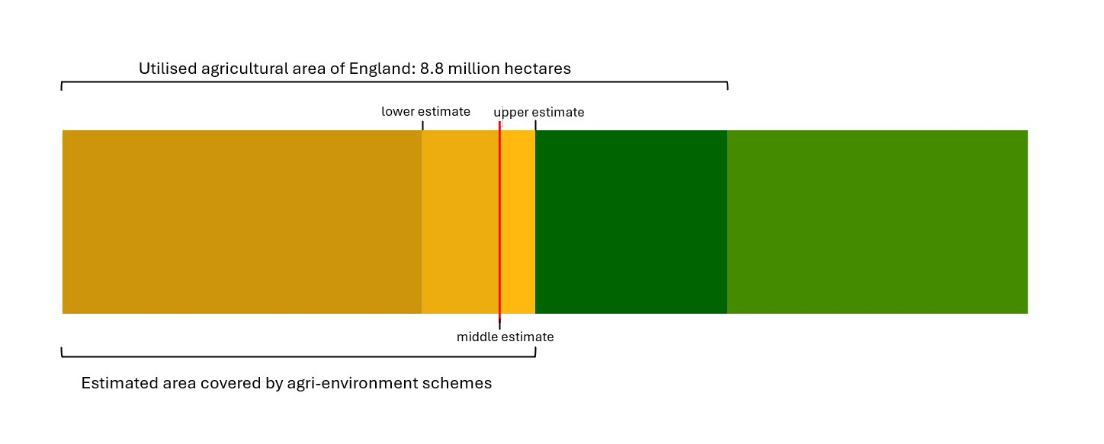
Figure 1: The land area of England, shown as a rectangle. The area under agri-environment schemes is shown in yellow, with darker yellow for the lower area and lighter yellows for the additional area under other estimates. The middle estimate is shown by a red line. The total utilised agricultural area of England is shown in dark green, and the total area of England is shown in lighter green.
Source: Area under agri-environment schemes in England at 31st December 2025
The total area under agri-environment schemes in England has increased since by 9% 2024, from 5.6 million hectares to 6.1 million hectares. This is largely because the area under SFI expanded offer agreements has increased by 350% since 2024, from around 0.4 million hectares to 1.8 million hectares. This increase of 1.4 million hectares more than makes up for the decrease in area under Countryside Stewardship, which dropped by 0.4 million hectares between 2024 and 2025 (from 2.0 million hectares to 1.6 million hectares, a decrease of around 20%). This decrease was largely due to agreements expiring, as Countryside Stewardship Mid Tier has now closed to new applications. Many of those who previously held Countryside Stewardship agreements will have transferred to SFI agreements.
The areas under SFI23 and Environmental Stewardship agreements have stayed largely stable since 2024.
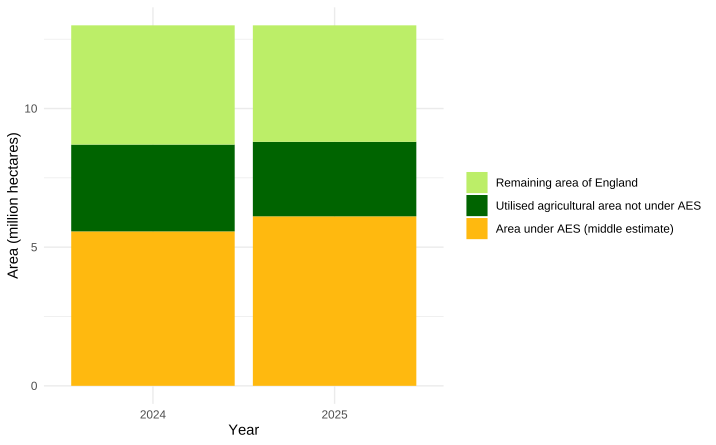
Figure 2: A chart showing the land area of England at 2024 and 2025, with the estimated area under agri-environment schemes shown in yellow, the total utilised agricultural area of England shown in dark green, and the total area of England shown in light green.
Source: Area under agri-environment schemes in England at 31st December 2025
4. Area under agreement by Region (International Territorial Level 1)
The ITL1 area (region) with the greatest area of land under agreement is the South West, and region with the lowest area (excluding London) is the North East.
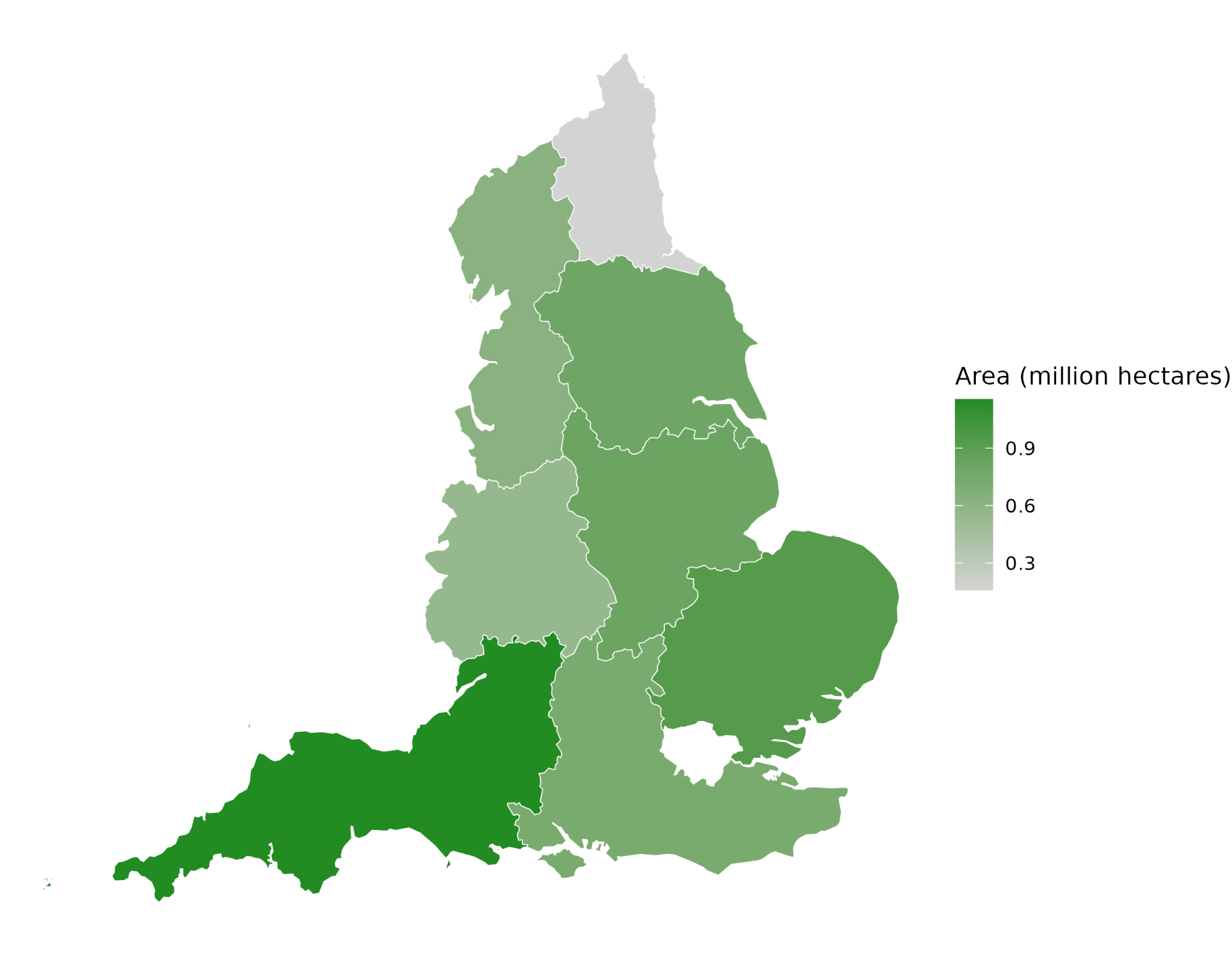
Figure 3: A map of England, showing Regions (ITL1 areas). The ITL areas with the lowest area under agreement are shown in light grey and the ITL areas with the highest area under agreement are shown in dark green.
Source: Area under agri-environment schemes in England at 31st December 2025
The regions are different sizes, which has a big effect on the area of agri-environment scheme agreements in each region. If we look at the percentage of all land parcel area in each region that is under agreement, we see that the North East has the highest percentage of land parcel area covered by agri-environment scheme agreements. However, the difference between the areas with the highest and lowest percentage coverage is only around 10 percentage points, so there is not much variation across regions.
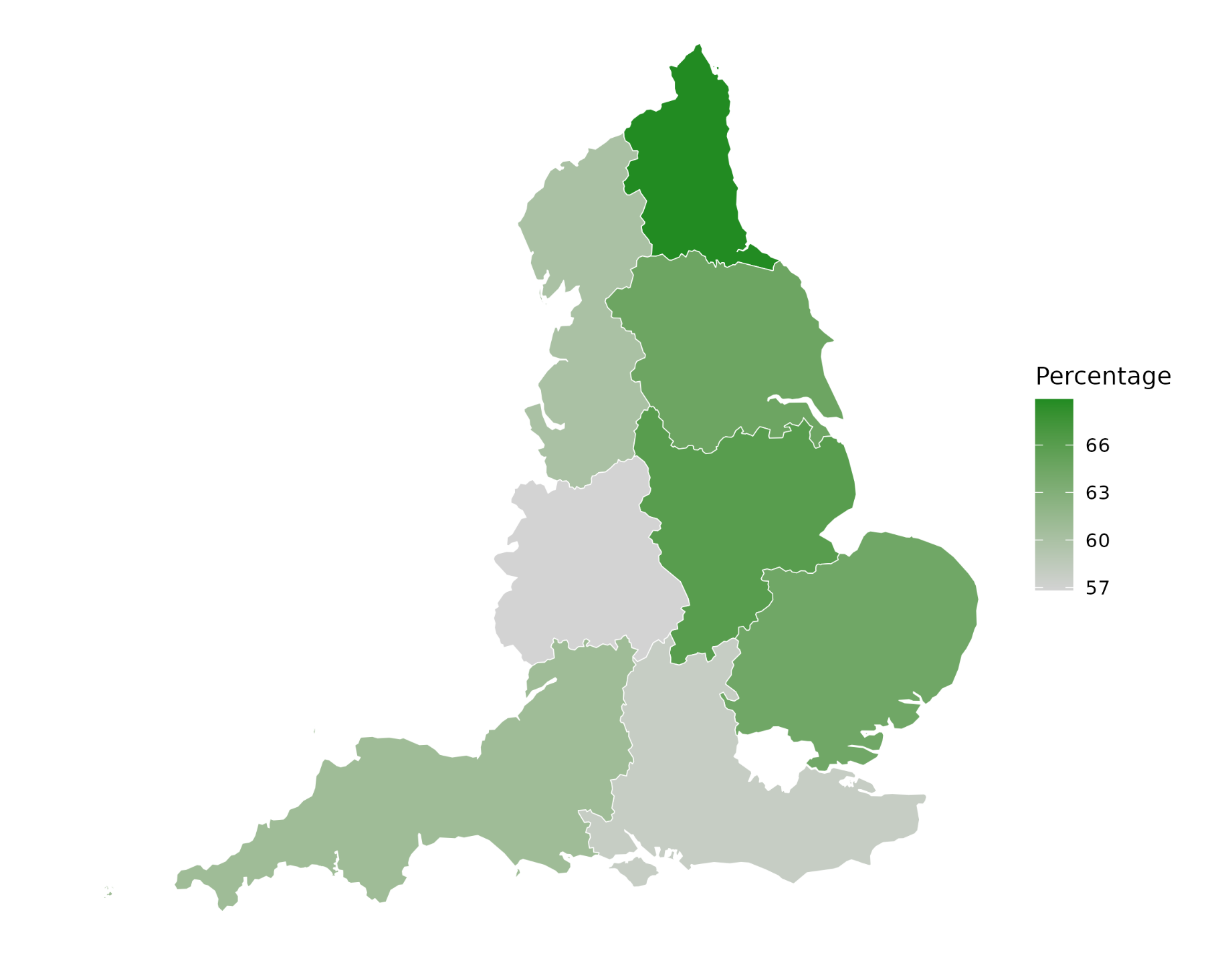
Figure 4: A map of England, showing Regions (ITL1 areas). The areas with the lowest proportions of area under agreement to parcel area are shown in light grey and the areas with the highest proportions are shown in dark green.
Source: Area under agri-environment schemes in England at 31st December 2025
The land parcel area is the total area of all land parcels registered with RPA in that region. This is roughly equivalent to the eligible area in each region and will include most agricultural land, as well as some other land such as woodland.
| ITL1 Name | Hectarage in AES | Total parcel hectarage | Percentage under AES agreement |
|---|---|---|---|
| East (England) | 936,000 | 1,450,000 | 65 |
| East Midlands (England) | 810,000 | 1,230,000 | 66 |
| London | 7,220 | 21,200 | 34 |
| North East (England) | 496,000 | 656,000 | 76 |
| North West (England) | 629,000 | 1,050,000 | 60 |
| South East (England) | 731,000 | 1,260,000 | 58 |
| South West (England) | 1,150,000 | 1,900,000 | 61 |
| West Midlands (England) | 548,000 | 964,000 | 57 |
| Yorkshire and The Humber | 787,000 | 1,220,000 | 65 |
Table 1: Table showing the percentage of registered land parcel area in each ITL1 area (region) that is under agri-environment scheme agreement (AES)
Source: Area under agri-environment schemes in England at 31st December 2025
5. Area under agreement by Counties and groups of unitary authorities (ITL3)
When we look at areas on a smaller scale, we can see that the percentage of land under agreement is fairly even across many ITL3 (Counties and groups of unitary authorities) areas. It tends to be lower in areas with a larger amount of built-up land. The ITL3 area with the highest proportion of land under agreement is Northumberland, at 80%.
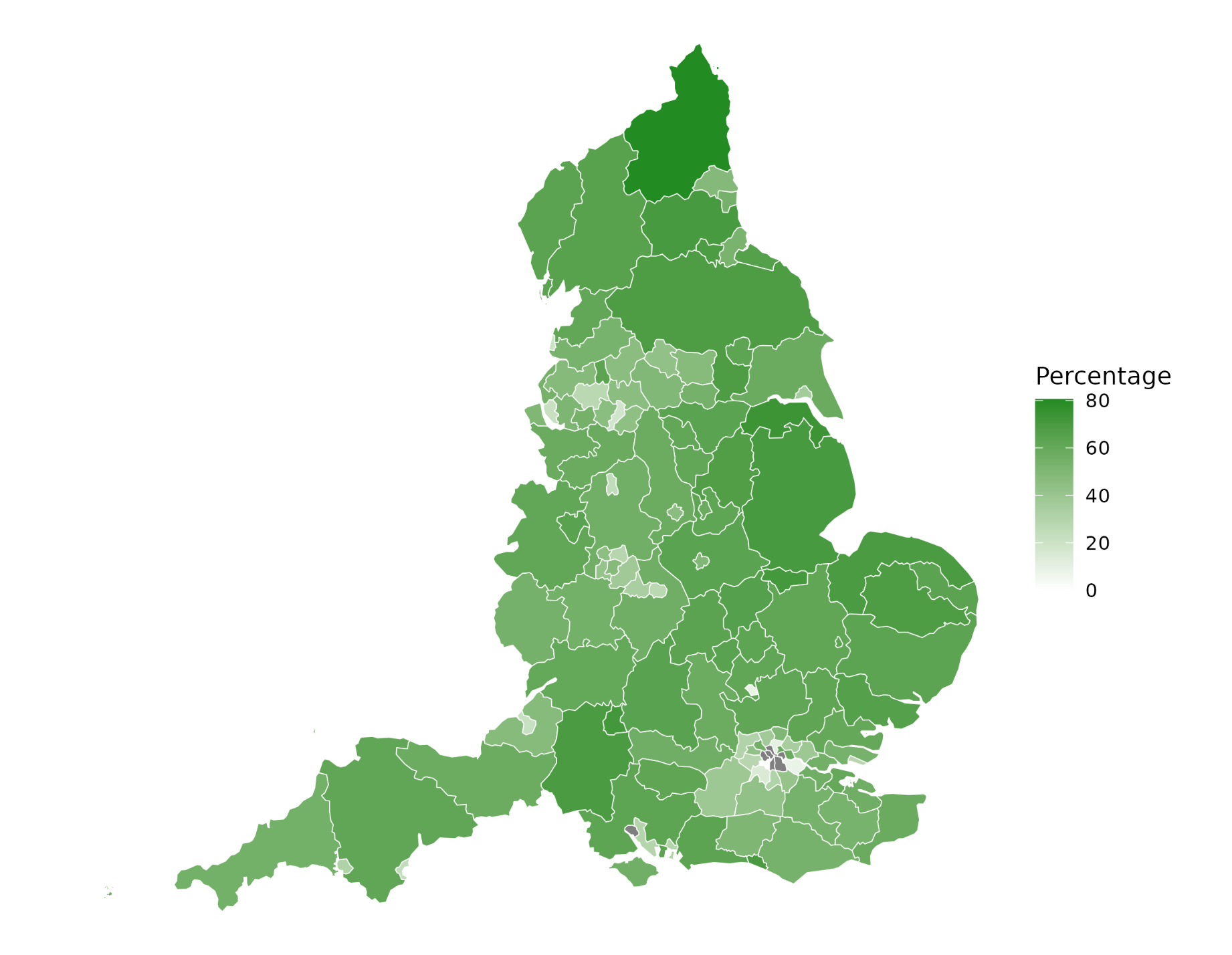
Figure 5: A map of England, showing Counties and groups of unitary authorities (ITL3 areas). The areas with the lowest proportion of area under agreement to parcel area are shown in light grey and the areas with the highest proportion of area under agreement to parcel area are shown in dark green.
Source: Area under agri-environment schemes in England at 31st December 2025
6. Where did removing planning actions make the most difference?
Planning actions are an important precursor to active land management, but when not paired with other actions, they do not involve active management of land. For this reason, we looked at the area under agreement with and without these kinds of actions. Removing planning actions (SAM1, IPM1, NUM1, MOR1, CSAM1, CIPM1, CNUM1 and CMOR1) decreased the total area under AES from 6.1 million hectares (middle estimate) to 5.0 million hectares (lower estimate). When looking at individual regions, removing planning actions decreased the area under AES by 35% in the East, compared to a 6% reduction in the North East. This could be due to the suitability of different actions to different areas, or due to the different distribution of farm types in each region.
| ITL1 Name | Hectarage in AES | Hectarage in AES without planning actions | Difference (hectares) | Percentage difference |
|---|---|---|---|---|
| East (England) | 936,000 | 607,000 | 329,000 | 35 |
| East Midlands (England) | 810,000 | 632,000 | 178,000 | 22 |
| London | 7,220 | 5,910 | 1,310 | 18 |
| North East (England) | 496,000 | 465,000 | 31,000 | 6 |
| North West (England) | 629,000 | 581,000 | 48,000 | 8 |
| South East (England) | 731,000 | 625,000 | 106,000 | 15 |
| South West (England) | 1,150,000 | 1,020,000 | 130,000 | 11 |
| West Midlands (England) | 548,000 | 446,000 | 102,000 | 19 |
| Yorkshire and The Humber | 787,000 | 639,000 | 148,000 | 19 |
Table 2: Table showing the area of land (hectarage) under agri-environment scheme agreement, with and without planning actions, and the difference between these two areas, per ITL1 region.
Source: Area under agri-environment schemes in England at 31st December 2025
7. Methodology
The methodology used to create these statistics is based on the method used for the first version of this bulletin. However, there has been one important change. The lower area under agri-environment schemes is now calculated using the same method as the middle estimate, with the only difference being that planning actions are removed from the lower area estimate. This is because removing planning actions makes a much larger difference than changing the method of action stacking (see methodology for full explanation of this), and keeping the action stacking method the same means that it is easier to see the difference made by removing planning actions as there is one methodological difference between the two numbers rather than two. The name of the lower estimate has been adjusted to reflect this - it is now called the lower estimate rather than the minimum estimate.
The method used to calculate the middle estimate, which is the main estimate used in this report, has not changed.
Please see the methodological caveats for this data for further information on limitations and level of accuracy.
7.1 Datasets
This section describes the datasets that were used in the analyses.
Reference parcels dataset, provided by RPA Geospatial Team. Dataset of all current parcel IDs and their area (in hectares). January 2026.
ES parcel-level data, provided by RPA Data and Analysis Team. Dataset of all options in ES agreements, which parcel they are on, the area of the option on each parcel, plus details of which agreements these relate to and the area of each parcel.
CS parcel-level data, provided by Defra Digital, Data and Technology Team from RPA data systems. Dataset of all options in CS agreements, which parcel they are on, the area of the option on each parcel, plus details of which agreements these relate to.
SFI23 parcel-level data, provided by Defra Digital, Data and Technology Team from RPA data systems. Dataset of all actions in SFI23 agreements, which parcel they are on, the area of the action on each parcel, plus details of which agreements these relate to.
SFI24/SFI expanded offer parcel-level data, provided by Defra Digital, Data and Technology Team from RPA data systems. Dataset of all actions in SFI24/SFI expanded offer agreements, which parcel they are on, the area of the action on each parcel, plus details of which agreements these relate to.
8. Contact
Enquires on this publication to: FCPstatsandreporting@defra.gov.uk
Tel: 03459 335577 (Defra enquiries) Find out more about call charges at – GOV.UK
Responsible Statistician: Katie Killick
The dataset associated with this statistical release can be found here