A new vision for water
Updated 19 February 2026

© Crown copyright 2026
This publication is licensed under the terms of the Open Government Licence v3.0 except where otherwise stated. To view this licence, visit nationalarchives.gov.uk/doc/open-government-licence/version/3 or write to the Information Policy Team, The National Archives, Kew, London TW9 4DU, or email: psi@nationalarchives.gov.uk.
Where we have identified any third party copyright information you will need to obtain permission from the copyright holders concerned.
This publication is available at https://www.gov.uk/government/publications/a-new-vision-for-water-white-paper/a-new-vision-for-water
Ministerial Foreword
Clean water from our taps. Healthy rivers we can swim in and enjoy. A water system that supports the new homes, jobs and opportunities our country needs. That’s our goal and that’s what this government is delivering.
In our first year in office, we moved quickly. We secured £104 billion of private investment to transform our water infrastructure. We passed the Water Special Measures Act to strengthen accountability. We banned unfair executive bonuses and made pollution cover-ups a criminal offence. Now, this White Paper sets out our once-in-a-generation plan to transform the water system for good.
We commissioned Sir Jon Cunliffe to take a hard, honest look at what had gone wrong with the water sector and how to put it right. After significant engagement across the whole system, he set out his comprehensive recommendations for reform in the Independent Water Commission’s final report. This White Paper both responds to, and builds on, his report to set out the actions needed to fix the system.
This is a once-in-a-generation opportunity to reform a sector vital to public health, our environment and the nation’s economic growth and prosperity. With a new stronger single regulator, and a renewed focus on securing a fair deal for customers, investors, and the environment, we will rebuild trust and secure a water system that works for everyone. Some reforms will be taken forward immediately, whilst others will form the foundations of a new water bill which we will introduce during this Parliament to set the course for lasting change.
This White Paper is how we deliver on our promise to clean up our rivers, lakes and seas – not just for today, but for generations to come.
Together, we can make water one of Britain’s greatest success stories once again: cleaner rivers for our children to enjoy, resilient infrastructure that powers economic growth, and a public that trusts the system serves them well.
The Rt Hon Emma Reynolds MP
Secretary of State for Environment, Food & Rural Affairs
Executive Summary
This White Paper sets out our action plan for water. We will reform our water sector and the wider water system to make sure it delivers our most critical outcomes – safe and secure supplies of water, a protected and enhanced environment, a fair deal for customers and investors – in a way that is more efficient and integrated. For too long changes to the water system have been piecemeal or disjointed, pulling regulators and companies in different directions – not delivering better outcomes, but adding to regulatory complexity and burden.
We have already secured a down payment for this transformative change through the £104 billion investment programme the water sector will be delivering between 2025 and 2030 – representing a new approach from the underinvestment of the past. The water industry will need more investment into the future, so we now need to go further and take forward a suite of reforms covering the entire water system – from our underlying legislation right through to delivery on the ground – to tackle the wider long-standing problems the sector has faced and firmly secure our place on this new course. This is a path where our water sector reliably delivers for everyone and drives economic growth in every corner of England. Where there are clean rivers and seas we can all enjoy, resilient infrastructure that is fit for the future, and water companies and investors that act responsibly and deliver for customers. In this White Paper, we split the reforms we will undertake into the following key themes:
A New Direction for Water: Reforms to set clearer long-term direction – including reforms to Strategic Policy Statements, rationalising plans, better joined-up regional water planning function, and a long-term stability objective. To help stakeholders to manage these changes, we will publish a Transition Plan detailing the journey to a new system. These reforms will provide clear direction to help companies and investors better plan for the long term and take advantage of long-term efficiencies.
Resetting Regulation: Establishing a new integrated water regulator to provide greater stability, transparency, and an integrated view of both economic and environmental performance. A new supervisory approach will shift regulation towards being more proactive and targeted to the specific needs of each water company to improve performance – while also increasing grip over water company delivery. These reforms will establish a model for the new regulator to intervene early to help underperforming water companies recover faster, attract the investment they need, and improve long-term financial resilience, asset health, and environmental performance.
Attracting Investment: Making water a more attractive and reliable sector for investors seeking stable and fair returns. This will include rationalising and simplifying performance commitments to reduce the volatility in returns, and introducing new measures to improve financial resilience. We are also increasing competition through more innovative third-party financing, and reforming the appeals process to bring water in line with other utility sectors. These reforms will reset the balance of risk and return for investors, ensuring that they receive a fair bet – a return which adequately reflects the risk they take, helping to re-establish the water sector as a place for steady and stable returns.
Putting Customers First: Creation of a new independent water ombudsman. We are also acting to better protect customers by further safeguarding our world-class drinking water and increasing consideration of public health across the system. These reforms will ensure customer protection continues to be prioritised and enhanced.
Clear Action for Clean Water: Building on record investment in storm overflows and wastewater treatment, taking action to tackle sewer misuse and introducing a single set of stronger and clearer standards and enforcement for agricultural pollution. We are also moving to a system of open monitoring – where companies are not marking their own homework on environmental performance. These reforms will drive forward the government’s promise to clean up our rivers, lakes, and seas.
Water Security: Improving asset health through new mapping and statutory resilience standards, while cutting leakage and increasing water efficiency with more water reuse, smart metering, and innovative regulation. We are also streamlining infrastructure delivery with new planning systems, support for stronger supply chains and better regulatory oversight to protect infrastructure from growing risks. These reforms will help water companies get spades in the ground faster to build and maintain more resilient infrastructure.
Transition Plan: Committing to publish a Transition Plan this year to lead the water sector through transformative reforms. This transition will be guided by the following principles: delivering a clear and straightforward roadmap, providing clarity on roles and responsibilities, securing buy-in from regulators and the water industry, and setting out practical guidance on how to create capacity and providing robust governance processes. The transition will be led by government, working in partnership with existing regulators, companies, investors, and environmental organisations.
By addressing the structural challenges faced by the water system with these complementary and integrated reforms, this will allow us to tackle many of the long-standing opportunities and trade-offs head-on. These reforms will be mutually reinforcing, helping deliver multiple outcomes and all moving in the same direction towards a better system for customers, companies, regulators, investors, and the environment.
The water system is in need of fundamental reform:
- the sector lacks clear joined-up longterm direction
- overlapping and confusing plans and processes.
- rivers, lakes and seas are polluted
- limited oversight and transparency of companies and assets
- one size fits all approach to regulation
- consumer protections are not at the forefront
- limited mechanisms for expediting infrastructure delivery
- sector lacks stability and financial resilience
We have already taken action by:
- passing the Water (Special Measures) Act
- securing £104 billion of private investment for the water sector
- banning unfair executive bonuses
- making pollution coverups a criminal offence
Our reforms to the system will include:
- publishing a Transition Plan, with accompanying interim Strategic Policy Statement for Ofwat and ministerial direction for EA, to set out how changes will happen and who is responsible
- appointing the chairdesignate of the new regulator
- reforming our approach to strategic guidance for the regulator, expanding it to include long term priorities for the wider water system ahead of price review 2029
- establishing a Regional Water Planning Steering Group to test new elements of the regional water planning function
- introducing the water reform bill into Parliament
This will lead to a new regulator and new legislation.
The outcomes the reforms will deliver are:
- a new direction for water – improved long-term stability of the sector
- resetting regulation - a powerful new regulator delivering improved financial resilience, asset health, and environmental performance
- attracting investment - a more attractive and reliable sector for investors
- putting customers first - prioritised and enhanced customer protection
- clear action for clean water - cleaner rivers, lakes and seas
- water security - boosted long-term growth and water security
Infographic using statistics to highlight current challenges in the water sector and the key reforms planned or action already taken relating to these challenges
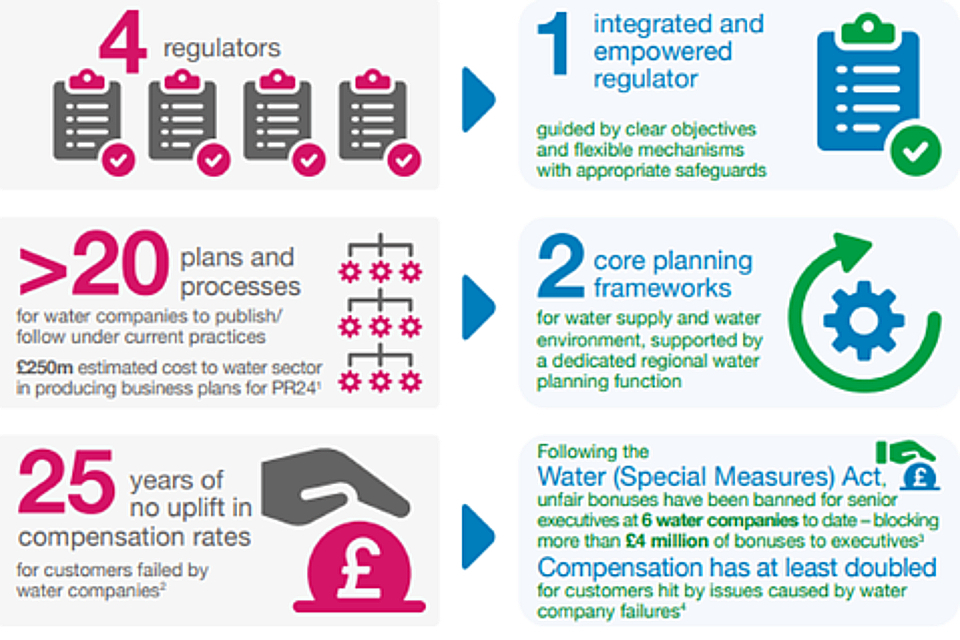
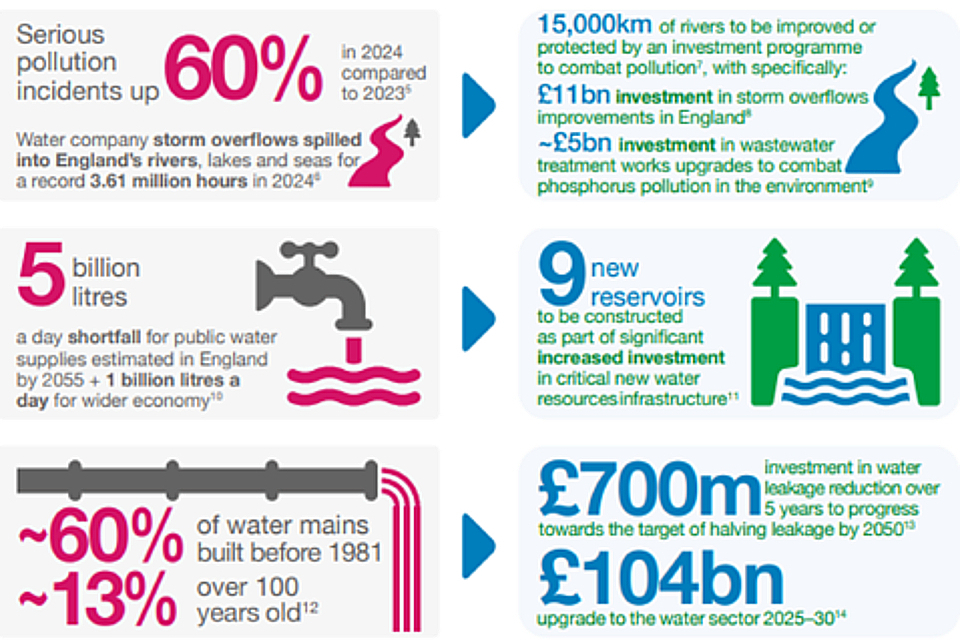
The infographic shows the following statistics and reforms:
On the left-hand side: 4 regulators
On the right-hand side: 1 integrated and empowered regulator guided by clear objectives and discretions with appropriate safeguards
On the left-hand side: > 20 plans and processes for water companies to publish/follow under current practices. £250m estimated cost to water sector in producing business plans for PR24
On the right-hand side: 2 core planning frameworks for water supply and water environment, supported by a dedicated regional water planning function
On the left-hand side: 25 years of no uplift in compensation rates for customers failed by water companies
On the right-hand side: Following the Water (Special Measures) Act, Water (Special Measures) Act, unfair bonuses have been banned for senior executives at 6 water companies to date – blocking more than £4 million of bonuses to executives. Compensation has at least doubled for customers hit by issues caused by water company failures
On the left-hand side: Serious pollution incidents up 60% in 2024 compared to 2023. Water company storm overflows spilled into England’s rivers, lakes, and seas for 3.61 million hours in 2024
On the right-hand side: 15,000km of rivers to be improved or protected by an investment programme to combat pollution, with specifically:
£11bn investment between 2025-30 in storm overflows improvements in England
~£5bn investment between 2025-30 in wastewater treatment works upgrades to combat phosphorous pollution in the environment
On the left-hand side: 5 billion litres a day shortfall for public water supplies estimated in England by 2055 + 1 billion litres a day for wider economy.
On the right-hand side: 9 new reservoirs to be constructed as part of significant increased investment in critical new water resources infrastructure
On the left-hand side: ~60% of water mains built before 1981, ~13% over 100 years old.
A New Direction for Water
The water sector has lacked alignment between water companies, regulators, investors, agriculture, transport, local government, developers and customers. Planning is fragmented, short-term and lacking strategic direction - undermining long-term stability and increasing investment risks. We will end this piecemeal approach and provide stronger leadership and direction.
Providing Long-Term Direction
We will set out clear long-term direction and priorities to guide decision-making and action for all parties who have a role to play in protecting our rivers, lakes, and seas, including key sectors such as the water industry, agriculture, transport, and development.
In the absence of a long-term and cross-sectoral strategy for water, governments have previously relied on Strategic Policy Statements (SPS) to Ofwat, the economic regulator, to guide how they make decisions on future planning with industry and how they fulfil their duties. Poor management of this process has resulted in fragmented and short-term direction and decision-making. To address this, we will reform the approach to the SPS by expanding it to cover long-term priorities and targets for the wider water system, looking 25 years into the future. This will:
- Enable the regulator to take a longer-term approach, providing more certainty for all actors in the water system on what outcomes and priorities they should be aiming to achieve in the next 5 years, 10 years, and in the long term.
- Give investors confidence in their future investment needs, and a clearer idea of delivery pathways, unlocking additional efficiencies in the supply chain.
- Set more specific, measurable direction for the new water regulator in the short-term.
We will publish this strategic guidance every five years to provide a clearer policy framework for independent regulation and planning at a more local level. This new strategic guidance will replace the current SPS and establish a clear framework for regulatory and planning discretion, helping drive effective delivery of the long-term priorities with robust assessment of costs and benefits. We will publish the first iteration of this new guidance early in the current cycle, to inform price review 2029 (PR29).
Alongside this, we recognise the system has long struggled with the lack of clear national, overarching targets providing long-term goals for water. It has been 25 years since the European Union’s (EU) Water Framework Directive was published, yet England and many EU Member States remain a long way from meeting their environmental objectives. We have also set four new water targets under the Environmental Improvement Plan (EIP). However, these focus on specific challenges facing the water system, meaning important pressures remain out of scope.
We will therefore explore setting new ambitious targets for the water environment. These would enable consistent national oversight and alignment between government, regional water planning, regulators, the water industry, and other sectors to deliver agreed outcomes more effectively while maintaining environmental standards. By establishing a firm, long-term government vision and commitment, we aim to give more clarity and confidence for long-term decision-making by companies and investors. These long-term targets for the water environment could also help drive delivery against wider targets set out in the new EIP, as we know action to clean up our waters also delivers co-benefits for priority areas like biodiversity and net zero.
As part of our new strategic direction, we will commit to creating a stable and predictable regulatory environment for the water industry. This will include an objective for the new regulator to improve the creditworthiness of the industry so it can provide long-term investors with the lower risk environment they seek. This will support delivery of longterm major infrastructure projects and help water companies maintain investment grade credit ratings, which will help keep customer bills affordable, in line with the level of service provided. As part of any new regulatory arrangements, we will work with the Department for Energy Security and Net Zero to ensure that the water industry continues to reduce emissions, including methane, contributing to meeting our carbon budgets and net zero commitments.
The current domestic legislative framework for water is also complex and not always well-aligned with modern expectations or emerging pressures. This can create uncertainty around responsibilities and risks encouraging a compliance-focused approach rather than driving the best outcomes for customers and the environment. Through an upcoming water bill, we intend to progress an ambitious, coherent reset of the legislative framework. This includes elements of the Urban Wastewater Treatment Regulations and exploring updates to the Water Framework Directive Regulations, where needed. This will focus on ensuring the legislative framework for water is coherent, in line with current expectations and desired outcomes, and future-proofed to adapt to changing pressures – such as emerging chemical and biological pollutants, and climate change. By seeking specific and limited powers to update and amend the legislative framework, and through careful rationalisation of legislation where needed, we will help deliver the government’s overall ambition to ensure it is focused on delivering better outcomes.
To guide water companies and other sectors through these reforms, and the wider changes outlined in this White Paper, the government will publish a Transition Plan in 2026. This will set out a roadmap to guide the sector from today’s system to the future model – providing certainty during a period of major change by setting out what needs to happen and when, and who is responsible. The Plan will also set out how we will create sufficient capacity across the sector to support ongoing delivery alongside implementation of our ambitious reform agenda. The interim SPS for Ofwat and complementary ministerial direction to the Environment Agency (EA), which the government will publish alongside the Transition Plan, will ensure regulators have clear direction to support this transition.
Complementary Systems
The UK Government is working with the devolved governments to identify and address cross-border issues. In particular, the UK and Welsh Governments are working closely and constructively to deliver water sector reforms that reflect each government’s policy ambitions. While the sectors in England and Wales are distinct, they must remain complementary and responsive to cross-border issues.
The UK Government acknowledges that the devolution of some additional legislative competence to Wales may be required. Work is ongoing with the Welsh Government to consider this alongside future arrangements for economic regulation, consumer protection and advocacy, and the alignment of regulatory functions with the Welsh border.
The Welsh Government’s position on water reform for Wales will be set out in more detail in their forthcoming Green Paper. The UK and Welsh Governments are working collaboratively to put in place transitional arrangements to maintain continuity and accountability during the regulatory reform process. Ensuring continuity of service and consumer protection throughout this transition remains a priority for both governments.
Streamlining Planning
We will provide clearer strategic direction across the water system, combined with a streamlined and consolidated approach to regional water planning to ensure this direction translates into better delivery.
Current water planning frameworks are costly, complex, and inefficient – with water companies having to publish or have regard to over 20 different plans for example. We will therefore deliver an improved water planning model, consolidating existing water industry plans and processes into two core planning frameworks – one for water environment and one for water supply. These two frameworks will enable cross-sectoral plans, underpinned by consistent assumptions and metrics at national and regional levels, as well as a strengthened approach to options development and cost-benefit analysis. This will help deliver our aim of reducing the administrative burden of regulation, which will drive opportunities to deliver multiple benefits and support growth by joining up currently siloed processes.
These planning frameworks will be enabled by an enhanced, better joined-up regional water planning function. This will fill the ‘missing middle’ in the current system and enable a more holistic, coordinated approach to water environment and supply planning which aligns with the long-term priorities. Regional water planning will support delivery of national strategic objectives such as the economic growth mission, house building targets and nature recovery, whilst enabling regional and local priorities to be realised. It will also unlock better collaboration to create coherent, joined-up plans across sectors including the water industry, agriculture, transport, and development and better consider currently overlooked objectives like public health.
Each regional plan will set out investment priorities to meet national water and growth objectives. They will help identify lower-cost and higher-impact solutions to improve water quality and supply, considering opportunities across sectors. They will enable preventative interventions and nature-based solutions where appropriate, to reduce long-term costs and improve resilience. Decisions on regional water planning should be evidence-based, transparent and subject to clear oversight mechanisms. Plans will be tailored to local needs, while operating within the long-term national priorities and shared methodologies.
Delivering regional planning presents a crucial opportunity to streamline costs, reduce bureaucracy, and deliver better value for money compared to the current system. We are considering opportunities to rationalise and better align existing planning functions and resource, such as River Basin Management Planning, regional water resource groups, catchment partnerships, and Regional Flood and Coastal Committees. We are committed to reducing duplication, making better use of existing expertise, simplifying engagement for stakeholders, such as water companies, catchment partnerships, local authorities and others, and ensuring a more coherent system. This is critical to unlocking better joined-up water planning while avoiding the system getting bogged-down in more layers of bureaucracy and process.
Case study 1
Examples like Severn Trent’s catchment management work show how regional planning can unlock flexible, place-based investment that delivers better results at lower cost. By working with farmers to reduce run-off of phosphates, nitrates, and pesticides, the company has avoided the need for expensive treatment works while improving water quality and delivering wider environmental benefits.
To support development of the new model and test how the approach works in practice, we will work with local partnerships to prepare for new elements of the regional water planning function in 2026. We will set up a Regional Water Planning Steering Group to scope and co-design the framework, considering questions such as how catchment and local insight can inform regional system planning, how best to join up water, flood, and development planning, and how system planning could influence where investment is targeted. This group will include cross-sector representation including from regulators, the water industry, agriculture, transport, and local government to ensure we are building on and learning from best practice and innovation from around the country. Phased implementation will enable us to test and refine delivery models, informing implementation from 2027. We will set out more detail about this approach in the Transition Plan, including how elements will feed into the next investment round for water companies.
We are also doubling funding for catchment partnerships to strengthen local capacity to deliver effective catchment planning. We will test key elements of catchment-level input into regional planning, including exploring how catchment partnerships can work effectively across sectors, involving a greater range of decision-makers to identify more cost-effective solutions and support greater use of nature-based solutions.
Effective Collaboration for Reform
To successfully implement the scale of reform needed in the water sector, we need to bring all parties along on this journey. This was a major achievement of the Independent Water Commission, meeting with nearly 250 organisations and individuals and receiving over 50,000 responses to the Call for Evidence. Since the publication of Sir Jon’s final report, we have established numerous working groups to ensure a diverse range of stakeholder views were considered in developing our reforms from the outset. We plan to continue this open and collaborative approach as our reforms progress, drawing in expertise, support, and challenge from diverse groups across the water system.
As part of this more open and collaborative approach to reform, we are also committed to working in partnership with the sector to champion successes. We will play a role in ensuring the public understand the complexity of addressing long-standing challenges – that there are inherent trade-offs to be managed in the system, and that fundamental change takes time. This does not mean government will not call out poor performance or that enforcement action will not be taken by the regulator when required, but we want to build strong partnerships with all parties with a stake in the water system attracting the investment it needs to work better for customers and the environment.
Resetting Regulation
The public has lost trust in the regulations that govern our water sector and the current regulators’ ability to hold water companies to account and ensure they are acting in the public interest. At the same time, investors have lost trust that the water industry regulatory framework offers them a fair bet. The regulatory landscape is complex, lacks transparency, and does not give companies or investors the clarity needed to drive change.
At the heart of reforms will be a powerful single new regulator for the water industry. This regulator will have the proper powers to oversee water companies and sectors whose activities impact the water environment, modernise our regulatory approach, and tackle financial engineering and poor environmental performance.
A New Water Regulator
There is widespread consensus that the existing regulatory framework, with four separate regulators or agencies with overlapping and conflicting remits, has been ineffective. While there are successes, such as the Drinking Water Inspectorate’s (DWI) performance in overseeing high-quality drinking water, the regulatory system overall has not delivered for customers or the environment, nor has it created the conditions for long-term investment.
For this reason, we will create a powerful new regulator by abolishing Ofwat and bringing together the relevant water system functions from the existing regulators (Ofwat, the DWI, EA, and Natural England) into one new body. This will replace the current fragmented system with one regulator capable of integrated management of the water system. It will be able to deliver better services for customers, joined-up regulation and a cleaner environment for nature and the public.
Its core mission will be to deliver fair and effective regulation that protects and improves public health, safeguards the environment, and drives investment – ensuring trust, accountability, and value for all. It will have robust powers to oversee both water companies and other sectors whose activities impact the water environment. Its key objectives will be:
- Protect public health and the environment.
- Ensure water company bills are fair and affordable for customers.
- Strengthen the water sector’s financial resilience and ability to attract the long-term investment required to meet its ambitions, ensuring that the sector supports economic growth.
- Provide robust oversight of water companies to maintain and enhance the long-term health and resilience of their infrastructure.
By meeting these objectives, the new regulator will provide greater stability and transparency for the public, investors, and the water industry. It will have central oversight of the water system to regulate the different pressures on water quality and water resources in an integrated way. In pursuing these objectives, the new regulator will have clear direction from government, including through the reformed approach to strategic guidance, on managing the trade-offs required in regulating the water system. A single regulator will be able to look at all water company activities in the round for the first time, enabling a ‘whole firm’ view of economic and environmental performance and the provision of water services. Delivery targets, business planning, and cost assessment will be fully integrated ensuring that investment meets the needs of the sector.
As we set up this new regulator, strong early leadership will be essential to build a constructive new culture and deliver this integrated industry-wide approach from the start. In line with government requirements on new public appointments, we will make leadership appointments at the earliest opportunity. This will help support and oversee preparatory work to ensure the regulator is operational upon legal establishment. These early appointments will develop the corporate strategy and new ways of working for the new body, whilst working with the existing regulators to secure a smooth transition. The existing regulators will retain their full legal powers and responsibilities until the new water regulator is set up, directed by the expectations set out in the Transition Plan.
Senior leadership of the four existing water regulators will seek to improve collaboration on their established and ongoing activities ahead of the establishment of the new regulator. Details for improved collaboration will be outlined as part of the upcoming Transition Plan.
A New Toolkit and Approach for Regulators
Tailored Approach
The current model of regulating water companies relies too heavily on industry-wide benchmarking and economic modelling, which can overlook company-specific risks and performance issues stemming from each company’s unique history, asset base, geography, and many other factors. This one-size-fits-all approach has limited the regulatory model’s ability to intervene early, prevent financial engineering, tailor oversight, and drive better outcomes for the public and the environment.
To fix this, we will require and support the new regulator to adopt a supervisory approach. Through continuous engagement, the regulator will build a better understanding of the specific circumstances of each water company, including its engineering and technical challenges. This will transform the way water companies are regulated, shifting to an approach that is more proactive, risk-based, company-specific and outcomes-focused – while also improving grip and oversight of delivery. Benchmarking and modelling will continue to be an important tool to avoid abuse of monopoly power, but this will be improved with company-specific capability and contextual judgement within the new regulator – enabling a tailored approach which reflects a company’s particular challenges.
Supervision will operate through teams with company-specific expertise, who are responsible for oversight and funding decisions relating to each water company. Supervisors will embed expertise, be supported by specialist advisors and be overseen by the new regulator board. Supervision will operate on a ‘risk ladder’, backed by a clear framework, where regulatory scrutiny is proportionate to risk level, avoiding disproportionate regulatory burdens. To ensure regulation is stable and predictable, and supervisors’ decision-making is objective, there will be guardrails in place around the supervisory regime. This will include published standards of supervision and a supervision manual to ensure a consistent, fair, and objective approach is taken. Furthermore, all decisions will be taken with public benefit at the forefront and will be in line with our overall aim of reducing the burden of regulation, and will be subject to suitable appeal mechanisms.
Constrained Discretion
Too often, legislation has led to over-prescriptive and onerous regulatory approaches. This has encouraged regulators to make cautious decisions overly focused on compliance, rather than achieving the outcomes intended by the government and necessary for public benefit.
We will therefore embed the concept of ‘constrained discretion’ into the reset of water regulation. The aim of constrained discretion is to empower the regulator with greater flexibility to support improved outcomes for people, the environment, and economic growth, within appropriate constraints set out in legislation. For example, a regulator that is more empowered to regulate on outcomes, rather than process, will be more able to prioritise sewage treatment works upgrades where they will have most impact and consider where a change in approach may remove regulatory barriers to the use of nature-based solutions.
We must address both legislative and cultural barriers to the effective use of discretion in regulation. We will address legislative barriers through planned legislative reform, ensuring regulations are focused on outcomes, rather than processes, and provide appropriate flexibility to the regulator. In parallel, we will address cultural barriers by ensuring the new regulator has the right tools, leadership, culture, and direction to make decisions with confidence. We will set the outcomes the regulator must deliver through refreshed objectives in the new strategic guidance. Alongside this, we are developing decision-making principles for the regulator to use when identifying the path to deliver the best outcomes.
The new regulator’s discretion will be constrained by appropriate guardrails. All regulatory activity will need to be within the limits set by legislation and underpinned by principles of good regulatory practice: transparency, consistency, accountability, and proportionality.
Ownership
Water company owners play an essential role in directing vital investment. But some water companies and their owners have prioritised short-term profits over long-term resilience and the environment.
We will create a regulatory system that supports owners with long-term business models and prevents the inappropriate financial engineering of companies in the past. We will consider new measures to do this, including through the new supervisory regime. This will be done with the sector, investors, and the new regulator to develop a proportionate and transparent set of tools for the regulator to protect customers and the long-term interest of companies.
Where a water company might want to transition to a new ownership model, such as a not-for-profit, the regulator will develop a transparent process to assess whether a water company’s requested move to a new model should go ahead and ensure customer interests are properly reflected in the decision.
We are also committed to pursuing further transparency in ownership, having recently consulted on adding the water sector to the existing seventeen areas of the economy subject to mandatory notification under the National Security and Investment Act. This would place a legal requirement on acquirers to inform the government of planned changes in company control. The government response to this consultation will set out our approach to taking this forward.
Performance
We need the right frameworks in place to immediately tackle poor performance and ensure it does not become persistent. We will therefore introduce a package of measures to improve performance across the water sector, giving the regulator stronger tools to intervene early, support recovery, and ensure water companies are financially resilient.
We will introduce a new Performance Improvement Regime (PIR) for poorly performing water companies. This regime will be designed to prevent companies from falling into a ‘cycle of decline’. The PIR will draw on the regulator’s in-depth understanding of a company, gained through the supervisory approach to regulation, and it will include both supportive and punitive measures. This will be calibrated holistically with the standard framework to ensure a toolbox of increasing options for the new regulator under the PIR.
The PIR will include measures which send a clear signal that poor performance will not be tolerated or rewarded. These measures will ensure that entering the PIR has genuine consequences where owners and management have contributed to under-performance.
At the same time, we recognise enforcement alone will not fix the problems we face. To avoid trapping water companies in a cycle of decline, the regime will also include tools to break this cycle and establish a path to improvement.
To ensure the regulator can act decisively should the high bar for Special Administration be met, we will ensure companies have appropriate contingency Special Administration Regime (SAR) plans, setting out how they would ensure that any special administrator, once appointed, would be able to maintain delivery of critical services and facilitate restructuring or sale if SAR is triggered. We are considering whether these requirements should apply to all water companies or just those at higher risk of failure, such as firms entering the PIR. In either case, the general approach to SAR contingency plans will be proportionate, pragmatic, and developed with the sector. Together, these reforms will help the regulator intervene earlier, tailor support to company circumstances, drive the improvements customers expect and provide greater certainty and clarity for investors.
Building a Better Culture
Building on these regulatory reforms, to truly turn around the water sector we also need to improve culture and leadership within water companies. Steps have already been taken to improve water company governance and executive accountability via the Water (Special Measures) Act, which provides legal powers to ban unjustified bonuses and to set a robust fitness and propriety test for senior leaders. Ofwat is already working to better align governance in the sector with the UK Corporate Governance Code, but more needs to be done.
A key part of improving culture is getting the right people in to do the job and we want the sector to be attractive to high-quality senior leaders, acting in the public interest, who can lead change from the top. To achieve this, we will consider taking forward a new regime for senior accountability, carefully designed to embed stronger ownership and accountability in a fair way which still allows water companies to appoint capable leadership. We will learn lessons from similar regimes implemented in the financial services sector to ensure we deliver the outcomes needed whilst minimising unnecessary bureaucracy or unintended consequences.
Case study 2
During the Government’s first week in office, we secured agreement for all water companies to update their Articles of Association to make the interests of customers and the environment a primary objective. This has now been delivered across the industry, meaning customers and the environment now sit at the heart of their objectives and decision-making. We will continue to explore ways to ensure customers and the environment remain essential to water company decision-making.
Accelerating Impact
As many of these regulatory reforms will take time to design and implement, we want to accelerate our efforts to secure early improvements. Our current regulators need the right tools available to continue to drive improvements and hold water companies firmly to account during this transition period.
We consulted on changes to enable the EA to deliver swifter and more proportionate penalties for minor-to-moderate offences. These would act as a deterrent to poor performance by water companies, and would sit alongside and complement the existing enforcement options such as prosecution and unlimited penalties for more serious offences to the criminal standard of proof.
We are also ensuring current regulators have the resources they need now for effective and timely enforcement. The EA has committed to resolving its backlog of enforcement cases from 2021 and earlier by April 2026. Tackling this backlog will allow regulators to take timely action against offenders, restore public confidence, and ensure environmental breaches are met with real consequences. And to avoid further backlogs, we are implementing the EA’s digital projects, which will make fundamental improvements to the regulator’s enforcement regime.
Our delivery assurance has also been strengthened through the establishment of the ministerial Water Delivery Taskforce, which has already unblocked significant housebuilding and improved water resilience, including over 10,000 homes in Oxford and up to 21,000 in North Sussex. We will continue to strengthen our delivery oversight and interventions, including a full assurance review as part of the establishment of the new single regulator.
Attracting Investment
Meeting the challenges of upgrading our water infrastructure and improving long-term resilience will require substantial investment. The £104 billion of investment into the sector during the 2025–30 spending period is just the start. Earlier this year the National Audit Office estimated water companies would need to invest at least £290 billion of enhancement investment before 2050 to ensure the industry can meet our growing needs. Achieving this will require a balanced approach to funding, with government, investors, the regulator, and the public working together to provide stability and the long-term commitment that this sector and its investors have been asking for, while keeping costs fair for customers.
The reforms in this White Paper are intended to achieve this. A consolidated business planning framework will provide clarity and direction; a single regulator will mean less burdensome regulatory duplication; and long-term strategic guidance will ensure water industry regulation is able to support long-term investment. We are also taking forward specific reforms to harness this investment opportunity, making sure the sector remains attractive to responsible investors who want reliable returns over a sustained period.
We want investors to be confident that the new rules underlying this regulated sector are stable, predictable, and will secure returns over the long-term. When investors put their money into the water industry, they do so in the knowledge it will be many years before infrastructure is built and operational. They need to be given confidence that returns will be fair, stable, and predictable across the lifespan of their investment.
These reforms are therefore designed with the perspective of long-term investors in mind. We recognise that the water industry will benefit if long-term investors are the custodians of these nationally important companies. We have seen poor decisions and behaviour in the past from the owners of some water companies, which have suggested more short-term strategies. Regulation must therefore provide the right environment for those with longer term approaches – reducing risk wherever possible and providing returns that may not be high, but are predictable and reliable. By embedding stability and transparency into the regulatory framework, we will create an environment where investors can plan decades ahead, knowing that government, companies, and regulators are aligned on their long-term priorities.
Improving Certainty and Resilience for Companies and Investors
The water industry will be best served by patient, long-term investors attracted by a steady, fair, and dependable return. It used to offer the stability which motivates these investors, but stability has eroded over time. Regulation should ensure investors expecting high returns over short timeframes are not encouraged. We want to see stable, predictable, and transparent regulation which provides the low-risk environment that long-term investors look for.
As an important first step in providing this greater stability, we are committing to retaining a 5-year cycle for water industry price reviews, but with reforms to make it function more effectively and with greater certainty. This will provide certainty to companies regarding bills and investment needs, ensuring focus remains on the delivery of outcomes for customers and the environment.
To further strengthen planning, we will introduce a 5/10/25-year planning approach. This will provide short-term funding certainty to water companies for the first 5 years, more indicative funding commitments for the following 5 years, and set out high-level funding needs over a 25-year horizon. The price review cycle would then act as 5-year checkpoints in long-term delivery plans, not delivery sprints. This new planning approach will reduce volatility and uncertainty for customers and water companies by smoothing the current ‘boom-and-bust’ delivery cycle and providing more funding certainty for the full lifecycle of projects to support accelerated delivery.
Graph: Water company spend by year in England and Wales, between 1989-90 and 2024-25, in 2024-25 prices, £ billion
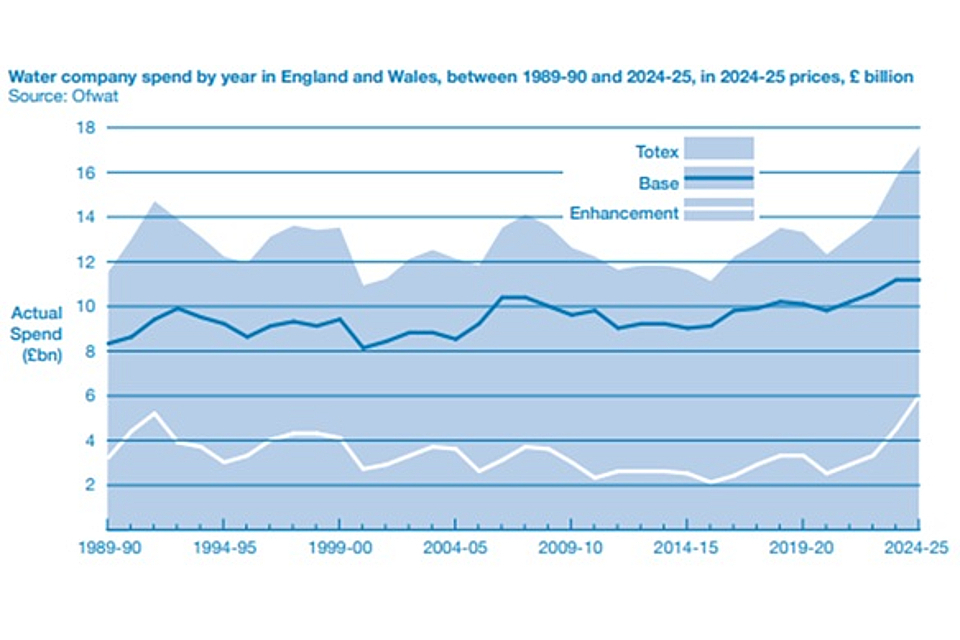
The graph shows water company spending in England and Wales between 1989–90 and 2024–25, measured in 2024–25 prices and expressed in billions of pounds. It is sourced from Ofwat.
The chart includes three spending categories:
- Totex (total expenditure) – shown as a wide band covering the full range of spending.
- Base expenditure – shown as a darker line running through the Totex band.
- Enhancement expenditure – shown as a lighter line running through the Totex band.
Overall trends:
- Totex fluctuates between roughly £10bn and £14bn for most of the period, with peaks in the mid1990s, around 2000–05, again around 2019–20, and a sharp rise towards around £17bn in 2024–25.
- Base expenditure remains relatively stable, fluctuating mostly between £8bn and £10bn, with smaller rises and dips over time.
- Enhancement expenditure is lower and more variable, ranging roughly from £2bn to £6bn, with peaks in the early 1990s and again in 2024–25.
The introduction of long-term planning horizons is not just about operational certainty – it is a signal to investors the sector is moving away from short-termism. By providing clarity on funding needs over 25 years, we are reducing risk and enabling investors to deploy capital with confidence that projects will be delivered efficiently and predictably. A strategic, long-term approach should also embed certainty within a spending period, ensuring that new targets are only introduced mid-period where absolutely necessary and that, when they are, their costs are considered and reflected.
Companies are currently subject to an incentive framework which has become increasingly complex. While this framework has led to improved outcomes in some cases, it has also contributed to additional regulatory complexity and increased the volatility in investor returns. We will therefore instruct the regulator to rationalise the incentive framework so that it is simpler, more predictable, and is not duplicative. We expect a revised framework to focus on driving improvement across the sector. It should reward companies for delivering outcomes that matter most to customers including public health, the environment, and long-term resilience. The new framework should monitor data in a targeted way that supports better regulation, and targets should be set in relation to a company’s current performance, using the expertise of supervisors in tandem with sector-wide benchmarking. This will ensure that improvement is recognised, including for companies that start from a position of poorer performance. Where poor performance has been subject to enforcement through other means, it is not in customer interests for companies to also be penalised a second time through the incentive framework for the same offence. This new approach will provide better clarity for companies and investors, reduce complexity and volatility in returns, and encourage steady, long-term investment.
With government offering greater certainty and proportionate regulation, companies and investors also need to play a role in improving their financial resilience. Since water companies were privatised, they have taken out debt as a cheaper way to raise the finance needed for major infrastructure programmes, rather than raising more expensive equity. However, while debt is often the most efficient way to finance long-lived infrastructure, over-reliance on debt and insufficient buffers has, in some instances, left companies exposed to financial shocks. We will therefore consider how the regulator can work with companies and investors to ensure companies do not accumulate unmanageable levels of debt, remain financially resilient to deliver vital services for customers and the environment, and are able to attract further investment as required.
Increasing Investment and Competition
We want to create more opportunities for investment and competition, as the water sector is rapidly expanding and critical to economic growth.
We will amend the Specified Infrastructure Projects Regulations (SIPR) Water Industry (English Undertakers) Regulations 2013 and enable legislation to enhance the existing regime, create more flexibility and allow greater use across the market, which will provide greater certainty and support competitive delivery. Amending the statutory thresholds will enable a wider range of projects to qualify for delivery under SIPR, building on the success of the Thames Tideway Tunnel. This will provide a procurement model that sits alongside Ofwat’s Direct Procurement for Customers (DPC), providing better value for money for both customers and companies, whilst increasing the attractiveness of large projects to the market.
We also intend to optimise SIPR by expanding the scope from solely sewage-focused projects to all types of water infrastructure. Greater early-stage oversight and assurance will be implemented, including where necessary, direct government involvement to strengthen incentives and reduce costs through improved competition and contracting. We will evaluate the SIPR and DPC procurement models over the next five years, and if required introduce further amendments based on live project experience.
Case study 3
Under construction between 2015 – 2025, the Thames Tideway Tunnel was a trailblazing example of how to deliver water infrastructure differently. Delivered using a bespoke and innovative delivery model – the Water Industry (Specified Infrastructure Projects) (English Undertakers) Regulations 2013 (SIPR) – this enabled the project to be procured by competition on the open market. This open procurement significantly reduced costs for both financing and bill payers. Delivered broadly on time and budget, the Tunnel is now operational and will reduce the volume of discharges into the tidal Thames by around 95% leaving behind a cleaner, healthier river.
Further to increasing opportunities for investment in major infrastructure projects, we also want to see more investment in nature and believe this could be supported by greater use of green investment instruments. As water companies continue to expand the use of innovative nature-based solutions and move away from concrete towards more green infrastructure, we recognise the opportunity that instruments like green bonds may present to help water companies to expand and diversify their investor base – reducing financing costs whilst improving environmental outcomes. We will therefore continue to work with regulators and investors to explore whether green bonds could support greater investment in the water sector.
We also want to ensure segments of the water sector where we have already introduced further competition, such as the Business Retail Market, are operating effectively and acting as a vehicle to support economic growth and reduce burdens for businesses. For example, we are pleased to see the planned phasing out of falling block tariffs by March 2030 to ensure fairer pricing structure and more responsible water usage. We will implement a new supplier of last resort mechanism to protect businesses from the disruption of unplanned retailer exits, ensuring continuity of service and safeguarding customer interests.
Competition can play a vital role in delivering our ambitious housing targets, building new towns, and boosting economic growth. New Appointments and Variations (NAVs), smaller providers of water and wastewater services are critical to unlocking this competition. We will therefore make the framework for regulating the NAV market more proportionate by working closely with regulators and the Ministry of Housing, Communities and Local Government (MHCLG) to support these businesses in delivering our ambitious housing targets and facilitating economic growth. This includes improving guidance for water resources and for drainage and wastewater management planning for NAVs to reduce unnecessary burden, given their relative size and risk to customers, while still ensuring statutory duties are fulfilled. We will also work with regulators to develop a clearer picture of the NAV market and a longer-term strategy to improve regulator-led monitoring.
A Consistent Approach Across Regulated Sectors
Alongside taking forward reforms to the water sector, we will also work across government to ensure regulated sectors are treated appropriately and consistently by their regulators – including in how they set the cost of capital. This will provide greater confidence in long-term investment outcomes, reduce unnecessary competition between UK regulated sectors, and attract investment for urgently needed infrastructure upgrades. We will also bring the water sector into alignment with other regulated sectors by replacing the current third-party redetermination led by the Competition and Markets Authority with a more focused appeals process. This will help create a price review process that is faster, more resource-efficient, and more predictable for water companies and investors.
We will support the Department for Business and Trade, HM Treasury, and the National Infrastructure and Service Transformation Authority (NISTA) in cross-government work to consider wider alignment of methodologies and processes across economic regulators, ensuring this considers the role of the new water regulator.
Putting Customers First
Everyone deserves a water service that is simple, reliable, and affordable. That means clean water from the tap, the efficient removal and treatment of wastewater, and water companies taking responsibility when things go wrong and putting it right. We want customers to see the true value of water and to trust the system that delivers it.
Historic underinvestment has resulted in bills rising sharply to fund much needed infrastructure upgrades. We know this is challenging for households who are struggling to afford this alongside other cost of living pressures. Customers are rightly angered by bill rises alongside too many cases of supply interruptions and water quality issues, further eroding trust in the system. We will put an end to these huge price hikes and failures of service, putting stronger protections in place to make sure a customer’s monthly water bill is a predictable cost that rises smoothly, that represents good value for money and households can reliably budget for.
Keeping Costs Down
We have already taken action to ensure customers are not footing the bill when things go wrong and are protecting the most vulnerable from rising bills. This includes more than doubling customer compensation when standards are not met through the Guaranteed Standards Scheme and reforming WaterSure – the statutory scheme to support low-income households with higher water usage due to medical needs or large households. The sector is also stepping up, offering the highest levels of water company social tariffs on record – with an annual average of £640m (2025–30) available for low-income customers.
In 2019 water companies made a public interest commitment to make bills affordable for those in water poverty by 2030 and to develop a strategy to end water poverty. The government expects companies to meet their commitment and to help drive the sector towards this goal. We are working with water companies to ensure vulnerable customers across the country receive support. This includes improving the guidance for social tariffs, exploring more consistency across schemes, and increasing awareness and uptake of the support on offer. More broadly, the reforms set out in this White Paper all play a key role in keeping costs fair for customers in the long-term, securing better value for money, and avoiding the dramatic bill hikes we have recently seen. Whether that is by providing greater long-term certainty for investors to reduce costs of financing or giving more flexibility to water companies and regulators to pursue the most cost-effective solutions, these reforms will be critical in managing customer bills and keeping more money in people’s pockets.
Case Study 4
Earlier this year, the government committed to reforming the WaterSure scheme (a cap on household water bills) and subsequently launched a consultation aimed at extending and improving support for vulnerable households. If adopted, these changes would improve affordability for low-income families and households with disabilities that cause high essential water use. We estimate an additional 43,000 households with disabilities could be eligible for WaterSure, and up to 160,000 existing recipients could see increased financial support due to the cap on their water bill being reduced.]
Supporting Customers
Alongside ensuring bills remain affordable, we also want to make sure customer concerns and complaints are taken seriously and resolved quickly. That is why we will strengthen protections for consumers by establishing a new, independent, impartial, strong, and accredited Water Ombudsman. It will be a bespoke model designed to evolve with the unique challenges of the water sector, applying best practices from other sectors like energy, communications, finance, and rail. This will guarantee protections for all water customers and ensure they have access to legally binding resolutions when a water company has failed to resolve customer complaints. We will also provide a stronger voice for customers, building on the Consumer Council for Water’s advocacy role.
High-quality and responsive customer service is a priority. We therefore want to make sure water companies are doing all they can to improve their current customer service and that this is monitored as part of their overall performance. We will therefore work closely with Ofwat and the new regulator to strengthen the customer measure of experience (C-MeX), ensuring it better targets and reflects company-specific performance. As public awareness and interest about the quality of our water continues to grow, we will ensure the voices of customers and communities play a key role in driving change. This is why we have established powerful new customer panels that can summon water company executives, worked with water companies to put customers and the environment in their Articles of Association, and are strengthening community voices through stronger regional planning. We are also increasing public access to water for recreation and wellbeing, with our reforms to bathing waters improving public safety and monitoring for swimmers, and the Mersey Valley Way being created as our first new National River Walk.
Keeping our Water Safe
The most important role the water sector plays for customers is in protecting and improving public health – ensuring sufficient levels of safe water are available for drinking and hygiene. Drinking water in England is some of the safest and cleanest in the world, with the most recent assessment by the DWI showing 99.97% of public supplies complied with drinking water standards.
Our world-leading drinking water standards cannot be taken for granted. Reviewing and revising our drinking water regulations is critical to ensuring drinking water quality remains high. The new regulator will therefore convene a drinking water quality advisory group, including scientific and public health experts who understand the water industry and the challenges it faces, to safeguard drinking water quality. This group will be given responsibility for making regular recommendations for updating drinking water regulations, accompanied by impact assessments to ensure value for money whilst helping protect and improve public health and consumer confidence in water quality.
A key part of maintaining the safety of our drinking water is Regulation 31 testing, which ensures materials and products used in water networks are safe and fit for purpose. These regulations protect consumers by preventing harmful substances from entering the water supply. There is currently insufficient capacity to test new products and provide assurances they are safe, and this potentially hinders innovation, as manufacturers are unable to obtain the necessary certification for new products. We will therefore work with the DWI, water companies, and manufacturers to improve testing capability.
As we take forward these reforms to secure the long-term safety of our drinking water, we will work in partnership with the Department of Health and Social Care to ensure public health is considered more broadly in our new water frameworks and regulations and to consider evidence gaps. This will be supported by a Chief Medical Officer-led Public Health Water Taskforce. This will support delivery of shared outcomes, like those in the 10 Year Health Plan, and make sure that as public demand for access to clean and safe waters for recreation and reuse continues to grow, government is on the front foot and actively incorporating these needs into future policy reforms.
Clear Action for Clean Water
Clean and plentiful water underpins a healthy natural environment. Amongst a range of challenges facing the water system, it is the pollution of our rivers, lakes, and seas which has most clearly sparked outrage from the public. Pollution from sewage treatment works, agricultural and road run-off, and industrial waste is harming some of our nation’s most iconic habitats, chalk streams, species, and landscapes. People should not need to check the level of sewage discharge at their local beach before deciding whether to make the trip.
Stopping Pollution Early
Across much of the nation, our sewer and drainage systems are under strain. These combined systems, handling both rainwater and wastewater, are ageing and increasingly overwhelmed by climate change, urban development, and population growth. This also heightens risks of contamination and waterborne diseases.
Over the next five years, £11 billion is being spent on storm overflows investments in England – improving around 2,500 storm overflows to reduce spills. And nearly £5 billion is being invested in upgrades at wastewater treatment works to remove phosphorus – a key cause of nutrient pollution in the environment. This is part of a wider investment programme to tackle the harm caused by these spills by 2050, at an estimated cost of £60 billion. This will lead to 15,000km of rivers being improved or protected.
We want to do better at addressing the root causes of pollution head-on. Therefore, we are proposing a shift in focus towards ‘pre-pipe’ solutions, such as rainwater management, including sustainable drainage systems, and tackling sewer misuse. These approaches are more sustainable, deliver wider benefits like reducing flood risk and supporting biodiversity, and will deliver better value for money for customers. To enable this shift, we will ensure legislation, funding streams, and regulatory mechanisms support the delivery of pre-pipe solutions.
We will also take stronger action to make sure the public are not inadvertently contributing to this pollution. We will do this by tackling sewer misuse to prevent sewer blockages, which will help maximise sewerage capacity, reduce pollution incidents, and sewer flooding. We have already introduced legislation to ban wet wipes containing plastic, which will reduce plastic and microplastic pollution in our waters.
We also need to ensure wider sources of pollution – not just from water companies – are being tackled. This includes acting to address long-standing issues caused by private sewerage, a key contributor to pollution in watercourses – particularly in rural areas. Given the impact road and urban run-off have on our water environment, we will also continue to work in partnership with the Department for Transport to ensure government is taking a full system approach to tackling pollution.
Precious habitats such as chalk streams, which support some of our rarest wildlife, are particularly susceptible to water pollution. The government is focused on protecting and recovering chalk streams through investment across a wide range of areas in our Storm Overflows Discharge Reduction Plan and locally led project funding, as well as through tackling agricultural water pollution and harmful abstraction. Through our reforms we will further embed action to improve chalk streams and strengthen the collaborative partnership between water companies, government agencies, farmers, and other actors important to tackling the sources of pollution in these special places.
Case Study 5
The chalk stream restoration flagship projects in rivers such as the Pang or Lark are collaborative partnerships among water companies, environmental organisations, and government agencies. Regional planning can work with these partnerships and local communities to improve whole chalk stream catchments, improving water quality and restoring river catchments for the benefit of local people and wildlife.]
Case Study 6
We are working closely with local partners to tackle pollution in England’s largest and most iconic lake - Windermere. The ‘Only Rainwater’ coalition has commenced a thorough feasibility study to determine what would be required to eliminate sewage discharges to the lake completely, drawing on best practice globally. Alongside water company investment to improve storm overflows and wastewater treatment works in the catchment, local groups are taking action on the ground, including via government-funded projects. The Love Windermere Partnership, made up of nine public, private, and third sector organisations published their Action Plan in November 2025 setting out 33 actions to be delivered over the next two years to tackle pollution from all sources. Our Water Restoration Fund is already funding a project to improve septic tank performance, and local partners are delivering Natural Flood Management projects throughout the catchment area to slow the flow into the lake after storms.]
Addressing Agricultural Pollution
Farming is crucial for our food security and rural livelihoods, and we know many farmers work hard to protect the environment, but agriculture remains a key source of water pollution - around 40% of river and groundwater pollution is due to agricultural practices. As part of our reforms to the water system, we need to ensure farmers continue to play their part in tackling water pollution, and are fairly held accountable when they do not.
Regulations should create a clear framework so farmers can confidently manage their land, soils, and crops – putting food on our plates in a way that keeps our waters clean and healthy. We have heard from farmers and land managers that the current regulations are not fully achieving this. Specifically, the current rules are unclear, complex to administer, and inconsistently applied. This means that some farmers doing the right thing and implementing best practice to minimise pollution are disadvantaged. We will therefore consolidate the existing regulatory framework into a single set of stronger and clearer national standards. Where necessary, the standards will also be strengthened and extended to bring best practices into regulations to deliver improvements in the water environment and ensure sufficient protections for air quality and soil health. We will continue to give farmers, environmental groups, and interested parties a voice in shaping these new regulations through our Addressing Pollution from Agriculture Programme and wider consultation.
In parallel, in early 2026 we will consult on reforms on how sewage sludge use in agriculture is regulated and whether this should be included in the Environmental Permitting Regime. We are also considering extending environmental permitting to cattle farming, to ensure interventions target environmental risks. We will continue to support farmers to improve their water supply planning and to develop local resource options, to store more water and make better use of water availability.
As outlined in the revised EIP, stronger regulation will be a fundamental part of our approach to support farmers to drive down pollution. Farmers must continue to meet their legal obligations. We are doubling the funding for farm inspections, enabling at least 6,000 annually by 2029, and have already issued amended Statutory Guidance on the Farming Rules for Water setting clear expectations for how they are enforced; this will support more farmers across the country to comply and protect our rivers and wildlife. Stronger regulation and enforcement will sit alongside the targeted use of Environmental Land Management schemes, the Catchment Sensitive Farming advice programme, and infrastructure grants to help farmers go further in adopting choices that reduce pollution, protect water, and boost their businesses.
Ending Operator Self-Monitoring
Monitoring is essential to guide local planning and decision-making and provide the public with a clear view of the health of our water environment, but the current system is patchy, resource-heavy, and does not provide an accurate picture of the condition of our water environment. The government has committed to ending ‘operator self-monitoring’ so water companies will no longer mark their own homework on pollution incidents. We will develop a new strengthened Open Monitoring approach for monitoring wastewater. Open Monitoring will be driven by greater digitisation and automation, making data accessible to the public in near-real time and helping to restore public trust in the system. As part of this, we will pursue options for intelligence-led inspections and third-party assurance.
In parallel to taking forward Open Monitoring, we will optimise the current monitoring framework to improve our ability to assess the condition of the whole water environment, understand the pressures affecting it, identify trends, and evaluate the effectiveness of interventions from an ecological and public health perspective. We will encourage more flexibility in monitoring approaches where appropriate, to drive better use of technological advances in data collection and analysis. We will also improve the use of Continuous Water Quality Monitoring data to understand the harm caused by water company discharges, better monitor the ecological health of the water environment, and improve risk messaging to protect public health.
Water Security
Our ageing and leaking infrastructure, suffering from a lack of investment, is struggling to cope with the growing demands being put on it. If we do not change the way we think about the resilience of our water system, we risk it becoming more vulnerable to threats and failure. As well as providing a fair bet to investors and delivering a step change in investment in new water infrastructure, including nine new reservoirs, we are introducing a series of measures to future-proof our water infrastructure, focused on improving long-term resilience and securing supplies for the future.
Driving Better Resilience
The water industry provides critical services that the public, nature, and our economy depend on every day. It is therefore crucial that water industry assets are up to scratch and resilient to shocks. For this reason, we will shift to a system where assets are properly maintained, and there are clear infrastructure standards companies must meet, with the right funding and incentives to ensure the long-term resilience of asset bases.
To do this, we need to build a better understanding of asset conditions. We will work with the new regulator to develop a fuller picture of asset health, building on Ofwat’s plans for a data-gathering exercise to provide a snapshot of asset conditions. We will also work with the new regulator to develop forward-looking asset health metrics to ensure this critical infrastructure gets the funding it needs.
Alongside this, we will improve the mapping of assets. This includes working with companies and stakeholders to ensure costs and scale of ambition are correctly calibrated and empowering the future regulator to ensure companies are meeting agreed requirements.
As we build this clearer picture of the asset base, we will develop statutory resilience standards to ensure all companies make forward-looking long-term assessments of their systems. These will be a key tool in ensuring the water industry is resilient to unexpected events or vulnerabilities and address regional fragmentation of resilience by bringing all companies up to an established standard.
Investing in the Asset Base
Establishing a baseline understanding of current asset condition and developing standards for both asset condition and asset resilience will help the sector understand what needs to be done to improve infrastructure standards. Changing the economic regulatory model alongside this will ensure companies are funded appropriately to fix these problems.
To do this, the new regulator will need appropriate technical capability to assess the sector’s asset needs and have engineering expertise embedded at its core – including through a Chief Engineer. The Chief Engineer will oversee a fundamental shift in the culture of the regulator and enable engineering-based supervision, supporting the regulator’s ability to understand the true costs of projects as part of its cost challenge process. They will provide expertise at the appropriate senior level, with a clear remit to ensure technical capability exists throughout the organisation, especially as part of infrastructure supervision.
The new regulator will also implement a series of changes to the Price Control process to ensure sufficient funding is allocated to maintaining and improving asset resilience. This includes:
- Abolishing the Quality and Ambition Assessment to ensure companies are not incentivised to bid for less investment than they need.
- Assessing how the depreciation of assets is currently calculated with the objective of ensuring the value of assets over time is accurately reflected in allowances and new investments are efficiently recouped to provide for customers.
- Funding being directed appropriately to maintain assets by clearly defining and ringfencing capital maintenance expenditure so it can only be spent on maintaining assets. This will mean companies receive separate allowances for capital maintenance, operating expenditure, and enhancement capital expenditure at future price reviews.
- Ahead of the new regulator’s establishment, the government will expect Ofwat, working with DWI, EA and Natural England, to deliver the government’s reform intent in the next price review.
Infrastructure, Planning and Development
Improving understanding and investment in our underlying assets and infrastructure is not only critical to the water sector itself, but also to enabling wider development and economic growth.
To deliver the government’s ambitious target to build 1.5 million new homes, we are working with the MHCLG to implement a new plan-making system. This will ensure better join-up between water and development planning processes, making plans simpler, faster to prepare and more accessible. Under this new system, the government intends to prescribe water and sewerage companies in ‘Requirement to Assist’ regulations so they will be obliged to assist with plan-making, where a plan-making authority reasonably requests it.
The government also intends to list water and sewerage companies as consultation bodies for the new plan-making system, so they will be made aware of key plan-making consultations where the plan-making authority consider they have an interest. We will also consider the role of water and sewerage companies in relation to planning applications, as we consider responses to the current consultation on reform of statutory consultees, which includes proposed criteria for the adoption of any new statutory consultee.
Separately, as this new process commences, we are also working together with MHCLG to ensure the right to connect for water supply and to the sewerage system supports and enables the government’s housing delivery objectives.
In parallel, the government is developing a spatial approach to infrastructure planning in England and will improve coordination across infrastructure sectors, including water, to support delivery of housing, growth, and environmental improvement. We are currently working with NISTA to support this, including the development of the government’s national infrastructure spatial tool. This will strengthen the local evidence base for place-based investment decisions on water and wastewater in coordination with other sectors.
There is also more that can be done to speed up the planning process for water companies’ own infrastructure. We will review Permitted Development Rights for water companies in England and consider additional planning flexibilities for small scale projects and development to help speed up delivery. And at the nationally significant level, we will update the National Policy Statements for water resources and wastewater. This will ensure planning processes for new major infrastructure projects are up to date and clearly understood by the sector.
As we progress new infrastructure through planning, we will ensure the Regulators’ Alliance for Progressing Infrastructure Development (RAPID) continues to coordinate and assure major infrastructure delivery, supporting faster delivery and avoiding duplication before being incorporated into the new regulator. We will support RAPID’s consultation on reviewing its remit to include wastewater and other strategic projects, aiming to enhance regulatory coordination, accelerate delivery, and strengthen infrastructure resilience across regions.
We will continue to use our Water Delivery Taskforce to drive economic growth and support planning. We have already seen it helping get more spades in the ground, unlocking previously stalled housing and economic growth through better government oversight and close partnership working.
Case Study 7
Between 2021 and 2025 housing development in Sussex North was stalled because of previous unsustainable abstraction on a Habitats Site and the presence of protected species. By the Water Delivery Taskforce bringing together and galvanising action from Natural England, the Environment Agency, the Ministry of Housing, Communities and Local Government and Southern Water, a package of measures was agreed that unblocked the delivery of 4,000 new homes and potentially enabled the construction of another 17,000 homes in Sussex North by 2029. We will continue to use the Water Delivery Taskforce to unblock challenges and ensure the water sector is driving economic growth.]
Supporting Supply Chains
Delivering the water infrastructure needed to meet future challenges depends on having the right supply chain capacity in place. We are therefore undertaking a joint assessment by regulators and systems planners to map out the sector’s infrastructure delivery needs in relation to current and future supply chain capability. This will help identify potential gaps, inform planning, and ensure water company investment plans are deliverable on time and at cost.
We will engage with and encourage collaboration between water companies to share best practice and lessons learned to address supply chain gaps. Given the scale of investment required in this sector, we want to see companies consolidating expertise from across the sector and wider industries to address emerging issues and build partnerships.
There are also opportunities to be harnessed in improving efficiency and reducing costs across the water sector by expanding the use of standardised designs and practices for key infrastructure, assets, components, and technology. While some standardisation already exists, greater consistency across companies could unlock further value for consumers and the environment. Recognising that detailed operational practices should not be imposed centrally without careful consideration, we are working with NISTA to explore how best to facilitate the adoption of more standardised approaches.
We will also develop an assessment of critical supply chains for the water and wastewater industries, with a specific focus on chemicals. This will examine risks in current supply chains to identify the actions needed to secure our water and wastewater needs in the face of identified threats, whilst maintaining appropriate efficiency and affordability.
Water Efficiency
Even with concerted action to deliver critical new infrastructure and improve resilience, our current water consumption is not sustainable. England faces a five-billion-litres-a-day shortfall for public water supplies by 2055, in addition to a further onebillion-litres-a-day deficit for the wider economy. It is therefore essential that we all do our bit to help secure a more reliable water supply for now and future generations.
Better water efficiency offers a win-win scenario for reducing customer bills, enabling sustainable supplies for the future, and protecting our environment. That is why we are committed to unlocking barriers to accelerate roll out of smart metering, and expanding customer access to smart meter data. This will deliver better outcomes for water resilience and fairer bills for customers, particularly for low-income homes. Water companies have committed to rolling out smart meters across 50% of homes and businesses by 2030, and government and regulators are overseeing this rollout via a Smart Meter Delivery Board to ensure that consumers get the maximum benefits from the rollout. This includes opportunities to reduce their bills, switch to cheaper tariffs, and identify water leaks across distribution networks – offering the potential to significantly reduce water loss and enhance the long-term resilience of water supplies. Water companies have committed to reduce leakage 50% by 2050 compared to 2017/18, backed up by £700 million worth of investment for leakage reduction over the next five years to deliver an initial reduction target of 30% by 2032.
To incentivise water efficiency, changes to tariff structures will also be necessary. Ofwat has already run a consultation on Promoting Water Efficiency in Wholesale Charges, which set out that the falling block tariff, which gives business customers discounts for using higher amounts of water, is not appropriate in a time of water scarcity. We will build on this, working with Ofwat, and in time the new regulator, to explore incentives for businesses and homes to adopt water efficiency.
We are also reaffirming our commitment to rollout a Mandatory Water Efficiency Label. This initiative will help save customers around £57 million on water bills and £71 million on energy bills over the next decade, protect our water supplies, and increase market innovation as more water efficient products are developed.
Improvements in water efficiency will need to go hand in hand with an increase in household water reuse and rainwater management. Our consultation has already started this process for homes in England and applicable housebuilding in Wales. But we will go further and look at ways of helping drive reuse and rainwater management uptake for large non-household developments and large water users. This will help support future water needs and growth within industry and ensure competing areas of growth, like housing, are not compromised. We will bring together a non-household customer journey group to understand how the government can support businesses, commercial and public sector buildings to adopt reuse.
Alongside getting households to do their bit to improve water efficiency, we also need water companies to be more careful in their water usage. The government will therefore move abstraction and impoundment regulation into the Environmental Permitting Regulations to improve how we use water resources, both helping tackle unsustainable water abstraction and making better use of water availability.
Innovation
Innovation has a crucial role to play in tackling systemic challenges like water scarcity, drainage, and wastewater treatment and improving our assets, whilst also supporting productivity and growth.
We are identifying where the barriers to trialling innovative approaches lie across the water sector and will take necessary action to allow sufficient regulatory discretion, such as through facilitating innovation of new regulatory ideas for water companies. Through new approaches like regulatory sandboxes, this will allow companies to collaborate more effectively and test innovative approaches to tackling major cross-cutting issues.
We will also continue to assess the existing ways of supporting innovation in the sector. For example, Ofwat has already commissioned an independent evaluation of the impact of its Innovation Fund with interim findings due in March 2026. We will carefully consider any recommendations from this evaluation to ensure this fund is offering good value for customers’ money.
We will work with regulators to ensure funding mechanisms in place are fully supporting economic growth and delivering much-needed technological advances. Water companies and industry bodies should also consolidate expertise and build partnerships from across the sector and academia to address emerging issues.
We have already seen strong examples of innovation and collaboration across the industry. For example, Northumbrian Water’s ‘Pipebot Patrol’, made possible through the joint working of water companies, drainage specialists and researchers at the University of Sheffield, and the work enabling fatbergs to be transformed into biofuel and biodiesel. These reforms will foster a more innovative industry which accelerates positive action like this.
Strengthening our Defences
We recognise that our water infrastructure needs to improve its resilience to the growing risks we face in a more dangerous and uncertain world. These risks include natural hazards like severe and extreme weather, as well as malicious attacks, for example, by cyber criminals.
The powers of the current regulators in this area do not go far enough. For this reason, we will provide the new regulator with additional powers to investigate and enforce the security and emergency measures direction, including no-notice powers of entry for inspections, to enable realistic testing of those security measures. This will bring consistency to the regulator’s central oversight of the water industry and ensure security obligations can be properly overseen and enforced.
The DWI has a range of enforcement actions available to protect public health and in the most serious cases it can prosecute persons or businesses who break the law. It cannot currently directly impose financial penalties, even where it deems these would be appropriate, and must therefore bring more prosecutions, which can cause delays in compliance. We will give the new water regulator the power to act more quickly against companies who are not complying with drinking water regulations, including the ability to impose financial penalties rather than take them to court.
Fines may encourage companies to take corrective action sooner, better protecting consumers where a risk has been identified. During the transition period, we will enable the DWI, as the current regulator, to strengthen its regulatory tools to keep consumers safe.
To protect public health and consumer confidence, we will introduce new powers so the new water regulator can take enforcement action against any third party operating a water treatment or supply asset, or acting on behalf of a water company in another relevant capacity.
In parallel, we will progress legislative changes to introduce statutory obligations on third parties that are contracted to build and operate assets on behalf of water companies. This will ensure action can be taken against such parties to secure compliance with national security and emergency directions, giving greater confidence in new assets and infrastructure.
To ensure water companies are doing enough to protect the supply of water to consumers, we will also introduce new powers to make legislation on sufficiency and consider new legislation for the regulator to take stronger action against water companies who fail to ensure a sufficient supply.
Next steps: a clear pathway for transition of the water industry
The reforms set out in this White Paper represent a radical transformation of the water industry regulatory framework in England. Delivering them successfully requires more than ambition. A structured plan for reform is essential to ensure companies, investors, and existing regulators are confident on how the transition will take place, while ensuring essential services continue as reforms are implemented.
We are committed to driving the momentum of change through identifying and implementing reforms as early as possible, where appropriate with some actions taking place immediately and others following a phased approach to ensure a successful and sustainable delivery.
We will therefore publish a joint Transition Plan with Wales this year, providing a roadmap for transformation of the water industry regulatory framework. The plan will be supported by interim SPS from the UK and Welsh Governments for Ofwat and ministerial direction to the EA from the UK Government ensuring regulators have the direction and clarity they need during the transition.
The UK and Welsh Governments will lead this process, building on formal protocols to ensure we have joint regulatory oversight and management of cross-border rivers and catchments, while working in partnership with existing regulators, companies, investors, and environmental organisations.
The Transition Plan will create a stable platform for reform – one that protects delivery today while building the water system of the future.
Principles for the transition
To enable a coordinated and credible shift towards a reformed regulatory framework that delivers improved outcomes for customers, society, the environment, and investors, we intend that the Transition Plan will:
- Deliver a clear and straightforward roadmap, setting out what is changing, when those changes will happen, and who will be responsible for delivering those changes.
- Provide clarity on roles and responsibilities, to ensure the regulators, the water industry and beyond understand their roles and what is expected of them.
- Ensure buy-in from regulators and the water industry for the government’s reform agenda, by working collaboratively to develop the plan with the people who will deliver it.
- Set out practical guidance on how to create capacity within the current system to focus on reforms, including where certain workstreams could be paused and what needs to continue to ensure legal requirements are met.
- Provide robust governance processes, including measurable ways of tracking progress to check that the Transition Plan is working as intended, and mechanisms to update the plan as the transition progresses.
What the Transition Plan will cover
The primary audiences for the Transition Plan will be the water industry and existing water regulators, recognising their unique role in delivering government reforms, and the need for clear guidance on the government’s expectations. We therefore intend for the Transition Plan to provide instruction on:
- The new strategic direction framework the regulators and water companies will be expected to operate within, including plans to reform the Strategic Policy Statement.
- Water industry business planning processes, in particular guidance on the preparation of plans, such as Drainage and Wastewater Management Plans and Water Resources Management Plans, for the next price review period, which is beginning now.
- Regional and national planning, including how the new regional planning framework will be implemented, how this will interact with water industry business planning and how cross-border governance will work.
- The new regulator and supervisory capacity, setting out how water companies and wider water system users should continue to interact with the existing water regulators, EA, Ofwat, DWI, NE, and Natural Resources Wales, in the delivery of business-as-usual schemes, as well as the reform agenda.
- Economic reforms and the next price review, confirming the key economic reforms that will be introduced and the form and duration of the next price review.
- Legislative reform in England, particularly how and when we expect to see primary and secondary legislative changes brought forward, subsequent impacts to the water industry and wider water system users, and setting out environmental obligations for water companies for PR29.
- Streamlining and change management, establishing the priorities for transition, and provide guidance on where processes can be streamlined to free up capacity across the system to protect delivery of price review 2024 (PR24) alongside the reform agenda.
- Engagement and feedback, how input from stakeholders will shape the ongoing transition process.
- The timings of reforms, when we expect reforms to be implemented, including those that will be in place prior to the next price review cycle.
Working collaboratively
Working together is essential for this transition. Regulators, water companies, investors, and wider stakeholders, such as environmental non-governmental organisations, are critical to these reforms, and real change will not happen without the knowledge and support of the people who work and invest in the water sector.
The UK and Welsh Governments will engage stakeholders, including regulators and water companies, through structured working groups to ensure the Transition Plan is rooted in real experience and practical design.
Ahead of the establishment of the new water regulator, the existing regulators have both governments’ full support to continue to carry out their duties in full. The Transition Plan will clearly set out how government expects the regulators to work together throughout the transition period. The water industry should continue to engage constructively with the regulators on all matters, including the delivery of PR24 and existing work to improve the performance of the sector. Our early leadership appointments for the new water regulator will help support and oversee preparatory work to ensure the regulator is operational upon legal establishment. The appointees will not have legal powers, but will develop internal approaches to implementation while working to restore confidence in the regulatory regime, and with the existing regulators to secure a smooth transition.
We will also embed update and feedback mechanisms into future engagement to ensure the plan remains fit for purpose over the next few years.
Timing
The first version of the Transition Plan will be published in 2026. It will set clear direction on priorities, sequencing, and engagement, giving the sector confidence as reforms begin and ahead of the introduction of an upcoming water bill. The Transition Plan will continue to be updated once there is greater certainty about the final shape of the new regulatory framework and associated reforms. These updates will include more detailed timelines, confirmation of further transitional arrangements, and will reflect feedback from stakeholders to ensure the plan remains practical and realistic.