Improving the energy performance of privately rented homes: government response (HTML)
Updated 21 January 2026

© Crown copyright 2026
This publication is licensed under the terms of the Open Government Licence v3.0 except where otherwise stated. To view this licence, visit nationalarchives.gov.uk/doc/open-government-licence/version/3 or write to the Information Policy Team, The National Archives, Kew, London TW9 4DU, or email: psi@nationalarchives.gov.uk.
Where we have identified any third party copyright information you will need to obtain permission from the copyright holders concerned.
This publication is available at https://www.gov.uk/government/consultations/improving-the-energy-performance-of-privately-rented-homes-2025-update/outcome/improving-the-energy-performance-of-privately-rented-homes-government-response-html
Ministerial foreword
Foreword by Martin McCluskey MP, Minister for Energy Consumers, UK government
Warm, affordable and decent homes should not be a luxury but a right in modern Britain. But for too many households, these basics are out of reach. Our Warm Homes Plan is our strategy to put that right, by upgrading up to 5 million homes to cut bills, slash fuel poverty, and support people to take greater control of their energy.
The private rented sector has the highest levels of fuel poverty of any housing tenure. Far too many tenants are suffering from high energy bills and poor health from the effects of living in a cold home. Government is today responding to its consultation from February 2025 to change that and ensure that tenants across England and Wales can expect warmer, cheaper-to-heat homes. In doing so I am hugely grateful for the level of engagement we have had from landlords, tenants, environmental interest groups and a range of other experts. This policy will be a critical step in achieving our Warm Homes Plan ambitions, to protect households and bring down the cost of living for good.
We have received responses from a wide variety of stakeholders across England and Wales. We have heard from individual landlords with a single property, to private rental sector organisations with a large portfolio. We have heard directly from tenants, from tenant advocacy groups and organisations representing vulnerable households. We have heard from climate groups, local authorities driving enforcement, and from the supply chain who will be carrying out and inspecting the quality of installations.
In this government response, we confirm key policy decisions about how minimum energy efficiency standards in the private rented sector will be increased. By setting a target of EPC C for all tenancies by 2030, using new EPCs, we aim to bring more households out of fuel poverty in line with the fuel poverty target. A maximum investment of £10,000 per property will drive the delivery of fabric measures, smart measures and low carbon heating.
New EPCs will provide landlords with clear and actionable information on their properties and the latest measures available to improve energy performance. We recognise that new innovative technologies can produce clean heat solutions and deliver lower running costs in the future. As part of the Warm Homes Plan, we will set up a pilot retrofit panel which will signpost innovative companies towards certification routes and support government policy in facilitating innovation. This panel will interface with a UK Research and Innovation (UKRI) proposed ‘sherpa’, an allocated organisation who will support the selected company to successfully navigate the process to approval. We are committed to working with innovators to bring their products to market and scale as quickly as possible, including through government grant schemes
We know that most landlords aim to provide decent accommodation for their tenants and meet their legal obligations. We recognise that this policy will require further action from landlords. That is why, as detailed in this government response and set out in next steps, we are seeking to make this process as transparent as possible, and will aim to ensure that compliance is as straightforward as possible whilst meeting our policy objectives. During the transition we have committed to steps to reduce the impact on landlords, whilst balancing the needs of tenants. Landlords who have already taken steps to improve their property to achieve an existing EPC C will be recognised for their proactive approach, and they will be able to demonstrate compliance with the new standards until their current EPC expires or is replaced. We will also expand the range of exemptions available to landlords to ensure the policy is fair across the market, including: making changes to the devaluation exemption to increase its applicability; introducing a new solid wall insulation exemption enabling landlords to make the choice about whether solid wall insulation is right for their property; and introducing an ‘affordability exemption’ to reduce the impact on the owners and tenants of low value properties.
Support is available to eligible landlords through energy schemes such as the Warm Homes: Local Grants and the Boiler Upgrade Scheme and Energy Company Obligation (ECO4). The zero-rate of VAT on energy saving materials and installation, such as insulation, and low-carbon heating, will remain until March 2027, making it cheaper for people to invest in their properties. We will provide clear guidance on how investment in the energy efficiency of a privately rented property may qualify as allowable expenses or be tax-deductible. As part of the Warm Homes Plan, we will establish a Strategic Partnership with the green home finance sector, aiming to ensure suitable financing opportunities are available to all consumers.
Government will continue to engage the sector as we design effective guidance for this policy. We will work with key stakeholders to maximise the effectiveness of this policy, including working with tenant and landlord representatives to ensure understanding and clarify support available, with local authorities to support enforcement, and with the supply chain to increase delivery and maintain quality. I look forward to working with all stakeholders as we work together to ensure all tenants have the warm, affordable homes they deserve.
Executive summary
The legislative changes set out in this document will be subject to Parliamentary approval.
The consultation on ‘Improving the energy performance of private rented homes’ was published on 7 February 2025 and closed on 2 May 2025. The consultation sought views on proposals to amend the Energy Efficiency (Private Rented Property) (England and Wales) Regulations 2015 (from now on referred to as ‘the Private Rented Sector (PRS) Regulations’) to implement higher minimum energy efficiency standards (MEES) in the domestic private rented sector in England and Wales. The consultation built upon proposals from a previous consultation published in 2020 and responded to the feedback from this 2020 consultation.
This document sets out a summary of the responses to the 2025 consultation and government’s response to the feedback. Government will proceed with seeking to amend the PRS Regulations to implement higher MEES, using new metrics to be introduced to EPCs as set out in the Reforms to the Energy Performance of Buildings regime consultation.
Private rented homes will be required to meet a primary standard set against the fabric performance metric on new EPCs and a secondary standard set against either the smart readiness metric or the heating system metric on new EPCs. The decision of which secondary standard the property should meet will be at the discretion of the landlord. Further information about new EPCs is available in government’s partial response to the Reforms to the Energy Performance of Buildings regime consultation, and in the HEM: EPC consultation published on 21 January.
Setting a dual metric standard against new EPC metrics and allowing landlords the discretion between meeting the heating system standard and the smart readiness standard, ensures the regulations deliver fuel poverty alleviation and bill savings to a similar degree to an EPC C standard against the existing EPC metric. However, the key benefit of utilising the dual metric approach using new metrics, is that it resolves the current issue whereby consumers are penalised for doing the right thing by installing low carbon heating systems, such as heat pumps, without punishing gas boiler users or forcing landlords to replace a working heating system.
Allowing landlords discretion to choose between which secondary metric to meet, gives landlords the option to either retain their property’s existing heating system and deliver bill savings for their tenants via alternative smart measures, such as solar panels, or to take advantage of the Boiler Upgrade Scheme (BUS) and receive funding to install a heat pump. Both options are valid routes to compliance with MEES. Furthermore, to ensure landlords are in no circumstances required to replace working heating systems with heat pumps to comply with the standard, properties that cannot receive any recommended measures to meet the smart readiness standard, will not be required to install measures to meet the heating system standard. Further detail on this is set out in the ‘EPC metrics’ section later in this document.
Landlords will be required to invest up to £10,000 per property on relevant energy efficiency improvements to bring the property up to standard. If the property does not meet the standard after £10,000 has been invested, the landlord may register the property for an exemption valid for 10 years and continue to let the property during this time. Once the exemption expires, the landlord must again invest in energy efficiency improvements to bring the property up to standard. £10,000 is the maximum landlords will be required to invest over a 10-year period; the impact assessment for this policy, published alongside this government response, estimates that the average spend per property to meet the standard will be £5,400, taking into account the cost cap.
Private landlords of all tenancies will be required to comply with the higher standard by 1 October 2030. Landlords of privately rented homes will continue to be required to comply with the existing minimum standard of EPC E up until the point they are required to comply with the higher standard.
Whilst government views a dual metric standard against new metrics as the best approach to drive bill and carbon savings, government also believes that early action from landlords should be recognised. Therefore, private rented homes that are graded C or above against the Energy Efficiency Rating (EER) on EPCs before 1 October 2029 will be considered compliant with the higher standard until the EPC expires. For the purposes of demonstrating existing EPC C compliance, EER will remain as a legacy metric and be displayed on reformed EPCs for a period of time. Landlords of properties that have not met C against the EER before 1 October2029, will be required to commission a new EPC prior to completing improvements works, to comply with the standard set against new EPC metrics. Landlords will also be required to commission an EPC after they have concluded installing the relevant measures to meet the standard to demonstrate compliance. The cost of these EPCs will count towards the £10,000 cost cap.
The PRS Regulations make provision for a range of exemptions for circumstances in which installing a particular measure may not be appropriate or possible, to ensure the requirements are fair and proportionate for landlords and tenants. These exemptions are measure-specific, meaning that landlords may have registered a valid exemption for a particular measure, but should still install all other relevant measures within the cost cap to meet the standard. The exemptions allow for landlords to continue to let properties that have not met the standard for as long as the exemption is valid. Government will increase the number of exemptions available, to reduce the impact on the market including rental prices and availability, and will amend some of the existing exemptions to make them clearer to landlords and in some cases expand their use cases. Future exemptions for increased domestic standards will be the:
- ‘High-cost’ exemption: If the cost of making even the cheapest recommended improvement on the EPC would exceed the cost cap (inc. VAT).
- ‘All relevant improvements made’ exemption: No further recommendations on EPC or from an approved report showing no further improvements possible, and the property remains below the standard.
- ‘Cost cap’ exemption: When a landlord has spent up to or over the cost cap of £10,000, or the next cheapest improvement will take the total spent on improvements, that have not previously been used for an exemption, over the cost cap of £10,000
- ‘Property value adjustment’ exemption (affordability exemption): Where the cost cap is £10,000 or 10% of the value of the house, whichever is lower.
- ‘Solid wall insulation’ exemption: Where a landlord could choose not to install solid wall insulation (SWI) and record that decision through this exemption.
- ‘Negative impacts’ exemption: This will combine 2 existing exemptions, the Devaluation exemption and the Wall insulation exemption, and will also allow landlords to register evidence that a specific measure would negatively impact their property.
- ‘Third-party consent’ exemption: Consent from a relevant third-party, for example, tenant, superior landlord, planning authority, is not granted.
- ‘New landlord’ exemption: Temporary 6-month exemption due to recently becoming a landlord of a tenanted property.
Government will also explore the possibility and logistics of a portfolio approach exemption whereby landlords with larger portfolios could, instead of assigning a cost cap to individual properties, multiply the cost cap by the amount of properties they have (up to a set amount) and utilise this total across their properties in to meet the higher standard. Government will engage with the sector as it develops this potential option.
The validity length of the revised ‘Cost cap’ exemption, the Property value adjustment exemption and the Negative impacts exemption will be 10 years, all other exemptions are typically valid for 5 years unless specified. Detailed guidance on the current exemptions available and how landlords can register for exemptions is available at: Domestic private rented property: minimum energy efficiency standard - landlord guidance. This guidance will be updated in advance of the higher standard being implemented with information on the new and updated exemptions.
Local authorities are responsible for enforcing the PRS Regulations. As set out in the Renters’ Rights Act, government will introduce a PRS Database and require private landlords to register the properties they let. The PRS Database will enable local authorities to identify which properties in their area are let in the PRS. Local authorities will then be able to check whether these properties are compliant with the PRS Regulations using the Energy Performance of Buildings Register, which hosts EPCs, and the PRS MEES Exemptions Register. The PRS Regulations will allow for local authorities to issue a maximum fine of £30,000 per property per breach for non-compliance with the PRS Regulations.
Government will seek new powers by Act of Parliament for the Secretary of State necessary to enable and enforce these improvements to the PRS Regulations. Government will then seek to lay a statutory instrument to enable the PRS Regulations to be updated, with the aim of it coming into force in 2027. The intention is that landlords will need to comply with the amended PRS Regulations from 1 October 2030.
Introduction
Policy context
Manifesto commitment
Government committed in its manifesto to ensure homes in the private rented sector meet minimum energy efficiency standards (MEES) by 2030, saving renters hundreds of pounds per year. The policy set out in this document to implement higher MEES for privately rented homes will deliver this commitment.
Fuel poverty
Since 2020, the rise in energy prices has impacted the ability of many households to heat their home adequately. This impact has been disproportionately felt by fuel poor households.
Government is required to deliver against its statutory fuel poverty target to ensure that as many fuel poor homes as is reasonably practicable achieve a minimum energy efficiency rating of C by 2030. In England, the private rented sector has the highest proportion of households in fuel poverty. 22% of households in the sector were considered to be in fuel poverty under the Low Income Low Energy Efficiency (LILEE) metric in 2024. This equates to 36% of all fuel poor households in England.
Private renters are typically contractually limited in their ability to make material changes to improve the energy efficiency of their home and lower their energy bills. Tenants who pay their own energy bills can request a smart meter and choose their own tariff, but they are reliant on their landlords to make material improvements to the building that could have a significant impact on their bills. Because landlords do not typically pay the energy bills for the properties they own whilst their tenants are in situ, they are often not incentivised to take action that would lower the bills.
In February, government published a review of the 2021 Fuel Poverty Strategy and concluded that a new strategy is required to support fuel poor households and lower bills. Government committed to publishing a new fuel poverty strategy this year and consulted on the priorities for a new plan to support fuel poor households. The updated strategy was published alongside the Warm Homes Plan on 21 January and sets out government’s plan to accelerate efforts to alleviate fuel poverty and to do as much as is reasonably practicable to meet the 2030 target.
Net Zero
The Warm Homes Plan will support the delivery of up to 5 million home upgrades by 2030. Increasing standards in the PRS will be a key contributor to achieving this.
By switching the electricity system away from fossil fuels and towards clean, renewable sources, government’s Clean Power Mission will reduce consumer exposure to volatile global energy markets, particularly gas prices. Heat pumps will be the best and cheapest form of electrified heating for a majority of homes. Recent evidence confirms that developments in heat pump technology mean they can provide thermal comfort in virtually all homes, and practical studies have shown that heat pumps can be installed in a wide variety of housing archetypes in the UK.[footnote 1] Government’s aim is that by 2030 the heat pump market will have expanded to over 450,000 annual installations.
The Warm Homes Plan focuses on rooftop solar, batteries, clean heat, insulation and adaptation measures to ensure that the nation’s homes are fit for the future. The improved PRS MEES target will reflect this, requiring landlords to install fabric measures, and either smart measures or low carbon heating systems in order to reduce carbon emissions, ensure tenants can benefit from managing their own clean electricity use, and reducing peak demand overall. Analysis indicates that increased PRS MEES could result in the installation of more than 900,000 PV installations by 2030, providing benefits for tenants and reducing strain on the grid.
The existing standard
Since 2020, privately rented homes in England and Wales have been required to meet a minimum standard of EPC E, unless a valid exemption applies. Landlords are required to invest up to £3,500 per property to meet this standard. Whilst the existing standard has helped deliver much needed basic improvements to the worst performing buildings in the sector, properties rated EPC D and E can still be costly to heat and require further improvements to reduce fuel poverty for low-income tenants of these properties.
Related policy reforms
Government is implementing a number of other policies which will impact the energy efficiency of rented homes in England and Wales and help facilitate the delivery of higher MEES in the private rented sector.
MEES for social rented homes:
A consultation on ‘Improving the Energy Efficiency of Socially Rented Homes in England’ was published on 2 July 2025 and closed on 12 September 2025. The consultation sought views on a range of proposals to introduce MEES of EPC C or equivalent for the social rented sector by 2030. The preferred metric proposal of the social rented consultation is similar to the approach set out for privately rented homes in England and Wales, proposing that social housing be required to meet a primary standard set against the fabric performance metric on new EPCs and a secondary standard set against either the smart readiness metric or the heating system metric on new EPCs. Government is currently considering the responses to this consultation and will publish a government response in due course.
EPC reform:
A consultation on ‘Reforms to the Energy Performance of Buildings regime’ was published on 4 December 2024 and closed on 26 February 2025. The consultation included a range of proposals to reform EPCs as a source of information for homeowners, landlords, and tenants, and as a tool to underpin government’s energy efficiency policies, including MEES. Government has published an interim response to the consultation alongside this document, which can be found at Reforms to the Energy Performance of Buildings regime. This interim response confirms the introduction of new metrics to EPCs as part of EPC reform and other changes to requirements under the Energy Performance of Buildings Regulations. A full response to the consultation will be published in 2026. Government will introduce new metrics to EPCs, including the fabric performance, smart readiness, and heating system metrics against which MEES for privately rented homes will be set.
The Renters’ Rights Act:
The Renters’ Rights Act delivers government’s manifesto commitment to transform the experience of private renting, including ending Section 21 ‘no fault’ evictions. The Act will improve the current system for both the 11 million private renters and 2.3 million landlords in England. It will give renters much greater security and stability so they can stay in their homes for longer, build lives in their communities, and avoid the risk of homelessness. Amongst the range of important measures included in the bill to overhaul the private rented sector, it will create a PRS Database, extend Awaab’s Law to privately rented homes, and introduce a new PRS Landlord Ombudsman.
The Decent Homes Standard (DHS):
Social rented homes in England have been required to meet the DHS since the early 2000s, helping to set minimum housing quality standards in the sector. Government published a consultation on ‘A reformed Decent Home Standard for social and privately rented homes’ on 2 July 2025. The consultation proposed to update the standard in a range of ways to ensure it reflects modern expectations, improving rented homes, supporting economic growth, and improving health outcomes. The consultation also proposed that the DHS becomes an enforceable requirement for privately rented homes from 2035 or 2037. Measures that private rented homes are required to install to meet MEES could also be relevant to ensuring they meet the DHS. The consultation on the DHS has now closed and a government response will be published in due course.
The Welsh Housing Quality Standard (WHQS):
The WHQS requires all social housing in Wales to be maintained and kept in good condition. Housing associations and local authorities with social rented homes are responsible for meeting and maintaining homes to the housing quality standard. The standard has been updated to reflect changes in the way people live, work and feel about their homes. The updated standard continues to improve the quality of people’s homes and sets new targets to address decarbonisation and water efficiency.
Support for landlords
Support is currently available to landlords to improve their properties. An eligibility tool is available on the ‘Help for Households’ GOV.UK page. Further information can be accessed via Find ways to save energy in your home. There is also a zero-rate of VAT until March 2027 on energy saving measures, such as insulation, and low-carbon heating, making it cheaper for people to invest in their properties and reduce their energy usage. The commercial incentive to enhance properties is further strengthened as investment in the energy efficiency of a private rented property may qualify as allowable expenses or be tax-deductible. See Annex A for examples.
On 21 January, government published its ‘Warm Homes Plan’. The Warm Homes Plan will deliver lower bills for up to 5 million households, support 180,000 additional high-quality jobs by 2030, and bring the benefits of clean, homegrown power to homes across the country. Through this plan, government is investing a landmark £15 billion as part of an overall package, which will enable an estimated £38 billion worth of investment over this Parliament.
Support for landlords who meet the eligibility rules will continue to be available through the Boiler Upgrade Scheme (BUS), which will provide grants of £7,500 towards the upfront cost of installing hydronic heat pumps, and £5,000 grants for biomass boilers to eligible applicants in England and Wales. More information about whether you are currently eligible for the scheme is available through the government website Apply boiler upgrade scheme. The scheme will begin providing grants with a value of £2,500 to support the installation of air-to-air heat pumps in domestic properties. The scheme will also begin to provide grants with a value of £2,500 to support the installation of heat batteries, once appropriate product, design, and installation standards have been implemented, including robust consumer protections. BUS funding will not count toward the cost cap of £10,000 for increased PRS MEES. However,landlords can still make use of BUS funding alongside their own funding where required in order to install measures to meet the standard against the heating system metric. If anypersonal investment is made alongside the BUS grant, then this may qualify as an allowable expense or be tax-deductible (see Annex A for more information).
Funding is also currently available for eligible private rented homes for the installation of a range of relevant measures through schemes including the Warm Homes: Local Grant and the current iteration of the Energy Company Obligation, ECO4, which will end in 2026. The funding through these schemes, and any other third-party funding landlords may acquire to upgrade their properties, can be counted towards the cost cap to comply with the PRS Regulations. To bring energy bills down for all, government has taken the decision not to continue the Energy Company Obligation and Great British Insulation Scheme, which are currently funded by a levy on energy bills, when they end this year. Government has instead committed to additional grant funding of £1.5 billion which will be directed to upgrading low-income households, benefitting those in fuel poverty. The details of this are set out in the Warm Homes Plan. Government is investing £15 billion in the Warm Homes Plan over the Spending Review period, to help households take up measures like solar panels, heat pumps, batteries and insulation. This support will lower bills and strengthen energy security by cutting reliance on volatile international fossil fuel markets, as well as reducing emissions.
While direct government funding will help stimulate the market, it is essential in the longer term to stimulate greater availability of private finance to support the transition to clean energy technologies. As part of the Warm Homes Plan, government will establish a Strategic Partnership with the green home finance sector, to help build and diversify the range of green financing options available from the broader market. This will allow government and lenders to agree a common set of goals and activities to deliver longer-term market-wide change, as finance is a vital long-term enabler of a self-sustaining mass market for home upgrades. Working with the finance industry, government is exploring new low and zero-interest consumer loans, to help more households meet the upfront costs of improving their homes. Government is aiming for the scheme to roll out in phases, expanding over time. This approach would allow government to iterate and expand the scheme in response to demand. This could entail, for example, widening the range of measures available, potentially including the necessary upgrades to connect to a heat network; and exploring how tenants could benefit through landlords accessing the scheme.
The consumer loan scheme will be the first investment from the £5 billion Warm Homes Strategic Investment Facility, which will make investments in and loans to the home upgrade sector. Government will launch a Call for Evidence early this year to identify where in the market the Warm Homes Strategic Investment Facility can deliver the greatest impact, for example in supporting homeowners, private and social landlords, investors or supply chains.
Consultation
Summary of consultation proposals
On 7 February 2025, government launched a consultation on proposals to amend the PRS Regulations to implement higher MEES in the domestic private rented sector in England and Wales. The 2025 consultation document also included a government response to the feedback to the proposals and questions from the consultation published in 2020. The government response included in the 2025 consultation document set out interim policy positions on areas such as the maximum penalty local authorities may apply for non-compliance, tools and powers to better enable compliance and enforcement with a higher standard, and the quality of installations. These positions from the 2025 consultation document are either reiterated or updated in the ‘Summary of the final policy’ section below.
This government response provides a summary of the feedback to the 2025 consultation and sets out government’s final position regarding the proposed policy. Information regarding next steps is also provided.
The 2025 consultation proposals were:
- That private rented homes meet a dual-metric standard set against new EPC metrics. The consultation proposed a preferred approach whereby the property meets a primary fabric performance standard and a secondary standard set against either the smart readiness metric or the heating system, with the choice as to which secondary standard the property should meet left to the discretion of the landlord. The consultation also set out 2 alternative approaches for how the standard could be set against new EPC metrics.
- That landlords could be required to invest up to £15,000 per property to meet the standard. This was proposed as the maximum amount landlords would be required to invest per property, and if the property remained below the standard once this cap was reached, the landlord could register the property for an ‘All relevant improvements made’ exemption valid for 10 years and continue to let the property during this time.
- That the new standard could apply to new tenancies from 2028 and to all tenancies to by 2030.
- To allow properties graded C or higher against the Energy Efficiency Rating (EER) on existing EPCs before 1 October 2029 to be considered compliant with the standard until the EPC expires or is replaced.
- To require properties below EER C on their existing EPC following EPC reform to commission a new EPC with new metrics before taking action to comply with the standard. The consultation also sought further views on the proposal from 2020 to require a post-retrofit EPC to demonstrate compliance.
In addition to these core policy proposals, the consultation also sought views on the exemptions regime, the potential to introduce an affordability exemption, whether to apply the standard to short-term lets, whether to place an explicit requirement on lettings agents and online property platforms to only let compliant properties, and ways in which government could drive the uptake of smart meters in the PRS.
Consultation period activity
During the consultation period, Ministers led a series of roundtables with key stakeholders on consultation proposals. Specifically, roundtable topics included the timeline, metrics, cost to landlords and enforcement. These roundtables were well attended by a variety of stakeholders who provided crucial input to policy discussions. Stakeholders included representatives for: landlords, landlords of traditionally constructed and heritage properties, tenants, estate agents, the short-term lets sector, local authorities, climate organisations, and EPC assessors.
Webinars, workshops, deep dives and a series of one-to-one sessions were also held as part of stakeholder engagement throughout the consultation period, and DESNZ representatives also attended a number of stakeholder-led events to understand potential impacts on the sector and to work with stakeholders on possible solutions. This included engagement with landlords of heritage properties who face some unique challenges when it comes to energy efficiency improvements.
Government also commissioned research to better understand the potential impact of proposed MEES policy on the sector. This research included surveys and interviews with landlords, tenants and large landlord representatives to understand what actions landlords might take in response to changes to MEES if they were not eligible for any exemption. It is important to note that these findings show what landlords say they plan to do in response to a range of hypothetical MEES scenarios, but these intentions might not always match what happens in the market. For example, landlords may report their intention to cover the costs of improvements with future rental income, but whether this is possible depends on the dynamics of the local rent market. The level at which rents are set is influenced by a wide range of factors beyond simply the cost incurred from installing energy efficiency measures. The research did not consider what exemptions may be available to landlords who are unable to implement improvements to their properties.
Interim research results indicated that 59% of landlords surveyed (n= 631) would undertake improvements to their properties if standards are increased and 15% said they did not know what they would do. While 23% said they would remove their properties from the rental market as a result of increased MEES. The same percentage of landlords said they would leave the market even if no changes were made to MEES. This suggests increasing MEES has a limited impact on landlords’ decisions to exit. It is important to note that these figures reflect stated intentions in response to scenarios rather than confirmed actions, therefore it is not certain that these landlords will leave the market in proportions seen in the survey. The qualitative evidence suggests that many rental agencies are starting to set their own minimum efficiency standards which could also play a role in landlords choosing to undertake improvements to their properties.
Of those who would undertake improvements, there was a roughly even split between landlords who would fund the changes using their own income, savings and loans and those who would consider raising rent prices. Landlords also appeared to be considering exit strategies without awareness or understanding of any of the possible exemptions they could be eligible for.
The interim findings from the research have been used to inform the development of the final policy, but please note that interim findings are subject to change, and that full research findings, including research limitations will be published in due course.
Overview of consultation feedback
In total, there were 1,920 respondents to this consultation. 91% of responses were from individuals or organisations in England and 9% of responses were from individuals or organisations in Wales. The majority of respondents to the consultation identified as individual private landlords (56%). In contrast, only 14% of respondents identified as private tenants. The summaries of the feedback to the consultation questions should be read with this asymmetry in mind. There were also singular responses from organisations who represented the views of multiple members or vulnerable persons. Figure 1 provides a visual representation of the types of respondents.
Figure 1: Breakdown of respondents
| Type of respondent | No. of responses |
|---|---|
| Did not answer | 4 |
| Homeowner | 271 |
| Private landlord | 1,058 |
| Social housing tenant | 17 |
| Private tenant | 270 |
| Other | 281 |
| Research/Academic organisation | 14 |
| Property management | 234 |
| Professional body or institution | 37 |
| National representative or trade body | 52 |
| Manufacturer/Supply chain | 22 |
| Housing association | 4 |
| Local authority | 41 |
| Energy sector | 19 |
| Architect | 9 |
| Designer/Engineer/Surveyor | 33 |
| Competent Persons Scheme Operator | 4 |
| Building Control Inspector/Approver | 2 |
| Energy efficiency service providers | 27 |
| Financial institutions | 9 |
| Environmental organisation | 18 |
| Insurance company | 2 |
| Estate agent | 62 |
| An accredited energy assessor | 32 |
| Builder/Developer | 45 |
The consultation also received responses from key voices for landlords, including landlord representatives such as the National Residential Landlords Association (NRLA), which has over 110,000 members across England and Wales, and the Country Land and Business Association (CLA) which has 28,000 members across England and Wales, and heritage property landlords or representatives, such as Historic England.
Key stakeholder respondents representing tenant interests included ACORN, a membership-base housing union with 300 members in Bristol, and Generation Rent, as well as organisations representing vulnerable people or those in fuel poverty, including the Committee on Fuel Poverty, National Energy Action (NEA) and Age UK which supports and represents over 7 million people across the UK. A joint submission was sent on behalf of 32 organisations (hereafter referred to as Green Homes Group), including some of the aforementioned respondents. This joint response was coordinated by the Green Homes Group, who work collectively on the decarbonisation of homes and fuel poverty alleviation, and the Renters’ Reform Coalition which has 21 member organisations, who campaign for better renters’ rights.
The consultation also received responses from Citizens Advice, who provide free, confidential practical advice to anyone who needs it, climate advocacy groups including E3G, the Centre for Net Zero and Energy Systems Catapult, trade and supply chain organisations, including Trading Standards Wales, and financial institutions and lenders.
Lastly, the consultation received responses from 28 local authorities, who are the enforcement bodies for this regulation, as well as the London Councils Group which represents 32 boroughs, the Association of Local Energy Officers (ALEO) whose members include 60 local authorities and over 40 associate members, the Property Energy Professions Association (PEPA), which represents the accreditation schemes for EPC assessors, and the Local Government Association (LGA) whose core membership includes 315 of 317 councils in England.
Overarching themes of responses
There were some key themes that occurred consistently across the responses to all the consultation questions. These consistent themes are addressed here.
Increased regulatory burden on landlords in the PRS:
Responses from individual landlords frequently raised concerns about the perception of an increased regulatory burden for the PRS in the past few years. Many of these respondents felt the proposals for PRS MEES compounded with a number of recent or upcoming requirements which had made letting properties in the PRS increasingly burdensome and costly over a short period of time. Other regulatory burdens referred to included changes following from the Renters’ Rights Act, fire safety regulations, annual gas safety certificates, and 5 yearly Electrical Installation Condition Report (EICR). Landlords also raised the specific issue of certain improvements to the property required under MEES not being classified as allowable expenses against the income for the purpose of tax relief. It was argued that the installations of some improvements are not classified as repair or maintenance expenses, and therefore the tax system did not incentivise the upgrading of components that needed to be replaced, for example replacing a no longer functioning boiler with a new, more efficient heating system, such as a heat pump.
Requirements that have come into force for rented homes in recent years ensure these homes are safe for their tenants. All tenants in rented accommodation should expect their home to be safe, secure, and good quality. Government is committed to implementing decency standards for both private and social rented homes. MEES form part of this decency programme, and the final policy is designed with this wider programme in mind. The purpose of the policy is to deliver significant fuel poverty alleviation for tenants. However, the regulations also include a number of provisions to ensure the requirements are fair and proportionate for landlords and tenants, including a phased implementation, a maximum spend requirement, and a range of exemptions for circumstances in which installing certain measures are not appropriate or possible.
With regard to the matter of certain improvements not counting as allowable expenses towards rental income, heat pumps may now be considered a maintenance or repair cost in certain circumstances and therefore be tax deductible. The fact that heat pumps are more energy efficient than gas boilers does not by itself mean that installation is a capital expenditure. See Annex A for more information.
Impact on the sector and cost pass through:
Many responses, in particular those of individual landlords, felt the policy could have a negative impact on the sector, namely landlords either exiting the sector or passing the costs of compliance onto tenants through rent increases. These responses also typically assumed that landlords exiting the sector would result in a reduction in the supply of private rented homes. Some responses posited that a significant number of landlords had already exited.
It is important to acknowledge that whilst the profile of private landlords may change, this does not automatically equate to a contraction of the sector. According to the English Housing Survey 2022-23, over the past decade the size of the private rented sector has remained consistent relative to the total housing in England, representing between 18-20% of all housing since 2012-13, and the number of private rented homes has increased by approximately 640,000 over this time.[footnote 2] Furthermore, according to the English Private Landlord Survey 2024, the proportion of landlords that let one property, between 2 and 4 properties, and 5 or more rental properties has remained roughly the same since the 2018 survey.
Additionally, it should be recognised that the levels at which rents are set are determined by a much wider range of factors than simply the costs incurred from regulatory compliance, and are crucially dependent on the dynamics of the local rental market, such as the competition within the sector and the amount prospective tenants are willing and able to pay.
Given the high number of properties that will already be compliant with the regulations, it is also important to consider that the costs of regulatory compliance will not be uniform across local markets.
Government also aims to meet an ambitious target of building 1.5 million new homes over the course of this Parliament, which will support tenants to buy their own homes. Increasing the supply of homes in the UK could also have a positive impact on the cost of rent for tenants by easing the pressure from excess demand. Furthermore, government will implement significant reforms through the Renters’ Rights Act to improve security and protections for tenants, such as the abolition of section 21 ‘no fault’ evictions, the abolition of fixed term tenancy agreements (meaning all tenancies would become periodic), and the introduction of a PRS Landlord Ombudsman to provide quick, fair, impartial and binding resolution for tenants’ complaints about their landlord.
Nonetheless, government recognises the concerns respondents raised. Setting the cost cap at £10,000 per property and introducing a Property Value Adjustment exemption will help manage the cost burden placed on landlords. Whilst the cap will be set at £10,000, the impact assessment published alongside this document estimates that the average per property spend will be nearly half of this at £5,400.
There is a range of support available for landlords to fund improvements (subject to eligibility rules), easing the cost of compliance with the regulations. An eligibility tool is available on the ‘Help for Households’ GOV.UK page and further information can be accessed via Find ways to save energy in your home. There is also a zero-rate of VAT until March 2027 on energy saving measures, such as insulation, and low-carbon heating, making it cheaper for people to invest in their properties and reduce their energy usage, and heat pumps may now be considered a maintenance or repair cost in certain circumstances and therefore be tax deductible (see Annex A for further information).
Complexity of compliance and the importance of enforcement:
Respondents indicated that simplicity was key, alongside clear communication and guidance about expectations. This was flagged as not only important for landlords to understand what they were required to do, but also for tenants so that they could understand their rights, and to enable local authorities to enforce the Regulations effectively.
Government will prepare clear and detailed guidance to be published on GOV.UK, which will set out the action landlords should take to comply with the PRS Regulations, including making upgrades to the building as recommended on the EPC and registering for exemptions in valid circumstances. Government will work closely with local authorities to ensure their experiences of enforcing the PRS Regulations inform the development of updated guidance.
Enforcement remains critical to this policy. Local authorities will require sufficient tools and funding to carry out this work. Government is already taking steps to empower local authorities, including raising the maximum fine amount to £30,000 per property, per breach, carrying out significant improvements to the PRS MEES Exemptions Register, and introducing a PRS Database through the Renters’ Rights Act. These steps will better enable local authorities to identify non-compliant properties in their area and take action to support landlords to comply. Government will continue to work with local authorities to understand requirements and take action to respond to these requirements.
Heritage properties:
Respondents commenting on heritage properties reflected on the constraints and complications of upgrading older properties. Depending on the property age and type, there are limitations to what measures can be used without compromising the property structure and value. Respondents commented on the complications of understanding which measures were suitable for older properties and the need to get expert advice beyond the advice provided on EPCs. Respondents also noted the potential higher cost of specialist measures or installers when treating heritage or traditionally constructed properties.
Government has considered responses to the consultation and has decided to make amendments to the range of current exemptions available; these are set out in response to question 14. This includes the continuation and or amendments of existing exemptions, and the addition of new exemptions.
Responding to feedback in the consultation, government is exploring introducing Primary Authority powers for the PRS Regulations (for England and Wales). These powers would allow local authorities to act as a single point of contact for a business with multiple PRS properties across boundaries. A Primary Authority will offer tailored and assured advice on PRS MEES compliance across a portfolio. Government recognises that establishing a Primary Authority partnership won’t be appropriate for all PRS landlords, but Primary Authority partnerships can reduce administration burdens for businesses and local authorities participating in a Primary Authority partnership. Government will continue to work with local authorities and relevant stakeholders to develop this option.
Short-term lets:
Whilst question 12 of the consultation specifically asked whether PRS MEES should apply to short-term lets; the consultation received a significant number of responses from short-term let landlords who provided feedback to each question of the consultation through the lens of short-term letting. This feedback helped draw out the ways in which the operation of short-term lets differs to that of other private rented properties. In particular, these respondents felt that MEES should not apply to short-term lets because the occupiers of these properties were not at risk of fuel poverty and the intermittent occupancy of short-term lets was not reflected in the methodology used to calculate EPC ratings. However, many private landlords and tenants felt the standard should apply to short-term lets on the basis there should be regulatory consistency between the sectors.
As covered in the government response to question 12, government will not apply PRS MEES to short-term lets at this time, but this position remains under review. Government acknowledges the risks of not applying a consistent regulatory standard across the domestic building stock in England and Wales, but more time is needed to ensure all the nuances of the short-term let sector are sufficiently considered. With regard to the argument that EPCs do not appropriately assess short-term lets due to their intermittent occupancy, it is important to note that EPCs are an assessment of the energy performance of the building regardless of the occupant’s behaviour. An assumption of standard occupancy is applied to produce estimates for energy use, bills, and carbon emissions, but the purpose of the EPC is to provide an overview of the building that is relevant to all types of occupancy. Government’s consultation on ‘Reforms to the Energy Performance of Buildings Regime’ sought views on EPC requirements for short-term lets. The interim response to this consultation is accessible at: ‘Reforms to the Energy Performance of Buildings Regime’.
Consumer protection:
Some responses pointed to the importance of quality installations and measures, reflecting that not all installers will deliver work to the same standard. Some respondents suggested that where fabric measures are installed incorrectly there is risk of damp and mould. Respondents also noted that not all measures are suitable for every property and there was risk that the wrong measures could be installed, impacting the building and potentially the tenants. This was reiterated by heritage property stakeholders when discussing whether landlords should have the ability to choose what to install. With larger, or specialist, landlords there may be the knowledge in place to consider the suitability of options, whereas this could provide significant challenge for smaller, or non-specialist, landlords. Relatedly, some respondents referenced issues with current EPCs, noting that they did not always recommend appropriate measures for properties and don’t reference the condition of current measures, nor ventilation. The benefits of retrofit coordination were mentioned as a way to support landlords in installing suitable measures from reputable companies. Where things go wrong, the need for clear pathways for redress for both tenants and landlords were highlighted.
A range of existing and new exemptions to help mitigate the above concerns are set out in response to question 14. This includes the continuation and amendments of existing exemptions, and the addition of new exemptions. To help ensure the quality of installations through PRS MEES, landlords will also be able to include some of the cost of specialised retrofit advice within the cost cap; cost amounts will be confirmed in legislation and guidance.
Landlords will not be required to use Trustmark and MCS-accredited installers to install measures to comply with PRS MEES, but government recommends the use of accredited installers. Retrofit work should be carried out by competent individuals, delivering high-quality installations. Clear technical standards and strong consumer protection and redress are pivotal to ensure quality installations. For government-funded schemes, work must be carried out by a TrustMark registered or MCS certified installer. Installers of energy efficiency measures must be certified to PAS2030. Installations must be compliant with PAS2035 for energy efficiency and the relevant MCS standard for microgeneration. Government is reforming the consumer protection landscape to simplify and strengthen the system for consumers, driving up quality and ensuring easy access to redress when work is defective.
Consistency between the different tenure types:
A number of respondents, most commonly individual private landlords, made reference to fairness and the need for consistency between different tenures. A number of these responses commented on the social rented sector (SRS), suggesting that if increased standards were going to apply to the PRS, they should apply to the SRS as well.
A consultation was launched on 2 July 2025, closed 12 September, regarding introducing minimum energy efficiency standards to the SRS. Socially rented homes are not currently required to meet a minimum EPC standard, and current requirements are roughly equivalent to an EPC F rating. The consultation proposed setting the standard at EPC C or equivalent by 2030, similar to proposals to raise standards in the private rented sector. If introduced, SRS MEES would be included in the revised Decent Homes Standard (DHS) as part of a Criterion D on thermal comfort. Consultation responses are currently being reviewed, and a response will be published in due course.
Smart meters:
Some responses raised concerns with a requirement to install smart meters to meet the smart readiness standard, citing that the responsibility lay with the bill payer, typically the tenant, to agree the installation of a smart meter.
It will be down to the discretion of the landlord as to whether they invest towards their property meeting the standard against the smart readiness metric or the heating system metric. Should the landlord choose to invest towards meeting the smart readiness standard, the installation of a smart meter will improve the smart readiness score of the property on their EPC. Installing a smart meter will enable the owner and occupier to make maximum use of the flexibility of smart measures, such as solar panels and batteries.
Tenants who pay the energy bills for their home can request the installation of a smart meter from their energy supplier, free of charge. Landlords should communicate with their tenant that they are supportive of the tenant requesting a smart meter if it is their preference. Landlords may also wish to discuss the benefits of a smart meter with their tenant if they are intending to install smart measures to meet the smart readiness standard. If the tenant does not agree to arrange the installation of a smart meter installation, and the property remains below the smart readiness standard without one, the landlord may register a third-party consent exemption and continue to let the property. Furthermore, properties that cannot meet the smart readiness standard without the installation of a smart meter, are not required to meet the heating system standard.
Summary of final policy
The following is a summary of the final policy following review of the consultation feedback. Greater detail on the consultation feedback and government’s response to each individual proposal from the consultation is set out in the section ‘Summary of responses to 2025 consultation and government response’ later in this document.
- Private rented homes will be required to meet a dual-metric standard set against new EPC metrics. Landlords must first invest towards installing measures to meet a primary fabric performance standard. Once the property meets this standard, or a valid exemption is registered, the landlord must then invest towards installing measures to meet a secondary standard set against either the smart readiness metric or the heating system metric, the choice of which will be down to the discretion of the landlord. • Landlords will be required to invest up to £10,000 per property to meet the standard. Third-party funding that the landlord receives can be counted towards this cap, including funding from government schemes, except for funding received from the Boiler Upgrade Scheme (BUS). If the property remains below the standard once this maximum investment has been reached, the landlord may register the property for a ‘cost cap’ exemption, valid for 10 years, and continue to let the property. The impact assessment published alongside this government response estimates that the average per property spend required to meet the standard will be £5,400. Once the regulations apply, landlords will be able to count spend towards the cost cap on relevant energy efficiency measures that have been installed since 1 October 2025.
- A ‘Property Value Adjustment’ exemption will be introduced for properties valued below £100,000, whereby these properties will be subject to a lower maximum spend requirement equivalent to 10% of the property’s value.
- All tenancies within scope of the regulations must be compliant with the standard by 1 October 2030. There will not be an earlier compliance date for new tenancies.
- Private rented homes that score a C or higher against the Energy Efficiency Rating (EER) displayed on existing or new EPCs before 1 October 2029 will be considered compliant with the higher standard until this EPC expires or is replaced.
- Landlords of private rented homes that do not have a score of EER C or higher on their EPC before 1 October 2029 will need to take action to improve their property to meet the standard set against new EPC metrics before 1 October 2030. Before taking action, landlords will be required to commission a new EPC that displays these new metrics to ensure the action they take is informed by the recommendations under these new EPCs. Once landlords have undertaken the necessary works to meet the standard, they will be required to commission another EPC post-retrofit before 1 October 2030 to demonstrate compliance. Landlords will be able to count reasonable EPC assessment costs, as set out by government, towards the cost cap.
- The Regulations will continue to make provision for a range of exemptions for circumstances in which measures cannot be installed to bring the property up to standard. Once the landlord has registered a valid exemption using the PRS MEES Exemptions Register, they may continue to let the property until the exemption expires. Once the exemption expires, the landlord must again try to make improvements to the property to bring it up to standard. Amendments and updates to the existing exemptions regime will include:
- The introduction of a ‘Negative impacts’ exemption for circumstances in which landlords can demonstrate installing a measure would negatively impact the fabric or structure of the building.
- The introduction of a ‘Solid wall insulation’ exemption, to replace the existing ‘Wall Insulation’ exemption, for circumstances in which landlords of solid wall properties do not wish to install solid wall insulation and this is the only remaining measure available to bring the property up to standard against the fabric performance metric.
- The introduction of a ‘Cost cap’ exemption for circumstances in which the landlord has spent up to the maximum amount required of £10,000 and the next cheapest measure cannot be installed within the cap. This scenario is currently covered by the ‘All Relevant Improvements Made’ exemption under the existing standard, which will be retained as an exemption, but for the higher standard will only apply to circumstances where no further improvements can be made.
- The simplification of the ‘New landlord’ exemption, which will allow all landlords that obtain a new stake in properties with in-situ tenants a grace period of 6 months to bring the property up to standard or register for another valid exemption.
- The existing ‘High-cost’ and ‘Third-party consent’ exemptions under the current exemptions regime will remain in place and unchanged.
- Short-term lets will not be required to comply with PRS MEES at this time, but this position will remain under review and government will seek legislative power for the Secretary of State to bring short-term lets into scope in the future if necessary. Government commits to seek views on how such a policy can be tailored to the needs of the sector, prior to making a decision about requiring short-term lets to meet MEES in the future.
- Landlords will not be required to use particular installers to make upgrades, but government strongly recommends the use of Trustmark-accredited and MCS-certified installers, and that installation practices adhere to PAS2035 standards, to enable quality installations and ensure consumer protection is in place should any rectification be required.
- A requirement for lettings agents and online property platforms to only advertise compliant properties will not be implemented at this time. Government believes adequate and accessible data must be in place before such a requirement is introduced. Therefore, this position will remain under review whilst government develops the PRS database and makes improvements to the PRS MEES Exemptions Register.
- Local authorities will be able to issue a maximum penalty of £30,000 per breach for each property found non-compliant. Alongside properties not meeting the standard without a valid exemption in place, landlords may also be fined for registering false or misleading information to the PRS MEES Exemptions Register. Local authorities (or, potentially, other appointed enforcement authorities or appointed third party agents) will be required to report enforcement activity to the government.
- Government will publish detailed guidance on GOV.UK, which will cover compliance and enforcement of the higher standard to inform landlords, tenants, and local authorities. Government is also re-developing the PRS MEES Exemptions Register to better enable landlords to register, and local authorities to review, exemptions for properties that are unable to meet the standard.
Next steps
This policy is designed to drive significant improvements in the PRS by 2030, improving living conditions for tenants and encouraging landlords to invest in their properties. These important changes will require action from a variety of individuals and organisations. Government is committed to continuing engagement with key stakeholders, including landlords, tenants, enforcement bodies and other industry experts, and to developing clear advice and detailed guidance for this policy. Figure 2 sets out an overview of key milestones between now and 2030.
Figure 2: Timeline for the planned implementation of EPC reform and higher MEES for privately rented homes (subject to Parliamentary approval and other factors)
2025:
- Spend on relevant energy efficiency improvements will be recognised as counting towards the £10,000 cost cap from 1 October 2025.
2026:
- Government responds to the consultation on ‘Improving the energy performance of privately rented homes’ (this document).
- Government publishes an interim response to the consultation on ‘Reforms to the Energy Performance of Buildings Regime’ confirming the new metrics that will be introduced to EPCs: www.gov.uk/government/consultations/reforms-to-the-energy-performance-of-buildings-regime.
- Government consults on proposals relating to the Home Energy Model (HEM) for producing new EPC metrics (the HEM:EPC consultation): www.gov.uk/government/consultations/home-energy-model-energy-performance-certificates.
- Government responds to the HEM:EPC consultation and publishes the final response to the consultation on ‘Reforms to the Energy Performance of Buildings Regime’.
- Government will aim to deliver new EPCs from October 2026.* Government recognises the timeline is ambitious and will work with industry to build a shared implementation plan and test assumptions.
2027:
- Legislation to raise minimum energy efficiency standards for privately rented homes comes into force.*
2029:
- Landlords of properties seeking to make use of the grandparenting clause must have an EPC for the property with a score of C or higher against the Energy Efficiency Rating before 1 October 2029.*
- Government publishes updated guidance to GOV.UK on the higher standard.
2030:
- By 1 October 2030, all tenancies must meet the higher standard set against new metrics unless the landlord has made use of the grandparenting clause or registered a valid exemption for the property on the Exemptions Register.
- Local authorities will begin enforcing the PRS Regulations.
*Appropriate guidance will be provided on GOV.UK to help landlords, tenants, and local authorities understand the requirements.
Implementation
In order to strengthen the PRS Regulations, including increasing the maximum fine amount to £30,000, government will seek new powers in primary legislation. This primary legislation proposal will also include requirements to commission a new EPC before initiating upgrades to a property. Government will also seek to expand the definition of a local authority to ensure combined authorities and other enforcement bodies can check compliance effectively. Government will seek to lay the primary legislation for this in due course.
Following the planned confirmation of the final policy on new EPCs and how the Home Energy Model (HEM) will calculate new EPC bands, government will be able to confirm how the exact target of C will look on new EPCs. This will be reflected in secondary legislation confirming the PRS MEES target of C. New EPCs will give landlords the information required on which measures they will need to undertake on their properties to reach the new EPC C standard. The secondary legislation that government will seek to lay will include: defining the maximum required investment of £10,000 per property, the maximum fine per infringement of the PRS Regulations, the EPC metrics that will be used for increased standards, the increased standard requirement of EPC C, and a requirement to obtain an updated EPC once any improvements have been made to a property.
Compliance and enforcement
Government will work with landlord and tenant advocacy groups to develop detailed guidance. It is important that landlords are given the information and tools to carry out these changes, including where support is available. It is also crucial tenants understand their rights and what they can expect from their landlord. Government will also work with local authorities who enforce the policy to provide clear information and share best practice. Local authorities will be key in driving this policy forward and working with local landlords to mitigate any issues. Developing the supply chain will also be pivotal in this policy, and government will work with stakeholders to monitor and encourage growth across England and Wales.
Consumer protection
As government work with the supply chain to build resource, it is crucial it take steps to encourage quality installations. Part of this will be through providing effective guidance to landlords. When choosing an installer, government recommends consumers use an installer or company that is TrustMark registered, or offers the same standards, consumer redress and financial protections. TrustMark is a government endorsed quality mark for home improvements. To become TrustMark registered, businesses must register with a TrustMark approved scheme provider and commit to the TrustMark Code of Conduct and Customer Charter, as well as the codes of practice relevant to their industry. This ensures that each TrustMark registered business has been thoroughly vetted for technical competence, customer service and good trading practices.
Government also recommends that consumers use installers who comply with PAS 2030/2035 standards. The Publicly Available Specification (PAS) 2030/2035 documents are developed and published by the British Standards Institute (BSI) and sponsored by the Department of Energy Security and Net Zero. They are industry-led documents and provide specification and guidance on the retrofit of dwellings. PAS 2035 details best practice guidance for domestic retrofit projects and specifies a process retrofit projects must follow which is based on a whole house approach to minimise the risk of unintended consequences.
Summary of responses to 2025 consultation and government response
The following section sets out a summary of responses for each question asked in the 2025 consultation and government’s response. Some questions are grouped together as they relate to one particular element of the policy. For example, there were 4 questions relating to how EPC metrics should form the basis of MEES. In such cases, the government response has grouped together the stakeholder feedback to the related questions and given an overall response covering all of those questions.
Energy Performance Certificate (EPC) metrics
The consultation asked 4 questions (1 to 4) relating to how the policy should make use of the metrics that appear on EPCs.
Summary of responses to Questions 1 to 4
Question 1 in the consultation asked: Do you agree with government’s preferred position of using new alternative EPC metrics following EPC reform as the basis for higher MEES for privately rented homes?
- Overall Responses: 1875 (98%)
- Agree: 727 (39%)
- Disagree: 937 (50%)
- Don’t Know: 211 (11%)
- Not answered: 45 (2%)
1,372 respondents left written comments for this question.
The most common theme across responses was criticism of the accuracy, consistency, and recommendations of EPCs. These responses typically argued that EPC employed too many assumptions in their assessments, that the methodology was calculated using outdated cost assumptions which lead to inaccurate estimates for both installation costs and cost savings, and that the assessments of old property types were particularly inaccurate due to not recognising various nuances of older construction methods.
A significant minority of respondents suggested a number of negative impacts that using new metrics as the basis of MEES could have, including making the standard more difficult or complex to meet, and requiring landlords to install new types of measures that were inappropriate for their properties. Some of these responses argued that multiple new metrics would be more challenging for landlords to understand and comply with and that fewer homes would likely score a C or above against new metrics compared to the EER. Some of these responses also highlighted that using the new metrics would penalise the use of cheaper-to-run gas boilers, despite these being the best heating solution for fuel poor tenants. It was also argued that using the new metrics would force the installation of heat pumps and respondents had concerns about their effectiveness, particularly in the context of short-term lets with intermittent occupancy.
A significant minority of respondents more fundamentally disagreed with the use of EPCs as the basis of MEES. Many of these responses argued that different property types cannot be compared and contrasted, and that using EPCs constituted applying a one-size-fits-all approach. Very few alternatives to EPCs were suggested and suggestions were not consistent. Some of these responses that disagreed with the use of EPCs argued that the improvements recommended by EPCs were not cost-effective and any savings would be eliminated by consequent rent increases. In the case of short-term lets, it was said that EPCs were not designed with seasonal occupancy in mid and there was not an appropriate benchmark for these property types. The overarching sentiment of these responses was that there were fundamental issues with EPCs that could not be addressed through EPC reform.
A very small number of responses viewed using new EPC metrics as the basis for MEES as ‘moving the goalposts’ and supported maintaining the current regime because landlords were familiar with EPCs in their existing format. Some of these responses stated that some landlords had already began acting to meet EPC C against the existing headline metric and that many properties currently rated EER C would likely be downgraded against new metrics.
On the other hand, a small number of responses raised issues with the existing EPC’s use of a cost metric, because it: results in EPCs penalising the use of electric heating which does not align with Net Zero objectives; is based on volatile energy prices that are outside of the control of landlords; does not necessarily correlate with improved health and comfort for tenants. A very small number of responses instead viewed the use of new metrics as more suited to delivering the objectives and would better align the policy with government’s overarching strategic objectives to both reduce fuel poverty and carbon emissions. These responses saw metrics as better tackling fuel poverty whilst also improving warmth, health, and comfort for tenants. The current single cost metric disincentives a switch to lower carbon solutions and in many cases disadvantages older properties where the performance has been proven to be better than assumed in RdSAP. Similarly, Energy Systems Catapult argued: ‘while reducing energy poverty is a primary objective of MEES, it is important that landlords can invest in solutions that align with future Net Zero objectives also to prevent needing to spend additional costs in the future on low-carbon heating. Using new alternative metrics will ensure that the regulations are better aligned with the desired policy outcomes’. The view that using new metrics would drive the uptake of low-carbon heating such as heat pumps was shared by a number of responses and some responses felt it was logical that MEES aligned with EPC reform for the policy to make maximal use of the benefits of reform.
A very small number of responses also highlighted the benefits of using new EPC metrics arguing that would produce a more detailed and nuanced assessment of the building and provide greater clarity for landlords and tenants on how the property can be improved. Some of these responses argued that new EPCs metrics would produce a more comprehensive overview of the energy efficiency of the building which would better accommodate different property types and allow landlords to make them most appropriate upgrades.
A small number of responses stated that there was not enough information on how MEES would use new EPC metrics, which made it difficult to comment. Some of these responses sought clarity on how the metrics would be displayed and recommendations communicated by EPCs post-reform.
A small number of responses expressed a preference for alternative metrics to be used as the basis of MEES, including the cost metrics, a carbon-based metric, an energy use metric, and a health metric (calculated on the basis of factors like warmth, comfort, air quality, and ventilation).
Lastly, a very small number of responses raised concerns with the timelines of EPC reform and MEES. These responses typically tentatively agreed with the use of new metrics but argued that EPC reform should not be rushed for the sake of MEES or that MEES should not be delayed simply for the purpose of utilising new EPCs. It was stated that the transition to new metrics should be smooth and clear for landlords and tenants, that the introduction of new EPCs will take time because assessors need to be adequately trained, and that landlords could be discouraged from acting early if they are waiting for the introduction of new EPCs.
Question 2 in the consultation asked: Government would welcome views on options for setting future MEES against a combination of new EPC metrics. Do you agree with government’s preferred approach of having a requirement to meet a primary standard set against the fabric performance metric and then a secondary standard set against either the smart readiness metric or heating system metric, with landlord discretion on which secondary metric their property meets?
- Overall Responses: 1856 (97%)
- Agree: 639 (34%)
- Disagree: 853 (46%)
- Don’t Know: 364 (20%)
- Not answered: 64 (3%)
1,189 respondents left written comments for this question.
The most common theme of these written responses was concern with the difficulty of installing particular measures that could be recommended under the proposed metrics, in particular, fabric measures and heat pumps. There were a number of reasons given for why measures may be difficult to install. In the case of leaseholds, listed properties, and properties in conservation areas, it was argued that relevant third parties such as freeholders and local authorities would likely refuse permission for measures to be installed. Fabric measures were often viewed as being either too expensive or not appropriate for certain property types (notably heritage buildings with solid walls) and could potentially lead to adverse consequences, such as damp and mould. It was also argued that some measures could compromise the aesthetics of buildings and in the case of short-term lets, this could consequently have a negative impact on the property owner’s business, where the unique aesthetics of the building were a selling a point.
A significant minority of responses raised concerns with the limited information available about new EPC metrics and the complexity of the consultations proposals, arguing mainly that it was either difficult at the time of the consultation to ascertain what would be required of landlords or that the complexity indicated that compliance and enforcement of the regulations would be too challenging. A number of the responses highlighted that it was the two-step process/secondary standard of the proposal that added unnecessary complexity, whilst others were specifically pointed to the term ‘smart readiness’ as a source of confusion. Those that were more supportive of the proposal argued that at the very least, landlords and local authorities would need clear guidance, especially in the cases where heritage buildings need to comply.
With regard to the smart readiness metric, a small number of responses specifically raised concerns with the inclusion of this metric in the proposed approach. These responses were typically from individual landlords, who cited concerns with smart meter network coverage in rural and coastal areas, alongside perceptions that smart meters were often faulty or difficult to use. These responses suggested that smart meter uptake should be driven by a separate smart meter-focussed policy, rather than MEES. More generally, respondents also argued that improving smart readiness was not a priority and that smart measures were not effective in lowering bills without corresponding behaviour change by tenants.
A small number of responses argued that the policy should prioritise retrofit that reduces running costs and that the metrics against which the standard is set should be chosen on this basis. It was largely agreed within the subset of these responses that fabric measures were the most important. A number of key stakeholders supported a fabric performance standard as the primary standard. The Committee on Fuel Poverty said, ‘We support the emphasis on fabric first being the primary standard and are strongly of the view that until this standard has been met the other metrics should not be considered as a measure of meeting MEES. From a fuel poverty perspective, a fabric first approach is essential.’ The NRLA stated that, ‘it is important to ensure thermal comfort and cost of energy bills are kept as a priority when setting what baseline metrics should be used for the new MEES. We have long argued for a fabric first approach when it comes to energy efficiency, and we agree that retrofit should focus on that element first.’ Fabric measures were considered to have the largest and longest-term impacts on energy efficiency and considered to be necessary to minimise heat loss and secure a baseline level of thermal efficiency/comfort, before new heating systems are installed. The MCS Foundation, which oversees standards for the installation of heat pumps, said, ‘while we advocate for a holistic approach to the upgrade of buildings, we agree that fabric efficiency should be prioritised in the context of this consultation to both tackle fuel poverty and support decarbonisation in the private rented sector. It is essential that the standard promotes consistent thermal performance across all privately rented homes to ensure they are warm, comfortable, and affordable to heat.’
A small number of responses cautioned against the discretion for landlords proposed in the approach, arguing that landlords would prioritise minimising their costs over install the measurers most appropriate for their properties and tenants. Some of these responses said that at the very least decisions should be made jointly with the tenant. However, a similar number of responses, welcomed greater flexibility for landlords, with some arguing in favour of equal weighting of the metrics (rather than having a primary and secondary standard) to allow landlords freedom to choose the combination of measures most suitable for their properties.
Lastly, a very small number of responses argued that using new EPC metrics constituted ‘moving the goalposts’ and was unfair on landlords who had already acted to achieve EPC C against the existing Energy Efficiency Rating (EER).
Question 3 in the consultation asked: What are your views on the alternative approaches of:
Alternative 1: A requirement to meet a standard set against dual metrics of equal weighting. The standard would be set against dual metrics including 2 of the following: fabric performance, heating system and smart readiness
Alternative 2: A requirement to meet an overarching standard set against all 3 metrics of fabric performance, heating system, and smart readiness, either through improvements across all standards or through landlords concentrating improvements against one or two standards
- Overall Responses: 1770 (92%)
- Alternative 1: 230 (13%)
- Alternative 2: 367 (21%)
- Neither: 834 (47%)
- Don’t Know: 336 (19%)
- Not answered: 150 (8%)
1,133 respondents left written comments for this question.
The most common theme across these written responses was that improving the fabric performance should be prioritised, and therefore, these responses typically endorsed government’s preferred approach over the proposed alternatives. The majority of these responses were from respondents that identified as private tenants. Some of these responses argued that the alternative options proposed risked fabric improvements being neglected or avoided all together. The NEA said that it, ‘strongly favours the approach proposed by the consultation over either alternative approach. While it is permissible for both the heating system and smart readiness metrics to be included as secondary measures, whereby fabric performance must be fulfilled first, allowing either of these measures to be prioritised risks deviating from installations and works that will alleviate fuel poverty.’ The NRLA stated, ‘Improving a property’s fabric element is the surest and most cost-efficient way of ensuring that energy bills are reduced and should be focused on - to a greater extent than installing solar panels or low carbon heating systems.’
By the same token, a very small number of responses cautioned against the increased landlord discretion and equal weighting across the metrics of the alternative options. These responses argued that this would result in adverse outcomes, such as expensive heating options being installed in buildings without adequate thermal efficiency and retrofit not meeting the core objectives of the policy. Citizens Advice said of the proposed alternative approaches, ‘these approaches risk weakening the MEES policy’s benefits to tenants and contributions to fuel poverty targets. As the government’s consultation acknowledges, measures landlords opt to install under these alternative systems may not be the most effective to maximise the efficiency and affordability of running the building.’ Some of these responses also argued that allowing flexibility could result in inconsistent energy efficiency across the private rented stock, that government would need to take additional steps to action landlords to align with its Fuel Poverty and Net Zero objectives, and that tenants should be involved in the decision-making process to ensure the best outcomes for their wellbeing.
Conversely, a small number of responses emphasised the value of flexibility and discretion for landlords, and as a result, typically supported ‘Alternative 2’. The majority of these responses were from respondents identifying as private landlords. These responses argued that landlords knew the best approach for their properties and would install the measures that were most appropriate and cost-effective. Flexibility was viewed as particularly important in the context of heritage buildings and would allow landlords to make improvements in some areas even if they were restricted from doing so in others. This would ultimately result in a higher compliance rate and fewer exemptions.
A small number of responses stressed the importance of an approach that is clear and simple to comply with and enforce. These responses argued that landlords could leave the sector of they could not understand the requirements, or that there was a risk of landlords gaming the system if it was too complex. It was argued that multiple metrics and standards brought unnecessary complexity and was suggested that there should instead be a single standard. It was also stated by some of these responses that government would need to provide clear advice and guidance to enable landlords to comply.
A very small number of responses highlighted the importance of ensuring the retrofit options to comply with MEES were holistic, so that all types of improvements were in scope. This was an argument usually made in favour of ‘Alternative 2’ over ‘Alternative 1’, where the option would mean certain measures were not in contention by virtue of one metric being excluded. Sustainable Energy Action (SEA) stated that whilst it ‘prefers the government’s chosen option, Alternative 2 emerges as the next-best option based on the weighting of EPC metrics. Alternative 2 offers a more accurate assessment of the retrofitting requirements for properties, which may involve improvements across all 3 metrics in some cases. In contrast, Alternative 1 does not account for this, and therefore, should not be pursued by the government.’ Reasons for all metrics being incorporated into the standard included that this would: enable retrofit to collectively deliver reductions in energy bills, carbon emissions, and energy demand, allow for more alternative retrofit options in the case that others were not feasible or forbidden, and better ensure retrofit delivers against both government’s Fuel Poverty and Net Zero targets. However, a very small number of responses instead associated a requirement to meet a standard that included all 3 metrics, as proposed under ‘Alternative 2’, with higher overall costs and complexity for landlords.
A very small number of responses that favoured ‘Alternative 1’, expressed an explicit preference for a dual fabric performance and heating system target. Smart readiness was viewed by these respondents as less relevant and impactful to reduce energy bills and carbon emissions. And finally, a very small number of responses state that the different options could not be properly evaluated without further information on the methodology, the specific measures required, and some real-world case studies.
Question 4 in the consultation asked: Do you have any alternative suggestions for how government could utilise new EPC metrics as the basis for MEES, such as a single metric approach (for example, fabric or cost based?) Please provide a rationale with your answer.
- Overall Responses: 1755 (91%)
- Yes: 701 (40%)
- No: 1052 (60%)
- Not answered: 165 (9%)
928 respondents left written comments for this question.
The most common theme, featuring in a significant minority of responses, was the preference for a cost-based metric as the basis of MEES. Whilst some of these responses clearly advocated for maintaining the existing system of using the Energy Efficiency Rating (EER) or a similar energy cost metric, for others it was unclear how the respondent interpreted the term ‘cost-based’, with some potentially alluding to the cost of installing measures rather than energy costs. Respondents with an interest in short-term lets favoured an energy cost metric, arguing this was the most relevant for them and their business. However, short-term let respondents also argue the calculations behind an energy cost metric should be adjusted to factor in the intermittent occupancy of short-term lets. Other respondents in favour of the cost metric argued this on the basis that landlords and tenants were already familiar with the existing system.
A small number of responses argued that the metrics should account for different factors such as the age, size, and location of the building and grade accordingly, such that different properties are held to different standards, rather than a ‘one-size-fits-all’ approach. In addition to age, size, and location, some of these responses suggested grading should account for factors such as the cost-effectiveness of measures and whether the property is a freehold or a leasehold. These comments stemmed from concerns that some property types could not install particular measures or that the cost of some measures would be prohibitively expensive for the certain building types, such as older, heritage properties. A very small number of responses were in explicitly in favour of properties having to meet a lower standard of D against EPC metrics. Some of these responses argued for this to be the universal standard, whilst others argued that a lower standard of D could apply only for certain properties. EPC D was considered a more reasonable standard because this is the average EPC grade for homes in England and Wales.
A very small number of responses advocated for outcome-based metric rather than metrics that imply specific measures should be installed. The energy cost metric was supported on this basis, as were metrics that grade buildings on the basis of carbon emissions and energy use. These responses argued that using these metrics would ensure the action landlords took delivers against government’s overarching targets, allow landlords the flexibility to retrofit in ways most appropriate for their individual properties, and better enable tenants to compare properties.
A very small number of responses emphasised that MEES should utilise metrics in a simple and easy-to-understand manner. For some of these responses, a single-metric approach was the simplest option and would better enable compliance, enforcement, and comparison of private rented homes. Some of these responses instead argued in favour of the regulations just setting out a list of basic measures that all private rented homes must have, rather than taking a metric approach. However, respondents were not consistent in what they considered these measures to be. A very small number of responses supported a fabric-only standard, because fabric improvements should be prioritised to lower energy bills for tenants.
In contrast, a very small number of responses either explicitly rejected a single-metric approach or advocated for a multi-metric approach, stating that setting the standard against multiple metrics would take advantage of proposed EPC metric reform and increase flexibility landlords.
Lastly, 2 other themes across a very small number of responses were: a reiteration of support for metric approaches already proposed in the consultation, typically the government response, and the argument that more information was needed on EPC metrics and how they would be utilised for the purpose of MEES before alternative approaches could be considered.
Government response (Questions 1 to 4)
The preferred metric approach in the consultation received the largest support of the 3 options set out. Whilst a significant number of individual landlord responses disagreed with this approach, key stakeholders that represent a large cohort of landlords, such as the NRLA, and tenants, such as Generation Rent, supported the approach on the basis it would secure the best outcome for tenants. Furthermore, much of the concern raised by responses related to the quality and accuracy of EPCs and the feasibility of installing measures recommended under EPC metrics to comply with MEES, which are addressed later in this section and throughout this document. On this basis, government will proceed with the preferred metrics approach set out in the consultation. Private rented homes will be required to meet a primary standard set against the fabric performance metric and a secondary standard set against either the smart readiness metric or the heating system metric. The decision of which secondary standard the property should meet will be at the discretion of the landlord.
Requiring landlords to prioritise improving the fabric of their properties will help ensure private rented homes have adequate thermal efficiency to reduce the building’s energy demand before new technologies are then installed to comply with the secondary metric. Under the fabric performance metric, possible measures recommended by the EPC could include cavity wall insulation, loft insulation, underfloor insulation, draught proofing, and double glazing for windows.
Government acknowledges the concerns some respondents raised with the suitability of fabric insulation measures for their properties, particularly for older buildings with solid walls. The Regulations will make provision for a range of exemptions, including a ‘negative impacts’ exemption applicable in instances where landlords can evidence that installing a measure would negatively impact the building, and a solid wall insulation applicable where it is the landlord’s preference not to install this measure. More detail on these exemptions is included in the section ‘Exemptions from meeting the standard’ later in this document. The landlord should endeavour to install all relevant fabric measures recommended to meet the fabric performance standard, but if the property remains below this standard without certain measures that cannot be installed, provided the landlord has registered their property for the relevant exemption, they may continue to let the property.
Once a property has met the fabric performance standard, or otherwise registered a valid exemption, the landlord should proceed with investing in the property to meet the secondary standard of their choice, either the smart readiness standard or the heating system standard. Properties that remain below the fabric performance standard, because certain fabric measures cannot be installed, must still then meet the secondary standard, unless further exemptions apply. Many private rented homes will already meet the fabric standard. In these instances, the landlord will only need to invest in their property to meet the secondary standard.
If a landlord chooses to invest in improving the smart readiness of their property, this will entail installing measures such as solar panels, batteries and other load shifting appliances, and smart meters to enable tenants to access smart tariffs and services. These measures will improve the flexibility of the building’s energy use, enabling the tenant to lower their energy bills further.
Some respondents, typically individual landlords, disagreed with a requirement to install smart meters under the smart readiness metric, citing concerns with connectivity in rural and coastal areas. Government is committed to supporting as many consumers as possible to realise the benefits of smart metering, and with 40 million smart meters now installed, many consumers across Great Britain are already feeling the benefits, including in rural areas. The Data Communications Company (DCC) runs the dedicated national communications network for smart metering, and is obligated under its license conditions, which are enforced by Ofgem, to provide smart meter wide area network (WAN) coverage to at least 99.25% of premises across Great Britain. Using the smart readiness metric means that the installation of a smart meter is recognised as a step towards compliance with MEES. More information on smart meters can be found in response to question 13 in the ‘Smart Meters’ section below.
Some respondents also raised concerns with the requirement to install a smart meter, given the responsibility lies with the bill payer, typically the tenant, to arrange the installation of one. Landlords should communicate with their tenant that they are supportive of the tenant requesting a smart meter if it is their preference. Landlords may also wish to discuss with their tenant the benefit of a smart meter in enabling them to access smart tariffs and services to take full advantage of the flexibility of smart measures, such as solar panels and batteries. If the tenant does not agree to arrange the installation of a smart meter installation, and the property remains below the smart readiness standard without one, the landlord may register a third-party consent exemption and continue to let the property. See section ‘Exemptions from meeting the standard’ later in this document for more information.
Alternatively, if a landlord chooses to improve the heating system of their property, this will entail upgrading the building’s heating system to a more energy efficient and low carbon alternative, such as a heat pump or a connection to a low carbon heat network. Additional measures recommended under the heating system metric could include heating controls, heat emitters (radiators), hot water cylinder upgrades, cylinder insulation, and solar water heating. A number of responses to the consultation highlighted the running cost implications of electric heating. The energy price shocks of recent years have exposed the risks, to both the country and households, of a reliance on volatile international fossil fuel markets. Because heat pumps run on electricity, households are less exposed to volatile gas markets, and in a position to benefit from new homegrown energy under government’s plans to make Britain a clean energy superpower.
Requiring private rented properties to first meet the fabric performance standard will help ensure the building has adequate thermal efficiency to enable heating systems such as heat pumps to operate at maximum efficiency. Heat pumps are capable of operating at greater than 3 times the efficiency of modern, efficient gas boilers, and taking action in this order will help prevent bills from rising for tenants where gas boilers are replaced with heat pumps. Tenants of homes with average gas and electricity consumption could save £130 on their annual energy bill through upgrading to a heat pump under a scheme such as BUS and by adopting a time-of-use tariff.
It is not the intention of government to require landlords to install a heat pump via the PRS Regulations. This is why landlords will have discretion between the heating system and smart readiness metric. So long as some recommended measures can be installed towards meeting the standard against one of these secondary metrics, the landlord is not required to install measures recommended to meet the standard set against the other. For example, if a battery is installed as recommended under the smart readiness metric, but solar PV cannot be installed due to consent being refused by the local planning authority, and therefore the property remains below the standard set against the smart readiness metric, the property is not then required to meet the heating system standard. If there are no recommended measures under the heating system metric that can be installed within the cost cap, the landlord must instead attempt to install recommended measures to meet the smart readiness standard. However, properties that cannot receive any recommended measures against the smart readiness standard within the cost cap, are not required to install measures to meet the heating system standard. This will ensure no landlord is required to replace their property’s heating system as the only means to comply.
Across the 4 questions related to EPC metrics, many respondents expressed broader concerns with EPCs, such as the accuracy of the methodology, the reliability of assessments and the capabilities of assessors, and the risk of potentially fraudulent EPCs. EPC reform will be a comprehensive reform of the EPCs, to ensure they are fit-for-purpose as a tool that underpins government’s fuel poverty and Net Zero policies, including MEES. There is ongoing work to manage EPC quality which includes the introduction of the replacement of the Standard Assessment Procedure (SAP) methodology used to calculate EPC ratings, with the Home Energy Model (HEM). Government is also working with the EPC assessor accreditation schemes to tackle poor performance of energy assessors, including strengthening training, continuous professional development, testing energy assessor skills requirements and reviewing the sanctions for poor assessment practice. In the consultation on EPC reform, government proposed giving EPC assessor accreditation schemes more control to oversee training, and to identify areas where additional training would be beneficial to improve EPC outputs and recommendations. EPC assessor accreditation schemes are responsible for managing the lodgements of their members and are required to have quality assurance procedures in place to check EPC quality, including having corrective actions in place where required standards are not met. EPC assessor accreditation schemes are required to take appropriate action consistent with their Fraud Identification Plan in the event of suspected fraud. This includes informing the appropriate authorities, for example local trading standards bodies or the police, if criminal activity is suspected.
Government also recognises the concerns respondents raised around the potential complexity of complying with and enforcing a standard set against multiple EPC metrics. Government will take a user-centric approach to designing new EPCs as part of EPC reform to ensure that the action required to improve the building against each metric is clear. Furthermore, government will publish detailed guidance for landlords and local authorities ahead of the legislation coming into force, which will set out the steps landlords should take to comply with the standard.
The banding for each metric on new EPCs will be determined through the development of the Home Energy Model (HEM). HEM will replace the Standard Assessment Procedure (SAP) as the underlying methodology used to calculate EPCs following EPC reform. Government is consulting on proposals on how the new metrics should be calculated by HEM and where the band boundaries should be drawn for each metric. The consultation can be accessed at: Home Energy Model: Energy Performance Certificates. Once the development of HEM is complete, government will confirm the band boundaries for the new metrics, including the score against each of the metrics that will constitute a C-grade.
Landlords do not need to wait until new EPCs with new metrics are available to improve their properties to comply with MEES. Properties that score C or higher against the Energy Efficiency Rating (EER) on existing EPCs before 1 October 2029 will be recognised as compliant with the higher standard until the EPC expires or is replaced. More information on this provision is included in the section ‘The transition from the EPC E standard and existing EPCs’ later in this document.
Cost cap
The consultation asked 2 questions (5 and 6) relating to the maximum amount landlords should be required to spend per property to meet the standard.
Summary of responses to Questions 5 and 6
Question 5 in the consultation asked: Do you agree with government’s proposal to increase the maximum required investment for Private Rented Sector (PRS) MEES to £15,000 per property and for landlords to be able to register an exemption if expenditure would take them over this figure? If not, please set out whether you consider a cap should apply and how; and if so, what level you consider the cap should be set at and why (whether this is the 2020 proposal of £10,000 or another figure). Please explain your answer.
Note: respondents could select multiple options for this question.
- Overall Responses: 1863 (97%)
- Agree: 180 (9%)
- Do not apply a cap/take an alternative approach: 355 (18%)
- Increase the cap, but not to £15,000: 176 (9%)
- Do not increase the cap: 818 (42%)
- Don’t Know: 104 (5%)
- Not answered: 57 (3%)
1,488 respondents left written comments for this question. Whilst only 9% of responses checked that they agreed the cap should be raised to £15,000, 33% of written respondents that checked ‘Do not apply a cap/take an alternative approach’ and 15% of respondents that checked ‘Increase the cap, but not to £15,000’ were in favour of landlords spending whatever was required for their properties to meet the standard. A small number of responses proposed alternative figures for increasing the cost cap below £15,000. 61 responses proposed a figure between £5,000 and £10,000 and 46 responses proposed a figure up to £5,000.
The CLA stated, ‘While we understand that 5 years of inflationary rises have meant that this cost cap needs to increase, we believe that £15,000 goes beyond an acceptable increase. Using the Bank of England’s inflation calculator, £10,000 in 2020 would only be £12,473 in February 2025. We cannot therefore support a £15,000 cost cap which is above the previously proposed figure plus inflation. We would support a cost cap of £12,500 (not to rise automatically with inflation), alongside an affordability cost cap.’
There were a number of key stakeholders that agreed with a £15,000 cap. Citizens Advice stated, ‘The current cost cap of £3,500 doesn’t cover the average cost of upgrading a property to EPC C and doesn’t cover the cost of some key single measures. A £15,000 cost cap strikes the correct balance between ensuring the cost cap is high enough that meaningful improvements can be made, while protecting landlords from excessively high costs.’
The most common theme across the written responses was concern that the costs imposed by the policy were too high. In particular, responses from individual landlords argued that too high a cost burden could result in landlords either leaving the sector or passing costs onto tenants. Many of these respondents assumed they would be required to spend the full £15,000 on their properties. In the case of short-term lets respondents, it was often argued that the costs of the policy would result in the closure of their business.
A significant minority of responses highlighted how factors such as the cost of retrofit, property value, and rental returns varied significantly across the PRS stock, and therefore a single, flat cost cap for all properties was not appropriate. In particular, it was argued that there are significant regional disparities in terms of property value and in some cases, too high a cap could represent multiple years-worth of total rental income for properties in some areas. Responses also emphasised that retrofit is more expensive for heritage buildings and properties off the gas grid as there are additional ancillary costs involved. Some of these responses suggested these ancillary costs should be counted towards the cost cap. Many of these responses proposed that the cap should vary for different properties and be determined on the basis of factors such as property value, rental income, the regional costs of works, the size of the property, and the size of the portfolio.
A small number of responses argued that the costs of measures were disproportionate to the energy savings resulting from the upgrades. Short-term let respondents frequently advocated for the ‘7-year payback’ exemption available under non-domestic MEES to apply for domestic MEES as well. The ‘7-year payback’ exemption applies in cases where a measure recommended by the EPC does not produce energy savings within 7 years equal to the installation cost of the measure; in such instances, landlords of non-domestic properties can register for an exemption and continue to let the property without installing this measure.
In contrast, as mentioned above a significant minority of responses favoured landlords being required to spend in excess of £15,000 per property, with many of these arguing there should not be cap on the spend required. The majority of these responses were from respondents that identified as private tenants. Arguments included that tenants should not lose out simply because their homes were more costly to retrofit, and that most properties will be retrofitted for less than £15,000, but those requiring more expensive retrofit should still be meeting the standard. Some these responses instead agreed with the proposal of a £15,000 cap as the starting point, but advocated for the cap to be regularly reviewed or increased year-on-year to remain in line with inflation. This would ensure the cap continued to reflect the cost of works over time and enable more expensive measures to remain in scope. Nationwide Foundation said, ‘We agree with Increasing the cost cap to £15,000. With any changes to policy regarding energy performance in the private rented sector (PRS), the government should give priority to ensuring that homes are brought up to standard for the tenants that live in them. We believe this is a fair cap that is necessary to bring homes up to an acceptable standard. However, it is important that this cap does not stay static at £15,000 while the cost of energy efficient adaptions and installations for homes continues to rise.’
A significant minority of responses stated that the grant funding landlords received should not count towards the cap, with some arguing more broadly that landlords should not receive any public funding for retrofit of their properties. The majority of these responses were from respondents that identified as private tenants.
A small number of responses argued in favour of additional support for landlords to fund retrofit, including grant funding, interest-free loans, and tax breaks, such as extending the policy of zero-VAT on energy efficiency measures to beyond 2027 and allowing landlords to offset the cost of installing measures in their tax returns. Some of the respondents that suggested grant funding should be made available for landlords also advocated for the previous point that this funding should not count towards the cost cap.
A very small number of responses raised concerns with how a cost cap could be abused. It was mentioned that tradespeople could raise prices if they were aware landlords would have to spend up to £15,000. It was also mentioned that landlords could collude with tradespeople to secure quotes priced measures above the cost cap or that landlords could delay taking action in the hope that inflation would push high-cost measures out of scope of the cap.
Lastly, a very small number of responses argued that the cost of measures installed prior to 2026 should count towards the cap, as some landlords had already begun taking action to improve their properties to meet an EPC C standard.
Question 6 in the consultation asked: Should government extend the exemption period for the cost cap to 10 years? If not, how long do you think the cost cap exemption should last? Please explain your answer.
- Overall Responses: 1821 (95%)
- Agree: 1008 (55%)
- Disagree: 536 (30%)
- Don’t Know: 277 (15%)
- Not answered: 99 (5%)
1,012 respondents provided a written comment to this question. The majority of respondents who agreed with this proposal were individual landlords.
Many respondents indicated that the proposed increase in cost cap represented a large financial burden to some landlords, and that setting the cost cap exemption length to a minimum of 10 years was an appropriate mitigation. A few respondents also suggested that financial support should be provided to landlords, for example in the form of a low interest or zero interest loan, or through grants, with some indicating that without knowing what financial support would be available it was hard to determine if 10 years was suitable. A very small number of respondents referred to fairness toward landlords and reducing the burden on them. Some of these responses suggested that a longer exemption period reduced administrative burden on landlords. Other responses indicated that flexibility was important to landlords, as was providing certainty and clear direction and guidance about expectations.
A significant minority of respondents made reference to impact on the market. When discussing impact on the market, respondents indicated that the proposed cost cap increase would reduce availability in the PRS market and would result in costs being passed through to tenants. The majority of respondents who referred to impact on the market, suggested the longer proposed exemption period would likely reduce the impact on the market, and therefore reduce the impact on tenants. Responses indicated that landlords could plan better over a longer timeframe, resulting in lower rent rises, as cost could be spread over multiple years of rent. Respondents also indicated that 10 years between having to spend up to the cost cap would limit the amount of landlords having to sell their properties. A very small number of responses indicated that they would sell their properties regardless of the length of the cost cap exemption.
Short-term let stakeholders suggested that, whilst they did not think that short-term lets should be included, if they were to be included then a longer cost cap exemption would be beneficial given the cost cap proposed.
A very small number of respondents of respondents made reference to the transition period or supply chain limitations. Of those who agreed with the proposal, respondents suggested that the supply chain was too constrained to deliver over a 5-year period and that 10 years would be more appropriate for the transition, and ensuring quality installations. However, of
respondents who identified as being part of the supply chain or energy efficiency service providers, the majority disagreed with the proposal to extend the cost cap period to 10 years.
Of the tenants who responded to this consultation, the majority disagreed with the proposal. A significant minority of respondents, including tenant advocacy groups and environmental groups, indicated that improvements should not be delayed. Respondents noted that having a shorter cost cap promotes and enables continual improvement in the sector and that 10 years is a long time between improvement cycles, delaying positive change in the PRS. Respondents referred to the negative impact that a longer exemption period would have on tenants, who would potentially be living in homes not brought up to standard for longer. Respondents noted the impact that living in an inefficient home could have on the health of tenants, especially for tenants who were more vulnerable to the health impacts of living in a cold home. Having a longer exemption period was also recognised as having a reduced impact on policy goals, including delaying tackling fuel poverty and reducing carbon emissions. Some respondents suggested that there should not be a cost cap at all and that if a property did not meet the standard, then it should not be rented out at all. The Green Homes Group (32 organisations) disagreed with the proposal, clarifying that a longer exemption period would limit government’s ability to tackle fuel poverty and reduce emissions. They noted the suitability of a 5-year exemption, and that 5 years was sufficient time for the exemption reason to be addressed and for improvements to be delivered in the property.
Local authorities who responded to the consultation, were fairly evenly split between agree and disagree. Whilst some local authorities felt that a longer cost cap would provide more time for local authorities to check exemptions and carry out enforcement, others strongly objected as they felt the proposal would slow down retrofit efforts and leave tenants in fuel poverty for longer. Some local authorities noted having their own net zero targets which would be negatively impacted by a longer exemption period. One local authority suggested that if PRS landlords chose to leave the sector, the properties could be purchased, improved, and brought into the SRS. Respondents stressed the importance of an effective enforcement process and highlighted that exemptions should be well-evidenced and quality checked. One local authority respondent suggested that landlords with exemptions should have to provide updates throughout the exemption period, and that the duty needs to be on the landlord to communicate progress with their property. They also iterated the need for a more automated system to support local authorities in enforcement and monitoring compliance.
Respondents provided a range of alternate time periods the cost cap should last for. A number of respondents indicated that they did not support the cost cap increase to £15,000, this is addressed in question 5. Some respondents who did not agree with a 10-year cost cap, primarily because of concern about delayed improvements, suggested shorter alternatives: between one to 5 years, 5 years with the option to extend by another 5 years, and 7 years. A small number of respondents indicated that the cost cap should be longer than 10 years: 10 years as a minimum, 15-20 years, 50 years and 100+ years. Some responses indicated that the cost cap exemption should be indefinite.
A very small number of respondents suggested alternative ways of setting a time period for the cost cap. For instance: a sliding scale to reflect different circumstances; an exemption for the duration of the current tenancy (following which there would be a void period); as long as the landlord owns the property. The Local Government Association proposed a graduated approach, suggesting that 10 years should only apply to properties at EPC D, and that EPC E, F and G properties should have a 5-year cost cap.
A very small number of respondents referred to natural maintenance cycles. Some of these respondents suggested that a 10-year cost cap exemption was better suited to natural property maintenance cycles and noted the importance of void periods in which work can be scheduled. Others suggested that the cost cap should be the same length as the EPC in order to fit with maintenance cycles, ensure up to date EPC information and reduce administrative burden for landlords.
A very small number of respondents referenced that new technology was in development which might enable better energy efficiency or low carbon upgrades. Some respondents used this as a reason to suggest 10 years was too long and that new measures would be available sooner, others felt that 10 years would allow for more technology development.
Citizens Advice suggested that if the cost cap were to remain at the proposed level of £15,000, and was not subject to affordability exemptions, a 10-year exemption could be reasonable provided landlord can evidence that they have genuinely spent £15,000 or more.
Government response (Questions 5 and 6)
Government recognises the affordability concerns expressed by respondents. Therefore, government will proceed with raising the maximum spend required of landlords to meet the standard to £10,000 per property, rather than the option of £15,000 proposed in the consultation. This maximum spend applies to the total investment required to meet the standard against both metrics. For example, if a landlord must invest £5,000 to meet the fabric performance standard, they would then only need to invest up to £5,000 to meet the secondary standard against either the smart readiness metric or the heating system metric. Whilst the cap per property will be set at £10,000, the impact assessment accompanying this government response estimates that the average per property spend of private rented homes below the standard will be £5,400, approximately half of the maximum spend required.
A maximum spend requirement of £10,000 per property will enable up to 415,000 private rented households to be lifted out of fuel poverty by 2030 and will ensure the worst performing properties that cannot meet the standard within the cap still receive significant investment to meaningfully reduce the energy bills for tenants and improve warmth comfort, with an estimated 1.75 million homes receiving upgrades. It is crucial that the worst performing properties are upgraded, as low-income tenants experience the most severe effects of fuel poverty in these properties.
Many respondents identifying as private landlords assumed they would have to spend the maximum amount required for each of their properties to meet the standard, on the basis that their properties were of an older construction and more costly to upgrade. Whilst government recognises the concerns owners of older properties have, it is important to note that landlords will not have to invest up to the cap just by virtue of the age of their property and the
construction type. This is because in many cases higher cost measures will exceed the remaining amount these properties are required to invest after having already allocated a portion of the cap towards certain measures. For example, a landlord may install recommended measures amounting to a total of £7,500. If the property remains below the standard after these measures have been installed and there are no further measures that can be installed for £2,500 or less, the landlord may register a ‘cost cap’ exemption and continue to let the property.
Once the landlord has registered for the ‘cost cap’ exemption, they may continue to let the property for as long as the exemption remains valid. This exemption currently has a validity period of 5 years; however, government will increase the validity period of this exemption to 10 years to reflect the increase in the investment required from landlords to meet MEES.
Suggestions from consultation responses for how long the cost cap exemption should be valid for ranged from one year to indefinitely. Government believes that 10 years is the appropriate length to balance affordability for landlords with the need to improve the overall energy performance of the sector over the long-term. Timely enforcement of this exemption will be critical to ensure proper application by landlords, so that tenants receive the improvements to their homes and wellbeing that they are entitled to under the Regulations. Local authorities will be able to issue compliance and penalty notices to landlords that fail to comply with the Regulations or submit false information when registering for exemptions. Alongside increasing the maximum fine to £30,000 per property per breach, government is exploring options to drive enforcement of the Regulations, and to improve the process for landlords to register, and local authorities to review, exemptions.
To further support affordability for landlords, government will allow landlords to count towards the cost cap certain third-party funding that landlords may receive to improve the energy efficiency of their property, including where landlords may be eligible for funds under government schemes.
However, funding received from the Boiler Upgrade Scheme (BUS) will not count towards the cost cap. This decision has been made to enable the uptake of heat pumps within the cost cap, should this be the landlord’s preferred route to compliance. Under BUS, landlords can receive a £7,500 voucher to put towards the cost of installing a heat pump. Therefore, provided the property has at least £3,500 spend remaining under the cost cap, a heat pump at the total cost of £11,000 can be installed within the £10,000 cost cap with the use of funding from BUS, to meet the heating system standard. Government is committed to driving the uptake of heat pumps to decarbonise homes and meet its statutory Carbon Budgets and Net Zero targets. Landlords can access information on funding on GOV.UK at: Find energy grants for your home. Decisions on the allocation of funding to private landlords and the eligibility criteria of private rented homes for each government scheme are made individually, to ensure government is funding retrofit in the appropriate circumstances.
Spending on relevant energy efficiency measures recommended on the property’s EPC or by a relevant expert, from 1 October 2025 onwards, will count towards the cost cap. Government has taken this decision on the basis that this will give landlords confidence to act early to improve the energy performance of their properties and reduce bills for their tenants. Landlords who install measures recommended on their EPC before new EPCs are available will be installing recommended measures generated using the RdSAP methodology. If, by the compliance date, the landlord has spent up to £10,000 on relevant measures and the property falls below the standard set against new metrics on new EPCs, but the property did not meet EER C before 1 October 2029, the landlord can use evidence of spend from 1 October 2025 to register a ‘cost cap’ exemption. Spend in the period from 1 October 2025 up to 30 September 2029 on any measures recommended by existing EPCs using RdSAP will be recognised as relevant under the cost cap, except for spend on the installation of fossil fuel heating. See the section ‘The Transition from the EPC E standard and existing EPCs’ later in this document for more information on the option of meeting EPC C on existing EPCs before 1 October 2029.
In addition, to support the quality of installations for both landlords and tenants, and affordability for landlords, landlords will also be able to include some of the cost of specialised retrofit advice within the cost cap; cost amounts will be confirmed in legislation.
Lastly, in the government response included within the consultation, government set out an interim position that the cost cap will not increase in line with inflation. Following the decision to proceed with a lower cost cap of £10,000, government has instead decided that the cost cap will undergo a review every 5 years, to take into consideration inflation to the cost of purchasing and installing measures, as well as other potential factors that could affect the impacts of the policy. The first review of the cap will not take place until after the compliance date of 1 October 2030. This will ensure landlords have the certainty that they will only need to spend up to £10,000 per property ahead of the compliance date. Should the cost cap be revised in the future, this change will be clearly communicated to stakeholders and relevant guidance will be updated.
Implementation timeline
Summary of responses to Question 7
Question 7 in the consultation asked: Do you agree with government’s preferred implementation timeline to require ‘new tenancies’ to meet the higher standard from 2028 and ‘all tenancies’ to meet the higher standard by 2030? If not, do you have alternative suggestions?
- Overall Responses: 1795 (93%)
- Agree: 313 (17%)
- Disagree: 1376 (77%)
- Don’t Know: 105 (6%)
- Not answered: 125 (7%)
Of the 1795 respondents to this question, 1531 left additional written comments.
The most common theme across the responses was the argument that the proposed implementation dates were too soon. The vast majority of these responses were from respondents identifying as private landlords. Alternative dates proposed by these responses primarily ranged from 2030 to 2035 for the earliest compliance date.
A significant minority of responses addressed the availability of materials and qualified tradespeople, with some raising concerns about the timescale necessary to organise for works to be completed. Some of these responses suggested that the implementation timeline proposed could result in a bottleneck for demand, risking a shortage of supply. For listed properties and those in conservation areas, it was highlighted that retrofit could involve a more comprehensive planning process.
A small number of respondents expressed concerns with the dependency of the policy on EPC reform, arguing landlords would not be confident to act until the final standards against new metrics were confirmed, especially given their properties’ scores could deviate significantly from those on existing EPCs. Some of these responses also highlighted that there would need to be time for EPC assessors to be trained to use the new methodology, further shortening the time between new EPCs being in place and the proposed compliance dates for MEES. A small proportion of these landlords argued that the compliance dates for MEES should not be set until EPC reform has concluded.
A small number of respondents also argued that the proposed dates did not allow enough time for landlords to acquire the necessary finances to upgrade their properties, with some stating that earlier compliance increased the need for funding from government.
In contrast, many respondents stressed the compliance dates should be as soon as possible. The majority of these responses were from respondents identifying as private tenants. Some of these responses said that the proposed timeline was probably the earliest these landlords could be expected to comply. These responses emphasised the dates should not bet pushed back any further and that proposals for an EPC C standard date back to 2020, meaning landlords have already had time to prepare. The NEA stated, ‘it is crucial that this is not pushed back any further. Landlords have had ample time to start thinking about upgrading homes, given that a PRS MEES standard of EPC C was first consulted on in 2020. The timeline set out here still allows 3 years to prepare new tenancies and 5 for existing tenancies’. However, many of the responses from private tenants argued that the timeline should be brought forward so that the final date was within parliament. It was argued within these responses that the proposed timeline was necessary to enable government to deliver against its statutory fuel poverty target and Carbon Budgets, and that setting out dates now would give the supply chain confidence to scale up.
The Energy Savings Trust (EST) said, ‘We agree with the timelines proposed within the consultation. We would stress, however, that the dates proposed are the latest that the standards should come into force and should not be subject to delay. Given the policy’s dependence on the new EPC framework, this should be taken forward as soon as possible. There also needs to be clarity and certainty around the timelines as soon as possible for the supply chain to be confident in scaling up to meet demand.’
A very small number of respondents disagreed with a phased approach to implementation. Some stated it led to uncertainty as to when landlords would need to comply, given they did not know when their tenants might leave. Others suggested it risked at two-tier system for properties and tenants, with longer-term tenants having to wait longer for energy efficiency improvements. On the other hand, a similar proportion of respondents argued the standard should only apply to new tenancies as it would be better to conduct works whilst the property is vacant. A very small number of respondents proposed an alternative approach to phased implementation, with the most common proposals being: compliance dates based on a gradual movement up the EPC bands, a metrics-based phasing in (whereby landlords are required to comply with some metrics later than others), or a requirement for properties to comply when their EPC expires.
Lastly, a very small number of respondents raised concerns with how the ‘new tenancies’ compliance date applied in the case of short-term lets and HMOs, or once tenancy reform was implemented through the Renters’ Rights Act. The key argument here was that some properties could have a high turnover of tenants effectively making 2028 the de facto compliance date for regulations.
Government response (Question 7)
It is clear from the feedback that the implementation timeline for the higher standard needs to balance the preparation time that landlords and the supply chain require to deliver upgrades with the urgency of addressing the high prevalence of fuel poverty in the sector. Instead of the phased implementation approach proposed in the consultation, government will proceed with a single compliance date of 1 October 2030. By this date, private rented homes must have a new EPC that demonstrates the property meets a C-grade or above against the fabric performance metric and either the smart readiness metric or the heating system metric, a valid registered exemption, or an existing EPC lodged prior to 1 October 2029 that demonstrates the property meets a C-grade against the EER.
A single compliance date of 1 October 2030 will also ensure the policy delivers significant fuel poverty alleviation to meet the Fuel Poverty target, with the impact assessment estimating up to 415,000 households will be lifted out of fuel poverty by 2030. In lieu of an earlier compliance date for new tenancies, elements of the policy such as grandparenting, the provision of funding that can be counted towards the cap, and recognising spend from 1 October 2025, will help drive early action from landlords to delivery bill savings and fuel poverty alleviation sooner.
Alongside the publication of this government response, government has confirmed some changes to EPCs and the Energy Performance of Buildings Regulations that will follow EPC reform, including expanding the information provided on an EPC by replacing the current cost metric with 4 new headline metrics: energy cost, fabric performance, heating system and smart readiness. Providing a broader range of metrics will allow for a more comprehensive assessment of a building’s energy performance and will enable landlords to make suitable
energy efficiency upgrades. Government has also published a consultation on how new EPC metrics will be calculated using HEM, including what measures will achieve a score of C against each metric, available here: Home Energy Model: Energy Performance Certificates. This consultation is open until 18 March 2026. Once the HEM:EPC consultation has closed, government will proceed with finalising the development of HEM and EPC reform. A single compliance date of 1 October 2030 will provide sufficient time for landlords to understand and prepare for the standard should they seek to comply with new metrics on new EPCs. However, landlords may also act ahead of new EPCs coming into effect and install measures recommended on their existing EPC. Spend from 1 October 2025 will be recognised under the cost cap and properties that meet EER C on their existing EPC will be considered compliant until this EPC expires. More information on this is set out in the next section on ‘The transition from the EPC E standard and existing EPCs’.
Lastly, government recognises the concerns some respondents raised around having to conduct improvements whilst tenants are in situ. Firstly, many measures to improve the energy performance of private rented homes can be conducted whilst the tenancy is in situ without causing significant disruption. Secondly, government encourages landlords to make upgrades to their properties during any vacant periods between now and 1 October 2030 to bring the property up to standard before the compliance date. However, if certain measures cannot be installed due to a tenant refusing consent for the work to be conducted and as a result the property remains below the standard after 1 October 2030, the landlord may register for the ‘third-party consent’ exemption. This exemption is valid for up to 5 years or until the tenant that refused consent leaves, if this occurs sooner. This will provide sufficient protection for both landlords and tenants.
The transition from the EPC E standard and existing EPCs
The consultation asked 5 questions (8 to 10.2) relating to how the policy should transition from the existing minimum standard of EPC E and current EPCs to the proposed higher standard and new EPCs following EPC reform.
Summary of responses to Questions 8 to 10.2
Question 8 in the consultation asked: Do you agree with government’s proposal that, as an EPC reform transition measure, landlords should be able to demonstrate their properties are compliant with the existing standard of EPC E using their past EPC?
- Overall Responses: 1846 (96%)
- Agree: 1187 (64%)
- Disagree: 448 (24%)
- Don’t Know: 210 (11%)
- Not answered: 74 (4%)
716 respondents provided a written response to the question.
A very small number of respondents of written responses indicated that there was a problem with EPCs. The majority of those commenting on the problems with EPCs indicated that there were issues with current EPCs such as not being accurate, subject to fraud or not incentivising low carbon heating. One respondent indicated that EPCs were not an effective tool for setting MEES.
A small number of respondents of responses indicated that the proposal was practical to support the transition to new metrics and a new target. Some respondents suggested that the proposal would reduce the impact and burden on the sector, such as limiting the amount of EPC assessments required. Some respondents supportive of the proposed approach referred to a reduced cost for landlords and reduced admin burden.
A very small number of respondents of responses indicated that not doing as proposed would be unfair to landlords who had brought their property to EPC E by the current standards, and that it would be moving the goal posts to change this now. A very small number of respondents indicated the importance of preventing the selling up of properties or increasing of rental costs. The majority of respondents replying in this way indicated that the proposal to allow existing EPCs to demonstrate compliance with the PRS MEES E standard would limit the impact on tenants.
A very small number of respondents of responses indicated that it was difficult to answer the question without knowing more about what future EPCs and the Home Energy Model would look like. Some of these respondents stated that they did not know enough to answer the question fully or indicated that more clarity on future EPCs would be helpful. A very small number of respondents specified difficulty understanding the question.
A very small number of respondents indicated that new assessments should be carried out as soon as possible. Some referenced the need for an equal or consistent standard across the PRS, or that landlords should be held to a more ambitious standard. A couple of respondents indicated that if a landlord had a new EPC, as opposed to the existing EPC, it would ensure they carried out the right measures under the new system which could benefit them in the longer term.
A very small number of respondents indicated that the proposed system could be confusing with different ways of complying with the standards under old and new EPCs. Respondents indicated this would be confusing for landlords, tenants and local authorities who are responsible for enforcing the standard.
A small number of respondents referred to short-term let properties, which are not currently required to have an EPC or meet a minimum standard, and indicated that these properties should not have to demonstrate compliance with an E standard. Similarly, several responses referred to some heritage properties which are not currently required to have EPCs, but that could be under proposed changes to EPCs, and indicated that these properties should also not have to demonstrate compliance with an E standard prior to a higher standard coming into place.
Question 9 in the consultation asked: Do you agree properties that have an EPC rating of C on EPCs before 2026 should be recognised as compliant with the future standard until their current EPC expires or is replaced? If not, are there alternative options to give landlords the confidence to act before EPC reform takes place?
- Overall Responses: 1850 (96%)
- Agree: 1257 (68%)
- Disagree: 440 (24%)
- Don’t Know: 152 (8%)
- Not answered: 70 (4%)
609 respondents provided a written response to the question.
The majority of respondents agreed with the proposed approach. Respondents who agreed with the proposal emphasised that it could enable a smoother transition, giving more time for the supply chain to grow, ease pressure and improve market stability. The majority of local authorities who responded to the consultation agreed with the proposed response, with many pointing to it aiding the transition. Of local authorities who did not agree, some pointed to the need for a hard backstop and consistent standard.
A significant minority of respondents, including environmental organisations and local authorities, as well as landlords and landlord representatives, indicated that the proposed approach would help recognise proactive landlords who had already made steps to improve and invest in their properties. Some respondents, including the NRLA, indicated that the proposal could incentivise landlords to take early action, and that not taking the proposed approach could disincentivise early action. A small number of respondents indicated that this could be beneficial for tenants without compromising on the fuel poverty target. Some respondents indicated that phasing could help ease demand pressures.
A very small number of respondents indicated that an existing EPC C should be valid indefinitely; however, many of those who disagreed with the proposal, and a small number of those who agreed, pointed to the issues of existing EPCs. Energy Systems Catapult noted that ‘EPCs are being updated to improve accuracy and usability’ and that ‘all tenants should be able to benefit from an informed EPC system’. Other respondents pointed to existing EPCs not always incentivising low carbon heating systems.
A very small number of respondents who disagreed with the proposal indicated that having 2 tiers of valid EPCs would be confusing for landlords and tenants, with some indicating that it would require clear communication and guidance. Many of the respondents who disagreed, including tenant representative groups, also noted that the expiry period was too long and that a consistent standard was important to ensure improved protection for tenants. Of respondents who disagreed, several responses suggested that ‘all PRS properties should be required to have a new EPC within one year of the new system being implemented to ensure better monitoring’. A small number of respondents who disagreed also indicated that this proposal would undermine the policy goal and potentially deliver less carbon savings.
Question 10 & 10.1 in the consultation asked respectively: Do you agree with government’s proposal to require landlords to commission a new EPC before taking action to comply with higher MEES? Should the cost of this new EPC be included within the cost cap?
Question 10:
- Overall Responses: 1,841 (96%)
- Agree: 748 (41%)
- Disagree: 858 (47%)
- Don’t Know: 234 (13%)
- Not answered: 79 (4%)
Question 10.1:
- Overall Responses: 1,708 (89%)
- Agree: 1,079 (63%)
- Disagree: 446 (26%)
- Don’t Know: 151 (9%)
- Not answered: 212 (11%)
There were 1,841 responses to question 10. As there was no text box provided for written feedback, many respondents used the text box for question 10.1 to share their views. Question 10.1 received 1,708 responses, including 708 written responses. The following summary combines responses to both questions.
Many respondents did not support the proposal to require landlords to commission a new EPC before taking action to comply with higher MEES. Of those opposed, the majority of respondents were landlords and estate agents. It was noted that requiring a new EPC when a valid one already exists could create unnecessary administrative burden. It was also noted that many landlords may already choose to commission an EPC voluntarily before making improvements, and making this mandatory may be excessive.
In contrast, many respondents supported the proposal. These included private tenants, environmental groups, trade associations, and Local Authorities. The highlighted benefits included landlords being provided with a reliable baseline to guide upgrade decisions and improving the quality of retrofit works.
A very small number of respondents raised concerns about the capacity and reliability of the current pool of EPC assessors, and the potential for EPC reform to result in lower ratings. Suggested mitigations included commissioning a deeper retrofit assessment, potentially covered by the cost cap, or allowing a pre improvement works EPC to be updated post retrofit, avoiding the need for 2 separate assessments.
The majority of respondents supported including the cost of a pre improvement works EPC within the cost cap. Most of these respondents were landlords, of which some noted rising compliance costs and the risk of these being passed on to tenants. It was also suggested that government fund pre-works EPCs.
Conversely, many respondents opposed including the cost of a pre improvement works EPC within the cost cap. These were mainly private tenants and environmental organisations. It was noted that EPCs are a standard business expense for landlords and the cap should be reserved for the installation of energy efficiency measures.
Question 10.2 in the consultation asked: Should landlords still be required to commission post-improvement EPCs? If yes, should the cost of the post-improvement EPC also be included within the cost cap?
- Overall Responses: 1,783 (93%)
- Agree: 1092 (61%)
- Disagree: 449 (25%)
- Don’t Know: 241 (14%)
- Not answered: 137 (7%)
There were 806 written responses to this question. The majority of respondents supported the requirement for a post-improvement EPC, including private landlords, homeowners, and housing associations. These respondents highlighted the EPC as a useful mechanism for verifying that energy efficiency improvements had been completed, and for providing transparency to tenants and regulatory bodies.
Respondents who were less supportive of the requirement expressed a range of views. Some acknowledged the value of a post-improvement EPC but suggested that the cost should be included within the proposed £15,000 cost cap. Many of those respondents who opposed the requirement outright, referred to concerns about the additional financial burden, particularly when considered alongside other regulatory costs.
A small number of respondents proposed alternative approaches to verifying post-improvement energy efficiency. These included the use of photographic evidence, installer certification, or digital building passports as potentially more cost-effective or flexible alternatives to commissioning a new EPC.
A very small number of respondents raised concerns about the potential for EPC fraud, while others noted the risk that additional costs could be passed on to tenants through increased rents. A very small number of landlords also expressed concern that increasing regulatory requirements, including EPC obligations, could lead some to consider exiting the rental market.
Government response (Questions 8 to 10.2)
During the transition period, up until the higher standard applies, government will accept proof of compliance with the current EPC E standard using existing EPCs. This will mean that if a landlord gets a new style EPC for their property, which under the existing system was rated as EPC E or above, and the new EPC scores the property below E, the landlord will be able to use their previous EPC as proof of compliance with the existing standard. If a property is below E under the current EPC system, they will still have to register a valid exemption to rent out the property.
This approach should enable landlords who already meet the current standard to focus on improvements to reach EPC C. This could enable more significant measures to be installed, and for more to be installed at the same time using a whole house approach, limiting disruption to tenants. It will also mean that landlords with a property currently below C who request a new EPC to understand the best improvements they can make to their property under the reformed system will not be disadvantaged. This is important given the improvements being made to EPCs and recommendations through HEM development and EPC reform, including how low carbon heating is rated and recommended by the EPC. Government wants landlords to be able to use the new system to inform their upgrades as much as possible to ensure the right measures for their property are carried out.
Government has decided that properties with an EPC C rating against the EER, the headline metric on existing EPCs, will be recognised as compliant with the future standard until the EPC expires or is replaced (therefore invalidated). This is sometimes referred to as ‘grandparenting’ legislation. The EER will also remain as a legacy metric and be displayed on reformed EPCs for a certain period. Therefore, government has decided that, properties that meet a C against the EER on reformed EPCs before 1 October 2029 will be recognised as compliant with the higher standard for the remainder of the validity period of these EPCs as well. The interim response to the consultation on ‘Reforms to the Energy Performance of Buildings Regime’ has confirmed that the validity length of EPCs will remain as 10 years following EPC reform. This means that landlords have up to and inclusive of 30 September 2029 to bring a property up to EER C to be recognised as compliant against the higher standard using this metric. Government anticipates that there will be considerable overlap between the measures recommended on under the EER on existing EPCs and under new metrics on reformed EPCs. Therefore, this approach would still encourage relevant improvements in properties. As set out in the government response to questions 5 and 6, spend by landlords in the period from 1 October 2025 up to 30 September 2029 on measures recommended by existing EPCs using RdSAP will be recognised as relevant under the cost cap, except for spend on the installation of fossil fuel heating. Government commits to providing guidance to support landlords, tenants and local authorities in understanding and navigating the transition period. This will include information on what measures will count toward the cost cap, following consultation on EPC:HEM reform: Home Energy Model: Energy Performance Certificates.
Government will require that, from the implementation of the new standard, landlords with properties rated below EPC C commission a new, reformed EPC once they are available, before making improvements and another after the completion of improvement works to demonstrate compliance with the higher standard. Government recognises the benefits of landlords having a clear understanding of their properties’ energy efficiency prior to taking action to improve rented homes. Commissioning a new EPC prior to improvement works taking place would help ensure this, as well as provide landlords with up-to-date advice as, recommendations in terms of improvement works needed to reach EPC C against the new metrics on reformed EPCs. Additionally, government recognises concerns raised regarding the suitability of advice provided by existing EPCs, therefore utilising new recommendations from reformed EPCs, calculated using HEM, will help mitigate these concerns. Furthermore, in order to evidence improvement works and demonstrate that the higher standard has been meant (where an exemption does not apply), government recognises the benefits of landlords commissioning an EPC upon completion of improvement works. As landlords will be required to commission an EPC prior to improvement works taking place this will provide tenants with transparency and easily accessible data regarding their home. This requirement will also help ease the enforcement burden on local authorities.
Government recognises that the cost cap should be limited to the investment being required of landlords to meet the new standard. Landlords will be able to include the cost of EPCs commissioned before and after improvement works take place to meet MEES within the cost cap. The maximum amount landlords will be able include within the cost cap will be specified in legislation, subject to Parliamentary approval. Where a landlord commissions a new EPC for any other reason which is not in relation to these 2 requirements for meeting MEES, the cost of the EPC cannot be included in the cost cap.
The below diagrams layout the path to compliance for a range of scenarios.
Properties at EER C or above before 1 October 2029
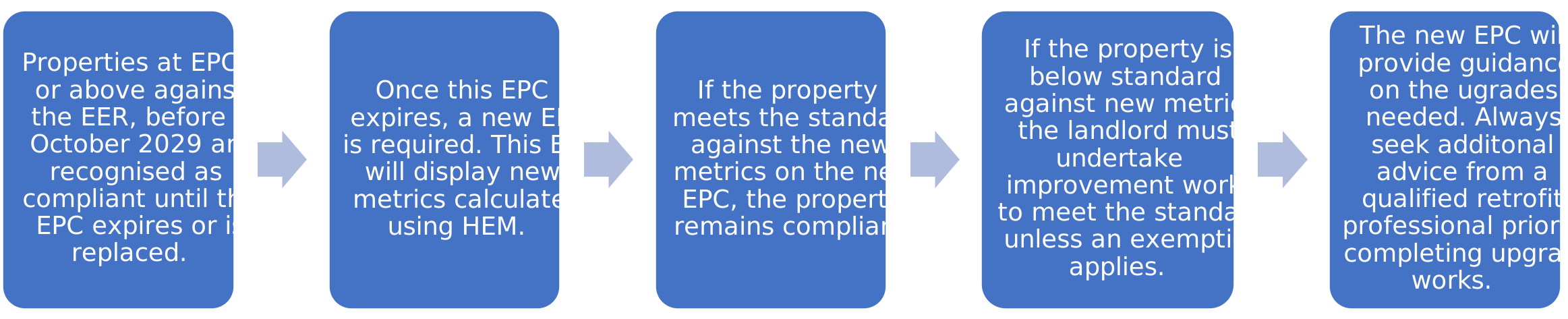
-
Properties at EPC C or above against the EER, before 1 October 2029 are recognised as compliant until the EPC expires or is replaced.
-
Once this EPC expires, a new EPC is required. This EPC will display new metrics calculated using HEM.
-
If the property meets the standard against the new metrics on the new EPC, the property remains compliant.
-
If the property is below standard against new metrics, the landlord must undertake improvement works to meet the standard, unless an exemption applies.
-
The new EPC will provide guidance on the upgrades needed. Always seek additional advice from a qualified retrofit professional prior to completing upgrade works.
Properties below EER C from 1 October 2029 onwards
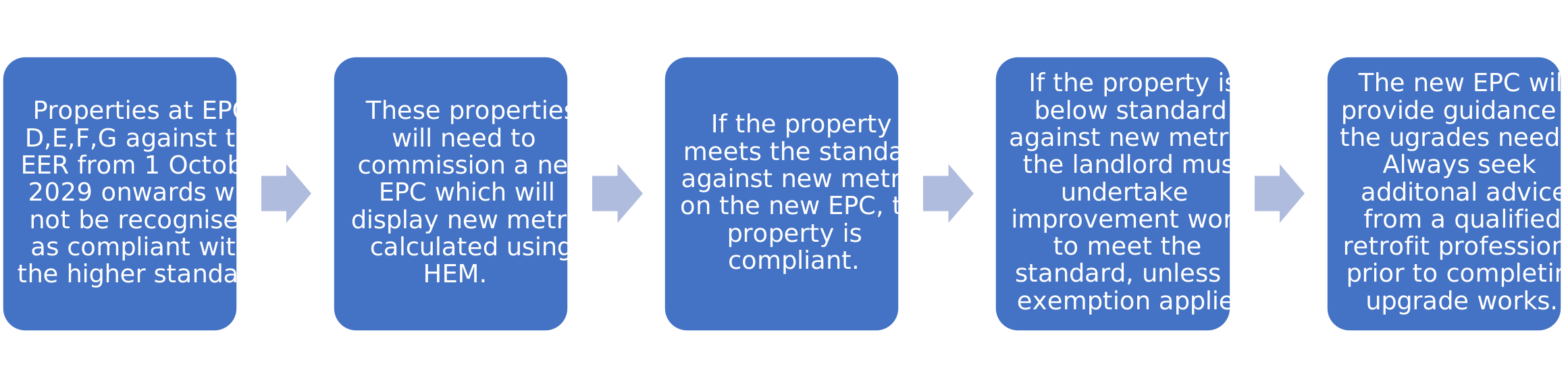
-
Properties at EPC D,E,F,G against the EER from 1 October 2029 onwards will not be recognised as compliant with the higher standard.
-
These properties will need to commission a new EPC which will display new metrics calculated using HEM.
-
If the property meets the standard against new metrics on the new EPC, the property is compliant.
-
If the property is below standard against new metrics, the landlord must undertake improvement works to meet the standard, unless an exemption applies.
-
The new EPC will provide guidance on the upgrades needed. Always seek additional advice from a qualified retrofit professional prior to completing upgrade works.
Property value adjustment (affordability exemption)
Summary of responses to Question 11
Question 11 in the consultation asked: Should government develop an affordability exemption? If yes, what eligibility criteria would be the most appropriate for an affordability exemption? Please indicate which, if any, of the proposed approaches you support or otherwise provide alternative suggestions.
- Overall Responses: 1794 (93%)
- Yes: 1054 (59%)
- No: 515 (29%)
- Don’t Know: 227 (12%)
- Not answered: 124 (7%)
1,117 respondents left written comments for this question.
Question 11 sought views on whether government should develop an affordability exemption to lower the maximum required investment to £10,000 per property subject to qualifying conditions.
The vast majority of respondents who gave a response to this question were in favour of government developing an affordability exemption. Within the group of respondents who responded ‘Yes’ to this question, 70% identified as landlords and 4% as private tenants. Within the group of respondents who answer ‘No’ to this question 24% identified as landlords and 40% of respondents identified as private tenants.
However, from the written responses to this question, the most common theme expressed was that occupants of privately rented homes should have a property that achieves the minimum standard. Many respondents voiced concerns suggesting that implementing an affordability exemption would lead to the worst performing homes being left behind. Of these many expressed views that an affordability exemption would create a two-tier PRS market where properties that require minor or cheaper upgrades would be improved. Of the responses that expressed the view that a two-tier PRS market was a concern, many respondents also highlighted that an affordability exemption may mean that vulnerable tenants or lower income tenants would be left in fuel poverty.
Some responses expressed support for developing an affordability exemption that was determined by a financial indicator. Within the responses expressing this preference, several different approaches were suggested. Many of respondents that indicated they preferred this approach expressed that any qualifying criteria for an affordability exemption should reflect the value of the property being let. Many respondents indicated that affordability exemption criteria should be based on the amount of rent a property generates. A small number of respondents that expressed this view added the affordability exemption criteria should be determined by the amount of rent a property generates after a landlord’s expenses have been taken into consideration.
Some responses expressed the view that landlords may not be able to fund the required improvements to their properties. The views expressed within this theme show that some respondents are concerned they may have to invest up to the maximum required investment (£15,000) on a property that was perceived to have low market value. Many of these responses claimed that typically this type of property is let out at below the average rent per month and therefore would not see viable financial returns for the property owner through rent received. A small number of landlords also expressed concerns on regional variance of property value. Many of these responses stated properties in different areas vary in value and that a £15,000 maximum required investment was too great of a proportion of the property value.
A small number of respondents expressed concern around increasing external financial pressures on landlords. Two themes were highlighted within responses expressing concerns surrounding financial pressures of increasing mortgage payments and repair expenditure. In addition, a small number of respondents claimed that the costs of measures and installing them would be disproportionate to the energy savings experienced by the tenant. Similarly, a small number of responses claimed that requiring landlords to invest up to £15,000 in their properties, and not implement an affordability exemption, would force many landlords to leave the market.
Responses for which approach government should take when defining eligibility for an affordability exemption:
- Overall responses: 968 (50%)
- Rent level-based approach: 601 (62%)
- Broad Rental Market Area (BRMA) based approach: 113 (12%)
- Council tax band-based approach: 164 (17%)
- Local authority area-based approach: 89 (9%)
Alongside asking if government should develop an affordability exemption, Question 11 also offered a range of possible approaches for respondents to select from. These approaches were designed to present a broad picture as to how the eligibility for an affordability exemption could be defined. Respondents were also encouraged to offer views on the suggested approaches or offer their own approaches with a written response.
The most popular approach to defining eligibility criteria for an affordability exemption was the rent-level based approach. A significant minority of respondents who selected this approach reasoned that this approach was the least administratively complex for landlords to understand and determine if their property would be eligible for an affordability exemption. Conversely a minority of respondents stated this approach could be too complex for local authorities to administer. A very small number of respondents also expressed the view that this approach may keep rent lower if the property was eligible for an affordability exemption. This was considered a way to protect low-income tenants from rent rises for a small number of respondents. In addition, a very small number of respondents expressed a concern that this approach could be vulnerable to manipulation from rouge actors in the sector providing false rental income data and expenses as eligibility evidence.
The Council tax band approach was chosen as the preferred option for 17% of the respondents to this question. This approach suggested using the council tax band of a property to determine if a property would qualify for an affordability exemption. Respondents who were in favour of the council tax band approach often cited the ease of this approach to administer for local authorities as well as for landlords to understand if their property was eligible for an exemption. However, concerns were also raised that a large number of properties in low council tax bands would likely be eligible meaning many properties would not be suitably upgraded. A small portion of respondents also highlighted that council tax bands have not been revised since 1991 and therefore would not offer an accurate representation of property or rental value of a property.
The BRMA based approach was the third most popular option. The most common reason given for opting for this approach was that it considers a combination of relevant factors including the region, house size and average rent in an area. However, a small number of responses expressed that this approach would be too complex. The main concerns were this approach would make compliance and enforcement activities difficult for local authorities as well as being difficult for landlords to determine their properties eligibility. However, a small number of responses stated this approach would be the most proportional approach in relation to the required investment from a landlord relative to the property.
The local authority area-based approach was the least popular approach of those suggested within the consultation. This approach recommended using the average rent of a local authority area utilising Office for National Statistics data. A small number of the respondents identified it would be difficult to communicate the qualifying criteria for landlords who have properties across several local authority areas and therefore different qualifying criteria for an affordability exemption. Respondents who selected this option expressed concern around different regions having different rent levels. A commonly used example was respondents claiming properties in London have a higher return in profit that properties in other areas and therefore a bigger budget for upgrades.
Government responses (Question 11)
Government is developing an affordability exemption for eligible properties. It is clear from the consultation feedback that introducing an affordability exemption is the proportionate approach for low value properties, which may receive low rental returns.
Many respondents expressed concern about having to invest up to £15,000 in properties with low market value, especially where rental income is below average. To mitigate this concern government has lowered the maximum required investment (‘cost cap’) from £15,000 to £10,000 per property. See the Cost Cap section of this government response for further details on this decision.
Many of the recommended eligibility criteria offered by respondents were not based on properties that were the costliest to upgrade. The most popular approach from the consultation responses was to base the affordability exemption criteria on rental income or on the value of the rented property. In the consultation responses, it was often considered that using the rental income as an indicator for eligibility was a proportional approach to determining the criteria for an affordability exemption. However, several stakeholders, including those representing tenants, fuel poverty alleviation and local authorities claimed that this approach would be difficult to administer, as well as inviting rogue actors in the sector to manipulate evidence to register exemptions.
From feedback in the consultation, the Broad Rental Market Approach (BRMA) was considered one of the more proportional approaches to determining an affordability exemption value. However, through the consultation feedback it became clear that there were significant concerns around the ability of local authorities to ensure compliance. Having such a wide range of cost caps would be difficult for local authorities to process as well as leaving landlords with mixed messaging surrounding their property’s maximum required investment. However, it was clear from the responses there is a concern surrounding the differences in value that can occur across the PRS in England and Wales and that an affordability exemption should consider this disparity. Therefore, government will look to ensure that areas where properties are of a lower value will be eligible for the affordability exemption.
In the consultation, one of the approaches for an affordability exemption that was suggested was to use the council tax band of a rented property to determine eligibility. In the responses of those who were in favour of using council tax bands the common theme was that this approach was not complex and therefore simple for the landlord to know if their property qualified for an exemption. This was also a position supported by some local authorities who also hold the relevant data for this approach to work. However, other respondents claimed that exempting properties based on their council tax band would lead to too large of a proportion of PRS homes being eligible for an exemption. In England almost 24% of all properties are in Band A and in Wales almost 15% of properties are in Band A. Should government develop an affordability exemption around the suggested approach this would lead to large sections of the PRS qualifying for an affordability exemption even in higher rent areas. Considering government has reduced the proposed cost cap from £15,000 to £10,000, it is important to ensure as many properties as possible can be upgraded to meet the minimum required standard. Many of the suggested approaches further add to administrative and financial burdens on landlords who are trying to comply with the minimum standard. It is clear from consultation feedback that any affordability exemption that is developed must be easy for landlord and tenants to understand and reduce administrative burden on local authorities.
Government will develop an affordability exemption approach that is based on the value of the rented property. The benchmark figure for the value of the property will begin in 2030 and proceed to be revised as necessary once any exemption has expired or the property has been revalued. A landlord with a rented property that is valued at less than £100,000 will be required to spend up to 10% of the value of the property on energy efficiency Improvements before being able to register an exemption. The exemption, from this point referred to as a ‘Property Value Adjustment Exemption’ will last for ten-years to match the cost cap exemption period. This approach was developed using feedback from the consultation, incorporating the consideration of geographical differences in property values. It also considers the evidence provided by a range of local authorities across England and Wales who offered their experiences of compliance and enforcement of the PRS Regulations.
Some respondents to the consultation voiced concerns that introducing an affordability exemption would lead to a ‘two-tiered’ PRS. This concern was that lower standard properties would not receive the required investment necessary to meet the minimum standard. However, the impact assessment that accompanies this government response shows that with a £10,000 cost cap the average property will require £5,400 of investment to achieve the minimum required energy efficiency standard. This is below the maximum required investment of £10,000. As the proposed ‘Property Value Adjustment Exemption’ would require landlords to invest up to £10,000 or 10% of the value of the property, the vast majority of properties will still have significant improvements applied. This approach ensures the policy lifts as many households out of fuel poverty as is reasonably practicable while maintaining housing availability.
Example table on Property Value Adjustment Exemption
| Value of the rented property below EPC C | £55,000 | £70,000 | £85,000 | £100,000 or higher |
|---|---|---|---|---|
| Required maximum investment before being eligible for a Property Value Adjustment Exemption | £5,500 | £7,000 | £8,500 | £10,000 |
Short-term lets
Summary of responses to Question 12
Question 12 in the consultation asked: Should government apply the PRS MEES Regulations to short-term lets? Please explain your answer.
- Overall Responses: 1840 (96%)
- Agree: 852 (46%)
- Disagree: 707 (38%)
- Don’t Know: 281 (15%)
- Not answered: 80 (4%)
1,122 respondents left written comments for this question.
The most common theme occurring across these written responses, was that, regardless of their tenancy type, buildings let on a short-term basis should still be energy efficient to reduce their energy demand and emissions, to deliver towards Net Zero. Some of these responses rationalised that buildings currently let short-term should meet the standard because they could be let long-term in the future. Others argued that occupiers of short-term lets were more wasteful when it came to energy use, and therefore it was more important to reduce the energy demand of buildings let short-term. It was also consistently mentioned that short-term lets had the advantage of long vacant periods within which upgrades could be made.
A significant minority of responses were of the view that standards for private rented properties should be consistent regardless of tenancy length, arguing that this created a ‘level-playing field’ for landlords, simplified enforcement for local authorities, and ensured short-term and long-term tenants received the same benefits. Some of these responses also argued that short-term lets already faced a more favourable regulatory regime and that inconsistently applying MEES would exacerbate the regulatory divergence between short-term and long-term lets.
More explicitly, a significant minority of responses agreed with the suggestion in the consultation that not applying the standard to short-term lets could increase the risk of private landlords moving to the sector to avoid complying with MEES, some argued this was already happening and perceived that there were inconsistent regulation and tax rules between the sectors.
In contrast, a significant minority of respondents argued that MEES was less relevant to short-term lets because they were not used for day-to-day living and occupiers were not responsible for paying the energy bills. Some of these responses argued there were not fuel poverty concerns for occupants of short-term lets and that landlords in this sector were already incentives to improve the energy efficiency of their properties because they paid the energy bills. In particular, summer lets were highlighted as properties with minimal heating demand, but it was also often argued that short-term lets of all type were generally seasonal and therefore had reduced heating requirements compared to long-term lets. It was asserted by some responses that the underlying methodology and recommendations of EPCs were not appropriate for short-term lets because calculations were based on assumptions of full-time occupancy.
A significant minority of responses stated that requiring short-term lets to meet MEES would compound with an overall increased regulatory burden for the sector in the past few years, leading to reduced supply and higher prices, diminishing a tourism industry that was vital for some local authorities. In particular, it was argued there would be a loss of heritage properties in the sector, which were a draw for guests. It was also frequently argued that if the supply of short-term lets fell, holidaymakers would be driven abroad, consequently increasing the overall emission of their holiday and therefore achieving the opposite of the policy’s decarbonisation objectives.
A very small number of respondents highlighted that it would be difficult or impossible for unique property types such as converted barns, boats, and castles, to comply with MEES, because measures recommended by EPCs could not be applied to these properties, but also because these properties were not suitable or allowed to be let long-term. The Professional Association of Self-Caterers UK said, ‘it is [not] the case that holiday lets are all a wasted opportunity for long-term rental, as for 36% of holiday lets, planning restrictions prevent full-time occupancy and often mean that it is not even possible to use the property over an extended period in winter when heating requirements would be greatest. Over half (53%) of all short-term holiday rental properties have never been a primary residence. The traditional holiday let is not representative of general domestic property that is used as a primary residence or a long-term rental, and these differences are frequently a fundamental aspect of the business model that attracts guests.’
There were a few additional themes that occurred across a very small number of responses: Requiring short-term lets to comply with MEES would place further pressure on enforcement and the supply chain, whilst the priority should be to upgrade existing long-term lets; If short-term lets are required to comply, they should be given more time to comply; and lastly, there needs to be a clear definition of short-term lets.
Government response (Question 12)
Government acknowledges the concerns respondents from the short-term lets sector raised throughout their responses to each consultation question about how the proposed policy could impact the sector. Question 12 asked in principle whether short-term lets should be subject to the same regulatory standard as private rented homes. Though many responses argued in favour on the basis of a ‘level playing field’, it is also clear from the feedback that there are many nuances relevant to the operation of short-term letting that differentiate the sector from long-term letting, and these require thorough consideration before any form of an energy efficiency standard is applied to the sector. On this basis, government will not require short-term lets to comply with PRS MEES at this time, but this position will remain under review. Short-term lets will not be required to meet the increased PRS MEES by 2030.
Whilst government recognises the concerns raised by responses that some landlords may seek to change their properties to short-term lets to avoid complying with the PRS Regulations, it is not the priority of this policy to improve the energy performance of existing short-term lets and potential impacts on the sector require further consideration before a decision is taken. The occupiers of short-term lets are not at risk of fuel poverty, unlike the tenants of private rented homes, and the priority of this policy is to deliver significant fuel poverty alleviation ahead of the 2030 fuel poverty target.
For the purpose of clarity, the term ‘short-term let’ refers to a property let typically on a license to occupy where the tenant or guest is not granted exclusive possession of the property in the same way as an assured tenancy. This is because the property is not the primary residence of the occupier. ‘Short-term let’ is not defined by the length of the occupancy. Following the abolition of fixed terms, in some instances, tenants may only stay in a property for a few months. This does not automatically mean the property is a short-term let. If the property is let on an assured tenancy, a regulated tenancy, or a domestic agricultural tenancy, and is legally required to have an EPC to be let, it is subject to the PRS Regulations regardless of the tenancy length and must comply with the higher standard by 1 October 2030.
With regard to the argument that EPCs do not appropriately assess short-term lets due to their intermittent occupancy, it is important to note that EPCs are an assessment of the energy performance of the building regardless of the occupant’s behaviour. An assumption of standard occupancy is applied to produce estimates for energy use, bills, and carbon emissions, but the purpose of the EPC is to provide an overview of the building that is relevant to all types of occupancy. Government’s consultation on ‘Reforms to the Energy Performance of Buildings Regime’ has sought views on requiring an EPC at the point of letting a short-term let and final decisions on this proposal have not yet been made.
Lastly, though short-term lets will not be brought into scope of MEES at this time, government will still seek new powers (through primary legislation) for the Secretary of State to be able to apply the standard to licenses to occupy at some point in the future. Government commits to seek views on how such a policy can be tailored to the needs of the sector, prior to making a decision about requiring short-term lets to meet MEES in the future.
Smart metering
Summary of responses to Question 13
Question 13 in the consultation asked: What actions could government take, including changes to the law to encourage or require smart meters in properties undergoing efficiency upgrades, to increase the number of smart meters installed in the PRS? Please provide your rationale and evidence for any suggestions for actions you have.
- Overall Responses: 1,338 (70%)
Respondents were generally positive about the installation of smart meters in the PRS and there was a spectrum of proposed ways government could act to drive uptake. A small number of respondents supported mandating smart meters while others discussed new ways to raise awareness and incentivise landlords and tenants, including through PRS MEES.
A very small number of respondents, all representing private landlords, reported concerns with the reliability of smart meters and discussed challenges they have faced engaging energy suppliers to resolve issues. The need to address smart meter performance issues to build consumer trust, before considering stronger interventions, was discussed by several organisations. A very small number of respondents landlords did question the extent to which smart metering relates to energy efficiency, but other respondents also acknowledged the benefits of smart metering in terms of better energy management and bill reduction, as well as integration with other energy efficiency technologies.
Those who support smart metering called for more campaigns to raise awareness of the benefits, recognising the importance of driving behaviour change. A very small number of respondents recognised how myths and misconceptions of smart meters were impacting consumers’ appetite to get smart meters and suggested consumers needed greater reassurance.
Responses over whose responsibility it should be to drive smart meter uptake in the Private Rented Sector varied, demonstrating a level of confusion across various actors in the sector. A very small number of respondents, representing lettings agents and landlords, suggested the burden should be placed squarely on energy suppliers and questioned why energy suppliers have missed rollout targets.
Although a small number of respondents felt legislative changes were unnecessary because tenants should already have a right to have a smart meter, other respondents – including industry bodies, private landlords and organisations representing the interests of tenants – called for greater clarity over rights, and greater awareness raising over existing rights. Indeed, most respondents who expressed a view felt the decision to get a smart meter should rest with the tenant, and therefore more work should be done to ensure tenants feel empowered.
Energy suppliers and some Local Authorities were a key proponent of including smart meters within PRS Regulations. One energy supplier suggested that the ability to let a property should be contingent on a smart meter being installed. Other energy suppliers suggested that a smart meter should contribute to a higher EPC rating, thereby acting as an incentive for landlords to arrange smart meter installations.
Government response (Question 13)
Smart meters are replacing analogue gas and electricity meters as part of a national infrastructure upgrade to modernise our energy system. At the end of June 2025, 40 million smart and advanced meters were in homes and small businesses across Great Britain. 69% of all meters are now smart or advanced meters.[footnote 3] Analysis of evidence from energy suppliers by the Behavioural Insights Team found that consumers save an average of 3.4% of electricity consumption and 3.0% for gas from engaging with their smart meters (Behavioural Insights Team, 2023).[footnote 4]
Government wants all consumers to benefit from smart metering, no matter their living circumstances, and the domestic Private Rented Sector continues to be a more challenging area for the domestic smart metering rollout. The proportion of privately rented properties with smart meters has consistently lagged behind that of owner-occupied and socially rented properties. Data from Ofgem’s Energy Consumer Satisfaction Survey (January 2025) found that 62% of private renters owned a smart meter, compared with 70% for social renters and 69% for homeowners.[footnote 5]
The consultation has highlighted multiple factors that contribute to the lower uptake of smart meters in the PRS, including poor understanding of smart meter benefits and lack of clarity over rights of tenants and landlords. Suggestions for ways government could help drive uptake of smart metering include more targeted campaigning, clarifying rights, incentivising landlords, and placing obligations on landlords.
On the issue of rights, tenants who pay the energy bills can request a smart meter from their energy supplier. However, some tenancy agreements contain provisions which restrict the ability of tenants to unilaterally arrange the installation of smart meters. This can lead to renters who are interested in getting smart meters not taking action to book an installation.
Government wants to explore ways to strengthen the rights of domestic tenants in getting a smart meter, while also being cognisant of the reasons why a minority of landlords may seek to refuse smart meter installations in properties they own. Separately to PRS MEES, government is undertaking sector-specific stakeholder engagement with consumer organisations, energy suppliers and organisations representing landlords and renters across both the private and social rental sectors to develop policy proposals and identify the most appropriate implementation route.
In relation to PRS MEES, smart meters will likely have a key role to play in the proposed new EPC metrics, particularly the smart-readiness metric, Home Energy Model: Energy Performance Certificates. Smart meters are integral to the effective operation of other ‘smart’ technologies, including electric vehicles, and maximising the benefits of other measures such as heat pumps. If a landlord chooses to invest in improving the smart readiness of their property, this will entail installing measures including smart meters to enable tenants to access smart tariffs and services. These measures will improve the flexibility of the building’s energy use, enabling the tenant to lower their energy bills further. Government will continue to explore how best to incorporate smart metering technology into the EPC and PRS MEES frameworks.
Lastly, some respondents raised concerns that meeting the standard may be contingent on having smart meters installed, given the responsibility to arrange installations lies with the billpayer, which is typically the tenant. Where the tenant is the billpayer, landlords should communicate with their tenant that they are supportive of them requesting smart meters, should the tenant wish to do so. Landlords may also wish to discuss the benefits of smart meters with their tenant, for example, in enabling them to take full advantage of the flexibility of smart measures, such as solar panels and batteries. If the tenant does not proceed to arrange a smart meter installation, and the property remains below the smart readiness standard without one, the landlord may register a third-party consent exemption and continue to let the property. See section ‘Exemptions from meeting the standard’ below for more information.
Exemptions from meeting the standard
Summary of responses to Questions 14 and 14.1
Question 14 in the consultation asked: Do you think the current MEES exemptions available to landlords are suitable?
- Overall Responses: 1754 (91%)
- Agree: 520 (30%)
- Disagree: 808 (46%)
- Don’t Know: 426 (24%)
- Not answered: 166 (9%)
999 respondents left written comments for this question.
Question 14.1 in the consultation asked: Are there other circumstances, not covered by the current MEES exemptions regime, where you think government should consider making exemptions for?
- Overall Responses: 1678 (87%)
- Agree: 762 (45%)
- Disagree: 237 (14%)
- Don’t Know: 679 (41%)
- Not answered: 242 (13%)
923 respondents left written comments for this question.
A significant minority of respondents raised concerns about tenant disruption these were raised by a range of respondents including tenants and tenant advocacy groups as well as landlords. These concerns included concern that tenants may face high levels of disruption whilst work was carried out or that tenants would be encouraged to refuse consent by a landlord wishing to avoid doing work. The risk that this would undermine the policy and create a two-tier system was highlighted.
Concerns were raised by a significant minority regarding possible impacts on heritage and protected buildings as well as those in conservation areas. These included concerns that these buildings could not reach higher EPC ratings and attempting to do so could damage them. It was highlighted that these building need a different approach to retrofit than newer building and this should be considered.
There were mixed responses regarding the suitability of existing exemptions and the need for more, with a significant minority of respondents arguing that a reduction in the number of exemptions would be preferable. Key reasons used to justify wanting a reduction in exemptions were to ensure that the maximum number of properties were upgraded, to ensure all tenants benefited and to avoid misuse of exemptions. A small number of respondents argued for increasing the number of exemptions, with a significant minority or respondents concerned about protecting historic buildings. A very small number of respondents identified issues with leasehold landlords restricting the work they could complete on a property, and a very small number wanted protection for financially vulnerable landlords. There was also a small number of respondents supporting extending the length of exemptions to reduce the burden on landlords or when the reason for an exemption was unlikely to change in 5 years.
A very small number of respondents identified the need for improved guidance for landlord and tenants, with many of the respondents raising other concerns that could be addressed though this improved guidance. There was confusion around the types of exemptions and their criteria, as well as the evidence required to prove eligibility. A significant minority of reasons that respondents requested additional exemptions would have been covered by existing exemptions.
Government response (Questions 14 and 14.1)
Government will continue to review the existing exemptions to ensure they are meeting the needs of both landlords and tenants throughout the policy development. This includes reviewing the guidance available to all parties with the aim to improve clarity and understanding and developing any additional guidance required due to changes in policy.
Government has identified the need to expand the temporary exemption for new landlords that is currently provided for under the existing regulations. This is to ensure that all new landlords or landlords that take whole or partial ownership of a property with an existing tenant are eligible for a 6-month exemption. This allows time for landlords to carry out required improvements and provides reassurance to tenants and mortgage lenders that the property can continue to be let during and after sale.
The need to introduce new exemptions will be kept under review as the policy is developed and whilst new EPC metrics are confirmed. This will enable government to respond to any policy development that may require additional consideration in limited circumstances to protect the private rental sector and its tenants.
Government has identified the need to introduce a specific ‘Cost cap’ exemption sperate from the existing all-relevant improvements made exemption. This will simplify the existing exemption to reflect its original positions, when there are no further recommendations on an EPC or report produced by a suitable assessor. The new ‘Cost cap’ exemption will be available to landlords who have spent up to or over the cost cap set in the response to question 5. The new ‘Cost cap’ exemption will last for 10 years as set in the response to Question 6.
On reviewing the existing ‘High-cost’ exemption, government has decided to maintain this exemption. Landlords can therefore continue to register an exemption where the cost of making even the cheapest recommended improvement on the EPC would exceed the cost cap (inc. VAT).
On reviewing the existing third-party consent exemption, government believes this meets the needs of many of the identified issues regarding consent required by landlords, such as that from superior landlords, planning authority and tenants, as reflected in the responses from many respondents. Maintaining this exemption will in particular help to protect tenants by ensuring that potentially disruptive energy efficiency improvements are not required to be installed whilst the tenant is in situ if they have not consented to the works. It is clear from the consultation responses that there is some misunderstanding as to how this exemption applies. Government is committed to improving the guidance for this exemption, including providing a non-exhaustive list of possible scenarios, to help landlords understand whether the exemption applies to their specific circumstances.
Government will introduce a ‘Property value adjustment’ exemption for landlords of properties with a value of less than £100,000. Detail on this exemption is set out earlier in this document under the section ‘Affordability exemption’.
Government has identified the need to introduce a ‘Negative impacts’ exemption to ensure necessary flexibility for the range property types within the PRS including older traditionally constructed properties and those of heritage significance. This exemption combines 2 existing exemptions, the ‘Devaluation’ exemption and the ‘Wall insulation’ exemption. The negative impacts exemption will enable landlords to register an exemption where they can provide evidence that a measure would negatively impact their property or where it would devalue the property by more than 5%. Guidance on what specific evidence will be required to register this exemption will be provided.
Government has identified the need to introduce a new ‘Solid wall insulation (SWI)’ exemption. This will allow landlords to register an exemption for their property if it remains below the fabric standard without the installation of solid wall insulation and it is the landlord’s preference not to install SWI. This decision has been made on the basis that there is significant risk of damp and mould if SWI is not installed to the correct standard and potentially more cost-effective improvements could be made to the property under the secondary standard and within the cost cap to lower energy bills and reduce carbon emissions. Landlords will not be required to provide evidence for this exemption but will need to make a declaration as part of registering the exemption, to verify that the property remains below the standard because they have chosen not to install solid wall insulation. Solid wall insulation, if installed correctly, can be an effective measure to reduce energy bills and improve warmth and comfort for tenants of solid wall properties. Should the landlord choose to install the solid wall insulation, the cost of installing this measure will count towards the cost cap. Government strongly recommends that landlords wishing to install solid wall insulation use a Trustmark-accredited installer and that the installation adheres to PAS2035 standard, to mitigate against the risk of adverse consequences such as condensation, damp, and mould. Installers performing improvement works in private rented homes will be subject to the quality and consumer protection reforms being delivered through the Warm Homes Plan, available at: Warm Homes Plan.
Government is considering the possibility of introducing a potential alternative route to compliance for landlords with large property portfolios in the form of a new exemption. This potential new exemption could allow for larger landlords to utilise the total sum of the combined cost caps for their individual properties, instead of being required to meet the cost cap per individual property to meet MEES. Such an approach could enable larger landlords to allocate more investment to properties that could benefit from deeper retrofit, without significantly increasing the overall financial burden on these landlords. If government were to proceed to create this new exemption, landlords that utilise it would likely be required to prioritise improvement works on their least energy efficient properties to ensure these properties are given the best chance to be upgraded to the standard. As part of this potential new exemption, the use of primary authority partnerships between landlords and a local authority is being explored. Government is working with industry regarding the logistics of this potential approach and if the decision is made to introduce this new exemption, government will publish further details.
Table of proposed exemptions
| Exemption description | Exemption status (new/updated/existing) |
|---|---|
| ‘New landlord’ exemption: This exemption would include any person who has become a landlord where on the date of purchase, or other ownership transfer, the property is let on an existing tenancy. This allows accidental landlords and landlords that take on a new tenanted property time to complete upgrades or collect evidence and apply for a further exemption. It also allows for properties to be bought and sold with tenants in situ. Landlords must provide evidence that they have become the landlord of the property within the last 6 months, and the exemption should last for 6 months from this date. | Updated exemption. |
| ‘Cost cap’ exemption: The cost cap exemption could be registered when a landlord has spent up to or over the cost cap of £10,000, or the next cheapest improvement will take the total spent on improvements, that have not previously been used for an exemption, over the cost cap of £10,000. The validity period for this exemption would be 10 years. | Updated exemption. The ‘cost cap’ and ‘all improvements made’ exemptions may become separate exemptions. |
| ‘All relevant improvements made’ exemption: No further recommendations on EPC or from an approved report showing no further improvements possible. The validity period for this exemption would be 5 years. | Updated exemption. The ‘all improvements made’ and ‘cost cap’ exemptions may become separate exemptions. |
| ‘High-cost’ exemption: The high-cost exemption applies where the cost of making even the cheapest recommended improvement on the EPC would exceed the cost cap (inc. VAT), will be retained. The validity period for this exemption would be 5 years. | Existing exemption (no updates). |
| ‘Third-party consent’ exemption: This exemption is considered to meet the needs of many of the identified issues regarding consent required by landlords, such as that from superior landlords, planning authorities and tenants, as reflected in the responses from many respondents. The validity period for this exemption would be 5 years or the length of the tenancy. | Existing exemption (no updates). |
| ‘Property value adjustment’ exemption: This affordability exemption would be set using property value. The cost cap would be set at £10,000 or 10% of the property’s value, whichever is lower. This is therefore only relevant for properties valued under £100,000. This exemption is designed to ensure that landlords with lower-value properties are not disproportionately burdened by the cost of compliance MEES. | New exemption. |
| ‘Negative impacts’ exemption: This exemption combines the existing devaluation and wall insulation exemptions and additionally allows landlords to evidence when a measure would negatively impact their property. Landlords will be able to register an exemption if they can provide proof that a measure will negatively impact or devalue their property by 5% or more. The validity period for this exemption would be 10 years. | Updated exemption. Combines the existing devaluation and wall insulation exemptions and expands use. |
| ‘Solid wall insulation’ exemption: The new SWI exemption will allow landlords to choose not to install SWI and record that decision through this exemption. This enables landlords to still install SWI where they feel it is appropriate and for it to still count towards the cost cap. The validity period for this exemption would be 5 years. | New exemption. |
| Potential alternative route to compliance for larger landlords (‘Portfolio Approach’ exemption): This could potentially be an alternative route to compliance for larger landlords. It would allow larger landlords to group properties and then utilise the total sum of the combined cost caps across the grouping, instead of spending up to £10,000 per individual property. This potential new exemption could enable larger landlords to spend more on properties that could benefit from deeper retrofit and would require a worst first approach. If government were to decide to develop this proposal into a new exemption, it is likely that the proposed validity period for this new exemption would be 10 years. | A potential new exemption. Government is considering the possibility of introducing this as an exemption and will be liaising with industry to develop this idea further with a view to making a viable proposal. |
Lettings agents and online property platforms
Summary of responses to Question 15
Question 15 in the consultation asked: Do you agree with government’s preferred position to keep a potential requirement on lettings agents and online property platforms under review whilst the PRS Database is being developed for properties in England?
- Overall Responses: 1769 (92%)
- Agree: 657 (37%)
- Disagree: 496 (28%)
- Don’t Know: 616 (35%)
- Not answered: 151 (8%)
Of the 1769 total responses to this question, 771 left additional written comments.
The most common theme in response to this question referenced the timing and implementation of the potential requirement on letting agents and online property platforms. These respondents felt that letting agents already have the information available to help promote compliance and disseminate information across the sector, and therefore the implementation of this requirement could be imposed sooner.
Another common theme in these responses was the call for better regulation of letting agents. These respondents argued that more should be required of lettings agents as they are best placed to improve regulation across the sector. Energy Systems Catapult argued that: ‘Letting agents and online property platforms should be required to receive valid and compliant EPC documentation in order to advertise properties, as having a valid EPC is already a requirement for letting a property. This does not need the PRS database, landlords would only need to provide the EPC at the time of advertisement. This would offer an additional layer of monitoring of compliance with MEES prior to local authority level, which would better support their enforcement and monitoring capabilities.’ It was consistently argued that greater requirements would help increase awareness of MEES, support landlord compliance and inform tenant decision-making, which crucially for many local authority councils, would in turn should ease the current burden of enforcement on local authorities.
A small number of respondents argued that a potential requirement on letting agents is either not necessary or an issue which could result in excessive administrative burden and costs. These responses stressed that regulation in the sector is currently already overwhelming, with a lighter touch regulatory approach is needed. This was also the case for short-term lets specifically, where some respondents argued in favour of keeping the requirement under review for now as it is less relevant to this sector and the impact would be significant. It was also argued that the impact on the PRS overall would be limited and therefore is not worth the significant effort and cost involved for limited benefit, as landlords that do not want to comply will simply not use, or already do not use, lettings agents. A very small number of respondents cited a lack of impact on increasing compliance rates as a standalone issue in their response.
A very small number of respondents argued that the approach to keep this requirement under review until the PRS database is developed is a sensible one. Arguments in favour of this included that it would assist with compliance once ready, that the PRS database should be an improvement on the current exemptions register which some respondents experienced issues with, and that this approach allows for greater flexibility to assess the effectiveness of the PRS database once developed, allowing time for agents and platforms to adapt to its use and feedback, ensure greater integration and efficiency, and improve data accuracy.
A very small number of respondents argued that more information and certainty is required before determining the best course of action. These respondents often stated that the PRS database should be established and tested first to provide greater certainty on its effectiveness and enable a greater understanding of the database prior to new regulations coming into force. These respondents generally stated that more details on the implications of the PRS database and what a potential requirement on letting agents’ entails is needed prior to any definitive decisions.
A very small number of respondents claimed that regulation changes required consistent application. This includes amongst some responses from landlords, the suggestion of a tenant database. For these respondents, it would be fair to have a PRS database of tenants to also better inform landlords on their occupants and identify potentially problematic tenants.
Lastly, a very small number of respondents mentioned that compliance checks need to be simplified as much possible to ensure minimal additional burdens.
Government response (Question 15)
Government will keep a potential requirement on lettings agents and online property platforms under review whilst the proposed PRS database in England is developed. Government recognises the support in favour of this requirement coming into force and wants to ensure its development alongside the PRS database is implemented as smoothly and efficiently as possible. This will include user testing and engagement with stakeholders to help improve understanding and the overall user experience. Through robust testing and integration, the proposed PRS database will enable letting agents and online property platforms to sufficiently fulfil all requirements and effectively support compliance checks and MEES enforcement.
Further evidence
Summary of responses to Questions 16 and 17
Question 16 in the consultation asked: Do you have any new evidence to submit regarding the topics as summarised in Chapter 2 of this consultation? Please specify which topic you are providing new evidence for.
Note: radio answers were not available for this question.
- Overall Responses: 132 (7%)
The consultation asked 2 additional questions to allow respondents the opportunity to submit further evidence relevant to government’s proposals.
Question 16 refers to Chapter 2 of the consultation, which consists of a summary of responses to the 2020 consultation ‘Improving the Energy Performance of Privately Rented Homes in England and Wales’, and outlines government’s preferred position on topics that were not subject to further questions in this consultation. The 2020 consultation asked 32 questions and considered a range of topics including compliance and enforcement, the potential impacts of COVID-19 on compliance with MEES, and the Energy Performance in Buildings (England and Wales) Regulations 2012 (2012/3118). Question 16 of the 2025 consultation asked for any new evidence or information related to these previously asked questions.
Of the total responses to this question, the majority were not directly relevant to this question and instead provided additional information and evidence to topics covered in the 2025 consultation, including expanding further on answers given to earlier questions. There were 132 relevant responses to this question.
Of these responses, a very small number focused on EPC assessments and metrics. Most of these respondents simply reinforced the need for EPC reform, suggesting that since the 2020 consultation the need for an overhaul of the EPC framework has continued if not grown, including how assessments are carried out and pressures on the supply chain. The rising cost of energy was cited as a further reason why EPC reform is needed, including a shift away from the EER C metric proposed in 2020 which assesses energy performance on the basis of cost.
Linked to this, a very small number of respondents stated that more information and greater certainty is required before any changes to the regulations are implemented. This not only included a lack of certainty around new EPC metrics, but also concerns around current recommended measures and whether certain measures are suitable for all properties, such as insulation for older, historic buildings.
A very small number of respondents called for greater financial support to account for rising costs, including and beyond energy costs. These respondents argued that any increased investment required from landlords should be accompanied by greater financial support to ease additional pressures and prevent landlords from exiting the market. Some of these responses cited the proposed cost-cap increase to £15,000 not taking into account inflation, as was previously proposed in the 2020 consultation.
A very small number of respondents raised concerns about enforcement and compliance, arguing that more proactive enforcement is required as current measures are largely inadequate. This included questions on maximum fines and whether a £30,000 maximum fine is excessive, with some suggestions that this is more punitive on smaller landlords and instead should be in proportion to rental income. Conversely, it was suggested that current fines are insufficient as an effective deterrent to compliance given the current fine for not having a valid EPC is considerably less than the maximum fine for MEES non-compliance.
A very small number of respondents discussed the implementation and timelines of the 2020 consultation proposals, with some arguing in favour of the previously proposed £10,000 cost cap as more suitable. Some of these respondents argued that the timeline impact on landlords, and smaller ones especially, is too strenuous. It was also suggested that housing used by the Ministry of Defence should have been consulted on to be included under the PRS Regulations.
Other themes across a very small number of responses include a reference to question 18 regarding the PRS database and the need to ensure this is efficient and of minimal cost. Exemptions, namely that the 7-to-21-day exemption referenced in question 20 should not be removed for landlords making all reasonable efforts to provide a valid EPC prior to a property being marketed or let, as this is not always practicable whilst works are underway. Regarding question 25, it was mentioned that a valid EPC should not have to be in place at all times as this would infringe on tenants’ rights. In relation to question 29 concerning tenant powers, it was argued that tenants should be able to request energy efficiency improvements, but not in a way that encourages or allows for excessive and frivolous requests.
Question 17 in the consultation asked: Is there any additional information or evidence you would like to provide on either the effectiveness of the existing PRS Regulations 2015 and guidance, or interactions with other policies? Note: radio answers were not available for this question.
- Overall Responses: 789 (41%)
The majority of these responses focused on either the timelines for introducing new regulations or the implementation of government’s proposed new standards. Whilst these responses were not overwhelmingly against raising the minimum energy efficiency standard, significant questions were raised around the practicalities and scope of the required changes within the timeline proposed. For example, some respondents indicated the proposed EPC C standard is too ambitious, with EPC D a more realistic target. Others raised concerns about the feasibility of upgrading homes with certain measures, including suggestions that a fabric first approach is unrealistic or impractical - either due to the age of the building or the leaseholder not having the relevant authority and permissions from the freeholder. Additionally, the proposed 2030 target for new tenancies to meet EPC C was considered unachievable by some. Lastly, some of these respondents suggested that existing regulations are sufficient and do not require further changes.
Many respondents referenced compliance and enforcement, outlining that the responsibility currently placed on local authorities is too burdensome. One of the barriers cited for this was a lack of funding, resource and awareness, with key stakeholder E3G arguing the need to ‘provide local authorities with the long-term, ring-fenced funding they need to enforce the new standards’ and ‘introduce a clear statutory duty and training on how to enforce MEES for local authority enforcement teams.’ It was noted that existing guidance is often too lengthy and technical and should be simplified to make it more accessible and easier to understand for those genuinely seeking to comply with regulations. Improving training programmes and offering flexibility and discretion to work with, rather than immediately punish, non-compliant landlords were also cited as potential solutions.
A significant minority of respondents stated the need for more information and certainty. These respondents asked for improved guidance, including how renovations should be carried out in practice, and protections to safeguard tenants during this period. This was also cited as a barrier to enforcement - as beyond a lack of resource - an inability to immediately identify accurate information was cited as a barrier that often results in time wasted investigating properties that may or may not be compliant. A suggested solution was that EPCs should be linked by the assessing officer to the contact details of the property owner or instructing company, as this would aid enforcement by improving access to information and the overall efficiency of compliance checks. Tenant groups also called for greater protections including rent freezes and limiting no-fault evictions for 2 years following retrofit works.
A significant minority of respondents argued that changes to the PRS Regulations would lead to overburdening administration and costs. This included pressures to comply with other regulations beyond energy efficiency measures such as gas, fire and electrical safety standards, as well as current burdens on the short-term lets sector specifically owing to changes to tax legislation.
A very small number of respondents raised financial incentives as key to unlocking the effectiveness of PRS Regulations. Financial support through tax reliefs and access to low-interest loans for landlords to make energy improvements was viewed as necessary, with suggestions that without this, the impact on the PRS would be too significant and would lead to decreased rental supply.
A very small number of respondents discussed EPCs and metrics, again calling for reform and stating the current EPC framework is not fit for purpose. The feasibility of reaching EPC C and the impact on the supply chain including upskilling requirements were also mentioned.
Regarding links with other policies, responses included better join-up between other related policies such as financing and tax, Heat and Buildings Strategy, national planning policy and regulations, Local Area Energy Plans, rebalancing to make low carbon measures more affordable, and greater coordination with EPC reform and HEM. A very small number of respondents raised concerns regarding exemptions, stating the current exemptions register requires vast improvement to make it more efficient and accurate. Some of these respondents also stated that exemptions can be improved for older and historic buildings, including suggestions that permanent exemptions for historic, listed buildings and conservation sites should be considered.
Lastly, a very small number of respondents called for the consistent application of regulations. These responses suggested that improved energy efficiency standards should be consistently applied across the social housing sector also and not limited to the private rented sector.
Government response (Questions 16 and 17)
Government recognises the consistent calls for EPC reform, greater support for landlords, strengthening tenants’ rights, applying a consistent standard across sectors, and improved join-up with other linked policies. The introduction at the outset of this government response outlines in further detail the ongoing work this government is committed to addressing these concerns.
Regarding concerns over implementation and the timeline for new proposals to come into effect, a response is provided above to question 8 of this consultation in relation to government’s decision to enforce a single compliance date of 1 October 2030 to help ease timeline pressures; and also notes the revised cost-cap of £10,000 as outlined above.
Government recognises that effective deterrence is necessary to support PRS MEES compliance. The proposed £30,000 fine is the maximum amount per property per breach, with each breach enabling more proportionate fines relative to the extent of non-compliance. This amount reduces the risk of incentivising non-compliance by having a maximum fine similar or closer to the cost cap amount. As such, government’s decision is that the maximum fine level for future increased PRS MEES is set at £30,000 per property, per breach of the regulations.
Government’s consultation on ‘Reforms to the Energy Performance of Buildings Regime’ has sought views on simplifying the Energy Performance of Buildings Regulations so that a property must have a valid EPC before it is marketed for sale or rent, by removing the existing allowance for properties to be marketed for up to 28 days whilst an EPC is being produced. It also sought views on requiring a valid EPC to be in place throughout the tenancy period for private rented properties. An interim response to the consultation was published alongside this document at: Reforms to the Energy Performance of Buildings regime, and a final response will be published in due course.
Government recognises the importance of improving guidance to support the awareness and compliance of PRS Regulations. Government’s preferred position is to update guidance for landlords in line with the introduction of new EPCs and in doing so, aims to improve the clarity, accessibility and understanding of PRS Regulations. Further, government’s preferred position to introduce local authority disclosure when a property is in breach of PRS Regulations remains and this will also aid monitoring and enforcement. The proposed PRS Database for England aims to support awareness and understanding of PRS Regulations by improving the availability and ease of access to information to help support local authority enforcement, as evidenced by the example of Rent Smart Wales.
Government remains committed to improving the PRS MEES Exemptions Register to help ease overburdening concerns and better support local authorities. A digital project is currently underway to address stakeholder feedback and work continues with local authorities and landlords to make the necessary improvements. Government is also committed to ensuring appropriate exemptions are in place to protect older, historic and heritage buildings and further detail on planned exemptions can be found in the government response to questions 14 and 14.1. Through identifying more appropriate exemptions, government also aims to address concerns that a minimum standard of EPC C is too ambitious and unfeasible. Altogether, these measures will support the effective delivery of a higher minimum energy efficiency standard and the Warm Homes Plan, aiming to reduce household bills and tackle fuel poverty.
Annex A: Deductible expenses
What is an eligible deductible expense when changing the energy efficiency of a private rented property?
This guidance applies equally to incorporated and unincorporated landlords. One of the key considerations when deciding whether a repair is a deductible expense is whether it is revenue or capital.
The asset is usually the overall property. The cost of land and any buildings on it is capital expenditure; so is the cost of any new buildings erected after letting has started and any improvements.
One of the key considerations is whether the expense repairs or maintains the asset, or whether it enhances it. It is largely a question of fact and degree in each case whether expenditure on a property leads to an improvement. Sometimes the improvement may be so small as to count as incidental to a repair: in the absence of other capital indications, the entire cost is revenue expenditure.
The cost normally remains revenue expenditure where any improvement arises only because the customer uses new materials that are broadly equivalent to the old materials.
Where installation of a heat pump is an allowable expense because it replaces an existing heating system, the deductible expense includes installation of the heat pump, pipes, and the cost of work to install and make good. The relative power of gas boilers and heat pumps are immaterial to the tax position; it is always a question of function. You do not need to demonstrate that a heat pump is equivalent in power to an old boiler, just that it does the same thing.
Capital expenditure may be eligible for capital gains tax relief when a property is sold.
Where expenses are incurred which would usually be revenue in nature, they can still be capital if:
- they are part of a larger capital undertaking. For example, extending or altering a property (one house to 2 flats etc.) will be capital in nature
- the repairs are to a recently purchased, dilapidated property, where the purchase price was reduced due to the repairs required and the property could not be used in the business until the repairs were competed
Example 1
Person A, a landlord, lets a residential property which has a gas central heating system for heating and hot water. They convert an integral garage into living space, including installing an additional radiator and insulation materials. The expense of converting the garage is an enhancement of the property and is capital expenditure for tax purposes, so cannot be deducted from profits.
Two years later, Person A replaces the heating system for the whole house, installing a heat pump with capacity to heat the entire property (including the garage). Installation of the heat pump and related works are an allowable expense for tax purposes, as it replaces the previous heating system.
If Person A had not installed an additional radiator in the garage when it was converted, the cost of installing the heat pump and adding an additional radiator to the garage would be capital, as it was doing more than the original system, so is an improvement.
Similarly, if Person A installed the heat pump at the same time as converting the garage and added the additional radiator, the cost of installing the heat pump would be capital as it is improvement.
Note that, until March 2027, the materials and installation of heat pumps could be eligible for zero-rated VAT (VAT Notice 708/6).
Example 2
Person B owns a 2-bedroom stone cottage in a remote rural area with no access to mains gas. The only heating in the property is a wood-burning stove in the kitchen. It has an immersion heater for hot water. The cottage has limited insulation and is normally occupied by tenants year-round. Between tenants, Person B decides to upgrade the cottage’s energy performance. Person B installs loft insulation. As this is the first-time installation, it is an enhancement of the property so it is capital expenditure for tax purposes and cannot be deducted from profits.
Person B replaces the single-glazed windows with equivalent double-glazed windows. While there is a significant improvement in the performance of the windows, this is because modern materials are being used which are inherently better than the old materials. Installation of the windows and related works are an allowable expense for tax purposes.
Person B installs a low-temperature 7 kW air source heat pump (ASHP) to replace the wood-burning stove and immersion heater. Installation of the heat pump and related works is capital expenditure for tax purposes, as this is installation of the first system of heating air and water.
Due to the intermittent nature of electricity supply in the area and the need for flexible energy use, Person B installs a heat battery to store thermal energy for later use. This is an enhancement of the property so it is capital expenditure for tax purposes, so cannot be deducted from profits.
Note that, until March 2027, the materials and installation for insulation and an air source heat pump could be eligible for zero rated VAT (VAT Notice 708/6).
Example 3
Person C is a landlord who owns and lets 3 adjacent terraced houses, each with its own gas boiler system providing space heating and hot water. They decide to replace all 3 boilers with a single shared ground source heat pump system. Installation of the heat pump and related works are an allowable expense for tax purposes, as it replaces the previous heating systems.
If Person C let 2 of the properties and lived in the third, then they would need to apportion the expense on a just and reasonable basis between the property business and private expenditure.
Note that, until March 2027, the materials and installation for a ground source heat pump could be eligible for zero rated VAT (VAT Notice 708/6).
Example 4
Person D and Person E are landlords who own and let the 2 flats in a single property, each of which has its own gas central heating system for heating and hot water. Person E is recommended an air sourced heat pump and asks Person D if they would like to share costs of a heat pump installation to be used for both flats. Installation of the heat pump and related works are an allowable expense for tax purposes, as it replaces the previous heating systems. The costs should be shared between them on a just and reasonable basis.
Note that, until March 2027, the materials and installation for an air source heat pump could be eligible for zero rated VAT (VAT Notice 708/6).
Example 5
Person F is a landlord who owns a 3-bedroom semi-detached house, which has an aging gas boiler system providing space heating and hot water. The boiler is increasingly unreliable and inefficient. Person F decides to fully replace the gas boiler with a modern heat battery system that provides both space heating and hot water, using off-peak electricity to store thermal energy.
The heat battery system is installed in the same location as the old boiler and connects to the existing pipework and radiators. No additional radiators or heating zones are added.
The heat battery fully replaces the function of the gas boiler, providing equivalent heating and hot water services.
Installation of the heat battery and related works are an allowable expense for tax purposes, as it replaces the previous heating system. Although the technology is different, the function remains the same. The expense includes the cost of the heat battery, installation, necessary plumbing and electrical work, and making good.
Example 6
Person G owns a 4-bedroom detached house that they rent out. Their property was heated by an ageing gas boiler that had become inefficient and costly to run. Person G explored options for upgrading to a low-carbon heating system. Person G applied for the Boiler Upgrade Scheme (BUS) through an MCS-certified installer. Having met the criteria, Person G was successful and chose to install an air source heat pump. The installation was carried out by the MCS-certified installer.
The total cost of installation was £12,500. With the £7,500 BUS grant, their out-of-pocket expense was reduced to £5,000. Person G’s personal investment (£5,000) to install the heat pump and related works are an allowable expense for tax purposes, as it replaces the previous heating system. For tax purposes, the whole cost should be included in Person G’s accounts as an expense.
Note that the personal investment, £5,000 would be counted toward the PRS MEES cost cap, but the £7,500 grant money would not be included in the PRS MEES cost cap.
Note that, until March 2027, the materials and installations through BUS are eligible for zero rated VAT (VAT Notice 708/6).
Annex B: PRS MEES EPC E evaluation summary
The Energy Efficiency (Private Rented Property) (England and Wales) Regulations 2015 require private rented homes in England and Wales to meet a minimum standard of EPC E, unless a valid exemption applies. The standard has applied to all tenancies since 2020. The Department for Energy Security and Net Zero (then the Department for Business Energy and Industrial Strategy) commissioned a consortium of ICF, Kantar Public, EREDA Consultants and Professor Peter Kemp to evaluate this standard.
The final report for the evaluation was published alongside this government response on 21 January and can be accessed at: Domestic private rental sector minimum energy efficiency standards: evaluation - final report. The final report covers the implementation of the regulations, provides evidence on the levels of compliance, and estimates the impacts of the regulations. The impact technical annexes to the report provide further detail on the methodology design of the impact analysis.
Overall, the findings from the evaluation demonstrate that awareness and understanding amongst stakeholders is reasonably high, that compliance levels are very high (though not 100%), and that the regulations resulted in clear impacts for the sub-sample of properties analysed.
Awareness of the regulations amongst landlords was reasonably high when they were first introduced in 2018 and increased over time. In 2021, 85% of English and 82% of Welsh landlords said they were aware of the regulations and by 2024 this had increased to 90% for English landlords (no equivalent data for Welsh landlords). Understanding of the regulations amongst landlords was also reasonably high, with 64% of English and 62% of Welsh landlords reporting they were both aware and fully understood the details. By 2024, 72% of English landlords said they were aware and fully understood the details. Awareness and understanding varied across different types of landlords and was lower amongst individual (rather than company) landlords, those who only let a single property, and those who were not a member of a landlord body or use a letting/managing agent.
Estimates of compliance with the regulations indicate that levels were very high. As of August 2023, 95.3% of domestic PRS properties with an EPC in England and Wales were compliant and 4.7% were non-compliant. There are caveats concerning these estimates and they should be treated as indicative rather than definitive. The evaluation found that the most important factors motivating and facilitating compliance were the potential negative consequences of non-compliance, a general compliance mindset, and pre-existing plans to upgrade properties. Instances of non-compliance, or at least deferred or delayed compliance, were associated with a lack of awareness and understanding of the regulations, the cost and time implications of compliance, and possible disruption for tenants.
A large majority (over 80%) of landlords with properties previously rated F or G met at least some of the costs of making energy efficiency improvements in response to the regulations using savings. Only one in 10 reported they had met some of the costs by increasing rent. Findings suggest that landlords of PRS properties likely in scope of the PRS MEES EPC E regulations were more likely to have upgraded the energy efficiency of their property than other groups of property owners. There was a 20.5 percentage point increase in the share of landlords with affected properties applying for a replacement EPC compared to a 6.5 percentage point increase amongst landlords with equivalent PRS properties in Scotland where the regulations did not apply.
Lastly, the final report for the evaluation also includes quantitative estimates of the impact of the regulations. A sub-sample of PRS properties were 3.53 times more likely to have an EPC rating of E or higher, with SAP scores being on average 1.1 points higher than otherwise, due to the regulations. For this sub-sample, there were average annual savings of 1,176kg of Co2e and £67 of energy bill costs per household. The average PRS property in England and Wales would have improved its warmth by 0.1-0.3 ºC (indoor winter temperature) by moving from an EPC rating of F or G to an E rating or better. It is estimated that the health improvements resulting from warmer homes due to moving above an EPC rating of F or G equate to 1,046 Quality Adjusted Life Years. The associated health sector expenditure impacts equate to a total estimate of savings of around £1 million after 5 years.
-
Source: Energy Systems Catapult: Electrification of Heat Demonstration Project ↩
-
MHCLG (2025) ‘Annex tables for English Housing Survey 2024 to 2025 headline findings on demographics and household resilience, Chapter 1: Profile of households and dwellings annex tables, Annex Table 1.1. ↩
-
DESNZ (2025)’Smart meters in Great Britain, quarterly update June 2025’ ↩
-
DESNZ/Behavioural Insights Team (2023) ‘Impacts of smart metering roll-out on household energy use’ ↩
-
Ofgem (2025) ‘Energy Consumer Satisfaction Survey: January 2025’ ↩