Construction Products Reform White Paper
Updated 30 March 2026

© Crown copyright 2026
This publication is licensed under the terms of the Open Government Licence v3.0 except where otherwise stated. To view this licence, visit nationalarchives.gov.uk/doc/open-government-licence/version/3 or write to the Information Policy Team, The National Archives, Kew, London TW9 4DU, or email: psi@nationalarchives.gov.uk.
Where we have identified any third party copyright information you will need to obtain permission from the copyright holders concerned.
This publication is available at https://www.gov.uk/government/consultations/construction-products-reform-white-paper/construction-products-reform-white-paper
Consultation summary
Topic of this consultation
This consultation seeks views on a package of proposals for reform of the construction products regime.
Body/bodies responsible for the consultation
The Ministry of Housing, Communities and Local Government (MHCLG)
Scope of this consultation
This consultation sets out proposals for reform of the construction products regime.
Responsibilities associated with the use or running of buildings or infrastructure are out of scope.
Geographical scope
The regulation for the placing or making available on the market of construction products is a reserved matter, for which decision-making has not been delegated by Parliament to the devolved institutions such as the Scottish and Welsh Parliaments, the Assemblies of Northern Ireland and London or to Local Authorities.
As set out in more detail in Chapter 4, under the Windsor Framework, in order to preserve its unique market access, Northern Ireland applies relevant European Union rules relating to the placement of a subset of construction products on the market. We will work closely with stakeholders across Northern Ireland to ensure that reforms are carried out in a way that safeguards the internal market, without conceding the imperative of public safety.
Duration
This consultation will last for 12 weeks from 25 February 2026 until 20 May 2026.
The five sector groups that have been identified as critical to supporting our vision are set out in Chapter 3 but we will also be undertaking engagement with a wide group of stakeholders during the consultation period.
How to respond
This consultation is open to everyone. It is important to hear from a wide range of interested parties from across the public and private sectors, as well as from members of the public.
You may respond to this consultation through our online survey platform.
We strongly encourage responses via the online platform, particularly from organisations with access to online facilities such as local authorities, representative bodies and businesses. We expect a high-level of interest across many sectors. Using the online survey will assist our analysis of the responses, enabling more efficient and effective consideration of the issues raised.
If you cannot respond via the online platform, you may send your response by email to: ConstructionProducts@communities.gov.uk
If you are responding in writing, please make it clear which question or paragraph number each comment relates to, and also ensure that the text of your response is in a format that allows copying of individual sentences or paragraphs, to help us when considering your view on particular issues.
Written responses can also be sent to:
Consultation on Construction Products Reform White Paper
Ministry of Housing, Communities and Local Government
Floor 3 (Mail point B)
Fry Building
2 Marsham Street
London
SW1P 4DF
Please submit your response through only one of the above routes.
When you reply, it would be very useful if you please confirm whether you are replying as an individual, a representative group or submitting an official response on behalf of an organisation and include:
-
your name
-
your email
-
your regional location
-
your position (if applicable)
-
the name of your organisation (if applicable)
-
the size of your organisation, for example, a Small or Medium-sized Enterprise (SME) or larger business (if applicable)
-
the nature of your organisation, for example a manufacturer, trading body, local authority (if applicable)
-
a summary of the people and organisations your group represents (if applicable)
-
who else you have consulted in reaching the conclusions in your response (if applicable)
When responding to the consultation, please do not include sensitive personal data such as your name and address within your responses to questions. Information you provide in response to this consultation may be disclosed in accordance with United Kingdom legislation (the Freedom of Information Act 2000, the Data Protection Act 2018 and the Environmental Information Regulations 2004). Therefore, please ensure that your response does not include any material that you are not content for us to publish. For further information on our Data Protection policy please see Annex E.
Thank you for taking time to submit a response. Your views will help to improve and shape construction products reforms.
Enquiries
For any enquiries about engagement on the white paper please contact: ConstructionProducts@communities.gov.uk
When you enquire, it would be useful if you confirm whether you are enquiring as an individual or on behalf of an organisation and include:
-
your name
-
your position (if applicable)
-
the name of your organisation (if applicable)
-
an email address
Ministerial foreword
The Grenfell Tower tragedy in June 2017 led to a devastating loss of life and revealed a crisis with national repercussions. The subsequent Inquiry and two independent reviews exposed a construction products regulatory regime that failed its most basic purpose: to keep people safe in their homes.
In February 2025, this government published and consulted on the Construction Products Reform Green Paper. This white paper is the next decisive step in our response to the urgent need for reform across our construction products regime. Government and the sector have recognised that the system must evolve dramatically. We must move from a framework originally designed to reduce technical trade barriers to one that places safety, accountability, public confidence, and growth and innovation at its core.
My vision for construction products reform is simple yet fundamental: safe products, used safely, generating significant positive impacts on long term growth and enabling residents and building users to have trust in products in their homes, workplaces, and hospitals. Alongside our vision for a better regulatory system set out in the Single Construction Regulator Prospectus: Consultation Document, this government is taking decisive steps towards ensuring that a tragedy such as Grenfell never happens again.
We will close longstanding gaps in regulatory coverage and establish a robust regime that gives confidence in this large and complex sector. Reform policies span the regulatory and institutional system: from bringing all construction products into the regime through the general safety requirement, to guaranteeing that bodies testing and certifying products act in the public interest, with penalties for those who do not. While the system is complex, the outcome must be clear: confidence in a regime that guarantees safe products, safely used while encouraging investment in industry, skills, and innovation, generating confidence in products for developers and a positive impact on long term growth.
This is not just regulatory change; it is a transformational cultural shift. By eliminating unsafe products, enhancing scrutiny, and improving transparency, we are delivering on our commitment to safeguard people in their homes and communities. We are preventing future tragedies and avoiding the risk of costly remediation for developers. This shift demands significant, long-term effort from both government and industry. All working within the system – manufacturers, installers, designers, specifiers, builders, government, regulators – must know their responsibilities and have the expertise and commitment to ensure the quality, safety, and correct installation of construction products.
Working together, we can create a system that ensures every product is safe and every building is reliable, restoring public confidence. This will support our mission to build 1.5 million safe homes, as well as vital public and infrastructure projects. For the sector, a clear and proportionate regulatory framework will provide stability and a level playing field. I want to see a competitive, competent and confident construction products sector that unlocks innovation and boosts productivity right across construction.
I am grateful to everyone who has contributed to this critical reform agenda so far, including those who shared valuable insights through the green paper and the Grenfell Tower Inquiry. Together, let us take this decisive step forward – resetting expectations, restoring trust, and safeguarding our built environment for generations to come.
Samantha Dixon MBE MP
Parliamentary Under-Secretary of State for Building Safety, Fire and Democracy
Executive summary
Introduction
i - The Grenfell Tower tragedy in June 2017 led to a devastating loss of life and laid bare systemic failures in the mechanisms designed to safeguard homes and the built environment. The tragedy revealed a pervasive crisis in the United Kingdom’s (UK) construction products regulatory system.
ii - Construction products are a foundational element of the built environment. The Grenfell Tower Inquiry, alongside independent reviews by Dame Judith Hackitt and Paul Morrell OBE and Anneliese Day KC, revealed a construction products regulatory system that demonstrably failed to safeguard public safety. Unethical manufacturers were able to exploit systemic weaknesses with appalling consequences at Grenfell and for the thousands of people who have found themselves in homes clad with unsafe materials. There is a compelling case for fundamental and system-wide reform.
iii - We published the Construction Products Reform Green Paper in February 2025, alongside the government response to the Grenfell Tower Inquiry Phase 2 Report.[footnote 1] This white paper responds to the green paper consultation and confirms an ambitious programme of reforms that are essential for public safety, critical to unlocking investment and economic growth, reducing trade friction and boosting productivity, and to the delivery of high-quality homes, other buildings and infrastructure.
iv - Reforms will mean a clear, predictable and proportionate regulatory framework that provides long-term stability, supporting a competitive, competent and confident construction products sector. For residents and building users, these reforms will provide the reassurance that products have been made, selected and used with safety at the fore. Developers will have the confidence that the construction products they use will be safe and of high quality and they can avoid the risk of costly remediation. Together, we will prevent further building safety tragedies.
Action taken since 2017
v - There has been some limited action since the Grenfell tragedy, but progress has not been sufficient to address the critical gaps in the regime. Action included bans of specific products: combustible materials were banned for high-rise residential buildings in 2018, with the ban extended to high-rise hotels and hostels in 2022.
vi - Action has also included independent reviews that have provided the evidence needed to shape reforms. The Building a Safer Future: Independent Review of Building Regulations and Fire Safety (the Hackitt review), led by Dame Judith Hackitt, identified systemic problems in product testing and certification, making it “difficult to know whether the right products are being used”. Dame Judith recommended reform to bring assurance and traceability of products, while acknowledging that “The system that covers product testing, labelling and marketing is at least as complicated as the entire regulatory system”.
vii - The Independent Review of the Construction Product Testing Regime led by Paul Morrell OBE and Anneliese Day KC (Morrell-Day review), published in 2023, identified systemic weaknesses right across the construction products system. The detailed recommendations informed the construction products green paper, which marked a decisive step toward system-wide reform.
viii - The national regulator for construction products was established in 2021 to lead market surveillance and enforcement. The Building Safety Act 2022 further empowered the regulator to act on unsafe products.
ix - Following the recommendation made by the Grenfell Tower Inquiry, the government has published, and is consulting on, the Single Construction Regulator Prospectus: Consultation Document.[footnote 2] Our intention is to create a new regulator which will not only meet the Inquiry’s recommendation but will also create the right conditions for actors across the whole building ecosystem to play their role in achieving positive outcomes. We are proposing that the single construction regulator will take on the role as the national regulator for construction products as well as the regulatory responsibilities of the Building Safety Regulator (BSR).
System-wide issues that must be addressed
x - The Grenfell Tower Inquiry and independent reviews identified the need for system-wide construction product reform. The following problems were corroborated by responses to the green paper consultation.
xi - Safety is not the central focus: The UK’s construction products regulations, derived from our membership of the EU, were designed to support trade not safety. As a result, currently, many designated standards on which the regime relies do not address safety, and current product marks are often misinterpreted as safety endorsements when they are not.
xii - Limited regulatory coverage: Only products covered by designated standards or technical assessments are regulated. Recent research undertaken for government by the Adroit Consortium suggests around 29% to 61% of products have a designated standard. The central estimate is that around 37% of the UK market is regulated under the Construction Products Regulations.[footnote 3] This leaves a significant proportion of products unregulated. This means that even where there are known issues, the national regulator for construction products is unable to act.
xiii - Fragmented regulatory landscape: Safety depends not just on individual products but on how they interact as part of a system in buildings and infrastructure projects. Current regulations do not adequately address system-level risks or the role of those designing and specifying buildings, installing, or using products. The Grenfell Tower Inquiry and green paper consultation responses highlighted regulatory fragmentation, overlapping responsibilities, and poor integration between product and building regulations.
xiv - Weak institutional oversight, competence, rigour and transparency of testing, and certification: The Grenfell Tower Inquiry and the Morrell-Day review[footnote 4] highlighted concerns about the efficacy of oversight by the UK Accreditation Service. Additionally, they shone a light on significant issues in relation to conformity assessment bodies (CABs), including conflicts of interest, lack of transparency and inconsistent testing. This is compounded by a lack of testing capacity and slow development of standards.
xv - Inadequate product information: The Grenfell Tower Inquiry and green paper consultation responses revealed dishonest and misleading marketing and poor-quality product information, making safe specification and installation difficult.
xvi - Lack of digitalisation and poor product traceability: Digitalisation is fragmented, with poor access to reliable, standardised product data and varied digital competence across the sector. There is also limited product traceability from manufacture to installation, impeding accountability across the chain.
xvii - Insufficient enforcement: Enforcement was virtually absent before the national regulator for construction products was created in 2021. This has fostered a culture of impunity, undermining trust and fair competition. Action has been taken by the national regulator to address non-compliance and safety concerns, for example, preventing the supply of specific Kingspan Insulation Ltd and Unilin Insulation UK Ltd products, and tackling widespread non-compliance across the external fire doorsets and heat-soaked toughened glass sectors. But the national regulator needs to regulate all products and to have stronger powers to visibly deter non-compliance and support safe homes and buildings.
xviii - Need to drive competence, culture, and accountability: There is a widespread lack of competence across the supply chain, from product design to installation and use. This is coupled with a pervasive culture of indifference to safety: several consultation responses pointed to a practice of prioritising cost over safety and quality.
Introducing ambitious reforms across the construction products regulatory framework
xix - This government will introduce a programme of long-term ambitious reform aimed at enhancing safety, supporting growth, including delivery of safe homes for residents over this Parliament and beyond, and ensuring accountability and transparency right across the product chain. The white paper considers consultation responses and sets out a clear path to system-wide solutions.
1. Mandatory requirements when placing a construction product on the market
xx - All products will be subject to regulatory requirements through one of two routes:
- i) Products regulated by designated standards:
xxi - To support supply chains and growth, alongside ensuring safe products, we will retain consistency with the revised EU regime where this meets our objectives. This recognises that the EU reforms seek to enhance safety, improve enforcement and market surveillance and introduce associated information requirements including digitalisation. Products that fall under designated standards must continue to comply with these mandatory standards. Decisions to designate new and revised standards will be made on a case by case basis as they come forward.
- ii) All other products:
xxii - We will implement a proportionate, risk-based general safety requirement (GSR) that applies to all products not covered by designated standards. This will address the gaps in regulatory coverage that could allow unsafe products to be placed on the market.
xxiii - Under a general safety requirement (GSR) manufacturers will be required to assess safety risks connected to the intended use and the normal or reasonably foreseeable conditions of use of the product and take proportionate action to eliminate or control such risks. Importers and distributors (including merchants) will also be subject to obligations to support product safety. We are consulting on the detailed requirements of the GSR alongside this white paper.
2. Additional measures to enhance the regulatory framework
xxiv - Further measures will apply where products are critical to safe construction and there is a risk of serious harm if something goes wrong. The approach will be proportionate, taking account of the build context to determine the level of associated obligations.
xxv - The government will also restore confidence in third-party assurance and certification. We will introduce minimum requirements to increase transparency, making it easier for those using these schemes to make informed choices and to be clear on the level of assurance a scheme provides.
3. Enhanced product information and transparency
xxvi - It is essential that all in the construction system can access clear, credible and accurate product information to make informed decisions regarding construction materials. This white paper confirms:
-
all construction products must feature clear, accessible labelling and product information that outlines critical safety information. Product information must be accurate and understandable to the user. The intention is to promote transparency and empower clients and builders to make decisions critical to safe selection and use, based on reliable information
-
additionally, for third party certification schemes, manufacturers will be required to make it known when they have undertaken tests and share any information that may affect the validity of a certificate with the issuer. For all products, the national regulator for construction products will be equipped with powers to mandate disclosure of any relevant test information to assure compliance with the law. Transparency of test information is essential for accountability, helping prevent dishonest and misleading marketing practices and supporting the safe use of products
-
we will support the development of a construction library in conjunction with industry. Our ambition is to support development of digital services that enable clear, accurate and honest product information accessible to anyone who needs it to make safer decisions. This is a complex and busy landscape, and we want to ensure what we develop achieves our ambition and does not create duplication or confusion
4. Digital solutions for enhanced product information
xxvii - Advancing technology offers an opportunity to improve transparency and traceability in the construction products sector. We want to see digital information systems – such as digital product records – as the norm in the construction sector. Digital information systems offer a means by which users can access information about the safety, composition and potential hazards associated with each product. Stakeholders can instantly verify critical product details and ensure compliance with relevant standards with the aim of supporting systems that will enable products to be tracked along the supply chain.
xxviii - Construction product information must be made available digitally to support access. We will work with industry to develop digital standards to promote consistency across product information. The move towards digital information by default, the future introduction of digital product records, digital identifiers and associated requirements to support traceability, will allow for easier identification of issues, foster accountability among manufacturers and support the golden thread. It will also aid regulatory bodies to monitor compliance more effectively.
5. Strengthening testing and certification
xxix - The future regime will rely on a strong testing and certification sector that can be trusted and is subject to robust oversight. Establishing a licensing regime that requires all UK Conformity Assessment Bodies (CABs) to be licenced by the national regulator for construction products is a definitive step to bringing consistency and rigour to testing and certification. All CABs will be required to act in the public interest, and we will legislate to that effect. UKAS will be overseen by the national regulator to ensure clear expectations of, and confidence in, how UKAS accredits conformity assessment bodies.
xxx - To complement a strengthened testing and certification regime we intend to develop new public sector testing capacity. This will provide much needed capacity and enable both enforcement and research testing. This will facilitate innovation and delivery of safe new homes for residents as well as other buildings and infrastructure.
6. Improved enforcement mechanisms
xxxi - Ensuring sufficient, visible enforcement underpinned by adequate powers and sanctions and clarity of responsibilities, remains a priority to address the fragmented nature of the regulatory landscape. The proposals place significant emphasis on improving coordination between the various regulatory bodies in the short term, ultimately leading to a single construction regulator.
xxxii - In this white paper we confirm that we will equip enforcement authorities with the investigation and intervention powers to effectively manage non-compliance across the construction products regime. These powers will be underpinned by robust criminal offences for both companies and individuals that do not comply. Breaches will be punishable by an unlimited fine or imprisonment. We are also consulting on new powers for the national regulator for construction products to issue civil monetary penalties as an alternative to prosecution. Finally, we are laying the foundation for additional sanctions following prosecution, including director disqualification and recouping proceeds of crime.
xxxiii - Combined, these measures are designed to deter bad actors from engaging in the dishonest and misleading behaviours detailed by the Grenfell Tower Inquiry Phase 2 Report. If they do not comply, there will be action and consequences.
7. Strengthening route to redress
xxxiv - The government is committed to reviewing and, where appropriate, improving legal routes for redress for those affected by faulty products. We will streamline the process to hold manufacturers accountable where defective cladding products have made buildings unfit for habitation historically.
8. Sustainability and environmental considerations
xxxv - Government will also factor in opportunities to take account of broader sustainability goals. The government has committed to reducing carbon emissions and transitioning to a circular economy, with a target of net zero by 2050. By encouraging and implementing sustainable practices, the construction products sector will be better able to contribute. Products covered by future mandatory standards will need to adhere to sustainability criteria aimed at reducing environmental impact, maintaining consistency with the reformed EU regime. We will also encourage best practice so that data about the environmental performance of products follows a commonly used standard methodology.
xxxvi - Additionally, government will work closely with industry stakeholders to develop products and practices that support a transition to a circular economy whilst enabling growth. This includes encouraging the reuse and recycling of construction materials where appropriate and minimising waste throughout the construction process.
9. Accountability and competence
xxxvii - Clarity of obligations during the production and use of construction products, complemented by strong enforcement, aims to establish a culture of responsibility.
xxxviii - All those involved in producing or using construction products will need to have the right level of competence to be able to meet the associated obligations. The sector is stepping up its practice, such as through the development of competence frameworks. But gaps still exist, with more action needed. Government will make clear our expectation that manufacturers and testing organisations are competent.
10. Setting the path to implementation
xxxix - We recognise that the path to long-term reform will take time and require a concerted effort from all those with responsibilities. The new regime will be ambitious yet proportionate, with phased implementation and tailored transition periods to drive pace whilst supporting industry to adjust, enabling ongoing housing delivery. We will consider the roles of all stakeholders and take into account the needs of SMEs. We will also pay close attention to the timescales for reform in the EU, to support trade and the flow of products to market in the short term, whilst paving the way for long term growth.
xl - Implementation of the new construction products regime will require legislation (both primary and secondary) so is subject to parliamentary time. Reflecting our commitment to progress reforms at pace we are consulting in parallel to this white paper on the details of the GSR regulations. We will also continue to look to industry to progress measures alongside, recognising the need for industry to drive change. Additionally, we will continue engagement with stakeholders to ensure a co-ordinated approach between government, industry and communities that takes account of firsthand experiences.
Conclusion
xli - The ambitious reforms set out in this white paper are another decisive step toward a safer, more accountable construction products regime. Reforms support long term growth: our vision is for a competitive, competent and confident construction products sector. Reforms will unlock innovation in materials and methods, attract skilled talent, and boost productivity – driving a modern, high-performing sector capable of meeting the UK’s housing and infrastructure needs. Developers can have confidence that the products they use will be safe and of high quality. This will facilitate the delivery of safe, high-quality homes in this Parliament and in line with our long-term housing strategy, which will be published shortly.
xlii - By closing regulatory gaps, demanding responsibility from across the product chain, and ensuring the national regulator for construction products has the powers to enforce, the government is laying the foundation for lasting change which must be delivered by the sector. We are also sending a clear message to any manufacturers considering engaging in the dishonest practices seen at Grenfell: the new regulatory regime will be enforced and there will be consequences for non-compliance.
xliii - This is a call to action. The lessons of Grenfell must drive a transformation in culture, competence, and accountability. Together – with industry, regulators, and residents – we will prevent a further building safety tragedy. Instead, we will build a future defined by safety, transparency, and trust to the benefit of communities and the economy.
Introduction
1. The Grenfell Tower tragedy in June 2017 led to a devastating loss of life and laid bare systemic failures in the mechanisms designed to safeguard the built environment. In response to the Grenfell Tower Inquiry Phase 2 Report[footnote 5] in 2025, the government committed to significant reforms aimed at delivering a robust regulatory framework, stronger government stewardship, a safety-focused workforce, and renewed public trust in the building system. Construction products are a foundational element of the built environment. Reforming how products are regulated and managed is therefore essential to achieving ambitious transformation across the built environment to ensure safe, quality homes and infrastructure, a thriving construction sector and long term growth.
2. The Grenfell Tower Inquiry highlighted serious flaws in the construction products regime and called for major reforms. Additionally, two independent reviews – the Building a Safer Future: Independent Review of Building Regulations and Fire Safety (the Hackitt review)[footnote 6] and the Independent Review of the Construction Product Testing Regime (Morrell-Day review)[footnote 7] – identified widespread institutional, enforcement, and regulatory failures within the system governing construction products. This white paper sets out how the government will achieve system-wide reform of the construction products sector, unlocking investment and productivity.
3. The Construction Products Reform Green Paper[footnote 8] was published in February 2025, alongside the government response to the Grenfell Tower Inquiry Phase 2 Report.[footnote 9] It set out detailed proposals designed to: address the critical gaps in regulation; improve safety; and rebuild public trust in the construction products used to build our homes, buildings and infrastructure. Consultation responses including from industry, regulators and institutions reinforce the compelling case for change and demonstrate appetite from across the sector to work towards a regulatory regime with safety at its heart.
4. The white paper is set out in three parts, broadly: system problems; system solutions; reform implementation and next steps.
5. Part A: sets out the regulatory and institutional landscape. It provides updated information about the construction products sector, including the current regulatory framework. It also makes the case for change, referencing evidence from the Grenfell Tower Inquiry and two Independent Reviews. It confirms systemic weaknesses, including regulatory gaps, poor oversight, and inconsistent performance across key actors. It concludes with an ambitious vision and objectives for reform.
6. Part B: presents how the government will deliver system-wide reform, anchored in a risk-based and proportionate regulatory regime that prioritises safety and drives economic growth and housing delivery, building public trust. It explores how consistency with reformed EU regulations can support these objectives and reduce trade friction, while ensuring a consistent and enhanced regime across the UK. This includes setting out:
-
the requirements that will apply to products, based on risk and proportionality, including a general safety requirement to ensure that all products are subject to regulatory oversight
-
the future of product marking and standards
-
strengthening standards development, testing and certification
-
enhanced product information, marketing, and labelling obligations across the supply chain
-
a robust framework for market surveillance, enforcement and redress, and the associated powers of the regulators
-
clear expectations of competence and accountability across the product chain
-
a proportionate approach to environmental requirements for manufacturers, by maintaining consistency with the reformed EU regulations
7. Part C: establishes next steps and planned implementation of reforms, as well as how stakeholders can engage in consultation over the next three months and beyond.
8. We are also publishing a summary of green paper consultation responses alongside this white paper.
Part A: Context for reform and case for change
Part A of this white paper describes the current regulatory and institutional landscape for construction products, sets out the system wide problems, and outlines the vision for reform of the regulatory and institutional regime.
Chapter 1: Overview
1.1 About this chapter
1.1.1 The construction products sector is significant and the regulatory backdrop and institutional architecture complex and often poorly understood. This chapter provides the context by setting out information on the construction products sector, the roles and responsibilities of key institutions, and the current regulatory framework.
1.2 The construction products sector
1.2.1 Construction products are critical to supply chains and to safe homes: Construction products are essential to all our houses, buildings and infrastructure. They range from basic materials such as bricks to more complex systems or assembled products such as fire doors or cladding systems. Consequently, they play a critical role in giving confidence to developers and delivering the government’s commitment to building safe homes that residents can trust.
1.2.2 Construction products form a significant part of the UK economy: In 2025, it is estimated that there were approximately 28,300 construction product manufacturers in the UK, representing around 1 in 5 UK manufacturers.[footnote 10] When broken down by business size, around 94% of UK construction product manufacturers were small or micro firms with fewer than 50 employees. In 2024, around 417,000 people in Great Britain were estimated to be in employment in the construction products sector.[footnote 11] In 2023, construction products made up 14% of the United Kingdom’s entire manufacturing base by turnover, and the total sector turnover for UK construction product manufacturers was estimated at £95bn.[footnote 12]
1.2.3 The sector is critical to our supply chains, growth and trade: The Department for Business and Trade estimates that the construction products sector imports more than it exports, with £22.9bn imported and £8.5bn exported, a deficit of around £14.4bn in 2024.[footnote 13] The European Union (EU) is the UK’s largest trading partner for construction products, with around 59% of exports and 60% of imports going to and from the EU. In 2024, the biggest share of construction products imports from a single country came from China, from which the UK imported around £4.2bn in goods. The UK’s largest export market was Ireland, to which the UK exported £1.6bn in construction products.
1.3 The current regulatory framework
1.3.1 Products covered by construction product regulations: the UK’s construction products regulations stem from its former EU membership. The EU Construction Products Regulation 2011 (the EU-CPR 2011) was implemented in the UK in 2013. Following the UK’s withdrawal from the EU, the EU-CPR 2011 was retained as UK law (now assimilated law, hereafter GB-CPR). It was amended in 2020 and 2022 to reflect the Northern Ireland Protocol and to grant enforcement powers to the Secretary of State. These powers are exercised by the national regulator for construction products on the Secretary of State’s behalf.[footnote 14] The GB regime remains closely aligned with the EU regime.
1.3.2 GB-CPR applies where products are subject to mandatory standards (designated by the Secretary of State) or are subject to a UK technical assessment. These standards largely mirror EU harmonised standards. Standards play an important role in providing a reliable basis for people to share the same expectations about a product. The mandatory nature of all designated standards is unique to construction products – in all other sectors the designated standard provides one way of demonstrating conformity with legal requirements.
1.3.3 Recent research undertaken for government by the Adroit Consortium noted that the proportion of UK/GB construction products that fall under designated standards is between 29% and 61%. The central estimate is that around 37% of the UK market is regulated under the construction product regulations.[footnote 15]
1.3.4 Products within scope must undergo conformity assessment and have a Declaration of Performance (DoP) outlining their essential characteristics which may include, for example, performance during a fire, durability and/or mechanical resistance. A United Kingdom Conformity Assessed (UKCA) mark must then be affixed to show compliance in order for the product to be placed on the market. Alternatively, products meeting EU requirements and affixed with the Conformité Européenne (CE) marking can be placed on the market in GB without the need for reassessment or additional documentation. The Construction Products (Amendment) Regulations 2025 came into force on 8 January 2026, to enable this provision to apply to products that adhere to the EU-CPR 2024.
1.4 Technical assessment
1.4.1 Alongside designated standards, the current regulatory regime provides a route for products not fully covered by a designated standards through preparation of a United Kingdom Assessment Document (UKAD). This enables products to be affixed with a UKCA mark. It provides a formal mechanism for demonstrating performance where designated standards do not yet exist, and a pathway for novel or specialised products to access the market with proportionate regulatory oversight. Products outside the scope of regulation – i.e. those not subject to designated standards or technical assessment – are not subject to mandatory requirements.
1.5 Voluntary standards and third party certification
1.5.1 Voluntary standards and third party certification schemes are widely used across the industry.
1.5.2 In addition to mandatory standards, which are regulated, the Independent Review of the Construction Product Testing Regime (Morrell-Day review) identified there are ‘advisory performance standards’. These may be used to demonstrate compliance with other obligations, such as the functional requirements of the building regulations.
1.5.3 There are also ‘industry standards.’ These do not have a role in supporting compliance with legal requirements for placing a product on the market, but may be a requirement within industry, for example mandated by insurance providers.
1.5.4 In addition, there are a range of third party certification schemes for construction products.[footnote 16] These can be used in addition to, or separately from, standards. A third party certification scheme is a process whereby a manufacturer who wishes to make a specific claim about a product engages with an independent organisation, such as a conformity assessment body (CAB). The CAB then reviews the manufacturing process of a product and determines whether it complies with a specific scheme in terms of safety, quality or performance.
1.5.5 Manufacturers may opt for voluntary standards or third-party certification in the absence of regulatory requirements. For other products they are used in addition to mandatory standards. They are currently unregulated.
Product marking
1.5.6 Product markings are typically symbols, words, or barcodes that are affixed to a product or its packaging. At present products covered by a designated standard or subject to a technical assessment (and therefore within scope of the UK regulations for construction products), can only be placed on the market if they are affixed with a conformity assessment mark. For construction products the permitted marks are: the UKCA mark; the CE mark; or the CE mark accompanied by the UK(NI) indication. More guidance on the current arrangements is set out on gov.uk.[footnote 17]
1.5.7 A marking can provide ‘at a glance’ information for those using the product and may provide a link to further information held digitally. However, there is a common assumption that product marking confirms the safety of the product. That is not the case for construction products: rather, they confirm that the manufacturer takes responsibility for the product’s conformity with the declared performance, as well as the compliance with all applicable legal requirements. Further, the presence of a mark does not provide assurances as to the suitability of a product for a specific use. Furthermore, the UKCA and CE marking regimes are fully based on physical labelling and do not currently take account of digital advancements. The result being that it can be difficult to access underlying information to inform decisions about the suitability of a product.
Product selection and use
1.5.8 Once the product is on the market, users (such as designers and specifiers) must determine product suitability based on information provided and their expertise, regulations, and guidance (such as approved documents).[footnote 18]
1.5.9 Rules regarding the selection and use of products in the UK are devolved matters, meaning each nation has its own legislative framework and authority. In England, the regulatory framework for specifying and installing construction products predominantly consists of the Building Act 1984,[footnote 19] with the Building Regulations 2010[footnote 20] providing further detail for this Act. This is supported by a range of approved documents which act as statutory guidance. Regulation 7 of the Building Act sets out legal duties for materials and workmanship, which is particularly relevant to the selection and use of construction products. This is supported by Approved Document 7,[footnote 21] which also covers materials and workmanship.
1.5.10 Additionally, the more recent Building Safety Act 2022 (BSA)[footnote 22] provides a more stringent regime for building safety, particularly for higher-risk buildings. The Higher-Risk Building Procedure Regulations 2023[footnote 23] provide further detail. Those regulations apply to higher-risk buildings in England and Wales, with separate rules in place in Scotland and Northern Ireland.
Figure 1: Current construction product lifecycle
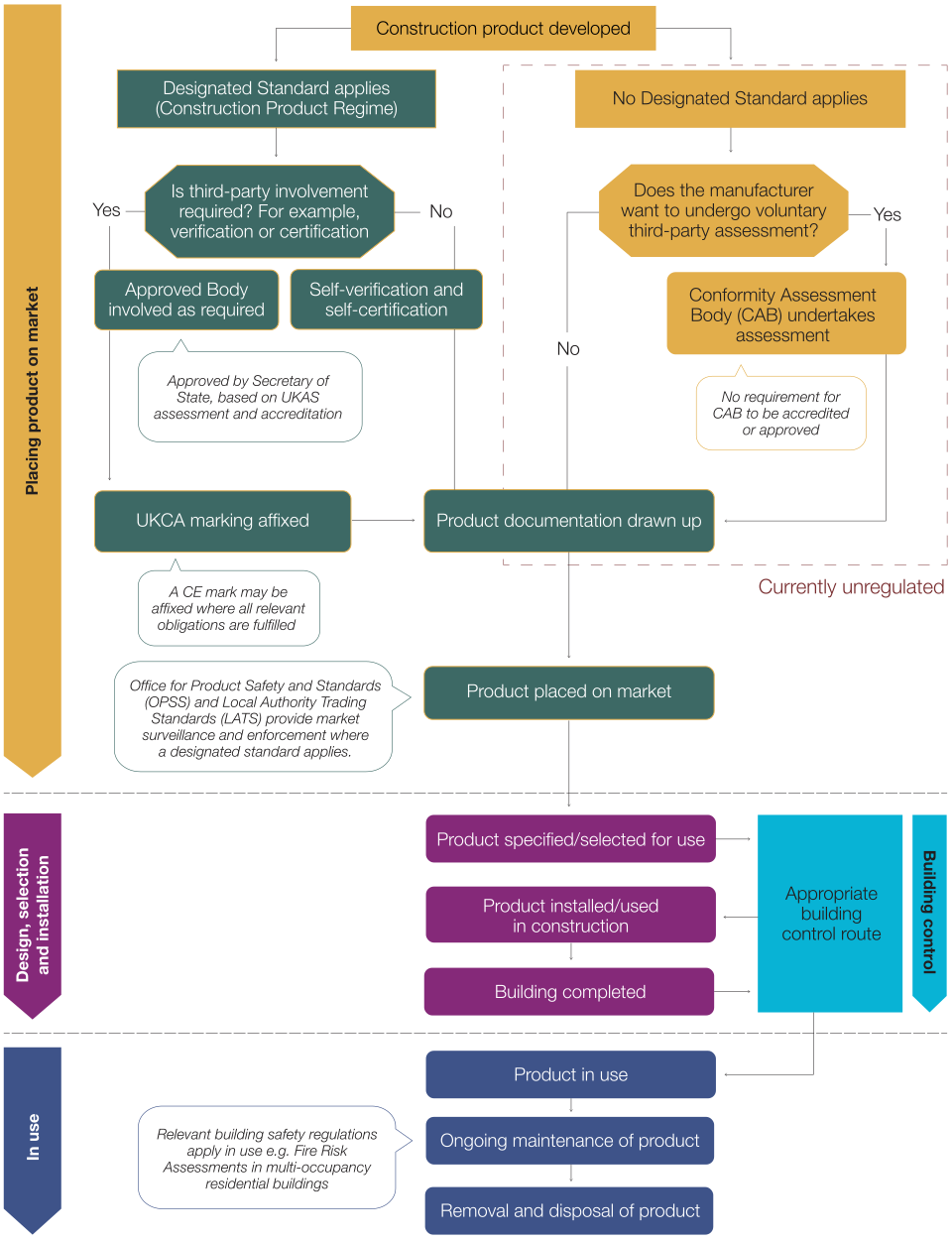
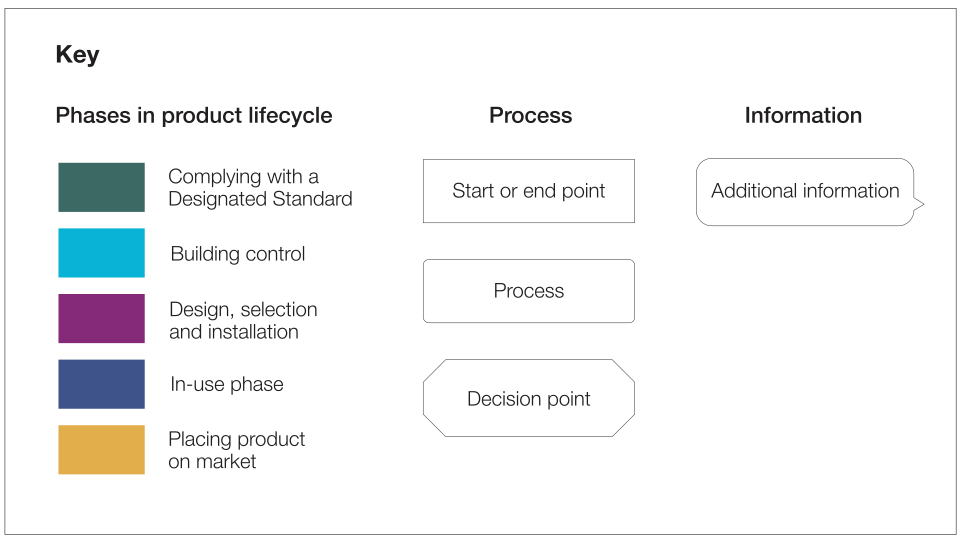
1.6 Roles and responsibilities within the current regime
1.6.1 The construction products regime is supported by the National Quality Infrastructure (NQI),[footnote 24] including:
-
the British Standards Institution (BSI), which develops national and international standards and represents the UK globally including representing the UK’s interests in the European regional standards bodies of CEN and CENELEC.[footnote 25] BSI publishes around 3100 standards annually across multiple sectors, and works closely with the Department for Business and Trade under a formal Memorandum of Understanding[footnote 26]
-
conformity Assessment Bodies (CABs), which test and certify products against designated standards. Under the GB-CPR, Approved Bodies (those CABs approved by the Secretary of State) assess products against designated standards, while UK Technical Assessment Bodies (TABs) handle technical assessments which provides a voluntary route to UKCA marking
-
the United Kingdom Accreditation Service (UKAS), which assesses, against international standards, whether CABs are competent to carry out specific conformity assessment activities. UKAS is appointed by government as the UK’s sole national accreditation body. The Secretary of State’s consideration for appointment of Approved Bodies is based on UKAS’s accreditation and assessment of the CAB. At present the national regulator for construction products has no role in this approval process. UKAS also accredits CABs for voluntary certification schemes where the scheme is recognised as meeting the relevant international standard
-
the national regulator for construction products, within the Office for Product Safety and Standards (OPSS), who lead market surveillance and enforcement under the construction products regulations
1.6.2 Conformity assessment is a general term to describe the systematic processes that are undertaken to determine whether a product has met specified requirements or standards. It includes discrete activities such as testing, inspection, validation, verification and calibration. Testing involves the evaluation of a product or system against specific criteria or standards to determine its performance, safety, or compliance. Testing may only be one part of the conformity assessment process and may not involve a comprehensive evaluation of all aspects of a product. Product certification is a broader process of evaluation: a means of providing ongoing assurance that a product complies with the specified requirements (e.g. in standards and/or other documents), including safety requirements where applicable, based on testing, factory production control and evaluation.
1.6.3 The national regulator for construction products works alongside the Building Safety Regulator (BSR), which oversees building safety and competence, particularly for higher-risk buildings in England. The BSR also promotes professional standards across the sector. Following an announcement in 2025, on 27 January 2026 the BSR became a standalone organisation under MHCLG, a step towards creating the single construction regulator.[footnote 27]
1.6.4 Alongside the national regulator for construction products, local authority trading standards (LATS) regulate product sales and enforce consumer protection laws, including those related to unfair trading and misleading marketing.
1.6.5 The national regulator for construction products, LATS in GB and the district councils in Northern Ireland exercise powers under the Construction Products Regulations 2020 and General Product Safety Regulations 2005 (GPSR) to investigate breaches, remove unsafe products, and issue sanctions. The GPSR applies only to consumer-facing products.
Figure 2: Current responsibilities under the construction products regulations
Central Government
Policy responsibility and regulator sponsorship sits across two central departments.
-
Ministry of Housing, Communities and Local Government (MHCLG) leads building safety and fire policy. This includes construction products and sponsorship of the national regulator for construction products and the Building Safety Regulator. MHCLG will become the sponsor of the single construction regulator as it is stood up. It also has responsibility for building regulations in England
-
Department for Business and Trade (DBT) leads sponsorship of the construction sector and sponsors the United Kingdom Accreditation Service (UKAS) and the British Standards Institution (BSI). The national regulator for construction products sits within the Office for Product Safety and Standards (OPSS). Whilst the national regulator for construction products is sponsored by MHCLG, OPSS sits within DBT
Regulators, surveillance and enforcement
Responsible for ensuring compliance with national regulation; national and local monitoring, surveillance and enforcement, and includes building control in the public and private sector.
NATIONALLY
-
the national regulator for construction products, is responsible for leading and coordinating market surveillance of construction product regulations across the UK. It is responsible for enforcement, including removing products that pose a safety risk from the market
-
the Building Safety Regulator (BSR), established in 2022. Initially housed in the Health and Safety Executive, functions moved to a new arm’s length body of MHCLG in January 2026. It raises safety standards across all buildings, including the safe use of construction products during construction, installation and occupation. It regulates the building control profession and provides building control functions to the Higher-Risk Building (HRB) regime, reviews Approved Documents and has a duty to facilitate improved competence of those working in the built environment
-
the Competition and Markets Authority (CMA) can decide whether consumer protection laws have been infringed, order redress to affected consumers and sanction businesses that fail to comply. Consumer protection legislation applies to construction products sold directly to the public
LOCALLY
-
local authority trading standards (LATS) in Great Britain and environmental health in Northern Ireland. Responsible for market surveillance and enforcement of the construction products regulations, supported by the national regulator for construction products, amongst other regulatory responsibilities
-
building control is delivered by the local authority or private sector. Building control provide advice and assurance on compliance with the minimum standards on construction and safety for non HRBs.
-
local fire and rescue services are responsible for assessing fire risk in the built environment as statutory consultees to building control bodies and as enforcers of fire safety legislation in non-domestic premises
Product Standards, Testing and Certification
The following private sector bodies are responsible for standardisation, accreditation, measurement, and conformity assessment of construction products.
-
the British Standards Institution (BSI) produces technical standards on construction and other products, representing the UK internationally. It is recognised as the National Standards Body. It is a non-profit distributing private company
-
United Kingdom Accreditation Service (UKAS) provides accreditation of conformity assessment bodies against international standards. UKAS is appointed as the UK’s sole National Accreditation Body and operates under a MoU with government. Accreditation is considered a public authority activity and UKAS is a not-for-profit private company limited by guarantee
-
Conformity Assessment Bodies (CABs) and Technical Assessment Bodies (TABs) undertake the testing and certification of products against standards, and voluntary testing by industry (TABs focus on voluntary testing). They are private sector organisations
1.7 Construction products regulations
1.7.1 GB-CPR establishes requirements for the marketing and supply of construction products in the UK, ensuring they meet safety and performance requirements through conformity with harmonised technical specifications and enforcement provisions. The 2013 regulations set the offences, market surveillance and enforcement of the 2011 regulations. These regulations only apply to construction products that have a designated standard or those subject to a UK technical assessment.
Table 1: Construction Product Regulations 2013
| Type of power | Powers |
|---|---|
| Interventions | Power to serve suspension notice, forfeiture powers, power to serve prohibition notice*, power to serve a notice to warn* |
| Investigation powers | Test purchase, power to search, power to seize and detain, power to inspect, power to enter premises, power to require production of records |
| Information gathering | Power to obtain information* |
| Sanctions/penalties | Powers to prosecute |
| *Powers marked with an asterisk are solely powers of the Secretary of State for Housing, Communities and Local Government exercised by the national regulator for construction products on behalf of the Secretary of State. All other powers are exercised by both the national regulator and LATS. |
1.8 Other regulations impacting construction products
1.8.1 The UK construction products market is also influenced by broader consumer protection and trading standards regulations. However, these were not specifically designed for the full range of construction products and generally do not apply to business-to-business transactions. This limits their relevance for products used by both households and commercial entities. Annex D outlines key regulatory provisions affecting the sector, including the Construction Products Regulations.
1.8.2 The GPSR apply to products that are intended for consumers, or likely (under reasonably foreseeable conditions) to be used by consumers even if not intended for them. They do not apply to products which are only available to businesses. They also do not include those products sold requiring repair.
Table 2: The General Product Safety Regulations 2005
| Type of power | Powers |
| Interventions | Power to serve suspension notice, forfeiture powers |
| Corrective action | Requirements to mark, requirements to warn, power to issue withdrawal notices, power to issue recall notices |
| Investigation powers | Test purchases, power of entry and search, power to order production of documents, power to seize and detain All now contained in Schedule 5 to Consumer Rights Act 2015 |
| Sanctions/penalties | Powers to prosecute |
1.8.3 The Building Regulations 2010 set performance standards for most building work, including how construction products must be used. Unlike the construction product regulations, the building regulations are devolved.
1.8.4 Regulation 7 of the Building Regulations 2010 (Materials and Workmanship) requires the use of materials that are appropriate, properly prepared, correctly applied, and installed in a workmanlike manner. While Regulation 7 applies broadly, its effectiveness is limited. Regulation 7 of the Building Regulations 2010 was updated in 2018 (via the Building (Amendment) Regulations 2018), imposing stricter non-combustibility requirements for the materials of external walls and specified attachments of relevant buildings (as defined in the Building Regulations 2010). Approved Document 7 provides statutory guidance on how to comply with Regulation 7.
1.8.5 More broadly, in England, approved documents set out statutory guidance to help builders, designers, and homeowners comply with the requirements of the Building Regulations 2010. There are 19 Approved documents (Parts A-T plus Approved Document 7) offering detailed guidance on meeting building regulations. Notably, Approved Document A covers structural safety and Document B addresses fire safety. The Grenfell Tower Inquiry’s Phase 2 Report recommended a full review of Approved Document B to improve clarity and effectiveness. In response, the BSR placed Approved Document B under continuous review.
1.8.6 The Construction (Design and Management) Regulations 2015 protect persons from health and safety risks arising from construction work by establishing a systematic framework for management of those risks, including carrying out work on a construction site. They provide for various health and safety duty roles, and general duties on duty holders including the principal designer, principal contractor, designers and contractors.
1.9 EU reform and the UK’s relationship with the European Union Construction Products Regulation (the EU-CPR 2024)
1.9.1 Within the EU, the EU-CPR sets the requirements for placing construction products on the market.
1.9.2 Since the UK left the EU, the regulatory requirements have remained largely aligned for the subset of construction products covered by the current framework.
1.9.3 However, in December 2024 the European Commission published the EU-CPR 2024 in the Official Journal of the European Union. The revised objectives include ensuring construction products are safe, improving enforcement and market surveillance, and reducing the climate and environmental impact of construction products.
1.9.4 The EU-CPR 2024 retains the fundamental elements of mandatory standards and associated testing, certification, and information requirements related to those standards. However, it also represents far reaching and significant reform, incorporating measures to enhance the safety of construction products. Measures include:
-
improvements to market surveillance and enforcement, including making explicit reference to manufacturers’ liabilities; the introduction of powers for national regulators to recover costs; and new obligations on conformity assessment bodies to support market surveillance
-
establishment of a database of construction products and requirement that product information should be accessible via a ‘digital product record’– with any relevant information becoming available via a Quick Response (QR) code
-
bringing re-used and recycled products within scope
-
expanding the actors to whom obligations apply, to include online marketplaces and fulfilment service providers
-
providing clarity on the future approach to the development of standards, through publication of a three-year work plan, as well as a mechanism for Member States to communicate product requirements
-
additional requirements for placing construction products on the market, such as manufacturers providing information on a product’s environmental sustainability, and installation information
1.9.5 The EU-CPR 2024 fully entered into force on 8 January 2026. Whilst new obligations on manufacturers and others apply from that date it is being implemented in phases. The requirements of the EU-CPR 2024 only apply once a product is covered by a harmonised standard that has been designated in accordance with the EU-CPR 2024. Until then, products will continue to be subject to the EU-CPR 2011 where applicable. In December the European Commission published its working plan for 2026-29[footnote 28] which provides a roadmap for implementing the EU-CPR 2024.
1.9.6 As of February 2026 no standards have been adopted under the EU-CPR 2024. Further, after adoption each standard is expected to be subject to a minimum 12-month transitional period, during which it is available to use on a voluntary basis.
1.9.7 To support implementation, member states are obliged to ensure that market surveillance and enforcement powers are in place by 8 January 2027. The EU-CPR 2011 will be repealed in full in 2040. This means that all standards will need to have been replaced with standards under the revised regime, and meet the association obligations under the EU-CPR 2024, by this date.
1.10 UK internal market
1.10.1 The regulations for placing or making construction products available on the market is a reserved matter. Reserved matters are decisions that are taken by the UK Parliament at Westminster even though they have effect in Scotland, Wales, Northern Ireland or the regions of England.
1.10.2 However, following the UK’s withdrawal from the EU, Northern Ireland (NI) continues to adhere to EU regulations for the subset of products covered by the CPR, in line with the Windsor Framework. Accordingly, the EU-CPR 2024 applies in NI.
1.10.3 In addition, the UK Internal Market Act 2020 established market access principles: mutual recognition and non-discrimination principles preserve the ability to trade unhindered in every part of the UK. Goods available on the NI market (known as ‘qualifying Northern Ireland goods’) have unfettered access when moving from Northern Ireland to the rest of the UK market. These products do not need to meet any additional or separate provisions to be sold in Great Britain.
1.11 Single construction regulator
1.11.1 The Inquiry recommended that government establish a single construction regulator to reduce fragmentation in how the construction sector is regulated, and to drive cultural change within the industry. The government accepted this recommendation. The recommendation listed a number of regulatory functions for the single construction regulator spanning buildings, products and professionals. This included responsibility for the regulation of construction products.
1.11.2 On 17 December 2025, the government published the Single Construction Regulator Prospectus: Consultation Document,[footnote 29] which sets out the strategic case and plans for reforming the regulatory system for the built environment, and the potential role for a single construction regulator within it. Our intention is to create a new regulator which will not only meet the Inquiry’s recommendation but will also create the right conditions for actors across the whole building ecosystem to play their role in achieving positive outcomes.
1.11.3 As set out in the prospectus, we will develop the organisational design and operating model of the single construction regulator, with further detail to follow. We expect that the single construction regulator will be accountable for the following, as they relate to the regulation of construction products:
-
operational strategy and policy
-
data and information
-
compliance and assurance, including of the testing and certification of construction products by other bodies
-
enforcement including work with other agencies
1.11.4 This means that the role of the national regulator for construction products (set out in Chapter 9) will ultimately become the responsibility of the single construction regulator. Our operating model and organisational design for the single construction regulator, and the transition plans to implement it, will reflect these functions and powers, building on the current activity and operating model of the national regulator for construction products.
1.11.5 As recommended by the Inquiry, the new single construction regulator will maintain the BSRs current regulatory responsibilities. Proposals for the future regulator will take account of any subsequent recommendations, including the work of the Building Control Independent Panel (BCIP). In January 2026, the BSR transferred out of the Health and Safety Executive (HSE) into a new, standalone body which will report directly to MHCLG. This new body will act as the foundation for the new single construction regulator.
Chapter 2: Problem statement
2.1 Context
2.1.1 The Grenfell Tower tragedy exposed serious failures in systems meant to protect the safety of homes and buildings. Unsafe products were misused and poorly installed, putting lives at risk nationwide. The Grenfell Tower Inquiry Phase 2 Report, and the two independent reviews make a compelling case for the urgent need for system-wide reform of the construction products sector. This government is also determined to make this an opportunity for long term growth.
2.1.2 The green paper set out a detailed rationale for change. This chapter reiterates the problems that reforms must address, indicating where responses to the consultation strengthened and built on this case. It identifies core problems across the system which must be tackled if we are to bring rigour, safety and confidence into the regime.
2.1.3 In considering these problems, it is important to recognise that failures and problems are pervasive across the system– spanning manufacture, design, specification, procurement, and installation. A system-wide approach to reform is therefore imperative – and must cover the full end-to-end chain of a construction product’s lifecycle, and be responsive to the evolving, multi-faceted, and complex nature of the construction products landscape. It must also be proportionate and failitate the construction sector.
2.2 The existing regulatory regime does not sufficiently support product safety
2.2.1 The green paper made clear that current construction products regulations in the UK do not foster a sufficient focus on safety. This derives from their basis in the European Union’s (EU) 2011 Construction Products Regulation (the EU-CPR 2011), which was principally conceived to remove technical barriers to the trade of construction products in the European single market. This means that where a product standard exists under UK regulations, it could be completely unrelated to safety (for example, a focus on energy efficiency instead).
2.2.2 Where product standards exist, it is often wrongly assumed that a product marking confirms the safety of a product, rather than conformity to a specific standard (which may itself be unrelated to safety). Reponses to the green paper consultation reinforce our understanding that product marks are often misunderstood as indicators of safety.
2.2.3 As a result of these shortcomings, the current regime fails to provide key safety information to those selecting and using products, even when they are regulated, and it does not provide the necessary assurance that these regulated products are safe.
2.2.4 Chapter 4 sets out the planned reforms to the EU regime and chapters 6,7 and 8 include additional proposals to regulate products, provide product information and support institutional reform.
2.3 The regulatory regime for products is fragmented
2.3.1 Respondents to the green paper consultation also emphasised the complex nature of products and their use in buildings. This means that regulatory measures to underpin the safety of construction products as individual basic products (e.g. insulation or bricks), components (e.g. electrical wire or an insulation panel), or systems (e.g. cladding or a fire door), have limited efficacy in ensuring the safety of the buildings that these products are installed within.
2.3.2 Construction products are used in systems and buildings rather than in isolation: responses to the green paper consultation emphasised that a product may be safely used on its own but become unsafe when combined with wider products. Consequently, consultation respondents highlighted the importance of assessing product safety in the context of how products interact within systems, not in isolation. Additionally, the way in which products are installed and used, is also determined by those responsible for constructing the buildings – namely, architects, engineers and tradespeople.
2.3.3 The Grenfell Tower Inquiry also exposed that regulation of the construction industry is too complex and fragmented, and demonstrated how this fragmentation was cynically exploited by bad actors. Consultation respondents echoed these concerns, citing that the current regulatory framework is disjointed, with overlapping responsibilities and inconsistent enforcement leading to confusion and gaps in accountability. Others commented on insufficient integration between the construction products and building regulations regimes, leaving a critical gap in oversight, where unsafe practices can have serious consequences.
2.3.4 This is picked up across a number of chapters in Part B. Chapter 5 addresses definitions, chapter 6 the regulatory regime, chapter 9 the future role of regulators, and chapter 11 proposed accountability across the regime.
2.4 The existing regulatory regime does not cover all products
2.4.1 Recent research undertaken for government by the Adroit Consortium noted that the proportion of construction products that fall under designated standards is between 29% and 61%. The central estimate is that around 37% of the UK market is regulated under the construction product regulations.[footnote 30]
2.4.2 Products are only regulated under construction products regulations if covered by a ‘designated standard’ or, subject to a UK ‘technical assessment’. As a result, there are no minimum requirements that cover all construction products, with a significant proportion of products remaining out of scope of the regulatory regime.
2.4.3 Responses to the green paper consultation confirmed the real challenges that this poses to regulating the sector given that a significant proportion of construction products are not covered. Many products are not subject to regulatory requirements before being placed on the market, creating a regime in which safety is not embedded at the outset of a product’s lifecycle, and which does not respond as new safety issues emerge. The national regulator for construction products cannot take enforcement action on these products even where there are known safety issues.
2.4.4 It is recognised that there is some consumer safety protection for business-to-consumer transactions under the consumer protection and general product safety regulations (see paragraph 1.8.1). However, this does not extend to business-to-business transactions, which represent the vast majority of transactions for construction products.
2.4.5 The general safety requirement will address these challenges associated with regulatory coverage by operating alongside existing UK construction products regulations, bringing all construction products into the regulatory regime through a GSR, as set out in chapter 6.
2.5 There is insufficient competence, rigour, transparency in, and oversight of, key institutions testing and certifying products and setting standards
2.5.1 The Inquiry Phase 2 Report and the Independent Review of the Construction Product Testing Regime (Morrell-Day review) pointed to a lack of competence, independence, transparency and rigour, alongside an absence of trust, conflicts of interest and inconsistency within the conformity assessment bodies (CABs). CABs are paid by manufacturers to provide third-party assurance prior to products being placed on the market. This introduces a commercial relationship which the Inquiry found can be in conflict with the independent verification of the performance of products.
2.5.2 Responses to the green paper consultation considered that CABs can be compromised by commercial interests, show lack of consistency in testing methodologies and interpretation of results, and do not make test data openly available. Some respondents stressed that “golden samples” and repeated testing until a pass is achieved undermine the integrity of certification. Additionally, for products not covered by the construction products regulations, it is possible for CABs to operate without United Kingdom Accreditation Service (UKAS) accreditation or any regulatory approval, which creates a lack of sufficient oversight. These issues combined demonstrate the need for reform to improve impartiality, reliability and transparency in conformity assessment.
2.5.3 The Morrell-Day review and responses to the green paper also identified capacity issues across the key organisations responsible for testing and certification processes, including inadequate testing capacity to meet projected growth. The majority of respondents agreed that an increase in public and private sector testing capacity is required.
2.5.4 The Inquiry criticised the rigour of UKAS oversight, inadequate assessment of the outputs and quality of CABs’ work and that it left ‘too much to trust’. This contributed to the lack of accountability for CABs after accreditation from UKAS.
2.5.5 However, UKAS subsequently undertook a review of all criticisms in the Grenfell Tower Inquiry report through its ‘PACE’[footnote 31] programme, leading to a significant and ongoing programme of change and reform. Nevertheless, responses to the green paper still called for greater transparency over UKAS accreditation and assessment activities in relation to construction products. They also called for clarity of roles between UKAS and the national regulator for construction products. Consequently, we consider that more is needed to strengthen UKAS and its role.
2.5.6 The Morrell-Day review posed questions about how standards are developed, including the transparency of the standard setting process. The review found that standards that seek to ensure product safety can risk becoming outdated through advances in technology. The development of new standards is slow, and products remain unregulated under the construction products regime until a standard is designated, or a UK technical assessment is issued.
2.5.7 In addition, because many standards are behind a paywall those who use them incur a cost, even when the standard is mandatory, creating barriers to entry for small and medium-sized enterprises (SMEs) in particular. More generally, for construction products the engagement between the BSI and government has lacked structure.
2.5.8 In summary, the system needs to be improved to bolster safety across the testing, accreditation and standard development regimes. Accreditation plays an important role in assessing against a standard whether a CAB is competent to carry out a specific conformity assessment activity. But reforms must address the wider issue of ensuring that the testing and certification processes effectively support the wider objective of delivering products which are safe. Therefore this also needs enhanced oversight by the national regulator for construction products and government. The system-wide reforms in Part B, Chapter 8 set out how government intends to achieve this.
2.6 There are insufficient rules on information, enabling misleading claims, and a lack of product traceability
2.6.1 Where rules do apply on the information manufacturers must provide with their products, these are currently primarily focused on supporting trade. There is no regulatory requirement to provide information that could be essential to safe use such as manufacturer instructions on where and how a product should or should not be installed. Even where products are covered by the regulatory regime, it is too often seen as a tick box exercise.
2.6.2 The Inquiry found evidence of misleading information. It found that voluntary claims made in marketing materials were deliberately misleading. These findings are substantiated by responses to the green paper consultation, which underline concerns about manufacturers providing incomplete, unclear, or deliberately misleading information.
2.6.3 The combined effect of insufficient rules on information required and the presence of misleading marketing claims by manufacturers is that there can be a lack of clear and accurate information on the performance of products. As consultation responses to the green paper reinforce, this makes it difficult for specifiers and contractors to make informed decisions on products and their safe use.
2.6.4 Current information systems also offer limited capability to trace products from manufacture through to installation and back to the point of origin. This lack of end-to-end traceability undermines assurance that products used on site align with those assessed for regulatory conformity. In the absence of robust tracking mechanisms, failures – such as those witnessed in the Grenfell Tower refurbishment – can be difficult or impossible to diagnose and remediate effectively.
2.6.5 Consultation responses identified crosscutting challenges with digitalisation in the sector. They underlined that, within the context of poor product information and lack of product traceability alongside the desired shift to digitalisation, the quality of digital product information can be poor or untrustworthy. Responses also highlighted inadequate access to standardised, evidence-based digital information in the sector. Further, designers, construction professionals, manufacturers and others lack the data and competence to interpret digital product information – which creates issues applying claims about a product to the ‘real world’.
2.6.6 In short, information requirements, strengthened traceability and a path to digitalisation is essential to ensuring accountability, safety, regulatory oversight and compliance across the product lifecycle, giving developers confidence in the construction products they use. Chapter 7, Part B sets out system solutions to the problems arising from poor product information requirements.
2.7 Enforcement action is insufficient
2.7.1 The Building a Safer Future: Independent Review of Building Regulations and Fire Safety (the Hackitt review) and the Morrell-Day review emphasised that enforcement action was almost non-existent at the time of their reports. Although the national regulator for construction products was established in 2021, enforcement has been limited by insufficient powers and regulatory coverage. The Morrell-Day review was unable to identify any prosecutions under construction products regulations since they were enacted. Since the review, only one prosecution has been taken forward under the regulations, by the national regulator for construction products.
2.7.2 There are also insufficient penalties, with action needed to ensure sufficient enforcement powers are available to the national regulator for construction products. This will ensure that it can successfully deter non-compliance and ensure safe products, underpinning future growth.
2.7.3 This lack of regulatory oversight and enforcement, and the associated lack of monitoring by government, permitted a culture in which enforcement was not expected to happen, generating little deterrent for manufacturers who market and sell unsafe products. The consequence was seen in the dishonesty and unscrupulous behaviour of manufacturers identified in the Inquiry’s Phase 2 Report. It also means that compliant actors within the industry feel that they are not competing on a level playing field, undermining investment and business growth.
2.7.4 In commenting on the green paper consultation, respondents recognised the need for a balanced, risk-based approach to regulation to avoid stifling innovation and efficiency.
2.7.5 The Inquiry recommended that the regulatory functions relating to the construction industry, including the regulation of construction products, should be brought into a single construction regulator. A consultation on the Single Construction Regulator Prospectus: Consultation Document is now underway. Chapter 6 in Part B of this white paper addresses the regulatory regime and chapter 9 confirms clear responsibilities and the commitment to enforcement powers for regulators.
2.8 There is unclear accountability, a lack of competence, and a culture of indifference
2.8.1 On accountability, the Hackitt review described the construction product system as opaque and fragmented, arguing that this precluded robust ownership and accountability among the client, designer, contractor and ultimate building owner. The Morrell-Day review continued this theme, finding a lack of clear accountability across the product lifecycle, from testing and certification to marketing, installation and maintenance, making it challenging for regulators to hold actors to account. The Inquiry Phase 2 Report found that parties had misunderstood their obligations and how they interacted with the obligations of others. All three reports called for a greater emphasis on personal and professional accountability. Respondents to the green paper voiced similar concerns.
2.8.2 Respondents to the green paper consultation were also clear that there is a widespread lack of competence across the construction products supply chain – from product design to installation – undermining safety. This was seen as linked to a pervasive culture of indifference to safety: several consultation responses pointed to a practice of prioritising cost over safety and quality.
2.8.3 Competence and accountability are addressed in all Part B chapters, with chapter 11 bringing together how these system wide problems will be addressed.
2.9 Post-Grenfell construction product safety reforms – summary of action to date
2.9.1 While the government has introduced some reforms to the construction products regime since the Grenfell Tower tragedy in 2017, progress has been limited and fragmented:
-
combustible materials ban: Introduced in 2018 for buildings over 18m (e.g. flats, hospitals, student housing), extended in 2022 to include hotels and hostels
-
establishment of the national regulator for construction products, within the Office for Product Safety and Standards (OPSS), in 2021
-
approved Document B review: A 2022 consultation led to the removal of national fire classifications in favour of the more robust European standard. Further revisions to guidance on external wall materials are underway
-
building Safety Act 2022: Implemented the Hackitt review recommendations and granted enforcement powers to two new regulatory bodies: the Building Safety Regulator and the national regulator for construction products. Also made provision for the New Homes Ombudsman
-
new regulatory powers: The Building Safety Act 2022 enabled government to regulate the marketing and supply of construction products including via:
-
a general safety requirement
-
standards-based or technically assessed products
-
a list of safety-critical products (where in the view of the Secretary of State, failure could cause death or serious injury)
-
2.9.2 This white paper and the parallel consultation on the general safety requirement set out how these powers will play a role in delivering construction product reforms.
2.10 Sector driven initiatives
2.10.1 Government has committed to driving forward the necessary regulatory reforms to addresses the systemic problems within the regime. However, we are clear that change must also be owned and led by the sector as a whole– including, but not limited to, manufacturers, importers, distributors (including merchants), specifiers, contractors, developers, standards bodies, testing houses, and funders. We recognise efforts to date by the sector to strengthen safety through voluntary self-regulation, and welcome ongoing engagement and initiative from the sector.
Examples of industry action to date
To establish a Voluntary Occurrence Reporting System (VORS) the remit of the confidential reporting system CROSS (Collaborative Reporting for Safer Structures) – run by the Institution for Structural Engineers, the Institution for Fire Safety Engineers and Institution of Civil Engineers – was expanded to cover both fire and structural safety.
The ‘Code for Construction Product Information’ (CCPI), established in 2021, is an industry-led initiative managed by an independently governed not-for-profit body. The CCPI works with manufacturers and suppliers to raise standards in construction product information management and marketing. The CCPI seeks to ensure that product information is clear, accurate, accessible, up to date and unambiguous. It supports the digitisation of product information and provision of accurate data. It also provides support for duty-holders including clients, contractors and designers in their due diligence regarding clear, accurate product information. A range of responses to the green paper consultation supported the CCPI, with the initiative seen as promoting transparency, accuracy and accountability in product information.
The UK Certification Authority for Reinforcing Steels (CARES) is an independent provider which assures the quality and sustainability of the constructional steels industry. The CARES Cloud digital platform delivers end-to-end traceability of steel products.
The Association for Specialist Fire Protection (ASFP) is a trade body for Passive Fire Protection (PFP) sector. Its work provides a practical model for how third-party certification and competency frameworks can be embedded in industry practice.
Both CARES and the ASFP bring together manufacturers, contractors and testing/certification bodies to raise standards, traceability and competence.
In 2021 the BSI launched the digital BSI Identify service as an open and persistent registry to provide identification for construction products and store associated product information.
The Construction Leadership Council’s guidance Building Control for a New Higher-Risk Building sets out good practice on how principal contractors and product manufacturers can work together to ensure products (particularly safety critical ones) are installed correctly and work as intended.
The BSI’s PAS 2000: 2026 Construction Products – Bringing Safe Products to Market – Code of Practice is scheduled for publication shortly. PAS 2000 is fully funded by government. This will provide a framework for manufacturers to demonstrate that they have taken reasonable steps to ensure their products are safe to be placed on the market.
2.10.2 We recognise the steps taken to date. However, when the Inquiry Report was published, the Prime Minister acknowledged the scale of ongoing issues and committed to delivering comprehensive reform of the construction products system.[footnote 32] The responses to the green paper on construction products reform confirm this need for change. This white paper is the next step – setting the foundation for bold, system-wide change that delivers safety, preventing further building safety tragedies, whilst unlocking investment and long term growth.
Chapter 3: Vision for reform
3.1 Reforming the built environment
3.1.1 Our vision for construction products reform is to create a trusted, proportionate regulatory system that ensures safe construction products, safely used. This, in turn will support the wider economy and give confidence to developers, enabling delivery of 1.5 million safe homes that residents can trust over this Parliament, and beyond. It will also underpin our long-term vision for housing to be set out in our upcoming long-term housing strategy.
3.2 Construction products reform objectives
Safety: Safe products that are trusted
3.2.1 Construction products must be safe for both their intended and normal or reasonably foreseeable conditions of use and used safely, for the long-term across buildings and infrastructure. Product safety must be supported by clear, accessible, and transparent information. The regulatory framework and institutions overseeing construction products must be world-class, with strong oversight, effective enforcement, and a clear focus on the public interest. Regulators and institutions must have well-defined responsibilities, along with the capacity and competence to enable sector productivity. Developers must have confidence in the products they select and use. The public and residents must be confident that homes, buildings and infrastructure are made from safe products, safely used, and that the system overseeing products can be trusted.
Growth and Innovation: A proportionate approach that enables innovation, growth and productivity, supporting delivery of 1.5 million safe homes over this Parliament, and beyond
3.2.2 The construction products regime will support industrial growth, boost investment and productivity, and help build a skilled, competent workforce. It will contribute to the delivery of 1.5 million safe, high-quality homes over this Parliament, and beyond, aligned with the UK’s long-term housing and infrastructure strategies. Regulations will be proportionate to risk. The regime will also aim to minimise trade friction, and support supply chains, including consistency with future European Union (EU) standards where this supports safety, innovation, market access and growth. A clear, predictable and proportionate framework will provide certainty, supporting investment and growth.
Accountability: Clear responsibilities and accountability at every stage
3.2.3 Clear lines of responsibility are established throughout the product journey, ensuring accountability from research and development to testing and certification and manufacture, through to selection, installation and use. Manufacturers and economic operators and all those in the chain must act responsibly, in line with their vital role in building safe and sustainable homes and communities. Reforms will reset expectations across the sector, enforce accountability, and support compliant businesses.
3.2.4 To meet these ambitions, the sector must be equipped with the skills and competence to design, use, and dispose of safe, high-quality products. Such products are essential to ensuring buildings perform as intended and remain safe throughout their lifecycle. Achieving this requires a systems-based approach to reform – one that assesses safety in context and recognises how products interact within broader systems, rather than in isolation.
3.3 Government, regulators, institutions and industry: Accountability and working together to achieve reforms
3.3.1 Five key groups are critical to delivering reform:
-
manufacturers and other economic operators (including distributors, merchants and importers) must take responsibility and ownership of product safety across the lifecycle and provide clear, accessible information to users
-
the construction industry and supply chain – including clients, designers, developers, and contractors – must raise standards, ensure appropriate product use, and drive competence and innovation. Reforms mean that accountability will extend across the value chain, with consequences for non-compliance
-
those involved in standard setting, accreditation, testing and certification (BSI, UKAS and CABs) must ensure rigorous, consistent standards and testing. Strengthened public sector testing capacity will support regulatory assurance and innovation
-
regulators must use their new powers to improve monitoring, and to carry out effective enforcement to uphold safety and drive cultural change across the sector
-
government must ensure the construction products regulatory regime is effective – driving safety, growth, and public and market confidence – by providing strategic oversight, monitoring system risks, and leading policy development
3.3.2 Reform will only succeed with collective commitment: every stakeholder has a role in delivering real-world impact and demanding safe products and safe practices. In turn, each stakeholder will stand to benefit from a reformed construction products regime. While government sets the vision and principles for reform, lasting change must be owned and led by the sector and supported by regulators and institutions.
3.3.3 Transparent information and fair, effective regulation will ensure that compliant businesses benefit from a level playing field and a stable framework that supports investment and innovation. Product users, including developers, will be able to put greater trust in the safety and quality of construction products, supported by reliable and accurate information. The sector as a whole will benefit from a competent workforce focused on safety. A broader range of clear powers will empower regulators to drive a culture of safety. The public will benefit from safer homes and infrastructure, which will provide the foundation for stronger communities and inclusive economic growth. In turn, this will prevent further building safety tragedies and avoid the risk of costly remediation for developers.
Part B: A reformed construction products system
Part B sets out the government’s intended approach to system-wide reform of the construction products sector. This reform aims to tackle longstanding issues within the current regulatory framework and reset the relationship with industry – ensuring all actors across the system fulfil their responsibilities to support the production and installation of safe products, and in doing so, restore public trust in construction products, and support long term economic growth.
Chapter 4 sets out how we will pursue consistency with the reformed EU regime where this aligns with our objectives for safe products, safely used. Chapter 5 sets out what this means for the scope and definitions that will guide reforms.
We also recognise that we will need to go beyond consistency with EU regulations to achieve our objectives. Chapter 6 confirms new regulatory requirements for products not covered by regulations and proposes new requirements to ensure all products are safely used, particularly those critical to safe construction.
If we are to achieve our reform objectives, the regime will need to ensure accessible, transparent and trustworthy information about products. Chapter 7 sets out how we will take information and marketing requirements forward.
Our approach to strengthen the assurance and oversight of testing and conformity assessment is confirmed in Chapter 8, including requiring testing and certification bodies to act in the public interest.
Enforcement of this new regime is fundamental to meeting the ambitions of reform, alongside routes to civil redress when things go wrong. Chapter 9 describes how we will clarify roles and responsibilities of the regulators and build the capacity to take action against bad actors. We will introduce changes while also developing a new single construction regulator. This new body will be developed out of the reformed Building Safety Regulator, and will also ultimately be responsible for the role of the national regulator for construction products.
Although safety is the key driver of reforms, there is also an opportunity to deliver for sustainability. Chapter 10 sets out proposals to align objectives for safety with sustainable growth.
Competence across the sector was a key theme in consultation responses and we recognise that the success of reforms relies on the knowledge, skills and professional competence of all actors within the system. This is addressed in Chapter 11.
We conclude Part B by setting out the accountability framework for a reformed regime in Chapter 12. A key criticism of the current regime is fragmentation and lack of clear responsibilities. This white paper is a significant next step to ensuring all actors across the chain have well defined responsibilities.
Chapter 4: How reforms will consider consistency with the new EU regime
4.1 About this chapter
4.1.1 The UK construction products regulations need to be replaced by a legal framework that better supports delivery of our objectives for construction products reform. Recognising that the current regulatory regime is founded on the former EU regulations, this chapter confirms the approach toward consistency with the reformed EU regulations going forwards.
4.2 Delivering reforms that are consistent with the EU-CPR 2024
4.2.1 In the Construction Products Reform Green Paper the government set out an intention to implement reforms in a way that retained consistency with the EU’s regulations where this met our objectives. This recognised that the EU-CPR 2024 reforms place a greater emphasis on product safety and the provision of product information.
4.2.2 Responses expressed broad support for consistency. A number also referenced the potential negative impacts of divergence such as increased complexity, costs, and reduced competitiveness for UK businesses.
4.2.3 Responses also raised additional points focussed on concerns about the UK’s ability to influence European standards that would become mandatory in the UK. They noted that the UK cannot enforce against overseas CABs that underpin CE marking. Some also expressed a view that, despite the reforms, the EU regime remains insufficiently focused on safety.
4.2.4 The government commitment to ensuring safe products remains clear. We will retain consistency with the reformed EU regulatory regime where it is in line with our objectives for safe products, safely used. In doing so we will take concerns into account. Chapters 5, 6 and 7 set out more detail on the mandatory measures within the EU-CPR 2024 which improve product safety, that are applicable to economic operators throughout the supply chain. This includes increased obligations in relation to product information, and duties to report non-compliance.
4.2.5 Notably, within the EU it is for Member States to define the requirements applicable to construction works (i.e. how products are used). This allows, for example, Member States to specify which product performance (e.g. the fire resistance time period) is required for which intended use(s). This means that, whilst products that meet the EU rules can be sold in the UK, the UK retains the right to determine where, and where not, a product may be used. Within the UK, the devolved governments are each responsible for administering these ‘in use’ requirements.
4.2.6 The UK must also be able to take action to tackle unsafe products and take action against CABs that do not meet the new rules. Chapters 6 and 8 set out how this will be addressed.
4.3 Regulatory implementation
4.3.1 Revisions to update the UK construction product regulations to deliver consistency with the EU-CPR 2024 can be made through secondary legislation, using powers in Schedule 11 of the Building Safety Act 2022. We intend to align timescales with the EU where possible to mitigate risks of regulatory divergence.
4.3.2 To inform regulatory changes we will engage further with industry. This will consider which measures in the EU-CPR 2024 would support safety, growth and supply chains if implemented in GB. The overarching principle is that economic operators should only be required to undertake testing and certification once in order to sell in the UK and EU markets. This work will identify ‘central measures’ which will be essential to a robust regulatory framework and ‘supporting measures’ where a different approach could better support our objectives without impacting trade. Some examples of such measures are below and are included for illustrative purposes only. We will undertake further work to determine the approach in relation to each measure.
Table 3: Central and supporting measures for consistency with the EU
| Central measures | Supporting measures |
|---|---|
| Foundational pillars which will be essential to achieving a robust regulatory framework and consistency with the EU | Measures that support delivery of our objectives and would not have a notable adverse impact on trade were the GB and EU rules different |
| Examples include: • Consistency of product standards. • The new systems for assessing products (the ‘Assessment and verification systems’ (AVS) to replace the ‘Assessment and Verification of Constancy of Performance’ (AVCP)) levels. • Product documentation requirements. |
Examples include: • Obligations in relation to conformity assessment bodies’ governance. • Provisions to support the flow of products to market in the event of a national emergency. |
4.4 Recognition of CE marked products
4.4.1 Since the UK’s departure from the EU, products that meet requirements under the EU’s CPR have been able to be placed on the GB market without the need for retesting or additional marking. This will continue to be the case, provided that the product complies with either the EU-CPR 2011 or the EU-CPR 2024 as appropriate. This recognises the programme of new and revised standards under the EU-CPR 2024, and the strengthened obligations under the EU-CPR 2024.
4.5 Regulations implementing the EU-CPR 2024 in Northern Ireland
4.5.1 In order to maintain Northern Ireland’s dual market access to the rest of the UK internal market and EU single market, the EU-CPR 2024 will be implemented to the same timetable in NI as in the European Union. This includes new EU harmonised standards (now known as ‘harmonised technical specifications under the EU-CPR 2024), which will enter into force at the same time in the EU and NI.
4.5.2 The obligations on manufacturers and other economic operators under the EU-CPR 2024 will apply automatically in NI. However, legislation will be needed to introduce offences and penalties as these are delegated to the local jurisdiction.
4.5.3 The Windsor Framework provides a platform for UK-EU co-operation through the Joint Consultative Working Group. It enables discussion of new rules applied under the Windsor Framework across a full range of issues, including on goods regulation. This is in addition to UK-EU stakeholder engagement with business and civic society groups.
4.5.4 Legislation will be introduced in 2026 to provide market surveillance powers to oversee and enforce the EU-CPR 2024 in NI. We are working closely with the devolved government and regulatory bodies to develop this legislation. We will continue to engage with the NI civil service and NI Assembly as we progress policy development and legislative planning.
4.6 Interaction with other regulatory regimes
4.6.1 We recognise that many construction products must adhere toother regulatory requirements. We need to mitigate the risks of overlapping and/or repetitive requirements. We want to ensure that obligations are proportionate, provide clarity of accountability, and eliminate unnecessary burdens for economic operators. In the green paper we sought information on other potential overlapping rules, regulations or guidance. Broadly, respondents supported aligning UK rules with the EU-CPR, International Organisation for Standardisation (ISO) standards, and other international standards to reduce duplication and trade barriers.
Chapter 5: Scope and definitions
5.1 About this chapter
5.1.1 Any regulatory regime is underpinned by the scope, and associated definitions. This chapter sets out these foundations, recognising that they will underpin the future regime.
5.2 Scope
5.2.1 The Construction Products Reform Green Paper set out the intention to maintain consistency of scope and product definitions with the EU-CPR 2024 where it meets our objectives, and for the same definitions to apply across all construction products. This included adopting a definition of ‘construction works’ which continues to cover products intended to be used in buildings or civil engineering works. This would be consistent with the EU-CPR 2024’s approach and we can confirm this remains the intention.
5.3 Definitions
5.3.1 We will underpin the regulatory regime by a suite of definitions set out in legislation, that are applied across all construction products. In the green paper we set out an intention to adopt a number of definitions from the EU-CPR 2024 and invited views. Consultation responses indicated broad support.
Definition of a construction product
5.3.2 The definition of a construction product is set out within the EU-CPR 2024
-
construction product means “any formed or formless physical item, including 3D printed products, or a kit that is placed on the market, including by means of supply to the construction site, for incorporation in a permanent manner into construction works or parts thereof with the exception of items that need first to be integrated into a kit or another construction product prior to being incorporated in a permanent manner into construction works”
-
kit means “a product placed on the market by a single economic operator as a set of at least two separate items, none of which needs to be a product itself, intended to be incorporated together into construction works”
5.3.3 We will adopt a definition of ‘construction works’ that is consistent with the EU-CPR 2024. This will continue the approach in the UK’s current construction products regulations, ensuring that products used in all buildings and civil engineering works are in scope.
5.3.4 The definitions incorporate new, used, and remanufactured products. Custom-made products are also included. However, there are exemptions for some custom-made products from testing and performance declaration requirements when strict criteria concerning manufacturing and safe installation are met.
Modern Methods of Construction
5.3.5 There is a need to clarify the regulatory approach to systems of products and Modern Methods of Construction (MMC).
5.3.6 A ‘system’ is a broad term which captures a mass of interdependent products combined to perform a dedicated function (e.g. an external cladding system). This could be a ‘kit’ or a system comprising multiple products placed on the market independent of one another.
5.3.7 MMC is also a wide term which covers a range of offsite and onsite techniques which provide alternatives to traditional construction methods.
5.3.8 Respondents noted the need for improved approaches to testing products systems and the interaction with building regulations and the approved documents. Some noted that current regulations and guidance are suited to traditional construction techniques and are insufficient with regard to MMC.
5.3.9 We intend to allow for product systems and MMC to be in scope. However, we will undertake further engagement to ensure there is no undue overlap or duplication of regulation. This will include clarifying principles to determine applicable obligations throughout a product’s supply chain and use, including where fabrication should fall under building regulations.
5.3.10 Regulations will be supported by guidance issued by the national regulator for construction products, which will complement any revisions to the approved documents.
Used products
5.3.11 For products regulated under the CPR, we will specify on a case-by-case basis whether the product standard applies to used or remanufactured products in addition to new products. This mirrors the approach set out in the EU-CPR 2024 and would enable the products to be brought into scope of the regulatory framework for the first time. Alongside this, used and re-manufactured products will be brought within scope of the GSR, as set out in the parallel GSR consultation.[footnote 33]
Key parts
5.3.12 Some components can be integrated into construction products, supporting safety and effective performance. The EU-CPR 2024 enables these to be brought into scope via the product standard, where deemed essential for the characterisation, safety or performance of the product. Key part(s) will be specified in the harmonised product standard, and must be listed within Declarations of Performance and Conformity (DoPC). This will be the responsibility of the product manufacturer.
5.3.13 We agree that parts identified as integral to the compliance of the product in which they are incorporated would benefit from dedicated regulatory coverage. This would also support market surveillance. We therefore intend to adopt a consistent approach for products subject to designated standards.
Summary
5.3.14 The intention is for the regime to encompass:
-
building and civil engineering works
-
all products that are likely to be used for permanent[footnote 34] incorporation in construction works (including via maintenance, refurbishment, or retrofit, in buildings and infrastructure) regardless of whether they are also likely to be used for other purposes
-
products that are available to trades, consumers, or both
-
key parts of products subject to designated standards
-
products that are made up of multiple individual parts, which may or may not themselves be products, including systems of products
-
products that have been manufactured and also those supplied in raw forms such as sands and aggregates
-
products that have been recovered from previous structures to be re-used or recycled as construction products, for consideration on a case-by-case basis
5.3.15 Definitions will be consistent with the EU-CPR 2024. This will be set out in secondary legislation, supported by guidance to ensure clarity where there is an interface with building regulations, notably in relation to MMC. Ahead of legislation the government will continue to work with stakeholders across industry.
Economic operators
5.3.16 The economic operator is the person subject to regulations in relation to the manufacturing or remanufacturing of products or those making products available on the market.
5.3.17 The EU-CPR 2024 defines an economic operator as:
- “…the manufacturer, the authorised representative, the importer, the distributor, the fulfilment service provider or any other natural or legal person who is subject to this Regulation in relation to the manufacturing or remanufacturing of products, including products to be reused, or to making those products available on the market, in accordance with this Regulation”
5.3.18 The majority of respondents to the green paper agreed that the proposed definition of ‘economic operator’ captures all of those who are responsible for ensuring that products are safe when they are placed on the market. We therefore intend to adopt this definition and support industry through the provision of guidance.
Online marketplaces
5.3.19 The current regulatory framework for construction products is primarily designed for traditional physical distribution channels, where manufacturers, importers, and distributors are clearly identifiable and accountable. However, online marketplaces do not always fit neatly into these definitions, with some online marketplaces acting as other economic operators depending on their activities. Therefore, we are seeking to modernise and clarify the responsibilities of online marketplaces in ensuring third-party sellers offer safe products with clear traceability and compliance assurance.
5.3.20 We plan to tackle the risks posed by unsafe construction products online as part of forthcoming wider reforms to the general product safety framework. Specific proposals in relation to online marketplaces will be consulted on early this year, led by the Department for Business and Trade. This is part of a wider consultation by DBT on major reforms to the general product safety framework to strengthen consumer protections, clarify supply chain responsibilities and streamline the processes for enforcement. We note that the EU-CPR 2024 brings online marketplaces into scope and will consider the interaction between the EU and UK rules for online marketplaces when taking account of the consultation.
Chapter 6: Regulating products
6.1 About this chapter
6.1.1 The Grenfell Tower Inquiry, the Building a Safer Future: Independent Review of Building Regulations and Fire Safety (the Hackitt review), and the Independent Review of the Construction Product Testing Regime (Morrell-Day review) all identified an insufficient focus on product safety and limited regulatory coverage. This chapter details the government’s intention regarding mandatory requirements when placing products on the market. It also sets out how we will bring all products within scope of the regulatory regime, how those products will be regulated, and where responsibility will rest at each stage. It explains how voluntary routes to market will be strengthened, to ensure rigour and support innovation. Proposals also cover how products are selected and used and the role of product marking.
6.2 Product requirements overview
6.2.1 We will regulate to ensure that products are safe and used safely, and that manufacturers and other economic operators act responsibly, enabling our industrial base to grow and innovate. The following three mechanisms will play a key role in achieving this:
A. For products covered by a designated standard: It will remain mandatory for manufacturers to declare the performance of the product in line with the designated standard, and to provide the necessary information to demonstrate compliance, including affixing a product mark. Products subject to a UK Technical Assessment or European Technical Assessment will also be regulated.
B. For products not covered by a designated standard or subject to a technical assessment: We will introduce a risk-based general safety requirement (GSR). When placing the product on the market the manufacturer will be required to identify and assess any safety risk connected to the intended use and the normal or reasonably foreseeable conditions of use of the product and take proportionate action to eliminate or control such risks.
6.2.2 All products will fall under either A or B.
6.2.3 For products classified as critical to safe construction: We will also introduce enhanced requirements where there is greatest risk of harm, to ensure that what is specified and installed is suitable and safe for the intended use. This will allow for additional measures where the national regulator for construction products considers that adherence to the standard alone is not sufficient to ensure that the product can be used safely.
6.3 Mandatory requirements for products covered by designated standards when placing the product on the market
6.3.1 In the Construction Products Reform Green Paper we set out an intention to maintain consistency with relevant new and revised European construction product standards where this meets our objectives. Responses to the green paper consultation broadly supported this, whilst raising a question about whether alignment with the EU-CPR alone would ensure safety.
6.3.2 New and revised European standards are being developed based on the requirements of the EU-CPR 2024. This includes the new assessment and verification systems (AVS) and obligations associated with the provision of additional information regarding safety and installation.
6.3.3 Government will expect consistency with European standards but will consider designation of new standards on a case-by-case basis to ensure this meets our objectives for safe products, safely used. Government reserves the right not to designate a new standard, and to commission standards where necessary to deliver our objectives. Information on new and revised standards that are proposed for designation will be published on gov.uk. This is the approach the government took in relation to six standards that were designated in September 2025.[footnote 35]
6.3.4 This will be complemented by proposals to strengthen the government’s relationship with the British Standards Institution (BSI) in relation to construction product standards (see section 6.11). It will also be complemented by obligations associated with how products are selected and used.
6.3.5 To address concerns about imported products, to place a product on the UK market economic operators will be required to comply with all relevant laws. This will be irrespective of the origin of a product and where the Conformity Assessment Body (CAB) is based.
6.3.6 Supplementing the enforcement regime, and the reforms set out in Chapter 9, there are also formal mechanisms and informal routes for the national regulator for construction products to engage with EU member states on a bilateral basis (including through the Withdrawal Agreement) to tackle concerns. Formal routes include ‘mutual assistance’ provisions. These make it a legal requirement for EU Member States to support action, including action by the UK in relation to products on the market in NI.
6.3.7 To implement the measures, we will introduce new construction products regulations. These will, after an appropriate transition period, replace the current regulatory regime. This legislation is necessary to establish in UK law the framework that will underpin new standards – for example, the AVS levels.
Figure 3: Illustrative steps required for products with designated standards
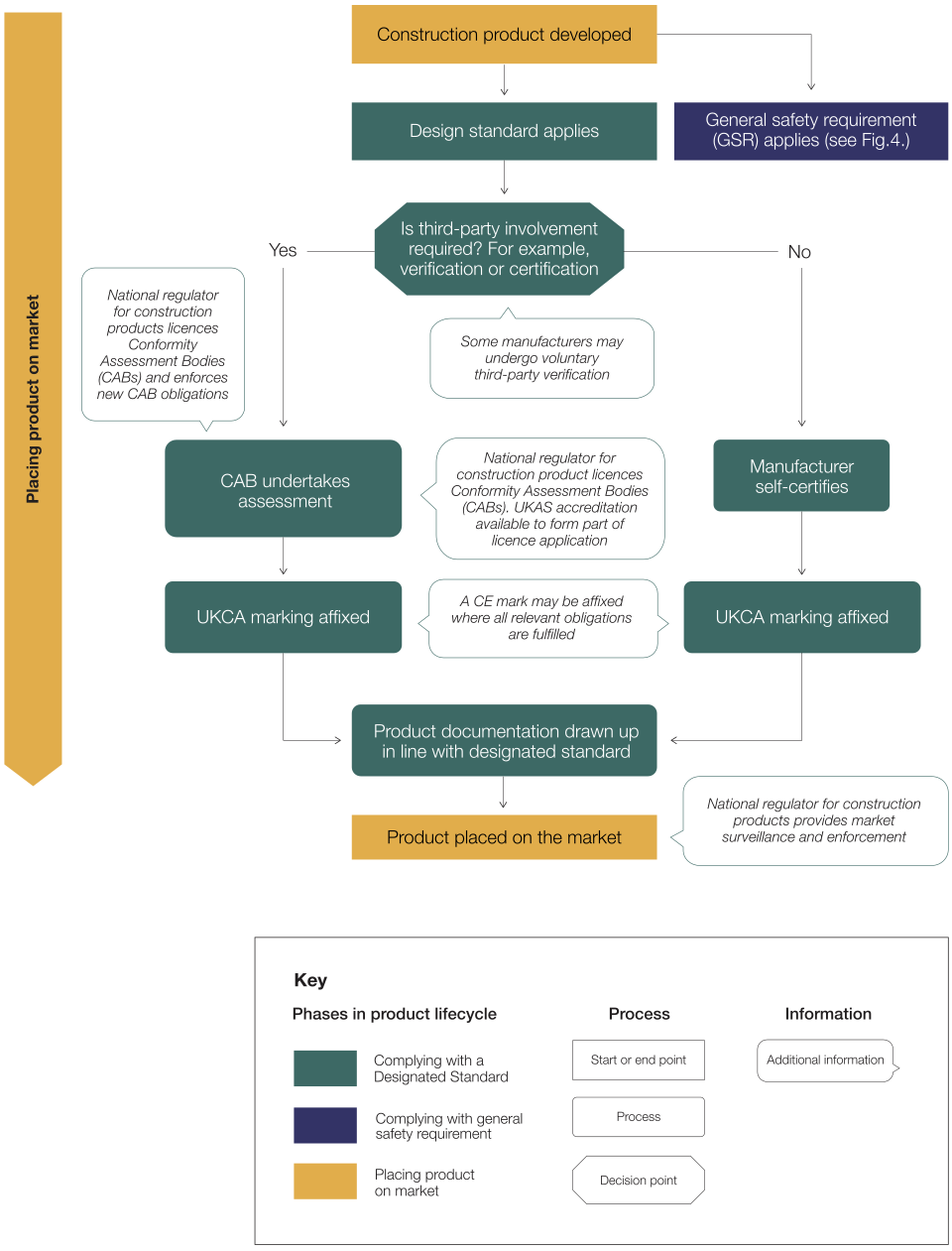
6.4 A general safety requirement for products not covered by a designated standard or technical assessment
6.4.1 We consulted in the green paper on a new general safety requirement (GSR) to regulate currently unregulated construction products. These are products not covered by a designated standard or technical assessment.
6.4.2 In the green paper we proposed a requirement on the manufacturer to undertake a proportionate risk assessment. The assessment is intended to eliminate or control any safety risk connected to the intended use and the normal or reasonably foreseeable conditions of use of their construction product before it is supplied or placed on the market.
6.4.3 We also proposed that importers, distributors and fulfilment service providers share responsibility for construction product safety.
6.4.4 Just over half of respondents supported the introduction of a GSR but stressed the need for requirements to be proportionate to the level of safety risk posed. Some raised concerns about excessive reliance on self-declared compliance and called for clear obligations and detailed government guidance. Many supported the introduction of digital tools like product records to enhance transparency and traceability. Others sought phased implementation, training, and proportionate enforcement measures to aid compliance by SMEs.
6.4.5 We can confirm that we will bring all products within the regulatory regime in a risk based and proportionate way by introducing a GSR for products not covered by designated standards or subject to a technical assessment.
6.4.6 This requirement will place a clear legal duty on economic operators including (but not limited to) manufacturers, importers and distributors (including merchants) to place only safe products on the market.
6.4.7 We can therefore also confirm that obligations will be introduced for importers, distributors and fulfilment providers. They will be required to:
-
verify that manufacturers comply with the GSR
-
ensure product information is provided to users
-
ensure that products are transported and stored without damage or degradation
-
retain customer information to enable traceability
6.4.8 We are consulting alongside this white paper on the details of the GSR. This will ensure the final framework is proportionate to risk, practical, enforceable and aligned with broader government policy on product safety and growth. The GSR will be introduced through secondary legislation. We will allow for a transition period after introducing regulations and we are aiming for implementation by late 2027. Guidance to support economic operators to comply with their obligations will be published by the national regulator for construction products.
Figure 4: Illustrative steps required under the general safety requirement (GSR)
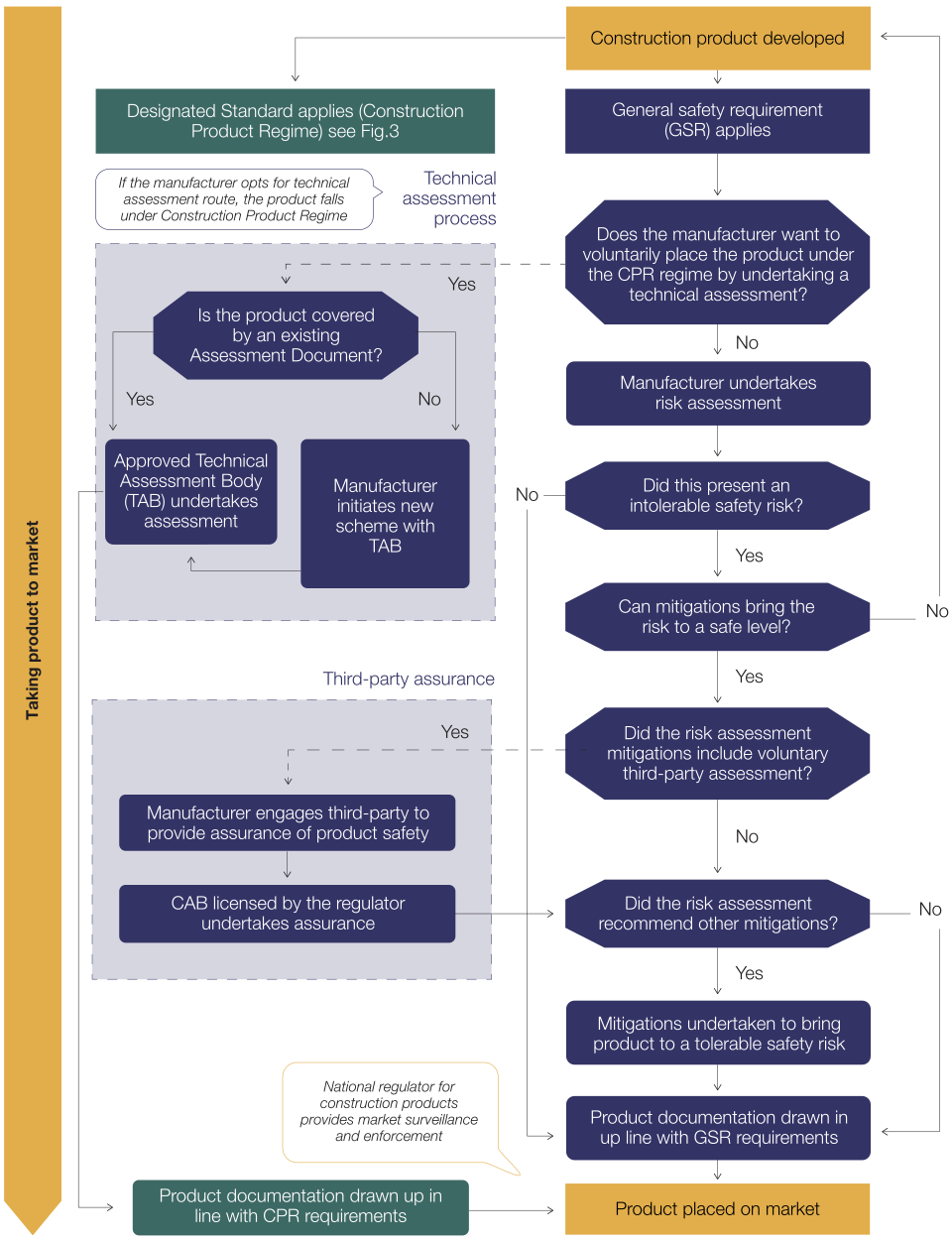
Meeting the obligations under the general safety requirement
6.4.9 We expect industry to take steps now to prepare for the introduction of the GSR. Some steps are already being taken. As part of this the BSI will shortly be publishing a new code of practice to support the safety of construction products across the UK.
PAS 2000:2026 Construction Products – Bringing Safe Products to Market – Code of Practice
The British Standards Institution launched a public consultation for proposed PAS 2000:2026 Construction Products – Bringing Safe Products to Market – Code of Practice. PAS 2000 is funded by government and officials from MHCLG and the OPSS have been engaged in this process.
PAS 2000 will provide a framework for all manufacturers to demonstrate they have taken reasonable steps to ensure their products are safe to be placed on the market. It will address pre-market risk assessment, factory production control, production information and collection, and the use of market feedback
The public consultation closed on 8 September 2025. The draft has been revised in response to the comments received and is due to be published imminently.
6.4.10 We consider that PAS2000:2026 will provide a vital step for industry to play their part in enhancing the safety of construction products used in the built environment. We consider the PAS an important tool to encourage safe practice across the sector.
6.5 The interplay with products subject to a UK technical assessment
6.5.1 If a manufacturer chooses to undertake a technical assessment against a UK Assessment Document (UKAD) or a European Assessment Document (EAD),[footnote 36] the product would be regulated under the construction products regulations. The GSR would not apply.
6.5.2 Where the manufacturer has decided not to pursue a technical assessment against a UKAD or EAD, the product would not be regulated under the construction products regulations. The product would be subject to the GSR.
Figure 5: Illustrative routes to placing a product on the market
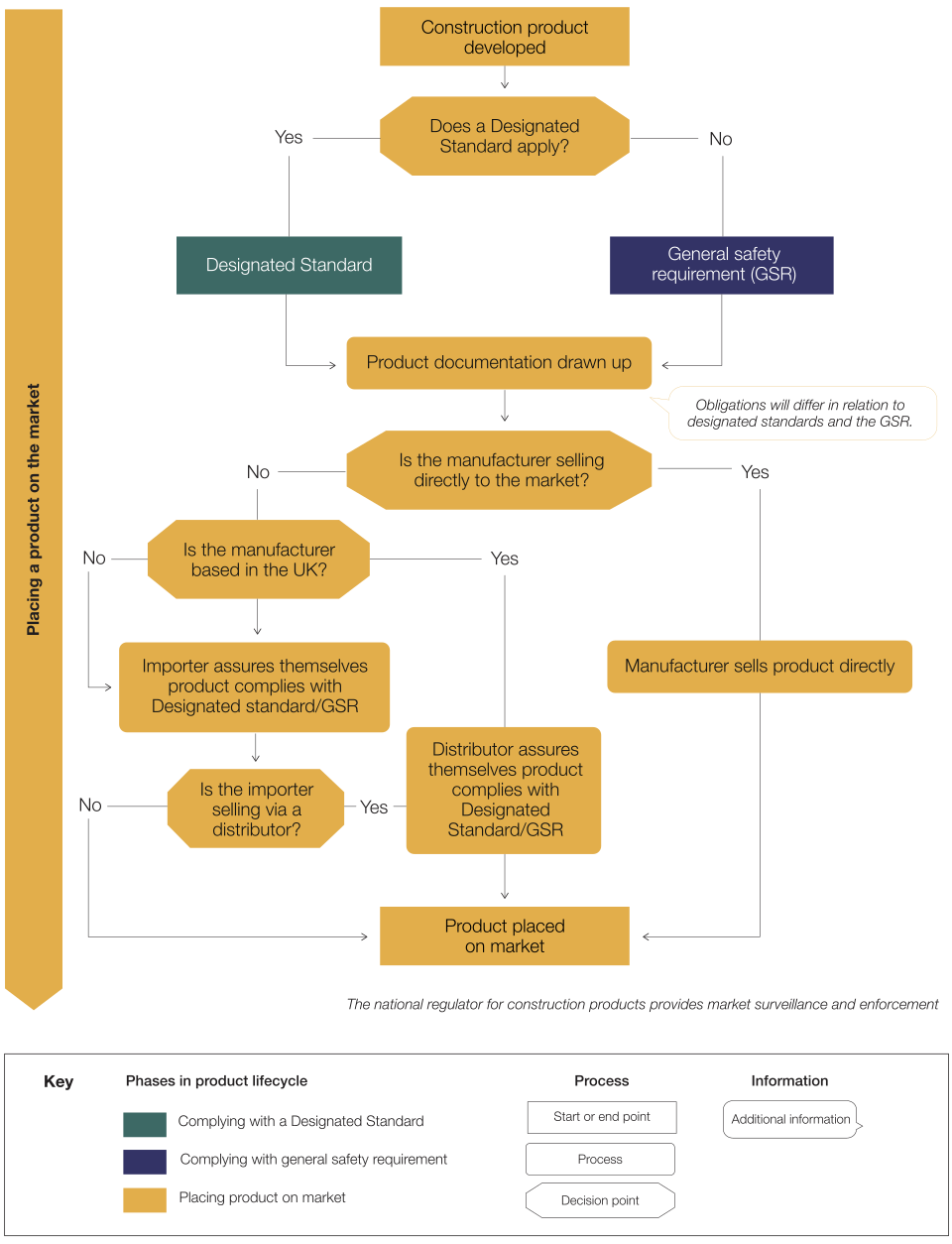
6.6 Enhanced rules for voluntary standards and third-party certification
6.6.1 Voluntary standards are widely used across the industry. As set out in chapter 1, whilst voluntary, these standards can also be advisory to demonstrate compliance with other regulations such as building regulations and approved documents. It is therefore important that there is a clear mechanism and structures to enable the BSI to be responsive to government objectives. Proposals for the role of the BSI are set out in paragraph 6.11.5. The role of advisory performance standards in statutory guidance will form part of the fundamental review of building regulations guidance.[footnote 37]
6.6.2 Third party certification schemes are also voluntary – they are not subject to regulatory oversight and adherence to schemes is not mandated.
6.6.3 The government is clear that robust, transparent schemes have a key role to play in providing additional assurance about products.
6.6.4 They are an important tool for those specifying and selecting products. Schemes can provide assurance and independent oversight to support decisions about selection and use, and can support innovative products being bought to market. However, the depth and nature of schemes can vary significantly, making it difficult for those specifying and selecting products to interpret scheme information. Additionally, in the event of concerns about a scheme, the national regulator for construction products has no power to act.
6.6.5 Research undertaken for government by the Adroit Consortium[footnote 38] identified that, because voluntary certification schemes are developed by and for market needs, there is no single framework or uniform baseline requirements across third-party certification schemes, and that there is no mandatory requirement to follow a specific model. The report also identified issues with accessibility and clarity of scheme information. The trust and assurance these schemes provide is also undermined where there is a lack of transparency of what schemes do and do not cover. The report concluded that greater transparency and standardisation may support better understanding and use of assurance schemes across the construction product supply chain.
6.6.6 The green paper outlined proposals including mandating minimum transparency obligations, the potential for minimum requirements that schemes must meet (for example minimum frequency of audits and/or sample testing), and for all schemes to require approval from the national regulator for construction products in order to be used. Consultation responses provided clear support for greater structure and oversight and minimum requirements. A clear majority indicated that schemes should receive upfront approval. Respondents also highlighted that surveillance and enforcement was required and that, within the context of a new third-party certification regime, government needs to define the role of the UK Accreditation Service (UKAS).
6.6.7 The government will take the following action:
-
the national regulator for construction products will be responsible for approving all third-party certification schemes and we will consider appropriate related offences for non-compliance
-
we will mandate minimum transparency requirements in respect of all third-party certification schemes in terms of process, form and content. This is not about mandating what schemes must include. Rather, it is about enabling those using schemes to make informed choices about which schemes best suits their particular needs. This will be achieved by making sure that there is clear and accessible information that enables schemes to be compared across providers. This will ensure that what schemes do and do not do is clear and transparent
-
the national regulator for construction products will be equipped with powers to set enhanced quality requirements. This information would be publicly available. We do not consider that it would be appropriate or proportionate to mandate levels of assurance requirements for every scheme. Instead, the national regulator could set threshold levels for a subset of schemes – for example, schemes that provide assurance for a particular product type – enabling an approach that is responsive to safety and drives transparency. This could extend to mandating the use of certain schemes to demonstrate suitability for particular uses – potentially supporting the new requirements for products critical to safe construction
-
scheme owners will be under a duty to ensure that the certification information is accurate
-
in addition, as detailed in Chapter 7, third-party scheme certificates will be required to contain sufficient information to evidence claims made about the product’s performance – including test results where appropriate
6.6.8 To drive accountability, responsibility will be placed on both the scheme owner and those using the schemes (typically manufacturers). We will give the national regulator for construction products powers of surveillance to ensure a scheme meets its declared levels of assurance. We will also provide powers to enforce against breaches, and we will consider appropriate offences related to third-party schemes.
6.6.9 Information on approved schemes will be made publicly available by the regulator, potentially via the construction product library. The government believes greater transparency in this area will inform decisions about selection and installation and will raise confidence in schemes.
6.6.10 During the consultation some expressed concerns that the effect of introducing minimum requirements would be weakened if the use of these schemes was not made mandatory. We recognise this concern, but do not consider that it would be proportionate to mandate the use of schemes across the board. The national regulator for construction products will, however, have the power to mandate the use of certain schemes in particular instances where there is greatest risk.
6.6.11 We expect these requirements would apply to all construction product schemes which conduct conformity assessment and surveillance activities to demonstrate whether a product meets safety, quality, or performance criteria. However, we will engage further to test this. Measures will require primary legislation and time for implementation.
6.6.12 Scheme owners can take early action. They can develop a voluntary approach, potentially through the BSI, as part of the pathway to greater transparency pending legislation enabling the reforms. This could build on previous work where MHCLG and a number of scheme providers collaborated to develop proposals for minimum standards for third party certification schemes for fire doors.
6.7 Technical Assessment Bodies
6.7.1 As a member of the EU the UK Technical Assessment Bodies (TABs) benefited from involvement in the wider European regime. When the UK left the EU, a parallel system was established for the UK TA regime. However, in practice the system has not been functioning well. The UK has not published any UK Assessment Documents (UKADs), while recent research undertaken for government by the Adroit Consortium[footnote 39] found that 177 European Assessment Documents (EADs) were cited between 2021 and 2024.
6.7.2 Whilst UK TABs can use pre-EU exit EADs as the basis for a technical assessment, there is no equivalent provision in law to enable UK TABs to adopt post-exit EADs as the basis for a UK Technical Assessment. This has resulted in divergence between the EU and GB.
6.7.3 The effect is that for some products there are outdated or absent technical specification requirements in Great Britain. This creates uncertainty for manufacturers and consumers, and makes the UK TA regime increasing less appealing to manufacturers. Further, whilst UK TABs can apply for observer status in the European Organisation for Technical Assessment (EOTA) following EU exit, UK TABs are unable to benefit from full participation in the EOTA, through which knowledge and expertise is brought together to support and facilitate the TA process.
6.7.4 The green paper recognised the potential for the TA route to support innovation for products not covered by designated standards. The consultation sought views on how it could be improved to better support uptake. Respondents indicated strong support for retaining the TA process and highlighted the flexibility for manufacturers in bringing new and innovative products to market. There was a clear appetite for establishing a UK based organisation like EOTA, to improve co-ordination and consistency among UK TABs. Respondents also expressed support for greater alignment with the EU technical assessment process, including the recognition and use of EADs developed since the UK left the EU.
6.7.5 The government will retain the UK TA regime, transitioning it to a fully voluntary route to market for products not covered by designated standards. This aligns with the revised approach under the new EU-CPR 2024 and will give manufacturers the flexibility to choose between regulatory pathways. The default will be that products not covered by a designated standard will be subject to the GSR, but the manufacturer may ‘opt in’ to the TA route. Consequently, the product would be regulated under the construction products regulations.
6.7.6 We will recognise EADs developed after the UK left the EU, in addition to those adopted before then. Where there are specific concerns about an EAD, the national regulator for construction products would be able to require that the product is either regulated under the GSR or is subject to a UKAD with different assessment criteria, irrespective of the fact that the product has been subject to a European technical assessment. This would be analogous to the UK’s ability not to designate a standard where there are concerns.
6.7.7 UK TABs will continue to have the ability to develop and adopt UK Assessment Documents independently of EOTA.
6.7.8 We also recognise the arguments put forward regarding the importance of UK TABs having greater involvement in this body. The Government is committed to cutting barriers to trade, and will always consider what further measures are necessary to enable the functioning and effective UK TA regime.
6.7.9 The national regulator for construction products will play a central, proportionate, role in overseeing the development and adoption of Technical Assessment Documents. This will include reviewing draft UKADs at key stages of the process, similar to the European Commission’s role under the revised EU-CPR 2024. The national regulator will also be responsible for assessing new EADs. This scrutiny and oversight will act as an important safeguard.
6.7.10 The government will engage further with UK TABs and introduce secondary legislation to make it easier for UK TABs to adopt EADs as UKADs, along with a framework to allow for appropriate oversight from the national regulator for construction products.
6.8 Products critical to safe construction
6.8.1 In the green paper we set out our intention to apply enhanced measures where there is a risk of serious harm if something goes wrong. The principal objective is to ensure that the regulatory regime provides sufficient assurance where products are used in scenarios that are critical to safety.
6.8.2 Many responses considered that installers of products critical to safe construction must be properly trained under approved schemes and operate in controlled environments. Many respondents advocated for third-party certification. There was also notable support for testing products and entire systems.
6.8.3 We remain of the view that more is needed to ensure that the regulatory regime provides sufficient assurance where products are used in situations that are critical to safety. There is a need to allow for obligations beyond the mandatory rules for placing a product on the market. But these must be proportionate to the risk involved.
6.8.4 Responding to feedback, we consider that it is the end use application which would determine whether it is critical to safe construction and intend to introduce a nuanced approach. This recognises that it is only the exact context within a building in which a product is used that defines how critical a product is for the overall safety of the building.
6.8.5 We consider that enhanced measures should apply where the failure of the product or system presents a risk to life. A limited number of products will always be critical to safe construction. For example, fire doors. Therefore, our expectation is that enhanced measures will primarily apply where the end-use application is critical to safe construction. These could be considered ‘safety critical scenarios.’
6.8.6 Consequently, proportionate obligations will be outcome based and focus on principal designers and principal contractors. Manufacturers will support designers. Obligations would be as follows:
-
principal designer – ultimately responsible for ensuring that what is specified and installed is suitable and safe for the intended use. The principal designer would be expected to consider the end use and undertake actions commensurate to that risk. This could be supported by guidance or statutory obligations to identify and mitigate risks in ‘safety critical scenarios’
-
principal contractors – would be responsible for ensuring that installation is carried out correctly and appropriately. Again, they would be expected to demonstrate how they have assessed the potential risks and taken appropriate action to mitigate those. In some instances, this could be by only using installers who meet certain competency requirements
-
manufacturers – will be responsible for meeting obligations in relation to providing product information. Increased take-up of robust third-party certification schemes could also support product selection and installation, along with support for competent installer schemes
6.8.7 The national regulator for construction products will be given duties to:
-
determine products or systems that are critical to safe construction. This is expected to a limited number
-
determine ‘safety critical scenarios’ where enhanced obligations would apply. The focus here would be on the final combination of products that make up a system
-
set requirements and issue guidance to support principal designers and principal contractors
6.8.8 We recognise that designers and contractors are already subject to range of obligations that aim to ensure safety. We will undertake further engagement with industry as we develop these proposals to ensure a proportionate approach that avoids duplication or overlap with other obligations, and truly adds value.
Question 1:
What should be included in guidance to support industry to understand their responsibilities regarding products critical to safe construction?
Figure 6: Illustrative Steps required for products identified as critical to safe construction
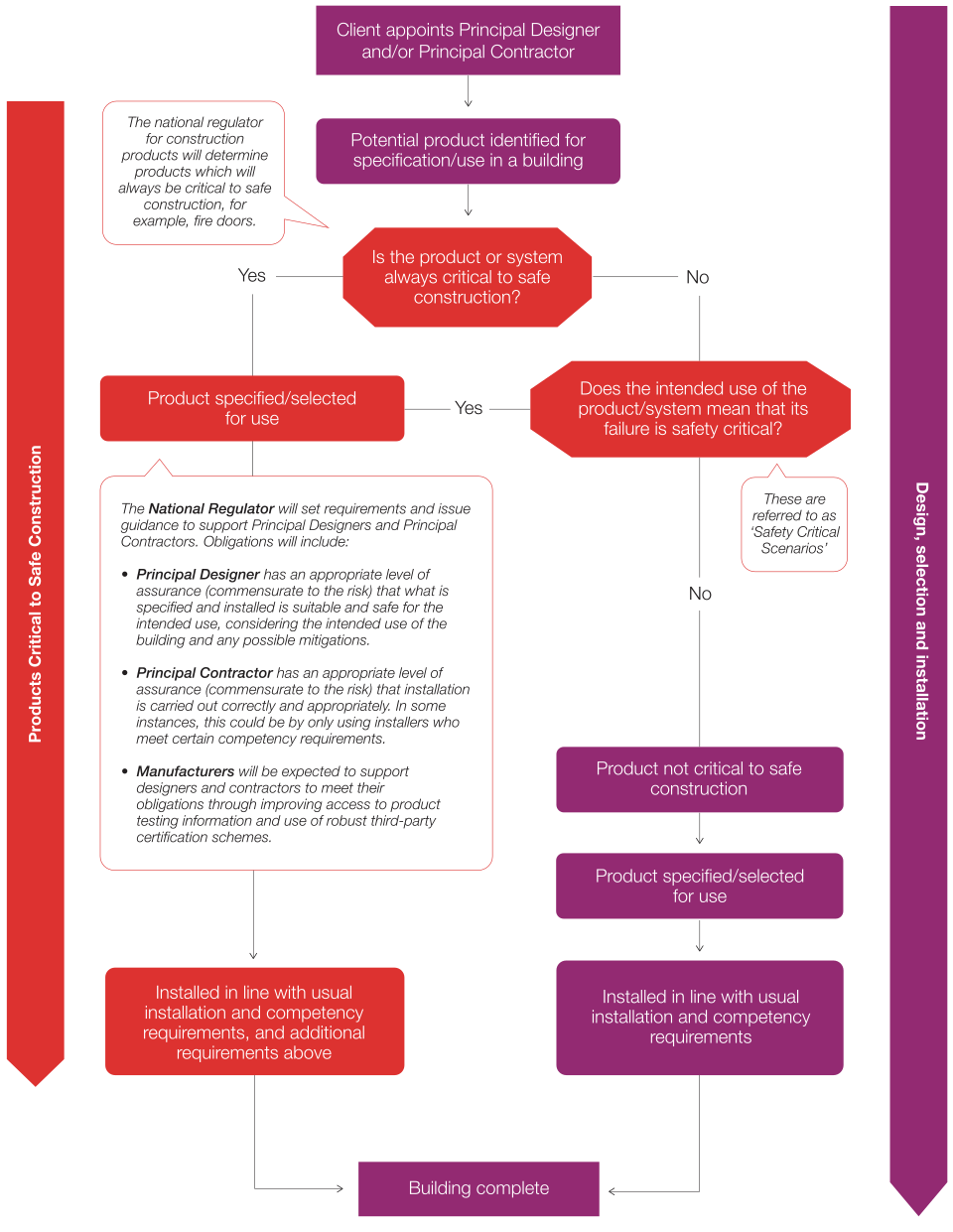
6.9 Product selection and use
6.9.1 In the green paper we highlighted that the Grenfell Tower Inquiry’s Phase 2 Report identified a lack of competence and/or due regard for safety across a number of organisations working on the Grenfell Tower’s refurbishment, including architects, the principal contractor and installers.
6.9.2 The current regulatory landscape for product selection and use is set out in Part A. As noted, there is a fundamental weakness in the regulations in relation to the selection and installation of construction products during building works. This leaves a critical gap in oversight, where unsafe practices can have serious consequences. We consider that more is needed.
6.9.3 Responses from the green paper made it clear that problems relating to construction product selection and installation can be found throughout the lifecycle of the product, not only at the point of selection and installation. They referenced:
-
unclear responsibility and accountability as well as issues around competence, including of product selectors and installers
-
the availability and quality of product information; the limited incorporation of digital tools such as digital product records
-
the quality of building control inspections during and post construction
6.9.4 Engagement consistently highlighted concerns that Regulation 7 of the Building Regulations 2010, and the supporting statutory guidance in Approved Document 7, were not fit for purpose. This was partly because they are not fully understood, nor being adequately enforced.
6.9.5 We agree that the regulatory framework for the selection and installation of products needs to be strengthened to support safe outcomes, particularly for products and scenarios critical to safe construction. Issues identified include: unclear responsibility and accountability throughout the lifecycle of a product; inadequate designer and contractor competence and awareness; and insufficient requirements in building regulations and guidance.
6.9.6 It is the responsibility of those designing and carrying out building work to ensure buildings are safe and meet building regulations. We recognise the importance of building control to quality and building safety outcomes. We think that there is a need to consider the potential benefits in supporting standardised inspections to ensure consistent oversight and the safe use of products. We also consider it essential that product safety is assessed within the context of entire systems and not in isolation. We will set out further detail on this in due course as our proposals develop, in the context of wider building control reform.[footnote 40]
6.9.7 We will also review Regulation 7(1) of the Building Regulations 2010, to ensure that it supports the safe selection and use of products. We are working closely with the Building Safety Regulator as part of the fundamental review of the building regulations guidance to review Approved Document 7. Areas for potential clarification/reform include:
-
ensuring there are clear expectations, including safety focused obligations on those specifying and installing construction products
-
guidance on the ways of demonstrating compliance of construction products, and the roles of independent certification, testing and self-declaration within this
-
clarification on the meaning and purpose of CE/UKCA marking
-
guidance on how the adequacy of re-used products can be assessed
-
guidance on installation that an inspector can check against
Figure 7: Illustrative Steps required to ensure safe selection and installation of construction products in line with the duty on the client, principal designer, principal contractors and installers
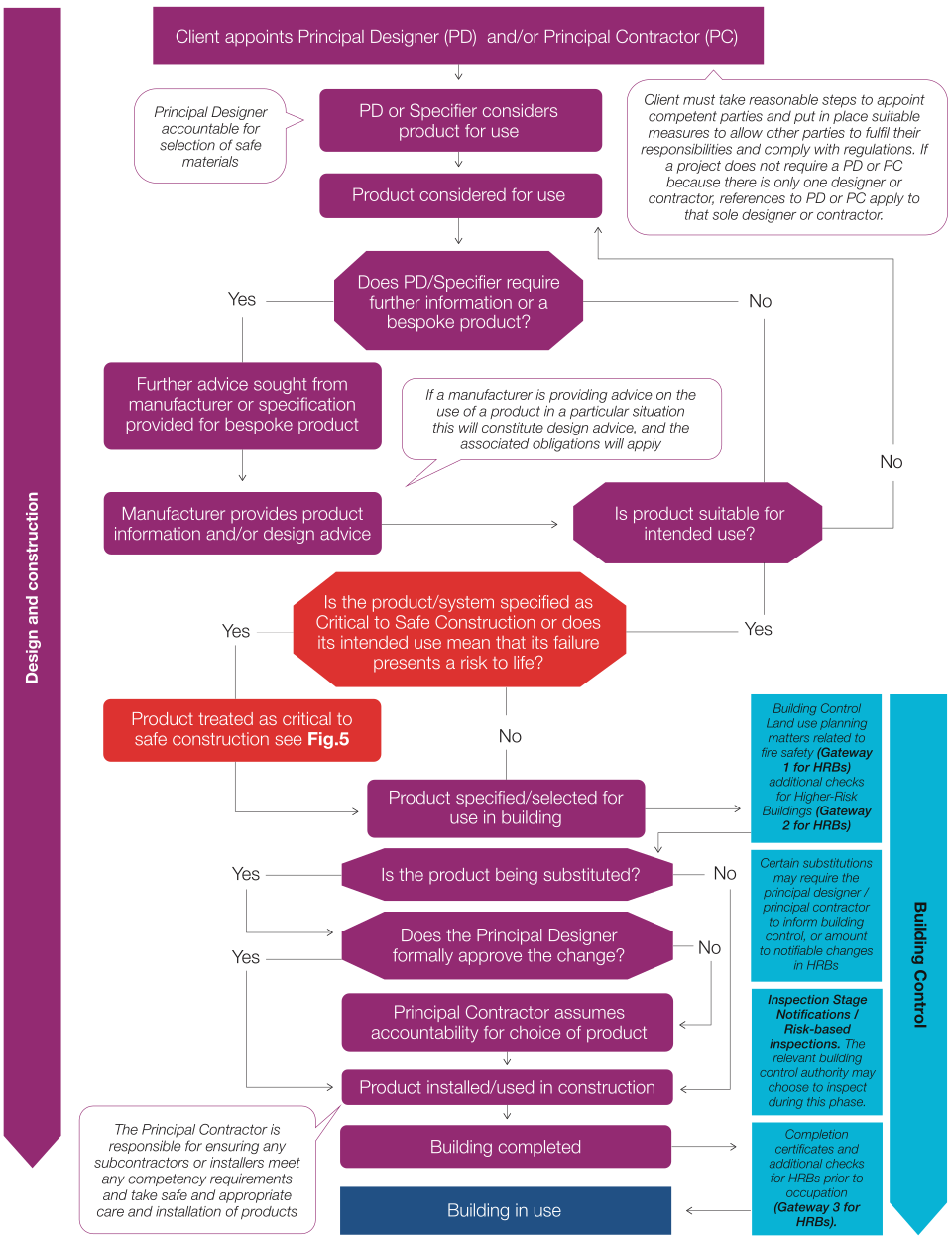
6.10 Product marking
6.10.1 We want clear product marking which demonstrates the product complies with the relevant rules for placing it on the market, and enables access to supporting information. In the green paper we sought views on the role of product marking in the future regime. Views on this topic were mixed. There was no clear demand for a digital alternative to the UKCA/ CE mark, with just over one third of respondents voicing support. Whilst there was broad support for digital innovation, most respondents expressed caution about replacing the UKCA mark entirely.
Products subject to a designated standard
6.10.2 At present the UKCA mark must be affixed by the manufacturer. Alternatively, the CE mark can be used where the relevant requirements of the EU regime have been met. We will retain the UKCA marking as a mandatory physical label for products regulated under the GB-CPR, alongside recognition of the CE mark. The UK(NI) mark and the CE mark will continue to be available for products being placed on the market in Northern Ireland.
6.10.3 We do not intend to introduce a digital alternative to the physical mark at this stage. We recognise the benefits that digital labelling could bring and will continue to discuss with businesses and other interested organisations as we consider our approach. Alongside, we intend to require that additional information be provided alongside the UKCA mark, to make the mark digitally enabled. For example, consistent with the EU-CPR 2024, we intend to require that a data carrier (i.e. a linear bar code symbol, a two-dimensional symbol, or other automatic identification data capture medium that can be read by a device) be provided alongside the UKCA mark. The intention here is to make product marking ‘digital ready’, whilst recognising that the introduction of any such requirements would be subject to the establishment of a digital platform sitting behind this.
6.10.4 Whilst reforms to the EU-CPR 2024 increase the focus on safety, it is important to ensure recognition that the UKCA and CE marks are not safety marks. Additional guidance will be published to support understanding, primarily for the benefit of those selecting and using products.
A voluntary mark for ‘best in class’
6.10.5 In the green paper we sought views on the merits of establishing a UK government mark which could be available for manufacturers to affix on a voluntary basis where they have met a higher level of assurance and/or quality. There was mixed appetite from respondents, with no majority view. Less than half supported the proposals, and just over one quarter considered that this was not necessary. Those supporting made clear this was conditional on a clear purpose for any such mark(s) – for example for products critical to safe construction. Considering views we will not take forward a voluntary mark at this time.
6.10.6 We intend to introduce a requirement that a data carrier be provided alongside the UKCA mark. We will also engage further with industry regarding the additional information that will be required to enable digital readiness.
6.11 British Standards Institution
6.11.1 The BSI is an independent body that plays a significant role in construction products standards, including representing UK interests in Europe and globally (see chapter 1). The government acknowledges the significant time commitment of those who participate in BSI standards committees. However, the government must be assured this national standards body can fully provide high quality, timely standards that meet UK priorities in relation to construction products. The Morrell-Day Review made multiple recommendations including that the government: “satisfy itself that BSI is free to act on mandates to develop or revise standards required as a UK national priority, unconstrained by the rules for CEN/CENELEC membership.”
6.11.2 The green paper set out a range of proposals to strengthen the relationship between the government, the national regulator for construction products and the BSI in relation to construction products standards. Proposal sought to ensure that priorities and activities are better aligned to support the shared objective of safe products and a safer built environment. Measures proposed also aimed to improve the transparency of decision making and accessibility of standards.
6.11.3 Respondents felt that greater representation was needed within the standard setting process, with a significant minority indicating that slowness is a weakness when it came to standard setting. Almost two thirds of respondents thought mandatory standards should be free to access. There was also clear signal from consultation responses that the priorities to address were: to have a more defined relationship with between MHCLG and the BSI; for a greater role for the national regulator for construction products in any new relationship between MHCLG, the BSI and the national regulator; for the national regulator and MHCLG to be present on the BSI’s committees; and for there to be greater transparency of decision making.
6.11.4 We recognise that the government’s participation in the processes for developing construction products standards reduced over a number of years. Since the establishing of the national regulator for construction products, this has started to improve, with the national regulator participating in several key committees. This participation is vital to help ensure that standards can meet national priorities and support safety. The intention is that this involvement will continue to grow.
6.11.5 The BSI has a crucial role in supporting the goal of safe construction. To fully realise this objective we believe that it is necessary:
-
to develop a process to facilitate commissions from MHCLG and/or the national regulator for construction products to the BSI to review construction products standards where potential concerns have been identified, to support national priorities
-
for BSI to put in place processes to enable identification, assessment and escalating of strategic risks and issues to the regulator and/or government, harnessing the expertise and knowledge of its standards committees
-
to systematically identify, assess and escalate information on key risks and issues that BSI committees are aware of. This information will support the standard setting process and inform policymaking and regulatory activity
-
to increase transparency of decision making in relation to construction products standards, including in relation to the technical or scientific basis of decisions, and the intent behind the changes
-
to continue efforts to increase the diversity of views represented in the standard setting process, for example increasing citizen representation
6.11.6 We will strengthen governance arrangements, including a Memorandum of Understanding (MoU) setting ways of working in relation to construction products. This reflects the unique mandatory nature of all designated construction products standards.
6.11.7 In the event that BSI is unable to deliver a new or revised standard, the regulator and government will have powers to commission standards from other bodies.
6.11.8 With regard to access to standards, we recognise that reaching the point of free access will take time and would require funding. In the intervening period, the BSI is taking action to make it easier for users of mandatory standards; for example, by building on its current provision of offering access at lower cost for smaller companies.
6.11.9 Given BSI’s recognition as the UK’s national standards body, accountability to industry and product users is important to ensure that there is trust in the standards development process. As part of this, MHCLG will be working more closely the BSI. The BSI will be expected to send annual reports of its activities in relation to construction products to the national regulator for construction products and to government, including on progress on implementing reforms. The BSI will be expected to publish that report.
Chapter 7: Clear, accessible information
7.1 About this chapter
7.1.1 This chapter sets out the government’s proposals to make information about construction products readily accessible. It details the government’s objectives for product information, including where used to make marketing claims, and proposed information requirements to ensure product information supports safety. It covers proposals to improve the quality, consistency and availability of product information and the digital infrastructure needed. The chapter also sets out areas for further exploration, where close working between government and industry will be needed – particularly in fast changing areas like digitalisation.
7.2 Policy objectives
7.2.1 The problems set out in Part A include poor access to information, fragmented or incomplete information, and difficulty in regulatory oversight. The following objectives underpin proposed interventions to address these. Information should be:
-
supportive of safe and competent decision-making: the information made available should be relevant to those designing, building and maintaining buildings and infrastructure
-
consistent: there should be a shared standard and understanding of the type of information required and the expected quality of that information; that these standards and expectations should be routinely met; and there should be clear protocols followed in producing, disseminating and verifying that information
-
accessible: those who need access to relevant information should have it as default (i.e. without users having to make undue efforts to seek it out or disentangle it from non-relevant information) and in digital formats. This should include but not be limited to those who need information to make decisions that impact safety, to verify others’ decisions and to meet statutory obligations (including to support the Golden Thread)
-
up-to-date: when changes are made to products, their manufacture or testing, the information should be updated in a timely manner
-
accurate and verifiable: when claims are made about the performance of a product – including in marketing information – those claims should be wholly based on trusted evidence, and that evidence is available to regulators at a minimum
-
proportionate: so that the burdens of providing do not outweigh the need for information on safe products and safe use
-
digitally interoperable: information should be available digitally and in formats that are compatible with tools used in industry today and in the future
-
traceable: products should be identifiable and their associated information accessible and persistent; enabling over the longer-term the establishment of more sophisticated, digital approaches to tracing information, throughout the use and supply chains
7.2.2 Responses to the Construction Products Reform Green Paper confirmed support for the direction of travel set out to ensure clear, high quality supporting product information.
7.2.3 Accurate product information is a crucial building block of our overall reform programme and will support delivery of our wider objectives of safety, growth and innovation and accountability.
7.2.4 We welcome industry-led schemes such as the Code for Construction Product Information (CCPI) and its work to drive up standards in product information and marketing.
7.3 Measures setting out what product information should be required
Product information requirements
7.3.1 We will place product information requirements on manufacturers and other economic operators to ensure that products are accompanied by relevant and comprehensive product information and that claims made about a product can be supported by evidence. This will be factored into revised regulations for products covered by designated standards and through the general safety requirement (GSR).
Product information requirements for products covered by designated standards (the EU-CPR)
7.3.2 We will be consistent with the EU-CPR where this meets our objectives (see chapter 6). This means that economic operators will be required to provide comprehensive product information, including under the categories of:
-
general product characteristics
-
intended use and technical specifications
-
instructions for safe use, disposal and maintenance
-
installation guidance
-
information on environmental performance
-
declarations of performance and conformity
-
unique product identifiers and versioning
-
certification and assessment details
-
safety evidence including warnings and test results
-
storage and transportation guidance
Product information requirements for products covered by the general safety requirement (see associated consultation on the GSR)[footnote 41]
7.3.3 For products captured by the GSR, we are proposing that all economic operators will be required to provide digitally available, comprehensive product information, including under the categories of:
-
general product characteristics
-
intended use and technical specifications
-
instructions for safe use, disposal, and maintenance
-
installation guidance
-
certification and assessment details
-
safety evidence, including warnings and details of voluntary testing that has been undertaken
-
unique product identifiers
-
storage and transportation guidance
-
information on any voluntary standards and third-party certification
Provision of test results
7.3.4 Product testing plays a key role in underpinning the regulatory regime by providing evidence of a product’s performance in specific conditions. The results of tests provide valuable information to those selecting and using the product. The information may be used for the purposes of demonstrating compliance, and/or for marketing purposes.
7.3.5 The Grenfell Tower Inquiry’s Phase 2 Report cited instances of manufacturers making false or misleading claims and made two related recommendations – on making test results available (113.23) and establishing a ‘construction library’ (113.39).
Provision of test information: Grenfell Tower Inquiry Recommendation 113.23
In our view clarity is required to avoid those who rely on certificates of conformity being misled. We therefore recommend:
-
that copies of all test results supporting any certificate issued by the construction regulator be included in the certificate
-
that manufacturers be required to provide the construction regulator with the full testing history of the product or material to which the certificate relates and inform the regulator of any material circumstances that may affect its performance; and
-
that manufacturers be required by law to provide on request copies of all test results that support claims about fire performance made for their products
7.3.6 The above recommendation should be read in the context of recommendation 113.22 (see paragraph 8.1.4) that “the construction regulator should be responsible for assessing the conformity of construction products with the requirements of legislation, statutory guidance and industry standards.”
7.3.7 The government accepted the Grenfell Tower Inquiry’s recommendation 113.23, in principle. We are clear that any claims made about a product’s performance, including statements about its suitability for use in certain situations, must be clear, honest, and evidenced. It is the responsibility of manufacturers, distributors (including merchants) and other economic operators to provide the information to demonstrate this.
7.3.8 In the green paper we recognised that this is a complex area, with varying levels of data produced, in different formats and for different audiences. We also recognised that there may be legitimate need to safeguard certain information – where it is commercially sensitive information and/or intellectual property. We sought views on what information is necessary to facilitate appropriate selection and safe installation, and to identify the circumstances in which disclosure of test information was not appropriate.
7.3.9 Respondents overwhelmingly stressed the need for test data to be clear, relevant, and reflective of real-world conditions. Many called for transparency about what was tested, how, and under what conditions – along with any limitations – so that designers, specifiers, and installers can make informed decisions. While transparency was widely supported, many respondents considered that disclosure of proprietary information could result in others gaining insights into product performance and potentially copying designs.
7.3.10 We agree with the Inquiry that different information has utility for different groups. We recognise that information on product testing can be highly technical and detailed, and sufficient competence is required to understand and apply test information to support the delivery of safe outcomes.
7.3.11 The government is unequivocal that the significant failings exposed by the Inquiry in relation to the provision of test information must be addressed. Therefore, the government will take forward the following:
-
all third-party scheme certificates will be required to contain sufficient information to evidence claims made – including test results where appropriate. This will deliver the first part of the Inquiry’s recommendation
-
we will equip the national regulator for construction products with the powers to access all information that it deems necessary to satisfy itself that a product complies with relevant legal requirements. This will meet the second part of the Inquiry’s recommendation
7.3.12 We will address the third and final part of the Inquiry’s recommendation in several ways:
-
manufacturers will be legally required to be able to evidence claims about a product’s performance relating to safety and safe use or other claims in any Declaration of Performance
-
for all products, manufacturers will be required to take all reasonable steps to comply with legitimate requests for access to test information. Where there are legitimate issues with releasing information that is commercially sensitive, ‘reasonable steps’ could include the use of non-disclosure agreements, or by providing access to a hard copy of documents in person
-
for third party certification schemes, manufacturers will be required to provide information on what tests have been undertaken, potentially via a digital service or ‘construction library’
-
we expect to see manufacturers develop and adopt a protocol to provide a consistent format for presenting test information. This would help to address issues with the variability in the amount and format of test information, which makes it difficult for those selecting products to compare information. We will legislate to mandate the disclosure of test results if industry fails to step up
7.3.13 The Inquiry also found evidence of test information, that would have affected the validity of a product’s certification, not being shared with the Conformity Assessment Body that issued the certificate.
7.3.14 In the green paper we sought views on whether manufacturers should be required to declare in advance whether testing they commission is a) for R&D purposes or b) to support the product being placed on the market (i.e. used to demonstrate compliance or make a claim about the product). The green paper considered that test data that falls under ‘b’ should be disclosed to those selecting or using the product. The policy intention was to address the issue exposed at Grenfell where a manufacturer failed to share test results which would have affected the validity of a certificate issued at an earlier date. Taking account of responses, we consider that this aim can be better achieved by the following measures:
-
when engaging a CAB or testing house, manufacturers 1) must provide any information on past tests that may be relevant to preparing and undertaking the assessment, including failed tests; and 2) will be legally obliged to share any subsequent test information with the CAB
-
CABs and testing houses will be required to take reasonable steps to ensure the certificates they are issuing remain up to date
-
the national regulator for construction products will be equipped with powers to mandate disclosure of cumulative test data from licensed CABs. This could include data on the proportion of pass/fail results, which would help the regulator identify where a CAB might warrant further inspection
7.3.15 The government considers that this package of measures is comprehensive and proportionate. For third party certification schemes, manufacturers will be subject to a new legal duty to make it known when they have undertaken tests and share any information that may affect the validity of a certificate with the issuer of the certificate. Those issuing certificates will be under a duty to take reasonable steps to ensure the certificates they issue are accurate and remain up to date. This dual approach will ensure that those selecting and using products can have confidence in the information presented, enabling safe outcomes. And, for all products, manufacturers will be required to take all reasonable steps to comply with legitimate requests for access to test information.
7.4 Measures to ensure the truthfulness and quality of product information – including marketing.
7.4.1 The Inquiry found that a major cause for concern in the Grenfell Tower tragedy was deliberately misleading information about products used on the building. Government expects manufacturers and distributers to market products honestly. To back this up legislation exists to support customers and businesses where products are faulty or mis-sold.[footnote 42]
7.4.2 In the green paper, we asked for views on the adequacy of marketing legislation. Many respondents provided examples of manufacturers using vague language, ambiguous technical terms and selective information when promoting products although didn’t comment directly on the adequacy of legislation.
7.4.3 Respondents also pointed to limited regulatory enforcement against misleading marketing with many stressing the lack of technical knowledge within regulators as a significant barrier.
7.4.4 We agree that there is a lack of clarity as to the expectations around marketing and product information and that enforcement has been lacking. The policies on test results and product information outlined above will go some way to addressing these concerns. We will also make clear our expectations that product information should be clear, accurate and up-to-date, honest and evidenced. These requirements will extend to marketing materials and advice as well as technical product information.
7.4.5 We will also require that:
-
evidence supporting claims of performance contained in the Declaration of Performance or as it relates to safety should be accessible by the national regulator for construction products from economic operators on request
-
economic operators will be expected to keep information under review and update it as necessary
7.4.6 We will support the sector to comply with these requirements by providing guidance to clarify expectations.
7.4.7 To ensure misleading marketing is tackled effectively we need regulators with specialist knowledge of construction products. We will expand powers of the national regulator for construction products to investigate safety and performance claims in product information and marketing.
7.5 Measures setting out how and when product information should be provided
Digitalisation and digital infrastructure
7.5.1 This section sets out how digitalisation will begin to address longstanding issues set out in the Independent Review of the Construction Product Testing Regime (Morrell-Day review) and the Construction Products Reform Green Paper, including a lack of accessibility and standardisation of data. Getting this right will support industry and government to enable product traceability across the construction system chain.
7.5.2 Our ambition is to support the development of digital services that enable clear, accurate and honest product information accessible to anyone who needs it to make safer decisions.
7.5.3 In the green paper, we sought views on digital approaches to product information. There was significant support for improved digital accessibility to information. Improved traceability supporting the golden thread was highlighted as a key benefit. Many responses also noted the potential for enhanced safety and compliance and emphasised how it could support a circular economy.
7.5.4 Respondents expressed caution around issues of data ownership, maintenance and verification of information, and raised concerns about cyber security and the need to safeguard intellectual property in any digital infrastructure.
7.5.5 Implementation challenges such as cost, resource and the logistics of labelling products were also raised. Another concern raised was the risk of digital exclusion due to the inconsistency of digital capability across the sector.
7.5.6 Finally, respondents noted the complexity of the current landscape, including diverse and overlapping existing databases and catalogues, standards, formats and templates, each with their own scope, priorities and approaches. It will be a significant undertaking to align the sector in a standardised digital approach, while encouraging innovation.
Industry’s role
7.5.7 Industry leads in developing solutions that work effectively, recognising the range and variety of products and firms represented within the construction products sector. We welcome the positive innovation driven by industry to develop digital solutions to access product information.
Government’s role
7.5.8 Government has a part to play in establishing clear expectations of what information should be available digitally. We will set requirements in legislation and convene industry and government to deliver standardised and interoperable approaches to digitisation. We want to do this in a way that facilitates safe decision making, builds on existing foundations, and can be maintained, without overburdening manufacturers or stifling innovation.
7.5.9 The shape of any future system will be developed in the context of progress made by industry, by wider government policy on digitalisation, and the potential for interoperability between GB and the EU’s Digital Product Passport (DPP) system. DPPs remain a developing policy area in the EU with the potential for wider application. We are clear that those selecting and using products must have full access to the information they need to ensure the safe use of products. We aim to ensure maximum practicable accessibility of test information and consistency with the EU for products covered by designated standards where this meets our objectives for safe products, safely used.
Digital product information
7.5.10 Requiring digital product information is the first step in the on-going digitalisation of the wider built environment sector. Over the coming years product information should be made available digitally, in formats that are interoperable, accessible, and endure over time. To deliver this:
-
for all products, information must be available digitally. Product labelling must include unique product identifiers, linked to up-to-date product information through a digital label (such as a QR code)
-
products covered by designated standards will need to be accompanied by a declaration of performance and conformity which is available digitally. We will continue to explore how DPPs – or an equivalent that delivers our objectives more effectively – could be phased in for products covered by designated standards as new standards are gradually adopted
7.5.11 We intend to introduce requirements through legislation.
Digital infrastructure and structured product information data
7.5.12 Construction products and associated product information play a central role in delivering a digitalised built environment sector. Having common, structured approaches to creating and sharing digital construction product information will be important to enable interoperability between building information and other IT systems, as well as minimising complexity and supporting clear expectations of industry.
7.5.13 There is a substantial amount of work on-going in industry and across government to agree, define and create the appropriate data structures or templates, and supporting standards, processes and tools that enable well-functioning information flows that support safe decision making. There is also a parallel programme of work in the EU, including to develop the infrastructure to support DPPs.
7.5.14 We welcome the work so far by industry. We will continue to work with industry to progress a standardised approach to digital construction product data.
Traceability
7.5.15 Traceability of products through all phases of a product lifecycle, from design and manufacture to installation, use, and disposal is needed to ensure accountability. The ability to trace products enables corrective action to be taken and will support enforcement, market surveillance and consumer safety.
7.5.16 Digital labelling, unique identifiers and more comprehensive product information requirements are the building blocks. They should be adopted in ways that support the golden thread and greater product traceability across the whole lifecycle.
7.5.17 Parts of the construction product industry are already leading the way with traceability schemes for specific product groups. We welcome this.
The UK Certification Authority for Reinforcing Steels (CARES) is an independent certification provider for the constructional steels industry. Its CARES Cloud technology is a digital platform providing end-to-end visibility for each batch of reinforcing steel, providing provenance, compliance and carbon footprint data. By digitising the chain of custody, CARES Cloud provides verifiable, real-time information to support safer buildings, reduced carbon and stronger accountability.
Construction library and other digital services
7.5.18 The Inquiry recommended that a construction library should be established to enable designers of buildings (particularly higher risk and complex ones) to have access to information about products to support safe design choices.
Grenfell Tower Inquiry Recommendation 113.39
Those who design buildings, particularly higher-risk and complex buildings, would benefit from having access to a body of information, such as data from tests on products and materials, reports on serious fires and academic papers.…… we have referred to the Cladding Materials Library set up by the University of Queensland, which could form the basis of a valuable source of information for designers of buildings in general. We recommend that the construction regulator sponsor the development of a similar library, perhaps as part of a joint project with the University of Queensland, to provide a continuing resource for designers.
7.5.19 The government accepted this recommendation. In the green paper we set out a broader vision for a library to facilitate better access for a range of users, including consumers, designers and regulators, to a range of information about products. We said that this could include information such as fire safety and academic reports, as well as detailed product information necessary to select and use products that will be safe for the planned use.
7.5.20 We sought views on the information a library could host and its benefits. The majority of respondents spoke positively of the proposal to develop a library and contributed suggestions for its development and use. They also pointed out challenges with implementation and upkeep including noting the “mammoth task” of compiling and updating a library if it captured all the information explored as options in the green paper. Concerns about implementation included legal and confidentiality issues, funding and administrative burdens on manufacturers, trust and verification of data.
7.5.21 Respondents who supported the library suggested a wide range of stakeholders that would benefit. But it was also clear that there were different interpretations of what the most effective construction library might look like, ranging from a comprehensive database of product information to a targeted information hub.
7.5.22 Our ambition is to support development of digital services that enable clear, accurate and honest product information accessible to anyone who needs it to make safer decisions. We will support development of a construction library, working with industry.
7.5.23 This is a complex and busy landscape, and we want to ensure what we develop achieves our ambition and does not create duplication or confusion. There are a range of digital platforms that exist or are in development and different users are likely to have differing needs. Digital maturity across the sector is also variable.
7.5.24 We therefore propose taking a stepped approach, targeting interventions we can make now while supporting wider digitalisation including looking for opportunities for interoperability or alignment between reporting systems to reduce overall administrative burden. This will include:
-
ensuring the national regulator for construction products has access to the digital capability and information it needs to deliver a “digital first” approach to market surveillance and effective enforcement
-
continuing to develop an approach that makes transparent what tests have been undertaken for products using third party certification schemes but allows manufacturers to host this information. We will consider any resulting requirements, including for a digital platform or database and will seek the necessary powers to enable its delivery
-
identifying the best route to simplify industry and other stakeholder access to regulatory guidance and information about fire safety, including research
-
working with the Department for Energy Security and Net Zero (DESNZ on their proposals for an embodied emissions reporting framework (EERF), including an IT system, as set out in the recent consultation on a policy framework to grow the market for low carbon industrial products[footnote 43]
7.5.25 The University of Edinburgh research project with Design Fire Consultants provides an example of knowledge generation that already supports industry and fire engineers.
Case Study: University of Edinburgh Cladding Data Library
Building knowledge about the fire hazard of cladding systems is key to prioritising building remediation. One industry led exemplar of knowledge generation is Design Fire Consultant’s Cladding Data library.[footnote 44] Researchers at The University of Edinburgh (supported by Design Fire Consultants and the EPSRC’s Impact Accelerator Fund), have undertaken nearly 100 tests on different combinations of cladding and insulation to better understand their relative hazard. The results from these tests have been made publicly available – and Design Fire Consultants have provided examples of how the data could be used in practice.
Digital competence
7.5.26 To deliver accessible digital information that users need, industry must have the capability and competence to provide it. There are some manufacturers at the forefront of developing digital infrastructure to support information sharing, but that competence across the sector is far from universal.
7.5.27 Reports such as the Construction Leadership Council’s recently published “Developing Digital Competency in the Built Environment”[footnote 45] offer a practical framework for organisations to assess their digital capabilities and identify areas for growth will help.
7.5.28 The national regulator for construction products has commissioned research to understand the barriers to digitalisation across the construction products sector. We will use the outcome of that research to guide future work with the CLC, industry and DBT to further support manufacturers to improve their digital capability.
Chapter 8: Assurance and oversight of testing, conformity assessment and certification
8.1 Context
8.1.1 The Grenfell Tower Inquiry’s Phase 2 Report identified significant failings in conformity assessment, testing and certification processes and oversight. Whilst the Grenfell Tower Inquiry focused on the actions of specific organisations, the report noted that there was no reason to think that these shortcomings were confined to these cases. Further, the Independent Review of the Construction Product Testing Regime (Morrell-Day review) also found significant issues.
8.1.2 This chapter sets out how we intend to deliver strong accountability and robust oversight across this landscape, in a way that supports the public interest. In this context, we are using ‘acting in the public interest’ to refer to making decisions or taking action towards a common goal of safe construction products. This includes the future obligations and expectations of conformity assessment bodies (CABs), the national regulator for construction products, and the UK Accreditation Service (UKAS). It also covers actions that the government will take to underpin the new regime, including taking forward work to establish new public sector testing and Research & Development (R&D) capacity.
Undertaking conformity assessment
8.1.3 Conformity assessment is a general term to describe the systematic processes that are undertaken to determine whether a product has met specified requirements or standards. As detailed in chapter 1, a number of organisations have a role in the current process: CABs; UKAS; and the national regulator for construction products. Responsibility for the policy governing construction products rests with the government.
8.1.4 The Inquiry’s Report contained the following recommendation:
Grenfell Tower Inquiry Recommendation 113.22
We therefore recommend that the construction regulator should be responsible for assessing the conformity of construction products with the requirements of legislation, statutory guidance and industry standards and issuing certificates as appropriate. We should expect such certificates to become pre-eminent in the market.
8.1.5 As stated in the Construction Products Reform Green Paper we recognised the Inquiry’s diagnosis of the problem. The green paper highlighted systemic issues with lack of transparency, capacity and competence within CABs, including inadequate expertise and insufficient independence. This led to conflict of interests resulting in CABs putting commercial incentives over the public interest.
8.1.6 We recognise the scale of the issues identified and are clear that the sector requires fundamental reform to fulfil its critical role in public safety. We accepted the Inquiry’s recommendation in principle and will take forward reforms to address the three inter-related issues:
-
the lack of a regime that operates in the public interest
-
the lack of public sector testing capacity
-
the lack of overall regulatory oversight of all CABs
8.2 Conformity Assessment Bodies (CABs)
Duties on CABs
8.2.1 The government is clear that conformity assessment activity should be undertaken in a way that works in the public interest, and with transparency at its heart. Those making purchasing decisions as well as building owners, residents and communities relying on the safety of products must be confident in the information provided about a product.
8.2.2 In the green paper we said we were going to address the current issue whereby many CABs are unregulated, and that we were minded to introduce new regulatory obligations that would apply to all UK CABs that act in relation to construction products. We sought views on proposals.
8.2.3 Respondents were broadly supportive of our proposed measures to strengthen the oversight of CABs including mandatory licensing, statutory codes of conduct, mandatory test data reporting and publication, and regulator-led surveillance and enforcement. There was strong support for separating testing and manufacturing functions in CABs to ensure independence. Some respondents expressed concerns about conflicts of interest where CABs have dual roles in providing certification and consultancy to the same manufacturer, but there were mixed views on how the commercial relationship between manufacturers and CABs could be eliminated.
8.2.4 Following consultation, we will take forward the following measures. All UK CABs operating in relation to construction products:
-
will be required to obtain a licence from the national regulator for construction products
-
will be obligated to carry out their functions in the public interest
-
must act independently and impartially
-
must have processes to identify, declare and manage conflicts of interest
-
will be subject to reporting obligations to report known or suspected breaches of the legal requirements, and ensure there are processes in place to enable their employees to whistle blow concerns
-
will be required to meet new transparency requirements, potentially including an annual report to the national regulator for construction products summarising its activities. We will consider further the extent to which some of this information should be made public, potentially via the construction library
-
must ensure their technicians are trained appropriately and continually
-
will be expected to meet industry best practice
8.2.5 A number of these obligations will be set out in a statutory code. Adherence to the code will be a requirement for licence holders.
Licensing regime
8.2.6 At present the regime that regulates CABs is limited: it provides partial coverage of CABs’ activities. This is because only those CABs that undertake activities in scope of the construction products regulations (i.e. CABs testing and certifying products subject to mandatory standards) require approval from the Secretary of State. This approval is based on UKAS’s assessment and accreditation of the CAB; the current regulatory regime does not require the involvement of the national regulator for constrution products at this point. More widely, there are also limited incentives for CABs to champion best practice. A licencing regime of all UK CABs will enable the national regulator to enforce against poor performers and incentivise them to meet higher standards. It will apply to all UK CABs rather than a subset being regulated, as is the case at present. To achieve this we will take the following steps:
-
create a licensing regime for all UK CABs
-
move approval for CABs to operate from the Secretary of State (currently responsible for approving those which CABs operate under the construction products regulations) to the national regulator for construction products
-
associated oversight of all UK CABs will also sit with the national regulator for construction products
8.2.7 Through this white paper, we are seeking views on how the licence could be applied – for example whether it should have a uniform set of requirements or tiered to include enhanced requirements in areas of greatest safety risk. We are also seeking views on the following principles to inform the development of the licence:
-
it has clear criteria for the national regulator for construction products to evaluate against (e.g. in regard to competency, transparency, independence and accountability)
-
it supports the wider reforms, such as the new regulatory framework for third-party certification schemes
-
the requirements and costs of compliance are proportionate to the ris
-
it incentivises CABs to go beyond statutory minimums
-
it can be used to take enforcement action against poor performing CABs, providing a tiered approach where CABs failed to take sufficient remedial action (for example, a formal warning notification and/or partial restriction of the licence), and ultimately enable the national regulator for construction products to ban the CAB from operating
-
that licence information is easily accessible. As we take forward these reforms we will consider the potential benefits of licence information being available via the construction products library
Question 2:
Do you agree that the above principles should underpin the licensing regime for CABs? [Yes/No]. Please explain your answer. Please outline how you think a licensing regime for CABs could work operationally.
8.3 Regulatory oversight
8.3.1 The government is clear that strong regulation of conformity assessment is required to address the failings identified by the Inquiry and independent reviews. The green paper proposed that the national regulator for construction products would be responsible for setting the criteria to assess whether a CAB should be granted a licence. We also proposed that the national regulator would have powers to suspend or withdraw the licence and enforce against CABs who breach their licensing conditions.
8.3.2 Responses to the green paper consultation showed broad support for stronger oversight, with many responses offering views on additional measures. Within this, CABs themselves were mostly supportive of the need for greater oversight. Some respondents, in particular community groups and housing associations, expressed concern that the green paper proposed that testing and certification continues to be undertaken by private sector CABs and not the national regulator for construction products, as recommended by the Inquiry. A number of respondents cited the need for any new measures to be properly enforced, including regular audits.
8.3.3 We will:
-
task the national regulator for construction products with licensing all UK CABs operating in the sector and provide powers to obtain information to inform its assessment
-
require the national regulator for construction products to undertake ongoing monitoring of the conditions of the licence and CABs’ statutory duties and equip it with powers to enforce these new rules
-
give the national regulator for construction products duties in relation overseeing UKAS’s performance
Regulatory intervention in cases of specific concerns
8.3.4 We also recognise that there may be specific instances where a product should not be made available for sale unless the national regulator for construction products provides an assessment upfront as to the product’s safety.
8.3.5 Therefore, we will go further than the green paper proposals, by giving the national regulator for construction products powers to take responsibility for assessing and certifying the conformity of a product against the legislative requirements. This would mean that, where the national regulator has specific safety concerns, a product could only be placed on the market if it is first assessed by the national regulator. We envisage the use of this ‘backstop’ power would be limited and only utilised where there is a demonstrable need (for example where a specific risk is identified in relation to a product critical to safe construction).
8.4 UK Accreditation Service and the role of accreditation in CAB licensing
8.4.1 Accreditation involves assessing CABs against relevant internationally specified standards. It underpins approval of CABs (to be ‘approved bodies’) and supports a large number of voluntary third-party certification schemes. Accreditation is undertaken by UKAS as the national accreditation body.
8.4.2 Accreditation plays an important role by assessing whether CABs are competent to carry out specific conformity assessment activities. The primary focus of accreditation is in assessing whether bodies are competent, demonstrated through following appropriate processes. It is not the role of accreditation to consider wider outcomes – namely whether construction products are safe.
8.4.3 Further, the Inquiry noted that it is not possible for UKAS to review all the activities of an organisation being considered for accreditation. The Inquiry considered that this “meant that the effectiveness of its oversight depended to a significant extent on the honesty and integrity of the organisation in question”.
8.4.4 Under our reforms, UKAS accreditation will be available to form part of the evidence to support licence applications. However, the criteria for a CAB licence will be broader. Further requirements will also need to be met and the national regulator for construction products will be accountable for decisions regarding licensing.
8.4.5 UKAS will continue to undertake its specific function in line with its remit as National Accreditation Body in relation to the competence of CABs assessing construction products, with greater oversight by the national regulator for construction products.
8.4.6 We also want UKAS to be a strategic partner, supporting the national regulator and policymakers through proactive identification of risks and assessment of the strategic implications. To support, we will put in place measures to improve transparency of the results of the accreditation process and UKAS’s activities in relation to construction products.
UKAS’s role
8.4.7 UKAS was criticised in the Inquiry for its lack of oversight and monitoring of CABs. In the green paper, the government recognised the need to address these criticisms and put in place a more robust accreditation process. UKAS had already recognised the need to take action and therefore has been working to make sure the lessons of the Grenfell tragedy have been learned, through its “Programme PACE”.
8.4.8 Responses to the green paper called for clarity of roles between UKAS and the national regulator for construction products, formalising UKAS’s obligations, with some calling for greater transparency over its activities, better resourcing (including skills and competence of technical assessors) and for UKAS to play a stronger role in helping to drive cultural change to improve the sector.
8.4.9 We also consider that UKAS needs to do more to address the Inquiry criticism that it was “too trusting” of CABs, and to ensure that risks are identified and strategic implications considered and escalated. This needs to encompass both risks in the CAB sector, and within UKAS’ own internal systems. Additionally, we consider that UKAS needs to do more to evidence how the changes it has implemented through PACE have been effective. Overall, there remains a need to rebuild trust in the accreditation process for construction products that was found by the Inquiry to have failed.
8.4.10 The government is clear that oversight by the national regulator for construction products is appropriate and necessary. We will:
-
provide the national regulator for construction products with powers to oversee UKAS’s activities in relation to construction products. This could include setting objectives, agreeing priorities for the coming year, and determining UKAS’s reporting requirements, to support regulatory oversight and identify emerging risks and opportunities in the sector
-
set in legislation that the national regulator for construction products conducts periodic performance reviews of UKAS (at regular intervals or as necessary if issues arise) to ensure that it is fulfilling its responsibility for construction products and supporting safety
-
set UKAS obligations to support the regulator’s licensing and oversight activities, including that it looks across the piece to identify risks, and to pro-actively assess and escalate these to the national regulator for construction products
-
require UKAS to increase the transparency of the accreditation process and its activities. For example, by publishing summary information on accreditations, anonymised audit findings, and a clearer complaints process and escalation routes
-
task the national regulator for construction products with establishing an Oversight Board to monitor UKAS’s performance in relation to construction products, ensuring it is accountable to government and the public, as recommended by the Morrell-Day review
8.4.11 In addition, we expect to see UKAS deliver the following. We will introduce legislation where necessary to ensure that UKAS can meet these expectations:
-
fully utilising its powers to suspend accreditation certificates, including warning underperforming CABs at risk of having their accreditation withdrawn and steps needed to remedy failings
-
increased surveillance of CABs following completion of accreditation assessments through more audits, unannounced and randomised inspections
-
contributing to the integrated reporting and intelligence sharing between economic operators, regulatory authorities, and those involved in standard setting, testing and certification across the built environment
-
play a stronger role in helping to drive cultural change in the sector
-
continue to build technical skills and capability of its people
CABs established outside of the UK
8.4.12 CAB capacity in the UK is insufficient. For some products, including where conformity assessment is compulsory under the construction products regulations, there is no UK capacity. Further, in many areas where there is some capacity the wait times are unacceptably high.
8.4.13 Many green paper respondents highlighted capacity constraints for testing certain construction products, causing delays to bringing products to market. The green paper proposed recognising assessments by overseas CABs as a practical way to expand capacity quickly and to provide greater access to skilled technicians outside of the UK.
8.4.14 As set out in paragraph 4.4.1, we will continue to recognise products that have been assessed by EU-recognised CABs under the EU’s Construction Products Regulation. Such CABs would not be subject to the new licensing regime. However, irrespective of where conformity assessment activity has taken place, all relevant laws must be complied with when placing a product on the market in Great Britain and this will be enforced.
8.4.15 As set out in paragraph 6.6.7, all third-party certification schemes used in the UK will require approval from the national regulator for construction products in order to operate, regardless of where the scheme owner is established.
8.4.16 More broadly, there are additional benefits to the UK through facilitating global trade. Specifically, mutual recognition of conformity assessment would prevent manufacturers from having to repeat tests for different markets, reducing costs and administrative burdens. The UK has several existing mutual recognition agreements which we continue to promote as a means of reducing administrative barriers for British businesses. The government is committed to working with the EU to identify areas where we can strengthen cooperation for mutual benefit and realise the potential of the UK-EU relationship by tackling unnecessary barriers to trade to support growth in the UK and Europe.
Building CAB capacity and competence
8.4.17 We want the UK construction products CAB sector to be globally competitive and give confidence to customers that they meet high standards with tests conducted by skilled technicians. We agree with the Morrell-Day review that there is a need to address the inadequacy of conformity assessment and testing capacity in the UK. This can support growth and innovation and support a skilled and growing workforce. We also recognise that additional requirements placed on the construction products industry may place greater pressure on the services of UK CABs. The green paper sought views on what support UK CABs need to invest, grow and improve their technical skills.
8.4.18 The majority of green paper respondents stressed the importance of government support through providing investment, technical training pathways and regulatory clarity. The government recognises it has a role to play: a UK Group of Conformity Assessment Bodies will be convened to help facilitate consistency and sharing of procedures, training, and peer review. This group should also seek to establish links to international groups such as the EU Group of Notified Bodies.
8.5 Research & development, public sector testing capacity, and expertise
8.5.1 The UK’s cadre of specialist building science experts has been allowed to decline for decades. Alongside this, public sector testing and research capacity for construction products has reduced. The Inquiry noted a gap since the transition of the Building Research Establishment (BRE) from government advisor to contractor.
8.5.2 Public testing and research both play a crucial role in a well-functioning construction products sector. The regulatory framework and enforcement must be informed and supported by expert, impartial advice. However, a number of issues currently exist:
-
there is a lack of testing capacity across the UK, both in terms of insufficient laboratory space for the amount of required testing and a lack of qualified personnel to perform the tests and interpret the results. The effect is that the regulators are forced to compete with private entities for testing capacity, causing delays and threatening the regulator’s ability to address potential concerns in a timely fashion
-
the Inquiry identified a disconnect between (the now) MHCLG, which owned and updated the building regulations, and BRE, which performed the testing and scientific analysis to inform the regulations. The Inquiry recommended that as much as possible these processes be carried out by the same organisation. This will require experts who understand the science to be in constant discourse with those making the regulations and advising ministers
8.5.3 More broadly, there is a need to ensure that expertise is used to support research and development in testing methodologies and to rebuild capabilities in the public sector where gaps have emerged since BRE’s transition. The system is not well placed to develop new approaches or respond quickly to emerging safety concerns.
8.5.4 Further, independent technical advice is essential to inform policymaking and ministerial decisions. Strengthening how expertise is accessed and applied will help address gaps and ensure impartial, specialist input informs decision making. This will support innovation and enable regulators to act at pace.
Public sector testing and R&D capacity
8.5.5 We define public research as the particular type of research that is delivered by government agencies and publicly funded. This research is focused on long term practical utility and public safety while not distorted by commercial pressures. Public sector testing in the context of construction products refers to testing undertaken by government, and is currently undertaken by two organisations:
-
the regulatory surveillance or enforcement testing of construction products to assess compliance with regulatory requirements. This is carried out by the national regulator for construction products
-
research testing to inform the constant review and updating of the building regulations. This is performed by the Building Safety Regulator
8.5.6 In the green paper we introduced the potential for a national testing facility for building safety science. Respondents were broadly supportive of government taking more action. A majority agreed that an increase in public and private testing capacity is required, and that a lack of testing capacity is available in the UK, resulting in high testing costs and long lead-in and turnaround times. The majority also felt that there was scope for the government to lead and promote R&D within the construction products industry.
8.5.7 Following consultation, we consider that new public sector testing and research capacity is crucial to underpinning the future regime. This was confirmed in the Single Construction Regulator Prospectus: Consultation Document, published 17 December 2025.[footnote 46]
8.5.8 New public sector testing capacity will enable both enforcement testing and research testing to be performed. Such facilities will:
-
provide much needed capacity for the regulators, with the associated benefit that more private sector capacity would be freed up for manufacturers
-
act as an authoritative, independent source of technical expertise and insight, to support regulatory activity and inform policy
-
enable regulators to undertake research to pre-empt new technologies and ensure that the regulatory framework is continually fit for purpose. It would allow the national regulator for construction products to continually scan the horizon for new threats to building safety posed by technological developments. This type of research is not suited for contracting out to private entities: it requires a long-term continuity of project and personnel that is not possible with the short-term contracts currently utilised
-
support delivery of new homes and infrastructure, by enabling innovation in the built environment whilst ensuring that new buildings are fundamentally safe, giving residents confidence
-
support the development of a new talent pipeline for the industry, rejuvenating the UK’s cadre of specialist building science experts via the creation of new jobs for specialist building safety research
-
opening up this capacity to private use could also allow expertise and good practice to be shared with outside users and potentially provide options for income generation
Harnessing technical expertise to inform regulatory activity and policy development
8.5.9 Good public policy depends on access to expert, impartial advice. The government and regulators rely on expert advice on matters of technical policy. The Inquiry Phase 2 Report and the Morrell-Day review both emphasised the need for regulators to build expertise and operate as informed, ‘intelligent clients’ when engaging with external specialists.
8.5.10 The regulators employ a range of technical experts, such as fire engineers. They provide advice and can also act as an ‘intelligent client’ to commission and evaluate new research and advice. Their technical and scientific expertise is supplemented by external expertise.
8.5.11 The national regulator for construction products maintains a register of experts and commissions work as required. The expert panel is a standing group that advises on ongoing compliance, product safety, and emerging regulatory challenges. Membership and engagement are coordinated by the national regulator.
8.5.12 The BSR monitors new innovations and developments in the construction industry to ensure that building regulations always account for the changing nature of the built environment. The BSR’s principal source of external expertise is the Building Advisory Committee (BAC). The BAC assists in addressing new and emerging issues across the built environment. It also provides leadership across industry to drive change.
8.5.13 In the green paper we sought views on where external expertise and challenge can have greatest effect to drive improved outcomes, noting that there is a limited pool of genuinely independent expertise in what is a diverse and wide-reaching sector. Responses highlighted the need for independent expertise to assist CABs, inform the categorising products critical to safe construction, and help address areas of concern.
8.5.14 We will:
-
seek to expand the scope of the national regulator for construction product’s register of experts, to enable it to advise on a broader range of areas, reflecting the increased regulatory functions. This includes enabling it to provide advice directly to MHCLG on matters of policy
-
explore how BAC can provide advice to MHCLG and the national regulator for construction products, in the context of the BSR becoming an Executive Agency of MHCLG
-
look to embed external advice and expertise into key processes, including the identification of where enhanced rules should apply in relation to products critical to safe construction
8.5.15 Alongside this, MHCLG is taking a number of steps to strengthen access to expertise to inform policymaking:
-
in September 2025 Thouria Istephan was appointed as interim Chief Construction Adviser (CCA).[footnote 47] The CCA provides independent advice to ministers and government on building safety and regulatory reform. The government will establish the role permanently during 2026
-
in 2019, MHCLG appointed its first Chief Scientific Adviser (CSA) for several years. Professor Richard Prager became the current CSA in 2023. The CSA provides expertise and harnesses external expertise to inform policymaking. Examples include collaboration on areas of research interest,[footnote 48] and taking forward work to establish a ‘college of experts’[footnote 49] to help inform future policy
8.5.16 Work to take forward new public sector testing and research capacity will include exploring models for delivery. This could include government partnerships with private test laboratories or academia for use of their capacity, or construction of a national testing facility, subject to future spending reviews.
8.5.17 As part of subsequent work, protocols will be developed to define how and when external experts are engaged and how their input is integrated into policy processes. In addition, an audit of existing technical capability within the national regulator for construction products and the BSR will be undertaken to identify gaps and inform future resourcing.
Question 3:
Do you agree that this national testing and research facility would lead to the highlighted benefits? [Yes/No]. Please explain your answer.
Question 4:
What opportunities are there for government to establish partnership models to establish new public sector testing and research capacity?
Chapter 9: Role and responsibilities of regulators
9.1 About this chapter
9.1.1 We want to strengthen the construction products enforcement regime, building on existing progress to raise compliance and generate a level playing field for businesses across the sector. This requires clear regulatory roles, widened functions, strengthened tools, access to information and a consistent national approach to deliver effective, visible enforcement.
9.1.2 In this chapter we set out our expectations for the role of the national regulator for construction products, in the context of the introduction of the single construction regulator, and how it will work with other regulatory authorities across the sector. Proposals cover resources and powers. We also consider routes for redress against construction product manufacturers.
9.2 Regulator functions, join up, and capabilities
Functions of the national regulator for construction products
9.2.1 The national regulator for construction products was established within the Office for Product Safety and Standards (OPSS) in April 2021. The national regulator has made progress to drive culture change in the sector. It has increased national-level market surveillance and taken enforcement action to remove non-compliant construction products from the UK market, required corrective actions from businesses, and shifted business behaviours and manufacturing processes to comply with the current regulatory regime. While an important step, we recognise that more needs to be done to ensure effective enforcement across the sector.
9.2.2 Building on the existing work of the OPSS, we want a clear, strengthened remit for the national regulator for construction products, that enables it to deliver effective oversight of our proposed regime.
9.2.3 In the Construction Products Reform Green Paper, we sought views on the national regulator for construction product’s functions, powers and capabilities that would deliver this. There was support for proposed functions. Respondents also raised the need for the national regulator for construction products to be properly resourced and skilled to carry out these functions, including the need for ongoing professional development to keep up with industry changes and evolving risks, and the use of digital tools. Some respondents flagged the need for greater market surveillance, and stronger, visible enforcement.
9.2.4 The national regulator for construction products currently carries out a number of functions, which it will continue and build on under the new regime:
-
enforcing compliance against designated standards and UK Technical Assessments in GB under the GB-CPRs, and against harmonised standards and European Technical Assessment in NI under the EU-CPR 2011. This function will continue, including as the EU-CPR 2024 is introduced in NI, and as we introduce consistency with these reforms in GB, as set out in Chapters 4 and 6. The national regulator for construction products will maintain its responsibilities to share intelligence with EU regulators in specific circumstances
-
leading the stakeholder reporting system and joining up surveillance and investigations work with other relevant regulators
-
supporting local authority trading standards (LATS), in particular at ports and borders, to carry out their surveillance and enforcement activities
-
hosting and expanding its use of external expertise to inform its activities, including to support its new regulatory functions
9.2.5 In addition, we confirm that in future the national regulator for construction products will take on the following responsibilities:
-
enforcement of the general safety requirement (GSR)
-
enforcement of the GB-CPR, including environmental information requirements
-
support the development, assessment and designation of construction products standards in GB
-
provide technical advice on adequacy of draft technical assessment documents, to inform Secretary of State decisions about their adoption
-
enforcement of accuracy of performance claims made
-
enforcement of new product information, labelling, traceability and marketing obligations, supported by guidance as appropriate
-
reformed engagement with BSI, including a memorandum of understanding (MoU), and potential risk-based commissioning of standards by the national regulator for construction products
-
oversight of CABs, including licensing CABs, enforcing a statutory code to act in the public interest and receiving and managing reports from CABs
-
power to issue conformity assessment certificates as a backstop in place of a CAB, in certain circumstances such as where there are specific safety concerns
-
oversight of UKAS in terms of its construction products activity, including performance management, and receiving and managing reports from UKAS
-
responsibility for supporting improvements and innovation around testing and standards, and a secretariat function to support CABs to come together as a group
-
oversight of third-party certification schemes obligations, including approving all schemes, enforcing minimum transparency requirements for all schemes, and setting additional quality requirements for selected schemes. This will include oversight of associated obligations in relation to information on product testing undertaken
-
role in developing, hosting and/or utilising information held within the construction library. As set out in Chapter 7, we are exploring how digital services can support access to construction product information. As part of this, we are considering the role of the national regulator for construction products
-
enforcement of any competence requirements placed upon those involved in the design, testing and manufacture of construction products
-
determine the limited number of products or systems deemed critical to safe construction to inform safety critical scenarios and work with the BSR to determine associated obligations (see paragraph 9.2.7)
9.2.6 Building on its existing engagement with industry stakeholders, the national regulator for construction products will promote its new product related functions with the sector and further raise its profile. This will contribute to raising awareness of the regulatory requirements under the new regime, thereby improving compliance; increasing the visibility of the regulator’s enforcement activity, which will act as a deterrent to non-compliance; and increasing stakeholders’ contribution to surveillance and reporting.
Functions of other regulators
9.2.7 While the activities listed above will deliver strengthened oversight of the development and placing on the market of products, we also want to ensure sufficient regulatory oversight of how they are selected, used and installed. Relevant technical standards for building work in England are set out in the Building Regulations 2010, and compliance with these regulations is overseen by building control. The BSR currently oversees the building control profession, alongside wider building safety responsibilities. In this context, we will review the enforcement of existing regulatory requirements and develop new regulator responsibilities. These will include:
-
supporting the review of the requirements and enforcement of Regulation 7(1) of the Building Regulations 2010 and the Approved Document 7, relating to materials and workmanship, to ensure they support the safe selection and use of products (as set out in chapter 6)
-
determining the ‘safety critical scenarios’. The regulator will set and oversee national obligations on economic operators relating to how products are used and facilitate the production of industry guidance to support compliance
Regulator join up and the single construction regulator
9.2.8 The government has accepted the Grenfell Tower Inquiry’s recommendation to establish a single construction regulator. This follows the Inquiry’s findings that insufficient integration of various functions across the built environment regulatory system was a contributing factor to the failings of the system as a whole. For construction products specifically, this meant there was no holistic or coordinated regulatory oversight over their full lifecycle. It led to unsafe products entering the market and enabled dishonest practices by manufacturers. This problem of regulatory fragmentation and lack of coordination was also raised by stakeholders who responded to our consultation.
9.2.9 The new single construction regulator will include responsibility for the regulation of construction products. This will mean that in due course, the proposed functions, enforcement approach, and powers for the national regulator for construction products set out above and in the rest of this chapter will be the responsibility of the single construction regulator. The future regulator will also take on the regulatory responsibilities of the BSR as part of a carefully phased transition.
9.2.10 Bringing these responsibilities into one organisation, alongside the regulation of buildings, will bring consistency and coherence across regulatory regimes for construction products and building safety. Building on the engagement between the national regulator for construction products and the BSR to date, this integration will enable greater intelligence sharing and coordinated regulatory action across the construction products and the building safety regimes, and along the lifecycle of products, from manufacture and placing on the market, to specification, selection and installation.
9.2.11 As well as the single construction regulator, we must ensure a clear role for building control across the UK, informed by qualified and experienced professionals and working with the Devolved Administrations as appropriate, to enable an effective contribution to this integrated and joined up approach. We will set out further detail in due course, as our proposals develop, in the wider context of building control reform.
9.2.12 Beyond this, there must be strong routes for intelligence sharing with other authorities across the sector, including fire and rescue authorities, local authorities, and EU and international construction products regulators, as set out in the following section on market surveillance.
Role of local authority trading standards
9.2.13 Since 2013, local authority trading standards (LATS) (environmental health, in NI) have had a duty to enforce construction products regulations. However, historically, LATS have largely not carried out this duty. Through the green paper and stakeholder engagement, we heard concerns about LATS’ ability to properly enforce the construction products regulations. They face competing regulatory priorities and a lack of capacity and expertise, noting the complexity of the sector and regulations.
9.2.14 The current spread of responsibilities at the national and local levels can also lead to a non-targeted or inconsistent approach, and to delays or confusion for industry stakeholders seeking regulator advice.
9.2.15 However, we were also informed about the important role LATS can play in preventing imported non-compliant or unsafe products from accessing the UK market at ports and borders, and in regulating the sale of products through retailers and to consumers.
9.2.16 Reflecting this, in future the national construction products regulator will act as the lead authority for the regulations. It will maintain a risk-based approach to prioritise its work but will no longer be limited to investigating and taking action on nationally significant, novel or contentious compliance issues. It will also further develop its reporting system, which will serve as a single reporting route for construction products by industry and other stakeholders. Consequently, we will remove the responsibility of all LATS to enforce the construction products regulations, by removing the relevant legislative duty on LATS.
9.2.17 The national regulator for construction products will continue to support local authorities at ports and borders, and their in-land partners, to contribute to enforcement of the regime by taking action on unsafe and non-compliant imported products. This will involve continuing to share intelligence on imports to improve strategies, developing operational guidance to achieve consistency and effectiveness in surveillance, and providing targeted training and learning resources.
9.2.18 The national regulator for construction products will also continue to support LATS, who choose to enforce the construction products regime as part of their local enforcement priorities. We will ensure LATS retain powers to enable this. We will also ensure that the national regulator is able to collect any relevant intelligence gathered by local authorities.
9.2.19 In the green paper we also asked if there should be a role for National Trading Standards (NTS). Given the strengthened role of the national regulator for construction products we will not create a role for NTS to contribute to this work.
Capabilities and resources of the national regulator for construction products
9.2.20 We recognised the importance of sufficient resources and capabilities for the national regulator for construction products in the green paper. Respondents also repeatedly raised this point. They also agreed it was fairer to make those who fail to meet safety standards (rather than compliant businesses or the taxpayer) pay to put things right. Several respondents noted that this could act as a deterrent against future non-compliance.
9.2.21 We will empower the national regulator for construction products to recover some costs from those regulated in relation to construction products. In the first instance the focus will be on recovering surveillance, investigation and enforcement costs, where individual businesses have been found to be non-compliant with their obligations under the GSR regulations. We also intend to introduce cost recovery mechanisms for products in scope of the construction products regulations.
9.2.22 We will consider additional opportunities for recovery of costs or income generation as we further develop our regulatory regime and the regulator’s role. This will include exploring options for the sector to contribute to the cost of oversight and licensing of CABs, in a proportionate, fair and transparent way.
9.2.23 We will work with the national regulator of construction products to build regulatory capability, with targeted investment in specialist skills and ongoing professional development.
9.3 Market surveillance
9.3.1 Market surveillance is essential to a well-functioning regulatory system, enabling potential risks around the performance, information or marketing of products to be uncovered and addressed.
9.3.2 Through the green paper consultation we heard from stakeholders that surveillance of the sector, and in particular of the testing regime, is challenging. This is because of its scale, complexity, dynamism, fragmentation, and the incomplete regulatory coverage. There was support for our green paper proposals, namely:
-
integrated reporting and intelligence sharing between economic operators, regulatory authorities, and those involved in standards, accreditation, testing and certification across the built environment
-
a clear and effective process for different stakeholders to report, with confidence, safety concerns and issues to the national regulator for construction products
-
a national regulator-led programme of proactive market surveillance, including risk-based testing
9.3.3 Actors across the built environment can contribute to surveillance. All with an interest should understand how to report a regulatory or safety concern about a product to the national regulator for construction products and have confidence in making use of its reporting system. We also need the national regulator to lead this surveillance work by effectively collecting and processing intelligence from stakeholders, sharing relevant insights with other regulatory authorities (ensuring there is an effective feedback loop), and using insights to inform and deliver a targeted, risk-based proactive surveillance programme.
Duties to report and cooperate
9.3.4 We will work to review and consider ways to strengthen and streamline intelligence sharing between relevant regulatory bodies.
9.3.5 Additionally, CABs and UKAS are a further source of reporting into the national regulator for construction products. As set out in chapter 8, we will place new obligations on these organisations to report any safety risks or relevant breaches or suspected breaches of regulatory obligations by manufacturers or (other) CABs to the national regulator.
9.3.6 Responses to the green paper indicated support for reporting and cooperation duties, although with a warning to keep new requirements manageable. Some respondents also noted that, when considering new reporting duties on CABs, we should be sensitive to the need to maintain trust with their clients (manufacturers), to avoid undermining the use of third-party certification schemes.
National regulator for construction product’s reporting system
9.3.7 In the consultation there was strong support for a strengthened regulator reporting system. This included an ask for improved transparency on enforcement decisions, and for managing the risk to economic operators of malicious reporting.
9.3.8 The regulator’s reporting system will serve as a single reporting route for all construction product safety or other compliance concerns from industry and other stakeholders. We will work with the national regulator for construction products to improve the current approach and consider accessibility, effectiveness, and stakeholder trust and confidence in the system.
9.3.9 Individuals wanting to report risks, bad practices and non-compliance from within their own organisation to the national regulator for construction products are not currently able to benefit from whistleblower employment protections. We would like to understand better whether there would be demand for these.
9.3.10 These measures will be complemented by the national regulator for construction product’s work to raise its profile, and industry’s awareness of the reporting process.
9.3.11 In the green paper, we also noted an existing third-party reporting structure, Collaborative Reporting for Safer Structures UK (CROSS-UK). Stakeholders on CROSS-UK indicated it to be a clear and positive process. The national regulator for construction products has clear routes to access CROSS-UK intelligence and has followed up on its findings in the past; this work will continue.
9.3.12 Given the focus on increasing and improving the flow of information into the national regulator for construction products, there is a need to maintain effective processing and triaging of this information. To help, the national regulator is exploring digital options to improve assessment of technical documents.
Proactive market surveillance
9.3.13 The national regulator for construction products maintains a programme of proactive surveillance. This is risk-based and informed by reports, research and sector engagement. The national regulator will continue this approach, supported by a strengthened system of reporting and regulator coordination.
Question 5:
Would there be a benefit to enabling employment protections, for individuals reporting risks, bad practices and non-compliance within their own organisation, to the national regulator for construction products? [Yes/No]. Please explain your answer.
9.4 Enforcement
9.4.1 The Building a Safer Future: Independent Review of Building Regulations and Fire Safety (Hackitt review), the Independent Review of the Construction Product Testing Regime (Morrell-Day review) and the Inquiry exposed gaps, weak penalties and a lack of oversight that have enabled unsafe practices to go unchecked. We must create a regulatory framework that delivers a clear and credible deterrent. This requires setting out unambiguous obligations for economic operators, backed by offences for non-compliance, and equipping regulators with robust powers to investigate and intervene when products pose safety risks or are otherwise non-compliant. Crucially, sanctions must be meaningful and proportionate to ensure that breaches carry real consequences. Embedding these measures, backed with appropriately resourced regulators, is a key element in strengthened enforcement of construction product safety.
Offences
9.4.2 To ensure that obligations on economic operators under the new regulatory regime are enforceable, it is essential that we establish the appropriate offences to make clear what constitutes unacceptable behaviour. It is also essential to ensure that regulatory powers can be exercised effectively to secure compliance and accountability across the construction sector.
9.4.3 In this white paper we have set out how products will be regulated. As set out in Chapter 4, the government will implement reforms to UK regulations covering products with a designated standard, guided by a principle of consistency with the EU’s revised framework where this meets our objectives. In due course, we will determine the appropriate set of offences required to underpin these changes. In the interim, products already subject to designated standards will continue to be subject to requirements under the Construction Product Regulations 2011. We will review existing offences and penalties to ensure enforcement authorities have the necessary tools to act effectively.
9.4.4 Additionally, as set out in Chapter 6, we will close the existing regulatory gap so that all construction products are regulated and economic operators have clear safety obligations. Under the general safety requirements (GSR) new offences will be created to support these obligations as set out in the accompanying GSR consultation.[footnote 50]
9.4.5 In 9.2.5, we have set out the new functions that the national regulator for construction products will undertake. Where these functions relate to new obligations on industry, such as requirements related to third-party schemes, we will consider associated offences to enable the national regulator to take appropriate enforcement action.
Powers
9.4.6 The national regulator for construction products and LATS have existing powers to enforce the construction product regulations in Great Britain. The national regulator and environmental health within District Councils have the powers to enforce in Northern Ireland. In the green paper we consulted on the suite of powers available to regulators to enforce new obligations under our proposed regime, including investigatory powers and intervention tools. Respondents were broadly supportive, with many agreeing the measures would enable effective management of non-compliance.
9.4.7 We have set out above that we will create the appropriate offences to underpin safety obligations in the reformed system. To support enforcement authorities to enforce compliance with these obligations, we will equip them with the necessary investigatory and intervention powers.
9.4.8 We want to ensure that the regulatory framework is consistent across all construction product regulations. We will seek to legislate to ensure that enforcement authorities have access to a uniform set of powers across construction product regulations. This includes the GSR, the CPR 2011 and the revised GB-CPR, as well as any future regulations related to the safety of construction products, to the extent possible.
9.4.9 As with offences, we will also give due consideration to the powers required for the national regulator for construction products to deliver its new functions. For example, in Chapter 6 we have set out the role of the national regulator in approving all third-party certification schemes, and in Chapter 8 we have set out that the national regulator will license CABs operating in the sector. We will develop appropriate powers in primary legislation to enable these functions.
Sanctions
9.4.10 In the green paper we outlined our intention to explore whether to make a breach of regulations a criminal offence that is punishable by an unlimited fine, imprisonment, or both. We also set out our intention to review options to give the national regulator for construction products the power to issue civil monetary penalties to broaden its options for enforcement and offer a route that may be less time and cost intensive.
9.4.11 As with investigatory and intervention powers, respondents were broadly supportive of the proposed sanctions. Many noted that the proposals would provide a strong deterrent to poor behaviour in industry, particularly fines and imprisonment.
9.4.12 As set out in the consultation document on the GSR, we will introduce a penalty for breaches of obligations under the GSR of up to two years’ imprisonment, or an unlimited fine, to enable the courts to tailor the sanction to the severity of the breach. As per our commitment for uniformity across construction product regulations, we will seek to reflect this approach for products in scope of the construction products regulations.
9.4.13 We will also introduce new powers to issue civil monetary penalties as an alternative to prosecution for construction product offences. We are consulting on whether this power should extend to LATS as well as the national regulator for construction products. We continue to consider the appropriate level for such penalties.
9.4.14 To go further, we consulted on a range of additional sanctions to strengthen the regulator’s enforcement powers and explore the strongest deterrents to poor behaviour in industry. These included measures to expand the scope of liabilities for construction product related offences, as well as powers to restrict individuals’ activity in industry.
Liabilities
9.4.15 In the green paper we considered whether further provisions are required to broaden who can be held liable for an offence, creating more routes to pursue bad actors and deter misconduct. Respondents were largely supportive of expanding liability, with many noting that this could improve accountability across the construction products sector and address existing issues where responsibility is deflected. Respondents also emphasised the importance of proportionality, with suggestions to target those who knowingly engage in misconduct rather than individuals acting in good faith who make honest mistakes.
9.4.16 We intend to introduce provisions to hold individuals liable for offences across construction product regulations. These will ensure that individuals can be held personally liable when a company commits an offence, where the offence occurred with their consent, connivance or negligence. This recognises that corporate decisions are made by individuals, and if a safety breach results from a deliberate or negligent act by a person in control, they are held accountable.
9.4.17 We are also continuing to explore provisions to hold associated companies to account, recognising their influence on corporate culture.
Additional measures following sanctions
9.4.18 The green paper set out our intention to explore regulatory powers to limit individuals’ activities in the construction products sector. Many respondents supported this, noting that such powers would act as a strong deterrent to poor behaviour and uphold industry integrity by reducing the risk of repeat offences. Support was particularly strong for measures targeting deliberate non-compliance and those knowingly producing or selling unsafe products. As with expanded liability, respondents were clear that that the parameters of such a power would need to be clearly defined to ensure proportionality, transparency and fairness.
9.4.19 We will also introduce provisions for individual liability. This means that, in addition to a successful conviction of an individual of an indictable offence, the national regulator for construction products could apply to the court for a ban under the Director Disqualification Act 1986, for up to 15 years. The possibility of disqualification will serve as a strong deterrent against misconduct, ensuring that those who do not take their safety obligations seriously are unable to run construction companies in the UK.
9.4.20 The measures we have set out will also ensure that, following successful prosecution of an offence, the national regulator for construction products could pursue further action through the Proceeds of Crime Act (2002) to recover assets obtained through criminal activity and prevent criminals from benefitting from their crimes. This offers a supplemental enforcement action to the national regulator.
9.4.21 Future serious non-compliance or unsafe practices which are identified by the regulator may also potentially provide a basis for public bodies to exclude relevant manufacturers or other economic operators from contracts for public constructions projects which are covered by the Procurement Act 2023.
9.4.22 These measures will complement the broader enforcement framework for construction product regulations, helping to restore trust, strengthen accountability, and ensure that those who undermine safety face real consequences.
9.5 Redress
9.5.1 In the green paper, we explored existing routes to civil redress. Civil redress in the construction products sector refers to an individual (including residents) or company with an interest in a building being able to seek appropriate compensation from a product manufacturer, where the building requires fixing as a result of an unsafe or otherwise problematic product.
9.5.2 Although routes to redress contribute to accountability in the sector, this process lies separately to the role of the national regulator for construction products. Part 5 of the Building Safety Act 2022 (BSA) introduced a statutory framework for construction product liability through Sections 147 to 151. These were designed to enable legal redress against manufacturers and suppliers of unsafe or mis-sold construction products, particularly where no direct contractual relationship exists between the affected party and the manufacturer.
9.5.3 Concerns have been raised about the practical challenges of navigating these provisions, with no claims having been publicly adjudicated by the courts to date. Key issues cited included complex legal thresholds and evidentiary burdens; limited availability of legacy documentation; high costs; and uncertainty around who is eligible to bring a claim.
9.5.4 It is important that the construction industry is able to recover funding from supply chains as appropriate, including manufacturers.
9.5.5 We are exploring ways to improve routes to redress so that those affected by past instances of mis-sold or unsafe cladding products, including developers and contractors who have paid to remediate buildings, have clearer and more effective options to seek contributions from manufacturers. This work will consider how legal processes might be simplified and unnecessary barriers to claims reduced. We are exploring options to strengthen and potentially update provisions within Part 5 of the Building Safety Act 2022.
9.5.6 We are also focused on future-proofing the system. Our aim is to establish a regulatory regime with clear and appropriate liabilities, whereby improved obligations and enforcement should reduce the need for redress over time. Nevertheless, we will also look to strengthened redress routes so individuals have access to appropriate remedies, should things go wrong in the future.
Chapter 10: Environment and sustainability
10.1 About this chapter
10.1.1 The government has committed to reducing carbon emissions and transitioning to a circular economy, with a target of net zero by 2050. While work is underway across both government and industry to embed environmental and circular economy principles, we believe that by encouraging and implementing sustainable practices, the construction products sector will be better able to contribute to these overall ambitions.
10.1.2 This chapter sets out the government’s approach to supporting the construction products sector to adopt sustainable practices. The approach aims to balance environmental ambition with the need to maintain product safety and enable continued productivity, innovation, and growth. These ambitions will be complemented by the government’s forthcoming circular economy growth plan.
10.2 Products covered by designated standards
Environmental assessment and reporting
10.2.1 In line with adopting the principle of consistency with the reformed EU regime, in the Construction Products Reform Green Paper we sought views on how to improve the environmental reporting of products covered by designated standards. This recognises that the EU-CPR 2024 introduces significant changes including:
-
environmental characteristics in standards: New harmonised standards will include 19 essential environmental characteristics based on life cycle assessment, such as climate impact, water use, particulate emissions, and land use. These are detailed in Annex II of the EU-CPR 2024
-
environmental assessment and reporting: Manufacturers must declare product performance against these essential environmental characteristics over the product’s life cycle, including packaging. These will be introduced in phases, with some characteristics required from 2026 as new standards are developed and with further characteristics introduced from 2030 and 2032
-
digital Product Passports (DPPs): DPPs will provide the platform for displaying information about how the product performs against essential environmental characteristics. It will be a requirement for products to provide the relevant information, including reporting against environmental characteristics, in a digital format
10.2.2 The majority of green paper consultation respondents, and those involved in engagement events, agreed that the environmental aspects of the EU-CPR 2024 should apply to products covered by a designated standard or technical assessment. This included strong support from manufacturers and national representatives or trade bodies/associations. Engagement with a wide range of stakeholders, including developers, manufacturers, trade bodies and associations as well as several other sectoral groups suggests that the UK construction products industry is already taking steps to assess, report and improve the environmental impact of products in readiness for future EU reforms to ensure that they can continue to sell their products in EU markets.
10.2.3 We can confirm that the government intends to maintain consistency with the environmental aspects of the revised the EU-CPR 2024. This call for consistency aids compliance and reduces administrative burdens on those exporting to the EU, whilst also supporting the sector in enhancing sustainability practice for products subject to a designated standard. The focus of environment and sustainability practice within the EU-CPR 2024 is an opportunity to implement better environmental and sustainable practices in a proportionate way across the construction products sector, without compromising safety or overburdening the sector with new requirements.
10.2.4 Alongside we will monitor delegated acts relating to environmental sustainability as they are developed. Decisions will be made on a case-by-case basis.
10.3 Products not covered by a designated standard:
10.3.1 The green paper consulted on regulatory options for sustainability and environmental measures for products not covered by designated standards. Proposals included measures associated with the introduction of a general safety requirement (GSR) and environmental data reporting – either mandatory or voluntary. They explored whether government or industry should lead implementation.
10.3.2 We recognise that there is currently no consistent way in which environmental data about construction products is presented across the sector. This may create potential problems such as being unable to compare environmental data across products and a lack of transparency. We heard mixed views about whether government should introduce a mandatory or voluntary approach to presenting environmental data (e.g. by mandating Environmental Product Declarations). We heard general support for a consistent, standardised approach to measuring and reporting environmental data.
10.3.3 We heard parts of the industry are already assessing, reporting, and improving the environmental impact of their products, driven by demand from within the market, including for data in support of product and building and construction project level assessments. Efforts are underway across industry to provide information about the environmental impact of products for inclusion in ‘Environmental Product Declarations’. As the sector continues to take responsibility for the transition to net zero and a circular economy, we expect the market to look to the construction products sector for more information about the environmental impact of their products.
10.3.4 We have therefore concluded that government action to introduce a mandatory approach to environmental reporting and data for products not covered by a designated standard is not needed at this time. This will avoid additional burdens or costs on the sector.
10.3.5 However, we recognise that, there may be confusion from manufacturers (particularly in an SME dominated sector) about the best route to present environmental data about their products. An Environmental Product Declaration (EPD) is a document that reports the environmental impact of a product over its life cycle. The vast majority of UK manufacturers that opt to make an EPD use European Standard (EN 15804+A2) as the methodology. Construction products manufacturers are already being asked by their buyers for product level embodied emissions data, normally in the form of EPDs prepared in line with EN15804 based on life cycle analysis (LCA) methodologies.[footnote 51] Manufacturers are increasingly using LCA to identify carbon hotspots in their processes and supply chains, and therefore opportunities for making improvements.[footnote 52]
10.3.6 The standard itself or the need to produce an EPD for products not covered by a designated standard will remain voluntary. This will support SMEs to better navigate the market for environmental reporting tools, and in doing so, follow best practice. It will also support greater consistency in the way in which environmental data about construction products is presented. However, we will look for opportunities to raise awareness and encourage the use of EN 15804 +A2.
Question 6:
We would like to raise awareness and encourage the use of EN 15804+A2 as the methodology for producing an Environmental Product Declaration. What other opportunities could support best practice for products not covered by a designated standard? Please explain your answer.
10.4 Broader government initiatives
10.4.1 More broadly, the government recognises that current complexities and information failures in the system mean it is difficult for manufacturers of construction products who invest in low carbon solutions to demonstrate the environmental credentials of their products to potential interested buyers. Similarly, it is difficult for buyers to access reliable, comparable information on embodied emissions of industrial products that can be taken into account in purchasing decisions.
10.4.2 The Department for Energy Security and Net Zero (DESNZ) has recently consulted on a policy framework to grow the market for low carbon industrial products[footnote 53] with an initial focus on steel, cement, and concrete products used in construction. The proposed embodied emissions reporting framework (EERF) aims to help producers with measuring, reporting, and verifying the embodied emissions of industrial products, thereby establishing a foundation to remove information failures and support buyers to make informed purchasing decisions. The consultation proposed that the EERF would contain guidance focussing on the Life Cycle Assessment (LCA) methodological approach and to encourage more producers to produce EPDs or Product Carbon Footprints to report the results of their LCA. This proposed guidance could facilitate compliance with the environmental aspects of the EU CPR reforms for producers, and help buyers to use this information, subject to further policy development.
10.5 Proposals that will not be taken forward
10.5.1 The green paper consulted on whether government should introduce an environmentally focused risk-based approach for products not covered by a mandatory standard. This could be introduced by placing a proportionate obligation on those responsible for putting the product on the market to ensure they consider and mitigate significant environmental impacts of products. Responses to the consultation and engagement with industry were mixed, with concern that additional requirements might cut across existing responsibilities or place unnecessary burdens on manufacturers.
10.5.2 We also consulted on additional options relating to the sustainability of construction products, including establishing a deposit refund system and a re-use database. Consultation responses indicate a mixed appetite and concern that such measures may cut across sector driven initiatives.
10.6 Implementation
10.6.1 The EU-CPR 2024 will be implemented in phases over several years as set out in chapter 4. This phased approach is intended to provide economic operators with sufficient time to prepare for new obligations. There are some specific implementation considerations on the environmental aspects:
-
environmental standards: Revised EU standards incorporating environmental requirements will be introduced on a case-by-case basis. The government will monitor the development and adoption timelines of these standards, continuing the engage with industry and regulators
-
environmental assessment and reporting: Phased requirements from January 2026 to provide environmental information as part of a DoPC
-
delegated acts: The government will assess any delegated acts arising from the EU-CPR 2024 – particularly those relating to environmental and sustainability measures – on a case-by-case basis
-
environmental Product Declarations (EPDs): EPDs are typically valid for five years. Manufacturers holding a valid EPD will not need to produce a new EPD until expiry
Chapter 11: Competence and accountability
11.1 About this chapter
11.1.1 It is vital that we create a culture where accountability for ensuring safe construction products that are safely used is understood. Clear accountability is needed across all stages of delivery from research and development; testing and certification through to placing products on the market; selection and installation; maintenance and enforcement of the regulations. This must be supported by competent individuals who understand their roles and responsibilities in the construction process.
11.1.2 This chapter sets out how the reforms will improve accountability and competence. These sit alongside a wider programme of reforms to strengthen regulation, competence, and culture across all professions, trades and occupations operating in the built environment.
11.2 Establishing clear accountability
11.2.1 Accountability refers to who or what takes responsibility for ensuring appropriate levels of competence and appropriate discharge of duties. The Grenfell Tower Inquiry, Building a Safer Future: Independent Review of Building Regulations and Fire Safety (Hackitt review), the Independent Review of the Construction Product Testing Regime (Morrell-Day review), and respondents to the Construction Products Green Paper emphasised concerns around the overlapping and unclear responsibilities. All called for a greater emphasis on personal and professional accountability.
11.2.2 Ensuring clarity of roles and responsibilities throughout the product lifecycle will help eliminate unnecessary burdens, reduce duplication, allow clarity in decision making for those accountable and enable enforcement to hold actors to account when needed.
11.3 Principles of accountability
11.3.1 The following principles guide thinking about accountability in this white paper:
-
there is an accountable party for all construction products, underpinned by the measures to ensure all construction products are captured within the construction product regime
-
it should be clear at each stage in a product lifecycle who is accountable for what, and the information and skills are needed to fulfil these obligations. This will ensure there is an accountable party from research and development to testing and certification and manufacture, through to selection, installation and use
11.4 Responsibilities of key parties
11.4.1 Each party will be responsible for a range of functions, for example:
11.4.2 Manufacturers and others placing a product on the market, such as distributors (including merchants), will be responsible for:
-
determining whether a designated standard or the general safety requirement (GSR) applies
-
ensuring products comply with designated standards or the GSR
-
assessing the safety of, and risk posed by, their products, if covered by the GSR
-
deciding on appropriate mitigations, including whether to undertake voluntary third-party conformity assessment to provide added assurance
-
providing required product information
-
supporting designers and installers to meet obligations for products critical to safe construction, by providing clear and accurate product information and supporting safe and appropriate installation
11.4.3 Testing and certification bodies will be responsible for:
-
undertaking third- party assessment in line with the new obligations set out in Chapter 8, including that they act in the public interest and adhere to a statutory code
-
deciding when to initiate new schemes, where none exist
11.4.4 Clients for construction work will be responsible for:
-
putting in place suitable measures to allow other parties to fulfil their responsibilities and ensure the project complies with building regulations
-
appointing appropriately competent parties
11.4.5 Architects, designers and specifiers will be responsible for:
-
specifying an appropriate product for use, including assuring themselves that products they are selecting are suitable and safe for the intended use
-
meeting enhanced obligations where they are selecting products for application in safety critical scenarios
-
complying with the requirements of the building regulations at product selection
11.4.6 Contractors, subcontractors and installers will be responsible for:
-
assuring themselves that building work is carried out in a workmanlike manner
-
ensuring they are competent to install the products they are using
-
ensuring the competence of any subcontractors they appoint
-
substituting products with approval from the principal designer
-
complying with new requirements on installation and construction in line with any changes to Regulation 7(1) and/or Approved Document 7
-
meeting enhanced requirements for products critical to safe construction, ensuring that what is specified and installed is suitable and safe for the intended use as specific requirements could apply in some cases, e.g. use of approved installer schemes
11.4.7 Building owners and users will be responsible for:
-
maintaining products
-
replacing products that have reached the end of their life or that have become unsafe
11.4.8 Regulatory authorities will be responsible for:
-
oversight of the reformed construction products regulatory regime, including market surveillance and enforcement of product requirements, and the standards setting, accreditation, testing and certification regimes (see Chapter 9)
-
oversight of compliance with requirements on how products are selected, installed and used in buildings (see Chapter 9)
11.4.9 National bodies
-
the British Standards Institution will be responsible for supporting the development of good quality standards and making these available
-
the UK Accreditation Service will be responsible for accrediting conformity assessment bodies in line with international standards and acting as a strategic partner to the national regulator for construction products to identify, assess and escalate risks
Figure 8: Responsibilities between key institutions under these white paper proposals
Party developing product is responsible for assessing the risk of the product and its safety, this includes:
-
construction product manufacturers
-
distributors producing white label goods
-
fabricators
Party placing product on the market (if covered by a designated standard) is responsible for ensuring compliance, this includes:
-
manufacturers selling directly
-
distributors
-
importers
-
merchants
Party placing product on the market (if covered by the GSR) is responsible for ensuring compliance, this includes:
-
manufacturers selling directly
-
distributors
-
importers
-
merchants
Party specifying product for use in a building is responsible for ensuring it is appropriate for use, this includes:
-
architects
-
principal Designers
-
designers
-
specifiers or parties selecting the product
-
parties substituting a specified product e.g. an installer
-
manufacturers, fabricators, merchants or distributors developing a bespoke product to specification
-
manufacturers, fabricators, merchants or distributors providing design advice
Party installing the product is responsible for safe use and their workmanship, this includes:
-
principal Contractors
-
contractors
-
subcontractors
-
installers
-
manufacturers, fabricators, merchants or distributors installing their own products
Party responsible for maintaining and disposing of product in line with product information throughout its lifecycle, this includes:
-
building owners
-
leaseholders
-
managing agents
How this applies in practice
11.4.10 There are many instances where actors in the system undertake multiple roles and take on their associated responsibilities. For example:
-
a distributor may manufacture products themselves
-
a manufacturer may provide design advice when developing a bespoke product
-
a contractor may select products during construction
-
a manufacturer may install a product directly on site
11.4.11 To ensure responsibility at each stage in a product lifecycle, accountability must be considered in relation to the function performed. In the above examples:
-
if a distributor is manufacturing products, they will need to meet the requirements placed on manufacturers
-
a manufacturer providing design advice will need to meet the requirements placed on designers including interactions with the principal designer
-
a specialist or fabricator providing a bespoke product will need to meet the requirements placed on manufacturers and designers
-
a contractor selecting or substituting a product will need to meet the requirements placed on specifiers and/or designers
-
a manufacturer installing a product on site will need to meet the requirements placed on contractors including interactions with the principal contractor
11.4.12 The diagram above provides an illustration of how different parties may assume accountability at different stages throughout the product lifecycle.
Question 7:
Are there any specific roles or points where you think accountability is not clear? [Yes/No]. If yes, please explain your answer and include who should be responsible.
11.5 Establishing clear expectations of competence
11.5.1 Accountability needs to be supported by competence of the relevant actors at each stage. Competence refers to the skills, knowledge, experience and behaviours of the people and organisations responsible for undertaking work across the whole construction chain. Consultation respondents highlighted the importance of having people with the right skills, knowledge and experience at every stage of the product chain, along with a culture of responsibility for safety and professional development.
11.5.2 The construction industry is wholly accountable for ensuring that construction products are designed and manufactured to be safe and then selected appropriate to planned use and installed correctly. Large parts of the industry recognise this, with consultation respondents highlighting industry-led efforts to improve competence, such as bespoke training, enhanced membership schemes, and competency frameworks. Training and certification schemes, including those led by trade associations and collaborative initiatives, were commonly cited as ways the sector is addressing competence gaps. But gaps still exist.
11.5.3 Government also has an important part to play to support industry in raising its game. Construction product reform is part of a wider programme of reform to strengthen competence and standards across the built environment professions. The reforms set out in this white paper will support immediate improvements to competence and accountability in relation to construction products but cannot be viewed in isolation.
11.6 Establishing a baseline requirement for competence for those who create and support development of construction products
11.6.1 To complement initiatives led by industry, we will act to place a baseline expectation of competence on all manufacturers and others involved in designing, testing and manufacturing construction products. This will bring expectations on those who develop products, including those who test products, in line with those involved in the construction of buildings.[footnote 54]
11.7 Construction product reforms and competence
11.7.1 A general requirement for competence will be supported by the complementary reforms set out in this white paper and the wider work to reform building professions.
Placing products on the market
11.7.2 Through the national regulator for construction products, we will provide clear guidance to explain the new requirements on assessing risk and providing product information introduced by the general safety requirement and requirements associated with our proposed revisions to construction product regulations.
Assurance and oversight of products
11.7.3 As set out in chapter 6 we will support a UK Group of Conformity Assessment Bodies to facilitate consistency and sharing of procedures, training, peer review and development of guidance materials. We will consider the status of any such guidance.
11.7.4 We also welcome Industry-led schemes such as the competency framework by the Association for Specialist Fire Protection.
Association for Specialist Fire Protection (ASFP) Case Study
The ASFP is a trade association for the passive fire protection (PFP) sector. ASFP has taken a proactive approach to supporting the safe use of products by making third-party certification a benchmark for responsible practice.
ASFP has developed a free competency framework to be used alongside installer certification to demonstrate competence. This helps to ensure certification is underpinned by robust competence standards.
11.8 Selecting and installing products in buildings once a product is on the market
11.8.1 Once a construction product is on the market, building professionals, designers and contractors are accountable for selecting and safely installing the right product for the intended use. The Building Act 1984 (as amended) and The Building Regulations 2010 create expectations that those carrying out these roles are competent to do the work in a way that is compliant with building regulations. The Construction (Design and Management) Regulations 2015 and other health and safety legislation ensures that work on site is conducted in an appropriate and safe way.
11.8.2 Whilst existing legislation goes some way to establishing competence requirements for those involved in construction, we know that there is more to do. A number of respondents to the green paper suggested that third-party product certification schemes can play an important role in informing decisions about a product’s suitability for a particular use. In chapter 6, we set out how the government will support the improvement of these schemes. We also set out our intent to review Regulation 7(1) of the Building Regulations 2010 including examining competence requirements.
Regulation of professions
11.8.3 The Grenfell Tower Inquiry Phase 2 Report included a series of detailed recommendations to strengthen regulation and accountability of specific roles responsible for safety-critical functions within the built environment: building control, fire engineers, fire risk assessors, principal contractors and principal designers. On fire engineers, we delivered on the Inquiry’s recommendation to produce a statement on the knowledge and skills to be expected of a competent fire engineer as a product of our expert advisory panel and have now published our plan for next steps in reforming the profession.[footnote 55]
11.8.4 Government will go further and work with key stakeholders, organisations and experts to introduce a new system of regulatory oversight and enforcement that simplifies and strengthens the current patchwork of regulation across different parts of the sector, to drive greater coherence, consistency and public trust. We will work with the sector to design a comprehensive programme of reform of building professions culminating in the publication of an overarching strategy for the built environment professions in spring 2027.
11.9 Regulating the market
11.9.1 To drive competence, effective regulation of products and their use is vital. As set out in Chapter 9, we will work with the relevant regulators to strengthen enforcement alongside building regulatory capability, with targeted investment in specialist skills and ongoing professional development.
11.9.2 Following a recommendation by the Inquiry, the Building Control Independent Panel (BCIP) was established in April 2025, chaired by Dame Judith Hackitt. The Panel is considering the overall system of building control but is also considering a range of interdependencies including whether the building control workforce has capacity to deliver what is required now and in the future. We will publish the BCIP’s final report alongside the government’s response in early 2026 and will ensure future proposals for the regulation of construction products are aligned with the BCIP’s recommendations.
11.10 Wider government action for construction skills
11.10.1 In response to the green paper, over half of those that offered views on how to improve competence suggested improving the training offer for the sector. This included improving apprenticeships and creating career pathways that value talent.
11.10.2 The government is working closely with the construction industry to provide high-quality training opportunities and build a diverse workforce that is fit for the future. The June 2025 Spending Review provided an additional £1.2 billion for the overall skills system per year by 2028-29, supporting 65,000 additional learners per year by 2028-29, including in construction. At Spring Statement 2025 the government also committed £625 million for construction skills, to train and recruit an additional 60,000 construction workers by 2028-29 and establish 10 new Technical Excellence Colleges.
Wider Industry Action to improve competence
11.10.3 Industry has a responsibility to ensure the competence and capacity of its workforce. We have already welcomed a £140m industry investment in late 2024 in 32 pioneering new Homebuilding Skills Hubs, which will create up to 5,000 more construction apprenticeships per year. We are also working closely with the Industry Competence Committee and Industry Competence Steering Group. We will explore ways to support the committee, including facilitating access to competence standards.
11.10.4 Industry also has an important role to play in developing training to equip people with the skills, knowledge and experience to do their jobs effectively and safely. Industry training can upskill individuals and drive competence in the sector with courses covering the lifecycle of a product.
Fire Door Maintenance Training & Development (FDM)
Fire Door Maintenance (FDM) was established in response to Grenfell and the Building Safety Act 2022. FDM developed a purpose-built training centre featuring over 50 fire-rated door sets and component rooms. FDM’s training programme ensures training is in-person, practical, accessible, and aligned with real-world demands.
Their training model blends hands-on experience with theoretical learning, ensuring learners understand both the legislation and the specific manufacturer requirements for installation and maintenance. Each of their courses culminates in an assessment, after which learners receive a GQA Qualifications Ltd skills card – providing a regulated and tangible demonstration of their competence. FDM also offers GQA regulated Level 3 diploma vocational qualifications for fire door inspectors, installers and maintainers which enable individuals to demonstrate their professional ability in this area.
Part C: Implementation
Chapter 12: Implementation plan
12.1 About this chapter
12.1.1 This white paper has detailed an ambitious programme of long-term system-wide reform of the construction products sector. Realisation of this ambition will need to be underpinned by a strategic approach to implementation, with clear phasing and signposting of changing requirements. This chapter sets out principles that will guide implementation alongside a roadmap for reform.
12.2 Principles underpinning how reforms will be implemented
12.2.1 We will adopt the following principles to support implementation:
-
we will be both ambitious and proportionate: We recognise the need for reform to be delivered without undue delay to deliver safer buildings for residents and clarity to business. We will move at pace to introduce measures at the earliest opportunity whilst providing sufficient notice for industry to transition. Commencement will be logically phased to allow for time to scale-up, develop processes, and train colleagues. Reforms will also be implemented in a way that supports the government’s commitment to 1.5 million safe homes over this Parliament, and delivery beyond, providing confidence for residents
-
implementation will be tailored to the make-up of the construction products sector: Implementation must account for the particular challenges of smaller businesses in adapting to large-scale reform and to the nature of different businesses across the sector. We must also consider to how reform is implemented by those throughout the product journey from manufacturers to test houses, designers, specifiers and installers who are also accountable for the safe use of construction products. We will continue to work in collaboration with industry and regulators as we phase the introduction of these measures to promote collaboration and consistency of intent across the systems
-
we will streamline obligations where possible: The construction product regime is complex, and we will aim to make compliance clear and unambiguous to minimise costs to business of complying. In developing reforms we will ensure that obligations provide clarity of accountability and avoid repetitive requirements
12.2.2 Responses to the green paper recognised that reform requires responsibility and accountability for government and industry. While government will lead the legislative and regulatory changes, industry must take ownership of compliance, safety, and transparency. Throughout the reform process we will continue to engage stakeholders on implementation including:
-
conformity assessment bodies
-
manufacturers, distributors (including merchants), and importers
-
designers, specifiers, and developers
-
contractors, sub-contractors, and installers
-
insurers and regulators
-
consumer and resident groups
12.2.3 Continuing the vision set out in the green paper (and reiterated in Part A), this inclusive approach will help ensure reforms are practical, proportionate, and capable of delivering lasting change. We are also committed to ensuring grace periods are proactively communicated with notice where possible. This will enable preparation and provide certainty, enabling continuing innovation and investment across the sector.
12.2.4 As the national regulator for construction products and, ultimately, the Single Construction Regulator adopt new functions, they will continue to pursue sector-based collaboration. The national regulator will provide appropriate guidance and engage industry to ensure all parties are clear on responsibilities and how they can comply with the changes as they are phased in.
12.3 The role of industry in the transition
12.3.1 The manufacturing and construction sectors will continue to have a central role in supporting the transition to the new regulatory regime.
12.3.2 We welcome recent industry-led efforts and investment to support the objective of safe products, safely used. We will continue to work closely with industry including in developing clear definitions, building competence, adopting PAS2000:2026,[footnote 56] developing and embracing open-digital standards and developing environmental standards.
12.3.3 To deliver this ambitious reform programme in line with the principles we also ask the following of stakeholders:
-
continued engagement in the design and implementation of construction product reform
-
that all stakeholders – including conformity assessment bodies, manufacturers, distributors (including merchants), importers, designers, contractors, installers and regulators – understand their roles and responsibilities in the new regime and develop capabilities to ensure they can deliver against them
-
that industry and regulators support these reforms through the development of training, guidance and industry best-practice where appropriate
12.4 Government commitments:
-
we will ensure that changes are phased to provide time for industry to adapt and embed appropriate process and build capabilities. We will continue to engage with industry and regulators on appropriate transition periods and lead times for specific measures as policy is developed. We recognise that lead times of 18-24 months will be necessary for some measures. In other areas, such as amending existing redress provisions, a shorter period will be sufficient
-
it will take a number of years for new standards to come forward under the EU-CPR 2024 and for subsequent decisions on designation to be taken in the UK. Products will continue to be regulated under the current construction products regulations in the meantime, but this will be accompanied by complementary reforms as wider measures come forward, such as obligations for products critical to safe construction
-
we also acknowledge the need for guidance and communications aimed at reaching the SMEs that make up the majority of the construction product manufacturing base. We commit to working with industry and regulators to ensure they are aware of proposed changes and their responsibilities and to identify how best to deliver this
-
we will undertake a proactive programme of engagement and consultation across the system, working with diverse industry stakeholders to inform policy development, ensure real-world implications are understood, and help drive cultural change within the sector. Engagement will take place throughout the consultation period and will be considered alongside formal consultation responses
Question 8:
Do you have views on appropriate lead times or transition periods relating to specific reforms set out in this white paper?
12.5 Roadmap of reform
12.5.1 This roadmap sets out indicative expectations regarding the sequencing of reforms across three tranches to help stakeholders plan and track progress.
Tranche 1: Regulations covering products subject to designated standards and technical assessments
12.5.2 We will introduce legislation to provide market surveillance and enforcement powers in Northern Ireland, in line with the Windsor Framework.
12.5.3 This will be followed by legislation for products covered by designated standards and technical assessments in GB, in a way that is consistent with the EU-CPR 2024. This will ultimately replace the existing CPR-2011 regulations. Our intention is that these obligations will enter into force at the same time as the general safety requirement, subject to parliamentary time (see below).
Tranche 2: The general safety requirement (GSR), measures drawing on existing legislative powers, and non-legislative reforms.
12.5.4 Some reforms can be introduced using existing legislative powers or through non-legislative means. We will introduce the general safety requirement (GSR) using powers under the Building Safety Act 2022. We will aim to introduce regulations by end 2026, subject to parliamentary time, and bring them into force late 2027. This will allow manufactures and other parties to plan for compliance. Guidance on how to ensure compliance, including examples of good practice, will be published ahead of the measures coming into force.
Tranche 3: Primary legislation
12.5.5 Many of the reforms set out in this white paper require primary legislation. For example, where they make changes to existing legislation or the roles of statutory bodies. This tranche also includes a wide range of measures such as digital licensing, offences and liabilities, public sector testing, products critical to safe construction, third-party certification and some national regulator functions. These changes will be implemented through primary legislation in a future legislative session, subject to parliamentary time. Some measures may also require subsequent secondary legislation following this bill. The current rules will continue ahead and alongside of these reforms in line with any transitional arrangements.
12.5.6 The government is committed to working collaboratively with all stakeholders to deliver a construction products regime that prioritises safety, accountability, and innovation. Together, we can ensure that lessons from the past lead to lasting change and a safer built environment for all.
Question 9:
What should we be taking into account when developing the proposed tranches and sequencing? Please explain your answer.
Chapter 13: Next steps
13.1 Working together
13.1.1 This white paper reaffirms the vital importance of reform in the construction products sector to improve public safety, rebuild trust, give residents the confidence that their homes and other buildings are safe and ensure that a tragedy like Grenfell Tower can never be repeated. This is a significant opportunity for change and reflects our shared ambition with industry to establish a construction products regime that is effective and commands confidence from both the public and the market.
13.1.2 Responsibility for achieving reform will require a sustained effort across the industry and government, including manufacturers, distributors (including merchants), specifiers, contractors, investors, regulators, and those assessing, selecting and using construction products. Each has a role in ensuring products are safe and used appropriately, that economic operators act responsibly, and that the sector can grow and innovate. This will enable reforms to contribute to long term growth, as well as supporting delivery of safe homes and buildings for residents and communities alongside critical infrastructure.
13.2 Further evidence
13.2.1 The policy in this white paper builds on the green paper consultation and extensive engagement, findings from the Building a Safer Future: Independent Review of Building Regulations and Fire Safety (Hackitt review), the Independent Review of the Construction Product Testing Regime (Morrell-Day review) and the Grenfell Tower Inquiry. We have also commissioned research and statistical analysis that was undertaken for government by the Adroit Consortium to address data gaps and uncertainties, ensuring policy is grounded in a robust understanding of the sector.[footnote 57]
13.2.2 We recognise the complexity of the construction products sector. As we move towards implementation, government will continue to assess the impacts of reform. We are keen to work with industry and experts to access reliable data and analysis on issues such as supply chains and market structure. We welcome views on existing evidence and suggestions for addressing gaps.
Question 10:
Do you have any views, evidence or insights regarding the impact that reforms might have regarding the costs and benefits to businesses, as well as any wider impacts?
13.3 Consultation
13.3.1 Consultation will run from 25 February 2026 to 20 May 2026, supported by engagement with stakeholders across the sector. In parallel, we are consulting on the general safety requirement.[footnote 58]
13.4 Sector engagement
13.4.1 Effective reform requires input, buy-in, and partnership from a wide range of stakeholders including: devolved administrations, industry, civil society, regulators, institutions, and academics. This includes national and local bodies, manufacturers, designers, developers, individuals, and communities – all of whom bring valuable knowledge and experience and hold key responsibilities.
13.4.2 Building on engagement during the consultation on the Construction Products Reform Green Paper consultation and recognising the significant contributions made from stakeholders across the sector, the government is proposing a follow-up programme of engagement and consultation. We will work with diverse industry stakeholders as well as residents and communities, including those affected by unsafe products in the past. Engagement will inform policy development, ensure real-world implications are understood, and help drive cultural change within the sector. Engagement will take place throughout the consultation period and will be considered alongside formal consultation responses.
13.4.3 The government is committed to working collaboratively with all stakeholders to deliver a construction products regime that prioritises safety, accountability, and innovation. Together, we can ensure that lessons from the past lead to lasting change and a safer built environment for all, preventing future building safety tragedies and unlocking long term growth.
Question 11:
Do you have any other useful information that you wish to share that is not covered by your previous answers?
Part D: Annexes
Annex A: Acronyms and definitions
| Term | Definition |
|---|---|
| Assessment and Verification of Constancy Performance (AVCP) | A harmonised system defining how to assess products and control the constancy of the assessment results. |
| Assessment and Verification Systems (AVS) | Assesses the declared performance of a construction product; ensure that such performance remains stable over time; verify compliance with the Regulation. |
| Association for Specialist Fire Protection (ASFP) | A trade association for the passive fire protection sector. The organisation brings together manufacturers, contractors, and certification bodies to ensure quality installation and maintenance practices for passive fire protection systems, which are built-in measures to restrict fire and smoke spread in buildings. |
| British Standards Institution (BSI) | The national standards body of the United Kingdom. BSI produces technical standards on a wide range of products and services and also supplies certification and standards-related services to businesses. |
| Building Safety Act 2022 (BSA) | A major law reforming building safety regulation to protect residents, holding developers and owners accountable, especially for high-risk buildings, by creating new roles, clearer standards, and a tougher regulatory regime after the Grenfell tragedy. |
| Building Safety Regulator (BSR) | Established under the Building Safety Act 2022 to regulate higher-risk buildings, raise safety standards of all buildings, help professionals in design, construction, and building control, to improve their competence. As of January 2026 the BSR moved to a new standalone body. |
| Buildings Advisory Committee (BAC) | A high-level steering group that provides independent advice and information to the Building Safety Regulator (BSR) on new and emerging issues in the built environment. |
| CEN / CENELEC | CENELEC is the European Committee for Electrotechnical Standardisation that brings together the National Electrotechnical Committee of 34 countries. |
| Certification Authority for Reinforcing Steels (CARES) | An independent provider of assured certification for the constructional steels industry. |
| Chief Construction Advisor (CCA) | A senior UK government role, originally created to lead public sector construction policy, drive down costs, and implement reforms. |
| Chief Scientific Advisor (CSA) | A senior government leader who brings scientific evidence and expertise into policy-making. |
| Code for Construction Product Information (CCPI) | A code initiated by the Construction Product Association (CPA) as a direct response to Dame Judith Hackitt’s ‘Building a Safer Future: Independent Review of Building Regulations and Fire Safety’ which sets out to create and promote urgent and positive culture in addition to, behaviour change in the way the construction product manufacturing and industry manages and provides information on their products. |
| Collaborative Reporting for Safer Structures UK (CROSS-UK) | A confidential reporting system which allows professionals working in the built environment to report on fire and structural safety issues. These are then published anonymously to share lessons learned, create positive change, and improve safety |
| Competent Person Schemes (CPS) | Allows individuals and companies to self-certify that their work complies with the building regulations as an alternative to submitting an application to building control services. |
| Conformité Européenne Mark (CE Mark) | The marking affixed to a product to indicate that it conforms to the applicable requirements in EU law. |
| Conformity Assessment Bodies (CABs) | Comprises testing and calibration laboratories, certification bodies as well as inspection bodies that provide conformity assessment services. |
| Construction Design and Management (CDM) | Regulations that aim to improve the health and safety of people working in the construction industry by ensuring that they have the right information about risks. |
| Construction Products Association (CPA) | Organisation that represents and champions construction product manufacturers and suppliers. |
| Declaration of Performance (DoP) | A mandatory document that manufacturers and authorised representatives need to sign to declare that construction products comply with the legal requirements, as required under the EU Construction Products Regulation 2011 and UK construction products regulations. |
| Declarations of Performance and Conformity (DoPC) | A mandatory EU document for construction products, replacing the old Declaration of Performance (DoP) under the revised Construction Products Regulation (EU) 2024/3110. |
| Department of Business and Trade (DBT) | The UK government department responsible for supporting economic growth by helping businesses invest, grow, and export. |
| Designated standard | A standard, developed by consensus, which is recognised by government by publishing its reference on GOV.UK in a formal notice of publication. Construction products designated standards are designated by the Secretary of State for Housing, Communities and Local Government and are mandatory standards. |
| Digital Product Passports (DPP) | A tool, introduced through the EU Ecodesign for Sustainable Products Regulations and the 2024 reforms of the EU-CPR, to provide easily accessible digital information about a product and its performance criteria, including its environmental impact, to users, the supply chain and regulators, by offering relevant and comprehensive information about the product’s lifecycle. |
| Digital product records | A tool to provide easily accessible digital information about a product and its performance, which could fulfil a similar function to Digital Product Passports (as outlined above). |
| Distributors | A person in the supply chain other than the manufacturer or importer who makes a product available on the market (includes merchants of construction products and builders’ merchants). |
| Economic operators | The manufacturer or other person with obligations in relation to placing a product on the market, including the authorised representatives, importers, distributors (including merchants), and fulfilment service providers This definition of ‘economic operators’ does not include online marketplaces. |
| Embodied Emissions Reporting Framework (EERF) | A UK government initiative to create standardised rules for measuring, reporting, and verifying the greenhouse gas emissions in industrial products (like steel, cement) and construction, helping buyers choose low-carbon options and preventing carbon leakage. |
| Environmental Product Declaration (EPD) | Measures the environmental impact of a product. It is generated based on data obtained through life cycle assessment. |
| EU-CPR | The EU legislation that sets standards for the safety, performance, and environmental impact of construction products sold in the EU. |
| EU-CPR 2011 | An EU law that sets out harmonised rules for how construction products are marketed and sold across the European Union. Its goal is to remove technical barriers and ensure that construction products meet essential health and safety requirements, allowing for the free movement of these products within the Single Market. This regulation requires manufacturers to provide information on a product’s performance through a Declaration of Performance (DoP) and to affix a CE marking. |
| EU-CPR 2024 | Adopted in 2024 and entered into force on 7 January, 2025. This updated regulation introduces new rules for construction products to improve safety, sustainability, and digital transparency within the EU. Key changes include the mandatory introduction of Digital Product Passports (DPPs), which provide detailed information about a product’s technical and environmental data, and an expansion of the CE marking to reflect both performance and environmental impact. |
| European Assessment Document (EAD) | A harmonised technical specification for construction products, established under the Construction Products Regulation. |
| European Organisation for Technical Assessment (EOTA) | A Europe wide association of Technical Assessment Bodies for construction products established under the Construction Products Regulation in the European Union. |
| European Union (EU) | The European Union (EU) is an economic and political union of 27 countries. It operates an internal (or single) market which allows free movement of goods, capital, services and people between member states. |
| GB-CPR | UK’s version of the Construction Products Regulation (CPR) as it applies to Great Britain (England, Scotland, and Wales) post-Brexit. The legislation provides a harmonised set of rules for placing construction products on the market to ensure they are safe and fit for purpose. |
| General Product Safety Regulations (GPSR) | The General Product Safety Regulations 2005 provide the basis for ensuring the safety of consumer goods by setting requirements and providing a range of provisions to secure enforcement of, and compliance with, the requirements. |
| General safety requirement (GSR) | Schedule 11 of the Building Safety Act 2022 provided enabling powers to implement through secondary legislation a general duty on economic operators to only market or supply safe construction products and imposed safety requirements in relation to that duty. |
| Golden Thread | The information clients, principal designers, principal contractors and accountable persons need to keep in relation to higher-risk buildings. |
| Grenfell Tower Inquiry report | The Phase 2 and final official report of the public inquiry into the 2017 Grenfell Tower tragedy in London. |
| Health and Safety Executive (HSE) | National regulator for workplace health and safety, responsible for preventing work-related deaths, injuries, and ill-health by enforcing the law, providing guidance, and investigating incidents. |
| Importer | The first person who is established within the UK and makes available a product from outside of the UK on the GB market. |
| Industry Competence Steering Group (ICSG) | A UK industry-wide, cross-sector forum that develops and maintains competence frameworks for the built environment industry to improve safety standards. |
| Industry Competency Committee (ICC) | Established in September 2023 under section 10 of the Building Safety Act 2022 and section 11A (3) of the Health and Safety at Work Act 1974. |
| International Organisation for Standardisation (ISO) | An independent, non-governmental, international standard development organisation composed of representatives from the national standards organisations of member countries. Membership requirements are given in Article 3 of the ISO Statutes. |
| Life Cycle Analysis (LCA) | A standardised, holistic framework (ISO 14040/44) for evaluating a product, service, or process’s total environmental impact, from “cradle-to-grave” (raw materials, manufacturing, distribution, use, disposal/recycling) to identify environmental hotspots and inform sustainable decisions. |
| Local authority trading standards (LATS) | Local authority departments that enforce a range of legislation including consumer protection and construction product regulation. |
| Manufacturing | The process by which a construction product is produced, assembled, or fabricated for the purpose of being placed on the market for incorporation in a permanent manner into construction works or parts thereof, in accordance with applicable technical specifications and performance requirements. |
| Ministry of Housing, Communities and Local Government (MHCLG) | A UK ministerial department, that leads on building safety and fire policy. This includes construction products and sponsorship of the National Regulator for construction products and the Building Safety Regulator. |
| Modern Methods of Construction (MMC) | A process which focuses on off-site construction techniques, such as mass production and factory assembly, as alternatives to traditional building. |
| National Quality Infrastructure (NQI) | The NQI is a collective name for the organisations that provides a system of checks and assurance through standardisation, accreditation, measurement, conformity assessment, and enforcement. |
| National Trading Standards (NTS) | The organisation responsible for coordinating and delivering national and regional consumer protection enforcement across England and Wales, focusing on serious national and regional consumer protection issues. |
| National regulator for construction products (the national regulator) | The regulator was established in the Office for Products Safety and Standards (OPSS) in April 2021, and reports to the Secretary of State for Housing, Communities and Local Government. It is leading and coordinating work that will set a new regulatory approach for construction products. The government is currently consulting on plans for regulatory reform and the development of a single construction regulator which will be responsible for construction product regulation in the future. |
| Office for Product Safety and Standards (OPSS) | The national regulator for all consumer products, except for vehicles, medicines and food. The national regulator for construction products sits within the OPSS (since April 2021). |
| PACE Programme | A broad, ongoing initiative by the UK Accreditation Service (UKAS) to implement lessons from the Grenfell Tower tragedy. |
| Passive Fire Protection (PFP) | A system that consists of fire-resistant materials and systems integrated into a building’s structure to contain and slow the spread of fire and smoke, rather than extinguish it. |
| Placed on the market | When the product is first made available for distribution, consumption or use on the market as part of a commercial activity. This can be in return for payment or free of charge. |
| Quick Response (QR) Code | Two-dimensional codes that you can scan with a smartphone. The code contains information, usually a site address, and once you scan it, the code connects you with a resource on the web |
| Registration, Evaluation, Authorisation and Restriction of chemicals (REACH) | A regulation that applies to the majority of chemical substances that are manufactured in or imported into Great Britain. |
| Remanufacturing | Refers to transformative processes that restore a used product (going beyond checking, cleaning and repairing), to a condition equivalent to a new product. |
| Re-use | Refers to the process of taking a previously used construction product and placing it back on the market for incorporation into construction works, either in its original form or with minimal processing. |
| Single Construction Regulator | The first recommendation of the Grenfell Tower Inquiry’s Phase 2 Report was to create a single construction regulator to reduce fragmentation in how the construction sector is regulated and drive cultural change within the industry. Government is committed to delivering this recommendation. A prospectus containing plans for the regulator was published in December 2025 and is open to consultation until 20 March 2026. |
| Small and Medium-sized Enterprises (SME’s) | Businesses that have revenues, assets, or a number of employees below a certain threshold. In the UK and EU, the general rule is under 250 employees, with specific thresholds for turnover (e.g., under £44m) or balance sheet total (e.g., under £38m). |
| Technical assessment bodies (TABs) | Assesses construction products on the base of Technical Assessment documents. These bodies are designated by the Secretary of State under the Construction Products Regulations. |
| Technical assessment (TA) | A formal, documented evaluation of a construction product’s or system’s performance and suitability for its intended use, often when a harmonised European or UK standard doesn’t fully cover it. This assessment is based on rigorous testing and technical data, and for European products, it leads to a European Technical Assessment (ETA) (or UK Technical Assessment (UKTA) in the UK) that enables CE marking (or UKCA marking), confirming its quality and facilitating its market entry. |
| Test house | Tests products, components, or systems to ensure they meet specific standards, regulations, and/or quality requirements. |
| The Independent Review of the Construction Products Testing Regime | The Independent Review of the Construction Products Testing Regime, led by Paul Morrell OBE and Anneliese Day KC (see footnote 7), was a government-commissioned study after the Grenfell disaster to find weaknesses in how UK construction product safety is tested, certified, and regulated. The review recommended a new, stricter system with a National Regulator for Construction Products and mandatory “general safety requirements” for all products to ensure they perform as advertised and are safe for use in buildings, addressing issues like outdated standards and non-compliant testing. |
| United Kingdom Accreditation Service (UKAS) | The sole national accreditation body recognised by the government to assess the competence of organisations that provide certification, testing, inspection and calibration services. |
| United Kingdom Assessment Document (UKAD) | A document adopted by the responsible Technical Assessment Body for the purpose of issuing UK Technical Assessments, under the Construction Products Regulations. |
| United Kingdom Conformity Assessed marking (UKCA Mark) | A conformity mark that indicates conformity with the applicable requirements for products sold within Great Britain. |
| Voluntary Occurrence Reporting System (VORS) | A confidential, independent reporting system where professionals can raise concerns about structural or fire safety – life cycle, from design to occupation. |
Annex B: List of questions
| Chapter | Heading | Question Number | Question Text |
|---|---|---|---|
| Chapter 6: Regulating products | 6.8: Products critical to safe construction | 1. | What should be included in guidance to support industry to understand their responsibilities regarding products critical to safe construction? |
| Chapter 8: Assurance and oversight of testing, conformity assessment and certification | 8.2: Conformity assessment bodies (CABs) | 2. | Do you agree that the above principles should underpin the licensing regime for CABs? [Yes/No]. Please explain your answer. Please outline how you think a licensing regime for CABs could work operationally. |
| 8.5: Research & development, public sector testing capacity, and expertise | 3. | Do you agree that this national testing and research facility would lead to the highlighted benefits? [Yes/No]. Please explain your answer. | |
| 4. | What opportunities are there for government to establish partnership models to establish new public sector testing and research capacity? | ||
| Chapter 9: Role and responsbilities of regulators | 9.3: Market surveillance | 5. | Would there be a benefit to enabling employment protections, for individuals reporting risks, bad practices and non-compliance within their own organisation, to the national regulator for construction products? [Yes/No]. Please explain your answer. |
| Chapter 10: Environment and sustainability | 10.3: Products not covered by a designated standard | 6. | We would like to raise awareness and encourage the use of EN 15804+A2 as the methodology for producing an Environmental Product Declaration. What other opportunities could support best practice for products not covered by a designated standard? Please explain your answer. |
| Chapter 11: Competence and accountability | 11.4: Responsibilities of key parties | 7. | Are there any specific roles or points where you think accountability is not clear? [Yes/No]. If yes, please explain your answer and include who should be responsible. |
| Chapter 12: Implementation plan | 12.4: Government commitments | 8. | Do you have views on appropriate lead times or transition periods relating to specific reforms set out in this white paper? |
| 12.5: Roadmap of reform | 9. | What should we take into account when developing the proposed tranches and sequencing? Please explain your answer. | |
| Chapter 13: Next steps | 13.2: Further evidence | 10. | Do you have any views, evidence or insights regarding the impact that reforms might have regarding the costs and benefits to businesses, as well as any wider impacts? |
| 13.4: Sector engagement | 11. | Do you have any other useful information that you wish to share that is not covered by your previous answers? |
Annex C: List of figures and tables
| Chapter | Diagram/Table |
|---|---|
| Chapter 1 | Figure 1: Current construction product life cycle |
| Figure 2: Current responsibilities under the construction products regulations | |
| Table 1: Construction Products Regulations 2013 | |
| Table 2: The General Product Safety Regulations 2005 | |
| Chapter 4 | Table 3: Central and supporting measures for consistency with the EU |
| Chapter 6 | Figure 3: Illustrative steps required for products with designated standards |
| Figure 4: Illustrative steps required under the general safety requirement (GSR) | |
| Figure 5: Illustrative route to placing a product on the market | |
| Figure 6: Illustrative steps required for products identified as critical to safe construction | |
| Figure 7: Illustrative steps required to ensure safe selection and installation of construction products in line with the duty on the client, principal designer, principal contractors and installers | |
| Chapter 11 | Figure 8: Responsibilities between key institutions under these white paper proposals |
Annex D: Key regulations that impact the Construction Products Sector
| Regulation | Description |
|---|---|
| Building Regulations 2010 | These regulations set out the legal requirements for building work in England, covering areas like safety, energy efficiency, and accessibility. Approved Documents provide practical examples and technical guidance on how to meet those legal requirements for each specific Part of the regulations. |
| Building Safety Act 2022 | The Act includes provisions establishing the new Building Safety Regulator; provides powers to make regulations in relation to the marketing and supply of construction products; and, powers for those who have incurred losses as a result of building safety defects to take action against construction product manufacturers where appropriate. |
| Business Protection from Misleading Marketing Regulations 2008 | Prohibits misleading business-to-business advertising and sets out the conditions under which comparative advertisements (which are any advertisements that identify a competitor or a competitor’s product) are permitted. The enforcement authorities for the purposes of the Business Protection Regulations, are the Competitions and Markets Authority and local authority trading standards (LATS) in Great Britain and, in Northern Ireland, the Department of Enterprise, Trade and Investment. These enforcement authorities have considerable powers – to obtain information, to make test purchases, to enter premises, and to investigate. Breach of these prohibitions amounts to a criminal offence. |
| Construction Design and Management Regulations 2015 | These regulations provide for the management of health, safety and welfare when carrying out work on a construction site. They provide for various health and safety duty roles, and general duties on duty holders, including the principal designer, principal contractor, designers and contractors. |
| Consumer Protection Act 1987 | Provides for civil action to be taken against the producer of a defective product, any person who has held themselves as the producer of the product, or any person who has imported the product into the United Kingdom in the course of any business. |
| Digital Markets, Competition and Consumers Act 2024 | This includes provisions that update and enhance powers to investigate and enforce consumer protection law and resolve consumer disputes; and gives consumers protections in respect of unfair commercial practices. |
| EU-CPR 2024 (Regulation (EU) 2024/3110) | The EU’s new construction product regulations, published in December 2024. Its overarching objectives are to achieve a well-functioning single market for construction products, and to contribute to the objectives of the European Green deal. Underpinning objectives include ensuring construction products are safe, improving enforcement and market surveillance and reducing the climate and environmental impact of construction products. Under the Windsor Framework this Regulation applies in Northern Ireland. |
| EU-GPSR (Regulation (EU) 2023/988) | The objective of the Regulation is to improve the functioning of the internal market while providing for a high level of consumer protection. The Regulation lays down essential rules on the safety of consumer products placed or made available on the market and applies insofar as there are no specific provisions with the same objective under European Union law which regulate the safety of the products concerned. Under the Windsor Framework this Regulation applies in Northern Ireland. |
| GB-RAMS 2008 (Regulation (EC) No 765/2008) | Originally EU law to make provision for the organisation and operation of accreditation and conformity assessment bodies, and a framework for the market surveillance of products to ensure those products meet a high level of protection of public interests, health and safety in general, health and safety at the workplace, the protection of consumers, protection of the environment and security. Following the United Kingdom’s withdrawal from the European Union, this is assimilated (now retained) UK law. This retained law also established the ‘UKCA’ product marking. |
| General Product Safety Regulations 2005 (GPSR) | Provides the basis for ensuring the safety of consumer goods by setting requirements and providing a range of provisions to secure enforcement of and compliance with the requirements. The GPSR does not apply where a product is subject to sector-specific safety regulations, to the extent that the sector-specific legislation covers the same risks as the GPSR. |
| The Construction Products (Amendment etc.) (EU Exit) Regulations 2019 | The Regulations correct challenges associated with the effective operation of retained EU law, and other limitations arising from the United Kingdom’s withdrawal from the European Union in the Construction Products Regulation 2011 and 2013. |
| The Construction Products (Amendment) (EU Exit) Regulations 2020 | Regulations implementing the Windsor Framework for construction products. Schedule 3 sets out the enforcement framework that applies in Northern Ireland. |
| The Construction Products (Amendment) Regulations 2022 | These Regulations provide the Secretary of State for Housing, Communities and Local Government with the existing investigatory, enforcement and prosecutorial powers available to enforcement authorities, to regulate the construction products sector. |
| The Construction Products (Amendment) Regulations 2025 | This statutory instrument made amendments recognising revised EU construction product regulation to enable the continued recognition of construction products that have a CE mark or CE mark with accompanying UK(NI) indication affixed for the purposes of compliance with assimilated construction product regulations in Great Britain. This came into force In January 2026. |
| The Construction Products Regulation 2011 (Regulation (EU) No 305/2011) | Originally EU law which aimed to remove technical barriers to the trade of construction products in the European single market. Following the United Kingdom’s withdrawal from the European Union, this is assimilated law. The construction products regulations in Great Britain are mandatory where a standard has been ‘designated’ by the Secretary of State for Housing, Communities and Local Government or where a product is subject to a technical assessment. Under the Windsor Framework the EU law version of this Regulation applies in Northern Ireland. |
| The Construction Products Regulations 2013 | The Regulations, as made, gave the necessary provision for the operation in the United Kingdom of Regulation (EU) No 305/2011. Following the United Kingdom’s withdrawal from the European Union, this Regulation applies in Great Britain. |
| Windsor Framework | The Windsor Framework is an agreement reached in February 2023 between the UK and the EU, which made changes to the Protocol on Ireland/Northern Ireland. The Protocol on Ireland/Northern Ireland established special arrangements for Northern Ireland given its unique circumstances. Under the Protocol (and unlike the rest of the UK), Northern Ireland applies relevant European Union rules relating to the placement of manufactured goods on the market. |
Annex E: Data protection
The following is to explain your rights and give you the information you are entitled to under the Data Protection Act 2018 and other Data Protection Legislation.
Note that this section only refers to your personal data (your name address and anything that could be used to identify you personally) not the content of your response to engagement on this white paper.
1. The identity of the data controller and contact details of our Data Protection Officer
The Ministry of Housing, Communities and Local Government (MHCLG) is the data controller. The Data Protection Officer can be contacted at:
Dataprotection@communities.gov.uk
Or by writing to the following address:
Data Protection Officer
Ministry of Housing, Communities and Local Government
Fry Building
2 Marsham Street
London
SW1P 4DF
2. Why we are collecting your personal data
Your personal data is being collected as an essential part of the engagement process, so that we can contact you to discuss your responses to the consultation and for statistical purposes.
We will collect your IP address if you respond to the engagement on this white paper online. We may use this to ensure that each person only completes a survey once. We will not use this data for any other purpose.
The personal information we are requesting as part of this consultation includes:
-
your name
-
your email
-
your regional location
-
your position (if applicable)
-
the name of organisation (if applicable)
-
the size of your organisation, for example, a Small or Medium Enterprise (SME) or larger business (if applicable)
-
what your organisation is, for example, a manufacturer, trading body, local authority (if applicable)
3. Sensitive types of personal data
Please do not share special category data or criminal offence data if we have not asked for this unless absolutely necessary for the purposes of your response. By ‘special category personal data’, we mean information about a living individual’s:
-
race
-
ethnic origin
-
political opinions
-
religious or philosophical beliefs
-
trade union membership
-
genetics
-
biometrics
-
health (including disability-related information)
-
sex life
-
sexual orientation
By ‘criminal offence data’, we mean information relating to a living individual’s criminal convictions or offences or related security measures.
4. Our legal basis for processing your personal data
The collection of your personal data is lawful under article 6(1)(e) of the UK General Data Protection Regulation as it is necessary for the performance by MHCLG of a task in the public interest/in the exercise of official authority vested in the data controller. Section 8(d) of the Data Protection Act 2018 states that this will include processing of personal data that is necessary for the exercise of a function of the Crown, a Minister of the Crown or a government department i.e. in this case engagement on a white paper.
5. With whom we will be sharing your personal data
MHCLG may appoint a ‘data processor’, acting on behalf of the Department and under our instruction, to help analyse the responses to this consultation. Where we do, we will ensure that the processing of your personal data remains in strict accordance with the requirements of the data protection legislation.
MHCLG will take reasonable and proportionate steps to remove personal data from the consultation responses before using an Artificial Intelligence (AI) tool. The AI tool processes data securely and does not copy or share data. The data will only be accessed and used by those authorised to do so.
The AI tool identifies themes present in the responses. The draft themes are reviewed and agreed by a policy team before the tool then maps responses to the themes to be used by policy teams to analyse the consultation. MHCLG will take steps to check for accuracy and identify and reduce bias.
We may also share your full responses with other government departments to support the delivery of inter-government business. See below the list of government departments we may share your full responses with:
-
department for Business and Trade (DBT), including the Office of Product Safety and Standards
-
Number 10
-
Cabinet Office
-
HMT
-
DESNZ
-
DEFRA
-
DSIT
-
BSR
6. For how long we will keep your personal data, or criteria used to determine the retention period
Your personal data will be held for two years from the end of engagement on this white paper, unless we identify that its continued retention is unnecessary before that point.
7. Your rights, e.g. access, rectification, erasure
The data we are collecting is your personal data, and you have considerable say over what happens to it. You have the right:
a. to see what data we have about you
b. to ask us to stop using your data, but keep it on record
c. to ask to have your data corrected if it is incorrect or incomplete
d. to object to our use of your personal data in certain circumstances
e. to lodge a complaint with the independent Information Commissioner’s Office (ICO) if you think we are not handling your data fairly or in accordance with the law. You can contact ICO at https://ico.org.uk/, or telephone 0303 123 1113.
Please contact us at the following address if you wish to exercise the rights listed above, except the right to lodge a complaint with the ICO: dataprotection@communities.gov.uk
Or by writing to the following address:
Knowledge and Information Access Team
Ministry of Housing, Communities and Local Government
Fry Building
2 Marsham Street
London
SW1P 4DF
8. Your personal data will not be sent overseas
9. Your personal data will not be used for any automated decision making
10. Your personal data will be stored in a secure government IT system
We use a third-party system, Citizen Space, to collect responses. In the first instance your personal data will be stored on their secure UK-based server. Your personal data will remain on the Citizen Space server and/or be transferred to our secure government IT system for 2-years of retention before it is deleted.
-
See footnote 9 ↩
-
See Footnote 29 ↩
-
See Footnote 15 ↩
-
See Footnote 7 ↩
-
Independent Review of Building Regulations and Fire Safety: Hackitt Review - GOV.UK ↩
-
Independent Review of the Construction Product Testing Regime - GOV.UK ↩
-
Grenfell Tower Inquiry Phase 2 Report: Government response (HTML) - GOV.UK ↩
-
MHCLG analysis based on NOMIS data accessed in Nov 2025, using UK Business Counts in 2025. These estimates should be treated as a guide only and are subject to a degree of uncertainty, largely because industry classification codes do not match easily to the sector and some products are not destined exclusively for construction. Manufacturers were identified using 70 4-digit Standard Industrial Classification (SIC) codes informed by the Adroit Consortium. This manufacturer grouping will also include producers of raw materials used for construction such as building stone, however excluding construction purposed stone quarrying and quarrying support firms that are not manufacturers under SIC codes does not significantly change the 1/5 proportion. As the construction products industry does not map easily onto SIC codes, assumptions were used to weight each SIC grouping. This was informed by both product descriptions and the value of sales of relevant products from the PRODCOM dataset. This therefore means this estimate is indicative, as the number of manufacturers may not scale linearly with the value of sales. https://www.nomisweb.co.uk/datasets/idbrent ↩
-
MHCLG analysis based on NOMIS, 2024 employment data from Business Register and Employment Survey accessed November 2025. SIC Code weighting method from footnote 10 was used. This estimate is only indicative, as employment may not correlate linearly with the value of sales of relevant products. Business Register and Employment Survey/Annual Business Inquiry - Data Sources - home - Nomis - Official Census and Labour Market Statistics (nomisweb.co.uk) ↩
-
MHCLG analysis based on ONS Annual Business Survey (2025). Some codes were redacted from the ABS and could not be used. SIC Code weighting method from footnote 10 was used. Excluding stone quarrying and quarrying support firms would reduce the proportion of manufacturing turnover to 13%. Non-financial business economy, UK: Sections A to S - Office for National Statistics ↩
-
DBT (2025), Construction building materials: commentary December 2025 - GOV.UK ↩
-
To note throughout that it is the Secretary of State who is granted enforcement powers under the 2013 and 2020 Regulations (rather than the national regulator for construction products). Throughout the white paper, we refer to the national regulator for ease. ↩
-
Construction products sector and subsectors - GOV.UK, research undertaken for government by the Adroit Consortium. This range is based on analysis of PRODCOM commodity codes to understand the proportion of products that fall under Designated Standards. The available data is insufficient to determine the exact proportion of UK-manufactured sales covered by such standards; a range has been provided due to this uncertainty. A qualitative assessment of commodity descriptions against the scope of Designated Standards indicated that coverage is limited to a minority of products. The central estimate is therefore likely to fall under the lower half of the range; hence the central estimate is not the mid-point. ↩
-
Third-party certification schemes for construction products – GOV.UK, research undertaken for government by the Adroit Consortium. ↩
-
Construction Products Regulation in Great Britain - GOV.UK ↩
-
The Building (Higher-Risk Buildings Procedures) (England) Regulations 2023 – LEGISLATION.GOV.UK ↩
-
Memorandum of Understanding Between DBT and BSI – ASSETS.PUBLISHING.SERVICE.GOV.UK ↩
-
BSR becomes standalone body in landmark step towards single construction regulator - GOV.UK ↩
-
COMMUNICATION FROM THE COMMISSION, (First) CPR Working Plan for 2026-2029 - EUR-Lex - 52025DC0772 - EN - EUR-LEX.EUROPA.EU ↩
-
See footnote 15 for more detail ↩
-
A broad, ongoing initiative by the UK Accreditation Service (UKAS) to implement lessons from the Grenfell Tower tragedy. ↩
-
Prime Minister’s statement on Grenfell Tower Inquiry final report: 4 September 2024 - GOV.UK ↩
-
The EU-CPR 2024 defines ‘permanent’ as “intended to remain in the construction work, or in parts thereof, after the completion of the construction or renovation process.” ↩
-
‘Pre-Exit’ European Assessment Documents: construction products - GOV.UK ↩
-
Fundamental Review of Building Regulations Guidance – GOV.UK ↩
-
See footnote 16 ↩
-
Analysis of European Assessment Documents after Brexit, research undertaken for government by the Adroit Consortium ↩
-
Building control: charges, notices and certificates - GOV.UK ↩
-
See footnote 33 ↩
-
General Product Safety Regulations 2005; Consumer Protection Act 1987; Digital Markets, Competition and Consumers Act 2024; Business Protection from Misleading Marketing Regulations 2008 ↩
-
Growing the market for low carbon industrial products: policy framework - GOV.UK ↩
-
Construction Leadership Council, Developing Digital Competency in the Built Environment ↩
-
See footnote 29. ↩
-
Ministry of Housing, Communities and Local Government areas of research interest - GOV.UK ↩
-
Technical independent advisers sought for College of Experts - GOV.UK ↩
-
See footnote 33 ↩
-
Construction LCA’s 2024 Guide to Environmental Product Declarations (EPD) ↩
-
Almost 36% of surveyed manufacturers anticipate achieving significant carbon reductions of 11-30% by applying insights from LCA in their product development. A further 50% of surveyed manufacturers anticipate reducing their products’ impacts by up to 10%. 14% foresee reduction exceeding 30% when applying insights from LCA in their product development process. (source: One Click LCA Carbon Experts Report 2025.pdf ↩
-
Growing the market for low carbon industrial products: policy framework - GOV.UK ↩
-
The Building Act 1984 (as amended), The Building Regulations 2010 and The Construction (Design and Management) Regulations 2015 ↩
-
British Standards Institution - Project – PAS 2000:2026, Construction products – Bringing safe products to market – Code of practice ↩
-
See footnote 15 ↩
-
See footnote 33 ↩