Construction building materials: commentary December 2025
Published 14 January 2026

© Crown copyright 2026
This publication is licensed under the terms of the Open Government Licence v3.0 except where otherwise stated. To view this licence, visit nationalarchives.gov.uk/doc/open-government-licence/version/3 or write to the Information Policy Team, The National Archives, Kew, London TW9 4DU, or email: psi@nationalarchives.gov.uk.
Where we have identified any third party copyright information you will need to obtain permission from the copyright holders concerned.
This publication is available at https://www.gov.uk/government/statistics/building-materials-and-components-statistics-december-2025/construction-building-materials-commentary-december-2025
Coverage: United Kingdom (UK) and Great Britain (GB) – country and region
1. Executive summary
1.1 Headline findings
Headline findings in this edition of the publication are that:
- deliveries of bricks decreased by 6.1% in November 2025 compared with November 2024
- deliveries of blocks decreased by 11.5% in November 2025 compared with November 2024
- the material price index for ‘all work’ increased by 3.0% in November 2025 compared with November 2024
1.2 Headline graph
Figure 1: construction material annual price inflation, UK
Number of bricks

Source: monthly statistics of building materials and components, Table 9
2. Introduction
This commentary accompanies the latest monthly statistics of Building Materials and Components data tables, published on the Building Materials and Components GOV.UK page on 14 January 2026.
It provides an overview of recent trends in the data presented in the tables. The data tables present the latest detailed information on selected building materials and components.
They cover the following materials:
- construction material price indices (monthly, UK)
- sand and gravel sales (quarterly, GB and regions)
- concrete roofing tiles production, deliveries and stocks (quarterly, GB)
- ready-mixed concrete deliveries (quarterly, UK)
- slate production, deliveries and stocks (quarterly, GB)
- cement and clinker production, deliveries and stocks (annual, GB)
- bricks production, deliveries and stocks (monthly, GB and regions)
- concrete building blocks production, deliveries and stocks (monthly, GB and regions)
- values of overseas imports and exports trades for selected materials and components for use in construction (quarterly, UK)
- value of European Union (EU) and Non-EU Trade for selected materials and components for use in construction (annual, UK)
These statistics support analysis of the construction materials market and business planning. They are regularly reported in the construction press and are used for a variety of purposes, including policy development, evaluation and monitoring market trends. For further details, see the Uses of these statistics section of this publication.
3. Summary of results
3.1 Material price indices
As of this edition, we have resumed the publication of construction material price indices (CMPIs – Tables 1a and 1b), following a pause while issues with producer price indices (PPIs) were being resolved by the Office for National Statistics (ONS).
Data has been revised from July 2020 onwards. Users should download the latest tables to ensure they have access to the most accurate data.
Figure 2: construction material annual price inflation, UK
Source: monthly statistics of building materials and components, Table 1
Table 1: construction material price indices, year-on-year and month-on-month percentage change
| Material price indices | November 2024 to November 2025 | October 2025 to November 2025 |
|---|---|---|
| New housing | 4.1 | -0.1 |
| Other new work | 2.4 | 0.6 |
| Repair and maintenance | 4.0 | -0.2 |
| All work | 3.0 | 0.1 |
The material price index for ‘all work’:
- increased by 3.0% in November 2025 compared with November 2024
- increased by 2.7% in October 2025 compared with October 2024
- increased by 0.1% in November 2025 compared with October 2025
- decreased by 0.1% in October 2025 compared with September 2025
ONS has resumed publication of PPIs following a pause in publication in 2025 while issues with chain linking of data were resolved. This edition of the publication includes a one-off data table containing a time series of revised back data for the PPIs, showing revised data back to 2009.
Table 2: construction materials experiencing the greatest price increases and decreases in the 12 months to November 2025, UK
| Construction materials | (% change) |
|---|---|
| Imported sawn or planed wood | 11.9 |
| Electric water heaters | 8.5 |
| Other builders’ ironmongery | 6.9 |
| Gravel, sand, clays and kaolin - exc aggregate levy | -3.7 |
| Imported plywood | -4.5 |
| Concrete reinforcing bars (steel) | -7.0 |
The aggregated CMPIs hide larger price movements for some specific products and materials, Table 2 shows the 3 largest increases and the 3 largest decreases.
3.2 Cement and clinker
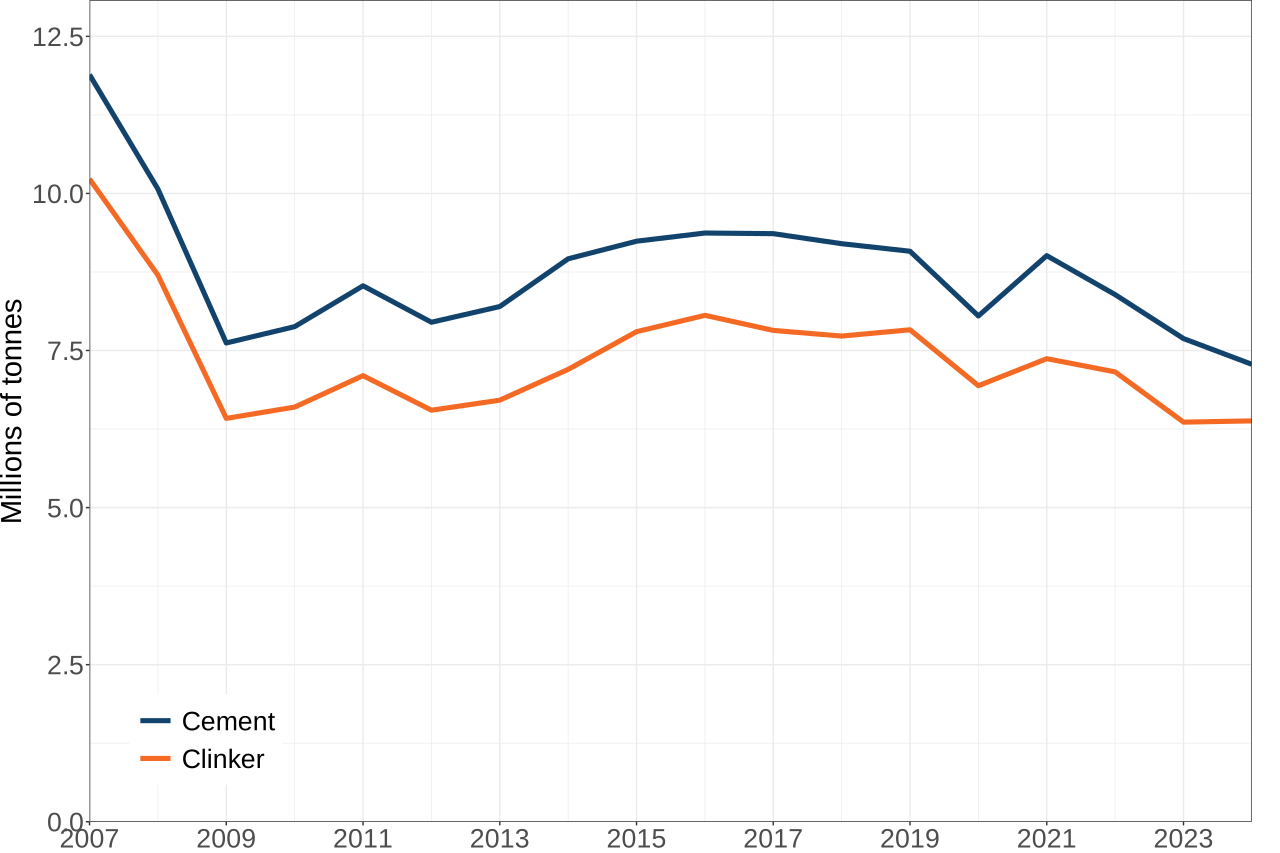
Figure 3: production of cement and clinker, GB
Weight of cement and clinker
Source: monthly statistics of building materials and components, Table 8
Production of cement:
- decreased by 5.3% to 7.3 million tonnes in 2024 compared with 7.7 million tonnes in 2023
- decreased by 8.4% in 2023 compared with 2022
Production of clinker:
- increased by 0.3% to 6.4 million tonnes in 2024 compared with 6.4 million tonnes in 2023
- decreased by 11.2% in 2023 compared with 2022
3.3 Sand and gravel
Figure 4: seasonally adjusted sales of sand and gravel, GB
Weight of sand and gravel

Source: monthly statistics of building materials and components, Table 4
According to the seasonally adjusted data, sales of sand and gravel:
- increased by 0.4% in Quarter 3 2025 compared with Quarter 2 2025
- decreased by 1.9% in Quarter 2 2025 compared with Quarter 1 2025
- decreased by 0.5% in Quarter 3 2025 compared with Quarter 3 2024
- decreased by 2.0% in Quarter 2 2025 compared with Quarter 2 2024
- after recovering from the COVID-19 pandemic, from 2022 the general trend has been of a decline
- have consistently remained below levels typically seen before the recession of 2008 to 2009
3.4 Concrete
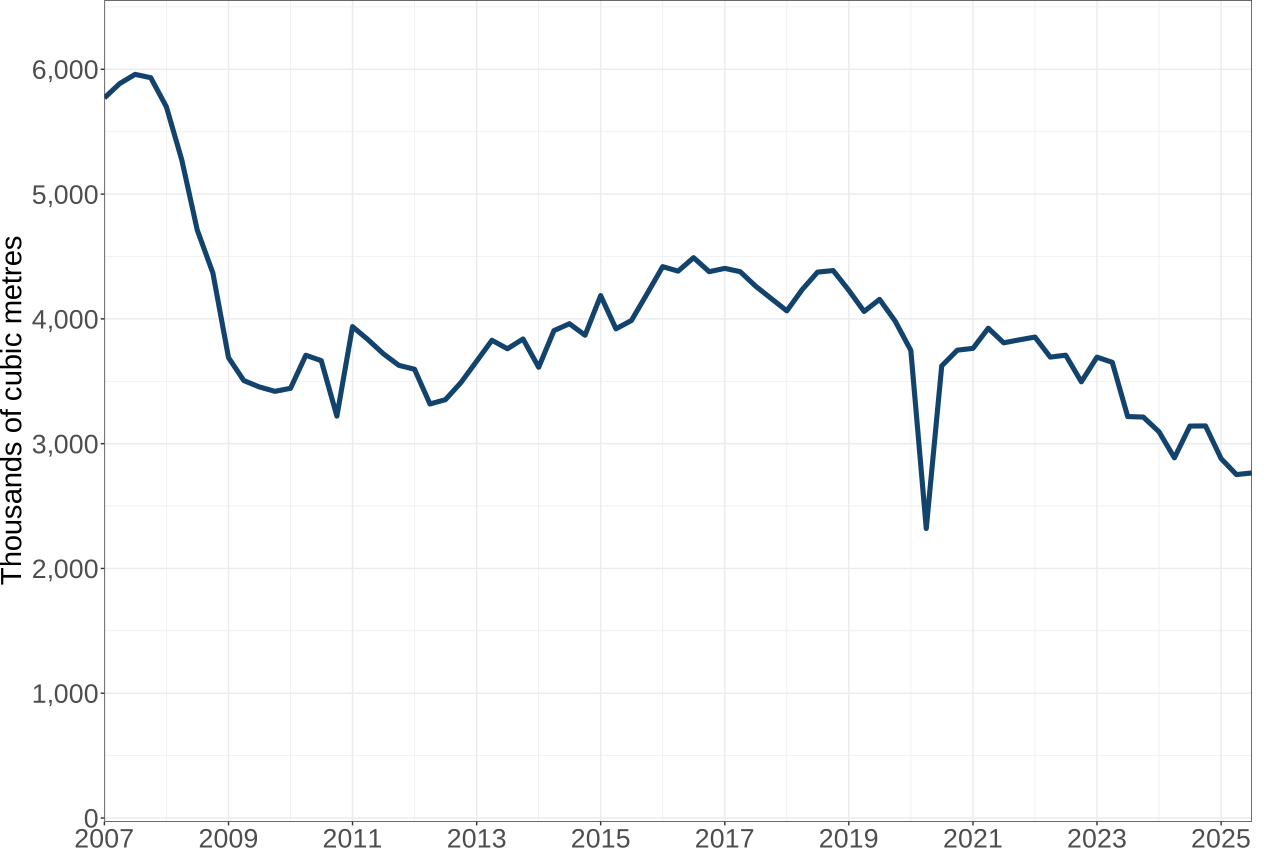
Figure 5: seasonally adjusted sales of ready-mixed concrete, GB
Volume of concrete
Source: monthly statistics of building materials and components, Table 6
According to the seasonally adjusted data, ready mixed concrete sales:
- increased by 0.5% in Quarter 3 2025 compared with Quarter 2 2025
- decreased by 4.4% in Quarter 2 2025 compared with Quarter 1 2025
- decreased by 12.0% in Quarter 3 2025 compared with Quarter 3 2024
- decreased by 4.6% in Quarter 2 2025 compared with Quarter 2 2024
- recovered steadily since Quarter 2 2012 after the 2008 to 2009 recession, until the drop due to the COVID-19 pandemic
3.5 Bricks
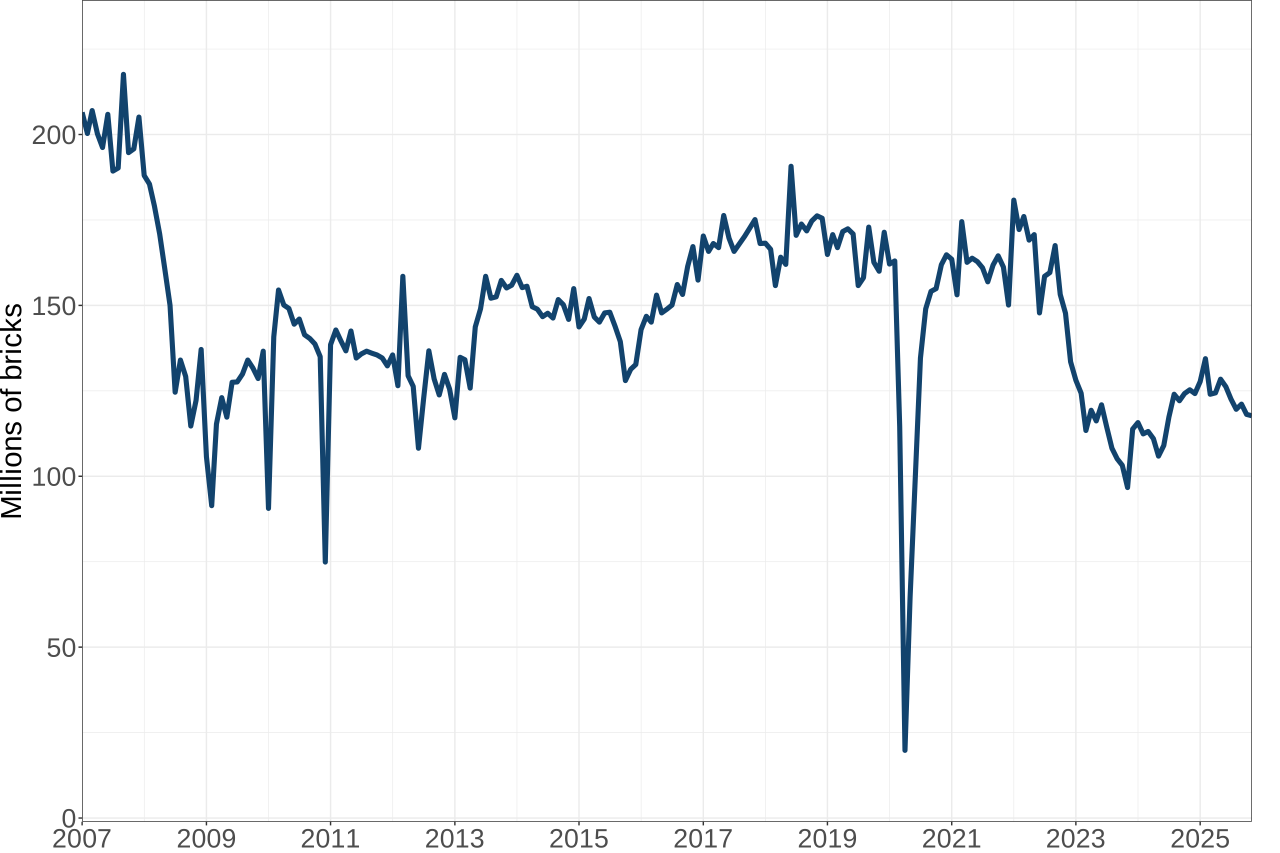
Figure 6: seasonally adjusted deliveries of bricks, GB
Number of bricks
Source: monthly statistics of building materials and components, Table 9
According to the seasonally adjusted data, bricks deliveries:
- decreased by 6.1% in November 2025 compared with November 2024
- decreased by 4.9% in October 2025 compared with October 2024
- decreased by 0.3% in November 2025 compared with October 2025
- decreased by 2.5% in October 2025 compared with September 2025
- declined during the recession of 2008 to 2009
- were broadly flat between 2009 and 2013, with some dips due to extreme snowfall and periods of poor weather
- grew from 2013 until 2022, interrupted only by the sharp decline in 2020 due to the COVID-19 pandemic
- declined in 2022 and 2023
- have steadily grown from 2024 onwards, but remain below pre-2022 levels
Table 3: imports and exports of clay bricks (UK) compared to production of Bricks (GB), millions of bricks
| Year | Brick imports | Brick exports | Domestic brick production |
|---|---|---|---|
| 2021 | 433 | 15 | 1,909 |
| 2022 | 570 | 35 | 1,959 |
| 2023 | 329 | 15 | 1,626 |
| 2024 | 316 | 15 | 1,331 |
Looking at the data on imports and exports of bricks:
- imports of bricks reached 316 million in 2024, a decrease of 4% compared to 2023
- exports of bricks reached 15 million in 2024, a decrease of 0% compared to 2023
- the trade deficit of bricks was 301 million in 2024, decreasing by 4.1% compared to 2023
- bricks imports from overseas have added to the UK bricks market to make up for the decrease in domestic production seen since 2008
- in recent years, bricks imports have made up just less than 20% of the total UK brick market
3.6 Blocks
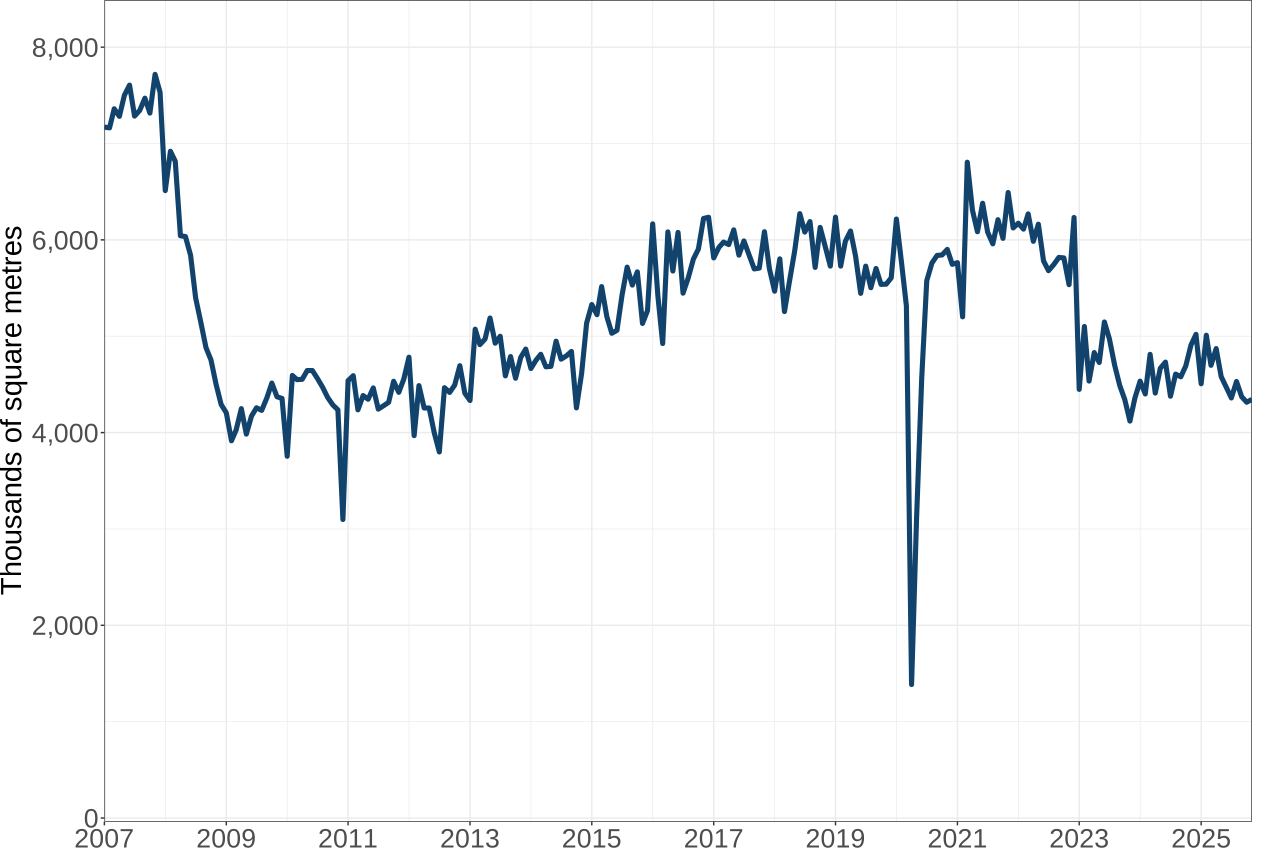
Figure 7: seasonally adjusted deliveries of concrete blocks, GB
Area of concrete blocks
Source: monthly statistics of building materials and components, Table 11
According to the seasonally adjusted data, blocks deliveries:
- decreased by 11.5% in November 2025 compared with November 2024
- decreased by 8.0% in October 2025 compared with October 2024
- increased by 0.7% in November 2025 compared with October 2025
- decreased by 1.3% in October 2025 compared with September 2025
- declined during the recession of 2008 to 2009, only coming back to growth in 2013
- grew from 2013 until 2020, interrupted only by the sharp decline in 2020 due to the COVID-19 pandemic
- declined in 2022 and 2023
- increased slightly since 2024, but remain below pre-2022 levels
3.7 Imports and exports of construction materials
Figure 8: quarterly exports and imports of construction materials, UK
Nominal value in Pound Sterling

Source: monthly statistics of building materials and components, Table 13
Exports of construction materials:
- decreased by £14 million in Quarter 3 2025 compared with Quarter 2 2025, from £2,258 million to £2,244 million, a decrease of 0.6%
- decreased by £38 million in 2024 compared with 2023, from £8,569 million to £8,531 million, a decrease of 0.4%
Imports of construction materials:
- decreased by £51 million in Quarter 3 2025 compared with Quarter 2 2025, from £5,819 million to £5,769 million, a decrease of 0.9%
- increased by £221 million in 2024 compared with 2023, from £22,721 million to £22,941 million, an increase of 1.0%
The trade deficit of construction materials:
- contracted by £37 million in Quarter 3 2025 compared with the previous quarter, from £3,562 million to £3,525 million, a decrease of 1.0%
- widened by £259 million in 2024 compared with 2023, from £14,152 million to £14,410 million, an increase of 1.8%
Table 4: top 5 exported construction materials in 2024
| Top 5 exported materials | £ (million) |
|---|---|
| Electrical wires | 1,026 |
| Paints and varnishes | 806 |
| Lamps and fittings | 440 |
| Builders ironmongery | 397 |
| Air conditioning equipment | 386 |
The top 5 exported materials in 2024 accounted for 35.8% of total construction material exports.
Table 5: top 5 imported construction materials in 2024
| Top 5 imported materials | £ (million) |
|---|---|
| Electrical wires | 2,764 |
| Lamps and fittings | 1,044 |
| Sawn wood > 6mm thick | 1,033 |
| Air conditioning equipment | 988 |
| Builders ironmongery | 915 |
The top 5 imported construction materials in 2024 accounted for 29.4% of total construction material imports.
Table 6: UK trade of construction materials with EU and non-EU countries, 2024
| Trade | EU | Non-EU | Total |
|---|---|---|---|
| Exports £ (million) | 5,075 | 3,456 | 8,531 |
| Exports (% of total trade) | 59.5 | 40.5 | 100.0 |
| Imports £ (million) | 13,807 | 9,134 | 22,941 |
| Imports (% of total trade) | 60.2 | 39.8 | 100.0 |
Looking at the UK construction materials trades with the EU:
- the total share of exports going to the EU declined from 60.2% in 2023 to 59.5% in 2024
- the total share of imports coming from the EU declined from 61.3% in 2023 to 60.2% in 2024
- in 2019, prior to the UK’s withdrawal from the European Union and the COVID-19 pandemic, the share of total exports going to the EU was 60.9%, whilst the share of total imports coming from the EU was 56.4%
Table 7: top 5 UK export markets for construction materials in 2024
| Top 5 export markets | £ (million) |
|---|---|
| Ireland | 1,562 |
| United States | 1,041 |
| Germany | 742 |
| Netherlands | 650 |
| France | 573 |
The top 5 export markets comprised 53.5% of total construction materials exports in 2024. Ireland is the largest export market, with a share of 18.3% of total exports.
Table 8: top 5 UK import markets for construction materials in 2024
| Top 5 import markets | £ (million) |
|---|---|
| China | 4,186 |
| Germany | 2,316 |
| Netherlands | 1,344 |
| Italy | 1,294 |
| Spain | 1,208 |
The top 5 import markets comprised 45.1% of total construction materials imports in 2024. Around 18.2% of all imports are from China.
The ‘Rotterdam effect’ (also known as the ‘Antwerp effect’) may affect trade figures.
4. Economic background
4.1 Construction output
The ONS published Construction output in Great Britain: October 2025 on 12 December 2025.
Main points:
- total construction output is estimated to have fallen by 0.3% in the 3 months to October 2025
- over the 3-month period, repair and maintenance fell by 1.0%, while new work grew by 0.1%
- at the sector level, 4 out of the 9 sectors fell in the 3 months to October 2025; the main negative contributor to the decrease was private housing repair and maintenance, which fell by 2.3%
- monthly construction output is estimated to have fallen by 0.6% in October 2025; this follows an increase of 0.2% in September 2025
- the decrease in monthly output in October 2025 came from decreases in both new work, and repair and maintenance, which fell by 0.7% and 0.6%, respectively
4.2 Bank of England summary of business conditions
The Bank of England published its most recent update to the Agents’ Summary of Business Conditions on 18 December 2025, covering intelligence gathered in the 6 weeks to late November 2025.
- construction sector output continues to contract on last year, with contacts expecting modest positive output growth by mid-2026 as new work picks up
- housebuilding and commercial projects remain below last year’s levels due to high build and funding costs.
- larger infrastructure projects and repair and maintenance are steadily increasing, with office, hotel and retail refurbishments continuing and renovations being driven by post-Grenfell regulation
- planning delays and budget uncertainty have been slowing activity across the sector
4.3 Business insights
The ONS published further information from their fortnightly Business insights and impact on the UK economy on 8 January 2026, which was live from 15 to 28 December 2025.
4.4 Gross domestic product estimate
ONS published estimates of Gross domestic product (GDP) for October 2025 on 12 December 2025.
In the 3 months to October 2025:
- real GDP fell by 0.1%, following growth of 0.1% in the 3 months to September 2025 and 0.2% in the 3 months to August 2025
- services output experienced no growth, compared with growth of 0.2% in the 3 months to September 2025, continuing the recent trend of slowing growth in the service sector
- production output fell by 0.5%, largely because of a fall in the manufacture of motor vehicles, trailers and semi-trailers in this period; this follows a fall of 0.5% in the 3 months to September 2025
4.5 Gross domestic product forecast
The latest monthly Consensus economics forecast survey (which uses an average of private sector forecasts) results were published in December 2025:
- the mean GDP forecast for 2025 is 1.4%, with no change from the previous month’s forecast
- the mean GDP forecast for 2026 is 1.0%, with no change from the previous month’s forecast
The Office for Budget Responsibility published a new economic and fiscal outlook on 26 November 2025:
- GDP was expected to grow by 1.5% in 2025, up from 1.0% predicted in March 2025
- GDP was expected to grow by 1.4% in 2026
4.6 Construction output forecasts
Experian published their Winter 2025 forecasts for the construction sector in November 2025.
Main points:
- total construction output is projected to grow by 1.9% in 2025, 2.8% in 2026 and 4.2% in 2027
- the new housing sector is expected to grow by 2.1% in 2025, 4.9% in 2026 and 8.8% in 2027
- total repair, maintenance and improvement (RM&I) is forecast to grow by 1.3% in 2025, 2.2% in 2026 and 2.4% in 2027
- the new infrastructure sector is expected to grow by 3.9% in 2025, 2.4% in 2026 and 4.6% in 2027
- the private industrial sector is expected to grow by 0.6% in 2025, 2.2% in 2026 and 3.5% in 2027
- the public non-residential sector is forecast to decrease by 6.0% in 2025, then grow by 1.1% in 2026 and 3.0% in 2027.
The Construction Products Association (CPA) published their construction industry forecasts for Autumn 2025 in October 2025.
Main points:
- the CPA forecasts construction output to grow by 1.1% in 2025 and 2.8% in 2026
- private housing is expected to grow by 2.0% in 2025 and 4.0% in 2026
- private housing RM&I is expected to remain flat in 2025 and grow by 2.0% in 2026
4.7 Manufacturing
The latest Index of Production (IoP) data for October 2025 were published on 12 December 2025 by ONS.
Main points for the Standard Industrial Classification (SIC) 23.1-4/7-9 industry (includes manufacture of bricks, tiles and other construction products, seasonally adjusted):
- when comparing October 2025 with October 2024, output decreased by 7.1%
- when comparing October 2025 with September 2025, output increased by 1.4%
Main points for the SIC 23.5-6 industry (includes the manufacture of concrete, cement and other products for construction purposes, seasonally adjusted):
- when comparing October 2025 with October 2024, output decreased by 4.5%
- when comparing October 2025 with September 2025, output increased by 1.7%
5. Accompanying tables
The most recently published data tables (available in Excel and Open Document Spreadsheet (ODS) format) can be found at the Building Materials and Components GOV.UK page in the ‘Construction building materials: tables, December 2025’ documents.
All data used in this report for charts and tables are also available for users to download in the ‘Construction building materials: data for charts and table, December 2025’ document (ODS format).
Past editions of the statistics can be found at the National Archives website:
- from 2005 to 2010
- for 2011
- from 2012 to 2021
A historical series of back data was published in the February 2025 edition of this publication.
Any requests for data not included in this back data series should be directed to business.statistics@businessandtrade.gov.uk.
A series of back data was published for PPIs in the December 2025 edition to show the extent of revisions to the historical series following issues with chain-linking being resolved by ONS.
6. Technical information
Following a review of the publication in 2010, the Department for Business, Innovation and Skills (BIS) commissioned the ONS Methodology Advisory Service (MAS) to address some of the recommendations.
HM Revenue and Customs (HMRC) use administrative sources to produce overseas trade statistics (OTS). A statement of administrative sources used to compile construction material trade statistics is available on the Building Materials and Components GOV.UK page. Separately, HMRC also have a statement of administrative sources which covers OTS.
Since the UK left the EU, there have been changes in the trade data collection methods. For more information, see the ONS impact of trade in goods data collection changes on UK trade statistics.
6.1 Seasonal adjustment
Following advice from the MAS, and the results of a consultation (see the results of the BIS consultation on seasonal adjustment for more detail), BIS agreed to publish seasonally adjusted data for the following series:
- sand and gravel, total sales
- concrete blocks, all types deliveries
- bricks, all types deliveries
- ready-mixed concrete, deliveries
For initial publication of seasonally adjusted data, data from 1983 onwards was seasonally adjusted. Subsequently, for each monthly publication, data up to 12 months or 4 quarters prior to the new data point is revised. Upon the completion of each year’s data series, data for the previous 12 years is revised.
The department publishes both non-seasonally adjusted and seasonally adjusted data in the tables of this publication. From the June 2015 edition this publication has used seasonally adjusted data in the commentary for these series.
The seasonal adjustment review is carried out yearly. The purpose of correcting the reported series is to update seasonal factors such as winter weather (including the reduction in hours of daylight, and frost and rain) and other seasonal events such as Christmas and Easter. Thus, seasonally adjusted figures show the underlying trend more clearly.
The most recent annual review of seasonal adjustment was carried out in April 2025 for sand and gravel, concrete blocks, bricks and ready mixed concrete data, with only minor changes made to improve the robustness of the process.
6.2 Response rate
The following table gives a summary of response rates related to some of the latest survey results. Where the response rate is less than 100%, estimates are made for missing values.
| For latest data used | Bulletin table number | Response rate |
|---|---|---|
| Quarterly sand and gravel | 4 and 5 | 80% |
| - Quarterly sand and gravel: land won | 4 and 5 | 78% |
| - Quarterly sand and gravel: marine dredged | 4 and 5 | 96% |
| Quarterly concrete roofing tiles | 6 | 80% |
| Quarterly slate | 7 | 78% |
| Monthly bricks data | 9 and 10 | 100% |
| Monthly concrete blocks | 11 and 12 | 93% |
7. Definitions
| Term | Description |
|---|---|
| Production | Products completed and ready for dispatch |
| Deliveries | Sold products which have left the premises |
| Stocks | Manufacturer’s stocks |
| Sand and gravel – land won | Sand and gravel from pits and quarries, including that derived from beaches and rivers |
| Sand and gravel – marine dredged | Sand and gravel derived from seas and estuaries |
8. Further information
8.1 Future updates to these statistics
The next publication in this series will be on 4 February 2026.
8.2 Pre-release access
Pre-release access is not granted for this publication.
8.3 Related statistics
Construction statistics: sources and outputs lists the known sources of information available on the construction industry and their outputs. These include information on employees, employment, enterprises, output and new orders in the construction industry as well as the contribution of the industry to the economy. Related information, for example housing, is also included.
The Construction statistics annual brings together a wide range of statistics currently available on the construction industry from a variety of sources and provides a broad perspective on statistical trends in the construction industry, with some international comparisons.
In its monthly IoP publication, the ONS publishes Gross Value Added (seasonally adjusted, UK) data for the following 2 industries:
- SIC 23.1-4/7-9 industry, which includes the manufacture of bricks, tiles and other construction products
- SIC 23.5-6 industry, which includes the manufacture of concrete, cement and other products for construction purposes
These data are not directly comparable with the data in this bulletin, due to differences in coverage and methodology. They are nevertheless useful in illustrating the latest output trends of related construction materials as measured by the ONS.
8.4 Revisions policy
The DBT statistical error policy can be found on the Building Materials webpage.
Data can be revised for a number of reasons, including receipt of more data, methodology changes and corrections. Data subject to scheduled revisions are published as provisional. The period for which data are provisional differs depending on material type and is indicated in each table, either by use of [p] markers or in footnotes. When provisional data become final, [p] markers are removed.
For unscheduled revisions, no revision marker is added, though in the case of substantial revisions a note will be added at the top of the revised table and in the ‘Revisions’ section of the table file.
Users should download the latest edition of the publication to ensure they have the most up-to-date tables.
8.5 Uses of these statistics
The Building Materials and Components statistics are used for a variety of purposes, including policy development and evaluation concerning the construction products industry, as well as monitoring market trends. In a wider context, the figures are regularly reported in the construction press to facilitate market analysis and business planning for its wide range of readers.
The statistics are also increasingly used by financial institutions for assessing market information and industry trends. For more information on the uses of the Building Materials statistics, their usefulness to users and users’ views on the quality of these statistics, see Section 3 of the Building Materials and Components review.
8.6 Methodology
The statistics reported on in this publication are compiled from a number of different sources. Details of how all of the data in this publication is obtained, processed and produced can be found in the Building Materials and Components: Methodology document.
8.7 User engagement
Users are encouraged to provide comments and feedback on how these statistics are used and how well they meet user needs. Comments on any issues relating to this statistical release are welcomed and should be sent to: business.statistics@businessandtrade.gov.uk.
The Consultative Committee on Construction Industry Statistics (CCCIS) meets twice a year, chaired by the department, to discuss issues relating to the collection and dissemination of UK construction statistics. The CCCIS has a wide membership representing government, the construction industry and independent analysts. Minutes of previous CCCIS meetings are available from the building materials web page.
The department statement on statistical public engagement and data standards sets out the department’s commitments on public engagement and data standards as outlined by the Code of Practice for Statistics.
8.8 Accreditation of official statistics
Accredited official statistics were previously referred as National Statistics. Our statistical practice is regulated by the Office for Statistical Regulation (OSR). OSR sets the standards of trustworthiness, quality and value in the Code of Practice for Statistics that all producers of official statistics should adhere to.
These accredited official statistics were independently reviewed by OSR in 2011. They comply with the OSR and should be labelled ‘accredited official statistics’.
You are welcome to contact us directly with any comments about how we meet these standards. Alternatively, you can contact OSR by emailing regulation@statistics.gov.uk or via the OSR website.
Since the latest review by OSR, we have continued to comply with the Code of Practice for Statistics, and have made the following improvements:
-
carried out a public consultation and introduced publication of seasonally adjusted data on deliveries of sand and gravel, concrete blocks, bricks, and ready-mixed concrete
-
in response to the cessation of the Ministry of Housing, Communities and Local Government’s (MHCLG) Annual Minerals Raised Inquiry, which previously supplied the sampling frame for the land-won sand and gravel survey, we have:
- changed the survey from sample survey to a census, increasing the panel from 200 sites to around 500 sites
- refreshed the panel of sites annually using information from the British Geological Survey
- made the survey statutory under the Statistics of Trade Act 1947, bringing it into line with the marine-dredged sand and gravel survey
-
the ONS/MAS review of building materials statistics improved the design of the blocks survey, making it fully monthly instead of a mixture of monthly and quarterly data collection
-
introduced the publication of the tables in an OpenDocument (ODS) spreadsheet, in addition to Microsoft Excel
-
rebased all price indices series to 2015 = 100 in the November 2020 publication
-
in February 2024 we have replaced the previous production process with a reproducible analytical pipeline and consolidated storage of historical data on new SQL databases
-
redesigned tables to conform to The Public Sector Bodies (Websites and Mobile Applications) Accessibility Regulations 2018 legislation
-
redesigned the PDF commentary in HTML, which is more accessible particularly for readers using mobile devices
-
published a detailed methodology document for the publication (see section 8.6)
8.9 Contact
Responsible statistician: Krzysztof Pukacz
Email: business.statistics@businessandtrade.gov.uk
Media enquiries: +44 (0)20 7215 2000
Public enquiries: +44 (0)77 4994 8965
8.10 Department for Business and Trade
The Department for Business and Trade is an economic growth department. We ensure fair, competitive market rates at home, secure access to new markets abroad and support businesses to invest, export and grow. Our priorities are the Industrial Strategy, Make Work Pay, the Trade Strategy and the Plan for Small Business.
8.11 Legal disclaimer
Whereas every effort has been made to ensure that the information in this document is accurate, the Department for Business and Trade does not accept liability for any errors, omissions or misleading statements, and no warranty is given or responsibility accepted as to the standing of any individual, firm, company or other organisation mentioned.
© Crown copyright 2026
You may re-use this publication (not including logos) free of charge in any format or medium, under the terms of the Open Government Licence.
To view this licence, visit nationalarchives.gov.uk/doc/open-government-licence/version/3
Where we have identified any this party copyright information in the material that you wish to use, you will need to obtain permission from the copyright holder(s) concerned.
If you need a version of this document in a more accessible format, email business.statistics@businessandtrade.gov.uk. Tell us what format you need. It will help us if you say what assistive technology you use.