Employment based energy consumption mapping in the UK (web accessible)
Updated 30 June 2026

© Crown copyright 2026
This publication is licensed under the terms of the Open Government Licence v3.0 except where otherwise stated. To view this licence, visit nationalarchives.gov.uk/doc/open-government-licence/version/3 or write to the Information Policy Team, The National Archives, Kew, London TW9 4DU, or email: psi@nationalarchives.gov.uk.
Where we have identified any third party copyright information you will need to obtain permission from the copyright holders concerned.
This publication is available at https://www.gov.uk/government/statistics/uk-local-authority-and-regional-greenhouse-gas-emissions-statistics-2005-to-2024/employment-based-energy-consumption-mapping-in-the-uk-web-accessible
Introduction
Data on energy use by large industrial and commercial sites (also known as Point Sources) are collected and compiled within the National Atmospheric Emissions Inventory (NAEI). These datasets include fuel consumption estimates derived from Environmental Permitting Regulations (EPR), all installations covered by Emission Trading Schemes (UK ETS and EU ETS) and other sites that are significant sources of air pollution. The method used to compile these estimates is documented in the Technical Report for the UK local and regional greenhouse gas emissions.
The energy used by smaller non-domestic sites is significant in terms of overall energy consumption from the industrial, commercial and public sectors in the UK. For example, the smaller industrial combustion facilities represented about 17% of industrial CO2 emissions in 2024 (based on the ‘B_Industry’ Gridded Nomenclature For Reporting (GNFR) source category (as defined in annex V) in accordance with the EMEP/EEA Guidebook). However, energy consumption data for these sites are not available in a consistent format across the UK and therefore, proxy data on employment and energy use are used to estimate energy use and emissions at these locations.
This report describes the methods used to estimate the energy use at the UK level by the smaller industrial, commercial, and public sectors facilities and to model the distribution of energy use across the UK at 1x1km resolution and at Local Authority level.
The outputs of this work are used in the generation of detailed 1x1km resolution emission maps for air quality pollutants and greenhouse gases as well as for other spatially disaggregated NAEI outputs such as the local and regional greenhouse gas statistics, Devolved Government Inventories, and sub-national energy statistics for solid and liquid fuels.
Data sources
This section of the report describes the data sets used as inputs to the modelling process for energy use in industrial, commercial, and public sector facilities that are not included in the NAEI point source database.
Employment data
The Inter-Departmental Business Register (IDBR) database provides detailed data on the number of employees at each registered UK business entity. This database has 2.1 million businesses listed and covers approximately 99% of economic activities across the UK.
An extract from the IDBR was obtained from the Office for National Statistics (ONS), with the data fields as shown in Table 1. The grid reference attribute was used to aggregate total numbers of employees for each 1x1km grid square by Standard Industry Classification (SIC) sector.
Table 1: Information held on the IDBR for each business.
| Field | Description |
|---|---|
| Local Unit | Local Unit Reference Code |
| Enterprise | Enterprise Reference Code |
| Reporting Unit | Reporting Unit Reference Code |
| Name | Local Unit Name |
| Address | Local Unit Address |
| Postcode | Local Unit Postcode |
| Employment | Total number of employees figure plus working proprietors |
| Employees | Total number of people employed, excluding proprietors |
| SIC2007 | UK Standard Industry Classification 2007 |
| GOR | Regions (Former Government Offices for the Regions) |
| Grid Reference | Locations on map using Cartesian coordinates |
The 2007 SIC is used to assign a 5-digit code of economic activity type to each business. Appendix 1 shows the higher-level 2-digit activity Divisions of the SIC that are used for this study and the sectors they have been assigned to. The business entities are classified into Local Units and Enterprise Units.
Energy statistics
Sector specific fuel use statistics are available on an annual basis from the Department for Energy Security and Net Zero via the Energy Consumption in the UK (ECUK) publication (DESNZ, 2025). The mapping of energy consumption based on employment makes heavy use of the Industrial data tables, and Service sector data tables. The ECUK user guide provides details on the methodology of those datasets and how they are calculated to be representative of all businesses in each sector.
Table 2 below presents a breakdown of the fuel consumption in industrial sectors in 2024 as provided from the ECUK tables described above. A time-series of statistics was produced using the following ECUK tables:
- industrial final energy consumption at 2-digit SIC2007 level by fuel type, for the years 2009-2024
- service sector final energy consumption by sub-sector, for the years 2005-2024
Following changes in duty on gas oil, the latest ECUK contains zero values for gas oil from 2023. However, gas oil figures are still required to distribute energy use in line with other fuels. Therefore, while the reporting adapts to this change, values for 2022 were taken to represent 2023 onwards.
A methodological update was introduced to the EECUK data in 2025 and applied back to 2021. The new method uses data from the Emissions Trading Scheme (ETS), and Climate Change Agreements (CCA) and represents an improvement in quality for most industrial sectors. Those sectors with least coverage in the ETS and CCA data, and therefore highest uncertainty in the resulting estimates, are mechanical/electrical engineering and textiles and leather. There are more details here: [Update to estimates of industrial consumption within ECUK](Update to estimates of industrial consumption within ECUK.
Table 2: Industrial energy consumption by fuel type in 2024 (thousand tonnes of oil equivalent) based on ECUK Table C3.
| SIC (2007) codes | Description | Coal | LPG | Gas oil | Fuel oil | Natural gas | Electricity |
|---|---|---|---|---|---|---|---|
| 8 | Other mining and quarrying | - | 7.40 | - | 0.00 | 132.57 | 226.93 |
| 10 | Manufacture of food products | 21.67 | 4.07 | - | - | 1,356.31 | 762.26 |
| 11 | Manufacture of beverages | 0.01 | 1.88 | - | - | 337.00 | 129.77 |
| 12 | Manufacture of tobacco products | - | - | - | - | - | - |
| 13 | Manufacture of textiles | - | - | - | - | 248.01 | 186.07 |
| 14 | Manufacture of wearing apparel | - | - | - | - | - | - |
| 15 | Manufacture of leather and related products | - | - | - | - | 15.02 | 13.05 |
| 16 | Manufacture of wood and of products of wood and cork, except furniture; manufacture of articles of straw and plaiting materials | 25.10 | - | - | - | 187.04 | 126.71 |
| 17 | Manufacture of paper and paper products | - | 0.06 | - | - | 254.40 | 648.98 |
| 18 | Printing and publishing of recorded media and other publishing activities | - | 0.00 | - | - | 10.04 | 167.04 |
| 20 | Manufacture of chemicals and chemical products | 31.43 | - | - | 7.92 | 955.45 | 1,202.17 |
| 21 | Manufacture of basic pharmaceutical products and pharmaceutical preparations | - | - | - | 0.05 | 99.29 | 58.21 |
| 22 | Manufacture of rubber and plastic products | 44.50 | - | - | - | 244.19 | 1,092.40 |
| 23 | Manufacture of other non-metallic mineral products | 259.89 | 1.46 | - | 0.00 | 972.72 | 211.72 |
| 24 | Iron and steel | 16.93 | 1.00 | - | 9.54 | 472.98 | 165.65 |
| 25 | Manufacture of fabricated metal products, except machinery and equipment | 5.26 | - | - | - | 447.13 | 363.29 |
| 26 | Manufacture of computer, electronic and optical products | 2.26 | - | - | - | 262.15 | 388.93 |
| 27 | Manufacture of electrical equipment | 0.20 | - | - | - | 49.85 | 108.41 |
| 28 | Manufacture of machinery and equipment n.e.c. | 0.77 | - | - | - | 99.47 | 100.74 |
| 29 | Manufacture of motor vehicles, trailers and semi-trailers | - | 0.01 | - | - | 271.21 | 263.92 |
| 30 | Manufacture of other transport equipment | - | 0.00 | - | - | 100.19 | 16.63 |
| 31 | Manufacture of furniture | 0.06 | - | - | - | 2.30 | 4.78 |
| 32 | Other manufacturing | 8.57 | - | - | - | 83.65 | 282.21 |
| 36 | Water collection, treatment and supply | 10.31 | - | - | - | 4.83 | 2.67 |
| 38 | Waste collection, treatment and disposal activities; materials recovery | 0.21 | - | - | - | - | - |
| 42 | Civil engineering/construction | 3.13 | - | - | - | 18.91 | - |
Point sources
Data on location specific (Point Source) fuel consumption are collated in the NAEI point source database. They are compiled from data for regulated processes reported in the Environment Agency’s Pollution Inventory, the Scottish Pollution Release Inventory (SPRI), Wales Emissions Inventory (WEI), the Northern Ireland Environment Agency Pollution Inventory, Inventory of Statutory Releases, the Emissions Trading Schemes and from other data obtained by the NAEI. The Local and Regional greenhouse gas technical report describes in more detail the methodology used to calculate fuel use at point sources.
Gas and electricity consumption data for England, Wales, Scotland and Northern Ireland
Data on non-domestic gas and electricity consumption are available from DESNZ within the sub-national gas consumption data collection. For Great Britain, gas consumption data have been used at individual postcode level. While this level of detail allows for more accurate calculations, revisions in the gas consumption are more noticeable at postcode level.
For Northern Ireland, gas consumption data are also available at postcode level and were provided by the utility companies. Electricity consumption is available as part of the sub-national statistics datasets.
Employment time-series
A time-series of employment activity was back-calculated with the use of Business Register data and Employment Survey (BRES) annual employment estimates. The time-series was calculated at a regional level for each Broad Industry Group (SIC2007).
Energy Performance Certificates and Display Energy Certificates
Energy Performance Certificates (EPC) and Display Energy Certificates (DEC) provide information on fuel use at individual building level. These datasets include address, postcode, Unique Property Reference Number (UPRN), lodgement date, main heating fuel, primary energy use (kWh/m2 per year) and total building floor area (m2) data (to calculate the total primary energy use).
The EPC/DEC data were cleaned to remove locations with natural gas and grid supplied electricity as their main heating fuel and were used to distribute oils and solid fuels more accurately. The inclusion of lodgement dates meant that a time series of fuel changes could also be established, as the data cover 2008 – 2025. As data was not available for 2005 - 2007, the data for 2008 were used for those years as well.
For non-gas and non-electricity fuel use, almost 15,700 individual EPC/DEC were matched with IDBR records (representing ~434,500 workers). When combined with the 1.3 million records that were identified as using electricity as their main heating fuel, this allowed for more accurate distribution of non-metered fuels.
This represents a total of 35% of all the EPC/DECs being matched to an IDBR record. This accounts for 33% of all IDBR records, representing 48% of all UK employment.
The unmatched EPC/DEC records were not able to be matched due to a lack of descriptive information regarding the building address or the address no longer exists.
Analysis
This section describes the methods used to analyse and combine the datasets to model the distribution of energy consumption across the UK by fuel type. Estimates of gas and electricity consumption were compared with, and corrected against, detailed metered data at postcode level (and in the case of Northern Ireland electricity, Local Authority level). These were produced for the latest NAEI year at 1x1km level (to support the air quality and greenhouse gas maps for the latest inventory) and for 2015 to 2024 at local authority level for use in the local authority greenhouse gas and local authority residual fuels datasets. Pre-2015 non-domestic gas consumption data at postcode level were unavailable. Equivalent datasets for other fuels (such as oil and coal) do not exist. Therefore, an alternative methodology utilising EPC and DEC data was employed for these fuels.
Process flow diagrams
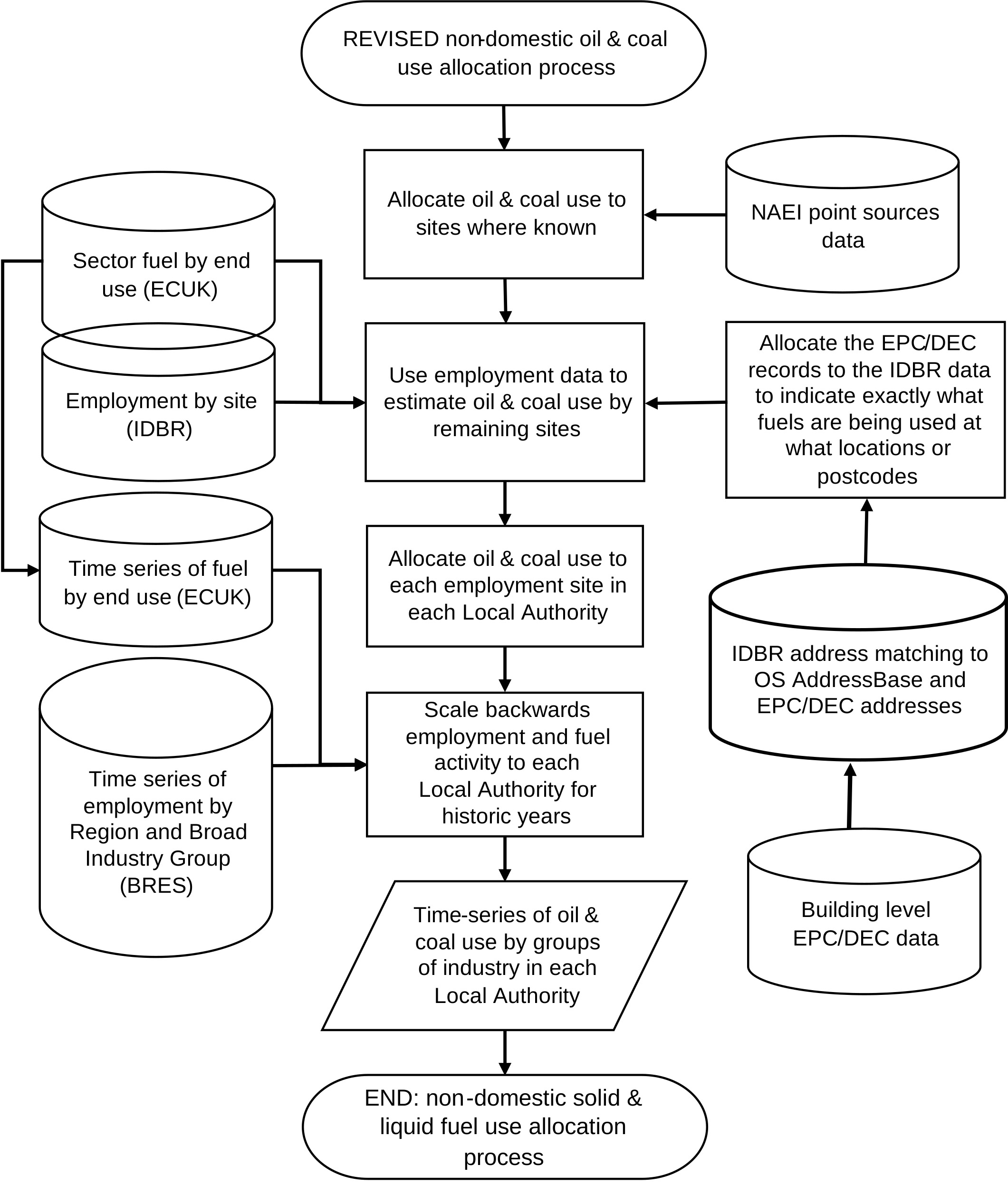
In Figure 1 a brief explanation of the diagrams building blocks used in the subsequent Figure 2 and Figure 3, to graphically summarise the data flows and modelling processes implemented for each fuel type considered.
Figure 1: Legend for the process flow diagrams below.
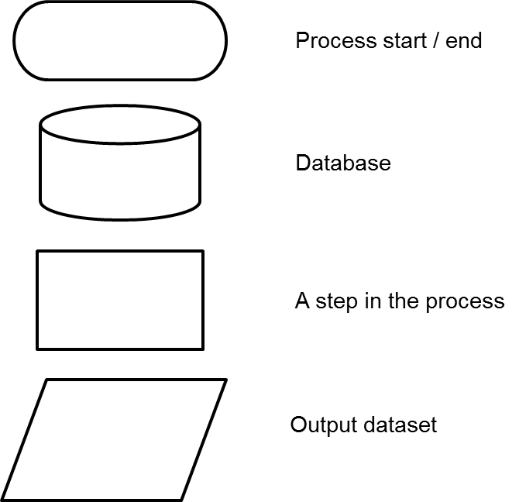
Figure 2: Non-domestic gas use allocation process.
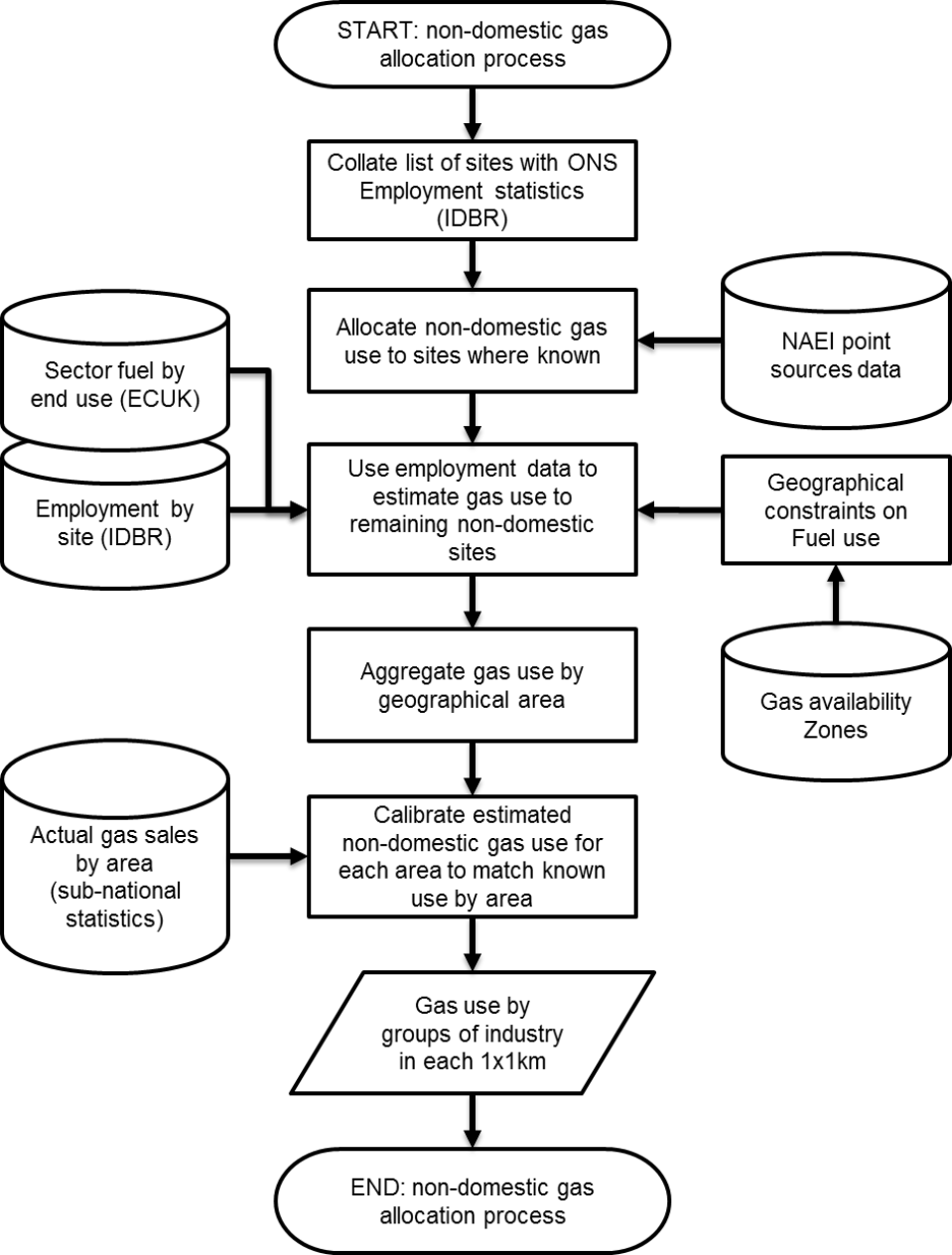
Figure 3: Non-domestic oil and coal use allocation process.
Matching point sources to employment data
Overlaps between the NAEI point source database and the IDBR database were identified and flagged. This was necessary to prevent double counting of energy consumption at the national level and at the detailed spatial level.
To enable data matching, the NAEI point sources were allocated to SIC codes. The total energy consumption associated with these point sources were then calculated at 2-digit SIC code level using bottom-up fuel use estimates in the NAEI point source database.
Subsequently, the locations of each of the NAEI point sources were matched to records in the IDBR using information in the location organisation name, SIC code and postcode on both datasets. Following this automated matching, the largest unmatched energy users were manually reviewed and matched to an appropriate IDBR record. This matching allowed employment records to be removed from the modelling to minimise double counting.
Matching NAEI sectors to SIC codes
Allocation of SIC codes in the energy and employment datasets to NAEI sectors enabled the aggregation of fuel use estimates to NAEI sectors and a comparison of energy consumption totals. This procedure also facilitated the generation of maps that were consistent with NAEI sector boundaries for distributing emissions data. The two main NAEI sectors relevant to the fuel use mapping are ‘Other industry’ (so, not the largest industrial emitters such as iron and steel or the cement industry) and ‘Commercial and Public’ sector.
Calculation of non-point source residual energy consumption
The comparison of energy data grouped by SIC code and NAEI sector provided an estimate of the total residual energy consumption, that is the energy not used at the identified sites. This residual energy was identified for re-distribution using the employment data.
The comparison and calculation of residual energy at this level supported the highest level of cross-checks across emissions subsectors to be retained for energy consumption mapping.
Energy intensity factors
Estimates of fuel intensity per employee were used to distribute residual energy by sector across the IDBR employment sites and create maps of fuel use. Total UK employee numbers in the IDBR were aggregated to an equivalent sector level to DESNZ energy statistics which is at SIC 2007 2-digit code level for industrial sectors but at a higher level for commercial and service sectors. The total numbers of employees by SIC code (4, 3, or 2-digit codes as appropriate) were then calculated from the IDBR database, excluding the allocated sites identified in the step matching point sources to employment data. This calculation also took account of the geographical areas appropriate to the relevant fuels.
The total residual energy by SIC code (as described above) and total number of employees for the same codes were then used to derive a national average energy intensity factor per employee for each fuel type for each sector for these residual energy locations.
The fuel intensity factors were then applied across the employment distribution from the IDBR to create maps of fuel use by industry sector.
Gas and electricity consumption to adjust the distribution of gas predicted by the employment and energy intensity data
For gas and electricity consumption estimates, model outputs are adjusted using real gas consumption data using an iterative approach of comparison and adjustment.
The gas and electricity data sets were compared with initial modelled estimates of gas and electricity, using calibration factors at postcode level to improve the initial estimates and ensure modelled and measured estimates were consistent, as far as possible. To avoid double counting fuel consumption, the gas calculated from point sources was removed from the postcode totals.
The DESNZ dataset does not provide a distribution of gas consumption in Northern Ireland for the early years of the time-series. Historic data were added using information on gas consumption by industry and commerce at district level from Energy providers (SSE Airtricity, Firmus) to adjust the modelled estimates in each Northern Ireland Local Authority.
Other fuels
The other fuels modelled using this method are coal and oil (with fuel oil and gas oil modelled separately for industrial sectors). The calculations for these two types of fuel are different to those for gas because no metered data exist for these fuels.
EPCs and DECs were matched to the IDBR employment data based on regular string expression matching (often referred to as fuzzy matching ) of the address provided in the two datasets. This provided an indication of the type (and in some cases an indication of the quantity) of fuel used at that address.
Where it was not possible to match an IDBR record with an EPC/DEC, a fuel was assigned to that record based on the other buildings at the same postcode. The EPC/DEC data were then used to find the outstanding buildings which used grid supplied electricity as their main heating fuel at postcode level. Gas data were still calibrated using postcode level meter data. Consequently, all remaining postcodes without gas or electricity determined as their main heating fuel were assigned as using solid, liquid, or other fuel.
For sites in the IDBR records where no fuel information was available either through a respective EPC/DEC or through related records in the same postcode, it was assumed to use a mixture of all non-gas and non-electricity fuels.
Outputs
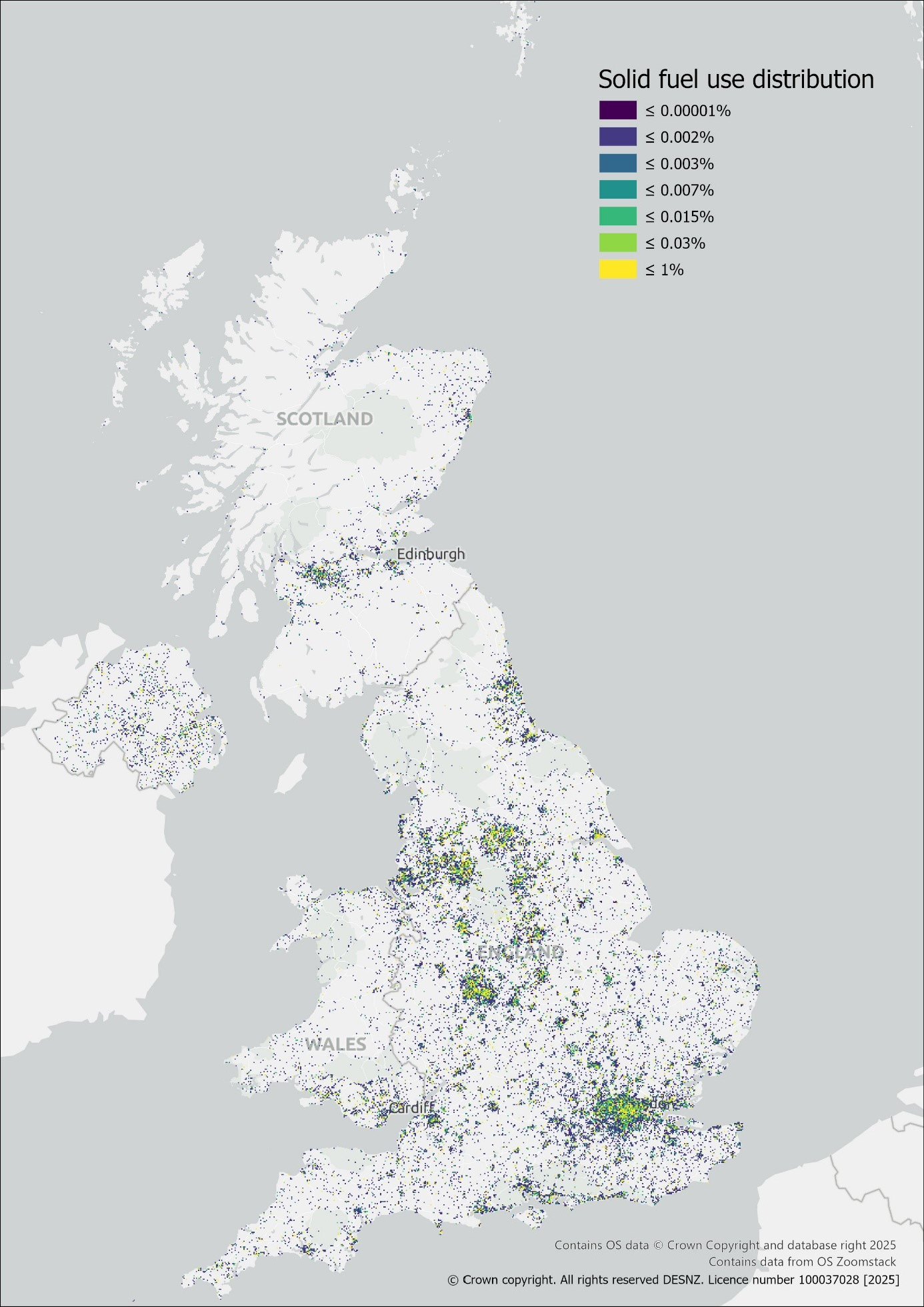
Figures 4 and 5 below show respectively the modelled distribution fuel oil and solid fuel use across the UK.
Figure 4: Modelled distribution of ‘other industrial’ of fuel oil use across the UK.
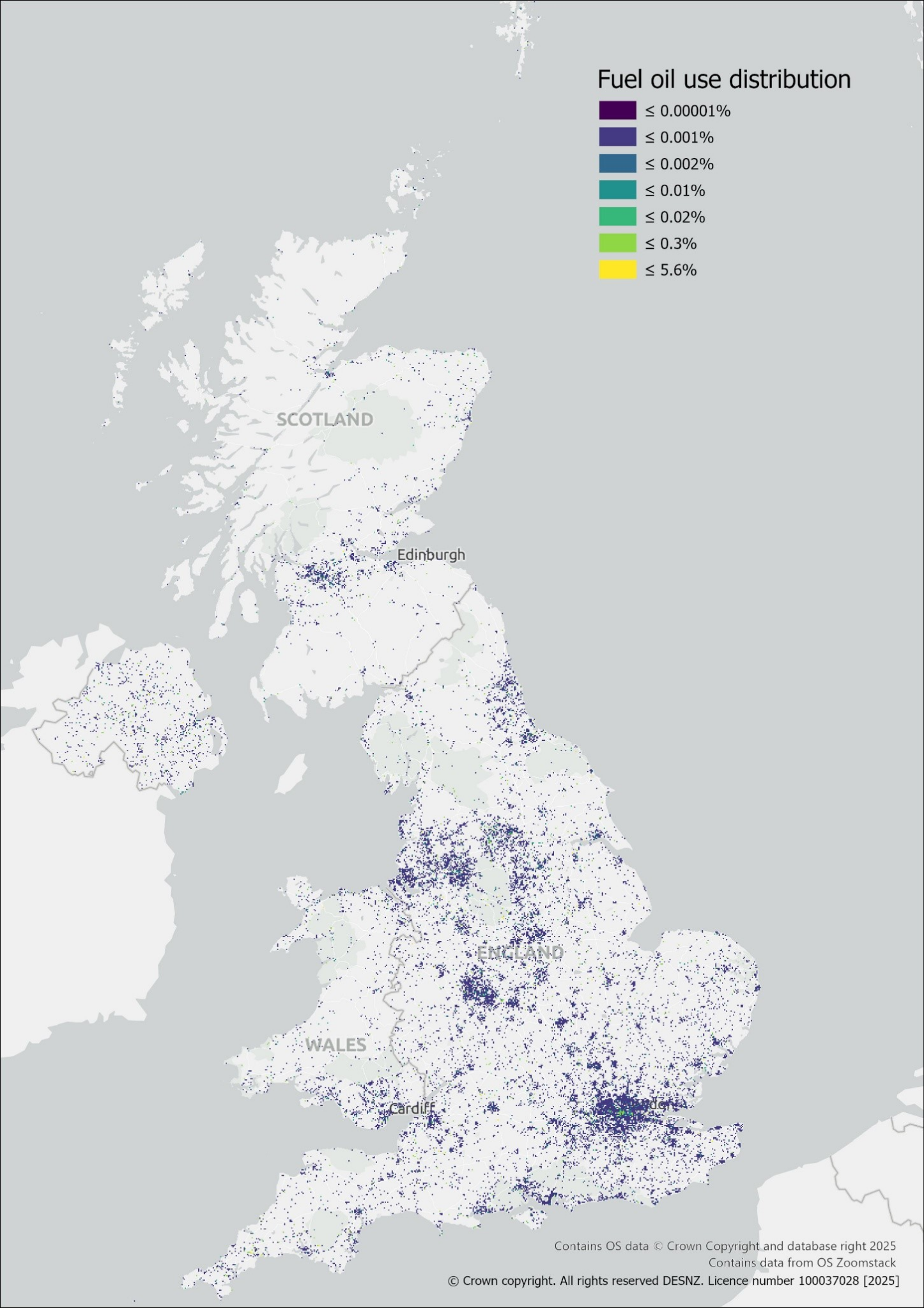
Figure 5: Modelled distribution of ‘other industrial’ solid fuel use across the UK.
Appendix 1: 2-digit Standard Industrial Classification 2007
| SIC (2007) codes | Description | Sector |
|---|---|---|
| 1 | Crop and animal production, hunting and related service activities | Agriculture |
| 2 | Forestry and logging | Agriculture |
| 3 | Fishing and aquaculture | Agriculture |
| 5 | Mining of coal and lignite | Industry |
| 6 | Extraction of crude petroleum and natural gas | Industry |
| 7 | Mining of metal ores | Industry |
| 8 | Other mining and quarrying | Industry |
| 9 | Mining support service activities | Industry |
| 10 | Manufacture of food products | Industry |
| 11 | Manufacture of beverages | Industry |
| 12 | Manufacture of tobacco products | Industry |
| 13 | Manufacture of textiles | Industry |
| 14 | Manufacture of wearing apparel | Industry |
| 15 | Manufacture of leather and related products | Industry |
| 16 | Manufacture of wood and of products of wood and cork, except furniture; manufacture of articles of straw and plaiting materials | Industry |
| 17 | Manufacture of paper and paper products | Industry |
| 18 | Printing and reproduction of recorded media | Industry |
| 20 | Manufacture of chemicals and chemical products | Industry |
| 21 | Manufacture of basic pharmaceutical products and pharmaceutical preparations | Industry |
| 22 | Manufacture of rubber and plastic products | Industry |
| 23 | Manufacture of other non-metallic mineral products | Industry |
| 24 | Manufacture of basic metals | Industry |
| 25 | Manufacture of fabricated metal products, except machinery and equipment | Industry |
| 26 | Manufacture of computer, electronic and optical products | Industry |
| 27 | Manufacture of electrical equipment | Industry |
| 28 | Manufacture of machinery and equipment n.e.c. | Industry |
| 29 | Manufacture of motor vehicles, trailers and semi-trailers | Industry |
| 30 | Manufacture of other transport equipment | Industry |
| 31 | Manufacture of furniture | Industry |
| 32 | Other manufacturing | Industry |
| 33 | Repair and installation of machinery and equipment | Commercial |
| 35 | Electricity, gas, steam and air conditioning supply | Industry |
| 36 | Water collection, treatment and supply | Industry |
| 37 | Sewerage | Commercial |
| 38 | Waste collection, treatment and disposal activities; materials recovery | Industry |
| 39 | Remediation activities and other waste management services. | Commercial |
| 41 | Construction of buildings | Commercial |
| 42 | Civil engineering | Industry |
| 43 | Specialised construction activities | Commercial |
| 45 | Wholesale and retail trade and repair of motor vehicles and motorcycles | Commercial |
| 46 | Wholesale trade, except of motor vehicles and motorcycles | Commercial |
| 47 | Retail trade, except of motor vehicles and motorcycles | Commercial |
| 49 | Land transport and transport via pipelines | Commercial |
| 50 | Water transport | Commercial |
| 51 | Air transport | Commercial |
| 52 | Warehousing and support activities for transportation | Commercial |
| 53 | Postal and courier activities | Commercial |
| 55 | Accommodation | Commercial |
| 56 | Food and beverage service activities | Commercial |
| 58 | Publishing activities | Commercial |
| 59 | Motion picture, video and television programme production, sound recording and music publishing activities | Commercial |
| 60 | Programming and broadcasting activities | Commercial |
| 61 | Telecommunications | Commercial |
| 62 | Computer programming, consultancy and related activities | Commercial |
| 63 | Information service activities | Commercial |
| 64 | Financial service activities, except insurance and pension funding | Commercial |
| 65 | Insurance, reinsurance and pension funding, except compulsory social security | Commercial |
| 66 | Activities auxiliary to financial services and insurance activities | Commercial |
| 68 | Real estate activities | Commercial |
| 69 | Legal and accounting activities | Commercial |
| 70 | Activities of head offices; management consultancy activities | Commercial |
| 71 | Architectural and engineering activities; technical testing and analysis | Commercial |
| 72 | Scientific research and development | Commercial |
| 73 | Advertising and market research | Commercial |
| 74 | Other professional, scientific and technical activities | Commercial |
| 75 | Veterinary activities | Commercial |
| 77 | Rental and leasing activities | Commercial |
| 78 | Employment activities | Commercial |
| 79 | Travel agency, tour operator and other reservation service and related activities | Commercial |
| 80 | Security and investigation activities | Commercial |
| 81 | Services to buildings and landscape activities | Commercial |
| 82 | Office administrative, office support and other business support activities | Commercial |
| 84 | Public administration and defence; compulsory social security | Public Administration |
| 85 | Education | Public Administration |
| 86 | Human health activities | Public Administration |
| 87 | Residential care activities | Public Administration |
| 88 | Social work activities without accommodation | Commercial |
| 90 | Creative, arts and entertainment activities | Commercial |
| 91 | Libraries, archives, museums and other cultural activities | Commercial |
| 92 | Gambling and betting activities | Commercial |
| 93 | Sports activities and amusement and recreation activities | Commercial |
| 94 | Activities of membership organisations | Commercial |
| 95 | Repair of computers and personal and household goods | Commercial |
| 96 | Other personal service activities | Commercial |
| 96 | Other personal service activities | Public Administration |
| 97 | Activities of households as employers of domestic personnel | Commercial |
| 98 | Undifferentiated goods- and services-producing activities of private households for own use | Commercial |
| 99 | Activities of extraterritorial organisations and bodies | Commercial |