Social housing sales and demolitions 2024-25
Published 12 February 2026
Applies to England

© Crown copyright 2026
This publication is licensed under the terms of the Open Government Licence v3.0 except where otherwise stated. To view this licence, visit nationalarchives.gov.uk/doc/open-government-licence/version/3 or write to the Information Policy Team, The National Archives, Kew, London TW9 4DU, or email: psi@nationalarchives.gov.uk.
Where we have identified any third party copyright information you will need to obtain permission from the copyright holders concerned.
This publication is available at https://www.gov.uk/government/statistics/social-housing-sales-and-demolitions-2024-25-england/social-housing-sales-and-demolitions-2024-25
Release date: 12 February 2025
Lead Statistician: Samuel Pitch
Statistical queries: housing.statistics@communities.gov.uk
Media enquiries: 0303 444 1209 or NewsDesk@communities.gov.uk
Our statistical practice is regulated by the Office for Statistics Regulation (OSR). OSR sets the standards of trustworthiness, quality and value in the Code of Practice for Statistics that all producers of official statistics should adhere to. You are welcome to contact us directly with any comments about how we meet these standards. Alternatively, you can contact OSR by emailing regulation@statistics.gov.uk or via the OSR website.
This statistical release presents data on the number of social housing dwellings sold and demolished in the period 1 April 2024 to 31 March 2025. This data is subject to revisions.
Social housing is defined in the Housing and Regeneration Act 2008 sections 68-77. The term covers low-cost rental, low-cost home ownership and accommodation owned by registered providers as previously defined in the Housing Act 1996.
1. Headline figures
In 2024-25 there were: 19,941 sales of social housing dwellings, an increase of 14% compared to 2023-24.
15,160 sales of social housing were low-cost rental dwellings, an increase of 9% compared to 2023-24.
4,781 sales of social housing were through low-cost home ownership equity reaching 100%, an increase of 35% compared to 2023-24.
3,119 demolitions of social housing dwellings, a decrease of 14% compared with 2023-24.
23,189 estimated net increase in the stock of social housing for rent of large private registered providers and local authorities with a Housing Revenue Account, covered in a new bulletin alongside this release.
2. Introduction
This statistical release presents accredited official statistics [footnote 1] on annual sales and demolitions of social housing in England. It contains information about the dwellings owned by private registered providers collected by the Regulator of Social Housing (RSH) in the Statistical Data Return (SDR) and information about dwellings owned by local authorities collected by the Ministry of Housing, Communities and Local Government (MHCLG) in the Local Authority Housing Statistics (LAHS). There is also supplementary information provided which is sourced from the Continuous Recording (CORE) sales dataset, collected by MHCLG.
This report provides a summary of social housing sales and demolitions. It focuses on the sales of low-cost rental dwellings and the 100% staircased sales of shared ownership properties [footnote 2]. The shared ownership sales section of this release and the various live tables report on the characteristics of initial sale (or first tranche) of shared ownership dwellings, Staircasing allows shared ownership purchasers to buy additional shares in their property over time.
More detailed reports also accompany this release:
-
Official statistics in development [footnote 3] covering Net supply of social housing for rent
3. Social housing sales
In 2024-25, there were 19,941 sales of social housing dwellings in England, an increase of 14% compared to 2023-24. Of these 19,941 sales, 7,950 (40%) were of local authority owned stock and 11,991 (60%) were of stock owned by private registered providers.
Figure 1.1 Total sales of social housing from 1 April 1997 to 31 March 2025, by provider
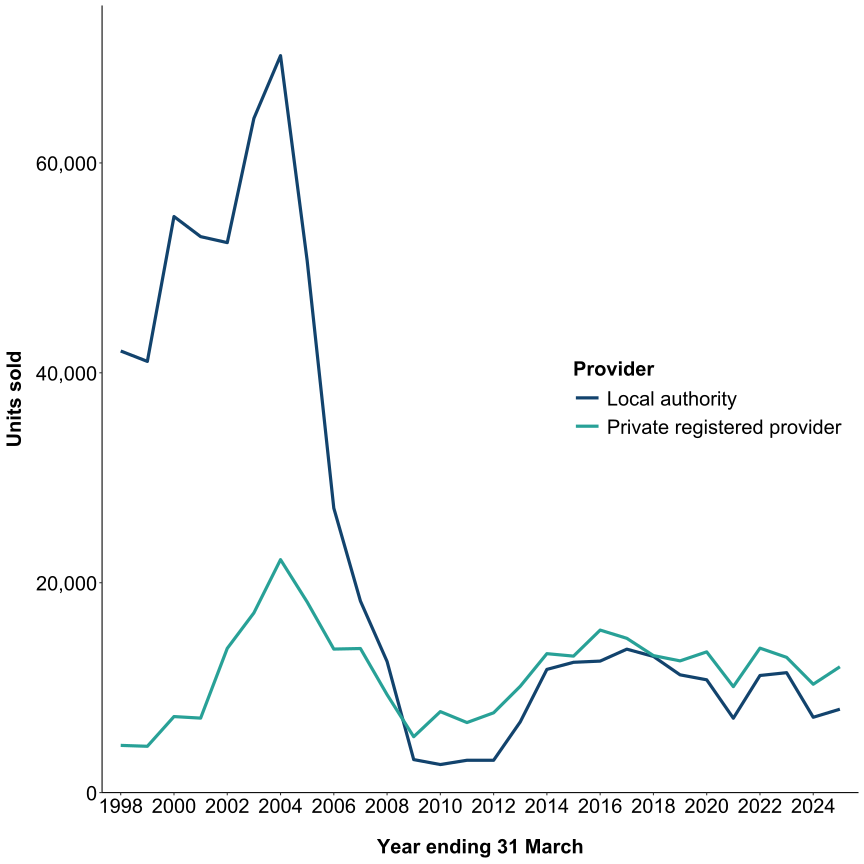
The data for this chart is available in Live Table 678.
Social housing can be sold through a variety of different schemes or on the open market. The majority of sales are completed through the Right to Buy for local authority housing and for private registered provider-owned housing through Preserved Right to Buy and Voluntary Right to Buy (before the pilot was completed). These schemes accounted for 46% of sales in 2024-25 and have accounted for 90% of all recorded sales since 1980-81.
Sales of rental stock to non-sitting tenants, including sales to the open market, accounted for 26% of all social housing sales in 2024-25.
The 100% staircased sales [footnote 2] of Shared Ownership properties, known as low-cost home ownership (LCHO) sales, accounted for 24% of total sales in 2024-25 and, based on the data available, accounted for 12% of all sales since 2001-02.
Other sales to sitting tenants, for example through the Right to Acquire and Social Homebuy schemes, accounted for 4% of sales in 2024-25.
Figure 1.2 Total sales of social housing by type of sale from 1 April 1997 to 31 March 2025, England
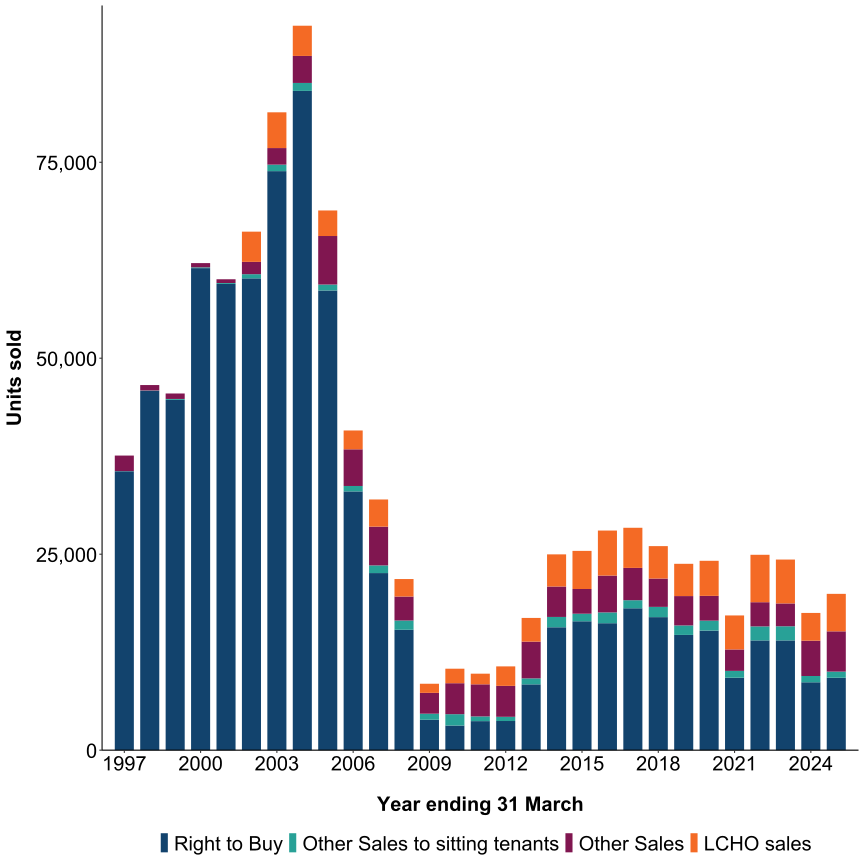
The data for this chart is available in Live Table 678.
4. Social housing sales by region
The number of sales of social housing varies significantly by region and is driven largely by the number of Right to Buy sales. Therefore, changes to the Right to Buy scheme have a large impact on regional variations in sales. For more in-depth analysis of these sales, please see the accompanying Right to Buy dedicated section. Due to the variation in stock sizes, the graph below presents sales per 1,000 stock [footnote 4].
There were 4.6 sales per 1,000 stock across all regions in 2024-25. This is lower than the peak of 6.7 sales per 1,000 stock in 2015-16 after the 2012 reinvigoration of the Right to Buy Scheme [footnote 5], and similar to the post-reinvigoration low point of 4.1 sales per 1,000 stock in 2020-21.
Figure 1.3 Sales of social housing per 1,000 stock from 1 April 2011 to 31 March 2025, by English region
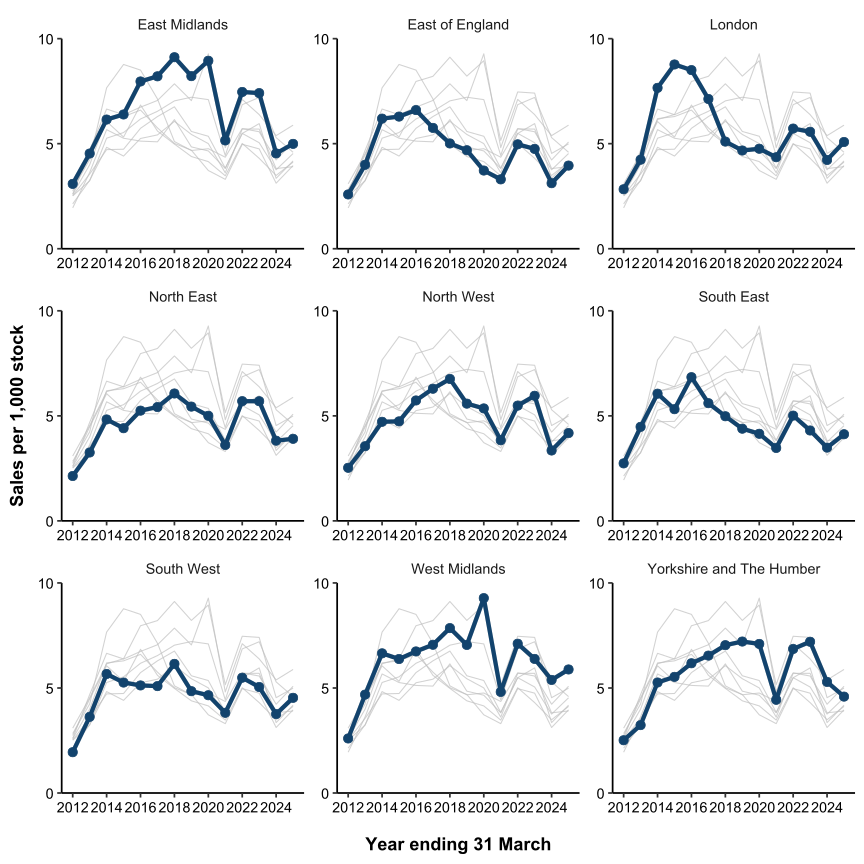
The sales data for this chart is available in the Social Housing Sales and Demolitions open data and stock figures are taken from the Local Authority Housing Statistics and the Statistical Data Return for local authorities and private registered providers respectively.
In 2024-25, the total sales per 1,000 stock ranged from 3.9 in the North West to 5.9 in the West Midlands, while, as mentioned, the England figure was of 4.6 sales per 1,000 stock.
Compared to the previous year, sales per 1,000 stock increased across all regions other than Yorkshire and The Humber. The largest increase was in London (up 0.86 sales per 1,000 stock) and the smallest increase was in the North east (up 0.08 sales per 1,000 stock). In Yorkshire and the Humber, there was a slight decrease of 0.7 sales per 1,000 stock.
Between April 2013 and March 2016, London saw more sales as a proportion of its housing stock than any other region, averaging 8.3 sales per 1,000 stock in the 3-year period. From April 2016 to March 2022, the East Midlands and West Midlands saw the highest sales relative to stock, largely driven by the introduction of the Voluntary Right to Buy [footnote 6] pilot scheme in those areas in 2016.
From 2022–23 onwards, regional patterns changed again. In 2022-23, the East Midlands recorded the highest rate of social housing sales, closely followed by Yorkshire and the Humber (7.4 and 7.2 sales per 1,00 stock, respectively). The following year, 2023–24, sales remained concentrated in similar parts of the country. The West Midlands and Yorkshire and the Humber reporting the highest proportions of sales relative to stock (5.4 and 5.3 sales per 1,000 stock).
By 2024–25, the regional distribution of sales had changed again. London re-emerged as a region with one of the highest sales levels (5.1 sales per 1,000 stock) for the first time since the mid-2010s, while the West Midlands continued to report the highest proportion of sales (5.9 sales per 1,000 stock)
Across the regions of England, the main provider of social housing varies, with private registered providers owning more social housing than local authorities in all the regions of England except the East Midlands and Yorkshire and the Humber in 2024-25. However, the proportion of private registered provider owned housing stock varies considerably even in those regions where it has the majority of stock, for example 52% of social housing in London and 86% in the North West is owned by private registered providers.
The graph below shows the number of sales by provider type in each of the regions in England. Sales of private registered provider stock have been consistently higher than sales of local authority stock in the North West, South East and South West for the whole period covered and since 2018-19 in London. Local authority stock sales have been consistently higher than sales of private registered provider stock in the East Midlands and Yorkshire and the Humber.
These regional differences in sales patterns are linked to the Large Scale Voluntary Transfers (LSVTs), discussed in more detail below, that took place between 1989 and 2015, during which large volumes of local authority stock were transferred to private registered providers. Most transfers took place in London and the North West, followed by the South East, resulting in PRPs owning a larger share of the social housing stock in those regions. As a result, regions with many LSVTs now show higher levels of PRP sales, while regions that retained more local authority ownership, such as the East Midlands and Yorkshire and the Humber, continue to show higher LA sales.
Figure 1.4 Total sales of social housing from 1 April 2011 to 31 March 2025, by provider and English region
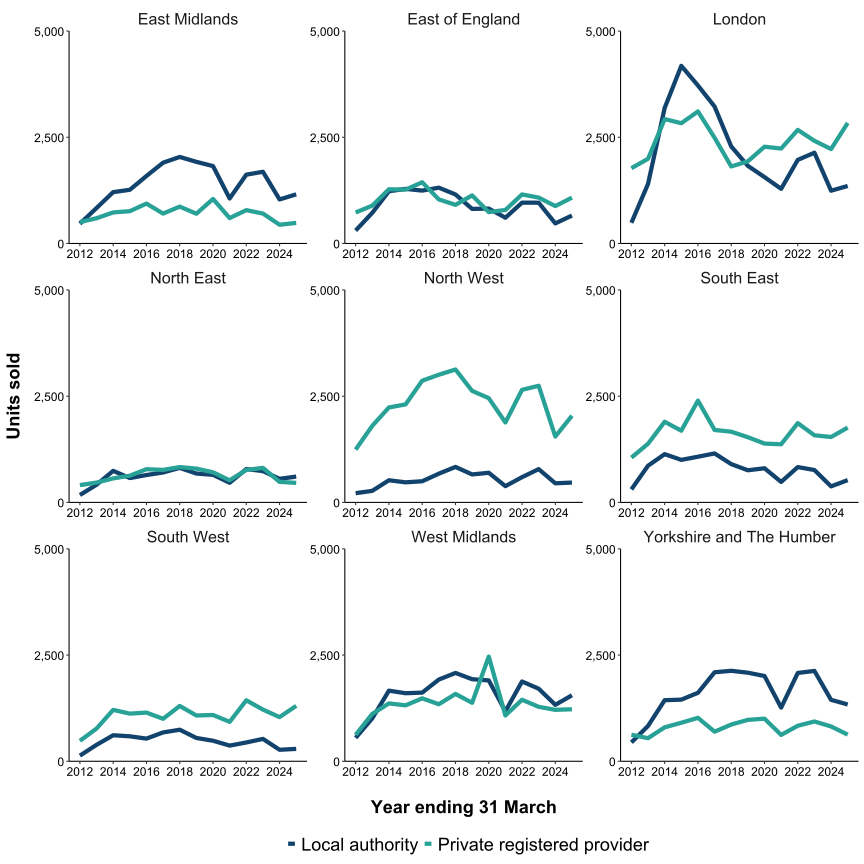
The data for this chart is available in the Social Housing Sales and Demolitions open data.
4.1 Low cost home ownership sales by region
For the 4,781 100% staircased low-cost home ownership sales in 2024-25, 34% of these were in London and a further 21% were in the South East. This regional distribution is similar to previous years. 99% of these sales were from private registered providers.
4.2 Transfers of stock by region
Historically, local authorities were the main provider of social housing across all English regions. However, transfers of stock from local authorities to private registered providers, including large scale voluntary transfers (LSVTs) [footnote 7], have resulted in a shift in this balance of local authority and private registered provider owned social housing stock. Between 1988 and 2015 [footnote 8], over 1.3 million social housing dwellings were transferred from local authorities to private registered providers as part of a total of 307 LSVTs. LSVTs were more prevalent in certain regions of the country, particularly in the North West where 85% of stock was owned by private registered providers by 2015.
There have been no LSVTs since 2015, however smaller transfers of stock from local authorities to private registered providers still exist. A total of 244 transfers since 2015-16 to 2024-25, of which 5 in 2024-25.
5. Demolitions
In 2024-25, there were 3,119 demolitions of social housing dwellings, a decrease of 14% compared to 2023-24. Of these, 1,470 (47%) were of local authority stock [footnote 9] and 1,649 (52%) were of private registered provider stock. These demolitions represent 0.1% of the stock of local authorities and private registered providers respectively, at 31 March 2025.
Historically, the number of demolitions of local authority owned stock was much higher, peaking at just over 14,500 in 2001-02. However, the number of local authority demolitions has since fallen, and the 1,470 demolitions in 2024-25 were the lowest number recorded. Demolitions of private registered provider stock have fluctuated more over time, and in 2024-25 increased by 4% compared to 2023-24
Figure 1.5: Demolitions of social housing stock, from April 1997 to 31 March 2025 by provider
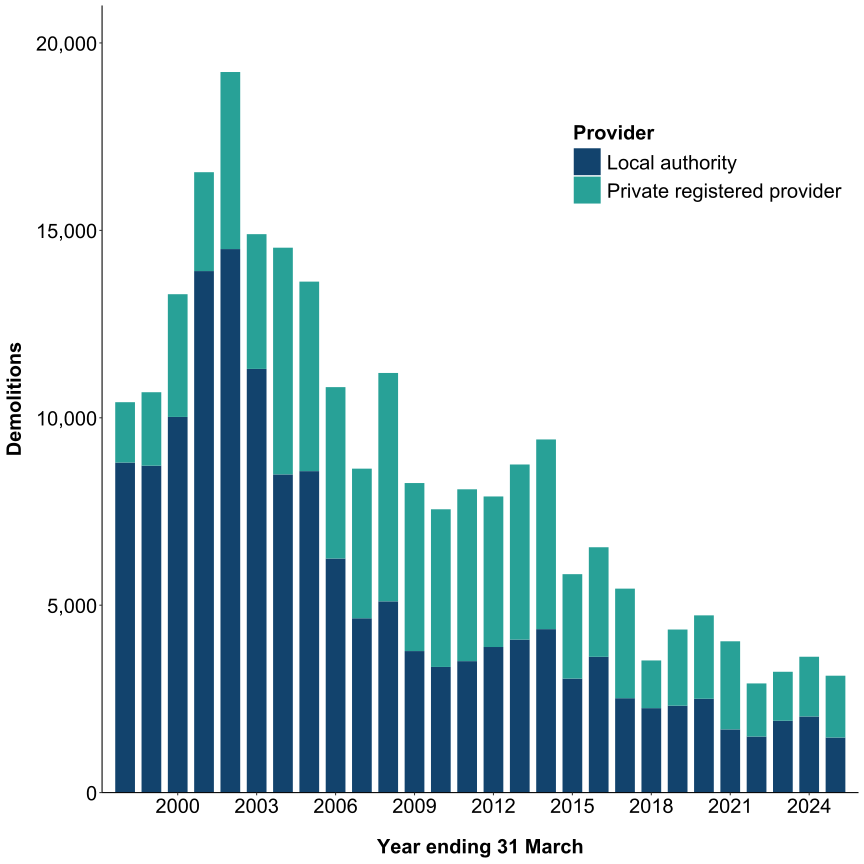
The data for this chart is available in Live Table 684.
Data for demolitions of PRP owned social housing stock are available by region and lower tier local authority geography since 2011-12. Due to the large variation in the total social housing stock and the type of stock owner in each region, the graph below presents demolitions as a proportion of total stock. It shows that between April 2011 and March 2016 the North East demolished a larger proportion of its total housing stock than any other region, peaking during 2012-13 with 6.5 demolitions per 1,000 stock.
Between April 2016 and March 2025, London demolished a larger proportion of its stock than any other region. On average it demolished 1.6 homes per 1,000 each year. Over the same period combined, the East of England and the East Midlands demolished proportionally the least stock, the average of the rates between April 2016 and March 2025 being 0.5 demolitions per 1,000 stock.
Figure 1.6 Demolitions of social housing per 1,000 stock from 1 April 2011 to 31 March 2025 by English region
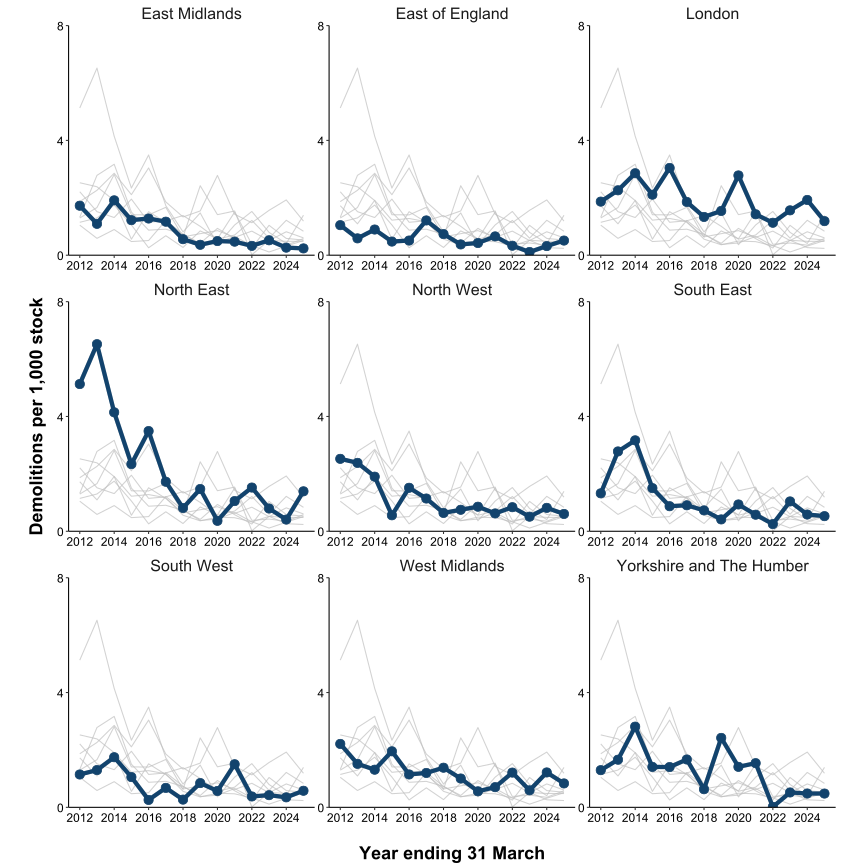
The demolitions data for this chart is available in the Social Housing Sales and Demolitions open data and stock figures are taken from the Local Authority Housing Statistics and the Statistical Data Return for local authorities and private registered providers respectively.
6. Related statistics
Affordable Housing Supply in England 2024-25: A statistical release by MHCLG which reports on the number of affordable housing dwellings started and completed from 1 April 2024 to 31 March 2025. These statistics contain information on the number of Shared Ownership dwellings completed, which can be used as a proxy for the total Shared Ownership dwellings with first tranche sold in 2024-25. The live tables accompanying this release report on affordable housing supply from 1991-92 to 2024-25.
Private registered provider social housing stock in England: A statistical release by RSH based on data sourced from the Statistical Data Return on an annual basis, it provides details of private registered provider owned and managed stock, details rents reported for low-cost rental (social and affordable rents) and provides an overview of the private registered provider sector including details on stock losses and gains, and vacancies.
Local Authority Housing Statistics: A statistical dataset released by MHCLG which shows the district-level data collected annually from all local authorities. Parts of the dataset are used as a source for this release, but it is also used to report on dwelling stock, condition of stock, rents and arrears and supply of new social housing.
Right to Buy sales and replacements: A statistical release by MHCLG which reports on the number of Right to Buy sales [footnote 10] of social housing and the number of properties started or acquired to replace these stock funded through the receipts of these sales. The data is sourced from the Pooling of Capital Receipts return which is collected by MHCLG from all local authorities which have a Housing Revenue Account. Up to the end of 2020-21 this was a quarterly release, but from 2021-22 it is an annual release with quarterly management information published.
-
These official statistics were independently reviewed by the Office for Statistics Regulation in December 2011. They comply with the standards of trustworthiness, quality and value in the Code of Practice for Statistics and should be labelled ‘accredited official statistics’. ↩
-
Properties which were once occupied under relevant shared ownership or low-cost home ownership arrangements where the occupier has now acquired a 100% share of a shared ownership property or repaid an equity loan on a shared equity property in full. ↩ ↩2
-
Official statistics in development are official statistics that are undergoing a development; they may be new or existing statistics, and will be tested with users, in line with the standards of trustworthiness, quality, and value in the Code of Practice for Statistics. ↩
-
Stock is reported as of 31 March at the end of the current financial year ↩
-
More information on the reinvigoration of the Right to Buy scheme can be found in the accompanying Right to Buy document. ↩
-
In 2016-17, Voluntary Right to Buy (VRtB) was introduced as a small-scale pilot and then widened to a Midlands regional pilot in 2018. This gave the Right to Buy to tenants of private registered providers who previously were not eligible for Preserved Right to Buy. More information can be found in the Voluntary Right to Buy Midlands pilot: evaluation. ↩
-
A Large-Scale Voluntary Transfer is the voluntary transfer of ownership of all or some of a local authority’s tenanted and leasehold homes to a private registered housing provider, registered by the Social Housing Regulator, in return for a payment for the value of that stock ↩
-
Data available shows the dates for these 307 large scale voluntary transfers to be from 15 December 1988 to 13 April 2015. ↩
-
Local authority demolitions relate to Housing Revenue Account stock only, which makes up more than 99% of local authority housing in England. See Section A of the Local Authority Housing Statistics. ↩
-
These statistics relate only to those sales by local authorities under the Right to Buy scheme which are subject to the Right to Buy receipt pooling requirements. More detail can be found in the definitions section of their technical notes. ↩