Social housing sales and demolitions 2024-25: Net supply of social housing for rent
Published 12 February 2026
Applies to England

© Crown copyright 2026
This publication is licensed under the terms of the Open Government Licence v3.0 except where otherwise stated. To view this licence, visit nationalarchives.gov.uk/doc/open-government-licence/version/3 or write to the Information Policy Team, The National Archives, Kew, London TW9 4DU, or email: psi@nationalarchives.gov.uk.
Where we have identified any third party copyright information you will need to obtain permission from the copyright holders concerned.
This publication is available at https://www.gov.uk/government/statistics/social-housing-sales-and-demolitions-2024-25-england/social-housing-sales-and-demolitions-2024-25-net-supply-of-social-housing-for-rent
Social housing for rent is defined in section 69 of the Housing and Regeneration Act 2008, where it is also referred to as low cost rental accommodation. For the purpose of these statistics, it includes homes owned by local authorities and private registered providers at the following tenures: social rent, affordable rent (including London affordable rent), and intermediate rent. For definitions of these tenures, please refer to the housing statistics glossary.
The estimates of net supply of social housing for rent in this bulletin show some differences when compared with the more direct measure of the change in stock of social housing for rent [footnote 1]. Some of these differences are definitional and explored later in this bulletin.
The headlines in this bulletin all cover local authorities with a Housing Revenue Account (those that own at least 200 homes) and private registered providers that own at least 1,000 homes (the Regulator of Social Housing’s definition of a large provider). We estimate these providers own 97% of social housing for rent in England [footnote 2].
Estimates of net supply in this bulletin and figures quoted from the Regulator of Social Housing or from other official statistics are unrounded.
Release date: 12 February 2026
Lead Statistician: Samuel Pitch
Statistical queries: housing.statistics@communities.gov.uk
Media enquiries: 0303 444 1209 or NewsDesk@communities.gov.uk
1. Headline figures
In the year ending 31 March 2025: +23,189 was the estimated net change in the stock of social housing for rent (includes social rent, affordable rent, London affordable rent, and intermediate rent).
-3,834 was the estimated net change in social rent stock, driven in large part by sales of local authority stock.
+25,628 was the estimated net change of affordable rent stock (including London affordable rent).
95% of all losses of social housing for rent were to social rent, increasing to 97% when restricted only to losses through sales.
2. Introduction
This bulletin presents gains and losses of social housing for rent in England. It is split into two sections.
The first section presents accredited official statistics comparing over time the number of sales and demolitions of social housing for rent with new supply of these homes provided by local authorities and private registered providers. This provides a time series back to 1997-98, and figures down to the local authority level, but it does not represent a complete measure of net supply of social housing for rent because some small categories of losses are not covered (but all categories of new supply are included).
The second section presents official statistics in development [footnote 3] estimating the net supply of social housing for rent for the three years up to 31 March 2025. These estimates show the full profile of gains and losses by provider and tenure, but they cover a shorter period and fewer providers, rely on newly developed data sources, and are available at England level only. They also show some differences when compared with the more direct measure of the year-on-year change in stock of social housing for rent. The reasons for these differences are discussed later in this bulletin. The methodology in this second section differs from previous years’ releases to make use of more detailed data now available for local authorities. These statistics have been developed to meet demand from users for a net measure of the supply of social housing for rent, including a recommendation by the Housing Communities and Local Government select committee in July 2020.
3. Comparing sales and demolitions to new supply
This section compares the number of sales and demolitions of social housing for rent with the new supply of these homes provided by local authorities and private registered providers [footnote 4]. This data is presented as a time series from 1997-98, although it should only be used for comparison of general trends. For official statistics in development which calculate net figures for the supply of social housing for rent since 2022-23 broken down by tenure, please see the next section.
While sales and demolitions are the two main sources of losses to social housing, the data presented in this section does not account for all losses. There are a few reasons for this:
- the local authority demolitions data only covers local authorities with a Housing Revenue Account (those that own at least 200 homes). These local authorities own more than 99% of local authority housing for rent in England [footnote 5].
- the sales and demolitions data only covers private registered providers that own at least 1,000 homes (the Regulator of Social Housing’s definition of a large provider). These providers own 96% of private registered provider housing for rent in England [footnote 6].
- this data does not cover losses through conversions and change of tenure, which we estimate to be 17% of losses of social housing for rent in 2024-25 [footnote 7].
- this data does not cover non-registered providers or where the provider was unknown. We expect these to be a relatively small number.
In 2024-25, local authorities delivered 9,241 new units of social housing for rent, while private registered providers delivered 37,629, representing a combined total of 46,870 new social housing for rent [footnote 8]. Meanwhile, there were 23,681 sales and demolitions of social housing for rent this year.
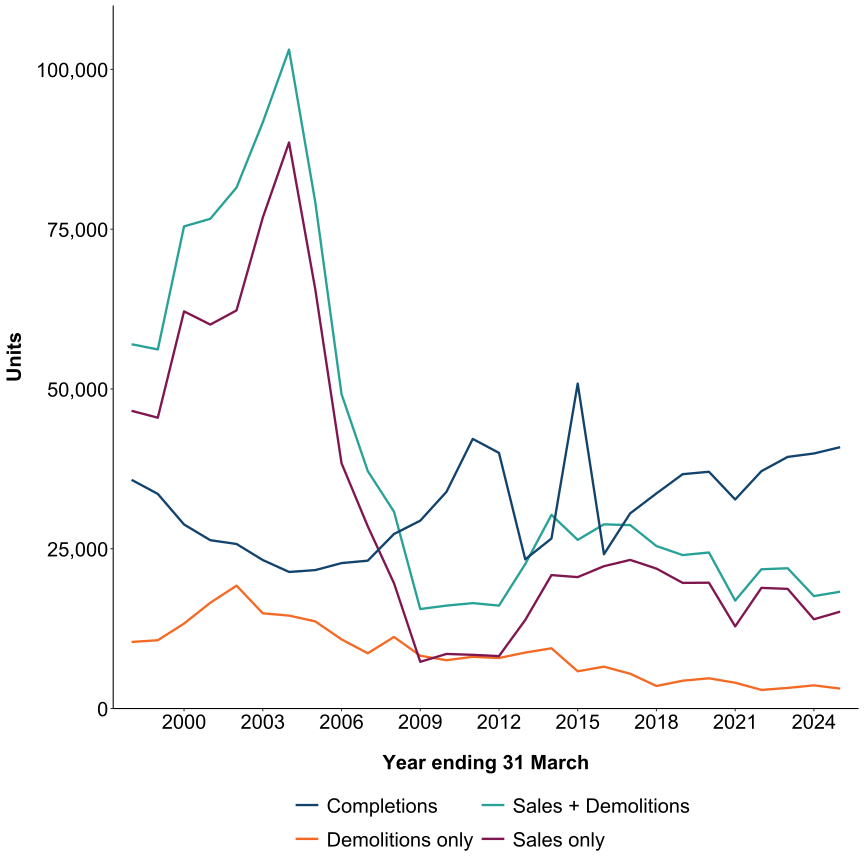
The chart below compares sales and demolitions with new supply of social housing for rent since 1997-98. Between 1997-98 and 2007-08, the combined sales and demolitions were consistently higher than new supply of social housing for rent. By contrast, in all but 2 of the 17 years from 2008-09 to 2024-25, new supply of social housing for rent has exceeded losses through sales and demolitions.
Figure 4.1 Comparison of sales and demolitions to new supply of social housing for rent, England 1 April 1997 to 31 March 2025
The data for gains in this chart is available in the Affordable Housing Supply statistics open data, while the data for losses is available in the Social Housing Sales and Demolitions open data.
The change in the pattern was due to several factors, including the sharp decrease in sales between 2003-04 and 2008-09, the general decrease in the number of demolitions since 2001-02, and the investments through different affordable homes programmes since 2008. In particular, the peak in completions in 2014-15 can be explained by a surge in delivery at the close of the 2014-15 Affordable Homes Programme.
This is also consistent with trends in stock estimates presented in Live Table 104 which show an increase in the combined local authority and private registered provider stock since 2008. Estimates in this table follow the Census definition of “dwelling” and include an adjustment for bedspaces and non-self-contained dwellings. Therefore, they do not exactly match data on the number of units (which include bedspaces as well as dwellings) available for affordable or social housing.
4. Net supply of social housing for rent
4.1 Background
This section presents official statistics in development [footnote 3] which estimate the net supply of social housing for rent at various tenures by comparing the inflows and outflows of stock in England. Users should be aware that official statistics in development may have a higher degree of uncertainty than accredited official statistics.
The most direct measure of the change in the stock of social housing for rent can be calculated by comparing private registered provider and local authority housing stock over time [footnote 1], as this covers all local authorities and private registered providers. However, this measure lacks information on the constituent gains and losses which drive the change between annual stock figures.
We have therefore collected new data and further developed a methodology to estimate the net change in social housing for rent by looking at the profile of gains and losses at each tenure. This is to meet a recommendation from the July 2020 Housing, Communities and Local Government Select Committee, as well as demand for a net measure from other users.
However, the coverage of these estimates of net supply is slightly lower than the coverage of the figures reported by the Regulator of Social Housing on the change in stock of social housing for rent. The estimates of net supply presented here cover only local authorities with a Housing Revenue Account (those that own at least 200 homes) and private registered providers that own at least 1,000 homes (the Regulator of Social Housing’s definition of a large provider). We estimate these providers own 97% of social housing for rent in England [footnote 2]. Later in this section we compare and explain the differences between these two measures of the change in stock of social housing for rent.
The estimates of net supply in this section are calculated by combining data on gains and losses of social housing for rent from the Local Authority Housing Statistics and the Statistical Data Return collections.
Social housing for rent is defined in section 69 of the Housing and Regeneration Act 2008, where it is also referred to as low cost rental accommodation. For the purpose of these statistics, it includes homes owned by local authorities and private registered providers at the following tenures: social rent, affordable rent (including London affordable rent), and intermediate rent. For definitions of these tenures, please refer to the housing statistics glossary.
As these are official statistics in development, we are particularly keen to receive feedback via housing.statistics@communities.gov.uk on whether readers find them relevant, valuable, or whether there are any other comments.
4.2 Overall net supply of social housing for rent
In 2024-25, the estimated net increase in social housing for rent was 23,189. By provider, social housing for rent owned by local authorities there is an estimated net increase of around 202 units in 2024-25, while the rental stock owned by private registered providers is estimated to have increased by 22,987 units.
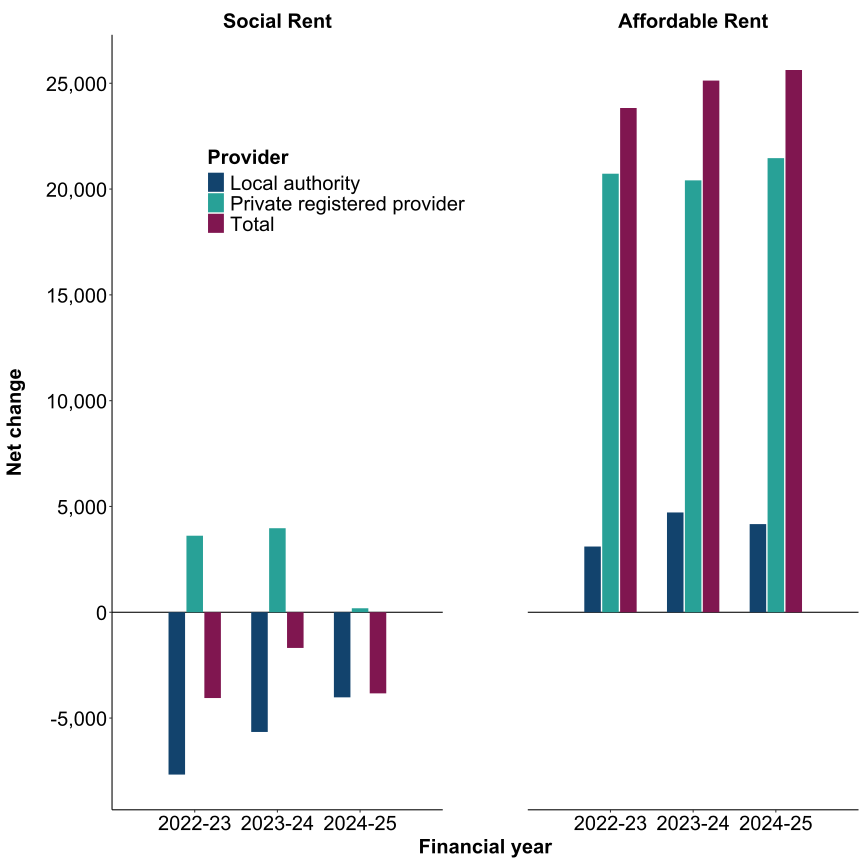
The graph below presents these estimates of net supply of social housing for rent (for the social rent and affordable rent tenures separately) in England from 2022-23 to 2024-25 by provider [footnote 9].
Figure 4.2 Net supply of housing for social rent and affordable rent by provider, 2022-23 to 2024-25
The data used for the graph is available alongside this release.
In 2024-25, there was an estimated net loss of 3,834 homes for social rent, with 188 social rent gains for private registered providers offset by 4,022 rent losses for local authorities. Overall, the net loss of social rent in 2024-25 was higher than the net loss of 1,687 in 2023-24.
There were an estimated net gain of 25,628 homes affordable rent in 2024-25. This was driven by an estimated 21,462 gains in affordable rent homes owned by private registered providers. Meanwhile, local authorities saw a net increase of 4,166 homes for affordable rent in 2024-25. Overall, the net increase of affordable rent in 2024-25 was slightly higher than the net increase of 25,128 in 2023-24.
Differences between the figures above, especially those for social rent for private registered providers and affordable rent for local authorities, and those that can be calculated via year-on-year stock change are discussed in the next section and in the technical notes.
4.3 Comparisons with other available data
Another way of measuring the change in stock of social housing for rent is to compare the stock held by local authorities and private registered providers from one year to the next, as published by the Regulator of Social Housing [footnote 1]. This method shows there were an additional 24,046 units of social housing for rent at 31 March 2025 compared with the previous year. This is 857 units higher than the overall estimate of net supply presented above.
There are several definitional differences between these two measures which explains this:
- The figure for private registered provider stock published by the Regulator of Social Housing includes both small and large providers (those that own more or less than 1,000 stock), whereas the data on gains and losses in the stock balance sheet of the Statistical Data Return additional tables, which informs our estimate of net supply, excludes small providers [footnote 10] [footnote 11]. Large private registered providers own 96% of social housing for rent in England [footnote 6].
-
All local authority housing stock is covered by the Regulator for Social Housing’s Local Authority Data Return. Whereas data from the Section K of the Local Authority Housing Statistics used to calculate our estimate of net supply is only mandatory for local authorities with a Housing Revenue Account (those that own at least 200 stock). These local authorities own more than 99% of local authority housing for rent in England [footnote 5]. However, this data was not returned by all these local authorities in full [footnote 12].
-
The inclusion (or not) of temporary accommodation explains in large part the differences between the methodology presented here and the year-on-year local authority stock differences. Temporary accommodation is excluded from Section K of the Local Authority Housing Statistics but it is included in the Regulator for Social Housing’s Local Authority Data Return if the units meet the legal definition of social housing. In 2024-25, this seems to account for most of the differences in the net numbers of local authority affordable rent between the two sources.
- There may also be differences due to the timing of gains and losses recorded in different data sources, particularly with transfers of stock from private registered providers to local authorities (and vice versa) near the start or the end of the financial year. For instance, we are aware of around 200 transfers from private registered providers to local authorities being recorded as losses in 2022-23, which seem to only appear recorded as gains for local authorities in the following year.
It is possible to account for some of the differences in coverage by restricting the Regulator of Social Housing’s data to local authorities with a Housing Revenue Account and by using stock data for large private registered providers only. Any remaining differences are likely due to the timing issue discussed above, as well as minor data quality issues discussed further in the technical notes accompanying this release. After accounting for differences in coverage, the difference between the two measures are as follows:
-
Overall, the difference between measures increases from 857 to 3,171 units, as shown in Table 3 of the technical notes accompanying this release.
-
For social rent, both measures show a net decrease, of 3,834 using our estimate of net supply and of 2,320 using the stock figures from the Regulator of Social Housing (see Table 4 of the technical notes). The differences are mainly due to private registered providers social rent. This is in contrast with the decrease of 4,047 units in the overall social rent stock when directly comparing the Regulator of Social Housing’s figures across years. However, these figures are not directly comparable because, in addition to the definitional differences discussed above, the main Regulator of Social Housing stock figures for social rent also include intermediate rent units.
-
For affordable rent, both measures show a net increase. Our estimate shows a net increase of 25,628, compared to 28,680 from the Regulator of Social Housing’s data (see Table 5 of the technical notes) after accounting for differences in coverage between the two measures. These differences are driven by the local authority issue concerning temporary accommodation discussed previously. The Regulator of Social Housing’s unadjusted comparison of stock across years showed an increase of 28,096 units.
4.4 Impact of tenure, provider and type of loss or gain on net supply of social housing
This section presents estimates of net supply of social housing for rent broken down by tenure, provider, and the constituent types of losses and gains.
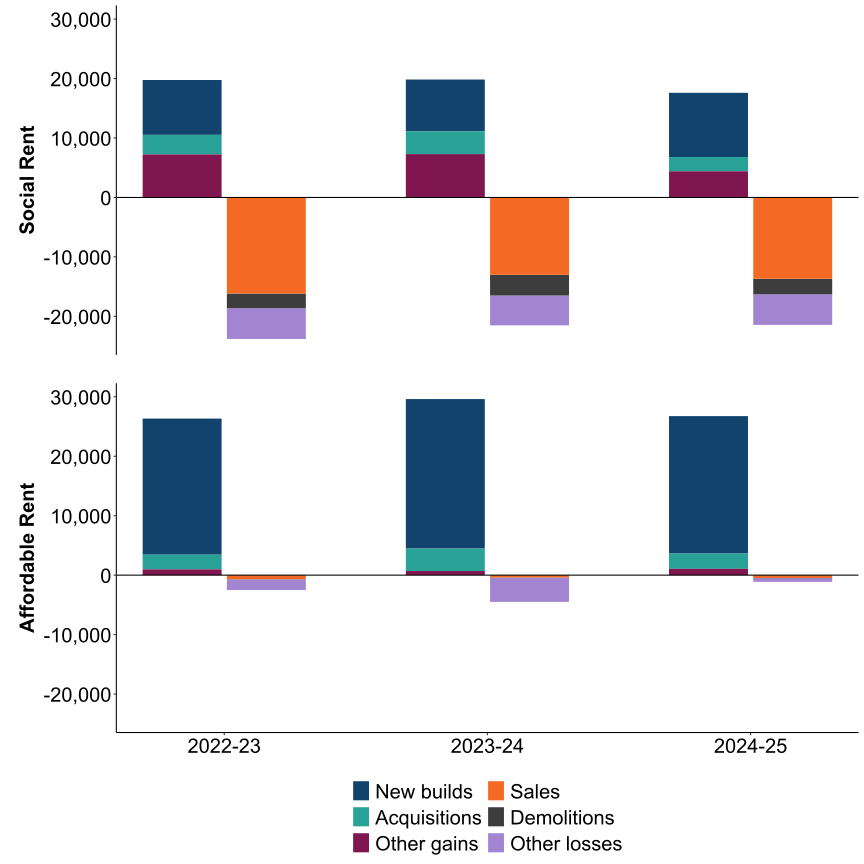
The chart below shows a breakdown of gains and losses of housing for social rent and affordable rent for local authorities and private registered providers combined.
Figure 4.3 Net supply of housing for social rent and affordable rent by type of gain or loss, 2022-23 to 2024-25
The data used for the graph is available alongside this release.
This chart shows that losses to social rent stock consist mainly of sales, with 13,673 social rent sales taking place in 2024-25, making up 64% of social rent losses. By contrast, the 471 sales of affordable rent stock were considerably lower, making up 42% of all losses to affordable rent.
Gains in affordable rent were mostly driven by new build, with 23,128 new build homes for affordable rent in 2024-25, making up 86% of all affordable rent gains. By contrast, the 10,807 social rent new builds represented 61% of all social rent gains in 2024-25, while other gains (due to conversions, transfers in stock, or changes in tenure) which made up 25% of all social rent gains, represent only 4% of all affordable rent gains.
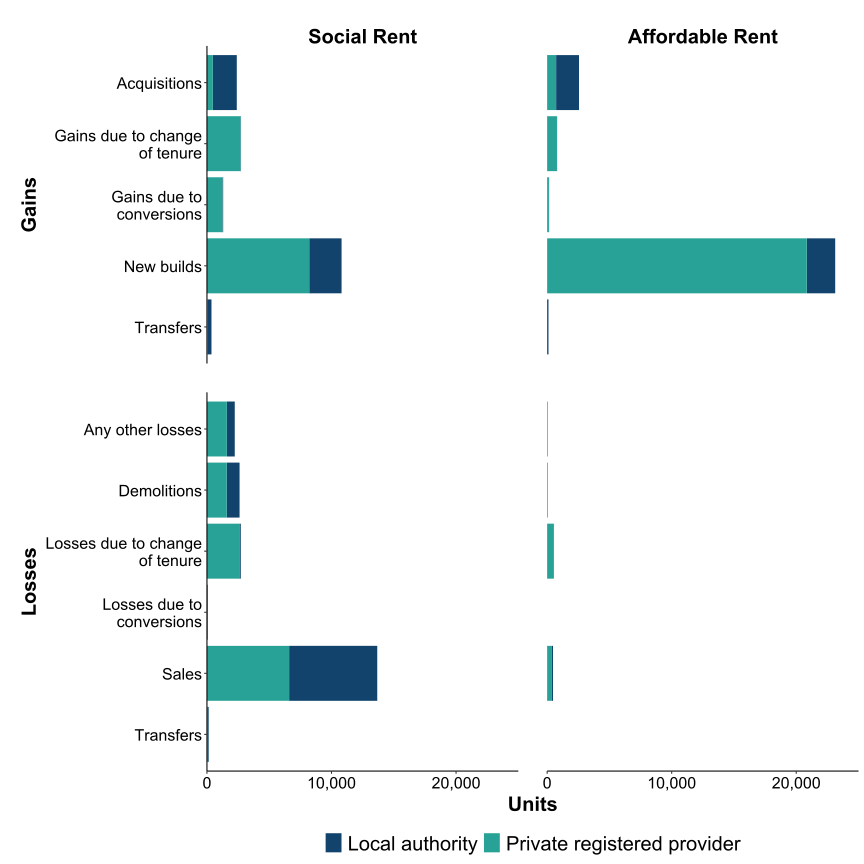
The chart below shows a breakdown of gains and losses of housing for social rent and affordable rent in the latest year, 2023-24, this time with local authorities and private registered providers shown separately.
Figure 4.4 Net supply of housing for social rent and affordable rent by provider and type of gain or loss, 2024-25
The data used for the graph is available alongside this release.
Most gains to affordable rent were new build, with a smaller number of acquisitions. But gains to social rent stock, especially that owned by private registered providers saw a greater mix of new builds, acquisitions, changes of tenure and conversions. Most of the 22,562 stock losses were of social rent stock, representing 95% of all losses of social housing for rent. If we restrict to sales only, then for 97% of all sales were of social rent. 42% of all social rent stock losses were owned by local authorities and 58% owned by private registered providers.
An estimated 99% of losses of local authority stock were social rent properties, similar to the 97% of stock held by local authorities that is for social rent in 2024-25. By contrast, 92% of private registered provider losses were social rent properties, a little higher than the 86% of stock held by private registered that was for social rent in 2024-25 [footnote 13].
The data used for our estimates is available at local authority level for stock owned by local authorities [footnote 14]. Data for private registered providers is not currently available by geography. We will continue to explore ways to obtain this data in future.
-
Available in Table 1.4 of the Regulator of Social Housing’s ‘Registered provider social housing stock and rents in England’ collection. ↩ ↩2 ↩3
-
Calculated by using Private registered providers stock and rents in England - Summary (key facts), Table 1.4 of the Regulator of Social Housing’s ‘Registered provider social housing stock and rents in England’ collection, Local Authority Data Return and Local Authority Data Return additional tables. ↩ ↩2
-
Official statistics in development are official statistics that are undergoing a development; they may be new or existing statistics, and will be tested with users, in line with the standards of trustworthiness, quality, and value in the Code of Practice for Statistics. ↩ ↩2
-
The figures for new supply are a subset of the total presented in Live Table 1000, and include not just new build, but also acquisitions of stock that were not previously used as social housing for rent. ↩
-
Calculated by dividing local authority rental stock in the stock information sheet of the Local Authority Data Return for those local authorities with a Housing Revenue Account by the total rental stock owned by local authorities (available in Table 1.1 of the Local Authority Data Return additional tables). ↩ ↩2
-
See Table 3.1c of the Statistical Data Return additional tables. ↩ ↩2
-
For the purposes of this release, London affordable rent is counted as affordable rent. Intermediate rent accounts for a relatively small percentage of stock and is therefore not commented on in this bulletin, but the [data on gains and losses of intermediate rental stock is available alongside this release. ↩
-
The stock balance sheet only covers private registered providers owning at least 1,000 social housing units who are registered on 31 March each year. This means that stock flow data for smaller providers, or those who have developed within year but subsequently deregistered, will not be captured. Additionally, as providers only report activities which they have undertaken, units transferred into a provider may include development activity carried out by precursor bodies prior to a merger (e.g. Provider A develops 200 units prior to merging with into Provider B and transferring all of its stock. Provider B does not record this as development activity because it did not carry out the work and the 200 units would be recorded under the total units transferred into it). Units developed by subsidiaries or third parties that have ownership moved to a large private registered provider may also sometimes be recorded as something other than new build activity depending on the legal form the change of ownership took. ↩
-
From 2024–25, SDR column headers changed to provide a more detailed breakdown: acquisitions are now split into five explicit categories (from PRP in same group, from unregistered entity in same group, from another PRP excluding same group, from Local Authority RP, and from other sources). The methodology was adjusted for 2024-25 to reflect this and therefore, comparisons across years should be made with caution, as 2022-23 and 2023-24 do not include the adjustment. ↩
-
LAHS did not have a 100% response rate in 2024-25. For the purpose of our Net Supply and comparison figures, Croydon and Hillingdon did not provided data for Section K. Together they account for around 23,000 local authority Housing Revenue Account stock. Therefore, direct comparisons across years should be made with caution. We have adjusted for this in the discussion included in the technical notes. ↩
-
Stock figures from Table 1.4 of the Regulator of Social Housing’s ‘Registered provider social housing stock and rents in England’ collection. ↩
-
See Section K of the Local Authority Housing Statistics collection. ↩