How many people come to the UK via illegal entry routes?
Published 26 November 2026

© Crown copyright 2026
This publication is licensed under the terms of the Open Government Licence v3.0 except where otherwise stated. To view this licence, visit nationalarchives.gov.uk/doc/open-government-licence/version/3 or write to the Information Policy Team, The National Archives, Kew, London TW9 4DU, or email: psi@nationalarchives.gov.uk.
Where we have identified any third party copyright information you will need to obtain permission from the copyright holders concerned.
This publication is available at https://www.gov.uk/government/statistics/immigration-system-statistics-year-ending-september-2026/how-many-people-come-to-the-uk-via-illegal-entry-routes
Back to ‘Immigration system statistics, year ending September 2026’ contents page
This release goes up to the year ending (YE) September 2026. The “year ending” period includes the 12 months up to and including the YE month. For example, YE September 2026 includes the 12 months between 1 October 2025 and 30 September 2026.
Additional information is provided in the ‘About the statistics’ section and in the user guide.
1. Arrivals via illegal entry routes
Not all people arriving to the UK via illegal entry routes will be detected and the proportion of arrivals detected will vary by method and route. Therefore, these figures are representative of the volume detected, rather than the exact total arrival figure for each route. However, broad trends of arrivals by route can be observed.
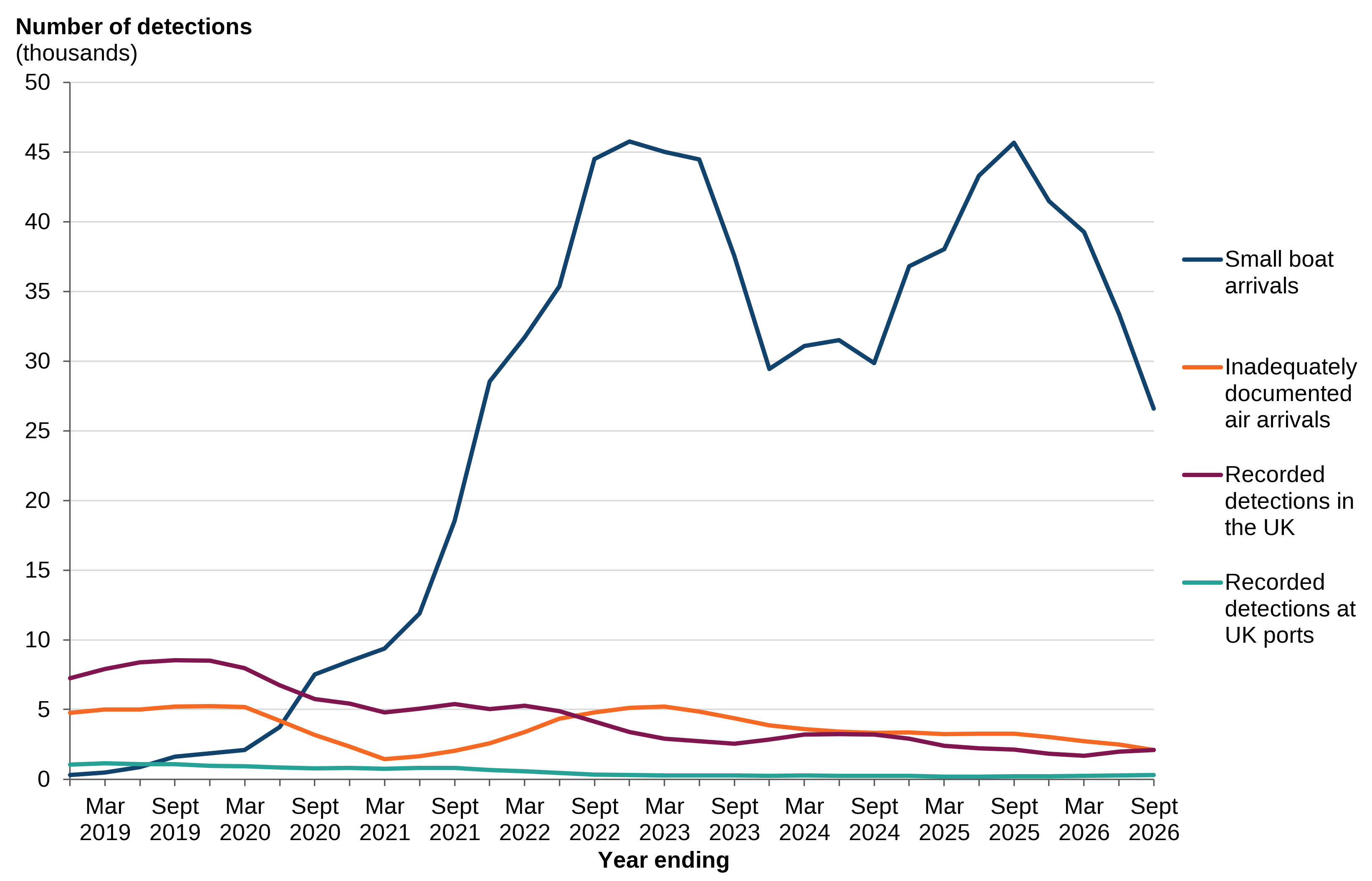
The number of people detected arriving to the UK via illegal entry routes in the YE September 2026 was lower than the previous year and the lowest since the YE September 2021.
In the YE September 2026, there were 31,077 people detected arriving via illegal entry routes, 39% fewer than in the YE September 2025 (51,244) and the lowest since the YE September 2021 (26,761). People arriving via small boat (26,581) accounted for 86% of these arrivals, covered in more detail in Section 2. Small boats have been the predominant recorded entry method for people arriving via illegal routes since 2020, when detected arrivals increased rapidly and detections on other illegal entry methods declined. This decline was likely in part due to the COVID-19 pandemic making other methods of illegal entry, such as air or ferry, less viable. Small boat arrivals are also the most visible of the illegal methods of entry, so the most likely to be detected (and therefore recorded), and numbers have remained high even as other routes have become more viable again.
The number of inadequately documented air arrivals (IDAs) has been decreasing since the recent peak in the YE March 2023 (5,222). There were 2,107 IDAs in the YE September 2026, 35% fewer than in the YE September 2025.
In the YE September 2026, 2,098 people were detected in the UK, within 72 hours of arriving via an illegal route, a decrease of 1% compared to YE September 2025 (2,123) and 75% fewer than the recent peak of 8,535 in the YE September 2019. Many of those detected will have arrived clandestinely, for example in a vehicle or on a ferry.
Recorded detections at UK ports have decreased since 2018 (when the statistical series began), down 75% from the highest number of detections in YE March 2019 (1,150). Despite a recent 46% increase in detections in the YE September 2026 (291) compared to the previous year (200), the number of detections remains relatively low, at below 300 in each of the last 4 years.
Figure 1: People detected entering the UK by illegal method of entry, YE December 2018 to YE September 20261
Source: Illegal entry routes to the UK detailed dataset, year ending September 2026 - IER_D01
Notes:
- The order of the legend matches the order of the lines, descending by volume of detected arrivals in the YE September 2026.
1.1 Demographics of people arriving via illegal routes
The overall demographic profile of people detected arriving via illegal entry routes largely reflects the demographic profile of small boat arrivals, which account for the majority of detections (see Section 2.3 for more detail on nationalities of small boat arrivals).
Since 2018, 70% of people detected arriving via illegal entry routes to the UK have been adult males aged 18 and over. During the same period, 18% of arrivals were aged 17 and under.
IDAs are the main exception, with a different demographic profile. For example, Georgian and Chinese nationals were more commonly detected arriving by air than by small boat.
Table 1: 5 most common nationalities detected arriving to the UK by illegal method of entry, in the YE September 20261,2,3,4
| Small boat arrivals (% of total) | Inadequately documented air arrivals (% of total) | Recorded detections in the UK (% of total) | |
|---|---|---|---|
| Eritrea, 17% |
Georgia, 15% |
Sudan, 41% |
|
| Sudan, 14% |
Iran, 14% |
Iran, 20% |
|
| Somalia, 14% |
China, 13% |
Iraq, 10% |
|
| Afghanistan, 13% |
Sri Lanka, 9% |
Eritrea, 8% |
|
| Iran, 10% |
Stateless, 7% |
Vietnam, 4% |
|
| Total (excluding those where nationality is not yet available) | 25,548 | 2,107 | 2,098 |
Source: Illegal entry routes to the UK detailed dataset, year ending September 2026 - IER_D01
Notes:
- The most common nationalities are those with the highest number of people detected arriving for each separate illegal method of entry in the YE September 2026.
- Excludes small boat arrivals labelled as ‘Not currently recorded’, for whom information on nationality is not yet available.
- The nationality recorded as stateless includes those officially recognised as stateless, including those recognised as Kuwaiti Bidoon.
- The most common nationalities for those detected arriving illegally at UK ports are not included in this table due to the low volume of arrivals for this method of entry; however, nationality data is published in table IER_D01 of the illegal entry routes detailed datasets.
2. Small boat arrivals
2.1 Number of people arriving via small boat
Statistics on people arriving via small boat include individuals who were detected on arrival to the UK, detected in the Channel and subsequently brought to the UK, and those encountered in the UK who were suspected of having arrived on a small boat within the previous 72 hours. They do not include any people who arrived on larger vessels (such as a ferry), those who arrived in the UK undetected, or those prevented from departing France or intercepted by French authorities and returned to France (see the ‘user guide’). A weekly summary of small boat arrivals and preventions is also published by the Home Office, along with the latest daily data on Small boat activity in the English Channel - GOV.UK.
The number of people arriving to the UK via small boat decreased in the YE September 2026 and was the lowest since the YE September 2021.
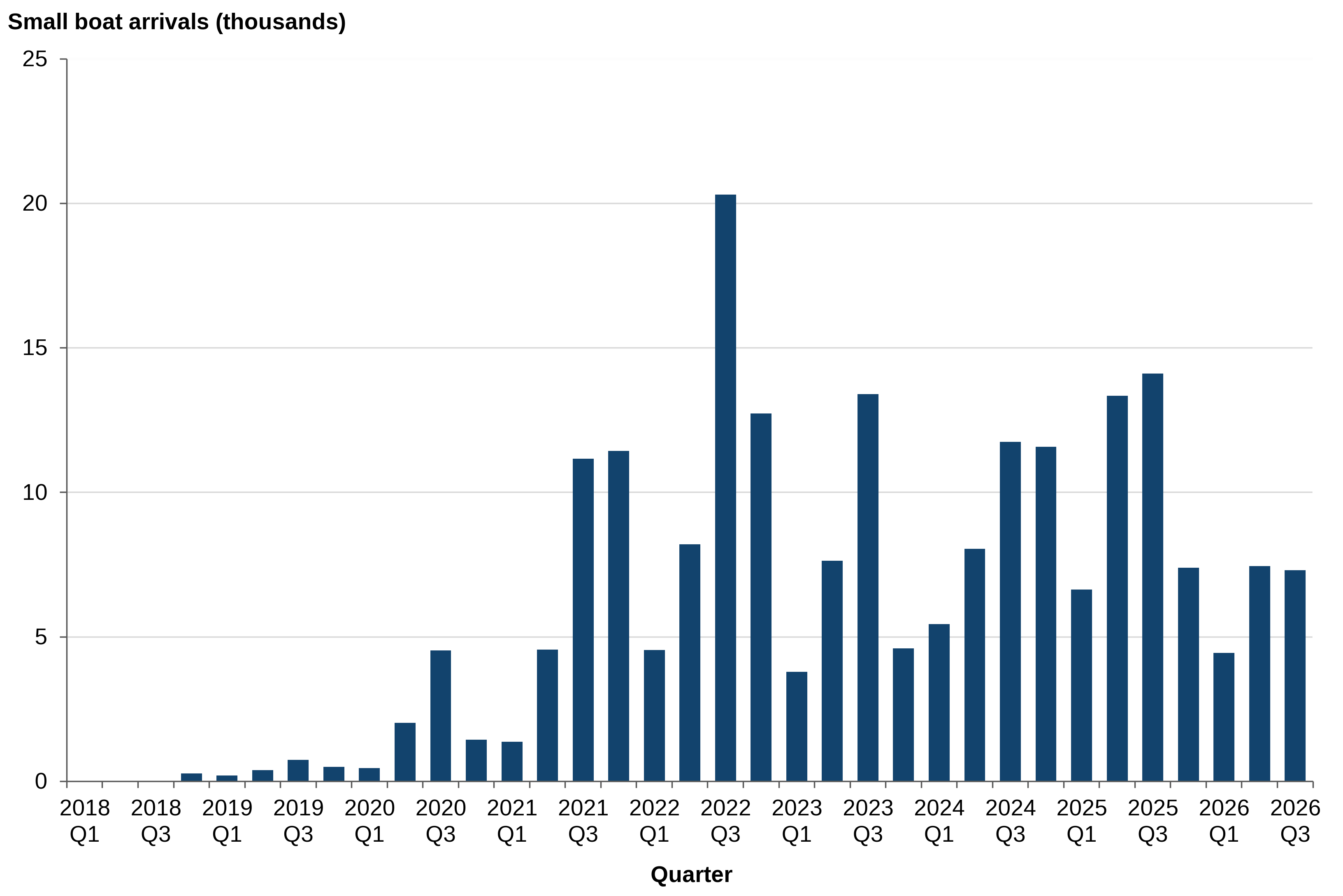
The number of people arriving via small boat in the YE September 2026 (26,581) was 42% fewer than in the YE September 2025. The number of people arriving via small boat was relatively low from 2018 to 2020, with 10,608 arrivals in total across these 3 years. The number of people arriving via small boat has since had 2 notable peaks, firstly in the YE December 2022 (45,774) and then again in the YE September 2025 (45,659) (see Figure 1). The number detected in the latest year was the lowest since the YE September 2021 (18,528), following a decrease in the latest year.
Small boat arrival numbers fluctuate, often due to changes in the weather. Warmer summer months typically see higher numbers due to more favourable crossing conditions. Comparisons of arrivals between months or years should take this seasonality and differences in weather conditions into account and we do not advise making comparisons between short periods or different times of the year.
Figure 2: Quarterly number of people arriving via small boat, January 2018 to September 2026
Source: Illegal entry routes to the UK detailed dataset, year ending September 2026 - IER_D01
2.2 Number of small boats and people per boat
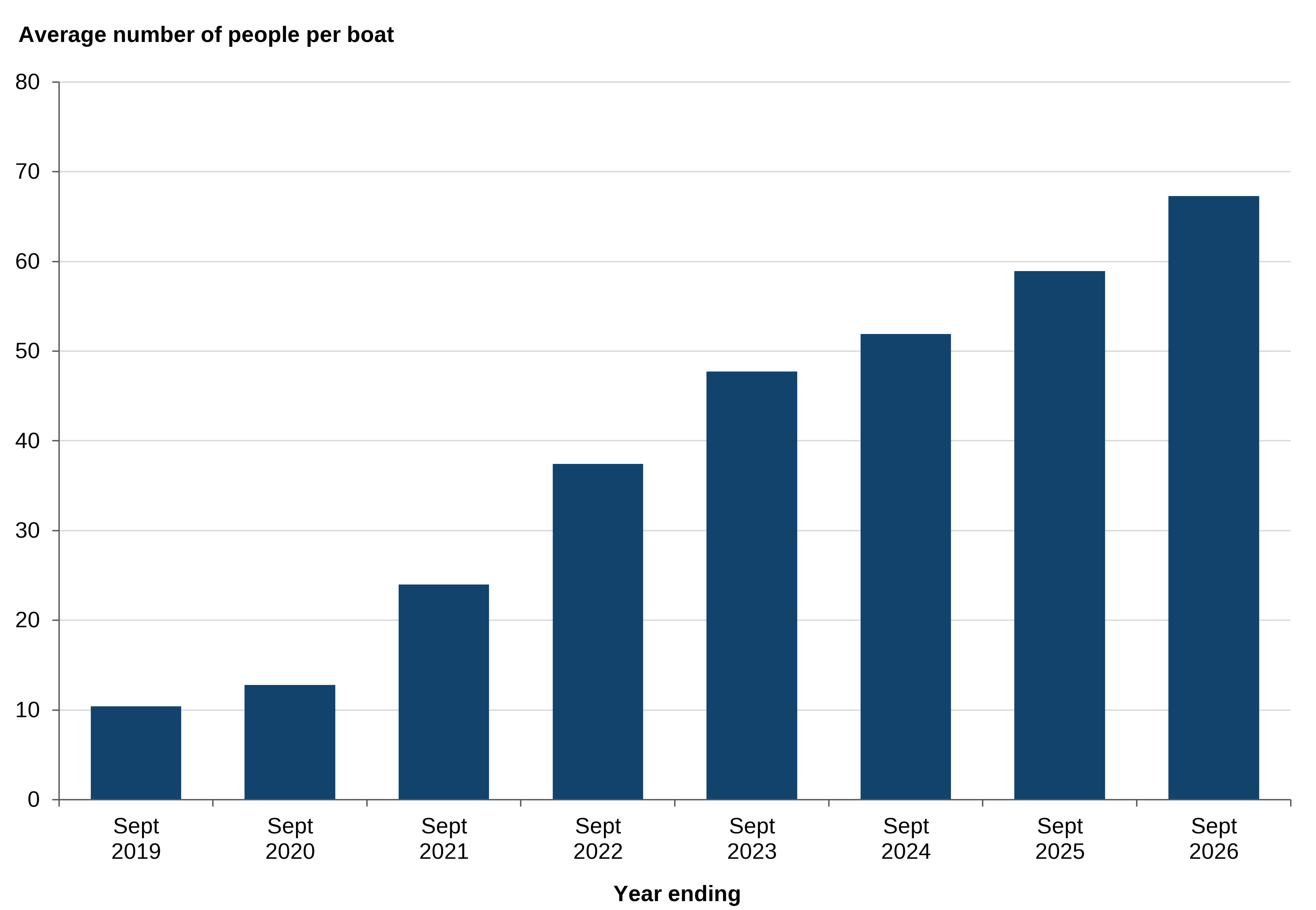
The average number of people per small boat has increased year-on-year since 2018.
Figure 3: Average number of people per small boat, YE September 2019 to YE September 2026
Source: Illegal entry routes to the UK summary tables, year ending September 2026 - IER_02a
The average number of people per small boat has increased each year since 2018, reaching 67 people per boat in the YE September 2026. This is an increase from 59 in the previous year and 10 in the YE September 2019. Most recently, July to September 2026 had an average of 73 people per boat. In contrast, the number of small boats arriving decreased 49% in the YE September 2026 (395 boats) compared to the YE September 2025 (775 boats).
2.3 Nationalities of people arriving via small boat
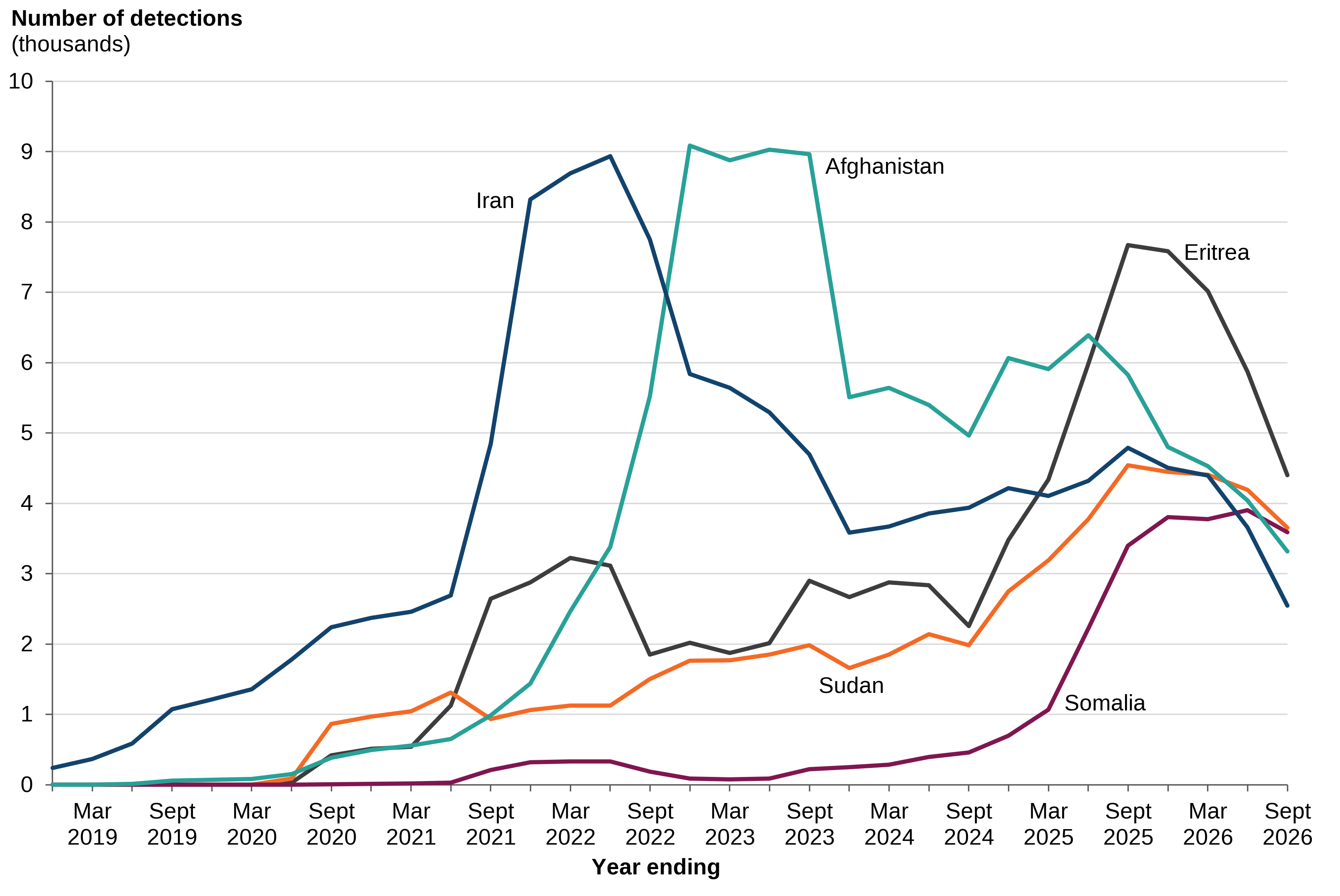
The top 5 most common nationalities (Eritrean, Sudanese, Somali, Afghan, and Iranian) arriving via small boat in the YE September 2026 accounted for more than two-thirds of all small boat arrivals in that period.
Eritreans were the most common nationality arriving by small boat in the YE September 2026, with 4,399 arrivals, 43% lower than in the previous year (Figure 4).
The number of Sudanese, Afghan and Iranian nationals arriving by small boat also decreased in the latest year, down 20%, 43% and 47% respectively.
Despite the overall decrease in the number of people arriving by small boat, the number of Somali nationals arriving by small boat in the YE September 2026 (3,587 arrivals) was 6% higher than in the previous year.
Albanian nationals were historically one of the most common nationalities arriving by small boat, accounting for 28% of all small boat arrivals in the YE December 2022. However, their numbers have since decreased, with only 100 Albanians arriving via small boat in the YE September 2026.
Figure 4: Most common nationalities arriving via small boat, YE December 2018 to YE September 20261
Source: Illegal entry routes to the UK detailed dataset, year ending September 2026 - IER_D01
Notes:
- Excludes arrivals where information on nationality was not recorded in the dataset.
For information on returns of people who arrived via small boat (and all returns from the UK), see the ‘How many people are returned from the UK?’ chapter of the Immigration system statistics quarterly release. Data on individuals who arrived to the UK via small boat from France and were subsequently returned to France under the readmission arrangements established by the UK-France agreement (which ended in October 2026) is published in Transfers into and returns from the United Kingdom under the UK-France Agreement on the Prevention of Dangerous Journeys, between 6 August 2025 and 30 June 2026 on GOV.UK.
Data on asylum claims and National Referral Mechanism (NRM) referrals from people who arrived via small boat is published in a separate chapter, updated annually in May, called ‘How many small boat arrivals have claimed asylum or been referred to the National Referral Mechanism?’. The latest data going up to the YE December 2025 is available in the accompanying data tables.
3. About the statistics
The Illegal entry routes (formerly ‘irregular migration’) statistics were first published in February 2022 as ‘Official Statistics’.
This release uses the term ‘illegal entry routes’ when referring to the act of entering into the UK unlawfully. Some individuals entering via illegal routes may go on to claim asylum, regularise their status in the UK, or be found to have been a victim of modern slavery.
All statistics in this chapter relate to people who come to the UK via illegal routes. It includes those arriving on a small boat across the English Channel (a ‘small boat arrival’), along with some other groups arriving without prior lawful permission.
The statistics presented here relate to the number of people detected on, or shortly after, arrival to the UK through various illegal methods of entry. They do not include all those who enter the UK through illegal routes, nor the number of people currently present in the UK without permission. It is not possible to know the exact number of people currently resident in the UK without permission, nor the total number of people who enter the UK via illegal routes, and so we have not produced any official estimates for this number.
This is because:
- some people will successfully evade border controls and remain in the UK undetected
- some people may enter the UK on regular routes, but their status can change over time – for example, if they overstay a visa (it should be noted that there are a number of ways in which a person’s departure from the UK may legitimately not be recorded on the system)
- the data sources available count the number of recorded detections - in some instances the same person may be detected multiple times, either for the same method of entry or across different methods of entry (such individuals will be counted multiple times in the statistics)
- some people may enter the UK via illegal routes but subsequently go on to get legal status – for example, following a successful asylum claim
Figures on detections may be affected by the levels of operational activity at the border and overseas, so should not be used to infer levels of entry via illegal routes. Changes in detection could be a result of changes in operational activity as well as changes in the number of people attempting to enter the UK via illegal routes and recording practices.
Some people seek to enter the UK without valid permission but are prevented from reaching the UK border (for example, at the juxtaposed controls in France and Belgium, or further afield, if prevented from travelling). Prevented attempts are not reported in this chapter. However, a weekly summary of small boat arrivals and preventions is published separately by the Home Office, including definitions of what these figures include. Enforcement activity in response to offences which have the effect of exploiting vulnerable migrants by smuggling them across borders for profit, including offences committed by organised criminal groups, is published in the chapter ‘What is being done to stop organised immigration crime?’.
This data on small boat preventions and organised immigration crime disruptions can be used to provide more context on people attempting to cross the English Channel in small boats and enforcement activity. Any counts of arrivals and attempted entries may relate to multiple arrivals or attempts by the same individual and therefore will not relate to numbers of individual people.
For more information on the data in this chapter, please see the ‘user guide’.
4. Data tables
Data referred to here can be found in the following tables:
We welcome your feedback
If you have any comments or suggestions for the development of this report, please provide feedback by emailing MigrationStatsEnquiries@homeoffice.gov.uk. Please include the words ‘PUBLICATION FEEDBACK’ in the subject of your email.
We’re always looking to improve the accessibility of our documents. If you find any problems or have any feedback relating to accessibility, please email us.
See Section 6 of the ‘About this release’ section for more details.