How many people are returned from the UK?
Published 26 November 2026

© Crown copyright 2026
This publication is licensed under the terms of the Open Government Licence v3.0 except where otherwise stated. To view this licence, visit nationalarchives.gov.uk/doc/open-government-licence/version/3 or write to the Information Policy Team, The National Archives, Kew, London TW9 4DU, or email: psi@nationalarchives.gov.uk.
Where we have identified any third party copyright information you will need to obtain permission from the copyright holders concerned.
This publication is available at https://www.gov.uk/government/statistics/immigration-system-statistics-year-ending-september-2026/how-many-people-are-returned-from-the-uk
Back to ‘Immigration system statistics, year ending September 2026’ contents page
This release goes up to the year ending (YE) September 2026. The “year ending” period includes the 12 months up to and including the YE month. For example, YE September 2026 includes the 12 months between 1 October 2025 and 30 September 2026.
Additional information is provided in the ‘About the statistics’ section and in the user guide.
1. Returns
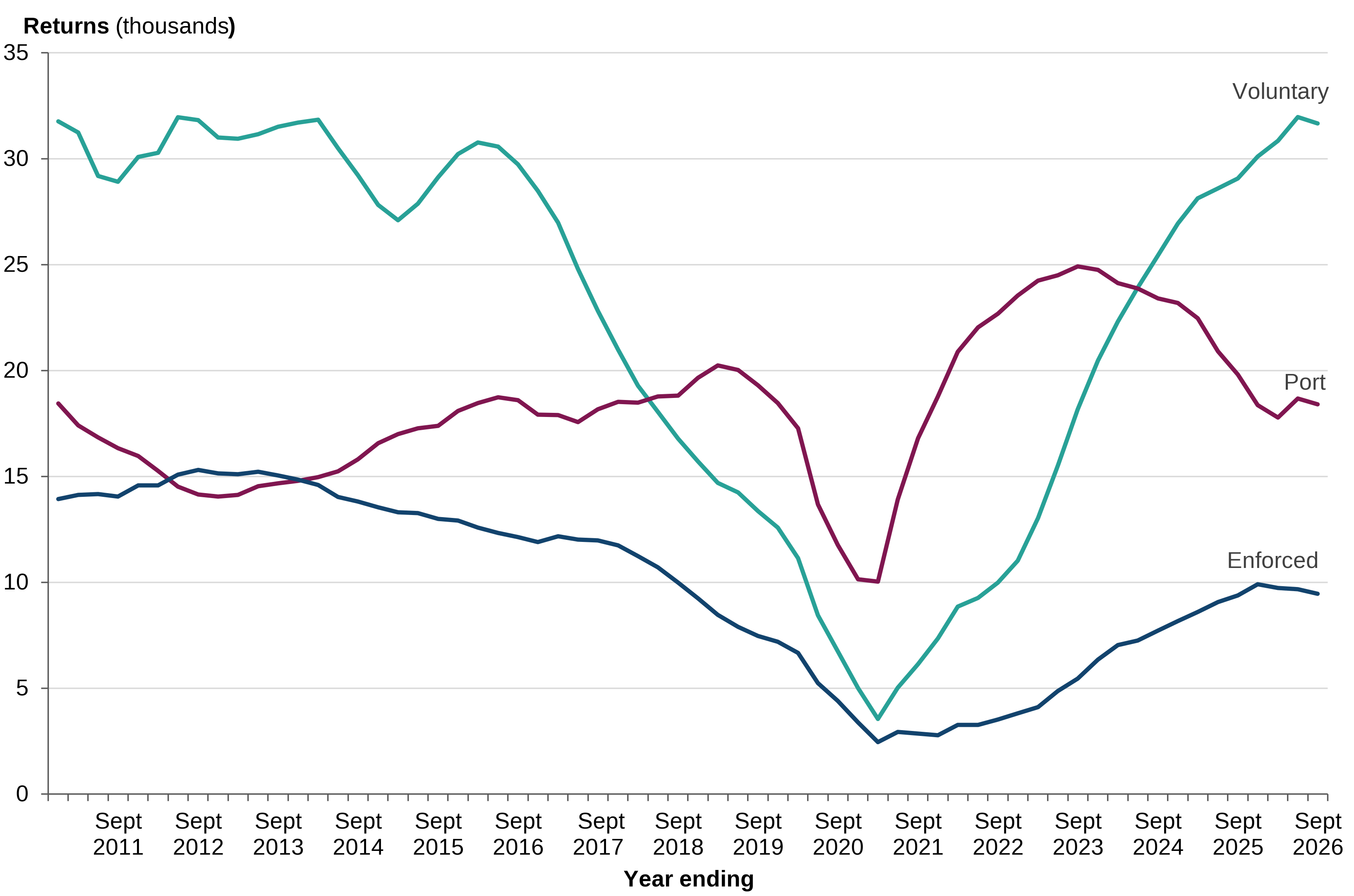
Enforced and voluntary returns from the UK have continued to increase year on year since 2022, with over 41,100 returns of people with no legal right to remain in the UK in the YE September 2026.
The Home Office seeks to return people to another country who do not have a legal right to stay in the UK. This includes people who are subject to deportation action, for example, due to a serious criminal conviction (see Section 5), enter, or attempt to enter, the UK illegally (including people entering via illegal routes of entry and by means of deception on entry), have been refused asylum (See Section 6), overstay their period of legal right to remain in the UK and those who breach their conditions of leave.
Returns can be categorised into 3 return types:
- enforced returns include people subject to administrative removal or deportation action which is carried out by the Home Office (see Section 2)
- voluntary returns include people who were liable to removal action or subject to immigration control but have left of their own accord, sometimes with support from the Home Office (see Section 3)
- port returns include people who are refused entry to the UK at a place of arrival and have subsequently departed (see Section 4)
There were 41,121 enforced and voluntary returns in the YE September 2026, a 7% increase on the 38,453 returns in the previous year. Around three-quarters (77%) returned voluntarily and around one-quarter (23%) were enforced returns. There were an additional 18,409 people refused entry on arrival and subsequently departed (‘port returns’).
Figure 1: Returns from the UK, by type of return, YE December 2010 to YE September 2026
Source: Returns - Ret_D01
2. Enforced returns
Enforced returns in the YE September 2026 remain similar to the previous year at around 9,500.
In the YE September 2026 there were 9,464 enforced returns, similar to the previous year (9,386). Enforced returns had fallen over time, from more than 15,000 returns in 2012 to fewer than 3,000 in 2021 but have since increased (See Figure 1).
The increase since 2022 was partially driven by increases in asylum-related returns (see Section 6). The ability to return people has been supported by returns agreements with countries outside the UK, schemes to remove foreign offenders (see Section 5) and the UK-France Agreement (see Section 6.1). For more information on these factors, please see the policy timeline document.
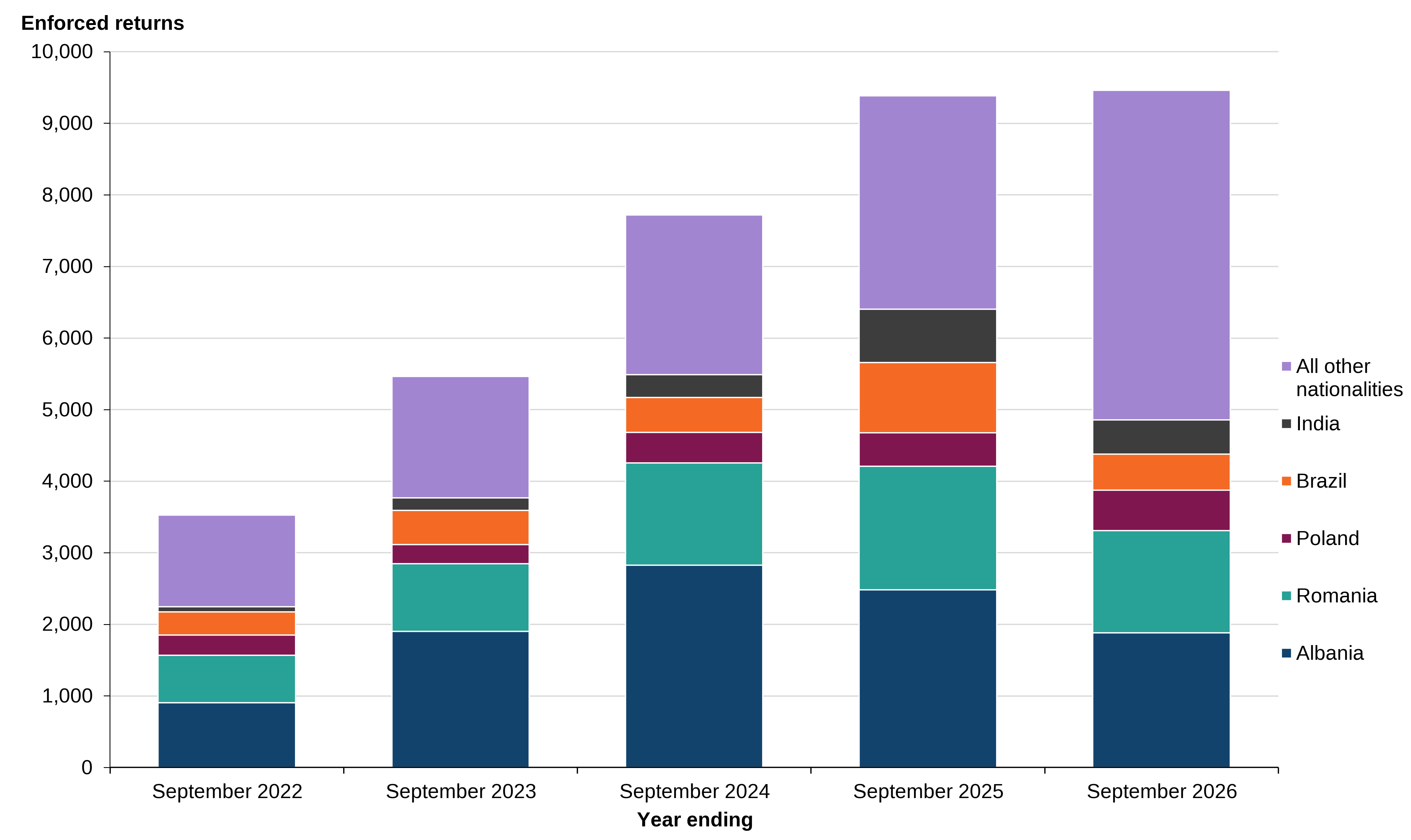
Albanian nationals have consistently been the most common nationality for enforced returns over the last 5 years, accounting for 20% of enforced returns in the latest year. This is attributed to the prominence of Albanians within FNO returns (See Section 5), asylum-related returns and small boat returns (see Section 6) following the signing of the UK Albanian Joint Communique in December 2022. However, enforced returns of Albanians have fallen compared to the previous year (24% decrease to 1,882) alongside enforced returns of Romanians (down 17% to 1,429) and Brazilians (down 49% to 500 returns).
Enforced returns of prominent small boat arrival nationalities, such as Afghan, Eritrean and Sudanese, have increased substantially since the UK-France Agreement was introduced in August 2025 (See Section 6).
Figure 2: Enforced returns from the UK, by nationality1; YE September 2022 to YE September 2026
Source: Returns - Ret_D01
Notes:
- Nationalities shown are the top 5 most common nationalities for enforced returns in the latest 12-month period.
3. Voluntary returns
Voluntary returns have continued to increase compared to the previous year, with over 31,000 in the YE September 2026, similar to volumes recorded in 2013.
Voluntary returns are categorised in 3 different ways: assistance from the Home Office (‘assisted’) returns; where the Home Office was notified of the departure, in the form of self-funded (‘controlled’) returns; and those discovered through data matching against passenger departures data (‘other verified returns’). Exact definitions can be found in the glossary section of the user guide.
In the YE September 2026, there were 31,657 voluntary returns, an increase of 9% compared with the previous year. As shown in Figure 1, voluntary returns remained high between 2010 and 2016, averaging around 30,000 per year, before falling substantially. Numbers have risen sharply since 2022 and are now at levels similar to those last observed between 2010 and 2016.
Until 2025, the majority (>50%) of voluntary returns in the last 15 years were ‘other verified returns’. However, since then, these returns make up less than half of all voluntary returns (45% in the YE September 2026). This coincides with ‘assisted’ returns becoming more prominent with large increases since 2024. These returns now comprise just over a third (34%) of all voluntary returns in the YE September 2026 compared with an average of 21% between 2022 and 2024.
‘Assisted’ returns are up 13% in the YE September 2026 compared with the previous year. Of these returns, over a third (36%) were Brazilian nationals. ‘Controlled’ returns have increased by 14% and make up 21% of all voluntary returns. ‘Other verified returns’ are up 4%, with 43% being Indian nationals.
4. Refusals of entry at port and subsequent return (port returns)
Port returns have declined over the last 3 years following increases between 2021 and 2023.
In the YE September 2026, there were 18,409 port returns, a decrease of 7% compared with the previous year. The decline over the last 3 years follows increases between 2021 and 2023 when most forms of travel became more viable after restrictions from the COVID-19 pandemic were eased.
UK Border Force take decisions to stop passengers on arrival based on the information that they receive and may subsequently refuse entry to the UK if they are not satisfied that an individual is a genuine visitor. Nationality does not play a part in these decisions, but the most common nationalities of port returns has changed since 2020.
Of the top 10 most common nationalities for port returns, 8 were non-visa nationals in the YE September 2026. This includes Romanian nationals who, despite being the most common port return nationality since 2012, are driving the overall decrease (down 31% to 3,999 in the YE September 2026 from 5,791 last year).
5. Returns of foreign national offenders
Total FNO returns include enforced, voluntary and port returns. FNOs that are returned may have arrived in the UK some years earlier, may have claimed asylum (included in ‘asylum-related return’ statistics) and may have lived in the UK for some time prior to their conviction and subsequent return.
Almost 6,000 FNOs were returned in the YE September 2026, up from the previous year and continuing the increases seen since 2022.
There were 5,995 FNO returns in the YE September 2026, an increase of 10% compared with the previous year. FNO returns have steadily increased since 2022 and are now just below the annual average of around 6,300 returns recorded between 2015 and 2017, when FNO returns were at their highest.
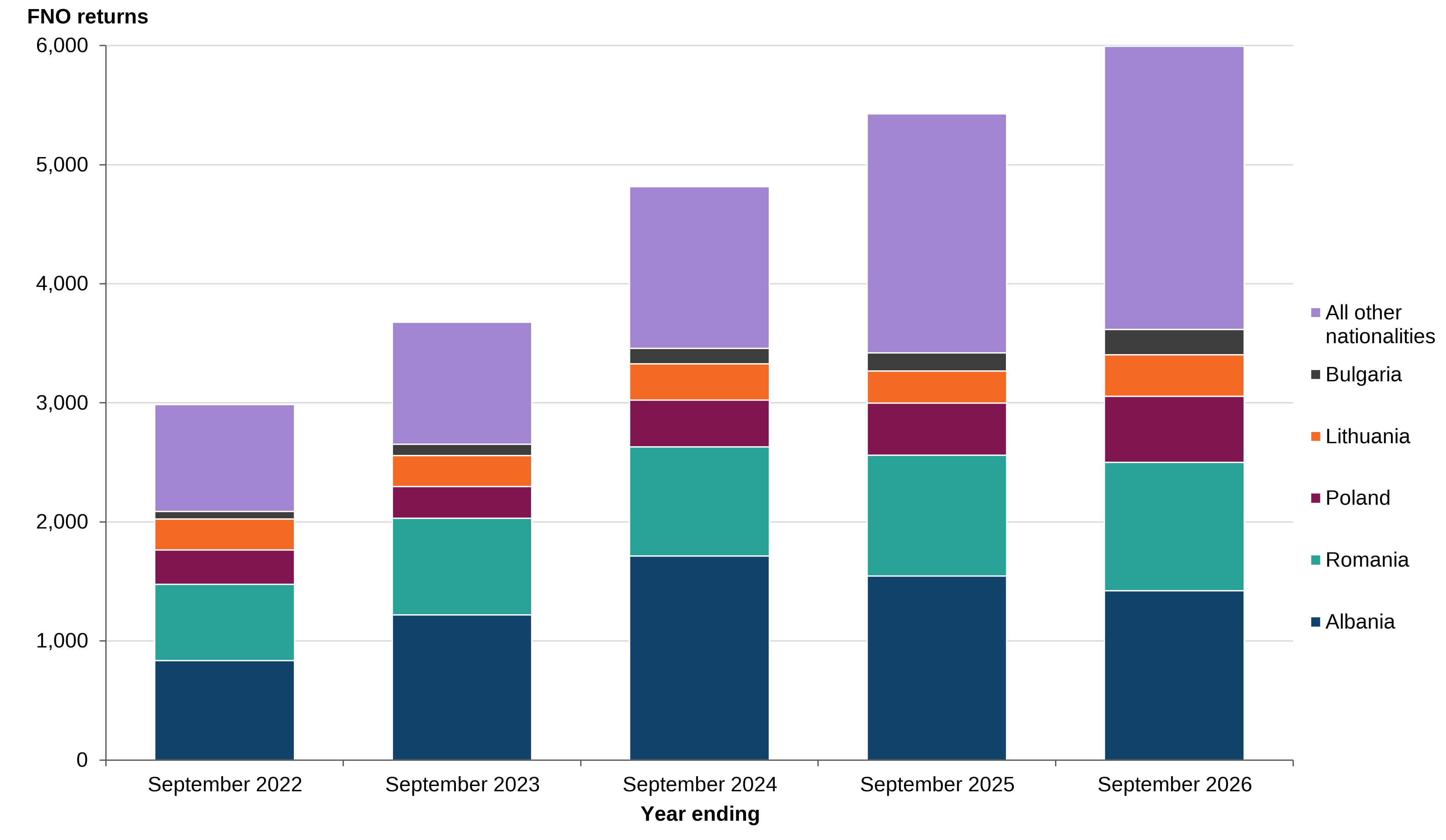
Albanian, Romanian and Polish were the most common nationalities for FNO returns in the YE September 2026 (See Figure 3). Albanian nationals have been the most common nationality in each of the last 5 years, with the UK Albanian Joint Communique (signed in December 2022) strengthening cooperation between the UK and Albania.
Despite being the most common nationality, Albanian FNO returns have decreased by 8% in the latest year from 1,545 in YE September 2025 to 1,421 in YE September 2026. FNO returns, however, have increased amongst several other prominent nationalities, most notably Polish FNO returns, up 27% from 436 to 553.
The Early Removal Scheme (ERS), introduced in 2004, enables FNOs to be returned earlier in their custodial sentence. The Facilitated return scheme (FRS) is a voluntary Home Office scheme established in 2006 which supports FNOs to leave the UK at the earliest possible opportunity and resettle in their home country, encouraging FNOs to cooperate with early removal. Over the last few years there have been some changes to the ERS and Standard Determinate Sentence 40% (SDS40) which has enabled earlier return of FNOs.
For more information on changes to rules relating to returns, see the policy timeline document. For ERS return statistics, please see the ‘Returns from the UK and enforcement activity’ ad hoc statistical release.
Figure 3: Returns of FNOs1 from the UK, by nationality2; YE September 2022 to YE September 2026
Source: Returns - Ret_D03
Notes:
- An FNO is someone who is not a British citizen and is, or was, convicted in the UK of any criminal offence, or convicted abroad for a serious criminal offence.
- Nationalities shown are the top 5 nationalities for FNO returns in the latest 12-months.
6. Asylum-related returns
Asylum-related returns relate to cases where there has been an asylum claim or further submission at some stage prior to the return. This will include asylum seekers whose asylum claims have been withdrawn, refused and who have exhausted any rights of appeal, those returned under third-country provisions, as well as a small number of those granted asylum/protection but who had to be removed for other reasons (such as criminality). In this section, asylum-related returns include enforced and voluntary returns, unless stated otherwise.
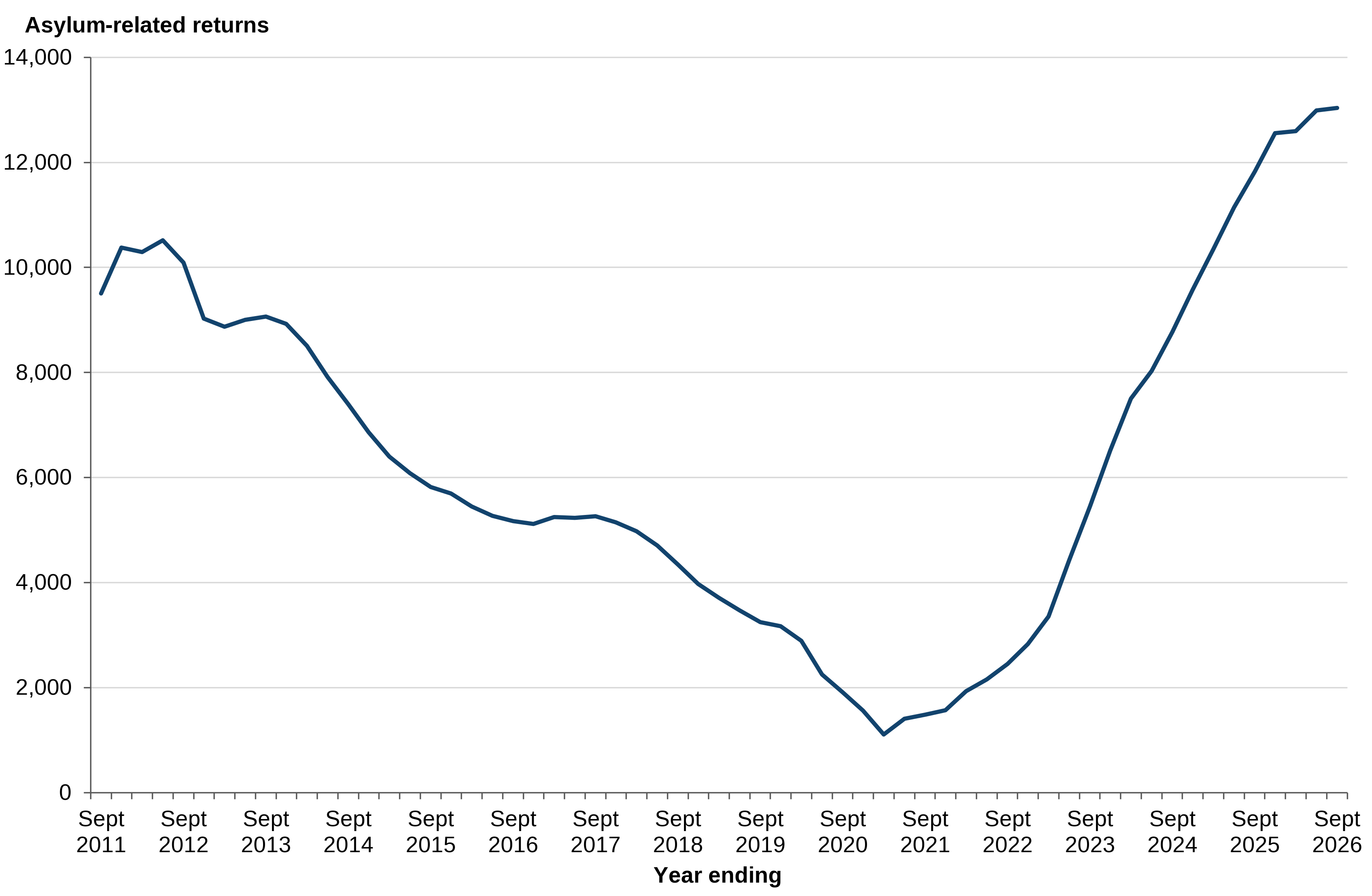
Asylum-related returns continued to increase to around 13,000 in the latest year and are at the highest level since 2010 (when this statistical series began).
In the YE September 2026, there were 13,039 asylum-related returns, an increase of 10% compared with the previous year. Asylum related returns have increased year on year since 2022.
The increase in asylum-related returns in the latest year was partially driven by enforced asylum-related returns of prominent nationalities arriving to the UK by small boat. The vast majority claim asylum upon arrival, see Section 6.1 for more detail. Eritreans (up from 6 to 335), Afghans (up from 11 to 313) and Sudanese (up from 1 to 179) are all up substantially compared with the previous year following the introduction of the UK-France agreement in August 2025.
The sharp increase in asylum-related returns can also, in part, be attributed to an increase in the volume of asylum claims refused or withdrawn between 2022 and 2025 for which any rights of appeal have been exhausted, making individuals eligible for return. For more information on trends in asylum case processing, please see the ‘How many people are granted asylum in the UK?’ topic.
Albanians have high withdrawal and refusal rates from asylum applications (see table Asy_D02 of the ‘Asylum detailed datasets’) and are the most common nationality for asylum-related returns in the YE September 2026, accounting for just under a fifth (or 19%) of the total. Despite this, asylum-related returns of Albanian nationals have decreased in the latest year by just under a third (30%) (from 3,507 to 2,448 compared with the previous year).
Figure 4: Asylum-related returns from the UK; YE December 2010 to YE September 2026
Source: Returns - Ret_D05
6.1. Returns of small boat arrivals
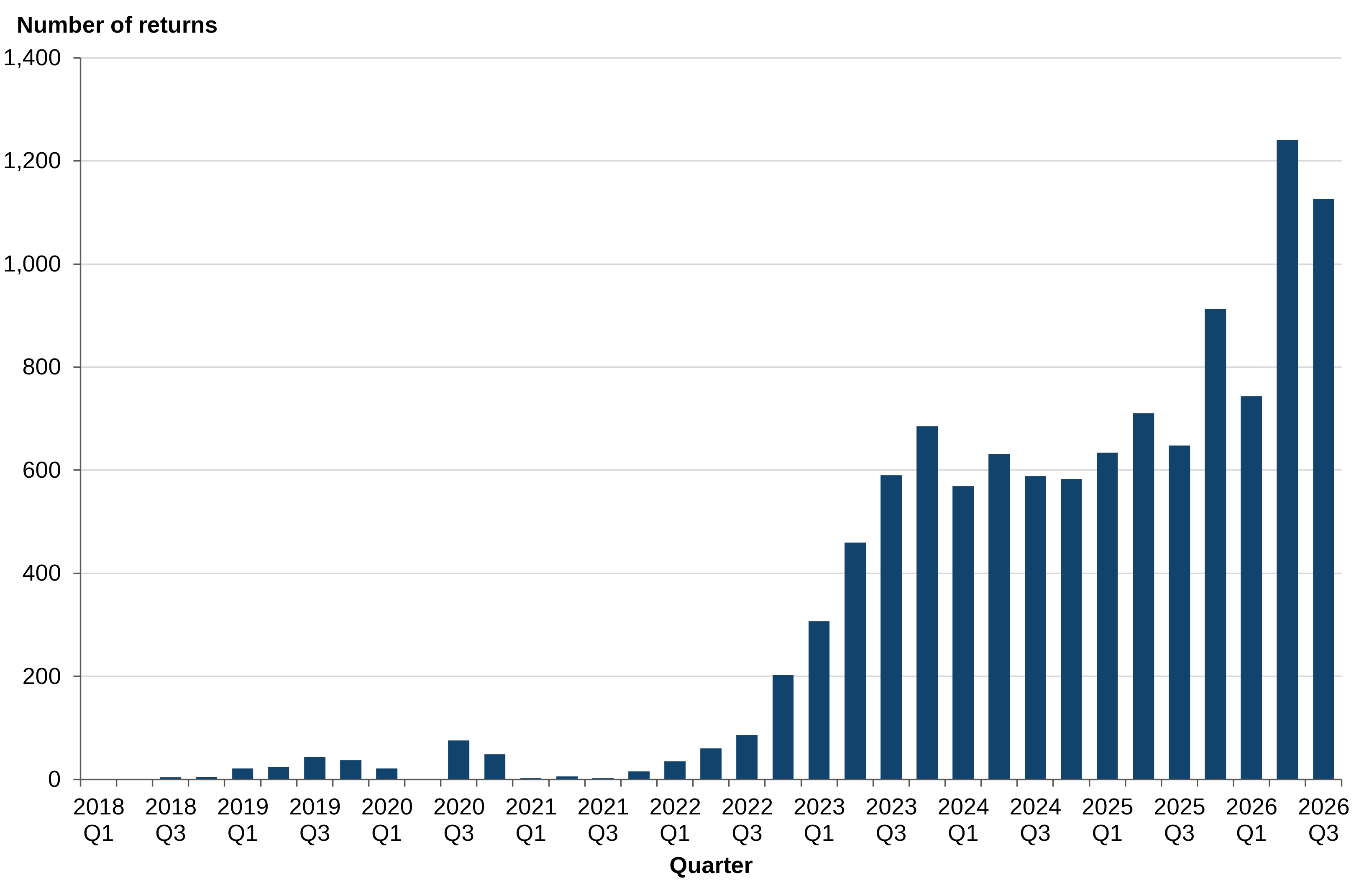
Returns of small boat arrivals continue to increase and are at the highest level since 2018 (when this statistical series began).
In the YE September 2026, there were 4,025 returns of people who had arrived to the UK by small boat, 56% more than the previous year. This increase follows the introduction of the UK-France Agreement which was introduced in August 2025 and ended in October 2026. For more information, please see the policy timeline document. Data on returns by month since the commencement of operational delivery of the treaty (6 August 2025) to 30 June 2026 are published in the ‘Transfers into and returns from the United Kingdom under the UK-France Agreement on the Prevention of Dangerous Journeys’.
There have been 11,128 returns of small boat arrivals since 2018. The vast majority of small boat arrivals claim asylum, and there will be a period of time for their claim to be assessed prior to it being known whether they will be subject to return.
Of the returns of small boat arrivals in the latest year, 33% (or 1,318) were Albanian nationals (see Returns - Ret_06b). However, Albanian small boat returns have decreased, mirroring the decline in Albanian arrivals via this illegal entry route. Afghan (347) and Eritrean (337) nationals are the next 2 most common nationalities of small boat arrivals returned from the UK, together accounting for a further 17% of small boat returns in the YE September 2026.
See Home Office ‘Country returns guides’ for more information on the returns process for individual countries of origin.
Figure 5: Returns of small boat arrivals by quarter, January 2018 to September 2026
Source: Returns - Ret_06a
7. About the statistics
The latest 7 quarters of data are revised in each release. Therefore, the most recent quarters should be considered provisional.
Data on voluntary returns is subject to upward revision, so comparisons over time should be made with caution. In some cases, individuals who have been told to leave the UK will not notify the Home Office of their departure from the UK. In such cases, it can take some time for the Home Office to become aware of such a departure and update the system. As a result, data for more recent periods will initially undercount the total number of returns. ‘Other verified returns’ are particularly affected by this. Further details on the revisions can be found in the returns section of the user guide.
The statistics in this section show the number of returns from the UK. One individual may have been returned more than once in a given period and, if that was the case, would be counted more than once in the statistics.
For information on who the Home Office seeks to return see section 16.3 of the user guide.
8. Data tables
Data referred to here can be found in the following tables:
We welcome your feedback
If you have any comments or suggestions for the development of this report, please provide feedback by emailing MigrationStatsEnquiries@homeoffice.gov.uk. Please include the words ‘PUBLICATION FEEDBACK’ in the subject of your email.
We’re always looking to improve the accessibility of our documents. If you find any problems or have any feedback relating to accessibility, please email us.
See Section 6 of the ‘About this release’ for more details.