How many people are granted asylum in the UK?
Published 26 November 2026

© Crown copyright 2026
This publication is licensed under the terms of the Open Government Licence v3.0 except where otherwise stated. To view this licence, visit nationalarchives.gov.uk/doc/open-government-licence/version/3 or write to the Information Policy Team, The National Archives, Kew, London TW9 4DU, or email: psi@nationalarchives.gov.uk.
Where we have identified any third party copyright information you will need to obtain permission from the copyright holders concerned.
This publication is available at https://www.gov.uk/government/statistics/immigration-system-statistics-year-ending-september-2026/how-many-people-are-granted-asylum-in-the-uk
Back to ‘Immigration system statistics, year ending September 2026’ contents page
This release goes up to the year ending (YE) September 2026. The “year ending” period includes the 12 months up to and including the YE month. For example, YE September 2026 includes the 12 months between 1 October 2025 and 30 September 2026.
Additional information is provided in the ‘About the statistics’ section and in the user guide.
1. How many people are granted protection at initial decision?
The data in this section relates to grants of protection or other leave at initial decision following an asylum claim. Additional numbers of people receive a grant of protection following an appeal; for further details, see section 4 of this chapter. Other people will be granted refugee status when they are brought to the UK under UNHCR resettlement schemes (reported in How many people come to the UK via safe and legal (humanitarian) routes?’).
The number of people granted at initial decision fell substantially compared with last year due to a fall in the number of initial decisions and the grant rate.
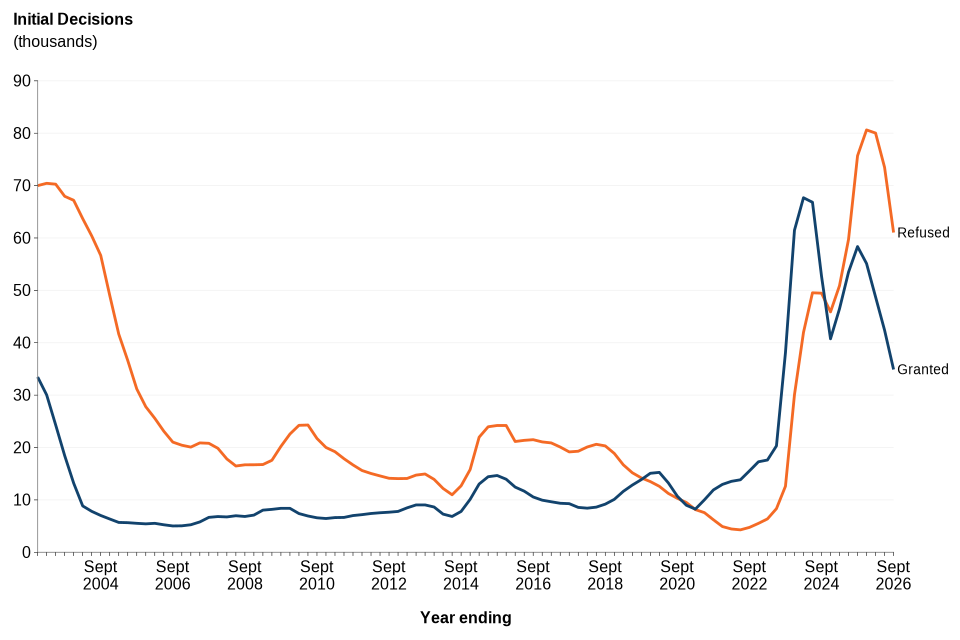
In the YE September 2026, 34,891 people received grants at initial decision, 40% less than in the previous year and 48% below the peak of 67,678 in the YE March 2024. The fall in the number of people granted reflects both a lower grant rate and fewer initial decisions. The latter is partly explained by a reduction in the overall caseload, with fewer new claims and fewer people awaiting an initial decision.
Figure 1: Number of people granted or refused protection following an asylum claim in the UK, YE December 2002 to YE September 20261, 2
Source: Asylum claims and initial decisions - Asy_D02
Notes:
- Includes main applicants and dependants.
- Excludes withdrawals and administrative outcomes.
Figure 1 shows that there were more refusals than grants in the YE September 2026, with 61,036 people refused protection or other leave, 19% less than the previous year. The number of people receiving initial decisions (refusals and grants of protection or other leave) was 95,927, 28% less than in the previous year.
2. What proportion of asylum seekers are granted protection at initial decision?
The data in this section relates only to the grant rate which is the proportion of initial decisions (main applicants only) which resulted in a grant of protection or other leave. The grant rate excludes withdrawals and administrative outcomes.
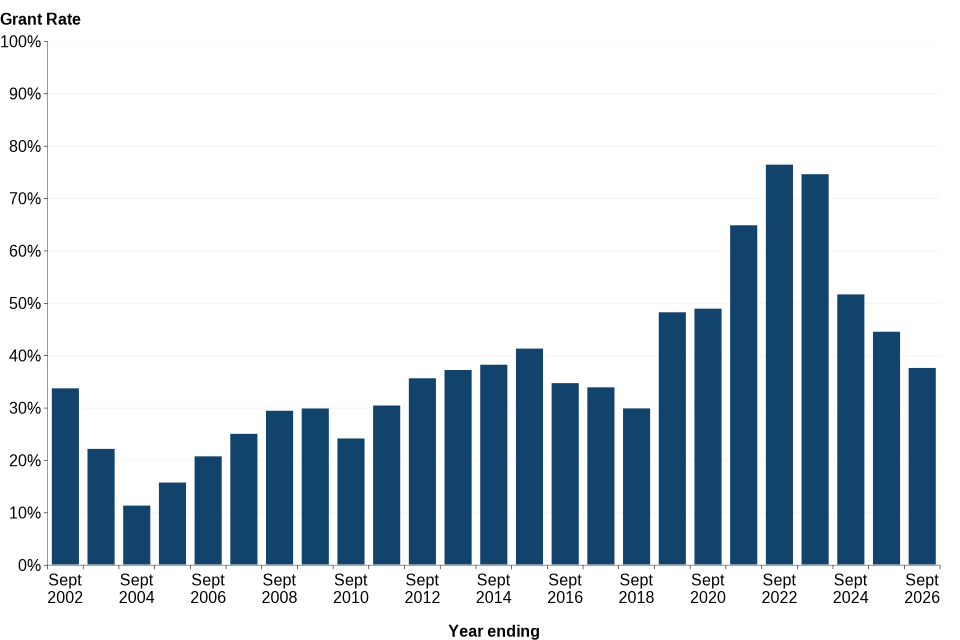
The grant rate has fallen to the lowest level since 2018.
Figure 2: Asylum grant rate at initial decision, YE September 2002 to YE September 2026
Source: Asylum claims and initial decisions - Asy_D02
Figure 2 shows that the grant rate was 38% in YE September 2026. This was lower than the previous year (45% in YE September 2025), and substantially below the peak grant rate of 77% in the YE September 2022.
The overall grant rate can vary for a number of reasons, including the mix of nationalities claiming asylum, the objective country situation at the date of decision, and the protection needs of those who claim asylum in the UK. It can also be affected by operational resourcing and policy decisions, such as changes to the types of cases prioritised for decisions. The Home Office guidance on caseworking prioritisation is published on GOV.UK.
3. Who is granted protection at initial decision?
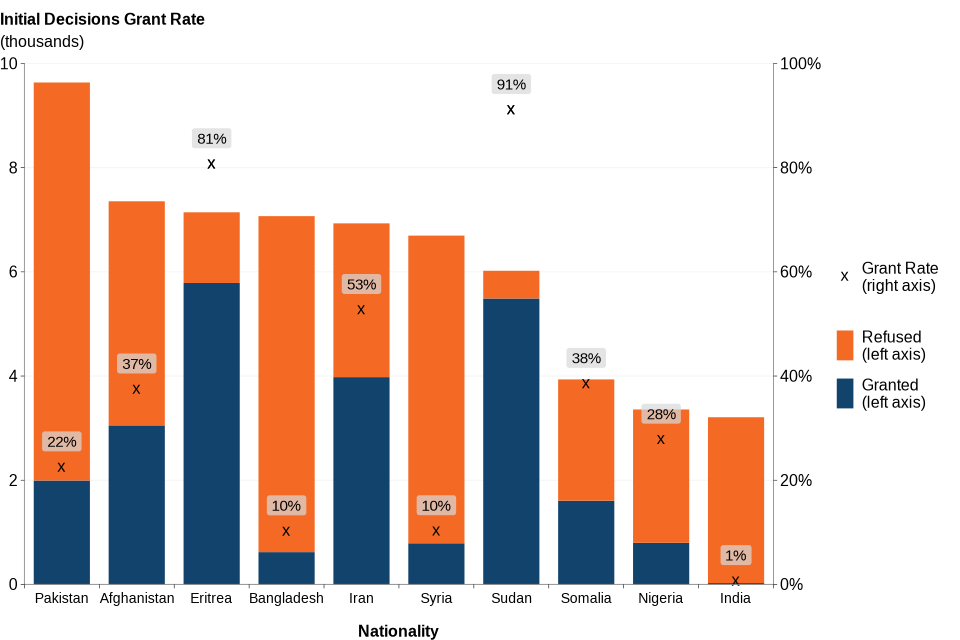
Grant rates vary widely across nationalities claiming asylum.
Figure 3: The number of asylum claimants receiving initial decisions in the UK, for the top ten nationalities, and the grant rate at initial decision (%), YE September 20261, 2
Source: Asylum claims and initial decisions - Asy_D02
Notes:
- The figure shows the top 10 nationalities receiving initial decisions in the YE September 2026.
- The number of people receiving initial decisions includes main applicants and dependants. The grant rate includes main applicants only.
Among the top 10 nationalities receiving initial decisions, Sudan (91%) and Eritrea (81%) had the highest grant rates in the YE September 2026, as shown in Figure 3. Some nationalities have a lower grant rate, with Bangladesh (10%), Syria (10%) and particularly India (1%) seeing a low proportion of claims being granted at initial decision.
There were 2,408 unaccompanied asylum-seeking children (UASC) granted protection or other leave at initial decision in the YE September 2026. The grant rate for UASC claims (59%) is higher than for non-UASC claims (37%).
4. How do latest outcomes compare to initial outcomes?
The outcome of an asylum claim may change following an appeal or a reconsideration. As more initial decisions are made and appeals are completed, the number of grants and refusals relating to claims made in previous years will change. This is especially relevant for the most recent years, as ongoing appeals and reconsiderations mean the latest grant rate will change.
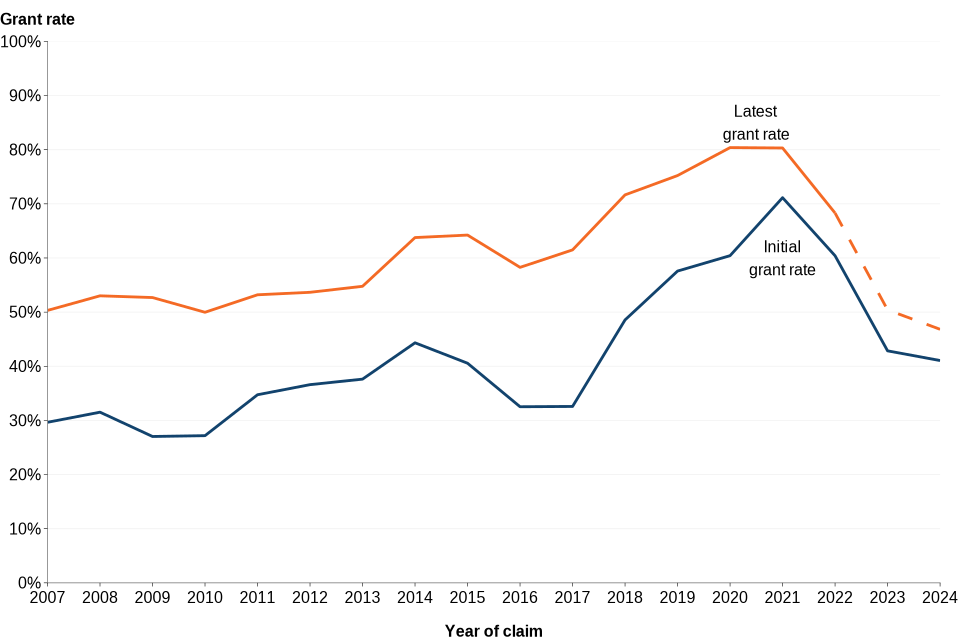
For claims made in 2021 or 2022, the grant rate when based on the latest decision was 8 percentage points higher than when based on the initial decision.
Figure 4: Grant rates at initial and latest decision by year of claim, 2007 to 20241, 2, 3
Source: Outcome analysis of asylum claims - Asy_D04
Notes:
- Main applicants only.
- The grant rate is the proportion of decisions which resulted in a grant of protection or other leave. Excludes withdrawals and administrative outcomes.
- Data is based on the year of the asylum claim, and the grant rate at initial decision and latest decision are calculated from the outcomes as at the point of data extraction in October 2026.
Figure 4 shows that the difference between initial and latest grant rates has narrowed for more recent claim cohorts. The latest grant rate was 17 to 29 percentage points higher than the initial grant rate for claims made between 2007 and 2020, compared with 8 to 9 percentage points for claims made in 2021 or 2022.
HM Courts and Tribunal Service (HMCTS) publish data on appeals in their quarterly tribunal statistics release. The data shows that waiting times for asylum related appeals have grown, with the average wait being over a year. This means that many asylum claims made after 2022 that have received a decision and gone to appeal may not yet have received an appeal outcome. This is less likely to affect claims made in 2021 and 2022, which have had longer to progress through the appeals system.
5. How many people do not receive a substantive decision on their asylum claim?
A substantive decision on an asylum claim refers to a grant of permission to stay or refusal of the asylum claim, based on the merit of the claim itself. However, some claims are closed before a substantive decision is issued.
5.1 Withdrawals
If a claimant fails to follow the required processes, such as not attending interviews, the Home Office can withdraw their claim. This is known as an implicit withdrawal. Claims can also be explicitly withdrawn if the claimant tells the Home Office they no longer wish to proceed with their claim.
In the YE September 2026, 13,272 people had their asylum claims withdrawn, a 35% decrease compared to the previous year. Of these withdrawals in the latest year, 79% were implicit withdrawals.
5.2 Inadmissibility
Some asylum claims may be treated as inadmissible. The strengthened inadmissibility rules, which came into force in January 2021, set out the circumstances in which the UK may decide not to consider an asylum claim, including where a person has a previous presence in, or connection to, a safe third country.
Between January 2021 and September 2026, 1,647 people who entered the inadmissibility process were removed from the UK. These returns were made to European nations: Bulgaria, Denmark, France, Germany, Ireland, Italy, Malta, Slovenia, Spain, Sweden and Switzerland. Most individuals in this figure were returned to France under the pilot UK-France Agreement on the Prevention of Dangerous Journeys, which came into effect in August 2025 and ended in October 2026.
6. What happens after an asylum seeker is granted protection?
After being granted refugee status or another form of protection, individuals transition from asylum support into mainstream systems for housing, health, and education. Refugees are eligible to work and can access benefits including English language and employment support through national and local programmes.
Data on the employment rate, working hours and earnings of refugees in England and Wales between 2015 and 2023 comes from the Refugee Integration Outcomes (RIO) project, published in November 2025. Analysis of HMRC-linked data shows that the employment rate among refugees aged 16 to 64, granted asylum between 2015 and 2023, levels off at around 48% after 2 years. Further findings from a previous analysis from the RIO project used Census 2021 data for refugees in England and Wales between 2015 and 2021, provides insight on the types of jobs refugees secured as well as their language proficiency and housing outcomes.
Changes to the Immigration Rules in spring 2026 reduced the standard period of permission to stay granted to people who are recognised as needing protection in the UK. For asylum claims lodged on or after 2 March 2026, adults and accompanied asylum-seeking children granted refugee status or humanitarian protection are granted 30 months’ permission to stay on a protection route. These changes have not been applied to unaccompanied asylum-seeking children, who continue to receive 5 years’ permission to stay, if granted, while the Government considers the appropriate long-term policy for this group. All individuals who claimed asylum before 2 March 2026 remain subject to the previous arrangements, under which successful claimants are normally granted 5 years’ permission to stay.
Between 2 March 2026 and 30 September 2026, 40,199 people claimed asylum in the UK. During the same period, 13,906 people received grants of protection (which relate to claims lodged before and after the Immigration Rules changes). Of those granted protection:
- 5,308 people were granted 30 months’ permission to stay (4,824 were granted refugee permission and 484 were granted humanitarian protection)
- 8,598 people were granted 5 years’ permission to stay (7,782 were granted refugee permission and 816 were granted humanitarian protection)
7. About the statistics
An asylum claimant (also referred to as an ‘asylum seeker’) is someone who makes a claim to be recognised as a refugee under the Refugee Convention.
An asylum claim marks an individual’s entry into the UK asylum system. Following a claim, people may spend time in the system awaiting an initial decision and, where eligible, may receive accommodation or financial support. Outcomes on a claim may include a grant of protection or other leave, a refusal, or other outcomes such as a withdrawal or an administrative outcome, with some claimants able to appeal following a decision.
An asylum claim may relate to more than one person, if the main applicant has family members (‘dependants’) who are included in the same claim.
The statistics in this section focus on the number of people (main applicants and dependants) receiving outcomes on their asylum claims. The number of main applicants (excluding dependants) represents the total number of asylum cases being considered by the Home Office.
Statistics on other parts of the asylum system are available in other chapters of this report - ‘How many people claim asylum in the UK?’ and ‘How many people are in the UK asylum system?’.
Further information and definitions can be found in the user guide.
7.1 Data source
The statistics are based on Home Office administrative data, which is recorded by caseworkers as part of the asylum process. As the data comes from live operational systems, figures may be revised as information is updated and quality assured.
7.2 Appeals
Data on the number of appeals lodged, and their outcomes, is published in ‘Asylum appeals lodged and determined – Asy_D06 and Asy_D07’. Asylum appeals data from April 2023 onwards was not available at the time of data extraction for this release due to ongoing work as immigration data transitions to a new case working system. Updated data will be included in a future edition of the Immigration system statistics release. Figures for immigration and asylum appeals at First-Tier Tribunal and subsequent stages are published by the Ministry of Justice as part of their Tribunal Statistics release. For a full list of differences between the Tribunal Statistics and Home Office asylum appeals statistics, see the user guide.
8. Data tables
Data referred to here can be found in the following tables:
- Asylum summary tables
- Detailed asylum datasets
- Detailed resettlement datasets
- HMCTS Quarterly Tribunal Statistics
- Transfers into and returns from the United Kingdom under the UK-France Agreement on the Prevention of Dangerous Journeys, ad hoc statistical release
- Refugee Integration Outcomes (RIO) Insights
We welcome your feedback
If you have any comments or suggestions for the development of this report, please provide feedback by emailing MigrationStatsEnquiries@homeoffice.gov.uk. Please include the words ‘PUBLICATION FEEDBACK’ in the subject of your email.
We’re always looking to improve the accessibility of our documents. If you find any problems or have any feedback relating to accessibility, please email us.
See Section 6 of the ‘About this release’ section for more details.