How many people come to the UK via safe and legal (humanitarian) routes?
Published 26 November 2026

© Crown copyright 2026
This publication is licensed under the terms of the Open Government Licence v3.0 except where otherwise stated. To view this licence, visit nationalarchives.gov.uk/doc/open-government-licence/version/3 or write to the Information Policy Team, The National Archives, Kew, London TW9 4DU, or email: psi@nationalarchives.gov.uk.
Where we have identified any third party copyright information you will need to obtain permission from the copyright holders concerned.
This publication is available at https://www.gov.uk/government/statistics/immigration-system-statistics-year-ending-september-2026/how-many-people-come-to-the-uk-via-safe-and-legal-humanitarian-routes
Back to ‘Immigration system statistics, year ending September 2026’ contents page
This release goes up to the year ending (YE) September 2026. The “year ending” period includes the 12 months up to and including the YE month. For example, YE September 2026 includes the 12 months between 1 October 2025 and 30 September 2026.
This chapter covers the safe and legal humanitarian schemes allowing eligible people to come to, or remain in, the UK. It includes both out-of-country grants to individuals overseas and in-country extensions for people already in the UK, either to switch onto one of these schemes from another type of leave or to extend their stay on the same route. The schemes covered are:
- Ukraine Scheme visas (including Ukraine Family, Sponsorship, and Extension Schemes): introduced between 2022 and 2025 following the Russian invasion of Ukraine to allow persons affected by the war to come to, or continue their stay in, the UK
- British National (Overseas) (BN(O)) visas: introduced in 2021 to provide those with BN(O) status the opportunity for them and their family members to live, work and study in the UK
- Refugee resettlement schemes: which allow for the transfer of refugees from other countries to the UK
- Refugee Family Reunion visas: which allow the partners and children of refugees in the UK to join them
Additional information is provided in the ‘About the statistics’ section and in the user guide.
1. Overview of safe and legal (humanitarian) routes
Both out-of-country and in-country grants have decreased in the latest year.
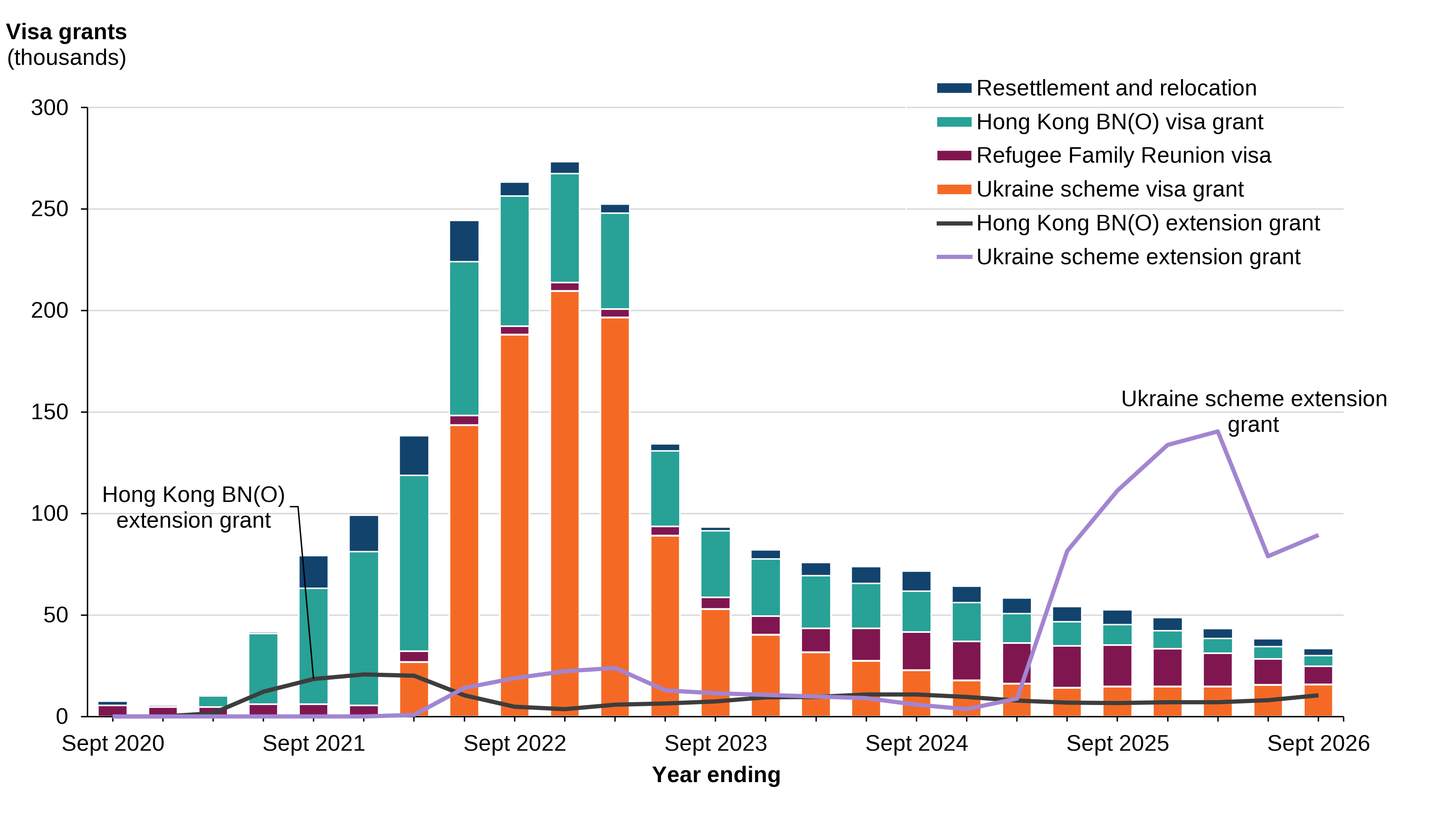
In the YE September 2026, there were 132,949 grants of leave on safe and legal (humanitarian) routes, allowing people to come to, or remain in, the UK. This was 22% lower than in the YE September 2025, largely due to fewer in-country Ukraine Permission Extension grants, fewer grants of Refugee Family Reunion visas and out-of-country British National (Overseas) visas, as well as fewer arrivals under the Afghan Resettlement Programme. Most (75%) of grants were to people already in the UK who were extending their leave, most notably on the Ukraine Permission Extension Scheme.
Of the total, 33,559 were out-of-country grants, issued to individuals outside of the UK. This is 36% fewer than in the YE September 2025. Of which, there were:
- 15,711 out-of-country visa grants through Ukraine schemes
- 5,146 out-of-country visa grants through the BN(O) route
- 3,519 refugees resettled
- 9,183 grants of Refugee Family Reunion visas
In addition, there were 99,390 in-country extensions issued to individuals already in the UK in the YE September 2026, down 16% from 117,703 in-country extensions in the YE September 2025. Of the 99,390 in-country extensions, there were:
- 88,913 in-country extensions through the Ukraine schemes of which, almost all were through the Ukraine Permission Extension Scheme, so granted to people already on a Ukraine scheme
- 10,477 in-country extensions through the BN(O) route
Figure 1: Grants of leave on safe and legal (humanitarian) routes to the UK, by route, YE September 2020 to YE September 2026 1,2
Source: Safe and legal (humanitarian) routes summary tables – Hum_01
Notes:
- Includes main applicants and dependants.
- Resettlement and relocation include the Afghan Resettlement Programme, UK Resettlement Scheme and Mandate Scheme. It also includes previous schemes such as the Vulnerable Persons Resettlement Scheme and Vulnerable Children Resettlement Scheme which closed in February 2021. Figures include those sponsored through Community Sponsorship.
2. Ukraine Schemes
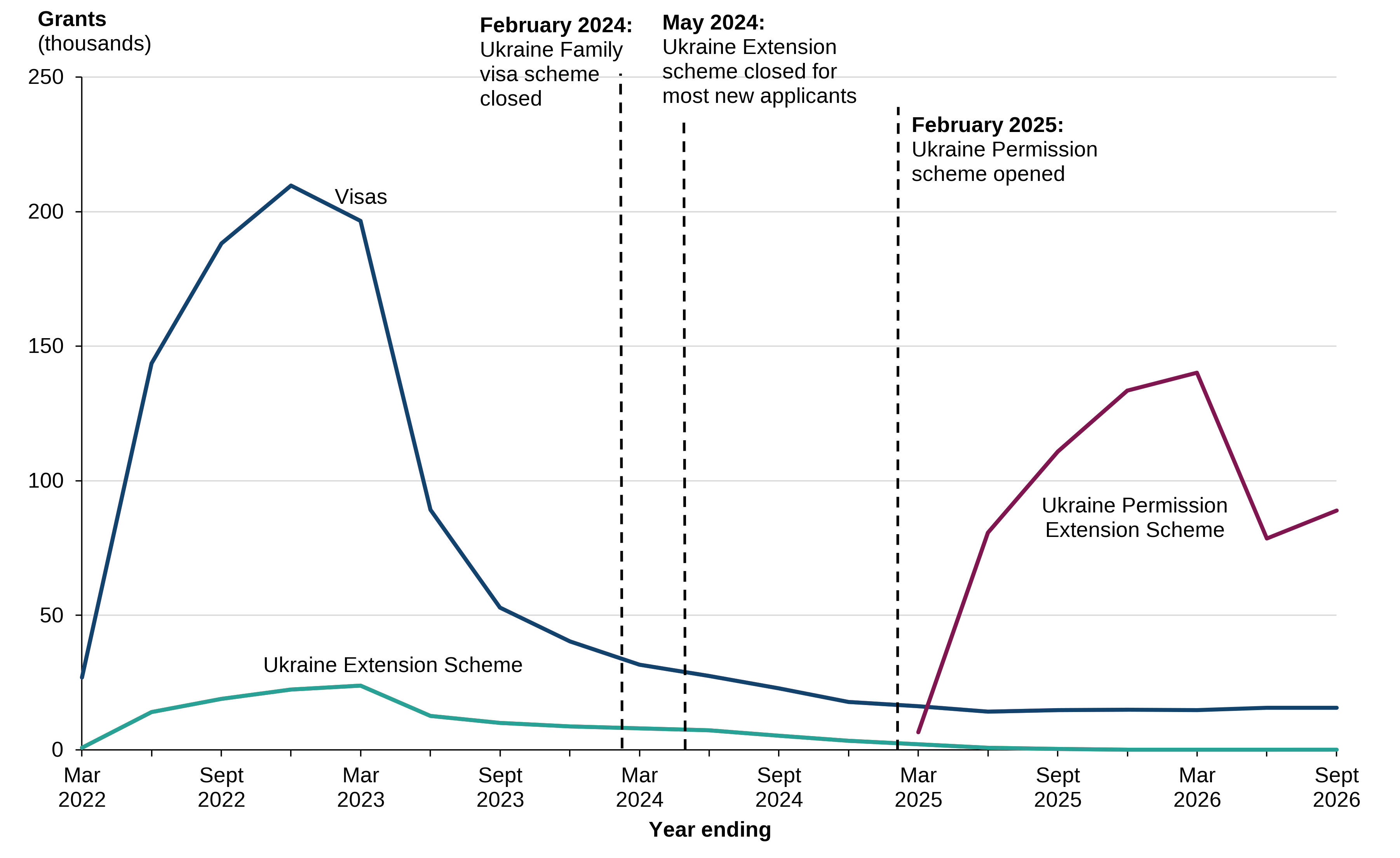
The Ukraine Family Scheme closed to new applications from 19 February 2024 and the Ukraine Extension Scheme closed for most new applications on 16 May 2024 and for children born in the UK to parents with existing, valid visas on 4 February 2025. Some applications received decisions after these dates.
The Ukraine Sponsorship Scheme remains open but has a stricter eligibility than when it first opened - sponsors must be British/Irish citizens or must be settled in the UK, and applicants are given a reduced visa length (18 months rather than 36 months). This change was announced in February 2024.
The Ukraine Permission Extension (UPE) Scheme opened on 4 February 2025 to allow people previously on one of the Ukraine schemes to continue their leave in the UK.
Total grants of leave on the Ukraine schemes have declined in the latest year, with the in-country Ukraine Permission Extension scheme continuing to account for the majority of grants.
There were 15,711 grants of out-of-country visas under the Ukraine Schemes in the YE September 2026 (a 6% increase compared to the previous year), bringing the total grants to 294,269 visas since the schemes opened in March 2022.
There were a further 88,913 in-country extensions granted in the YE September 2026 (a 20% decrease compared to the previous year). Under the UPE scheme, almost all extensions (88,903) were granted to people previously on one of the Ukraine schemes. These grants include individuals reaching the end of their initial 3 years’ permission, as well as those eligible to extend their stay for a further 24 months following an initial 18-month UPE extension, under changes introduced in April 2026.
Figure 2: Out-of-country visa grants and in-country extension grants on Ukrainian Visa Schemes, YE March 2022 to YE September 20261,2,3
Source: Safe and legal (humanitarian) routes summary tables - Ukr_01
Notes:
- Visa grants include the Ukraine Family Scheme and the Ukraine Sponsorship Scheme, which both opened March 2022.
- The Ukraine Extension Scheme includes grants on the Ukraine Family Extension Scheme. The Ukraine Extension Scheme opened in May 2022 and closed to most new applications in May 2024 and closed to most new applications in May 2024 and existing applications in February 2025.
- The Ukraine Permission Extension Scheme opened in February 2025.
Figure 2 shows grants on the Ukraine visa schemes peaked in the YE December 2022 with 209,706 grants. The number of visas granted has since fallen and has remained below 30,000 per year since the YE June 2024. The Ukraine Extension Scheme peaked in the YE March 2023 with 23,864 grants and has been steadily decreasing since. The Ukraine Permission Extension Scheme opened in February 2025, with 199,691 total extensions granted up to the end of September 2026. Following the UPE peak in YE March 2026, as individuals who arrived under the Ukraine schemes in 2022 began reaching the end of their initial permission, quarterly grants generally declined. However, grants increased in the latest quarter (July to September 2026), following changes introduced in April 2026 allowing eligible individuals who had received an initial 18-month UPE extension to apply for a further 24 months’ permission.
Not everyone granted a visa will have used it, either because they have not yet arrived in the UK or may have chosen to go elsewhere or remain in Ukraine. The number of arrivals follows a similar trend to out-of-country visas granted, peaking not long after the introduction of the schemes, at 110,000 in the YE December 2022. Visas granted were initially higher than arrivals in the first year of the scheme opening, suggesting some people in the early days of the scheme may not have used their visa, however numbers have been broadly aligned since.
Some of those who arrived from Ukraine will have since left the UK either temporarily or permanently. Management information indicates that, as of the end of September 2026, around 101,700 people (42%) who had previously arrived on the Ukraine schemes had exited the UK and were believed to be out of the country, although some may subsequently return.
As of the end of September 2026, adult females aged 18 to 64 accounted for just under half (46%) of the people who have arrived from Ukraine since the schemes began, children (aged 17 and under) accounted for a further 26%, adult males aged 18 to 64 accounted for 22% and other adults aged 65 and over accounted for 6%.
3. British National Overseas (BN(O)) route
Visa applications and grants on the BN(O) route have steadily decreased, however settlement grants have been rising as individuals start to become eligible after 5 years on the route.
On 31 January 2021, British National (Overseas) (BN(O)) passport holders from Hong Kong were given the opportunity along with their family members to live, work and study in the UK. This route also allows people to apply for settlement if they have a BN(O) visa and have spent 5 continuous years in the UK.
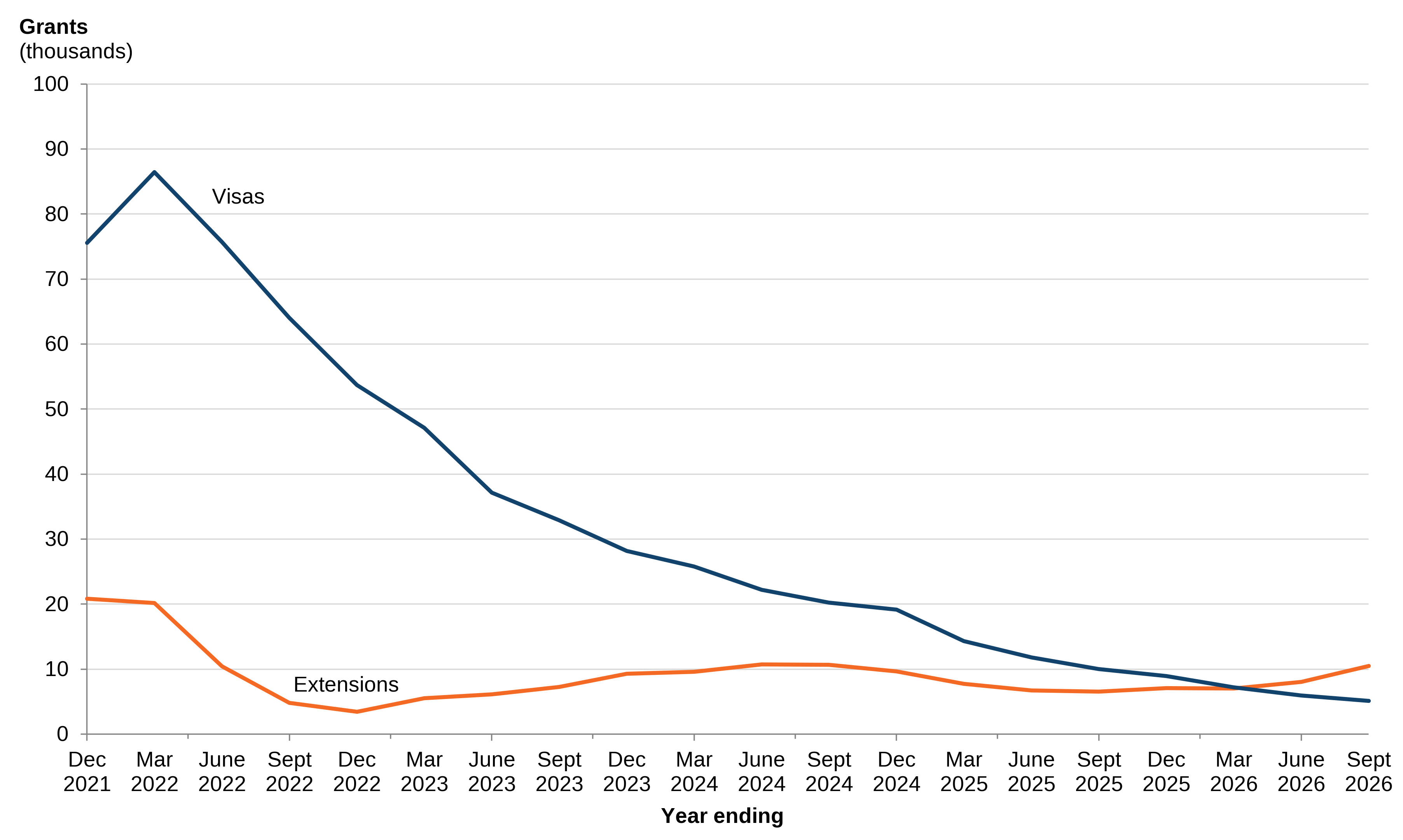
BN(O) out-of-country visas peaked in the YE March 2022, with 86,439 granted, soon after the scheme opened. BN(O) visa grants have decreased each year since. There were 5,146 grants of BN(O) visas in the YE September 2026, bringing the total number of grants to 189,347 since the scheme opened.
The BN(O) route also allows people already in the UK to remain in the UK by extending onto the route. There have been 58,311 in-country grants for people already in the UK since the scheme opened, with 10,477 in the YE September 2026.
Figure 3: Out-of-country visa grants and in-country extension grants on the British National (Overseas) route, YE December 2021 to YE September 2026
Source: Safe and legal (humanitarian) routes summary tables - BNO_01
There have been 58,478 grants of settlement to individuals whose most recent leave was on the BN(O) route, with 98% issued over the latest 12-month period. There has been an increase in these grants since January 2026, explained by the fact that the BN(O) route came into effect in January 2021 and typically requires 5 years of continuous residence in the UK before becoming eligible for settlement. Some individuals may have qualifying earlier, where time spent on other eligible visa routes, prior to moving onto the BN(O) route, counts towards their 5-year residence period. For more information on settlement see ‘How many Indefinite Leave (Settlement and EUSS settled status) grants have been issued in the UK?’.
4. Resettlement
The UK has a range of resettlement schemes to bring refugees from other countries to the UK. Information on the different resettlement schemes and the differences between resettlement and relocation can be found in the user guide.
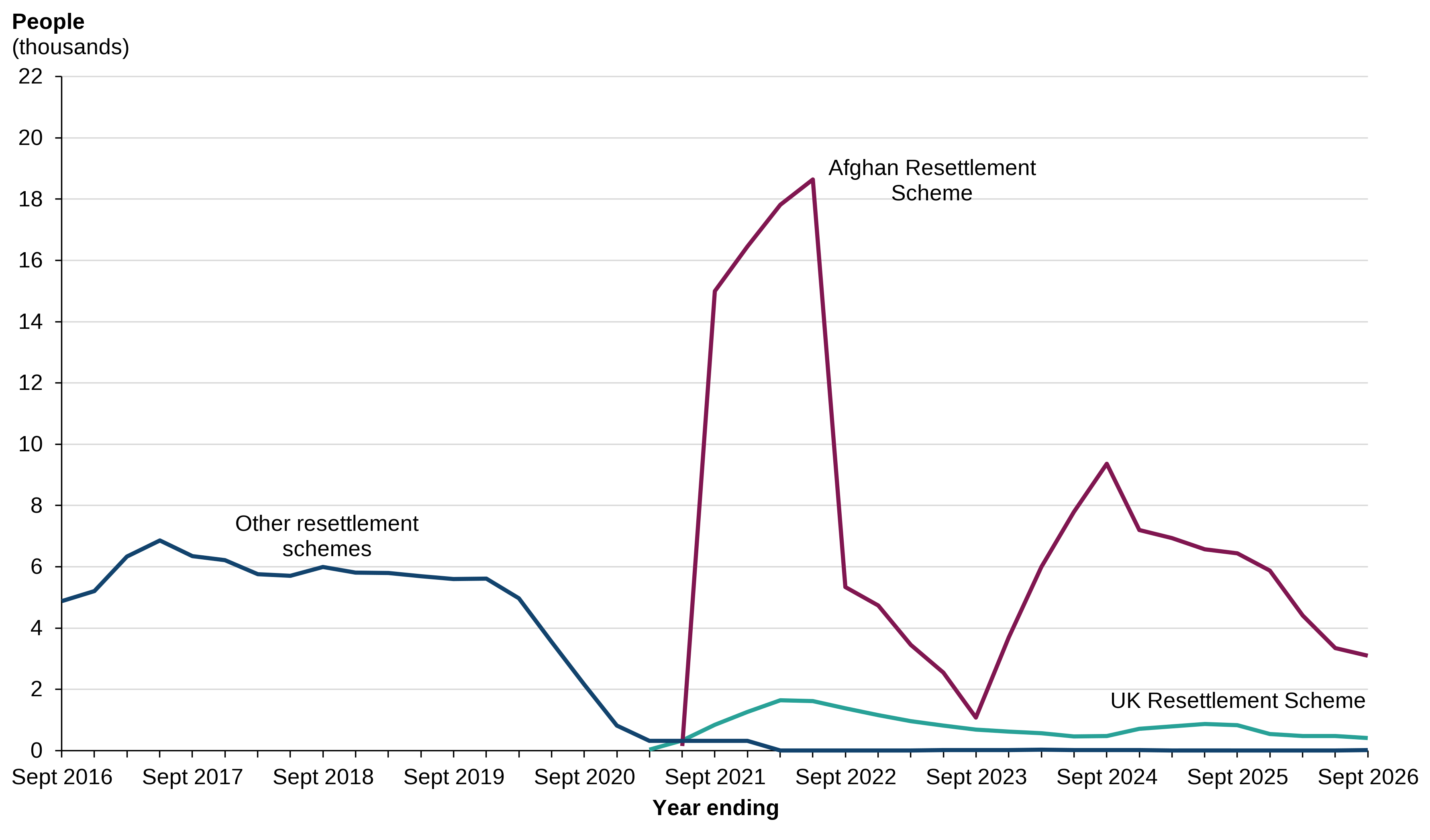
The number of refugees being resettled has decreased since the peak in the YE June 2022, which saw high volumes of resettlement through the Afghan Resettlement Programme.
There were 3,519 people resettled in the YE September 2026. This is 52% fewer than the YE September 2025. Of those resettled in the YE September 2026, 88% (3,101) arrived through the Afghan Resettlement Programme (ARP); the remaining 12% (418) arrived through either the UK Resettlement Scheme or the Mandate Scheme.
Between 2016 and 2019, the UK resettled around 6,000 people per year. The numbers resettled remained around this level until March 2020, when resettlement activity was paused due to the COVID-19 pandemic. Resettlement increased again following the resettlement and relocation of people from Afghanistan after the Taliban takeover in August 2021, and the opening of the Afghan Resettlement Programme (ARP) schemes. After the initial peak, of 20,256 arrivals, in the YE June 2022, a second smaller peak (of 9,872 arrivals) was seen in the YE September 2024, in part due to the introduction of the Afghan Response Route, following a data breach in February 2022. The numbers resettled under the Afghan Resettlement Programme have since decreased.
Figure 4: People resettled and relocated, by scheme, YE September 2016 to YE September 2026 1,2
Source: Resettlement – Res_D02
Notes:
- Date on which the refugee arrived in the UK.
- ‘Other resettlement schemes’ include the Vulnerable Persons Resettlement Scheme, the Vulnerable Children Resettlement Scheme, the Gateway Protection Programme and the Mandate Scheme.
Since the first arrivals in 2021, the Afghan Resettlement Programme has resettled a total of 40,319 people.
Of the 40,319 people resettled under the Afghan Resettlement Programme:
- 21,122 arrived under the Afghan Relocations and Assistance Policy (ARAP)
- 14,234 arrived under the Afghan Citizens Resettlement Scheme (ACRS)
- 4,933 arrived under the Afghanistan Response Route (ARR)
- 30 arrived under the Afghan Resettlement Programme, but the specific route has not yet been recorded
In July 2025, the Government confirmed that there will be no further ACRS pathways or referrals, ARAP is closed to new applicants and that ARR is discontinued. However, existing applications on these schemes will continue to be processed and therefore, there will be arrivals in future quarters. For further detail please see guidance on the Afghan Resettlement Programme.
The UK Resettlement Scheme has resettled 4,634 refugees since its launch in 2021.
In November 2025, the Government announced plans to reform refugee resettlement by introducing 3 new refugee sponsorship routes. These routes will operate through a lead sponsorship model, and consist of community sponsorship, refugee study and refugee work routes. These routes introduce a new framework enabling communities, universities and employers to identify a specific refugee, in need of international protection, who they wish to sponsor and support to come to the UK. These routes operate separately from and alongside the existing UK Resettlement Scheme (UKRS). For further detail on these new routes please see the policy guidance on named community sponsorship, refugee study and refugee work routes. The first arrivals under the new routes are expected in Autumn 2027.
4.2 International comparisons of refugee resettlement
International resettlement data is sourced from UNHCR and is accurate as of June 2026.
Between 2010 and September 2026, the UK resettled just over 36,000 individuals through UNHCR resettlement schemes – the sixth largest number in the world (after the United States, Canada, Australia, Germany and Sweden) and third in Europe.
International comparisons should be made with caution as available data from the UN Refugee Agency (UNHCR) relates only to UNHCR resettlement schemes (the UK Resettlement Scheme, Community Sponsorship Scheme, Mandate Scheme and ACRS Pathway 2). The UNHCR data does not include ARAP, ARR or ACRS Pathway 1 and 3 cases, meaning it is an undercount for the UK in terms of total resettlement and relocation. Information on the different resettlement schemes can be found in the user guide.
4.3 What happens after a refugee is resettled in the UK?
Upon arrival in the UK through a resettlement programme, individuals are supported to integrate into mainstream systems for housing, benefits, health care, and education.
Further information on integration outcomes, including employment, language proficiency and housing, is provided in the ‘How many people come to the UK via safe and legal (humanitarian) routes?’ chapter of the year ending September 2025 release.
5. Refugee Family Reunion
A Refugee Family Reunion visa allows partners and children of individuals previously granted refugee status or humanitarian protection in the UK to come to the UK to live.
On 4 September 2025, the Refugee Family Reunion route was paused, see ‘Appendix Family Reunion (Sponsors with Protection)’. Outstanding applications, submitted before the pause, will continue to be progressed under the rules in place prior to the pause, alongside cases resolved through appeal.
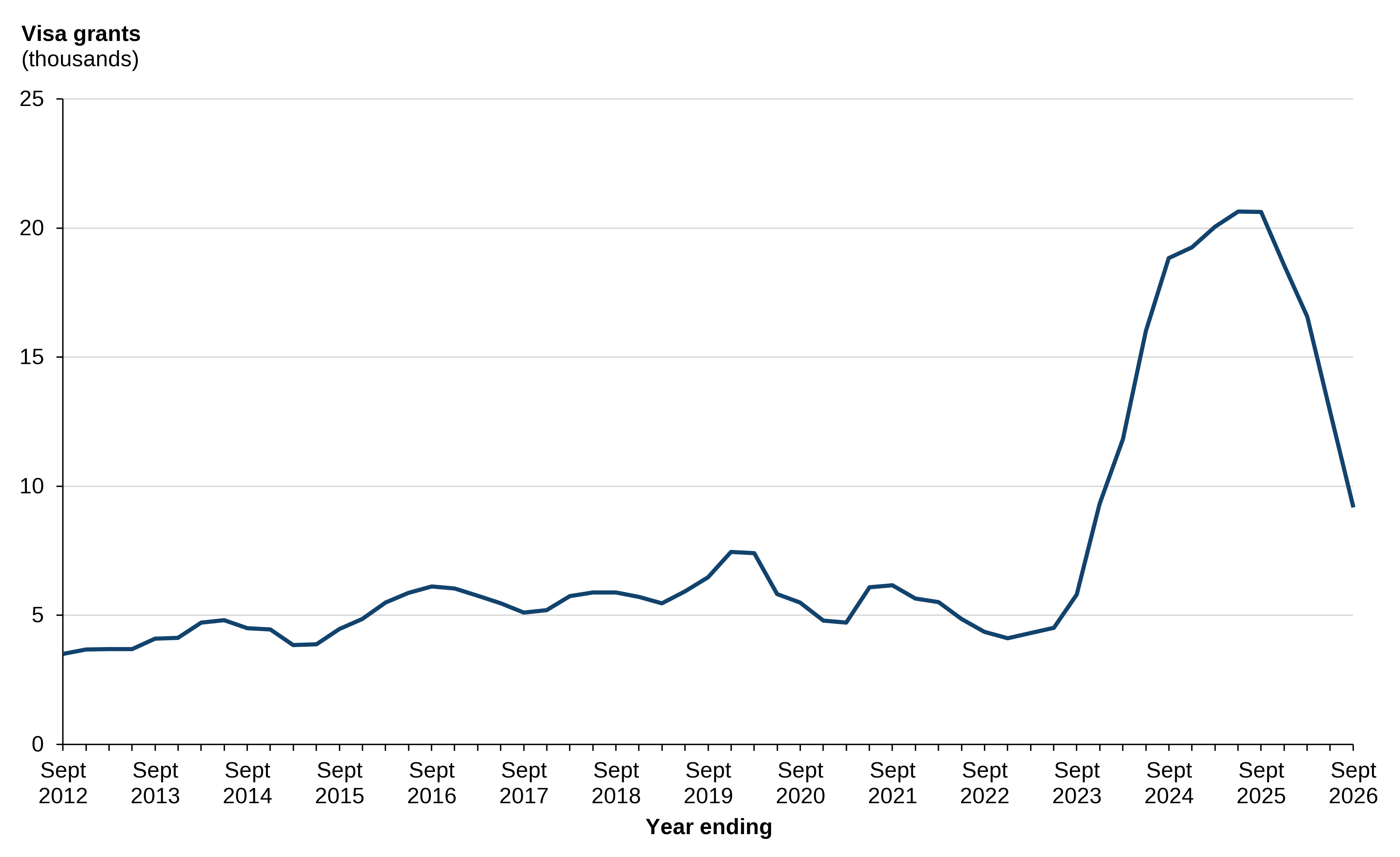
The number of people coming to reunite with refugee family members in the UK has decreased since 2024, although levels remain high compared to historic volumes.
Between late 2023 and early September 2025, Refugee Family Reunion grants increased relative to historic levels, from 4,521 in the year ending June 2023 to 20,626 in the year ending September 2025. The increase followed a high number of individuals granted refugee status over this period, who became eligible to sponsor partners and children to join them in the UK under the Refugee Family Reunion route.
Total grants in the year ending September 2026 (9,183) were 55% lower than the previous year.
Figure 5: Refugee Family Reunion visa grants, YE September 2012 to YE September 2026
Source: Refugee Family Reunion Visa Grants - Fam_D01
The most common nationalities granted Refugee Family Reunion in the year ending September 2026 were Afghanistan (17%), Yemen (14%), Sudan (11%), Iran (10%) and Eritrea (7%). Trends in Refugee Family Reunion visas are partly driven by the number of individuals granted refugee status or humanitarian protection in preceding years.
For further details on the Refugee Family Reunion route, see Section 6.5 of this chapter and ‘Why do people come to the UK - Family?’.
6. About the statistics
6.1 Arrivals
Arrival figures linked to a Ukraine visa scheme or an out-of-country BN(O) visa are rounded to the nearest 100. Where individuals have multiple visits, only the first arrival after the visa grant has been counted. See the Home Office statistics on exit checks: user guide for more details.
6.2 Ukraine Visa and Extension Schemes
During March 2022, the UK government introduced 2 new visa routes to allow persons affected by the crisis in Ukraine to come to the UK. Introduced on 4 March 2022, the Ukraine Family Scheme allows applicants to join family members or extend their stay in the UK. The Ukraine Sponsorship Scheme was introduced on 18 March 2022 and allows Ukrainian nationals and their family members to come to the UK if they have a named sponsor under the Homes for Ukraine Scheme.
The Ukraine Family Scheme closed to new applications from 19 February 2024, and the Ukraine Extension Scheme closed for most new applications on 16 May 2024 and for children born in the UK to parents with existing, valid visas on 4 February 2025. Some applications received decisions after these dates.
On 4 February 2025, the UK government launched the Ukraine Permission Extension (UPE) scheme. A Ukrainian national, or family member of Ukrainian nationals, who are living in the UK with existing permission on one of the Ukraine schemes, may be eligible to apply to continue living in the UK for 18 months through this scheme, with the option to extend for a further 24 months.
6.3 British National Overseas (BN(O)) route
In January 2021, the UK government introduced a new immigration route for British National (Overseas) (BN(O)) status holders, providing the opportunity for them and their family members to live, work and study in the UK. This route opened on 31 January 2021 and is open to individuals who hold a BN(O) passport and are, or have recently been, resident in Hong Kong, and their dependants.
6.4 Resettlement
Refugees in other countries can be given protection in the UK via resettlement schemes. The UK works with the UN Refugee Agency (the ‘UNHCR’) to arrange for the transfer of refugees from an asylum country to the UK, with the aim of ultimately granting them permanent residence. Information on the different resettlement schemes can be found in the user guide.
6.5 Refugee Family Reunion
Refugee Family Reunion visas allow partners and children aged 17 and under to join those granted refugee status or humanitarian protection in the UK if they formed part of the family unit before their sponsor fled their country.
The family members do not receive refugee status themselves. Leave is given in line with the sponsor, so that the family member’s leave will expire at the same time as the sponsor. Individuals are allowed to work, study and have recourse to public funds.
On 4 September 2025, the Refugee Family Reunion route was paused. Those seeking reunification may apply through other family routes, if they believe they meet the relevant immigration rules. Outstanding applications, submitted before the pause, will continue to be progressed under the family reunion rules in place prior to the commencement of the suspension, including those that are at appeal.
Applications submitted before 4 September 2025 may still appear in the data in the following months. This is because applicants have up to 240 days to attend a Visa Application Centre and provide their biometrics. An application is only counted in the statistics once biometrics have been taken.
7. Data tables
Data referred to here can be found in the following tables:
- Safe and legal (humanitarian) routes
- Entry clearance visa applications and outcomes
- Extensions
- Resettlement and relocation
- Refugee Family Reunion
- Settlement
The Ministry for Housing, Communities and Local Government publish additional visa data on the Homes for Ukraine Sponsorship scheme, including visa data by age and sex of the applicant, and by local authority, at: MHCLG ad hoc statistical publications.
Regional and local authority data, for individuals on the Homes for Ukraine scheme, those under the Afghan Resettlement Programme, and asylum seekers receiving support, is published by the Home Office and the Ministry for Housing, Communities and Local Government, at:Regional and local authority data on immigration groups.
We welcome your feedback
If you have any comments or suggestions for the development of this report, please provide feedback by emailing MigrationStatsEnquiries@homeoffice.gov.uk. Please include the words ‘PUBLICATION FEEDBACK’ in the subject of your email.
We’re always looking to improve the accessibility of our documents. If you find any problems or have any feedback relating to accessibility, please email us.
See Section 6 of the ‘About this release’ section for more details.