How many people are in the UK asylum system?
Published 26 November 2026

© Crown copyright 2026
This publication is licensed under the terms of the Open Government Licence v3.0 except where otherwise stated. To view this licence, visit nationalarchives.gov.uk/doc/open-government-licence/version/3 or write to the Information Policy Team, The National Archives, Kew, London TW9 4DU, or email: psi@nationalarchives.gov.uk.
Where we have identified any third party copyright information you will need to obtain permission from the copyright holders concerned.
This publication is available at https://www.gov.uk/government/statistics/immigration-system-statistics-year-ending-september-2026/how-many-people-are-in-the-uk-asylum-system
Back to ‘Immigration system statistics, year ending September 2026’ contents page
This release goes up to the year ending (YE) September 2026. The “year ending” period includes the 12 months up to and including the YE month. For example, YE September 2026 includes the 12 months between 1 October 2025 and 30 September 2026.
Additional information is provided in the ‘About the statistics’ section and in the user guide.
1. How many people are awaiting an initial decision?
The number of people awaiting an initial decision has almost halved in the past year.
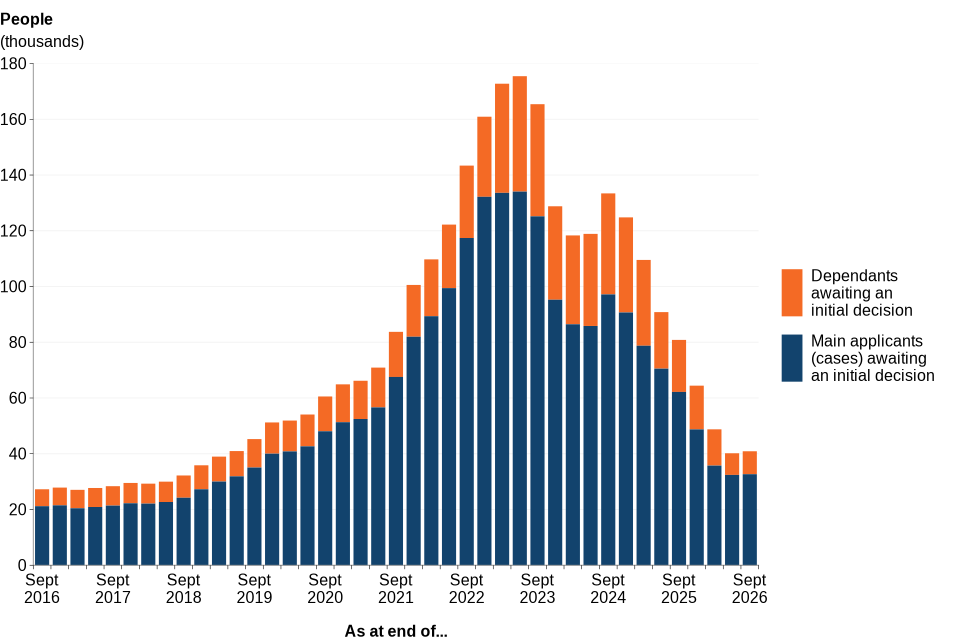
At the end of September 2026 there were 40,887 people (relating to 32,669 cases) awaiting an initial decision, 49% fewer than a year prior and 77% below the peak level in June 2023.
The overall fall in the number of people awaiting an initial decision corresponds to a notable and sustained increase in initial decisions and a fall in applications in recent years.
Figure 1: Number of people and cases awaiting an initial decision, as at 30 September 2016 to as at 30 September 20261
Source: Asylum claims awaiting a decision – Asy_D03
Notes:
- Figures relate to the number of cases or people awaiting a decision at the end of the period, rather than the total throughout the period.
Figure 1 shows that the number of people awaiting an initial decision has been on a downward trend in recent years. However, the number increased slightly in the latest quarter by 2%, from 40,168 to 40,887. This is because volumes of people flowing in (claims) and out (initial decisions and other outcomes) have become more closely aligned in the two most recent quarters, resulting in a levelling off in the recent downward trend.
The amount of time people spend awaiting an initial decision has also reduced. The number of people who had been waiting more than 6 months for an initial decision decreased by 12% in the last quarter, while 72% of asylum claims received in January to March 2026 were processed within 6 months.
Decision-making activity can vary over time due to a range of operational factors, including the flexible deployment of decision makers in response to wider casework demands.
2. How many asylum cases are in the overall asylum casework system?
In addition to those awaiting an initial decision, the asylum casework system includes cases who have appealed their initial decision and are awaiting a further outcome, as well as failed asylum seekers who are subject to removal from the UK.
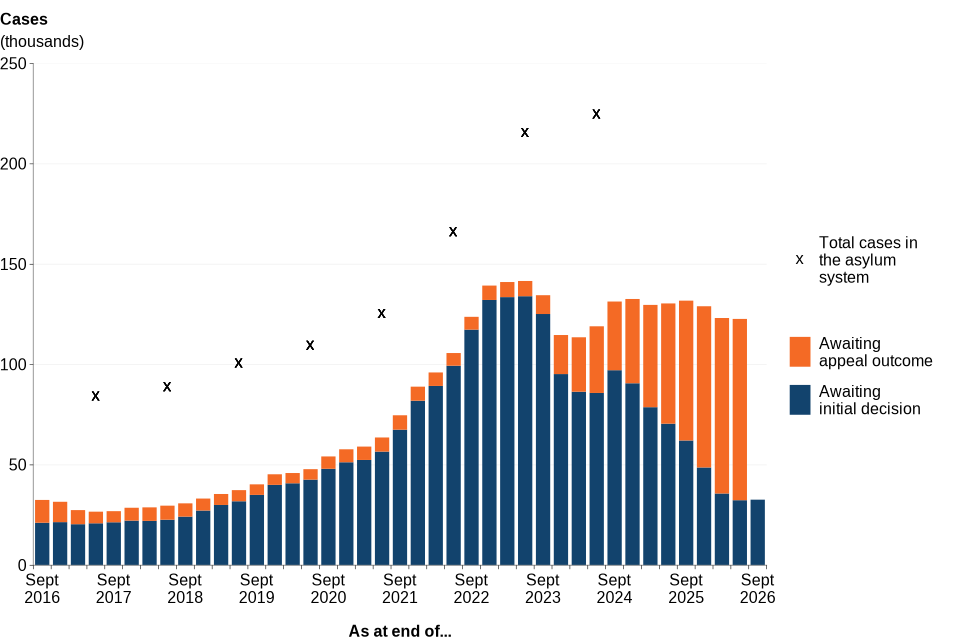
In the past year, the number of people awaiting an initial decision fell, while the asylum appeals open caseload increased.
Figure 2: Asylum main applicants awaiting an initial decision or appeal outcome, and total cases in the asylum system, as at 30 September 2016 to as at 30 September 20261, 2, 3
Source: Asylum claims awaiting a decision – Asy_D03; Migration Transparency Data collection – ASY_03; Tribunal statistics Main Tables, Ministry of Justice – FIA_4
Notes:
- The crosses show the total number of cases in the asylum system, including those awaiting an initial decision, post-decision, with an outstanding appeal, subject to removal action, or on hold.
- All figures relate to the number of cases, not people, awaiting a decision at the end of the period, rather than the total throughout the period.
- The number of cases awaiting an appeal outcome refers to the First-tier Tribunal Immigration and Asylum Chamber (FTTIAC) open caseload, published by the Ministry of Justice. Its coverage is broader than asylum alone and includes appeals relating to asylum, protection and revocation of protection.
The number of cases in the asylum system increased more than fourfold over the decade to June 2024, from 55,814 at the end of June 2014 to 224,742 at the end of June 2024 (as shown in Figure 2). At the end of June 2024, 40% of these cases were awaiting an initial decision, whilst the remaining cases were awaiting an appeal outcome or were failed asylum seekers awaiting removal from the UK. The total number of cases is published in table ASY_03 of Immigration and protection data, as part of the ‘Migration transparency data’.
HMCTS-published data shows that the open Asylum/Protection/Revocation of Protection caseload in the FTTIAC has increased from 6,319 at the end of June 2022 to 90,341 at the end of June 2026 (latest available data at the time of publication). For further information on appeals, see the latest Tribunal statistics from HM Courts and Tribunal Service (HMCTS).
Once an asylum claim has been refused and any rights of appeal have been exhausted, the individual may be returned from the UK. For data on these asylum-related returns, see table Ret_D05 in the Returns detailed datasets, which also provides data on wider returns.
A breakdown of the Home Office’s number of cases awaiting an appeal outcome and awaiting removal is not currently available beyond June 2024 due to work on the transition to a new caseworking system, though work is ongoing to reinstate the data and figures. Once reporting resumes, future publications should be able to provide disaggregated figures.
3. How many asylum seekers are receiving housing and financial support?
People in the asylum system who are destitute can receive support from the UK Government. This support could be the provision of accommodation, subsistence (cash support) or both, and is overseen by the Home Office. More information on asylum support is published on GOV.UK.
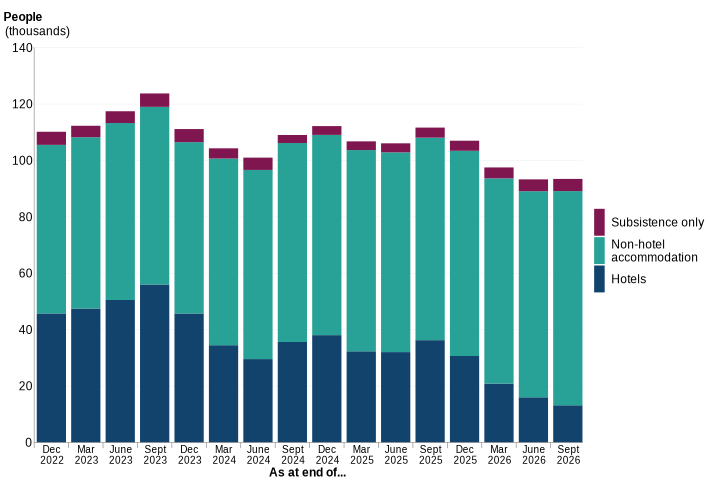
The number of people receiving asylum support has fallen over the last year, with falling numbers of people being accommodated in hotels.
At the end of September 2026, there were 93,453 individuals in receipt of asylum support. This was 16% fewer than at the end of September 2025 and 24% fewer than at the end of September 2023, when the number of supported asylum seekers peaked at 123,758 people.
Figure 3: Number of people in receipt of asylum support, by the type of support, as at 31 December 2022 to as at 30 September 20261
Source: Asylum seekers in receipt of support – Asy_D09
Notes:
- ‘Non-hotel accommodation’ includes initial, other contingency, dispersal and other accommodation.
Between September 2025 and September 2026, the fall in the number of people in hotel accommodation outweighed the increase in non-hotel accommodation. Of the individuals receiving asylum support at the end of September 2026:
- 13,185 (14%) were in hotel accommodation, 23,088 (64%) fewer than at the end of September 2025, and 42,833 (76%) fewer than the peak of 56,018 at the end of September 2023
- 75,947 (81%) were in non-hotel accommodation, such as dispersal, 4,135 (6%) more than at the end of September 2025
- 4,321 (5%) were in receipt of subsistence support only, 755 (21%) more than at the end of September 2025
Trends in the number of people receiving asylum support broadly reflect trends in the number of people in the wider asylum system - that is, more people in the system means that more people are likely to be eligible to receive support.
At the end of September 2026, 40,887 people were awaiting an initial decision and 93,453 people were receiving asylum support. This indicates that most people receiving asylum support are in other parts of the asylum system, including those awaiting an appeal outcome or failed asylum seekers, rather than awaiting an initial decision.
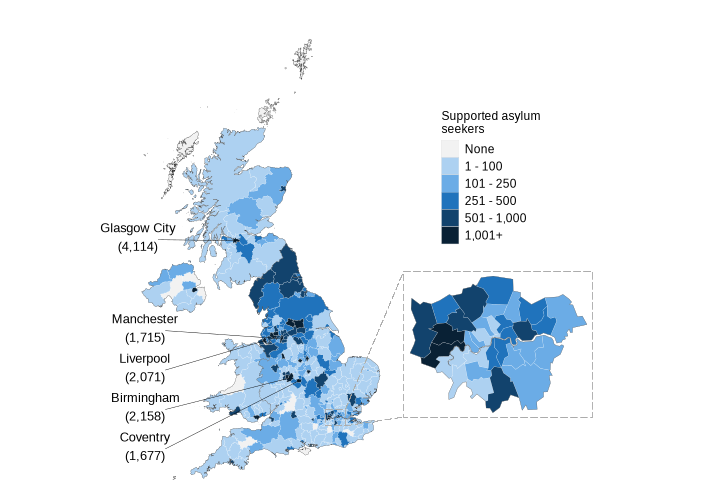
There were 13 supported asylum seekers per 10,000 residents of the UK at the end of September 2026. The regions with the most supported asylum seekers as a proportion of their overall population were the North East and North West of England, with 26 and 25 supported people per 10,000 residents respectively.
The local authorities with the highest numbers of supported asylum seekers within them were Glasgow City (4,114), Birmingham (2,158), Liverpool (2,071), Manchester (1,715) and Coventry (1,677). Of 361 local authorities, around half (48%) had fewer than 100 supported asylum seekers.
The Home Office uses former military sites as part of the government’s commitment to stop using hotels. At the end of September 2026, 728 people were in Wethersfield, Braintree, and 467 people were in Crowborough Training Camp, Wealden. Factsheets on asylum accommodation at military sites are published on GOV.UK.
Figure 4: Supported asylum seekers, by local authority as at 30 September 20261, 2, 3
Source: Asy_D11 – Asylum seekers in receipt of support by local authority and Office for National Statistics licensed under the Open Government Licence v.3.0
Contains OS data © Crown copyright and database right 2026.
Notes:
- Includes main applicants and dependants.
- Figures show the number of supported asylum seekers for the 5 local authorities with the highest number of supported asylum seekers.
- Local authority data is based on the registered address of the asylum seeker. This is not necessarily the location at which the individual regularly resides.
The number of asylum seekers in receipt of support excludes unaccompanied asylum-seeking children (UASC), who are supported by local authorities.
In addition to supported asylum seekers, some of the people who have come to the UK on safe and legal (humanitarian) routes will be accommodated in local authorities (for example, resettled individuals). More detail is available in table Res_D01 of the Resettlement data tables and table Reg_02 of the Regional and local authority data on immigration groups.
4. About the statistics
An asylum claimant (also referred to as an ‘asylum seeker’) is someone who makes a claim to be recognised as a refugee under the Refugee Convention.
An asylum claim marks an individual’s entry into the UK asylum system. Following a claim, people may spend time in the system awaiting an initial decision and, where eligible, may receive accommodation or financial support. Outcomes on a claim may include a grant of protection or other leave, a refusal, or other outcomes such as a withdrawal or an administrative outcome, with some claimants able to appeal following a decision.
An asylum claim may relate to more than one person, if the main applicant has family members (dependants) who are included in the same claim.
These statistics focus on the number of people (main applicants and dependants) claiming asylum. The number of main applicants (excluding dependants) represents the total number of asylum cases that require consideration by the Home Office.
Statistics on other parts of the asylum system are available in other chapters of this report - ‘How many people claim asylum in the UK?’ and ‘How many people are granted asylum in the UK?’.
For more information on the data in this chapter, please see the ‘user guide’.
4.1 Data source
The statistics are based on Home Office administrative data, which is recorded by caseworkers as part of the asylum process. As the data comes from live operational systems, figures may be revised as information is updated and quality assured.
Figures on initial decision WIP are available in both the ‘Migration transparency data collection’ (ASY_02 and ASY_03) and ‘Immigration system statistics’ (Asy_D03). These are produced using different methodologies:
- the Migration transparency data presents data on the number of cases in the asylum system relating to main applicants only, whereas the Immigration system statistics data covers main applicants and dependants (and can be disaggregated into those groups)
- a person should typically only have one asylum case, but there are instances where multiple cases may be opened for a single person; the Migration transparency data presents all open cases, to reflect the volume of open cases in the caseworking system; the Immigration system statistics data includes only the first case opened for a person, to avoid double counting individuals
As a result, figures may differ between the 2 data tables and should not be directly compared.
4.2 Appeals
Data on the number of appeals lodged, and their outcomes, is published in ‘Asylum appeals lodged and determined – Asy_D06 and Asy_D07’. Asylum appeals data from April 2023 onwards was not available at the time of data extraction for this release due to ongoing work as immigration data transitions to a new caseworking system. Updated data will be included in a future edition of the Immigration system statistics release. Figures for immigration and asylum appeals at the First-tier Tribunal and subsequent stages are published by the Ministry of Justice as part of their Tribunal statistics release. For a full list of differences between the Tribunal statistics and Home Office asylum appeals statistics, see the user guide.
5. Data tables
Data referred to here can be found in the following tables:
- Asylum summary tables
- Detailed asylum datasets
- Detailed resettlement datasets
- Migration transparency data
- Regional and local authority data on immigration groups
We welcome your feedback
If you have any comments or suggestions for the development of this report, please provide feedback by emailing ‘MigrationStatsEnquiries@homeoffice.gov.uk’. Please include the words ‘PUBLICATION FEEDBACK’ in the subject of your email.
We’re always looking to improve the accessibility of our documents. If you find any problems or have any feedback relating to accessibility, please email us.
See Section 6 of the ‘About this release’ section for more details.